EP3519320B1 - Lebensmittelverpackungsanordnung und zugehörige verfahren - Google Patents
Lebensmittelverpackungsanordnung und zugehörige verfahren Download PDFInfo
- Publication number
- EP3519320B1 EP3519320B1 EP17781604.8A EP17781604A EP3519320B1 EP 3519320 B1 EP3519320 B1 EP 3519320B1 EP 17781604 A EP17781604 A EP 17781604A EP 3519320 B1 EP3519320 B1 EP 3519320B1
- Authority
- EP
- European Patent Office
- Prior art keywords
- foodstuff
- heating element
- container
- chemically
- cavity
- Prior art date
- Legal status (The legal status is an assumption and is not a legal conclusion. Google has not performed a legal analysis and makes no representation as to the accuracy of the status listed.)
- Active
Links
Images




































Classifications
-
- B—PERFORMING OPERATIONS; TRANSPORTING
- B65—CONVEYING; PACKING; STORING; HANDLING THIN OR FILAMENTARY MATERIAL
- B65D—CONTAINERS FOR STORAGE OR TRANSPORT OF ARTICLES OR MATERIALS, e.g. BAGS, BARRELS, BOTTLES, BOXES, CANS, CARTONS, CRATES, DRUMS, JARS, TANKS, HOPPERS, FORWARDING CONTAINERS; ACCESSORIES, CLOSURES, OR FITTINGS THEREFOR; PACKAGING ELEMENTS; PACKAGES
- B65D81/00—Containers, packaging elements, or packages, for contents presenting particular transport or storage problems, or adapted to be used for non-packaging purposes after removal of contents
- B65D81/34—Containers, packaging elements, or packages, for contents presenting particular transport or storage problems, or adapted to be used for non-packaging purposes after removal of contents for packaging foodstuffs or other articles intended to be cooked or heated within the package
- B65D81/3484—Packages having self-contained heating means, e.g. heating generated by the reaction of two chemicals
-
- A—HUMAN NECESSITIES
- A47—FURNITURE; DOMESTIC ARTICLES OR APPLIANCES; COFFEE MILLS; SPICE MILLS; SUCTION CLEANERS IN GENERAL
- A47J—KITCHEN EQUIPMENT; COFFEE MILLS; SPICE MILLS; APPARATUS FOR MAKING BEVERAGES
- A47J36/00—Parts, details or accessories of cooking-vessels
- A47J36/24—Warming devices
- A47J36/28—Warming devices generating the heat by exothermic reactions, e.g. heat released by the contact of unslaked lime with water
-
- B—PERFORMING OPERATIONS; TRANSPORTING
- B65—CONVEYING; PACKING; STORING; HANDLING THIN OR FILAMENTARY MATERIAL
- B65B—MACHINES, APPARATUS OR DEVICES FOR, OR METHODS OF, PACKAGING ARTICLES OR MATERIALS; UNPACKING
- B65B25/00—Packaging other articles presenting special problems
- B65B25/22—Packaging articles of food, e.g. fish fillets, intended to be cooked in the package
-
- B—PERFORMING OPERATIONS; TRANSPORTING
- B65—CONVEYING; PACKING; STORING; HANDLING THIN OR FILAMENTARY MATERIAL
- B65B—MACHINES, APPARATUS OR DEVICES FOR, OR METHODS OF, PACKAGING ARTICLES OR MATERIALS; UNPACKING
- B65B29/00—Packaging of materials presenting special problems
- B65B29/10—Packaging two or more different substances isolated from one another in the package but capable of being mixed without opening the package, e.g. forming packages containing a resin and hardener isolated by a frangible partition
-
- B—PERFORMING OPERATIONS; TRANSPORTING
- B65—CONVEYING; PACKING; STORING; HANDLING THIN OR FILAMENTARY MATERIAL
- B65D—CONTAINERS FOR STORAGE OR TRANSPORT OF ARTICLES OR MATERIALS, e.g. BAGS, BARRELS, BOTTLES, BOXES, CANS, CARTONS, CRATES, DRUMS, JARS, TANKS, HOPPERS, FORWARDING CONTAINERS; ACCESSORIES, CLOSURES, OR FITTINGS THEREFOR; PACKAGING ELEMENTS; PACKAGES
- B65D25/00—Details of other kinds or types of rigid or semi-rigid containers
- B65D25/02—Internal fittings
- B65D25/04—Partitions
-
- B—PERFORMING OPERATIONS; TRANSPORTING
- B65—CONVEYING; PACKING; STORING; HANDLING THIN OR FILAMENTARY MATERIAL
- B65D—CONTAINERS FOR STORAGE OR TRANSPORT OF ARTICLES OR MATERIALS, e.g. BAGS, BARRELS, BOTTLES, BOXES, CANS, CARTONS, CRATES, DRUMS, JARS, TANKS, HOPPERS, FORWARDING CONTAINERS; ACCESSORIES, CLOSURES, OR FITTINGS THEREFOR; PACKAGING ELEMENTS; PACKAGES
- B65D81/00—Containers, packaging elements, or packages, for contents presenting particular transport or storage problems, or adapted to be used for non-packaging purposes after removal of contents
- B65D81/32—Containers, packaging elements, or packages, for contents presenting particular transport or storage problems, or adapted to be used for non-packaging purposes after removal of contents for packaging two or more different materials which must be maintained separate prior to use in admixture
-
- B—PERFORMING OPERATIONS; TRANSPORTING
- B65—CONVEYING; PACKING; STORING; HANDLING THIN OR FILAMENTARY MATERIAL
- B65D—CONTAINERS FOR STORAGE OR TRANSPORT OF ARTICLES OR MATERIALS, e.g. BAGS, BARRELS, BOTTLES, BOXES, CANS, CARTONS, CRATES, DRUMS, JARS, TANKS, HOPPERS, FORWARDING CONTAINERS; ACCESSORIES, CLOSURES, OR FITTINGS THEREFOR; PACKAGING ELEMENTS; PACKAGES
- B65D81/00—Containers, packaging elements, or packages, for contents presenting particular transport or storage problems, or adapted to be used for non-packaging purposes after removal of contents
- B65D81/34—Containers, packaging elements, or packages, for contents presenting particular transport or storage problems, or adapted to be used for non-packaging purposes after removal of contents for packaging foodstuffs or other articles intended to be cooked or heated within the package
-
- B—PERFORMING OPERATIONS; TRANSPORTING
- B65—CONVEYING; PACKING; STORING; HANDLING THIN OR FILAMENTARY MATERIAL
- B65D—CONTAINERS FOR STORAGE OR TRANSPORT OF ARTICLES OR MATERIALS, e.g. BAGS, BARRELS, BOTTLES, BOXES, CANS, CARTONS, CRATES, DRUMS, JARS, TANKS, HOPPERS, FORWARDING CONTAINERS; ACCESSORIES, CLOSURES, OR FITTINGS THEREFOR; PACKAGING ELEMENTS; PACKAGES
- B65D2581/00—Containers, packaging elements, or packages, for contents presenting particular transport or storage problems, or adapted to be used for non-packaging purposes after removal of contents
- B65D2581/34—Containers, packaging elements, or packages, for contents presenting particular transport or storage problems, or adapted to be used for non-packaging purposes after removal of contents for packaging foodstuffs or other articles intended to be cooked or heated within
- B65D2581/3401—Cooking or heating method specially adapted to the contents of the package
- B65D2581/3429—Packages containing a secondary product to be cooked and discharged over the primary product
- B65D2581/3431—Packages containing a secondary product to be cooked and discharged over the primary product the secondary product, e.g. fudge, being heated over ice-cream
Definitions
- This disclosure relates to a foodstuff packaging assembly and more particularly to a foodstuff packaging assembly including foodstuff packaging, a first foodstuff disposed within the foodstuff packaging, and a second foodstuff disposed within the foodstuff packaging.
- the disclosure also relates to a method for assembling a foodstuff packaging assembly and a method for utilizing a foodstuff packaging assembly.
- Foodstuff packaging including foodstuff contained therein are known. While existing foodstuff packaging including foodstuff contained therein perform adequately for their intended purpose, improvements to foodstuff packaging including foodstuff contained therein are continuously being sought in order to advance the arts. in the state of the art are known documents
- One aspect of the disclosure provides an assembly as set out in claim 1.
- the second foodstuff material may be selected from the group consisting of: granola, muesli, oats, seeds, nuts and cereal.
- the first foodstuff material may be selected from the group consisting of: chocolate and fudge.
- the first foodstuff material may include ice cream.
- the heating element may include a first portion and a second portion that is detachably-connected to the first portion.
- the first portion of the heating element may include an inner surface, an outer surface and one or more passages formed in the outer surface of the first portion of the heating element.
- the second portion of the heating element may include an inner surface and an outer surface.
- the inner surface of the second portion of the heating element may be disposed adjacent the outer surface of the first portion of the heating element.
- the inner surface of the first portion of the heating element may be disposed adjacent the outer surface of the base portion of the foodstuff container.
- the first portion of the heating element may define a cavity that contains a chemically-activated material. More particularly, the chemically-activated material may be an oxygen-activated material.
- the second portion of the heating element may be a removable film member. Upon removing the removable film member of the heating element from the first portion of the heating element, the one or more passages formed in the outer surface of the first portion of the heating element may arrange the chemically-activated material in direct fluid communication with the surrounding atmosphere for permitting oxygen to chemically react with the chemically-activated material for causing the first portion of the heating element to generate heat.
- the chemically-activated material includes zinc.
- the zinc may become zinc oxide.
- Both of the first foodstuff and the second foodstuff are contained within the foodstuff-receiving cavity of the foodstuff container.
- the foodstuff packaging includes a foodstuff separator arranged within the foodstuff-receiving cavity of the foodstuff container for separating the foodstuff-receiving cavity into: a first foodstuff-receiving cavity portion that is sized for receiving an amount of the first foodstuff and a second foodstuff-receiving cavity portion that is sized for receiving an amount of the second foodstuff.
- the foodstuff separator includes an upper surface, a lower surface and a side surface connecting the upper surface to the lower surface.
- the foodstuff separator may also be defined by a thickness extending between the upper surface of the foodstuff separator and the lower surface of the foodstuff separator.
- the foodstuff separator includes a plurality of passages that extend through the thickness of the foodstuff separator for arranging the first foodstuff-receiving cavity portion in fluid communication with the second foodstuff-receiving cavity portion.
- the heating element is attached to the foodstuff container. In other examples, the heating element is formed with the foodstuff container. In yet other examples, not according to the invention, the heating element is formed with the closure.
- Another aspect of the disclosure provides a method for assembling an assembly, as set out in claim 7.
- the method may include: providing foodstuff packaging including a foodstuff container defining a foodstuff-receiving cavity, a heating element attached to a surface of the foodstuff container.
- the heating element may include a first portion and a second portion that is detachably-connected to the first portion.
- the first portion of the heating element includes chemically-activated material.
- the method may also include detachably-removing the second portion of the heating element from the first portion of the heating element for permitting oxygen from surrounding atmosphere to chemically react with the chemically-activated material for causing the first portion of the heating element to generate heat.
- the method may also include transferring the heat generated by the first portion of the heating element from the heating element to the foodstuff container.
- the method may also include further transferring the heat generated by the first portion of the heating element from the heating element to a first foodstuff by way of the foodstuff container.
- the first foodstuff may be contained within the foodstuff-receiving cavity of the foodstuff container.
- the method may also include utilizing the heat that is transferred to the first foodstuff for transitioning the first foodstuff from a substantially solid state to a substantially liquid state.
- the method may also include comingling the first foodstuff that is in the liquid state with the second foodstuff that is contained within the foodstuff-receiving cavity of the foodstuff container for forming a comingled foodstuff within the foodstuff-receiving cavity of the foodstuff container.
- the method also includes removing a closure from the foodstuff packaging for accessing the comingled foodstuff within the foodstuff-receiving cavity of the foodstuff container.
- the method includes: stirring or shaking the comingled foodstuff within the foodstuff-receiving cavity of the foodstuff container; and consuming the comingled foodstuff that is contained within the foodstuff-receiving cavity of the foodstuff container.
- the second foodstuff material is selected from the group consisting of: granola, muesli, oats, seeds, nuts and cereal, not being limited by the first foodstuff.
- the first foodstuff includes a foodstuff material is selected from the group consisting of: chocolate and fudge, not being limited by the second foodstuff material.
- Example configurations will now be described more fully with reference to the accompanying drawings.
- Example configurations are provided so that this disclosure will be thorough, and will fully convey the scope of the disclosure to those of ordinary skill in the art. Specific details are set forth such as examples of specific components, devices, and methods, to provide a thorough understanding of configurations of the present disclosure. It will be apparent to those of ordinary skill in the art that specific details need not be employed, that example configurations may be embodied in many different forms, and that the specific details and the example configurations should not be construed to limit the scope of the disclosure.
- first, second, third, etc. may be used herein to describe various elements, components, regions, layers and/or sections. These elements, components, regions, layers and/or sections should not be limited by these terms. These terms may be only used to distinguish one element, component, region, layer or section from another region, layer or section. Terms such as “first,” “second,” and other numerical terms do not imply a sequence or order unless clearly indicated by the context. Thus, a first element, component, region, layer or section discussed below could be termed a second element, component, region, layer or section without departing from the teachings of the example configurations.
- the assembly 10 includes a plurality of members defining foodstuff packaging (see, e.g., reference numerals 12, 14, 20), a first foodstuff (see, e.g., reference numeral 16) and a second foodstuff (see, e.g., reference numeral 18).
- the first foodstuff 16 may be separated from, and not comingled throughout, the second foodstuff 18.
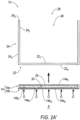
- the assembly 10 may be subsequently activated (see, e.g., FIGS. 3B-3C , 4C-4D ) by a user U (see, e.g., FIG.
- the heat H imparted to the first foodstuff 16 may cause the first foodstuff 16 to transition or phase change (e.g., melt) from a first state (e.g., solid) to a second state (e.g., liquid).
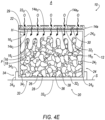
- the first foodstuff 16 may seep or ooze into the second foodstuff 18 such that the first foodstuff 16 is comingled throughout the second foodstuff 18 while the first foodstuff 16 and the second foodstuff 18 are contained within another portion (see, e.g., reference numeral 12) of the foodstuff packaging 12, 14, 20 in order to define a comingled foodstuff (see, e.g., reference letter F in FIGS. 3C-3D , 4E-4I ) that is contained within the foodstuff packaging 12, 14, 20.
- the user U may then remove (see, e.g., FIGS.
- the assembly 10 may include a foodstuff container 12, a heating element 14, a first foodstuff 16, a second foodstuff 18, and a closure 20.
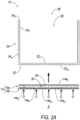
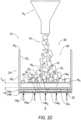
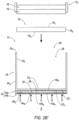
- FIGS. 2A-2F illustrate a first methodology for assembling the assembly 10.
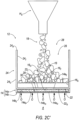
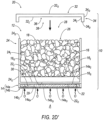
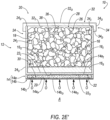
- FIGS. 2A'-2E' illustrate a second methodology for assembling the assembly 10.
- the heating element (14) in one possible embodiment could be attached to the foodstuff container (12) and can be formed either with the foodstuff container or with the closure (20).
- the foodstuff container 12 may include a base portion 22 connected to a sidewall portion 24.
- the base portion 22 includes an inner surface 22 I and an outer surface 22 O .
- the sidewall portion 24 includes an inner surface 24 I , an outer surface 24 O , and a distal end surface 24 D that connects the inner surface 24 I to the outer surface 24 O .
- the inner surface 22 I of the base portion 22 and the inner surface 24 I of the sidewall portion 24 define a foodstuff-receiving cavity 26 of the foodstuff container 12. Access to the foodstuff-receiving cavity 26 is formed by an opening 28 defined by the inner surface 24 I of the sidewall portion 24 and the distal end surface 24 D of the sidewall portion 24.
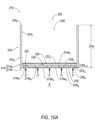
- the heating element 14 includes a first portion 14a and a second portion 14b.
- the first portion 14a of the heating element 14 includes an inner surface 14a I , an outer surface 14ao, and one or more passages 14a P formed in the outer surface 14ao.
- the second portion 14b of the heating element 14 includes an inner surface 14b I and an outer surface 14bo.
- the inner surface 14b I of the second portion 14b of the heating element 14 is disposed adjacent the outer surface 14ao of the first portion 14a of the heating element 14.
- the inner surface 14a I of the first portion 14a of the heating element 14 is disposed adjacent the outer surface 22 O of the base portion 22.
- the second portion 14b of the heating element 14 may be a removable film member that is discarded into a trash receptacle T once the inner surface 14b I of the second portion 14b of the heating element 14 is selectively-detached from (and no longer disposed adjacent to) the outer surface 14ao of the first portion 14a of the heating element 14.
- the first portion 14a of the heating element 14 further defines a cavity 29.
- the cavity 29 may include a chemically-activated material 30.
- the chemically-activated material 30 may be disposed within the cavity 29.
- the chemically-activated material 30 may include an air-activated material, and more particularly, an oxygen-activated material, such as, for example, zinc.
- the second portion 14b may prevent fluid communication between the cavity 29 and the atmosphere A through the one or more passages 14a P formed in the outer surface 14ao of the first portion 14a.
- the one or more passages 14a P may be prevented from fluidly communicating with surrounding atmosphere A (thereby preventing oxygen O from surrounding atmosphere A to pass through the one or more passages 14a P formed in the outer surface 14ao of the first portion 14a of the heating element 14 for subsequently contacting the chemically-activated material 30).
- oxygen O from surrounding atmosphere A to pass through the one or more passages 14a P formed in the outer surface 14ao of the first portion 14a of the heating element 14 for subsequently contacting the chemically-activated material 30.
- a user U may selectively activate the chemically-activated material 30 by removing the second portion 14b of the heating element 14 from the first portion 14a of the heating element 14 in order to permit the oxygen O from the surrounding atmosphere A to pass through the one or more passages 14a P formed in the outer surface 14ao of the first portion 14a and into the cavity 29 such that the oxygen O may come into contact with the chemically-activated material 30.
- a chemical reaction takes place (e.g., the zinc defining the chemically-activated material 30 becomes zinc oxide), which causes the chemically-activated material 30 to generate heat.
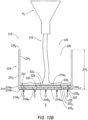
- the first foodstuff 16 may be deposited into the foodstuff-receiving cavity 26 of the foodstuff container 12.
- the first foodstuff 16 may be deposited into the foodstuff-receiving cavity 26 of the foodstuff container 12 in a liquid state or a solid state. If the first foodstuff 16 is in liquid state when it is deposited into the foodstuff-receiving cavity 26 of the foodstuff container 12, the first foodstuff 16 may be extruded into the foodstuff-receiving cavity 26 of the foodstuff container 12 from an extruder or first foodstuff hopper Hc.
- the first foodstuff 16 may be permitted to cure in order to permit the first foodstuff 16 to transition from a liquid state to a solid state.
- the first foodstuff 16 may stick to but may also be removably attached to at least a portion of the inner surface 22 I of the base portion 22 of the foodstuff container 12.
- the first foodstuff 16 when the first foodstuff 16 is cured into a solid state, the first foodstuff 16 may be attached to or disposed over (i) all of the inner surface 22 I of the base portion 22 of the foodstuff container 12 and (ii) a portion of the inner surface 24 I of the sidewall portion 24 of the foodstuff container 12 that extends away from the inner surface 22 I of the base portion 22.
- the first foodstuff 16 when the first foodstuff 16 has cured into a solid state, the first foodstuff 16 may be defined by an upper surface 16 I , a lower surface 16 O and a side surface 16 S connecting the upper surface 16 I to the lower surface 16 O .
- the first foodstuff 16 may also be defined by a thickness T 16 extending between the upper surface 16 I and the lower surface 16 O .
- the inner surface 24 I of the sidewall portion 24 of the foodstuff container 12 defines the foodstuff-receiving cavity 26 of the foodstuff container 12 to have a substantially cylindrical shape
- the side surface 16 S of the first foodstuff 16 may define the first foodstuff 16 to have a diameter D 16 .
- the second foodstuff 18 may be deposited into the foodstuff-receiving cavity 26 of the foodstuff container 12.
- the second foodstuff material 18 may include one or more of, but is not limited to: granola, muesli, oats, seeds, nuts, cereal or the like.
- the second foodstuff 18 is shown to include a plurality of pieces or units of foodstuff, the second foodstuff 18 may include one piece or one unit of foodstuff that is deposited into the foodstuff-receiving cavity 26.
- the second foodstuff 18 may be defined as a "low moisture" food material.
- an exemplary "high moisture” food material may be defined to include, for example, ice cream, chocolate, fudge or the like. Therefore, in some instances, when the second foodstuff 18 includes, for example, one or more of granola, muesli, oats, seeds, nuts, cereal or the like, such foodstuff is known to have a relatively low moisture content, and, therefore, may be deemed or defined as being an exemplary "low moisture" foodstuff material.
- the second foodstuff 18 may include a "low moisture" foodstuff material, and, in being differentiated from the first foodstuff 16, the second foodstuff 18 may be deemed or defined in the negative context as not being a "high moisture” foodstuff material. Furthermore, in other examples, the first foodstuff 16 and the second foodstuff 18 may be defined as having approximately the same moisture content.
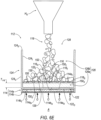
- the second foodstuff 18 may deposited into the foodstuff-receiving cavity 26 of the foodstuff container 12 from a second foodstuff hopper H G .
- the second foodstuff 18 may be contained with the foodstuff-receiving cavity 26 and arranged upon and over the upper surface 16 I of the first foodstuff 16 such that that second foodstuff 18 is separated from, and not comingled or mixed with, the first foodstuff 16.
- the second foodstuff hopper H G may meter any desirable amount of the second foodstuff 18 into the foodstuff-receiving cavity 26. In some instances, the second foodstuff hopper H G may meter an amount of the second foodstuff 18 that is approximately equal to a remainder of a volume of the foodstuff-receiving cavity 26 that is not occupied by the first foodstuff 16.
- the closure 20 includes at least a base portion 32.
- the base portion 32 includes an inner surface 32 I and an outer surface 32 O .
- the closure 20 may also include a sidewall portion 34 connected to the base portion 32.
- the sidewall portion 34 includes an inner surface 34 I , an outer surface 34 O , and a distal end surface 34 D that connects the inner surface 34 I to the outer surface 34 O .
- the inner surface 32 I of the base portion 32 and the inner surface 34 I of the sidewall portion 34 define a container-receiving cavity 36. Access to the container-receiving cavity 36 is formed by an opening 38 defined by the inner surface 34 I of the sidewall portion 34 and the distal end surface 34 D of the sidewall portion 34.
- the inner surface 32 I of the base portion 32 of the closure 20 may be removably attached to the distal end surface 24 D of the sidewall portion 24 of the foodstuff container 12. Attachment of the inner surface 32 I of the base portion 32 of the closure 20 to the distal end surface 24 D of the sidewall portion 24 of the foodstuff container 12 may be conducted in any desirable methodology such as, for example, ultrasonic welding, a friction-fit connection or the like.
- the inner surface 34 I of the sidewall portion 34 of the closure 20 may include a threaded surface (not shown) that cooperates with a corresponding threaded surface (not shown) formed upon a portion of the outer surface 24 O of the sidewall portion 24 of the foodstuff container 12 in order to removably attach the closure 20 to the foodstuff container 12.
- FIGS. 2A' -2E' an alternative methodology for assembling the assembly 10 is described.
- the alternative methodology for assembling the assembly 10 of FIGS. 2A'-2E' is substantially similar to the methodology for assembling the assembly 10 of FIGS. 2A-2F .
- the methodology for assembling the assembly 10 of FIGS. 2A'-2E' does, however, differ from the methodology for assembling the assembly 10 of FIGS. 2A-2F as shown and described below at FIGS. 2B'-2C' ; therefore, the following description related to the methodology associated with the assembling of the assembly 10 at FIGS. 2A'-2E' is limited to the disclosure found at FIGS. 2B'-2C' (i.e., the remaining disclosure associated with the assembly of the assembly 10 at FIGS. 2A'-2E' is substantially the same as the disclosure associated with the assembly of the assembly 10 at FIGS. 2A-2F ).
- the first foodstuff 16 (e.g., chocolate, fudge or the like) may be deposited into the foodstuff-receiving cavity 26 of the foodstuff container 12.
- the first foodstuff 16 may be deposited into the foodstuff-receiving cavity 26 of the foodstuff container 12 in a pre-cured, substantially solid form (rather than in liquid form as described above at FIG. 2B ).
- the first foodstuff 16 may be metered from a first foodstuff hopper H C that may include, for example, a magazine of prefabricated first foodstuff 16 members that are in a pre-cured, substantially solid form.
- the first foodstuff 16 may be removably attached to or, alternatively, disposed over at least a portion of the inner surface 22 I of the base portion 22 of the foodstuff container 12. In some instances, the first foodstuff 16 may be attached to or disposed over all of the inner surface 22 I of the base portion 22 of the foodstuff container 12 and a portion of the inner surface 24 I of the sidewall portion 24 of the foodstuff container 12 that extends away from the inner surface 22 I of the base portion 22 of the foodstuff container 12.
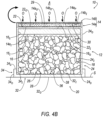
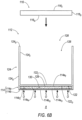
- the outer surface 14bo of the second portion 14b of the heating element 14 may be first optionally arranged upon a support surface S such that the assembly 10 is arranged in a "right-side-up" orientation upon the support surface S. Then, as seen in FIGS. 3B and 4B , the outer surface 32 O of the base portion 32 of the closure 20 may be arranged upon the support surface S such that the assembly 10 is arranged in an "up-side-down" orientation upon the support surface S.
- the second portion 14b of the heating element 14 which may be a removable film member, is then selectively-detached from the outer surface 14ao of the first portion 14a of the heating element 14.
- the second portion 14b of the heating element 14 may be discarded into a trash receptacle T.
- the chemically-activated material 30 contained within the cavity 29 of the first portion 14a of the heating element 14 is selectively activated. Activation of the chemically-activated material 30 contained within the first portion 14a of the heating element 14 occurs when oxygen O from surrounding atmosphere A is permitted to be in fluid communication with the chemically-activated material 30.
- the one or more passages 14a P formed in the outer surface 14ao of the first portion 14a are not permitted to be in fluid communication with surrounding atmosphere A (thereby not permitting oxygen O from surrounding atmosphere A to pass through the one or more passages 14a P formed in the outer surface 14ao of the first portion 14a of the heating element 14 for subsequently contacting the chemically-activated material 30).
- an oxygen barrier formed by the second portion 14b of the heating element 14 no longer exists, and, as a result, oxygen O from surrounding atmosphere A is permitted to pass through the one or more passages 14a P formed in the outer surface 14ao of the first portion 14a such that the oxygen O may come into contact with the chemically-activated material 30.
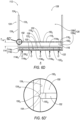
- a chemical reaction takes place (e.g., the zinc defining the chemically-activated material 30 becomes zinc oxide), which causes the chemically-activated material 30 to generate heat H (see, e.g., FIG. 4C ).
- the heat H generated by the chemically-activated material 30 of the first portion 14a of the heating element 14 is passed through the base portion 22 of the foodstuff container 12 such that the heat H is ultimately imparted into and absorbed by the first foodstuff 16.
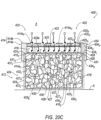
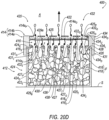
- the heat H causes the first foodstuff 16 to transition from a substantially solid state (see, e.g., FIG. 4C ) to a melted, substantially liquid state (see, e.g., FIGS. 4D-4F ).
- FIGS. 4C substantially solid state
- FIGS. 4D-4F a melted, substantially liquid state
- the first foodstuff 16 detaches from one or more of the inner surface 22 I of the base portion 22 of the foodstuff container 12 and the inner surface 24 I of the sidewall portion 24 of the foodstuff container 12 such that the first foodstuff 16 vertically seeps or oozes downwardly and into the second foodstuff 18 such that the first foodstuff 16 is comingled throughout the second foodstuff 18 to define a comingled foodstuff F that is contained within foodstuff container 12.
- the container 12, the heating element 14 and the closure 20 is then returned to the "right-side-up" orientation upon the support surface S that that the outer surface 14ao of the first portion 14a of the heating element 14 is arranged upon the support surface S.
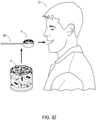
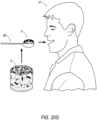
- the closure 20 may be selectively-removed from the foodstuff container 12 such that a user U (see, e.g., FIG. 4I ) may access the foodstuff-receiving cavity 26 of the foodstuff container 12 that contains the comingled foodstuff F. If desired, as seen in FIG.
- the user U may arrange a utensil (e.g., a spoon SP) within the foodstuff-receiving cavity 26 of the foodstuff container 12 for mixing or stirring the comingled foodstuff F.
- a utensil e.g., a spoon SP
- the closure 20 could remain attached to the foodstuff container 12 and the comingled foodstuff F could be shaken.
- the user U may consume the comingled foodstuff F.
- the first foodstuff 16 is heated H by a portion (i.e., the heating element 14) of the foodstuff packaging 12, 14, 20.
- the foodstuff packaging 12, 14, 20 provides a "self-heating" function that avoids the use of a non-packaging, external heat source (e.g., a microwave oven, a gas oven, an electric oven, a stove, fire or the like) for imparting heat to the first foodstuff 16.
- a non-packaging, external heat source e.g., a microwave oven, a gas oven, an electric oven, a stove, fire or the like
- the arrangement of the heating element 14 in an opposing relationship with respect to the first foodstuff 16 substantially limits the heat H generated by the heating element 14 to be mostly received by the first foodstuff 16 and not the second foodstuff 18.
- the first foodstuff 16 may, as desired, transition from a liquid state to a solid state; however, if the second foodstuff 18 is, for example, a "low moisture" food product, the second foodstuff 18 may undesirably burn (as a result of having very little or no moisture, which may be evaporated upon being heated) when microwave energy is imparted into the second foodstuff 18.
- the heat H from the heating element 14 may merely warm the second foodstuff 18 while also avoiding any damage / burning of the second foodstuff 18, which would otherwise occur if a non-packaging external heat source (e.g., a microwave oven) were to be utilized for heating the first foodstuff 16.
- a non-packaging external heat source e.g., a microwave oven
- FIG. 5 illustrates an exemplary assembly, which is shown generally at 100.
- the assembly 100 includes a plurality of members defining foodstuff packaging (see, e.g., reference numerals 112, 114, 120, 150), a first foodstuff (see, e.g., reference numeral 116) and a second foodstuff (see, e.g., reference numeral 118).
- foodstuff packaging see, e.g., reference numerals 112, 114, 120, 150
- a first foodstuff see, e.g., reference numeral 116
- a second foodstuff see, e.g., reference numeral 118.
- the first foodstuff 116 vertically seeps or oozes into the second foodstuff 118 such that the first foodstuff 116 is comingled throughout the second foodstuff 118 while the first foodstuff 116 and the second foodstuff 118 are contained within another portion (see, e.g., reference numeral 112) of the foodstuff packaging 112, 114, 120, 150 in order to define a comingled foodstuff (see, e.g., reference letter F in FIGS. 7C-7D , 8E-8I ) that is contained within the foodstuff packaging 112, 114, 120, 150.
- the user U may then remove (see, e.g., FIGS.
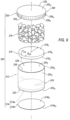
- the assembly 100 may include a foodstuff container 112, a heating element 114, a first foodstuff 116, a second foodstuff 118, a closure 120, and a foodstuff separator 150.
- FIGS. 6A-6G illustrate a methodology for assembling the assembly 100.
- the foodstuff container 112 may include a base portion 122 connected to a sidewall portion 124.
- the base portion 122 may include an inner surface 122 I and an outer surface 122 O .
- the sidewall portion 124 may include an inner surface 124 I , an outer surface 124 O and a distal end surface 124 D connects the inner surface 124 I to the outer surface 124 O .
- the inner surface 122 I of the base portion 122 and the inner surface 124 I of the sidewall portion 124 define a foodstuff-receiving cavity 126 of the foodstuff container 112. Access to the foodstuff-receiving cavity 126 is formed by an opening 128 defined by the inner surface 124 I of the sidewall portion 124 and the distal end surface 124 D of the sidewall portion 124.
- the heating element 114 may include a first portion 114a and a second portion 114b.
- the first portion 114a of the heating element 114 includes an inner surface 114a I , an outer surface 114ao and one or more passages 114a P formed in the outer surface 114a O .
- the second portion 114b of the heating element 114 includes an inner surface 114b I and an outer surface 114bo.
- the inner surface 114b I of the second portion 114b of the heating element 114 is disposed adjacent the outer surface 114ao of the first portion 114a of the heating element 114.
- the inner surface 114a I of the first portion 114a of the heating element 114 is disposed adjacent the outer surface 122 O of the base portion 122.
- the second portion 114b of the heating element 114 may be a removable film member that is discarded into a trash receptacle T once the inner surface 114b I of the second portion 114b of the heating element 114 is selectively-detached from (and no longer disposed adjacent to) the outer surface 114ao of the first portion 114a of the heating element 114.
- the first portion 114a of the heating element 114 further defines a cavity 129 that may include a chemically-activated material 130.
- the chemically-activated material 130 may be disposed within the cavity 129.
- the chemically-activated material 130 may include an air-activated material, and more particularly, an oxygen-activated material, such as, for example, zinc.
- the one or more passages 14a P are prevented from fluidly communicating with surrounding atmosphere A (thereby not permitting oxygen O from surrounding atmosphere A to pass through the one or more passages 114a P formed in the outer surface 114ao of the first portion 114a of the heating element 114 for subsequently contacting the chemically-activated material 130).
- a user U may selectively activate the chemically-activated material 130 by removing the second portion 114b of the heating element 114 from the first portion 114a of the heating element 114 in order to permit the oxygen O from the surrounding atmosphere A to pass through the one or more passages 114a P formed in the outer surface 114ao of the first portion 114a and into the cavity 129 such that the oxygen O may come into contact with the chemically-activated material 130.
- a chemical reaction takes place (e.g., the zinc defining the chemically-activated material 130 becomes zinc oxide), which causes the chemically-activated material 130 to generate heat.
- the first foodstuff 116 (e.g., chocolate, fudge or the like) may be deposited into the foodstuff-receiving cavity 126 of the foodstuff container 112.
- the first foodstuff 116 may be deposited into the foodstuff-receiving cavity 126 of the foodstuff container 112 in a pre-cured, substantially solid state.
- the first foodstuff 116 may be metered from a first foodstuff hopper H C that may include, for example, a magazine of prefabricated first foodstuff 116 members that are in a pre-cured, substantially solid form.
- the first foodstuff 116 may be defined by an upper surface 116 I , a lower surface 116 O and a side surface 116s connecting the upper surface 116 I to the lower surface 116 O .
- the first foodstuff 116 may also be defined by a thickness T 116 extending between the upper surface 116 I and the lower surface 116 O .
- the side surface 116 S of the first foodstuff 116 may define the first foodstuff 116 to have a diameter D 116 .
- the first foodstuff 116 may be removably attached to or, alternatively, disposed over at least a portion of the inner surface 122 I of the base portion 122 of the foodstuff container 112. In some instances, the first foodstuff 116 may be attached to or disposed over all of the inner surface 122 I of the base portion 122 of the foodstuff container 112 and a portion of the inner surface 124 I of the sidewall portion 124 of the foodstuff container 112 that extends away from the inner surface 122 I of the base portion 122 of the foodstuff container 112.
- the foodstuff separator 150 may be deposited into the foodstuff-receiving cavity 126 of the foodstuff container 112.
- the foodstuff separator 150 may include an upper surface 150 I , a lower surface 150 O and a side surface 150s connecting the upper surface 150 I to the lower surface 150 O .
- the foodstuff separator 150 is also defined by a thickness T 150 extending between the upper surface 150 I and the lower surface 150 O .
- the lower surface 150 O of the foodstuff separator 150 may be disposed adjacent to, or, in a spaced-apart relationship with respect to the upper surface 116 I of the first foodstuff 116.
- the side surface 150 S of the foodstuff separator 150 may include a radially-outwardly-extending projection 150 S-P .
- the radially-outwardly-extending projection 150 S-P may be registered within a recess 124 I-R formed in the inner surface 124 I of the sidewall portion 124 of the foodstuff container 112 for radially connecting the foodstuff separator 150 to the inner surface 124 I of the sidewall portion 124 of the foodstuff container 112.
- the foodstuff separator 150 When the foodstuff separator 150 is connected to the inner surface 124 I of the sidewall portion 124 of the foodstuff container 112, the foodstuff separator 150 separates the foodstuff-receiving cavity 126 of the foodstuff container 112 into a first foodstuff-receiving cavity portion 126a that is sized for receiving an amount of the first foodstuff 116 and a second foodstuff-receiving cavity portion 126b that is sized for receiving an amount of the second foodstuff 118.
- the foodstuff separator 150 may retain the first foodstuff 116 between the lower surface 150 O of the foodstuff separator 150 and the inner surface 122 I of the base portion 122 of the foodstuff container 112.
- the foodstuff separator 150 may secure the lower surface 116 O of the first foodstuff 116 adjacent to the inner surface 122 I of the base portion 122 of the foodstuff container 112 in order to promote a transfer of heat H from the heating element 114, through the base portion 122 of the foodstuff container 112 and to the first foodstuff 116.
- the foodstuff separator 150 also includes a plurality of passages 152 that may extend through the thickness T 150 of the foodstuff separator 150.
- the plurality of passages 152 formed by the foodstuff separator 150 may permit the first foodstuff to seep, ooze or flow-through the plurality of passages 152 formed by the foodstuff separator 150 such that the first foodstuff 116 may flow out of the first foodstuff-receiving cavity portion 126a and into the second foodstuff-receiving cavity portion 126b.
- the second foodstuff 118 may be deposited into the second foodstuff-receiving cavity portion 126b of the foodstuff-receiving cavity 126 of the foodstuff container 112.
- the second foodstuff 118 may deposited into the second foodstuff-receiving cavity portion 126b of the foodstuff-receiving cavity 126 of the foodstuff container 112 from a second foodstuff hopper H G .
- the second foodstuff 118 is contained with the second foodstuff-receiving cavity portion 126b of the foodstuff-receiving cavity 126 and arranged upon and over the upper surface 150 I of the foodstuff separator 150 such that that second foodstuff 118 is separated from, and not comingled with, the first foodstuff 116.
- the second foodstuff hopper H G may meter any desirable amount of the second foodstuff 118 into the second foodstuff-receiving cavity portion 126b of the foodstuff-receiving cavity 126.
- the closure 120 includes at least a base portion 132.
- the base portion 132 includes an inner surface 132 I and an outer surface 132 O .
- the closure 120 may also include a sidewall portion 134 connected to the base portion 132.
- the sidewall portion 134 includes an inner surface 134 I , an outer surface 134 O and a distal end surface 134 D that connects the inner surface 134 I to the outer surface 134 O .
- the inner surface 132 I of the base portion 132 and the inner surface 134 I of the sidewall portion 134 define a container-receiving cavity 136. Access to the container-receiving cavity 136 is formed by an opening 138 defined by the inner surface 134 I of the sidewall portion 134 and the distal end surface 134 D of the sidewall portion 134.
- the inner surface 132 I of the base portion 132 of the closure 120 may be removably attached to the distal end surface 124 D of the sidewall portion 124 of the foodstuff container 112. Attachment of the inner surface 132 I of the base portion 132 of the closure 120 to the distal end surface 124 D of the sidewall portion 124 of the foodstuff container 112 may be conducted in any desirable methodology such as, for example, ultrasonic welding, a friction-fit connection or the like.
- the inner surface 134 I of the sidewall portion 134 of the closure 120 may include a threaded surface (not shown) that cooperates with a corresponding threaded surface (not shown) formed upon a portion of the outer surface 124 O of the sidewall portion 124 of the foodstuff container 112 in order to removably attach the closure 120 to the foodstuff container 112.
- the outer surface 114bo of the second portion 114b of the heating element 114 may be arranged upon a support surface S such that the assembly 100 is arranged in a "right-side-up" orientation upon the support surface S.
- the outer surface 132 O of the base portion 132 of the closure 120 may be arranged upon the support surface S such that the assembly 100 is arranged in an "up-side-down" orientation upon the support surface S.
- the second portion 114b of the heating element 114 which may be a removable film member, is then selectively-detached from the outer surface 114ao of the first portion 114a of the heating element 114.
- the second portion 114b of the heating element 114 may be discarded into a trash receptacle T.
- the chemically-activated material 130 disposed within the cavity 129 of the first portion 114a of the heating element 114 is selectively activated. Activation of the chemically-activated material 130 contained within the first portion 114a of the heating element 114 occurs when oxygen O from surrounding atmosphere A is permitted to be in fluid communication with the chemically-activated material 130.
- the one or more passages 114a P formed in the outer surface 114a O of the first portion 114a are not permitted to be in fluid communication with surrounding atmosphere A (thereby not permitting oxygen O from surrounding atmosphere A to pass through the one or more passages 114a P formed in the outer surface 114ao of the first portion 114a of the heating element 114 for subsequently contacting the chemically-activated material 130).
- an oxygen barrier formed by the second portion 114b of the heating element 114 no longer exists, and, as a result, oxygen O from surrounding atmosphere A is permitted to pass through the one or more passages 114a P formed in the outer surface 114ao of the first portion 114a such that the oxygen O may come into contact with the chemically-activated material 130.
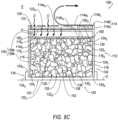
- a chemical reaction takes place (e.g., the zinc defining the chemically-activated material 130 becomes zinc oxide), which causes the chemically-activated material 130 to generate heat H (see, e.g., FIG. 8C ).
- the heat H generated by the chemically-activated material 130 of the first portion 114a of the heating element 114 is passed through the base portion 122 of the foodstuff container 112 such that the heat H is ultimately imparted into and absorbed by the first foodstuff 116.
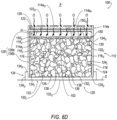
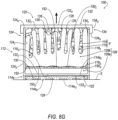
- the heat H causes the first foodstuff 116 to transition from a substantially solid state (see, e.g., FIG. 8C ) to a melted, substantially liquid state (see, e.g., FIGS. 8D-8F ).
- FIGS. 8C-8F the heat H causes the first foodstuff 116 to transition from a substantially solid state (see, e.g., FIG. 8C ) to a melted, substantially liquid state (see, e.g., FIGS. 8D-8F ).
- the first foodstuff 116 transitions to a melted, substantially liquid form, the first foodstuff 116, with the assistance of gravity, detaches from one or more of the inner surface 122 I of the base portion 122 of the foodstuff container 112 and the inner surface 124 I of the sidewall portion 124 of the foodstuff container 112 such that the first foodstuff 116 vertically flows through the plurality of passages 152 formed by the foodstuff separator 150.
- the first foodstuff 116 may flow out of the first foodstuff-receiving cavity portion 126a and into the second foodstuff-receiving cavity portion 126b such that the first foodstuff 116 seeps or oozes downwardly and into the second foodstuff 118.
- the first foodstuff 116 is comingled throughout the second foodstuff 118 to define a comingled foodstuff F that is contained within foodstuff container 112.
- the container 112 the heating element 114 and the closure 120 is then returned to the "right-side-up" orientation upon the support surface S such that the outer surface 114ao of the first portion 114a of the heating element 114 is arranged upon the support surface S.
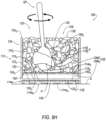
- the closure 120 may be selectively-removed from the foodstuff container 112 such that a user U (see, e.g., FIG. 8I ) may access the foodstuff-receiving cavity 126 of the foodstuff container 112 that contains the comingled foodstuff F. If desired, as seen in FIG.
- the user U may arrange a utensil (e.g., a spoon SP) within the foodstuff-receiving cavity 126 of the foodstuff container 112 for mixing or stirring the comingled foodstuff F.
- a utensil e.g., a spoon SP
- the closure 120 could remain attached to the foodstuff container 112 and the comingled foodstuff F could be shaken.
- the user U may consume the comingled foodstuff F.
- the heating element 114 In view of the above-described functionality of the heating element 114, it is seen that the first foodstuff 116 is heated H by a portion (i.e., the heating element 114) of the foodstuff packaging 112, 114, 120, 150.
- the foodstuff packaging 112, 114, 120, 150 provides a "self-heating" function that avoids the use of a non-packaging, external heat source (e.g., a microwave oven, a gas oven, an electric oven, a stove, fire or the like) for imparting heat to the first foodstuff 116.
- a non-packaging, external heat source e.g., a microwave oven, a gas oven, an electric oven, a stove, fire or the like
- the arrangement of the heating element 114 in an opposing relationship with respect to the first foodstuff 116 substantially limits the heat H generated by the heating element 114 to be mostly received by the first foodstuff 116 and not the second foodstuff 118.
- the first foodstuff 116 may, as desired, transition from a liquid state to a solid state; however, if the second foodstuff 118 is an exemplary "low moisture" food product, the second foodstuff 118 may undesirably burn (as a result of having very little or no moisture, which may be evaporated upon being heated) when microwave energy is imparted into the second foodstuff 118.
- the heat H generated by the heating element 114 may be imparted into the second foodstuff 118, the heat H from the heating element 114 may merely warm the second foodstuff 118 while also avoiding any damage / burning of the second foodstuff 118, which would otherwise occur if a non-packaging external heat source (e.g., a microwave oven) were to be utilized for heating the first foodstuff 116.
- a non-packaging external heat source e.g., a microwave oven
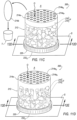
- the assembly 200 includes a plurality of members defining foodstuff packaging (see, e.g., reference numerals 212, 214, 220), a first foodstuff (see, e.g., reference numeral 216) and a second foodstuff (see, e.g., reference numeral 218).
- the first foodstuff 216 may be separated from, and not comingled throughout, the second foodstuff 218.
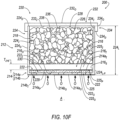
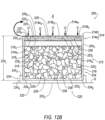
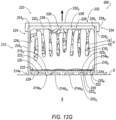
- the assembly 200 may be subsequently activated (see, e.g., FIGS. 11B-11C , 12C-12D ) by a user U (see, e.g., FIG.
- the heat H imparted to the first foodstuff 216 may cause the first foodstuff 216 to transition or phase change (e.g., melt) from a first state (e.g., solid) to a second state (e.g., liquid).
- the first foodstuff 216 may seep or ooze into the second foodstuff 218 such that the first foodstuff 216 is comingled throughout the second foodstuff 218 while the first foodstuff 216 and the second foodstuff 218 are contained within another portion (see, e.g., reference numeral 212) of the foodstuff packaging 212, 214, 220 in order to define a comingled foodstuff (see, e.g., reference letter F in FIGS. 11C-11D , 12E-12I ) that is contained within the foodstuff packaging 212, 214, 220.
- the user U may then remove (see, e.g., FIGS.
- the foodstuff container 212 may include a base portion 222 connected to a sidewall portion 224.
- the base portion 222 includes an inner surface 222 I and an outer surface 222 O .
- the sidewall portion 224 includes an inner surface 224 I , an outer surface 224 O , and a distal end surface 224 D that connects the inner surface 224 I to the outer surface 224 O .
- a portion 224 L-P of a length 224 L of the sidewall portion 224 may extend beyond the outer surface 222 O of the base portion 222 thereby defining a cavity 229.
- the inner surface 222 I of the base portion 222 and the inner surface 224 I of the sidewall portion 224 define a foodstuff-receiving cavity 226 of the foodstuff container 212. Access to the foodstuff-receiving cavity 226 is formed by an opening 228 defined by the inner surface 224 I of the sidewall portion 224 and the distal end surface 224 D of the sidewall portion 224.
- the heating element 214 includes a first portion 214a and a second portion 214b.
- the first portion 214a of the heating element 214 is defined by the cavity 229 formed by the foodstuff container 212 and a chemically-activated material 230 disposed therein.
- the foodstuff container 212 may further include a heating element retainer portion 225 connected to and extending from the portion 224 L-P of the length 224 L of the sidewall portion 224 that extends beyond the outer surface 222 O of the base portion 222.
- the heating element retainer portion 225 therefore may contribute to the formation of the first portion 214a of the heating element 214 whereby the heating element retainer portion 225 includes an inner surface 225 I , an outer surface 225 O .
- One or more passages 225 P may extend through the heating element retainer portion 225 from the outer surface 225 O to the inner surface 225 I .
- the second portion 214b of the heating element 214 includes an inner surface 214b I and an outer surface 214bo.
- the inner surface 214b I of the second portion 214b of the heating element 214 is disposed adjacent the outer surface 225 O of the heating element retainer portion 225.
- the second portion 214b of the heating element 214 may be a removable film member that is discarded into a trash receptacle T once the inner surface 214b I of the second portion 214b of the heating element 214 is selectively-detached from (and no longer disposed adj acent to) the outer surface 225 O of the heating element retainer portion 225.
- the chemically-activated material 230 may include an air-activated material, and more particularly, an oxygen-activated material, such as, for example, zinc.
- an air-activated material such as, for example, zinc.
- the one or more passages 225 P may be prevented from fluidly communicating with surrounding atmosphere A (thereby preventing oxygen O from surrounding atmosphere A to pass through the one or more passages 225 P for subsequently contacting the chemically-activated material 230).
- a user U may selectively activate the chemically-activated material 230 by removing the second portion 214b of the heating element 214 from the first portion 214a of the heating element 214 in order to permit the oxygen O from the surrounding atmosphere A to pass through the one or more passages 225 P and into the cavity 229 such that the oxygen O may come into contact with the chemically-activated material 230.
- a chemical reaction takes place (e.g., the zinc defining the chemically-activated material 230 becomes zinc oxide), which causes the chemically-activated material 230 to generate heat.
- the first foodstuff 216 (e.g., chocolate, fudge or the like) may be deposited into the foodstuff-receiving cavity 226 of the foodstuff container 212.
- the first foodstuff 216 may be deposited into the foodstuff-receiving cavity 226 of the foodstuff container 212 in a liquid state or a solid state.
- the first foodstuff 216 may be extruded into the foodstuff-receiving cavity 226 of the foodstuff container 212 from an extruder or first foodstuff hopper Hc.
- the first foodstuff 216 may be permitted to cure in order to permit the first foodstuff 216 to transition from a liquid state to a solid state.
- the first foodstuff 216 may stick to but may also be removably attached to at least a portion of the inner surface 222 I of the base portion 222 of the foodstuff container 212.
- the first foodstuff 216 when the first foodstuff 216 is cured into a solid state, the first foodstuff 216 may be attached to or disposed over (i) all of the inner surface 222 I of the base portion 222 of the foodstuff container 212 and (ii) a portion of the inner surface 224 I of the sidewall portion 224 of the foodstuff container 212 that extends away from the inner surface 222 I of the base portion 222.
- the first foodstuff 216 when the first foodstuff 216 has cured into a solid state, the first foodstuff 216 may be defined by an upper surface 216 I , a lower surface 216 O and a side surface 216s connecting the upper surface 216 I to the lower surface 216 O .
- the first foodstuff 216 may also be defined by a thickness T 216 extending between the upper surface 216 I and the lower surface 216 O .
- the side surface 216 S of the first foodstuff 216 may define the first foodstuff 216 to have a diameter D 216 .
- the second foodstuff 218 may be deposited into the foodstuff-receiving cavity 226 of the foodstuff container 212.
- the second foodstuff material 218 may include one or more of, but is not limited to: granola, muesli, oats, seeds, nuts, cereal or the like.
- the second foodstuff 218 is shown to include a plurality of pieces or units of foodstuff, the second foodstuff 218 may include one piece or one unit of foodstuff that is deposited into the foodstuff-receiving cavity 226.
- the second foodstuff 218 may deposited into the foodstuff-receiving cavity 226 of the foodstuff container 212 from a second foodstuff hopper H G .
- the second foodstuff 218 may be contained with the foodstuff-receiving cavity 226 and arranged upon and over the upper surface 216 I of the first foodstuff 216 such that that second foodstuff 218 is separated from, and not comingled or mixed with, the first foodstuff 216.
- the second foodstuff hopper H G may meter any desirable amount of the second foodstuff 218 into the foodstuff-receiving cavity 226. In some instances, the second foodstuff hopper H G may meter an amount of the second foodstuff 218 that is approximately equal to a remainder of a volume of the foodstuff-receiving cavity 226 that is not occupied by the first foodstuff 216.
- the closure 220 includes at least a base portion 232.
- the base portion 232 includes an inner surface 232 I and an outer surface 232 O .
- the closure 220 may also include a sidewall portion 234 connected to the base portion 232.
- the sidewall portion 234 includes an inner surface 234 I , an outer surface 234 O , and a distal end surface 234 D connecting the inner surface 234 I to the outer surface 234 O .
- the inner surface 232 I of the base portion 232 and the inner surface 234 I of the sidewall portion 234 define a container-receiving cavity 236. Access to the container-receiving cavity 236 is formed by an opening 238 defined by the inner surface 234 I of the sidewall portion 234 and the distal end surface 234 D of the sidewall portion 234.
- the inner surface 232 I of the base portion 232 of the closure 220 may be removably attached to the distal end surface 224 D of the sidewall portion 224 of the foodstuff container 212. Attachment of the inner surface 232 I of the base portion 232 of the closure 220 to the distal end surface 224 D of the sidewall portion 224 of the foodstuff container 212 may be conducted in any desirable methodology such as, for example, ultrasonic welding, a friction-fit connection or the like.
- the inner surface 234 I of the sidewall portion 234 of the closure 220 may include a threaded surface (not shown) that cooperates with a corresponding threaded surface (not shown) formed upon a portion of the outer surface 224 O of the sidewall portion 224 of the foodstuff container 212 in order to removably attach the closure 220 to the foodstuff container 212.
- an alternative methodology for assembling the assembly 200 may include depositing pre-cured (rather than in liquid form as described above at FIG. 10B ) the first foodstuff 16 (e.g., chocolate, fudge or the like) into the foodstuff-receiving cavity 226 of the foodstuff container 212. If the first foodstuff 216 is in a pre-cured, substantially solid form when it is deposited into the foodstuff-receiving cavity 26 of the foodstuff container 12, the first foodstuff 16 may be metered from a first foodstuff hopper H C (see, e.g., FIG. 2B' ) that may include, for example, a magazine of prefabricated first foodstuff 216 members that are in a pre-cured, substantially solid form.
- a first foodstuff hopper H C see, e.g., FIG. 2B'
- the outer surface 214bo of the second portion 214b of the heating element 214 may be first optionally arranged upon a support surface S such that the assembly 200 is arranged in a "right-side-up" orientation upon the support surface S. Then, as seen in FIGS. 11B and 12B , the outer surface 232 O of the base portion 232 of the closure 220 may be arranged upon the support surface S such that the assembly 200 is arranged in an "up-side-down" orientation upon the support surface S.
- the second portion 214b of the heating element 214 which may be a removable film member, is then selectively-detached from the outer surface 225 O of the heating element retainer portion 225.
- the second portion 214b of the heating element 214 may be discarded into a trash receptacle T.
- the chemically-activated material 230 contained within the cavity 229 of the first portion 214a of the heating element 214 is selectively activated. Activation of the chemically-activated material 230 contained within the first portion 214a of the heating element 214 occurs when oxygen O from surrounding atmosphere A is permitted to be in fluid communication with the chemically-activated material 230.
- the one or more passages 225 P of the heating element retainer portion 225 are not permitted to be in fluid communication with surrounding atmosphere A (thereby not permitting oxygen O from surrounding atmosphere A to pass through the one or more passages 225 P of the heating element retainer portion 225 for subsequently contacting the chemically-activated material 230).
- an oxygen barrier formed by the second portion 214b of the heating element 214 no longer exists, and, as a result, oxygen O from surrounding atmosphere A is permitted to pass through the one or more passages 225 P of the heating element retainer portion 225 such that the oxygen O may come into contact with the chemically-activated material 230.
- a chemical reaction takes place (e.g., the zinc defining the chemically-activated material 230 becomes zinc oxide), which causes the chemically-activated material 230 to generate heat H (see, e.g., FIG. 12C ).
- the heat H generated by the chemically-activated material 230 of the first portion 214a of the heating element 214 is passed through the base portion 222 of the foodstuff container 212 such that the heat H is ultimately imparted into and absorbed by the first foodstuff 216.
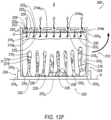
- the heat H causes the first foodstuff 216 to transition from a substantially solid state (see, e.g., FIG. 12C ) to a melted, substantially liquid state (see, e.g., FIGS. 12D-12F ).
- FIGS. 12C-12F the heat H causes the first foodstuff 216 to transition from a substantially solid state (see, e.g., FIG. 12C ) to a melted, substantially liquid state (see, e.g., FIGS. 12D-12F ).
- the first foodstuff 216 detaches from one or more of the inner surface 222 I of the base portion 222 of the foodstuff container 212 and the inner surface 224 I of the sidewall portion 224 of the foodstuff container 212 such that the first foodstuff 216 vertically seeps or oozes downwardly and into the second foodstuff 218 such that the first foodstuff 216 is comingled throughout the second foodstuff 218 to define a comingled foodstuff F that is contained within foodstuff container 212.
- the container 212, the heating element 214 and the closure 220 is then returned to the "right-side-up" orientation upon the support surface S that that the outer surface 225 O of the heating element retainer portion 225 is arranged upon the support surface S.
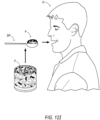
- the closure 220 may be selectively-removed from the foodstuff container 212 such that a user U (see, e.g., FIG. 12I ) may access the foodstuff-receiving cavity 226 of the foodstuff container 212 that contains the comingled foodstuff F. If desired, as seen in FIG.
- the user U may arrange a utensil (e.g., a spoon SP) within the foodstuff-receiving cavity 226 of the foodstuff container 212 for mixing or stirring the comingled foodstuff F.
- a utensil e.g., a spoon SP
- the closure 220 could remain attached to the foodstuff container 212 and the comingled foodstuff F could be shaken.
- the user U may consume the comingled foodstuff F.
- the first foodstuff 216 is heated H by a portion (i.e., the heating element 214) of the foodstuff packaging 212, 214, 220.
- the foodstuff packaging 212, 214, 220 provides a "self-heating" function that avoids the use of a non-packaging, external heat source (e.g., a microwave oven, a gas oven, an electric oven, a stove, fire or the like) for imparting heat to the first foodstuff 216.
- a non-packaging, external heat source e.g., a microwave oven, a gas oven, an electric oven, a stove, fire or the like
- the arrangement of the heating element 214 in an opposing relationship with respect to the first foodstuff 216 substantially limits the heat H generated by the heating element 214 to be mostly received by the first foodstuff 216 and not the second foodstuff 218.
- the first foodstuff 216 may, as desired, transition from a liquid state to a solid state; however, if the second foodstuff 218 is, for example, a "low moisture" food product, the second foodstuff 218 may undesirably burn (as a result of having very little or no moisture, which may be evaporated upon being heated) when microwave energy is imparted into the second foodstuff 218.
- the heat H from the heating element 214 may merely warm the second foodstuff 218 while also avoiding any damage / burning of the second foodstuff 218, which would otherwise occur if a non-packaging external heat source (e.g., a microwave oven) were to be utilized for heating the first foodstuff 216.
- a non-packaging external heat source e.g., a microwave oven
- the assembly 300 includes a plurality of members defining foodstuff packaging (see, e.g., reference numerals 312, 314, 320), a first foodstuff (see, e.g., reference numeral 316 at, e.g., FIG. 14C ) and a second foodstuff (see, e.g., reference numeral 318).
- a first foodstuff see, e.g., reference numeral 316 at, e.g., FIG. 14C
- a second foodstuff see, e.g., reference numeral 318.
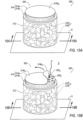
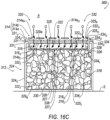
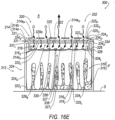
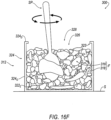
- the first foodstuff 316 may seep or ooze into the second foodstuff 318 such that the first foodstuff 316 is comingled throughout the second foodstuff 318 while the first foodstuff 316 and the second foodstuff 318 are contained within another portion (see, e.g., reference numeral 312) of the foodstuff packaging 312, 314, 320 in order to define a comingled foodstuff (see, e.g., reference letter F in FIGS. 15C-15D , 16D-16G ) that is contained within the foodstuff packaging 312, 314, 320.
- the user U may then remove (see, e.g., FIGS.
- 16E-16F another portion (see, e.g., reference numeral 320) of the foodstuff packaging 312, 314, 320 in order to gain access (see, e.g., FIG. 16F ) to the portion (see, e.g., reference numeral 312) of the foodstuff packaging 312, 314, 320 that contains the comingled foodstuff F in order to subsequently consume (see, e.g., FIG. 16G ) the comingled foodstuff F.
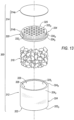
- the assembly 300 may include a foodstuff container 312, a heating element 314, a first foodstuff 316 (see FIG. 14C ), a second foodstuff 318, and a closure 320.
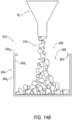
- FIGS. 14A-14D illustrate a first methodology for assembling the assembly 300.
- the foodstuff container 312 may include a base portion 322 connected to a sidewall portion 324.
- the base portion 322 includes an inner surface 322 I and an outer surface 322 O .
- the sidewall portion 324 includes an inner surface 324 I , an outer surface 324 O , and a distal end surface 324 D that connects the inner surface 324 I to the outer surface 324 O .
- the distal end surface 324 D of the sidewall portion 324 of the foodstuff container 312 may project radially inwardly beyond the inner surface 324 I of the sidewall portion 324 of the foodstuff container 312 thereby forming closure-supporting-ledge 323.
- the inner surface 322 I of the base portion 322 and the inner surface 324 I of the sidewall portion 324 define a foodstuff-receiving cavity 326 of the foodstuff container 312. Access to the foodstuff-receiving cavity 326 is formed by an opening 328 defined by the inner surface 324 I of the sidewall portion 324 and the distal end surface 324 D of the sidewall portion 324.
- the second foodstuff 318 may deposited into the foodstuff-receiving cavity 326 of the foodstuff container 312 from a foodstuff hopper H G .
- the second foodstuff 318 may be contained with the foodstuff-receiving cavity 326 and arranged upon and over the inner surface 322 I of the base portion 322 of the foodstuff container 312.
- the first foodstuff 316 prior to activating the heating element 314, the first foodstuff 316 is contained within the closure 320, and, therefore, as seen in FIGS. 14C-14D , the second foodstuff 318 is initially separated from, and not comingled or mixed with, the first foodstuff 316.
- the foodstuff hopper H G may meter any desirable amount of the second foodstuff 318 into the foodstuff-receiving cavity 326.
- the foodstuff hopper H G may meter an amount of the second foodstuff 318 that is approximately equal to a volume of the foodstuff-receiving cavity 326 less a volume of the first foodstuff 316 that is contained within the closure 320 prior to activating the heating element 314.
- the second foodstuff material 318 may include one or more of, but is not limited to: granola, muesli, oats, seeds, nuts, cereal or the like.
- the second foodstuff 318 is shown to include a plurality of pieces or units of foodstuff, the second foodstuff 318 may include one piece or one unit of foodstuff that is deposited into the foodstuff-receiving cavity 326.
- the closure 320 includes a first cavity 329a and a second cavity 329b.
- the first cavity 329a of the closure 320 is defined by a heating element retainer portion 325, a base portion 332 and a sidewall portion 334.
- the second cavity 329b of the closure 320 is defined by a first foodstuff retainer portion 327, the base portion 332 and the sidewall portion 334.
- a chemically-activated material 330 is disposed within the first cavity 329a, and the first foodstuff 316 is disposed within the second cavity 329b.
- the heating element retainer portion 325 and the chemically-activated material 330 contributes to the formation of a first portion 314a of the heating element 314.
- the sidewall portion 334 is connected to each of the heating element retainer portion 325, the first foodstuff retainer portion 327 and the base portion 332.
- the sidewall portion 334 includes an inner surface 334 I , an outer surface 334 O , an upper end portion 334u, a lower end portion 334 L and an intermediate portion 334 M .
- the heating element retainer portion 325 includes an inner surface 325 I and an outer surface 325 O .
- the heating element retainer portion 325 is connected to and extends from the upper end portion 334u of the sidewall portion 334.
- One or more passages 325 P may extend through the heating element retainer portion 325 from the outer surface 325 O to the inner surface 325 I .
- the base portion 332 includes an upper surface 332u and a lower surface 332 L .
- the base portion 332 is connected to and extends from the inner surface 334 I of the sidewall portion 334 proximate the intermediate portion 334 M of the sidewall portion 334.
- the first foodstuff retainer portion 327 includes an inner surface 327 I and an outer surface 327 O .
- the first foodstuff retainer portion 327 is connected to and extends from the lower end portion 334 L of the sidewall portion 334.
- One or more passages 327 P may extend through the first foodstuff retainer portion 327 from the outer surface 327 O to the inner surface 327 I .
- the inner surface 334 I of the sidewall portion 334, the inner surface 325 I of the heating element retainer portion 325 and the upper surface 332u of the base portion 332 defines the first cavity 329a that contains the chemically-activated material 330.
- the inner surface 334 I of the sidewall portion 334, the inner surface 327 I of the first foodstuff retainer portion 327 and the lower surface 332 L of the base portion 332 defines the second cavity 329a that contains the first foodstuff 316.
- the closure 320 may include an outwardly-extending projection 331 that extends away from the outer surface 334 O of the sidewall portion 334.
- the outwardly-extending projection 331 may include an upper surface 331u and a lower surface 331 L .
- the lower surface 331 L of the outwardly-extending projection 331 is disposed adjacent the distal end surface 324 D of the sidewall portion 334 of the foodstuff container 312 that forms closure-supporting-ledge 323. Attachment of the outwardly-extending projection 331 of the closure 320 to the closure-supporting-ledge 323 of the foodstuff container 312 may be conducted in any desirable methodology such as, for example, ultrasonic welding, an adhesive connection or the like.
- a portion of the outwardly-extending projection 331 of the closure 320 may be formed with the closure-supporting-ledge 323 of the foodstuff container 312 to thereby form a hinged lid connection of the closure 320 and the foodstuff container 312.
- the second portion 314b of the heating element 314 includes an inner surface 314b I and an outer surface 314bo. As seen in FIGS. 14C-14D , the inner surface 314b I of the second portion 314b of the heating element 314 is disposed adjacent the outer surface 325 O of the heating element retainer 325.
- the second portion 314b of the heating element 314 may be a removable film member that is discarded into a trash receptacle T once the inner surface 314b I of the second portion 314b of the heating element 314 is selectively-detached from (and no longer disposed adjacent to) the outer surface 325 O of the heating element retainer 325.
- the chemically-activated material 330 may include an air-activated material, and more particularly, an oxygen-activated material, such as, for example, zinc.
- an air-activated material such as, for example, zinc.
- the one or more passages 325 P may be prevented from fluidly communicating with surrounding atmosphere A (thereby preventing oxygen O from surrounding atmosphere A to pass through the one or more passages 325 P for subsequently contacting the chemically-activated material 330).
- a user U may selectively activate the chemically-activated material 330 by removing the second portion 314b of the heating element 314 from the first portion 314a of the heating element 314 in order to permit the oxygen O from the surrounding atmosphere A to pass through the one or more passages 325 P and into the cavity 329 such that the oxygen O may come into contact with the chemically-activated material 330.
- a chemical reaction takes place (e.g., the zinc defining the chemically-activated material 330 becomes zinc oxide), which causes the chemically-activated material 330 to generate heat.
- the second portion 314b of the heating element 314, which may be a removable film member, is then selectively-detached from the outer surface 325 O of the heating element retainer 325.
- the second portion 314b of the heating element 314 may be discarded into a trash receptacle T.
- the chemically-activated material 330 contained within the cavity 329 of the first portion 314a of the heating element 314 is selectively activated. Activation of the chemically-activated material 330 contained within the first portion 314a of the heating element 314 occurs when oxygen O from surrounding atmosphere A is permitted to be in fluid communication with the chemically-activated material 330.
- the one or more passages 325 P of the heating element retainer 325 are not permitted to be in fluid communication with surrounding atmosphere A (thereby not permitting oxygen O from surrounding atmosphere A to pass through the one or more passages 325 P of the heating element retainer 325 for subsequently contacting the oxygen-activated material 330).
- an oxygen barrier formed by the second portion 314b of the heating element 314 no longer exists, and, as a result, oxygen O from surrounding atmosphere A is permitted to pass through the one or more passages 325 P of the heating element retainer 325 such that the oxygen O may come into contact with the chemically-activated material 330.
- a chemical reaction takes place (e.g., the zinc defining the chemically-activated material 330 becomes zinc oxide), which causes the chemically-activated material 330 to generate heat H (see, e.g., FIGS. 16B-16D ).
- the heat H generated by the chemically-activated material 330 of the first portion 314a of the heating element 314 is passed through the base portion 332 of the closure 320 such that the heat H is ultimately imparted into and absorbed by the first foodstuff 316.
- the heat H causes the first foodstuff 316 to transition from a substantially solid state (see, e.g., FIG. 16B ) to a melted, substantially liquid state (see, e.g., FIGS. 16C-16D ).
- the first foodstuff 316 transitions to a melted, substantially liquid form, the first foodstuff 316, with the assistance of gravity, vertically seeps or oozes downwardly through the one or more passages 327 P of the first foodstuff retainer portion 327 and into the foodstuff-receiving cavity 326 of the foodstuff container 312 that contains the second foodstuff 318 such that the first foodstuff 316 is comingled throughout the second foodstuff 318 to define a comingled foodstuff F that is contained within foodstuff container 312.
- the user U may selectively-remove (or, alternatively, pivot away if the closure 320 is partially attached in a hinged configuration) the closure 320 from the foodstuff container 312 such that the user U may access the foodstuff-receiving cavity 326 of the foodstuff container 312 that contains the comingled foodstuff F. If desired, as seen in FIG.
- the user U may arrange a utensil (e.g., a spoon SP) within the foodstuff-receiving cavity 326 of the foodstuff container 312 for mixing or stirring the comingled foodstuff F.
- a utensil e.g., a spoon SP
- the closure 320 could remain attached to the foodstuff container 312 and the comingled foodstuff F could be shaken.
- the user U may consume the comingled foodstuff F.
- the first foodstuff 316 is heated H by a portion (i.e., the heating element 314) of the foodstuff packaging 312, 314, 320.
- the foodstuff packaging 312, 314, 320 provides a "self-heating" function that avoids the use of a non-packaging, external heat source (e.g., a microwave oven, a gas oven, an electric oven, a stove, fire or the like) for imparting heat to the first foodstuff 316.
- a non-packaging, external heat source e.g., a microwave oven, a gas oven, an electric oven, a stove, fire or the like
- the arrangement of the heating element 314 in an opposing relationship with respect to the first foodstuff 316 substantially limits the heat H generated by the heating element 314 to be mostly received by the first foodstuff 316 and not the second foodstuff 318.
- the first foodstuff 316 may, as desired, transition from a liquid state to a solid state; however, if the second foodstuff 318 is, for example, a "low moisture" food product, the second foodstuff 318 may undesirably burn (as a result of having very little or no moisture, which may be evaporated upon being heated) when microwave energy is imparted into the second foodstuff 318.
- the heat H from the heating element 314 may merely warm the second foodstuff 318 while also avoiding any damage / burning of the second foodstuff 318, which would otherwise occur if a non-packaging external heat source (e.g., a microwave oven) were to be utilized for heating the first foodstuff 316.
- a non-packaging external heat source e.g., a microwave oven
- the assembly 400 includes a plurality of members defining foodstuff packaging (see, e.g., reference numerals 412, 414, 420), a first foodstuff (see, e.g., reference numeral 416 at, e.g., FIG. 18C ) and a second foodstuff (see, e.g., reference numeral 418).
- a first foodstuff see, e.g., reference numeral 416 at, e.g., FIG. 18C
- a second foodstuff see, e.g., reference numeral 418.
- the first foodstuff 416 may seep or ooze into the second foodstuff 418 such that the first foodstuff 416 is comingled throughout the second foodstuff 418 while the first foodstuff 416 and the second foodstuff 418 are contained within another portion (see, e.g., reference numeral 412) of the foodstuff packaging 412, 414, 420 in order to define a comingled foodstuff (see, e.g., reference letter F in FIGS. 19C-19D , 20D-20G ) that is contained within the foodstuff packaging 412, 414, 420.
- the user U may then remove (see, e.g., FIGS.
- the assembly 400 may include a foodstuff container 412, a heating element 414, a first foodstuff 416, a second foodstuff 418, and a closure 420.
- FIGS. 18A-18D illustrate a first methodology for assembling the assembly 400.
- the foodstuff container 412 may include a base portion 422 connected to a sidewall portion 424.
- the base portion 422 includes an inner surface 422 I and an outer surface 422 O .
- the sidewall portion 424 includes an inner surface 424 I , an outer surface 424 O , and a distal end surface 424 D that connects the inner surface 424 I to the outer surface 424 O .
- the inner surface 422 I of the base portion 422 and the inner surface 424 I of the sidewall portion 424 define a foodstuff-receiving cavity 426 of the foodstuff container 412. Access to the foodstuff-receiving cavity 426 is formed by an opening 428 defined by the inner surface 424 I of the sidewall portion 424 and the distal end surface 424 D of the sidewall portion 424.
- the second foodstuff 418 may deposited into the foodstuff-receiving cavity 426 of the foodstuff container 412 from a foodstuff hopper H G .
- the second foodstuff 418 may be contained with the foodstuff-receiving cavity 426 and arranged upon and over the inner surface 422 I of the base portion 422 of the foodstuff container 412.
- the first foodstuff 416 prior to activating the heating element 414, the first foodstuff 416 is contained within the closure 420, and, therefore, as seen in FIGS. 18C-18D , the second foodstuff 418 is initially separated from, and not comingled or mixed with, the first foodstuff 416.
- the foodstuff hopper H G may meter any desirable amount of the second foodstuff 418 into the foodstuff-receiving cavity 426.
- the foodstuff hopper H G may meter an amount of the second foodstuff 418 that is approximately equal to a volume of the foodstuff-receiving cavity 426 less a volume of the first foodstuff 416 that is contained within the closure 420 prior to activating the heating element 414.
- the second foodstuff material 418 may include one or more of, but is not limited to: granola, muesli, oats, seeds, nuts, cereal or the like.
- the second foodstuff 418 is shown to include a plurality of pieces or units of foodstuff, the second foodstuff 418 may include one piece or one unit of foodstuff that is deposited into the foodstuff-receiving cavity 426.
- the closure 420 includes a first cavity 429a and a second cavity 429b.
- the first cavity 429a of the closure 420 is defined by a heating element retainer portion 425, a base portion 432 and a sidewall portion 434.
- the second cavity 429b of the closure 420 is defined by a first foodstuff retainer portion 427, the base portion 432 and the sidewall portion 434.
- a chemically-activated material 430 is disposed within the first cavity 429a, and the first foodstuff 416 is disposed within the second cavity 429b.
- the heating element retainer portion 425 and the chemically-activated material 430 contributes to the formation of a first portion 414a of the heating element 414.
- the sidewall portion 434 is connected to each of the heating element retainer portion 425, the first foodstuff retainer portion 427 and the base portion 432.
- the sidewall portion 434 includes an inner surface 434 I , an outer surface 434 O , an upper end portion 434u, a lower end portion 434 L and an intermediate portion 434 I .
- the heating element retainer portion 425 includes an inner surface 425 I and an outer surface 425 O .
- the heating element retainer portion 425 is connected to and extends from the upper end portion 434u of the sidewall portion 434.
- One or more passages 425 P may extend through the heating element retainer portion 425 from the outer surface 425 O to the inner surface 425 I .
- the base portion 432 includes an upper surface 432u and a lower surface 432 L .
- the base portion 432 is connected to and extends from the inner surface 434 I of the sidewall portion 434 proximate the intermediate portion 434 I of the sidewall portion 434.
- the first foodstuff retainer portion 427 includes an inner surface 427 I and an outer surface 427 O .
- the first foodstuff retainer portion 427 is connected to and extends from the lower end portion 434 L of the sidewall portion 434.
- One or more passages 427 P may extend through the first foodstuff retainer portion 427 from the outer surface 427 O to the inner surface 427 I .
- the inner surface 434 I of the sidewall portion 434, the inner surface 425 I of the heating element retainer portion 425 and the upper surface 432u of the base portion 432 defines the first cavity 429a that contains the chemically-activated material 430.
- the inner surface 434 I of the sidewall portion 434, the inner surface 427 I of the first foodstuff retainer portion 427 and the lower surface 432 L of the base portion 432 defines the second cavity 429a that contains the first foodstuff 416.
- the closure 420 may include an outwardly-extending projection 431 that extends away from the outer surface 434 O of the sidewall portion 434 and the outer surface 427 O of the first foodstuff retainer portion 427.
- the outwardly-extending projection 431 may include an outer surface 431 O and an inner surface 431 I .
- the inner surface 431 I of the outwardly-extending projection 431 of the closure 420 may include a threaded surface (not shown) that cooperates with a corresponding threaded surface (not shown) formed upon a portion of the outer surface 424 O of the sidewall portion 424 of the foodstuff container 412 in order to removably attach the closure 420 to the foodstuff container 412.
- the inner surface 431 I of the outwardly-extending projection 431 of the closure 420 may be removably-attached to and cooperate with the outer surface 424 O of the sidewall portion 424 of the foodstuff container 412 in other configurations (e.g., a friction-fit connection, a snap-fit connection or the like) in order to removably attach the closure 420 to the foodstuff container 412.
- other configurations e.g., a friction-fit connection, a snap-fit connection or the like
- the second portion 414b of the heating element 414 includes an inner surface 414b I and an outer surface 414bo. As seen in FIGS. 18C-18D , the inner surface 414b I of the second portion 414b of the heating element 414 is disposed adjacent the outer surface 425 O of the heating element retainer 425.
- the second portion 414b of the heating element 414 may be a removable film member that is discarded into a trash receptacle T once the inner surface 414b I of the second portion 414b of the heating element 414 is selectively-detached from (and no longer disposed adjacent to) the outer surface 425 O of the heating element retainer 425.
- the chemically-activated material 430 may include an air-activated material, and more particularly, an oxygen-activated material, such as, for example, zinc.
- an air-activated material such as, for example, zinc.
- the one or more passages 425 P may be prevented from fluidly communicating with surrounding atmosphere A (thereby preventing oxygen O from surrounding atmosphere A to pass through the one or more passages 425 P for subsequently contacting the chemically-activated material 430).
- a user U may selectively activate the chemically-activated material 430 by removing the second portion 414b of the heating element 414 from the first portion 414a of the heating element 414 in order to permit the oxygen O from the surrounding atmosphere A to pass through the one or more passages 425 P and into the cavity 429 such that the oxygen O may come into contact with the chemically-activated material 430.
- a chemical reaction takes place (e.g., the zinc defining the chemically-activated material 430 becomes zinc oxide), which causes the chemically-activated material 430 to generate heat.
- the second portion 414b of the heating element 414 which may be a removable film member, is then selectively-detached from the outer surface 425 O of the heating element retainer 425.
- the second portion 414b of the heating element 414 may be discarded into a trash receptacle T.
- the chemically-activated material 430 contained within the cavity 429 of the first portion 414a of the heating element 414 is selectively activated. Activation of the chemically-activated material 430 contained within the first portion 414a of the heating element 414 occurs when oxygen O from surrounding atmosphere A is permitted to be in fluid communication with the chemically-activated material 430.
- the one or more passages 425 P of the heating element retainer 425 are not permitted to be in fluid communication with surrounding atmosphere A (thereby not permitting oxygen O from surrounding atmosphere A to pass through the one or more passages 425 P of the heating element retainer 425 for subsequently contacting the chemically-activated material 430).
- an oxygen barrier formed by the second portion 414b of the heating element 414 no longer exists, and, as a result, oxygen O from surrounding atmosphere A is permitted to pass through the one or more passages 425 P of the heating element retainer 425 such that the oxygen O may come into contact with the chemically-activated material 430.
- a chemical reaction takes place (e.g., the zinc defining the chemically-activated material 430 becomes zinc oxide), which causes the chemically-activated material 430 to generate heat H (see, e.g., FIGS. 20B-20D ).
- the heat H generated by the chemically-activated material 430 of the first portion 414a of the heating element 414 is passed through the base portion 432 of the closure 420 such that the heat H is ultimately imparted into and absorbed by the first foodstuff 416.
- the heat H causes the first foodstuff 416 to transition from a substantially solid state (see, e.g., FIG. 20B ) to a melted, substantially liquid state (see, e.g., FIGS. 20C-20D ).
- FIGS. 20B substantially solid state
- FIGS. 20C-20D a melted, substantially liquid state
- the first foodstuff 416 transitions to a melted, substantially liquid form
- the first foodstuff 416 with the assistance of gravity, vertically seeps or oozes downwardly through the one or more passages 427 P of the first foodstuff retainer portion 427 and into the foodstuff-receiving cavity 426 of the foodstuff container 412 that contains the second foodstuff 418 such that the first foodstuff 416 is comingled throughout the second foodstuff 418 to define a comingled foodstuff F that is contained within foodstuff container 412.
- the user U may selectively-remove the closure 420 from the foodstuff container 412 such that the user U may access the foodstuff-receiving cavity 426 of the foodstuff container 412 that contains the comingled foodstuff F. If desired, as seen in FIG.
- the user U may arrange a utensil (e.g., a spoon SP) within the foodstuff-receiving cavity 426 of the foodstuff container 412 for mixing or stirring the comingled foodstuff F.
- a utensil e.g., a spoon SP
- the closure 420 could remain attached to the foodstuff container 412 and the comingled foodstuff F could be shaken.
- the user U may consume the comingled foodstuff F.
- the first foodstuff 416 is heated H by a portion (i.e., the heating element 414) of the foodstuff packaging 412, 414, 420.
- the foodstuff packaging 412, 414, 420 provides a "self-heating" function that avoids the use of a non-packaging, external heat source (e.g., a microwave oven, a gas oven, an electric oven, a stove, fire or the like) for imparting heat to the first foodstuff 416.
- a non-packaging, external heat source e.g., a microwave oven, a gas oven, an electric oven, a stove, fire or the like
- the arrangement of the heating element 414 in an opposing relationship with respect to the first foodstuff 416 substantially limits the heat H generated by the heating element 414 to be mostly received by the first foodstuff 416 and not the second foodstuff 418.
- the first foodstuff 416 may, as desired, transition from a liquid state to a solid state; however, if the second foodstuff 418 is, for example, a "low moisture" food product, the second foodstuff 418 may undesirably burn (as a result of having very little or no moisture, which may be evaporated upon being heated) when microwave energy is imparted into the second foodstuff 418.
- the heat H from the heating element 414 may merely warm the second foodstuff 418 while also avoiding any damage / burning of the second foodstuff 418, which would otherwise occur if a non-packaging external heat source (e.g., a microwave oven) were to be utilized for heating the first foodstuff 416.
- a non-packaging external heat source e.g., a microwave oven
Landscapes
- Engineering & Computer Science (AREA)
- Mechanical Engineering (AREA)
- Food Science & Technology (AREA)
- Life Sciences & Earth Sciences (AREA)
- Chemical & Material Sciences (AREA)
- Chemical Kinetics & Catalysis (AREA)
- General Preparation And Processing Of Foods (AREA)
- Packages (AREA)
- Package Specialized In Special Use (AREA)
- Preparation Of Fruits And Vegetables (AREA)
- Cereal-Derived Products (AREA)
Claims (12)
- Anordnung (10), die Folgendes umfasst:einen Nahrungsmittelbehälter (12), der einen Basisabschnitt (22) und einen Seitenwandabschnitt (24), der einen Nahrungsmittelaufnahmehohlraum (26) definiert, beinhaltet;ein chemisch aktiviertes Heizelement (14), das betreibbar ist, Wärme zu erzeugen, und neben einer äußeren Fläche (22O) des Basisabschnitt (22) angeordnet ist;ein erstes Nahrungsmittel (16), das im Nahrungsmittelaufnahmehohlraum (26) neben einer inneren Fläche (22I) des Basisabschnitts (22) angeordnet ist, wobei das erste Nahrungsmittel (16) betreibbar ist, nach Anwendung der Wärme von einem ersten Zustand in einen zweiten Zustand überzugehen; undein zweites Nahrungsmittel (18), das im Nahrungsmittelaufnahmehohlraum (26) angeordnet istund dadurch gekennzeichnet, dass:der Seitenwandabschnitt (124) eine innere Fläche (1241) beinhaltet, die eine Ausnehmung (124IR) aufweist,die Anordnung ferner einen Separator (150) beinhaltet, der im Hohlraum (126) des Behälters (112) angeordnet ist und (i) eine obere Fläche (150I), (ii) eine untere Fläche (150O), die auf einer gegenüberliegenden Seite der oberen Fläche (150I) ausgebildet ist, (iii) eine Seitenfläche (150S), die die obere Fläche (150I) mit der unteren Fläche (150O) verbindet, (iv) eine Vielzahl von Durchführungen, die sich durch den Separator (150) von der oberen Fläche (150I) zur unteren Fläche (150O) erstrecken, und (v) einen sich radial nach außen erstreckenden Vorsprung (150SP, 154), der sich von der Seitenfläche (150s) erstreckt und in der Ausnehmung (124IR) der inneren Fläche (1241) des Nahrungsmittelbehälters (12) registriert ist, wobei der Separator (150) den Hohlraum (126) in einen ersten Hohlraumabschnitt (126a), der das erste Nahrungsmittel (16) beinhaltet, und einen zweiten Hohlraumabschnitt (126b), der das zweite Nahrungsmittel (18) beinhaltet, trennt,wobei das erste Nahrungsmittel (16) im ersten Zustand des zweiten Nahrungsmittels (18) vom Separator (150) getrennt ist und das erste Nahrungsmittel (16) betreibbar ist, im zweiten Zustand via die Vielzahl von Durchführungen (152) durch den Separator (150) geleitet zu werden.
- Anordnung (10) nach Anspruch 1, wobei das erste Nahrungsmittel (16) vom zweiten Nahrungsmittel (18) getrennt ist, wenn sich das erste Nahrungsmittel (16) im ersten Zustand befindet, und das erste Nahrungsmittel (16) mit dem gesamten zweiten Nahrungsmittel (18) vermischt wird, wenn sich das erste Nahrungsmittel (16) im zweiten Zustand befindet.
- Anordnung (10) nach Anspruch 1, wobei das zweite Nahrungsmittel (18) mindestens eines von Müsli, Hafer, Samenkörnern, Nüssen und Zerealien ist, während das erste Nahrungsmittel(16)-Material mindestens eines von Schokolade und Karamell ist.
- Anordnung (10) nach Anspruch 1, wobei das chemisch aktivierte Heizelement (14) Zink umfasst.
- Anordnung (10) nach Anspruch 1, die ferner einen Verschluss (20) umfasst und wobei das Heizelement (14) am Nahrungsmittelbehälter (12) befestigt ist.
- Anordnung (10) nach Anspruch 5, wobei das Heizelement (14) mit dem Nahrungsmittelbehälter (12) oder mit dem Verschluss (20) ausgebildet ist.
- Verfahren, das Folgendes umfasst:Bereitstellen eines Behälters (12), der einen Basisabschnitt (22) und einen Seitenwandabschnitt (24), der einen Lebensmittelaufnahmehohlraum (26) definiert, aufweist;Anordnen eines chemisch aktivierten Heizelements (14), das betreibbar ist, Wärme zu erzeugen, neben einer äußeren Fläche (22O) des Basisabschnitts des Behälters (12);Anordnen eines ersten Nahrungsmittels (16) im Lebensmittelaufnahmehohlraum (26) neben einer inneren Fläche (22I) des Basisabschnitts (22), wobei das erste Nahrungsmittel (16) betreibbar ist, nach Anwendung der Wärme von einem ersten Zustand in einen zweiten Zustand überzugehen; undAnordnen eines zweiten Nahrungsmittels (18) im Lebensmittelaufnahmehohlraum (26);dadurch gekennzeichnet, dass:der Seitenwandabschnitt (124) des Behälters (12) eine innere Fläche (124I) beinhaltet, die eine Ausnehmung (124IR) aufweist,Anordnen eines Separators (150) im Hohlraum (126) zwischen dem ersten Nahrungsmittel (16) und dem zweiten Nahrungsmittel (18), wobei der Separator (150) (i) eine obere Fläche (150I), eine untere Fläche (150O), die auf einer gegenüberliegenden Seite der oberen Fläche (150I) ausgebildet ist, (iii) eine Seitenfläche (150s), die die obere Fläche (150I) mit der unteren Fläche (150O) verbindet, (iv) einen sich radial nach außen erstreckenden Vorsprung (150SP, 154), der sich von der Seitenfläche (150s) erstreckt und in der Ausnehmung (124IR) der inneren Fläche (124I) des Nahrungsmittelbehälters (12) registriert ist, und eine Vielzahl von Durchführungen (152), die dadurch ausgebildet sind, wobei der Separator (150) den Hohlraum (126) in einen ersten Hohlraumabschnitt (126a), der das erste Nahrungsmittel (16) beinhaltet, und einen zweiten Hohlraumabschnitt (126b), der das zweite Nahrungsmittel (18) beinhaltet, trennt und das erste Nahrungsmittel (16) betreibbar ist, im zweiten Zustand via die Vielzahl von Durchführungen (152) durch den Separator (150) geleitet zu werden.
- Verfahren nach Anspruch 7, wobei das Anordnen des ersten Nahrungsmittels (16) im Lebensmittelaufnahmehohlraum (26) das Trennen des ersten Nahrungsmittels (16) vom zweiten Nahrungsmittel (18), wenn das erste Nahrungsmittel (16) im ersten Zustand angeordnet ist, und das Vermischen des ersten Nahrungsmittels (16) mit dem zweiten Nahrungsmittel (18), wenn das erste Nahrungsmittel (16) im zweiten Zustand angeordnet ist, beinhaltet.
- Verfahren nach Anspruch 7, wobei das Anordnen des zweiten Nahrungsmittels (18) im Lebensmittelaufnahmehohlraum (26) das Anordnen von mindestens einem von Müsli, Hafer, Samenkörnern, Nüssen und Zerealien im Lebensmittelaufnahmehohlraum (26) beinhaltet und/oder das Anordnen des ersten Nahrungsmittels (16) im Lebensmittelaufnahmehohlraum (26) das Anordnen von mindestens einem von Schokolade und Karamell im ersten Lebensmittelaufnahmehohlraum (26) beinhaltet.
- Verfahren nach Anspruch 7, wobei das Bereitstellen des Heizelements (14) mit einem chemisch aktivierten Material das Bereitstellen des Heizelements (14) mit Zink beinhaltet.
- Verfahren nach Anspruch 7, wobei der erste Zustand des ersten Nahrungsmittels (16) ein fester Zustand ist und der zweite Zustand des ersten Nahrungsmittels (16) ein flüssiger Zustand ist.
- Verfahren nach Anspruch 7, wobei das erste Nahrungsmittel (16) zwischen dem chemisch aktivierten Heizelement (14) und dem zweiten Nahrungsmittel (18) angeordnet ist.
Applications Claiming Priority (2)
| Application Number | Priority Date | Filing Date | Title |
|---|---|---|---|
| US201662401302P | 2016-09-29 | 2016-09-29 | |
| PCT/US2017/053881 WO2018064256A1 (en) | 2016-09-29 | 2017-09-28 | Foodstuff packaging assembly and related methods |
Publications (2)
| Publication Number | Publication Date |
|---|---|
| EP3519320A1 EP3519320A1 (de) | 2019-08-07 |
| EP3519320B1 true EP3519320B1 (de) | 2025-02-19 |
Family
ID=60051588
Family Applications (1)
| Application Number | Title | Priority Date | Filing Date |
|---|---|---|---|
| EP17781604.8A Active EP3519320B1 (de) | 2016-09-29 | 2017-09-28 | Lebensmittelverpackungsanordnung und zugehörige verfahren |
Country Status (11)
| Country | Link |
|---|---|
| US (1) | US20180086537A1 (de) |
| EP (1) | EP3519320B1 (de) |
| JP (1) | JP7337689B2 (de) |
| CN (1) | CN109789960B (de) |
| AU (1) | AU2017335772B2 (de) |
| BR (1) | BR112019005141B1 (de) |
| CA (1) | CA3038096A1 (de) |
| ES (1) | ES3014167T3 (de) |
| MX (1) | MX2019003155A (de) |
| RU (1) | RU2746999C2 (de) |
| WO (1) | WO2018064256A1 (de) |
Families Citing this family (1)
| Publication number | Priority date | Publication date | Assignee | Title |
|---|---|---|---|---|
| US12623802B2 (en) * | 2023-09-26 | 2026-05-12 | Lab 37 LLC | Food assembly and packaging robot |
Citations (5)
| Publication number | Priority date | Publication date | Assignee | Title |
|---|---|---|---|---|
| US3079911A (en) * | 1959-07-06 | 1963-03-05 | Edward C Ryan | Heating device |
| JPS5531243A (en) * | 1978-08-28 | 1980-03-05 | Toyo Ink Mfg Co Ltd | Heating structure |
| US4874618A (en) * | 1985-12-27 | 1989-10-17 | General Mills, Inc. | Package containing a moisture resistant edible internal barrier |
| WO1996007604A1 (en) * | 1994-09-09 | 1996-03-14 | Deeley, Stephanie, Tamsin | Packaging for a comestible product |
| US20100112146A1 (en) * | 2008-06-10 | 2010-05-06 | Zoss Robert A | Packages for dispensing liquid and dry food |
Family Cites Families (48)
| Publication number | Priority date | Publication date | Assignee | Title |
|---|---|---|---|---|
| US2604976A (en) * | 1950-09-21 | 1952-07-29 | Sarg Fredrick Adolf | Combined liquid and food lunch container |
| US2579405A (en) * | 1950-11-03 | 1951-12-18 | Sukacev Lev | Self-heating containers |
| US2850391A (en) * | 1955-06-27 | 1958-09-02 | George G Gunsberg | Packaged frozen food article |
| US3040897A (en) * | 1956-03-09 | 1962-06-26 | Herbert H Holman | Invertable container |
| US3360161A (en) * | 1965-10-21 | 1967-12-26 | Marlin B Smith | Splashproof drinking vessel |
| US3722399A (en) * | 1971-04-23 | 1973-03-27 | Scovill Manufacturing Co | Popcorn popper having automatic buttering means |
| US4233325A (en) * | 1979-09-13 | 1980-11-11 | International Flavors & Fragrances Inc. | Ice cream package including compartment for heating syrup |
| JPS6015863U (ja) * | 1983-07-11 | 1985-02-02 | 日本パイオニクス株式会社 | 加熱保温容器 |
| JPS61253023A (ja) * | 1985-04-04 | 1986-11-10 | 旭化成株式会社 | 加熱容器 |
| US5140121A (en) * | 1986-09-02 | 1992-08-18 | The Pillsbury Company | Microwave food product and methods of their manufacture and heating |
| US4794008A (en) * | 1987-02-27 | 1988-12-27 | General Foods Corporation | Method of preparing a packaged frozen confection |
| JPH0298566A (ja) * | 1988-09-26 | 1990-04-10 | Koushinshiya:Kk | 加熱機能付容器 |
| US4942277A (en) * | 1989-12-15 | 1990-07-17 | Narberes Gary A | Microwave popcorn service bowl |
| US5168140A (en) * | 1991-02-11 | 1992-12-01 | Helmut Welker | Microwave coffee brewer and travel mug |
| JPH06191565A (ja) * | 1992-04-01 | 1994-07-12 | Asahi Chem Ind Co Ltd | 加温容器 |
| GB9316758D0 (en) * | 1993-08-12 | 1993-09-29 | Convenience Foods Ltd | Food product |
| US5575848A (en) * | 1994-12-07 | 1996-11-19 | Chedville; Darryl J. | Apparatus for applying coatings to food |
| DE19500500A1 (de) * | 1995-01-10 | 1996-07-11 | Fraenkische Hartpapierwaren Gm | Behälter |
| US5676244A (en) * | 1995-04-04 | 1997-10-14 | Green; Robert | Food container |
| US5871116A (en) * | 1997-05-02 | 1999-02-16 | Picchietti; Romana | Food service and storage foodstuff holding container assembly |
| FR2768412B1 (fr) * | 1997-09-12 | 1999-10-15 | Seb Sa | Recipient de chauffage par micro-ondes pour matiere thermofusible |
| US6276555B1 (en) * | 2000-02-25 | 2001-08-21 | Pearl E. Edwards | Salad storage and drainage device |
| WO2001092128A1 (en) * | 2000-05-29 | 2001-12-06 | Roy Kevin Miller | Food and beverage container |
| US6645539B2 (en) * | 2001-07-02 | 2003-11-11 | Kraft Foods Holdings, Inc. | Food packaging with system for dispersion on edible food component |
| US6903320B2 (en) * | 2002-12-10 | 2005-06-07 | Mars, Incorporated | Differential temperature microwavable container |
| US7487881B2 (en) * | 2003-04-11 | 2009-02-10 | Form Plastics Company | Dual chamber salad container |
| US20060068063A1 (en) * | 2004-09-24 | 2006-03-30 | Zerfas Paul A | Multiple compartment package |
| US20060260598A1 (en) * | 2005-05-23 | 2006-11-23 | Chris Bjork | Tray assembly and methods |
| US20070237867A1 (en) * | 2006-04-05 | 2007-10-11 | Mars, Inc. | Microwavable steamer food pack |
| JP5028921B2 (ja) * | 2006-09-14 | 2012-09-19 | 東洋製罐株式会社 | 誘導加熱調理容器、及び調理セット |
| US20100015293A1 (en) * | 2007-03-02 | 2010-01-21 | Conagra Foods Rdm, Inc. | Multi-component packaging system and apparatus |
| RU2370196C2 (ru) * | 2007-04-27 | 2009-10-20 | Общество С Ограниченной Ответственностью "Барган Продакшн Групп" | Упаковка для пищевых продуктов и способ ее изготовления |
| CN201132653Y (zh) * | 2007-08-29 | 2008-10-15 | 洪江波 | 自动加热食品罐头容器 |
| US20090186133A1 (en) * | 2008-01-22 | 2009-07-23 | Chris Bjork | Microwaveable cup arrangement and methods |
| US20090246329A1 (en) * | 2008-03-25 | 2009-10-01 | Jonathan Isserow | Food container with heatable insert |
| CA2727449C (en) * | 2008-06-10 | 2016-10-11 | General Mills Marketing, Inc. | Packages for dispensing liquid and dry food |
| US8348083B2 (en) * | 2009-02-10 | 2013-01-08 | Oded Light | Partitioned cereal bowl |
| CN201354181Y (zh) * | 2009-02-19 | 2009-12-02 | 高源� | 可任意拼插内隔板的收纳箱盒 |
| FR2960131B1 (fr) * | 2010-05-21 | 2012-07-27 | Claude Sebban | Nouveau produit alimentaire |
| US20110290232A1 (en) * | 2010-05-27 | 2011-12-01 | Group Jds, Ltd Corporation | Exothermic semi-rigid plastic stick |
| KR20110007566U (ko) * | 2011-07-13 | 2011-07-29 | 성옥 오 | 발열체 |
| US20130345649A1 (en) * | 2012-06-26 | 2013-12-26 | Sealed Air Corporation(Us) | Self-Heating Patch |
| US10021895B2 (en) * | 2012-10-10 | 2018-07-17 | Edison Nation, Llc | Method for quickly preparing a marshmallow based snack |
| KR101425201B1 (ko) * | 2013-04-11 | 2014-08-01 | 김재희 | 마시는 죽 및 음료를 위한 휴대용 발열 용기 |
| US9278796B2 (en) * | 2014-02-17 | 2016-03-08 | Sonoco Development, Inc. | Container having self-contained heater material |
| CN105059657B (zh) * | 2015-07-22 | 2017-11-21 | 海门名驰工业设计有限公司 | 一种可换标签的内置限位槽的瓦楞纸箱 |
| CN204998941U (zh) * | 2015-08-14 | 2016-01-27 | 生生国际(香港)有限公司 | 容置盒 |
| EP3368832B1 (de) * | 2015-10-29 | 2020-08-05 | Tempra Technology, Inc. | Tragbare heizung für kleine mengen eines verbraucherprodukts |
-
2017
- 2017-09-28 EP EP17781604.8A patent/EP3519320B1/de active Active
- 2017-09-28 US US15/718,055 patent/US20180086537A1/en not_active Abandoned
- 2017-09-28 BR BR112019005141-4A patent/BR112019005141B1/pt active IP Right Grant
- 2017-09-28 AU AU2017335772A patent/AU2017335772B2/en active Active
- 2017-09-28 JP JP2019517028A patent/JP7337689B2/ja active Active
- 2017-09-28 WO PCT/US2017/053881 patent/WO2018064256A1/en not_active Ceased
- 2017-09-28 CA CA3038096A patent/CA3038096A1/en active Pending
- 2017-09-28 CN CN201780060435.7A patent/CN109789960B/zh active Active
- 2017-09-28 ES ES17781604T patent/ES3014167T3/es active Active
- 2017-09-28 RU RU2019112047A patent/RU2746999C2/ru active
- 2017-09-28 MX MX2019003155A patent/MX2019003155A/es unknown
Patent Citations (5)
| Publication number | Priority date | Publication date | Assignee | Title |
|---|---|---|---|---|
| US3079911A (en) * | 1959-07-06 | 1963-03-05 | Edward C Ryan | Heating device |
| JPS5531243A (en) * | 1978-08-28 | 1980-03-05 | Toyo Ink Mfg Co Ltd | Heating structure |
| US4874618A (en) * | 1985-12-27 | 1989-10-17 | General Mills, Inc. | Package containing a moisture resistant edible internal barrier |
| WO1996007604A1 (en) * | 1994-09-09 | 1996-03-14 | Deeley, Stephanie, Tamsin | Packaging for a comestible product |
| US20100112146A1 (en) * | 2008-06-10 | 2010-05-06 | Zoss Robert A | Packages for dispensing liquid and dry food |
Also Published As
| Publication number | Publication date |
|---|---|
| ES3014167T3 (en) | 2025-04-21 |
| BR112019005141B1 (pt) | 2023-03-28 |
| JP2019529273A (ja) | 2019-10-17 |
| CN109789960B (zh) | 2022-01-18 |
| RU2019112047A (ru) | 2020-10-29 |
| RU2746999C2 (ru) | 2021-04-23 |
| AU2017335772B2 (en) | 2023-05-18 |
| MX2019003155A (es) | 2019-07-18 |
| RU2019112047A3 (de) | 2020-10-29 |
| CA3038096A1 (en) | 2018-04-05 |
| EP3519320A1 (de) | 2019-08-07 |
| BR112019005141A2 (pt) | 2019-06-04 |
| JP7337689B2 (ja) | 2023-09-04 |
| CN109789960A (zh) | 2019-05-21 |
| AU2017335772A1 (en) | 2019-03-21 |
| US20180086537A1 (en) | 2018-03-29 |
| WO2018064256A1 (en) | 2018-04-05 |
Similar Documents
| Publication | Publication Date | Title |
|---|---|---|
| US20210107724A1 (en) | Methods and Apparatus for Automated Food Preparation | |
| JP2018508189A (ja) | 食材の処理および/またはフレーバリングのための方法およびシステム | |
| SE520986C2 (sv) | Förpackning och metod för pastörisering och vacuumförpackning av livsmedel | |
| JP2018150054A (ja) | 容器入り食材、スタック及び包装スタック | |
| US10017317B2 (en) | Food package and method for transfer of food | |
| US20180086537A1 (en) | Foodstuff Packaging Assembly and Related Methods | |
| US20090246329A1 (en) | Food container with heatable insert | |
| EP1470058B1 (de) | Sammelpackung und verfahren zu dessen herstellung | |
| AU2003206713A1 (en) | Multiple pack and method of producing same | |
| US20060289524A1 (en) | Microwavable, sealable food/vegetable draining storage container, also known as the ''Old Maid catcher popcorn bowl" | |
| US20070221197A1 (en) | Self-heating package for pre-cooked foods | |
| WO2012138520A1 (en) | Multicompartment cup | |
| JP6914937B2 (ja) | 冷凍にぎり寿司及び冷凍にぎり寿司の製作方法 | |
| CN211663841U (zh) | 一种自热食品包装盖膜 | |
| CN110406808A (zh) | 复合保温容器 | |
| JP2004210366A (ja) | 小分け冷凍保存容器 | |
| US10716432B2 (en) | Self-heating pouch and method of manufacture thereof | |
| JP6476637B2 (ja) | 電子レンジ加熱対応容器 | |
| JP2017214119A (ja) | 食品包装容器 | |
| JP2000023628A (ja) | ソース掛けライス及びその提供方法 | |
| NZ620691B2 (en) | Method for forming a tubular container for food products and resulting container |
Legal Events
| Date | Code | Title | Description |
|---|---|---|---|
| STAA | Information on the status of an ep patent application or granted ep patent |
Free format text: STATUS: UNKNOWN |
|
| STAA | Information on the status of an ep patent application or granted ep patent |
Free format text: STATUS: THE INTERNATIONAL PUBLICATION HAS BEEN MADE |
|
| PUAI | Public reference made under article 153(3) epc to a published international application that has entered the european phase |
Free format text: ORIGINAL CODE: 0009012 |
|
| STAA | Information on the status of an ep patent application or granted ep patent |
Free format text: STATUS: REQUEST FOR EXAMINATION WAS MADE |
|
| 17P | Request for examination filed |
Effective date: 20190415 |
|
| AK | Designated contracting states |
Kind code of ref document: A1 Designated state(s): AL AT BE BG CH CY CZ DE DK EE ES FI FR GB GR HR HU IE IS IT LI LT LU LV MC MK MT NL NO PL PT RO RS SE SI SK SM TR |
|
| AX | Request for extension of the european patent |
Extension state: BA ME |
|
| DAV | Request for validation of the european patent (deleted) | ||
| DAX | Request for extension of the european patent (deleted) | ||
| STAA | Information on the status of an ep patent application or granted ep patent |
Free format text: STATUS: EXAMINATION IS IN PROGRESS |
|
| 17Q | First examination report despatched |
Effective date: 20200605 |
|
| P01 | Opt-out of the competence of the unified patent court (upc) registered |
Effective date: 20230601 |
|
| RAP3 | Party data changed (applicant data changed or rights of an application transferred) |
Owner name: KELLANOVA |
|
| GRAP | Despatch of communication of intention to grant a patent |
Free format text: ORIGINAL CODE: EPIDOSNIGR1 |
|
| STAA | Information on the status of an ep patent application or granted ep patent |
Free format text: STATUS: GRANT OF PATENT IS INTENDED |
|
| INTG | Intention to grant announced |
Effective date: 20240927 |
|
| GRAS | Grant fee paid |
Free format text: ORIGINAL CODE: EPIDOSNIGR3 |
|
| GRAA | (expected) grant |
Free format text: ORIGINAL CODE: 0009210 |
|
| STAA | Information on the status of an ep patent application or granted ep patent |
Free format text: STATUS: THE PATENT HAS BEEN GRANTED |
|
| AK | Designated contracting states |
Kind code of ref document: B1 Designated state(s): AL AT BE BG CH CY CZ DE DK EE ES FI FR GB GR HR HU IE IS IT LI LT LU LV MC MK MT NL NO PL PT RO RS SE SI SK SM TR |
|
| REG | Reference to a national code |
Ref country code: GB Ref legal event code: FG4D |
|
| REG | Reference to a national code |
Ref country code: CH Ref legal event code: EP |
|
| REG | Reference to a national code |
Ref country code: IE Ref legal event code: FG4D |
|
| REG | Reference to a national code |
Ref country code: DE Ref legal event code: R096 Ref document number: 602017087864 Country of ref document: DE |
|
| REG | Reference to a national code |
Ref country code: NL Ref legal event code: FP |
|
| REG | Reference to a national code |
Ref country code: ES Ref legal event code: FG2A Ref document number: 3014167 Country of ref document: ES Kind code of ref document: T3 Effective date: 20250421 |
|
| PG25 | Lapsed in a contracting state [announced via postgrant information from national office to epo] |
Ref country code: RS Free format text: LAPSE BECAUSE OF FAILURE TO SUBMIT A TRANSLATION OF THE DESCRIPTION OR TO PAY THE FEE WITHIN THE PRESCRIBED TIME-LIMIT Effective date: 20250519 |
|
| PG25 | Lapsed in a contracting state [announced via postgrant information from national office to epo] |
Ref country code: FI Free format text: LAPSE BECAUSE OF FAILURE TO SUBMIT A TRANSLATION OF THE DESCRIPTION OR TO PAY THE FEE WITHIN THE PRESCRIBED TIME-LIMIT Effective date: 20250219 |
|
| PG25 | Lapsed in a contracting state [announced via postgrant information from national office to epo] |
Ref country code: PL Free format text: LAPSE BECAUSE OF FAILURE TO SUBMIT A TRANSLATION OF THE DESCRIPTION OR TO PAY THE FEE WITHIN THE PRESCRIBED TIME-LIMIT Effective date: 20250219 |
|
| REG | Reference to a national code |
Ref country code: LT Ref legal event code: MG9D |
|
| PG25 | Lapsed in a contracting state [announced via postgrant information from national office to epo] |
Ref country code: IS Free format text: LAPSE BECAUSE OF FAILURE TO SUBMIT A TRANSLATION OF THE DESCRIPTION OR TO PAY THE FEE WITHIN THE PRESCRIBED TIME-LIMIT Effective date: 20250619 Ref country code: NO Free format text: LAPSE BECAUSE OF FAILURE TO SUBMIT A TRANSLATION OF THE DESCRIPTION OR TO PAY THE FEE WITHIN THE PRESCRIBED TIME-LIMIT Effective date: 20250519 |
|
| PG25 | Lapsed in a contracting state [announced via postgrant information from national office to epo] |
Ref country code: HR Free format text: LAPSE BECAUSE OF FAILURE TO SUBMIT A TRANSLATION OF THE DESCRIPTION OR TO PAY THE FEE WITHIN THE PRESCRIBED TIME-LIMIT Effective date: 20250219 |
|
| PG25 | Lapsed in a contracting state [announced via postgrant information from national office to epo] |
Ref country code: PT Free format text: LAPSE BECAUSE OF FAILURE TO SUBMIT A TRANSLATION OF THE DESCRIPTION OR TO PAY THE FEE WITHIN THE PRESCRIBED TIME-LIMIT Effective date: 20250620 Ref country code: LV Free format text: LAPSE BECAUSE OF FAILURE TO SUBMIT A TRANSLATION OF THE DESCRIPTION OR TO PAY THE FEE WITHIN THE PRESCRIBED TIME-LIMIT Effective date: 20250219 |
|
| PG25 | Lapsed in a contracting state [announced via postgrant information from national office to epo] |
Ref country code: GR Free format text: LAPSE BECAUSE OF FAILURE TO SUBMIT A TRANSLATION OF THE DESCRIPTION OR TO PAY THE FEE WITHIN THE PRESCRIBED TIME-LIMIT Effective date: 20250520 Ref country code: BG Free format text: LAPSE BECAUSE OF FAILURE TO SUBMIT A TRANSLATION OF THE DESCRIPTION OR TO PAY THE FEE WITHIN THE PRESCRIBED TIME-LIMIT Effective date: 20250219 |
|
| REG | Reference to a national code |
Ref country code: AT Ref legal event code: MK05 Ref document number: 1768112 Country of ref document: AT Kind code of ref document: T Effective date: 20250219 |
|
| PGFP | Annual fee paid to national office [announced via postgrant information from national office to epo] |
Ref country code: NL Payment date: 20250704 Year of fee payment: 9 |
|
| PG25 | Lapsed in a contracting state [announced via postgrant information from national office to epo] |
Ref country code: SE Free format text: LAPSE BECAUSE OF FAILURE TO SUBMIT A TRANSLATION OF THE DESCRIPTION OR TO PAY THE FEE WITHIN THE PRESCRIBED TIME-LIMIT Effective date: 20250219 |
|
| PG25 | Lapsed in a contracting state [announced via postgrant information from national office to epo] |
Ref country code: SM Free format text: LAPSE BECAUSE OF FAILURE TO SUBMIT A TRANSLATION OF THE DESCRIPTION OR TO PAY THE FEE WITHIN THE PRESCRIBED TIME-LIMIT Effective date: 20250219 |
|
| PG25 | Lapsed in a contracting state [announced via postgrant information from national office to epo] |
Ref country code: DK Free format text: LAPSE BECAUSE OF FAILURE TO SUBMIT A TRANSLATION OF THE DESCRIPTION OR TO PAY THE FEE WITHIN THE PRESCRIBED TIME-LIMIT Effective date: 20250219 |
|
| PGFP | Annual fee paid to national office [announced via postgrant information from national office to epo] |
Ref country code: DE Payment date: 20250702 Year of fee payment: 9 |
|
| PGFP | Annual fee paid to national office [announced via postgrant information from national office to epo] |
Ref country code: IT Payment date: 20250825 Year of fee payment: 9 |
|
| PGFP | Annual fee paid to national office [announced via postgrant information from national office to epo] |
Ref country code: GB Payment date: 20250703 Year of fee payment: 9 |
|
| PG25 | Lapsed in a contracting state [announced via postgrant information from national office to epo] |
Ref country code: AT Free format text: LAPSE BECAUSE OF FAILURE TO SUBMIT A TRANSLATION OF THE DESCRIPTION OR TO PAY THE FEE WITHIN THE PRESCRIBED TIME-LIMIT Effective date: 20250219 |
|
| PGFP | Annual fee paid to national office [announced via postgrant information from national office to epo] |
Ref country code: FR Payment date: 20250808 Year of fee payment: 9 |
|
| PG25 | Lapsed in a contracting state [announced via postgrant information from national office to epo] |
Ref country code: EE Free format text: LAPSE BECAUSE OF FAILURE TO SUBMIT A TRANSLATION OF THE DESCRIPTION OR TO PAY THE FEE WITHIN THE PRESCRIBED TIME-LIMIT Effective date: 20250219 Ref country code: CZ Free format text: LAPSE BECAUSE OF FAILURE TO SUBMIT A TRANSLATION OF THE DESCRIPTION OR TO PAY THE FEE WITHIN THE PRESCRIBED TIME-LIMIT Effective date: 20250219 |
|
| PGFP | Annual fee paid to national office [announced via postgrant information from national office to epo] |
Ref country code: IE Payment date: 20250702 Year of fee payment: 9 |
|
| PG25 | Lapsed in a contracting state [announced via postgrant information from national office to epo] |
Ref country code: RO Free format text: LAPSE BECAUSE OF FAILURE TO SUBMIT A TRANSLATION OF THE DESCRIPTION OR TO PAY THE FEE WITHIN THE PRESCRIBED TIME-LIMIT Effective date: 20250219 |
|
| PG25 | Lapsed in a contracting state [announced via postgrant information from national office to epo] |
Ref country code: SK Free format text: LAPSE BECAUSE OF FAILURE TO SUBMIT A TRANSLATION OF THE DESCRIPTION OR TO PAY THE FEE WITHIN THE PRESCRIBED TIME-LIMIT Effective date: 20250219 |
|
| REG | Reference to a national code |
Ref country code: DE Ref legal event code: R097 Ref document number: 602017087864 Country of ref document: DE |
|
| PLBE | No opposition filed within time limit |
Free format text: ORIGINAL CODE: 0009261 |
|
| STAA | Information on the status of an ep patent application or granted ep patent |
Free format text: STATUS: NO OPPOSITION FILED WITHIN TIME LIMIT |
|
| REG | Reference to a national code |
Ref country code: CH Ref legal event code: L10 Free format text: ST27 STATUS EVENT CODE: U-0-0-L10-L00 (AS PROVIDED BY THE NATIONAL OFFICE) Effective date: 20251231 |
|
| 26N | No opposition filed |
Effective date: 20251120 |
|
| PGFP | Annual fee paid to national office [announced via postgrant information from national office to epo] |
Ref country code: ES Payment date: 20251015 Year of fee payment: 9 |
|
| REG | Reference to a national code |
Ref country code: CH Ref legal event code: H13 Free format text: ST27 STATUS EVENT CODE: U-0-0-H10-H13 (AS PROVIDED BY THE NATIONAL OFFICE) Effective date: 20260504 |