EP3499463A2 - Erfassungsvorrichtung, lernvorrichtung, erlerntes modell, erfassungssystem, bestimmungsverfahren und lernverfahren - Google Patents
Erfassungsvorrichtung, lernvorrichtung, erlerntes modell, erfassungssystem, bestimmungsverfahren und lernverfahren Download PDFInfo
- Publication number
- EP3499463A2 EP3499463A2 EP18208069.7A EP18208069A EP3499463A2 EP 3499463 A2 EP3499463 A2 EP 3499463A2 EP 18208069 A EP18208069 A EP 18208069A EP 3499463 A2 EP3499463 A2 EP 3499463A2
- Authority
- EP
- European Patent Office
- Prior art keywords
- image data
- grasping
- flexible
- top surface
- unit
- Prior art date
- Legal status (The legal status is an assumption and is not a legal conclusion. Google has not performed a legal analysis and makes no representation as to the accuracy of the status listed.)
- Granted
Links
Images




Classifications
-
- G—PHYSICS
- G06—COMPUTING OR CALCULATING; COUNTING
- G06T—IMAGE DATA PROCESSING OR GENERATION, IN GENERAL
- G06T1/00—General purpose image data processing
- G06T1/0014—Image feed-back for automatic industrial control, e.g. robot with camera
-
- B—PERFORMING OPERATIONS; TRANSPORTING
- B25—HAND TOOLS; PORTABLE POWER-DRIVEN TOOLS; MANIPULATORS
- B25J—MANIPULATORS; CHAMBERS PROVIDED WITH MANIPULATION DEVICES
- B25J9/00—Program-controlled manipulators
- B25J9/16—Program controls
- B25J9/1628—Program controls characterised by the control loop
- B25J9/163—Program controls characterised by the control loop learning, adaptive, model based, rule based expert control
-
- B—PERFORMING OPERATIONS; TRANSPORTING
- B25—HAND TOOLS; PORTABLE POWER-DRIVEN TOOLS; MANIPULATORS
- B25J—MANIPULATORS; CHAMBERS PROVIDED WITH MANIPULATION DEVICES
- B25J13/00—Controls for manipulators
-
- B—PERFORMING OPERATIONS; TRANSPORTING
- B25—HAND TOOLS; PORTABLE POWER-DRIVEN TOOLS; MANIPULATORS
- B25J—MANIPULATORS; CHAMBERS PROVIDED WITH MANIPULATION DEVICES
- B25J9/00—Program-controlled manipulators
- B25J9/16—Program controls
- B25J9/1602—Program controls characterised by the control system, structure, architecture
- B25J9/161—Hardware, e.g. neural networks, fuzzy logic, interfaces, processor
-
- B—PERFORMING OPERATIONS; TRANSPORTING
- B25—HAND TOOLS; PORTABLE POWER-DRIVEN TOOLS; MANIPULATORS
- B25J—MANIPULATORS; CHAMBERS PROVIDED WITH MANIPULATION DEVICES
- B25J9/00—Program-controlled manipulators
- B25J9/16—Program controls
- B25J9/1612—Program controls characterised by the hand, wrist, grip control
-
- B—PERFORMING OPERATIONS; TRANSPORTING
- B25—HAND TOOLS; PORTABLE POWER-DRIVEN TOOLS; MANIPULATORS
- B25J—MANIPULATORS; CHAMBERS PROVIDED WITH MANIPULATION DEVICES
- B25J9/00—Program-controlled manipulators
- B25J9/16—Program controls
- B25J9/1656—Program controls characterised by programming, planning systems for manipulators
- B25J9/1669—Program controls characterised by programming, planning systems for manipulators characterised by special application, e.g. multi-arm co-operation, assembly, grasping
-
- B—PERFORMING OPERATIONS; TRANSPORTING
- B25—HAND TOOLS; PORTABLE POWER-DRIVEN TOOLS; MANIPULATORS
- B25J—MANIPULATORS; CHAMBERS PROVIDED WITH MANIPULATION DEVICES
- B25J9/00—Program-controlled manipulators
- B25J9/16—Program controls
- B25J9/1694—Program controls characterised by use of sensors other than normal servo-feedback from position, speed or acceleration sensors, perception control, multi-sensor controlled systems, sensor fusion
- B25J9/1697—Vision controlled systems
-
- G—PHYSICS
- G06—COMPUTING OR CALCULATING; COUNTING
- G06F—ELECTRIC DIGITAL DATA PROCESSING
- G06F18/00—Pattern recognition
- G06F18/20—Analysing
- G06F18/21—Design or setup of recognition systems or techniques; Extraction of features in feature space; Blind source separation
- G06F18/214—Generating training patterns; Bootstrap methods, e.g. bagging or boosting
-
- G—PHYSICS
- G06—COMPUTING OR CALCULATING; COUNTING
- G06N—COMPUTING ARRANGEMENTS BASED ON SPECIFIC COMPUTATIONAL MODELS
- G06N3/00—Computing arrangements based on biological models
- G06N3/02—Neural networks
- G06N3/04—Architecture, e.g. interconnection topology
- G06N3/045—Combinations of networks
-
- G—PHYSICS
- G06—COMPUTING OR CALCULATING; COUNTING
- G06T—IMAGE DATA PROCESSING OR GENERATION, IN GENERAL
- G06T7/00—Image analysis
- G06T7/70—Determining position or orientation of objects or cameras
-
- G—PHYSICS
- G06—COMPUTING OR CALCULATING; COUNTING
- G06V—IMAGE OR VIDEO RECOGNITION OR UNDERSTANDING
- G06V20/00—Scenes; Scene-specific elements
- G06V20/35—Categorising the entire scene, e.g. birthday party or wedding scene
- G06V20/36—Indoor scenes
-
- G—PHYSICS
- G06—COMPUTING OR CALCULATING; COUNTING
- G06T—IMAGE DATA PROCESSING OR GENERATION, IN GENERAL
- G06T2207/00—Indexing scheme for image analysis or image enhancement
- G06T2207/10—Image acquisition modality
- G06T2207/10004—Still image; Photographic image
- G06T2207/10012—Stereo images
-
- G—PHYSICS
- G06—COMPUTING OR CALCULATING; COUNTING
- G06T—IMAGE DATA PROCESSING OR GENERATION, IN GENERAL
- G06T2207/00—Indexing scheme for image analysis or image enhancement
- G06T2207/10—Image acquisition modality
- G06T2207/10028—Range image; Depth image; 3D point clouds
-
- G—PHYSICS
- G06—COMPUTING OR CALCULATING; COUNTING
- G06T—IMAGE DATA PROCESSING OR GENERATION, IN GENERAL
- G06T2207/00—Indexing scheme for image analysis or image enhancement
- G06T2207/20—Special algorithmic details
- G06T2207/20084—Artificial neural networks [ANN]
Definitions
- the present disclosure relates to a grasping apparatus, a learning apparatus, a learned model, a grasping system, a determination method, and a learning method.
- a technique for grasping an object using machine learning has been known. For example, in Marcus Gualtieri, Andreas ten Pas, Kate Saenko, and Robert Platt, "High precision grasp pose detection in dense clutter", arXiv preprint arXiv: 1603.01564, 2016 ., a grasping apparatus generates candidates of grasping postures such that point groups of a gripper and an object come into contact with each other and sufficient object point groups are in the gripper. Then, this grasping apparatus determines whether or not the generated candidate of grasping posture is suitable for grasping using a CNN (Convolutional Neural Network).
- CNN Convolutional Neural Network
- a first exemplary aspect is a grasping apparatus including: an image data acquisition unit configured to acquire image data of an object being photographed; a grasping unit configured to grasp an object; a control unit configured to control a motion of the grasping unit; and a grasping position determination unit configured to determine, using the image data of photographed flexible objects in a folded and stacked state that is acquired by the image data acquisition unit, whether or not a part of the flexible objects in that image data is suitable for being grasped, in which the control unit controls the grasping unit so as to deform ends of a top surface of the flexible object that is at the top of the stacked flexible objects and the grasping position determination unit determines whether or not a part is suitable for being grasped using the image data of the photographed flexible object the ends of the top surface of which have been deformed.
- the ends of the top surface of the flexible object can be deformed by the grasping unit. Since the deformed forms of the ends which are combined into one end are different from that of the ends which are not combined into one end, a large difference is generated between an image of a part suitable for being grasped and that of a part unsuitable for being grasped. Therefore, with this grasping apparatus, it is possible to determine a suitable grasping position.
- the grasping apparatus further includes a contact position determination unit configured to determine a position of the flexible object in contact with the grasping unit in order to deform the ends of the top surface using the image data of the photographed flexible objects before the ends of the top surface are deformed, the image data being acquired by the image data acquisition unit, in which for deforming the ends of the top surface, the control unit may perform control so that the grasping unit displaces the flexible object in the contact position determined by the contact position determination unit.
- control for deforming the ends of the top surface of the flexible objects can be performed autonomously.
- control unit may control the grasping unit so as to deform the ends of the top surface by making the grasping unit press the flexible object.
- a learning apparatus including: a training data acquisition unit configured to acquire training data including image data of an object being photographed; and a learning calculation unit configured to perform calculation of machine learning using the training data acquired by the training data acquisition unit, in which the image data is image data of flexible objects in a folded and stacked state and includes a first image data and a second image data of the flexible objects the ends of a top surface of which have been deformed from a regular stacked pattern shape, the first image data being image data of the ends of the top surface that are combined into one end by folding the flexible object, the second image data being image data of the ends of the top surface that are not combined into one end by folding the flexible object, and the learning calculation unit calculates to learn a part of the flexible object suitable for being grasped using the training data.
- this learning apparatus learning is performed using the image data of the flexible objects which have been deformed from a regular stacked pattern shape. Since the deformed forms of the ends which are combined into one end are different from that of the ends which are not combined into one end, learning can be performed using the first and second image data which have a large difference between them for use in learning. Therefore, according to this learning apparatus, it is possible to learn a suitable grasping position.
- another exemplary aspect is a learned model for causing a computer to function so as to output grasping suitability of a part of an object as a quantified value based on image data of the object being photographed, in which a weighting coefficient of a neutral network constituting the learned model is learned using training data including the image data of the object being photographed, the image data included in the training data is image data of flexible objects in a folded and stacked state and includes a first image data and a second image data of the flexible objects the ends of a top surface of which have been deformed from a regular stacked pattern shape, the first image data being image data of the ends of the top surface that are combined into one end by folding the flexible object, the second image data being image data of the ends of the top surface that are not combined into one end by folding the flexible object, and the leaned model causing a computer to function so as to perform calculation according to the weighting coefficient for image data of the flexible objects in a folded and stacked state that are input to an input layer of the neutral network and output whether or not a part of
- a grasping system including: an image pickup device configured to photograph surrounding objects; an image data acquisition unit configured to acquire image data photographed by the image pickup device; a grasping unit configured to grasp an object; a control unit configured to control a motion of the grasping unit; and a grasping position determination unit configured to determine, using the image data of photographed flexible objects in a folded and stacked state that is acquired by the image data acquisition unit, whether or not a part of the flexible objects in that image data is suitable for being grasped, in which the control unit controls the grasping unit so as to deform ends of a top surface of the flexible objects and the grasping position determination unit determines whether or not a part is suitable for being grasped using the image data of the photographed flexible objects the ends of the top surface of which have been deformed.
- the ends of the top surface of the flexible objects can be deformed by the grasping unit. Since the deformed forms of the ends which are combined into one end are different from that of the ends which are not combined into one end, a large difference is generated between an image of a part suitable for being grasped and that of a part unsuitable for being grasped. Therefore, according to this grasping system, it is possible to determine a suitable grasping position.
- another exemplary aspect is a determination method for controlling a grasping unit so as to deform ends of a top surface of a plurality of flexible objects in a folded and stacked state and determining whether or not a part of the flexible objects in the image data is suitable for being grasped using the image data of the photographed flexible objects the ends of the top surface of which have been deformed.
- the ends of the top surface of the flexible objects can be deformed by the grasping unit. Since the deformed forms of the ends which are combined into one end are different from that of the ends which are not combined into one end, a large difference is generated between an image of a part suitable for being grasped and that of a part unsuitable for being grasped. Therefore, according to this determination method, it is possible to determine a suitable grasping position.
- another exemplary aspect is a learning method including: acquiring training data including image data of an object being photographed; and performing calculation of machine learning to determine a part of flexible objects suitable for being grasped using the acquired training data, in which the image data is image data of flexible objects in a folded and stacked state and includes a first image data and a second image data of the flexible objects the ends of a top surface of which have been deformed from a regular stacked pattern shape, the first image data being image data of the ends of the top surface that are combined into one end by folding the flexible object, and the second image data being image data of the ends of the top surface that are not combined into one end by folding the flexible object.
- this learning method learning is performed using the image data of the flexible objects which are deformed from a regular stacked pattern shape. Since the deformed forms of the ends which are combined into one end are different from that of the ends which are not combined into one end, learning can be performed using the first and second image data which have a sufficient difference between them for use in learning. Therefore, according to this learning method, it is possible to learn a suitable grasping position.
- a grasping apparatus a learning apparatus, a learned model, a grasping system, a determination method, and a learning method capable of determining a suitable grasping position for flexible objects in a folded and stacked state.
- a grasping apparatus 1 grasps a flexible object whose shape is easily deformed such as cloth and paper products.
- the grasping apparatus 1 particularly grasps the flexible object which is at the top of a plurality of flexible objects in a folded and stacked state. Note that depending on a part grasped by the grasping apparatus 1, a state of an external appearance of the flexible object changes from a folded state to an unfolded state. That is, when a part to be grasped is not suitable for grasping, the grasping apparatus 1 cannot lift up the flexible object while maintaining the folded state thereof.
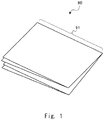
- Fig. 1 is a schematic diagram showing an example of an external appearance of a folded flexible object 90.
- Fig. 1 shows an external appearance of the flexible object 90 folded in four as an example.
- Four side ends of the flexible object 90 have different features as shown in Fig. 1 .
- Ends 91 are ends which are combined into one end by folding the flexible object and other ends are ends which are not combined into one end by folding the flexible object. That is, the ends 91 are ends in which one fold appears in the external appearance of the flexible object and other ends, in contrast, are ends in which a plurality of folds appear or no fold appears in the external appearance of the flexible object.
- the ends 91 are ends in which one edge appears in the external appearance of the flexible object and other ends, in contrast, are ends in which two or more edges (when the flexible object is folded in four as shown in Fig. 1 , specifically two or four edges) appear in the external appearance of the flexible object. That is, the ends 91 are closed ends, and ends other than the ends 91, in contrast, are opened ends.
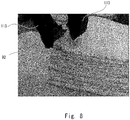
- Figs. 2A to 2C show the flexible objects in a folded and stacked state. Specifically, Figs. 2A to 2C show a state in which a plurality of folded cloth towels 92 are stacked. Note that a mark 92a shows ends combined into one end by folding the cloth towel 92 in Fig. 2A , and marks 92b and 92c show opened ends (i.e., ends not combined into one end) in Figs. 2B and 2C . Similar regular stacked patterns appear in each of Figs. 2A to 2C . Therefore, it is difficult to distinguish between the ends shown in Fig. 2A and the ends shown in Figs. 2B or 2C . Accordingly, it is difficult to identify a suitable grasping position.
- the grasping apparatus cannot easily lift up the flexible object which is at the top of the stacked flexible objects while maintaining the folded state thereof.
- the flexible object is folded so as to have ends combined into one end.
- the flexible object may be folded by repeating being folded in half one or more times, such as folding in half, folding it in four, or folding it in eight.
- the flexible object may be folded so that a folding, which is perpendicular or parallel to a folding generated at the time of n-th folding, is generated.
- the above-described method of folding the flexible object is an example and is not limited thereto.
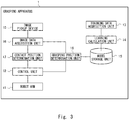
- Fig. 3 is a block diagram showing a schematic configuration of the grasping apparatus 1 according to the embodiment.
- the grasping apparatus 1 performs: [1] a learning process for generating a learned model based on image data of the flexible object; and [2] a determination process for determining a part suitable for being grasped using the learned model.
- the grasping apparatus 1 can also be referred to as a learning apparatus.
- the grasping apparatus 1 includes: an image pickup device 10; a robot arm 11; a control unit 12; a training data acquisition unit 13; a learning calculation unit 14; a model storage unit 15; an image data acquisition unit 16; a contact position determination unit 17; and a grasping position determination unit 18.
- the image pickup device 10 is a device for photographing surrounding objects, and in this embodiment, more specifically, it is a device for generating three-dimensional image information.
- the image pickup device 10 may be a stereo camera.
- the image pickup device 10 may include a Time-of-Flight distance sensor such as a laser range finder, or may include a distance sensor using a Light Coding system or the like in which a dot pattern is projected to measure a distance.
- the specific configuration of the image pickup device 10 can be any configurations and it is not limited to the configuration according to any one of the above techniques.
- the robot arm 11 is a specific example of a grasping part for grasping an object. As shown in Fig. 4 , the robot arm 11, includes, for example: a plurality of links 111; a joint part (a wrist joint, an elbow joint, a shoulder joint, etc.) 112 for rotatably coupling each link 111; and an end effector 113 for grasping a target object.
- a joint part a wrist joint, an elbow joint, a shoulder joint, etc.
- a rotation sensor 114 such as an encoder for detecting rotation information on each joint part 112, an actuator 115 such as a servo motor for driving each joint part 112, and a force sensor 116 for detecting an operation force of each joint part 112 are provided.
- the force sensor 116 for example, is a torque sensor or the like for detecting torque of each joint part 112.
- a speed reduction mechanism is provided in each joint part 112.
- the end effector 113 for example, is composed of a plurality of finger parts or the like and can grasp a target object by holding it with the finger parts.
- An actuator 117 for driving the end effector 113 and a force sensor 118 for detecting an operation force of the end effector 113 are provided in the end effector 113.
- the control unit 12 controls an operation of the robot arm 11.
- the control unit 12 calculates a trajectory of the robot arm 11 based on a result of the process performed by the contact position determination unit 17 or the grasping position determination unit 18. Further, the control unit 12 moves the robot arm 11 according to the calculated trajectory. Specifically, for example, the control unit 12 feedback-controls the robot arm 11 by controlling the actuators 115 and 117 based on outputs from the rotation sensor 114 and the force sensors 116 and 118.
- the training data acquisition unit 13 acquires training data including image data of an object being photographed.
- the training data acquisition unit 13 may read to acquire the training data previously stored in a storage device such as a memory of the grasping apparatus 1 or may acquire the training data sent from other apparatuses.
- the learning calculation unit 14 performs calculation of machine learning using the training data acquired by the training data acquisition unit 13.
- the image data included in the training data for example, is two-dimensional image data, but may instead be three-dimensional image data.
- the image data included in the training data is image data of the flexible objects in a folded and stacked state, especially image data of the flexible objects the ends of the top surface of which have been deformed from a regular stacked pattern shape. More specifically, in this embodiment, the photographed image data where the ends of the top surface of the flexible object which is at the top of the stacked flexible objects are pressed from the side surface direction is used. Further, as such image data, the image data used for the training data includes the following two types of image data. Note that one of the two types of the image data is referred to as first image data and the other is referred as to second image data.
- the first image data is image data of deformed ends being photographed which are combined into one end by folding the flexible object. That is, the first image data is photographed image data where the ends combined into one end by folding the flexible object have been deformed due to a pressing force from the side surface direction.
- a label indicating that it is image data of a part suitable for being grasped is associated with the first image data.
- the second image data is image data of deformed ends being photographed which are not combined into one end by folding the flexible object. That is, the second image data is photographed image data where the ends other than the ends combined into one end by folding the flexible object have been deformed due to a pressing force from the side surface direction.
- a label indicating that it is image data of a part unsuitable for being grasped is associated with the second image data. Note that the first and the second data may be partial image data cut from the image data.
- the learning calculation unit 14 calculates to learn a part of the flexible object suitable for being grasped by using the above-described training data.
- the CNN Convolutional Neural Network
- the CNN YOLO v2 capable of outputting a coordinate position in the image of the part suitable or unsuitable for being grasped and the grasping suitability of the part is used as the machine learning model.
- the learning calculation unit 14 especially calculates parameter values such as a weighting coefficient of a neutral network using the training data.
- the learning calculation unit 14 stores the learned model in the model storage unit 15 after completing the calculation using the training data.
- the following learned model for causing a computer to function so as to output the grasping suitability of a part of the object as a quantified value based on the image data of the object being photographed is stored in the model storage unit 15. That is, the weighting coefficient of the neutral network constituting this learned model is learned using the training data including the image data of the object being photographed. Note that this image data includes the above-described first and second image data. Then, this learned model causes a computer to function so as to perform a calculation according to the weighting coefficient for image data of the flexible objects in a folded and stacked state that are input to an input layer of the neutral network and output whether or not a part of the flexible objects in the image data is suitable for being grasped from an output layer of the neutral network. Note that image data in which the flexible objects in a folded and stacked state is not photographed may be input to the input layer. As described above, the learned model stored in the model storage unit 15 is used as a program module.
- the image data acquisition unit 16 acquires image data of an object being photographed.
- the image data acquisition unit 16 acquires, for example, image data of flexible objects being photographed in a folded and stacked state.
- the image data acquisition unit 16 acquires the image data photographed by the image pickup device 10.
- the image data acquisition unit 16 may read to acquire the image data previously stored in a storage device such as a memory of the grasping apparatus 1 or may acquire the image data sent from other apparatuses. Note that in this embodiment, although three-dimensional image data is acquired to control the robot arm 11, it is not always necessary when determining merely a suitable grasping position. That is, even with two-dimensional image data, it is possible to determine a suitable grasping position by the learned model.
- the contact position determination unit 17 determines a contact position to deform a flexible object to be grasped using the robot arm 11, which is, more specifically, the end effector 113. More specifically, the contact position determination unit 17 determines a contact position to deform the ends of the top surface of the stacked flexible objects. That is, the contact position determination unit 17 determines a contact position with the robot arm 11 in the flexible object to be grasped when the robot arm 11 displaces the flexible object to be grasped. In this embodiment, the object to be grasped is displaced when it is pressed by the robot arm 11 (the end effector 113). Therefore, in this embodiment, the contact position determination unit 17 determines a contact position for the robot arm 11 to press the flexible object to be grasped.
- the contact position determination unit 17 determines the contact position using image data acquired by the image data acquisition unit 16 in which the flexible objects before the ends of the top surface thereof are deformed by the robot arm 11 is photographed. Note that details of the determination of the contact positon will be described later with reference to a flowchart.
- the grasping positon determination unit 18 determines whether or not a part of the flexible objects in the image data is suitable for being grasped using the image data acquired by the image data acquisition unit 16. That is, the grasping position determination unit 18 uses the image data of the photographed flexible objects in a folded and stacked state to determine whether or not the part of the flexible objects in that image data is suitable for being grasped. Note that grasping position determination unit 18, more specifically, performs the determination using the photographed image data of the flexible objects the ends of the top surface of which have been deformed. Further, at that time, the grasping position determination unit 18 uses the learned model stored in the model storage unit 15.
- the grasping position determination unit 18 applies the above-described CNN, in which parameters including a weighting coefficient are previously set, to the image data acquired by the image data acquisition unit 16. Further, the grasping position determination unit 18 determines areas suitable and unsuitable for being grasped, and outputs the area suitable for being grasped.
- the control unit 12 controls the robot arm 11 as described above.
- the control unit 12 particularly controls the robot arm 11 so as to deform ends of the top surface of the flexible object which is at the top of the stacked flexible objects when determining a grasping position.
- the control unit 12 controls the robot arm 11 so that the ends of the flexible object are deformed by the robot arm 11 pressing with a predetermined force at the contact position determined by the contact position determination unit 17.
- the control unit 12 controls the end effector 113 of the robot arm 11 so as to press the ends of the top surface of the flexible object which is at the top of the stacked flexible objects, which is a contact position determined by the contact position determination unit 17, from the side surface direction. Since a motion for the deformation is simply a pressing motion, the deformation can be easily performed.
- the ends of the flexible object are pressed from a lateral direction as described above.
- the robot arm 11 may displace other positions of the flexible object when determining a grasping position.
- the control unit 12 may control the robot arm 11 so as to press a positon which is a predetermined distance away from the ends of the top surface of the flexible object which is at the top of the stacked flexible objects from above.
- the control unit 12 controls the robot arm 11 so as to press the flexible object at a contact position.
- the control unit 12 may displace the flexible object by other motions than the above motions performed by the robot arm 11 for deforming the ends of the flexible object.
- the deformation of the ends of the flexible object may be performed by the displacement due to other motions such as pulling the flexible object at the contact position determined by the contact position determination unit 17.
- the image data included in the training data i.e., the training data used in the learning calculation unit 14
- the image data included in the training data is image data of the flexible object deformed by using a deformation method the same as that performed by the robot arm 11 when determining a grasping position.
- control unit 12 controls the robot arm 11 so as to grasp the flexible object to be grasped at a grasping position, which is determined by the grasping position determination unit 18 to be a suitable area for being grasped.
- control unit 12 controls the robot arm 11 so as to hold the ends of the flexible object determined to be a suitable area for being grasped from the lateral direction and grasp the flexible object.
- control unit 12 may hold the vicinity of the ends to be suitable for being grasped from any direction and grasp the flexible object.
- a program including various instructions stored in a storage device such as the memory included in the grasping apparatus 1 is executed by a processor included in the grasping apparatus 1 so that the control unit 12; the training data acquisition unit 13; the learning calculation unit 14; the image data acquisition unit 16; the contact position determination unit 17; and the grasping position determination unit 18 are implemented.
- the model storage unit 15 is composed of storage devices such as the memory included in the grasping apparatus 1.
- the processor may be a CPU (Central Processing Unit), an MPU (Micro Processing Unit), a GPU (Graphics Processing Unit), or other types of processors.
- the memory may be a volatile memory or a nonvolatile memory.
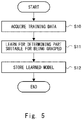
- Fig. 5 is a flowchart showing a flow of a learning process performed by the grasping apparatus 1.
- the training data acquisition unit 13 firstly acquires training data in a step 10 (S10).
- the training data acquired in the step 10 includes the above-described first and second image data which have been associated with labels.
- the learning calculation unit 14 uses the training data acquired in the step 10 to perform a predetermined calculation for learning the CNN which determines a part suitable for being grasped.
- the model storage unit 15 stores the learned model whose parameter value is determined by the completion of the calculation performed in the step 11.
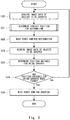
- Fig. 6 is a flowchart showing a flow of a process performed when the grasping apparatus 1 grasps an object to be grasped.
- the image data acquisition unit 16 firstly acquires image data of an object photographed by the image pickup device 10.
- the contact position determination unit 17 determines a contact position for deforming the flexible object to be grasped.
- the contact position determination unit 17 specifically determines the contact position by processes shown in a flowchart of Fig. 7 .
- the contact position determination unit 17 detects a plane on which the flexible objects to be grasped are placed. That is, the contact position determination unit 17 performs a predetermined image analysis on image data acquired by the image data acquisition unit 16 to detect the plane.
- the contact position determination unit 17 performs an image analysis and thereby detects a block present in the side of the image higher than the plane detected in the step 210. Further, the detected block is cut out from that image.
- the contact position determination unit 17 performs a predetermined edge detection on the image of the block cut out in the step 211.
- the edges detected by this edge detection correspond to a contour of the objects to be grasped (the stacked flexible objects).
- the contact position determination unit 17 determines the ends of the upper surface of the stacked flexible objects as a contact position.
- the contact position determination unit 17 specifically determines a position of the edge present in the highest position (i.e., the uppermost position) of the positions among the edges detected in the step 212 as the contact position.
- the process proceeds to a step 22 (see Fig. 6 ).
- the control unit 12 controls the robot arm 11 so that the end effector 113 presses the contact position determined in the step 21 from the lateral direction (see Fig. 8 ).
- the image data acquisition unit 16 acquires image data of the object photographed by the image pickup device 10. Note that in the image data acquired in the step 23, the object to be grasped, which has been deformed by the process of the step 22, is photographed. The deformation of cloth products or the like pressed by the end effector 113 is maintained even after the end effector 113 is released therefrom. Therefore, in the step 23, the image data photographed in a state where the end effector 113 is released from the flexible object may be acquired.
- a step 24 the grasping position determination unit 18 performs a determination on a position suitable for being grasped. That is, the grasping position determination unit 18 determines whether the part of the object to be grasped in the image data acquired in the step 23 is suitable for being grasped using the learned model.
- the process proceeds to a step 26.
- a position suitable for being grasped has not been found (“No" in the step 25)
- the process returns to the step 20.
- the process returns to the step 20, for example, the processes performed after the step 20 are repeated for image data photographed from a direction different from the direction in the previous time.
- the determination on the position suitable for being grasped is similarly performed for the ends of the other sides.
- the control unit 12 controls the robot arm 11 so that the end effector 113 holds the position determined to be suitable for being grasped in the step 24 from the lateral direction.
- the grasping apparatus 1 having the above-described configuration, when a grasping position is determined, ends of the top surface of the flexible object can be deformed by the robot arm 11.
- the deformed forms of the ends which are combined into one end are different from that of the ends which are not combined into one end. That is, the grasping position determination unit 18 performs a determination using image data showing a state which differs depending on whether or not a part is suitable for being grasped. Therefore, the grasping position determination unit 18 can determine a suitable grasping position.
- the grasping apparatus 1 includes the above-described contact position determination unit 17. Therefore, it is possible to autonomously determine a contact position for the deformation. That is, in the grasping apparatus 1, the control unit 12 performs control according to a contact position determined by the contact position determination unit 17 so that the grasping apparatus 1 autonomously deforms the flexible object.
- the grasping apparatus 1 includes all components shown in Fig. 3 and some of them may be included in other apparatuses.
- a system as shown in Fig. 9 may be configured.
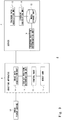
- Fig. 9 is a schematic diagram showing a grasping system 2 including an image pickup device 10, a server 3, and a grasping apparatus 4.
- the image pickup device 10 is installed in a space instead of in the grasping apparatus 4.
- the server 3 includes the training data acquisition unit 13, the learning calculation unit 14, the model storage unit 15, and the grasping position determination unit 18 of the components shown in Fig. 3 , and the other components shown in Fig. 3 are included in the grasping apparatus 4.
- a program including various instructions stored in a storage device such as the memory included in the grasping apparatus 4 is executed by a processor included in the grasping apparatus 4 so that a control unit 12, an image data acquisition unit 16, and a contact position determination unit 17 are implemented.
- a program including various instructions stored in a storage device such as the memory included in the server 3 is executed by a processor included in the server 3 so that the training data acquisition unit 13, the learning calculation unit 14, and the grasping position determination unit 18 are implemented.
- the model storage unit 15 is composed of storage devices such as the memory included in the server 3. Image data is transmitted and received between the image pickup device 10 and the grasping apparatus 4. That is, the image data acquisition unit 16 of the grasping apparatus 4 acquires image data, which are transmitted from the image pickup device 10 and received by the grasping apparatus 4. Further, between the server 3 and the grasping apparatus 4, image data necessary for a process performed by the grasping position determination unit 18 is transmitted and received, and a result of the process performed by the grasping position determination unit 18 is also transmitted and received.
- Fig. 9 shows an example of an apparatus which performs distributed processing, and other configurations or other apparatuses may be used for the distributed processing.
- a system is not limited to the configuration examples shown in Figs. 3 and 9 , and for example, it may be configured so that a server executes a process performed by the learning calculation unit 14 and a grasping apparatus executes a process performed by the grasping position determination unit 18. On the contrary, a system may be configured so that a grasping apparatus executes a process performed by the learning calculation unit 14 and a server executes a process performed by the grasping position determination unit 18.
- Non-transitory computer readable media include any type of tangible storage media.
- Examples of non-transitory computer readable media include magnetic storage media (such as floppy disks, magnetic tapes, hard disk drives, etc.), optical magnetic storage media (e.g. magneto-optical disks), CD-ROM (compact disc read only memory), CD-R (compact disc recordable), CD-R/W (compact disc rewritable), and semiconductor memories (such as mask ROM, PROM (programmable ROM), EPROM (erasable PROM), flash ROM, RAM (random access memory), etc.).
- magnetic storage media such as floppy disks, magnetic tapes, hard disk drives, etc.
- optical magnetic storage media e.g. magneto-optical disks
- CD-ROM compact disc read only memory
- CD-R compact disc recordable
- CD-R/W compact disc rewritable
- semiconductor memories such as mask ROM, PROM (programmable ROM), EPROM (erasable PROM), flash ROM
- the program may be provided to a computer using any type of transitory computer readable media.
- Examples of transitory computer readable media include electric signals, optical signals, and electromagnetic waves.
- Transitory computer readable media can provide the program to a computer via a wired communication line (e.g. electric wires, and optical fibers) or a wireless communication line.
Landscapes
- Engineering & Computer Science (AREA)
- Robotics (AREA)
- Physics & Mathematics (AREA)
- Theoretical Computer Science (AREA)
- Mechanical Engineering (AREA)
- General Physics & Mathematics (AREA)
- Computer Vision & Pattern Recognition (AREA)
- Health & Medical Sciences (AREA)
- General Health & Medical Sciences (AREA)
- Artificial Intelligence (AREA)
- Evolutionary Computation (AREA)
- Data Mining & Analysis (AREA)
- Orthopedic Medicine & Surgery (AREA)
- Automation & Control Theory (AREA)
- Mathematical Physics (AREA)
- Software Systems (AREA)
- General Engineering & Computer Science (AREA)
- Life Sciences & Earth Sciences (AREA)
- Fuzzy Systems (AREA)
- Computational Linguistics (AREA)
- Bioinformatics & Computational Biology (AREA)
- Evolutionary Biology (AREA)
- Bioinformatics & Cheminformatics (AREA)
- Multimedia (AREA)
- Computing Systems (AREA)
- Molecular Biology (AREA)
- Biophysics (AREA)
- Biomedical Technology (AREA)
- Manipulator (AREA)
- Image Analysis (AREA)
Priority Applications (1)
| Application Number | Priority Date | Filing Date | Title |
|---|---|---|---|
| EP21168900.5A EP3869464B1 (de) | 2017-12-18 | 2018-11-23 | Lernvorrichtung und lernverfahren |
Applications Claiming Priority (1)
| Application Number | Priority Date | Filing Date | Title |
|---|---|---|---|
| JP2017241555A JP7136554B2 (ja) | 2017-12-18 | 2017-12-18 | 把持装置、学習装置、プログラム、把持システム、及び学習方法 |
Related Child Applications (2)
| Application Number | Title | Priority Date | Filing Date |
|---|---|---|---|
| EP21168900.5A Division-Into EP3869464B1 (de) | 2017-12-18 | 2018-11-23 | Lernvorrichtung und lernverfahren |
| EP21168900.5A Division EP3869464B1 (de) | 2017-12-18 | 2018-11-23 | Lernvorrichtung und lernverfahren |
Publications (3)
| Publication Number | Publication Date |
|---|---|
| EP3499463A2 true EP3499463A2 (de) | 2019-06-19 |
| EP3499463A3 EP3499463A3 (de) | 2019-09-04 |
| EP3499463B1 EP3499463B1 (de) | 2021-11-17 |
Family
ID=64604427
Family Applications (2)
| Application Number | Title | Priority Date | Filing Date |
|---|---|---|---|
| EP21168900.5A Active EP3869464B1 (de) | 2017-12-18 | 2018-11-23 | Lernvorrichtung und lernverfahren |
| EP18208069.7A Not-in-force EP3499463B1 (de) | 2017-12-18 | 2018-11-23 | Erfassungsvorrichtung, erlerntes modell und bestimmungsverfahren |
Family Applications Before (1)
| Application Number | Title | Priority Date | Filing Date |
|---|---|---|---|
| EP21168900.5A Active EP3869464B1 (de) | 2017-12-18 | 2018-11-23 | Lernvorrichtung und lernverfahren |
Country Status (5)
| Country | Link |
|---|---|
| US (1) | US11383378B2 (de) |
| EP (2) | EP3869464B1 (de) |
| JP (1) | JP7136554B2 (de) |
| KR (2) | KR102140637B1 (de) |
| CN (1) | CN110046538B (de) |
Cited By (1)
| Publication number | Priority date | Publication date | Assignee | Title |
|---|---|---|---|---|
| WO2021001039A1 (de) * | 2019-07-03 | 2021-01-07 | Sewts Gmbh | Verfahren zur positionierung eines biegeschlaffen flächenwerkstücks sowie positionierungsvorrichtung |
Families Citing this family (25)
| Publication number | Priority date | Publication date | Assignee | Title |
|---|---|---|---|---|
| JP6680732B2 (ja) * | 2017-08-23 | 2020-04-15 | ファナック株式会社 | 物品積み付け装置及び機械学習装置 |
| JP7136554B2 (ja) * | 2017-12-18 | 2022-09-13 | 国立大学法人信州大学 | 把持装置、学習装置、プログラム、把持システム、及び学習方法 |
| US11584016B2 (en) * | 2018-04-24 | 2023-02-21 | Fanuc Corporation | Robot controller and system |
| JP7047726B2 (ja) * | 2018-11-27 | 2022-04-05 | トヨタ自動車株式会社 | 把持ロボットおよび把持ロボットの制御プログラム |
| JP2020110874A (ja) * | 2019-01-11 | 2020-07-27 | 倉敷紡績株式会社 | 柔軟物の積み重ね方法、衣服の折り畳みおよび積み重ね方法、ならびにロボットシステム |
| CN110253581A (zh) * | 2019-06-25 | 2019-09-20 | 华北水利水电大学 | 一种基于视觉识别的辅助抓取方法 |
| EP4013575B1 (de) * | 2019-08-16 | 2026-03-25 | Laundry Robotics B.V. | Verfahren und system zum zuführen eines flachteils zu einem transportförderer und/oder einer flachteilbehandlungsvorrichtung |
| DE102020128653B4 (de) * | 2019-11-13 | 2024-03-14 | Nvidia Corporation | Greifbestimmung für ein Objekt in Unordnung |
| JP7342676B2 (ja) | 2019-12-13 | 2023-09-12 | トヨタ自動車株式会社 | 遠隔操作システム及び遠隔操作方法 |
| CN111145257B (zh) * | 2019-12-27 | 2024-01-05 | 深圳市越疆科技有限公司 | 物品抓取方法、系统及物品抓取机器人 |
| JP7342974B2 (ja) * | 2020-01-15 | 2023-09-12 | オムロン株式会社 | 制御装置、学習装置、制御方法、及び制御プログラム |
| US10759054B1 (en) * | 2020-02-26 | 2020-09-01 | Grey Orange Pte. Ltd. | Method and system for handling deformable objects |
| JP7337285B2 (ja) * | 2020-10-19 | 2023-09-01 | 三菱電機株式会社 | ロボット制御装置およびロボット制御方法 |
| CN112297013B (zh) * | 2020-11-11 | 2022-02-18 | 浙江大学 | 一种基于数字孪生和深度神经网络的机器人智能抓取方法 |
| JP7737795B2 (ja) * | 2020-12-18 | 2025-09-11 | 株式会社前川製作所 | 把持位置演算システム、把持位置演算プログラム、学習済モデル、及び骨付き肉把持システム |
| US11911919B2 (en) | 2021-03-05 | 2024-02-27 | Mujin, Inc. | Method and computing system for performing grip region detection |
| CN113459101B (zh) * | 2021-03-05 | 2022-08-09 | 牧今科技 | 用于执行抓持区域检测的方法和计算系统 |
| DE102021202759B4 (de) * | 2021-03-22 | 2024-11-07 | Robert Bosch Gesellschaft mit beschränkter Haftung | Vorrichtung und Verfahren zum Trainieren eines maschinellen Lernmodells zum Steuern eines Roboters |
| US11752525B2 (en) | 2021-07-16 | 2023-09-12 | Mihir Kothari | System and method of laundry sorting |
| US12024815B2 (en) | 2021-07-16 | 2024-07-02 | Mihir Kothari | System and method of laundry sorting |
| CN115446835B (zh) * | 2022-09-05 | 2024-06-14 | 大连交通大学 | 一种基于深度学习的刚软仿人手自主抓取方法 |
| US12584268B2 (en) | 2022-09-13 | 2026-03-24 | Mihir Kothari | System and method of laundry singulation and flattening |
| CN116494239A (zh) * | 2023-05-23 | 2023-07-28 | 深圳大学 | 软体机械手控制方法、装置、软体机械手及电子设备 |
| CN116494244B (zh) * | 2023-06-02 | 2026-04-17 | 电子科技大学中山学院 | 一种柔性物体抓取方法、装置、电子设备及存储介质 |
| WO2025166148A1 (en) * | 2024-02-02 | 2025-08-07 | Sufficiently Advanced, Inc. | Machine handling of non-rigid materials |
Family Cites Families (26)
| Publication number | Priority date | Publication date | Assignee | Title |
|---|---|---|---|---|
| US4355795A (en) | 1980-03-04 | 1982-10-26 | Bobst Champlain, Inc. | Sheet handling device |
| DE4124077C2 (de) * | 1991-07-19 | 1995-03-09 | Fraunhofer Ges Forschung | Einrichtung zur Aufnahme von biegeschlaffen flächigen Teilen |
| JPH0780790A (ja) * | 1993-09-16 | 1995-03-28 | Fujitsu Ltd | 三次元物体把持システム |
| US20010056313A1 (en) * | 2000-05-08 | 2001-12-27 | Osborne William Joseph | Object locating and retrieving system utilizing labels |
| JP3855050B2 (ja) * | 2002-04-26 | 2006-12-06 | 独立行政法人産業技術総合研究所 | 衣類状態推定方法及びプログラム |
| JP3723818B2 (ja) * | 2002-06-24 | 2005-12-07 | 松下電器産業株式会社 | 多関節駆動機構及びその製造方法、それを用いた把持ハンドとロボット |
| JP2009279700A (ja) | 2008-05-21 | 2009-12-03 | Purex:Kk | ワークの把持方法および装置 |
| WO2010062998A2 (en) * | 2008-11-26 | 2010-06-03 | H.W. J. Designs For Agribusiness, Inc. | Bag retrieval assembly and bag for pressed bales |
| US8997670B2 (en) * | 2010-03-18 | 2015-04-07 | Wayne J. Book | Conveyance system that transports fabric |
| CA2819588C (en) * | 2010-12-01 | 2019-09-17 | Seven Dreamers Laboratories, Inc. | Deformable thin object spreading device and deformable thin object spreading method |
| JP5952136B2 (ja) | 2012-08-29 | 2016-07-13 | 倉敷紡績株式会社 | 布片の縁部の自動検出方法とその装置、および、該装置を有する布片展開送り装置 |
| JP6364836B2 (ja) * | 2014-03-14 | 2018-08-01 | セイコーエプソン株式会社 | ロボット、ロボットシステム、及び制御装置 |
| KR20150118813A (ko) | 2014-04-15 | 2015-10-23 | 삼성전자주식회사 | 햅틱 정보 운용 방법 및 이를 지원하는 전자 장치 |
| US9427874B1 (en) * | 2014-08-25 | 2016-08-30 | Google Inc. | Methods and systems for providing landmarks to facilitate robot localization and visual odometry |
| US9492923B2 (en) * | 2014-12-16 | 2016-11-15 | Amazon Technologies, Inc. | Generating robotic grasping instructions for inventory items |
| JP6522488B2 (ja) | 2015-07-31 | 2019-05-29 | ファナック株式会社 | ワークの取り出し動作を学習する機械学習装置、ロボットシステムおよび機械学習方法 |
| EP3414710B1 (de) * | 2016-03-03 | 2022-11-02 | Google LLC | Tiefes maschinellen lernverfahren und vorrichtung für robotisches greifen |
| US9962989B2 (en) * | 2016-04-01 | 2018-05-08 | Bastian Solutions, Llc | Robotic system for placing printed material into boxes |
| JP6724499B2 (ja) | 2016-04-05 | 2020-07-15 | 株式会社リコー | 物体把持装置及び把持制御プログラム |
| US9981379B1 (en) * | 2016-05-12 | 2018-05-29 | X Development Llc | Detachable support member for robot gripper |
| JP7136554B2 (ja) * | 2017-12-18 | 2022-09-13 | 国立大学法人信州大学 | 把持装置、学習装置、プログラム、把持システム、及び学習方法 |
| US10981272B1 (en) * | 2017-12-18 | 2021-04-20 | X Development Llc | Robot grasp learning |
| JP7325896B2 (ja) * | 2019-04-04 | 2023-08-15 | 花王株式会社 | シート移送方法 |
| FR3096672B1 (fr) * | 2019-06-03 | 2021-04-30 | Jyga Process | installation et procédé de manipulation de flans plats |
| US11738447B2 (en) * | 2019-07-29 | 2023-08-29 | Nimble Robotics, Inc. | Storage systems and methods for robotic picking |
| US10759054B1 (en) * | 2020-02-26 | 2020-09-01 | Grey Orange Pte. Ltd. | Method and system for handling deformable objects |
-
2017
- 2017-12-18 JP JP2017241555A patent/JP7136554B2/ja active Active
-
2018
- 2018-11-23 EP EP21168900.5A patent/EP3869464B1/de active Active
- 2018-11-23 EP EP18208069.7A patent/EP3499463B1/de not_active Not-in-force
- 2018-12-10 US US16/214,556 patent/US11383378B2/en active Active
- 2018-12-13 KR KR1020180160688A patent/KR102140637B1/ko active Active
- 2018-12-13 CN CN201811525879.6A patent/CN110046538B/zh not_active Expired - Fee Related
-
2020
- 2020-03-12 KR KR1020200030705A patent/KR102140639B1/ko active Active
Non-Patent Citations (1)
| Title |
|---|
| None |
Cited By (3)
| Publication number | Priority date | Publication date | Assignee | Title |
|---|---|---|---|---|
| WO2021001039A1 (de) * | 2019-07-03 | 2021-01-07 | Sewts Gmbh | Verfahren zur positionierung eines biegeschlaffen flächenwerkstücks sowie positionierungsvorrichtung |
| US20220244699A1 (en) | 2019-07-03 | 2022-08-04 | Sewts Gmbh | Method for positioning a limp, flat workpiece and positioning apparatus |
| US12386333B2 (en) | 2019-07-03 | 2025-08-12 | Sewts Gmbh | Method for positioning a limp, flat workpiece and positioning apparatus |
Also Published As
| Publication number | Publication date |
|---|---|
| EP3499463B1 (de) | 2021-11-17 |
| KR20190073282A (ko) | 2019-06-26 |
| EP3869464A1 (de) | 2021-08-25 |
| KR20200032057A (ko) | 2020-03-25 |
| US20190184554A1 (en) | 2019-06-20 |
| CN110046538B (zh) | 2023-04-25 |
| EP3869464B1 (de) | 2024-05-15 |
| EP3499463A3 (de) | 2019-09-04 |
| KR102140637B1 (ko) | 2020-08-04 |
| KR102140639B1 (ko) | 2020-08-04 |
| US11383378B2 (en) | 2022-07-12 |
| JP2019107725A (ja) | 2019-07-04 |
| CN110046538A (zh) | 2019-07-23 |
| JP7136554B2 (ja) | 2022-09-13 |
Similar Documents
| Publication | Publication Date | Title |
|---|---|---|
| US11383378B2 (en) | Grasping apparatus, learning apparatus, learned model, grasping system, determination method, and learning method | |
| CN111055279B (zh) | 基于触觉与视觉结合的多模态物体抓取方法与系统 | |
| CN108885715B (zh) | 用于机器人抓取的深度机器学习方法和装置 | |
| US11504846B2 (en) | Robot teaching system based on image segmentation and surface electromyography and robot teaching method thereof | |
| JP7154815B2 (ja) | 情報処理装置、制御方法、ロボットシステム、コンピュータプログラム、及び記憶媒体 | |
| US20220016766A1 (en) | Method and system for grasping an object | |
| CN109074513B (zh) | 用于机器人抓握的深度机器学习方法和装置 | |
| CN114502937B (zh) | 触觉传感器 | |
| CN111275063A (zh) | 一种基于3d视觉的机器人智能抓取控制方法及系统 | |
| JP2019084601A (ja) | 情報処理装置、把持システムおよび情報処理方法 | |
| JP2017177294A (ja) | ロボット制御装置、ロボット制御方法、ロボットシステムおよびコンピュータプログラム | |
| JP2024001106A5 (de) | ||
| Namiki et al. | Origami folding by multifingered hands with motion primitives | |
| JP2016196077A (ja) | 情報処理装置、情報処理方法、およびプログラム | |
| Mišeikis et al. | Transfer learning for unseen robot detection and joint estimation on a multi-objective convolutional neural network | |
| JP5300795B2 (ja) | 顔表情増幅装置、表情認識装置、顔表情増幅方法、表情認識方法、及びプログラム | |
| JP6838833B2 (ja) | 把持装置、把持方法、及びプログラム | |
| JP7201858B2 (ja) | 判定方法 | |
| Garg et al. | Handaid: A seven dof semi-autonomous robotic manipulator | |
| Sommer et al. | Face classification using touch with a humanoid robot hand | |
| Samandi | Single-shot RGB-D grasping of objects using a multi-finger robot: a grasp rectangle approach with post-processing | |
| CN120480912B (zh) | 一种多机型柔性六轴机器人视觉抓取系统 | |
| Rouhafzay et al. | Biologically Inspired Vision and Touch Sensing to Optimize 3D Object Representation and Recognition | |
| Laschi et al. | Recognizing hand posture by vision: applications in humanoid personal robotics | |
| CN121492064A (zh) | 一种利用视觉识别技术完成人形机器人灵巧手精准控制的方法 |
Legal Events
| Date | Code | Title | Description |
|---|---|---|---|
| PUAI | Public reference made under article 153(3) epc to a published international application that has entered the european phase |
Free format text: ORIGINAL CODE: 0009012 |
|
| STAA | Information on the status of an ep patent application or granted ep patent |
Free format text: STATUS: REQUEST FOR EXAMINATION WAS MADE |
|
| PUAL | Search report despatched |
Free format text: ORIGINAL CODE: 0009013 |
|
| 17P | Request for examination filed |
Effective date: 20181123 |
|
| AK | Designated contracting states |
Kind code of ref document: A2 Designated state(s): AL AT BE BG CH CY CZ DE DK EE ES FI FR GB GR HR HU IE IS IT LI LT LU LV MC MK MT NL NO PL PT RO RS SE SI SK SM TR |
|
| AX | Request for extension of the european patent |
Extension state: BA ME |
|
| PUAF | Information related to the publication of a search report (a3 document) modified or deleted |
Free format text: ORIGINAL CODE: 0009199SEPU |
|
| AK | Designated contracting states |
Kind code of ref document: A3 Designated state(s): AL AT BE BG CH CY CZ DE DK EE ES FI FR GB GR HR HU IE IS IT LI LT LU LV MC MK MT NL NO PL PT RO RS SE SI SK SM TR |
|
| AX | Request for extension of the european patent |
Extension state: BA ME |
|
| RIC1 | Information provided on ipc code assigned before grant |
Ipc: G06T 1/00 20060101ALI20190612BHEP Ipc: G06T 7/70 20170101AFI20190612BHEP |
|
| REG | Reference to a national code |
Ref country code: DE Ref legal event code: R079 Ref document number: 602018026748 Country of ref document: DE Free format text: PREVIOUS MAIN CLASS: G06T0007730000 Ipc: G06T0007700000 |
|
| PUAL | Search report despatched |
Free format text: ORIGINAL CODE: 0009013 |
|
| D17D | Deferred search report published (deleted) | ||
| AK | Designated contracting states |
Kind code of ref document: A3 Designated state(s): AL AT BE BG CH CY CZ DE DK EE ES FI FR GB GR HR HU IE IS IT LI LT LU LV MC MK MT NL NO PL PT RO RS SE SI SK SM TR |
|
| AX | Request for extension of the european patent |
Extension state: BA ME |
|
| RIC1 | Information provided on ipc code assigned before grant |
Ipc: G06T 7/70 20170101AFI20190731BHEP Ipc: G06T 1/00 20060101ALI20190731BHEP |
|
| GRAP | Despatch of communication of intention to grant a patent |
Free format text: ORIGINAL CODE: EPIDOSNIGR1 |
|
| STAA | Information on the status of an ep patent application or granted ep patent |
Free format text: STATUS: GRANT OF PATENT IS INTENDED |
|
| INTG | Intention to grant announced |
Effective date: 20201208 |
|
| GRAJ | Information related to disapproval of communication of intention to grant by the applicant or resumption of examination proceedings by the epo deleted |
Free format text: ORIGINAL CODE: EPIDOSDIGR1 |
|
| STAA | Information on the status of an ep patent application or granted ep patent |
Free format text: STATUS: REQUEST FOR EXAMINATION WAS MADE |
|
| INTC | Intention to grant announced (deleted) | ||
| GRAP | Despatch of communication of intention to grant a patent |
Free format text: ORIGINAL CODE: EPIDOSNIGR1 |
|
| STAA | Information on the status of an ep patent application or granted ep patent |
Free format text: STATUS: GRANT OF PATENT IS INTENDED |
|
| INTG | Intention to grant announced |
Effective date: 20210601 |
|
| GRAS | Grant fee paid |
Free format text: ORIGINAL CODE: EPIDOSNIGR3 |
|
| GRAA | (expected) grant |
Free format text: ORIGINAL CODE: 0009210 |
|
| STAA | Information on the status of an ep patent application or granted ep patent |
Free format text: STATUS: THE PATENT HAS BEEN GRANTED |
|
| RAP3 | Party data changed (applicant data changed or rights of an application transferred) |
Owner name: TOYOTA JIDOSHA KABUSHIKI KAISHA Owner name: SHINSHU UNIVERSITY |
|
| AK | Designated contracting states |
Kind code of ref document: B1 Designated state(s): AL AT BE BG CH CY CZ DE DK EE ES FI FR GB GR HR HU IE IS IT LI LT LU LV MC MK MT NL NO PL PT RO RS SE SI SK SM TR |
|
| REG | Reference to a national code |
Ref country code: GB Ref legal event code: FG4D |
|
| REG | Reference to a national code |
Ref country code: DE Ref legal event code: R096 Ref document number: 602018026748 Country of ref document: DE |
|
| REG | Reference to a national code |
Ref country code: IE Ref legal event code: FG4D |
|
| REG | Reference to a national code |
Ref country code: AT Ref legal event code: REF Ref document number: 1448708 Country of ref document: AT Kind code of ref document: T Effective date: 20211215 |
|
| REG | Reference to a national code |
Ref country code: LT Ref legal event code: MG9D |
|
| REG | Reference to a national code |
Ref country code: NL Ref legal event code: MP Effective date: 20211117 |
|
| REG | Reference to a national code |
Ref country code: AT Ref legal event code: MK05 Ref document number: 1448708 Country of ref document: AT Kind code of ref document: T Effective date: 20211117 |
|
| PG25 | Lapsed in a contracting state [announced via postgrant information from national office to epo] |
Ref country code: RS Free format text: LAPSE BECAUSE OF FAILURE TO SUBMIT A TRANSLATION OF THE DESCRIPTION OR TO PAY THE FEE WITHIN THE PRESCRIBED TIME-LIMIT Effective date: 20211117 Ref country code: LT Free format text: LAPSE BECAUSE OF FAILURE TO SUBMIT A TRANSLATION OF THE DESCRIPTION OR TO PAY THE FEE WITHIN THE PRESCRIBED TIME-LIMIT Effective date: 20211117 Ref country code: FI Free format text: LAPSE BECAUSE OF FAILURE TO SUBMIT A TRANSLATION OF THE DESCRIPTION OR TO PAY THE FEE WITHIN THE PRESCRIBED TIME-LIMIT Effective date: 20211117 Ref country code: BG Free format text: LAPSE BECAUSE OF FAILURE TO SUBMIT A TRANSLATION OF THE DESCRIPTION OR TO PAY THE FEE WITHIN THE PRESCRIBED TIME-LIMIT Effective date: 20220217 Ref country code: AT Free format text: LAPSE BECAUSE OF FAILURE TO SUBMIT A TRANSLATION OF THE DESCRIPTION OR TO PAY THE FEE WITHIN THE PRESCRIBED TIME-LIMIT Effective date: 20211117 |
|
| PG25 | Lapsed in a contracting state [announced via postgrant information from national office to epo] |
Ref country code: IS Free format text: LAPSE BECAUSE OF FAILURE TO SUBMIT A TRANSLATION OF THE DESCRIPTION OR TO PAY THE FEE WITHIN THE PRESCRIBED TIME-LIMIT Effective date: 20220317 Ref country code: SE Free format text: LAPSE BECAUSE OF FAILURE TO SUBMIT A TRANSLATION OF THE DESCRIPTION OR TO PAY THE FEE WITHIN THE PRESCRIBED TIME-LIMIT Effective date: 20211117 Ref country code: PT Free format text: LAPSE BECAUSE OF FAILURE TO SUBMIT A TRANSLATION OF THE DESCRIPTION OR TO PAY THE FEE WITHIN THE PRESCRIBED TIME-LIMIT Effective date: 20220317 Ref country code: PL Free format text: LAPSE BECAUSE OF FAILURE TO SUBMIT A TRANSLATION OF THE DESCRIPTION OR TO PAY THE FEE WITHIN THE PRESCRIBED TIME-LIMIT Effective date: 20211117 Ref country code: NO Free format text: LAPSE BECAUSE OF FAILURE TO SUBMIT A TRANSLATION OF THE DESCRIPTION OR TO PAY THE FEE WITHIN THE PRESCRIBED TIME-LIMIT Effective date: 20220217 Ref country code: NL Free format text: LAPSE BECAUSE OF FAILURE TO SUBMIT A TRANSLATION OF THE DESCRIPTION OR TO PAY THE FEE WITHIN THE PRESCRIBED TIME-LIMIT Effective date: 20211117 Ref country code: LV Free format text: LAPSE BECAUSE OF FAILURE TO SUBMIT A TRANSLATION OF THE DESCRIPTION OR TO PAY THE FEE WITHIN THE PRESCRIBED TIME-LIMIT Effective date: 20211117 Ref country code: HR Free format text: LAPSE BECAUSE OF FAILURE TO SUBMIT A TRANSLATION OF THE DESCRIPTION OR TO PAY THE FEE WITHIN THE PRESCRIBED TIME-LIMIT Effective date: 20211117 Ref country code: GR Free format text: LAPSE BECAUSE OF FAILURE TO SUBMIT A TRANSLATION OF THE DESCRIPTION OR TO PAY THE FEE WITHIN THE PRESCRIBED TIME-LIMIT Effective date: 20220218 Ref country code: ES Free format text: LAPSE BECAUSE OF FAILURE TO SUBMIT A TRANSLATION OF THE DESCRIPTION OR TO PAY THE FEE WITHIN THE PRESCRIBED TIME-LIMIT Effective date: 20211117 |
|
| REG | Reference to a national code |
Ref country code: CH Ref legal event code: PL |
|
| PG25 | Lapsed in a contracting state [announced via postgrant information from national office to epo] |
Ref country code: SM Free format text: LAPSE BECAUSE OF FAILURE TO SUBMIT A TRANSLATION OF THE DESCRIPTION OR TO PAY THE FEE WITHIN THE PRESCRIBED TIME-LIMIT Effective date: 20211117 Ref country code: SK Free format text: LAPSE BECAUSE OF FAILURE TO SUBMIT A TRANSLATION OF THE DESCRIPTION OR TO PAY THE FEE WITHIN THE PRESCRIBED TIME-LIMIT Effective date: 20211117 Ref country code: RO Free format text: LAPSE BECAUSE OF FAILURE TO SUBMIT A TRANSLATION OF THE DESCRIPTION OR TO PAY THE FEE WITHIN THE PRESCRIBED TIME-LIMIT Effective date: 20211117 Ref country code: LU Free format text: LAPSE BECAUSE OF NON-PAYMENT OF DUE FEES Effective date: 20211123 Ref country code: EE Free format text: LAPSE BECAUSE OF FAILURE TO SUBMIT A TRANSLATION OF THE DESCRIPTION OR TO PAY THE FEE WITHIN THE PRESCRIBED TIME-LIMIT Effective date: 20211117 Ref country code: DK Free format text: LAPSE BECAUSE OF FAILURE TO SUBMIT A TRANSLATION OF THE DESCRIPTION OR TO PAY THE FEE WITHIN THE PRESCRIBED TIME-LIMIT Effective date: 20211117 Ref country code: CZ Free format text: LAPSE BECAUSE OF FAILURE TO SUBMIT A TRANSLATION OF THE DESCRIPTION OR TO PAY THE FEE WITHIN THE PRESCRIBED TIME-LIMIT Effective date: 20211117 Ref country code: BE Free format text: LAPSE BECAUSE OF NON-PAYMENT OF DUE FEES Effective date: 20211130 |
|
| REG | Reference to a national code |
Ref country code: BE Ref legal event code: MM Effective date: 20211130 |
|
| REG | Reference to a national code |
Ref country code: DE Ref legal event code: R097 Ref document number: 602018026748 Country of ref document: DE |
|
| PG25 | Lapsed in a contracting state [announced via postgrant information from national office to epo] |
Ref country code: MC Free format text: LAPSE BECAUSE OF FAILURE TO SUBMIT A TRANSLATION OF THE DESCRIPTION OR TO PAY THE FEE WITHIN THE PRESCRIBED TIME-LIMIT Effective date: 20211117 |
|
| PLBE | No opposition filed within time limit |
Free format text: ORIGINAL CODE: 0009261 |
|
| STAA | Information on the status of an ep patent application or granted ep patent |
Free format text: STATUS: NO OPPOSITION FILED WITHIN TIME LIMIT |
|
| 26N | No opposition filed |
Effective date: 20220818 |
|
| PG25 | Lapsed in a contracting state [announced via postgrant information from national office to epo] |
Ref country code: IE Free format text: LAPSE BECAUSE OF NON-PAYMENT OF DUE FEES Effective date: 20211123 Ref country code: AL Free format text: LAPSE BECAUSE OF FAILURE TO SUBMIT A TRANSLATION OF THE DESCRIPTION OR TO PAY THE FEE WITHIN THE PRESCRIBED TIME-LIMIT Effective date: 20211117 |
|
| PGFP | Annual fee paid to national office [announced via postgrant information from national office to epo] |
Ref country code: GB Payment date: 20220930 Year of fee payment: 5 |
|
| PG25 | Lapsed in a contracting state [announced via postgrant information from national office to epo] |
Ref country code: SI Free format text: LAPSE BECAUSE OF FAILURE TO SUBMIT A TRANSLATION OF THE DESCRIPTION OR TO PAY THE FEE WITHIN THE PRESCRIBED TIME-LIMIT Effective date: 20211117 |
|
| PGFP | Annual fee paid to national office [announced via postgrant information from national office to epo] |
Ref country code: FR Payment date: 20221010 Year of fee payment: 5 |
|
| PGFP | Annual fee paid to national office [announced via postgrant information from national office to epo] |
Ref country code: DE Payment date: 20220930 Year of fee payment: 5 |
|
| PG25 | Lapsed in a contracting state [announced via postgrant information from national office to epo] |
Ref country code: IT Free format text: LAPSE BECAUSE OF FAILURE TO SUBMIT A TRANSLATION OF THE DESCRIPTION OR TO PAY THE FEE WITHIN THE PRESCRIBED TIME-LIMIT Effective date: 20211117 |
|
| PG25 | Lapsed in a contracting state [announced via postgrant information from national office to epo] |
Ref country code: CY Free format text: LAPSE BECAUSE OF FAILURE TO SUBMIT A TRANSLATION OF THE DESCRIPTION OR TO PAY THE FEE WITHIN THE PRESCRIBED TIME-LIMIT Effective date: 20211117 |
|
| PG25 | Lapsed in a contracting state [announced via postgrant information from national office to epo] |
Ref country code: LI Free format text: LAPSE BECAUSE OF NON-PAYMENT OF DUE FEES Effective date: 20220630 Ref country code: HU Free format text: LAPSE BECAUSE OF FAILURE TO SUBMIT A TRANSLATION OF THE DESCRIPTION OR TO PAY THE FEE WITHIN THE PRESCRIBED TIME-LIMIT; INVALID AB INITIO Effective date: 20181123 Ref country code: CH Free format text: LAPSE BECAUSE OF NON-PAYMENT OF DUE FEES Effective date: 20220630 |
|
| PG25 | Lapsed in a contracting state [announced via postgrant information from national office to epo] |
Ref country code: MK Free format text: LAPSE BECAUSE OF FAILURE TO SUBMIT A TRANSLATION OF THE DESCRIPTION OR TO PAY THE FEE WITHIN THE PRESCRIBED TIME-LIMIT Effective date: 20211117 |
|
| REG | Reference to a national code |
Ref country code: DE Ref legal event code: R119 Ref document number: 602018026748 Country of ref document: DE |
|
| PG25 | Lapsed in a contracting state [announced via postgrant information from national office to epo] |
Ref country code: TR Free format text: LAPSE BECAUSE OF FAILURE TO SUBMIT A TRANSLATION OF THE DESCRIPTION OR TO PAY THE FEE WITHIN THE PRESCRIBED TIME-LIMIT Effective date: 20211117 |
|
| GBPC | Gb: european patent ceased through non-payment of renewal fee |
Effective date: 20231123 |
|
| PG25 | Lapsed in a contracting state [announced via postgrant information from national office to epo] |
Ref country code: MT Free format text: LAPSE BECAUSE OF FAILURE TO SUBMIT A TRANSLATION OF THE DESCRIPTION OR TO PAY THE FEE WITHIN THE PRESCRIBED TIME-LIMIT Effective date: 20211117 |
|
| PG25 | Lapsed in a contracting state [announced via postgrant information from national office to epo] |
Ref country code: DE Free format text: LAPSE BECAUSE OF NON-PAYMENT OF DUE FEES Effective date: 20240601 |
|
| PG25 | Lapsed in a contracting state [announced via postgrant information from national office to epo] |
Ref country code: GB Free format text: LAPSE BECAUSE OF NON-PAYMENT OF DUE FEES Effective date: 20231123 |
|
| PG25 | Lapsed in a contracting state [announced via postgrant information from national office to epo] |
Ref country code: FR Free format text: LAPSE BECAUSE OF NON-PAYMENT OF DUE FEES Effective date: 20231130 |
|
| PG25 | Lapsed in a contracting state [announced via postgrant information from national office to epo] |
Ref country code: GB Free format text: LAPSE BECAUSE OF NON-PAYMENT OF DUE FEES Effective date: 20231123 Ref country code: FR Free format text: LAPSE BECAUSE OF NON-PAYMENT OF DUE FEES Effective date: 20231130 Ref country code: DE Free format text: LAPSE BECAUSE OF NON-PAYMENT OF DUE FEES Effective date: 20240601 |