EP3483151A1 - Tetrahydropyranylester als riechstoffe - Google Patents
Tetrahydropyranylester als riechstoffe Download PDFInfo
- Publication number
- EP3483151A1 EP3483151A1 EP18206125.9A EP18206125A EP3483151A1 EP 3483151 A1 EP3483151 A1 EP 3483151A1 EP 18206125 A EP18206125 A EP 18206125A EP 3483151 A1 EP3483151 A1 EP 3483151A1
- Authority
- EP
- European Patent Office
- Prior art keywords
- alkyl
- ketene
- reaction
- substituted
- methyl
- Prior art date
- Legal status (The legal status is an assumption and is not a legal conclusion. Google has not performed a legal analysis and makes no representation as to the accuracy of the status listed.)
- Granted
Links
- 0 CC1(CC(*=C)OCC1)O Chemical compound CC1(CC(*=C)OCC1)O 0.000 description 2
Classifications
-
- C—CHEMISTRY; METALLURGY
- C07—ORGANIC CHEMISTRY
- C07D—HETEROCYCLIC COMPOUNDS
- C07D309/00—Heterocyclic compounds containing six-membered rings having one oxygen atom as the only ring hetero atom, not condensed with other rings
- C07D309/02—Heterocyclic compounds containing six-membered rings having one oxygen atom as the only ring hetero atom, not condensed with other rings having no double bonds between ring members or between ring members and non-ring members
- C07D309/08—Heterocyclic compounds containing six-membered rings having one oxygen atom as the only ring hetero atom, not condensed with other rings having no double bonds between ring members or between ring members and non-ring members with hetero atoms or with carbon atoms having three bonds to hetero atoms with at the most one bond to halogen, e.g. ester or nitrile radicals, directly attached to ring carbon atoms
- C07D309/10—Oxygen atoms
-
- C—CHEMISTRY; METALLURGY
- C07—ORGANIC CHEMISTRY
- C07D—HETEROCYCLIC COMPOUNDS
- C07D309/00—Heterocyclic compounds containing six-membered rings having one oxygen atom as the only ring hetero atom, not condensed with other rings
- C07D309/02—Heterocyclic compounds containing six-membered rings having one oxygen atom as the only ring hetero atom, not condensed with other rings having no double bonds between ring members or between ring members and non-ring members
- C07D309/08—Heterocyclic compounds containing six-membered rings having one oxygen atom as the only ring hetero atom, not condensed with other rings having no double bonds between ring members or between ring members and non-ring members with hetero atoms or with carbon atoms having three bonds to hetero atoms with at the most one bond to halogen, e.g. ester or nitrile radicals, directly attached to ring carbon atoms
- C07D309/10—Oxygen atoms
- C07D309/12—Oxygen atoms only hydrogen atoms and one oxygen atom directly attached to ring carbon atoms, e.g. tetrahydropyranyl ethers
Definitions
- the present invention relates to a process for preparing tetrahydropyranyl esters from the corresponding 4-hydroxytetrahydropyran compounds by reaction with a ketene compound.
- the WO 2009/130192 A1 describes inter alia the acetylation of tetrahydropyranyl esters with acid anhydrides and acid chlorides.
- the EP 0 949 239 A1 describes a process for the preparation of linalyl acetate by reacting linalool with ketene in the presence of a zinc salt as a catalyst.
- the EP 0383446 A2 describes the synthesis and olfactory properties of a variety of 2,4,4-trisubstituted tetrahydropyranyl esters (A) wherein R I is methyl or ethyl and R II is straight or branched C 2 -C 4 alkyl or C 2 -C 4 Alkenyl stands.
- A 2,4,4-trisubstituted tetrahydropyranyl esters
- R I is methyl or ethyl and R II is straight or branched C 2 -C 4 alkyl or C 2 -C 4 Alkenyl stands.
- 3-methylbut-3-en-1-ol is first reacted with an aldehyde of the formula R II -CHO in the presence of an acidic catalyst, to obtain a reaction mixture containing at least one 2-substituted 4-hydroxy-4-methyl tetrahydropyran of the general formula (B) contains:
- the intermediate (B) is then subjected to acylation by reaction with a carboxylic acid anhydride under acidic conditions.
- straight-chain or branched alkyl is preferably C 1 -C 6 -alkyl and particularly preferably C 1 -C 4 -alkyl.
- Alkyl is in particular methyl, ethyl, n-propyl, isopropyl, n-butyl, isobutyl (2-methylpropyl), sec-butyl (1-methylpropyl), tert-butyl (1,1-dimethylethyl), n-pentyl or n-hexyl.
- alkyl is methyl, ethyl, n-propyl, isopropyl, or isobutyl.
- alkoxy is preferably C 1 -C 6 -alkoxy and particularly preferably C 1 -C 4 -alkoxy.
- Alkoxy is in particular methoxy, ethoxy, n-propyloxy, isopropyloxy, n-butyloxy, isobutyloxy, sec-butyloxy, tert-butyloxy, n-pentyloxy or n-hexyloxy.
- alkoxy is methoxy, ethoxy, n-propyloxy, isopropyloxy, or isobutyloxy.
- straight-chain or branched alkenyl is preferably C 2 -C 6 -alkenyl and particularly preferably C 2 -C 4 -alkenyl.
- the alkenyl radical also has one or more, preferably 1 to 3, particularly preferably 1 or 2 and very particularly preferably one ethylenic double bond.
- Alkenyl is in particular ethenyl, 1-propenyl, 2-propenyl, 1-methylethenyl, 1-butenyl, 2-butenyl, 3-butenyl, 1-methyl-1-propenyl, 2-methyl-1-propenyl, 1-methyl- 2-propenyl or 2-methyl-2-propenyl.
- cycloalkyl denotes a cycloaliphatic radical having preferably 3 to 10, particularly preferably 5 to 8, carbon atoms.
- cycloalkyl groups are in particular cyclopropyl, cyclobutyl, cyclopentyl, cyclohexyl, cycloheptyl or cyclooctyl.
- cycloalkyl is cyclohexyl.
- Substituted cycloalkyl groups may have one or more (eg 1, 2, 3, 4 or 5) substituents depending on the ring size. These are preferably selected independently of one another from C 1 -C 6 -alkyl and C 1 -C 6 -alkoxy. In the case of a substitution, the cycloalkyl groups preferably carry one or more, for example one, two, three, four or five C 1 -C 6 -alkyl groups.
- substituted cycloalkyl groups are, in particular, 2- and 3-methylcyclopentyl, 2- and 3-ethylcyclopentyl, 2-, 3- and 4-methylcyclohexyl, 2-, 3- and 4-ethylcyclohexyl, 2-, 3- and 4-propylcyclohexyl, 2-, 3- and 4-isopropylcyclohexyl, 2-, 3- and 4-butylcyclohexyl and 2-, 3- and 4-isobutylcyclohexyl.
- aryl in the context of the present invention comprises mono- or polynuclear aromatic hydrocarbon radicals having usually 6 to 14, particularly preferably 6 to 10, carbon atoms.
- aryl are in particular phenyl, naphthyl, indenyl, fluorenyl, anthracenyl, phenanthrenyl, naphthacenyl, chrysenyl, pyrenyl, etc. and especially phenyl or naphthyl.
- Substituted aryls may have one or more (eg 1, 2, 3, 4 or 5) substituents depending on the number and size of their ring systems. These are preferably selected independently of one another from C 1 -C 6 -alkyl and C 1 -C 6 -alkoxy.
- substituted aryl radicals are 2-, 3- and 4-methylphenyl, 2,4-, 2,5-, 3,5- and 2,6-dimethylphenyl, 2,4,6-trimethylphenyl, 2-, 3- and 4-ethylphenyl, 2,4-, 2,5-, 3,5- and 2,6-diethylphenyl, 2,4,6-triethylphenyl, 2-, 3- and 4-propylphenyl, 2,4-, 2, 5-, 3,5- and 2,6-dipropylphenyl, 2,4,6-tripropylphenyl, 2-, 3- and 4-isopropylphenyl, 2,4-, 2,5-, 3,5- and 2,6 Diisopropylphenyl, 2,4,6-triisopropylphenyl, 2-, 3- and 4-butylphenyl, 2,4-, 2,5-, 3,5- and 2,6-dibutylphenyl, 2,4,6-tributylphenyl, 2-, 3- and 4-isobutylphenyl
- R 1 is preferably straight-chain or branched C 1 -C 12 -alkyl or straight-chain or branched C 2 -C 12 -alkenyl , R 1 particularly preferably represents straight-chain or branched C 1 -C 6 -alkyl or straight-chain or branched C 2 -C 6 -alkenyl. In another preferred embodiment, R 1 is phenyl.
- radical R 1 Preferred meanings for the radical R 1 are thus methyl, ethyl, n-propyl, isopropyl, n-butyl, isobutyl, n-pentyl, n-hexyl or phenyl.
- R 1 is n-propyl or isobutyl (2-methylpropyl).
- R 2 , R 3 and R 4 are all hydrogen.
- R 5 is methyl or ethyl, more preferably methyl.
- R a and R b are both hydrogen.
- a 2-substituted 4-hydroxy-4-methyltetrahydropyran of the general formula (II.1) is used in the process according to the invention wherein R 1 has the meaning given above.
- One of the starting materials for step a) of the process according to the invention is 3-methylbut-3-en-1-ol (isoprenol) of the formula (IV),
- Isoprenol is readily available and commercially available from isobutene and formaldehyde by known methods on any scale. There are no special requirements for the purity, quality or production process of the isoprenol to be used according to the invention. It can be used in commercial quality and purity in step a) of the process according to the invention. Preference is given to using isoprenol which has a purity of 90% by weight or more, particularly preferably those having a purity of 95 to 100% by weight and very particularly preferably those having a purity of 97 to 99.9% by weight. % or even more preferably 98 to 99.8% by weight.
- Another starting material for step a) of the process according to the invention is an aldehyde of the formula (V) R 1 -CHO, where R 1 in the formula (V) has the abovementioned meaning.
- aldehydes of the formula (V) to be used are: acetaldehyde, propionaldehyde, butyraldehyde, valeraldehyde, isovaleraldehyde, hexanal, heptanal, benzaldehyde, citral, citronellal.
- Aldehydes of the formula (V) which are very particularly preferably employed according to the invention are butyraldehyde, isovaleraldehyde and benzaldehyde, in particular butyraldehyde and isovaleraldehyde.
- step a) the 3-methylbut-3-en-ol (IV) and the aldehyde (V) in a molar ratio of about 1 to 2 to 2 to 1, more preferably from 0.7 to 1 to 2 to 1, in particular from 1 to 1 to 2 to 1, used.
- step a) the 3-methylbut-3-en-ol (IV) and the aldehyde (V) are used in a molar ratio of 1: 1 to 1.5: 1.
- the reaction in step a) preferably takes place in the presence of an acidic catalyst.
- any acidic catalyst can be used for the reaction in step a), ie any substance that has Brönstedt or Lewis acidity.
- suitable catalysts are protic acids such as hydrochloric acid, sulfuric acid, phosphoric acid, methanesulfonic acid and p-toluenesulfonic acid, acidic molecular element compounds such as aluminum chloride, boron trifluoride, zinc chloride, tin tetrachloride and titanium tetrachloride; oxidic acidic solids such as zeolites, silicates, aluminates, aluminosilicates, clays and strongly acidic ion exchangers.
- strongly acidic cation exchanger is understood to mean a cation exchanger in the H + form which has strongly acidic groups.
- the strongly acidic groups are usually sulfonic acid groups.
- the acidic groups are usually attached to a polymer matrix, the z. B. may be gel or macroporous.
- a preferred embodiment of the method according to the invention is accordingly characterized in that one uses a strongly acidic, sulfonic acid-containing cation exchanger.
- Suitable strong acid cation exchangers are in the WO 2010/133473 and WO 2011/154330 which is incorporated herein by reference.
- the reaction in step a) can optionally also be carried out in the presence of an external organic solvent which is inert under the reaction conditions.
- Suitable solvents are, for example, tert-butyl methyl ether, cyclohexane, decalin, hexane, heptane, ligroin, petroleum ether, toluene or xylene.
- the solvents mentioned can be used alone or in the form of mixtures with one another.
- the reaction in step a) is preferably carried out without addition of an external organic solvent.
- step b) the reaction mixture from step a) is preferably distilled, giving at least one fraction enriched in the 2-substituted 4-hydroxy-4-methyltetrahydropyranes of the general formula (II.1) and one at the 2-substituted fraction 4-hydroxy-4-methyl-tetrahydropyrans of the general formula (II.1) depleted fraction.
- Suitable apparatus for distillative separation include distillation columns, such as tray columns, which may be equipped with bells, sieve plates, sieve trays, packings, fillers, valves, side draws, etc., evaporators, such as thin film evaporator, falling film evaporator, forced circulation evaporator, Sambay (agitated thin-film evaporator), etc., and combinations thereof.
- the distillation columns may have separation-active internals, which are preferably selected from separating trays, ordered packings, z.
- separation-active internals are preferably selected from separating trays, ordered packings, z.
- sheet or tissue packs such as Sulzer Mellapak®, Sulzer BX, Montz B1 or Montz A3 or Kühni Rombopak, or random beds of packing, such.
- a preferred method for preparing and isolating 2-substituted-4-hydroxy-4-methyltetrahydropyranols by reacting 3-methylbut-3-en-1-ol (isoprenol) with the corresponding aldehydes in the presence of a strongly acidic cation exchanger followed by isolation or distillative separation in a dividing wall column or in an interconnection of two distillation columns in the form of a thermal coupling is in the WO 2011/154330 described. The disclosure of this document is hereby incorporated by reference.
- At least one 4-hydroxytetrahydropyran compound of the general formula (II) or (II.1) is reacted with a ketene of the formula (III) or (III.1).
- the ketene (III.1) is preferably produced by high-temperature pyrolysis of acetone or acetic acid at temperatures which are generally higher than 650.degree.
- the temperature for producing the ketene (III.1) is preferably in a range from 650 to 1000 ° C., particularly preferably from 700 to 900 ° C.
- the ketene (III.1) is prepared under reduced pressure.
- the pressure is preferably in a range from about 100 to 900 mbar, particularly preferably from 300 to 500 mbar, in particular from 350 to 450 mbar.
- the ketene (III.1) is prepared under ambient pressure ("depressurized"). Preferably, the pressure is then in a range of about 950 to 1050 mbar.
- ketene compounds (III) and in particular the ketene (III.1) are extremely reactive compounds which are highly prone to dimerization with the formation of diketenes, in the process according to the invention it is preferred to use a ketene compound which has only just been prepared.
- the process according to the invention is particularly advantageous when using ketene (III.1), which has been prepared immediately before the reaction in the process according to the invention, z.
- the ketene (III.1) is introduced into the reaction mixture below the liquid surface, so that it bubbled through the reaction mixture.
- the ketene is passed under intensive stirring in the reaction mixture, so that essentially no ketene in larger amounts in the gas phase passes.
- the pressure of the ketene (III.1) must be sufficiently high to overcome the hydrostatic pressure of the reaction mixture above the ketene feed, optionally assisted by an inert gas stream, e.g. Nitrogen.
- the ketene (III.1) can be fed by any suitable means. Important are a good distribution and a fast mixing.
- the nozzles may be provided at or near the reactor bottom.
- the nozzles can be designed as openings of a hollow chamber surrounding the reactor.
- immersion nozzles are used with suitable leads.
- Several nozzles can z. B. be arranged in the form of a wreath.
- the nozzles may face up or down.
- the nozzles are preferably inclined downwards.
- the ketene (III.1) is prepared under reduced pressure and reacted under reduced pressure with at least one 4-hydroxytetrahydropyran compound of the general formula (II).
- the pressure in the preparation and the reaction of the ketene (III.1) is preferably in a range from about 100 to 900 mbar, particularly preferably from 300 to 500 mbar, in particular from 350 to 450 mbar.
- reaction of the compound of the general formula (II) with the ketene (III) is preferably carried out using at most equimolar amounts of the ketene compound (III). Preference is given to a slight molar excess of the compound of the general formula (II).
- the reaction of the 4-hydroxytetrahydropyran compound of the general formula (II) with the ketene compound (III) and in particular the ketene (III.1) is preferably carried out in such a way that accumulation of the ketene compound in the reaction mixture is avoided at any time during the reaction.
- the reaction of the compound of the general formula (II) with the ketene (III) is carried out so that ketenes is introduced into the reaction mixture until the compound (II) is substantially completely reacted.
- substantially reacted is meant a conversion of at least 98%, preferably of at least 99%.
- the compound of the general formula (II) is preferably subjected to a reaction with a ketene (III) at a temperature in the range from 0 to 150.degree. C., preferably from 10 to 120.degree.
- the compound of general formula (II) (or (11.1)) is subjected to a reaction with a ketene (III) (or (111.1)) in the absence of an added catalyst.
- the compound of general formula (II) (or (11.1)) is subjected to a reaction with a ketene (III) (or (111.1)) in the presence of a catalyst.
- a catalyst Preferably, at least one zinc salt is used as the catalyst, which may also be present as a hydrate or multiple hydrate.
- the catalyst used is particularly preferably a zinc salt of a carboxylic acid, especially a monocarboxylic acid having 1 to 18 carbon atoms or dicarboxylic acid having 2 to 18 carbon atoms. These include z. As zinc formate, zinc acetate, zinc propionate, zinc butyrate, zinc stearate, zinc succinate or zinc oxalate. Particularly preferred is zinc acetate. It is very advantageous in the process according to the invention that the catalysts generally only have to be used in very small amounts, which makes the process more cost-effective and facilitates the work-up of the reaction mixture. This applies in particular to the use of a zinc salt as a catalyst.
- the catalyst is preferably used in an amount of from 0.01 to 2% by weight, particularly preferably from 0.02 to 0.5% by weight, based on the total amount of compound (II) (or (11.1)) ,
- reaction vessel which as essential ingredients a good stirring and / or mixing device, a metering device for ketene, a heater for starting the reaction and to maintain the Reaction temperature during the post-reaction, a cooling device for removing the heat of reaction of the exothermic reaction and a vacuum pump.
- the ketene is added so that it is never present in excess in the reaction mixture, and that the reaction mixture is always well mixed.
- ketene The detection of ketene succeeds, for example, by IR spectroscopy on the characteristic carbonyl.
- compositions obtainable by the process according to the invention are particularly advantageously suitable as a fragrance or to provide a fragrance.
- compositions according to the invention can be diluted as desired for use as a fragrance with at least one solvent customary in this field of application.
- suitable solvents ethanol, dipropylene glycol or its ethers, phthalates, propylene glycols or carbonates of diols, preferably ethanol.
- Water is also suitable as a solvent for diluting the perfume compositions according to the invention and can advantageously be used together with suitable emulsifiers.
- the fragrances obtained by the process according to the invention have a high stability and durability due to the structural and chemical similarity of the components.
- fragrances obtained by the process according to the invention are suitable for incorporation into cosmetic compositions as well as consumer and consumer goods or agents, as described in more detail below, wherein the fragrances can be incorporated into the mentioned goods or even applied to such.
- an organoleptically effective amount as in the context of the entire present invention, is to be understood in particular as meaning an amount which, when properly used, is sufficient to cause the consumer or consumer to have a scent impression.
- cosmetic compositions all the usual cosmetic compositions are suitable. These are preferably perfume, Eau de Toilette, deodorants, soap, shower gel, bath gel, creams, lotions, sunscreens, compositions for cleaning and hair care, such as hair shampoo, conditioner, hair gel, hair fixative in the form of liquids or foams and more Hair cleansers or conditioners, compositions for decorative use on human bodies, such as cosmetic pencils, for example lipsticks, lip balms, concealers, blushers, eyeshadow pencils, lip pencils, eye contour pencils, eyebrow pencils, correction pencils, sun-protection sticks, anti-aging sticks Acne pens and similar products as well as nail polishes and other nail care products.
- cosmetic pencils for example lipsticks, lip balms, concealers, blushers, eyeshadow pencils, lip pencils, eye contour pencils, eyebrow pencils, correction pencils, sun-protection sticks, anti-aging sticks Acne pens and similar products as well as nail polishes and other nail care products.
- the fragrances obtained by the process according to the invention are particularly suitable for use in perfumes, for.
- perfumes for.
- Eau de Toilette, shower gels, bath gels and body deodorants for.
- consumer goods or consumer goods are: air-deodorants (air care), detergents or care products for textiles (especially detergents, fabric softeners), textile treatment agents such as Ironing auxiliaries, cleaning preparations, cleaning preparations, cleaning preparations for the treatment of surfaces, for example of furniture, floors, kitchen equipment, glass panes and windows and screens, bleaching, toilet blocks, descaling agents, fertilizers, building materials, mold removers, disinfectants, vehicle care products and the like more.
- R 1 is straight-chain or branched C 1 -C 6 -alkyl, straight-chain or branched C 2 -C 6 -alkenyl or phenyl.
- R 1 is methyl, ethyl, n-propyl, isopropyl, n-butyl, isobutyl, n-pentyl, n-hexyl or phenyl, preferably for n-propyl or isobutyl.
- a specific embodiment 9 is a method according to any one of the preceding embodiments 1 to 8, wherein the compound of the general Formula (II) is subjected to a reaction with a ketene (III) in the presence of a catalyst, which is preferably selected from zinc salts, more preferably zinc salts of carboxylic acids, in particular zinc acetate.
- a catalyst which is preferably selected from zinc salts, more preferably zinc salts of carboxylic acids, in particular zinc acetate.
- a specific embodiment 10 is a method according to embodiment 9, wherein the catalyst in an amount of 0.01 to 2 wt .-%, particularly preferably from 0.02 to 0.5 wt .-%, based on the total amount of compound (II) is used.
- the concentrations of the products obtained were determined by GC analysis with an internal standard.
- Table 1 Composition of the reaction mixture reaction time trans-tetra-hydro-2-isobutyl-4-methyl-pyranyl-4-acetate cis-tetra-hydro-2-isobutyl-4-methyl-pyranyl-4-acetate Total tetra-hydro-2-isobutyl-4-methyl-pyranyl-4-acetate trans-tetra-hydro-2-isobutyl-4-methyl-pyran-4-ol cis-tetra-hydro-2-isobutyl-4-methyl-pyran-4-ol Total tetra-hydro-2-isobutyl-4-methyl-pyran-4-ol [H] [%] * [%] * [%] * [%] * [%] * [%] * [%] * [%] * [%] * [%] * [%] * [%] * [%] * [%] * [%] * [%] * 0 0 0 22.8 77.1 99.9 2 3.1 16.0 19.1
- Tetrahydro-2-isobutyl-4-methyl-pyran-4-ol (5.0 g, 29 mmol, 1.0 eq.), 4- (dimethylamino) -pyridine (35 mg, 0.3 mmol, 0.01 eq.)
- triethylamine (9.69 g, 96 mmol, 3.3 eq.) were initially charged in toluene (44 g) and heated to 90 ° C. with stirring. Then acetyl chloride (7.52 g, 96 mmol, 3.3 eq.) was added dropwise over 2 h. After a total of 4 h was cooled to 30 ° C and the reaction by the addition of water (25 g) stopped. The yield of tetrahydro-2-isobutyl-4-methylpyranyl-4-acetate was 32% by GC analysis.
- Tetrahydro-2-isobutyl-4-methyl-pyran-4-ol (5.0 g, 29 mmol, 1.0 eq.), 4- (dimethylamino) -pyridine (35 mg, 0.3 mmol, 0.01 eq.)
- triethylamine (9.69 g, 96 mmol, 3.3 eq.) were initially charged without solvent at 90 ° C. with stirring. Then, acetyl chloride (7.52 g, 96 mmol, 3.3 eq.) was added dropwise, whereby pyranyl acetate was formed under vigorous reaction and the reaction mixture became highly heterogeneous.
Landscapes
- Chemical & Material Sciences (AREA)
- Organic Chemistry (AREA)
- Organic Low-Molecular-Weight Compounds And Preparation Thereof (AREA)
- Pyrane Compounds (AREA)
Abstract
Description
- Die vorliegende Erfindung betrifft ein Verfahren zur Herstellung von Tetrahydropyranylestern aus den entsprechenden 4-Hydroxy-tetrahydropyranverbindungen durch Umsetzung mit einer Ketenverbindung.
- Zur Herstellung von Konsum- und Verbrauchsgütern mit bestimmten organoleptischen Eigenschaften, d. h. von Produkten, die über vorteilhafte geruchliche (olfaktorische) oder geschmackliche (gustatorische) Eigenschaften verfügen, steht eine große Vielzahl an Aromachemikalien (Riech- und Geschmacksstoffen) für die äußerst diversen Einsatzbereiche dieser Stoffe zur Verfügung. Hier besteht ein ständiger Bedarf an neuen besseren Herstellungsverfahren, die die Bereitstellung einzelner Aromachemikalien z. B. mit höherer Effizienz oder in höherer Reinheit ermöglichen. Diese Herstellungsverfahren sollen auch geeignet sein, die Produkte in größeren, speziell technischen, Maßstäben herzustellen.
- Es ist bekannt, zur Herstellung von Estern höherer Alkohole diese mit Carbonsäurehalogeniden oder mit Carbonsäureanhydriden umzusetzen. Nachteilig bei der Umsetzung mit Carbonsäurehalogeniden ist, dass bei deren Umsetzung Halogenwasserstoffsäuren gebildet werden, die allgemein zu Korrosionsproblemen führen und bei tertiären Alkoholen Wasserabspaltungen und dadurch vielfach Polymerisationen verursachen. Bei der Umsetzung mit Carbonsäureanhydriden besteht der Nachteil, dass im Reaktionsgemisch äquimolare Mengen der entsprechenden Carbonsäure gebildet werden, die bei der Aufarbeitung abgetrennt werden müssen und deren Wiederverwendung technisch aufwändig sein kann.
- Pandey, et al beschreiben in Biosci. Biotech. Biochem. 59 (4) S. 725-727, 1995 u.a. die Herstellung von 4-Alkanoyltetrahydropyranestern durch Umsetzung des korrespondierenden Alkohols mit Akanoylchlorid und Triethylamin.
- Die
WO 2009/130192 A1 beschreibt u.a. die Acetylierung von Tetrahydropyranylestern mit Säureanhydriden und Säurechloriden. - Es ist weiterhin bekannt, zur Herstellung von Essigsäureestern hydroxylgruppenhaltige Verbindungen mit Keten umzusetzen. Für die Umsetzung hydroxylgruppenhaltiger Verbindungen mit Keten können verschiedene Katalysatoren eingesetzt werden, z. B. Brönstedtsäuren, wie Schwefelsäure, p-Toluolsulfonsäure, Phosphorsäure, Kaliumhydrogensulfat oder Lewissäuren, wie Bortrifluorid bzw. Bortrifluorid-Ätherat. Jedoch sind auch für die katalysierte Umsetzung von Ketenen verschiedene Nachteile beschrieben. So können saure Katalysatoren in Metallapparaturen Korrosion hervorrufen oder zur unerwünschten Bildung von harzartigen Verunreinigungen führen. Zudem lassen sie sich vielfach nur schwer wieder vom Reaktionsgemisch abtrennen.
- Verfahren und Vorrichtungen zur Herstellung von Keten sind z. B. in Organic Syntheses, Coll. Vol. 1, S. 330 (1941) und Vol. 4, S. 39 (1925) sowie in der Chemiker Zeitung 97, Nr. 2, Seiten 67 bis 73 (1979) beschrieben.
- Die
EP 0 949 239 A1 beschreibt ein Verfahren zur Herstellung von Linalylacetat durch Umsetzung von Linalool mit Keten in Gegenwart eines Zinksalzes als Katalysator. - Es ist bekannt, diverse substituierte Tetrahydropyranverbindungen als Aromachemikalien zu verwenden. So sind beispielsweise 2,4,4-substituierte Tetrahydropyranylester der allgemeinen Formel (A) wertvolle Aromachemikalien:

- Die
EP 0383446 A2 beschreibt die Synthese sowie die olfaktorischen Eigenschaften einer Vielzahl verschiedener 2,4,4-trisubstituierter Tetrahydropyranylester (A), worin RI für Methyl oder Ethyl steht und RII für geradkettiges oder verzweigtes C2-C4-Alkyl oder C2-C4-Alkenyl steht. Dazu wird zunächst 3-Methylbut-3-en-1-ol mit einem Aldehyd der Formel RII-CHO in Gegenwart eines sauren Katalysators umsetzt, wobei ein Reaktionsgemisch erhalten wird, das wenigstens ein 2-substituiertes 4-Hydroxy-4-methyl-tetrahydropyran der allgemeinen Formel (B) enthält:
- Die Zwischenstufe (B) wird anschließend einer Acylierung durch Umsetzung mit einem Carbonsäureanhydrid unter sauren Bedingungen unterzogen.
- 4-Hydroxy-tetrahydropyranverbindungen und speziell 2-substituierte 4-Hydroxy-4-methyl-tetrahydropyrane sind ebenfalls wertvolle Verbindungen für den Einsatz als Aromachemikalien, und dem Fachmann sind diverse Verfahren zu ihrer Herstellung bekannt, z. B. aus der
EP 1 493 737 A1 ,WO 2011/147919 ,WO 2010/133473 ,WO 2011/154330 undPCT/EP2013/071409 - Es wurde jetzt überraschenderweise gefunden, dass durch Umsetzung von 4-Hydroxy-tetrahydropyranverbindungen und speziell von 2-substituierten 4-Hydroxy-4-methyl-tetrahydropyranen mit Ketenen die Herstellung von Tetrahydropyranylestern und speziell von 2-substituiertem 4-Hydroxy-4-methyl-tetrahydropyranylestern in einfacher Weise mit sehr hohen Ausbeuten und gleichzeitig in hoher Reinheit gelingt. Somit können bevorzugt Tetrahydropyranylester mit höherer Reinheit und somit besserer Riechstoffqualität erzielt werden als mit aus dem Stand der Technik bekannten Verfahren. Auf aufwändige Reinigungsschritte kann vorteilhafterweise verzichtet werden. Dies ist angesichts der hohen Reaktivität der eingesetzten Ketene überraschend.
- Weitere Vorteile des gefundenen Verfahrens sind, dass die Produkte auch ohne Anwesenheit eines externen Lösungsmittels während der Reaktion in guten Ausbeuten und in hohen Reinheiten erhalten werden, sowie dass der Reaktionsverlauf sehr gut gesteuert und die Reaktion somit gut kontrolliert werden kann.
- Gegenstand der Erfindung ist ein Verfahren zur Herstellung von Tetrahydropyranylestern der allgemeinen Formel (I)

- R1, R2, R3 und R4 unabhängig voneinander für Wasserstoff, geradkettiges oder verzweigtes C1-C12-Alkyl, geradkettiges oder verzweigtes C2-C12-Alkenyl, unsubstituiertes oder mit C1-C12-Alkyl und/oder C1-C12-Alkoxy substituiertes Cycloalkyl mit insgesamt 3 bis 20 Kohlenstoffatomen oder unsubstituiertes oder mit C1-C12-Alkyl und/oder C1-C12-Alkoxy substituiertes Aryl mit insgesamt 6 bis 20 Kohlenstoffatomen stehen,
- R5 für Wasserstoff oder geradkettiges oder verzweigtes C1-C12-Alkyl steht, und
- Ra und Rb unabhängig voneinander für Wasserstoff oder jeweils unsubstituiertes oder substituiertes C1-C12-Alkyl, C5-C8-Cycloalkyl oder C6-C14-Aryl stehen,
- bei dem man wenigstens eine 4-Hydroxy-tetrahydropyranverbindung der allgemeinen Formel (II) bereitstellt

- wobei R1, R2, R3, R4 und R5 die zuvor angegebenen Bedeutungen haben und die Verbindung der allgemeinen Formel (II) einer Umsetzung mit einem Keten (III)
CRaRb=C=O (III)
- unterzieht, wobei Ra und Rb die zuvor angegebenen Bedeutungen haben.
- Eine bevorzugte Ausführungsform ist ein Verfahren zur Herstellung von 2-substituierten 4-Methyltetrahydropyranylestern der allgemeinen Formel (I.1)

- R1 für Wasserstoff, geradkettiges oder verzweigtes C1-C12-Alkyl, geradkettiges oder verzweigtes C2-C12-Alkenyl, unsubstituiertes oder mit C1-C12-Alkyl und/oder C1-C12-Alkoxy substituiertes Cycloalkyl mit insgesamt 3 bis 20 Kohlenstoffatomen oder unsubstituiertes oder mit C1-C12-Alkyl und/oder C1-C12-Alkoxy substituiertes Aryl mit insgesamt 6 bis 20 Kohlenstoffatomen steht,
- bei dem man wenigstens ein 2-substituiertes 4-Hydroxy-4-methyl-tetrahydropyran der allgemeinen Formel (II.1) bereitstellt

- wobei R1 die zuvor angegebenen Bedeutungen hat und die Verbindung der allgemeinen Formel (11.1) einer Umsetzung mit dem Keten (III.1)
CH2=C=O (III.1)
- Sofern im Folgenden nicht genauer angegeben, bezeichnen die Begriffe
"Tetrahydropyranylester",
"4-Hydroxy-tetrahydropyranverbindung",
"2-substituiertes 4-Hydroxy-4-methyl-tetrahydropyran",
"2-substituiertes 4-Methyl-tetrahydropyranyl-4-acetat" - im Rahmen der Erfindung cis/trans-Gemische jedweder Zusammensetzung sowie die reinen Konformations-Isomere. Die zuvor genannten Begriffe bezeichnen weiterhin alle Enantiomere in Reinform sowie racemische und optisch aktive Gemische der Enantiomeren dieser Verbindungen.
- Sofern im Folgenden von cis- und trans-Diastereomeren der Verbindungen (I) die Rede ist, wird jeweils nur eine der enantiomeren Formen abgebildet. Lediglich zur Veranschaulichung werden im Folgenden beispielhaft die Isomeren des 2-Isobutyl-4-methyl-tetrahydropyran-4-yl-acetats (I.1a) wiedergegeben:

- Im Rahmen der vorliegenden Erfindung steht der Ausdruck geradkettiges oder verzweigtes Alkyl vorzugsweise für C1-C6-Alkyl und besonders bevorzugt für C1-C4-Alkyl. Alkyl steht insbesondere für Methyl, Ethyl, n-Propyl, Isopropyl, n-Butyl, Isobutyl (2-Methylpropyl), sec.-Butyl (1-Methylpropyl), tert.-Butyl (1,1-Dimethylethyl), n-Pentyl oder n-Hexyl. Speziell steht Alkyl für Methyl, Ethyl, n-Propyl, Isopropyl, oder Isobutyl.
- Im Rahmen der vorliegenden Erfindung steht der Ausdruck geradkettiges oder verzweigtes Alkoxy vorzugsweise für C1-C6-Alkoxy und besonders bevorzugt für C1-C4-Alkoxy. Alkoxy steht insbesondere für Methoxy, Ethoxy, n-Propyloxy, Isopropyloxy, n-Butyloxy, Isobutyloxy, sec.-Butyloxy, tert.-Butyloxy, n-Pentyloxy oder n-Hexyloxy. Speziell steht Alkoxy für Methoxy, Ethoxy, n-Propyloxy, Isopropyloxy, oder Isobutyloxy. Im Rahmen der vorliegenden Erfindung steht der Ausdruck geradkettiges oder verzweigtes Alkenyl vorzugsweise für C2-C6-Alkenyl und besonders bevorzugt für C2-C4-Alkenyl. Der Alkenylrest weist neben Einfachbindungen noch eine oder mehrere, bevorzugt 1 bis 3, besonders bevorzugt 1 oder 2 und ganz besonders bevorzugt eine ethylenische Doppelbindung auf. Alkenyl steht insbesondere für Ethenyl, 1-Propenyl, 2-Propenyl, 1-Methylethenyl, 1-Butenyl, 2-Butenyl, 3-Butenyl, 1-Methyl-1-propenyl, 2-Methyl-1-propenyl, 1-Methyl-2-propenyl oder 2-Methyl-2-propenyl.
- Im Rahmen der Erfindung bezeichnet Cycloalkyl einen cycloaliphatischen Rest mit vorzugsweise 3 bis 10, besonders bevorzugt 5 bis 8, Kohlenstoffatomen. Beispiele für Cycloalkylgruppen sind insbesondere Cyclopropyl, Cyclobutyl, Cyclopentyl, Cyclohexyl, Cycloheptyl oder Cyclooctyl. Speziell steht Cycloalkyl für Cyclohexyl.
- Substituierte Cycloalkylgruppen können in Abhängigkeit von der Ringgröße einen oder mehrere (z. B. 1, 2, 3, 4 oder 5) Substituenten aufweisen. Diese sind vorzugsweise unabhängig voneinander ausgewählt unter C1-C6-Alkyl und C1-C6-Alkoxy. Die Cycloalkylgruppen tragen im Falle einer Substitution vorzugsweise eine oder mehrere, beispielsweise eine, zwei, drei, vier oder fünf C1-C6-Alkylgruppen. Beispiele für substituierte Cycloalkylgruppen sind insbesondere 2- und 3-Methylcyclopentyl, 2- und 3-Ethylcyclopentyl, 2-, 3- und 4-Methylcyclohexyl, 2-, 3- und 4-Ethylcyclohexyl, 2-, 3- und 4-Propylcyclohexyl, 2-, 3- und 4-lsopropylcyclohexyl, 2-, 3- und 4-Butylcyclohexyl und 2-, 3- und 4-lsobutylcyclohexyl.
- Der Ausdruck "Aryl" umfasst im Rahmen der vorliegenden Erfindung ein- oder mehrkernige aromatische Kohlenwasserstoffreste mit üblicherweise 6 bis 14, besonders bevorzugt 6 bis 10 Kohlenstoffatomen. Beispiele für Aryl sind insbesondere Phenyl, Naphthyl, Indenyl, Fluorenyl, Anthracenyl, Phenanthrenyl, Naphthacenyl, Chrysenyl, Pyrenyl, etc. und speziell Phenyl oder Naphthyl.
- Substituierte Aryle können in Abhängigkeit von der Anzahl und Größe ihrer Ringsysteme einen oder mehrere (z. B. 1, 2, 3, 4 oder 5) Substituenten aufweisen. Diese sind vorzugsweise unabhängig voneinander ausgewählt unter C1-C6-Alkyl und C1-C6-Alkoxy. Beispiele für substituierte Arylreste sind 2-, 3- und 4-Methylphenyl, 2,4-, 2,5-, 3,5- und 2,6-Dimethylphenyl, 2,4,6-Trimethylphenyl, 2-, 3- und 4-Ethylphenyl, 2,4-, 2,5-, 3,5- und 2,6-Diethylphenyl, 2,4,6-Triethylphenyl, 2-, 3- und 4-Propylphenyl, 2,4-, 2,5-, 3,5- und 2,6-Dipropylphenyl, 2,4,6-Tripropylphenyl, 2-, 3- und 4-Isopropylphenyl, 2,4-, 2,5-, 3,5- und 2,6-Diisopropylphenyl, 2,4,6-Triisopropylphenyl, 2-, 3- und 4-Butylphenyl, 2,4-, 2,5-, 3,5- und 2,6-Dibutylphenyl, 2,4,6-Tributylphenyl, 2-, 3- und 4-Isobutylphenyl, 2,4-, 2,5-, 3,5- und 2,6-Diisobutylphenyl, 2,4,6-Triisobutylphenyl, 2-, 3- und 4-sec-Butylphenyl, 2,4-, 2,5-, 3,5- und 2,6-Di-sec-butylphenyl, 2,4,6-Tri-sec-butylphenyl, 2-, 3- und 4-tert.-Butylphenyl, 2,4-, 2,5-, 3,5- und 2,6-Di-tert.-butylphenyl und 2,4,6-Tri-tert.-butylphenyl.
- Die im Folgenden angegebenen geeigneten und bevorzugten Bedingungen für die Umsetzung einer Verbindung der allgemeinen Formel (II) mit einem Keten (III) gelten gleichermaßen für die Umsetzung einer Verbindung der allgemeinen Formel (II.1) mit dem Keten (III.1), sofern nichts anderes angegeben ist.
- Bevorzugt steht R1 in den Verbindungen der Formel (I), (II), (I.1) und (II.1) für geradkettiges oder verzweigtes C1-C12-Alkyl oder geradkettiges oder verzweigtes C2-C12-Alkenyl. Besonders bevorzugt steht R1 für geradkettiges oder verzweigtes C1-C6-Alkyl oder geradkettiges oder verzweigtes C2-C6-Alkenyl. In einer weiteren bevorzugten Ausführung steht R1 für Phenyl.
- Bevorzugte Bedeutungen für den Rest R1 sind somit Methyl, Ethyl, n-Propyl, Isopropyl, n-Butyl, Isobutyl, n-Pentyl, n-Hexyl oder Phenyl.
- Besonders bevorzugt steht R1 für n-Propyl oder Isobutyl (2-Methylpropyl).
- Bevorzugt stehen R2, R3 und R4 alle für Wasserstoff.
- Bevorzugt steht R5 für Methyl oder Ethyl, besonders bevorzugt Methyl.
- Bevorzugt stehen Ra und Rb beide für Wasserstoff.
- Für den Einsatz in dem erfindungsgemäßen Verfahren geeignete 4-Hydroxy-tetrahydropyranverbindungen der allgemeinen Formel (II) und Verfahren zu deren Herstellung sind dem Fachmann prinzipiell bekannt.
- In einer speziellen Ausführungsform wird in dem erfindungsgemäßen Verfahren ein 2-substituiertes 4-Hydroxy-4-methyl-tetrahydropyran der allgemeinen Formel (II.1) eingesetzt

- Vorzugsweise wird zur Bereitstellung des 2-substituierten 4-Hydroxy-4-methyl-tetra-hydropyrans der allgemeinen Formel (11.1)
- a) 3-Methylbut-3-en-1-ol der Formel (IV)

R1-CHO (V)
worin- R1
- für geradkettiges oder verzweigtes C1-C12-Alkyl, geradkettiges oder verzweigtes C2-C12-Alkenyl, unsubstituiertes oder mit C1-C12-Alkyl und/oder C1-C12-Alkoxy substituiertes Cycloalkyl mit insgesamt 3 bis 20 Kohlenstoffatomen oder unsubstituiertes oder mit C1-C12-Alkyl und/oder C1-C12-Alkoxy substituiertes Aryl mit insgesamt 6 bis 20 Kohlenstoffatomen steht,
- b) gegebenenfalls das Reaktionsgemisch aus Schritt a) einer Auftrennung unter Erhalt wenigstens einer an den 2-substituierten 4-Hydroxy-4-methyl-tetrahydro-pyranen der allgemeinen Formel (II.1) angereicherten Fraktion unterzogen wird.
- Derartige Verfahren sind z. B. in der
EP 1 493 737 A1 ,WO 2011/147919 ,WO 2010/133473 ,WO 2011/154330 undPCT/EP2013/071409 - In einer speziellen Ausführungsform wird das Reaktionsgemisch aus Schritt a) einer Auftrennung unter Erhalt wenigstens einer an den 2-substituierten 4-Hydroxy-4-methyl-tetrahydropyranen der allgemeinen Formel (I.1) angereicherten Fraktion und einer an den 2-substituierten 4-Hydroxy-4-methyl-tetrahydropyranen der allgemeinen Formel (I.1) abgereicherten Fraktion unterzogen (= Schritt b)).
- Einer der Ausgangsstoffe für Schritt a) des erfindungsgemäßen Verfahrens ist 3-Methylbut-3-en-1-ol (Isoprenol) der Formel (IV),
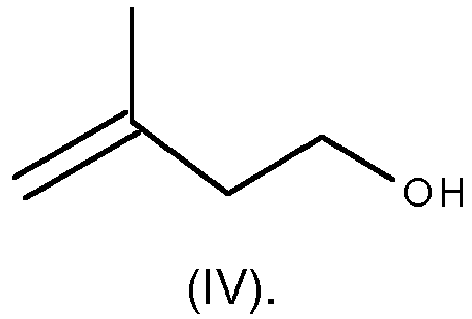
- Isoprenol ist nach bekannten Verfahren aus Isobuten und Formaldehyd in jedem Maßstab gut zugänglich und kommerziell verfügbar. An die Reinheit, Qualität oder Herstellverfahren des erfindungsgemäß einzusetzenden Isoprenols sind keine besonderen Anforderungen zu stellen. Es kann in handelsüblicher Qualität und Reinheit in Schritt a) des erfindungsgemäßen Verfahrens eingesetzt werden. Bevorzugt setzt man Isoprenol ein, das eine Reinheit von 90 Gew.-% oder darüber hat, besonders bevorzugt solches mit einer Reinheit von 95 bis 100 Gew.-% und ganz besonders bevorzugt solches mit einer Reinheit von 97 bis 99,9 Gew.-% oder noch mehr bevorzugt 98 bis 99,8 Gew.-%.
- Ein weiterer Ausgangsstoff für Schritt a) des erfindungsgemäßen Verfahrens ist ein Aldehyd der Formel (V) R1-CHO, wobei R1 in der Formel (V) die zuvor angegebene Bedeutung hat.
- Bevorzugt einzusetzende Aldehyde der Formel (V) sind: Acetaldehyd, Propionaldehyd, Butyraldehyd, Valeraldehyd, Isovaleraldehyd, Hexanal, Heptanal, Benzaldehyd, Citral, Citronellal. Erfindungsgemäß ganz besonders bevorzugt einzusetzende Aldehyde der Formel (V) sind Butyraldehyd, Isovaleraldehyd und Benzaldehyd, insbesondere Butyraldehyd und Isovaleraldehyd.
- Bevorzugt werden in Schritt a) das 3-Methylbut-3-en-ol (IV) und der Aldehyd (V) in einem molaren Verhältnis von etwa 1 zu 2 bis 2 zu 1, besonders bevorzugt von 0,7 zu 1 bis 2 zu 1, insbesondere von 1 zu 1 bis 2 zu 1, eingesetzt. In einer speziellen Ausführung werden in Schritt a) das 3-Methylbut-3-en-ol (IV) und der Aldehyd (V) in einem molaren Verhältnis von 1 zu 1 bis 1,5 zu 1 eingesetzt.
- Bevorzugt erfolgt die Umsetzung in Schritt a) in Gegenwart eines sauren Katalysators. Prinzipiell kann für die Umsetzung in Schritt a) jeder saure Katalysator verwendet werden, d. h. jede Substanz, die Brönstedt- oder Lewis-Acidität aufweist. Beispiele für geeignete Katalysatoren sind Protonensäuren, wie Salzsäure, Schwefelsäure, Phosphorsäure, Methansulfonsäure und p-Toluolsulfonsäure, saure molekulare Elementverbindungen, wie Aluminiumchlorid, Bortrifluorid, Zinkchlorid, Zinntetrachlorid und Titantetrachlorid; oxidische saure Festkörper wie Zeolithe, Silikate, Aluminate, Alumosilikate, Tone und stark saure lonentauscher.
- Unter dem Begriff stark saurer Kationenaustauscher wird dabei ein Kationenaustauscher in der H+-Form verstanden, der stark saure Gruppen aufweist. Bei den stark sauren Gruppen handelt es sich in der Regel um Sulfonsäuregruppen. Die sauren Gruppen sind in der Regel angebunden an eine Polymermatrix, die z. B. gelförmig bzw. makroporös sein kann. Eine bevorzugte Ausführungsform des erfindungsgemäßen Verfahrens ist dementsprechend dadurch gekennzeichnet, dass man einen stark sauren, Sulfonsäuregruppen aufweisenden Kationenaustauscher einsetzt. Geeignete stark saure Kationenaustauscher sind in der
WO 2010/133473 undWO 2011/154330 beschrieben, worauf hier in vollem Umfang Bezug genommen wird. - Die Umsetzung in Schritt a) kann wahlweise auch zusätzlich in Gegenwart eines unter den Reaktionsbedingungen inerten externen organischen Lösungsmittels durchgeführt werden. Geeignete Lösungsmittel sind beispielsweise tert-Butylmethylether, Cyclohexan, Dekalin, Hexan, Heptan, Ligroin, Petrolether, Toluol oder Xylol. Die genannten Lösungsmittel können alleine oder in Form von Gemischen untereinander eingesetzt werden. Bevorzugt führt man die Umsetzung in Schritt a) ohne Zusatz eines externen organischen Lösungsmittels durch.
- Bevorzugt wird in Schritt b) das Reaktionsgemisch aus Schritt a) einer destillativen Auftrennung unter Erhalt wenigstens einer an den 2-substituierten 4-Hydroxy-4-methyl-tetrahydropyranen der allgemeinen Formel (II.1) angereicherten Fraktion und einer an den 2-substituierten 4-Hydroxy-4-methyl-tetrahydropyranen der allgemeinen Formel (II.1) abgereicherten Fraktion unterzogen. Geeignete Vorrichtungen zur destillativen Auftrennung umfassen Destillationskolonnen, wie Bodenkolonnen, die mit Glocken, Siebplatten, Siebböden, Packungen, Füllkörpern, Ventilen, Seitenabzügen, etc. ausgerüstet sein können, Verdampfer, wie Dünnschichtverdampfer, Fallfilmverdampfer, Zwangsumlaufverdampfer, Sambay-Verdampfer (agitated thin-film evaporator), etc. und Kombinationen davon. Die Destillationskolonnen können trennwirksame Einbauten aufweisen, die vorzugsweise ausgewählt sind unter Trennböden, geordnete Packungen, z. B. Blech- oder Gewebepackungen, wie Sulzer Mellapak®, Sulzer BX, Montz B1 oder Montz A3 oder Kühni Rombopak, oder regellose Schüttungen von Füllkörpern, wie z. B. Dixon-Ringen, Raschig-Ringen, High-Flow-Ringen oder Raschig-Super-Ringen. Ein bevorzugtes Verfahren zur Herstellung und Isolierung von 2-sustituierten 4-Hydroxy-4-methyl-tetrahydropyranolen durch Umsetzung von 3-Methylbut-3-en-1-ol (Isoprenol) mit den entsprechenden Aldehyden in Gegenwart eines stark sauren Kationenaustauschers und anschließender Isolierung bzw. destillativer Abtrennung in einer Trennwandkolonne oder in einer Zusammenschaltung von zwei Destillationskolonnen in Form einer thermischen Kopplung ist in der
WO 2011/154330 beschrieben. Auf die Offenbarung dieses Dokuments wird hier Bezug genommen. - Erfindungsgemäß wird in dem erfindungsgemäßen Verfahren wenigstens eine 4-Hydroxy-tetrahydropyranverbindung der allgemeinen Formel (II) bzw. (II.1) mit einem Keten der Formel (III) bzw. (III.1) umgesetzt.
- Für den Einsatz in dem erfindungsgemäßen Verfahren eignen sich ganz allgemein Ketenverbindungen der allgemeinen Formel (III) CRaRb=C=O, wobei Ra und Rb unabhängig voneinander für Wasserstoff oder jeweils unsubstituiertes oder substituiertes C1-C12-Alkyl, C5-C8-Cycloalkyl oder C6-C14-Aryl stehen.
- Der einfachste Vertreter der Ketenverbindungen ist das Keten der Formel (III.1) CH2=C=O (Ethenon). Dieses wird erfindungsgemäß bevorzugt eingesetzt.
- Bevorzugt erzeugt man das Keten (III.1) durch Hochtemperatur-Pyrolyse von Aceton oder Essigsäure bei Temperaturen, die in der Regel höher als 650 °C sind. Bevorzugt liegt die Temperatur zur Erzeugung des Ketens (III.1) in einem Bereich von 650 bis 1000 °C, besonders bevorzugt von 700 bis 900 °C.
- In einer speziellen Ausführungsform wird das Keten (III.1) unter vermindertem Druck hergestellt. Bevorzugt liegt der Druck in einem Bereich von etwa 100 bis 900 mbar, besonders bevorzugt von 300 bis 500 mbar, insbesondere von 350 bis 450 mbar. In einer alternativen Ausführungsform wird das Keten (III.1) unter Umgebungsdruck ("drucklos") hergestellt. Bevorzugt liegt der Druck dann in einem Bereich von etwa 950 bis 1050 mbar.
- Da Ketenverbindungen (III) und insbesondere das Keten (III.1) äußerst reaktive Verbindungen sind, die stark zur Dimerisierung unter Bildung von Diketenen neigen, verwendet man in dem erfindungsgemäßen Verfahren vorzugsweise eine Ketenverbindung, welche erst kurz vorher hergestellt worden ist. Das erfindungsgemäße Verfahren gestaltet sich besonders vorteilhaft, wenn man Keten (III.1) verwendet, welches unmittelbar vor der Umsetzung in dem erfindungsgemäßen Verfahren hergestellt worden ist, z. B. durch thermische Spaltung von Aceton, Essigsäure oder Essigsäureanhydrid oder durch Dehydrochlorierung von Acetylchlorid mit Basen, wie Triethylamin.
- In einer ersten Variante des erfindungsgemäßen Verfahrens wird das Keten (III.1) unter der Flüssigkeitsoberfläche in das Reaktionsgemisch eingeführt, so dass es das Reaktionsgemisch durchperlt. Vorteilhafterweise wird das Keten unter intensivem Rühren in das Reaktionsgemisch geführt, so dass im Wesentlichen kein Keten in größeren Mengen in die Gasphase übertritt. Der Druck des Ketens (III.1) muss ausreichend hoch sein, um den hydrostatischen Druck des Reaktionsgemisches oberhalb der Keten-Einspeisung zu überwinden, gegebenenfalls unterstützt durch einen Inertgasstrom, z. B. Stickstoff.
- Das Keten (III.1) kann über beliebige geeignete Vorrichtungen eingespeist werden. Wichtig sind dabei eine gute Verteilung und eine schnelle Durchmischung. Es eignen sich z. B. Begasungslanzen, die fest installiert sein können, oder vorzugsweise Düsen. Die Düsen können am oder in der Nähe des Reaktorbodens vorgesehen sein. Die Düsen können hierzu als Öffnungen einer den Reaktor umgebenden Hohlkammer ausgebildet sein. Bevorzugt werden jedoch Tauchdüsen mit geeigneten Zuleitungen eingesetzt. Mehrere Düsen können z. B. in Form eines Kranzes angeordnet sein. Die Düsen können nach oben oder nach unten weisen. Die Düsen weisen vorzugsweise schräg nach unten.
- In einer zweiten Variante des erfindungsgemäßen Verfahrens wird das Keten (III.1) unter vermindertem Druck hergestellt und unter vermindertem Druck mit wenigstens einer 4-Hydroxy-tetrahydropyranverbindung der allgemeinen Formel (II) umgesetzt. Bevorzugt liegt der Druck bei der Herstellung und der Umsetzung des Ketens (III.1) in einem Bereich von etwa 100 bis 900 mbar, besonders bevorzugt von 300 bis 500 mbar, insbesondere von 350 bis 450 mbar.
- Verfahren und Vorrichtungen zur Herstellung von Ethenon sind z. B. in Organic Syntheses, Coll. Vol. 1, S. 330 (1941) und Vol. 4, S. 39 (1925) sowie in der Chemiker Zeitung 97, Nr. 2, Seiten 67 bis 73 (1979) beschrieben. Soll in dem erfindungsgemäßen Verfahren eine Ketenverbindung CRaRb=C=O (III) eingesetzt werden, wobei Ra und Rb von Wasserstoff verschiedene Bedeutungen besitzen, so kann die Herstellung nach prinzipiell bekannten Verfahren erfolgen. Dazu zählt z. B. die Eliminierung von Halogenwasserstoff aus Carbonsäurehalogeniden mit nachbarständigem Wasserstoff. Derartige Verfahren sind z. B. in Organikum, VEB Deutscher Verlag der Wissenschaften, 16. Auflage, Berlin 1986, Kapitel 3.1.5, speziell Seite 234 beschrieben. Die Herstellung von Ketenverbindungen gelingt auch durch Arndt-Eistert-Synthese durch Umsetzung eines Carbonsäurehalogenids mit Diazomethan.
- Ein Überschuss an der Ketenverbindung (III) (bzw. (111.1)) kann zu unerwünschten Nebenreaktionen führen. Daher erfolgt die Umsetzung der Verbindung der allgemeinen Formel (II) mit dem Keten (III) vorzugsweise unter Verwendung von höchstens äquimolaren Mengen an der Ketenverbindung (III). Bevorzugt ist ein geringer molarer Überschuss an der Verbindung der allgemeinen Formel (II).
- Vorzugsweise erfolgt die Umsetzung der 4-Hydroxy-tetrahydropyranverbindung der allgemeinen Formel (II) mit der Ketenverbindung (III) und insbesondere dem Keten (III.1) so, dass eine Akkumulation der Ketenverbindung im Reaktionsgemisch zu jedem Zeitpunkt der Umsetzung vermieden wird.
- Bevorzugt erfolgt die Umsetzung der Verbindung der allgemeinen Formel (II) mit dem Keten (III) so, dass so lange Keten in das Reaktionsgemisch eingeleitet wird, bis die Verbindung (II) im Wesentlichen vollständig umgesetzt ist. Unter "im Wesentlichen umgesetzt" wird dabei ein Umsatz von wenigstes 98 %, bevorzugt von wenigstens 99 %, verstanden.
- Bevorzugt wird die Verbindung der allgemeinen Formel (II) einer Umsetzung mit einem Keten (III) bei einer Temperatur im Bereich von 0 bis 150 °C, bevorzugt von 10 bis 120 °C, unterzogen.
- In einer ersten bevorzugten Ausführungsform wird die Verbindung der allgemeinen Formel (II) (bzw. (11.1)) einer Umsetzung mit einem Keten (III) (bzw. (111.1)) in Abwesenheit eines zugesetzten Katalysators unterzogen.
- In einer zweiten bevorzugten Ausführungsform wird die Verbindung der allgemeinen Formel (II) (bzw. (11.1)) einer Umsetzung mit einem Keten (III) (bzw. (111.1)) in Gegenwart eines Katalysators unterzogen. Bevorzugt wird wenigstens ein Zinksalz als Katalysator eingesetzt, das auch als Hydrat bzw. Mehrfach-Hydrat vorliegen kann.
- Besonders bevorzugt wird als Katalysator ein Zinksalz einer Carbonsäure, speziell einer Monocarbonsäure mit 1 bis 18 C-Atomen oder Dicarbonsäure mit 2 bis 18 C-Atomen, eingesetzt. Dazu zählen z. B. Zinkformiat, Zinkacetat, Zinkpropionat, Zinkbutyrat, Zinkstearat, Zinksuccinat oder Zinkoxalat. Besonders bevorzugt ist Zinkacetat. Sehr vorteilhaft an dem erfindungsgemäßen Verfahren ist, dass man die Katalysatoren in der Regel nur in sehr kleinen Mengen einsetzen muss, was das Verfahren kostengünstiger macht und die Aufarbeitung des Reaktionsgemisches erleichtert. Dies gilt insbesondere für den Einsatz eines Zinksalzes als Katalysator.
- Bevorzugt verwendet man den Katalysator in einer Menge von 0,01 bis 2 Gew.-%, besonders bevorzugt von 0,02 bis 0,5 Gew.-%, bezogen auf die Gesamtmenge der Verbindung (II) (bzw. (11.1)).
- Zur Durchführung der erfindungsgemäßen Umsetzung geht man mit Vorteil so vor, dass man diese Umsetzung in einem geeigneten Reaktionsgefäß durchführt, welches als wesentliche Bestandteile eine gute Rühr- und/oder Mischeinrichtung, eine Dosiervorrichtung für Keten, eine Heizvorrichtung zum Starten der Reaktion und zum Aufrechterhalten der Reaktionstemperatur während der Nachreaktion, eine Kühleinrichtung zum Abführen der Reaktionswärme der exothermen Umsetzung sowie eine Vakuumpumpe enthält.
- Für eine optimale Reaktionsführung ist es vorteilhaft, dass man das Keten so zudosiert, dass es im Reaktionsgemisch nie im Überschuss vorliegt, und dass das Reaktionsgemisch immer gut durchmischt wird.
- Für eine optimale Reaktionsführung ist es weiterhin vorteilhaft, dass man zu schnelles Zudosieren von Keten vermeidet sowie das Ende der Umsetzung eindeutig feststellt.
- Der Nachweis von Keten gelingt beispielsweise IR-spektroskopisch über die charakteristische Carbonylschwingung.
- Mit Hilfe des erfindungsgemäßen Verfahrens ist es möglich, die Verbindungen der allgemeinen Formel (I) auf technisch einfache Weise in hohen Reinheiten und dennoch in ausgezeichneten Ausbeuten und Raum-Zeit-Ausbeuten herzustellen. Da die Edukte im Wesentlichen vollständig zu Produkten umgesetzt werden, zeichnet sich das erfindungsgemäße Verfahren durch eine maximale Atomökonomie aus.
- Die nach dem erfindungsgemäßen Verfahren erhältlichen Zusammensetzungen eignen sich besonders vorteilhaft als Riechstoff oder zur Bereitstellung eines Riechstoffs.
- Die erfindungsgemäßen Zusammensetzungen können für den Einsatz als Riechstoff mit wenigstens einem auf diesem Anwendungsgebiet üblichen Lösemittel beliebig verdünnt werden. Beispielhaft seien als geeignete Lösemittel genannt: Ethanol, Dipropylenglycol oder dessen Ether, Phthalate, Propylenglykole oder Carbonate von Diolen, bevorzugt Ethanol. Auch Wasser ist als Lösemittel zur Verdünnung der erfindungsgemäßen Duftstoffkompositionen geeignet und kann vorteilhaft zusammen mit geeigneten Emulgatoren eingesetzt werden.
- Die nach dem erfindungsgemäßen Verfahren erhaltenen Riechstoffe weisen auf Grund der strukturellen und chemischen Ähnlichkeit der Komponenten eine hohe Stabilität und Haltbarkeit auf.
- Die nach dem erfindungsgemäßen Verfahren erhaltenen Riechstoffe eigenen sich zur Einarbeitung in kosmetische Zusammensetzungen sowie Gebrauchs- und Verbrauchsgüter bzw. Mittel, wie sie im Folgenden näher beschrieben sind, wobei die Riechstoffe in die genannten Güter eingearbeitet oder auch auf solche aufgebracht sein können. Unter einer organoleptisch wirksamen Menge ist dabei, wie im Rahmen der gesamten vorliegenden Erfindung, insbesondere eine solche Menge zu verstehen, die bei sachgemäßer Anwendung ausreicht, beim Anwender bzw. Verbraucher einen Dufteindruck hervorzurufen.
- Als kosmetische Zusammensetzungen sind alle üblichen kosmetischen Zusammensetzungen geeignet. Dabei handelt es sich bevorzugt um Parfum, Eau de Toilette, Deodorants, Seife, Duschgel, Badegel, Cremes, Lotions, Sonnenschutzmittel, Zusammensetzungen zur Reinigung und Pflege der Haare, wie Haarshampoo, Spülung, Haargel, Haarfestiger in Form von Flüssigkeiten oder Schäumen und weitere Reinigungs- oder Pflegemittel für die Haare, Zusammensetzungen zur dekorativen Anwendung am menschlichen Körper, wie kosmetische Stifte, zum Beispiel Lippenstifte, Lippenpflegestifte, Abdeckstifte (Concealer), Wangenrouge (Blusher), Lidschattenstifte, Lippenkonturenstifte, Augenkonturenstifte, Augenbrauenstifte, Korrekturstifte, Sonnenschutzstifte, Anti-Akne-Stifte und vergleichbare Produkte sowie Nagellacke und weitere Produkte zur Nagelpflege.
- Die nach dem erfindungsgemäßen Verfahren erhaltenen Riechstoffe eignen sich speziell für einen Einsatz in Parfums, z. B. als Eau de Toilette, Duschgele, Badegele und Körperdeodorants.
- Sie eignen sich weiterhin zur Aromatisierung von Verbrauchs- oder Gebrauchsgütern, in die sie eingearbeitet bzw. auf die sie aufgebracht werden und ihnen dadurch einen angenehmen frischen grünen Akzent verleihen. Beispiele für Verbrauchs- oder Gebrauchsgüter sind: Raumluftdeodorants (Air Care), Reinigungsmittel oder Pflegemittel für Textilien (speziell Waschmittel, Weichspüler), Textilbehandlungsmittel wie beispielsweise Bügelhilfsmittel, Putzmittel, Reinigungsmittel, Pflegemittel zur Behandlung von Oberflächen, beispielsweise von Möbeln, Fußböden, Kücheneinrichtungen, Glasscheiben und Fenstern sowie Bildschirmen, Bleichen, Toilettensteine, Entkalkungsmittel, Düngemittel, Baustoffe, Schimmelentferner, Desinfektionsmittel, Produkte für die Auto- bzw. Fahrzeugpflege und dergleichen mehr.
- In einer speziellen Ausführungsform 1 handelt es sich um ein Verfahren zur Herstellung von Tetrahydropyranylestern der allgemeinen Formel (I)

- R1, R2, R3 und R4 unabhängig voneinander für Wasserstoff, geradkettiges oder verzweigtes C1-C12-Alkyl, geradkettiges oder verzweigtes C2-C12-Alkenyl, unsubstituiertes oder mit C1-C12-Alkyl und/oder C1-C12-Alkoxy substituiertes Cycloalkyl mit insgesamt 3 bis 20 Kohlenstoffatomen oder unsubstituiertes oder mit C1-C12-Alkyl und/oder C1-C12-Alkoxy substituiertes Aryl mit insgesamt 6 bis 20 Kohlenstoffatomen stehen,
- R5 für Wasserstoff oder geradkettiges oder verzweigtes C1-C12-Alkyl steht, und
- Ra und Rb unabhängig voneinander für Wasserstoff oder jeweils unsubstituiertes oder substituiertes C1-C12-Alkyl, C5-C8-Cycloalkyl oder C6-C14-Aryl stehen,
- bei dem man wenigstes eine 4-Hydroxy-tetrahydropyranverbindung der allgemeinen Formel (II) bereitstellt

- wobei R1, R2, R3, R4 und R5 die zuvor angegebenen Bedeutungen haben, und die Verbindung der allgemeinen Formel (II) einer Umsetzung mit einem Keten (III)
CRaRb=C=O (III)
- unterzieht, wobei Ra und Rb die zuvor angegebenen Bedeutungen haben.
- In einer speziellen Ausführungsform 2 handelt es sich um ein Verfahren nach der Ausführungsform 1, wobei R1 für geradkettiges oder verzweigtes C1-C6-Alkyl, geradkettiges oder verzweigtes C2-C6-Alkenyl oder Phenyl steht.
- In einer speziellen Ausführungsform 3 handelt es sich um ein Verfahren nach den Ausführungsformen 1 oder 2, wobei R1 für Methyl, Ethyl, n-Propyl, Isopropyl, n-Butyl, Isobutyl, n-Pentyl, n-Hexyl oder Phenyl, bevorzugt für n-Propyl oder Isobutyl steht.
- In einer speziellen Ausführungsform 4 handelt es sich um ein Verfahren nach einem der vorhergehenden Aufführungsformen 1 bis 3, wobei R2, R3 und R4 alle für Wasserstoff stehen.
- In einer speziellen Ausführungsform 5 handelt es sich um ein Verfahren nach einem der vorhergehenden Ausführungsformen 1 bis 4, wobei R5 für Methyl oder Ethyl, bevorzugt Methyl, steht.
- In einer speziellen Ausführungsform 6 handelt es sich um ein Verfahren nach einem der vorhergehenden Ausführungsformen 1 bis 5, wobei Ra und Rb beide für Wasserstoff stehen.
- In einer speziellen Ausführungsform 7 handelt es sich um ein Verfahren nach einem der vorhergehenden Ausführungsformen 1 bis 6, wobei die Verbindung der allgemeinen Formel (II) einer Umsetzung mit einem Keten (III) bei einer Temperatur im Bereich von 0 bis 150 °C, bevorzugt von 10 bis 120 °C, unterzogen wird.
- In einer speziellen Ausführungsform 8 handelt es sich um ein Verfahren nach einem der vorhergehenden Ausführungsformen 1 bis 7, wobei die Verbindung der allgemeinen Formel (II) einer Umsetzung mit einem Keten (III) in Abwesenheit eines zugesetzten Katalysators unterzogen wird.
- In einer speziellen Ausführungsform 9 handelt es sich um ein Verfahren nach einem der vorhergehenden Ausführungsformen 1 bis 8, wobei die Verbindung der allgemeinen Formel (II) einer Umsetzung mit einem Keten (III) in Gegenwart eines Katalysators unterzogen wird, der vorzugsweise ausgewählt ist unter Zinksalzen, besonders bevorzugt Zinksalzen von Carbonsäuren, insbesondere Zinkacetat.
- In einer speziellen Ausführungsform 10 handelt es sich um ein Verfahren nach der Ausführungsform 9, wobei der Katalysator in einer Menge von 0,01 bis 2 Gew.-%, besonders bevorzugt von 0,02 bis 0,5 Gew.-%, bezogen auf die Gesamtmenge der Verbindung (II) eingesetzt wird.
- In einer speziellen Ausführungsform 11 handelt es sich um ein Verfahren zur Herstellung von 2-substituierten 4-Methyltetrahydropyranylestern der allgemeinen Formel (I.1)

- R1 für Wasserstoff, geradkettiges oder verzweigtes C1-C12-Alkyl, geradkettiges oder verzweigtes C2-C12-Alkenyl, unsubstituiertes oder mit C1-C12-Alkyl und/oder C1-C12-Alkoxy substituiertes Cycloalkyl mit insgesamt 3 bis 20 Kohlenstoffatomen oder unsubstituiertes oder mit C1-C12-Alkyl und/oder C1-C12-Alkoxy substituiertes Aryl mit insgesamt 6 bis 20 Kohlenstoffatomen steht,
- bei dem man wenigstens ein 2-substituiertes 4-Hydroxy-4-methyl-tetrahydropyran der allgemeinen Formel (II.1) bereitstellt

- wobei R1 die zuvor angegebenen Bedeutungen hat und die Verbindung der allgemeinen Formel (11.1) einer Umsetzung mit dem Keten (III.1)
CH2=C=O (III.1)
- In einer speziellen Ausführungsform 12 handelt es sich um ein Verfahren nach der Ausführungsform 11, wobei man zur Bereitstellung des 2-substituierten 4-Hydroxy-4-methyl-tetrahydropyrans der allgemeinen Formel (II.1):
- a) 3-Methylbut-3-en-1-ol der Formel (IV)

R1-CHO (V)
worin- R1 für geradkettiges oder verzweigtes C1-C12-Alkyl, geradkettiges oder verzweigtes C2-C12-Alkenyl, unsubstituiertes oder mit C1-C12-Alkyl und/oder C1-C12-Alkoxy substituiertes Cycloalkyl mit insgesamt 3 bis 20 Kohlenstoffatomen oder unsubstituiertes oder mit C1-C12-Alkyl und/oder C1-C12-Alkoxy substituiertes Aryl mit insgesamt 6 bis 20 Kohlenstoffatomen steht,
- in Gegenwart eines sauren Katalysators umsetzt, wobei ein Reaktionsgemisch erhalten wird, das wenigstens ein 2-substituiertes 4-Hydroxy-4-methyl-tetrahydropyran der allgemeinen Formel (11.1) enthält, worin R1 die zuvor angegebene Bedeutung hat,
- b) gegebenenfalls das Reaktionsgemisch aus Schritt a) einer Auftrennung unter Erhalt wenigstens einer an den 2-substituierten 4-Hydroxy-4-methyl-tetrahydropyranen der allgemeinen Formel (II.1) angereicherten Fraktion unterzieht.
- Die folgenden Beispiele dienen der Verdeutlichung der Erfindung, ohne sie in irgendeiner Weise zu beschränken.
- Gaschromatographische Analysen wurden nach der folgenden Methode durchgeführt:
- Säule: DB WAX 30 m x 0,32 mm
- FD 0,25 µm
- Injektortemperatur: 200 °C; Detektortemperatur 250 °C
- Temperaturprogramm: Anfangstemp.: 60 °C, mit 2 °C/min auf 120 °C,
mit 20 °C/min auf 230 °C - Retentionszeiten: trans-Tetrahydro-2-isobutyl-4-methylpyranyl-4-acetat tR = 15,1 min cis-Tetrahydro-2-isobutyl-4-methylpyranyl-4-acetat tR = 18,8 min trans-Tetrahydro-2-isobutyl-4-methylpyran-4-ol tR = 19,6 min cis-Tetrahydro-2-isobutyl-4-methylpyran-4-ol tR = 21,5 min
- Die Konzentrationen der erhaltenen Produkte (Gew.-%) wurden GC-analytisch mit internem Standard ermittelt.
- 127,08 g Tetrahydro-2-isobutyl-4-methylpyran-4-ol (0,74 Mol; Zusammensetzung vgl. Tabelle 1, Probe nach 0 h) wurden bei 90 °C vorgelegt. Keten, das durch die Pyrolyse von Aceton (0,411 mL/min) bei 700 °C erhalten wurde, wurde nach Abkühlen bei 90 °C unterhalb der Flüssigkeitsoberfläche und unter kräftigem Rühren eingeleitet. Der Umsatz der Pyrolyse lag bei ca. 48 % (bezogen auf isoliertes, nicht umgesetztes Aceton) und der Ketengehalt im Pyrolysegas lag bei 23 bis 24 %. Nach 7 h Reaktionszeit wurde die Keten-Einleitung unterbrochen und am Folgetag fortgesetzt. Nach insgesamt 10 h Reaktionszeit war das Startmaterial umgesetzt, und der Versuch wurde beendet. Insgesamt wurden während des Versuchs 92,6 g Aceton (1,59 Mol, 2,15 Äq.; bezogen auf isoliertes, nicht umgesetztes Aceton) in der Pyrolyse umgesetzt. Die Zusammensetzung der Proben ist in Tabelle 1 angegeben. Die Ausbeute an Tetrahydro-2-isobutyl-4-methyl-pyranyl-4-acetat lag bei 89 %.
- Cis- und trans-Tetrahydro-2-isobutyl-4-methylpyranyl-4-acetatwurden per NMR-Spektroskopie charakterisiert:
Cis-Tetrahydro-2-isobutyl-4-methylpyranyl-4-acetat: 13C NMR (125 MHz, CDCl3): δ = 21.7, 22.3, 22.5, 23.2, 24.3, 37.7, 43.8, 45.4, 64.6, 72.7, 80.0, 170.3 ppm. - Trans-Tetrahydro-2-isobutyl-4-methylpyranyl-4-acetat: 13C NMR (125 MHz, CDCl3): δ = 22.37, 22.39, 23.2, 24.3, 26.2, 36.3, 42.5, 45.1, 63.4, 70.9, 79.3, 170.4 ppm.
Tabelle 1: Zusammensetzung des Reaktionsgemisches Reaktionszeit trans-Tetra-hydro-2-isobutyl-4-methyl-pyranyl-4-acetat cis-Tetra-hydro-2-isobutyl-4-methyl-pyranyl-4-acetat Summe Tetra-hydro-2-isobutyl-4-methyl-pyranyl-4-acetat trans-Tetra-hydro-2-isobutyl-4-methyl-pyran-4-ol cis-Tetra-hydro-2-isobutyl-4-methyl-pyran-4-ol Summe Tetra-hydro-2-isobutyl-4-methyl-pyran-4-ol [h] [%]* [%]* [%]* [%]* [%]* [%]* 0 0 0 0 22,8 77,1 99,9 2 3,1 16,0 19,1 16,9 52,9 69,8 4 7,4 35,0 42,4 15,6 34,5 50,1 6 11,6 49,8 61,4 13,7 18,9 32,6 7 15,2 60,7 75,9 10,6 8,4 19,0 8 18,6 73,4 92,0 1,5 2,4 3,9 9 20,6 74,4 95,0 0 0,4 0,4 10 21,2 73,9 95,1 0 0 0 * GC-Gew.-% - Tetrahydro-2-isobutyl-4-methylpyran-4-ol (5.0 g, 29 mMol, 1.0 Äq.), 4-(Dimethylamino)-pyridin (35 mg, 0.3 mMol, 0.01 Äq.) und Triethylamin (9.69 g, 96 mMol, 3.3 Äq.) wurden in Toluol (44 g) vorgelegt und unter Rühren auf 90 °C erwärmt. Dann wurde Acetylchlorid (7.52 g, 96 mMol, 3.3 Äq.) innerhalb von 2 h zugetropft. Nach insgesamt 4 h wurde auf 30 °C abgekühlt und die Reaktion durch Zugabe von Wasser (25 g) gestoppt. Die Ausbeute an Tetrahydro-2-isobutyl-4-methylpyranyl-4-acetat lag nach GC-Analytik bei 32 %.
- Tetrahydro-2-isobutyl-4-methylpyran-4-ol (5.0 g, 29 mMol, 1.0 Äq.), 4-(Dimethylamino)-pyridin (35 mg, 0.3 mMol, 0.01 Äq.) und Triethylamin (9.69 g, 96 mMol, 3.3 Äq.) wurden ohne Lösungsmittel unter Rühren bei 90 °C vorgelegt. Dann wurde vorsichtig Acetylchlorid (7.52 g, 96 mMol, 3.3Äq.) zugetropft, wobei unter heftiger Reaktion Pyranylacetat gebildet wurde und das Reaktionsgemisch stark heterogen wurde. Nach vollständiger Zugabe wurde noch 60 min bei 90 °C weiter gerührt, dann auf 30 °C abgekühlt, der Ansatz vorsichtig mit Wasser (50 g) versetzt und mit Toluol (30 g) extrahiert. Die Ausbeute an Tetrahydro-2-isobutyl-4-methylpyranyl-4-acetat lag nach GC-Analytik bei 26 %.
Claims (7)
- Verbindungen der allgemeinen Formel (I)
 R1, R2, R3 und R4 unabhängig voneinander für Wasserstoff, geradkettiges oder verzweigtes C1-C12-Alkyl, geradkettiges oder verzweigtes C2-C12-Alkenyl, unsubstituiertes oder mit C1-C12-Alkyl und/oder C1-C12-Alkoxy substituiertes Cycloalkyl mit insgesamt 3 bis 20 Kohlenstoffatomen oder unsubstituiertes oder mit C1-C12-Alkyl und/oder C1-C12-Alkoxy substituiertes Aryl mit insgesamt 6 bis 20 Kohlenstoffatomen stehen,R5 für Wasserstoff oder geradkettiges oder verzweigtes C1-C12-Alkyl steht, undRa und Rb unabhängig voneinander für Wasserstoff oder jeweils unsubstituiertes oder substituiertes C1-C12-Alkyl, C5-C8-Cycloalkyl oder C6-C14-Aryl stehen.
 - Verfahren nach Anspruch 1, wobei R1 für Phenyl oder mit C1-C6-Alkyl und/oder C1-C6-Alkoxy substituiertes Phenyl steht.
- Verfahren nach einem der vorhergehenden Ansprüche, wobei R2, R3 und R4 alle für Wasserstoff stehen.
- Verfahren nach einem der vorhergehenden Ansprüche, wobei R5 für Methyl oder Ethyl, bevorzugt Methyl, steht.
- Verbindungen gemäß Anspruch 1 der Formel (I.1)

R1 für Wasserstoff, geradkettiges oder verzweigtes C1-C12-Alkyl, geradkettiges oder verzweigtes C2-C12-Alkenyl, unsubstituiertes oder mit C1-C12-Alkyl und/oder C1-C12-Alkoxy substituiertes Cycloalkyl mit insgesamt 3 bis 20 Kohlenstoffatomen oder unsubstituiertes oder mit C1-C12-Alkyl und/oder C1-C12-Alkoxy substituiertes Aryl mit insgesamt 6 bis 20 Kohlenstoffatomen steht. - Verbindung gemäß einem der Ansprüche 1 bis 5 ausgewählt unter Verbindungen der Formeln (I-A.1), (I-A.2), (I-A.3) (I-A.4), (I-A.5), (I-A.6), (I-A.7), (I-A.8), (I-A.9) und I-A.10


- Verwendung von Verbindungen der Formel (I) oder (I.1) als Riechstoff.
Applications Claiming Priority (3)
| Application Number | Priority Date | Filing Date | Title |
|---|---|---|---|
| EP15157835 | 2015-03-05 | ||
| EP16707808.8A EP3265451B1 (de) | 2015-03-05 | 2016-03-04 | Verfahren zur herstellung von tetrahydropyranylestern |
| PCT/EP2016/054632 WO2016139338A1 (de) | 2015-03-05 | 2016-03-04 | Verfahren zur herstellung von tetrahydropyranylestern |
Related Parent Applications (2)
| Application Number | Title | Priority Date | Filing Date |
|---|---|---|---|
| EP16707808.8A Division EP3265451B1 (de) | 2015-03-05 | 2016-03-04 | Verfahren zur herstellung von tetrahydropyranylestern |
| EP16707808.8A Division-Into EP3265451B1 (de) | 2015-03-05 | 2016-03-04 | Verfahren zur herstellung von tetrahydropyranylestern |
Publications (2)
| Publication Number | Publication Date |
|---|---|
| EP3483151A1 true EP3483151A1 (de) | 2019-05-15 |
| EP3483151B1 EP3483151B1 (de) | 2025-06-25 |
Family
ID=52630241
Family Applications (2)
| Application Number | Title | Priority Date | Filing Date |
|---|---|---|---|
| EP16707808.8A Active EP3265451B1 (de) | 2015-03-05 | 2016-03-04 | Verfahren zur herstellung von tetrahydropyranylestern |
| EP18206125.9A Active EP3483151B1 (de) | 2015-03-05 | 2016-03-04 | Tetrahydropyranylester als riechstoffe |
Family Applications Before (1)
| Application Number | Title | Priority Date | Filing Date |
|---|---|---|---|
| EP16707808.8A Active EP3265451B1 (de) | 2015-03-05 | 2016-03-04 | Verfahren zur herstellung von tetrahydropyranylestern |
Country Status (7)
| Country | Link |
|---|---|
| US (1) | US10106517B2 (de) |
| EP (2) | EP3265451B1 (de) |
| JP (1) | JP6695890B2 (de) |
| CN (1) | CN107438600B (de) |
| ES (1) | ES2833366T3 (de) |
| MX (1) | MX391448B (de) |
| WO (1) | WO2016139338A1 (de) |
Families Citing this family (7)
| Publication number | Priority date | Publication date | Assignee | Title |
|---|---|---|---|---|
| MX2017014148A (es) | 2015-05-04 | 2018-03-15 | Basf Se | Proceso para la preparacion de melonal. |
| JP2018522007A (ja) | 2015-07-15 | 2018-08-09 | ビーエーエスエフ ソシエタス・ヨーロピアBasf Se | アリールプロペンの調製方法 |
| EP3170828A1 (de) | 2015-11-23 | 2017-05-24 | Basf Se | Verfahren zur herstellung von verbindungen mit 16-oxabicyclo[10.3.1]pentadecengerüst und deren folgeprodukten |
| JP7039472B2 (ja) | 2015-12-08 | 2022-03-22 | ビーエーエスエフ ソシエタス・ヨーロピア | Bea骨格構造を有するスズ含有ゼオライト材料 |
| US10954538B2 (en) | 2016-02-19 | 2021-03-23 | Basf Se | Enzymatic cyclization of homofarnesylic acid |
| CN109195959B (zh) * | 2016-05-31 | 2023-08-18 | 巴斯夫欧洲公司 | 四氢吡喃基低碳烷基酯和其使用烯酮化合物的制备 |
| US10800724B2 (en) | 2016-07-15 | 2020-10-13 | Basf Se | Preparation of 14-methyl-16-oxabicyclo[10.3.1]pentadecenes from 3-methyl-1,5-cyclopentadecanedione |
Citations (8)
| Publication number | Priority date | Publication date | Assignee | Title |
|---|---|---|---|---|
| EP0383446A2 (de) | 1989-02-09 | 1990-08-22 | INTERNATIONAL FLAVORS & FRAGRANCES INC. | 2,2,4-trisubstituierte tetrahydropyranische Ester und organoleptische Verwendung davon |
| EP0949239A1 (de) | 1998-04-09 | 1999-10-13 | Basf Aktiengesellschaft | Verfahren zur Herstellung von Linalylacetat |
| EP1493737A1 (de) | 2003-07-04 | 2005-01-05 | Kao Corporation | Verfahren zur Herstellung einer Pyranverbindung |
| US20090263336A1 (en) * | 2008-04-22 | 2009-10-22 | V. Mane Fils | Novel pyran derivatives and their preparation |
| WO2009130192A1 (en) | 2008-04-22 | 2009-10-29 | V. Mane Fils | Novel pyran derivatives, their preparation and use thereof in perfumery |
| WO2010133473A1 (de) | 2009-05-19 | 2010-11-25 | Basf Se | Verfahren zur herstellung von 2-substituierten tetrahydropyranolen |
| WO2011147919A1 (de) | 2010-05-27 | 2011-12-01 | Basf Se | Verfahren zur herstellung von in 2-stellung substituierten tetrahydropyranolen |
| WO2011154330A1 (de) | 2010-06-10 | 2011-12-15 | Basf Se | Verfahren zur herstellung und isolierung von 2-substituierten tetrahydropyranolen |
Family Cites Families (11)
| Publication number | Priority date | Publication date | Assignee | Title |
|---|---|---|---|---|
| CN101381390B (zh) * | 2007-09-05 | 2012-12-05 | 王加旺 | 溴铵类肌肉松弛剂的合成方法 |
| JP6293766B2 (ja) | 2012-10-15 | 2018-03-14 | ビーエーエスエフ ソシエタス・ヨーロピアBasf Se | 2−置換4−ヒドロキシ−4−メチルテトラヒドロピラン及び2−置換4−メチルテトラヒドロピランの一体的調製のための方法 |
| CN105189675B (zh) | 2013-07-22 | 2017-10-31 | 巴斯夫欧洲公司 | 包含具有至少两个环状碳酸酯基团和硅氧烷基团的化合物的涂布材料 |
| US9765001B2 (en) | 2014-01-17 | 2017-09-19 | Basf Se | Method for producing arylpropenes |
| EP2915797A1 (de) | 2014-03-07 | 2015-09-09 | Basf Se | Verfahren zur Herstellung von Menthonen aus Isopulegol in der Gasphase |
| EP2865676A1 (de) | 2014-04-14 | 2015-04-29 | Basf Se | Herstellung von 2-substituierten 4-Methyl-tetrahydropyranen aus 2-Alkyl-4,4-dimethyl-1,3-dioxan-haltigen Ausgangsstoffen |
| JP6549611B2 (ja) | 2014-04-14 | 2019-07-24 | ビーエーエスエフ ソシエタス・ヨーロピアBasf Se | 匂いの品質が安定した2−置換4−ヒドロキシ−4−メチルテトラヒドロピランの製造 |
| ES2925686T3 (es) | 2014-04-14 | 2022-10-19 | Basf Se | Preparación de 4-hidroxi-4-metil-tetrahidropiranos sustituidos en la posición 2 a partir de materiales de partida que contienen 2-alquil-4,4-dimetil-1,3-dioxano |
| US9765003B2 (en) | 2014-05-05 | 2017-09-19 | Basf Se | Process for producing 2,6-dimethyl-5-hepten-1-al |
| EP2985364A1 (de) | 2014-08-14 | 2016-02-17 | Basf Se | Verfahren zur Herstellung von Alkoholen durch elektrochemische reduktive Kopplung |
| WO2016050690A1 (de) | 2014-09-29 | 2016-04-07 | Basf Se | Verfahren zur biokatalytischen cyclisierung von geranyllinalool und dabei erhaltene cyclisierungsprodukte |
-
2016
- 2016-03-04 ES ES16707808T patent/ES2833366T3/es active Active
- 2016-03-04 US US15/555,723 patent/US10106517B2/en active Active
- 2016-03-04 WO PCT/EP2016/054632 patent/WO2016139338A1/de not_active Ceased
- 2016-03-04 EP EP16707808.8A patent/EP3265451B1/de active Active
- 2016-03-04 JP JP2017546076A patent/JP6695890B2/ja active Active
- 2016-03-04 MX MX2017011407A patent/MX391448B/es unknown
- 2016-03-04 EP EP18206125.9A patent/EP3483151B1/de active Active
- 2016-03-04 CN CN201680013680.8A patent/CN107438600B/zh active Active
Patent Citations (8)
| Publication number | Priority date | Publication date | Assignee | Title |
|---|---|---|---|---|
| EP0383446A2 (de) | 1989-02-09 | 1990-08-22 | INTERNATIONAL FLAVORS & FRAGRANCES INC. | 2,2,4-trisubstituierte tetrahydropyranische Ester und organoleptische Verwendung davon |
| EP0949239A1 (de) | 1998-04-09 | 1999-10-13 | Basf Aktiengesellschaft | Verfahren zur Herstellung von Linalylacetat |
| EP1493737A1 (de) | 2003-07-04 | 2005-01-05 | Kao Corporation | Verfahren zur Herstellung einer Pyranverbindung |
| US20090263336A1 (en) * | 2008-04-22 | 2009-10-22 | V. Mane Fils | Novel pyran derivatives and their preparation |
| WO2009130192A1 (en) | 2008-04-22 | 2009-10-29 | V. Mane Fils | Novel pyran derivatives, their preparation and use thereof in perfumery |
| WO2010133473A1 (de) | 2009-05-19 | 2010-11-25 | Basf Se | Verfahren zur herstellung von 2-substituierten tetrahydropyranolen |
| WO2011147919A1 (de) | 2010-05-27 | 2011-12-01 | Basf Se | Verfahren zur herstellung von in 2-stellung substituierten tetrahydropyranolen |
| WO2011154330A1 (de) | 2010-06-10 | 2011-12-15 | Basf Se | Verfahren zur herstellung und isolierung von 2-substituierten tetrahydropyranolen |
Non-Patent Citations (5)
| Title |
|---|
| "Organikum, 16. Auflage,", 1986, VEB DEUTSCHER VERLAG, article "Kapitel 3.1.5,", pages: 234 |
| AGNESE ABATE ET AL: "Preparation of the Enantiomerically Enriched Isomers of the Odorous Cyclic EthersClarycet? ,Florol? , andRhubafuran? by Enzymatic Catalysis", HELVETICA CHIMICA ACTA, vol. 87, no. 4, 1 April 2004 (2004-04-01), pages 765 - 780, XP055564013, ISSN: 0018-019X, DOI: 10.1002/hlca.200490075 * |
| CHEMIKER ZEITUNG, vol. 97, no. 2, 1979, pages 67 - 73 |
| ORGANIC SYNTHESES, vol. 1, 1941, pages 330 |
| PANDEY ET AL., BIOSCI. BIOTECH. BIOCHEM., vol. 59, no. 4, 1995, pages 725 - 727 |
Also Published As
| Publication number | Publication date |
|---|---|
| EP3265451A1 (de) | 2018-01-10 |
| US10106517B2 (en) | 2018-10-23 |
| JP2018508517A (ja) | 2018-03-29 |
| CN107438600B (zh) | 2021-04-13 |
| MX391448B (es) | 2025-03-19 |
| EP3265451B1 (de) | 2020-08-26 |
| JP6695890B2 (ja) | 2020-05-20 |
| EP3483151B1 (de) | 2025-06-25 |
| CN107438600A (zh) | 2017-12-05 |
| ES2833366T3 (es) | 2021-06-15 |
| WO2016139338A1 (de) | 2016-09-09 |
| US20180044313A1 (en) | 2018-02-15 |
| MX2017011407A (es) | 2017-12-20 |
Similar Documents
| Publication | Publication Date | Title |
|---|---|---|
| EP3265451B1 (de) | Verfahren zur herstellung von tetrahydropyranylestern | |
| EP3131885B1 (de) | Herstellung von 2-substituierten 4-methyl-tetrahydropyranen aus 2-alkyl-4,4-dimethyl-1,3-dioxan-haltigen ausgangsstoffen | |
| EP3131888B1 (de) | Herstellung von 2-substituierten 4-hydroxy-4-methyl-tetrahydropyranen aus 2-alkyl-4,4-dimethyl-1,3-dioxan-haltigen ausgangsstoffen | |
| EP2906545B1 (de) | Verfahren zur integrierten herstellung von 2-substituierten 4-hydroxy-4-methyl-tetrahydropyranen und von 2-substituierten 4-methyl-tetrahydropyranen | |
| EP3131887B1 (de) | Herstellung von 2-substituierten 4-hydroxy-4-methyl-tetrahydropyranen mit stabiler riechstoffqualität | |
| EP0062291A1 (de) | Verbessertes Verfahren zur Herstellung mehrfach ungesättigter Ketone | |
| DE19840746A1 (de) | Verfahren zur Herstellung gamma,delta-ungesättigter Ketone durch Carroll-Reaktion | |
| EP0842917B1 (de) | Verfahren zur Herstellung Gamma,Delta-ungesättigten Ketonen durch Carroll-Reaktion in cyclischen Carbonaten oder Gamma-Lactonen als Lösungsmittel | |
| EP3464258A1 (de) | Tetrahydropyranylniederalkylester und deren herstellung mittels einer ketenverbindung | |
| WO2020089134A1 (de) | Herstellung von 2-substituierten 4-methyl-tetrahydropyranen aus 2-substituierten 4-hydroxy-4-methyl-tetrahydropyranen als ausgangsstoffen | |
| EP1296918B1 (de) | Dimethylbenzol-Derivate als Riechstoffe | |
| DE1668802C3 (de) | Verfahren zur Herstellung von Carbonsäurediestern von 1,6-Dihydroxyhexadienen-1,5 | |
| EP0421271B1 (de) | 3-substituierte 2-Hydroxy-3-formylpropionsäureester, Verfahren zu deren Herstellung sowie deren Verwendung zur Herstellung von 3-substituierten 3-Formyl-acrylsäurereestern | |
| EP0189581A1 (de) | Neue 2,3-disubstituierte Bicyclo[2.2.1]heptane und -heptene, deren Herstellung und deren Verwendung als Riechstoffe | |
| EP1236707A1 (de) | Verfahren zur Herstellung makrocyclischer Ketone | |
| EP0005196A1 (de) | Octylcyclohexanderivate, ihre Herstellung und ihre Verwendung als Riechstoffe | |
| EP0235532A1 (de) | Verfahren zur Herstellung von 4-Monoacetalen des 2-Methyl-2-buten-1,4-dials | |
| EP0735032B1 (de) | Verfahren zur Herstellung von 5-Hydroxy-4-methyl-2(5H)-furanon | |
| EP1129060B1 (de) | Carbonylverbindungen und deren verwendung als riechstoffe | |
| DE1793421C (de) | Cyclododecylalkylketone, Verfahren zu ihrer Herstellung sowie ihre Verwen dung als Riechstoffe | |
| EP0538685A2 (de) | Verfahren zur Herstellung von Vinyloxycarbonsäureestern | |
| EP0398099B1 (de) | Verfahren zur Herstellung von Cyclopentanonen | |
| DE1793421B1 (de) | Cyclododecylalkylketone,Verfahren zu ihrer Herstellung sowie ihre Verwendung als Riechstoffe | |
| DE3916138A1 (de) | Verfahren zur herstellung von cyclopentanonen | |
| DE842195B (de) | Verfahren zur Herstellung von ß-Oxycarbonsäurelactonen |
Legal Events
| Date | Code | Title | Description |
|---|---|---|---|
| PUAI | Public reference made under article 153(3) epc to a published international application that has entered the european phase |
Free format text: ORIGINAL CODE: 0009012 |
|
| STAA | Information on the status of an ep patent application or granted ep patent |
Free format text: STATUS: THE APPLICATION HAS BEEN PUBLISHED |
|
| AC | Divisional application: reference to earlier application |
Ref document number: 3265451 Country of ref document: EP Kind code of ref document: P |
|
| AK | Designated contracting states |
Kind code of ref document: A1 Designated state(s): AL AT BE BG CH CY CZ DE DK EE ES FI FR GB GR HR HU IE IS IT LI LT LU LV MC MK MT NL NO PL PT RO RS SE SI SK SM TR |
|
| STAA | Information on the status of an ep patent application or granted ep patent |
Free format text: STATUS: REQUEST FOR EXAMINATION WAS MADE |
|
| 17P | Request for examination filed |
Effective date: 20191115 |
|
| RBV | Designated contracting states (corrected) |
Designated state(s): AL AT BE BG CH CY CZ DE DK EE ES FI FR GB GR HR HU IE IS IT LI LT LU LV MC MK MT NL NO PL PT RO RS SE SI SK SM TR |
|
| STAA | Information on the status of an ep patent application or granted ep patent |
Free format text: STATUS: EXAMINATION IS IN PROGRESS |
|
| 17Q | First examination report despatched |
Effective date: 20200217 |
|
| GRAP | Despatch of communication of intention to grant a patent |
Free format text: ORIGINAL CODE: EPIDOSNIGR1 |
|
| STAA | Information on the status of an ep patent application or granted ep patent |
Free format text: STATUS: GRANT OF PATENT IS INTENDED |
|
| INTG | Intention to grant announced |
Effective date: 20250211 |
|
| RIN1 | Information on inventor provided before grant (corrected) |
Inventor name: KLOS, MARGARETHE Inventor name: HICKMANN, VOLKER Inventor name: PELZER, RALF Inventor name: STORK, TIMON Inventor name: RUEDENAUER, STEFAN |
|
| GRAS | Grant fee paid |
Free format text: ORIGINAL CODE: EPIDOSNIGR3 |
|
| GRAA | (expected) grant |
Free format text: ORIGINAL CODE: 0009210 |
|
| STAA | Information on the status of an ep patent application or granted ep patent |
Free format text: STATUS: THE PATENT HAS BEEN GRANTED |
|
| AC | Divisional application: reference to earlier application |
Ref document number: 3265451 Country of ref document: EP Kind code of ref document: P |
|
| AK | Designated contracting states |
Kind code of ref document: B1 Designated state(s): AL AT BE BG CH CY CZ DE DK EE ES FI FR GB GR HR HU IE IS IT LI LT LU LV MC MK MT NL NO PL PT RO RS SE SI SK SM TR |
|
| REG | Reference to a national code |
Ref country code: GB Ref legal event code: FG4D Free format text: NOT ENGLISH |
|
| REG | Reference to a national code |
Ref country code: CH Ref legal event code: EP |
|
| REG | Reference to a national code |
Ref country code: DE Ref legal event code: R096 Ref document number: 502016017006 Country of ref document: DE |
|
| REG | Reference to a national code |
Ref country code: CH Ref legal event code: EP |
|
| REG | Reference to a national code |
Ref country code: IE Ref legal event code: FG4D Free format text: LANGUAGE OF EP DOCUMENT: GERMAN |
|
| PG25 | Lapsed in a contracting state [announced via postgrant information from national office to epo] |
Ref country code: FI Free format text: LAPSE BECAUSE OF FAILURE TO SUBMIT A TRANSLATION OF THE DESCRIPTION OR TO PAY THE FEE WITHIN THE PRESCRIBED TIME-LIMIT Effective date: 20250625 |
|
| REG | Reference to a national code |
Ref country code: LT Ref legal event code: MG9D |
|
| PG25 | Lapsed in a contracting state [announced via postgrant information from national office to epo] |
Ref country code: GR Free format text: LAPSE BECAUSE OF FAILURE TO SUBMIT A TRANSLATION OF THE DESCRIPTION OR TO PAY THE FEE WITHIN THE PRESCRIBED TIME-LIMIT Effective date: 20250926 Ref country code: NO Free format text: LAPSE BECAUSE OF FAILURE TO SUBMIT A TRANSLATION OF THE DESCRIPTION OR TO PAY THE FEE WITHIN THE PRESCRIBED TIME-LIMIT Effective date: 20250925 |
|
| PG25 | Lapsed in a contracting state [announced via postgrant information from national office to epo] |
Ref country code: BG Free format text: LAPSE BECAUSE OF FAILURE TO SUBMIT A TRANSLATION OF THE DESCRIPTION OR TO PAY THE FEE WITHIN THE PRESCRIBED TIME-LIMIT Effective date: 20250625 |
|
| PG25 | Lapsed in a contracting state [announced via postgrant information from national office to epo] |
Ref country code: HR Free format text: LAPSE BECAUSE OF FAILURE TO SUBMIT A TRANSLATION OF THE DESCRIPTION OR TO PAY THE FEE WITHIN THE PRESCRIBED TIME-LIMIT Effective date: 20250625 |
|
| PG25 | Lapsed in a contracting state [announced via postgrant information from national office to epo] |
Ref country code: RS Free format text: LAPSE BECAUSE OF FAILURE TO SUBMIT A TRANSLATION OF THE DESCRIPTION OR TO PAY THE FEE WITHIN THE PRESCRIBED TIME-LIMIT Effective date: 20250925 |
|
| PG25 | Lapsed in a contracting state [announced via postgrant information from national office to epo] |
Ref country code: LV Free format text: LAPSE BECAUSE OF FAILURE TO SUBMIT A TRANSLATION OF THE DESCRIPTION OR TO PAY THE FEE WITHIN THE PRESCRIBED TIME-LIMIT Effective date: 20250625 |
|
| REG | Reference to a national code |
Ref country code: NL Ref legal event code: MP Effective date: 20250625 |
|
| PG25 | Lapsed in a contracting state [announced via postgrant information from national office to epo] |
Ref country code: NL Free format text: LAPSE BECAUSE OF FAILURE TO SUBMIT A TRANSLATION OF THE DESCRIPTION OR TO PAY THE FEE WITHIN THE PRESCRIBED TIME-LIMIT Effective date: 20250625 |
|
| PG25 | Lapsed in a contracting state [announced via postgrant information from national office to epo] |
Ref country code: PT Free format text: LAPSE BECAUSE OF FAILURE TO SUBMIT A TRANSLATION OF THE DESCRIPTION OR TO PAY THE FEE WITHIN THE PRESCRIBED TIME-LIMIT Effective date: 20251027 |
|
| PG25 | Lapsed in a contracting state [announced via postgrant information from national office to epo] |
Ref country code: IS Free format text: LAPSE BECAUSE OF FAILURE TO SUBMIT A TRANSLATION OF THE DESCRIPTION OR TO PAY THE FEE WITHIN THE PRESCRIBED TIME-LIMIT Effective date: 20251025 |
|
| PG25 | Lapsed in a contracting state [announced via postgrant information from national office to epo] |
Ref country code: SM Free format text: LAPSE BECAUSE OF FAILURE TO SUBMIT A TRANSLATION OF THE DESCRIPTION OR TO PAY THE FEE WITHIN THE PRESCRIBED TIME-LIMIT Effective date: 20250625 |
|
| PG25 | Lapsed in a contracting state [announced via postgrant information from national office to epo] |
Ref country code: CZ Free format text: LAPSE BECAUSE OF FAILURE TO SUBMIT A TRANSLATION OF THE DESCRIPTION OR TO PAY THE FEE WITHIN THE PRESCRIBED TIME-LIMIT Effective date: 20250625 |
|
| PG25 | Lapsed in a contracting state [announced via postgrant information from national office to epo] |
Ref country code: PL Free format text: LAPSE BECAUSE OF FAILURE TO SUBMIT A TRANSLATION OF THE DESCRIPTION OR TO PAY THE FEE WITHIN THE PRESCRIBED TIME-LIMIT Effective date: 20250625 |
|
| PG25 | Lapsed in a contracting state [announced via postgrant information from national office to epo] |
Ref country code: EE Free format text: LAPSE BECAUSE OF FAILURE TO SUBMIT A TRANSLATION OF THE DESCRIPTION OR TO PAY THE FEE WITHIN THE PRESCRIBED TIME-LIMIT Effective date: 20250625 |
|
| PG25 | Lapsed in a contracting state [announced via postgrant information from national office to epo] |
Ref country code: SK Free format text: LAPSE BECAUSE OF FAILURE TO SUBMIT A TRANSLATION OF THE DESCRIPTION OR TO PAY THE FEE WITHIN THE PRESCRIBED TIME-LIMIT Effective date: 20250625 |
|
| PG25 | Lapsed in a contracting state [announced via postgrant information from national office to epo] |
Ref country code: ES Free format text: LAPSE BECAUSE OF FAILURE TO SUBMIT A TRANSLATION OF THE DESCRIPTION OR TO PAY THE FEE WITHIN THE PRESCRIBED TIME-LIMIT Effective date: 20250625 |
|
| REG | Reference to a national code |
Ref country code: CH Ref legal event code: U11 Free format text: ST27 STATUS EVENT CODE: U-0-0-U10-U11 (AS PROVIDED BY THE NATIONAL OFFICE) Effective date: 20260401 |
|
| PGFP | Annual fee paid to national office [announced via postgrant information from national office to epo] |
Ref country code: GB Payment date: 20260319 Year of fee payment: 11 |
|
| PG25 | Lapsed in a contracting state [announced via postgrant information from national office to epo] |
Ref country code: DK Free format text: LAPSE BECAUSE OF FAILURE TO SUBMIT A TRANSLATION OF THE DESCRIPTION OR TO PAY THE FEE WITHIN THE PRESCRIBED TIME-LIMIT Effective date: 20250625 |
|
| PGFP | Annual fee paid to national office [announced via postgrant information from national office to epo] |
Ref country code: DE Payment date: 20260320 Year of fee payment: 11 |
|
| PG25 | Lapsed in a contracting state [announced via postgrant information from national office to epo] |
Ref country code: IT Free format text: LAPSE BECAUSE OF FAILURE TO SUBMIT A TRANSLATION OF THE DESCRIPTION OR TO PAY THE FEE WITHIN THE PRESCRIBED TIME-LIMIT Effective date: 20250625 |
|
| PGFP | Annual fee paid to national office [announced via postgrant information from national office to epo] |
Ref country code: FR Payment date: 20260323 Year of fee payment: 11 |
|
| PLBE | No opposition filed within time limit |
Free format text: ORIGINAL CODE: 0009261 |
|
| STAA | Information on the status of an ep patent application or granted ep patent |
Free format text: STATUS: NO OPPOSITION FILED WITHIN TIME LIMIT |
|
| REG | Reference to a national code |
Ref country code: CH Ref legal event code: L10 Free format text: ST27 STATUS EVENT CODE: U-0-0-L10-L00 (AS PROVIDED BY THE NATIONAL OFFICE) Effective date: 20260507 |