EP3480306A2 - Neuartige hitzebeständige fructose-6-phosphat-3-epimerase und verfahren zur herstellung von allulose durch verwendung davon - Google Patents
Neuartige hitzebeständige fructose-6-phosphat-3-epimerase und verfahren zur herstellung von allulose durch verwendung davon Download PDFInfo
- Publication number
- EP3480306A2 EP3480306A2 EP17820584.5A EP17820584A EP3480306A2 EP 3480306 A2 EP3480306 A2 EP 3480306A2 EP 17820584 A EP17820584 A EP 17820584A EP 3480306 A2 EP3480306 A2 EP 3480306A2
- Authority
- EP
- European Patent Office
- Prior art keywords
- phosphate
- allulose
- glucose
- fructose
- microorganism
- Prior art date
- Legal status (The legal status is an assumption and is not a legal conclusion. Google has not performed a legal analysis and makes no representation as to the accuracy of the status listed.)
- Granted
Links
Images


Classifications
-
- C—CHEMISTRY; METALLURGY
- C12—BIOCHEMISTRY; BEER; SPIRITS; WINE; VINEGAR; MICROBIOLOGY; ENZYMOLOGY; MUTATION OR GENETIC ENGINEERING
- C12Y—ENZYMES
- C12Y501/00—Racemaces and epimerases (5.1)
- C12Y501/03—Racemaces and epimerases (5.1) acting on carbohydrates and derivatives (5.1.3)
-
- C—CHEMISTRY; METALLURGY
- C12—BIOCHEMISTRY; BEER; SPIRITS; WINE; VINEGAR; MICROBIOLOGY; ENZYMOLOGY; MUTATION OR GENETIC ENGINEERING
- C12N—MICROORGANISMS OR ENZYMES; COMPOSITIONS THEREOF; PROPAGATING, PRESERVING, OR MAINTAINING MICROORGANISMS; MUTATION OR GENETIC ENGINEERING; CULTURE MEDIA
- C12N15/00—Mutation or genetic engineering; DNA or RNA concerning genetic engineering, vectors, e.g. plasmids, or their isolation, preparation or purification; Use of hosts therefor
- C12N15/09—Recombinant DNA-technology
- C12N15/11—DNA or RNA fragments; Modified forms thereof; Non-coding nucleic acids having a biological activity
- C12N15/52—Genes encoding for enzymes or proenzymes
-
- C—CHEMISTRY; METALLURGY
- C12—BIOCHEMISTRY; BEER; SPIRITS; WINE; VINEGAR; MICROBIOLOGY; ENZYMOLOGY; MUTATION OR GENETIC ENGINEERING
- C12N—MICROORGANISMS OR ENZYMES; COMPOSITIONS THEREOF; PROPAGATING, PRESERVING, OR MAINTAINING MICROORGANISMS; MUTATION OR GENETIC ENGINEERING; CULTURE MEDIA
- C12N9/00—Enzymes; Proenzymes; Compositions thereof; Processes for preparing, activating, inhibiting, separating or purifying enzymes
- C12N9/90—Isomerases (5.)
-
- C—CHEMISTRY; METALLURGY
- C12—BIOCHEMISTRY; BEER; SPIRITS; WINE; VINEGAR; MICROBIOLOGY; ENZYMOLOGY; MUTATION OR GENETIC ENGINEERING
- C12P—FERMENTATION OR ENZYME-USING PROCESSES TO SYNTHESISE A DESIRED CHEMICAL COMPOUND OR COMPOSITION OR TO SEPARATE OPTICAL ISOMERS FROM A RACEMIC MIXTURE
- C12P19/00—Preparation of compounds containing saccharide radicals
- C12P19/02—Monosaccharides
-
- C—CHEMISTRY; METALLURGY
- C12—BIOCHEMISTRY; BEER; SPIRITS; WINE; VINEGAR; MICROBIOLOGY; ENZYMOLOGY; MUTATION OR GENETIC ENGINEERING
- C12P—FERMENTATION OR ENZYME-USING PROCESSES TO SYNTHESISE A DESIRED CHEMICAL COMPOUND OR COMPOSITION OR TO SEPARATE OPTICAL ISOMERS FROM A RACEMIC MIXTURE
- C12P19/00—Preparation of compounds containing saccharide radicals
- C12P19/24—Preparation of compounds containing saccharide radicals produced by the action of an isomerase, e.g. fructose
-
- C—CHEMISTRY; METALLURGY
- C12—BIOCHEMISTRY; BEER; SPIRITS; WINE; VINEGAR; MICROBIOLOGY; ENZYMOLOGY; MUTATION OR GENETIC ENGINEERING
- C12Y—ENZYMES
- C12Y207/00—Transferases transferring phosphorus-containing groups (2.7)
- C12Y207/01—Phosphotransferases with an alcohol group as acceptor (2.7.1)
- C12Y207/01063—Polyphosphate--glucose phosphotransferase (2.7.1.63)
-
- C—CHEMISTRY; METALLURGY
- C12—BIOCHEMISTRY; BEER; SPIRITS; WINE; VINEGAR; MICROBIOLOGY; ENZYMOLOGY; MUTATION OR GENETIC ENGINEERING
- C12Y—ENZYMES
- C12Y504/00—Intramolecular transferases (5.4)
- C12Y504/02—Phosphotransferases (phosphomutases) (5.4.2)
- C12Y504/02002—Phosphoglucomutase (5.4.2.2)
-
- C—CHEMISTRY; METALLURGY
- C12—BIOCHEMISTRY; BEER; SPIRITS; WINE; VINEGAR; MICROBIOLOGY; ENZYMOLOGY; MUTATION OR GENETIC ENGINEERING
- C12R—INDEXING SCHEME ASSOCIATED WITH SUBCLASSES C12C - C12Q, RELATING TO MICROORGANISMS
- C12R2001/00—Microorganisms ; Processes using microorganisms
- C12R2001/01—Bacteria or Actinomycetales ; using bacteria or Actinomycetales
-
- C—CHEMISTRY; METALLURGY
- C12—BIOCHEMISTRY; BEER; SPIRITS; WINE; VINEGAR; MICROBIOLOGY; ENZYMOLOGY; MUTATION OR GENETIC ENGINEERING
- C12R—INDEXING SCHEME ASSOCIATED WITH SUBCLASSES C12C - C12Q, RELATING TO MICROORGANISMS
- C12R2001/00—Microorganisms ; Processes using microorganisms
- C12R2001/01—Bacteria or Actinomycetales ; using bacteria or Actinomycetales
- C12R2001/185—Escherichia
- C12R2001/19—Escherichia coli
Definitions
- the present disclosure relates to fructose-6-phosphate-3-epimerase and a method for producing allulose using the same.
- D-Psicose-3-epimerase (EC 5.1.3.30) and D-tagatose-3-epimerase (EC 5.1.3.31) are known as enzymes capable of producing allulose by 3-epimerization (C3-epimerization) of D-fructose.
- C3-epimerization 3-epimerization
- the present inventors have made extensive efforts to develop a method that can economically and industrially increase the rate of conversion to allulose.
- allulose-6-phosphate is produced through the conversion from sucrose, starch, or maltodextrin, which are economical raw materials, to glucose or glucose-1-phosphate, glucose-6-phosphate, and fructose-6-phosphate
- sucrose, starch, or maltodextrin which are economical raw materials
- glucose or glucose-1-phosphate, glucose-6-phosphate, and fructose-6-phosphate it was found that allulose can be produced using allulose-6-phosphate phosphatase involved in an irreversible reaction pathway.
- the present inventors have completed the present disclosure by discovering a novel thermostable enzyme that can be applied to the pathway for converting the fructose-6-phosphate to allulose-6-phosphate.
- An object of the present disclosure is to provide fructose-6-phosphate-3-epimerase consisting of an amino acid sequence of SEQ ID NO: 1.
- Another object of the present disclosure is to provide a nucleic acid encoding the fructose-6-phosphate-3-epimerase of the present disclosure.
- Still another object of the present disclosure is to provide a transformant comprising the nucleic acid encoding the fructose-6-phosphate-3-epimerase of the present disclosure.
- Still another object of the present disclosure is to provide a composition for producing allulose, comprising the fructose-6-phosphate-3-epimerase of the present disclosure, a microorganism expressing the same, or a culture of the microorganism.
- Still another object of the present disclosure is to provide a method for producing allulose using the fructose-6-phosphate-3-epimerase of the present disclosure.
- thermostable fructose-6-phosphate-3-epimerase of the present disclosure is thermostable, it can be used to exploit the pathway for converting fructose-6-phosphate to allulose-6-phosphate industrially, it is possible to proceed using the pathway for synthesizing allulose due to the use of economical raw materials, and the production of allulose is possible due to dephosphorylation of allulose-6-phosphate, which is an irreversible reaction pathway; therefore, the rate of conversion to allulose can be remarkably increased.
- the isolation/purification process can be simplified or removed because the resultant of the reaction includes a high concentration of allulose due to the increase in the rate of conversion to allulose, and therefore, the production method is advantageous in that it is simple and economical.
- an aspect of the present disclosure provides fructose-6-phosphate-3-epimerase consisting of an amino acid sequence of SEQ ID NO: 1.
- the fructose-6-phosphate-3-epimerase of the present disclosure may comprise a polypeptide having a homology to the amino acid sequence of SEQ ID NO: 1 of at least 80%, 90%, 95%, 97%, or 99%.
- a protein having an amino acid sequence having deletion, modification, substitution, or addition of some sequences falls within the scope of the present disclosure as long as it has the homology and exhibits efficacy corresponding to that of the protein consisting of the amino acid sequence of SEQ ID NO: 1.
- a protein has efficacy corresponding to that of the fructose-6-phosphate-3-epimerase of the present disclosure, which consists of the amino acid sequence of SEQ ID NO: 1, it does not exclude a mutation that can occur by a meaningless sequence addition upstream or downstream of the amino acid sequence of SEQ ID NO: 1, a naturally occurring mutation, or a silent mutation.
- a protein including the amino acid sequence of SEQ ID NO: 1 also belongs to the scope of the present disclosure.
- the fructose-6-phosphate-3-epimerase may be encoded by the nucleotide sequence of SEQ ID NO: 2, or the fructose-6-phosphate-3-epimerase may be encoded by a nucleotide sequence having a homology to the nucleotide sequence of SEQ ID NO: 2 of at least 80%, 90%, 95%, 97%, or 99%, but is not limited thereto. Based on codon degeneracy, it is apparent that proteins which consist of the amino acid sequence of SEQ ID NO: 1, or polynucleotides which can be translated into proteins having a homology to the above proteins, can also be included in the scope of the present disclosure.
- homology refers to a degree of matching with a given amino acid sequence or nucleotide sequence, and the homology may be expressed as a percentage.
- a homology sequence having an activity which is identical or similar to the given amino acid sequence or nucleotide sequence is expressed as "% homology".
- the homology sequence may be determined by, for example, standard software, specifically, BLAST 2.0, which calculates the parameters such as score, identity, similarity, etc ., or by comparing the sequences in a Southern hybridization experiment under defined stringent conditions, and defining appropriate hybridization conditions is within the skill of the art, and may be determined by a method well known to those skilled in the art (for example, J.
- stringent conditions refers to conditions that are designed to permit specific hybridization between polynucleotides. For example, these conditions are specifically described in the literature ( e.g ., J. Sambrook et al., supra ) .
- the stringent conditions may be adjusted to determine the homology.
- hybridization conditions of low stringency corresponding to a T m value of 55°C
- conditions of 5X SSC, 0.1% SDS, 0.25% milk, and no formamide; or 30% formamide, 5X SSC, and 0.5% SDS may be used.
- Hybridization conditions of mild stringency correspond to high T m values; for example, 40% formamide and 5X or 6X SSC may be used.
- Hybridization conditions of high stringency correspond to the highest T m values; for example, 50% formamide and 5X or 6X SSC may be used, but the hybridization conditions are not limited to the examples above.
- Hybridization requires that two nucleic acids have complementary sequences, although mismatches between bases are possible depending on the stringency of hybridization.
- complementary is used to describe the relationship between nucleotide bases that are capable of being hybridized with each other. For example, with respect to DNA, adenosine is complementary to thymine and cytosine is complementary to guanine. Therefore, the present disclosure may also include substantially similar nucleic acid sequences as well as isolated nucleic acid fragments complementary to the entire sequence.
- the polynucleotide having homology can be detected using hybridization conditions including a hybridization step at a T m value of 55°C and using the above-described conditions.
- the T m value may be 60°C, 63°C, or 65°C, but is not limited thereto. Those skilled in the art can appropriately adjust the T m value according to its purpose.
- the appropriate stringency of hybridizing the polynucleotides is dependent on the length and degree of complementarity of the polynucleotides, and the variables are well known in the art. As the similarity or homology between the two nucleotides becomes greater, the T m value for hybrids of the polynucleotides having such sequence becomes greater. The relative stability for the hybridization of the polynucleotides (corresponding to a higher T m value) decreases in the following order: RNA:RNA, DNA:RNA, DNA:DNA. The calculation formula of the T m values for hybrids, the length of which is greater than 100 nucleotides, is published in the art (Sambrook et al ., supra , 9.50-9.51).
- the mismatch position may be more important, and the length of the oligonucleotides may determine the specificity thereof (Sambrook et al ., supra , 11.7-11.8).
- the polynucleotides may be detected using the following hybridization conditions: 1) a hybridization step with a salt concentration lower than 500 mM and a temperature of at least 37°C; and a washing step at at least 63°C with 2X SSPE; 2) a hybridization step with a salt concentration lower than 200 mM and a temperature of at least 37°C; or 3) both hybridization and washing steps at 63°C with 2X SSPE.
- the length of the hybridization nucleic acid can be, for example, at least about 10 nucleotides, 15 nucleotides, 20 nucleotides, or at least 30 nucleotides.
- those skilled in the art can adjust the temperature and the washing solution salt concentration as needed depending on factors such as the length of the probe.
- the fructose-6-phosphate-3-epimerase of the present disclosure may be an enzyme derived from Thermotoga sp., and specifically may be an enzyme derived from Thermotoga neapolitana , but is not limited thereto.
- Another aspect of the present disclosure provides a nucleic acid encoding the fructose-6-phosphate-3-epimerase of the present disclosure.
- Still another aspect of the present disclosure provides a transformant comprising the nucleic acid encoding the fructose-6-phosphate-3-epimerase of the present disclosure.
- the term "transformation” refers to a process of introducing into a host cell a vector including a nucleic acid encoding a target protein, thereby enabling the expression of the protein encoded by the nucleic acid in the host cell.
- the transformed nucleic acid it does not matter whether the transformed nucleic acid is inserted into the chromosome of a host cell and located therein or located outside the chromosome, as long as it can be expressed in the host cell, and both cases are included.
- the nucleic acid includes DNA and RNA which encode the target protein. The nucleic acid may be inserted in any form as long as it can be introduced into a host cell and expressed therein.
- the nucleic acid may be introduced into a host cell in the form of an expression cassette, which is a gene construct including all essential elements required for self-expression.
- the expression cassette may conventionally include a promoter operably linked to the nucleic acid, a transcription termination signal, a ribosome-binding domain, and a translation termination signal.
- the expression cassette may be in the form of an expression vector capable of self-replication.
- the nucleic acid may be introduced into a host cell as it is and operably linked to a sequence essential for its expression in the host cell, but the nucleic acid is not limited thereto.
- operably linked refers to a functional linkage between a promoter sequence, which initiates and mediates the transcription of the nucleic acid encoding the target protein of the present disclosure, and the above gene sequence.
- the method of the present disclosure for transforming the vector includes any method of introducing a nucleic acid into a cell, and may be carried out by selecting a suitable standard technique known in the art according to a host cell. Examples of the method may include electroporation, calcium phosphate (CaPO 4 ) precipitation, calcium chloride (CaCl 2 ) precipitation, microinjection, a polyethyleneglycol (PEG) technique, a DEAE-dextran technique, a cationic liposome technique, a lithium acetate-DMSO technique, etc ., but are not limited thereto.
- the host cell it is preferable to use a host having a high efficiency of introducing DNA and a high efficiency of expressing the introduced DNA.
- a host having a high efficiency of introducing DNA and a high efficiency of expressing the introduced DNA.
- it may be E. coli, but is not limited thereto.
- Still another aspect of the present disclosure provides a composition for producing allulose, comprising the fructose-6-phosphate-3-epimerase of the present disclosure, a microorganism expressing the fructose-6-phosphate-3-epimerase of the present disclosure, or a culture of the microorganism expressing the fructose-6-phosphate-3-epimerase of the present disclosure.
- the composition of the present disclosure for producing allulose may further comprise an enzyme involved in the allulose-producing pathway (see Fig. 1 ) of the present disclosure, a microorganism expressing the enzyme involved in the allulose-producing pathway of the present disclosure, or a culture of the microorganism expressing the enzyme involved in the allulose-producing pathway of the present disclosure.
- an enzyme to be contained in the composition of the present disclosure for producing allulose and a substrate used for the production of allulose are not limited, as long as allulose can be produced by using the fructose-6-phosphate-3-epimerase of the present disclosure.
- composition of the present disclosure for producing allulose may further comprise allulose-6-phosphate phosphatase, a microorganism expressing the allulose-6-phosphate phosphatase, or a culture of the microorganism expressing the allulose-6-phosphate phosphatase.
- composition of the present disclosure for producing allulose may further comprise: (a) (i) starch, maltodextrin, sucrose, or a combination thereof, glucose, glucose-1-phosphate, glucose-6-phosphate, or fructose-6-phosphate; (ii) phosphate; (iii) allulose-6-phosphate phosphatase; (iv) glucose-6-phosphate isomerase; (v) phosphoglucomutase or glucokinase; and/or (vi) ⁇ -glucanophosphorylase, starch phosphorylase, maltodextrin phosphorylase, sucrose phosphorylase, ⁇ -amylase, pullulanase, isoamylase, glucoamylase, or sucrase; or (b) a microorganism expressing any of the enzymes or a culture of the microorganism expressing any of the enzymes, but is not limited thereto.
- the starch/maltodextrin phosphorylase (EC 2.4.1.1) and ⁇ -glucanophosphorylase of the present disclosure may include any proteins as long as these are proteins that are subjected to phosphoryl transfer from phosphate to glucose, thereby having the activity of producing glucose-1-phosphate from starch or maltodextrin.
- the sucrose phosphorylase (EC 2.4.1.7) of the present disclosure may include any protein as long as it is a protein that is subjected to phosphoryl transfer from phosphate to glucose, thereby having the activity of producing glucose-1-phosphate from sucrose.
- the ⁇ -amylase (EC 3.2.1.1), pullulanase (EC 3.2.1.41), glucoamylase (EC 3.2.1.3), and isoamylase of the present disclosure may include any proteins as long as these are proteins having the activity of converting starch or maltodextrin to glucose.
- the sucrase (EC 3.2.1.26) of the present disclosure may include any protein as long as it s a protein having the activity of converting sucrose to glucose.
- the phosphoglucomutase (EC 5.4.2.2) of the present disclosure may include any protein as long as it is a protein having the activity of converting glucose-1-phosphate to glucose-6-phosphate.
- the glucokinase may include any protein as long as it is a protein capable of transferring phosphate to glucose, thereby having the activity of converting to glucose-6-phosphate.
- the glucokinase may be a polyphosphate-dependent glucokinase, and more specifically may be a polyphosphate-dependent glucokinase derived from Deinococcus geothermalis consisting of the amino acid sequence of SEQ ID NO: 5 and the nucleotide sequence of SEQ ID NO: 7, or may be a polyphosphate-dependent glucokinase derived from Anaerolinea thermophila consisting of the amino acid sequence of SEQ ID NO: 6 and the nucleotide sequence of SEQ ID NO: 8.
- the glucose-6-phosphate isomerase of the present disclosure may include any protein as long as it is a protein having an activity of converting glucose-6-phosphate to fructose-6-phosphate.
- the allulose-6-phosphate phosphatase of the present disclosure may include any protein as long as it is a protein having an activity of converting allulose-6-phosphate to allulose. More specifically, the allulose-6-phosphate phosphatase may be a protein having an activity of irreversibly converting allulose-6-phosphate to allulose.
- Still another aspect of the present disclosure provides a method for producing allulose, comprising: converting fructose-6-phosphate to allulose-6-phosphate by reacting the fructose-6-phosphate with fructose-6-phosphate-3-epimerase consisting of an amino acid sequence of SEQ ID NO: 1, a microorganism expressing the fructose-6-phosphate-3-epimerase, or a culture of the microorganism expressing the fructose-6-phosphate-3-epimerase.
- the production method of the present disclosure may further comprise converting allulose-6-phosphate to allulose by reacting the allulose-6-phosphate with allulose-6-phosphate phosphatase, a microorganism expressing the allulose-6-phosphate phosphatase, or a culture of the microorganism expressing the allulose-6-phosphate phosphatase, after converting the fructose-6-phosphate of the present disclosure to the allulose-6-phosphate.
- the production method of the present disclosure may further comprise converting glucose-6-phosphate to fructose-6-phosphate by reacting the glucose-6-phosphate with glucose-6-phosphate isomerase, a microorganism expressing the glucose-6-phosphate isomerase, or a culture of the microorganism expressing the glucose-6-phosphate isomerase, prior to converting the fructose-6-phosphate of the present disclosure to allulose-6-phosphate.
- the production method of the present disclosure may further comprise converting glucose-1-phosphate to glucose-6-phosphate by reacting the glucose-1-phosphate with phosphoglucomutase, a microorganism expressing the phosphoglucomutase, or a culture of the microorganism expressing the phosphoglucomutase, prior to converting the glucose-6-phosphate of the present disclosure to fructose-6-phosphate.
- the production method of the present disclosure may further comprise converting glucose to glucose-6-phosphate by reacting the glucose with glucokinase, a microorganism expressing the glucokinase, or a culture of the microorganism expressing the glucokinase, and phosphate, prior to converting the glucose-6-phosphate of the present disclosure to fructose-6-phosphate.
- the production method of the present disclosure may further comprise converting starch, maltodextrin, sucrose, or a combination thereof to glucose-1-phosphate by reacting the starch, maltodextrin, sucrose, or combination thereof with phosphate and ⁇ -glucanophosphorylase, starch phosphorylase, maltodextrin phosphorylase, or sucrose phosphorylase; a microorganism expressing the phosphorylase; or a culture of the microorganism expressing the phosphorylase, prior to converting the glucose-1-phosphate of the present disclosure to glucose-6-phosphate.
- the production method of the present disclosure may further comprise converting starch, maltodextrin, sucrose, or a combination thereof to glucose by reacting the starch, maltodextrin, sucrose, or combination thereof with ⁇ -amylase, pullulanase, glucoamylase, sucrase, or isoamylase; a microorganism expressing the amylase, pullulanase, or sucrase; or a culture of the microorganism expressing the amylase, pullulanase, or sucrase, prior to converting the glucose of the present disclosure to glucose-6-phosphate.
- the production method of the present disclosure may further comprise converting glucose to starch, maltodextrin, or sucrose by reacting the glucose with 4- ⁇ -glucanotransferase, a microorganism expressing the 4- ⁇ -glucanotransferase, or a culture of the microorganism expressing the 4- ⁇ -glucanotransferase.
- the "reaction" may be carried out at a pH of 5.0 to 10.0, a temperature of 50°C to 90°C, and/or for 1 minute to 24 hours.
- the reaction of the present disclosure may be carried out at a pH of 5.0 to 9.0, a pH of 5.0 to 8.0, a pH of 5.0 to 7.0, a pH of 5.0 to 6.0, a pH of 6.0 to 10.0, a pH of 6.0 to 9.0, a pH of 6.0 to 8.0, a pH of 6.0 to 7.0, a pH of 7.0 to 10.0, a pH of 7.0 to 9.0, a pH of 7.0 to 8.0, a pH of 8.0 to 10.0, a pH of 8.0 to 9.0, or a pH of 9.0 to 10.0.
- reaction of the present disclosure may be carried out at 55°C to 90°C, 60°C to 90°C, 60°C to 75°C, 65°C to 75°C, or 60°C to 70°C. Additionally, the reaction of the present disclosure may be carried out for 1 minute to 12 hours, 1 minute to 6 hours, 1 minute to 3 hours, 1 minute to 1 hour, 5 minutes to 24 hours, 5 minutes to 12 hours, 5 minutes to 6 hours, 5 minutes to 3 hours, 5 minutes to 1 hour, 10 minutes to 24 hours, 10 minutes to 12 hours, 10 minutes to 6 hours, 10 minutes to 3 hours, or 10 minutes to 1 hour.
- Still another aspect of the present disclosure provides a method for producing allulose, comprising reacting starch, maltodextrin, sucrose, or a combination thereof, and phosphate with (a) allulose-6-phosphate phosphatase; fructose-6-phosphate-3-epimerase consisting of an amino acid sequence of SEQ ID NO: 1; glucose-6-phosphate isomerase; phosphoglucomutase or glucokinase; and ⁇ -glucanophosphorylase, starch phosphorylase, maltodextrin phosphorylase, sucrose phosphorylase, ⁇ -amylase, pullulanase, isoamylase, glucoamylase, or sucrase; or (b) a microorganism expressing any of the enzymes or a culture of the microorganism.
- Example 1 Preparation of recombinant expression vector containing gene of fructose-6-phosphate-3-epimerase, and transformed microorganism
- thermostable fructose-6-phosphate-3-epimerase In order to discover novel thermostable fructose-6-phosphate-3-epimerase, a gene was isolated from Thermotoga neapolitana , a thermophilic microorganism, and then a recombinant expression vector and a transformed microorganism were produced.
- fp3e which is a gene expected to encode fructose-6-phosphate-3-epimerase
- SEQ ID NO: 1 amino acid sequence
- SEQ ID NO: 2 nucleotide sequence
- SEQ ID NO: 3 a forward primer
- SEQ ID NO: 4 reverse primer
- PCR was carried out for a total of 25 cycles under the following conditions: denaturation at 95°C for 30 seconds, annealing at 55°C for 30 seconds, and polymerization at 68°C for 2 minutes.
- the resultants were inserted into pET21a (Novagen Inc.), which is a plasmid vector for expression in E. coli, using restriction enzymes Nde and Xho, and then a recombinant expression vector was constructed and named as CJ_tn_fp3e.
- CJ_tn_fp3e was transformed into the E. coli strain BL21(DE3) by a conventional transformation method (Sambrook et al. 1989) to prepare a microorganism transformed to a recombinant vector including the nucleotide sequence of SEQ ID NO: 2, and this was designated as E. coli BL21(DE3)/CJ_tn_fp3e.
- the strain E. coli BL21(DE3)/CJ_tn_fp3e was deposited to the Korean Culture Center of Microorganisms (KCCM), which is an international depositary authority under the Budapest Treaty, on June 23, 2016, and assigned Accession No. KCCM11848P.
- KCCM Korean Culture Center of Microorganisms
- E. coli BL21(DE3)/CJ_tn_fp3e was inoculated into a culture tube containing 5 mL of LB liquid medium, and then a seed culture was initiated in a shaking incubator at 37°C until the absorbance at 600 nm reached 2.0.
- the seed culture solution was inoculated into a culture flask containing the LB liquid medium, and the main culture was carried out.
- 1 mM IPTG was added to induce expression/production of FP3E.
- the seed culture and main culture were carried out at a stirring rate of 200 rpm at a temperature of 37°C.
- the culture solution was centrifuged at 4°C at 8,000 ⁇ g for 20 minutes, and then cells were recovered.
- the recovered cells were washed twice with a 50 mM Tris-HCl buffer (pH 7.0), suspended in the same buffer, and then the cells were disrupted using an ultrasonic cell disruptor.
- the cell debris was centrifuged at 4°C at 13,000 ⁇ g for 20 minutes, and then only the supernatant was obtained.
- FP3E was purified from the supernatant using His-tag affinity chromatography.
- the purified recombinant enzyme solution was dialyzed with a 50 mM Tris-HCl buffer (pH 7.0), and then the resultants were used for property analysis of the enzyme.
- the molecular weight was confirmed by SDS-PAGE analysis, and as a result, it was found that the molecular weight of the purified FP3E was about 25 kDa (indicated as "E" in Fig. 2 ).
- fructose-6-phosphate 50 mM was suspended in a 50 mM Tris-HCl buffer (pH 7.0), and the purified FP3E (0.1 unit/mL) was added thereto. Thereafter, the resultants were reacted at 70°C for 1 hour.
- allulose-6-phosphate Due to the absence of the reference material of allulose-6-phosphate at present, it is impossible to determine whether allulose-6-phosphate is produced. Therefore, after converting allulose-6-phosphate to allulose using a phytase, which is allulose-6-phosphate phosphatase, the conversion activity was measured according to the production of allulose. Specifically, upon completion of the reaction, a phytase (10 unit/mL) was added and then reacted at 37°C for 1 hour to dephosphorylate both the substrate, e.g ., fructose-6-phosphate, and the product, e.g ., allulose-6-phosphate. Thereafter, the fructose and allulose were analyzed by HPLC.
- HPLC analysis was carried out using an Aminex HPX-87C column (Bio-rad Inc.) while flowing the reaction product in the mobile phase at a flow rate of 0.5 mL/min at 80°C.
- the fructose and allulose were detected by a Refractive Index Detector.
- Example 4 Confirmation of activity of FP3E according to pH, temperature, and addition of metal ion
- the purified FP3E (0.1 unit/mL) was added to fructose-6-phosphate (50 mM) suspended in a 50 mM buffer with various pHs (pH 4.0 to 7.0, sodium citrate ; pH 6.0 to 8.0, potassium phosphate: pH 7.0 to 9.0, Tris-HCl), and then reacted at 70°C for 10 minutes. Thereafter, the resultants were reacted with a phytase under the same conditions as in Example 3, and the allulose was quantitatively analyzed by HPLC.
- FP3E showed the maximum activity at a pH of 7.0 to 8.0, and that FP3E maintained 70% or higher of its activity at a very broad pH range (5.0 to 10.0) compared to the maximum activity ( Fig. 4 ).
- Example 4 Confirmation of activity of FP3E according to pH, temperature, and addition of metal ion
- the purified FP3E (0.1 unit/mL) was added to fructose-6-phosphate (50 mM) suspended in a 50 mM buffer with various pHs (pH 4.0 to 7.0, sodium citrate ; pH 6.0 to 8.0, potassium phosphate: pH 7.0 to 9.0, Tris-HCl), and then reacted at 70°C for 10 minutes. Thereafter, the resultants were reacted with a phytase under the same conditions as in Example 3, and the allulose was quantitatively analyzed by HPLC.
- FP3E showed the maximum activity at a pH of 7.0 to 8.0, and that FP3E maintained 70% or higher of its activity at a very broad pH range (5.0 to 10.0) compared to the maximum activity ( Fig. 4 ).
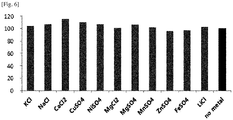
- each of the metal ions e.g ., NiSO 4 , CuSO 4 , MnSO 4 , CaCl 2 , ZnSO 4 , MgSO 4 , MgCl 2 , FeSO 4 , NaCl, LiCl, and KCl
- a metal ion e.g ., NiSO 4 , CuSO 4 , MnSO 4 , CaCl 2 , ZnSO 4 , MgSO 4 , MgCl 2 , FeSO 4 , NaCl, LiCl, and KCl
Landscapes
- Chemical & Material Sciences (AREA)
- Life Sciences & Earth Sciences (AREA)
- Organic Chemistry (AREA)
- Health & Medical Sciences (AREA)
- Engineering & Computer Science (AREA)
- Genetics & Genomics (AREA)
- Wood Science & Technology (AREA)
- Zoology (AREA)
- Bioinformatics & Cheminformatics (AREA)
- General Engineering & Computer Science (AREA)
- Biotechnology (AREA)
- Biochemistry (AREA)
- General Health & Medical Sciences (AREA)
- Biomedical Technology (AREA)
- Microbiology (AREA)
- Molecular Biology (AREA)
- General Chemical & Material Sciences (AREA)
- Chemical Kinetics & Catalysis (AREA)
- Medicinal Chemistry (AREA)
- Physics & Mathematics (AREA)
- Biophysics (AREA)
- Plant Pathology (AREA)
- Enzymes And Modification Thereof (AREA)
- Preparation Of Compounds By Using Micro-Organisms (AREA)
- Micro-Organisms Or Cultivation Processes Thereof (AREA)
- Pharmaceuticals Containing Other Organic And Inorganic Compounds (AREA)
Applications Claiming Priority (2)
| Application Number | Priority Date | Filing Date | Title |
|---|---|---|---|
| KR20160082543 | 2016-06-30 | ||
| PCT/KR2017/006985 WO2018004308A2 (ko) | 2016-06-30 | 2017-06-30 | 신규 내열성 과당-6-인산-3-에피머화 효소 및 이를 이용한 알룰로스 제조방법 |
Publications (3)
| Publication Number | Publication Date |
|---|---|
| EP3480306A2 true EP3480306A2 (de) | 2019-05-08 |
| EP3480306A4 EP3480306A4 (de) | 2020-03-11 |
| EP3480306B1 EP3480306B1 (de) | 2023-06-07 |
Family
ID=60787012
Family Applications (1)
| Application Number | Title | Priority Date | Filing Date |
|---|---|---|---|
| EP17820584.5A Active EP3480306B1 (de) | 2016-06-30 | 2017-06-30 | Neuartige hitzebeständige fructose-6-phosphat-3-epimerase und verfahren zur herstellung von allulose durch verwendung davon |
Country Status (13)
| Country | Link |
|---|---|
| US (1) | US10907182B2 (de) |
| EP (1) | EP3480306B1 (de) |
| JP (1) | JP6817343B2 (de) |
| KR (2) | KR101966530B1 (de) |
| CN (1) | CN109563499B (de) |
| AU (1) | AU2017287764B2 (de) |
| BR (1) | BR112018077188B1 (de) |
| CA (1) | CA3027687C (de) |
| ES (1) | ES2950576T3 (de) |
| MX (1) | MX2018016114A (de) |
| PL (1) | PL3480306T3 (de) |
| RU (1) | RU2733427C2 (de) |
| WO (1) | WO2018004308A2 (de) |
Cited By (1)
| Publication number | Priority date | Publication date | Assignee | Title |
|---|---|---|---|---|
| EP3555282A4 (de) * | 2016-12-14 | 2020-07-22 | Bonumose LLC | Enzymatische herstellung von d-allulose |
Families Citing this family (19)
| Publication number | Priority date | Publication date | Assignee | Title |
|---|---|---|---|---|
| US10907182B2 (en) * | 2016-06-30 | 2021-02-02 | Cj Cheiljedang Corporation | Thermostable fructose-6-phosphate-3-epimerase and a method for producing allulose using the same |
| WO2018039505A1 (en) * | 2016-08-24 | 2018-03-01 | National Technology & Engineering Solutions Of Sandia Llc (Ntess) | Novel protic or phosphate-based ionic liquids useful for lignocellulosic processing |
| CN108251468A (zh) * | 2018-02-06 | 2018-07-06 | 南京朗奈生物技术有限公司 | 生物法生产d-阿洛酮糖的工艺 |
| KR102233375B1 (ko) * | 2018-12-11 | 2021-03-31 | 씨제이제일제당 주식회사 | 신규 싸이코스-6-인산의 탈인산화 효소, 이를 포함하는 싸이코스 생산용 조성물, 및 이를 이용한 싸이코스 제조방법 |
| KR102138862B1 (ko) * | 2019-03-08 | 2020-07-30 | 씨제이제일제당 주식회사 | 알룰로스를 생산하는 스태필로코커스 속 미생물 및 이를 이용한 알룰로스 제조방법 |
| KR102256624B1 (ko) * | 2019-03-19 | 2021-05-26 | 주식회사 삼양사 | 인산화당 에피머 효소 |
| KR102080886B1 (ko) * | 2019-05-21 | 2020-02-24 | 씨제이제일제당 주식회사 | 부반응성이 낮은 리불로스-인산 3-에피머화 효소의 모티프 및 이를 포함하는 효소 |
| BR112021024211A2 (pt) * | 2019-05-31 | 2022-03-08 | Bonumose Inc | Produção enzimática de frutose |
| EP4053274B1 (de) * | 2019-10-28 | 2026-04-15 | Samyang Corporation | Fructose-6-phosphat-3-epimerase und deren verwendung |
| US20220372535A1 (en) * | 2019-10-28 | 2022-11-24 | Samyang Corporation | Fructose-6-phosphate 3-epimerase and use thereof |
| KR102509561B1 (ko) * | 2020-12-21 | 2023-03-14 | 주식회사 삼양사 | 높은 기질 특이성을 갖는 탈인산화 효소 단백질 및 이의 용도 |
| CN114790469B (zh) * | 2021-01-26 | 2024-03-26 | 中国科学院天津工业生物技术研究所 | 一种酶促合成阿洛酮糖的方法 |
| EP4680759A2 (de) | 2023-03-15 | 2026-01-21 | Annikki GmbH | Verfahren zur herstellung einer wässerigen lösung enthaltend l-psicose |
| EP4446422A3 (de) | 2023-03-15 | 2025-12-10 | Annikki GmbH | Verfahren zur herstellung einer wässerigen lösung enthaltend l-psicose |
| EP4464786A1 (de) | 2023-05-15 | 2024-11-20 | Annikki GmbH | Verfahren zur herstellung von wässerigen lösungen enthaltend d-psicose oder l-psicose |
| EP4431614A1 (de) | 2023-03-15 | 2024-09-18 | Annikki GmbH | Verfahren zur herstellung von wässerigen lösungen enthaltend d-psicose oder l-psicose |
| EP4464785A1 (de) | 2023-05-15 | 2024-11-20 | Annikki GmbH | Verfahren zur herstellung von d-talitol, d-tagatose und d-psicose |
| AR132695A1 (es) | 2023-05-15 | 2025-07-23 | Annikki Gmbh | Procedimiento para la preparación de d-talitol, d-tagatosa y d-psicosa |
| KR20250095788A (ko) * | 2023-12-19 | 2025-06-27 | 대상 주식회사 | 항시발현용 신규 프로모터, 이를 포함하는 목적 단백질 발현 시스템 및 이를 이용하여 알룰로스를 제조하는 방법 |
Family Cites Families (10)
| Publication number | Priority date | Publication date | Assignee | Title |
|---|---|---|---|---|
| DE10037611A1 (de) * | 2000-08-02 | 2002-02-14 | Degussa | Neue für das rpe-Gen kodierende Nuleotidsequenzen |
| KR100744479B1 (ko) * | 2005-06-01 | 2007-08-01 | 씨제이 주식회사 | 사이코스 에피머화 효소에 의한 사이코스의 생산 방법 |
| CN100577793C (zh) * | 2007-12-12 | 2010-01-06 | 江南大学 | 微生物转化d-果糖制备d-阿洛酮糖的菌种和方法 |
| GB0822937D0 (en) * | 2008-12-16 | 2009-01-21 | Terranol As | Microorganism |
| CN102382867A (zh) | 2010-09-06 | 2012-03-21 | 黄卫东 | 一种胞外酶催化糖合成方法 |
| KR20140080282A (ko) | 2012-12-20 | 2014-06-30 | 주식회사 삼양제넥스 | D-사이코스 3-에피머화 효소를 이용한 과당으로부터 사이코스의 제조방법 |
| KR101610911B1 (ko) | 2013-05-09 | 2016-04-08 | 주식회사 삼양사 | L-리불로스 5-인산 4-에피머화 효소를 이용한 과당에서 타가토스 생산 |
| KR102189458B1 (ko) * | 2013-09-03 | 2020-12-11 | 로께뜨프레르 | D-사이코스 3-에피머라제의 개선된 변이체 및 그의 용도 |
| WO2016191267A1 (en) | 2015-05-22 | 2016-12-01 | Archer Daniels Midland Company | A genus of epimerase enzymes for conversion of fructose to allulose at high temperature and low ph |
| US10907182B2 (en) | 2016-06-30 | 2021-02-02 | Cj Cheiljedang Corporation | Thermostable fructose-6-phosphate-3-epimerase and a method for producing allulose using the same |
-
2017
- 2017-06-30 US US16/314,067 patent/US10907182B2/en active Active
- 2017-06-30 RU RU2019100788A patent/RU2733427C2/ru active
- 2017-06-30 AU AU2017287764A patent/AU2017287764B2/en active Active
- 2017-06-30 PL PL17820584.5T patent/PL3480306T3/pl unknown
- 2017-06-30 JP JP2018567065A patent/JP6817343B2/ja active Active
- 2017-06-30 BR BR112018077188-0A patent/BR112018077188B1/pt active IP Right Grant
- 2017-06-30 MX MX2018016114A patent/MX2018016114A/es unknown
- 2017-06-30 ES ES17820584T patent/ES2950576T3/es active Active
- 2017-06-30 EP EP17820584.5A patent/EP3480306B1/de active Active
- 2017-06-30 WO PCT/KR2017/006985 patent/WO2018004308A2/ko not_active Ceased
- 2017-06-30 CN CN201780041244.6A patent/CN109563499B/zh active Active
- 2017-06-30 CA CA3027687A patent/CA3027687C/en active Active
- 2017-06-30 KR KR1020170083757A patent/KR101966530B1/ko active Active
-
2019
- 2019-03-29 KR KR1020190037301A patent/KR102042044B1/ko active Active
Cited By (4)
| Publication number | Priority date | Publication date | Assignee | Title |
|---|---|---|---|---|
| EP3555282A4 (de) * | 2016-12-14 | 2020-07-22 | Bonumose LLC | Enzymatische herstellung von d-allulose |
| US11053528B2 (en) | 2016-12-14 | 2021-07-06 | Bonumose, Inc. | Enzymatic production of D-allulose |
| US11078506B2 (en) | 2016-12-14 | 2021-08-03 | Bonumose, Inc. | Enzymatic production of D-allulose |
| US11168342B2 (en) | 2016-12-14 | 2021-11-09 | Bonumose, Inc. | Enzymatic production of D-allulose |
Also Published As
| Publication number | Publication date |
|---|---|
| AU2017287764A1 (en) | 2018-12-20 |
| US10907182B2 (en) | 2021-02-02 |
| CA3027687C (en) | 2022-07-05 |
| PL3480306T3 (pl) | 2023-11-06 |
| BR112018077188B1 (pt) | 2022-09-06 |
| KR102042044B1 (ko) | 2019-12-02 |
| US20190225997A1 (en) | 2019-07-25 |
| WO2018004308A2 (ko) | 2018-01-04 |
| CN109563499B (zh) | 2022-08-12 |
| AU2017287764B2 (en) | 2021-01-21 |
| RU2019100788A3 (de) | 2020-07-30 |
| CA3027687A1 (en) | 2018-01-04 |
| MX2018016114A (es) | 2019-10-14 |
| KR20190038775A (ko) | 2019-04-09 |
| KR101966530B1 (ko) | 2019-04-08 |
| ES2950576T3 (es) | 2023-10-11 |
| JP2019522477A (ja) | 2019-08-15 |
| EP3480306A4 (de) | 2020-03-11 |
| CN109563499A (zh) | 2019-04-02 |
| KR20180004023A (ko) | 2018-01-10 |
| JP6817343B2 (ja) | 2021-01-20 |
| RU2019100788A (ru) | 2020-07-30 |
| BR112018077188A2 (pt) | 2019-06-25 |
| RU2733427C2 (ru) | 2020-10-01 |
| EP3480306B1 (de) | 2023-06-07 |
| WO2018004308A3 (ko) | 2018-02-22 |
Similar Documents
| Publication | Publication Date | Title |
|---|---|---|
| EP3480306B1 (de) | Neuartige hitzebeständige fructose-6-phosphat-3-epimerase und verfahren zur herstellung von allulose durch verwendung davon | |
| EP3480304B1 (de) | Eine neuartige thermostable tagatose-6-phosphat-phosphatase und ein verfahren zur herstellung von tagatose unter verwendung derselben | |
| KR101919713B1 (ko) | 신규한 d-사이코스 3-에피머화 효소 및 이를 이용한 d-사이코스의 제조 방법 | |
| US10752888B2 (en) | Method for enzymatically preparing highly concentrated myo-inositol | |
| JP2020529205A (ja) | 新規のプシコース−6−リン酸脱リン酸酵素、前記酵素を含むプシコース生産用組成物、前記酵素を利用してプシコースを製造する方法 | |
| KR102063908B1 (ko) | 신규 내열성 과당-6-인산 3-에피머화 효소 및 이를 이용한 알룰로스 제조방법 | |
| US20210261939A1 (en) | A Novel D-Psicose 3-Epimerase and Method for Producing D-Psicose Using the Same | |
| KR20190068470A (ko) | 신규한 사이코스-6-인산 탈인산효소, 상기 효소를 포함하는 사이코스 생산용 조성물, 상기 효소를 이용하여 사이코스를 제조하는 방법 | |
| KR102055875B1 (ko) | 신규 내열성 과당-6-인산 3-에피머화 효소 및 이를 이용한 알룰로스 제조방법 |
Legal Events
| Date | Code | Title | Description |
|---|---|---|---|
| STAA | Information on the status of an ep patent application or granted ep patent |
Free format text: STATUS: THE INTERNATIONAL PUBLICATION HAS BEEN MADE |
|
| TPAC | Observations filed by third parties |
Free format text: ORIGINAL CODE: EPIDOSNTIPA |
|
| PUAI | Public reference made under article 153(3) epc to a published international application that has entered the european phase |
Free format text: ORIGINAL CODE: 0009012 |
|
| STAA | Information on the status of an ep patent application or granted ep patent |
Free format text: STATUS: REQUEST FOR EXAMINATION WAS MADE |
|
| 17P | Request for examination filed |
Effective date: 20190130 |
|
| AK | Designated contracting states |
Kind code of ref document: A2 Designated state(s): AL AT BE BG CH CY CZ DE DK EE ES FI FR GB GR HR HU IE IS IT LI LT LU LV MC MK MT NL NO PL PT RO RS SE SI SK SM TR |
|
| AX | Request for extension of the european patent |
Extension state: BA ME |
|
| DAV | Request for validation of the european patent (deleted) | ||
| DAX | Request for extension of the european patent (deleted) | ||
| RIC1 | Information provided on ipc code assigned before grant |
Ipc: C12P 19/24 20060101ALI20200127BHEP Ipc: C12N 9/90 20060101AFI20200127BHEP Ipc: C12P 19/02 20060101ALI20200127BHEP Ipc: C12N 15/52 20060101ALI20200127BHEP |
|
| A4 | Supplementary search report drawn up and despatched |
Effective date: 20200207 |
|
| STAA | Information on the status of an ep patent application or granted ep patent |
Free format text: STATUS: EXAMINATION IS IN PROGRESS |
|
| 17Q | First examination report despatched |
Effective date: 20210326 |
|
| REG | Reference to a national code |
Ref country code: DE Ref legal event code: R079 Ref document number: 602017069829 Country of ref document: DE Free format text: PREVIOUS MAIN CLASS: C12N0009900000 Ipc: C12R0001010000 |
|
| GRAJ | Information related to disapproval of communication of intention to grant by the applicant or resumption of examination proceedings by the epo deleted |
Free format text: ORIGINAL CODE: EPIDOSDIGR1 |
|
| GRAP | Despatch of communication of intention to grant a patent |
Free format text: ORIGINAL CODE: EPIDOSNIGR1 |
|
| RIC1 | Information provided on ipc code assigned before grant |
Ipc: C12N 9/90 20060101ALI20221117BHEP Ipc: C12N 15/52 20060101ALI20221117BHEP Ipc: C12P 19/02 20060101ALI20221117BHEP Ipc: C12P 19/24 20060101ALI20221117BHEP Ipc: C12R 1/19 20060101ALI20221117BHEP Ipc: C12R 1/01 20060101AFI20221117BHEP |
|
| GRAP | Despatch of communication of intention to grant a patent |
Free format text: ORIGINAL CODE: EPIDOSNIGR1 |
|
| STAA | Information on the status of an ep patent application or granted ep patent |
Free format text: STATUS: GRANT OF PATENT IS INTENDED |
|
| INTG | Intention to grant announced |
Effective date: 20230103 |
|
| GRAS | Grant fee paid |
Free format text: ORIGINAL CODE: EPIDOSNIGR3 |
|
| GRAA | (expected) grant |
Free format text: ORIGINAL CODE: 0009210 |
|
| STAA | Information on the status of an ep patent application or granted ep patent |
Free format text: STATUS: THE PATENT HAS BEEN GRANTED |
|
| AK | Designated contracting states |
Kind code of ref document: B1 Designated state(s): AL AT BE BG CH CY CZ DE DK EE ES FI FR GB GR HR HU IE IS IT LI LT LU LV MC MK MT NL NO PL PT RO RS SE SI SK SM TR |
|
| REG | Reference to a national code |
Ref country code: GB Ref legal event code: FG4D |
|
| REG | Reference to a national code |
Ref country code: CH Ref legal event code: EP Ref country code: AT Ref legal event code: REF Ref document number: 1575166 Country of ref document: AT Kind code of ref document: T Effective date: 20230615 |
|
| REG | Reference to a national code |
Ref country code: DE Ref legal event code: R096 Ref document number: 602017069829 Country of ref document: DE |
|
| P01 | Opt-out of the competence of the unified patent court (upc) registered |
Effective date: 20230606 |
|
| REG | Reference to a national code |
Ref country code: LT Ref legal event code: MG9D |
|
| REG | Reference to a national code |
Ref country code: NL Ref legal event code: MP Effective date: 20230607 Ref country code: ES Ref legal event code: FG2A Ref document number: 2950576 Country of ref document: ES Kind code of ref document: T3 Effective date: 20231011 |
|
| PG25 | Lapsed in a contracting state [announced via postgrant information from national office to epo] |
Ref country code: SE Free format text: LAPSE BECAUSE OF FAILURE TO SUBMIT A TRANSLATION OF THE DESCRIPTION OR TO PAY THE FEE WITHIN THE PRESCRIBED TIME-LIMIT Effective date: 20230607 Ref country code: NO Free format text: LAPSE BECAUSE OF FAILURE TO SUBMIT A TRANSLATION OF THE DESCRIPTION OR TO PAY THE FEE WITHIN THE PRESCRIBED TIME-LIMIT Effective date: 20230907 |
|
| REG | Reference to a national code |
Ref country code: AT Ref legal event code: MK05 Ref document number: 1575166 Country of ref document: AT Kind code of ref document: T Effective date: 20230607 |
|
| PG25 | Lapsed in a contracting state [announced via postgrant information from national office to epo] |
Ref country code: RS Free format text: LAPSE BECAUSE OF FAILURE TO SUBMIT A TRANSLATION OF THE DESCRIPTION OR TO PAY THE FEE WITHIN THE PRESCRIBED TIME-LIMIT Effective date: 20230607 Ref country code: NL Free format text: LAPSE BECAUSE OF FAILURE TO SUBMIT A TRANSLATION OF THE DESCRIPTION OR TO PAY THE FEE WITHIN THE PRESCRIBED TIME-LIMIT Effective date: 20230607 Ref country code: LV Free format text: LAPSE BECAUSE OF FAILURE TO SUBMIT A TRANSLATION OF THE DESCRIPTION OR TO PAY THE FEE WITHIN THE PRESCRIBED TIME-LIMIT Effective date: 20230607 Ref country code: LT Free format text: LAPSE BECAUSE OF FAILURE TO SUBMIT A TRANSLATION OF THE DESCRIPTION OR TO PAY THE FEE WITHIN THE PRESCRIBED TIME-LIMIT Effective date: 20230607 Ref country code: HR Free format text: LAPSE BECAUSE OF FAILURE TO SUBMIT A TRANSLATION OF THE DESCRIPTION OR TO PAY THE FEE WITHIN THE PRESCRIBED TIME-LIMIT Effective date: 20230607 Ref country code: GR Free format text: LAPSE BECAUSE OF FAILURE TO SUBMIT A TRANSLATION OF THE DESCRIPTION OR TO PAY THE FEE WITHIN THE PRESCRIBED TIME-LIMIT Effective date: 20230908 |
|
| PG25 | Lapsed in a contracting state [announced via postgrant information from national office to epo] |
Ref country code: FI Free format text: LAPSE BECAUSE OF FAILURE TO SUBMIT A TRANSLATION OF THE DESCRIPTION OR TO PAY THE FEE WITHIN THE PRESCRIBED TIME-LIMIT Effective date: 20230607 |
|
| PG25 | Lapsed in a contracting state [announced via postgrant information from national office to epo] |
Ref country code: SK Free format text: LAPSE BECAUSE OF FAILURE TO SUBMIT A TRANSLATION OF THE DESCRIPTION OR TO PAY THE FEE WITHIN THE PRESCRIBED TIME-LIMIT Effective date: 20230607 |
|
| PG25 | Lapsed in a contracting state [announced via postgrant information from national office to epo] |
Ref country code: IS Free format text: LAPSE BECAUSE OF FAILURE TO SUBMIT A TRANSLATION OF THE DESCRIPTION OR TO PAY THE FEE WITHIN THE PRESCRIBED TIME-LIMIT Effective date: 20231007 |
|
| PG25 | Lapsed in a contracting state [announced via postgrant information from national office to epo] |
Ref country code: SM Free format text: LAPSE BECAUSE OF FAILURE TO SUBMIT A TRANSLATION OF THE DESCRIPTION OR TO PAY THE FEE WITHIN THE PRESCRIBED TIME-LIMIT Effective date: 20230607 Ref country code: SK Free format text: LAPSE BECAUSE OF FAILURE TO SUBMIT A TRANSLATION OF THE DESCRIPTION OR TO PAY THE FEE WITHIN THE PRESCRIBED TIME-LIMIT Effective date: 20230607 Ref country code: RO Free format text: LAPSE BECAUSE OF FAILURE TO SUBMIT A TRANSLATION OF THE DESCRIPTION OR TO PAY THE FEE WITHIN THE PRESCRIBED TIME-LIMIT Effective date: 20230607 Ref country code: PT Free format text: LAPSE BECAUSE OF FAILURE TO SUBMIT A TRANSLATION OF THE DESCRIPTION OR TO PAY THE FEE WITHIN THE PRESCRIBED TIME-LIMIT Effective date: 20231009 Ref country code: IS Free format text: LAPSE BECAUSE OF FAILURE TO SUBMIT A TRANSLATION OF THE DESCRIPTION OR TO PAY THE FEE WITHIN THE PRESCRIBED TIME-LIMIT Effective date: 20231007 Ref country code: EE Free format text: LAPSE BECAUSE OF FAILURE TO SUBMIT A TRANSLATION OF THE DESCRIPTION OR TO PAY THE FEE WITHIN THE PRESCRIBED TIME-LIMIT Effective date: 20230607 Ref country code: CZ Free format text: LAPSE BECAUSE OF FAILURE TO SUBMIT A TRANSLATION OF THE DESCRIPTION OR TO PAY THE FEE WITHIN THE PRESCRIBED TIME-LIMIT Effective date: 20230607 Ref country code: AT Free format text: LAPSE BECAUSE OF FAILURE TO SUBMIT A TRANSLATION OF THE DESCRIPTION OR TO PAY THE FEE WITHIN THE PRESCRIBED TIME-LIMIT Effective date: 20230607 |
|
| REG | Reference to a national code |
Ref country code: CH Ref legal event code: PL |
|
| PG25 | Lapsed in a contracting state [announced via postgrant information from national office to epo] |
Ref country code: LU Free format text: LAPSE BECAUSE OF NON-PAYMENT OF DUE FEES Effective date: 20230630 |
|
| REG | Reference to a national code |
Ref country code: DE Ref legal event code: R097 Ref document number: 602017069829 Country of ref document: DE |
|
| PG25 | Lapsed in a contracting state [announced via postgrant information from national office to epo] |
Ref country code: MC Free format text: LAPSE BECAUSE OF FAILURE TO SUBMIT A TRANSLATION OF THE DESCRIPTION OR TO PAY THE FEE WITHIN THE PRESCRIBED TIME-LIMIT Effective date: 20230607 |
|
| REG | Reference to a national code |
Ref country code: IE Ref legal event code: MM4A |
|
| PG25 | Lapsed in a contracting state [announced via postgrant information from national office to epo] |
Ref country code: MC Free format text: LAPSE BECAUSE OF FAILURE TO SUBMIT A TRANSLATION OF THE DESCRIPTION OR TO PAY THE FEE WITHIN THE PRESCRIBED TIME-LIMIT Effective date: 20230607 Ref country code: LU Free format text: LAPSE BECAUSE OF NON-PAYMENT OF DUE FEES Effective date: 20230630 |
|
| PLBE | No opposition filed within time limit |
Free format text: ORIGINAL CODE: 0009261 |
|
| STAA | Information on the status of an ep patent application or granted ep patent |
Free format text: STATUS: NO OPPOSITION FILED WITHIN TIME LIMIT |
|
| PG25 | Lapsed in a contracting state [announced via postgrant information from national office to epo] |
Ref country code: IE Free format text: LAPSE BECAUSE OF NON-PAYMENT OF DUE FEES Effective date: 20230630 |
|
| PG25 | Lapsed in a contracting state [announced via postgrant information from national office to epo] |
Ref country code: IE Free format text: LAPSE BECAUSE OF NON-PAYMENT OF DUE FEES Effective date: 20230630 Ref country code: DK Free format text: LAPSE BECAUSE OF FAILURE TO SUBMIT A TRANSLATION OF THE DESCRIPTION OR TO PAY THE FEE WITHIN THE PRESCRIBED TIME-LIMIT Effective date: 20230607 Ref country code: CH Free format text: LAPSE BECAUSE OF NON-PAYMENT OF DUE FEES Effective date: 20230630 |
|
| PG25 | Lapsed in a contracting state [announced via postgrant information from national office to epo] |
Ref country code: SI Free format text: LAPSE BECAUSE OF FAILURE TO SUBMIT A TRANSLATION OF THE DESCRIPTION OR TO PAY THE FEE WITHIN THE PRESCRIBED TIME-LIMIT Effective date: 20230607 |
|
| 26N | No opposition filed |
Effective date: 20240308 |
|
| PG25 | Lapsed in a contracting state [announced via postgrant information from national office to epo] |
Ref country code: SI Free format text: LAPSE BECAUSE OF FAILURE TO SUBMIT A TRANSLATION OF THE DESCRIPTION OR TO PAY THE FEE WITHIN THE PRESCRIBED TIME-LIMIT Effective date: 20230607 |
|
| PG25 | Lapsed in a contracting state [announced via postgrant information from national office to epo] |
Ref country code: BG Free format text: LAPSE BECAUSE OF FAILURE TO SUBMIT A TRANSLATION OF THE DESCRIPTION OR TO PAY THE FEE WITHIN THE PRESCRIBED TIME-LIMIT Effective date: 20230607 |
|
| PG25 | Lapsed in a contracting state [announced via postgrant information from national office to epo] |
Ref country code: BG Free format text: LAPSE BECAUSE OF FAILURE TO SUBMIT A TRANSLATION OF THE DESCRIPTION OR TO PAY THE FEE WITHIN THE PRESCRIBED TIME-LIMIT Effective date: 20230607 |
|
| PGFP | Annual fee paid to national office [announced via postgrant information from national office to epo] |
Ref country code: DE Payment date: 20250220 Year of fee payment: 9 |
|
| PGFP | Annual fee paid to national office [announced via postgrant information from national office to epo] |
Ref country code: GB Payment date: 20250407 Year of fee payment: 9 |
|
| PG25 | Lapsed in a contracting state [announced via postgrant information from national office to epo] |
Ref country code: CY Free format text: LAPSE BECAUSE OF FAILURE TO SUBMIT A TRANSLATION OF THE DESCRIPTION OR TO PAY THE FEE WITHIN THE PRESCRIBED TIME-LIMIT; INVALID AB INITIO Effective date: 20170630 |
|
| PG25 | Lapsed in a contracting state [announced via postgrant information from national office to epo] |
Ref country code: HU Free format text: LAPSE BECAUSE OF FAILURE TO SUBMIT A TRANSLATION OF THE DESCRIPTION OR TO PAY THE FEE WITHIN THE PRESCRIBED TIME-LIMIT; INVALID AB INITIO Effective date: 20170630 |
|
| PGFP | Annual fee paid to national office [announced via postgrant information from national office to epo] |
Ref country code: ES Payment date: 20250714 Year of fee payment: 9 |
|
| PG25 | Lapsed in a contracting state [announced via postgrant information from national office to epo] |
Ref country code: TR Free format text: LAPSE BECAUSE OF FAILURE TO SUBMIT A TRANSLATION OF THE DESCRIPTION OR TO PAY THE FEE WITHIN THE PRESCRIBED TIME-LIMIT Effective date: 20230607 |
|
| PGFP | Annual fee paid to national office [announced via postgrant information from national office to epo] |
Ref country code: BE Payment date: 20260220 Year of fee payment: 10 Ref country code: IT Payment date: 20260223 Year of fee payment: 10 |
|
| PGFP | Annual fee paid to national office [announced via postgrant information from national office to epo] |
Ref country code: FR Payment date: 20260224 Year of fee payment: 10 |
|
| PGFP | Annual fee paid to national office [announced via postgrant information from national office to epo] |
Ref country code: PL Payment date: 20260224 Year of fee payment: 10 |