EP3477299B1 - Verfahren zur identifizierung hochaffiner komplexe aus zwei liganden und einem rezeptor, vorrichtung zur durchführung des verfahrens und selbst-assemblierende chemische bibliothek zur verwendung in dem verfahren - Google Patents
Verfahren zur identifizierung hochaffiner komplexe aus zwei liganden und einem rezeptor, vorrichtung zur durchführung des verfahrens und selbst-assemblierende chemische bibliothek zur verwendung in dem verfahren Download PDFInfo
- Publication number
- EP3477299B1 EP3477299B1 EP18207435.1A EP18207435A EP3477299B1 EP 3477299 B1 EP3477299 B1 EP 3477299B1 EP 18207435 A EP18207435 A EP 18207435A EP 3477299 B1 EP3477299 B1 EP 3477299B1
- Authority
- EP
- European Patent Office
- Prior art keywords
- ligands
- rna
- bases
- strand dna
- dna
- Prior art date
- Legal status (The legal status is an assumption and is not a legal conclusion. Google has not performed a legal analysis and makes no representation as to the accuracy of the status listed.)
- Active
Links
Images


Classifications
-
- C—CHEMISTRY; METALLURGY
- C12—BIOCHEMISTRY; BEER; SPIRITS; WINE; VINEGAR; MICROBIOLOGY; ENZYMOLOGY; MUTATION OR GENETIC ENGINEERING
- C12Q—MEASURING OR TESTING PROCESSES INVOLVING ENZYMES, NUCLEIC ACIDS OR MICROORGANISMS; COMPOSITIONS OR TEST PAPERS THEREFOR; PROCESSES OF PREPARING SUCH COMPOSITIONS; CONDITION-RESPONSIVE CONTROL IN MICROBIOLOGICAL OR ENZYMOLOGICAL PROCESSES
- C12Q1/00—Measuring or testing processes involving enzymes, nucleic acids or microorganisms; Compositions therefor; Processes of preparing such compositions
- C12Q1/68—Measuring or testing processes involving enzymes, nucleic acids or microorganisms; Compositions therefor; Processes of preparing such compositions involving nucleic acids
- C12Q1/6811—Selection methods for production or design of target specific oligonucleotides or binding molecules
-
- B—PERFORMING OPERATIONS; TRANSPORTING
- B01—PHYSICAL OR CHEMICAL PROCESSES OR APPARATUS IN GENERAL
- B01L—CHEMICAL OR PHYSICAL LABORATORY APPARATUS FOR GENERAL USE
- B01L3/00—Containers or dishes for laboratory use, e.g. laboratory glassware; Droppers
- B01L3/50—Containers for the purpose of retaining a material to be analysed, e.g. test tubes
- B01L3/502—Containers for the purpose of retaining a material to be analysed, e.g. test tubes with fluid transport, e.g. in multi-compartment structures
- B01L3/5027—Containers for the purpose of retaining a material to be analysed, e.g. test tubes with fluid transport, e.g. in multi-compartment structures by integrated microfluidic structures, i.e. dimensions of channels and chambers are such that surface tension forces are important, e.g. lab-on-a-chip
-
- B—PERFORMING OPERATIONS; TRANSPORTING
- B01—PHYSICAL OR CHEMICAL PROCESSES OR APPARATUS IN GENERAL
- B01L—CHEMICAL OR PHYSICAL LABORATORY APPARATUS FOR GENERAL USE
- B01L7/00—Heating or cooling apparatus; Heat insulating devices
- B01L7/52—Heating or cooling apparatus; Heat insulating devices with provision for submitting samples to a predetermined sequence of different temperatures, e.g. for treating nucleic acid samples
- B01L7/525—Heating or cooling apparatus; Heat insulating devices with provision for submitting samples to a predetermined sequence of different temperatures, e.g. for treating nucleic acid samples with physical movement of samples between temperature zones
-
- G—PHYSICS
- G01—MEASURING; TESTING
- G01N—INVESTIGATING OR ANALYSING MATERIALS BY DETERMINING THEIR CHEMICAL OR PHYSICAL PROPERTIES
- G01N33/00—Investigating or analysing materials by specific methods not covered by groups G01N1/00 - G01N31/00
- G01N33/48—Biological material, e.g. blood, urine; Haemocytometers
- G01N33/50—Chemical analysis of biological material, e.g. blood, urine; Testing involving biospecific ligand binding methods; Immunological testing
- G01N33/53—Immunoassay; Biospecific binding assay; Materials therefor
- G01N33/5308—Immunoassay; Biospecific binding assay; Materials therefor for analytes not provided for elsewhere, e.g. nucleic acids, uric acid, worms, mites
-
- B—PERFORMING OPERATIONS; TRANSPORTING
- B01—PHYSICAL OR CHEMICAL PROCESSES OR APPARATUS IN GENERAL
- B01L—CHEMICAL OR PHYSICAL LABORATORY APPARATUS FOR GENERAL USE
- B01L2300/00—Additional constructional details
- B01L2300/06—Auxiliary integrated devices, integrated components
- B01L2300/0681—Filter
-
- B—PERFORMING OPERATIONS; TRANSPORTING
- B01—PHYSICAL OR CHEMICAL PROCESSES OR APPARATUS IN GENERAL
- B01L—CHEMICAL OR PHYSICAL LABORATORY APPARATUS FOR GENERAL USE
- B01L2300/00—Additional constructional details
- B01L2300/08—Geometry, shape and general structure
- B01L2300/0809—Geometry, shape and general structure rectangular shaped
- B01L2300/0816—Cards, e.g. flat sample carriers usually with flow in two horizontal directions
-
- B—PERFORMING OPERATIONS; TRANSPORTING
- B01—PHYSICAL OR CHEMICAL PROCESSES OR APPARATUS IN GENERAL
- B01L—CHEMICAL OR PHYSICAL LABORATORY APPARATUS FOR GENERAL USE
- B01L2300/00—Additional constructional details
- B01L2300/08—Geometry, shape and general structure
- B01L2300/0861—Configuration of multiple channels and/or chambers in a single devices
- B01L2300/088—Channel loops
-
- B—PERFORMING OPERATIONS; TRANSPORTING
- B01—PHYSICAL OR CHEMICAL PROCESSES OR APPARATUS IN GENERAL
- B01L—CHEMICAL OR PHYSICAL LABORATORY APPARATUS FOR GENERAL USE
- B01L2300/00—Additional constructional details
- B01L2300/18—Means for temperature control
- B01L2300/1805—Conductive heating, heat from thermostatted solids is conducted to receptacles, e.g. heating plates, blocks
- B01L2300/1822—Conductive heating, heat from thermostatted solids is conducted to receptacles, e.g. heating plates, blocks using Peltier elements
-
- B—PERFORMING OPERATIONS; TRANSPORTING
- B01—PHYSICAL OR CHEMICAL PROCESSES OR APPARATUS IN GENERAL
- B01L—CHEMICAL OR PHYSICAL LABORATORY APPARATUS FOR GENERAL USE
- B01L2300/00—Additional constructional details
- B01L2300/18—Means for temperature control
- B01L2300/1861—Means for temperature control using radiation
-
- B—PERFORMING OPERATIONS; TRANSPORTING
- B01—PHYSICAL OR CHEMICAL PROCESSES OR APPARATUS IN GENERAL
- B01L—CHEMICAL OR PHYSICAL LABORATORY APPARATUS FOR GENERAL USE
- B01L2300/00—Additional constructional details
- B01L2300/18—Means for temperature control
- B01L2300/1894—Cooling means; Cryo cooling
-
- B—PERFORMING OPERATIONS; TRANSPORTING
- B01—PHYSICAL OR CHEMICAL PROCESSES OR APPARATUS IN GENERAL
- B01L—CHEMICAL OR PHYSICAL LABORATORY APPARATUS FOR GENERAL USE
- B01L2400/00—Moving or stopping fluids
- B01L2400/04—Moving fluids with specific forces or mechanical means
- B01L2400/0475—Moving fluids with specific forces or mechanical means specific mechanical means and fluid pressure
- B01L2400/0487—Moving fluids with specific forces or mechanical means specific mechanical means and fluid pressure fluid pressure, pneumatics
Definitions
- a method for identifying high-affinity complexes of two ligands and a receptor is proposed.
- ligands from a library are used, each of which has a single-stranded DNA or RNA. Since the DNA or RNA of one part of the ligands is complementary to the DNA or RNA of another part of the ligands, both parts of the ligands can form binary complexes with each other.
- the length of the DNA or RNA can be 3 to 10 bases in an embodiment according to the invention.
- hybridization and dissociation of the single-stranded DNAs or RNAs is provided in a dynamic manner, which is already achieved at room temperature for the embodiment according to the invention and requires a cycle of heating and cooling for an embodiment not according to the invention.
- a microfluidic device for carrying out the method according to the invention is provided. and a dynamic, self-assembling chemical library containing binary complexes of the respective ligands is proposed.
- a major challenge in using DNA-encoded chemical libraries and DNA/RNA aptamer libraries to discover effective binders and inhibitors against diverse target proteins of biomedical interest is to improve the signal-to-noise ratio in selection experiments to distinguish molecules with high binding affinity from weak or non-binding compounds.
- the US 2010/159455 A1 discloses a method for the biological detection of receptors and proteins and the creation of profiles of receptors and proteins.
- the WO 97/43232 A1 discloses a substance library, a method for producing the substance library, a method for producing supramolecular complexes using the substance library, a use of the produced supramolecular complexes and a use of the substance library.
- the object of the present invention is therefore to provide a method with which it is possible to identify high-affinity ternary complexes of two ligands and a receptor in a simple, economical and highly sensitive manner.
- a device for carrying out the method and a self-assembling chemical library for use in the method should be provided.
- the object is achieved by the method according to claim 1, the dynamic, self-assembling chemical library according to claim 10 and the use of the library according to claim 15.
- the method not according to the invention is characterized in that incubation is carried out at a temperature (step b), step d) and/or step e)) at which the first part of the ligands and the second part of the ligands in the solution are hybridized to form ligand complexes.
- a high-affinity ternary ligand-receptor complex is formed from the two ligands and the receptor. High-affinity ligand pairs are thus depleted from the pool of binary ligand pairs and enriched in the form of a ternary ligand pair-receptor complex.
- the high-affinity ligands can be specifically converted - ideally quantitatively - into ligand-receptor complexes, which results in a larger amount of ligand-receptor complexes and thus increases the sensitivity of the non-inventive method compared to prior art methods (improved signal-to-noise ratio).
- the The frequency of formation of the high-affinity ligand pair can ideally be increased up to a factor of N for a number of N theoretically possible high-affinity ligand pairs in a library (quantitative formation of high-affinity complexes, no high-affinity ligands bound to low-affinity ligands and thus "trapped").
- the ligand complexes can be dissociated, for example, by increasing the temperature of the solution, in particular to a temperature of 35 °C to 95 °C, preferably 50 °C to 95 °C, particularly preferably 70 °C to 95 °C, in particular 80 °C to 95 °C.
- the dissociation of the ligand complexes is preferably carried out in a part of the solution that is spatially spaced from the receptor, preferably in such a way that the receptor is not functionally impaired by the conditions that lead to the dissociation.
- the advantage of this embodiment of the method not according to the invention is that the dissociation does not have a negative effect on the (biological) function of the receptor.
- receptors are thereby protected from thermal and/or pH-induced denaturation (e.g. receptors that contain or consist of proteins).
- the free ligands can be hybridized (again) by lowering the temperature of the solution, in particular by lowering it to a temperature of 1 °C to 30 °C, preferably 5 °C to 28 °C, particularly preferably 10 °C to 25 °C, in particular 15 to 20 °C.
- Steps c) to e) of the non-inventive method can be repeated at least once or twice, preferably at least 3 or 4 times, particularly preferably at least 5 or 6 times, in particular at least 7 or 8 times.
- the more often the steps are repeated the more high-affinity ligand complexes are gradually converted into the ligand-receptor complex (increase in sensitivity).
- At least 20 bases, preferably at least 40 bases, particularly preferably at least 100 bases, in particular at least 200 bases, of the single-stranded DNA or RNA from a first part of the ligands are complementary to the single-stranded DNA or RNA from a second part of the ligands.
- the method is characterized in that the solution is incubated at a room temperature at which an equilibrium of hybridization to ligand complexes and dissociation to free ligands is established between the first part of the ligands and the second part of the ligands (room temperature, ie 15°C to 30°C). This results in dynamic hybridization and dissociation.
- the method is further characterized in that in step i) the ligands are complexed to ligand complexes via hybridization of the DNA or RNA, the single-stranded DNA or RNA being in the first part of the ligands and the single-stranded DNA or RNA being in the second part of the ligands.
- second part of the ligand contains a base sequence that encodes the chemically covalently bound ligand.
- the difference to the first-mentioned, non-inventive method is that due to the smaller number of complementary bases between the two parts of the ligands, an association (via hybridization) and dissociation of the ligands already takes place at room temperature (dynamic equilibrium). Due to the presence of a receptor, high-affinity ligand pairs are "removed” from the dynamic equilibrium and transferred into the ligand-receptor complex. High-affinity ligand pairs are thus depleted from the general ligand pool of the chemical library and the high-affinity, ternary ligand-receptor complex is enriched.
- only 3 to 9 bases, preferably only 4 to 8 bases, particularly preferably only 5 to 7 bases, of the single-stranded DNA or RNA from a first part of the ligands can be complementary to the single-stranded DNA or RNA from a second part of the ligands.
- the length of the DNA or RNA of the first part of the ligands and/or second part of the ligands can be at least 20 bases, preferably at least 40 bases, particularly preferably at least 100 bases, in particular at least 200 bases.
- the first and/or second part of the ligands may make up more than 20%, preferably more than 30%, particularly preferably more than 40%, in particular 50%, of the total amount of ligands.
- the first part of the ligands has preferably L different ligands and the second part of the ligands preferably has M different ligands, so that L ⁇ M different binary ligand complexes are formed.
- a certain high-affinity ligand complex can be enriched with an increased efficiency of at least 1.5 to N-fold, preferably 2 to N (1/2) -fold, in particular 3 to 10-fold.
- the solution is incubated in at least one of steps b), e) and ii) at a temperature of 1 °C to 50 °C, preferably 5 °C to 37 °C, particularly preferably 10 °C to 25 °C, in particular 15 to 20 °C.
- a temperature of 1 °C to 50 °C preferably 5 °C to 37 °C, particularly preferably 10 °C to 25 °C, in particular 15 to 20 °C.
- it is advantageous that many receptor types are stable and have not lost their function of binding ligands.
- the solution can be incubated in at least one of steps b), e) and ii) for a period of 0.1 to 48 hours, preferably 0.2 to 24 hours, particularly preferably 0.5 to 12 hours, in particular 1 to 6 hours. Longer incubation times have proven to be advantageous since the binding of the ligand pairs to the receptor may be thermodynamically favored but may still have slow kinetics.
- the receptor used in the method according to the invention can be immobilized, preferably on a substrate selected from the group consisting of glass, ceramic, biopolymer, Sepharose, synthetic polymer and hydrogel.
- the solution with ligands can be circulated past the immobilized receptor.
- This embodiment is advantageous if the dissociation of the ligand complexes in the method is carried out in a part of the solution that is spatially separated from the receptor, since dissociation and hybridization of the ligands can take place spatially separately but nevertheless simultaneously (e.g. dissociation far from the receptor, hybridization near the receptor).
- the receptor contains or consists of a protein, a DNA, an RNA, a cell and/or an organic molecule with a molecular mass ⁇ 200 kDa, preferably ⁇ 100 kDa, particularly preferably ⁇ 10 kDa, in particular ⁇ 3 kDa.
- the ligands used can contain or consist of a molecule selected from the group consisting of protein, peptide, lipid, carbohydrate, dsDNA, ssDNA, dsRNA and ssRNA, aptamer, organic molecule with a molecular mass ⁇ 200 kDa, preferably ⁇ _ 100 kDa, particularly preferably ⁇ _ 10 kDa, in particular ⁇ 3 kDa.
- the complexes of ligand complexes and the receptor are identified using an analytical method.
- the method is preferably selected from the group consisting of mass spectrometry, HPLC, gas chromatography, IR spectroscopy and DNA sequencing, preferably DNA sequencing of a DNA or RNA barcode.
- the single-stranded DNA or RNA in the first and second part of the ligands contains a base sequence that codes for the chemically covalently bound ligand (base sequence as barcode), whereby this base sequence is preferably hybridized to a complementary base sequence of another single-stranded DNA or RNA.
- base sequence codes for the chemically covalently bound ligand
- the barcode is the simple identification of complex-bound ligands via DNA or RNA sequencing. It is particularly advantageous if the base sequence of the ligands contains a complementary single-stranded DNA or RNA hybridized, which can also serve as a barcode.
- both ligands of the ligand-receptor complex contain a single-stranded DNA or RNA
- this can be ligated, for example, by adding a ligase, to obtain a single-stranded DNA or RNA that encodes the specific combination of ligand 1 and 2.
- the (ligated) barcode does not only encode for a single ligand, but for two ligands that together form a high-affinity ligand complex.
- the method is characterized in that the single-stranded DNA or RNA of the ligands of the library is partially hybridized to a complementary base sequence of another single-stranded DNA or RNA, wherein 2 to 10 bases of the other single-stranded DNA or RNA from a first part of the ligands are complementary to bases of the single-stranded DNA or RNA from a second part of the ligands and bind to the complementary bases during the method (preferably forming a Y-shape, in particular as in Fig.
- a ligase which chemically covalently ligates the further single-stranded DNA or RNA from the first part of the ligands with the further single-stranded DNA or RNA from the second part of the ligands.
- a ligation of the two additional DNAs or RNAs only takes place if the respective bases hybridize, i.e. if the overall complex is sufficiently stable.
- the advantage of this embodiment is that once a complex has been formed, it is "stored" by the chemically covalent ligation of the two additional DNAs or RNAs.
- the ligated additional DNAs or RNAs accumulate during the process if the basis for their ligation was a stable formation of the overall complex.
- PCT, RT-PCR known methods
- very low concentrations of ligands can also be used in this way, and high-affinity ligands can be identified even at very low receptor concentrations.
- the heating of ligands in solution and the selection of ligands bound to immobilized receptor can take place locally separately from one another, thus preventing thermal damage to the receptor (e.g. protein denaturation).
- the container can retain immobilized receptor and prevent immobilized receptor from entering the fluidic lines.
- the container preferably has filters that prevent immobilized receptor from passing into the fluidic line.
- the cooling region of the device has a cooling device and/or is arranged in the region of the outlet with a valve.
- the device may comprise a pump arranged to pump a liquid through the fluidic line.
- the container of the device may comprise filters that prevent immobilized receptor from passing into the fluidic line.
- the microfluidic device can be characterized in that the container and/or the fluidic line contains a dynamic, self-assembling chemical library according to the invention (see below).
- a chemical library containing ligands comprising a single-stranded DNA or RNA with a base length of more than 2 bases chemically covalently bound to a ligand, wherein 2 to 10 bases of the single-stranded DNA or RNA from a first portion of the ligands are complementary to bases of the single-stranded DNA or RNA from a second portion of the ligands.
- the chemical library is characterized in that it contains binary complexes of the respective ligands, wherein the single-stranded DNA or RNA in the first portion of the ligands and the single-stranded DNA or RNA in the second portion of the ligands contain a base sequence encoding the chemically covalently bound ligand.
- only 3 to 9 bases, preferably only 4 to 8 bases, particularly preferably only 5 to 7 bases, of the single-stranded DNA or RNA from a first part of the ligands can be complementary to the single-stranded DNA or RNA from a second part of the ligands.
- the length of the DNA or RNA of the first part of the ligands and/or second part of the ligands can be at least 20 bases, preferably at least 40 bases, particularly preferably at least 100 bases, in particular at least 200 bases.
- the first and/or second part of the ligands make up more than 20%, preferably more than 30%, particularly preferably more than 40%, in particular 50%, of the total amount of ligands in the library.
- the first part of the ligands L preferably has L different ligands and the second part of the ligands preferably has L different ligands, so that the library has L 2 different ligand complexes.
- the ligands of the library can contain or consist of a molecule selected from the group consisting of protein, peptide, lipid, carbohydrate, dsDNA, ssDNA, dsRNA and ssRNA, aptamer, organic molecule with a molecular mass ⁇ 200 kDa, preferably ⁇ 100 kDa, particularly preferably ⁇ 10 kDa, in particular ⁇ 3 kDa.
- the library can be characterized in that the single-stranded DNA or RNA of the ligands of the library is each partially hybridized to a complementary base sequence of another single-stranded DNA or RNA, wherein 2 to 10 bases of a first further single-stranded DNA or RNA from a first part of the ligands are complementary to bases of the second single-stranded DNA or RNA from a second part of the ligands.
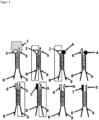
- Figure 1 shows a plurality of different ligands 2, 3, 4, 5, 6, 7 of a chemical library and at least one receptor 1.
- the ligands 2, 3, 4, 5, 6, 7 are each chemically covalently bound to a single-stranded DNA 8, 9, wherein the single-stranded DNA 8, 9 has a base length of more than 10 bases.
- the single-stranded DNA 8, 9 encodes the respective ligand to which it is bound via its base sequence.
- 18 bases of the single-stranded DNA 8 from a first part of the ligands 2, 6, 7 are complementary to bases of the single-stranded DNA 9 from a second part of the ligands 3, 4, 5 (see dashed line between the single-stranded DNAs 8, 9).
- Figure 2 shows a Figure 1 corresponding figure with the difference that in this embodiment only 6 bases of the single-stranded DNA from a first part of the ligands are complementary to bases of the single-stranded DNA or RNA from a second part of the ligands (otherwise the molecules and designations are Figure 1 identical).
- the lower number of complementary bases has the advantage that the association (hybridization) of two ligands is highly dynamic even at room temperature (15°C to 30°C), ie permanent hybridization and dissociation takes place.
- the high-affinity binding to receptor present in certain ligand pairs inhibits the dissociation of these ligand pairs, whereby complexes of receptor and high-affinity ligand pairs are populated for longer, "accumulate" over time and are ultimately more strongly populated in equilibrium.
- the advantage of this embodiment is that the dynamics of association and hybridization take place at room temperature, ie in contrast to the non-inventive embodiment of the Figure 1 no thermal energy has to be supplied.
- the disadvantage of this embodiment is a lower sensitivity than in the non-inventive embodiment in Figure 1 , because the smaller number of base pairs (6 instead of 18) makes the ligand complex and thus the complex of the ligands with the receptor more unstable, which means that the latter is less populated in equilibrium than in the embodiment in Figure 1 .
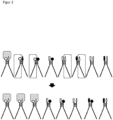
- Figure 3 illustrates how the high-affinity ligand pairs "accumulate" as a complex with the receptor over time (see first arrow above).
- the ligand pairs also have a complementary single-stranded DNA 10, 11 to the single-stranded DNA covalently bound to the ligand (otherwise the molecules and names are Figure 1 identical).
- This additional single-stranded DNA 10, 11 can be generated, for example, using suitable primers and a PCR reaction.
- the lower arrow 12 symbolizes a ligation reaction (e.g. by adding a ligase enzyme), which leads to the two additional single-stranded DNAs 10, 11 being chemically covalently ligated to one another.
- the advantage here is is that the ligated DNA piece codes for a specific ligand pair via its base sequence, which can thus be easily identified via DNA sequencing.
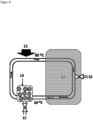
- Figure 4 describes a microfluidic device.
- a container 14 there is immobilized receptor, which was filled into the container via the opening 15 with a valve.
- the container 14 is connected on one side and the other to a line through which a liquid can be passed.
- the line is in a zone that can be heated. Heating can be achieved using an IR emitter as a heat source 13.
- the device also has a cooling zone 17. This zone optionally contains a cooling device.
- the line, here in the cooling area 17, has an outlet 16 with a valve from which liquid with (free) ligands can be removed and fed for analysis.
- immobilized receptor loaded with high-affinity ligands can be removed via the opening 15.
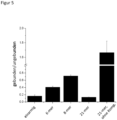
- Figure 5 shows the result of an experiment which proves the effectiveness of the method according to the invention.
- the Im-ssDNA was divided equally into a first part of Im-ssDNA1 and a second part of Im-ssDNA2, whereby Im-ssDNA1 and Im-ssDNA2 had a different number of complementary bases depending on the experiment (e.g. 6 complementary bases for "6-mer").
- Im-ssDNA1 was chemically covalently coupled to the fluorescent dye Cy5 in order to enable detection and quantification of free Im-ssDNA 1 or the free binary complex of Im-ssDNA1 and Im-ssDNA2 without receptor on the one hand and detection of the ternary Im-ssDNA1 ⁇ lm-ssDNA2 ⁇ receptor complex on the other hand.
- Immobilized streptavidin was used as receptor and an aqueous buffer with pH 9.2 was used as solution.
- the figure shows the ratio of the amount of ligand-receptor complex to ligands not bound to receptor ("bound/unbound" on the y-axis) under competitive conditions, i.e.
- ssDNA iminobiotin-free ssDNA
- non-affinity ligand see “single-armed”, “6-mer”, “8-mer” and “21-mer” on the x-axis) or non-competitive conditions, ie without the presence of competitive ssDNA ("21mer, no comp.” on the x-axis).
- Figure 6 shows a Y-shape that the entire complex takes in a preferred embodiment of the invention.
- the first ligand 2, which is chemically covalently bound to the first single-stranded DNA 8, has a section 18 that codes for the first ligand 2.
- the second ligand 3, which is chemically covalently bound to the second single-stranded DNA 9, has a section 19 that codes for the second ligand 3.
- six bases of the first single-stranded DNA 8 are complementary to six bases of the second single-stranded DNA 9 and can form base pairs 20 during the process (see the lines between the single-stranded DNAs 8, 9).
- the first single-stranded DNA 8 is partially hybridized (here: at the 3' end) with a first additional single-stranded DNA 10.
- the first additional single-stranded DNA 10 is characterized by containing an "overhang" of two to twelve bases (here: five bases, located at its 3'-end) that are complementary to two to twelve bases of the second single-stranded DNA 9 (here: five bases) and that can form base pairs 20 with the complementary bases during the process (see the lines between the additional first single-stranded DNA 10 and the second single-stranded DNA 9).
- the formation of the overall complex causes the first additional DNA 10 to be brought together with the second additional DNA 11 in such a way that they can be chemically covalently ligated by adding a ligase enzyme. If a ligase enzyme is added in the process, this results in ligation products of the two single-stranded additional DNAs 10, 11, which code for high-affinity ligand complexes, accumulating during the process. This increases the sensitivity of their detection. Since the accumulation product is DNA, it can be amplified even further (e.g. by PCR), which increases the sensitivity of the process. is further increased. In addition, sequencing of the ligated DNA allows a quick conclusion about the two ligands 2, 3, since the ligated DNA contains sections 18, 19, which code for both ligands 2, 3.
Landscapes
- Health & Medical Sciences (AREA)
- Chemical & Material Sciences (AREA)
- Life Sciences & Earth Sciences (AREA)
- Engineering & Computer Science (AREA)
- Molecular Biology (AREA)
- General Health & Medical Sciences (AREA)
- Immunology (AREA)
- Organic Chemistry (AREA)
- Biochemistry (AREA)
- Analytical Chemistry (AREA)
- Hematology (AREA)
- Zoology (AREA)
- Wood Science & Technology (AREA)
- Proteomics, Peptides & Aminoacids (AREA)
- Biotechnology (AREA)
- Microbiology (AREA)
- Chemical Kinetics & Catalysis (AREA)
- Clinical Laboratory Science (AREA)
- Physics & Mathematics (AREA)
- Urology & Nephrology (AREA)
- Biomedical Technology (AREA)
- Bioinformatics & Cheminformatics (AREA)
- Genetics & Genomics (AREA)
- General Engineering & Computer Science (AREA)
- Dispersion Chemistry (AREA)
- Biophysics (AREA)
- Cell Biology (AREA)
- Medicinal Chemistry (AREA)
- Tropical Medicine & Parasitology (AREA)
- Pathology (AREA)
- Food Science & Technology (AREA)
- General Physics & Mathematics (AREA)
- Measuring Or Testing Involving Enzymes Or Micro-Organisms (AREA)
- Investigating Or Analysing Biological Materials (AREA)
- Apparatus Associated With Microorganisms And Enzymes (AREA)
- Other Investigation Or Analysis Of Materials By Electrical Means (AREA)
- Peptides Or Proteins (AREA)
Applications Claiming Priority (3)
| Application Number | Priority Date | Filing Date | Title |
|---|---|---|---|
| DE102014213783.7A DE102014213783B3 (de) | 2014-07-16 | 2014-07-16 | Verfahren zur Identifizierung hochaffiner Komplexe aus zwei Liganden und einem Rezeptor, Vorrichtung zur Durchführung des Verfahrens und selbst-assemblierende chemische Bibliothek zur Verwendung in dem Verfahren |
| PCT/EP2015/065874 WO2016008822A2 (de) | 2014-07-16 | 2015-07-10 | Verfahren zur identifizierung hochaffiner komplexe aus zwei liganden und einem rezeptor, vorrichtung zur durchführung des verfahrens und selbst-assemblierende chemische bibliothek zur verwendung in dem verfahren |
| EP15744501.6A EP3169832B1 (de) | 2014-07-16 | 2015-07-10 | Verfahren zur identifizierung hochaffiner komplexe aus zwei liganden und einem rezeptor |
Related Parent Applications (1)
| Application Number | Title | Priority Date | Filing Date |
|---|---|---|---|
| EP15744501.6A Division EP3169832B1 (de) | 2014-07-16 | 2015-07-10 | Verfahren zur identifizierung hochaffiner komplexe aus zwei liganden und einem rezeptor |
Publications (3)
| Publication Number | Publication Date |
|---|---|
| EP3477299A1 EP3477299A1 (de) | 2019-05-01 |
| EP3477299C0 EP3477299C0 (de) | 2024-12-11 |
| EP3477299B1 true EP3477299B1 (de) | 2024-12-11 |
Family
ID=53192981
Family Applications (2)
| Application Number | Title | Priority Date | Filing Date |
|---|---|---|---|
| EP18207435.1A Active EP3477299B1 (de) | 2014-07-16 | 2015-07-10 | Verfahren zur identifizierung hochaffiner komplexe aus zwei liganden und einem rezeptor, vorrichtung zur durchführung des verfahrens und selbst-assemblierende chemische bibliothek zur verwendung in dem verfahren |
| EP15744501.6A Active EP3169832B1 (de) | 2014-07-16 | 2015-07-10 | Verfahren zur identifizierung hochaffiner komplexe aus zwei liganden und einem rezeptor |
Family Applications After (1)
| Application Number | Title | Priority Date | Filing Date |
|---|---|---|---|
| EP15744501.6A Active EP3169832B1 (de) | 2014-07-16 | 2015-07-10 | Verfahren zur identifizierung hochaffiner komplexe aus zwei liganden und einem rezeptor |
Country Status (8)
| Country | Link |
|---|---|
| US (2) | US11365439B2 (enExample) |
| EP (2) | EP3477299B1 (enExample) |
| JP (2) | JP6831776B2 (enExample) |
| CA (1) | CA2955087C (enExample) |
| DE (1) | DE102014213783B3 (enExample) |
| DK (1) | DK3169832T3 (enExample) |
| ES (2) | ES2712899T3 (enExample) |
| WO (1) | WO2016008822A2 (enExample) |
Families Citing this family (4)
| Publication number | Priority date | Publication date | Assignee | Title |
|---|---|---|---|---|
| WO2017218293A1 (en) | 2016-06-16 | 2017-12-21 | Richard Edward Watts | Oligonucleotide directed and recorded combinatorial synthesis of encoded probe molecules |
| WO2018204420A1 (en) | 2017-05-02 | 2018-11-08 | Haystack Sciences Corporation | Molecules for verifying oligonucleotide directed combinatorial synthesis and methods of making and using the same |
| CN107652453B (zh) * | 2017-09-26 | 2020-05-05 | 天津工业大学 | 接枝rgd短肽温敏可注射水凝胶及其制备方法和应用 |
| EP3604525B1 (en) * | 2018-08-02 | 2021-03-10 | TU Dresden | Method for providing a dna-encoded library, dna-encoded library and method of decoding a dna-encoded library |
Family Cites Families (15)
| Publication number | Priority date | Publication date | Assignee | Title |
|---|---|---|---|---|
| US5512439A (en) * | 1988-11-21 | 1996-04-30 | Dynal As | Oligonucleotide-linked magnetic particles and uses thereof |
| US7018793B1 (en) * | 1995-12-07 | 2006-03-28 | Diversa Corporation | Combinatorial screening of mixed populations of organisms |
| DE19619373A1 (de) * | 1996-05-14 | 1997-11-20 | Hoechst Ag | Neue Substanzbibliothek und damit hergestellte supramolekulare Komplexe |
| WO2002081729A2 (en) | 2001-04-06 | 2002-10-17 | California Institute Of Technology | Nucleic acid amplification utilizing microfluidic devices |
| KR100916889B1 (ko) * | 2002-03-08 | 2009-09-09 | 아이드게노쉬쉐 테흐니쉐 호흐슐레 쥬리히 | 암호화된 자가-조립 화학적 라이브러리(esachel) |
| CN101410530B (zh) * | 2003-04-18 | 2013-03-27 | 贝克顿·迪金森公司 | 免疫-扩增 |
| US7229769B2 (en) * | 2005-03-25 | 2007-06-12 | Illumina, Inc. | Compositions and methods for detecting protease activity |
| CA2664014A1 (en) * | 2006-09-18 | 2008-03-27 | Ensemble Discovery Corporation | Receptor family profiling |
| JP2009034052A (ja) * | 2007-08-02 | 2009-02-19 | Canon Inc | ハイブリダイゼーション方法および装置 |
| EP2138587A1 (en) * | 2008-06-23 | 2009-12-30 | Koninklijke Philips Electronics N.V. | Amplification of nucleic acids using temperature zones |
| CN102076870A (zh) | 2008-06-25 | 2011-05-25 | 实时基因组有限公司 | 对微阵列上的核酸进行解链曲线分析的方法和装置 |
| US8716191B2 (en) * | 2009-06-22 | 2014-05-06 | Universite De Strasbourg | Method of preparing an adduct |
| US10190986B2 (en) * | 2011-06-06 | 2019-01-29 | Abbott Laboratories | Spatially resolved ligand-receptor binding assays |
| BE1020816A5 (fr) * | 2012-07-04 | 2014-05-06 | Coris Bioconcept Sprl | Procede et dispositif pour la detection rapide de sequences nucleotidiques amplifiees. |
| CN105392897B (zh) * | 2013-03-19 | 2020-03-20 | 定向基因组学公司 | 靶序列的富集 |
-
2014
- 2014-07-16 DE DE102014213783.7A patent/DE102014213783B3/de active Active
-
2015
- 2015-07-10 JP JP2017502621A patent/JP6831776B2/ja active Active
- 2015-07-10 EP EP18207435.1A patent/EP3477299B1/de active Active
- 2015-07-10 US US15/326,172 patent/US11365439B2/en active Active
- 2015-07-10 ES ES15744501T patent/ES2712899T3/es active Active
- 2015-07-10 ES ES18207435T patent/ES3002709T3/es active Active
- 2015-07-10 WO PCT/EP2015/065874 patent/WO2016008822A2/de not_active Ceased
- 2015-07-10 CA CA2955087A patent/CA2955087C/en active Active
- 2015-07-10 EP EP15744501.6A patent/EP3169832B1/de active Active
- 2015-07-10 DK DK15744501.6T patent/DK3169832T3/en active
-
2021
- 2021-01-29 JP JP2021013303A patent/JP7112540B2/ja active Active
-
2022
- 2022-06-07 US US17/834,197 patent/US20220298552A1/en active Pending
Also Published As
| Publication number | Publication date |
|---|---|
| EP3169832A2 (de) | 2017-05-24 |
| DE102014213783B3 (de) | 2015-06-18 |
| EP3477299C0 (de) | 2024-12-11 |
| JP6831776B2 (ja) | 2021-02-17 |
| CA2955087C (en) | 2023-03-07 |
| JP7112540B2 (ja) | 2022-08-03 |
| WO2016008822A2 (de) | 2016-01-21 |
| US11365439B2 (en) | 2022-06-21 |
| JP2021092576A (ja) | 2021-06-17 |
| ES2712899T3 (es) | 2019-05-16 |
| US20170198336A1 (en) | 2017-07-13 |
| CA2955087A1 (en) | 2016-01-21 |
| DK3169832T3 (en) | 2019-03-25 |
| WO2016008822A3 (de) | 2016-05-19 |
| ES3002709T3 (en) | 2025-03-07 |
| EP3169832B1 (de) | 2018-12-05 |
| JP2017529062A (ja) | 2017-10-05 |
| US20220298552A1 (en) | 2022-09-22 |
| EP3477299A1 (de) | 2019-05-01 |
Similar Documents
| Publication | Publication Date | Title |
|---|---|---|
| DE60125312T2 (de) | Mikroarray | |
| DE69331665T2 (de) | Methode zur behandlung von nukleinsäureproben | |
| DE69836587T2 (de) | Nukleinsäuresammlung | |
| EP3477299B1 (de) | Verfahren zur identifizierung hochaffiner komplexe aus zwei liganden und einem rezeptor, vorrichtung zur durchführung des verfahrens und selbst-assemblierende chemische bibliothek zur verwendung in dem verfahren | |
| DE10149786B4 (de) | Oberfläche für Untersuchungen aus Populationen von Einzelmolekülen | |
| DE102006014879B4 (de) | RNA-Markierungsverfahren | |
| DE102011114984B3 (de) | Sequenzspezifische Analyse von Nukleinsäuren | |
| DE60029607T2 (de) | Elektrochemilumineszenz-helikasetest | |
| EP1234056B1 (de) | Dynamische bestimmung von analyten durch arrays auf inneren oberflächen | |
| DE102006005287B4 (de) | Verfahren zum Nachweis von Zielnukleinsäuren | |
| DE102006024058B4 (de) | Modulares System mit immobilisierten Nukleinsäuren und/oder Nukleinsäurederivaten an metallischen Oberflächen und Verfahren zu dessen Herstelung | |
| DE69521801T2 (de) | Methode des nukleinsäuretransfers | |
| DE102004043870A1 (de) | Verfahren zur Erweiterung des dynamischen Erfassungsbereich bei Mikroarrays | |
| EP1880017B1 (de) | Verfahren zur herstellung von liganden, liganden und test-kit | |
| DE19853185C1 (de) | Chemische Evolution durch exponentielle Amplifikation molekularer Matrizen | |
| DE102014200446B3 (de) | Verfahren zur Dekonvolution Nukleinsäure enthaltender Substanzgemische | |
| WO2025223824A1 (de) | Beschichtung für ein kavitätenarray für eine mikrofluidische vorrichtung in der point-of-care-diagnostik | |
| DE19848403A1 (de) | Verfahren zur exponentiellen Amplifikation molekularer Matrizen | |
| DE102005029810A1 (de) | Verfahren zum Nachweis von Nukleotidsequenzen, Verwendung des Verfahrens und Testbesteck | |
| DE102005029811A1 (de) | Oligonukleotidanordnungen, Verfahren zu deren Einsatz und deren Verwendung | |
| WO2003056034A2 (de) | Verfahren zur in-vitro selektion von bindern | |
| DE10361137A1 (de) | Mikroarray, Kit und Verfahren zum Validieren und/oder Kalibrieren eines Systems von Hybridisierungsexperimenten | |
| WO1994010564A1 (de) | Verfahren zur trennung von substanzen aus verdünnten lösungen oder suspensionen | |
| WO2002004111A2 (de) | Polymer-chip | |
| DE10237284A1 (de) | Nukleinsäurenachweis |
Legal Events
| Date | Code | Title | Description |
|---|---|---|---|
| PUAI | Public reference made under article 153(3) epc to a published international application that has entered the european phase |
Free format text: ORIGINAL CODE: 0009012 |
|
| STAA | Information on the status of an ep patent application or granted ep patent |
Free format text: STATUS: REQUEST FOR EXAMINATION WAS MADE |
|
| 17P | Request for examination filed |
Effective date: 20181121 |
|
| AC | Divisional application: reference to earlier application |
Ref document number: 3169832 Country of ref document: EP Kind code of ref document: P |
|
| AK | Designated contracting states |
Kind code of ref document: A1 Designated state(s): AL AT BE BG CH CY CZ DE DK EE ES FI FR GB GR HR HU IE IS IT LI LT LU LV MC MK MT NL NO PL PT RO RS SE SI SK SM TR |
|
| STAA | Information on the status of an ep patent application or granted ep patent |
Free format text: STATUS: EXAMINATION IS IN PROGRESS |
|
| 17Q | First examination report despatched |
Effective date: 20220114 |
|
| GRAP | Despatch of communication of intention to grant a patent |
Free format text: ORIGINAL CODE: EPIDOSNIGR1 |
|
| STAA | Information on the status of an ep patent application or granted ep patent |
Free format text: STATUS: GRANT OF PATENT IS INTENDED |
|
| INTG | Intention to grant announced |
Effective date: 20240718 |
|
| GRAS | Grant fee paid |
Free format text: ORIGINAL CODE: EPIDOSNIGR3 |
|
| GRAA | (expected) grant |
Free format text: ORIGINAL CODE: 0009210 |
|
| STAA | Information on the status of an ep patent application or granted ep patent |
Free format text: STATUS: THE PATENT HAS BEEN GRANTED |
|
| AC | Divisional application: reference to earlier application |
Ref document number: 3169832 Country of ref document: EP Kind code of ref document: P |
|
| AK | Designated contracting states |
Kind code of ref document: B1 Designated state(s): AL AT BE BG CH CY CZ DE DK EE ES FI FR GB GR HR HU IE IS IT LI LT LU LV MC MK MT NL NO PL PT RO RS SE SI SK SM TR |
|
| REG | Reference to a national code |
Ref country code: GB Ref legal event code: FG4D Free format text: NOT ENGLISH |
|
| REG | Reference to a national code |
Ref country code: CH Ref legal event code: EP |
|
| REG | Reference to a national code |
Ref country code: DE Ref legal event code: R096 Ref document number: 502015016999 Country of ref document: DE |
|
| REG | Reference to a national code |
Ref country code: IE Ref legal event code: FG4D Free format text: LANGUAGE OF EP DOCUMENT: GERMAN |
|
| U01 | Request for unitary effect filed |
Effective date: 20241211 |
|
| U07 | Unitary effect registered |
Designated state(s): AT BE BG DE DK EE FI FR IT LT LU LV MT NL PT RO SE SI Effective date: 20241217 |
|
| REG | Reference to a national code |
Ref country code: ES Ref legal event code: FG2A Ref document number: 3002709 Country of ref document: ES Kind code of ref document: T3 Effective date: 20250307 |
|
| PG25 | Lapsed in a contracting state [announced via postgrant information from national office to epo] |
Ref country code: HR Free format text: LAPSE BECAUSE OF FAILURE TO SUBMIT A TRANSLATION OF THE DESCRIPTION OR TO PAY THE FEE WITHIN THE PRESCRIBED TIME-LIMIT Effective date: 20241211 |
|
| PG25 | Lapsed in a contracting state [announced via postgrant information from national office to epo] |
Ref country code: NO Free format text: LAPSE BECAUSE OF FAILURE TO SUBMIT A TRANSLATION OF THE DESCRIPTION OR TO PAY THE FEE WITHIN THE PRESCRIBED TIME-LIMIT Effective date: 20250311 |
|
| PG25 | Lapsed in a contracting state [announced via postgrant information from national office to epo] |
Ref country code: GR Free format text: LAPSE BECAUSE OF FAILURE TO SUBMIT A TRANSLATION OF THE DESCRIPTION OR TO PAY THE FEE WITHIN THE PRESCRIBED TIME-LIMIT Effective date: 20250312 |
|
| PG25 | Lapsed in a contracting state [announced via postgrant information from national office to epo] |
Ref country code: RS Free format text: LAPSE BECAUSE OF FAILURE TO SUBMIT A TRANSLATION OF THE DESCRIPTION OR TO PAY THE FEE WITHIN THE PRESCRIBED TIME-LIMIT Effective date: 20250311 |
|
| PG25 | Lapsed in a contracting state [announced via postgrant information from national office to epo] |
Ref country code: SM Free format text: LAPSE BECAUSE OF FAILURE TO SUBMIT A TRANSLATION OF THE DESCRIPTION OR TO PAY THE FEE WITHIN THE PRESCRIBED TIME-LIMIT Effective date: 20241211 |
|
| PG25 | Lapsed in a contracting state [announced via postgrant information from national office to epo] |
Ref country code: PL Free format text: LAPSE BECAUSE OF FAILURE TO SUBMIT A TRANSLATION OF THE DESCRIPTION OR TO PAY THE FEE WITHIN THE PRESCRIBED TIME-LIMIT Effective date: 20241211 |
|
| PG25 | Lapsed in a contracting state [announced via postgrant information from national office to epo] |
Ref country code: IS Free format text: LAPSE BECAUSE OF FAILURE TO SUBMIT A TRANSLATION OF THE DESCRIPTION OR TO PAY THE FEE WITHIN THE PRESCRIBED TIME-LIMIT Effective date: 20250411 |
|
| PG25 | Lapsed in a contracting state [announced via postgrant information from national office to epo] |
Ref country code: SK Free format text: LAPSE BECAUSE OF FAILURE TO SUBMIT A TRANSLATION OF THE DESCRIPTION OR TO PAY THE FEE WITHIN THE PRESCRIBED TIME-LIMIT Effective date: 20241211 |
|
| PG25 | Lapsed in a contracting state [announced via postgrant information from national office to epo] |
Ref country code: CZ Free format text: LAPSE BECAUSE OF FAILURE TO SUBMIT A TRANSLATION OF THE DESCRIPTION OR TO PAY THE FEE WITHIN THE PRESCRIBED TIME-LIMIT Effective date: 20241211 |
|
| U20 | Renewal fee for the european patent with unitary effect paid |
Year of fee payment: 11 Effective date: 20250729 |
|
| PGFP | Annual fee paid to national office [announced via postgrant information from national office to epo] |
Ref country code: ES Payment date: 20250826 Year of fee payment: 11 |
|
| PGFP | Annual fee paid to national office [announced via postgrant information from national office to epo] |
Ref country code: GB Payment date: 20250821 Year of fee payment: 11 |
|
| PLBE | No opposition filed within time limit |
Free format text: ORIGINAL CODE: 0009261 |
|
| STAA | Information on the status of an ep patent application or granted ep patent |
Free format text: STATUS: NO OPPOSITION FILED WITHIN TIME LIMIT |
|
| PGFP | Annual fee paid to national office [announced via postgrant information from national office to epo] |
Ref country code: CH Payment date: 20250813 Year of fee payment: 11 |
|
| 26N | No opposition filed |
Effective date: 20250912 |