EP3469367B1 - Phospholipidetheranaloga zur identifizierung und isolierung zirkulierender tumorzellen - Google Patents
Phospholipidetheranaloga zur identifizierung und isolierung zirkulierender tumorzellen Download PDFInfo
- Publication number
- EP3469367B1 EP3469367B1 EP17814042.2A EP17814042A EP3469367B1 EP 3469367 B1 EP3469367 B1 EP 3469367B1 EP 17814042 A EP17814042 A EP 17814042A EP 3469367 B1 EP3469367 B1 EP 3469367B1
- Authority
- EP
- European Patent Office
- Prior art keywords
- cell
- cancer
- blood
- formula
- group
- Prior art date
- Legal status (The legal status is an assumption and is not a legal conclusion. Google has not performed a legal analysis and makes no representation as to the accuracy of the status listed.)
- Active
Links
Images

Classifications
-
- G—PHYSICS
- G01—MEASURING; TESTING
- G01N—INVESTIGATING OR ANALYSING MATERIALS BY DETERMINING THEIR CHEMICAL OR PHYSICAL PROPERTIES
- G01N33/00—Investigating or analysing materials by specific methods not covered by groups G01N1/00 - G01N31/00
- G01N33/48—Biological material, e.g. blood, urine; Haemocytometers
- G01N33/50—Chemical analysis of biological material, e.g. blood, urine; Testing involving biospecific ligand binding methods; Immunological testing
- G01N33/53—Immunoassay; Biospecific binding assay; Materials therefor
- G01N33/575—Immunoassay; Biospecific binding assay; Materials therefor for cancer
-
- G—PHYSICS
- G01—MEASURING; TESTING
- G01N—INVESTIGATING OR ANALYSING MATERIALS BY DETERMINING THEIR CHEMICAL OR PHYSICAL PROPERTIES
- G01N15/00—Investigating characteristics of particles; Investigating permeability, pore-volume or surface-area of porous materials
- G01N15/10—Investigating individual particles
- G01N15/14—Optical investigation techniques, e.g. flow cytometry
-
- G—PHYSICS
- G01—MEASURING; TESTING
- G01N—INVESTIGATING OR ANALYSING MATERIALS BY DETERMINING THEIR CHEMICAL OR PHYSICAL PROPERTIES
- G01N21/00—Investigating or analysing materials by the use of optical means, i.e. using sub-millimetre waves, infrared, visible or ultraviolet light
- G01N21/62—Systems in which the material investigated is excited whereby it emits light or causes a change in wavelength of the incident light
- G01N21/63—Systems in which the material investigated is excited whereby it emits light or causes a change in wavelength of the incident light optically excited
- G01N21/64—Fluorescence; Phosphorescence
- G01N21/6428—Measuring fluorescence of fluorescent products of reactions or of fluorochrome labelled reactive substances, e.g. measuring quenching effects, using measuring "optrodes"
-
- G—PHYSICS
- G01—MEASURING; TESTING
- G01N—INVESTIGATING OR ANALYSING MATERIALS BY DETERMINING THEIR CHEMICAL OR PHYSICAL PROPERTIES
- G01N33/00—Investigating or analysing materials by specific methods not covered by groups G01N1/00 - G01N31/00
- G01N33/48—Biological material, e.g. blood, urine; Haemocytometers
- G01N33/50—Chemical analysis of biological material, e.g. blood, urine; Testing involving biospecific ligand binding methods; Immunological testing
- G01N33/53—Immunoassay; Biospecific binding assay; Materials therefor
- G01N33/543—Immunoassay; Biospecific binding assay; Materials therefor with an insoluble carrier for immobilising immunochemicals
- G01N33/54313—Immunoassay; Biospecific binding assay; Materials therefor with an insoluble carrier for immobilising immunochemicals the carrier being characterised by its particulate form
- G01N33/54326—Magnetic particles
-
- G—PHYSICS
- G01—MEASURING; TESTING
- G01N—INVESTIGATING OR ANALYSING MATERIALS BY DETERMINING THEIR CHEMICAL OR PHYSICAL PROPERTIES
- G01N33/00—Investigating or analysing materials by specific methods not covered by groups G01N1/00 - G01N31/00
- G01N33/48—Biological material, e.g. blood, urine; Haemocytometers
- G01N33/50—Chemical analysis of biological material, e.g. blood, urine; Testing involving biospecific ligand binding methods; Immunological testing
- G01N33/53—Immunoassay; Biospecific binding assay; Materials therefor
- G01N33/575—Immunoassay; Biospecific binding assay; Materials therefor for cancer
- G01N33/5758—Immunoassay; Biospecific binding assay; Materials therefor for cancer involving compounds serving as markers for tumours, cancers or neoplasias, e.g. cellular determinants, receptors, heat shock/stress proteins, A-protein, oligosaccharides or metabolites
- G01N33/5759—Immunoassay; Biospecific binding assay; Materials therefor for cancer involving compounds serving as markers for tumours, cancers or neoplasias, e.g. cellular determinants, receptors, heat shock/stress proteins, A-protein, oligosaccharides or metabolites involving compounds localised on the membrane of tumour or cancer cells
-
- G—PHYSICS
- G01—MEASURING; TESTING
- G01N—INVESTIGATING OR ANALYSING MATERIALS BY DETERMINING THEIR CHEMICAL OR PHYSICAL PROPERTIES
- G01N33/00—Investigating or analysing materials by specific methods not covered by groups G01N1/00 - G01N31/00
- G01N33/48—Biological material, e.g. blood, urine; Haemocytometers
- G01N33/50—Chemical analysis of biological material, e.g. blood, urine; Testing involving biospecific ligand binding methods; Immunological testing
- G01N33/58—Chemical analysis of biological material, e.g. blood, urine; Testing involving biospecific ligand binding methods; Immunological testing involving labelled substances
- G01N33/582—Chemical analysis of biological material, e.g. blood, urine; Testing involving biospecific ligand binding methods; Immunological testing involving labelled substances with fluorescent label
-
- G—PHYSICS
- G01—MEASURING; TESTING
- G01R—MEASURING ELECTRIC VARIABLES; MEASURING MAGNETIC VARIABLES
- G01R33/00—Arrangements or instruments for measuring magnetic variables
- G01R33/12—Measuring magnetic properties of articles or specimens of solids or fluids
- G01R33/1269—Measuring magnetic properties of articles or specimens of solids or fluids of molecules labeled with magnetic beads
-
- G—PHYSICS
- G01—MEASURING; TESTING
- G01N—INVESTIGATING OR ANALYSING MATERIALS BY DETERMINING THEIR CHEMICAL OR PHYSICAL PROPERTIES
- G01N15/00—Investigating characteristics of particles; Investigating permeability, pore-volume or surface-area of porous materials
- G01N15/01—Investigating characteristics of particles; Investigating permeability, pore-volume or surface-area of porous materials specially adapted for biological cells, e.g. blood cells
-
- G—PHYSICS
- G01—MEASURING; TESTING
- G01N—INVESTIGATING OR ANALYSING MATERIALS BY DETERMINING THEIR CHEMICAL OR PHYSICAL PROPERTIES
- G01N15/00—Investigating characteristics of particles; Investigating permeability, pore-volume or surface-area of porous materials
- G01N15/10—Investigating individual particles
- G01N2015/1006—Investigating individual particles for cytology
-
- G—PHYSICS
- G01—MEASURING; TESTING
- G01N—INVESTIGATING OR ANALYSING MATERIALS BY DETERMINING THEIR CHEMICAL OR PHYSICAL PROPERTIES
- G01N15/00—Investigating characteristics of particles; Investigating permeability, pore-volume or surface-area of porous materials
- G01N15/10—Investigating individual particles
- G01N15/14—Optical investigation techniques, e.g. flow cytometry
- G01N2015/1402—Data analysis by thresholding or gating operations performed on the acquired signals or stored data
-
- G—PHYSICS
- G01—MEASURING; TESTING
- G01N—INVESTIGATING OR ANALYSING MATERIALS BY DETERMINING THEIR CHEMICAL OR PHYSICAL PROPERTIES
- G01N15/00—Investigating characteristics of particles; Investigating permeability, pore-volume or surface-area of porous materials
- G01N15/10—Investigating individual particles
- G01N15/14—Optical investigation techniques, e.g. flow cytometry
- G01N2015/1488—Methods for deciding
-
- G—PHYSICS
- G01—MEASURING; TESTING
- G01N—INVESTIGATING OR ANALYSING MATERIALS BY DETERMINING THEIR CHEMICAL OR PHYSICAL PROPERTIES
- G01N21/00—Investigating or analysing materials by the use of optical means, i.e. using sub-millimetre waves, infrared, visible or ultraviolet light
- G01N21/62—Systems in which the material investigated is excited whereby it emits light or causes a change in wavelength of the incident light
- G01N21/63—Systems in which the material investigated is excited whereby it emits light or causes a change in wavelength of the incident light optically excited
- G01N21/64—Fluorescence; Phosphorescence
- G01N21/6428—Measuring fluorescence of fluorescent products of reactions or of fluorochrome labelled reactive substances, e.g. measuring quenching effects, using measuring "optrodes"
- G01N2021/6439—Measuring fluorescence of fluorescent products of reactions or of fluorochrome labelled reactive substances, e.g. measuring quenching effects, using measuring "optrodes" with indicators, stains, dyes, tags, labels, marks
Definitions
- Circulating tumor cells are a blood-based marker hypothesized to have predictive and prognostic value in cancer detection and progression. Specifically, CTCs are theorized to be a minimally invasive source of tumor cells from both the primary tumor and metastatic sites. ( Alix-Panabieres C, et al., Challenges in circulating tumour cell research, Nat Rev Cancer, 2014 Sep, 14(9), 623-31 and Yap T, et al., Circulating tumor cells: a multifunctional biomarker, Clin Cancer Res, 2014 May 15, 20(10), 2553-68 .) Many cancer types are known or predicted to give rise to CTCs, including multiple myeloma.
- CSC cancer stem cells
- CTC cancer growth factor
- EpCAM epithelial cell adhesion molecule
- pan-cytokeratin pan-cytokeratin positive cell.
- identification and isolation of CTCs from whole blood is technically challenging because CTCs are extremely rare and can be as low as 1 cell in 7.5 milliliters ("mL”) of blood (i.e. 1 in several billion cells).
- US 2012/178645 discloses a method for diagnosing cancer in a subject said method comprising the steps of providing a biological sample from a subject, and determining the expression of the MCAM gene in a circulating tumor cell in said biological sample.
- US 2007/020178 discloses methods for treating, detecting methods for treating, detecting and locating recurrence of cancer, radiation and chemo insensitive cancer or metastasis of cancer in tumors.
- US 2009/0047656 discloses a method of propagating cells of interest obtained from a biological specimen.
- APC Cancer-targeted alkylphosphocholine
- the present invention is directed to a method of identifying one or more circulating tumor cells comprising:
- the present invention is further directed to a method of isolating one or more circulating tumor cells comprising the steps of:
- the one or more circulating tumor cells comprise cancer stem cells.
- the PLE analog bound to an article, of the present invention is a compound selected from the group consisting of formula (I), formula (II), formula (III) and formula (IV) wherein:
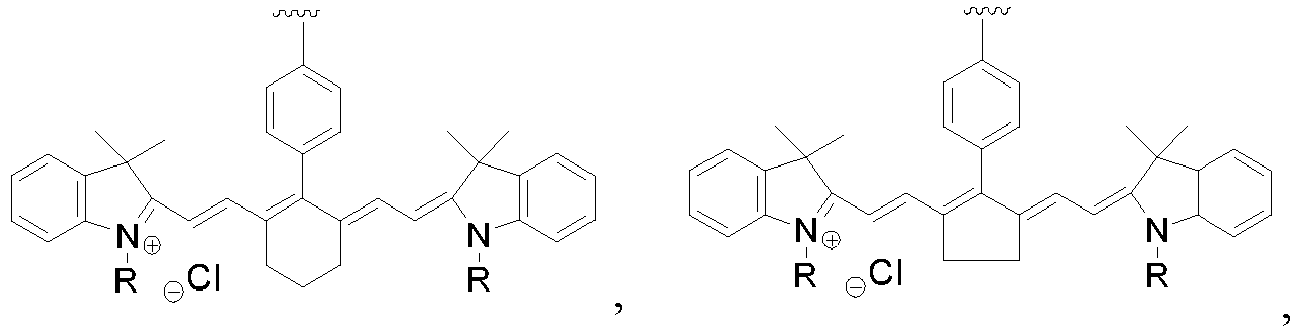
- the luminescent molecule is a fluorophore, more preferably the fluorophore is selected from the group consisting of , wherein each R is independently selected from H, CH 3 , C 2 H 5 and C 3 H 7 , most preferably
- the magnetic bead is selected from the group consisting of nano-magnetic beads, micro-magnetic beads, paramagnetic beads and super paramagnetic beads, wherein the magnetic bead is bound to the PLE analog via a linker selected from the group consisting of a biotin-streptavidin linker, an azetidinone linker, and an amine-, azide-, alkyne-, carboxyl- and hydroxyl group linker and combinations thereof.
- a linker selected from the group consisting of a biotin-streptavidin linker, an azetidinone linker, and an amine-, azide-, alkyne-, carboxyl- and hydroxyl group linker and combinations thereof.
- the one or more circulating tumor cells of the present invention are selected from the group consisting of a breast cancer, a lung cancer, a thyroid cancer, a cervical cancer, a squamous cell carcinoma, a prostate cancer, a pancreas cancer, and a colorectal cancer cell, a multiple myeloma cell, a cancer stem cell, preferably a breast cancer, a lung cancer, a thyroid cancer, a cervical cancer, a squamous cell carcinoma, a prostate cancer, a pancreas cancer and a colorectal cancer cell, and more preferably a prostate cancer cell or a pancreas cancer cell.
- the methods of the present invention may be utilized in further downstream data acquisition technologies including, but not limited to, protein isolation, RNA isolation, DNA isolation, gene translocation and/or amplification analysis and fluorescent in-situ hybridization.
- Figure 1 Plot analysis of CD45-, CD34- cells isolated from patient 108 (colorectal cancer.) Panel A shows cells stained with for all markers except CD14. Panel B shows cells stained with all markers. Upper left quadrant indicates CD14-/CLR1501+ cells, upper right indicates CD14+/CLR1501+, bottom right indicates CD14+/CLR1501-, and bottom left indicates CD14-/CLR1501.
- PLE analogs have the ability to identify, isolate, and enable downstream analysis of CTCs of all types. Cancer cells have five to ten times more lipid rafts than healthy cells. Lipid rafts are specialized regions of the membrane phospholipid bilayer that contain high concentrations of cholesterol and sphingolipids and serve to organize cell surface and intracellular signaling molecules (e.g., growth factor and cytokine receptors, the phosphatidylinositol 3-kinase (PI3K)/Akt survival pathway). Data suggests that lipid rafts serve as portals of entry for PLEs.
- PI3K phosphatidylinositol 3-kinase
- the present invention is directed to a method of identifying one or more circulating tumor cells comprising:
- the present invention is further directed to a method of isolating one or more circulating tumor cells comprising the steps of:
- the PLE analog bound to an article of the present invention is a compound selected from the group consisting of formula (I), formula (II), formula (III) and formula (IV) wherein:
- the luminescent molecule is a fluorophore, more preferably the fluorophore is selected from the group consisting of wherein each R is independently selected from H, CH 3 , C 2 H 5 and C 3 H 7 , most preferably
- the magnetic bead is selected from the group consisting of nano-magnetic beads, micro-magnetic beads, paramagnetic beads and super paramagnetic beads, wherein the magnetic bead is bound to the PLE analog via a linker selected from the group consisting of a biotin-streptavidin linker, an azetidinone linker, and an amine-, azide-, alkyne-, carboxyl- and hydroxyl group linker and combinations thereof.
- a linker selected from the group consisting of a biotin-streptavidin linker, an azetidinone linker, and an amine-, azide-, alkyne-, carboxyl- and hydroxyl group linker and combinations thereof.
- the one or more circulating tumor cells of the present invention are selected from the group consisting of a breast cancer, a lung cancer, a thyroid cancer, a cervical cancer, a squamous cell carcinoma, a prostate cancer, a pancreas cancer and a colorectal cancer cell and a cancer stem cell and a malignant plasma cell, preferably a prostate cancer cell or a pancreas cancer cell.
- the methods of the present invention may be utilized in further downstream data acquisition technologies including, but not limited to, protein isolation, RNA isolation, DNA isolation, gene translocation and/or amplification analysis and fluorescent in-situ hybridization.
- a circulating tumor cell is intended to refer to a single cell, while reference to “circulating tumor cells” or “cluster of circulating tumor cells” is intended to refer to more than one cancer cell.
- reference to “circulating tumor cells” is intended to include a population of circulating tumor cells including one or more circulating tumor cells while reference to "a circulating tumor cell” could include more than one circulating tumor cell.
- circulating tumor cell refers to any cancer cell or cluster of cancer cells that are found in a subject's blood or blood serum sample.
- CTCs may also contain or consist of a cancer stem cell or cluster of cancer stem cells that are found in a subject's blood or blood serum sample.
- cancer stem cell refers to a cancer cell capable of selfrenewing and differentiating into the distinct types of cancer cells found in a malignant tumor.
- cancer refers to, but is not limited to, a variety of cancer types including breast cancer including male breast cancer; digestive/gastrointestinal cancers including anal cancer, appendix cancer, extrahepatic bile duct cancer, gastrointestinal carcinoid tumor, colon cancer, esophageal cancer, gallbladder cancer, gastric cancer, gastrointestinal stromal tumors ("gist"), Islet cell tumors, adult primary liver cancer, childhood liver cancer, pancreatic cancer, rectal cancer, small intestine cancer, and stomach (gastric) cancer; endocrine and neuroendocrine cancers including pancreatic adenocarcinoma, adrenocortical carcinoma, pancreatic neuroendocrine tumors, Merkel cell carcinoma, non-small cell lung neuroendocrine tumor, small cell lung neuroendocrine tumor, parathyroid cancer, pheochromocytoma, pituitary tumor and thyroid cancer; eye cancers including intraocular melanoma and retinoblastoma;
- sample refers to any sample suitable for the methods provided by the present invention.
- the sample may be any sample that includes circulating tumor cells suitable for detection.
- Sources of samples include whole blood, bone marrow, pleural fluid, peritoneal fluid, central spinal fluid, urine, saliva and bronchial washes.
- the sample is a blood sample, including, for example, whole blood or any fraction or component thereof.
- a sample may be obtained and processed using well known and routine clinical methods (e.g., procedures for drawing and processing whole blood).
- an exemplary sample may be peripheral blood drawn from a subject with cancer.
- identify or “identifying” refers to visualizing the existence of a CTC.
- isolated refers to physically separating CTCs from other cell types found in a subject's sample.
- contact refers to bringing a subject, tissue, organ or cells in contact with a PLE analog of the present invention.
- contact can be accomplished ex vivo or in vitro, i.e. in a test tube, in cells or tissues of living organisms, for example, humans.
- a "patient” or “subject”, used equivalently herein, refers to a mammal, preferably a human.
- alkyl refers to a branched or straight-chain alkyl consisting of a saturated hydrocarbon group of 1 to 24 carbon atoms (C 1 -C 24 ) unless otherwise stated.
- the alkyl group can be cyclic or acyclic.
- amine refers to a functional group that contains a nitrogen atom with a lone pair of electrons.
- azide refers to a functional group that contains three consecutive nitrogen atoms.
- alkyne refers to a functional group that contains two carbon atoms that are triple bonded to each other.
- carboxyl refers to a functional group that contains a C(O)O structure.
- hydroxyl refers to a functional group that contains an OH.
- n is an integer from 16 to 30.
- Y is selected from the group consisting of -H, -OH, -OR, -C(O)OH, and -OC(O)R.
- R refers to an alkyl
- R refers to an H, CH 3 , C 2 H 5 and C 3 H 7 .
- X is a luminescent molecule or a magnetic bead bound to a linker.
- Flow cytometry useful in the present invention includes, but is not limited to, fluorescence activated cell sorting ("FACS") and multi-color flow cytometry.
- FACS fluorescence activated cell sorting
- Magnetic beads useful in the present invention include, but are not limited to, nano-magnetic beads having a size in the nanometer range and are sometimes referred to as magnetic nanoparticles, for example 50 nM MACS ® beads, (MACS is a registered trademark of and available from Miltenyi Biotec GmbH), micro-magnetic beads having a size in the micrometer range, for example 1-3 ⁇ M Dynabeads ® (Dynabeads is a registered trademark of and available from Invitrogen Dynal AS Corp), paramagnetic beads and super paramagnetic beads.
- Luminescent molecules useful in the present invention include fluorophores.
- Fluorophores include, but are not limited to, Alexa Fluor ® (Alex Fluor is a registered trademark of and available from Molecular Probes, Inc.) compounds including 350, 405, 430, 488, 532, 546, 555, 568, 594, 610, 633, 635, 647, 660, 680, 700, 750 and 790, Brilliant Violet TM (Brilliant Violet is available from BioLegend ® ) compounds including 420, 510, 605, 650, 711 and 786, Brilliant Ultra-VioletTM (Brilliant Ultra-Violet is available from BD Biosciences, Inc.) compounds including those of the following frequency 395 and 737 nm, Dylight ® (Dylight is a registered trademark of and available from Pierce Biotechnology, Inc.) compounds including 350, 405, 488, 550, 594, 633, 650, 680, 755 and 800, Violetfluor ® 450, Redfluor ® 710, (Violetflu
- Linkers useful in the present invention include, but are not limited to, a bond, biotin-streptavidin linker, an azetidinone linker, and an amine-, azide-, alkyne-, carboxyl-, hydroxylgroup linker and combinations thereof.
- the present invention is directed to a method of identifying a circulating prostate cancer cell comprising:
- the present invention is directed to a method of isolating a circulating prostate cancer cell comprising:
- both a PLE of formula I-IV and a magnetic bead as described herein are each attached to its own functional group.
- the functional groups are then bound through click chemistry.
- a PLE of formula I of the present invention can be attached to an azide functional group and a magnetic bead can be attached to an alkyne functional group.
- the azide and alkyne functional groups can then be bound through click chemistry such as Copper-Catalzyed Azide-Alkyne Cycloaddition ("CuAAC).
- CuAAC Copper-Catalzyed Azide-Alkyne Cycloaddition
- magnetic beads attached to a functional group are known as "functionalized magnetic beads" and are available from multiple sources such as Nanocs, Inc.
- CLR1401 azide is bound to an alkyne functionalized magnetic bead through click chemistry.
- CuAAC is described in Himo F, et al., Copper(I)-catalyzed synthesis of azoles. DFT study predicts unprecedented reactivity and intermediates, J Am Chem Soc, 2005 Jan 12, 127(1), 210-216 .
- the alkyne functionalized magnetic bead and CLR1401 azide are mixed in a 1:1 ratio of water and tert- butyl alcohol in the presence of a copper oxide ("Cu(I)”) catalyst for 6 to 12 hours.
- Cu(I) copper oxide
- sodium ascorbate is added to the mixture.
- the final PLE-magnetic bead can then be isolated from the solution using simple filtration or extraction.
- CLR1401 acetylene is bound to an azide functionalized magnetic bead through click chemistry.
- the same CuAAC reaction used for binding of CLR1401 azide to an alkyne functionalized magnetic bead can be used as described above.
- Carboxy CLR1401 is bound to an amine functionalized-magnetic nanoparticle through amide bonding.
- Amide bonding can be achieved with any coupling reagent suitable for formation of an amide bond, such as reagents used for peptide synthesis including, but not limited to, (2-(1H-benzotriazol-1-yl)-1,1,3,3-tetramethyluronium hexafluorophosphate) (“HBTU”), (1-[Bis(dimethylamino)methylene]-1H-1,2,3-triazolo[4,5-b]pyridinium 3-oxid hexafluorophosphate) (“HATU”), COMU ® (COMU is available from Sigma Aldrich Co, LLC and is a registered trademark of Luxembourg Biotechnologies Ltd.) and propane phosphonic acid anhydride (“PPAA” or T3P ® , T3P is available through and a registered trademark of Euticals SPA.)
- HBTU (2-(1H-benz
- amine-functionalized magnetic nanoparticles may be bound to a carboxy-PLE through an azetidinone ("AZD") linker.
- AZD azetidinone
- CLR1401 carboxy-AZD can be bound to an amine-functionalized magnetic nanoparticle via an AZD linker.
- AZD linkage is described in Roberts LR et al., Kappa agonist CovX-Bodies, Bioorg Med Chem Lett, 2012 Jun 15, 22(12), 4173-4178 and Sato S et al., Chemically Programmed Antibodies AS HIV-1 Attachment Inhibitors, ACS Med Chem Lett, 2013 May 9, 4(5), 460-465 .
- CTCs were then analyzed by flow cytometry to indicate the number of cells from each whole blood sample that were positive and/or negative for a particular marker.
- CTCs were identified as live cells that were CD45-, CD14-, CD34-, CK+, and EpCAM+ ("by definition"). Due to prior experience with CD14+ monocytes/macrophages ( Figure 1 ), CD14+ cells were removed from the analyses due to high uptake of CLR1501. CD34+ normal epithelial cells were also removed from the analyses. In comparison, the remaining CD45+ and CD34+ cells in the same patient will not take up CLR1501 to a large extent. The results from this analysis is explained below and summarized in Tables 1 and 2.
- FIG. 1 A representative flow cytometry image depicting high uptake of CLR1501 in CD14+ cells of blood samples from patient 8 is shown in Figure 1 .
- upper left quadrant indicates CD14-/CLR1501+ cells
- upper right indicates CD14+/CLR1501+
- bottom right indicates CD14+/CLR1501-
- bottom left indicates CD14-/CLR1501-.
- cells negative for CD45 and CD34 i.e. possible circulating tumor cells isolated from blood drawn from patient 108 is shown stained with all markers, except Brilliant Violet 785 TM CD14.
- Cells positive for CD14 labeled are shown on the x-axis and cells positive for CLR1501 on the y-axis.
- Panel A was used as a control to set the gates for Brilliant Violet 785 TM CD14 positive cells.
- panel B cells negative for CD45 and CD34 isolated from blood drawn from patient 108 is shown stained with all markers, including Brilliant Violet 785 TM CD14. As shown, 99.7% of cells positive for CD14+ are also positive for CLR1501. Compare Figure 1 , panel B to panel A.
- CLR 1501 was able to identify ⁇ 99-100% of CK+ cells (compare row 2 to row 3 of Table 1 or2) and ⁇ 35-100% of EpCAM+ cells (compare rows 4 or row 5 of Table 1 or 2), in all cancer types irrespective of which blood collection tube was utilized.
- CLR 1501 there were a large number of cells that were CLR 1501+, but CK-, EpCAM-, CD45-, CD14-, CD34-, and contained a nucleus (row 6, Tables 1-2).
- Cells indicated in row 6 of Tables 1 and 2 are not blood cell types but may be other tumor cells which may have decreased or no expression of EpCAM and CK.
- CLR1501 is capable of identifying circulating tumor cells that would otherwise go undetected in current single and multi-marker assays.
- Patients 101, 102, 104 and 108 had blood draws taken prior to and after therapy (Draw 1 and 2, respectively).
- Patient 101 had a very good partial response to therapy; however, from Draw 1 to 2, this patient's CTC count by definition increased from 0 to 10, indicating progression of the cancer (Table 1).
- If only CK was utilized as a marker of tumor cells Patient 101's tumor cell count decreased from 4.7 million to 10 (Table 1, compare Draw 1 to Draw 2). If only EpCAM was utilized as a marker of tumor cells, Patient 101's tumor cell count increased from 20 to 41 (Table 1, compare Draw 1 to Draw 2).
- the fluorescent PLE analog CLR1501 was successfully used to identify CTCs from lung, thyroid, breast, cervical, squamous cell carcinoma, and colorectal cancer patients.
Landscapes
- Health & Medical Sciences (AREA)
- Life Sciences & Earth Sciences (AREA)
- Immunology (AREA)
- Chemical & Material Sciences (AREA)
- Engineering & Computer Science (AREA)
- Physics & Mathematics (AREA)
- Biomedical Technology (AREA)
- Hematology (AREA)
- Molecular Biology (AREA)
- Urology & Nephrology (AREA)
- General Physics & Mathematics (AREA)
- Pathology (AREA)
- General Health & Medical Sciences (AREA)
- Biochemistry (AREA)
- Analytical Chemistry (AREA)
- Cell Biology (AREA)
- Microbiology (AREA)
- Food Science & Technology (AREA)
- Biotechnology (AREA)
- Medicinal Chemistry (AREA)
- Dispersion Chemistry (AREA)
- Spectroscopy & Molecular Physics (AREA)
- Condensed Matter Physics & Semiconductors (AREA)
- Chemical Kinetics & Catalysis (AREA)
- Nuclear Medicine, Radiotherapy & Molecular Imaging (AREA)
- Optics & Photonics (AREA)
- Measuring Or Testing Involving Enzymes Or Micro-Organisms (AREA)
- Investigating Or Analysing Biological Materials (AREA)
- Oncology (AREA)
- Hospice & Palliative Care (AREA)
- Pharmaceuticals Containing Other Organic And Inorganic Compounds (AREA)
- Investigating, Analyzing Materials By Fluorescence Or Luminescence (AREA)
- Micro-Organisms Or Cultivation Processes Thereof (AREA)
- Medicines Containing Material From Animals Or Micro-Organisms (AREA)
Claims (13)
- Verfahren zum Identifizieren einer oder mehrerer zirkulierender Tumorzellen (CTCs), umfassend:(i) Kontaktieren einer Blut- oder Blutserumprobe von einem Subjekt mit einer Zusammensetzung umfassend eine Verbindung der Formel (I),

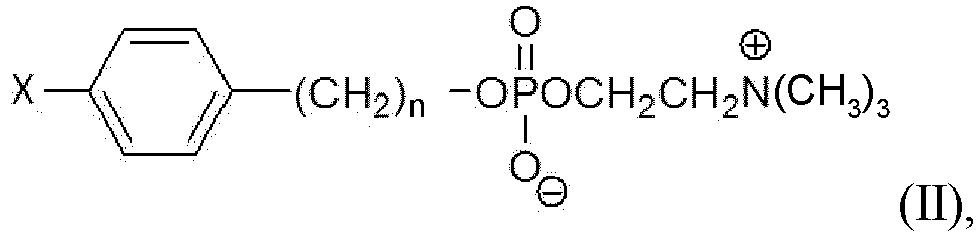
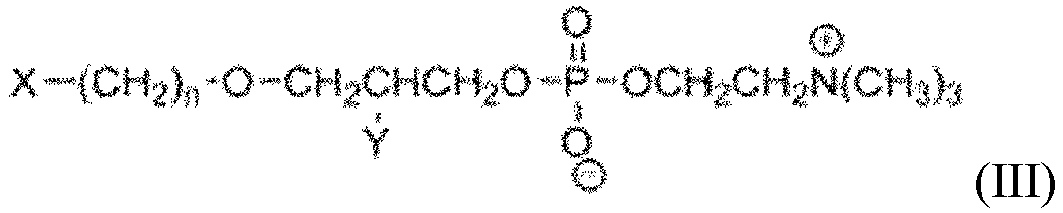
 n eine ganze Zahl von 16 bis 30 ist;Y ausgewählt ist aus der Gruppe bestehend aus -H, -OH, -OR1, -C(O)OH und -OC(O)R1, wobei R1 ein Alkyl ist; undX ein lumineszierendes Molekül oder ein magnetisches Kügelchen ist, das über einen Linker angebracht ist; und(ii) Aussetzen der Blut- oder Blutserumprobe von dem Subjekt einer Fluoreszenzmikroskopie oder Durchflusszytometrie,
wobei die eine oder mehreren CTCs ausgewählt sind aus der Gruppe bestehend aus einer Brustkrebszelle, einer Lungenkrebszelle, einer Schilddrüsenkrebszelle, einer Gebärmutterhalskrebszelle, einer Plattenepithelkarzinomzelle, einer Prostatakrebszelle, einer Bauchspeicheldrüsenkrebszelle, einer Darmkrebszelle, einer Krebsstammzelle, einer Leukämiezelle und einer Lymphomzelle. - Verfahren zum Isolieren einer oder mehrerer zirkulierender Tumorzellen (CTCs), umfassend die Schritte:(i) Kontaktieren einer Blut- oder Blutserumprobe von einem Subjekt mit einer Zusammensetzung umfassend eine Verbindung der Formel (I),


 n eine ganze Zahl von 16 bis 30 ist;Y ausgewählt ist aus der Gruppe bestehend aus -H, -OH, -OR1, -C(O)OH und -OC(O)R1, wobei R1 ein Alkyl ist; undX ein lumineszierendes Molekül oder ein magnetisches Kügelchen ist, das über einem Linker angebracht ist; und(ii) Aussetzen der Blut- oder Blutserumprobe von dem Subjekt einer Durchflusszytometrie oder einem Magnetfeld,wobei die Blut- oder Blutserumprobe von dem Subjekt einer Durchflusszytometrie ausgesetzt wird, wenn X ein lumineszierendes Molekül ist;wobei die Blut- oder Blutserumprobe von dem Subjekt einem Magnetfeld ausgesetzt wird, wenn X ein magnetisches Kügelchen ist, das über einem Linker angebracht ist; undwobei die eine oder mehreren CTCs ausgewählt sind aus der Gruppe bestehend aus einer Brustkrebszelle, einer Lungenkrebszelle, einer Schilddrüsenkrebszelle, einer Gebärmutterhalskrebszelle, einer Plattenepithelkarzinomzelle, einer Prostatakrebszelle, einer Bauchspeicheldrüsenkrebszelle, einer Darmkrebszelle, einer Krebsstammzelle, einer Leukämiezelle und einer Lymphomzelle.
 - Verfahren nach Anspruch 1 oder Anspruch 2, wobei X ein lumineszierendes Molekül ist.
- Verfahren nach Anspruch 3, wobei das lumineszierende Molekül ein Fluorophor ist.
- Verfahren nach Anspruch 4, wobei das Fluorophor ausgewählt ist aus der Gruppe bestehend aus

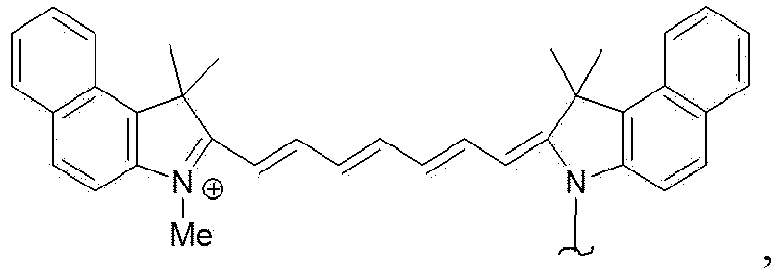
- Verfahren nach Anspruch 5, wobei die Verbindung eine Verbindung der Formel (II) ist und das Fluorophor ausgewählt ist aus der Gruppe bestehend aus

- Verfahren nach Anspruch 1 oder Anspruch 2, wobei X ein magnetisches Kügelchen ist, das über einem Linker angebracht ist.
- Verfahren nach Anspruch 7, wobei das magnetische Kügelchen ausgewählt ist aus der Gruppe bestehend aus nanomagnetischen Kügelchen, mikromagnetischen Kügelchen, paramagnetischen Kügelchen und superparamagnetischen Kügelchen.
- Verfahren nach Anspruch 1 oder 7, wobei der Linker ausgewählt ist aus der Gruppe bestehend aus einem Biotin-Streptavidin-Linker, einem Azetidinon-Linker und einem Amin-, Azid-, Alkin-, Carboxyl- und Hydroxylgruppen-Linker und Kombinationen davon.
- Verfahren nach Anspruch 2, ferner umfassend Isolieren der einen oder mehreren CTCs.
- Verfahren nach Anspruch 10, ferner umfassend Verwenden der isolierten CTCs in einer Technologie ausgewählt aus der Gruppe bestehend aus Proteinisolierung, RNA-Isolierung, DNA-Isolierung, Gentranslokationsanalyse, Genamplifikationsanalyse und Fluoreszenz-in-situ-Hybridisierung.
- Verfahren nach Anspruch 1 oder Anspruch 2, wobei die Leukämiezelle eine akute lymphoblastische Leukämiezelle, eine akute myeloische Leukämiezelle, eine chronische lymphozytische Leukämiezelle, eine chronische myeloische Leukämiezelle oder eine Haarzellen-Leukämiezelle ist.
- Verfahren nach Anspruch 1 oder Anspruch 2, wobei die Lymphomzelle eine kutane T-Zell-Lymphomzelle, eine Hodgkin-Lymphomzelle oder eine Non-Hodgkin-Lymphomzelle ist.
Priority Applications (1)
| Application Number | Priority Date | Filing Date | Title |
|---|---|---|---|
| SI201731403T SI3469367T1 (sl) | 2016-06-14 | 2017-06-14 | Analogi fosfolipidnega etra za identifikacijo in izolacijo tumorskih celic v obtoku |
Applications Claiming Priority (2)
| Application Number | Priority Date | Filing Date | Title |
|---|---|---|---|
| US201662349713P | 2016-06-14 | 2016-06-14 | |
| PCT/US2017/037549 WO2017218702A1 (en) | 2016-06-14 | 2017-06-14 | Phospholipid ether analogs for the identification and isolation of circulating tumor cells |
Publications (3)
| Publication Number | Publication Date |
|---|---|
| EP3469367A1 EP3469367A1 (de) | 2019-04-17 |
| EP3469367A4 EP3469367A4 (de) | 2020-02-19 |
| EP3469367B1 true EP3469367B1 (de) | 2023-08-02 |
Family
ID=60572525
Family Applications (1)
| Application Number | Title | Priority Date | Filing Date |
|---|---|---|---|
| EP17814042.2A Active EP3469367B1 (de) | 2016-06-14 | 2017-06-14 | Phospholipidetheranaloga zur identifizierung und isolierung zirkulierender tumorzellen |
Country Status (16)
| Country | Link |
|---|---|
| US (1) | US11467159B2 (de) |
| EP (1) | EP3469367B1 (de) |
| JP (1) | JP7136770B2 (de) |
| KR (1) | KR20190037226A (de) |
| CN (1) | CN109791152B (de) |
| AU (1) | AU2017286604B2 (de) |
| BR (1) | BR112018077197A2 (de) |
| CA (1) | CA3027497C (de) |
| DK (1) | DK3469367T3 (de) |
| EA (1) | EA201892663A1 (de) |
| ES (1) | ES2952867T3 (de) |
| IL (1) | IL263687B2 (de) |
| MX (1) | MX2018015710A (de) |
| NZ (1) | NZ749272A (de) |
| SI (1) | SI3469367T1 (de) |
| WO (1) | WO2017218702A1 (de) |
Families Citing this family (11)
| Publication number | Priority date | Publication date | Assignee | Title |
|---|---|---|---|---|
| CN109154601B (zh) | 2016-05-19 | 2022-11-29 | 斯坦福大学托管董事会 | 用于流动中的自动单细胞细胞学分类的系统和方法 |
| EP3338806A1 (de) * | 2016-12-21 | 2018-06-27 | Université de Namur | Verfahren zur funktionalisierung von nanopartikeln |
| KR102821508B1 (ko) | 2018-04-10 | 2025-06-16 | 셀렉타 바이오사이언시스, 인코퍼레이티드 | 인지질-플라베글린 접합체 및 표적화된 암 치료를 위해 이를 사용하는 방법 |
| US10611995B2 (en) * | 2018-08-15 | 2020-04-07 | Deepcell, Inc. | Systems and methods for particle analysis |
| US11815507B2 (en) | 2018-08-15 | 2023-11-14 | Deepcell, Inc. | Systems and methods for particle analysis |
| CA3150991A1 (en) * | 2019-09-12 | 2021-03-18 | Cellectar Biosciences, Inc. | Phospholipid ether conjugates as cancer-targeting drug vehicles |
| CA3154192A1 (en) | 2019-10-10 | 2021-04-15 | Cellectar Biosciences, Inc. | Phospholipid-flavagline conjugates and methods of using the same for targeted cancer therapy |
| KR102400464B1 (ko) * | 2020-07-28 | 2022-05-19 | 부산대학교 산학협력단 | 암 줄기세포 검출용 바이오 마커 조성물 |
| US20230251262A1 (en) * | 2022-02-09 | 2023-08-10 | Universitaesklinikum Hamburg-Eppendorf | Enrichment, detection and characterization of circulating tumor cells with susd2 and enpp1 |
| CN115326683A (zh) * | 2022-08-12 | 2022-11-11 | 四川成电医联科技咨询有限公司 | 一种基于阻抗脉冲时延法的磁珠标定的白细胞子分群计数方法 |
| CN115389766B (zh) * | 2022-08-29 | 2023-09-22 | 深圳市瑞格生物科技有限公司 | 用于诊断神经母细胞瘤是否发生骨髓浸润的标志物及其应用 |
Family Cites Families (12)
| Publication number | Priority date | Publication date | Assignee | Title |
|---|---|---|---|---|
| WO1999041613A1 (en) | 1998-02-12 | 1999-08-19 | Immunivest | Methods and reagents for the rapid and efficient isolation of circulating cancer cells |
| KR20070015518A (ko) * | 2004-03-02 | 2007-02-05 | 셀렉타, 엘엘씨 | 암의 진단 및 치료를 위한 포스포리피드 유사체 |
| US8540968B2 (en) * | 2004-03-02 | 2013-09-24 | Cellectar, Inc. | Phospholipid ether analogs as agents for detecting and locating cancer, and methods thereof |
| KR20080005178A (ko) | 2004-12-20 | 2008-01-10 | 셀렉타, 엘엘씨 | 암 검출 및 치료용 인지질 에테르 동족체 |
| JP2009529880A (ja) | 2006-03-13 | 2009-08-27 | ベリデックス・エルエルシー | 原発細胞の増殖 |
| ES2549459T3 (es) | 2009-05-11 | 2015-10-28 | Cellectar, Inc. | Compuestos de éter de fosfolípido fluorescentes, composiciones y procedimientos de uso |
| US7811548B1 (en) * | 2009-05-11 | 2010-10-12 | Cellectar, Inc. | Fluorescent phospholipid ether compounds and compositions |
| US20100286510A1 (en) * | 2009-05-11 | 2010-11-11 | Pinchuk Anatoly | Use of fluorescent phospholipid ether compounds in biopsies |
| WO2010151109A1 (en) * | 2009-06-26 | 2010-12-29 | Erasmus University Medical Center Rotterdam | Identifying circulating tumor cells (ctcs) using cd146 in breast cancers patients |
| EP2964672B1 (de) | 2013-03-05 | 2019-10-09 | Board of Regents, The University of Texas System | Spezifisches erkennungswerkzeug für mesenchymale und epithel-mesenchymal transformierte zirkulierende tumorzellen |
| JP6052756B2 (ja) | 2014-07-22 | 2016-12-27 | 株式会社がん免疫研究所 | 末梢循環癌細胞の検出方法および検出装置 |
| US9925283B2 (en) * | 2015-04-10 | 2018-03-27 | Wisconsin Alumni Research Foundation | Alkylphosphocholine analogs for multiple myeloma imaging and therapy |
-
2017
- 2017-06-14 JP JP2019518376A patent/JP7136770B2/ja active Active
- 2017-06-14 CN CN201780048543.2A patent/CN109791152B/zh active Active
- 2017-06-14 MX MX2018015710A patent/MX2018015710A/es unknown
- 2017-06-14 NZ NZ749272A patent/NZ749272A/en unknown
- 2017-06-14 WO PCT/US2017/037549 patent/WO2017218702A1/en not_active Ceased
- 2017-06-14 SI SI201731403T patent/SI3469367T1/sl unknown
- 2017-06-14 ES ES17814042T patent/ES2952867T3/es active Active
- 2017-06-14 AU AU2017286604A patent/AU2017286604B2/en active Active
- 2017-06-14 EP EP17814042.2A patent/EP3469367B1/de active Active
- 2017-06-14 US US15/623,309 patent/US11467159B2/en active Active
- 2017-06-14 IL IL263687A patent/IL263687B2/en unknown
- 2017-06-14 KR KR1020197000619A patent/KR20190037226A/ko not_active Ceased
- 2017-06-14 BR BR112018077197-0A patent/BR112018077197A2/pt active Search and Examination
- 2017-06-14 DK DK17814042.2T patent/DK3469367T3/da active
- 2017-06-14 EA EA201892663A patent/EA201892663A1/ru unknown
- 2017-06-14 CA CA3027497A patent/CA3027497C/en active Active
Also Published As
| Publication number | Publication date |
|---|---|
| BR112018077197A2 (pt) | 2019-08-20 |
| MX2018015710A (es) | 2019-06-10 |
| EP3469367A4 (de) | 2020-02-19 |
| DK3469367T3 (da) | 2023-08-28 |
| AU2017286604B2 (en) | 2023-05-18 |
| SI3469367T1 (sl) | 2023-10-30 |
| CN109791152B (zh) | 2023-03-03 |
| US11467159B2 (en) | 2022-10-11 |
| EA201892663A1 (ru) | 2019-05-31 |
| WO2017218702A1 (en) | 2017-12-21 |
| JP7136770B2 (ja) | 2022-09-13 |
| AU2017286604A1 (en) | 2019-01-03 |
| CA3027497C (en) | 2023-12-05 |
| KR20190037226A (ko) | 2019-04-05 |
| IL263687B1 (en) | 2023-05-01 |
| IL263687B2 (en) | 2023-09-01 |
| IL263687A (en) | 2019-02-03 |
| ES2952867T3 (es) | 2023-11-06 |
| NZ749272A (en) | 2023-01-27 |
| CA3027497A1 (en) | 2017-12-21 |
| JP2019528456A (ja) | 2019-10-10 |
| EP3469367A1 (de) | 2019-04-17 |
| CN109791152A (zh) | 2019-05-21 |
| US20170356914A1 (en) | 2017-12-14 |
Similar Documents
| Publication | Publication Date | Title |
|---|---|---|
| EP3469367B1 (de) | Phospholipidetheranaloga zur identifizierung und isolierung zirkulierender tumorzellen | |
| Zijlstra et al. | Prostasomes as a source of diagnostic biomarkers for prostate cancer | |
| EP3400996B1 (de) | Erfassung, identifizierung und verwendung neuer biomarker für feste tumore in körperflüssigkeiten | |
| EP2748337B1 (de) | Zellreaktionstest für krebs sowie verfahren zu seiner herstellung und anwendung | |
| Xiao et al. | Accurate and Convenient Lung Cancer Diagnosis through Detection of Extracellular Vesicle Membrane Proteins via Förster Resonance Energy Transfer | |
| Li et al. | Tumour-derived exosomal piR-25783 promotes omental metastasis of ovarian carcinoma by inducing the fibroblast to myofibroblast transition | |
| WO2009070392A1 (en) | Automated enumeration and characterization of circulating melanoma cells in blood | |
| Wu et al. | Extracellular vesicles in urologic malignancies—Implementations for future cancer care | |
| US20150226745A1 (en) | Prostate cancer markers and uses thereof | |
| WO2018184005A1 (en) | Methods of using giant cell nucleic acid characterization in cancer screening, diagnostics, treatment and recurrence | |
| Li et al. | Detection of serum EphA2-EVs for pancreatic cancer diagnosis by light initiated chemiluminescent assay | |
| CN106796237A (zh) | 末梢循环癌细胞的检测方法及检测装置 | |
| KR101979989B1 (ko) | 혈액에서 분리된 세포외소포체 분석을 통한 폐암 진단, 약제반응 및 예후 예측용 조성물 | |
| NZ789361A (en) | Phospholipid ether analogs for the identification and isolation of circulating tumor cells | |
| EA040793B1 (ru) | Аналоги фосфолипидного эфира для идентификации и выделения циркулирующих опухолевых клеток | |
| Hu et al. | Evaluation of Circulating Tumor Cells-DNA Methylated Separation Nano-Polylactic-co-Glycolic Acid Magnetic Beads with Epithelial Cell Adhesion Molecul/Epidermal Growth Factor Receptor Double Antibody Modification and Its Application in Lung Cancer Diagnosis | |
| KR20220014003A (ko) | 암 줄기세포 검출용 바이오 마커 조성물 | |
| KR20230051566A (ko) | 개질된 단당류 화합물을 사용하여 다세포 유기체로부터의 진핵 세포를 표지하기 위한 방법 및 키트 | |
| JP7812576B2 (ja) | 癌診断用キット及びその使用 | |
| US20240159764A1 (en) | Compositions and methods for selective capture, purification, release and isolation of single cells | |
| Gilazieva et al. | Extracellular vesicles as brain tumor biomarkers | |
| Welsh et al. | Development of a multiplex-to-single exosome analysis (MT-SEA) pipeline to characterize exosomes associated with tumour progression and responses to treatment | |
| WO2025076241A9 (en) | Methods for detecting cancer in a subject | |
| Gupta et al. | LIQUID BIOPSY AND ITS CLINICAL APPLICATIONS IN ONCOLOGY | |
| Klump et al. | Clinical relevance of the defining the most abundant fraction of mutated oncogenic DNA and RNA among different EV subtypes |
Legal Events
| Date | Code | Title | Description |
|---|---|---|---|
| STAA | Information on the status of an ep patent application or granted ep patent |
Free format text: STATUS: THE INTERNATIONAL PUBLICATION HAS BEEN MADE |
|
| PUAI | Public reference made under article 153(3) epc to a published international application that has entered the european phase |
Free format text: ORIGINAL CODE: 0009012 |
|
| STAA | Information on the status of an ep patent application or granted ep patent |
Free format text: STATUS: REQUEST FOR EXAMINATION WAS MADE |
|
| 17P | Request for examination filed |
Effective date: 20190114 |
|
| AK | Designated contracting states |
Kind code of ref document: A1 Designated state(s): AL AT BE BG CH CY CZ DE DK EE ES FI FR GB GR HR HU IE IS IT LI LT LU LV MC MK MT NL NO PL PT RO RS SE SI SK SM TR |
|
| AX | Request for extension of the european patent |
Extension state: BA ME |
|
| RAP1 | Party data changed (applicant data changed or rights of an application transferred) |
Owner name: CELLECTAR BIOSCIENCES, INC. |
|
| DAV | Request for validation of the european patent (deleted) | ||
| DAX | Request for extension of the european patent (deleted) | ||
| A4 | Supplementary search report drawn up and despatched |
Effective date: 20200120 |
|
| RIC1 | Information provided on ipc code assigned before grant |
Ipc: G01N 33/569 20060101AFI20200114BHEP Ipc: G01N 33/574 20060101ALI20200114BHEP |
|
| RAP1 | Party data changed (applicant data changed or rights of an application transferred) |
Owner name: CELLECTAR BIOSCIENCES, INC. |
|
| GRAP | Despatch of communication of intention to grant a patent |
Free format text: ORIGINAL CODE: EPIDOSNIGR1 |
|
| STAA | Information on the status of an ep patent application or granted ep patent |
Free format text: STATUS: GRANT OF PATENT IS INTENDED |
|
| INTG | Intention to grant announced |
Effective date: 20230124 |
|
| GRAS | Grant fee paid |
Free format text: ORIGINAL CODE: EPIDOSNIGR3 |
|
| P01 | Opt-out of the competence of the unified patent court (upc) registered |
Effective date: 20230524 |
|
| GRAA | (expected) grant |
Free format text: ORIGINAL CODE: 0009210 |
|
| STAA | Information on the status of an ep patent application or granted ep patent |
Free format text: STATUS: THE PATENT HAS BEEN GRANTED |
|
| AK | Designated contracting states |
Kind code of ref document: B1 Designated state(s): AL AT BE BG CH CY CZ DE DK EE ES FI FR GB GR HR HU IE IS IT LI LT LU LV MC MK MT NL NO PL PT RO RS SE SI SK SM TR |
|
| REG | Reference to a national code |
Ref country code: GB Ref legal event code: FG4D |
|
| REG | Reference to a national code |
Ref country code: CH Ref legal event code: EP |
|
| REG | Reference to a national code |
Ref country code: DE Ref legal event code: R096 Ref document number: 602017072222 Country of ref document: DE |
|
| REG | Reference to a national code |
Ref country code: DK Ref legal event code: T3 Effective date: 20230825 |
|
| REG | Reference to a national code |
Ref country code: IE Ref legal event code: FG4D |
|
| REG | Reference to a national code |
Ref country code: NL Ref legal event code: FP |
|
| REG | Reference to a national code |
Ref country code: ES Ref legal event code: FG2A Ref document number: 2952867 Country of ref document: ES Kind code of ref document: T3 Effective date: 20231106 |
|
| REG | Reference to a national code |
Ref country code: LT Ref legal event code: MG9D |
|
| REG | Reference to a national code |
Ref country code: AT Ref legal event code: MK05 Ref document number: 1595360 Country of ref document: AT Kind code of ref document: T Effective date: 20230802 |
|
| PG25 | Lapsed in a contracting state [announced via postgrant information from national office to epo] |
Ref country code: GR Free format text: LAPSE BECAUSE OF FAILURE TO SUBMIT A TRANSLATION OF THE DESCRIPTION OR TO PAY THE FEE WITHIN THE PRESCRIBED TIME-LIMIT Effective date: 20231103 |
|
| PG25 | Lapsed in a contracting state [announced via postgrant information from national office to epo] |
Ref country code: IS Free format text: LAPSE BECAUSE OF FAILURE TO SUBMIT A TRANSLATION OF THE DESCRIPTION OR TO PAY THE FEE WITHIN THE PRESCRIBED TIME-LIMIT Effective date: 20231202 |
|
| PG25 | Lapsed in a contracting state [announced via postgrant information from national office to epo] |
Ref country code: SE Free format text: LAPSE BECAUSE OF FAILURE TO SUBMIT A TRANSLATION OF THE DESCRIPTION OR TO PAY THE FEE WITHIN THE PRESCRIBED TIME-LIMIT Effective date: 20230802 Ref country code: RS Free format text: LAPSE BECAUSE OF FAILURE TO SUBMIT A TRANSLATION OF THE DESCRIPTION OR TO PAY THE FEE WITHIN THE PRESCRIBED TIME-LIMIT Effective date: 20230802 Ref country code: PT Free format text: LAPSE BECAUSE OF FAILURE TO SUBMIT A TRANSLATION OF THE DESCRIPTION OR TO PAY THE FEE WITHIN THE PRESCRIBED TIME-LIMIT Effective date: 20231204 Ref country code: NO Free format text: LAPSE BECAUSE OF FAILURE TO SUBMIT A TRANSLATION OF THE DESCRIPTION OR TO PAY THE FEE WITHIN THE PRESCRIBED TIME-LIMIT Effective date: 20231102 Ref country code: LV Free format text: LAPSE BECAUSE OF FAILURE TO SUBMIT A TRANSLATION OF THE DESCRIPTION OR TO PAY THE FEE WITHIN THE PRESCRIBED TIME-LIMIT Effective date: 20230802 Ref country code: LT Free format text: LAPSE BECAUSE OF FAILURE TO SUBMIT A TRANSLATION OF THE DESCRIPTION OR TO PAY THE FEE WITHIN THE PRESCRIBED TIME-LIMIT Effective date: 20230802 Ref country code: IS Free format text: LAPSE BECAUSE OF FAILURE TO SUBMIT A TRANSLATION OF THE DESCRIPTION OR TO PAY THE FEE WITHIN THE PRESCRIBED TIME-LIMIT Effective date: 20231202 Ref country code: HR Free format text: LAPSE BECAUSE OF FAILURE TO SUBMIT A TRANSLATION OF THE DESCRIPTION OR TO PAY THE FEE WITHIN THE PRESCRIBED TIME-LIMIT Effective date: 20230802 Ref country code: GR Free format text: LAPSE BECAUSE OF FAILURE TO SUBMIT A TRANSLATION OF THE DESCRIPTION OR TO PAY THE FEE WITHIN THE PRESCRIBED TIME-LIMIT Effective date: 20231103 Ref country code: FI Free format text: LAPSE BECAUSE OF FAILURE TO SUBMIT A TRANSLATION OF THE DESCRIPTION OR TO PAY THE FEE WITHIN THE PRESCRIBED TIME-LIMIT Effective date: 20230802 Ref country code: AT Free format text: LAPSE BECAUSE OF FAILURE TO SUBMIT A TRANSLATION OF THE DESCRIPTION OR TO PAY THE FEE WITHIN THE PRESCRIBED TIME-LIMIT Effective date: 20230802 |
|
| PG25 | Lapsed in a contracting state [announced via postgrant information from national office to epo] |
Ref country code: PL Free format text: LAPSE BECAUSE OF FAILURE TO SUBMIT A TRANSLATION OF THE DESCRIPTION OR TO PAY THE FEE WITHIN THE PRESCRIBED TIME-LIMIT Effective date: 20230802 |
|
| PG25 | Lapsed in a contracting state [announced via postgrant information from national office to epo] |
Ref country code: SM Free format text: LAPSE BECAUSE OF FAILURE TO SUBMIT A TRANSLATION OF THE DESCRIPTION OR TO PAY THE FEE WITHIN THE PRESCRIBED TIME-LIMIT Effective date: 20230802 Ref country code: RO Free format text: LAPSE BECAUSE OF FAILURE TO SUBMIT A TRANSLATION OF THE DESCRIPTION OR TO PAY THE FEE WITHIN THE PRESCRIBED TIME-LIMIT Effective date: 20230802 Ref country code: EE Free format text: LAPSE BECAUSE OF FAILURE TO SUBMIT A TRANSLATION OF THE DESCRIPTION OR TO PAY THE FEE WITHIN THE PRESCRIBED TIME-LIMIT Effective date: 20230802 Ref country code: CZ Free format text: LAPSE BECAUSE OF FAILURE TO SUBMIT A TRANSLATION OF THE DESCRIPTION OR TO PAY THE FEE WITHIN THE PRESCRIBED TIME-LIMIT Effective date: 20230802 Ref country code: SK Free format text: LAPSE BECAUSE OF FAILURE TO SUBMIT A TRANSLATION OF THE DESCRIPTION OR TO PAY THE FEE WITHIN THE PRESCRIBED TIME-LIMIT Effective date: 20230802 |
|
| REG | Reference to a national code |
Ref country code: DE Ref legal event code: R097 Ref document number: 602017072222 Country of ref document: DE |
|
| PLBE | No opposition filed within time limit |
Free format text: ORIGINAL CODE: 0009261 |
|
| STAA | Information on the status of an ep patent application or granted ep patent |
Free format text: STATUS: NO OPPOSITION FILED WITHIN TIME LIMIT |
|
| 26N | No opposition filed |
Effective date: 20240503 |
|
| PG25 | Lapsed in a contracting state [announced via postgrant information from national office to epo] |
Ref country code: BG Free format text: LAPSE BECAUSE OF FAILURE TO SUBMIT A TRANSLATION OF THE DESCRIPTION OR TO PAY THE FEE WITHIN THE PRESCRIBED TIME-LIMIT Effective date: 20230802 |
|
| PG25 | Lapsed in a contracting state [announced via postgrant information from national office to epo] |
Ref country code: BG Free format text: LAPSE BECAUSE OF FAILURE TO SUBMIT A TRANSLATION OF THE DESCRIPTION OR TO PAY THE FEE WITHIN THE PRESCRIBED TIME-LIMIT Effective date: 20230802 |
|
| PG25 | Lapsed in a contracting state [announced via postgrant information from national office to epo] |
Ref country code: MC Free format text: LAPSE BECAUSE OF FAILURE TO SUBMIT A TRANSLATION OF THE DESCRIPTION OR TO PAY THE FEE WITHIN THE PRESCRIBED TIME-LIMIT Effective date: 20230802 |
|
| PG25 | Lapsed in a contracting state [announced via postgrant information from national office to epo] |
Ref country code: LU Free format text: LAPSE BECAUSE OF NON-PAYMENT OF DUE FEES Effective date: 20240614 |
|
| PG25 | Lapsed in a contracting state [announced via postgrant information from national office to epo] |
Ref country code: BE Free format text: LAPSE BECAUSE OF NON-PAYMENT OF DUE FEES Effective date: 20240630 |
|
| REG | Reference to a national code |
Ref country code: BE Ref legal event code: MM Effective date: 20240630 |
|
| PGFP | Annual fee paid to national office [announced via postgrant information from national office to epo] |
Ref country code: DE Payment date: 20250627 Year of fee payment: 9 |
|
| PGFP | Annual fee paid to national office [announced via postgrant information from national office to epo] |
Ref country code: GB Payment date: 20250627 Year of fee payment: 9 Ref country code: DK Payment date: 20250625 Year of fee payment: 9 |
|
| PGFP | Annual fee paid to national office [announced via postgrant information from national office to epo] |
Ref country code: NL Payment date: 20250626 Year of fee payment: 9 |
|
| PGFP | Annual fee paid to national office [announced via postgrant information from national office to epo] |
Ref country code: FR Payment date: 20250625 Year of fee payment: 9 |
|
| PGFP | Annual fee paid to national office [announced via postgrant information from national office to epo] |
Ref country code: IE Payment date: 20250627 Year of fee payment: 9 |
|
| PGFP | Annual fee paid to national office [announced via postgrant information from national office to epo] |
Ref country code: SI Payment date: 20250519 Year of fee payment: 9 |
|
| PGFP | Annual fee paid to national office [announced via postgrant information from national office to epo] |
Ref country code: ES Payment date: 20250701 Year of fee payment: 9 |
|
| PGFP | Annual fee paid to national office [announced via postgrant information from national office to epo] |
Ref country code: IT Payment date: 20250619 Year of fee payment: 9 |
|
| PGFP | Annual fee paid to national office [announced via postgrant information from national office to epo] |
Ref country code: CH Payment date: 20250701 Year of fee payment: 9 |
|
| PG25 | Lapsed in a contracting state [announced via postgrant information from national office to epo] |
Ref country code: CY Free format text: LAPSE BECAUSE OF FAILURE TO SUBMIT A TRANSLATION OF THE DESCRIPTION OR TO PAY THE FEE WITHIN THE PRESCRIBED TIME-LIMIT; INVALID AB INITIO Effective date: 20170614 |
|
| PG25 | Lapsed in a contracting state [announced via postgrant information from national office to epo] |
Ref country code: HU Free format text: LAPSE BECAUSE OF FAILURE TO SUBMIT A TRANSLATION OF THE DESCRIPTION OR TO PAY THE FEE WITHIN THE PRESCRIBED TIME-LIMIT; INVALID AB INITIO Effective date: 20170614 |