EP3466525B1 - Entwässerungssystem für wässrige organische verbindungen, betriebsverfahren dafür und entwässerungsverfahren - Google Patents
Entwässerungssystem für wässrige organische verbindungen, betriebsverfahren dafür und entwässerungsverfahren Download PDFInfo
- Publication number
- EP3466525B1 EP3466525B1 EP17802840.3A EP17802840A EP3466525B1 EP 3466525 B1 EP3466525 B1 EP 3466525B1 EP 17802840 A EP17802840 A EP 17802840A EP 3466525 B1 EP3466525 B1 EP 3466525B1
- Authority
- EP
- European Patent Office
- Prior art keywords
- water
- separation membrane
- membrane module
- condenser
- pressure
- Prior art date
- Legal status (The legal status is an assumption and is not a legal conclusion. Google has not performed a legal analysis and makes no representation as to the accuracy of the status listed.)
- Active
Links
Images


Classifications
-
- B—PERFORMING OPERATIONS; TRANSPORTING
- B01—PHYSICAL OR CHEMICAL PROCESSES OR APPARATUS IN GENERAL
- B01D—SEPARATION
- B01D61/00—Processes of separation using semi-permeable membranes, e.g. dialysis, osmosis or ultrafiltration; Apparatus, accessories or auxiliary operations specially adapted therefor
- B01D61/36—Pervaporation; Membrane distillation; Liquid permeation
- B01D61/366—Apparatus therefor
-
- B—PERFORMING OPERATIONS; TRANSPORTING
- B01—PHYSICAL OR CHEMICAL PROCESSES OR APPARATUS IN GENERAL
- B01D—SEPARATION
- B01D61/00—Processes of separation using semi-permeable membranes, e.g. dialysis, osmosis or ultrafiltration; Apparatus, accessories or auxiliary operations specially adapted therefor
- B01D61/36—Pervaporation; Membrane distillation; Liquid permeation
-
- B—PERFORMING OPERATIONS; TRANSPORTING
- B01—PHYSICAL OR CHEMICAL PROCESSES OR APPARATUS IN GENERAL
- B01D—SEPARATION
- B01D61/00—Processes of separation using semi-permeable membranes, e.g. dialysis, osmosis or ultrafiltration; Apparatus, accessories or auxiliary operations specially adapted therefor
- B01D61/36—Pervaporation; Membrane distillation; Liquid permeation
- B01D61/362—Pervaporation
-
- B—PERFORMING OPERATIONS; TRANSPORTING
- B01—PHYSICAL OR CHEMICAL PROCESSES OR APPARATUS IN GENERAL
- B01D—SEPARATION
- B01D63/00—Apparatus in general for separation processes using semi-permeable membranes
- B01D63/06—Tubular membrane modules
-
- B—PERFORMING OPERATIONS; TRANSPORTING
- B01—PHYSICAL OR CHEMICAL PROCESSES OR APPARATUS IN GENERAL
- B01D—SEPARATION
- B01D69/00—Semi-permeable membranes for separation processes or apparatus characterised by their form, structure or properties; Manufacturing processes specially adapted therefor
- B01D69/10—Supported membranes; Membrane supports
- B01D69/107—Organic support material
- B01D69/1071—Woven, non-woven or net mesh
-
- B—PERFORMING OPERATIONS; TRANSPORTING
- B01—PHYSICAL OR CHEMICAL PROCESSES OR APPARATUS IN GENERAL
- B01D—SEPARATION
- B01D69/00—Semi-permeable membranes for separation processes or apparatus characterised by their form, structure or properties; Manufacturing processes specially adapted therefor
- B01D69/12—Composite membranes; Ultra-thin membranes
- B01D69/1216—Three or more layers
-
- B—PERFORMING OPERATIONS; TRANSPORTING
- B01—PHYSICAL OR CHEMICAL PROCESSES OR APPARATUS IN GENERAL
- B01D—SEPARATION
- B01D71/00—Semi-permeable membranes for separation processes or apparatus characterised by the material; Manufacturing processes specially adapted therefor
- B01D71/02—Inorganic material
- B01D71/0213—Silicon
-
- B—PERFORMING OPERATIONS; TRANSPORTING
- B01—PHYSICAL OR CHEMICAL PROCESSES OR APPARATUS IN GENERAL
- B01D—SEPARATION
- B01D71/00—Semi-permeable membranes for separation processes or apparatus characterised by the material; Manufacturing processes specially adapted therefor
- B01D71/02—Inorganic material
- B01D71/028—Molecular sieves
-
- C—CHEMISTRY; METALLURGY
- C02—TREATMENT OF WATER, WASTE WATER, SEWAGE, OR SLUDGE
- C02F—TREATMENT OF WATER, WASTE WATER, SEWAGE, OR SLUDGE
- C02F1/00—Treatment of water, waste water, or sewage
- C02F1/008—Control or steering systems not provided for elsewhere in subclass C02F
-
- C—CHEMISTRY; METALLURGY
- C02—TREATMENT OF WATER, WASTE WATER, SEWAGE, OR SLUDGE
- C02F—TREATMENT OF WATER, WASTE WATER, SEWAGE, OR SLUDGE
- C02F1/00—Treatment of water, waste water, or sewage
- C02F1/44—Treatment of water, waste water, or sewage by dialysis, osmosis or reverse osmosis
- C02F1/448—Treatment of water, waste water, or sewage by dialysis, osmosis or reverse osmosis by pervaporation
-
- B—PERFORMING OPERATIONS; TRANSPORTING
- B01—PHYSICAL OR CHEMICAL PROCESSES OR APPARATUS IN GENERAL
- B01D—SEPARATION
- B01D2311/00—Details relating to membrane separation process operations and control
- B01D2311/10—Temperature control
-
- B—PERFORMING OPERATIONS; TRANSPORTING
- B01—PHYSICAL OR CHEMICAL PROCESSES OR APPARATUS IN GENERAL
- B01D—SEPARATION
- B01D2311/00—Details relating to membrane separation process operations and control
- B01D2311/14—Pressure control
-
- C—CHEMISTRY; METALLURGY
- C02—TREATMENT OF WATER, WASTE WATER, SEWAGE, OR SLUDGE
- C02F—TREATMENT OF WATER, WASTE WATER, SEWAGE, OR SLUDGE
- C02F2101/00—Nature of the contaminant
- C02F2101/30—Organic compounds
-
- C—CHEMISTRY; METALLURGY
- C02—TREATMENT OF WATER, WASTE WATER, SEWAGE, OR SLUDGE
- C02F—TREATMENT OF WATER, WASTE WATER, SEWAGE, OR SLUDGE
- C02F2209/00—Controlling or monitoring parameters in water treatment
- C02F2209/02—Temperature
-
- C—CHEMISTRY; METALLURGY
- C02—TREATMENT OF WATER, WASTE WATER, SEWAGE, OR SLUDGE
- C02F—TREATMENT OF WATER, WASTE WATER, SEWAGE, OR SLUDGE
- C02F2209/00—Controlling or monitoring parameters in water treatment
- C02F2209/03—Pressure
Definitions
- the present invention relates to: a dehydration system including a separation membrane module, which is used for separating water from organic solvents in the industrial fields; an operation method of the same; and a dehydration method.
- Separation of water and an organic compound that are contained in an aqueous organic compound is an important technology for purification of aqueous organic compounds in chemical plants as well as recovery of organic compounds from aqueous organic compounds, for example, at precision electronic component factories and lithium battery production plants in the semiconductor industries of printed wiring boards, semiconductor wafers, electronic components, liquid crystal substrates, lenses and the like.
- Distillation has been conventionally employed as a method of dehydrating an aqueous organic compound; however, in recent years, dehydration methods using an inorganic membrane such as a zeolite membrane have been proposed (Patent Documents 1 to 4).
- US 2014/142363 A1 is directed to an improved lifetime membrane system for separating a gasoline feed stream using a ceramic pervaporation membrane.
- a pervaporation method in which an aqueous organic compound is brought into contact with one side (e.g., outer side) of a membrane element and the pressure on the other side (e.g., inner side) is reduced so as to allow water to permeate through the membrane element in the form of steam
- a vapor permeation method in which an aqueous organic compound is supplied in a vapor state from the beginning.
- the driving force of water permeation is determined by a difference in water partial pressure between the outer side (the side to which an aqueous organic compound is supplied) and the inner side (the side to which water permeates) of a membrane element.
- a dehydration system in which a separation membrane module is used may be employed as an apparatus for performing dehydration of an aqueous organic compound using a zeolite membrane.
- a tubular membrane element used in this separation membrane module is composed of a tubular porous ceramic support and a zeolite membrane disposed on the support.
- Non-patent Document 1 One example of problems in aqueous organic compound dehydration systems using a separation membrane module equipped with a zeolite membrane as a separation membrane is damage to a membrane element (e.g., Non-patent Document 1). Damage to a membrane element markedly reduces the membrane water selectivity, consequently interfering with the plant operations. Therefore, a countermeasure for suppressing damage to a membrane element is demanded in such dehydration systems.
- Non-patent Document 1 Third Technical/Research Workshop on Application of Membrane Separation to Chemical Processes "Aiming at Technology for Applying Membrane Separation to Chemical Processes: Development of High-Performance Separation Membranes and Forefront of Reaction Membrane Separation", held by Chugoku Economic Federation, etc.; lecture material ("Trouble Cases in Practical Application of Zeolite Membrane"), September 5, 2014
- Non-patent Document 1 In order to solve the above-described problem of damage to a membrane element in dehydration systems using a separation membrane module, generally, the strength of the membrane element is increased as a countermeasure (Non-patent Document 1). Meanwhile, there can be found no case where the cause of damage to a membrane element was investigated in terms of device design or operation method of a dehydration system, particularly defects in a pipe for water vapor permeating through a membrane element or in a condensed water extraction sequence.
- an object of the present invention is to provide: a dehydration system including a zeolite membrane-equipped separation membrane module used for separating water from an aqueous organic compound, in which damage to a membrane element in the separation membrane module can be reduced; and an operation method of the same.
- the present inventor intensively studied to solve the above-described problem and consequently discovered that damage to a membrane element in a dehydration system including a zeolite membrane-equipped separation membrane module is caused by backflow of condensed water, which is generated by condensation of water vapor permeating through the membrane element in a vacuum pipe, into the membrane element.
- the cause of the backflow resides in a pipe connecting the membrane element and a condenser or in a defect of the vacuum pipe and/or condensed water extraction sequence, thereby completing the present invention.
- the dehydration system in the operation of a dehydration system including a zeolite membrane-equipped separation membrane module in a chemical plant, the dehydration system is generally assumed to be automatically and continuously operated outdoors regardless of the season and the time of day. In such a case, particularly in winter nights and the like, water vapor permeating through a membrane element is in a state where it is easily condensed in a vacuum pipe.
- the present invention provides a countermeasure against such condensed water.
- embodiments of the present invention include the followings.
- the membrane element (s) when the pressure in the pipe connecting the separation membrane module and the condenser is higher than a specific pressure, the membrane element (s) is/are likely to be damaged. In the present invention, damage of the membrane element(s) can be inhibited by controlling the above-described pressure to be not higher than a specific pressure.
- embodiments of the present invention also include the followings.
- a dehydration system that can be stably operated for a long period and a dehydration method, in which the occurrence of damage to a membrane element caused by condensed water generated in a pipe connecting a separation membrane module and a condenser is suppressed, as well as a method of stably operating the dehydration system for a long period, are provided.
- One embodiment of the present invention is a dehydration system for separating water from an aqueous organic compound, the dehydration system including: a separation membrane module inside of which one or plural tubular membrane elements, each including a tubular porous ceramic support and a zeolite membrane disposed on the support, are arranged and which separates water from the aqueous organic compound supplied thereto using the one or plural tubular membrane elements; a pressure-reducing means for reducing the pressure on a water permeate side of each tubular membrane element; and a condenser which is arranged between the separation membrane module and the pressure-reducing means via a pipe and condenses water vapor permeating through the tubular membrane element (s) into water, wherein the dehydration system has at least one of the following configurations (1) and (2).
- the dehydration system includes a temperature-maintaining means for maintaining the pipe connecting the separation membrane module and the condenser to have a temperature at which water does not condense.
- Configuration (2) the pipe connecting the separation membrane module and the condenser is arranged downward from a permeated water outlet of the separation membrane module toward the condenser.
- the "pipe connecting the separation membrane module and the condenser” may be hereinafter referred to as a "transmission pipe”.
- the dehydration system of this embodiment is characterized by having at least one of the configurations (1) and (2).
- Examples of technical ideas common to the configurations (1) and (2) include inhibition of generation of condensed water in the pipe (transmission pipe) connecting the separation membrane module and the condenser of the dehydration system, and inhibition of backflow of condensed water generated in the transmission pipe into the separation membrane module.
- the term "damage to a membrane element” means a state where a defect such as cracking or breakage occurs in either or both of the tubular porous ceramic support and the zeolite membrane that constitute a membrane element and the water permeation selectivity of the membrane element is thereby reduced.
- the configurations (1) and (2) can each contribute to the inhibition of generation and backflow of condensed water in the transmission pipe and, particularly, by adopting the configuration (1), the pipe can be maintained at the saturated water vapor temperature or higher, so that generation of condensed water particularly in the transmission pipe can be inhibited.
- the phrase "arranged downward from a permeated water outlet of the separation membrane module toward the condenser" means any state where the condenser is positioned lower than the permeated water outlet of the separation membrane module and the transmission pipe is connected such that it is not positioned higher than the permeated water outlet of the separation membrane module; however, for avoidance of backflow, it is preferred that at least a part of the transmission pipe that is immediate to the permeated water outlet of the separation membrane module be arranged as vertical as possible.
- the thickness (inner diameter) of the transmission pipe may be selected as appropriate taking into consideration, for example, the length of the pipe, the aqueous organic compound to be treated (e.g., the type, the water content, the treatment amount and the like), other equipments in the dehydration system (e.g., the condenser, the pressure-reducing means and the like), and the presence or absence of other dehydration equipment; however, since condensed water is likely to be generated when the thickness (inner diameter) of the transmission pipe is small, the thickness (inner diameter) of the transmission pipe is preferably not less than 2 cm, more preferably not less than 2.5 cm.
- the dehydration system of this embodiment has at least the configuration (1) and includes, as the above-described temperature-maintaining means, an insulating member which covers the pipe connecting the separation membrane module and the condenser.
- the dehydration system of this embodiment has at least the configuration (1) and includes, as the above-described temperature-maintaining means, a heating means for heating the pipe connecting the separation membrane module and the condenser.
- the dehydration system of this embodiment includes both the insulating member and the heating means as the temperature-maintaining means.
- a heating method is not particularly restricted and, for example, a steam trace (steam pipe) or a heating wire of a heat transfer heater (electrical trace) may be wound around the transmission pipe.
- a steam trace steam pipe
- a heating wire of a heat transfer heater electrical trace
- the dehydration system of this embodiment have both of the configurations (1) and (2).
- the method of operating the dehydration system of this embodiment is a method of operating the above-described dehydration system, which method includes maintaining the temperature of the pipe (transmission pipe) connecting the separation membrane module and the condenser to be 20°C or higher.
- the temperature of the transmission pipe is preferably 40°C or higher, more preferably 60°C or higher, still more preferably 80°C or higher, yet still more preferably 100°C or higher, particularly preferably 110°C or higher, most preferably 120°C or higher.
- the temperature of the pipe to be in a range of -20°C to 20°C with respect to a preset temperature of the separation membrane module.
- the dehydration system of this embodiment can be utilized as an alternative means to a conventional dehydration equipment such as a distillation column, or as a means for post-processing of other dehydration equipment such as a distillation column.
- a conventional dehydration equipment such as a distillation column
- a means for post-processing of other dehydration equipment such as a distillation column.
- an aqueous organic compound recovered from a distillation column arranged for a process preceding the separation membrane module may be supplied to the dehydration system.
- the conditions for operating the distillation column and the dehydration system of the present invention may be determined as appropriate taking into consideration the type, the water content and the like of the aqueous organic compound to be treated.
- the aqueous organic compound to be dehydrated and concentrated by the dehydration system of this embodiment is not particularly restricted, and examples thereof include aqueous organic compounds such as aqueous organic acids, aqueous alcohols, and aqueous organic solvents. More specific examples of the aqueous organic compound include aqueous organic acids, such as citric acid, succinic acid, ethylenediamine tetraacetic acid, tartaric acid, salicylic acid, oxalic acid, acetic acid, formic acid, propionic acid, butyric acid, valeric acid, caproic acid, enanthic acid, caprylic acid, benzoic acid, acrylic acid, adipic acid, malonic acid, malic acid, phthalic acid, glycolic acid, terephthalic acid and fumaric acid; phenols; alcohols, such as methyl alcohol, ethyl alcohol, propyl alcohol, isopropyl alcohol, butyl alcohol, isobutyl alcohol, s-but
- the water content in the aqueous organic compound to be treated is not particularly restricted, and the dehydration system of this embodiment can be applied to, for example, an aqueous organic compound having a water content of 5% by weight or higher.
- PV method pervaporation method
- VP method vapor permeation method
- FIG. 1 is a schematic view illustrating a dehydration system based on a PV method, which is one example of the aqueous organic compound dehydration system of this embodiment.
- a raw material organic compound as a raw material is distilled in a distillation column 11, and a low-boiling-point component is discharged from the top of the column via a pipe P 1 ', while a high-boiling-point component (liquid component) is supplied from the bottom of the column to a separation membrane module 10 via a pipe P 1 .
- a high-boiling-point component liquid component
- an aqueous organic compound constituting this high-boiling-point component is exemplified as a treatment subject; however, an aqueous organic compound constituting a liquid component obtained after condensation of the low-boiling-point component discharged via the pipe P 1 ' may be the treatment subject as well.
- tubular membrane elements Inside the separation membrane module 10, one or plural tubular membrane elements (see FIG. 4 ), each having a tubular porous ceramic support and a zeolite membrane disposed on the support, are arranged. Each tubular membrane element has a separation membrane (zeolite membrane) which does not allow an organic compound to permeate therethrough but selectively allows water to permeate therethrough.
- separation membrane zeolite membrane
- an aqueous organic compound is brought into contact with the outer surface of each tubular membrane element and the pressure on the inner surface side is reduced by a pressure-reducing means to allow water to permeate from the outer surface to the inner surface of the membrane element, whereby the organic compound is concentrated and water is recovered.
- a heating means (not illustrated) is arranged in the separation membrane module 10.
- the membrane element may be of a single-tube type or a multi-tube type, and it is preferred that usually 1 to 2,000, particularly 50 to 1,000 membrane elements be arranged apart from one another by a distance of 5 mm to 10 mm.
- the housing size and the number of the membrane elements are changed as appropriate in accordance with the amount of a fluid to be treated. A concrete configuration of the membrane elements is described below.
- the aqueous organic compound thus dehydrated and concentrated without permeating through the membrane element(s) is discharged via a pipe P 2 and then circulated back to the distillation column 11 via a pipe P 2A during a period when the water content is equal to or higher than a reference value, or recovered as a dehydrated organic compound via a pipe P 2B when the water content is equal to or lower than the reference value.
- a condenser 12 In the downstream of the separation membrane module 10, a condenser 12, a water storage tank 13 and a vacuum pump 14 are arranged in series, and water (steam) permeated through the separation membrane(s) in the membrane element(s) is condensed by the condenser 12 and subsequently sent to and retained in the water storage tank 13.
- the retained water is discharged from the bottom of the water storage tank 13 once the amount of the retained water reaches a prescribed level.
- a reduction in pressure on the permeate side that is required as a driving force of water permeating through the membrane(s) is attained by the vacuum pump 14 used as a pressure-reducing means, and the degree of vacuum is controlled by a pressure control valve (not illustrated) arranged in the middle of the pipe.
- a pipe P 3 (transmission pipe) connecting the separation membrane module 10 and the condenser 12 is covered by an insulating member 15 as a temperature-maintaining means, and a steam trace is wound as a heating means on the outer wall of the pipe P 3 , although this is not illustrated in the drawing.
- the insulating member 15 and the steam trace are temperature-maintaining means for inhibiting generation of condensed water caused by condensation of water vapor discharged from the separation membrane module 10 in the pipe P 3 . That is, it is satisfactory as long as the pipe P 3 (transmission pipe) can be maintained to have a temperature at which generation of condensed water can be inhibited.
- the temperature of the pipe P 3 is preferably 40°C or higher, more preferably 60°C or higher, still more preferably 80°C or higher, yet still more preferably 100°C or higher, particularly preferably 110°C or higher, most preferably 120°C or higher.
- the temperature of the pipe P 3 (transmission pipe) is preferably adjusted to be in a range of -20°C to 20°C with respect to a preset temperature of the separation membrane module 10.
- the pipe P 3 (transmission pipe) is preferably heated continuously; however, even if the heating of the pipe P 3 (transmission pipe) is temporarily discontinued for some reason, the temperature can be maintained by the insulating member 15.
- the insulating member 15 is composed of, for example, a common heat-insulating material such as glass wool or rock wool, and is arranged in such a manner to cover the pipe P 3 (transmission pipe) . It is preferred that the insulating member 15 cover the pipe P 3 with as little gap as possible. A gap therebetween may lead to the absence of heating by the heating means, or may cause generation of condensed water due to insufficient heating.
- the stream trace may be wound on the pipe P 3 with or without a gap as long as the steam trace can heat the pipe P 3 to a prescribed temperature.
- heated steam of other system in a chemical plant may also be used.
- heating means e.g., a heat transfer heater
- other heating means e.g., a heat transfer heater
- the pipe P 3 (transmission pipe) is arranged downward from a permeated water outlet of the separation membrane module 10 toward the condenser 12.
- the pipe P 3 transmission pipe
- the pipe P 3 is arranged such that a part thereof immediate to the permeated water outlet (outlet of permeated water vapor) of the separation membrane module 10 is arranged along the vertical direction. This configuration is preferred since it enables to more reliably inhibit backflow into the separation membrane module 10 even when condensed water is generated in the pipe P 3 (transmission pipe) due to failure or the like of the temperature-maintaining means.
- a dehydration system having a separation membrane module is used in a PV method of treating a liquid-form aqueous organic compound supplied from a distillation column; however, the dehydration system of this embodiment may also be used in a VP method.
- a PV method is generally employed when a liquid (feed liquid) of an aqueous organic compound such as an aqueous organic acid, an aqueous alcohol or an aqueous organic solvent that is recovered from the bottom and/or the middle of the distillation column is supplied to the separation membrane module, while a VP method is generally employed when a gas of an aqueous organic compound such as an aqueous organic acid, an aqueous alcohol or an aqueous organic solvent that is recovered from the top and/or the middle of the distillation column is supplied to the separation membrane module.
- the dehydration system has a single separation membrane module; however, the dehydration system may have plural separation membrane modules arranged in series or in parallel as well. Moreover, in the above-described embodiments, a distillation column is used; however, a raw material organic compound may be directly supplied to the dehydration system having the separation membrane module.
- the pipe P 3 (transmission pipe) is configured such that it includes the temperature-maintaining means and is arranged downward from the permeated water outlet of the separation module toward the condenser; however, the pipe P 3 (transmission pipe) may also be configured to have either one of these configurations. Still, from the standpoint of inhibiting generation of condensed water per se, it is preferred that the pipe P 3 (transmission pipe) have at least the temperature-maintaining means.
- the present invention also relates to, as another embodiment, a method of operating a dehydration system for separating water from an aqueous organic compound
- the dehydration system includes: a separation membrane module inside of which one or plural tubular membrane elements, each including a tubular porous ceramic support and a zeolite membrane disposed on the support, are arranged and which separates water from the aqueous organic compound supplied thereto using the one or plural tubular membrane elements; a pressure-reducing means for reducing the pressure on a water permeate side of each tubular membrane element; a condenser which is arranged between the separation membrane module and the pressure-reducing means via a pipe and condenses water vapor permeating through the tubular membrane element (s) into water; and a water storage vessel in which water permeating through the condenser is retained, and the method includes controlling the pressure in the pipe connecting the separation membrane module and the condenser to be an absolute pressure of 20 kPa or less when water retained in the water storage vessel is discharged (
- the "pipe connecting the separation membrane module and the condenser” may be hereinafter referred to as a "transmission pipe” .
- the operation method of this embodiment is characterized by controlling the pressure in the pipe connecting the separation membrane module and the condenser to be an absolute pressure of 20 kPa or less when water retained in the water storage vessel is discharged.
- the membrane element (s) is/are highly likely to be damaged in the case of, for example, removing water from an aqueous organic compound having a high temperature (e.g., about 130°C).
- the dehydration system include a pressure control member which is arranged on a pipe connecting the condenser and the water storage vessel and can be opened and closed, and that the pressure in the pipe connecting the separation membrane module and the condenser is controlled by initially closing the pressure control member when water is discharged from the water storage vessel.
- the phrase "initially closing the pressure control member” means to at least close the pressure control member before performing an operation of cancelling a reduced-pressure state of the water storage vessel.
- a vacuum state on the permeate side of the separation membrane module is maintained by closing the pressure control member before introducing a gas into the water storage vessel.
- the pressure of the permeate side is gradually increased; however, by monitoring the pipe between the separation membrane module and the condenser and controlling the pressure control member under such a condition that does not allow the pressure to exceed an absolute pressure of 20 kPa, the pressure between the separation membrane and the condenser as well as between the condenser and the pressure control member can be maintained in a certain range at all times, and damage to the membrane element (s) caused by pressure fluctuation can thereby be suppressed.
- opening the pressure control member in the end means to at least open the pressure control member after performing an operation of bringing the water storage vessel into a reduced-pressure state.
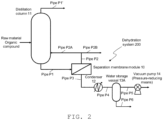
- FIG. 2 is a schematic view illustrating a dehydration system of an aqueous organic compound, which is one embodiment of the present invention and used for a PV method where damage to a membrane element is suppressed by controlling the above-described pressure to be not higher than a specific pressure.
- FIG. 3 is an enlarged schematic view illustrating a section between a separation membrane module and a pressure-reducing means. In FIG. 2 , the section between the separation membrane module and the pressure-reducing means is illustrated in a simple manner.
- a raw material organic compound is distilled in a distillation column 11, and a low-boiling-point component is discharged from the top of the column via a pipe P 1 ', while a high-boiling-point component (liquid component) is supplied from the bottom of the column to a separation membrane module 10 via a pipe P 1 .
- an aqueous organic compound constituting this high-boiling-point component is exemplified as a treatment subject; however, an aqueous organic compound constituting a liquid component obtained after condensation of the low-boiling-point component discharged via the pipe P 1 ' may be the treatment subject as well.
- tubular membrane elements each having a tubular porous ceramic support and a zeolite membrane disposed on the support are arranged.
- Each tubular membrane element has a separation membrane (zeolite membrane) which does not allow an organic compound to permeate therethrough but selectively allows water to permeate therethrough.
- an aqueous organic compound is brought into contact with the outer surface of each tubular membrane element and the pressure of the inner surface side is reduced by a pressure-reducing means to allow water to permeate from the outer surface to the inner surface of the membrane element, whereby the organic compound is concentrated and water is recovered.
- a heating means (not illustrated) is arranged in the separation membrane module 10.
- the membrane element may be of a single-tube type or a multi-tube type, and it is preferred that usually 1 to 2,000, particularly 50 to 1,000 membrane elements be arranged apart from one another by a distance of 5 mm to 10 mm.
- the housing size and the number of the membrane elements are changed as appropriate in accordance with the amount of a fluid to be treated. A concrete configuration of the membrane elements is described below.
- the aqueous organic compound thus dehydrated and concentrated without permeating through the membrane element(s) is discharged via a pipe P 2 and then circulated back to the distillation column 11 via a pipe P 2A when the water content is equal to or higher than a reference value, or recovered as a dehydrated organic compound via a pipe P 2B when the water content is equal to or lower than the reference value.
- a condenser 12 In the downstream of the separation membrane module 10, a condenser 12, a water storage vessel 13A and a vacuum pump 14 are arranged in series, and water (steam) permeated through the separation membrane(s) of the membrane element(s) is condensed in the condenser 12 and subsequently sent to and temporarily retained in the water storage vessel 13A. Once the amount of the retained water reaches a prescribed level, the retained water is discharged from the bottom of the water storage vessel 13A and sent to a water storage vessel 13B via a pipe.
- the water storage vessel 13B is larger than the water storage vessel 13A and is thus capable of retaining a greater amount of water.
- a reduced pressure on the permeate side that is required as a driving force of water permeating through the membrane(s) is provided by the vacuum pump 14 used as a pressure-reducing means, and the degree of vacuum is controlled by valves V 1 to V 4 , which are pressure control members arranged in the middle of the respective pipes.
- valves V 1 and V 4 are opened (valves V 2 and V 3 are closed) and, once water retained in the water storage vessel 13A reached a prescribed amount, the valve V 1 is closed first. Then, the valve V 4 is closed and the valves V 2 and V 3 are opened to expose the water storage vessel 13A to the atmosphere, whereby water retained in the water storage vessel 13A is transferred to the water storage vessel 13B. It is noted here that, after the valve V 1 is closed, the operations of opening or closing the valves V 2 , V 3 and V 4 are performed simultaneously; however, these operations may also be performed with a time lag.
- water retained in the water storage vessel 13A is transferred to the water storage vessel 13B by exposing the water storage vessel 13A to the atmosphere; however, a gas other than the atmosphere may be introduced into the water storage vessel 13A to cancel a reduced-pressure state.
- the water storage vessel 13B usually has atmospheric pressure, it may have a reduced pressure as well.
- valves V 1 to V 4 are operated substantially simultaneously without any particular control; however, in the operation method of this embodiment, these valves are operated such that the pressure in the pipe (pipe P 3 ) connecting the separation membrane module 10 and the condenser 12 is controlled to be an absolute pressure of 20 kPa or less.
- valves V 1 and V 4 are in an opened state while the valves V 2 and V 3 are in a closed state, and the absolute pressure on the permeate side of the separation membrane module is 0.5 to 15 kPa or so, with the pressure in the pipe P 3 that connects the separation membrane module 10 and the condenser 12 also being the same.
- the valves V 1 and V 4 are closed when water is discharged from the water storage vessel 13A; however, since there is still a difference in water partial pressure between the outside and the inside of each membrane element in the separation membrane module, the pressure on the permeate side gradually increases with time.
- the pipe P 3 is monitored so as to perform the discharge of water from the water storage vessel 13A (operations of the valves V 2 and V 3 ), the recovery of a degree of vacuum in the water storage vessel 13A (operation of the valve V 4 ) and the recovery of a degree of vacuum in the pipe P 3 (corresponding to the pressure on the permeate side) (operation of the valve V 1 ), all under such a condition where the absolute pressure in the pipe P 3 does not exceed 20 kPa.
- the time required for the absolute pressure in the pipe P 3 to reach 20 kPa after closing of the valve V 1 is dependent on the degree of vacuum during the operation, the aqueous organic compound to be treated (ant its water content), the separation membrane module (membrane element(s) constituting the module), the inner volume of the pipe P 3 and the like and thus cannot be generalized; however, it is usually 1 to 3 minutes or so.
- the inner volume of the water storage vessel 13A, the amount of water to be retained until discharge, the output of the vacuum pump 14 and the like are set as appropriate such that the discharge of water from the water storage vessel 13A and the recovery of a degree of vacuum can be performed during the above-describe period.
- valve V 1 As described above as one example of concrete conditions, after water is discharged from the water storage vessel 13A, it is preferred to open the valve V 1 in the end at the time of reducing the pressure in the water storage vessel 13 and the pipe P 3 .
- opening the valve V 1 after the water storage vessel 13A and the pipe P 3 are brought into a desired reduced-pressure state, since the pressure between the separation membrane module and the condenser as well as between the condenser and the valve V 1 is maintained in a certain range at all times, damage to the membrane elements caused by pressure fluctuation can be suppressed.
- another embodiment of the present invention which is a dehydration method of separating water from an aqueous organic compound, includes, at least: a separation membrane module inside of which one or plural tubular membrane elements, each including a tubular porous ceramic support and a zeolite membrane disposed on the support, are arranged and which separates water from the aqueous organic compound supplied thereto using the one or plural tubular membrane elements; a pressure-reducing means for reducing the pressure on a water permeate side of each tubular membrane element; a condenser which is arranged between the separation membrane module and the pressure-reducing means via a pipe and condenses water vapor permeating through the tubular membrane element(s) into water; and a backflow-inhibiting means for inhibiting backflow of the thus condensed water into the membrane element(s).
- the backflow-inhibiting means has at least one of the following configurations (1) and (2):
- the backflow-inhibiting means includes a water storage vessel in which water permeating through the condenser is retained, and controls the pressure in the pipe connecting the separation membrane module and the condenser to be an absolute pressure of 20 kPa or less when water retained in the water storage vessel is discharged.
- membrane element arranged inside the separation membrane module in the dehydration system of the present invention will now be described. It is noted here that the below-described membrane element represents a preferred mode of the membrane element used in the dehydration system of the present invention, and the membrane element is not restricted to the following as long as the object of the present invention is not impaired.
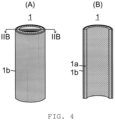
- a membrane element 1 used in this embodiment that is illustrated in FIG. 4 has a zeolite membrane on (the outer side of) a tubular porous ceramic support and assumes a tubular shape as a whole.
- the "tubular shape” is not restricted to a cylindrical shape and may be a rectangular tube shape; however, from the standpoint of improving the sealing property, the membrane element 1 preferably has a cylindrical (tubular) shape.
- FIGs. 4(A) and 4(B) illustrate one example of the membrane element 1.
- FIG. 4(A) is a drawing that schematically illustrates the outer appearance of the membrane element 1
- FIG. 4(B) is a drawing that schematically illustrates a IIB-IIB cross-section of FIG. 4 (A) .
- the membrane element 1 has a cylindrical porous ceramic support 1a and a zeolite membrane 1b formed on the outer side (outer wall surface) of the porous ceramic support 1a.
- the membrane element 1 illustrated in FIG. 4 which has the zeolite membrane only on the outer wall of the porous ceramic support is used; however, it is also possible to use a membrane element which has a zeolite membrane only on the inner wall or on both the inner wall and the outer wall of a porous ceramic support.
- the porous ceramic support 1a functions as a support that supports the zeolite membrane 1b.
- the material constituting the porous ceramic support 1a is not particularly restricted and may be any chemically stable porous inorganic substance as long as zeolite can be crystallized on its surface or the like in a membrane form.
- Specific examples of such a material include sintered ceramics, such as silica, ⁇ -alumina, ⁇ -alumina, mullite, zirconia, titania, yttria, silicon nitride, and silicon carbide.
- aluminas such as ⁇ -alumina and ⁇ -alumina, and mullite are preferred, and aluminas are particularly preferred.
- the porous ceramic support 1a itself is not required to have a molecular sieving capability.
- fine pores holes, voids
- any known porous ceramic support can be used.
- the porous ceramic support 1a has a porosity of usually 20% or higher, preferably 25% or higher, more preferably 30% or higher, but usually 80% or lower, preferably 60% or lower, more preferably 50% or lower, and the average pore size of the porous ceramic support 1a is usually 0.01 um or larger, preferably 0.05 um or larger, more preferably 0.1 um or larger, with the upper limit thereof being usually 20 um or smaller, preferably 10 um or smaller, more preferably 5 ⁇ m or smaller.
- the porous ceramic support 1a having such pores not only has a sufficient strength and can appropriately support the zeolite membrane 1b, but also can allow molecules passed through the zeolite membrane 1b to permeate therethrough at a sufficient rate or allow molecules to reach the zeolite membrane 1b at a sufficient rate. Moreover, the porous ceramic support 1a is not easily broken even when a pressure is applied thereto from a sealing member by caulking.
- the porosity and the pore size of the porous ceramic support 1a can be easily determined by mercury porosimetry, SEM observation of a cross-section, or the like. The same also applies to the average pore size; however, the average pore size can also be calculated from the volume and the mass using the true specific gravity.
- the thickness of the porous ceramic support 1a is not particularly restricted as long as the porous ceramic support 1a has a prescribed strength.
- the thickness varies depending on the material, the porosity and the like; however, the thickness is, for example, preferably not less than 0.5 mm, more preferably not less than 0.8 mm, still more preferably not less than 1.3 mm.
- the inner diameter of the porous ceramic support 1a is also not particularly restricted as long as the porous ceramic support 1a has a prescribed strength.
- the inner diameter varies depending on the material, the porosity and the like; however, the ratio of the inner diameter with respect to the thickness of the porous ceramic support 1a (inner diameter (mm)/thickness (mm)) is, for example, preferably not higher than 20, more preferably not higher than 17, still more preferably not higher than 13, particularly preferably not higher than 9.
- the length (length in the axial direction) of the porous ceramic support 1a is also not particularly restricted.
- the zeolite membrane 1b is a thin layer formed on the outer side (outer surface) of the porous ceramic support 1a.
- the mode of the zeolite membrane 1b is not particularly restricted as long as it can appropriately exhibit molecular sieving capability.
- the zeolite membrane 1b is preferably composed of an aluminosilicate; however, as long as the membrane performance is not greatly impaired, a metal element such as Ga, Fe, B, Ti, Zr, Sn or Zn may be used in place of Al, or the zeolite membrane 1b may also contain an element such as Ga, Fe, B, Ti, Zr, Sn, Zn or P along with Al.
- the skeleton of crystal zeolite constituting the pores of the zeolite membrane is preferably an 8 or less-membered oxygen ring, more preferably a 6 to 8-membered oxygen ring.
- zeolite examples include AEI, AFG, ANA, CHA, DDR, EAB, ERI, ESV, FAR, FRA, GIS, ITE, KFI, LEV, LIO, LOS, LTA, LTN, MAR, PAU, RHO, RTH, SOD, STI, TOL, and UFI.
- a membrane constituted by AEI, CHA, DDR, ERI, KFI, LEV, PAU, RHO, RTH, SOD, LTA or UFI-type zeolite it is more preferred to use a membrane constituted by CHA, DDR, RHO or SOD-type zeolite.
- n represents the number of oxygen atoms in a pore having the largest number of oxygen atoms among the pores constituted by a zeolite skeleton and an element T (non-oxygen element constituting the skeleton).
- an organic template (structure-directing agent) may be used as required, and the template is usually not particularly restricted as long as it can yield a desired zeolite structure. It is not necessary to use a template when the zeolite membrane 1b can be synthesized without a template.
- the thickness of the zeolite membrane 1b is not particularly restricted; however, it is usually 0.01 ⁇ m to 30 um, preferably 0.01 ⁇ m to 10 um. The thinner the zeolite membrane 1b, the more preferred it is, as long as the membrane performance is not greatly impaired.
- Examples of a method of forming the zeolite membrane 1b on the surface of the porous ceramic support 1a include a method of crystallizing zeolite in a membrane form on the surface of the porous ceramic support 1a (see, for example, WO 2013/125660 ) .
- FIG. 4 a mode in which the zeolite membrane 1b is formed on the outer wall of the porous ceramic support 1a is illustrated; however, the present invention is not restricted to this mode.
- a mode in which the zeolite membrane 1b is formed on the inner wall of the porous ceramic support 1a, or a mode in which the zeolite membrane 1b is formed on both the outer wall and the inner wall of the porous ceramic support 1a, may be adopted as well.
- the dehydration system is suitable for applications where steady operation is required over a long period (e.g., chemical plants).
Landscapes
- Chemical & Material Sciences (AREA)
- Engineering & Computer Science (AREA)
- Water Supply & Treatment (AREA)
- Chemical Kinetics & Catalysis (AREA)
- Life Sciences & Earth Sciences (AREA)
- Hydrology & Water Resources (AREA)
- Environmental & Geological Engineering (AREA)
- Organic Chemistry (AREA)
- Inorganic Chemistry (AREA)
- Separation Using Semi-Permeable Membranes (AREA)
Claims (11)
- Dehydratisierungssystem (100, 200) zur Abtrennung von Wasser aus einer wässrigen organischen Verbindung, wobei das Dehydratisierungssystem (100, 200) umfasst:ein Trennmembranmodul (10), in dem ein oder mehrere röhrenförmige Membranelemente (1), die jeweils einen röhrenförmigen porösen Keramikträger (1a) und eine auf dem Träger (1a) angeordnete Zeolithmembran (1b) umfassen, angeordnet sind, und das Wasser von der ihm zugeführten wässrigen organischen Verbindung unter Verwendung des einen oder der mehreren röhrenförmigen Membranelements/Membranelemente (1) trennt;ein Druckreduziermittel zum Reduzieren des Drucks auf einer Wasserpermeatseite jedes röhrenförmigen Membranelements (1); undeinen Kondensator (12), der zwischen dem Trennmembranmodul (10) und dem Druckreduziermittel über ein Übertragungsrohr (P3) angeordnet ist und Wasserdampf, der durch das/die röhrenförmige(n) Membranelement(e) (1) dringt, zu Wasser kondensiert,wobei das Dehydratisierungssystem (100, 200) so konfiguriert ist, dass es Wasser von einer äußeren Oberfläche zu einer inneren Oberfläche des/der Membranelements/Membranelemente (1) durchdringen lässt, indem es die wässrige organische Verbindung in Kontakt mit der äußeren Oberfläche jedes röhrenförmigen Membranelements (1) bringt und indem es den Druck auf der Seite der inneren Oberfläche mittels des Druckreduziermittels reduziert, unddadurch gekennzeichnet, dass das Dehydratisierungssystem mindestens eine der folgenden Konfigurationen (1) und (2) aufweist:Konfiguration (1): das Dehydratisierungssystem (100, 200) umfasst ein Mittel zur Temperaturerhaltung, um das Übertragungsrohr (P3), das das Trennmembranmodul (10) und den Kondensator (12) verbindet, auf einer Temperatur zu halten, bei der Wasser nicht kondensiert, undKonfiguration (2): das Übertragungsrohr (P3), das das Trennmembranmodul (10) und den Kondensator (12) verbindet, ist von einem Auslass für durchgelassenes Wasser des Trennmembranmoduls (10) nach unten in Richtung des Kondensators (12) angeordnet, was bedeutet, dass der Kondensator (12) in jedem Zustand niedriger als der Auslass für durchgelassenes Wasser des Trennmembranmoduls (10) positioniert ist und das Übertragungsrohr (P3) so angeschlossen ist, dass es nicht höher als der Auslass für durchgelassenes Wasser des Trennmembranmoduls (10) positioniert ist,wobei diese Konfigurationen dazu dienen, einen Rückfluss von in dem Übertragungsrohr (P3) erzeugtem Kondenswasser in das Trennmembranmodul (10) zu verhindern.
- Dehydratisierungssystem (100, 200) nach Anspruch 1, wobei das Dehydratisierungssystem (100, 200) zumindest die Konfiguration (1) aufweist und als Mittel zur Temperaturerhaltung ein Isolierelement (15) umfasst, das das Übertragungsrohr (P3), das das Trennmembranmodul (10) und den Kondensator (12) verbindet, abdeckt.
- Dehydratisierungssystem (100, 200) nach Anspruch 1 oder 2, wobei das Dehydratisierungssystem (100, 200) zumindest die Konfiguration (1) aufweist und als Mittel zur Temperaturerhaltung ein Heizmittel zum Beheizen des Übertragungsrohrs (P3), das das Trennmembranmodul (10) und den Kondensator (12) verbindet, umfasst.
- Dehydratisierungssystem (100, 200) nach Anspruch 3, wobei das Heizmittel eine Dampfleitung oder eine elektrische Leitung ist.
- Dehydratisierungssystem (100, 200) nach einem der Ansprüche 1 bis 4, das beide Konfigurationen (1) und (2) aufweist.
- Verfahren zur Dehydratisierung einer wässrigen organischen Verbindung zur Abtrennung von Wasser aus einer wässrigen organischen Verbindung, wobei das Verfahren die folgenden Schritte umfasst:Abtrennen von Wasser aus der wässrigen organischen Verbindung unter Verwendung eines oder mehrerer röhrenförmiger Membranelemente (1), die innerhalb eines Trennmembranmoduls (10) angeordnet sind, und wobei jedes röhrenförmige Membranelement (1) einen röhrenförmigen porösen Keramikträger (1a) und eine auf dem Träger (1a) angeordnete Zeolithmembran (1b) umfasst,wobei die wässrige organische Verbindung dem Trennmembranmodul (10) zugeführt und mit der äußeren Oberfläche jedes röhrenförmigen Membranelements (1) in Kontakt gebracht wird,und wobei der Druck auf einer Wasserpermeat- und inneren Oberflächenseite jedes röhrenförmigen Membranelements (1) durch ein Druckreduziermittel reduziert wird, um Wasser von einer äußeren Oberfläche zur inneren Oberfläche des/der Membranelements/Membranelemente (1) durchdringen zu lassen;Kondensieren von Wasserdampf, der durch das/die röhrenförmige(n) Membranelement(e) (1) dringt, zu Wasser in einem Kondensator (12), der zwischen dem Trennmembranmodul (10) und dem Druckreduziermittel über ein Übertragungsrohr (P3) angeordnet ist; undgekennzeichnet durch Verhindern des Rückflusses des so kondensierten Wassers in das/die Membranelement(e) durch ein Rückflussverhinderungsmittel, wobei das Rückflussverhinderungsmittel mindestens eine der folgenden Konfigurationen (1) und (2) aufweist:Konfiguration (1): das Rückflussverhinderungsmittel umfasst ein Mittel zur Temperaturerhaltung, um das Übertragungsrohr (P3), das das Trennmembranmodul und den Kondensator (12) verbindet, auf einer Temperatur zu halten, bei der Wasser nicht kondensiert, undKonfiguration (2): das Rohr, das das Trennmembranmodul (10) und den Kondensator (12) verbindet, ist von einem Auslass für durchgelassenes Wasser des Trennmembranmoduls (10) nach unten in Richtung des Kondensators (12) angeordnet, was bedeutet, dass der Kondensator (12) in jedem Zustand niedriger als der Auslass für durchgelassenes Wasser des Trennmembranmoduls (10) positioniert ist und das Übertragungsrohr (P3) so angeschlossen ist, dass es nicht höher als der Auslass für durchgelassenes Wasser des Trennmembranmoduls (10) positioniert ist.
- Verfahren zur Dehydratisierung einer wässrigen organischen Verbindung nach Anspruch 6, wobeidas Verfahren das Zurückhalten des durch den Kondensator durchgelassenen Wassers in einem Wasserspeicherbehälter (13A, 13B) umfasst, unddas Steuern des Drucks in dem Rohr, das das Trennmembranmodul (10) und den Kondensator (12) verbindet, durch das Rückflussverhinderungsmittel auf einen absoluten Druck von 20 kPa oder weniger, wenn das in dem Wasserspeicherbehälter (13A, 13B) zurückgehaltene Wasser abgelassen wird.
- Verfahren zur Dehydratisierung einer wässrigen organischen Verbindung nach Anspruch 6, wobei das Verfahren das Halten der Temperatur des Übertragungsrohrs (P3), das das Trennmembranmodul (10) und den Kondensator (12) verbindet, auf 20°C oder höher umfasst.
- Verfahren zur Dehydratisierung einer wässrigen organischen Verbindung nach Anspruch 8, wobei die Temperatur des Übertragungsrohrs (P3) so eingestellt wird, dass sie in einem Bereich von -20°C bis 20°C in Bezug auf eine voreingestellte Temperatur des Trennmembranmoduls (10) liegt.
- Verfahren zur Dehydratisierung einer wässrigen organischen Verbindung nach Anspruch 7, wobei das Dehydratisierungssystem (100, 200) das Öffnen und Schließen eines Drucksteuerungselements umfasst, das an einem Rohr angeordnet ist, das den Kondensator (12) und den Wasserspeicherbehälter (13A, 13B) verbindet, wobei der Druck in dem Rohr, das das Trennmembranmodul (10) und den Kondensator (12) verbindet, durch anfängliches Schließen des Drucksteuerungselements gesteuert wird, wenn Wasser aus dem Wasserspeicherbehälter (13A, 13B) abgelassen wird.
- Verfahren zur Dehydratisierung einer wässrigen organischen Verbindung (100, 200) nach einem der Ansprüche 7 oder 10, wobei nach dem Ablassen von Wasser aus dem Wasserspeicherbehälter (13A, 13B) das Drucksteuerungselement, das an dem Übertragungsrohr, das den Kondensator und den Wasserspeicherbehälter (13A, 13B) verbindet, angeordnet ist, am Ende zum Zeitpunkt der Reduzierung des Drucks in dem Wasserspeicherbehälter (13A, 13B) und dem Rohr, das das Drucksteuerungselement und den Wasserspeicherbehälter (13A, 13B) verbindet, geöffnet wird.
Applications Claiming Priority (3)
| Application Number | Priority Date | Filing Date | Title |
|---|---|---|---|
| JP2016106415 | 2016-05-27 | ||
| JP2016170944 | 2016-09-01 | ||
| PCT/JP2017/019393 WO2017204254A1 (ja) | 2016-05-27 | 2017-05-24 | 含水有機化合物の脱水システム及びその運転方法、並びに脱水方法 |
Publications (3)
| Publication Number | Publication Date |
|---|---|
| EP3466525A1 EP3466525A1 (de) | 2019-04-10 |
| EP3466525A4 EP3466525A4 (de) | 2019-06-05 |
| EP3466525B1 true EP3466525B1 (de) | 2023-12-13 |
Family
ID=60411329
Family Applications (1)
| Application Number | Title | Priority Date | Filing Date |
|---|---|---|---|
| EP17802840.3A Active EP3466525B1 (de) | 2016-05-27 | 2017-05-24 | Entwässerungssystem für wässrige organische verbindungen, betriebsverfahren dafür und entwässerungsverfahren |
Country Status (5)
| Country | Link |
|---|---|
| US (1) | US20190091630A1 (de) |
| EP (1) | EP3466525B1 (de) |
| JP (1) | JP7070408B2 (de) |
| CN (1) | CN109195688A (de) |
| WO (1) | WO2017204254A1 (de) |
Families Citing this family (3)
| Publication number | Priority date | Publication date | Assignee | Title |
|---|---|---|---|---|
| US11578628B2 (en) | 2020-10-23 | 2023-02-14 | Gas Technology Insitute | Method and system to selectively recover water vapor and latent heat from exhaust gas streams |
| KR102464360B1 (ko) * | 2021-12-27 | 2022-11-09 | (주)파인텍 | 분리막을 이용한 유기용제 탈수장치 |
| CN116409839B (zh) * | 2023-06-12 | 2023-08-08 | 东莞市鹏锦机械科技有限公司 | 一种nmp废液提纯系统及工艺 |
Citations (2)
| Publication number | Priority date | Publication date | Assignee | Title |
|---|---|---|---|---|
| US4925562A (en) * | 1986-07-29 | 1990-05-15 | Gft Gesellschaft Fur Trenntechnik Mbh | Pervaporation process and membrane |
| US20140142363A1 (en) * | 2012-11-16 | 2014-05-22 | Exxonmobil Research And Engineering Company | Membrane separation process using mixed vapor-liquid feed |
Family Cites Families (19)
| Publication number | Priority date | Publication date | Assignee | Title |
|---|---|---|---|---|
| JPS5573301A (en) * | 1978-11-24 | 1980-06-03 | Japan Atom Energy Res Inst | Concentrating method and apparatus for aqueous solution |
| JPS58180204A (ja) * | 1982-04-19 | 1983-10-21 | Kuri Kagaku Sochi Kk | 滲透蒸発膜を用いる分離法 |
| JPH067780Y2 (ja) * | 1984-11-20 | 1994-03-02 | 徳山曹達株式会社 | 液体混合物の分離装置 |
| US4787919A (en) * | 1987-06-23 | 1988-11-29 | Union Carbide Corporation | Membrane separation system and process |
| JPH0557151A (ja) * | 1991-08-30 | 1993-03-09 | Mitsui Eng & Shipbuild Co Ltd | 有機物選択透過分離装置 |
| JP2600290Y2 (ja) * | 1993-11-05 | 1999-10-04 | 日東電工株式会社 | 浸透気化膜分離装置 |
| ATE457818T1 (de) * | 2003-02-21 | 2010-03-15 | Mitsubishi Chem Corp | Verfahren zur konzentration von wasserlöslichem organischem material |
| EP1924334A4 (de) * | 2005-09-13 | 2009-11-11 | Rasirc | Verfahren zur herstellung einer hochreinen strömung |
| US8926731B2 (en) * | 2005-09-13 | 2015-01-06 | Rasirc | Methods and devices for producing high purity steam |
| JP5135671B2 (ja) * | 2005-09-28 | 2013-02-06 | 三菱化学株式会社 | ゼオライト分離膜の製造方法 |
| CN102206197A (zh) * | 2011-03-31 | 2011-10-05 | 天津大学 | 带有中间储罐间歇精馏与渗透汽化耦合分离四氢呋喃和水的装置和方法 |
| JP6107808B2 (ja) | 2012-02-24 | 2017-04-05 | 三菱化学株式会社 | ゼオライト膜複合体 |
| CN202516478U (zh) * | 2012-05-07 | 2012-11-07 | 成都连接流体分离科技有限公司 | 麦芽糖醇稀液连续式膜浓缩设备 |
| JP2014046300A (ja) | 2012-09-03 | 2014-03-17 | National Institute Of Advanced Industrial & Technology | 膜による溶液の脱水法 |
| JP5681160B2 (ja) * | 2012-11-02 | 2015-03-04 | 本田技研工業株式会社 | 燃料分離装置及び分離器状態判定方法 |
| CN103071307B (zh) * | 2013-01-23 | 2015-04-22 | 江苏九天高科技股份有限公司 | 一种精馏-蒸汽渗透耦合的有机溶剂脱水方法及装置 |
| JP2015127026A (ja) | 2013-12-27 | 2015-07-09 | 日本碍子株式会社 | 分離装置、分離方法及び分離膜 |
| JP6221889B2 (ja) * | 2014-03-26 | 2017-11-01 | 三菱ケミカル株式会社 | 多管式分離膜モジュール |
| JP2016027938A (ja) * | 2014-07-11 | 2016-02-25 | 日本碍子株式会社 | 膜の再生方法、膜の再生装置及び分離装置 |
-
2017
- 2017-05-24 EP EP17802840.3A patent/EP3466525B1/de active Active
- 2017-05-24 WO PCT/JP2017/019393 patent/WO2017204254A1/ja not_active Ceased
- 2017-05-24 JP JP2018519585A patent/JP7070408B2/ja active Active
- 2017-05-24 CN CN201780032744.3A patent/CN109195688A/zh active Pending
-
2018
- 2018-11-27 US US16/201,278 patent/US20190091630A1/en not_active Abandoned
Patent Citations (2)
| Publication number | Priority date | Publication date | Assignee | Title |
|---|---|---|---|---|
| US4925562A (en) * | 1986-07-29 | 1990-05-15 | Gft Gesellschaft Fur Trenntechnik Mbh | Pervaporation process and membrane |
| US20140142363A1 (en) * | 2012-11-16 | 2014-05-22 | Exxonmobil Research And Engineering Company | Membrane separation process using mixed vapor-liquid feed |
Also Published As
| Publication number | Publication date |
|---|---|
| JPWO2017204254A1 (ja) | 2019-03-28 |
| JP7070408B2 (ja) | 2022-05-18 |
| US20190091630A1 (en) | 2019-03-28 |
| EP3466525A4 (de) | 2019-06-05 |
| WO2017204254A1 (ja) | 2017-11-30 |
| CN109195688A (zh) | 2019-01-11 |
| EP3466525A1 (de) | 2019-04-10 |
Similar Documents
| Publication | Publication Date | Title |
|---|---|---|
| US9085476B2 (en) | Pervaporation membranes highly selective for volatile solvents present in fermentation broths | |
| Li et al. | Properties and separation performance of Ge-ZSM-5 membranes | |
| Cui et al. | Preparation and application of zeolite/ceramic microfiltration membranes for treatment of oil contaminated water | |
| US7341663B2 (en) | Spiral-wound liquid membrane module for separation of fluids and gases | |
| Tsuru et al. | Nanofiltration in non-aqueous solutions by porous silica–zirconia membranes | |
| EP3466525B1 (de) | Entwässerungssystem für wässrige organische verbindungen, betriebsverfahren dafür und entwässerungsverfahren | |
| JP5585307B2 (ja) | Vocの回収装置 | |
| CN113613764A (zh) | 沸石膜复合体、沸石膜复合体的制造方法、沸石膜复合体的处理方法及分离方法 | |
| JP2020075864A (ja) | アルコールの製造方法 | |
| JP6500499B2 (ja) | 分離膜モジュール及びその運転方法 | |
| JP6592914B2 (ja) | 分離膜モジュール | |
| JP2016041419A (ja) | 分離方法及び分離装置 | |
| Li et al. | ZSM‐11 membranes: Characterization and pervaporation performance | |
| JP2005161187A (ja) | ガス分離回収装置及び分離回収方法 | |
| Soydaş et al. | Separation of gas and organic/water mixtures by MFI type zeolite membranes synthesized in a flow system | |
| CN119343172A (zh) | 分离装置的运转方法及分离装置 | |
| JP2017042724A (ja) | 分離方法 | |
| JP2020075865A (ja) | アルコールの製造のための水−アルコール分離システム及び水−アルコール分離方法 | |
| US20230264142A1 (en) | Gas separation method and gas separation apparatus | |
| JP2017104827A (ja) | 分離装置の使用方法及び分離装置 | |
| JP6728583B2 (ja) | 微量アルコールの除去方法 | |
| US20080047427A1 (en) | Membrane Production Method | |
| CN110719808B (zh) | 脱水方法及脱水装置 | |
| JP2017165671A (ja) | 高濃度アルコールの製造方法 | |
| JP2018020985A (ja) | アルコールの製造方法 |
Legal Events
| Date | Code | Title | Description |
|---|---|---|---|
| STAA | Information on the status of an ep patent application or granted ep patent |
Free format text: STATUS: THE INTERNATIONAL PUBLICATION HAS BEEN MADE |
|
| PUAI | Public reference made under article 153(3) epc to a published international application that has entered the european phase |
Free format text: ORIGINAL CODE: 0009012 |
|
| STAA | Information on the status of an ep patent application or granted ep patent |
Free format text: STATUS: REQUEST FOR EXAMINATION WAS MADE |
|
| 17P | Request for examination filed |
Effective date: 20181221 |
|
| AK | Designated contracting states |
Kind code of ref document: A1 Designated state(s): AL AT BE BG CH CY CZ DE DK EE ES FI FR GB GR HR HU IE IS IT LI LT LU LV MC MK MT NL NO PL PT RO RS SE SI SK SM TR |
|
| AX | Request for extension of the european patent |
Extension state: BA ME |
|
| A4 | Supplementary search report drawn up and despatched |
Effective date: 20190503 |
|
| RIC1 | Information provided on ipc code assigned before grant |
Ipc: B01D 61/36 20060101AFI20190426BHEP Ipc: B01D 63/06 20060101ALI20190426BHEP Ipc: B01D 69/12 20060101ALI20190426BHEP Ipc: B01D 71/02 20060101ALI20190426BHEP Ipc: B01D 69/10 20060101ALI20190426BHEP |
|
| DAV | Request for validation of the european patent (deleted) | ||
| DAX | Request for extension of the european patent (deleted) | ||
| STAA | Information on the status of an ep patent application or granted ep patent |
Free format text: STATUS: EXAMINATION IS IN PROGRESS |
|
| 17Q | First examination report despatched |
Effective date: 20200807 |
|
| GRAP | Despatch of communication of intention to grant a patent |
Free format text: ORIGINAL CODE: EPIDOSNIGR1 |
|
| STAA | Information on the status of an ep patent application or granted ep patent |
Free format text: STATUS: GRANT OF PATENT IS INTENDED |
|
| INTG | Intention to grant announced |
Effective date: 20230713 |
|
| P01 | Opt-out of the competence of the unified patent court (upc) registered |
Effective date: 20230906 |
|
| GRAS | Grant fee paid |
Free format text: ORIGINAL CODE: EPIDOSNIGR3 |
|
| GRAA | (expected) grant |
Free format text: ORIGINAL CODE: 0009210 |
|
| STAA | Information on the status of an ep patent application or granted ep patent |
Free format text: STATUS: THE PATENT HAS BEEN GRANTED |
|
| AK | Designated contracting states |
Kind code of ref document: B1 Designated state(s): AL AT BE BG CH CY CZ DE DK EE ES FI FR GB GR HR HU IE IS IT LI LT LU LV MC MK MT NL NO PL PT RO RS SE SI SK SM TR |
|
| REG | Reference to a national code |
Ref country code: GB Ref legal event code: FG4D |
|
| REG | Reference to a national code |
Ref country code: CH Ref legal event code: EP |
|
| REG | Reference to a national code |
Ref country code: DE Ref legal event code: R096 Ref document number: 602017077511 Country of ref document: DE |
|
| REG | Reference to a national code |
Ref country code: IE Ref legal event code: FG4D |
|
| PG25 | Lapsed in a contracting state [announced via postgrant information from national office to epo] |
Ref country code: GR Free format text: LAPSE BECAUSE OF FAILURE TO SUBMIT A TRANSLATION OF THE DESCRIPTION OR TO PAY THE FEE WITHIN THE PRESCRIBED TIME-LIMIT Effective date: 20240314 |
|
| REG | Reference to a national code |
Ref country code: LT Ref legal event code: MG9D |
|
| PG25 | Lapsed in a contracting state [announced via postgrant information from national office to epo] |
Ref country code: LT Free format text: LAPSE BECAUSE OF FAILURE TO SUBMIT A TRANSLATION OF THE DESCRIPTION OR TO PAY THE FEE WITHIN THE PRESCRIBED TIME-LIMIT Effective date: 20231213 |
|
| REG | Reference to a national code |
Ref country code: NL Ref legal event code: MP Effective date: 20231213 |
|
| PG25 | Lapsed in a contracting state [announced via postgrant information from national office to epo] |
Ref country code: ES Free format text: LAPSE BECAUSE OF FAILURE TO SUBMIT A TRANSLATION OF THE DESCRIPTION OR TO PAY THE FEE WITHIN THE PRESCRIBED TIME-LIMIT Effective date: 20231213 |
|
| PG25 | Lapsed in a contracting state [announced via postgrant information from national office to epo] |
Ref country code: LT Free format text: LAPSE BECAUSE OF FAILURE TO SUBMIT A TRANSLATION OF THE DESCRIPTION OR TO PAY THE FEE WITHIN THE PRESCRIBED TIME-LIMIT Effective date: 20231213 Ref country code: GR Free format text: LAPSE BECAUSE OF FAILURE TO SUBMIT A TRANSLATION OF THE DESCRIPTION OR TO PAY THE FEE WITHIN THE PRESCRIBED TIME-LIMIT Effective date: 20240314 Ref country code: ES Free format text: LAPSE BECAUSE OF FAILURE TO SUBMIT A TRANSLATION OF THE DESCRIPTION OR TO PAY THE FEE WITHIN THE PRESCRIBED TIME-LIMIT Effective date: 20231213 Ref country code: BG Free format text: LAPSE BECAUSE OF FAILURE TO SUBMIT A TRANSLATION OF THE DESCRIPTION OR TO PAY THE FEE WITHIN THE PRESCRIBED TIME-LIMIT Effective date: 20240313 |
|
| REG | Reference to a national code |
Ref country code: AT Ref legal event code: MK05 Ref document number: 1640014 Country of ref document: AT Kind code of ref document: T Effective date: 20231213 |
|
| PG25 | Lapsed in a contracting state [announced via postgrant information from national office to epo] |
Ref country code: NL Free format text: LAPSE BECAUSE OF FAILURE TO SUBMIT A TRANSLATION OF THE DESCRIPTION OR TO PAY THE FEE WITHIN THE PRESCRIBED TIME-LIMIT Effective date: 20231213 |
|
| PG25 | Lapsed in a contracting state [announced via postgrant information from national office to epo] |
Ref country code: SE Free format text: LAPSE BECAUSE OF FAILURE TO SUBMIT A TRANSLATION OF THE DESCRIPTION OR TO PAY THE FEE WITHIN THE PRESCRIBED TIME-LIMIT Effective date: 20231213 Ref country code: RS Free format text: LAPSE BECAUSE OF FAILURE TO SUBMIT A TRANSLATION OF THE DESCRIPTION OR TO PAY THE FEE WITHIN THE PRESCRIBED TIME-LIMIT Effective date: 20231213 Ref country code: NO Free format text: LAPSE BECAUSE OF FAILURE TO SUBMIT A TRANSLATION OF THE DESCRIPTION OR TO PAY THE FEE WITHIN THE PRESCRIBED TIME-LIMIT Effective date: 20240313 Ref country code: NL Free format text: LAPSE BECAUSE OF FAILURE TO SUBMIT A TRANSLATION OF THE DESCRIPTION OR TO PAY THE FEE WITHIN THE PRESCRIBED TIME-LIMIT Effective date: 20231213 Ref country code: LV Free format text: LAPSE BECAUSE OF FAILURE TO SUBMIT A TRANSLATION OF THE DESCRIPTION OR TO PAY THE FEE WITHIN THE PRESCRIBED TIME-LIMIT Effective date: 20231213 Ref country code: HR Free format text: LAPSE BECAUSE OF FAILURE TO SUBMIT A TRANSLATION OF THE DESCRIPTION OR TO PAY THE FEE WITHIN THE PRESCRIBED TIME-LIMIT Effective date: 20231213 |
|
| PG25 | Lapsed in a contracting state [announced via postgrant information from national office to epo] |
Ref country code: IS Free format text: LAPSE BECAUSE OF FAILURE TO SUBMIT A TRANSLATION OF THE DESCRIPTION OR TO PAY THE FEE WITHIN THE PRESCRIBED TIME-LIMIT Effective date: 20240413 |
|
| PG25 | Lapsed in a contracting state [announced via postgrant information from national office to epo] |
Ref country code: CZ Free format text: LAPSE BECAUSE OF FAILURE TO SUBMIT A TRANSLATION OF THE DESCRIPTION OR TO PAY THE FEE WITHIN THE PRESCRIBED TIME-LIMIT Effective date: 20231213 Ref country code: AT Free format text: LAPSE BECAUSE OF FAILURE TO SUBMIT A TRANSLATION OF THE DESCRIPTION OR TO PAY THE FEE WITHIN THE PRESCRIBED TIME-LIMIT Effective date: 20231213 |
|
| PG25 | Lapsed in a contracting state [announced via postgrant information from national office to epo] |
Ref country code: SK Free format text: LAPSE BECAUSE OF FAILURE TO SUBMIT A TRANSLATION OF THE DESCRIPTION OR TO PAY THE FEE WITHIN THE PRESCRIBED TIME-LIMIT Effective date: 20231213 |
|
| PG25 | Lapsed in a contracting state [announced via postgrant information from national office to epo] |
Ref country code: SM Free format text: LAPSE BECAUSE OF FAILURE TO SUBMIT A TRANSLATION OF THE DESCRIPTION OR TO PAY THE FEE WITHIN THE PRESCRIBED TIME-LIMIT Effective date: 20231213 Ref country code: SK Free format text: LAPSE BECAUSE OF FAILURE TO SUBMIT A TRANSLATION OF THE DESCRIPTION OR TO PAY THE FEE WITHIN THE PRESCRIBED TIME-LIMIT Effective date: 20231213 Ref country code: RO Free format text: LAPSE BECAUSE OF FAILURE TO SUBMIT A TRANSLATION OF THE DESCRIPTION OR TO PAY THE FEE WITHIN THE PRESCRIBED TIME-LIMIT Effective date: 20231213 Ref country code: IT Free format text: LAPSE BECAUSE OF FAILURE TO SUBMIT A TRANSLATION OF THE DESCRIPTION OR TO PAY THE FEE WITHIN THE PRESCRIBED TIME-LIMIT Effective date: 20231213 Ref country code: IS Free format text: LAPSE BECAUSE OF FAILURE TO SUBMIT A TRANSLATION OF THE DESCRIPTION OR TO PAY THE FEE WITHIN THE PRESCRIBED TIME-LIMIT Effective date: 20240413 Ref country code: EE Free format text: LAPSE BECAUSE OF FAILURE TO SUBMIT A TRANSLATION OF THE DESCRIPTION OR TO PAY THE FEE WITHIN THE PRESCRIBED TIME-LIMIT Effective date: 20231213 Ref country code: CZ Free format text: LAPSE BECAUSE OF FAILURE TO SUBMIT A TRANSLATION OF THE DESCRIPTION OR TO PAY THE FEE WITHIN THE PRESCRIBED TIME-LIMIT Effective date: 20231213 Ref country code: AT Free format text: LAPSE BECAUSE OF FAILURE TO SUBMIT A TRANSLATION OF THE DESCRIPTION OR TO PAY THE FEE WITHIN THE PRESCRIBED TIME-LIMIT Effective date: 20231213 |
|
| PG25 | Lapsed in a contracting state [announced via postgrant information from national office to epo] |
Ref country code: PT Free format text: LAPSE BECAUSE OF FAILURE TO SUBMIT A TRANSLATION OF THE DESCRIPTION OR TO PAY THE FEE WITHIN THE PRESCRIBED TIME-LIMIT Effective date: 20240415 Ref country code: PL Free format text: LAPSE BECAUSE OF FAILURE TO SUBMIT A TRANSLATION OF THE DESCRIPTION OR TO PAY THE FEE WITHIN THE PRESCRIBED TIME-LIMIT Effective date: 20231213 |
|
| PG25 | Lapsed in a contracting state [announced via postgrant information from national office to epo] |
Ref country code: PT Free format text: LAPSE BECAUSE OF FAILURE TO SUBMIT A TRANSLATION OF THE DESCRIPTION OR TO PAY THE FEE WITHIN THE PRESCRIBED TIME-LIMIT Effective date: 20240415 Ref country code: PL Free format text: LAPSE BECAUSE OF FAILURE TO SUBMIT A TRANSLATION OF THE DESCRIPTION OR TO PAY THE FEE WITHIN THE PRESCRIBED TIME-LIMIT Effective date: 20231213 |
|
| REG | Reference to a national code |
Ref country code: DE Ref legal event code: R097 Ref document number: 602017077511 Country of ref document: DE |
|
| PG25 | Lapsed in a contracting state [announced via postgrant information from national office to epo] |
Ref country code: DK Free format text: LAPSE BECAUSE OF FAILURE TO SUBMIT A TRANSLATION OF THE DESCRIPTION OR TO PAY THE FEE WITHIN THE PRESCRIBED TIME-LIMIT Effective date: 20231213 |
|
| PLBE | No opposition filed within time limit |
Free format text: ORIGINAL CODE: 0009261 |
|
| STAA | Information on the status of an ep patent application or granted ep patent |
Free format text: STATUS: NO OPPOSITION FILED WITHIN TIME LIMIT |
|
| PG25 | Lapsed in a contracting state [announced via postgrant information from national office to epo] |
Ref country code: SI Free format text: LAPSE BECAUSE OF FAILURE TO SUBMIT A TRANSLATION OF THE DESCRIPTION OR TO PAY THE FEE WITHIN THE PRESCRIBED TIME-LIMIT Effective date: 20231213 |
|
| PG25 | Lapsed in a contracting state [announced via postgrant information from national office to epo] |
Ref country code: SI Free format text: LAPSE BECAUSE OF FAILURE TO SUBMIT A TRANSLATION OF THE DESCRIPTION OR TO PAY THE FEE WITHIN THE PRESCRIBED TIME-LIMIT Effective date: 20231213 Ref country code: DK Free format text: LAPSE BECAUSE OF FAILURE TO SUBMIT A TRANSLATION OF THE DESCRIPTION OR TO PAY THE FEE WITHIN THE PRESCRIBED TIME-LIMIT Effective date: 20231213 |
|
| 26N | No opposition filed |
Effective date: 20240916 |
|
| REG | Reference to a national code |
Ref country code: CH Ref legal event code: PL |
|
| PG25 | Lapsed in a contracting state [announced via postgrant information from national office to epo] |
Ref country code: MC Free format text: LAPSE BECAUSE OF FAILURE TO SUBMIT A TRANSLATION OF THE DESCRIPTION OR TO PAY THE FEE WITHIN THE PRESCRIBED TIME-LIMIT Effective date: 20231213 |
|
| PG25 | Lapsed in a contracting state [announced via postgrant information from national office to epo] |
Ref country code: LU Free format text: LAPSE BECAUSE OF NON-PAYMENT OF DUE FEES Effective date: 20240524 |
|
| GBPC | Gb: european patent ceased through non-payment of renewal fee |
Effective date: 20240524 |
|
| PG25 | Lapsed in a contracting state [announced via postgrant information from national office to epo] |
Ref country code: MC Free format text: LAPSE BECAUSE OF FAILURE TO SUBMIT A TRANSLATION OF THE DESCRIPTION OR TO PAY THE FEE WITHIN THE PRESCRIBED TIME-LIMIT Effective date: 20231213 Ref country code: LU Free format text: LAPSE BECAUSE OF NON-PAYMENT OF DUE FEES Effective date: 20240524 Ref country code: CH Free format text: LAPSE BECAUSE OF NON-PAYMENT OF DUE FEES Effective date: 20240531 |
|
| REG | Reference to a national code |
Ref country code: BE Ref legal event code: MM Effective date: 20240531 |
|
| PG25 | Lapsed in a contracting state [announced via postgrant information from national office to epo] |
Ref country code: IE Free format text: LAPSE BECAUSE OF NON-PAYMENT OF DUE FEES Effective date: 20240524 |
|
| PG25 | Lapsed in a contracting state [announced via postgrant information from national office to epo] |
Ref country code: BE Free format text: LAPSE BECAUSE OF NON-PAYMENT OF DUE FEES Effective date: 20240531 |
|
| PG25 | Lapsed in a contracting state [announced via postgrant information from national office to epo] |
Ref country code: FR Free format text: LAPSE BECAUSE OF NON-PAYMENT OF DUE FEES Effective date: 20240531 |
|
| PG25 | Lapsed in a contracting state [announced via postgrant information from national office to epo] |
Ref country code: GB Free format text: LAPSE BECAUSE OF NON-PAYMENT OF DUE FEES Effective date: 20240524 |
|
| PGFP | Annual fee paid to national office [announced via postgrant information from national office to epo] |
Ref country code: DE Payment date: 20250402 Year of fee payment: 9 |
|
| PG25 | Lapsed in a contracting state [announced via postgrant information from national office to epo] |
Ref country code: CY Free format text: LAPSE BECAUSE OF FAILURE TO SUBMIT A TRANSLATION OF THE DESCRIPTION OR TO PAY THE FEE WITHIN THE PRESCRIBED TIME-LIMIT; INVALID AB INITIO Effective date: 20170524 |
|
| PG25 | Lapsed in a contracting state [announced via postgrant information from national office to epo] |
Ref country code: HU Free format text: LAPSE BECAUSE OF FAILURE TO SUBMIT A TRANSLATION OF THE DESCRIPTION OR TO PAY THE FEE WITHIN THE PRESCRIBED TIME-LIMIT; INVALID AB INITIO Effective date: 20170524 |
|
| PG25 | Lapsed in a contracting state [announced via postgrant information from national office to epo] |
Ref country code: FI Free format text: LAPSE BECAUSE OF FAILURE TO SUBMIT A TRANSLATION OF THE DESCRIPTION OR TO PAY THE FEE WITHIN THE PRESCRIBED TIME-LIMIT Effective date: 20231213 |