EP3453597A1 - Pièce monobloc formant un bloc avant comportant un système d'absorption et un système aérodynamique - Google Patents
Pièce monobloc formant un bloc avant comportant un système d'absorption et un système aérodynamique Download PDFInfo
- Publication number
- EP3453597A1 EP3453597A1 EP18193228.6A EP18193228A EP3453597A1 EP 3453597 A1 EP3453597 A1 EP 3453597A1 EP 18193228 A EP18193228 A EP 18193228A EP 3453597 A1 EP3453597 A1 EP 3453597A1
- Authority
- EP
- European Patent Office
- Prior art keywords
- structural part
- semi
- structural
- piece
- following
- Prior art date
- Legal status (The legal status is an assumption and is not a legal conclusion. Google has not performed a legal analysis and makes no representation as to the accuracy of the status listed.)
- Granted
Links
Images


Classifications
-
- B—PERFORMING OPERATIONS; TRANSPORTING
- B62—LAND VEHICLES FOR TRAVELLING OTHERWISE THAN ON RAILS
- B62D—MOTOR VEHICLES; TRAILERS
- B62D21/00—Understructures, i.e. chassis frame on which a vehicle body may be mounted
- B62D21/15—Understructures, i.e. chassis frame on which a vehicle body may be mounted having impact absorbing means, e.g. a frame designed to permanently or temporarily change shape or dimension upon impact with another body
- B62D21/152—Front or rear frames
-
- B—PERFORMING OPERATIONS; TRANSPORTING
- B29—WORKING OF PLASTICS; WORKING OF SUBSTANCES IN A PLASTIC STATE IN GENERAL
- B29C—SHAPING OR JOINING OF PLASTICS; SHAPING OF MATERIAL IN A PLASTIC STATE, NOT OTHERWISE PROVIDED FOR; AFTER-TREATMENT OF THE SHAPED PRODUCTS, e.g. REPAIRING
- B29C45/00—Injection moulding, i.e. forcing the required volume of moulding material through a nozzle into a closed mould; Apparatus therefor
- B29C45/17—Component parts, details or accessories; Auxiliary operations
- B29C45/26—Moulds
-
- B—PERFORMING OPERATIONS; TRANSPORTING
- B29—WORKING OF PLASTICS; WORKING OF SUBSTANCES IN A PLASTIC STATE IN GENERAL
- B29C—SHAPING OR JOINING OF PLASTICS; SHAPING OF MATERIAL IN A PLASTIC STATE, NOT OTHERWISE PROVIDED FOR; AFTER-TREATMENT OF THE SHAPED PRODUCTS, e.g. REPAIRING
- B29C65/00—Joining or sealing of preformed parts, e.g. welding of plastics materials; Apparatus therefor
- B29C65/48—Joining or sealing of preformed parts, e.g. welding of plastics materials; Apparatus therefor using adhesives, i.e. using supplementary joining material; solvent bonding
- B29C65/4805—Joining or sealing of preformed parts, e.g. welding of plastics materials; Apparatus therefor using adhesives, i.e. using supplementary joining material; solvent bonding characterised by the type of adhesives
-
- B—PERFORMING OPERATIONS; TRANSPORTING
- B29—WORKING OF PLASTICS; WORKING OF SUBSTANCES IN A PLASTIC STATE IN GENERAL
- B29C—SHAPING OR JOINING OF PLASTICS; SHAPING OF MATERIAL IN A PLASTIC STATE, NOT OTHERWISE PROVIDED FOR; AFTER-TREATMENT OF THE SHAPED PRODUCTS, e.g. REPAIRING
- B29C66/00—General aspects of processes or apparatus for joining preformed parts
- B29C66/70—General aspects of processes or apparatus for joining preformed parts characterised by the composition, physical properties or the structure of the material of the parts to be joined; Joining with non-plastics material
- B29C66/71—General aspects of processes or apparatus for joining preformed parts characterised by the composition, physical properties or the structure of the material of the parts to be joined; Joining with non-plastics material characterised by the composition of the plastics material of the parts to be joined
-
- B—PERFORMING OPERATIONS; TRANSPORTING
- B32—LAYERED PRODUCTS
- B32B—LAYERED PRODUCTS, i.e. PRODUCTS BUILT-UP OF STRATA OF FLAT OR NON-FLAT, e.g. CELLULAR OR HONEYCOMB, FORM
- B32B15/00—Layered products comprising a layer of metal
- B32B15/04—Layered products comprising a layer of metal comprising metal as the main or only constituent of a layer, which is next to another layer of the same or of a different material
- B32B15/08—Layered products comprising a layer of metal comprising metal as the main or only constituent of a layer, which is next to another layer of the same or of a different material of synthetic resin
-
- B—PERFORMING OPERATIONS; TRANSPORTING
- B32—LAYERED PRODUCTS
- B32B—LAYERED PRODUCTS, i.e. PRODUCTS BUILT-UP OF STRATA OF FLAT OR NON-FLAT, e.g. CELLULAR OR HONEYCOMB, FORM
- B32B15/00—Layered products comprising a layer of metal
- B32B15/18—Layered products comprising a layer of metal comprising iron or steel
-
- B—PERFORMING OPERATIONS; TRANSPORTING
- B32—LAYERED PRODUCTS
- B32B—LAYERED PRODUCTS, i.e. PRODUCTS BUILT-UP OF STRATA OF FLAT OR NON-FLAT, e.g. CELLULAR OR HONEYCOMB, FORM
- B32B15/00—Layered products comprising a layer of metal
- B32B15/20—Layered products comprising a layer of metal comprising aluminium or copper
-
- B—PERFORMING OPERATIONS; TRANSPORTING
- B60—VEHICLES IN GENERAL
- B60K—ARRANGEMENT OR MOUNTING OF PROPULSION UNITS OR OF TRANSMISSIONS IN VEHICLES; ARRANGEMENT OR MOUNTING OF PLURAL DIVERSE PRIME-MOVERS IN VEHICLES; AUXILIARY DRIVES FOR VEHICLES; INSTRUMENTATION OR DASHBOARDS FOR VEHICLES; ARRANGEMENTS IN CONNECTION WITH COOLING, AIR INTAKE, GAS EXHAUST OR FUEL SUPPLY OF PROPULSION UNITS IN VEHICLES
- B60K11/00—Arrangement in connection with cooling of propulsion units
- B60K11/08—Air inlets for cooling; Shutters or blinds therefor
-
- B—PERFORMING OPERATIONS; TRANSPORTING
- B60—VEHICLES IN GENERAL
- B60R—VEHICLES, VEHICLE FITTINGS, OR VEHICLE PARTS, NOT OTHERWISE PROVIDED FOR
- B60R19/00—Wheel guards; Radiator guards, e.g. grilles; Obstruction removers; Fittings damping bouncing force in collisions
- B60R19/02—Bumpers, i.e. impact receiving or absorbing members for protecting vehicles or fending off blows from other vehicles or objects
-
- B—PERFORMING OPERATIONS; TRANSPORTING
- B60—VEHICLES IN GENERAL
- B60R—VEHICLES, VEHICLE FITTINGS, OR VEHICLE PARTS, NOT OTHERWISE PROVIDED FOR
- B60R19/00—Wheel guards; Radiator guards, e.g. grilles; Obstruction removers; Fittings damping bouncing force in collisions
- B60R19/02—Bumpers, i.e. impact receiving or absorbing members for protecting vehicles or fending off blows from other vehicles or objects
- B60R19/023—Details
-
- B—PERFORMING OPERATIONS; TRANSPORTING
- B60—VEHICLES IN GENERAL
- B60R—VEHICLES, VEHICLE FITTINGS, OR VEHICLE PARTS, NOT OTHERWISE PROVIDED FOR
- B60R19/00—Wheel guards; Radiator guards, e.g. grilles; Obstruction removers; Fittings damping bouncing force in collisions
- B60R19/02—Bumpers, i.e. impact receiving or absorbing members for protecting vehicles or fending off blows from other vehicles or objects
- B60R19/04—Bumpers, i.e. impact receiving or absorbing members for protecting vehicles or fending off blows from other vehicles or objects formed from more than one section in a side-by-side arrangement
-
- B—PERFORMING OPERATIONS; TRANSPORTING
- B60—VEHICLES IN GENERAL
- B60R—VEHICLES, VEHICLE FITTINGS, OR VEHICLE PARTS, NOT OTHERWISE PROVIDED FOR
- B60R19/00—Wheel guards; Radiator guards, e.g. grilles; Obstruction removers; Fittings damping bouncing force in collisions
- B60R19/02—Bumpers, i.e. impact receiving or absorbing members for protecting vehicles or fending off blows from other vehicles or objects
- B60R19/18—Bumpers, i.e. impact receiving or absorbing members for protecting vehicles or fending off blows from other vehicles or objects characterised by the cross-section; Means within the bumper to absorb impact
-
- B—PERFORMING OPERATIONS; TRANSPORTING
- B60—VEHICLES IN GENERAL
- B60R—VEHICLES, VEHICLE FITTINGS, OR VEHICLE PARTS, NOT OTHERWISE PROVIDED FOR
- B60R19/00—Wheel guards; Radiator guards, e.g. grilles; Obstruction removers; Fittings damping bouncing force in collisions
- B60R19/02—Bumpers, i.e. impact receiving or absorbing members for protecting vehicles or fending off blows from other vehicles or objects
- B60R19/24—Arrangements for mounting bumpers on vehicles
- B60R19/26—Arrangements for mounting bumpers on vehicles comprising yieldable mounting means
-
- B—PERFORMING OPERATIONS; TRANSPORTING
- B60—VEHICLES IN GENERAL
- B60R—VEHICLES, VEHICLE FITTINGS, OR VEHICLE PARTS, NOT OTHERWISE PROVIDED FOR
- B60R19/00—Wheel guards; Radiator guards, e.g. grilles; Obstruction removers; Fittings damping bouncing force in collisions
- B60R19/02—Bumpers, i.e. impact receiving or absorbing members for protecting vehicles or fending off blows from other vehicles or objects
- B60R19/48—Bumpers, i.e. impact receiving or absorbing members for protecting vehicles or fending off blows from other vehicles or objects combined with, or convertible into, other devices or objects, e.g. bumpers combined with road brushes, bumpers convertible into beds
-
- B—PERFORMING OPERATIONS; TRANSPORTING
- B60—VEHICLES IN GENERAL
- B60R—VEHICLES, VEHICLE FITTINGS, OR VEHICLE PARTS, NOT OTHERWISE PROVIDED FOR
- B60R21/00—Arrangements or fittings on vehicles for protecting or preventing injuries to occupants or pedestrians in case of accidents or other traffic risks
- B60R21/34—Protecting non-occupants of a vehicle, e.g. pedestrians
-
- B—PERFORMING OPERATIONS; TRANSPORTING
- B62—LAND VEHICLES FOR TRAVELLING OTHERWISE THAN ON RAILS
- B62D—MOTOR VEHICLES; TRAILERS
- B62D25/00—Superstructure or monocoque structure sub-units; Parts or details thereof not otherwise provided for
- B62D25/08—Front or rear portions
-
- B—PERFORMING OPERATIONS; TRANSPORTING
- B62—LAND VEHICLES FOR TRAVELLING OTHERWISE THAN ON RAILS
- B62D—MOTOR VEHICLES; TRAILERS
- B62D25/00—Superstructure or monocoque structure sub-units; Parts or details thereof not otherwise provided for
- B62D25/08—Front or rear portions
- B62D25/082—Engine compartments
- B62D25/084—Radiator supports
-
- B—PERFORMING OPERATIONS; TRANSPORTING
- B62—LAND VEHICLES FOR TRAVELLING OTHERWISE THAN ON RAILS
- B62D—MOTOR VEHICLES; TRAILERS
- B62D25/00—Superstructure or monocoque structure sub-units; Parts or details thereof not otherwise provided for
- B62D25/08—Front or rear portions
- B62D25/082—Engine compartments
- B62D25/085—Front-end modules
-
- B—PERFORMING OPERATIONS; TRANSPORTING
- B62—LAND VEHICLES FOR TRAVELLING OTHERWISE THAN ON RAILS
- B62D—MOTOR VEHICLES; TRAILERS
- B62D29/00—Superstructures, understructures, or sub-units thereof, characterised by the material thereof
- B62D29/001—Superstructures, understructures, or sub-units thereof, characterised by the material thereof characterised by combining metal and synthetic material
- B62D29/004—Superstructures, understructures, or sub-units thereof, characterised by the material thereof characterised by combining metal and synthetic material the metal being over-moulded by the synthetic material, e.g. in a mould
-
- B—PERFORMING OPERATIONS; TRANSPORTING
- B62—LAND VEHICLES FOR TRAVELLING OTHERWISE THAN ON RAILS
- B62D—MOTOR VEHICLES; TRAILERS
- B62D29/00—Superstructures, understructures, or sub-units thereof, characterised by the material thereof
- B62D29/008—Superstructures, understructures, or sub-units thereof, characterised by the material thereof predominantly of light alloys, e.g. extruded
-
- B—PERFORMING OPERATIONS; TRANSPORTING
- B62—LAND VEHICLES FOR TRAVELLING OTHERWISE THAN ON RAILS
- B62D—MOTOR VEHICLES; TRAILERS
- B62D29/00—Superstructures, understructures, or sub-units thereof, characterised by the material thereof
- B62D29/04—Superstructures, understructures, or sub-units thereof, characterised by the material thereof predominantly of synthetic material
-
- B—PERFORMING OPERATIONS; TRANSPORTING
- B62—LAND VEHICLES FOR TRAVELLING OTHERWISE THAN ON RAILS
- B62D—MOTOR VEHICLES; TRAILERS
- B62D29/00—Superstructures, understructures, or sub-units thereof, characterised by the material thereof
- B62D29/04—Superstructures, understructures, or sub-units thereof, characterised by the material thereof predominantly of synthetic material
- B62D29/041—Understructures
-
- B—PERFORMING OPERATIONS; TRANSPORTING
- B62—LAND VEHICLES FOR TRAVELLING OTHERWISE THAN ON RAILS
- B62D—MOTOR VEHICLES; TRAILERS
- B62D35/00—Vehicle bodies characterised by streamlining
-
- B—PERFORMING OPERATIONS; TRANSPORTING
- B62—LAND VEHICLES FOR TRAVELLING OTHERWISE THAN ON RAILS
- B62D—MOTOR VEHICLES; TRAILERS
- B62D35/00—Vehicle bodies characterised by streamlining
- B62D35/02—Streamlining the undersurfaces
-
- B—PERFORMING OPERATIONS; TRANSPORTING
- B29—WORKING OF PLASTICS; WORKING OF SUBSTANCES IN A PLASTIC STATE IN GENERAL
- B29C—SHAPING OR JOINING OF PLASTICS; SHAPING OF MATERIAL IN A PLASTIC STATE, NOT OTHERWISE PROVIDED FOR; AFTER-TREATMENT OF THE SHAPED PRODUCTS, e.g. REPAIRING
- B29C45/00—Injection moulding, i.e. forcing the required volume of moulding material through a nozzle into a closed mould; Apparatus therefor
- B29C45/14—Injection moulding, i.e. forcing the required volume of moulding material through a nozzle into a closed mould; Apparatus therefor incorporating preformed parts or layers, e.g. injection moulding around inserts or for coating articles
- B29C45/14311—Injection moulding, i.e. forcing the required volume of moulding material through a nozzle into a closed mould; Apparatus therefor incorporating preformed parts or layers, e.g. injection moulding around inserts or for coating articles using means for bonding the coating to the articles
-
- B—PERFORMING OPERATIONS; TRANSPORTING
- B29—WORKING OF PLASTICS; WORKING OF SUBSTANCES IN A PLASTIC STATE IN GENERAL
- B29K—INDEXING SCHEME ASSOCIATED WITH SUBCLASSES B29B, B29C OR B29D, RELATING TO MOULDING MATERIALS OR TO MATERIALS FOR MOULDS, REINFORCEMENTS, FILLERS OR PREFORMED PARTS, e.g. INSERTS
- B29K2101/00—Use of unspecified macromolecular compounds as moulding material
- B29K2101/12—Thermoplastic materials
-
- B—PERFORMING OPERATIONS; TRANSPORTING
- B29—WORKING OF PLASTICS; WORKING OF SUBSTANCES IN A PLASTIC STATE IN GENERAL
- B29K—INDEXING SCHEME ASSOCIATED WITH SUBCLASSES B29B, B29C OR B29D, RELATING TO MOULDING MATERIALS OR TO MATERIALS FOR MOULDS, REINFORCEMENTS, FILLERS OR PREFORMED PARTS, e.g. INSERTS
- B29K2705/00—Use of metals, their alloys or their compounds, for preformed parts, e.g. for inserts
- B29K2705/02—Aluminium
-
- B—PERFORMING OPERATIONS; TRANSPORTING
- B29—WORKING OF PLASTICS; WORKING OF SUBSTANCES IN A PLASTIC STATE IN GENERAL
- B29K—INDEXING SCHEME ASSOCIATED WITH SUBCLASSES B29B, B29C OR B29D, RELATING TO MOULDING MATERIALS OR TO MATERIALS FOR MOULDS, REINFORCEMENTS, FILLERS OR PREFORMED PARTS, e.g. INSERTS
- B29K2705/00—Use of metals, their alloys or their compounds, for preformed parts, e.g. for inserts
- B29K2705/08—Transition metals
- B29K2705/12—Iron
-
- B—PERFORMING OPERATIONS; TRANSPORTING
- B29—WORKING OF PLASTICS; WORKING OF SUBSTANCES IN A PLASTIC STATE IN GENERAL
- B29L—INDEXING SCHEME ASSOCIATED WITH SUBCLASS B29C, RELATING TO PARTICULAR ARTICLES
- B29L2031/00—Other particular articles
- B29L2031/30—Vehicles, e.g. ships or aircraft, or body parts thereof
- B29L2031/3044—Bumpers
-
- B—PERFORMING OPERATIONS; TRANSPORTING
- B32—LAYERED PRODUCTS
- B32B—LAYERED PRODUCTS, i.e. PRODUCTS BUILT-UP OF STRATA OF FLAT OR NON-FLAT, e.g. CELLULAR OR HONEYCOMB, FORM
- B32B2605/00—Vehicles
- B32B2605/08—Cars
-
- B—PERFORMING OPERATIONS; TRANSPORTING
- B60—VEHICLES IN GENERAL
- B60K—ARRANGEMENT OR MOUNTING OF PROPULSION UNITS OR OF TRANSMISSIONS IN VEHICLES; ARRANGEMENT OR MOUNTING OF PLURAL DIVERSE PRIME-MOVERS IN VEHICLES; AUXILIARY DRIVES FOR VEHICLES; INSTRUMENTATION OR DASHBOARDS FOR VEHICLES; ARRANGEMENTS IN CONNECTION WITH COOLING, AIR INTAKE, GAS EXHAUST OR FUEL SUPPLY OF PROPULSION UNITS IN VEHICLES
- B60K11/00—Arrangement in connection with cooling of propulsion units
- B60K11/02—Arrangement in connection with cooling of propulsion units with liquid cooling
- B60K11/04—Arrangement or mounting of radiators, radiator shutters, or radiator blinds
-
- B—PERFORMING OPERATIONS; TRANSPORTING
- B60—VEHICLES IN GENERAL
- B60R—VEHICLES, VEHICLE FITTINGS, OR VEHICLE PARTS, NOT OTHERWISE PROVIDED FOR
- B60R19/00—Wheel guards; Radiator guards, e.g. grilles; Obstruction removers; Fittings damping bouncing force in collisions
- B60R19/02—Bumpers, i.e. impact receiving or absorbing members for protecting vehicles or fending off blows from other vehicles or objects
- B60R19/48—Bumpers, i.e. impact receiving or absorbing members for protecting vehicles or fending off blows from other vehicles or objects combined with, or convertible into, other devices or objects, e.g. bumpers combined with road brushes, bumpers convertible into beds
- B60R2019/486—Bumpers, i.e. impact receiving or absorbing members for protecting vehicles or fending off blows from other vehicles or objects combined with, or convertible into, other devices or objects, e.g. bumpers combined with road brushes, bumpers convertible into beds with air passages, e.g. for cooling
-
- B—PERFORMING OPERATIONS; TRANSPORTING
- B60—VEHICLES IN GENERAL
- B60Y—INDEXING SCHEME RELATING TO ASPECTS CROSS-CUTTING VEHICLE TECHNOLOGY
- B60Y2410/00—Constructional features of vehicle sub-units
- B60Y2410/12—Production or manufacturing of vehicle parts
- B60Y2410/122—Plastic parts manufactured by moulding
-
- B—PERFORMING OPERATIONS; TRANSPORTING
- B60—VEHICLES IN GENERAL
- B60Y—INDEXING SCHEME RELATING TO ASPECTS CROSS-CUTTING VEHICLE TECHNOLOGY
- B60Y2410/00—Constructional features of vehicle sub-units
- B60Y2410/12—Production or manufacturing of vehicle parts
- B60Y2410/123—Over-moulded parts
-
- Y—GENERAL TAGGING OF NEW TECHNOLOGICAL DEVELOPMENTS; GENERAL TAGGING OF CROSS-SECTIONAL TECHNOLOGIES SPANNING OVER SEVERAL SECTIONS OF THE IPC; TECHNICAL SUBJECTS COVERED BY FORMER USPC CROSS-REFERENCE ART COLLECTIONS [XRACs] AND DIGESTS
- Y02—TECHNOLOGIES OR APPLICATIONS FOR MITIGATION OR ADAPTATION AGAINST CLIMATE CHANGE
- Y02T—CLIMATE CHANGE MITIGATION TECHNOLOGIES RELATED TO TRANSPORTATION
- Y02T10/00—Road transport of goods or passengers
- Y02T10/80—Technologies aiming to reduce greenhouse gasses emissions common to all road transportation technologies
- Y02T10/88—Optimized components or subsystems, e.g. lighting, actively controlled glasses
Definitions
- the present invention relates to the field of motor vehicles.
- the invention relates to a front block module for motor vehicles.
- a front block of a motor vehicle comprising in particular a technical front face supporting functional elements such as a cooling system (radiator), a bumper skin or optical elements, and a system for absorbing energy.
- a cooling system radiator
- a bumper skin or optical elements a system for absorbing energy.
- An energy absorbing system includes at least one shock beam for transmitting forces to the vehicle side members.
- a beam is generally called “high impact beam” or “upper shock beam”, and it is positioned in front of the technical front.
- This system generally also includes a pedestrian impact protection system (high-way absorber and low-side stiffener).
- This front block structure thus gathers separate parts each having distinct specificities, in particular the shock beam which provides a structural role, and the technical front which ensures a more functional role. This may represent difficulties in assembling the parts relative to each other and impose certain constraints on the style of the vehicle. For example, the style of the bumper skin is impacted by the positioning of the shock beam to prevent the beam from being seen from an air inlet opening.
- air intake flaps To reduce CO2 emissions, one can also find in this environment (or more) frame (usually plastic), on which are mounted mobile elements, called air intake flaps. These elements are part of an active aerodynamic system in which an actuator controls the setting in motion of the moving elements, whose function is to allow the flow of air entering through the bumper grilles and according to the configurations of vehicle speed, to close them.
- This type of frame is assembled on the shock beam, below, above or below and above, which complicates the assembly of the various elements to the front block.
- the frame includes horizontal walls, and it is the same for the air guides between the bumper skin and the cooling system.
- this frame acts as a structure for the moving shutters, whereas in this environment, the shock beam and the pedestrian low-beam stiffener also serve as a structure.
- the present invention is intended to provide a one-piece piece, forming a light vehicle front block module and whose assembly is simplified.
- the invention thus relates to a one-piece piece forming a front block module in which aerodynamic functions (frame for controlled flaps), associated with other surrounding aerodynamic functions (movable flaps), are integrated with the impact beam in a structural frame which is partly formed by the shock beam itself.
- the invention relates to a single piece forming a front block for a motor vehicle comprising a structural part constituting an energy absorption system, and a semi-structural part coming from molding forming at least one aerodynamic system, the semi-structural part being overmoulded on the structural part.
- the invention also relates to an assembly of a one-piece piece according to the invention and at least one of the following functional elements: a cooling system, a bumper skin, an optical element.
- the invention also relates to a method for manufacturing a monobloc piece forming a front block for a motor vehicle according to the invention in which the structural part constituting an energy absorption system is produced, then overmolded by means of a mold and a plastic material the semi-structural part on the structural part, so that the semi-structural part forms at least one aerodynamic system.
- the one-piece piece 10 forms a front block for a motor vehicle and comprises a structural part 20, and a semi-structural part 30.
- the structural part 20 comprises at least one of the following elements: a bar shock beam 22, a crash-box shock absorber 24, a pedestrian impact protection system 26 (high-way absorber and low-side stiffener).
- the structural part 20 comprises a shock beam bar 22
- the latter is advantageously made of steel, aluminum or composite material.
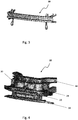
- the structural part 20 constitutes an energy absorption system, as illustrated on the figures 1 and 3 .
- a structural element is described as capable of absorbing an impact on the vehicle.
- the semi-structural part 30 is molded, in particular by an injection molding process. During this injection molding, the semi-structural part 30 is overmolded on the structural part 20 thus forming an insert. Thus, the two parts, structural 20 and semi-structural 30, form a single piece 10. It is described as semi-structural element that supports secondary functions and is not intended to absorb shocks other than low energy shocks (pedestrian shock and parking shock).
- the semi-structural part 30 forms at least one aerodynamic system 40.
- Aerodynamic system is understood to mean a set of shapes capable of fulfilling an aerodynamic function for the vehicle, or of contributing to such a function. Such shapes can thus correspond to an air guide, a frame for flaps controlled, or a baffle underbody for example.
- the semi-structural part 30 thus forms, by molding, at least one of these elements: frame for controlled flaps 42, air guide 44, underbody deflector 46.
- the piloted flaps used on the vehicle to regulate the air intake to the front of the vehicle are directly positioned on the semi-structural part 30 coming from molding (at the frame 42 coming from molding). It is therefore no longer necessary to mount them on a frame, itself assembled on the front block.
- the flaps controlled follow toward the rear of the vehicle.
- the semi-structural part forms useful elements for the overall aerodynamic system of the vehicle.
- the semi-structural part 30 supports at least one of the following functional elements 50, functional elements taken alone or in combination: a cooling system 52 (see figure 5 ), such as a radiator, a bumper skin 54 (see figure 6 ), an optical element 56 (see figure 6 ).
- a cooling system 52 see figure 5
- a bumper skin 54 such as a radiator
- an optical element 56 see figure 6 .
- the semi-structural part 30 supports a battery charger. This arrangement is particularly advantageous when the vehicle is an electric vehicle.
- This charger can be directly integrated in semi-structural part 30, the semi-structural part 30 overmolding for example the charger.
- the semi-structural part 30 supports an electronic control unit, or electronic control unit (ECU).
- ECU electronice control unit
- Such a unit is generally in the form of a housing, which is here supported by the semi-structural part 30.
- This electronic control unit can be directly integrated in the semi-structural part 30, the semi-structural part 30 overmolded by example the case of the electronic control unit (ECU).
- the one-piece piece 10 incorporates functions of bumper reinforcements. Part 10 can thus be advantageously preassembled with the bumper before supply to the vehicle manufacturer.
- the one-piece piece 10 incorporates bumper rigidity reinforcement functions.
- the piece 10 can thus advantageously incorporate a plastron 48.
- the piece 10 thus allows a better management of the diversity of the vehicle: for example, for a basic version of a vehicle, the piloted flaps 58 are not necessarily mounted on the part 10, and the frame 42 piloted flaps 58 present on the semi-structural part 30 then serves as an air guide to the radiator. It is thus possible to envisage an upscaling by post-assembly of components after the molding step.
- the semi-structural part 30 is made of thermoplastic material, for example a material based on at least one of the following products: polypropylene (PP), polyamide (PA), polyethylene (PE), polycarbonate and polybutylene terephthalate (PC-PBT).
- PP polypropylene
- PA polyamide
- PE polyethylene
- PC-PBT polybutylene terephthalate
- the plastic is advantageously reinforced by reinforcing elements such as: glass fibers, carbon fibers or mineral or natural fillers such as talc.
- the figure 2 illustrates a first example of a single piece 10 forming front block module according to the invention.
- This part 10 comprises the structural part 20 illustrated on the figure 1 .
- the rigidity of the frames 42 controlled shutters 58 located under the impact beam 22 is provided by the shock beam 22 in the upper part and the pedestrian stiffener in the lower lane.
- the direct material link between high and low tracks offers better mechanical strength than an assembly that tends to cause stress concentrations.
- the figure 4 illustrates a second example of a one-piece piece 10 forming a front block module according to the invention.
- This part 10 comprises the structural part 20 illustrated on the figure 3 .
- the lower part of the part 10 serves as the upper guide for the movable flaps, especially if ribs are added, and in the lower part, the convergent low track guides the air between the bumper and the piloted shutters.
- the air inlet surface is maximized, especially on the top (beam) and the bottom (converge).
- the figure 5 illustrates a third example of a monobloc piece 10 forming a front block module according to the invention.
- the invention also relates to a method of manufacturing a one-piece piece 10, forming a front block for a motor vehicle according to the invention.
- the structural part 20 constituting an energy absorption system is produced, then the semi-structural part 30 is molded onto the structural part 20 by means of a mold and a plastic material.
- the overmolding is realized so that the semi-structural part 30 forms at least one aerodynamic system 40.
- an injection mold is preferably used.
- the structural part 20 is made by manufacturing at least one bar of shock beam 22. Then this bar shock beam 22 is introduced into the mold as an insert overmold. Different techniques can be used to manufacture the bar 22, depending on the material used.
- the shock beam bar 22 is made of steel by means of a method chosen alone or combination among the following methods: rollforming, hydroforming, cold stamping, hot stamping.
- the shock beam bar 22 is made of aluminum by means of a method chosen alone or in combination from the following processes: stamping, extrusion.
- the beam bar 22 is made of a composite material by means of a method chosen alone or combination of the following methods: thermocompression, stamping, extrusion, pultrusion.
- the piece 10 according to the invention thus constitutes a one-piece piece, forming a front block module in which aerodynamic functions are integrated with the impact beam in a structural frame which is partly formed by the impact beam itself.
- the structural part 20 and the semi-structural part 30 have a significant cohesion, so as not to dissociate in case of impact of the vehicle in particular.
- the mechanical adhesion between the structural part 20 and the semi-structural part 30 is improved by making openings in the structural part 20 before overmoulding, so that the plastic molding material flows to through the orifices.
- the semi-structural part 30 is made in a single step, during the injection. That is, all the functions carried by the semi-structural part 30 are molded at the same time. Thus, one integrates different functions directly into the one-piece part, without additional assembly. It is thus possible in the single step of overmoulding, overmoulding sensor supports, molded air guides, the frame for the movable flaps ... without this requiring the fixing of additional supports.
- the semi-structural part 30 is made of bi-material, during the injection step.
- This mode has the advantage of being able to integrate flexible lips that promote sealing with the bumper and / or the engine cooling system.
- the flexible lips may be of elastomer type material.
Landscapes
- Engineering & Computer Science (AREA)
- Mechanical Engineering (AREA)
- Chemical & Material Sciences (AREA)
- Combustion & Propulsion (AREA)
- Transportation (AREA)
- Architecture (AREA)
- Structural Engineering (AREA)
- Manufacturing & Machinery (AREA)
- Body Structure For Vehicles (AREA)
- Injection Moulding Of Plastics Or The Like (AREA)
- Cooling, Air Intake And Gas Exhaust, And Fuel Tank Arrangements In Propulsion Units (AREA)
- Superstructure Of Vehicle (AREA)
Abstract
Description
- La présente invention concerne le domaine des véhicules automobiles. En particulier, l'invention concerne un module de blocs avant pour véhicules automobiles.
- On connait déjà dans l'état de la technique, notamment du document
WO2006/100379 , un bloc avant de véhicule automobile comprenant notamment une face avant technique supportant des éléments fonctionnels tels qu'un système de refroidissement (radiateur), une peau de pare-chocs ou encore des éléments optiques, et un système d'absorption d'énergie. - Un système d'absorption d'énergie comprend au moins une poutre de chocs, pour transmettre des efforts vers les longerons du véhicule. Une telle poutre est généralement appelée « poutre choc haute » ou « poutre choc supérieure », et elle est positionnée devant la face avant technique. Ce système comporte généralement également un système de protection des chocs piétons (absorbeur voie haute et raidisseur voie basse).
- Cette structure de bloc avant regroupe donc des pièces distinctes ayant chacune des spécificités distinctes, notamment la poutre de chocs qui assure un rôle structurel, et la face avant technique qui assure un rôle davantage fonctionnel. Cela peut représenter des difficultés d'assemblage des pièces les unes par rapport aux autres et imposer certaines contraintes sur le style du véhicule. Par exemple, le style de la peau de pare-chocs est impacté par le positionnement de la poutre de chocs pour éviter que l'on voie la poutre de chocs depuis une ouverture d'entrée d'air.
- Afin de réduire les émissions de CO2, on peut aussi trouver dans cet environnement un (ou plusieurs) cadre (généralement en plastique), sur lequel sont montés des éléments mobiles, appelés volets d'entrée d'air. Ces éléments font partie d'un système aérodynamique actif dans lequel un actionneur commande la mise en mouvement des éléments mobiles, dont la fonction est d'autoriser l'écoulement de l'air entrant par les grilles du pare-chocs et selon les configurations de vitesse du véhicule, de les obturer.
- Ce type de cadre est assemblé sur la poutre choc, dessous, dessus ou dessous et dessus, ce qui complexifie l'assemblage des divers éléments au bloc avant.
- De plus, une telle architecture de bloc avant conduit à une redondance de certaines fonctions, découlant sur une multiplicité des pièces, et donc, un alourdissement du bloc avant. Par exemple, le cadre comprend des parois horizontales, et il en est de même pour les guides d'air entre la peau de pare-chocs et le système de refroidissement. Un autre exemple, concerne également le cadre des volets mobiles : ce cadre fait office de structure pour les volets mobiles, alors que dans cet environnement, la poutre de choc et le raidisseur voie basse piéton font également office de structure.
- Il apparait donc que les blocs avants connus comportent un ensemble d'éléments qu'il est nécessaire d'assembler au cours d'une multitude d'étapes plus ou moins complexes lors de l'assemblage sur véhicule, et que de nombreuses fonctions réalisées par certains de ces éléments sont redondantes, conduisant à une complexité d'assemblage et un alourdissement du véhicule.
- La présente invention a notamment pour but de proposer une pièce monobloc, formant un module de bloc avant de véhicule allégé et dont l'assemblage est simplifié. L'invention concerne ainsi une pièce monobloc formant un module de bloc avant dans lequel des fonctions aérodynamiques (cadre pour volets pilotés), associées à d'autre fonctions aérodynamiques environnantes (volets mobiles), sont intégrées à la poutre choc dans un cadre structurel qui est en partie formé par la poutre choc elle-même.
- L'invention concerne une pièce monobloc formant un bloc avant pour véhicule automobile comprenant une partie structurelle constituant un système d'absorption d'énergie, et une partie semi-structurelle venue de moulage formant au moins un système aérodynamique, la partie semi-structurelle étant surmoulée sur la partie structurelle.
- La pièce monobloc formant un module de bloc avant selon l'invention procure entre autres les avantages suivants :
- une réduction du nombre de pièces sur le véhicule, fournissant ainsi un système compact, une simplification du flux logistique étant donné qu'il y a moins de références pièces, et une simplification de l'assemblage en usine pour le constructeur (une seule pièce à monter sur le véhicule) ;
- un allègement de la fonction purement aérodynamique car on utilise moins de matière, et on évite la fabrication de cadre redondant avec les parties du cadre déjà désignées dans les pièces existantes pour d'autres fonctions. Par ailleurs, l'allègement est également obtenu par une élimination des fixations entre éléments du bloc avant. Par exemple, la structure des cadres des volets pilotés est réalisée par la pièce monobloc directement (les volets pilotés sont directement clippés sur la pièce monobloc) et la partie semi-structurelle peut faire office directement de cloison et guide d'air.
- La pièce monobloc peut en outre comporter l'une ou plusieurs des caractéristiques suivantes, prises seules ou en combinaison :
- le système aérodynamique comporte seul ou en combinaison au moins l'un des éléments suivants : un cadre pour volets pilotés, un guide d'air, un déflecteur sous caisse, un plastron ;
- la partie semi-structurelle est apte à supporter au moins l'un des éléments fonctionnels suivants : un système de refroidissement, une peau de pare-chocs, un élément optique ;
- la partie semi-structurelle est réalisée en matière thermoplastique à base d'au moins l'un des produits suivants : polypropylène (PP), polyamide (PA), polyethylène (PE), polycarbonate et polytéréphtalate de butylène (PC-PBT) ;
- la matière thermoplastique est renforcée par des éléments de renfort ;
- la partie semi-structurelle est réalisée en bi-matière, et comprend des lèvres en matériau de type élastomère ;
- la partie structurelle comporte au moins l'un des éléments suivants : un barreau de poutre choc, un absorbeur de choc du type « crash box », un système de protection des chocs piétons ;
- la partie structurelle comporte un barreau de poutre choc en acier, en aluminium ou en matière composite ;
- la partie semi-structurelle supporte un chargeur batterie et/ou une unité de commande électronique (ECU).
- L'invention concerne également un ensemble d'une pièce monobloc selon l'invention et d'au moins l'un des éléments fonctionnels suivants : un système de refroidissement, une peau de pare-chocs, un élément optique.
- L'invention concerne également un procédé de fabrication d'une pièce monobloc formant un bloc avant pour véhicule automobile selon l'invention dans lequel on réalise la partie structurelle constituant un système d'absorption d'énergie, puis on surmoule au moyen d'un moule et d'une matière plastique la partie semi-structurelle sur la partie structurelle, de façon à ce que la partie semi-structurelle forme au moins un système aérodynamique.
- Le procédé peut en outre comporter l'une ou plusieurs des caractéristiques suivantes, prises seules ou en combinaison :
- le moule est un moule d'injection ;
- on réalise la partie structurelle en réalisant un barreau de poutre choc en acier au moyen d'un procédé choisi seul ou combinaison parmi les procédés suivants : profilage (rollforming), hydroformage, emboutissage à froid, emboutissage à chaud ;
- on réalise la partie structurelle en réalisant un barreau de poutre choc en aluminium au moyen d'un procédé choisi seul ou combinaison parmi les procédés suivants : emboutissage, extrusion ;
- on réalise la partie structurelle en réalisant un barreau de poutre choc en matière composite au moyen d'un procédé choisi seul ou combinaison parmi les procédés suivants : thermocompression, estampage, extrusion, pultrusion ;
- on introduit le barreau de poutre choc dans le moule en tant qu'insert à surmouler ;
- on améliore l'adhésion mécanique entre la partie structurelle et la partie semi-structurelle, en réalisant des orifices dans la partie structurelle avant surmoulage, afin que la matière plastique de surmoulage flue à travers les orifices ;
- on améliore l'adhésion chimique entre la partie structurelle et la partie semi-structurelle, en réalisant au moins l'une des étapes suivantes : on ajoute un adhésif sur la partie structurelle avant surmoulage par poudrage, spray, colle et/ou film ; on ajoute un adhésif dans une résine de la matière plastique, tel que de l'anhydrique maléique ;
- la partie semi-structurelle est réalisée en une seule étape de surmoulage ;
- la partie semi-structurelle est réalisée en bi-matière dont l'un au moins des matériaux est un matériau de type élastomère ;
- après l'étape de surmoulage, on assemble sur la pièce monobloc des fonctions annexes telles que des volets pilotés, des mécanismes moteurs, des câblages, de l'électronique, des capteurs.
- L'invention sera mieux comprise à la lecture des figures annexées, qui sont fournies à titre d'exemples et ne présentent aucun caractère limitatif, dans lesquelles :
- la
figure 1 illustre un premier exemple d'une partie structurelle d'une pièce monobloc formant module de bloc avant conforme à l'invention ; - la
figure 2 illustre un premier exemple de pièce monobloc formant module de bloc avant conforme à l'invention, comportant la partie structurelle de lafigure 1 ; - la
figure 3 illustre un second exemple d'une partie structurelle d'une pièce monobloc formant module de bloc avant conforme à l'invention ; - la
figure 4 illustre un second exemple de pièce monobloc formant module de bloc avant conforme à l'invention, comportant la partie structurelle de lafigure 3 ; - la
figure 5 illustre un troisième exemple de pièce monobloc formant module de bloc avant conforme à l'invention ; - la
figure 6 illustre l'avant d'un véhicule automobile, muni d'une pièce monobloc selon l'invention. - Comme illustré sur les
figures, 2 ,4 ,5 et 6 , la pièce monobloc 10 selon l'invention forme un bloc avant pour véhicule automobile et comprend une partie structurelle 20, et une partie semi-structurelle 30. - La partie structurelle 20 comporte au moins l'un des éléments suivants : un barreau de poutre choc 22, un absorbeur de choc du type « crash box » 24, un système de protection des chocs piétons 26 (absorbeur voie haute et raidisseur voie basse).
- Lorsque la partie structurelle 20 comporte un barreau de poutre choc 22, ce dernier est avantageusement réalisé en acier, en aluminium ou en matière composite.
- La partie structurelle 20 constitue un système d'absorption d'énergie, tel qu'illustré sur les
figures 1 et3 . On qualifie de structurelle un élément apte à absorber un choc subi par le véhicule. - La partie semi-structurelle 30 est venue de moulage, notamment par un procédé de moulage par injection. Au cours de ce moulage par injection, la partie semi-structurelle 30 est surmoulée sur la partie structurelle 20 formant ainsi un insert. Ainsi, les deux parties, structurelle 20 et semi-structurelle 30, forment une seule pièce monobloc 10. On qualifie de semi structurelle un élément qui supporte des fonctions secondaires et n'a pas vocation à absorber des chocs autres que des chocs à faible énergie (choc piéton et choc parking).
- La partie semi-structurelle 30 forme au moins un système aérodynamique 40. On entend par système aérodynamique un ensemble de formes aptes à remplir une fonction aérodynamique pour le véhicule, ou à contribuer à une telle fonction. De telles formes peuvent ainsi correspondre à un guide d'air, un cadre pour volets pilotés, ou à un déflecteur sous caisse par exemple. La partie semi-structurelle 30 forme donc, par moulage, au moins l'un de ces éléments : cadre pour volets pilotés 42, guide d'air 44, déflecteur sous caisse 46.
- Ainsi, les volets pilotés utilisés sur le véhicule pour réguler l'arrivée d'air à l'avant du véhicule sont directement positionnés sur la partie semi-structurelle 30 venue de moulage (au niveau du cadre 42 venu de moulage). Il n'est donc plus nécessaire de les monter sur un cadre, lui-même assemblé sur le bloc avant. De plus, en cas de recul de la poutre choc 22 lors d'un choc, les volets pilotés suivent vers l'arrière du véhicule.
- Ainsi, la partie semi-structurelle forme des éléments utiles pour le système aérodynamique global du véhicule.
- Selon un mode de réalisation, la partie semi-structurelle 30 supporte au moins l'un des éléments fonctionnels 50 suivants, éléments fonctionnels pris seul ou en combinaison : un système de refroidissement 52 (voir
figure 5 ), tel qu'un radiateur, une peau de pare-chocs 54 (voirfigure 6 ), un élément optique 56 (voirfigure 6 ). - Avantageusement, la partie semi-structurelle 30 supporte un chargeur batterie. Cette disposition est particulièrement avantageuse lorsque le véhicule est un véhicule électrique. Ce chargeur peut être directement intégré dans partie semi-structurelle 30, la partie semi-structurelle 30 surmoulant par exemple le chargeur.
- Avantageusement, la partie semi-structurelle 30 supporte une unité de commande électronique, ou electronic control unit (ECU). Une telle unité est généralement sous la forme d'un boitier, qui est ici supporté par la partie semi-structurelle 30. Cette unité de commande électronique peut être directement intégrée dans la partie semi-structurelle 30, la partie semi-structurelle 30 surmoulant par exemple le boitier de l'unité de commande électronique (ECU).
- Selon un exemple, la pièce monobloc 10 intègre des fonctions de renforts de pare-chocs. La pièce 10 peut ainsi être avantageusement préassemblée avec le pare-chocs avant fourniture au constructeur du véhicule.
- Selon un exemple, la pièce monobloc 10 intègre des fonctions de renforcement de la rigidité du pare-chocs. La pièce 10 peut ainsi avantageusement intégrer un plastron 48.
- La pièce 10 permet ainsi une meilleure gestion de la diversité du véhicule : par exemple, pour une version de base d'un véhicule, les volets pilotés 58 ne sont pas nécessairement montés sur la pièce 10, et le cadre 42 des volets pilotés 58 présent sur la partie semi-structurelle 30 sert alors de guide d'air vers le radiateur. On peut ainsi envisager une montée en gamme par post-assemblage de composants après l'étape de moulage.
- De façon avantageuse, la partie semi-structurelle 30 est réalisée en matière thermoplastique, par exemple une matière à base d'au moins l'un des produits suivants : polypropylène (PP), polyamide (PA), polyethylène (PE), polycarbonate et polytéréphtalate de butylène (PC-PBT).
- La matière plastique est avantageusement renforcée par des éléments de renforts tels que : des fibres de verre, de carbone ou bien des charges minérales ou naturelles comme du talc.
- La
figure 2 illustre un premier exemple de pièce monobloc 10 formant module de bloc avant conforme à l'invention. Cette pièce 10 comporte la partie structurelle 20 illustrée sur lafigure 1 . Comme on peut le constater, la rigidité des cadres 42 des volets pilotés 58 situés sous la poutre choc 22 est offerte par la poutre choc 22 en partie supérieure et le raidisseur piéton en voie basse. Le lien direct de matière entre voie haute et voie basse offre une meilleure tenue mécanique qu'un assemblage qui a tendance à provoquer des concentrations de contraintes. - La
figure 4 illustre un second exemple de pièce monobloc 10 formant module de bloc avant conforme à l'invention. Cette pièce 10 comporte la partie structurelle 20 illustrée sur lafigure 3 . La partie inférieure de la pièce 10 sert de guidage supérieur aux volets mobiles, notamment si on ajoute des nervures, et en partie basse, le convergent voie basse permet de guider l'air entre le pare-chocs et les shutters pilotés. On maximise la surface d'entrée d'air notamment sur le haut (poutre) et le bas (convergent). - La
figure 5 illustre un troisième exemple de pièce monobloc 10 formant module de bloc avant conforme à l'invention. - L'invention concerne également un procédé de fabrication d'une pièce monobloc 10, formant un bloc avant pour véhicule automobile selon l'invention.
- Selon ce procédé, on réalise la partie structurelle 20 constituant un système d'absorption d'énergie, puis on surmoule au moyen d'un moule et d'une matière plastique la partie semi-structurelle 30 sur la partie structurelle 20. Le surmoulage est réalisé de façon à ce que la partie semi-structurelle 30 forme au moins un système aérodynamique 40.
- Pour réaliser le surmoulage, on utilise de préférence, un moule d'injection.
- La partie structurelle 20 est réalisée en fabriquant au moins un barreau de poutre choc 22. Puis ce barreau de poutre choc 22 est introduit dans le moule en tant qu'insert à surmouler. Différentes techniques peuvent être utilisées pour fabriquer le barreau 22, en fonction de la matière utilisée.
- Selon un premier exemple de réalisation, le barreau de poutre choc 22 est réalisé en acier au moyen d'un procédé choisi seul ou combinaison parmi les procédés suivants : profilage (rollforming), hydroformage, emboutissage à froid, emboutissage à chaud.
- Selon un second exemple de réalisation, le barreau de poutre choc 22 est réalisé en aluminium au moyen d'un procédé choisi seul ou combinaison parmi les procédés suivants : emboutissage, extrusion.
- Selon un troisième exemple de réalisation, le barreau de poutre choc 22 est réalisé en matière composite au moyen d'un procédé choisi seul ou combinaison parmi les procédés suivants : thermocompression, estampage, extrusion, pultrusion.
- La pièce 10 selon l'invention constitue ainsi une pièce monobloc, formant un module de bloc avant dans lequel des fonctions aérodynamiques sont intégrées à la poutre choc dans un cadre structurel qui est en partie formé par la poutre choc elle-même.
- Il est donc important que la partie structurelle 20 et la partie semi-structurelle 30 possèdent une cohésion importante, afin de ne pas se dissocier en cas de choc du véhicule notamment.
- Pour ce faire, selon un mode de réalisation, on améliore l'adhésion mécanique entre la partie structurelle 20 et la partie semi-structurelle 30, en réalisant des orifices dans la partie structurelle 20 avant surmoulage, afin que la matière plastique de surmoulage flue à travers les orifices.
- Pour améliorer la cohésion entre les deux parties, on peut également, alternativement ou en complément, améliorer l'adhésion chimique entre la partie structurelle 20 et la partie semi-structurelle 30, en réalisant au moins l'une des étapes suivantes :
- on ajoute un adhésif sur la partie structurelle 20 avant surmoulage par poudrage, spray, colle et/ou film ;
- on ajoute un adhésif dans une résine de la matière plastique, tel que de l'anhydrique maléique.
- Selon un mode de réalisation, la partie semi-structurelle 30 est réalisée en une seule étape, lors de l'injection. C'est-à-dire que toutes les fonctions portées par la partie semi-structurelle 30 sont moulées en mêmes temps. Ainsi, on intègre différentes fonctions directement dans la pièce monobloc, sans assemblage complémentaire. Il est ainsi possible lors de l'unique étape de surmoulage, de surmouler des supports de capteurs, des guides d'air venu de moulage, le cadre pour les volets mobiles... sans que cela ne nécessite de fixer des supports complémentaires.
- Selon un second mode de réalisation, la partie semi-structurelle 30 est réalisée en bi-matière, lors de l'étape d'injection. Ce mode a l'avantage de pouvoir intégrer des lèvres souples qui favorisent l'étanchéité avec le pare choc et/ou le système de refroidissement moteur. Les lèvres souples peuvent être en matériau de type élastomère.
- Bien entendu, il est également envisagé de compléter les fonctions de la pièce monobloc 10 par des éléments assemblés 50 ultérieurement à l'étape de surmoulage, tels que : des volets pilotés 58, des mécanismes moteurs, des câblages, de l'électronique, des capteurs...
-
- 10 : pièce monobloc formant un bloc avant pour véhicule automobile
- 20 : partie structurelle de la pièce monobloc 10
- 22 : barreau de poutre choc de la partie structurelle 20
- 24 : absorbeur de choc du type « crash box » de la partie structurelle 20
- 26 : système de protection des chocs piétons de la partie structurelle 20
- 30 : partie semi-structurelle de la pièce monobloc 10
- 40 : système aérodynamique de la partie semi-structurelle 30
- 42 : cadre pour volets pilotés 42 du système aérodynamique 40
- 44 : guide d'air 44 du système aérodynamique 40
- 46 : déflecteur sous caisse du système aérodynamique 40
- 48 : plastron de la pièce monobloc 10
- 50 : éléments fonctionnels 50 supportés par la partie semi-structurelle 30, assemblés sur la pièce 10, ultérieurement à l'étape de surmoulage
- 52 : système de refroidissement des éléments fonctionnels 50
- 54 : peau de pare-chocs des éléments fonctionnels 50
- 56 : élément optique des éléments fonctionnels 50
- 58 : volets pilotés
Claims (21)
- Pièce monobloc (10) formant un bloc avant pour véhicule automobile comprenant une partie structurelle (20) constituant un système d'absorption d'énergie, et une partie semi-structurelle (30) venue de moulage formant au moins un système aérodynamique (40), la partie semi-structurelle (30) étant surmoulée sur la partie structurelle (20).
- Pièce (10) selon la revendication précédente, dans lequel le système aérodynamique (40) comporte seul ou en combinaison au moins l'un des éléments suivants : un cadre pour volets pilotés (42), un guide d'air (44), un déflecteur sous caisse (46), un plastron (48).
- Pièce (10) selon l'une des revendications précédentes, dans lequel la partie semi-structurelle (30) est apte à supporter au moins l'un des éléments fonctionnels (50) suivants : un système de refroidissement (52), une peau de pare-chocs (54), un élément optique (56).
- Pièce (10) selon l'une des revendications précédentes, dans lequel la partie semi-structurelle (30) est réalisée en matière thermoplastique à base d'au moins l'un des produits suivants : polypropylène (PP), polyamide (PA), polyethylène (PE), polycarbonate et polytéréphtalate de butylène (PC-PBT).
- Pièce (10) selon la revendication précédente, dans lequel la matière thermoplastique est renforcée par des éléments de renfort.
- Pièce (10) selon l'une des revendications précédentes, dans lequel la partie semi-structurelle (30) est réalisée en bi-matière, et comprend des lèvres en matériau de type élastomère.
- Pièce (10) selon l'une des revendications précédentes, dans lequel la partie structurelle (20) comporte au moins l'un des éléments suivants : un barreau de poutre choc (22), un absorbeur de choc du type « crash box » (24), un système de protection des chocs piétons (26).
- Pièce (10) selon l'une des revendications précédentes, dans lequel la partie structurelle (20) comporte un barreau de poutre choc (22) en acier, en aluminium ou en matière composite.
- Pièce (10) selon l'une des revendications précédentes dans laquelle la partie semi-structurelle supporte un chargeur batterie et/ou une unité de commande électronique (ECU).
- Ensemble d'une pièce (10) selon l'une des revendications précédentes et d'au moins l'un des éléments fonctionnels (50) suivants : un système de refroidissement (52), une peau de pare-chocs (54), un élément optique (56).
- Procédé de fabrication d'une pièce monobloc (10) formant un bloc avant pour véhicule automobile selon l'une des revendications 1 à 9, dans lequel on réalise la partie structurelle (20) constituant un système d'absorption d'énergie, puis on surmoule au moyen d'un moule et d'une matière plastique la partie semi-structurelle (30) sur la partie structurelle (20), de façon à ce que la partie semi-structurelle (30) forme au moins un système aérodynamique (40).
- Procédé selon la revendication précédente, dans lequel le moule est un moule d'injection.
- Procédé selon l'une des revendications 11 et 12, dans lequel on réalise la partie structurelle (20) en réalisant un barreau de poutre choc (22) en acier au moyen d'un procédé choisi seul ou combinaison parmi les procédés suivants : profilage, hydroformage, emboutissage à froid, emboutissage à chaud.
- Procédé selon l'une des revendications 11 et 12, dans lequel on réalise la partie structurelle (20) en réalisant un barreau de poutre choc (22) en aluminium au moyen d'un procédé choisi seul ou combinaison parmi les procédés suivants : emboutissage, extrusion.
- Procédé selon l'une des revendications 11 et 12, dans lequel on réalise la partie structurelle (20) en réalisant un barreau de poutre choc (22) en matière composite au moyen d'un procédé choisi seul ou combinaison parmi les procédés suivants : thermocompression, estampage, extrusion, pultrusion.
- Procédé selon l'une des revendications 1 à 15, dans lequel on introduit le barreau de poutre choc (22) dans le moule en tant qu'insert à surmouler.
- Procédé selon l'une des revendications 11 à 16, dans lequel on améliore l'adhésion mécanique entre la partie structurelle (20) et la partie semi-structurelle (30), en réalisant des orifices dans la partie structurelle (20) avant surmoulage, afin que la matière plastique de surmoulage flue à travers les orifices.
- Procédé selon l'une des revendications 11 à 17, dans lequel on améliore l'adhésion chimique entre la partie structurelle (20) et la partie semi-structurelle (30), en réalisant au moins l'une des étapes suivantes :- on ajoute un adhésif sur la partie structurelle (20) avant surmoulage par poudrage, spray, colle et/ou film ;- on ajoute un adhésif dans une résine de la matière plastique, tel que de l'anhydrique maléique.
- Procédé selon l'une des revendications 11 à 18, dans lequel la partie semi-structurelle (30) est réalisée en une seule étape de surmoulage.
- Procédé selon l'une des revendications 11 à 19, dans lequel la partie semi-structurelle (30) est réalisée en bi-matière dont l'un au moins des matériaux est un matériau de type élastomère.
- Procédé selon l'une des revendications 11 à 20, dans lequel après l'étape de surmoulage, on assemble sur la pièce monobloc (10) des fonctions annexes (50) telles que des volets pilotés (58), des mécanismes moteurs, des câblages, de l'électronique, des capteurs.
Applications Claiming Priority (1)
| Application Number | Priority Date | Filing Date | Title |
|---|---|---|---|
| FR1758255A FR3070665B1 (fr) | 2017-09-07 | 2017-09-07 | Piece monobloc formant un bloc avant comportant un systeme d'absorption et un systeme aerodynamique |
Publications (2)
| Publication Number | Publication Date |
|---|---|
| EP3453597A1 true EP3453597A1 (fr) | 2019-03-13 |
| EP3453597B1 EP3453597B1 (fr) | 2020-07-15 |
Family
ID=60020190
Family Applications (1)
| Application Number | Title | Priority Date | Filing Date |
|---|---|---|---|
| EP18193228.6A Active EP3453597B1 (fr) | 2017-09-07 | 2018-09-07 | Pièce monobloc formant un bloc avant comportant un système d'absorption et un système aérodynamique |
Country Status (11)
| Country | Link |
|---|---|
| US (1) | US11059520B2 (fr) |
| EP (1) | EP3453597B1 (fr) |
| JP (1) | JP7203540B2 (fr) |
| KR (1) | KR102283037B1 (fr) |
| CN (1) | CN109466634A (fr) |
| AR (1) | AR112960A1 (fr) |
| BR (1) | BR102018067910B1 (fr) |
| ES (1) | ES2824810T3 (fr) |
| FR (1) | FR3070665B1 (fr) |
| MX (1) | MX394326B (fr) |
| RU (1) | RU2711181C1 (fr) |
Cited By (1)
| Publication number | Priority date | Publication date | Assignee | Title |
|---|---|---|---|---|
| WO2019241598A1 (fr) * | 2018-06-13 | 2019-12-19 | Zephyros, Inc. | Dispositifs pultrudés moulés hybrides |
Families Citing this family (8)
| Publication number | Priority date | Publication date | Assignee | Title |
|---|---|---|---|---|
| JP6863036B2 (ja) * | 2017-04-19 | 2021-04-21 | スズキ株式会社 | 車両前部構造 |
| FR3087402B1 (fr) | 2018-10-18 | 2020-10-30 | Plastic Omnium Cie | Renfort de parechoc destine a etre integre dans un bloc avant de vehicule comprenant une platine supportant des capteurs |
| CN111547001B (zh) * | 2020-05-29 | 2021-08-17 | 重庆工程职业技术学院 | 一种汽车保险杠 |
| CN111907448B (zh) * | 2020-08-10 | 2022-04-08 | 宁波吉利汽车研究开发有限公司 | 车辆传力路径前端结构及车辆 |
| KR102854826B1 (ko) * | 2020-10-05 | 2025-09-04 | 현대자동차주식회사 | 차량용 프론트 범퍼구조 |
| ES2922028A1 (es) | 2021-02-23 | 2022-09-06 | Srg Global Liria S L | Un metodo de moldeo por inyeccion de multiples disparos de una pieza decorativa para la parte delantera de un vehiculo y una pieza decorativa moldeada por inyeccion de multiples disparos para la parte delantera de un vehiculo |
| CN114633443B (zh) * | 2022-03-11 | 2024-05-24 | 重庆平伟汽车零部件有限公司 | 一种复杂菱形格栅注塑成型工艺的优化方法 |
| KR20240169377A (ko) * | 2023-05-24 | 2024-12-03 | 현대자동차주식회사 | 차량의 프론트엔드모듈 프레임 |
Citations (4)
| Publication number | Priority date | Publication date | Assignee | Title |
|---|---|---|---|---|
| FR2981887A1 (fr) * | 2011-11-02 | 2013-05-03 | Renault Sas | Guide d'air structurel et modulaire a fonction de face avant technique de moteur de vehicule automobile et vehicule ainsi equipe. |
| WO2015165939A1 (fr) * | 2014-04-30 | 2015-11-05 | Valeo Systemes Thermiques | Guide d'air et module de guide d'air |
| FR3038290A1 (fr) * | 2015-07-03 | 2017-01-06 | Peugeot Citroen Automobiles Sa | Ensemble comprenant une cloison et un deflecteur |
| WO2017109647A1 (fr) * | 2015-12-23 | 2017-06-29 | Sabic Global Technologies B.V. | Élément inférieur d'absorption d'énergie composite/hybride pour automobiles, et son procédé de fabrication |
Family Cites Families (24)
| Publication number | Priority date | Publication date | Assignee | Title |
|---|---|---|---|---|
| JPH0753857B2 (ja) * | 1987-04-29 | 1995-06-07 | 豊田合成株式会社 | インサ−ト反応射出成形品 |
| JPH04119253U (ja) * | 1991-04-04 | 1992-10-26 | 三菱自動車工業株式会社 | 二層構造のバンパ |
| FR2783796B1 (fr) * | 1998-09-30 | 2001-02-23 | Valeo Thermique Moteur Sa | Facade avant composite metal/plastique renforcee surmoulee pour vehicule automobile |
| FR2804649B1 (fr) * | 2000-02-07 | 2002-05-10 | Ecia Equip Composants Ind Auto | Face avant pour vehicule automobile |
| AU2003248628A1 (en) | 2002-06-06 | 2003-12-22 | Netshape Corp | Bumper with integrated energy absorber and beam |
| FR2883542B1 (fr) * | 2005-03-23 | 2007-06-15 | Plastic Omnium Cie | Traverse superieure pour bloc avant de vehicule automobile |
| FR2938805B1 (fr) * | 2008-11-24 | 2011-09-30 | Faurecia Bloc Avant | Module de face avant de vehicule automobile comprenant un bouclier |
| DE102009031746A1 (de) * | 2009-07-06 | 2011-01-13 | GM Global Technology Operations, Inc., Detroit | Kühlluftführungseinrichtung für ein Kraftfahrzeug |
| US20110039470A1 (en) * | 2009-07-30 | 2011-02-17 | E.I. Du Pont De Nemours And Company | Overmolded heat resistant polyamide composite structures and processes for their preparation |
| US8646552B2 (en) * | 2010-07-21 | 2014-02-11 | Shape Corp. | Integrated energy absorber and air flow management structure |
| CN202264723U (zh) * | 2011-10-27 | 2012-06-06 | 武汉名杰模塑有限公司 | 一种带吸能块的汽车保险杠 |
| EP2869986B1 (fr) * | 2012-07-06 | 2018-09-19 | Compagnie Plastic Omnium | Moule pour former une piece de vehicule automobile en materiau polymere |
| US9162641B2 (en) * | 2012-11-12 | 2015-10-20 | GM Global Technology Operations LLC | Front fascia or grill support structure and aerodynamic shutter assembly |
| US8931828B2 (en) * | 2012-11-12 | 2015-01-13 | GM Global Technology Operations LLC | Grill opening reinforcement assembly |
| JP6191354B2 (ja) * | 2013-09-18 | 2017-09-06 | スズキ株式会社 | 車体下部のカバー構造 |
| JP6041313B2 (ja) | 2013-09-27 | 2016-12-07 | 林テレンプ株式会社 | 車両用バンパー構造、及び、バンパーアブソーバー |
| KR20150043855A (ko) * | 2013-10-15 | 2015-04-23 | 현대자동차주식회사 | 쿨링 덕트 구조 |
| FR3013302B1 (fr) * | 2013-11-19 | 2015-12-11 | Renault Sas | Guide d'air monopiece pour face avant de vehicule automobile et vehicule ainsi equipe |
| CN203902458U (zh) * | 2013-12-24 | 2014-10-29 | 福特环球技术公司 | 前保险杠缓冲件、前保险杠组件 |
| FR3015941B1 (fr) | 2013-12-26 | 2017-04-07 | Plastic Omnium Cie | Augmentation de la compressibilite d'une poutre de pare-choc |
| KR101585546B1 (ko) * | 2014-07-18 | 2016-01-15 | 한화첨단소재 주식회사 | 연속섬유로 이루어진 로드 형태의 프론트 앤드 캐리어 어퍼멤버 제조방법 |
| JP6432376B2 (ja) | 2015-02-09 | 2018-12-05 | 株式会社デンソー | 車両用衝突検知装置 |
| JP6365514B2 (ja) | 2015-11-20 | 2018-08-01 | マツダ株式会社 | 車両の衝撃吸収構造 |
| CN205601770U (zh) * | 2015-11-30 | 2016-09-28 | 上汽通用汽车有限公司 | 一种车辆的保险杠结构以及具有其的车辆 |
-
2017
- 2017-09-07 FR FR1758255A patent/FR3070665B1/fr not_active Expired - Fee Related
-
2018
- 2018-09-04 JP JP2018164977A patent/JP7203540B2/ja active Active
- 2018-09-04 RU RU2018131698A patent/RU2711181C1/ru active
- 2018-09-05 BR BR102018067910-4A patent/BR102018067910B1/pt active IP Right Grant
- 2018-09-05 MX MX2018010716A patent/MX394326B/es unknown
- 2018-09-06 KR KR1020180106550A patent/KR102283037B1/ko active Active
- 2018-09-06 CN CN201811036643.6A patent/CN109466634A/zh active Pending
- 2018-09-07 ES ES18193228T patent/ES2824810T3/es active Active
- 2018-09-07 EP EP18193228.6A patent/EP3453597B1/fr active Active
- 2018-09-07 AR ARP180102559A patent/AR112960A1/es active IP Right Grant
- 2018-09-07 US US16/124,703 patent/US11059520B2/en active Active
Patent Citations (4)
| Publication number | Priority date | Publication date | Assignee | Title |
|---|---|---|---|---|
| FR2981887A1 (fr) * | 2011-11-02 | 2013-05-03 | Renault Sas | Guide d'air structurel et modulaire a fonction de face avant technique de moteur de vehicule automobile et vehicule ainsi equipe. |
| WO2015165939A1 (fr) * | 2014-04-30 | 2015-11-05 | Valeo Systemes Thermiques | Guide d'air et module de guide d'air |
| FR3038290A1 (fr) * | 2015-07-03 | 2017-01-06 | Peugeot Citroen Automobiles Sa | Ensemble comprenant une cloison et un deflecteur |
| WO2017109647A1 (fr) * | 2015-12-23 | 2017-06-29 | Sabic Global Technologies B.V. | Élément inférieur d'absorption d'énergie composite/hybride pour automobiles, et son procédé de fabrication |
Cited By (4)
| Publication number | Priority date | Publication date | Assignee | Title |
|---|---|---|---|---|
| WO2019241598A1 (fr) * | 2018-06-13 | 2019-12-19 | Zephyros, Inc. | Dispositifs pultrudés moulés hybrides |
| EP4253015A3 (fr) * | 2018-06-13 | 2023-12-27 | Zephyros Inc. | Dispositifs pultrudés moulés hybrides |
| US11890825B2 (en) | 2018-06-13 | 2024-02-06 | Zephyros, Inc. | Hybrid molded and pultruded devices |
| US12350866B2 (en) | 2018-06-13 | 2025-07-08 | Zephyros, Inc. | Hybrid molded and pultruded devices |
Also Published As
| Publication number | Publication date |
|---|---|
| BR102018067910A8 (pt) | 2023-02-28 |
| US11059520B2 (en) | 2021-07-13 |
| AR112960A1 (es) | 2020-01-08 |
| ES2824810T3 (es) | 2021-05-13 |
| US20190071130A1 (en) | 2019-03-07 |
| JP7203540B2 (ja) | 2023-01-13 |
| KR102283037B1 (ko) | 2021-07-28 |
| EP3453597B1 (fr) | 2020-07-15 |
| MX394326B (es) | 2025-03-24 |
| KR20190027749A (ko) | 2019-03-15 |
| FR3070665B1 (fr) | 2019-09-13 |
| BR102018067910A2 (pt) | 2019-04-24 |
| JP2019051931A (ja) | 2019-04-04 |
| RU2711181C1 (ru) | 2020-01-15 |
| FR3070665A1 (fr) | 2019-03-08 |
| BR102018067910B1 (pt) | 2024-02-20 |
| CN109466634A (zh) | 2019-03-15 |
Similar Documents
| Publication | Publication Date | Title |
|---|---|---|
| EP3453597B1 (fr) | Pièce monobloc formant un bloc avant comportant un système d'absorption et un système aérodynamique | |
| EP0994006B1 (fr) | Procédé de fabrication d'une face avant de véhicule automobile et face avant apte à être fabriquée par ce procédé | |
| EP2300250B1 (fr) | Ouvrant, notamment hayon, de vehicule | |
| EP1032527A1 (fr) | Facade avant composite metal/plastique surmoulee pour vehicule automobile | |
| JP2017508656A (ja) | 複合リフトゲート | |
| FR2904868A1 (fr) | Groupe structurel alveolaire et procede de fabrication d'un tel groupe | |
| EP3041698B1 (fr) | Caisson intérieur pour hayon de véhicule, avec panneau technique rapporté | |
| EP3294613B1 (fr) | Pavillon structurel, et véhicule équipé d'un tel pavillon | |
| DE102007006493A1 (de) | Leichtbauteil in Hybridbauweise | |
| US10406893B2 (en) | Inner support panel for mounting a hardware module of a vehicle door assembly | |
| US10906590B2 (en) | Vehicle assembly and methods of making and using the same | |
| EP2164719B1 (fr) | Module structurel d'emmarchement | |
| EP2029416B1 (fr) | Piece de structure pour bloc avant de vehicule automobile | |
| FR2687974A1 (fr) | Chassis pour vehicule, procede de fabrication d'un tel chassis, et vehicule ainsi equipe. | |
| CN105818870B (zh) | 用于生产复合结构类型的机动车辆车身的方法 | |
| EP1718515B1 (fr) | Procede de fabrication d'un plancher de vehicule comprenant une couche de materiau synthetique | |
| KR100826472B1 (ko) | 차량의 프론트 엔드 모듈용 캐리어 | |
| FR3014401A1 (fr) | Tablier avant par assemblage de pieces composites | |
| FR2771990A1 (fr) | Piece de carrosserie monobloc destinee a un vehicule automobile et son procede de fabrication | |
| FR3076804A1 (fr) | Piece structurelle pour caisse en blanc de vehicule et procede de fabrication associe | |
| EP2830897A1 (fr) | Conduit d'alimentation d'air habitacle | |
| FR2883248A1 (fr) | Facade arriere interne pour vehicule destinee a etre fixe a des cotes de caisse | |
| FR3140611A1 (fr) | Ensemble de planche de bord | |
| FR3141673A1 (fr) | ProcÉDÉ d’implantation d’Interfaces fonctionnelles sur des piÈces de vÉhicule automobile par impression 3D |
Legal Events
| Date | Code | Title | Description |
|---|---|---|---|
| PUAI | Public reference made under article 153(3) epc to a published international application that has entered the european phase |
Free format text: ORIGINAL CODE: 0009012 |
|
| STAA | Information on the status of an ep patent application or granted ep patent |
Free format text: STATUS: THE APPLICATION HAS BEEN PUBLISHED |
|
| AK | Designated contracting states |
Kind code of ref document: A1 Designated state(s): AL AT BE BG CH CY CZ DE DK EE ES FI FR GB GR HR HU IE IS IT LI LT LU LV MC MK MT NL NO PL PT RO RS SE SI SK SM TR |
|
| AX | Request for extension of the european patent |
Extension state: BA ME |
|
| STAA | Information on the status of an ep patent application or granted ep patent |
Free format text: STATUS: REQUEST FOR EXAMINATION WAS MADE |
|
| 17P | Request for examination filed |
Effective date: 20190912 |
|
| RAV | Requested validation state of the european patent: fee paid |
Extension state: MA Effective date: 20190912 |
|
| RBV | Designated contracting states (corrected) |
Designated state(s): AL AT BE BG CH CY CZ DE DK EE ES FI FR GB GR HR HU IE IS IT LI LT LU LV MC MK MT NL NO PL PT RO RS SE SI SK SM TR |
|
| RIC1 | Information provided on ipc code assigned before grant |
Ipc: B62D 29/00 20060101ALI20191204BHEP Ipc: B62D 25/08 20060101AFI20191204BHEP Ipc: B62D 29/04 20060101ALI20191204BHEP |
|
| GRAP | Despatch of communication of intention to grant a patent |
Free format text: ORIGINAL CODE: EPIDOSNIGR1 |
|
| STAA | Information on the status of an ep patent application or granted ep patent |
Free format text: STATUS: GRANT OF PATENT IS INTENDED |
|
| INTG | Intention to grant announced |
Effective date: 20200203 |
|
| GRAS | Grant fee paid |
Free format text: ORIGINAL CODE: EPIDOSNIGR3 |
|
| GRAA | (expected) grant |
Free format text: ORIGINAL CODE: 0009210 |
|
| STAA | Information on the status of an ep patent application or granted ep patent |
Free format text: STATUS: THE PATENT HAS BEEN GRANTED |
|
| AK | Designated contracting states |
Kind code of ref document: B1 Designated state(s): AL AT BE BG CH CY CZ DE DK EE ES FI FR GB GR HR HU IE IS IT LI LT LU LV MC MK MT NL NO PL PT RO RS SE SI SK SM TR |
|
| REG | Reference to a national code |
Ref country code: CH Ref legal event code: EP Ref country code: GB Ref legal event code: FG4D Free format text: NOT ENGLISH |
|
| REG | Reference to a national code |
Ref country code: DE Ref legal event code: R096 Ref document number: 602018006020 Country of ref document: DE |
|
| REG | Reference to a national code |
Ref country code: IE Ref legal event code: FG4D Free format text: LANGUAGE OF EP DOCUMENT: FRENCH |
|
| REG | Reference to a national code |
Ref country code: AT Ref legal event code: REF Ref document number: 1290737 Country of ref document: AT Kind code of ref document: T Effective date: 20200815 |
|
| REG | Reference to a national code |
Ref country code: LT Ref legal event code: MG4D |
|
| REG | Reference to a national code |
Ref country code: AT Ref legal event code: MK05 Ref document number: 1290737 Country of ref document: AT Kind code of ref document: T Effective date: 20200715 |
|
| REG | Reference to a national code |
Ref country code: NL Ref legal event code: MP Effective date: 20200715 |
|
| PG25 | Lapsed in a contracting state [announced via postgrant information from national office to epo] |
Ref country code: LT Free format text: LAPSE BECAUSE OF FAILURE TO SUBMIT A TRANSLATION OF THE DESCRIPTION OR TO PAY THE FEE WITHIN THE PRESCRIBED TIME-LIMIT Effective date: 20200715 Ref country code: HR Free format text: LAPSE BECAUSE OF FAILURE TO SUBMIT A TRANSLATION OF THE DESCRIPTION OR TO PAY THE FEE WITHIN THE PRESCRIBED TIME-LIMIT Effective date: 20200715 Ref country code: AT Free format text: LAPSE BECAUSE OF FAILURE TO SUBMIT A TRANSLATION OF THE DESCRIPTION OR TO PAY THE FEE WITHIN THE PRESCRIBED TIME-LIMIT Effective date: 20200715 Ref country code: PT Free format text: LAPSE BECAUSE OF FAILURE TO SUBMIT A TRANSLATION OF THE DESCRIPTION OR TO PAY THE FEE WITHIN THE PRESCRIBED TIME-LIMIT Effective date: 20201116 Ref country code: BG Free format text: LAPSE BECAUSE OF FAILURE TO SUBMIT A TRANSLATION OF THE DESCRIPTION OR TO PAY THE FEE WITHIN THE PRESCRIBED TIME-LIMIT Effective date: 20201015 Ref country code: SE Free format text: LAPSE BECAUSE OF FAILURE TO SUBMIT A TRANSLATION OF THE DESCRIPTION OR TO PAY THE FEE WITHIN THE PRESCRIBED TIME-LIMIT Effective date: 20200715 Ref country code: FI Free format text: LAPSE BECAUSE OF FAILURE TO SUBMIT A TRANSLATION OF THE DESCRIPTION OR TO PAY THE FEE WITHIN THE PRESCRIBED TIME-LIMIT Effective date: 20200715 Ref country code: NO Free format text: LAPSE BECAUSE OF FAILURE TO SUBMIT A TRANSLATION OF THE DESCRIPTION OR TO PAY THE FEE WITHIN THE PRESCRIBED TIME-LIMIT Effective date: 20201015 Ref country code: GR Free format text: LAPSE BECAUSE OF FAILURE TO SUBMIT A TRANSLATION OF THE DESCRIPTION OR TO PAY THE FEE WITHIN THE PRESCRIBED TIME-LIMIT Effective date: 20201016 |
|
| PG25 | Lapsed in a contracting state [announced via postgrant information from national office to epo] |
Ref country code: LV Free format text: LAPSE BECAUSE OF FAILURE TO SUBMIT A TRANSLATION OF THE DESCRIPTION OR TO PAY THE FEE WITHIN THE PRESCRIBED TIME-LIMIT Effective date: 20200715 Ref country code: RS Free format text: LAPSE BECAUSE OF FAILURE TO SUBMIT A TRANSLATION OF THE DESCRIPTION OR TO PAY THE FEE WITHIN THE PRESCRIBED TIME-LIMIT Effective date: 20200715 Ref country code: PL Free format text: LAPSE BECAUSE OF FAILURE TO SUBMIT A TRANSLATION OF THE DESCRIPTION OR TO PAY THE FEE WITHIN THE PRESCRIBED TIME-LIMIT Effective date: 20200715 Ref country code: IS Free format text: LAPSE BECAUSE OF FAILURE TO SUBMIT A TRANSLATION OF THE DESCRIPTION OR TO PAY THE FEE WITHIN THE PRESCRIBED TIME-LIMIT Effective date: 20201115 |
|
| PG25 | Lapsed in a contracting state [announced via postgrant information from national office to epo] |
Ref country code: NL Free format text: LAPSE BECAUSE OF FAILURE TO SUBMIT A TRANSLATION OF THE DESCRIPTION OR TO PAY THE FEE WITHIN THE PRESCRIBED TIME-LIMIT Effective date: 20200715 |
|
| REG | Reference to a national code |
Ref country code: DE Ref legal event code: R097 Ref document number: 602018006020 Country of ref document: DE |
|
| PG25 | Lapsed in a contracting state [announced via postgrant information from national office to epo] |
Ref country code: IT Free format text: LAPSE BECAUSE OF FAILURE TO SUBMIT A TRANSLATION OF THE DESCRIPTION OR TO PAY THE FEE WITHIN THE PRESCRIBED TIME-LIMIT Effective date: 20200715 Ref country code: SM Free format text: LAPSE BECAUSE OF FAILURE TO SUBMIT A TRANSLATION OF THE DESCRIPTION OR TO PAY THE FEE WITHIN THE PRESCRIBED TIME-LIMIT Effective date: 20200715 Ref country code: EE Free format text: LAPSE BECAUSE OF FAILURE TO SUBMIT A TRANSLATION OF THE DESCRIPTION OR TO PAY THE FEE WITHIN THE PRESCRIBED TIME-LIMIT Effective date: 20200715 Ref country code: DK Free format text: LAPSE BECAUSE OF FAILURE TO SUBMIT A TRANSLATION OF THE DESCRIPTION OR TO PAY THE FEE WITHIN THE PRESCRIBED TIME-LIMIT Effective date: 20200715 Ref country code: CZ Free format text: LAPSE BECAUSE OF FAILURE TO SUBMIT A TRANSLATION OF THE DESCRIPTION OR TO PAY THE FEE WITHIN THE PRESCRIBED TIME-LIMIT Effective date: 20200715 Ref country code: RO Free format text: LAPSE BECAUSE OF FAILURE TO SUBMIT A TRANSLATION OF THE DESCRIPTION OR TO PAY THE FEE WITHIN THE PRESCRIBED TIME-LIMIT Effective date: 20200715 |
|
| REG | Reference to a national code |
Ref country code: ES Ref legal event code: FG2A Ref document number: 2824810 Country of ref document: ES Kind code of ref document: T3 Effective date: 20210513 |
|
| PLBE | No opposition filed within time limit |
Free format text: ORIGINAL CODE: 0009261 |
|
| STAA | Information on the status of an ep patent application or granted ep patent |
Free format text: STATUS: NO OPPOSITION FILED WITHIN TIME LIMIT |
|
| PG25 | Lapsed in a contracting state [announced via postgrant information from national office to epo] |
Ref country code: AL Free format text: LAPSE BECAUSE OF FAILURE TO SUBMIT A TRANSLATION OF THE DESCRIPTION OR TO PAY THE FEE WITHIN THE PRESCRIBED TIME-LIMIT Effective date: 20200715 |
|
| VS25 | Lapsed in a validation state [announced via postgrant information from nat. office to epo] |
Ref country code: MA Free format text: LAPSE BECAUSE OF FAILURE TO SUBMIT A TRANSLATION OF THE DESCRIPTION OR TO PAY THE FEE WITHIN THE PRESCRIBED TIME-LIMIT Effective date: 20200715 |
|
| REG | Reference to a national code |
Ref country code: BE Ref legal event code: MM Effective date: 20200930 |
|
| 26N | No opposition filed |
Effective date: 20210416 |
|
| PG25 | Lapsed in a contracting state [announced via postgrant information from national office to epo] |
Ref country code: LU Free format text: LAPSE BECAUSE OF NON-PAYMENT OF DUE FEES Effective date: 20200907 Ref country code: SK Free format text: LAPSE BECAUSE OF FAILURE TO SUBMIT A TRANSLATION OF THE DESCRIPTION OR TO PAY THE FEE WITHIN THE PRESCRIBED TIME-LIMIT Effective date: 20200715 |
|
| PG25 | Lapsed in a contracting state [announced via postgrant information from national office to epo] |
Ref country code: IE Free format text: LAPSE BECAUSE OF NON-PAYMENT OF DUE FEES Effective date: 20200907 Ref country code: SI Free format text: LAPSE BECAUSE OF FAILURE TO SUBMIT A TRANSLATION OF THE DESCRIPTION OR TO PAY THE FEE WITHIN THE PRESCRIBED TIME-LIMIT Effective date: 20200715 Ref country code: BE Free format text: LAPSE BECAUSE OF NON-PAYMENT OF DUE FEES Effective date: 20200930 |
|
| REG | Reference to a national code |
Ref country code: CH Ref legal event code: PL |
|
| PG25 | Lapsed in a contracting state [announced via postgrant information from national office to epo] |
Ref country code: TR Free format text: LAPSE BECAUSE OF FAILURE TO SUBMIT A TRANSLATION OF THE DESCRIPTION OR TO PAY THE FEE WITHIN THE PRESCRIBED TIME-LIMIT Effective date: 20200715 Ref country code: MT Free format text: LAPSE BECAUSE OF FAILURE TO SUBMIT A TRANSLATION OF THE DESCRIPTION OR TO PAY THE FEE WITHIN THE PRESCRIBED TIME-LIMIT Effective date: 20200715 Ref country code: CY Free format text: LAPSE BECAUSE OF FAILURE TO SUBMIT A TRANSLATION OF THE DESCRIPTION OR TO PAY THE FEE WITHIN THE PRESCRIBED TIME-LIMIT Effective date: 20200715 |
|
| PG25 | Lapsed in a contracting state [announced via postgrant information from national office to epo] |
Ref country code: MK Free format text: LAPSE BECAUSE OF FAILURE TO SUBMIT A TRANSLATION OF THE DESCRIPTION OR TO PAY THE FEE WITHIN THE PRESCRIBED TIME-LIMIT Effective date: 20200715 Ref country code: MC Free format text: LAPSE BECAUSE OF FAILURE TO SUBMIT A TRANSLATION OF THE DESCRIPTION OR TO PAY THE FEE WITHIN THE PRESCRIBED TIME-LIMIT Effective date: 20200715 |
|
| PG25 | Lapsed in a contracting state [announced via postgrant information from national office to epo] |
Ref country code: LI Free format text: LAPSE BECAUSE OF NON-PAYMENT OF DUE FEES Effective date: 20210930 Ref country code: CH Free format text: LAPSE BECAUSE OF NON-PAYMENT OF DUE FEES Effective date: 20210930 |
|
| P01 | Opt-out of the competence of the unified patent court (upc) registered |
Effective date: 20230517 |
|
| REG | Reference to a national code |
Ref country code: DE Ref legal event code: R081 Ref document number: 602018006020 Country of ref document: DE Owner name: OPMOBILITY SE, FR Free format text: FORMER OWNER: COMPAGNIE PLASTIC OMNIUM, LYON, FR Ref country code: DE Ref legal event code: R081 Ref document number: 602018006020 Country of ref document: DE Owner name: COMPAGNIE PLASTIC OMNIUM SE, FR Free format text: FORMER OWNER: COMPAGNIE PLASTIC OMNIUM, LYON, FR |
|
| REG | Reference to a national code |
Ref country code: DE Ref legal event code: R081 Ref document number: 602018006020 Country of ref document: DE Owner name: OPMOBILITY SE, FR Free format text: FORMER OWNER: COMPAGNIE PLASTIC OMNIUM SE, LYON, FR |
|
| REG | Reference to a national code |
Ref country code: ES Ref legal event code: PC2A Owner name: OPMOBILITY SE Effective date: 20241126 |
|
| PGFP | Annual fee paid to national office [announced via postgrant information from national office to epo] |
Ref country code: DE Payment date: 20250919 Year of fee payment: 8 |
|
| PGFP | Annual fee paid to national office [announced via postgrant information from national office to epo] |
Ref country code: GB Payment date: 20250919 Year of fee payment: 8 |
|
| PGFP | Annual fee paid to national office [announced via postgrant information from national office to epo] |
Ref country code: FR Payment date: 20250926 Year of fee payment: 8 |
|
| PGFP | Annual fee paid to national office [announced via postgrant information from national office to epo] |
Ref country code: ES Payment date: 20251030 Year of fee payment: 8 |