EP3452152B1 - Tröpfchenabgabevorrichtung zur erzeugung und abgabe von tröpfchen an das lungensystem - Google Patents
Tröpfchenabgabevorrichtung zur erzeugung und abgabe von tröpfchen an das lungensystem Download PDFInfo
- Publication number
- EP3452152B1 EP3452152B1 EP17793287.8A EP17793287A EP3452152B1 EP 3452152 B1 EP3452152 B1 EP 3452152B1 EP 17793287 A EP17793287 A EP 17793287A EP 3452152 B1 EP3452152 B1 EP 3452152B1
- Authority
- EP
- European Patent Office
- Prior art keywords
- delivery device
- droplets
- droplet delivery
- aperture plate
- droplet
- Prior art date
- Legal status (The legal status is an assumption and is not a legal conclusion. Google has not performed a legal analysis and makes no representation as to the accuracy of the status listed.)
- Active
Links
Images











Classifications
-
- A—HUMAN NECESSITIES
- A61—MEDICAL OR VETERINARY SCIENCE; HYGIENE
- A61B—DIAGNOSIS; SURGERY; IDENTIFICATION
- A61B5/00—Measuring for diagnostic purposes; Identification of persons
- A61B5/08—Measuring devices for evaluating the respiratory organs
- A61B5/082—Evaluation by breath analysis, e.g. determination of the chemical composition of exhaled breath
-
- A—HUMAN NECESSITIES
- A61—MEDICAL OR VETERINARY SCIENCE; HYGIENE
- A61B—DIAGNOSIS; SURGERY; IDENTIFICATION
- A61B5/00—Measuring for diagnostic purposes; Identification of persons
- A61B5/08—Measuring devices for evaluating the respiratory organs
- A61B5/087—Measuring breath flow
-
- A—HUMAN NECESSITIES
- A61—MEDICAL OR VETERINARY SCIENCE; HYGIENE
- A61M—DEVICES FOR INTRODUCING MEDIA INTO, OR ONTO, THE BODY; DEVICES FOR TRANSDUCING BODY MEDIA OR FOR TAKING MEDIA FROM THE BODY; DEVICES FOR PRODUCING OR ENDING SLEEP OR STUPOR
- A61M11/00—Sprayers or atomisers specially adapted for therapeutic purposes
- A61M11/001—Particle size control
-
- A—HUMAN NECESSITIES
- A61—MEDICAL OR VETERINARY SCIENCE; HYGIENE
- A61M—DEVICES FOR INTRODUCING MEDIA INTO, OR ONTO, THE BODY; DEVICES FOR TRANSDUCING BODY MEDIA OR FOR TAKING MEDIA FROM THE BODY; DEVICES FOR PRODUCING OR ENDING SLEEP OR STUPOR
- A61M11/00—Sprayers or atomisers specially adapted for therapeutic purposes
- A61M11/001—Particle size control
- A61M11/003—Particle size control by passing the aerosol trough sieves or filters
-
- A—HUMAN NECESSITIES
- A61—MEDICAL OR VETERINARY SCIENCE; HYGIENE
- A61M—DEVICES FOR INTRODUCING MEDIA INTO, OR ONTO, THE BODY; DEVICES FOR TRANSDUCING BODY MEDIA OR FOR TAKING MEDIA FROM THE BODY; DEVICES FOR PRODUCING OR ENDING SLEEP OR STUPOR
- A61M11/00—Sprayers or atomisers specially adapted for therapeutic purposes
- A61M11/005—Sprayers or atomisers specially adapted for therapeutic purposes using ultrasonics
-
- A—HUMAN NECESSITIES
- A61—MEDICAL OR VETERINARY SCIENCE; HYGIENE
- A61M—DEVICES FOR INTRODUCING MEDIA INTO, OR ONTO, THE BODY; DEVICES FOR TRANSDUCING BODY MEDIA OR FOR TAKING MEDIA FROM THE BODY; DEVICES FOR PRODUCING OR ENDING SLEEP OR STUPOR
- A61M15/00—Inhalators
- A61M15/0001—Details of inhalators; Constructional features thereof
- A61M15/0003—Details of inhalators; Constructional features thereof with means for dispensing more than one drug
-
- A—HUMAN NECESSITIES
- A61—MEDICAL OR VETERINARY SCIENCE; HYGIENE
- A61M—DEVICES FOR INTRODUCING MEDIA INTO, OR ONTO, THE BODY; DEVICES FOR TRANSDUCING BODY MEDIA OR FOR TAKING MEDIA FROM THE BODY; DEVICES FOR PRODUCING OR ENDING SLEEP OR STUPOR
- A61M15/00—Inhalators
- A61M15/0001—Details of inhalators; Constructional features thereof
- A61M15/002—Details of inhalators; Constructional features thereof with air flow regulating means
-
- A—HUMAN NECESSITIES
- A61—MEDICAL OR VETERINARY SCIENCE; HYGIENE
- A61M—DEVICES FOR INTRODUCING MEDIA INTO, OR ONTO, THE BODY; DEVICES FOR TRANSDUCING BODY MEDIA OR FOR TAKING MEDIA FROM THE BODY; DEVICES FOR PRODUCING OR ENDING SLEEP OR STUPOR
- A61M15/00—Inhalators
- A61M15/0001—Details of inhalators; Constructional features thereof
- A61M15/0021—Mouthpieces therefor
-
- A—HUMAN NECESSITIES
- A61—MEDICAL OR VETERINARY SCIENCE; HYGIENE
- A61M—DEVICES FOR INTRODUCING MEDIA INTO, OR ONTO, THE BODY; DEVICES FOR TRANSDUCING BODY MEDIA OR FOR TAKING MEDIA FROM THE BODY; DEVICES FOR PRODUCING OR ENDING SLEEP OR STUPOR
- A61M15/00—Inhalators
- A61M15/0065—Inhalators with dosage or measuring devices
-
- A—HUMAN NECESSITIES
- A61—MEDICAL OR VETERINARY SCIENCE; HYGIENE
- A61M—DEVICES FOR INTRODUCING MEDIA INTO, OR ONTO, THE BODY; DEVICES FOR TRANSDUCING BODY MEDIA OR FOR TAKING MEDIA FROM THE BODY; DEVICES FOR PRODUCING OR ENDING SLEEP OR STUPOR
- A61M15/00—Inhalators
- A61M15/0065—Inhalators with dosage or measuring devices
- A61M15/0068—Indicating or counting the number of dispensed doses or of remaining doses
- A61M15/0081—Locking means
-
- A—HUMAN NECESSITIES
- A61—MEDICAL OR VETERINARY SCIENCE; HYGIENE
- A61M—DEVICES FOR INTRODUCING MEDIA INTO, OR ONTO, THE BODY; DEVICES FOR TRANSDUCING BODY MEDIA OR FOR TAKING MEDIA FROM THE BODY; DEVICES FOR PRODUCING OR ENDING SLEEP OR STUPOR
- A61M15/00—Inhalators
- A61M15/0085—Inhalators using ultrasonics
-
- A—HUMAN NECESSITIES
- A61—MEDICAL OR VETERINARY SCIENCE; HYGIENE
- A61M—DEVICES FOR INTRODUCING MEDIA INTO, OR ONTO, THE BODY; DEVICES FOR TRANSDUCING BODY MEDIA OR FOR TAKING MEDIA FROM THE BODY; DEVICES FOR PRODUCING OR ENDING SLEEP OR STUPOR
- A61M15/00—Inhalators
- A61M15/0091—Inhalators mechanically breath-triggered
-
- A—HUMAN NECESSITIES
- A61—MEDICAL OR VETERINARY SCIENCE; HYGIENE
- A61M—DEVICES FOR INTRODUCING MEDIA INTO, OR ONTO, THE BODY; DEVICES FOR TRANSDUCING BODY MEDIA OR FOR TAKING MEDIA FROM THE BODY; DEVICES FOR PRODUCING OR ENDING SLEEP OR STUPOR
- A61M15/00—Inhalators
- A61M15/02—Inhalators with activated or ionised fluids, e.g. electrohydrodynamic [EHD] or electrostatic devices; Ozone-inhalators with radioactive tagged particles
- A61M15/025—Bubble jet droplet ejection devices
-
- A—HUMAN NECESSITIES
- A61—MEDICAL OR VETERINARY SCIENCE; HYGIENE
- A61M—DEVICES FOR INTRODUCING MEDIA INTO, OR ONTO, THE BODY; DEVICES FOR TRANSDUCING BODY MEDIA OR FOR TAKING MEDIA FROM THE BODY; DEVICES FOR PRODUCING OR ENDING SLEEP OR STUPOR
- A61M16/00—Devices for influencing the respiratory system of patients by gas treatment, e.g. ventilators; Tracheal tubes
- A61M16/0051—Devices for influencing the respiratory system of patients by gas treatment, e.g. ventilators; Tracheal tubes with alarm devices
-
- A—HUMAN NECESSITIES
- A61—MEDICAL OR VETERINARY SCIENCE; HYGIENE
- A61M—DEVICES FOR INTRODUCING MEDIA INTO, OR ONTO, THE BODY; DEVICES FOR TRANSDUCING BODY MEDIA OR FOR TAKING MEDIA FROM THE BODY; DEVICES FOR PRODUCING OR ENDING SLEEP OR STUPOR
- A61M16/00—Devices for influencing the respiratory system of patients by gas treatment, e.g. ventilators; Tracheal tubes
- A61M16/0057—Pumps therefor
- A61M16/0066—Blowers or centrifugal pumps
-
- A—HUMAN NECESSITIES
- A61—MEDICAL OR VETERINARY SCIENCE; HYGIENE
- A61M—DEVICES FOR INTRODUCING MEDIA INTO, OR ONTO, THE BODY; DEVICES FOR TRANSDUCING BODY MEDIA OR FOR TAKING MEDIA FROM THE BODY; DEVICES FOR PRODUCING OR ENDING SLEEP OR STUPOR
- A61M16/00—Devices for influencing the respiratory system of patients by gas treatment, e.g. ventilators; Tracheal tubes
- A61M16/021—Devices for influencing the respiratory system of patients by gas treatment, e.g. ventilators; Tracheal tubes operated by electrical means
-
- A—HUMAN NECESSITIES
- A61—MEDICAL OR VETERINARY SCIENCE; HYGIENE
- A61M—DEVICES FOR INTRODUCING MEDIA INTO, OR ONTO, THE BODY; DEVICES FOR TRANSDUCING BODY MEDIA OR FOR TAKING MEDIA FROM THE BODY; DEVICES FOR PRODUCING OR ENDING SLEEP OR STUPOR
- A61M16/00—Devices for influencing the respiratory system of patients by gas treatment, e.g. ventilators; Tracheal tubes
- A61M16/10—Preparation of respiratory gases or vapours
- A61M16/105—Filters
- A61M16/106—Filters in a path
- A61M16/107—Filters in a path in the inspiratory path
-
- A—HUMAN NECESSITIES
- A61—MEDICAL OR VETERINARY SCIENCE; HYGIENE
- A61M—DEVICES FOR INTRODUCING MEDIA INTO, OR ONTO, THE BODY; DEVICES FOR TRANSDUCING BODY MEDIA OR FOR TAKING MEDIA FROM THE BODY; DEVICES FOR PRODUCING OR ENDING SLEEP OR STUPOR
- A61M16/00—Devices for influencing the respiratory system of patients by gas treatment, e.g. ventilators; Tracheal tubes
- A61M16/10—Preparation of respiratory gases or vapours
- A61M16/1075—Preparation of respiratory gases or vapours by influencing the temperature
- A61M16/108—Preparation of respiratory gases or vapours by influencing the temperature before being humidified or mixed with a beneficial agent
-
- A—HUMAN NECESSITIES
- A61—MEDICAL OR VETERINARY SCIENCE; HYGIENE
- A61M—DEVICES FOR INTRODUCING MEDIA INTO, OR ONTO, THE BODY; DEVICES FOR TRANSDUCING BODY MEDIA OR FOR TAKING MEDIA FROM THE BODY; DEVICES FOR PRODUCING OR ENDING SLEEP OR STUPOR
- A61M16/00—Devices for influencing the respiratory system of patients by gas treatment, e.g. ventilators; Tracheal tubes
- A61M16/10—Preparation of respiratory gases or vapours
- A61M16/14—Preparation of respiratory gases or vapours by mixing different fluids, one of them being in a liquid phase
-
- A—HUMAN NECESSITIES
- A61—MEDICAL OR VETERINARY SCIENCE; HYGIENE
- A61M—DEVICES FOR INTRODUCING MEDIA INTO, OR ONTO, THE BODY; DEVICES FOR TRANSDUCING BODY MEDIA OR FOR TAKING MEDIA FROM THE BODY; DEVICES FOR PRODUCING OR ENDING SLEEP OR STUPOR
- A61M16/00—Devices for influencing the respiratory system of patients by gas treatment, e.g. ventilators; Tracheal tubes
- A61M16/10—Preparation of respiratory gases or vapours
- A61M16/14—Preparation of respiratory gases or vapours by mixing different fluids, one of them being in a liquid phase
- A61M16/142—Preparation of respiratory gases or vapours by mixing different fluids, one of them being in a liquid phase with semi-permeable walls separating the liquid from the respiratory gas
-
- B—PERFORMING OPERATIONS; TRANSPORTING
- B05—SPRAYING OR ATOMISING IN GENERAL; APPLYING FLUENT MATERIALS TO SURFACES, IN GENERAL
- B05B—SPRAYING APPARATUS; ATOMISING APPARATUS; NOZZLES
- B05B17/00—Apparatus for spraying or atomising liquids or other fluent materials, not covered by the preceding groups
- B05B17/04—Apparatus for spraying or atomising liquids or other fluent materials, not covered by the preceding groups operating with special methods
- B05B17/06—Apparatus for spraying or atomising liquids or other fluent materials, not covered by the preceding groups operating with special methods using ultrasonic or other kinds of vibrations
-
- B—PERFORMING OPERATIONS; TRANSPORTING
- B05—SPRAYING OR ATOMISING IN GENERAL; APPLYING FLUENT MATERIALS TO SURFACES, IN GENERAL
- B05B—SPRAYING APPARATUS; ATOMISING APPARATUS; NOZZLES
- B05B17/00—Apparatus for spraying or atomising liquids or other fluent materials, not covered by the preceding groups
- B05B17/04—Apparatus for spraying or atomising liquids or other fluent materials, not covered by the preceding groups operating with special methods
- B05B17/06—Apparatus for spraying or atomising liquids or other fluent materials, not covered by the preceding groups operating with special methods using ultrasonic or other kinds of vibrations
- B05B17/0607—Apparatus for spraying or atomising liquids or other fluent materials, not covered by the preceding groups operating with special methods using ultrasonic or other kinds of vibrations generated by electrical means, e.g. piezoelectric transducers
- B05B17/0638—Apparatus for spraying or atomising liquids or other fluent materials, not covered by the preceding groups operating with special methods using ultrasonic or other kinds of vibrations generated by electrical means, e.g. piezoelectric transducers spray being produced by discharging the liquid or other fluent material through a plate comprising a plurality of orifices
- B05B17/0646—Vibrating plates, i.e. plates being directly subjected to the vibrations, e.g. having a piezoelectric transducer attached thereto
-
- G—PHYSICS
- G16—INFORMATION AND COMMUNICATION TECHNOLOGY [ICT] SPECIALLY ADAPTED FOR SPECIFIC APPLICATION FIELDS
- G16H—HEALTHCARE INFORMATICS, i.e. INFORMATION AND COMMUNICATION TECHNOLOGY [ICT] SPECIALLY ADAPTED FOR THE HANDLING OR PROCESSING OF MEDICAL OR HEALTHCARE DATA
- G16H20/00—ICT specially adapted for therapies or health-improving plans, e.g. for handling prescriptions, for steering therapy or for monitoring patient compliance
- G16H20/10—ICT specially adapted for therapies or health-improving plans, e.g. for handling prescriptions, for steering therapy or for monitoring patient compliance relating to drugs or medications, e.g. for ensuring correct administration to patients
- G16H20/13—ICT specially adapted for therapies or health-improving plans, e.g. for handling prescriptions, for steering therapy or for monitoring patient compliance relating to drugs or medications, e.g. for ensuring correct administration to patients delivered from dispensers
-
- G—PHYSICS
- G16—INFORMATION AND COMMUNICATION TECHNOLOGY [ICT] SPECIALLY ADAPTED FOR SPECIFIC APPLICATION FIELDS
- G16H—HEALTHCARE INFORMATICS, i.e. INFORMATION AND COMMUNICATION TECHNOLOGY [ICT] SPECIALLY ADAPTED FOR THE HANDLING OR PROCESSING OF MEDICAL OR HEALTHCARE DATA
- G16H40/00—ICT specially adapted for the management or administration of healthcare resources or facilities; ICT specially adapted for the management or operation of medical equipment or devices
- G16H40/60—ICT specially adapted for the management or administration of healthcare resources or facilities; ICT specially adapted for the management or operation of medical equipment or devices for the operation of medical equipment or devices
- G16H40/63—ICT specially adapted for the management or administration of healthcare resources or facilities; ICT specially adapted for the management or operation of medical equipment or devices for the operation of medical equipment or devices for local operation
-
- G—PHYSICS
- G16—INFORMATION AND COMMUNICATION TECHNOLOGY [ICT] SPECIALLY ADAPTED FOR SPECIFIC APPLICATION FIELDS
- G16H—HEALTHCARE INFORMATICS, i.e. INFORMATION AND COMMUNICATION TECHNOLOGY [ICT] SPECIALLY ADAPTED FOR THE HANDLING OR PROCESSING OF MEDICAL OR HEALTHCARE DATA
- G16H50/00—ICT specially adapted for medical diagnosis, medical simulation or medical data mining; ICT specially adapted for detecting, monitoring or modelling epidemics or pandemics
- G16H50/20—ICT specially adapted for medical diagnosis, medical simulation or medical data mining; ICT specially adapted for detecting, monitoring or modelling epidemics or pandemics for computer-aided diagnosis, e.g. based on medical expert systems
-
- G—PHYSICS
- G16—INFORMATION AND COMMUNICATION TECHNOLOGY [ICT] SPECIALLY ADAPTED FOR SPECIFIC APPLICATION FIELDS
- G16H—HEALTHCARE INFORMATICS, i.e. INFORMATION AND COMMUNICATION TECHNOLOGY [ICT] SPECIALLY ADAPTED FOR THE HANDLING OR PROCESSING OF MEDICAL OR HEALTHCARE DATA
- G16H50/00—ICT specially adapted for medical diagnosis, medical simulation or medical data mining; ICT specially adapted for detecting, monitoring or modelling epidemics or pandemics
- G16H50/30—ICT specially adapted for medical diagnosis, medical simulation or medical data mining; ICT specially adapted for detecting, monitoring or modelling epidemics or pandemics for calculating health indices; for individual health risk assessment
-
- A—HUMAN NECESSITIES
- A61—MEDICAL OR VETERINARY SCIENCE; HYGIENE
- A61B—DIAGNOSIS; SURGERY; IDENTIFICATION
- A61B5/00—Measuring for diagnostic purposes; Identification of persons
- A61B5/08—Measuring devices for evaluating the respiratory organs
- A61B5/0816—Measuring devices for examining respiratory frequency
-
- A—HUMAN NECESSITIES
- A61—MEDICAL OR VETERINARY SCIENCE; HYGIENE
- A61B—DIAGNOSIS; SURGERY; IDENTIFICATION
- A61B5/00—Measuring for diagnostic purposes; Identification of persons
- A61B5/08—Measuring devices for evaluating the respiratory organs
- A61B5/091—Measuring volume of inspired or expired gases, e.g. to determine lung capacity
-
- A—HUMAN NECESSITIES
- A61—MEDICAL OR VETERINARY SCIENCE; HYGIENE
- A61M—DEVICES FOR INTRODUCING MEDIA INTO, OR ONTO, THE BODY; DEVICES FOR TRANSDUCING BODY MEDIA OR FOR TAKING MEDIA FROM THE BODY; DEVICES FOR PRODUCING OR ENDING SLEEP OR STUPOR
- A61M11/00—Sprayers or atomisers specially adapted for therapeutic purposes
- A61M11/001—Particle size control
- A61M11/002—Particle size control by flow deviation causing inertial separation of transported particles
-
- A—HUMAN NECESSITIES
- A61—MEDICAL OR VETERINARY SCIENCE; HYGIENE
- A61M—DEVICES FOR INTRODUCING MEDIA INTO, OR ONTO, THE BODY; DEVICES FOR TRANSDUCING BODY MEDIA OR FOR TAKING MEDIA FROM THE BODY; DEVICES FOR PRODUCING OR ENDING SLEEP OR STUPOR
- A61M15/00—Inhalators
-
- A—HUMAN NECESSITIES
- A61—MEDICAL OR VETERINARY SCIENCE; HYGIENE
- A61M—DEVICES FOR INTRODUCING MEDIA INTO, OR ONTO, THE BODY; DEVICES FOR TRANSDUCING BODY MEDIA OR FOR TAKING MEDIA FROM THE BODY; DEVICES FOR PRODUCING OR ENDING SLEEP OR STUPOR
- A61M15/00—Inhalators
- A61M15/0028—Inhalators using prepacked dosages, one for each application, e.g. capsules to be perforated or broken-up
- A61M15/003—Inhalators using prepacked dosages, one for each application, e.g. capsules to be perforated or broken-up using capsules, e.g. to be perforated or broken-up
- A61M15/0033—Details of the piercing or cutting means
- A61M15/0035—Piercing means
-
- A—HUMAN NECESSITIES
- A61—MEDICAL OR VETERINARY SCIENCE; HYGIENE
- A61M—DEVICES FOR INTRODUCING MEDIA INTO, OR ONTO, THE BODY; DEVICES FOR TRANSDUCING BODY MEDIA OR FOR TAKING MEDIA FROM THE BODY; DEVICES FOR PRODUCING OR ENDING SLEEP OR STUPOR
- A61M16/00—Devices for influencing the respiratory system of patients by gas treatment, e.g. ventilators; Tracheal tubes
- A61M16/021—Devices for influencing the respiratory system of patients by gas treatment, e.g. ventilators; Tracheal tubes operated by electrical means
- A61M16/022—Control means therefor
-
- A—HUMAN NECESSITIES
- A61—MEDICAL OR VETERINARY SCIENCE; HYGIENE
- A61M—DEVICES FOR INTRODUCING MEDIA INTO, OR ONTO, THE BODY; DEVICES FOR TRANSDUCING BODY MEDIA OR FOR TAKING MEDIA FROM THE BODY; DEVICES FOR PRODUCING OR ENDING SLEEP OR STUPOR
- A61M16/00—Devices for influencing the respiratory system of patients by gas treatment, e.g. ventilators; Tracheal tubes
- A61M16/021—Devices for influencing the respiratory system of patients by gas treatment, e.g. ventilators; Tracheal tubes operated by electrical means
- A61M16/022—Control means therefor
- A61M16/024—Control means therefor including calculation means, e.g. using a processor
-
- A—HUMAN NECESSITIES
- A61—MEDICAL OR VETERINARY SCIENCE; HYGIENE
- A61M—DEVICES FOR INTRODUCING MEDIA INTO, OR ONTO, THE BODY; DEVICES FOR TRANSDUCING BODY MEDIA OR FOR TAKING MEDIA FROM THE BODY; DEVICES FOR PRODUCING OR ENDING SLEEP OR STUPOR
- A61M16/00—Devices for influencing the respiratory system of patients by gas treatment, e.g. ventilators; Tracheal tubes
- A61M16/10—Preparation of respiratory gases or vapours
-
- A—HUMAN NECESSITIES
- A61—MEDICAL OR VETERINARY SCIENCE; HYGIENE
- A61M—DEVICES FOR INTRODUCING MEDIA INTO, OR ONTO, THE BODY; DEVICES FOR TRANSDUCING BODY MEDIA OR FOR TAKING MEDIA FROM THE BODY; DEVICES FOR PRODUCING OR ENDING SLEEP OR STUPOR
- A61M16/00—Devices for influencing the respiratory system of patients by gas treatment, e.g. ventilators; Tracheal tubes
- A61M16/10—Preparation of respiratory gases or vapours
- A61M16/1075—Preparation of respiratory gases or vapours by influencing the temperature
-
- A—HUMAN NECESSITIES
- A61—MEDICAL OR VETERINARY SCIENCE; HYGIENE
- A61M—DEVICES FOR INTRODUCING MEDIA INTO, OR ONTO, THE BODY; DEVICES FOR TRANSDUCING BODY MEDIA OR FOR TAKING MEDIA FROM THE BODY; DEVICES FOR PRODUCING OR ENDING SLEEP OR STUPOR
- A61M16/00—Devices for influencing the respiratory system of patients by gas treatment, e.g. ventilators; Tracheal tubes
- A61M16/0003—Accessories therefor, e.g. sensors, vibrators, negative pressure
- A61M2016/0015—Accessories therefor, e.g. sensors, vibrators, negative pressure inhalation detectors
- A61M2016/0018—Accessories therefor, e.g. sensors, vibrators, negative pressure inhalation detectors electrical
-
- A—HUMAN NECESSITIES
- A61—MEDICAL OR VETERINARY SCIENCE; HYGIENE
- A61M—DEVICES FOR INTRODUCING MEDIA INTO, OR ONTO, THE BODY; DEVICES FOR TRANSDUCING BODY MEDIA OR FOR TAKING MEDIA FROM THE BODY; DEVICES FOR PRODUCING OR ENDING SLEEP OR STUPOR
- A61M16/00—Devices for influencing the respiratory system of patients by gas treatment, e.g. ventilators; Tracheal tubes
- A61M16/0003—Accessories therefor, e.g. sensors, vibrators, negative pressure
- A61M2016/0015—Accessories therefor, e.g. sensors, vibrators, negative pressure inhalation detectors
- A61M2016/0018—Accessories therefor, e.g. sensors, vibrators, negative pressure inhalation detectors electrical
- A61M2016/0021—Accessories therefor, e.g. sensors, vibrators, negative pressure inhalation detectors electrical with a proportional output signal, e.g. from a thermistor
-
- A—HUMAN NECESSITIES
- A61—MEDICAL OR VETERINARY SCIENCE; HYGIENE
- A61M—DEVICES FOR INTRODUCING MEDIA INTO, OR ONTO, THE BODY; DEVICES FOR TRANSDUCING BODY MEDIA OR FOR TAKING MEDIA FROM THE BODY; DEVICES FOR PRODUCING OR ENDING SLEEP OR STUPOR
- A61M16/00—Devices for influencing the respiratory system of patients by gas treatment, e.g. ventilators; Tracheal tubes
- A61M16/0003—Accessories therefor, e.g. sensors, vibrators, negative pressure
- A61M2016/0027—Accessories therefor, e.g. sensors, vibrators, negative pressure pressure meter
-
- A—HUMAN NECESSITIES
- A61—MEDICAL OR VETERINARY SCIENCE; HYGIENE
- A61M—DEVICES FOR INTRODUCING MEDIA INTO, OR ONTO, THE BODY; DEVICES FOR TRANSDUCING BODY MEDIA OR FOR TAKING MEDIA FROM THE BODY; DEVICES FOR PRODUCING OR ENDING SLEEP OR STUPOR
- A61M16/00—Devices for influencing the respiratory system of patients by gas treatment, e.g. ventilators; Tracheal tubes
- A61M16/0003—Accessories therefor, e.g. sensors, vibrators, negative pressure
- A61M2016/003—Accessories therefor, e.g. sensors, vibrators, negative pressure with a flowmeter
- A61M2016/0033—Accessories therefor, e.g. sensors, vibrators, negative pressure with a flowmeter electrical
- A61M2016/0036—Accessories therefor, e.g. sensors, vibrators, negative pressure with a flowmeter electrical in the breathing tube and used in both inspiratory and expiratory phase
-
- A—HUMAN NECESSITIES
- A61—MEDICAL OR VETERINARY SCIENCE; HYGIENE
- A61M—DEVICES FOR INTRODUCING MEDIA INTO, OR ONTO, THE BODY; DEVICES FOR TRANSDUCING BODY MEDIA OR FOR TAKING MEDIA FROM THE BODY; DEVICES FOR PRODUCING OR ENDING SLEEP OR STUPOR
- A61M16/00—Devices for influencing the respiratory system of patients by gas treatment, e.g. ventilators; Tracheal tubes
- A61M16/0003—Accessories therefor, e.g. sensors, vibrators, negative pressure
- A61M2016/003—Accessories therefor, e.g. sensors, vibrators, negative pressure with a flowmeter
- A61M2016/0033—Accessories therefor, e.g. sensors, vibrators, negative pressure with a flowmeter electrical
- A61M2016/0039—Accessories therefor, e.g. sensors, vibrators, negative pressure with a flowmeter electrical in the inspiratory circuit
-
- A—HUMAN NECESSITIES
- A61—MEDICAL OR VETERINARY SCIENCE; HYGIENE
- A61M—DEVICES FOR INTRODUCING MEDIA INTO, OR ONTO, THE BODY; DEVICES FOR TRANSDUCING BODY MEDIA OR FOR TAKING MEDIA FROM THE BODY; DEVICES FOR PRODUCING OR ENDING SLEEP OR STUPOR
- A61M2205/00—General characteristics of the apparatus
- A61M2205/02—General characteristics of the apparatus characterised by a particular materials
- A61M2205/0233—Conductive materials, e.g. antistatic coatings for spark prevention
-
- A—HUMAN NECESSITIES
- A61—MEDICAL OR VETERINARY SCIENCE; HYGIENE
- A61M—DEVICES FOR INTRODUCING MEDIA INTO, OR ONTO, THE BODY; DEVICES FOR TRANSDUCING BODY MEDIA OR FOR TAKING MEDIA FROM THE BODY; DEVICES FOR PRODUCING OR ENDING SLEEP OR STUPOR
- A61M2205/00—General characteristics of the apparatus
- A61M2205/02—General characteristics of the apparatus characterised by a particular materials
- A61M2205/0238—General characteristics of the apparatus characterised by a particular materials the material being a coating or protective layer
-
- A—HUMAN NECESSITIES
- A61—MEDICAL OR VETERINARY SCIENCE; HYGIENE
- A61M—DEVICES FOR INTRODUCING MEDIA INTO, OR ONTO, THE BODY; DEVICES FOR TRANSDUCING BODY MEDIA OR FOR TAKING MEDIA FROM THE BODY; DEVICES FOR PRODUCING OR ENDING SLEEP OR STUPOR
- A61M2205/00—General characteristics of the apparatus
- A61M2205/02—General characteristics of the apparatus characterised by a particular materials
- A61M2205/0272—Electro-active or magneto-active materials
- A61M2205/0294—Piezoelectric materials
-
- A—HUMAN NECESSITIES
- A61—MEDICAL OR VETERINARY SCIENCE; HYGIENE
- A61M—DEVICES FOR INTRODUCING MEDIA INTO, OR ONTO, THE BODY; DEVICES FOR TRANSDUCING BODY MEDIA OR FOR TAKING MEDIA FROM THE BODY; DEVICES FOR PRODUCING OR ENDING SLEEP OR STUPOR
- A61M2205/00—General characteristics of the apparatus
- A61M2205/10—General characteristics of the apparatus with powered movement mechanisms
- A61M2205/103—General characteristics of the apparatus with powered movement mechanisms rotating
-
- A—HUMAN NECESSITIES
- A61—MEDICAL OR VETERINARY SCIENCE; HYGIENE
- A61M—DEVICES FOR INTRODUCING MEDIA INTO, OR ONTO, THE BODY; DEVICES FOR TRANSDUCING BODY MEDIA OR FOR TAKING MEDIA FROM THE BODY; DEVICES FOR PRODUCING OR ENDING SLEEP OR STUPOR
- A61M2205/00—General characteristics of the apparatus
- A61M2205/27—General characteristics of the apparatus preventing use
-
- A—HUMAN NECESSITIES
- A61—MEDICAL OR VETERINARY SCIENCE; HYGIENE
- A61M—DEVICES FOR INTRODUCING MEDIA INTO, OR ONTO, THE BODY; DEVICES FOR TRANSDUCING BODY MEDIA OR FOR TAKING MEDIA FROM THE BODY; DEVICES FOR PRODUCING OR ENDING SLEEP OR STUPOR
- A61M2205/00—General characteristics of the apparatus
- A61M2205/27—General characteristics of the apparatus preventing use
- A61M2205/276—General characteristics of the apparatus preventing use preventing unwanted use
-
- A—HUMAN NECESSITIES
- A61—MEDICAL OR VETERINARY SCIENCE; HYGIENE
- A61M—DEVICES FOR INTRODUCING MEDIA INTO, OR ONTO, THE BODY; DEVICES FOR TRANSDUCING BODY MEDIA OR FOR TAKING MEDIA FROM THE BODY; DEVICES FOR PRODUCING OR ENDING SLEEP OR STUPOR
- A61M2205/00—General characteristics of the apparatus
- A61M2205/33—Controlling, regulating or measuring
-
- A—HUMAN NECESSITIES
- A61—MEDICAL OR VETERINARY SCIENCE; HYGIENE
- A61M—DEVICES FOR INTRODUCING MEDIA INTO, OR ONTO, THE BODY; DEVICES FOR TRANSDUCING BODY MEDIA OR FOR TAKING MEDIA FROM THE BODY; DEVICES FOR PRODUCING OR ENDING SLEEP OR STUPOR
- A61M2205/00—General characteristics of the apparatus
- A61M2205/33—Controlling, regulating or measuring
- A61M2205/3306—Optical measuring means
-
- A—HUMAN NECESSITIES
- A61—MEDICAL OR VETERINARY SCIENCE; HYGIENE
- A61M—DEVICES FOR INTRODUCING MEDIA INTO, OR ONTO, THE BODY; DEVICES FOR TRANSDUCING BODY MEDIA OR FOR TAKING MEDIA FROM THE BODY; DEVICES FOR PRODUCING OR ENDING SLEEP OR STUPOR
- A61M2205/00—General characteristics of the apparatus
- A61M2205/33—Controlling, regulating or measuring
- A61M2205/3306—Optical measuring means
- A61M2205/3313—Optical measuring means used specific wavelengths
-
- A—HUMAN NECESSITIES
- A61—MEDICAL OR VETERINARY SCIENCE; HYGIENE
- A61M—DEVICES FOR INTRODUCING MEDIA INTO, OR ONTO, THE BODY; DEVICES FOR TRANSDUCING BODY MEDIA OR FOR TAKING MEDIA FROM THE BODY; DEVICES FOR PRODUCING OR ENDING SLEEP OR STUPOR
- A61M2205/00—General characteristics of the apparatus
- A61M2205/33—Controlling, regulating or measuring
- A61M2205/3327—Measuring
-
- A—HUMAN NECESSITIES
- A61—MEDICAL OR VETERINARY SCIENCE; HYGIENE
- A61M—DEVICES FOR INTRODUCING MEDIA INTO, OR ONTO, THE BODY; DEVICES FOR TRANSDUCING BODY MEDIA OR FOR TAKING MEDIA FROM THE BODY; DEVICES FOR PRODUCING OR ENDING SLEEP OR STUPOR
- A61M2205/00—General characteristics of the apparatus
- A61M2205/33—Controlling, regulating or measuring
- A61M2205/3331—Pressure; Flow
-
- A—HUMAN NECESSITIES
- A61—MEDICAL OR VETERINARY SCIENCE; HYGIENE
- A61M—DEVICES FOR INTRODUCING MEDIA INTO, OR ONTO, THE BODY; DEVICES FOR TRANSDUCING BODY MEDIA OR FOR TAKING MEDIA FROM THE BODY; DEVICES FOR PRODUCING OR ENDING SLEEP OR STUPOR
- A61M2205/00—General characteristics of the apparatus
- A61M2205/33—Controlling, regulating or measuring
- A61M2205/3331—Pressure; Flow
- A61M2205/3334—Measuring or controlling the flow rate
-
- A—HUMAN NECESSITIES
- A61—MEDICAL OR VETERINARY SCIENCE; HYGIENE
- A61M—DEVICES FOR INTRODUCING MEDIA INTO, OR ONTO, THE BODY; DEVICES FOR TRANSDUCING BODY MEDIA OR FOR TAKING MEDIA FROM THE BODY; DEVICES FOR PRODUCING OR ENDING SLEEP OR STUPOR
- A61M2205/00—General characteristics of the apparatus
- A61M2205/35—Communication
- A61M2205/3546—Range
- A61M2205/3553—Range remote, e.g. between patient's home and doctor's office
-
- A—HUMAN NECESSITIES
- A61—MEDICAL OR VETERINARY SCIENCE; HYGIENE
- A61M—DEVICES FOR INTRODUCING MEDIA INTO, OR ONTO, THE BODY; DEVICES FOR TRANSDUCING BODY MEDIA OR FOR TAKING MEDIA FROM THE BODY; DEVICES FOR PRODUCING OR ENDING SLEEP OR STUPOR
- A61M2205/00—General characteristics of the apparatus
- A61M2205/35—Communication
- A61M2205/3546—Range
- A61M2205/3569—Range sublocal, e.g. between console and disposable
-
- A—HUMAN NECESSITIES
- A61—MEDICAL OR VETERINARY SCIENCE; HYGIENE
- A61M—DEVICES FOR INTRODUCING MEDIA INTO, OR ONTO, THE BODY; DEVICES FOR TRANSDUCING BODY MEDIA OR FOR TAKING MEDIA FROM THE BODY; DEVICES FOR PRODUCING OR ENDING SLEEP OR STUPOR
- A61M2205/00—General characteristics of the apparatus
- A61M2205/35—Communication
- A61M2205/3576—Communication with non implanted data transmission devices, e.g. using external transmitter or receiver
- A61M2205/3584—Communication with non implanted data transmission devices, e.g. using external transmitter or receiver using modem, internet or bluetooth
-
- A—HUMAN NECESSITIES
- A61—MEDICAL OR VETERINARY SCIENCE; HYGIENE
- A61M—DEVICES FOR INTRODUCING MEDIA INTO, OR ONTO, THE BODY; DEVICES FOR TRANSDUCING BODY MEDIA OR FOR TAKING MEDIA FROM THE BODY; DEVICES FOR PRODUCING OR ENDING SLEEP OR STUPOR
- A61M2205/00—General characteristics of the apparatus
- A61M2205/35—Communication
- A61M2205/3576—Communication with non implanted data transmission devices, e.g. using external transmitter or receiver
- A61M2205/3592—Communication with non implanted data transmission devices, e.g. using external transmitter or receiver using telemetric means, e.g. radio or optical transmission
-
- A—HUMAN NECESSITIES
- A61—MEDICAL OR VETERINARY SCIENCE; HYGIENE
- A61M—DEVICES FOR INTRODUCING MEDIA INTO, OR ONTO, THE BODY; DEVICES FOR TRANSDUCING BODY MEDIA OR FOR TAKING MEDIA FROM THE BODY; DEVICES FOR PRODUCING OR ENDING SLEEP OR STUPOR
- A61M2205/00—General characteristics of the apparatus
- A61M2205/50—General characteristics of the apparatus with microprocessors or computers
- A61M2205/502—User interfaces, e.g. screens or keyboards
-
- A—HUMAN NECESSITIES
- A61—MEDICAL OR VETERINARY SCIENCE; HYGIENE
- A61M—DEVICES FOR INTRODUCING MEDIA INTO, OR ONTO, THE BODY; DEVICES FOR TRANSDUCING BODY MEDIA OR FOR TAKING MEDIA FROM THE BODY; DEVICES FOR PRODUCING OR ENDING SLEEP OR STUPOR
- A61M2205/00—General characteristics of the apparatus
- A61M2205/50—General characteristics of the apparatus with microprocessors or computers
- A61M2205/502—User interfaces, e.g. screens or keyboards
- A61M2205/505—Touch-screens; Virtual keyboard or keypads; Virtual buttons; Soft keys; Mouse touches
-
- A—HUMAN NECESSITIES
- A61—MEDICAL OR VETERINARY SCIENCE; HYGIENE
- A61M—DEVICES FOR INTRODUCING MEDIA INTO, OR ONTO, THE BODY; DEVICES FOR TRANSDUCING BODY MEDIA OR FOR TAKING MEDIA FROM THE BODY; DEVICES FOR PRODUCING OR ENDING SLEEP OR STUPOR
- A61M2205/00—General characteristics of the apparatus
- A61M2205/50—General characteristics of the apparatus with microprocessors or computers
- A61M2205/52—General characteristics of the apparatus with microprocessors or computers with memories providing a history of measured variating parameters of apparatus or patient
-
- A—HUMAN NECESSITIES
- A61—MEDICAL OR VETERINARY SCIENCE; HYGIENE
- A61M—DEVICES FOR INTRODUCING MEDIA INTO, OR ONTO, THE BODY; DEVICES FOR TRANSDUCING BODY MEDIA OR FOR TAKING MEDIA FROM THE BODY; DEVICES FOR PRODUCING OR ENDING SLEEP OR STUPOR
- A61M2205/00—General characteristics of the apparatus
- A61M2205/58—Means for facilitating use, e.g. by people with impaired vision
- A61M2205/583—Means for facilitating use, e.g. by people with impaired vision by visual feedback
-
- A—HUMAN NECESSITIES
- A61—MEDICAL OR VETERINARY SCIENCE; HYGIENE
- A61M—DEVICES FOR INTRODUCING MEDIA INTO, OR ONTO, THE BODY; DEVICES FOR TRANSDUCING BODY MEDIA OR FOR TAKING MEDIA FROM THE BODY; DEVICES FOR PRODUCING OR ENDING SLEEP OR STUPOR
- A61M2205/00—General characteristics of the apparatus
- A61M2205/58—Means for facilitating use, e.g. by people with impaired vision
- A61M2205/583—Means for facilitating use, e.g. by people with impaired vision by visual feedback
- A61M2205/584—Means for facilitating use, e.g. by people with impaired vision by visual feedback having a color code
-
- A—HUMAN NECESSITIES
- A61—MEDICAL OR VETERINARY SCIENCE; HYGIENE
- A61M—DEVICES FOR INTRODUCING MEDIA INTO, OR ONTO, THE BODY; DEVICES FOR TRANSDUCING BODY MEDIA OR FOR TAKING MEDIA FROM THE BODY; DEVICES FOR PRODUCING OR ENDING SLEEP OR STUPOR
- A61M2205/00—General characteristics of the apparatus
- A61M2205/58—Means for facilitating use, e.g. by people with impaired vision
- A61M2205/587—Lighting arrangements
-
- A—HUMAN NECESSITIES
- A61—MEDICAL OR VETERINARY SCIENCE; HYGIENE
- A61M—DEVICES FOR INTRODUCING MEDIA INTO, OR ONTO, THE BODY; DEVICES FOR TRANSDUCING BODY MEDIA OR FOR TAKING MEDIA FROM THE BODY; DEVICES FOR PRODUCING OR ENDING SLEEP OR STUPOR
- A61M2205/00—General characteristics of the apparatus
- A61M2205/60—General characteristics of the apparatus with identification means
- A61M2205/6018—General characteristics of the apparatus with identification means providing set-up signals for the apparatus configuration
-
- A—HUMAN NECESSITIES
- A61—MEDICAL OR VETERINARY SCIENCE; HYGIENE
- A61M—DEVICES FOR INTRODUCING MEDIA INTO, OR ONTO, THE BODY; DEVICES FOR TRANSDUCING BODY MEDIA OR FOR TAKING MEDIA FROM THE BODY; DEVICES FOR PRODUCING OR ENDING SLEEP OR STUPOR
- A61M2205/00—General characteristics of the apparatus
- A61M2205/60—General characteristics of the apparatus with identification means
- A61M2205/6063—Optical identification systems
- A61M2205/6072—Bar codes
-
- A—HUMAN NECESSITIES
- A61—MEDICAL OR VETERINARY SCIENCE; HYGIENE
- A61M—DEVICES FOR INTRODUCING MEDIA INTO, OR ONTO, THE BODY; DEVICES FOR TRANSDUCING BODY MEDIA OR FOR TAKING MEDIA FROM THE BODY; DEVICES FOR PRODUCING OR ENDING SLEEP OR STUPOR
- A61M2205/00—General characteristics of the apparatus
- A61M2205/75—General characteristics of the apparatus with filters
- A61M2205/7536—General characteristics of the apparatus with filters allowing gas passage, but preventing liquid passage, e.g. liquophobic, hydrophobic, water-repellent membranes
-
- A—HUMAN NECESSITIES
- A61—MEDICAL OR VETERINARY SCIENCE; HYGIENE
- A61M—DEVICES FOR INTRODUCING MEDIA INTO, OR ONTO, THE BODY; DEVICES FOR TRANSDUCING BODY MEDIA OR FOR TAKING MEDIA FROM THE BODY; DEVICES FOR PRODUCING OR ENDING SLEEP OR STUPOR
- A61M2205/00—General characteristics of the apparatus
- A61M2205/82—Internal energy supply devices
- A61M2205/8206—Internal energy supply devices battery-operated
-
- A—HUMAN NECESSITIES
- A61—MEDICAL OR VETERINARY SCIENCE; HYGIENE
- A61M—DEVICES FOR INTRODUCING MEDIA INTO, OR ONTO, THE BODY; DEVICES FOR TRANSDUCING BODY MEDIA OR FOR TAKING MEDIA FROM THE BODY; DEVICES FOR PRODUCING OR ENDING SLEEP OR STUPOR
- A61M2206/00—Characteristics of a physical parameter; associated device therefor
- A61M2206/10—Flow characteristics
- A61M2206/11—Laminar flow
-
- A—HUMAN NECESSITIES
- A61—MEDICAL OR VETERINARY SCIENCE; HYGIENE
- A61M—DEVICES FOR INTRODUCING MEDIA INTO, OR ONTO, THE BODY; DEVICES FOR TRANSDUCING BODY MEDIA OR FOR TAKING MEDIA FROM THE BODY; DEVICES FOR PRODUCING OR ENDING SLEEP OR STUPOR
- A61M2207/00—Methods of manufacture, assembly or production
-
- A—HUMAN NECESSITIES
- A61—MEDICAL OR VETERINARY SCIENCE; HYGIENE
- A61M—DEVICES FOR INTRODUCING MEDIA INTO, OR ONTO, THE BODY; DEVICES FOR TRANSDUCING BODY MEDIA OR FOR TAKING MEDIA FROM THE BODY; DEVICES FOR PRODUCING OR ENDING SLEEP OR STUPOR
- A61M2230/00—Measuring parameters of the user
- A61M2230/04—Heartbeat characteristics, e.g. ECG, blood pressure modulation
- A61M2230/06—Heartbeat rate only
-
- A—HUMAN NECESSITIES
- A61—MEDICAL OR VETERINARY SCIENCE; HYGIENE
- A61M—DEVICES FOR INTRODUCING MEDIA INTO, OR ONTO, THE BODY; DEVICES FOR TRANSDUCING BODY MEDIA OR FOR TAKING MEDIA FROM THE BODY; DEVICES FOR PRODUCING OR ENDING SLEEP OR STUPOR
- A61M2230/00—Measuring parameters of the user
- A61M2230/20—Blood composition characteristics
- A61M2230/205—Blood composition characteristics partial oxygen pressure (P-O2)
-
- A—HUMAN NECESSITIES
- A61—MEDICAL OR VETERINARY SCIENCE; HYGIENE
- A61M—DEVICES FOR INTRODUCING MEDIA INTO, OR ONTO, THE BODY; DEVICES FOR TRANSDUCING BODY MEDIA OR FOR TAKING MEDIA FROM THE BODY; DEVICES FOR PRODUCING OR ENDING SLEEP OR STUPOR
- A61M2230/00—Measuring parameters of the user
- A61M2230/30—Blood pressure
-
- A—HUMAN NECESSITIES
- A61—MEDICAL OR VETERINARY SCIENCE; HYGIENE
- A61M—DEVICES FOR INTRODUCING MEDIA INTO, OR ONTO, THE BODY; DEVICES FOR TRANSDUCING BODY MEDIA OR FOR TAKING MEDIA FROM THE BODY; DEVICES FOR PRODUCING OR ENDING SLEEP OR STUPOR
- A61M2230/00—Measuring parameters of the user
- A61M2230/40—Respiratory characteristics
-
- B—PERFORMING OPERATIONS; TRANSPORTING
- B05—SPRAYING OR ATOMISING IN GENERAL; APPLYING FLUENT MATERIALS TO SURFACES, IN GENERAL
- B05B—SPRAYING APPARATUS; ATOMISING APPARATUS; NOZZLES
- B05B7/00—Spraying apparatus for discharge of liquids or other fluent materials from two or more sources, e.g. of liquid and air, of powder and gas
- B05B7/0012—Apparatus for achieving spraying before discharge from the apparatus
Definitions
- This disclosure relates to a piezoelectric actuated droplet delivery device for generating and delivering a fluid as an ejected stream of droplets to a pulmonary system of a subject.
- the reservoir of the droplet delivery device is removably coupled with the housing.
- the reservoir of the droplet delivery device is coupled to the ejector mechanism to form a combination reservoir/ejector mechanism module, and the combination reservoir/ejector mechanism module is removably coupled with the housing.
- the droplet delivery device may further include a wireless communication module.
- the wireless communication module is a Bluetooth transmitter.
- the droplet delivery device may further include one or more sensors selected from an infer-red transmitter, a photodetector, an additional pressure sensor, and combinations thereof.
- the disclosure relates to a breath actuated droplet delivery device for delivering a fluid as an ejected stream of droplets to the pulmonary system of a subject.
- the device may include: a housing; a combination reservoir/ejector mechanism module in fluid communication with the housing for receiving a volume of fluid and generating an ejected stream of droplets; the ejector mechanism comprising a piezoelectric actuator and an aperture plate comprising a domed shape, the aperture plate having a plurality of openings formed through its thickness and the piezoelectric actuator operable to oscillate the aperture plate at a frequency to thereby generate the ejected stream of droplets; at least one differential pressure sensor positioned within the housing; the at least one differential pressure sensor configured to activate the ejector mechanism to generate the ejected stream of droplets upon sensing a pre-determined pressure change within the housing when a subject applies an inspiratory breath to an airflow exit side of the housing; the ejector mechanism configured to generate the ejected stream of
- the domed-shape aperture plate of the breath actuated droplet delivery device is composed of a material selected from the group consisting of poly ether ether ketone (PEEK), polyimide, polyetherimide, polyvinylidine fluoride (PVDF), ultra-high molecular weight polyethylene (UHMWPE), Ni, NiCo, Pd, Pt, NiPd, metal alloys, and combinations thereof.
- PEEK poly ether ether ketone
- PVDF polyvinylidine fluoride
- UHMWPE ultra-high molecular weight polyethylene
- the breath actuated droplet delivery device further includes a laminar flow element located at an airflow entrance side of the housing and configured to facilitate laminar airflow across the exit side of aperture plate and to provide sufficient airflow to ensure that the ejected stream of droplets flows through the droplet delivery device during use.
- the breath actuated droplet delivery device further includes a mouthpiece coupled with the housing opposite the laminar flow element.
- this disclosure relates to a method of filtering large droplets from an aerosolized plume using inertial forces.
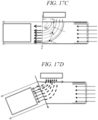
- the method may include: generating an ejected stream of droplets using a droplet delivery device, wherein the ejector mechanism is orientated with reference to the housing such that the ejected stream of droplets is directed into and through the housing at an approximate 90 degree change of trajectory prior to expulsion from the housing; and wherein droplets having an diameter greater than about 5 ⁇ m are deposited on the sidewalls of the housing due to inertial forces, without being carried in entrained airflow through and out of the droplet delivery device to the pulmonary system of the subject.
- the present disclosure relates to a droplet delivery device for delivery a fluid as an ejected stream of droplets to the pulmonary system of a subject and related methods of delivering safe, suitable, and repeatable dosages to the pulmonary system of a subject.
- the present disclosure also includes a droplet delivery device and system capable of delivering a defined volume of fluid in the form of an ejected stream of droplets such that an adequate and repeatable high percentage of the droplets are delivered into the desired location within the airways, e.g., the alveolar airways of the subject during use.
- the present disclosure provides a droplet delivery device for delivery of a fluid as an ejected stream of droplets to the pulmonary system of a subject, the device comprising a housing, a reservoir for receiving a volume of fluid, and an ejector mechanism including a piezoelectric actuator and an aperture plate, wherein the ejector mechanism is configured to eject a stream of droplets having an average ejected droplet diameter of less than 5 microns.
- the ejector mechanism is activated by at least one differential pressure sensor located within the housing of the droplet delivery device upon sensing a pre-determined pressure change within the housing. In certain embodiments, such a pre-determined pressure change may be sensed during an inspiration cycle by a user of the device, as will be explained in further detail herein.
- effective deposition into the lungs generally requires droplets less than 5 ⁇ m in diameter.
- a droplet delivery device must impart a momentum that is sufficiently high to permit ejection out of the device, but sufficiently low to prevent deposition on the tongue or in the back of the throat. Droplets below 5 ⁇ m in diameter are transported almost completely by motion of the airstream and entrained air that carry them and not by their own momentum.
- the present disclosure includes and provides an ejector mechanism configured to eject a stream of droplets within the respirable range of less than 5 ⁇ m.
- the ejector mechanism is comprised of an aperture plate that is directly or indirectly coupled to a piezoelectric actuator.
- the aperture plate may be coupled to an actuator plate that is coupled to the piezoelectric actuator.
- the aperture plate generally includes a plurality of openings formed through its thickness and the piezoelectric actuator directly or indirectly (e.g. via an actuator plate) oscillates the aperture plate, having fluid in contact with one surface of the aperture plate, at a frequency and voltage to generate a directed aerosol stream of droplets through the openings of the aperture plate into the lungs, as the patient inhales.
- the actuator plate is oscillated by the piezoelectric oscillator at a frequency and voltage to generate a directed aerosol stream or plume of aerosol droplets.
- the present disclosure relates to a droplet delivery device for delivering a fluid as an ejected stream of droplets to the pulmonary system of a subject.
- the therapeutic agents may be delivered at a high dose concentration and efficacy, as compared to alternative dosing routes and standard inhalation technologies.
- the droplet delivery devices of the disclosure may be used to treat various diseases, disorders and conditions by delivering therapeutic agents to the pulmonary system of a subject.
- the droplet delivery devices may be used to deliver therapeutic agents both locally to the pulmonary system, and systemically to the body.
- the droplet delivery device may be used to deliver therapeutic agents as an ejected stream of droplets to the pulmonary system of a subject for the treatment or prevention of pulmonary diseases or disorders such as asthma, chronic obstructive pulmonary diseases (COPD) cystic fibrosis (CF), tuberculosis, chronic bronchitis, or pneumonia.
- pulmonary diseases or disorders such as asthma, chronic obstructive pulmonary diseases (COPD) cystic fibrosis (CF), tuberculosis, chronic bronchitis, or pneumonia.
- COPD chronic obstructive pulmonary diseases
- CF cystic fibrosis
- tuberculosis chronic bronchitis
- the droplet delivery device may be used to deliver therapeutic agents such as COPD medications, asthma medications, or antibiotics.
- therapeutic agents include albuterol sulfate, ipratropium bromide, tobramycin, and combinations thereof.
- the droplet delivery device may be used for the systemic delivery of therapeutic agents including small molecules, therapeutic peptides, proteins, antibodies, and other bioengineered molecules via the pulmonary system.
- the droplet delivery device may be used to systemically deliver therapeutic agents for the treatment or prevention of indications inducing, e.g., diabetes mellitus, rheumatoid arthritis, plaque psoriasis, Crohn's disease, hormone replacement, neutropenia, nausea, influenza, etc.
- therapeutic peptides, proteins, antibodies, and other bioengineered molecules include: growth factors, insulin, vaccines (Prevnor - Pneumonia, Gardasil - HPV), antibodies (Avastin, Humira, Remicade, Herceptin), Fc Fusion Proteins (Enbrel, Orencia), hormones (Elonva- long acting FSH, Growth Hormone), enzymes (Pulmozyme - rHu-DNAase- ), other proteins (Clotting factors, Interleukins, Albumin), gene therapy and RNAi, cell therapy (Provenge - Prostate cancer vaccine), antibody drug conjugates - Adcetris (Brentuximab vedotin for HL), cytokines, anti-infective agents, polynucleotides, oligonucleotides (e.g., gene vectors), or any combination thereof; or solid particles or suspensions such as Flonase (fluticasone propionate) or
- the droplet delivery device of the disclosure may be used to deliver a solution of nicotine including the water-nicotine azeotrope for the delivery of highly controlled dosages for smoking cessation or a condition requiring medical or veterinary treatment.
- the fluid may contain THC, CBD, or other chemicals contained in marijuana for the treatment of seizures and other conditions.
- the drug delivery device of the disclosure may be used to deliver scheduled and controlled substances such as narcotics for the highly controlled dispense of pain medications where dosing is only enabled by doctor or pharmacy communication to the device, and where dosing may only be enabled in a specific location such as the patient's residence as verified by GPS location on the patient's smart phone.
- This mechanism of highly controlled dispensing of controlled medications can prevent the abuse or overdose of narcotics or other addictive drugs.
- Certain benefits of the pulmonary route for delivery of drugs and other medications include a non-invasive, needle-free delivery system that is suitable for delivery of a wide range of substances from small molecules to very large proteins, reduced level of metabolizing enzymes compared to the GI tract and absorbed molecules do not undergo a first pass effect.
- a non-invasive, needle-free delivery system that is suitable for delivery of a wide range of substances from small molecules to very large proteins, reduced level of metabolizing enzymes compared to the GI tract and absorbed molecules do not undergo a first pass effect.
- medications that are administered orally or intravenously are diluted through the body, while medications given directly into the lungs may provide concentrations at the target site (the lungs) that are about 100 times higher than the same intravenous dose. This is especially important for treatment of drug resistant bacteria, drug resistant tuberculosis, for example and to address drug resistant bacterial infections that are an increasing problem in the ICU.
- MMAD mass mean aerodynamic diameters
- the mass mean aerodynamic diameter is defined as the diameter at which 50% of the particles by mass are larger and 50% are smaller.
- droplet particles in this size range must have momentum that is sufficiently high to permit ejection out of the device, but sufficiently low to overcome deposition onto the tongue (soft palate) or pharynx.
- the ejected stream of droplets is generated in a controllable and defined droplet size range.
- the droplet size range includes at least about 50%, at least about 60%, at least about 70%, at least about 85%, at least about 90%, between about 50% and about 90%, between about 60% and about 90%, between about 70% and about 90%, etc., of the ejected droplets are in the respirable range of below about 5 ⁇ m.
- the ejected stream of droplets may have one or more diameters, such that droplets having multiple diameters are generated so as to target multiple regions in the airways (mouth, tongue, throat, upper airways, lower airways, deep lung, etc.)
- droplet diameters may range from about 1 ⁇ m to about 200 ⁇ m, about 2 ⁇ m to about 100 ⁇ m, about 2 ⁇ m to about 60 ⁇ m, about 2 ⁇ m to about 40 ⁇ m, about 2 ⁇ m to about 20 ⁇ m, about 1 ⁇ m to about 5 ⁇ m, about 1 ⁇ m to about 4.7 ⁇ m, about 1 ⁇ m to about 4 ⁇ m, about 10 ⁇ m to about 40 ⁇ m, about 10 ⁇ m to about 20 ⁇ m, about 5 ⁇ m to about 10 ⁇ m, and combinations thereof.
- At least a fraction of the droplets have diameters in the respirable range, while other particles may have diameters in other sizes so as to target non-respirable locations (e.g., larger than 5 ⁇ m).
- Illustrative ejected droplet streams in this regard might have 50% - 70% of droplets in the respirable range (less than about 5 ⁇ m), and 30% -50% outside of the respirable range (about 5 ⁇ m - about 10 ⁇ m, about 5 ⁇ m - about 20 ⁇ m, etc.)
- methods for delivering safe, suitable, and repeatable dosages of a medicament to the pulmonary system using the droplet delivery devices of the disclosure are provided.
- the methods deliver an ejected stream of droplets to the desired location within the pulmonary system of the subject, including the deep lungs and alveolar airways.
- a droplet delivery device for delivery an ejected stream of droplets to the pulmonary system of a subject.
- the droplet delivery device generally includes a housing and a reservoir disposed in or in fluid communication with the housing, an ejector mechanism in fluid communication with the reservoir, and at least one differential pressure sensor positioned within the housing.
- the differential pressure sensor is configured to activate the ejector mechanism upon sensing a pre-determined pressure change within the housing, and the ejector mechanism is configured to generate a controllable plume of an ejected stream of droplets.
- the ejected stream of droplets includes, without limitation, solutions, suspensions or emulsions which have viscosities in a range capable of droplet formation using the ejector mechanism.
- the ejector mechanism may include a piezoelectric actuator which is directly or indirectly coupled to an aperture plate having a plurality of openings formed through its thickness.
- the piezoelectric actuator is operable to directly or indirectly oscillate the aperture plate at a frequency to thereby generate an ejected stream of droplets.
- the droplet delivery device may include a combination reservoir/ejector mechanism module that may be replaceable or disposable either on a periodic basis, e.g., a daily, weekly, monthly, as-needed, etc. basis, as may be suitable for a prescription or over-the-counter medication.
- the reservoir may be prefilled and stored in a pharmacy for dispensing to patients or filled at the pharmacy or elsewhere by using a suitable injection means such as a hollow injection syringe driven manually or driven by a micro-pump.
- the syringe may fill the reservoir by pumping fluid into or out of a rigid container or other collapsible or non-collapsible reservoir.
- such disposable/replaceable, combination reservoir/ejector mechanism module may minimize and prevent buildup of surface deposits or surface microbial contamination on the aperture plate, owing to its short in-use time.
- the present disclosure also provides a droplet delivery device that is altitude insensitive.
- the droplet delivery device is configured so as to be insensitive to pressure differentials that may occur when the user travels from sea level to sub-sea levels and at high altitudes, e.g., while traveling in an airplane where pressure differentials may be as great as 4 psi.
- the droplet delivery device may include a superhydrophobic filter which provides for free exchange of air across the filter into and out of the reservoir, while blocking moisture or fluids from passing through the filter, thereby reducing or preventing fluid leakage or deposition on aperture plate surfaces.
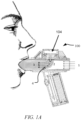
- Droplet delivery device 100 is illustrated in use by a patient.
- Droplet delivery device 100 may include one or more differential pressure sensors (not shown) to provide for automatic electronic breath actuation of the device.
- Such pressure sensor(s) automatically detects a desired point during a user's inhalation cycle to activate the actuation of ejector mechanism 104 to generate an ejected stream of droplets.
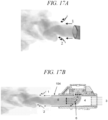
- a user may begin to inhale, pulling air through the back of the device at 1, triggering the differential pressure sensor and thereby activating actuation of ejector mechanism 104 to generate an ejected stream of droplets at 2, which stream of droplets are entrained in the user's inhalation airflow thereby traveling along the device and into the user's airway at 3.
- any large droplets are removed from the entrained airflow via inertial filtering, falling to the bottom surface of the device at 4.
- the pressure sensor(s) may be programmed to trigger a 2 second ejection when the user generated airflow within the device is about 10 SLM or similar pressure.
- any suitable differential pressure within a standard physiological range of a target user may be used.
- a trigger point during the inspiratory cycle may provide an optimum point during a user's inhalation cycle to activate and actuate the generation of an ejected stream of droplets, and delivery of medication. Since electronic breath actuation does not require user-device coordination, the droplet delivery devices and methods of the disclosure further provide assurance for optimum delivery of inhaled medication.
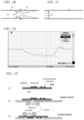
- FIGS. 1B -1E illustrate inhalation detection systems according to embodiments of the disclosure that sense airflow by detecting pressure differentials across a flow restriction.
- pressure sensors may be located within the droplet delivery device of the disclosure with a restriction that is internal to the device, e.g., within aerosol delivery mouthpiece tube.
- FIG.1B is an example where the restriction is internal to the device tube
- FIG. 1C the restriction is at the air inlet laminar flow element.
- the pressure is sensed as the differential between the interior of the device tube and the pressure outside the tube.
- FIG. 1D is a screen capture of an exemplary pressure sensor response to an inhaled breath of a ⁇ 1 second duration.
- FIG. 1E illustrates exemplary differential pressure sensor designs and assemblies onto a device board (1).
- the sensor may have pneumatic connection through the hole in the printed circuit board (PCB) and may be mounted either on the main PCB, as shown below on scheme (2), or on a daughter board as shown on scheme (3).
- PCB printed circuit board
- the droplet delivery device of the disclosure may be actuated to delivery an ejected stream of droplets for any suitable time sufficient to deliver the desired dosage.
- the piezoelectric actuator may be activated to the oscillate the aperture plate to thereby generate the ejected stream of droplets for a short burst of time, e.g., one tenth of a second, or for sever seconds, e.g., 5 second.
- the droplet delivery device may be activated to generate and deliver the ejected stream of droplets, e.g., for up to about 5 seconds, up to about 4 seconds, up to about 3 seconds, up to about 2 seconds, up to about 1 second, between about 1 second and about 2 seconds, between about 0.5 seconds and 2 seconds, etc.
- any suitable differential pressure sensor with adequate sensitivity to measure pressure changes obtained during standard inhalation cycles may be used, e.g., ⁇ 5 SLM, 10 SLM, 20 SLM, etc.
- pressure sensors from Sensirion, Inc., SDP31 or SDP32 are particularly well suited for these applications.
- the signal generated by the pressure sensors provides a trigger for activation and actuation of the ejector mechanism of the droplet delivery device at or during a peak period of a patient's inhalation (inspiratory) cycle and assures optimum deposition of the ejected stream of droplets and delivery of the medication into the pulmonary airways of the user.
- Information may also be carried by a programmable or non-programmable microchip on the module which communicates to the electronics in the housing via the piezoelectric power connection. For example, each time the device is turned on, the cartridge may be sent minimal voltage, e.g., five volts through the piezoelectric power connection which causes the data chip to send a low-level pulse stream back to the electronics via the same power connection.
- An airflow sensor located in the device aerosol delivery tube measures the inspiratory and expiratory flow rates flowing in and out of the mouthpiece. This sensor is placed so that it does not interfere with drug delivery or become a site for collection of residue or promote bacterial growth or contamination.
- a differential (or gage) pressure sensor downstream of a flow restrictor e.g., laminar flow element
- inhalation inspiratory flow
- the mouthpiece pressure will be lower than the ambient pressure
- exhalation expiratory flow
- the magnitude of the pressure differential during an inspiratory cycle is a measure of the magnitude of airflow and airway resistance at the air inlet end of the aerosol delivery tube.
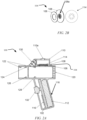
- an exemplary droplet delivery device 100 including an power/activation button 132; an electronics circuit board 102; an ejector mechanism 104 including a piezoelectric actuator 106 and an aperture plate 108; a reservoir 110, which may include an optional filter 110a on a surface thereof; and a power source 112 (which may optionally be rechargeable) electronically coupled to the piezoelectric actuator 106.
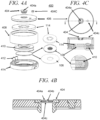
- the reservoir 110 may be coupled to or integrated with the ejector mechanism 104 to form a combination drug reservoir/ejector mechanism module (see FIG. 4A -4C) that may be replaceable, disposable or reusable.
- Droplet delivery device 100 further includes power source 112, which when activated, e.g., by pressure sensor 122 upon sensing a pre-determined change in pressure within the device, will energize the piezoelectric actuator 106 to vibrate the aperture plate 108 to cause an ejected stream of droplets to be ejected through the aperture plate 108 in a predefined direction.
- Droplet delivery device 100 may further include surface tension plate 114 to, at least in part, direct and focus fluid to the aperture plate 108, as described further herein.
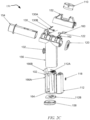
- the remaining components detailed in FIG. 2C are located in the device handle 156, which include the mount assembly 164 for power source 112 (e.g., three, AAA batteries), top and bottom battery contacts, 112A, 112B, and audio chip and speaker, 166A, 166B.
- power source 112 e.g., three, AAA batteries
- top and bottom battery contacts 112A, 112B
- audio chip and speaker 166A, 166B.
- the internal pressure resistance of the droplet delivery device may be customized to an individual user or user group by modifying the mouthpiece tube design to include various configurations of air aperture grids or openings, thereby increasing or decreasing resistance to airflow through the device as the user inhales.
- the mouthpiece tube design may include various configurations of air aperture grids or openings, thereby increasing or decreasing resistance to airflow through the device as the user inhales.
- FIG. 2E an exemplary aperture grid 172 at the mouthpiece tube opening is illustrated.
- different air entrance aperture sizes and numbers may be used to achieve different resistance values, and thereby different internal device pressure values. This feature provides a mechanism to easily and quickly adapt and customize the airway resistance of the droplet delivery device to the individual patient's state of health or condition.
- any suitable material may be used to form the housing of the droplet delivery device.
- the material should be selected such that it does not interact with the components of the device or the fluid to be ejected (e.g., drug or medicament components).
- polymeric materials suitable for use in pharmaceutical applications may be used including, e.g., gamma radiation compatible polymer materials such as polystyrene, polysulfone, polyurethane, phenolics, polycarbonate, polyimides, aromatic polyesters (PET, PETG), etc.
- the reservoir and ejector mechanism may be integrated together into a combination reservoir/ejector mechanism module that may be removable and/or disposable.
- the combination reservoir/ejector mechanism module may be vertically orientated such that the surface tension plate may facilitate fluid contact between the fluid in the reservoir and the fluid contact surface of the aperture plate.
- the combination reservoir/ejector mechanism module be horizontally oriented within the device and positioned such that the fluid within the reservoir is in constant contact with the fluid contact surface of the aperture plate.
- the combination reservoir/ejector mechanism module 400 is illustrated including the piezoelectric actuator 106, aperture plate 108, surface tension plate 114, a guide 402 which facilitates and aligns insertion of the module 400 onto the ejector device (not shown), filter 404, and ejector mechanism housing 414.
- filter 404 is comprised of a sandwich structure in which a polymer, metal or other composite material structure includes a micro-size aperture 404B located between two superhydrophobic filters 404A, such as those provided by Nitto Denko, Temish, high performance breathable porous membranes.
- module 400 may further include a seal 404C, which seals the fill hole used to dispense fluid into the ampule.
- Other components include a polymer cap 406 which seals the top of the ampule, a housing cup 408 which includes the surface tension plate 114, an O-ring structure 410 which supports the aperture plate 108 and piezoelectric actuator 106, which make electrical contact to the electronics through connector pins 412.
- an optional bar code (not shown) which may provide electrical contact and electrical feed to the piezoelectric actuator 106, as well as provide information on the drug type, initial drug volume, concentration, e.g.; dosing information such as single or multiple dosing regimens, dosing frequency and dosing times. Additional information that may be included on the barcode which may identify the type of aperture plate, target droplet size distribution and target site of action in the pulmonary airways or body, in general. Alternatively, this information may be carried on an electronic chip embedded in the module which can be read either via a wireless connection or via a signal carried by the piezoelectric power connection or via one or more additional physical contacts. Other information included on the barcode or chip may provide critical drug content information or cartridge identification which may prevent improper use of the device or accidental insertion of expired or improper medication, for example.
- the droplet delivery devices of the disclosure may further include an ejector closure mechanism, which may provide a closure barrier to restrict evaporation of reservoir fluid through the aperture plate and may provide a protective barrier from contamination for the aperture plate and reservoir.
- an ejector closure mechanism may provide for a protective enclosure of the reservoir/ejector mechanism module to thereby minimize evaporative loss, contamination, and/or intrusion of foreign substances into the reservoir during storage.
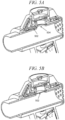
- an exemplary ejector closure mechanism 502 is illustrated at the ejector spray exit port 504 ( FIG. 5A showing ejector closure mechanism 502 in an open configuration and FIG. 5B showing ejector closure mechanism 502 in a closed configuration).
- the ejector closure mechanism can be either manually opened and closed or electronically actuated.
- the ejector closure mechanism may include one or more sensors to prevent operation of the ejector mechanism when the ejector closure mechanism is not open.
- FIGS. 5C -5E a more detailed view of an exemplary ejector closure mechanism is provided.
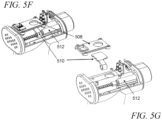
- Removal of housing top cover 152 exposes the ejector closure actuation mechanism 506 which includes a closure guide 508, sliding seal plate 510, and a motor mechanism 512, which may open and close the sliding seal plate 510 as the motor mechanism 512 is activated.
- Any suitable miniature motor mechanism may be used, e.g., a thread and screw motor that is piezoelectric driven and actuated such as an ultrasonic swiggle motor from SI Scientific Instruments (www.si-gmbh.de).
- FIGS. 5F -5G provide a more detailed view of the ejector closure mechanism.
- the sliding seal plate 510 and closure guide 508 are shown in an exploded view.
- the laminar flow element is designed and configured in order to provide an optimum airway resistance for achieving peak inspirational flows that are required for deep inhalation which promotes delivery of ejected droplets deep into the pulmonary airways.
- Laminar flow elements also function to promote laminar flow across the aperture plate, which also serves to stabilize airflow repeatability, stability and insures an optimal precision in the delivered dose.
- the size, number, shape and orientation of holes in the laminar flow element of the disclosure may be configured to provide a desired pressure drop within the droplet delivery device.
- it may be generally desirable to provide a pressure drop that is not so large as to strongly affect a user's breathing or perception of breathing.
- FIG. 6A illustrates the relationship between differential pressure and flow rate through exemplary laminar flow elements of the disclosure as a function of aperture hole diameter (0.6 mm, 1.6 mm and 1.9 mm), while FIG. 6B illustrates differential pressure as a function of flow rates through the laminar flow elements of the disclosure as a function of number of holes (29 holes, 23 holes, 17 holes).
- Laminar flow elements are mounted on droplet delivery devices similar to that provided in FIG. 2C .
- the flow rate verses differential pressure as a function of hole size is shown to have a liner relationship, when flow rate is plotted as a function of the square root of differential pressure.
- the number of holes is held constant at 17 holes.
- the laminar flow element may have hole diameters ranging from, e.g., 0.1 mm in diameter to diameters equal to the cross sectional diameter of the air inlet tube (e.g., 0.5 mm, 1 mm, 1.5 mm, 2 mm, 2.5 mm, 3 mm, 3.5 mm, 4 mm, 4.5 mm, 5 mm, 5.5 mm, 6 mm, 6.5 mm, etc.), and number of holes may range from 1 to the number of holes, for example, to fill the laminar flow element area (e.g., 30, 60, 90, 100, 150, etc.).
- the laminar flow element may be mounted at the air inlet side of a droplet delivery device as described herein.
- the use of laminar flow elements having different sized holes, or the use of adjustable apertures may be required in order to accommodate the differences among the lungs and associated inspiratory flow rates of young and old, small and large, and various pulmonary disease states.
- the aperture is adjustable by the patient (perhaps by having a slotted ring that can be rotated)
- a method may be provided to read the aperture hole setting and lock that position to avoid inadvertent changes of the aperture hole size, hence the flow measurement.
- pressure sensing is an accurate method for flow measurement
- other embodiments may use, e.g., hot wires or thermistor types of flow rate measurement methods which lose heat at a rate proportional to flow rate, moving blades (turbine flow meter technology) or by using a spring-loaded plate, without limitation of example.
- the piezoelectric actuator 106 is directly coupled to the actuator plate 108b, which is then directly coupled to the aperture plate 108. Upon activation, piezoelectric actuator 106 oscillates the actuator plate 108b, which then in turn oscillates the aperture plate 108 to generate the ejected stream of droplets.
- the aperture plate may have any suitable size, shape or material.
- the aperture plate may have a circular, annular, oval, square, rectangular, or a generally polygonal shape.
- the aperture plate may be generally planar or may have a concave or convex shape.
- the aperture plate may have a generally domed or half-spherical shape.
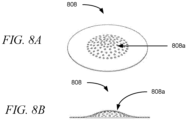
- an exemplary aperture plate 808 is illustrated wherein openings 808a are located in a region having a generally domed-shape.
- a droplet delivery device of the disclosure comprising an aperture plate having a generally domed shape will deliver a more accurate, consistent, and verifiable dose to a subject, with a droplet size distribution that is suitable for successful delivery of medication to the subject's pulmonary system.
- DLM Digital Holographic Microscopy
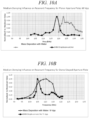
- Amplitude of displacement at resonance, and capture of the instantaneous Eigenmode shapes for the vibrating, circular, domed-shaped aperture plates are illustrated, as well as the corresponding graph of the frequency sweep versus amplitude of displacement for the dome-shaped aperture plate from 50 kHz to 150 kHz and excitation voltage; 5 Vpp.
- the Eigenmode shapes associated with resonance frequencies 59 kHz, 105 kHz, and 134 kHz, are shown in call-out images for the domed-shaped aperture plate.
- planar surface ejects 0.5 mL/min over an active surface area of 28.3 mm 2 footprint (area) and the domed surface ejects 0.7 mL/min from just a 3.1 mm 2 active surface area footprint for similar openings.
- the domed surface ejects 12.6 times more mass per unit area of active surface area footprint as compared to the planar surface.
- an aperture plate formed from the high modulus polymeric may be processed to reduce residual stresses that may accumulate in its morphology and thickness during film formation and fabrication.
- annealing of PEEK film is a standard procedure suggested by Victrex to obtain optimized crystallinity and to allow relaxation of intrinsic stresses. (www.victrex.com).
- the systems and methods for releasing residual stresses in high modulus polymeric materials may provide increased yield strength of an aperture plate formed from such materials so as to optimize its stability in the oscillations of the aperture plate as well as minimize plastic deformation of the entrance and exit orifice geometries of the nozzle plate during actuation.
- the systems and methods for releasing residual stresses in the high modulus polymeric aperture plate may insure delivery and administration of a repeatable, consistent dose of medicament.
- PEEK due to its desirable mechanical performance in dynamic loading and its resistance up to high temperatures, is easily laser micromachined and excimer laser ablated, making it a suitable material for fabrication of aperture plates.
- laser excimer treatment of polymer surfaces, and PEEK surfaces in particular may be used for surface treatment of PEEK aperture plates in order to improve adhesive bonding of the piezoelectric ceramic to the PEEK aperture plate.
- laser ablation and fine machining of PEEK may be used to form parallel grooves or other surface structures, which may lead to the formation of superhydrophobic regions on selected surface areas of the PEEK aperture plates, which may inhibit the drug solution or suspension from wetting selected regions of the aperture plate.
- the plurality of openings may range in average diameter from about 1 ⁇ m to about 200 ⁇ m, about 2 ⁇ m to about 100 ⁇ m, about 2 ⁇ m to about 60 ⁇ m, about 2 ⁇ m to about 40 ⁇ m, about 2 ⁇ m to about 20 ⁇ m, about 2 ⁇ m to about 5 ⁇ m, about 1 ⁇ m to about 2 ⁇ m, about 2 ⁇ m to about 4 ⁇ m, about 10 ⁇ m to about 40 ⁇ m, about 10 ⁇ m to about 20 ⁇ m, about 5 ⁇ m to about 10 ⁇ m, etc.
- Aperture plate thickness may range from about 10 ⁇ m to about 300 ⁇ m, about 10 ⁇ m to about 200 ⁇ m, about 10 to about 100 ⁇ m, about 25 ⁇ m to about 300 ⁇ m, about 25 ⁇ m to about 200 ⁇ m, about 25 ⁇ m to about 100 ⁇ m, etc.
- the number of openings in the aperture plate may range from, e.g., about 5 to about 5000, about 50 to about 5000, about 100 to about 5000, about 250 to about 4000, about 500 to about 4000, etc. It certain embodiments, the number of openings may be increased or decreased by increasing or decreasing the aperture plate pitch (i.e., opening center-to-center distance). In this regard, an increase in the packing density, i.e. reducing the pitch distance, and increasing the number of opening in the aperture plate leads to an increase in the total droplet ejected volume.
- optimization of the aspect ratio of the fluid entrance to the fluid exit diameters, in combination with capillary lengths, allows for formation of ejected droplets of fluids having relatively high viscosities.
- the piezoelectric actuator drives the oscillation of the aperture plate which produces the vibration that leads to the formation of the ejected stream of droplets.
- the aperture plate oscillates and a stream of droplets are generated and ejected from the openings in the aperture plate along a direction away from the fluid reservoir.
- the piezoelectric actuator may be formed from any suitable piezoelectric material or combination of materials.
- suitable piezoelectric materials include ceramics that exhibit the piezoelectric effect such as lead zirconate titanate (PZT), lead-titanate (PbTiO2), lead-zirconate (PbZrO3), or barium titanate (BaTiO3).
- PZT lead zirconate titanate
- PbTiO2 lead-titanate
- PbZrO3 lead-zirconate
- BaTiO3 barium titanate
- the piezoelectric actuator may have any suitable size and shape, so as to be compatible to oscillate the aperture plate.
- the reservoir may be configured to include an internal flexible drug ampoule to provide an airtight drug container.
- an exemplary reservoir 110 is illustrated including a flexible drug ampule 1302 packaged within a hard shell structure 1304, a lid closure 1306 that may include a screw closure 1306A design (illustrated), a snap-in design or other alternate closure system (not shown), and an ejector mechanism housing 104A.
- the reservoir with flexible drug ampoule also include foil lidding 1308, a retainer ring 1310, which provides a rigid structure to support the flexible ampule as well as provide a slot to house an O-ring 1312, which prevents leakage once the foil lidding 1308 is punctured to release its contents.
- the droplet delivery device may comprise a surface tension plate placed in proximity to the aperture plate on the fluid contact side of the aperture plate.
- the surface tension plate directs and focuses fluid to the aperture plate. More particularly, in certain embodiments, the surface tension plate may be on the on the fluid contact side of the aperture plate so as to provide for a uniform distribution of fluid onto the aperture plate from the reservoir.
- the distance of placement of the surface tension plate from the aperture plate provides for an optimization of performance of the ejector mechanism, as measured by ejected droplet mass rate.
- ejected droplet mass rate is measured gravimetrically by weighing the filled reservoir before and after actuation.
- the plot displayed in FIG. 15B represents averages of five (5), 2.2 second actuations (sprays) generated using an ejector mechanism including a surface tension plate 1400 with perforations 1402 configured as illustrated in FIG. 15A and a domed shaped aperture plate (not shown).
- the effect of polymer composition of the surface tension plate on ejector mechanism performance was also tested.
- Surface tension plates were formed using nylon6 or acrylonitrile butadiene styrene (ABS) copolymer.
- the disclosure also provides a single or dual disposable/reusable drug reservoir/ejector module that can deliver multiple medications, flavors, or combinations thereof for polypharmacy in which the aperture plate may include openings with multiple size configurations (e.g., different entrance and/or exit opening sizes, spacings, etc.). Aperture plates with openings having multiple size configurations generate droplets of different size distributions, thereby targeting different regions of the pulmonary airways.
- one opening may have an average exit diameter of 4 ⁇ m and an octagonal array of 8 larger openings having an average exit diameter of 20 ⁇ m.
- the aperture plate may deliver both larger droplets (about 20 ⁇ m in diameter) as well as smaller droplets (about 4 ⁇ m in diameter), which can target different regions of the pulmonary airways and which, for example, may simultaneously deliver flavors to the throat and medication to the deep alveolar passageways.
- Another aspect of the present disclosure as described herein provides droplet delivery device configurations and methods to increase the respirable dose of an ejected stream of droplets by filtering and excluding larger droplets (having a MMAD larger than about 5 ⁇ m) from the aerosol plume by virtue of their higher inertial force and momentum (referred to herein as "inertial filtering").
- inertial filtering In the event that droplet particles having MMAD larger than 5 ⁇ m are generated, their increased inertial mass may provide a means of excluding these larger particles from the airstream by deposition onto the mouthpiece of the droplet delivery device.
- This inertial filter effect of the drug delivery device of the disclosure further increases the respirable dose provided by the device, thus providing improved targeting delivery of medication to desired regions of the airways during use.
- aerosol droplets have an initial momentum that is large enough to be carried by the droplet plume emerging from the aperture plate.
- a gas stream changes direction as it flows around an object in its path, suspended particles tend to keep moving in their original direction due to their inertia.
- droplets having MMAD larger than 5 ⁇ m generally have a momentum that is sufficiently large to deposit onto the sidewall of the mouthpiece tube (due to their inertial mass), instead of being deflected and carried into the airflow.
- Inertial mass is a measure of an object's resistance to acceleration when a force is applied. It is determined by applying a force to an object and measuring the acceleration that results from that force. An object with small inertial mass will accelerate more than an object with large inertial mass when acted upon by the same force.
- Inertial mass a force of F, Newtons is applied to an object, and the acceleration in m/s 2 is measured.
- Inertial mass, m is force per acceleration, in kilograms.
- Inertial force as the name implies is the force due to the momentum of the droplets. This is usually expressed in the momentum equation by the term ( ⁇ v)v. So, the denser a fluid, and the higher its velocity, the more momentum (inertia) it has.
- P ⁇ Vd 3 6
- the product of the mass and velocity is known as the linear momentum.
- FIG. 17A illustrates a negative image recorded of a stream of droplets generated by a droplet delivery device similar to that of FIGS. 2A-2B .
- the image provides empirical evidence for the mechanism for generating entrained air from ejected droplets as a consequence of the combined momentum transfer from the droplets to the surrounding air and the large specific surface area of droplets 5 ⁇ m and less in diameter.
- Region 1 represents a region of laminar flow
- region 2 is an area of turbulent flow due to the generation of entrained air.
- FIG. 17B illustrates inertial filtering provided by an exemplary droplet delivery device of the disclosure for filtering and excluding larger droplets from the aerosol plume.
- larger droplets may be allowed to pass through the droplet delivery device within the effects of inertial filtering or with varied effects of inertial filtering.
- the incoming airstream velocity may be increased (e.g., through use of the mini-fan described herein) so larger droplet particles may be carried into the pulmonary airways.
- the exit angle of the mouthpiece tube may be varied (increased or decreased) to allow for deposition of droplets of varying sizes on the sidewalls of the mouthpiece.
- FIGS. 17C -17D if the angle of the mouthpiece is changed, the larger or smaller droplets will deposit or pass through the mouthpiece with or without impacting on the sidewalls of the mouthpiece.
- FIG. 17C illustrates an embodiment with a standard 90 degree turn
- FIG. 17D illustrate a greater than 90 degree turn.
- the embodiment of FIG. 17D would allow droplets having a slightly larger diameter to pass without impacting on the sidewall of the mouthpiece.
- the droplet delivery devices provide for various automation, monitoring and diagnostic functions.
- device actuation may be provided by way of automatic subject breath actuation.
- the device may provide automatic spray verification, to ensure that the device has generated the proper droplet generation and provided to proper dosing to the subject.
- the droplet delivery device may be provided with one or more sensors to facilitate such functionality.
- the droplet delivery device may provide automatic spray verification via LED and photodetector mechanisms.
- an infra-red transmitter e . g ., IR LED, or UV LED ⁇ 280 nm LED
- 126 and infra-red or UV (UV with ⁇ 280nm cutoff) photodetector 124 are mounted along the droplet ejection side of the device to transmit an infra-red or UV beam or pulse, which detects the plume of droplets and thereby may be used for spray detection and verification.
- the IR or UV signal interacts with the aerosol plume and can be used to verify that a stream of droplets has been ejected as well as provide a measure of the corresponding ejected dose of medicament.
- Examples include but not limited to, infrared 850 nm emitters with narrow viewing angles of either, 8, 10 and 12-degrees, (MTE2087 series) or 275 nm UV LED with a GaN photodetector for aerosol spray verification in the solar blind region of the spectra.
- the sub 280 nm LEDs e.g. 260 nm LEDs
- e the molar absorptivity coefficient (or molar extinction coefficient) which is a constant that is associated with a specific compound or formulation
- L is the path length or distance between LED emitter and photodetector
- c the concentration of the solution.
- results are illustrated from exemplary droplet delivery devices including LEDs 126 and photodetectors 124 (with reference to FIGS. 2A- 2C), and enabled with automatic spray verification using ( FIG. 18A ) deep red LED (650nm) and/or ( FIG. 18B ) near IR LED (850nm) laser.
- Correct generation of a stream of droplets may be confirmed by aerosol plume measurement.
- aerosol plume measurement may be implemented at locations in the device mouthpiece tube between the exit end of mouthpiece and the ejector mechanism, across the face of the ejector mechanism, or at both positions.
- the aerosol plume may be optically measured via light transmission across the diameter of the mouthpiece for an absorption measurement, or by scattering with the photodetector at 90 degrees to the optical illumination so that scattering from the aerosol plume increases the light received at the photodetector.
- spray verification and dose verification may be achieved by formulating the fluid/drug to include a compound that fluoresces (or the fluid/drug may naturally fluoresce).
- the fluorescence may be measured using standard optical means.
- the light source used for measurement may be modulated, to minimize the effects of external light.
- the generation of droplets by the aperture plate may be directly measured. This direct measurement can allow direct confirmation that the aperture plate is primed and working correctly.
- the aerosol plume may be monitored as it passes through the droplet delivery device.
- the optical means may be any conventional LED with a relatively narrow beam and a half-angle less than twenty degrees.
- a laser diode may be used to produce a very narrow, collimated beam that will reflect off individual droplets.
- Various wavelengths from the near UV to the near IR have been used to successfully measure aerosol plume absorption in transmission mode.
- LEDs that are less than 280 nm
- interference from sunlight or other conventional light sources can be avoided by placing a filter on the detector than attenuates wavelengths longer than 275 nm.
- an optical bandpass filter may be placed in front of the detector in order to avoid interference from the stimulation light or external light. Restriction of the ambient light may also be accomplished by utilizing vanes or shades as part of the air-restriction aperture between the device and ambient air.
- the droplet delivery device may be used in connection with or integrated with breathing assist devices such as a mechanical ventilator or portable Continuous Positive Airway Pressure (CPAP) machine, to provide in-line dosing of therapeutic agents with the breathing assistance airflow.
- breathing assist devices such as a mechanical ventilator or portable Continuous Positive Airway Pressure (CPAP) machine, to provide in-line dosing of therapeutic agents with the breathing assistance airflow.
- CPAP Continuous Positive Airway Pressure
- VAP ventilator-assisted pneumonia
- Tobramycin administration through the pulmonary route is generally regarded as superior to intravenous administration for treating VAP, with nebulizers being typically used to deliver the antibiotics through generation of a continuous stream of droplets into the ventilator airflow.
- the main benefit of inhaled versus oral or intravenous administered antibiotics is the ability to deliver a higher concentration of the antibiotic directly into the lungs.
- continuous generation of nebulizer mist provides imprecise dosing that cannot be verified between inhalation and exhalation cycles.
- a droplet delivery device 1902 is placed in-line with a ventilator 1900, (for example a GE Carescape R860).
- the droplet delivery device 1902 generates a stream of droplets as described herein, which includes a therapeutic agent such as tobramycin, that enters into the ventilator airstream near to the patient end of the endotracheal tube 1904.
- FIG. 19 provides an example of a standalone device 1902 operating with a ventilator 1900.
- the ventilator 1900 supplies a stream of inhalation air 1900A and removes a stream of exhalation air 1900B in separate tubes that merge to a single endotracheal tube 1904 close to the patient to minimize mixing of inhalations and exhalations and dead volume.
- the droplet delivery device 1902 may be placed close to the patient end of the endotracheal tube 1904 in order to minimize loss of droplets that may stick to the tube sidewall.
- the patient end of the endotracheal tube 1904 is placed in a patient's throat and held in place with a balloon near the end of the tube (not shown).
- Actuation of the droplet delivery device is initiated at the start of an inhalation cycle.
- the droplet delivery device can be battery powered and self-initiating, breath actuated or connected to electronics that are part of the ventilator.
- the system may be configured so that dosing frequency and duration may be set either within the ventilator or the device.
- droplet ejection timing and duration can be determined by the device or initiated by the ventilator.
- the device may be programmed to dispense for half a second once every ten breaths on a continuous basis or perhaps once a minute.
- a device may operate in a standalone manner or communicate the timing of dispenses and flowrates to the ventilator by a direct electrical connection or via Bluetooth or a similar wireless protocol.
- the table below provides an alternative format of the summary of Cascade impactor testing results, providing the results based on likely area of droplet impact in the mouthpiece/throat/coarse, respirable droplets, and fine droplets (Albuterol, 0.5%, Anderson Cascade, 28.3 lpm, 10 actuations).
- Example C Comparative Droplet Generation versus Combivent ® Respimat ® and Proair ® HFA
- the droplet delivery device of the disclosure is a breath-actuated piezoelectric actuated device with removable and replaceable reservoir.
- the reservoir is designed to contain a therapeutic inhalation drug volume to provide 100 - 200 breath actuated doses per use.
- the predicate device Combivent Respimat is a propellant free, piston actuated, multidose metered inhaler, while the ProAIr HFA device is a CFC free, propellant based metered dose inhale.
- a single test device body, and three (3) reservoir/ejector mechanism modules were tested. All predicate devices were tested in triplicate, for a total nine (9) Cascade Impactor trials. The devices of the disclosure were tested in triplicate with a new drug reservoir charged with 750 ⁇ l of 0.5% Albuterol sulfate for each of the three (3) tests.
- Particle size distributions were measured using the Anderson Cascade Impactor (ACI) sampling at a constant 28.3 lpm during each test.
- the Anderson Cascade Impactor test is as described above in Example B, and can be used to determine the coarse particle mass, coarse particle fraction, respirable particle mass, respirable particle fraction, fine particle mass, and fine particle fraction of test aerosols.
- ACI data can also be used to calculate the Mass Median Aerodynamic Diameter (MMAD) and Geometric Standard Deviation (GSD) of the aerosol size distribution. Droplet classifications are defined as following: Coarse particle fraction, > 4.7 um; Respirable particle fraction, 0.4 - 4.7 um; Fine particle fraction, ⁇ 0.4 um.
- the predicate Combivent ® Respimat ® inhaler was tested using Combivent ® Respimat ® cartridges containing 20 mcg ipratropium bromide and 100 mcg albuterol equivalent to 120 mcg dose of albuterol sulfate delivery per actuation.
- the predicate PROAIR ® HFA inhaler was evaluated with cartridges containing 108 mcg albuterol sulfate equivalent to 90 mcg delivered dose per actuation, while the droplet delivery device of the disclosure was evaluated using albuterol sulfate at a concentration of 5000ug/ml equivalent to 0.5% albuterol and 85 mcg delivered dose per actuation.
- Results from cascade impactor test trials for each inhaler tested in triplicate for Albuterol sulfate are as follows ( FIGS. 23A -23B): Average MMAD for: Test Device, 1.93 ⁇ 0.11, Combivent ® Respimat ® , 1.75 ⁇ 0.19, and PROAIR ® HFA 2.65 ⁇ 0.05 ⁇ m for dispensing Albuterol sulfate.
- FIGS. 23A -23B A summary and comparison of Cascade Impactor Testing of the test device, Combivent Respimat ® and Proair ® HFA inhalers is shown in in the tables below and in FIGS. 23A -23B . These data show the test device provides the highest respirable particle fraction for devices tested, ( FIG. 23B ) with a mean ⁇ standard deviation: For the Test device, 68.7% ⁇ 3.2%, Combivent ® Respimat ® , 57.3% ⁇ 10.5, and PROAIR ® HFA, 65.2% ⁇ 2.4%.
- Example D Clinical Study - Albuterol Sulfate and Ipratropium Bromide
- test device Using an exemplary ejector device of the disclosure (test device), a cross over clinical trial was conducted comparing the acute bronchodilatory effects of the test device using albuterol sulfate and ipratropium bromide versus no treatment in a group of patients with chronic obstructive pulmonary disease.
- subjects at visit 1 must: 1) be previously diagnosed with COPD; 2) have at least a 10 pack year smoking history; 3) be prescribed one or more inhaled bronchodilators; 4) exhibit post bronchodilator FEV1 ⁇ 25% and ⁇ 70% predicted normal value using appropriate reference equations.
- the study is a crossover, single center, 1 day lung function study to measure the acute bronchodilation effect of standard dose albuterol sulfate and ipratropium bromide using an test device of the disclosure in a group of COPD patients.
- Subjects may undergo up to a 1 week screening period. If the patient is not using long acting beta agonists or long acting muscarinic antagonists and has not used a short acting bronchodilator in the previous 6 hours, no washout period is necessary and can immediately proceed with visit 2. If the subject is using a long acting beta agonist they will be washed out for 48 hours. If the subject is using a long acting muscarinic antagonist the washout period will be one week. During the washout period subjects will be allowed to continue to use inhaled corticosteroids (ICS), short acting beta agonists (SABA), short acting muscarinic antagonists (SAMA), leukotriene inhibitors, and phosphodiesterase 4 inhibitors. Subjects experiencing COPD exacerbations during the washout period will be excluded from the trial. Subjects who successfully complete the screening period will be included in the trial.
- ICS inhaled corticosteroids
- SABA short acting beta agonists
- SAMA short acting muscarinic antagonists
- the test devices include piezoelectric actuated ejector mechanisms integrated with reservoir.
- the reservoir mounts to a device housing.
- the device housing has 2 areas 1) a mouthpiece tube and 2) a handle. The patient breathes in through the mouthpiece tube to activate the ejector mechanism.
- the mouthpiece tube detaches from the housing and can be sterilized and reused or disposed of after patient use.
- the primary efficacy endpoints will include change in FEV1 during 2 time periods: the 20 minutes before receiving a dose of albuterol sulfate and ipratropium bromide using the ejector device of the disclosure, and the 20 minutes after receiving a dose of albuterol sulfate and ipratropium bromide from the ejector device of the disclosure.
- Safety endpoint will include vital signs and changes in FEV1.
- the statistical analysis will include an analysis of the change in FEV1 using T-tests.
- treatment with the ejector device of the disclosure improved FEV1 by an average of about 260-275 cc. This improvement is 1.2 to 2 times the increase in broncodilatory effect typically observed using standard manual inhalers with the same dose of active drug.
- Example E Clinical Study - Albuterol Sulfate
- test device Using an exemplary droplet delivery device of the disclosure (test device), a cross over clinical trial was conducted comparing the acute bronchodilatory effects of the test device using albuterol sulfate versus the ProAir ® HFA Inhaler in a group of patients with chronic obstructive pulmonary disease (COPD).
- COPD chronic obstructive pulmonary disease
- subjects at visit 1 must: 1) be previously diagnosed with COPD; 2) have at least a 10 pack year smoking history; 3) be prescribed one or more inhaled bronchodilators; 4) exhibit FEV1 ⁇ 70% or at least 10% lower than the predicted normal value using appropriate reference equations.
- Subjects may undergo up to a 1 week screening period. If the patient is not using long acting beta agonists or long acting muscarinic antagonists and has not used a short acting bronchodilator in the previous 6 hours, no washout period is necessary and can immediately proceed with visit 2. If the subject is using a long acting beta agonist, they will be washed out for 48 hours. If the subject is using a long acting muscarinic antagonist, the washout period will be up to one week. During the washout period subjects will be allowed to continue to use inhaled corticosteroids (ICS), short acting beta agonists (SABA), short acting muscarinic antagonists (SAMA), leukotriene inhibitors, and phosphodiesterase 4 inhibitors. Subjects experiencing COPD exacerbations during the washout period will be excluded from the trial. Subjects who successfully complete the screening period will be included in the trial.
- ICS inhaled corticosteroids
- SABA short acting beta agonists
- SAMA short acting muscarin
- the test devices include piezoelectric actuated ejector mechanisms integrated with reservoir.
- the reservoir mounts to a device housing.
- the device housing has 2 areas 1) a mouthpiece tube and 2) a handle. The patient breathes in through the mouthpiece tube to activate the ejector mechanism.
- the mouthpiece tube detaches from the housing and can be sterilized and reused or disposed of after patient use.
- the primary efficacy endpoints will include change in FEV1 during 2 time periods: the 20 minutes before receiving a dose of albuterol sulfate and the 20 minutes after receiving a dose of albuterol sulfate using the test device of the disclosure.
- Safety endpoint will include vital signs and changes in FEV1.
- the statistical analysis will include an analysis of the change in FEV1 using T-tests.
- Results demonstrate the use of the test device of the disclosure provides a significant bronchodilatory effect versus no treatment, and a similar but slightly improved bronchodilatory effect versus treatment with twice the dose using a predicate device, the ProAir HFA device. More particularly, there was a statistically significant improvement in FEV1 (120ml) with the device at a 100 microgram dose of albuterol compared to no treatment. Further, it was unexpectedly found that the average improvement was 11.9ml greater than the improvement seen with twice the dose of 200 micrograms using the predicate device, the ProAir HFA inhaler. In this regard, the test device of the disclosure was able to achieve a similar but slightly improved clinical efficacy at half the dose of the predicate device. The test device was able to delivery concentrated doses of a COPD medication and provide meaningful therapeutic efficacy, as compared to standard treatment options.
- Example F Delivery of Large Molecules - Local and Systemic Delivery
- testing is conducted to verify that large molecules including epidermal growth factor receptor (EGFR) monoclonocal antibody, bevacizumab (Avastin), adalimumab (Humira) and etanercept (Enbrel) is not denatured or degraded by ejection through the device of the disclosure, and to verify that local pulmonary delivery and/or systemic delivery of the active agent is achieved.
- EGFR epidermal growth factor receptor
- bevacizumab Avastin
- adalimumab Humira
- Enbrel etanercept
- Droplet Characterization To verify droplet generation, droplet impactor studies may be performed, as described herein.
- Gel Electrophoresis To determine the stability of active agent after droplet generation, the generated stream of droplets including the active agent is collected and the molecular weight of the active agent is verified using gel electrophoresis. Gel electrophoresis will show that there is negligible change in the electrophoretic mobility, and hence the molecular weight, of the post-aerosol active agent from that of the control, i.e., whole EGFR antibodies, bevacizumab, adalimumab, or etanercept. The gel will also show that is no evidence of smaller fragments of the protein on the gel, further confirming that the aerosol generation will not cause any appreciable protein degradation. In addition, the gel will show no apparent aggregation of the antibody or protein, which is significant as many inhalation devices have been reported to be prone to protein aggregation and hence unsuitable for the pulmonary delivery of large macromolecules such as proteins and antibodies.
- SEC Size Exclusion Chromatography
- Drug solutions for testing include Enbrel, (ENBREL ® single-use prefilled syringes in 25 mg (0.51 mL of a 50 mg/mL solution of etanercept), and insulin, (Humalog, 200 units/ml, 3ml kwikpens)
- ENBREL ® is a dimeric fusion protein consisting of the extracellular ligand-binding portion of the human 75 kilodalton (p75) tumor necrosis factor receptor (TNFR) linked to the Fc portion of human IgG1.
- the Fc component of etanercept contains the CH2 domain, the CH3 domain and hinge region, but not the CH1 domain of IgG1.
- Etanercept is produced by recombinant DNA technology in a Chinese hamster ovary (CHO) mammalian cell expression system. It consists of 934 amino acids and has an apparent molecular weight of approximately 150 kilodaltons.
- SEC is performed with a Yarra TM 3 um SEC-2000 LC column 300 x 7.8 mm, SecurityGuard cartridge kit and SecurityGuard cartridges GFC-2000, 4 x 3 mm ID.
- Fifty microliters of Enbrel from the syringe (ENBREL ® single-use prefilled syringes in 25mg/0.51 mL of a 50 mg/mL solution of etanercept) is diluted (4:1) (4 parts, 200 mcl of the mobile phase buffer solution to 1 part, 50 mcl Enbrel from syringe).
- Fifty microliter of the diluted Enbrel is injected and separation was performed at a flow rate of 1.0 ml/min.
- the mobile phase buffer system included a PHOS. BUFF. SALINE. (PBS) solution and 0.025% NaN 3 , pH 6.8. UV detection is performed at 280 nm.
- the total area under the curve of the UV signal at 280 nm versus elution time for controls is compared with the aerosolized samples, which is set to 100%.
- mcl Fifty microliters (mcl) of insulin, (Humalog, 200 units/ml, 3ml Kwikpens) is directly drawn from the Kwikpen and injected into the SEC column for analysis while 200 mcl of the Kwikpen solution is directly injected into the ampule/cartridge before actuation and aerosol generation with the test device. Aerosol collection and SEC is performed in a similar fashion as for the Enbrel analysis and aerosol collection.
- An ampule/cartridge is filled with either 0.20 ml of Enbrel ® (50 mg/ml) diluted 4:1 (10 mg/ml)(4 parts (200 mcl) of PBS and 0.025% NaN 3 and 1 part (50 mcl of Enbrel solution from the syringe). After 20 actuations and aerosolization, about 150 mcl of the aerosolized Enbrel solution is recovered and collected in the polypropylene tube located below the ejector mechanism. The control consists of the diluted Enbrel solution, 50 mcl of which is injected into the SEC column for analysis.
- Insulin solutions from a Humalog, 200 units/ml, 3ml Kwikpen is drawn with a syringe and 200 mcl is injected directly into the reservoir/ejector mechanism module and mounted onto a test device before actuation. Aerosol emerging from the test device is collected by placing a 0.5 ml polypropylene test tube directly below the aperture plate. Twenty actuations aerisolization resulted in the recovery of about 150 mcl of the aerosol insulin spray. Fifty microliters of the collected aerosol spray is injected onto the SEC column for analysis, while 50 mcl of the Kwikpen insulin solution is injected onto the SEC column for control samples.
- FIG.24A-24B are SEC chromatographs of Enbrel ® diluted 4:1, (10 mg/ml) control ( FIG. 24A ) and aerosolized Enbrel solutions ( FIG. 24B ) collected from the test device after actuation. A single main peak is evident in chromatographs of the aerosolized Enbrel solution with an elution time of about 25 minutes.
- the tables below compare areas under the UV curves for the various peaks emerging at specified elution times (min) for controls and aerosolized Enbrel solutions.
- test device can deliver 95.4% of Enbrel that is structurally unchanged after delivering an aerosol dose, while only 4.6% of the dose leads to formation of molecular fragments with elution times of 13 and 25 minutes.
- FIGS. 25A -25B are SEC chromatographs of Insulin from Kwikpen (200 U/ml; 34.7 mcg/U; 6.94 mg/ml) as control ( FIG. 25A ) and aerosolized from the test device ( FIG. 25B ). About 150 mcl of aerosolized Insulin solutions were collected from the test device after actuation. A single major peak is evident in the chromatograph of the aerosolized Insulin solution with an elution time of about 25 minutes. The tables below compare areas under the UV curves for the various peaks emerging at specified elution times for controls and aerosolized Insulin solutions. Retention times are in minutes.
- test device can deliver 97.5% of the ejected dose of Insulin that is structurally unchanged while 2.5% of the ejected dose forms a fragment which elutes at ⁇ 25 minutes.
- Gravimetric analysis was performed by weighing the Insulin solution filled ampule before and after dosing. The average of five doses (actuations) were analyzed with an average of 5.01 mg +/- 0.53 mg. The total delivered dose of Insulin per actuation is therefore 34.8 mcg per actuation.
- the activity of the aerosolized antibody or protein is demonstrated by testing its ability to bind to its antigen or target on a cell surface, i.e., EGFR, TNF ⁇ , etc.
- a cell surface i.e., EGFR, TNF ⁇ , etc.
- Flow cytometry data of cells incubated with either aerosolized or non-aerosolized active agent will reflect activity. Specifically, the data will show a shift in the fluorescence intensity of the cells incubated with non-aerosolized fluorescently labelled active agent compared to that for the untreated cells. A similar shift will be obtained with cells incubated with aerosolized active agent, suggesting that the post-aerosolized active agent retains its immunoactivity and hence its ability to bind to its target receptor on the cell surface.
- Clinical/In Vivo Testing Using an exemplary ejector device of the disclosure, as generally shown in Figs. 1A-1E , a clinical trial is conducted to assess pharmacokinetic data following administration of large molecule active agents. pK data will verify that large molecule active agents are successfully systematically administered.
Landscapes
- Health & Medical Sciences (AREA)
- Engineering & Computer Science (AREA)
- Public Health (AREA)
- Biomedical Technology (AREA)
- General Health & Medical Sciences (AREA)
- Life Sciences & Earth Sciences (AREA)
- Heart & Thoracic Surgery (AREA)
- Animal Behavior & Ethology (AREA)
- Veterinary Medicine (AREA)
- Hematology (AREA)
- Anesthesiology (AREA)
- Pulmonology (AREA)
- Emergency Medicine (AREA)
- Bioinformatics & Cheminformatics (AREA)
- Medical Informatics (AREA)
- Primary Health Care (AREA)
- Epidemiology (AREA)
- Pathology (AREA)
- Chemical & Material Sciences (AREA)
- Biophysics (AREA)
- Dispersion Chemistry (AREA)
- Data Mining & Analysis (AREA)
- Databases & Information Systems (AREA)
- Surgery (AREA)
- Physics & Mathematics (AREA)
- Molecular Biology (AREA)
- Physiology (AREA)
- Pharmacology & Pharmacy (AREA)
- Business, Economics & Management (AREA)
- General Business, Economics & Management (AREA)
- Medicinal Chemistry (AREA)
- Medicinal Preparation (AREA)
- Pharmaceuticals Containing Other Organic And Inorganic Compounds (AREA)
- Infusion, Injection, And Reservoir Apparatuses (AREA)
Claims (11)
- Piezoelektrisch betätigte Tröpfchenabgabevorrichtung (100) zum Erzeugen und Abgeben eines Fluids als einen ausgestoßenen Tröpfchenstrom an ein Lungensystem eines Subjekts, wobei die piezoelektrisch betätigte Tröpfchenabgabevorrichtung Folgendes umfasst:einen Ausstoßmechanismus (104), der einen piezoelektrischen Aktor (106) und eine Aperturplatte (108) umfasst, wobei die Aperturplatte eine Vielzahl von Öffnungen aufweist, die durch ihre Dicke gebildet ist, und der piezoelektrische Aktor bedienbar ist, um die Aperturplatte mit einer Frequenz zu oszillieren, um dadurch den ausgestoßenen Tröpfchenstrom zu erzeugen;wobei die Tröpfchenabgabevorrichtung dadurch gekennzeichnet ist, dass:die Tröpfchenabgabevorrichtung ein Gehäuse (116) mit einem Mundstück, das sich an einem Luftflussausgang des Gehäuses befindet, und ein Luftflusslaminarflusselement (120), das sich gegenüber dem Mundstück und an einem Luftflusseingang des Gehäuses befindet, umfasst;wobei das Luftflusslaminarflusselement konfiguriert ist, um Laminarluftfluss über eine Ausgangsseite der Aperturplatte zu erleichtern; unddas Laminarflusselement eine Anzahl an Löchern beinhaltet, wobei die Größe, Anzahl, Form und Ausrichtung der Löcher konfiguriert sind, um einen internen Luftflusswiderstand innerhalb der Vorrichtung zu erzeugen und um ausreichenden Luftfluss durch das Vorrichtungsgehäuse während Verwendung bereitzustellen;wobei die Tröpfchenabgabevorrichtung zu Folgendem konfiguriert ist:(a) Erzeugen des ausgestoßenen Tröpfchenstroms, wobei zumindest 70 % des ausgestoßenen Tröpfchenstroms einen durchschnittlichen ausgestoßenen Tröpfchendurchmesser von weniger als etwa 5 µm aufweisen.
- Piezoelektrisch betätigte Tröpfchenabgabevorrichtung nach Anspruch 1, wobei der ausgestoßene Tröpfchenstrom einer Trajektorienänderung von ungefähr 90 Grad innerhalb der piezoelektrisch betätigten Tröpfchenabgabevorrichtung ausgesetzt ist, sodass Tröpfchen mit einem Durchmesser von mehr als 5 µm aus dem ausgestoßenen Tröpfchenstrom aufgrund von Trägheitskräften gefiltert werden, ohne in mitgerissenem Luftfluss durch die und aus der piezoelektrisch betätigten Tröpfchenabgabevorrichtung zu dem Lungensystem des Subjekts getragen zu werden.
- Piezoelektrisch betätigte Tröpfchenabgabevorrichtung nach Anspruch 1, wobei der ausgestoßene Tröpfchenstrom ein therapeutisches Mittel für die Behandlung einer Lungenerkrankung, einer Lungenstörung oder eines Lungenzustands umfasst.
- Piezoelektrisch betätigte Tröpfchenabgabevorrichtung nach Anspruch 1, ferner umfassend:einen Behälter, der innerhalb des Gehäuses oder in Fluidkommunikation damit angeordnet ist, um ein Fluidvolumen aufzunehmen; undzumindest einen Differenzdrucksensor, der innerhalb des Gehäuses positioniert ist, wobei der zumindest eine Differenzdrucksensor konfiguriert ist, um den Ausstoßmechanismus zu aktivieren, wenn eine vorbestimmte Druckänderung innerhalb des Gehäuses erfasst wird, um dadurch einen ausgestoßenen Tröpfchenstrom zu erzeugen.
- Piezoelektrisch betätigte Tröpfchenabgabevorrichtung nach Anspruch 1, wobei die Aperturplatte der piezoelektrisch betätigten Tröpfchenabgabevorrichtung eine gewölbte Form umfasst.
- Piezoelektrisch betätigte Tröpfchenabgabevorrichtung nach Anspruch 3, wobei die Lungenerkrankung, die Lungenstörung oder der Lungenzustand aus Asthma, chronisch obstruktiven Lungenerkrankungen (COPD), zystischer Fibrose (CF), Tuberkulose, chronischer Bronchitis und Lungenentzündung ausgewählt ist.
- Piezoelektrisch betätigte Tröpfchenabgabevorrichtung nach Anspruch 3 oder Anspruch 6, wobei das therapeutische Mittel ein COPD-Medikament, ein Asthma-Medikament oder ein Antibiotikum ist.
- Piezoelektrisch betätigte Tröpfchenabgabevorrichtung nach Anspruch 7, wobei das therapeutische Mittel aus Albuterolsulfat, Ipratropiumbromid, Tobramycin und Kombinationen davon ausgewählt ist.
- Piezoelektrisch betätigte Tröpfchenabgabevorrichtung nach Anspruch 3, wobei die Erkrankung, die Störung oder der Zustand aus Diabetes mellitus, rheumatoider Arthritis, Plaque-Psoriasis, Crohn-Erkrankung, Hormonersatztherapie, Neutropenie, Übelkeit und Influenza ausgewählt ist.
- Piezoelektrisch betätigte Tröpfchenabgabevorrichtung nach Anspruch 9, wobei das therapeutische Mittel ein therapeutisches Peptid, ein therapeutisches Protein, ein therapeutischer Antikörper oder ein anderes therapeutisches biotechnisch hergestelltes Molekül ist.
- Piezoelektrisch betätigte Tröpfchenabgabevorrichtung nach Anspruch 10, wobei das therapeutische Mittel aus Wachstumsfaktoren, Insulin, Impfstoffen, Antikörpern, Fc-Fusionsprotein, Hormonen, Enzymen, Gentherapien und RNAi-Zelltherapien, Antikörper-Arzneimittel-Konjugaten, Zytokinen, antiinfektiösen Mitteln, Polynukleotiden, Oligonukleotiden oder einer beliebigen Kombination davon ausgewählt ist.
Priority Applications (2)
| Application Number | Priority Date | Filing Date | Title |
|---|---|---|---|
| EP25177791.8A EP4591994A3 (de) | 2016-05-03 | 2017-05-03 | Tröpfchenabgabevorrichtung zur erzeugung und abgabe von tröpfchen an das lungensystem |
| EP25179242.0A EP4624054A3 (de) | 2016-05-03 | 2017-05-03 | Verfahren zur erzeugung und abgabe von tröpfchen an das lungensystem unter verwendung einer tröpfchenabgabevorrichtung |
Applications Claiming Priority (11)
| Application Number | Priority Date | Filing Date | Title |
|---|---|---|---|
| US201662331328P | 2016-05-03 | 2016-05-03 | |
| US201662332352P | 2016-05-05 | 2016-05-05 | |
| US201662334076P | 2016-05-10 | 2016-05-10 | |
| US201662354437P | 2016-06-24 | 2016-06-24 | |
| US201662399091P | 2016-09-23 | 2016-09-23 | |
| US201662416026P | 2016-11-01 | 2016-11-01 | |
| US201662422932P | 2016-11-16 | 2016-11-16 | |
| US201662428696P | 2016-12-01 | 2016-12-01 | |
| US201762448796P | 2017-01-20 | 2017-01-20 | |
| US201762471929P | 2017-03-15 | 2017-03-15 | |
| PCT/US2017/030917 WO2017192771A1 (en) | 2016-05-03 | 2017-05-03 | Methods for generating and delivering droplets to the pulmonary system using a droplet delivery device |
Related Child Applications (4)
| Application Number | Title | Priority Date | Filing Date |
|---|---|---|---|
| EP25179242.0A Division EP4624054A3 (de) | 2016-05-03 | 2017-05-03 | Verfahren zur erzeugung und abgabe von tröpfchen an das lungensystem unter verwendung einer tröpfchenabgabevorrichtung |
| EP25179242.0A Division-Into EP4624054A3 (de) | 2016-05-03 | 2017-05-03 | Verfahren zur erzeugung und abgabe von tröpfchen an das lungensystem unter verwendung einer tröpfchenabgabevorrichtung |
| EP25177791.8A Division EP4591994A3 (de) | 2016-05-03 | 2017-05-03 | Tröpfchenabgabevorrichtung zur erzeugung und abgabe von tröpfchen an das lungensystem |
| EP25177791.8A Division-Into EP4591994A3 (de) | 2016-05-03 | 2017-05-03 | Tröpfchenabgabevorrichtung zur erzeugung und abgabe von tröpfchen an das lungensystem |
Publications (4)
| Publication Number | Publication Date |
|---|---|
| EP3452152A1 EP3452152A1 (de) | 2019-03-13 |
| EP3452152A4 EP3452152A4 (de) | 2020-01-01 |
| EP3452152B1 true EP3452152B1 (de) | 2025-07-02 |
| EP3452152C0 EP3452152C0 (de) | 2025-07-02 |
Family
ID=92911176
Family Applications (3)
| Application Number | Title | Priority Date | Filing Date |
|---|---|---|---|
| EP17793287.8A Active EP3452152B1 (de) | 2016-05-03 | 2017-05-03 | Tröpfchenabgabevorrichtung zur erzeugung und abgabe von tröpfchen an das lungensystem |
| EP25177791.8A Pending EP4591994A3 (de) | 2016-05-03 | 2017-05-03 | Tröpfchenabgabevorrichtung zur erzeugung und abgabe von tröpfchen an das lungensystem |
| EP25179242.0A Pending EP4624054A3 (de) | 2016-05-03 | 2017-05-03 | Verfahren zur erzeugung und abgabe von tröpfchen an das lungensystem unter verwendung einer tröpfchenabgabevorrichtung |
Family Applications After (2)
| Application Number | Title | Priority Date | Filing Date |
|---|---|---|---|
| EP25177791.8A Pending EP4591994A3 (de) | 2016-05-03 | 2017-05-03 | Tröpfchenabgabevorrichtung zur erzeugung und abgabe von tröpfchen an das lungensystem |
| EP25179242.0A Pending EP4624054A3 (de) | 2016-05-03 | 2017-05-03 | Verfahren zur erzeugung und abgabe von tröpfchen an das lungensystem unter verwendung einer tröpfchenabgabevorrichtung |
Country Status (5)
| Country | Link |
|---|---|
| US (6) | US11285283B2 (de) |
| EP (3) | EP3452152B1 (de) |
| JP (2) | JP7407593B2 (de) |
| CN (1) | CN109475709B (de) |
| WO (1) | WO2017192771A1 (de) |
Families Citing this family (68)
| Publication number | Priority date | Publication date | Assignee | Title |
|---|---|---|---|---|
| EP3767632B1 (de) | 2012-06-25 | 2024-05-29 | Gecko Health Innovations, Inc. | Vorrichtungen, systeme und verfahren für adhärenzüberwachung und patienteninteraktion |
| EA036564B1 (ru) | 2013-08-28 | 2020-11-24 | Джеко Хелт Инновейшнз, Инк. | Устройства, системы и способы для контроля соблюдения режима терапии и устройства, системы и способы для контроля применения дозаторов потребляемых материалов |
| JP6799529B2 (ja) | 2014-08-28 | 2020-12-16 | マイクロドース セラピューテクス,インコーポレイテッド | 小型圧力センサ起動を備えるタイダルドライパウダー吸入器 |
| AR102055A1 (es) | 2014-08-28 | 2017-02-01 | Norton (Waterford) Ltd | Módulo de asistencia para el uso correcto de un inhalador |
| MX379352B (es) | 2014-08-28 | 2025-03-11 | Norton Waterford Ltd | Módulo de monitoreo de cumplimiento para un inhalador. |
| CA2963030C (en) * | 2014-10-10 | 2021-07-13 | Vectura Gmbh | Inhalation device for use in aerosol therapy of respiratory diseases |
| GB201420039D0 (en) | 2014-11-11 | 2014-12-24 | Teva Uk Ltd | System for training a user in administering a medicament |
| US10058661B2 (en) | 2014-12-04 | 2018-08-28 | Norton (Waterford) Limited | Inhalation monitoring system and method |
| WO2017192782A1 (en) * | 2016-05-03 | 2017-11-09 | Pneuma Respiratory, Inc. | Systems and methods comprising a droplet delivery device and a breathing assist device for therapeutic treatment |
| KR102295739B1 (ko) * | 2016-05-03 | 2021-08-30 | 뉴마 레스퍼러토리 인코포레이티드 | 유체들의 폐기관계로의 전달을 위한 액적 전달 디바이스 및 사용 방법 |
| WO2017192773A1 (en) * | 2016-05-03 | 2017-11-09 | Pneuma Respiratory, Inc. | Methods for treatment of pulmonary lung diseases with improved therapeutic efficacy and improved dose efficiency |
| EP3452152B1 (de) * | 2016-05-03 | 2025-07-02 | Pneuma Respiratory, Inc. | Tröpfchenabgabevorrichtung zur erzeugung und abgabe von tröpfchen an das lungensystem |
| US11285274B2 (en) * | 2016-05-03 | 2022-03-29 | Pneuma Respiratory, Inc. | Methods for the systemic delivery of therapeutic agents to the pulmonary system using a droplet delivery device |
| EA038837B1 (ru) * | 2016-08-04 | 2021-10-27 | Джапан Тобакко Инк. | Ароматический ингалятор |
| CN110177591B (zh) | 2016-11-18 | 2021-11-19 | 诺顿(沃特福特)有限公司 | 吸入器 |
| IL286777B2 (en) | 2016-11-18 | 2025-03-01 | Norton Waterford Ltd | Drug delivery device with electronics |
| CA3064005C (en) | 2017-05-19 | 2023-03-07 | Pneuma Respiratory, Inc. | Dry powder delivery device and methods of use |
| US10786633B2 (en) * | 2017-09-08 | 2020-09-29 | Hcmed Innovations Co., Ltd. | Nebulizer and nozzle assembly thereof |
| US11738158B2 (en) | 2017-10-04 | 2023-08-29 | Pneuma Respiratory, Inc. | Electronic breath actuated in-line droplet delivery device and methods of use |
| CA3079189A1 (en) | 2017-10-17 | 2019-04-25 | Pneuma Respiratory, Inc. | Nasal drug delivery apparatus and methods of use |
| CA3082192A1 (en) | 2017-11-08 | 2019-05-16 | Pneuma Respiratory, Inc. | Electronic breath actuated in-line droplet delivery device with small volume ampoule and methods of use |
| CA3087769A1 (en) * | 2018-01-08 | 2019-07-11 | Pneuma Respiratory, Inc. | Treatment of pulmonary cancers using an electronic breath actuated droplet delivery device |
| WO2019173846A1 (en) * | 2018-03-09 | 2019-09-12 | Health Research, Inc. | Induction spacer for inhaler |
| EP3773840B1 (de) * | 2018-04-02 | 2024-11-06 | Pneuma Respiratory, Inc. | Digitaler handvernebler und verwendungsverfahren |
| CN112041011A (zh) * | 2018-04-24 | 2020-12-04 | 曼金德公司 | 用于检测和监控吸入的设备、系统和方法 |
| AU2019292315A1 (en) * | 2018-06-26 | 2021-02-18 | Omega Life Science Ltd. | Aerosol generation devices |
| US11690963B2 (en) | 2018-08-22 | 2023-07-04 | Qnovia, Inc. | Electronic device for producing an aerosol for inhalation by a person |
| EP3829370A4 (de) | 2018-08-22 | 2022-04-27 | Respira Technologies, Inc. | Elektronische vorrichtung zur erzeugung eines aerosols zur inhalation durch eine person |
| US11517685B2 (en) | 2019-01-18 | 2022-12-06 | Qnovia, Inc. | Electronic device for producing an aerosol for inhalation by a person |
| US12501929B2 (en) | 2018-08-22 | 2025-12-23 | Qnovia, Inc. | Electronic device for producing an aerosol for inhalation by a person |
| AU2019352957A1 (en) * | 2018-10-01 | 2021-04-29 | Pneuma Respiratory, Inc. | Delivery of low surface tension compositions to the pulmonary system via electronic breath actuated droplet delivery device |
| US20220104544A1 (en) * | 2019-02-08 | 2022-04-07 | Nathan Morrow Jackson | Monolithic microfabricated vibrating mesh atomizer |
| CN113784660B (zh) * | 2019-03-27 | 2024-06-11 | 斯皮罗技术医疗有限公司 | 用于测量气道阻力的方法和设备 |
| KR20220003585A (ko) | 2019-04-30 | 2022-01-10 | 노턴 (워터포드) 리미티드 | 흡입기 시스템 |
| US11419995B2 (en) | 2019-04-30 | 2022-08-23 | Norton (Waterford) Limited | Inhaler system |
| US20220211960A1 (en) * | 2019-05-08 | 2022-07-07 | Respinova Ltd. | A system for delivering inhaled therapies |
| KR20220030213A (ko) * | 2019-05-09 | 2022-03-10 | 뉴마 레스퍼러토리 인코포레이티드 | 초음파 호흡 작동식 호흡기 액적 전달 디바이스 및 사용 방법 |
| ES2913135T3 (es) | 2019-05-17 | 2022-05-31 | Norton Waterford Ltd | Dispositivo de administración de fármacos con electrónica |
| CN110064108B (zh) * | 2019-06-10 | 2021-01-12 | 河南科技大学第一附属医院 | 呼吸内科用雾化吸入系统 |
| US20220296823A1 (en) * | 2019-06-27 | 2022-09-22 | Pneuma Respiratory, Inc. | Delivery of small droplets to the respiratory system via electronic breath actuated droplet delivery device |
| CN110433366B (zh) * | 2019-08-12 | 2022-03-04 | 杭州市红十字会医院 | 一种便携式呼吸科给药器 |
| HUP1900356A1 (hu) * | 2019-10-11 | 2021-04-28 | Spirocco Kft | Kétirányú térfogatáram mérõ eszköz MDI inhalácíós készülékhez, valamint MDI inhalációs készülék, mely ilyen kétirányú térfogatáram mérõ eszközt tartalmaz |
| US20210113783A1 (en) | 2019-10-20 | 2021-04-22 | Respira Technologies, Inc. | Electronic devices and liquids for aerosolizing and inhaling therewith |
| WO2021203038A1 (en) * | 2020-04-03 | 2021-10-07 | Pneuma Respiratory, Inc. | Delivery of ginsenosides to the respiratory system via electronic breath actuated droplet delivery device |
| EP4167984A1 (de) | 2020-06-23 | 2023-04-26 | Flagship Pioneering, Inc. | Antivirale verbindungen und verfahren zu ihrer verwendung |
| EP3935972B1 (de) * | 2020-07-07 | 2023-09-06 | Aptar Radolfzell GmbH | Oralspender für flüssigkeiten, insbesondere für nikotin- oder cannabishaltige flüssigkeiten |
| US10994083B1 (en) | 2020-10-02 | 2021-05-04 | Bahram Kam Habibi | Electronic inhaler |
| US12471625B2 (en) | 2020-11-01 | 2025-11-18 | Qnovia, Inc. | Electronic devices and liquids for aerosolizing and inhaling therewith |
| CA3208791A1 (en) * | 2020-12-23 | 2022-06-30 | Amgen Inc. | Methods and systems for selecting conditions for making inhalation formulations |
| US20220241526A1 (en) * | 2021-02-04 | 2022-08-04 | Funai Electric Co., Ltd. | Method for controlling fluid jet plume characteristics |
| US20220241525A1 (en) * | 2021-02-04 | 2022-08-04 | Funai Electric Co., Ltd. | Method for controlling fluid jet plume characteristics |
| CN113133931B (zh) * | 2021-04-23 | 2023-06-02 | 河南科技大学第一附属医院 | 一种眼科护理用清洗器 |
| WO2022246413A1 (en) * | 2021-05-18 | 2022-11-24 | Legacy US Inc. | Fluid mixing apparatus such as a ventilator |
| KR20240037245A (ko) | 2021-06-22 | 2024-03-21 | 뉴마 레스퍼러토리 인코포레이티드 | 푸시 이젝션에 의한 액적 전달 장치 |
| EP4366570A1 (de) | 2021-07-08 | 2024-05-15 | JT International SA | Von oben befüllbare kartusche für ein aerosolrauchsystem in tintenstrahltechnologie |
| WO2023110407A1 (en) * | 2021-12-17 | 2023-06-22 | Stamford Devices Limited | A nebulizer with plume detection |
| EP4456959A4 (de) * | 2021-12-29 | 2025-11-05 | Breatheasy Co D/B/A Miist Therapeutics | Nikotinabgabesysteme |
| US12484618B2 (en) | 2022-04-22 | 2025-12-02 | Qnovia, Inc. | Electronic devices for aerosolizing and inhaling liquid having diaphragm and a pressure sensor |
| KR20250038748A (ko) | 2022-07-18 | 2025-03-19 | 뉴마 레스퍼러토리 인코포레이티드 | 작은 스텝 크기 및 고해상도 에어로졸 생성 시스템 및 방법 |
| EP4624431A1 (de) | 2022-11-25 | 2025-10-01 | Agc Inc. | Glasherstellungsvorrichtung und glasherstellungsverfahren |
| KR20250136341A (ko) | 2023-01-09 | 2025-09-16 | 뉴마 레스퍼러토리 인코포레이티드 | 고 투여량 신뢰 모드를 갖는 액적 전달 장치 |
| US20250082866A1 (en) * | 2023-09-07 | 2025-03-13 | Delbio, Inc. | Aerosol medicament delivery system and control method therefor |
| US20250082871A1 (en) * | 2023-09-07 | 2025-03-13 | Delbio, Inc. | Nebulization medicament delivery device |
| WO2025129612A1 (en) * | 2023-12-22 | 2025-06-26 | Imperial Tobacco Limited | Aerosol generating apparatus |
| US20250205438A1 (en) * | 2023-12-22 | 2025-06-26 | Rare Air Health, Inc. | Microfluidic platform for shear-less aerosolization of lipid nanoparticles for messenger rna inhalation |
| WO2025217537A1 (en) * | 2024-04-12 | 2025-10-16 | Pneuma Respiratory, Inc. | Cartridge identification and protection |
| WO2025240785A1 (en) * | 2024-05-16 | 2025-11-20 | 3M Innovative Properties Company | Sample collection device and system and a method of collecting and analyzing a sample |
| CN119533858B (zh) * | 2024-12-06 | 2025-10-17 | 重庆大学 | 一种长靶距淹没条件下射流切割冰体的实验装置 |
Citations (1)
| Publication number | Priority date | Publication date | Assignee | Title |
|---|---|---|---|---|
| US5894841A (en) * | 1993-06-29 | 1999-04-20 | Ponwell Enterprises Limited | Dispenser |
Family Cites Families (200)
| Publication number | Priority date | Publication date | Assignee | Title |
|---|---|---|---|---|
| US3934585A (en) | 1970-08-13 | 1976-01-27 | Maurice David M | Method and apparatus for application of eye drops |
| DE2445791C2 (de) | 1974-09-25 | 1984-04-19 | Siemens AG, 1000 Berlin und 8000 München | Ultraschall-Flüssigkeitszerstäuber |
| US5021701A (en) | 1988-10-20 | 1991-06-04 | Tdk Corporation | Piezoelectric vibrator mounting system for a nebulizer |
| US5487378A (en) * | 1990-12-17 | 1996-01-30 | Minnesota Mining And Manufacturing Company | Inhaler |
| US5404871A (en) | 1991-03-05 | 1995-04-11 | Aradigm | Delivery of aerosol medications for inspiration |
| US5938117A (en) * | 1991-04-24 | 1999-08-17 | Aerogen, Inc. | Methods and apparatus for dispensing liquids as an atomized spray |
| US7628339B2 (en) | 1991-04-24 | 2009-12-08 | Novartis Pharma Ag | Systems and methods for controlling fluid feed to an aerosol generator |
| US5164740A (en) | 1991-04-24 | 1992-11-17 | Yehuda Ivri | High frequency printing mechanism |
| US5363842A (en) | 1991-12-20 | 1994-11-15 | Circadian, Inc. | Intelligent inhaler providing feedback to both patient and medical professional |
| GB2272389B (en) | 1992-11-04 | 1996-07-24 | Bespak Plc | Dispensing apparatus |
| US5888477A (en) * | 1993-01-29 | 1999-03-30 | Aradigm Corporation | Use of monomeric insulin as a means for improving the bioavailability of inhaled insulin |
| US5607410A (en) | 1993-02-16 | 1997-03-04 | Branch; John D. | Vision directed eye wash |
| CN100566769C (zh) | 1993-06-29 | 2009-12-09 | 茵捷特数码浮质有限公司 | 利用吸入方式服用物质的方法和器具 |
| GB9405952D0 (en) | 1994-03-25 | 1994-05-11 | Zeneca Ltd | Aqueous ophthalmic sprays |
| US5522385A (en) | 1994-09-27 | 1996-06-04 | Aradigm Corporation | Dynamic particle size control for aerosolized drug delivery |
| CA2204385A1 (en) | 1994-11-02 | 1996-05-17 | Steen Erik Holm | A method and device for atomizing fluids |
| US6011062A (en) | 1994-12-22 | 2000-01-04 | Alcon Laboratories, Inc. | Storage-stable prostaglandin compositions |
| US5586550A (en) | 1995-08-31 | 1996-12-24 | Fluid Propulsion Technologies, Inc. | Apparatus and methods for the delivery of therapeutic liquids to the respiratory system |
| US20020121274A1 (en) | 1995-04-05 | 2002-09-05 | Aerogen, Inc. | Laminated electroformed aperture plate |
| US6085740A (en) | 1996-02-21 | 2000-07-11 | Aerogen, Inc. | Liquid dispensing apparatus and methods |
| US5758637A (en) | 1995-08-31 | 1998-06-02 | Aerogen, Inc. | Liquid dispensing apparatus and methods |
| ATE209518T1 (de) | 1995-06-21 | 2001-12-15 | Asta Medica Ag | Arzneipulverkartusche mit integrierter dosiereinrichtung, sowie pulverinhalator |
| US5828394A (en) | 1995-09-20 | 1998-10-27 | The Board Of Trustees Of The Leland Stanford Junior University | Fluid drop ejector and method |
| DE19535010C2 (de) | 1995-09-21 | 1998-01-22 | Pelikan Produktions Ag | Verwendung eines Tropfenerzeugers in einem medizinischen Gerät zum dosierten Zuführen eines Medikamentes zu einem Fluidstrom |
| US5823179A (en) | 1996-02-13 | 1998-10-20 | 1263152 Ontario Inc. | Nebulizer apparatus and method |
| IL118191A (en) | 1996-05-08 | 2001-04-30 | Card Guard Scient Survival Ltd | System and method for remote respiratory examination |
| US5906202A (en) | 1996-11-21 | 1999-05-25 | Aradigm Corporation | Device and method for directing aerosolized mist to a specific area of the respiratory tract |
| DK1129741T3 (da) | 1997-11-19 | 2006-08-07 | Microflow Eng Sa | Forstövningsindretning til inhalator |
| US6397838B1 (en) | 1998-12-23 | 2002-06-04 | Battelle Pulmonary Therapeutics, Inc. | Pulmonary aerosol delivery device and method |
| US6378780B1 (en) | 1999-02-09 | 2002-04-30 | S. C. Johnson & Son, Inc. | Delivery system for dispensing volatiles |
| US6196218B1 (en) | 1999-02-24 | 2001-03-06 | Ponwell Enterprises Ltd | Piezo inhaler |
| US6615826B1 (en) | 1999-02-26 | 2003-09-09 | 3M Innovative Properties Company | Slow spray metered dose inhaler |
| KR100474199B1 (ko) | 1999-03-08 | 2005-03-08 | 에스.씨. 존슨 앤드 선, 인코포레이티드 | 압전소자 부착방법 |
| US6235177B1 (en) | 1999-09-09 | 2001-05-22 | Aerogen, Inc. | Method for the construction of an aperture plate for dispensing liquid droplets |
| CO5270018A1 (es) | 1999-12-11 | 2003-04-30 | Glaxo Group Ltd | Distribuidor de medicamento |
| CA2399464C (en) | 2000-02-11 | 2008-10-07 | Medic-Aid Limited | Drug delivery apparatus |
| US7600511B2 (en) * | 2001-11-01 | 2009-10-13 | Novartis Pharma Ag | Apparatus and methods for delivery of medicament to a respiratory system |
| US8336545B2 (en) * | 2000-05-05 | 2012-12-25 | Novartis Pharma Ag | Methods and systems for operating an aerosol generator |
| US7971588B2 (en) * | 2000-05-05 | 2011-07-05 | Novartis Ag | Methods and systems for operating an aerosol generator |
| US6968840B2 (en) * | 2000-05-05 | 2005-11-29 | Aerogen, Inc. | Methods and systems for operating an aerosol generator |
| MXPA02010884A (es) | 2000-05-05 | 2003-03-27 | Aerogen Ireland Ltd | Aparato y metodo para el suministro de medicamentos al sistema respiratorio. |
| AU2001257034A1 (en) | 2000-05-12 | 2001-11-26 | Dura Pharmaceuticals, Inc. | Compressed gas dry powder inhaler |
| US6637430B1 (en) | 2000-06-16 | 2003-10-28 | Ponwell Enterprises Limited | Respiratory delivery system with power/medicament recharge assembly |
| WO2002005879A1 (en) | 2000-07-15 | 2002-01-24 | Glaxo Group Limited | Medicament dispenser |
| AU2001277230A1 (en) | 2000-08-01 | 2002-02-13 | Inhale Therapeutic Systems, Inc. | Apparatus and process to produce particles having a narrow size distribution andparticles made thereby |
| DK2301524T3 (da) | 2000-12-27 | 2013-07-15 | Gilead Sciences Inc | Inhalerbar aztreonam uden arginin til behandling og forebyggelse af bakterielle lungeinfektioner |
| US6758837B2 (en) | 2001-02-08 | 2004-07-06 | Pharmacia Ab | Liquid delivery device and method of use thereof |
| US20030072717A1 (en) | 2001-02-23 | 2003-04-17 | Vapotronics, Inc. | Inhalation device having an optimized air flow path |
| US6732944B2 (en) | 2001-05-02 | 2004-05-11 | Aerogen, Inc. | Base isolated nebulizing device and methods |
| KR20020087298A (ko) | 2001-05-15 | 2002-11-22 | 김원규 | 야생삼을 주성분으로 함유하는 자양강장용 조성물 |
| EP1420841A2 (de) | 2001-08-31 | 2004-05-26 | Rosti, A/S | Inhalator |
| US6684880B2 (en) | 2001-12-04 | 2004-02-03 | Hewlett-Packard Development Company, L.P. | Applicator for dispensing bioactive compositions and methods for using the same |
| US6851626B2 (en) | 2002-01-07 | 2005-02-08 | Aerogen, Inc. | Methods and devices for nebulizing fluids |
| US7458373B2 (en) | 2002-01-15 | 2008-12-02 | Philip Morris Usa Inc. | Aerosol generator for drug formulation |
| JP2003265994A (ja) | 2002-03-13 | 2003-09-24 | Olympus Optical Co Ltd | 噴霧ヘッド |
| AU2003218308B2 (en) | 2002-03-20 | 2006-07-20 | Advanced Inhalation Research, Inc. | hGH (human growth hormone) formulations for pulmonary administration |
| DE60330761D1 (de) | 2002-04-19 | 2010-02-11 | 3M Innovative Properties Co | Abstandstück für die frühzeitige entfernung des nicht-einatembaren anteils eines medizinischen aerosols |
| JP2006507921A (ja) | 2002-06-28 | 2006-03-09 | プレジデント・アンド・フェロウズ・オブ・ハーバード・カレッジ | 流体分散のための方法および装置 |
| US7648957B2 (en) | 2002-09-04 | 2010-01-19 | Dsm Ip Assets B.V. | Nutritional and therapeutic composition of an insulin sensitizer and a peptide fraction |
| US7070071B2 (en) | 2002-09-23 | 2006-07-04 | Agouron Pharmaceuticals, Inc. | Dispensing apparatus and method for liquid products, particularly medicinal products |
| DE10244795A1 (de) | 2002-09-26 | 2004-04-08 | Boehringer Ingelheim Pharma Gmbh & Co. Kg | Pulverinhalator |
| US20040230090A1 (en) | 2002-10-07 | 2004-11-18 | Hegde Anant V. | Vascular assist device and methods |
| GB2396825B (en) | 2002-11-20 | 2004-12-08 | Profile Respiratory Systems Lt | Improved inhalation method and apparatus |
| US7849850B2 (en) | 2003-02-28 | 2010-12-14 | Battelle Memorial Institute | Nozzle for handheld pulmonary aerosol delivery device |
| US20100222752A1 (en) | 2003-05-20 | 2010-09-02 | Collins Jr James F | Ophthalmic fluid delivery system |
| US8012136B2 (en) | 2003-05-20 | 2011-09-06 | Optimyst Systems, Inc. | Ophthalmic fluid delivery device and method of operation |
| DE602004031829D1 (de) | 2003-05-20 | 2011-04-28 | Collins | Ophthalmisches arzneimittelabgabesystem |
| US8616195B2 (en) | 2003-07-18 | 2013-12-31 | Novartis Ag | Nebuliser for the production of aerosolized medication |
| US20050172958A1 (en) | 2003-08-20 | 2005-08-11 | The Brigham And Women's Hospital, Inc. | Inhalation device and system for the remote monitoring of drug administration |
| EP1694392A4 (de) | 2003-11-25 | 2008-05-14 | Robert E Coifman | Verfahren zur messung des einatemflusses |
| US20050121025A1 (en) | 2003-12-04 | 2005-06-09 | Gamard Stephan C.F. | Portable gas operating inhaler |
| US20050150489A1 (en) * | 2004-01-12 | 2005-07-14 | Steve Dunfield | Dispensing medicaments based on rates of medicament action |
| US8109266B2 (en) | 2004-02-20 | 2012-02-07 | Pneumoflex Systems, Llc | Nebulizer having flow meter function |
| US9022027B2 (en) * | 2004-02-20 | 2015-05-05 | Pneumoflex Systems, Llc | Nebulizer with intra-oral vibrating mesh |
| EP1718354B1 (de) | 2004-02-24 | 2020-04-29 | MicroDose Therapeutx, Inc. | Inhalator mit einem direktionalen durchflusssensor |
| CA2561845C (en) | 2004-04-02 | 2014-03-25 | The Government Of The United States Of America As Represented By The Secretary Of The Department Of Health And Human Services, Centers For Disease Control And Prevention | Aerosol delivery systems and methods |
| US8056556B2 (en) | 2004-04-12 | 2011-11-15 | Hewlett-Packard Development Company, L.P. | Inhaler nozzle maintenance apparatus and method |
| US20080059228A1 (en) | 2004-04-24 | 2008-03-06 | Christopher Bossi | Operation Of A Remote Medication Management System |
| JP4393518B2 (ja) | 2004-08-02 | 2010-01-06 | キヤノン株式会社 | 薬液カートリッジおよび該カートリッジを用いた吸入装置 |
| JP4695940B2 (ja) | 2004-08-02 | 2011-06-08 | キヤノン株式会社 | 吸入装置 |
| ES2314354T3 (es) | 2004-11-09 | 2009-03-16 | Novagali Pharma S.A. | Emulsion de tipo aceite en agua con baja concentracion de agente cationico y potencial zeta positivo. |
| GB0427858D0 (en) | 2004-12-20 | 2005-01-19 | Glaxo Group Ltd | Manifold for use in medicament dispenser |
| JP2006212203A (ja) | 2005-02-03 | 2006-08-17 | Canon Inc | 吸入装置、及び液剤吐出カートリッジ |
| DE102005006374B3 (de) | 2005-02-11 | 2006-07-20 | Pari GmbH Spezialisten für effektive Inhalation | Aerosolerzeugungsvorrichtung und Inhalationstherapiegerät mit einer derartigen Vorrichtung |
| US7219664B2 (en) | 2005-04-28 | 2007-05-22 | Kos Life Sciences, Inc. | Breath actuated inhaler |
| KR101348594B1 (ko) | 2005-05-18 | 2014-01-07 | 노바르티스 아게 | 기관지 치료를 위한 밸브, 장치 및 방법 |
| JP5064383B2 (ja) | 2005-05-25 | 2012-10-31 | エアロジェン,インコーポレイテッド | 振動システムと方法 |
| WO2007008825A2 (en) | 2005-07-11 | 2007-01-18 | Emory University | System and method for optimized delivery of an aerosol to the respiratory tract |
| IL169807A (en) | 2005-07-21 | 2015-03-31 | Steadymed Ltd | Device for administering a drug |
| US8367734B1 (en) | 2005-08-11 | 2013-02-05 | Amphastar Pharmaceuticals Inc. | Stable epinephrine suspension formulation with high inhalation delivery efficiency |
| US7900625B2 (en) | 2005-08-26 | 2011-03-08 | North Carolina State University | Inhaler system for targeted maximum drug-aerosol delivery |
| JP4789555B2 (ja) * | 2005-09-13 | 2011-10-12 | キヤノン株式会社 | 液剤吐出装置 |
| KR100802149B1 (ko) | 2005-09-16 | 2008-02-11 | 주식회사 진생사이언스 | 혈관 손상에 의한 질환 예방 및 치료용 조성물 |
| EP1937337A1 (de) | 2005-10-18 | 2008-07-02 | EQUINE NEBULIZER ApS | Inhaliergerät zur bereitstellung eines nebels einer vernebelten flüssigen medizinischen lösung für einen anwender |
| US8753308B2 (en) | 2006-01-06 | 2014-06-17 | Acelrx Pharmaceuticals, Inc. | Methods for administering small volume oral transmucosal dosage forms using a dispensing device |
| DE102006006183A1 (de) | 2006-02-10 | 2007-08-16 | Pari GmbH Spezialisten für effektive Inhalation | Inhalationstherapievorrichtung für die Anwendung bei Frühgeborenen und Kleinkindern |
| DE602006019688D1 (de) | 2006-03-31 | 2011-03-03 | Sensirion Holding Ag | Durchflusssensor mit durchflussanpassbarem Analog-Digital-Wandler |
| US7841338B2 (en) | 2006-04-13 | 2010-11-30 | Boehringer Ingelheim International Gmbh | Dispensing device |
| WO2008054855A2 (en) | 2006-04-13 | 2008-05-08 | Ada Technologies, Inc. | Electrotherapeutic treatment device and method |
| US8376525B2 (en) | 2006-09-08 | 2013-02-19 | Canon Kabushiki Kaisha | Liquid discharge head and method of manufacturing the same |
| US20080142010A1 (en) | 2006-09-20 | 2008-06-19 | Next Safety, Inc. | Systems, methods, and apparatuses for pulmonary drug delivery |
| NL2000309C2 (nl) | 2006-11-09 | 2008-05-13 | Indes Holding Bv | Systeem voor het kunstmatig beademen van personen. |
| FR2908329B1 (fr) | 2006-11-14 | 2011-01-07 | Telemaq | Dispositif et methode de distribution de fluide par ultrasons |
| WO2008116165A2 (en) | 2007-03-21 | 2008-09-25 | Next Safety, Inc. | Methods and systems of delivering medication via inhalation |
| EP2139409A1 (de) | 2007-03-28 | 2010-01-06 | Stamford Devices Limited | Insufflation von körperhöhlen |
| JP4877011B2 (ja) | 2007-03-28 | 2012-02-15 | ブラザー工業株式会社 | 液滴噴射装置 |
| US20090235925A1 (en) | 2007-03-28 | 2009-09-24 | John Sylvester Power | Aerosolisation system |
| US20080271732A1 (en) | 2007-05-01 | 2008-11-06 | Next Safety, Inc. | Pulmonary Drug Delivery Devices Configured to Control the Size of Administered Droplets |
| EP1992380A1 (de) | 2007-05-16 | 2008-11-19 | Boehringer Ingelheim Pharma GmbH & Co. KG | Abgabevorrichtung |
| US8528544B2 (en) | 2007-05-30 | 2013-09-10 | Canon Kabushiki Kaisha | Inhaler |
| MX2010003263A (es) * | 2007-09-25 | 2010-06-02 | Novartis Ag | Tratamiento de trastornos pulmonares con medicamentos aerosolizados tales como vancomicina. |
| AU2012258488A1 (en) | 2007-09-25 | 2013-01-10 | Nektar Therapeutics | Treatment of pulmonary disorders with aerosolized medicaments such as vancomycin |
| CN103191129A (zh) | 2007-10-12 | 2013-07-10 | C.T.辨析有限公司 | 治疗眼睛病症的脂氧化物类化合物 |
| JP2009106467A (ja) | 2007-10-30 | 2009-05-21 | Canon Inc | 吸入装置 |
| US20090212133A1 (en) | 2008-01-25 | 2009-08-27 | Collins Jr James F | Ophthalmic fluid delivery device and method of operation |
| WO2009111612A1 (en) * | 2008-03-07 | 2009-09-11 | Novartis Ag | Aerosolization device |
| WO2010008424A2 (en) * | 2008-04-04 | 2010-01-21 | Novartis Ag | Aerosolization device |
| US7891580B2 (en) | 2008-04-30 | 2011-02-22 | S.C. Johnson & Son, Inc. | High volume atomizer for common consumer spray products |
| JP5479465B2 (ja) | 2008-06-20 | 2014-04-23 | マンカインド コーポレイション | 吸入努力をリアルタイムにプロファイルする対話式機器および方法 |
| WO2010035252A2 (en) | 2008-09-26 | 2010-04-01 | Stamford Devices Limited | A nebuliser system |
| EP2337600B1 (de) | 2008-09-26 | 2019-09-18 | Stamford Devices Limited | Ergänzendes sauerstoffabgabesystem |
| US20090192443A1 (en) | 2008-10-06 | 2009-07-30 | Collins Jr James F | Ophthalmic fluid delivery device and method of operation |
| DE102008054431B3 (de) | 2008-12-09 | 2010-06-17 | Pari Pharma Gmbh | Aerosoltherapievorrichtung |
| JP2010143048A (ja) | 2008-12-18 | 2010-07-01 | Fuji Xerox Co Ltd | 液滴吐出ヘッドおよび液滴吐出装置 |
| BRPI1007732A2 (pt) | 2009-05-11 | 2016-12-27 | Koninkl Philips Electronics Nv | aparelho para administração de medicamentos para a administração de um aerossol incluindo um medicamento para um paciente, kit para a administração de um aerossol incluindo um medicamento para um paciente e método de administração de um aerossol incluindo um medicamento para um paciente |
| JP5805095B2 (ja) | 2009-10-09 | 2015-11-04 | フィリップ・モーリス・プロダクツ・ソシエテ・アノニム | 多重構成要素芯を含むエーロゾル発生器 |
| US9358569B2 (en) | 2009-11-18 | 2016-06-07 | Reckitt Benckiser Llc | Ultrasonic surface treatment device and method |
| ES2666676T3 (es) | 2009-12-26 | 2018-05-07 | Inspiro Medical Ltd | Dispositivo de administración de polvo seco |
| US20110230820A1 (en) | 2010-03-18 | 2011-09-22 | Aerosurgical Limited | Insufflation of body cavities |
| WO2011127669A1 (zh) | 2010-04-14 | 2011-10-20 | Lee Jui-Jen | 雾化清洗保健装置及其雾化方法 |
| US10154923B2 (en) | 2010-07-15 | 2018-12-18 | Eyenovia, Inc. | Drop generating device |
| WO2012009702A1 (en) | 2010-07-15 | 2012-01-19 | Corinthian Ophthalmic, Inc. | Method and system for performing remote treatment and monitoring |
| CN103118642B (zh) | 2010-07-15 | 2015-09-09 | 艾诺维亚股份有限公司 | 液滴生成装置 |
| KR20150031340A (ko) | 2010-07-15 | 2015-03-23 | 코린시언 아프샐믹 인코포레이티드 | 안과용 약물 전달 |
| US9757528B2 (en) | 2010-08-23 | 2017-09-12 | Darren Rubin | Nebulizer having different negative pressure threshold settings |
| EP2457609A1 (de) | 2010-11-24 | 2012-05-30 | PARI Pharma GmbH | Aerosolerzeuger |
| EP3795361A1 (de) | 2010-12-28 | 2021-03-24 | Stamford Devices Limited | Lichtdefinierte aperturplatte und verfahren zur herstellung davon |
| US9452274B2 (en) | 2011-01-20 | 2016-09-27 | Pneumoflex Systems, Llc | Metered dose atomizer |
| US20140213925A1 (en) | 2011-09-20 | 2014-07-31 | Isonea Limited | Systems, methods and kits for measuring respiratory rate and dynamically predicting respiratory episodes |
| US20130150812A1 (en) | 2011-12-12 | 2013-06-13 | Corinthian Ophthalmic, Inc. | High modulus polymeric ejector mechanism, ejector device, and methods of use |
| PT2797652T (pt) | 2011-12-27 | 2019-02-19 | Vectura Gmbh | Dispositivo para inalação com sistema de feedback |
| EP2724741B1 (de) * | 2012-10-26 | 2017-06-14 | Vectura GmbH | Inhalationsvorrichtung zur Verwendung in einer Inhalationstherapie |
| EP2819733A1 (de) | 2012-02-27 | 2015-01-07 | Laerdal Global Health AS | Wiederbelebungsanordnung mit einem peep-ventil |
| WO2013132056A1 (en) * | 2012-03-09 | 2013-09-12 | Activaero Gmbh | Mixing channel for an inhalation device and inhalation device |
| KR102107258B1 (ko) | 2012-04-10 | 2020-05-28 | 아이노비아 인코포레이티드 | 전하 격리 및 제어가능한 액적 전하, 그리고 저용량 용적 안과적 투여를 제공하는 분사 토출기 기구들 및 디바이스들 |
| US20130269694A1 (en) | 2012-04-16 | 2013-10-17 | Dance Pharmaceuticals, Inc. | Inhaler controlled by mobile device |
| KR102108588B1 (ko) | 2012-04-20 | 2020-05-07 | 아이노비아 인코포레이티드 | 분사 토출기 디바이스 및 이용 방법들 |
| WO2013163527A1 (en) | 2012-04-27 | 2013-10-31 | Medstar Health | System and method for treating a medical condition using an aerosolized solution |
| BR112014028342A2 (pt) | 2012-05-14 | 2017-07-18 | Eyenovia Inc | dispositivo gerador de gotas de fluxo laminar e métodos de uso. |
| CN104640708B (zh) | 2012-05-15 | 2017-11-07 | 艾诺维亚股份有限公司 | 喷射器设备、方法、驱动器及用于其的电路 |
| SI2852391T1 (sl) | 2012-05-21 | 2022-04-29 | Insmed Incorporated | Sistemi za obravnavo pljučnih infekcij |
| CN110720918B (zh) | 2012-05-30 | 2023-01-10 | 瑞思迈传感器技术有限公司 | 用于监控心肺健康的方法和设备 |
| CN104350182B (zh) | 2012-06-11 | 2020-04-21 | 斯坦福设备有限公司 | 制造用于喷雾器的孔板的方法 |
| AU2013352004B2 (en) | 2012-11-28 | 2019-02-14 | Fontem Holdings 1 B.V. | Methods and devices for compound delivery |
| US8807131B1 (en) | 2013-06-18 | 2014-08-19 | Isonea Limited | Compliance monitoring for asthma inhalers |
| WO2015005958A1 (en) | 2013-07-09 | 2015-01-15 | Pulmone Advanced Medical Devices, Ltd. | Determining respiratory parameters |
| US10175254B2 (en) | 2013-07-16 | 2019-01-08 | Palo Alto Health Sciences, Inc. | Methods and systems for quantitative colorimetric capnometry |
| US10194693B2 (en) | 2013-09-20 | 2019-02-05 | Fontem Holdings 1 B.V. | Aerosol generating device |
| TW201511782A (zh) | 2013-09-30 | 2015-04-01 | Healthkare Entpr Co Ltd | 拋棄式保健器物之結構 |
| US9781953B2 (en) | 2013-11-15 | 2017-10-10 | Vmr Products Llc | Vaporizer with cover sleeve |
| BR112016013877B1 (pt) | 2013-12-19 | 2021-04-27 | Koninklijke Philips N.V. | Conjunto para uso em um aparelho de gotículas líquidas |
| EP3091976B1 (de) | 2014-01-10 | 2024-07-24 | Avalyn Pharma Inc. | Aerosolförmige pirfenidon- und pyridonanalogverbindungen und verwendungen davon |
| US10709173B2 (en) | 2014-02-06 | 2020-07-14 | Juul Labs, Inc. | Vaporizer apparatus |
| EP2910268A1 (de) | 2014-02-25 | 2015-08-26 | PARI Pharma GmbH | Inhalator und Inhalatorsatz |
| NO2709641T3 (de) | 2014-03-10 | 2018-05-12 | ||
| RU2695332C2 (ru) | 2014-05-15 | 2019-07-23 | Бристол-Маерс Сквибб Компани | Лечение рака легкого с помощью комбинации антитела против pd-1 и другого противоракового средства |
| US10307550B2 (en) | 2014-06-09 | 2019-06-04 | Dance Biopharm Inc. | Liquid drug cartridges and associated dispenser |
| RU2691615C2 (ru) | 2014-06-30 | 2019-06-14 | Сике Медикал Лтд. | Ингалятор с регулированием потока |
| CN106573123B (zh) | 2014-06-30 | 2021-08-31 | Syqe医药有限公司 | 用于活性剂的肺部递送的方法、装置及系统 |
| US10857313B2 (en) | 2014-07-01 | 2020-12-08 | Aerami Therapeutics, Inc. | Liquid nebulization systems and methods |
| US10471222B2 (en) | 2014-07-01 | 2019-11-12 | Dance Biopharm Inc. | Aerosolization system with flow restrictor and feedback device |
| FR3023735B1 (fr) | 2014-07-17 | 2016-07-29 | Areco Finances Et Tech - Arfitec | Nebuliseur compact pour rafraichir l'air |
| WO2016019353A1 (en) * | 2014-07-31 | 2016-02-04 | MJAR Holdings, LLC | Electronic cigarettes, cartridges, and inhalable formulations of medicinal cannabis compounds, and apparatuses and methods for making and using the same |
| KR20170093120A (ko) | 2014-10-10 | 2017-08-14 | 아블린쓰 엔.브이. | Rsv 감염의 치료 방법 |
| CA2963030C (en) | 2014-10-10 | 2021-07-13 | Vectura Gmbh | Inhalation device for use in aerosol therapy of respiratory diseases |
| CN104586396B (zh) | 2014-12-12 | 2017-04-26 | 歌尔股份有限公司 | 一种肺活量的测试方法和设备 |
| US20160325055A1 (en) | 2015-05-08 | 2016-11-10 | Lunatech, Llc | Device To Deliver Cannabidiol And Associated Compounds To Promote Health |
| CN205019058U (zh) | 2015-07-31 | 2016-02-10 | 天津信仁科技发展有限公司 | 一种基于云平台的肺功能检测训练数据服务系统 |
| CN204995458U (zh) | 2015-09-15 | 2016-01-27 | 南京瀚雅健康科技有限公司 | 运动心肺测试仪 |
| WO2017056103A1 (en) | 2015-10-01 | 2017-04-06 | Anuraag Reddy Kuchukulla | A controlled nicotine delivery system which restricts, and gradually attenuates the dosage |
| US10328218B2 (en) * | 2015-10-15 | 2019-06-25 | Engineered Medical Systems, Inc. | Respiratory medicament nebulizer system |
| US11285274B2 (en) * | 2016-05-03 | 2022-03-29 | Pneuma Respiratory, Inc. | Methods for the systemic delivery of therapeutic agents to the pulmonary system using a droplet delivery device |
| EP3452152B1 (de) | 2016-05-03 | 2025-07-02 | Pneuma Respiratory, Inc. | Tröpfchenabgabevorrichtung zur erzeugung und abgabe von tröpfchen an das lungensystem |
| AU2017259982B2 (en) | 2016-05-03 | 2021-04-01 | Pneuma Respiratory, Inc. | Systems and methods for pulmonary health management |
| KR102295739B1 (ko) | 2016-05-03 | 2021-08-30 | 뉴마 레스퍼러토리 인코포레이티드 | 유체들의 폐기관계로의 전달을 위한 액적 전달 디바이스 및 사용 방법 |
| WO2017192782A1 (en) * | 2016-05-03 | 2017-11-09 | Pneuma Respiratory, Inc. | Systems and methods comprising a droplet delivery device and a breathing assist device for therapeutic treatment |
| WO2017192773A1 (en) * | 2016-05-03 | 2017-11-09 | Pneuma Respiratory, Inc. | Methods for treatment of pulmonary lung diseases with improved therapeutic efficacy and improved dose efficiency |
| ES2760943T3 (es) | 2016-05-23 | 2020-05-18 | Presspart Mfg Ltd | Inhalador de polvo seco |
| EP3562436A1 (de) | 2016-12-30 | 2019-11-06 | BVW Holding AG | Stent mit verbesserter fixierung |
| CA3064005C (en) | 2017-05-19 | 2023-03-07 | Pneuma Respiratory, Inc. | Dry powder delivery device and methods of use |
| US11738158B2 (en) | 2017-10-04 | 2023-08-29 | Pneuma Respiratory, Inc. | Electronic breath actuated in-line droplet delivery device and methods of use |
| CA3079189A1 (en) | 2017-10-17 | 2019-04-25 | Pneuma Respiratory, Inc. | Nasal drug delivery apparatus and methods of use |
| CA3082192A1 (en) | 2017-11-08 | 2019-05-16 | Pneuma Respiratory, Inc. | Electronic breath actuated in-line droplet delivery device with small volume ampoule and methods of use |
| EP3773840B1 (de) | 2018-04-02 | 2024-11-06 | Pneuma Respiratory, Inc. | Digitaler handvernebler und verwendungsverfahren |
| KR20190122453A (ko) | 2018-04-20 | 2019-10-30 | (의료)길의료재단 | 진세노사이드 Re를 함유하는 호흡기 질환 예방 또는 치료용 약학적 조성물 |
| CN111989005B (zh) | 2018-05-16 | 2024-05-28 | 菲利普莫里斯生产公司 | 雾化器及用于雾化器的网格 |
| AU2019352957A1 (en) | 2018-10-01 | 2021-04-29 | Pneuma Respiratory, Inc. | Delivery of low surface tension compositions to the pulmonary system via electronic breath actuated droplet delivery device |
| WO2020154497A1 (en) | 2019-01-24 | 2020-07-30 | Pneuma Respiratory, Inc. | Electronic breath actuated droplet delivery systems with dose metering capabilities, inhalation topography methods, and related methods of use |
| KR20220030213A (ko) | 2019-05-09 | 2022-03-10 | 뉴마 레스퍼러토리 인코포레이티드 | 초음파 호흡 작동식 호흡기 액적 전달 디바이스 및 사용 방법 |
| US20220296823A1 (en) | 2019-06-27 | 2022-09-22 | Pneuma Respiratory, Inc. | Delivery of small droplets to the respiratory system via electronic breath actuated droplet delivery device |
-
2017
- 2017-05-03 EP EP17793287.8A patent/EP3452152B1/de active Active
- 2017-05-03 US US16/098,721 patent/US11285283B2/en active Active
- 2017-05-03 EP EP25177791.8A patent/EP4591994A3/de active Pending
- 2017-05-03 WO PCT/US2017/030917 patent/WO2017192771A1/en not_active Ceased
- 2017-05-03 EP EP25179242.0A patent/EP4624054A3/de active Pending
- 2017-05-03 CN CN201780037744.2A patent/CN109475709B/zh active Active
- 2017-05-03 JP JP2019510563A patent/JP7407593B2/ja active Active
- 2017-05-16 US US15/596,970 patent/US9956360B2/en active Active
-
2018
- 2018-03-02 US US15/910,826 patent/US10898666B2/en active Active
- 2018-08-08 US US16/058,857 patent/US10449314B2/en active Active
-
2019
- 2019-07-29 US US16/525,014 patent/US10525220B2/en active Active
-
2021
- 2021-01-22 US US17/156,374 patent/US20220008669A1/en not_active Abandoned
-
2022
- 2022-10-14 JP JP2022165165A patent/JP2022188270A/ja active Pending
Patent Citations (1)
| Publication number | Priority date | Publication date | Assignee | Title |
|---|---|---|---|---|
| US5894841A (en) * | 1993-06-29 | 1999-04-20 | Ponwell Enterprises Limited | Dispenser |
Also Published As
| Publication number | Publication date |
|---|---|
| CN109475709B (zh) | 2022-12-27 |
| US20220008669A1 (en) | 2022-01-13 |
| EP4591994A3 (de) | 2025-10-01 |
| US20180344955A1 (en) | 2018-12-06 |
| US20190358420A1 (en) | 2019-11-28 |
| EP4624054A2 (de) | 2025-10-01 |
| WO2017192771A1 (en) | 2017-11-09 |
| JP2022188270A (ja) | 2022-12-20 |
| EP3452152A1 (de) | 2019-03-13 |
| EP3452152A4 (de) | 2020-01-01 |
| JP2019514656A (ja) | 2019-06-06 |
| US10449314B2 (en) | 2019-10-22 |
| US10898666B2 (en) | 2021-01-26 |
| CN109475709A (zh) | 2019-03-15 |
| JP7407593B2 (ja) | 2024-01-04 |
| EP4624054A3 (de) | 2025-11-19 |
| US20170319796A1 (en) | 2017-11-09 |
| EP4591994A2 (de) | 2025-07-30 |
| US20190117907A1 (en) | 2019-04-25 |
| US20180369515A1 (en) | 2018-12-27 |
| US9956360B2 (en) | 2018-05-01 |
| US11285283B2 (en) | 2022-03-29 |
| US10525220B2 (en) | 2020-01-07 |
| EP3452152C0 (de) | 2025-07-02 |
Similar Documents
| Publication | Publication Date | Title |
|---|---|---|
| US12521498B2 (en) | Droplet delivery device with location control | |
| US10525220B2 (en) | Droplet delivery device for delivery of fluids to the pulmonary system and methods of use | |
| US11285285B2 (en) | Systems and methods comprising a droplet delivery device and a breathing assist device for therapeutic treatment | |
| US11285274B2 (en) | Methods for the systemic delivery of therapeutic agents to the pulmonary system using a droplet delivery device | |
| US11285284B2 (en) | Methods for treatment of pulmonary lung diseases with improved therapeutic efficacy and improved dose efficiency | |
| US20250375579A1 (en) | Droplet delivery device for delivery of fluids to the pulmonary system and methods of use |
Legal Events
| Date | Code | Title | Description |
|---|---|---|---|
| STAA | Information on the status of an ep patent application or granted ep patent |
Free format text: STATUS: THE INTERNATIONAL PUBLICATION HAS BEEN MADE |
|
| PUAI | Public reference made under article 153(3) epc to a published international application that has entered the european phase |
Free format text: ORIGINAL CODE: 0009012 |
|
| STAA | Information on the status of an ep patent application or granted ep patent |
Free format text: STATUS: REQUEST FOR EXAMINATION WAS MADE |
|
| 17P | Request for examination filed |
Effective date: 20181121 |
|
| AK | Designated contracting states |
Kind code of ref document: A1 Designated state(s): AL AT BE BG CH CY CZ DE DK EE ES FI FR GB GR HR HU IE IS IT LI LT LU LV MC MK MT NL NO PL PT RO RS SE SI SK SM TR |
|
| AX | Request for extension of the european patent |
Extension state: BA ME |
|
| DAV | Request for validation of the european patent (deleted) | ||
| DAX | Request for extension of the european patent (deleted) | ||
| A4 | Supplementary search report drawn up and despatched |
Effective date: 20191204 |
|
| RIC1 | Information provided on ipc code assigned before grant |
Ipc: A61M 11/00 20060101ALI20191128BHEP Ipc: B05B 17/06 20060101ALI20191128BHEP Ipc: A61M 15/00 20060101AFI20191128BHEP |
|
| STAA | Information on the status of an ep patent application or granted ep patent |
Free format text: STATUS: EXAMINATION IS IN PROGRESS |
|
| 17Q | First examination report despatched |
Effective date: 20230217 |
|
| GRAP | Despatch of communication of intention to grant a patent |
Free format text: ORIGINAL CODE: EPIDOSNIGR1 |
|
| STAA | Information on the status of an ep patent application or granted ep patent |
Free format text: STATUS: GRANT OF PATENT IS INTENDED |
|
| INTG | Intention to grant announced |
Effective date: 20240502 |
|
| GRAJ | Information related to disapproval of communication of intention to grant by the applicant or resumption of examination proceedings by the epo deleted |
Free format text: ORIGINAL CODE: EPIDOSDIGR1 |
|
| STAA | Information on the status of an ep patent application or granted ep patent |
Free format text: STATUS: EXAMINATION IS IN PROGRESS |
|
| INTC | Intention to grant announced (deleted) | ||
| GRAP | Despatch of communication of intention to grant a patent |
Free format text: ORIGINAL CODE: EPIDOSNIGR1 |
|
| STAA | Information on the status of an ep patent application or granted ep patent |
Free format text: STATUS: GRANT OF PATENT IS INTENDED |
|
| INTG | Intention to grant announced |
Effective date: 20250114 |
|
| GRAS | Grant fee paid |
Free format text: ORIGINAL CODE: EPIDOSNIGR3 |
|
| GRAA | (expected) grant |
Free format text: ORIGINAL CODE: 0009210 |
|
| STAA | Information on the status of an ep patent application or granted ep patent |
Free format text: STATUS: THE PATENT HAS BEEN GRANTED |
|
| AK | Designated contracting states |
Kind code of ref document: B1 Designated state(s): AL AT BE BG CH CY CZ DE DK EE ES FI FR GB GR HR HU IE IS IT LI LT LU LV MC MK MT NL NO PL PT RO RS SE SI SK SM TR |
|
| REG | Reference to a national code |
Ref country code: GB Ref legal event code: FG4D |
|
| REG | Reference to a national code |
Ref country code: CH Ref legal event code: EP |
|
| REG | Reference to a national code |
Ref country code: DE Ref legal event code: R096 Ref document number: 602017090312 Country of ref document: DE |
|
| REG | Reference to a national code |
Ref country code: IE Ref legal event code: FG4D |
|
| U01 | Request for unitary effect filed |
Effective date: 20250723 |
|
| U07 | Unitary effect registered |
Designated state(s): AT BE BG DE DK EE FI FR IT LT LU LV MT NL PT RO SE SI Effective date: 20250729 |
|
| PG25 | Lapsed in a contracting state [announced via postgrant information from national office to epo] |
Ref country code: IS Free format text: LAPSE BECAUSE OF FAILURE TO SUBMIT A TRANSLATION OF THE DESCRIPTION OR TO PAY THE FEE WITHIN THE PRESCRIBED TIME-LIMIT Effective date: 20251102 |
|
| PG25 | Lapsed in a contracting state [announced via postgrant information from national office to epo] |
Ref country code: NO Free format text: LAPSE BECAUSE OF FAILURE TO SUBMIT A TRANSLATION OF THE DESCRIPTION OR TO PAY THE FEE WITHIN THE PRESCRIBED TIME-LIMIT Effective date: 20251002 |
|
| PG25 | Lapsed in a contracting state [announced via postgrant information from national office to epo] |
Ref country code: HR Free format text: LAPSE BECAUSE OF FAILURE TO SUBMIT A TRANSLATION OF THE DESCRIPTION OR TO PAY THE FEE WITHIN THE PRESCRIBED TIME-LIMIT Effective date: 20250702 |
|
| PG25 | Lapsed in a contracting state [announced via postgrant information from national office to epo] |
Ref country code: GR Free format text: LAPSE BECAUSE OF FAILURE TO SUBMIT A TRANSLATION OF THE DESCRIPTION OR TO PAY THE FEE WITHIN THE PRESCRIBED TIME-LIMIT Effective date: 20251003 |
|
| PG25 | Lapsed in a contracting state [announced via postgrant information from national office to epo] |
Ref country code: CZ Free format text: LAPSE BECAUSE OF FAILURE TO SUBMIT A TRANSLATION OF THE DESCRIPTION OR TO PAY THE FEE WITHIN THE PRESCRIBED TIME-LIMIT Effective date: 20250702 |
|
| PG25 | Lapsed in a contracting state [announced via postgrant information from national office to epo] |
Ref country code: PL Free format text: LAPSE BECAUSE OF FAILURE TO SUBMIT A TRANSLATION OF THE DESCRIPTION OR TO PAY THE FEE WITHIN THE PRESCRIBED TIME-LIMIT Effective date: 20250702 |
|
| PG25 | Lapsed in a contracting state [announced via postgrant information from national office to epo] |
Ref country code: RS Free format text: LAPSE BECAUSE OF FAILURE TO SUBMIT A TRANSLATION OF THE DESCRIPTION OR TO PAY THE FEE WITHIN THE PRESCRIBED TIME-LIMIT Effective date: 20251002 |
|
| PG25 | Lapsed in a contracting state [announced via postgrant information from national office to epo] |
Ref country code: ES Free format text: LAPSE BECAUSE OF FAILURE TO SUBMIT A TRANSLATION OF THE DESCRIPTION OR TO PAY THE FEE WITHIN THE PRESCRIBED TIME-LIMIT Effective date: 20250702 |