EP3441439B1 - Microsphere, thermally foamable resin composition, foam molded body and manufacturing method for same - Google Patents
Microsphere, thermally foamable resin composition, foam molded body and manufacturing method for same Download PDFInfo
- Publication number
- EP3441439B1 EP3441439B1 EP17778898.1A EP17778898A EP3441439B1 EP 3441439 B1 EP3441439 B1 EP 3441439B1 EP 17778898 A EP17778898 A EP 17778898A EP 3441439 B1 EP3441439 B1 EP 3441439B1
- Authority
- EP
- European Patent Office
- Prior art keywords
- microsphere
- foaming
- temperature
- polymer
- outer shell
- Prior art date
- Legal status (The legal status is an assumption and is not a legal conclusion. Google has not performed a legal analysis and makes no representation as to the accuracy of the status listed.)
- Active
Links
Images
Classifications
-
- B—PERFORMING OPERATIONS; TRANSPORTING
- B01—PHYSICAL OR CHEMICAL PROCESSES OR APPARATUS IN GENERAL
- B01J—CHEMICAL OR PHYSICAL PROCESSES, e.g. CATALYSIS OR COLLOID CHEMISTRY; THEIR RELEVANT APPARATUS
- B01J13/00—Colloid chemistry, e.g. the production of colloidal materials or their solutions, not otherwise provided for; Making microcapsules or microballoons
- B01J13/02—Making microcapsules or microballoons
- B01J13/06—Making microcapsules or microballoons by phase separation
- B01J13/14—Polymerisation; cross-linking
-
- C—CHEMISTRY; METALLURGY
- C08—ORGANIC MACROMOLECULAR COMPOUNDS; THEIR PREPARATION OR CHEMICAL WORKING-UP; COMPOSITIONS BASED THEREON
- C08L—COMPOSITIONS OF MACROMOLECULAR COMPOUNDS
- C08L33/00—Compositions of homopolymers or copolymers of compounds having one or more unsaturated aliphatic radicals, each having only one carbon-to-carbon double bond, and only one being terminated by only one carboxyl radical, or of salts, anhydrides, esters, amides, imides or nitriles thereof; Compositions of derivatives of such polymers
- C08L33/18—Homopolymers or copolymers of nitriles
-
- C—CHEMISTRY; METALLURGY
- C08—ORGANIC MACROMOLECULAR COMPOUNDS; THEIR PREPARATION OR CHEMICAL WORKING-UP; COMPOSITIONS BASED THEREON
- C08J—WORKING-UP; GENERAL PROCESSES OF COMPOUNDING; AFTER-TREATMENT NOT COVERED BY SUBCLASSES C08B, C08C, C08F, C08G or C08H
- C08J9/00—Working-up of macromolecular substances to porous or cellular articles or materials; After-treatment thereof
- C08J9/32—Working-up of macromolecular substances to porous or cellular articles or materials; After-treatment thereof from compositions containing microballoons, e.g. syntactic foams
-
- B—PERFORMING OPERATIONS; TRANSPORTING
- B01—PHYSICAL OR CHEMICAL PROCESSES OR APPARATUS IN GENERAL
- B01J—CHEMICAL OR PHYSICAL PROCESSES, e.g. CATALYSIS OR COLLOID CHEMISTRY; THEIR RELEVANT APPARATUS
- B01J13/00—Colloid chemistry, e.g. the production of colloidal materials or their solutions, not otherwise provided for; Making microcapsules or microballoons
- B01J13/02—Making microcapsules or microballoons
- B01J13/06—Making microcapsules or microballoons by phase separation
- B01J13/14—Polymerisation; cross-linking
- B01J13/18—In situ polymerisation with all reactants being present in the same phase
-
- C—CHEMISTRY; METALLURGY
- C08—ORGANIC MACROMOLECULAR COMPOUNDS; THEIR PREPARATION OR CHEMICAL WORKING-UP; COMPOSITIONS BASED THEREON
- C08F—MACROMOLECULAR COMPOUNDS OBTAINED BY REACTIONS ONLY INVOLVING CARBON-TO-CARBON UNSATURATED BONDS
- C08F220/00—Copolymers of compounds having one or more unsaturated aliphatic radicals, each having only one carbon-to-carbon double bond, and only one being terminated by only one carboxyl radical or a salt, anhydride ester, amide, imide or nitrile thereof
- C08F220/02—Monocarboxylic acids having less than ten carbon atoms; Derivatives thereof
- C08F220/42—Nitriles
-
- C—CHEMISTRY; METALLURGY
- C08—ORGANIC MACROMOLECULAR COMPOUNDS; THEIR PREPARATION OR CHEMICAL WORKING-UP; COMPOSITIONS BASED THEREON
- C08J—WORKING-UP; GENERAL PROCESSES OF COMPOUNDING; AFTER-TREATMENT NOT COVERED BY SUBCLASSES C08B, C08C, C08F, C08G or C08H
- C08J9/00—Working-up of macromolecular substances to porous or cellular articles or materials; After-treatment thereof
- C08J9/04—Working-up of macromolecular substances to porous or cellular articles or materials; After-treatment thereof using blowing gases generated by a previously added blowing agent
- C08J9/12—Working-up of macromolecular substances to porous or cellular articles or materials; After-treatment thereof using blowing gases generated by a previously added blowing agent by a physical blowing agent
- C08J9/14—Working-up of macromolecular substances to porous or cellular articles or materials; After-treatment thereof using blowing gases generated by a previously added blowing agent by a physical blowing agent organic
- C08J9/141—Hydrocarbons
-
- C—CHEMISTRY; METALLURGY
- C08—ORGANIC MACROMOLECULAR COMPOUNDS; THEIR PREPARATION OR CHEMICAL WORKING-UP; COMPOSITIONS BASED THEREON
- C08K—Use of inorganic or non-macromolecular organic substances as compounding ingredients
- C08K9/00—Use of pretreated ingredients
- C08K9/10—Encapsulated ingredients
-
- C—CHEMISTRY; METALLURGY
- C08—ORGANIC MACROMOLECULAR COMPOUNDS; THEIR PREPARATION OR CHEMICAL WORKING-UP; COMPOSITIONS BASED THEREON
- C08L—COMPOSITIONS OF MACROMOLECULAR COMPOUNDS
- C08L33/00—Compositions of homopolymers or copolymers of compounds having one or more unsaturated aliphatic radicals, each having only one carbon-to-carbon double bond, and only one being terminated by only one carboxyl radical, or of salts, anhydrides, esters, amides, imides or nitriles thereof; Compositions of derivatives of such polymers
- C08L33/18—Homopolymers or copolymers of nitriles
- C08L33/22—Homopolymers or copolymers of nitriles containing four or more carbon atoms
-
- C—CHEMISTRY; METALLURGY
- C09—DYES; PAINTS; POLISHES; NATURAL RESINS; ADHESIVES; COMPOSITIONS NOT OTHERWISE PROVIDED FOR; APPLICATIONS OF MATERIALS NOT OTHERWISE PROVIDED FOR
- C09K—MATERIALS FOR MISCELLANEOUS APPLICATIONS, NOT PROVIDED FOR ELSEWHERE
- C09K3/00—Materials not provided for elsewhere
Definitions
- the present invention relates to a microsphere, a heat-expandable resin composition, and a foam molded article and a method for manufacturing the same.
- a "microsphere,” also called a heat-expandable microcapsule, is formed by microencapsulating a volatile foaming agent with an outer shell formed from a polymer, and is typically heat-expandable (“heat-expandable microsphere").
- an outer shell is formed so as to encapsulate a foaming agent when the suspension polymerization of a polymerizable monomer and a polymerizable mixture containing the foaming agent is carried out in an aqueous dispersion medium.
- thermoplastic resin having good gas barrier properties is ordinarily used.
- the polymer forming the outer shell softens through heating.
- a low-boiling-point compound such as a hydrocarbon which goes into a gaseous state at a temperature equal to or lower than the softening point of the polymer forming the outer shell is typically used.
- the foaming agent When the microspheres are heated, the foaming agent vaporizes and expansion force acts on the outer shell and, at the same time, the elastic modulus of the polymer forming the outer shell decreases rapidly, thereby causing rapid expansion at a certain temperature. This temperature is referred to as the "foaming initiation temperature.”
- foaming initiation temperature When the microspheres are heated to a temperature equal to or higher than this foaming initiation temperature, foamed particles (independent bubbles) are formed due to the above expansion phenomenon, and when the microspheres are further heated, the foaming agent permeates the thinned outer shell and the internal pressure decreases, resulting in shrinking (deflating) of the foamed particles. Note that the temperature at which the volume increase is greatest due to the above expansion phenomenon is called the “maximum foaming temperature.”
- microspheres form the foamed particles thereof
- microspheres are being used in a wide range of fields such as design-imparting materials, functionality-imparting materials, and weight-reducing materials.
- microspheres are used by being added to polymeric materials such as synthetic resins (thermoplastic resins and thermosetting resins), and rubber, paint, and ink.
- polymeric materials such as synthetic resins (thermoplastic resins and thermosetting resins), and rubber, paint, and ink.
- the demanded performance level for microspheres is also increasing. For example, improvement of processing characteristics such as heat resistance is demanded.
- An example of a proposed microsphere having heat resistance that can be used at high temperatures is a microsphere in which the monomer serving as the main component is acrylonitrile (I), a copolymer obtained by polymerizing a monomer (II) containing a carboxyl group and a monomer (III) containing a group that reacts with the carboxyl group of that monomer are used as the outer shell, and the microsphere includes a liquid having a boiling point not higher than the softening temperature of that copolymer (Patent Document 1).
- Patent Document D2 A further microsphere and process for producing molded foam is disclosed in Patent Document D2.
- microspheres exhibit narrow foaming behavior.
- microspheres exhibiting narrow foaming behavior means that they have foaming initiation temperatures which are close each other, and foaming tends to be initiated all at once under foaming temperature conditions.
- foaming nonuniformity tends to occur when the microspheres are caused to foam, a uniform foam tends not to be formed, and in that the temperature range during primary processing at a stage prior to causing the microspheres to foam is narrow because foaming may occur expectedly at low temperatures.
- the present invention takes the above problem into consideration, and an object of the present invention is to provide a microsphere that exhibits narrow foaming behavior while maintaining sufficient foaming performance, a heat-expandable resin composition and a foam molded article that includes the same, and a method for manufacturing the above foam molded article.
- the present inventors discovered that the above problem is solved by adjusting the difference between the foaming initiation temperature of the microsphere and the glass transition temperature of the polymer forming the outer shell of the microsphere to within a prescribed range, and thereby achieved the present invention.
- a first aspect of the present invention is a microsphere including an outer shell containing a polymer, and a foaming agent encapsulated inside the outer shell, wherein the microsphere satisfies the relationship (1): 20 ⁇ Ts ⁇ Tg ⁇ 75 ° C where Ts (°C) represents the foaming initiation temperature of the microsphere, and Tg (°C) represents the glass transition temperature of the polymer.
- the above polymer forming the outer shell is a polymer containing a structural unit derived from a vinyl monomer, and comprises a copolymer containing a structural unit derived from methacrylonitrile and a structural unit derived from methacrylic acid as main components, wherein the total content of the structural units derived from methacrylonitrile and the structural units derived from methacrylic acid is from 90 to 100 wt.%, relative to an amount of all structural units derived from vinyl monomers.
- the above foaming agent includes from 75 to 100 wt.% of hexane and from 0 to 25 wt.% of another foaming agent.
- a second aspect of the present invention is a heat-expandable resin composition containing the above microsphere and one or more types selected from the group consisting of thermoplastic resins, thermosetting resins, and fibers.
- a third aspect of the present invention is a foam molded article containing foam particles of the above microsphere and one or more types selected from the group consisting of thermoplastic resins, thermosetting resins, and fibers.
- a fourth aspect of the present invention is a method for manufacturing a foam molded article.
- the method includes heating an unfoamed molded article formed from a heat-expandable resin composition containing the above microsphere and one or more types selected from the group consisting of thermoplastic resins, thermosetting resins, and fibers at a temperature equal to or higher than the foaming initiation temperature of the above microsphere.
- the present invention can provide a microsphere that exhibits narrow foaming behavior while maintaining sufficient foaming performance, a heat-expandable resin composition and a foam molded article that includes the same, and a method for manufacturing the above foam molded article.
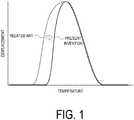
- FIG. 1 is a graph schematically comparing the foaming behavior of the microsphere of the present invention and that of a known microsphere.
- the microsphere according to the present invention includes an outer shell and a foaming agent encapsulated inside the outer shell and is typically heat-expandable ("heat-expandable microsphere").
- the microsphere having such a configuration can generally be produced by suspension-polymerizing one or more types of polymerizable monomer in the presence of a foaming agent in an aqueous dispersion medium containing a dispersion stabilizer.
- the microsphere of the present invention satisfies the following relationship (1). 20 ⁇ Ts ⁇ Tg ⁇ 75 ° C (In the above relationship, Ts (°C) represents the foaming initiation temperature of the microsphere, and Tg (°C) represents the glass transition temperature of the polymer.)
- the microsphere of the present invention preferably satisfies the relationship 25 ⁇ Ts - Tg ⁇ 65 (°C), and more preferably satisfies the relationship 30 ⁇ Ts - Tg ⁇ 55 (°C).
- the above relationship (1) is considered to express that the outer shell softens sufficiently while retaining barrier properties when the vapor pressure at which the foaming agent can foam at temperature Ts is reached, and to reflect a situation in which, as a result, the microsphere foams rapidly when the heating temperature reaches Ts or above and exhibits narrow foaming behavior.
- FIG. 1 is a graph schematically comparing the foaming behavior of the microsphere of the present invention and that of a known microsphere. It is understood that with the microsphere of the present invention compared to the known microsphere, the foaming initiation temperature Ts shifted to the high-temperature side without the maximum foaming temperature Tmax substantially changing, and as a result, the foaming behavior became narrow.
- the difference (Tmax - Ts) between the maximum foaming temperature Tmax and the foaming initiation temperature Ts is preferably not greater than 40°C, more preferably from 5°C to 35°C, or more preferably from 10°C to 30°C.
- Tmax - Ts is within the above range, the foaming behavior of the microsphere tends to be narrower.
- the glass transition temperature Tg that is used is the value calculated from the FOX equation using the values listed in Polymer Handbook, J. Brandrup, Interscience, 1989 .
- the foaming initiation temperature is measured using a thermomechanical analyzer (called "TMA" hereinafter). Specifically, microspheres as a sample are heated at a temperature increasing rate of 5°C/min using a TMA.
- TMA thermomechanical analyzer
- the foaming initiation temperature in the present invention is the temperature at which height displacement begins when the height displacement of the portion occupied by the sample is continuously measured.
- the maximum foaming temperature is measured using a TMA. Specifically, microspheres as a sample are heated at a temperature increasing rate of 5°C/min using a TMA.
- the foaming initiation temperature in the present invention is the temperature at which height displacement is greatest when the height displacement of the portion occupied by the sample is continuously measured.
- polymers forming the outer shell examples include polymers containing a structural unit derived from a vinyl monomer.
- the polymer comprises a copolymer containing a structural unit derived from methacrylonitrile and a structural unit derived from methacrylic acid as main components (also called “methacrylonitrile/methacrylic acid copolymer” hereinafter) because a microsphere that exhibits narrow foaming behavior while maintaining sufficient foaming performance is readily obtained.
- the methacrylonitrile/methacrylic acid copolymer may also contain a structural unit derived from another vinyl monomer.
- the other vinyl monomer include nitrile monomers other than methacrylonitrile, such as acrylonitrile, ⁇ -chloroacrylonitrile, ⁇ -ethoxyacrylonitrile, and fumaronitrile; vinyl chloride; vinylidene chloride; vinyl acetate; conjugated dienes, such as chloroprene, isoprene, and butadiene; N-substituted maleimides, such as N-phenylmaleimide, N-naphthylmaleimide, N-cyclohexylmaleimide, and methylmaleimide; unsaturated acids other than methacrylic acid, such as acrylic acid, crotonic acid, and anhydrous maleic acid; acrylates such as methyl acrylate, ethyl
- the content of the structural units derived from methacrylonitrile is preferably from 10 to 90 wt.%, more preferably from 15 to 85 wt.%, or even more preferably from 20 to 80 wt.%
- the content of the structural units derived from methacrylic acid is preferably from 10 to 90 wt.%, more preferably from 15 to 85 wt.%, or even more preferably from 20 to 80 wt.%, relative to the total amount of the structural units derived from methacrylonitrile and the structural units derived from methacrylic acid.
- the total content of the structural units derived from methacrylonitrile and structural units derived from methacrylic acid is from 90 to 100 wt.%, more preferably from 90 to 99 wt.%, or even more preferably from 90 to 98 wt.%, and the content of the structural units derived from other vinyl monomers is from 0 to 10 wt.%, more preferably from 1 to 10 wt.%, or even more preferably from 2 to 10 wt.%, relative to the amount of all structural units derived from vinyl monomers.
- More specific examples include methacrylonitrile/methacrylic acid copolymers in which the content of the structural units derived from methacrylonitrile is from 10 to 90 wt.% and the content of the structural units derived from methacrylic acid is from 10 to 90 wt.%, relative to the total amount of the structural units derived from methacrylonitrile and the structural units derived from methacrylic acid, the total content of the structural units derived from methacrylonitrile and the structural units derived from methacrylic acid is from 90 to 100%, and the content of the structural units derived from other vinyl monomers is from 0 to 10 wt.%, relative to the amount of all structural units derived from vinyl monomers.
- methacrylonitrile/methacrylic acid copolymers in which the content of the structural units derived from methacrylonitrile is from 15 to 85 wt.% and the content of the structural units derived from methacrylic acid is from 15 to 85 wt.%, relative to the total amount of the structural units derived from methacrylonitrile and the structural units derived from methacrylic acid, the total content of the structural units derived from methacrylonitrile and the structural units derived from methacrylic acid is from 90 to 98%, and the content of the structural units derived from other vinyl monomers is from 2 to 10 wt.%, relative to the amount of all structural units derived from vinyl monomers.
- the polymer forming the outer shell preferably does not contain structural units derived from acrylonitrile from the perspectives of preventing yellowing, preventing unnecessary generation of water-soluble polymers, and the like.
- the polymer forming the outer shell preferably does not contain structural units derived from crosslinkable monomers as the polymerizable monomer from the perspective of easily obtaining a high foamed article.
- the polymerizable carbon-carbon double bonds include vinyl groups, methacryl groups, acryl groups, and allyl groups.
- the two or more polymerizable carbon-carbon double bonds may be the same or different from each other.
- the foaming agent is a substance that becomes a gas by heating and comprises from 75 to 100 wt% of hexane and from 0 to 25 wt% of another foaming agent.
- a hydrocarbon or the like having a boiling point corresponding to the foaming initiation temperature may be used as a foaming agent.
- hydrocarbons such as methane, ethane, ethylene, propane, propene, n-butane, isobutane, butene, isobutene, n-pentane, isopentane, neopentane, n-hexane, isohexane, n-heptane, isoheptane, n-octane, isooctoane, n-nonane, isononane, n-decane, isodecane, n-dodecane, isododecane, petroleum ethers, and isoparaffin mixtures, and isomer mixtures thereof; chlorofluorocarbons such as CCl 3 F, CCl 2 F 2 , CClF 3 , and CClF 2 -CClF 2 ; and tetraalkylsilanes such as tetramethylsilane, trimethylethyl
- the foaming agent is hexane alone or a combination of two or more types. Above all, n-hexane is utilised because it exhibits sufficient foaming performance. In addition, a compound that undergoes thermolysis and becomes a gas when heated may also be used as desired.
- the foaming agent includes from 75 to 100 wt.% of hexane and from 0 to 15 wt.% of other foaming agents, and more preferably includes from 80 to 100 wt.% of hexane and from 0 to 20 wt.% of other foaming agents.
- other foaming agents include the foaming agents other than n-hexane exemplified specifically above. Isooctane is preferred from the perspective of achieving both sufficient foaming performance and narrow foaming behavior.
- the proportion of foaming agent encapsulated in the microsphere is preferably from 5 to 50 parts by weight, more preferably from 15 to 40 parts by weight, or even more preferably from 20 to 30 parts by weight, relative to 100 parts by weight of polymer forming the outer shell.
- the proportions of polymerizable monomer and foaming agent that is used are preferably adjusted such that the outer shell polymer and foaming agent after polymerization are within the above proportions.
- the proportion of the foaming agent is within the above range, it is preferred in that the expansion ratio does not tend to become insufficient, in that the thickness of the outer shell does not become too thin, and in that the early foaming and breakage of the outer shell due to shear force incurred under heating during processing tend to be suppressed.
- a microsphere can be produced by suspension-polymerizing one or more types of polymerizable monomer in the presence of a foaming agent in an aqueous dispersion medium containing a dispersion stabilizer.
- known methods may be used without particular limitation.
- the average particle size of the microsphere of the present invention is not particularly limited, and is preferably from 1 to 200 ⁇ m, more preferably from 3 to 150 ⁇ m, or particularly preferably from 5 to 100 ⁇ m.
- foamability tends to be sufficient; surface smoothness does not tend to be lost in fields that demand glossy appearance; and resistance to shearing force during processing does not tend to be insufficient.
- the heat-expandable resin composition according to the present invention contains the above microsphere and one or more types selected from the group consisting of thermoplastic resins, thermosetting resins, and fibers.
- the thermoplastic resins, thermosetting resins, and fibers may each be used as one type alone or as a combination of two or more types.
- the content of the microspheres is preferably from 10 to 70 parts by weight, more preferably from 20 to 60 parts by weight, or even more preferably from 30 to 50 parts by weight, relative to 100 parts by weight of the one or more types selected from the group consisting of thermoplastic resins, thermosetting resins, and fibers.
- a foam molded article having a good foaming state tends to be obtained.
- thermoplastic resins are not particularly limited and include polyvinyl chloride (PVC), polypropylene (PP), ethylene/vinyl acetate copolymer (EVA), thermoplastic elastomer (TPE), ethylene/methyl methacrylate copolymer (EMMA), ethylene/ ⁇ -olefin copolymer (LLDPE), and low density polyethylene (LDPE).
- thermosetting resins include ethylene-propylene-diene rubber (EPDM), silicone rubber, and epoxy resin.
- fibers are not particularly limited and include glass fibers, carbon fibers, metal fibers, pulp fibers, and synthetic fibers.
- the method for manufacturing the heat-expandable resin composition according to the present invention includes kneading and heat-treating the microsphere and the one or more types selected from the group consisting of thermoplastic resins, thermosetting resins, and fibers at a temperature lower than the foaming initiation temperature of the microsphere.
- Examples of the method of kneading and heat treatment are not particularly limited and include extrusion.
- the specific examples of the extrusion include blending the unheat-treated microsphere with the above one or more types selected from the group consisting of thermoplastic resins, thermosetting resins, and fibers, and creating pellets by extrusion processing at a temperature lower than the foaming initiation temperature of the microsphere.
- the foam molded article according to the present invention contains foamed particles of the above microsphere and one or more types selected from the group consisting of thermoplastic resins, thermosetting resins, and fibers.
- the foamed particles are bubbles formed by swelling the microsphere by heating at a temperature not lower than the foaming initiation temperature of the microsphere and are typically independent bubbles.
- thermoplastic resin, thermosetting resin, and fibers are those exemplified specifically above.
- the foam molded article according to the present invention is designed as necessary with the objective of weight reduction by foam molding using the above microsphere.
- the shape of the foam molded article is not particularly limited and may be a sheet shape, a rod shape, a pipe shape, a block shape, or any other shape.
- the above foam molded article can be advantageously used as a resin molded product for automobiles because it is reduced in weight by using foam molding and has an excellent soundproofing effect and thermal insulation effect.
- the method for manufacturing a foam molded article according to the present invention includes heating an unfoamed molded article formed from a heat-expandable resin composition containing the above microsphere and one or more types selected from the group consisting of thermoplastic resins, thermosetting resins, and fibers at a temperature equal to or higher than the foaming initiation temperature of the above microsphere.
- the above heat-expandable resin composition may be manufactured by, for example, the method described above.
- the range described above may be employed as the content of the microspheres in the above heat-expandable resin composition.
- the foaming initiation temperature of the microsphere may sometimes decrease due to the heating at a temperature lower than the foaming initiation temperature of the microsphere.
- the foaming initiation temperature of the microsphere in cases where heat treatment is performed during the manufacture of the heat-expandable resin composition, is the foaming initiation temperature of the microsphere after that heat treatment.
- the foaming initiation temperature and maximum foaming temperature of examples and comparative examples were measured. Specifically, 0.5 mg of a sample was placed in a container and heated at a temperature increasing rate of 5°C/min using a TMA (model no. TMA/SDTA840, Mettler-Toledo International Inc.), and height displacement of the portion occupied by the sample was continuously measured. The temperature at which the above height displacement started was taken as the foaming initiation temperature (Ts), and the temperature at which the height displacement was greatest was taken as the maximum foaming temperature (Tmax). The height displacement at the point when the height displacement was greatest is called “maximum displacement" hereinafter.
- TMA model no. TMA/SDTA840, Mettler-Toledo International Inc.
- An aqueous dispersion medium was prepared by mixing 32.5 g of 20 wt.% colloidal silica, 1.3 g of 50 wt.% diethanolamine-adipic acid condensation product (acid value: 78 mg KOH/g), 0.48 g of sodium nitrite, 89 g of sodium chloride, and 283 g of water. To this aqueous dispersion medium, 5 wt.% hydrochloric acid aqueous solution was added, and the pH was adjusted to 3.5.
- a polymerizable monomer mixture was prepared by mixing methacrylonitrile (MAN), methacrylic acid (MAA), methyl acrylate (MA), isopentane, isooctane, n-hexane, and isododecane in the weights (g) shown in Table 1 and 1.0 g of 2,2'-azobisisobutyronitrile.
- the prepared aqueous dispersion medium and polymerizable mixture were stirred and mixed using a homogenizer to form minute droplets of the polymerizable monomer mixture in the aqueous dispersion medium.
- the aqueous dispersion medium containing minute droplets of this polymerizable mixture was charged into a polymerization vessel (1.5 L) equipped with an agitator and a reaction was performed by heating at 60°C for 9 hours and then heating at 70°C for another 16 hours using a hot water bath.
- the foaming initiation temperature Ts and the maximum foaming temperature Tmax of the obtained microspheres were evaluated by TMA. Note that the glass transition temperature Tg of the polymer forming the outer shell of the microspheres was calculated from the FOX equation using the values listed in Polymer Handbook, J. Brandrup, Interscience, 1989 .
- the microsphere according to the present invention exhibits narrow foaming behavior while maintaining sufficient foaming performance.
Landscapes
- Chemical & Material Sciences (AREA)
- Organic Chemistry (AREA)
- Chemical Kinetics & Catalysis (AREA)
- Health & Medical Sciences (AREA)
- Medicinal Chemistry (AREA)
- Polymers & Plastics (AREA)
- Engineering & Computer Science (AREA)
- Materials Engineering (AREA)
- Dispersion Chemistry (AREA)
- Manufacture Of Porous Articles, And Recovery And Treatment Of Waste Products (AREA)
- Manufacturing Of Micro-Capsules (AREA)
- Compositions Of Macromolecular Compounds (AREA)
- Addition Polymer Or Copolymer, Post-Treatments, Or Chemical Modifications (AREA)
Applications Claiming Priority (2)
| Application Number | Priority Date | Filing Date | Title |
|---|---|---|---|
| JP2016076021A JP6685165B2 (ja) | 2016-04-05 | 2016-04-05 | マイクロスフェアー、熱発泡性樹脂組成物、並びに発泡成形体及びその製造方法 |
| PCT/JP2017/007856 WO2017175519A1 (ja) | 2016-04-05 | 2017-02-28 | マイクロスフェアー、熱発泡性樹脂組成物、並びに発泡成形体及びその製造方法 |
Publications (3)
| Publication Number | Publication Date |
|---|---|
| EP3441439A4 EP3441439A4 (en) | 2019-02-13 |
| EP3441439A1 EP3441439A1 (en) | 2019-02-13 |
| EP3441439B1 true EP3441439B1 (en) | 2020-02-05 |
Family
ID=60001099
Family Applications (1)
| Application Number | Title | Priority Date | Filing Date |
|---|---|---|---|
| EP17778898.1A Active EP3441439B1 (en) | 2016-04-05 | 2017-02-28 | Microsphere, thermally foamable resin composition, foam molded body and manufacturing method for same |
Country Status (5)
| Country | Link |
|---|---|
| EP (1) | EP3441439B1 (https=) |
| JP (1) | JP6685165B2 (https=) |
| KR (1) | KR102176550B1 (https=) |
| CN (1) | CN108884376B (https=) |
| WO (1) | WO2017175519A1 (https=) |
Families Citing this family (4)
| Publication number | Priority date | Publication date | Assignee | Title |
|---|---|---|---|---|
| KR102915081B1 (ko) * | 2019-08-06 | 2026-01-21 | 닛토덴코 가부시키가이샤 | 점착 테이프 |
| JP7710986B2 (ja) * | 2019-08-06 | 2025-07-22 | 日東電工株式会社 | 粘着テープ |
| JP2021031586A (ja) * | 2019-08-23 | 2021-03-01 | 株式会社クレハ | 発泡成形体およびその製造方法 |
| CN113061284B (zh) * | 2021-03-24 | 2023-03-14 | 中国科学院深圳先进技术研究院 | 一种轻质有机复合材料及其制备方法 |
Family Cites Families (12)
| Publication number | Priority date | Publication date | Assignee | Title |
|---|---|---|---|---|
| JP3209408B2 (ja) | 1997-07-24 | 2001-09-17 | 川崎製鉄株式会社 | 合金化処理過程の冷却方法 |
| WO1999043758A1 (en) | 1998-02-24 | 1999-09-02 | Matsumoto Yushi-Seiyaku Co., Ltd. | Heat-expandable microcapsules, process for producing the same, and method of utilizing the same |
| WO2004058910A1 (ja) * | 2002-12-25 | 2004-07-15 | Matsumoto Yushi-Seiyaku Co., Ltd. | 熱膨張性マイクロカプセル、発泡成形物の製造方法及び発泡成形物 |
| JP5204368B2 (ja) * | 2004-05-19 | 2013-06-05 | 積水化学工業株式会社 | 熱膨張性マイクロカプセル及び熱膨張性マイクロカプセルの製造方法 |
| CN100566811C (zh) * | 2004-09-13 | 2009-12-09 | 株式会社吴羽 | 热发泡性微球及其制造方法、其用途、含有其的组合物、和物品 |
| EP1964903B1 (en) * | 2005-12-19 | 2017-03-22 | Kureha Corporation | Heat-expandable microspheres, process for production of the same and uses thereof |
| JP5255200B2 (ja) * | 2005-12-21 | 2013-08-07 | 積水化学工業株式会社 | 熱膨張性マイクロカプセル及び発泡成形体 |
| US20130184362A1 (en) * | 2010-09-06 | 2013-07-18 | Hiroshi Yamauchi | Foamable resin composition and foam molded body |
| JP5746498B2 (ja) * | 2010-11-19 | 2015-07-08 | 松本油脂製薬株式会社 | 熱膨張性微小球およびその用途 |
| JP2013234255A (ja) * | 2012-05-08 | 2013-11-21 | Sekisui Chem Co Ltd | 被覆熱膨張性マイクロカプセル |
| WO2013178561A2 (en) * | 2012-05-30 | 2013-12-05 | Akzo Nobel Chemicals International B.V. | Microspheres |
| JP6082848B2 (ja) * | 2014-05-23 | 2017-02-15 | 松本油脂製薬株式会社 | 熱膨張性微小球、その製造方法および用途 |
-
2016
- 2016-04-05 JP JP2016076021A patent/JP6685165B2/ja active Active
-
2017
- 2017-02-28 EP EP17778898.1A patent/EP3441439B1/en active Active
- 2017-02-28 CN CN201780021707.2A patent/CN108884376B/zh active Active
- 2017-02-28 KR KR1020187030070A patent/KR102176550B1/ko active Active
- 2017-02-28 WO PCT/JP2017/007856 patent/WO2017175519A1/ja not_active Ceased
Non-Patent Citations (1)
| Title |
|---|
| None * |
Also Published As
| Publication number | Publication date |
|---|---|
| WO2017175519A1 (ja) | 2017-10-12 |
| CN108884376A (zh) | 2018-11-23 |
| EP3441439A4 (en) | 2019-02-13 |
| JP2017185448A (ja) | 2017-10-12 |
| KR102176550B1 (ko) | 2020-11-09 |
| EP3441439A1 (en) | 2019-02-13 |
| CN108884376B (zh) | 2021-04-02 |
| JP6685165B2 (ja) | 2020-04-22 |
| KR20180125537A (ko) | 2018-11-23 |
Similar Documents
| Publication | Publication Date | Title |
|---|---|---|
| JP4542908B2 (ja) | 熱膨張性マイクロカプセル、発泡成形物の製造方法及び発泡成形物 | |
| TWI520775B (zh) | A heat-expandable microcapsule, a method for producing a heat-expandable microcapsule, a foamed masterbatch, and a foamed molded article | |
| EP1288272B2 (en) | Heat-expandable microsphere and production process thereof | |
| CN101341227B (zh) | 热发泡性微球及其制造方法和用途 | |
| TWI526247B (zh) | Thermal expansion microcapsules and methods of making heat-expandable microcapsules | |
| EP2327475A2 (en) | Thermally-expandable microspheres having good foaming characteristics and uniform microsphere diameter and methods of preparing the same | |
| EP1811007A1 (en) | Thermally foaming microsphere, method for production thereof, use thereof, composition containing the same, and article | |
| EP3441439B1 (en) | Microsphere, thermally foamable resin composition, foam molded body and manufacturing method for same | |
| JP2002012693A (ja) | 熱発泡性マイクロスフェアー及びその製造方法 | |
| EP4467579A1 (en) | Thermally expandable microcapsules, foamable resin composition, and foam | |
| JP7296946B2 (ja) | 熱膨張性マイクロカプセル及び発泡成形用組成物 | |
| KR102165682B1 (ko) | 마이크로스피어, 상기 마이크로스피어를 포함하는 열발포성 수지 조성물, 구조 부재, 및 성형체, 및 상기 구조 부재 및 상기 성형체의 제조 방법 | |
| EP3231850B1 (en) | Thermally-expandable microspheres, and composition and molded article containing same | |
| JP7583537B2 (ja) | 熱膨張性マイクロカプセル、成形用樹脂組成物及び発泡成形体 | |
| US20180258248A1 (en) | Large-diameter heat-expanding microspheres and method for producing same | |
| WO2026034309A1 (ja) | マイクロスフェアー、成形用樹脂組成物、及び発泡成形体 | |
| KR20100103952A (ko) | 경량성 부품 소재를 위한 열팽창성 마이크로스페어 및 그 제조방법 | |
| WO2017195438A1 (ja) | 発泡成形体の製造方法 |
Legal Events
| Date | Code | Title | Description |
|---|---|---|---|
| STAA | Information on the status of an ep patent application or granted ep patent |
Free format text: STATUS: THE INTERNATIONAL PUBLICATION HAS BEEN MADE |
|
| PUAI | Public reference made under article 153(3) epc to a published international application that has entered the european phase |
Free format text: ORIGINAL CODE: 0009012 |
|
| STAA | Information on the status of an ep patent application or granted ep patent |
Free format text: STATUS: REQUEST FOR EXAMINATION WAS MADE |
|
| 17P | Request for examination filed |
Effective date: 20181031 |
|
| A4 | Supplementary search report drawn up and despatched |
Effective date: 20190102 |
|
| AK | Designated contracting states |
Kind code of ref document: A1 Designated state(s): AL AT BE BG CH CY CZ DE DK EE ES FI FR GB GR HR HU IE IS IT LI LT LU LV MC MK MT NL NO PL PT RO RS SE SI SK SM TR |
|
| AX | Request for extension of the european patent |
Extension state: BA ME |
|
| GRAP | Despatch of communication of intention to grant a patent |
Free format text: ORIGINAL CODE: EPIDOSNIGR1 |
|
| STAA | Information on the status of an ep patent application or granted ep patent |
Free format text: STATUS: GRANT OF PATENT IS INTENDED |
|
| DAV | Request for validation of the european patent (deleted) | ||
| DAX | Request for extension of the european patent (deleted) | ||
| RIC1 | Information provided on ipc code assigned before grant |
Ipc: C09K 3/00 20060101AFI20190604BHEP Ipc: B01J 13/14 20060101ALI20190604BHEP Ipc: C08L 33/18 20060101ALI20190604BHEP Ipc: C08K 9/10 20060101ALI20190604BHEP Ipc: C08J 9/32 20060101ALI20190604BHEP Ipc: C08F 220/42 20060101ALI20190604BHEP |
|
| INTG | Intention to grant announced |
Effective date: 20190626 |
|
| GRAJ | Information related to disapproval of communication of intention to grant by the applicant or resumption of examination proceedings by the epo deleted |
Free format text: ORIGINAL CODE: EPIDOSDIGR1 |
|
| STAA | Information on the status of an ep patent application or granted ep patent |
Free format text: STATUS: REQUEST FOR EXAMINATION WAS MADE |
|
| GRAS | Grant fee paid |
Free format text: ORIGINAL CODE: EPIDOSNIGR3 |
|
| STAA | Information on the status of an ep patent application or granted ep patent |
Free format text: STATUS: GRANT OF PATENT IS INTENDED |
|
| INTC | Intention to grant announced (deleted) | ||
| GRAP | Despatch of communication of intention to grant a patent |
Free format text: ORIGINAL CODE: EPIDOSNIGR1 |
|
| INTG | Intention to grant announced |
Effective date: 20191112 |
|
| GRAA | (expected) grant |
Free format text: ORIGINAL CODE: 0009210 |
|
| STAA | Information on the status of an ep patent application or granted ep patent |
Free format text: STATUS: THE PATENT HAS BEEN GRANTED |
|
| AK | Designated contracting states |
Kind code of ref document: B1 Designated state(s): AL AT BE BG CH CY CZ DE DK EE ES FI FR GB GR HR HU IE IS IT LI LT LU LV MC MK MT NL NO PL PT RO RS SE SI SK SM TR |
|
| REG | Reference to a national code |
Ref country code: GB Ref legal event code: FG4D |
|
| REG | Reference to a national code |
Ref country code: AT Ref legal event code: REF Ref document number: 1229898 Country of ref document: AT Kind code of ref document: T Effective date: 20200215 |
|
| REG | Reference to a national code |
Ref country code: DE Ref legal event code: R096 Ref document number: 602017011441 Country of ref document: DE |
|
| REG | Reference to a national code |
Ref country code: IE Ref legal event code: FG4D |
|
| REG | Reference to a national code |
Ref country code: CH Ref legal event code: EP |
|
| REG | Reference to a national code |
Ref country code: SE Ref legal event code: TRGR |
|
| REG | Reference to a national code |
Ref country code: NL Ref legal event code: MP Effective date: 20200205 |
|
| PG25 | Lapsed in a contracting state [announced via postgrant information from national office to epo] |
Ref country code: PT Free format text: LAPSE BECAUSE OF FAILURE TO SUBMIT A TRANSLATION OF THE DESCRIPTION OR TO PAY THE FEE WITHIN THE PRESCRIBED TIME-LIMIT Effective date: 20200628 Ref country code: NO Free format text: LAPSE BECAUSE OF FAILURE TO SUBMIT A TRANSLATION OF THE DESCRIPTION OR TO PAY THE FEE WITHIN THE PRESCRIBED TIME-LIMIT Effective date: 20200505 Ref country code: FI Free format text: LAPSE BECAUSE OF FAILURE TO SUBMIT A TRANSLATION OF THE DESCRIPTION OR TO PAY THE FEE WITHIN THE PRESCRIBED TIME-LIMIT Effective date: 20200205 Ref country code: RS Free format text: LAPSE BECAUSE OF FAILURE TO SUBMIT A TRANSLATION OF THE DESCRIPTION OR TO PAY THE FEE WITHIN THE PRESCRIBED TIME-LIMIT Effective date: 20200205 |
|
| REG | Reference to a national code |
Ref country code: LT Ref legal event code: MG4D |
|
| PG25 | Lapsed in a contracting state [announced via postgrant information from national office to epo] |
Ref country code: IS Free format text: LAPSE BECAUSE OF FAILURE TO SUBMIT A TRANSLATION OF THE DESCRIPTION OR TO PAY THE FEE WITHIN THE PRESCRIBED TIME-LIMIT Effective date: 20200605 Ref country code: BG Free format text: LAPSE BECAUSE OF FAILURE TO SUBMIT A TRANSLATION OF THE DESCRIPTION OR TO PAY THE FEE WITHIN THE PRESCRIBED TIME-LIMIT Effective date: 20200505 Ref country code: GR Free format text: LAPSE BECAUSE OF FAILURE TO SUBMIT A TRANSLATION OF THE DESCRIPTION OR TO PAY THE FEE WITHIN THE PRESCRIBED TIME-LIMIT Effective date: 20200506 Ref country code: LV Free format text: LAPSE BECAUSE OF FAILURE TO SUBMIT A TRANSLATION OF THE DESCRIPTION OR TO PAY THE FEE WITHIN THE PRESCRIBED TIME-LIMIT Effective date: 20200205 Ref country code: HR Free format text: LAPSE BECAUSE OF FAILURE TO SUBMIT A TRANSLATION OF THE DESCRIPTION OR TO PAY THE FEE WITHIN THE PRESCRIBED TIME-LIMIT Effective date: 20200205 |
|
| REG | Reference to a national code |
Ref country code: DE Ref legal event code: R119 Ref document number: 602017011441 Country of ref document: DE |
|
| PG25 | Lapsed in a contracting state [announced via postgrant information from national office to epo] |
Ref country code: NL Free format text: LAPSE BECAUSE OF FAILURE TO SUBMIT A TRANSLATION OF THE DESCRIPTION OR TO PAY THE FEE WITHIN THE PRESCRIBED TIME-LIMIT Effective date: 20200205 |
|
| REG | Reference to a national code |
Ref country code: CH Ref legal event code: PL |
|
| REG | Reference to a national code |
Ref country code: BE Ref legal event code: MM Effective date: 20200229 |
|
| PG25 | Lapsed in a contracting state [announced via postgrant information from national office to epo] |
Ref country code: LT Free format text: LAPSE BECAUSE OF FAILURE TO SUBMIT A TRANSLATION OF THE DESCRIPTION OR TO PAY THE FEE WITHIN THE PRESCRIBED TIME-LIMIT Effective date: 20200205 Ref country code: ES Free format text: LAPSE BECAUSE OF FAILURE TO SUBMIT A TRANSLATION OF THE DESCRIPTION OR TO PAY THE FEE WITHIN THE PRESCRIBED TIME-LIMIT Effective date: 20200205 Ref country code: LU Free format text: LAPSE BECAUSE OF NON-PAYMENT OF DUE FEES Effective date: 20200228 Ref country code: RO Free format text: LAPSE BECAUSE OF FAILURE TO SUBMIT A TRANSLATION OF THE DESCRIPTION OR TO PAY THE FEE WITHIN THE PRESCRIBED TIME-LIMIT Effective date: 20200205 Ref country code: CZ Free format text: LAPSE BECAUSE OF FAILURE TO SUBMIT A TRANSLATION OF THE DESCRIPTION OR TO PAY THE FEE WITHIN THE PRESCRIBED TIME-LIMIT Effective date: 20200205 Ref country code: SK Free format text: LAPSE BECAUSE OF FAILURE TO SUBMIT A TRANSLATION OF THE DESCRIPTION OR TO PAY THE FEE WITHIN THE PRESCRIBED TIME-LIMIT Effective date: 20200205 Ref country code: SM Free format text: LAPSE BECAUSE OF FAILURE TO SUBMIT A TRANSLATION OF THE DESCRIPTION OR TO PAY THE FEE WITHIN THE PRESCRIBED TIME-LIMIT Effective date: 20200205 Ref country code: EE Free format text: LAPSE BECAUSE OF FAILURE TO SUBMIT A TRANSLATION OF THE DESCRIPTION OR TO PAY THE FEE WITHIN THE PRESCRIBED TIME-LIMIT Effective date: 20200205 Ref country code: DK Free format text: LAPSE BECAUSE OF FAILURE TO SUBMIT A TRANSLATION OF THE DESCRIPTION OR TO PAY THE FEE WITHIN THE PRESCRIBED TIME-LIMIT Effective date: 20200205 |
|
| REG | Reference to a national code |
Ref country code: AT Ref legal event code: MK05 Ref document number: 1229898 Country of ref document: AT Kind code of ref document: T Effective date: 20200205 |
|
| PG25 | Lapsed in a contracting state [announced via postgrant information from national office to epo] |
Ref country code: CH Free format text: LAPSE BECAUSE OF NON-PAYMENT OF DUE FEES Effective date: 20200229 Ref country code: MC Free format text: LAPSE BECAUSE OF FAILURE TO SUBMIT A TRANSLATION OF THE DESCRIPTION OR TO PAY THE FEE WITHIN THE PRESCRIBED TIME-LIMIT Effective date: 20200205 Ref country code: LI Free format text: LAPSE BECAUSE OF NON-PAYMENT OF DUE FEES Effective date: 20200229 |
|
| PLBE | No opposition filed within time limit |
Free format text: ORIGINAL CODE: 0009261 |
|
| STAA | Information on the status of an ep patent application or granted ep patent |
Free format text: STATUS: NO OPPOSITION FILED WITHIN TIME LIMIT |
|
| 26N | No opposition filed |
Effective date: 20201106 |
|
| PG25 | Lapsed in a contracting state [announced via postgrant information from national office to epo] |
Ref country code: DE Free format text: LAPSE BECAUSE OF NON-PAYMENT OF DUE FEES Effective date: 20200901 Ref country code: AT Free format text: LAPSE BECAUSE OF FAILURE TO SUBMIT A TRANSLATION OF THE DESCRIPTION OR TO PAY THE FEE WITHIN THE PRESCRIBED TIME-LIMIT Effective date: 20200205 Ref country code: IE Free format text: LAPSE BECAUSE OF NON-PAYMENT OF DUE FEES Effective date: 20200228 Ref country code: FR Free format text: LAPSE BECAUSE OF NON-PAYMENT OF DUE FEES Effective date: 20200405 Ref country code: IT Free format text: LAPSE BECAUSE OF FAILURE TO SUBMIT A TRANSLATION OF THE DESCRIPTION OR TO PAY THE FEE WITHIN THE PRESCRIBED TIME-LIMIT Effective date: 20200205 |
|
| PG25 | Lapsed in a contracting state [announced via postgrant information from national office to epo] |
Ref country code: SI Free format text: LAPSE BECAUSE OF FAILURE TO SUBMIT A TRANSLATION OF THE DESCRIPTION OR TO PAY THE FEE WITHIN THE PRESCRIBED TIME-LIMIT Effective date: 20200205 Ref country code: BE Free format text: LAPSE BECAUSE OF NON-PAYMENT OF DUE FEES Effective date: 20200229 Ref country code: PL Free format text: LAPSE BECAUSE OF FAILURE TO SUBMIT A TRANSLATION OF THE DESCRIPTION OR TO PAY THE FEE WITHIN THE PRESCRIBED TIME-LIMIT Effective date: 20200205 |
|
| GBPC | Gb: european patent ceased through non-payment of renewal fee |
Effective date: 20210228 |
|
| PG25 | Lapsed in a contracting state [announced via postgrant information from national office to epo] |
Ref country code: GB Free format text: LAPSE BECAUSE OF NON-PAYMENT OF DUE FEES Effective date: 20210228 |
|
| PG25 | Lapsed in a contracting state [announced via postgrant information from national office to epo] |
Ref country code: TR Free format text: LAPSE BECAUSE OF FAILURE TO SUBMIT A TRANSLATION OF THE DESCRIPTION OR TO PAY THE FEE WITHIN THE PRESCRIBED TIME-LIMIT Effective date: 20200205 Ref country code: MT Free format text: LAPSE BECAUSE OF FAILURE TO SUBMIT A TRANSLATION OF THE DESCRIPTION OR TO PAY THE FEE WITHIN THE PRESCRIBED TIME-LIMIT Effective date: 20200205 Ref country code: CY Free format text: LAPSE BECAUSE OF FAILURE TO SUBMIT A TRANSLATION OF THE DESCRIPTION OR TO PAY THE FEE WITHIN THE PRESCRIBED TIME-LIMIT Effective date: 20200205 |
|
| PG25 | Lapsed in a contracting state [announced via postgrant information from national office to epo] |
Ref country code: MK Free format text: LAPSE BECAUSE OF FAILURE TO SUBMIT A TRANSLATION OF THE DESCRIPTION OR TO PAY THE FEE WITHIN THE PRESCRIBED TIME-LIMIT Effective date: 20200205 Ref country code: AL Free format text: LAPSE BECAUSE OF FAILURE TO SUBMIT A TRANSLATION OF THE DESCRIPTION OR TO PAY THE FEE WITHIN THE PRESCRIBED TIME-LIMIT Effective date: 20200205 |
|
| P01 | Opt-out of the competence of the unified patent court (upc) registered |
Effective date: 20230512 |
|
| PGFP | Annual fee paid to national office [announced via postgrant information from national office to epo] |
Ref country code: SE Payment date: 20260218 Year of fee payment: 10 |