EP3438180B1 - Energy absorber - Google Patents
Energy absorber Download PDFInfo
- Publication number
- EP3438180B1 EP3438180B1 EP17774120.4A EP17774120A EP3438180B1 EP 3438180 B1 EP3438180 B1 EP 3438180B1 EP 17774120 A EP17774120 A EP 17774120A EP 3438180 B1 EP3438180 B1 EP 3438180B1
- Authority
- EP
- European Patent Office
- Prior art keywords
- olefin
- resin
- mass
- energy absorber
- polyamide
- Prior art date
- Legal status (The legal status is an assumption and is not a legal conclusion. Google has not performed a legal analysis and makes no representation as to the accuracy of the status listed.)
- Active
Links
Images

Classifications
-
- B—PERFORMING OPERATIONS; TRANSPORTING
- B60—VEHICLES IN GENERAL
- B60R—VEHICLES, VEHICLE FITTINGS, OR VEHICLE PARTS, NOT OTHERWISE PROVIDED FOR
- B60R19/00—Wheel guards; Radiator guards, e.g. grilles; Obstruction removers; Fittings damping bouncing force in collisions
- B60R19/02—Bumpers, i.e. impact receiving or absorbing members for protecting vehicles or fending off blows from other vehicles or objects
- B60R19/18—Bumpers, i.e. impact receiving or absorbing members for protecting vehicles or fending off blows from other vehicles or objects characterised by the cross-section; Means within the bumper to absorb impact
-
- B—PERFORMING OPERATIONS; TRANSPORTING
- B60—VEHICLES IN GENERAL
- B60R—VEHICLES, VEHICLE FITTINGS, OR VEHICLE PARTS, NOT OTHERWISE PROVIDED FOR
- B60R21/00—Arrangements or fittings on vehicles for protecting or preventing injuries to occupants or pedestrians in case of accidents or other traffic risks
- B60R21/02—Occupant safety arrangements or fittings, e.g. crash pads
- B60R21/04—Padded linings for the vehicle interior ; Energy absorbing structures associated with padded or non-padded linings
-
- C—CHEMISTRY; METALLURGY
- C08—ORGANIC MACROMOLECULAR COMPOUNDS; THEIR PREPARATION OR CHEMICAL WORKING-UP; COMPOSITIONS BASED THEREON
- C08L—COMPOSITIONS OF MACROMOLECULAR COMPOUNDS
- C08L23/00—Compositions of homopolymers or copolymers of unsaturated aliphatic hydrocarbons having only one carbon-to-carbon double bond; Compositions of derivatives of such polymers
- C08L23/02—Compositions of homopolymers or copolymers of unsaturated aliphatic hydrocarbons having only one carbon-to-carbon double bond; Compositions of derivatives of such polymers not modified by chemical after-treatment
- C08L23/10—Homopolymers or copolymers of propene
-
- C—CHEMISTRY; METALLURGY
- C08—ORGANIC MACROMOLECULAR COMPOUNDS; THEIR PREPARATION OR CHEMICAL WORKING-UP; COMPOSITIONS BASED THEREON
- C08L—COMPOSITIONS OF MACROMOLECULAR COMPOUNDS
- C08L23/00—Compositions of homopolymers or copolymers of unsaturated aliphatic hydrocarbons having only one carbon-to-carbon double bond; Compositions of derivatives of such polymers
- C08L23/02—Compositions of homopolymers or copolymers of unsaturated aliphatic hydrocarbons having only one carbon-to-carbon double bond; Compositions of derivatives of such polymers not modified by chemical after-treatment
- C08L23/10—Homopolymers or copolymers of propene
- C08L23/12—Polypropene
-
- C—CHEMISTRY; METALLURGY
- C08—ORGANIC MACROMOLECULAR COMPOUNDS; THEIR PREPARATION OR CHEMICAL WORKING-UP; COMPOSITIONS BASED THEREON
- C08L—COMPOSITIONS OF MACROMOLECULAR COMPOUNDS
- C08L23/00—Compositions of homopolymers or copolymers of unsaturated aliphatic hydrocarbons having only one carbon-to-carbon double bond; Compositions of derivatives of such polymers
- C08L23/02—Compositions of homopolymers or copolymers of unsaturated aliphatic hydrocarbons having only one carbon-to-carbon double bond; Compositions of derivatives of such polymers not modified by chemical after-treatment
- C08L23/18—Homopolymers or copolymers of hydrocarbons having four or more carbon atoms
- C08L23/20—Homopolymers or copolymers of hydrocarbons having four or more carbon atoms having four to nine carbon atoms
-
- C—CHEMISTRY; METALLURGY
- C08—ORGANIC MACROMOLECULAR COMPOUNDS; THEIR PREPARATION OR CHEMICAL WORKING-UP; COMPOSITIONS BASED THEREON
- C08L—COMPOSITIONS OF MACROMOLECULAR COMPOUNDS
- C08L77/00—Compositions of polyamides obtained by reactions forming a carboxylic amide link in the main chain; Compositions of derivatives of such polymers
-
- C—CHEMISTRY; METALLURGY
- C08—ORGANIC MACROMOLECULAR COMPOUNDS; THEIR PREPARATION OR CHEMICAL WORKING-UP; COMPOSITIONS BASED THEREON
- C08L—COMPOSITIONS OF MACROMOLECULAR COMPOUNDS
- C08L77/00—Compositions of polyamides obtained by reactions forming a carboxylic amide link in the main chain; Compositions of derivatives of such polymers
- C08L77/02—Polyamides derived from omega-amino carboxylic acids or from lactams thereof
-
- C—CHEMISTRY; METALLURGY
- C08—ORGANIC MACROMOLECULAR COMPOUNDS; THEIR PREPARATION OR CHEMICAL WORKING-UP; COMPOSITIONS BASED THEREON
- C08L—COMPOSITIONS OF MACROMOLECULAR COMPOUNDS
- C08L77/00—Compositions of polyamides obtained by reactions forming a carboxylic amide link in the main chain; Compositions of derivatives of such polymers
- C08L77/06—Polyamides derived from polyamines and polycarboxylic acids
-
- F—MECHANICAL ENGINEERING; LIGHTING; HEATING; WEAPONS; BLASTING
- F16—ENGINEERING ELEMENTS AND UNITS; GENERAL MEASURES FOR PRODUCING AND MAINTAINING EFFECTIVE FUNCTIONING OF MACHINES OR INSTALLATIONS; THERMAL INSULATION IN GENERAL
- F16F—SPRINGS; SHOCK-ABSORBERS; MEANS FOR DAMPING VIBRATION
- F16F7/00—Vibration-dampers; Shock-absorbers
-
- F—MECHANICAL ENGINEERING; LIGHTING; HEATING; WEAPONS; BLASTING
- F16—ENGINEERING ELEMENTS AND UNITS; GENERAL MEASURES FOR PRODUCING AND MAINTAINING EFFECTIVE FUNCTIONING OF MACHINES OR INSTALLATIONS; THERMAL INSULATION IN GENERAL
- F16F—SPRINGS; SHOCK-ABSORBERS; MEANS FOR DAMPING VIBRATION
- F16F7/00—Vibration-dampers; Shock-absorbers
- F16F7/12—Vibration-dampers; Shock-absorbers using plastic deformation of members
-
- F—MECHANICAL ENGINEERING; LIGHTING; HEATING; WEAPONS; BLASTING
- F16—ENGINEERING ELEMENTS AND UNITS; GENERAL MEASURES FOR PRODUCING AND MAINTAINING EFFECTIVE FUNCTIONING OF MACHINES OR INSTALLATIONS; THERMAL INSULATION IN GENERAL
- F16F—SPRINGS; SHOCK-ABSORBERS; MEANS FOR DAMPING VIBRATION
- F16F7/00—Vibration-dampers; Shock-absorbers
- F16F7/12—Vibration-dampers; Shock-absorbers using plastic deformation of members
- F16F7/121—Vibration-dampers; Shock-absorbers using plastic deformation of members the members having a cellular, e.g. honeycomb, structure
-
- B—PERFORMING OPERATIONS; TRANSPORTING
- B60—VEHICLES IN GENERAL
- B60R—VEHICLES, VEHICLE FITTINGS, OR VEHICLE PARTS, NOT OTHERWISE PROVIDED FOR
- B60R19/00—Wheel guards; Radiator guards, e.g. grilles; Obstruction removers; Fittings damping bouncing force in collisions
- B60R19/02—Bumpers, i.e. impact receiving or absorbing members for protecting vehicles or fending off blows from other vehicles or objects
- B60R19/18—Bumpers, i.e. impact receiving or absorbing members for protecting vehicles or fending off blows from other vehicles or objects characterised by the cross-section; Means within the bumper to absorb impact
- B60R2019/1806—Structural beams therefor, e.g. shock-absorbing
- B60R2019/1833—Structural beams therefor, e.g. shock-absorbing made of plastic material
- B60R2019/184—Blow moulded
-
- B—PERFORMING OPERATIONS; TRANSPORTING
- B60—VEHICLES IN GENERAL
- B60R—VEHICLES, VEHICLE FITTINGS, OR VEHICLE PARTS, NOT OTHERWISE PROVIDED FOR
- B60R19/00—Wheel guards; Radiator guards, e.g. grilles; Obstruction removers; Fittings damping bouncing force in collisions
- B60R19/02—Bumpers, i.e. impact receiving or absorbing members for protecting vehicles or fending off blows from other vehicles or objects
- B60R19/18—Bumpers, i.e. impact receiving or absorbing members for protecting vehicles or fending off blows from other vehicles or objects characterised by the cross-section; Means within the bumper to absorb impact
- B60R2019/186—Additional energy absorbing means supported on bumber beams, e.g. cellular structures or material
- B60R2019/1866—Cellular structures
-
- B—PERFORMING OPERATIONS; TRANSPORTING
- B60—VEHICLES IN GENERAL
- B60R—VEHICLES, VEHICLE FITTINGS, OR VEHICLE PARTS, NOT OTHERWISE PROVIDED FOR
- B60R21/00—Arrangements or fittings on vehicles for protecting or preventing injuries to occupants or pedestrians in case of accidents or other traffic risks
- B60R21/34—Protecting non-occupants of a vehicle, e.g. pedestrians
-
- C—CHEMISTRY; METALLURGY
- C08—ORGANIC MACROMOLECULAR COMPOUNDS; THEIR PREPARATION OR CHEMICAL WORKING-UP; COMPOSITIONS BASED THEREON
- C08L—COMPOSITIONS OF MACROMOLECULAR COMPOUNDS
- C08L2205/00—Polymer mixtures characterised by other features
- C08L2205/03—Polymer mixtures characterised by other features containing three or more polymers in a blend
-
- C—CHEMISTRY; METALLURGY
- C08—ORGANIC MACROMOLECULAR COMPOUNDS; THEIR PREPARATION OR CHEMICAL WORKING-UP; COMPOSITIONS BASED THEREON
- C08L—COMPOSITIONS OF MACROMOLECULAR COMPOUNDS
- C08L2205/00—Polymer mixtures characterised by other features
- C08L2205/08—Polymer mixtures characterised by other features containing additives to improve the compatibility between two polymers
-
- C—CHEMISTRY; METALLURGY
- C08—ORGANIC MACROMOLECULAR COMPOUNDS; THEIR PREPARATION OR CHEMICAL WORKING-UP; COMPOSITIONS BASED THEREON
- C08L—COMPOSITIONS OF MACROMOLECULAR COMPOUNDS
- C08L2207/00—Properties characterising the ingredient of the composition
- C08L2207/02—Heterophasic composition
Definitions
- the present invention relates to an energy absorber having excellent impact resistance and excellent impact energy absorbability.
- EA Electronicgy Absorption
- door trims of automobiles are known which are intended to absorb collision energy at the time of broadside collision.
- hollow EA materials produced by blow molding or EA materials having ribs and produced by injection molding are disclosed (see Patent Literature 1 and Patent Literature 2).
- EP 2 796 496 A1 describes a thermoplastic resin composition which is obtained by mixing a polyolefin resin, a polyamide resin, and a compatibilizer.
- the thermoplastic resin composition is characterized in having a resin phase separate structure as observed under an electron microscope, wherein the resin phase separate structure consists of a continuous phase and a disperse phase which is dispersed in the continuous phase, there is a microdisperse phase in the disperse phase, and the average diameter of the microdisperse phase is 5 to 1,200 nm.
- WO 2013/191307 A1 describes a resin composition comprising a blend of a first resin, a second resin incompatible with the first resin, and a modified elastomer having a reactive group capable of reacting with the first resin, wherein the resin composition has a co-continuous phase structure including a continuous phase A formed of the first resin and a continuous phase B formed of the second resin, and also has a dispersed domain a distributed in the continuous phase A, a finely dispersed subdomain a' distributed in the dispersed domain a, a dispersed domain b distributed in the continuous phase B, and a finely dispersed subdomain b' distributed in the dispersed domain b, the dispersed domain a includes a dispersed domain formed of at least one selected from the group consisting of the second resin and a reaction product of the first resin and the modified elastomer, the dispersed domain b includes a dispersed domain formed of at least one selected from the group consisting of the first resin and the reaction product of
- JP 2013 237242 A describes a honeycomb structure formed with a plurality of cells disposed making a line.
- an object of the present invention to provide an energy absorber having excellent impact resistance and excellent impact energy absorbability.
- the present invention is directed to an energy absorber as defined in claim 1.
- Preferred embodiments are defined in the dependent claims.
- the energy absorber according to the present invention includes a specific olefin-based resin composition, and therefore has excellent impact resistance and excellent impact energy absorbability and is less likely to be broken, for example, fractured. Further, the energy absorber according to the present invention exhibits excellent ductility (extensibility) and repairability (restorability) when subjected to an impact, and therefore unless the energy absorber according to the present invention is broken, its shape is restored. That is, the energy absorber according to the present invention has also excellent durability. Further, even when subjected to an excessive impact, the energy absorber according to the present invention is ductilely fractured, and therefore a negative influence on its surroundings can be reduced. Further, the energy absorber according to the present invention includes an olefin-based resin composition that has excellent flowability when melted, and therefore has excellent formability. Therefore, the energy absorber can have a fine shape by injection molding or the like.
- the energy absorber according to the present invention has an impact absorbing frame having an impact absorbing wall whose plane direction is along a direction in which an impact load is to be applied.
- the energy absorber according to the present invention configured to allow the impact absorbing wall to collapse to absorb an impact when subjected to an impact load can have further improved impact energy absorbability, and is therefore much less likely to be broken, for example, fractured.
- the impact absorbing frame may have a tubular hollow portion surrounded by the impact absorbing wall.
- the energy absorber according to the present invention can have further improved impact energy absorbability, and is therefore much less likely to be broken, for example, fractured.
- the impact absorbing frame may have a honeycomb structure having the two or more tubular hollow portions.
- the energy absorber according to the present invention can have further improved impact energy absorbability, and is therefore much less likely to be broken, for example, fractured.
- An energy absorber includes an olefin-based resin composition having a specific structure and obtained by mixing an olefin resin (hereinafter referred to as "component (A)”), a polyamide resin (hereinafter referred to as “component (B)”), and an elastomer having a reactive group that reacts with the polyamide resin (hereinafter referred to as “modified elastomer (C)” or “component (C)”), that is, an olefin-based resin composition having a continuous phase containing the component (A) and a polyamide resin-based dispersed phase dispersed in the continuous phase and having a structure in which the component (C) is contained in a matrix phase containing the component (B).
- component (A) olefin resin
- component (B) polyamide resin
- the olefin-based resin composition is preferably a thermoplastic resin composition.
- the continuous phase constituting this composition is a phase containing the component (A), and may be a phase composed of the component (A) and another resin (which will be described later) depending on the purpose, intended use, etc.
- the structure of the continuous phase is not particularly limited, and may be either a crosslinked structure or a non-crosslinked structure.
- the component (A) to be used is not particularly limited, and may be a conventionally-known polyolefin.
- the component (A) include an ethylene homopolymer, a copolymer of ethylene and an unsaturated hydrocarbon having 3 or more carbon atoms (hereinafter referred to as " ⁇ -olefin"), an ⁇ -olefin homopolymer, and a copolymer of two or more ⁇ -olefins. These polymers may be used singly or in combination of two or more of them.
- Examples of the ⁇ -olefin include propylene, 1-butene, 1-pentene, 1-hexene, 1-heptene, 3-methyl-1-butene, and 4-methyl-1-pentene.
- the component (A) is preferably an ⁇ -olefin homopolymer or copolymer, more preferably polypropylene, an ethylene-propylene copolymer, an ethylene-1-butene copolymer, an ethylene-propylene-1-butene copolymer, or the like, particularly preferably a polymer containing a structural unit derived from propylene.
- the weight-average molecular weight (based on polystyrene standards) of the component (A) measured by gel permeation chromatography (GPC) is not particularly limited, but is, for example, preferably 10,000 to 500,000, more preferably 100,000 to 450,000, even more preferably 200,000 to 400,000 from the viewpoint of achieving excellent impact resistance and impact energy absorbability.
- the component (A) is different from a polyolefin-based component as the component (C), which will be described later, in that the component (A) is an olefin resin that has no affinity for the component (B) and that has no reactive group that can react with the component (B), either.
- the continuous phase may be composed of only the component (A), or may further contain another resin as long as the other resin forms a continuous phase together with the component (A). That is, a co-continuous phase may be formed.
- the other resin is a polyamide resin (component (B)).
- the continuous phase contains a polyamide resin-based dispersed phase, and may contain an additive that will be described later in a dispersed state.
- the polyamide resin-based dispersed phase constituting the olefin-based resin composition is a phase in which the modified elastomer is contained in a matrix phase containing the component (B).
- the matrix phase may be a phase composed of only the component (B) or may be a phase composed of the component (B) and another resin (which will be described later) depending on the purpose, intended use, etc.
- the component (B) is not particularly limited as long as its main chain has an amide bond (-NH-CO-).
- the component (B) include resins obtained by conventionally-known methods such as ring-opening polymerization of a lactam, dehydration condensation of an amino acid, polycondensation of a diamine and a dicarboxylic acid, and polycondensation of aminocarboxylic acids, and these resins may be used singly or in combination of two or more of them
- the component (B) may be one obtained using the raw material compound singly or one obtained using the two or more raw material compounds.
- lactam examples include ⁇ -caprolactam, undecane lactam, and ⁇ -lauryl lactam.
- amino acid examples include aminocaproic acid, aminoundecanoic acid, aminododecanoic acid, and paraaminomethylbenzoic acid.
- diamine examples include: aliphatic diamines such as ethylenediamine, 1,3-diaminopropane, 1,4-diaminobutane, 1,6-diaminohexane, 1,7-diaminoheptane, 1,8-diaminooctane, 1,9-diaminononane, 1,10-diaminodecane, 1,11-diaminoundecane, 1,12-diaminododecane, 1,13-diaminotridecane, 1,14-diaminotetradecane, 1,15-diaminopentadecane, 1,16-diaminohexadecane, 1,17-diaminoheptadecane, 1,18-diaminooctadecane, 1,19-diaminononadecane, 1,20-diaminoeicosane, 2-methyl-1,5-di
- dicarboxylic acid examples include: aliphatic dicarboxylic acids such as oxalic acid, malonic acid, succinic acid, glutaric acid, adipic acid, pimelic acid, suberic acid, azelaic acid, sebacic acid, undecanedioic acid, dodecanedioic acid, brasylic acid, tetradecanedioic acid, pentadecanedioic acid, and octadecanedioic acid; alicyclic dicarboxylic acids such as cyclohexanedicarboxylic acids; and aromatic dicarboxylic acids such as orthophthalic acid, terephthalic acid, isophthalic acid, and naphthalene dicarboxylic acid.
- aliphatic dicarboxylic acids such as oxalic acid, malonic acid, succinic acid, glutaric acid, adipic acid, pimelic acid, suberic acid,
- the component (B) include polyamide 6, polyamide 66, polyamide 610, polyamide 612, polyamide 614, polyamide 11, polyamide 12, polyamide 6T, polyamide 6I, polyamide 9T, polyamide M5T, polyamide 1010, polyamide 1012, polyamide 10T, polyamide MXD6, polyamide 6T/66, polyamide 6T/6I, polyamide 6T/6I/66, polyamide 6T/2M-5T, and polyamide 9T/2M-8T.
- polyamide 11 is particularly preferred.
- the polyamide 11 is preferably used either singly or in combination with another polyamide resin. It is to be noted that in the latter case, the upper limit of content of the other polyamide resin is preferably 40% by mass with respect to the total mass of the component (B).
- the polyamide 11 is preferably a resin obtained using 11-aminoundecanoic acid or undecane lactam as a monomer.
- 11-aminoundecanoic acid can be obtained from castor oil, and therefore polyamide 11 obtained using such 11-aminoundecanoic acid is preferred from the viewpoint of environmental protection (particularly from the viewpoint of carbon neutral).
- the weight-average molecular weight (based on polystyrene standards) of the component (B) measured by gel permeation chromatography (GPC) is not particularly limited, but is, for example, preferably 5,000 to 100,000, more preferably 7,500 to 50,000, even more preferably 10,000 to 50,000 from the viewpoint of achieving excellent impact resistance and impact energy absorbability.
- the matrix phase may further contain another resin.
- the other resin is preferably a resin having compatibility with the component (B).
- polyamide resin-based dispersed phase is contained in at least the component (A) constituting the continuous phase.
- This component (C) is preferably a component having an affinity for the olefin resin. More specifically, the component (C) preferably has compatibilizing effect on the polyamide resin and the olefin resin. In other words, the component (C) is preferably a compatibilizer for the polyamide resin and polyolefin resin.
- the component (C) used in the present invention is particularly preferably an elastomer having a reactive group that reacts with the polyamide resin in the side chain or at the end of the molecule.
- the amount of modification is not particularly limited.
- the number of reactive groups contained in one molecule of the modified elastomer is preferably 1 or more, more preferably 2 to 50, even more preferably 3 to 30, particularly preferably 5 to 20.
- such modified elastomers may be used singly or in combination of two or more of them.
- Examples of an elastomer before modification include an olefin-based elastomer and a styrene-based elastomer.
- the elastomer before modification is particularly preferably an olefin-based elastomer.
- the olefin-based elastomer is preferably an ⁇ -olefin-based copolymer containing a structural unit derived from an ⁇ -olefin having 3 to 8 carbon atoms, and examples of such an ⁇ -olefin-based copolymer include an ethylene- ⁇ -olefin copolymer, an ⁇ -olefin copolymer, an ⁇ -olefin-non-conjugated diene copolymer, and an ethylene- ⁇ -olefin-non-conjugated diene copolymer. Among them, an ethylene- ⁇ -olefin copolymer, an ⁇ -olefin copolymer, and an ethylene- ⁇ -olefin-non-conjugated diene copolymer are particularly preferred.
- non-conjugated diene examples include: linear non-cyclic diene compounds such as 1,4-pentadiene, 1,4-hexadiene, 1,5-hexadiene and 1,6-hexadiene; branched non-cyclic diene compounds such as 5-methyl-1,4-hexadiene, 3,7-dimethyl-1,6-octadiene, 5,7-dimethylocta-1,6-diene, 3,7-dimethyl-1,7-octadiene, 7-methylocta-1,6-diene, and dihydromyrcene; and alicyclic diene compounds such as tetrahydroindene, methyltetrahydroindene, dicyclopentadiene, bicyclo[2.2.1]-hepta-2,5-diene, 5-methylene-2-norbornene, 5-ethylidene-2-norbomene, 5-propenyl-2-norborn
- the olefin elastomer examples include an ethylene-propylene copolymer, an ethylene-1-butene copolymer, an ethylene-1-pentene copolymer, an ethylene-1-hexene copolymer, an ethylene-1-octene copolymer, a propylene-1-butene copolymer, a propylene-1-pentene copolymer, a propylene-1-hexene copolymer, and a propylene-1-octene copolymer.
- an ethylene-propylene copolymer, an ethylene-1-butene copolymer, and an ethylene-1-octene copolymer are preferred.
- styrene-based elastomer examples include a block copolymer of an aromatic vinyl compound and a conjugated diene compound and a hydrogenated product thereof.
- aromatic vinyl compound examples include: styrene; alkylstyrenes such as ⁇ -methylstyrene, p-methylstyrene, and p-tert-butylstyrene; p-methoxystyrene; and vinylnaphthalene.
- conjugated diene compound examples include butadiene, isoprene, 1,3-pentadiene, methylpentadiene, phenylbutadiene, 3,4-dimethyl-1,3-hexadiene, and 4,5-diethyl-1,3-octadiene.
- styrene-based elastomer examples include styrene-butadienestyrene copolymers (SBSs), styrene-isoprene-styrene copolymers (SISs), styrene-ethylene/butylene-styrene copolymers (SEBSs), and styrene-ethylene/propylene-styrene copolymers (SEPSs).
- SBSs styrene-butadienestyrene copolymers
- SISs styrene-isoprene-styrene copolymers
- SEBSs styrene-ethylene/butylene-styrene copolymers
- SEPSs styrene-ethylene/propylene-styrene copolymers
- the weight-average molecular weight (based on polystyrene standards) of the elastomer measured by gel permeation chromatography (GPC) is not particularly limited, but is, for example, preferably 10,000 to 500,000, more preferably 20,000 to 500,000, even more preferably 30,000 to 300,000 from the viewpoint of achieving excellent impact resistance and impact energy absorbability.
- Examples of the reactive group that reacts with the polyamide resin include an acid anhydride group, a carboxyl group, an epoxy group, an oxazoline group, and an isocyanate group. It is to be noted that a method for attaching such a reactive group to the elastomer is not particularly limited, and a known method may be used.
- an acid anhydride group and a carboxyl group are preferred, and an acid anhydride group is particularly preferred.
- Examples of a monomer (acid anhydride) for introducing an acid anhydride group include acid anhydrides such as maleic anhydride, phthalic anhydride, itaconic anhydride, succinic anhydride, glutaric anhydride, adipic anhydride, citraconic anhydride, tetrahydrophthalic anhydride, and butenyl succinic anhydride.
- acid anhydrides such as maleic anhydride, phthalic anhydride, itaconic anhydride, succinic anhydride, glutaric anhydride, adipic anhydride, citraconic anhydride, tetrahydrophthalic anhydride, and butenyl succinic anhydride.
- maleic anhydride, phthalic anhydride, and itaconic anhydride are preferred, and maleic anhydride is particularly preferred.
- Examples of a monomer (carboxylic acid) for introducing a carboxyl group include acrylic acid, methacrylic acid, maleic acid, fumaric acid, itaconic acid, and citraconic acid.
- component (C) examples include an acid-modified elastomer having an acid anhydride group attached thereto, a carboxylic acid-modified elastomer having a carboxyl group attached thereto, an epoxy-modified elastomer having an epoxy group attached thereto, an oxazoline-modified elastomer having an oxazoline group attached thereto, and an isocyanate-modified elastomer having an isocyanate group attached thereto.
- the component (C) is preferably an elastomer modified with maleic anhydride such as a maleic anhydride-modified ethylene-propylene copolymer, a maleic anhydride-modified ethylene-1-butene copolymer, a maleic anhydride-modified ethylene-1-hexene copolymer, or a maleic anhydride-modified ethylene-1-octene copolymer.
- the polyamide-based resin dispersed phase may contain only the component (C) or may further contain another elastomer in its matrix phase containing the component (B).
- the other elastomer a non-modified olefin elastomer or the like can be used.
- the shape and size of the component (C) contained in the matrix phase of the polyamide-based resin dispersed phase and the shape and size of the other elastomer that may be contained in the matrix phase of the polyamide-based resin dispersed phase are not particularly limited.
- the average of the diameters of particles of the phase (fine dispersed phase) containing the modified elastomer (C) is not particularly limited, but is, for example, preferably 5 to 1000 nm, more preferably 8 to 600 nm, even more preferably 10 to 400 nm, particularly preferably 15 to 350 nm from the viewpoint of achieving excellent impact resistance and impact energy absorbability. It is to be noted that the average is determined in the following manner. One hundred particles of a phase (which is composed of the component (C) and a reaction product of the component (C) and the polyamide resin) in the polyamide-based resin dispersed phase are randomly selected in an image obtained using an electron microscope, the diameter of each of the particles is measured, and the average of the measured diameters is determined.
- the polyamide-based resin dispersed phase may have a definite shape, such as a spherical shape or an oval spherical shape, or a variation thereof (indefinite shape), and may have surface irregularities.
- the upper limit of maximum diameter of the polyamide-based resin dispersed phase is not particularly limited, but is preferably 20,000 nm, more preferably 10,000 nm, even more preferably 8000 nm, particularly preferably 4000 nm from the viewpoint of achieving excellent impact resistance and excellent impact energy absorbability.
- the lower limit is usually 5 nm (particularly 10 nm, more particularly 15 nm, even more particularly 50 nm).
- the maximum diameter may be measured using an image obtained by an electron microscope.
- the olefin-based resin composition contains a plurality of particles of the polyamide-based resin dispersed phase, and the particles may be particles having almost the same shape and size, a combination of two or more kinds of particles having almost the same maximum diameter, or particles having various sizes within the above range.
- the olefin-based resin composition includes a continuous phase containing the component (A) and a polyamide resin-based dispersed phase dispersed in the continuous phase, and the polyamide resin-based dispersed phase is contained in a state where an interfacial phase is provided in at least part of the interface between the continuous phase and the polyamide resin-based dispersed phase.
- the interfacial phase contains the modified elastomer .
- the thickness of the interfacial phase is not particularly limited.
- nucleating agent and the reinforcing filler examples include: silicates such as talc, silica, clay, montmorillonite, and kaolin; carbonates such as calcium carbonate, lithium carbonate, and magnesium carbonate; metal oxides such as alumina, titanium oxide, and zinc oxide; metals such as aluminum, iron, silver, and copper; hydroxides such as aluminum hydroxide and magnesium hydroxide; sulfides such as barium sulfate; carbides such as charcoal and bamboo charcoal; titanides such as potassium titanate and barium titanate; celluloses such as cellulose microfibrils and cellulose acetate; resin fibers such as polyethylene terephthalate fibers, nylon fibers, polyethylene naphthalate fibers, aramid fibers, vinylon fibers, and polyarylate fibers; and carbons such as fullerenes and carbon nanotubes.
- silicates such as talc, silica, clay, montmorillonite, and kaolin
- carbonates such
- antioxidant examples include phenol-based compounds, organic phosphite-based compounds, and thioether-based compounds.
- heat stabilizer examples include hindered amine-based compounds.
- ultraviolet absorber examples include benzophenone-based compounds, benzotriazole-based compounds, and benzoate-based compounds.
- antistatic agent examples include nonionic compounds, cationic compounds, and anionic compounds.
- the flame retardant examples include halogen-based compounds, phosphorus-based compounds (e.g., nitrogen-containing phosphate compounds and phosphate esters), nitrogen-based compounds (e.g., guanidine, triazine, melamine, and derivatives thereof), inorganic compounds (e.g., metal hydroxides), boron-based compounds, silicone-based compounds, sulfur-based compounds, and red phosphorus-based compounds.
- phosphorus-based compounds e.g., nitrogen-containing phosphate compounds and phosphate esters
- nitrogen-based compounds e.g., guanidine, triazine, melamine, and derivatives thereof
- inorganic compounds e.g., metal hydroxides
- boron-based compounds silicone-based compounds
- sulfur-based compounds sulfur-based compounds
- red phosphorus-based compounds examples include halogen-based compounds, phosphorus-based compounds (e.g., nitrogen-containing phosphate compounds and phosphate esters), nitrogen-based compounds (e
- Examples of the flame retardant aid include various antimony compounds, zinc compounds, bismuth compounds, magnesium hydroxide, and clayey silicate.
- the content of the polyamide resin-based dispersed phase may be 90% by mass or less (particularly, 2 to 90% by mass).
- the content of the polyamide resin-based dispersed phase is preferably 5 to 85% by mass, more preferably 10 to 83% by mass, even more preferably 15 to 80% by mass, even more preferably 20 to 78% by mass, particularly preferably 25 to 75% by mass, more particularly preferably 30 to 73% by mass, even more particularly preferably 35 to 70% by mass.
- the content of the continuous phase may be 10% by mass or more (particularly, 10 to 98% by mass), but is preferably 15 to 95% by mass, more preferably 17 to 90% by mass, even more preferably 20 to 85% by mass, even more preferably 22 to 80% by mass, particularly preferably 25 to 75% by mass, more particularly preferably 27 to 70% by mass, even more particularly preferably 30 to 65% by mass.
- the content of the polyamide resin-based dispersed phase is within the above range, it is possible to obtain an energy absorber having excellent impact resistance and excellent impact energy absorbability. Particularly, it is possible to obtain an energy absorber having an excellent performance balance among impact resistance, impact energy absorbability, and moldability.
- the content of the component (C) contained in the polyamide-based resin dispersed phase may be 20 to 90% by mass.
- the content of the component (C) is preferably 22 to 88% by mass, more preferably 25 to 86% by mass, even more preferably 27 to 75% by mass, even more preferably 29 to 70% by mass, particularly preferably 32 to 66% by mass, more particularly preferably 36 to 60% by mass.
- the content of the component (B) contained in the polyamide-based resin dispersed phase may be 10 to 80% by mass, preferably 12 to 78% by mass, more preferably 14 to 75% by mass, even more preferably 25 to 73% by mass, even more preferably 30 to 71% by mass, particularly preferably 34 to 68% by mass, more particularly preferably 40 to 64% by mass.
- the polyamide-based resin dispersed phase composed of the components (B) and (C) and dispersed in the continuous phase can be made smaller. Further, the amount of the component (B) having a large specific gravity to be used can be reduced to reduce the specific gravity of the energy absorber made of the olefin-based resin composition. This makes it possible to obtain an energy absorber having excellent impact resistance and excellent impact energy absorbability while being lightweight. Further, since the content of the component (B) can be reduced while such mechanical characteristics are sufficiently maintained, the energy absorber made of the olefin-based resin composition can have a low-gloss appearance with low surface luster. Therefore, the energy absorber can be applied to exterior and interior materials that are directly visually recognized, and can offer excellent design flexibility.
- the content of the component (B) may be 10 to 65% by mass, preferably 15 to 60% by mass, more preferably 18 to 55% by mass, particularly preferably 20 to 50% by mass, even more preferably 25 to 45% by mass. That is, the content of the component (A) may be 35 to 90% by mass, more preferably 40 to 85% by mass, particularly preferably 45 to 82% by mass, more particularly preferably 50 to 80% by mass, even more particularly preferably 55 to 75% by mass.
- the content of the component (B) is within the above range, it is possible to obtain an energy absorber having excellent impact resistance and excellent impact energy absorbability. Particularly, it is possible to obtain an energy absorber having an excellent performance balance among impact resistance, impact energy absorbability, and moldability.
- the content of the component (A) is 30 to 73% by mass, preferably 35 to 70% by mass.
- the content of the component (A) is in the above range, excellent impact resistance and excellent impact energy absorbability are achieved. Particularly, it is possible to obtain an energy absorber having an excellent performance balance among impact resistance, impact energy absorbability, and moldability.
- the content of the component (B) is 5 to 65% by mass, preferably 7 to 60% by mass, more preferably 10 to 57% by mass, particularly preferably 13 to 55% by mass, more particularly preferably 15 to 50% by mass, even more particularly preferably 20 to 45% by mass.
- the content of the component (B) is in the above range, excellent impact resistance and excellent impact energy absorbability are achieved. Particularly, it is possible to obtain an energy absorber having an excellent performance balance among impact resistance, impact energy absorbability, and moldability.
- the content of the component (C) is 5 to 50% by mass, preferably 7 to 45% by mass, more preferably 10 to 43% by mass, particularly preferably 10 to 40% by mass, more particularly preferably 13 to 37% by mass, even more particularly preferably 15 to 35% by mass.
- the content of the component (C) is in the above range, excellent impact resistance and excellent impact energy absorbability are achieved. Particularly, it is possible to obtain an energy absorber having an excellent performance balance among impact resistance, impact energy absorbability, and moldability.
- the energy absorber according to the present invention may be constituted from only the olefin-based resin composition or a mixture of the olefin-based resin composition and another constituent material.
- the other constituent material examples include another olefin resin, another thermoplastic resin (except for the resins contained in the olefin-based resin composition and the other olefin resin), a reinforcing filler, a flame retardant, a flame retardant aid, a filler, a colorant, an antibacterial agent, and an antistatic agent. It is to be noted that these other constituent materials may be used singly or in combination of two or more of them.
- the other olefin resin a known polyolefin can be used. Specific examples thereof include an ethylene homopolymer, a copolymer of ethylene and an ⁇ -olefin (e.g., propylene, 1-butene, 1-pentene, 1-hexene, 1-heptene, 3-methyl-1-butene, or 4-methyl-1-pentene), an ⁇ -olefin homopolymer, and a copolymer of two or more ⁇ -olefins. It is to be noted that these other olefin resins may be used singly or in combination of two or more of them.
- ⁇ -olefin e.g., propylene, 1-butene, 1-pentene, 1-hexene, 1-heptene, 3-methyl-1-butene, or 4-methyl-1-pentene
- ⁇ -olefin e.g., propylene, 1-butene, 1-pentene, 1-hexene,
- a specific example of the other olefin resin is polypropylene.
- the weight-average molecular weight (based on polystyrene standards) of the other olefin resin measured by gel permeation chromatography (GPC) is not particularly limited, but is, for example, preferably 10,000 to 500,000, more preferably 100,000 to 450,000, even more preferably 200,000 to 400,000.
- the content of the olefin-based resin composition may be 1 to 99% by mass per 100% by mass of the total of the olefin-based resin composition and the other olefin resin.
- the content of the olefin-based resin composition may be particularly 1 to 99% by mass, more particularly 5 to 95% by mass, even more particularly 10 to 90% by mass, even more particularly 15 to 85% by mass, even more particularly 20 to 80% by mass, even more particularly 30 to 70% by mass, even more particularly 40 to 60% by mass.
- the content of each of the components (A) to (C) is determined by multiplying the above-described content of each of the components (A) to (C) by the content (%) of the olefin-based resin composition.
- thermoplastic resin examples include polyester-based resins (polybutylene terephthalate, polyethylene terephthalate, polycarbonate, polybutylene succinate, polyethylene succinate, and polylactic acid).
- the reinforcing filler examples include glass fibers, carbon fibers, and organic fibers (e.g., resin fibers such as polyethylene terephthalate fibers, nylon fibers, and aramid fibers (e.g., Kevlar)).
- resin fibers such as polyethylene terephthalate fibers, nylon fibers, and aramid fibers (e.g., Kevlar)
- the bar-flow length of the resin composition (the olefin-based resin composition or a mixture of the olefin resin composition and another constituent material) constituting the energy absorber according to the present invention as measured by the following method may be 300 mm or more (particularly, 350 to 750 mm, more particularly 390 to 700 mm, even more particularly 400 to 650 mm).
- the resin composition constituting the energy absorber according to the present invention has more excellent formability (moldability), and therefore an energy absorber having a finer shape can be obtained by injection molding or the like.
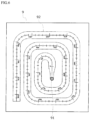
- the bar-flow length is the length of a molded body obtained by injection molding performed using an injection molding machine having a bar-flow mold (i.e., a mold having an angular spiral cavity having an injection port diameter of 10 mm , a width of 20 mm, and a thickness of 2 mm) connected thereto under conditions of a cylinder temperature of 190°C, a mold temperature of 60 °C an injection pressure of 150 MPa, an injection rate of 25 to 200 mm/sec, and a metering value of 60 (a screw is retracted by 60 mm to provide, in a cylinder, a space of 60 mm for storing a material to be injected).
- a bar-flow mold i.e., a mold having an angular spiral cavity having an injection port diameter of 10 mm , a width of 20 mm, and a thickness of 2 mm
- the resin composition (the olefin-based resin composition or a mixture of the olefin resin composition and another constituent material) constituting the energy absorber according to the present invention has a stress at break of 12 to 50 MPa, (particularly 15 to 45 MPa, more particularly 18 to 40 MPa) as measured by the following tensile test and an elongation at break of 100 to 400%, particularly 150 to 350%).
- the stress at break and the elongation at break are within the above ranges, it is possible to obtain an energy absorber having more excellent impact energy absorbability and is much less likely to be broken, for example, fractured.
- the energy absorber according to the present invention may be a solid molded body or a foamed molded body. Particularly, the energy absorber according to the present invention is preferably a solid molded body from the viewpoint of achieving excellent impact absorbability.
- this energy absorber can be manufactured by a method depending on its structure, intended use, etc.
- the solid molded body can be manufactured by subjecting a raw material composition to injection molding, extrusion molding (sheet extrusion, profile extrusion), T-die molding, blow molding, injection blow molding, inflation molding, blow molding, vacuum molding, compression molding, press molding, stamping molding, or transfer molding. These molding methods may be used singly or in combination of two or more of them.
- the foamed molded body can be manufactured by chemical foaming or physical foaming of a raw material composition.
- a known method can be used, such as injection foam molding, press foam molding, extrusion foam molding, stampable foam molding, or heat foam molding. These molding methods may be used singly or in combination of two or more of them.
- the raw material composition to be used may be the olefin-based resin composition or a mixture itself of the olefin resin composition and another constituent material.
- the raw material composition to be used may be a melt-kneaded product containing the olefin resin, the polyamide resin, and the modified elastomer.
- thermoplastic resin composition which contains a melt-kneaded product of the olefin resin, the polyamide resin, and the modified elastomer.
- thermoplastic resin composition which is obtained by a preparation method including, in order, a first melt-kneading step in which a first raw material containing the polyamide resin and the modified elastomer is melt-kneaded to obtain a first kneaded product and a second melt-kneading step in which a second raw material containing the first kneaded product and the olefin resin is melt-kneaded (i.e., a thermoplastic resin composition containing a melt-kneaded product of a melt-kneaded product of the polyamide resin and the modified elastomer and the olefin resin).
- the obtained second kneaded product (olefin-based resin composition) may be kneaded with another olefin resin, and the thus obtained kneaded product may be used as the melt-kneaded product.
- the olefin resin, the polyamide resin, and the modified elastomer may be melt-kneaded at the same time.
- melt-kneading can be performed using a melt-kneading apparatus such as an extruder (e.g., a single-screw extruder or a twin-screw kneading extruder), a kneader, or a mixer (e.g., a high-speed flow mixer, a paddle mixer, or a ribbon mixer).
- a melt-kneading apparatus such as an extruder (e.g., a single-screw extruder or a twin-screw kneading extruder), a kneader, or a mixer (e.g., a high-speed flow mixer, a paddle mixer, or a ribbon mixer).
- extruder e.g., a single-screw extruder or a twin-screw kneading extruder
- a mixer e.g., a high-speed flow mixer, a
- melt kneading of the polyamide resin and the modified elastomer may be performed by adding all of them at a time or by adding one of them to the other in several batches.
- the kneading temperature at this time is preferably 190 to 350°C, more preferably 200 to 330°C, even more preferably 205 to 310°C.
- melt-kneading of the first kneaded product and the olefin resin may be performed by adding all of them at a time or by adding one of them to the other in several batches.
- the kneading temperature at this time is preferably 190 to 350°C, more preferably 200 to 300°C, even more preferably 205 to 260°C.
- first kneaded product and the second kneaded product may be solidified by pelletization or the like or may be in the form of a molten material.
- the olefin resin an ⁇ -olefin homopolymer or copolymer may be directly used.
- the olefin resin to be used may be, for example, a mixed resin of polypropylene, polyethylene, and ethylene-propylene rubber (non-modified olefin elastomer) known as "block-type polypropylene" because propylene and an ethylene-propylene copolymer are preferred as raw material resins containing the olefin resin.
- the modified elastomer is preferably an elastomer having a reactive group, which can react with the polyamide resin, attached thereto, and the above-described one is used.
- an ⁇ -olefin copolymer "TAFMER series” (trade name) manufactured by Mitsui Chemicals, Inc., or "AMPLIFY series” (trade name) manufactured by The Dow Chemical Company can be used.
- the ratios of the olefin resin, the polyamide resin, and the modified elastomer are 30 to 73% by mass, 5 to 65% by mass, and 5 to 50% by mass, preferably 30 to 73% by mass, 15 to 50% by mass, and 13 to 37% by mass, even more preferably 35 to 70% by mass, 20 to 45% by mass, and 15 to 35% by mass, respectively.
- polyamide resin varies in its performance depending on its type.
- a preferred amount of the polyamide resin to be used to obtain the effects of the present invention is as follows.
- the amount of the polyamide 6 to be used is preferably 0 to 35% by mass per 100% by mass of the total of the olefin resin, the polyamide resin, and the modified elastomer.
- the amount of the polyamide 610 to be used is preferably 5 to 40% by mass, even more preferably 10 to 40% by mass per 100% by mass of the total of the olefin resin, the polyamide resin, and the modified elastomer.
- the amount of the polyamide 11 to be used is preferably 10 to 55% by mass, more preferably 15 to 55% by mass per 100% by mass of the total of the olefin resin, the polyamide resin, and the modified elastomer.
- the amount of the polyamide 12 to be used is preferably 5 to 35% by mass, even more preferably 10 to 35% by mass per 100% by mass of the total of the olefin resin, the polyamide resin, and the modified elastomer.
- the amount of the polyamide 1010 to be used is preferably 5 to 55% by mass, even more preferably 10 to 55% by mass per 100% by mass of the total of the olefin resin, the polyamide resin, and the modified elastomer.
- the amount of the polyamide 10T to be used is preferably 5 to 45% by mass, even more preferably 10 to 45% by mass per 100% by mass of the total of the olefin resin, the polyamide resin, and the modified elastomer.
- the amount of the PAMXD6 to be used is preferably 5 to 40% by mass, even more preferably 10 to 40% by mass per 100% by mass of the total of the olefin resin, the polyamide resin, and the modified elastomer.
- the form of the energy absorber according to the present invention is not particularly limited, and the energy absorber according to the present invention may take any form depending on its purpose, intended use, etc.
- the energy absorber according to the present invention will be descried with reference to specific embodiments.
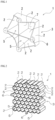
- An energy absorber (1) has an impact absorbing frame (3) having an impact absorbing wall (2) whose plane direction is along a direction in which an impact load is to be applied, wherein the impact absorbing wall (2) is collapsed to absorb an impact when subjected to an impact load (see FIGs. 1 and 2 ).
- the energy absorber according to this embodiment can have further improved impact energy absorbability and is much less likely to be broken, for example, fractured.
- the impact absorbing wall (2) is provided so that its plane direction is along a direction in which an impact load is to be applied (i.e., the impact absorbing wall (2) is provided so that its plane direction is substantially parallel to a direction in which an impact load is to be applied), and is therefore collapsed along a direction in which an impact load is applied to absorb impact energy.
- the "plane direction” refers to a direction orthogonal to the thickness direction of the impact absorbing wall (2).
- substantially parallel refers to a concept including not only a case where the plane direction and the direction in which an impact load is to be applied are perfectly parallel but also a case where both of them are slightly inclined so that an angle between them is in the range of ⁇ 20° (preferably ⁇ 15°, more preferably ⁇ 10°).
- the thickness of the impact absorbing wall (2) is not particularly limited, and may be appropriately adjusted according to the purpose, intended use, etc.
- the thickness may be 10 mm or less (particularly 1 to 8 mm, more particularly 2 to 4 mm).
- the impact absorbing frame (3) is not particularly limited as long as it has at least the impact absorbing wall (2).
- the impact absorbing frame (3) may have a tubular hollow portion (5) surrounded by the impact absorbing wall (2).
- the energy absorber can have further improved impact energy absorbability and is much less likely to be broken, for example, fractured.
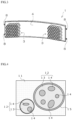
- the cross-sectional shape of the hollow portion (5) is not limited only to a quadrangular shape (see FIG. 1 ), and may be a circular shape, an elliptical shape, or another polygonal shape such as a triangular shape or a hexagonal shape (see FIG. 2 ).
- the number of hollow portions (5) is not particularly limited.
- the impact absorbing frame (3) may have two or more hollow portions (5) (see FIG. 2 ).
- the impact absorbing frame (3) having two or more hollow portions (5) may be one having a honeycomb structure (see FIG. 2 ).
- the energy absorber can have further improved impact energy absorbability and is much less likely to be broken, for example, fractured.
- the "honeycomb structure” refers to a concept including not only a case where the cross-sections of the hollow portions (5) have a regular hexagonal shape but also a case where the cross-sections of the hollow portions (5) have one polygonal shape (see FIG. 1 ) or two or more polygonal shapes in combination.
- the impact absorbing frame (3) may be provided with a mounting portion (6), another wall (7) (see FIGs. 1 and 2 ), a reinforcing rib, etc.
- the energy absorber (1) may be constituted from only the impact absorbing frame (3) as shown in FIGs. 1 and 2 , or may have another constituent member in addition to the impact absorbing frame (3) as in the case of an embodiment that will be described later.
- An energy absorber (1) may have, for example, an exterior part (4) and one or more impact absorbing frames (3) provided to be connected to the exterior part (4) (see FIG. 3 ). It is to be noted that the above description about the impact absorbing frame (3) can be directly applied to this impact absorbing frame (3).
- the exterior part (4) is not particularly limited as long as it is provided to be connected to the impact absorbing frame (3), and the shape thereof is appropriately adjusted according to the shape of a part where the energy absorber (1) is to be provided.
- the exterior part (4) may be provided with a mounting part (8), a reinforcing rib, etc.
- each of these energy absorbers (1) according to the embodiments of the present invention can be manufactured by integral molding using the above-described raw material composition.
- the energy absorber according to the present invention has excellent impact resistance and excellent impact energy absorbability, and is therefore less likely to be broken, for example, fractured. Further, the energy absorber according to the present invention exhibits excellent ductility (extensibility) and repairability (restorability) when subjected to an impact, and therefore unless the energy absorber according to the present invention is broken, its shape is restored. That is, the energy absorber according to the present invention has also excellent durability. Further, even when subjected to an excessive impact, the energy absorber according to the present invention is ductilely fractured, and is therefore highly safe.
- the energy absorber according to the present invention is suitable for parts for vehicles (for automobiles and bicycles), parts for ships, parts for aircraft, industrial materials, office equipment parts, daily necessities, toys, sporting goods, building material parts, structures, medical supplies, and agriculture-, forestry-, and fishery-related parts.
- the energy absorber according to the present invention is suitable for exterior parts, interior parts, and base materials thereof for parts for vehicles, parts for ships, and parts for aircraft.
- automobile-related parts include: exterior parts such as roof rails, fenders, garnishes, bumpers, door panels, roof panels, hood panels, trunk lids, spoilers, and cowls; interior parts such as door trims, pockets, arm rests, decorative panels, ornament panels, energy absorbers (impact absorbers) [specific examples thereof include energy absorbers for automobiles called bumper energy absorbers, pedestrian protection energy absorbers, pedestrian protection systems, pedestrian-protection beams, front-end pedestrian-protection systems, crash cans, fascia supports, corner impact protections, energy absorbers, energy absorber systems, crash boxes, and honeycomb structure energy absorbers], speaker grills, quarter trims, pillar garnishes, cowl side garnishes, shields, back boards, dynamic dampers, side air-bag peripheral parts, instrument panels, air-bag peripheral parts, center consoles, overhead consoles, sunvisors, package trays, high mount stop lamp covers, seat side garnishes, assist grips, and safety belt parts; and electrical parts such as lamp housings, cleaner
- Examples of the industrial materials include transport containers, trays, trucks, pylons, center poles, and construction equipment.
- Examples of the daily necessities include food trays, helmets, shoes, book-slides, dishes, and cleaning tools.
- Examples of the sporting goods include protectors (baseball, soccer, motor sports), outdoor products, and climbing tools.
- Examples of the building material parts include heat insulating materials.
- Examples of the structures include road signs.
- Examples of the medical supplies include mouthpieces, medical devices, and drug containers.
- Examples of the agriculture-, forestry-, and fishery-related parts include floats, planters, and culture fishery-related tools.
- the energy absorber according to the present invention is preferably used as an energy absorption material (EA material) in automobile-related parts.
- the energy absorber according to the present invention can be suitably used as an EA material at least part of which is collapsed by an impact load at the time of collision (frontal collision, rear-end collision, broadside collision) to absorb impact energy.
- a molded body for evaluation of Example 1 was prepared by the following procedure, which was made of an olefin-based resin composition containing 55% by mass of an olefin, 25% by mass of a polyamide resin, and 20% by mass of a modified elastomer per 100% by mass of the total of the olefin-based resin composition (energy absorber).
- olefin resin polypropylene resin (homopolymer), manufactured by Japan Polypropylene Corporation, product name: "NOVATEC MA1B”, weight-average molecular weight: 312,000, melting point: 165°C
- thermoplastic resin composition was cut using a pelletizer to produce pellets of the thermoplastic resin composition of Example 1.
- the obtained pellets of the thermoplastic resin composition of Example 1 were fed into a hopper of an injection molding machine (manufactured by NISSEI PLASTIC INDUSTRIAL CO., LTD., 40-ton injection molding machine) and subjected to injection molding under injection conditions of a set temperature of 210°C and a mold temperature of 40°C to obtain a molded body for evaluation (test specimen for measuring physical properties) to be used for measurements and evaluations that will be described later.
- phase structure of the olefin-based resin composition constituting the molded body for evaluation of Example 1 was determined in the following manner.
- a sample cut out from the molded body for evaluation was embedded in a resin and trimmed and cut in a cross section using an ultramicrotome with a diamond knife and subjected to steam dyeing with a metal oxide.
- An ultrathin section sample was taken from the obtained cross section after dyeing and observed with a transmission electron microscope (TEM, manufactured by Hitachi High-Technologies Corporation, Model "HT7700") to determine a phase structure.
- TEM transmission electron microscope
- Pellets of a thermoplastic resin composition of Example 2 were prepared by the same procedure as in the above-described Example 1, which were made of an olefin-based resin composition containing 30% by mass of an olefin, 60% by mass of a polyamide rein, and 10% by mass of a modified elastomer per 100% by mass of the total of the olefin-based resin composition (energy absorber). Then, the obtained pellets of the thermoplastic resin composition of Example 2 were subjected to injection molding in the same manner as in Example 1 to obtain a molded body for evaluation to be used for measurements and evaluations that will be described later.
- Example 2 the phase structure of the olefin-based resin composition constituting the molded body for evaluation of Example 2 was determined in the same manner as in the above-described Example 1.
- a co-continuous phase containing the olefin resin and the polyamide, a polyamide resin-based dispersed phase containing the polyamide resin and the modified elastomer and dispersed in the continuous phase composed of the olefin resin, a fine dispersed phase contained in the polyamide resin-based dispersed phase, containing the modified elastomer, and dispersed in a matrix phase containing the polyamide resin, and an interfacial phase containing the modified elastomer and present between the continuous phase composed of the olefin resin and the polyamide resin-based dispersed phase were observed.
- the measurement of flexural modulus was performed in accordance with JIS K7171. The results of the measurement are shown in Table 1. It is to be noted that the measurement of flexural modulus was performed by applying a load at a speed of 2 mm/min from an action point (curvature radius: 5 mm) located in the middle of two supporting points (curvature radius: 5 mm) whose distance (L) was 64 mm while supporting each of the test specimens at the two supporting points.
- a bar-flow mold (a mold 9 shown in FIG. 6 which has an injection port 91 with a diameter of 10 mm and an angular spiral cavity 92 with a width of 20 mm and a thickness of 2 mm) was connected to the extruder used to prepare each of the molded bodies for evaluation, and injection molding was performed under conditions of a cylinder temperature of 190°C, a mold temperature of 60°C, an injection pressure of 150 MPa, an injection speed of 25 to 200 mm/sec (25 mm/sec, 50mm/sec, 100 mm/sec, 200 mm/sec), and a metering value of 60 (a screw was retracted by 60 mm to provide, in a cylinder, a space of 60 mm for storing a material to be injected), and the length of the thusobtained molded body was measured as a bar-flow length.
- the resin compositions of Comparative Examples 1 to 4 had a Charpy impact strength of 17 to 60 kJ/m 2 and a flexural modulus of 1000 to 2300 MPa.
- the resin compositions of Examples 1 and 2 had a Charpy impact strength of 72.9 to 90 kJ/m 2 and a flexural modulus of 775 to 1180 MPa. Therefore, it was confirmed that the resin compositions of Examples 1 and 2 have excellent impact resistance.
- the resin compositions of Examples 1 and 2 had a lower stress before the start of plastic deformation and a higher elongation percentage before break than the resin compositions of Comparative Examples 1 to 4. Therefore, it was confirmed that when subjected to an impact load, the resin compositions of Examples 1 and 2 exhibit excellent impact absorbability and can reduce a reaction force exerted on an object that applies the impact load.
- an energy absorber having excellent impact resistance and excellent impact energy absorbability can be obtained from each of the resin compositions of Examples.
- the resin compositions of Examples have high elongation at break, and therefore it is considered that an energy absorber can be obtained which exhibits excellent ductility (extensibility) and repairability (restorability) when subjected to an impact and is less likely to be broken, for example, fractured. It is to be noted that it is considered that even when subjected to an excessive impact, such an energy absorber is ductilely fractured, and therefore a negative influence on its surroundings can be reduced.
- the resin compositions of Comparative Examples 2 to 4 had a bar-flow length of 145 to 381 mm at an injection speed of 50 to 100 mm/sec.
- the resin compositions of Examples 1 and 2 had a bar-flow length of 504 to 620 mm at an injection speed of 25 to 200 mm/sec which was about 1.3 to 4.3 times the results of Comparative Examples 2 to 4.
Landscapes
- Chemical & Material Sciences (AREA)
- Engineering & Computer Science (AREA)
- General Engineering & Computer Science (AREA)
- Health & Medical Sciences (AREA)
- Chemical Kinetics & Catalysis (AREA)
- Medicinal Chemistry (AREA)
- Polymers & Plastics (AREA)
- Organic Chemistry (AREA)
- Mechanical Engineering (AREA)
- Compositions Of Macromolecular Compounds (AREA)
- Vibration Dampers (AREA)
- Injection Moulding Of Plastics Or The Like (AREA)
Applications Claiming Priority (2)
| Application Number | Priority Date | Filing Date | Title |
|---|---|---|---|
| JP2016071735A JP6384507B2 (ja) | 2016-03-31 | 2016-03-31 | エネルギー吸収体 |
| PCT/JP2017/009095 WO2017169575A1 (ja) | 2016-03-31 | 2017-03-07 | エネルギー吸収体 |
Publications (3)
| Publication Number | Publication Date |
|---|---|
| EP3438180A1 EP3438180A1 (en) | 2019-02-06 |
| EP3438180A4 EP3438180A4 (en) | 2019-11-06 |
| EP3438180B1 true EP3438180B1 (en) | 2025-05-07 |
Family
ID=59964078
Family Applications (1)
| Application Number | Title | Priority Date | Filing Date |
|---|---|---|---|
| EP17774120.4A Active EP3438180B1 (en) | 2016-03-31 | 2017-03-07 | Energy absorber |
Country Status (9)
| Country | Link |
|---|---|
| US (1) | US11014516B2 (enExample) |
| EP (1) | EP3438180B1 (enExample) |
| JP (1) | JP6384507B2 (enExample) |
| KR (1) | KR102116918B1 (enExample) |
| CN (1) | CN108884279B (enExample) |
| BR (1) | BR112018068375A2 (enExample) |
| RU (1) | RU2744290C2 (enExample) |
| SG (1) | SG11201806523UA (enExample) |
| WO (1) | WO2017169575A1 (enExample) |
Families Citing this family (8)
| Publication number | Priority date | Publication date | Assignee | Title |
|---|---|---|---|---|
| CN110177826A (zh) * | 2017-01-30 | 2019-08-27 | 丰田纺织株式会社 | 改性剂和其使用方法、改性剂的制造方法以及添加材料用载体 |
| CN110392714B (zh) | 2017-03-16 | 2021-03-12 | 丰田纺织株式会社 | 热塑性树脂片、层叠片和成型体 |
| JP7136088B2 (ja) * | 2017-04-19 | 2022-09-13 | トヨタ紡織株式会社 | 熱可塑性樹脂組成物、成形体及びその製造方法 |
| IT201700103763A1 (it) * | 2017-09-15 | 2019-03-15 | Srt S R L | Elemento ad assorbimento d’urto polimerico per un veicolo e struttura paraurti |
| CN109188012B (zh) * | 2018-11-15 | 2024-02-02 | 中国兵器工业集团第二一四研究所苏州研发中心 | 一种蜂窝状微止挡结构 |
| JP7136740B2 (ja) * | 2019-04-18 | 2022-09-13 | トヨタ自動車株式会社 | 車両構造及び車両の製造方法 |
| US11207958B2 (en) * | 2019-07-30 | 2021-12-28 | Ford Global Technologies, Llc | Vehicle door arrangement configured to prevent overlap |
| JP7677996B2 (ja) * | 2020-12-22 | 2025-05-15 | 三井化学株式会社 | 熱可塑性樹脂組成物およびその製造方法 |
Family Cites Families (22)
| Publication number | Priority date | Publication date | Assignee | Title |
|---|---|---|---|---|
| US6670421B1 (en) * | 2001-08-03 | 2003-12-30 | Aci Technologies, Llc | Olefin-polyamide thermoplastic alloy and process for making the same |
| CN1863861B (zh) | 2003-10-10 | 2011-03-30 | 埃克森美孚化学专利公司 | 聚丙烯和聚酰胺的组合物 |
| JP2009029296A (ja) * | 2007-07-27 | 2009-02-12 | Tokai Rubber Ind Ltd | 衝撃吸収部材 |
| JP5125704B2 (ja) | 2008-04-08 | 2013-01-23 | トヨタ紡織株式会社 | 側突用樹脂衝撃吸収体 |
| JP5552016B2 (ja) | 2010-09-30 | 2014-07-16 | トヨタ紡織株式会社 | 衝撃吸収体 |
| US8336933B2 (en) * | 2010-11-04 | 2012-12-25 | Sabic Innovative Plastics Ip B.V. | Energy absorbing device and methods of making and using the same |
| US9586355B2 (en) | 2011-03-11 | 2017-03-07 | Exxonmobil Chemical Patents Inc. | Dynamically vulcanized thermoplastic elastomer film |
| US20150065625A1 (en) | 2011-03-11 | 2015-03-05 | Exxonmobil Chemical Patents Inc. | Method of Forming Dynamically Vulcanized Thermoplastic Elastomer Films and Films Formed Therefrom |
| JP2012222846A (ja) | 2011-04-04 | 2012-11-12 | Hitachi Ltd | ディジタル保護制御装置 |
| JP5836923B2 (ja) * | 2011-12-22 | 2015-12-24 | トヨタ紡織株式会社 | 植物由来ポリアミド樹脂を用いた熱可塑性樹脂組成物及び成形体 |
| JP5879253B2 (ja) * | 2011-12-22 | 2016-03-08 | トヨタ紡織株式会社 | 熱可塑性樹脂組成物及びその製造方法 |
| WO2013094764A1 (ja) * | 2011-12-22 | 2013-06-27 | トヨタ紡織株式会社 | 熱可塑性樹脂組成物及びその製造方法 |
| EP2796497B1 (en) | 2011-12-22 | 2024-09-04 | Toyota Boshoku Kabushiki Kaisha | Thermoplastic resin composition, method for producing same, and molded body |
| JP5914318B2 (ja) * | 2011-12-22 | 2016-05-11 | トヨタ紡織株式会社 | 熱可塑性樹脂組成物の製造方法 |
| EP2796496B1 (en) * | 2011-12-22 | 2018-11-07 | Toyota Boshoku Kabushiki Kaisha | Thermoplastic resin composition and method for producing same |
| JP5882730B2 (ja) * | 2011-12-28 | 2016-03-09 | 株式会社ブリヂストン | 外観検査装置及び外観検査方法 |
| US20130175128A1 (en) * | 2012-01-05 | 2013-07-11 | Sabic Innovative Plastics Ip B.V. | Multi-stage energy absorber and method of making and using the same |
| US8876179B2 (en) * | 2012-02-01 | 2014-11-04 | Sabic Global Technologies B.V. | Energy absorbing assembly and methods of making and using the same |
| JP2013237242A (ja) | 2012-05-17 | 2013-11-28 | Toray Ind Inc | ハニカム構造体およびサンドイッチ構造体 |
| JP5798595B2 (ja) | 2012-06-22 | 2015-10-21 | 株式会社豊田中央研究所 | 樹脂組成物 |
| KR102166745B1 (ko) | 2013-06-12 | 2020-10-16 | 킴벌리-클라크 월드와이드, 인크. | 에너지 흡수 부재 |
| JP6177834B2 (ja) * | 2014-06-26 | 2017-08-09 | 三洋化成工業株式会社 | シリコーン粘着剤用帯電防止剤及び帯電防止性シリコーン粘着剤 |
-
2016
- 2016-03-31 JP JP2016071735A patent/JP6384507B2/ja active Active
-
2017
- 2017-03-07 EP EP17774120.4A patent/EP3438180B1/en active Active
- 2017-03-07 US US16/087,344 patent/US11014516B2/en active Active
- 2017-03-07 CN CN201780019667.8A patent/CN108884279B/zh active Active
- 2017-03-07 SG SG11201806523UA patent/SG11201806523UA/en unknown
- 2017-03-07 BR BR112018068375A patent/BR112018068375A2/pt not_active Application Discontinuation
- 2017-03-07 KR KR1020187030603A patent/KR102116918B1/ko active Active
- 2017-03-07 RU RU2018136244A patent/RU2744290C2/ru active
- 2017-03-07 WO PCT/JP2017/009095 patent/WO2017169575A1/ja not_active Ceased
Also Published As
| Publication number | Publication date |
|---|---|
| EP3438180A4 (en) | 2019-11-06 |
| US11014516B2 (en) | 2021-05-25 |
| BR112018068375A2 (pt) | 2019-01-15 |
| SG11201806523UA (en) | 2018-08-30 |
| WO2017169575A1 (ja) | 2017-10-05 |
| CN108884279A (zh) | 2018-11-23 |
| CN108884279B (zh) | 2021-02-26 |
| JP6384507B2 (ja) | 2018-09-05 |
| KR102116918B1 (ko) | 2020-05-29 |
| RU2018136244A (ru) | 2020-04-30 |
| RU2018136244A3 (enExample) | 2020-04-30 |
| JP2017179237A (ja) | 2017-10-05 |
| RU2744290C2 (ru) | 2021-03-04 |
| US20200180535A1 (en) | 2020-06-11 |
| EP3438180A1 (en) | 2019-02-06 |
| KR20180126541A (ko) | 2018-11-27 |
Similar Documents
| Publication | Publication Date | Title |
|---|---|---|
| EP3438180B1 (en) | Energy absorber | |
| EP2796497B1 (en) | Thermoplastic resin composition, method for producing same, and molded body | |
| JP6266715B2 (ja) | 熱可塑性樹脂組成物及びその製造方法 | |
| US11992980B2 (en) | Foamed resin molded article and method for manufacturing same | |
| US11299608B2 (en) | Thermoplastic resin composition, method for producing same and molded body | |
| EP3597699A1 (en) | Thermoplastic resin sheet, laminated sheet, and molded object | |
| EP2796496A1 (en) | Thermoplastic resin composition and method for producing same | |
| EP3438182B1 (en) | Dispersion diameter adjustment method and thermoplastic resin composition | |
| EP3613804B1 (en) | Thermoplastic resin composition, molded object, and production methods therefor | |
| EP3438181B1 (en) | Thermoplastic resin composition and molded body | |
| JP7677996B2 (ja) | 熱可塑性樹脂組成物およびその製造方法 |
Legal Events
| Date | Code | Title | Description |
|---|---|---|---|
| STAA | Information on the status of an ep patent application or granted ep patent |
Free format text: STATUS: THE INTERNATIONAL PUBLICATION HAS BEEN MADE |
|
| PUAI | Public reference made under article 153(3) epc to a published international application that has entered the european phase |
Free format text: ORIGINAL CODE: 0009012 |
|
| STAA | Information on the status of an ep patent application or granted ep patent |
Free format text: STATUS: REQUEST FOR EXAMINATION WAS MADE |
|
| 17P | Request for examination filed |
Effective date: 20180813 |
|
| AK | Designated contracting states |
Kind code of ref document: A1 Designated state(s): AL AT BE BG CH CY CZ DE DK EE ES FI FR GB GR HR HU IE IS IT LI LT LU LV MC MK MT NL NO PL PT RO RS SE SI SK SM TR |
|
| AX | Request for extension of the european patent |
Extension state: BA ME |
|
| DAV | Request for validation of the european patent (deleted) | ||
| DAX | Request for extension of the european patent (deleted) | ||
| A4 | Supplementary search report drawn up and despatched |
Effective date: 20191008 |
|
| RIC1 | Information provided on ipc code assigned before grant |
Ipc: B60R 21/04 20060101ALI20191001BHEP Ipc: F16F 7/12 20060101ALI20191001BHEP Ipc: C08L 23/12 20060101ALI20191001BHEP Ipc: C08L 77/00 20060101ALI20191001BHEP Ipc: B29C 45/00 20060101ALI20191001BHEP Ipc: C08L 23/26 20060101ALI20191001BHEP Ipc: F16F 7/00 20060101ALI20191001BHEP Ipc: C08L 23/00 20060101AFI20191001BHEP |
|
| STAA | Information on the status of an ep patent application or granted ep patent |
Free format text: STATUS: EXAMINATION IS IN PROGRESS |
|
| 17Q | First examination report despatched |
Effective date: 20200803 |
|
| RIC1 | Information provided on ipc code assigned before grant |
Ipc: C08L 77/06 20060101ALI20211019BHEP Ipc: C08L 77/02 20060101ALI20211019BHEP Ipc: C08L 23/12 20060101ALI20211019BHEP Ipc: F16F 7/12 20060101ALI20211019BHEP Ipc: F16F 7/00 20060101ALI20211019BHEP Ipc: C08L 77/00 20060101ALI20211019BHEP Ipc: C08L 23/26 20060101ALI20211019BHEP Ipc: B60R 21/04 20060101ALI20211019BHEP Ipc: B29C 45/00 20060101ALI20211019BHEP Ipc: C08L 23/00 20060101AFI20211019BHEP |
|
| GRAP | Despatch of communication of intention to grant a patent |
Free format text: ORIGINAL CODE: EPIDOSNIGR1 |
|
| STAA | Information on the status of an ep patent application or granted ep patent |
Free format text: STATUS: GRANT OF PATENT IS INTENDED |
|
| INTG | Intention to grant announced |
Effective date: 20250129 |
|
| GRAS | Grant fee paid |
Free format text: ORIGINAL CODE: EPIDOSNIGR3 |
|
| GRAA | (expected) grant |
Free format text: ORIGINAL CODE: 0009210 |
|
| STAA | Information on the status of an ep patent application or granted ep patent |
Free format text: STATUS: THE PATENT HAS BEEN GRANTED |
|
| AK | Designated contracting states |
Kind code of ref document: B1 Designated state(s): AL AT BE BG CH CY CZ DE DK EE ES FI FR GB GR HR HU IE IS IT LI LT LU LV MC MK MT NL NO PL PT RO RS SE SI SK SM TR |
|
| REG | Reference to a national code |
Ref country code: GB Ref legal event code: FG4D |
|
| REG | Reference to a national code |
Ref country code: CH Ref legal event code: EP |
|
| REG | Reference to a national code |
Ref country code: DE Ref legal event code: R096 Ref document number: 602017089353 Country of ref document: DE |
|
| REG | Reference to a national code |
Ref country code: IE Ref legal event code: FG4D |
|
| REG | Reference to a national code |
Ref country code: NL Ref legal event code: MP Effective date: 20250507 |
|
| PG25 | Lapsed in a contracting state [announced via postgrant information from national office to epo] |
Ref country code: PT Free format text: LAPSE BECAUSE OF FAILURE TO SUBMIT A TRANSLATION OF THE DESCRIPTION OR TO PAY THE FEE WITHIN THE PRESCRIBED TIME-LIMIT Effective date: 20250908 Ref country code: FI Free format text: LAPSE BECAUSE OF FAILURE TO SUBMIT A TRANSLATION OF THE DESCRIPTION OR TO PAY THE FEE WITHIN THE PRESCRIBED TIME-LIMIT Effective date: 20250507 Ref country code: ES Free format text: LAPSE BECAUSE OF FAILURE TO SUBMIT A TRANSLATION OF THE DESCRIPTION OR TO PAY THE FEE WITHIN THE PRESCRIBED TIME-LIMIT Effective date: 20250507 |
|
| REG | Reference to a national code |
Ref country code: LT Ref legal event code: MG9D |
|
| PG25 | Lapsed in a contracting state [announced via postgrant information from national office to epo] |
Ref country code: NO Free format text: LAPSE BECAUSE OF FAILURE TO SUBMIT A TRANSLATION OF THE DESCRIPTION OR TO PAY THE FEE WITHIN THE PRESCRIBED TIME-LIMIT Effective date: 20250807 Ref country code: GR Free format text: LAPSE BECAUSE OF FAILURE TO SUBMIT A TRANSLATION OF THE DESCRIPTION OR TO PAY THE FEE WITHIN THE PRESCRIBED TIME-LIMIT Effective date: 20250808 |
|
| PG25 | Lapsed in a contracting state [announced via postgrant information from national office to epo] |
Ref country code: PL Free format text: LAPSE BECAUSE OF FAILURE TO SUBMIT A TRANSLATION OF THE DESCRIPTION OR TO PAY THE FEE WITHIN THE PRESCRIBED TIME-LIMIT Effective date: 20250507 Ref country code: NL Free format text: LAPSE BECAUSE OF FAILURE TO SUBMIT A TRANSLATION OF THE DESCRIPTION OR TO PAY THE FEE WITHIN THE PRESCRIBED TIME-LIMIT Effective date: 20250507 |
|
| REG | Reference to a national code |
Ref country code: AT Ref legal event code: MK05 Ref document number: 1792457 Country of ref document: AT Kind code of ref document: T Effective date: 20250507 |
|
| PG25 | Lapsed in a contracting state [announced via postgrant information from national office to epo] |
Ref country code: BG Free format text: LAPSE BECAUSE OF FAILURE TO SUBMIT A TRANSLATION OF THE DESCRIPTION OR TO PAY THE FEE WITHIN THE PRESCRIBED TIME-LIMIT Effective date: 20250507 |
|
| PG25 | Lapsed in a contracting state [announced via postgrant information from national office to epo] |
Ref country code: HR Free format text: LAPSE BECAUSE OF FAILURE TO SUBMIT A TRANSLATION OF THE DESCRIPTION OR TO PAY THE FEE WITHIN THE PRESCRIBED TIME-LIMIT Effective date: 20250507 |
|
| PG25 | Lapsed in a contracting state [announced via postgrant information from national office to epo] |
Ref country code: AT Free format text: LAPSE BECAUSE OF FAILURE TO SUBMIT A TRANSLATION OF THE DESCRIPTION OR TO PAY THE FEE WITHIN THE PRESCRIBED TIME-LIMIT Effective date: 20250507 |
|
| PG25 | Lapsed in a contracting state [announced via postgrant information from national office to epo] |
Ref country code: RS Free format text: LAPSE BECAUSE OF FAILURE TO SUBMIT A TRANSLATION OF THE DESCRIPTION OR TO PAY THE FEE WITHIN THE PRESCRIBED TIME-LIMIT Effective date: 20250807 |
|
| PG25 | Lapsed in a contracting state [announced via postgrant information from national office to epo] |
Ref country code: IS Free format text: LAPSE BECAUSE OF FAILURE TO SUBMIT A TRANSLATION OF THE DESCRIPTION OR TO PAY THE FEE WITHIN THE PRESCRIBED TIME-LIMIT Effective date: 20250907 |
|
| PG25 | Lapsed in a contracting state [announced via postgrant information from national office to epo] |
Ref country code: LV Free format text: LAPSE BECAUSE OF FAILURE TO SUBMIT A TRANSLATION OF THE DESCRIPTION OR TO PAY THE FEE WITHIN THE PRESCRIBED TIME-LIMIT Effective date: 20250507 |