EP3434817B1 - A method of producing a yarn and a fabric having the look and feel of natural fibers - Google Patents
A method of producing a yarn and a fabric having the look and feel of natural fibers Download PDFInfo
- Publication number
- EP3434817B1 EP3434817B1 EP18184992.8A EP18184992A EP3434817B1 EP 3434817 B1 EP3434817 B1 EP 3434817B1 EP 18184992 A EP18184992 A EP 18184992A EP 3434817 B1 EP3434817 B1 EP 3434817B1
- Authority
- EP
- European Patent Office
- Prior art keywords
- fibers
- noils
- man
- yarn
- fiber
- Prior art date
- Legal status (The legal status is an assumption and is not a legal conclusion. Google has not performed a legal analysis and makes no representation as to the accuracy of the status listed.)
- Active
Links
Images



Classifications
-
- D—TEXTILES; PAPER
- D02—YARNS; MECHANICAL FINISHING OF YARNS OR ROPES; WARPING OR BEAMING
- D02G—CRIMPING OR CURLING FIBRES, FILAMENTS, THREADS, OR YARNS; YARNS OR THREADS
- D02G3/00—Yarns or threads, e.g. fancy yarns; Processes or apparatus for the production thereof, not otherwise provided for
- D02G3/22—Yarns or threads characterised by constructional features, e.g. blending, filament/fibre
-
- D—TEXTILES; PAPER
- D02—YARNS; MECHANICAL FINISHING OF YARNS OR ROPES; WARPING OR BEAMING
- D02G—CRIMPING OR CURLING FIBRES, FILAMENTS, THREADS, OR YARNS; YARNS OR THREADS
- D02G3/00—Yarns or threads, e.g. fancy yarns; Processes or apparatus for the production thereof, not otherwise provided for
- D02G3/02—Yarns or threads characterised by the material or by the materials from which they are made
- D02G3/04—Blended or other yarns or threads containing components made from different materials
-
- D—TEXTILES; PAPER
- D01—NATURAL OR MAN-MADE THREADS OR FIBRES; SPINNING
- D01G—PRELIMINARY TREATMENT OF FIBRES, e.g. FOR SPINNING
- D01G11/00—Disintegrating fibre-containing articles to obtain fibres for re-use
-
- D—TEXTILES; PAPER
- D01—NATURAL OR MAN-MADE THREADS OR FIBRES; SPINNING
- D01G—PRELIMINARY TREATMENT OF FIBRES, e.g. FOR SPINNING
- D01G13/00—Mixing, e.g. blending, fibres; Mixing non-fibrous materials with fibres
-
- D—TEXTILES; PAPER
- D01—NATURAL OR MAN-MADE THREADS OR FIBRES; SPINNING
- D01D—MECHANICAL METHODS OR APPARATUS IN THE MANUFACTURE OF ARTIFICIAL FILAMENTS, THREADS, FIBRES, BRISTLES OR RIBBONS
- D01D5/00—Formation of filaments, threads, or the like
- D01D5/42—Formation of filaments, threads, or the like by cutting films into narrow ribbons or filaments or by fibrillation of films or filaments
- D01D5/423—Formation of filaments, threads, or the like by cutting films into narrow ribbons or filaments or by fibrillation of films or filaments by fibrillation of films or filaments
-
- D—TEXTILES; PAPER
- D01—NATURAL OR MAN-MADE THREADS OR FIBRES; SPINNING
- D01H—SPINNING OR TWISTING
- D01H4/00—Open-end spinning machines or arrangements for imparting twist to independently moving fibres separated from slivers; Piecing arrangements therefor; Covering endless core threads with fibres by open-end spinning techniques
- D01H4/04—Open-end spinning machines or arrangements for imparting twist to independently moving fibres separated from slivers; Piecing arrangements therefor; Covering endless core threads with fibres by open-end spinning techniques imparting twist by contact of fibres with a running surface
- D01H4/16—Friction spinning, i.e. the running surface being provided by a pair of closely spaced friction drums, e.g. at least one suction drum
-
- D—TEXTILES; PAPER
- D01—NATURAL OR MAN-MADE THREADS OR FIBRES; SPINNING
- D01H—SPINNING OR TWISTING
- D01H5/00—Drafting machines or arrangements ; Threading of roving into drafting machine
- D01H5/18—Drafting machines or arrangements without fallers or like pinned bars
- D01H5/32—Regulating or varying draft
- D01H5/36—Regulating or varying draft according to a pre-arranged pattern, e.g. to produce slubs
-
- D—TEXTILES; PAPER
- D10—INDEXING SCHEME ASSOCIATED WITH SUBLASSES OF SECTION D, RELATING TO TEXTILES
- D10B—INDEXING SCHEME ASSOCIATED WITH SUBLASSES OF SECTION D, RELATING TO TEXTILES
- D10B2201/00—Cellulose-based fibres, e.g. vegetable fibres
- D10B2201/20—Cellulose-derived artificial fibres
- D10B2201/28—Cellulose esters or ethers, e.g. cellulose acetate
-
- D—TEXTILES; PAPER
- D10—INDEXING SCHEME ASSOCIATED WITH SUBLASSES OF SECTION D, RELATING TO TEXTILES
- D10B—INDEXING SCHEME ASSOCIATED WITH SUBLASSES OF SECTION D, RELATING TO TEXTILES
- D10B2331/00—Fibres made from polymers obtained otherwise than by reactions only involving carbon-to-carbon unsaturated bonds, e.g. polycondensation products
- D10B2331/04—Fibres made from polymers obtained otherwise than by reactions only involving carbon-to-carbon unsaturated bonds, e.g. polycondensation products polyesters, e.g. polyethylene terephthalate [PET]
Definitions
- the present invention relates to a method of producing a yarn and a fabric having the look and feel of natural fibers.
- a known process that can be applied to man-made fibers, in order to obtain a yarn and a fabric having the look and handfeel of natural fibers is texturisation.
- Texturisation is applied to man-made fibers in filament form to modify them in order to obtain a look and feel similar to the look and feel of natural fibers.
- Texturisation is a finishing step that transforms a pre-oriented supply yarn (POY) into Drawn Textured Yarn (DTY) and hence into a product having natural fiber-like character.
- POY pre-oriented supply yarn
- DTY Drawn Textured Yarn
- pre-oriented yarn is permanently crimped using friction. Unfortunately it is not possible to apply a texturisation process to fibers in staple form.
- Man-made fibers may be used either in filament or in staple form. When used in staple form, the fiber length is almost constant or in any case having a small coefficient of variation (CV%) of their length distribution, when compared with natural fibers. In general, natural fibers such as cotton, linen, and so on, exhibit a wide variety of fiber lengths.
- the yarns described in US 4,466,237 comprise a blend of synthetic fibers.
- the yarns described therein comprise a mixture of at least three groups of synthetic fibers, each group consisting of synthetic fibers of a substantially uniform length which differs from the substantially uniform length of the synthetic fibers of the other groups.
- each of the at least three groups differs from the substantially uniform length of the synthetic fibers in the other groups by a factor of at least about 15% and the fiber lengths within each group differ by a factor of 5% or less. None of the groups can be more than 75% by weight of the mixture.
- a synthetic fiber-containing yarn which is said to exhibit the physical characteristics, such as bulkiness and appearance, of natural fiber-containing yarns is also described in US 4,384,450 .
- Fiber cutting might be done by separate companies, but such operations will entail extra cost and will require more production time. Also arranging the percentages of the length groups adds another complexity. All this has the consequence that the lack of good distribution in fiber length will cause a less natural-like yarn aspect.
- the object of the US 3,987,615 patent is to treat inexpensive gin motes to reclaim the usable cotton fibers contained therein.
- US 3,987,615 teaches to process the gin motes first by cleaning them, then carding them to provide a CV ranging from 45% to 60%, drafting them, and then combing them to further reduce the CV down to 30% - 32%.
- noils are the waste fibers obtained from yarn production.
- noils are the short fibers left over from carding and combing process. For instance during the carding process, the fibers are aligned in a parallel fashion, the locks and unorganized clumps of fibers are opened mechanically.
- This mechanical force may break some the fibers and these shortened fibers are called noils.
- the method comprises the steps of:
- the length distribution of the fibers in the final blend of fibers is defined by a coefficient of variation (CV%) of at least 30 percent.
- the coefficient of variation of the length distribution of the fibers in the final blend of fibers for producing the yarn may have a value comprised between 25 and 80 percent. In a preferred embodiment, the coefficient of variation of the length distribution of the fibers in the final blend of fibers for producing the yarn may have a value comprised between 30 and 75 percent.
- the coefficient of variation of the length distribution of the fibers in the final blend of fibers for producing the yarn may have a value comprised between 30 and 60 percent.
- a first advantage of the above method is that fibers which are used in yarn production, have different lengths, which creates a length-range which is similar to that of natural fibers.
- noils are broken fibers, they do not resemble virgin fibers. As noils are pulled by the force applied, after being broken, they are more textured with respect to virgin man-made fibers, namely they have an appearance more similar to natural fibers, and have different edge-shapes. This amounts to a textured kind of fibers that have properties similar to those of the natural fibers.
- the present invention can recycle industrial waste. Another important advantage is given by the possibility of creating an alternative to natural fibers. Thanks to the present invention, a very simple way to produce textiles with very natural look, without using natural fibers, is provided.
- virgin fiber indicates conventional man-made fibers. Such fibers have a substantially constant length within a very small range or in any case having a small coefficient of variation (CV%) of their length distribution.
- Virgin fibers may be any man-made fibers such as regenerated cellulosic fibers (lyocell, viscose, modal, polynosic fiber, cupro, acetate, etc.), polyester, nylon and so on.
- the term "man-made fiber” indicates any kind of fiber which is produced by human beings. This term includes all kinds of regenerated cellulosic fibers, inorganic fibers, metal fibers and so on.
- noils are waste fibres deriving from industrial textile processes. During such processes, a certain amount of fibres are broken and those broken fibres are eliminated from the production and constitute noils.
- the length of the noils i.e. of the fibers obtained from textile processes such as carding, is in the range of 4 to 38 mm.
- noils of man-made fibers may be derived from operations of textile machines, such as yarn spinning machines or carding machines, or draw frames, namely machines for combining and drawing slivers of a textile fiber.
- drawing is the operation by which slivers are blended, doubled and leveled.
- noils are fibers that have been subjected to a mechanical action.
- the noils of viscose may have the specifications below defined in terms of average fiber length numberwise L n .
- Average Fiber length (numberwise) : 29,4 mm CV % : 34,8 Short fiber content (less than 1/2 inch or 1.27 cm) % : 8,2
- Average Fiber length (numberwise) 33,6 mm CV % : 24 Short fiber content (less than 1/2 inch or 1.27 cm) % : 2,8
- CV% S x ⁇ ⁇ 100
- the difference in short fiber content and CV% shows the difference between noils with respect to virgin fibers in terms of noils having a wider range in fiber length.
- Some machines may produce much shorter noils whereas some machines may produce longer noils.
- Table 1 below represents the standards of noils.
- Natural fiber containing yarns have higher irregularities which may be seen in test results like fine places, thick places, amount of neps, hairiness. Regular man-made fibers give much less irregularities. That's why natural irregularities do not appear on the fabric surface. By adding noils to man-made fibers, such irregularities will increase the possibility to achieve a more natural look.
- Tables 2 and 3 show a comparison between a traditional yarn, indicated as Yarn 1, and a yarn which is made not according to an embodiment of the invention, indicated as Yarn 2.
- Yarn 3 which is a natural fiber yarn, namely it is composed of 100% cotton, is added in Tables 2 and 3 below for further comparisons.
- Tables 2 and 3 are obtained from Uster Imperfection Test Units where, in Table 2, EP stands for Effect Program according to which a particular slub pattern is made. The particular Effect Program used in Table 2 bis called Jap-39.
- Table 3 Composition coarse + 35 coarse + 50 Neps 200% Hairiness Yarn 1 100% modal 1104 134 4 8,16 Yarn 2 100% viscose noils 2535 911 198 8,88 Yarn 3 100% cotton 2822 1087 29 8,77
- hairiness is also distinctively increased.
- the skilled person is aware that hairiness H corresponds to the total length of protruding fibers of 1 cm of yarn.
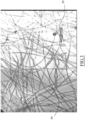
- FIG. 1 it is shown a representation of an embodiment of the invention consisting of a mixed group of fibers comprising textured and conventional man-made fibers.
- the textured fiber appears more crimped and irregular with respect to the conventional man-made fiber.
- Figure 2 is a representation of a group of man-made fiber noils.
- Figure 2 shows, in a better focus, how the fibers of noils are uneven and almost like cotton fibers whereas conventional man-made fibers are very even almost like a wire.
- Figure 3 is a representation of a group of man-made fiber noils.
- Noils could be made of man-made fibers available in staple form such as regenerated cellulosic fibers (lyocell, viscose, modal, acetate, polynosic fiber, cupro and so on), polyester, nylon, or others.
- regenerated cellulosic fibers lyocell, viscose, modal, acetate, polynosic fiber, cupro and so on
- polyester nylon, or others.
- Noils of different man-made fiber may also be mixed. For instance noils of viscose can be mixed with noils of lyocell. Noils of man-made fibers may be mixed with the virgin man-made fibers. In this case the minimum noil percentage should be 5%.
- fibers with different denier (fineness) and/or different cross-section shape are considered beneficial for the aims of the present invention.
- Noils may also be obtained from post recycled textile fibers. For example, if a textile product made of lyocell is recycled, the fibers which are derived from this recycling will not have a constant length or shape. Therefore such fibers will be like noils "uneven” in terms of length and shape.
- noils derived from natural fibers such as cotton or wool or others, can be used.
- Such noils are already uneven in shape naturally and have a wide range of lengths. Therefore when noils derived from natural fibers are mixed with man-made fibers, a distinctively enhanced natural look may be achieved.
- noils of different types of natural and man-made fibers may be mixed together.
- Noils of natural and man-made fibers may be mixed with the virgin man-made fibers wherein the noils percentage is at least 5% in weight with respect to the total weight of the yarn.
- the step of mixing together virgin man-made fibers with noils of natural and man-made fibers comprises mixing together fibers having different denier and/or different cross-section shape.
- Yarns made by the present invention could be used together with a yarn or yarns made of conventional fibers.
- slubs are irregularities made by purpose in certain length, thickness and frequency on yarns in order to achieve the look of the yarns produced in the past when yarn spinning was not capable of producing a very perfect or even yarn.
- the slub effect is often being used to give an irregular look. In case of usage of noils, a more natural look is achieved. In particular, slubs create small, uncontrolled irregularities on the yarn which makes the look more natural. These small irregularities are not possible when a very even (by length, shape or fineness) fiber material is used.
- Table 4 shows a good comparison of slub parameters of the same three yarns which were compared before.
- Average thickness shows the average increase in thickness vs. base of the yarn.
- Average length shows the length of the slubs.
- Frequency shows the number of the slubs per meter.
- a mixed group of fibers is represented of comprising a textured fiber as an example of noil type of man-made fiber indicated with number 10 and at least a non-textured conventional man-made fiber indicated with number 20 for shape comparison
- figure 2 is a representation of a group of man-made fiber noils wherein the textured fibers look almost like cotton fiber in terms of shape
- figure 3 a group of man-made fiber noils is represented having a certain number of fiber knots 30, these knots 30 being similar to the ones of natural fibers and very rarely can be seen in man-made fibers.
- the yarns deriving from the above described embodiments and comprising noils of natural and/or man-made fibers may be spun into yarn by using any spinning technique such as ringspun, corespun, open-end spun, airjet spun or any possible spinning systems.
- a fabric and/or a garment made of a yarn and/or yarns which has been made using this innovative method can be used such as but not limited undyed, white, optic, yarn dyed, fiber dyed, piece dyed, fabric dyed, garment dyed, printed, coated in fabric and/or garment form with any kind of dyestuff/colouring agent such as indigo, indantrene, pigment, sulfur, reactive and so on.
- the present invention enables a yarn with wide range of fiber length and types, as well as protruding ends, beneficial properties such tactile comfort, covering, air permeability are much more evident.
- the yarn produced better mimics a yarn or fabric made of natural fibers.
- the yarns produced can be used in weaving or knitting for producing a fabric having a more natural look and feel.
- Garments comprising a fabric according to the various embodiments of the invention can also be produced.
- the first version could be made by using natural fibers and the second version could be made by using conventional man made fibers.
- the first reference will, of course, represent the natural look of the fabric or garment.
- Another way to identify a product that has been made using the innovative method is related to the average fiber length and short fiber amount.
- a yarn made with this new technique has much more shorter fibers than a yarn made by conventional man-made fiber, because as stated above in this new technique, noils are used.
- the yarns could be taken out from the fabric and/or the garment and then these yarns could be untwisted.
- two reference yarns can be provided as before explained: the first sample being made by using natural fibers and the second sample being made by using conventional man made fibers and both samples could also be untwisted and be subjected to the histogram test.
- the unknown yarn's fiber has a short fiber amount and average fiber length similar to the first reference, it means that there are noils in the content of the unknown yarn and therefore the tested yarn is made employing the innovative technique described in the present invention.
- Yarns can be checked using a SEM (Scanning Electron Microscope) microscope to find out whether they are made by this innovative technique or not.
- SEM Sccanning Electron Microscope
- figure 4 is a representation of a yarn made of 100% conventional modal in Ne 8/1 (738.1 dtex/1) Ring spun.
- figure 5 is a representation of a yarn not according to the invention made of 100% noils in Ne 8/1 (738.1 dtex/1) Ring spun.
- Figure 4 and figure 5 help to check the floating fibers.
- Figure 4 shows mostly parallel, uniform fibers while figure 5 shows floating fibers with irregular shapes.
- Figure 4 and Figure 5 allow to make a comparison by counting the number of the fiber edges 40 on the yarn surface also.
- the idea is to see and capture some pictures where the greatest amount of yarn edges are present.
- the yarn surface in terms of square meters can be checked using, for example the unit mm 2 .
- the number of edges 40 are divided by the surface (in mm 2 ).
- Table 5 below is a chart showing the limits of ring spun yarns. Table 5 Number of edges/mm 2 Number of edges/mm 2 Material minimum maximum 100% cotton 20 30 100% man-made fiber noils 20 27 50% man-made fiber, 50% man-made fiber noils 16 23 100% modal 5 16
- An increase in the amount of noils will increase the number of the edges.
- Ring spun yarns respond best to this analysis.
- airjet type of spinning techniques are more difficult as the fibers are very much compact and it is hard to see them under a microscope.
- a compact spinning technique would also insert the fiber edges into the yarn so that a lower number of edges can be seen, but in any case, the unknown yarn can be analyzed under a SEM microscope in terms of yarn edge number and floating fiber to be compared with reference yarns.
- a first sample is made by using natural fibers and the second sample being made by using conventional man-made fibers.
- the number of the edges 40 may be calculated as out of the tolerances stated here.
- reference fabrics/garments should be made from yarns (a first sample being made by using natural fibers and a second sample being made by using conventional man-made fibers) and should be treated/dyed in the same way as the unknown sample to be compared with the unknown fabric and/or garment.
- reference yarns help to figure out the number of yarn edges 40. For instance if cotton noils are mixed with modal, the number of the edges 40 of this yarn will be greater than the number of edges 40 of a yarn made of conventional cotton with the same modal fibers. Also the number of floating fibers would be higher.
- image processing libraries currently available such as, but not limited, to OpenCV or alike in order to evaluate and rank automatically the fiber edges generated by microscopy such as electron microscopy for finer details in comparison with the one made of conventional man-made.
- Such an application can count the edges within the image frame along the yarn and assign numerical values to samples for quantitative comparison and ranking.
- numerical values can be used for quantitative comparison or for benchmarking.
- the numeric values of the inventive product will be similar to that of the natural fibers.
Landscapes
- Engineering & Computer Science (AREA)
- Textile Engineering (AREA)
- Mechanical Engineering (AREA)
- Yarns And Mechanical Finishing Of Yarns Or Ropes (AREA)
- Knitting Of Fabric (AREA)
- Woven Fabrics (AREA)
Applications Claiming Priority (1)
| Application Number | Priority Date | Filing Date | Title |
|---|---|---|---|
| EP17182857 | 2017-07-24 |
Publications (2)
| Publication Number | Publication Date |
|---|---|
| EP3434817A1 EP3434817A1 (en) | 2019-01-30 |
| EP3434817B1 true EP3434817B1 (en) | 2024-04-17 |
Family
ID=59388002
Family Applications (1)
| Application Number | Title | Priority Date | Filing Date |
|---|---|---|---|
| EP18184992.8A Active EP3434817B1 (en) | 2017-07-24 | 2018-07-23 | A method of producing a yarn and a fabric having the look and feel of natural fibers |
Country Status (10)
| Country | Link |
|---|---|
| US (2) | US11203820B2 (pl) |
| EP (1) | EP3434817B1 (pl) |
| JP (1) | JP7380968B2 (pl) |
| CN (1) | CN109295574B (pl) |
| BR (1) | BR102018014995B1 (pl) |
| DK (1) | DK3434817T3 (pl) |
| ES (1) | ES2982235T3 (pl) |
| PL (1) | PL3434817T3 (pl) |
| PT (1) | PT3434817T (pl) |
| WO (1) | WO2019020547A1 (pl) |
Families Citing this family (6)
| Publication number | Priority date | Publication date | Assignee | Title |
|---|---|---|---|---|
| US11359309B2 (en) | 2018-12-21 | 2022-06-14 | Target Brands, Inc. | Ring spun yarn and method |
| USD905973S1 (en) * | 2019-05-20 | 2020-12-29 | Schattdecor Ag | Sheet material |
| CN112301493B (zh) * | 2019-07-24 | 2023-07-21 | 东丽纤维研究所(中国)有限公司 | 一种棉感纱线、其制造方法以及纺织品 |
| CN110670195A (zh) * | 2019-10-14 | 2020-01-10 | 上海纺织(集团)大丰纺织有限公司 | 一种再生涤纶、天丝纤维混纺纱线及其制作工艺 |
| CN117802656A (zh) * | 2024-03-01 | 2024-04-02 | 德州华源生态科技有限公司 | 一种包芯麻混纱线的制备方法以及包芯麻混纱线 |
| WO2026032739A1 (en) | 2024-08-06 | 2026-02-12 | Lenzing Aktiengesellschaft | A plurality of man-made cellulosic fibers, a method for its manufacture and its use |
Family Cites Families (29)
| Publication number | Priority date | Publication date | Assignee | Title |
|---|---|---|---|---|
| US2271184A (en) | 1940-12-31 | 1942-01-27 | Dreyfus Camille | Staple fiber and yarn |
| US3107412A (en) * | 1961-01-06 | 1963-10-22 | Ici Ltd | Production of staple fibers from waste material |
| JPS5027092B1 (pl) * | 1969-06-14 | 1975-09-05 | ||
| US3945188A (en) * | 1973-04-19 | 1976-03-23 | Pierre Muller | Method of spinning synthetic textile fibers |
| US3987615A (en) * | 1975-08-18 | 1976-10-26 | Hal Franklin Whisnant | Process of forming yarns from gin motes |
| US4160359A (en) * | 1978-04-24 | 1979-07-10 | Milliken Research Corporation | Random signal generator for the manufacture of slub open end spun yarn |
| US4384450A (en) | 1979-08-13 | 1983-05-24 | Celanese Corporation | Mixed fiber length yarn |
| US4300267A (en) * | 1980-02-06 | 1981-11-17 | Cotton, Incorporated | Total fiber recovery method and apparatus |
| US4466237A (en) * | 1980-12-16 | 1984-08-21 | Celanese Corporation | Mixed fiber length yarn |
| US4446237A (en) | 1981-03-27 | 1984-05-01 | Life Technologies, Inc. | Method for detection of a suspect viral deoxyribonucleic acid in an acellular biological fluid |
| JPS61628A (ja) * | 1984-06-11 | 1986-01-06 | 佐藤 正行 | 混紡手芸糸およびその編物 |
| JPS62156323A (ja) * | 1985-12-25 | 1987-07-11 | Toyobo Co Ltd | スラブ糸の製造法 |
| PT93077A (pt) * | 1989-02-27 | 1990-08-31 | Rieter Ag Maschf | Processo e dispositivo para a preparacao de fio misto |
| US5331801A (en) * | 1992-01-24 | 1994-07-26 | Eco Fibre Canada Inc. | Recycled yarns from textile waste and the manufacturing process therefor |
| JP2002069775A (ja) * | 2000-08-22 | 2002-03-08 | Tsuzuki Boseki Kk | 綿糸製結束紐、及びその製造方法 |
| JP2007016328A (ja) * | 2005-07-05 | 2007-01-25 | Nisshinbo Ind Inc | ムラ糸の製造方法及びそのムラ糸を用いた織編物 |
| DE102005031977A1 (de) | 2005-07-08 | 2007-01-11 | Bayer Materialscience Ag | Verfahren zur Herstellung von sedimentationsstabilen NCO-Prepolymeren und ihre Verwendung |
| CN101148797B (zh) * | 2007-11-02 | 2011-06-08 | 东华大学 | 基于棉纺设备的一种超短低密度纤维的高比例混纺工艺 |
| CN101634066A (zh) * | 2008-07-25 | 2010-01-27 | 上海申安纺织有限公司 | 再生纱的纺纱方法 |
| CN101994183A (zh) * | 2009-08-14 | 2011-03-30 | 上海飞龙纺织有限公司 | 亚麻纤维和天丝纤维混纺纱线及其制备方法 |
| US9885127B2 (en) * | 2010-04-12 | 2018-02-06 | Paradigm One, Llc | Processes for using recycled waste cotton material in producing a textile product and textile products produced from waste cotton material |
| GB2493866B (en) * | 2010-04-12 | 2017-06-07 | Enova Textile And Apparel Llc | Process for using recycled waste cotton material in producing a textile product and textile products produced from waste cotton material |
| CN102493065A (zh) * | 2011-12-19 | 2012-06-13 | 上海申安纺织有限公司 | 一种再生棉雪花混纺纱及其混纺工艺 |
| KR101434561B1 (ko) * | 2012-02-17 | 2014-08-27 | 남용업 | 단섬유를 이용한 혼방사의 제조방법 |
| CN103422208A (zh) * | 2012-05-21 | 2013-12-04 | 颜志超 | 一种利用再生棉制作的点粒纱及其加工方法 |
| DE102012016720A1 (de) * | 2012-08-23 | 2014-02-27 | Daimler Ag | Garnabschnitt, Verfahren zur Herstellung eines Funktionsgarns und Vorrichtung |
| CN103726151B (zh) * | 2012-10-11 | 2016-08-03 | 际华三五四二纺织有限公司 | 一种利用废棉纺纱的方法 |
| US20150159304A1 (en) * | 2013-12-05 | 2015-06-11 | Patrick Yarn Mills | Flame and heat resistant yarns and fabrics |
| CN104153075B (zh) * | 2014-08-08 | 2018-12-28 | 百隆东方股份有限公司 | 一种混色残雪环保纱线及其制造方法 |
-
2018
- 2018-07-23 DK DK18184992.8T patent/DK3434817T3/da active
- 2018-07-23 CN CN201810810294.2A patent/CN109295574B/zh active Active
- 2018-07-23 WO PCT/EP2018/069878 patent/WO2019020547A1/en not_active Ceased
- 2018-07-23 PL PL18184992.8T patent/PL3434817T3/pl unknown
- 2018-07-23 US US16/041,943 patent/US11203820B2/en active Active
- 2018-07-23 JP JP2018137315A patent/JP7380968B2/ja active Active
- 2018-07-23 EP EP18184992.8A patent/EP3434817B1/en active Active
- 2018-07-23 BR BR102018014995-4A patent/BR102018014995B1/pt active IP Right Grant
- 2018-07-23 ES ES18184992T patent/ES2982235T3/es active Active
- 2018-07-23 PT PT181849928T patent/PT3434817T/pt unknown
-
2021
- 2021-12-20 US US17/555,725 patent/US11959200B2/en active Active
Also Published As
| Publication number | Publication date |
|---|---|
| BR102018014995B1 (pt) | 2024-03-05 |
| US11959200B2 (en) | 2024-04-16 |
| WO2019020547A1 (en) | 2019-01-31 |
| BR102018014995A2 (pt) | 2019-03-26 |
| CN109295574B (zh) | 2023-06-20 |
| US20190024266A1 (en) | 2019-01-24 |
| US20220112631A1 (en) | 2022-04-14 |
| JP2019056197A (ja) | 2019-04-11 |
| PL3434817T3 (pl) | 2024-08-26 |
| CN109295574A (zh) | 2019-02-01 |
| JP7380968B2 (ja) | 2023-11-15 |
| DK3434817T3 (da) | 2024-07-22 |
| ES2982235T3 (es) | 2024-10-15 |
| EP3434817A1 (en) | 2019-01-30 |
| US11203820B2 (en) | 2021-12-21 |
| PT3434817T (pt) | 2024-07-11 |
Similar Documents
| Publication | Publication Date | Title |
|---|---|---|
| US11959200B2 (en) | Method of producing a yarn and a fabric having the look and feel of natural fibers | |
| Ray et al. | Effect of blending methodologies on cotton melange yarn quality | |
| EP0370111A1 (en) | Polyester-cotton blended yarns and staple fibers of polyester used therefor | |
| Yilmaz et al. | Comparison of the effects of different cotton fibre wastes on different yarn types | |
| US11767618B2 (en) | Ring spun yarn and method | |
| Hossain | Uster imperfections of 35% cotton and 65% polyester blended yarn for 40Ne, 50Ne and 60Ne ring spun yarn | |
| Barella et al. | Yarn hairiness: a further update | |
| Hossen et al. | Influence of blending method and blending ratio on ring-spun yarn quality–a MANOVA approach | |
| EP4450688B1 (en) | A core spun yarn comprising short cellulosic staple fibers and process for its production | |
| HK40002300B (en) | A method of producing a yarn and a fabric having the look and feel of natural fibers | |
| HK40002300A (en) | A method of producing a yarn and a fabric having the look and feel of natural fibers | |
| Louis et al. | Ring Spun All-Staple Core-Wrap Yarn—A Progress Report | |
| Haque et al. | Evaluation of processing performance and properties of 100% cotton and cotton-polyester blended ring yarns | |
| HK40117173A (en) | A core spun yarn comprising short cellulosic staple fibers and process for its production | |
| Arafa | PRODUCING YARNS FROM BLENDS OF CARD WASTES, RECYCLED FABRIC AND MEDIUM QUALITY COTTON | |
| RU2162493C1 (ru) | Льносодержащая пряжа с эффектами для тканых и трикотажных изделий и способ ее получения (варианты) | |
| Banerjee | Effect of Blending Methodologies on Cotton Mélange Yarn Quality | |
| HK40118161A (en) | A core spun yarn comprising short cellulosic staple fibers and process for its production | |
| Ross et al. | Woollen-yarn manufacture | |
| CN114481395A (zh) | 一种残雪纱及其生产方法和由其形成的面料 | |
| Xiang | A novel approach of pure single spun silk yarn production | |
| Morton et al. | THE BLENDING OF VISCOSE RAYON AND OTHER FIBRES WITH PARTICULAR REFERENCE TO THE COTTON SYSTEM OF PROCESSING | |
| Ghosh | An analysis for comparative study of polyester/cotton and polyester/flax blended yarn | |
| Al-Banna et al. | BLENDING EXTRA LONG AND LONG STAPLE EGYPTIAN COTTONS FOR PRODUCING HIGH QUALITY YARNS | |
| MXPA00002345A (en) | Method of producing improved knit fabrics from blended fibers |
Legal Events
| Date | Code | Title | Description |
|---|---|---|---|
| PUAI | Public reference made under article 153(3) epc to a published international application that has entered the european phase |
Free format text: ORIGINAL CODE: 0009012 |
|
| STAA | Information on the status of an ep patent application or granted ep patent |
Free format text: STATUS: THE APPLICATION HAS BEEN PUBLISHED |
|
| AK | Designated contracting states |
Kind code of ref document: A1 Designated state(s): AL AT BE BG CH CY CZ DE DK EE ES FI FR GB GR HR HU IE IS IT LI LT LU LV MC MK MT NL NO PL PT RO RS SE SI SK SM TR |
|
| AX | Request for extension of the european patent |
Extension state: BA ME |
|
| STAA | Information on the status of an ep patent application or granted ep patent |
Free format text: STATUS: REQUEST FOR EXAMINATION WAS MADE |
|
| 17P | Request for examination filed |
Effective date: 20190304 |
|
| RBV | Designated contracting states (corrected) |
Designated state(s): AL AT BE BG CH CY CZ DE DK EE ES FI FR GB GR HR HU IE IS IT LI LT LU LV MC MK MT NL NO PL PT RO RS SE SI SK SM TR |
|
| REG | Reference to a national code |
Ref country code: HK Ref legal event code: DE Ref document number: 40002300 Country of ref document: HK |
|
| STAA | Information on the status of an ep patent application or granted ep patent |
Free format text: STATUS: EXAMINATION IS IN PROGRESS |
|
| 17Q | First examination report despatched |
Effective date: 20220607 |
|
| P01 | Opt-out of the competence of the unified patent court (upc) registered |
Effective date: 20230419 |
|
| GRAP | Despatch of communication of intention to grant a patent |
Free format text: ORIGINAL CODE: EPIDOSNIGR1 |
|
| STAA | Information on the status of an ep patent application or granted ep patent |
Free format text: STATUS: GRANT OF PATENT IS INTENDED |
|
| INTG | Intention to grant announced |
Effective date: 20231115 |
|
| GRAS | Grant fee paid |
Free format text: ORIGINAL CODE: EPIDOSNIGR3 |
|
| GRAA | (expected) grant |
Free format text: ORIGINAL CODE: 0009210 |
|
| STAA | Information on the status of an ep patent application or granted ep patent |
Free format text: STATUS: THE PATENT HAS BEEN GRANTED |
|
| AK | Designated contracting states |
Kind code of ref document: B1 Designated state(s): AL AT BE BG CH CY CZ DE DK EE ES FI FR GB GR HR HU IE IS IT LI LT LU LV MC MK MT NL NO PL PT RO RS SE SI SK SM TR |
|
| REG | Reference to a national code |
Ref country code: GB Ref legal event code: FG4D |
|
| REG | Reference to a national code |
Ref country code: CH Ref legal event code: EP |
|
| REG | Reference to a national code |
Ref country code: IE Ref legal event code: FG4D Ref country code: DE Ref legal event code: R096 Ref document number: 602018068103 Country of ref document: DE |
|
| REG | Reference to a national code |
Ref country code: PT Ref legal event code: SC4A Ref document number: 3434817 Country of ref document: PT Date of ref document: 20240711 Kind code of ref document: T Free format text: AVAILABILITY OF NATIONAL TRANSLATION Effective date: 20240708 |
|
| REG | Reference to a national code |
Ref country code: NL Ref legal event code: FP |
|
| REG | Reference to a national code |
Ref country code: DK Ref legal event code: T3 Effective date: 20240715 |
|
| REG | Reference to a national code |
Ref country code: SE Ref legal event code: TRGR |
|
| REG | Reference to a national code |
Ref country code: LT Ref legal event code: MG9D |
|
| REG | Reference to a national code |
Ref country code: AT Ref legal event code: MK05 Ref document number: 1677326 Country of ref document: AT Kind code of ref document: T Effective date: 20240417 |
|
| PG25 | Lapsed in a contracting state [announced via postgrant information from national office to epo] |
Ref country code: IS Free format text: LAPSE BECAUSE OF FAILURE TO SUBMIT A TRANSLATION OF THE DESCRIPTION OR TO PAY THE FEE WITHIN THE PRESCRIBED TIME-LIMIT Effective date: 20240817 |
|
| PG25 | Lapsed in a contracting state [announced via postgrant information from national office to epo] |
Ref country code: BG Free format text: LAPSE BECAUSE OF FAILURE TO SUBMIT A TRANSLATION OF THE DESCRIPTION OR TO PAY THE FEE WITHIN THE PRESCRIBED TIME-LIMIT Effective date: 20240417 |
|
| PG25 | Lapsed in a contracting state [announced via postgrant information from national office to epo] |
Ref country code: HR Free format text: LAPSE BECAUSE OF FAILURE TO SUBMIT A TRANSLATION OF THE DESCRIPTION OR TO PAY THE FEE WITHIN THE PRESCRIBED TIME-LIMIT Effective date: 20240417 Ref country code: FI Free format text: LAPSE BECAUSE OF FAILURE TO SUBMIT A TRANSLATION OF THE DESCRIPTION OR TO PAY THE FEE WITHIN THE PRESCRIBED TIME-LIMIT Effective date: 20240417 |
|
| PG25 | Lapsed in a contracting state [announced via postgrant information from national office to epo] |
Ref country code: GR Free format text: LAPSE BECAUSE OF FAILURE TO SUBMIT A TRANSLATION OF THE DESCRIPTION OR TO PAY THE FEE WITHIN THE PRESCRIBED TIME-LIMIT Effective date: 20240718 |
|
| REG | Reference to a national code |
Ref country code: ES Ref legal event code: FG2A Ref document number: 2982235 Country of ref document: ES Kind code of ref document: T3 Effective date: 20241015 |
|
| PG25 | Lapsed in a contracting state [announced via postgrant information from national office to epo] |
Ref country code: AT Free format text: LAPSE BECAUSE OF FAILURE TO SUBMIT A TRANSLATION OF THE DESCRIPTION OR TO PAY THE FEE WITHIN THE PRESCRIBED TIME-LIMIT Effective date: 20240417 |
|
| PG25 | Lapsed in a contracting state [announced via postgrant information from national office to epo] |
Ref country code: LV Free format text: LAPSE BECAUSE OF FAILURE TO SUBMIT A TRANSLATION OF THE DESCRIPTION OR TO PAY THE FEE WITHIN THE PRESCRIBED TIME-LIMIT Effective date: 20240417 |
|
| PG25 | Lapsed in a contracting state [announced via postgrant information from national office to epo] |
Ref country code: LV Free format text: LAPSE BECAUSE OF FAILURE TO SUBMIT A TRANSLATION OF THE DESCRIPTION OR TO PAY THE FEE WITHIN THE PRESCRIBED TIME-LIMIT Effective date: 20240417 Ref country code: IS Free format text: LAPSE BECAUSE OF FAILURE TO SUBMIT A TRANSLATION OF THE DESCRIPTION OR TO PAY THE FEE WITHIN THE PRESCRIBED TIME-LIMIT Effective date: 20240817 Ref country code: HR Free format text: LAPSE BECAUSE OF FAILURE TO SUBMIT A TRANSLATION OF THE DESCRIPTION OR TO PAY THE FEE WITHIN THE PRESCRIBED TIME-LIMIT Effective date: 20240417 Ref country code: GR Free format text: LAPSE BECAUSE OF FAILURE TO SUBMIT A TRANSLATION OF THE DESCRIPTION OR TO PAY THE FEE WITHIN THE PRESCRIBED TIME-LIMIT Effective date: 20240718 Ref country code: FI Free format text: LAPSE BECAUSE OF FAILURE TO SUBMIT A TRANSLATION OF THE DESCRIPTION OR TO PAY THE FEE WITHIN THE PRESCRIBED TIME-LIMIT Effective date: 20240417 Ref country code: BG Free format text: LAPSE BECAUSE OF FAILURE TO SUBMIT A TRANSLATION OF THE DESCRIPTION OR TO PAY THE FEE WITHIN THE PRESCRIBED TIME-LIMIT Effective date: 20240417 Ref country code: AT Free format text: LAPSE BECAUSE OF FAILURE TO SUBMIT A TRANSLATION OF THE DESCRIPTION OR TO PAY THE FEE WITHIN THE PRESCRIBED TIME-LIMIT Effective date: 20240417 Ref country code: RS Free format text: LAPSE BECAUSE OF FAILURE TO SUBMIT A TRANSLATION OF THE DESCRIPTION OR TO PAY THE FEE WITHIN THE PRESCRIBED TIME-LIMIT Effective date: 20240717 |
|
| REG | Reference to a national code |
Ref country code: DE Ref legal event code: R097 Ref document number: 602018068103 Country of ref document: DE |
|
| PG25 | Lapsed in a contracting state [announced via postgrant information from national office to epo] |
Ref country code: EE Free format text: LAPSE BECAUSE OF FAILURE TO SUBMIT A TRANSLATION OF THE DESCRIPTION OR TO PAY THE FEE WITHIN THE PRESCRIBED TIME-LIMIT Effective date: 20240417 |
|
| PG25 | Lapsed in a contracting state [announced via postgrant information from national office to epo] |
Ref country code: CZ Free format text: LAPSE BECAUSE OF FAILURE TO SUBMIT A TRANSLATION OF THE DESCRIPTION OR TO PAY THE FEE WITHIN THE PRESCRIBED TIME-LIMIT Effective date: 20240417 |
|
| PG25 | Lapsed in a contracting state [announced via postgrant information from national office to epo] |
Ref country code: RO Free format text: LAPSE BECAUSE OF FAILURE TO SUBMIT A TRANSLATION OF THE DESCRIPTION OR TO PAY THE FEE WITHIN THE PRESCRIBED TIME-LIMIT Effective date: 20240417 Ref country code: SK Free format text: LAPSE BECAUSE OF FAILURE TO SUBMIT A TRANSLATION OF THE DESCRIPTION OR TO PAY THE FEE WITHIN THE PRESCRIBED TIME-LIMIT Effective date: 20240417 |
|
| PG25 | Lapsed in a contracting state [announced via postgrant information from national office to epo] |
Ref country code: SM Free format text: LAPSE BECAUSE OF FAILURE TO SUBMIT A TRANSLATION OF THE DESCRIPTION OR TO PAY THE FEE WITHIN THE PRESCRIBED TIME-LIMIT Effective date: 20240417 |
|
| PG25 | Lapsed in a contracting state [announced via postgrant information from national office to epo] |
Ref country code: SM Free format text: LAPSE BECAUSE OF FAILURE TO SUBMIT A TRANSLATION OF THE DESCRIPTION OR TO PAY THE FEE WITHIN THE PRESCRIBED TIME-LIMIT Effective date: 20240417 Ref country code: SK Free format text: LAPSE BECAUSE OF FAILURE TO SUBMIT A TRANSLATION OF THE DESCRIPTION OR TO PAY THE FEE WITHIN THE PRESCRIBED TIME-LIMIT Effective date: 20240417 Ref country code: RO Free format text: LAPSE BECAUSE OF FAILURE TO SUBMIT A TRANSLATION OF THE DESCRIPTION OR TO PAY THE FEE WITHIN THE PRESCRIBED TIME-LIMIT Effective date: 20240417 Ref country code: EE Free format text: LAPSE BECAUSE OF FAILURE TO SUBMIT A TRANSLATION OF THE DESCRIPTION OR TO PAY THE FEE WITHIN THE PRESCRIBED TIME-LIMIT Effective date: 20240417 Ref country code: CZ Free format text: LAPSE BECAUSE OF FAILURE TO SUBMIT A TRANSLATION OF THE DESCRIPTION OR TO PAY THE FEE WITHIN THE PRESCRIBED TIME-LIMIT Effective date: 20240417 |
|
| PG25 | Lapsed in a contracting state [announced via postgrant information from national office to epo] |
Ref country code: MC Free format text: LAPSE BECAUSE OF FAILURE TO SUBMIT A TRANSLATION OF THE DESCRIPTION OR TO PAY THE FEE WITHIN THE PRESCRIBED TIME-LIMIT Effective date: 20240417 |
|
| PLBE | No opposition filed within time limit |
Free format text: ORIGINAL CODE: 0009261 |
|
| STAA | Information on the status of an ep patent application or granted ep patent |
Free format text: STATUS: NO OPPOSITION FILED WITHIN TIME LIMIT |
|
| REG | Reference to a national code |
Ref country code: CH Ref legal event code: PL |
|
| PG25 | Lapsed in a contracting state [announced via postgrant information from national office to epo] |
Ref country code: LU Free format text: LAPSE BECAUSE OF NON-PAYMENT OF DUE FEES Effective date: 20240723 |
|
| 26N | No opposition filed |
Effective date: 20250120 |
|
| PG25 | Lapsed in a contracting state [announced via postgrant information from national office to epo] |
Ref country code: LU Free format text: LAPSE BECAUSE OF NON-PAYMENT OF DUE FEES Effective date: 20240723 |
|
| PG25 | Lapsed in a contracting state [announced via postgrant information from national office to epo] |
Ref country code: SI Free format text: LAPSE BECAUSE OF FAILURE TO SUBMIT A TRANSLATION OF THE DESCRIPTION OR TO PAY THE FEE WITHIN THE PRESCRIBED TIME-LIMIT Effective date: 20240417 Ref country code: BE Free format text: LAPSE BECAUSE OF NON-PAYMENT OF DUE FEES Effective date: 20240731 Ref country code: CH Free format text: LAPSE BECAUSE OF NON-PAYMENT OF DUE FEES Effective date: 20240731 |
|
| REG | Reference to a national code |
Ref country code: BE Ref legal event code: MM Effective date: 20240731 |
|
| PG25 | Lapsed in a contracting state [announced via postgrant information from national office to epo] |
Ref country code: IE Free format text: LAPSE BECAUSE OF NON-PAYMENT OF DUE FEES Effective date: 20240723 |
|
| PGFP | Annual fee paid to national office [announced via postgrant information from national office to epo] |
Ref country code: NL Payment date: 20250726 Year of fee payment: 8 |
|
| PGFP | Annual fee paid to national office [announced via postgrant information from national office to epo] |
Ref country code: ES Payment date: 20250801 Year of fee payment: 8 Ref country code: PT Payment date: 20250702 Year of fee payment: 8 |
|
| PGFP | Annual fee paid to national office [announced via postgrant information from national office to epo] |
Ref country code: DE Payment date: 20250714 Year of fee payment: 8 Ref country code: DK Payment date: 20250725 Year of fee payment: 8 |
|
| PGFP | Annual fee paid to national office [announced via postgrant information from national office to epo] |
Ref country code: NO Payment date: 20250729 Year of fee payment: 8 |
|
| PGFP | Annual fee paid to national office [announced via postgrant information from national office to epo] |
Ref country code: IT Payment date: 20250709 Year of fee payment: 8 Ref country code: PL Payment date: 20250703 Year of fee payment: 8 Ref country code: TR Payment date: 20250711 Year of fee payment: 8 |
|
| PGFP | Annual fee paid to national office [announced via postgrant information from national office to epo] |
Ref country code: GB Payment date: 20250704 Year of fee payment: 8 |
|
| PGFP | Annual fee paid to national office [announced via postgrant information from national office to epo] |
Ref country code: FR Payment date: 20250725 Year of fee payment: 8 |
|
| PGFP | Annual fee paid to national office [announced via postgrant information from national office to epo] |
Ref country code: SE Payment date: 20250727 Year of fee payment: 8 |
|
| PG25 | Lapsed in a contracting state [announced via postgrant information from national office to epo] |
Ref country code: CY Free format text: LAPSE BECAUSE OF FAILURE TO SUBMIT A TRANSLATION OF THE DESCRIPTION OR TO PAY THE FEE WITHIN THE PRESCRIBED TIME-LIMIT; INVALID AB INITIO Effective date: 20180723 |
|
| PG25 | Lapsed in a contracting state [announced via postgrant information from national office to epo] |
Ref country code: HU Free format text: LAPSE BECAUSE OF FAILURE TO SUBMIT A TRANSLATION OF THE DESCRIPTION OR TO PAY THE FEE WITHIN THE PRESCRIBED TIME-LIMIT; INVALID AB INITIO Effective date: 20180723 |