EP3404484A1 - Bildschirm für eine anzeige - Google Patents
Bildschirm für eine anzeige Download PDFInfo
- Publication number
- EP3404484A1 EP3404484A1 EP17738405.4A EP17738405A EP3404484A1 EP 3404484 A1 EP3404484 A1 EP 3404484A1 EP 17738405 A EP17738405 A EP 17738405A EP 3404484 A1 EP3404484 A1 EP 3404484A1
- Authority
- EP
- European Patent Office
- Prior art keywords
- light
- screen
- microlens array
- microlens
- image
- Prior art date
- Legal status (The legal status is an assumption and is not a legal conclusion. Google has not performed a legal analysis and makes no representation as to the accuracy of the status listed.)
- Withdrawn
Links
Images






Classifications
-
- G—PHYSICS
- G02—OPTICS
- G02B—OPTICAL ELEMENTS, SYSTEMS OR APPARATUS
- G02B3/00—Simple or compound lenses
- G02B3/0006—Arrays
- G02B3/0037—Arrays characterized by the distribution or form of lenses
- G02B3/0056—Arrays characterized by the distribution or form of lenses arranged along two different directions in a plane, e.g. honeycomb arrangement of lenses
-
- G—PHYSICS
- G02—OPTICS
- G02B—OPTICAL ELEMENTS, SYSTEMS OR APPARATUS
- G02B5/00—Optical elements other than lenses
- G02B5/003—Light absorbing elements
-
- G—PHYSICS
- G02—OPTICS
- G02B—OPTICAL ELEMENTS, SYSTEMS OR APPARATUS
- G02B27/00—Optical systems or apparatus not provided for by any of the groups G02B1/00 - G02B26/00, G02B30/00
- G02B27/01—Head-up displays
-
- G—PHYSICS
- G02—OPTICS
- G02B—OPTICAL ELEMENTS, SYSTEMS OR APPARATUS
- G02B27/00—Optical systems or apparatus not provided for by any of the groups G02B1/00 - G02B26/00, G02B30/00
- G02B27/01—Head-up displays
- G02B27/0101—Head-up displays characterised by optical features
-
- G—PHYSICS
- G02—OPTICS
- G02B—OPTICAL ELEMENTS, SYSTEMS OR APPARATUS
- G02B3/00—Simple or compound lenses
- G02B3/0006—Arrays
-
- G—PHYSICS
- G03—PHOTOGRAPHY; CINEMATOGRAPHY; ANALOGOUS TECHNIQUES USING WAVES OTHER THAN OPTICAL WAVES; ELECTROGRAPHY; HOLOGRAPHY
- G03B—APPARATUS OR ARRANGEMENTS FOR TAKING PHOTOGRAPHS OR FOR PROJECTING OR VIEWING THEM; APPARATUS OR ARRANGEMENTS EMPLOYING ANALOGOUS TECHNIQUES USING WAVES OTHER THAN OPTICAL WAVES; ACCESSORIES THEREFOR
- G03B21/00—Projectors or projection-type viewers; Accessories therefor
- G03B21/54—Accessories
- G03B21/56—Projection screens
- G03B21/60—Projection screens characterised by the nature of the surface
- G03B21/62—Translucent screens
-
- G—PHYSICS
- G03—PHOTOGRAPHY; CINEMATOGRAPHY; ANALOGOUS TECHNIQUES USING WAVES OTHER THAN OPTICAL WAVES; ELECTROGRAPHY; HOLOGRAPHY
- G03B—APPARATUS OR ARRANGEMENTS FOR TAKING PHOTOGRAPHS OR FOR PROJECTING OR VIEWING THEM; APPARATUS OR ARRANGEMENTS EMPLOYING ANALOGOUS TECHNIQUES USING WAVES OTHER THAN OPTICAL WAVES; ACCESSORIES THEREFOR
- G03B21/00—Projectors or projection-type viewers; Accessories therefor
- G03B21/54—Accessories
- G03B21/56—Projection screens
- G03B21/60—Projection screens characterised by the nature of the surface
- G03B21/62—Translucent screens
- G03B21/625—Lenticular translucent screens
Definitions
- the present disclosure relates to a screen for display, and in particular to a transmissive screen.
- Patent Literature 1 discloses a transmissive screen for a head-up display (HUD). Such a screen includes a microlens array positioned on the incident side of laser light and an aperture array positioned on the output side (Claim 1 of Patent Literature 1). The light shielding portion of the aperture array is formed of a material that absorbs visible light such as a black resist (paragraph [0052] of Patent Literature 1).
- the head up display of Patent Literature 1 can absorb external light reaching the screen by the light shielding portion (paragraph [0054] of the same Literature). Accordingly, the contrast of the displayed image can be enhanced by reducing the external light reflection on the screen (paragraph [0056] of the same Literature).
- Patent Literature 1 Japanese Unexamined Patent Application Publication No. 2012-208440
- the light shielding portion of the above-described aperture array absorbs external light. Accordingly, the light shielding portion acts as a heat collector for the external light. As a result, overheating of the light shielding part may cause overheating of the entire screen.
- Fig. 1 illustrates a cross-sectional view of a transmissive screen 20.
- the screen 20 includes a microlens array 21 and an aperture array 24.
- the aperture array 24 is arranged on the surface on the other side of the surface on which the microlens array 21 is arranged.
- the microlens array 21 and the aperture array 24 are arranged on a transparent base member 28 made of resin.
- the screen 20 illustrated in Fig. 1 let an image light 31 pass therethrough.
- individual microlenses 22 of the microlens array 21 generate diffusion 32 of the image light 31.
- the screen 20 functions as an optical screen.
- the diffusion angle in the diffusion 32 can be made as desired in accordance with the design of the microlens 22.
- the diffusion angle may be defined as a spread angle which represents positions at which a value of luminance of the diffused image light 31 becomes equal to a half value of the center luminance of the image light 31.
- the microlens 22 has a convex surface projecting outward of the screen 20, i.e., downward in the figure.
- the aperture array 24 illustrated in Fig. 1 includes a light shielding portion 25 and an aperture 26. Accordingly, the diffused image light 31 which has been diffused as described above finally passes through the screen 20 via the aperture 26. In other words, it is preferable that the light shielding portion 25 is provided only in the portions other than the portion through which the image light 31 passes.
- the inner diameter of the aperture 26 illustrated in Fig. 1 is equal to or larger than the diameter of the spread of the image light 31 on the cross section of the image light 31 at the aperture 26.
- it is so designed in a head-up display that includes the screen 20.
- the image light 31 reflected by an inner surface 29 of the light shielding portion 25 can be reduced.
- the inner surface 29 is a surface of the light shielding portion 25 and located on the top surface side of the transparent base member 28, i.e., the surface opposite an outer surface 27.
- Fig. 2 is an image obtained by capturing one example of the aperture array 24. As illustrated in the captured image, apertures 26 are arranged in a lattice pattern on the aperture array 24. The aperture 26 is surrounded by the light shielding portion 25.
- the light shielding portion 25 is a metal film. It is preferable that the metal film is a film formed by any one of vapor deposition, sputtering, and electroforming. It is preferable that the metal film is a vapor-deposited film.
- the outer surface 27 of the metal film constituting the light shielding portion 25 has a mirror surface.
- the outer surface 27 is the surface farther from the microlens array 21.
- the reflectance of light having a wavelength of 380 nanometers (nm) to 780 nm is preferably 80% or more, more preferably 83% or more, and further preferably 87% or more.
- the reflectance of the outer surface 27 illustrated in Fig. 1 is obtained, for example, from a value resulting when irradiating a metal film with light, the metal film being fabricated in the same manner as the light shielding portion 25 and having no aperture and measuring the brightness of the reflected light using a spectrophotometer.
- the incident light is incident on the outer surface 27 at an angle of 10 degrees with respect to the normal line of the outer surface 27.
- U-4100 manufactured by Hitachi High-Tech Science Corporation may be used as the spectrophotometer.
- FIG. 3 An optical system 30 of the head-up display is illustrated in Fig. 3 .
- Such a head-up display includes the screen 20.
- the screen 20 constitutes a part of the optical system 30.
- the image light 31 indicated by the solid line in Fig. 3 is projected onto the screen 20 from the microlens array 21 side.
- the image light 31 is generated by, for example, a picture generation unit (PGU).
- PGU picture generation unit
- the image light 31 is guided to the screen 20 by a projection optical system.
- the image light 31 illustrated in Fig. 3 is diffused by the microlens array 21.
- the image light 31 passes through the screen 20.
- the image light 31 is emitted from the screen 20 as diffused light and is reflected by a concave mirror 35. Thereafter, the image light 31 is presented as an image of a virtual image to an observer viewing the head-up display.
- the screen 20 includes the microlens array 21.
- the diffusion angle, efficiency, and the like of the screen 20 can be readily controlled by the microlens array 21.
- use of the microlens array 21 makes it possible to adjust the image presented by the image light 31 so that it has an angle of view at which the observer can readily view the image.
- the head-up display is mounted in a vehicle and the vehicle is arranged outdoors.
- sunlight may enter the optical system 30 illustrated in Fig. 3 as an external light 34.
- the external light 34 indicated by the broken line in Fig. 3 is reflected by the concave mirror 35.
- the external light 34 may reach the screen 20.
- the external light 34 entering from the opposite direction to the image light 31 is reflected by the screen 20. Specifically, it is reflected by the microlens array 21 or the aperture array 24.
- the optical axis of the image light 31 and the optical axis of the external light 34 are parallel to each other, there is a possibility that the external light 34 is mixed with the image light 31.
- the screen 20 is inclined so that the optical axis of the image light 31 emitted from the aperture 26 is not parallel to the optical axis of the external light 34 reflected by the light shielding portion 25.
- the screen 20 is inclined such that the screen 20 is inclined with respect to the optical axis of the image light 31 projected on the screen 20 from the microlens array 21 side.
- the entering external light 34 can escape in a direction different from the optical axis of the image light 31. Accordingly, since the external light 34 is not easily mixed with the image light 31, whitening of the image is suppressed.
- the head up display in accordance with this embodiment further includes a light absorbing portion 36.
- the external light 34 reflected by the light shielding portion 25 strikes the light absorbing portion 36.
- the light absorbing portion 36 is subjected to black painting, alumite treatment, and the like.
- the light absorbing portion 36 absorbs the external light 34. Accordingly, occurrence of a phenomenon where the external light 34 becomes stray light in the optical system 30 is suppressed.
- the contrast of the image can be enhanced.
- the external light 34 illustrated in Fig. 3 is collected on the screen by the concave mirror 35, the energy of the external light 34 is efficiently absorbed with the black matrix. Accordingly, the screen may be easily overheated along with the black matrix.
- an absorptive type contrast enhancing means such as a black matrix is not suitable for the screen in a head-up display.
- Such a problem is not limited to the case where the external light 34 is sunlight. The same problem may arise even in any other case where the head-up display is not mounted in a vehicle.
- the external light 34 that has reached the screen 20 can escape to the light absorbing portion 36.
- the screen 20 is provided with the light shielding portion 25 made of a metal film.
- the light shielding portion 25 reflects the external light 34 by regular reflection. As a result, the light shielding portion 25 is not easily overheated and accordingly the screen 20 is not easily overheated.
- the microlens array 21 illustrated in Fig. 1 can be formed as a sheet in accordance with a known method.
- the mold used to shape the microlens array sheet may be formed by cutting.
- a template may be formed by photolithography to form the mold on the basis of such a template.
- the mold may be fabricated by laser ablation. Any mold can be used as long as it can withstand the shaping of the microlens array sheet.
- a resin sheet such as injection molding, press molding, and shaping by ultraviolet curing
- various means suitable for shaping a resin sheet such as injection molding, press molding, and shaping by ultraviolet curing, can be used.
- the sheet obtained by shaping may be attached to the transparent base member 28.
- a resin disposed on the transparent base member 28 may be shaped.
- the aperture array 24 blocks the external light 34 but does not block the image light 31. Accordingly, it is necessary to accurately form a pattern of the aperture array on the transparent base member 28 in accordance with the arrangement of the microlenses 22 in the microlens array 21.
- self-alignment exposure it is preferable in this embodiment to use self-alignment exposure as the pattern forming method.
- a photoresist is exposed using the light collection function of the microlens array 21 as such illustrated in Figs. 1 and 3 .
- Fig. 4 is a schematic diagram of resist application.
- the microlens array 21 is formed on one side of the transparent base member 28, i.e., the bottom surface 38.
- the resist 41 is applied to the top surface 39 of the transparent base member 28.
- the top surface 39 is a surface opposite to the bottom surface 38.
- the resist 41 is a negative resist. It is preferable that the resist 41 comprises a photosensitive resin.
- Spin coating, die coating, spray coating, roll coating, and the like can be used as the method of coating the resist 41 on the top surface 39 illustrated in Fig. 4 . Further, drying is performed to volatilize the solvent of the applied resist 41. For drying, a hot plate, oven, vacuum dryer, infrared heater, and the like can be used. As a method that does not involve application and drying, a method of laminating a film resist can be adopted.
- Fig. 5 is a schematic view of exposure of the resist.
- An exposure light 44 is emitted from the side of the microlens array 21 toward the transparent base member 28. It is preferable that the exposure light 44 is ultraviolet light.
- the exposure light 44 is collected by each microlens of the microlens array 21.
- the resist 41 is exposed by the exposure light 44.
- the aperture diameter may change according to the focal length and diffusion angle of the microlens.
- the exposure light 44 illustrated in Fig. 5 it is possible to use light containing wavelengths that can cause the resist 41 to be exposed. It is preferable that the light source of the exposure light 44 is a light source capable of emitting light having substantially the same projection angle and pupil diameter as those of the image light 31 illustrated in Fig. 3 . It is also preferable that the light source of the exposure light 44 is a light source having a small viewing angle.
- Implementation of the self-alignment exposure as described above is suitable for transmitting the exposure light through substantially the same optical path as the optical path of the image light 31 as illustrated in Fig. 7 which will be described later.
- the implementation is suitable for exposing only the portion of the resist 41 which is considered to allow the image light to pass through.
- the resist 41 in such a portion changes to the to-be-exposed resist 42 illustrated in Fig. 5 .
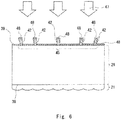
- Fig. 6 illustrates the step of forming the metal film 43.
- the resist 41 and the to-be-exposed resist 42 illustrated in Fig. 5 are developed.
- the exposed resist is exposed to the developing solution along with the transparent base plate 28.
- an alkaline developing solution suitable for the material used in the resist 41 may be used.
- an immersion method, a shaking method, a paddle method, a spray method, or the like can be used.
- the resists are rinsed with pure water and then dried.
- a metal film 48 is formed on the top surface 39 on which the resist pattern 45 has been s formed.
- the formation of the metal film 48 may be performed by any one of, but not limited to, evaporation, sputtering, and electroforming.
- the resist pattern 45 illustrated in Fig. 6 is removed from the transparent base member 28.
- the aperture array 24 composed of the metal film 48 ( Fig. 6 ) is formed as illustrated in Fig. 7 .
- the aperture 26 as illustrated in Fig. 2 is formed in the portion where the to-be-exposed resist 42 is removed.
- the screen 20 can be manufactured.
- the removal of the resist pattern 45 illustrated in Fig. 6 is performed by a lift-off process.
- the lift-off it is preferable to bring the solvent into contact with the to-be-exposed resist 42.
- the lift-off solution may be warmed.
- vibration may be applied to the transparent base member 28.
- a vapor deposition method is suitable as a means for forming the metal film 48 illustrated in Fig. 6 .
- metal particles travel straight as a vapor flow 47. Accordingly, the metal particles will not easily reach the side surface of the to-be-exposed resist 42 in a roundabout manner. Accordingly, the side surface of the to-be-exposed resist 42 is not easily covered with the metal film 48.
- the aperture array shields light except for the portion through which the image light 31 passes. This is because the exposure light 44 illustrated in Fig. 5 passes through the portion where the aperture 26 through which the image light 31 illustrated in Fig. 7 passes should formed by the above self-alignment method. Specifically, it is the gist of the resist pattern formation in accordance with this embodiment that the to-be-exposed resist 42 is provided at a portion where the aperture 26 is to be formed by the above self-alignment method.
- a screen is manufactured by the above self-alignment method, and a head up display can be manufactured by arranging such a screen in a head up display.
- the screen 20 is arranged such that the image light 31 is projected from the microlens array 21 side to the screen 20 illustrated in Fig. 7 .
- the transmission of the image light 31 at the aperture 26 takes place efficiently. This is because the aperture 26 is precisely provided in advance at the position through which the image light 31 passes by the self-alignment method.
- At least one of the exposure light 44 illustrated in Fig. 5 and the image light 31 illustrated in Fig. 7 may be adjusted. Specifically, it may be adjusted such that the image point distance Ex of the exposure light 44 illustrated in Fig. 5 and the image point distance Im of the image light 31 illustrated in Fig. 7 are equal to each other. Alternatively, the difference between these image point distances is preferably in any one of the range of 10, 9, 8, 7, 6, 5, 4, 3, 2, and 1%.
- the inner diameter of the aperture 26 illustrated in Fig. 7 can be made substantially equal to the diameter of the spread of the image light 31 on the cross section at the aperture 26. It is made possible to increase the efficiency of reflection of the external light 34 at the light shielding portion 25 while reducing the image light 31 reflected by the inner surface 29 of the light shielding portion 25.
- the transmission efficiency of the image light and the reflection efficiency of the external light can be balanced in accordance with the design of the optical system of the head-up display illustrated in Fig. 3 , i.e., the design of the optical system 30 illustrated in Fig. 3 . Accordingly, adjustment can be implemented depending on the requirements based on the design of the head-up display such that both increase in the transmission efficiency of the image light and increase in the contrast can be achieved in a compatible manner.
- the image point 50 is an image point of the exposure light 44 with respect to the microlens of the microlens array 21.
- the image point 50 is in front of the applied resist 41 with respect to the microlens.
- the image point 50 is in the transparent base member 28, but in other aspects, the image point 50 may be in the microlens array 21.
- the to-be-exposed resist 42 illustrated in Fig. 6 becomes thicker as it becomes more distant from the microlens array 21.
- the to-be-exposed resist 42 has a so-called reverse tapered shape. This is because the exposure light 44 has already passed the image point 50 at the time when the exposure light 44 reaches the to-be-exposed resist 42 as illustrated in Fig. 5 , and the exposure light 44 is in the course of diffusion.
- the angle of the vapor flow 47 to the top surface 39 is not limited. This is because the side face of the to-be-exposed resist 42 having the inverse tapered shape will always be shaded from the vapor flow 47 in any direction.
- the direction of the vapor flow 47 impinging on the top surface 39 illustrated in Fig. 6 is not inclined with respect to the normal direction of the top surface 39.
- the direction of the vapor flow 47 may be inclined by 0° to 20°.
- the range of such inclination is preferably 0° to 10° and more preferably 0° to 5°. When the inclination becomes smaller, the metal film 46 can be thickened more efficiently.
- the positional relationship between the image point 50 illustrated in Fig. 5 and the applied resist 41 can be adjusted as appropriate. Such a positional relationship can be adjusted by, for example, the thickness of at least either one of the transparent base member 28 and the base portion 19 of the microlens array 21. However, when the sum of these thicknesses increases and the image point distance Ex of the image point 50 does not change, then the distance from the main surface of the microlens array 21 to the resist 41 becomes relatively large. In the figure, the image point distance Ex of the image point 50 also takes into account the fact that the exposure light 44 is refracted at the interface between the microlens array 21 and the transparent base member 28. This also applies to the image point distance Im of the image light 31 illustrated in Fig. 7 .
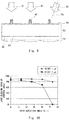
- Fig. 8 illustrates another aspect of the exposure of the resist.
- the exposure light 44 diffused by each microlens is partially omitted for convenience of explanation.
- the distance between the main surface of the microlens array 21 and the resist 41 becomes relatively small when the total thickness of the transparent base member 28 and the base portion 19 becomes small and the image point distance Ex of the image point 50 does not change.
- the image point of the exposure light 44 with respect to the microlens of the microlens array 21 is farther than the resist 41 with respect to the microlens.
- the image point distance Ex of the image point 50 also takes into account the fact that the exposure light 44 is refracted by the transparent base member 28 and the resist 41.
- the to-be-exposed resist 42 illustrated in Fig. 8 tapers away from the microlens array 21.
- the to-be-exposed resist 42 has a so-called forward tapered shape. This is because the exposure light 44 has not yet passed the image point at the time when the exposure light 44 reaches the to-be-exposed resist 42 as illustrated in the figure, and the exposure light 44 is in the course of convergence.
- a portion exposed is generated on the side surface of the to-be-exposed resist 42, where the exposed portion is not coated with the metal film 48.
- the magnitude of the inclination in the direction of the vapor flow 51 impinging on the top surface 39 is indicated by the vapor deposition angle Va with reference to the normal direction of the top surface 39. If the vapor deposition angle Va exceeds 60°, the shaded portion of the to-be-exposed resist 42 in the top surface 39 may become large. For this reason, a sufficient amount of metal for forming the light shielding portion cannot be fed to the shaded portion.
- the graph of Fig. 10 illustrates the relationship between the vapor deposition angle Va and the light blocking ratio of the aperture array.
- the graph indicates the light blocking ratio of the aperture array when vapor deposition is performed while changing the deposition angle Va with respect to the top surface 39 illustrated in Fig. 9 .
- the to-be-exposed resist 42 has a substantially cylindrical shape with a diameter of 10 ⁇ m.
- the pitch of the apertures of the aperture array formed on the basis of the to-be-exposed resist 42 is 20 ⁇ m.
- the light blocking ratio illustrated in Fig. 10 indicates the ratio of the area where the metal film is formed on the top surface 39 illustrated in Fig. 9 .
- the height of the to-be-exposed resist 42 is either 1 ⁇ m or 5 ⁇ m. In the case of a height of 5 ⁇ m as compared with the case of a height of 1 ⁇ m, the shaded portion of the to-be-exposed resist 42 becomes large. Accordingly, in the case of a height of 5 ⁇ m, the light blocking ratio is smaller than in the case of a height of 1 ⁇ m. When the height of the to-be-exposed resist 42 is 5 ⁇ m, the light blocking ratio sharply decreases when the deposition angle Va is larger than 60°.
- the graph of Fig. 11 illustrates the relationship between the vapor deposition angle Va and the exposure ratio of the resist.
- the exposure ratio of the resist represents the exposure ratio with reference to the area of the side surface of the to-be-exposed resist 42 illustrated in Fig. 9 .
- the deposition angle Va By setting the deposition angle Va to be larger than 0°, the side surface of the to-be-exposed resist 42 can be exposed.
- the vapor deposition angle Va illustrated in Fig. 9 can be determined by taking:
- the vapor deposition angle Va illustrated in Fig. 9 can be set within the range of 20° to 60°.
- the vapor deposition angle Va is preferably 45°.
- the lift-off can be efficiently performed by suppressing the deposition of metal on the side surface of the to-be-exposed resist 42. Further, it is made possible to efficiently deposit the metal on the top surface 39 where the light shielding portion is to be formed.
- the present disclosure is not limited to the above-described embodiment and can be appropriately modified without departing from the spirit of the invention.
- the transparent base member 28 and the microlens array 21 illustrated in Fig. 1 may be shaped as a seamless integral member.
- a microlens array sheet including the transparent base member 28 and the microlens array 21 illustrated in Fig. 4 was formed.
- the microlens array 21 was shaped on the transparent base member 28 made of a polycarbonate film using ultraviolet curable resin.
- the thickness of the polycarbonate film was 100 ⁇ m.
- An acrylic resin was used as ultraviolet curable resin.
- the irradiation amount of ultraviolet ray was 500 mJ/cm 2 .
- the resist 41 was applied to the back side of the microlens array sheet, i.e., the top surface 39. Coating was carried out by a spin coating method. The number of revolutions of the microlens array sheet as a workpiece was adjusted so that the film thickness of the resist 41 was 5 ⁇ m.
- PMER N-CA 3000 which is a negative type photoresist manufactured by TOKYO OHKA KOGYO CO., LTD. was used. The resist 41 was dried in an oven at 70°C for 20 minutes.
- the microlens array sheet was set on the stage of a UV exposure apparatus. At this point, the microlens array 21 illustrated in Fig. 5 was placed as the upper side. Ultraviolet rays were emitted from the microlens array 21 side. The exposure amount was 500 mJ/cm 2 . After the exposure, the microlens array sheet was subjected to PEB (post exposure bake) treatment in an oven at 70°C for 20 minutes.
- PEB post exposure bake
- the microlens array sheet was immersed in an organic alkaline developing solution (TMAH 2.38%). Also, the microlens array sheet was shaken for 3 minutes. The microlens array sheet taken out from the developer was rinsed with pure water and further dried.
- TMAH organic alkaline developing solution
- the metal film 48 illustrated in Fig. 6 was formed by a vacuum deposition apparatus, where the vapor deposition angle was 45°.
- the weight of the vapor deposition source was 10.4 g.
- the thickness of the vapor-deposited film was about 200 nm.
- the lift-off was carried out by immersing the vapor-deposited microlens array sheet in NMP (n-methyl-2-pyrrolidone).
- NMP n-methyl-2-pyrrolidone
- the microlens array sheet was shaken for 180 seconds.
- the to-be-exposed resist 42 was melted to form the aperture array 24 illustrated in Fig. 7 .
- the screen of the example was obtained.
- the screen taken out from the NMP was rinsed with pure water and air-dried.
- the item that has undergone the processes up to shaping of the microlens array by ultraviolet curable resin according to the example was defined as the screen of a comparative example.
- the reflection characteristics on the back side of the microlens array sheet, i.e., on the top surface 39 side illustrated in Fig. 7 were evaluated.
- Fig. 12 is a schematic diagram of an apparatus for evaluating the reflection characteristics.
- This apparatus is a goniometer for measuring the intensity distribution of the reflected light according to the reflection angles when the test screen 60 is irradiated with the external light 64.
- the test screen 60 was placed on the black sheet 59 with the microlens array as the lower side.
- LED quasi-parallel light having a divergence angle of 5° or less was used as the external light 64 illustrated in Fig. 12 .
- a light source 61 that emits such a parallel light was arranged.
- a part of the external light 64 is diffusely reflected on the test screen 60 and becomes diffuse reflection light 65.
- a part of the external light 64 is specularly reflected by the test screen 60 and becomes specular reflection light 66.
- the specular reflection light 66 is inclined by +20°.
- the intensities of the diffuse reflection light 65 and the specular reflection light 66 illustrated in Fig. 12 were measured using the 2-D luminance meter 62.
- the reflection angle was changed by changing the observation angle Ob of the 2-D luminance meter 62 from -60° to +60°.
- the observation angle Ob when the 2-D luminance meter 62 faces the test screen 60 directly was set to 0°.
- the mounting angle of the test screen 60 when the test screen 60 is installed in the head-up display is 20°. Accordingly, the optical axis of the light source 61 is out of alignment by -20° with the optical axis of the 2-D luminance meter 62 at the observation angle Ob of 0°.
- Fig. 13 is a graph showing the correlation between the brightness of the diffuse reflection light and the observation angle.
- the unit of the brightness of diffuse reflected light is cd/m 2 .
- the inclination angle when the screen is attached to the head-up display is 20°. Accordingly, strong specularly reflected light is prevented from entering the observer's eyes.
Landscapes
- Physics & Mathematics (AREA)
- General Physics & Mathematics (AREA)
- Optics & Photonics (AREA)
- Optical Elements Other Than Lenses (AREA)
- Overhead Projectors And Projection Screens (AREA)
- Devices For Indicating Variable Information By Combining Individual Elements (AREA)
Applications Claiming Priority (2)
| Application Number | Priority Date | Filing Date | Title |
|---|---|---|---|
| JP2016003410 | 2016-01-12 | ||
| PCT/JP2017/000551 WO2017122651A1 (ja) | 2016-01-12 | 2017-01-11 | ディスプレイ用スクリーン |
Publications (2)
| Publication Number | Publication Date |
|---|---|
| EP3404484A1 true EP3404484A1 (de) | 2018-11-21 |
| EP3404484A4 EP3404484A4 (de) | 2019-09-11 |
Family
ID=59310980
Family Applications (1)
| Application Number | Title | Priority Date | Filing Date |
|---|---|---|---|
| EP17738405.4A Withdrawn EP3404484A4 (de) | 2016-01-12 | 2017-01-11 | Bildschirm für eine anzeige |
Country Status (6)
| Country | Link |
|---|---|
| US (1) | US10901122B2 (de) |
| EP (1) | EP3404484A4 (de) |
| JP (1) | JPWO2017122651A1 (de) |
| KR (1) | KR102164725B1 (de) |
| CN (1) | CN108700797B (de) |
| WO (1) | WO2017122651A1 (de) |
Cited By (12)
| Publication number | Priority date | Publication date | Assignee | Title |
|---|---|---|---|---|
| WO2020039847A1 (en) * | 2018-08-21 | 2020-02-27 | Ricoh Company, Ltd. | Image projection apparatus, diffusion screen, and mobile object |
| US10838556B2 (en) | 2019-04-05 | 2020-11-17 | Apple Inc. | Sensing system for detection of light incident to a light emitting layer of an electronic device display |
| US11067884B2 (en) | 2018-12-26 | 2021-07-20 | Apple Inc. | Through-display optical transmission, reception, or sensing through micro-optic elements |
| US11295664B2 (en) | 2020-03-11 | 2022-04-05 | Apple Inc. | Display-synchronized optical emitters and transceivers |
| US11327237B2 (en) | 2020-06-18 | 2022-05-10 | Apple Inc. | Display-adjacent optical emission or reception using optical fibers |
| US11487859B2 (en) | 2020-07-31 | 2022-11-01 | Apple Inc. | Behind display polarized optical transceiver |
| US11527582B1 (en) | 2019-09-24 | 2022-12-13 | Apple Inc. | Display stack with integrated photodetectors |
| US11592873B2 (en) | 2020-02-14 | 2023-02-28 | Apple Inc. | Display stack topologies for under-display optical transceivers |
| US11611058B2 (en) | 2019-09-24 | 2023-03-21 | Apple Inc. | Devices and systems for under display image sensor |
| US11839133B2 (en) | 2021-03-12 | 2023-12-05 | Apple Inc. | Organic photodetectors for in-cell optical sensing |
| GB2624439A (en) * | 2022-11-18 | 2024-05-22 | Envisics Ltd | Manufacture of reflection suppression device |
| US12124002B2 (en) | 2021-09-03 | 2024-10-22 | Apple Inc. | Beam deflector metasurface |
Families Citing this family (5)
| Publication number | Priority date | Publication date | Assignee | Title |
|---|---|---|---|---|
| DE102016211511A1 (de) * | 2016-06-27 | 2017-12-28 | Carl Zeiss Smt Gmbh | Beleuchtungseinheit für die Mikrolithographie |
| DE102017214592A1 (de) | 2017-08-22 | 2019-02-28 | Continental Automotive Gmbh | Head-Up-Display |
| JP2019124859A (ja) * | 2018-01-18 | 2019-07-25 | 株式会社Jvcケンウッド | マイクロレンズアレイユニット及び表示装置 |
| JP2019164230A (ja) * | 2018-03-19 | 2019-09-26 | 株式会社リコー | 画像投写装置及び移動体 |
| EP4148467A4 (de) | 2020-05-15 | 2023-11-01 | Samsung Electronics Co., Ltd. | Reflektierende struktur, reflektierende strukturanordnung damit und schwimmende bildanzeigevorrichtung |
Family Cites Families (18)
| Publication number | Priority date | Publication date | Assignee | Title |
|---|---|---|---|---|
| JPH1039769A (ja) * | 1996-07-19 | 1998-02-13 | Toray Ind Inc | マイクロレンズアレイシート |
| JPH10241434A (ja) | 1997-02-27 | 1998-09-11 | Toray Ind Inc | 光線指向性化シートおよびそれを用いた指向性面状光源 |
| JPH11344602A (ja) | 1998-03-30 | 1999-12-14 | Seiko Epson Corp | ブラックマトリクス付マイクロレンズ基板の製造方法、液晶パネル用対向基板、液晶パネルおよび投射型表示装置 |
| FR2793043B1 (fr) * | 1999-04-29 | 2003-06-06 | Synelec Sa | Ecran de projection |
| JP2001201611A (ja) | 2000-01-21 | 2001-07-27 | Hitachi Ltd | 光学的機能性シート及びこれを用いた面状光源並びに画像表示装置 |
| JP3731592B2 (ja) * | 2003-09-08 | 2006-01-05 | セイコーエプソン株式会社 | 透過型スクリーン用部材、透過型スクリーンおよびリア型プロジェクタ |
| JP2006330631A (ja) * | 2005-05-30 | 2006-12-07 | Miraial Kk | 背面投射型スクリーン |
| EP1899760A4 (de) * | 2005-06-29 | 2011-05-04 | Reflexite Corp | Verfahren und vorrichtung zur aperturskulpturierung in einem mikrolinsengruppenfilm |
| JP2007199212A (ja) * | 2006-01-24 | 2007-08-09 | Seiko Epson Corp | マイクロレンズ基板、透過型スクリーンおよびリア型プロジェクタ |
| JP2007212887A (ja) * | 2006-02-10 | 2007-08-23 | Miraial Kk | 異方性光吸収シート、異方性光吸収シートの製造方法、異方性光吸収シート用金型の製造方法、及び、画像投射装置用スクリーン |
| JP4788405B2 (ja) * | 2006-03-07 | 2011-10-05 | 凸版印刷株式会社 | レンズシート及び透過型プロジェクションスクリーン |
| JP4896553B2 (ja) * | 2006-03-29 | 2012-03-14 | 藤森工業株式会社 | マイクロレンズアレイシートの製造方法 |
| WO2012124524A1 (ja) * | 2011-03-11 | 2012-09-20 | シャープ株式会社 | 蒸着粒子射出装置および蒸着装置 |
| JP5732969B2 (ja) * | 2011-03-30 | 2015-06-10 | 日本精機株式会社 | ヘッドアップディスプレイ装置 |
| US20140198368A1 (en) * | 2013-01-17 | 2014-07-17 | Koc University | High Gain Display Screen with Rotated Microlens Array |
| JP2014149405A (ja) * | 2013-01-31 | 2014-08-21 | Nippon Seiki Co Ltd | ヘッドアップディスプレイ装置 |
| JP5777772B1 (ja) | 2014-06-16 | 2015-09-09 | 株式会社シーエフ | 羽毛の光触媒加工法及び装置 |
| JP6372346B2 (ja) * | 2014-12-24 | 2018-08-15 | 日本精機株式会社 | ヘッドアップディスプレイ |
-
2017
- 2017-01-11 EP EP17738405.4A patent/EP3404484A4/de not_active Withdrawn
- 2017-01-11 CN CN201780014969.6A patent/CN108700797B/zh not_active Expired - Fee Related
- 2017-01-11 US US16/069,344 patent/US10901122B2/en not_active Expired - Fee Related
- 2017-01-11 JP JP2017561121A patent/JPWO2017122651A1/ja active Pending
- 2017-01-11 WO PCT/JP2017/000551 patent/WO2017122651A1/ja not_active Ceased
- 2017-01-11 KR KR1020187021403A patent/KR102164725B1/ko not_active Expired - Fee Related
Cited By (14)
| Publication number | Priority date | Publication date | Assignee | Title |
|---|---|---|---|---|
| WO2020039847A1 (en) * | 2018-08-21 | 2020-02-27 | Ricoh Company, Ltd. | Image projection apparatus, diffusion screen, and mobile object |
| US11067884B2 (en) | 2018-12-26 | 2021-07-20 | Apple Inc. | Through-display optical transmission, reception, or sensing through micro-optic elements |
| US10838556B2 (en) | 2019-04-05 | 2020-11-17 | Apple Inc. | Sensing system for detection of light incident to a light emitting layer of an electronic device display |
| US11422661B2 (en) | 2019-04-05 | 2022-08-23 | Apple Inc. | Sensing system for detection of light incident to a light emitting layer of an electronic device display |
| US12016237B2 (en) | 2019-09-24 | 2024-06-18 | Apple Inc. | Display stack with integrated photodetectors |
| US11611058B2 (en) | 2019-09-24 | 2023-03-21 | Apple Inc. | Devices and systems for under display image sensor |
| US11527582B1 (en) | 2019-09-24 | 2022-12-13 | Apple Inc. | Display stack with integrated photodetectors |
| US11592873B2 (en) | 2020-02-14 | 2023-02-28 | Apple Inc. | Display stack topologies for under-display optical transceivers |
| US11295664B2 (en) | 2020-03-11 | 2022-04-05 | Apple Inc. | Display-synchronized optical emitters and transceivers |
| US11327237B2 (en) | 2020-06-18 | 2022-05-10 | Apple Inc. | Display-adjacent optical emission or reception using optical fibers |
| US11487859B2 (en) | 2020-07-31 | 2022-11-01 | Apple Inc. | Behind display polarized optical transceiver |
| US11839133B2 (en) | 2021-03-12 | 2023-12-05 | Apple Inc. | Organic photodetectors for in-cell optical sensing |
| US12124002B2 (en) | 2021-09-03 | 2024-10-22 | Apple Inc. | Beam deflector metasurface |
| GB2624439A (en) * | 2022-11-18 | 2024-05-22 | Envisics Ltd | Manufacture of reflection suppression device |
Also Published As
| Publication number | Publication date |
|---|---|
| CN108700797A (zh) | 2018-10-23 |
| WO2017122651A1 (ja) | 2017-07-20 |
| US20190018170A1 (en) | 2019-01-17 |
| US10901122B2 (en) | 2021-01-26 |
| KR20180095936A (ko) | 2018-08-28 |
| EP3404484A4 (de) | 2019-09-11 |
| CN108700797B (zh) | 2020-12-08 |
| KR102164725B1 (ko) | 2020-10-13 |
| JPWO2017122651A1 (ja) | 2018-12-27 |
Similar Documents
| Publication | Publication Date | Title |
|---|---|---|
| US10901122B2 (en) | Screen for display | |
| JP7142701B2 (ja) | 自動車投光器用の投射装置、及び投射装置を製造するための方法 | |
| KR102468923B1 (ko) | 헤드업 디스플레이 | |
| CN100427971C (zh) | 光吸收构件 | |
| JP4224547B2 (ja) | 像スクリーンおよびその上への光吸収層の形成方法 | |
| WO2020042563A1 (zh) | 投影屏幕及其制造方法 | |
| KR100538298B1 (ko) | 차광성층을 갖춘 렌티큘라 렌즈시트 및 그 제조방법 | |
| US9395616B2 (en) | Projection screen and manufacturing method of projection screen | |
| US7336895B2 (en) | Diffuser panel and optical apparatus which uses this diffuser panel | |
| KR20060124565A (ko) | 배면투사형 스크린 | |
| CN111077722A (zh) | 投影屏幕及其加工方法 | |
| JP2006065266A (ja) | 反射スクリーン、反射投影システム、及び、反射スクリーンの製造方法 | |
| US7787184B2 (en) | Member having antireflection structure | |
| JP2006047784A (ja) | 遮光帯を有するレンズシート及びその製造方法 | |
| JP2019020484A (ja) | ディスプレイ用スクリーン、及びその製造方法 | |
| TWI228745B (en) | Projection optics apparatus and thereof display device and thereof manufacturing method | |
| JP2004191429A (ja) | 透過型スクリーン、その製造方法、及び背面投影型プロジェクション装置 | |
| JP2019144470A (ja) | ヘッドアップディスプレイ装置 | |
| JP2002277614A (ja) | フレネルレンズシートの製造方法およびフレネルレンズシートの成形型の製造方法 | |
| KR100662911B1 (ko) | 렌티큘라 렌즈시트와 그 제조방법 | |
| JPH11142976A (ja) | 透過型スクリーンおよびその製造方法 | |
| JP2000250139A (ja) | 背面投写形表示装置、透過形スクリーン及びその製造方法 | |
| TWI232993B (en) | Projection optics apparatus and thereof display device and thereof manufacturing method | |
| JP2002006112A (ja) | レンズシート及びその製造方法と、透過型スクリーン | |
| JP2007178674A (ja) | レンズシート及びレンズシートの製造方法 |
Legal Events
| Date | Code | Title | Description |
|---|---|---|---|
| STAA | Information on the status of an ep patent application or granted ep patent |
Free format text: STATUS: THE INTERNATIONAL PUBLICATION HAS BEEN MADE |
|
| PUAI | Public reference made under article 153(3) epc to a published international application that has entered the european phase |
Free format text: ORIGINAL CODE: 0009012 |
|
| STAA | Information on the status of an ep patent application or granted ep patent |
Free format text: STATUS: REQUEST FOR EXAMINATION WAS MADE |
|
| 17P | Request for examination filed |
Effective date: 20180809 |
|
| AK | Designated contracting states |
Kind code of ref document: A1 Designated state(s): AL AT BE BG CH CY CZ DE DK EE ES FI FR GB GR HR HU IE IS IT LI LT LU LV MC MK MT NL NO PL PT RO RS SE SI SK SM TR |
|
| AX | Request for extension of the european patent |
Extension state: BA ME |
|
| DAV | Request for validation of the european patent (deleted) | ||
| DAX | Request for extension of the european patent (deleted) | ||
| A4 | Supplementary search report drawn up and despatched |
Effective date: 20190809 |
|
| RIC1 | Information provided on ipc code assigned before grant |
Ipc: G03B 21/62 20140101AFI20190805BHEP Ipc: G02B 27/01 20060101ALI20190805BHEP |
|
| STAA | Information on the status of an ep patent application or granted ep patent |
Free format text: STATUS: EXAMINATION IS IN PROGRESS |
|
| 17Q | First examination report despatched |
Effective date: 20200514 |
|
| GRAP | Despatch of communication of intention to grant a patent |
Free format text: ORIGINAL CODE: EPIDOSNIGR1 |
|
| STAA | Information on the status of an ep patent application or granted ep patent |
Free format text: STATUS: GRANT OF PATENT IS INTENDED |
|
| GRAJ | Information related to disapproval of communication of intention to grant by the applicant or resumption of examination proceedings by the epo deleted |
Free format text: ORIGINAL CODE: EPIDOSDIGR1 |
|
| STAA | Information on the status of an ep patent application or granted ep patent |
Free format text: STATUS: EXAMINATION IS IN PROGRESS |
|
| INTG | Intention to grant announced |
Effective date: 20210519 |
|
| INTC | Intention to grant announced (deleted) | ||
| GRAP | Despatch of communication of intention to grant a patent |
Free format text: ORIGINAL CODE: EPIDOSNIGR1 |
|
| STAA | Information on the status of an ep patent application or granted ep patent |
Free format text: STATUS: GRANT OF PATENT IS INTENDED |
|
| INTG | Intention to grant announced |
Effective date: 20210726 |
|
| STAA | Information on the status of an ep patent application or granted ep patent |
Free format text: STATUS: THE APPLICATION IS DEEMED TO BE WITHDRAWN |
|
| 18D | Application deemed to be withdrawn |
Effective date: 20211207 |