EP3402652B1 - Machine de stéréolithographie améliorée à initialisation facilitée - Google Patents
Machine de stéréolithographie améliorée à initialisation facilitée Download PDFInfo
- Publication number
- EP3402652B1 EP3402652B1 EP17709788.8A EP17709788A EP3402652B1 EP 3402652 B1 EP3402652 B1 EP 3402652B1 EP 17709788 A EP17709788 A EP 17709788A EP 3402652 B1 EP3402652 B1 EP 3402652B1
- Authority
- EP
- European Patent Office
- Prior art keywords
- modelling
- modelling plate
- supporting unit
- suited
- movement
- Prior art date
- Legal status (The legal status is an assumption and is not a legal conclusion. Google has not performed a legal analysis and makes no representation as to the accuracy of the status listed.)
- Active
Links
Images




Classifications
-
- B—PERFORMING OPERATIONS; TRANSPORTING
- B29—WORKING OF PLASTICS; WORKING OF SUBSTANCES IN A PLASTIC STATE IN GENERAL
- B29C—SHAPING OR JOINING OF PLASTICS; SHAPING OF MATERIAL IN A PLASTIC STATE, NOT OTHERWISE PROVIDED FOR; AFTER-TREATMENT OF THE SHAPED PRODUCTS, e.g. REPAIRING
- B29C64/00—Additive manufacturing, i.e. manufacturing of three-dimensional [3D] objects by additive deposition, additive agglomeration or additive layering, e.g. by 3D printing, stereolithography or selective laser sintering
- B29C64/10—Processes of additive manufacturing
- B29C64/106—Processes of additive manufacturing using only liquids or viscous materials, e.g. depositing a continuous bead of viscous material
- B29C64/124—Processes of additive manufacturing using only liquids or viscous materials, e.g. depositing a continuous bead of viscous material using layers of liquid which are selectively solidified
-
- B—PERFORMING OPERATIONS; TRANSPORTING
- B29—WORKING OF PLASTICS; WORKING OF SUBSTANCES IN A PLASTIC STATE IN GENERAL
- B29C—SHAPING OR JOINING OF PLASTICS; SHAPING OF MATERIAL IN A PLASTIC STATE, NOT OTHERWISE PROVIDED FOR; AFTER-TREATMENT OF THE SHAPED PRODUCTS, e.g. REPAIRING
- B29C64/00—Additive manufacturing, i.e. manufacturing of three-dimensional [3D] objects by additive deposition, additive agglomeration or additive layering, e.g. by 3D printing, stereolithography or selective laser sintering
- B29C64/10—Processes of additive manufacturing
- B29C64/106—Processes of additive manufacturing using only liquids or viscous materials, e.g. depositing a continuous bead of viscous material
- B29C64/124—Processes of additive manufacturing using only liquids or viscous materials, e.g. depositing a continuous bead of viscous material using layers of liquid which are selectively solidified
- B29C64/129—Processes of additive manufacturing using only liquids or viscous materials, e.g. depositing a continuous bead of viscous material using layers of liquid which are selectively solidified characterised by the energy source therefor, e.g. by global irradiation combined with a mask
- B29C64/135—Processes of additive manufacturing using only liquids or viscous materials, e.g. depositing a continuous bead of viscous material using layers of liquid which are selectively solidified characterised by the energy source therefor, e.g. by global irradiation combined with a mask the energy source being concentrated, e.g. scanning lasers or focused light sources
-
- B—PERFORMING OPERATIONS; TRANSPORTING
- B29—WORKING OF PLASTICS; WORKING OF SUBSTANCES IN A PLASTIC STATE IN GENERAL
- B29C—SHAPING OR JOINING OF PLASTICS; SHAPING OF MATERIAL IN A PLASTIC STATE, NOT OTHERWISE PROVIDED FOR; AFTER-TREATMENT OF THE SHAPED PRODUCTS, e.g. REPAIRING
- B29C64/00—Additive manufacturing, i.e. manufacturing of three-dimensional [3D] objects by additive deposition, additive agglomeration or additive layering, e.g. by 3D printing, stereolithography or selective laser sintering
- B29C64/20—Apparatus for additive manufacturing; Details thereof or accessories therefor
-
- B—PERFORMING OPERATIONS; TRANSPORTING
- B29—WORKING OF PLASTICS; WORKING OF SUBSTANCES IN A PLASTIC STATE IN GENERAL
- B29C—SHAPING OR JOINING OF PLASTICS; SHAPING OF MATERIAL IN A PLASTIC STATE, NOT OTHERWISE PROVIDED FOR; AFTER-TREATMENT OF THE SHAPED PRODUCTS, e.g. REPAIRING
- B29C64/00—Additive manufacturing, i.e. manufacturing of three-dimensional [3D] objects by additive deposition, additive agglomeration or additive layering, e.g. by 3D printing, stereolithography or selective laser sintering
- B29C64/20—Apparatus for additive manufacturing; Details thereof or accessories therefor
- B29C64/227—Driving means
- B29C64/232—Driving means for motion along the axis orthogonal to the plane of a layer
-
- B—PERFORMING OPERATIONS; TRANSPORTING
- B29—WORKING OF PLASTICS; WORKING OF SUBSTANCES IN A PLASTIC STATE IN GENERAL
- B29C—SHAPING OR JOINING OF PLASTICS; SHAPING OF MATERIAL IN A PLASTIC STATE, NOT OTHERWISE PROVIDED FOR; AFTER-TREATMENT OF THE SHAPED PRODUCTS, e.g. REPAIRING
- B29C64/00—Additive manufacturing, i.e. manufacturing of three-dimensional [3D] objects by additive deposition, additive agglomeration or additive layering, e.g. by 3D printing, stereolithography or selective laser sintering
- B29C64/20—Apparatus for additive manufacturing; Details thereof or accessories therefor
- B29C64/245—Platforms or substrates
-
- B—PERFORMING OPERATIONS; TRANSPORTING
- B29—WORKING OF PLASTICS; WORKING OF SUBSTANCES IN A PLASTIC STATE IN GENERAL
- B29C—SHAPING OR JOINING OF PLASTICS; SHAPING OF MATERIAL IN A PLASTIC STATE, NOT OTHERWISE PROVIDED FOR; AFTER-TREATMENT OF THE SHAPED PRODUCTS, e.g. REPAIRING
- B29C64/00—Additive manufacturing, i.e. manufacturing of three-dimensional [3D] objects by additive deposition, additive agglomeration or additive layering, e.g. by 3D printing, stereolithography or selective laser sintering
- B29C64/20—Apparatus for additive manufacturing; Details thereof or accessories therefor
- B29C64/255—Enclosures for the building material, e.g. powder containers
-
- B—PERFORMING OPERATIONS; TRANSPORTING
- B33—ADDITIVE MANUFACTURING TECHNOLOGY
- B33Y—ADDITIVE MANUFACTURING, i.e. MANUFACTURING OF THREE-DIMENSIONAL [3D] OBJECTS BY ADDITIVE DEPOSITION, ADDITIVE AGGLOMERATION OR ADDITIVE LAYERING, e.g. BY 3D PRINTING, STEREOLITHOGRAPHY OR SELECTIVE LASER SINTERING
- B33Y10/00—Processes of additive manufacturing
-
- B—PERFORMING OPERATIONS; TRANSPORTING
- B33—ADDITIVE MANUFACTURING TECHNOLOGY
- B33Y—ADDITIVE MANUFACTURING, i.e. MANUFACTURING OF THREE-DIMENSIONAL [3D] OBJECTS BY ADDITIVE DEPOSITION, ADDITIVE AGGLOMERATION OR ADDITIVE LAYERING, e.g. BY 3D PRINTING, STEREOLITHOGRAPHY OR SELECTIVE LASER SINTERING
- B33Y30/00—Apparatus for additive manufacturing; Details thereof or accessories therefor
Definitions
- the present invention concerns a stereolithography machine whose initialization is particularly simple and which, therefore, is suited to be used also by inexpert operators.
- a stereolithography machine is used for the production of complex three-dimensional objects, starting from a light-sensitive resin which is polymerized in layers by means of a light beam.
- a stereolithography machine comprises a tank containing the above mentioned resin and a modelling plate which faces the bottom of the tank and supports the three-dimensional object being formed.
- the modelling plate is associated with a supporting unit so that it can be moved according to a direction of movement that is orthogonal to the bottom of the tank.
- the surface of the preceding layer or, in the case of the first layer, the surface of the modelling plate are immersed in the resin until they are arranged at a distance from the bottom of the tank which is equal to the thickness of the layer to be obtained, in such a way as to define a corresponding layer of resin.
- said resin layer is polymerized through irradiation with a light beam coming from under the tank, which for this purpose has a transparent bottom.
- the machine Before the processing cycle can be started, the machine needs to be initialized with a procedure during which the modelling plate is regulated with respect to the supporting unit so that its surface is as parallel to the bottom of the tank as possible.
- Said initialization procedure furthermore, allows the machine to store the actual position of the bottom of the tank, so that said surface can be placed automatically and precisely at any prefixed distance from the bottom itself.
- Said initialization procedure is necessary because the dimensions of the tank, which is usually made of a plastic material, are not known in advance and show tolerances in terms of both size and shape.
- the incorrect positioning of the modelling plate with respect to the bottom of the tank can damage the tank itself, in addition to causing the faulty solidification of the first layers of the object, which in turn may lead to the production of processing rejects.
- each layer of the object is generally of the order of tenths of millimetres, very high precision is required when positioning the plate with respect to the bottom of the tank.
- the modelling plate is brought into contact with the bottom of the tank while at the same time keeping it released from the supporting unit, in such a way as to allow it to be positioned in close contact with the bottom of the tank.
- the modelling plate is associated with the supporting unit through movable means that allow both its relative movement with respect to the supporting unit according to the direction of movement and its limited rotation according to axes that are orthogonal to the direction of movement.
- the operator After placing the modelling plate in contact with the bottom of the tank, the operator acts on special adjustable spacers that project from the supporting unit towards the modelling plate, extending them until they come into contact with the modelling plate itself.
- the position obtained in this manner is stored by the control system of the supporting unit.
- a paper sheet is interposed between the modelling plate and the bottom of the tank. After placing the modelling plate in contact with the bottom of the tank and tightening the spacers, the operator makes sure that the paper sheet can still be removed from under the modelling plate, which ensures the absence of excessive localized pressures.
- the interposition of the paper sheet prevents the modelling plate from resting perfectly on the bottom of the tank, due to the thickness of the paper sheet itself.
- the tank is supported by elastic elements that allow a certain excursion of the same in the direction of movement of the modelling plate.
- stereolithography machines that allow the position of the modelling plate to be regulated with respect to the supporting unit are described in documents WO 2013/177620 and US 2015/0328841 .
- the present invention intends to overcome all of the above mentioned drawbacks which are typical of the stereolithography machines of the known types described above.
- the easier initialization of the machine that is the subject of the invention makes the latter suited to be used also by inexpert operators.
- the easier initialization of the machine that is the subject of the invention makes it possible to carry out the initialization procedure more rapidly compared to the machines of the known type, thus reducing machine downtimes.
- the higher initialization precision which can be achieved with the machine that is the subject of the invention avoids the need to provide additional initial layers for the three-dimensional object, thus reducing the time necessary to make the object itself and the quantity of resin required.
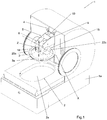
- the stereolithography machine of the invention indicated as a whole by 1 in Figure 1 , comprises a frame 1a which supports a tank 2 containing a light sensitive resin and provided with a bottom 2a.
- the bottom 2a is transparent, in such a way as to allow the passage of a light beam originating from a source not illustrated in the drawings but known per se, arranged under the tank 2 and suited to selectively solidify a layer of resin arranged so that it is adjacent to the bottom 2a itself.
- a modelling plate 3 which has a modelling surface 3a facing towards the bottom 2a.
- the modelling surface 3a is used to support the first layer of the three-dimensional object that is solidified, which in turn serves as a support for a second layer, and so on for the successive layers.
- the modelling plate 3 is supported by a supporting unit 5 , in turn associated with the frame 1a through guide means and through moving means 4 suited to move the supporting unit 5 and, consequently, the plate 3 , according to a direction of movement Z orthogonal to the bottom 2a.
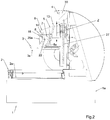
- the moving means 4 comprise a servo motor 30 , for example a stepping motor, visible in Figure 2 .
- said servo motor 30 operates a worm screw 27 , also visible in Figure 2 , which in turn is operatively associated with the supporting unit 5.
- the moving means 4 allow the modelling plate 3 to be moved according to the direction of movement Z , in such a way as to arrange the modelling surface 3a , or the surface of the last solidified layer of the object, so that it is immersed in the resin at a distance from the bottom 2a corresponding to the thickness of the successive layer to be obtained.
- the modelling plate 3 is connected to the supporting unit 5 by means of a coupling unit 6 which makes it possible to modify the position of the modelling plate 3 with respect to the supporting unit 5 and which can be locked in order to make the plate 3 integral with the supporting unit 5.
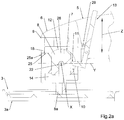
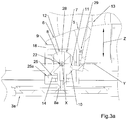
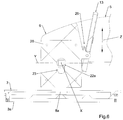
- the coupling unit 6 is configured in such a way as to allow the translation of the modelling plate 3 with respect to the supporting unit 5 , according to the direction of movement Z , between a first linear position, represented in Figures 2a and 5 , in which the plate 3 is positioned further away from the supporting unit 5 , and a second linear position, represented in Figures 3a and 6 , in which it is positioned nearer to the supporting unit 5.
- the coupling unit 6 is configured so as to force the modelling plate 3 in the first linear position, for example through the presence of elastic means not illustrated in the drawings but known per se.
- said elastic means ensure that when the supporting unit 5 is lowered, during the initialization procedure, the modelling plate 3 remains in contact with the bottom 2a of the tank 2.
- said elastic means are absent and the modelling plate 3 is forced in the first linear position by the own dead load of the plate 3 itself.
- the supporting unit 5 is configured in such a way as to allow also the rotation of the modelling plate 3 with respect to the supporting unit 5 , according to a rotation axis X perpendicular to the direction of movement Z , between a first angular position, in which the modelling surface 3a is orthogonal to the direction of movement Z , and a second angular position, in which the modelling surface 3a is rotated with respect to the first angular position.
- said rotation allows the modelling plate 3 to adapt also to possible deviations of the bottom 2a of the tank 2 around said rotation axis X with respect to the plane that is orthogonal to the direction of movement Z.
- the supporting unit 5 is configured so as to allow also a rotation of the modelling plate 3 with respect to the supporting unit 5 , according to a further rotation axis Y perpendicular to the first rotation axis X and to the direction of movement Z.
- said rotation combined with the previous movements described above, allows the modelling plate 3 to assume a position in which it perfectly adheres to the bottom 2a of the tank 2 during the initialization procedure.
- the machine 1 furthermore comprises clamping means 9 suited to be operated in such a way as to make the modelling plate 3 and the supporting unit 5 integral with each other, so as to prevent the above mentioned translation and rotation movements, and suited to be released in such a way as to allow said movements.
- the coupling unit 6 comprises a housing 7 and a spherical body 8 revolvingly arranged in said housing 7 so that it can rotate around said rotation axes X and Y.
- the shape of the housing 7 is such that it prevents the translation of the spherical body 8 in the three spatial directions at least when the modelling plate 3 occupies an angular position sufficiently near said first angular position, meaning when the modelling surface 3a forms, with respect to the direction of movement Z , an angle that differs from a right angle by a value smaller than a predefined value.
- the housing 7 has a spherical shape with diameter equal to the diameter of the spherical body 8 , thus improving the stability of the coupling in any mutual angular position.
- the clamping means 9 are configured in such a way as to press the housing 7 and the spherical body 8 against each other, so that the consequent friction between the respective surfaces prevents any mutual movement between the two components, thus making them actually integral with each other independently of their mutual position.
- the coupling unit 6 described above behaves as a spherical joint that allows the modelling plate 3 to rotate around the rotation axis X and, if envisaged, also around said further rotation axis Y , assuming any angular position around said axes within a predefined angular interval.
- the coupling unit 6 and the clamping means 9 allow the machine 1 to be initialized through a very simple procedure, thus achieving one of the objects of the invention.
- the initialization procedure described above can be carried out by releasing the clamping means 9 and lowering the supporting unit 5 until arranging the modelling plate 3 so that it rests on the bottom 2a of the tank 2. Successively, the clamping means 9 are operated in such a way as to lock any mutual movement between the spherical body 8 and the housing 7 , so as to fix the position of the modelling plate 3 with respect to the supporting unit 5.
- the spherical constraint of the spherical body 8 is such that the operation of the clamping means 9 does not cause any relative movement between the modelling plate 3 and the supporting unit 5.
- the action of the clamping means 9 is limited to the generation of sufficient friction between the housing 7 and the spherical body 8 to lock the modelling plate 3 in the position spontaneously assumed by the latter when it came into contact with the bottom 2a.
- said clamping means 9 do not cause lack of homogeneity in the contact pressures between the modelling plate 3 and the bottom 2a and, therefore, it is not necessary to complete the procedure by verifying the correct distribution of the contact pressures of the modelling plate 3.
- the invention thus achieves the object to facilitate the initialization procedure of the machine 1 , making the latter suited to be used even by inexpert operators.
- the position obtained in this way can be directly used by the control system of the supporting unit 5 as a reference position for the processing cycle.
- the spherical body 8 is integral with the modelling plate 3 , to which it is connected through a connection body 8a , while the housing 7 is connected to the supporting unit 5 and defines a slot 7a which houses the connection body 8a and allows it to move during the rotary movements of the spherical body 8 in the housing 7 according to the two rotation axes X and Y.
- the slot 7a extends around the rotation axis X over an angle equal to that which separates the first angular position from the second angular position.
- the width of the slot 7a in the direction perpendicular to said angular extension exceeds the width of the connection body 8a , in such a way as to allow a certain rotation of the spherical body 8 according to the rotation axis Y.
- the housing 7 can be connected to the modelling plate 3 and the spherical body 8 can be integral with the supporting unit 5 , without for this reason modifying the substance of the invention.
- the coupling unit 6 comprises also releasable stop means 10 suited to be operated to lock the modelling plate 3 in said second angular position.
- the modelling plate 3 can be locked in the second angular position with the modelling surface 3a inclined, so that the excess liquid resin can easily drip into the underlying tank 2, thus further increasing the ease of use of the machine.
- the second angular position is separated from the first angular position by approximately 90°, in such a way as to determine a vertical position of the modelling surface 3a , thus ensuring better dripping of the excess resin.
- the stop means 10 comprise a stop body 11 which is maintained in contact with the spherical body 8 through the action of elastic means 29 visible in detail in Figure 2a .
- the spherical body 8 is provided with a recess 12 suited to house the stop body 11 which snaps into it when the modelling plate 3 is arranged in the second angular position, release means 13 being provided, which can be operated by the user in order to release the stop body 11 from the recess 12.
- the stop body 11 automatically snaps into the recess 12 , in such a way as to hold the spherical body 8 and, consequently, the modelling plate 3 in the second angular position.
- the release means 13 comprise a lever which can be accessed by the user and which, when shifted, causes the stop body 11 to be extracted from the recess 12 and, consequently, the modelling plate 3 to be released, thus allowing the latter to be rotated in an angular position different from the first angular position.
- Said rotation of the modelling plate 3 can be performed manually or, more preferably, can take place spontaneously, which can be obtained, for example, by configuring the modelling plate 3 itself in such a way that its centre of gravity is shifted horizontally with respect to the rotation centre defined by the spherical body 8.
- the coupling unit 6 includes friction means intended to brake the lowering movement of the modelling plate 3 towards the first angular position, which may include the presence of a slight interference between the spherical body 8 and its housing 7 , or between the connection body 8a and the slot 7a.
- stop means 10 can assume configurations different from the one described above.
- the stop body 11 is provided with a recess and the spherical body 8 is provided with a corresponding projecting body suited to be fitted in said recess.
- the machine 1 is also equipped with a sensor, not illustrated in the figures but known per se, configured to detect the angular position of the modelling plate 3.
- a sensor not illustrated in the figures but known per se, configured to detect the angular position of the modelling plate 3.
- the machine 1 is furthermore equipped with a system which prevents the start of the processing cycle if said sensor signals that the modelling plate 3 is in the second angular position.
- clamping means 9 these preferably comprise a hollow body 14 that defines the housing 7.
- the hollow body 14 can be deformed in such a way as to be pressed around the spherical body 8 and is associated with control means 15 suited to be operated to cause said deformation.
- the deformability of the hollow body 14 is obtained by making the latter so that it is constituted by two half-bodies 16 , 17 mutually facing each other and removably associated with each other, visible in detail in the sectional view of Figure 4 , while the control means 15 can be operated in order to vary the mutual distance between the half-bodies 16 , 17.
- the half-bodies 16 , 17 are mutually symmetrical and each one of them defines a corresponding cavity in a substantially hemispherical shape.
- the half-bodies 16 , 17 are connected to the supporting unit 5 through elastic means that keep them in contact with the spherical body 8 , in such a way as to prevent the latter from translating with respect to the housing 7 , though allowing it to rotate.
- the hollow body 14 is slidingly associated with the supporting unit 5 according to the direction of movement Z through a guide body 18 which, preferably, prevents the rotations of the hollow body 14 as well as its translations according to directions that are orthogonal to the direction of movement Z.
- said guide body 18 allows the modelling plate 3 to translate with respect to the supporting unit 5 , in such a way as to ensure that the modelling surface 3a comes into contact with the bottom 2a of the tank 2.
- said translation movement makes it possible to extend the lowering movement of the modelling plate 3 beyond the moment of the actual contact of the modelling surface 3a with the bottom 2a , giving the plate 3 time to correctly rest on the bottom 2a.
- forcing means are provided which force the modelling plate 3 towards the first linear position and which, advantageously, ensure perfect contact between the plate 3 and the bottom 2a during said lowering movement.
- said forcing means comprise elastic means interposed between the hollow body 14 and the guide body 18 , not illustrated in the figures but known per se.
- said forcing means comprise the dead load of the modelling plate 3 , which tends to push the latter downwards, overcoming any possible friction.
- the hollow body 14 is contained inside the guide body 18 mentioned above and the latter can be deformed in such a way as to press the hollow body 14 around the spherical body 8 , in such a way as to lock the modelling plate 3 as described above.
- the condition just described above is preferably obtained by equipping the guide body 18 with two jaws 19 , 20 which face the hollow body 14 on respective opposite sides.
- the jaws 19 , 20 are removably associated with each other through the control means 15 mentioned above, which can be operated to adjust the mutual distance between the jaws themselves.
- said control means 15 comprise a screw 22 , preferably provided with an operating knob 22c.
- Said screw 22 connects the two jaws 19 , 20 with each other, in such a way that the rotation of the screw 22 in one direction causes the jaws 19 , 20 to move near each other and, therefore, the latter to be pressed around the hollow body 14 , and the rotation of the screw 22 in the opposite direction allows the two jaws 19 , 20 to be loosened and the hollow body 14 to be consequently released.
- the machine 1 is provided with a locking device suited to prevent the operation of the screw 22 when the modelling plate 3 is arranged in the first linear position.
- said locking means prevent the modelling plate 3 from being locked on the supporting unit 5 when it is still lifted from the bottom 2a of the tank 2 and, therefore, before the initialization procedure has been completed. In this way, it is possible to avoid damaging the bottom 2a of the tank 2 during the lowering movement of the modelling plate 3.
- the locking device comprises means suited to constrain the screw 22 to the spherical body 8 according to the direction of movement Z in such a way that, when the spherical body 8 moves with respect to the supporting unit 5 following the movement of the modelling plate 3 from the first linear position towards the second linear position, the screw 22 is moved accordingly.
- the locking device furthermore comprises, in each one of the jaws 19 , 20 , a corresponding through slot 23 , 24 having an elongated shape that follows the direction of movement Z , which houses a corresponding end 22a, 22b of the screw 22 and allows it to slide according to the direction of movement Z.
- At least one first end 22a of the screw 22 and the corresponding first through slot 23 in which said first end 22a is inserted are configured so as to prevent the rotation of the screw 22 when the first end 22a is arranged in a first position along the first through slot 23 , corresponding to the condition in which the modelling plate 3 is in its first linear position, illustrated in Figure 5 .
- first end 22a and the first through slot 23 are configured so as to allow the rotation of the screw 22 when the first end 22a is arranged in a second position along the first through slot 23 , corresponding to the condition in which the modelling plate 3 is in the second linear position, illustrated in Figure 6 .
- the conditions described above are preferably obtained by providing the first end 22a of the screw 22 with a square-shaped cross section, while the first through slot 23 is configured in such a way that it has two sections with different width.
- the lower end of the first through slot 23 corresponding to the area occupied by the screw in said first position, is larger than the side of said square-shaped cross section and smaller than its diagonal, while the upper end is larger than said diagonal.
- said conditions can be obtained by configuring the first end 22a and the first through slot 23 in a different way than that just described above, provided that, according to a first direction, the cross section of the first end 22a is narrower than its maximum width according to a direction incident on said first direction and that, furthermore, the width of the section of the first through slot 23 occupied by the screw 22 in said first position is included between said two widths and the width of the section of the first through slot 23 occupied by the screw 22 in said second position exceeds said maximum width.
- the screw 22 is preferably provided with a through opening 28 which houses the screw 22.
- the screw 22 is associated with the housing 7 in such a way as to obtain a constraint that is analogous to that described above.
- the cross section of the spherical body 8 according to a reference plane passing through the rotation axis X has a flattened shape.
- the hollow body 14 and the guide body 18 are provided with respective openings 25 , 25a whose shape matches said flattened cross section of the spherical body 8.
- said openings 25 and 25a are configured so as to make it impossible to extract the spherical body 8 from the hollow body 14 and from the guide body 18 when the modelling plate 3 is arranged in the first angular position and to allow it to be extracted when the modelling plate 3 is arranged in the second angular position, or in any case in a position different from the first angular position.
- Said flattened cross section of the spherical body 8 and the presence of the openings 25 and 25a make it possible to uncouple the spherical body 8 from the housing 7 in a simple and rapid manner when the modelling plate 3 is in the second angular position, for example in order to remove the object from the machine at the end of the processing cycle with no need to detach it from the modelling plate 3.
- said flattened cross section has two rectilinear portions opposing each other with respect to the screw 22 and corresponding to two respective plane and parallel surfaces of the spherical body 8.
- the flattened cross section can even have just one of said rectilinear portions, or one or more portions in a shape different from the circular shape.
- the through opening 28 of the spherical body 8 which houses the screw 22 described above, it preferably extends according to a reference direction that is orthogonal to the screw 22 until reaching the surface of the spherical body 8, in such a way as to have an open side.
- the reference direction coincides with the direction of extraction of the spherical body 8 from the housing 7 when the modelling plate 3 is arranged in the second angular position.
- the through opening 28 makes it possible to extract the spherical body 8 from the housing 7 and to introduce it in the latter with no need to remove the screw 22, in the manner illustrated by the succession of Figures 7 and 8 .
- the screw 22 is arranged so that it is parallel to the rotation axis X , in such a way as to hinder neither the rotation of the spherical body 8 , nor its extraction from the housing 7.
- the initialization procedure of the stereolithography machine 1 described above is carried out by arranging the modelling plate 3 as shown in Figure 8 and introducing the spherical body 8 in the housing 7 as shown in Figure 7 .
- the modelling plate 3 can be rotated until it reaches the first angular position shown in Figure 2 .
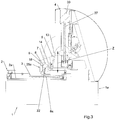
- the operator activates the supporting unit 5 in such a way as to place the modelling plate 3 in contact with the bottom 2a of the tank 2 , as can be seen in Figure 3 .
- the mobility of the spherical body 8 with respect to the housing 7 allows the modelling plate 3 to adapt its orientation to that of the bottom 2a.
- the supporting unit 5 is lowered further, causing the spherical body 8 and the screw 22 to be shifted with respect to the supporting unit 5 and, therefore, with respect to the guide body 18 and to the respective slots 23 , 24.
- Said lowering movement of the supporting unit 5 proceeds until the first end 22a of the screw 22 is released from the first slot 23 so as to allow the activation of the screw 22 itself.
- the process described above takes place automatically, through an initialization cycle according to which the supporting unit 5 is first lifted until reaching a reference position detected by an apposite sensor and successively the supporting unit 5 is lowered by a predefined distance suited to ensure that said release takes place, taking into account the geometric tolerance of the bottom 2a of the tank 2.
- the operator can activate the clamping means 9 in order to fix the modelling plate 3 to the supporting unit 5 , so as to complete the initialization procedure.
- the position of the supporting unit 5 at the end of the initialization procedure is stored by the control system of the machine 1 as the reference position for the processing cycle, which can start immediately with no need for further adjustments by the user.
- the coupling unit and the clamping means of the machine that is the subject of the invention make it possible to fix the modelling plate to the supporting unit independently of its position and with no need to modify said position.
Landscapes
- Chemical & Material Sciences (AREA)
- Engineering & Computer Science (AREA)
- Materials Engineering (AREA)
- Manufacturing & Machinery (AREA)
- Physics & Mathematics (AREA)
- Optics & Photonics (AREA)
- Mechanical Engineering (AREA)
Claims (10)
- Machine de stéréolithographie (1) comprenant:- une cuve (2) indiquée pour contenir une résine photosensible et dotée d'un fond (2a);- un groupe de support (5) associé à des moyens de mouvement (4) indiqués pour déplacer ledit groupe de support (5) selon une direction de mouvement (Z) qui est orthogonale audit fond (2a);- une plaque de modélisation (3) dotée d'une surface de modélisation (3a) qui se trouve en face dudit fond (2a) de manière à supporter un objet tridimensionnel;- un groupe d'accouplement (6) indiqué pour relier ladite plaque de modélisation (3) audit groupe de support (5), configuré pour consentir la translation de ladite plaque de modélisation (3) par rapport audit groupe de support (5), selon ladite direction de mouvement (Z), entre une première position linéaire dans laquelle elle est plus éloignée dudit groupe de support (5) et une deuxième position linéaire dans laquelle elle est plus proche dudit groupe de support (5), et pour consentir la rotation de ladite plaque de modélisation (3) par rapport audit groupe de support (5), selon au moins un axe de rotation (X) qui est perpendiculaire à ladite direction de mouvement (Z), entre une première position angulaire dans laquelle ladite surface de modélisation (3a) est orthogonale à ladite direction de mouvement (Z) et une deuxième position angulaire dans laquelle laite surface de modélisation (3a) est tournée par rapport à ladite première position angulaire, ledit groupe d'accouplement (6) comprenant un logement (7) et un corps sphérique (8) disposé de manière tournante dans ledit logement (7) de manière à ce qu'il peut tourner au moins selon ledit axe de rotation (X);- des moyens de serrage (9) qui peuvent être relâchés;caractérisée en ce que lesdits moyens de serrage (9) comprennent:- un corps creux (14) qui définit ledit logement (7), ledit corps creux (14) étant déformable de manière à ce qu'il peut être pressé autour dudit corps sphérique (8);- des moyens de contrôle (15) indiqués pour être actionnés pour presser ledit corps creux (14) autour dudit corps sphérique (8) de manière à rendre ladite plaque de modélisation (3) et ledit groupe de support (5) solidaires entre eux de manière à empêcher ladite translation et ladite rotation.
- Machine de stéréolithographie selon la revendication 1, caractérisée en ce que ledit groupe d'accouplement (6) comprend des moyens d'arrêt (10) qui peuvent être relâchés, indiqués pour être actionnés afin de bloquer ladite plaque de modélisation (3) dans ladite deuxième position angulaire.
- Machine de stéréolithographie selon la revendication 2, caractérisée en ce que lesdits moyens d'arrêt (10) comprennent un corps d'arrêt (11) maintenu en contact avec ledit corps sphérique (8) par l'action de moyens élastiques, ledit corps sphérique (8) étant pourvu d'une cavité (12) apte à loger par déclic ledit corps d'arrêt (11) quand ladite plaque de modélisation (3) est disposée dans ladite deuxième position angulaire, étant présents des moyens de déblocage (13) qui peuvent être actionnés pour relâcher ledit corps d'arrêt (11) de ladite cavité (12).
- Machine de stéréolithographie selon l'une quelconque des revendications de 1 à 3, caractérisée en ce que ledit corps creux (14) comprend deux demi-corps (16, 17) réciproquement tournés l'un vers l'autre et associés entre eux de manière amovible, lesdits moyens de contrôle (15) étant indiqués pour être actionnés afin de varier la distance réciproque entre lesdits demi-corps (16, 17).
- Machine de stéréolithographie selon l'une quelconque des revendications de 1 à 4, caractérisée en ce que ledit corps creux (14) est associé de manière coulissante audit groupe de support (5) selon ladite direction de mouvement (Z) au moyen d'un corps de guidage (18).
- Machine selon la revendication 5, caractérisée en ce qu'elle comprend des moyens forçage aptes à forcer ladite plaque de modélisation (3) dans ladite première position linéaire.
- Machine selon la revendication 5 ou 6, caractérisée en ce que ledit corps de guidage (18) comprend deux mâchoires (19, 20) entre lesquelles ledit corps creux (14) est interposé, lesdites moyens de contrôle (15) étant configurés de manière à presser lesdites deux mâchoires (19, 20) contre ledit corps creux (14).
- Machine selon la revendication 7, caractérisée en ce que lesdits moyens de contrôle (15) comprennent une vis (22) qui relie lesdites deux mâchoires (19, 20) entre elles de manière à ce que la rotation de ladite vis (22) dans une première direction provoque le rapprochement réciproque entre lesdites mâchoires (19, 20).
- Machine selon la revendication 8, caractérisée en ce que ladite vis (22) est bloquée sur ledit corps sphérique (8) et/ou sur ledit logement (7) selon au moins un sens de ladite direction de mouvement (Z), et en ce que chacune desdites mâchoires (19, 20) est dotée d'une fente passante correspondante (23, 24) ayant une forme allongée suivant ladite direction de mouvement (Z) et logeant de manière coulissante une extrémité correspondante (22a, 22b) de ladite vis (22) selon ladite direction de mouvement (Z), une première extrémité (22a) de ladite vis (22) et la première fente passante correspondante (23) étant configurées pour empêcher la rotation de ladite vis (22) quand ladite première extrémité (22a) est disposée dans une première position le long de ladite première fente passante (23), correspondant à la condition dans laquelle ladite plaque de modélisation (3) se trouve dans ladite première position linéaire, et pour consentir ladite rotation quand ladite première extrémité (22a) est disposée dans une deuxième position le long de ladite première fente passante (23), correspondant à la condition dans laquelle ladite plaque de modélisation (3) se trouve dans ladite deuxième position linéaire.
- Machine de stéréolithographie selon l'une quelconque des revendications de 5 à 9, caractérisée en ce que la section transversale dudit corps sphérique (8) selon un plan de référence passant par ledit axe de rotation (X) présente un profil aplati, ledit corps creux (14) et/ou ledit corps de guidage (18) présentant une ouverture (25, 25a) ayant une forme correspondant à ladite section transversale aplatie, configurée de manière à empêcher l'extraction dudit corps sphérique (8) dudit corps creux (14) et/ou dudit corps de guidage (18) quand ladite plaque de modélisation (3) est disposée dans ladite première position angulaire et à consentir ladite extraction quand ladite plaque de modélisation est disposée dans une position différente de ladite première position angulaire et préférablement coïncidant avec ladite deuxième position angulaire.
Applications Claiming Priority (2)
| Application Number | Priority Date | Filing Date | Title |
|---|---|---|---|
| ITUB2016A000242A ITUB20160242A1 (it) | 2016-01-15 | 2016-01-15 | Macchina stereolitografica ad inizializzazione facilitata perfezionata |
| PCT/IB2017/050186 WO2017122167A1 (fr) | 2016-01-15 | 2017-01-13 | Machine de stéréolithographie améliorée à initialisation facilitée |
Publications (2)
| Publication Number | Publication Date |
|---|---|
| EP3402652A1 EP3402652A1 (fr) | 2018-11-21 |
| EP3402652B1 true EP3402652B1 (fr) | 2020-02-26 |
Family
ID=55860963
Family Applications (1)
| Application Number | Title | Priority Date | Filing Date |
|---|---|---|---|
| EP17709788.8A Active EP3402652B1 (fr) | 2016-01-15 | 2017-01-13 | Machine de stéréolithographie améliorée à initialisation facilitée |
Country Status (9)
| Country | Link |
|---|---|
| US (2) | US20190030877A1 (fr) |
| EP (1) | EP3402652B1 (fr) |
| JP (1) | JP6895973B2 (fr) |
| KR (1) | KR20180103123A (fr) |
| CN (1) | CN108472868A (fr) |
| BR (1) | BR112018014265A2 (fr) |
| IT (1) | ITUB20160242A1 (fr) |
| TW (1) | TW201726365A (fr) |
| WO (1) | WO2017122167A1 (fr) |
Families Citing this family (8)
| Publication number | Priority date | Publication date | Assignee | Title |
|---|---|---|---|---|
| US11760004B2 (en) | 2015-06-28 | 2023-09-19 | 3D Systems. Inc. | High capacity three-dimensional printer with drain system for heavy articles |
| JP2019098644A (ja) * | 2017-12-04 | 2019-06-24 | カンタツ株式会社 | 3次元造形装置、3次元造形装置の制御方法および3次元造形装置の制御プログラム |
| FI128049B (fi) | 2018-06-28 | 2019-08-30 | Planmeca Oy | Stereolitografialaitteisto ja menetelmä stereolitografialaitteiston kalibroimiseksi |
| CN214188485U (zh) * | 2020-12-14 | 2021-09-14 | 深圳市纵维立方科技有限公司 | 一种调平装置及三维打印设备 |
| KR102409011B1 (ko) * | 2021-02-18 | 2022-06-22 | (주) 휴비츠 | 자동 틸팅 구조를 가지는 3d 프린터 |
| EP4334116B1 (fr) * | 2021-05-07 | 2025-03-05 | 3D Systems, Inc. | Imprimante tridimensionnelle de grande capacité avec système de drainage pour articles lourds |
| EP4173802A1 (fr) | 2021-10-30 | 2023-05-03 | Zortrax S.A. | Système de montage d'une plate-forme et d'une cuve de résine pour une imprimante 3d lcd uv |
| CN115723327A (zh) * | 2022-11-18 | 2023-03-03 | 安徽中科春谷激光产业技术研究院有限公司 | 一种光固化梯度材料成型装置及方法 |
Family Cites Families (8)
| Publication number | Priority date | Publication date | Assignee | Title |
|---|---|---|---|---|
| US3279518A (en) * | 1964-07-24 | 1966-10-18 | Carl G Bollinger | Combination key slot and retainer for blind bolt connections |
| DE10053742C5 (de) * | 2000-10-30 | 2006-06-08 | Concept Laser Gmbh | Vorrichtung zum Sintern, Abtragen und/oder Beschriften mittels elektromagnetischer gebündelter Strahlung sowie Verfahren zum Betrieb der Vorrichtung |
| WO2005033524A1 (fr) * | 2003-10-03 | 2005-04-14 | Micronix Pty Ltd | Pince pour equipement universel |
| US8336844B2 (en) * | 2007-01-31 | 2012-12-25 | Hunter Fan Company | Mounting system for supporting a ceiling fan assembly |
| WO2013177620A1 (fr) * | 2012-05-29 | 2013-12-05 | Zydex Pty Ltd | Dispositif et procédé de réalisation d'un objet |
| US9452567B2 (en) * | 2013-08-27 | 2016-09-27 | Kao-Chih Syao | Stereolithography apparatus |
| TWI513572B (zh) * | 2014-05-16 | 2015-12-21 | 三緯國際立體列印科技股份有限公司 | 用於三維列印機的成型裝置及三維列印機 |
| JP2016087906A (ja) * | 2014-11-04 | 2016-05-23 | 武藤工業株式会社 | 立体構造物製造方法及び装置 |
-
2016
- 2016-01-15 IT ITUB2016A000242A patent/ITUB20160242A1/it unknown
-
2017
- 2017-01-13 US US16/071,055 patent/US20190030877A1/en not_active Abandoned
- 2017-01-13 JP JP2018533144A patent/JP6895973B2/ja not_active Expired - Fee Related
- 2017-01-13 WO PCT/IB2017/050186 patent/WO2017122167A1/fr not_active Ceased
- 2017-01-13 KR KR1020187023413A patent/KR20180103123A/ko not_active Ceased
- 2017-01-13 TW TW106101102A patent/TW201726365A/zh unknown
- 2017-01-13 EP EP17709788.8A patent/EP3402652B1/fr active Active
- 2017-01-13 CN CN201780006516.9A patent/CN108472868A/zh active Pending
- 2017-01-13 BR BR112018014265-4A patent/BR112018014265A2/pt not_active IP Right Cessation
-
2021
- 2021-12-29 US US17/565,064 patent/US20220118688A1/en not_active Abandoned
Non-Patent Citations (1)
| Title |
|---|
| None * |
Also Published As
| Publication number | Publication date |
|---|---|
| US20190030877A1 (en) | 2019-01-31 |
| WO2017122167A1 (fr) | 2017-07-20 |
| KR20180103123A (ko) | 2018-09-18 |
| CN108472868A (zh) | 2018-08-31 |
| JP6895973B2 (ja) | 2021-06-30 |
| EP3402652A1 (fr) | 2018-11-21 |
| BR112018014265A2 (pt) | 2018-12-18 |
| ITUB20160242A1 (it) | 2017-07-15 |
| TW201726365A (zh) | 2017-08-01 |
| JP2019501799A (ja) | 2019-01-24 |
| US20220118688A1 (en) | 2022-04-21 |
Similar Documents
| Publication | Publication Date | Title |
|---|---|---|
| US20220118688A1 (en) | Stereolithography machine with facilitated initialization | |
| CN107107464A (zh) | 具有便利的初始化的立体光刻机器 | |
| RU2495748C1 (ru) | Улучшенная стереолитографическая машина | |
| US10625389B2 (en) | Device for blocking workpieces, particularly spectacle lenses, for the processing and/or coating thereof | |
| CN102481989A (zh) | 贴标机 | |
| JP2012147673A5 (fr) | ||
| CN108215312B (zh) | 压力设备 | |
| CN207156480U (zh) | 保压对位装置 | |
| CN101865658B (zh) | 刀刃检测设备和检测方法 | |
| CN111844734A (zh) | 一种光固化3d打印机的平台调整机构 | |
| US20090284851A1 (en) | Device and method for locking lens | |
| HK1240171A1 (en) | Stereolithography machine with facilitated initialization | |
| CN119635911B (zh) | 桌板型注液机 | |
| HK1240171B (zh) | 具有便利的初始化的立体光刻机器 | |
| EP3820677B1 (fr) | Tête de modélisation destinée à une machine d'impression tridimensionnelle et procédé d'étalonnage de ladite tête de modélisation | |
| CN222291027U (zh) | 成型平台的锁紧装置和3d打印机 | |
| KR102260498B1 (ko) | 렌즈성형지그용 정렬장치 | |
| JP5596396B2 (ja) | 射出成形機 | |
| CN219842274U (zh) | 一种管道承压强度检测装置 | |
| JPH10109325A (ja) | 竪型射出装置 | |
| JP2014210406A (ja) | 射出成形機及び制御方法 | |
| CN212149507U (zh) | 一种电动封口机 | |
| JP5735295B2 (ja) | 竪型射出成形機及びその制御方法 | |
| CN206476227U (zh) | 一种标头机构的调整机构 | |
| EP3268522A1 (fr) | Réglage de la position réciproque des parties transversales d'un dispositif de guidage de tissu |
Legal Events
| Date | Code | Title | Description |
|---|---|---|---|
| STAA | Information on the status of an ep patent application or granted ep patent |
Free format text: STATUS: UNKNOWN |
|
| STAA | Information on the status of an ep patent application or granted ep patent |
Free format text: STATUS: THE INTERNATIONAL PUBLICATION HAS BEEN MADE |
|
| PUAI | Public reference made under article 153(3) epc to a published international application that has entered the european phase |
Free format text: ORIGINAL CODE: 0009012 |
|
| STAA | Information on the status of an ep patent application or granted ep patent |
Free format text: STATUS: REQUEST FOR EXAMINATION WAS MADE |
|
| 17P | Request for examination filed |
Effective date: 20180813 |
|
| AK | Designated contracting states |
Kind code of ref document: A1 Designated state(s): AL AT BE BG CH CY CZ DE DK EE ES FI FR GB GR HR HU IE IS IT LI LT LU LV MC MK MT NL NO PL PT RO RS SE SI SK SM TR |
|
| AX | Request for extension of the european patent |
Extension state: BA ME |
|
| DAV | Request for validation of the european patent (deleted) | ||
| DAX | Request for extension of the european patent (deleted) | ||
| REG | Reference to a national code |
Ref country code: DE Ref legal event code: R079 Ref document number: 602017012281 Country of ref document: DE Free format text: PREVIOUS MAIN CLASS: B29C0067000000 Ipc: B29C0064124000 |
|
| GRAP | Despatch of communication of intention to grant a patent |
Free format text: ORIGINAL CODE: EPIDOSNIGR1 |
|
| STAA | Information on the status of an ep patent application or granted ep patent |
Free format text: STATUS: GRANT OF PATENT IS INTENDED |
|
| RIC1 | Information provided on ipc code assigned before grant |
Ipc: B29C 64/20 20170101ALI20190902BHEP Ipc: B33Y 30/00 20150101ALN20190902BHEP Ipc: B29C 64/124 20170101AFI20190902BHEP |
|
| INTG | Intention to grant announced |
Effective date: 20190920 |
|
| GRAS | Grant fee paid |
Free format text: ORIGINAL CODE: EPIDOSNIGR3 |
|
| GRAA | (expected) grant |
Free format text: ORIGINAL CODE: 0009210 |
|
| STAA | Information on the status of an ep patent application or granted ep patent |
Free format text: STATUS: THE PATENT HAS BEEN GRANTED |
|
| REG | Reference to a national code |
Ref country code: DE Ref legal event code: R081 Ref document number: 602017012281 Country of ref document: DE Owner name: DWS S.R.L., THIENE, IT Free format text: FORMER OWNER: DWS S.R.L., THIENE (VI), IT |
|
| AK | Designated contracting states |
Kind code of ref document: B1 Designated state(s): AL AT BE BG CH CY CZ DE DK EE ES FI FR GB GR HR HU IE IS IT LI LT LU LV MC MK MT NL NO PL PT RO RS SE SI SK SM TR |
|
| REG | Reference to a national code |
Ref country code: GB Ref legal event code: FG4D |
|
| REG | Reference to a national code |
Ref country code: CH Ref legal event code: EP |
|
| REG | Reference to a national code |
Ref country code: AT Ref legal event code: REF Ref document number: 1237099 Country of ref document: AT Kind code of ref document: T Effective date: 20200315 |
|
| REG | Reference to a national code |
Ref country code: IE Ref legal event code: FG4D |
|
| REG | Reference to a national code |
Ref country code: DE Ref legal event code: R096 Ref document number: 602017012281 Country of ref document: DE |
|
| PG25 | Lapsed in a contracting state [announced via postgrant information from national office to epo] |
Ref country code: RS Free format text: LAPSE BECAUSE OF FAILURE TO SUBMIT A TRANSLATION OF THE DESCRIPTION OR TO PAY THE FEE WITHIN THE PRESCRIBED TIME-LIMIT Effective date: 20200226 Ref country code: NO Free format text: LAPSE BECAUSE OF FAILURE TO SUBMIT A TRANSLATION OF THE DESCRIPTION OR TO PAY THE FEE WITHIN THE PRESCRIBED TIME-LIMIT Effective date: 20200526 Ref country code: FI Free format text: LAPSE BECAUSE OF FAILURE TO SUBMIT A TRANSLATION OF THE DESCRIPTION OR TO PAY THE FEE WITHIN THE PRESCRIBED TIME-LIMIT Effective date: 20200226 |
|
| REG | Reference to a national code |
Ref country code: NL Ref legal event code: MP Effective date: 20200226 |
|
| REG | Reference to a national code |
Ref country code: LT Ref legal event code: MG4D |
|
| PG25 | Lapsed in a contracting state [announced via postgrant information from national office to epo] |
Ref country code: SE Free format text: LAPSE BECAUSE OF FAILURE TO SUBMIT A TRANSLATION OF THE DESCRIPTION OR TO PAY THE FEE WITHIN THE PRESCRIBED TIME-LIMIT Effective date: 20200226 Ref country code: IS Free format text: LAPSE BECAUSE OF FAILURE TO SUBMIT A TRANSLATION OF THE DESCRIPTION OR TO PAY THE FEE WITHIN THE PRESCRIBED TIME-LIMIT Effective date: 20200626 Ref country code: LV Free format text: LAPSE BECAUSE OF FAILURE TO SUBMIT A TRANSLATION OF THE DESCRIPTION OR TO PAY THE FEE WITHIN THE PRESCRIBED TIME-LIMIT Effective date: 20200226 Ref country code: HR Free format text: LAPSE BECAUSE OF FAILURE TO SUBMIT A TRANSLATION OF THE DESCRIPTION OR TO PAY THE FEE WITHIN THE PRESCRIBED TIME-LIMIT Effective date: 20200226 Ref country code: BG Free format text: LAPSE BECAUSE OF FAILURE TO SUBMIT A TRANSLATION OF THE DESCRIPTION OR TO PAY THE FEE WITHIN THE PRESCRIBED TIME-LIMIT Effective date: 20200526 Ref country code: GR Free format text: LAPSE BECAUSE OF FAILURE TO SUBMIT A TRANSLATION OF THE DESCRIPTION OR TO PAY THE FEE WITHIN THE PRESCRIBED TIME-LIMIT Effective date: 20200527 |
|
| PG25 | Lapsed in a contracting state [announced via postgrant information from national office to epo] |
Ref country code: NL Free format text: LAPSE BECAUSE OF FAILURE TO SUBMIT A TRANSLATION OF THE DESCRIPTION OR TO PAY THE FEE WITHIN THE PRESCRIBED TIME-LIMIT Effective date: 20200226 |
|
| PG25 | Lapsed in a contracting state [announced via postgrant information from national office to epo] |
Ref country code: SM Free format text: LAPSE BECAUSE OF FAILURE TO SUBMIT A TRANSLATION OF THE DESCRIPTION OR TO PAY THE FEE WITHIN THE PRESCRIBED TIME-LIMIT Effective date: 20200226 Ref country code: EE Free format text: LAPSE BECAUSE OF FAILURE TO SUBMIT A TRANSLATION OF THE DESCRIPTION OR TO PAY THE FEE WITHIN THE PRESCRIBED TIME-LIMIT Effective date: 20200226 Ref country code: DK Free format text: LAPSE BECAUSE OF FAILURE TO SUBMIT A TRANSLATION OF THE DESCRIPTION OR TO PAY THE FEE WITHIN THE PRESCRIBED TIME-LIMIT Effective date: 20200226 Ref country code: RO Free format text: LAPSE BECAUSE OF FAILURE TO SUBMIT A TRANSLATION OF THE DESCRIPTION OR TO PAY THE FEE WITHIN THE PRESCRIBED TIME-LIMIT Effective date: 20200226 Ref country code: SK Free format text: LAPSE BECAUSE OF FAILURE TO SUBMIT A TRANSLATION OF THE DESCRIPTION OR TO PAY THE FEE WITHIN THE PRESCRIBED TIME-LIMIT Effective date: 20200226 Ref country code: LT Free format text: LAPSE BECAUSE OF FAILURE TO SUBMIT A TRANSLATION OF THE DESCRIPTION OR TO PAY THE FEE WITHIN THE PRESCRIBED TIME-LIMIT Effective date: 20200226 Ref country code: PT Free format text: LAPSE BECAUSE OF FAILURE TO SUBMIT A TRANSLATION OF THE DESCRIPTION OR TO PAY THE FEE WITHIN THE PRESCRIBED TIME-LIMIT Effective date: 20200719 Ref country code: CZ Free format text: LAPSE BECAUSE OF FAILURE TO SUBMIT A TRANSLATION OF THE DESCRIPTION OR TO PAY THE FEE WITHIN THE PRESCRIBED TIME-LIMIT Effective date: 20200226 Ref country code: ES Free format text: LAPSE BECAUSE OF FAILURE TO SUBMIT A TRANSLATION OF THE DESCRIPTION OR TO PAY THE FEE WITHIN THE PRESCRIBED TIME-LIMIT Effective date: 20200226 |
|
| REG | Reference to a national code |
Ref country code: AT Ref legal event code: MK05 Ref document number: 1237099 Country of ref document: AT Kind code of ref document: T Effective date: 20200226 |
|
| REG | Reference to a national code |
Ref country code: DE Ref legal event code: R097 Ref document number: 602017012281 Country of ref document: DE |
|
| PLBE | No opposition filed within time limit |
Free format text: ORIGINAL CODE: 0009261 |
|
| STAA | Information on the status of an ep patent application or granted ep patent |
Free format text: STATUS: NO OPPOSITION FILED WITHIN TIME LIMIT |
|
| PG25 | Lapsed in a contracting state [announced via postgrant information from national office to epo] |
Ref country code: AT Free format text: LAPSE BECAUSE OF FAILURE TO SUBMIT A TRANSLATION OF THE DESCRIPTION OR TO PAY THE FEE WITHIN THE PRESCRIBED TIME-LIMIT Effective date: 20200226 |
|
| 26N | No opposition filed |
Effective date: 20201127 |
|
| PG25 | Lapsed in a contracting state [announced via postgrant information from national office to epo] |
Ref country code: SI Free format text: LAPSE BECAUSE OF FAILURE TO SUBMIT A TRANSLATION OF THE DESCRIPTION OR TO PAY THE FEE WITHIN THE PRESCRIBED TIME-LIMIT Effective date: 20200226 Ref country code: PL Free format text: LAPSE BECAUSE OF FAILURE TO SUBMIT A TRANSLATION OF THE DESCRIPTION OR TO PAY THE FEE WITHIN THE PRESCRIBED TIME-LIMIT Effective date: 20200226 |
|
| REG | Reference to a national code |
Ref country code: DE Ref legal event code: R082 Ref document number: 602017012281 Country of ref document: DE Representative=s name: HEUN, THOMAS, DIPL.-ING. (UNIV.), DE Ref country code: DE Ref legal event code: R082 Ref document number: 602017012281 Country of ref document: DE Representative=s name: HEUN, THOMAS, DIPL.-ING.UNIV., DE |
|
| PG25 | Lapsed in a contracting state [announced via postgrant information from national office to epo] |
Ref country code: MC Free format text: LAPSE BECAUSE OF FAILURE TO SUBMIT A TRANSLATION OF THE DESCRIPTION OR TO PAY THE FEE WITHIN THE PRESCRIBED TIME-LIMIT Effective date: 20200226 |
|
| REG | Reference to a national code |
Ref country code: CH Ref legal event code: PL |
|
| GBPC | Gb: european patent ceased through non-payment of renewal fee |
Effective date: 20210113 |
|
| PG25 | Lapsed in a contracting state [announced via postgrant information from national office to epo] |
Ref country code: LU Free format text: LAPSE BECAUSE OF NON-PAYMENT OF DUE FEES Effective date: 20210113 |
|
| REG | Reference to a national code |
Ref country code: BE Ref legal event code: MM Effective date: 20210131 |
|
| PG25 | Lapsed in a contracting state [announced via postgrant information from national office to epo] |
Ref country code: FR Free format text: LAPSE BECAUSE OF NON-PAYMENT OF DUE FEES Effective date: 20210131 |
|
| PG25 | Lapsed in a contracting state [announced via postgrant information from national office to epo] |
Ref country code: CH Free format text: LAPSE BECAUSE OF NON-PAYMENT OF DUE FEES Effective date: 20210131 Ref country code: LI Free format text: LAPSE BECAUSE OF NON-PAYMENT OF DUE FEES Effective date: 20210131 Ref country code: GB Free format text: LAPSE BECAUSE OF NON-PAYMENT OF DUE FEES Effective date: 20210113 |
|
| PG25 | Lapsed in a contracting state [announced via postgrant information from national office to epo] |
Ref country code: IE Free format text: LAPSE BECAUSE OF NON-PAYMENT OF DUE FEES Effective date: 20210113 |
|
| PG25 | Lapsed in a contracting state [announced via postgrant information from national office to epo] |
Ref country code: BE Free format text: LAPSE BECAUSE OF NON-PAYMENT OF DUE FEES Effective date: 20210131 |
|
| PGFP | Annual fee paid to national office [announced via postgrant information from national office to epo] |
Ref country code: IT Payment date: 20230103 Year of fee payment: 7 Ref country code: DE Payment date: 20230127 Year of fee payment: 7 |
|
| PG25 | Lapsed in a contracting state [announced via postgrant information from national office to epo] |
Ref country code: CY Free format text: LAPSE BECAUSE OF FAILURE TO SUBMIT A TRANSLATION OF THE DESCRIPTION OR TO PAY THE FEE WITHIN THE PRESCRIBED TIME-LIMIT Effective date: 20200226 |
|
| PG25 | Lapsed in a contracting state [announced via postgrant information from national office to epo] |
Ref country code: HU Free format text: LAPSE BECAUSE OF FAILURE TO SUBMIT A TRANSLATION OF THE DESCRIPTION OR TO PAY THE FEE WITHIN THE PRESCRIBED TIME-LIMIT; INVALID AB INITIO Effective date: 20170113 |
|
| P01 | Opt-out of the competence of the unified patent court (upc) registered |
Effective date: 20230707 |
|
| PG25 | Lapsed in a contracting state [announced via postgrant information from national office to epo] |
Ref country code: MK Free format text: LAPSE BECAUSE OF FAILURE TO SUBMIT A TRANSLATION OF THE DESCRIPTION OR TO PAY THE FEE WITHIN THE PRESCRIBED TIME-LIMIT Effective date: 20200226 |
|
| PG25 | Lapsed in a contracting state [announced via postgrant information from national office to epo] |
Ref country code: TR Free format text: LAPSE BECAUSE OF FAILURE TO SUBMIT A TRANSLATION OF THE DESCRIPTION OR TO PAY THE FEE WITHIN THE PRESCRIBED TIME-LIMIT Effective date: 20200226 |
|
| REG | Reference to a national code |
Ref country code: DE Ref legal event code: R119 Ref document number: 602017012281 Country of ref document: DE |
|
| PG25 | Lapsed in a contracting state [announced via postgrant information from national office to epo] |
Ref country code: MT Free format text: LAPSE BECAUSE OF FAILURE TO SUBMIT A TRANSLATION OF THE DESCRIPTION OR TO PAY THE FEE WITHIN THE PRESCRIBED TIME-LIMIT Effective date: 20200226 |
|
| PG25 | Lapsed in a contracting state [announced via postgrant information from national office to epo] |
Ref country code: DE Free format text: LAPSE BECAUSE OF NON-PAYMENT OF DUE FEES Effective date: 20240801 |
|
| PG25 | Lapsed in a contracting state [announced via postgrant information from national office to epo] |
Ref country code: DE Free format text: LAPSE BECAUSE OF NON-PAYMENT OF DUE FEES Effective date: 20240801 |
|
| PG25 | Lapsed in a contracting state [announced via postgrant information from national office to epo] |
Ref country code: IT Free format text: LAPSE BECAUSE OF NON-PAYMENT OF DUE FEES Effective date: 20240113 |