EP3374359B1 - Dihydroimidazopyrazinone derivatives useful in the treatment of cancer - Google Patents
Dihydroimidazopyrazinone derivatives useful in the treatment of cancer Download PDFInfo
- Publication number
- EP3374359B1 EP3374359B1 EP16791420.9A EP16791420A EP3374359B1 EP 3374359 B1 EP3374359 B1 EP 3374359B1 EP 16791420 A EP16791420 A EP 16791420A EP 3374359 B1 EP3374359 B1 EP 3374359B1
- Authority
- EP
- European Patent Office
- Prior art keywords
- methyl
- compound
- dihydroimidazo
- pyrazin
- pyrimidin
- Prior art date
- Legal status (The legal status is an assumption and is not a legal conclusion. Google has not performed a legal analysis and makes no representation as to the accuracy of the status listed.)
- Active
Links
- JEBWUNFYBSGCLA-ZETCQYMHSA-N CC(C)(C)OC(N([C@@H](COC)CO1)[S+2]1=O)=O Chemical compound CC(C)(C)OC(N([C@@H](COC)CO1)[S+2]1=O)=O JEBWUNFYBSGCLA-ZETCQYMHSA-N 0.000 description 1
- NNMKEDBLJNKLII-UHFFFAOYSA-N CCOC(c1nc(-c2nc(Cl)ncc2C)c[n]1CC(COC)N)=O Chemical compound CCOC(c1nc(-c2nc(Cl)ncc2C)c[n]1CC(COC)N)=O NNMKEDBLJNKLII-UHFFFAOYSA-N 0.000 description 1
- XIFYLZHUCXXVHT-VIFPVBQESA-N CCOC(c1nc(-c2nc(Cl)ncc2C)c[n]1C[C@H](C)N)=O Chemical compound CCOC(c1nc(-c2nc(Cl)ncc2C)c[n]1C[C@H](C)N)=O XIFYLZHUCXXVHT-VIFPVBQESA-N 0.000 description 1
- GSJWTBPXHPDMHL-JTQLQIEISA-N CCOC(c1nc(-c2nc(Cl)ncc2Cl)c[n]1C[C@H](C)N(C(OC(C)(C)C)=O)S(O)(=O)=O)=O Chemical compound CCOC(c1nc(-c2nc(Cl)ncc2Cl)c[n]1C[C@H](C)N(C(OC(C)(C)C)=O)S(O)(=O)=O)=O GSJWTBPXHPDMHL-JTQLQIEISA-N 0.000 description 1
- HOPHIBCOMHAGKZ-JTQLQIEISA-N CCOC(c1nc(-c2nc(Cl)ncc2Cl)c[n]1C[C@H](C)NC(OC(C)(C)C)=O)=O Chemical compound CCOC(c1nc(-c2nc(Cl)ncc2Cl)c[n]1C[C@H](C)NC(OC(C)(C)C)=O)=O HOPHIBCOMHAGKZ-JTQLQIEISA-N 0.000 description 1
- BHTFNUCJZGWQNU-UHFFFAOYSA-N CCOC(c1ncc[n]1CCNC(OC(C)(C)C)=O)=O Chemical compound CCOC(c1ncc[n]1CCNC(OC(C)(C)C)=O)=O BHTFNUCJZGWQNU-UHFFFAOYSA-N 0.000 description 1
- SDXRFQIMGCUZLK-VIFPVBQESA-N C[C@@H](C[n]1c2nc(-c3nc(Cl)ncc3Cl)c1)N(Cc1nc(C(F)(F)F)ccc1)C2=O Chemical compound C[C@@H](C[n]1c2nc(-c3nc(Cl)ncc3Cl)c1)N(Cc1nc(C(F)(F)F)ccc1)C2=O SDXRFQIMGCUZLK-VIFPVBQESA-N 0.000 description 1
- BQDAMEBIHXFYOG-AWEZNQCLSA-N C[C@@H](C[n]1c2nc(-c3nc(Nc4ccn[n]4C)ncc3C)c1)N(Cc1cc(C(F)F)ccn1)C2=O Chemical compound C[C@@H](C[n]1c2nc(-c3nc(Nc4ccn[n]4C)ncc3C)c1)N(Cc1cc(C(F)F)ccn1)C2=O BQDAMEBIHXFYOG-AWEZNQCLSA-N 0.000 description 1
- DZQCUGHBICCEOR-CQSZACIVSA-N C[C@H](C[n]1c2nc(-c3nc(Nc4ccn[n]4C)ncc3C)c1)N(Cc1cccc(C(F)(F)F)n1)C2=O Chemical compound C[C@H](C[n]1c2nc(-c3nc(Nc4ccn[n]4C)ncc3C)c1)N(Cc1cccc(C(F)(F)F)n1)C2=O DZQCUGHBICCEOR-CQSZACIVSA-N 0.000 description 1
- WMZHUQPUDOWPQA-QMMMGPOBSA-N Cc(c(-c1c[n](C[C@@H](COC)NC2=O)c2n1)n1)cnc1Cl Chemical compound Cc(c(-c1c[n](C[C@@H](COC)NC2=O)c2n1)n1)cnc1Cl WMZHUQPUDOWPQA-QMMMGPOBSA-N 0.000 description 1
- DIJXYXDDBIYLLI-OAHLLOKOSA-N Cc(c(-c1c[n](C[C@H](COC)N(Cc2cc(F)cc(F)c2)C2=O)c2n1)n1)cnc1Cl Chemical compound Cc(c(-c1c[n](C[C@H](COC)N(Cc2cc(F)cc(F)c2)C2=O)c2n1)n1)cnc1Cl DIJXYXDDBIYLLI-OAHLLOKOSA-N 0.000 description 1
- RBBNHPCATVVAJB-UHFFFAOYSA-N Cc1c(-c2c[n](CCN(Cc(cc3Cl)ccc3F)C3=O)c3n2)nc(Nc2ccn[n]2C)nc1 Chemical compound Cc1c(-c2c[n](CCN(Cc(cc3Cl)ccc3F)C3=O)c3n2)nc(Nc2ccn[n]2C)nc1 RBBNHPCATVVAJB-UHFFFAOYSA-N 0.000 description 1
- OBCKTAPOTATUEO-UHFFFAOYSA-N Cc1cnc(Nc2ccn[n]2C)nc1-c1c[n](CCN(Cc2cc(C(F)F)ccc2)C2=O)c2n1 Chemical compound Cc1cnc(Nc2ccn[n]2C)nc1-c1c[n](CCN(Cc2cc(C(F)F)ccc2)C2=O)c2n1 OBCKTAPOTATUEO-UHFFFAOYSA-N 0.000 description 1
Images







Classifications
-
- C—CHEMISTRY; METALLURGY
- C07—ORGANIC CHEMISTRY
- C07D—HETEROCYCLIC COMPOUNDS
- C07D487/00—Heterocyclic compounds containing nitrogen atoms as the only ring hetero atoms in the condensed system, not provided for by groups C07D451/00 - C07D477/00
- C07D487/02—Heterocyclic compounds containing nitrogen atoms as the only ring hetero atoms in the condensed system, not provided for by groups C07D451/00 - C07D477/00 in which the condensed system contains two hetero rings
- C07D487/04—Ortho-condensed systems
-
- A—HUMAN NECESSITIES
- A61—MEDICAL OR VETERINARY SCIENCE; HYGIENE
- A61K—PREPARATIONS FOR MEDICAL, DENTAL OR TOILETRY PURPOSES
- A61K31/00—Medicinal preparations containing organic active ingredients
- A61K31/33—Heterocyclic compounds
- A61K31/395—Heterocyclic compounds having nitrogen as a ring hetero atom, e.g. guanethidine or rifamycins
- A61K31/41—Heterocyclic compounds having nitrogen as a ring hetero atom, e.g. guanethidine or rifamycins having five-membered rings with two or more ring hetero atoms, at least one of which being nitrogen, e.g. tetrazole
- A61K31/415—1,2-Diazoles
- A61K31/416—1,2-Diazoles condensed with carbocyclic ring systems, e.g. indazole
-
- A—HUMAN NECESSITIES
- A61—MEDICAL OR VETERINARY SCIENCE; HYGIENE
- A61K—PREPARATIONS FOR MEDICAL, DENTAL OR TOILETRY PURPOSES
- A61K31/00—Medicinal preparations containing organic active ingredients
- A61K31/33—Heterocyclic compounds
- A61K31/395—Heterocyclic compounds having nitrogen as a ring hetero atom, e.g. guanethidine or rifamycins
- A61K31/495—Heterocyclic compounds having nitrogen as a ring hetero atom, e.g. guanethidine or rifamycins having six-membered rings with two or more nitrogen atoms as the only ring heteroatoms, e.g. piperazine or tetrazines
- A61K31/4985—Pyrazines or piperazines ortho- or peri-condensed with heterocyclic ring systems
-
- A—HUMAN NECESSITIES
- A61—MEDICAL OR VETERINARY SCIENCE; HYGIENE
- A61K—PREPARATIONS FOR MEDICAL, DENTAL OR TOILETRY PURPOSES
- A61K31/00—Medicinal preparations containing organic active ingredients
- A61K31/33—Heterocyclic compounds
- A61K31/395—Heterocyclic compounds having nitrogen as a ring hetero atom, e.g. guanethidine or rifamycins
- A61K31/495—Heterocyclic compounds having nitrogen as a ring hetero atom, e.g. guanethidine or rifamycins having six-membered rings with two or more nitrogen atoms as the only ring heteroatoms, e.g. piperazine or tetrazines
- A61K31/505—Pyrimidines; Hydrogenated pyrimidines, e.g. trimethoprim
- A61K31/506—Pyrimidines; Hydrogenated pyrimidines, e.g. trimethoprim not condensed and containing further heterocyclic rings
-
- A—HUMAN NECESSITIES
- A61—MEDICAL OR VETERINARY SCIENCE; HYGIENE
- A61K—PREPARATIONS FOR MEDICAL, DENTAL OR TOILETRY PURPOSES
- A61K45/00—Medicinal preparations containing active ingredients not provided for in groups A61K31/00 - A61K41/00
- A61K45/06—Mixtures of active ingredients without chemical characterisation, e.g. antiphlogistics and cardiaca
-
- A—HUMAN NECESSITIES
- A61—MEDICAL OR VETERINARY SCIENCE; HYGIENE
- A61P—SPECIFIC THERAPEUTIC ACTIVITY OF CHEMICAL COMPOUNDS OR MEDICINAL PREPARATIONS
- A61P1/00—Drugs for disorders of the alimentary tract or the digestive system
- A61P1/04—Drugs for disorders of the alimentary tract or the digestive system for ulcers, gastritis or reflux esophagitis, e.g. antacids, inhibitors of acid secretion, mucosal protectants
-
- A—HUMAN NECESSITIES
- A61—MEDICAL OR VETERINARY SCIENCE; HYGIENE
- A61P—SPECIFIC THERAPEUTIC ACTIVITY OF CHEMICAL COMPOUNDS OR MEDICINAL PREPARATIONS
- A61P1/00—Drugs for disorders of the alimentary tract or the digestive system
- A61P1/18—Drugs for disorders of the alimentary tract or the digestive system for pancreatic disorders, e.g. pancreatic enzymes
-
- A—HUMAN NECESSITIES
- A61—MEDICAL OR VETERINARY SCIENCE; HYGIENE
- A61P—SPECIFIC THERAPEUTIC ACTIVITY OF CHEMICAL COMPOUNDS OR MEDICINAL PREPARATIONS
- A61P35/00—Antineoplastic agents
-
- A—HUMAN NECESSITIES
- A61—MEDICAL OR VETERINARY SCIENCE; HYGIENE
- A61P—SPECIFIC THERAPEUTIC ACTIVITY OF CHEMICAL COMPOUNDS OR MEDICINAL PREPARATIONS
- A61P35/00—Antineoplastic agents
- A61P35/02—Antineoplastic agents specific for leukemia
-
- A—HUMAN NECESSITIES
- A61—MEDICAL OR VETERINARY SCIENCE; HYGIENE
- A61P—SPECIFIC THERAPEUTIC ACTIVITY OF CHEMICAL COMPOUNDS OR MEDICINAL PREPARATIONS
- A61P43/00—Drugs for specific purposes, not provided for in groups A61P1/00-A61P41/00
-
- C—CHEMISTRY; METALLURGY
- C07—ORGANIC CHEMISTRY
- C07D—HETEROCYCLIC COMPOUNDS
- C07D403/00—Heterocyclic compounds containing two or more hetero rings, having nitrogen atoms as the only ring hetero atoms, not provided for by group C07D401/00
- C07D403/02—Heterocyclic compounds containing two or more hetero rings, having nitrogen atoms as the only ring hetero atoms, not provided for by group C07D401/00 containing two hetero rings
- C07D403/04—Heterocyclic compounds containing two or more hetero rings, having nitrogen atoms as the only ring hetero atoms, not provided for by group C07D401/00 containing two hetero rings directly linked by a ring-member-to-ring-member bond
-
- A—HUMAN NECESSITIES
- A61—MEDICAL OR VETERINARY SCIENCE; HYGIENE
- A61K—PREPARATIONS FOR MEDICAL, DENTAL OR TOILETRY PURPOSES
- A61K2300/00—Mixtures or combinations of active ingredients, wherein at least one active ingredient is fully defined in groups A61K31/00 - A61K41/00
-
- C—CHEMISTRY; METALLURGY
- C07—ORGANIC CHEMISTRY
- C07B—GENERAL METHODS OF ORGANIC CHEMISTRY; APPARATUS THEREFOR
- C07B2200/00—Indexing scheme relating to specific properties of organic compounds
- C07B2200/13—Crystalline forms, e.g. polymorphs
Definitions
- the present disclosure relates to certain dihydroimidazopyrazinone derivatives and pharmaceutically-acceptable salts thereof that selectively inhibit ERK and possess anti-cancer activity.
- the present disclosure also relates to use of said dihydroimidazopyrazinone derivatives and pharmaceutically-acceptable salts thereof in methods of treatment of the human or animal body, for example in prevention or treatment of cancer.
- the present disclosure also relates to processes and intermediate compounds involved in the preparation of said dihydroimidazopyrazinone derivatives and to pharmaceutical compositions containing said dihydroimidazopyrazinone derivatives and pharmaceutically-acceptable salts thereof.
- MAP kinases play a key regulatory role in almost every aspect of cell biology.
- the mammalian MAP kinases consist of cytoplasmic protein serine/threonine kinases that participate in the transduction of cellular signals from the plasma membrane to the nucleus.
- MAPK signalling cascades each consisting of 3 components: a MAPK kinase (MAP3K), a MAPK kinase (MAP2K) and a MAPK.
- MAP3K MAPK kinase
- MAP2K MAPK kinase
- the activated MAP kinases phosphorylate numerous substrates including other protein kinases, protein phosphatases, transcription factors and other functional proteins.
- the RAS-RAF-MEK-ERK signalling cascade participates in the regulation of cell cycle progression, cell proliferation, survival, metabolism and transcription.
- ERK1 and ERK2 are ubiquitously expressed MAPK kinases that participate in the RAS-RAF-MEK-ERK signalling cascade, which both contain unique N- and C-terminal extensions that provide signalling specificity, in addition to a 31 -amino-acid-residue insertion within the kinase domain that provide additional functional specificity.
- ERK1 and ERK2 are activated in a wide variety of cell types by mitogenic and other stimuli, resulting in activation of multiple isoforms of RAS (HRAS, NRAS and KRAS).
- RAF RAF isoforms
- MEK1 and MEK2 dual-specificity protein kinases that mediate the phosphorylation of tyrosine and threonine of ERK1 and ERK2.
- ERK1 and ERK2 have a large number of identified cytoplasmic and nuclear substrates (reference Yoon S, Seger R. The extracellular signal-regulated kinase: multiple substrates regulate diverse cellular functions; Growth Factors 2006, 24, 21-44 ).
- the RAS-RAF-MEK-ERK signalling cascade is deregulated in a variety of diseases including brain injury, cancer, cardiac hypertrophy, diabetes and inflammation. Specifically in cancer, mutations in KRAS occur in approximately 58% of pancreatic, 33% of colorectal and 31% of biliary cancers, and NRAS mutations in 18% of melanomas. Oncogenic mutations in RAS result in elevated ERK activity across multiple tumours. In addition, BRAF mutations occur in approximately 40-60% of melanomas, 40% of thyroid cancers and 20% of colorectal cancers (reference Vakiani E, Solit DB. KRAS and BRAF; drug targets and predictive biomarkers; Journal of Pathology 2011, 223, 219-29 ).
- inhibition of ERK is referred to herein, it should be understood to mean inhibition of ERK1 and/or ERK2, particularly ERK2.
- alkyl refers to both straight and branched chain saturated hydrocarbon radicals having the specified number of carbon atoms. References to individual alkyl groups such as “propyl” are specific for the straight chain version only and references to individual branched chain alkyl groups such as 'isopropyl' are specific for the branched chain version only.
- C 1-3 alkyl examples are methyl, ethyl, propyl and isopropyl.
- C 1-4 alkyl examples include methyl, ethyl, propyl, isopropyl, butyl and tert- butyl.
- halogen refers to fluoro, chloro, bromo and iodo.
- halo may refer to fluoro, chloro, and bromo.
- halo may refer to fluoro and chloro.
- halo may refer to fluoro.
- halo may refer to chloro.
- halo may refer to bromo.
- R 1 is hydrogen, methyl or -CH 2 OMe.
- R 1 is methyl or -CH 2 OMe.
- R 1 is hydrogen
- R 1 is methyl
- R 1 is - CH 2 OMe.
- R 2 is pyridinyl, optionally substituted on 1 ring carbon atom by a substituent independently selected from the group consisting of methyl, difluoromethyl and trifluoromethyl; or R 2 is pyrimidinyl, optionally substituted on 1 ring carbon atom by a substituent independently selected from the group consisting of methyl, difluoromethyl and trifluoromethyl; or R 2 is phenyl optionally substituted on 1 or 2 ring carbon atoms by a substituent independently selected from the group consisting of fluoro, chloro, difluoromethyl, trifluoromethyl, methoxy and -OCHF 2 .
- R 2 is pyridinyl, optionally substituted on 1 ring carbon atom by a substituent independently selected from the group consisting of methyl, difluoromethyl and trifluoromethyl; or R 2 is pyrimidinyl, optionally substituted on 1 ring carbon atom by trifluoromethyl; or R 2 is phenyl optionally substituted on 1 or 2 ring carbon atoms by a substituent independently selected from the group consisting of fluoro, chloro, difluoromethyl, trifluoromethyl, methoxy and -OCHF 2 .
- R 2 is pyridinyl, optionally substituted on 1 ring carbon atom by a substituent independently selected from the group consisting of methyl, difluoromethyl and trifluoromethyl; or R 2 is pyrimidinyl, optionally substituted on 1 ring carbon atom by trifluoromethyl; or R 2 is phenyl optionally substituted on 1 ring carbon atom by a substituent independently selected from the group consisting fluoro, chloro, difluoromethyl, trifluoromethyl, methoxy and -OCHF 2 .
- R 2 is pyridinyl, optionally substituted on 1 ring carbon atom by a substituent independently selected from the group consisting of methyl, difluoromethyl and trifluoromethyl; or R 2 is pyrimidinyl, optionally substituted on 1 ring carbon atom by trifluoromethyl; or R 2 is phenyl optionally substituted on 2 ring carbon atoms by a substituent independently selected from the group consisting of fluoro, chloro, difluoromethyl, trifluoromethyl, methoxy and -OCHF 2 .
- R 2 is pyridinyl, optionally substituted on 1 ring carbon atom by a substituent independently selected from the group consisting of methyl, difluoromethyl and trifluoromethyl; or R 2 is pyrimidinyl, optionally substituted on 1 ring carbon atom by trifluoromethyl; or R 2 is phenyl optionally substituted on 1 or 2 ring carbon atoms by a substituent independently selected from the group consisting of fluoro, chloro, difluoromethyl, methoxy and -OCHF 2 .
- R 2 is pyridinyl, optionally substituted on 1 ring carbon atom by difluoromethyl; or R 2 is phenyl optionally substituted on 1 or 2 ring carbon atoms by a substituent independently selected from the group consisting of fluoro and chloro.
- R 2 is pyridinyl, optionally substituted on 1 ring carbon atom by a substituent independently selected from the group consisting of methyl, difluoromethyl and trifluoromethyl.
- R 2 is pyridinyl, optionally substituted on 1 ring carbon atom by a methyl.
- R 2 is pyridinyl, optionally substituted on 1 ring carbon atom by difluoromethyl.
- R 2 is pyridinyl, optionally substituted on 1 ring carbon atom by trifluoromethyl.
- R 2 is pyrimidinyl, optionally substituted on 1 ring carbon atom by a substituent independently selected from the group consisting of methyl, difluoromethyl or trifluoromethyl.
- R 2 is pyrimidinyl, optionally substituted on 1 ring carbon atom by methyl.
- R 2 is pyrimidinyl, optionally substituted on 1 ring carbon atom by difluoromethyl.
- R 2 is pyrimidinyl, optionally substituted on 1 ring carbon atom by trifluoromethyl.
- R 2 is phenyl optionally substituted on 1 or 2 ring carbon atoms by a substituent independently selected from the group consisting of fluoro, chloro, difluoromethyl, trifluoromethyl, methoxy and -OCHF 2 .
- R 2 is phenyl optionally substituted on 1 or 2 ring carbon atoms by a substituent independently selected from the group consisting of fluoro, chloro, difluoromethyl, methoxy and -OCHF 2 .
- R 2 is phenyl optionally substituted on 1 or 2 ring carbon atoms by a substituent independently selected from fluoro, chloro or methoxy.
- R 2 is phenyl optionally substituted on 2 ring carbon atoms by a substituent independently selected from the group consisting of fluoro, chloro and methoxy.
- R 2 is phenyl optionally substituted on 1 or 2 ring carbon atoms by a substituent independently selected from the group consisting fluoro, chloro and methoxy.
- R 2 is phenyl optionally substituted on 1 or 2 ring carbon atoms by a substituent independently selected from the group consisting fluoro and chloro.
- R 2 is phenyl optionally substituted on 1 ring carbon atom by a substituent independently selected from the group consisting of fluoro and chloro.
- R 2 is phenyl optionally substituted on 2 ring carbon atoms by a substituent independently selected from the group consisting of fluoro and chloro.
- R 2 is phenyl optionally substituted on 1 or 2 ring carbon atoms by a substituent independently selected from the group consisting fluoro and methoxy.
- R 2 is phenyl optionally substituted on 2 ring carbon atoms by a substituent independently selected from the group consisting of fluoro and methoxy.
- R 2 is phenyl optionally substituted on 1 or 2 ring carbon atoms by fluoro.
- R 2 is phenyl optionally substituted on 1 or 2 ring carbon atoms by chloro.
- R 2 is phenyl optionally substituted on 1 or 2 ring carbon atoms by difluoromethyl.
- R 2 is phenyl optionally substituted on 1 or 2 ring carbon atoms by trifluoromethyl.
- R 2 is phenyl optionally substituted on 1 or 2 ring carbon atoms by methoxy.
- R 2 is phenyl optionally substituted on 1 or 2 ring carbon atoms by -OCHF 2 .
- R 2 is phenyl optionally substituted on 2 ring carbon atoms by fluoro.
- R 2 is phenyl optionally substituted on 1 ring carbon atom by chloro.
- R 2 is 6-methylpyridin-2-yl, 4-(difluoromethyl)pyridin-2-yl, 6-(difluoromethyl)pyridin-2-yl, 4-(trifluoromethyl)pyridin-2-yl, 6-(trifluoromethyl)pyridin-2-yl, 2-(trifluoromethyl)pyridin-4-yl, 2-(trifluoromethyl)pyrimidin-4-yl, 6-(trifluoromethyl)pyrimidin-4-yl, 3-chlorophenyl, 3,4-difluorophenyl, 3,5-difluorophenyl, 3-chloro-4-fluorophenyl, 3-(difluoromethoxy)phenyl, 3-(difluoromethyl)phenyl, 3-methoxyphenyl or 4-fluoro-3-methoxyphenyl.
- R 2 is 6-(difluoromethyl)pyridin-2-yl, 3-chlorophenyl, 3,4-difluorophenyl or 3,5-difluorophenyl.
- R 2 is 6-methylpyridin-2-yl.
- R 2 is 4-(difluoromethyl)pyridin-2-yl.
- R 2 is 6-(difluoromethyl)pyridin-2-yl.
- R 2 is 4-(trifluoromethyl)pyridin-2-yl.
- R 2 is 6-(trifluoromethyl)pyridin-2-yl.
- R 2 is 2-(trifluoromethyl)pyridin-4-yl.
- R 2 is 2-(trifluoromethyl)pyrimidin-4-yl.
- R 2 is 6-(trifluoromethyl)pyrimidin-4-yl.
- R 2 is 3-chlorophenyl.
- R 2 is 3,4-difluorophenyl.
- R 2 is 3,5-difluorophenyl.
- R 2 is 3-chloro-4-fluorophenyl.
- R 2 is 3-(difluoromethoxy)phenyl.
- R 2 is 3-(difluoromethyl)phenyl.
- R 2 is 3-methoxyphenyl.
- R 2 is 4-fluoro-3-methoxyphenyl.
- R 3 is hydrogen, methyl or chloro.
- R 3 is hydrogen or methyl.
- R 3 is hydrogen
- R 3 is methyl
- R 3 is chloro
- any one or more of the specific examples or a pharmaceutically-acceptable salt thereof there is provided any one or more of the specific examples or a pharmaceutically-acceptable salt thereof. In a further aspect, there is provided the specific examples described herein or a pharmaceutically-acceptable salt thereof, wherein any one or more of the examples is excluded. In a further aspect, there is provided a compound selected from:
- Example 18 In a further aspect there is provided the compound of Example 18 or a pharmaceutically-acceptable adduct thereof.
- Some compounds of Formula (I) have a chiral centre and it will be recognised that such compound of Formula (I) may be prepared, isolated and/or supplied with or without the presence, in addition, of one or more of the other 2 possible enantiomeric isomers of the compound of Formula (I) in any relative proportions.
- the preparation of enantioenriched/ enantiopure compounds may be carried out by standard techniques of organic chemistry that are well known in the art, for example by synthesis from enantioenriched or enantiopure starting materials, use of an appropriate enantioenriched or enantiopure catalyst during synthesis, and/or by resolution of a racemic or partially enriched mixture of stereoisomers, for example via chiral chromatography.
- composition comprising a compound of Formula (I) or a pharmaceutically-acceptable salt thereof, optionally together with one or more of the other stereoisomeric forms of the compound of Formula (I) or pharmaceutically-acceptable salt thereof, wherein the compound of Formula (I) or pharmaceutically-acceptable salt thereof is present within the composition with an enantiomeric excess (%ee) of ⁇ 90%.
- the %ee in the above-mentioned composition is ⁇ 95%.
- the %ee in the above-mentioned composition is ⁇ 98%.
- the %ee in the above-mentioned composition is ⁇ 99%.
- a pharmaceutical composition which comprises a compound of the Formula (I) or a pharmaceutically-acceptable salt thereof, in association with a pharmaceutically-acceptable diluent or carrier.
- a pharmaceutical composition which comprises a compound of the Formula (I) or a pharmaceutically-acceptable salt thereof, in association with a pharmaceutically-acceptable diluent or carrier, optionally further comprising one or more of the other stereoisomeric forms of the compound of Formula (I) or pharmaceutically-acceptable salt thereof, wherein the compound of Formula (I) or pharmaceutically-acceptable salt thereof is present within the composition with an enantiomeric excess (%ee) of ⁇ 90%.
- the %ee in the above-mentioned composition is ⁇ 95%.
- the %ee in the above-mentioned composition is ⁇ 98%.
- the %ee in the above-mentioned composition is ⁇ 99%.
- the compounds of Formula (I) and pharmaceutically-acceptable salts thereof may prepared, used or supplied in amorphous form, crystalline form, or semicrystalline form and any given compound of Formula (I) or pharmaceutically-acceptable salt thereof may be capable of being formed into more than one crystalline / polymorphic form, including hydrated (e.g. hemi-hydrate, a mono-hydrate, a di-hydrate, a tri-hydrate or other stoichiometry of hydrate) and/or solvated forms. It is to be understood that the present disclosure encompasses any and all such solid forms of the compound of Formula (I) and pharmaceutically-acceptable salts thereof.
- isotopes of atoms occurring in the present compounds will be understood to include those atoms having the same atomic number but different mass numbers.
- isotopes of hydrogen include tritium and deuterium.
- isotopes of carbon include 13 C and 14 C.
- a suitable pharmaceutically-acceptable salt of a compound of the Formula (I) is, for example, an acid addition salt.
- a further suitable pharmaceutically-acceptable salt of a compound of the Formula (I) is, for example, a salt formed within the human or animal body after administration of a compound of the Formula (I) to said human or animal body.
- a suitable pharmaceutically-acceptable salt of a compound of the Formula (I) may also be, for example, an acid-addition salt of a compound of the Formula (I), for example an acid-addition salt with a inorganic or organic acid such as hydrochloric acid, hydrobromic acid, sulphuric acid or trifluoroacetic acid.
- a inorganic or organic acid such as hydrochloric acid, hydrobromic acid, sulphuric acid or trifluoroacetic acid.
- Pharmaceutically-acceptable salts of a compound of the Formula (I) may also be an acid-addition salt with an acid such as one of the following: acetic acid, adipic acid, benzene sulfonic acid, benzoic acid, cinnamic acid, citric acid, D,L-lactic acid, ethane disulfonic acid, ethane sulfonic acid, fumaric acid, L-tartaric acid, maleic acid, malic acid, malonic acid, methane sulfonic acid, napadisylic acid, phosphoric acid, saccharin, succinic acid or toluene sulfonic acid (such as p -toluenesulfonic acid). It is to be understood that a pharmaceutically-acceptable salt of a compound of the Formula (I) form an aspect of the present disclosure.
- the compound of Formula (I) may be prepared as a co-crystal solid form.
- a co-crystal refers to solids that are crystalline single-phase materials composed of a compound of Formula (I) and at least one other molecular and/or ionic compound, herein referred to as a co-former, generally in a stoichiometric ratio, which are neither solvates nor simple salts.
- a co-former generally in a stoichiometric ratio, which are neither solvates nor simple salts.
- the compound of Formula (I) and its coformer have a ⁇ pKa (pKa (base) - pKa (acid)) > 1, there will be substantial proton transfer resulting in ionization and potential formation of a salt as opposed to a co-crystal.
- the compound of Formula (I) and its co-former have a ⁇ pKa (pKa (base) - pKa (acid)) ⁇ 1, there will be less than substantial proton transfer. If this criterion is met, the compound-co-former entity should be classified as a co-crystal. In a co-crystal, the compound and co-former molecules interact by hydrogen bonding and possibly other non-covalent interactions. It may be noted that a co-crystal may itself form solvates, including hydrates.
- Pharmaceutically-acceptable co-crystals of a compound of the Formula (I) may be, for example, adipic acid or fumaric acid co-crystals. It is to be understood that a pharmaceutically-acceptable co-crystal of a compound of the Formula (I) forms another aspect of the present disclosure.
- an adduct covers both pharmaceutically-acceptable salts and pharmaceutically-acceptable co-crystals of a compound of the Formula (I).
- a skilled person would be able to determine whether a salt or a co-crystal is formed based on the difference in the pKa of the compound and its co-former as described hereinabove.
- an adduct is a salt.
- an adduct is a co-crystal.
- a pharmaceutically-acceptable salt of a compound of Formula (I) (or one of more of the Examples) in any embodiment or aspect is to be understood to include a compound of Formula (I) (or any one or more of the Examples respectively) presented as a pharmaceutically-acceptable co-crystal or more generally described as a (pharmaceutically-acceptable) adduct, unless the context demands otherwise.
- pharmaceutically-acceptable co-crystal of a compound of Formula (I) is to be understood to refer to a co-crystal formed between the compound of Formula (I) and a pharmaceutically-acceptable counterion (co-former).
- pharmaceutically-acceptable adduct of a compound of formula (I) is to be understood to refer to an adduct (salt or co-crystal) formed between the compound of Formula (I) and a pharmaceutically-acceptable counterion (co-former).
- Adipic acid adduct herein referred to as Form 1, is characterised in providing at least one of the following 2 ⁇ values measured using CuK ⁇ radiation: 8.6 and 9.8.
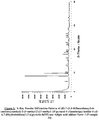
- Adipic acid adduct, Form 1 is characterised in providing an X-ray powder diffraction pattern, substantially as shown in Figure 3 .
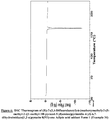
- DSC analysis shows ( R )-7-(3,4-Difluorobenzyl)-6-(methoxymethyl)-2-(5-methyl-2-((1-methyl-1 H -pyrazol-5-yl)amino)pyrimidin-4-yl)-6,7-dihydroimidazo[1,2-a]pyrazin-8(5 H )-one
- Adipic acid adduct, Form 1 is a high melting solid with an onset of 185.4°C and a peak at 186.2°C.
- the present disclosure relates to a crystalline form of (R)-7-(3,4-Difluorobenzyl)-6-(methoxymethyl)-2-(5-methyl-2-((1-methyl-1 H -pyrazol-5-yl)amino)pyrimidin-4-yl)-6,7-dihydroimidazo[1,2-a]pyrazin-8(5 H )-one Ethanesulfonic acid adduct, Form 1, and/or a crystalline form of ( R )-7-(3,4-Difluorobenzyl)-6-(methoxymethyl)-2-(5-methyl-2-((1-methyl-1 H -pyrazol-5-yl)amino)pyrimidin-4-yl)-6,7-dihydroimidazo[1,2-a]pyrazin-8(5 H )-one Adipic acid adduct, Form 1, the degree of crystallinity is conveniently greater than about 60%, more conveniently greater than about 80%,
- Adipic acid adduct, Form 1 provides X-ray powder diffraction patterns substantially the same as the X-ray powder diffraction patterns shown in Figure 3 and has the ten (angle 2-theta values) shown in Table 2. It will be understood that the 2-theta values of the X-ray powder diffraction pattern may vary slightly from one machine to another or from one sample to another, and so the values quoted are not to be construed as absolute.
- an X-ray powder diffraction pattern may be obtained which has one or more measurement errors depending on measurement conditions (such as equipment or machine used).
- intensities in an X-ray powder diffraction pattern may fluctuate depending on measurement conditions.
- Adipic acid adduct, Form 1 is not limited to the crystals that provide X-ray powder diffraction patterns identical to the X-ray powder diffraction pattern shown in Figure 3 , and any crystals providing X-ray powder diffraction patterns substantially the same as those shown in Figure 3 fall within the scope of the present disclosure.
- a person skilled in the art of X-ray powder diffraction is able to judge the substantial identity of X-ray powder diffraction patterns.
- a measurement error of a diffraction angle in an X-ray powder diffractogram is approximately plus or minus 0.2° 2-theta, and such degree of a measurement error should be taken into account when considering the X-ray powder diffraction pattern in Figure 1 and when reading Table 1. Furthermore, it should be understood that intensities might fluctuate depending on experimental conditions and sample preparation (preferred orientation).
- One skilled in the art will have the ability to determine substantial identities of diffractograms, spectra and thermograms.
- a suitable pharmaceutically-acceptable pro-drug of a compound of the Formula (I) also forms an aspect of the present disclosure.
- the compounds of the disclosure may be administered in the form of a pro-drug, which is a compound that is broken down in the human or animal body to release a compound of the disclosure.
- a pro-drug may be used to alter the physical properties and/or the pharmacokinetic properties of a compound of the present disclosure.
- a pro-drug can be formed when the compound of the present disclosure contains a suitable group or substituent to which a property-modifying group can be attached.
- Examples of pro-drugs include in-vivo cleavable ester or amide derivatives that may be formed at the carboxy group in a compound of the Formula (I).
- one aspect of the present disclosure includes those compounds of Formula (I) as defined hereinbefore when made available by organic synthesis and when made available within the human or animal body by way of cleavage of a pro-drug thereof. Accordingly, the present disclosure includes those compounds of the Formula (I) that are produced by organic synthetic means and also such compounds that are produced in the human or animal body by way of metabolism of a precursor compound, that is a compound of the Formula (I) may be a synthetically-produced compound or a metabolically-produced compound.
- a suitable pharmaceutically-acceptable pro-drug of a compound of the Formula (I) is one that is based on reasonable medical judgement as being suitable for administration to the human or animal body without undesirable pharmacological activities and without undue toxicity.
- a suitable pharmaceutically-acceptable pro-drug of a compound of the Formula (I) that possesses a carboxy group is, for example, an in-vivo cleavable ester thereof.
- An in-vivo cleavable ester of a compound of the Formula (I) containing a carboxy group is, for example, a pharmaceutically-acceptable ester which is cleaved in the human or animal body to produce the parent acid.
- Suitable pharmaceutically-acceptable esters for a carboxy group include (1-6C)alkyl esters such as methyl, ethyl and tert -butyl, (1-6C)alkoxymethyl esters such as methoxymethyl esters, (1-6C)alkanoyloxymethyl esters such as pivaloyloxymethyl esters, 3-phthalidyl esters, (3-8C)cycloalkylcarbonyloxy-(1-6C)alkyl esters such as cyclopentylcarbonyloxymethyl and 1-cyclohexylcarbonyloxyethyl esters, 2-oxo-1,3-dioxolenylmethyl esters such as 5-methyl-2-oxo-1,3-dioxolen-4-ylmethyl esters and (1-6C)alkoxycarbonyloxy-(1-6C)alkyl esters such as methoxycarbonyloxymethyl and 1-methoxycarbonyloxyethyl esters.
- a suitable pharmaceutically-acceptable pro-drug of a compound of the Formula (I) which have a carboxy group is for example an in-vivo cleavable amide such as a N- C 1 - 6 alkyl and N,N -di-(C 1 - 6 alkyl)amide such as N -methyl, N -ethyl, N -propyl, N,N- dimethyl, N -ethyl- N -methyl or N , N -diethylamide.
- the in-vivo effects of a compound of the Formula (I) may be exerted in part by one or more metabolites that are formed within the human or animal body after administration of a compound of the Formula (I). As stated hereinbefore, the in-vivo effects of a compound of the Formula (I) may also be exerted by way of metabolism of a precursor compound (a pro-drug).
- Another aspect of the present disclosure provides a process for preparing a compound of the Formula (I), or a pharmaceutically-acceptable salt thereof.
- a suitable process is illustrated by the following representative process variants in which, unless otherwise stated R 1 to R 3 has any of the meanings defined hereinbefore.
- Necessary starting materials may be obtained by standard procedures of organic chemistry or are commercially available. The preparation of such starting materials is described in conjunction with the following representative process variants and within the accompanying Examples. Alternatively, necessary starting materials are obtainable by analogous procedures to those illustrated which are within the ordinary skill of an organic chemist.
- a compound of formula (I) may be prepared from a compound of formula (II), wherein L 1 is a suitable leaving group (such as halogen, or -SO 2 Me, etc), by reaction with a compound of formula (XII), wherein P 1 is hydrogen, with a suitable base (such as NaH, Na 2 CO 3 , Cs 2 CO 3 or K 2 CO 3 ) in a suitable solvent (such as N,N- dimethylformamide or N,N- dimethylacetamide) or in the presence of a suitable Pd catalyst and phosphine ligand with a suitable base (e.g.
- a compound of formula (I) may be prepared from a compound of formula (II), wherein L 1 is a suitable leaving group (such as halo, or -SO 2 Me, etc.), by reaction with a compound of formula (XII), wherein P 1 is a suitable group other than hydrogen (such as formyl or trifluoroacetamide) with a suitable base (such as NaH, Na 2 CO 3 , Cs 2 CO 3 or K 2 CO 3 ) in a suitable solvent (such as N,N- dimethylformamide or N,N- dimethylacetamide) or in the presence of a suitable Pd catalyst and phosphine ligand with a suitable base (e.g.
- a suitable solvent such as dioxane
- elevated temperatures such as achieved by heating or by microwave irradiation
- removal of the protecting group P 1 in the presence of a suitable base such as sodium hydroxide in a suitable solvent and water.
- a compound of formula (II) may be prepared from a compound of formula (III), wherein L 1 is a suitable leaving group (such as Cl or -SO 2 Me), by reaction with a compound of formula (XIII) wherein L 2 is a suitable leaving group (such as halogen, or - OSO 2 Me, -Tos, etc), in the presence of a suitable base (such as sodium hydride or K 2 CO 3 ) and a suitable solvent (such as N,N- dimethylformamide).
- a suitable base such as sodium hydride or K 2 CO 3
- a suitable solvent such as N,N- dimethylformamide
- compounds of formula (II) may be prepared from compounds of formula (VI), wherein R 4 is an alkyl group (such as methyl or ethyl), by the reaction with compounds of the formula (X) in the presence of suitable reducing reagent (such as NaBH 3 CN) and a suitable solvent (such as tetrahydrofuran) followed by subsequent lactamisation conditions in a suitable solvent (such as MeOH) with a suitable base (such as ammonia), or with a Lewis acid catalyst (such as trimethylaluminium).
- suitable reducing reagent such as NaBH 3 CN
- suitable solvent such as tetrahydrofuran
- suitable solvent such as tetrahydrofuran
- suitable base such as ammonia
- a Lewis acid catalyst such as trimethylaluminium
- a compound of formula (II) wherein L 1 is a pre-cursor to a suitable leaving group may be prepared from a compound of formula (V), wherein L 3 is a suitable metal group (such as trimethyl stannane, etc), by reaction with a compound of formula (XI) wherein L 2 is a suitable leaving group (such as halo, or OSO 2 CF 3 ), in the presence of a suitable Pd catalyst and phosphine ligand in a suitable solvent (such as a mixture of N,N -dimethylformamide, dimethoxyethane, water and ethanol) under suitable conditions such as heating thermally or in a microwave reactor.
- a suitable solvent such as a mixture of N,N -dimethylformamide, dimethoxyethane, water and ethanol
- a compound of formula (V), wherein R 1 is hydrogen or an alkyl group (such as methyl), may be prepared from a compound of formula (VII), by reaction with a compound of formula (XIV) where L 4 is a suitable leaving group (such as halo, or OSO 2 CF 3 ), in the presence of a suitable base (such as sodium hydride or K 2 CO 3 ) and a suitable solvent (such as N,N- dimethylformamide or acetone).
- a suitable base such as sodium hydride or K 2 CO 3
- a suitable solvent such as N,N- dimethylformamide or acetone
- a compound of formula (VI), wherein R 4 is an alkyl group (such as methyl or ethyl), may be prepared from a compound of formula (VIII), by reaction with either a compound of formula (XV), wherein L 5 is a suitable leaving group (such as halo, -OSO 2 Me or -OSO 2 CF 3 ) and P 3 is a suitable protecting group (such as -Boc), or a compound of formula (XVI) wherein P 3 is a suitable protecting group (such as -Boc), in the presence of a suitable base (such as sodium hydride or K 2 CO 3 ) in a suitable solvent (such as dioxane or MeCN) under conditions of ambient or elevated temperatures (such as achieved by heating or by microwave irradiation); In the case where compound of formula (XVI) is used it may be necessary to remove the intermediate sulfamic acid under conditions of aqueous acid (such as HCl) in a suitable solvent (such as ethanol).
- the protecting group P 3 can be removed from compounds of formula (XV) and (XVI) by the use of a suitable acid (such as HC1) in a suitable solvent (such as dioxane or ethanol), under conditions of ambient temperatures.
- a suitable acid such as HC1
- a suitable solvent such as dioxane or ethanol
- a compound of formula (VI) may be isolated as a salt, such as a hydrochloride or dihydrochloride salt.
- L 1 is -SMe or halogen.
- L 1 is -SMe or Cl.
- R 4 is an alkyl group.
- R 4 is C 1-4 alkyl.
- R 4 is methyl or ethyl.
- R 4 is methyl
- R 4 is ethyl
- a suitable base is sodium hydride or K 2 CO 3 .
- a suitable base is sodium hydride.
- reaction of a compound of formula (VIII) with a compound of formula (XVI) is performed in dioxane or MeCN.
- reaction of a compound of formula (VIII) with a compound of formula (XVI) is performed in dioxane.
- reaction of a compound of formula (VIII) with a compound of formula (XVI) is performed in MeCN.
- reaction of a compound of formula (VIII) with a compound of formula (XVI) is performed at temperatures at about 20°C.
- reaction of a compound of formula (VIII) with a compound of formula (XVI) is performed at temperatures of 18-25°C.
- reaction of a compound of formula (VIII) with a compound of formula (XVI) is performed at temperatures > 20°C.
- reaction of a compound of formula (VIII) with a compound of formula (XVI) is performed at temperatures >50°C.
- reaction of a compound of formula (VIII) with a compound of formula (XVI) is performed at temperatures >80°C.
- reaction of a compound of formula (VIII) with a compound of formula (XVI) is performed at temperatures ⁇ 85°C.
- reaction of a compound of formula (VIII) with a compound of formula (XVI) is performed at temperatures ⁇ 85°C and ⁇ 100°C.
- reaction of a compound of formula (VIII) with a compound of formula (XVI) is performed at temperatures ⁇ 100°C.
- reaction of a compound of formula (VIII) with a compound of formula (XVI) is performed at temperatures ⁇ 80°C and ⁇ 110°C.
- reaction of a compound of formula (VIII) with a compound of formula (XVI) is performed at temperatures ⁇ 110°C.
- a suitable aqueous acid is HC1.
- removal of intermediate sulfamic acid is performed in ethanol.
- P 3 is -Boc.
- a suitable base is K 2 CO 3 .
- a suitable acid is HC1.
- removal of the protecting group P 3 is performed in dioxane or ethanol.
- removal of the protecting group P 3 is performed in ethanol.
- removal of the protecting group P 3 is performed in dioxane.
- removal of the protecting group P 3 is at temperatures of 18-25°C.
- removal of the protecting group P 3 is at temperatures of 22-28°C.
- removal of the protecting group P 3 is at temperatures at about 20°C.
- removal of the protecting group P 3 is at temperatures at about 25°C.
- a compound of formula (VIII) wherein L 1 is a suitable leaving group (such as halogen, or -SO 2 Me, etc) may be prepared from a compound of formula (IX), wherein R 4 is an alkyl group (such as methyl, etc) and P 4 is a protecting group (such as SEM) by reaction with a compound of formula (XVII) wherein L 5 is a suitable leaving group (such as halo, or OSO 2 CF 3 ), in the presence of a suitable Pd catalyst and phosphine ligand, with a suitable base (such as caesium carbonate) in a suitable solvent (such as a mixture of dioxane and water), under suitable conditions (such as heating thermally or in a microwave reactor).
- a suitable leaving group such as halogen, or -SO 2 Me, etc
- Compound of formula IX can be prepared by methods well known in the art.
- a compound of formula (III) may also be prepared from a compound of formula (VI) wherein R 4 is an alkyl group (such as methyl or ethyl) by treatment with a suitable base (such as ammonia) in a suitable solvent (such as MeOH).
- a suitable base such as ammonia
- a suitable solvent such as MeOH
- a pharmaceutically-acceptable salt of a compound of the Formula (I) when required it may be obtained by, for example, reaction of said compound with a suitable acid or suitable base.
- a pharmaceutically-acceptable pro-drug of a compound of the Formula (I) When a pharmaceutically-acceptable pro-drug of a compound of the Formula (I) is required, it may be obtained using a conventional procedure.
- an in-vivo cleavable ester of compound of the Formula (I) may be obtained by, for example, reaction of a compound of the Formula (I) containing a carboxy group with a pharmaceutically-acceptable alcohol. Further information on pro-drugs has been provided hereinbefore.
- a suitable protecting group for an amino or alkylamino group is, for example, an acyl group, for example an alkanoyl group such as acetyl, an alkoxycarbonyl group, for example a methoxycarbonyl, ethoxycarbonyl or t-butoxycarbonyl group, an arylmethoxycarbonyl group, for example benzyloxycarbonyl, or an aroyl group, for example benzoyl.
- the deprotection conditions for the above protecting groups necessarily vary with the choice of protecting group.
- an acyl group such as an alkanoyl or alkoxycarbonyl group or an aroyl group may be removed for example, by hydrolysis with a suitable base such as an alkali metal hydroxide, for example lithium or sodium hydroxide.
- a suitable base such as an alkali metal hydroxide, for example lithium or sodium hydroxide.
- an acyl group such as a t-butoxycarbonyl group may be removed, for example, by treatment with a suitable acid as hydrochloric, sulphuric or phosphoric acid or trifluoroacetic acid and an arylmethoxycarbonyl group such as a benzyloxycarbonyl group may be removed, for example, by hydrogenation over a catalyst such as palladium-on-carbon, or by treatment with a Lewis acid for example boron tris(trifluoroacetate).
- a suitable alternative protecting group for a primary amino group is, for example, a phthaloyl group which may be removed by treatment with an alkylamine, for example dimethylaminopropylamine, or with hydrazine.
- a suitable protecting group for a hydroxy group is, for example, an acyl group, for example an alkanoyl group such as acetyl, an aroyl group, for example benzoyl, or an arylmethyl group, for example benzyl.
- the deprotection conditions for the above protecting groups will necessarily vary with the choice of protecting group.
- an acyl group such as an alkanoyl or an aroyl group may be removed, for example, by hydrolysis with a suitable base such as an alkali metal hydroxide, for example lithium or sodium hydroxide.
- a suitable base such as an alkali metal hydroxide, for example lithium or sodium hydroxide.
- an arylmethyl group such as a benzyl group may be removed, for example, by hydrogenation over a catalyst such as palladium-on-carbon.
- a suitable protecting group for a carboxy group is, for example, an esterifying group, for example a methyl or an ethyl group which may be removed, for example, by hydrolysis with a base such as sodium hydroxide, or for example a t-butyl group which may be removed, for example, by treatment with an acid, for example an organic acid such as trifluoroacetic acid, or for example a benzyl group which may be removed, for example, by hydrogenation over a catalyst such as palladium-on-carbon.
- a base such as sodium hydroxide
- a t-butyl group which may be removed, for example, by treatment with an acid, for example an organic acid such as trifluoroacetic acid, or for example a benzyl group which may be removed, for example, by hydrogenation over a catalyst such as palladium-on-carbon.
- the protecting groups may be removed at any convenient stage in the synthesis using conventional techniques well known in the chemical art.
- MEK U911-activated ERK2 protein was expressed and purified in-house. Enzyme and substrate solutions were made up in assay buffer consisting of 50mM Tris (pH 7.5), 10mM MgC12, 0.1mM EGTA (ethylene glycol tetraacetic acid), 10mM DTT (dithiothreitol) and 0.01% (v/v) CHAPS (3-[(3-Cholamidopropyl)dimethylammonio]-1-propanesulfonate). 1.2nM ERK2 protein was prepared in assay buffer and 10 ⁇ l was dispensed into each well of a polypropylene, 384-well plate (#781201, Greiner) containing test and reference control compounds.
- assay buffer consisting of 50mM Tris (pH 7.5), 10mM MgC12, 0.1mM EGTA (ethylene glycol tetraacetic acid), 10mM DTT (dithiothreitol) and
- the phospho-p90RSK cell assay was performed in the A375 cell line, a human malignant melanoma which has a BRAF mutation up-regulating the MAPK pathway and, hence, elevated endogenous levels of phospho-ERK and phospho-p90RSK.
- A375 cells were cultured in cell media composed of DMEM (Dulbecco's modified Eagle's medium), 10% (v/v) Foetal Calf Serum and 1% (v/v) L-Glutamine.
- cells were dispensed into black, 384-well Costar plates (#3712, Corning) to give 2400 cells per well in a total volume of 40 ⁇ l cell media, and were incubated overnight at 37°C, 90% relative humidity and 5% CO 2 in a rotating incubator. Test compounds and reference controls were dosed directly into the cell plates using a Labcyte Echo 555 acoustic dispenser.
- the cell plates were then incubated for 2 hours at 37°C before being fixed by the addition of 20 ⁇ l 12% formaldehyde in PBS/A (4% final concentration), followed by a 20 minute room temperature incubation, and then a 2x wash with 150 ⁇ l PBS/A (phosphate buffered saline containing albumin) using a BioTek ELx405 platewasher.
- Cells were permeabilised with 20 ⁇ l 0.1% Triton X-100 in PBS/A for 20 minutes at room temperature, and then washed 1x with 100 ⁇ l PBS/A.
- Compounds as claimed herein generally have enzyme activity in the above assay of ⁇ 0.5 mM, such as ⁇ 0.2 mM.
- Activated MEK protein was supplied by MRC-PPU (DU911, Dundee, UK) or expressed and purified in-house.
- the MEK assay was performed with the ADP-GloTM Kinase Assay Kit (Promega, Madison, WI, USA), in Greiner 384-well white low volume plates. 2 ⁇ l of 6 nM activated MEK protein, in assay buffer consisting of 50 mM Tris (pH 7.5), 10 mM DTT, 0.1 mM EGTA, 0.01% v/v Tween20 and 10 mM MgCl2, was dispensed into each well of a plate containing test and reference control compounds.
- A549 is a human non small cell lung cancer line carrying an oncogenic mutation in the KRAS gene (G12S).
- Female nude mice Hard, UK
- mice were implanted subcutaneously (s.c.) on the left flank, with 5x10 6 A549 cells (ATCC) per mouse.
- Tumour growth was monitored by twice weekly calliper measurement and volumes calculated using elliptical formula (pi/6 x width x width x length). Once tumours had reached a volume of ⁇ 200-300mm 3 animals were randomised into groups of 7-11 and were treated with a continuous combination schedule of selumetinib (ARRY-142886) 25 mg/kg BiD and Example 18a 25 mg/kg QD (four hours after first selumetinib dose), both were dosed by peroral route. Tumour volumes were measured twice weekly after dosing commenced.
- Example 18a was formulated in 10% DMSO, 90% of a 40% kleptose solution (Kleptose is sourced from Roquette -Pharma [Trademarked] Hydroxypropyl betacyclodextrin - suitable for in-vivo use and formulations).
- A549 is a human non small cell lung cancer line carrying an oncogenic mutation in the KRAS gene (G12S).
- H2122 is a human non small cell lung cancer line carrying an oncogenic mutation in the KRAS gene (G12C).
- H2009 is a human non small cell lung cancer line carrying an oncogenic mutation in the KRAS gene (G12A).
- Calu6 is a human non small cell lung cancer line carrying mutation in the KRAS (G13K) gene. All cell lines were obtained from the American Type Culture Collection.
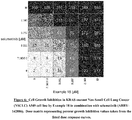
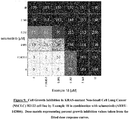
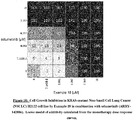
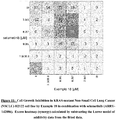
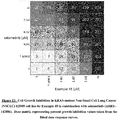
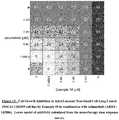
- Cells were seeded in 384-well black, clear bottomed plates (Greiner Bio-One, Stonehouse, UK), cultured for 18-24 hours and treated with increasing concentrations of Example 18 and selumetinib (0 - 10 ⁇ mol/L) in a 6x6 dosing matrix. Cells were seeded at a concentration such that cells in untreated wells were approximately 80% confluent at the end of the assay. After 3 days of treatment, live cell number was determined using a Sytox Green endpoint as described previously (" Davies BR, Greenwood H, Dudley P, et al: Preclinical pharmacology of AZD5363, an inhibitor of AKT: Pharmacodynamics, antitumor activity, and correlation of monotherapy activity with genetic background.
- This formula gives a percentage from 0% to 200%.
- Anti-proliferative effects are indicated by scores from 0% (no effect on cell growth) to 100% (complete inhibition of cell growth); cell killing is indicated by scores from 100% (no cell killing) to 200% (killing of all cells).
- This model of additivity provides a null-reference that is predicted by the expected response if the two agents were the same drug.
- the 3-dimensional model surface predicted from the two single-agent response curves, is subtracted from the experimentally-derived 3-dimensional dose effect surface to generate a difference volume.
- This excess matrix volume can be integrated to generate a synergy score.
- a synergy score cutoff >5 was used to identify combinations of interest in the initial high-throughput screen.
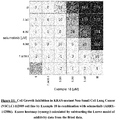
- Example 18 can inhibit the growth of a panel of cancer cell lines with KRAS mutations as a monotherapy and this effect is synergistically enhanced by treatment with selumetinib.
- Synergy scores for each cell line are 25 (A549), 14.3 (H2122), 67.5 (H2009), and 3 (Calu6).
- the synergy scores above are an average of three or more independent experiments.
- a pharmaceutical composition which comprises a compound of the Formula (I), or a pharmaceutically-acceptable salt thereof, as defined hereinbefore in association with a pharmaceutically-acceptable diluent or carrier.
- Suitable pharmaceutically-acceptable excipients for a tablet formulation include, for example, inert diluents, granulating and disintegrating agents, binding agents, lubricating agents, preservative agents and antioxidants.
- a further suitable pharmaceutically-acceptable excipient may be a chelating agent.
- Tablet formulations may be uncoated or coated either to modify their disintegration and the subsequent absorption of the active ingredient within the gastrointestinal tract, or to improve their stability and/or appearance, in either case, using conventional coating agents and procedures well known in the art.
- compositions for oral use may alternatively be in the form of hard gelatin capsules in which the active ingredient is mixed with an inert solid diluent, or as soft gelatin capsules in which the active ingredient is mixed with water or an oil.
- Aqueous suspensions generally contain the active ingredient in finely powdered form together with one or more suspending agents, dispersing or wetting agents.
- the aqueous suspensions may also contain one or more preservatives, anti-oxidants, colouring agents, flavouring agents, and/or sweetening agents.
- Oily suspensions may be formulated by suspending the active ingredient in a vegetable oil or in a mineral oil.
- the oily suspensions may also contain a thickening agent.
- Sweetening agents such as those set out above, and flavouring agents may be added to provide a palatable oral preparation. These compositions may be preserved by the addition of an anti-oxidant.
- Dispersible powders and granules suitable for preparation of an aqueous suspension by the addition of water generally contain the active ingredient together with a dispersing or wetting agent, suspending agent and one or more preservatives. Additional excipients such as sweetening, flavouring and colouring agents, may also be present.
- compositions of the present disclosure may also be in the form of oil-in-water emulsions.
- the oily phase may be a vegetable oil or a mineral oil or a mixture of any of these.
- the emulsions may also contain sweetening, flavouring and preservative agents.
- Syrups and elixirs may be formulated with sweetening agents, and may also contain a demulcent, preservative, flavouring and/or colouring agent.
- compositions may also be in the form of a sterile injectable aqueous or oily suspension, which may be formulated according to known procedures using one or more of the appropriate dispersing or wetting agents and suspending agents, which have been mentioned above.
- a sterile injectable preparation may also be a sterile injectable solution or suspension in a non-toxic parenterally-acceptable diluent or solvent system.
- Compositions for administration by inhalation may be in the form of a conventional pressurised aerosol arranged to dispense the active ingredient either as an aerosol containing finely divided solid or liquid droplets.
- Conventional aerosol propellants such as volatile fluorinated hydrocarbons or hydrocarbons may be used and the aerosol device is conveniently arranged to dispense a metered quantity of active ingredient.
- Dry powder inhalers may also be suitable.
- the amount of active ingredient that is combined with one or more excipients to produce a single dosage form will necessarily vary depending upon the host treated and the particular route of administration.
- oral administration to humans will generally require, for example, from 1 mg to 2 g of active agent (more suitably from 100mg to 2g, for example from 250 mg to 1.8g, such as from 500mg to 1.8g, particularly from 500mg to 1.5g, conveniently from 500mg to 1g) to be administered compounded with an appropriate and convenient amount of excipients which may vary from about 3 to about 98 percent by weight of the total composition.
- unit dosage forms will contain about 10 mg to 0.5 g of a compound of this present disclosure, although a unit dosage form may contain up to 1g.
- a single solid dosage form may contain between 1 and 300mg of active ingredient.
- the size of the dose for therapeutic or prophylactic purposes of compounds of the present disclosure will naturally vary according to the nature and severity of the disease state, the age and sex of the animal or patient and the route of administration, according to well known principles of medicine.
- a daily dose in the range for example, 1 mg/kg to 100 mg/kg body weight is received, given if required in divided doses.
- lower doses will be administered when a parenteral route is employed.
- a dose in the range for example, 1 mg/kg to 25 mg/kg body weight will generally be used.
- a dose in the range for example, 1 mg/kg to 25 mg/kg body weight will be used.
- Oral administration is however preferred, particularly in tablet form.
- compounds of the present disclosure or pharmaceutically-acceptable salts thereof are administered as tablets comprising 10mg to 500mg of the compound of Formula (I) (or a pharmaceutically-acceptable salt thereof), wherein one or more tablets are administered as required to achieve the desired dose.
- ERK signalling through ERK causes tumourigenesis by one or more of the effects of mediating proliferation of cancer and other cells, mediating angiogenic events and mediating the motility, migration and invasiveness of cancer cells.
- the compounds of the present disclosure possess potent anti-tumour activity which it is believed is obtained by way of inhibition of ERK that is involved in the signal transduction steps which lead to the proliferation and survival of tumour cells and the invasiveness and migratory ability of metastasising tumour cells.
- the compounds of the present disclosure may be of value as anti-tumour agents, in particular as selective inhibitors of the proliferation, survival, motility, dissemination and invasiveness of mammalian cancer cells leading to inhibition of tumour growth and survival and to inhibition of metastatic tumour growth.
- the compounds of the present disclosure may be of value as anti-proliferative and anti-invasive agents in the containment and/or treatment of solid tumour disease.
- the compounds of the present disclosure may be useful in the prevention or treatment of those tumours which are sensitive to inhibition of ERK and that are involved in the signal transduction steps which lead to the proliferation and survival of tumour cells and the migratory ability and invasiveness of metastasising tumour cells.
- the compounds of the present disclosure may be useful in the prevention or treatment of those tumours which are mediated alone or in part by inhibition of ERK, i.e. the compounds may be used to produce an ERK inhibitory effect in a warm-blooded animal in need of such treatment.
- a compound of the Formula (I), or a pharmaceutically-acceptable salt thereof, as defined hereinbefore for use in a warm-blooded animal such as man as an anti-invasive agent in the containment and/or treatment of solid tumour disease.
- a compound of the Formula (I), or a pharmaceutically-acceptable salt thereof, as defined hereinbefore in the manufacture of a medicament for use in a warm-blooded animal such as man as an anti-invasive agent in the containment and/or treatment of solid tumour disease.
- a compound of the Formula (I), or a pharmaceutically-acceptable salt thereof, as defined hereinbefore for use in the prevention or treatment of solid tumour disease in a warm-blooded animal such as man.
- a compound of the Formula (I), or a pharmaceutically-acceptable salt thereof, as defined hereinbefore in the manufacture of a medicament for use in the prevention or treatment of solid tumour disease in a warm-blooded animal such as man.
- an effective amount means an amount that (i) treats the particular disease, condition or disorder, (ii) attenuates, ameliorates or eliminates one or more symptoms of the particular disease, condition or disorder, (iii) delays or prevents the onset of one or more symptoms of the particular disease, condition or disorder described herein.
- the effective amount may reduce the number of cancer cells; reduce the tumour size; inhibit (eg slow to some extent and preferably stop) infiltration of the cancer cells into peripheral organs; inhibit tumour metastasis; inhibit to some extent tumour growth; and/or relieve to some extent one or more of the symptoms associated with cancer.
- efficacy can be measure by assessing, for example the time to disease progression (TTP) and/or assessing the response rate (RR).
- a compound of the Formula (I), or a pharmaceutically-acceptable salt thereof, as defined hereinbefore in the manufacture of a medicament for use in the prevention or treatment of a hyperproliferative disease or disorder modulated by RAS/RAF/MEK/ERK kinases.
- a compound of the Formula (I), or a pharmaceutically-acceptable salt thereof, as defined hereinbefore for use in providing an inhibitory effect on ERK is provided.
- Compounds of Formula (I) may be effective in treating any cancer where the RAS/RAF/MEK/ERK kinase pathway is activated.
- cancers which have been reported to have such activation include acute myelogenous leukemia (AML), chronic myelomonocyic leukemia, multiple myeloma, chronic myelogenous leukemia, colorectal cancer (CRC), breast cancer, bladder cancer, head and neck cancer, brain cancer, glioblastoma, neuroblastoma, Non-Hodgkins lymphoma, pancreatic cancer, ovarian cancer, testicular cancer, thyroid cancer, non-small cell lung cancer (NSCLC), small cell lung cancer, melanoma, neurofibromatosis type 1 (NF1), biliary tract.
- AML acute myelogenous leukemia
- CRC colorectal cancer
- NSCLC non-small cell lung cancer
- NF1 neurofibromatosis type 1
- compounds may be effective in treating a cancer selected from NSCLC, pancreatic, CRC, melanoma, uveal melanoma, paediatric NF1, differentiated thyroid and biliary tract cancer.
- compounds may be effective in treating KRAS or BRAF mutant cancers.
- compounds may be effective in treating MAPK pathway dependent cancers such as NSCLC, pancreatic and CRC; in some embodiments such cancers are KRAS mutant cancers as described hereinafter.
- compounds may be effective in treating BRAF mutant melanoma.
- compounds may be effective in treating a cancer selected from NRAS mutant melanoma, uveal melanoma, paediatric NF1, differentiated thyroid and biliary tract cancer.
- a compound of the Formula (I), or a pharmaceutically-acceptable salt thereof, as defined hereinbefore in the manufacture of a medicament for use in the treatment of a cancer selected from NSCLC, pancreatic, CRC, melanoma, uveal melanoma, paediatric NF1, differentiated thyroid and biliary tract cancers.
- a compound of the Formula (I), or a pharmaceutically-acceptable salt thereof, as defined hereinbefore in the manufacture of a medicament for use in the treatment of a cancer selected from NSCLC, pancreatic and CRC.
- a compound of the Formula (I), or a pharmaceutically-acceptable salt thereof, as defined hereinbefore in the manufacture of a medicament for use in the treatment of NRAS mutant melanoma, uveal melanoma, paediatric NF1, differentiated thyroid and biliary tract cancer.
- a compound of the Formula (I), or a pharmaceutically-acceptable salt thereof, as defined hereinbefore in the manufacture of a medicament for use in the treatment of a cancer mediated by ERK, wherein the cancer has developed resistance to one or more other MAPK pathway inhibitors.
- the in-vivo effects of a compound of the Formula (I) may be exerted in part by one or more metabolites that are formed within the human or animal body after administration of a compound of the Formula (I).
- compositions, methods and uses particular compounds of Formula (I) are the compounds of the Examples, or pharmaceutically-acceptable salts thereof. Further illustrative examples for compositions, methods and uses are:
- the anti-cancer treatment defined herein may be applied as a sole therapy or may involve, in addition to the compounds of the present disclosure, conventional surgery or radiotherapy or chemotherapy.
- a compound of formula (I) is combined with another compound which has anti-hyperproliferative properties or that is useful in treating a hyperproliferative disorder.
- the additional compound may suitably have complementary activities to the compound of formula (I) such that they do not adversely affect each other.
- combination therapy may prevent or delay inherent or acquired resistance attributable to activation of the RAS/RAF/MEK/ERK pathway observed with MEK inhibition and to prevent or delay inherent or acquired resistance mediated via RAS pathway activation.
- administration of certain combinations may improve the quality of life of a patient compared to the quality of life experienced by the same patient receiving a different treatment.
- administration of a combination to a patient may provide an improved quality of life compared to the quality of life the same patient would experience if they received only one of the individual agents as therapy.
- a combined therapy may lower the dose of the therapeutic agents required.
- the combination may also cause reduced tumour burden and thereby reduce the associated adverse events.
- a compound of Formula (I), or a pharmaceutically-acceptable salt thereof, and an additional anti-tumour substance for the conjoint treatment of cancer is provided.
- anti-cancer treatment may be applied as a sole therapy or may involve, in addition to the compound of the present disclosure, conventional surgery or radiotherapy or chemotherapy.
- chemotherapy may include one or more of the following categories of anti-tumour agents:-
- a combination suitable for use in the treatment of cancer comprising a compound of Formula (I) as defined hereinbefore or a pharmaceutically-acceptable salt thereof and another anti-tumour agent, in particular any one of the anti tumour agents listed under (i) - (xi) above.
- another anti-tumour agent in particular any one of the anti tumour agents listed under (i) - (xi) above.
- the anti-tumour agent listed under (i)-(xi) above is the standard of care for the specific cancer to be treated; the person skilled in the art will understand the meaning of "standard of care”.
- a compound of Formula (I) or a pharmaceutically-acceptable salt thereof in combination with another anti-tumour agent in particular an anti-tumour agent selected from one listed under (i) - (xi) herein above.
- a pharmaceutical composition which comprises a compound of Formula (I) or a pharmaceutically-acceptable salt thereof in combination with an anti-tumour agent selected from one listed under (i) - (xi) herein above, in association with a pharmaceutically-acceptable diluent or carrier.
- a pharmaceutical composition which comprises a compound of Formula (I) or a pharmaceutically-acceptable salt thereof in combination with an anti-tumour agent selected from one listed under (i) - (xi) herein above, in association with a pharmaceutically-acceptable diluent or carrier for use in treating cancer.
- a compound of Formula (I) or a pharmaceutically-acceptable salt thereof in combination with another anti-tumour agent in particular an anti-tumour agent selected from one listed under (i) above.
- a combination suitable for use in the treatment of cancer comprising a compound of Formula (I) as defined hereinbefore or a pharmaceutically-acceptable salt thereof and any one of the anti tumour agents listed under (i) above.
- a pharmaceutical composition which comprises a compound of Formula (I) or a pharmaceutically-acceptable salt thereof in combination with an anti-tumour agent selected from one listed under (i) herein above, in association with a pharmaceutically-acceptable diluent or carrier.
- a pharmaceutical composition which comprises a compound of Formula (I) or a pharmaceutically-acceptable salt thereof in combination with an anti-tumour agent selected from one listed under (i) herein above, in association with a pharmaceutically-acceptable diluent or carrier for use in treating cancer.
- a compound of Formula (I) or a pharmaceutically-acceptable salt thereof in combination with another anti-tumour agent in particular an anti-tumour agent selected from one listed under (iii) above.
- a combination suitable for use in the treatment of cancer comprising a compound of Formula (I) as defined hereinbefore or a pharmaceutically-acceptable salt thereof and any one of the anti tumour agents listed under (iii) above.
- a pharmaceutical composition which comprises a compound of Formula (I) or a pharmaceutically-acceptable salt thereof in combination with an anti-tumour agent selected from one listed under (iii) herein above, in association with a pharmaceutically-acceptable diluent or carrier.
- a pharmaceutical composition which comprises a compound of Formula (I) or a pharmaceutically-acceptable salt thereof in combination with an anti-tumour agent selected from one listed under (iii) herein above, in association with a pharmaceutically-acceptable diluent or carrier for use in treating cancer.
- suitable examples of anti tumour agents listed in (iii) above are those agents which also act on MAPK kinsases, particularly on the RAS-RAF-MEK-ERK signalling cascade such as MEK inhibitors.
- a combination suitable for use in the treatment of cancer comprising a compound of Formula (I) as defined hereinbefore or a pharmaceutically-acceptable salt thereof and a MEK inhibitor, such as selumetinib (ARRY-142886).
- the above combination of the compound of formula (I) and selumetinib is suitable for use in the treatment of any cancer dependent on the MAPK pathway, such as NSCLC, pancreatic or CR cancer, optionally in combination with standard of care therapy.
- Particular combinations of the present disclosure comprise any one of the compounds of the Examples herein (or a pharmaceutically-acceptable salt thereof) and a MEK inhibitor such as selumetinib (ARRY-142886) as described hereinabove.
- a MEK inhibitor such as selumetinib (ARRY-142886) as described hereinabove.
- Further illustrative examples for combinations of the present disclosure and a MEK inhibitor such as selumetinib (ARRY-14288) are:
- the combination may also be dosed with standard of care treatment, as understood by the skilled person, such as other treatments from (i) to (xi) hereinbefore.
- standard of care may be selected from (i) above.
- Suitably standard of care therapy may be dosed according to its usual dosing regimen, as understood by the skilled person.
- kits comprising a compound of Formula (I) or a pharmaceutically-acceptable salt thereof in combination with an anti-tumour agent selected from one listed under (i) - (xi) herein above.
- kit comprising:
- kit comprising:
- the compounds of the Formula (I) are primarily of value as therapeutic agents for use in warm-blooded animals (including man), they are also useful whenever it is required to inhibit ERK. Thus, they are useful as pharmacological standards for use in the development of new biological tests and in the search for new pharmacological agents.
- Another aspect of the present disclosure is based on identifying a link between the status of the gene encoding KRAS and susceptibility to treatment with a compound of Formula (I). This therefore provides opportunities, methods and tools for selecting patients for treatment with a compound of Formula (I), particularly cancer patients, and/or avoiding treatment of patients less likely to respond therapeutically to the treatment thus avoiding unnecessary treatment and any side effects that may be associated with such ineffective treatment.
- the present disclosure relates to patient selection tools and methods (including personalised medicine).
- the selection is based on whether the tumour cells to be treated possess wild-type or mutant KRAS gene.
- the KRAS gene status can therefore be used as a biomarker of susceptibility to treatment with an ERK inhibitor.
- biomarkers that will enrich for or select patients whose tumours will respond to treatment with an ERK inhibitor, such as a compound of Formula (I).
- an ERK inhibitor such as a compound of Formula (I)
- Patient selection biomarkers that identify the patients most likely to respond to an agent are ideal in the treatment of cancer, since they reduce the unnecessary treatment of patients with non-responding tumours to the potential side effects of such agents.
- a biomarker can be described as "a characteristic that is objectively measured and evaluated as an indicator of normal biologic processes, pathogenic processes, or pharmacologic responses to a therapeutic intervention".
- a biomarker is any identifiable and measurable indicator associated with a particular condition or disease where there is a correlation between the presence or level of the biomarker and some aspect of the condition or disease (including the presence of, the level or changing level of, the type of, the stage of, the susceptibility to the condition or disease, or the responsiveness to a drug used for treating the condition or disease). The correlation may be qualitative, quantitative, or both qualitative and quantitative.
- a biomarker is a compound, compound fragment or group of compounds. Such compounds may be any compounds found in or produced by an organism, including proteins (and peptides), nucleic acids and other compounds.
- Biomarkers may have a predictive power, and as such may be used to predict or detect the presence, level, type or stage of particular conditions or diseases (including the presence or level of particular microorganisms or toxins), the susceptibility (including genetic susceptibility) to particular conditions or diseases, or the response to particular treatments (including drug treatments). It is thought that biomarkers will play an increasingly important role in the future of drug discovery and development, by improving the efficiency of research and development programs. Biomarkers can be used as diagnostic agents, monitors of disease progression, monitors of treatment and predictors of clinical outcome. For example, various biomarker research projects are attempting to identify markers of specific cancers and of specific cardiovascular and immunological diseases. It is believed that the development of new validated biomarkers will lead both to significant reductions in healthcare and drug development costs and to significant improvements in treatment for a wide variety of diseases and conditions.
- a biomarker may be required.
- the marker may be measurable in surrogate and tumour tissues. Ideally these markers will also correlate with efficacy and thus could ultimately be used for patient selection.
- the technical problem underlying this aspect of the present disclosure is the identification of means for stratification of patients for treatment with a compound of Formula (I).
- the technical problem is solved by provision of the embodiments characterized in the claims and/or description herein.
- the present disclosure provides a method of determining sensitivity of cells to a compound of Formula (I).
- the method comprises determining the status of KRAS gene in said cells.
- the cells are identified as likely to be sensitive to a compound of Formula I if the cells possess a mutated KRAS gene. Those patients with a mutated KRAS gene are therefore predicted to be particularly susceptible to treatment with a compound of Formula (I).
- a cell is defined as sensitive to a compound of Formula (I) if it inhibits the increase in cell number in a cell growth assay (either through inhibition of cell proliferation and /or through increased cell death). Methods of the present disclosure are useful for predicting which cells are more likely to respond to a compound of Formula (I) by growth inhibition.
- the present disclosure is further based, in part, on methods that can be used to determine a patient's responsiveness to a compound of Formula (I) including determining whether to administer a compound of Formula (I).
- the methods of the present disclosure include the determination of the gene status of KRAS.
- the presence of a mutated KRAS gene indicates that the tumour cells are more likely to respond by growth inhibition when contacted with a compound of Formula (I).
- the KRAS gene status can therefore be used to select patients for treatment with a compound of Formula (I).
- a sample "representative of the tumour” can be the actual tumour sample isolated, or may be a sample that has been further processed, e.g. a sample of PCR amplified nucleic acid from the tumour sample.
- the present invention discloses a method for selecting a cancer patient suitable for treatment with a compound of Formula (I), the method comprising;
- the status of the KRAS gene in a patient's tumour is determining from a biological sample obtained from said patient
- the biological sample is a tumour cell containing sample.
- the biological sample is one that contains tumour DNA, such as a blood sample.
- a method for selecting a patient for treatment with a compound of Formula (I) comprising obtaining a sample from a patient that comprises tumour cells or nucleic acid from the tumour cell; determining whether the KRAS gene in the patient's tumour cells is wild type or mutant; and selecting a patient for treatment with a compound of Formula (I) based thereon.
- the method may include or exclude the actual patient sample isolation step.
- a method for selecting a patient for treatment with a compound of Formula (I) comprising determining whether the KRAS gene in a tumour cell or nucleic acid containing sample previously isolated from the patient is wild type or mutant; and selecting a patient for treatment with a compound of Formula (I) based thereon.
- the patient is selected for treatment with a compound of Formula (I) if the tumour cell has a mutant KRAS gene.
- a method for predicting a patient's responsiveness to a compound of Formula (I) comprising determining whether the KRAS gene in the patient's tumour cells is wild type or mutant and based thereon, predicting a patient's responsiveness to treatment with a compound of Formula (I).
- a method for determining the likelihood of effectiveness of treatment with a compound of formula I in a human patient affected with cancer comprising: determining whether the KRAS gene(s) in the patient's tumour cells is wild type or mutant and based thereon, predicting a patient's responsiveness to treatment with a compound of Formula (I).
- a gene status of wild-type is meant to indicate normal or appropriate expression of the gene and normal function of the encoded protein.
- mutant status is meant to indicate abnormal or inappropriate gene expression, or expression of a protein with altered function, consistent with the known roles of mutant KRAS in cancer (as described herein). Any number of genetic or epigenetic alterations, including but not limited to mutation, amplification, deletion, genomic rearrangement, or changes in methylation profile, may result in a mutant status. However, if such alterations nevertheless result in appropriate expression of the normal protein, or a functionally equivalent variant, then the gene status is regarded as wild-type.
- variants that typically would not result in a functional mutant gene status include synonomous coding variants and common polymorphisms (synonymous or non-synonymous).
- gene status can be assessed by a functional assay, or it may be inferred from the nature of detected deviations from a reference sequence.
- the wild-type or mutant status of the KRAS gene is determined by the presence or absence of non-synonymous nucleic acid variations in the genes. Observed non-synonymous variations corresponding to known common polymorphisms with no annotated functional effects do not contribute to a gene status of mutant.
- sequences regarded as wild type include those that possess one or more synonymous changes to the nucleic acid sequence (which changes do not alter the encoded protein sequence), non-synonymous common polymorphisms (e.g. germ-line polymorphisms) which alter the protein sequence but do not affect protein function, and intronic non-splice-site sequence changes.
- a method for determining the likelihood of effectiveness of treatment with a compound of Formula (I) in a human patient affected with cancer comprising: detecting the presence or absence of at least one non-synonymous nucleic acid variance in the KRAS gene of said patient relative to the wild type gene, wherein the presence of at least one somatic non-synonymous nucleic acid variance in the KRAS gene indicates that treatment with the compound of Formula (I) is likely to be effective.
- a method for assessing the susceptibility of an individual to treatment with a compound of Formula (I) which method comprises:
- the gene status of KRAS can be determined by determination of the nucleic acid sequence. This could be via direct sequencing of the full-length gene or analysis of specific sites within the gene, e.g. commonly mutated sites.
- KRAS gene is wild type or mutant. Functional mutation of this KRAS gene produces a protein that has impaired GTP hydrolysis capability. Mutant KRAS persists in an active, GTP-bound state, leading to constitutive and deregulated stimulation of downstream signalling of the pathway in cells, including but not limited to activation of Raf, PI3K and Ral pathways.
- the assays to assess the functional status of KRAS variants when expressed in cells include but are not limited to:
- the patient's sample to be tested for the gene status can be any tumour tissue, tumour-cell containing or tumour nucleic acid containing sample obtained or obtainable from the individual.
- the test sample is conveniently a sample of blood, mouth swab, biopsy, or other body fluid or tissue obtained from an individual.
- Particular examples include: circulating tumour cells, circulating DNA in the plasma or serum, cells isolated from the ascites fluid of ovarian cancer patients, lung sputum for patients with tumours within the lung, a fine needle aspirate from a breast cancer patient, urine, peripheral blood, a cell scraping, a hair follicle, a skin punch or a buccal sample.
- test sample may equally be a nucleic acid sequence corresponding to the sequence in the test sample, that is to say that all or a part of the region in the sample nucleic acid may firstly be amplified using any convenient technique e.g. polymerase chain reaction (PCR), before analysis.
- the nucleic acid may be genomic DNA or fractionated or whole cell RNA.
- the RNA is whole cell RNA and is used directly as the template for labelling a first strand cDNA using random primers or poly A primers.
- the nucleic acid or protein in the test sample may be extracted from the sample according to standard methodologies (see Green & Sambrook, Eds., Molecular Cloning: A Laboratory Manual, (2012, 4th edition, Vol. 1-3, ISBN 9781936113422), Cold Spring Harbor Laboratory Press, Cold Spring Harbor, N.Y .).
- the diagnostic methods of the present disclosure can be undertaken using a sample previously taken from the individual or patient. Such samples may be preserved by freezing or fixed and embedded in formalin-paraffin or other media. Alternatively, a fresh tumour cell containing sample may be obtained and used.
- tumours for treatment with a compound of Formula (I) have been described hereinbefore.
- mutant KRAS nucleic acids can be employed, in the context of the present disclosure, to predict the response to drug treatment. Since mutations in these genes occur at the DNA level, the methods of the present disclosure can be based on detection of mutations or variances in genomic DNA, as well as transcripts and proteins themselves. It can be desirable to confirm mutations in genomic DNA by analysis of transcripts and/or polypeptides, in order to ensure that the detected mutation is indeed expressed in the subject.
- allelic variation requires a mutation discrimination technique, optionally an amplification reaction (such as one based on polymerase chain reaction) and optionally a signal generation system.
- mutation detection techniques available in the art and these may be used in combination with a signal generation system, of which there are numerous available in the art.
- Many methods for the detection of allelic variation are reviewed by Nollau et al., Clin. Chem., 1997, 43, 1114-1120 ; Anderson SM. Expert Rev Mol Diagn., 2011, 11, 635-642 ; Meyerson M.
- determining the presence or absence of a particular variance or plurality of variances in the KRAS gene in a patient with cancer can be performed in a variety of ways. Such tests are commonly performed using DNA or RNA collected from biological samples, e.g., tissue biopsies, urine, stool, sputum, blood, cells, tissue scrapings, breast aspirates or other cellular materials, and can be performed by a variety of methods including, but not limited to, PCR, hybridization with allele-specific probes, enzymatic mutation detection, chemical cleavage of mismatches, mass spectrometry or DNA sequencing, including minisequencing.
- biological samples e.g., tissue biopsies, urine, stool, sputum, blood, cells, tissue scrapings, breast aspirates or other cellular materials
- methods including, but not limited to, PCR, hybridization with allele-specific probes, enzymatic mutation detection, chemical cleavage of mismatches, mass spectrometry or DNA sequencing, including minis
- Suitable mutation detection techniques include amplification refractory mutation system (ARMSTM), amplification refractory mutation system linear extension (ALEXTM), competitive oligonucleotide priming system (COPS), Taqman, Molecular Beacons, restriction fragment length polymorphism (RFLP), and restriction site based PCR and fluorescence resonance energy transfer (FRET) techniques.
- ARMSTM amplification refractory mutation system
- ALEXTM amplification refractory mutation system linear extension
- COPS competitive oligonucleotide priming system
- RFLP restriction fragment length polymorphism
- FRET fluorescence resonance energy transfer
- the method employed for determining the nucleotide(s) within a biomarker gene is selected from: allele-specific amplification (allele specific PCR) - such as amplification refractory mutation system (ARMS), sequencing, allelic discrimination assay, hybridisation, restriction fragment length polymorphism (RFLP) or oligonucleotide ligation assay (OLA).
- allele-specific amplification allele specific PCR
- ARMS amplification refractory mutation system
- allelic discrimination assay hybridisation
- RFLP restriction fragment length polymorphism
- OLA oligonucleotide ligation assay
- nucleic acids for analysis from samples generally requires nucleic acid amplification.
- Many amplification methods rely on an enzymatic chain reaction (such as a polymerase chain reaction, a ligase chain reaction, or a self-sustained sequence replication) or from the replication of all or part of the vector into which it has been cloned.
- the amplification according to the present disclosure is an exponential amplification, as exhibited by for example the polymerase chain reaction.
- amplification methods have been described in the literature, for example, general reviews of these methods in Landegren, U. , et al., Science, 1988 242, 229-237 and Lewis, R., Genetic Engineering News 1990, 10, 54-55 .
- amplification methods can be used in the methods of the present disclosure, and include polymerase chain reaction (PCR), PCR in situ, ligase amplification reaction (LAR), ligase hybridisation, Q ⁇ bacteriophage replicase, transcription-based amplification system (TAS), genomic amplification with transcript sequencing (GAWTS), nucleic acid sequence-based amplification (NASBA) and in situ hybridisation.
- Primers suitable for use in various amplification techniques can be prepared according to methods known in the art.
- PCR Polymerase Chain Reaction
- PCR is a nucleic acid amplification method described inter alia in U.S. Pat. Nos. 4,683,195 and 4,683,202 .
- PCR consists of repeated cycles of DNA polymerase generated primer extension reactions.
- the target DNA is heat denatured and two oligonucleotides, which bracket the target sequence on opposite strands of the DNA to be amplified, are hybridised. These oligonucleotides become primers for use with DNA polymerase.
- the DNA is copied by primer extension to make a second copy of both strands. By repeating the cycle of heat denaturation, primer hybridisation and extension, the target DNA can be amplified a million fold or more in about two to four hours.
- PCR is a molecular biology tool, which must be used in conjunction with a detection technique to determine the results of amplification.
- An advantage of PCR is that it increases sensitivity by amplifying the amount of target DNA by 1 million to 1 billion fold in approximately 4 hours.
- PCR can be used to amplify any known nucleic acid in a diagnostic context ( Mok et al., Gynaecologic Oncology, 1994, 52: 247-252 ,).
- An allele specific amplification technique such as Amplification Refractory Mutation System (ARMSTM) ( Newton et al., Nucleic Acids Res., 1989, 17, 2503-2516 ) can also be used to detect single base mutations. Under the appropriate PCR amplification conditions a single base mismatch located at the 3'-end of the primer is sufficient for preferential amplification of the perfectly matched allele (Newton et al., 1989, supra ), allowing the discrimination of closely related species.
- the basis of an amplification system using the primers described above is that oligonucleotides with a mismatched 3'-residue will not function as primers in the PCR under appropriate conditions. This amplification system allows genotyping solely by inspection of reaction mixtures after agarose gel electrophoresis.
- Analysis of amplification products can be performed using any method capable of separating the amplification products according to their size, including automated and manual gel electrophoresis, mass spectrometry, and the like.
- the present disclosure relates to pharmaceutical composition
- a compound of Formula (I) for use in the prevention and treatment of cancer with tumour cells identified as harbouring a mutant KRAS gene.
- mutant forms of KRAS determined/identified are at all positions across the gene.
- compounds of the present disclosure may also be useful in treating BRAF mutant cancers.
- the information provided above within this personalised Healthcare section for KRAS mutant cancers may analogously be applied to BRAF resistant cancers, other than Gene Bank Accession details.
- the reaction mixture was quenched with water (50 mL) and extracted into EtOAc (30 x 25 mL), the organic layer was dried over Na 2 SO 4 , filtered and evaporated to afford crude product.
- the crude product was purified by preparative HPLC (Waters XBridge Prep C18 OBD column, 5 ⁇ silica, 19 mm diameter, 100 mm length), using decreasingly polar mixtures of water (containing 0.1% NH 4 HCO 3 ) and MeCN as eluents.
- NBS (10.05 g, 56.5 mmol) was added portionwise to ethyl 1-(2-(( tert- butoxycarbonyl)amino)ethyl)-1 H -imidazole-2-carboxylate (Intermediate 7; 16 g, 56.5 mmol) in DCM (80 mL) and DMF (80 mL) at 0 °C under nitrogen. The resulting solution was then stirred at 0 °C temperature for 12 hours. The reaction mixture was diluted with DCM (300 mL), and washed sequentially with water (100 mL x 2). The organic layer was dried over Na 2 SO 4 , filtered and evaporated to afford crude product.
- XPhos 2nd generation precatalyst (0.435 g, 0.55 mmol) was added to a degassed solution of ethyl 4-bromo-1-((2-(trimethylsilyl)ethoxy)methyl)-1 H -imidazole-2-carboxylate (Intermediate 15; 3.86 g, 11.05 mmol), 4,4,4',4',5,5,5',5'-octamethyl-2,2'-bi(1,3,2-dioxaborolane) (4.21 g, 16.58 mmol) and KOAc (2.17 g, 22.10 mmol) in dioxane (100 mL) at ambient temperature under nitrogen and the resulting solution was heated to 85 °C for 3 hours.
- reaction mixture was allowed to cool to 50 °C and cesium carbonate (7.20 g, 22.10 mmol), 2,4-dichloropyrimidine (1.646 g, 11.05 mmol) and water (20 mL) were added followed by Pd(PPh 3 ) 4 (0.638 g, 0.55 mmol) and the reaction mixture heated at 85 °C for 2 hours.
- the reaction mixture was then passed through celite and washed with MeOH and the volatiles removed under reduced pressure. Water and DCM were added and organic layer extracted and dried by passing through a phase separator cartridge.
- 2,2,2-trifluoroacetic acid (8.48 mL, 110.73 mmol) was added to ethyl 4-(2-chloropyrimidin-4-yl)-1-((2-(trimethylsilyl)ethoxy)methyl)-1 H- imidazole-2-carboxylate (4.24 g, 11.07 mmol) in DCM (100 mL) and the resulting solution was stirred at ambient temperature for 2 hours and then left to stand at ambient temperature for 16 hours. The volatiles were removed under reduced pressure, the resultant solid was dissolved in DCM and water and filtered through a layer of celite.
- aqueous layer was separated and basified with saturated sodium bicarbonate and extracted into DCM, then dried by passing through a phase separator cartridge and the solvent removed to afford a solid.
- the organic layer was passed through a phase separator cartridge, combined with the solid and pre-absorbed onto silica and subjected to silica chromatography eluting with 0-100% diethylether in DCM. Pure fractions were combined and evaporated to afford ethyl 4-(2-chloropyrimidin-4-yl)-1 H -imidazole-2-carboxylate (Intermediate 14; 1.58 g, 57%) as a solid.
- the reaction was cooled to room temperature, diluted with ethyl acetate (100 mL) and washed with saturated aqueous NaHCO 3 (25 mL), dried over Na 2 SO 4 and concentrated in vacuo to give a brown solid.
- the crude material was dissolved in DCM, concentrated in vacuo and adsorbed onto silica.
- the crude product was purified by flash silica chromatography, elution gradient 0 to 15% MeOH in EtOAc.
- the solvent was removed by distillation under vacuum.
- the crude product was purified by flash silica chromatography, elution gradient 3 to 4% MeOH in DCM. Pure fractions were evaporated to dryness to afford crude product.
- the crude product was further purified by preparative HPLC (XSelect CSH Prep C18 OBD column, 5 ⁇ silica, 19 mm diameter, 150 mm length), using decreasingly polar mixtures of water (containing 0.05% NH 4 HCO 3 ) and MeCN as eluents.
- 6-(trifluoromethyl)picolinaldehyde (114 mg, 0.65 mmol) was added to ethyl 1-(2-aminoethyl)-4-(2-chloro-5-methylpyrimidin-4-yl)-1 H -imidazole-2-carboxylate dihydrochloride (Intermediate 21; 250 mg, 0.65 mmol) in DCM (10 mL) at 25 °C under air. The resulting solution was stirred at 40 °C for 3 hours. Sodium triacetoxyborohydride (415 mg, 1.96 mmol) was added to reaction mixture at 25 °C and the resulting solution was stirred at 25 °C for 12 hours.
- the reaction mixture was quenched with water (10 mL) and extracted with DCM (3 x 15 mL). The organic layers were combined and washed with brine (15 mL), dried over Na 2 SO 4 , filtered and the volatiles removed under reduced pressure.
- the crude product was purified by flash silica chromatography, elution gradient 2 to 5% MeOH in DCM.
- Trifluoroacetic acid (20 mL, 259.60 mmol) was added to ethyl 4-(2-chloro-5-methylpyrimidin-4-yl)-1-((2-(trimethylsilyl)ethoxy)methyl)-1 H -imidazole-2-carboxylate (Intermediate 24; 5.6 g, 14.11 mmol) in DCM (20 mL) at 25°C and the resulting mixture was stirred at 25 °C for 12 hours. The volatiles were then removed under reduced pressure and the reaction mixture was basified with saturated NaHCO 3 .
- Pd(Ph 3 P) 4 (1.158 g, 1.00 mmol) was added to (2-(ethoxycarbonyl)-1-((2-(trimethylsilyl)ethoxy)methyl)-1 H -imidazol-4-yl)boronic acid (Intermediate 25; 6.3 g, 20.05 mmol), 2,4-dichloro-5-methylpyrimidine (3.27 g, 20.05 mmol) and Cs 2 CO 3 (13.07 g, 40.10 mmol) in 1,4-dioxane (120 mL) and water (20 mL) at 25 °C under nitrogen and the resulting mixture was stirred at 85 °C for 2 hours.
- Trifluoroacetic acid (20 mL, 259.60 mmol) was added to ethyl 4-(2,5-dichloropyrimidin-4-yl)-1-((2-(trimethylsilyl)ethoxy)methyl)-1 H -imidazole-2-carboxylate (Intermediate 32; 5.6 g, 13.42 mmol) in DCM (20 mL) at 25 °C. The resulting mixture was stirred at 25 °C for 12 hours. The solvent was removed under reduced pressure and the reaction mixture was basified with excess saturated NaHCO 3 .
- Pd(Ph 3 P) 4 (1.14 g, 0.99 mmol) was added to (2-(ethoxycarbonyl)-1-((2-(trimethylsilyl)ethoxy)methyl)-1 H -imidazol-4-yl)boronic acid (Intermediate 25; 6.2 g, 19.73 mmol), 2,4,5-trichloropyrimidine (3.62 g, 19.73 mmol) and Cs 2 CO 3 (9.64 g, 29.60 mmol) in 1,4-dioxane (160 mL) and water (40 mL) at 25°C under nitrogen. The resulting mixture was stirred at 85 °C for 2 hours.
- the reaction mixture was quenched with water (10 mL) and extracted with DCM (3 x 15 mL). The organic layers were combined and washed with brine (15 mL), dried over Na 2 SO 4 , filtered and evaporated to afford yellow oil.
- the crude product was purified by flash silica chromatography, elution gradient 2 to 3% MeOH in DCM.
- Oxalyl dichloride (7.92 g, 62.39 mmol) was added dropwise to 6-(difluoromethyl)picolinic acid (Intermediate 41; 5.4 g, 31.19 mmol) and DMF (0.242 mL, 3.12 mmol) in DCM (30 mL) at 25°C under nitrogen. The resulting mixture was stirred at 25 °C for 2 hours. The solvent was then removed under reduced pressure to afford the desired product 6-(difluoromethyl)picolinoyl chloride (6.00 g, 100%) as a yellow oil which was used immediately.
- the reaction mixture was quenched with water (10 mL), extracted with DCM (3 x 15 mL). The combined organic layers were washed with brine (15 mL), dried over Na 2 SO 4 , filtered and evaporated to afford a yellow oil.
- the crude product was purified by flash silica chromatography, elution gradient 2 to 2.5% MeOH in DCM.
- the reaction was quenched with saturated aqueous NaHCO 3 (25 mL) and the aqueous phase was extracted with DCM (3 x 50 mL). The combined organic phases were dried over Na 2 SO 4 , filtered and evaporated to afford yellow residue.
- the crude product was purified by flash silica chromatography, elution gradient 0 to 5% MeOH in DCM.
- 2nd Generation XantPhos precatalyst (63.9 mg, 0.07 mmol) was added to 7-(3-chloro-4-fluorobenzyl)-2-(2-chloro-5-methylpyrimidin-4-yl)-6,7-dihydroimidazo[1,2-a]pyrazin-8(5 H )-one (Intermediate 47; 292 mg, 0.72 mmol), 1-methyl-1 H -pyrazol-5-amine (140 mg, 1.44 mmol) and Cs 2 CO 3 (585 mg, 1.80 mmol) in 1,4-dioxane (3 mL) at 25°C under nitrogen. The resulting solution was stirred at 100 °C for 4 hours.
- reaction mixture was quenched with saturated aqueous NaHCO 3 (25 mL), the resulting precipitate was collected by filtration, washed with water (50 mL) and dried under vacuum to afford 7-(3-chloro-4-fluorobenzyl)-2-(2-chloro-5-methylpyrimidin-4-yl)-6,7-dihydroimidazo[1,2-a]pyrazin-8(5 H )-one (Intermediate 48; 292 mg, >100%) as a yellow solid, which was used without further purification.
- 2nd Generation XantPhos precatalyst (62.0 mg, 0.07 mmol) was added to 2-(2-chloro-5-methylpyrimidin-4-yl)-7-(3-chlorobenzyl)-6,7-dihydroimidazo[1,2-a]pyrazin-8(5 H )-one (Intermediate 49; 271 mg, 0.70 mmol), 1-methyl-1 H -pyrazol-5-amine (136 mg, 1.40 mmol) and Cs 2 CO 3 (569 mg, 1.75 mmol) in 1,4-dioxane (5 mL) at 25 °C under nitrogen. The resulting solution was stirred at 100 °C for 4 hours.
- 2nd Generation XantPhos precatalyst (61.6 mg, 0.07 mmol) was added to 2-(2-chloro-5-methylpyrimidin-4-yl)-7-(3-(difluoromethyl)benzyl)-6,7-dihydroimidazo[1,2-a]pyrazin-8(5 H )-one (Intermediate 50; 280 mg, 0.69 mmol), 1-methyl-1 H -pyrazol-5-amine (135 mg, 1.39 mmol) and Cs 2 CO 3 (565 mg, 1.73 mmol) in 1,4-dioxane (5 mL) at 25°C under nitrogen. The resulting solution was stirred at 100 °C for 4 hours. The solvent was then removed by distillation under vacuum.
- reaction mixture was quenched with saturated NaHCO 3 (25 mL) and the resulting precipitate was collected by filtration, washed with water (50 mL) and dried under vacuum to afford 2-(2-chloro-5-methylpyrimidin-4-yl)-7-(3-(difluoromethyl)benzyl)-6,7-dihydroimidazo[1,2-a]pyrazin-8(5 H )-one (Intermediate 50; 280 mg) as a yellow solid, which was used without further purification.
- 6-(Difluoromethyl)picolinaldehyde (Intermediate 39; 123 mg, 0.78 mmol) was added to ethyl 1-(2-aminoethyl)-4-(2-chloro-5-methylpyrimidin-4-yl)-1 H -imidazole-2-carboxylate dihydrochloride (Intermediate 21; 200 mg, 0.52 mmol), DIPEA (0.274 mL, 1.57 mmol) and AcOH (0.090 mL, 1.57 mmol) in DCM (10 mL) at 25°C under nitrogen.
- the resulting mixture was degassed 3 times under nitrogen and then stirred at 70 °C for 24 hours.
- the reaction mixture was cooled to room temperature and the layers were separated.
- the organic layer was washed successively with water (500 mL), aqueous citric acid (IN, 600 mL) and water (200 mL).
- Silicycle (Si-SH, 150 g) was added to the organic layer at 40 °C and stirred for 20 hours. After filtration the filtrate was concentrated and the residue was purified by SFC chromatography using a Kromasil DIOL column, elution gradient 25% EtOH/NH 3 100/0.5 in CO 2 , 140 bar.
- the adduct was determined by 1 H NMR to be a 1:1 molar ratio of ethanesulfonic acid: ( R )-7-(3,4-difluorobenzyl)-6-(methoxymethyl)-2-(5-methyl-2-((1-methyl-1 H -pyrazol-5-yl)amino)pyrimidin-4-yl)-6,7-dihydroimidazo[1,2-a]pyrazin-8(5 H )-one.
- the reaction mixture was quenched with saturated NaHCO 3 (400 mL), extracted with EtOAc (3 x 250 mL), the organic layers were washed with brine, dried over Na 2 SO 4 , filtered and evaporated to afford a yellow residue.
- the crude product was purified by flash silica chromatography, elution gradient 0 to 5% MeOH in DCM.
- the crude product was purified by flash silica chromatography, elution gradient 4 to 5% MeOH in DCM. Pure fractions were evaporated to dryness to afford a yellow solid.
- the solid was purified further by preparative HPLC (XSelect CSH Prep C18 OBD column, 5 ⁇ silica, 19 mm diameter, 150 mm length), using decreasingly polar mixtures of water (containing 0.01% NH 4 HCO 3 ) and MeCN as eluents.
- the reaction mixture was quenched with water (15 mL), extracted with EtOAc (4 x 10 mL). The organic layers were combined and washed with water (3 x 20 mL), brine (20 mL). The organic layers were dried over Na 2 SO 4 , filtered and evaporated to afford yellow oil.
- the crude product was purified by flash silica chromatography, elution gradient 0 to 3% MeOH in DCM.
- the crude product was purified by flash silica chromatography, elution gradient 0 to 7% MeOH in DCM. Pure fractions were evaporated to dryness to afford a residue.
- the crude product was purified further by preparative HPLC (XSelect CSH Prep C18 OBD column, 5 ⁇ silica, 19 mm diameter, 150 mm length), using decreasingly polar mixtures of water (containing 0.1% Formic acid) and MeCN as eluents.
Landscapes
- Health & Medical Sciences (AREA)
- Chemical & Material Sciences (AREA)
- Organic Chemistry (AREA)
- Veterinary Medicine (AREA)
- Medicinal Chemistry (AREA)
- Pharmacology & Pharmacy (AREA)
- Life Sciences & Earth Sciences (AREA)
- Animal Behavior & Ethology (AREA)
- General Health & Medical Sciences (AREA)
- Public Health (AREA)
- Epidemiology (AREA)
- Chemical Kinetics & Catalysis (AREA)
- General Chemical & Material Sciences (AREA)
- Nuclear Medicine, Radiotherapy & Molecular Imaging (AREA)
- Engineering & Computer Science (AREA)
- Bioinformatics & Cheminformatics (AREA)
- Hematology (AREA)
- Oncology (AREA)
- Pharmaceuticals Containing Other Organic And Inorganic Compounds (AREA)
- Nitrogen Condensed Heterocyclic Rings (AREA)
- Medicines That Contain Protein Lipid Enzymes And Other Medicines (AREA)
Priority Applications (6)
| Application Number | Priority Date | Filing Date | Title |
|---|---|---|---|
| PL16791420T PL3374359T3 (pl) | 2015-11-09 | 2016-11-08 | Pochodne dihydroimidazopirazynonu użyteczne w leczeniu nowotworu |
| SI201630668T SI3374359T1 (sl) | 2015-11-09 | 2016-11-08 | Derivati dihidroimidazopirazinona uporabni pri zdravljenju raka |
| RS20200392A RS60155B1 (sr) | 2015-11-09 | 2016-11-08 | Derivati dihidroimidazopirazinona korisni za upotrebu u tretmanu raka |
| MEP-2020-72A ME03770B (me) | 2015-11-09 | 2016-11-08 | Derivati dihidroimidazopirazinona korisni za upotrebu u tretmanu raka |
| HRP20200342TT HRP20200342T1 (hr) | 2015-11-09 | 2016-11-08 | Derivati dihidroimidazopirazinona korisni u liječenju raka |
| SM20200152T SMT202000152T1 (it) | 2015-11-09 | 2016-11-08 | Derivati di diidroimidazopirazinone utili nel trattamento di cancro |
Applications Claiming Priority (3)
| Application Number | Priority Date | Filing Date | Title |
|---|---|---|---|
| US201562252726P | 2015-11-09 | 2015-11-09 | |
| US201662401351P | 2016-09-29 | 2016-09-29 | |
| PCT/EP2016/076932 WO2017080979A1 (en) | 2015-11-09 | 2016-11-08 | Dihydroimidazopyrazinone derivatives useful in the treatment of cancer |
Publications (2)
| Publication Number | Publication Date |
|---|---|
| EP3374359A1 EP3374359A1 (en) | 2018-09-19 |
| EP3374359B1 true EP3374359B1 (en) | 2020-01-08 |
Family
ID=57241113
Family Applications (1)
| Application Number | Title | Priority Date | Filing Date |
|---|---|---|---|
| EP16791420.9A Active EP3374359B1 (en) | 2015-11-09 | 2016-11-08 | Dihydroimidazopyrazinone derivatives useful in the treatment of cancer |
Country Status (35)
Families Citing this family (17)
| Publication number | Priority date | Publication date | Assignee | Title |
|---|---|---|---|---|
| WO2017068412A1 (en) | 2015-10-21 | 2017-04-27 | Otsuka Pharmaceutical Co., Ltd. | Benzolactam compounds as protein kinase inhibitors |
| SMT202000152T1 (it) * | 2015-11-09 | 2020-05-08 | Astrazeneca Ab | Derivati di diidroimidazopirazinone utili nel trattamento di cancro |
| GB201706327D0 (en) | 2017-04-20 | 2017-06-07 | Otsuka Pharma Co Ltd | A pharmaceutical compound |
| JP7352981B2 (ja) * | 2018-10-10 | 2023-09-29 | 深▲チェン▼市塔吉瑞生物医薬有限公司 | ジヒドロイミダゾピラジノン化合物、該化合物を含む組成物およびその使用 |
| KR20210145773A (ko) | 2019-03-28 | 2021-12-02 | 지앙수 헨그루이 메디슨 컴퍼니 리미티드 | 티에노헤테로고리형 유도체, 이의 제조 방법 및 이의 의약적 용도 |
| EP3978498A1 (en) | 2019-05-24 | 2022-04-06 | Jiangsu Hengrui Medicine Co., Ltd. | Substituted fused bicyclic derivative, preparation method therefor, and application thereof in medicines |
| PH12021553058A1 (en) | 2019-06-06 | 2022-07-25 | Hutchison Medipharma Ltd | Tricyclic compounds and their use |
| TW202134242A (zh) | 2019-12-05 | 2021-09-16 | 瑞典商阿斯特捷利康公司 | 用於生產式(i)之方法及中間體 |
| EP4071155A4 (en) * | 2019-12-06 | 2024-01-17 | D3 Bio (Wuxi) Co., Ltd. | Thiazololactam compound as erk inhibitor and use thereof |
| US20230331731A1 (en) | 2020-09-29 | 2023-10-19 | Jiangsu Hengrui Pharmaceuticals Co., Ltd. | Crystal form of pyrrolo heterocyclic derivative and preparation method therefor |
| AR126166A1 (es) * | 2021-06-18 | 2023-09-27 | Antengene Discovery Ltd | Combinación de un inhibidor de erk y un inhibidor de kras y usos de estos |
| WO2022268065A1 (en) * | 2021-06-22 | 2022-12-29 | Fochon Biosciences, Ltd. | Compounds as erk inhibitors |
| EP4378478A4 (en) | 2021-07-27 | 2025-11-12 | Toray Industries | MEDICINE FOR THE TREATMENT AND/OR PREVENTION OF CANCER |
| EP4426702A1 (en) | 2021-11-04 | 2024-09-11 | Skyhawk Therapeutics, Inc. | Condensed-pyrazine amine derivatives for treating sca3 |
| EP4514807B1 (en) | 2022-04-27 | 2025-12-17 | Skyhawk Therapeutics, Inc. | Compositions useful for modulating splicing |
| US20260027118A1 (en) | 2022-05-12 | 2026-01-29 | Skyhawk Therapeutics, Inc. | Compositions useful for modulating splicing |
| WO2024006971A2 (en) * | 2022-07-01 | 2024-01-04 | The Scripps Research Institute | Antimalarial compounds |
Family Cites Families (19)
| Publication number | Priority date | Publication date | Assignee | Title |
|---|---|---|---|---|
| US4683202A (en) | 1985-03-28 | 1987-07-28 | Cetus Corporation | Process for amplifying nucleic acid sequences |
| US4683195A (en) | 1986-01-30 | 1987-07-28 | Cetus Corporation | Process for amplifying, detecting, and/or-cloning nucleic acid sequences |
| WO2004041826A1 (en) * | 2002-11-06 | 2004-05-21 | Merck Sharp & Dohme Limited | Imidazopyrazinones and imidazotriazinones derivates as gaba-a receptor anxiolytic |
| GB0520958D0 (en) * | 2005-10-14 | 2005-11-23 | Cyclacel Ltd | Compound |
| CN101611007A (zh) * | 2006-12-20 | 2009-12-23 | 先灵公司 | 新颖的jnk抑制剂 |
| ES2648143T3 (es) * | 2010-12-22 | 2017-12-28 | Janssen Pharmaceutica Nv | Derivados de 5,6-dihidro-imidazo[1,2-a]pirazin-8-ilamina útiles como inhibidores de la beta-secretasa (BACE) |
| MX381326B (es) * | 2011-10-10 | 2025-03-12 | H Lundbeck As | Derivados de 7h-imidazo[1-5-a]pirazin-8-ona como inhibidores de la fosfodiesterasa 9(pde9); y el uso de los mismos en el tratamiento de trastornos neurodegenerativos |
| JP2013166727A (ja) * | 2012-02-16 | 2013-08-29 | Dainippon Sumitomo Pharma Co Ltd | ジヒドロイミダゾピラジノン誘導体 |
| PE20150666A1 (es) | 2012-03-01 | 2015-05-06 | Array Biopharma Inc | Inhibidores de serina/treonina cinasa |
| US9532987B2 (en) | 2013-09-05 | 2017-01-03 | Genentech, Inc. | Use of a combination of a MEK inhibitor and an ERK inhibitor for treatment of hyperproliferative diseases |
| EA031243B1 (ru) | 2013-12-06 | 2018-12-28 | Дженентек, Инк. | Ингибиторы серин/треонинкиназ |
| MX375902B (es) * | 2013-12-30 | 2025-03-07 | Genentech Inc | Inhibidores de serina/treonina cinasa. |
| KR102379517B1 (ko) | 2013-12-30 | 2022-03-25 | 제넨테크, 인크. | 세린/트레오닌 키나아제 억제제 |
| CN106659721B (zh) | 2014-04-09 | 2021-01-01 | 基因泰克公司 | 用于制备药物的方法 |
| US10412619B2 (en) * | 2014-11-14 | 2019-09-10 | Qualcomm Incorporated | Buffer status report for eDCS |
| WO2016162325A1 (en) | 2015-04-07 | 2016-10-13 | Astrazeneca Ab | Substituted 3,4-dihydropyrrolo[1,2-a]pyrazin-1 (2h)-one derivatives as kinase inhibitors |
| WO2016192064A1 (en) | 2015-06-03 | 2016-12-08 | Js Innopharm (Shanghai) Ltd. | Heterocyclic compounds for treating psoriasis |
| WO2016192063A1 (en) | 2015-06-03 | 2016-12-08 | Changzhou Jiekai Pharmatech Co. Ltd | Heterocyclic compounds as erk inhibitors |
| SMT202000152T1 (it) * | 2015-11-09 | 2020-05-08 | Astrazeneca Ab | Derivati di diidroimidazopirazinone utili nel trattamento di cancro |
-
2016
- 2016-11-08 SM SM20200152T patent/SMT202000152T1/it unknown
- 2016-11-08 MY MYPI2018000675A patent/MY197626A/en unknown
- 2016-11-08 ES ES16791420T patent/ES2780650T3/es active Active
- 2016-11-08 KR KR1020187016091A patent/KR20180074788A/ko not_active Withdrawn
- 2016-11-08 PE PE2018000611A patent/PE20181288A1/es unknown
- 2016-11-08 CN CN201680064567.2A patent/CN108349983B/zh active Active
- 2016-11-08 HR HRP20200342TT patent/HRP20200342T1/hr unknown
- 2016-11-08 WO PCT/EP2016/076932 patent/WO2017080979A1/en not_active Ceased
- 2016-11-08 DK DK16791420.9T patent/DK3374359T3/da active
- 2016-11-08 TN TNP/2018/000119A patent/TN2018000119A1/en unknown
- 2016-11-08 SI SI201630668T patent/SI3374359T1/sl unknown
- 2016-11-08 LT LTEP16791420.9T patent/LT3374359T/lt unknown
- 2016-11-08 BR BR112018008397-6A patent/BR112018008397B1/pt not_active IP Right Cessation
- 2016-11-08 CR CR20180316A patent/CR20180316A/es unknown
- 2016-11-08 ME MEP-2020-72A patent/ME03770B/me unknown
- 2016-11-08 US US15/345,537 patent/US9902731B2/en active Active
- 2016-11-08 SG SG11201803066VA patent/SG11201803066VA/en unknown
- 2016-11-08 PL PL16791420T patent/PL3374359T3/pl unknown
- 2016-11-08 EA EA201891063A patent/EA038028B1/ru unknown
- 2016-11-08 MX MX2018005725A patent/MX376639B/es active IP Right Grant
- 2016-11-08 RS RS20200392A patent/RS60155B1/sr unknown
- 2016-11-08 CA CA3003549A patent/CA3003549A1/en active Pending
- 2016-11-08 TW TW105136236A patent/TWI730012B/zh not_active IP Right Cessation
- 2016-11-08 PT PT167914209T patent/PT3374359T/pt unknown
- 2016-11-08 JP JP2018522784A patent/JP6877423B2/ja active Active
- 2016-11-08 EP EP16791420.9A patent/EP3374359B1/en active Active
- 2016-11-08 AU AU2016351813A patent/AU2016351813B2/en not_active Ceased
-
2018
- 2018-01-18 US US15/873,965 patent/US10202391B2/en active Active
- 2018-04-26 IL IL258953A patent/IL258953A/en active IP Right Grant
- 2018-05-03 NI NI201800058A patent/NI201800058A/es unknown
- 2018-05-07 SV SV2018005687A patent/SV2018005687A/es unknown
- 2018-05-07 PH PH12018500987A patent/PH12018500987A1/en unknown
- 2018-05-07 CO CONC2018/0004857A patent/CO2018004857A2/es unknown
- 2018-05-07 CL CL2018001226A patent/CL2018001226A1/es unknown
- 2018-06-06 ZA ZA2018/03742A patent/ZA201803742B/en unknown
-
2020
- 2020-04-02 CY CY20201100314T patent/CY1123627T1/el unknown
Non-Patent Citations (1)
| Title |
|---|
| None * |
Also Published As
Similar Documents
| Publication | Publication Date | Title |
|---|---|---|
| US10202391B2 (en) | Chemical compounds | |
| WO2017080980A1 (en) | Dihydropyrrolopyrazinone derivatives useful in the treatment of cancer | |
| EP3433256B1 (en) | 6,7,8,9-tetrahydro-3h-pyrazolo[4,3-f]isoquinoline derivative useful in the treatment of cancer | |
| EP2948447B1 (en) | Chemical compounds | |
| WO2018019793A1 (en) | N-(2-(4-((1r,3r)-3-methyl-2,3,4,9-tetrahydro-1h-pyrido[3,4-b]indol-1-yl)phenoxy)ethyl)propan-1-amine derivatives and related compounds as selective down-regulators of the estrogen receptor for treating cancer | |
| WO2016162325A1 (en) | Substituted 3,4-dihydropyrrolo[1,2-a]pyrazin-1 (2h)-one derivatives as kinase inhibitors | |
| AU2018211495A1 (en) | Estrogen receptor modulators | |
| HK1256283B (en) | Dihydroimidazopyrazinone derivatives useful in the treatment of cancer | |
| HK40026812A (en) | 6,7,8,9-tetrahydro-3h-pyrazolo[4,3-f]isoquinoline derivatives useful in the treatment of cancer | |
| HK40026812B (en) | 6,7,8,9-tetrahydro-3h-pyrazolo[4,3-f]isoquinoline derivatives useful in the treatment of cancer | |
| HK1214592B (en) | Chemical compounds | |
| HK40002601A (en) | 6,7,8,9-tetrahydro-3h-pyrazolo[4,3-f]isoquinoline derivative useful in the treatment of cancer | |
| HK40002601B (en) | 6,7,8,9-tetrahydro-3h-pyrazolo[4,3-f]isoquinoline derivative useful in the treatment of cancer |
Legal Events
| Date | Code | Title | Description |
|---|---|---|---|
| STAA | Information on the status of an ep patent application or granted ep patent |
Free format text: STATUS: UNKNOWN |
|
| STAA | Information on the status of an ep patent application or granted ep patent |
Free format text: STATUS: THE INTERNATIONAL PUBLICATION HAS BEEN MADE |
|
| PUAI | Public reference made under article 153(3) epc to a published international application that has entered the european phase |
Free format text: ORIGINAL CODE: 0009012 |
|
| STAA | Information on the status of an ep patent application or granted ep patent |
Free format text: STATUS: REQUEST FOR EXAMINATION WAS MADE |
|
| 17P | Request for examination filed |
Effective date: 20180611 |
|
| AK | Designated contracting states |
Kind code of ref document: A1 Designated state(s): AL AT BE BG CH CY CZ DE DK EE ES FI FR GB GR HR HU IE IS IT LI LT LU LV MC MK MT NL NO PL PT RO RS SE SI SK SM TR |
|
| AX | Request for extension of the european patent |
Extension state: BA ME |
|
| DAV | Request for validation of the european patent (deleted) | ||
| GRAP | Despatch of communication of intention to grant a patent |
Free format text: ORIGINAL CODE: EPIDOSNIGR1 |
|
| STAA | Information on the status of an ep patent application or granted ep patent |
Free format text: STATUS: GRANT OF PATENT IS INTENDED |
|
| INTG | Intention to grant announced |
Effective date: 20190313 |
|
| RAP1 | Party data changed (applicant data changed or rights of an application transferred) |
Owner name: ASTRAZENECA AB |
|
| GRAJ | Information related to disapproval of communication of intention to grant by the applicant or resumption of examination proceedings by the epo deleted |
Free format text: ORIGINAL CODE: EPIDOSDIGR1 |
|
| STAA | Information on the status of an ep patent application or granted ep patent |
Free format text: STATUS: REQUEST FOR EXAMINATION WAS MADE |
|
| GRAP | Despatch of communication of intention to grant a patent |
Free format text: ORIGINAL CODE: EPIDOSNIGR1 |
|
| STAA | Information on the status of an ep patent application or granted ep patent |
Free format text: STATUS: GRANT OF PATENT IS INTENDED |
|
| INTC | Intention to grant announced (deleted) | ||
| INTG | Intention to grant announced |
Effective date: 20190719 |
|
| REG | Reference to a national code |
Ref country code: HK Ref legal event code: DE Ref document number: 1256283 Country of ref document: HK |
|
| GRAS | Grant fee paid |
Free format text: ORIGINAL CODE: EPIDOSNIGR3 |
|
| GRAA | (expected) grant |
Free format text: ORIGINAL CODE: 0009210 |
|
| STAA | Information on the status of an ep patent application or granted ep patent |
Free format text: STATUS: THE PATENT HAS BEEN GRANTED |
|
| AK | Designated contracting states |
Kind code of ref document: B1 Designated state(s): AL AT BE BG CH CY CZ DE DK EE ES FI FR GB GR HR HU IE IS IT LI LT LU LV MC MK MT NL NO PL PT RO RS SE SI SK SM TR |
|
| AX | Request for extension of the european patent |
Extension state: BA ME |
|
| REG | Reference to a national code |
Ref country code: GB Ref legal event code: FG4D |
|
| REG | Reference to a national code |
Ref country code: CH Ref legal event code: EP |
|
| REG | Reference to a national code |
Ref country code: IE Ref legal event code: FG4D |
|
| REG | Reference to a national code |
Ref country code: DE Ref legal event code: R096 Ref document number: 602016027943 Country of ref document: DE |
|
| REG | Reference to a national code |
Ref country code: AT Ref legal event code: REF Ref document number: 1222574 Country of ref document: AT Kind code of ref document: T Effective date: 20200215 |
|
| REG | Reference to a national code |
Ref country code: HR Ref legal event code: TUEP Ref document number: P20200342 Country of ref document: HR |
|
| REG | Reference to a national code |
Ref country code: FI Ref legal event code: FGE |
|
| REG | Reference to a national code |
Ref country code: RO Ref legal event code: EPE |
|
| REG | Reference to a national code |
Ref country code: PT Ref legal event code: SC4A Ref document number: 3374359 Country of ref document: PT Date of ref document: 20200327 Kind code of ref document: T Free format text: AVAILABILITY OF NATIONAL TRANSLATION Effective date: 20200320 |
|
| REG | Reference to a national code |
Ref country code: DK Ref legal event code: T3 Effective date: 20200327 |
|
| REG | Reference to a national code |
Ref country code: NL Ref legal event code: FP |
|
| REG | Reference to a national code |
Ref country code: SE Ref legal event code: TRGR |
|
| REG | Reference to a national code |
Ref country code: NO Ref legal event code: T2 Effective date: 20200108 |
|
| REG | Reference to a national code |
Ref country code: HR Ref legal event code: T1PR Ref document number: P20200342 Country of ref document: HR |
|
| REG | Reference to a national code |
Ref country code: GR Ref legal event code: EP Ref document number: 20200400936 Country of ref document: GR Effective date: 20200615 |
|
| REG | Reference to a national code |
Ref country code: SK Ref legal event code: T3 Ref document number: E 33939 Country of ref document: SK |
|
| REG | Reference to a national code |
Ref country code: EE Ref legal event code: FG4A Ref document number: E019155 Country of ref document: EE Effective date: 20200401 |
|
| REG | Reference to a national code |
Ref country code: ES Ref legal event code: FG2A Ref document number: 2780650 Country of ref document: ES Kind code of ref document: T3 Effective date: 20200826 |
|
| REG | Reference to a national code |
Ref country code: DE Ref legal event code: R097 Ref document number: 602016027943 Country of ref document: DE |
|
| REG | Reference to a national code |
Ref country code: AT Ref legal event code: UEP Ref document number: 1222574 Country of ref document: AT Kind code of ref document: T Effective date: 20200108 |
|
| PLBE | No opposition filed within time limit |
Free format text: ORIGINAL CODE: 0009261 |
|
| STAA | Information on the status of an ep patent application or granted ep patent |
Free format text: STATUS: NO OPPOSITION FILED WITHIN TIME LIMIT |
|
| REG | Reference to a national code |
Ref country code: HR Ref legal event code: ODRP Ref document number: P20200342 Country of ref document: HR Payment date: 20201104 Year of fee payment: 5 |
|
| 26N | No opposition filed |
Effective date: 20201009 |
|
| REG | Reference to a national code |
Ref country code: HR Ref legal event code: ODRP Ref document number: P20200342 Country of ref document: HR Payment date: 20211105 Year of fee payment: 6 |
|
| REG | Reference to a national code |
Ref country code: HR Ref legal event code: ODRP Ref document number: P20200342 Country of ref document: HR Payment date: 20221103 Year of fee payment: 7 |
|
| PGFP | Annual fee paid to national office [announced via postgrant information from national office to epo] |
Ref country code: SM Payment date: 20221031 Year of fee payment: 7 Ref country code: SK Payment date: 20221025 Year of fee payment: 7 Ref country code: RS Payment date: 20221026 Year of fee payment: 7 Ref country code: RO Payment date: 20221031 Year of fee payment: 7 Ref country code: LV Payment date: 20221103 Year of fee payment: 7 Ref country code: LU Payment date: 20221027 Year of fee payment: 7 Ref country code: LT Payment date: 20221104 Year of fee payment: 7 Ref country code: CY Payment date: 20221025 Year of fee payment: 7 Ref country code: BG Payment date: 20221028 Year of fee payment: 7 Ref country code: MC Payment date: 20221026 Year of fee payment: 7 |
|
| PGFP | Annual fee paid to national office [announced via postgrant information from national office to epo] |
Ref country code: SI Payment date: 20221027 Year of fee payment: 7 |
|
| PGFP | Annual fee paid to national office [announced via postgrant information from national office to epo] |
Ref country code: MT Payment date: 20221125 Year of fee payment: 7 Ref country code: MK Payment date: 20221026 Year of fee payment: 7 |
|
| P01 | Opt-out of the competence of the unified patent court (upc) registered |
Effective date: 20230408 |
|
| PGFP | Annual fee paid to national office [announced via postgrant information from national office to epo] |
Ref country code: AL Payment date: 20221111 Year of fee payment: 7 |
|
| REG | Reference to a national code |
Ref country code: HR Ref legal event code: ODRP Ref document number: P20200342 Country of ref document: HR Payment date: 20231030 Year of fee payment: 8 |
|
| PGFP | Annual fee paid to national office [announced via postgrant information from national office to epo] |
Ref country code: NL Payment date: 20231116 Year of fee payment: 8 |
|
| PGFP | Annual fee paid to national office [announced via postgrant information from national office to epo] |
Ref country code: GR Payment date: 20231113 Year of fee payment: 8 |
|
| PGFP | Annual fee paid to national office [announced via postgrant information from national office to epo] |
Ref country code: IS Payment date: 20231115 Year of fee payment: 8 |
|
| PGFP | Annual fee paid to national office [announced via postgrant information from national office to epo] |
Ref country code: TR Payment date: 20231030 Year of fee payment: 8 Ref country code: SE Payment date: 20231110 Year of fee payment: 8 Ref country code: PT Payment date: 20231107 Year of fee payment: 8 Ref country code: NO Payment date: 20231108 Year of fee payment: 8 Ref country code: IE Payment date: 20231109 Year of fee payment: 8 Ref country code: HU Payment date: 20231121 Year of fee payment: 8 Ref country code: HR Payment date: 20231030 Year of fee payment: 8 Ref country code: FI Payment date: 20231116 Year of fee payment: 8 Ref country code: EE Payment date: 20231107 Year of fee payment: 8 Ref country code: DK Payment date: 20231116 Year of fee payment: 8 Ref country code: CZ Payment date: 20231030 Year of fee payment: 8 Ref country code: CH Payment date: 20231201 Year of fee payment: 8 Ref country code: AT Payment date: 20231109 Year of fee payment: 8 |
|
| PGFP | Annual fee paid to national office [announced via postgrant information from national office to epo] |
Ref country code: PL Payment date: 20231031 Year of fee payment: 8 Ref country code: BE Payment date: 20231121 Year of fee payment: 8 |
|
| REG | Reference to a national code |
Ref country code: LT Ref legal event code: MM4D Effective date: 20231108 |
|
| REG | Reference to a national code |
Ref country code: SK Ref legal event code: MM4A Ref document number: E 33939 Country of ref document: SK Effective date: 20231108 |
|
| PG25 | Lapsed in a contracting state [announced via postgrant information from national office to epo] |
Ref country code: MC Free format text: LAPSE BECAUSE OF NON-PAYMENT OF DUE FEES Effective date: 20231130 |
|
| PG25 | Lapsed in a contracting state [announced via postgrant information from national office to epo] |
Ref country code: LT Free format text: LAPSE BECAUSE OF NON-PAYMENT OF DUE FEES Effective date: 20231108 |
|
| PG25 | Lapsed in a contracting state [announced via postgrant information from national office to epo] |
Ref country code: LU Free format text: LAPSE BECAUSE OF NON-PAYMENT OF DUE FEES Effective date: 20231108 |
|
| PG25 | Lapsed in a contracting state [announced via postgrant information from national office to epo] |
Ref country code: RS Free format text: LAPSE BECAUSE OF NON-PAYMENT OF DUE FEES Effective date: 20231108 |
|
| PG25 | Lapsed in a contracting state [announced via postgrant information from national office to epo] |
Ref country code: SK Free format text: LAPSE BECAUSE OF NON-PAYMENT OF DUE FEES Effective date: 20231108 |
|
| PG25 | Lapsed in a contracting state [announced via postgrant information from national office to epo] |
Ref country code: SM Free format text: LAPSE BECAUSE OF NON-PAYMENT OF DUE FEES Effective date: 20240606 Ref country code: SK Free format text: LAPSE BECAUSE OF NON-PAYMENT OF DUE FEES Effective date: 20231108 Ref country code: RS Free format text: LAPSE BECAUSE OF NON-PAYMENT OF DUE FEES Effective date: 20231108 Ref country code: RO Free format text: LAPSE BECAUSE OF NON-PAYMENT OF DUE FEES Effective date: 20231108 Ref country code: MC Free format text: LAPSE BECAUSE OF NON-PAYMENT OF DUE FEES Effective date: 20231130 Ref country code: LU Free format text: LAPSE BECAUSE OF NON-PAYMENT OF DUE FEES Effective date: 20231108 Ref country code: LT Free format text: LAPSE BECAUSE OF NON-PAYMENT OF DUE FEES Effective date: 20231108 Ref country code: CY Free format text: LAPSE BECAUSE OF NON-PAYMENT OF DUE FEES Effective date: 20231108 Ref country code: BG Free format text: LAPSE BECAUSE OF NON-PAYMENT OF DUE FEES Effective date: 20231108 Ref country code: SI Free format text: LAPSE BECAUSE OF NON-PAYMENT OF DUE FEES Effective date: 20231109 |
|
| PG25 | Lapsed in a contracting state [announced via postgrant information from national office to epo] |
Ref country code: LV Free format text: LAPSE BECAUSE OF NON-PAYMENT OF DUE FEES Effective date: 20231108 |
|
| REG | Reference to a national code |
Ref country code: SI Ref legal event code: KO00 Effective date: 20240814 |
|
| REG | Reference to a national code |
Ref country code: HR Ref legal event code: PBON Ref document number: P20200342 Country of ref document: HR Effective date: 20241108 |
|
| REG | Reference to a national code |
Ref country code: DK Ref legal event code: EBP Effective date: 20241130 |
|
| REG | Reference to a national code |
Ref country code: CH Ref legal event code: PL |
|
| REG | Reference to a national code |
Ref country code: SE Ref legal event code: EUG |
|
| PG25 | Lapsed in a contracting state [announced via postgrant information from national office to epo] |
Ref country code: FI Free format text: LAPSE BECAUSE OF NON-PAYMENT OF DUE FEES Effective date: 20241108 |
|
| REG | Reference to a national code |
Ref country code: NL Ref legal event code: MM Effective date: 20241201 |
|
| PG25 | Lapsed in a contracting state [announced via postgrant information from national office to epo] |
Ref country code: NO Free format text: LAPSE BECAUSE OF NON-PAYMENT OF DUE FEES Effective date: 20241130 |
|
| REG | Reference to a national code |
Ref country code: EE Ref legal event code: MM4A Ref document number: E019155 Country of ref document: EE Effective date: 20241130 Ref country code: AT Ref legal event code: MM01 Ref document number: 1222574 Country of ref document: AT Kind code of ref document: T Effective date: 20241108 Ref country code: CH Ref legal event code: PL |
|
| PG25 | Lapsed in a contracting state [announced via postgrant information from national office to epo] |
Ref country code: HR Free format text: LAPSE BECAUSE OF NON-PAYMENT OF DUE FEES Effective date: 20241108 |
|
| PG25 | Lapsed in a contracting state [announced via postgrant information from national office to epo] |
Ref country code: PT Free format text: LAPSE BECAUSE OF NON-PAYMENT OF DUE FEES Effective date: 20250508 |
|
| PG25 | Lapsed in a contracting state [announced via postgrant information from national office to epo] |
Ref country code: EE Free format text: LAPSE BECAUSE OF NON-PAYMENT OF DUE FEES Effective date: 20241130 |
|
| PG25 | Lapsed in a contracting state [announced via postgrant information from national office to epo] |
Ref country code: GR Free format text: LAPSE BECAUSE OF NON-PAYMENT OF DUE FEES Effective date: 20250610 |
|
| PG25 | Lapsed in a contracting state [announced via postgrant information from national office to epo] |
Ref country code: CH Free format text: LAPSE BECAUSE OF NON-PAYMENT OF DUE FEES Effective date: 20241130 |
|
| PG25 | Lapsed in a contracting state [announced via postgrant information from national office to epo] |
Ref country code: AT Free format text: LAPSE BECAUSE OF NON-PAYMENT OF DUE FEES Effective date: 20241108 |
|
| PG25 | Lapsed in a contracting state [announced via postgrant information from national office to epo] |
Ref country code: CZ Free format text: LAPSE BECAUSE OF NON-PAYMENT OF DUE FEES Effective date: 20241108 |
|
| PG25 | Lapsed in a contracting state [announced via postgrant information from national office to epo] |
Ref country code: HU Free format text: LAPSE BECAUSE OF NON-PAYMENT OF DUE FEES Effective date: 20241109 |
|
| PG25 | Lapsed in a contracting state [announced via postgrant information from national office to epo] |
Ref country code: NL Free format text: LAPSE BECAUSE OF NON-PAYMENT OF DUE FEES Effective date: 20241201 |
|
| REG | Reference to a national code |
Ref country code: BE Ref legal event code: MM Effective date: 20241130 |
|
| PG25 | Lapsed in a contracting state [announced via postgrant information from national office to epo] |
Ref country code: DK Free format text: LAPSE BECAUSE OF NON-PAYMENT OF DUE FEES Effective date: 20241130 |
|
| PG25 | Lapsed in a contracting state [announced via postgrant information from national office to epo] |
Ref country code: SE Free format text: LAPSE BECAUSE OF NON-PAYMENT OF DUE FEES Effective date: 20241109 |
|
| PG25 | Lapsed in a contracting state [announced via postgrant information from national office to epo] |
Ref country code: BE Free format text: LAPSE BECAUSE OF NON-PAYMENT OF DUE FEES Effective date: 20241130 |
|
| PG25 | Lapsed in a contracting state [announced via postgrant information from national office to epo] |
Ref country code: IE Free format text: LAPSE BECAUSE OF NON-PAYMENT OF DUE FEES Effective date: 20241108 |
|
| PGFP | Annual fee paid to national office [announced via postgrant information from national office to epo] |
Ref country code: DE Payment date: 20251014 Year of fee payment: 10 |
|
| PGFP | Annual fee paid to national office [announced via postgrant information from national office to epo] |
Ref country code: GB Payment date: 20251016 Year of fee payment: 10 |
|
| PGFP | Annual fee paid to national office [announced via postgrant information from national office to epo] |
Ref country code: IT Payment date: 20251030 Year of fee payment: 10 |
|
| PGFP | Annual fee paid to national office [announced via postgrant information from national office to epo] |
Ref country code: FR Payment date: 20251023 Year of fee payment: 10 |
|
| PGFP | Annual fee paid to national office [announced via postgrant information from national office to epo] |
Ref country code: ES Payment date: 20251212 Year of fee payment: 10 |
|
| PG25 | Lapsed in a contracting state [announced via postgrant information from national office to epo] |
Ref country code: TR Free format text: LAPSE BECAUSE OF NON-PAYMENT OF DUE FEES Effective date: 20241108 |
|
| PG25 | Lapsed in a contracting state [announced via postgrant information from national office to epo] |
Ref country code: PL Free format text: LAPSE BECAUSE OF NON-PAYMENT OF DUE FEES Effective date: 20241108 |
|
| PG25 | Lapsed in a contracting state [announced via postgrant information from national office to epo] |
Ref country code: IS Free format text: LAPSE BECAUSE OF NON-PAYMENT OF DUE FEES Effective date: 20250603 |