EP3340973B1 - Pharmaceutically acceptable salts of beta-guanidinopropionic acid with improved properties and uses thereof - Google Patents
Pharmaceutically acceptable salts of beta-guanidinopropionic acid with improved properties and uses thereof Download PDFInfo
- Publication number
- EP3340973B1 EP3340973B1 EP16840104.0A EP16840104A EP3340973B1 EP 3340973 B1 EP3340973 B1 EP 3340973B1 EP 16840104 A EP16840104 A EP 16840104A EP 3340973 B1 EP3340973 B1 EP 3340973B1
- Authority
- EP
- European Patent Office
- Prior art keywords
- gpa
- salt
- pharmaceutically acceptable
- acceptable salt
- acid
- Prior art date
- Legal status (The legal status is an assumption and is not a legal conclusion. Google has not performed a legal analysis and makes no representation as to the accuracy of the status listed.)
- Active
Links
Images












Classifications
-
- A—HUMAN NECESSITIES
- A61—MEDICAL OR VETERINARY SCIENCE; HYGIENE
- A61K—PREPARATIONS FOR MEDICAL, DENTAL OR TOILETRY PURPOSES
- A61K31/00—Medicinal preparations containing organic active ingredients
- A61K31/185—Acids; Anhydrides, halides or salts thereof, e.g. sulfur acids, imidic, hydrazonic or hydroximic acids
- A61K31/19—Carboxylic acids, e.g. valproic acid
- A61K31/195—Carboxylic acids, e.g. valproic acid having an amino group
- A61K31/197—Carboxylic acids, e.g. valproic acid having an amino group the amino and the carboxyl groups being attached to the same acyclic carbon chain, e.g. gamma-aminobutyric acid [GABA], beta-alanine, epsilon-aminocaproic acid or pantothenic acid
-
- A—HUMAN NECESSITIES
- A61—MEDICAL OR VETERINARY SCIENCE; HYGIENE
- A61K—PREPARATIONS FOR MEDICAL, DENTAL OR TOILETRY PURPOSES
- A61K47/00—Medicinal preparations characterised by the non-active ingredients used, e.g. carriers or inert additives; Targeting or modifying agents chemically bound to the active ingredient
- A61K47/06—Organic compounds, e.g. natural or synthetic hydrocarbons, polyolefins, mineral oil, petrolatum or ozokerite
- A61K47/08—Organic compounds, e.g. natural or synthetic hydrocarbons, polyolefins, mineral oil, petrolatum or ozokerite containing oxygen, e.g. ethers, acetals, ketones, quinones, aldehydes, peroxides
- A61K47/12—Carboxylic acids; Salts or anhydrides thereof
-
- A—HUMAN NECESSITIES
- A61—MEDICAL OR VETERINARY SCIENCE; HYGIENE
- A61K—PREPARATIONS FOR MEDICAL, DENTAL OR TOILETRY PURPOSES
- A61K9/00—Medicinal preparations characterised by special physical form
- A61K9/0012—Galenical forms characterised by the site of application
- A61K9/0019—Injectable compositions; Intramuscular, intravenous, arterial, subcutaneous administration; Compositions to be administered through the skin in an invasive manner
-
- A—HUMAN NECESSITIES
- A61—MEDICAL OR VETERINARY SCIENCE; HYGIENE
- A61K—PREPARATIONS FOR MEDICAL, DENTAL OR TOILETRY PURPOSES
- A61K9/00—Medicinal preparations characterised by special physical form
- A61K9/14—Particulate form, e.g. powders, Processes for size reducing of pure drugs or the resulting products, Pure drug nanoparticles
- A61K9/19—Particulate form, e.g. powders, Processes for size reducing of pure drugs or the resulting products, Pure drug nanoparticles lyophilised, i.e. freeze-dried, solutions or dispersions
-
- A—HUMAN NECESSITIES
- A61—MEDICAL OR VETERINARY SCIENCE; HYGIENE
- A61P—SPECIFIC THERAPEUTIC ACTIVITY OF CHEMICAL COMPOUNDS OR MEDICINAL PREPARATIONS
- A61P1/00—Drugs for disorders of the alimentary tract or the digestive system
- A61P1/04—Drugs for disorders of the alimentary tract or the digestive system for ulcers, gastritis or reflux esophagitis, e.g. antacids, inhibitors of acid secretion, mucosal protectants
-
- A—HUMAN NECESSITIES
- A61—MEDICAL OR VETERINARY SCIENCE; HYGIENE
- A61P—SPECIFIC THERAPEUTIC ACTIVITY OF CHEMICAL COMPOUNDS OR MEDICINAL PREPARATIONS
- A61P35/00—Antineoplastic agents
-
- A—HUMAN NECESSITIES
- A61—MEDICAL OR VETERINARY SCIENCE; HYGIENE
- A61P—SPECIFIC THERAPEUTIC ACTIVITY OF CHEMICAL COMPOUNDS OR MEDICINAL PREPARATIONS
- A61P35/00—Antineoplastic agents
- A61P35/04—Antineoplastic agents specific for metastasis
-
- C—CHEMISTRY; METALLURGY
- C07—ORGANIC CHEMISTRY
- C07C—ACYCLIC OR CARBOCYCLIC COMPOUNDS
- C07C277/00—Preparation of guanidine or its derivatives, i.e. compounds containing the group, the singly-bound nitrogen atoms not being part of nitro or nitroso groups
- C07C277/08—Preparation of guanidine or its derivatives, i.e. compounds containing the group, the singly-bound nitrogen atoms not being part of nitro or nitroso groups of substituted guanidines
-
- C—CHEMISTRY; METALLURGY
- C07—ORGANIC CHEMISTRY
- C07C—ACYCLIC OR CARBOCYCLIC COMPOUNDS
- C07C279/00—Derivatives of guanidine, i.e. compounds containing the group, the singly-bound nitrogen atoms not being part of nitro or nitroso groups
- C07C279/04—Derivatives of guanidine, i.e. compounds containing the group, the singly-bound nitrogen atoms not being part of nitro or nitroso groups having nitrogen atoms of guanidine groups bound to acyclic carbon atoms of a carbon skeleton
- C07C279/14—Derivatives of guanidine, i.e. compounds containing the group, the singly-bound nitrogen atoms not being part of nitro or nitroso groups having nitrogen atoms of guanidine groups bound to acyclic carbon atoms of a carbon skeleton being further substituted by carboxyl groups
-
- C—CHEMISTRY; METALLURGY
- C07—ORGANIC CHEMISTRY
- C07C—ACYCLIC OR CARBOCYCLIC COMPOUNDS
- C07C51/00—Preparation of carboxylic acids or their salts, halides or anhydrides
- C07C51/41—Preparation of salts of carboxylic acids
- C07C51/412—Preparation of salts of carboxylic acids by conversion of the acids, their salts, esters or anhydrides with the same carboxylic acid part
-
- C—CHEMISTRY; METALLURGY
- C07—ORGANIC CHEMISTRY
- C07C—ACYCLIC OR CARBOCYCLIC COMPOUNDS
- C07C51/00—Preparation of carboxylic acids or their salts, halides or anhydrides
- C07C51/42—Separation; Purification; Stabilisation; Use of additives
- C07C51/43—Separation; Purification; Stabilisation; Use of additives by change of the physical state, e.g. crystallisation
-
- C—CHEMISTRY; METALLURGY
- C07—ORGANIC CHEMISTRY
- C07C—ACYCLIC OR CARBOCYCLIC COMPOUNDS
- C07C57/00—Unsaturated compounds having carboxyl groups bound to acyclic carbon atoms
- C07C57/02—Unsaturated compounds having carboxyl groups bound to acyclic carbon atoms with only carbon-to-carbon double bonds as unsaturation
- C07C57/13—Dicarboxylic acids
- C07C57/15—Fumaric acid
Definitions
- ⁇ -Guanidinopropionic acid also referred to as guanidinopropionic acid, beta-guanidinopropionic acid or, N-(aminoiminomethyl)-beta-alanine is a creatine analog.
- acidic guanidine derivatives such as ⁇ -GPA can ameliorate hyperglycemia in animal models of noninsulin-dependent diabetes. Accordingly, it is sometimes used as a dietary supplement in diabetic patients to regulate blood sugar levels.
- ⁇ -GPA is a white crystalline powder that is highly soluble in water (> 50 mg/mL).
- ⁇ -GPA has recently been found to be effective for the suppression of metastasis, particularly liver metastasis in gastrointestinal cancers, e.g., see International Patent Publication WO2014/071067 .
- ⁇ -GPA salts and formulations with improved physical properties and handling characteristics.
- the present invention features new pharmaceutical salts of ⁇ -GPA which exhibit improved physical properties.
- the invention features salts of ⁇ -GPA with improved flow properties (e.g., improved Carr's index and/or Hausner ratio), such as fumarate salts, succinate salts, and oxalate salts.
- the invention also features pharmaceutical compositions including a pharmaceutically effective amount of one or more salts of ⁇ -GPA, as well as methods of treating cancer including administration of a formulation including a ⁇ -GPA salt of the invention to a subject in need thereof.
- the invention features a pharmaceutically acceptable salt of ⁇ -guanidinopropionic acid having a Carr's Index of less than 20 (e.g., less than 15, less than 10, less than 6) and/or a Hausner ratio of less than 1.25 (e.g., less than 1.2, less than 1.15, less than 1 .1), wherein the pharmaceutically acceptable salt is a salt of beta-guanidinopropionic acid and a dicarboxylic acid (e.g., fumaric acid, succinic acid, or oxalic acid).
- a pharmaceutically acceptable salt is a salt of beta-guanidinopropionic acid and a dicarboxylic acid (e.g., fumaric acid, succinic acid, or oxalic acid).
- the pharmaceutically acceptable salt is a fumarate salt (e.g., a 1:1 fumarate salt), a succinate salt (e.g., a 2:1 succinate salt), or an oxalate salt (e.g., a 1:1 oxalate salt).
- the pharmaceutically acceptable salt is crystalline (e.g., a 1:1 fumarate salt with rod-like crystal morphology.
- the pharmaceutically acceptable salt includes less than 40% by weight (e.g., less than 30%, less than 20%, less than 10%, less than 5%, less than 1% or between 30-40%, 25-35%, 20-30%, 15-25%, 10-20%, 5-15%, 1-10%) of amorphous compound.
- the pharmaceutically acceptable salt is substantially free of amorphous compound.
- the pharmaceutically acceptable salt is substantially free of any other salt or crystal form of ⁇ -GPA.
- the pharmaceutically acceptable salt is a 1:1 fumarate salt.
- the pharmaceutically acceptable salt has an endothermic onset at about 171 °C (e.g., from 169 °C to 173 °C, 170 °C to 173 °C, 169 °C to 172 °C, 170 °C to 172 °C) in differential scanning calorimetry (DSC) profile.
- the pharmaceutically acceptable salt has a loss of weight from 31 °C to 140 °C of less than 5% (e.g., less than 4%, less than 3%, less than 2%, less than 1%) as measured by thermal gravimetric analysis.
- the pharmaceutically acceptable salt has at least one peak at diffraction angle 2 ⁇ (°) of 20 ⁇ 0.5 as measured by X-ray powder diffractometry. In some embodiments, the pharmaceutically acceptable salt further has at least one peak at diffraction angle 2 ⁇ (°) of 20 ⁇ 0.5, 20.5 ⁇ 0.5, and/or 23 ⁇ 0.5 as measured by X-ray powder diffractometry. In some embodiments, the pharmaceutically acceptable salt has one or more (e.g., two or more, three or more, four or more, five or more, six or more, seven or more, eight or more, nine or more, ten or more, eleven or more, twelve or more, thirteen or more, fourteen or more) peaks listed in Table 1 as measured by X-ray powder diffractometry.
- the pharmaceutically acceptable salt has all of the peaks listed in Table 1 as measured by X-ray powder diffractometry.
- Table 1 XRPD peak list for the 1:1 fumarate salt of ⁇ -GPA 2 ⁇ (°) Intensity 11.78 5.5 13.95 6.0 17.42 6.4 19.22 12.5 19.68 21.1 20.02 8.4 20.58 27.4 21.01 6.3 22.87 22.4 23.74 6.4 24.74 5.5 25.57 5.4 26.74 100 28.84 12.3 29.48 7.1
- the pharmaceutically acceptable salt has at least one peak at 3300 ⁇ 1 cm -1 as measured by Raman spectroscopy. In some embodiments, the pharmaceutically acceptable salt has at least one peak at 3188 ⁇ 1 cm -1 as measured by Raman spectroscopy. In some embodiments, the pharmaceutically acceptable salt has at least one peak at 3049 ⁇ 1 cm -1 as measured by Raman spectroscopy. In some embodiments, the pharmaceutically acceptable salt has at least one peak at 2941 ⁇ 1 cm -1 as measured by Raman spectroscopy. In some embodiments, the pharmaceutically acceptable salt has at least one peak at 2886 ⁇ 1 cm -1 as measured by Raman spectroscopy.
- the pharmaceutically acceptable salt has at least one peak at 1713 ⁇ 1 cm -1 as measured by Raman spectroscopy. In some embodiments, the pharmaceutically acceptable salt has at least one peak at 1653 ⁇ 1 cm -1 as measured by Raman spectroscopy. In some embodiments, the pharmaceutically acceptable salt has at least one peak at 1483 ⁇ 1 cm -1 as measured by Raman spectroscopy. In some embodiments, the pharmaceutically acceptable salt has at least one peak at 1421 ⁇ 1 cm -1 as measured by Raman spectroscopy. In some embodiments, the pharmaceutically acceptable salt has at least one peak at 1382 ⁇ 1 cm -1 as measured by Raman spectroscopy.
- the pharmaceutically acceptable salt has at least one peak at 1305 ⁇ 1 cm -1 as measured by Raman spectroscopy. In some embodiments, the pharmaceutically acceptable salt has at least one peak at 1268 ⁇ 1 cm -1 as measured by Raman spectroscopy. In some embodiments, the pharmaceutically acceptable salt has at least one peak at 1190 ⁇ 1 cm -1 as measured by Raman spectroscopy. In some embodiments, the pharmaceutically acceptable salt has at least one peak at 1084 ⁇ 1 cm -1 as measured by Raman spectroscopy. In some embodiments, the pharmaceutically acceptable salt has at least one peak at 997 ⁇ 1 cm -1 as measured by Raman spectroscopy.
- the pharmaceutically acceptable salt has at least one peak at 896 ⁇ 1 cm -1 as measured by Raman spectroscopy. In some embodiments, the pharmaceutically acceptable salt has at least one peak at 681 ⁇ 1 cm -1 as measured by Raman spectroscopy. In some embodiments, the pharmaceutically acceptable salt has at least one peak at 625 ⁇ 1 cm -1 as measured by Raman spectroscopy. In some embodiments, the pharmaceutically acceptable salt has at least one peak at 555 ⁇ 1 cm -1 as measured by Raman spectroscopy. In some embodiments, the pharmaceutically acceptable salt has at least one peak at 486 ⁇ 1 cm -1 as measured by Raman spectroscopy.
- the pharmaceutically acceptable salt has one or more (e.g., two or more, three or more, four or more, five or more, six or more, seven or more, eight or more, nine or more, ten or more, eleven or more, twelve or more, thirteen or more, fourteen or more) peaks listed in Table 2 as measured by Raman spectroscopy. In some embodiments, the pharmaceutically acceptable salt has all of the peaks listed in Table 2 as measured by Raman spectroscopy. Table 2.
- the pharmaceutically acceptable salt is a 1:1 oxalate salt. In some embodiments, the pharmaceutically acceptable salt has at least one peak at diffraction angle 2 ⁇ (°) of 27.5 ⁇ 0.5 as measured by X-ray powder diffractometry. In some embodiments, the pharmaceutically acceptable salt has one or more (e.g., two or more, three or more, four or more, five or more, six or more, seven or more, eight or more, nine or more, ten or more, eleven or more, twelve or more, thirteen or more, fourteen or more) peaks listed in Table 3. In some embodiments, the pharmaceutically acceptable salt has all of the peaks listed in Table 3 as measured by X-ray powder diffractometry.
- the pharmaceutically acceptable salt is a 2:1 succinate salt.
- the pharmaceutically acceptable salt has at least one peak at diffraction angle 2 ⁇ (°) of 27 ⁇ 0.5 as measured by X-ray powder diffractometry.
- the pharmaceutically acceptable salt has one or more (e.g., two or more, three or more, four or more, five or more, six or more, seven or more, eight or more, nine or more, ten or more, eleven or more, twelve or more, thirteen or more, fourteen or more) peaks listed in Table 4.
- the pharmaceutically acceptable salt has all of the peaks listed in Table 4 as measured by X-ray powder diffractometry. Table 4.
- the invention features a composition (e.g., an aqueous composition) including any of the foregoing pharmaceutically acceptable salts and a pharmaceutically acceptable excipient.
- the pharmaceutically acceptable salt contains less than 10% by weight (e.g., less than 5%, less than 1%) of amorphous compound.
- the pharmaceutically acceptable salt is substantially free of amorphous compound.
- the invention features a composition (e.g., an aqueous composition) including the fumarate salt of ⁇ -guanidinopropionic acid, wherein at least 80% (at least 85%, at least 90%, at least 95%, at least 99%) of the fumarate salt of ⁇ -guanidinopropionic acid is a 1:1 salt (e.g., wherein the composition is substantially free of the 2:1 fumarate salt of ⁇ -guanidinopropionic acid) and a pharmaceutically acceptable excipient.
- a composition e.g., an aqueous composition
- the fumarate salt of ⁇ -guanidinopropionic acid wherein at least 80% (at least 85%, at least 90%, at least 95%, at least 99%) of the fumarate salt of ⁇ -guanidinopropionic acid is a 1:1 salt (e.g., wherein the composition is substantially free of the 2:1 fumarate salt of ⁇ -guanidinopropionic acid) and a pharmaceutically acceptable
- the pharmaceutically acceptable excipient includes 1,3-butanediol, mannitol, water, Ringer's solution, or isotonic sodium chloride solution. In some embodiments of any of the foregoing compositions, the composition is formulated for intravenous infusion.
- the invention features a pharmaceutically acceptable salt or a composition for use in a method for treating cancer (e.g., gastrointestinal cancer such as colon cancer or gastric cancer, pancreatic cancer, liver cancer, breast cancer, prostate cancer, lung cancer, and melanoma) in a subject in need thereof, including administering to the subject an effective amount of any of the foregoing pharmaceutically acceptable salts or compositions.
- cancer e.g., gastrointestinal cancer such as colon cancer or gastric cancer, pancreatic cancer, liver cancer, breast cancer, prostate cancer, lung cancer, and melanoma
- the invention features a pharmaceutically acceptable salt or a composition for use in a method for treating metastatic cancer (e.g., metastatic gastrointestinal cancer such as colon cancer or gastric cancer) in a subject in need thereof, including administering to the subject an effective amount of any of the foregoing pharmaceutically acceptable salts or compositions.
- the effective amount includes an amount effective to suppress metastatic colonization (e.g., metastatic colonization in the liver) of the cancer (e.g., gastrointestinal cancer such as colorectal cancer or gastric cancer).
- the invention features pharmaceutically acceptable salt or a composition for use in a a method for treating cancer (e.g., gastrointestinal cancer such as colon cancer or gastric cancer) in a subject in need thereof, comprising injecting into the subject an effective amount of an aqueous composition comprising any of the foregoing pharmaceutically acceptable salts and a pharmaceutically acceptable excipient.
- cancer e.g., gastrointestinal cancer such as colon cancer or gastric cancer
- the cancer is metastatic cancer.
- the effective amount is an amount effective to suppress metastatic colonization of the cancer.
- the invention features a pharmaceutically acceptable salt or a composition for use in a method of treating metastatic cancer (e.g., gastrointestinal cancer such as colorectal cancer, esophageal cancer, or gastric cancer, pancreatic cancer, liver cancer, breast cancer, prostate cancer, lung cancer, and melanoma) in a subject in need thereof comprising: (a) providing a subject identified to have, or to be at risk of having, metastatic cancer on the basis of the expression level of miR-483-5p and/or miR-551a is below a predetermined reference value or the expression level of CKB and/or SLC6a8 is above a predetermined reference value; and (b) administering to the subject an effective amount of any of the foregoing pharmaceutically acceptable salt or compositions.
- metastatic cancer e.g., gastrointestinal cancer such as colorectal cancer, esophageal cancer, or gastric cancer, pancreatic cancer, liver cancer, breast cancer, prostate cancer, lung cancer, and melanoma
- metastatic cancer
- any of the foregoing methods further include administering an additional therapy (e.g., an additional therapeutic agent) to the subject.
- the additional therapy is a therapeutic agent such as cyclocreatine, a RNAi agent, a nucleic acid, a vector, 5-fluorouracil, Oxaliplatin, Irinotecan, Capecitabine, Gemcitabine, Cetuximab, Taxol, Avastin, folinic acid (leucovorin), Regorafenib, Zaltrap, topoisomerase I inhibitors, NKTR-102, Tivantinib, PX-866, Sorafenib, Linifanib, kinase inhibitors, Telatinib, XL281 (BMS-908662), Robatumumab, or IGF1-R inhibitors.
- a therapeutic agent such as cyclocreatine, a RNAi agent, a nucleic acid, a vector, 5-fluorouracil, Oxalip
- the disclosure features a method of producing a pharmaceutically acceptable 1:1 fumarate salt of ⁇ -guanidinopropionic acid.
- This method includes combining ⁇ -guanidinopropionic acid and fumaric acid in an amount sufficient to produce a pharmaceutically acceptable 1:1 fumarate salt of ⁇ -guanidinopropionic acid.
- the method includes dissolving the ⁇ -guanidinopropionic acid and the fumaric acid in a solvent and the 1:1 fumarate salt of ⁇ -guanidinopropionic acid precipitates from the solvent.
- the method further includes recrystallization of the 1:1 fumarate salt of ⁇ -guanidinopropionic acid.
- the present inventors carried out salt screening experiments with 19 different counterions and eight different solvent systems. Ten of the counterions were prepared in crystalline forms and their properties assessed. Following identification of preferred salts with optimal properties, polymorph screening of these salts was conducted.
- ⁇ -GPA has the structure:
- ⁇ -GPA is zwitterionic and highly soluble in water (> 50 mg/mL), but has low solubility in organic solvents.
- ⁇ -GPA possesses a basic guanidino group, and is thus capable of forming both 1:1 ( ⁇ -GPA:acid) and 2:1 ( ⁇ -GPA:acid) salts with diacids.
- a "2:1 salt" of ⁇ -GPA with a diacid e.g., a 2:1 succinate salt
- a salt including two molecules of ⁇ -GPA and one molecule of the diacid e.g., a "2:1 succinate salt” includes two molecules of ⁇ -GPA and one molecule of succinic acid.
- Free ⁇ -GPA in solid state is highly crystalline and is generally present as an anhydrate.
- the crystalline form is non-hygroscopic (e.g., with ⁇ 0.3% water uptake at 80% humidity at 25 °C) with a sharp melting point at 219 °C and an endothermic event at 235 °C by DSC.
- the crystals of ⁇ -GPA have a plate-like crystal morphology. No degradation was observed in experiments at 40 °C at 75% humidity after 4 weeks.
- the flow properties of ⁇ -GPA are sub-optimal.
- the bulk density is 0.389 g/cc and the tapped density is 0.627 g/cc.
- These measurements can be used to calculate the Carr's index and Hausner ratio for a substance.
- the Carr's index and Hausner ratio are indicators of flowability of a powder. As known in the art, e.g., as described in Carr R. L. Chem. Eng. 1965, 72, 163-168 , the relationship to flowability of a powder to the Carr's index and Hausner ratio is based on the scale shown in Table 5 below. Table 5.
- the hydrochloric acid, L-malic acid, phosphoric acid, methanesulfonic acid, and ethanesulfonic acid salts were found to be stable in dry conditions, but deliquesced under high humidity conditions.
- the maleic acid, fumaric acid, succinic acid, and oxalic acid salts were found to be stable in both dry and humid conditions.
- the maleic acid, fumaric acid, and oxalic acid salts were found to have 1:1 ( ⁇ -GPA:acid) stoichiometry, whereas the succinic acid salt was found to have 2:1 ( ⁇ -GPA:acid) stoichiometry.
- Further experiments to generate 2:1 salts with fumaric, oxalic, and maleic acid were conducted, resulting in the preparation of 2:1 salts with maleic acid and fumaric acid.
- the bulk density and tapped density for the three salts was determined as shown in Table 6 below. Table 6.
- Bulk density and tapped density measurements Salt Bulk density Tapped density oxalate (1:1) 0.505 g/cc 0.623 g/cc succinate (2:1) 0.405 g/cc 0.472 g/cc fumarate (1:1) 0.576 g/cc 0.613 g/cc.
- the Carr's index and Hausner ratios were calculated for each of the three salts, and as shown in Table 7, the three salts exhibit greatly improved predicted flow properties compared to ⁇ -GPA. The predicted flow properties were confirmed by experiments utilizing a Hanson Flodex instrument. Table 7.
- the 2:1 fumarate salt of ⁇ -GPA was formed upon lypohilization of the 1:1 salt and fast evaporation, or lyophilization of ⁇ -GPA and fumaric acid in 2:1 ( ⁇ -GPA:acid) stiochiometry.
- the crystalline form of the 2:1 salt was found to contain some amorphous material, and was unstable.
- the 2:1 fumarate salt converted to the 1:1 salt when slurried in water, heated, or under high humidity conditions.
- Crystalline ⁇ -GPA is defined as a solid comprising ⁇ -GPA, or a pharmaceutically acceptable salt thereof, in which the constituent molecules are packed in a regularly ordered repeating pattern extending in all three spatial dimensions. Identification of crystallinity is readily accomplished in a number of ways known to those skilled in the art. Microscopic examination of a test composition will reveal the presence of regular shapes suggesting ordered internal structure, e.g., the 1:1 fumarate salt of ⁇ -GPA produced in Example 1 has rod-like morphology.
- XRPD is another method for identifying crystalline ⁇ -GPA, or pharmaceutically acceptable salts thereof.
- the regularly ordered structure of constituent molecules in crystal diffracts incident X-rays in a distinct pattern depicted as a spectrum of peaks. This pattern of peaks for the 1:1 fumarate salt of ⁇ -GPA is shown in Figure 1 . While the XRPD peaks for a particular crystal may vary in intensity, the same general pattern will be present in replicate XRPD analysis.
- Crystalline 1:1 fumarate salt of ⁇ -GPA exhibits an XRPD dominant peak at about 27 2 ⁇ (°), ordinarily about 26.7.
- about is meant within the typical variation in measurement of XRPD peaks. Such variations may result from the use of different instruments, instrument settings, batches of product, post-crystallization processing such as micronization or milling, and with varying sample preparation methods. In general, about means ⁇ 0.5 2 ⁇ (°).
- Illustrative examples of other dominant peaks for crystalline 1:1 fumarate salt of ⁇ -GPA are at about 19, 20, 21, 23, and 29 2 ⁇ (°), ordinarily 19.2, 19.7, 20.6, 22.9, and 28.8 2 ⁇ (°).
- Representative peaks for crystalline 1:1 fumarate salt of ⁇ -GPA are shown in Table 1.
- the identification of a crystalline form of ⁇ -GPA, or a pharmaceutically acceptable salt thereof need not require the presence of any one or more of the dominant peaks seen in Figure 1 or listed in Table 1.
- the presence or absence of dominant peaks is ordinarily taken into account with other diagnostic characteristics, e.g., DSC thermogram or TGA graph, to identify a candidate as a particular crystalline form of ⁇ -GPA, or a pharmaceutically acceptable salt thereof.
- Crystalline 1:1 fumarate salt of ⁇ -GPA is also characterized by DSC thermogram which reveals an endothermic onset at 171 °C in differential scanning calorimetry profile. Typically, some variation in this measurement also will be encountered (e.g., ⁇ 1-3 °C).
- Crystalline 1:1 fumarate salt of ⁇ -GPA may also be characterized by thermal gravimetric analysis, e.g., by a loss of weight from 31 °C to 140 °C of less than 1%.
- ⁇ -GPA has recently been found to be effective for the suppression of metastasis.
- the mechanism of action has been hypothesized as inhibition of creatine transport and/or creatine kinase.
- the phosphocreatine system promotes metastasis by enhancing the survival of disseminated cancer cells in the liver by acting as an energetic store for ATP generation to endure hepatic hypoxia.
- Inhibition of creatine transport into cancer cells limits the amount of phosphocreatine available to use in the production of ATP.
- Inhibition of creatine kinase inhibits the production of ATP through conversion of phosphocreatine to creatine.
- Typical vascularized tumors that can be treated with the method include solid tumors, particularly carcinomas, which require a vascular component for the provision of oxygen and nutrients.
- Exemplary solid tumors include, but are not limited to, carcinomas of the lung, breast, bone, ovary, stomach, pancreas, larynx, esophagus, testes, liver, parotid, biliary tract, colon, rectum, cervix, uterus, endometrium, kidney, bladder, prostate, thyroid, squamous cell carcinomas, adenocarcinomas, small cell carcinomas, melanomas, gliomas, glioblastomas, neuroblastomas, Kaposi's sarcoma, and sarcomas.
- Treating cancer can result in a reduction in size or volume of a tumor.
- tumor size is reduced by 5% or greater (e.g., 10%, 20%, 30%, 40%, 50%, 60%, 70%, 80%, 90% or greater) relative to its size prior to treatment.
- Size of a tumor may be measured by any reproducible means of measurement.
- the size of a tumor may be measured as a diameter of the tumor.
- Treating cancer may further result in a decrease in number of tumors.
- tumor number is reduced by 5% or greater (e.g., 10%, 20%, 30%, 40%, 50%, 60%, 70%, 80%, 90% or greater) relative to number prior to treatment.
- Number of tumors may be measured by any reproducible means of measurement, e.g., the number of tumors may be measured by counting tumors visible to the naked eye or at a specified magnification (e.g., 2x, 3x, 4x, 5x, 10x, or 50x).
- Treating cancer can result in a decrease in number of metastatic nodules in other tissues or organs distant from the primary tumor site.
- the number of metastatic nodules is reduced by 5% or greater (e.g., 10%, 20%, 30%, 40%, 50%, 60%, 70%, 80%, 90% or greater) relative to number prior to treatment.
- the number of metastatic nodules may be measured by any reproducible means of measurement.
- the number of metastatic nodules may be measured by counting metastatic nodules visible to the naked eye or at a specified magnification (e.g., 2x, 10x, or 50x).
- Treating cancer can result in an increase in average survival time of a population of subjects treated according to the present invention in comparison to a population of untreated subjects.
- the average survival time is increased by more than 30 days (more than 60 days, 90 days, or 120 days).
- An increase in average survival time of a population may be measured by any reproducible means.
- An increase in average survival time of a population may be measured, for example, by calculating for a population the average length of survival following initiation of treatment with the compound of the invention.
- An increase in average survival time of a population may also be measured, for example, by calculating for a population the average length of survival following completion of a first round of treatment with a pharmaceutically acceptable salt of the invention.
- Treating cancer can also result in a decrease in the mortality rate of a population of treated subjects in comparison to an untreated population.
- the mortality rate is decreased by more than 2% (e.g., more than 5%, 10%, or 25%).
- a decrease in the mortality rate of a population of treated subjects may be measured by any reproducible means, for example, by calculating for a population the average number of disease-related deaths per unit time following initiation of treatment with a pharmaceutically acceptable salt of the invention.
- a decrease in the mortality rate of a population may also be measured, for example, by calculating for a population the average number of disease-related deaths per unit time following completion of a first round of treatment with a pharmaceutically acceptable salt of the invention.
- compositions that contains a suitable excipient and one or more of the pharmaceutically acceptable salts described above.
- the composition can be a pharmaceutical composition that contains a pharmaceutically acceptable excipient, a dietary composition that contains a dietarily acceptable suitable excipient, or a cosmetic composition that contains a cosmetically acceptable excipient.
- composition refers to the combination of an active agent with a excipient, inert or active, making the composition especially suitable for diagnostic or therapeutic use in vivo or ex vivo.
- a "pharmaceutically acceptable excipient,” after administered to or upon a subject, does not cause undesirable physiological effects.
- the excipient in the pharmaceutical composition must be “acceptable” also in the sense that it is compatible with the active ingredient and can be capable of stabilizing it.
- One or more solubilizing agents can be utilized as pharmaceutical excipients for delivery of an active compound.
- examples of a pharmaceutically acceptable excipient include, but are not limited to, biocompatible vehicles, adjuvants, additives, and diluents to achieve a composition usable as a dosage form.
- examples of other excipients include colloidal silicon oxide, magnesium stearate, cellulose, sodium lauryl sulfate, and D&C Yellow # 10.
- the term "pharmaceutically acceptable salt” refers to those salts which are, within the scope of sound medical judgment, suitable for use in contact with the tissues of humans and lower animals without undue toxicity, irritation, or allergic response, and are commensurate with a reasonable benefit/risk ratio.
- Pharmaceutically acceptable salts of amines, carboxylic acids, and other types of compounds are well known in the art. For example, S.M. Berge, et al. describe pharmaceutically acceptable salts in detail in J. Pharmaceutical Sciences, 66:1-19 (1977 ).
- the salts can be prepared in situ during the final isolation and purification of the compounds of the invention, or separately by reacting a free base or free acid function with a suitable reagent, as described generally below.
- a free base function can be reacted with a suitable acid.
- suitable pharmaceutically acceptable salts thereof may, include metal salts such as alkali metal salts, e.g. sodium or potassium salts; and alkaline earth metal salts, e.g. calcium or magnesium salts.
- Examples of pharmaceutically acceptable, nontoxic acid addition salts are salts of an amino group formed with inorganic acids such as hydrochloric acid, hydrobromic acid, phosphoric acid, sulfuric acid and perchloric acid or with organic acids such as acetic acid, oxalic acid, maleic acid, tartaric acid, citric acid, succinic acid, fumaric, or malonic acid or by using other methods used in the art such as ion exchange.
- inorganic acids such as hydrochloric acid, hydrobromic acid, phosphoric acid, sulfuric acid and perchloric acid
- organic acids such as acetic acid, oxalic acid, maleic acid, tartaric acid, citric acid, succinic acid, fumaric, or malonic acid or by using other methods used in the art such as ion exchange.
- salts include adipate, alginate, ascorbate, aspartate, benzenesulfonate, benzoate, bisulfate, borate, butyrate, camphorate, camphorsulfonate, citrate, cyclopentanepropionate, digluconate, dodecylsulfate, ethanesulfonate, formate, fumarate, glucoheptonate, glycerophosphate, gluconate, hemisulfate, heptanoate, hexanoate, hydroiodide, 2-hydroxy-ethanesulfonate, lactobionate, lactate, laurate, lauryl sulfate, malate, maleate, malonate, methanesulfonate, 2-naphthalenesulfonate, nicotinate, nitrate, oleate, oxalate, palmitate, pamoate, pectinate
- Representative alkali or alkaline earth metal salts include sodium, lithium, potassium, calcium, and magnesium.
- Further pharmaceutically acceptable salts include, when appropriate, nontoxic ammonium, quaternary ammonium, and amine cations formed using counterions such as halide, hydroxide, carboxylate, sulfate, phosphate, nitrate, loweralkyl sulfonate and aryl sulfonate.
- the pharmaceutical compositions of the present invention additionally include a pharmaceutically acceptable excipient, which, as used herein, includes any and all solvents, diluents, or other liquid vehicle, dispersion or suspension aids, surface active agents, isotonic agents, thickening or emulsifying agents, preservatives, solid binders, and lubricants, as suited to the particular dosage form desired.
- a pharmaceutically acceptable excipient includes any and all solvents, diluents, or other liquid vehicle, dispersion or suspension aids, surface active agents, isotonic agents, thickening or emulsifying agents, preservatives, solid binders, and lubricants, as suited to the particular dosage form desired.
- Remington's Pharmaceutical Sciences, Sixteenth Edition, E. W. Martin (Mack Publishing Co., Easton, Pa., 1980 ) discloses various excipients used in formulating pharmaceutical compositions and known techniques for the preparation thereof.
- materials which can serve as pharmaceutically acceptable excipients include, but are not limited to, sugars such as lactose, glucose and sucrose; starches such as corn starch and potato starch; cellulose and its derivatives such as sodium carboxymethyl cellulose, ethyl cellulose and cellulose acetate; powdered tragacanth; malt; gelatine; talc; excipients such as cocoa butter and suppository waxes; oils such as peanut oil, cottonseed oil; safflower oil, sesame oil; olive oil; corn oil and soybean oil; glycols; such as propylene glycol; esters such as ethyl oleate and ethyl laurate; agar; natural and synthetic phospholipids, such as soybean and egg yolk phosphatides, lecithin, hydrogenated soy lecithin, dimyristoyl lecithin, dipalmitoyl lecithin, distearoyl lecithin, dioleoy
- lecithin which are preferred include those which are available under the trade name Phosal® or Phospholipon® and include Phosal 53 MCT, Phosal 50 PG, Phosal 75 SA, Phospholipon 90H, Phospholipon 90G and Phospholipon 90 NG; soy-phosphatidylcholine (SoyPC) and DSPE-PEG2000 are particularly preferred; buffering agents such as magnesium hydroxide and aluminum hydroxide; alginic acid; pyrogen-free water; isotonic saline; Ringer's solution; ethyl alcohol, and phosphate buffer solutions, as well as other non-toxic compatible lubricants such as sodium lauryl sulfate and magnesium stearate, as well as coloring agents, releasing agents, coating agents, sweetening, flavoring and perfuming agents, preservatives and antioxidants can also be present in the composition, according to the judgment of the formulator.
- buffering agents such as magnesium hydroxide and aluminum hydrox
- compositions in any of the forms described above, can be used for treating cancer, or any other disease or condition described herein.
- An effective amount refers to the amount of an active compound/agent that is required to confer a therapeutic effect on a treated subject. Effective doses will vary, as recognized by those skilled in the art, depending on the types of diseases treated, route of administration, excipient usage, and the possibility of co-usage with other therapeutic treatment.
- a pharmaceutical composition of this invention can be administered parenterally, orally, nasally, rectally, topically, or buccally.
- parenteral refers to subcutaneous, intracutaneous, intravenous, intramuscular, intraarticular, intraarterial, intrasynovial, intrasternal, intrathecal, intralesional, or intracranial injection, as well as any suitable infusion technique.
- a sterile injectable composition can be a solution or suspension in a non-toxic parenterally acceptable diluent or solvent.
- solutions include, but are not limited to, 1,3-butanediol, mannitol, water, Ringer's solution, and isotonic sodium chloride solution.
- fixed oils are conventionally employed as a solvent or suspending medium (e.g., synthetic mono- or diglycerides).
- Fatty acids such as, but not limited to, oleic acid and its glyceride derivatives, are useful in the preparation of injectables, as are natural pharmaceutically acceptable oils, such as, but not limited to, olive oil or castor oil, orpolyoxyethylated versions thereof.
- oil solutions or suspensions also can contain a long chain alcohol diluent or dispersant such as, but not limited to, carboxymethyl cellulose, or similar dispersing agents.
- a long chain alcohol diluent or dispersant such as, but not limited to, carboxymethyl cellulose, or similar dispersing agents.
- Other commonly used surfactants such as, but not limited to, Tweens or Spans or other similar emulsifying agents or bioavailability enhancers, which are commonly used in the manufacture of pharmaceutically acceptable solid, liquid, or other dosage forms also can be used for the purpose of formulation.
- a composition for oral administration can be any orally acceptable dosage form including capsules, tablets, emulsions and aqueous suspensions, dispersions, and solutions.
- commonly used excipients include, but are not limited to, lactose and corn starch.
- Lubricating agents such as, but not limited to, magnesium stearate, also are typically added.
- useful diluents include, but are not limited to, lactose and dried corn starch.
- compositions for topical administration can be formulated as solutions, ointments, creams, suspensions, lotions, powders, pastes, gels, sprays, aerosols, or oils.
- topical formulations can be in the form of patches or dressings impregnated with active ingredient(s), which can optionally include one or more excipients or diluents.
- the topical formulations include a material that would enhance absorption or penetration of the active agent(s) through the skin or other affected areas.
- a topical composition contains a safe and effective amount of a dermatologically acceptable excipient suitable for application to the skin.
- a "cosmetically acceptable” or “dermatologically-acceptable” composition or component refers a composition or component that is suitable for use in contact with human skin without undue toxicity, incompatibility, instability, or allergic response.
- the excipient enables an active agent and optional component to be delivered to the skin at an appropriate concentration(s).
- the excipient thus can act as a diluent, dispersant, solvent, or the like to ensure that the active materials are applied to and distributed evenly over the selected target at an appropriate concentration.
- the excipient can be solid, semi-solid, or liquid.
- the excipient can be in the form of a lotion, a cream, or a gel, in particular one that has a sufficient thickness or yield point to prevent the active materials from sedimenting.
- the excipient can be inert or possess dermatological benefits. It also should be physically and chemically compatible with the active components described herein, and should not unduly impair stability, efficacy, or other use benefits associated with the composition.
- the pharmaceutical composition may further include an additional compound having antiproliferative activity.
- the additional compound having antiproliferative activity can be selected from a group of antiproliferative agents including those shown in Table 8.
- the compounds and pharmaceutical compositions of the present invention can be formulated and employed in combination therapies, that is, the compounds and pharmaceutical compositions can be formulated with or administered concurrently with, prior to, or subsequent to, one or more other desired therapeutics or medical procedures.
- the particular combination of therapies (therapeutics or procedures) to employ in a combination regimen will take into account compatibility of the desired therapeutics and/or procedures and the desired therapeutic effect to be achieved.
- the therapies employed may achieve a desired effect for the same disorder, or they may achieve different effects (e.g., control of any adverse effects).
- antiproliferative agent any antiproliferative agent, including those antiproliferative agents listed in Table 8, any of which can be used in combination with a pharmaceutically acceptable salt of the invention to treat the medical conditions recited herein.
- Antiproliferative agents also include organo-platine derivatives, naphtoquinone and benzoquinone derivatives, chrysophanic acid and anthroquinone derivatives thereof.
- Table 8 Alkylating agents Busulfan Chlorambucil dacarbazine procarbazine ifosfamide altretamine hexamethylmelamine estramustine phosphate thiotepa mechlorethamine dacarbazine streptozocin lomustine temozolomide cyclophosphamide Semustine Platinum agents spiroplatin lobaplatin (Aeterna) tetraplatin satraplatin (Johnson Matthey) ormaplatin BBR-3464 (Hoffmann-La Roche) iproplatin SM-11355 (Sumitomo) ZD-0473 (AnorMED) AP-5280 (Access) oxaliplatin cisplatin carboplatin Antimetabolites azacytidine trimetrexate Floxuridine deoxycoformycin 2-chlorodeoxyadenosine pentostatin 6-mercaptopurine hydroxyurea 6-thioguanine decitabine (SuperGen) c
- TGA Thermal Gravimetric Analysis
- Samples were analyzed using an Aquadyne DVS-2 gravimetric water sorption analyzer. The relative humidity was adjusted between 2-95% and the weight of the sample was continuously monitored and recorded.
- Sample was prepared by dissolving the compound in deuterated dimethylsulfoxide with 0.05% (v/v) tetramethylsilane (TMS). Spectra were collected at ambient temperature on a Bruker Avance 300 MHz NMR with TopSpin software. The number of scans was 16 for proton NMR.
- Samples were analyzed using an Olympus BX53 polarized light microscope equipped with a PAXcam 3 digital microscope camera.
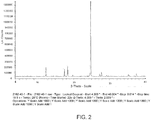
- Solid-state ⁇ -GPA was analyzed by XRPD ( Figure 2 ) and was also observed under a polarized microscope ( Figure 3 ). The material was found to be crystalline
- a DSC thermogram of ⁇ -GPA is illustrated in Figure 4 .
- the melting onset of ⁇ -GPA was found to be around 219 °C followed by an endothermic event at around 237 °C and immediate possible degradation. However, another tiny endothermic event at 187 °C was also exhibited by the material (possible traces of another form of ⁇ -GPA).
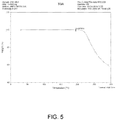
- TGA analysis reveals that there is less than 0.1% weight loss in the sample from 30 to 145 °C as illustrated in Figure 5 .
- Table 10 illustrates the selected counter ions for the salt screening of ⁇ -GPA. Salt screening experiments were designed in 1:1.1 equivalence (eq) for ⁇ -GPA to counter ion. Table 10. List of selected counterions Sample ID ⁇ -GPA (mg) Counterion Counterion sequence # Counterion molecular wt 2162-42-1 to 4 30 Hydrochloric acid (36-38%)* 1 36.46 2162-42-5 to 8 30 Hydrobromic acid (48%)* 2 80.91 2162-42-9 to 12 30 Sulfuric acid (95-98%)* 3 98.08 2162-42-13 to 16 30 Phosphoric acid (85%)* 4 98.00 2162-42-17 to 20 30 Methane sulfonic acid (98%)* 5 96.11 2162-42-21 to 24 30 Maleic acid 6 116.07 2162-42-25 to 28 30 Fumaric acid 7 116.07 2162-42-29 to 32 30 Tartaric acid 8 150.09 2162-42-33 to 36 30
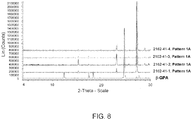
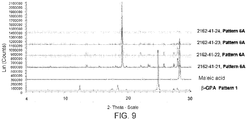
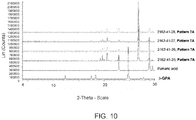
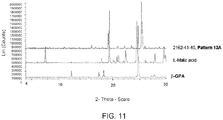
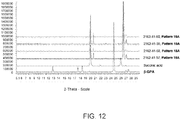
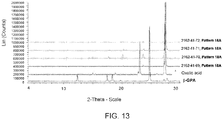
- Figures 8 through 13 represents the XRPDs of the new crystalline forms isolated from slurry/slow evaporation experiments.
- Crystalline forms were prepared with phosphoric acid (from ethyl acetate and trifluoroethanol), methanesulfonic acid (from ethyl acetate), ethanesulfonic acid (from all four solvents), and L-malic acid (from trifluoroethanol).
- Salt screening experiments of ⁇ -GPA with maleic, fumaric, and oxalic acids in 2:1 ( ⁇ -GPA:acid) ratio were set up. Around 0.3 mL of water was used to dissolve ⁇ -GPA (120 mg) and the counterion in 2:1 ( ⁇ -GPA:acid) ratio at 90 °C for oxalic and maleic acid. However, for the experiment with fumaric acid, 0.2 mL of methanol was used to dissolve the counterion at 65 °C. All the experiments resulted in the precipitation of white solids within 10 minutes. However, the vials were left for stirring over the weekend.
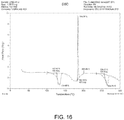
- the DSC of ⁇ -GPA-HCl salt revealed the presence of an endothermic event at around 135 °C followed by an exothermic event at around 185 °C and an endotherm at 265 °C ( Figure 16 ).
- the exothermic event in the DSC arises from the recrystallization of the sample as confirmed by hot stage microscopy ( Figure 17 ).
- the TGA analysis revealed a weight loss of around 11% from 31 °C to 210 °C.
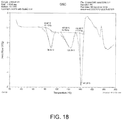
- the ⁇ -GPA-maleic acid salt (Sample ID: 2162-42-21) exhibited three endotherms at the following temperatures: 90, 124 and 141 °C ( Figure 18 ).
- TGA analysis revealed a weight loss of around 1.2 % from 31 to 105 °C (1st endotherm) and a weight loss of around 5.4 % from 105 to 138 °C (2nd endotherm).
- the ⁇ -GPA-maleic acid salt (Sample ID: 2162-48-6) exhibited two endotherms at 85 and 155 °C respectively. However, the dried sample exhibited only one endotherm at 155 °C. From the DSC analysis it is evident that a hydrate was formed in the prior case whereas an anhydrous form was yielded as a result of drying. TGA analysis revealed a weight loss of ⁇ 0.1 % from 31 to 145 °C.
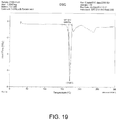
- ⁇ -GPA-fumaric acid salt (Sample ID: 2162-42-25) exhibited an endotherm at 171 °C ( Figure 19 ) followed by possible decomposition of the salt.
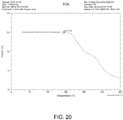
- TGA analysis revealed a weight loss ⁇ 1% from 31 °C to 145 °C ( Figure 20 ).
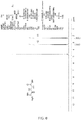
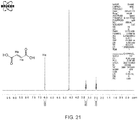
- the 1 H NMR of the 1:1 fumarate salt is shown in Figure 21 .
- ⁇ -GPA-L-malic acid salt (Sample ID: 2162-42-45) exhibited an endotherm at 110 °C followed by possible decomposition of the salt.
- TGA analysis revealed a weight loss ⁇ 1% from 31 °C to 145 °C.
- the 1 H-NMR of the salt confirmed it was a 1:1 salt.
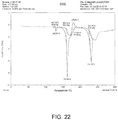
- the DSC of ⁇ -GPA-succinic acid salt revealed the presence of an endothermic event at around 130 °C followed by another endothermic event at around 175 °C. An exothermic event was observed at around 179 °C ( Figure 22 ) followed by an endothermic event at 232 °C.
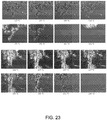
- hot stage microscopy was performed on the sample and illustrated in Figure 23 .
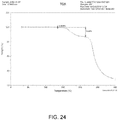
- the TGA analysis revealed a weight loss of around 0.4% from 31 °C to 135 °C and 13% from 135 to 215 °C ( Figure 24 ).
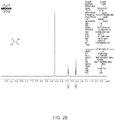
- the 1 H-NMR revealed that the salt formed between ⁇ -GPA and succinic acid was in 2:1 ( ⁇ -GPA:acid) molar ratio ( Figure 25 ).
- the ⁇ -GPA-oxalic acid (Sample ID: 2162-42-69) when analyzed by DSC revealed a presence of an endothermic event at around 217 °C followed by an exothermic peak at around 224 °C and an endotherm at 268 °C as represented in Figure 26 .
- the TGA analysis revealed a weight loss of ⁇ 0.3% from 31 to 195 °C ( Figure 27 ).
- FIG 28 The 1 H-NMR of ⁇ -GPA oxalate is presented in Figure 28 . From the elemental analysis the stoichiometric ratio of ⁇ -GPA to oxalic acid was found to be 1:1 (Intertek).
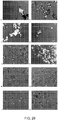
- Salts of ⁇ -GPA were also analyzed by optical microscopy. Optical microscopic images of ⁇ -GPA salts are presented from Figure 29A to 29J . As shown in Figure 30 , ⁇ -GPA fumarate (1:1) has a rod-like crystal morphology.
- 1:1 ⁇ -GPA oxalate and 1:1 ⁇ -GPA fumarate salts retained their XRPD pattern after 48 hours slurry in water.
- 2:1 ⁇ -GPA succinate started showing up peaks from ⁇ -GPA after 6 hours slurry in water and thus the experiment was stopped after 6 hours.
- Example 9 Solid Form Stability of Salts at 40 °C and 75% Humidity
- the mobile phase was prepared by dissolving 2.72 g of monobasic potassium phosphate in 1L of deionized water and the adjusting the desired pH by 85% (w/w) phosphoric acid.
- Mobile Phase B 100 % Acetonitrile Gradient used: Time (minutes) A % B % 0 25 75 15.0 25 75 23.0 80 20 25.0 80 20 25.1 25 75 30.0 25 75 Flow rate: 1 mL/min Injection volume: 10 ⁇ L Detector wavelength: 210 nm Run time: 30 minutes Column temperature: 40 °C Diluent: Acetonitrile:water (1:1)
- the counterions were also analyzed by HPLC under the same concentrations as they were present in the respective salts.
- Table 15 lists the bulk and tapped density of ⁇ -GPA and salts thereof.
- Table 15 lists the bulk and tapped density of ⁇ -GPA and salts thereof. Table 15. Bulk and Tapped Densities Sample Bulk density ( ⁇ B) Tapped density ( ⁇ T) ⁇ -GPA 0.389 g/cc 0.627 g/cc ⁇ -GPA oxalate (1:1) 0.505 g/cc 0.623 g/cc ⁇ -GPA succinate (2:1) 0.405 g/cc 0.472 g/cc ⁇ -GPA fumarate (1:1) 0.576 g/cc 0.613 g/cc
- a Carr's index greater than 25 is considered to be an indication of poor flowability while a value below 15 is an indication of good flowability.
- Table 16 lists the Carr's index and Hausner ratio corresponding to the flow character of a powder proposed by R. L. Carl. Table 16. Flow Characteristics Based on Carr's Index and Hausner Ration Carr index Flow character Hausner ratio 1-10 Excellent 1.00 - 1.11 11-15 Good 1.12 - 1.18 16-20 Fair 1.19 - 1.25 21-25 Passable 1.26 - 1.34 26-31 Poor 1.35 - 1.45 32-37 Very poor 1.46 - 1.59 > 38 Very very poor > 1.60
- Table 17 lists the Carr's index and Hausner ratio for ⁇ -GPA and salts thereof.
- Carr's Index and Hausner Ratio for ⁇ -GPA and Salts Thereof Sample Carr index Flow character Hausner ratio ⁇ -GPA 37.9 Very very poor 1.610 ⁇ -GPA oxalate (1:1) (Pattern 18 A, original salt ) 18.7 Fair 1.23 ⁇ -GPA succinate (2:1) (Pattern 15A) 14.3 Good 1.167 ⁇ -GPA fumarate (1:1) (Pattern 7A) 5.9 Excellent 1.063
- a cylindrical vessel is secured to the stand and above that a funnel is also secured such that the bottom of the funnel is close to the vessel.
- a powder load of ⁇ 50-60 g is then poured through the funnel into the middle of the cylinder.
- the lever device is pulled to open the hole in the disk quickly and without vibration. If a powder slowly flows through the small-diameter holes, leaving a cavity shaped like an upside-down, truncated cone, the test is considered positive. If a powder flocculates in bulk and falls abruptly, forming a cylindrical cavity, the test is considered negative. If a powder does not fall through the small-diameter holes, the test is considered negative. If the experiment is negative, the powder is tested again with a disk having a larger hole.
- Tables 18-21 list the flowability test results for ⁇ -GPA and salts thereof. Table 18. Flowability Test Results for ⁇ -GPA Run # Disc pore Size mm Did solid pass? 1 18 No 2 20 No 3 28 No 4 32 Yes, but the powder fell abruptly forming a cylindrical cavity (flocculation). Thus, the test was considered negative. 5 30 No 6 34 Yes Table 19. Flowability Test Results for the Oxalate Salt Run # Disc pore Size mm Did solid pass? 1 12 No 2 18 No 3 24 No 4 30 Yes 5 28 Yes 6 26 Yes Table 20. Flowability Test Results for the Succinate Salt Run # Disc pore Size mm Did solid pass?
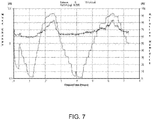
- Sample 2162-64-1 was analyzed by DVS in triplicate and the post DVS samples were characterized by XRPD to identify the form at the end of the experiment.
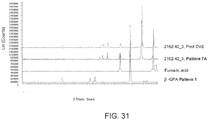
- the moisture uptake by ⁇ -GPA fumarate was found to be less than 0.1%.
- the XRPDs were found to be identical to ⁇ -GPA fumarate (Pattern 7A) and no appearance of ⁇ -GPA peaks were observed, unlike sample 2162-42-3 post DVS ( Figure 30 ).
- ⁇ -GPA maleate (1:1), fumarate (1:1), succinate (2:1) and oxalate (1:1) Three salts of ⁇ -GPA were selected after performing the DVS experiments: ⁇ -GPA maleate (1:1), fumarate (1:1), succinate (2:1) and oxalate (1:1) and the form stability was determined by XRPD.
- ⁇ -GPA fumarate, succinate and oxalate retained their XRPD after the DVS experiment.
- ⁇ -GPA fumarate revealed the presence of two peaks from the ⁇ -GPA indicating dissociation of the salt.
- the purity assessment for the salts was carried out by HPLC and the purity of the salts was as follows: ⁇ -GPA fumarate - 97.7%, ⁇ -GPA succinate - 98.1% and ⁇ -GPA oxalate - 98.4%.
- ⁇ -GPA oxalate Patterns 18A and B
- fumarate fumarate
- succinate was determined using density analyzer unit.
- flowability measurements for the salts were measured using Hanson Flodex unit.
- the solid form stability of ⁇ -GPA fumarate was studied at various temperature/humidity conditions as listed in Table 22 for a week using saturated salt solution chambers. The samples were analyzed by XRPD after a week. The XRPD analysis of the stability samples for ⁇ -GPA fumarate under various temperature/RH conditions indicated that ⁇ -GPA fumarate retained the original XRPD pattern (Pattern 7A) Table 22.
- Solubility of ⁇ -GPA fumarate was measured gravimetrically in fifteen different solvents and solvent mixtures at 15 and 45 °C. About 100 mg of the compound was dispensed in ten volumes (1 mL) of the solvent/solvent mixture and slurried for 48 hours. Table 23 represents the solubility of ⁇ -GPA fumarate in different solvents. After 48 hours the vials were centrifuged. The supernatant was collected and left for slow evaporation under vacuum at 45 °C and solubility was determined. The solids obtained after centrifugation and evaporation were analyzed by XRPD. The XRPD analysis of the precipitates after 48 hours slurries revealed no form transformations for 1:1 ⁇ -GPA fumarate.
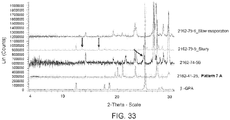
- ⁇ -GPA fumarate was slurried in tetrahydrofuran:water (1:1) for 48 hours. The filtrate was set up for evaporation at 45 °C under vacuum, and after overnight evaporation an off-white solid was obtained. Both the solids from the slurry and the solids obtained after slow evaporation were analyzed by XRPD ( Figure 33 ).
- Pattern 7B obtained by slow evaporation (45 °C) of the filtrate of ⁇ -GPA fumarate from the slurry experiment in tetrahydrofuran:water (1:1), was analyzed by DSC and 1 H-NMR. The DSC revealed the presence of an endotherm at 161 °C and also traces of Pattern 7A (the original ⁇ -GPA fumarate salt).
- Anti-solvent addition experiments for 1:1 ⁇ -GPA fumarate were performed by using different anti-solvents. A given amount of 1:1 ⁇ -GPA fumarate was dissolved in the solvent at 50 °C. Around 1 mL of ice cold anti-solvent was added to salt solution and continued stirring in ice bath for 2 hours followed by overnight stirring at 20 °C. None of the experiments resulted in a new form of ⁇ -GPA fumarate.
- Neat and solvent drop grinding experiments were also performed as a part of polymorph screening. Around 30 mg of the sample was ground in the presence of 20 ⁇ L of solvent (tetrahydrofuran, isopropanol, acetone, water, or t-butylmethylether) for 5 minutes using mortar and pestle. After grinding, the samples were analyzed by XRPD. All the experiments resulted in XRPDs that were identical to Pattern 7A.
- solvent tetrahydrofuran, isopropanol, acetone, water, or t-butylmethylether
- the microscopic image of the sample revealed the presence of some amorphous material. It could be possible that excess of fumaric acid after the formation of 2:1 ⁇ -GPA fumarate salt might have transformed to amorphous as seen in the microscopic image of the lyophilized sample
- the DSC of the lyophilized sample revealed the presence of an exothermic event (possible recrystallization or solid phase transformation) followed by two endothermic events ( Figure 36 ).
- the first endothermic event could be the 1:1 ⁇ -GPA fumarate salt followed by the melting of possible side product which might have formed after the melting of 1:1 ⁇ -GPA fumarate salt.
- Pattern 7A 2162-84-5 Vial containing 50 mg of ⁇ -GPA fumarate was placed in the dry ice-acetone mixture for 30 minutes and was brought to room temperature and again placed back in the dry ice-acetone mixture for additional 30 min and again to RT.
- Pattern 7A 2162-84-6 50 mg of ⁇ -GPA fumarate was heated in a vial to 150 °C and brought to room temperature. This cycle was repeated three times and the sample was analyzed later by XRPD.
- Pattern 7A 2162-84-7 50 mg of ⁇ -GPA fumarate was heated in an aluminum cup to 165 °C and immediately placed in dry ice/acetone cooling bath for 15 min. Later, the sample was analyzed later by XRPD. The started turned yellow to brown in color upon heating.
- Pattern 7D Heating of ⁇ -GPA fumarate (2162-84-7) at 160-165°C resulted in a yellow to brownish solid (possible side reaction followed by decomposition) which was further analyzed by 1H-NMR and XRPD.
- Pattern 7A (the original 1:1 ⁇ -GPA fumarate form) appears to be the most stable form.
- Raman spectroscopy of the 1:1 ⁇ -GPA fumarate salt was carried out on a Bruker IFS 66V/S FT-IR/FT-Raman spectrometer equipped with a 1064nm laser ( Figure 37 ).
- the peak list of the Raman spectra is listed in Table 26. Table 26.
Landscapes
- Chemical & Material Sciences (AREA)
- Health & Medical Sciences (AREA)
- Organic Chemistry (AREA)
- Public Health (AREA)
- Veterinary Medicine (AREA)
- General Health & Medical Sciences (AREA)
- Animal Behavior & Ethology (AREA)
- Life Sciences & Earth Sciences (AREA)
- Pharmacology & Pharmacy (AREA)
- Medicinal Chemistry (AREA)
- Epidemiology (AREA)
- General Chemical & Material Sciences (AREA)
- Chemical Kinetics & Catalysis (AREA)
- Engineering & Computer Science (AREA)
- Nuclear Medicine, Radiotherapy & Molecular Imaging (AREA)
- Oil, Petroleum & Natural Gas (AREA)
- Bioinformatics & Cheminformatics (AREA)
- Dermatology (AREA)
- Oncology (AREA)
- Crystallography & Structural Chemistry (AREA)
- Acyclic And Carbocyclic Compounds In Medicinal Compositions (AREA)
- Pharmaceuticals Containing Other Organic And Inorganic Compounds (AREA)
- Organic Low-Molecular-Weight Compounds And Preparation Thereof (AREA)
Priority Applications (4)
| Application Number | Priority Date | Filing Date | Title |
|---|---|---|---|
| PL16840104T PL3340973T3 (pl) | 2015-08-25 | 2016-08-25 | Farmaceutycznie dopuszczalne sole kwasu beta-guanidynopropionowego o ulepszonych właściwościach, i ich zastosowania |
| HRP20210044TT HRP20210044T1 (hr) | 2015-08-25 | 2016-08-25 | Farmaceutski prihvatljive soli beta-gvanidinopropionske kiseline sa poboljšanim svojstvima i njihova upotreba |
| SI201631048T SI3340973T1 (sl) | 2015-08-25 | 2016-08-25 | Farmacevtsko sprejemljive soli beta-gvanidinopropionske kisline z izboljšanimi lastnostmi in njihove uporabe |
| RS20210023A RS61804B1 (sr) | 2015-08-25 | 2016-08-25 | Farmaceutski prihvatljive soli beta-gvanidinopropionske kiseline sa poboljšanim svojstvima i njihova upotreba |
Applications Claiming Priority (2)
| Application Number | Priority Date | Filing Date | Title |
|---|---|---|---|
| US201562209624P | 2015-08-25 | 2015-08-25 | |
| PCT/US2016/048643 WO2017035331A1 (en) | 2015-08-25 | 2016-08-25 | PHARMACEUTICALLY ACCEPTABLE SALTS OF β-GUANIDINOPROPIONIC ACID WITH IMPROVED PROPERTIES AND USES THEREOF |
Publications (3)
| Publication Number | Publication Date |
|---|---|
| EP3340973A1 EP3340973A1 (en) | 2018-07-04 |
| EP3340973A4 EP3340973A4 (en) | 2019-04-03 |
| EP3340973B1 true EP3340973B1 (en) | 2020-10-14 |
Family
ID=58100994
Family Applications (1)
| Application Number | Title | Priority Date | Filing Date |
|---|---|---|---|
| EP16840104.0A Active EP3340973B1 (en) | 2015-08-25 | 2016-08-25 | Pharmaceutically acceptable salts of beta-guanidinopropionic acid with improved properties and uses thereof |
Country Status (16)
| Country | Link |
|---|---|
| US (4) | US20170056352A1 (OSRAM) |
| EP (1) | EP3340973B1 (OSRAM) |
| JP (2) | JP6880023B2 (OSRAM) |
| KR (1) | KR102707964B1 (OSRAM) |
| CN (2) | CN114057611A (OSRAM) |
| AU (1) | AU2016311368B2 (OSRAM) |
| CA (1) | CA2996520C (OSRAM) |
| DK (1) | DK3340973T3 (OSRAM) |
| ES (1) | ES2843561T3 (OSRAM) |
| HR (1) | HRP20210044T1 (OSRAM) |
| HU (1) | HUE053963T2 (OSRAM) |
| PL (1) | PL3340973T3 (OSRAM) |
| PT (1) | PT3340973T (OSRAM) |
| RS (1) | RS61804B1 (OSRAM) |
| SI (1) | SI3340973T1 (OSRAM) |
| WO (1) | WO2017035331A1 (OSRAM) |
Families Citing this family (12)
| Publication number | Priority date | Publication date | Assignee | Title |
|---|---|---|---|---|
| EP3950673A1 (en) | 2014-04-30 | 2022-02-09 | Inspirna, Inc. | Inhibitors of creatine transport and uses thereof |
| US20190125745A1 (en) * | 2014-12-17 | 2019-05-02 | Rgenix, Inc. | Treatment and diagnosis of cancer |
| US20170056352A1 (en) * | 2015-08-25 | 2017-03-02 | Rgenix, Inc. | PHARMACEUTICALLY ACCEPTABLE SALTS OF beta-GUANIDINOPROPIONIC ACID WITH IMPROVED PROPERTIES AND USES THEREOF |
| TWI808055B (zh) | 2016-05-11 | 2023-07-11 | 美商滬亞生物國際有限公司 | Hdac 抑制劑與 pd-1 抑制劑之組合治療 |
| TWI794171B (zh) | 2016-05-11 | 2023-03-01 | 美商滬亞生物國際有限公司 | Hdac抑制劑與pd-l1抑制劑之組合治療 |
| WO2018160178A1 (en) * | 2017-03-01 | 2018-09-07 | Rgenix, Inc. | Pharmaceutically acceptable salts of b-guanidinopropionic acid with improved properties and uses thereof |
| EP3713575A4 (en) | 2017-11-21 | 2021-08-25 | Rgenix, Inc. | POLYMORPHS AND THEIR USES |
| WO2021119316A1 (en) * | 2019-12-11 | 2021-06-17 | Rgenix, Inc. | Methods of treating cancer |
| HUE067466T2 (hu) | 2019-12-13 | 2024-10-28 | Inspirna Inc | Fémsók és alkalmazásuk |
| KR102615692B1 (ko) | 2021-10-13 | 2023-12-19 | 주식회사 휴엔켐 | 베타-구아니디노프로피온산을 포함하는 간섬유화 예방 또는 치료용 조성물 |
| CN119421865A (zh) * | 2022-04-21 | 2025-02-11 | 默沙东有限责任公司 | 制备附聚的结晶中链脂肪酸钠盐的方法 |
| KR102822799B1 (ko) | 2022-11-09 | 2025-06-20 | 충남대학교산학협력단 | 베타-구아니디노프로피온산을 포함하는 장내 미생물 개선용 조성물 |
Family Cites Families (78)
| Publication number | Priority date | Publication date | Assignee | Title |
|---|---|---|---|---|
| CA101653A (en) | 1906-08-30 | 1906-10-23 | Herman Besser | Mould |
| BE794886A (fr) * | 1972-02-22 | 1973-08-02 | Pfizer | Acides 6-(alpha-(omega-guanidinoalcanoylamino)acylamino)-penicillaniques |
| US3933797A (en) * | 1972-02-22 | 1976-01-20 | Pfizer Inc. | 6-[α-(ω-QUANIDINOALKANOYLAMIDO)ACYLAMIDO]PENICILLANIC ACIDS |
| US3972872A (en) | 1974-09-23 | 1976-08-03 | Pfizer Inc. | 6-[α-(ω-Guanidinoalkanoylamido)acylamido]penicillanic acids |
| ATE70048T1 (de) | 1986-09-10 | 1991-12-15 | Syntex Inc | Selektive amidinierung von diaminen. |
| US5676978A (en) * | 1989-02-14 | 1997-10-14 | Amira, Inc. | Methods of inhibiting undesirable cell growth using a combination of a cyclocreatine compound and a hyperplastic inhibitory agent |
| CA2028593C (en) * | 1989-10-31 | 2007-08-21 | Douglas R. Brandt | Stabilized enzyme compositions |
| DE4334639A1 (de) | 1993-10-11 | 1995-04-13 | Inst Neue Mat Gemein Gmbh | Verfahren zur Herstellung von TiN-Sinterkörpern und -Schichten |
| DE793646T1 (de) | 1994-11-23 | 1999-12-30 | Pharmacia & Upjohn Co., Kalamazoo | Carboxylierte aminoguanidine zum behandlung von insulin-unabhängigem diabetes mellitus |
| US5994577A (en) | 1994-11-23 | 1999-11-30 | Larsen; Scott D. | Aminoguanidine carboxylates for the treatment of non-insulin-dependent diabetes mellitus |
| JP3745439B2 (ja) | 1995-07-06 | 2006-02-15 | 花王株式会社 | 皮膚外用剤 |
| TW453881B (en) | 1995-10-16 | 2001-09-11 | Kao Corp | Cosmetic composition comprising amide derivatives |
| JPH09202710A (ja) * | 1995-11-20 | 1997-08-05 | Kao Corp | しわ改善剤 |
| AU3117497A (en) | 1996-05-21 | 1997-12-09 | Pharmacia & Upjohn Company | Aminoguanidine carboxylate lactams for the treatment of non-insulin-dependent diabetes mellitus |
| JP4317599B2 (ja) | 1996-06-26 | 2009-08-19 | 武田薬品工業株式会社 | 徐放性製剤 |
| EP1093370B1 (en) | 1998-06-30 | 2006-02-22 | Takeda Pharmaceutical Company Limited | Pharmaceutical composition for the treatment of diabetes |
| EP1656945A1 (en) | 1999-06-05 | 2006-05-17 | The Board Of Trustees Of The Leland Stanford Junior University | Pharmaceutical composition comprising oligoarginine |
| US6605115B1 (en) | 1999-06-05 | 2003-08-12 | Board Of Trustees Of The Leland Stanford Junior University | Method and composition for inhibiting cardiovascular cell proliferation |
| US6242491B1 (en) | 1999-06-25 | 2001-06-05 | Rima Kaddurah-Daouk | Use of creatine or creatine compounds for skin preservation |
| US20020082448A1 (en) | 1999-11-08 | 2002-06-27 | The Upjohn Company | Aminoguanidine carboxylates for the treatment of non-insulin-dependent diabetes mellitus |
| US7335723B2 (en) | 2001-08-08 | 2008-02-26 | Merck & Co., Inc. | Melanin-concentrating hormone antagonists |
| EP1465609A2 (en) | 2001-11-07 | 2004-10-13 | Medical Research Council | Modulation of dopaminergic neurons |
| CA2473229A1 (en) | 2002-01-09 | 2003-07-24 | Merck & Co., Inc. | Selective melanin-concentrating hormone type -1 receptor agonists |
| US20120245211A1 (en) | 2002-06-04 | 2012-09-27 | Children's Hospital Medical Center | Methods of Treating Cognitive Dysfunction by Modulating Brain Energy Metabolism |
| EP1567180A4 (en) | 2002-06-04 | 2010-03-10 | Avicena Group Inc | METHODS OF TREATING COGNITIVE DYSFUNCTIONS BY MODULATING BRAIN ENERGY METABOLISM |
| GB0302882D0 (en) | 2003-02-07 | 2003-03-12 | Univ Cardiff | Improvements in or relating to agents for the treatment of cardiovascular dysfunction and weight loss |
| EP1746099A1 (en) | 2004-12-23 | 2007-01-24 | DeveloGen Aktiengesellschaft | Mnk1 or Mnk2 inhibitors |
| JP4865251B2 (ja) | 2005-05-09 | 2012-02-01 | 株式会社 資生堂 | 不全角化抑制剤、毛穴縮小剤及び皮膚外用組成物 |
| KR101355868B1 (ko) | 2005-08-02 | 2014-01-27 | 알즈켐 아게 | 구아니디노아세트산 성분에 기반한 액체 제제 |
| WO2008054544A2 (en) | 2006-05-22 | 2008-05-08 | Immune Disease Institute, Inc. | Method for delivery across the blood brain barrier |
| WO2008043024A2 (en) | 2006-10-04 | 2008-04-10 | Kalypsys, Inc. | Oral pharmaceutical formulation comprising a sulfonyl bicyclic modulator of ppar for the treatment of disease |
| CN101594778A (zh) | 2006-12-11 | 2009-12-02 | 凯姆制药公司 | 苯丙胺的非标准氨基酸结合物及其制备和使用的方法 |
| DE102007004781A1 (de) | 2007-01-31 | 2008-08-07 | Alzchem Trostberg Gmbh | Verwendung von Guanidinoessigsäure(-Salzen) zur Herstellung eines gesundheitsfördernden Mittels |
| CA2674020A1 (en) | 2007-02-08 | 2008-08-14 | Kempharm, Inc. | Polar hydrophilic prodrugs of amphetamine and other stimulants and processes for making and using the same |
| EP2197890A1 (en) | 2007-09-07 | 2010-06-23 | Gencia Corporation | Mitochondrial compositions and uses thereof |
| WO2009098142A1 (en) | 2008-02-06 | 2009-08-13 | Helm Ag | Prasugrel salts with improved properties |
| BRPI0907287B1 (pt) | 2008-12-19 | 2018-01-02 | L'oréal | "processo de clareamento ou de coloração das fibras queratínicas e dispositivo com vários comportamentos" |
| FR2940077B1 (fr) | 2008-12-19 | 2012-07-20 | Oreal | Procede de coloration eclaircissante de matieres keratiniques mettant en oeuvre une composition anhydre colorante comprenant un agent alcalin et une composition oxydante. |
| FR2940104B1 (fr) | 2008-12-19 | 2011-08-19 | Oreal | Procede de traitement des cheveux mettant en oeuvre une emulsion directe comprenant un agent oxydant et une composition contenant un agent alcalin |
| JP5866137B2 (ja) | 2009-04-30 | 2016-02-17 | ロレアル | アミノトリアルコキシシランまたはアミノトリアルケニルオキシシラン化合物を含む組成物を用いたヒトケラチン繊維の明色化および/または着色ならびに装置 |
| WO2011031308A1 (en) | 2009-09-09 | 2011-03-17 | Cytokinetics, Incorporated | Novel combinations |
| CN102573888A (zh) | 2009-09-18 | 2012-07-11 | 诺和诺德公司 | 长效y2 受体激动剂 |
| FR2954160B1 (fr) | 2009-12-22 | 2012-03-30 | Oreal | Composition de coloration ou d'eclaircissement comprenant un corps gras et un polymere amphotere |
| CN104586859B (zh) | 2009-12-31 | 2017-12-05 | 凯姆制药公司 | 喹硫平的氨基酸缀合物、其制备和使用方法 |
| DE102010012199A1 (de) | 2010-03-19 | 2011-09-22 | Fresenius Medical Care Deutschland Gmbh | Molekular geprägte Polymere für die Eliminierung von Metaboliten |
| FR2958161B1 (fr) | 2010-04-02 | 2012-04-27 | Oreal | Procede de traitement des cheveux mettant en oeuvre une emulsion directe comprenant un agent oxydant et une emulsion directe contenant un agent alcalin |
| WO2011127933A1 (en) | 2010-04-16 | 2011-10-20 | Nuevolution A/S | Bi-functional complexes and methods for making and using such complexes |
| WO2011133150A1 (en) | 2010-04-21 | 2011-10-27 | Pharmacofore, Inc. | Compositions comprising enzyme-cleavable prodrugs of active agents and inhibitors thereof |
| EP2560489A4 (en) | 2010-04-21 | 2014-01-22 | Signature Therapeutics Inc | COMPOSITIONS WITH ENZYMSPALTBAR OPIOID PRODRUGS AND HEMMER FOR THIS |
| US20110262359A1 (en) | 2010-04-21 | 2011-10-27 | Jenkins Thomas E | Compositions comprising enzyme-cleavable prodrugs of active agents and inhibitors thereof |
| US20110262355A1 (en) | 2010-04-21 | 2011-10-27 | Jenkins Thomas E | Compositions comprising enzyme-cleavable opioid prodrugs and inhibitors thereof |
| US20130059914A1 (en) | 2010-04-21 | 2013-03-07 | Signature Therapeutics, Inc. | Compositions Comprising Enzyme-Cleavable Amphetamine Prodrugs and Inhibitors Thereof |
| RU2012151500A (ru) | 2010-05-03 | 2014-06-10 | Дженентек, Инк. | Композиции и способы, пригодные для снижения вязкости белковосодержащих составов |
| WO2011143534A1 (en) | 2010-05-13 | 2011-11-17 | The Mclean Hospital Corporation | Methods for the treatment of psychiatric disorders |
| EP2399885A1 (en) | 2010-06-22 | 2011-12-28 | Ulrich Dietz | Device and method for solubilizing, separating, removing and reacting carboxylic acids in aqueous or organic solutions by means of micro- or nanoemulsification |
| WO2012024611A1 (en) | 2010-08-20 | 2012-02-23 | Natural Alternatives International, Inc. | Methods of treating sarcopenia and frailty |
| WO2012047630A2 (en) | 2010-09-27 | 2012-04-12 | Martin Teintze | N-alkyl or n-aryl substituted guanide and biguanide compounds and methods of their use |
| US8765115B2 (en) | 2010-12-01 | 2014-07-01 | National Institute of Agrobiological Scienses | Method of treatment of gastrointestinal disorders with IL-10 |
| US20120232066A1 (en) | 2011-03-09 | 2012-09-13 | Jenkins Thomas E | Compositions for reducing risk of adverse events caused by drug-drug interactions |
| WO2012122420A2 (en) | 2011-03-09 | 2012-09-13 | Pharmacofore, Inc. | Opioid prodrugs with heterocyclic linkers |
| EP2683394B1 (en) | 2011-03-09 | 2021-01-06 | Signature Therapeutics, Inc. | Active agent prodrugs with heterocyclic linkers |
| WO2012138214A1 (en) | 2011-04-08 | 2012-10-11 | Brewster Lizzy Maritza | Beta-guanidinopropionic acid for the treatment of hypertension |
| WO2012173846A2 (en) | 2011-06-06 | 2012-12-20 | Aileron Therapeutics, Inc. | Peptidomimetic macrocycles |
| CN102850242A (zh) * | 2011-06-27 | 2013-01-02 | 天津天成制药有限公司 | 胍基丙酸硝酸盐的制备方法 |
| US8427223B2 (en) | 2011-07-19 | 2013-04-23 | Lsi Corporation | Voltage level translator circuit for reducing jitter |
| BR112014002084B1 (pt) | 2011-07-28 | 2022-03-29 | Kempharm, Inc | Composição de pró-fármaco e uso de conjugado de metilfenidato |
| TW201806968A (zh) | 2011-10-18 | 2018-03-01 | 艾利倫治療公司 | 擬肽巨環化合物 |
| FR2983407B1 (fr) | 2011-12-06 | 2014-01-03 | Oreal | Composition aqueuse riche en huile et son utilisation dans un procede de coloration d'oxydation ou de decoloration |
| BR112014020103A2 (pt) | 2012-02-15 | 2018-10-09 | Aileron Therapeutics, Inc. | macrociclos peptidomiméticos |
| CA2864120A1 (en) | 2012-02-15 | 2013-08-22 | Aileron Therapeutics, Inc. | Triazole-crosslinked and thioether-crosslinked peptidomimetic macrocycles |
| MX2014014902A (es) | 2012-06-05 | 2015-03-04 | Neuroderm Ltd | Composiciones que comprenden apomorfina y acidos organicos y usos de las mismas. |
| US9221789B2 (en) | 2012-06-22 | 2015-12-29 | Basf Se | Multicomponent crystals comprising imatinib mesilate and selected co-crystal formers |
| CN114177166B (zh) * | 2012-10-31 | 2024-07-30 | 洛克菲勒大学 | 结肠癌的治疗和诊断 |
| FR2997846B1 (fr) | 2012-11-09 | 2023-10-20 | Oreal | Composition comprenant un derive dicarbonyle et un acide, le procede de lissage des fibres keratiniques a partir de cette composition |
| WO2014138492A1 (en) | 2013-03-08 | 2014-09-12 | Solan, LLC | Methods for fabricating graphite-based structures and devices made therefrom |
| CN103288685B (zh) * | 2013-07-03 | 2015-02-18 | 郭礼强 | 一种3-胍基丙酸的制备方法 |
| US20170056352A1 (en) | 2015-08-25 | 2017-03-02 | Rgenix, Inc. | PHARMACEUTICALLY ACCEPTABLE SALTS OF beta-GUANIDINOPROPIONIC ACID WITH IMPROVED PROPERTIES AND USES THEREOF |
| WO2018160178A1 (en) | 2017-03-01 | 2018-09-07 | Rgenix, Inc. | Pharmaceutically acceptable salts of b-guanidinopropionic acid with improved properties and uses thereof |
-
2016
- 2016-08-24 US US15/245,750 patent/US20170056352A1/en not_active Abandoned
- 2016-08-25 CN CN202111189796.6A patent/CN114057611A/zh active Pending
- 2016-08-25 HU HUE16840104A patent/HUE053963T2/hu unknown
- 2016-08-25 PL PL16840104T patent/PL3340973T3/pl unknown
- 2016-08-25 JP JP2018529503A patent/JP6880023B2/ja active Active
- 2016-08-25 RS RS20210023A patent/RS61804B1/sr unknown
- 2016-08-25 CN CN201680057402.2A patent/CN108472269B/zh active Active
- 2016-08-25 KR KR1020187008144A patent/KR102707964B1/ko active Active
- 2016-08-25 ES ES16840104T patent/ES2843561T3/es active Active
- 2016-08-25 WO PCT/US2016/048643 patent/WO2017035331A1/en not_active Ceased
- 2016-08-25 AU AU2016311368A patent/AU2016311368B2/en active Active
- 2016-08-25 PT PT168401040T patent/PT3340973T/pt unknown
- 2016-08-25 DK DK16840104.0T patent/DK3340973T3/da active
- 2016-08-25 SI SI201631048T patent/SI3340973T1/sl unknown
- 2016-08-25 EP EP16840104.0A patent/EP3340973B1/en active Active
- 2016-08-25 HR HRP20210044TT patent/HRP20210044T1/hr unknown
- 2016-08-25 CA CA2996520A patent/CA2996520C/en active Active
- 2016-09-30 US US15/281,329 patent/US9827217B2/en active Active
-
2017
- 2017-10-27 US US15/795,540 patent/US10512623B2/en active Active
-
2019
- 2019-11-06 US US16/675,669 patent/US20200138759A1/en not_active Abandoned
-
2021
- 2021-04-30 JP JP2021077099A patent/JP7134294B2/ja active Active
Non-Patent Citations (1)
| Title |
|---|
| None * |
Also Published As
| Publication number | Publication date |
|---|---|
| DK3340973T3 (da) | 2021-01-11 |
| RS61804B1 (sr) | 2021-06-30 |
| CA2996520A1 (en) | 2017-03-02 |
| US20180243248A1 (en) | 2018-08-30 |
| HK1257822A1 (en) | 2019-11-01 |
| JP2021121597A (ja) | 2021-08-26 |
| JP7134294B2 (ja) | 2022-09-09 |
| PL3340973T3 (pl) | 2021-06-14 |
| SI3340973T1 (sl) | 2021-07-30 |
| CA2996520C (en) | 2024-11-19 |
| CN108472269B (zh) | 2021-11-02 |
| EP3340973A4 (en) | 2019-04-03 |
| KR20180059446A (ko) | 2018-06-04 |
| AU2016311368A1 (en) | 2018-03-29 |
| KR102707964B1 (ko) | 2024-09-20 |
| CN114057611A (zh) | 2022-02-18 |
| US20170056352A1 (en) | 2017-03-02 |
| ES2843561T3 (es) | 2021-07-19 |
| EP3340973A1 (en) | 2018-07-04 |
| AU2016311368B2 (en) | 2020-10-08 |
| CN108472269A (zh) | 2018-08-31 |
| PT3340973T (pt) | 2021-01-19 |
| JP6880023B2 (ja) | 2021-06-02 |
| US20200138759A1 (en) | 2020-05-07 |
| US10512623B2 (en) | 2019-12-24 |
| JP2018531280A (ja) | 2018-10-25 |
| HRP20210044T1 (hr) | 2021-04-30 |
| HUE053963T2 (hu) | 2021-07-28 |
| US9827217B2 (en) | 2017-11-28 |
| US20170056353A1 (en) | 2017-03-02 |
| WO2017035331A1 (en) | 2017-03-02 |
Similar Documents
| Publication | Publication Date | Title |
|---|---|---|
| EP3340973B1 (en) | Pharmaceutically acceptable salts of beta-guanidinopropionic acid with improved properties and uses thereof | |
| US9884813B1 (en) | Pharmaceutically acceptable salts of B-guanidinopropionic acid with improved properties and uses thereof | |
| US8293726B2 (en) | Treatment of cancer and other diseases | |
| US20220054664A1 (en) | Pharmacokinetic enhancements of bifunctional chelates and uses thereof | |
| ES2542647T3 (es) | Derivados de pirido[2,3 b]pirazina y sus usos terapéuticos | |
| EP3068443B1 (en) | Residualizing linkers and uses thereof | |
| US10717704B2 (en) | Inhibitors of creatine transport and uses thereof | |
| WO2022087371A1 (en) | Novel bicyclic compounds | |
| TW201024309A (en) | A triazolothiadiazole inhibitor of c-Met protein kinase | |
| US20250114488A1 (en) | Psma-targeted radiopharmaceuticals and checkpoint inhibitor combination therapy | |
| WO2004007676A2 (en) | Combination therapy for the treatment of neoplasms | |
| WO2016176636A1 (en) | Inhibitors of creatine transport and uses thereof | |
| HK1257822B (en) | Pharmaceutically acceptable salts of beta-guanidinopropionic acid with improved properties and uses thereof | |
| US20250177581A1 (en) | Ntsr1-targeted radiopharmaceuticals and dna damage response inhibitor combination therapy | |
| US20230150976A1 (en) | 4-Amino Pyrimidine Compounds for the Treatment of Cancer | |
| TW202506204A (zh) | Psma靶向放射性藥物及dna損傷反應抑制劑之組合療法 | |
| TW202337450A (zh) | Ntsr1靶向放射性藥物及檢查點抑制劑之組合療法 | |
| EA045232B1 (ru) | Усиление фармакокинетики бифункциональных хелатов и их применения | |
| HK1235391B (en) | Inhibitors of creatine transport and uses thereof | |
| WO2005117847A2 (en) | Methods and compounds for the treatment of neoplasms |
Legal Events
| Date | Code | Title | Description |
|---|---|---|---|
| STAA | Information on the status of an ep patent application or granted ep patent |
Free format text: STATUS: THE INTERNATIONAL PUBLICATION HAS BEEN MADE |
|
| PUAI | Public reference made under article 153(3) epc to a published international application that has entered the european phase |
Free format text: ORIGINAL CODE: 0009012 |
|
| STAA | Information on the status of an ep patent application or granted ep patent |
Free format text: STATUS: REQUEST FOR EXAMINATION WAS MADE |
|
| 17P | Request for examination filed |
Effective date: 20180322 |
|
| AK | Designated contracting states |
Kind code of ref document: A1 Designated state(s): AL AT BE BG CH CY CZ DE DK EE ES FI FR GB GR HR HU IE IS IT LI LT LU LV MC MK MT NL NO PL PT RO RS SE SI SK SM TR |
|
| AX | Request for extension of the european patent |
Extension state: BA ME |
|
| RIN1 | Information on inventor provided before grant (corrected) |
Inventor name: GRILL, ANDREAS, G. Inventor name: SINGH, ANIRUDDH Inventor name: KAVURU, PADMINI Inventor name: MARTINEZ, EDUARDO, J. |
|
| RAV | Requested validation state of the european patent: fee paid |
Extension state: MA Effective date: 20180322 |
|
| A4 | Supplementary search report drawn up and despatched |
Effective date: 20190301 |
|
| RIC1 | Information provided on ipc code assigned before grant |
Ipc: A61K 31/19 20060101ALI20190222BHEP Ipc: A61K 31/195 20060101ALI20190222BHEP Ipc: C07C 57/15 20060101ALI20190222BHEP Ipc: C07C 279/14 20060101ALI20190222BHEP Ipc: A61K 31/155 20060101AFI20190222BHEP |
|
| REG | Reference to a national code |
Ref country code: HK Ref legal event code: DE Ref document number: 1257822 Country of ref document: HK |
|
| GRAP | Despatch of communication of intention to grant a patent |
Free format text: ORIGINAL CODE: EPIDOSNIGR1 |
|
| STAA | Information on the status of an ep patent application or granted ep patent |
Free format text: STATUS: GRANT OF PATENT IS INTENDED |
|
| INTG | Intention to grant announced |
Effective date: 20200424 |
|
| RIN1 | Information on inventor provided before grant (corrected) |
Inventor name: KAVURU, PADMINI Inventor name: MARTINEZ, EDUARDO, J. Inventor name: GRILL, ANDREAS, G. Inventor name: SINGH, ANIRUDDH |
|
| GRAS | Grant fee paid |
Free format text: ORIGINAL CODE: EPIDOSNIGR3 |
|
| GRAA | (expected) grant |
Free format text: ORIGINAL CODE: 0009210 |
|
| STAA | Information on the status of an ep patent application or granted ep patent |
Free format text: STATUS: THE PATENT HAS BEEN GRANTED |
|
| AK | Designated contracting states |
Kind code of ref document: B1 Designated state(s): AL AT BE BG CH CY CZ DE DK EE ES FI FR GB GR HR HU IE IS IT LI LT LU LV MC MK MT NL NO PL PT RO RS SE SI SK SM TR |
|
| AX | Request for extension of the european patent |
Extension state: BA ME |
|
| REG | Reference to a national code |
Ref country code: GB Ref legal event code: FG4D |
|
| REG | Reference to a national code |
Ref country code: AT Ref legal event code: REF Ref document number: 1322902 Country of ref document: AT Kind code of ref document: T Effective date: 20201015 Ref country code: CH Ref legal event code: EP |
|
| REG | Reference to a national code |
Ref country code: DE Ref legal event code: R096 Ref document number: 602016045995 Country of ref document: DE |
|
| REG | Reference to a national code |
Ref country code: IE Ref legal event code: FG4D |
|
| REG | Reference to a national code |
Ref country code: DK Ref legal event code: T3 Effective date: 20210108 |
|
| REG | Reference to a national code |
Ref country code: HR Ref legal event code: TUEP Ref document number: P20210044T Country of ref document: HR |
|
| REG | Reference to a national code |
Ref country code: CH Ref legal event code: NV Representative=s name: E. BLUM AND CO. AG PATENT- UND MARKENANWAELTE , CH |
|
| REG | Reference to a national code |
Ref country code: PT Ref legal event code: SC4A Ref document number: 3340973 Country of ref document: PT Date of ref document: 20210119 Kind code of ref document: T Free format text: AVAILABILITY OF NATIONAL TRANSLATION Effective date: 20210111 |
|
| REG | Reference to a national code |
Ref country code: FI Ref legal event code: FGE |
|
| REG | Reference to a national code |
Ref country code: NL Ref legal event code: FP |
|
| REG | Reference to a national code |
Ref country code: SE Ref legal event code: TRGR |
|
| REG | Reference to a national code |
Ref country code: GR Ref legal event code: EP Ref document number: 20210400094 Country of ref document: GR Effective date: 20210215 |
|
| REG | Reference to a national code |
Ref country code: NO Ref legal event code: T2 Effective date: 20201014 |
|
| REG | Reference to a national code |
Ref country code: HR Ref legal event code: T1PR Ref document number: P20210044 Country of ref document: HR |
|
| REG | Reference to a national code |
Ref country code: LT Ref legal event code: MG4D |
|
| PG25 | Lapsed in a contracting state [announced via postgrant information from national office to epo] |
Ref country code: LV Free format text: LAPSE BECAUSE OF FAILURE TO SUBMIT A TRANSLATION OF THE DESCRIPTION OR TO PAY THE FEE WITHIN THE PRESCRIBED TIME-LIMIT Effective date: 20201014 Ref country code: BG Free format text: LAPSE BECAUSE OF FAILURE TO SUBMIT A TRANSLATION OF THE DESCRIPTION OR TO PAY THE FEE WITHIN THE PRESCRIBED TIME-LIMIT Effective date: 20210114 |
|
| REG | Reference to a national code |
Ref country code: DE Ref legal event code: R097 Ref document number: 602016045995 Country of ref document: DE |
|
| REG | Reference to a national code |
Ref country code: ES Ref legal event code: FG2A Ref document number: 2843561 Country of ref document: ES Kind code of ref document: T3 Effective date: 20210719 |
|
| REG | Reference to a national code |
Ref country code: HU Ref legal event code: AG4A Ref document number: E053963 Country of ref document: HU |
|
| PG25 | Lapsed in a contracting state [announced via postgrant information from national office to epo] |
Ref country code: SM Free format text: LAPSE BECAUSE OF FAILURE TO SUBMIT A TRANSLATION OF THE DESCRIPTION OR TO PAY THE FEE WITHIN THE PRESCRIBED TIME-LIMIT Effective date: 20201014 Ref country code: LT Free format text: LAPSE BECAUSE OF FAILURE TO SUBMIT A TRANSLATION OF THE DESCRIPTION OR TO PAY THE FEE WITHIN THE PRESCRIBED TIME-LIMIT Effective date: 20201014 Ref country code: EE Free format text: LAPSE BECAUSE OF FAILURE TO SUBMIT A TRANSLATION OF THE DESCRIPTION OR TO PAY THE FEE WITHIN THE PRESCRIBED TIME-LIMIT Effective date: 20201014 Ref country code: SK Free format text: LAPSE BECAUSE OF FAILURE TO SUBMIT A TRANSLATION OF THE DESCRIPTION OR TO PAY THE FEE WITHIN THE PRESCRIBED TIME-LIMIT Effective date: 20201014 Ref country code: RO Free format text: LAPSE BECAUSE OF FAILURE TO SUBMIT A TRANSLATION OF THE DESCRIPTION OR TO PAY THE FEE WITHIN THE PRESCRIBED TIME-LIMIT Effective date: 20201014 |
|
| REG | Reference to a national code |
Ref country code: AT Ref legal event code: UEP Ref document number: 1322902 Country of ref document: AT Kind code of ref document: T Effective date: 20201014 |
|
| PLBE | No opposition filed within time limit |
Free format text: ORIGINAL CODE: 0009261 |
|
| STAA | Information on the status of an ep patent application or granted ep patent |
Free format text: STATUS: NO OPPOSITION FILED WITHIN TIME LIMIT |
|
| REG | Reference to a national code |
Ref country code: HR Ref legal event code: ODRP Ref document number: P20210044 Country of ref document: HR Payment date: 20210804 Year of fee payment: 6 |
|
| 26N | No opposition filed |
Effective date: 20210715 |
|
| REG | Reference to a national code |
Ref country code: DE Ref legal event code: R081 Ref document number: 602016045995 Country of ref document: DE Owner name: INSPIRNA, INC., NEW YORK, US Free format text: FORMER OWNER: RGENIX, INC., NEW YORK, NY, US |
|
| REG | Reference to a national code |
Ref country code: NO Ref legal event code: CHAD Owner name: INSPIRNA, US |
|
| PG25 | Lapsed in a contracting state [announced via postgrant information from national office to epo] |
Ref country code: AL Free format text: LAPSE BECAUSE OF FAILURE TO SUBMIT A TRANSLATION OF THE DESCRIPTION OR TO PAY THE FEE WITHIN THE PRESCRIBED TIME-LIMIT Effective date: 20201014 |
|
| REG | Reference to a national code |
Ref country code: LU Ref legal event code: HC Free format text: FORMER OWNER: RGENIX, INC. Effective date: 20211006 |
|
| REG | Reference to a national code |
Ref country code: HU Ref legal event code: HC9C Owner name: INSPIRNA, INC., US Free format text: FORMER OWNER(S): RGENIX, INC., US |
|
| REG | Reference to a national code |
Ref country code: NL Ref legal event code: HC Owner name: INSPIRNA, INC.; US Free format text: DETAILS ASSIGNMENT: CHANGE OF OWNER(S), CHANGE OF OWNER(S) NAME; FORMER OWNER NAME: RGENIX, INC. Effective date: 20211115 |
|
| REG | Reference to a national code |
Ref country code: FI Ref legal event code: PCE Owner name: INSPIRNA, INC. |
|
| REG | Reference to a national code |
Ref country code: BE Ref legal event code: HC Owner name: INSPIRNA, INC.; US Free format text: DETAILS ASSIGNMENT: CHANGE OF OWNER(S), CHANGE OF OWNER(S) NAME; FORMER OWNER NAME: RGENIX, INC. Effective date: 20211213 |
|
| REG | Reference to a national code |
Ref country code: HR Ref legal event code: PNAN Ref document number: P20210044 Country of ref document: HR Owner name: INSPIRNA, INC., US |
|
| REG | Reference to a national code |
Ref country code: ES Ref legal event code: PC2A Owner name: INSPIRNA, INC. Effective date: 20220523 |
|
| REG | Reference to a national code |
Ref country code: SI Ref legal event code: SP73 Owner name: INSPIRNA, INC.; US Effective date: 20220329 |
|
| REG | Reference to a national code |
Ref country code: AT Ref legal event code: HC Ref document number: 1322902 Country of ref document: AT Kind code of ref document: T Owner name: INSPIRNA, INC., US Effective date: 20220503 |
|
| REG | Reference to a national code |
Ref country code: HR Ref legal event code: ODRP Ref document number: P20210044 Country of ref document: HR Payment date: 20220802 Year of fee payment: 7 |
|
| PG25 | Lapsed in a contracting state [announced via postgrant information from national office to epo] |
Ref country code: CY Free format text: LAPSE BECAUSE OF FAILURE TO SUBMIT A TRANSLATION OF THE DESCRIPTION OR TO PAY THE FEE WITHIN THE PRESCRIBED TIME-LIMIT Effective date: 20201014 |
|
| REG | Reference to a national code |
Ref country code: HR Ref legal event code: ODRP Ref document number: P20210044 Country of ref document: HR Payment date: 20230802 Year of fee payment: 8 |
|
| PG25 | Lapsed in a contracting state [announced via postgrant information from national office to epo] |
Ref country code: MK Free format text: LAPSE BECAUSE OF FAILURE TO SUBMIT A TRANSLATION OF THE DESCRIPTION OR TO PAY THE FEE WITHIN THE PRESCRIBED TIME-LIMIT Effective date: 20201014 |
|
| VS25 | Lapsed in a validation state [announced via postgrant information from nat. office to epo] |
Ref country code: MA Free format text: LAPSE BECAUSE OF FAILURE TO SUBMIT A TRANSLATION OF THE DESCRIPTION OR TO PAY THE FEE WITHIN THE PRESCRIBED TIME-LIMIT Effective date: 20201014 |
|
| REG | Reference to a national code |
Ref country code: HR Ref legal event code: ODRP Ref document number: P20210044 Country of ref document: HR Payment date: 20240801 Year of fee payment: 9 |
|
| PGFP | Annual fee paid to national office [announced via postgrant information from national office to epo] |
Ref country code: LU Payment date: 20240827 Year of fee payment: 9 |
|
| PGFP | Annual fee paid to national office [announced via postgrant information from national office to epo] |
Ref country code: NL Payment date: 20240826 Year of fee payment: 9 |
|
| PG25 | Lapsed in a contracting state [announced via postgrant information from national office to epo] |
Ref country code: MT Free format text: LAPSE BECAUSE OF FAILURE TO SUBMIT A TRANSLATION OF THE DESCRIPTION OR TO PAY THE FEE WITHIN THE PRESCRIBED TIME-LIMIT Effective date: 20201014 |
|
| PGFP | Annual fee paid to national office [announced via postgrant information from national office to epo] |
Ref country code: IS Payment date: 20240807 Year of fee payment: 9 |
|
| PGFP | Annual fee paid to national office [announced via postgrant information from national office to epo] |
Ref country code: DE Payment date: 20240828 Year of fee payment: 9 Ref country code: FI Payment date: 20240826 Year of fee payment: 9 Ref country code: MC Payment date: 20240808 Year of fee payment: 9 Ref country code: IE Payment date: 20240827 Year of fee payment: 9 Ref country code: HR Payment date: 20240801 Year of fee payment: 9 |
|
| PGFP | Annual fee paid to national office [announced via postgrant information from national office to epo] |
Ref country code: GR Payment date: 20240827 Year of fee payment: 9 Ref country code: DK Payment date: 20240826 Year of fee payment: 9 |
|
| PGFP | Annual fee paid to national office [announced via postgrant information from national office to epo] |
Ref country code: GB Payment date: 20240827 Year of fee payment: 9 Ref country code: PT Payment date: 20240805 Year of fee payment: 9 |
|
| PGFP | Annual fee paid to national office [announced via postgrant information from national office to epo] |
Ref country code: BE Payment date: 20240827 Year of fee payment: 9 |
|
| PGFP | Annual fee paid to national office [announced via postgrant information from national office to epo] |
Ref country code: FR Payment date: 20240826 Year of fee payment: 9 |
|
| PGFP | Annual fee paid to national office [announced via postgrant information from national office to epo] |
Ref country code: ES Payment date: 20240902 Year of fee payment: 9 Ref country code: CH Payment date: 20240903 Year of fee payment: 9 |
|
| PGFP | Annual fee paid to national office [announced via postgrant information from national office to epo] |
Ref country code: CZ Payment date: 20240806 Year of fee payment: 9 |
|
| PGFP | Annual fee paid to national office [announced via postgrant information from national office to epo] |
Ref country code: AT Payment date: 20240801 Year of fee payment: 9 |
|
| PGFP | Annual fee paid to national office [announced via postgrant information from national office to epo] |
Ref country code: PL Payment date: 20240807 Year of fee payment: 9 |
|
| PGFP | Annual fee paid to national office [announced via postgrant information from national office to epo] |
Ref country code: HU Payment date: 20240805 Year of fee payment: 9 Ref country code: SI Payment date: 20240731 Year of fee payment: 9 |
|
| PGFP | Annual fee paid to national office [announced via postgrant information from national office to epo] |
Ref country code: NO Payment date: 20240828 Year of fee payment: 9 Ref country code: SE Payment date: 20240827 Year of fee payment: 9 Ref country code: IT Payment date: 20240822 Year of fee payment: 9 Ref country code: RS Payment date: 20240731 Year of fee payment: 9 |
|
| PGFP | Annual fee paid to national office [announced via postgrant information from national office to epo] |
Ref country code: TR Payment date: 20240821 Year of fee payment: 9 |