EP3340666A1 - Method, apparatus and computer readable medium for successively switching notification frequency - Google Patents
Method, apparatus and computer readable medium for successively switching notification frequency Download PDFInfo
- Publication number
- EP3340666A1 EP3340666A1 EP18152372.1A EP18152372A EP3340666A1 EP 3340666 A1 EP3340666 A1 EP 3340666A1 EP 18152372 A EP18152372 A EP 18152372A EP 3340666 A1 EP3340666 A1 EP 3340666A1
- Authority
- EP
- European Patent Office
- Prior art keywords
- frequency
- wireless communication
- station
- notification information
- communication device
- Prior art date
- Legal status (The legal status is an assumption and is not a legal conclusion. Google has not performed a legal analysis and makes no representation as to the accuracy of the status listed.)
- Pending
Links
Images



Classifications
-
- H—ELECTRICITY
- H04—ELECTRIC COMMUNICATION TECHNIQUE
- H04W—WIRELESS COMMUNICATION NETWORKS
- H04W72/00—Local resource management
- H04W72/02—Selection of wireless resources by user or terminal
-
- H—ELECTRICITY
- H04—ELECTRIC COMMUNICATION TECHNIQUE
- H04W—WIRELESS COMMUNICATION NETWORKS
- H04W72/00—Local resource management
- H04W72/20—Control channels or signalling for resource management
-
- H—ELECTRICITY
- H04—ELECTRIC COMMUNICATION TECHNIQUE
- H04W—WIRELESS COMMUNICATION NETWORKS
- H04W8/00—Network data management
- H04W8/005—Discovery of network devices, e.g. terminals
-
- H—ELECTRICITY
- H04—ELECTRIC COMMUNICATION TECHNIQUE
- H04W—WIRELESS COMMUNICATION NETWORKS
- H04W84/00—Network topologies
- H04W84/18—Self-organising networks, e.g. ad-hoc networks or sensor networks
-
- H—ELECTRICITY
- H04—ELECTRIC COMMUNICATION TECHNIQUE
- H04W—WIRELESS COMMUNICATION NETWORKS
- H04W84/00—Network topologies
- H04W84/18—Self-organising networks, e.g. ad-hoc networks or sensor networks
- H04W84/20—Leader-follower arrangements
Definitions
- the present invention relates to a wireless communication device, a wireless communication system, a wireless communication method, and a program.
- an access point In the infrastructure mode of IEEE 802.11, the operation of an access point (AP) is started first, and notification information (beacon) is periodically transmitted from the access point at a frequency that is set in advance.
- a station finds the access point, which is a communication counterpart, by receiving the beacon transmitted from the access point.
- a method is assumed of determining an access point and a station by negotiation after connection has been completed, without distinguishing in advance an access point and a station among communicating devices. According to this method, since it is not known at what frequency the counterpart is operating, notifications, such as beacons, are transmitted while switching the frequencies, and when the frequencies of devices match at a certain timing, the notification information can be received for the first time and connection can be completed.
- a wireless communication device which includes a notification information transmitting unit for transmitting, via a wireless communication network, notification information of the wireless communication device, a notification information receiving unit for receiving notification information transmitted from another device, a frequency switching unit for successively switching, at random cycles, a frequency at which the notification information is transmitted or a frequency at which the notification information is received, and a transmission processing unit for performing a data transmission process after transmitting or receiving an acknowledgement to the notification information to/from such other device
- Transmission of the notification information by the transmitting unit and waiting for receipt of the notification information by the receiving unit may be performed in time-division manner.
- There may be provided a random period setting unit for setting a cycle for transmitting the notification information or a waiting cycle for the receipt of the notification information to a random period.
- an acknowledgement transmitting unit for transmitting, in case the notification information transmitted from another device is received by the notification information receiving unit, the acknowledgement to such other device.
- reception processing unit for receiving the acknowledgement to the notification information of the wireless communication device from another device which has received the notification information of the wireless communication device.
- Transmission of the notification information by the transmitting unit may be performed at a determined specific frequency.
- Reception of the notification information by the receiving unit may be performed at a determined specific frequency.
- the transmitting unit may transmit a beacon as the notification information, and the receiving unit may receive an acknowledgement to the beacon transmitted as the notification information.
- the transmitting unit may transmit a probe request as the notification information, and the receiving unit may receive a probe response to the probe request transmitted as the notification information.
- a wireless communication system which includes a first wireless communication device including a first notification information transmitting unit for transmitting, via a wireless communication network, notification information of the first wireless communication device, a first notification information receiving unit for receiving notification information transmitted from another device, a first frequency switching unit for successively switching, at random cycles, a frequency at which the notification information is transmitted or a frequency at which the notification information is received, and a first transmission processing unit for performing a data transmission process after transmitting or receiving an acknowledgement to the notification information to/from such other device, and a second wireless communication device including a second notification information transmitting unit for transmitting, via the wireless communication network, notification information of the second wireless communication device, a second notification information receiving unit for receiving notification information transmitted from another device, a second frequency switching unit for successively switching, at random cycles, a frequency at which the notification information is transmitted or a frequency at which the notification information is received, and a second transmission processing unit for performing a data transmission process after transmitting or receiving an acknowledgement to the notification information to
- a wireless communication method which includes the steps of transmitting, via a wireless communication network, notification information of a wireless communication device, waiting for notification information transmitted from another device, successively switching, at random cycles, a frequency at which the notification information is transmitted or a frequency at which the notification information is received, and performing a data transmission process after transmitting or receiving an acknowledgement to the notification information to/from such other device.
- a wireless communication device a wireless communication system, a wireless communication method, and a program which are novel and improved, and which enable to reliably look for a communication counterpart while switching frequencies.
- wireless LAN connection modes defined by IEEE 802.11, which is a wireless LAN standard, are an infrastructure mode of performing communication via an access point.
- a radio has to somehow find a connection counterpart. To find here means to be in a state where synchronization of frequency channels and timings can be established.
- the operation of an access point is started first, and a beacon is periodically transmitted at a frequency (referred to as F1) that is set in advance.
- the beacon is notification information including an ESS-ID, which is an identifier of a network, a time stamp, which is time information in the network, a list of supported wireless transmission rates, or the like.
- a station (STA) finds the access point (AP), which is a communication counterpart, by receiving the beacon transmitted from the access point.
- the frequency of the station (STA) may be set by a user to be the same as the frequency F1 of the access point (AP).
- the frequency of the station (STA) may be set such that the station continues reception while switching the frequency channels defined by IEEE 802.11 one by one until the station detects the beacon.
- FIG. 1 is a sequence diagram showing a flow of a sequence until communication is started between an access point and a station, in the infrastructure mode of IEEE 802.11.
- the power of an access point is turned on in step S10, and the access point starts transmission of beacon at the frequency F1 in the next step S12. Additionally, the access point can autonomously find the frequency set by a user or a frequency at which an access point is vacant.
- the station starts waiting for a beacon in step S22. The station keeps waiting while switching frequencies.
- step S24 the frequency at which the station waits for a beacon is set to F1. Accordingly, a beacon (frequency F1) transmitted from the access point is received at the station, and in step S26, the station perceives the existence of the access point.
- step S28 authentication and association are performed between the access point and the station, and connection is completed in step S28.
- a beacon is transmitted from the access point to the station, and data communication between the access point and the station is started.
- a method can be assumed according to which two terminals are connected by direct connection in a simple manner by using the mechanism of IEEE 802.11 wireless LAN without the user consciously distinguishing between an access point and a station.
- the terminals are equal to each other without the distinction of access point and station, and at the time of communication, both start searching for each other at the same time.
- Negotiation is performed after each other is found, and one plays the role of a simple access point, and the other plays the role of a station. Accordingly, this method enables to realize a simple infrastructure mode without distinguishing between an access point and a station.
- two terminals have to find each other simultaneously without which terminal is to play the role of starting continuous transmission of beacons (the role of the access point) being determined. At this time, the two terminals start operation while still not knowing the frequency of a counterpart and not even knowing if a counterpart exists at all. Accordingly, the two terminals have to transmit notification information while switching the frequencies, and at the same time, to wait in anticipation of reception of notification information of a counterpart.
- FIG. 2 is a sequence diagram showing an example of transmitting notification information by using a beacon in communication by direct connection using the mechanism of IEEE 802.11 wireless LAN.
- STA1 station 1
- the station 1 transmits a beacon at the frequency F1, and after transmitting the beacon, waits, in step S34, for a response from other station at the frequency F1.
- step S40 On the other hand, at a station 2 (STA2), power is turned on in step S40. In the next step S42, the station 2 transmits a beacon at the frequency F1, and after transmitting the beacon, waits, in step S44, for a response from other station at the frequency F1.
- the station 2 can receive the beacon transmitted by the station 1.
- the station 2 perceives the existence of the station 1 in step S46.
- negotiation for determining which is to play the role of an access point is performed between the station 1 and the station 2.
- the station 1 will play the role of an access point, and the connection is completed.
- the station 2 will play the role of a station (station (STA) shown in FIG. 1 ) in the infrastructure mode.
- STA station
- a simple infrastructure mode can be realized by negotiation at the time of connection, without determining in advance which device is to play the role of an access point or a station.
- FIG. 3 is a sequence diagram showing a case where frequency change cycles of the station 1 and the station 2 match.
- step S50 when the power of the station 1 (STA1) is turned on in step S50, the station 1 sets a communication frequency to F1 in the next step S52.
- the station 1 transmits a beacon at the frequency F1, and after transmitting the beacon, waits, in step S56, for a response from other station at the frequency F1.
- step S60 when the power of the station 2 (STA2) is turned on in step S60, the station 2 sets a communication frequency to F2 in the next step S62. In the next step S64, the station 2 transmits a beacon at the frequency F2, and after transmitting the beacon, waits, in step S66, for a response from other station at the frequency F2.
- the station 1 switches the frequency to F2 in step S58, and transmits a beacon and waits as in steps S54 to S56. Subsequently, the station 1 periodically switches the frequency in the order of F3 ⁇ F1 ⁇ F2 ⁇ F3, and performs the same processes.
- the station 2 also switches the frequency to F3 in step S68, and transmits a beacon and waits as in steps S64 to S66. Subsequently, the station 2 periodically switches the frequency in the order of F1 ⁇ F2 ⁇ F3 ⁇ F1, and performs the same processes.
- the station 1 transmits a beacon at the frequency F1 (step S54) and is waiting at the frequency F1 (S56)
- the station 2 transmits a beacon at the frequency F2 (step S64) and is waiting at the frequency F2 (step S66). Therefore, neither the station 1 nor the station 2 can perceive the other because their respective frequencies are different.
- the frequency switching cycle is the same for the station 1 and the station 2. Thus, even if each of the stations 1 and 2 switches the frequency after step S58 or S68, the frequency at which the station 1 performs transmission and the frequency at which the station 2 is waiting will not match. Also, the frequency at which the station 2 performs transmission and the frequency at which the station 1 is waiting will not match. Therefore, both station 1 and station 2 will not perceive each other.
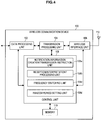
- FIG. 4 is a block diagram showing an example of the configuration of a wireless communication device 100 according to each embodiment of the present invention.
- the wireless communication device 100 is configured to be able to communicate with other wireless communication device by a wireless communication network such as IEEE 802.11a, IEEE 802.11b and IEEE 802.11n, which are wireless LAN standards.
- a wireless communication network such as IEEE 802.11a, IEEE 802.11b and IEEE 802.11n, which are wireless LAN standards.
- each wireless communication device 100 includes a data processing unit 102, a transmission processing unit 104, a wireless interface unit 106, a control unit 108, a memory 110, and an antenna 112.
- the data processing unit 102 creates various data frames and data packets in response to a request from an upper layer, for example, and supplies the same to the transmission processing unit 104.
- the transmission processing unit 104 performs, at the time of transmission, processing such as adding to a packet generated at the data processing unit 102 various data heads or an error detection code such as a frame check sequence (FCS), and provides the data which has been processed to the wireless interface unit 106.
- the wireless interface unit 106 generates, from the data received from the transmission processing unit 104, a modulation signal in a frequency band of a carrier, and makes the same transmitted from the antenna 112 as a radio signal.
- the wireless interface unit 106 decodes the various data frames by down-converting the radio signal received by the antenna 112 and changing the same to a bit sequence. That is, the wireless interface unit 106 can function, in cooperation with the antenna 112, as a transmitting unit and a receiving unit.
- the transmission processing unit 104 analyzes the headers added to the various data frames supplied from the wireless interface unit 106 and checks, based on the error detection code, that each data frame includes no error, and then, supplies the various data frames to the data processing unit 102.
- the data processing unit 102 processes and analyzes the various data frames and data packets supplied from the transmission processing unit 104.
- the control unit 108 is a block for controlling the respective operations of the data processing unit 102, the transmission processing unit 104, and the wireless interface unit 106.
- the control unit 108 performs operations such as determination of a transmission/reception frequency, creation of a control message (notification information such as a beacon, a beacon acknowledgement, a probe request and a probe response), issuance of a transmission command for the control message, and interpretation of the control message.
- the control unit 108 controls various operations of the wireless communication device 100, such as reception operation and transmission operation.
- the control unit 108 includes, as main structural elements, a notification-information creation/transmission-instruction unit 108a, a reception/interpretation processing unit 108b, a frequency switching unit 108c, and a random period setting unit 108d.
- the notification-information creation/transmission-instruction unit 108a creates the control message, or issues a transmission command for the control message.
- the reception/interpretation processing unit 108b performs a reception process or an interpretation process for the control message transmitted from the communication counterpart.
- the frequency switching unit 108c performs an operation of switching transmission frequencies or of switching waiting frequencies.
- the random period setting unit 108d performs an operation of setting a transmission cycle or a waiting cycle to a random period.
- the memory 110 plays the role of a work area for the data processing by the control unit 108, and has a function of a storage medium for holding various types of data.
- Various storage media for example, a volatile memory such as a DRAM, a non-volatile memory such as an EEPROM, a hard disk and an optical disk, may be used as the memory 110.
- each block shown in FIG. 4 can be configured from hardware (circuit).
- each block can be configured from a processor (CPU) and software (program) for making the processor function.
- the program can be stored in the storage medium included in the wireless communication device 100, such as the memory 110.
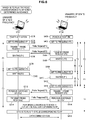
- FIG. 5 is a schematic diagram showing a flow of a sequence according to the present embodiment.
- two stations STA1 and STA2 are to look for a communication counterpart. Both stations 1 and 2 are assumed to have a function conforming to IEEE 802.11. Also, as with FIG. 3 , usable frequencies are F 1, F2 and F3 for both stations 1 and 2.
- each of the station 1 and the station 2 There are two kinds of messages to be transmitted by each of the station 1 and the station 2, namely, a beacon and a beacon acknowledgement which is transmitted at the time of receiving a beacon. Also, there are four states in relation to the states of each of the station 1 and the station 2, namely, beacon transmission, waiting, frequency changing, and beacon response transmission.
- the station 1 is to transmit a beacon at the frequency F1 during the beacon transmission cycle.
- the station 2 is to transmit a beacon at the frequency F2.
- the transmission of a beacon is to be alternately performed every 2 cycles of the frequency switching cycles and waiting is to be performed every cycle.
- the station 1 sets a communication frequency to F1 in the next step S102.
- the station 1 transmits a beacon at the frequency F1, and after transmitting the beacon, waits, in step S106, for a response from other station at the frequency F1.
- a communication frequency is set to F2 in the next step S202.
- the station 2 transmits a beacon at the frequency F2, and after transmitting the beacon, waits, in step S206, for a response from other station at the frequency F2.
- step S208 the station 2 sets the frequency to F3. Since the transmission of a beacon is performed every 2 cycles of the frequency switching cycles, the station 2 waits without transmitting a beacon at the frequency F3 (step S210). Then, the frequency is switched to F2 in step S212, and a beacon is transmitted at the frequency F2 in the next step S214.
- the station 1 changes the frequency to F2 in step S108. Since, also at the station 1, the transmission of a beacon is performed every 2 cycles of the frequency switching cycles, the station 1 waits without transmitting a beacon at the frequency F2 (S110). Thus, the transmission timing of a beacon (frequency F2) by the station 2 in step S214 is during the time the station has started to wait (frequency F2) in step S110 and is still waiting at the frequency F2. This is because, in this case, steps S212 and S214 of the station 2 occurred before the timing of the station 1 changing the frequency after step S108, because the cycle of the station 1 for changing the frequency after step S108 was set to be random. Therefore, the station 1 receives the beacon transmitted from the station 2 at the frequency F2, perceives the existence of the station 2 in step S112, and transmits a beacon response in the next step S114.
- the station 2 receives the beacon response transmitted from the station 1 and perceives the existence of the station 1 in step S216. Then, negotiation is performed between the station 1 and the station 2 to determine which is to play the role of an access point.
- the station 1 is determined to play the role of an access point in the infrastructure mode (step S218), and the connection is completed. In this case, the station 2 will play the role of a station in the infrastructure mode.
- data communication is performed between the station 1 and the station 2.
- the cycle for transmitting beacons, the cycle for waiting, or the cycle for changing the frequencies is set to a random period for each of the stations 1 and 2.
- a time T1 from a timing of starting the waiting at the frequency F3 (step S210) to a timing of changing to the frequency F2 (step S212) can be set as the random period.
- a time T2 from a timing of setting to the frequency F3 (step S208) to a timing of changing to the next frequency F2 (step S212) can be set as the random period.
- a time T3 from a timing of transmitting a beacon at the frequency F2 and of starting to wait (step S206) to a timing of changing to the next frequency F3 (step S208) can be set as the random period.
- a time T4 from setting the transmission frequency for a beacon to F2 (step S202) to a timing of changing to the next frequency F3 (step S208) can be set as the random period.
- a portion equivalent to 2 cycles of the frequency switching cycles may be set as the random period. For example, a time T5 from setting the transmission frequency for a beacon to F2 (step S202) to a next timing of setting the transmission frequency for a beacon to F2 (step S212) may be set as the random period.
- the random period may be period generated by a random number generator, for example.
- the transmission of a beacon is performed every 2 cycles of the frequency switching cycles at each of the stations 1 and 2.
- the transmission of a beacon and waiting can be performed every cycle.
- the transmission frequency for a beacon can also be changed every cycle as with FIG. 3 .
- beacons are transmitted at a constant frequency at all times in FIG. 5
- the beacons may be transmitted at periodically different frequencies (for example, F1 ⁇ F2 ⁇ F3 ⁇ F1, ).
- the configuration of a wireless communication device 100 according to the second embodiment is the same as that of the first embodiment described with FIG. 4 .
- the waiting time for receiving a beacon was made random in the first embodiment.
- a cycle for transmission or a cycle for waiting is set to a random period in case of receiving a probe response as a response to a probe request.
- the probe request here is notification information including an identifier of a network, supported communication rate information, identification information of each station, or the like.
- each of the station 1 and the station 2 there are two kinds of messages to be transmitted by each of the station 1 and the station 2, namely, a probe request and a probe response. Also, there are four states in relation to the states of each of the station 1 and the station 2, namely, probe request transmission, waiting, frequency changing, and probe response transmission.
- FIG. 6 is a schematic diagram showing the flow of processes. It is assumed that, for both the station 1 and the station 2, the transmission of a probe request is performed every 2 cycles of the frequency switching cycles and waiting is performed every cycle.
- the station 1 sets a communication frequency to F1 in the next step S302.
- the station 1 transmits a probe request at the frequency F1. Then, after transmitting the probe request, the station 1 waits, in step S306, for the reception of a probe response to the probe request that has been transmitted.
- a communication frequency is set to F3 in the next step S402.
- the station 2 transmits a probe request at a frequency F2 in the next step S404. Then, after transmitting the probe request, the station 2 waits, in step S406, for a probe response to the probe request that has been transmitted.
- step S408 the station 2 sets the frequency to F1, and waits for a probe request at the frequency F1 in step 5410. Then, in step S412, the frequency is switched to F3, and a probe request is transmitted at the frequency F3 in the next step S414.
- the station 1 changes the frequency to F3 in step S308, starts waiting for a probe request at the frequency F3 in the next step S310, and will keep waiting. Then, the transmission timing of a probe request (frequency F3) by the station 2 in step S414 matches the timing of the station 1 waiting (frequency F3), after step S310, for a probe request. This is because, in this case, steps S412 and S414 of the station 2 occurred before the timing of the station 1 changing the frequency after step S308, because the cycle of the station 1 for changing the frequency after step S308 was set to be random. Therefore, the station 1 receives the probe request transmitted from the station 2 at the frequency F3, perceives the existence of the station 2 in step S312, and transmits a probe response in the next step S314.
- the station 2 receives the probe response transmitted from the station 1 and perceives the existence of the station 1 in step S416. Then, negotiation is performed between the station 1 and the station 2 to determine which is to play the role of an access point.
- the station 1 is determined to play the role of an access point in the infrastructure mode (step S418), and the connection is completed. In this case, the station 2 will play the role of a station in the infrastructure mode.
- data communication is performed between the station 1 and the station 2.
- the waiting time is set to a random period for both station 1 and station 2.
- the waiting time is set to a random period for both station 1 and station 2.
- the station 2 as an example, any of T6 to T11 shown in FIG. 6 or some of T6 to T11 can be made to be the random period.
- the station 1 switches the frequency in the order such as F1 ⁇ F2 ⁇ F3 ⁇ F1...
- the station 2 switches the frequency in the order such as F2 ⁇ F3 ⁇ F1 ⁇ F2....
- the station 1 waits for a probe request at the frequency F3, and the station 2 waits for a probe request at the frequency F1.
- the waiting frequency may be periodically differing frequencies, and may be switched in the order of F1 ⁇ F2 ⁇ F3 ⁇ F1..., for example.
- the frequencies of the devices are not set to be different at all times, and a situation where the devices will not find each other can be prevented.
Landscapes
- Engineering & Computer Science (AREA)
- Computer Networks & Wireless Communication (AREA)
- Signal Processing (AREA)
- Databases & Information Systems (AREA)
- Mobile Radio Communication Systems (AREA)
Applications Claiming Priority (3)
| Application Number | Priority Date | Filing Date | Title |
|---|---|---|---|
| JP2009094369A JP5332840B2 (ja) | 2009-04-08 | 2009-04-08 | 無線通信装置、無線通信システム、無線通信方法及びプログラム |
| EP16178811.2A EP3110185B1 (en) | 2009-04-08 | 2010-02-08 | Method, apparatuses and computer readable medium for successively switching notification frequency |
| EP10250204.4A EP2239991B1 (en) | 2009-04-08 | 2010-02-08 | Wireless communications device, system, method and program |
Related Parent Applications (3)
| Application Number | Title | Priority Date | Filing Date |
|---|---|---|---|
| EP10250204.4A Division EP2239991B1 (en) | 2009-04-08 | 2010-02-08 | Wireless communications device, system, method and program |
| EP16178811.2A Division EP3110185B1 (en) | 2009-04-08 | 2010-02-08 | Method, apparatuses and computer readable medium for successively switching notification frequency |
| EP16178811.2A Division-Into EP3110185B1 (en) | 2009-04-08 | 2010-02-08 | Method, apparatuses and computer readable medium for successively switching notification frequency |
Publications (1)
| Publication Number | Publication Date |
|---|---|
| EP3340666A1 true EP3340666A1 (en) | 2018-06-27 |
Family
ID=42462390
Family Applications (3)
| Application Number | Title | Priority Date | Filing Date |
|---|---|---|---|
| EP18152372.1A Pending EP3340666A1 (en) | 2009-04-08 | 2010-02-08 | Method, apparatus and computer readable medium for successively switching notification frequency |
| EP10250204.4A Active EP2239991B1 (en) | 2009-04-08 | 2010-02-08 | Wireless communications device, system, method and program |
| EP16178811.2A Active EP3110185B1 (en) | 2009-04-08 | 2010-02-08 | Method, apparatuses and computer readable medium for successively switching notification frequency |
Family Applications After (2)
| Application Number | Title | Priority Date | Filing Date |
|---|---|---|---|
| EP10250204.4A Active EP2239991B1 (en) | 2009-04-08 | 2010-02-08 | Wireless communications device, system, method and program |
| EP16178811.2A Active EP3110185B1 (en) | 2009-04-08 | 2010-02-08 | Method, apparatuses and computer readable medium for successively switching notification frequency |
Country Status (4)
| Country | Link |
|---|---|
| US (5) | US20100260158A1 (https=) |
| EP (3) | EP3340666A1 (https=) |
| JP (1) | JP5332840B2 (https=) |
| CN (2) | CN101860941B (https=) |
Families Citing this family (14)
| Publication number | Priority date | Publication date | Assignee | Title |
|---|---|---|---|---|
| JP5664273B2 (ja) | 2011-01-21 | 2015-02-04 | ソニー株式会社 | 無線通信装置、プログラム、および無線通信システム |
| JP5281106B2 (ja) * | 2011-03-02 | 2013-09-04 | 株式会社バッファロー | 無線lan装置 |
| JP5526069B2 (ja) * | 2011-03-30 | 2014-06-18 | 株式会社Nttドコモ | 無線通信端末 |
| US9019878B2 (en) * | 2011-06-14 | 2015-04-28 | Microsoft Technology Licensing, Llc | Phone supporting mode conversion |
| WO2014038161A1 (ja) * | 2012-09-07 | 2014-03-13 | パナソニック株式会社 | 通信端末装置、通信システムおよび通信端末装置の制御方法 |
| JPWO2016043294A1 (ja) * | 2014-09-19 | 2017-04-27 | 株式会社東芝 | 無線通信装置および無線通信方法 |
| US10243755B2 (en) * | 2015-03-25 | 2019-03-26 | Mitsubishi Electric Corporation | Communication device and communication method |
| EP3806533B1 (en) | 2015-07-07 | 2023-01-04 | Sony Group Corporation | Communication device and communication method |
| JP6519710B2 (ja) * | 2016-06-08 | 2019-05-29 | 日立化成株式会社 | 無線通信システム |
| TWM568972U (zh) | 2016-10-31 | 2018-10-21 | 美商米沃奇電子工具公司 | 發訊系統及位置紀錄系統 |
| CN108574958B (zh) * | 2017-03-07 | 2020-11-13 | 四零四科技股份有限公司 | 无线网络的环境配置系统及其方法 |
| JP7034709B2 (ja) * | 2017-12-28 | 2022-03-14 | キヤノン株式会社 | 情報処理装置、端末装置、制御方法及びプログラム |
| CN108419209B (zh) * | 2018-02-14 | 2020-07-07 | 广州天电科技有限公司 | 一种电子围栏及其控制方法 |
| CN114223224B (zh) | 2019-08-13 | 2024-03-08 | 米沃奇电动工具公司 | 具有多个和应用程序可设置的信标发射率的工具追踪装置 |
Citations (7)
| Publication number | Priority date | Publication date | Assignee | Title |
|---|---|---|---|---|
| JP2005051522A (ja) | 2003-07-29 | 2005-02-24 | Sony Corp | 無線通信システム、無線通信装置及び無線通信方法、並びにコンピュータ・プログラム |
| JP2005151525A (ja) | 2003-10-24 | 2005-06-09 | Sony Corp | 無線通信システム、無線通信装置及び無線通信方法、並びにコンピュータ・プログラム |
| JP2005223767A (ja) | 2004-02-06 | 2005-08-18 | Sony Corp | 無線通信システム、無線通信装置及び無線通信方法、並びにコンピュータ・プログラム |
| US20060104333A1 (en) * | 2004-11-18 | 2006-05-18 | Motorola, Inc. | Acknowledgment for a time division channel |
| US20070171910A1 (en) * | 2005-10-05 | 2007-07-26 | Ravi Kumar | Peer-to-peer communication in ad hoc wireless network |
| US20080002616A1 (en) * | 2006-06-30 | 2008-01-03 | Michael Stahl | Device, system, and method of coordinating wireless connections |
| WO2009009608A2 (en) * | 2007-07-10 | 2009-01-15 | Qualcomm Incorporated | Control channel design to support one-to-one, many-to-one, and one-to-many peer-to-peer communications |
Family Cites Families (89)
| Publication number | Priority date | Publication date | Assignee | Title |
|---|---|---|---|---|
| US5784368A (en) * | 1994-09-23 | 1998-07-21 | Motorola, Inc. | Method and apparatus for providing a synchronous communication environment |
| US5659545A (en) * | 1994-11-15 | 1997-08-19 | Motorola, Inc. | Apparatus for mobile unit acquisition in a satellite communication system and method therefor |
| FR2728369B1 (fr) * | 1994-12-19 | 1997-01-31 | Sgs Thomson Microelectronics | Procede et dispositif pour accroitre la securite d'un circuit integre |
| US5850525A (en) * | 1996-03-29 | 1998-12-15 | Advanced Micro Devices, Inc. | Method and apparatus for adding a randomized propagation delay interval to an interframe spacing in a station accessing an ethernet network |
| US6205153B1 (en) * | 1997-05-09 | 2001-03-20 | Siemens Information And Communications Systems, Inc. | System and method for improving CSMA/CD network performance during collisions |
| US6473412B1 (en) * | 1998-04-03 | 2002-10-29 | Telefonaktiebolaget Lm Ericsson (Publ) | Uncoordinated frequency hopping cellular system |
| US6484027B1 (en) * | 1998-06-15 | 2002-11-19 | Sbc Technology Resources, Inc. | Enhanced wireless handset, including direct handset-to-handset communication mode |
| US6760308B1 (en) * | 1999-02-26 | 2004-07-06 | Bitbytebit Information Services, Inc. | Adaptive transmission in multi-access asynchronous channels |
| US6535551B1 (en) * | 1999-11-17 | 2003-03-18 | Conexant Systems, Inc. | DSL post-synchronization auto baud |
| US7496368B2 (en) * | 2001-04-03 | 2009-02-24 | Sharp Kabushiki Kaisha | Method and device for controlling frequency selection within a wireless communication system |
| EP1257093B1 (en) * | 2001-05-08 | 2006-07-26 | Agere Systems Guardian Corporation | Wireless network system comprising access points |
| EP1257090B1 (en) * | 2001-05-08 | 2004-11-17 | Lucent Technologies Inc. | Wireless LAN with dynamic frequency selection |
| US6693888B2 (en) * | 2001-06-06 | 2004-02-17 | Networks Associates Technology, Inc. | Method and apparatus for filtering that specifies the types of frames to be captured and to be displayed for an IEEE802.11 wireless LAN |
| US6665269B1 (en) * | 2002-01-30 | 2003-12-16 | Networks Associates Technology, Inc. | Method and apparatus for filtering network traffic based on the correct channel in an IEEE 802.11(b) wireless lan |
| KR20040040040A (ko) * | 2002-11-06 | 2004-05-12 | 삼성전자주식회사 | 무선통신시스템 및 무선통신시스템의 핸드오프방식 |
| US7350077B2 (en) * | 2002-11-26 | 2008-03-25 | Cisco Technology, Inc. | 802.11 using a compressed reassociation exchange to facilitate fast handoff |
| JP4125172B2 (ja) * | 2003-04-23 | 2008-07-30 | キヤノン株式会社 | 無線通信システム、無線通信装置、及びその制御方法、並びにコンピュータプログラム |
| JP4397929B2 (ja) * | 2003-04-29 | 2010-01-13 | 株式会社エヌ・ティ・ティ・ドコモ | ワイヤレスネットワークの高速能動的探索装置及び方法 |
| US8054798B2 (en) * | 2003-06-13 | 2011-11-08 | Ntt Docomo, Inc. | Proxy active scan for wireless networks |
| US7817612B2 (en) * | 2003-07-29 | 2010-10-19 | Sony Corporation | Decentralized wireless communication system, apparatus, and associated methodology |
| JP2005079985A (ja) * | 2003-09-01 | 2005-03-24 | Sony Corp | 無線通信システム、無線通信装置及び無線通信方法、並びにコンピュータ・プログラム |
| US7317682B2 (en) * | 2003-09-04 | 2008-01-08 | Mitsubishi Electric Research Laboratories, Inc. | Passive and distributed admission control method for ad hoc networks |
| JP4143011B2 (ja) * | 2003-09-17 | 2008-09-03 | 松下電器産業株式会社 | キャリアセンス多重アクセス方法、無線基地局装置及び無線端末装置 |
| US7260393B2 (en) * | 2003-09-23 | 2007-08-21 | Intel Corporation | Systems and methods for reducing communication unit scan time in wireless networks |
| US7092353B2 (en) * | 2003-10-17 | 2006-08-15 | Qualcomm Incorporated | Carrier search methods and apparatus |
| JP3948454B2 (ja) * | 2003-12-12 | 2007-07-25 | ソニー株式会社 | 通信装置と通信システムと通信方法およびプログラム |
| US7573857B1 (en) * | 2004-01-16 | 2009-08-11 | Qualcomm Incorporated | Capacity management for wireless local area networks |
| US20050174950A1 (en) * | 2004-02-09 | 2005-08-11 | Sharp Laboratories Of America, Inc. | Distributed network organization and topology discovery in ad-hoc network |
| US8699418B2 (en) * | 2008-04-08 | 2014-04-15 | Aruba Networks, Inc. | Band steering for multi-band wireless clients |
| JP2005303788A (ja) * | 2004-04-14 | 2005-10-27 | Matsushita Electric Ind Co Ltd | 無線装置 |
| US7620409B2 (en) * | 2004-06-17 | 2009-11-17 | Honeywell International Inc. | Wireless communication system with channel hopping and redundant connectivity |
| JP4421955B2 (ja) * | 2004-06-24 | 2010-02-24 | Okiセミコンダクタ株式会社 | 無線装置 |
| JP2006060322A (ja) * | 2004-08-17 | 2006-03-02 | Toshiba Corp | 基地局装置、無線システム、接続方法およびプログラム |
| JP4507765B2 (ja) * | 2004-08-26 | 2010-07-21 | 富士通株式会社 | プログラム、中継装置制御方法、無線通信装置制御方法及びシステム |
| WO2006071650A2 (en) * | 2004-12-23 | 2006-07-06 | Conexant Systems, Inc. | Systems and methods for device discovery |
| US7554979B2 (en) * | 2005-02-03 | 2009-06-30 | Canon Kabushiki Kaisha | Communication apparatus and method having function of transmitting notification signal while hiding group identification information |
| US7848305B2 (en) * | 2005-02-03 | 2010-12-07 | Qualcomm Incorporated | Techniques for accessing a wireless communication system with tune-away capability |
| US20060203784A1 (en) * | 2005-03-14 | 2006-09-14 | International Business Machines Corporation | Smart roaming to avoid time-outs during WLAN association |
| US7881695B2 (en) * | 2005-04-13 | 2011-02-01 | Sony Corporation | Fixed network master |
| US7616594B2 (en) * | 2005-04-22 | 2009-11-10 | Microsoft Corporation | Wireless device discovery and configuration |
| US7814322B2 (en) * | 2005-05-03 | 2010-10-12 | Sri International | Discovery and authentication scheme for wireless mesh networks |
| KR101235993B1 (ko) * | 2005-05-12 | 2013-02-21 | 삼성전자주식회사 | 무선 랜 메쉬 통신 시스템에서 스케쥴링 방법 및 장치 |
| US7738470B2 (en) * | 2005-05-23 | 2010-06-15 | Alpha Networks Inc. | Fast and automatic self-forming meshing topology to integrate with wired networks |
| US7880641B2 (en) * | 2006-12-21 | 2011-02-01 | Parris Earl H | Configurable smart utility meter box |
| US7787401B2 (en) * | 2005-06-17 | 2010-08-31 | Cisco Technology, Inc. | Using mini-beacons in a wireless network |
| US7577125B2 (en) * | 2005-07-08 | 2009-08-18 | Microsoft Corporation | Direct wireless client to client communication |
| EP1917761A1 (en) * | 2005-08-09 | 2008-05-07 | Freescale Semiconductor, Inc. | Handover based on a quality of service metric obtained from a mac layer of a received signal |
| CA2620550C (en) * | 2005-09-22 | 2015-02-03 | Lg Electronics Inc. | Access probe randomization for wireless communication system |
| US7864732B2 (en) * | 2006-01-27 | 2011-01-04 | Mediatek Inc. | Systems and methods for handoff in wireless network |
| US7817609B2 (en) * | 2006-03-27 | 2010-10-19 | Ka Lun Eddie Law | Multi-channel wireless networks |
| US8228865B2 (en) * | 2006-04-07 | 2012-07-24 | Qualcomm Incorporated | Method and apparatus for operating in a wireless local area network based on information from a wireless wide area network |
| US20100165913A1 (en) * | 2006-04-26 | 2010-07-01 | Agency For Science Technology And Research | Methods of transmitting and receiving data |
| US20080031208A1 (en) * | 2006-08-04 | 2008-02-07 | Microsoft Corporation | Synchronization between wireless devices while saving power |
| US7580393B2 (en) * | 2006-10-02 | 2009-08-25 | Tropos Networks, Inc. | Probe response determination |
| JP2008122729A (ja) | 2006-11-14 | 2008-05-29 | Sony Corp | ノイズ低減装置、ノイズ低減方法、ノイズ低減プログラムおよびノイズ低減音声出力装置 |
| US8144793B2 (en) * | 2006-12-12 | 2012-03-27 | Microsoft Corporation | Cognitive multi-user OFDMA |
| US20080159208A1 (en) * | 2006-12-28 | 2008-07-03 | Motorola, Inc. | Method and apparatus for allocation of shared spectrum in a wireless communication system |
| KR20080067252A (ko) * | 2007-01-15 | 2008-07-18 | 엘지전자 주식회사 | 무선네트워크에서 통신방법 및 무선네트워크 시스템 |
| US20080219285A1 (en) * | 2007-03-08 | 2008-09-11 | Microsoft Corporation | Multi-Channel Communications Protocol |
| US7688762B2 (en) * | 2007-03-21 | 2010-03-30 | Cisco Technology, Inc. | Mesh backhaul network planning |
| JP4958634B2 (ja) * | 2007-05-16 | 2012-06-20 | キヤノン株式会社 | 通信装置及び通信方法 |
| WO2008147046A1 (en) * | 2007-05-25 | 2008-12-04 | Lg Electronics Inc. | Management procedure in wireless communication system and station supporting management procedure |
| JP2008301006A (ja) * | 2007-05-30 | 2008-12-11 | Hitachi Ltd | 無線通信システム及び無線通信方法 |
| CN101682539B (zh) * | 2007-06-01 | 2012-11-28 | Lg电子株式会社 | 无线lan中的扫描过程、支持扫描过程的站点及其帧格式 |
| US8018882B1 (en) * | 2007-07-03 | 2011-09-13 | Marvell International Ltd. | Ad-hoc wireless communication system with variable ATIM window |
| WO2009016800A1 (ja) * | 2007-07-31 | 2009-02-05 | Nec Corporation | 無線lan端末およびアクセスポイント探索方法 |
| KR20090029479A (ko) * | 2007-09-18 | 2009-03-23 | 삼성전자주식회사 | 무선 네트워크에서 선택적 채널 스캐닝 방법 및 장치 |
| US8199000B2 (en) * | 2007-09-27 | 2012-06-12 | General Electric Company | System and method for interference mitigation in a wireless sensor network |
| JP2009088816A (ja) * | 2007-09-28 | 2009-04-23 | Rohm Co Ltd | 情報通信端末、無線通信装置および無線通信ネットワーク |
| US9173148B2 (en) * | 2007-10-12 | 2015-10-27 | Qualcomm Incorporated | Identification of target node for wireless handoff |
| US7881340B2 (en) * | 2007-10-22 | 2011-02-01 | The Johns Hopkins University | Decentralized media access control for ad-hoc mobile wireless network |
| US8666420B2 (en) * | 2008-04-02 | 2014-03-04 | Cisco Technology, Inc. | Building wireless routing structures using out of band signaling |
| JP5106275B2 (ja) * | 2008-06-30 | 2012-12-26 | 株式会社東芝 | 無線通信装置及び無線通信方法 |
| US8355387B2 (en) * | 2008-07-24 | 2013-01-15 | Samsung Electronics Co., Ltd. | System and method for bandwidth reservation protocol for spatial reuse in a wireless communication network |
| US8218600B2 (en) * | 2008-08-22 | 2012-07-10 | Siemens Aktiengesellschaft | Frequency hopping network with a guaranteed handoff delay |
| US8428079B1 (en) * | 2008-09-24 | 2013-04-23 | Marvell International, Ltd | Systems and methods for discovering a wireless network in a peer-to-peer network |
| US8190167B2 (en) * | 2008-09-29 | 2012-05-29 | Intel Corporation | Wireless device channel selection using dynamic channel allocation |
| JP5127658B2 (ja) * | 2008-10-06 | 2013-01-23 | キヤノン株式会社 | 通信装置、通信装置の制御方法、コンピュータプログラム及び記憶媒体 |
| US8570898B1 (en) * | 2008-10-24 | 2013-10-29 | Marvell International Ltd. | Method for discovering devices in a wireless network |
| US8270304B2 (en) * | 2008-10-31 | 2012-09-18 | Symbol Technologies, Inc. | Methods and apparatus for access point scanning in VOIP systems |
| JP5185081B2 (ja) * | 2008-11-17 | 2013-04-17 | 株式会社東芝 | 無線端末装置、通信方法、及び通信プログラム |
| US20100148931A1 (en) * | 2008-12-12 | 2010-06-17 | Ravikanth Srinivasa Pappu | Radio devices and communications |
| JP5141570B2 (ja) * | 2009-01-20 | 2013-02-13 | 富士通株式会社 | 無線アドホックネットワークのための無線通信機 |
| US8335937B2 (en) * | 2009-12-24 | 2012-12-18 | Intel Corporation | Method and system for discoverability of power saving P2P devices |
| US8264985B2 (en) * | 2010-05-12 | 2012-09-11 | Cisco Technology, Inc. | Locally unique node port identifiers |
| US8576870B2 (en) * | 2010-06-09 | 2013-11-05 | Apple Inc. | Access point systems |
| US8599759B2 (en) * | 2011-04-29 | 2013-12-03 | Cooper Technologies Company | Multi-path radio transmission input/output devices, network, systems and methods with on demand, prioritized routing protocol |
| KR101332813B1 (ko) * | 2012-02-24 | 2013-11-27 | 주식회사 팬택 | 무선 통신 장치 및 무선 통신 장치의 무선 접속 채널의 형성 방법 |
| US9282449B2 (en) * | 2012-03-01 | 2016-03-08 | Microsoft Technology Licensing, Llc | Peer-to-peer discovery |
-
2009
- 2009-04-08 JP JP2009094369A patent/JP5332840B2/ja active Active
-
2010
- 2010-02-08 EP EP18152372.1A patent/EP3340666A1/en active Pending
- 2010-02-08 EP EP10250204.4A patent/EP2239991B1/en active Active
- 2010-02-08 EP EP16178811.2A patent/EP3110185B1/en active Active
- 2010-03-30 US US12/750,346 patent/US20100260158A1/en not_active Abandoned
- 2010-04-01 CN CN201010151175.4A patent/CN101860941B/zh active Active
- 2010-04-01 CN CN201310635208.6A patent/CN103686665B/zh active Active
-
2013
- 2013-02-28 US US13/780,997 patent/US10070415B2/en active Active
- 2013-10-23 US US14/061,207 patent/US9655080B2/en active Active
- 2013-11-05 US US14/072,358 patent/US10051605B2/en active Active
-
2018
- 2018-07-25 US US16/044,724 patent/US10517071B2/en active Active
Patent Citations (7)
| Publication number | Priority date | Publication date | Assignee | Title |
|---|---|---|---|---|
| JP2005051522A (ja) | 2003-07-29 | 2005-02-24 | Sony Corp | 無線通信システム、無線通信装置及び無線通信方法、並びにコンピュータ・プログラム |
| JP2005151525A (ja) | 2003-10-24 | 2005-06-09 | Sony Corp | 無線通信システム、無線通信装置及び無線通信方法、並びにコンピュータ・プログラム |
| JP2005223767A (ja) | 2004-02-06 | 2005-08-18 | Sony Corp | 無線通信システム、無線通信装置及び無線通信方法、並びにコンピュータ・プログラム |
| US20060104333A1 (en) * | 2004-11-18 | 2006-05-18 | Motorola, Inc. | Acknowledgment for a time division channel |
| US20070171910A1 (en) * | 2005-10-05 | 2007-07-26 | Ravi Kumar | Peer-to-peer communication in ad hoc wireless network |
| US20080002616A1 (en) * | 2006-06-30 | 2008-01-03 | Michael Stahl | Device, system, and method of coordinating wireless connections |
| WO2009009608A2 (en) * | 2007-07-10 | 2009-01-15 | Qualcomm Incorporated | Control channel design to support one-to-one, many-to-one, and one-to-many peer-to-peer communications |
Also Published As
| Publication number | Publication date |
|---|---|
| CN103686665B (zh) | 2017-08-11 |
| US20140056283A1 (en) | 2014-02-27 |
| US20100260158A1 (en) | 2010-10-14 |
| JP2010245975A (ja) | 2010-10-28 |
| US20130170459A1 (en) | 2013-07-04 |
| JP5332840B2 (ja) | 2013-11-06 |
| EP2239991B1 (en) | 2016-11-09 |
| CN101860941B (zh) | 2014-01-08 |
| US10517071B2 (en) | 2019-12-24 |
| CN101860941A (zh) | 2010-10-13 |
| EP2239991A1 (en) | 2010-10-13 |
| EP3110185B1 (en) | 2018-05-02 |
| EP3110185A1 (en) | 2016-12-28 |
| US10051605B2 (en) | 2018-08-14 |
| CN103686665A (zh) | 2014-03-26 |
| US20180332565A1 (en) | 2018-11-15 |
| US9655080B2 (en) | 2017-05-16 |
| US20140036725A1 (en) | 2014-02-06 |
| US10070415B2 (en) | 2018-09-04 |
Similar Documents
| Publication | Publication Date | Title |
|---|---|---|
| EP3110185B1 (en) | Method, apparatuses and computer readable medium for successively switching notification frequency | |
| US10567979B2 (en) | Wireless communication device, wireless communication system, wireless communication method, and program | |
| US10848953B2 (en) | Wireless communication device, wireless communication system, wireless communication method and program | |
| US8335179B2 (en) | Control device, terminal device, and communication system and communication method, using the same |
Legal Events
| Date | Code | Title | Description |
|---|---|---|---|
| PUAI | Public reference made under article 153(3) epc to a published international application that has entered the european phase |
Free format text: ORIGINAL CODE: 0009012 |
|
| STAA | Information on the status of an ep patent application or granted ep patent |
Free format text: STATUS: REQUEST FOR EXAMINATION WAS MADE |
|
| 17P | Request for examination filed |
Effective date: 20180217 |
|
| AC | Divisional application: reference to earlier application |
Ref document number: 2239991 Country of ref document: EP Kind code of ref document: P Ref document number: 3110185 Country of ref document: EP Kind code of ref document: P |
|
| AK | Designated contracting states |
Kind code of ref document: A1 Designated state(s): AT BE BG CH CY CZ DE DK EE ES FI FR GB GR HR HU IE IS IT LI LT LU LV MC MK MT NL NO PL PT RO SE SI SK SM TR |
|
| STAA | Information on the status of an ep patent application or granted ep patent |
Free format text: STATUS: EXAMINATION IS IN PROGRESS |
|
| 17Q | First examination report despatched |
Effective date: 20200325 |
|
| RAP3 | Party data changed (applicant data changed or rights of an application transferred) |
Owner name: SONY GROUP CORPORATION |
|
| RAP1 | Party data changed (applicant data changed or rights of an application transferred) |
Owner name: INTERDIGITAL CE PATENT HOLDINGS, SAS |
|
| GRAP | Despatch of communication of intention to grant a patent |
Free format text: ORIGINAL CODE: EPIDOSNIGR1 |
|
| STAA | Information on the status of an ep patent application or granted ep patent |
Free format text: STATUS: GRANT OF PATENT IS INTENDED |
|
| RIC1 | Information provided on ipc code assigned before grant |
Ipc: H04W 84/20 20090101ALI20230322BHEP Ipc: H04W 8/00 20090101AFI20230322BHEP |
|
| INTG | Intention to grant announced |
Effective date: 20230414 |
|
| GRAJ | Information related to disapproval of communication of intention to grant by the applicant or resumption of examination proceedings by the epo deleted |
Free format text: ORIGINAL CODE: EPIDOSDIGR1 |
|
| STAA | Information on the status of an ep patent application or granted ep patent |
Free format text: STATUS: EXAMINATION IS IN PROGRESS |
|
| INTC | Intention to grant announced (deleted) |