EP3289054B1 - Composition lubrifiante ultra-fluide - Google Patents
Composition lubrifiante ultra-fluide Download PDFInfo
- Publication number
- EP3289054B1 EP3289054B1 EP16720100.3A EP16720100A EP3289054B1 EP 3289054 B1 EP3289054 B1 EP 3289054B1 EP 16720100 A EP16720100 A EP 16720100A EP 3289054 B1 EP3289054 B1 EP 3289054B1
- Authority
- EP
- European Patent Office
- Prior art keywords
- group
- alkyl
- composition according
- alkyl group
- formula
- Prior art date
- Legal status (The legal status is an assumption and is not a legal conclusion. Google has not performed a legal analysis and makes no representation as to the accuracy of the status listed.)
- Active
Links
Classifications
-
- C—CHEMISTRY; METALLURGY
- C10—PETROLEUM, GAS OR COKE INDUSTRIES; TECHNICAL GASES CONTAINING CARBON MONOXIDE; FUELS; LUBRICANTS; PEAT
- C10M—LUBRICATING COMPOSITIONS; USE OF CHEMICAL SUBSTANCES EITHER ALONE OR AS LUBRICATING INGREDIENTS IN A LUBRICATING COMPOSITION
- C10M169/00—Lubricating compositions characterised by containing as components a mixture of at least two types of ingredient selected from base-materials, thickeners or additives, covered by the preceding groups, each of these compounds being essential
- C10M169/04—Mixtures of base-materials and additives
- C10M169/041—Mixtures of base-materials and additives the additives being macromolecular compounds only
-
- C—CHEMISTRY; METALLURGY
- C08—ORGANIC MACROMOLECULAR COMPOUNDS; THEIR PREPARATION OR CHEMICAL WORKING-UP; COMPOSITIONS BASED THEREON
- C08L—COMPOSITIONS OF MACROMOLECULAR COMPOUNDS
- C08L53/00—Compositions of block copolymers containing at least one sequence of a polymer obtained by reactions only involving carbon-to-carbon unsaturated bonds; Compositions of derivatives of such polymers
- C08L53/005—Modified block copolymers
-
- C—CHEMISTRY; METALLURGY
- C08—ORGANIC MACROMOLECULAR COMPOUNDS; THEIR PREPARATION OR CHEMICAL WORKING-UP; COMPOSITIONS BASED THEREON
- C08L—COMPOSITIONS OF MACROMOLECULAR COMPOUNDS
- C08L71/00—Compositions of polyethers obtained by reactions forming an ether link in the main chain; Compositions of derivatives of such polymers
- C08L71/02—Polyalkylene oxides
-
- C—CHEMISTRY; METALLURGY
- C10—PETROLEUM, GAS OR COKE INDUSTRIES; TECHNICAL GASES CONTAINING CARBON MONOXIDE; FUELS; LUBRICANTS; PEAT
- C10M—LUBRICATING COMPOSITIONS; USE OF CHEMICAL SUBSTANCES EITHER ALONE OR AS LUBRICATING INGREDIENTS IN A LUBRICATING COMPOSITION
- C10M2205/00—Organic macromolecular hydrocarbon compounds or fractions, whether or not modified by oxidation as ingredients in lubricant compositions
- C10M2205/02—Organic macromolecular hydrocarbon compounds or fractions, whether or not modified by oxidation as ingredients in lubricant compositions containing acyclic monomers
- C10M2205/028—Organic macromolecular hydrocarbon compounds or fractions, whether or not modified by oxidation as ingredients in lubricant compositions containing acyclic monomers containing aliphatic monomers having more than four carbon atoms
-
- C—CHEMISTRY; METALLURGY
- C10—PETROLEUM, GAS OR COKE INDUSTRIES; TECHNICAL GASES CONTAINING CARBON MONOXIDE; FUELS; LUBRICANTS; PEAT
- C10M—LUBRICATING COMPOSITIONS; USE OF CHEMICAL SUBSTANCES EITHER ALONE OR AS LUBRICATING INGREDIENTS IN A LUBRICATING COMPOSITION
- C10M2205/00—Organic macromolecular hydrocarbon compounds or fractions, whether or not modified by oxidation as ingredients in lubricant compositions
- C10M2205/02—Organic macromolecular hydrocarbon compounds or fractions, whether or not modified by oxidation as ingredients in lubricant compositions containing acyclic monomers
- C10M2205/028—Organic macromolecular hydrocarbon compounds or fractions, whether or not modified by oxidation as ingredients in lubricant compositions containing acyclic monomers containing aliphatic monomers having more than four carbon atoms
- C10M2205/0285—Organic macromolecular hydrocarbon compounds or fractions, whether or not modified by oxidation as ingredients in lubricant compositions containing acyclic monomers containing aliphatic monomers having more than four carbon atoms used as base material
-
- C—CHEMISTRY; METALLURGY
- C10—PETROLEUM, GAS OR COKE INDUSTRIES; TECHNICAL GASES CONTAINING CARBON MONOXIDE; FUELS; LUBRICANTS; PEAT
- C10M—LUBRICATING COMPOSITIONS; USE OF CHEMICAL SUBSTANCES EITHER ALONE OR AS LUBRICATING INGREDIENTS IN A LUBRICATING COMPOSITION
- C10M2205/00—Organic macromolecular hydrocarbon compounds or fractions, whether or not modified by oxidation as ingredients in lubricant compositions
- C10M2205/04—Organic macromolecular hydrocarbon compounds or fractions, whether or not modified by oxidation as ingredients in lubricant compositions containing aromatic monomers, e.g. styrene
-
- C—CHEMISTRY; METALLURGY
- C10—PETROLEUM, GAS OR COKE INDUSTRIES; TECHNICAL GASES CONTAINING CARBON MONOXIDE; FUELS; LUBRICANTS; PEAT
- C10M—LUBRICATING COMPOSITIONS; USE OF CHEMICAL SUBSTANCES EITHER ALONE OR AS LUBRICATING INGREDIENTS IN A LUBRICATING COMPOSITION
- C10M2205/00—Organic macromolecular hydrocarbon compounds or fractions, whether or not modified by oxidation as ingredients in lubricant compositions
- C10M2205/06—Organic macromolecular hydrocarbon compounds or fractions, whether or not modified by oxidation as ingredients in lubricant compositions containing conjugated dienes
-
- C—CHEMISTRY; METALLURGY
- C10—PETROLEUM, GAS OR COKE INDUSTRIES; TECHNICAL GASES CONTAINING CARBON MONOXIDE; FUELS; LUBRICANTS; PEAT
- C10M—LUBRICATING COMPOSITIONS; USE OF CHEMICAL SUBSTANCES EITHER ALONE OR AS LUBRICATING INGREDIENTS IN A LUBRICATING COMPOSITION
- C10M2205/00—Organic macromolecular hydrocarbon compounds or fractions, whether or not modified by oxidation as ingredients in lubricant compositions
- C10M2205/08—Organic macromolecular hydrocarbon compounds or fractions, whether or not modified by oxidation as ingredients in lubricant compositions containing non-conjugated dienes
-
- C—CHEMISTRY; METALLURGY
- C10—PETROLEUM, GAS OR COKE INDUSTRIES; TECHNICAL GASES CONTAINING CARBON MONOXIDE; FUELS; LUBRICANTS; PEAT
- C10M—LUBRICATING COMPOSITIONS; USE OF CHEMICAL SUBSTANCES EITHER ALONE OR AS LUBRICATING INGREDIENTS IN A LUBRICATING COMPOSITION
- C10M2207/00—Organic non-macromolecular hydrocarbon compounds containing hydrogen, carbon and oxygen as ingredients in lubricant compositions
- C10M2207/02—Hydroxy compounds
- C10M2207/023—Hydroxy compounds having hydroxy groups bound to carbon atoms of six-membered aromatic rings
- C10M2207/026—Hydroxy compounds having hydroxy groups bound to carbon atoms of six-membered aromatic rings with tertiary alkyl groups
-
- C—CHEMISTRY; METALLURGY
- C10—PETROLEUM, GAS OR COKE INDUSTRIES; TECHNICAL GASES CONTAINING CARBON MONOXIDE; FUELS; LUBRICANTS; PEAT
- C10M—LUBRICATING COMPOSITIONS; USE OF CHEMICAL SUBSTANCES EITHER ALONE OR AS LUBRICATING INGREDIENTS IN A LUBRICATING COMPOSITION
- C10M2207/00—Organic non-macromolecular hydrocarbon compounds containing hydrogen, carbon and oxygen as ingredients in lubricant compositions
- C10M2207/28—Esters
- C10M2207/2805—Esters used as base material
-
- C—CHEMISTRY; METALLURGY
- C10—PETROLEUM, GAS OR COKE INDUSTRIES; TECHNICAL GASES CONTAINING CARBON MONOXIDE; FUELS; LUBRICANTS; PEAT
- C10M—LUBRICATING COMPOSITIONS; USE OF CHEMICAL SUBSTANCES EITHER ALONE OR AS LUBRICATING INGREDIENTS IN A LUBRICATING COMPOSITION
- C10M2207/00—Organic non-macromolecular hydrocarbon compounds containing hydrogen, carbon and oxygen as ingredients in lubricant compositions
- C10M2207/28—Esters
- C10M2207/281—Esters of (cyclo)aliphatic monocarboxylic acids
- C10M2207/2815—Esters of (cyclo)aliphatic monocarboxylic acids used as base material
-
- C—CHEMISTRY; METALLURGY
- C10—PETROLEUM, GAS OR COKE INDUSTRIES; TECHNICAL GASES CONTAINING CARBON MONOXIDE; FUELS; LUBRICANTS; PEAT
- C10M—LUBRICATING COMPOSITIONS; USE OF CHEMICAL SUBSTANCES EITHER ALONE OR AS LUBRICATING INGREDIENTS IN A LUBRICATING COMPOSITION
- C10M2209/00—Organic macromolecular compounds containing oxygen as ingredients in lubricant compositions
- C10M2209/10—Macromolecular compoundss obtained otherwise than by reactions only involving carbon-to-carbon unsaturated bonds
- C10M2209/103—Polyethers, i.e. containing di- or higher polyoxyalkylene groups
- C10M2209/1033—Polyethers, i.e. containing di- or higher polyoxyalkylene groups used as base material
-
- C—CHEMISTRY; METALLURGY
- C10—PETROLEUM, GAS OR COKE INDUSTRIES; TECHNICAL GASES CONTAINING CARBON MONOXIDE; FUELS; LUBRICANTS; PEAT
- C10M—LUBRICATING COMPOSITIONS; USE OF CHEMICAL SUBSTANCES EITHER ALONE OR AS LUBRICATING INGREDIENTS IN A LUBRICATING COMPOSITION
- C10M2209/00—Organic macromolecular compounds containing oxygen as ingredients in lubricant compositions
- C10M2209/10—Macromolecular compoundss obtained otherwise than by reactions only involving carbon-to-carbon unsaturated bonds
- C10M2209/103—Polyethers, i.e. containing di- or higher polyoxyalkylene groups
- C10M2209/105—Polyethers, i.e. containing di- or higher polyoxyalkylene groups of alkylene oxides containing three carbon atoms only
- C10M2209/1055—Polyethers, i.e. containing di- or higher polyoxyalkylene groups of alkylene oxides containing three carbon atoms only used as base material
-
- C—CHEMISTRY; METALLURGY
- C10—PETROLEUM, GAS OR COKE INDUSTRIES; TECHNICAL GASES CONTAINING CARBON MONOXIDE; FUELS; LUBRICANTS; PEAT
- C10M—LUBRICATING COMPOSITIONS; USE OF CHEMICAL SUBSTANCES EITHER ALONE OR AS LUBRICATING INGREDIENTS IN A LUBRICATING COMPOSITION
- C10M2215/00—Organic non-macromolecular compounds containing nitrogen as ingredients in lubricant Compositions
- C10M2215/02—Amines, e.g. polyalkylene polyamines; Quaternary amines
- C10M2215/06—Amines, e.g. polyalkylene polyamines; Quaternary amines having amino groups bound to carbon atoms of six-membered aromatic rings
- C10M2215/064—Di- and triaryl amines
-
- C—CHEMISTRY; METALLURGY
- C10—PETROLEUM, GAS OR COKE INDUSTRIES; TECHNICAL GASES CONTAINING CARBON MONOXIDE; FUELS; LUBRICANTS; PEAT
- C10M—LUBRICATING COMPOSITIONS; USE OF CHEMICAL SUBSTANCES EITHER ALONE OR AS LUBRICATING INGREDIENTS IN A LUBRICATING COMPOSITION
- C10M2215/00—Organic non-macromolecular compounds containing nitrogen as ingredients in lubricant Compositions
- C10M2215/24—Organic non-macromolecular compounds containing nitrogen as ingredients in lubricant Compositions having hydrocarbon substituents containing thirty or more carbon atoms, e.g. nitrogen derivatives of substituted succinic acid
- C10M2215/28—Amides; Imides
-
- C—CHEMISTRY; METALLURGY
- C10—PETROLEUM, GAS OR COKE INDUSTRIES; TECHNICAL GASES CONTAINING CARBON MONOXIDE; FUELS; LUBRICANTS; PEAT
- C10M—LUBRICATING COMPOSITIONS; USE OF CHEMICAL SUBSTANCES EITHER ALONE OR AS LUBRICATING INGREDIENTS IN A LUBRICATING COMPOSITION
- C10M2219/00—Organic non-macromolecular compounds containing sulfur, selenium or tellurium as ingredients in lubricant compositions
- C10M2219/04—Organic non-macromolecular compounds containing sulfur, selenium or tellurium as ingredients in lubricant compositions containing sulfur-to-oxygen bonds, i.e. sulfones, sulfoxides
- C10M2219/044—Sulfonic acids, Derivatives thereof, e.g. neutral salts
-
- C—CHEMISTRY; METALLURGY
- C10—PETROLEUM, GAS OR COKE INDUSTRIES; TECHNICAL GASES CONTAINING CARBON MONOXIDE; FUELS; LUBRICANTS; PEAT
- C10M—LUBRICATING COMPOSITIONS; USE OF CHEMICAL SUBSTANCES EITHER ALONE OR AS LUBRICATING INGREDIENTS IN A LUBRICATING COMPOSITION
- C10M2219/00—Organic non-macromolecular compounds containing sulfur, selenium or tellurium as ingredients in lubricant compositions
- C10M2219/04—Organic non-macromolecular compounds containing sulfur, selenium or tellurium as ingredients in lubricant compositions containing sulfur-to-oxygen bonds, i.e. sulfones, sulfoxides
- C10M2219/046—Overbased sulfonic acid salts
-
- C—CHEMISTRY; METALLURGY
- C10—PETROLEUM, GAS OR COKE INDUSTRIES; TECHNICAL GASES CONTAINING CARBON MONOXIDE; FUELS; LUBRICANTS; PEAT
- C10M—LUBRICATING COMPOSITIONS; USE OF CHEMICAL SUBSTANCES EITHER ALONE OR AS LUBRICATING INGREDIENTS IN A LUBRICATING COMPOSITION
- C10M2219/00—Organic non-macromolecular compounds containing sulfur, selenium or tellurium as ingredients in lubricant compositions
- C10M2219/06—Thio-acids; Thiocyanates; Derivatives thereof
- C10M2219/062—Thio-acids; Thiocyanates; Derivatives thereof having carbon-to-sulfur double bonds
- C10M2219/066—Thiocarbamic type compounds
- C10M2219/068—Thiocarbamate metal salts
-
- C—CHEMISTRY; METALLURGY
- C10—PETROLEUM, GAS OR COKE INDUSTRIES; TECHNICAL GASES CONTAINING CARBON MONOXIDE; FUELS; LUBRICANTS; PEAT
- C10M—LUBRICATING COMPOSITIONS; USE OF CHEMICAL SUBSTANCES EITHER ALONE OR AS LUBRICATING INGREDIENTS IN A LUBRICATING COMPOSITION
- C10M2223/00—Organic non-macromolecular compounds containing phosphorus as ingredients in lubricant compositions
- C10M2223/02—Organic non-macromolecular compounds containing phosphorus as ingredients in lubricant compositions having no phosphorus-to-carbon bonds
- C10M2223/04—Phosphate esters
- C10M2223/045—Metal containing thio derivatives
-
- C—CHEMISTRY; METALLURGY
- C10—PETROLEUM, GAS OR COKE INDUSTRIES; TECHNICAL GASES CONTAINING CARBON MONOXIDE; FUELS; LUBRICANTS; PEAT
- C10N—INDEXING SCHEME ASSOCIATED WITH SUBCLASS C10M RELATING TO LUBRICATING COMPOSITIONS
- C10N2010/00—Metal present as such or in compounds
- C10N2010/04—Groups 2 or 12
-
- C—CHEMISTRY; METALLURGY
- C10—PETROLEUM, GAS OR COKE INDUSTRIES; TECHNICAL GASES CONTAINING CARBON MONOXIDE; FUELS; LUBRICANTS; PEAT
- C10N—INDEXING SCHEME ASSOCIATED WITH SUBCLASS C10M RELATING TO LUBRICATING COMPOSITIONS
- C10N2010/00—Metal present as such or in compounds
- C10N2010/12—Groups 6 or 16
-
- C—CHEMISTRY; METALLURGY
- C10—PETROLEUM, GAS OR COKE INDUSTRIES; TECHNICAL GASES CONTAINING CARBON MONOXIDE; FUELS; LUBRICANTS; PEAT
- C10N—INDEXING SCHEME ASSOCIATED WITH SUBCLASS C10M RELATING TO LUBRICATING COMPOSITIONS
- C10N2020/00—Specified physical or chemical properties or characteristics, i.e. function, of component of lubricating compositions
- C10N2020/01—Physico-chemical properties
- C10N2020/02—Viscosity; Viscosity index
-
- C—CHEMISTRY; METALLURGY
- C10—PETROLEUM, GAS OR COKE INDUSTRIES; TECHNICAL GASES CONTAINING CARBON MONOXIDE; FUELS; LUBRICANTS; PEAT
- C10N—INDEXING SCHEME ASSOCIATED WITH SUBCLASS C10M RELATING TO LUBRICATING COMPOSITIONS
- C10N2020/00—Specified physical or chemical properties or characteristics, i.e. function, of component of lubricating compositions
- C10N2020/01—Physico-chemical properties
- C10N2020/04—Molecular weight; Molecular weight distribution
-
- C—CHEMISTRY; METALLURGY
- C10—PETROLEUM, GAS OR COKE INDUSTRIES; TECHNICAL GASES CONTAINING CARBON MONOXIDE; FUELS; LUBRICANTS; PEAT
- C10N—INDEXING SCHEME ASSOCIATED WITH SUBCLASS C10M RELATING TO LUBRICATING COMPOSITIONS
- C10N2030/00—Specified physical or chemical properties which is improved by the additive characterising the lubricating composition, e.g. multifunctional additives
- C10N2030/02—Pour-point; Viscosity index
-
- C—CHEMISTRY; METALLURGY
- C10—PETROLEUM, GAS OR COKE INDUSTRIES; TECHNICAL GASES CONTAINING CARBON MONOXIDE; FUELS; LUBRICANTS; PEAT
- C10N—INDEXING SCHEME ASSOCIATED WITH SUBCLASS C10M RELATING TO LUBRICATING COMPOSITIONS
- C10N2030/00—Specified physical or chemical properties which is improved by the additive characterising the lubricating composition, e.g. multifunctional additives
- C10N2030/04—Detergent property or dispersant property
-
- C—CHEMISTRY; METALLURGY
- C10—PETROLEUM, GAS OR COKE INDUSTRIES; TECHNICAL GASES CONTAINING CARBON MONOXIDE; FUELS; LUBRICANTS; PEAT
- C10N—INDEXING SCHEME ASSOCIATED WITH SUBCLASS C10M RELATING TO LUBRICATING COMPOSITIONS
- C10N2030/00—Specified physical or chemical properties which is improved by the additive characterising the lubricating composition, e.g. multifunctional additives
- C10N2030/06—Oiliness; Film-strength; Anti-wear; Resistance to extreme pressure
-
- C—CHEMISTRY; METALLURGY
- C10—PETROLEUM, GAS OR COKE INDUSTRIES; TECHNICAL GASES CONTAINING CARBON MONOXIDE; FUELS; LUBRICANTS; PEAT
- C10N—INDEXING SCHEME ASSOCIATED WITH SUBCLASS C10M RELATING TO LUBRICATING COMPOSITIONS
- C10N2030/00—Specified physical or chemical properties which is improved by the additive characterising the lubricating composition, e.g. multifunctional additives
- C10N2030/10—Inhibition of oxidation, e.g. anti-oxidants
-
- C—CHEMISTRY; METALLURGY
- C10—PETROLEUM, GAS OR COKE INDUSTRIES; TECHNICAL GASES CONTAINING CARBON MONOXIDE; FUELS; LUBRICANTS; PEAT
- C10N—INDEXING SCHEME ASSOCIATED WITH SUBCLASS C10M RELATING TO LUBRICATING COMPOSITIONS
- C10N2030/00—Specified physical or chemical properties which is improved by the additive characterising the lubricating composition, e.g. multifunctional additives
- C10N2030/54—Fuel economy
-
- C—CHEMISTRY; METALLURGY
- C10—PETROLEUM, GAS OR COKE INDUSTRIES; TECHNICAL GASES CONTAINING CARBON MONOXIDE; FUELS; LUBRICANTS; PEAT
- C10N—INDEXING SCHEME ASSOCIATED WITH SUBCLASS C10M RELATING TO LUBRICATING COMPOSITIONS
- C10N2030/00—Specified physical or chemical properties which is improved by the additive characterising the lubricating composition, e.g. multifunctional additives
- C10N2030/68—Shear stability
-
- C—CHEMISTRY; METALLURGY
- C10—PETROLEUM, GAS OR COKE INDUSTRIES; TECHNICAL GASES CONTAINING CARBON MONOXIDE; FUELS; LUBRICANTS; PEAT
- C10N—INDEXING SCHEME ASSOCIATED WITH SUBCLASS C10M RELATING TO LUBRICATING COMPOSITIONS
- C10N2040/00—Specified use or application for which the lubricating composition is intended
- C10N2040/25—Internal-combustion engines
Definitions
- the invention relates to the field of lubricating compositions for motor vehicles.
- the invention provides a lubricating composition of grade according to the SAEJ300 classification defined by the formula (X) W (Y) in which X represents 0 or 5 and Y represents an integer ranging from 4 to 20.
- This lubricating composition comprises at least one polyalphaolefin oil (PAO), from 10 to 80% by weight of the composition of at least one group V oil and at least one comb polymer.
- PAO polyalphaolefin oil
- the invention also relates to the use of this lubricating composition for improving the Fuel Eco (FE) of a lubricant or for reducing the fuel consumption of an engine, in particular a vehicle engine, in particular an engine. of a hybrid vehicle.
- FE Fuel Eco
- High-performance lubricants must therefore possess improved properties, particularly with regard to kinematic viscosity, viscosity index, volatility, dynamic viscosity or cold pour point.
- Thermal stability and resistance to oxidation are also properties to be improved for high-performance lubricants.
- engine lubricants are available in increasingly fluid viscosity grades. This phenomenon is all the more important as the engines operate on low temperature cycles as is often required for urban journeys in most of the world's large cities. And this need is all the more important for hybrid engines. Beyond reducing the viscosity grade, other solutions make it possible to increase the FE gains provided by the engine lubricant.
- Engine lubricating compositions must also improve the cleanliness of the engine. They must also comply with the limits set by the automotive industry.
- the document US 6,232,279 B discloses lubricating compositions having a low viscosity comprising a base oil and a statistical block polymer, and the use of said lubricating compositions as an engine oil in an internal combustion engine to improve the fuel economy performance of the engine.
- the grade according to the SAEJ300 classification of the lubricating composition according to the invention is chosen from 0W4, 0W8, 0W12, 0W16, 0W20, 5W4, 5W8, 5W12, 5W16, 5W20. More preferably, the lubricating composition according to the invention has a grade according to the SAEJ300 classification of 0W12.
- the kinematic viscosity measured at 40°C according to the ASTM D445 standard of the lubricating composition according to the invention ranges from 12 to 30 mm 2 .s -1 , preferably from 14 to 25 mm 2 .s -1 .
- composition according to the invention comprises at least one polyalphaolefin oil (PAO), from 10 to 80% by weight of the composition of at least one group V oil and at least one comb polymer.
- PAO polyalphaolefin oil
- the lubricating composition according to the invention comprises a PAO whose kinematic viscosity, measured at 100°C according to the ASTM D445 standard, ranges from 1.5 to 6 mm 2 .s -1 or from 2 to 8 mm 2 .s -1 or even from 2 to 6 mm 2 .s -1 .
- the weight average molecular weight of PAO can vary quite widely. Preferably, the weight average molecular mass of the PAO is less than 500 Da. The weight average molecular mass of the PAO can also range from 50 to 500 Da, from 50 to 350 Da or even from 50 to 300 Da.
- the lubricating composition according to the invention comprises a light PAO, in particular a PAO whose kinematic viscosity at 100 ° C, measured according to the ASTM D445 standard, ranging from 3 to 4 mm 2 .s -1 , and which comprises more than 50% by weight of 9-methyl-11-octyl-henicosane, trimer of 1-decene of formula (A)
- the lubricating composition according to comprises a group V oil in an amount ranging from 10 to 80% by weight of the lubricating composition.
- the lubricating composition according to the invention comprises 20 to 80%, 20 to 60%, 20 to 50% or 30 to 80%, 30 to 60%, 30 to 50% by weight of the composition of a group V oil. More preferably, the lubricating composition according to the invention comprises from 35 to 45%, for example 40%, by weight of the group V oil composition.
- the lubricating composition according to the invention comprises a group V oil chosen from a monoester or a polyalkylene glycol (PAG).
- PAG polyalkylene glycol
- alkene monoesters and alkyl monoesters preferably C 2 -C 10 -alkyl monoesters, in particular ethyl monoesters, propyl monoesters, butyl monoesters, pentyl monoesters, monoesters hexylic.
- R 3 represents a group chosen from a linear C 8 -alkyl group; a branched C 8 -alkyl group; a linear C 9 -alkyl group; a branched C 9 -alkyl group; a linear C 10 -alkyl group; C 10 -branched alkyl; a linear C 11 -alkyl group; a branched C 11 -alkyl group; a linear C 12 -alkyl group; a branched C 12 -alkyl group; a linear C 13 -alkyl group; a branched C 13 -alkyl group; a linear C 14 -alkyl group; a branched C 14 -alkyl group; a linear C 15 -alkyl group; a branched C 15 -alkyl group.
- n represents an average number equal to 2 or m represents an average number equal to 3.5 and n represents an average number equal to at 2.8.
- a preferred PAG is a PAG of formula (B2) in which m represents an average number equal to 2.5 and n represents an average number equal to 2 and whose viscosity kinematic at 100 °C, measured according to the ASTM D445 standard, ranges from 2.5 to 3.5 mm 2 .s -1; the viscosity index is between 160 and 180; the pour point is less than -40°C; the dynamic viscosity (CCS) at -35°C, measured according to the ASTM D5293 standard, is less than 500 mPa.s.
- B2 PAG of formula (B2) in which m represents an average number equal to 2.5 and n represents an average number equal to 2 and whose viscosity kinematic at 100 °C, measured according to the ASTM D445 standard, ranges from 2.5 to 3.5 mm 2 .s -1; the viscosity index is between 160 and 180; the pour point is less than -40°C; the dynamic viscosity (CCS) at -
- a preferred PAG is a PAG of formula (B2) in which m represents an average number equal to 3.5 and n represents an average number equal to 2.8 and whose kinematic viscosity at 100 ° C, measured according to the ASTM D445 standard, ranges from 3.5 to 4.5 mm 2 .s -1; the viscosity index is between 180 and 210; the pour point is less than -50°C; the dynamic viscosity (CCS) at -35°C, measured according to the ASTM D5293 standard, is less than 1,200 mPa.s.
- B2 PAG of formula (B2) in which m represents an average number equal to 3.5 and n represents an average number equal to 2.8 and whose kinematic viscosity at 100 ° C, measured according to the ASTM D445 standard, ranges from 3.5 to 4.5 mm 2 .s -1; the viscosity index is between 180 and 210; the pour point is less than -50°C; the dynamic visco
- the lubricating composition according to the invention comprises a comb polymer.
- the comb polymer comprises pendant chains obtained by polymerization or copolymerization of olefins. More preferably, the comb polymer comprises pendant chains obtained by polymerization or copolymerization of olefins comprising from 8 to 17 carbon atoms, in particular olefins chosen from styrenes, substituted styrenes, butadiene added in 1 ,4, butadiene added in 1,2, the compounds of formula (C1) in which Q 1 and Q 2 independently represent a hydrogen atom or a C 1 -C 18 -alkyl group.
- Q 3 represents a phenyl group or a linear or branched butyl group, in particular an n-butyl group.
- Q 7 represents a phenyl group or a linear or branched butyl group, in particular an n-butyl group.
- comb polymer is the product Viscoplex 3-200 (Evonik company).
- the respective quantities of (a) PAO, (b) group V oil and (c) comb polymer can vary.
- the weight ratio (a/b) between the polyalphaolefin oil (PAO) (a) and the group V oil (b) ranges from 0.1 to 4, preferably from 0.3 to 3 ,6.
- the lubricating composition according to the invention has a particularly high VI.
- the VI of the lubricating composition according to the invention is greater than 220. More preferably, the VI of the lubricating composition according to the invention is greater than 250, or even greater than 270 or 300.
- the lubricating composition according to the invention may comprise other base oils, mineral, synthetic or natural, animal or vegetable, suitable for its use.
- the base oils used in the lubricating compositions according to the invention may be oils of mineral or synthetic origin belonging to groups I to V according to the classes defined in the API classification (or their equivalents according to the ATIEL classification) (table A) or their mixtures.
- Table A Saturates content
- Sulfur content Viscosity index (VI) Group I Mineral oils ⁇ 90% > 0.03% 80 ⁇ VI ⁇ 120
- Group III Hydrocracked or hydroisomerized oils ⁇ 90% ⁇ 0.03% ⁇ 120
- the mineral base oils according to the invention include all types of bases obtained by atmospheric and vacuum distillation of crude oil, followed by refining operations. such as solvent extraction, deasphalting, solvent dewaxing, hydrotreating, hydrocracking, hydroisomerization and hydrofinishing.
- Blends of synthetic and mineral oils may also be used.
- lubricating bases there is generally no limitation as to the use of different lubricating bases to produce the lubricating compositions according to the invention, except that they must have properties, in particular viscosity, viscosity index, sulfur content , resistance to oxidation, suitable for use in engines or vehicle transmissions.
- the base oils of the lubricating compositions according to the invention can also be chosen from synthetic oils, such as certain esters of carboxylic acids and alcohols, and from polyalphaolefins.
- the polyalphaolefins used as base oils are for example obtained from monomers comprising from 4 to 32 carbon atoms, for example from octene or decene, and whose viscosity at 100°C is between 1.5 and 15 mm 2 .s -1 according to ASTM D445.
- Their average molecular mass is generally between 250 and 3,000 according to the ASTM D5296 standard.
- the lubricating composition according to the invention may comprise at least 50% by mass of base oils relative to the total mass of the composition. More advantageously, the lubricating composition according to the invention comprises at least 60% by mass, or even at least 70% by mass, of base oils relative to the total mass of the composition. More particularly advantageously, the lubricating composition according to the invention comprises from 75 to 99.9% by mass of base oils relative to the total mass of the composition.
- the invention also provides a lubricating composition for vehicle engines comprising at least one lubricating composition according to the invention, at least one base oil and at least one additive.
- the preferred additives for the lubricating composition according to the invention are chosen from detergent additives, anti-wear additives, friction modifier additives, extreme pressure additives, dispersants, pour point improvers, anti- foam, thickeners and mixtures thereof.
- the lubricating composition according to the invention comprises at least one anti-wear additive, at least one extreme pressure additive or mixtures thereof.
- Anti-wear additives and extreme pressure additives protect rubbing surfaces by forming a protective film adsorbed on these surfaces.
- the anti-wear additives are chosen from phosphosulfur additives such as metal alkylthiophosphates, in particular zinc alkylthiophosphates, and more specifically zinc dialkyldithiophosphates or ZnDTP.
- phosphosulfur additives such as metal alkylthiophosphates, in particular zinc alkylthiophosphates, and more specifically zinc dialkyldithiophosphates or ZnDTP.
- the preferred compounds are of formula Zn((SP(S)(OR)(OR ' )) 2 , in which R and R ' , identical or different, independently represent an alkyl group, preferably an alkyl group comprising from 1 to 18 atoms of carbon.
- Amine phosphates are also anti-wear additives which can be used in the lubricating composition according to the invention.
- the phosphorus provided by these additives can act as a poison in the catalytic systems of automobiles because these additives generate ash.
- additives which do not provide phosphorus such as, for example, polysulphides, in particular sulfur-containing olefins.
- the lubricating composition according to the invention may comprise from 0.01 to 6% by mass, preferably from 0.05 to 4% by mass, more preferably from 0.1 to 2% by mass relative to the mass. total lubricating composition, anti-wear additives and extreme pressure additives.
- the lubricating composition according to the invention may comprise at least one friction modifier additive.
- the friction modifier additive can be chosen from a compound providing metallic elements and an ash-free compound.
- the compounds providing metallic elements mention may be made of transition metal complexes such as Mo, Sb, Sn, Fe, Cu, Zn whose ligands can be hydrocarbon compounds comprising atoms of oxygen, nitrogen, sulfur or phosphorus.
- the ash-free friction modifier additives are generally of organic origin and can be chosen from monoesters of fatty acids and polyols, alkoxylated amines, alkoxylated fatty amines, fatty epoxides, fatty borate epoxides; fatty amines or glycerol esters of fatty acids.
- the fatty compounds comprise at least one hydrocarbon group comprising from 10 to 24 carbon atoms.
- the lubricating composition according to the invention may comprise from 0.01 to 2% by mass or from 0.01 to 5% by mass, preferably from 0.1 to 1.5% by mass or from 0.1 at 2% by mass relative to the total mass of the lubricating composition, friction modifier additive.
- the lubricating composition according to the invention may comprise at least one antioxidant additive.
- the antioxidant additive generally makes it possible to delay the degradation of the lubricating composition in service. This degradation can in particular result in the formation of deposits, the presence of sludge or an increase in the viscosity of the lubricating composition.
- Antioxidant additives act in particular as free radical inhibitors or hydroperoxide destroyers.
- antioxidant additives mention may be made of phenolic-type antioxidant additives, amine-type antioxidant additives and phosphosulfur-containing antioxidant additives. Some of these antioxidant additives, for example phosphosulfur antioxidant additives, can generate ash. Phenolic antioxidant additives can be ash-free or in the form of neutral or basic metal salts.
- the antioxidant additives may in particular be chosen from sterically hindered phenols, sterically hindered phenol esters and sterically hindered phenols comprising a thioether bridge, diphenylamines, diphenylamines substituted by at least one C 1 -C 12 alkyl group, N ,N'-dialkyl-aryl-diamines and mixtures thereof.
- the sterically hindered phenols are chosen from compounds comprising a phenol group of which at least one vicinal carbon of the carbon carrying the alcohol function is substituted by at least one C 1 -C 10 alkyl group, preferably one C 1 -C 6 alkyl group, preferably a C 4 alkyl group, preferably the tert-butyl group.
- Amino compounds are another class of antioxidant additives that can be used, possibly in combination with phenolic antioxidant additives.
- Examples of amino compounds are aromatic amines, for example aromatic amines of formula NR a R b R c in which R a represents an aliphatic group or an aromatic group, optionally substituted, R b represents an aromatic group, optionally substituted, R c represents a hydrogen atom, an alkyl group, an aryl group or a group of formula R d S(O) z R e in which R d represents an alkylene group or an alkenylene group, R e represents an alkyl group, a alkenyl group or an aryl group and z represents 0, 1 or 2.
- Sulfurized alkyl phenols or their alkali and alkaline earth metal salts can also be used as antioxidant additives.
- antioxidant additives are that of copper compounds, for example copper thio- or dithio-phosphates, copper salts and carboxylic acids, dithiocarbamates, sulphonates, phenates, copper acetylacetonates. Copper I and II salts, succinic acid or anhydride salts can also be used.
- copper compounds for example copper thio- or dithio-phosphates, copper salts and carboxylic acids, dithiocarbamates, sulphonates, phenates, copper acetylacetonates.
- Copper I and II salts, succinic acid or anhydride salts can also be used.
- the lubricating composition according to the invention may contain all types of antioxidant additives known to those skilled in the art.
- the lubricating composition comprises at least one ash-free antioxidant additive.
- the lubricating composition according to the invention comprises from 0.1 to 2% by weight relative to the total mass of the composition, of at least one antioxidant additive.
- the lubricating composition according to the invention may also comprise at least one detergent additive.
- Detergent additives generally help reduce the formation of deposits on the surface of metal parts by dissolving secondary oxidation and combustion products.
- the detergent additives which can be used in the lubricating composition according to the invention are generally known to those skilled in the art.
- the detergent additives may be anionic compounds comprising a long lipophilic hydrocarbon chain and a hydrophilic head.
- the associated cation may be a metal cation of an alkali or alkaline earth metal.
- the detergent additives are preferably chosen from alkali metal or alkaline earth metal salts of carboxylic acids, sulfonates, salicylates, naphthenates, as well as phenate salts.
- the alkali and alkaline earth metals are preferably calcium, magnesium, sodium or barium.
- metal salts generally include the metal in stoichiometric quantity or in excess, therefore in quantity greater than the stoichiometric quantity.
- overbased detergent additives the excess metal providing the overbased character to the detergent additive is then generally in the form of a metal salt insoluble in the oil, for example a carbonate, a hydroxide, an oxalate, an acetate, a glutamate, preferably a carbonate .
- the lubricating composition according to the invention may comprise from 0.5 to 8% or from 2 to 4% by weight of detergent additive relative to the total mass of the lubricating composition.
- the lubricating composition according to the invention may also comprise at least one pour point depressant additive.
- the pour point depressant additives By slowing down the formation of paraffin crystals, the pour point depressant additives generally improve the cold behavior of the lubricating composition according to the invention.
- pour point depressant additives mention may be made of polyalkyl methacrylates, polyacrylates, polyarylamides, polyalkylphenols, polyalkylnaphthalenes and alkylated polystyrenes.
- the lubricating composition according to the invention can also comprise at least one dispersing agent.
- the dispersing agent can be chosen from Mannich bases, succinimides and their derivatives.
- the lubricating composition according to the invention may comprise from 0.2 to 10% by weight of dispersing agent relative to the total mass of the lubricating composition.
- the lubricating composition may also comprise at least one additional polymer improving the viscosity index.
- additional polymers improving the viscosity index mention may be made of polymer esters, homopolymers or copolymers, hydrogenated or non-hydrogenated, of styrene, butadiene and isoprene, polymethacrylates (PMA).
- the lubricating composition according to the invention may comprise from 1 to 15% by mass relative to the total mass of the lubricating polymer composition improving the viscosity index.
- the invention also relates to the use of this lubricating composition.
- the invention relates to the use of a lubricating composition according to the invention for the lubrication of a vehicle engine, in particular for the lubrication of an engine of a hybrid vehicle.
- the use of a lubricating composition according to the invention makes it possible to improve the lubrication of a vehicle engine.
- the use of a lubricating composition according to the invention makes it possible to improve the lubrication of a vehicle engine during an urban cycle defined according to the European NEDC cycle or during an urban cycle defined according to the European WLTP cycle or during a cold cycle defined according to the European ECE cycle.
- the invention also relates to the use of a lubricating composition according to the invention to improve the Fuel Eco (FE) of a lubricant.
- FE Fuel Eco
- the invention also relates to the use of a lubricating composition according to the invention to reduce the fuel consumption of an engine, in particular a vehicle engine, in particular an engine of a hybrid vehicle.
- the particular, advantageous or preferred characteristics of the lubricating composition according to the invention make it possible to define uses according to the invention which are also particular, advantageous or preferred.
- Example 1 preparation of lubricating compositions according to the invention
- Example 2 preparation of comparative lubricating compositions
- the different components of the comparative lubricating compositions are mixed according to the nature and quantities of products presented in Table 3. ⁇ u>Table 3 ⁇ /u> Comparative composition (% by weight) CC1 CC2 DTP - (Durasyn 164 Ineos) 44.2 84.2 Group V Oil - Monoester (Priolube 1414 Croda) 40 0 Polymer - Linear polymethacrylate (Viscoplex 6-054 Evonik) 6.2 0 Comb polymer - Comb polymethacrylate (Viscoplex 3-200 Evonik) 0 6.2 Additive package - Ca sulfonates, alkylated diphenylamine antioxidant agents and hindered phenols, secondary ZnDTP, bisuccinimide dispersant 8.6 8.6 Anti-friction agent MoDTC (Sakuralube 525 Adeka) 1.0 1.0 1.0 1.0 1.0 1.0 1.0 1.0 1.0 1.0 1.0 1.0 1.0 1.0 1.0 1.0
- the first comparative lubricating composition (CC1) does not include comb polymethacrylate but a linear polymethacrylate.
- the second comparative lubricating composition (CC2) does not include group V oil but only group IV oil. The characteristics of these comparative lubricating compositions are presented in Table 4.
- Example 3 evaluation of the fuel economy performances of the lubricating compositions according to the invention (CL2 and CL4) and of the comparative lubricating composition (CC1)
- the fuel consumption when lubricating using the lubricating composition according to the invention is compared to the fuel consumption when using a reference lubricating composition (base oil and additive package similar to the package of additives of the composition according to the invention - grade SAEJ300 5W30).
- the fuel consumption gains are evaluated by taking as a reference the fuel consumption resulting from the use of this reference lubricating composition. The results obtained are presented in table 5.
- the CL2 and CL4 lubricating compositions according to the invention allow very significant fuel consumption gains.
- the lubricating composition according to the invention CL2 allows gains greater than those obtained with the comparative lubricating composition CC1 which does not include comb polymethacrylate.
- the lubricating composition according to the invention CL4 comprising a group V oil of PAG type also allows significant gains.
- these lubricating compositions according to the invention allow very significant gains in fuel economy on the engine cycle at low temperature and low engine speed, which demonstrates the advantage of these lubricating compositions according to the invention for obtaining even greater fuel savings in urban conditions.
- Example 4 evaluation of the traction coefficient performances of the lubricating compositions according to the invention (CL1, CL2 and CL3) and of a comparative lubricating composition (CC2)
- the lubricating compositions according to the invention therefore have very good traction coefficients. These results confirm that the lubricating compositions according to the invention make it possible to reduce the coefficient of friction, and therefore to improve the fuel economy gain compared to a comparative lubricating composition comprising a PAO and a comb polymer according to the invention. but not comprising group V oil according to the invention, and this with different contents of group V oil.
- Example 5 evaluation of the engine cleanliness performances of the lubricating compositions according to the invention (CL1, CL2, CL3 and CL4) and of a comparative lubricating composition (CC2)
- the lubricating compositions according to the invention therefore make it possible to maintain good engine cleanliness, or even to improve engine cleanliness, and comply with the limits set by the automobile industry. It should be noted that these good results in engine cleanliness are obtained with different contents of group V oil according to the invention.
Landscapes
- Chemical & Material Sciences (AREA)
- Chemical Kinetics & Catalysis (AREA)
- Organic Chemistry (AREA)
- General Chemical & Material Sciences (AREA)
- Oil, Petroleum & Natural Gas (AREA)
- Health & Medical Sciences (AREA)
- Medicinal Chemistry (AREA)
- Polymers & Plastics (AREA)
- Lubricants (AREA)
Description
- L'invention concerne le domaine des compositions lubrifiantes pour véhicules à moteur. L'invention fournit une composition lubrifiante de grade selon la classification SAEJ300 défini par la formule (X) W (Y) dans laquelle X représente 0 ou 5 et Y représente un nombre entier allant de 4 à 20. Cette composition lubrifiante comprend au moins une huile polyalphaoléfinique (PAO), de 10 à 80 % en poids de la composition d'au moins une huile de groupe V et au moins un polymère en peigne. L'invention concerne également l'utilisation de cette composition lubrifiante pour améliorer le Fuel Eco (FE) d'un lubrifiant ou pour réduire la consommation de carburant d'un moteur, en particulier d'un moteur de véhicule, notamment d'un moteur d'un véhicule hybride.
- Les besoins en lubrifiants haute performance augmentent. En particulier, du fait de conditions d'utilisation dont la sévérité s'accroit, par exemple du fait de températures ou de contraintes mécaniques très élevées.
- L'espacement des vidanges et la diminution de la taille des systèmes de lubrification entraînent également une augmentation du besoin en lubrifiants haute performance. L'efficacité énergétique et notamment l'amélioration du Fuel Eco (FE) des lubrifiants ou la réduction de la consommation de carburant des moteurs, en particulier des moteurs de véhicule, sont des objectifs de plus en plus importants et conduisent à l'utilisation croissante de lubrifiants haute performance.
- Les lubrifiants haute performance doivent donc posséder des propriétés améliorées, en particulier en ce qui concerne la viscosité cinématique, l'indice de viscosité, la volatilité, la viscosité dynamique ou le point d'écoulement à froid.
- La stabilité thermique et la résistance à l'oxydation sont également des propriétés à améliorer pour les lubrifiants haute performance.
- Une toxicité réduite et une bonne miscibilité avec d'autres lubrifiants ou d'autres matériaux sont également des propriétés à rechercher pour les lubrifiants haute performance.
- Ces besoins sont particulièrement accrus lors de la lubrification d'un moteur d'un véhicule hybride, en particulier pour ce qui concerne la réduction des frottements au sein du moteur. L'amélioration des conditions d'utilisation, par exemple à des températures de fonctionnement particulières, doit également être visée, en particulier lors de la montée en température du moteur.
- Afin d'améliorer l'efficacité énergétique des moteurs automobiles via la réduction des frottements, les lubrifiants moteurs se déclinent en grade de viscosité de plus en plus fluide. Ce phénomène est d'autant plus important que les moteurs fonctionnent sur des cycles basse température comme l'impose souvent les trajets urbains dans la plupart des grandes villes de la planète. Et ce besoin est d'autant plus important pour les moteurs hybrides. Au-delà de la réduction du grade de viscosité d'autres solutions permettent d'accroître les gains FE apportés par le lubrifiant moteur.
- Les compositions lubrifiantes pour moteur doivent également permettre d'améliorer la propreté du moteur. Elles doivent également être conformes aux limites fixées par l'industrie automobile.
- Le document
US 2010/190671 A divulgue l'utilisation des polymères en peigne dans des compositions lubrifiantes en tant qu'additif pour la diminution de la consommation de carburant de véhicules. - Le document
US 6 232 279 B divulgue des compositions lubrifiantes possédant une faible viscosité comprenant une huile de base et un polymère à bloc statistique, et l'utilisation desdites compositions lubrifiantes comme huile pour moteur dans un moteur à combustion interne pour améliorer la performance d'économie de carburant du moteur. - La présentation "How we're making lubricants more efficient" de Stephan Fengler (Evonik Industries) se réfère à une nouvelle génération de polymères en peigne réduisant la consommation de carburant.
- Il existe donc un besoin de lubrifiants haute performance permettant d'apporter une solution à tout ou partie des problèmes des lubrifiants de l'état de la technique.
- Ainsi, l'invention fournit une composition lubrifiante de grade selon la classification SAEJ300 défini par la formule (I)
(X) W (Y) (I)
dans laquelle - ▪ X représente 0 ou 5 ;
- ▪ Y représente un nombre entier allant de 4 à 20 ; et
- (a) au moins une huile polyalphaoléfinique (PAO) dont la viscosité cinématique mesurée à 100 °C selon la norme ASTM D445 va de 1,5 à 8 mm2.s-1 ;
- (b) de 10 à 80 % en poids de la composition d'au moins une huile de groupe V dont la viscosité cinématique mesurée à 100 °C selon la norme ASTM D445 va de 1,5 à 8 mm2.s-1, telle que définie ci-après ;
- (c) au moins un polymère en peigne dont les chaînes pendantes comprennent au moins 50 atomes de carbone et choisi parmi les copolymères d'au moins une polyoléfine et d'au moins un poly(alkyl)methacrylate ; les copolymères d'au moins une polyoléfine et d'au moins un poly(alkyl)acrylate.
- La composition lubrifiante selon l'invention possède un grade de viscosité particulièrement avantageux. Le grade de viscosité de la composition lubrifiante selon l'invention peut notamment être choisi parmi
- ▪ un grade selon la classification SAEJ300 défini par les formules (II) ou (III)
0 W (Y) (II)
5 W (Y) (III)
dans lesquelles Y représente un nombre entier allant de 4 à 20, en particulier allant de 4 à 16 ou de 4 à 12 ; ou - ▪ un grade selon la classification SAEJ300 défini par les formules (IV) ou (V)
(X) W 8 (IV)
(X) W 12 (V)
dans lesquelles X représente 0 ou 5. - De manière préférée, le grade selon la classification SAEJ300 de la composition lubrifiante selon l'invention est choisi parmi 0W4, 0W8, 0W12, 0W16, 0W20, 5W4, 5W8, 5W12, 5W16, 5W20. De manière plus préférée, la composition lubrifiante selon l'invention possède un grade selon la classification SAEJ300 de 0W12.
- De manière également préférée, la viscosité cinématique mesurée à 40 °C selon la norme ASTM D445 de la composition lubrifiante selon l'invention va de 12 à 30 mm2.s-1, de préférence de 14 à 25 mm2.s-1.
- La composition selon l'invention comprend au moins une huile polyalphaoléfinique (PAO), de 10 à 80 % en poids de la composition d'au moins une huile de groupe V et au moins un polymère en peigne.
- De manière préférée, la composition lubrifiante selon l'invention comprend une PAO dont la viscosité cinématique, mesurée à 100°C selon la norme ASTM D445, va de 1,5 à 6 mm2.s-1 ou de 2 à 8 mm2.s-1 ou encore de 2 à 6 mm2.s-1.
- La masse moléculaire moyenne en poids de la PAO peut varier assez largement. De manière préférée, la masse moléculaire moyenne en poids de la PAO est inférieure à 500 Da. La masse moléculaire moyenne en poids de la PAO peut également aller de 50 à 500 Da, de 50 à 350 Da ou encore de 50 à 300 Da.
- De manière également préférée, la composition lubrifiante selon l'invention comprend une PAO légère, en particulier une PAO dont la viscosité cinématique à 100 °C, mesurée selon la norme ASTM D445, allant de 3 à 4 mm2.s-1, et qui comprend plus de 50 % en poids de 9-methyl-11-octyl-henicosane, trimère de 1-décène de formule (A)

- Outre la PAO, la composition lubrifiante selon comprend une huile de groupe V en une quantité allant de 10 à 80 % en poids de la composition lubrifiante. De manière préférée, la composition lubrifiante selon l'invention comprend de 20 à 80 %, de 20 à 60 %, de 20 à 50 % ou de 30 à 80 %, de 30 à 60 %, de 30 à 50 % en poids de la composition d'une huile de groupe V. De manière plus préférée, la composition lubrifiante selon l'invention comprend de 35 à 45 %, par exemple 40 %, en poids de la composition d'huile de groupe V.
- La composition lubrifiante selon l'invention comprend une huile de groupe V choisie parmi un monoester ou un polyalkylene-glycol (PAG).
- Le monoester répond à la formule (B1) ;

- ▪ R1 représente un groupement hydrocarboné, saturé ou insaturé, linéaire ou ramifié, comprenant de 14 à 24 atomes de carbone ;
- ▪ R2 représente un groupement hydrocarboné, saturé ou insaturé, linéaire ou ramifié, comprenant de 2 à 18 atomes de carbone ;
- Comme monoester plus préféré, on peut citer un monoester de formule (B1) dans laquelle
- ▪ R1 est un groupement saturé et R2 est un groupement insaturé ; ou
- ▪ R1 est un groupement insaturé et R2 est un groupement saturé ; ou
- ▪ R1 et R2 sont des groupements saturés ; ou
- ▪ R1 et R2 sont des groupements insaturés ; ou encore
- ▪ R1 représente un groupement hydrocarboné, saturé ou insaturé, linéaire ou ramifié, comprenant de 14 à 20 atomes de carbone, préférentiellement de 14 à 18 atomes de carbone, plus préférentiellement de 16 à 18 atomes de carbone ; ou
- ▪ R2 représente un groupement hydrocarboné, saturé ou insaturé, linéaire ou ramifié, comprenant de 3 à 14 atomes de carbone, préférentiellement de 4 à 12 atomes de carbone, plus préférentiellement de 4 à 10 atomes de carbone ; ou
- ▪ R1 est un groupement linéaire et R2 est un groupement ramifié ; ou
- ▪ R1 est un groupement ramifié et R2 est un groupement linéaire ; ou
- ▪ R1 et R2 sont des groupements linéaires ; ou
- ▪ R1 et R2 sont des groupements ramifiés.
- Comme monoester particulièrement préféré, on peut citer un monoester de formule (B1) dans laquelle seul R1, seul R2 ou R1 et R2 sont choisis parmi
- ▪ un groupement saturé linéaire ;
- ▪ un groupement saturé ramifié comprenant de 1 à 5 chaînes de ramification ;
- ▪ un groupement saturé ramifié dont les chaînes de ramification comprennent de 1 à 5 atomes de carbone ;
- ▪ un groupement saturé ramifié comprenant de 1 à 5 chaînes de ramification et dont les chaînes de ramification comprennent de 1 à 5 atomes de carbone.
- Comme exemples de monoesters préférés, on peut citer
- ▪ les stéarates, de préférence les stéarates d'alkyle et les stéarates d'alcényle, plus préférentiellement les stéarates de C4-C10-alkyle, en particulier le stéarate de butyle, le stéarate de pentyle, le stéarate d'hexyle, le stéarate d'heptyle, le stéarate d'octyle, le stéarate de nonyle, le stéarate de décyle ;
- ▪ les oléates, de préférence les oléates d'alkyle et les oléates d'alcényle, plus préférentiellement les oléates de C4-C10-alkyle, en particulier l'oléate de butyle, l'oléate de pentyle, l'oléate d'hexyle, l'oléate d'heptyle, l'oléate d'octyle, l'oléate de nonyle, l'oléate de décyle .
- Comme exemples de monoesters préférés, on peut citer également les monoesters alcéniques et les monoesters alkyliques, de préférence les monoesters C2-C10-alkyliques, en particulier les monoesters éthyliques, les monoesters propyliques, les monoesters butyliques, les monoesters pentyliques, les monoesters hexyliques.
- Le polyalkylene-glycol (PAG) répond à la formule (B2)

- ▪ R3 représente un groupement C1-C30-alkyl linéaire ou ramifié ;
- ▪ m et n représentent indépendamment un nombre moyen allant de 1 à 5.
- De manière préférée pour le PAG de formule (B2), R3 représente un groupement choisi parmi un groupement C8-alkyl linéaire ; un groupement C8-alkyl ramifié ; un groupement C9-alkyl linéaire ; un groupement C9-alkyl ramifié ; un groupement C10-alkyl linéaire ; C10-alkyl ramifié ; un groupement C11-alkyl linéaire ; un groupement C11-alkyl ramifié ; un groupement C12-alkyl linéaire ; un groupement C12-alkyl ramifié ; un groupement C13-alkyl linéaire ; un groupement C13-alkyl ramifié ; un groupement C14-alkyl linéaire ; un groupement C14-alkyl ramifié ; un groupement C15-alkyl linéaire ; un groupement C15-alkyl ramifié.
- De manière également préférée pour le PAG de formule (B2),
- ▪ m est supérieur ou égal à n ; ou
- ▪ m représente un nombre moyen allant de 2 à 4,5, notamment un nombre moyen allant de 2 à 3,5 ; ou
- ▪ n représente un nombre moyen allant de 1,5 à 4, notamment un nombre moyen allant de 1,5 à 3.
- De manière plus préférée pour le PAG de formule (B2), m représente un nombre moyen égal à 2,5 et n représente un nombre moyen égal à 2 ou m représente un nombre moyen égal à 3,5 et n représente un nombre moyen égal à 2,8.
- De manière avantageuse pour la composition lubrifiante selon l'invention, le PAG de formule (B2) possède
- ▪ une viscosité cinématique à 100 °C, mesurée selon la norme ASTM D445, allant de 2,5 à 4,5 mm2.s-1 ; ou
- ▪ un indice de viscosité supérieur à 160 ou compris entre 160 et 210 ; ou
- ▪ un point d'écoulement inférieur à -40 °C ; ou
- ▪ une viscosité dynamique (CCS) à -35 °C, mesurée selon la norme ASTM D5293 inférieure à 1 200 mPa.s.
- Un exemple de PAG préféré est un PAG de formule (B2) dans laquelle m représente un nombre moyen égal à 2,5 et n représente un nombre moyen égal à 2 et dont la viscosité cinématique à 100 °C, mesurée selon la norme ASTM D445, va de 2,5 à 3,5 mm2.s-1 ; l'indice de viscosité est compris entre 160 et 180 ; le point d'écoulement est inférieur à - 40 °C ; la viscosité dynamique (CCS) à -35 °C, mesurée selon la norme ASTM D5293 est inférieure à 500 mPa.s.
- Un autre exemple de PAG préféré est un PAG de formule (B2) dans laquelle m représente un nombre moyen égal à 3,5 et n représente un nombre moyen égal à 2,8 et dont la viscosité cinématique à 100 °C, mesurée selon la norme ASTM D445, va de 3,5 à 4,5 mm2.s-1 ; l'indice de viscosité est compris entre 180 et 210 ; le point d'écoulement est inférieur à -50 °C ; la viscosité dynamique (CCS) à -35 °C, mesurée selon la norme ASTM D5293 est inférieure à 1 200 mPa.s.
- Comme autre polyalkylene-glycol (PAG) non compris dans la portée des revendications, on peut citer un polymère à blocs de formule (B3) ou un polymère statistique de formule (B3)

- ▪ R4 représente un groupement C1-C30-alkyl linéaire ou ramifié, de préférence un groupement C8-C12-alkyl linéaire ou ramifié ;
- ▪ p représente un nombre allant de 2 à 60, de préférence de 5 à 30 ou de 7 à 15 ;
- ▪ R5 et R6, identiques ou différents, représentent indépendamment un atome d'hydrogène ou un groupement C1-C2-alkyl.
- Comme autres polyalkylene-glycol (PAG) particuliers non compris dans la portée des revendications, on peut citer
- o un polymère à blocs de formule (B4) ou un polymère statistique de formule (B4)

- ▪ R4 représente un groupement C1-C30-alkyl linéaire ou ramifié, de préférence un groupement C8-C12-alkyl linéaire ou ramifié ;
- ▪ q représente un nombre allant de 2 à 60, de préférence de 5 à 30 ou de 7 à 15 ;
- ▪ R7 et R8 représentent un atome d'hydrogène ; ou R7 représente un atome d'hydrogène et R8 représente un groupement methyl ; ou R7 représente un groupement methyl et R8 représente atome d'hydrogène ; ou R7 et R8 représentent un groupement methyl ; ou R7 représente un groupement ethyl et R8 représente un atome d'hydrogène ; ou R7 représente un atome d'hydrogène et R8 représente un groupement ethyl ;
- o un polymère à blocs de formule (B5) ou un polymère statistique de formule (B5)

- ▪ R4 représente un groupement C1-C30-alkyl linéaire ou ramifié, de préférence un groupement C8-C12-alkyl linéaire ou ramifié ;
- ▪ r et t représentent indépendamment un nombre allant de 1 à 30, de préférence de 2 à 15 ou de 2 à 8 ;
- ▪ R9 et R10 représentent un atome d'hydrogène ; ou R9 représente un atome d'hydrogène et R10 représente un groupement methyl ; ou R9 représente un groupement methyl et R10 représente atome d'hydrogène ; ou R9 et R10 représentent un groupement methyl ; ou R9 représente un groupement ethyl et R10 représente un atome d'hydrogène ; ou R9 représente un atome d'hydrogène et R10 représente un groupement ethyl ;
- ▪ R11 et R12 représentent un atome d'hydrogène ; ou R11 représente un atome d'hydrogène et R12 représente un groupement methyl ; ou R11 représente un groupement methyl et R12 représente atome d'hydrogène ; ou R11 et R12 représentent un groupement methyl ; ou R11 représente un groupement ethyl et R12 représente un atome d'hydrogène ; ou R11 représente un atome d'hydrogène et R12 représente un groupement ethyl.
- Comme autres polyalkylene-glycol (PAG) particuliers non compris dans la portée des revendications, on peut citer un polymère à blocs de formule (B6) ou un polymère statistique de formule (B6)

- ▪ R13 représente un groupement C8-C12-alkyl linéaire ou ramifié ;
- ▪ v représente un nombre allant de 2 à 6 ;
- ▪ w représente un nombre allant de 2 à 5.
- Outre une PAO et une huile de groupe V, la composition lubrifiante selon l'invention comprend un polymère à peigne.
- De manière préférée, le polymère à peigne comprend des chaînes pendantes obtenues par polymérisation ou par copolymérisation d'oléfines. De manière plus préférée, le polymère à peigne comprend des chaînes pendantes obtenues par polymérisation ou par copolymérisation d'oléfines comprenant de 8 à 17 atomes de carbone, en particulier d'oléfines choisies parmi les styrènes, les styrènes substitués, le butadiène additionné en 1,4, le butadiène additionné en 1,2, les composés de formule (C1)

- De manière plus préférée, le polymère à peigne est préparé par copolymérisation
- ▪ d'un monomère oléfinique de formule (C2)

- ∘ Q3 représente un groupement C2-C8-alkyl linéaire ou ramifié ; un groupement C3-C8-cycloalkyl ; un groupement C6-C10-aryl ;
- ∘ Q4 représente un atome d'hydrogène ou un groupement méthyle ;
- ∘ L1 représente un résidu d'addition 1,4 de butadiène ; un résidu d'addition 1,4 de butadiène substitué par au moins un groupement C1-C6-alkyl ; un résidu d'addition vinylique de styrène ; un résidu d'addition vinylique de styrène substitué par au moins un groupement C1-C6-alkyl ;
- ∘ L2 représente un résidu d'addition vinylique de butadiène ; un résidu d'addition vinylique de butadiène substitué par un groupement C1-C6-alkyl ; un résidu d'addition vinylique de styrène ; un résidu d'addition vinylique de styrène substitué par au moins un groupement C1-C6-alkyl ;
- ∘ k et j représentent indépendamment 0 ou un nombre entier allant de 1 à 3 000 et la somme (k + j) est égale à un nombre entier allant de 7 à 3 000, de préférence allant de 10 à 3 000 ; et
- ▪ d'un monomère ester alkyl-acrylique ou ester alkyl-methacrylique de formule (C3)
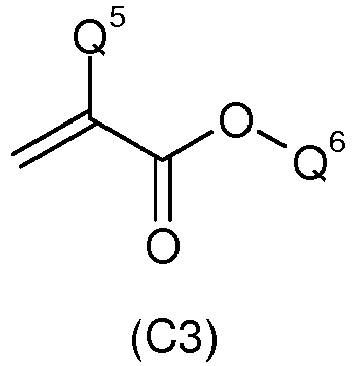
- ∘ Q5 représente un atome d'hydrogène ou un groupement méthyle ;
- ∘ Q6 représente C1-C26-alkyl linéaire ou ramifié.
- De manière plus préférée, Q3 représente un groupement phényl ou un groupement butyl linéaire ou ramifié, en particulier un groupement n-butyl.
- De manière particulièrement préférée, le polymère à peigne est préparé par copolymérisation
- ▪ d'un monomère oléfinique de formule (C4)

- ∘ Q7 représente un groupement C1-C6-alkyl ; un groupement C6-aryl ;
- ∘ Q8 représente un atome d'hydrogène ou un groupement méthyle ;
- ∘ Q9, Q10 et Q11 représentent indépendamment un atome d'hydrogène ou un groupement C1-C18-alkyl ;
- o x, y et z représentent indépendamment 0 ou un nombre entier allant de 1 à 3 000 et la somme (x + y + z) est égale à un nombre entier allant de 7 à 3 000, de préférence allant de 10 à 3 000 ; et
- ▪ d'un monomère ester alkyl-acrylique ou ester alkyl-methacrylique de formule (C3)

- ∘ Q5 représente un atome d'hydrogène ou un groupement méthyle ;
- ∘ Q6 représente C1-C26-alkyl linéaire ou ramifié.
- De manière plus préférée, Q7 représente un groupement phényl ou un groupement butyl linéaire ou ramifié, en particulier un groupement n-butyl.
- De manière plus particulièrement préférée, le polymère à peigne est préparé par copolymérisation
- ▪ d'un monomère oléfinique de formule (C5)

- ∘ Q8 représente un atome d'hydrogène ou un groupement méthyle ;
- o x et y représentent indépendamment 0 ou un nombre entier allant de 1 à 3 000 et la somme (x + y + z) est égale à un nombre entier allant de 7 à 3 000, de préférence allant de 10 à 3 000 ; et
- ▪ d'un monomère ester alkyl-acrylique ou ester alkyl-methacrylique de formule (C3)

- ∘ Q5 représente un atome d'hydrogène ou un groupement méthyle ;
- ∘ Q6 représente C1-C26-alkyl linéaire ou ramifié.
- Un exemple de polymère à peigne est le produit Viscoplex 3-200 (société Evonik).
- Au sein de la composition lubrifiante selon l'invention, les quantités respectives (a) de PAO, (b) d'huile de groupe V et (c) de polymère en peigne peuvent varier. De manière préférée, le rapport en poids (a/b) entre l'huile polyalphaoléfinique (PAO) (a) et l'huile de groupe V (b) va de 0,1 à 4, de préférence de 0,3 à 3,6.
- La composition lubrifiante selon l'invention possède un VI particulièrement élevé. De manière préférée, le VI de la composition lubrifiante selon l'invention est supérieur à 220. De manière plus préférée, le VI de la composition lubrifiante selon l'invention est supérieur à 250, voire supérieur à 270 ou à 300.
- De manière générale, la composition lubrifiante selon l'invention peut comprendre d'autres huiles de base, minérale, synthétique ou naturelle, animale ou végétale, adaptées à son utilisation.
- Les huiles de base utilisées dans les compositions lubrifiantes selon l'invention peuvent être des huiles d'origines minérales ou synthétiques appartenant aux groupes I à V selon les classes définies dans la classification API (ou leurs équivalents selon la classification ATIEL) (tableau A) ou leurs mélanges.
Tableau A Teneur en saturés Teneur en soufre Indice de viscosité (VI) Groupement I Huiles minérales < 90 % > 0,03 % 80 ≤ VI < 120 Groupement II Huiles hydrocraquées ≥ 90 % ≤ 0,03 % 80 ≤ VI < 120 Groupement III Huiles hydrocraquées ou hydro-isomérisées ≥ 90 % ≤ 0,03 % ≥ 120 Groupement IV Polyalphaoléfines (PAO) Groupement V Esters et autres bases non incluses dans les groupes I à IV - Les huiles de base minérales selon l'invention incluent tous types de bases obtenues par distillation atmosphérique et sous vide du pétrole brut, suivies d'opérations de raffinage telles qu'extraction au solvant, désasphaltage, déparaffinage au solvant, hydrotraitement, hydrocraquage, hydroisomérisation et hydrofinition.
- Des mélanges d'huiles synthétiques et minérales peuvent également être employés.
- Il n'existe généralement aucune limitation quant à l'emploi de bases lubrifiantes différentes pour réaliser les compositions lubrifiantes selon l'invention, si ce n'est qu'elles doivent avoir des propriétés, notamment de viscosité, indice de viscosité, teneur en soufre, résistance à l'oxydation, adaptées à une utilisation pour des moteurs ou pour des transmissions de véhicule.
- Les huiles de bases des compositions lubrifiantes selon l'invention peuvent également être choisies parmi les huiles synthétiques, telles certains esters d'acides carboxyliques et d'alcools, et parmi les polyalphaoléfines. Les polyalphaoléfines utilisées comme huiles de base sont par exemple obtenues à partir de monomères comprenant de 4 à 32 atomes de carbone, par exemple à partir d'octène ou de décène, et dont la viscosité à 100 °C est comprise entre 1,5 et 15 mm2.s-1 selon la norme ASTM D445. Leur masse moléculaire moyenne est généralement comprise entre 250 et 3 000 selon la norme ASTM D5296.
- La composition lubrifiante selon l'invention peut comprendre au moins 50 % en masse d'huiles de base par rapport à la masse totale de la composition. De manière plus avantageuse, la composition lubrifiante selon l'invention comprend au moins 60 % en masse, voire au moins 70 % en masse, d'huiles de base par rapport à la masse totale de la composition. De manière plus particulièrement avantageuse, la composition lubrifiante selon l'invention comprend de 75 à 99,9 % en masse d'huiles de base par rapport à la masse totale de la composition.
- L'invention fournit également une composition lubrifiante pour moteur de véhicules comprenant au moins une composition lubrifiante selon l'invention, au moins une huile de base et au moins un additif.
- De nombreux additifs peuvent être utilisés pour cette composition lubrifiante selon l'invention.
- Les additifs préférés pour la composition lubrifiante selon l'invention sont choisis parmi les additifs détergents, les additifs anti-usure, les additifs modificateurs de frottement, les additifs extrême pression, les dispersants, les améliorants du point d'écoulement, les agents anti-mousse, les épaississants et leurs mélanges.
- De manière préférée, la composition lubrifiante selon l'invention comprend au moins un additif anti-usure, au moins un additif extrême pression ou leurs mélanges.
- Les additifs anti-usure et les additifs extrême pression protègent les surfaces en frottement par formation d'un film protecteur adsorbé sur ces surfaces.
- Il existe une grande variété d'additifs anti-usure. De manière préférée pour la composition lubrifiante selon l'invention, les additifs anti-usure sont choisis parmi des additifs phosphosoufrés comme les alkylthiophosphates métalliques, en particulier les alkylthiophosphates de zinc, et plus spécifiquement les dialkyldithiophosphates de zinc ou ZnDTP. Les composés préférés sont de formule Zn((SP(S)(OR)(OR'))2, dans laquelle R et R', identiques ou différents, représentent indépendamment un groupement alkyle, préférentiellement un groupement alkyle comportant de 1 à 18 atomes de carbone.
- Les phosphates d'amines sont également des additifs anti-usure qui peuvent être employés dans la composition lubrifiante selon l'invention. Toutefois, le phosphore apporté par ces additifs peut agir comme poison des systèmes catalytiques des automobiles car ces additifs sont générateurs de cendres. On peut minimiser ces effets en substituant partiellement les phosphates d'amines par des additifs n'apportant pas de phosphore, tels que, par exemple, les polysulfures, notamment les oléfines soufrées.
- De manière avantageuse, la composition lubrifiante selon l'invention peut comprendre de 0,01 à 6 % en masse, préférentiellement de 0,05 à 4 % en masse, plus préférentiellement de 0,1 à 2 % en masse par rapport à la masse totale de composition lubrifiante, d'additifs anti-usure et d'additifs extrême-pression.
- De manière avantageuse, la composition lubrifiante selon l'invention peut comprendre au moins un additif modificateur de frottement. L'additif modificateur de frottement peut être choisi parmi un composé apportant des éléments métalliques et un composé exempt de cendres. Parmi les composés apportant des éléments métalliques, on peut citer les complexes de métaux de transition tels que Mo, Sb, Sn, Fe, Cu, Zn dont les ligands peuvent être des composés hydrocarbonés comprenant des atomes d'oxygène, d'azote, de soufre ou de phosphore. Les additifs modificateurs de frottement exempt de cendres sont généralement d'origine organique et peuvent être choisis parmi les monoesters d'acides gras et de polyols, les amines alcoxylées, les amines grasses alcoxylées, les époxydes gras, les époxydes gras de borate; les amines grasses ou les esters de glycérol d'acide gras. Selon l'invention, les composés gras comprennent au moins un groupement hydrocarboné comprenant de 10 à 24 atomes de carbone.
- De manière avantageuse, la composition lubrifiante selon l'invention peut comprendre de 0,01 à 2 % en masse ou de 0,01 à 5 % en masse, préférentiellement de 0,1 à 1,5 % en masse ou de 0,1 à 2 % en masse par rapport à la masse totale de la composition lubrifiante, d'additif modificateur de frottement.
- De manière avantageuse, la composition lubrifiante selon l'invention peut comprendre au moins un additif antioxydant.
- L'additif antioxydant permet généralement de retarder la dégradation de la composition lubrifiante en service. Cette dégradation peut notamment se traduire par la formation de dépôts, par la présence de boues ou par une augmentation de la viscosité de la composition lubrifiante.
- Les additifs antioxydants agissent notamment comme inhibiteurs radicalaires ou destructeurs d'hydropéroxydes. Parmi les additifs antioxydants couramment employés, on peut citer les additifs antioxydants de type phénolique, les additifs antioxydants de type aminé, les additifs antioxydants phosphosoufrés. Certains de ces additifs antioxydants, par exemple les additifs antioxydants phosphosoufrés, peuvent être générateurs de cendres. Les additifs antioxydants phénoliques peuvent être exempt de cendres ou bien être sous forme de sels métalliques neutres ou basiques. Les additifs antioxydants peuvent notamment être choisis parmi les phénols stériquement encombrés, les esters de phénol stériquement encombrés et les phénols stériquement encombrés comprenant un pont thioéther, les diphénylamines, les diphénylamines substituées par au moins un groupement alkyle en C1-C12, les N,N'-dialkyle-aryle-diamines et leurs mélanges.
- De préférence selon l'invention, les phénols stériquement encombrés sont choisis parmi les composés comprenant un groupement phénol dont au moins un carbone vicinal du carbone portant la fonction alcool est substitué par au moins un groupement alkyle en C1-C10, de préférence un groupement alkyle en C1-C6, de préférence un groupement alkyle en C4, de préférence par le groupement ter-butyle.
- Les composés aminés sont une autre classe d'additifs antioxydants pouvant être utilisés, éventuellement en combinaison avec les additifs antioxydants phénoliques. Des exemples de composés aminés sont les amines aromatiques, par exemple les amines aromatiques de formule NRaRbRc dans laquelle Ra représente un groupement aliphatique ou un groupement aromatique, éventuellement substitué, Rb représente un groupement aromatique, éventuellement substitué, Rc représente un atome d'hydrogène, un groupement alkyle, un groupement aryle ou un groupement de formule RdS(O)zRe dans laquelle Rd représente un groupement alkylène ou un groupement alkenylène, Re représente un groupement alkyle, un groupement alcényle ou un groupement aryle et z représente 0, 1 ou 2.
- Des alkyl phénols sulfurisés ou leurs sels de métaux alcalins et alcalino-terreux peuvent également être utilisés comme additifs antioxydants.
- Une autre classe d'additifs antioxydants est celle des composés cuivrés, par exemples les thio- ou dithio-phosphates de cuivre, les sels de cuivre et d'acides carboxyliques, les dithiocarbamates, les sulphonates, les phénates, les acétylacétonates de cuivre. Les sels de cuivre I et II, les sels d'acide ou d'anhydride succiniques peuvent également être utilisés.
- La composition lubrifiante selon l'invention peut contenir tous types d'additifs antioxydants connus de l'homme du métier.
- De manière avantageuse, la composition lubrifiante comprend au moins un additif antioxydant exempt de cendres.
- De manière également avantageuse, la composition lubrifiante selon l'invention comprend de 0,1 à 2 % en poids par rapport à la masse totale de la composition, d'au moins un additif antioxydant.
- La composition lubrifiante selon l'invention peut également comprendre au moins un additif détergent.
- Les additifs détergents permettent généralement de réduire la formation de dépôts à la surface des pièces métalliques par dissolution des produits secondaires d'oxydation et de combustion.
- Les additifs détergents utilisables dans la composition lubrifiante selon l'invention sont généralement connus de l'homme de métier. Les additifs détergents peuvent être des composés anioniques comprenant une longue chaîne hydrocarbonée lipophile et une tête hydrophile. Le cation associé peut être un cation métallique d'un métal alcalin ou alcalino-terreux.
- Les additifs détergents sont préférentiellement choisis parmi les sels de métaux alcalins ou de métaux alcalino-terreux d'acides carboxyliques, les sulfonates, les salicylates, les naphténates, ainsi que les sels de phénates. Les métaux alcalins et alcalino-terreux sont préférentiellement le calcium, le magnésium, le sodium ou le baryum.
- Ces sels métalliques comprennent généralement le métal en quantité stoechiométrique ou bien en excès, donc en quantité supérieure à la quantité stoechiométrique. Il s'agit alors d'additifs détergents surbasés ; le métal en excès apportant le caractère surbasé à l'additif détergent est alors généralement sous la forme d'un sel métallique insoluble dans l'huile, par exemple un carbonate, un hydroxyde, un oxalate, un acétate, un glutamate, préférentiellement un carbonate.
- De manière avantageuse, la composition lubrifiante selon l'invention peut comprendre de 0,5 à 8 % ou de 2 à 4 % en poids d'additif détergent par rapport à la masse totale de la composition lubrifiante.
- De manière également avantageuse, la composition lubrifiante selon l'invention peut également comprendre au moins un additif abaisseur de point d'écoulement.
- En ralentissant la formation de cristaux de paraffine, les additifs abaisseurs de point d'écoulement améliorent généralement le comportement à froid de la composition lubrifiante selon l'invention.
- Comme exemple d'additifs abaisseurs de point d'écoulement, on peut citer les polyméthacrylates d'alkyle, les polyacrylates, les polyarylamides, les polyalkylphénols, les polyalkylnaphtalènes, les polystyrènes alkylés.
- De manière avantageuse, la composition lubrifiante selon l'invention peut également comprendre au moins un agent dispersant.
- L'agent dispersant peut être choisis parmi les bases de Mannich, les succinimides et leurs dérivés.
- De manière également avantageuse, la composition lubrifiante selon l'invention peut comprendre de 0,2 à 10 % en masse d'agent dispersant par rapport à la masse totale de la composition lubrifiante.
- De manière avantageuse, la composition lubrifiante peut également comprendre au moins un polymère supplémentaire améliorant l'indice de viscosité. Comme exemples de polymère supplémentaire améliorant l'indice de viscosité, on peut citer les esters polymères, les homopolymères ou les copolymères, hydrogénés ou non- hydrogénés, du styrène, du butadiène et de l'isoprène, les polyméthacrylates (PMA). De manière également avantageuse, la composition lubrifiante selon l'invention peut comprendre de 1 à 15 % en masse par rapport à la masse totale de la composition lubrifiante de polymère améliorant l'indice de viscosité.
- Outre une composition lubrifiante, l'invention concerne également l'utilisation de cette composition lubrifiante. En particulier, l'invention concerne l'utilisation d'une composition lubrifiante selon l'invention pour la lubrification d'un moteur de véhicule, en particulier 14 pour la lubrification d'un moteur d'un véhicule hybride.
- De manière préférée, l'utilisation d'une composition lubrifiante selon l'invention permet d'améliorer la lubrification d'un moteur de véhicule. De manière particulièrement préférée, l'utilisation d'une composition lubrifiante selon l'invention permet d'améliorer la lubrification d'un moteur de véhicule lors d'un cycle urbain défini selon le cycle européen NEDC ou lors d'un cycle urbain défini selon le cycle européen WLTP ou encore lors d'un cycle à froid défini selon le cycle européen ECE.
- L'invention concerne également l'utilisation d'une composition lubrifiante selon l'invention pour améliorer le Fuel Eco (FE) d'un lubrifiant.
- L'invention concerne également l'utilisation d'une composition lubrifiante selon l'invention pour réduire la consommation de carburant d'un moteur, en particulier d'un moteur de véhicule, notamment d'un moteur d'un véhicule hybride.
- Selon l'invention, les caractéristiques particulières, avantageuses ou préférées de la composition lubrifiante selon l'invention, permettent de définir des utilisations selon l'invention qui sont également particulières, avantageuses ou préférées.
- Les différents aspects de l'invention peuvent être illustrés par les exemples qui suivent.
- On mélange les différentes composantes des compositions lubrifiantes selon l'invention en fonction de la nature et des quantités de produits présentées dans le tableau 1.
Tableau 1 Compositions lubrifiantes selon l'invention (% en poids) CL1 CL2 CL3 CL4 PAO - (Durasyn 164 Ineos) 64,2 44,2 24,2 44,2 Huile Groupe V - Monoester (Priolube 1414 Croda) 20 40 60 0 Huile Groupe V - PAG de formule (B2) avec R3 = C12H25, m = 2,45 et n = 1,97 0 0 0 40 Polymère en peigne - Polymethacrylate en peigne (Viscoplex 3-200 Evonik) 6,2 6,2 6,2 6,2 Paquet d'additifs - sulfonates de Ca, agents antioxydants de type diphénylamine alkylée et phénols encombrés, ZnDTP secondaire, dispersant de type bisuccinimide 8,6 8,6 8,6 8,6 Agent anti-frottement MoDTC (Sakuralube 525 Adeka) 1,0 1,0 1,0 1,0 - Les caractéristiques de ces compositions lubrifiantes selon l'invention sont présentées dans le tableau 2.
Tableau 2 Composition lubrifiante CL1 CL2 CL3 CL4 Grade SAEJ300 0W12 0W12 0W12 0W16 KV 130 calculé (mm2.s-1) 4,62 4,32 4,63 4,79 KV100 - ISO 3104 (mm2.s-1) 6,950 6, 43 6,995 7,191 KV40 - ISO3104 (mm2.s-1) 23,31 20,92 23,79 24,45 VI - ISO2909 284 296 283 287 HTHS à 150 °C - CEC L-036 (mPa.s) 2,24 2,17 2,15 2,83 CCS à -35 °C - ASTM D5293 (mPa.s) / 839 / 1 415 - On mélange les différentes composantes des compositions lubrifiantes comparatives en fonction de la nature et des quantités de produits présentées dans le tableau 3.
Tableau 3 Composition comparative (% en poids) CC1 CC2 PAO - (Durasyn 164 Ineos) 44,2 84,2 Huile Groupe V - Monoester (Priolube 1414 Croda) 40 0 Polymère - Polymethacrylate linéaire (Viscoplex 6-054 Evonik) 6,2 0 Polymère en peigne - Polymethacrylate en peigne (Viscoplex 3-200 Evonik) 0 6,2 Paquet d'additifs - sulfonates de Ca, agents antioxydants de type diphénylamine alkylée et phénols encombrés, ZnDTP secondaire, dispersant de type bisuccinimide 8,6 8,6 Agent anti-frottement MoDTC (Sakuralube 525 Adeka) 1,0 1,0 - La première composition lubrifiante comparative (CC1) ne comprend pas de polymethacrylate en peigne mais un polymethacrylate linéaire. La deuxième composition lubrifiante comparative (CC2) ne comprend pas d'huile de groupe V mais uniquement de l'huile de groupe IV. Les caractéristiques de ces compositions lubrifiantes comparatives sont présentées dans le tableau 4.
Tableau 4 Composition lubrifiante comparative CC1 CC2 Grade SAEJ300 0W12 0W16 KV 130 calculé (mm2.s-1) 3,84 4,03 KV100 - ISO 3104 (mm2.s-1) 5,970 6,358 KV40 - ISO3104 (mm2.s-1) 23,08 26,19 VI - ISO2909 225 210 HTHS à 150 °C - CEC L-036 (mPa.s) 2,14 2,30 CCS à -35 °C - ASTM D5293 (mPa.s) 968 2 268 - Au cours de plusieurs essais selon les conditions décrites dans les exemples de
WO 2012-025901 , la consommation de carburant lors de la lubrification au moyen de la composition lubrifiante selon l'invention est comparée à la consommation de carburant lors de l'utilisation d'une composition lubrifiante de référence (huile de base et paquet d'additifs similaire au paquet d'additifs de la composition selon l'invention - grade SAEJ300 5W30). Les gains de consommation de carburant sont évalués en prenant comme référence les consommations de carburant résultant de l'utilisation de cette composition lubrifiante de référence. Les résultats obtenus sont présentés dans le tableau 5.Tableau 5 Gain obtenu grâce à la composition lubrifiante (%) CL2 CL4 CC1 Cycle NEDC complet 4,89 4,01 4,73 Cycle NEDC phase ECE à froid 12,84 10,34 11,11 Cycle NEDC phase cycle urbain mixte 7,48 5,58 6,03 - On constate que les compositions lubrifiantes CL2 et CL4 selon l'invention permettent des gains de consommation de carburant très importants. Ainsi, la composition lubrifiante selon l'invention CL2 permet des gains supérieurs à ceux obtenus avec la composition lubrifiante comparative CC1 qui ne comprend pas de polymethacrylate en peigne. Par ailleurs, la composition lubrifiante selon l'invention CL4 comprenant une huile de groupe V de type PAG permet également des gains importants.
- On constate plus particulièrement que ces compositions lubrifiantes selon l'invention permettent des gains très significatifs d'économie de carburant sur cycle moteur à basse température et à faible régime moteur, ce qui démontre l'intérêt de ces compositions lubrifiantes selon l'invention pour obtenir des économies de carburant encore plus importantes en conditions urbaines.
- Le coefficient de traction des compositions lubrifiantes est évalué et les résultats obtenus sont présentés dans le tableau 6.
Tableau 6 Composition lubrifiante CL1 CL2 CL3 CC2 coefficient de traction (MTM: T= 40 °C, Ve= 1 m.-1, SRR= 20 % charge= 25 N) 0,019 0,018 0,016 0,023 - Les compositions lubrifiantes selon l'invention possèdent donc de très bons coefficients de traction. Ces résultats confirment que les compositions lubrifiantes selon l'invention permettent de réduire le coefficient de frottement, et donc d'améliorer le gain d'économie de carburant par rapport à une composition lubrifiante comparative comprenant une PAO et un polymère en peigne selon l'invention mais ne comprenant pas d'huile de groupe V selon l'invention, et ceci avec différentes teneurs en huile de groupe V.
- Les propriétés de propreté moteur sont évaluées par le test TEOST MHT selon la norme ASTM D7097 et les résultats obtenus sont présentés dans le tableau 7 et exprimés en milligrammes. La valeur maximale acceptable, notamment pour la plupart des constructeurs automobiles, est égale à 35 mg suivant la classification ILSAC pour une huile de grade 0Wxx.
Tableau 7 Composition lubrifiante CL1 CL2 CL3 CL4 CC2 dépôt sur tige Teost MHT - ASTM D7097 (mg) 12,2 11,9 22,7 10,7 7,6 - Les compositions lubrifiantes selon l'invention permettent donc de conserver une bonne propreté moteur, voire d'améliorer la propreté moteur et sont conformes aux limites fixées par l'industrie automobile. Il est à noter que ces bons résultats en propreté moteur sont obtenus avec différentes teneurs en huile de groupe V selon l'invention.
Claims (13)
- Composition lubrifiante de grade selon la classification SAEJ300 défini par la formule (I)
(X) W (Y) (I)
dans laquelle▪ X représente 0 ou 5 ;▪ Y représente un nombre entier allant de 4 à 20 ; etcomprenant(a) au moins une huile polyalphaoléfinique (PAO) dont la viscosité cinématique mesurée à 100 °C selon la norme ASTM D445 va de 1,5 à 8 mm2.s-1 ;(b) de 10 à 80 % en poids de la composition d'au moins une huile de groupe V dont la viscosité cinématique mesurée à 100 °C selon la norme ASTM D445 va de 1,5 à 8 mm2.s-1 choisi parmi▪ un monoester de formule (B1) ;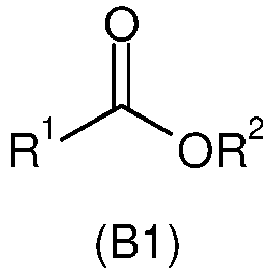 o R1 représente un groupement hydrocarboné, saturé ou insaturé, linéaire ou ramifié, comprenant de 14 à 24 atomes de carbone ;o R2 représente un groupement hydrocarboné, saturé ou insaturé, linéaire ou ramifié, comprenant de 2 à 18 atomes de carbone ;▪ un polyalkylene-glycol (PAG) de formule (B2)
 o R3 représente un groupement C1-C30-alkyl linéaire ou ramifié ;m et n représentent indépendamment un nombre moyen allant de 1 à 5;(c) au moins un polymère en peigne dont les chaînes pendantes comprennent au moins 50 atomes de carbone et choisi parmi les copolymères d'au moins une polyoléfine et d'au moins un poly(alkyl)methacrylate ; les copolymères d'au moins une polyoléfine et d'au moins un poly(alkyl)acrylate.
 - Composition lubrifiante selon la revendication 1 de grade selon la classification SAEJ300 choisi parmi 0W4, 0W8, 0W12, 0W16, 0W20, 5W4, 5W8, 5W12, 5W16, 5W20.
- Composition lubrifiante selon l'une des revendications 1 ou 2 dont la viscosité cinématique mesurée à 40 °C selon la norme ASTM D445 va de 12 à 30 mm2.s-1, de préférence de 14 à 25 mm2.s-1.
- Composition lubrifiante selon l'une des revendications 1 à 3▪ pour laquelle la viscosité cinématique de la PAO, mesurée à 100 °C selon la norme ASTM D445, va de 1,5 à 6 mm2.s-1 ou de 2 à 8 mm2.s-1 ou encore de 2 à 6 mm2.s-1 ; ou▪ pour laquelle la masse moléculaire moyenne en poids de la PAO est inférieure à 500 Da ou va de 50 à 500 Da ou va de 50 à 350 Da ou de 50 à 300 Da.
- Composition lubrifiante selon l'une des revendications 1 à 4 comprenant de 20 à 80 %, de 30 à 60 % ou de 35 à 45 % en poids de la composition d'huile de groupe V.
- Composition lubrifiante selon l'une des revendications 1 à 5 pour laquelle le polymère à peigne dont les chaînes pendantes sont obtenues par polymérisation ou par copolymérisation d'oléfines, de préférence d'oléfines comprenant de 8 à 17 atomes de carbone et choisies parmi les styrènes, les styrènes substitués, le butadiène additionné en 1,4, le butadiène additionné en 1,2, les composés de formule (C1)

- Composition lubrifiante selon l'une des revendications 1 à 6 pour laquelle le polymère à peigne est préparé par copolymérisation▪ d'un monomère oléfinique de formule (C2)
 o Q3 représente un groupement C2-C8-alkyl linéaire ou ramifié ; un groupement C3-C8-cycloalkyl ; un groupement C6-C10-aryl ;o Q4 représente un atome d'hydrogène ou un groupement méthyle ;o L1 représente un résidu d'addition 1,4 de butadiène ; un résidu d'addition 1,4 de butadiène substitué par au moins un groupement C1-C6-alkyl ; un résidu d'addition vinylique de styrène ; un résidu d'addition vinylique de styrène substitué par au moins un groupement C1-C6-alkyl ;o L2 représente un résidu d'addition vinylique de butadiène ; un résidu d'addition vinylique de butadiène substitué par un groupement C1-C6-alkyl ; un résidu d'addition vinylique de styrène ; un résidu d'addition vinylique de styrène substitué par au moins un groupement C1-C6-alkyl ;o k et j représentent indépendamment 0 ou un nombre entier allant de 1 à 3 000 et la somme (k + j) est égale à un nombre entier allant de 7 à 3 000, de préférence allant de 10 à 3 000 ; et▪ d'un monomère ester alkyl-acrylique ou ester alkyl-methacrylique de formule (C3)
 o Q5 représente un atome d'hydrogène ou un groupement méthyle ;∘ Q6 représente C1-C26-alkyl linéaire ou ramifié.
 - Composition lubrifiante selon l'une des revendications 1 à 7 pour laquelle le polymère à peigne est préparé par copolymérisation▪ d'un monomère oléfinique de formule (C4)
 o Q7 représente un groupement C1-C6-alkyl ; un groupement C6-aryl ;o Q8 représente un atome d'hydrogène ou un groupement méthyle ;o Q9, Q10 et Q11 représentent indépendamment un atome d'hydrogène ou un groupement C1-C18-alkyl ;o x, y et z représentent indépendamment 0 ou un nombre entier allant de 1 à 3 000 et la somme (x + y + z) est égale à un nombre entier allant de 7 à 3 000, de préférence allant de 10 à 3 000 ; et▪ d'un monomère ester alkyl-acrylique ou ester alkyl-methacrylique de formule (C3)
 o Q5 représente un atome d'hydrogène ou un groupement méthyle ;∘ Q6 représente C1-C26-alkyl linéaire ou ramifié.
 - Composition lubrifiante selon l'une des revendications 1 à 8 dont le rapport en poids (a/b) entre l'huile polyalphaoléfinique (PAO) (a) et l'huile de groupe V (b) va de 0,1 à 4, de préférence de 0,3 à 3,6.
- Composition lubrifiante selon l'une des revendications 1 à 9 dont le VI est supérieur à 220, de préférence supérieur à 250, voire supérieur à 270 ou à 300.
- Utilisation d'une composition lubrifiante selon l'une des revendications 1 à 10 pour la lubrification d'un moteur de véhicule ou pour améliorer la lubrification d'un moteur de véhicule▪ lors d'un cycle urbain défini selon le cycle européen NEDC ; ou▪ lors d'un cycle urbain défini selon le cycle européen WLTP ; ou▪ lors d'un cycle à froid défini selon le cycle européen ECE.
- Utilisation selon la revendication 11 pour la lubrification d'un moteur d'un véhicule hybride.
- Utilisation d'une composition lubrifiante selon l'une des revendications 1 à 10 pour améliorer le Fuel Eco (FE) d'un lubrifiant ou pour réduire la consommation de carburant d'un moteur, en particulier d'un moteur de véhicule, notamment d'un moteur d'un véhicule hybride.
Applications Claiming Priority (2)
| Application Number | Priority Date | Filing Date | Title |
|---|---|---|---|
| FR1553930A FR3035663B1 (fr) | 2015-04-30 | 2015-04-30 | Composition lubrifiante ultra-fluide |
| PCT/EP2016/059581 WO2016174186A1 (fr) | 2015-04-30 | 2016-04-29 | Composition lubrifiante ultra-fluide |
Publications (2)
| Publication Number | Publication Date |
|---|---|
| EP3289054A1 EP3289054A1 (fr) | 2018-03-07 |
| EP3289054B1 true EP3289054B1 (fr) | 2024-07-24 |
Family
ID=53674131
Family Applications (1)
| Application Number | Title | Priority Date | Filing Date |
|---|---|---|---|
| EP16720100.3A Active EP3289054B1 (fr) | 2015-04-30 | 2016-04-29 | Composition lubrifiante ultra-fluide |
Country Status (11)
| Country | Link |
|---|---|
| US (1) | US10731102B2 (fr) |
| EP (1) | EP3289054B1 (fr) |
| JP (1) | JP6799006B2 (fr) |
| KR (1) | KR102644248B1 (fr) |
| CN (1) | CN107548414A (fr) |
| AR (1) | AR104459A1 (fr) |
| BR (1) | BR112017023235A2 (fr) |
| CA (1) | CA2984685A1 (fr) |
| FR (1) | FR3035663B1 (fr) |
| MA (1) | MA41976A (fr) |
| WO (1) | WO2016174186A1 (fr) |
Families Citing this family (25)
| Publication number | Priority date | Publication date | Assignee | Title |
|---|---|---|---|---|
| FR3058156B1 (fr) * | 2016-10-27 | 2022-09-16 | Total Marketing Services | Composition pour vehicule electrique |
| EP3601504A1 (fr) * | 2017-03-24 | 2020-02-05 | ExxonMobil Chemical Patents Inc. | Huiles de base augmentant la viscosité d'un simulateur de démarrage à froid et formulations d'huile lubrifiante les contenant |
| FR3069864B1 (fr) * | 2017-08-03 | 2019-08-16 | Total Marketing Services | Composition lubrifiante comprenant un diester |
| FR3072685B1 (fr) * | 2017-10-20 | 2020-11-06 | Total Marketing Services | Composition pour refroidir et lubrifier un systeme de motorisation d'un vehicule |
| CN108085101B (zh) * | 2017-11-16 | 2021-04-16 | 大庆劳特润滑油有限公司 | 一种用于改善燃油经济性的超300粘度指数的发动机油组合物 |
| JP7266367B2 (ja) * | 2018-03-12 | 2023-04-28 | エクソンモービル・テクノロジー・アンド・エンジニアリング・カンパニー | 潤滑油基油組成物 |
| US11629308B2 (en) * | 2019-02-28 | 2023-04-18 | ExxonMobil Technology and Engineering Company | Low viscosity gear oil compositions for electric and hybrid vehicles |
| US11085006B2 (en) | 2019-07-12 | 2021-08-10 | Afton Chemical Corporation | Lubricants for electric and hybrid vehicle applications |
| KR102842991B1 (ko) * | 2019-11-26 | 2025-08-06 | 현대자동차주식회사 | 연비 및 내구성이 향상된 무단변속기유 조성물 |
| FR3105255B1 (fr) * | 2019-12-20 | 2023-03-03 | Total Marketing Services | Procede de fabrication d’estolides et composition d’estolides |
| FR3108621B1 (fr) * | 2020-03-25 | 2022-07-22 | Total Marketing Services | Utilisation de polymère d’alkyle métacrylate pour réduire les émissions de particules |
| CN116209738B (zh) | 2020-09-01 | 2026-03-13 | 国际壳牌研究有限公司 | 发动机油组合物 |
| US11326123B1 (en) | 2020-12-01 | 2022-05-10 | Afton Chemical Corporation | Durable lubricating fluids for electric vehicles |
| US11634655B2 (en) | 2021-03-30 | 2023-04-25 | Afton Chemical Corporation | Engine oils with improved viscometric performance |
| CN117098832A (zh) | 2021-03-31 | 2023-11-21 | 出光兴产株式会社 | 润滑油组合物 |
| US11753599B2 (en) | 2021-06-04 | 2023-09-12 | Afton Chemical Corporation | Lubricating compositions for a hybrid engine |
| KR20240102949A (ko) * | 2021-11-09 | 2024-07-03 | 셰브런 재팬 리미티드 | 고효율 엔진 오일 조성물 |
| US11814599B2 (en) | 2022-03-31 | 2023-11-14 | Afton Chemical Corporation | Durable magnet wires and lubricating fluids for electric and hybrid vehicle applications |
| US12098347B2 (en) | 2022-09-21 | 2024-09-24 | Afton Chemical Corporation | Lubricating composition for fuel efficient motorcycle applications |
| US12024687B2 (en) | 2022-09-27 | 2024-07-02 | Afton Chemical Corporation | Lubricating composition for motorcycle applications |
| US11912955B1 (en) | 2022-10-28 | 2024-02-27 | Afton Chemical Corporation | Lubricating compositions for reduced low temperature valve train wear |
| US12110468B1 (en) | 2023-03-22 | 2024-10-08 | Afton Chemical Corporation | Antiwear systems for improved wear in medium and/or heavy duty diesel engines |
| US12043817B1 (en) | 2023-06-27 | 2024-07-23 | Afton Chemical Corporation | Low viscosity lubricating fluid for an electric motor system |
| US11939551B1 (en) | 2023-06-27 | 2024-03-26 | Afton Chemical Corporation | Lubricating fluid for an electric motor system |
| FR3154413A1 (fr) * | 2023-10-18 | 2025-04-25 | Totalenergies Onetech | Compositions lubrifiantes d’indice de viscosité élevé |
Family Cites Families (11)
| Publication number | Priority date | Publication date | Assignee | Title |
|---|---|---|---|---|
| JP3454593B2 (ja) * | 1994-12-27 | 2003-10-06 | 旭電化工業株式会社 | 潤滑油組成物 |
| GB9624441D0 (en) | 1996-11-25 | 1997-01-15 | Exxon Research Engineering Co | Fuel economy engine oil composition |
| US6713438B1 (en) * | 1999-03-24 | 2004-03-30 | Mobil Oil Corporation | High performance engine oil |
| BRPI0813492B1 (pt) * | 2007-07-09 | 2017-06-06 | Evonik Oil Additives Gmbh | uso de polímeros em forma de pente para reduzir consumo de combustível |
| US20090186784A1 (en) * | 2008-01-22 | 2009-07-23 | Diggs Nancy Z | Lubricating Oil Composition |
| US8476205B2 (en) * | 2008-10-03 | 2013-07-02 | Exxonmobil Research And Engineering Company | Chromium HVI-PAO bi-modal lubricant compositions |
| DE102010038615A1 (de) * | 2010-07-29 | 2012-02-02 | Evonik Rohmax Additives Gmbh | Polyalkyl(meth)acrylat zur Verbesserung von Schmieröleigenschaften |
| FR2964115B1 (fr) * | 2010-08-27 | 2013-09-27 | Total Raffinage Marketing | Lubrifiant moteur |
| FR2998303B1 (fr) * | 2012-11-16 | 2015-04-10 | Total Raffinage Marketing | Composition lubrifiante |
| US20140162924A1 (en) * | 2012-12-10 | 2014-06-12 | Raymond F. Watts | Method of improving the efficiency of automotive transmissions |
| CN103725385B (zh) * | 2013-12-27 | 2015-04-22 | 华南理工大学 | 一种全合成无级变速器传动液及其制备方法和应用 |
-
2015
- 2015-04-30 FR FR1553930A patent/FR3035663B1/fr active Active
-
2016
- 2016-04-29 AR ARP160101233A patent/AR104459A1/es unknown
- 2016-04-29 EP EP16720100.3A patent/EP3289054B1/fr active Active
- 2016-04-29 JP JP2017556138A patent/JP6799006B2/ja active Active
- 2016-04-29 CN CN201680025924.4A patent/CN107548414A/zh active Pending
- 2016-04-29 CA CA2984685A patent/CA2984685A1/fr not_active Abandoned
- 2016-04-29 WO PCT/EP2016/059581 patent/WO2016174186A1/fr not_active Ceased
- 2016-04-29 KR KR1020177031291A patent/KR102644248B1/ko active Active
- 2016-04-29 US US15/570,147 patent/US10731102B2/en active Active
- 2016-04-29 BR BR112017023235-9A patent/BR112017023235A2/pt active Search and Examination
- 2016-04-29 MA MA041976A patent/MA41976A/fr unknown
Also Published As
| Publication number | Publication date |
|---|---|
| EP3289054A1 (fr) | 2018-03-07 |
| FR3035663A1 (fr) | 2016-11-04 |
| US20180134983A1 (en) | 2018-05-17 |
| US10731102B2 (en) | 2020-08-04 |
| WO2016174186A1 (fr) | 2016-11-03 |
| KR102644248B1 (ko) | 2024-03-06 |
| MA41976A (fr) | 2018-03-07 |
| KR20180004718A (ko) | 2018-01-12 |
| JP2018514621A (ja) | 2018-06-07 |
| FR3035663B1 (fr) | 2017-06-02 |
| CA2984685A1 (fr) | 2016-11-03 |
| CN107548414A (zh) | 2018-01-05 |
| BR112017023235A2 (pt) | 2018-08-07 |
| AR104459A1 (es) | 2017-07-19 |
| JP6799006B2 (ja) | 2020-12-09 |
Similar Documents
| Publication | Publication Date | Title |
|---|---|---|
| EP3289054A1 (fr) | Composition lubrifiante ultra-fluide | |
| EP2643441B1 (fr) | Composition lubrifiante pour moteur | |
| EP3274432B1 (fr) | Composition lubrifiante | |
| EP2920283B1 (fr) | Composition lubrifiante | |
| EP3662041B1 (fr) | Composition lubrifiante comprenant un diester | |
| WO2017157979A1 (fr) | Composition lubrifiante a base de polyalkylene glycols | |
| EP3325583B1 (fr) | Composition lubrifiante a fuel eco longue durée | |
| EP3625315A1 (fr) | Utilisation de compositions lubrifiantes pour ameliorer la proprete d'un moteur de vehicule 4-temps | |
| EP3877488B1 (fr) | Utilisation d'un diester pour ameliorer les proprietes anti-usure d'une composition lubrifiante | |
| EP3481927B1 (fr) | Composition lubrifiante pour moteur a gaz | |
| EP3331974B1 (fr) | Utilisation des compositions lubrifiantes pour prevenir ou diminuer le pre-allumage dans un moteur | |
| EP3430110B1 (fr) | Composition lubrifiante a base de polyalkylene glycols | |
| EP3237588A1 (fr) | Composition lubrifiante a matériau a changement de phase | |
| EP3947610B1 (fr) | Utilisation d'une composition lubrifiante pour transmission de véhicule à moteur | |
| EP3529341B1 (fr) | Composition lubrifiante | |
| EP3237589A1 (fr) | Composition lubrifiante a matériau a changement de phase | |
| WO2017191215A1 (fr) | Composition hydraulique grand froid |
Legal Events
| Date | Code | Title | Description |
|---|---|---|---|
| STAA | Information on the status of an ep patent application or granted ep patent |
Free format text: STATUS: THE INTERNATIONAL PUBLICATION HAS BEEN MADE |
|
| PUAI | Public reference made under article 153(3) epc to a published international application that has entered the european phase |
Free format text: ORIGINAL CODE: 0009012 |
|
| STAA | Information on the status of an ep patent application or granted ep patent |
Free format text: STATUS: REQUEST FOR EXAMINATION WAS MADE |
|
| 17P | Request for examination filed |
Effective date: 20171027 |
|
| AK | Designated contracting states |
Kind code of ref document: A1 Designated state(s): AL AT BE BG CH CY CZ DE DK EE ES FI FR GB GR HR HU IE IS IT LI LT LU LV MC MK MT NL NO PL PT RO RS SE SI SK SM TR |
|
| AX | Request for extension of the european patent |
Extension state: BA ME |
|
| DAX | Request for extension of the european patent (deleted) | ||
| RAV | Requested validation state of the european patent: fee paid |
Extension state: MA Effective date: 20171027 |
|
| STAA | Information on the status of an ep patent application or granted ep patent |
Free format text: STATUS: EXAMINATION IS IN PROGRESS |
|
| 17Q | First examination report despatched |
Effective date: 20210127 |
|
| RAP1 | Party data changed (applicant data changed or rights of an application transferred) |
Owner name: TOTALENERGIES ONETECH |
|
| GRAP | Despatch of communication of intention to grant a patent |
Free format text: ORIGINAL CODE: EPIDOSNIGR1 |
|
| STAA | Information on the status of an ep patent application or granted ep patent |
Free format text: STATUS: GRANT OF PATENT IS INTENDED |
|
| RIC1 | Information provided on ipc code assigned before grant |
Ipc: C10N 40/25 20060101ALN20240123BHEP Ipc: C10N 30/10 20060101ALN20240123BHEP Ipc: C10N 30/06 20060101ALN20240123BHEP Ipc: C10N 30/04 20060101ALN20240123BHEP Ipc: C10N 30/02 20060101ALN20240123BHEP Ipc: C10N 30/00 20060101ALN20240123BHEP Ipc: C10N 20/04 20060101ALN20240123BHEP Ipc: C10N 20/02 20060101ALN20240123BHEP Ipc: C10N 10/12 20060101ALN20240123BHEP Ipc: C10N 10/04 20060101ALN20240123BHEP Ipc: C10M 169/04 20060101AFI20240123BHEP |
|
| INTG | Intention to grant announced |
Effective date: 20240226 |
|
| GRAS | Grant fee paid |
Free format text: ORIGINAL CODE: EPIDOSNIGR3 |
|
| P01 | Opt-out of the competence of the unified patent court (upc) registered |
Effective date: 20240514 |
|
| GRAA | (expected) grant |
Free format text: ORIGINAL CODE: 0009210 |
|
| STAA | Information on the status of an ep patent application or granted ep patent |
Free format text: STATUS: THE PATENT HAS BEEN GRANTED |
|
| AK | Designated contracting states |
Kind code of ref document: B1 Designated state(s): AL AT BE BG CH CY CZ DE DK EE ES FI FR GB GR HR HU IE IS IT LI LT LU LV MC MK MT NL NO PL PT RO RS SE SI SK SM TR |
|
| REG | Reference to a national code |
Ref country code: GB Ref legal event code: FG4D Free format text: NOT ENGLISH |
|
| REG | Reference to a national code |
Ref country code: CH Ref legal event code: EP |
|
| REG | Reference to a national code |
Ref country code: DE Ref legal event code: R096 Ref document number: 602016088537 Country of ref document: DE |
|
| REG | Reference to a national code |
Ref country code: IE Ref legal event code: FG4D Free format text: LANGUAGE OF EP DOCUMENT: FRENCH |
|
| REG | Reference to a national code |
Ref country code: LT Ref legal event code: MG9D |
|
| REG | Reference to a national code |
Ref country code: NL Ref legal event code: MP Effective date: 20240724 |
|
| PG25 | Lapsed in a contracting state [announced via postgrant information from national office to epo] |
Ref country code: PT Free format text: LAPSE BECAUSE OF FAILURE TO SUBMIT A TRANSLATION OF THE DESCRIPTION OR TO PAY THE FEE WITHIN THE PRESCRIBED TIME-LIMIT Effective date: 20241125 |
|
| REG | Reference to a national code |
Ref country code: AT Ref legal event code: MK05 Ref document number: 1706339 Country of ref document: AT Kind code of ref document: T Effective date: 20240724 |
|
| PG25 | Lapsed in a contracting state [announced via postgrant information from national office to epo] |
Ref country code: NL Free format text: LAPSE BECAUSE OF FAILURE TO SUBMIT A TRANSLATION OF THE DESCRIPTION OR TO PAY THE FEE WITHIN THE PRESCRIBED TIME-LIMIT Effective date: 20240724 |
|
| PG25 | Lapsed in a contracting state [announced via postgrant information from national office to epo] |
Ref country code: PT Free format text: LAPSE BECAUSE OF FAILURE TO SUBMIT A TRANSLATION OF THE DESCRIPTION OR TO PAY THE FEE WITHIN THE PRESCRIBED TIME-LIMIT Effective date: 20241125 Ref country code: NL Free format text: LAPSE BECAUSE OF FAILURE TO SUBMIT A TRANSLATION OF THE DESCRIPTION OR TO PAY THE FEE WITHIN THE PRESCRIBED TIME-LIMIT Effective date: 20240724 |
|
| PG25 | Lapsed in a contracting state [announced via postgrant information from national office to epo] |
Ref country code: NO Free format text: LAPSE BECAUSE OF FAILURE TO SUBMIT A TRANSLATION OF THE DESCRIPTION OR TO PAY THE FEE WITHIN THE PRESCRIBED TIME-LIMIT Effective date: 20241024 |
|
| PG25 | Lapsed in a contracting state [announced via postgrant information from national office to epo] |
Ref country code: GR Free format text: LAPSE BECAUSE OF FAILURE TO SUBMIT A TRANSLATION OF THE DESCRIPTION OR TO PAY THE FEE WITHIN THE PRESCRIBED TIME-LIMIT Effective date: 20241025 Ref country code: FI Free format text: LAPSE BECAUSE OF FAILURE TO SUBMIT A TRANSLATION OF THE DESCRIPTION OR TO PAY THE FEE WITHIN THE PRESCRIBED TIME-LIMIT Effective date: 20240724 Ref country code: PL Free format text: LAPSE BECAUSE OF FAILURE TO SUBMIT A TRANSLATION OF THE DESCRIPTION OR TO PAY THE FEE WITHIN THE PRESCRIBED TIME-LIMIT Effective date: 20240724 |
|
| PG25 | Lapsed in a contracting state [announced via postgrant information from national office to epo] |
Ref country code: BG Free format text: LAPSE BECAUSE OF FAILURE TO SUBMIT A TRANSLATION OF THE DESCRIPTION OR TO PAY THE FEE WITHIN THE PRESCRIBED TIME-LIMIT Effective date: 20240724 |
|
| PG25 | Lapsed in a contracting state [announced via postgrant information from national office to epo] |
Ref country code: LV Free format text: LAPSE BECAUSE OF FAILURE TO SUBMIT A TRANSLATION OF THE DESCRIPTION OR TO PAY THE FEE WITHIN THE PRESCRIBED TIME-LIMIT Effective date: 20240724 |
|
| PG25 | Lapsed in a contracting state [announced via postgrant information from national office to epo] |
Ref country code: AT Free format text: LAPSE BECAUSE OF FAILURE TO SUBMIT A TRANSLATION OF THE DESCRIPTION OR TO PAY THE FEE WITHIN THE PRESCRIBED TIME-LIMIT Effective date: 20240724 Ref country code: IS Free format text: LAPSE BECAUSE OF FAILURE TO SUBMIT A TRANSLATION OF THE DESCRIPTION OR TO PAY THE FEE WITHIN THE PRESCRIBED TIME-LIMIT Effective date: 20241124 |
|
| PG25 | Lapsed in a contracting state [announced via postgrant information from national office to epo] |
Ref country code: HR Free format text: LAPSE BECAUSE OF FAILURE TO SUBMIT A TRANSLATION OF THE DESCRIPTION OR TO PAY THE FEE WITHIN THE PRESCRIBED TIME-LIMIT Effective date: 20240724 |
|
| PG25 | Lapsed in a contracting state [announced via postgrant information from national office to epo] |
Ref country code: ES Free format text: LAPSE BECAUSE OF FAILURE TO SUBMIT A TRANSLATION OF THE DESCRIPTION OR TO PAY THE FEE WITHIN THE PRESCRIBED TIME-LIMIT Effective date: 20240724 Ref country code: RS Free format text: LAPSE BECAUSE OF FAILURE TO SUBMIT A TRANSLATION OF THE DESCRIPTION OR TO PAY THE FEE WITHIN THE PRESCRIBED TIME-LIMIT Effective date: 20241024 |
|
| PG25 | Lapsed in a contracting state [announced via postgrant information from national office to epo] |
Ref country code: RS Free format text: LAPSE BECAUSE OF FAILURE TO SUBMIT A TRANSLATION OF THE DESCRIPTION OR TO PAY THE FEE WITHIN THE PRESCRIBED TIME-LIMIT Effective date: 20241024 Ref country code: PL Free format text: LAPSE BECAUSE OF FAILURE TO SUBMIT A TRANSLATION OF THE DESCRIPTION OR TO PAY THE FEE WITHIN THE PRESCRIBED TIME-LIMIT Effective date: 20240724 Ref country code: NO Free format text: LAPSE BECAUSE OF FAILURE TO SUBMIT A TRANSLATION OF THE DESCRIPTION OR TO PAY THE FEE WITHIN THE PRESCRIBED TIME-LIMIT Effective date: 20241024 Ref country code: LV Free format text: LAPSE BECAUSE OF FAILURE TO SUBMIT A TRANSLATION OF THE DESCRIPTION OR TO PAY THE FEE WITHIN THE PRESCRIBED TIME-LIMIT Effective date: 20240724 Ref country code: IS Free format text: LAPSE BECAUSE OF FAILURE TO SUBMIT A TRANSLATION OF THE DESCRIPTION OR TO PAY THE FEE WITHIN THE PRESCRIBED TIME-LIMIT Effective date: 20241124 Ref country code: HR Free format text: LAPSE BECAUSE OF FAILURE TO SUBMIT A TRANSLATION OF THE DESCRIPTION OR TO PAY THE FEE WITHIN THE PRESCRIBED TIME-LIMIT Effective date: 20240724 Ref country code: GR Free format text: LAPSE BECAUSE OF FAILURE TO SUBMIT A TRANSLATION OF THE DESCRIPTION OR TO PAY THE FEE WITHIN THE PRESCRIBED TIME-LIMIT Effective date: 20241025 Ref country code: FI Free format text: LAPSE BECAUSE OF FAILURE TO SUBMIT A TRANSLATION OF THE DESCRIPTION OR TO PAY THE FEE WITHIN THE PRESCRIBED TIME-LIMIT Effective date: 20240724 Ref country code: ES Free format text: LAPSE BECAUSE OF FAILURE TO SUBMIT A TRANSLATION OF THE DESCRIPTION OR TO PAY THE FEE WITHIN THE PRESCRIBED TIME-LIMIT Effective date: 20240724 Ref country code: BG Free format text: LAPSE BECAUSE OF FAILURE TO SUBMIT A TRANSLATION OF THE DESCRIPTION OR TO PAY THE FEE WITHIN THE PRESCRIBED TIME-LIMIT Effective date: 20240724 Ref country code: AT Free format text: LAPSE BECAUSE OF FAILURE TO SUBMIT A TRANSLATION OF THE DESCRIPTION OR TO PAY THE FEE WITHIN THE PRESCRIBED TIME-LIMIT Effective date: 20240724 |
|
| PG25 | Lapsed in a contracting state [announced via postgrant information from national office to epo] |
Ref country code: RO Free format text: LAPSE BECAUSE OF FAILURE TO SUBMIT A TRANSLATION OF THE DESCRIPTION OR TO PAY THE FEE WITHIN THE PRESCRIBED TIME-LIMIT Effective date: 20240724 Ref country code: SM Free format text: LAPSE BECAUSE OF FAILURE TO SUBMIT A TRANSLATION OF THE DESCRIPTION OR TO PAY THE FEE WITHIN THE PRESCRIBED TIME-LIMIT Effective date: 20240724 Ref country code: DK Free format text: LAPSE BECAUSE OF FAILURE TO SUBMIT A TRANSLATION OF THE DESCRIPTION OR TO PAY THE FEE WITHIN THE PRESCRIBED TIME-LIMIT Effective date: 20240724 |
|
| PG25 | Lapsed in a contracting state [announced via postgrant information from national office to epo] |
Ref country code: EE Free format text: LAPSE BECAUSE OF FAILURE TO SUBMIT A TRANSLATION OF THE DESCRIPTION OR TO PAY THE FEE WITHIN THE PRESCRIBED TIME-LIMIT Effective date: 20240724 |
|
| PG25 | Lapsed in a contracting state [announced via postgrant information from national office to epo] |
Ref country code: CZ Free format text: LAPSE BECAUSE OF FAILURE TO SUBMIT A TRANSLATION OF THE DESCRIPTION OR TO PAY THE FEE WITHIN THE PRESCRIBED TIME-LIMIT Effective date: 20240724 |
|
| REG | Reference to a national code |
Ref country code: DE Ref legal event code: R097 Ref document number: 602016088537 Country of ref document: DE |
|
| PG25 | Lapsed in a contracting state [announced via postgrant information from national office to epo] |
Ref country code: SK Free format text: LAPSE BECAUSE OF FAILURE TO SUBMIT A TRANSLATION OF THE DESCRIPTION OR TO PAY THE FEE WITHIN THE PRESCRIBED TIME-LIMIT Effective date: 20240724 |
|
| PLBE | No opposition filed within time limit |
Free format text: ORIGINAL CODE: 0009261 |
|
| STAA | Information on the status of an ep patent application or granted ep patent |
Free format text: STATUS: NO OPPOSITION FILED WITHIN TIME LIMIT |
|
| 26N | No opposition filed |
Effective date: 20250425 |
|
| PGFP | Annual fee paid to national office [announced via postgrant information from national office to epo] |
Ref country code: DE Payment date: 20250422 Year of fee payment: 10 |
|
| PGFP | Annual fee paid to national office [announced via postgrant information from national office to epo] |
Ref country code: GB Payment date: 20250423 Year of fee payment: 10 |
|
| PGFP | Annual fee paid to national office [announced via postgrant information from national office to epo] |
Ref country code: IT Payment date: 20250424 Year of fee payment: 10 |
|
| PGFP | Annual fee paid to national office [announced via postgrant information from national office to epo] |
Ref country code: FR Payment date: 20250425 Year of fee payment: 10 |
|
| PG25 | Lapsed in a contracting state [announced via postgrant information from national office to epo] |
Ref country code: SE Free format text: LAPSE BECAUSE OF FAILURE TO SUBMIT A TRANSLATION OF THE DESCRIPTION OR TO PAY THE FEE WITHIN THE PRESCRIBED TIME-LIMIT Effective date: 20240724 |
|
| REG | Reference to a national code |
Ref country code: CH Ref legal event code: H13 Free format text: ST27 STATUS EVENT CODE: U-0-0-H10-H13 (AS PROVIDED BY THE NATIONAL OFFICE) Effective date: 20251125 |
|
| PG25 | Lapsed in a contracting state [announced via postgrant information from national office to epo] |
Ref country code: LU Free format text: LAPSE BECAUSE OF NON-PAYMENT OF DUE FEES Effective date: 20250429 |
|
| PG25 | Lapsed in a contracting state [announced via postgrant information from national office to epo] |
Ref country code: MC Free format text: LAPSE BECAUSE OF FAILURE TO SUBMIT A TRANSLATION OF THE DESCRIPTION OR TO PAY THE FEE WITHIN THE PRESCRIBED TIME-LIMIT Effective date: 20240724 |
|
| REG | Reference to a national code |
Ref country code: BE Ref legal event code: MM Effective date: 20250430 |
|
| PG25 | Lapsed in a contracting state [announced via postgrant information from national office to epo] |
Ref country code: BE Free format text: LAPSE BECAUSE OF NON-PAYMENT OF DUE FEES Effective date: 20250430 |
|
| PG25 | Lapsed in a contracting state [announced via postgrant information from national office to epo] |
Ref country code: CH Free format text: LAPSE BECAUSE OF NON-PAYMENT OF DUE FEES Effective date: 20250430 |
|
| PG25 | Lapsed in a contracting state [announced via postgrant information from national office to epo] |
Ref country code: IE Free format text: LAPSE BECAUSE OF NON-PAYMENT OF DUE FEES Effective date: 20250429 |
|
| VS25 | Lapsed in a validation state [announced via postgrant information from nat. office to epo] |
Ref country code: MA Free format text: LAPSE BECAUSE OF FAILURE TO SUBMIT A TRANSLATION OF THE DESCRIPTION OR TO PAY THE FEE WITHIN THE PRESCRIBED TIME-LIMIT; INVALID AB INITIO Effective date: 20160429 |