EP3286367B1 - Thermisch fixierbares flächengebilde - Google Patents
Thermisch fixierbares flächengebilde Download PDFInfo
- Publication number
- EP3286367B1 EP3286367B1 EP16714401.3A EP16714401A EP3286367B1 EP 3286367 B1 EP3286367 B1 EP 3286367B1 EP 16714401 A EP16714401 A EP 16714401A EP 3286367 B1 EP3286367 B1 EP 3286367B1
- Authority
- EP
- European Patent Office
- Prior art keywords
- polyurethane foam
- foam
- polyurethane
- sheet material
- polyol
- Prior art date
- Legal status (The legal status is an assumption and is not a legal conclusion. Google has not performed a legal analysis and makes no representation as to the accuracy of the status listed.)
- Active
Links
Images



Classifications
-
- D—TEXTILES; PAPER
- D06—TREATMENT OF TEXTILES OR THE LIKE; LAUNDERING; FLEXIBLE MATERIALS NOT OTHERWISE PROVIDED FOR
- D06M—TREATMENT, NOT PROVIDED FOR ELSEWHERE IN CLASS D06, OF FIBRES, THREADS, YARNS, FABRICS, FEATHERS OR FIBROUS GOODS MADE FROM SUCH MATERIALS
- D06M17/00—Producing multi-layer textile fabrics
- D06M17/04—Producing multi-layer textile fabrics by applying synthetic resins as adhesives
- D06M17/10—Polyurethanes polyurea
-
- A—HUMAN NECESSITIES
- A41—WEARING APPAREL
- A41D—OUTERWEAR; PROTECTIVE GARMENTS; ACCESSORIES
- A41D27/00—Details of garments or of their making
- A41D27/02—Linings
- A41D27/06—Stiffening-pieces
-
- D—TEXTILES; PAPER
- D04—BRAIDING; LACE-MAKING; KNITTING; TRIMMINGS; NON-WOVEN FABRICS
- D04H—MAKING TEXTILE FABRICS, e.g. FROM FIBRES OR FILAMENTARY MATERIAL; FABRICS MADE BY SUCH PROCESSES OR APPARATUS, e.g. FELTS, NON-WOVEN FABRICS; COTTON-WOOL; WADDING ; NON-WOVEN FABRICS FROM STAPLE FIBRES, FILAMENTS OR YARNS, BONDED WITH AT LEAST ONE WEB-LIKE MATERIAL DURING THEIR CONSOLIDATION
- D04H1/00—Non-woven fabrics formed wholly or mainly of staple fibres or like relatively short fibres
- D04H1/40—Non-woven fabrics formed wholly or mainly of staple fibres or like relatively short fibres from fleeces or layers composed of fibres without existing or potential cohesive properties
- D04H1/44—Non-woven fabrics formed wholly or mainly of staple fibres or like relatively short fibres from fleeces or layers composed of fibres without existing or potential cohesive properties the fleeces or layers being consolidated by mechanical means, e.g. by rolling
- D04H1/46—Non-woven fabrics formed wholly or mainly of staple fibres or like relatively short fibres from fleeces or layers composed of fibres without existing or potential cohesive properties the fleeces or layers being consolidated by mechanical means, e.g. by rolling by needling or like operations to cause entanglement of fibres
- D04H1/48—Non-woven fabrics formed wholly or mainly of staple fibres or like relatively short fibres from fleeces or layers composed of fibres without existing or potential cohesive properties the fleeces or layers being consolidated by mechanical means, e.g. by rolling by needling or like operations to cause entanglement of fibres in combination with at least one other method of consolidation
- D04H1/488—Non-woven fabrics formed wholly or mainly of staple fibres or like relatively short fibres from fleeces or layers composed of fibres without existing or potential cohesive properties the fleeces or layers being consolidated by mechanical means, e.g. by rolling by needling or like operations to cause entanglement of fibres in combination with at least one other method of consolidation in combination with bonding agents
-
- D—TEXTILES; PAPER
- D04—BRAIDING; LACE-MAKING; KNITTING; TRIMMINGS; NON-WOVEN FABRICS
- D04H—MAKING TEXTILE FABRICS, e.g. FROM FIBRES OR FILAMENTARY MATERIAL; FABRICS MADE BY SUCH PROCESSES OR APPARATUS, e.g. FELTS, NON-WOVEN FABRICS; COTTON-WOOL; WADDING ; NON-WOVEN FABRICS FROM STAPLE FIBRES, FILAMENTS OR YARNS, BONDED WITH AT LEAST ONE WEB-LIKE MATERIAL DURING THEIR CONSOLIDATION
- D04H1/00—Non-woven fabrics formed wholly or mainly of staple fibres or like relatively short fibres
- D04H1/40—Non-woven fabrics formed wholly or mainly of staple fibres or like relatively short fibres from fleeces or layers composed of fibres without existing or potential cohesive properties
- D04H1/44—Non-woven fabrics formed wholly or mainly of staple fibres or like relatively short fibres from fleeces or layers composed of fibres without existing or potential cohesive properties the fleeces or layers being consolidated by mechanical means, e.g. by rolling
- D04H1/46—Non-woven fabrics formed wholly or mainly of staple fibres or like relatively short fibres from fleeces or layers composed of fibres without existing or potential cohesive properties the fleeces or layers being consolidated by mechanical means, e.g. by rolling by needling or like operations to cause entanglement of fibres
- D04H1/48—Non-woven fabrics formed wholly or mainly of staple fibres or like relatively short fibres from fleeces or layers composed of fibres without existing or potential cohesive properties the fleeces or layers being consolidated by mechanical means, e.g. by rolling by needling or like operations to cause entanglement of fibres in combination with at least one other method of consolidation
- D04H1/49—Non-woven fabrics formed wholly or mainly of staple fibres or like relatively short fibres from fleeces or layers composed of fibres without existing or potential cohesive properties the fleeces or layers being consolidated by mechanical means, e.g. by rolling by needling or like operations to cause entanglement of fibres in combination with at least one other method of consolidation entanglement by fluid jet in combination with another consolidation means
-
- D—TEXTILES; PAPER
- D04—BRAIDING; LACE-MAKING; KNITTING; TRIMMINGS; NON-WOVEN FABRICS
- D04H—MAKING TEXTILE FABRICS, e.g. FROM FIBRES OR FILAMENTARY MATERIAL; FABRICS MADE BY SUCH PROCESSES OR APPARATUS, e.g. FELTS, NON-WOVEN FABRICS; COTTON-WOOL; WADDING ; NON-WOVEN FABRICS FROM STAPLE FIBRES, FILAMENTS OR YARNS, BONDED WITH AT LEAST ONE WEB-LIKE MATERIAL DURING THEIR CONSOLIDATION
- D04H1/00—Non-woven fabrics formed wholly or mainly of staple fibres or like relatively short fibres
- D04H1/40—Non-woven fabrics formed wholly or mainly of staple fibres or like relatively short fibres from fleeces or layers composed of fibres without existing or potential cohesive properties
- D04H1/58—Non-woven fabrics formed wholly or mainly of staple fibres or like relatively short fibres from fleeces or layers composed of fibres without existing or potential cohesive properties by applying, incorporating or activating chemical or thermoplastic bonding agents, e.g. adhesives
- D04H1/64—Non-woven fabrics formed wholly or mainly of staple fibres or like relatively short fibres from fleeces or layers composed of fibres without existing or potential cohesive properties by applying, incorporating or activating chemical or thermoplastic bonding agents, e.g. adhesives the bonding agent being applied in wet state, e.g. chemical agents in dispersions or solutions
- D04H1/66—Non-woven fabrics formed wholly or mainly of staple fibres or like relatively short fibres from fleeces or layers composed of fibres without existing or potential cohesive properties by applying, incorporating or activating chemical or thermoplastic bonding agents, e.g. adhesives the bonding agent being applied in wet state, e.g. chemical agents in dispersions or solutions at spaced points or locations
-
- D—TEXTILES; PAPER
- D04—BRAIDING; LACE-MAKING; KNITTING; TRIMMINGS; NON-WOVEN FABRICS
- D04H—MAKING TEXTILE FABRICS, e.g. FROM FIBRES OR FILAMENTARY MATERIAL; FABRICS MADE BY SUCH PROCESSES OR APPARATUS, e.g. FELTS, NON-WOVEN FABRICS; COTTON-WOOL; WADDING ; NON-WOVEN FABRICS FROM STAPLE FIBRES, FILAMENTS OR YARNS, BONDED WITH AT LEAST ONE WEB-LIKE MATERIAL DURING THEIR CONSOLIDATION
- D04H1/00—Non-woven fabrics formed wholly or mainly of staple fibres or like relatively short fibres
- D04H1/40—Non-woven fabrics formed wholly or mainly of staple fibres or like relatively short fibres from fleeces or layers composed of fibres without existing or potential cohesive properties
- D04H1/58—Non-woven fabrics formed wholly or mainly of staple fibres or like relatively short fibres from fleeces or layers composed of fibres without existing or potential cohesive properties by applying, incorporating or activating chemical or thermoplastic bonding agents, e.g. adhesives
- D04H1/64—Non-woven fabrics formed wholly or mainly of staple fibres or like relatively short fibres from fleeces or layers composed of fibres without existing or potential cohesive properties by applying, incorporating or activating chemical or thermoplastic bonding agents, e.g. adhesives the bonding agent being applied in wet state, e.g. chemical agents in dispersions or solutions
- D04H1/68—Non-woven fabrics formed wholly or mainly of staple fibres or like relatively short fibres from fleeces or layers composed of fibres without existing or potential cohesive properties by applying, incorporating or activating chemical or thermoplastic bonding agents, e.g. adhesives the bonding agent being applied in wet state, e.g. chemical agents in dispersions or solutions the bonding agent being applied in the form of foam
-
- D—TEXTILES; PAPER
- D06—TREATMENT OF TEXTILES OR THE LIKE; LAUNDERING; FLEXIBLE MATERIALS NOT OTHERWISE PROVIDED FOR
- D06N—WALL, FLOOR, OR LIKE COVERING MATERIALS, e.g. LINOLEUM, OILCLOTH, ARTIFICIAL LEATHER, ROOFING FELT, CONSISTING OF A FIBROUS WEB COATED WITH A LAYER OF MACROMOLECULAR MATERIAL; FLEXIBLE SHEET MATERIAL NOT OTHERWISE PROVIDED FOR
- D06N3/00—Artificial leather, oilcloth or other material obtained by covering fibrous webs with macromolecular material, e.g. resins, rubber or derivatives thereof
- D06N3/0043—Artificial leather, oilcloth or other material obtained by covering fibrous webs with macromolecular material, e.g. resins, rubber or derivatives thereof characterised by their foraminous structure; Characteristics of the foamed layer or of cellular layers
-
- D—TEXTILES; PAPER
- D06—TREATMENT OF TEXTILES OR THE LIKE; LAUNDERING; FLEXIBLE MATERIALS NOT OTHERWISE PROVIDED FOR
- D06N—WALL, FLOOR, OR LIKE COVERING MATERIALS, e.g. LINOLEUM, OILCLOTH, ARTIFICIAL LEATHER, ROOFING FELT, CONSISTING OF A FIBROUS WEB COATED WITH A LAYER OF MACROMOLECULAR MATERIAL; FLEXIBLE SHEET MATERIAL NOT OTHERWISE PROVIDED FOR
- D06N3/00—Artificial leather, oilcloth or other material obtained by covering fibrous webs with macromolecular material, e.g. resins, rubber or derivatives thereof
- D06N3/12—Artificial leather, oilcloth or other material obtained by covering fibrous webs with macromolecular material, e.g. resins, rubber or derivatives thereof with macromolecular compounds obtained otherwise than by reactions only involving carbon-to-carbon unsaturated bonds, e.g. gelatine proteins
- D06N3/14—Artificial leather, oilcloth or other material obtained by covering fibrous webs with macromolecular material, e.g. resins, rubber or derivatives thereof with macromolecular compounds obtained otherwise than by reactions only involving carbon-to-carbon unsaturated bonds, e.g. gelatine proteins with polyurethanes
- D06N3/146—Artificial leather, oilcloth or other material obtained by covering fibrous webs with macromolecular material, e.g. resins, rubber or derivatives thereof with macromolecular compounds obtained otherwise than by reactions only involving carbon-to-carbon unsaturated bonds, e.g. gelatine proteins with polyurethanes characterised by the macromolecular diols used
-
- D—TEXTILES; PAPER
- D06—TREATMENT OF TEXTILES OR THE LIKE; LAUNDERING; FLEXIBLE MATERIALS NOT OTHERWISE PROVIDED FOR
- D06N—WALL, FLOOR, OR LIKE COVERING MATERIALS, e.g. LINOLEUM, OILCLOTH, ARTIFICIAL LEATHER, ROOFING FELT, CONSISTING OF A FIBROUS WEB COATED WITH A LAYER OF MACROMOLECULAR MATERIAL; FLEXIBLE SHEET MATERIAL NOT OTHERWISE PROVIDED FOR
- D06N3/00—Artificial leather, oilcloth or other material obtained by covering fibrous webs with macromolecular material, e.g. resins, rubber or derivatives thereof
- D06N3/18—Artificial leather, oilcloth or other material obtained by covering fibrous webs with macromolecular material, e.g. resins, rubber or derivatives thereof with two layers of different macromolecular materials
- D06N3/183—Artificial leather, oilcloth or other material obtained by covering fibrous webs with macromolecular material, e.g. resins, rubber or derivatives thereof with two layers of different macromolecular materials the layers are one next to the other
-
- A—HUMAN NECESSITIES
- A41—WEARING APPAREL
- A41D—OUTERWEAR; PROTECTIVE GARMENTS; ACCESSORIES
- A41D31/00—Materials specially adapted for outerwear
-
- D—TEXTILES; PAPER
- D06—TREATMENT OF TEXTILES OR THE LIKE; LAUNDERING; FLEXIBLE MATERIALS NOT OTHERWISE PROVIDED FOR
- D06N—WALL, FLOOR, OR LIKE COVERING MATERIALS, e.g. LINOLEUM, OILCLOTH, ARTIFICIAL LEATHER, ROOFING FELT, CONSISTING OF A FIBROUS WEB COATED WITH A LAYER OF MACROMOLECULAR MATERIAL; FLEXIBLE SHEET MATERIAL NOT OTHERWISE PROVIDED FOR
- D06N2209/00—Properties of the materials
- D06N2209/12—Permeability or impermeability properties
- D06N2209/121—Permeability to gases, adsorption
- D06N2209/123—Breathable
-
- D—TEXTILES; PAPER
- D06—TREATMENT OF TEXTILES OR THE LIKE; LAUNDERING; FLEXIBLE MATERIALS NOT OTHERWISE PROVIDED FOR
- D06N—WALL, FLOOR, OR LIKE COVERING MATERIALS, e.g. LINOLEUM, OILCLOTH, ARTIFICIAL LEATHER, ROOFING FELT, CONSISTING OF A FIBROUS WEB COATED WITH A LAYER OF MACROMOLECULAR MATERIAL; FLEXIBLE SHEET MATERIAL NOT OTHERWISE PROVIDED FOR
- D06N2211/00—Specially adapted uses
- D06N2211/10—Clothing
-
- D—TEXTILES; PAPER
- D06—TREATMENT OF TEXTILES OR THE LIKE; LAUNDERING; FLEXIBLE MATERIALS NOT OTHERWISE PROVIDED FOR
- D06N—WALL, FLOOR, OR LIKE COVERING MATERIALS, e.g. LINOLEUM, OILCLOTH, ARTIFICIAL LEATHER, ROOFING FELT, CONSISTING OF A FIBROUS WEB COATED WITH A LAYER OF MACROMOLECULAR MATERIAL; FLEXIBLE SHEET MATERIAL NOT OTHERWISE PROVIDED FOR
- D06N3/00—Artificial leather, oilcloth or other material obtained by covering fibrous webs with macromolecular material, e.g. resins, rubber or derivatives thereof
- D06N3/0043—Artificial leather, oilcloth or other material obtained by covering fibrous webs with macromolecular material, e.g. resins, rubber or derivatives thereof characterised by their foraminous structure; Characteristics of the foamed layer or of cellular layers
- D06N3/0047—Artificial leather, oilcloth or other material obtained by covering fibrous webs with macromolecular material, e.g. resins, rubber or derivatives thereof characterised by their foraminous structure; Characteristics of the foamed layer or of cellular layers obtained by incorporating air, i.e. froth
-
- D—TEXTILES; PAPER
- D06—TREATMENT OF TEXTILES OR THE LIKE; LAUNDERING; FLEXIBLE MATERIALS NOT OTHERWISE PROVIDED FOR
- D06N—WALL, FLOOR, OR LIKE COVERING MATERIALS, e.g. LINOLEUM, OILCLOTH, ARTIFICIAL LEATHER, ROOFING FELT, CONSISTING OF A FIBROUS WEB COATED WITH A LAYER OF MACROMOLECULAR MATERIAL; FLEXIBLE SHEET MATERIAL NOT OTHERWISE PROVIDED FOR
- D06N3/00—Artificial leather, oilcloth or other material obtained by covering fibrous webs with macromolecular material, e.g. resins, rubber or derivatives thereof
- D06N3/0043—Artificial leather, oilcloth or other material obtained by covering fibrous webs with macromolecular material, e.g. resins, rubber or derivatives thereof characterised by their foraminous structure; Characteristics of the foamed layer or of cellular layers
- D06N3/005—Artificial leather, oilcloth or other material obtained by covering fibrous webs with macromolecular material, e.g. resins, rubber or derivatives thereof characterised by their foraminous structure; Characteristics of the foamed layer or of cellular layers obtained by blowing or swelling agent
-
- D—TEXTILES; PAPER
- D06—TREATMENT OF TEXTILES OR THE LIKE; LAUNDERING; FLEXIBLE MATERIALS NOT OTHERWISE PROVIDED FOR
- D06N—WALL, FLOOR, OR LIKE COVERING MATERIALS, e.g. LINOLEUM, OILCLOTH, ARTIFICIAL LEATHER, ROOFING FELT, CONSISTING OF A FIBROUS WEB COATED WITH A LAYER OF MACROMOLECULAR MATERIAL; FLEXIBLE SHEET MATERIAL NOT OTHERWISE PROVIDED FOR
- D06N3/00—Artificial leather, oilcloth or other material obtained by covering fibrous webs with macromolecular material, e.g. resins, rubber or derivatives thereof
- D06N3/0056—Artificial leather, oilcloth or other material obtained by covering fibrous webs with macromolecular material, e.g. resins, rubber or derivatives thereof characterised by the compounding ingredients of the macro-molecular coating
- D06N3/0068—Polymeric granules, particles or powder, e.g. core-shell particles, microcapsules
Definitions
- the invention relates to thermally fixable fabrics, in particular usable as fixable insert or lining materials in the textile industry, which are characterized by improved performance properties and improved processability, and their production and use as liners for textiles.
- Inlays are the invisible framework of clothing. They ensure correct fits and optimal comfort. Depending on the application, they support processability, increase functionality and stabilize clothing. In addition to clothing, these functions may be used in technical textile applications, such as e.g. take over the furniture, upholstery and home textiles industry application.
- Inlays are described, for example, in US Pat GB1,162,147 or in the WO2013 / 167250 , Important property profiles for interlining fabrics are softness, resilience, grip, detergency, and wear resistance of the substrate in use.
- Inlay fabrics can consist of nonwovens, woven fabrics, knitted fabrics or comparable textile fabrics which are usually additionally provided with an adhesive mass, as a result of which the insert usually has an outer fabric can be thermally bonded by heat and / or pressure (fuser insert). The insert is thus laminated to an outer fabric.
- the various textile fabrics mentioned have different property profiles depending on the manufacturing process. Fabrics consist of threads / yarns in warp and weft direction, knitted fabrics consist of threads / yarns which are connected by a stitch bond to form a textile fabric. Nonwovens consist of single fibers deposited into a batt, which are bound mechanically, chemically or thermally.
- the batt is solidified by mechanically entangling the fibers.
- the fibers For this one uses either a needle technique or an entanglement by means of water or steam jets.
- needling results in soft products, but with a relatively labile feel, this technology was only able to establish itself in very special niches in the area of interlining materials.
- mechanical needling one usually relies on a basis weight> 50 g / m 2 , which is too heavy for a large number of interlining applications.
- Nonwoven fabrics solidified with water jets can be made in lower basis weights, but are generally flat and have little elasticity at break.
- the batt is provided with a binder (eg acrylate binder) by impregnation, spraying or by means of otherwise customary application methods and then condensed.
- a binder eg acrylate binder
- the binder binds the fibers together to form a nonwoven fabric, but results in a relatively stiff product being obtained because the binder spreads over much of the batt and adheres the fibers together throughout, as in a composite. Variations under control Softness can only be compensated to a limited extent by fiber blends or binder selection.
- Thermally bonded nonwovens are typically calendered or hot air-solidified for use as liners.
- punctiform calender consolidation has become established as a standard technology today.
- the batt usually consists of polyester or polyamide fibers specially developed for this process and is consolidated by means of a calender at temperatures around the melting point of the fiber, one roll of the calender being provided with a dot engraving.
- a dot engraving consists, for example, of 64 dots / cm 2 and may, for example, have a welding surface of 12%. Without a point arrangement, the interlining would be sheet-like solidified and inappropriately hard to handle.
- the adhesive compositions which are usually applied to interlining, are usually thermally activated and usually consist of thermoplastic polymers.
- the technology for applying these adhesive compositions is carried out according to the prior art in a separate step on the fiber fabric.
- adhesive technology usually powder point, paste pressure, colon, and hot-melt method known and described in the patent literature. The most efficient in terms of bonding with the outer fabric even after care treatment and in terms of remindvernietung is now considered the Doppelticiantung.
- Such a colon has a two-layer structure. It consists of a lower and a upper point.
- the sub-point penetrates into the base material and serves as a barrier against adhesive mass recoil and for anchoring the top point particles.
- Usual sub-items consist for example of binder and / or of a thermoplastic polymer, which contributes to the bond strength with the fixation.
- the sub-point also contributes, in addition to the anchoring in the base material, as a barrier layer to prevent the adhesive mass backlash.
- Main adhesive component in the two-layer composite is primarily the top point. This may consist of a thermoplastic material which is sprinkled as a powder on the sub-point. After the spreading process, the excess part of the powder (between the points of the lower layer) is expediently sucked off again. After subsequent sintering, the upper point is bound to the sub-point (thermal) and can serve as an adhesive to the upper point.
- a different number of dots are printed on and / or the amount of adhesive mass or the geometry of the dot pattern is varied.
- a typical number of points are, for example, CP 110 with a support of 9 g / m 2 or CP 52 with a support amount of 11 g / m 2 .
- thermoplastic polymers usually in particle form with a particle size ⁇ 80 microns, thickeners and flow aids are prepared and then pasty printed by means of a rotary screen printing process on the support layer usually punctiform. Subsequently, the printed carrier layer is expediently subjected to a drying process.
- hotmelt adhesives can be used for inlay or lining materials as adhesive media for hot bonding.
- the penetration leads to the fact that the adhesive mass sub-point can not be formed well and after the scattering of the powder (Doppelticianbe Anlagenung) forms an inhomogeneous, little convex point.
- the spreading of the point has the further consequence that the sub-point is "smeared", so that the powder in the edge regions of the sub-point and also in part in the interstices can not be sucked well. This leads, in addition to the contamination of the system to a weakening of the bond after bonding.
- the object of the present invention is to provide textile fabrics which can also be fixed on thin, transparent, flexible or very open outer fabrics.
- the textile fabrics should be able to be processed easily with conventional fixing presses, show very good haptic and optical properties, be easy and inexpensive to produce, a very good washing resistance up to 95 ° C show, and also survive drying conditions at high numbers of cycles.
- Another object is to provide the textile fabrics with a high elasticity, in particular in the transverse direction.
- the foam coating in the sheet according to the invention is characterized by a very homogeneous and narrow pore size distribution with a high stability. It is believed that this is possible by reducing the level of foaming agent in the foam coating.
- the proportion of foaming agents in the foam coating based on their active, foam-forming constituents, less than 1.5 wt .-%, more preferably less than 1 wt .-%. Most preferably, no foaming agent is included.
- Foaming agents according to the invention are understood as meaning compositions which contain surfactants and / or mixtures of surfactants and have a foaming effect in the production of the polyurethane foam. Typical foaming agents are, for example, ®RUCO-COAT FO 4010 or ®TUBICOAT SCH ⁇ UMER HP.
- the polyurethane foam with a pore structure in which more than 30% of the pores have a diameter in the range of 5 to 20 .mu.m, preferably from 5 to 18 .mu.m and in particular from 10 to 16 microns and / / or in which more than 50% of the pores have a diameter which is in the range of 5 to 25 ⁇ m and in particular 10 to 20 ⁇ m and / or in which more than 70% of the pores have a diameter in the range of 5 to 30 ⁇ m, preferably from 5 to 27 ⁇ m and in particular from 10 to 25 ⁇ m, and / or in which more than 97% of the pores have a diameter in the range from 5 to 60 ⁇ m, preferably from 5 to 55 ⁇ m and in particular from 10 is up to 50 microns.
- the polyurethane foam may be provided with a pore structure in which the average pore diameter is at comparatively small values, preferably in the range of 5 to 30 ⁇ m, preferably 10 to 25 ⁇ m, more preferably 10 to 20 ⁇ m.
- the mean pore diameters can be determined according to the standard ASTM E 1294 (Coulter Porometer).
- the foam tends to collapse.
- the polyurethane foam is breathable and moisture-permeable due to its specific pore structure, which has a positive effect on the wearing comfort.
- the pore structure of the polyurethane foam is also very uniform, which is advantageous for a uniform air circulation and a uniform air permeability.
- the average penetration depth of the polyurethane foam into the carrier layer is preferably less than 20 ⁇ m, preferably less than 15 ⁇ m, more preferably from 5 to 10 ⁇ m.
- the polyurethane foam is significantly more cost-effective than the pure paste printing, since the share of raw materials is much lower with the same edition.
- foam-coated inserts are softer to the touch than those provided with conventional adhesive.
- the sheet according to the invention Due to the porous structure of the polyurethane foam, it is possible to provide the sheet according to the invention with a high air permeability. This is determined according to the invention according to DIN EN ISO 9237. The standard climate is according to DIN 50014 / ISO 554, the test result is given in dm 3 / s * m 2 .
- the polyurethane foam has an air permeability of more than 150 l / m 2 / s at 100 Pa, preferably from 200 to 800 l / m 2 / s, more preferably from 400 to 1400. This allows a high wearing comfort when used as a liner.
- the polyurethane foam can be smoothed by means of a calender.
- the breathability or the air permeability can be adjusted specifically.
- the layer thickness can also be adjusted by the foam application as well as by the parameters on the calender. The stronger the smoothness effect, the denser the layer becomes to a migration resistance, for example to feathers, down etc.
- the specific polyurethane foam makes it possible to provide the sheet according to the invention with good tear propagation, tearing and / or needle tear resistance and seam strength properties.
- the polyurethane by the use of the polyurethane, a high elasticity of the sheet, in particular in the transverse direction, can be achieved.
- Stiffer fleece can be used without haptic disadvantages To experience overall performance.
- fibers eg BIKO fibers
- new products can be produced with specific properties, such as an elastic waistband insert based on a conventional polyamide / polyester nonwoven fabric.
- a further advantage of the use of polyurethanes is that the textile fabric according to the invention has a soft, elastic, beautiful (pleasant) feel.
- the grip of the insert is a significant and important test in the textile industry. It is particularly advantageous that the pleasant grip without additional equipment, such. Silicon equipment of the base can be achieved.
- the layer thickness of the polyurethane foam can be adjusted depending on the desired properties of the fabric. For most applications, it has proven to be favorable for the polyurethane foam to set a mean layer thickness in the range of 5 to 400 .mu.m, preferably from 5 to 100 .mu.m and in particular from 10 to 50 microns.
- the layer thickness can be determined by electron microscopy.
- the basis weight of the polyurethane foam may vary depending on the desired properties of the sheet. As favorable for most applications, it has proven for the polyurethane foam to set a basis weight in the range of 0.1 g / m 2 to 100 g / m 2 in the case of a surface coating. For point coatings, basis weights of 0.5 g / m 2 to 10 g / m 2 have proved favorable.
- polyurethane foam preferred for the preparation of the polyurethane foam is the use of aqueous, non-reactive or reactive, but preferably non-reactive polyurethane dispersions.
- the aqueous, non-reactive polyurethane dispersions generally have a polyurethane content between 5 wt .-% and 65 wt .-%.
- Polyurethane dispersions having a polyurethane content of between 30% by weight and 60% by weight are preferred according to the invention.
- the Brookfield viscosity of the inventively preferred, aqueous, non-reactive polyurethane dispersions at 20 ° C is preferably between 10 and 5000 mPaxs, more preferably between 10 and 2000 mPaxs.
- aqueous non-reactive polyurethane dispersions may be used to produce the polyurethane foam, the polyurethanes of which are prepared from the components defined in claim 1:
- the polyisocyanate (A) organic di- and / or polyisocyanates are preferably used.
- Polyols (B) used are preferably polyols having a molecular weight of 500 to 6000 g / mol. It is particularly preferred if these contain no ionic groups or functional groups convertible into ionic groups.
- Preferred chain extenders (C) are di- or monohydroxyl compounds having at least one ionic group or a functional group convertible to an ionic group.
- thermoplastic polyurethane For the preparation of the thermoplastic polyurethane it is further possible if appropriate to use compounds having one or two isocyanate-reactive functional groups and at least one ionic group or functional group convertible into an ionic group.
- compounds having at least two isocyanate-reactive functional groups and a molecular weight of 60 to 500 g / mol, which contain no ionic groups or functional groups which can be converted into ionic groups, can be used.
- the organic polyisocyanates (A) may be both aromatic and aliphatic. According to the invention, preference is given to using aqueous, non-reactive, aliphatic polyurethane dispersions for preparing the polyurethane foam, since the aliphatic polyurethane foams obtained are substantially more light-stable than aromatic polyurethane coatings.
- the polyols (B) may be based on polyester polyols, polyether polyols, polycaprolactone polyols, polycarbonate polyols, copolymers of polycaprolactone polyol, polytetrahydrofuran, and blends thereof. Preference according to the invention is given to polyesterpolyols or polyetherpolyols and mixtures thereof.
- polyether polyols are preferable.
- polyester polyols are preferable.
- polyurethane foams which have a surprisingly high washing stability.
- a polyester polyol-based polyurethane foam was developed, which survives after several washes at 95 ° C and also applications in the post-processing area without a deterioration of the properties.
- the melting range of the polyurethane is preferably from 130 to 300 ° C, more preferably from 160 to 250 ° C, especially from 180 to 220 ° C.
- the glass transition temperature T g of the polyurethane is preferably from -100 ° C to 100 ° C, more preferably from -80 to 30 ° C, especially from -60 to 30 ° C.
- polyurethanes having high elongation values preferably from 100 to 2500%, more preferably from 500 to 2000%, in particular from 700 to 1500% are used.
- deposits can be obtained with an elastic behavior of the coating and a particularly pleasant grip.
- polyurethanes and / or polyurethane compositions having modulus values of preferably from 0.5 to 30 MPa, more preferably from 1 to 15 MPa, in particular from 1.5 to 5 MPa are used.
- polyurethanes and / or polyurethane compositions having tensile strengths of preferably from 5 to 50 MPa, more preferably from 15 to 40 MPa, in particular from 20 to 30 MPa are used.
- polyurethanes and / or polyurethane compositions having a Shore hardness of preferably from 30 to 120, more preferably from 40 to 90, in particular from 50 to 70 are used.
- the polyurethane may be chemically crosslinked or uncrosslinked.
- the polyurethane foam at least one crosslinker, preferably selected from z.
- the modulation of the polyurethane foam with crosslinkers allows the viscoelastic properties of the polyurethane foam to be modulated in a targeted manner and the withdrawal behavior to be adjusted.
- both the handle and the cleaning resistance can be selectively varied by the crosslinkers.
- the polyurethane has a degree of crosslinking of less than 0.1, more preferably less than 0.05, even more preferably less than 0.02. Most preferably, the polyurethane is completely uncrosslinked. Surprisingly, it has been found according to the invention that the foam structure has a high washing stability even at 95 ° C., even in the case of an uncrosslinked or only slightly crosslinked polyurethane. Advantageous to uncrosslinked or only low Crosslinked polyurethane is that they are very flexible and have a softer feel.
- the polyurethane foam comprises dimethylcellulose and / or, preferably, and polyacrylic acid as thickener. It has been found that by using these substances a particularly uniform, bubble-free coating can be obtained.
- the polyurethane foam contains foam stabilizers, in particular ammonium stearate or potassium oleate, preferably in an amount of from 1 to 10% by weight.
- the polyurethane foam contains foaming agents, in particular surfactants.
- the polyurethane foam contains associative thickeners, in particular hydrophobically modified polyacrylates, cellulose ethers, polyacrylamides, polyethers or associative polyurethane thickeners.
- associative thickeners in particular hydrophobically modified polyacrylates, cellulose ethers, polyacrylamides, polyethers or associative polyurethane thickeners.
- the polyurethane foam advantageously has these compounds in an amount of less than 5% by weight.
- the polyurethane composition is free of these substances.
- the polyurethane foam is free of these substances. This is also advantageous with regard to the emission values of the applied polyurethane foam.
- exhaust pipes, dryer cooling zones, etc. are not so heavily loaded with condensate of the usually low-boiling mineral oils. This has the additional positive effect that the deposits are less contaminated with condensate and thus their quality can be increased.
- the use of PEG in combination with mineral oil-containing thickeners may be disadvantageous.
- the use of PEG is advantageous. It has proven to be particularly suitable if the proportion of PEG in the polyurethane foam is in the range from 1 to 40% by weight.
- the polyurethane foam contains a filler, in particular selected from aluminosilicates, preferably kaolin, calcium silicates, calcium carbonates, magnesium carbonates, phyllosilicates, fumed silicas and aluminum oxides, such as. B. wollastonite, dolomite, mica, barite flour or talc.
- the amount of the filler is preferably from 0.5 to 55% by weight, more preferably from 5 to 45% by weight, based in each case on the total weight of the polyurethane foam.
- the filler preferably has an average particle size of 5 nm to 100 microns. Due to the modulation of the polyurethane foam with fillers can also viscoelastic Properties (rheology), the handle, the cleaning resistance, the pore size distribution, the stickiness and the deduction are adjusted specifically.
- fillers which release gas in the oven during drying and thus contribute to foaming or stabilize the foam.
- the polyurethane foam contains an additive selected from activated carbon, carbon black, phase change materials (PCMs), thermoplastic polymer powder, Expancel, flock fibers, adhesion promoters, flame retardants such. Mg and / or alhydroxides or phosphorus compounds, coating pigments such as e.g. Titanium dioxide, superabsorbents such as e.g. Polyacrylic acid, wood shavings, zeolites, metal powders, magnetic particles, e.g. Iron oxides, encapsulated substances such as e.g. Colors, fragrances or active ingredients (wound dressing) or odor-absorbing substances such.
- PCMs phase change materials
- thermoplastic polymer powder Expancel
- flock fibers adhesion promoters
- flame retardants such. Mg and / or alhydroxides or phosphorus compounds
- coating pigments such as e.g. Titanium dioxide
- superabsorbents such as e.g. Polyacrylic acid
- wood shavings
- the sheet according to the invention comprises a carrier layer. It has proven to be expedient to optimally adjust the polarity of the foam to the carrier layer.
- a hydrophobic base requires a hydrophobically adjusted foam and a hydrophilically adjusted base of a rather hydrophilic foam.
- the selection of the textile material to be used for the carrier layer takes place with regard to the respective intended use or the special quality requirements.
- nonwoven fabrics, woven fabrics, knitted fabrics, knits or the like are suitable.
- waddings have become proved particularly suitable, since the functional equipment of Waddings is widespread.
- the invention has no limits in principle here.
- the person skilled in the art can easily find the material combination suitable for his application here.
- the carrier layer consists of a nonwoven fabric.
- the nonwoven fabric, but also the threads or yarns of the textile materials may consist of man-made fibers or else of natural fibers.
- man-made fibers preferably polyester, polyamide, cellulose regenerated and / or binder fibers are used, as natural fibers wool or cotton fibers.
- the man-made fibers may here comprise crimpable, crimped and / or uncracked staple fibers, crimpable, crimped and / or uncurled, directly spun continuous fibers and / or finite fibers, such as meltblown fibers.
- the carrier layer can be constructed in one or more layers.
- the technologies described above can be used.
- the bonding of the fibers of the nonwoven fabric to a nonwoven fabric can be effected mechanically (conventional needling, water jet technique), by means of a binder or thermally.
- a moderate nonwoven strength of the carrier layer prior to printing is sufficient, since the carrier layer is additionally applied and solidified with binder when printing with the mixture of binder and thermoplastic polymer.
- low cost fiber raw materials can be used, provided that they meet the requirements of the handle. Also, the litigation can be simplified.
- Fibers with a fiber titer of up to 6.7 dtex are particularly suitable for interlining materials. Coarser titers are usually not used because of their high fiber stiffness. Fibers are preferred in the range of 1 to 3 dtex, but also microfibers with a titer ⁇ 1 dtex are conceivable.
- the polyurethane foam is formed flat. According to a further preferred embodiment of the invention, the polyurethane foam is formed in the form of a dot pattern. The points may be distributed in a regular or irregular pattern on the carrier layer.
- a hot melt adhesive may be applied.
- Hotmelt adhesives also known as hotmelt adhesives, hot melt adhesives or hotmelts
- thermoplastic polymers such as polyamides (PA), copolyamides, polyesters (PES), copolyesters, ethylvinylacetate (EVA) and its copolymers (EVAC), polyethylene (PE), polypropylene (PP), amorphous polyalphaolefins (APAO), polyurethanes (PU) etc. used as hot melt adhesives.
- the adhesive effect of the hotmelt adhesives is fundamentally based on the fact that they can be reversibly melted down as thermoplastic polymers and, as a liquid melt, due to their viscosity reduced by the melting process, are able to wet the surface to be bonded and thereby form an adhesion to it.
- the subsequent cooling of the hot melt adhesive solidifies again to the solid, which has a high cohesion and in this way produces the connection to the adhesive surface.
- the viscoelastic polymers ensure that the adhesion is retained even after the cooling process with their volume changes and the associated build-up of mechanical stresses.
- the built-up cohesion mediates the binding forces between the substrates.
- the hot melt adhesives are used in powder form.
- the size of the particles is based on the area to be printed, for example the desired size of a binding point.
- the particle diameter may vary between> 0 ⁇ m and 500 ⁇ m.
- the particle size of the hot melt adhesive is not uniform, but follows a distribution, i. one always has a particle size spectrum.
- the particle size is expediently matched to the desired application quantity, point size and point distribution.
- Hotmelt adhesives in powder form can be applied by means of scattering application, which is expedient in particular for bonding porous substrates for the production of overall breathable textile composites.
- Another advantage of the spreader application is that it is a simple application method for large scale applications. Since thermally activated powders, for example of polyamides, polyesters or polyurethanes, are tacky even at low temperatures, they are suitable for gentle treatment Lamination of heat-sensitive substrates, eg high-quality textiles. Thanks to good flow properties in the activated state, a good connection is made even at low pressure and short contact time; however, the risk of tissue penetration remains low.
- the hotmelt adhesive is applied on that side of the carrier layer which faces away from the polyurethane foam.
- the polyurethane foam in this embodiment represents the lower layer of a two-ply adhesive composition on which a hot-melt adhesive top layer is arranged.
- the hot-melt adhesive top layer may be in the form of a dot pattern or flat.
- the two-ply adhesive mass structure is one in which polyurethane foam and hot melt adhesive are formed as double dots, wherein the polyurethane foam is designed as a sub-dot pattern and the hot melt adhesive as a top dot pattern.
- the colons may be distributed in a regular or irregular pattern on the carrier layer.
- two-layer adhesive structures are understood to mean both the two-layer adhesive structure described above and colons.
- sub-layer is intended to include both surface sublayers and sub-points and the term upper layer comprises both surface upper layers and upper points.
- the colon based on a polyurethane foam as a sub-dot and a scattering powder as a top is preferably formed in a dot pattern the carrier layer applied. This enhances the softness and resilience of the material.
- the dot pattern may be regular or irregular.
- the imprint is by no means limited to dot patterns.
- the colon can be applied in any geometry, for example in the form of lines, stripes, mesh or lattice-like structures, points with rectangular, diamond-shaped or oval geometry or the like.
- the two-ply adhesive mass structures are characterized by a low adhesive mass kickback, since the polyurethane foam applied first acts as a barrier layer. If the polyurethane foam is mixed with a thermoplastic polymer, preferably with a melting point ⁇ 190 ° C., this contributes to the bonding. The remindvernietung the deposit is hereby deteriorated.
- the polyurethane in the polyurethane foam can be present both in pure form and in blends.
- the polyurethane foam in addition to the polyurethane contains other polymers.
- the thermoplastic polymers other than the polyurethane may include, for example, polyacrylates, silicones, (co) -polyester, (co) -polyamide, polyolefin, ethylene-vinyl acetate-based polymers and / or combinations (blends and copolymers) of said polymers.
- the proportion of the polyurethane based on the total amount of the polyurethane coating is preferably 20 to 100 wt .-%, more preferably 30 to 90 wt .-% and in particular from 40 to 90 wt .-%.
- Particularly preferred according to the invention are the polyacrylates and silicones.
- the polyurethane foam is preferably present in a coating weight of 0.1 to 100 g / m 2 .
- the composition of the polyurethane foam it is possible to obtain a sheet with a particularly good transverse elasticity.
- Practical experiments have shown that in the case of a two-ply adhesive composition, the composition of the lower layer has a much greater effect on the transverse elasticity of the surface image than that of the upper layer.
- the polyurethane foam may contain thermoplastic polymers which have a melting point ⁇ 190 ° C and thereby contribute to the bonding with the fixation.
- a backsheet containing thermoplastic polymers preferably thermoplastic co-polyamide, co-polyester or polyurethane, or mixtures thereof, aids in bonding the topsheet, but also provides a higher level of backbonding.
- the use of polyurethanes in the lower layer gives a much better connection of the upper layer and thus can both increase the release force and reduce the powder trickle.
- Advantageous over e.g. Polyamides is a much improved anchorage to the top, greater elasticity and flexibility.
- the adhesion to coated outer fabrics is supported.
- thermoplastic polymers having a melting point ⁇ 190 ° C. for example from the group of the copolyamides, the copolyesters or the polyurethanes, is that this makes it possible to use the polyurethane foam without additional hot-melt adhesive coating. This can save a production step. Particularly advantageous is a grain fraction ⁇ 500 microns has been found.
- the hot-melt adhesive may contain thermoplastic co-polyamide, co-polyester or polyolefins, for example, with the common Thermoplastics can be mixed.
- thermoplastic co-polyamide for example, with the common Thermoplastics can be mixed.
- Particularly suitable PU, PA, PES, PP, PE, ethylene vinyl acetate, copolymers, etc. have proven.
- the polymers can also be extruded together with the other thermoplastics (compound).
- polyurethane foam could contain binders, in particular acrylate dispersions or silicone dispersions.
- the hotmelt adhesive is produced as granules which have good millability. Both for the upper layer fraction (generally 80-200 microns) and for the lower layer (0-80 microns), it is useful if a grindability is given within these limits.
- the milled particles have a geometry that is as round as possible in order to ensure fault-free spreading or error-free incorporation and sintering.
- the hotmelt adhesives can also be used with the other conventional coating methods in the insert area, such as powder dot, paste printing, double dot, scatter, hotmelt, scattering coating, etc.
- phase boundary can be recognized between the upper layer and the lower layer.
- This can be effected, for example, by mixing, foaming and applying a thermoplastic polymer in particle form with a polyurethane dispersion. After application, the polyurethane is separated from the coarser particles, with the coarser particles coming to rest more on top of the bonding surface, for example the point surface. The polyurethane binds in addition to its function to anchor in the carrier layer and this in addition to binding, the coarser particles. At the same time there is a partial separation of particles and polyurethane on the surface of the carrier layer. The polyurethane penetrates deeper into the material as the particles accumulate on the surface.
- the components of the polyurethane dispersion may be selected as discussed above with respect to the polyurethane foam.
- the foam has a specific minimum foam density (in g / L).
- the polyurethane foam for forming a sheet-like coating having a foam weight of 1 to 450 g / L, preferably from 50 to 400 g / L, in particular from 100 to 300 g / L is used. In this way, excessive penetration of the foam into the insert can be prevented and a good anchoring in the interlining material can be achieved.
- polyurethane foam is to be applied in the form of a dot pattern
- polyurethane dispersions having a foam liter weight of from 1 to 700 g / L, preferably from 200 to 600 g / L, in particular from 400 to 560 g / L, have proven particularly suitable.
- the foaming of the polyurethane dispersion can be carried out by conventional methods, for example by mechanical impact.
- Microspheres are small spherical plastic spheres and consist of a thin thermoplastic shell encapsulating hydrocarbon, usually isobutene or isopentane.
- the shell is a copolymer consisting of monomers such as e.g. Vinylidene chloride, acrylonitrile or methyl methacrylate is constructed.
- monomers such as e.g. Vinylidene chloride, acrylonitrile or methyl methacrylate
- the propellant gas remains permanently trapped. When the heat is removed, the shell solidifies in its enlarged form and forms a closed cell structure.
- Advantages of such a foam produced by means of microspheres are not only the reduced price but also a better feel, a changed elasticity and compressibility.
- the microspheres are homogeneously distributed in the polyurethane dispersion. After applying the foam on the support layer and optionally the hot melt adhesive microspheres expand, usually at temperatures in the range of 80 - 230 ° C.
- the concentration of the microspheres is advantageously in the range of 0.5-5% by weight, based on the total weight of the polyurethane dispersion.
- microspheres having a particle size of 10 to 150 ⁇ m, more preferably 10 to 16 ⁇ m and / or an expansion temperature in the range of 120 to 130 ° C.
- the polyurethane foam is produced by foaming an aqueous polyurethane dispersion.
- the proportion of the polyurethane in the dispersion is preferably in the range of 25 to 95 wt .-%, more preferably from 35 to 70 wt .-%, in particular from 45 to 60 wt .-% based on the total weight of the dispersion.
- Inserts coated with polyurethane foams produced from such polyurethane dispersions are characterized by the fact that they are much drier and more pleasant to the touch and have a substantially increased elasticity.
- the polyurethane dispersion can be prepared, for example, by means of the emulsifier / shear force process, the melt dispersing process, the ketimine or ketazine process, the prepolymer / ionomer process and the universal acetone process, and also mixtures of said processes.
- the polyurethane dispersion can also be mixed with other aqueous dispersions, such as, for example, polyacrylate dispersions, silicone dispersions or polyvinyl acetate dispersions.
- aqueous dispersions such as, for example, polyacrylate dispersions, silicone dispersions or polyvinyl acetate dispersions.
- the polyurethane dispersion has crosslinking agents in an amount of less than 2% by weight, more preferably less than 1% by weight, even more preferably less than 0.5% by weight.
- the solids content of the polyurethane dispersion may be between 10 and 70% by weight, preferably between 15 and 60% by weight and more preferably between 20 and 60% by weight, in particular between 30 and 50% by weight.
- the stabilization of the polyurethane dispersion can be carried out by internal and / or external anionic, cationic or neutral emulsifiers.
- the pH of the polyurethane dispersion is preferably in the range of 4.0 to 11.0, more preferably between 5.0 and 10.0, even more preferably between 6 and 9.
- a polyurethane dispersion which contains foaming agents, in particular based on surfactants, only in a small amount.
- foaming agents in particular based on surfactants
- the proportion of foaming agents is less than 5 wt .-%.
- the polyurethane dispersion is free of these substances.
- a polyurethane dispersion is used, the dimethyl cellulose and / or, preferably, and, polyacrylic acid as a thickener preferably contains in an amount of 0.1 wt .-% to 10 wt .-%.
- the polyurethane dispersion Foam stabilizers in particular such.
- ammonium stearate or potassium oleate preferably in an amount of 1 to 10 wt .-%.
- a polyurethane dispersion which contains polyethylene glycol. It has proven to be particularly suitable if the proportion of PEG in the polyurethane dispersion is in the range from 1 to 40% by weight. This is advantageous in that the drying times of the polyurethane foam can be significantly reduced and the printability of the polyurethane foam or its rheological behavior is significantly improved.
- the application of the polyurethane foam can be carried out in various ways.
- a hot melt adhesive for example by means of the double-point method or paste dot method can be applied.
- the hotmelt adhesive can also be applied in the form of a scattering powder to the lower layer.
- the application of the paste point as a top layer is advantageous because it produces a substantially more textile feel than with a two-dimensional hot melt application or by means of the double-point method.
- the non-polyurethane foam-coated side of the carrier layer is coated with hot-melt adhesive, it is preferably provided with a two-layer adhesive structure (double point) in order to minimize back-riveting.
- the carrier layer of a textile material or of nonwoven fabric can be coated with the polyurethane foam directly in a conventional doctor blade machine.
- textile aids such as thickeners (for example, partially crosslinked polyacrylates and their salts), dispersants, wetting agents, running aids, handle modifiers or to treat in any other way so that the printing process is more reliable production ,
- the sheet has proven to be particularly suitable for fixing to a thin, transparent or holey outer material.
- thermally fixable sheet is not limited to this application.
- Other applications are conceivable, for example, as fixable textile fabrics in home textiles such as upholstered furniture, reinforced seat structures, seat covers or as a fixable and stretchable textile fabric in the automotive industry, in shoe components or in the field of hygiene / medical.
- a nonwoven fabric base (100% polyamide) with 12 g / m 2 basis weight is not according to the known double-point method with different polyurethane foams and for comparison with different coated foamed polyurethane pastes.
- a sub-grade paste is prepared in a known manner.
- a polyurethane dispersion is converted into a polyurethane foam with the aid of a commercial food processor.
- an aliphatic polyesterurethane is used. This generates viscoelastic properties of the sub-point in combination with a pleasant feel and very good resistance to washing.
- the top point is a polyamide powder with a melting point of 113 ° C and an MFI value of 71 (g / 10 min) (determined at 160 ° C under a load of 2.16 kg).
- the print stencil grid is a CP250 with a hole diameter of 0.17 mm.
- the polyurethane dispersion is mixed with the additives described in Table 1.
- Table 2 shows the observed release force values of the coated and fixed nonwoven fabrics ⁇ b> Table 2 ⁇ / b> Release force [N / 5cm] paste printing foam pressure PES / BW primary 2.5 2.5 After 3xDC 1.3 1.5 After 3x40 ° C 1.8 1.9 CV primary 4.0 4.4 After 3xDC 2.3 2.2 After 3x40 ° C 1.1 1 PES primary 3.6 3.6 After 3xDC 1.6 2 After 3x40 ° C 2.5 2.7 Transparent outer fabric 4.1 4.0 1x40 ° C 1.7 1.5
- the rheological behavior of the reference polyurethane dispersion or the polyurethane foam 1 is considered as a function of the shear rate.
- Brookfield RV T / spindle 7 the viscosity is determined at the following measuring speeds.
- the polyurethane foam (solid line) provides a very nice print image, as the point can be shown very raised and not penetrated by the wearer. Also, the foam coverage over the width and length of the wearer is very constant. Furthermore, the ratio between penetration depth and point geometry is very balanced. It can also be seen that the drop in viscosity increases with increasing shear rate analogous manner as with the paste, but at much lower viscosities.
- the polyurethane dispersion 1 prepared is foamed with the aid of a rotor-stator mixer from MST and applied by means of the rotary screen printing method to a 12 g / m 2 nonwoven fabric (polyurethane foam 1). It could be stated that, despite the lower viscosity, the foam mixture penetrates much less into the substrate to be coated than the very high-viscosity reference polyurethane dispersion. The penetration depth can be well regulated by the foam density. The drier the foam (the lower the density) the less penetrates the polyurethane foam in the liner, but the worse is the running behavior with respect to stencil occupancy and expression behavior. In this trial, the optimum pot weight was 500 g / L.
- the produced Pulyurethandispersion 2 is foamed using a HANSA mixer Top-Mix Compact 60 and applied by means of a "Knife over roll" application system on a 24 g / m 2 nonwoven fabric over the entire surface (polyurethane foam 2) and dried in the oven.
- the gap is set at 0.5 mm.
- the line speed is 6 m / min with a pot weight of 125 g / L.
- the final total application of the foam coating is 17.9 g / m 2 .
- the coating penetrates only minimally into the substrate and a uniform, full-surface coating can be generated (see FIG. 3 ).
- the foam coating is also stable to laundry up to 95 ° C and survives a dry cleaning without damage. The quality of the foam coating such as feel and feel is also retained.
- Polyurethane dispersion 2 water 184.3 g PEG 36.5 g PU auxiliary dispersion (49%) 154 g ammonia 1.8 g
- Thickener 2 25%) polyacrylic acid 17.5 g Thickener 3 (3%) methylcellulose 28 g filler 13.50 g
- the foam-coated nonwoven fabric produced under 2b) is coated by means of the known paste dot method.
- This is based on a standard adhesive mass system with a thermoplastic polymer based on polyamide, which has a melting point of 126 ° C and an MFI value of 28 (g / 10 min) (determined at 160 ° C under a load of 2.16 kg).
- the aqueous paste further contains the customary auxiliaries, such as, for example, emulsifiers, thickeners and process auxiliaries.
- 12.5 g / m 2 paste is knife-dried with a CP grid of 110. The fabric is then fixed with a temperature of 120 ° C for 12 sec.
- the material used is a polyester-cotton outer fabric.
- the material used is a polyester-cotton outer fabric.
- Table 3 shows the release force values of the coated foam and the directly coated insert Table 3 Paste-coated foam surface coating Direct coated nonwoven Primary adhesion [N / 5cm] 5.8 8.2 1x60 ° C wash [N / 5cm] 5.1 5.3 1x95 ° C wash [N / 5cm] 6.8 5 1xchemical cleaning [N / 5cm] 4.9 8.0 Reverse riveting [N / 10cm] 0.1 2.3
- thermoplastic polyamide powder having a particle size distribution of 80-200 my was added, which has a melting point of 108 ° C and an MFI value of 97 (g / 10 min) (determined at 160 ° C under a load of 2.16 kg) and the Polyurethane dispersion 2 by an analogous manner as foamed under 1. Thereafter, the foam is doctored onto a nonwoven base at 24 g / m 2 and oven dried.
- the loading weight is 21.2 g / m 2 .
- the inserts are then fixed at a temperature of 130 ° C or 140 ° C for 12 sec. And a pressure of 2.5 bar (press: Kannegiesser EXT 1000 CU).
- the material used is a polyester-cotton outer fabric.
- the release force results achieved in the coating of the nonwoven fabric article with a standard polyamide paste having a coverage of 20 g / m 2 and a CP of 110 are compared.
- Table 4 Polymer in foam Polymer in paste Primary adhesion 130 ° C [N / 5cm] 10.0 8.3 Primary adhesion 140 ° C [N / 5cm] 12.3 10.1
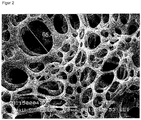
- FIG. 2 the SEM image of a top view of the polyurethane foam 2 on the coated carrier layer is shown.
- FIG. 3 an SEM image of a cross section of the polyurethane foam 2 occupied carrier layer is shown. It can be seen clearly the very low penetration depth of the foam in the carrier layer.
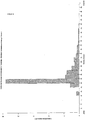
- the pore size distribution of the foam coating of a fabric according to the invention is measured on the basis of ASTM E 1294 (1989).
- Tester PMI.01.01 Sample number: 3 Sample size: diameter 21 mm Sample thickness: 1 mm Test liquid: Galden HT230 Exposure time:> 1 min. Test temperature: 22 ° C
- the smallest pore diameter is 12.9 ⁇ m
- the average pore diameter is 15.2 ⁇ m
- the largest pore diameter is 50.5 ⁇ m.
- the pore size distribution is in FIG. 4 shown.
- the pore size distribution of the foam coating of a sheet is measured according to ASTM E 1294 (1989).
- the smallest pore diameter is 8.9 ⁇ m
- the average pore diameter is 31.1 ⁇ m
- the largest pore diameter is 80.7 ⁇ m.
- the pore size distribution is in FIG. 5 shown.
- Table 5 shows the air permeability according to DIN EN ISO 139 at 100 Pa Table 5 nonwoven 100% PES 100% PES mass 24 gsm 24 gsm edition 15 gsm 15 gsm tries foam pure paste line Air permeability in [l / m 2 / s] 725 129 649 131 615 122 Average 663.0 127.3
Landscapes
- Engineering & Computer Science (AREA)
- Textile Engineering (AREA)
- Chemical & Material Sciences (AREA)
- Chemical Kinetics & Catalysis (AREA)
- Dispersion Chemistry (AREA)
- General Chemical & Material Sciences (AREA)
- Mechanical Engineering (AREA)
- Laminated Bodies (AREA)
- Treatments For Attaching Organic Compounds To Fibrous Goods (AREA)
- Adhesive Tapes (AREA)
- Adhesives Or Adhesive Processes (AREA)
- Details Of Garments (AREA)
Description
- Die Erfindung betrifft thermisch fixierbare Flächengebilde, insbesondere verwendbar als fixierbare Einlage- oder Futterstoffe in der Textilindustrie, die sich durch verbesserte anwendungstechnische Eigenschaften und durch verbesserte Verarbeitbarkeit auszeichnen, sowie deren Herstellung und Verwendung als Einlagen für Textilien.
- Einlagestoffe sind das unsichtbare Gerüst der Bekleidung. Sie sorgen für korrekte Passformen und optimalen Tragekomfort. Je nach Anwendung unterstützen sie die Verarbeitbarkeit, erhöhen die Funktionalität und stabilisieren die Bekleidung. Neben der Bekleidung können diese Funktionen in technischen Textilanwendungen, wie z.B. der Möbel-, Polster- sowie Heimtextilien-Industrie Anwendung übernehmen.
- Einlagestoffe werden zum Beispiel beschrieben in der
GB1,162,147 WO2013/167250 . Wichtige Eigenschaftsprofile für Einlagestoffe sind Weichheit, Sprungelastizität, Griff, Wasch- und Pflegebeständigkeit sowie ausreichende Abriebbeständigkeit des Trägermaterials im Gebrauch. - Einlagestoffe können aus Vliesstoffen, Geweben, Gewirken oder vergleichbaren textilen Flächengebilden bestehen, die meist zusätzlich mit einer Haftmasse versehen sind, wodurch die Einlage mit einem Oberstoff meist thermisch durch Hitze und/oder Druck verklebt werden kann (Fixiereinlage). Die Einlage wird somit auf einen Oberstoff laminiert. Die genannten verschiedenen textilen Flächengebilde haben je nach Herstellungsverfahren unterschiedliche Eigenschaftsprofile. Gewebe bestehen aus Fäden/Garnen in Kette- und Schussrichtung, Gewirke bestehen aus Fäden/Garnen, die über eine Maschenbindung zu einem textilen Flächengebilde verbunden werden. Vliesstoffe bestehen aus zu einem Faserflor abgelegten Einzelfasern, die mechanisch, chemisch oder thermisch gebunden werden.
- Bei mechanisch gebundenen Vliesstoffen wird das Faserflor durch mechanisches Verschlingen der Fasern verfestigt. Hierzu verwendet man entweder eine Nadeltechnik oder ein Verschlingen mittels Wasser- bzw. Dampfstrahlen. Die Vernadelung ergibt zwar weiche Produkte, allerdings mit relativ labilem Griff, so dass sich diese Technologie im Bereich der Einlagestoffe nur in ganz speziellen Nischen durchsetzen konnte. Außerdem ist man in der mechanischen Vernadelung üblicherweise auf ein Flächengewicht > 50 g/m2 angewiesen, was für eine Vielzahl an Einlagestoffanwendungen zu schwer ist.
- Mit Wasserstrahlen verfestigte Vliesstoffe lassen sich in niedrigeren Flächengewichten darstellen, sind im Allgemeinen aber flach und wenig sprungelastisch.
- Bei chemisch gebundenen Vliesstoffen wird der Faserflor durch Imprägnieren, Besprühen oder mittels sonst üblicher Auftragsmethoden mit einem Bindemittel (z.B. Acrylatbinder) versehen und anschließend kondensiert. Das Bindemittel bindet die Fasern untereinander zu einem Vliesstoff, hat aber zur Folge, dass ein relativ steifes Produkt erhalten wird, da sich das Bindemittel über weite Teile des Faserflors verteilt erstreckt und die Fasern wie in einem Verbundwerkstoff durchgehend miteinander verklebt. Variationen im Griff bzw. Weichheit lassen sich nur bedingt über Fasermischungen oder Bindemittelauswahl kompensieren.
- Thermisch gebundene Vliesstoffe werden zur Verwendung als Einlagestoffe üblicherweise Kalander- oder durch Heißluft-verfestigt. Bei Einlagevliesstoffen hat sich heutzutage die punktförmige Kalanderverfestigung als Standardtechnologie durchgesetzt. Das Faserflor besteht dabei in der Regel aus speziell für diesen Prozess entwickelten Fasern aus Polyester oder Polyamid und wird mittels eines Kalanders bei Temperaturen um den Schmelzpunkt der Faser verfestigt, wobei eine Walze des Kalanders mit einer Punktgravur versehen ist. Solch eine Punktgravur besteht z.B. aus 64 Punkten/cm2 und kann z.B. eine Verschweißfläche von 12 % besitzen. Ohne eine Punktanordnung würde der Einlagestoff flächenartig verfestigt und ungeeignet hart im Griff sein.
- Die oben beschriebenen unterschiedlichen Verfahren zur Herstellung von textilen Flächengebilden sind bekannt und in Fachbüchern und in der Patentliteratur beschrieben.
- Die Haftmassen, welche üblicherweise auf Einlagestoffe aufgebracht sind, sind meist thermisch aktivierbar und bestehen in der Regel aus thermoplastischen Polymeren. Die Technologie zum Aufbringen dieser Haftmassenbeschichtungen erfolgt nach dem Stand der Technik in einem separaten Arbeitsschritt auf das Faserflächengebilde. Als Haftmassentechnologie sind üblicherweise Pulverpunkt-, Pastendruck-, Doppelpunkt-, Streu- und Hotmeltverfahren bekannt und in der Patentliteratur beschrieben. Als am leistungsfähigsten hinsichtlich Verklebung mit dem Oberstoff auch nach Pflegebehandlung und in Bezug auf die Rückvernietung wird heute die Doppelpunktbeschichtung angesehen.
- Ein solcher Doppelpunkt weist einen zweischichtigen Aufbau auf. Er besteht aus einem Unter- und einem Oberpunkt. Der Unterpunkt dringt in das Basismaterial ein und dient als Sperrschicht gegen Haftmassenrückschlag und zur Verankerung der Oberpunktpartikel. Übliche Unterpunkte bestehen beispielsweise aus Bindemittel und/oder aus einem thermoplastischen Polymer, das bei der Fixierung zur Klebkraft mit beiträgt. Je nach eingesetzter Chemie trägt der Unterpunkt neben der Verankerung im Basismaterial auch als Sperrschicht zur Verhinderung des Haftmassenrückschlages bei. Hauptklebekomponente im zweischichtigen Verbund ist primär der Oberpunkt. Dieser kann aus einem thermoplastischen Material bestehen, welches als Pulver auf den Unterpunkt aufgestreut wird. Nach dem Streuvorgang wird der überschüssige Teil des Pulvers (zwischen den Punkten der unteren Schicht) zweckmäßigerweise wieder abgesaugt. Nach anschließendem Sintern ist der Oberpunkt auf dem Unterpunkt (thermisch) gebunden und kann als Klebstoff zum Oberpunkt dienen.
- Je nach Einsatzzweck des Einlagestoffes werden eine unterschiedliche Anzahl an Punkten aufgedruckt und/oder die Haftmassenmenge oder die Geometrie des Punktmusters variiert. Eine typische Punktanzahl sind z.B. CP 110 bei einer Auflage von 9 g/m2 bzw. CP 52 mit einer Auflagemenge von 11 g/m2.
- Weit verbreitet ist auch der Pastendruck. Bei dieser Technologie wird eine wässrige Dispersion aus thermoplastischen Polymeren, üblicherweise in Partikelform mit einer Partikelgröße < 80 µm, Verdickern und Laufhilfsmitteln hergestellt und dann pastös mittels eines Rotationssiebdruckverfahrens auf die Trägerlage meist punktförmig aufgedruckt. Anschließend wird die bedruckte Trägerlage zweckmäßigerweise einem Trocknungsprozess unterzogen.
- Es ist bekannt, dass für Einlage- oder Futterstoffe als Haftmedien für die Heißverklebung verschiedenste Schmelzklebstoffe eingesetzt werden können.
- Zurzeit stellen dünne, transparente, flexible oder offene Oberstoffe vor allem in der Damenoberbekleidung einen Trend in der Bekleidungsindustrie dar. Zur Unterstützung solcher Oberstoffe bietet sich eine Einlage an, die sehr leicht und offen in ihrer Struktur ist.
- Die Beschichtung solcher Materialien mit gängigen wässrigen Pastensystemen stellt hierbei ein Problem dar, da diese Systeme beim Beschichtungsvorgang durch die Basis penetrieren und in den nachfolgenden Schritten die Produktionsanlagen erheblich verschmutzen. Hierdurch wird nicht nur die Artikelqualität erheblich verschlechtert, sondern die Produktionsanlagen müssen bedeutend öfter angehalten werden, um Maschinenteile aufwändig zu reinigen.
- Des Weiteren führt die Penetration dazu, dass der Haftmassenunterpunkt nicht gut ausgebildet werden kann und nach dem Streuen des Puders (Doppelpunktbeschichtung) sich ein inhomogener, wenig konvexer Punkt ausbildet. Das Spreiten des Punktes hat weiter zur Folge, dass der Unterpunkt "verschmiert" ist, so dass das Puder in den Randbereichen des Unterpunktes und auch zum Teil in den Zwischenräumen nicht gut abgesaugt werden kann. Dies führt neben der Verunreinigung der Anlage zu einer Schwächung des Verbundes nach der Verklebung.
- Die Aufgabe der vorliegenden Erfindung besteht darin, textile Flächengebilde bereitzustellen, die auch auf dünnen, transparenten, flexiblen oder sehr offenen Oberstoffen fixiert werden können.
- Darüber hinaus sollen die textilen Flächengebilde mit üblichen Fixierpressen problemlos verarbeitet werden können, sehr gute haptische und optische Eigenschaften zeigen, einfach und kostengünstig herstellbar sein, eine sehr gute Waschbeständigkeit bis 95 °C zeigen, und auch Trocknungsbedingungen bei hohen Zyklenzahlen überstehen.
- Eine weitere Aufgabe besteht darin, die textilen Flächengebilde mit einer hohen Elastizität, insbesondere in Querrichtung, auszustatten.
- Diese Aufgabe wird erfindungsgemäß mit einem thermisch fixierbaren Flächengebilde gelöst, insbesondere verwendbar als fixierbarer Einlagestoff in der Textilindustrie, mit einer Trägerlage aus einem textilen Material, auf welcher eine Beschichtung aus Polyurethanschaum aufgebracht ist, welcher ein thermoplastisches Polyurethan in Form eines Umsetzungsprodukts von
- mindestens einem bifunktionellen, vorzugsweise aliphatischen, cycloaliphatischen oder aromatischen Polyisocyanat (A) mit einem Isocyanatgehalt von 5 bis 65 Gew.-Anteilen,
- mindestens einem Polyol (B) ausgewählt aus der Gruppe bestehend aus Polyesterpolyol, Polyetherpolyol, Polycaprolactonpolyol, Polycarbonatpolyol, Copolymer aus Polycaprolactonpolyol Polytetrahydrofuran und Gemischen hiervon sowie gegebenfalls mit
- mindestens einem Kettenverlängerer (C) enthält,
- Bevorzugte Ausgestaltungen der Erfindung sind in den Unteransprüchen beschrieben.
- Die Schaumbeschichtung im erfindungsgemäßen Flächengebilde zeichnet sich durch eine sehr homogene und enge Porengrößenverteilung mit einer hohen Stabilität aus. Es wird vermutet, dass dies durch eine Reduzierung des Anteils an Schaumbildner in der Schaumbeschichtung ermöglicht wird. Der Einsatz eines Schaumbildners, wie es im Stand der Technik üblich ist, hat in der erfindungsgemäßen Schaumbeschichtung nämlich überraschenderweise keine Verbesserung der Schaumstruktur zufolge, sondern dass die Porengröße des Polyurethanschaums deutlich erhöht und die Polyurethanschaumbeschichtung sehr schmierig wird.
- Vorteilhafterweise beträgt der Anteil an Schaumbildnern in der Schaumbeschichtung, bezogen auf ihre aktiven, schaumbildenden Bestandteile, weniger als 1,5 Gew.-%, noch bevorzugter weniger als 1 Gew.-%. Ganz besonders bevorzugt ist kein Schaumbildner enthalten. Unter Schaumbildnern werden erfindungsgemäß Zusammensetzungen verstanden, die Tenside und/oder Mischungen von Tensiden enthalten und bei der Herstellung des Polyurethanschaumes schäumend wirken. Übliche Schaumbildner sind beispielsweise ®RUCO-COAT FO 4010 oder ®TUBICOAT SCHÄUMER HP.
- Erfindungsgemäß ist es möglich, den Polyurethanschaum mit einer Porenstruktur zu versehen, in der mehr als 30 % der Poren einen Durchmesser aufweisen, der im Bereich von 5 bis 20 µm, vorzugsweise von 5 bis 18 µm und insbesondere von 10 bis 16 µm liegt und/oder in der mehr als 50 % der Poren einen Durchmesser aufweisen, der im Bereich von 5 bis 25 µm und insbesondere von 10 bis 20 µm liegt und/oder in der mehr als 70 % der Poren einen Durchmesser aufweisen, der im Bereich von 5 bis 30 µm vorzugsweise von 5 bis 27 µm und insbesondere von 10 bis 25 µm liegt und/oder in der mehr als 97 % der Poren einen Durchmesser aufweisen, der im Bereich von 5 bis 60 µm, vorzugsweise von 5 bis 55 µm und insbesondere von 10 bis 50 µm liegt.
- Ferner kann der Polyurethanschaum mit einer Porenstruktur versehen werden, in der der mittlere Porendurchmesser bei vergleichsweise kleinen Werten und zwar vorzugsweise im Bereich von 5 bis 30 µm und vorzugsweise von 10 bis 25 µm und insbesondere von 10 bis 20 µm liegt. Die mittleren Porendurchmesser können gemäß der Norm ASTM E 1294 (Coulter Porometer) bestimmt werden.
- Liegt der mittlere Porendurchmesser bei geringeren oder größeren Werten, so neigt der Schaum zum Kollabieren.
- Dazu kommt, dass bei der Aufbringung eines derartigen Polyurethanschaums aufgrund seiner geringen Dichte nahezu keine Penetration in die Trägerlage stattfindet. Dies ist vorteilhaft, da hierdurch auch sehr leichte Vliesstoffe bzw. sehr leichte, offene Gewebe oder Gewirke mit guten Trennkraftwerten bei hohen Geschwindigkeiten beschichtet werden können, ohne die Beschichtungsanlage zu verschmutzen.
- Zusätzlich ist der Polyurethanschaum aufgrund seiner spezifischen Porenstruktur atmungsaktiv und feuchtedurchlässig, was sich positiv auf den Tragekomfort auswirkt. Die Porenstruktur des Polyurethanschaums ist zudem sehr gleichmäßig, was für eine gleichmäßige Luftzirkulation und eine gleichmäßige Luftdurchlässigkeit vorteilhaft ist.
- Bevorzugt beträgt die mittlere Eindringtiefe des Polyurethanschaums in die Trägerlage weniger als 20 µm, vorzugsweise weniger als 15 µm, noch bevorzugter von 5 bis 10 µm.
- Zudem wurde gefunden, dass beim Aufbringen eines Polyurethanschaums mit der erfindungsgemäßen Porenstruktur sowohl die Auflage als auch die Qualität über einen längeren Beschichtungszeitraum konstant bleiben. Darüber hinaus ist beim Aufbringen dieses Polyurethanschaums in Form eines Punktmusters vorteilhaft, dass ein homogener, erhabener Unterpunktschaum erhalten werden kann, der auch beim Aufstreuen von Schmelzklebstoffpuder nicht in sich zusammenfällt und nach der Ansinterung und Trocknung im Ofen einen gut zusammengeschmolzenen Haftmassenpunkt aus Schaumunterpunkt und thermoplastischer Haftmasse ergibt. Der Schaum bleibt im gesamten Prozess sowie auch während der Trocknung stabil und fällt nicht in sich zusammen. Insbesondere kann die feinporige Schaumstruktur während des gesamten Prozesses beibehalten bleiben.
- Darüber hinaus bietet das Aufbringen eines Polyurethanschaums gegenüber einer herkömmlichen Pastenbeschichtung - die üblicherweise im Rotationssiebdruckverfahren oder mittels Rakelverfahren aufgebracht wird - generell verschiedene Vorteile.
- So ist der Polyurethanschaum deutlich kosteneffizienter als der reine Pastendruck, da bei gleicher Auflage der Anteil an Rohstoffen wesentlich geringer ist.
- Weiter vorteilhaft ist, dass keine Penetrierung durch die Einlage stattfindet. Eine reine Binderdruckmischung penetriert dagegen deutlich stärker in/durch die Einlage. Produktionsversuche zeigen ebenfalls, dass beim Schaumdruck die Rückseite der bedruckten Rohware trocken bleibt, während dieses Material beim Pastendruck vollständig durchnässt wird.
- Dazu kommt, dass mit Schaum beschichtete Einlagen weicher im Griff sind als die mit herkömmlicher Haftmasse versehenen Einlagen.
- Zudem müssen bezüglich der Haftung vor und nach Behandlungsschritten und der Rückvernietung der hergestellten Waren mit dem Schaumdruck keine Zugeständnisse gemacht werden, da diese Eigenschaften auf einem vergleichbaren Niveau wie bei der Beschichtung mit reiner Paste liegen.
- Aufgrund der porösen Struktur des Polyurethanschaums ist es möglich, das erfindungsgemäße Flächengebilde mit einer hohen Luftdurchlässigkeit zu versehen. Diese wird erfindungsgemäß nach DIN EN ISO 9237 bestimmt. Das Normklima ist gemäß DIN 50014 / ISO 554, das Prüfergebnis wird in dm3/s*m2 angegeben.
- Gemäß einer bevorzugten Ausführungsform der Erfindung weist der Polyurethanschaum eine Luftdurchlässigkeit von mehr als 150 l/m2/s bei 100 Pa, vorzugsweise von 200 bis 800 l/m2/s, noch bevorzugter von 400 bis 1400 auf. Dies ermöglicht beim Einsatz als Einlagestoff einen hohen Tragekomfort.
- In einer weiteren bevorzugten Ausführungsform kann der Polyurethanschaum mit Hilfe eines Kalanders geglättet werden. Hierdurch kann die Atmungsaktivität bzw. die Luftdurchlässigkeit gezielt eingestellt werden. Auch die Schichtdicke kann durch den Schaumauftrag als auch durch die Parameter am Kalander eingestellt werden. Je stärker die Glättwirkung, desto dichter wird die Schicht bis hin zu einer Migrationsbeständikeit, zum Beispiel gegenüber Federn, Daunen etc.
- Darüber hinaus ermöglicht es der spezifische Polyurethanschaum, das erfindungsgemäße Flächengebilde mit guten Eigenschaften bezüglich Weiterreißkraft, Stichausreiß- und/oder Nadelausreißfestigkeit sowie Nahtfestigkeit zu versehen.
- Ferner kann durch die Verwendung des Polyurethans eine hohe Elastizität des Flächengebildes, insbesondere in Querrichtung, erreicht werden. So können auch steifere Vliese verwendet werden, ohne Nachteile in der haptischen Gesamtperformance zu erfahren. Des Weiteren ist es auch möglich, Flächengebilden allein durch die Polyurethan-Beschichtung eine hohe Elastizität zu verleihen, ohne auf Fasern (z.B. BIKO-Fasern) oder Garne mit einer hohen Elastizität zurückgreifen zu müssen. Hierdurch können neue Produkte mit spezifischen Eigenschaften hergestellt werden, wie z.B. eine elastische Bundeinlage auf Basis eines konventionellen Polyamid-/Polyester-Vliesstoffes.
- Ein weiterer Vorteil der Verwendung von Polyurethanen besteht darin, dass das erfindungsgemäße textile Flächengebilde einen weichen, elastischen, schönen (angenehmen) Griff aufweist. Der Griff der Einlage ist ein signifikanter und wichtiger Test in der Textilindustrie. Vorteilhaft ist insbesondere, dass der angenehme Griff ohne zusätzliche Ausrüstungen, wie z.B. Silikonausrüstungen der Basis erzielt werden kann.
- Dazu kommt, dass man bei der Verwendung von Polyurethanen eine große Synthesefreiheit hat. So steht für die Polyurethansynthese eine große Auswahl an Monomeren zur Verfügung, was eine einfache Einstellung der gewünschten physikalischen Eigenschaften wie Härte, Elastizität, etc. ermöglicht.
- Die Schichtdicke des Polyurethanschaums kann in Abhängigkeit von den erwünschten Eigenschaften des Flächengebildes eingestellt werden. Für die meisten Anwendungszwecke hat es sich als günstig erwiesen, für den Polyurethanschaum eine mittlere Schichtdicke im Bereich von 5 bis 400 µm, vorzugsweise von 5 bis 100 µm und insbesondere von 10 bis 50 µm einzustellen. Die Schichtdicke kann elektronenmikroskopisch bestimmt werden.
- Dementsprechend kann das Flächengewicht des Polyurethanschaums in Abhängigkeit von den erwünschten Eigenschaften des Flächengebildes variieren. Als für die meisten Anwendungszwecke günstig hat es sich erwiesen, für den Polyurethanschaum ein Flächengewicht im Bereich von 0,1 g/m2 bis 100 g/m2 im Falle einer Flächenbeschichtung einzustellen. Bei Punktbeschichtungen haben sich Flächengewichte von 0,5 g/m2 bis 10 g/m2 als günstig erwiesen.
- Erfindungsgemäß bevorzugt für die Herstellung des Polyurethanschaums ist die Verwendung von wässrigen, nicht reaktiven oder reaktiven, bevorzugt jedoch nicht reaktiven Polyurethandispersionen.
- Die wässrigen, nicht reaktiven Polyurethandispersionen verfügen im Allgemeinen über einen Polyurethangehalt zwischen 5 Gew.-% und 65 Gew.-%. Erfindungsgemäß bevorzugt sind Polyurethandispersionen mit einem Polyurethangehalt zwischen 30 Gew.-% und 60 Gew.-%.
- Die Brookfield-Viskosität der erfindungsgemäß bevorzugten, wässrigen, nicht reaktiven Polyurethandispersionen liegt bei 20 °C vorzugsweise zwischen 10 und 5000 mPaxs, besonders bevorzugt jedoch zwischen 10 und 2000 mPaxs.
- Erfindungsgemäß können zur Erzeugung des Polyurethanschaums wässrige, nicht reaktive Polyurethandispersionen verwendet werden, deren enthaltene Polyurethane aus den in Anspruch 1 definierten Komponenten hergestellt sind:
Als Polyisocyanat (A) werden vorzugsweise organische Di- und/oder Polyisocyanate eingesetzt. - Als Polyole (B) werden vorzugsweise Polyole eingesetzt, mit einem Molekulargewicht von 500 bis 6000 g/mol. Besonders bevorzugt ist es, wenn diese keine ionischen Gruppen oder in ionische Gruppen überführbare funktionelle Gruppen enthalten.
- Als Kettenverlängerer (C) werden vorzugsweise Di- oder Monohydroxylverbindungen mit mindestens einer ionischen Gruppe oder in eine ionische Gruppe überführbare funktionelle Gruppe eingesetzt.
- Zur Herstellung des thermoplastischen Polyurethans können ferner gegebenenfalls Verbindungen mit ein oder zwei gegenüber Isocyanat reaktiven funktionellen Gruppen und mindestens einer ionischen Gruppe oder in eine ionische Gruppe überführbaren funktionelle Gruppe eingesetzt werden.
- Ferner können Verbindungen mit mindestens zwei gegenüber Isocyanat reaktiven funktionellen Gruppen und einem Molgewicht von 60 bis 500 g/mol, welche keine ionischen Gruppen oder in ionische Gruppen überführbare funktionelle Gruppen enthalten, eingesetzt werden.
- Die organischen Polyisocyanate (A) können sowohl aromatisch als auch aliphatisch sein. Erfindungsgemäß bevorzugt werden wässrige, nicht reaktive, aliphatische Polyurethandispersionen zur Herstellung des Polyurethanschaums verwendet, da die erhaltenen aliphatischen Polyurethanschäume gegenüber aromatischen Polyurethanbeschichtungen wesentlich lichtstabiler sind.
- Die Polyole (B), können auf Polyesterpolyolen, Polyetherpolyolen, Polycaprolactonpolyolen, Polycarbonatpolyolen, Copolymeren aus Polycaprolactonpolyol, Polytetrahydrofuran sowie deren Abmischungen basieren. Erfindungsgemäß bevorzugt sind Polyesterpolyole oder Polyetherpolyole sowie deren Abmischungen.
- Für Anwendungen, die einen Polyurethanschaum mit niedrigem Glasübergangsbereich und/oder guter Hydrolysebeständigkeit erfordern, sind Polyetherpolyole zu bevorzugen. Für Anwendungen, die einen Polyurethanschaum mit guten mechanischen Eigenschaften wie z.B. Abrieb erfordern, sind Polyesterpolyole zu bevorzugen.
- In praktischen Versuchen hat sich gezeigt, dass bei dem Einsatz von reinen Polyesterpolyolen gegebenenfalls in Kombination mit Polyetherpolyolen Polyurethanschäume erhalten werden können, die eine überraschend hohe Waschstabilität haben. So konnte ein Polyurethanschaum auf Polyesterpolyolbasis entwickelt werden, der nach mehreren Wäschen bei 95 °C und auch Anwendungen im Post-processing Bereich ohne eine Verschlechterung der Eigenschaften übersteht.
- Der Schmelzbereich des Polyurethans beträgt vorzugsweise von 130 bis 300 °C, noch bevorzugter von 160 bis 250 °C, insbesondere von 180 bis 220 °C.
- Die Glasübergangstemperatur Tg-Wert des Polyurethans beträgt vorzugsweise von -100 °C bis 100 °C, noch bevorzugter von -80 bis 30 °C, insbesondere von -60 bis 30 °C.
- in einer bevorzugten Ausführungsform der Erfindung werden Polyurethane mit hohen Elongationswerten von vorzugsweise 100 bis 2500 %, noch bevorzugter von 500 bis 2000 %, insbesondere von 700 bis 1500 % eingesetzt. Hierdurch können Einlagen mit einem elastischen Verhalten der Beschichtung und einem besonders angenehmen Griff erhalten werden.
- In einer bevorzugten Ausführungsform der Erfindung werden Polyurethane und/oder Polyurethanzusammensetzungen mit Modulwerten von vorzugsweise 0,5 bis 30 MPa, noch bevorzugter von 1 bis 15 MPa, insbesondere von 1,5 bis 5 MPa eingesetzt.
- In einer bevorzugten Ausführungsform der Erfindung werden Polyurethane und/oder Polyurethanzusammensetzungen mit Zugfestigkeiten von vorzugsweise 5 bis 50 MPa, noch bevorzugter von 15 bis 40 MPa, insbesondere von 20 bis 30 MPa eingesetzt.
- In einer bevorzugten Ausführungsform der Erfindung werden Polyurethane und/oder Polyurethanzusammensetzungen mit Shore-Härten, von vorzugsweise 30 bis 120, noch bevorzugter von 40 bis 90, insbesondere von 50 bis 70 eingesetzt.
- Das Polyurethan kann chemisch vernetzt oder unvernetzt vorliegen. So kann der Polyurethanschaum mindestens einen Vernetzer, vorzugsweise ausgewählt aus z. B. Aziridinen, Isocyanaten, geblockten Isocyanaten, Carbodiimiden oder Melaminharzen aufweisen. Durch die Modulation des Polyurethanschaums mit Vernetzern können zudem die viskoelastischen Eigenschaften des Polyurethanschaums gezielt moduliert werden und das Abzugsverhalten eingestellt werden. Darüber hinaus können durch die Vernetzer sowohl der Griff als auch die Reinigungsbeständigkeit gezielt variiert werden. So kann durch die Verwendung von Vernetzern eine Performancesteigerung der Trennkraft des Schaumes vor allem nach der Wäsche oder der chemischen Reinigung erzielt werden.
- In einer bevorzugten Ausführungsform der Erfindung weist das Polyurethan einen Vernetzungsgrad von weniger als 0,1, noch bevorzugter von weniger als 0,05, noch bevorzugter von weniger als 0,02 auf. Ganz besonders bevorzugt liegt das Polyurethan gänzlich unvernetzt vor. Überraschend wurde erfindungsgemäß gefunden, dass die Schaumstruktur auch bei einem unvernetzten bzw. nur gering vernetzten Polyurethan eine hohe Waschstabilität sogar bei 95 °C aufweist. Vorteilhaft an unvernetztem bzw. nur gering vernetztem Polyurethan ist, dass diese sehr flexibel sind und einen weicheren Griff zeigen.
- In praktischen Versuchen wurde gefunden, dass es besonders zweckmäßig ist, wenn der Polyurethanschaum Dimethylcellulose und/oder, bevorzugt und, Polyacrylsäure als Verdicker enthält. Es wurde gefunden, dass durch die Verwendung dieser Substanzen eine besonders gleichmäßige, blasenfreie Beschichtung erhalten werden kann.
- Darüber hinaus wurde gefunden, dass es zur Stabilisierung des Polyurethanschaums und insbesondere zur Einstellung der erfindungsgemäßen Porengrößenverteilung vorteilhaft ist, wenn der Polyurethanschaum Schaumstabilisatoren, insbesondere Ammoniumstearat oder Kaliumoleat, vorzugsweise in einer Menge von 1 bis 10 Gew.% enthält.
- Wie oben erläutert, hat es sich erfindungsgemäß als nicht vorteilhaft erwiesen, wenn der Polyurethanschaum Schaumbildner, insbesondere Tenside, enthält.
- Als ebenfalls nicht vorteilhaft hat es sich erwiesen, wenn der Polyurethanschaum assoziative Verdicker, insbesondere hydrophob modifizierte Polyacrylate, Celluloseether, Polyacrylamide, Polyether oder assoziative Polyurethan-Verdicker enthält. Um die gewünschte Viskosität zu erzielen ist nämlich eine zu hohe Einsatzmenge der assoziativ wirkenden Verdicker erforderlich. Die Mischung wird hierdurch zügig/lang und zieht Fäden. Aus diesem Grund weist der Polyurethanschaum diese Verbindungen vorteilhafterweise in einer Menge von weniger als 5 Gew.% auf. Ganz bevorzugt ist die Polyurethanzusammensetzung frei von diesen Substanzen.
- Als ebenfalls nicht vorteilhaft hat es sich erwiesen, wenn der Polyurethanschaum mineralölhaltige Verdicker in Kombination mit Polyethylenglykol (PEG) enthält. Werden z. B. mineralölhaltige Acrylatverdicker in der Schaumformulierung verwendet, verdrängen diese nämlich das PEG, welches in Mineralölen unlöslich ist. Das PEG bildet dann einen sehr schmierigen Rückstand auf dem Polymerfilm. Aus diesem Grund weist der Polyurethanschaum, sofern er als Laufhilfsmittel PEG enthält, mineralölhaltige Verdicker vorteilhafterweise in einer Menge von weniger als 10 Gew. % auf.
- Ganz bevorzugt ist der Polyurethanschaum frei von diesen Substanzen. Dies ist auch hinsichtlich der Emissionswerte des applizierten Polyurethanschaums vorteilhaft. Zudem werden Abluftrohre, Trocknerkühlzonen etc. nicht so stark mit Kondensat der meist niedrig siedenden Mineralöle belastet. Das hat zusätzlich den positiven Effekt, dass die Einlagen weniger mit Kondensat verunreinigt werden und somit deren Qualität gesteigert werden kann.
- Wie oben erwähnt, kann die Verwendung von PEG in Kombination mit mineralölhaltigen Verdickern nachteilig sein. Grundsätzlich ist die Verwendung von PEG jedoch vorteilhaft. Als besonders geeignet hat sich dabei erwiesen, wenn der Anteil PEG im Polyurethanschaum im Bereich von 1 bis 40 Gew.-% liegt.
- In einer bevorzugten Ausführungsform der Erfindung enthält der Polyurethanschaum einen Füllstoff, insbesondere ausgewählt aus Alumosilikaten, vorzugsweise Kaolin, Calciumsilikaten, Calciumcarbonaten, Magnesiumcarbonaten, Schichtsilikaten, pyrogenen Kieselsäuren und Aluminiumoxiden, wie z. B. Wollastonite, Dolomite, Glimmer, Barytmehle oder Talkum. Die Menge des Füllstoffs beträgt vorzugsweise von 0,5 bis 55 Gew.-%, noch bevorzugter von 5 bis 45 Gew.%, jeweils bezogen auf das Gesamtgewicht des Polyurethanschaums. Dabei weist der Füllstoff vorzugsweise eine mittlere Partikelgröße von 5 nm bis 100 µm auf. Durch die Modulation des Polyurethanschaums mit Füllstoffen können zudem dessen viskoelastische Eigenschaften (Rheologie), der Griff, die Reinigungsbeständigkeit, die Porengrößenverteilung, die Klebrigkeit sowie das Abzugsverhalten gezielt eingestellt werden.
- Von Vorteil kann auch die Verwendung von Füllstoffen sein, die während der Trocknung im Ofen Gas freisetzen und somit zur Schaumbildung beitragen bzw. den Schaum stabilisieren.
- In einer weiteren vorteilhaften Ausführungsform der Erfindung enthält der Polyurethanschaum ein Additiv, ausgewählt aus Aktivkohle, Ruß, Phase Change Materials (PCMs), thermoplastischem Polymer-Puder, Expancel, Flockfasern, Haftvermittler, Flammschutzmittel wie z.B. Mg- und/oder Alhydroxide oder Phosphorverbindungen, Streichpigmente wie z.B. Titandioxid, Superabsorber wie z.B. Polyacrylsäure, Holzspäne, Zeolithe, Metallpulver, magnetische Partikel wie z.B. Eisenoxide, gekapselte Stoffe wie z.B. Farben, Duftstoffe oder Wirkstoffe (Wundauflage) oder geruchsabsorbierende Stoffe wie z. B. Cyclodextrine oder PVPs, vorzugsweise in einer Menge von 0,1 bis 70 Gew.%, noch bevorzugter von 5 bis 60 Gew.% jeweils bezogen auf das Gesamtgewicht des Polyurethanschaums.
- Des Weiteren umfasst das erfindungsgemäße Flächengebilde eine Trägerlage. Dabei hat es sich als zweckmäßig erwiesen, die Polarität des Schaumes optimal auf die Trägerlage einzustellen. Eine hydrophobe Basis bedarf eines hydrophob eingestellten Schaumes und eine hydrophil eingestellte Basis eines eher hydrophil eingestellten Schaumes.
- Die Auswahl des für die Trägerlage einzusetzenden textilen Materials erfolgt im Hinblick auf den jeweiligen Anwendungszweck bzw. die besonderen Qualitätsanforderungen. Geeignet sind zum Beispiel Vliesstoffe, Gewebe, Gewirke, Gestricke oder dergleichen. Beispielsweise haben sich Waddings als besonders geeignet erwiesen, da die funktionelle Ausrüstung von Waddings weit verbreitet ist. Durch die Erfindung sind hier prinzipiell keinerlei Grenzen gesetzt. Der Fachmann kann hier leicht die für seine Anwendung geeignete Materialkombination auffinden. Vorzugsweise besteht die Trägerlage aus einem Vliesstoff.
- Der Vliesstoff, aber auch die Fäden oder Garne der textilen Materialien können aus Chemiefasern oder aber auch aus Naturfasern bestehen. Als Chemiefasern kommen vorzugsweise Polyester-, Polyamid-, Celluloseregenerat- und/oder Bindefasern zum Einsatz, als Naturfasern Wolle-oder Baumwollfasern.
- Die Chemiefasern können hierbei kräuselbar, gekräuselte und/oder ungekräuselte Stapelfasern, kräuselbare, gekräuselte und/oder ungekräuselte, direkt gesponnene Endlosfasern und/oder endliche Fasern, wie Meltblown-Fasern, umfassen. Die Trägerlage kann ein- oder mehrlagig aufgebaut sein.
- Für die Herstellung des Vliesstoffs können die eingangs dargestellten Technologien eingesetzt werden. Das Verbinden der Fasern des Faserflors zu einem Vliesstoff kann hierbei mechanisch (konventionelles Vernadeln, Wasserstrahltechnik), mittels eines Bindemittels oder thermisch erfolgen. Hierbei reicht allerdings eine moderate Vliesstofffestigkeit der Trägerlage vor dem Bedrucken aus, da die Trägerlage beim Bedrucken mit dem Gemisch aus Bindemittel und thermoplastischem Polymer noch zusätzlich mit Bindemittel beaufschlagt und verfestigt wird. Für die moderaten Vliesstofffestigkeiten können auch kostengünstige Faserrohstoffe eingesetzt werden, vorausgesetzt, dass diese die Anforderungen an den Griff erfüllen. Auch kann die Prozessführung vereinfacht werden.
- Im Falle der Verwendung von Stapelfasern ist es vorteilhaft, diese mit mindestens einer Krempel zu einem Faserflor zu kardieren. Bevorzugt ist hier eine Wirrlegung (Random-Technologie), doch auch Kombinationen aus Längs-und/oder Querlegung bzw. noch kompliziertere Krempelanordnungen sind möglich, wenn spezielle Vliesstoffeigenschaften ermöglicht werden sollen bzw. wenn mehrlagige Faserstrukturen gewünscht werden.
- Besonders geeignet für Einlagestoffe sind Fasern mit einem Fasertiter bis 6,7 dtex. Gröbere Titer werden aufgrund ihrer großen Fasersteifigkeit normalerweise nicht eingesetzt. Bevorzugt sind Fasertiter im Bereich von 1 bis 3 dtex, doch auch Mikrofasern mit einem Titer < 1 dtex sind denkbar.
- Gemäß einer bevorzugten Ausführungsform der Erfindung ist der Polyurethanschaum flächig ausgebildet. Gemäß einer weiteren bevorzugten Ausführungsform der Erfindung ist der Polyurethanschaum in Form eines Punktmusters ausgebildet. Dabei können die Punkte in einem regelmäßigen oder unregelmäßigen Muster auf der Trägerlage verteilt sein.
- Auf dem Polyurethanschaum kann ein Schmelzklebstoff aufgebracht sein.
- Schmelzklebstoffe, auch Heißklebestoffe, Heißkleber oder im Englischen Hotmelts genannt, sind seit langem bekannt. Allgemein versteht man unter ihnen im Wesentlichen lösungsmittelfreie Produkte, die im geschmolzenen Zustand auf eine Klebefläche aufgetragen werden, rasch beim Abkühlen erstarren und damit schnell Festigkeit aufbauen. Erfindungsgemäß bevorzugt werden thermoplastische Polymere, wie Polyamide (PA), Copolyamide, Polyester (PES), Copolyester, Ethylvinylacetat (EVA) und dessen Copolymere (EVAC), Polyethylen (PE), Polypropylen (PP), amorphe Polyalphaolefine (APAO), Polyurethane (PU) etc. als Schmelzklebstoffe verwendet.
- Die Klebewirkung der Schmelzklebstoffe basiert grundsätzlich darauf, dass sie sich als thermoplastische Polymere reversibel aufschmelzen lassen und als flüssige Schmelze aufgrund ihrer durch den Schmelzvorgang erniedrigten Viskosität in der Lage sind, die zu klebende Fläche zu benetzen und dadurch eine Adhäsion zu ihr auszubilden. Als Folge der anschließenden Abkühlung erstarrt der Schmelzklebstoff wieder zum Festkörper, der eine hohe Kohäsion besitzt und auf diese Weise die Verbindung zur Klebefläche herstellt. Nachdem die Klebung stattgefunden hat, sorgen die viskoelastischen Polymere dafür, dass die Adhäsion auch nach dem Abkühlvorgang mit ihren Volumenänderungen und dem damit verbundenen Aufbau mechanischer Spannungen erhalten bleibt. Die aufgebaute Kohäsion vermittelt die Bindekräfte zwischen den Substraten.
- Vorteilhafterweise werden die Schmelzklebstoffe in Pulverform eingesetzt. Die Größe der Partikel orientiert sich an der zu bedruckenden Fläche, beispielsweise der gewünschten Größe eines Bindungspunktes. Im Falle eines Punktmusters kann der Partikeldurchmesser zwischen >0 µm und 500 µm variieren. Grundsätzlich ist die Partikelgröße des Schmelzklebstoffs nicht einheitlich, sondern folgt einer Verteilung, d.h. man hat immer ein Partikelgrößenspektrum vorliegen. Zweckmäßigerweise ist die Partikelgröße abgestimmt auf die gewünschte Auftragsmenge, Punktgröße und Punktverteilung.
- Schmelzklebstoffe in Pulverform können mittels Streuauftrag aufgebracht werden, was insbesondere zum Kleben poröser Substrate für die Herstellung insgesamt atmungsaktiver Textilverbunde zweckmäßig ist. Vorteilhaft am Streuauftrag ist ferner, dass es eine einfache Auftragsmethode für Anwendungen in großem Maßstab ist. Da thermoaktivierte Pulver, beispielsweise aus Polyamiden, Polyestern oder Polyurethanen, bereits bei niedrigen Temperaturen klebfähig sind, eignen sie sich zur schonenden Laminierung wärmeempfindlicher Substrate, z.B. hochwertiger Textilien. Dank guter Fließeigenschaften im aktivierten Zustand wird selbst bei niedrigem Druck und kurzer Anpresszeit eine gute Verbindung hergestellt; dennoch bleibt das Risiko des Durchschlagens in das Gewebe gering.
- Denkbar ist auch, dass der Schmelzklebstoff auf derjenigen Seite der Trägerlage, die dem Polyurethanschaum abgewandt ist, aufgebracht ist.
- Im Falle eines flächigen Polyurethanschaums stellt der Polyurethanschaum in dieser Ausführungsform die Unterschicht einer zweilagigen Haftmassenstruktur dar, auf der eine Schmelzklebstoffoberschicht angeordnet ist. Dabei kann die Schmelzkleberoberschicht in Form eines Punktmusters oder flächig ausgebildet sein.
- In einer bevorzugten Ausführungsform der Erfindung ist die zweilagige Haftmassenstruktur eine solche, in der Polyurethanschaum und Schmelzklebstoff als Doppelpunkte ausgebildet sind, wobei der Polyurethanschaum als Unterpunktmuster und der Schmelzklebstoff als Oberpunktmuster ausgestaltet ist. Dabei können die Doppelpunkte in einem regelmäßigen oder unregelmäßigen Muster auf der Trägerlage verteilt sein.
- Erfindungsgemäß sollen unter zweilagigen Haftmassenstrukturen sowohl die oben beschriebene flächige zweilagige Haftmassenstruktur als auch Doppelpunkte verstanden werden. Dementsprechend soll der Begriff Unterschicht sowohl flächige Unterschichten als auch Unterpunkte und der Begriff Oberschicht sowohl flächige Oberschichten als auch Oberpunkte umfassen.
- Der Doppelpunkt auf der Basis eines Polyurethanschaums als Unterpunkt und einem Streupuder als Oberpunkt wird vorzugsweise in einem Punktmuster auf die Trägerlage aufgebracht. Damit werden die Weichheit und die Sprungelastizität des Materials verstärkt. Das Punktmuster kann regulär oder irregulär verteilt sein. Die Bedruckung ist aber keinesfalls auf Punktmuster beschränkt. Der Doppelpunkt kann in beliebigen Geometrien aufgebracht werden, z.B. auch in Form von Linien, Streifen, netz- oder gitterartigen Strukturen, Punkten mit rechteckiger, rautenförmiger oder ovaler Geometrie oder dergleichen.
- Die zweilagigen Haftmassenstrukturen zeichnen sich durch einen geringen Haftmassenrückschlag aus, da der zuerst aufgebrachte Polyurethanschaum als Sperrschicht wirkt. Mischt man dem Polyurethanschaum ein thermoplastisches Polymer, vorzugsweise mit einen Schmelzpunkt < 190 °C bei, so trägt dieses zur Verklebung bei. Die Rückvernietung der Einlage wird hierbei jedoch verschlechtert.
- Das Polyurethan im Polyurethanschaum kann sowohl in reiner Form als auch in Abmischungen vorliegen. So ist auch denkbar, dass der Polyurethanschaum neben dem Polyurethan noch weitere Polymere enthält. Die von dem Polyurethan verschiedenen thermoplastischen Polymere können beispielsweise Polyacrylate, Silikone, (Co)-Polyester-, (Co)-Polyamid-, Polyolefin-, Ethylenvinylacetat-basierende Polymere und/oder Kombinationen (Gemische und Copolymerisate) der genannten Polymere umfassen. Dabei beträgt der Anteil des Polyurethans bezogen auf die Gesamtmenge der Polyurethanbeschichtung vorzugsweise 20 bis 100 Gew.-%, noch bevorzugter 30 bis 90 Gew.-% und insbesondere von 40 bis 90 Gew.-%. Erfindungsgemäß besonders bevorzugt sind dabei die Polyacrylate und Silikone.
- Der Polyurethanschaum liegt vorzugsweise in einem Beschichtungsgewicht von 0,1 bis 100 g/m2 vor.
- Erfindungsgemäß wurde gefunden, dass durch geeignete Auswahl der Zusammensetzung des Polyurethanschaums ein Flächengebilde mit einer besonders guten Querelastizität erhalten werden kann. Praktische Versuche haben ergeben, dass sich im Falle einer zweilagigen Haftmassenstruktur die Zusammensetzung der Unterschicht deutlich stärker auf die Querelastizität des Flächenbildes auswirkt als die der Oberschicht.
- Ferner kann der Polyurethanschaum thermoplastische Polymere enthalten, die einen Schmelzpunkt < 190 °C aufweisen und dadurch bei der Fixierung mit zur Verklebung beitragen. Eine Unterschicht, die thermoplastische Polymere, vorzugsweise thermoplastisches Co-Polyamid, Co-Polyester oder Polyurethan oder Gemische davon enthält, unterstützt die Oberschicht bei der Verklebung, liefert aber auch einen höheren Rückvernietungswert. Durch die Verwendung von Polyurethanen in der Unterschicht erhält man eine wesentlich bessere Anbindung der Oberschicht und kann somit sowohl die Trennkraft erhöhen als auch das Puderrieseln reduzieren. Vorteilhaft gegenüber z.B. Polyamiden ist eine stark verbesserte Verankerung zum Oberpunkt, eine höhere Elastizität und Flexibilität. Darüber hinaus wird die Klebkraft auf beschichteten Oberstoffen unterstützt.
- Ein weiterer Vorteil der Verwendung von thermoplastischen Polymeren mit einem Schmelzpunkt < 190 °C, beispielsweise aus der Gruppe der CoPolyamide, der Co-Polyester oder der Polyurethane ist, dass es hierdurch möglich ist, den Polyurethanschaum ohne zusätzliche Schmelzkleberbeschichtung einzusetzen. Dadurch kann ein Produktionsschritt eingespart werden. Als besonders vorteilhaft hat sich eine Kornfraktion < 500 µm herausgestellt.
- Wie erläutert, kann der Schmelzklebstoff thermoplastisches Co-Polyamid, Co-Polyester oder Polyolefine enthalten, die beispielsweise mit den gängigen Thermoplasten abgemischt werden können. Als besonders geeignet haben sich PU, PA, PES, PP, PE, Ethylenvinylacetat, Copolymere, etc. erwiesen. Die Polymere können auch mit den weiteren Thermoplasten zusammen extrudiert werden (Compound).
- Ferner könnte der Polyurethanschaum Bindemittel, wie insbesondere Acrylatdispersionen oder Silikondispersionen, enthalten.
- Für den Einlagebereich ist es vorteilhaft, wenn der Schmelzklebstoff als Granulat hergestellt wird, das eine gute Vermahlbarkeit aufweist. Sowohl für die Oberschichtfraktion (generell 80-200 µm) als auch für die Unterschicht (0-80 µm) ist es zweckmäßig, wenn eine Vermahlbarkeit in diesen Grenzen gegeben ist. Vorteilhafterweise weisen die vermahlenen Partikel eine möglichst runde Geometrie auf, um ein fehlerfreies Streuen bzw. eine fehlerfreie Einarbeitung und Ansinterung zu gewährleisten.
- Die Schmelzklebstoffe können erfindungsgemäß auch mit den anderen gängigen Beschichtungsmethoden im Einlagebereich, wie Pulverpunkt-, Pastendruck-, Doppelpunkt-, Streu-, Hotmeltverfahren, Scattering Coating, etc. eingesetzt werden. Hierzu werden zweckmäßigerweise andere Korngrößenverteilungen oder z.B. eine Pastenformulierung eingesetzt.
- Ebenfalls denkbar ist, dass zwischen Oberschicht und Unterschicht keine klare Phasengrenze zu erkennen ist. Dies kann beispielsweise dadurch bewirkt werden, dass ein thermoplastisches Polymer in Partikelform mit einer Polyurethandispersion vermischt, aufgeschäumt und aufgetragen wird. Nach dem Auftragen wird das Polyurethan von den gröberen Partikeln separiert, wobei die gröberen Partikel mehr auf der Oberseite der Bindungsfläche, beispielsweise der Punktoberfläche, zum Liegen kommen. Das Polyurethan bindet neben seiner Funktion, sich in der Trägerlage zu verankern und diese zusätzlich zu binden, die gröberen Partikel. Gleichzeitig kommt es zu einer teilweisen Trennung von Partikeln und Polyurethan an der Oberfläche der Trägerlage. Das Polyurethan dringt tiefer in das Material ein, während sich die Partikel an der Oberfläche anreichern. Dadurch sind die gröberen Polymerpartikel in der Bindemittelmatrix zwar eingebunden, gleichzeitig steht ihre freie (Ober-)Fläche an der Oberfläche des Vliesstoffs aber zur direkten Verklebung mit dem Oberstoff zur Verfügung. Es kommt zur Ausbildung einer doppelpunktähnlichen Struktur, wobei zur Erzeugung dieser Struktur im Gegensatz zum bekannten Doppelpunktverfahren aber nur ein einziger Verfahrensschritt erforderlich ist und auch das aufwändige Absaugen überschüssigen Pulvers entfällt. Die Einlagen erhalten auf diese Weise eine höhere Elastizität und ein höheres Rücksprungvermögen als diejenigen mit herkömmlichen Polymeren auf Polyamid- oder Polyesterbasis.
- Ein bevorzugtes Verfahren zur Herstellung eines erfindungsgemäßen thermisch fixierbaren Flächengebildes umfasst die folgenden Maßnahmen:
- a) Bereitstellen einer Trägerlage,
- b) Aufschäumen einer Polyurethandispersion, welche ein thermoplastisches Polyurethan in Form eines Umsetzungsprodukts von
- mindestens einem bifunktionellen Polyisocyanat (A) mit einem Isocyanatgehalt von 5 bis 65 Gew.-Anteilen mit
- mindestens einem Polyol (B) ausgewählt aus der Gruppe bestehend aus Polyesterpolyol, Polyetherpolyol, Polycaprolactonpolyol, Polycarbonatpolyol, Copolymer aus Polycaprolactonpolyol Polytetrahydrofuran und Gemischen hiervon sowie gegebenenfalls mit
- mindestens einem Kettenverlängerer (C) enthält unter Bildung eines Polyurethanschaums, derart, dass der Polyurethanschaum eine Porenstruktur aufweist, in der mehr als 50 % der Poren einen Durchmesser, gemessen nach DIN ASTM E 1294, aufweisen, der im Bereich von 5 bis 30 µm liegt,
- c) Auftragen des Polyurethanschaums auf ausgewählte Flächenbereiche der Trägerlage und
- d) Temperaturbehandlung der aus Schritt c) erhaltenen Trägerlage zum Trocknen und gleichzeitigen Verbinden des Polyurethanschaums mit der Trägerlage unter Ausbildung einer Beschichtung.
- Die Komponenten der Polyurethandispersion können wie oben in Bezug auf den Polyurethanschaum diskutiert, ausgewählt werden.
- Um einen erhabenen Druck eines Schaums zu gewährleisten, als auch die Stabilität des Schaums im nachfolgenden Prozess aufrecht zu erhalten, ist es vorteilhaft, wenn der Schaum eine spezifische Mindestschaumdichte (in g/L) aufweist. Hierzu hat es sich als zweckmäßig erwiesen, wenn der Polyurethanschaum zur Ausbildung einer flächigen Beschichtung mit einem Schaumlitergewicht von 1 bis 450 g/L, vorzugsweise von 50 bis 400 g/L, insbesondere von 100 bis 300 g/L eingesetzt wird. Auf diese Weise kann eine zu starke Penetration des Schaumes in die Einlage verhindert und eine gute Verankerung im Einlagestoff erzielt werden.
- Soll der Polyurethanschaum in Form eines Punktmusters aufgebracht werden, so haben sich Polyurethandispersionen mit einem Schaumlitergewicht von 1 bis 700 g/L, vorzugsweise von 200 bis 600 g/L, insbesondere von 400 bis 560 g/L als besonders geeignet erwiesen.
- Das Aufschäumen der Polyurethandispersion kann nach herkömmlichen Verfahren, beispielsweise durch mechanisches Aufschlagen, erfolgen.
- Ebenfalls möglich ist es, das Aufschäumen der Polyurethandispersion durch Expandieren von Mikrosphären durchzuführen. Dieses Aufschäumverfahren kann auch zusätzlich zum mechanischen Aufschäumen eingesetzt werden.
- Mikrosphären sind kleine sphärische Kunststoffkugeln und bestehen aus einer dünnen thermoplastischen Hülle, die Kohlenwasserstoff einkapselt, üblicherweise Isobuten oder Isopentan. Die Hülle ist ein Copolymer, das aus Monomeren wie z.B. Vinylidenchlorid, Acrylnitril oder Methyl-Methacrylat aufgebaut ist. Durch Erhitzung steigt der Gasdruck im Inneren der Hülle an, die gleichzeitig allmählich erweicht. Dadurch vergrößert sich das Volumen der Mikrosphären. Das Treibgas bleibt dauerhaft eingeschlossen. Wenn die Hitze entfernt wird, erstarrt die Hülle in ihrer vergrößerten Form und es bildet sich eine geschlossene Zellstruktur. Vorteile eines solchen mittels Mikrosphären erzeugten Schaumes sind neben dem reduzierten Preis auch eine bessere Haptik, eine veränderte Elastizität und Kompressibilität.
- Zur Schaumerzeugung werden die Mikrosphären in der Polyurethandispersion homogen verteilt. Nach Aufbringen des Schaums auf der Trägerlage und gegebenenfalls des Schmelzklebstoffs expandieren die Mikrosphären, in der Regel bei Temperaturen im Bereich von 80 - 230 °C.
- In praktischen Versuchen hat sich gezeigt, dass die Konzentration der Mikrosphären vorteilhafterweise im Bereich von 0,5 - 5 Gew.-%, bezogen auf das Gesamtgewicht des Polyurethandispersion liegt.
- Als ebenfalls vorteilhaft hat es sich erwiesen, Mikrosphären mit einer Korngröße von 10 bis 150 µm, noch bevorzugter von 10 - 16 µm und/oder einer Expansionstemperatur im Bereich von 120-130 °C einzusetzen.
- Gemäß einer bevorzugten Ausführungsform wird der Polyurethanschaum durch Aufschäumen einer wässrigen Polyurethandispersion hergestellt.
- Der Anteil des Polyurethans in der Dispersion liegt vorzugsweise im Bereich von 25 bis 95 Gew.-%, noch bevorzugter von 35 bis 70 Gew.-%, insbesondere von 45 bis 60 Gew.-% bezogen auf das Gesamtgewicht der Dispersion. Mit aus derartigen Polyurethandispersionen hergestellten Polyurethanschäumen beschichtete Einlagen zeichnen sich dadurch aus, dass sie wesentlich trockener und angenehmer im Griff sind und eine wesentlich erhöhte Elastizität aufweisen.
- Die Polyurethandispersion kann beispielsweise mittels des Emulgator/Scherkraft-Verfahrens, des Schmelzdispergier-Verfahrens, des Ketimin- bzw. Ketazin-Verfahrens, des Prepolymer/Ionomer-Verfahrens sowie des universellen Aceton-Verfahrens sowie Mischformen der genannten Verfahren hergestellt werden.
- Die Polyurethandispersion kann auch mit anderen wässrigen Dispersionen, wie z.B. Polyacrylatdispersionen, Silikondispersionen oder Polyvinylacetatdispersionen vermischt werden.
- Vorteilhafterweise weist die Polyurethandispersion Vernetzer in einer Menge von weniger als 2 Gew.-%, noch bevorzugter von weniger als 1 Gew.-%, noch bevorzugter von weniger als 0,5 Gew.-% auf.
- Der Feststoffgehalt der Polyurethandispersion kann zwischen 10 und 70 Gew.-%, bevorzugt zwischen 15 und 60 Gew.-% und besonders bevorzugt zwischen 20 und 60 Gew.-%, insbesondere zwischen 30 und 50 Gew.-%, liegen.
- Die Stabilisierung der Polyurethandispersion kann durch interne und/oder externe anionische, kationische oder neutrale Emulgatoren erfolgen.
- Der pH-Wert der Polyurethandispersion liegt vorzugsweise im Bereich von 4,0 bis 11,0, noch bevorzugter zwischen 5,0 und 10,0, noch bevorzugter zwischen 6 und 9.
- Wie bereits oben erläutert ist es vorteilhaft, wenn eine Polyurethandispersion eingesetzt wird, die Schaumbildner, insbesondere auf Tensidbasis, nur in einer geringen Menge enthält. So hat es sich im Hinblick auf die Porengrößenverteilung als günstig erwiesen, wenn der Anteil an Schaumbildnern weniger als 5 Gew.-% beträgt. Ganz bevorzugt ist die Polyurethandispersion frei von diesen Substanzen.
- In einer bevorzugten Ausführungsform der Erfindung wird eine Polyurethandispersion eingesetzt, die Dimethylcellulose und/oder, bevorzugt und, Polyacrylsäure als Verdicker enthält vorzugsweise in einer Menge von 0,1 Gew.-% bis 10 Gew.-%.
- Darüber hinaus wurde gefunden, dass es zur Stabilisierung des Polyurethanschaums und insbesondere zur Einstellung der erfindungsgemäßen Porengrößenverteilung vorteilhaft ist, wenn die Polyurethandispersion die Schaumstabilisatoren, insbesondere wie z. B. Ammoniumstearat oder Kaliumoleat, vorzugsweise in einer Menge von 1 bis 10 Gew.-% enthält.
- In einer bevorzugten Ausführungsform der Erfindung wird eine Polyurethandispersion eingesetzt, die Polyethylenglykol enthält. Als besonders geeignet hat sich dabei erwiesen, wenn der Anteil PEG in der Polyurethandispersion im Bereich von 1 bis 40 Gew.-% liegt.
Hieran ist vorteilhaft, dass die Trocknungszeiten des Polyurethanschaums deutlich erniedrigt werden können und die Druckbarkeit des Polyurethanschaums bzw. dessen rheologisches Verhalten deutlich verbessert wird. - Die Applikation des Polyurethanschaums kann auf verschiedene Weise durchgeführt werden.
- So kann zur Ausbildung einer zweilagigen Haftmassenstruktur auf einen flächig applizierten Polyurethanschaum als Unterschicht ein Schmelzkleber beispielsweise mit Hilfe des Doppelpunktverfahrens oder Pastenpunktverfahrens aufgebracht werden. Alternativ kann auf die Unterschicht der Schmelzklebstoff auch in Form eines Streupuders aufgebracht werden.
- Die Applikation des Pastenpunktes als Oberschicht ist vorteilhaft, da hierdurch ein wesentlich textilerer Griff als bei einem flächigen Schmelzkleberauftrag oder mittels des Doppelpunktverfahrens erzeugt wird.
- Wird hingegen die nicht mit Polyurethanschaum beschichtete Seite der Trägerlage mit Schmelzkleber beschichtet, wird diese vorzugsweise mit einer zweischichtigen Haftmassenstruktur (Doppelpunkt) versehen, um die Rückvernietung zu minimieren.
- Die Trägerlage aus einem textilen Material bzw. aus Vliesstoff kann direkt in einer herkömmlichen Rakelmaschine mit dem Polyurethanschaum belegt werden. Dazu kann es eventuell sinnvoll sein, die Trägerlage vor dem Druckvorgang mit textilen Hilfsmitteln wie Verdicker (beispielsweise partiell vernetzte Polyacrylate und deren Salze), Dispergatoren, Netzmittel, Laufhilfsmittel, Griffmodifikatoren zu benetzen oder auf beliebige andere Art so zu behandeln, dass der Druckprozess produktionssicherer wird.
- Erfindungsgemäß können die verschiedensten Oberstoffe eingesetzt werden. Als besonders geeignet hat sich das Flächengebilde zur Fixierung an einem dünnen, transparenten oder löchrigen Oberstoff erwiesen.
- Der Einsatz eines erfindungsgemäßen thermisch fixierbaren Flächengebildes ist jedoch nicht auf diese Anwendung beschränkt. Auch andere Anwendungen sind denkbar, beispielsweise als fixierbare textile Flächengebilde bei Heimtextilien wie Polstermöbeln, verstärkten Sitzkonstruktionen, Sitzbezügen oder als fixierbares und dehnfähiges textiles Flächengebilde in der Automobilausstattung, bei Schuhkomponenten oder im Bereich Hygiene/Medikal.
- Nachfolgend wird die Erfindung ohne Beschränkung der Allgemeinheit anhand mehrerer Beispiele beschrieben.
- Eine Vliestoffbasis (100 % Polyamid) mit 12 g/m2 Flächengewicht wird nach dem bekannten Doppelpunktverfahren mit verschiedenen Polyurethanschäumen und zum Vergleich mit verschiedenen nicht aufgeschäumten Polyurethanpasten beschichtet. Hierbei wird eine Unterpunktpaste nach bekannter Weise hergestellt. Zur Bildung der Polyurethanschäume wird eine Polyurethandispersion mit Hilfe einer handelsüblichen Küchenmaschine in einen Polyurethanschaum überführt. Hierbei wird ein aliphatisches Polyesterurethan verwendet. Dieses generiert viskoelastische Eigenschaften des Unterpunktes in Kombination mit einem angenehmen Griff bei sehr guter Wäschebeständigkeit. Als Oberpunkt wird ein Streupulver aus Polyamid eingesetzt mit einem Schmelzpunkt von 113 °C und einem MFI-Wert von 71 (g/10 min) (ermittelt bei 160 °C unter einer Belastung von 2,16 kg). Als Druckschablonenraster kommt ein CP250 mit einem Lochdurchmesser von 0,17 mm zum Einsatz.
- Die Polyurethandispersion wird mit den in Tabelle 1 beschriebenen Additiven versetzt.
- Im Beschichtungsprozess wird 1,5 g Polyurethanpaste bzw. 1,5 g Polyurethanschaum aufgetragen und mit 3 g Streupuder belegt. Diese Einlagen werden bei einer Temperatur von 130 °C für 12 sec. und einem Druck von 2,5 bar fixiert (Presse: Kannegiesser EXT 1000 CU). Als Stoff dient ein Polyester-Baumwoll-Oberstoff. In Tabelle 1 sind die eingesetzten Formulierungen dargestellt:
-
Tabelle 1 Referenz-Polyurethandispersion Polyurethandispersion 1 Wasser 135,7 g 165,50 g Entschäumer (33%) 4 g Schaumbildner (Tensid) (83%) 5 g PEG 9g 32,50 g PU-Hilfsdispersion (49%) 340 g 183,0 g Ammoniak 1,4 g 1,4 g Verdicker 1 (80%) Polyacrylsäure 4,9 g 14,20 g Verdicker 2 (25%) Polyacrylsäure 14,2 g Verdicker 3 (3%) Methylcellulose 25 g Schaumstabilisator (30%) 12,0 g -
- ¤ Wasser kalt vorlegen
- ¤ PEG zugeben
- ¤ PU-Hilfsdispersion zugeben
- ¤ Ammoniak zugeben
- ¤ Verdicker 2 + 3 zugeben, mit dem Flügelrührer vorsichtig homogenisieren
- ¤ Schaumstabilisator zugeben
- ¤ Viskosität ermitteln (Brookfield RV T, Spindel 5, 20rpm, Faktor = 200)
- ¤ pH-Wert ermitteln (Sollwerte: 8,8 bis 9,3)
- ¤ ca. 120 Sekunden bei max. Umdrehung mit der Küchenmaschine (Kenwood KM 280) aufschäumen
- ¤ Topfgewicht ermitteln, Sollwert Schaumlitergewicht 500g/L ± 50g/L
- ¤ Viskosität ermitteln (Brookfield RV T, Spindel 5, 20rpm, Faktor = 200)
- ¤ Generell gilt: zu lange Rührzeiten sind zu vermeiden, da hier bereits ein Schaum gebildet werden kann. Dieser kann die Funktionalität der Schaummischaggregate beeinträchtigen
- Es wurde gefunden, dass sich bei der Schaumherstellung eine Kombination aus einem Polyacrylatverdicker und Methylcellulose am besten eignet, da hierdurch zum einen die Rheologie der Polyurethandispersion optimal eingestellt werden kann und zum anderen ein trockener Schaum mit gleichmäßiger Porengröße entsteht. Als weiter vorteilhaft hat sich erwiesen, wenn der Anteil an Laufhilfsmittel (PEG) im Schaum auf mehr als 1 Gew.% eingestellt wird. Des Weiteren hat sich ein Schaumstabilisator auf Basis von Ammonstearat als besonders geeignet erwiesen. Zudem konnte auf die gängigen Schaumbildner verzichtet werden, wodurch überraschenderweise ein besonders homogener Schaum mit kleinen Porengrößen generiert werden konnte. Die verringerte Additivierung reduziert außerdem die Wechselwirkungen mit den restlichen Rohstoffen der Dispersion, so dass der Schaum deshalb erheblich effektiver ist.
- In Tabelle 2 sind die beobachteten Trennkraftwerte der beschichteten und fixierten Vliesstoffe dargestellt
Tabelle 2 Trennkraft [N/5cm] Pastendruck Schaumdruck PES/BW primär 2,5 2,5 Nach 3xDC 1,3 1,5 Nach 3x40°C 1,8 1,9 CV primär 4,0 4,4 Nach 3xDC 2,3 2,2 Nach 3x40°C 1,1 1 PES primär 3,6 3,6 Nach 3xDC 1,6 2 Nach 3x40°C 2,5 2,7 Transparenter Oberstoff 4,1 4,0 1x40°C 1,7 1,5 - Es zeigt sich, dass der Schaumdruck keine negativen Effekte auf die Trennkraft hat.
- In
Figur 1 wird das rheologische Verhalten der Referenz-Polyurethandispersion bzw. des Polyurethanschaums 1 in Abhängigkeit von der Schergeschwindigkeit betrachtet. Mit Brookfield RV T/Spindel 7 wird bei nachstehenden Messgeschwindigkeiten die Viskosität ermittelt. Über den Schablonen-/Folienumfang (0,64m) der Produktionsschablonen kann die Messgeschwindigkeit in die Produktionsgeschwindigkeit der Druckmaschine umgerechnet werden, z.B.: Messgeschwindigkeit 2,5 U/min x Schablonenumfang 0,64 m = Druckmaschine (Folie) 1,6m/min; Messgeschwindigkeiten Brookfield Viskosimeter: 2,5; 5; 10; 20; 50 und 100 U/min. - Hierbei wird deutlich, dass der Schaum 1 grundsätzlich bei gleichen Scherraten eine geringere Viskosität aufweist als die verwendete Referenz-Dispersion. Dies ist ein erheblicher Vorteil, da bei Dispersionen die erhöhte Penetration durch die Flächenware in der Regel durch eine starke Anhebung der Viskosität kompensiert werden muss. Dies führt wiederum zu erheblichen Problemen bei der Auslegung der Pumpen und dem gleichmäßigen Auftrag der Dispersionen.
- Des Weiteren liefert der Polyurethanschaum (durchgezogene Linie) ein sehr schönes Druckbild, da der Punkt sehr erhaben dargestellt werden kann und auch nicht durch den Träger penetriert. Auch ist der Schaumauftrag über Breite und Länge des Trägers sehr konstant. Ferner ist das Verhältnis zwischen Eindringtiefe und Punktgeometrie sehr ausgewogen. Weiter kann man noch erkennen, dass der Abfall der Viskosität mit zunehmender Scherrate auf analoge Weise, wie bei der Paste, geschieht, jedoch bei wesentlich geringeren Viskositäten.
- Im großtechnischen Betriebsversuch wird die hergestellte Polyurethandispersion 1 mit Hilfe eines Rotor-Stator-Mischers der Firma MST aufgeschäumt und mittels des Rotationssieb-Druckverfahrens auf eine 12 g/m2 Vliesstoffware aufgetragen (Polyurethanschaum 1). Es konnte festgestellt werden, dass trotz geringerer Viskosität die Schaummischung deutlich weniger in das zu beschichtende Substrat penetriert als die sehr hochviskose Referenz-Polyurethandispersion. Die Eindringtiefe lässt sich hierbei gut über die Schaumdichte regulieren. Je trockener der Schaum (je geringer die Dichte) desto weniger penetriert der Polyurethanschaum in die Einlage, aber desto schlechter ist auch das Laufverhalten bezüglich Schablonenbelegung und Ausdruckverhalten. In diesem Betriebsversuch lag das optimale Topfgewicht bei 500 g/L.
- Im großtechnischen Betriebsversuch wird die hergestellte Pulyurethandispersion 2 mit Hilfe eines HANSA-Mischers Top-Mix Compact 60 aufgeschäumt und mittels eines "Knife over Roll" Auftragssystems auf eine 24 g/m2 Vliesstoffware vollflächig aufgetragen (Polyurethanschaum 2) und im Ofen getrocknet. Der Spalt wird mit 0,5 mm eingestellt. Die Anlagengeschwindigkeit beträgt 6 m/min bei einem Topfgewicht von 125 g/L. Der finale Gesamtauftrag des Schaumstriches liegt bei 17,9 g/m2. Auch bei diesem Versuch ist deutlich zu erkennen, dass die Beschichtung nur minimal in das Substrat penetriert und eine gleichmäßige, vollflächige Beschichtung generiert werden kann (siehe
Figur 3 ). Die Schaumbeschichtung ist auch gegenüber einer Wäsche bis 95 °C stabil und übersteht eine chemische Reinigung ohne Schaden. Die Qualität der Schaumbeschichtung wie Haptik und Griff bleibt ebenfalls erhalten.Polyurethandispersion 2 Wasser 184,3 g PEG 36,5 g PU-Hilfsdispersion (49%) 154 g Ammoniak 1,8 g Verdicker 2 (25%) Polyacrylsäure 17,5 g Verdicker 3 (3%) Methylcellulose 28 g Füllstoff 13,50 g Schaumstabilisator 2 (30%) 15,0 g - Der unter 2b) hergestellt Vliesstoff mit Schaumstrich wird mit Hilfe des bekannten Pastenpunktverfahrens beschichtet. Hierbei wird auf ein Standard-Haftmassensystem mit einem thermoplastischen Polymeren auf Basis von Polyamid zurückgegriffen, welches einen Schmelzpunkt von 126°C und einen MFI-Wert von 28 (g/10 min) (ermittelt bei 160° C unter einer Belastung von 2,16 kg) aufweist. Die wässrige Paste enthält des Weiteren die üblichen Hilfsstoffe, wie beispielsweise Emulgatoren, Verdicker und Prozesshilfsmittel. Im Beschichtungsprozess wird 12,5 g/m2 Paste mit einem CP-Raster von 110 aufgerakelt. Das Flächengebilde wird danach mit einer Temperatur von 120 °C für 12 sec. und einem Druck von 2,5 bar fixiert (Presse: Multistar DX 1000 CU). Als Stoff dient ein Polyester-Baumwoll-Oberstoff. In nachfolgender Tabelle ist die Primärtrennkraft, die Trennkraft nach einer 60°C und einer 95° C Wäsche dargestellt sowie die Trennkraft nach chemischer Reinigung. Des Weiteren werden noch die Rückvernietungswerte verglichen.
- In Tabelle 3 sind die Trennkraftwerte des beschichteten Schaumes und der direkt beschichteten Einlage dargestellt
Tabelle 3 Pastenbeschichtete Schaumflächenbeschichtung Direkt beschichteter Vliesstoff Primärhaftung [N/5cm] 5,8 8,2 1x60°C-Wäsche [N/5cm] 5,1 5,3 1x95° C-Wäsche [N/5cm] 6,8 5 1xchemische Reinigung [N/5cm] 4,9 8,0 Rückvernietung [N/10cm] 0,1 2,3 - Erstaunlicherweise kann gezeigt werden, dass die Trennkraft der Proben mit der Polyesterpolyurethanbeschichtung nach der Reinigung, vor allem bei hohen Temperaturen, höhere Werte aufweist als ohne eine zusätzliche Schicht. Des Weiteren ist die Rückvernietung durch die zusätzliche Polyurethanschaumschicht stark reduziert.
- In Polyurethandispersion 2 werden 13 Gew.-% thermoplastisches Polyamidpulver mit einer Korngrößenverteilung von 80-200 my zugegeben, welches einen Schmelzpunkt von 108°C und einen MFI-Wert von 97 (g/10 min) (ermittelt bei 160° C unter einer Belastung von 2,16 kg) aufweist und die Polyurethandispersion 2 nach analoger Weise wie unter 1 aufgeschäumt. Danach wird der Schaum auf eine Vliesstoffbasis mit 24 g/m2 aufgerakelt und im Ofen getrocknet. Das Aufladegewicht beträgt 21,2 g/m2.
- Die Einlagen werden im Anschluss bei einer Temperatur von 130 °C bzw. 140 °C für 12 sec. und einem Druck von 2,5 bar fixiert (Presse: Kannegiesser EXT 1000 CU). Als Stoff dient ein Polyester-Baumwoll-Oberstoff. Vergleichend sind die Trennkraftergebnisse gegenübergestellt, die bei der Beschichtung von dem Vliesstoffartikel mit einer Standard-Polyamidpaste mit einer Auflage von 20 g/m2 und einem CP von 110 erreicht werden.
Tabelle 4 Polymer in Schaum Polymer in Paste Primärhaftung 130 °C [N/5cm] 10,0 8,3 Primärhaftung 140 °C [N/5cm] 12,3 10,1 - In
Figur 2 ist die REM-Aufnahme einer Aufsicht des Polyurethanschaums 2 auf der beschichteten Trägerlage gezeigt. Man erkennt eine klare Porenstruktur mit einer homogenen Porengrößenverteilung im Bereich von 10 bis 40 µm. - In
Figur 3 ist eine REM-Aufnahme eines Querschnitts der mit Polyurethanschaum 2 belegten Trägerlage gezeigt. Man erkennt deutlich die sehr geringe Eindringtiefe des Schaums in die Trägerlage. - Die Porengrößenverteilung der Schaumbeschichtung eines erfindungsgemäßen Flächengebildes wird in Anlehnung an ASTM E 1294 (1989) gemessen.
- Prüfgerät: PMI.01.01
Probenkörperanzahl: 3
Probengröße: Durchmesser 21 mm
Probendicke: 1 mm
Prüfflüssigkeit: Galden HT230
Einwirkzeit: > 1 min.
Prüftemperatur: 22 °C - Es wird gefunden, dass der kleinste Porendurchmesser bei 12,9 µm, der mittlere Porendurchmesser bei 15,2 µm und der größte Porendurchmesser bei 50,5 µm liegt. Die Porengrößenverteilung ist in
Figur 4 gezeigt. - Die Porengrößenverteilung der Schaumbeschichtung eines Flächengebildes wird in Anlehnung an ASTM E 1294 (1989) gemessen.
- Es wird gefunden, dass der kleinste Porendurchmesser bei 8,9 µm, der mittlere Porendurchmesser bei 31,1 µm und der größte Porendurchmesser bei 80,7 µm liegt. Die Porengrößenverteilung ist in
Figur 5 gezeigt. - In Tabelle 5 ist die zur Luftdurchlässigkeit nach DIN EN ISO 139 bei 100 Pa gezeigt
Tabelle 5 Vliesstoff 100 % PES 100 % PES Gewicht 24 g/m2 24 g/m2 Auflage 15 g/m2 15 g/m2 Versuche Schaum reiner Pastenstrich Luftdurchlässigkeit in [l/m2/s] 725 129 649 131 615 122 Mittelwert 663,0 127,3 -
- Fig. 1:
- Rheologisches Verhalten der Druckpaste bzw. des Schaums in Abhängigkeit von der Beschichtungsgeschwindigkeit
- Fig. 2:
- REM-Aufnahme einer Aufsicht des Polyurethanschaums 2
- Fig. 3:
- REM-Aufnahme eines Querschnitts des Polyurethanschaums 2
- Fig. 4:
- Porengrößenverteilung Schaumbeschichtung ohne Schaumbildner
- Fig. 5:
- Porengrößenverteilung Schaumbeschichtung mit 2 Gew.-% Schaumbildner
Claims (15)
- Thermisch fixierbares Flächengebilde, verwendbar als fixierbarer Einlagestoff in der Textilindustrie mit einer Trägerlage aus einem textilen Material, auf welcher eine Beschichtung aus Polyurethanschaum aufgebracht ist, welcher ein thermoplastisches Polyurethan in Form eines Umsetzungsprodukts von- mindestens einem bifunktionellen, vorzugsweise aliphatischen, cycloaliphatischen oder aromatischen, Polyisocyanat (A) mit einem Isocyanatgehalt von 5 bis 65 Gew.-Anteilen- mindestens einem Polyol (B) ausgewählt aus der Gruppe bestehend aus Polyesterpolyol, Polyetherpolyol, Polycaprolactonpolyol, Polycarbonatpolyol, Copolymer aus Polycaprolactonpolyol Polytetrahydrofuran und Gemischen hiervon sowie gegebenenfalls mit- mindestens einem Kettenverlängerer (C) enthält,dadurch gekennzeichnet, dass der Polyurethanschaum eine Porenstruktur aufweist, in der mehr als 50 % der Poren einen Durchmesser, gemessen nach DIN ASTM E 1294, aufweisen, der im Bereich von 5 bis 30 µm liegt.
- Thermisch fixierbares Flächengebilde nach Anspruch 1, dadurch gekennzeichnet, dass der Polyurethanschaum einen mittleren Porendurchmesser aufweist, der im Bereich von 5 bis 30 µm liegt.
- Thermisch fixierbares Flächengebilde nach einem oder mehreren der vorangehenden Ansprüche, dadurch gekennzeichnet, dass der Anteil des Schaumbildners im Polyurethanschaum, bezogen auf seine aktiven, schaumbildenden Bestandteile, weniger als 1,5 Gew.-% beträgt.
- Thermisch fixierbares Flächengebilde nach einem oder mehreren der vorangehenden Ansprüche, dadurch gekennzeichnet, dass die mittlere Eindringtiefe des Polyurethanschaums in die Trägerlage weniger als 20 µm beträgt.
- Thermisch fixierbares Flächengebilde nach einem oder mehreren der vorangehenden Ansprüche, dadurch gekennzeichnet, dass der Polyurethanschaum eine Luftdurchlässigkeit von mehr als 150 l/m2/s bei 100 Pa aufweist, gemessen nach DIN EN ISO 9237.
- Thermisch fixierbares Flächengebilde nach einem oder mehreren der vorangehenden Ansprüche, dadurch gekennzeichnet, dass der Polyurethanschaum eine mittlere Schichtdicke im Bereich von 5 bis 400 µm aufweist.
- Thermisch fixierbares Flächengebilde nach einem oder mehreren der vorangehenden Ansprüche dadurch gekennzeichnet, dass das Polyol (B) ausgewählt ist aus Polyesterpolyol und/oder Polyetherpolyol.
- Thermisch fixierbares Flächengebilde nach einem oder mehreren der vorangehenden Ansprüche, dadurch gekennzeichnet, dass das Polyurethan einen Vernetzungsgrad von weniger als 0,1 aufweist.
- Thermisch fixierbares Flächengebilde nach einem oder mehreren der vorangehenden Ansprüche, dadurch gekennzeichnet, dass der Polyurethanschaum flächig oder als Punktmuster ausgebildet ist.
- Thermisch fixierbares Flächengebilde nach einem oder mehreren der vorangehenden Ansprüche, dadurch gekennzeichnet, dass der Schmelzklebstoff auf dem Polyurethanschaum und/oder auf derjenigen Seite der Trägerlage, die dem Polyurethanschaum abgewandt ist, aufgebracht ist.
- Thermisch fixierbares Flächengebilde nach einem oder mehreren der vorangehenden Ansprüche, dadurch gekennzeichnet, dass der Polyurethanschaum als Unterschicht einer zweilagigen Haftmassenstruktur ausgebildet ist, auf der eine Schmelzklebstoffoberschicht angeordnet ist.
- Thermisch fixierbares Flächengebilde nach einem oder mehreren der vorangehenden Ansprüche, dadurch gekennzeichnet, dass der Polyurethanschaum und Schmelzklebstoff als Doppelpunkte ausgebildet sind, wobei der Polyurethanschaum als Unterpunktmuster und der Schmelzklebstoff als Oberpunktmuster ausgestaltet ist.
- Verfahren zur Herstellung eines thermisch fixierbaren Flächengebildes umfasst die folgenden Maßnahmen:a) Bereitstellen einer Trägerlage,b) Aufschäumen einer Polyurethandispersion, welche ein thermoplastisches Polyurethan in Form eines Umsetzungsprodukts von- mindestens einem bifunktionellen Polyisocyanat (A) mit einem Isocyanatgehalt von 5 bis 65 Gew.-Anteilen mit- mindestens einem Polyol (B) ausgewählt aus der Gruppe bestehend aus Polyesterpolyol, Polyetherpolyol, Polycaprolactonpolyol, Polycarbonatpolyol, Copolymer aus Polycaprolactonpolyol Polytetrahydrofuran und Gemischen hiervon sowie gegebenenfalls mit- mindestens einem Kettenverlängerer (C) enthält unter Bildung eines Polyurethanschaums, derart, dass der Polyurethanschaum eine Porenstruktur aufweist, in der mehr als 50 % der Poren einen Durchmesser, gemessen nach DIN ASTM E 1294, aufweisen, der im Bereich von 5 bis 30 µm liegtc) Auftragen des Polyurethanschaums auf ausgewählte Flächenbereiche der Trägerlage undd) Temperaturbehandlung der aus Schritt c) erhaltenen Trägerlage zum Trocknen und gleichzeitigen Verbinden des Polyurethanschaums mit der Trägerlage unter Ausbildung einer Beschichtung.
- Verfahren nach Anspruch 13, dadurch gekennzeichnet, dass der Polyurethanschaum zur Ausbildung einer flächigen Beschichtung mit einem Schaumlitergewicht von 1 bis 450 g/L und/oder zur Ausbildung eines Punktmusters mit einem Schaumlitergewicht von 1 bis 700 g/L ausgebildet wird.
- Verfahren nach Anspruch 13 oder 14, dadurch gekennzeichnet, dass die Polyurethandispersion Vernetzer in einer Menge von weniger als 2 Gew% enthält.
Priority Applications (1)
| Application Number | Priority Date | Filing Date | Title |
|---|---|---|---|
| PL16714401T PL3286367T3 (pl) | 2015-04-22 | 2016-04-04 | Termicznie mocowalny materiał arkuszowy |
Applications Claiming Priority (2)
| Application Number | Priority Date | Filing Date | Title |
|---|---|---|---|
| DE102015005089.3A DE102015005089A1 (de) | 2015-04-22 | 2015-04-22 | Thermisch fixierbares Flächengebilde |
| PCT/EP2016/057314 WO2016169752A1 (de) | 2015-04-22 | 2016-04-04 | Thermisch fixierbares flächengebilde |
Publications (2)
| Publication Number | Publication Date |
|---|---|
| EP3286367A1 EP3286367A1 (de) | 2018-02-28 |
| EP3286367B1 true EP3286367B1 (de) | 2019-06-05 |
Family
ID=55661433
Family Applications (1)
| Application Number | Title | Priority Date | Filing Date |
|---|---|---|---|
| EP16714401.3A Active EP3286367B1 (de) | 2015-04-22 | 2016-04-04 | Thermisch fixierbares flächengebilde |
Country Status (12)
| Country | Link |
|---|---|
| US (1) | US10472751B2 (de) |
| EP (1) | EP3286367B1 (de) |
| JP (1) | JP6526833B2 (de) |
| KR (1) | KR102100232B1 (de) |
| CN (1) | CN107466329B (de) |
| CA (1) | CA2983539C (de) |
| DE (1) | DE102015005089A1 (de) |
| ES (1) | ES2738984T3 (de) |
| PL (1) | PL3286367T3 (de) |
| RU (1) | RU2677960C1 (de) |
| TW (1) | TWI666116B (de) |
| WO (1) | WO2016169752A1 (de) |
Families Citing this family (8)
| Publication number | Priority date | Publication date | Assignee | Title |
|---|---|---|---|---|
| DE102017002552A1 (de) | 2017-03-17 | 2018-09-20 | Carl Freudenberg Kg | Schallabsorbierendes Textilkomposit |
| EP3412319A1 (de) * | 2017-06-09 | 2018-12-12 | Mölnlycke Health Care AB | Schaumstoff in der wundbehandlung |
| EP3701081B1 (de) * | 2017-10-27 | 2023-12-06 | Carl Freudenberg KG | Thermisch fixierbares flächengebilde |
| DE102017010022A1 (de) * | 2017-10-27 | 2019-05-02 | Carl Freudenberg Kg | Thermisch fixierbares Flächengebilde |
| TW202104720A (zh) * | 2019-05-09 | 2021-02-01 | 英商萊卡英國有限公司 | 具有固體低熔融粉末之可轉印彈性分散物 |
| EP4115759A4 (de) * | 2020-03-03 | 2024-03-27 | Toray Industries, Inc. | Kleidungsstück |
| KR102370363B1 (ko) * | 2021-06-21 | 2022-03-07 | 주식회사 덕성 | 온도조절이 가능한 기능성 퍼프 및 그 제조방법 |
| DE102022105897A1 (de) | 2022-03-14 | 2023-09-14 | Carl Freudenberg Kg | Thermisch fixierbares Flächengebilde mit biologisch abbaubarer Haftmasse |
Family Cites Families (28)
| Publication number | Priority date | Publication date | Assignee | Title |
|---|---|---|---|---|
| DE1469374A1 (de) * | 1965-10-16 | 1969-02-06 | Freudenberg Carl Fa | Verfahren zur Herstellung von einbuegelbaren Einlagen |
| DE2456813A1 (de) * | 1974-11-30 | 1976-06-10 | Freudenberg Carl Fa | Hydrophiler schaumstoff auf polyurethanbasis |
| DE3140784A1 (de) * | 1981-10-14 | 1983-04-28 | Freudenberg, Carl, 6940 Weinheim | "saugfaehiges flaechengebilde und verfahren zu seiner herstellung" |
| US4696849A (en) | 1985-09-16 | 1987-09-29 | The Dow Chemical Company | Process for preparing polyurethane-backed textiles |
| JPS6433282A (en) * | 1987-07-30 | 1989-02-03 | Kanai Hiroyuki | Core cloth for clothing |
| JP2599768B2 (ja) * | 1988-08-09 | 1997-04-16 | 株式会社クラレ | 織編物 |
| FR2648832B1 (fr) * | 1989-06-26 | 1991-09-20 | Picardie Lainiere | Insert destine a l'industrie vestimentaire |
| FR2672313B1 (fr) * | 1991-02-05 | 1993-04-30 | Picardie Lainiere | Procede de fabrication d'entoilages thermocollants, entoilage thermocollant. |
| DE59106435D1 (de) * | 1991-12-17 | 1995-10-12 | Kufner Textilwerke Gmbh | Beschichtetes Flächengebilde. |
| FR2685171B1 (fr) * | 1991-12-20 | 1994-03-11 | Picardie Lainiere | Entoilage thermocollant et son procede de fabrication. |
| DE19803362A1 (de) | 1998-01-29 | 1999-08-05 | Sartorius Gmbh | Geschäumte poröse Membranen aus thermoplastischen Polymeren sowie Verfahren und Vorrichtung zu ihrer Herstellung |
| US6620488B2 (en) * | 1999-08-09 | 2003-09-16 | Inoac Corporation | Skin material, skinned cushion, and process for producing skinned cushion |
| BR9917111A (pt) * | 1998-12-29 | 2001-10-23 | Dow Chemical Co | Processo para produzir uma espuma de poliuretano resiliente, espuma, espuma sobre um artigo de substrato e pisos ou têxteis acolchoados |
| US6803495B2 (en) * | 2000-06-28 | 2004-10-12 | World Properties, Inc. | Polyurethane foam composition and method of manufacture thereof |
| US20030084788A1 (en) | 2001-06-22 | 2003-05-08 | Fraser Ladson L | Foam coated air filtration media |
| DE10260815B4 (de) | 2002-12-23 | 2008-07-03 | Universität Zu Köln | Aufgeschäumtes Material und Herstellverfahren für das aufgeschäumte Material |
| JP2004263339A (ja) * | 2003-03-04 | 2004-09-24 | Japan Vilene Co Ltd | 接着芯地の製造方法 |
| KR100514629B1 (ko) * | 2003-07-15 | 2005-09-14 | 주식회사 헵스켐 | 우레탄폴리올 프리폴리머, 다공성 폴리우레탄체 및 이의제조방법 |
| US20050025954A1 (en) * | 2003-07-30 | 2005-02-03 | Sullivan Alfred Hardy | Cloth backing for use in a trim cover |
| DE10335131A1 (de) * | 2003-07-31 | 2005-02-24 | Blue Membranes Gmbh | Verfahren und Herstellung von porösen kohlenstoffbasierten Formkörpern |
| CN100540581C (zh) * | 2004-02-17 | 2009-09-16 | 株式会社普利司通 | 低回弹性、高透气性的聚氨酯泡沫及其应用 |
| WO2008058913A1 (de) * | 2006-11-15 | 2008-05-22 | Basf Se | Verfahren zur herstellung von polyurethan-weichschaumstoffen |
| KR101025445B1 (ko) * | 2008-07-25 | 2011-03-30 | 한국바이린주식회사 | 패턴 프린팅을 통해 제조된 부직포 접착 심지 및 이의제조방법 |
| US20130210301A1 (en) * | 2010-08-23 | 2013-08-15 | Nitto Denko Corporation | Composite sheet |
| WO2012148915A2 (en) * | 2011-04-27 | 2012-11-01 | Edizone, Llc | Cushioning elements comprising elastomeric material and methods of forming same |
| CN103534288B (zh) * | 2011-05-13 | 2015-04-08 | 马斯创新(私人)有限公司 | 一种泡沫混合料及其使用 |
| DE102012009055B4 (de) | 2012-05-08 | 2015-06-03 | Carl Freudenberg Kg | Thermisch fixierbares Flächengebilde, Verfahren zu seiner Herstellung und seine Verwendung als Einlagestoff zur Fixierung an einem Oberstoff |
| AT14073U1 (de) * | 2013-10-07 | 2015-04-15 | Schaefer Philipp | Lederaustauschmaterial |
-
2015
- 2015-04-22 DE DE102015005089.3A patent/DE102015005089A1/de not_active Ceased
-
2016
- 2016-04-04 KR KR1020177027577A patent/KR102100232B1/ko active Active
- 2016-04-04 RU RU2017134277A patent/RU2677960C1/ru active
- 2016-04-04 EP EP16714401.3A patent/EP3286367B1/de active Active
- 2016-04-04 CA CA2983539A patent/CA2983539C/en active Active
- 2016-04-04 ES ES16714401T patent/ES2738984T3/es active Active
- 2016-04-04 US US15/558,568 patent/US10472751B2/en active Active
- 2016-04-04 CN CN201680021279.9A patent/CN107466329B/zh active Active
- 2016-04-04 PL PL16714401T patent/PL3286367T3/pl unknown
- 2016-04-04 JP JP2017554894A patent/JP6526833B2/ja active Active
- 2016-04-04 WO PCT/EP2016/057314 patent/WO2016169752A1/de not_active Ceased
- 2016-04-19 TW TW105112187A patent/TWI666116B/zh active
Non-Patent Citations (1)
| Title |
|---|
| None * |
Also Published As
| Publication number | Publication date |
|---|---|
| PL3286367T3 (pl) | 2020-02-28 |
| ES2738984T3 (es) | 2020-01-28 |
| EP3286367A1 (de) | 2018-02-28 |
| US20180057983A1 (en) | 2018-03-01 |
| CA2983539A1 (en) | 2016-10-27 |
| DE102015005089A1 (de) | 2016-10-27 |
| RU2677960C1 (ru) | 2019-01-22 |
| CN107466329B (zh) | 2021-07-20 |
| TW201718265A (zh) | 2017-06-01 |
| JP2018517068A (ja) | 2018-06-28 |
| KR102100232B1 (ko) | 2020-04-13 |
| TWI666116B (zh) | 2019-07-21 |
| JP6526833B2 (ja) | 2019-06-05 |
| KR20170122250A (ko) | 2017-11-03 |
| US10472751B2 (en) | 2019-11-12 |
| CA2983539C (en) | 2020-01-07 |
| WO2016169752A1 (de) | 2016-10-27 |
| CN107466329A (zh) | 2017-12-12 |
Similar Documents
| Publication | Publication Date | Title |
|---|---|---|
| WO2016169752A1 (de) | Thermisch fixierbares flächengebilde | |
| DE102012009055B4 (de) | Thermisch fixierbares Flächengebilde, Verfahren zu seiner Herstellung und seine Verwendung als Einlagestoff zur Fixierung an einem Oberstoff | |
| EP3701081B1 (de) | Thermisch fixierbares flächengebilde | |
| EP2411221B1 (de) | Thermisch fixierbaarer einlagevliesstoff, verfahren zu dessen herstellung und verwendung | |
| DE19746913C2 (de) | Trägermaterial für medizinische Zwecke | |
| EP2207925B1 (de) | Thermisch fixierbares flächengebilde | |
| EP2207926A1 (de) | Textiles fixierbares flächengebilde | |
| EP3715516A1 (de) | Thermisch fixierbares textiles flächengebilde | |
| DE69432773T2 (de) | Hochflexibles lederartiges Material und Verfahren zu dessen Herstellung | |
| EP1937886A1 (de) | Elastischer, weicher und punkförmig gebundener vliesstoff mit füllstoffpartikeln, verfahren zu dessen herstellung und dessen verwendung | |
| DE102014005819B4 (de) | Thermisch fixierbares Flächengebilde und Verfahren zu seiner Herstellung | |
| AT14073U1 (de) | Lederaustauschmaterial | |
| DE102009010995B4 (de) | Thermisch fixierbares Flächengebilde | |
| WO2015106903A1 (de) | Thermisch fixierbares flächengebilde | |
| DE102013003446A1 (de) | Verbundmaterial | |
| DE102017010022A1 (de) | Thermisch fixierbares Flächengebilde | |
| DE102022105897A1 (de) | Thermisch fixierbares Flächengebilde mit biologisch abbaubarer Haftmasse | |
| EP1960592A1 (de) | Verfahren zur erstrückenbeschichtung eines teppichs |
Legal Events
| Date | Code | Title | Description |
|---|---|---|---|
| STAA | Information on the status of an ep patent application or granted ep patent |
Free format text: STATUS: THE INTERNATIONAL PUBLICATION HAS BEEN MADE |
|
| PUAI | Public reference made under article 153(3) epc to a published international application that has entered the european phase |
Free format text: ORIGINAL CODE: 0009012 |
|
| STAA | Information on the status of an ep patent application or granted ep patent |
Free format text: STATUS: REQUEST FOR EXAMINATION WAS MADE |
|
| 17P | Request for examination filed |
Effective date: 20171006 |
|
| AK | Designated contracting states |
Kind code of ref document: A1 Designated state(s): AL AT BE BG CH CY CZ DE DK EE ES FI FR GB GR HR HU IE IS IT LI LT LU LV MC MK MT NL NO PL PT RO RS SE SI SK SM TR |
|
| AX | Request for extension of the european patent |
Extension state: BA ME |
|
| DAV | Request for validation of the european patent (deleted) | ||
| DAX | Request for extension of the european patent (deleted) | ||
| GRAP | Despatch of communication of intention to grant a patent |
Free format text: ORIGINAL CODE: EPIDOSNIGR1 |
|
| STAA | Information on the status of an ep patent application or granted ep patent |
Free format text: STATUS: GRANT OF PATENT IS INTENDED |
|
| INTG | Intention to grant announced |
Effective date: 20181126 |
|
| GRAS | Grant fee paid |
Free format text: ORIGINAL CODE: EPIDOSNIGR3 |
|
| GRAA | (expected) grant |
Free format text: ORIGINAL CODE: 0009210 |
|
| STAA | Information on the status of an ep patent application or granted ep patent |
Free format text: STATUS: THE PATENT HAS BEEN GRANTED |
|
| AK | Designated contracting states |
Kind code of ref document: B1 Designated state(s): AL AT BE BG CH CY CZ DE DK EE ES FI FR GB GR HR HU IE IS IT LI LT LU LV MC MK MT NL NO PL PT RO RS SE SI SK SM TR |
|
| REG | Reference to a national code |
Ref country code: GB Ref legal event code: FG4D Free format text: NOT ENGLISH |
|
| REG | Reference to a national code |
Ref country code: CH Ref legal event code: EP |
|
| REG | Reference to a national code |
Ref country code: AT Ref legal event code: REF Ref document number: 1140070 Country of ref document: AT Kind code of ref document: T Effective date: 20190615 |
|
| REG | Reference to a national code |
Ref country code: IE Ref legal event code: FG4D Free format text: LANGUAGE OF EP DOCUMENT: GERMAN |
|
| REG | Reference to a national code |
Ref country code: DE Ref legal event code: R096 Ref document number: 502016004915 Country of ref document: DE |
|
| REG | Reference to a national code |
Ref country code: NL Ref legal event code: MP Effective date: 20190605 |
|
| REG | Reference to a national code |
Ref country code: LT Ref legal event code: MG4D |
|
| PG25 | Lapsed in a contracting state [announced via postgrant information from national office to epo] |
Ref country code: HR Free format text: LAPSE BECAUSE OF FAILURE TO SUBMIT A TRANSLATION OF THE DESCRIPTION OR TO PAY THE FEE WITHIN THE PRESCRIBED TIME-LIMIT Effective date: 20190605 Ref country code: LT Free format text: LAPSE BECAUSE OF FAILURE TO SUBMIT A TRANSLATION OF THE DESCRIPTION OR TO PAY THE FEE WITHIN THE PRESCRIBED TIME-LIMIT Effective date: 20190605 Ref country code: NO Free format text: LAPSE BECAUSE OF FAILURE TO SUBMIT A TRANSLATION OF THE DESCRIPTION OR TO PAY THE FEE WITHIN THE PRESCRIBED TIME-LIMIT Effective date: 20190905 Ref country code: FI Free format text: LAPSE BECAUSE OF FAILURE TO SUBMIT A TRANSLATION OF THE DESCRIPTION OR TO PAY THE FEE WITHIN THE PRESCRIBED TIME-LIMIT Effective date: 20190605 Ref country code: AL Free format text: LAPSE BECAUSE OF FAILURE TO SUBMIT A TRANSLATION OF THE DESCRIPTION OR TO PAY THE FEE WITHIN THE PRESCRIBED TIME-LIMIT Effective date: 20190605 Ref country code: SE Free format text: LAPSE BECAUSE OF FAILURE TO SUBMIT A TRANSLATION OF THE DESCRIPTION OR TO PAY THE FEE WITHIN THE PRESCRIBED TIME-LIMIT Effective date: 20190605 |
|
| REG | Reference to a national code |
Ref country code: SK Ref legal event code: T3 Ref document number: E 31823 Country of ref document: SK |
|
| PG25 | Lapsed in a contracting state [announced via postgrant information from national office to epo] |
Ref country code: GR Free format text: LAPSE BECAUSE OF FAILURE TO SUBMIT A TRANSLATION OF THE DESCRIPTION OR TO PAY THE FEE WITHIN THE PRESCRIBED TIME-LIMIT Effective date: 20190906 Ref country code: LV Free format text: LAPSE BECAUSE OF FAILURE TO SUBMIT A TRANSLATION OF THE DESCRIPTION OR TO PAY THE FEE WITHIN THE PRESCRIBED TIME-LIMIT Effective date: 20190605 Ref country code: RS Free format text: LAPSE BECAUSE OF FAILURE TO SUBMIT A TRANSLATION OF THE DESCRIPTION OR TO PAY THE FEE WITHIN THE PRESCRIBED TIME-LIMIT Effective date: 20190605 Ref country code: BG Free format text: LAPSE BECAUSE OF FAILURE TO SUBMIT A TRANSLATION OF THE DESCRIPTION OR TO PAY THE FEE WITHIN THE PRESCRIBED TIME-LIMIT Effective date: 20190905 |
|
| REG | Reference to a national code |
Ref country code: ES Ref legal event code: FG2A Ref document number: 2738984 Country of ref document: ES Kind code of ref document: T3 Effective date: 20200128 |
|
| PG25 | Lapsed in a contracting state [announced via postgrant information from national office to epo] |
Ref country code: EE Free format text: LAPSE BECAUSE OF FAILURE TO SUBMIT A TRANSLATION OF THE DESCRIPTION OR TO PAY THE FEE WITHIN THE PRESCRIBED TIME-LIMIT Effective date: 20190605 Ref country code: RO Free format text: LAPSE BECAUSE OF FAILURE TO SUBMIT A TRANSLATION OF THE DESCRIPTION OR TO PAY THE FEE WITHIN THE PRESCRIBED TIME-LIMIT Effective date: 20190605 Ref country code: NL Free format text: LAPSE BECAUSE OF FAILURE TO SUBMIT A TRANSLATION OF THE DESCRIPTION OR TO PAY THE FEE WITHIN THE PRESCRIBED TIME-LIMIT Effective date: 20190605 Ref country code: CZ Free format text: LAPSE BECAUSE OF FAILURE TO SUBMIT A TRANSLATION OF THE DESCRIPTION OR TO PAY THE FEE WITHIN THE PRESCRIBED TIME-LIMIT Effective date: 20190605 Ref country code: PT Free format text: LAPSE BECAUSE OF FAILURE TO SUBMIT A TRANSLATION OF THE DESCRIPTION OR TO PAY THE FEE WITHIN THE PRESCRIBED TIME-LIMIT Effective date: 20191007 |
|
| PG25 | Lapsed in a contracting state [announced via postgrant information from national office to epo] |
Ref country code: SM Free format text: LAPSE BECAUSE OF FAILURE TO SUBMIT A TRANSLATION OF THE DESCRIPTION OR TO PAY THE FEE WITHIN THE PRESCRIBED TIME-LIMIT Effective date: 20190605 Ref country code: IS Free format text: LAPSE BECAUSE OF FAILURE TO SUBMIT A TRANSLATION OF THE DESCRIPTION OR TO PAY THE FEE WITHIN THE PRESCRIBED TIME-LIMIT Effective date: 20191005 |
|
| REG | Reference to a national code |
Ref country code: DE Ref legal event code: R097 Ref document number: 502016004915 Country of ref document: DE |
|
| PLBE | No opposition filed within time limit |
Free format text: ORIGINAL CODE: 0009261 |
|
| STAA | Information on the status of an ep patent application or granted ep patent |
Free format text: STATUS: NO OPPOSITION FILED WITHIN TIME LIMIT |
|
| PG25 | Lapsed in a contracting state [announced via postgrant information from national office to epo] |
Ref country code: DK Free format text: LAPSE BECAUSE OF FAILURE TO SUBMIT A TRANSLATION OF THE DESCRIPTION OR TO PAY THE FEE WITHIN THE PRESCRIBED TIME-LIMIT Effective date: 20190605 |
|
| 26N | No opposition filed |
Effective date: 20200306 |
|
| PG25 | Lapsed in a contracting state [announced via postgrant information from national office to epo] |
Ref country code: SI Free format text: LAPSE BECAUSE OF FAILURE TO SUBMIT A TRANSLATION OF THE DESCRIPTION OR TO PAY THE FEE WITHIN THE PRESCRIBED TIME-LIMIT Effective date: 20190605 |
|
| PG25 | Lapsed in a contracting state [announced via postgrant information from national office to epo] |
Ref country code: MC Free format text: LAPSE BECAUSE OF FAILURE TO SUBMIT A TRANSLATION OF THE DESCRIPTION OR TO PAY THE FEE WITHIN THE PRESCRIBED TIME-LIMIT Effective date: 20190605 |
|
| PG25 | Lapsed in a contracting state [announced via postgrant information from national office to epo] |
Ref country code: LU Free format text: LAPSE BECAUSE OF NON-PAYMENT OF DUE FEES Effective date: 20200404 |
|
| REG | Reference to a national code |
Ref country code: BE Ref legal event code: MM Effective date: 20200430 |
|
| PG25 | Lapsed in a contracting state [announced via postgrant information from national office to epo] |
Ref country code: BE Free format text: LAPSE BECAUSE OF NON-PAYMENT OF DUE FEES Effective date: 20200430 |
|
| PG25 | Lapsed in a contracting state [announced via postgrant information from national office to epo] |
Ref country code: IE Free format text: LAPSE BECAUSE OF NON-PAYMENT OF DUE FEES Effective date: 20200404 |
|
| PG25 | Lapsed in a contracting state [announced via postgrant information from national office to epo] |
Ref country code: MT Free format text: LAPSE BECAUSE OF FAILURE TO SUBMIT A TRANSLATION OF THE DESCRIPTION OR TO PAY THE FEE WITHIN THE PRESCRIBED TIME-LIMIT Effective date: 20190605 Ref country code: CY Free format text: LAPSE BECAUSE OF FAILURE TO SUBMIT A TRANSLATION OF THE DESCRIPTION OR TO PAY THE FEE WITHIN THE PRESCRIBED TIME-LIMIT Effective date: 20190605 |
|
| PG25 | Lapsed in a contracting state [announced via postgrant information from national office to epo] |
Ref country code: MK Free format text: LAPSE BECAUSE OF FAILURE TO SUBMIT A TRANSLATION OF THE DESCRIPTION OR TO PAY THE FEE WITHIN THE PRESCRIBED TIME-LIMIT Effective date: 20190605 |
|
| PGFP | Annual fee paid to national office [announced via postgrant information from national office to epo] |
Ref country code: SK Payment date: 20250314 Year of fee payment: 10 |
|
| PGFP | Annual fee paid to national office [announced via postgrant information from national office to epo] |
Ref country code: TR Payment date: 20250318 Year of fee payment: 10 |
|
| PGFP | Annual fee paid to national office [announced via postgrant information from national office to epo] |
Ref country code: DE Payment date: 20250428 Year of fee payment: 10 Ref country code: PL Payment date: 20250402 Year of fee payment: 10 |
|
| PGFP | Annual fee paid to national office [announced via postgrant information from national office to epo] |
Ref country code: GB Payment date: 20250422 Year of fee payment: 10 Ref country code: ES Payment date: 20250513 Year of fee payment: 10 |
|
| PGFP | Annual fee paid to national office [announced via postgrant information from national office to epo] |
Ref country code: IT Payment date: 20250422 Year of fee payment: 10 |
|
| PGFP | Annual fee paid to national office [announced via postgrant information from national office to epo] |
Ref country code: FR Payment date: 20250424 Year of fee payment: 10 |
|
| PGFP | Annual fee paid to national office [announced via postgrant information from national office to epo] |
Ref country code: CH Payment date: 20250501 Year of fee payment: 10 |
|
| PGFP | Annual fee paid to national office [announced via postgrant information from national office to epo] |
Ref country code: AT Payment date: 20250417 Year of fee payment: 10 |