EP3280257B1 - Humanized t cell mediated immune responses in non-human animals - Google Patents
Humanized t cell mediated immune responses in non-human animals Download PDFInfo
- Publication number
- EP3280257B1 EP3280257B1 EP16766106.5A EP16766106A EP3280257B1 EP 3280257 B1 EP3280257 B1 EP 3280257B1 EP 16766106 A EP16766106 A EP 16766106A EP 3280257 B1 EP3280257 B1 EP 3280257B1
- Authority
- EP
- European Patent Office
- Prior art keywords
- human
- polypeptide
- mhc
- rodent
- chimeric
- Prior art date
- Legal status (The legal status is an assumption and is not a legal conclusion. Google has not performed a legal analysis and makes no representation as to the accuracy of the status listed.)
- Active
Links
Images













Classifications
-
- A—HUMAN NECESSITIES
- A01—AGRICULTURE; FORESTRY; ANIMAL HUSBANDRY; HUNTING; TRAPPING; FISHING
- A01K—ANIMAL HUSBANDRY; AVICULTURE; APICULTURE; PISCICULTURE; FISHING; REARING OR BREEDING ANIMALS, NOT OTHERWISE PROVIDED FOR; NEW BREEDS OF ANIMALS
- A01K67/00—Rearing or breeding animals, not otherwise provided for; New or modified breeds of animals
- A01K67/027—New or modified breeds of vertebrates
- A01K67/0275—Genetically modified vertebrates, e.g. transgenic
- A01K67/0278—Knock-in vertebrates, e.g. humanised vertebrates
-
- C—CHEMISTRY; METALLURGY
- C07—ORGANIC CHEMISTRY
- C07K—PEPTIDES
- C07K14/00—Peptides having more than 20 amino acids; Gastrins; Somatostatins; Melanotropins; Derivatives thereof
- C07K14/435—Peptides having more than 20 amino acids; Gastrins; Somatostatins; Melanotropins; Derivatives thereof from animals; from humans
- C07K14/705—Receptors; Cell surface antigens; Cell surface determinants
- C07K14/70503—Immunoglobulin superfamily
- C07K14/7051—T-cell receptor (TcR)-CD3 complex
-
- C—CHEMISTRY; METALLURGY
- C07—ORGANIC CHEMISTRY
- C07K—PEPTIDES
- C07K14/00—Peptides having more than 20 amino acids; Gastrins; Somatostatins; Melanotropins; Derivatives thereof
- C07K14/435—Peptides having more than 20 amino acids; Gastrins; Somatostatins; Melanotropins; Derivatives thereof from animals; from humans
- C07K14/705—Receptors; Cell surface antigens; Cell surface determinants
- C07K14/70503—Immunoglobulin superfamily
- C07K14/70517—CD8
-
- C—CHEMISTRY; METALLURGY
- C07—ORGANIC CHEMISTRY
- C07K—PEPTIDES
- C07K14/00—Peptides having more than 20 amino acids; Gastrins; Somatostatins; Melanotropins; Derivatives thereof
- C07K14/435—Peptides having more than 20 amino acids; Gastrins; Somatostatins; Melanotropins; Derivatives thereof from animals; from humans
- C07K14/705—Receptors; Cell surface antigens; Cell surface determinants
- C07K14/70503—Immunoglobulin superfamily
- C07K14/70539—MHC-molecules, e.g. HLA-molecules
-
- C—CHEMISTRY; METALLURGY
- C07—ORGANIC CHEMISTRY
- C07K—PEPTIDES
- C07K16/00—Immunoglobulins [IG], e.g. monoclonal or polyclonal antibodies
- C07K16/18—Immunoglobulins [IG], e.g. monoclonal or polyclonal antibodies against material from animals or humans
- C07K16/28—Immunoglobulins [IG], e.g. monoclonal or polyclonal antibodies against material from animals or humans against receptors, cell surface antigens or cell surface determinants
- C07K16/2803—Immunoglobulins [IG], e.g. monoclonal or polyclonal antibodies against material from animals or humans against receptors, cell surface antigens or cell surface determinants against the immunoglobulin superfamily
-
- C—CHEMISTRY; METALLURGY
- C12—BIOCHEMISTRY; BEER; SPIRITS; WINE; VINEGAR; MICROBIOLOGY; ENZYMOLOGY; MUTATION OR GENETIC ENGINEERING
- C12N—MICROORGANISMS OR ENZYMES; COMPOSITIONS THEREOF; PROPAGATING, PRESERVING, OR MAINTAINING MICROORGANISMS; MUTATION OR GENETIC ENGINEERING; CULTURE MEDIA
- C12N15/00—Mutation or genetic engineering; DNA or RNA concerning genetic engineering, vectors, e.g. plasmids, or their isolation, preparation or purification; Use of hosts therefor
- C12N15/09—Recombinant DNA-technology
- C12N15/63—Introduction of foreign genetic material using vectors; Vectors; Use of hosts therefor; Regulation of expression
- C12N15/79—Vectors or expression systems specially adapted for eukaryotic hosts
- C12N15/85—Vectors or expression systems specially adapted for eukaryotic hosts for animal cells
- C12N15/8509—Vectors or expression systems specially adapted for eukaryotic hosts for animal cells for producing genetically modified animals, e.g. transgenic
-
- A—HUMAN NECESSITIES
- A01—AGRICULTURE; FORESTRY; ANIMAL HUSBANDRY; HUNTING; TRAPPING; FISHING
- A01K—ANIMAL HUSBANDRY; AVICULTURE; APICULTURE; PISCICULTURE; FISHING; REARING OR BREEDING ANIMALS, NOT OTHERWISE PROVIDED FOR; NEW BREEDS OF ANIMALS
- A01K2207/00—Modified animals
- A01K2207/15—Humanized animals
-
- A—HUMAN NECESSITIES
- A01—AGRICULTURE; FORESTRY; ANIMAL HUSBANDRY; HUNTING; TRAPPING; FISHING
- A01K—ANIMAL HUSBANDRY; AVICULTURE; APICULTURE; PISCICULTURE; FISHING; REARING OR BREEDING ANIMALS, NOT OTHERWISE PROVIDED FOR; NEW BREEDS OF ANIMALS
- A01K2217/00—Genetically modified animals
- A01K2217/07—Animals genetically altered by homologous recombination
- A01K2217/072—Animals genetically altered by homologous recombination maintaining or altering function, i.e. knock in
-
- A—HUMAN NECESSITIES
- A01—AGRICULTURE; FORESTRY; ANIMAL HUSBANDRY; HUNTING; TRAPPING; FISHING
- A01K—ANIMAL HUSBANDRY; AVICULTURE; APICULTURE; PISCICULTURE; FISHING; REARING OR BREEDING ANIMALS, NOT OTHERWISE PROVIDED FOR; NEW BREEDS OF ANIMALS
- A01K2217/00—Genetically modified animals
- A01K2217/15—Animals comprising multiple alterations of the genome, by transgenesis or homologous recombination, e.g. obtained by cross-breeding
-
- A—HUMAN NECESSITIES
- A01—AGRICULTURE; FORESTRY; ANIMAL HUSBANDRY; HUNTING; TRAPPING; FISHING
- A01K—ANIMAL HUSBANDRY; AVICULTURE; APICULTURE; PISCICULTURE; FISHING; REARING OR BREEDING ANIMALS, NOT OTHERWISE PROVIDED FOR; NEW BREEDS OF ANIMALS
- A01K2267/00—Animals characterised by purpose
- A01K2267/01—Animal expressing industrially exogenous proteins
-
- C—CHEMISTRY; METALLURGY
- C07—ORGANIC CHEMISTRY
- C07K—PEPTIDES
- C07K16/00—Immunoglobulins [IG], e.g. monoclonal or polyclonal antibodies
-
- C—CHEMISTRY; METALLURGY
- C07—ORGANIC CHEMISTRY
- C07K—PEPTIDES
- C07K2319/00—Fusion polypeptide
-
- C—CHEMISTRY; METALLURGY
- C07—ORGANIC CHEMISTRY
- C07K—PEPTIDES
- C07K2319/00—Fusion polypeptide
- C07K2319/01—Fusion polypeptide containing a localisation/targetting motif
- C07K2319/03—Fusion polypeptide containing a localisation/targetting motif containing a transmembrane segment
-
- C—CHEMISTRY; METALLURGY
- C12—BIOCHEMISTRY; BEER; SPIRITS; WINE; VINEGAR; MICROBIOLOGY; ENZYMOLOGY; MUTATION OR GENETIC ENGINEERING
- C12N—MICROORGANISMS OR ENZYMES; COMPOSITIONS THEREOF; PROPAGATING, PRESERVING, OR MAINTAINING MICROORGANISMS; MUTATION OR GENETIC ENGINEERING; CULTURE MEDIA
- C12N2800/00—Nucleic acids vectors
- C12N2800/10—Plasmid DNA
- C12N2800/106—Plasmid DNA for vertebrates
- C12N2800/107—Plasmid DNA for vertebrates for mammalian
Definitions
- the present disclosure relates to a rodents e.g., mice or rats) capable of mounting substantially human(ized) T cell mediated immune responses and expressing (i) one or more human(ized) T cell co-receptor(s) (e.g., CD4 and/or CD8 (e.g., CD8 ⁇ , and/or CD8 ⁇ )), (ii) one or more human(ized) major histocompatibility complex(es) that associates with the one or more human(ized) T cell co-receptor(s) (e.g., MHC II (e.g., MHC ⁇ and/or MHC II ⁇ ) and/or MHC I (e.g., MHC I ⁇ and/or ⁇ 2 microglobulin)) and (iii) a human(ized) T cell receptor (TCR) (e.g., TCR ⁇ and/or TCR ⁇ ); methods of making the rodents
- TCR human(ized) T cell receptor
- MHC major histocompatibility complex
- HLA human leukocyte antigen
- T cells come in several varieties, including helper T cells and cytotoxic T cells.
- Helper T cells express co-receptor CD4 and recognize antigens bound to MHC II molecules.
- CD4+ T cells activate other effector cells in the immune system, e.g., MHC II expressing B cells to produce antibody, MHC II expressing macrophages to destroy pathogens, etc.
- the binding of CD4 and T cell receptor to the same MHC II-presented foreign antigen makes a T cell significantly more sensitive to that antigen.
- CTLs cytotoxic T cells express co-receptor CD8 and recognize foreign antigens bound to MHC I molecules.
- CTLs are specialized to kill any cell that bears an MHC I-bound peptide recognized by its own membrane-bound TCR.
- CTLs When a cell displays peptides derived from cellular proteins not normally present (e.g., of viral, tumor, or other non-self origin), such peptides are recognized by CTLs, which become activated and kill the cell displaying the peptide. Similar to CD4, engagement of CD8 makes CTLs more sensitive to MHC I-presented antigen.
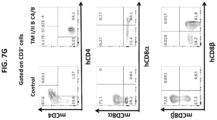
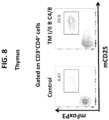
- the thymus of genetically modified non-human animals comprising a substantially humanized T cell immune system has similar absolute numbers of thymocytes and CD3+ T cells as control animals. Additionally, these cells show comparable development into single positive T cells to control animals and are capable of generating a robust human cellular response against antigen, e.g., a viral antigen.
- the human cellular response of the non-human animals generally comprises activated non-human T cells expressing human or humanized T cell receptor (TCR) variable domains that recognize antigen presented in the peptide binding cleft formed by human leukocyte antigen (HLA) extracellular domains, which may be expressed on the surface of non-human antigen presenting cells.
- the substantially humanized T cell immune system may comprise
- the rodent T cell and the rodent antigen presenting cell are found in or isolated from the same rodent
- rodents e.g., mice or rats
- rodents e.g., mice or rats
- the rodent comprises
- the first nucleotide sequence encoding a chimeric T cell CD4 co-receptor polypeptide is present at an endogenous CD4 T cell co-receptor locus
- the second nucleotide sequence encoding a chimeric T cell CD8 ⁇ co-receptor polypeptide is present at an endogenous CD8 ⁇ T cell co-receptor locus
- the third nucleotide sequence encoding a chimeric T cell CD8 ⁇ co-receptor polypeptide is present at an endogenous CD8 ⁇ T cell co-receptor locus.
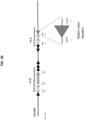
- Additional examples include a chimeric human/rodent CD4 polypeptide encoded by the gene set forth in FIG.
- the human portion of the resulting chimeric human/rodent CD4 T cell co-receptor polypeptide comprises at least human Ig1, human Ig2 and human Ig3 domains, otherwise respectively referred to as D1, D2 and D3 domains
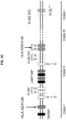
- a chimeric CD8 co-receptor encoded by the genes set forth in FIG. 5B e.g., wherein the human portion of the chimeric CD8 co-receptor comprises all or substantially all of the extracellular portion of a human CD8 polypeptide (e.g., CD8 ⁇ and/or CD8 ⁇ ), including human immunoglobulin V (IgV)-like ⁇ and ⁇ domains.
- IgV immunoglobulin V
- the human portion of the chimeric CD4 T cell co-receptor polypeptide comprises one or more extracellular domains of a human CD4 polypeptide (e.g., D1, D2, D3, D4, or any combination thereof) and the rodent portion of the chimeric CD4 T cell co-receptor polypeptide comprises the transmembrane and cytoplasmic domains of a rodent CD4 T cell co-receptor, the human portion of the chimeric CD8 ⁇ polypeptide comprises an extracellular domain (e.g., an IgV-like domain) of a human CD8 ⁇ polypeptide and the rodent portion of the chimeric CD8 ⁇ polypeptide comprises the transmembrane and cytoplasmic domains of a rodent CD8 ⁇ polypeptide, and/or the human portion of the CD8 ⁇ polypeptide comprises an extracellular domain (e.g., an IgV-like domain) of the human CD8 ⁇ polypeptide and the rodent portion of the chimeric CD8 ⁇ T cell co
- the first nucleic acid sequence encoding the human(ized) MHC II ⁇ is present at an endogenous rodent MHC II ⁇ locus and the second nucleic acid sequence encoding the human(ized) MHC II ⁇ is present at an endogenous rodent MHC II ⁇ locus, and/or the third nucleic acid sequence encoding the human(ized) MHC I is present at an endogenous rodent MHC I locus.
- the human(ized) MHC II ⁇ polypeptide comprises the extracellular portion (or part thereof) of a human HLA class II ⁇ polypeptide
- the human(ized) MHC II ⁇ polypeptide comprises the extracellular portion (or part thereof) of a human HLA class I ⁇ polypeptide and/ or the human(ized) MHC I polypeptide comprises the extracellular portion (or part thereof) of a human HLA class I polypeptide.
- the humanized MHC II ⁇ polypeptide comprises human MHC II ⁇ 1 and ⁇ 2 domains
- the humanized MHC II ⁇ polypeptide comprises human MHC II ⁇ 1 and ⁇ 2 domains
- the humanized MHC I polypeptide comprises human MHC I ⁇ 1, ⁇ 2, and ⁇ 3 domains.
- the first nucleic acid sequence encoding the chimeric human/rodent MHC II ⁇ polypeptide is expressed under regulatory control of endogenous rodent MHC II ⁇ promoter and regulatory elements
- the second nucleic acid sequence encoding the chimeric human/non-human MHC II ⁇ polypeptide is expressed under regulatory control of endogenous rodent MHC II ⁇ promoter and regulatory elements
- the third nucleic acid sequence encoding the chimeric human/rodent MHC I polypeptide is expressed under regulatory control of an endogenous non-human MHC I promoter and regulatory elements.
- a rodent portion of the chimeric human/rodent MHC II ⁇ polypeptide comprises transmembrane and cytoplasmic domains of an endogenous rodent MHC II ⁇ polypeptide
- a rodent portion of the chimeric human/rodent MHC II ⁇ polypeptide comprises transmembrane and cytoplasmic domains of an endogenous rodent MHC II ⁇ polypeptide
- a rodent portion of the chimeric human/non-human MHC I polypeptide comprises transmembrane and cytoplasmic domains of an endogenous rodent MHC I polypeptide.
- Embodiments include rodents wherein the human portion of the proteins of chimeric human/rodent MHC II complex is derived from corresponding human HLA class II proteins selected from the group consisting of HLA-DR, HLA-DQ, and HLA-DP and/or wherein the human portion of the third chimeric human/rodent MHC I polypeptide is derived from human HLA-A, human HLA-B, or human HLA-C.
- the chimeric MHC II ⁇ polypeptide comprises the extracellular portion, or a part thereof, of a HLA-DR ⁇ protein, a HLA-DQ ⁇ protein, or a HLA-DP ⁇ protein
- the chimeric MHC II ⁇ polypeptide comprises the extracellular portion, or a part thereof, of a HLA-DR ⁇ protein, a HLA-DQ ⁇ protein, or a HLA-DP ⁇ protein
- the chimeric MHC I polypeptide comprises the extracellular portion, or a part thereof, of a human HLA-A protein, a human HLA-B protein, or a human HLA-C protein.
- rodents are also provided, wherein the human portion of the chimeric human/rodent MHC II proteins derived from corresponding human HLA-DR proteins, e.g., the human portion of the human/rodents MHC II ⁇ polypeptide comprises ⁇ 1 and ⁇ 2 domains of the ⁇ chain of HLA-DR2 and the human portion of the human/rodent MHC II ⁇ polypeptide comprises ⁇ 1 and ⁇ 2 domains of the ⁇ chain of HLA-DR2 and/or wherein the human portion of the MHC I polypeptide is derived from a human HLA-A polypeptide, e.g., the human portion of the human/rodent MHC I polypeptide comprises the ⁇ 1, ⁇ 2, and ⁇ 3 domains of a human HLA-A2 polypeptide, e.g., the ⁇ 1, ⁇ 2, and ⁇ 3 domains of a human HLA-A2.1 polypeptide.
- Non-human animals wherein the non-human portions of the MHC II complex are derived from a murine H-2E encoding sequence and/or wherein the non-human portions of the MHC I polypeptide is derived from a murine H-2K encoding sequence are also provided.
- the chimeric MHC II ⁇ polypeptide comprises the transmembrane and cytoplasmic domains of a murine H-2E ⁇ polypeptide
- the chimeric MHC II ⁇ polypeptide comprises the transmembrane and cytoplasmic domains of a murine H-2E ⁇ polypeptide
- the chimeric MHC I polypeptide comprises the transmembrane and cytoplasmic domains of a murine H-2K polypeptide.
- the unrearranged TCR ⁇ variable gene locus is present at an endogenous TCR ⁇ variable gene locus and the unrearranged TCR ⁇ variable gene locus is present at an endogenous TCR ⁇ variable gene locus.
- the unrearranged TCR ⁇ variable gene locus comprises a complete repertoire of human unrearranged V ⁇ gene segments and a complete repertoire of human unrearranged J ⁇ gene segments and/or the unrearranged TCR ⁇ variable gene locus comprises a complete repertoire of human unrearranged V ⁇ gene segments, a complete repertoire of human unrearranged D ⁇ gene segments and a complete repertoire of human unrearranged J ⁇ gene segments.
- the human unrearranged V ⁇ and J ⁇ gene segments rearrange to form a rearranged human V ⁇ /J ⁇ sequence and/or the human unrearranged V ⁇ , D ⁇ and J ⁇ gene segment rearrange to form a rearranged human V ⁇ /D ⁇ /J ⁇ sequence.
- a rodents as disclosed herein expresses a T cell receptor comprising a human TCR ⁇ variable region and/or a human TCR ⁇ variable region on the surface of a T cell.
- endogenous non-human V ⁇ and J ⁇ segments are incapable of rearranging to form a rearranged V ⁇ /J ⁇ sequence and/or endogenous non-human V ⁇ , D ⁇ , and J ⁇ segments are incapable of rearranging to form a rearranged V ⁇ /D ⁇ /J ⁇ sequence
- the animal may lack a functional endogenous non-human TCR ⁇ variable locus and/or the animal may lack a functional endogenous non-human TCR ⁇ variable locus
- the animal comprises (a) a deletion of all or substantially all functional endogenous V ⁇ gene segments, (b) a deletion of all or substantially all functional endogenous J ⁇ gene segments, (c) a deletion of all or substantially all functional endogenous V ⁇ gene segments, (d) a deletion of all or substantially all functional endogenous D ⁇ gene segments, (e) a deletion of all or substantially all functional endogenous J ⁇ gene segments, and/or (f) a combination thereof.
- the endogenous non-human TCR ⁇ variable locus lacks all or substantially all functional endogenous V ⁇ gene segments and/or lacks all or substantially all functional endogenous J ⁇ gene segments; and/or the endogenous non-human TCR ⁇ variable locus (a) lacks all or substantially all functional endogenous V ⁇ gene segments, (b) lacks all or substantially all functional endogenous D ⁇ gene segments, (c) lacks all or substantially all functional endogenous J ⁇ gene segments, or (d) any combination of (a), (b), and (c)
- the first, second and/or third nucleotide sequence(s) respectively encoding the chimeric T cell CD4, CD8 ⁇ and/or CD8 ⁇ co-receptor polypeptide(s) is present at endogenous T cell co-receptor loci, e.g., endogenous CD4, CD8 ⁇ and/or CD8 ⁇ co-receptor loci respectively;
- the unrearranged TCR ⁇ variable gene locus is present at an endogenous TCR ⁇ variable gene locus;
- the unrearranged TCR ⁇ variable gene locus is present at an endogenous TCR ⁇ variable gene locus;
- the first, second and/or third nucleic acid sequence(s) respectively encoding the chimeric MHC II ⁇ , MHC II ⁇ , and/or MHC I polypeptide(s) is present at endogenous MHC loci; e.g., MHC II ⁇ , MHC II ⁇ , and/or MHC I loci, respectively.
- the nucleotide sequence(s) encoding the chimeric T cell co-receptor(s), the unrearranged TCR ⁇ variable gene locus, the unrearranged TCR ⁇ variable gene locus and/or the nucleic acid sequence(s) encoding the chimeric MHC molecule(s) may be operably linked to a rodent promoter and regulatory sequences.
- the first nucleotide sequence may be expressed under regulatory control of endogenous rodent CD4 promoter and regulatory elements
- the second nucleotide sequence may be expressed under regulatory control of endogenous rodent CD8 ⁇ promoter and regulatory elements
- and/or the third nucleotide sequence may expressed under regulatory control of endogenous rodent CD8 ⁇ promoter and regulatory elements
- the unrearranged TCR ⁇ variable gene locus may be expressed under regulatory control of endogenous TCR ⁇ (variable) regulatory and promoter elements
- the unrearranged TCR ⁇ variable gene locus may be expressed under regulatory control of endogenous TCR ⁇ (variable) regulatory and promoter elements
- the unrearranged TCR ⁇ variable gene locus may be expressed under regulatory control of endogenous TCR ⁇ (variable) regulatory and promoter elements
- the first nucleic acid sequence may be expressed under regulatory control of endogenous rodent MHC II ⁇ promoter and regulatory elements
- the second nucleic acid sequence may be expressed under regulatory control of endogenous rodent MHC II ⁇ promoter and
- a nucleotide sequence encoding the extracellular portion (or parts thereof, e.g., D1, D2, D3 and/or D4) of the human CD4 polypeptide replaces a sequence encoding the extracellular portion (or parts thereof, e.g., D1, D2, D3 and/or D4) of an endogenous rodent (mouse) CD4 co-receptor polypeptide, and may be operably linked to endogenous rodent (mouse) CD4 transmembrane and cytoplasmic domain encoding sequences, at the endogenous rodent (mouse) CD4 co-receptor locus;
- a nucleotide sequence encoding all or part of the extracellular portion of a human CD8 ⁇ polypeptide replaces a sequence encoding all or part of an extracellular portion of an endogenous rodent (mouse) T cell CD8 ⁇ polypeptide, and may be operably linked to endogenous rodent (mouse) CD8 ⁇ transmembran
- a genetically modified rodent animal as disclosed herein does not express a functional endogenous non-human T cell CD4 co-receptor from its endogenous locus, does not express a functional endogenous rodent T cell CD8 co-receptor from its endogenous CD8 locus, does not express a functional TCR ⁇ variable domain from an endogenous TCR ⁇ variable locus, does not express a function TCR ⁇ variable domain from an endogenous TCR ⁇ variable locus, does not express an extracellular domain of an endogenous MHC II complex from an endogenous MHC II locus (e.g., on a cell surface) and/or does not express an extracellular domain of an endogenous MHC I polypeptide from an endogenous MHC I locus (e.g., on a cell surface).
- any non-human animal disclosed herein may further comprise a ⁇ 2 microglobulin locus encoding a polypeptide comprising a human or humanized ⁇ 2 microglobulin amino acid sequence, wherein the non-human animal expresses the human or humanized ⁇ 2 microglobulin polypeptide.
- the rodent does not express a functional endogenous rodent ⁇ 2 microglobulin polypeptide from an endogenous rodent ⁇ 2 microglobulin locus.
- the ⁇ 2 microglobulin locus is operably linked to endogenous rodent ⁇ 2 microglobulin regulatory elements.
- the ⁇ 2 microglobulin locus comprises a nucleotide sequence set forth in exon 2, exon 3, and exon 4 (e.g., exon 2 to exon 4) of a human ⁇ 2 microglobulin gene, and optionally, the ⁇ 2 microglobulin locus further comprises a nucleotide sequence set forth in exon 1 of a rodent, ⁇ 2 microglobulin gene.
- a mouse that expresses chimeric human/murine T cell CD4, CD8 ⁇ , and CD8 ⁇ co-receptor polypeptides each respectively comprising murine CD4, CD8 ⁇ , and CD8 ⁇ transmembrane and cytoplasmic domains; a T cell receptor comprising a human TCR ⁇ variable region and a human TCR ⁇ variable region on the surface of a T cell; chimeric human/murine MHC II ⁇ , MHC II ⁇ , and MHC I polypeptides each respectively comprising extracellular domains of a human MHC II ⁇ (human HLA class II ⁇ 1 and ⁇ 2 domains), MHC II ⁇ (human HLA class II ⁇ 1 and ⁇ 2 domains), and MHC I polypeptide (e.g., human HLA class I ⁇ 1, ⁇ 2, and ⁇ 3 domains); and a human or humanized ⁇ 2 microglobulin polypeptide.
- a human MHC II ⁇ human HLA class II ⁇ 1 and ⁇ 2 domains
- rodents e.g., mice
- the first nucleic acid sequence encodes an ⁇ chain of a chimeric human/murine HLA-DR/H-2E polypeptide
- the second nucleotide sequence encodes a ⁇ chain of a chimeric HLA-DR/H-2E polypeptide
- the third nucleic acid sequence encodes a chimeric human/murine HLA-A/H-2K polypeptide
- the mouse expresses HLA-A/H-2K and HLA-DR/H-2E proteins.
- a rodent comprising a substantially humanized T cell immune system, e.g., wherein the substantially humanized T cell immune system mounts a substantially humanized T cell immune response against an antigen.
- the substantially humanized T cell immune response comprises activated T cells expressing human T cell receptor (TCR) variable domains that recognize antigen presented in the context of human leukocyte antigen (HLA) extracellular domains and/or antigen presenting cells that present antigen in the context of HLA extracellular domains.
- TCR human T cell receptor
- HLA human leukocyte antigen
- the substantially humanized T cell immune system comprises:(a) a rodent T cell that expresses a T cell co-receptor polypeptide comprising a human T cell co receptor domain that binds to a human HLA molecule and/or a T cell receptor (TCR) comprising a TCR variable domain that is encoded by at least one human TCR variable region gene segment; and (b) a rodent antigen presenting cell that presents antigen in the context of human HLA and activates the rodent T cell.
- a rodent T cell that expresses a T cell co-receptor polypeptide comprising a human T cell co receptor domain that binds to a human HLA molecule and/or a T cell receptor (TCR) comprising a TCR variable domain that is encoded by at least one human TCR variable region gene segment
- TCR T cell receptor
- methods of making a genetically modified non-human animal as disclosed herein comprise (a) introducing into the genome of the non-human animal a first nucleotide sequence encoding a chimeric human/non-human T cell co-receptor polypeptide (e.g., a chimeric CD4 polypeptide), and/or a second nucleotide sequence encoding a second chimeric human/non-human T cell co-receptor polypeptide (e.g., a chimeric CD8 ⁇ polypeptide) and a third nucleotide sequence encoding a third chimeric human/non-human T cell co-receptor polypeptide (e.g., a CD8 ⁇ polypeptide), wherein a non-human portion of each chimeric T cell co-receptor polypeptide comprises at least transmembrane and cytoplasmic domains of a non-human T cell co-re
- the first nucleotide sequence encodes the extracellular portion, or a part thereof, of human CD4 operably linked to at least transmembrane and cytoplasmic domains of a non-human CD4 co-receptor
- the second nucleotide sequence encodes the extracellular portion, or a part thereof, of human CD8 ⁇ and at least the transmembrane and cytoplasmic domains of a non-human CD8 ⁇
- the third nucleotide sequence encodes the extracellular portion, or a part thereof, of human CD8 ⁇ and at least the transmembrane and cytoplasmic domains of non-human CD8 ⁇
- the first nucleic acid sequence encodes the extracellular portion (or part thereof) of a human HLA class II ⁇ polypeptide and at least the transmembrane and cytoplasmic domains of a non-human MHC II ⁇ polypeptide
- the second nucleic acid sequence encodes the extracellular portion (or part thereof) of a human HLA class II ⁇ poly
- Methods of making rodents include embodiments wherein (a) introducing the first, second and/or third nucleotide sequence(s) encoding the chimeric T cell co-receptor polypeptide(s) into the genome of the non-human animal comprises replacing at an endogenous CD4 locus a nucleotide sequence encoding an endogenous rodent CD4 polypeptide with a nucleotide sequence encoding a chimeric human/rodent CD4 polypeptide, and/or replacing at an endogenous CD8 ⁇ locus a nucleotide sequence encoding an endogenous rodent CD8 ⁇ polypeptide with a nucleotide sequence encoding a chimeric human/rodent CD8 ⁇ polypeptide and replacing at an endogenous CD8 ⁇ locus a nucleotide sequence encoding an endogenous rodent CD8 ⁇ polypeptide with a nucleotide sequence encoding a chimeric human/rodent CD8 ⁇ polypeptide; (b) insert
- (a) introducing the first, second and/or third nucleotide sequence into the genome of the rodent animal respectively comprises (i) replacing at an endogenous CD4 locus a nucleotide sequence encoding the extracellular portion (or a part thereof) of an endogenous rodent CD4 polypeptide with a nucleotide sequence encoding the extracellular portion (or a part thereof) of a human CD4 polypeptide in operable linkage with sequences encoding the endogenous rodent CD4 transmembrane and cytoplasmic domains, (ii) replacing at an endogenous CD8 ⁇ locus a nucleotide sequence encoding the extracellular portion (or a part thereof) of an endogenous rodent CD8 ⁇ polypeptide with a nucleotide sequence encoding the extracellular portion (or a part thereof) of a human CD8 ⁇ polypeptide in operable linkage with sequences encoding the endogenous rodent CD8 ⁇ transmembrane and
- the introducing step comprises replacing in a first rodent at an endogenous CD4 locus a nucleotide sequence encoding an endogenous rodent CD4 polypeptide with a nucleotide sequence encoding a chimeric human/rodent CD4 polypeptide, replacing in a second rodent at an endogenous CD8 ⁇ locus a nucleotide sequence encoding an endogenous rodent CD8 ⁇ polypeptide with a nucleotide sequence encoding a chimeric human/rodent CD8 ⁇ polypeptide and replacing at an endogenous CD8 ⁇ locus a nucleotide sequence encoding an endogenous rodent CD8 ⁇ polypeptide with a nucleotide sequence encoding a chimeric human/rodent CD8 ⁇ polypeptide.
- the introducing step comprises replacing in a first rodent at an endogenous CD4 locus a nucleotide sequence encoding the extracellular portion (or a part thereof) of an endogenous rodent CD4 polypeptide with a nucleotide sequence encoding the extracellular portion (or a part thereof) of a human CD4 polypeptide in operable linkage with sequences encoding the endogenous rodent CD4 transmembrane and cytoplasmic domains, replacing in a second rodent at an endogenous CD8 ⁇ locus a nucleotide sequence encoding the extracellular portion (or a part thereof) of an endogenous rodent CD8 ⁇ polypeptide with a nucleotide sequence encoding the extracellular portion (or a part thereof) of a human CD8 ⁇ polypeptide in operable linkage with sequences encoding the endogenous rodent CD8 ⁇ transmembrane and cytoplasmic domains and replacing at an endogenous CD8 ⁇ locus a
- the inserting step may comprise replacing in a third non-human animal an endogenous non-human TCR ⁇ variable gene locus with an unrearranged humanized TCR ⁇ variable gene locus comprising at least one human V ⁇ segment and at least one human J ⁇ segment to generate a humanized TCR ⁇ variable gene locus, wherein the humanized TCR ⁇ variable gene locus is operably linked to endogenous non-human TCR ⁇ constant region; replacing in a fourth non-human animal an endogenous non-human TCR ⁇ variable gene locus with an unrearranged humanized TCR ⁇ variable gene locus comprising at least one human V ⁇ segment, at least one human D ⁇ segment, and at least one human J ⁇ segment to generate a humanized TCR ⁇ variable gene locus, wherein the humanized TCR ⁇ variable gene locus is operably linked to endogenous non-human TCR ⁇ constant region.
- the replacing steps are performed simultaneously or in any order.
- the placing step may comprise in no particular order, replacing in a fifth non-human animal at an endogenous non-human MHC II locus one or more nucleotide sequence encoding a non-human MHC II complex with one or more nucleotide sequence encoding a chimeric human/non-human MHC II complex; and replacing in the fifth non-human animal at an endogenous non-human MHC I locus a nucleotide sequence encoding a non-human MHC I polypeptide with a nucleotide sequence encoding a chimeric human/non-human MHC I polypeptide the placing step may comprise replacing in a fifth non-human animal at an endogenous non-human MHC II ⁇ locus a nucleotide sequence encoding the extracellular portion (or a part thereof) of a non-human MHC II ⁇ polypeptide with a nucleotide sequence encoding the extracellular portion (or a part thereof) of a human MHC II ⁇ polypeptid
- the adding step may comprise replacing in a sixth non-human animal at the endogenous non-human ⁇ 2 microglobulin locus a nucleotide sequence encoding a non-human ⁇ 2 microglobulin polypeptide with a nucleotide sequence encoding a human or humanized ⁇ 2 microglobulin polypeptide.
- the human or humanized ⁇ 2 microglobulin polypeptide is encoded by the nucleotide sequence set forth in exon 2, exon 3, and exon 4 of the human ⁇ 2 microglobulin gene.
- Methods disclosed herein may comprise homologous recombination in non-human embryonic stem (ES) cells. Methods disclosed herein may be used to generate mice as disclosed herein.
- Non-human animals expressing chimeric human/non-human CD4, CD8 ⁇ and/or CD8 ⁇ T cell co-receptor polypeptides, human(ized) TCR ⁇ / ⁇ proteins, and chimeric MHC II complex and MHC I may be generated by (a) first introducing each individual human(ized) gene by homologous recombination in individual ES cells respectively and generating each individual non-human animal from such ES cells, and subsequent breeding of each generated non-human animal in any order, (b) introducing all human(ized) genes by sequential homologous recombination in a single ES cell and then generating a non-human animal from such ES cell, or (c) a combination of sequential homologous recombination at some loci in ES cells and breeding. Animals as
- Also disclosed are methods of isolating human TCR variable domains specific for an antigen from a non-human animal comprising isolating from a non-human animal provided herein or made according to a method disclosed herein a T cell or TCR protein that binds to the antigen.
- the methods may further comprise identifying a first and/or second nucleic acid encoding the TCR ⁇ and/or TCR ⁇ variable domains that binds to the antigen and/or culturing a cell comprising one or more vectors in sufficient conditions for expression of the vector(s), wherein the vector(s) comprises a third and/or fourth nucleic acid respectively identical to or substantially identical to the first and/or second nucleic acids, and wherein the third and/or fourth nucleic acid is cloned in-frame with, e.g., a human TCR constant region gene, e.g., a TCR ⁇ constant region gene and/or TCR ⁇ constant region gene, respectively.
- a human TCR constant region gene e.g., a TCR ⁇ constant region gene and/or TCR ⁇ constant region gene, respectively.
- Tissues and cells comprising the genetic modifications as disclosed herein (which may include rearranged human TCR ⁇ and/or TCR ⁇ variable region genes), and nucleic acids encoding such human TCR variable domains expressed by such tissues or cells isolated from a non-human animal modified as described herein are also disclosed.
- nucleic acids e.g., expression vectors
- nucleic acid sequences encoding a human TCR variable domain as disclosed herein, e.g., a human rearranged TCR ⁇ or human rearranged TCR ⁇ variable region gene, cloned in-frame to an appropriate human TCR constant region gene, e.g., a TCR ⁇ constant region gene or TCR ⁇ constant region gene, respectively
- host cells comprising such nucleic acids (e.g., expression vectors) and (3) the TCR expressed by the host cells.
- recombinant nucleic acids disclosed herein comprise a human rearranged TCR ⁇ variable region gene or a TCR ⁇ variable region gene, e.g., derived from a non-human animal genetically modified as disclosed herein or a tissue isolated therefrom, cloned in-frame with a human TCR ⁇ constant region gene or a TCR ⁇ constant region gene, respectively.
- a method of generating a humanized T cell response in a non-human animal is also disclosed, the method generally comprising immunizing a non-human animal a non-human animal genetically modified or having a substantially humanized T cell immune system as described herein with an antigen, e.g., a human antigen, e.g., a human tumor antigen, a human bacterial pathogen, a human viral pathogen, etc.
- an antigen e.g., a human antigen, e.g., a human tumor antigen, a human bacterial pathogen, a human viral pathogen, etc.
- the non-human animal immunized expresses at least 50% of all functional human TCRV ⁇ gene segments and/or at least 50% of all functional human TCRV ⁇ gene segments and/or comprises all or substantially all functional human TCRV ⁇ gene segments and/or all or substantially all functional human TCRV ⁇ gene segments.
- in vitro methods of isolating human TCR specific for an antigen which generally comprise detecting activation of a first cell of a non-human animal after (a) contact with a second cell of a non-human animal and (b) incubation with the antigen; wherein the first cell expresses a chimeric human/non-human T cell co-receptor and either or both (i) a chimeric human/non-human TCR ⁇ chain and (ii) a chimeric human/non-human TCR ⁇ chain, and wherein the second cell expresses a chimeric human/non-human MHC polypeptide.
- the methods may further comprise isolating a TCR from the first cell, or nucleic acids encoding same.
- the antigen may be tumor antigen, a viral antigen, an autoantigen, or a bacterial antigen
- the non-human animal is a rodent, e.g., a rat or a mouse.
- compositions comprising a first and second cell of a non-human animal; wherein the first cell expresses a chimeric human/non-human T cell co-receptor and optionally, either or both (i) a chimeric human/non-human TCR ⁇ chain and (ii) a chimeric human/non-human TCR ⁇ chain, and wherein the second cell expresses a chimeric human/non-human MHC polypeptide that associates with the chimeric human/non-human T cell co-receptor.
- the first cell may be a non-human T cell.
- the second cell is a non-human antigen presenting cell.
- rodents e.g. mice or rats
- a humanized T cell co-receptor e.g., humanized CD4 and/or CD8 (e.g., CD8 ⁇ and/or CD8 ⁇ )
- a human or humanized major histocompatibility complex MHC
- MHC major histocompatibility complex
- binds the humanized T cell co-receptor e.g., human or humanized MHC II (e.g., MHC II ⁇ and/or MHC II ⁇ chains) and/or MHC I (e.g., MHC I ⁇ ), and optionally human or humanized ⁇ 2 microglobulin
- TCR human or humanized T cell receptor
- the development of the cellular arm of the immune system of the non-human animals disclosed herein is comparable to control animals, e.g., the thymus and spleen comprises similar absolute numbers of thymocytes and CD3+ cells.
- This is in stark contrast to other non-human animals modified to comprise both human TCR ( ⁇ and ⁇ ) and a chimeric human/mouse MHC I molecule, see, e.g., Li (2010) Nature Medicine 16:1029-1035 and supplementary materials.
- Such animals showed a decrease in T cell populations compared not only to wildtype control animals, but also animals modified with only human TCR, and animals modified with only the chimeric human/mouse MHC I molecule, id.
- rodents engineered to co-express a humanized CD4 co-receptor and a humanized MHC II and/or a humanized CD8 co-receptor and a humanized MHC I, and a humanized TCR are also disclosed.
- Methods for making a genetically engineered animal that expresses at least one humanized T cell co-receptor (e.g., humanized CD4 and/or CD8), at least one humanized MHC that associates with the humanized T cell co-receptor (e.g., humanized MHC II and/or MHC I that associate with humanized CD4 and/or CD8, respectively) and the humanized TCR are also disclosed.
- Methods for using the genetically engineered animals that mount a substantially humanized T cell immune response for developing human therapeutics are also disclosed.
- mice that are genetically modified to mount substantially humanized T cell immune responses.
- the mice disclosed herein express at least one human or humanized T cell co-receptor, at least one human or humanized major histocompatibility complex (MHC) capable of associating with the at least one human or humanized T cell co-receptor, and/or a human or humanized T cell receptor (TCR), which is preferably capable of recognizing an antigen presented in the context of human or humanized MHC in association with a human or humanized T cell co-receptor and providing activation signals to the non-human cell, e.g., non-human T cell, expressing the human or humanized TCR.
- MHC major histocompatibility complex
- TCR human or humanized T cell receptor
- the human or humanized T cell co-receptor, human or humanized TCR and/or human or humanized MHC may be encoded by the genome of the non-human animal.
- the rodents upon immunization with an antigen, present HLA restricted epitopes of the antigen to TCR derived from human TCR gene segments, e.g., a human TCR ⁇ V segment, a human TCR ⁇ J segment, a human TCR ⁇ V segment, human TCR ⁇ D segment and/or a human TCR ⁇ J segment.
- a genetically modified rodent animal whose genome comprises (e.g., at an endogenous locus) a nucleotide sequence encoding a humanized T cell co-receptor polypeptide (e.g., CD4 or CD8 polypeptide), wherein the chimeric T cell co-receptor polypeptide comprises conservative amino acid substitutions of the amino acid sequence(s) described herein and/or a nucleic acid sequence encoding a humanized MHC polypeptide that associates with the humanized T cell co-receptor polypeptide, wherein the humanized MHC polypeptide comprises conservative amino acid substitutions of the amino acid sequence(s) described herein.
- a humanized T cell co-receptor polypeptide e.g., CD4 or CD8 polypeptide
- the chimeric T cell co-receptor polypeptide comprises conservative amino acid substitutions of the amino acid sequence(s) described herein and/or a nucleic acid sequence encoding a humanized MHC polypeptide that associate
- a conservative amino acid substitution includes substitution of an amino acid residue by another amino acid residue having a side chain R group with similar chemical properties (e.g., charge or hydrophobicity).
- Conservative amino acid substitutions may be achieved by modifying a nucleotide sequence so as to introduce a nucleotide change that will encode the conservative substitution.
- a conservative amino acid substitution will not substantially change the functional properties of interest of a protein, for example, the ability of CD4 or CD8 to associate with, e.g., bind to MHC II or MHC I, respectively, and may, e.g., increase sensitivity of TCR to MHC-presented antigen.
- groups of amino acids that have side chains with similar chemical properties include aliphatic side chains such as glycine, alanine, valine, leucine, and isoleucine; aliphatic-hydroxyl side chains such as serine and threonine; amide-containing side chains such as asparagine and glutamine; aromatic side chains such as phenylalanine, tyrosine, and tryptophan; basic side chains such as lysine, arginine, and histidine; acidic side chains such as aspartic acid and glutamic acid; and, sulfur-containing side chains such as cysteine and methionine.
- aliphatic side chains such as glycine, alanine, valine, leucine, and isoleucine
- aliphatic-hydroxyl side chains such as serine and threonine
- amide-containing side chains such as asparagine and glutamine
- aromatic side chains such as phenylalanine, tyrosine, and trypto
- Conservative amino acids substitution groups include, for example, valine/leucine/isoleucine, phenylalanine/tyrosine, lysine/arginine, alaninelvaline, glutamate/aspartate, and asparagine/glutamine.
- a conservative amino acid substitution can be a substitution of any native residue in a protein with alanine, as used in, for example, alanine scanning mutagenesis.
- a conservative substitution is made that has a positive value in the PAM250 log-likelihood matrix disclosed in Gonnet et al. ((1992) Exhaustive Matching of the Entire Protein Sequence Database, Science 256:1443-45 ).
- the substitution is a moderately conservative substitution wherein the substitution has a nonnegative value in the PAM250 log-likelihood matrix.
- nucleic acid residues encoding humanized T cell co-receptor polypeptides, humanized MHC polypeptides, and/or TCR variable regions described herein due to the degeneracy of the genetic code, other nucleic acids may encode the polypeptides described herein.
- a genetically modified non-human animal that comprises in its genome a nucleotide sequence encoding a humanized T cell co-receptor polypeptide (e.g., CD4 or CD8 polypeptide), an unrearranged T cell receptor variable gene locus (e.g., TCR ⁇ and/or TCR ⁇ ) comprising human unrearranged gene segments, and/or a nucleic acid sequence encoding a humanized MHC polypeptide capable of associating with the humanized T cell co-receptor polypeptide with conservative amino acid substitutions, also disclosed is a non-human animal whose genome comprises a nucleotide sequence encoding a humanized T cell co-receptor polypeptide (e.g., CD4 or CD8 polypeptide), an unrearranged T cell receptor variable gene locus (e.g., TCR ⁇ and/or TCR ⁇ ) comprising human unrearranged gene segments, and/or a nucleic acid sequence encoding a humanized MHC polypeptide capable
- identity of a sequence may be determined by a number of different algorithms known in the art that can be used to measure nucleotide and/or amino acid sequence identity. In some embodiments described herein, identities are determined using a ClustalW v. 1.83 (slow) alignment employing an open gap penalty of 10.0, an extend gap penalty of 0.1, and using a Gonnet similarity matrix (MacVector TM 10.0.2, MacVector Inc., 2008). The length of the sequences compared with respect to identity of sequences will depend upon the particular sequences. In various embodiments, identity is determined by comparing the sequence of a mature protein from its N-terminal to its C-terminal.
- the human portion of the chimeric human/non-human sequence (but not the non-human portion) is used in making a comparison for the purpose of ascertaining a level of identity between a human sequence and a human portion of a chimeric human/non-human sequence (e.g., comparing a human ectodomain of a chimeric human/mouse protein to a human ectodomain of a human protein).
- homology in reference to sequences, e.g., nucleotide or amino acid sequences, means two sequences which, upon optimal alignment and comparison, are identical in, e.g., at least about 75% of nucleotides or amino acids, e.g., at least about 80% of nucleotides or amino acids, e.g., at least about 90-95% nucleotides or amino acids, e.g., greater than 97% nucleotides or amino acids.
- the targeting construct should contain arms homologous to endogenous DNA sequences (i.e., "homology arms”); thus, homologous recombination can occur between the targeting construct and the targeted endogenous sequence.
- operably linked refers to a juxtaposition wherein the components so described are in a relationship permitting them to function in their intended manner.
- a nucleic acid sequence encoding a protein may be operably linked to regulatory sequences (e.g., promoter, enhancer, silencer sequence, etc.) so as to retain proper transcriptional regulation.
- regulatory sequences e.g., promoter, enhancer, silencer sequence, etc.
- various portions of the chimeric or humanized protein of the disclosure may be operably linked to retain proper folding, processing, targeting, expression, and other functional properties of the protein in the cell. Unless stated otherwise, various domains of the chimeric or humanized proteins are operably linked to each other.
- replacement in reference to gene replacement refers to placing exogenous genetic material at an endogenous genetic locus, thereby replacing all or a portion of the endogenous gene with an orthologous or homologous nucleic acid sequence.
- nucleic acid sequences of endogenous loci encoding portions of mouse CD4 or CD8 (CD8 ⁇ and/or CD8 ⁇ ) polypeptides were replaced by nucleotide sequences encoding portions of human CD4 or CD8 (CD8 ⁇ and/or CD8 ⁇ ) polypeptides, respectively.
- non-human animals that express at least one human or humanized T cell co-receptor, e.g., CD4, CD8 ⁇ and/or CD8 ⁇ .
- a non-human animal as disclosed herein comprises at least one of a first, second, and/or third nucleotide sequence, each of which encodes a different human or chimeric human/non-human T cell co-receptor polypeptide selected from a human or humanized CD4 polypeptide, a human or humanized CD8 ⁇ polypeptide, and a human or humanized CD8 ⁇ polypeptide.
- a non-human animal as disclosed herein may comprise a nucleic acid sequence or nucleic acid sequences encoding a human or humanized CD4 and/or a human or humanized CD8 (e.g., human or humanized CD8 ⁇ and/or CD8 ⁇ ) polypeptide(s).
- a non-human animal as disclosed herein comprises a first nucleotide sequence encoding a human or humanized CD4 polypeptide.
- a non-human animal as disclosed herein comprises a first nucleotide seauence encoding a human or humanized CD8 ⁇ polypeptide and a second nucleotide sequence encoding a human or humanized CD8 ⁇ polypeptide.
- a non-human animal as disclosed herein comprises first and second nucleotide sequences encoding human or humanized CD8 ⁇ and CD8 ⁇ polypeptides and further comprises a third nucleotide sequence encoding a human or humanized CD4 polypeptide.
- rodents that comprise in their genome, e.g., at an endogenous CD4 locus, a nucleotide sequence encoding a human or humanized CD4 polypeptide; thus, the animals express a human or humanized CD4 polypeptide.
- CD4 gene is localized to chromosome 12, and is thought to contain 10 exons.
- CD4 gene encodes a protein with amino-terminal hydrophobic signal sequence, encoded by exons 2 and 3 of the gene.
- the protein comprises four extracellular immunoglobulin-like domains, Ig1-lg4, also commonly and respectively referred to as D1-D4 domains.
- Ig1-lg4 domains Ig1-lg4 domains
- D1 domain is believed to be encoded by exon 3 (sequence downstream of signal peptide) and exon 4, while D2, D3, and D4 are encoded by a separate exon each -- exons 5, 6, and 7, respectively (see FIG. 5A : D1, D2, D3 and D4 domains are encoded by sequences designated as Ig1, Ig2, Ig3 and Ig4, respectively).
- D1 domain of CD4 resembles immunoglobulin variable (V) domain, and, together with a portion of D2 domain, is believed to bind (associate with) MHC II, e.g., at an MHC II co-receptor binding site.
- MHC II interacts with T cell co-receptor CD4 at the hydrophobic crevice at the junction between MHC II ⁇ 2 and ⁇ 2 domains.
- CD4 domains D3 and D4 of the CD4 co-receptor are believed to interact with the TCR-CD3 complex as the substitution of these two domains abrogated the ability of CD4 to bind to TCR. Vignali et al. (1996) The Two Membrane Proximal Domains of CD4 Interact with the T Cell Receptor, J. Exp. Med. 183:2097-2107 .
- CD4 molecule exists as a dimer, and residues in the D4 domain of the molecule are believed to be responsible for CD4 dimerization. Moldovan et al. (2002) CD4 Dimers Constitute the Functional Components Required for T Cell Activation, J. Immunol. 169:6261-68 .
- CD4 cytoplasmic domain possesses many distinct functions.
- the cytoplasmic domain of CD4 recruits a tyrosine kinase Lck.
- Lck is a Src family kinase that is associated with CD4 and CD8 cytoplasmic domains and simultaneous binding of the co-receptors and TCRs to the same MHC leads to increased tyrosine phosphorylation of CD3 and ⁇ chain of the TCR complex, which in turn leads to recruitment of other factors that play a role in T cell activation.
- cytoplasmic tail of CD4 also promotes differentiation of CD4+CD8+ T cells into CD4+ lineage by designing and testing expression of hybrid protein comprising CD8 extracellular domain and CD4 cytoplasmic tail in transgenic mice. Itano et al. (1996) The Cytoplasmic Domain of CD4 Promotes the Development of CD4 Lineage T Cells, J. Exp. Med. 183:731-41 . The expression of the hybrid protein led to the development of MHC I-specific, CD4 lineage T cells. Id.
- CD4 co-receptor appears to be the primary receptor for HIV virus, with the CD4+ T cell depletion being an indicator of disease progression.
- the cytoplasmic tail of CD4 appears to be essential for delivering apoptotic signal to CD4+ T cells in HIV-induced apoptosis.
- the interaction of CD4 and Lck was shown to potentiate HIV-induced apoptosis in these cells. Corbeil et al. (1996) HIV-induced Apoptosis Requires the CD4 Receptor Cytoplasmic Tail and Is Accelerated by Interaction of CD4 with p56lck, J. Exp. Med. 183:39-48 .
- T cells develop in the thymus progressing from immature CD4-/CD8- (double negative or DN) thymocytes to CD4+/CD8+ (double positive or DP) thymocytes, which eventually undergo positive selection to become either CD4+ or CD8+ (single positive or SP) T cells.
- DP thymocytes that receive signals through MHC I-restricted TCR differentiate into CD8+ T cells
- DP thymocytes that receive signals through MHC II-restricted TCR differentiate into CD4+ T cells.
- the cues received by the DP cell that lead to its differentiation into either CD4+ of CD8+ T cell have been a subject of much research.
- Deactivation of a specific T cell co-receptor as a result of positive selection is a product of transcriptional regulation.
- CD4 it has been shown that an enhancer located 13 kb upstream of exon 1 of CD4 upregulates CD4 expression in CD4+ and CD8+ T cells.
- Killeen et al. (1993) Regulated expression of human CD4 rescues helper T cell development in mice lacking expression of endogenous CD4, EMBO J. 12:1547-53 .
- a cis-acting transcriptional silencer located within the first intron of murine CD4 gene functions to silence expression of CD4 in cells other than CD4+ T cells.
- the disclosure provides a genetically modified rodent comprising, e.g., at its endogenous T cell co-receptor locus (e.g., CD4 locus), a nucleotide sequence encoding a chimeric human/rodent T cell co-receptor polypeptide.
- a human portion of the chimeric polypeptide comprises all or substantially all of an extracellular portion (or part thereof, e.g., one or more extracellular domains, e.g., at least two consecutive extracellular domains) of a human T cell co-receptor.
- a rodent portion of the chimeric polypeptide comprises transmembrane and cytoplasmic domains of a rodent T cell co-receptor.
- the rodent expresses a functional chimeric T cell co-receptor polypeptide.
- the disclosure provides a genetically modified rodent comprising at its endogenous CD4 locus a nucleotide sequence encoding a chimeric human/rodent CD4 polypeptide, wherein a human portion of the chimeric polypeptide comprises all or substantially all of an extracellular portion of a human CD4, wherein a non-human portion comprises at least transmembrane and cytoplasmic domains of a non-human CD4, and wherein the animal expresses a functional chimeric CD4 polypeptide.
- the rodent only expresses the humanized CD4 polypeptide, i.e., chimeric human/rodent CD4 polypeptide, and does not express a functional endogenous rodent CD4 protein from its endogenous CD4 locus.
- the human portion of the chimeric human/rodent CD4 polypeptide comprises all or substantially all of the extracellular portion of a human CD4 polypeptide.
- the human portion of the chimeric human/rodent CD4 polypeptide comprises at least all or substantially all of the MHC II binding domain of the human CD4 polypeptide (e.g., a substantial portion of human D1 and D2 domains); in one embodiment, the human portion of the chimeric human/rodent CD4 polypeptide comprises all or substantially all of D1, D2, and D3 domains of the human CD4 polypeptide; in yet another embodiment, the human portion of the chimeric human/rodent CD4 polypeptide comprises all or substantially all of immunoglobulin-like domains of CD4, e.g., domains termed D1, D2, D3, and D4.
- the human portion of the chimeric human/rodent CD4 polypeptide comprises in its human portion all or substantially all of the human CD4 sequence that is responsible for interacting with MHC II and/or extracellular portion of a T cell receptor. In yet another embodiment, the human portion of the chimeric human/rodent CD4 polypeptide comprises all or substantially all of the extracellular portion of the human CD4 that is responsible for interacting with MHC II and/or the variable domain of a T cell receptor.
- the nucleotide sequence encoding the human portion of the chimeric CD4 polypeptide comprises all or substantially all of the coding sequence of domains D1-D2 of the human CD4 (e.g., a portion of exon 3 and exons 4-5 of the human CD4 gene); in another embodiment, it comprises all or substantially all of the coding sequence of D1-D3 of the human CD4 (e.g., portion of exon 3 and exons 4-6 of the human CD4).
- the nucleotide sequence encoding chimeric human/non-human CD4 comprises nucleotide sequences encoding all or substantially all D1-D3 domains of the human CD4.
- the nucleotide sequence encoding the human portion of the chimeric CD4 polypeptide comprises the coding sequence of D1-D4 domains of the human CD4 gene.
- the nucleotide sequence may comprise the nucleotide sequence encoding mouse CD4 signal peptide, e.g., region encoded by portions of exons 2-3 of the mouse gene.
- the nucleotide sequence may comprise the nucleotide sequence encoding a human CD4 signal peptide.
- the chimeric human/non-human CD4 polypeptide comprises an amino acid sequence set forth in SEQ ID NO:78, and the human portion of the chimeric polypeptide spans about amino acids 27-319 of SEQ ID NO:78 (set forth separately in SEQ ID NO:79).
- the rodent expresses a chimeric human/rodent CD4 polypeptide sequence.
- a human portion of the chimeric CD4 sequence may comprises one or more conservative or non-conservative modifications.
- a non-human animal that expresses a human CD4 sequence wherein the human CD4 sequence is at least about 85%, 90%, 95%, 96%, 97%, 98%, or 99% identical to a human CD4 sequence. In a specific embodiment, the human CD4 sequence is at least about 90%, 95%, 96%, 97%, 98%, or 99% identical to the human CD4 sequence described in the Examples. In one embodiment, the human CD4 sequence comprises one or more conservative substitutions. In one embodiment, the human CD4 sequence comprises one or more non-conservative substitutions.
- a portion e.g., a human portion of the chimeric CD4, may comprise substantially all of the sequence indicated herein (e.g., substantially all of a protein domain indicated herein).
- substantially all sequence generally includes 85%, 90%, 95%, 96%, 97%, 98%, or 99% of the amino acids believed to represent a particular portion of the protein (e.g., a particular functional domain, etc.).
- a functional domain may vary slightly depending on the alignment and domain prediction methods used.
- the rodent portion of the chimeric human/rodent CD4 polypeptide comprises at least transmembrane and cytoplasmic domains of the rodent CD4 polypeptide. Due to the important functions served by CD4 cytoplasmic domain, retention of the endogenous rodent (e.g., mouse) sequence in genetically engineered animals ensures preservation of proper intracellular signaling and other functions of the co-receptor.
- the non-human animal is a mouse
- the non-human CD4 polypeptide is a mouse CD4 polypeptide.
- any suitable sequence derived therefrom, e.g., sequence comprising conservative/non-conservative amino acid substitutions is encompassed herein.
- the non-human portion of the chimeric CD4 co-receptor comprises any sequence of the endogenous CD4 that has not been humanized.
- the rodent described herein may comprise at its endogenous locus a nucleotide sequence encoding a chimeric human/rodent CD4 polypeptide. In one embodiment, this results in a replacement of a portion of an endogenous CD4 gene with a nucleotide sequence encoding a portion of a human CD4 polypeptide.
- such replacement is a replacement of endogenous nucleotide sequence encoding, e.g., all or substantially all of the extracellular domain of a rodent CD4, e.g., a sequence encoding at least all or substantially all of the first immunoglobulin-like domain (i.e., D1) of a rodent CD4 (e.g., a sequence encoding all or substantially all of domains D1-D2 of a rodent CD4, e.g., a sequence encoding all or substantially all of domains 01-03 of a rodent CD4, e.g., a sequence encoding all or substantially all of domains D1-D4 of a rodent CD4), with a human nucleotide sequence encoding the same.
- D1-D2 immunoglobulin-like domain
- a rodent CD4 e.g., a sequence encoding all or substantially all of domains D1-D2 of a rodent CD4
- the replacement results in a chimeric protein comprising human CD4 sequence that is responsible for interacting with MHC II and/or extracellular portion of a T cell receptor. In yet another embodiment, the replacement results in a chimeric protein comprising human CD4 sequence that is responsible for interacting with MHC II and/or variable domain of a T cell receptor. In one embodiment, the replacement does not comprise a replacement of a CD4 sequence encoding at least transmembrane and cytoplasmic domains of a rodent an CD4 polypeptide. Thus, in one embodiment, the rodent expresses a chimeric human/rodent CD4 polypeptide from the endogenous rodent CD4 locus. In yet another embodiment, the replacement results in a protein comprising a polypeptide sequence set forth in SEQ ID NO:78.
- the nucleotide sequence of the chimeric human/rodent CD4 locus e.g., chimeric human/mouse CD4 locus described herein is provided.
- the chimeric human/non-human (e.g., human/rodent, e.g., human/mouse) CD4 sequence is placed at the endogenous non-human (e.g., rodent, e.g., mouse) CD4 locus, it retains the CD4 enhancer element located upstream of the first CD4 exon.
- the replacement at the endogenous rodent, e.g., mouse/CD4 locus comprises a replacement of, e.g., a portion of exon 3 encoding D1, and exons 4-6 encoding the rest of D1 and D2-D3 of CD4 polypeptide; thus, in one embodiment, the chimeric CD4 locus retains the cis-acting silencer located in intron 1 of the non-human (e.g., mouse) CD4 gene. Thus, in one embodiment, the chimeric locus retains endogenous non-human (e.g., rodent, e.g., mouse) CD4 promoter and regulatory elements.
- non-human e.g., rodent, e.g., mouse
- the chimeric locus may contain human promoter and regulatory elements to the extent those allow proper CD4 expression, CD4+ T cell development, CD4 lineage choice, and co-receptor function.
- the animals disclosed herein may comprise a genetic modification that does not after proper lineage choice and development of T cells.
- the rodents e.g., mice of the invention do not express chimeric CD4 polypeptide on immune cells other than cells that normally express CD4.
- animals do not express CD4 on B cells or mature CD8+ T cells.
- the replacement results in retention of elements that allow proper spatial and temporal regulation of CD4 expression.
- a rodent e.g., a mouse or rat
- a functional chimeric CD4 protein from a chimeric CD4 locus as described herein displays the chimeric protein on a cell surface, e.g., T cell surface.
- the non-human animal expresses the chimeric CD4 protein on a cell surface in a cellular distribution that is the same as observed in a human.
- the CD4 protein is capable of interacting with an MHC II protein expressed on the surface of a second cell, e.g., an antigen presenting cell (APC).
- APC antigen presenting cell
- the disclosure generally provides genetically modified rodents that comprise in their genome, e.g., at an endogenous CD8 locus, a nucleotide sequence encoding a human or humanized CD8 polypeptide; thus, the animals express a human or humanized CD8 polypeptide.
- the disclosure provides rodents that comprise in their genome, e.g., at an endogenous CD8 locus, a nucleotide sequence encoding a human or humanized CD8 ⁇ polypeptide and/or a nucleotide sequence encoding a human or humanized CD8 ⁇ polypeptide.
- the genetically modified rodent expresses a human or humanized CD8 ⁇ and/or a human or humanized CD8 ⁇ polypeptide(s).
- Human CD8 protein is typically expressed on cell surface as heterodimer of two polypeptides, CD8 ⁇ and CD8 ⁇ , although disulfide-linked homodimers and homomultimers have also been detected (e.g., in NK cells and intestinal ⁇ T cells, which express CD8 ⁇ ).
- the genes encoding human CD8 ⁇ and CD8 ⁇ are located in close proximity to each other on chromosome 2. Nakayama et al. (1992) Recent Duplication of the Two Human CD8 ⁇ -chain genes, J. Immunol. 148:1919-27 .
- CD8 ⁇ protein contains a leader peptide, an immunoglobulin V-like region, a hinge region, a transmembrane domain and a cytoplasmic tail.
- a leader peptide an immunoglobulin V-like region
- a hinge region a transmembrane domain
- a cytoplasmic tail a cytoplasmic tail.
- Human CD8 ⁇ gene lies upstream of the CD8 ⁇ gene on chromosome 2. Multiple isoforms generated by alternative splicing of CD8 ⁇ gene have been reported, with one isoform predicted to lack a transmembrane domain and generate a secreted protein. Norment et al. (1988) A second subunit of CD8 is expressed in human T cells, EMBO J. 7:3433-39 . The exons/introns of CD8 ⁇ gene are also depicted schematically in FIG. 5B .
- the membrane-bound CD8 ⁇ protein contains an N-terminal signal sequence, followed by immunoglobulin V-like domain, a short extracellular hinge region, a transmembrane domain, and a cytoplasmic tail.
- the hinge region is a site of extensive glycosylation, which is thought to maintain its conformation and protect the protein from cleavage by proteases. Leahy (1995) A structural view of CD4 and CD8, FASEB J. 9:17-25 .
- CD8 protein is commonly expressed on cytotoxic T cells, and interacts with MHC I molecules. The interaction is mediated through CD8 binding to the ⁇ 3 domain of MHC I. Although binding of MHC class I to CD8 is about 100-fold weaker than binding of TCR to MHC class I, CD8 binding enhances the affinity of TCR binding. Wooldridge et al. (2010) MHC Class I Molecules with Superenhanced CD8 Binding Properties Bypass the Requirement for Cognate TCR Recognition and Nonspecifically Activate CTLs, J. Immunol. 184:3357-3366 .
- CD8 binding to MHC class I molecules is species-specific; the mouse homolog of CD8, Lyt-2, was shown to bind H-2D d molecules at the ⁇ 3 domain, but it did not bind HLA-A molecules.
- Lyt-2 Molecule Recognizes Residues in the Class I ⁇ 3 Domain in Allogeneic Cytotoxic T Cell Responses, J. Exp. Med. 168:325-341 . Differential binding was presumably due to CDR-like determinants (CDR1- and CDR2-like) on CD8 that were not conserved between humans and mice. Sanders et al.
- CD8 binds HLA-A2 in a conserved region of the ⁇ 3 domain (at position 223-229).
- a single substitution (V245A) in HLA-A reduced binding of CD8 to HLA-A, with a concomitant large reduction in T cell-mediated lysis.
- Salter et al. (1989) Polymorphism in the ⁇ 3 domain of HLA-A molecules affects binding to CD8, Nature 338:345-348 .
- polymorphism in the ⁇ 3 domain of HLA-A molecules also affected binding to CD8. Id.
- H-2D d In mice, amino acid substitution at residue 227 in H-2D d affected the binding of mouse Lyt-2 to H-2D d , and cells transfected with a mutant H-2D d were not lysed by CD8+ T cells. Potter et al. (1989) Substitution at residue 227 of H-2 class I molecules abrogates recognition by CD8-dependent, but not CD8-independent, cytotoxic T lymphocytes, Nature 337:73-75 . Thus, expression of human or humanized CD8 may be beneficial for studying T cell responses to antigen presented by human or humanized MHC I.
- the cytoplasmic domain of CD8 interacts with tyrosine kinase Lck, which in turn leads to T cell activation.
- Lck seems to interact with the cytoplasmic domain of CD8 ⁇ , it appears that this interaction is regulated by the presence of the cytoplasmic domain of CD8 ⁇ because mutations or deletion of CD8 ⁇ cytoplasmic domain resulted in reduced CD8 ⁇ -associated Lck activity. Irie et al. (1998) The cytoplasmic domain of CD8 ⁇ Regulates Lck Kinase Activation and CD8 T cell Development, J. Immunol. 161 :183-91 . The reduction in Lck activity was associated with impairment in T cell development. Id.
- CD8 on appropriate cells e.g., cytotoxic T cells
- appropriate cells e.g., cytotoxic T cells
- enhancer elements located throughout the CD8 locus. For instance, at least 4 regions of DNAse I-hypersensitivity, regions often associated with regulator binding, have been identified at the CD8 locus. Hosert et al. (1997) A CD8 genomic fragment that directs subset-specific expression of CD8 in transgenic mice, J. Immunol. 158:4270-81 .
- the disclosure provides a genetically modified rodent comprising in its genome, e.g., at its endogenous CD8 locus, at least one nucleotide sequence encoding a chimeric human/rodent CD8 polypeptide (e.a..
- CD8 ⁇ and/or ⁇ polypeptide wherein a human portion of the polypeptide comprises all or substantially all of an extracellular portion (or a part thereof, e.g., an extracellular domain) of a human CD8 polypeptide (e.g., CD8 ⁇ and/or ⁇ ), wherein a rodent portion comprises at least transmembrane and cytoplasmic domains of a non-human CD8 (e.g., CD8 ⁇ and/or ⁇ ), and wherein the animal expresses the chimeric CD8 polypeptide (e.g., CD8 ⁇ and/or ⁇ polypeptide).
- a human portion of the polypeptide comprises all or substantially all of an extracellular portion (or a part thereof, e.g., an extracellular domain) of a human CD8 polypeptide (e.g., CD8 ⁇ and/or ⁇ )
- a rodent portion comprises at least transmembrane and cytoplasmic domains of a non-human CD8 (e.g., CD
- the disclosure provides a genetically modified rodent comprising at its endogenous rodent CD8 locus a first nucleotide sequence encoding a chimeric human/rodent CD8 ⁇ polypeptide and a second nucleotide sequence encoding a chimeric human/rodent CD8 ⁇ polypeptide, wherein the first nucleotide sequence comprises a sequence that encodes all or substantially all of the extracellular portion of a human CD8 ⁇ polypeptide and at least transmembrane and cytoplasmic domains of a rodent CD8 ⁇ polypeptide, and wherein the second nucleotide sequence comprises a sequence that encodes all or substantially all of the extracellular portion of a human CD8 ⁇ polypeptide and at least transmembrane and cytoplasmic domains of a rodent CD ⁇ polypeptide, wherein the animal expresses a functional chimeric human/rodent CD8 protein.
- the rodent only expresses a humanized CD8 polypeptide (e.g., chimeric human/rodent CD8 ⁇ and/or ⁇ polypeptide), and does not express a corresponding functional rodent CD8 polypeptide(s) from the endogenous CD8 locus.
- a humanized CD8 polypeptide e.g., chimeric human/rodent CD8 ⁇ and/or ⁇ polypeptide
- the chimeric human/rodent CD8 ⁇ polypeptide comprises in its human portion all or substantially all of the extracellular portion of a human CD8 ⁇ polypeptide.
- the human portion of the chimeric CD8 ⁇ polypeptide comprises at least the MHC I binding domain of the human CD8 ⁇ polypeptide.
- the human portion of the chimeric CD8 ⁇ polypeptide comprises the sequence of at least all or substantially all of the immunoglobulin V-like domain of the human CD8 ⁇ .
- the nucleotide sequence encoding the human portion of the chimeric CD8 ⁇ polypeptide comprises at least the exons that encode an extracellular portion of the human CD8 ⁇ polypeptide.
- the nucleotide sequence comprises at least the exons that encode the Ig V-like domains.
- the extracellular portion of a human CD8 ⁇ polypeptide is a region encompassing the portion of the polypeptide that is not transmembrane or cytoplasmic domain.
- the nucleotide sequence encoding the chimeric human/rodent CD8 ⁇ polypeptide comprises the sequence encoding a non-human (e.g., rodent, e.g., mouse) CD8 ⁇ signal peptide.
- the nucleotide sequence may comprise the sequence encoding a human CD8 ⁇ signal sequence.
- the chimeric human/non-human CD8 ⁇ polypeptide comprises an amino acid sequence set forth in SEQ ID NO:88, and the human portion of the chimeric polypeptide is set forth at amino acids 28-179 of SEQ ID NO:88 (represented separately in SEQ ID NO:89).
- the chimeric human/rodent CD8 ⁇ polypeptide comprises in its human portion all or substantially all of the extracellular portion of a human CD8 ⁇ polypeptide.
- the human portion of the chimeric CD8 ⁇ polypeptide comprises the sequence of all or substantially all of the immunoglobulin V-like domain of human CD8 ⁇ .
- the nucleotide sequence encoding the human portion of the chimeric CD8 ⁇ polypeptide comprises at least the exons that encode the extracellular portion of the human CD8 ⁇ polypeptide.
- the nucleotide sequence encoding the human portion of the chimeric human/rodent CD8 ⁇ polypeptide comprises at least the exons that encode the IgG V-like domain of human CD8 ⁇ .
- the nucleotide sequence encoding the chimeric human/non-human CD8 ⁇ polypeptide comprises the sequence encoding a rodent,(e.g., mouse) CD8 ⁇ signal peptide.
- the nucleotide sequence may comprise the sequence encoding a human CD8 ⁇ signal sequence.
- the chimeric human/rodent CD8 ⁇ polypeptide comprises an amino acid sequence set forth in SEQ ID NO:83, and the human portion of the chimeric polypeptide is set forth at amino acids 15-165 of SEQ ID NO:83 (represented separately in SEQ ID NO:84).
- the rodent expresses a chimeric human/rodent CD8 ⁇ and CD8 ⁇ polypeptides.
- the human portion of the chimeric human/rodent CD8 ⁇ and/or ⁇ polypeptide comprises one or more conservative or nonconservative modification(s).
- a rodent that expresses a human CD8 ⁇ and ⁇ polypeptide sequence wherein the human CD8 ⁇ and/or ⁇ polypeptide sequence is at least about 85%, 90%, 95%, 96%, 97%, 98%, or 99% identical to a human CD8 ⁇ and/or ⁇ polypeptide sequence, respectively.
- the human CD8 ⁇ and/or ⁇ polypeptide sequence is at least about 90%, 95%, 96%, 97%, 98%, or 99% identical to the respective human CD8 ⁇ and/or ⁇ polypeptide sequence described in the Examples.
- the human CD8 ⁇ and/or ⁇ polypeptide sequence comprises one or more conservative substitutions.
- the human CD8 ⁇ and/or ⁇ polypeptide sequence comprises one or more non-conservative substitutions.
- a portion e.g., a human portion of the chimeric CD8, may comprise substantially all of the sequence indicated herein (e.g., substantially all of a protein domain indicated herein).
- substantially all sequence generally includes 85%, 90%, 95%, 96%, 97%, 98%, or 99%of the amino acids believed to represent a particular portion of the protein (e.g., a particular functional domain, etc.).
- a functional domain may vary slightly depending on the alignment and domain prediction methods used.
- the rodent portion of the chimeric human/rodent CD8 ⁇ and/or ⁇ polypeptide comprises at least transmembrane and/or cytoplasmic domain of the rodent CD8 ⁇ and/or ⁇ polypeptide, respectively. Due to the important functions served by CD8 cytoplasmic domain, retention of the endogenous rodent (e.g., mouse) sequence in genetically engineered animals ensures preservation of proper intracellular signaling and other functions of the co-receptor.
- the rodent is a mouse
- the rodent CD8 ⁇ and/or ⁇ polypeptide is a mouse CD8 ⁇ and/or ⁇ polypeptide, respectively.
- mouse CD8 ⁇ and ⁇ sequences are described in the Examples, any suitable sequence derived therefrom, e.g., sequence comprising conservative/non-conservative amino acid substitutions, is encompassed herein.
- the rodent e.g., mouse
- the rodent retains any endogenous sequence that has not been humanized.
- the non-human animal described herein may comprise at its endogenous locus a nucleotide sequence encoding a chimeric human/non-human CD8 ⁇ and/or ⁇ polypeptide. In one embodiment, this results in a replacement of a portion of an endogenous CD8 ⁇ gene with a nucleotide sequence encoding a portion of a human CD8 ⁇ polypeptide, and/or a replacement of a portion of an endogenous CD8 ⁇ gene with a nucleotide sequence encoding a portion of a human CD8 ⁇ polypeptide.
- such replacement is a replacement of endogenous nucleotide sequence encoding all or substantially all of extracellular portion of a rodent CD8 ⁇ and/or ⁇ with a human nucleotide with a human nucleotide sequence encoding the same. In one embodiment, such replacement is a replacement of a sequence encoding at least all or substantially all of the immunoglobulin V-like domain of a rodent CD8 ⁇ and/or ⁇ with a human nucleotide sequence encoding the same. In one embodiment, the replacement does not comprise a replacement of a CD8 ⁇ and/or ⁇ sequence encoding transmembrane and cytoplasmic domain of a rodent CD8 ⁇ and/or ⁇ polypeptide.
- the rodent expresses a chimeric human/rodent CD8 ⁇ and/or ⁇ polypeptide from the endogenous rodent CD8 locus.
- the replacement results in a CD8 ⁇ and/or ⁇ protein comprising a polypeptide sequence set forth in SEQ ID NO:88 and/or 84, respectively.
- the nucleotide sequence of the chimeric human/non-human CD8 locus (e.g., chimeric rodent CD8 locus, e.g., chimeric mouse CD8 locus) is disclosed
- the chimeric human/rodent e.g., human/rodent, e.g., human/mouse
- CD8 ⁇ and/or ⁇ sequence is placed at respective endogenous non-human (e.g., rodent, e.g., mouse) CD8 ⁇ and/or ⁇ locus, it retains endogenous CD8 ⁇ and/or ⁇ promoter and regulatory elements.
- the chimeric locus may contain human CD8 ⁇ and/or ⁇ promoter and regulatory elements to the extent those allow proper CD8 ⁇ and/or ⁇ expression (proper spatial and temporal protein expression), CD8+ T cell development, CD8 lineage choice, and co-receptor function.
- the rodents comprise a genetic modification that does not alter proper lineage choice and development of T cells.
- the rodents,(e.g., mice) do not express chimeric CD8 protein on immune cells other than cells that normally express CD8, e.g., animals do not express CD8 on B cells or mature CD4+ T cells.
- the replacement results in retention of elements that allow proper spatial and temporal regulation of CD8 ⁇ and/or ⁇ expression.
- a rodent e.g., a rodent, e.g., a mouse or rat
- a functional chimeric CD8 protein e.g., CD8 ⁇ or CD8 ⁇
- the rodent expresses the chimeric CD8 protein on a cell surface in a cellular distribution that is the same as observed in a human.
- the CD8 protein is capable of interacting with an MHC I protein expressed on the surface of a second cell.
- a rodent as disclosed herein comprises, e.g., in its genome, (a) a nucleotide sequence encoding a chimeric human/rodent T cell co-receptor, wherein the human portion of the chimeric T cell co-receptor polypeptide is encoded by a sequence encoding an extracellular domain of a human T cell co-receptor, and wherein the sequence encoding the extracellular domain of a human T cell co-receptor is operably linked to a nucleotide comprising a sequence encoding a rodent T cell co-receptor transmembrane and/or cytoplasmic domain; (b) an unrearranged T cell receptor (TCR) variable gene region comprising at least one human V segment, optionally at least on human D segment, and at least one human J segment, wherein the unrearranged V, optionally D, and J segments of the TCR
- TCR T cell receptor
- the invention generally provides genetically modified rodents wherein the rodents comprise in the genome unrearranged humanized TCR variable gene loci, e.g., an unrearranged human TCR variable gene region comprising human TCR variable segments capable of recombining to form a rearranged TCR variable gene sequence.
- TCR locus or TCR gene locus refer to the genomic DNA comprising the TCR coding region, including the entire TCR coding region, including unrearranged V(D)J sequences, enhancer sequence, constant sequence(s), and any upstream or downstream (UTR, regulatory regions, etc.), or intervening DNA sequence (introns, etc.).
- TCR variable locus, TCR variable region, or TCR variable gene locus refers to genomic DNA that includes TCR variable region segments (V(D)J region) but excludes TCR constant sequences and, in various embodiments, enhancer sequences. Other sequences may be included in the TCR variable gene locus for the purposes of genetic manipulation (e.g., selection cassettes, restriction sites, etc.), and these are encompassed herein.
- T cells bind epitopes on small antigenic determinants on the surface of antigen-presenting cells that are associated with a major histocompatibility complex (MHC; in mice) or human leukocyte antigen (HLA; in humans) complex. T cells bind these epitopes through a T cell receptor (TCR) complex on the surface of the T cell.
- T cell receptors are heterodimeric structures composed of two types of chains: an ⁇ (alpha) and ⁇ (beta) chain, or a ⁇ (gamma) and ⁇ (delta) chain.
- the ⁇ chain is encoded by the nucleic acid sequence located within the ⁇ locus (on human or mouse chromosome 14), which also encompasses the entire ⁇ locus, and the ⁇ chain is encoded by the nucleic acid sequence located within the ⁇ locus (on mouse chromosome 6 or human chromosome 7).
- the majority of T cells has an ⁇ TCR; while a minority of T cells bears a ⁇ TCR.
- Interactions of TCRs with MHC class I (presenting to CD8+ T cells) and MHC class II (presenting to CD4+ T cells) molecules are shown in FIG. 1 (closed symbols represent non-human sequences; striped symbols represent human sequences, showing one particular embodiment of the TCR protein of the present invention).
- T cell receptor ⁇ and ⁇ polypeptides are linked to each other via a disulfide bond.
- Each of the two polypeptides that make up the TCR contains an extracellular domain comprising constant and variable regions, a transmembrane domain, and a cytoplasmic tail (the transmembrane domain and the cytoplasmic tail also being a part of the constant region).
- the variable region of the TCR determines its antigen specificity, and similar to immunoglobulins, comprises three complementary determining regions (CDRs).
- T cell receptor variable gene loci e.g., TCR ⁇ and TCR ⁇ loci
- TCR ⁇ and TCR ⁇ loci contain a number of unrearranged V(D)J segments (variable (V), joining (J), and in TCR ⁇ and ⁇ , diversity (D) segments).
- V variable
- J joining
- D TCR ⁇ and ⁇ , diversity
- TCR ⁇ variable gene locus undergoes rearrangement, such that the resultant TCR ⁇ chain is encoded by a specific combination of VJ segments (V ⁇ /J ⁇ sequence); and TCR ⁇ variable gene locus undergoes rearrangement, such that the resultant TCR ⁇ chain is encoded by a specific combination of VDJ segments (V ⁇ /D ⁇ /J ⁇ sequence).
- thymocytes Interactions with thymic stroma trigger thymocytes to undergo several developmental stages, characterized by expression of various cell surface markers.
- a summary of characteristic cell surface markers at various developmental stages in the thymus is presented in Table 1. Rearrangement at the TCR ⁇ variable gene locus begins at the DN2 stage and ends during the DN4 stage, while rearrangement of the TCR ⁇ variable gene locus occurs at the DP stage. After the completion of TCR ⁇ locus rearrangement, the cells express TCR ⁇ chain at the cell surface together with the surrogate ⁇ chain, pT ⁇ . See, Janeway's Immunobiology, Chapter 7, 7th Ed., Murphy et al. eds., Garland Science, 2008 .
- Table 1 Developmental Stages of T cells in the Thymus Developmental Stage DN1 DN2 DN3 DN4 DP SP Marker(s) CD44+/CD25- CD44+/CD25+ CD44 low /CD25+ CD44- / CD25- CD4+/CD8+ CD4+ or CD8+
- Naive CD4+ and CD8+ T cells exit the thymus and enter the peripheral lymphoid organs (e.g., spleen) where they are exposed to antigens and are activated to clonally expand and differentiate into a number of effector T cells (Teff), e.g., cytotoxic T cells, T REG cells, T H 17 cells, T H 1 cells, T H 2 cells, etc. Subsequent to infection, a number of T cells persist as memory T cells, and are classified as either central memory T cells (Tern) or effector memory T cells (Tern). Sallusto et al.
- CD45RO isoform of CD45 While all memory T cells express CD45RO isoform of CD45 (na ⁇ ve T cells express CD45RA isoform), Tern are characterized by expression of L-selectin (also known as CD62L) and CCR7+, which are important for binding to and signaling in the peripheral lymphoid organs and lymph nodes. Id. Thus, all T cells found in the peripheral lymphoid organs (e.g., na ⁇ ve T cells, Tern cells, etc.) express CD62L. In addition to CD45RO, all memory T cells are known to express a number of different cell surface markers, e.g., CD44. For summary of various cell surface markers on T cells, see Janeway's Immunobiology, Chapter 10, supra.
- TCR variable domain functions primarily in antigen recognition
- the extracellular portion of the constant domain, as well as transmembrane, and cytoplasmic domains of the TCR also serve important functions.
- a complete TCR receptor complex requires more than the ⁇ and ⁇ or ⁇ and ⁇ polypeptides; additional molecules required include CD3 ⁇ , CD3 ⁇ , and CD3 ⁇ , as well as the ⁇ chain homodimer ( ⁇ ).
- TCR ⁇ rearrangement when the cells express TCR ⁇ /pT ⁇ , this pre-TCR complex exists together with CD3 on the cell surface.
- TCR ⁇ (or pT ⁇ ) on the cell surface has two basic residues in its transmembrane domain, one of which recruits a CD3 ⁇ heterodimer, and another recruits ⁇ via their respective acidic residues.
- TCR ⁇ has an additional basic residue in its transmembrane domain that is believed to recruit CD3 ⁇ heterodimer. See, e.g., Kuhns et al. (2006) Deconstructing the Form and Function of the TCR/CD3 Complex, Immunity 24:133-39 ; Wucherpfennig et al. (2009) Structural Biology of the T-cell Receptor: Insights into Receptor Assembly, Ligand Recognition, and Initiation of Signaling, Cold Spring Harb. Perspect. Biol.
- the assembled complex comprising TCR ⁇ heterodimer, CD3 ⁇ , CD3 ⁇ , and ⁇ , is expressed on the T cell surface.
- the polar residues in the transmembrane domain have been suggested to serve as quality control for exiting endoplasmic reticulum; it has been demonstrated that in the absence of CD3 subunits, TCR chains are retained in the ER and targeted for degradation. See, e.g., Call and Wucherpfennig (2005) The T Cell Receptor: Critical Role of the Membrane Environment in Receptor Assembly and Function, Annu. Rev. Immunol. 23:101-25 .
- CD3 and ⁇ chains of the assembled complex provide components for TCR signaling as TCR ⁇ heterodimer (or TCR ⁇ heterodimer) by itself lacks signal transducing activity.
- the CD3 chains possess one Immune-Receptor-Tyrosine-based-Activation-Motif (ITAM) each, while the ⁇ chain contains three tandem ITAMs. ITAMs contain tyrosine residues capable of being phosphorylated by associated kinases.
- ITAMs contain tyrosine residues capable of being phosphorylated by associated kinases.
- the assembled TCR-CD3 complex contains 10 ITAM motifs. See, e.g., Love and Hayes (2010) ITAM-Mediated Signaling by the T-Cell Antigen Receptor, Cold Spring Harb. Perspect. Biol. 2:e002485 .
- ITAM motifs are phosphorylated by Src family tyrosine kinases, Lck and Fyn, which initiates a signaling cascade, resulting in Ras activation, calcium mobilization, actin cytoskeleton rearrangements, and activation of transcription factors, all ultimately leading to T cell differentiation, proliferation, and effector actions. Id., see also, Janeway's Immunobiology, supra.
- TCR ⁇ transmembrane and cytoplasmic domains are thought to have a role in mitochondrial targeting and induction of apoptosis; in fact, naturally occurring N-terminally truncated TCR ⁇ molecules exist in thymocytes. Shani et al. (2009) Incomplete T-cell receptor-- ⁇ peptides target the mitochondrion and induce apoptosis, Blood 113:3530-41 .
- TCR constant region which, in various embodiments, comprises a portion of extracellular as well as transmembrane and cytoplasmic domains); and in various embodiments the structure of this region should be taken into consideration when designing humanized TCRs or genetically modified non-human animals expressing the same.
- mice transgenic for rearranged T cell receptor sequences are known in the art.
- the present disclosure relates to genetically modified rodents (e.g., rats, mice) that comprise unrearranged human or humanized T cell variable gene loci that are capable of rearranging to form nucleic acid sequences that encode human T cell receptor variable domains, including animals that comprise T cells that comprise rearranged human variable domains and rodent (e.g., mouse or rat) constant regions.
- the present disclosure also provides non-human animals (e.g., rats, mice) that are capable of generating a diverse repertoire of human T cell receptor variable region sequences; thus, the present disclosure provides rodents that express TCRs with fully human variable domains in response to an antigen of interest and that bind an epitope of the antigen of interest.
- non-human animals that generate a diverse T cell receptor repertoire capable of reacting with various antigens, including but not limited to antigens presented by APCs.
- the disclosure provides genetically modified rodents,(e.g., rats, mice) that comprise in their genome unrearranged human TCR variable region segments (V(D)J segments), wherein the unrearranged human TCR variable region segments replace, at an endogenous rodent TCR variable gene locus (e.g., TCR ⁇ , ⁇ , ⁇ , and/or ⁇ variable gene locus), endogenous rodent TCR variable region segments.
- endogenous rodent TCR variable gene locus e.g., TCR ⁇ , ⁇ , ⁇ , and/or ⁇ variable gene locus
- unrearranged human TCR variable gene locus replaces endogenous rodent TCR variable gene locus.
- the disclosure provides genetically modified rodents (e.g., rats, mice) that comprise in their genome unrearranged human TCR variable region segments (V(D)J segments), wherein the unrearranged human TCR variable region segments are operably linked to a rodent TCR constant region gene sequence resulting in a humanized TCR locus, wherein the humanized TCR locus is at a site in the genome other than the endogenous rodent TCR locus.
- rodent e.g., mouse, rat
- a transgene that comprises unrearranged human TCR variable region segments operably linked to non-human TCR constant region gene sequence is also provided.
- the genetically modified rodent comprise in their genome human TCR variable region segments, while retaining rodent (e.g., mouse, rat) TCR constant gene sequence(s) that encode TCR constant domains.
- a TCR constant domain includes the transmembrane domain and the cytoplasmic tail of the TCR.
- the genetically modified rodents retain endogenous non-human TCR transmembrane domain and cytoplasmic tail.
- rodents comprise rodent non-endogenous TCR constant gene sequences, e.g., encoding rodent non-endogenous TCR transmembrane domain and cytoplasmic tail.
- the constant domain of the TCR participates in a signaling cascade initiated during antigen-primed T cell activation; thus, endogenous TCR constant domain interacts with a variety of non-human anchor and signaling proteins in the T cell.
- the genetically modified rodents express humanized T cell receptors that retain the ability to recruit a variety of endogenous non-human anchor or signaling molecules, e.g., CD3 molecules (e.g., CD3 ⁇ , CD3 ⁇ , CD3 ⁇ ), the ⁇ chain, Lck, Fyn, ZAP-70, etc.
- CD3 molecules e.g., CD3 ⁇ , CD3 ⁇ , CD3 ⁇
- Lck ⁇ chain
- Fyn Fyn
- ZAP-70 ZAP-70
- a rodent in its genome unrearranged human TCR ⁇ variable region segments, wherein the unrearranged human TCR ⁇ variable region segments are operably linked to a rodent TCR ⁇ constant region gene sequence resulting in a humanized TCR ⁇ locus.
- the humanized TCR ⁇ locus is at a site in the genome other than the endogenous non-human TCR ⁇ locus.
- the unrearranged human TCR ⁇ variable region segments replacs endogenous non-human TCR ⁇ variable region segments while retaining endogenous non-human TCR ⁇ constant region gene sequence(s).
- the unrearranged human TCR ⁇ variable gene locus replaces endogenous non-human TCR ⁇ variable gene locus.
- replacement of an endogenous rodent TCR ⁇ variable region gene locus with the unrearranged human TCR ⁇ variable gene locus comprises a deletion or inactivation of a TCR ⁇ variable gene locus.
- replacement of an endogenous rodent TCR ⁇ variable region gene with the unrearranged human TCR ⁇ gene locus comprises a replacement of an endogenous TCR ⁇ variable gene locus with unrearranged human TCR ⁇ variable region segments.
- the animal may retains endogenous non-human TCR ⁇ variable region and constant region gene sequence(s).
- the animal expresses a TCR that comprises a chimeric human/non-human (i.e., humanized) TCR ⁇ chain and a non-human TCR ⁇ chain.
- a rodent in its genome unrearranged human TCR ⁇ variable region segments, wherein the unrearranged human TCR ⁇ variable region segments are operably linked to a non-human TCR ⁇ constant region gene sequence resulting in a humanized TCR ⁇ locus.
- the humanized TCR ⁇ locus is at a site in the genome other than the endogenous non-human TCR ⁇ locus.
- the unrearranged human TCR ⁇ variable region segments replace endogenous non-human TCR ⁇ variable region segments while retaining endogenous non-human TCR ⁇ constant region gene sequence(s).
- the unrearranged human TCR ⁇ variable gene locus replaces endogenous non-human TCR ⁇ variable gene locus.
- a rodent comprises in its genome unrearranged human TCR ⁇ variable region segments, wherein the unrearranged human TCR ⁇ variable region segments are operably linked to a rodent TCR ⁇ constant region gene sequence resulting in a humanized TCR ⁇ locus.
- the humanized TCR ⁇ locus is at a site in the genome other than the endogenous non-human TCR ⁇ locus.
- the unrearranged human TCR ⁇ variable region segments replace endogenous rodent TCR ⁇ variable region segments while retaining endogenous rodent TCR ⁇ constant region gene sequence(s).
- the unrearranged human TCR ⁇ variable gene locus replaces endogenous rodent TCR ⁇ variable gene locus.
- the animal retains endogenous non-human TCR ⁇ variable region and constant region gene sequence(s).
- the animal expresses a TCR that comprises a chimeric human/rodent (i.e., humanized) TCR ⁇ chain and a rodent TCR ⁇ chain.
- the disclosure provides a genetically modified non-human animal (e.g., rodent, e.g., mouse or rat) that comprises in its genome (a) an unrearranged T cell receptor (TCR) ⁇ variable gene locus comprising at least one human V ⁇ segment and at least one human J ⁇ segment, operably linked to an endogenous non-human (e.g., rodent, e.g., mouse or rat) TCR ⁇ constant gene sequence(s), (b) an unrearranged TCR ⁇ variable gene locus comprising at least one human V ⁇ segment, at least one human D ⁇ segment, and at least one human J ⁇ segment, operably linked to an endogenous non-human (e.g., rodent, e.g., mouse or rat) TCR ⁇ constant region gene sequence(s) and/or (c) an unrearranged TCR ⁇ variable gene locus comprising at least one human V ⁇ segment, at least one human D ⁇ segment, and at least one human J ⁇ segment, operably linked to an endogenous
- Another rodent as provided herein comprises in its genome (a) an unrearranged T cell receptor (TCR) ⁇ variable gene locus comprising at least one human V ⁇ segment and at least one human J ⁇ segment, operably linked to an endogenous non-human (e.g., rodent, e.g., mouse or rat) TCR ⁇ constant gene sequence(s), (b) an unrearranged TCR ⁇ variable gene locus comprising at least one human V ⁇ segment, at least one human D ⁇ segment, and at least one human J ⁇ segment, operably linked to an endogenous non-human (e.g., rodent, e.g., mouse or rat) TCR ⁇ constant gene sequence(s), (c) an unrearranged TCR ⁇ variable gene locus comprising at least one human V ⁇ segment, at least one human D ⁇ segment, and at least one human J ⁇ segment, operably linked to an endogenous non-human (e.g., rodent, e.g., mouse or rat) TCR ⁇ constant region gene sequence(s) and/
- the unrearranged human or humanized TCR variable gene locus TCR ⁇ TCR ⁇ and/or TCR ⁇ variable gene locus is comprised in the germline of the rodent e.g., mouse or rat).
- the replacements of TCR V(D)J segments by unrearranged human TCR V(D)J segments may be at an endogenous non-human TCR variable locus (or loci), wherein the unrearranged human V and J and/or V and D and J segments are operably linked to non-human TCR constant region gene sequences.
- the non-human animal comprises two copies of the unrearranged human or humanized TCR ⁇ variable gene locus, two copies of the unrearranged human or humanized TCR ⁇ variable gene locus and/or two copies of the unrearranged human or humanized TCR ⁇ variable gene locus.
- the rodent is homozygous for one or more unrearranged human or humanized TCR ⁇ , TCR ⁇ and/or TCR ⁇ variable gene loci.
- the rodent comprises one copy of the unrearranged human or humanized TCR ⁇ variable gene locus, one copy of the unrearranged human or humanized TCR ⁇ variable gene locus and/or one copy of the unrearranged human or humanized TCR ⁇ variable gene locus.
- the non-human animal is heterozygous for unrearranged human or humanized TCR ⁇ , TCR ⁇ and/or TCR ⁇ variable gene locus.
- a non-human animal is heterozygous or homozygous for unrearranged human or humanized TCR ⁇ variable gene locus.
- the unrearranged TCR ⁇ variable gene locus comprising human variable region segments is positioned in the rodent genome such that the human variable region segments replace corresponding rodent variable region segments.
- the unrearranged TCR ⁇ variable gene locus comprising human variable region segments replaces endogenous TCR ⁇ variable gene locus.
- endogenous rodent V ⁇ and J ⁇ segments are incapable of rearranging to form a rearranged V ⁇ /J ⁇ sequence.
- the human V ⁇ and J ⁇ segments in the unrearranged TCR ⁇ variable gene locus are capable of rearranging to form a rearranged human V ⁇ /J ⁇ sequence.
- the unrearranged TCR ⁇ variable gene locus comprising human variable region segments is positioned in the rodent genome such that the human variable region segments replace corresponding rodent variable region segments.
- the unrearranged TCR ⁇ variable gene locus comprising human variable region segments replaces endogenous TCR ⁇ variable gene locus.
- endogenous rodent V ⁇ , D ⁇ , and J ⁇ segments are incapable of rearranging to form a rearranged V ⁇ /D ⁇ /J ⁇ sequence.
- the human V ⁇ , D ⁇ , and J ⁇ segments in the unrearranged TCR ⁇ variable gene locus are capable of rearranging to form a rearranged human V ⁇ /D ⁇ /J ⁇ sequence.
- the unrearranged TCR ⁇ variable gene locus comprising human variable region segments is positioned in the rodent genome such that the human variable region segments replace corresponding rodent variable region segments.
- the unrearranged TCR ⁇ variable gene locus comprising human variable region segments replaces endogenous TCR ⁇ variable gene locus.
- endogenous non-human V ⁇ , D ⁇ , and J ⁇ segments are incapable of rearranging to form a rearranged V ⁇ /D ⁇ /J ⁇ sequence.
- the human V ⁇ , D ⁇ , and J ⁇ segments in the unrearranged TCR ⁇ variable gene locus are capable of rearranging to form a rearranged human V ⁇ /D ⁇ /J ⁇ sequence.
- the unrearranged TCR ⁇ variable gene locus comprising human variable region segments is positioned in the rodent genome such that the human variable region segments replace corresponding rodent variable region segments.
- the unrearranged TCR ⁇ variable gene locus comprising human variable region segments replaces endogenous TCR ⁇ variable gene locus.
- endogenous rodent V ⁇ and J ⁇ segments are incapable of rearranging to form a rearranged V ⁇ /J ⁇ sequence.
- the human V ⁇ and J ⁇ segments in the unrearranged TCR ⁇ variable gene locus are capable of rearranging to form a rearranged human V ⁇ /J ⁇ sequence.
- both the unrearranged TCR ⁇ , ⁇ , ⁇ and/or ⁇ variable gene loci comprising human variable region segments replace respective endogenous TCR ⁇ , ⁇ , ⁇ , and ⁇ variable gene loci.
- endogenous rodent V ⁇ and J ⁇ segments are incapable of rearranging to form a rearranged V ⁇ /J ⁇ sequence
- endogenous rodent V ⁇ , D ⁇ , and J ⁇ segments are incapable of rearranging to form a rearranged V ⁇ /D ⁇ /J ⁇ sequence
- endogenous V ⁇ , D ⁇ , and J ⁇ segments are incapable of rearranged to form a rearranged V ⁇ /D ⁇ /J ⁇ sequence
- endogenous rodent V ⁇ and J ⁇ segments are incapable of rearranging to form a rearranged V ⁇ /D ⁇ /J ⁇ sequence
- endogenous rodent V ⁇ and J ⁇ segments are incapable of rearranging to form a rearranged V ⁇ /J ⁇ sequence.
- the human V ⁇ and J ⁇ segments in the unrearranged TCR ⁇ variable gene locus are capable of rearranging to form a rearranged human V ⁇ /J ⁇ sequence
- the human V ⁇ , D ⁇ , and J ⁇ segments in the unrearranged TCR ⁇ variable gene locus are capable of rearranging to form a rearranged human V ⁇ /D ⁇ /J ⁇ sequence
- the human V ⁇ , D ⁇ , and J ⁇ segments in the unrearranged TCR ⁇ variable gene locus are capable of rearranged to form a rearranged human V ⁇ /D ⁇ /J ⁇ sequence
- the human V ⁇ and J ⁇ segments in the unrearranged TCR ⁇ variable gene locus are capable of rearranging to form a rearranged human V ⁇ /J ⁇ sequence.
- the rodent comprising a humanized TCR ⁇ , TCR ⁇ and/or TCR ⁇ gene locus (comprising an unrearranged human TCR ⁇ , TCR ⁇ and/or TCR ⁇ variable gene locus) retains an endogenous rodent TCR ⁇ TCR ⁇ and/or TCR ⁇ variable gene locus.
- the endogenous rodent TCR ⁇ , TCR ⁇ and/or TCR ⁇ variable gene locus is a non-functional locus.
- the non-functional locus is an inactivated locus, e.g., an inverted locus (e.g., the coding nucleic acid sequence of the variable gene locus is in inverted orientation with respect to the constant region sequence, such that no successful rearrangements are possible utilizing variable region segments from the inverted locus).
- the humanized TCR ⁇ , TCR ⁇ and/or TCR ⁇ variable gene locus is positioned between the endogenous rodent TCR ⁇ , TCR ⁇ and/or TCR ⁇ variable gene locus and the endogenous rodent TCR ⁇ , TCR ⁇ and/or TCR ⁇ constant gene locus, respectively. Similar chromosomal arrangements may be made for placing human or humanized TCR ⁇ into the genome of a rodent e.g., at a TCR ⁇ locus.
- the number, nomenclature, position, as well as other aspects of V and J and/or V, D, and J segments of the human and mouse TCR loci may be ascertained using the IMGT database, available at the website of the International Immunogenetics information System (IMGT).
- the mouse TCR ⁇ variable locus is approximately 1.5 megabases and comprises a total of 110Va and 60 J ⁇ segments.
- the human TCR ⁇ variable locus is approximately 1 megabase and comprises a total of 54Va and 61Ja segments, with 45V ⁇ and 50J ⁇ believed to be functional.
- the numbers of human V(D)J segments referred to throughout the specification refers to the total number of V(D)J segments.
- the genetically modified rodent e.g., mouse or rat
- the rodent comprises a humanized TCR ⁇ locus that comprises 1, 2, 3, 4, 5, 6, 7, 8, 9, 10, 15, 20, 23, 25, 30, 35, 40, 45, 48, 50, or up to 54 human V ⁇ segments.
- the humanized TCR ⁇ locus comprises 2, 8, 23, 35, 48, or 54 human V ⁇ segments.
- the humanized TCR ⁇ locus in the rodent may comprise 5%, 10%, 15%, 20%, 25%, 30%, 35%, 40%, 45%, 50%, 55%, 60%, 65%, 70%, 75%, 80%, 85%, 90%, 95%, 96%, 97%, 98% 99%, or 100% of human V ⁇ ; in some embodiments, it may comprise about 2%, about 3%, about 15%, about 65%, about 90%, or 100% of human V ⁇ .
- the rodent comprises a humanized TCR ⁇ locus that comprises a DNA fragment comprising a contiguous human sequence of human V ⁇ 40 to Va41 (V ⁇ segment is also referred to as "TRAV” or “TCRAV”) and a DNA fragment comprising a contiguous human sequence of 61 human J ⁇ segments (J ⁇ segment is also referred to as "TRAJ” or “TCRAJ”).
- the rodent comprises a humanized TCR ⁇ locus that comprises a DNA fragment comprising a contiguous human sequence of human TRAV35 to TRAV41 and a DNA fragment comprising a contiguous human sequence of 61 human TRAJs.
- the rodent comprises a humanized TCR ⁇ locus that comprises a DNA fragment comprising a contiguous human sequence of human TRAV22 to TRAV41 and a DNA fragment comprising a contiguous human sequence of 61 human TRAJs.
- the rodent comprises a humanized TCR ⁇ locus that comprises a DNA fragment comprising a contiguous human sequence of human TRAV13-2 to TRAV41 and a DNA fragment comprising a contiguous human sequence of 61 human TRAJs.
- the rodent comprises a humanized TCR ⁇ locus that comprises a DNA fragment comprising a contiguous human sequence of human TRAV6 to TRAV41 and 61 human TRAJs.
- the non-human animal comprises a humanized TCR ⁇ locus that comprises a DNA fragment comprising a contiguous human sequence of human TRAV1-1 to TRAV 41 and 61 human TRAJs.
- the DNA fragments comprising contiguous human sequences of human TCR ⁇ variable region segments also comprise restriction enzyme sites, selection cassettes, endonucleases sites, or other sites inserted to facilitate cloning and selection during the locus humanization process. In various embodiments, these additional sites do not interfere with proper functioning (e.g., rearrangement, splicing, etc.) of various genes at the TCR ⁇ locus.
- the humanized TCR ⁇ locus comprises 61 human J ⁇ segments, or 100% of human J ⁇ segments.
- humanized TCR ⁇ locus comprises 8 human V ⁇ segments and 61 human J ⁇ segments; in another particular embodiment, humanized TCR ⁇ locus comprises 23 human V ⁇ segments and 61 human J ⁇ segments.
- the humanized TCR ⁇ locus comprises a complete repertoire of human V ⁇ and J ⁇ segments, i.e., all human variable ⁇ region gene segments encoded by the ⁇ locus, or 54 human V ⁇ and 61 human J ⁇ segments.
- the rodent does not comprise any endogenous non-human V ⁇ or J ⁇ segments at the TCR ⁇ locus.
- the mouse TCR ⁇ variable locus is approximately 0.6 megabases and comprises a total of 33 V ⁇ , 2 D ⁇ , and 14 J ⁇ segments.
- the human TCR ⁇ variable locus is approximately 0.6 megabases and comprises a total of 67 V ⁇ , 2 D ⁇ , and 14 J ⁇ segments.
- the genetically modified rodent e.g., mouse or rat
- the rodent comprises a humanized TCR ⁇ locus that comprises 1, 2, 3, 4, 5, 6, 7, 8, 9, 10, 15, 20, 23, 25, 30, 35, 40, 45, 48, 50, 55, 60, or up to human 67 V ⁇ segments.
- the humanized TCR ⁇ locus comprises 8, 14,40, 66, or human 67 V ⁇ segments.
- the humanized TCR ⁇ locus in the rodent may comprise 5%, 10%, 15%, 20%, 25%, 30%, 35%, 40%, 45%, 50%, 55%, 60%, 65%, 70%, 75%, 80%, 85%, 90%, 95%, 96%, 97%, 98% 99%, or 100% of human V ⁇ ; in some embodiments, it may comprise about 20%, about 60%, about 15%, about 98%, or 100% of human V ⁇ .
- the non-human animal comprises a humanized TCR ⁇ locus that comprises a DNA fragment comprising a contiguous human sequence of human V ⁇ 18 to V ⁇ 29-1 (V ⁇ segment is also referred to as "TRBV” or "TCRBV”).
- the rodent comprises a humanized TCR ⁇ locus that comprises a DNA fragment comprising a contiguous human sequence of human TRBV18 to TRBV29-1, a separate DNA fragment comprising a contiguous human sequence of human D ⁇ 1-J ⁇ 1 (i.e., human D ⁇ 1-J ⁇ 1-1-J ⁇ 1-6 segments), and a separate DNA fragment comprising a contiguous human sequence of human D ⁇ 2-J ⁇ 2 (i.e., human D ⁇ 2-J ⁇ 2-1-J ⁇ 2-7 segments).
- a humanized TCR ⁇ locus that comprises a DNA fragment comprising a contiguous human sequence of human TRBV18 to TRBV29-1, a separate DNA fragment comprising a contiguous human sequence of human D ⁇ 1-J ⁇ 1 (i.e., human D ⁇ 1-J ⁇ 1-1-J ⁇ 1-6 segments), and a separate DNA fragment comprising a contiguous human sequence of human D ⁇ 2-J ⁇ 2 (i.e., human D ⁇ 2-J ⁇ 2-1-J ⁇ 2-7 segments).
- the rodent comprises a humanized TCR ⁇ locus that comprises a DNA fragment comprising a contiguous human sequence of human TRBV6-5 to TRBV29-1, a separate DNA fragment comprising a contiguous human sequence of human D ⁇ 1-J ⁇ 1 (i.e., human D ⁇ 1-J ⁇ 1-1-J ⁇ 1-6 segments), and a separate DNA fragment comprising a contiguous human sequence of human D ⁇ 2-J ⁇ 2 (i.e., human D ⁇ 2-J ⁇ 2-1-J ⁇ 2-7 segments).
- a humanized TCR ⁇ locus that comprises a DNA fragment comprising a contiguous human sequence of human TRBV6-5 to TRBV29-1, a separate DNA fragment comprising a contiguous human sequence of human D ⁇ 1-J ⁇ 1 (i.e., human D ⁇ 1-J ⁇ 1-1-J ⁇ 1-6 segments), and a separate DNA fragment comprising a contiguous human sequence of human D ⁇ 2-J ⁇ 2 (i.e., human D ⁇ 2-J ⁇ 2-1-J ⁇ 2-7 segments).
- the rodent comprises a humanized TCR ⁇ locus that comprises a DNA fragment comprising a contiguous human sequence of human TRBV1 to TRBV29-1, a separate DNA fragment comprising a contiguous human sequence of human Dp1-Jp1, and a separate DNA fragment comprising a contiguous human sequence of human D ⁇ 2-J ⁇ 2.
- the rodent comprises a humanized TCR ⁇ locus that comprises a DNA fragment comprising a contiguous human sequence of human TRBV1 to TRBV29-1, a separate DNA fragment comprising a contiguous human sequence of human D ⁇ 1-J ⁇ 1, a separate DNA fragment comprising a contiguous human sequence of human D ⁇ 2-J ⁇ 2, and a separate DNA fragment comprising the sequence of human TRBV30.
- the DNA fragments comprising contiguous human sequences of human TCR ⁇ variable region segments also comprise restriction enzyme sites, selection cassettes, endonucleases sites, or other sites inserted to facilitate cloning and selection during the locus humanization process. In various embodiments, these additional sites do not interfere with proper functioning (e.g., rearrangement, splicing, etc.) of various genes at the TCR ⁇ locus.
- the humanized TCR ⁇ locus comprises 14 human J ⁇ segments, or 100% of human J ⁇ segments, and 2 human D ⁇ segments or 100% of human J ⁇ segments.
- the humanized TCR ⁇ locus comprises at least one human V ⁇ segment, e.g., 14 human V ⁇ segments, and all mouse D ⁇ and J ⁇ segments, humanized TCR ⁇ locus comprises 14 human V ⁇ segments, 2 human D ⁇ segments, and 14 human J ⁇ segments.
- the humanized TCR ⁇ locus comprises a complete repertoire of human V ⁇ , D ⁇ , and J ⁇ segments, i.e., all human variable ⁇ region gene segments encoded by the ⁇ locus or 67 human V ⁇ , 2 human D ⁇ , and 14 human J ⁇ segments.
- the rodent comprises one (e.g., 5') rodent V ⁇ segment at the humanized TCR ⁇ locus.
- the rodent does not comprise any endogenous non-human V ⁇ , D ⁇ , or J ⁇ segments at the TCR ⁇ locus.
- the rodent comprises a repertoire of human TCR ⁇ and TCR ⁇ (and optionally human TCR ⁇ and TCR ⁇ ) variable region segments (e.g., a complete repertoire of variable region segments)
- the repertoire of various segments e.g., the complete repertoire of various segments
- the animal is utilized by the animal to generate a diverse repertoire of TCR molecules to various antigens.
- the rodent comprise contiguous portions of the human genomic TCR variable loci that comprise V, D, and J, or D and J, or V and J, or V segments arranged as in an unrearranged human genomic variable locus, e.g., comprising promoter sequences, leader sequences, intergenic sequences, regulatory sequences, etc., arranged as in a human genomic TCR variable locus.
- the various segments are arranged as in an unrearranged rodent genomic TCR variable locus.
- the humanized locus can comprise two or more human genomic segments that do not appear in a human genome juxtaposed, e.g., a fragment of V segments of the human variable locus located in a human genome proximal to the constant region, juxtaposed with a fragment of V segments of the human variable locus located in a human genome at the upstream end of the human variable locus.
- the TCR ⁇ gene segments are located with the TCR ⁇ locus (see FIG. 4A , top, TCRD region boxed).
- TCR ⁇ J and D segments are located between V ⁇ and J ⁇ segments, while TCR ⁇ V segments are interspersed throughout the TCR ⁇ locus, with the majority located among various V ⁇ segments.
- the number and locations of various TCR ⁇ segments can be determined from the IMGT database. Due to the genomic arrangement of TCR ⁇ gene segments within the TCR ⁇ locus, successful rearrangement at the TCR ⁇ locus may delete or inactivate the TCR ⁇ gene segments.
- a rodent comprising an unrearranged human TCR ⁇ variable gene locus also comprises at least one human V ⁇ segment, e.g., up to complete repertoire of human V ⁇ segments.
- the replacement of endogenous TCR ⁇ variable gene locus results in a replacement of at least one rodent V ⁇ segment with a human V ⁇ segment.
- the rodent comprises a complete repertoire of human V ⁇ , D ⁇ , and J ⁇ segments at the unrearranged humanized TCR ⁇ locus; in yet other embodiments, the rodent comprises a complete unrearranged human TCR ⁇ locus at the unrearranged humanized TCR ⁇ locus (i.e., a TCR ⁇ locus including human variable region segments, as well as human enhancer and constant region).
- An example for constructing an unrearranged humanized TCR ⁇ locus comprising complete unrearranged TCR ⁇ locus is depicted in U.S. Patent No. 9,113,616 .
- the rodent further comprises an unrearranged humanized TCR ⁇ locus, e.g., a TCR ⁇ locus comprising at least one human V ⁇ and at least one human J ⁇ segments (e.g., a complete repertoire of human V ⁇ and human J ⁇ variable region segments).
- the human TCRylocus is on human chromosome 7, while the mouse TCR ⁇ locus is on mouse chromosome 13. See the IMGT database for more detail on the TCR ⁇ locus.
- the rodent (e.g., mouse or rat) comprising humanized TCR ⁇ and ⁇ variable gene loci (and, optionally humanized TCR ⁇ / ⁇ variable gene loci) described herein expresses a humanized T cell receptor comprising a human variable region and a rodent,(e.g., mouse or rat) constant region on a surface of a T cell.
- the rodent is capable of expressing a diverse repertoire of humanized T cell receptors that recognize a variety of presented antigens.
- humanized T cell receptor polypeptides disclosed herein comprise human leader sequences.
- the humanized TCR receptor nucleic acid sequences are engineered such that the humanized TCR polypeptides comprise non-human leader sequences.
- the humanized TCR polypeptides described herein may be expressed under control of endogenous non-human regulatory elements (e.g., rodent regulatory elements), e.g., promoter, silencer, enhancer, etc.
- the humanized TCR polypeptides described herein may alternatively be expressed under control of human regulatory elements.
- the rodent described herein further comprise all regulatory and other sequences normally found in situ in the human genome.
- the human variable region of the humanized TCR protein is capable of interacting with various proteins on the surface of the same cell or another cell.
- the human variable region of the humanized TCR interacts with MHC proteins (e.g., MHC class I or II proteins) presenting antigens on the surface of the second cell, e.g., an antigen presenting cell (APC).
- MHC proteins e.g., MHC class I or II proteins
- APC antigen presenting cell
- the MHC I or II protein is a rodent e.g., mouse or rat
- the MHC I or II protein is a human(ized) protein.
- the second cell e.g., the APC
- the second cell is an endogenous rodent cell expressing a human or humanized MHC molecule.
- the second cell is a human cell expressing a human MHC molecule.
- the rodent expresses a humanized T cell receptor with a non-human constant region on the surface of a T cell, wherein the receptor is capable of interacting with rodent molecules, e.g., anchor or signaling molecules expressed in the T cell (e.g., CD3 molecules, the ⁇ chain, or other proteins anchored to the TCR through the CD3 molecules or the ⁇ chain).
- rodent molecules e.g., anchor or signaling molecules expressed in the T cell (e.g., CD3 molecules, the ⁇ chain, or other proteins anchored to the TCR through the CD3 molecules or the ⁇ chain).
- a cellular complex comprising (a) a non-human T-cell that expresses (i) a TCR that comprises a humanized TCR ⁇ chain as described herein and humanized TCR ⁇ chain as described herein and (ii) a chimeric co-receptor as described herein and (b) a non-human antigen-presenting cell comprising an antigen bound to a chimeric MHC I and/or chimeric MHC II as described herein.
- the non-human constant TCR ⁇ and TCR ⁇ chains are complexed with a non-human zeta ( ⁇ ) chain homodimer and CD3 heterodimers.
- the cellular complex is an in vivo cellular complex.
- the cellular complex is an in vitro cellular complex.
- the rodents,(e.g., mice or rats) disclosed herein produce T cells that are capable of undergoing thymic development, progressing from DN1 to DN2 to DN3 to DN4 to DP and to CD4 or CD8 SP T cells.
- T cells of the rodent express cell surface molecules typically produced by a T cell during a particular stage of thymic development (e.g., CD25, CD44, Kit, CD3, pT ⁇ , etc.).
- the rodent disclosed herein may express pT ⁇ complexed with TCR ⁇ at the DN3 stage of thymic development.
- the non-human animals described herein express T cells capable of undergoing thymic development to produce CD4+ and CD8+ T cells.
- the rodent disclosed herein produce T cells that are capable of undergoing T cell differentiation in the periphery.
- the rodents disclosed herein are capable of producing a repertoire of effector T cells, e.g., CTL (cytotoxic T lymphocytes), T H 1, T H 2, T REG , T H 17, etc.
- CTL cytotoxic T lymphocytes
- T H 1, T H 2, T REG T H 17, etc.
- the rodents disclosed herein generate effector T cells that fulfill different functions typical of the particular T cell type, e.g., recognize, bind, and respond to foreign antigens.
- the rodents disclosed herein produce effector T cells that kill cells displaying peptide fragments of cytosolic pathogens expressed in the context of MHC I molecules; recognize peptides derived from antigens degraded in intracellular vesicles and presented by MHC II molecules on the surface of macrophages and induce macrophages to kill microorganisms; produce cytokines that drive B cell differentiation; activate B cells to produce opsonizing antibodies; induce epithelial cells to produce chemokines that recruit neutrophils to infection sites; etc.
- the rodents disclosed herein comprise CD3+ T cells in the periphery, e.g., in the spleen.
- the rodents disclosed herein are capable of generating a population of memory T cells in response an antigen of interest.
- the non-human animals generate both central memory T cells (Tern) and effector memory T cells (Tern) to an antigen, e.g., antigen of interest (e.g., antigen being tested for vaccine development, etc.).
- DN1 and DN2 cells that do not receive sufficient signals may develop into B cells, myeloid cells (e.g., dendritic cells), mast cells and NK cells.
- B cells myeloid cells
- myeloid cells e.g., dendritic cells
- mast cells e.g., lymphoid cells
- NK cells e.g., lymphoid cells
- the rodents disclosed herein develop B cells, myeloid cells (e.g., dendritic cells), mast cells and NK cells.
- the rodents disclosed herein develop a dendritic cell population in the thymus.
- the predominant type of T cell receptors expressed on the surface of T cells is TCR ⁇ / ⁇ , with the minority of the cells expressing TCR ⁇ / ⁇ .
- the T cells of the rodents comprising humanized TCR ⁇ and/or ⁇ loci exhibit utilization of TCR ⁇ / ⁇ and TCR ⁇ / ⁇ loci, e.g., utilization of TCR ⁇ / ⁇ and TCRS/y loci that is similar to the wild type animal (e.g., the T cells of the non-human animals described herein express TCR ⁇ / ⁇ and TCRS/y proteins in comparable proportions to that expressed by wild type animals).
- the rodents comprising humanized TCR ⁇ / ⁇ and endogenous non-human TCR ⁇ / ⁇ loci exhibit utilization of all loci.
- genetically modified non-human animals that co-express at least one humanized T cell co-receptor, at least one humanized MHC that associates with the humanized T cell co-receptor, and optionally, a humanized TCR, which upon recognizing and binding peptide presented by the humanized MHC, and in conjunction with the humanized co-receptor, provides activation signals to the cell expressing the humanized TCR and chimeric T cell co-receptor polypeptides.
- a non-human animal as disclosed herein comprises at least one of a first, second, and/or third nucleic acid sequence, each of which encodes a different human or humanized MHC polypeptide selected from the group consisting of a human or humanized MHC II ⁇ polypeptide, a human or humanized MHC II ⁇ polypeptide, and a human or humanized MHC I ⁇ polypeptide; the non-human animal also optionally comprises a human or humanized ⁇ 2 microglobulin.
- Use of the first, second, and third designations herein is not to be construed as limiting the non-human animals disclosed herein as requiring all three nucleic acid sequences or the presence of any of the human or humanized MHC polypeptides in any specific order.
- a rodent as disclosed herein may comprise, e.g., a first and second nucleotide sequence encoding e.g., a human or chimeric CD8 ⁇ polypeptide and a human or chimeric CD8 ⁇ polypeptide, an unrearranged T cell receptor (TCR) ⁇ variable gene locus comprising at least one human V ⁇ segment and at least one human J ⁇ segment, operably linked to a rodent TCR ⁇ constant gene sequence and/or an unrearranged TCR ⁇ variable gene locus comprising at least one human V ⁇ segment, at least one human D ⁇ segment, and at least one human J ⁇ segment, operably linked to a rodent TCR ⁇ constant gene sequence, and optionally a first and second nucleic acid sequence encoding, e.g., a human or humanized MHC I ⁇ polypeptide and a human or humanized ⁇ 2-microglobulin polypeptide.
- TCR T cell receptor
- a rodent as disclosed herein may comprise, e.g., a first nucleotide sequence encoding, e.g., a chimeric CD4 polypeptide; an unrearranged T cell receptor (TCR) ⁇ variable gene locus comprising at least one human V ⁇ segment and at least one human J ⁇ segment, operably linked to a rodent TCR ⁇ constant gene sequence and/or an unrearranged TCR ⁇ variable gene locus comprising at least one human V ⁇ segment, at least one human D ⁇ segment, and at least one human J ⁇ segment, operably linked to a rodent TCR ⁇ constant gene sequence; and optionally a first and second nucleic acid sequence encoding, e.g., a human or humanized MHC II ⁇ polypeptide and a human or humanized MHC II ⁇ polypeptide.
- TCR T cell receptor
- a rodent as disclosed herein may comprise, e.g., a first, second and third nucleotide sequence encoding e.g., a chimeric CD4 polypeptide, a chimeric CD8 ⁇ polypeptide, and a chimeric CD8 ⁇ polypeptide; an unrearranged T cell receptor (TCR) ⁇ variable gene locus comprising at least one human V ⁇ segment and at least one human J ⁇ segment, operably linked to a rodent TCR ⁇ constant gene sequence and/or an unrearranged TCR ⁇ variable gene locus comprising at least one human V ⁇ segment, at least one human D ⁇ segment, and at least one human J ⁇ segment, operably linked to a non-human TCR ⁇ constant gene sequence; and a first, second, third and fourth nucleic acid sequence encoding, e.g., a human or humanized MHC II ⁇ polypeptide, a human or humanized MHC II ⁇ polypeptide, a human or humanized MHC I ⁇ polypeptide,
- a genetically modified rodent comprising in its genome a nucleic acid sequence encoding a human or humanized MHC I polypeptide and/or a nucleic acid sequence encoding human or humanized MHC II protein.
- the MHC I nucleic acid sequence may encode an MHC I polypeptide that is partially human and partially rodent e.g., chimeric human rodent MHC I polypeptide
- the MHC II nucleic acid sequence may encode an MHC II protein that is partially human and partially rodent e.g., chimeric human rodent MHC II protein (e.g., comprising chimeric human/rodent MHC II ⁇ and ⁇ polypeptides).
- the animal does not express endogenous MHC I and/or endogenous MHC II polypeptides, e.g., functional endogenous MHC I and /or MHC II polypeptides on a cell surface.
- endogenous MHC I and/or endogenous MHC II polypeptides e.g., functional endogenous MHC I and /or MHC II polypeptides
- the only MHC I and/or MHC II molecules expressed on a cell surface of the rodent are chimeric MHC I and/or MHC II molecules.
- a genetically modified non-human animal comprising in its genome, e.g., at the endogenous locus, a nucleic acid sequence encoding a chimeric human/non-human MHC I polypeptide is disclosed in U.S. Patent Publication Nos. 20130111617 and 2013018581 .
- a genetically modified non-human animal comprising in its genome, e.g., at the endogenous locus, a nucleic acid sequence encoding humanized, e.g., chimeric human/non-human MHC II polypeptides is disclosed in U.S. Patent No. 8,847,005 and in U.S. Patent Publication No 20130185820 .
- a genetically modified non-human animal comprising in its genome, e.g., at the endogenous locus, a nucleic acid sequence encoding a chimeric human/non-human MHC I polypeptide and comprising in its genome, e.g., at the endogenous locus, a nucleic acid sequence encoding humanized, e.g., chimeric human/non-human MHC II polypeptides, is disclosed in U.S. Patent Publication No. 20140245467 .
- a genetically modified rodent comprising in its genome, e.g., at one or more endogenous MHC loci, a first nucleic acid sequence encoding a chimeric human/rodent MHC I polypeptide, wherein a human portion of the chimeric MHC I polypeptide comprises an extracellular portion (or part thereof, e.g., one or more extracellular domains) of a human MHC I polypeptide; a second nucleic acid sequence encoding a chimeric human rodent MHC II ⁇ polypeptide, wherein a human portion of the chimeric MHC II ⁇ polypeptide comprises an extracellular portion (or part thereof, e.g., one or more extracellular domains) of a human MHC II ⁇ polypeptide; and/or a third nucleic acid sequence encoding a chimeric human/rodent MHC II ⁇ polypeptide, wherein a human portion of the chimeric MHC II ⁇ polypeptide comprises an
- the first, second, and/or third nucleic acid sequences are respectively located the endogenous rodent MHC I, MHC II ⁇ and MHC II ⁇ loci.
- the rodent is a mouse
- the first, second, and/or third nucleic acid sequences are located at the endogenous mouse MHC locus on mouse chromosome 17.
- the first nucleic acid sequence is located at the endogenous rodent MHC I locus.
- the second nucleic acid sequence is located at the endogenous rodent MHC II ⁇ locus.
- the third nucleic acid sequence is located at the endogenous rodent MHC II ⁇ locus.
- the rodent only expresses the chimeric human/rodent MHC I, MHC II ⁇ and/or MHC ⁇ II polypeptides and does not express endogenous rodent MHC polypeptides (e.g., functional endogenous MHC I, II a and/or II ⁇ polypeptides) from the endogenous rodent MHC locus.
- the animal described herein expresses a functional chimeric MHC I and a functional chimeric MHC II on the surface of its cells, e.g., antigen presenting cells, etc.
- the only MHC I and MHC II expressed by the animal on a cell surface are chimeric MHC I and chimeric MHC II, and the animal does not express any endogenous MHC I and MHC II on a cell surface.
- the chimeric human/non-human MHC I polypeptide comprises in its human portion a peptide binding cleft, e.g., of a human MHC I polypeptide.
- the human portion of the chimeric polypeptide comprises an extracellular portion of a human MHC I.
- the human portion of the chimeric polypeptide comprises an extracellular domain of an ⁇ chain of a human MHC I.
- the human portion of the chimeric polypeptide comprises ⁇ 1 and ⁇ 2 domains of a human MHC I.
- the human portion of the chimeric polypeptide comprises ⁇ 1, ⁇ 2, and ⁇ 3 domains of a human MHC I.
- a human portion of the chimeric MHC II ⁇ polypeptide and/or a human portion of the chimeric MHC II ⁇ polypeptide comprises a peptide-binding domain of a human MHC II ⁇ polypeptide and/or human MHC II ⁇ polypeptide, respectively.
- the human portion of the chimeric MHC II ⁇ and/or ⁇ polypeptide comprises an extracellular portion of a human MHC II ⁇ and/or ⁇ polypeptide, respectively.
- a human portion of the chimeric MHC II ⁇ polypeptide comprises ⁇ 1 domain of a human MHC II ⁇ polypeptide; in another embodiment, a human portion of the chimeric MHC II ⁇ polypeptide comprises ⁇ 1 and ⁇ 2 domains of a human MHC II ⁇ polypeptide. In an additional embodiment, a human portion of the chimeric MHC II ⁇ polypeptide comprises ⁇ 1 domain of a human MHC II ⁇ polypeptide; in another embodiment, a human portion of the chimeric MHC II ⁇ polypeptide comprises ⁇ 1 and ⁇ 2 domains of a human MHC II ⁇ polypeptide.
- the human or humanized MHC I polypeptide may be derived from a functional human HLA molecule encoded by any of HLA-A, HLA-B, HLA-C, HLA-E, HLA-F, or HLA-G loci.
- the human or humanized MHC II polypeptide may be derived from a functional human HLA molecule encoded by an of HLA-DP, -DQ, and -DR loci.
- HLA nomenclature used in the art. Additional information regarding HLA nomenclature and various HLA alleles can be found in Holdsworth et al. (2009) The HLA dictionary 2008: a summary of HLA-A, -B, -C, -DRB1/3/4/5, and DQB1 alleles and their association with serologically defined HLA-A, -B, -C, -DR, and -DQ antigens, Tissue Antigens 73:95-170 , and a recent update by Marsh et al. (2010) Nomenclature for factors of the HLA system, 2010, Tissue Antigens 75:291-455 .
- the MHC I or MHC II polypeptides may be derived from any functional human HLA-A, B, C, DR, or DQ molecules.
- the human or humanized MHC I and/or II polypeptides may be derived from any functional human HLA molecules described therein.
- all MHC I and MHC II polypeptides expressed on a cell surface comprise a portion derived from human HLA molecules.
- HLA molecules specific polymorphic HLA alleles, known to be associated with a number of human diseases, e.g., human autoimmune diseases.
- specific polymorphisms in HLA loci have been identified that correlate with development of rheumatoid arthritis, type I diabetes, Hashimoto's thyroiditis, multiple sclerosis, myasthenia gravis, Graves' disease, systemic lupus erythematosus, celiac disease, Crohn's disease, ulcerative colitis, and other autoimmune disorders.
- the human or humanized MHC I and/or II polypeptides may be derived from a human HLA molecule known to be associated with a particular disease, e.g., autoimmune disease.
- the human or humanized MHC I polypeptide is derived from human HLA-A.
- the HLA-A polypeptide is an HLA-A2 polypeptide (e.g., and HLA-A2.1 polypeptide).
- the HLA-A polypeptide is a polypeptide encoded by an HLA-A*0201 allele, e.g., HLA-A*02:01:01:01 allele. The HLA-A*0201 allele is commonly used amongst the North American population.
- any suitable HLA-A sequence is encompassed herein, e.g., polymorphic variants of HLA-A2 exhibited in human population, sequences with one or more conservative or non-conservative amino acid modifications, nucleic acid sequences differing from the sequence described herein due to the degeneracy of genetic code, etc.
- the human portion of the chimeric MHC I polypeptide is derived from human MHC I selected from HLA-B and HLA-C. In one aspect, it is derived from HLA-B, e.g., HLA-B27. In another aspect, it is derived from HLA-A3, -B7, -Cw6, etc.
- the human portions of the humanized MHC II ⁇ and ⁇ polypeptides described herein are derived from human HLA-DR, e.g., HLA-DR2.
- HLA-DR ⁇ chains are monomorphic, e.g., the ⁇ chain of HLA-DR complex is encoded by HLA-DRA gene (e.g., HLA-DR ⁇ *01 gene).
- HLA-DR ⁇ chain is polymorphic.
- HLA-DR2 comprises an ⁇ chain encoded by HLA-DRA gene and a ⁇ chain encoded by HLA-DR1 ⁇ *1501 gene.
- any suitable HLA-DR sequences are encompassed herein, e.g., polymorphic variants exhibited in human population, sequences with one or more conservative or non-conservative amino acid modifications, nucleic acid sequences differing from the sequences described herein due to the degeneracy of genetic code, etc.
- the human portions of the chimeric MHC II ⁇ and/or ⁇ polypeptide may be encoded by nucleic acid sequences of HLA alleles known to be associated with common human diseases.
- HLA alleles include, but are not limited to, HLA-DRB1*0401, - DRB1*0301, -DQA1*0501, -DQB1*0201, DRB1*1501, -DRB1*1502, -DQB1*0602, - DQA1*0102, -DQA1*0201, -DQB1 *0202, -DQA1 *0501, and combinations thereof.
- the rodent portion of a chimeric human/rodent MHC I, MHC II ⁇ and/or MHC II ⁇ polypeptide(s) comprises transmembrane and cytoplasmic domains of an endogenous rodent e.g., mouse, rat, etc.) MHC I, MHC II ⁇ and/or MHC II ⁇ polypeptide(s), respectively.
- the rodent portion of the chimeric human/rodent MHC I polypeptide may comprise transmembrane and cytoplasmic domains of an endogenous rodent MHC I polypeptide.
- the rodent portion of a chimeric MHC II ⁇ polypeptide may comprise transmembrane and cytoplasmic domains of an endogenous rodent MHC II ⁇ polypeptide.
- the rodent portion of a chimeric human/rodent MHC II ⁇ polypeptide may comprise transmembrane and cytoplasmic domains of an endogenous rodent MHC II ⁇ polypeptide.
- the non-human animal is mouse, and a rodent portion of the chimeric MHC I polypeptide is derived from a mouse H-2K protein.
- the animal is a mouse, and rodent portions of the chimeric MHC II ⁇ and ⁇ polypeptides are derived from a mouse H-2E protein.
- a rodent portion of the chimeric MHC I polypeptide may comprise transmembrane and cytoplasmic domains derived from a mouse H-2K
- rodent portions of the chimeric MHC II a and ⁇ polypeptides may comprise transmembrane and cytoplasmic domains derived from a mouse H-2E protein.
- H-2K and H-2E sequences are contemplated in the Examples, any suitable sequences, e.g., polymorphic variants, conservative/non-conservative amino acid substitutions, etc., are encompassed herein.
- the non-human animal is a mouse, and the mouse does not express functional endogenous MHC polypeptides from its H-2D locus.
- the mouse is engineered to lack all or a portion of an endogenous H-2D locus.
- the mouse does not express any functional endogenous mouse MHC I and MHC II on a cell surface.
- a chimeric human/non-human polypeptide may be such that it comprises a The human or a non-human leader (signal) sequence.
- the chimeric MHC I polypeptide may comprises a non-human leader sequence of an endogenous MHC I polypeptide.
- the chimeric MHC II ⁇ polypeptide may comprise a non-human leader sequence of an endogenous MHC II ⁇ polypeptide.
- the chimeric MHC II ⁇ polypeptide may comprises a non-human leader sequence of an endogenous MHC II ⁇ polypeptide.
- the chimeric MHC I, MHC II ⁇ and/or MHC II ⁇ polypeptide(s) may comprises a non-human leader sequence of MHC I, MHC II ⁇ and/or MHC II ⁇ polypeptide(s), respectively, from another non-human animal, e.g., another rodent or another mouse strain.
- the nucleic acid sequence encoding the chimeric MHC I, MHC II ⁇ and/or MHC II ⁇ polypeptide may be operably linked to a nucleic acid sequence encoding a non-human MHC I, MHC II ⁇ and/or MHC II ⁇ leader sequence, respectively.
- the chimeric MHC I, MHC II ⁇ and/or MHC II ⁇ polypeptide(s) may comprise a human leader sequence of human MHC I, human MHC II ⁇ and/or human MHC II ⁇ polypeptide, respectively (e.g., a leader sequence of human HLA-A2, human HLA-DR ⁇ and/or human HLA-DR ⁇ 1*1501, respectively).
- a chimeric human/non-human MHC I, MHC II ⁇ and/or MHC II ⁇ polypeptide may comprise in its human portion a complete or substantially complete extracellular domain of a human MHC I, human MHC II a and/or human MHC II ⁇ polypeptide, respectively.
- a human portion may comprise at least 80%, preferably at least 85%, more preferably at least 90%, e.g., 95% or more of the amino acids encoding an extracellular domain of a human MHC I, human MHC II ⁇ and/or human MHC II ⁇ polypeptide (e.g., human HLA-A2, human HLA-DR ⁇ and/or human HLA-DR ⁇ 1*1501).
- substantially complete extracellular domain of the human MHC I, human MHC II ⁇ and/or human MHC II ⁇ polypeptide lacks a human leader sequence.
- the chimeric human/non-human MHC I, chimeric human/non-human MHC II ⁇ and/or the chimeric human/non-human MHC II ⁇ polypeptide comprises a human leader sequence.
- the chimeric MHC I, MHC II ⁇ and/or MHC II ⁇ polypeptide may be operably linked to (e.g., be expressed under the regulatory control of) endogenous non-human promoter and regulatory elements, e.g., mouse MHC I, MHC II ⁇ and/or MHC II ⁇ regulatory elements, respectively.
- endogenous non-human promoter and regulatory elements e.g., mouse MHC I, MHC II ⁇ and/or MHC II ⁇ regulatory elements, respectively.
- Such arrangement will facilitate proper expression of the chimeric MHC I and/or MHC II polypeptides in the non-human animal, e.g., during immune response in the non-human animal.
- the rodent of the disclosure e.g., a mouse, comprises (e.g., at an endogenous ⁇ 2 microglobulin locus) a nucleic acid sequence encoding a human or humanized ⁇ 2 microglobulin.
- ⁇ 2 microglobulin or the light chain of the MHC class I complex (also abbreviated " ⁇ 2M") is a small (12 kDa) non-glycosylated protein, that functions primarily to stabilize the MHC I ⁇ chain.
- Generation of human or humanized ⁇ 2 microglobulin animals is described in detail in U.S. Patent Publication No. 20130111617 .
- the nucleotide sequence encoding the human or humanized ⁇ 2 microglobulin polypeptide may comprise nucleic acid residues corresponding to the entire human ⁇ 2 microglobulin gene.
- the nucleotide sequence may comprise nucleic acid residues encoding amino acid sequence set forth in amino acids 21-119 of a human ⁇ 2 microglobulin protein (i.e., amino acid residues corresponding to the mature human ⁇ 2 microglobulin).
- the nucleotide sequence may comprise nucleic acid residues encoding amino acid sequence set forth in amino acids 23-115 of a human ⁇ 2 microglobulin protein, for example, amino acid sequence set forth in amino acids 23-119 of a human ⁇ 2 microglobulin protein.
- the nucleic and amino acid sequences of human ⁇ 2 microglobulin are described in Gussow et al., supra.
- the human or humanized ⁇ 2 microglobulin polypeptide may comprise amino acid sequence set forth in amino acids 23-115 of a human ⁇ 2 microglobulin polypeptide, e.g., amino acid sequence set forth in amino acids 23-119 of a human ⁇ 2 microglobulin polypeptide, e.g., amino acid sequence set forth in amino acids 21-119 of a human ⁇ 2 microglobulin polypeptide.
- the human ⁇ 2 microglobulin may comprise amino acids 1-119 of a human ⁇ 2 microglobulin polypeptide.
- the nucleotide sequence encoding a human or humanized ⁇ 2 microglobulin comprises a nucleotide sequence set forth in exon 2 to exon 4 of a human ⁇ 2 microglobulin gene.
- the nucleotide sequence comprises nucleotide sequences set forth in exons 2, 3, and 4 of a human ⁇ 2 microglobulin gene.
- the nucleotide sequences set forth in exons 2, 3, and 4 are operably linked to allow for normal transcription and translation of the gene.
- the human sequence comprises a nucleotide sequence corresponding to exon 2 to exon 4 of a human ⁇ 2 microglobulin gene.
- the human sequence comprises a nucleotide sequence corresponding to exon 2 to about 267 bp after exon 4 of a human ⁇ 2 microglobulin gene. In a specific embodiment, the human sequence comprises about 2.8 kb of a human ⁇ 2 microglobulin gene.
- the human or humanized ⁇ 2 microglobulin polypeptide may be encoded by a nucleotide sequence comprising nucleotide sequence set forth in exon 2 to exon 4 of a human ⁇ 2 microglobulin, e.g., nucleotide sequence corresponding to exon 2 to exon 4 of a human ⁇ 2 microglobulin gene.
- the polypeptide may be encoded by a nucleotide sequence comprising nucleotide sequences set forth in exons 2, 3, and 4 of a human ⁇ 2 microglobulin gene.
- the human or humanized ⁇ 2 microglobulin polypeptide is encoded by a nucleotide sequence corresponding to exon 2 to about 267 bp after exon 4 of a human ⁇ 2 microglobulin gene.
- the human or humanized polypeptide is encoded by a nucleotide sequence comprising about 2.8 kb of a human ⁇ 2 microglobulin gene.
- exon 4 of the ⁇ 2 microglobulin gene contains the 5' untranslated region
- the human or humanized polypeptide may be encoded by a nucleotide sequence comprising exons 2 and 3 of the ⁇ 2 microglobulin gene.
- a non-human animal that expresses a human ⁇ 2 microglobulin sequence wherein the ⁇ 2 microglobulin sequence is at least about 85%, 90%, 95%, 96%, 97%, 98%, or 99% identical to a human ⁇ 2 microglobulin sequence.
- the ⁇ 2 microglobulin sequence is at least about 90%, 95%, 96%, 97%, 98%, or 99% identical to the human ⁇ 2 microglobulin sequence described herein.
- the human ⁇ 2 microglobulin sequence comprises one or more conservative substitutions.
- the human ⁇ 2 microglobulin sequence comprises one or more non-conservative substitutions.
- the nucleotide sequence encoding a human or humanized ⁇ 2 microglobulin protein also comprises a nucleotide sequence set forth in exon 1 of a rodent ⁇ 2 microglobulin gene.
- the rodent comprises in its genome a nucleotide sequence encoding a human or humanized ⁇ 2 microglobulin wherein the nucleotide sequence comprises exon 1 of a non-human ⁇ 2 microglobulin and exons 2, 3, and 4 of a human ⁇ 2 microglobulin gene.
- the human or humanized ⁇ 2 microglobulin polypeptide is encoded by exon 1 of a non-human ⁇ 2 microglobulin gene and exons 2, 3, and 4 of a human ⁇ 2 microglobulin gene (e.g., exons 2 and 3 of a human ⁇ 2 microglobulin gene).
- the MHC I protein comprises an extracellular domain of a human MHC I polypeptide.
- the rodent further comprises a human or humanized ⁇ 2 microglobulin polypeptide.
- the animal comprising chimeric CD8 protein described herein may further comprise a humanized MHC I complex, wherein the humanized MHC I complex comprises: (1) a humanized MHC I polypeptide, e.g., wherein the humanized MHC I polypeptide comprises a human MHC I extracellular domain and transmembrane and cytoplasmic domains of an endogenous (e.g., mouse) MHC I, e.g., wherein the humanized MHC I comprises ⁇ 1, ⁇ 2, and a3 domains of a human MHC I polypeptide, and (2) a human or humanized ⁇ 2 microglobulin polypeptide (e.g., the animal comprises in its genome a nucleotide sequence set forth in exons 2, 3, and 4
- both humanized MHC I and human or humanized ⁇ 2 microglobulin polypeptides are encoded by nucleotide sequences located at endogenous MHC I and ⁇ 2 microglobulin loci, respectively; in one aspect, the animal does not express functional endogenous MHC I and ⁇ 2 microglobulin polypeptides.
- the MHC I expressed by the animals may be a chimeric human/rodent (e.g., human/mouse) MHC I polypeptide.
- a human portion of the chimeric MHC I polypeptide may be derived from a human HLA class I protein selected from the group consisting of HLA-A, HLA-B, and HLA-C, e.g., HLA-A2, HLA-B27, HLA-B7, HLA-Cw6, or any other HLA class I molecule present in a human population.
- a rodent (i.e., a mouse) portion of the chimeric MHC I polypeptide may be derived from a mouse MHC I protein selected from H-2D, H-2K and H-2L.
- the rodent (e.g., mouse) further comprises a nucleotide sequence encoding a human or humanized MHC II protein, such that the chimeric CD4 protein expressed on the surface of a T cell of the animal is capable of interacting with a human or humanized MHC II expressed on a surface of a second cell. e.g., an antiaen presenting cell.
- the MHC II protein comprises an extracellular domain of a human MHC II ⁇ polypeptide and an extracellular domain of a human MHC II ⁇ polypeptide.
- Exemplary genetically modified animals expressing a human or humanized MHC II polypeptide are described in U.S. Patent No. 8,847,005, issued September 30, 2014 , and U.S.
- the animal comprising chimeric CD4 protein described herein may further comprise a humanized MHC II protein, wherein the humanized MHC II protein comprises: (1) a humanized MHC II ⁇ polypeptide comprising a human MHC II ⁇ extracellular domain and transmembrane and cytoplasmic domains of an endogenous, e.g., mouse, MHC II, wherein the human MHC II ⁇ extracellular domain comprises ⁇ 1 and ⁇ 2 domains of a human MHC II ⁇ and (2) a humanized MHC II ⁇ polypeptide comprising a human MHC II ⁇ extracellular domain and transmembrane and cytoplasmic domains of an endogenous, e.g., mouse, MHC II, wherein the human MHC II ⁇ extracellular domain comprises ⁇ 1 and ⁇ 2 domains of a human MHC II ⁇ .
- the humanized MHC II protein comprises: (1) a humanized MHC II ⁇ polypeptide comprising a human MHC II ⁇ extracellular domain and transme
- both humanized MHC II ⁇ and ⁇ polypeptides are encoded by nucleic acid sequences located at endogenous MHC II ⁇ and ⁇ loci, respectively; in one aspect, the animal does not express functional endogenous MHC II ⁇ and ⁇ polypeptides.
- the MHC II expressed by the animals may be a human/rodent (e.g., human/mouse) MHC II protein.
- a human portion of the chimeric MHC II protein may be derived from a human HLA class II protein selected from the group consisting of HLA-DR, HLA-DQ, and HLA-DP, e.g., HLA-DR4, HLA-DR2, HLA-DQ2.5, HLA-DQ8, or any other HLA class II molecule present in a human population.
- a rodent (i.e.. a mouse) portion of the chimeric MHC II polypeptide mav be derived from a mouse MHC II protein selected from H-2E and H-2A.
- the genetically modified rodents described herein make cells, e.g., APCs, with human or humanized MHC I and II on the cell surface and, as a result, present peptides as epitopes for T cells in a human-like manner, because substantially all of the components of the complex are human or humanized.
- the genetically modified rodents of the invention can be used to study the function of a human immune system in the humanized animal; for identification of antigens and antigen epitopes that elicit immune response (e.g., T cell epitopes, e.g., unique human cancer epitopes), e.g., for use in vaccine development; for evaluation of vaccine candidates and other vaccine strategies; for studying human autoimmunity; for studying human infectious diseases; and otherwise for devising better therapeutic strategies based on human MHC expression.
- T cell epitopes e.g., unique human cancer epitopes
- the genetically modified rodent of the invention may be selected from a group consisting of a mouse and rat,.
- other methods are employed to make a non-human animal comprising the genetic modification.
- Such methods include, e.g., modifying a non-ES cell genome (e.g., a fibroblast or an induced pluripotent cell) and employing nuclear transfer to transfer the modified genome to a suitable cell, e.g., an oocyte, and gestating the modified cell (e.g., the modified oocyte) in a non-human animal under suitable conditions to form an embryo.
- the genetically modified animal is a rodent.
- the rodent is selected from a mouse, a rat, and a hamster.
- the rodent is selected from the superfamily Muroidea.
- the genetically modified animal is from a family selected from Calomyscidae (e.g., mouse-like hamsters), Cricetidae (e.g., hamster, New World rats and mice, voles), Muridae (true mice and rats, gerbils, spiny mice, crested rats), Nesomyidae (climbing mice, rock mice, white-tailed rats, Malagasy rats and mice), Platacanthomyidae (e.g., spiny dormice), and Spalacidae (e.g., mole rates, bamboo rats, and zokors).
- Calomyscidae e.g., mouse-like hamsters
- Cricetidae e.g., ham
- the genetically modified rodent is selected from a true mouse or rat (family Muridae), a gerbil, a spiny mouse, and a crested rat.
- the genetically modified mouse is from a member of the family Muridae.
- the animal is a rodent.
- the rodent is selected from a mouse and a rat.
- the non-human animal is a mouse.
- the rodent is a mouse of a C57BL strain selected from C578UA, C57BUAn, C57BL/GrFa, C57BL/KaLwN, C57BL/6, C57BU6J, C57BL/6ByJ, C57BL/6NJ, C57BL/10, C57BL/10ScSn, C57BL/10Cr, and C57BL/Ola.
- the mouse is a 129 strain selected from the group consisting of a strain that is 129P1, 129P2, 129P3, 129X1, 129S1 (e.g., 129S1/SV, 129S1/Svlm), 129S2, 129S4, 129S5, 129S9/SvEvH, 129S6 (129/SvEvTac), 129S7, 129S8, 129T1, 129T2 (see, e.g., Festing et al.
- the genetically modified mouse is a mix of an aforementioned 129 strain and an aforementioned C57BL/6 strain.
- the mouse is a mix of aforementioned 129 strains, or a mix of aforementioned BL/6 strains.
- the 129 strain of the mix is a 129S6 (129/SvEvTac) strain.
- the mouse is a BALB strain, e.g., BALB/c strain. In yet another embodiment, the mouse is a mix of a BALB strain and another aforementioned strain.
- Non-human animals as provided herein may be a mouse derived from any combination of the aforementioned strains.
- the non-human animal is a rat.
- the rat is selected from a Wistar rat, an LEA strain, a Sprague Dawley strain, a Fischer strain, F344, F6, and Dark Agouti.
- the rat strain is a mix of two or more strains selected from the group consisting of Wistar, LEA, Sprague Dawley, Fischer, F344, F6, and Dark Agouti.
- a genetically modified mouse comprising, e.g., in its genome, e.g., in its germline genome, (a) a first nucleotide sequence encoding a first chimeric human/murine T cell co-receptor polypeptide (e.g., CD4), a second nucleotide sequence encoding a second chimeric human/murine T cell co-receptor polypeptide (e.g., CD8 ⁇ ), and/or a third nucleotide sequence encoding a third chimeric human/murine T cell co-receptor polypeptide (e.g., CD8 ⁇ ), wherein a murine portion of each chimeric T cell co-receptor polypeptide comprises at least transmembrane and cytoplasmic domains of a murine T cell co-receptor, wherein a human portion of each chimeric polypeptide comprises an extracellular portion (or part thereof, e.g.
- a genetically modified mouse comprising in its genome, e.g., at its endogenous CD4 locus, a nucleotide sequence encoding a chimeric human/mouse CD4 polypeptide, wherein a mouse portion of the chimeric polypeptide comprises at least transmembrane and cytoplasmic domains of a mouse CD4 polypeptide, and wherein the mouse expresses a chimeric human/mouse CD4.
- a human portion of the chimeric polypeptide comprises at least all or substantially all of the extracellular domain of a human CD4 polypeptide.
- a human portion of the chimeric polypeptide comprises at least all or substantially all of the D1 domain of a human CD4 protein.
- a human portion of the chimeric polypeptide comprises at least all or substantially all of D1-D2 domains of a human CD4 protein, e.g., at least all or substantially all of D1-D3 domains of a human CD4 protein, e.g., all or substantially all of D1-D4 domains of a human CD4 protein.
- the mouse comprises at the endogenous CD4 locus a nucleotide sequence comprising at least all or substantially all of exons 4, 5, and 6 of the human CD4 gene, e.g., the sequence of exon 3 of the human CD4 gene encoding a portion of the D1 domain of human CD4 and exons 4-6 of the human CD4 gene.
- the mouse comprises at the endogenous CD4 locus a chimeric human/mouse CD4 that comprises a human CD4 sequence that is responsible for interacting with MHC II and/or extracellular portion of a T cell receptor. In another embodiment, the mouse comprises at the endogenous CD4 locus a chimeric human/mouse CD4 that comprises a human CD4 sequence that is responsible for interacting with MHC II and/or variable domain of a T cell receptor.
- the nucleotide sequence comprises the sequence encoding mouse CD4 signal peptide. In one embodiment, the mouse comprises a replacement of the nucleotide sequence encoding a mouse CD4 extracellular domain with a nucleotide sequence encoding a human CD4 extracellular domain.
- the mouse comprises a replacement of the nucleotide sequence encoding at least all or substantially all of mouse CD4 D1 domain, e.g., a nucleotide sequence encoding at least all or substantially all of mouse CD4 D1-D2 domains, e.g., a nucleotide sequence encoding at least all or substantially all of mouse CD4 D1-D3 domains, with human nucleotide sequence encoding the same.
- the domains of chimeric CD4 polypeptide are encoded by a nucleotide sequence that is schematically represented in FIG. 5A .
- the mouse does not express a functional endogenous mouse CD4 from it endogenous mouse CD4 locus.
- the mouse herein comprises the chimeric human/mouse CD4 nucleotide sequence in the germline of the mouse.
- the mouse retains any endogenous sequences that have not been humanized, e.g., in the embodiment wherein the mouse comprises a replacement of the nucleotide sequence encoding all or substantially all of D1-D3 domains, the mouse retains endogenous nucleotide sequence encoding mouse CD4 D4 domain as well a nucleotide sequence encoding transmembrane and cytoplasmic domains of mouse CD4.
- the mouse expressing chimeric human/mouse CD4 protein retains mouse CD4 promoter and regulatory sequences, e.g., the nucleotide sequence in the mouse encoding chimeric human/mouse CD4 is operably linked to endogenous mouse CD4 promoter and regulatory sequences.
- these mouse regulatory sequences retained in the genetically engineered animal of the invention include the sequences that regulate expression of the chimeric protein at proper stages during T cell development.
- the mouse does not express chimeric CD4 on B cells or mature CD8 + T cells.
- the mouse also does not express chimeric CD4 on any cell type, e.g., any immune cell type, that normally does not express endogenous CD4.
- a genetically modified mouse disclosed herein may comprise in its genome, e.g., at its endogenous CD8 locus, a first nucleotide sequence encoding a chimeric human/mouse CD8a polypeptide and a second nucleotide sequence encoding a chimeric human/mouse CD8 ⁇ polypeptide.
- the first nucleotide sequence comprises a sequence that encodes all or substantially all of an extracellular portion of a human CD8 ⁇ polypeptide and at least transmembrane and cytoplasmic domains of a mouse CD8 ⁇ polypeptide
- the second nucleotide sequence comprises a sequence that encodes all or substantially all of an extracellular portion of a human CD8 ⁇ polypeptide and at least transmembrane and cytoplasmic domains of a mouse CD8 ⁇ polypeptide, and wherein the mouse expresses a functional chimeric human/mouse CD8 protein.
- the first nucleotide sequence comprises a sequence that encodes at least the immunoglobulin V-like domain of the human CD8 ⁇ polypeptide and the remaining sequences of a mouse CD8 ⁇ polypeptide
- the second nucleotide sequence comprises a sequence that encodes at least the immunoglobulin V-like domain of the human CD8 ⁇ polypeptide and the remaining sequences of a mouse CD8 ⁇ polypeptide.
- first nucleotide sequence comprises at least the MHC I-binding domain of a human CD8 ⁇ polypeptide.
- the first and the second nucleotide sequences comprise at least the exons that encode the extracellular portion of a human CD8 ⁇ polypeptide and/or CD8 ⁇ polypeptide, respectively.
- the extracellular portion of a human CD8 ⁇ polypeptide and/or CD8 ⁇ polypeptide is a region encompassing the portion of the human CD8 ⁇ polypeptide and/or CD8 ⁇ polypeptide that is not transmembrane or cytoplasmic domain.
- the domains of a chimeric CD8 ⁇ polypeptide are encoded by a nucleotide sequence that is schematically represented in FIG. 5B .
- the domains of a chimeric CD8 ⁇ polypeptide are encoded by a nucleotide sequence that is schematically represented in FIG. 5B .
- the nucleotide sequence encoding the chimeric human/mouse CD8 ⁇ polypeptide and/or CD8 ⁇ polypeptide comprises the sequence encoding a mouse CD8 ⁇ and/or CD8 ⁇ signal peptide, respectively.
- the nucleotide sequence may comprise the sequence encoding a human CD8 ⁇ and/or CD8 ⁇ signal sequence.
- the mouse comprises a replacement of a nucleotide sequence encoding all or substantially all of the mouse CD8 ⁇ and/or CD8 ⁇ extracellular domain with a nucleotide sequence encoding all or substantially all of the human CD8 ⁇ and/or CD8 ⁇ extracellular domain, respectively.
- the mouse does not express a functional endogenous mouse CD8 ⁇ and/or CD8 ⁇ polypeptide from its endogenous CD8 locus.
- the mouse as described herein comprises the chimeric human/mouse CD8 sequence in its germ line.
- the mouse expressing chimeric human/mouse CD8 ⁇ and/or CD8 ⁇ polypeptide retains mouse CD8 ⁇ and/or CD8 ⁇ promoter and regulatory sequences, e.g., the nucleotide sequence in the mouse encoding chimeric human/mouse CD8 is operably linked to endogenous mouse CD8 promoter and regulatory sequences.
- these regulatory sequences retained in the mouse include the sequences regulating CD8 protein expression at proper stages of T cell development.
- the genetically modified mouse does not express chimeric CD8 on B cells or mature CD4 + T cells, or any cell, e.g., immune cell, that does not normally express endogenous CD8.
- a genetically modified mouse comprising in its genome an unrearranged human or humanized TCR variable gene locus, e.g., TCR ⁇ , TCR ⁇ , TCR ⁇ , and/or TCR ⁇ variable gene locus.
- the unrearranged human or humanized TCR variable gene locus replaces endogenous mouse TCR variable gene locus.
- unrearranged human or humanized TCR variable gene locus is at a site in the genome other than the corresponding endogenous mouse TCR locus.
- human or humanized unrearranged TCR variable gene locus is operably linked to mouse TCR constant region.
- the mouse comprises in its genome an unrearranged T cell receptor (TCR) a variable gene locus comprising at least one human V ⁇ segment and least one human J ⁇ segment, operably linked to a mouse TCR ⁇ constant gene sequence, and an unrearranged TCR ⁇ variable gene locus comprising at least one human V ⁇ segment, at least one human D ⁇ segment, and at least one human J ⁇ segment, operably linked to a mouse TCR ⁇ constant gene sequence.
- TCR T cell receptor
- the mouse comprises in its genome an unrearranged TCR ⁇ variable gene locus comprising a complete repertoire of human V ⁇ segments and a complete repertoire of human J ⁇ segments operably linked to a mouse TCR ⁇ constant gene sequence, and an unrearranged TCR ⁇ variable gene locus comprising a complete repertoire of human V ⁇ segments, a complete repertoire of human D ⁇ segments, and a complete repertoire of human J ⁇ segments operably linked to a mouse TCR ⁇ constant gene sequence.
- the unrearranged TCR ⁇ variable gene locus comprising human TCR ⁇ variable region segments replaces endogenous mouse TCR ⁇ variable gene locus
- the unrearranged TCR ⁇ variable gene locus comprising human TCR ⁇ variable region segments replaces the endogenous mouse TCR ⁇ variable gene locus.
- the endogenous mouse V ⁇ and J ⁇ segments are incapable of rearranging to form a rearranged V ⁇ /J ⁇ sequence
- the endogenous mouse V ⁇ , D ⁇ , and J ⁇ segments are incapable of rearranging to form a rearranged V ⁇ /D ⁇ /J ⁇ sequence.
- the human V ⁇ and J ⁇ segments rearrange to form a rearranged human V ⁇ /J ⁇ sequence
- the human V ⁇ , D ⁇ , and J ⁇ segments rearrange to form a rearranged human V ⁇ /D ⁇ /J ⁇ sequence.
- the disclosure also relates to a genetically modified mouse that comprises in its genome a nucleic acid sequence encoding a chimeric MHC polypeptide, wherein the human portion of the chimeric MHC polypeptide associates with a human extracellular domain of a chimeric T cell co-receptor as disclosed herein.
- Genetically modified mice as disclosed herein may comprise a first nucleic acid sequence encoding a chimeric human/mouse MHC I, a second nucleic acid sequence encoding a chimeric human/mouse MHC II ⁇ , and/or a third nucleic acid sequence encoding a chimeric human/mouse MHC II ⁇ polypeptides.
- a human portion of the chimeric MHC I, MHC II ⁇ , and/or MHC II ⁇ may comprise an extracellular domain of a human MHC I, MHC II ⁇ , and MHC II ⁇ , respectively.
- the mouse expresses functional chimeric human/mouse MHC I, MHC II ⁇ , and MHC II ⁇ polypeptides from its endogenous mouse MHC locus.
- the mouse does not express functional mouse MHC polypeptides, e.g., functional mouse MHC I, MHC II ⁇ , and MHC II ⁇ polypeptides, from its endogenous mouse MHC locus.
- the only MHC I and MHC II expressed by the mouse on a cell surface are chimeric MHC I and II.
- a human portion of the chimeric human/mouse MHC I polypeptide comprises a peptide binding domain or an extracellular domain of a human MHC I (e.g., human HLA-A, e.g., human HLA-A2, e.g., human HLA-A2.1).
- the mouse does not express a peptide binding or an extracellular domain of an endogenous mouse MHC I polypeptide from its endogenous mouse MHC I locus.
- the peptide binding domain of the human MHC I may comprise ⁇ 1 and ⁇ 2 domains.
- the peptide binding domain of the human MHC I may comprise ⁇ 1, ⁇ 2, and ⁇ 3 domains.
- the extracellular domain of the human MHC I comprises an extracellular domain of a human MHC I ⁇ chain.
- the endogenous mouse MHC I locus is an H-2K (e.g., H-2Kb) locus
- the mouse portion of the chimeric MHC I polypeptide comprises transmembrane and cytoplasmic domains of a mouse H-2K (e.g., H-2Kb) polypeptide.
- the mouse comprises at its endogenous mouse MHC I locus a nucleic acid sequence encoding a chimeric human/mouse MHC I, wherein a human portion of the chimeric polypeptide comprises an extracellular domain of a human HLA-A2 (e.g., HLA-A2.1) polypeptide and a mouse portion comprises transmembrane and cytoplasmic domains of a mouse H-2K (e.g., H-2Kb) polypeptide, and a mouse expresses a chimeric human/mouse HLA-A2/H-2K protein.
- a human portion of the chimeric polypeptide comprises an extracellular domain of a human HLA-A2 (e.g., HLA-A2.1) polypeptide and a mouse portion comprises transmembrane and cytoplasmic domains of a mouse H-2K (e.g., H-2Kb) polypeptide
- a mouse expresses a chimeric human/mouse HLA-A2/H
- the mouse portion of the chimeric MHC I polypeptide may be derived from other mouse MHC I, e.g., H-2D, H-2L, etc.; and the human portion of the chimeric MHC I polypeptide may be derived from other human MHC I, e.g., HLA-B, HLA-C, etc.
- the mouse does not express a functional endogenous H-2K polypeptide from its endogenous mouse H-2K locus.
- the mouse does not express functional endogenous MHC polypeptides from its H-2D locus.
- the mouse is engineered to lack all or a portion of an endogenous H-2D locus.
- the only MHC I polypeptides expressed by the mouse on a cell surface are chimeric human/mouse MHC I polypeptides.
- a human portion of the chimeric human/mouse MHC II ⁇ polypeptide comprises a human MHC II ⁇ peptide binding or extracellular domain and a human portion of the chimeric human/mouse MHC II ⁇ polypeptide comprises a human MHC II ⁇ peptide binding or extracellular domain.
- the mouse does not express a peptide binding or an extracellular domain of endogenous mouse ⁇ and/or ⁇ polypeptide from an endogenous mouse locus (e.g., H-2A and/or H-2E locus).
- the mouse comprises a genome that lacks a gene that encodes a functional MHC class II molecule comprising an H-2Ab1, H-2Aa, H-2Eb1, H-2Eb2, H-2Ea, and a combination thereof.
- the only MHC II polypeptides expressed by the mouse on a cell surface are chimeric human/mouse MHC II polypeptides.
- the peptide-binding domain of the human MHC II ⁇ polypeptide may comprise ⁇ 1 domain and the peptide-binding domain of the human MHC II ⁇ polypeptide may comprise a ⁇ 1 domain; thus, the peptide-binding domain of the chimeric MHC II complex may comprise human ⁇ 1 and ⁇ 1 domains.
- the extracellular domain of the human MHC II ⁇ polypeptide may comprise ⁇ 1 and ⁇ 2 domains and the extracellular domain of the human MHC II ⁇ polypeptide may comprise ⁇ 1 and ⁇ 2 domains; thus, the extracellular domain of the chimeric MHC II complex may comprise human ⁇ 1, ⁇ 2, ⁇ 1 and ⁇ 2 domains.
- the mouse portion of the chimeric MHC II complex comprises transmembrane and cytosolic domains of mouse MHC II, e.g. mouse H-2E (e.g., transmembrane and cytosolic domains of mouse H-2E ⁇ and ⁇ chains).
- the mouse of the invention comprises at its endogenous mouse MHC II locus a nucleic acid sequence encoding a chimeric human/mouse MHC II ⁇ , wherein a human portion of the chimeric MHC II ⁇ polypeptide comprises an extracellular domain derived from an ⁇ chain of a human MHC II (e.g., ⁇ chain of HLA-DR2) and a mouse portion comprises transmembrane and cytoplasmic domains derived from an ⁇ chain of a mouse MHC II (e.g., H-2E); and a mouse comprises at its endogenous mouse MHC II locus a nucleic acid sequence encoding a chimeric human/mouse MHC II ⁇ , wherein a human portion of the chimeric MHC II ⁇ polypeptide comprises an extracellular domain derived from a ⁇ chain of a human MHC II (e.g., ⁇ chain of HLA-DR2) and a mouse portion comprises transmembrane and cytoplasm
- the mouse portion of the chimeric MHC II protein may be derived from other mouse MHC II, e.g., H-2A, etc.; and the human portion of the chimeric MHC II protein may be derived from other human MHC II, e.g., HLA-DQ, etc.
- the mouse does not express functional endogenous H-2A and H-2E polypeptides from their endogenous mouse loci (e.g., the mouse does not express H-2Ab1, H-2Aa, H-2Eb1, H-2Eb2, and H-2Ea polypeptides).
- the mouse lacks expression of any endogenous MHC I or MHC II molecule on a cell surface.
- the human or humanized ⁇ 2 microglobulin expressed by a genetically modified non-human animal, or cells, embryos, or tissues derived from a non-human animal preserves all the functional aspects of the endogenous and/or human ⁇ 2 microglobulin.
- the human or humanized ⁇ 2 microglobulin binds the ⁇ chain of MHC I polypeptide (e.g., endogenous non-human or human MHC I polypeptide).
- the human or humanized ⁇ 2 microglobulin polypeptide may bind, recruit or otherwise associate with any other molecules, e.g., receptor, anchor or signaling molecules that associate with endogenous non-human and/or human ⁇ 2 microglobulin (e.g., HFE, etc.).
- any other molecules e.g., receptor, anchor or signaling molecules that associate with endogenous non-human and/or human ⁇ 2 microglobulin (e.g., HFE, etc.).
- tissue or cell In addition to genetically modified animals (e.g., rodents, e.g., mice or rats), also disclosed is a tissue or cell, wherein the tissue or cell is derived from a non-human animal as described herein, and comprises a heterologous ⁇ 2 microglobulin gene or ⁇ 2 microglobulin sequence, i.e., nucleotide and/or amino acid sequence.
- the heterologous ⁇ 2 microglobulin gene or ⁇ 2 microglobulin sequence is a human or humanized ⁇ 2 microglobulin gene or human or humanized ⁇ 2 microglobulin sequence.
- the cell is a nucleated cell.
- the cell may be any cell known to express MHC I complex, e.g., an antigen presenting cell.
- the human or humanized ⁇ 2 microglobulin polypeptide expressed by said cell may interact with endogenous non-human MHC I (e.g., rodent MHC I), to form a functional MHC I complex.
- the resultant MHC I complex may be capable of interacting with a T cell, e.g., a cytotoxic T cell.
- a T cell e.g., a cytotoxic T cell.
- non-human cells that comprise human or humanized ⁇ 2 microglobulin gene or sequence, and an additional human or humanized sequence, e.g., chimeric MHC I polypeptide presently disclosed.
- the human or humanized ⁇ 2 microglobulin polypeptide may interact with, e.g., a chimeric human/non-human MHC I polypeptide, and a functional MHC I complex may be formed.
- such complex is capable of interacting with a TCR on a T cell, e.g., a human or a non-human T cell.
- an in vitro complex of a cell from a non-human animal as described herein and a human or a non-human T cell are also disclosed in an in vitro complex of a cell from a non-human animal as described herein and a human or a non-human T cell.
- a rodent embryo e.g., a mouse or a rat embryo
- the embryo may comprise an ES donor cell that comprises the heterologous ⁇ 2 microglobulin gene or ⁇ 2 microglobulin sequence, and host embryo cells.
- the heterologous ⁇ 2 microglobulin gene or ⁇ 2 microglobulin sequence is a human or humanized ⁇ 2 microglobulin gene or ⁇ 2 microglobulin sequence.
- non-human cell comprising a chromosome or fragment thereof of a non-human animal (e.g., wherein the chromosome or fragment thereof comprises a nucleotide sequence encoding a human or humanized ⁇ 2 microglobulin polypeptide).
- the non-human cell may comprise a nucleus of a non-human animal as The non-human cell may comprises the chromosome or fragment thereof as the result of a nuclear transfer.
- a non-human induced pluripotent cell comprising a heterologous ⁇ 2 microglobulin gene or ⁇ 2 microglobulin sequence is disclosed.
- the induced pluripotent cell may be derived from a non-human animal.
- the heterologous ⁇ 2 microglobulin gene or ⁇ 2 microalobulin sequence may be a human or humanized gene or sequence.
- the mouse described herein expresses chimeric human/mouse MHC II only on professional antigen presenting cells, e.g., B cell, monocytes/macrophages, and/or dendritic cells of the mouse.
- a mouse described herein elicits an immune response, e.g., a cellular immune response, to one or more human antigens.
- a mouse described herein elicits a humanized T cell response to one or more human antigens.
- a non-human embryo e.g., a rodent, e.g., a mouse or a rat embryo
- the embryo comprises a donor ES cell that is derived from a non-human animal (e.g., a rodent, e.g., a mouse or a rat) as disclosed herein.
- the embryo may comprise an ES donor cell that comprises the chimeric CD4 gene, the chimeric CD8 (e.g., CD8 ⁇ and/or CD8 ⁇ ) gene, a humanized MHC I (e.g., MHC I ⁇ ) nucleic acid sequence, a humanized MHC II (e.g., MHC II ⁇ and/or MHC II ⁇ ) nucleic acid sequence, an unrearranged humanized TCR (e.g., TCR ⁇ and/or TCR ⁇ , or TCR ⁇ , and/or TCR ⁇ ) locus and/or human or humanized ⁇ 2 microglobulin gene sequence and host embryo cells.
- a humanized MHC I e.g., MHC I ⁇
- a humanized MHC II e.g., MHC II ⁇ and/or MHC II ⁇
- TCR unrearranged humanized TCR locus and/or human or humanized ⁇ 2 microglobulin gene sequence and host embryo cells.
- tissue wherein the tissue is derived from a non-human animal (e.g., a rodent, e.g., a mouse or a rat) as disclosed herein, and expresses the chimeric CD4 protein, the chimeric CD8 protein (e.g., chimeric CD8 ⁇ and/or CD8 ⁇ protein), a humanized TCR polypeptide (e.g., TCR ⁇ and/or TCR ⁇ , or TCR ⁇ , and/or TCR ⁇ polypeptide), a humanized MHC I polypeptide (e.g., MHC I ⁇ ), a humanized MHC II polypeptide (e.g., MHC II ⁇ and/or MHC II ⁇ polypeptide) and/or a human or humanized ⁇ 2 microglobulin.
- a non-human animal e.g., a rodent, e.g., a mouse or a rat
- the chimeric CD4 protein e.g., chimeric CD8 ⁇ and/or
- a method for making a chimeric human/non-human CD4 molecule comprising expressing in a single cell a chimeric CD4 protein from a nucleotide construct as disclosed herein.
- the nucleotide construct may be a viral vector; specifically, the viral vector may be is a lentiviral vector.
- the cell may be is selected from a CHO, COS, 293, HeLa, and a retinal cell expressing a viral nucleic acid sequence (e.g., a PERC.6 TM cell).
- a cell that expresses a chimeric CD4 protein is disclosed.
- the cell may comprise an expression vector comprising a chimeric CD4 sequence as described herein.
- the cell may be selected from CHO, COS, 293, HeLa, and a retinal cell expressing a viral nucleic acid sequence (e.g., a PERC.6 TM cell).
- a chimeric CD4 molecule made by a non-human animal as described herein is also disclosed wherein, the chimeric CD4 molecule comprises an amino acid sequence of all or substantially all of an extracellular domain of a human CD4 protein, and at least transmembrane and cytoplasmic domains from a non-human CD4 protein, e.g., mouse CD4 protein.
- a chimeric CD4 molecule made by a non-human animal as described herein wherein the chimeric CD4 molecule comprises an amino acid sequence of at least all or substantially all D1 domain of a human CD4, e.g., at least all or substantially all D1-D2 domains of a human CD4, e.g., at least all or substantially all D1-D3 domains of a human CD4, e.g., an amino acid sequence of human CD4 that is responsible for binding MHC II and/or extracellular domain of a TCR, e.g., an amino acid sequence of human CD4 that is responsible for binding MHC II and/or a variable domain of a TCR; and wherein the remainder of the protein (e.g., transmembrane domain, cytoplasmic domain, any portion of extracellular domain that has not been humanized) is derived from the endogenous non-human protein sequence.
- the remainder of the protein e.g., transmembrane domain, cytoplasmic domain, any portion of
- An exemplary chimeric human/non-human CD4 polypeptide comprises an amino acid sequence set forth in SEQ ID NO:78, and the human portion of the chimeric polypeptide spans about amino acids 27-319 of SEQ ID NO:78 (set forth separately in SEQ ID NO:79).
- a method for making a chimeric human/non-human CD8 molecule comprising expressing in a single cell a chimeric CD8 polypeptide(s) from a nucleotide construct(s) as described herein.
- the nucleotide construct may be a viral vector;
- the viral vector may be a lentiviral vector.
- the cell may be selected from a CHO, COS, 293, HeLa, and a retinal cell expressing a viral nucleic acid sequence (e.g., a PERC.6 TM cell).
- a cell that expresses a chimeric CD8 protein comprising an expression vector comprising a chimeric CD8 sequence(s) as described herein.
- the cell may be selected from CHO, COS, 293, HeLa, and a retinal cell expressing a viral nucleic acid sequence (e.g., a PERC.6 TM cell).
- a chimeric CD8 molecule made by a non-human animal as described herein is also disclosed, wherein the chimeric CD8 molecule comprises all or substantially all of the extracellular domain from a human CD8 protein (e.g., CD8 ⁇ and/or CD8 ⁇ ), and at least transmembrane and cytoplasmic domains from a non-human CD8 protein, e.g., mouse CD8 protein.
- a human CD8 protein e.g., CD8 ⁇ and/or CD8 ⁇
- exemplary chimeric CD8 ⁇ polypeptide is set forth in SEQ ID NO:88
- exemplary chimeric CD8 ⁇ protein is set forth in SEQ ID NO:83.
- a humanized TCR protein made by a non-human animal e.g., rodent, e.g., mouse or rat
- the humanized TCR protein comprises a human variable region and a non-human constant region.
- the humanized TCR protein comprises human complementary determining regions (i.e., human CDR1, 2, and 3) in its variable domain and a non-human constant region.
- nucleic acids that encode the human TCR variable domains generated by a non-human animal described herein.
- a non-human cell isolated from a non-human animal as described herein is disclosed.
- the cell may be an ES cell.
- the cell may be a T cell, e.g., a CD4+ T cell.
- the cell may be a helper T cell (T H cell).
- the T H cell may be an effector T H cell e.g., T H 1 cell or T H 2 cell.
- the cell may be CD8+ T cell.
- the cell may be a cytotoxic T cell.
- the TCR protein may comprise TCR ⁇ , TCR ⁇ , or a combination thereof.
- the cell may be a T cell, e.g., a CD4+ or a CD8+ T cell.
- non-human T cells as disclosed herein may express on its cell surface (a) a chimeric human/non-human T cell co-receptor, e.g., a chimeric CD4 polypeptide or a chimeric CD8 polypeptide, comprising a human T cell co-receptor extracellular domain operably linked to a non-human T cell co-receptor transmembrane and/or intracellular domain; and (b) a TCR protein comprising a human variable region and a non-human constant region.
- the cell may be an antigen presenting cell.
- the antigen presenting cell may presents antigen on humanized MHC I molecules.
- the antigen presenting cell may be a professional antigen presenting cell, e.g., a B cell, a dendritic cell, and a macrophage.
- the antigen presenting cell may presents antigen on humanized MHC I and/or humanized MHC II molecules.
- a cell that expresses a chimeric human/non-human MHC I and MHC II proteins is disclosed.
- the cell may be a mouse cell that does not express functional endogenous MHC polypeptides from its H-2D locus.
- the cell is a mouse cell engineered to lack all or a portion of an endogenous H-2D locus.
- the cell is a mouse cell that does not express any functional endogenous MHC I and MHC II polypeptide on its surface.
- the cell may comprise an expression vector comprising a chimeric MHC class I sequence and chimeric MHC class II sequence as described herein.
- the cell may be selected from CHO, COS, 293, HeLa, and a retinal cell expressing a viral nucleic acid sequence (e.g., a PERC.6 TM cell).
- a chimeric MHC II complex comprising an extracellular domain of HLA-DR2 disclosed herein may be detected by anti-HLA-DR antibodies.
- a cell displaying chimeric human/non-human MHC II polypeptide may be detected and/or selected using anti-HLA-DR antibody.
- the chimeric MHC I complex comprising an extracellular domain of HLA-A2 described herein may be detected using anti-HLA-A, e.g., anti-HLA-A2 antibodies.
- a cell displaying a chimeric human/non-human MHC I polypeptide may be detected and/or selected using anti-HLA-A antibody.
- Antibodies that recognize other HLA alleles are commercially available or can be generated, and may be used for detection/selection.
- Such animals comprising multiple chimeric human/non-human (e.g., human/rodent, e.g., human/mouse) MHC I and MHC II genes at endogenous MHC loci are also provided.
- Examples of such chimeric MHC I and MHC II proteins are described in U.S. Publication Nos. 20130111617 , 20130185819 , 20130185820 and 20140245467 and U.S. Patent No. 8,847,005 .
- non-human cell comprising a chromosome or fragment thereof of a non-human animal as described herein.
- the non-human cell may comprises a nucleus of a non-human animal as described herein.
- the non-human cell comprises the chromosome or fragment thereof as the result of a nuclear transfer.
- a non-human induced pluripotent cell comprising a gene encoding a chimeric CD4 polypeptide, a gene encoding a chimeric CD8 polypeptide (e.g., CD8 ⁇ and/or CD8 ⁇ polypeptide), a gene encoding a humanized MHC I polypeptide (e.g., MHC I a and/or ⁇ 2 microglobulin), a gene encoding a humanized MHC II polypeptide (e.g., MHC II ⁇ and/or MHC II ⁇ ) and/or an unrearranged humanized TCR locus encoding a humanized TCR ⁇ and/or TCR ⁇ polypeptide as described herein is disclosed.
- the induced pluripotent cell may be derived from a non-human animal as described herein.
- a hybridoma or quadroma is, derived from a cell of a non-human animal as described herein.
- the non-human animal may be a mouse or rat.
- a method for making a genetically engineered non-human animal e.g., a genetically engineered rodent, e.g., a mouse or rat
- the methods comprise (a) introducing into the genome of the non-human animal a first nucleotide sequence encoding a chimeric human/non-human T cell co-receptor polypeptide, a second nucleotide sequence encoding a second chimeric human/non-human T cell co-receptor polypeptide, and/or a third nucleotide sequence encoding a third chimeric human/non-human T cell co-receptor polypeptide, wherein a non-human portion of each chimeric T cell co-receptor polypeptide comprises at least transmembrane and cytoplasmic domains of a non-human T cell co-receptor, and wherein a human portion of each chimeric polypeptide comprises an extracellular portion (or part thereof) of
- the steps of introducing, inserting and/or placing may comprise targeting sequences encoding the extracellular domain(s) of the T cell co-receptor, the variable domain(s) of the TCR, the extracellular domain(s) of the MHC polypeptide, or a portion of the ⁇ 2 microglobulin and replacing them with sequences encoding human T cell co-receptor extracellular domain(s), human TCR variable domains, human MHC extracellular domain(s), and/or a human portion of the ⁇ 2 microglobulin, respectively.
- Introducing, inserting, placing and/or adding may comprise breeding, e.g., mating, animals of the same species. Introducing inserting, placing and/or adding may comprises sequential homologous recombination in non-human ES cells.
- the ES cells may be derived from non-human animals genetically modified to comprise one or more, but not all, of the genetic modifications desired, and homologous recombination in such ES cells completes the genetic modification.
- Introducing, inserting, placing and/or adding may comprise a combination of breeding and homologous recombination in ES cells, e.g., breeding a non-human an animal to another (or more) animal of the same species, wherein some or all of the animals may be generated from ES cells genetically modified via a single homologous recombination or sequential homologous recombination events, and wherein some ES cell may be isolated from a non-human animal comprising one or more of the genetic modifications disclosed herein.
- the method may utilize a targeting construct made using VELOCIGENE ® technology, introducing the construct into ES cells, and introducing targeted ES cell clones into a mouse embryo using VELOCIMOUSE ® technology, as described in the Examples.
- Targeting construct may comprise 5' and/or 3' homology arms that target the endogenous sequence to be replaced, an insert sequence (that replaces the endogenous sequence) and one or more selection cassettes.
- a selection cassette is a nucleotide sequence inserted into a targeting construct to facilitate selection of cells (e.g., ES cells) that have integrated the construct of interest.
- suitable selection cassettes are known in the art.
- a selection cassette enables positive selection in the presence of a particular antibiotic (e.g., Neo, Hyg, Pur, CM, SPEC, etc.).
- a selection cassette may be flanked by recombination sites, which allow deletion of the selection cassette upon treatment with recombinase enzymes. Commonly used recombination sites are loxP and Frt, recognized by Cre and Flp enzymes, respectively, but others are known in the art.
- a selection cassette may be located anywhere in the construct outside the coding region. The selection cassette may be located at the 5' end the human DNA fragment. The selection cassette may be located at the 3' end of the human DNA fragment. The selection cassette may be located within the human DNA fragment. The selection cassette may be located within an intron of the human DNA fragment. The selection cassette may be located at the junction of the human and mouse DNA fragment.
- the method for making a genetically engineered non-human animal may result in the animal that comprises at an endogenous CD4 locus a nucleotide sequence encoding a chimeric human/non-human CD4 polypeptide.
- the disclosure comprises a method of modifying a CD4 locus of a non-human animal to express a chimeric human/non-human CD4 polypeptide described herein.
- a method of modifying a CD4 locus of a mouse to express a chimeric human/mouse CD4 polypeptide comprising introducing, e.g., replacing at an endogenous CD4 locus of a non-human animal, e.g., a mouse, a nucleotide sequence encoding an endogenous non-human CD4 polypeptide with a nucleotide sequence encoding a chimeric human/mouse CD4 polypeptide.
- the chimeric human/mouse CD4 polypeptide may comprise all or substantially all of an extracellular domain of a human CD4 polypeptide and at least transmembrane and cytoplasmic domains of an endogenous mouse CD4 polypeptide.
- the chimeric human/mouse CD4 polypeptide may coreprise all or substantially all of D1-D2 domains of a human CD4 polypeptide.
- the chimeric human/mouse CD4 polypeptide may comprise all or substantially all of D1-D3 domains of a human CD4 polypeptide.
- the chimeric human/mouse CD4 polypeptide may comprises all or substantially all of amino acid sequence of human CD4 that is responsible for interacting with MHC II and/or an extracellular domain of a T cell receptor.
- the chimeric human/mouse CD4 polypeptide may comprise all or substantially all of amino acid sequence of human CD4 that is responsible for interacting with MHC II and/or a variable domain of a T cell receptor.
- nucleotide construct for generating genetically modified animals comprising chimeric human/non-human CD4 is disclosed.
- the nucleotide sequence comprises 5' and 3' homology arms, a DNA fragment comprising human CD4 gene sequence (e.g., human CD4 extracellular domain gene sequence, e.g., gene sequence of all or substantially all of domains D1-D2 of human CD4, e.g., gene sequence of all or substantially all of domains D1-D3 and/or D2-D3 of human CD4, e.g., gene sequence of all or substantially all of domains D1-D4 of human CD4), and a selection cassette flanked by recombination sites.
- human CD4 gene sequence e.g., human CD4 extracellular domain gene sequence, e.g., gene sequence of all or substantially all of domains D1-D2 of human CD4, e.g., gene sequence of all or substantially all of domains D1-D3 and/or D2-D3 of human CD4, e
- Human CD4 gene sequence may be a genomic sequence that comprises introns and exons of human CD4. Homology arms are homologous to non-human (e.g., mouse) CD4 genomic sequence. An exemplary construct is depicted in FIG. 5A .
- the method may result in an animal that comprises at an endogenous CD8 locus a nucleotide sequence(s) encoding a chimeric human/non-human CD8 ⁇ and/or CD8 ⁇ polypeptide.
- a method of modifying a CD8 locus of a mouse to express a chimeric human/mouse CD8 polypeptide comprising introducing, e.g., replacing, at an endogenous CD8 locus of a non-human animal, e.g., a mouse, a nucleotide sequence encoding an endogenous non-human CD8 polypeptide with a nucleotide sequence encoding a chimeric human/mouse CD8 polypeptide.
- the CD8 polypeptide may be selected from CD8 ⁇ , CD8 ⁇ , and combination thereof.
- the chimeric polypeptide may comprises all or substantially all of an extracellular domain of a human CD8 polypeptide and at least transmembrane and cytoplasmic domains of an endogenous mouse CD8 polypeptide.
- nucleotide construct for generating genetically modified animals comprising human/non-human CD8 is also disclosed.
- the sequence of the nucleotide construct may comprise 5' and 3' homology arms, a DNA fragment comprising human CD8 ⁇ or CD8 ⁇ sequence, and a selection cassette flanked by recombination sites.
- the human sequence may comprise introns and exons of human CD8 ⁇ or CD8 ⁇ , e.g., exons encoding the extracellular domain of the human CD8 ⁇ or CD8 ⁇ , respectively.
- Homology arms may be homologous to non-human CD8 ⁇ or CD8 ⁇ sequence. Exemplary constructs for CD8 ⁇ and CD8 ⁇ are depicted in FIG. 5B .
- the targeting strategy may comprise introducing chimeric CD8 ⁇ construct described herein into ES cells, generating a mouse from the targeted ES cells, deriving genetically modified ES cells from said mouse, and introducing chimeric CD8 ⁇ construct described herein into said genetically modified ES cells.
- the targeting strategy may comprise introducing a chimeric CD8 ⁇ construct described herein into ES cells, selecting the cells that have incorporated the chimeric CD8 ⁇ construct, introducing a chimeric CD8 ⁇ construct described herein into ES cells that have incorporated and are harboring the chimeric CD8 ⁇ construct, and selecting the cells that have incorporated both chimeric CD8 ⁇ and CD8 ⁇ .
- the steps of selecting may be performed utilizing different selection markers.
- CD8 ⁇ humanization may be accomplished first.
- ES cells of genetically modified non-human animals can be screened to confirm successful incorporation of exogenous nucleotide sequence of interest or expression of exogenous polypeptide by a variety of methods known in the art (e.g., modification of allele assay described in Valenzuela et al. (2003) High-throughput engineering of the mouse genome coupled with high-resolution expression analysis, Nature Biotech. 21 (6):652-659 ).
- the method for making a genetically modified non-human animal may result in the animal whose genome comprises a humanized unrearranged TCR locus (e.g., a humanized unrearranged TCR ⁇ , TCR ⁇ , TCR ⁇ , and/or TCR ⁇ locus).
- a humanized unrearranged TCR locus e.g., a humanized unrearranged TCR ⁇ , TCR ⁇ , TCR ⁇ , and/or TCR ⁇ locus.
- a method for making a genetically modified non-human animal that expresses a T cell receptor comprising a human variable region and a non-human (e.g., rodent, e.g., mouse or rat) constant region on a surface of a T cell
- the method comprises inserting, e.g., replacing, in a first non-human animal an endogenous non-human TCR ⁇ variable gene locus with an unrearranged humanized TCR ⁇ variable gene locus comprising at least one human V ⁇ segment and at least one human J ⁇ segment, wherein the humanized TCR ⁇ variable gene locus is operably linked to endogenous TCR ⁇ constant region; inserting, e.g., replacing in a second non-human animal an endogenous non-human TCR ⁇ variable gene locus with an unrearranged humanized TCR ⁇ variable gene locus comprising at least one human V ⁇ segment, one human D ⁇ segment, and one human J ⁇ segment, wherein
- the replacements may be made at the endogenous loci.
- the method may comprise progressive humanization strategy, wherein a construct comprising additional variable region segments is introduced into ES cells at each subsequent step of humanization, ultimately resulting in a mouse comprising a complete repertoire of human variable region segments (see, e.g., FIGs. 4A and 4B ).
- a method of modifying a TCR variable gene locus e.g., TCR ⁇ , TCR ⁇ , TCR ⁇ , and/or TCR ⁇ gene locus
- a method of modifying a TCR variable gene locus to express a humanized TCR protein on a surface of a T cell wherein the method comprises inserting, e.g., replacing, in a non-human animal an endogenous non-human TCR variable gene locus with an unrearranged humanized TCR variable gene locus.
- the unrearranged humanized TCR variable gene locus comprises at least one human V ⁇ segment and at least one human J ⁇ segment.
- the TCR variable gene locus is a TCR ⁇ variable gene locus
- the unrearranged humanized TCR variable gene locus comprises at least one human V ⁇ segment, at least one human D ⁇ segment, and at least one human J ⁇ segment.
- the unrearranged humanized TCR variable gene locus may be operably linked to the corresponding endogenous non-human TCR constant region.
- nucleotide constructs for generating genetically modified animals comprising humanized TCR variable region genes are also disclosed.
- the nucleotide construct may comprise: 5' and 3' homology arms, a human DNA fragment comprising human TCR variable region gene segment(s), and a selection cassette flanked by recombination sites.
- the human DNA fragment may be a TCR ⁇ gene fragment and it comprises at least one human TCR ⁇ variable region segment.
- the human DNA fragment may be a TCR ⁇ fragment and it comprises at least one human TCR ⁇ variable region gene segment.
- At least one homology arm may be non-human homology arm and it is homologous to non-human TCR locus (e.g., non-human TCR ⁇ or TCR ⁇ locus).
- the sequence(s) encoding a chimeric human/rodent MHC I and MHC II polypeptides are located at an endogenous non-human MHC locus (e.g., mouse H-2K and/or H-2E locus). In one embodiment, this results in placement, e.g., replacement, of an endogenous MHC gene(s) or a portion thereof with a nucleic acid sequence(s) encoding a human or humanized MHC I polypeptides.
- an endogenous non-human MHC locus e.g., mouse H-2K and/or H-2E locus
- nucleic acid sequences encoding MHC I, MHC II ⁇ and MHC II ⁇ polypeptides are located in proximity to one another on the chromosome, in order to achieve the greatest success in humanization of both MHC I and MHC II in one animal, the MHC I and MHC II loci should be targeted sequentially.
- methods of generating a genetically modified non-human animal comprising nucleic acid sequences encoding chimeric human/non-human MHC I, MHC II a and MHC II ⁇ polypeptides as described herein.
- the nucleic acid construct may comprises: 5' and 3' non-human homology arms, a human DNA fragment comprising human MHC gene sequences (e.g., human HLA-A2 or human HLA-DRs gene sequences), and a selection cassette flanked by recombination sites.
- the human DNA fragment may be a genomic fragment that comprises both introns and exons of a human MHC gene (e.g., human HLA-A2 or HLA-DR2 gene).
- the non-human homology arms may be homologous to a non-human MHC locus (e.g., MHC I or MHC II locus).
- the 5' and 3' non-human homology arms comprise genomic sequence at 5' and 3' locations, respectively, of an endogenous non-human (e.g., murine) MHC class I or class II gene locus (e.g., 5' of the first leader sequence and 3' of the ⁇ 3 exon of the mouse MHC I gene, or upstream of mouse H-2Ab1 gene and downstream of mouse H-2Ea gene).
- an endogenous non-human (e.g., murine) MHC class I or class II gene locus e.g., 5' of the first leader sequence and 3' of the ⁇ 3 exon of the mouse MHC I gene, or upstream of mouse H-2Ab1 gene and downstream of mouse H-2Ea gene.
- the endogenous MHC class I locus is selected from mouse H-2K, H-2D and H-2L.
- the endogenous MHC class I locus is mouse H-2K.
- the endogenous MHC II locus is selected from mouse H-2E and H-2A.
- the engineered MHC II construct allows replacement of both mouse H-2E and H-2A genes.
- the mouse does not express functional endogenous MHC polypeptides from its H-2D locus.
- the mouse is engineered to lack all or a portion of an endogenous H-2D locus.
- the mouse does not express any functional endogenous MHC I and MHC II polypeptides on a cell surface.
- the only MHC I and MHC II expressed by the mouse on a cell surface are chimeric human/mouse MHC I and MHC II.
- the disclosure also provides methods for making a genetically engineered non-human animal (e.g., a genetically engineered rodent, e.g., a mouse or a rat) whose genome comprises a ⁇ 2 microglobulin locus encoding a human or humanized ⁇ 2 microglobulin polypeptide.
- a genetically engineered rodent e.g., mouse
- the methods result in a genetically engineered rodent, e.g., mouse, whose genome comprises at an endogenous ⁇ 2 microglobulin locus a nucleotide sequence encoding a human or humanized ⁇ 2 microglobulin polypeptide.
- the mouse does not express a functional mouse ⁇ 2 microglobulin from an endogenous mouse ⁇ 2 microglobulin locus.
- the methods may utilize a targeting construct, e.g., made using VELOCIGENE ® technology, introducing the construct into ES cells, and introducing targeted ES cell clones into a mouse embryo, e.g., using VELOCIMOUSE ® technology, as described in herein.
- a targeting construct e.g., made using VELOCIGENE ® technology
- the nucleotide construct may comprise: 5' and 3' non-human homology arms, a human DNA fragment comprising human ⁇ 2 microglobulin sequences, and a selection cassette flanked by recombination sites.
- the human DNA fragment may be a genomic fragment that comprises both introns and exons of a human ⁇ 2 microglobulin gene.
- the non-human homology arms may be homologous to a non-human ⁇ 2 microglobulin locus.
- the genomic fragment may comprise exons 2, 3, and 4 of the human ⁇ 2 microglobulin gene.
- the genomic fragment comprises, from 5' to 3': exon 2, intron, exon 3, intron, and exon 4, all of human ⁇ 2 microglobulin sequence.
- the selection cassette may be located anywhere in the construct outside the ⁇ 2 microglobulin coding region, e.g., it may be located 3' of exon 4 of the human ⁇ 2 microglobulin.
- the 5' and 3' non-human homology arms may comprise genomic sequence 5' and 3' of endogenous non-human ⁇ 2 microglobulin gene, respectively.
- the 5' and 3' non-human homology arms may comprise genomic sequence 5' of exon 2 and 3' of exon 4 of endogenous non-human gene, respectively.
- Another aspect of the disclosure relates to a method of modifying a ⁇ 2 microglobulin locus of a non-human animal (e.g., a rodent, e.g., a mouse or a rat) to express a human or humanized ⁇ 2 microglobulin polypeptide described herein.
- a non-human animal e.g., a rodent, e.g., a mouse or a rat
- One method of modifying a ⁇ 2 microglobulin locus of a non-human animal, e.g., mouse, to express a human or humanized ⁇ 2 microglobulin polypeptide comprises replacing at an endogenous ⁇ 2 microglobulin locus a nucleotide sequence encoding a mouse ⁇ 2 microglobulin with a nucleotide sequence encoding the human or humanized ⁇ 2 microglobulin polypeptide.
- the non-human animal e.g., mouse does not express a functional ⁇ 2 microglobulin polypeptide from an endogenous non-human, e.g., mouse ⁇ 2 microglobulin locus.
- the nucleotide sequence encoding the human or humanized ⁇ 2 microglobulin polypeptide comprises nucleotide sequence set forth in exons 2 to 4 of the human ⁇ 2 microglobulin gene. In other embodiments, the nucleotide sequence encoding the human or humanized ⁇ 2 microglobulin polypeptide comprises nucleotide sequences set forth in exons 2, 3, and 4 of the human ⁇ 2 microglobulin gene.
- FIGs. 2-5 Various examples of the humanized loci described herein are presented in FIGs. 2-5 .
- non-human ES cells or genetically modified non-human animals are screened to confirm successful incorporation of exogenous nucleotide sequence of interest or expression of exogenous polypeptide.
- Numerous techniques are known to those skilled in the art, and include (but are not limited to) Southern blotting, long PCR, quantitative PCR (e.g., real-time PCR using TAQMAN ® ), fluorescence in situ hybridization, Northern blotting, flow cytometry, Western analysis, immunocytochemistry, immunohistochemistry, etc.
- non-human animals e.g., mice bearing the genetic modification of interest
- non-human animals e.g., mice bearing the genetic modification of interest
- Other assays that identify a specific nucleotide or amino acid sequence in the genetically modified animals are known to those skilled in the art.
- the animals may be generated herein by breeding.
- a non-human animal comprising the chimeric human/non-human CD8 described herein and the humanized MHC I and/or ⁇ 2 microglobulin may be generated by breeding an animal comprising a chimeric CD8 locus (e.g., chimeric CD8 ⁇ and/or ⁇ locus) as described herein with an animal comprising a humanized MHC I and/or ⁇ 2 microglobulin locus.
- a chimeric CD8 locus e.g., chimeric CD8 ⁇ and/or ⁇ locus
- the animal may also be generated by introducing into ES cells of a non-human animal comprising humanized MHC I and/or ⁇ 2 microglobulin locus a nucleotide sequence encoding chimeric CD8 (e.g., chimeric CD8 ⁇ and/or ⁇ ), e.g., for replacement at the endogenous CD8 locus (e.g., chimeric CD8 ⁇ and/or ⁇ locus); or introducing into ES cells of a non-human animal comprising a chimeric CD8 locus (e.g., chimeric CD8 ⁇ and/or ⁇ locus) a nucleotide sequence(s) encoding humanized MHC I and/or ⁇ 2 microglobulin.
- chimeric CD8 e.g., chimeric CD8 ⁇ and/or ⁇
- a nucleotide sequence(s) encoding humanized MHC I and/or ⁇ 2 microglobulin e.g., chimeric CD
- the animal comprising a chimeric CD8 locus may first be bred with an animal comprising a humanized TCR variable gene locus to create an animal comprising humanized CD8 and TCR variable region loci, which may then be bred with an animal comprising humanized MHC I and/or ⁇ 2 microglobulin loci to generate an animal comprising humanized MHC I, TCR variable gene and/or ⁇ 2 microglobulin loci.
- the animal comprising a humanized MHC I and/or ⁇ 2 microglobulin loci may first be bred with an animal comprising a humanized TCR variable gene locus to create an animal comprising humanized MHC I and TCR variable region loci, which may then be bred with an animal comprising a chimeric CD8 locus generate an animal comprising humanized MHC I, TCR variable gene and/or ⁇ 2 microglobulin loci, respectively.
- the non-human animal comprising a chimeric human/non-human CD4 and the humanized MHC II may be generated by breeding an animal comprising a chimeric CD4 locus as described herein with an animal comprising a humanized MHC II locus.
- the animal may also be generated by introducing into ES cells of a non-human animal comprising humanized MHC II locus a nucleotide sequence encoding chimeric CD4, e.g., for replacement at the endogenous CD4 locus; or introducing into ES cells of a non-human animal comprising a chimeric CD4 locus a nucleotide sequence encoding humanized MHC II.
- the animal comprising a chimeric CD4 locus may first be bred with an animal comprising a humanized TCR variable gene locus to create an animal comprising humanized CD4 and TCR variable region loci, which may then be bred with an animal comprising a humanized MHC II locus to generate an animal comprising humanized CD4, MHC II and TCR variable gene loci.
- the animal comprising a comprising humanized MHC II locus may first be bred with an animal comprising a humanized TCR variable gene locus to create an animal comprising humanized MHC II and TCR variable region loci, which may then be bred with an animal comprising a chimeric CD4 locus generate an animal comprising humanized MHC II, TCR variable gene and/or ⁇ 2 microglobulin loci, respectively.
- a non-human animal comprising the chimeric human/non-human CD8 described herein and the humanized MHC I and/or ⁇ 2 microglobulin is bred with an animal comprising a chimeric CD4 locus as described herein and an animal comprising a humanized MHC II locus to generate a non-human animal comprising chimeric CD4 and CD8 polypeptides and humanized MHC I (and/or ⁇ 2 microglobulin) and MHC II molecules.
- the animal comprising chimeric human/non-human CD4 and CD8 polypeptides and humanized MHC I and MHC II molecules may be bred with an animal comprising a humanized TCR variable domain to generate an animal comprising a substantially humanized T cell immune system, e.g., chimeric human/non-human CD4 and CD8 polypeptides, humanized MHC I (and/or ⁇ 2 microglobulin) and MHC II molecules and humanized TCR variable domains.
- a substantially humanized T cell immune system e.g., chimeric human/non-human CD4 and CD8 polypeptides, humanized MHC I (and/or ⁇ 2 microglobulin) and MHC II molecules and humanized TCR variable domains.
- any of the genetically modified non-human animal (e.g., mouse) described herein may comprise one or two copies of the genes encoding chimeric human/non-human CD8 (e.g., CD8 ⁇ and/or CD8 ⁇ ); chimeric human/non-human CD4; human or humanized MHC I; human or humanized ⁇ 2 microglobulin; human or humanized MHC II (e.g., MHC II ⁇ and/or MHC II ⁇ ); and human or humanized TCR (e.g., TCR ⁇ and/or TCR ⁇ ). Accordingly, the animal may be heterozygous or homozygous for any or all of these genes.
- CD8 ⁇ and/or CD8 ⁇ chimeric human/non-human CD4
- human or humanized MHC I human or humanized ⁇ 2 microglobulin
- human or humanized MHC II e.g., MHC II ⁇ and/or MHC II ⁇
- human or humanized TCR e.g., TCR ⁇ and/or
- the genetically modified non-human animals e.g., rodents, e.g., mice or rats, comprising either humanized CD4 and MHC II or humanized CD8 and MHC I (and ⁇ 2 microglobulin), or both, present peptides to T cells (CD4+ or CD8+ T cells, respectively) in a human-like manner, because substantially all of the components of the complex are human or humanized.
- the genetically modified non-human animals can be used to study the function of a human immune system in the humanized animal; for identification of antigens and antigen epitopes that elicit immune response (e.g., T cell epitopes, e.g., unique human cancer epitopes), e.g., for use in vaccine development; for identification of high affinity T cells to human pathogens or cancer antigens (i.e., T cells that bind to antigen in the context of human MHC I complex with high avidity), e.g., for use in adaptive T cell therapy; for evaluation of vaccine candidates and other vaccine strategies; for studying human autoimmunity; for studying human infectious diseases; and otherwise for devising better therapeutic strategies based on human MHC and CD4/CD8 expression.
- T cell epitopes e.g., unique human cancer epitopes
- high affinity T cells to human pathogens or cancer antigens i.e., T cells that bind to antigen in the context of human MHC I complex with high avid
- the genetically engineered animals may be useful, among other things, for evaluating the capacity of an antigen to initiate an immune response in a human, and for generating a diversity of antigens and identifying a specific antigen that may be used in human vaccine development.
- a method for determining whether a peptide will provoke a cellular immune response in a human comprising exposing a genetically modified non-human animal as described herein to the peptide, allowing the non-human animal to mount an immune response, and detecting in the non-human animal a cell (e.g., a CD8+ or CD4+ T cell, comprising a human CD8 or CD4, respectively) that binds a sequence of the peptide presented by a chimeric human/non-human MHC I or II molecule as described herein.
- the non-human animal following exposure comprises an MHC class I-restricted CD8+ cytotoxic T lymphocyte (CTL) that binds the peptide.
- CTL cytotoxic T lymphocyte
- the non-human animal following exposure comprises an MHC II-restricted CD4+ T cell that binds the peptide.
- a method for identifying a human T cell epitope comprising exposing a non-human animal as described herein to an antigen comprising a putative T cell epitope, allowing the non-human animal to mount an immune response, isolating from the non-human animal an MHC class I- or MHC class II-restricted T cell that binds the epitope, and identifying the epitope bound by said T cell.
- a method for identifying an antigen that generates a T cell response in a human comprising exposing a putative antigen to a mouse as described herein, allowing the mouse to generate an immune response, and identifying the antigen bound by the HLA class I- or class II-restricted molecule.
- a method for determining whether a putative antigen contains an epitope that upon exposure to a human immune system will generate an HLA class I- or class II-restricted immune response comprising exposing a mouse as described herein to the putative antigen and measuring an antigen-specific HLA class I- or HLA class II-restricted immune response in the mouse.
- the genetically engineered non-human animals described herein may be useful for identification of T cell receptors, e.g., high-avidity T cell receptors, that recognize an antigen of interest, e.g., a tumor or another disease antigen.
- the method may comprise: exposing the non-human animal described herein to an antigen, allowing the non-human animal to mount an immune response to the antigen, isolating from the non-human animal a T cell comprising a T cell receptor that binds the antigen presented by a human or humanized MHC I or MHC II, and determining the sequence of said T cell receptor.
- Non-human animals expressing a diverse repertoire of functional human TCR V(D)J gene segments may be useful for the study of human diseases.
- the genetically engineered non-human animals described herein may express a TCR repertoire substantially similar to a TCR repertoire expressed in a human, e.g., the TCR repertoire of a non-human animal disclosed herein may be derived from at least about 50%, at least about 60%, at least about 70%, at least about 75%, at least about 80%, at least about 85%, at least about 90%, at least about 95%, at least about 97%, or at least about 99% of all functional human TCR ⁇ , TCR ⁇ , TCR ⁇ and/or TCR ⁇ gene segments.
- a non-human animal as disclosed expresses a TCR repertoire derived from
- the mouse may produces a T cell repertoire comprising all or substantially all functional human TCR V ⁇ gene segments, and comprising all or substantially all functional human TCR V ⁇ gene segments.
- the mouse disclosed herein utilizes human TCR V ⁇ and/or V ⁇ genes with a frequency similar to the frequency of human TCR V ⁇ and/or V ⁇ genes, respectively, utilized by human T cells in a human.
- Methods of detecting the gene segments expressed in the TCR repertoire of the non-human animal include, e.g., flow cytometric and/or sequencing methods (e.g., real time PCR, Next Generation Sequencing, etc.).
- a method for determining T cell activation by a putative human therapeutic comprising exposing a genetically modified animal as described herein to a putative human therapeutic (or e.g., exposing a human or humanized MHC II- or MHC I-expressing cell of such an animal to a peptide sequence of the putative therapeutic), exposing a cell of the genetically modified animal that displays a human or humanized MHC/peptide complex to a T cell comprising a chimeric human/non-human (e.g., human/mouse) CD4 or CD8 capable of binding the cell of the genetically modified animal, and measuring activation of the T cell that is induced by the peptide-displaying cell of the genetically modified animal.
- a putative human therapeutic or e.g., exposing a human or humanized MHC II- or MHC I-expressing cell of such an animal to a peptide sequence of the putative therapeutic
- the genetically modified animals of the invention may be used to identify autoantigens of relevance to human autoimmune diseases, e.g., type I diabetes, multiple sclerosis, etc. Also, the genetically modified animals of may be used to study various aspects of human autoimmune disease, and may be utilized as autoimmune disease models.
- the genetically modified non-human animals disclosed herein may make T cells with humanized TCR molecules on their surface, and as a result, would recognize peptides presented to them by MHC complexes in a human-like manner.
- the genetically modified non-human animals described herein may be used to study the development and function of human T cells and the processes of immunological tolerance; to test human vaccine candidates; to generate TCRs with certain specificities for TCR gene therapy; to generate TCR libraries to disease associated antigens (e.g., tumor associated antigens (TAAs); etc.
- TAAs tumor associated antigens
- T cells e.g., cytotoxic T cells
- antigen of interest e.g., viral antigen, bacterial antigen, tumor antigen, etc.
- TILs tumor infiltrating lymphocytes
- TCR gene therapy attempts have been made to initiate TCR gene therapy where T cells are either selected or programmed to target an antigen of interest, e.g., a TAA.
- Current TCR gene therapy relies on identification of sequences of TCRs that are directed to specific antigens, e.g., tumor associated antigens.
- Rosenberg and colleagues have published several studies in which they transduced peripheral blood lymphocytes derived from a melanoma patient with genes encoding TCR ⁇ and ⁇ chains specific for melanoma-associated antigen MART-1 epitopes, and used resulting expanded lymphocytes for adoptive T cell therapy. Johnson et al.
- the present disclosure solves this problem by providing genetically engineered rodents comprising in their genome an unrearranged human TCR variable gene locus.
- the non-human animal described herein is capable of generating T cells with a diverse repertoire of humanized T cell receptors.
- the non-human animals described herein may be a source of a diverse repertoire of humanized T cell receptors, e.g., high-avidity humanized T cell receptors for use in adoptive T cell transfer.
- a method of generating a T cell receptor to a human antigen comprising immunizing a non-human animal (e.g., a rodent, e.g., a mouse or a rat) described herein with an antigen of interest, allowing the animal to mount an immune response, isolating from the animal an activated T cell with specificity for the antigen of interest, and determining the nucleic acid sequence of the T cell receptor expressed by the antigen-specific T cell.
- a non-human animal e.g., a rodent, e.g., a mouse or a rat
- a method of producing a human T cell receptor specific for an antigen of interest comprising immunizing a non-human animal described herein with the antigen of interest; allowing the animal to mount an immune response; isolating from the animal a T cell reactive to the antigen of interest; determining a nucleic acid sequence of a human TCR variable region expressed by the T cell; cloning the human TCR variable region into a nucleotide construct comprising a nucleic acid sequence of a human TCR constant region such that the human TCR variable region is operably linked to the human TCR constant region; and expressing from the construct a human T cell receptor specific for the antigen of interest.
- an antigen of interest e.g., a disease-associated antigen
- the steps of isolating a T cell, determining a nucleic acid sequence of a human TCR variable region expressed by the T cell, cloning the human TCR variable region into a nucleotide construct comprising a nucleic acid sequence of a human TCR constant region, and expressing a human T cell receptor are performed using standard techniques known to those of skill the art.
- the nucleotide sequence encoding a T cell receptor specific for an antigen of interests may be expressed in a cell.
- the cell expressing the TCR may be selected from a CHO, COS, 293, HeLa, PERC.6 TM cell, etc.
- the antigen of interest may be any antigen that is known to cause or be associated with a disease or condition, e.g., a tumor associated antigen; an antigen of viral, bacterial or other pathogenic origin; etc. Many tumor associated antigens are known in the art. A selection of tumor associated antigens is presented in Cancer Immunity (A Journal of the Cancer Research Institute) Peptide Database (archive.cancerimmunity.org/peptidedatabase/Tcellepitopes.htm).
- the antigen of interest may be a human antigen, e.g., a human tumor associated antigen.
- the antigen may be a cell type-specific intracellular antigen, and a T cell receptor is used to kill a cell expressing the antigen.
- Disclosed herein is a method of identifying a T cell with specificity against an antigen of interest, e.g., a tumor associated antigen, comprising immunizing a non-human animal described herein with the antigen of interest, allowing the animal to mount an immune response, and isolating from the non-human animal a T cell with specificity for the antigen.
- an antigen of interest e.g., a tumor associated antigen
- a method of treating or ameliorating a disease or condition e.g., a cancer
- a subject e.g., a mammalian subject, e.g., a human subject
- immunizing a non-human animal described herein with an antigen associated with the disease or condition allowing the animal to mount an immune response, isolating from the animal a population of antigen-specific T cells, and infusing isolated antigen-specific T cells into the subject.
- a method of treating or ameliorating a disease or condition in a human subject comprising immunizing the non-human animal described herein with an antigen of interest (e.g., a disease- or condition-associated antigen, e.g., a tumor associated antigen), allowing the animal to mount an immune response, isolating from the animal a population of antigen-specific T cells, determining the nucleic acid sequence of a T cell receptor, (e.g., a first and/or second nucleic acid sequence encoding the human rearranged TCR ⁇ and/or human rearranged TCR ⁇ variable region gene); a third and/or fourth nucleic acid sequence encoding the human rearranged TCR ⁇ variable region gene or a TCR ⁇ variable region gene, expressed by the antigen-specific T cells, cloning the nucleic acid sequence of the T cell receptor, e.g., the first, second, third and/or fourth nucleic acid sequence respectively encoding the human rearranged TCR ⁇
- the T cell receptor nucleic acid sequence may be further humanized prior to introduction into T cells derived from the subject, e.g., the sequence encoding the non-human constant region is modified to further resemble a human TCR constant region (e.g., the non-human constant region is replaced with a human constant region).
- the disease or condition may be cancer.
- An antigen-specific T cell population may be expanded prior to infusing into the subject.
- the subject's immune cell population is immunodepleted prior to the infusion of antigen-specific T cells.
- the antigen-specific TCR may be a high avidity TCR, e.g., a high avidity TCR to a tumor associated antigen.
- the T cell may be a cytotoxic T cell.
- the disease or condition may be caused by a virus or a bacterium.
- a disease or condition may be an autoimmune disease.
- TREG cells are a subpopulation of T cells that maintain tolerance to self-antigens and prevent pathological self-reactivity.
- methods of treating autoimmune disease that rely on generation of antigen-specific TREG cells in the non-human animal of described herein.
- a vector e.g., in-frame and operably linked to a human TCR constant gene
- a non-human animal as described herein to make nucleic acid sequences encoding human TCR variable domains (e.g., TCR ⁇ and/or ⁇ variable domains).
- a method for making a nucleic acid sequence encoding a human TCR variable domain comprising immunizing a non-human animal as described herein with an antigen of interest, allowing the non-human animal to mount an immune response to the antigen of interest, and obtaining therefrom a nucleic acid sequence encoding a human TCR variable domain that binds the antigen of interest.
- the method may further comprise making a nucleic acid sequence encoding a human TCR variable domain that is operably linked to a non-human TCR constant region, comprising isolating a T cell from a non-human animal described herein and obtaining therefrom the nucleic acid sequence encoding the TCR variable domain linked to the non-human constant region TCR constant region, and cloning the nucleic acid sequence(s) encoding the TCR variable domain (e.g., a first, second, third or fourth nucleic acid sequence respectively encoding a human rearranged TCR ⁇ variable region gene, human rearranged TCR ⁇ variable region gene, TCR ⁇ variable region gene or a TCR ⁇ variable region gene) in-frame with an appropriate human constant region (e.g., a human TCR ⁇ constant region gene, human TCR ⁇ constant region gene, TCR ⁇ constant region gene or a TCR ⁇ variable region gene, respectively).
- an appropriate human constant region e.g., a human TCR ⁇ constant region gene, human TCR
- TCR variable region nucleic acid sequences such as rearranged TCR variable nucleic acid sequences, e.g., rearranged TCR ⁇ and/or TCR ⁇ variable region nucleic acid sequences, generated in the non-human animals described herein, and encoded respectively by, e.g., a human rearranged V ⁇ /J ⁇ gene sequence and a rearranged human V ⁇ D ⁇ J ⁇ gene sequence.
- TCR variable region amino acid sequences encoded by such rearranged TCR variable region nucleic acid sequences.
- TCR variable region nucleic acid sequences obtained in the non-human animals described herein may be cloned in operable linkage with human TCR constant region (TCR ⁇ and/or TCR ⁇ constant region), and utilized for various uses described herein, e.g., as a human therapeutic, in a human.
- a non-human animal as described herein to make a human therapeutic, comprising immunizing the non-human animal with an antigen of interest (e.g., a tumor associated antigen), allowing the non-human animal to mount an immune response, obtaining from the animal T cells reactive to the antigen of interest, obtaining from the T cells a nucleic acid sequence(s) encoding a humanized TCR protein or human TCR variable domain that binds the antigen of interest, and employing the nucleic acid sequence(s) encoding a humanized TCR protein or a human TCR variable domain in a human therapeutic.
- an antigen of interest e.g., a tumor associated antigen
- a method for making a human therapeutic comprising immunizing a non-human animal as described herein with an antigen of interest, allowing the non-human animal to mount an immune response, obtaining from the animal T cells reactive to the antigen of interest, obtaining from the T cells a nucleic acid sequence(s) encoding a humanized T cell receptor that binds the antigen of interest, and employing the humanized (or fully human) T cell receptor in a human therapeutic.
- the human therapeutic may be a T cell (e.g., a human T cell, e.g., a T cell derived from a human subject) harboring a nucleic acid sequence of interest (e.g., transfected or transduced or otherwise introduced with the nucleic acid of interest) such that the T cell expresses the humanized TCR protein with affinity for an antigen of interest.
- a subject in whom the therapeutic is employed may be in need of therapy for a particular disease or condition, and the antigen is associated with the disease or condition.
- the T cell is a cytotoxic T cell, the The antigen is a tumor associated antigen, and the disease or condition is cancer.
- the T cell may be derived from the subject.
- the human therapeutic may be a T cell receptor.
- the therapeutic receptor may be a soluble T cell receptor.
- Much effort has been expanded to generate soluble T cell receptors or TCR variable regions for use therapeutic agents.
- Generation of soluble T cell receptors depends on obtaining rearranged TCR variable regions.
- One approach is to design single chain TCRs comprising TCR ⁇ and TCR ⁇ , and, similarly to scFv immunoglobulin format, fuse them together via a linker (see, e.g., International Application No. WO 2011/044186 ).
- the resulting scTv if analogous to scFv, would provide a thermally stable and soluble form of TCR ⁇ / ⁇ binding protein.
- a soluble T cell receptor derived from the TCR receptor sequence expressed by the non-human animal can be used to block the function of a protein of interest, e.g., a viral, bacterial, or tumor associated protein.
- a soluble T cell receptor may be fused to a moiety that can kill an infected or cancer cell, e.g., a cytotoxic molecules (e.g., a chemotherapeutic), toxin, radionuclide, prodrug, antibody, etc.
- a soluble T cell receptor may also be fused to an immunomodulatory molecule, e.g., a cytokine, chemokine, etc.
- a soluble T cell receptor may also be fused to an immune inhibitory molecule, e.g., a molecule that inhibits a T cell from killing other cells harboring an antigen recognized by the T cell.
- an immune inhibitory molecule e.g., a molecule that inhibits a T cell from killing other cells harboring an antigen recognized by the T cell.
- Such soluble T cell receptors fused to immune inhibitory molecules can be used, e.g., in blocking autoimmunity.
- Various exemplary immune inhibitory molecules that may be fused to a soluble T cell receptor are reviewed in Ravetch and Lanier (2000) immune Inhibitory Receptors, Science 290:84-89 .
- a vaccine will activate an immunological response (e.g., T cell proliferation, cytokine release, etc.), and lead to generation of effector, as well as memory T cells (e.g., central and effector memory T cells).
- an immunological response e.g., T cell proliferation, cytokine release, etc.
- memory T cells e.g., central and effector memory T cells
- An in vitro preparation comprises a T cell that bears a chimeric CD8 protein on its surface and a second cell that binds the chimeric CD8.
- the second cell may be a cell expressing an MHC I polypeptide, e.g., a chimeric human/non-human MHC I protein.
- the chimeric CD8 on the surface of the first cell may interact with chimeric MHC I on the surface of the second cell.
- the chimeric CD8 protein may retain interaction with endogenous cytosolic molecules, e.g., endogenous cytosolic signaling molecules (e.g., endogenous Lck, etc.).
- An in vitro preparation comprises a T cell that bears a chimeric CD4 protein on its surface and a second cell that binds the chimeric CD4.
- the second cell may be cell, be e.g., an APC, expressing an MHC II polypeptide, e.g., a chimeric human/non-human MHC II protein.
- the chimeric CD4 on the surface of the first cell may be interact with chimeric MHC II on the surface of the second cell.
- the chimeric CD4 protein may retain interaction with endogenous cytosolic molecules, e.g., endogenous cytosolic signaling molecules (e.g., endogenous Lck, etc.).
- mice comprising a human or humanized T cell co-receptor (e.g., chimeric human/non-human CD4 or CD8), optionally further comprising a human or humanized MHC II or I protein, will be apparent from the present disclosure.
- a human or humanized T cell co-receptor e.g., chimeric human/non-human CD4 or CD8
- a human or humanized MHC II or I protein e.g., chimeric human/non-human CD4 or CD8
- FIG. 3A The various steps involved in engineering a mouse comprising humanized MHC I and MHC II loci, with corresponding and additional endogenous MHC I and MHC II loci deletions (HLA-A21H-2K, HLA-DR2/H-2E, H-2A-del, H-2D-del) are depicted in FIG. 3A . Detailed description of the steps appears below.
- mouse H-2K gene was humanized in a single step by construction of a unique targeting vector from human and mouse bacterial artificial chromosome (BAC) DNA using VELOCIGENE ® technology (see, e.g., U.S. Pat. No. 6,586,251 and Valenzuela et al. (2003) High-throughput engineering of the mouse genome coupled with high-resolution expression analysis. Nat. Biotech. 21(6): 652-659 ).
- BAC bacterial artificial chromosome
- DNA from mouse BAC clone RP23-173k21 (Invitrogen) was modified by homologous recombination to replace the genomic DNA encoding the ⁇ 1, ⁇ 2 and ⁇ 3 domains of the mouse H-2K gene with human genomic DNA encoding the ⁇ 1, ⁇ 2 and ⁇ 3 subunits of the human HLA-A gene ( FIG. 2A ).
- the genomic sequence encoding the mouse the ⁇ 1, ⁇ 2 and ⁇ 3 subunits of the H-2K gene is replaced with the human genomic DNA encoding the ⁇ 1, ⁇ 2 and ⁇ 3 domains of the human HLA-A*0201 gene in a single targeting event using a targeting vector comprising a hygromycin cassette flanked by loxP sites with a 5' mouse homology arm containing sequence 5' of the mouse H-2K locus including the 5' untranslated region (UTR) and a 3' mouse homology arm containing genomic sequence 3' of the mouse H-2K ⁇ 3 coding sequence.
- a targeting vector comprising a hygromycin cassette flanked by loxP sites with a 5' mouse homology arm containing sequence 5' of the mouse H-2K locus including the 5' untranslated region (UTR) and a 3' mouse homology arm containing genomic sequence 3' of the mouse H-2K ⁇ 3 coding sequence.
- the final construct for targeting the endogenous H-2K gene locus from 5' to 3' included (1) a 5' homology arm containing -200 bp of mouse genomic sequence 5' of the endogenous H-2K gene including the 5'UTR, (2) -1339 bp of human genomic sequence including the HLA-A*0201 leader sequence, the HLA-A*0201 leader/ ⁇ 1 intron, the HLA-A*0201 ⁇ 1 exon, the HLA-A*0201 ⁇ 1- ⁇ 2 intron, the HLA-A*0201 ⁇ 2 exon, -316 bp of the 5' end of the ⁇ 2- ⁇ 3 intron, (3) a 5' loxP site, (4) a hygromycin cassette, (5) a 3' loxP site, (6) -580 bp of human genomic sequence including -304 bp of the 3' end of the ⁇ 2- ⁇ 3 intron, the HLA-A*0201 ⁇ 3 exon, and (7) a 3' homology arm
- the sequence of 149 nucleotides at the junction of the mouse/human sequences at the 5' of the targeting vector is set forth in SEQ ID NO: 90
- the sequence of 159 nucleotides at the junction of the human/mouse sequences at the 3' of the targeting vector is set forth in SEQ ID NO:91.
- Homologous recombination with this targeting vector created a modified mouse H-2K locus containing human genomic DNA encoding the ⁇ 1, ⁇ 2 and ⁇ 3 domains of the HLA-A*0201 gene operably linked to the endogenous mouse H-2K transmembrane and cytoplasmic domain coding sequences which, upon translation, leads to the formation of a chimeric human/mouse MHC class I protein.
- the selection cassette present in the targeting construct may be later removed using various methods known in the art.
- the targeted BAC DNA was used to electroporate mouse F1 H4 ES cells to create modified ES cells for generating mice that express a chimeric MHC class I protein on the surface of nucleated cells (e.g., T and B lymphocytes, macrophages, neutrophils) (see, e.g., step 1 in the scheme depicted in FIG. 3A ).
- nucleated cells e.g., T and B lymphocytes, macrophages, neutrophils
- ES cells containing an insertion of human HLA sequences were identified by a quantitative TAQMAN TM assay (Valenzuela et al. (2003), supra ).
- targeted ES cells described herein are used as donor ES cells and introduced into an 8-cell stage mouse embryo by the VELOCIMOUSE ® method (see, e.g., US Pat. No. 7,294,754 and Poueymirou et al. (2007) F0 generation mice that are essentially fully derived from the donor gene-targeted ES cells allowing immediate phenotypic analyses Nature Biotech. 25(1):91-99 ).
- VELOCIMICE ® F0 mice fully derived from the donor ES cell
- a modification of allele assay Valenzuela et al., supra
- Heterozygous mice generated by this method are bred to homozygosity.
- Expression of chimeric HLA-A2/H-2K is confirmed by flow cytometry using antibodies specific for HLA-A and H-2K.
- Targeted ES cells described above comprising the chimeric HLA-A2/H-2K were used in further genetic engineering steps described in Examples 1.2-1.3 to generate mice comprising both humanized MHC I and MHC II loci and lacking endogenous MHC I and MHC II loci (See FIG. 3A ).
- Example 1.2 Generation of Mouse ES Cells comprising MHC I and MHC II Loci Deletions
- upstream and downstream homology arms were derived by PCR of mouse BAC DNA from locations 5' of the H-2Ab1 gene and 3' of the H-2Ea gene, respectively. These homology arms were used to make a cassette that deleted ⁇ 79 kb of RP23-458i22 comprising genes H-2Ab1, H-2Aa, H-2Eb1, H-2Eb2, and H-2Ea of the MHC class II locus by bacterial homologous recombination (BHR). This region was replaced with a neomycin cassette flanked by lox2372 sites.
- the final targeting vector from 5' to 3' included a 26 kb homology arm comprising mouse genomic sequence 5' to the H-2Ab1 gene of the endogenous MHC class II locus, a 5' lox2372 site, a neomycin cassette, a 3' lox2372 site and a 63 kb homology arm comprising mouse genomic sequence 3' to the H-2Ea gene of the endogenous MHC class II locus.
- the BAC DNA targeting vector (described above) was used to electroporate mouse ES cells comprising humanized MHC I locus (from Example 1.1 above; see, e.g., step 2 in FIG. 3A ) to create modified ES cells comprising a deletion of the endogenous MHC class II locus (both H-2A and H-2E were deleted). Positive ES cells containing a deleted endogenous MHC class II locus were identified by the quantitative PCR assay using TAQMAN TM probes ( Lie and Petropoulos (1998) Curr. Opin. Biotechnology 9:43-48 ).
- the upstream region of the deleted locus was confirmed by PCR using primers 5111U F (CAGAACGCCAGGCTGTAAC; SEQ ID NO:1) and 5111U R (GGAGAGCAGGGTCAGTCAAC; SEQ ID NO:2) and probe 5111U P (CACCGCCACTCACAGCTCCTTACA; SEQ ID NO:3), whereas the downstream region of the deleted locus was confirmed using primers 5111D F (GTGGGCACCATCTTCATCATTC; SEQ ID NO:4) and 5111D R (CTTCCTTTCCAGGGTGTGACTC; SEQ ID NO:5) and probe 5111D P (AGGCCTGCGATCAGGTGGCACCT; SEQ ID NO:6).
- neomycin cassette from the targeting vector was confirmed using primers NEOF (GGTGGAGAGGCTATTCGGC; SEQ ID NO:7) and NEOR (GAACACGGCGGCATCAG;SEQ ID NO:8) and probe NEOP (TGGGCACAACAGACAATCGGCTG; SEQ ID NO:9).
- the nucleotide sequence across the upstream deletion point included the following, which indicates endogenous mouse sequence upstream of the deletion point (contained within the parentheses below) linked contiguously to cassette sequence present at the deletion point: (TTTGTAAACA AAGTCTACCC AGAGACAGAT GACAGACTTC AGCTCCAATG CTGATTGGTT CCTCACTTGG GACCAACCCT) ACCGGTATAA CTTCGTATAA GGTATCCTAT ACGAAGTTAT ATGCATGGCC TCCGCGCCGG.
- the nucleotide sequence across the downstream deletion point included the following, which indicates cassette sequence contiguous with endogenous mouse sequence downstream of the deletion point (contained within the parentheses below): CGACCTGCAG CCGGCGCGCC ATAACTTCGT ATAAGGTATC CTATACGAAG TTATCTCGAG (CACAGGCATT TGGGTGGGCA GGGATGGACG GTGACTGGGA CAATCGGGAT GGAAGAGCAT AGAATGGGAG TTAGGGAAGA).
- the loxed neomycin cassette was removed using CRE (see, e.g., step 3 in FIG. 3A ). Specifically, a plasmid encoding Cre recombinase was electroporated into ES cells to remove the neomycin cassette. Neo cassette may also be removed using other methods known in the art.
- BHR was used to modify mouse BAC clone bMQ-218H21 (Sanger Institute), replacing 3756 bp of the H2-D gene (from the ATG start codon to 3 bp downstream of the TGA stop codon, exons 1-8 of mouse H-2D) with a 6,085 bp cassette containing from 5' to 3': a LacZ gene in frame with a 5' loxp site, UbC promoter, Neomycin gene, and 3' loxp site.
- the BAC DNA targeting vector (described above) was used to electroporate mouse ES cells comprising humanized MHC I locus and a deletion of mouse MHC II, described above (see, e.g., step 4 in FIG. 3A ) .
- Positive ES cells containing a deleted endogenous H-2D locus were identified by the quantitative PCR assay, as described above.
- Table 2 contains primers and probes used for the quantitative PCR assay.
- Table 2 TAQMAN TM Loss of Allele Assay Primers and Probes for Detection of Deleted H-2D Locus Name (location) Forward Primer Reverse Primer Probe 5152 mTU (upstream) 5152 mTD (downstream)
- mouse H-2Ea gene was modified in accordance with the description in US Patent No. 8,847,005, issued September 30, 2014 , to generate a vector comprising sequence encoding a chimeric H-2Ea/HLA-DRA1*01 protein.
- H-2Eb gene For mouse H-2Eb gene, synthesized human HLA-DR2 ⁇ chain (DRB1*1501) was used to generate a vector comprising DR ⁇ 1*02(1501) exons and introns, and swapped using bacterial homologous recombination into the vector comprising chimeric H-2Ea/HLA-DRA1*01 protein.
- H-2Eb1 gene was modified essentially as described in U.S. Patent Publication No. 20130185820 , and U.S. Patent No. 8,847,005 .
- the resulting HLA-DR2/H-2E large targeting vector is depicted in FIGs. 2B and 3B .
- the various nucleotide sequence junctions of the resulting LTVECs e.g., mouse/human sequence junctions, human/mouse sequence junctions, or junctions of mouse or human sequence with selection cassettes
- Table 3 the sequence of the resulting LTVECs
- exon 1 and the remainder of intron 1 of the C57BL/6 allele of H-2Ea was replaced with the equivalent 2616 bp region from the BALB/c allele of H-2Ea. This was done because exon 1 of the C57BL/6 allele of H-2Ea contains a deletion which renders the gene nonfunctional, while exon 1 of BALB/c allele of H-2Ea is functional.
- exon 1 of BALB/c allele of H-2Ea is functional.
- the targeted BAC DNA described above was used to electroporate mouse ES cells comprising humanized MHC I (HLA-A2), as well as MHC II and H-2D deletion to create modified ES cells for generating mice that express chimeric MHC I and MHC II genes and lack functional endogenous mouse H-2E, H-2A, H-2K, and H-2D loci (see, e.g., step 5 in FIG. 3A ) .
- ES cells containing an insertion of human HLA sequences were identified by a quantitative PCR (TAQMAN TM ) assay, using primers and probes in Table 4.
- Table 4 TAQMAN TM Primer and Probe Sequences for Detection of MHC I and MHC II Loci Humanization Name (location) Forward Primer Reverse Primer Probe Hyg cassette 7092 hTUP1 (Exon 2 of DRB1*1501) 7092 hTUP2 (Exon 2 of DRB1*1501) 7092 hTDP1 (Exon 3 of DRB1*1501) 7092 hTDP2 (exon 3 of DRB1*1501) hDRAIU (exon 2 of DRA) 1751jxn2 1 (loss-of-allele assay, sequence present in H-2A and H-2E delete only) 1 All sequences except this one are used in the gain-of-allele assay.
- the selection cassette may be removed by methods known by the skilled artisan.
- ES cells bearing the chimeric human/mouse MHC class I locus may be transfected with a construct that expresses Cre in order to remove the "loxed" selection cassette introduced by the insertion of the targeting construct (see, e.g., step 6 in FIG. 3A ) .
- the selection cassette may optionally be removed by breeding to mice that express Cre recombinase. Optionally, the selection cassette is retained in the mice.
- Targeted ES cells containing all of the modifications described herein were verified using a quantitative TAQMAN ® assay described above using the primer/probe sets described herein for individual modifications. An additional primer/probe set was used to determine that during cassette-deletion step, no inverted clone was created due to lox sites present in opposing orientation.
- VELOCIMICE ® F0 mice fully derived from the donor ES cell
- a modification of allele assay Valenzuela et al., supra
- FIG. 3C A schematic representation of the genotype of MHC loci in the resulting mice is depicted in FIG. 3C (** represents H-2L gene which is not present in all mouse strains).
- Expression of both chimeric human/mouse MHC I and MHC II proteins is confirmed using antibodies specific for human HLA-DR2 and HLA-A2. Heterozygous mice are bred to homozygosity.
- mouse ⁇ 2 microglobulin ( ⁇ 2m) gene was humanized in a single step by construction of a unique targeting vector from human and mouse bacterial artificial chromosome (BAC) DNA using VELOCIGENE ® technology (see, e.g., US Pat. No. 6,586,251 and Valenzuela et al., supra).
- BAC bacterial artificial chromosome
- a targeting vector was generated by bacterial homologous recombination containing mouse ⁇ 2m upstream and downstream homology arms from BAC clone 89C24 from the RPCI-23 library (Invitrogen).
- the mouse homology arms were engineered to flank a 2.8 kb human ⁇ 2m DNA fragment extending from exon 2 to about 267 nucleotides downstream of non-coding exon 4 ( FIG. 2C ).
- a drug selection cassette flanked by recombinase recognition sites (e.g., loxP sites) was engineered into the targeting vector to allow for subsequent selection.
- the final targeting vector was linearized and electroporated into a F1H4 mouse ES cell line (Valenzuela et al., supra).
- ES cell clones with drug cassette removed were introduced into an 8-cell stage mouse embryo by the VELOCIMOUSE ® method (see, e.g., US Pat. No. 7,294,754 and Poueymirou et al., supra ).
- VELOCIMICE ® F0 mice fully derived from the donor ES cell bearing the humanized ⁇ 2m gene were identified by screening for loss of mouse allele and gain of human allele using a modification of allele assay (Valenzuela et al., supra ) . Heterozygous mice are bred to homozygosity. Expression of human ⁇ 2 microglobulin was confirmed by flow cytometry using antibodies specific for human ⁇ 2 microglobulin.
- mice comprising a deletion of endogenous TCR (ex or ⁇ ) variable loci and replacement of endogenous V and J or V, D, and J segments are made using VELOCIGENE ® genetic engineering technology (see, e.g., US Pat. No. 6,586,251 and Valenzuela, D.M., et al. (2003), supra), wherein human sequences derived from BAC libraries using bacterial homologous recombination are used to make large targeting vectors (LTVECs) comprising genomic fragments of human TCR variable loci flanked by targeting arms to target the LTVECs to endogenous mouse TCR variable loci in mouse ES cells.
- LTVECs large targeting vectors
- Targeted ES cell clones are introduced into 8-cell stage (or earlier) mouse embryos by the VELOCIMOUSE ® method (Poueymirou, W.T. et al. (2007, supra ) .
- VELOCIMICE ® (F0 mice fully derived from the donor ES cell) bearing humanized TCR loci are identified by screening for loss of endogenous TCR variable allele and gain of human allele using a modification of allele assay (Valenzuela et al., supra ) .
- F0 pups are genotyped and bred to homozygosity. Mice homozygous for humanized TCR ⁇ and/or TCR ⁇ variable loci are made as described herein.
- SEQ ID NO Description 1626 46 Junctional nucleic acid sequence between the 3' end of mouse sequence upstream of the TCR ⁇ variable locus and the 5' end of lox P-Ub-Hyg- lox P cassette. 47 Junctional nucleic acid sequence between the 3' end of lox P-Ub-Hyg- lox P cassette and the 5' end of human TCRV ⁇ 40-TCRV ⁇ 41-TCRJ ⁇ 1 insertion, including AsiSl site. 48 Junctional nucleic acid sequence between the 3' end of human TCRV ⁇ 40-TCRV ⁇ 41-TCRJ ⁇ 1 insertion and the 5' end of the mouse sequence downstream of the human TCR ⁇ variable locus, including Notl site.
- 1770 55 Junctional nucleic acid sequence between the 3' end of mouse sequence upstream of the TCR ⁇ variable locus and the 5' end of lox P-Ub-Hyg- lox P cassette. 56 Junctional nucleic acid sequence between the 3' end of lox P-Ub-Hyg- lox P cassette and the 5' end of human TCRV ⁇ 6-TCRV ⁇ 8-5 insertion, including AsiSl site. 1771 57 Junctional nucleic acid sequence between the 3' end of mouse sequence upstream and the TCR ⁇ variable locus to the 5' end of lox P-Ub-Neo- lox P cassette.
- DNA from mouse BAC clone RP23-6A14 was modified by homologous recombination and used as a targeting vector to replace TCRAJ1-TCRAJ28 region of the endogenous mouse TCR ⁇ locus with a Ub-hygromycin cassette followed by a lox P site.
- DNA from mouse BAC clone RP23-117i19 was modified by homologous recombination and used as a targeting vector to replace -15kb region surrounding (and including) TCRAV1 of the endogenous mouse TCR ⁇ and ⁇ locus with a PGK-neomycin cassette followed by a lox P site.
- ES cells bearing a double-targeted chromosome i.e., a single endogenous mouse TCR ⁇ locus targeted with both of these targeting vectors
- karyotyping and screening methods e.g., TAQMAN TM
- Modified ES cells were treated with CRE recombinase, thereby mediating the deletion of the region between the two lox P sites (i.e., the region consisting of the endogenous mouse TCR ⁇ locus from TCRAV1 to TCRAJ1) and leaving behind only a single lox P site, neomycin cassette and the mouse constant and enhancer regions. This strategy resulted in generation of a deleted mouse TCR ⁇ / ⁇ locus (MAID 1540, FIG. 4A , second diagram).
- the first human targeting vector for TCR ⁇ had 191,660 bp of human DNA from the CTD2216p1 and CTD2285m07 BAC clones (Invitrogen) that contained the first two consecutive human TCR ⁇ V gene segments (TRAV40 & 41) and 61 TCR ⁇ J (50 functional) gene segments.
- This BAC was modified by homologous recombination to contain a Not1 site 403 bp downstream (3') of the TCR ⁇ J1 gene segment for ligation of a 3' mouse homology arm and a 5' AsiSl site for ligation of a 5' mouse homology arm.
- the 3' homology arm contained endogenous mouse TCR ⁇ sequences from the RP23-6A14 BAC clone and the 5' homology arm contained endogenous TCR ⁇ sequence 5' of mouse TCR ⁇ V from mouse BAC clone RP23-117i19.
- This mouse-human chimeric BAC was used as a targeting vector (MAID 1626) for making an initial insertion of human TCR ⁇ gene segments plus an upstream lox p-ub-hygromycin- lox p cassette at the mouse TCR ⁇ loci.
- the junctional nucleic acid sequences (SEQ ID NOs: 46-48) for the MAID 1626 targeting vector are described in Table 5.
- the final TCR ⁇ locus contained a 5' lox p-ub-neomycin- lox P cassette plus a total of 54 human TCR ⁇ V (45 functional) and 61 human TCR ⁇ J gene segment operably linked to mouse TCR ⁇ constant genes and enhancers.
- the junctional nucleic acid sequences (SEQ ID NOs: 57 and 58) for the MAID 1771 targeting vector are described in Table 5.
- the selection cassettes are removed by deletion with Cre or Flp recombinase.
- human TCR ⁇ locus may be reintroduced into the TCR alpha sequence.
- SEQ ID NO Description 1625 59 Junctional nucleic acid sequence between the 3' end of mouse sequence upstream of the TCR ⁇ variable locus (nearby the upstream mouse trypsinogen genes) and the 5' end of frt -Ub-Neo- frt cassette. 60 Junctional nucleic acid sequence between the 3' end of frt -Ub-Neo- frt cassette and the 5' end of human TCRV ⁇ 18-TCRV ⁇ 29-1 insertion. 61 Junctional nucleic acid sequence between the 3' end of human TCRV ⁇ 18-TCRV ⁇ 29-1 insertion and the 5' end of the mouse sequence downstream of the mouse TCRV ⁇ segments (nearby downstream mouse trypsinogen genes).
- DNA from mouse BAC clone RP23-153p19 was modified by homologous recombination and used as a targeting vector to replace 17kb region (including TCRBV30) just upstream of the 3' trypsinogen (TRY) gene cluster in the endogenous mouse TCR ⁇ locus with a PGK-neo cassette followed by a lox P site.
- DNA from mouse BAC clone RP23-461h15 was modified by homologous recombination and used as a targeting vector to replace 8355 bp region (including TCRBV2 and TCRBV3) downstream of 5' trypsinogen (TRY) gene cluster in the endogenous mouse TCR ⁇ locus with a Ub-hygromycin cassette followed by a lox P site.
- ES cells bearing a double-targeted chromosome i.e., a single endogenous mouse TCR ⁇ locus targeted with both targeting vectors
- TAQMAN TM 5' trypsinogen
- Modified ES cells were treated with CRE recombinase, mediating the deletion of the region between the 5' and 3' lox P sites (consisting of the endogenous mouse TCR ⁇ locus from TCRBV2 to TCRBV30) and leaving behind only a single lox P site, hygromycin cassette and the mouse TCRBDs, TCRBJs, constant, and enhancer sequences.
- One mouse TCRV ⁇ was left upstream of the 5' cluster of trypsinogen genes, and one mouse TCRV ⁇ was left downstream of the mouse E ⁇ , as noted in Fig 4B .
- the first human targeting vector for TCR ⁇ had 125,781 bp of human DNA from the CTD2559j2 BAC clone (Invitrogen) that contained the first 14 consecutive human TCR ⁇ V gene segments (TRBV18-TRBV29-1); the junctional nucleic acid sequences (SEQ ID NOs: 59-61) for the MAID 1625 targeting vector are described in Table 6.
- DNA from mouse BAC clone RP23-302p18 (Invitrogen) and from human BAC clone RP11-701D14 (Invitrogen) was modified by homologous recombination and used as a targeting vector (MAID 1715) into the ES cells that contained the TCR ⁇ V mini-locus described above (i.e., MAID 1625).
- This modification replaced -18540 bp region (from 100 bp downstream of the polyA of the 3' trypsinogen genes to 100bp downstream from the J segments in the D2 cluster which included mouse TCRBD1-J1, mouse constant 1, and mouse TCRBD2-J2) in the endogenous mouse TCR ⁇ locus with -25425 bp of sequence containing human TCRBD1-J1, lox P Ub-hygromycin- lox P cassette, mouse constant 1, human TCRBD2-J2.
- ES cells bearing a double-targeted chromosome i.e., a single endogenous mouse TCR ⁇ locus targeted with both targeting vectors
- karyotyping and screening methods e.g ., TAQMAN TM
- Modified ES cells were treated with CRE recombinase thereby mediating the deletion the hygromycin cassette leaving behind only a single lox P site downstream from human J segments in D1J cluster.
- the junctional nucleic acid sequences (SEQ ID NOs: 62-66) for the MAID 1715 targeting vector are described in Table 6.
- a human TCR ⁇ mini-locus containing a total 66 human TCR ⁇ V (47 functional) and the human TCR ⁇ D and J segments (MAID 1792) operably linked to mouse TCR ⁇ constant genes and enhancers was generated.
- the junctional nucleic acid sequences (SEQ ID NOs: 69 and 70) for the MAID 1792 targeting vector are described in Table 6.
- Mouse TCRBV31 is located ⁇ 9.4 kb 3' of TCRBC2 (second TCRB constant region sequence) and is in the opposite orientation to the other TCRBV segments.
- the equivalent human V segment is TCRBV30, which is located in a similar position in the human TCRB locus.
- To humanize TCRBV31 the mouse BAG clone containing mouse TCRBV31, was modified by bacterial homologous recombination to make LTVEC MAID 6192. The entire coding region, beginning at the start codon in exon 1, the intron, the 3' UTR, and the recombination signal sequences (RSS) of TCRBV31 were replaced with the homologous human TCRBV30 sequences.
- FIG. 4B depicts the selection cassette located in the intron between exon 1 and exon 2 of the hTCRBV30 gene.
- junctional nucleic acid sequences (SEQ ID NOs: 71 and 72) for the MAID 6192 targeting vector are described in Table 6.
- MAID 6192 DNA is electroporated into MAID1792 ES cells, and cells are screened for loss of mouse TCRB31 allele and gain of human TCRB30 allele.
- the selection cassettes are removed by deletion with Cre or Flp recombinase.
- mice homozygous for humanized TCR ⁇ variable locus are bred with mice homozygous for humanized TCR ⁇ variable locus to form progeny comprising humanized TCRoc and TCR ⁇ variable loci. Progeny are bred to homozygosity with respect to humanized TCR ⁇ and humanized TCR ⁇ loci.
- mice comprising humanized TCR ⁇ and TCR ⁇ variable loci are confirmed to undergo normal T cell development and comprise T cell receptors that express variable domains derived from a variety of variable gene segments.
- CD4 and CD8 loci both CD8alpha and CD8 beta loci
- CD8alpha and CD8 beta loci Humanization of CD4 and CD8 loci (both CD8alpha and CD8 beta loci) is described in detail in U.S. Patent Application Publication No. 20140245466 .
- mouse CD4 locus was humanized in a single step by construction of a unique targeting vector from human and mouse bacterial artificial chromosome (BAC) DNA using VELOCIGENE ® technology (see, e.g., US Pat. No. 6,586,251 and Valenzuela et al. (2003), supra ) .
- BAC Bacterial Artificial Chromosome
- the human CD4 Targeting Vector was linearized with Notl and electroporated into F1H4 mouse ES cells.
- Targeted ES cells bearing a humanized CD4 locus were identified by genotyping using a modification of allele assay (Valenzuela et al.) that detected the presence of the neomycin cassette and the human CD4 gene, as well as one copy of the mouse CD4 gene.
- the final humanized CD4 locus derived from successful incorporation of humanized CD4 targeting vector into ES cells is depicted in FIG. 5A .
- the sequence across the human intron 3 - lox-neo cassette junction (5' end of the cassette) is set forth in SEQ ID NO:75
- the sequence across lox-neo cassette - human intron 3 junction (3' end of the cassette) is set forth in SEQ ID NO:76; both sequences are also listed in Table 7.
- the complete nucleic acid sequence of the humanized CD4 piece, including the pgk-neo cassette depicted in Fig. 5A is set forth in SEQ ID NO:77.
- the pgk-neo cassette is spans residues 307-2176 of SEQ ID NO:77, the two lox sites are located at residues 267-300 and 2182-2215, while the human sequence spans residues 1-234 and 2222-18263.
- the amino acid sequence of complete humanized CD4 protein is set forth in SEQ ID NO:78, with human sequence spanning amino acids 27-319 (set forth in SEQ ID NO:79).
- Table 7 Junction Sequences of the Chimeric CD4 Targeting Vector Junction Sequence SEQ ID NO 5' mouse/ human junction 73 3' human/ mouse junction 74 Human/5' lox site 75 3' lox site/ human 76 Human sequences are in parenthesis and sequence containing restriction enzyme site (PI-Sce I) is bolded. Selection cassette sequences are italicized.
- Floxed neomycin resistance cassette is removed by electroporation of plasmid expressing Cre recombinase into ES cells containing humanized CD4 locus.
- Targeted ES cells bearing a humanized CD4 locus without resistance marker are identified by genotyping that detected absence of the neomycin cassette, the presence of one copy of the human CD4 gene and one copy of the mouse CD4 gene.
- Targeted ES cells described above were used as donor ES cells and introduced into an 8-cell stage mouse embryo by the VELOCIMOUSE ® method (see, e.g., US Pat. No. 7,294,754 and Poueymirou et al. (2007, supra ) .
- VELOCIMICE ® F0 mice fully derived from the donor ES cell
- a modification of allele assay Valenzuela et al., supra
- Expression of humanized CD4 proteins on the surface of T cells was detected using anti-human CD4 antibodies. Mice heterozygous for humanized CD4 protein described herein were bred to homozygosity.
- CD8 ⁇ and CD8 ⁇ genes are colocalized in the genome, e.g., on mouse chromosome 6, they are located about 37 kb away from each other. Due to close linkage, sequential targeting, by first introducing one gene, e.g., CD8 ⁇ , followed by introduction of the second gene, e.g., CD8 ⁇ , is performed. Specific detailed steps of humanization are described in U.S. Patent Application Publication No. 20140245466 .
- mouse CD8 ⁇ locus was humanized in a single step by construction of a unique targeting vector from mouse bacterial artificial chromosome (BAC) DNA using VELOClGENE ® technology.
- DNA from BAC RP23-431M6 was modified by BHR to generate a large targeting vector (LTVEC), MAID 1737, to contain a replacement of mouse exons 2-3 encoding the CD8 ecto domain (from the 5' junction in intron 1 to the 3' junction in intron 3), with homologous human sequences ( FIG. 5B ).
- a loxp-Ub-Hyg cassette was inserted at the 3' junction in intron 3.
- the nucleotide sequence at various junctions of the resulting vector are listed in Table 8 and set forth in Sequence Listing.
- the complete amino acid sequence of humanized CD8 ⁇ protein is set forth in SEQ ID NO:83; with human sequences spanning amino acids 15-165 (set forth in SEQ ID NO:84).
- Table 8 Joint Sequences of the Chimeric CD8 ⁇ Targeting Vector Junction Sequence SEQ ID NO Mouse/human in intron 1 80 Human/5' of lox site in intron 3 81 3' of lox site/mouse in intron 3 82 Human sequences are in parenthesis, lox sites are italicized, and restriction enzyme sites, multiple cloning sites, and vector-derived sequences are bolded.
- Targeting vector was electroporated into F1H4 mouse ES cells.
- Targeted ES cells bearing a humanized CD8 ⁇ locus were identified by genotyping using a modification of allele assay (Valenzuela et al.) that detected the presence of the human CD8 ⁇ gene.
- Mouse CD8 ⁇ locus was also humanized in a single step by construction of a unique targeting vector from mouse bacterial artificial chromosome (BAC) DNA using VELOCIGENE ® technology.
- DNA from BAC RP23-431M6 was modified by BHR to generate a large targeting vector (LTVEC), MAID 1738, to contain a replacement of mouse exons 1-2 encoding the CD8a ecto domain (from the 5' junction at Ala codon 27 in mouse exon 1 to the 3' junction in mouse intron 2), with the homologous human sequences (from the 5' junction in human exon 2 to the 3' junction in intron 3 ( Fig. 5A )). This retains the mouse leader sequence at the beginning of exon 1.
- LTVEC large targeting vector
- MAID 1738 to contain a replacement of mouse exons 1-2 encoding the CD8a ecto domain (from the 5' junction at Ala codon 27 in mouse exon 1 to the 3' junction in mouse intron 2), with the homolog
- a lox2372-Ub-Neo cassette was inserted at the 3' junction of human/mouse sequences.
- the nucleotide sequences at various junctions of the resulting vector are listed in Table 9 and set forth in Sequence Listing.
- the complete amino acids sequence of humanized CD8 ⁇ polypeptide is set forth in SEQ ID NO:88, with human sequence spanning amino acids 28-179 (set forth in SEQ ID NO:89). Table 9.
- Humanized CD8 ⁇ targeting vector described above was electroporated into mouse ES cells that contained a humanized CD8b locus to create modified ES cells that comprise humanized CD8b and CD8a loci ( Fig. 5B ).
- Targeted ES cells bearing a humanized CD8a and CD8b loci were identified by genotyping using a modification of allele assay (Valenzuela et al.).
- Targeted ES cells described above were used as donor ES cells and introduced into an 8-cell stage mouse embryo by the VELOCIMOUSE ® method (see, e.g., US Pat. No. 7,294,754 and Poueymirou et al, supra ) .
- VELOCIMICE ® F0 mice fully derived from the donor ES cell bearing a chimeric CD8b gene and a chimeric CD8a gene were identified by genotyping using a modification of allele assay (Valenzuela et al., supra ) that detects the presence of the unique human CD8b and CD8a gene sequences.
- the selection cassettes in CD8 ⁇ and CD8 ⁇ loci may be removed by methods known by the skilled artisan. Mice heterozygous for humanized CD8 ⁇ and CD8 ⁇ loci as described herein are bred to homozygosity. Expression of humanized CD8 ⁇ and CD8 ⁇ on the surface of T cells is detected using anti-human CD8 antibodies.
- mice homozygous for humanization of various components e.g., MHC I, MHC II ⁇ and ⁇ , TCR ⁇ and ⁇ , CD4, CD8 ⁇ and ⁇ , and ⁇ 2M may be bred together in any combination to create mice that have different components of the T cell immune response humanized.
- a mouse comprising a humanized MHC I may be bred with a mouse comprising a humanized ⁇ 2M to generate a mouse expressing humanized MHC I/ ⁇ 2M.
- mice homozygous for humanization of various components are bred together using methods known in the art to obtain a mouse comprising all nine humanizations ("TM I/II B C4/8" mice).
- Mice are bred to homozygosity using methods known in the art.
- targeting vectors comprising each humanized gene can be introduced via sequential targeting into the same ES cell to obtain an ES cell comprising all nine humanizations, and the resultant ES cell is introduced into 8-cell stage mouse embryo by the VELOCIMOUSE ® method, described in Examples 1-3 above.
- mice homozygous for humanized MHC I, MHC II ⁇ and ⁇ , TCR ⁇ and ⁇ , CD4, CD8 ⁇ and ⁇ and for humanized ⁇ 2M were characterized. Specifically, spleen and thymi, from mice were harvested and single cell suspensions were obtained. Suspensions were centrifuged at 1200 rpm for 5 min at 4°C to pellet cells, and cells from each tissue were lysed with 4 mL of ACK lysing buffer (GIBCO) to lyse red blood cells. Cells were filtered through cell strainer, centrifuged to pellet, resuspended in media and counted.
- GEBCO ACK lysing buffer
- FIGs. 6A-C and FIGs. 9A-C Cell surface expression of CD19, CD3, CD4 and CD8 ⁇ depicted in FIGs. 6A-C and FIGs. 9A-C was analyzed by FACS using fluorochrome-conjugated antibodies: anti-mouse CD3 (17A2, BD ), anti-mouse CD19 (1D3, BD ), anti-mouse F4/80 (BM8, Biolegend ), anti-mouse CD8 ⁇ (53-6.7, BD ), anti-mouse CD4 (RM4-5, eBioscience ), anti-human CD8 ⁇ (SK1, BD ), and anti-human CD4 (RPA-T4, BD ) .
- FIGs. 7A-F and 10A-F were analyzed by FACS using fluorochrome-conjugated antibodies: anti-mouse CD19 (6D5, Biolegend ), anti-mouse F4/80 (BM8, Biolegend ), anti-mouse H2Db (KH95, Biolegend ) , anti-human HLA-A2 (BB7.2, BD ) , anti-human HLA-DR (G46-6, BD), anti-human B2-mibroglobulin (2M2, Biolegend ) and anti-mouse I A I E (M5/114.15.2, eBioscience).
- fluorochrome-conjugated antibodies anti-mouse CD19 (6D5, Biolegend ), anti-mouse F4/80 (BM8, Biolegend ), anti-mouse H2Db (KH95, Biolegend ) , anti-human HLA-A2 (BB7.2, BD ) , anti-human HLA-DR (G46-6, BD
- FIG. 7G and FIG. 10G Cell surface expression of mouse and human CD4 and CD8 in FIG. 7G and FIG. 10G was analyzed by FACS using fluorochrome-conjugated antibodies: anti-mouse CD3 (17A2, Biolegend ) , anti-mouse CD4 (GK1.5, eBiosciences ), anti-mouse CD8 ⁇ (53-6.7, BD 2 ), anti-mouse CD8 ⁇ (H35-17.2, eBioscience ), anti-human CD4 (OKT4, eBioscience ), anti-human CD8 ⁇ (RPA-T8, BD 6 ), anti-human CD8 ⁇ (2ST8.5H7, BD ) .
- Cell surface expression of FoxP3 and CD25 shown in FIG. 8 or FIG.
- FIGs. 9D-9E Cell surface expression of CD44 and CD62L shown in FIGs. 9D-9E was analysed using anti-CD44 (IM7, BD ) and anti-CD62L (MEL-14, Biolegend ) .
- FIG. 6A shows that the proportion of B cells and T cells in the thymi of mice having a humanized cellular immune system (TM I/II B C4/8) is similar to the proportion found in control mice.
- the frequency and number of F4/80 cells in the thymi of TM I/II B C4/8 mice was compared to control mice ( FIG. 6B and data not shown).
- humanized CD4 and CD8 are expressed on thymic cells of a mouse humanized for all nine cellular immunity genes (TM I/II B C4/8), similar to the expression of mouse CD4 and CD8 in non-humanized control mice ( FIG. 6C ).
- Humanized ⁇ 2M is expressed on the surface of B cells and macrophages in humanized TM I/II B C4/8 mice, while its expression is absent from the B cells and macrophages of control mice ( FIGs. 7A and 7B ).
- humanized MHC I and II are present on the surface of both B cells and macrophages of humanized TM I/II B C4/8 mice ( FIGs.
- Humanized CD4, CD8 ⁇ and CD8 ⁇ are expressed on the surface of CD3+ thymic cells obtained from humanized TM I/II B C4/8 mice while absent from CD3+ thymic cells in the control mice ( FIG. 7G ).
- Humanized TM I/II B CD4/8 express regulatory T cells (Treg) ( FIG. 8 ), NK cells (CD335 + CD3 - ) and monocytes (CD11b + ) (data not shown).
- FIGs. 9A-D , and 10A-10G Spleens of mice humanized for cellular immune system components (TM I/II B CD4/8) comprised comparable absolute numbers of CD3+ cells, and nearly normal proportion of B and T cells ( FIG. 9A and data not shown). The frequency and number of F4/80 cells in the spleens of TM I/II B C4/8 mice were compared to control mice ( FIG. 9B and data not shown). Mice humanized for cellular immune system components (TM I/II B CD4/8) expressed humanized CD4 and CD8 ⁇ on CD3+ splenic cells ( FIG. 9C ).
- Humanized TM I/II/ B CD4/8 mice comprised memory effector (CD44 + CD62L - ) CD4 + and CD8 + T cells and central memory (CD44 + CD62L + ) CD8 + T cells ( FIGs. 9D and 9E ).
- humanized ⁇ 2M is expressed on the surface of B cells and macrophages in the spleen of humanized TM I/II B C4/B mice, while its expression, and the expression of mouse MHC molecules, are absent from the B cells and macrophages in the spleen of control mice.
- humanized MHC I and II are present on the surface of both B cells and macrophages in the spleen of humanized TM I/II B C4/B mice ( FIGs. 10C and 10D ) whereas mouse MHC class I and II molecules were undetectable ( FIGs. 10E and 10F ).
- Humanized CD4, CD8 ⁇ and CD8 ⁇ are expressed on the surface of CD3+ splenic cells obtained from humanized TM I/II B C4/8 mice while absent from CD3+ splenic cells in the control mice ( FIG. 10G ).
- TM I/II B C4/8 mice have near normal expression of splenic regulatory T cells compared to control mice ( FIG. 11 ), and express splenic NK cells (CD335 + CD3 - ) and monocytes (CD11b + ).
- Example 6 Evaluation of presentation to and activation of T cells with human peptide
- mice comprising humanized cellular immune system components exhibited humanized T cell immune responses
- splenocytes from mice humanized for cellular immune system components TM I/II B CD4/8
- MAGE-A3 a peptide presented specifically by human HLA-A2
- MAGE-A3 a peptide presented specifically by human HLA-A2, is synthesized (Celtek Biosciences), diluted in PBS, and mixed in equal volume with Complete Freund's Adjuvant (CFA; Chondrex, Inc.) such that 200 ⁇ g of the MAGE-A3 is contained in the 200 ⁇ l emulsion. 50 ⁇ l of emulsion is injected into 4 spots on each animal.
- CFA Complete Freund's Adjuvant
- Two spots are each in a hind flank and 2 spots each are near each shoulder of mice homozygous for humanized MHC I, MHC II ⁇ and ⁇ , TCR ⁇ and ⁇ , CD4, CD8 ⁇ and ⁇ , and ⁇ 2M (TM I/II B CD4/8) or control mice which express endogenous MHC I, MHC II ⁇ and ⁇ , TCR ⁇ and ⁇ , CD4, CD8 ⁇ and ⁇ , and ⁇ 2M.
- TM I/II B CD4/8 or control mice which express endogenous MHC I, MHC II ⁇ and ⁇ , TCR ⁇ and ⁇ , CD4, CD8 ⁇ and ⁇ , and ⁇ 2M.
- Spleen suspensions from immunized mice are obtained and dissociated. Red blood cells are lysed in ACK lysis buffer (Life Technologies), and splenocytes are suspended in RPMI complete media. 2 ⁇ 10 5 of isolated splenocytes in the absence or in the presence of 10 ⁇ g/mL or 1 pg/mL of diluted MAGE-A3 peptide are tested per well of PVDF plates (Millipore) coated with 5 ⁇ g/mL of the mouse IFN- ⁇ capture antibody (BD Biosciences) in an ELISPOT assay.
- the plates are washed and incubated with biotinylated detection antibody (BD Biosciences), washed, treated with Streptavidin-HRP (MabTech), washed and developed with TMB substrate (Mabtech), and counted by AID Elispot reader.
- biotinylated detection antibody BD Biosciences
- Streptavidin-HRP Streptavidin-HRP
- TMB substrate TMB substrate
- mice of each genotype were tested, and all samples were run in triplicate with standard deviation shown by error bars.
- FIG. 12 only samples from mice homozygous for each of humanized MHC I, MHC II ⁇ and ⁇ , TCR ⁇ and ⁇ , CD4, CD8 ⁇ and ⁇ , and ⁇ 2M (TM I/II B CD4/8) responded by secreting IFN- ⁇ after treatment with HLA-A2-specific peptide MAGE-A3, indicating that T cells from these mice were activated after presentation of MAGE-A3 by humanized HLA-A2.
- LCMV lymphocytic choriomeningitis virus
- mice comprising humanized cellular immune system components e.g., MHC I, MHC II ⁇ and ⁇ , TCR ⁇ and ⁇ , CD4, CD8 ⁇ and ⁇ , and ⁇ 2M
- humanized cellular immune system components e.g., MHC I, MHC II ⁇ and ⁇ , TCR ⁇ and ⁇ , CD4, CD8 ⁇ and ⁇ , and ⁇ 2M
- mice comprising humanized cellular immune system components e.g., MHC I, MHC II ⁇ and ⁇ , TCR ⁇ and ⁇ , CD4, CD8 ⁇ and ⁇ , and ⁇ 2M.
- TM I/II B C4/8 mice were infected with 2 ⁇ 10 5 ffu of Armstrong virus strain i.p. on Day 0.
- organs were harvested and viral titers were measured.
- FIG. 13A both control and humanized mice were able to clear Armstrong infection.
- Both control and humanized mice were also infected with 4.5 ⁇ 10 5 ffu of Clone 13 virus i.v. on Day 0, and on Day 21 organs were harvested and viral titers measured. As depicted in FIG. 13B , both mouse strains were able to establish chronic LCMV infection. The ability of humanized mice to express PD1, Lag3, and Tim3, markers of T cell exhaustion, was also measured. Blood was taken from uninfected mice and infected humanized mice 3 weeks post-infection and stained using flow cytometry with PE-Cy7 conjugated anti-PD1 antibody (BIOLEGEND), PerCpCy5.5 conjugated Lag3 antibody (BIOLEGEND), and PE conjugated Tim3 antibody (R&D Systems). Data in FIG. 13C is a quantification of cells staining positive for the indicated receptors. Both humanized (TM I/II B C4/8) mice and control B6 mice expressed all three markers of T cell exhaustion 3 weeks after infection with chronic LCMV Clone 13 strain.
- mice humanized for cellular immune system components 5 control and 4 humanized mice were infected with 2 ⁇ 10 5 ffu of Armstrong strain, and on Day 17 super-infected with 4.5 ⁇ 10 5 ffu Clone 13 strain (2 of each humanized and control mice were mock-infected as an additional control). On Day 31 post initial infection, organs were harvested and viral titers were analyzed. As depicted in FIG. 14 , 5/5 control mice and 3/4 humanized mice that have encountered an acute LCMV infection were subsequently protected from chronic LCMV infection, demonstrating intact memory T cell responses in these animals.
- mice were infected on Day 0 with 2 ⁇ 10 5 ffu of Armstrong virus strain.
- FIGs. 15A-B or at the indicated time points post infection ( FIGs. 15C-D ) the specificity of the cellular response was analyzed using three HLA-A2 restricted peptides known to activate human CD8 + T cells (GPC10-18, N69-77 or Z49-58), see Botten et al. (2007) J. Virol. 81:2307-17 , or gp33, an immunodominant LCMV peptide recognized by mice on a H-2D b background.
- CD8 + T cells were isolated from harvested spleens and pulsed with the peptides.
- CD8 + cells producing interferon- ⁇ (IFN ⁇ ) were measured by ELISpot ( FIGs. 15A- B ) or by staining for intracellular IFN ⁇ ( FIGs. 15C-D ) .
- CD8 + T cells isolated from control animals are specifically activated by the gp33 peptide ( FIG. 15A ), while CD8 + T cells isolated from humanized animals are activated by the HLA-A2 restricted peptides ( FIG. 15B ).
- the time course of CD8+ T cell activation shows in both control and humanized mice CD8+ T cells expand during the first two weeks post infection and are undetectable after the virus is cleared ( FIGs. 15C-D ).
- mice comprising a humanized, or substantially humanized T cell immune system are capable of processing LCMV expressed protein, presenting them on humanized MHC molecules and activating T cells via a humanized T cell receptor.
Landscapes
- Health & Medical Sciences (AREA)
- Life Sciences & Earth Sciences (AREA)
- Chemical & Material Sciences (AREA)
- Immunology (AREA)
- Organic Chemistry (AREA)
- General Health & Medical Sciences (AREA)
- Genetics & Genomics (AREA)
- Zoology (AREA)
- Molecular Biology (AREA)
- Biochemistry (AREA)
- Biophysics (AREA)
- Medicinal Chemistry (AREA)
- Proteomics, Peptides & Aminoacids (AREA)
- Environmental Sciences (AREA)
- Gastroenterology & Hepatology (AREA)
- Toxicology (AREA)
- Cell Biology (AREA)
- Engineering & Computer Science (AREA)
- Biotechnology (AREA)
- Veterinary Medicine (AREA)
- Animal Husbandry (AREA)
- Biodiversity & Conservation Biology (AREA)
- Animal Behavior & Ethology (AREA)
- Biomedical Technology (AREA)
- General Engineering & Computer Science (AREA)
- Bioinformatics & Cheminformatics (AREA)
- Wood Science & Technology (AREA)
- Plant Pathology (AREA)
- Microbiology (AREA)
- Physics & Mathematics (AREA)
- Peptides Or Proteins (AREA)
- Micro-Organisms Or Cultivation Processes Thereof (AREA)
- Medicines Containing Material From Animals Or Micro-Organisms (AREA)
- Preparation Of Compounds By Using Micro-Organisms (AREA)
- Medicines Containing Antibodies Or Antigens For Use As Internal Diagnostic Agents (AREA)
- Medicinal Preparation (AREA)
- Medicines That Contain Protein Lipid Enzymes And Other Medicines (AREA)
Priority Applications (5)
| Application Number | Priority Date | Filing Date | Title |
|---|---|---|---|
| RS20230771A RS64540B1 (sr) | 2015-04-06 | 2016-04-06 | Imunski odgovori posredovani humanizovanim t ćelijama kod ne-humanih životinja |
| SM20230408T SMT202300408T1 (it) | 2015-04-06 | 2016-04-06 | Risposte immunitarie mediate da cellule t umanizzate in animali non umani |
| HRP20231039TT HRP20231039T1 (hr) | 2015-04-06 | 2016-04-06 | Imunosni odgovori posredovani humaniziranim t stanicama kod ne-humanih životinja |
| SI201631742T SI3280257T1 (sl) | 2015-04-06 | 2016-04-06 | S humaniziranimi t-celicami posredovani imunski odzivi pri nehumanih živalih |
| EP23175865.7A EP4248744A3 (en) | 2015-04-06 | 2016-04-06 | Humanized t cell mediated immune responses in non-human animals |
Applications Claiming Priority (4)
| Application Number | Priority Date | Filing Date | Title |
|---|---|---|---|
| US201562143687P | 2015-04-06 | 2015-04-06 | |
| US201562158804P | 2015-05-08 | 2015-05-08 | |
| US201562186935P | 2015-06-30 | 2015-06-30 | |
| PCT/US2016/026260 WO2016164492A2 (en) | 2015-04-06 | 2016-04-06 | Humanized t cell mediated immune responses in non-human animals |
Related Child Applications (1)
| Application Number | Title | Priority Date | Filing Date |
|---|---|---|---|
| EP23175865.7A Division EP4248744A3 (en) | 2015-04-06 | 2016-04-06 | Humanized t cell mediated immune responses in non-human animals |
Publications (2)
| Publication Number | Publication Date |
|---|---|
| EP3280257A2 EP3280257A2 (en) | 2018-02-14 |
| EP3280257B1 true EP3280257B1 (en) | 2023-06-07 |
Family
ID=56926255
Family Applications (2)
| Application Number | Title | Priority Date | Filing Date |
|---|---|---|---|
| EP16766106.5A Active EP3280257B1 (en) | 2015-04-06 | 2016-04-06 | Humanized t cell mediated immune responses in non-human animals |
| EP23175865.7A Pending EP4248744A3 (en) | 2015-04-06 | 2016-04-06 | Humanized t cell mediated immune responses in non-human animals |
Family Applications After (1)
| Application Number | Title | Priority Date | Filing Date |
|---|---|---|---|
| EP23175865.7A Pending EP4248744A3 (en) | 2015-04-06 | 2016-04-06 | Humanized t cell mediated immune responses in non-human animals |
Country Status (24)
| Country | Link |
|---|---|
| US (2) | US11259510B2 (enExample) |
| EP (2) | EP3280257B1 (enExample) |
| JP (6) | JP6796597B2 (enExample) |
| KR (2) | KR20240132525A (enExample) |
| CN (2) | CN113349159B (enExample) |
| AU (3) | AU2016246698B2 (enExample) |
| CA (2) | CA2980771C (enExample) |
| DK (1) | DK3280257T3 (enExample) |
| ES (1) | ES2954865T3 (enExample) |
| FI (1) | FI3280257T3 (enExample) |
| HR (1) | HRP20231039T1 (enExample) |
| HU (1) | HUE064168T2 (enExample) |
| IL (4) | IL318990A (enExample) |
| LT (1) | LT3280257T (enExample) |
| MX (2) | MX2017012829A (enExample) |
| NZ (1) | NZ736031A (enExample) |
| PL (1) | PL3280257T3 (enExample) |
| PT (1) | PT3280257T (enExample) |
| RS (1) | RS64540B1 (enExample) |
| RU (1) | RU2732628C2 (enExample) |
| SG (2) | SG11201707691WA (enExample) |
| SI (1) | SI3280257T1 (enExample) |
| SM (1) | SMT202300408T1 (enExample) |
| WO (1) | WO2016164492A2 (enExample) |
Families Citing this family (44)
| Publication number | Priority date | Publication date | Assignee | Title |
|---|---|---|---|---|
| KR102295746B1 (ko) | 2011-10-28 | 2021-09-01 | 리제너론 파아마슈티컬스, 인크. | 유전자 변형된 주요 조직적합성 복합체 마우스 |
| RS61455B1 (sr) | 2011-10-28 | 2021-03-31 | Regeneron Pharma | Genetski modifikovani miševi t ćelijskog receptora |
| US9591835B2 (en) | 2011-10-28 | 2017-03-14 | Regeneron Pharmaceuticals, Inc. | Genetically modified major histocompatibility complex animals |
| RS63220B1 (sr) | 2011-10-28 | 2022-06-30 | Regeneron Pharma | Genetski modifikovani miševi sa ekspresijom himernih molekula klase ii glavnog kompleksa histokompatibilnosti (mhc) |
| US9848587B2 (en) | 2013-02-20 | 2017-12-26 | Regeneron Pharmaceuticals, Inc. | Humanized T cell co-receptor mice |
| SI2958937T1 (sl) | 2013-02-22 | 2018-12-31 | Regeneron Pharmaceuticals, Inc. | Miš, ki izraža humanizirani poglavitni histokompatibilnostni kompleks |
| US20150342163A1 (en) | 2013-02-22 | 2015-12-03 | Regeneron Pharmaceuticals, Inc. | Genetically modified major histocompatibility complex mice |
| CN108366548B (zh) | 2015-11-20 | 2021-10-08 | 瑞泽恩制药公司 | 具有人源化淋巴细胞活化基因3的非人动物 |
| CN109068621B (zh) | 2016-02-29 | 2021-07-20 | 再生元制药公司 | 具有人源化的tmprss基因的啮齿类动物 |
| CN109640644B (zh) | 2016-06-03 | 2021-10-26 | 瑞泽恩制药公司 | 表达外源末端脱氧核苷酸转移酶的非人动物 |
| WO2019067875A1 (en) | 2017-09-29 | 2019-04-04 | Regeneron Pharmaceuticals, Inc. | NON-HUMAN ANIMALS COMPRISING A HUMANIZED TTR LOCUS AND METHODS OF USE |
| JP7621795B2 (ja) * | 2017-10-19 | 2025-01-27 | セレクティス | 改善された免疫細胞療法のためのnk阻害物質遺伝子の標的指向遺伝子組み込み |
| JP7361031B2 (ja) | 2017-11-30 | 2023-10-13 | リジェネロン・ファーマシューティカルズ・インコーポレイテッド | ヒト化trkb遺伝子座を含む非ヒト動物 |
| ES2987813T3 (es) | 2018-03-24 | 2024-11-18 | Regeneron Pharma | Métodos para identificar péptidos tumorales asociados al HLA |
| IL277355B2 (en) | 2018-03-26 | 2025-01-01 | Regeneron Pharma | Humanized rodents for testing therapeutic agents |
| CA3098040A1 (en) | 2018-07-16 | 2020-01-23 | Regeneron Pharmaceuticals, Inc. | Non-human animal models of ditra disease and uses thereof |
| CN113454110B (zh) | 2018-10-23 | 2024-07-02 | 里珍纳龙药品有限公司 | Ny-eso-1 t细胞受体和其使用方法 |
| US12264189B2 (en) | 2018-10-31 | 2025-04-01 | Mayo Foundation For Medical Education And Research | Methods and materials for treating cancer |
| US12257286B2 (en) | 2018-10-31 | 2025-03-25 | Mayo Foundation For Medical Education And Research | Methods and materials for treating cancer |
| US12624086B2 (en) | 2018-10-31 | 2026-05-12 | Mayo Foundation For Medical Education And Research | Materials and methods for treating cancer |
| JP7506686B2 (ja) | 2019-04-04 | 2024-06-26 | リジェネロン・ファーマシューティカルズ・インコーポレイテッド | ヒト化凝固因子12遺伝子座を含む非ヒト動物 |
| MX2021013218A (es) * | 2019-05-01 | 2021-12-10 | Pact Pharma Inc | Composiciones y metodos para el tratamiento del cancer usando una terapia con celulas t modificadas con tet2. |
| WO2020247452A1 (en) | 2019-06-04 | 2020-12-10 | Regeneron Pharmaceuticals, Inc. | Non-human animals comprising a humanized ttr locus with a beta-slip mutation and methods of use |
| CN113939595A (zh) | 2019-06-07 | 2022-01-14 | 瑞泽恩制药公司 | 包括人源化白蛋白基因座的非人动物 |
| US20210102942A1 (en) * | 2019-10-03 | 2021-04-08 | Regeneron Pharmaceuticals, Inc. | High-throughput method to screen cognate T cell and epitope reactivities in primary human cells |
| BR112022014461A2 (pt) | 2020-01-24 | 2022-09-13 | Regeneron Pharma | Antígeno preferencialmente expresso em receptores de células t de melanoma (prame) e métodos de uso dos mesmos |
| CN116981357A (zh) * | 2021-03-31 | 2023-10-31 | 瑞泽恩制药公司 | 包含具有改善的tcrb组库多样性的人源化细胞免疫系统组分的基因修饰的小鼠 |
| WO2023092119A2 (en) | 2021-11-22 | 2023-05-25 | Ludwig Institute For Cancer Research Ltd | Methods for predicting responsiveness to a cancer therapy |
| CN113999873B (zh) * | 2021-12-31 | 2022-05-20 | 北京市疾病预防控制中心 | 一种基因修饰的非人动物的构建方法及其应用 |
| EP4215042A1 (en) * | 2022-01-21 | 2023-07-26 | Max-Delbrück-Centrum für Molekulare Medizin | A non-human mammal comprising in its genome at least two human leukocyte antigen (hla) class i alleles, methods of making such mammal and uses thereof |
| CN115074368B (zh) * | 2022-06-09 | 2023-08-08 | 澳门科技大学 | 一种耐药型类风湿性关节炎动物模型的构建及其应用 |
| CN120019068A (zh) * | 2022-08-12 | 2025-05-16 | 独创目标实验室 | 具有人源化γ和δTCR可变基因的经遗传修饰的非人类 |
| CA3265746A1 (en) | 2022-09-22 | 2024-03-28 | Regeneron Pharmaceuticals, Inc. | GENETICALLY MODIFIED MICE EXPRESSING COMPONENTS OF A HUMAN CELLULAR IMMUNE SYSTEM |
| IL320128A (en) | 2022-10-31 | 2025-06-01 | Regeneron Pharma | Methods for treating cancer using a combination of adoptive cell therapy and a targeted immunocytokine |
| WO2024112806A1 (en) * | 2022-11-21 | 2024-05-30 | Moonwalk Biosciences, Inc. | Generation and use of epigenetic maps for drug discovery |
| EP4688857A1 (en) | 2023-04-07 | 2026-02-11 | Regeneron Pharmaceuticals, Inc. | Methods of treating cancer with a lymphotoxin beta receptor agonist |
| EP4720109A1 (en) | 2023-05-25 | 2026-04-08 | Regeneron Pharmaceuticals, Inc. | T cell receptors that bind presented hpv16-, mart1-, cmv-, ebv-, or influenza- peptides |
| TW202520975A (zh) * | 2023-08-09 | 2025-06-01 | 英商劍橋企業有限公司 | 基因改造之囓齒動物及囓齒動物細胞以及其等用途 |
| WO2025064761A1 (en) | 2023-09-22 | 2025-03-27 | Regeneron Pharmaceuticals, Inc. | Kras10-18 g12d off-target peptides and uses thereof |
| WO2025064738A1 (en) | 2023-09-22 | 2025-03-27 | Regeneron Pharmaceuticals, Inc. | Dntt 250-258 off-target peptides and uses thereof |
| WO2026006734A1 (en) | 2024-06-28 | 2026-01-02 | Regeneron Pharmaceuticals, Inc. | Off-target peptide-mhc complex conformation modeling systems and methods for antigen-recognition molecule development |
| WO2026006724A1 (en) | 2024-06-28 | 2026-01-02 | Regeneron Pharmaceuticals, Inc. | Prame off-target peptides and uses thereof |
| WO2026030428A2 (en) | 2024-08-01 | 2026-02-05 | Regeneron Pharmaceuticals, Inc. | Prostate-specific antigen peptides and uses thereof |
| GB202418716D0 (en) | 2024-12-19 | 2025-02-05 | Univ Oxford Innovation Ltd | Product |
Family Cites Families (68)
| Publication number | Priority date | Publication date | Assignee | Title |
|---|---|---|---|---|
| US5958678A (en) | 1986-08-21 | 1999-09-28 | The Trustees Of Columbia University In The City Of New York | DNA encoding the T cell surface protein T4 and use of fragments of T4 in the treatment of AIDS |
| US5175384A (en) | 1988-12-05 | 1992-12-29 | Genpharm International | Transgenic mice depleted in mature t-cells and methods for making transgenic mice |
| US5574205A (en) | 1989-07-25 | 1996-11-12 | Cell Genesys | Homologous recombination for universal donor cells and chimeric mammalian hosts |
| US5413923A (en) | 1989-07-25 | 1995-05-09 | Cell Genesys, Inc. | Homologous recombination for universal donor cells and chimeric mammalian hosts |
| DE69034263D1 (de) | 1989-07-25 | 2009-04-02 | Cell Genesys Inc | Homologe Rekombination für universelle Donorzellen und chimerische Säugetierzellen |
| US6150584A (en) | 1990-01-12 | 2000-11-21 | Abgenix, Inc. | Human antibodies derived from immunized xenomice |
| GB9100481D0 (en) | 1991-01-10 | 1991-02-20 | Inst Nat Sante Rech Med | Genetically engineered mice |
| WO1993005817A1 (en) | 1991-09-19 | 1993-04-01 | President And Fellows Of Harvard College | Transgenic mhc class i and class ii antigen-deficient mammals |
| EP0663952A4 (en) | 1992-09-11 | 1997-06-11 | Univ California | TRANSGENIC ANIMALS HAVING TARGET LYMPHOCYTA TRANSDUCTION GENES. |
| US5523226A (en) * | 1993-05-14 | 1996-06-04 | Biotechnology Research And Development Corp. | Transgenic swine compositions and methods |
| GB9315303D0 (en) | 1993-07-23 | 1993-09-08 | Zeneca Ltd | Polypeptide |
| US5965787A (en) | 1995-08-31 | 1999-10-12 | Mayo Foundation For Medical Education And Research | HLA-DRBI peptides with specific binding affinity for HLA-DQ molecules: prevention and treatment of rheumatoid arthritis |
| US6002066A (en) | 1996-01-16 | 1999-12-14 | Ortho Pharmaceutical Corp. | H2-M modified transgenic mice |
| EP0910409A4 (en) | 1996-03-05 | 2003-03-19 | Scripps Research Inst | RECOMBINANT GENE CONSTRUCTS ENCODING T-CELL RECEPTORS SPECIFIC TO HUMAN-RESTRICTED TUMORANTANTIGENS |
| EP1972194A1 (en) | 1996-12-03 | 2008-09-24 | Amgen Fremont Inc. | Transgenic mammals having human ig loci including plural vh and vk regions and antibodies produced therefrom |
| AU741130B2 (en) | 1997-09-16 | 2001-11-22 | Oregon Health Sciences University | Recombinant MHC molecules useful for manipulation of antigen-specific T-cells |
| US6372955B1 (en) | 1998-02-17 | 2002-04-16 | Ortho Mcneil Pharmaceutical, Inc. | Methods for Producing B cells and antibodies from H2-O modified transgenic mice |
| WO2001027291A1 (en) | 1999-10-12 | 2001-04-19 | Institut Pasteur | Design of a polyepitopic construct for the induction of hla-a2.1 restricted hiv 1 specific ctl responses using hhd mice |
| US7462486B2 (en) | 2000-05-12 | 2008-12-09 | Oregon Health & Science University | Methods of selecting T cell receptor V peptides for therapeutic use |
| WO2002000933A2 (en) | 2000-06-23 | 2002-01-03 | Interleukin Genetics, Inc. | Screening assays for identifying modulators of the inflammatory or immune responses |
| US6911204B2 (en) * | 2000-08-11 | 2005-06-28 | Favrille, Inc. | Method and composition for altering a B cell mediated pathology |
| US6596541B2 (en) | 2000-10-31 | 2003-07-22 | Regeneron Pharmaceuticals, Inc. | Methods of modifying eukaryotic cells |
| US7105348B2 (en) | 2000-10-31 | 2006-09-12 | Regeneron Pharmaceuticals, Inc. | Methods of modifying eukaryotic cells |
| US6586251B2 (en) | 2000-10-31 | 2003-07-01 | Regeneron Pharmaceuticals, Inc. | Methods of modifying eukaryotic cells |
| JPWO2002047474A1 (ja) | 2000-12-13 | 2004-04-15 | 住友製薬株式会社 | Hla−a24発現トランスジェニック動物及びその利用 |
| DK1409646T3 (da) | 2000-12-19 | 2012-08-06 | Altor Bioscience Corp | Transgene dyr omfattende et humaniseret immunsystem |
| FR2827302B1 (fr) | 2001-07-13 | 2003-10-10 | Genoway | Cellule et animal transgenique modelisant la presentation antigenique humaine et leurs utilisations |
| PT1421115E (pt) * | 2001-08-31 | 2005-07-29 | Avidex Ltd | Receptor de celulas t soluvel |
| JP4087338B2 (ja) | 2001-11-15 | 2008-05-21 | キリンファーマ株式会社 | キメラ非ヒト動物 |
| WO2003068819A1 (en) | 2001-12-22 | 2003-08-21 | 4-Antibody Ag | Method for the generation of genetically modified vertebrate precursor lymphocytes and use thereof for the production of heterologous binding proteins |
| US8895020B2 (en) | 2002-04-19 | 2014-11-25 | Washington University | Single chain trimers and uses therefor |
| DE10244457A1 (de) | 2002-09-24 | 2004-04-01 | Johannes-Gutenberg-Universität Mainz | Verfahren zur rationalen Mutagenese von alpha/beta T-Zell Rezeptoren und entsprechend mutierte MDM2-Protein spezifische alpha/beta T-Zell Rezeptoren |
| AU2003271904B2 (en) | 2002-10-09 | 2009-03-05 | Adaptimmune Limited | Single chain recombinant T cell receptors |
| US20040072262A1 (en) | 2002-10-11 | 2004-04-15 | Montero-Julian Felix A. | Methods and systems for detecting MHC class I binding peptides |
| WO2004042004A2 (en) | 2002-10-30 | 2004-05-21 | The Wistar Institute Of Anatomy And Biology | Mouse model for autoimmune disorders |
| US7663017B2 (en) | 2003-07-30 | 2010-02-16 | Institut Pasteur | Transgenic mice having a human major histocompatability complex (MHC) phenotype, experimental uses and applications |
| DE10347710B4 (de) | 2003-10-14 | 2006-03-30 | Johannes-Gutenberg-Universität Mainz | Rekombinante Impfstoffe und deren Verwendung |
| US7745690B2 (en) | 2004-03-09 | 2010-06-29 | Nagoya Industrial Science Research Institute | Transgenic nonhuman mammal representing the pathologic conditions of human rheumatoid arthritis |
| EP1802193B1 (en) | 2004-10-19 | 2014-04-30 | Regeneron Pharmaceuticals, Inc. | Method for generating a mouse homozygous for a genetic modification |
| US20090304657A1 (en) | 2006-05-03 | 2009-12-10 | The United States Of America, As Represented By The Secretary, Dept. Of Health And Human Services | Chimeric t cell receptors and related materials and methods of use |
| EP1878798A1 (en) | 2006-07-13 | 2008-01-16 | Institut Pasteur | Method of producing a multichimeric mouse and applications to study the immunopathogenesis of human tissue-specific pathologies |
| EP1878342A1 (en) | 2006-07-13 | 2008-01-16 | Institut Pasteur | Immunodeficient mice transgenic for HLA class I and HLA class II molecules and their uses |
| CN101534859B (zh) * | 2006-09-08 | 2017-06-09 | 米迪缪尼有限公司 | 人源化抗cd19抗体及其在治疗癌症、移植病和自身免疫病中的应用 |
| WO2008051854A2 (en) | 2006-10-20 | 2008-05-02 | Trustees Of Boston University | A tunable genetic switch for regulating gene expression |
| RU2448979C2 (ru) | 2006-12-14 | 2012-04-27 | Ридженерон Фармасьютикалз, Инк. | Антитела человека к дельта-подобному лиганду-4 человека |
| EP2262898B1 (en) | 2008-03-07 | 2018-01-24 | Regeneron Pharmaceuticals, Inc. | Es cell-derived mice from diploid host embryo injection |
| US20090328240A1 (en) | 2008-06-24 | 2009-12-31 | Sing George L | Genetically modified mice as predictors of immune response |
| WO2010107400A1 (en) | 2009-03-20 | 2010-09-23 | Agency For Science, Technology And Research | Genetically modified animal and method of obtaining the same |
| DK3241435T3 (da) | 2009-07-08 | 2021-08-23 | Kymab Ltd | Dyremodeller og terapeutiske molekyler |
| RU2425880C2 (ru) * | 2009-07-30 | 2011-08-10 | Учреждение Российской академии наук Институт общей генетики им. Н.И. Вавилова РАН | Способ получения трансгенных мышей |
| GB0917090D0 (en) | 2009-09-29 | 2009-11-11 | Ucl Biomedica Plc | T-cell receptor |
| WO2011044186A1 (en) | 2009-10-06 | 2011-04-14 | The Board Of Trustees Of The University Of Illinois | Human single-chain t cell receptors |
| US8956828B2 (en) | 2009-11-10 | 2015-02-17 | Sangamo Biosciences, Inc. | Targeted disruption of T cell receptor genes using engineered zinc finger protein nucleases |
| EP2593551B1 (en) | 2010-07-15 | 2016-09-14 | Technion Research & Development Foundation Ltd. | Isolated high affinity entities with t-cell receptor like specificity towards native complexes of mhc class ii and glutamic acid decarboxylase (gad) autoantigenic peptides |
| WO2012039779A1 (en) | 2010-09-24 | 2012-03-29 | The United States Of America As Represented By The Secretary Of The Navy | Humanized transgenic mouse model |
| CN105950654B (zh) | 2010-11-27 | 2020-03-20 | 朱坚 | 一种人源化的转基因动物 |
| RS63220B1 (sr) | 2011-10-28 | 2022-06-30 | Regeneron Pharma | Genetski modifikovani miševi sa ekspresijom himernih molekula klase ii glavnog kompleksa histokompatibilnosti (mhc) |
| KR102295746B1 (ko) | 2011-10-28 | 2021-09-01 | 리제너론 파아마슈티컬스, 인크. | 유전자 변형된 주요 조직적합성 복합체 마우스 |
| RS61455B1 (sr) | 2011-10-28 | 2021-03-31 | Regeneron Pharma | Genetski modifikovani miševi t ćelijskog receptora |
| US9043996B2 (en) | 2011-10-28 | 2015-06-02 | Regeneron Pharmaceuticals, Inc. | Genetically modified major histocompatibility complex animals |
| US9591835B2 (en) | 2011-10-28 | 2017-03-14 | Regeneron Pharmaceuticals, Inc. | Genetically modified major histocompatibility complex animals |
| SI2818478T1 (sl) | 2011-10-28 | 2017-07-31 | Regeneron Pharmaceuticals, Inc. | Humanizirani il-6 in receptor il-6 |
| DK4389764T3 (da) | 2012-11-05 | 2026-04-13 | Regeneron Pharma | Genetisk modificerede gnavere og fremgangsmåder til anvendelse heraf |
| US9848587B2 (en) * | 2013-02-20 | 2017-12-26 | Regeneron Pharmaceuticals, Inc. | Humanized T cell co-receptor mice |
| SI2958937T1 (sl) * | 2013-02-22 | 2018-12-31 | Regeneron Pharmaceuticals, Inc. | Miš, ki izraža humanizirani poglavitni histokompatibilnostni kompleks |
| US20150342163A1 (en) | 2013-02-22 | 2015-12-03 | Regeneron Pharmaceuticals, Inc. | Genetically modified major histocompatibility complex mice |
| CA2902543A1 (en) * | 2013-03-11 | 2014-10-09 | Regeneron Pharmaceuticals, Inc. | Transgenic mice expressing chimeric major histocompatibility complex (mhc) class i molecules |
| AU2014249148B2 (en) | 2013-03-11 | 2020-04-02 | Regeneron Pharmaceuticals, Inc. | Transgenic mice expressing chimeric major histocompatibility complex (mhc) class ii molecules |
-
2016
- 2016-04-06 MX MX2017012829A patent/MX2017012829A/es unknown
- 2016-04-06 EP EP16766106.5A patent/EP3280257B1/en active Active
- 2016-04-06 KR KR1020247028283A patent/KR20240132525A/ko active Pending
- 2016-04-06 SI SI201631742T patent/SI3280257T1/sl unknown
- 2016-04-06 HU HUE16766106A patent/HUE064168T2/hu unknown
- 2016-04-06 CA CA2980771A patent/CA2980771C/en active Active
- 2016-04-06 NZ NZ736031A patent/NZ736031A/en unknown
- 2016-04-06 CN CN202110308348.7A patent/CN113349159B/zh active Active
- 2016-04-06 CA CA3223798A patent/CA3223798A1/en active Pending
- 2016-04-06 US US15/564,723 patent/US11259510B2/en active Active
- 2016-04-06 SG SG11201707691WA patent/SG11201707691WA/en unknown
- 2016-04-06 CN CN201680030625.XA patent/CN107666828B/zh active Active
- 2016-04-06 IL IL318990A patent/IL318990A/en unknown
- 2016-04-06 PT PT167661065T patent/PT3280257T/pt unknown
- 2016-04-06 EP EP23175865.7A patent/EP4248744A3/en active Pending
- 2016-04-06 HR HRP20231039TT patent/HRP20231039T1/hr unknown
- 2016-04-06 JP JP2017552483A patent/JP6796597B2/ja active Active
- 2016-04-06 AU AU2016246698A patent/AU2016246698B2/en active Active
- 2016-04-06 FI FIEP16766106.5T patent/FI3280257T3/fi active
- 2016-04-06 PL PL16766106.5T patent/PL3280257T3/pl unknown
- 2016-04-06 RS RS20230771A patent/RS64540B1/sr unknown
- 2016-04-06 SG SG10201909320U patent/SG10201909320UA/en unknown
- 2016-04-06 RU RU2017137786A patent/RU2732628C2/ru active
- 2016-04-06 LT LTEPPCT/US2016/026260T patent/LT3280257T/lt unknown
- 2016-04-06 ES ES16766106T patent/ES2954865T3/es active Active
- 2016-04-06 IL IL297097A patent/IL297097B2/en unknown
- 2016-04-06 KR KR1020177032048A patent/KR102699643B1/ko active Active
- 2016-04-06 WO PCT/US2016/026260 patent/WO2016164492A2/en not_active Ceased
- 2016-04-06 SM SM20230408T patent/SMT202300408T1/it unknown
- 2016-04-06 DK DK16766106.5T patent/DK3280257T3/da active
- 2016-04-06 IL IL284809A patent/IL284809B2/en unknown
-
2017
- 2017-09-28 IL IL254775A patent/IL254775A0/en unknown
- 2017-10-05 MX MX2023002653A patent/MX2023002653A/es unknown
-
2020
- 2020-05-14 JP JP2020085069A patent/JP2020115896A/ja not_active Withdrawn
-
2022
- 2022-01-13 US US17/575,450 patent/US20220174921A1/en active Pending
- 2022-08-01 JP JP2022122754A patent/JP2022140609A/ja not_active Withdrawn
- 2022-08-26 AU AU2022221563A patent/AU2022221563B2/en active Active
-
2023
- 2023-10-18 JP JP2023179453A patent/JP7763820B2/ja active Active
-
2024
- 2024-07-17 JP JP2024114035A patent/JP7555515B1/ja active Active
-
2025
- 2025-05-06 AU AU2025203245A patent/AU2025203245A1/en active Pending
- 2025-10-22 JP JP2025177694A patent/JP2026009189A/ja active Pending
Also Published As
Similar Documents
| Publication | Publication Date | Title |
|---|---|---|
| JP7555515B1 (ja) | 非ヒト動物におけるヒト化t細胞媒介性免疫応答 | |
| US12376573B2 (en) | Genetically modified mice comprising humanized cellular immune system components with improved diversity of TCRB repertoire | |
| US20240099279A1 (en) | Genetically modified mice expressing components of human cellular immune system | |
| HK40092669A (en) | Humanized t cell mediated immune responses in non-human animals | |
| HK1250884B (en) | Humanized t cell mediated immune responses in non-human animals | |
| BR122019026475B1 (pt) | Composição e método para produzir um camundongo geneticamente modificado | |
| BR112017021250B1 (pt) | Método para produzir um roedor geneticamente modificado, método para gerar uma resposta de célula t humanizada em um roedor e método in vitro para gerar um domínio variável de tcr humano específico para um antígeno |
Legal Events
| Date | Code | Title | Description |
|---|---|---|---|
| REG | Reference to a national code |
Ref country code: HR Ref legal event code: TUEP Ref document number: P20231039T Country of ref document: HR |
|
| STAA | Information on the status of an ep patent application or granted ep patent |
Free format text: STATUS: THE INTERNATIONAL PUBLICATION HAS BEEN MADE |
|
| PUAI | Public reference made under article 153(3) epc to a published international application that has entered the european phase |
Free format text: ORIGINAL CODE: 0009012 |
|
| STAA | Information on the status of an ep patent application or granted ep patent |
Free format text: STATUS: REQUEST FOR EXAMINATION WAS MADE |
|
| 17P | Request for examination filed |
Effective date: 20171030 |
|
| AK | Designated contracting states |
Kind code of ref document: A2 Designated state(s): AL AT BE BG CH CY CZ DE DK EE ES FI FR GB GR HR HU IE IS IT LI LT LU LV MC MK MT NL NO PL PT RO RS SE SI SK SM TR |
|
| AX | Request for extension of the european patent |
Extension state: BA ME |
|
| DAV | Request for validation of the european patent (deleted) | ||
| DAX | Request for extension of the european patent (deleted) | ||
| REG | Reference to a national code |
Ref country code: HK Ref legal event code: DE Ref document number: 1250884 Country of ref document: HK |
|
| STAA | Information on the status of an ep patent application or granted ep patent |
Free format text: STATUS: EXAMINATION IS IN PROGRESS |
|
| 17Q | First examination report despatched |
Effective date: 20190510 |
|
| GRAP | Despatch of communication of intention to grant a patent |
Free format text: ORIGINAL CODE: EPIDOSNIGR1 |
|
| STAA | Information on the status of an ep patent application or granted ep patent |
Free format text: STATUS: GRANT OF PATENT IS INTENDED |
|
| INTG | Intention to grant announced |
Effective date: 20200708 |
|
| RIN1 | Information on inventor provided before grant (corrected) |
Inventor name: GURER, CAGAN Inventor name: MURPHY, ANDREW J. Inventor name: MACDONALD, LYNN Inventor name: KYRATSOUS, CHRISTOS |
|
| GRAJ | Information related to disapproval of communication of intention to grant by the applicant or resumption of examination proceedings by the epo deleted |
Free format text: ORIGINAL CODE: EPIDOSDIGR1 |
|
| STAA | Information on the status of an ep patent application or granted ep patent |
Free format text: STATUS: EXAMINATION IS IN PROGRESS |
|
| INTC | Intention to grant announced (deleted) | ||
| GRAP | Despatch of communication of intention to grant a patent |
Free format text: ORIGINAL CODE: EPIDOSNIGR1 |
|
| STAA | Information on the status of an ep patent application or granted ep patent |
Free format text: STATUS: GRANT OF PATENT IS INTENDED |
|
| GRAJ | Information related to disapproval of communication of intention to grant by the applicant or resumption of examination proceedings by the epo deleted |
Free format text: ORIGINAL CODE: EPIDOSDIGR1 |
|
| GRAP | Despatch of communication of intention to grant a patent |
Free format text: ORIGINAL CODE: EPIDOSNIGR1 |
|
| INTG | Intention to grant announced |
Effective date: 20210126 |
|
| GRAJ | Information related to disapproval of communication of intention to grant by the applicant or resumption of examination proceedings by the epo deleted |
Free format text: ORIGINAL CODE: EPIDOSDIGR1 |
|
| INTG | Intention to grant announced |
Effective date: 20210204 |
|
| GRAP | Despatch of communication of intention to grant a patent |
Free format text: ORIGINAL CODE: EPIDOSNIGR1 |
|
| STAA | Information on the status of an ep patent application or granted ep patent |
Free format text: STATUS: EXAMINATION IS IN PROGRESS |
|
| GRAJ | Information related to disapproval of communication of intention to grant by the applicant or resumption of examination proceedings by the epo deleted |
Free format text: ORIGINAL CODE: EPIDOSDIGR1 |
|
| GRAP | Despatch of communication of intention to grant a patent |
Free format text: ORIGINAL CODE: EPIDOSNIGR1 |
|
| STAA | Information on the status of an ep patent application or granted ep patent |
Free format text: STATUS: GRANT OF PATENT IS INTENDED |
|
| INTC | Intention to grant announced (deleted) | ||
| INTG | Intention to grant announced |
Effective date: 20210318 |
|
| GRAJ | Information related to disapproval of communication of intention to grant by the applicant or resumption of examination proceedings by the epo deleted |
Free format text: ORIGINAL CODE: EPIDOSDIGR1 |
|
| STAA | Information on the status of an ep patent application or granted ep patent |
Free format text: STATUS: EXAMINATION IS IN PROGRESS |
|
| INTC | Intention to grant announced (deleted) | ||
| GRAP | Despatch of communication of intention to grant a patent |
Free format text: ORIGINAL CODE: EPIDOSNIGR1 |
|
| STAA | Information on the status of an ep patent application or granted ep patent |
Free format text: STATUS: GRANT OF PATENT IS INTENDED |
|
| INTG | Intention to grant announced |
Effective date: 20211015 |
|
| GRAJ | Information related to disapproval of communication of intention to grant by the applicant or resumption of examination proceedings by the epo deleted |
Free format text: ORIGINAL CODE: EPIDOSDIGR1 |
|
| STAA | Information on the status of an ep patent application or granted ep patent |
Free format text: STATUS: EXAMINATION IS IN PROGRESS |
|
| INTC | Intention to grant announced (deleted) | ||
| GRAP | Despatch of communication of intention to grant a patent |
Free format text: ORIGINAL CODE: EPIDOSNIGR1 |
|
| STAA | Information on the status of an ep patent application or granted ep patent |
Free format text: STATUS: GRANT OF PATENT IS INTENDED |
|
| INTG | Intention to grant announced |
Effective date: 20220426 |
|
| GRAJ | Information related to disapproval of communication of intention to grant by the applicant or resumption of examination proceedings by the epo deleted |
Free format text: ORIGINAL CODE: EPIDOSDIGR1 |
|
| GRAP | Despatch of communication of intention to grant a patent |
Free format text: ORIGINAL CODE: EPIDOSNIGR1 |
|
| STAA | Information on the status of an ep patent application or granted ep patent |
Free format text: STATUS: EXAMINATION IS IN PROGRESS |
|
| INTG | Intention to grant announced |
Effective date: 20220525 |
|
| GRAP | Despatch of communication of intention to grant a patent |
Free format text: ORIGINAL CODE: EPIDOSNIGR1 |
|
| STAA | Information on the status of an ep patent application or granted ep patent |
Free format text: STATUS: GRANT OF PATENT IS INTENDED |
|
| INTC | Intention to grant announced (deleted) | ||
| INTG | Intention to grant announced |
Effective date: 20220701 |
|
| GRAJ | Information related to disapproval of communication of intention to grant by the applicant or resumption of examination proceedings by the epo deleted |
Free format text: ORIGINAL CODE: EPIDOSDIGR1 |
|
| STAA | Information on the status of an ep patent application or granted ep patent |
Free format text: STATUS: EXAMINATION IS IN PROGRESS |
|
| GRAP | Despatch of communication of intention to grant a patent |
Free format text: ORIGINAL CODE: EPIDOSNIGR1 |
|
| STAA | Information on the status of an ep patent application or granted ep patent |
Free format text: STATUS: GRANT OF PATENT IS INTENDED |
|
| INTC | Intention to grant announced (deleted) | ||
| INTG | Intention to grant announced |
Effective date: 20221214 |
|
| GRAS | Grant fee paid |
Free format text: ORIGINAL CODE: EPIDOSNIGR3 |
|
| GRAA | (expected) grant |
Free format text: ORIGINAL CODE: 0009210 |
|
| STAA | Information on the status of an ep patent application or granted ep patent |
Free format text: STATUS: THE PATENT HAS BEEN GRANTED |
|
| AK | Designated contracting states |
Kind code of ref document: B1 Designated state(s): AL AT BE BG CH CY CZ DE DK EE ES FI FR GB GR HR HU IE IS IT LI LT LU LV MC MK MT NL NO PL PT RO RS SE SI SK SM TR |
|
| REG | Reference to a national code |
Ref country code: GB Ref legal event code: FG4D |
|
| P01 | Opt-out of the competence of the unified patent court (upc) registered |
Effective date: 20230429 |
|
| REG | Reference to a national code |
Ref country code: CH Ref legal event code: EP Ref country code: AT Ref legal event code: REF Ref document number: 1571890 Country of ref document: AT Kind code of ref document: T Effective date: 20230615 |
|
| REG | Reference to a national code |
Ref country code: DE Ref legal event code: R096 Ref document number: 602016079971 Country of ref document: DE |
|
| REG | Reference to a national code |
Ref country code: DK Ref legal event code: T3 Effective date: 20230829 |
|
| REG | Reference to a national code |
Ref country code: FI Ref legal event code: FGE |
|
| REG | Reference to a national code |
Ref country code: PT Ref legal event code: SC4A Ref document number: 3280257 Country of ref document: PT Date of ref document: 20230912 Kind code of ref document: T Free format text: AVAILABILITY OF NATIONAL TRANSLATION Effective date: 20230906 |
|
| REG | Reference to a national code |
Ref country code: SE Ref legal event code: TRGR |
|
| REG | Reference to a national code |
Ref country code: NL Ref legal event code: FP |
|
| REG | Reference to a national code |
Ref country code: NO Ref legal event code: T2 Effective date: 20230607 |
|
| REG | Reference to a national code |
Ref country code: GR Ref legal event code: EP Ref document number: 20230401487 Country of ref document: GR Effective date: 20231010 |
|
| REG | Reference to a national code |
Ref country code: SK Ref legal event code: T3 Ref document number: E 42268 Country of ref document: SK |
|
| REG | Reference to a national code |
Ref country code: ES Ref legal event code: FG2A Ref document number: 2954865 Country of ref document: ES Kind code of ref document: T3 Effective date: 20231127 |
|
| REG | Reference to a national code |
Ref country code: EE Ref legal event code: FG4A Ref document number: E023609 Country of ref document: EE Effective date: 20231003 |
|
| REG | Reference to a national code |
Ref country code: HR Ref legal event code: T1PR Ref document number: P20231039 Country of ref document: HR |
|
| REG | Reference to a national code |
Ref country code: HU Ref legal event code: AG4A Ref document number: E064168 Country of ref document: HU |
|
| REG | Reference to a national code |
Ref country code: DE Ref legal event code: R097 Ref document number: 602016079971 Country of ref document: DE |
|
| PLBE | No opposition filed within time limit |
Free format text: ORIGINAL CODE: 0009261 |
|
| REG | Reference to a national code |
Ref country code: HR Ref legal event code: ODRP Ref document number: P20231039 Country of ref document: HR Payment date: 20240326 Year of fee payment: 9 |
|
| STAA | Information on the status of an ep patent application or granted ep patent |
Free format text: STATUS: NO OPPOSITION FILED WITHIN TIME LIMIT |
|
| 26N | No opposition filed |
Effective date: 20240308 |
|
| REG | Reference to a national code |
Ref country code: AT Ref legal event code: UEP Ref document number: 1571890 Country of ref document: AT Kind code of ref document: T Effective date: 20230607 |
|
| REG | Reference to a national code |
Ref country code: HR Ref legal event code: ODRP Ref document number: P20231039 Country of ref document: HR Payment date: 20250402 Year of fee payment: 10 |
|
| PGFP | Annual fee paid to national office [announced via postgrant information from national office to epo] |
Ref country code: MK Payment date: 20250321 Year of fee payment: 10 |
|
| PGFP | Annual fee paid to national office [announced via postgrant information from national office to epo] |
Ref country code: SM Payment date: 20260323 Year of fee payment: 11 |
|
| PGFP | Annual fee paid to national office [announced via postgrant information from national office to epo] |
Ref country code: SE Payment date: 20260319 Year of fee payment: 11 |
|
| PGFP | Annual fee paid to national office [announced via postgrant information from national office to epo] |
Ref country code: GB Payment date: 20260319 Year of fee payment: 11 Ref country code: LT Payment date: 20260319 Year of fee payment: 11 |
|
| PGFP | Annual fee paid to national office [announced via postgrant information from national office to epo] |
Ref country code: MC Payment date: 20260323 Year of fee payment: 11 |
|
| PGFP | Annual fee paid to national office [announced via postgrant information from national office to epo] |
Ref country code: NO Payment date: 20260320 Year of fee payment: 11 Ref country code: DK Payment date: 20260319 Year of fee payment: 11 Ref country code: IE Payment date: 20260320 Year of fee payment: 11 |
|
| PGFP | Annual fee paid to national office [announced via postgrant information from national office to epo] |
Ref country code: LU Payment date: 20260319 Year of fee payment: 11 Ref country code: FI Payment date: 20260319 Year of fee payment: 11 Ref country code: BE Payment date: 20260319 Year of fee payment: 11 Ref country code: IT Payment date: 20260319 Year of fee payment: 11 |
|
| PGFP | Annual fee paid to national office [announced via postgrant information from national office to epo] |
Ref country code: NL Payment date: 20260319 Year of fee payment: 11 |
|
| PGFP | Annual fee paid to national office [announced via postgrant information from national office to epo] |
Ref country code: RS Payment date: 20260326 Year of fee payment: 11 |
|
| PGFP | Annual fee paid to national office [announced via postgrant information from national office to epo] |
Ref country code: FR Payment date: 20260320 Year of fee payment: 11 |
|
| PGFP | Annual fee paid to national office [announced via postgrant information from national office to epo] |
Ref country code: TR Payment date: 20260327 Year of fee payment: 11 |
|
| PGFP | Annual fee paid to national office [announced via postgrant information from national office to epo] |
Ref country code: PT Payment date: 20260320 Year of fee payment: 11 Ref country code: CZ Payment date: 20260327 Year of fee payment: 11 |
|
| PGFP | Annual fee paid to national office [announced via postgrant information from national office to epo] |
Ref country code: GR Payment date: 20260320 Year of fee payment: 11 Ref country code: PL Payment date: 20260323 Year of fee payment: 11 |
|
| REG | Reference to a national code |
Ref country code: HR Ref legal event code: ODRP Ref document number: P20231039 Country of ref document: HR Payment date: 20260326 Year of fee payment: 11 |
|
| PGFP | Annual fee paid to national office [announced via postgrant information from national office to epo] |
Ref country code: SK Payment date: 20260325 Year of fee payment: 11 Ref country code: LV Payment date: 20260324 Year of fee payment: 11 Ref country code: EE Payment date: 20260325 Year of fee payment: 11 |
|
| PGFP | Annual fee paid to national office [announced via postgrant information from national office to epo] |
Ref country code: SI Payment date: 20260325 Year of fee payment: 11 |
|
| PGFP | Annual fee paid to national office [announced via postgrant information from national office to epo] |
Ref country code: BG Payment date: 20260325 Year of fee payment: 11 |
|
| REG | Reference to a national code |
Ref country code: CH Ref legal event code: U11 Free format text: ST27 STATUS EVENT CODE: U-0-0-U10-U11 (AS PROVIDED BY THE NATIONAL OFFICE) Effective date: 20260501 |
|
| PGFP | Annual fee paid to national office [announced via postgrant information from national office to epo] |
Ref country code: HU Payment date: 20260427 Year of fee payment: 11 |
|
| PGFP | Annual fee paid to national office [announced via postgrant information from national office to epo] |
Ref country code: ES Payment date: 20260504 Year of fee payment: 11 |
|
| PGFP | Annual fee paid to national office [announced via postgrant information from national office to epo] |
Ref country code: DE Payment date: 20260319 Year of fee payment: 11 |
|
| PGFP | Annual fee paid to national office [announced via postgrant information from national office to epo] |
Ref country code: AT Payment date: 20260320 Year of fee payment: 11 |
|
| PGFP | Annual fee paid to national office [announced via postgrant information from national office to epo] |
Ref country code: RO Payment date: 20260402 Year of fee payment: 11 Ref country code: CH Payment date: 20260501 Year of fee payment: 11 |
|
| PGFP | Annual fee paid to national office [announced via postgrant information from national office to epo] |
Ref country code: HR Payment date: 20260421 Year of fee payment: 11 Ref country code: CY Payment date: 20260320 Year of fee payment: 11 |
|
| PGFP | Annual fee paid to national office [announced via postgrant information from national office to epo] |
Ref country code: IS Payment date: 20260420 Year of fee payment: 11 |
|
| PGFP | Annual fee paid to national office [announced via postgrant information from national office to epo] |
Ref country code: AL Payment date: 20260424 Year of fee payment: 11 |
|
| PGFP | Annual fee paid to national office [announced via postgrant information from national office to epo] |
Ref country code: MT Payment date: 20260407 Year of fee payment: 11 |