EP3279984A1 - Aluminiumplatte und stromabnehmer für stromspeicherungsvorrichtung - Google Patents
Aluminiumplatte und stromabnehmer für stromspeicherungsvorrichtung Download PDFInfo
- Publication number
- EP3279984A1 EP3279984A1 EP16772129.9A EP16772129A EP3279984A1 EP 3279984 A1 EP3279984 A1 EP 3279984A1 EP 16772129 A EP16772129 A EP 16772129A EP 3279984 A1 EP3279984 A1 EP 3279984A1
- Authority
- EP
- European Patent Office
- Prior art keywords
- aluminum plate
- aluminum
- holes
- treatment
- membrane
- Prior art date
- Legal status (The legal status is an assumption and is not a legal conclusion. Google has not performed a legal analysis and makes no representation as to the accuracy of the status listed.)
- Granted
Links
- 229910052782 aluminium Inorganic materials 0.000 title claims abstract description 216
- XAGFODPZIPBFFR-UHFFFAOYSA-N aluminium Chemical compound [Al] XAGFODPZIPBFFR-UHFFFAOYSA-N 0.000 title claims abstract description 211
- 238000003860 storage Methods 0.000 title claims abstract description 32
- 230000002093 peripheral effect Effects 0.000 claims description 27
- 238000011282 treatment Methods 0.000 description 96
- 239000000758 substrate Substances 0.000 description 60
- 239000012528 membrane Substances 0.000 description 46
- WNROFYMDJYEPJX-UHFFFAOYSA-K aluminium hydroxide Chemical compound [OH-].[OH-].[OH-].[Al+3] WNROFYMDJYEPJX-UHFFFAOYSA-K 0.000 description 45
- 238000000034 method Methods 0.000 description 42
- VEXZGXHMUGYJMC-UHFFFAOYSA-N Hydrochloric acid Chemical compound Cl VEXZGXHMUGYJMC-UHFFFAOYSA-N 0.000 description 40
- XEEYBQQBJWHFJM-UHFFFAOYSA-N iron Substances [Fe] XEEYBQQBJWHFJM-UHFFFAOYSA-N 0.000 description 36
- 238000004090 dissolution Methods 0.000 description 34
- 238000004519 manufacturing process Methods 0.000 description 32
- 229910017604 nitric acid Inorganic materials 0.000 description 30
- GRYLNZFGIOXLOG-UHFFFAOYSA-N Nitric acid Chemical compound O[N+]([O-])=O GRYLNZFGIOXLOG-UHFFFAOYSA-N 0.000 description 28
- 239000008151 electrolyte solution Substances 0.000 description 28
- 238000005868 electrolysis reaction Methods 0.000 description 24
- 230000002349 favourable effect Effects 0.000 description 23
- 239000010410 layer Substances 0.000 description 22
- -1 for example Inorganic materials 0.000 description 20
- MUBZPKHOEPUJKR-UHFFFAOYSA-N Oxalic acid Chemical compound OC(=O)C(O)=O MUBZPKHOEPUJKR-UHFFFAOYSA-N 0.000 description 18
- QAOWNCQODCNURD-UHFFFAOYSA-N Sulfuric acid Chemical compound OS(O)(=O)=O QAOWNCQODCNURD-UHFFFAOYSA-N 0.000 description 18
- 239000002253 acid Substances 0.000 description 18
- 239000011149 active material Substances 0.000 description 18
- 238000007788 roughening Methods 0.000 description 18
- 238000005259 measurement Methods 0.000 description 17
- 239000007788 liquid Substances 0.000 description 14
- 239000003513 alkali Substances 0.000 description 13
- XLYOFNOQVPJJNP-UHFFFAOYSA-N water Substances O XLYOFNOQVPJJNP-UHFFFAOYSA-N 0.000 description 13
- HEMHJVSKTPXQMS-UHFFFAOYSA-M Sodium hydroxide Chemical compound [OH-].[Na+] HEMHJVSKTPXQMS-UHFFFAOYSA-M 0.000 description 12
- 239000000243 solution Substances 0.000 description 12
- 230000000052 comparative effect Effects 0.000 description 11
- NBIIXXVUZAFLBC-UHFFFAOYSA-N Phosphoric acid Chemical compound OP(O)(O)=O NBIIXXVUZAFLBC-UHFFFAOYSA-N 0.000 description 10
- 239000007864 aqueous solution Substances 0.000 description 10
- 229910000838 Al alloy Inorganic materials 0.000 description 9
- 230000005611 electricity Effects 0.000 description 8
- 238000011156 evaluation Methods 0.000 description 7
- 239000000463 material Substances 0.000 description 7
- 238000012360 testing method Methods 0.000 description 7
- 229910052783 alkali metal Inorganic materials 0.000 description 6
- QVQLCTNNEUAWMS-UHFFFAOYSA-N barium oxide Chemical compound [Ba]=O QVQLCTNNEUAWMS-UHFFFAOYSA-N 0.000 description 6
- 238000005530 etching Methods 0.000 description 6
- 239000011888 foil Substances 0.000 description 6
- 229910052751 metal Inorganic materials 0.000 description 6
- 239000002184 metal Substances 0.000 description 6
- 235000006408 oxalic acid Nutrition 0.000 description 6
- 238000001878 scanning electron micrograph Methods 0.000 description 6
- 230000037303 wrinkles Effects 0.000 description 6
- HBBGRARXTFLTSG-UHFFFAOYSA-N Lithium ion Chemical compound [Li+] HBBGRARXTFLTSG-UHFFFAOYSA-N 0.000 description 5
- 239000003929 acidic solution Substances 0.000 description 5
- 229910000147 aluminium phosphate Inorganic materials 0.000 description 5
- 230000015572 biosynthetic process Effects 0.000 description 5
- 238000007598 dipping method Methods 0.000 description 5
- 229910001416 lithium ion Inorganic materials 0.000 description 5
- 238000005096 rolling process Methods 0.000 description 5
- WHXSMMKQMYFTQS-UHFFFAOYSA-N Lithium Chemical compound [Li] WHXSMMKQMYFTQS-UHFFFAOYSA-N 0.000 description 4
- 150000007513 acids Chemical class 0.000 description 4
- 239000002390 adhesive tape Substances 0.000 description 4
- VSCWAEJMTAWNJL-UHFFFAOYSA-K aluminium trichloride Chemical compound Cl[Al](Cl)Cl VSCWAEJMTAWNJL-UHFFFAOYSA-K 0.000 description 4
- 239000003990 capacitor Substances 0.000 description 4
- 239000000969 carrier Substances 0.000 description 4
- 239000003518 caustics Substances 0.000 description 4
- 239000011248 coating agent Substances 0.000 description 4
- 238000000576 coating method Methods 0.000 description 4
- 229910052744 lithium Inorganic materials 0.000 description 4
- 239000000203 mixture Substances 0.000 description 4
- 239000007774 positive electrode material Substances 0.000 description 4
- 235000011121 sodium hydroxide Nutrition 0.000 description 4
- 238000005507 spraying Methods 0.000 description 4
- BNGXYYYYKUGPPF-UHFFFAOYSA-M (3-methylphenyl)methyl-triphenylphosphanium;chloride Chemical compound [Cl-].CC1=CC=CC(C[P+](C=2C=CC=CC=2)(C=2C=CC=CC=2)C=2C=CC=CC=2)=C1 BNGXYYYYKUGPPF-UHFFFAOYSA-M 0.000 description 3
- KWYUFKZDYYNOTN-UHFFFAOYSA-M Potassium hydroxide Chemical compound [OH-].[K+] KWYUFKZDYYNOTN-UHFFFAOYSA-M 0.000 description 3
- VYPSYNLAJGMNEJ-UHFFFAOYSA-N Silicium dioxide Chemical compound O=[Si]=O VYPSYNLAJGMNEJ-UHFFFAOYSA-N 0.000 description 3
- 229910045601 alloy Inorganic materials 0.000 description 3
- 239000000956 alloy Substances 0.000 description 3
- 150000001553 barium compounds Chemical class 0.000 description 3
- 229910001593 boehmite Inorganic materials 0.000 description 3
- 150000001875 compounds Chemical class 0.000 description 3
- 239000010949 copper Substances 0.000 description 3
- FAHBNUUHRFUEAI-UHFFFAOYSA-M hydroxidooxidoaluminium Chemical compound O[Al]=O FAHBNUUHRFUEAI-UHFFFAOYSA-M 0.000 description 3
- 230000003287 optical effect Effects 0.000 description 3
- 238000005406 washing Methods 0.000 description 3
- NLXLAEXVIDQMFP-UHFFFAOYSA-N Ammonia chloride Chemical compound [NH4+].[Cl-] NLXLAEXVIDQMFP-UHFFFAOYSA-N 0.000 description 2
- 150000000703 Cerium Chemical class 0.000 description 2
- 238000004566 IR spectroscopy Methods 0.000 description 2
- PXHVJJICTQNCMI-UHFFFAOYSA-N Nickel Chemical compound [Ni] PXHVJJICTQNCMI-UHFFFAOYSA-N 0.000 description 2
- CDBYLPFSWZWCQE-UHFFFAOYSA-L Sodium Carbonate Chemical compound [Na+].[Na+].[O-]C([O-])=O CDBYLPFSWZWCQE-UHFFFAOYSA-L 0.000 description 2
- 239000004115 Sodium Silicate Substances 0.000 description 2
- FAPWRFPIFSIZLT-UHFFFAOYSA-M Sodium chloride Chemical compound [Na+].[Cl-] FAPWRFPIFSIZLT-UHFFFAOYSA-M 0.000 description 2
- RTAQQCXQSZGOHL-UHFFFAOYSA-N Titanium Chemical compound [Ti] RTAQQCXQSZGOHL-UHFFFAOYSA-N 0.000 description 2
- QCWXUUIWCKQGHC-UHFFFAOYSA-N Zirconium Chemical compound [Zr] QCWXUUIWCKQGHC-UHFFFAOYSA-N 0.000 description 2
- 230000005856 abnormality Effects 0.000 description 2
- 230000000844 anti-bacterial effect Effects 0.000 description 2
- ITHZDDVSAWDQPZ-UHFFFAOYSA-L barium acetate Chemical compound [Ba+2].CC([O-])=O.CC([O-])=O ITHZDDVSAWDQPZ-UHFFFAOYSA-L 0.000 description 2
- AYJRCSIUFZENHW-UHFFFAOYSA-L barium carbonate Chemical compound [Ba+2].[O-]C([O-])=O AYJRCSIUFZENHW-UHFFFAOYSA-L 0.000 description 2
- IWOUKMZUPDVPGQ-UHFFFAOYSA-N barium nitrate Chemical compound [Ba+2].[O-][N+]([O-])=O.[O-][N+]([O-])=O IWOUKMZUPDVPGQ-UHFFFAOYSA-N 0.000 description 2
- 239000003610 charcoal Substances 0.000 description 2
- 150000001845 chromium compounds Chemical class 0.000 description 2
- QDOXWKRWXJOMAK-UHFFFAOYSA-N dichromium trioxide Chemical compound O=[Cr]O[Cr]=O QDOXWKRWXJOMAK-UHFFFAOYSA-N 0.000 description 2
- 238000001914 filtration Methods 0.000 description 2
- 229910052736 halogen Inorganic materials 0.000 description 2
- 150000002367 halogens Chemical class 0.000 description 2
- 229910052742 iron Inorganic materials 0.000 description 2
- KWGKDLIKAYFUFQ-UHFFFAOYSA-M lithium chloride Chemical compound [Li+].[Cl-] KWGKDLIKAYFUFQ-UHFFFAOYSA-M 0.000 description 2
- PQXKHYXIUOZZFA-UHFFFAOYSA-M lithium fluoride Chemical compound [Li+].[F-] PQXKHYXIUOZZFA-UHFFFAOYSA-M 0.000 description 2
- 229910003002 lithium salt Inorganic materials 0.000 description 2
- 159000000002 lithium salts Chemical class 0.000 description 2
- 150000002681 magnesium compounds Chemical class 0.000 description 2
- 159000000003 magnesium salts Chemical class 0.000 description 2
- 238000012423 maintenance Methods 0.000 description 2
- 150000002697 manganese compounds Chemical class 0.000 description 2
- 238000002156 mixing Methods 0.000 description 2
- 239000005078 molybdenum compound Substances 0.000 description 2
- 150000002752 molybdenum compounds Chemical class 0.000 description 2
- 239000007773 negative electrode material Substances 0.000 description 2
- BWHMMNNQKKPAPP-UHFFFAOYSA-L potassium carbonate Chemical compound [K+].[K+].[O-]C([O-])=O BWHMMNNQKKPAPP-UHFFFAOYSA-L 0.000 description 2
- 229910052913 potassium silicate Inorganic materials 0.000 description 2
- 235000019353 potassium silicate Nutrition 0.000 description 2
- 239000000843 powder Substances 0.000 description 2
- 239000002002 slurry Substances 0.000 description 2
- VWDWKYIASSYTQR-UHFFFAOYSA-N sodium nitrate Chemical compound [Na+].[O-][N+]([O-])=O VWDWKYIASSYTQR-UHFFFAOYSA-N 0.000 description 2
- NTHWMYGWWRZVTN-UHFFFAOYSA-N sodium silicate Chemical compound [Na+].[Na+].[O-][Si]([O-])=O NTHWMYGWWRZVTN-UHFFFAOYSA-N 0.000 description 2
- 229910052911 sodium silicate Inorganic materials 0.000 description 2
- 230000003746 surface roughness Effects 0.000 description 2
- 239000010936 titanium Substances 0.000 description 2
- 229910052719 titanium Inorganic materials 0.000 description 2
- 230000009466 transformation Effects 0.000 description 2
- BHHYHSUAOQUXJK-UHFFFAOYSA-L zinc fluoride Chemical compound F[Zn]F BHHYHSUAOQUXJK-UHFFFAOYSA-L 0.000 description 2
- 229910052726 zirconium Inorganic materials 0.000 description 2
- AEQDJSLRWYMAQI-UHFFFAOYSA-N 2,3,9,10-tetramethoxy-6,8,13,13a-tetrahydro-5H-isoquinolino[2,1-b]isoquinoline Chemical compound C1CN2CC(C(=C(OC)C=C3)OC)=C3CC2C2=C1C=C(OC)C(OC)=C2 AEQDJSLRWYMAQI-UHFFFAOYSA-N 0.000 description 1
- PAWQVTBBRAZDMG-UHFFFAOYSA-N 2-(3-bromo-2-fluorophenyl)acetic acid Chemical compound OC(=O)CC1=CC=CC(Br)=C1F PAWQVTBBRAZDMG-UHFFFAOYSA-N 0.000 description 1
- SIWNEELMSUHJGO-UHFFFAOYSA-N 2-(4-bromophenyl)-4,5,6,7-tetrahydro-[1,3]oxazolo[4,5-c]pyridine Chemical compound C1=CC(Br)=CC=C1C(O1)=NC2=C1CCNC2 SIWNEELMSUHJGO-UHFFFAOYSA-N 0.000 description 1
- JYLNVJYYQQXNEK-UHFFFAOYSA-N 3-amino-2-(4-chlorophenyl)-1-propanesulfonic acid Chemical compound OS(=O)(=O)CC(CN)C1=CC=C(Cl)C=C1 JYLNVJYYQQXNEK-UHFFFAOYSA-N 0.000 description 1
- QGZKDVFQNNGYKY-UHFFFAOYSA-O Ammonium Chemical compound [NH4+] QGZKDVFQNNGYKY-UHFFFAOYSA-O 0.000 description 1
- WKBOTKDWSSQWDR-UHFFFAOYSA-N Bromine atom Chemical compound [Br] WKBOTKDWSSQWDR-UHFFFAOYSA-N 0.000 description 1
- OKTJSMMVPCPJKN-UHFFFAOYSA-N Carbon Chemical compound [C] OKTJSMMVPCPJKN-UHFFFAOYSA-N 0.000 description 1
- 229920002134 Carboxymethyl cellulose Polymers 0.000 description 1
- ZAMOUSCENKQFHK-UHFFFAOYSA-N Chlorine atom Chemical compound [Cl] ZAMOUSCENKQFHK-UHFFFAOYSA-N 0.000 description 1
- RYGMFSIKBFXOCR-UHFFFAOYSA-N Copper Chemical compound [Cu] RYGMFSIKBFXOCR-UHFFFAOYSA-N 0.000 description 1
- PXGOKWXKJXAPGV-UHFFFAOYSA-N Fluorine Chemical compound FF PXGOKWXKJXAPGV-UHFFFAOYSA-N 0.000 description 1
- DGAQECJNVWCQMB-PUAWFVPOSA-M Ilexoside XXIX Chemical compound C[C@@H]1CC[C@@]2(CC[C@@]3(C(=CC[C@H]4[C@]3(CC[C@@H]5[C@@]4(CC[C@@H](C5(C)C)OS(=O)(=O)[O-])C)C)[C@@H]2[C@]1(C)O)C)C(=O)O[C@H]6[C@@H]([C@H]([C@@H]([C@H](O6)CO)O)O)O.[Na+] DGAQECJNVWCQMB-PUAWFVPOSA-M 0.000 description 1
- FYYHWMGAXLPEAU-UHFFFAOYSA-N Magnesium Chemical compound [Mg] FYYHWMGAXLPEAU-UHFFFAOYSA-N 0.000 description 1
- 239000004698 Polyethylene Substances 0.000 description 1
- HLCFGWHYROZGBI-JJKGCWMISA-M Potassium gluconate Chemical compound [K+].OC[C@@H](O)[C@@H](O)[C@H](O)[C@@H](O)C([O-])=O HLCFGWHYROZGBI-JJKGCWMISA-M 0.000 description 1
- 239000004111 Potassium silicate Substances 0.000 description 1
- PMZURENOXWZQFD-UHFFFAOYSA-L Sodium Sulfate Chemical compound [Na+].[Na+].[O-]S([O-])(=O)=O PMZURENOXWZQFD-UHFFFAOYSA-L 0.000 description 1
- GWEVSGVZZGPLCZ-UHFFFAOYSA-N Titan oxide Chemical compound O=[Ti]=O GWEVSGVZZGPLCZ-UHFFFAOYSA-N 0.000 description 1
- 239000002250 absorbent Substances 0.000 description 1
- 230000002745 absorbent Effects 0.000 description 1
- 239000006096 absorbing agent Substances 0.000 description 1
- 239000011358 absorbing material Substances 0.000 description 1
- 239000006230 acetylene black Substances 0.000 description 1
- 229920005822 acrylic binder Polymers 0.000 description 1
- 239000003463 adsorbent Substances 0.000 description 1
- 229910000288 alkali metal carbonate Inorganic materials 0.000 description 1
- 150000008041 alkali metal carbonates Chemical class 0.000 description 1
- 229910052910 alkali metal silicate Inorganic materials 0.000 description 1
- PNEYBMLMFCGWSK-UHFFFAOYSA-N aluminium oxide Inorganic materials [O-2].[O-2].[O-2].[Al+3].[Al+3] PNEYBMLMFCGWSK-UHFFFAOYSA-N 0.000 description 1
- DIZPMCHEQGEION-UHFFFAOYSA-H aluminium sulfate (anhydrous) Chemical compound [Al+3].[Al+3].[O-]S([O-])(=O)=O.[O-]S([O-])(=O)=O.[O-]S([O-])(=O)=O DIZPMCHEQGEION-UHFFFAOYSA-H 0.000 description 1
- VXAUWWUXCIMFIM-UHFFFAOYSA-M aluminum;oxygen(2-);hydroxide Chemical compound [OH-].[O-2].[Al+3] VXAUWWUXCIMFIM-UHFFFAOYSA-M 0.000 description 1
- ANBBXQWFNXMHLD-UHFFFAOYSA-N aluminum;sodium;oxygen(2-) Chemical compound [O-2].[O-2].[Na+].[Al+3] ANBBXQWFNXMHLD-UHFFFAOYSA-N 0.000 description 1
- 235000019270 ammonium chloride Nutrition 0.000 description 1
- BFNBIHQBYMNNAN-UHFFFAOYSA-N ammonium sulfate Chemical compound N.N.OS(O)(=O)=O BFNBIHQBYMNNAN-UHFFFAOYSA-N 0.000 description 1
- 229910052921 ammonium sulfate Inorganic materials 0.000 description 1
- 235000011130 ammonium sulphate Nutrition 0.000 description 1
- QVGXLLKOCUKJST-UHFFFAOYSA-N atomic oxygen Chemical compound [O] QVGXLLKOCUKJST-UHFFFAOYSA-N 0.000 description 1
- ISFLYIRWQDJPDR-UHFFFAOYSA-L barium chlorate Chemical compound [Ba+2].[O-]Cl(=O)=O.[O-]Cl(=O)=O ISFLYIRWQDJPDR-UHFFFAOYSA-L 0.000 description 1
- WDIHJSXYQDMJHN-UHFFFAOYSA-L barium chloride Chemical compound [Cl-].[Cl-].[Ba+2] WDIHJSXYQDMJHN-UHFFFAOYSA-L 0.000 description 1
- 229910001626 barium chloride Inorganic materials 0.000 description 1
- RQPZNWPYLFFXCP-UHFFFAOYSA-L barium dihydroxide Chemical compound [OH-].[OH-].[Ba+2] RQPZNWPYLFFXCP-UHFFFAOYSA-L 0.000 description 1
- OYLGJCQECKOTOL-UHFFFAOYSA-L barium fluoride Chemical compound [F-].[F-].[Ba+2] OYLGJCQECKOTOL-UHFFFAOYSA-L 0.000 description 1
- 229910001632 barium fluoride Inorganic materials 0.000 description 1
- 229910001863 barium hydroxide Inorganic materials 0.000 description 1
- SGUXGJPBTNFBAD-UHFFFAOYSA-L barium iodide Chemical compound [I-].[I-].[Ba+2] SGUXGJPBTNFBAD-UHFFFAOYSA-L 0.000 description 1
- 229940075444 barium iodide Drugs 0.000 description 1
- 229910001638 barium iodide Inorganic materials 0.000 description 1
- GXUARMXARIJAFV-UHFFFAOYSA-L barium oxalate Chemical compound [Ba+2].[O-]C(=O)C([O-])=O GXUARMXARIJAFV-UHFFFAOYSA-L 0.000 description 1
- 229940094800 barium oxalate Drugs 0.000 description 1
- OOULUYZFLXDWDQ-UHFFFAOYSA-L barium perchlorate Chemical compound [Ba+2].[O-]Cl(=O)(=O)=O.[O-]Cl(=O)(=O)=O OOULUYZFLXDWDQ-UHFFFAOYSA-L 0.000 description 1
- ARSLNKYOPNUFFY-UHFFFAOYSA-L barium sulfite Chemical compound [Ba+2].[O-]S([O-])=O ARSLNKYOPNUFFY-UHFFFAOYSA-L 0.000 description 1
- JRPBQTZRNDNNOP-UHFFFAOYSA-N barium titanate Chemical compound [Ba+2].[Ba+2].[O-][Ti]([O-])([O-])[O-] JRPBQTZRNDNNOP-UHFFFAOYSA-N 0.000 description 1
- 229910002113 barium titanate Inorganic materials 0.000 description 1
- HLKMEIITONDPGG-UHFFFAOYSA-L barium(2+);2-hydroxypropanoate Chemical compound [Ba+2].CC(O)C([O-])=O.CC(O)C([O-])=O HLKMEIITONDPGG-UHFFFAOYSA-L 0.000 description 1
- AGXUVMPSUKZYDT-UHFFFAOYSA-L barium(2+);octadecanoate Chemical compound [Ba+2].CCCCCCCCCCCCCCCCCC([O-])=O.CCCCCCCCCCCCCCCCCC([O-])=O AGXUVMPSUKZYDT-UHFFFAOYSA-L 0.000 description 1
- AYJRCSIUFZENHW-DEQYMQKBSA-L barium(2+);oxomethanediolate Chemical compound [Ba+2].[O-][14C]([O-])=O AYJRCSIUFZENHW-DEQYMQKBSA-L 0.000 description 1
- 239000011230 binding agent Substances 0.000 description 1
- GDTBXPJZTBHREO-UHFFFAOYSA-N bromine Substances BrBr GDTBXPJZTBHREO-UHFFFAOYSA-N 0.000 description 1
- 229910052794 bromium Inorganic materials 0.000 description 1
- AKLNLVOZXMQGSI-UHFFFAOYSA-N bufetolol Chemical compound CC(C)(C)NCC(O)COC1=CC=CC=C1OCC1OCCC1 AKLNLVOZXMQGSI-UHFFFAOYSA-N 0.000 description 1
- 239000001768 carboxy methyl cellulose Substances 0.000 description 1
- 235000010948 carboxy methyl cellulose Nutrition 0.000 description 1
- 239000008112 carboxymethyl-cellulose Substances 0.000 description 1
- 238000005266 casting Methods 0.000 description 1
- 239000003054 catalyst Substances 0.000 description 1
- VYLVYHXQOHJDJL-UHFFFAOYSA-K cerium trichloride Chemical compound Cl[Ce](Cl)Cl VYLVYHXQOHJDJL-UHFFFAOYSA-K 0.000 description 1
- QCCDYNYSHILRDG-UHFFFAOYSA-K cerium(3+);trifluoride Chemical compound [F-].[F-].[F-].[Ce+3] QCCDYNYSHILRDG-UHFFFAOYSA-K 0.000 description 1
- 238000006243 chemical reaction Methods 0.000 description 1
- 239000000460 chlorine Substances 0.000 description 1
- 229910052801 chlorine Inorganic materials 0.000 description 1
- JOPOVCBBYLSVDA-UHFFFAOYSA-N chromium(6+) Chemical compound [Cr+6] JOPOVCBBYLSVDA-UHFFFAOYSA-N 0.000 description 1
- 238000005097 cold rolling Methods 0.000 description 1
- 239000004035 construction material Substances 0.000 description 1
- 229910052802 copper Inorganic materials 0.000 description 1
- 230000001955 cumulated effect Effects 0.000 description 1
- 125000004122 cyclic group Chemical group 0.000 description 1
- 238000005034 decoration Methods 0.000 description 1
- 239000008367 deionised water Substances 0.000 description 1
- 229910021641 deionized water Inorganic materials 0.000 description 1
- 239000002781 deodorant agent Substances 0.000 description 1
- 238000011161 development Methods 0.000 description 1
- 238000009792 diffusion process Methods 0.000 description 1
- 238000006073 displacement reaction Methods 0.000 description 1
- 239000000428 dust Substances 0.000 description 1
- 239000003792 electrolyte Substances 0.000 description 1
- 230000002255 enzymatic effect Effects 0.000 description 1
- 229910052731 fluorine Inorganic materials 0.000 description 1
- 239000011737 fluorine Substances 0.000 description 1
- 239000000446 fuel Substances 0.000 description 1
- 239000007789 gas Substances 0.000 description 1
- 238000005098 hot rolling Methods 0.000 description 1
- 150000004677 hydrates Chemical class 0.000 description 1
- 239000012535 impurity Substances 0.000 description 1
- 239000011810 insulating material Substances 0.000 description 1
- 239000011777 magnesium Substances 0.000 description 1
- 229910052749 magnesium Inorganic materials 0.000 description 1
- ZGJOORCILCWISV-UHFFFAOYSA-L magnesium difluoride pentahydrate Chemical compound O.O.O.O.O.[F-].[F-].[Mg++] ZGJOORCILCWISV-UHFFFAOYSA-L 0.000 description 1
- QENHCSSJTJWZAL-UHFFFAOYSA-N magnesium sulfide Chemical compound [Mg+2].[S-2] QENHCSSJTJWZAL-UHFFFAOYSA-N 0.000 description 1
- WPBNNNQJVZRUHP-UHFFFAOYSA-L manganese(2+);methyl n-[[2-(methoxycarbonylcarbamothioylamino)phenyl]carbamothioyl]carbamate;n-[2-(sulfidocarbothioylamino)ethyl]carbamodithioate Chemical compound [Mn+2].[S-]C(=S)NCCNC([S-])=S.COC(=O)NC(=S)NC1=CC=CC=C1NC(=S)NC(=O)OC WPBNNNQJVZRUHP-UHFFFAOYSA-L 0.000 description 1
- 230000000873 masking effect Effects 0.000 description 1
- 238000001465 metallisation Methods 0.000 description 1
- 150000002739 metals Chemical class 0.000 description 1
- 244000005700 microbiome Species 0.000 description 1
- 229910052759 nickel Inorganic materials 0.000 description 1
- 239000001301 oxygen Substances 0.000 description 1
- 229910052760 oxygen Inorganic materials 0.000 description 1
- 238000012856 packing Methods 0.000 description 1
- ATGAWOHQWWULNK-UHFFFAOYSA-I pentapotassium;[oxido(phosphonatooxy)phosphoryl] phosphate Chemical compound [K+].[K+].[K+].[K+].[K+].[O-]P([O-])(=O)OP([O-])(=O)OP([O-])([O-])=O ATGAWOHQWWULNK-UHFFFAOYSA-I 0.000 description 1
- HWGNBUXHKFFFIH-UHFFFAOYSA-I pentasodium;[oxido(phosphonatooxy)phosphoryl] phosphate Chemical compound [Na+].[Na+].[Na+].[Na+].[Na+].[O-]P([O-])(=O)OP([O-])(=O)OP([O-])([O-])=O HWGNBUXHKFFFIH-UHFFFAOYSA-I 0.000 description 1
- 239000011941 photocatalyst Substances 0.000 description 1
- 230000010287 polarization Effects 0.000 description 1
- 229920000573 polyethylene Polymers 0.000 description 1
- 229910000027 potassium carbonate Inorganic materials 0.000 description 1
- 235000011181 potassium carbonates Nutrition 0.000 description 1
- 239000004224 potassium gluconate Substances 0.000 description 1
- 235000013926 potassium gluconate Nutrition 0.000 description 1
- 229960003189 potassium gluconate Drugs 0.000 description 1
- 235000011118 potassium hydroxide Nutrition 0.000 description 1
- NNHHDJVEYQHLHG-UHFFFAOYSA-N potassium silicate Chemical compound [K+].[K+].[O-][Si]([O-])=O NNHHDJVEYQHLHG-UHFFFAOYSA-N 0.000 description 1
- KVOIJEARBNBHHP-UHFFFAOYSA-N potassium;oxido(oxo)alumane Chemical compound [K+].[O-][Al]=O KVOIJEARBNBHHP-UHFFFAOYSA-N 0.000 description 1
- ZLIBICFPKPWGIZ-UHFFFAOYSA-N pyrimethanil Chemical compound CC1=CC(C)=NC(NC=2C=CC=CC=2)=N1 ZLIBICFPKPWGIZ-UHFFFAOYSA-N 0.000 description 1
- 238000001028 reflection method Methods 0.000 description 1
- 238000002407 reforming Methods 0.000 description 1
- 238000000926 separation method Methods 0.000 description 1
- 239000000741 silica gel Substances 0.000 description 1
- 229910002027 silica gel Inorganic materials 0.000 description 1
- 239000000377 silicon dioxide Substances 0.000 description 1
- 239000011734 sodium Substances 0.000 description 1
- 229910052708 sodium Inorganic materials 0.000 description 1
- 229910001388 sodium aluminate Inorganic materials 0.000 description 1
- 229910000029 sodium carbonate Inorganic materials 0.000 description 1
- 239000011780 sodium chloride Substances 0.000 description 1
- FQENQNTWSFEDLI-UHFFFAOYSA-J sodium diphosphate Chemical compound [Na+].[Na+].[Na+].[Na+].[O-]P([O-])(=O)OP([O-])([O-])=O FQENQNTWSFEDLI-UHFFFAOYSA-J 0.000 description 1
- 239000000176 sodium gluconate Substances 0.000 description 1
- 235000012207 sodium gluconate Nutrition 0.000 description 1
- 229940005574 sodium gluconate Drugs 0.000 description 1
- 235000019795 sodium metasilicate Nutrition 0.000 description 1
- 239000011684 sodium molybdate Substances 0.000 description 1
- 235000015393 sodium molybdate Nutrition 0.000 description 1
- TVXXNOYZHKPKGW-UHFFFAOYSA-N sodium molybdate (anhydrous) Chemical compound [Na+].[Na+].[O-][Mo]([O-])(=O)=O TVXXNOYZHKPKGW-UHFFFAOYSA-N 0.000 description 1
- 235000010344 sodium nitrate Nutrition 0.000 description 1
- 239000004317 sodium nitrate Substances 0.000 description 1
- 235000019794 sodium silicate Nutrition 0.000 description 1
- 229910052938 sodium sulfate Inorganic materials 0.000 description 1
- 235000011152 sodium sulphate Nutrition 0.000 description 1
- 235000019832 sodium triphosphate Nutrition 0.000 description 1
- 239000002904 solvent Substances 0.000 description 1
- 238000003756 stirring Methods 0.000 description 1
- 239000000126 substance Substances 0.000 description 1
- RCYJPSGNXVLIBO-UHFFFAOYSA-N sulfanylidenetitanium Chemical compound [S].[Ti] RCYJPSGNXVLIBO-UHFFFAOYSA-N 0.000 description 1
- 239000002344 surface layer Substances 0.000 description 1
- 239000008399 tap water Substances 0.000 description 1
- 235000020679 tap water Nutrition 0.000 description 1
- RYCLIXPGLDDLTM-UHFFFAOYSA-J tetrapotassium;phosphonato phosphate Chemical compound [K+].[K+].[K+].[K+].[O-]P([O-])(=O)OP([O-])([O-])=O RYCLIXPGLDDLTM-UHFFFAOYSA-J 0.000 description 1
- 238000007669 thermal treatment Methods 0.000 description 1
- 150000003609 titanium compounds Chemical class 0.000 description 1
- OGIDPMRJRNCKJF-UHFFFAOYSA-N titanium oxide Inorganic materials [Ti]=O OGIDPMRJRNCKJF-UHFFFAOYSA-N 0.000 description 1
- 239000002349 well water Substances 0.000 description 1
- 235000020681 well water Nutrition 0.000 description 1
- 238000004804 winding Methods 0.000 description 1
- DUNKXUFBGCUVQW-UHFFFAOYSA-J zirconium tetrachloride Chemical compound Cl[Zr](Cl)(Cl)Cl DUNKXUFBGCUVQW-UHFFFAOYSA-J 0.000 description 1
- OMQSJNWFFJOIMO-UHFFFAOYSA-J zirconium tetrafluoride Chemical compound F[Zr](F)(F)F OMQSJNWFFJOIMO-UHFFFAOYSA-J 0.000 description 1
Images


Classifications
-
- H—ELECTRICITY
- H01—ELECTRIC ELEMENTS
- H01M—PROCESSES OR MEANS, e.g. BATTERIES, FOR THE DIRECT CONVERSION OF CHEMICAL ENERGY INTO ELECTRICAL ENERGY
- H01M4/00—Electrodes
- H01M4/02—Electrodes composed of, or comprising, active material
- H01M4/64—Carriers or collectors
- H01M4/70—Carriers or collectors characterised by shape or form
- H01M4/80—Porous plates, e.g. sintered carriers
-
- H—ELECTRICITY
- H01—ELECTRIC ELEMENTS
- H01M—PROCESSES OR MEANS, e.g. BATTERIES, FOR THE DIRECT CONVERSION OF CHEMICAL ENERGY INTO ELECTRICAL ENERGY
- H01M4/00—Electrodes
- H01M4/02—Electrodes composed of, or comprising, active material
- H01M4/64—Carriers or collectors
- H01M4/66—Selection of materials
- H01M4/661—Metal or alloys, e.g. alloy coatings
-
- B—PERFORMING OPERATIONS; TRANSPORTING
- B22—CASTING; POWDER METALLURGY
- B22D—CASTING OF METALS; CASTING OF OTHER SUBSTANCES BY THE SAME PROCESSES OR DEVICES
- B22D11/00—Continuous casting of metals, i.e. casting in indefinite lengths
- B22D11/04—Continuous casting of metals, i.e. casting in indefinite lengths into open-ended moulds
- B22D11/049—Continuous casting of metals, i.e. casting in indefinite lengths into open-ended moulds for direct chill casting, e.g. electromagnetic casting
-
- C—CHEMISTRY; METALLURGY
- C22—METALLURGY; FERROUS OR NON-FERROUS ALLOYS; TREATMENT OF ALLOYS OR NON-FERROUS METALS
- C22C—ALLOYS
- C22C1/00—Making non-ferrous alloys
- C22C1/02—Making non-ferrous alloys by melting
- C22C1/026—Alloys based on aluminium
-
- C—CHEMISTRY; METALLURGY
- C22—METALLURGY; FERROUS OR NON-FERROUS ALLOYS; TREATMENT OF ALLOYS OR NON-FERROUS METALS
- C22C—ALLOYS
- C22C21/00—Alloys based on aluminium
-
- C—CHEMISTRY; METALLURGY
- C25—ELECTROLYTIC OR ELECTROPHORETIC PROCESSES; APPARATUS THEREFOR
- C25D—PROCESSES FOR THE ELECTROLYTIC OR ELECTROPHORETIC PRODUCTION OF COATINGS; ELECTROFORMING; APPARATUS THEREFOR
- C25D11/00—Electrolytic coating by surface reaction, i.e. forming conversion layers
- C25D11/02—Anodisation
- C25D11/04—Anodisation of aluminium or alloys based thereon
- C25D11/06—Anodisation of aluminium or alloys based thereon characterised by the electrolytes used
- C25D11/08—Anodisation of aluminium or alloys based thereon characterised by the electrolytes used containing inorganic acids
-
- C—CHEMISTRY; METALLURGY
- C25—ELECTROLYTIC OR ELECTROPHORETIC PROCESSES; APPARATUS THEREFOR
- C25D—PROCESSES FOR THE ELECTROLYTIC OR ELECTROPHORETIC PRODUCTION OF COATINGS; ELECTROFORMING; APPARATUS THEREFOR
- C25D11/00—Electrolytic coating by surface reaction, i.e. forming conversion layers
- C25D11/02—Anodisation
- C25D11/04—Anodisation of aluminium or alloys based thereon
- C25D11/18—After-treatment, e.g. pore-sealing
- C25D11/20—Electrolytic after-treatment
-
- C—CHEMISTRY; METALLURGY
- C25—ELECTROLYTIC OR ELECTROPHORETIC PROCESSES; APPARATUS THEREFOR
- C25D—PROCESSES FOR THE ELECTROLYTIC OR ELECTROPHORETIC PRODUCTION OF COATINGS; ELECTROFORMING; APPARATUS THEREFOR
- C25D9/00—Electrolytic coating other than with metals
- C25D9/04—Electrolytic coating other than with metals with inorganic materials
- C25D9/08—Electrolytic coating other than with metals with inorganic materials by cathodic processes
- C25D9/12—Electrolytic coating other than with metals with inorganic materials by cathodic processes on light metals
-
- C—CHEMISTRY; METALLURGY
- C25—ELECTROLYTIC OR ELECTROPHORETIC PROCESSES; APPARATUS THEREFOR
- C25F—PROCESSES FOR THE ELECTROLYTIC REMOVAL OF MATERIALS FROM OBJECTS; APPARATUS THEREFOR
- C25F3/00—Electrolytic etching or polishing
- C25F3/02—Etching
-
- C—CHEMISTRY; METALLURGY
- C25—ELECTROLYTIC OR ELECTROPHORETIC PROCESSES; APPARATUS THEREFOR
- C25F—PROCESSES FOR THE ELECTROLYTIC REMOVAL OF MATERIALS FROM OBJECTS; APPARATUS THEREFOR
- C25F3/00—Electrolytic etching or polishing
- C25F3/02—Etching
- C25F3/04—Etching of light metals
-
- H—ELECTRICITY
- H01—ELECTRIC ELEMENTS
- H01G—CAPACITORS; CAPACITORS, RECTIFIERS, DETECTORS, SWITCHING DEVICES, LIGHT-SENSITIVE OR TEMPERATURE-SENSITIVE DEVICES OF THE ELECTROLYTIC TYPE
- H01G11/00—Hybrid capacitors, i.e. capacitors having different positive and negative electrodes; Electric double-layer [EDL] capacitors; Processes for the manufacture thereof or of parts thereof
- H01G11/66—Current collectors
- H01G11/68—Current collectors characterised by their material
-
- H—ELECTRICITY
- H01—ELECTRIC ELEMENTS
- H01G—CAPACITORS; CAPACITORS, RECTIFIERS, DETECTORS, SWITCHING DEVICES, LIGHT-SENSITIVE OR TEMPERATURE-SENSITIVE DEVICES OF THE ELECTROLYTIC TYPE
- H01G11/00—Hybrid capacitors, i.e. capacitors having different positive and negative electrodes; Electric double-layer [EDL] capacitors; Processes for the manufacture thereof or of parts thereof
- H01G11/66—Current collectors
- H01G11/70—Current collectors characterised by their structure
-
- H—ELECTRICITY
- H01—ELECTRIC ELEMENTS
- H01M—PROCESSES OR MEANS, e.g. BATTERIES, FOR THE DIRECT CONVERSION OF CHEMICAL ENERGY INTO ELECTRICAL ENERGY
- H01M10/00—Secondary cells; Manufacture thereof
- H01M10/05—Accumulators with non-aqueous electrolyte
- H01M10/052—Li-accumulators
- H01M10/0525—Rocking-chair batteries, i.e. batteries with lithium insertion or intercalation in both electrodes; Lithium-ion batteries
-
- H—ELECTRICITY
- H01—ELECTRIC ELEMENTS
- H01M—PROCESSES OR MEANS, e.g. BATTERIES, FOR THE DIRECT CONVERSION OF CHEMICAL ENERGY INTO ELECTRICAL ENERGY
- H01M4/00—Electrodes
- H01M4/02—Electrodes composed of, or comprising, active material
- H01M4/64—Carriers or collectors
- H01M4/66—Selection of materials
-
- H—ELECTRICITY
- H01—ELECTRIC ELEMENTS
- H01M—PROCESSES OR MEANS, e.g. BATTERIES, FOR THE DIRECT CONVERSION OF CHEMICAL ENERGY INTO ELECTRICAL ENERGY
- H01M4/00—Electrodes
- H01M4/02—Electrodes composed of, or comprising, active material
- H01M4/64—Carriers or collectors
- H01M4/70—Carriers or collectors characterised by shape or form
- H01M4/72—Grids
- H01M4/74—Meshes or woven material; Expanded metal
- H01M4/742—Meshes or woven material; Expanded metal perforated material
-
- H—ELECTRICITY
- H01—ELECTRIC ELEMENTS
- H01G—CAPACITORS; CAPACITORS, RECTIFIERS, DETECTORS, SWITCHING DEVICES, LIGHT-SENSITIVE OR TEMPERATURE-SENSITIVE DEVICES OF THE ELECTROLYTIC TYPE
- H01G11/00—Hybrid capacitors, i.e. capacitors having different positive and negative electrodes; Electric double-layer [EDL] capacitors; Processes for the manufacture thereof or of parts thereof
- H01G11/22—Electrodes
- H01G11/26—Electrodes characterised by their structure, e.g. multi-layered, porosity or surface features
- H01G11/28—Electrodes characterised by their structure, e.g. multi-layered, porosity or surface features arranged or disposed on a current collector; Layers or phases between electrodes and current collectors, e.g. adhesives
-
- Y—GENERAL TAGGING OF NEW TECHNOLOGICAL DEVELOPMENTS; GENERAL TAGGING OF CROSS-SECTIONAL TECHNOLOGIES SPANNING OVER SEVERAL SECTIONS OF THE IPC; TECHNICAL SUBJECTS COVERED BY FORMER USPC CROSS-REFERENCE ART COLLECTIONS [XRACs] AND DIGESTS
- Y02—TECHNOLOGIES OR APPLICATIONS FOR MITIGATION OR ADAPTATION AGAINST CLIMATE CHANGE
- Y02E—REDUCTION OF GREENHOUSE GAS [GHG] EMISSIONS, RELATED TO ENERGY GENERATION, TRANSMISSION OR DISTRIBUTION
- Y02E60/00—Enabling technologies; Technologies with a potential or indirect contribution to GHG emissions mitigation
- Y02E60/10—Energy storage using batteries
-
- Y—GENERAL TAGGING OF NEW TECHNOLOGICAL DEVELOPMENTS; GENERAL TAGGING OF CROSS-SECTIONAL TECHNOLOGIES SPANNING OVER SEVERAL SECTIONS OF THE IPC; TECHNICAL SUBJECTS COVERED BY FORMER USPC CROSS-REFERENCE ART COLLECTIONS [XRACs] AND DIGESTS
- Y02—TECHNOLOGIES OR APPLICATIONS FOR MITIGATION OR ADAPTATION AGAINST CLIMATE CHANGE
- Y02E—REDUCTION OF GREENHOUSE GAS [GHG] EMISSIONS, RELATED TO ENERGY GENERATION, TRANSMISSION OR DISTRIBUTION
- Y02E60/00—Enabling technologies; Technologies with a potential or indirect contribution to GHG emissions mitigation
- Y02E60/13—Energy storage using capacitors
-
- Y—GENERAL TAGGING OF NEW TECHNOLOGICAL DEVELOPMENTS; GENERAL TAGGING OF CROSS-SECTIONAL TECHNOLOGIES SPANNING OVER SEVERAL SECTIONS OF THE IPC; TECHNICAL SUBJECTS COVERED BY FORMER USPC CROSS-REFERENCE ART COLLECTIONS [XRACs] AND DIGESTS
- Y02—TECHNOLOGIES OR APPLICATIONS FOR MITIGATION OR ADAPTATION AGAINST CLIMATE CHANGE
- Y02T—CLIMATE CHANGE MITIGATION TECHNOLOGIES RELATED TO TRANSPORTATION
- Y02T10/00—Road transport of goods or passengers
- Y02T10/60—Other road transportation technologies with climate change mitigation effect
- Y02T10/70—Energy storage systems for electromobility, e.g. batteries
Definitions
- the present invention relates to an aluminum plate and a collector for a storage device.
- the collectors As electrode collectors that are used for positive electrodes or negative electrodes in the above-described storage devices (hereinafter, simply referred to as “the collectors"), aluminum plates are used.
- WO2011/004777A describes "an aluminum penetrated foil comprising Fe: 5 weight ppm to 80 weight ppm, Si: 5 weight ppm to 100 weight ppm, and Cu: 10 weight ppm to 100 weight ppm with a remainder being Al and inevitable impurities, wherein (1) a foil thickness is 50 ⁇ m or less, (2) a plurality of through-holes reaching a rear surface from a foil front surface are provided, and (3) a ratio [c/t] of a vertical through-hole occupancy c (%) in the aluminum penetrated foil to the foil thickness t ( ⁇ m) is 1.4 or greater.” ([Claim 1]) and also describes that the inner diameters of the through-holes are in a range of 0.2 ⁇ m to 5 ⁇ m ([Claim 3]) and, furthermore, describes the application of active materials to this aluminum penetrated foil ([0036]).
- an object of the present invention is to provide an aluminum plate which is excellent in terms of both the step suitability and the working characteristics and a collector for a storage device using the same.
- the present inventors found that aluminum plates having an average opening diameter of through-holes, an average opening ratio, and a content of Fe in specific ranges are excellent in terms of both the step suitability and the working characteristics and completed the present invention.
- numeric ranges expressed using “to” include numeric values before and after “to” as the lower limit value and the upper limit value.
- An aluminum plate of the present invention is an aluminum plate having a plurality of through-holes formed in the thickness direction, in which the thickness of the aluminum plate is 40 ⁇ m or less, the average opening diameter of the through-holes is 0.1 to 100 ⁇ m, the average opening ratio by the through-holes is 2% to 30%, the content of Fe is 0.03% by mass or more, and the ratio of the content of Fe to the content of Si (hereinafter, also referred to as "the content ratio (Fe/Si)”) is 1.0 or more.
- the thickness of the aluminum plate refers to the average value of thicknesses measured at arbitrary five points using a contact-type film thickness measurement instrument (digital electronic micrometer).
- the average opening diameter of the through-holes is obtained by capturing an image of the front surface of the aluminum plate from the above using a high-resolution scanning electron microscope (SEM) at a magnification of 100 to 10,000 times, extracting at least 20 through-holes having a periphery that continues in a circular shape, scanning the diameters as opening diameters, and computing the average value thereof.
- SEM scanning electron microscope
- the magnification can be appropriately selected from the above-described range so that an SEM image from which 20 or more through-holes can be extracted can be obtained.
- the opening diameter the maximum value of the distance between the end portions of a through-hole portion was measured. That is, the shape of the opening portion of the through-hole is not limited to a substantially circular shape, and, in a case in which the shape of the opening portion is a non-circular shape, the maximum value of the distance between the end portions of the through-hole is considered as the opening diameter.
- the through-hole is considered as one through-hole, and the maximum value of the distance between the end portions of the through-hole portion is considered as the opening diameter.
- the average opening ratio by the through-holes is obtained by installing a parallel light optical unit on one surface side of the aluminum plate, transmitting parallel light, capturing an image of the front surface of the aluminum substrate using an optical microscope at a magnification of 100 times from the other surface of the aluminum substrate, computing the ratios (the opening area/the geometric area) from the sum of the opening areas of the through-holes and the area of five 100 mm ⁇ 75 mm views (the geometric area) at five places in a 10 cm ⁇ 10 cm range of the obtained image, and computing the average value of the ratios at the respective views (five places).
- both the step suitability and the working characteristics become favorable even in a thickness of 40 ⁇ m or less.
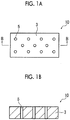
- FIGS. 1A and 1B and FIGS. 2A and 2B the overall constitution of the aluminum plate of the present invention will be described using FIGS. 1A and 1B and FIGS. 2A and 2B , and then individual specific constitutions will be described.
- An aluminum plate 10 illustrated in FIGS. 1A and 1B is an aluminum substrate 3 having a plurality of through-holes 5 in the thickness direction.
- aluminum substrate refers to a substrate used for the production of the aluminum plate of the present invention
- aluminum substrate having through-holes refers to a substrate included in the concept of the aluminum plate of the present invention.
- the aluminum plate 10 illustrated in FIG. 2A has a rectangular shape and illustrates an example in which the average opening ratio by through-holes is 0% at peripheral portions 3a of at least one pair of two opposite sides out of two pairs of two sides opposite to each other in the width direction.
- the aluminum plate 10 illustrated in FIG. 2B has a roll shape and illustrates an example in which the average opening ratio by through-holes is 0% at the peripheral portions 3a of two sides opposite to each other in the axial direction of a roll (the width direction of a long aluminum plate constituting the roll).
- the substrate (aluminum alloy) of the aluminum plate of the present invention is not particularly limited as long as the substrate is an aluminum alloy having a content of Fe of 0.03% by mass or more and a content ratio (Fe/Si) of 1.0 or more, and, for example, well-known aluminum alloys such as 3000-series aluminum alloys (for example, 3003 material and the like) and 8000-series aluminum alloys (for example, 8021 material and the like) can be used.
- well-known aluminum alloys such as 3000-series aluminum alloys (for example, 3003 material and the like) and 8000-series aluminum alloys (for example, 8021 material and the like) can be used.
- aluminum alloys having an alloy number shown in Table 1 can be used.
- the content of Fe is preferably 0.03% to 3.00% by mass and more preferably 0.03% to 2.0% by mass.
- the content ratio (Fe/Si) is preferably 1.0 to 100.0 and more preferably 2.0 to 50.0. Meanwhile, from the viewpoint of the elongation, it is preferable to carry out thermal softening on the aluminum substrate during rolling or after the end of rolling.
- the average opening diameter of the through-holes is 0.1 to 100 ⁇ m, and the average opening ratio by the through-holes is 2% to 30%.
- the average opening diameter of the through-holes is preferably 5 to 50 ⁇ m and more preferably 8 to 30 ⁇ m since the adhesiveness to active material layers becomes favorable in a case in which the aluminum plate of the present invention is used as a collector.
- the average opening ratio by the through-holes is preferably 2% to 30% and more preferably 4% to 20% since the predoping property of lithium becomes favorable and favorable handleability can be obtained in a case in which the aluminum plate of the present invention is used as a collector.
- the average opening ratio by the through-holes is preferably 0% to 5% at the peripheral portions of at least one pair of opposite sides out of two pairs of opposite sides. Meanwhile, there is an assumption that the average opening ratio at the peripheral portions is equal to or less than the specific value of the average opening ratio (2% to 30%) of all including the peripheral portions.
- peripheral portion refers to a region covering 50 mm (in width) from the end portion of the aluminum plate which constitutes a side.
- the average opening ratio being 0% indicates that there are no through-holes in the peripheral portions.
- the aluminum plate 10 illustrated in FIG. 2A is an example in which the average opening ratio by the through-holes at the peripheral portions 3a of at least one pair of two opposite sides is 0%.
- peripheral portions at which the average opening ratio by the through-holes reaches 0% to 5% are preferably provided at the peripheral portions of two sides opposite to each other in a direction (width direction) perpendicular to the transportation direction in a process for manufacturing the aluminum plate out of two pairs of two opposite sides.
- the average opening ratio by the through-holes is preferably 0% to 5% at the peripheral portions of two sides opposite to each other in the width direction.
- the average opening ratio by the through-holes is preferably 0% to 5% at the peripheral portions of two sides opposite to each other in the axial direction of the roll (the width direction of the long aluminum plate constituting the roll).
- the ratio of through-holes having an opening diameter of 5 ⁇ m or less to the through-holes is preferably 50% or less.
- the ratio of through-holes having an opening diameter of 5 ⁇ m or less is obtained by capturing an SEM image using the same method as in the measurement of the above-described average opening diameter of the through-holes, measuring the opening diameters of all through-holes at 30 mm ⁇ 30 mm views in five places in a 10 cm ⁇ 10 cm range of the obtained SEM image, and computing the ratio of the number of through-holes having an opening diameter of 5 ⁇ m or less to the number of all through-holes measured.
- the ratio of through-holes having an opening diameter of more than 30 ⁇ m preferably reaches 1% or more, and, since not only the adhesiveness but also the coatability in the case of forming active material layers also becomes favorable, the ratio more preferably reaches 20% or more.
- the ratio of through-holes having an opening diameter of more than 30 ⁇ m is obtained by capturing an SEM image using the same method as in the measurement of the above-described average opening diameter of the through-holes, measuring the opening diameters of all through-holes at 30 mm ⁇ 30 mm views in five places in a 10 cm ⁇ 10 cm range of the obtained SEM image, and computing the ratio of the number of through-holes having an opening diameter of more than 30 ⁇ m to the number of all through-holes measured.
- the thickness of the aluminum plate of the present invention is 40 ⁇ m or less as described above.
- the thickness of the aluminum plate is preferably 6 to 40 ⁇ m and more preferably 8 to 30 ⁇ m.
- the tensile strength, breaking elongation, and proof stress of the aluminum plate are preferably values described below.
- the tensile strength, the breaking elongation, and the proof stress refer to values measured using a method described in "Metallic materials-Tensile Testing-Method of test at room temperature" standardized by JIS Z 2241:2011. Meanwhile, regarding the shape of a test specimen that is used for these measurements, a No. 5 test specimen (JIS Z2241:2011) is used, the tensile rate is 2 mm/min, and AGS-H (5 KN) manufactured by Shimadzu Corporation is used as a tester. In addition, the proof stress is considered as a stress at which the aluminum plate plastically deforms 0.2% which is measured using an offset method.
- the tensile strength is preferably 15 to 350 N/mm 2 and more preferably 30 to 270 N/mm 2 . Meanwhile, the strength per unit width is 3 to 30 N/cm 2 and more preferably 6 to 20 N/cm 2 .
- the breaking elongation is preferably 0.3% or more and more preferably 0.3% to 3.0%.
- the proof stress is preferably 5 N/mm 2 or more and more preferably 10 to 150 N/mm 2 .
- the thickness of the aluminum plate of the present invention is 6 to 40 ⁇ m, it becomes possible to satisfy the respective values (the above-described widest numerical ranges) of the above-described tensile strength, breaking elongation, and proof stress.
- recess portions which have an average opening diameter of 0.1 ⁇ m to 100 ⁇ m and are not penetrated are preferably provided on at least one surface of the aluminum plate at a ratio at which the occupancy ratio reaches 0.5% or more. Meanwhile, these recess portions can be formed by carrying out an arbitrary roughening treatment in the above-described manufacturing method of the present invention.
- the average opening diameter of the recess portions is obtained by capturing an image of the surface of the aluminum substrate from the above using a high-resolution scanning electron microscope (SEM) at a magnification of 200 to 10,000 times, extracting at least 20 recess portions (pits) having an uneven structure the periphery of which continues in a circular shape (extracting all recess portions in a case in which there are less than 20 recess portions) from the obtained SEM image, scanning the diameters as opening diameters, and computing the average value thereof. Meanwhile, as the opening diameter, the maximum value of the distance between the end portions of an opening portion of a recess portion was measured.
- SEM scanning electron microscope
- the shape of the opening portion of the through-hole is not limited to a substantially circular shape, and, in a case in which the shape of the opening portion is a non-circular shape, the maximum value of the distance between the end portions of the recess portion is considered as the opening diameter. Therefore, for example, even in the case of a recess portion having a shape in which two or more recess portions are integrated together, the recess portion is considered as one recess portion, and the maximum value of the distance between the end portions of the opening portion is considered as the opening diameter.
- the occupancy ratio of the recess portions is obtained in the same manner as the average opening diameter of the recess portions by computing the ratios (the opening area of the recess portions/(the geometric area-the opening area of the through-holes)) from the sum of the opening areas of the recess portions having the above-described opening diameter and the area of the surface obtained by subtracting the opening area of the through-holes from the area of five 100 mm ⁇ 75 mm views (the geometric area) at five places in a 10 cm ⁇ 10 cm range of the obtained image, and computing the average value of the ratios at the respective views (five places).
- the average opening diameter of the recess portions is preferably 0.2 ⁇ m to 20 ⁇ m.
- the occupancy ratio of the recess portions is preferably 30% to 100%.
- the density of the recess portions is preferably 2 recess portions/mm 2 to 10 8 recess portions/mm 2 and preferably 2 recess portions/mm 2 to 10 6 recess portions/mm 2 .
- the density of the recess portions is obtained in the same manner as the average opening diameter of the recess portions by counting the number of through-holes in five 100 mm ⁇ 75 mm views at five places in a 10 cm ⁇ 10 cm range of the obtained image, converting the counted number to the number per square millimeter (mm 2 ), and computing the average value of the numbers at the respective views (five places).
- the arithmetic average roughness Ra of the aluminum plate is preferably 0.2 ⁇ m or more and more preferably 0.2 to 1.5 ⁇ m.
- the arithmetic average roughness Ra is 0.2 ⁇ m or more
- the adhesiveness to active material layers further improves, and the surface area increases and thus the contact area increases
- the capacity maintenance ratios or output characteristics of storage devices enhance.
- the arithmetic average roughness Ra refers to the average value of arithmetic average roughness values measured at five places using a contact-type (sensing pin-type) surface roughness meter (for example, SURFCOM 480A manufactured by Tokyo Seimitsu Co., Ltd.) with a sensing pin ⁇ of 2 ⁇ mR, a cut-off wavelength of 0.8 mm, a measurement rate of 0.3 mm/S, and a measurement length of 3 mm (ISO' 97 standards).
- a contact-type (sensing pin-type) surface roughness meter for example, SURFCOM 480A manufactured by Tokyo Seimitsu Co., Ltd.
- the specific surface area ⁇ S of the aluminum plate is preferably 2% or more and more preferably 5% to 80%.
- the contact area with active material layers or undercoats increases and thus the adhesiveness becomes more favorable, and storage devices having favorable output characteristics, cycle characteristics, rate characteristics, and the like can be produced.
- the specific surface area ⁇ S is a value obtained using Expression (i) from an actual area S x which is obtained using a three-point approximation method from three-dimensional data that are obtained by measuring areas at 512 ⁇ 128 points in a surface range of 25 ⁇ m ⁇ 25 ⁇ m using an atomic force microscope and a geometric measurement area So.
- ⁇ S S x ⁇ S 0 / S 0 ⁇ 100 %
- the surface shape is measured using an atomic force microscope (AFM), thereby obtaining three-dimensional data.
- the measurement is carried out, for example, under the following conditions.
- a 1 cm ⁇ 1 cm specimen is cut out from the aluminum plate and set in a horizontal specimen table on a piezo scanner, a cantilever is brought close to the specimen surface, scanning is carried out in the XY direction when the cantilever reaches a region in which the atomic force works, and, at this time, the surface shape (wave structure) of the specimen is captured as a displacement of piezo in the Z direction.
- a scanner capable of scanning 150 ⁇ m in the XY direction and 10 ⁇ m in the Z direction is used as the piezo scanner.
- a cantilever having a resonance frequency of 120 to 150 kHz and a spring constant of 12 to 20 N/m (SI-DF20, manufactured by NANOPROBE Co., Ltd.) is used, and the surface shape is measured in a dynamic force mode (DFM).
- DFM dynamic force mode
- the slight slope of the specimen is corrected by means of the least square approximation of the obtained three-dimensional data, thereby obtaining a reference surface.
- 512 ⁇ 128 points are measured in a surface range of 25 ⁇ m ⁇ 25 ⁇ m.
- the resolution in the XY direction is set to 1.9 ⁇ m
- the resolution in the Z direction is set to 1 nm
- the scanning rate is set to 60 ⁇ m/sec.
- Three adjacent points are extracted using the three-dimensional data (f(x, y)) obtained above, and the sum of the area of the least triangle formed by these three points is obtained and considered as the actual area S x .
- the surface area difference ⁇ S is obtained using Expression (i) from the obtained actual area S x and the geometric measurement area S 0 .
- the method for manufacturing an aluminum plate is a method for manufacturing an aluminum plate having a plurality of through-holes in the thickness direction including a membrane-forming step of forming a membrane including aluminum hydroxide as a main component on the surface of an aluminum substrate, a through-hole-forming step of forming through-holes by carrying out a through-hole-forming treatment after the membrane-forming step, and a membrane-removing step of removing the aluminum hydroxide membrane after the through-hole-forming step.
- FIGS. 3A to 3E and FIGS. 4A to 4E are schematic sectional views illustrating examples of a preferred embodiment of the method for manufacturing an aluminum plate.
- the method for manufacturing an aluminum plate is a method for manufacturing an aluminum plate including a membrane-forming step of forming an aluminum hydroxide membrane 2 by carrying out a membrane-forming treatment on one main surface (both main surfaces in an aspect illustrated in FIG. 4 ) of an aluminum substrate 1 ( FIGS. 3A and 3B and FIGS. 4A and 4B ), a through-hole-forming step of forming through-holes 5 by carrying out an electrolytic dissolution treatment after the membrane-forming step and producing an aluminum plate having an aluminum substrate 3 having the through-holes and an aluminum hydroxide membrane 4 having the through-holes ( FIGS. 3B and 3C and FIGS.
- FIGS. 3C and 3D and FIGS. 4C and 4D a membrane-removing step of removing the aluminum hydroxide membrane 4 having the through-holes after the through-hole-forming step and producing the aluminum plate 10 made of the aluminum substrate 3 having the through-holes.
- the method for manufacturing an aluminum plate preferably includes a roughening treatment step of carrying out an electrochemical roughening treatment on the aluminum substrate 3 having the through-holes after the membrane-removing step and producing the aluminum plate 10 having the roughened surface ( FIGS. 3D and 3E and FIGS. 4D and 4E ).
- the membrane-forming step in the method for manufacturing an aluminum plate is a step of forming an aluminum hydroxide membrane by carrying out a membrane-forming treatment on the surface of the aluminum substrate.
- the above-described membrane-forming treatment is not particularly limited, and it is possible to carry out, for example, the same treatment as a well-known aluminum hydroxide membrane-forming treatment of the related art.
- the conditions of the membrane-forming treatment vary in diverse manners depending on electrolytic solutions being used and thus cannot be determined uniformly; however, generally, the concentration of an electrolytic solution in a range of 1% by mass to 80% by mass, the liquid temperature in a range of 5°C to 70°C, the current density in a range of 0.5 A/dm 2 to 60 A/dm 2 , the voltage in a range of 1 V to 100 V, and the electrolysis duration in a range of 1 second to 20 minutes are appropriate and are adjusted so as to obtain a desired amount of a membrane.
- an electrochemical treatment is preferably carried out using nitric acid, hydrochloric acid, sulfuric acid, phosphoric acid, oxalic acid, or an acid mixture of two or more acids described above as an electrolytic solution.
- direct current or alternating current may be applied between the aluminum substrate and a counter electrode.
- the current density is preferably 1 to 60 A/dm 2 and more preferably in a range of 5 to 50 A/dm 2 .
- the electrochemical treatment is preferably carried out using a liquid power feeding method in which power is fed to the aluminum substrate through an electrolytic solution.
- the amount of the aluminum hydroxide membrane being formed by means of the membrane-forming treatment is preferably in a range of 0.05 to 50 g/m 2 and more preferably in a range of 0.1 to 10 g/m 2 .
- the through-hole-forming step is a step in which an electrolytic dissolution treatment is carried out after the membrane-forming step, thereby forming through-holes.
- the above-described electrolytic dissolution treatment is not particularly limited, and it is possible to use direct current or alternating current and use an acidic solution as an electrolytic solution.
- the electrochemical treatment is preferably carried out using at least one of nitric acid or hydrochloric acid, and the electrochemical treatment is more preferably carried out using at least one acid mixture of sulfuric acid, phosphoric acid, and oxalic acid in addition to these acids.
- the acidic solution which is the electrolytic solution it is possible to use, in addition to the above-described acids, electrolytic solutions described in the respective specifications of US4,671,859A , US4,661,219A , US4,618,405A , US4,600,482A , US4,566,960A , US4,566,958A , US4,566,959A , US4,416,972A , US4,374,710A , US4,336,113A , and US4,184,932A .
- the concentration of the acidic solution is preferably in a range of 0.1% by mass to 2.5% by mass and more preferably in a range of 0.2% by mass to 2.0% by mass.
- the liquid temperature of the acidic solution is preferably in a range of 20°C to 80°C and more preferably in a range of 30°C to 60°C.
- an aqueous solution including the above-described acid as a main body it is possible to use an aqueous solution obtained by adding at least one of a nitric acid compound having nitric acid ions such as aluminum nitrate, sodium nitrate, or ammonium nitrate, a hydrochloric acid compound having hydrochloric acid ions such as aluminum chloride, sodium chloride, or ammonium chloride, or a sulfuric acid compound having sulfuric acid ions such as aluminum sulfate, sodium sulfate, or ammonium sulfate to an aqueous solution of the acid which has a concentration of 1 to 100 g/L so as to obtain a concentration in a range of 1 g/L to saturation.
- a nitric acid compound having nitric acid ions such as aluminum nitrate, sodium nitrate, or ammonium nitrate
- a hydrochloric acid compound having hydrochloric acid ions such as aluminum chloride, sodium
- the aqueous solution including the acid as the main body may contain metals which are included in an aluminum alloy such as iron, copper, manganese, nickel, titanium, magnesium, and silica.
- an aluminum alloy such as iron, copper, manganese, nickel, titanium, magnesium, and silica.
- a liquid obtained by adding aluminum chloride, aluminum nitrate, aluminum nitrate, or the like to an aqueous solution of the acid having a concentration in a range of 0.1 to 2% by mass so that the concentration of aluminum ions falls in a range of 1 to 100 g/L is preferably used.
- the alternating-current power source wave is not particularly limited, and a sine wave, a square wave, a trapezoidal wave, a triangular wave, and the like can be used, and, among these, a square wave or a trapezoidal wave is preferred, and a trapezoidal wave is particularly preferred.
- the present invention it is possible to easily form through-holes which have an average opening diameter of 0.1 ⁇ m or more and less than 100 ⁇ m and the maximum diameter Ra inside by means of an electrochemical dissolution treatment in which an electrolytic solution including nitric acid as a main body is used (hereinafter, also abbreviated as "the nitric acid dissolution treatment").
- the nitric acid dissolution treatment is preferably an electrolysis treatment which is carried out using direct current under conditions of an average current density set to 5 A/dm 2 or higher and a quantity of electricity set to 50 C/dm 2 or greater since it is easy to control dissolution points of through-hole formation.
- the average current density is preferably 100 A/dm 2 or lower, and the quantity of electricity is preferably 10,000 C/dm 2 or less.
- the concentration or temperature of the electrolytic solution in the nitric acid electrolysis is not particularly limited, and it is possible to carry out electrolysis using a nitric acid electrolytic solution having a high concentration, for example, a nitric acid concentration in a range of 15% by mass to 35% by mass at 30°C to 60°C or carry out electrolysis using a nitric acid electrolytic solution having a nitric acid concentration in a range of 0.7% by mass to 2% by mass at a high temperature, for example, at 80°C or higher.
- the electrolysis can be carried out using an electrolytic solution obtained by mixing at least one of sulfuric acid, oxalic acid, or phosphoric acid having a concentration of 0.1% to 50% by mass with the nitric acid electrolytic solution.
- the present invention it is also possible to easily form through-holes which have an average opening diameter in a range of 1 ⁇ m or more and less than 100 ⁇ m and the maximum diameter Ra inside by means of an electrochemical dissolution treatment in which an electrolytic solution including hydrochloric acid as a main body is used (hereinafter, also abbreviated as “the hydrochloric acid dissolution treatment”).
- the hydrochloric acid dissolution treatment is preferably an electrolysis treatment which is carried out using direct current under conditions of an average current density set to 5 A/dm 2 or higher and a quantity of electricity set to 50 C/dm 2 or greater since it is easy to control dissolution points of through-hole formation.
- the average current density is preferably 100 A/dm 2 or lower, and the quantity of electricity is preferably 10,000 C/dm 2 or less.
- the hydrochloric acid concentration or temperature of the electrolytic solution is not particularly limited, and it is possible to carry out electrolysis using a hydrochloric acid electrolytic solution having a high concentration, for example, a hydrochloric acid concentration in a range of 10% by mass to 35% by mass at 30°C to 60°C or carry out electrolysis using a hydrochloric acid electrolytic solution having a hydrochloric acid concentration in a range of 0.7% by mass to 2% by mass at a high temperature, for example, at 80°C or higher.
- the electrolysis can be carried out using an electrolytic solution obtained by mixing at least one of sulfuric acid, oxalic acid, or phosphoric acid having a concentration of 0.1% to 50% by mass with the hydrochloric acid electrolytic solution.
- the membrane-removing step is a step of removing the aluminum hydroxide membrane by carrying out a chemical dissolution treatment.
- the aluminum hydroxide membrane can be removed by carrying out, for example, an acid etching treatment or an alkali etching treatment which will be described below.
- the above-described dissolution treatment is a treatment in which the aluminum hydroxide membrane is dissolved using a solution that dissolves aluminum hydroxide earlier than aluminum (hereinafter, referred to as "the aluminum hydroxide dissolution liquid").
- the aluminum hydroxide dissolution liquid is preferably an aqueous solution including at least one selected from a group consisting of, for example, nitric acid, hydrochloric acid, sulfuric acid, phosphoric acid, oxalic acid, chromium compounds, zirconium-based compounds, titanium-based compounds, lithium salts, cerium salts, magnesium salts, sodium silicofluoride, zinc fluoride, manganese compounds, molybdenum compounds, magnesium compounds, barium compounds, and halogen single bodies.
- aqueous solution including at least one selected from a group consisting of, for example, nitric acid, hydrochloric acid, sulfuric acid, phosphoric acid, oxalic acid, chromium compounds, zirconium-based compounds, titanium-based compounds, lithium salts, cerium salts, magnesium salts, sodium silicofluoride, zinc fluoride, manganese compounds, molybdenum compounds, magnesium compounds, barium compounds, and halogen single bodies.
- chromium compounds include chromium (III) oxide, anhydrous chromium (VI) acid, and the like.
- zirconium-based compounds examples include ammonium fluorozirconate, zirconium fluoride, and zirconium chloride.
- titanium compounds examples include titanium oxide and titanium sulfide.
- lithium salts examples include lithium fluoride and lithium chloride.
- cerium salts examples include cerium fluoride and cerium chloride.
- magnesium salts examples include magnesium sulfide.
- manganese compounds examples include sodium permanganate and calcium permanganate.
- Examples of the molybdenum compounds include sodium molybdate.
- magnesium compounds examples include magnesium fluoride-pentahydrate.
- barium compounds include barium oxide, barium acetate, barium carbonate, barium chlorate, barium chloride, barium fluoride, barium iodide, barium lactate, barium oxalate, barium perchlorate, barium selenate, barium selenite, barium stearate, barium sulfite, barium titanate, barium hydroxide, barium nitrate, hydrates thereof, and the like.
- barium oxide is particularly preferred.
- halogen single bodies examples include chlorine, fluorine, and bromine.
- the aluminum hydroxide dissolution liquid is preferably an aqueous solution containing an acid
- the acid include nitric acid, hydrochloric acid, sulfuric acid, oxalic acid, and the like, and the acid may be a mixture of two or more acids.
- nitric acid is preferably used as the acid.
- the concentration of the acid is preferably 0.01 mol/L or higher, more preferably 0.05 mol/L or higher, and still more preferably 0.1 mol/L or higher.
- the dissolution treatment is carried out by bringing the aluminum substrate on which the aluminum hydroxide membrane is formed into contact with the above-described dissolution liquid.
- a method for bringing the aluminum substrate into contact with the alumina dissolution liquid is not particularly limited, and examples thereof include a dipping method and a spraying method. Among these, the dipping method is preferred.
- the dipping method is a treatment in which the aluminum substrate on which the aluminum hydroxide membrane is formed is dipped into the above-described dissolution liquid. During the dipping treatment, it is preferable to carry out stirring since the treatment is carried out evenly.
- the duration of the dipping treatment is preferably 10 minutes or longer, more preferably one hour or longer, and still more preferably three hours or longer and five hours or longer.
- the alkali etching treatment is a treatment in which the surface layer is dissolved by bringing the aluminum hydroxide membrane into contact with an alkali solution.
- alkalis examples include caustic alkalis and alkali metal salts.
- caustic alkalis examples include sodium hydroxide (caustic soda) and caustic potash.
- alkali metal salts include alkali metal silicates such as sodium metasilicate, sodium silicate, potassium metasilicate, and potassium silicate; alkali metal carbonates such as sodium carbonate and potassium carbonate; alkali metal aluminate such as sodium aluminate and potassium aluminate; alkali metal aldonates such as sodium gluconate and potassium gluconate; and alkali metal hydrogenphosphate such as sodium diphosphate, potassium diphosphate, sodium triphosphate, and potassium triphosphate.
- solutions of caustic alkalis and solutions containing both caustic alkali and alkali metal aluminate are preferred from the viewpoint of the fast etching rates and the cheap prices.
- an aqueous solution of sodium hydroxide is preferred.
- the concentration of the alkali solution is preferably in a range of by mass to 50% by mass and more preferably in a range of 0.2% by mass to 10% by mass.
- the concentration of aluminum ions is preferably in a range of 0.01 % by mass to 10% by mass and more preferably in a range of 0.1 % by mass to 3% by mass.
- the temperature of the alkali solution is preferably in a range of 10°C to 90°C.
- the treatment duration is preferably in a range of 1 second to 120 seconds.
- Examples of a method for bringing the aluminum hydroxide membrane into contact with the alkali solution include a method in which the aluminum substrate on which the aluminum hydroxide membrane is formed is passed through a tank including the alkali solution, a method in which the aluminum substrate on which the aluminum hydroxide membrane is formed is immersed in a tank including the alkali solution, and a method in which the alkali solution is sprayed to the surface (the aluminum hydroxide membrane) of the aluminum substrate on which the aluminum hydroxide membrane is formed.
- the arbitrary roughening treatment step which the method for manufacturing an aluminum plate may have is a step of roughening the front surface or the rear surface of the aluminum substrate by carrying out an electrochemical roughening treatment (hereinafter, also abbreviated as “the electrolytic roughening treatment”) on the aluminum substrate from which the aluminum hydroxide membrane has been removed.
- the electrolytic roughening treatment an electrochemical roughening treatment
- the electrolytic roughening treatment is carried out, thereby roughening the surface of the aluminum substrate, since the adhesiveness to layers including active materials improves, and the surface area increases and thus the contact area increases, the capacity maintenance ratios of storage devices for which aluminum plates to be obtained (collectors) are used.
- the recess portions are also formed in the case of forming the through-holes, and, furthermore, the recess portions can be densely formed by carrying out a roughening treatment.
- the present embodiment employs a constitution in which the roughening treatment is carried out after the formation of the through-holes, but the constitution is not limited thereto, and the through-holes may be formed after the roughening treatment.
- recessed portions having an average opening diameter in a range of 0.5 ⁇ m to 3.0 ⁇ m at a density of 10 recess portions/100 ⁇ m 2 or higher by means of an electrochemical roughening treatment in which an electrolytic solution including nitric acid as a main body is used (hereinafter, also abbreviated as "the nitric acid electrolysis").
- the nitric acid electrolysis is preferably an electrolysis treatment which is carried out using alternating current under conditions of a peak current density set to 30 A/dm 2 or higher, an average current density set to 13 A/dm 2 or higher, and a quantity of electricity set to 150 C/dm 2 or greater since it becomes possible to form uniform recessed portions at a high density.
- the peak current density is preferably 100 A/dm 2 or lower
- the average current density is preferably 40 A/dm 2 or lower
- the quantity of electricity is preferably 400 C/dm 2 or less.
- the concentration or temperature of the electrolytic solution in the nitric acid electrolysis is not particularly limited, and it is possible to carry out electrolysis using a nitric acid electrolytic solution having a high concentration, for example, a nitric acid concentration in a range of 15% by mass to 35% by mass at 30°C to 60°C or carry out electrolysis using a nitric acid electrolytic solution having a nitric acid concentration in a range of 0.7% by mass to 2% by mass at a high temperature, for example, at 80°C or higher.
- recessed portions having an average opening diameter in a range of 0.5 ⁇ m to 3.0 ⁇ m at a density of 10 recess portions/100 ⁇ m 2 or higher by means of an electrochemical roughening treatment in which an electrolytic solution including hydrochloric acid as a main body is used (hereinafter, also abbreviated as "the hydrochloric acid electrolysis").
- the hydrochloric acid electrolysis is preferably an electrolysis treatment which is carried out using alternating current under conditions of a peak current density set to 30 A/dm 2 or higher, an average current density set to 13 A/dm 2 or higher, and a quantity of electricity set to 150 C/dm 2 or greater since it becomes possible to form uniform recessed portions at a high density.
- the peak current density is preferably 100 A/dm 2 or lower
- the average current density is preferably 40 A/dm 2 or lower
- the quantity of electricity is preferably 400 C/dm 2 or less.
- the method for manufacturing an aluminum plate preferably has a metal coating step in which part or all of the surfaces of the aluminum substrate including at least the inner walls of the through-holes are coated with a metal other than aluminum after the above-described membrane-removing step since it is possible to adjust the average opening diameter of the through-holes formed by means of the above-described electrolytic dissolution treatment to be small in a range of approximately 0.1 ⁇ m to 20 ⁇ m.
- part or all of the surfaces of the aluminum substrate including at least the inner walls of the through-holes are coated with a metal other than aluminum
- a metal other than aluminum means that, out of all the surfaces of the aluminum substrate including the inner walls of the through-holes, at least the inner walls of the through-holes are coated, and the surfaces other than the inner walls may not be coated or may be wholly or partially coated.
- a reaction in which aluminum reacts with high-temperature water or superheated steam so as to generate a pseudoboehmite hydrated oxide membrane is used, and it is possible to generate a hydrated oxide membrane by, for example, adjusting the pH of water (for example, pure water or deionized water) (100°C to 400°C) to be 7 to 12 and immersing the aluminum substrate therein.
- water for example, pure water or deionized water
- water washing it is preferable to carry out water washing after the completion of the steps of the respective treatments described above.
- water washing it is possible to use pure water, well water, tap water, or the like.
- a nipping device may be used.
- a collector for a storage device of the present invention (hereinafter, also abbreviated as “the collector of the present invention") is a collector for a storage device constituted of the above-described aluminum plate of the present invention.
- the aluminum plate has a plurality of through-holes in the thickness direction, and thus, for example, in a case in which the collector is used in lithium ion capacitors, pre-doping of lithium within a short period of time becomes possible, and it becomes possible to more uniformly disperse lithium.
- adhesiveness to active material layers or active charcoal becomes favorable, and it is possible to produce storage devices that are excellent in terms of productivity such as cycle characteristics, output characteristics, coating aptitude, and the like.
- the collector of the present invention in a case in which the average opening diameter of the through-holes in the aluminum plate is in a range of 8 ⁇ m to 30 ⁇ m, the predoping performance of lithium improves, adhesiveness to active material layers becomes more favorable, and it is possible to produce storage devices having improved cycle characteristics.
- the measurement by means of Fourier transformation IR spectroscopy is carried out under the following conditions. First, the incidence angle is set to 75°, and only parallel polarization is monitored using a polarizer and a reflection method. Next, the resolution is set to 2 to 4 cm -1 , and the cumulated number is set to 1,000 times. A metal deposition mirror is used as the background, and peak locations are recorded from the measurement results.
- a storage device of the present invention is a storage device having a positive electrode, a negative electrode, and an electrolytic solution (electrolyte), in which the collector of the present invention is used in at least one of the positive electrode or the negative electrode.
- the storage device is preferably stored in low-humidity environments. Specifically, the storage device is preferably stored in an environment in which the temperature is 25°C and the relative humidity is 0% to 20%.
- Examples of the method for forming the above-described low-humidity environments include a method in which a dehumidifier such as silica gel is packed together in the case of packing the storage device or the collector; a method in which the storage device or the collector is covered with a polyethylene and placed in a reduced-pressure state (for example, a substantial vacuum state); and the like.
- a dehumidifier such as silica gel
- the storage device or the collector is covered with a polyethylene and placed in a reduced-pressure state (for example, a substantial vacuum state); and the like.
- the thickness of the oxide membrane that is generated in the case of storing the storage device at 25°C and a relative humidity of 8% is approximately 4 nm
- the thickness of the oxide membrane that is generated in the case of storing the storage device at 25°C and a relative humidity of 70% is approximately 7.2 nm.
- the positive electrode in which the collector of the present invention is used is a positive electrode having a positive electrode collector in which the collector of the present invention is used for a positive electrode and a layer including a positive electrode active material that is formed on the surface of the positive electrode collector (positive electrode active material layer).
- the positive electrode active material layer may include, it is possible to appropriately employ materials described in Paragraphs "0077” to "0088” of JP2012-216513A , the content of which is incorporated into the present specification by reference.
- the negative electrode in which the collector of the present invention is used is a negative electrode having a negative electrode collector in which the collector of the present invention is used for a negative electrode and a layer including a negative electrode active material that is formed on the surface of the negative electrode collector.
- Treatments described below were carried out on the surface of a roll-shaped aluminum substrate having an average thickness of 20 ⁇ m, a width of 300 mm, and a length of 1,000 m, thereby producing an aluminum plate.
- both surfaces of the obtained slab were faced 20 mm, and then a thermal treatment was carried out at 500°C to 600°C.
- An electrolytic treatment was carried out under a condition of the total electric quantity being 1,000 C/dm 2 using an electrolytic solution (the concentration of nitric acid was 1%, the concentration of sulfuric acid was 0.2%, and the concentration of aluminum was 0.5%) that had been stored at 50°C and the aluminum substrate as a negative electrode, thereby forming an aluminum hydroxide membrane on the aluminum substrate. Meanwhile, the electrolytic treatment was carried out using a direct current power source. Meanwhile, as shown in Table 2, the current density was set to 50 A/dm 2 , and the electric quantity was set to 1,000 C/dm 2 or more.
- the aluminum hydroxide membrane was washed with water by means of spraying.
- an electrolytic treatment was carried out under a condition of the total electric quantity being 1,000 C/dm 2 using an electrolytic solution (the concentration of nitric acid was 1%, the concentration of sulfuric acid was 0.2%, and the concentration of aluminum was 0.5%) that had been stored at 50°C and the aluminum substrate as a negative electrode, thereby forming through-holes in the aluminum substrate and the aluminum hydroxide membrane.
- the electrolytic treatment was carried out using a direct current power source. Meanwhile, as shown in Table 2, the current density was set to 25 A/dm 2 , and the electric quantity was set to 1,000 C/dm 2 or more.
- the through-holes are washed with water by means of spraying and dried.
- the aluminum substrate that had been subjected to the electrolytic dissolution treatment was immersed in an aqueous solution (liquid temperature: 35°C) having a sodium hydroxide concentration of 5% by mass and an aluminum ion concentration of 0.5% by mass for 30 seconds and then immersed in an aqueous solution (liquid temperature: 30°C) having a nitric acid concentration of 1% by mass and an aluminum ion concentration of 0.5% by mass for 20 seconds, thereby dissolving and removing the aluminum hydroxide membrane.
- the aluminum substrate was washed with water by means of spraying and was dried, thereby producing an aluminum plate having through-holes. Meanwhile, the thicknesses of the produced aluminum plates are shown in Table 2.
- Aluminum plates were produced using the same method as in Example 1 except for the fact that the thicknesses, the average opening diameters of through-holes, the average opening ratios, and the like of aluminum plates produced by changing the contents of Fe and the content ratios (Fe/Si) in aluminum substrates or the current densities or the electric quantities in aluminum hydroxide membrane-forming treatments or electrolytic dissolution treatments were changed to values shown in Table 2.
- the contents of Fe and the content ratios (Fe/Si) in the produced aluminum plates are the same value as the content of Fe and the content ratio (Fe/Si) of the aluminum substrate used for the production, and thus not shown in Table 2.
- Aluminum plates were produced using the same method as in Example 1 except for the fact that masking was carried out using insulating material sheets so that the average opening ratios of through-holes at the peripheral portions (regions covering 50 mm from the end portion) of two sides opposite to each other in a direction (width direction) perpendicular to the transportation direction (rolling direction) of aluminum substrates in the electrolytic dissolution treatment (b1).
- Aluminum plates were produced using the same method as in Example 1 except for the fact that the average opening diameters of through-holes, the average opening ratios, and the like of aluminum plates produced by changing the contents of Fe and the content ratios (Fe/Si) in aluminum substrates or the electric quantities in aluminum hydroxide membrane-forming treatments or electrolytic dissolution treatments were changed to values shown in Table 2.
- the contents of Fe and the content ratios (Fe/Si) in the produced aluminum plates are the same value as the content of Fe and the content ratio (Fe/Si) of the aluminum substrate used for the production, and thus not shown in Table 2.
- the arithmetic average roughness Ra of the surfaces of the respective aluminum plates produced in Examples 1 to 24 and Comparative Examples 1 to 5 was obtained by computing the average value of arithmetic average roughness values measured at five places using a contact-type (sensing pin-type) surface roughness meter (for example, SURFCOM 480A manufactured by Tokyo Seimitsu Co., Ltd.) under measurement conditions (ISO' 97 standards) described below.
- the measurement results are shown in Table 2.
- 1,000 m-long roll-shaped samples were produced using the produced aluminum plates, and handling tests were carried out at a rate of 5 m/min using a delivery apparatus, a coating apparatus, and a winding apparatus.
- the produced aluminum plates were cut to a short strip shape so as to be 300 mm in the transportation direction (rolling direction) of the aluminum substrate and 10 mm in the direction orthogonal to the transportation direction.
- Eight cut aluminum plates were overlaid together and wound at an inner diameter ⁇ of approximately 18 mm, the wound sample was pressed by a 5 kg weight for one minute and further pressed for 30 seconds, and the heights of the wound samples in a swollen state on a board were measured.
- a slurry was prepared by adding and dispersing active charcoal powder (100 parts by mass) having a specific surface area of 1,950 m 2 /g as an active material, acetylene black (10 parts by mass), an acrylic binder (7 parts by mass), and carboxymethyl cellulose (4 parts by mass) to and in water.
- the prepared slurry was applied onto both surfaces of an aluminum plate in which through-holes were formed using a die coater so as to obtain a total thickness of 200 ⁇ m and dried at 120°C for 30 minutes, thereby forming an active material layer on the surface of the aluminum plate.
- the adhesiveness between the active material layer and the aluminum plate was measured using a peeling testing method.
- the aluminum plates on which the active material layer produced for the evaluation of the coatability was formed were cut to a width of 20 mm, thereby producing evaluation samples.
- a double sided adhesive tape (double sided adhesive tape manufactured by 3M) was attached to one surface of an SUS plate, and an evaluation sample was attached to one surface of the double sided adhesive tape.
- a part of the SUS plate was fixed by one clamp of a tensile tester, the tip of the evaluation sample bent at 180 degrees was fixed by the other clamp, and a 180 degree peeling test was carried out.
- the tensile rate was set to 100 mm/min.
- the average opening diameter of the through-holes is 0.1 to 100 ⁇ m
- the average opening ratio was 2% to 30%
- the content of Fe was 0.03% by mass or more
- the content ratio (Fe/Si) was 1.0 or more
- the aluminum plate of the present invention can be used for, in addition to collectors for storage devices, heat-resistance filters, oil-collecting filters, electrostatic filters, antibacterial filters, liquid-reforming filters, water electrolysis filters, exhaust gas-purifying filters, food filtration filters, marine life filtration filters, dust filters, DNA filters, fine powder classification filters, solid-liquid separation filters, deodorant filters, photocatalyst carriers, hydrogen-generating catalyst carriers, enzymatic electrodes, carriers of noble metal-absorbers, antibacterial carriers, adsorbents, absorbents, optical filters, near infrared cut filters, soundproof and sound-absorbing materials, electromagnetic shields, gas diffusion layers and separators in direct fuel batteries, networks for microorganism storage container oxygen supply openings, construction materials, lighting applications, metallic decoration applications, and the like.
Landscapes
- Chemical & Material Sciences (AREA)
- Engineering & Computer Science (AREA)
- Materials Engineering (AREA)
- Electrochemistry (AREA)
- Chemical Kinetics & Catalysis (AREA)
- Metallurgy (AREA)
- Organic Chemistry (AREA)
- Power Engineering (AREA)
- Mechanical Engineering (AREA)
- General Chemical & Material Sciences (AREA)
- Microelectronics & Electronic Packaging (AREA)
- Inorganic Chemistry (AREA)
- Manufacturing & Machinery (AREA)
- Cell Electrode Carriers And Collectors (AREA)
- Electric Double-Layer Capacitors Or The Like (AREA)
Applications Claiming Priority (5)
| Application Number | Priority Date | Filing Date | Title |
|---|---|---|---|
| JP2015074150 | 2015-03-31 | ||
| JP2015152373 | 2015-07-31 | ||
| JP2015236064 | 2015-12-02 | ||
| JP2016021786 | 2016-02-08 | ||
| PCT/JP2016/057177 WO2016158245A1 (ja) | 2015-03-31 | 2016-03-08 | アルミニウム板および蓄電デバイス用集電体 |
Publications (3)
| Publication Number | Publication Date |
|---|---|
| EP3279984A1 true EP3279984A1 (de) | 2018-02-07 |
| EP3279984A4 EP3279984A4 (de) | 2018-08-29 |
| EP3279984B1 EP3279984B1 (de) | 2020-10-21 |
Family
ID=57005706
Family Applications (1)
| Application Number | Title | Priority Date | Filing Date |
|---|---|---|---|
| EP16772129.9A Not-in-force EP3279984B1 (de) | 2015-03-31 | 2016-03-08 | Aluminiumplatte und stromabnehmer für stromspeicherungsvorrichtung |
Country Status (7)
| Country | Link |
|---|---|
| US (1) | US20180013148A1 (de) |
| EP (1) | EP3279984B1 (de) |
| JP (1) | JP6592506B2 (de) |
| KR (1) | KR20170118806A (de) |
| CN (1) | CN107431209A (de) |
| TW (1) | TW201639975A (de) |
| WO (1) | WO2016158245A1 (de) |
Cited By (2)
| Publication number | Priority date | Publication date | Assignee | Title |
|---|---|---|---|---|
| CN110819854A (zh) * | 2019-11-19 | 2020-02-21 | 安徽鑫发铝业有限公司 | 一种空气净化器用抗菌铝型材 |
| EP3536820A4 (de) * | 2016-11-02 | 2020-04-29 | UACJ Corporation | Aluminiumelement und verfahren zur herstellung des aluminiumelements |
Families Citing this family (10)
| Publication number | Priority date | Publication date | Assignee | Title |
|---|---|---|---|---|
| CN110326074B (zh) * | 2017-02-27 | 2022-02-18 | 太阳诱电株式会社 | 电化学器件 |
| JP6959054B2 (ja) * | 2017-07-18 | 2021-11-02 | 福田金属箔粉工業株式会社 | 開孔金属箔 |
| WO2019077995A1 (ja) * | 2017-10-16 | 2019-04-25 | 富士フイルム株式会社 | アルミニウム箔および電極用アルミニウム部材 |
| KR102203691B1 (ko) * | 2017-11-06 | 2021-01-15 | 주식회사 엘지화학 | 안전성이 향상된 이차전지용 전극과 이의 제조방법, 및 이 전극을 포함하는 이차전지 |
| JP7343304B2 (ja) * | 2019-05-27 | 2023-09-12 | 旭化成株式会社 | 正極前駆体 |
| JP7190582B2 (ja) | 2019-08-22 | 2022-12-15 | 富士フイルム株式会社 | アルミニウム箔 |
| KR102805380B1 (ko) * | 2020-07-01 | 2025-05-08 | 삼성에스디아이 주식회사 | 전극 조립체 및 이를 포함하는 이차 전지 |
| CN113231469B (zh) * | 2021-05-10 | 2023-04-18 | 贵州大学 | 一种锌基复合材料用铝合金材料包套热轧的方法 |
| WO2024055187A1 (zh) * | 2022-09-14 | 2024-03-21 | 宁德时代新能源科技股份有限公司 | 集流体、极片、电极组件、电池单体、电池以及用电装置 |
| CN121260821B (zh) * | 2025-12-03 | 2026-03-31 | 湖南中伟新氢材料科技有限公司 | 高孔隙率雷尼镍电极及其制备方法 |
Family Cites Families (13)
| Publication number | Priority date | Publication date | Assignee | Title |
|---|---|---|---|---|
| EP2099043B1 (de) * | 2006-12-27 | 2019-11-06 | JM Energy Corporation | Beschichtete elektrode und organischer elektrolytkondensator |
| JP4560079B2 (ja) * | 2007-08-09 | 2010-10-13 | パナソニック株式会社 | 非水電解質二次電池用正極の製造方法 |
| KR20110049847A (ko) * | 2008-09-09 | 2011-05-12 | 파나소닉 주식회사 | 비수 전해질 이차전지 및 그 제조방법 |
| JP5275446B2 (ja) * | 2009-03-05 | 2013-08-28 | 東洋アルミニウム株式会社 | 集電体用アルミニウム合金箔およびその製造方法 |
| JP5539985B2 (ja) * | 2009-07-07 | 2014-07-02 | 東洋アルミニウム株式会社 | アルミニウム貫通箔 |
| CN102575322B (zh) * | 2009-09-30 | 2014-04-02 | 东洋铝株式会社 | 铝贯通箔及其制造方法 |
| CN102598368B (zh) * | 2009-10-23 | 2014-09-17 | Sei株式会社 | 锂二次电池以及锂二次电池用集电箔的制造方法、以及锂二次电池用集电箔 |
| JP2011216364A (ja) * | 2010-03-31 | 2011-10-27 | Toyo Aluminium Kk | 負極集電体用金属箔 |
| JP2011249150A (ja) * | 2010-05-27 | 2011-12-08 | Mitsubishi Alum Co Ltd | 蓄電デバイス集電体用アルミニウム箔及び蓄電デバイス集電体 |
| JP5639398B2 (ja) * | 2010-07-16 | 2014-12-10 | 株式会社神戸製鋼所 | 電池集電体用アルミニウム硬質箔 |
| KR102045000B1 (ko) * | 2012-03-29 | 2019-11-14 | 가부시키가이샤 유에이씨제이 | 전극 집전체용 알루미늄 합금호일 및 그 제조 방법 |
| JP6174012B2 (ja) * | 2012-04-24 | 2017-08-02 | 株式会社Uacj | 電極集電体用アルミニウム合金箔、その製造方法及びリチウムイオン二次電池 |
| JP5914439B2 (ja) * | 2013-09-09 | 2016-05-11 | 富士フイルム株式会社 | 二次電池集電体用アルミニウム基材、二次電池集電体用アルミニウム基材の製造方法、二次電池集電体、正極、負極および二次電池 |
-
2016
- 2016-03-08 CN CN201680015737.8A patent/CN107431209A/zh active Pending
- 2016-03-08 EP EP16772129.9A patent/EP3279984B1/de not_active Not-in-force
- 2016-03-08 JP JP2017509461A patent/JP6592506B2/ja active Active
- 2016-03-08 WO PCT/JP2016/057177 patent/WO2016158245A1/ja not_active Ceased
- 2016-03-08 KR KR1020177026067A patent/KR20170118806A/ko not_active Ceased
- 2016-03-14 TW TW105107803A patent/TW201639975A/zh unknown
-
2017
- 2017-09-01 US US15/693,551 patent/US20180013148A1/en not_active Abandoned
Cited By (2)
| Publication number | Priority date | Publication date | Assignee | Title |
|---|---|---|---|---|
| EP3536820A4 (de) * | 2016-11-02 | 2020-04-29 | UACJ Corporation | Aluminiumelement und verfahren zur herstellung des aluminiumelements |
| CN110819854A (zh) * | 2019-11-19 | 2020-02-21 | 安徽鑫发铝业有限公司 | 一种空气净化器用抗菌铝型材 |
Also Published As
| Publication number | Publication date |
|---|---|
| US20180013148A1 (en) | 2018-01-11 |
| EP3279984A4 (de) | 2018-08-29 |
| CN107431209A (zh) | 2017-12-01 |
| KR20170118806A (ko) | 2017-10-25 |
| JPWO2016158245A1 (ja) | 2018-02-01 |
| TW201639975A (zh) | 2016-11-16 |
| EP3279984B1 (de) | 2020-10-21 |
| JP6592506B2 (ja) | 2019-10-16 |
| WO2016158245A1 (ja) | 2016-10-06 |
Similar Documents
| Publication | Publication Date | Title |
|---|---|---|
| EP3279984B1 (de) | Aluminiumplatte und stromabnehmer für stromspeicherungsvorrichtung | |
| EP3101159B1 (de) | Verfahren zur herstellung einer aluminiumplatte, aluminiumplatte, stromabnehmer für elektrische speichervorrichtung und elektrische speichervorrichtung | |
| EP3202957B1 (de) | Aluminiumplatte | |
| US11527758B2 (en) | Aluminum foil and aluminum member for electrodes | |
| EP3208365B1 (de) | Aluminiumplatte und verfahren zur herstellung der aluminiumplatte | |
| EP3434814A1 (de) | Aluminiumblechherstellungsverfahren und aluminiumblechherstellungsvorrichtung | |
| EP3330412A1 (de) | Aluminiumplatte und verfahren zur herstellung der aluminiumplatte | |
| US11527760B2 (en) | Aluminum member for electrodes and method of producing aluminum member for electrodes | |
| JP7777577B2 (ja) | 集電体用アルミニウム基材、キャパシタ、二次電池、および、集電体用アルミニウム基材の製造方法 | |
| JP7526800B2 (ja) | 集電体用アルミニウム部材、ならびに、リチウムイオンキャパシタ、電気二重層キャパシタ、半固体電池、固体電池、および、非水電解液を使用する二次電池 | |
| JP2017183174A (ja) | 金属箔、金属箔の製造方法および蓄電デバイス用集電体 | |
| Petit et al. | Comparison of 3D-Structured and Mesoporous Carbon as Host Material for Conversion/Alloy Active Material-Anodes with ZnO Using Operando Methods | |
| CN114270576A (zh) | 铝箔 |
Legal Events
| Date | Code | Title | Description |
|---|---|---|---|
| STAA | Information on the status of an ep patent application or granted ep patent |
Free format text: STATUS: THE INTERNATIONAL PUBLICATION HAS BEEN MADE |
|
| PUAI | Public reference made under article 153(3) epc to a published international application that has entered the european phase |
Free format text: ORIGINAL CODE: 0009012 |
|
| STAA | Information on the status of an ep patent application or granted ep patent |
Free format text: STATUS: REQUEST FOR EXAMINATION WAS MADE |
|
| 17P | Request for examination filed |
Effective date: 20170921 |
|
| AK | Designated contracting states |
Kind code of ref document: A1 Designated state(s): AL AT BE BG CH CY CZ DE DK EE ES FI FR GB GR HR HU IE IS IT LI LT LU LV MC MK MT NL NO PL PT RO RS SE SI SK SM TR |
|
| AX | Request for extension of the european patent |
Extension state: BA ME |
|
| DAV | Request for validation of the european patent (deleted) | ||
| DAX | Request for extension of the european patent (deleted) | ||
| A4 | Supplementary search report drawn up and despatched |
Effective date: 20180726 |
|
| RIC1 | Information provided on ipc code assigned before grant |
Ipc: H01G 11/68 20130101ALI20180720BHEP Ipc: B22D 11/049 20060101ALI20180720BHEP Ipc: C22C 21/02 20060101ALI20180720BHEP Ipc: H01G 11/28 20130101ALN20180720BHEP Ipc: H01G 11/70 20130101ALI20180720BHEP Ipc: H01M 4/66 20060101AFI20180720BHEP Ipc: C25D 9/12 20060101ALI20180720BHEP Ipc: C25F 3/04 20060101ALI20180720BHEP |
|
| STAA | Information on the status of an ep patent application or granted ep patent |
Free format text: STATUS: EXAMINATION IS IN PROGRESS |
|
| 17Q | First examination report despatched |
Effective date: 20200303 |
|
| GRAP | Despatch of communication of intention to grant a patent |
Free format text: ORIGINAL CODE: EPIDOSNIGR1 |
|
| STAA | Information on the status of an ep patent application or granted ep patent |
Free format text: STATUS: GRANT OF PATENT IS INTENDED |
|
| RIC1 | Information provided on ipc code assigned before grant |
Ipc: C25D 9/12 20060101ALI20200623BHEP Ipc: C25F 3/04 20060101ALI20200623BHEP Ipc: B22D 11/049 20060101ALI20200623BHEP Ipc: H01M 4/66 20060101AFI20200623BHEP Ipc: C25F 3/02 20060101ALI20200623BHEP Ipc: C22C 21/00 20060101ALI20200623BHEP Ipc: H01G 11/68 20130101ALI20200623BHEP Ipc: C22C 21/02 20060101ALI20200623BHEP Ipc: H01G 11/70 20130101ALI20200623BHEP Ipc: H01G 11/28 20130101ALN20200623BHEP Ipc: C22C 1/02 20060101ALI20200623BHEP |
|
| RIC1 | Information provided on ipc code assigned before grant |
Ipc: C25F 3/02 20060101ALI20200629BHEP Ipc: H01G 11/28 20130101ALN20200629BHEP Ipc: C22C 1/02 20060101ALI20200629BHEP Ipc: C22C 21/02 20060101ALI20200629BHEP Ipc: C25D 9/12 20060101ALI20200629BHEP Ipc: C25F 3/04 20060101ALI20200629BHEP Ipc: B22D 11/049 20060101ALI20200629BHEP Ipc: H01G 11/70 20130101ALI20200629BHEP Ipc: H01G 11/68 20130101ALI20200629BHEP Ipc: C22C 21/00 20060101ALI20200629BHEP Ipc: H01M 4/66 20060101AFI20200629BHEP |
|
| RIC1 | Information provided on ipc code assigned before grant |
Ipc: H01G 11/28 20130101ALN20200707BHEP Ipc: H01M 4/66 20060101AFI20200707BHEP Ipc: C22C 21/00 20060101ALI20200707BHEP Ipc: H01G 11/68 20130101ALI20200707BHEP Ipc: C22C 21/02 20060101ALI20200707BHEP Ipc: C25D 9/12 20060101ALI20200707BHEP Ipc: C25F 3/04 20060101ALI20200707BHEP Ipc: C25F 3/02 20060101ALI20200707BHEP Ipc: B22D 11/049 20060101ALI20200707BHEP Ipc: C22C 1/02 20060101ALI20200707BHEP Ipc: H01G 11/70 20130101ALI20200707BHEP |
|
| INTG | Intention to grant announced |
Effective date: 20200723 |
|
| GRAS | Grant fee paid |
Free format text: ORIGINAL CODE: EPIDOSNIGR3 |
|
| GRAA | (expected) grant |
Free format text: ORIGINAL CODE: 0009210 |
|
| STAA | Information on the status of an ep patent application or granted ep patent |
Free format text: STATUS: THE PATENT HAS BEEN GRANTED |
|
| AK | Designated contracting states |
Kind code of ref document: B1 Designated state(s): AL AT BE BG CH CY CZ DE DK EE ES FI FR GB GR HR HU IE IS IT LI LT LU LV MC MK MT NL NO PL PT RO RS SE SI SK SM TR |
|
| REG | Reference to a national code |
Ref country code: GB Ref legal event code: FG4D |
|
| REG | Reference to a national code |
Ref country code: CH Ref legal event code: EP |
|
| REG | Reference to a national code |
Ref country code: DE Ref legal event code: R096 Ref document number: 602016046305 Country of ref document: DE |
|
| REG | Reference to a national code |
Ref country code: IE Ref legal event code: FG4D |
|
| REG | Reference to a national code |
Ref country code: AT Ref legal event code: REF Ref document number: 1326767 Country of ref document: AT Kind code of ref document: T Effective date: 20201115 |
|
| REG | Reference to a national code |
Ref country code: AT Ref legal event code: MK05 Ref document number: 1326767 Country of ref document: AT Kind code of ref document: T Effective date: 20201021 |
|
| REG | Reference to a national code |
Ref country code: NL Ref legal event code: MP Effective date: 20201021 |
|
| RAP4 | Party data changed (patent owner data changed or rights of a patent transferred) |
Owner name: FUJIFILM CORPORATION |
|
| PG25 | Lapsed in a contracting state [announced via postgrant information from national office to epo] |
Ref country code: RS Free format text: LAPSE BECAUSE OF FAILURE TO SUBMIT A TRANSLATION OF THE DESCRIPTION OR TO PAY THE FEE WITHIN THE PRESCRIBED TIME-LIMIT Effective date: 20201021 Ref country code: PT Free format text: LAPSE BECAUSE OF FAILURE TO SUBMIT A TRANSLATION OF THE DESCRIPTION OR TO PAY THE FEE WITHIN THE PRESCRIBED TIME-LIMIT Effective date: 20210222 Ref country code: NO Free format text: LAPSE BECAUSE OF FAILURE TO SUBMIT A TRANSLATION OF THE DESCRIPTION OR TO PAY THE FEE WITHIN THE PRESCRIBED TIME-LIMIT Effective date: 20210121 Ref country code: NL Free format text: LAPSE BECAUSE OF FAILURE TO SUBMIT A TRANSLATION OF THE DESCRIPTION OR TO PAY THE FEE WITHIN THE PRESCRIBED TIME-LIMIT Effective date: 20201021 Ref country code: FI Free format text: LAPSE BECAUSE OF FAILURE TO SUBMIT A TRANSLATION OF THE DESCRIPTION OR TO PAY THE FEE WITHIN THE PRESCRIBED TIME-LIMIT Effective date: 20201021 Ref country code: GR Free format text: LAPSE BECAUSE OF FAILURE TO SUBMIT A TRANSLATION OF THE DESCRIPTION OR TO PAY THE FEE WITHIN THE PRESCRIBED TIME-LIMIT Effective date: 20210122 |
|
| REG | Reference to a national code |
Ref country code: LT Ref legal event code: MG4D |
|
| PG25 | Lapsed in a contracting state [announced via postgrant information from national office to epo] |
Ref country code: SE Free format text: LAPSE BECAUSE OF FAILURE TO SUBMIT A TRANSLATION OF THE DESCRIPTION OR TO PAY THE FEE WITHIN THE PRESCRIBED TIME-LIMIT Effective date: 20201021 Ref country code: AT Free format text: LAPSE BECAUSE OF FAILURE TO SUBMIT A TRANSLATION OF THE DESCRIPTION OR TO PAY THE FEE WITHIN THE PRESCRIBED TIME-LIMIT Effective date: 20201021 Ref country code: ES Free format text: LAPSE BECAUSE OF FAILURE TO SUBMIT A TRANSLATION OF THE DESCRIPTION OR TO PAY THE FEE WITHIN THE PRESCRIBED TIME-LIMIT Effective date: 20201021 Ref country code: BG Free format text: LAPSE BECAUSE OF FAILURE TO SUBMIT A TRANSLATION OF THE DESCRIPTION OR TO PAY THE FEE WITHIN THE PRESCRIBED TIME-LIMIT Effective date: 20210121 Ref country code: IS Free format text: LAPSE BECAUSE OF FAILURE TO SUBMIT A TRANSLATION OF THE DESCRIPTION OR TO PAY THE FEE WITHIN THE PRESCRIBED TIME-LIMIT Effective date: 20210221 Ref country code: LV Free format text: LAPSE BECAUSE OF FAILURE TO SUBMIT A TRANSLATION OF THE DESCRIPTION OR TO PAY THE FEE WITHIN THE PRESCRIBED TIME-LIMIT Effective date: 20201021 Ref country code: PL Free format text: LAPSE BECAUSE OF FAILURE TO SUBMIT A TRANSLATION OF THE DESCRIPTION OR TO PAY THE FEE WITHIN THE PRESCRIBED TIME-LIMIT Effective date: 20201021 |
|
| PG25 | Lapsed in a contracting state [announced via postgrant information from national office to epo] |
Ref country code: HR Free format text: LAPSE BECAUSE OF FAILURE TO SUBMIT A TRANSLATION OF THE DESCRIPTION OR TO PAY THE FEE WITHIN THE PRESCRIBED TIME-LIMIT Effective date: 20201021 |
|
| REG | Reference to a national code |
Ref country code: DE Ref legal event code: R097 Ref document number: 602016046305 Country of ref document: DE |
|
| PG25 | Lapsed in a contracting state [announced via postgrant information from national office to epo] |
Ref country code: EE Free format text: LAPSE BECAUSE OF FAILURE TO SUBMIT A TRANSLATION OF THE DESCRIPTION OR TO PAY THE FEE WITHIN THE PRESCRIBED TIME-LIMIT Effective date: 20201021 Ref country code: CZ Free format text: LAPSE BECAUSE OF FAILURE TO SUBMIT A TRANSLATION OF THE DESCRIPTION OR TO PAY THE FEE WITHIN THE PRESCRIBED TIME-LIMIT Effective date: 20201021 Ref country code: LT Free format text: LAPSE BECAUSE OF FAILURE TO SUBMIT A TRANSLATION OF THE DESCRIPTION OR TO PAY THE FEE WITHIN THE PRESCRIBED TIME-LIMIT Effective date: 20201021 Ref country code: SM Free format text: LAPSE BECAUSE OF FAILURE TO SUBMIT A TRANSLATION OF THE DESCRIPTION OR TO PAY THE FEE WITHIN THE PRESCRIBED TIME-LIMIT Effective date: 20201021 Ref country code: RO Free format text: LAPSE BECAUSE OF FAILURE TO SUBMIT A TRANSLATION OF THE DESCRIPTION OR TO PAY THE FEE WITHIN THE PRESCRIBED TIME-LIMIT Effective date: 20201021 Ref country code: SK Free format text: LAPSE BECAUSE OF FAILURE TO SUBMIT A TRANSLATION OF THE DESCRIPTION OR TO PAY THE FEE WITHIN THE PRESCRIBED TIME-LIMIT Effective date: 20201021 |
|
| PLBE | No opposition filed within time limit |
Free format text: ORIGINAL CODE: 0009261 |
|
| STAA | Information on the status of an ep patent application or granted ep patent |
Free format text: STATUS: NO OPPOSITION FILED WITHIN TIME LIMIT |
|
| PG25 | Lapsed in a contracting state [announced via postgrant information from national office to epo] |
Ref country code: DK Free format text: LAPSE BECAUSE OF FAILURE TO SUBMIT A TRANSLATION OF THE DESCRIPTION OR TO PAY THE FEE WITHIN THE PRESCRIBED TIME-LIMIT Effective date: 20201021 |
|
| 26N | No opposition filed |
Effective date: 20210722 |
|
| PG25 | Lapsed in a contracting state [announced via postgrant information from national office to epo] |
Ref country code: MC Free format text: LAPSE BECAUSE OF FAILURE TO SUBMIT A TRANSLATION OF THE DESCRIPTION OR TO PAY THE FEE WITHIN THE PRESCRIBED TIME-LIMIT Effective date: 20201021 Ref country code: IT Free format text: LAPSE BECAUSE OF FAILURE TO SUBMIT A TRANSLATION OF THE DESCRIPTION OR TO PAY THE FEE WITHIN THE PRESCRIBED TIME-LIMIT Effective date: 20201021 Ref country code: AL Free format text: LAPSE BECAUSE OF FAILURE TO SUBMIT A TRANSLATION OF THE DESCRIPTION OR TO PAY THE FEE WITHIN THE PRESCRIBED TIME-LIMIT Effective date: 20201021 |
|
| REG | Reference to a national code |
Ref country code: CH Ref legal event code: PL |
|
| GBPC | Gb: european patent ceased through non-payment of renewal fee |
Effective date: 20210308 |
|
| PG25 | Lapsed in a contracting state [announced via postgrant information from national office to epo] |
Ref country code: SI Free format text: LAPSE BECAUSE OF FAILURE TO SUBMIT A TRANSLATION OF THE DESCRIPTION OR TO PAY THE FEE WITHIN THE PRESCRIBED TIME-LIMIT Effective date: 20201021 |
|
| REG | Reference to a national code |
Ref country code: BE Ref legal event code: MM Effective date: 20210331 |
|
| PG25 | Lapsed in a contracting state [announced via postgrant information from national office to epo] |
Ref country code: CH Free format text: LAPSE BECAUSE OF NON-PAYMENT OF DUE FEES Effective date: 20210331 Ref country code: LU Free format text: LAPSE BECAUSE OF NON-PAYMENT OF DUE FEES Effective date: 20210308 Ref country code: LI Free format text: LAPSE BECAUSE OF NON-PAYMENT OF DUE FEES Effective date: 20210331 Ref country code: IE Free format text: LAPSE BECAUSE OF NON-PAYMENT OF DUE FEES Effective date: 20210308 Ref country code: GB Free format text: LAPSE BECAUSE OF NON-PAYMENT OF DUE FEES Effective date: 20210308 |
|
| PG25 | Lapsed in a contracting state [announced via postgrant information from national office to epo] |
Ref country code: IS Free format text: LAPSE BECAUSE OF FAILURE TO SUBMIT A TRANSLATION OF THE DESCRIPTION OR TO PAY THE FEE WITHIN THE PRESCRIBED TIME-LIMIT Effective date: 20210221 |
|
| PG25 | Lapsed in a contracting state [announced via postgrant information from national office to epo] |
Ref country code: BE Free format text: LAPSE BECAUSE OF NON-PAYMENT OF DUE FEES Effective date: 20210331 |
|
| PGFP | Annual fee paid to national office [announced via postgrant information from national office to epo] |
Ref country code: FR Payment date: 20230208 Year of fee payment: 8 |
|
| PGFP | Annual fee paid to national office [announced via postgrant information from national office to epo] |
Ref country code: DE Payment date: 20230131 Year of fee payment: 8 |
|
| P01 | Opt-out of the competence of the unified patent court (upc) registered |
Effective date: 20230515 |
|
| PG25 | Lapsed in a contracting state [announced via postgrant information from national office to epo] |
Ref country code: CY Free format text: LAPSE BECAUSE OF FAILURE TO SUBMIT A TRANSLATION OF THE DESCRIPTION OR TO PAY THE FEE WITHIN THE PRESCRIBED TIME-LIMIT Effective date: 20201021 |
|
| PG25 | Lapsed in a contracting state [announced via postgrant information from national office to epo] |
Ref country code: HU Free format text: LAPSE BECAUSE OF FAILURE TO SUBMIT A TRANSLATION OF THE DESCRIPTION OR TO PAY THE FEE WITHIN THE PRESCRIBED TIME-LIMIT; INVALID AB INITIO Effective date: 20160308 |
|
| PG25 | Lapsed in a contracting state [announced via postgrant information from national office to epo] |
Ref country code: MK Free format text: LAPSE BECAUSE OF FAILURE TO SUBMIT A TRANSLATION OF THE DESCRIPTION OR TO PAY THE FEE WITHIN THE PRESCRIBED TIME-LIMIT Effective date: 20201021 |
|
| PG25 | Lapsed in a contracting state [announced via postgrant information from national office to epo] |
Ref country code: TR Free format text: LAPSE BECAUSE OF FAILURE TO SUBMIT A TRANSLATION OF THE DESCRIPTION OR TO PAY THE FEE WITHIN THE PRESCRIBED TIME-LIMIT Effective date: 20201021 |
|
| PG25 | Lapsed in a contracting state [announced via postgrant information from national office to epo] |
Ref country code: MT Free format text: LAPSE BECAUSE OF FAILURE TO SUBMIT A TRANSLATION OF THE DESCRIPTION OR TO PAY THE FEE WITHIN THE PRESCRIBED TIME-LIMIT Effective date: 20201021 |
|
| REG | Reference to a national code |
Ref country code: DE Ref legal event code: R119 Ref document number: 602016046305 Country of ref document: DE |
|
| PG25 | Lapsed in a contracting state [announced via postgrant information from national office to epo] |
Ref country code: DE Free format text: LAPSE BECAUSE OF NON-PAYMENT OF DUE FEES Effective date: 20241001 |
|
| PG25 | Lapsed in a contracting state [announced via postgrant information from national office to epo] |
Ref country code: FR Free format text: LAPSE BECAUSE OF NON-PAYMENT OF DUE FEES Effective date: 20240331 |
|
| PG25 | Lapsed in a contracting state [announced via postgrant information from national office to epo] |
Ref country code: FR Free format text: LAPSE BECAUSE OF NON-PAYMENT OF DUE FEES Effective date: 20240331 Ref country code: DE Free format text: LAPSE BECAUSE OF NON-PAYMENT OF DUE FEES Effective date: 20241001 |