EP3277632B1 - Procédé de fabrication de cristaux de zincate de calcium, poudre ou suspension de cristaux de zincate de calcium ainsi que leurs utilisations - Google Patents
Procédé de fabrication de cristaux de zincate de calcium, poudre ou suspension de cristaux de zincate de calcium ainsi que leurs utilisations Download PDFInfo
- Publication number
- EP3277632B1 EP3277632B1 EP16731189.3A EP16731189A EP3277632B1 EP 3277632 B1 EP3277632 B1 EP 3277632B1 EP 16731189 A EP16731189 A EP 16731189A EP 3277632 B1 EP3277632 B1 EP 3277632B1
- Authority
- EP
- European Patent Office
- Prior art keywords
- suspension
- calcium zincate
- calcium
- crystals
- zincate crystals
- Prior art date
- Legal status (The legal status is an assumption and is not a legal conclusion. Google has not performed a legal analysis and makes no representation as to the accuracy of the status listed.)
- Active
Links
Images




Classifications
-
- C—CHEMISTRY; METALLURGY
- C01—INORGANIC CHEMISTRY
- C01G—COMPOUNDS CONTAINING METALS NOT COVERED BY SUBCLASSES C01D OR C01F
- C01G9/00—Compounds of zinc
-
- A—HUMAN NECESSITIES
- A01—AGRICULTURE; FORESTRY; ANIMAL HUSBANDRY; HUNTING; TRAPPING; FISHING
- A01N—PRESERVATION OF BODIES OF HUMANS OR ANIMALS OR PLANTS OR PARTS THEREOF; BIOCIDES, e.g. AS DISINFECTANTS, AS PESTICIDES OR AS HERBICIDES; PEST REPELLANTS OR ATTRACTANTS; PLANT GROWTH REGULATORS
- A01N59/00—Biocides, pest repellants or attractants, or plant growth regulators containing elements or inorganic compounds
- A01N59/16—Heavy metals; Compounds thereof
-
- B—PERFORMING OPERATIONS; TRANSPORTING
- B01—PHYSICAL OR CHEMICAL PROCESSES OR APPARATUS IN GENERAL
- B01D—SEPARATION
- B01D9/00—Crystallisation
- B01D9/0063—Control or regulation
-
- B—PERFORMING OPERATIONS; TRANSPORTING
- B01—PHYSICAL OR CHEMICAL PROCESSES OR APPARATUS IN GENERAL
- B01J—CHEMICAL OR PHYSICAL PROCESSES, e.g. CATALYSIS OR COLLOID CHEMISTRY; THEIR RELEVANT APPARATUS
- B01J23/00—Catalysts comprising metals or metal oxides or hydroxides, not provided for in group B01J21/00
- B01J23/06—Catalysts comprising metals or metal oxides or hydroxides, not provided for in group B01J21/00 of zinc, cadmium or mercury
-
- B—PERFORMING OPERATIONS; TRANSPORTING
- B01—PHYSICAL OR CHEMICAL PROCESSES OR APPARATUS IN GENERAL
- B01J—CHEMICAL OR PHYSICAL PROCESSES, e.g. CATALYSIS OR COLLOID CHEMISTRY; THEIR RELEVANT APPARATUS
- B01J35/00—Catalysts, in general, characterised by their form or physical properties
- B01J35/30—Catalysts, in general, characterised by their form or physical properties characterised by their physical properties
- B01J35/34—Mechanical properties
- B01J35/36—Mechanical strength
-
- B—PERFORMING OPERATIONS; TRANSPORTING
- B01—PHYSICAL OR CHEMICAL PROCESSES OR APPARATUS IN GENERAL
- B01J—CHEMICAL OR PHYSICAL PROCESSES, e.g. CATALYSIS OR COLLOID CHEMISTRY; THEIR RELEVANT APPARATUS
- B01J35/00—Catalysts, in general, characterised by their form or physical properties
- B01J35/70—Catalysts, in general, characterised by their form or physical properties characterised by their crystalline properties, e.g. semi-crystalline
-
- B—PERFORMING OPERATIONS; TRANSPORTING
- B01—PHYSICAL OR CHEMICAL PROCESSES OR APPARATUS IN GENERAL
- B01J—CHEMICAL OR PHYSICAL PROCESSES, e.g. CATALYSIS OR COLLOID CHEMISTRY; THEIR RELEVANT APPARATUS
- B01J37/00—Processes, in general, for preparing catalysts; Processes, in general, for activation of catalysts
- B01J37/0009—Use of binding agents; Moulding; Pressing; Powdering; Granulating; Addition of materials ameliorating the mechanical properties of the product catalyst
- B01J37/0027—Powdering
- B01J37/0036—Grinding
-
- B—PERFORMING OPERATIONS; TRANSPORTING
- B01—PHYSICAL OR CHEMICAL PROCESSES OR APPARATUS IN GENERAL
- B01J—CHEMICAL OR PHYSICAL PROCESSES, e.g. CATALYSIS OR COLLOID CHEMISTRY; THEIR RELEVANT APPARATUS
- B01J37/00—Processes, in general, for preparing catalysts; Processes, in general, for activation of catalysts
- B01J37/04—Mixing
-
- B—PERFORMING OPERATIONS; TRANSPORTING
- B01—PHYSICAL OR CHEMICAL PROCESSES OR APPARATUS IN GENERAL
- B01J—CHEMICAL OR PHYSICAL PROCESSES, e.g. CATALYSIS OR COLLOID CHEMISTRY; THEIR RELEVANT APPARATUS
- B01J37/00—Processes, in general, for preparing catalysts; Processes, in general, for activation of catalysts
- B01J37/08—Heat treatment
-
- B—PERFORMING OPERATIONS; TRANSPORTING
- B02—CRUSHING, PULVERISING, OR DISINTEGRATING; PREPARATORY TREATMENT OF GRAIN FOR MILLING
- B02C—CRUSHING, PULVERISING, OR DISINTEGRATING IN GENERAL; MILLING GRAIN
- B02C17/00—Disintegrating by tumbling mills, i.e. mills having a container charged with the material to be disintegrated with or without special disintegrating members such as pebbles or balls
- B02C17/16—Mills in which a fixed container houses stirring means tumbling the charge
- B02C17/163—Stirring means
-
- B—PERFORMING OPERATIONS; TRANSPORTING
- B02—CRUSHING, PULVERISING, OR DISINTEGRATING; PREPARATORY TREATMENT OF GRAIN FOR MILLING
- B02C—CRUSHING, PULVERISING, OR DISINTEGRATING IN GENERAL; MILLING GRAIN
- B02C17/00—Disintegrating by tumbling mills, i.e. mills having a container charged with the material to be disintegrated with or without special disintegrating members such as pebbles or balls
- B02C17/18—Details
- B02C17/183—Feeding or discharging devices
-
- C—CHEMISTRY; METALLURGY
- C01—INORGANIC CHEMISTRY
- C01F—COMPOUNDS OF THE METALS BERYLLIUM, MAGNESIUM, ALUMINIUM, CALCIUM, STRONTIUM, BARIUM, RADIUM, THORIUM, OR OF THE RARE-EARTH METALS
- C01F11/00—Compounds of calcium, strontium, or barium
-
- H—ELECTRICITY
- H01—ELECTRIC ELEMENTS
- H01M—PROCESSES OR MEANS, e.g. BATTERIES, FOR THE DIRECT CONVERSION OF CHEMICAL ENERGY INTO ELECTRICAL ENERGY
- H01M10/00—Secondary cells; Manufacture thereof
- H01M10/24—Alkaline accumulators
- H01M10/30—Nickel accumulators
-
- H—ELECTRICITY
- H01—ELECTRIC ELEMENTS
- H01M—PROCESSES OR MEANS, e.g. BATTERIES, FOR THE DIRECT CONVERSION OF CHEMICAL ENERGY INTO ELECTRICAL ENERGY
- H01M4/00—Electrodes
- H01M4/02—Electrodes composed of, or comprising, active material
- H01M4/06—Electrodes for primary cells
- H01M4/08—Processes of manufacture
-
- H—ELECTRICITY
- H01—ELECTRIC ELEMENTS
- H01M—PROCESSES OR MEANS, e.g. BATTERIES, FOR THE DIRECT CONVERSION OF CHEMICAL ENERGY INTO ELECTRICAL ENERGY
- H01M4/00—Electrodes
- H01M4/02—Electrodes composed of, or comprising, active material
- H01M4/24—Electrodes for alkaline accumulators
- H01M4/244—Zinc electrodes
-
- H—ELECTRICITY
- H01—ELECTRIC ELEMENTS
- H01M—PROCESSES OR MEANS, e.g. BATTERIES, FOR THE DIRECT CONVERSION OF CHEMICAL ENERGY INTO ELECTRICAL ENERGY
- H01M4/00—Electrodes
- H01M4/02—Electrodes composed of, or comprising, active material
- H01M4/24—Electrodes for alkaline accumulators
- H01M4/26—Processes of manufacture
-
- H—ELECTRICITY
- H01—ELECTRIC ELEMENTS
- H01M—PROCESSES OR MEANS, e.g. BATTERIES, FOR THE DIRECT CONVERSION OF CHEMICAL ENERGY INTO ELECTRICAL ENERGY
- H01M4/00—Electrodes
- H01M4/02—Electrodes composed of, or comprising, active material
- H01M4/36—Selection of substances as active materials, active masses, active liquids
- H01M4/58—Selection of substances as active materials, active masses, active liquids of inorganic compounds other than oxides or hydroxides, e.g. sulfides, selenides, tellurides, halogenides or LiCoFy; of polyanionic structures, e.g. phosphates, silicates or borates
- H01M4/5825—Oxygenated metallic salts or polyanionic structures, e.g. borates, phosphates, silicates, olivines
-
- H—ELECTRICITY
- H01—ELECTRIC ELEMENTS
- H01M—PROCESSES OR MEANS, e.g. BATTERIES, FOR THE DIRECT CONVERSION OF CHEMICAL ENERGY INTO ELECTRICAL ENERGY
- H01M4/00—Electrodes
- H01M4/02—Electrodes composed of, or comprising, active material
- H01M4/62—Selection of inactive substances as ingredients for active masses, e.g. binders, fillers
-
- B—PERFORMING OPERATIONS; TRANSPORTING
- B01—PHYSICAL OR CHEMICAL PROCESSES OR APPARATUS IN GENERAL
- B01D—SEPARATION
- B01D9/00—Crystallisation
- B01D2009/0086—Processes or apparatus therefor
-
- B—PERFORMING OPERATIONS; TRANSPORTING
- B01—PHYSICAL OR CHEMICAL PROCESSES OR APPARATUS IN GENERAL
- B01J—CHEMICAL OR PHYSICAL PROCESSES, e.g. CATALYSIS OR COLLOID CHEMISTRY; THEIR RELEVANT APPARATUS
- B01J2235/00—Indexing scheme associated with group B01J35/00, related to the analysis techniques used to determine the catalysts form or properties
- B01J2235/15—X-ray diffraction
-
- B—PERFORMING OPERATIONS; TRANSPORTING
- B01—PHYSICAL OR CHEMICAL PROCESSES OR APPARATUS IN GENERAL
- B01J—CHEMICAL OR PHYSICAL PROCESSES, e.g. CATALYSIS OR COLLOID CHEMISTRY; THEIR RELEVANT APPARATUS
- B01J2235/00—Indexing scheme associated with group B01J35/00, related to the analysis techniques used to determine the catalysts form or properties
- B01J2235/30—Scanning electron microscopy; Transmission electron microscopy
-
- C—CHEMISTRY; METALLURGY
- C01—INORGANIC CHEMISTRY
- C01P—INDEXING SCHEME RELATING TO STRUCTURAL AND PHYSICAL ASPECTS OF SOLID INORGANIC COMPOUNDS
- C01P2002/00—Crystal-structural characteristics
- C01P2002/70—Crystal-structural characteristics defined by measured X-ray, neutron or electron diffraction data
- C01P2002/72—Crystal-structural characteristics defined by measured X-ray, neutron or electron diffraction data by d-values or two theta-values, e.g. as X-ray diagram
-
- C—CHEMISTRY; METALLURGY
- C01—INORGANIC CHEMISTRY
- C01P—INDEXING SCHEME RELATING TO STRUCTURAL AND PHYSICAL ASPECTS OF SOLID INORGANIC COMPOUNDS
- C01P2004/00—Particle morphology
- C01P2004/01—Particle morphology depicted by an image
- C01P2004/03—Particle morphology depicted by an image obtained by SEM
-
- C—CHEMISTRY; METALLURGY
- C01—INORGANIC CHEMISTRY
- C01P—INDEXING SCHEME RELATING TO STRUCTURAL AND PHYSICAL ASPECTS OF SOLID INORGANIC COMPOUNDS
- C01P2004/00—Particle morphology
- C01P2004/30—Particle morphology extending in three dimensions
-
- C—CHEMISTRY; METALLURGY
- C01—INORGANIC CHEMISTRY
- C01P—INDEXING SCHEME RELATING TO STRUCTURAL AND PHYSICAL ASPECTS OF SOLID INORGANIC COMPOUNDS
- C01P2004/00—Particle morphology
- C01P2004/51—Particles with a specific particle size distribution
-
- C—CHEMISTRY; METALLURGY
- C01—INORGANIC CHEMISTRY
- C01P—INDEXING SCHEME RELATING TO STRUCTURAL AND PHYSICAL ASPECTS OF SOLID INORGANIC COMPOUNDS
- C01P2004/00—Particle morphology
- C01P2004/60—Particles characterised by their size
- C01P2004/61—Micrometer sized, i.e. from 1-100 micrometer
-
- C—CHEMISTRY; METALLURGY
- C01—INORGANIC CHEMISTRY
- C01P—INDEXING SCHEME RELATING TO STRUCTURAL AND PHYSICAL ASPECTS OF SOLID INORGANIC COMPOUNDS
- C01P2006/00—Physical properties of inorganic compounds
- C01P2006/10—Solid density
-
- C—CHEMISTRY; METALLURGY
- C01—INORGANIC CHEMISTRY
- C01P—INDEXING SCHEME RELATING TO STRUCTURAL AND PHYSICAL ASPECTS OF SOLID INORGANIC COMPOUNDS
- C01P2006/00—Physical properties of inorganic compounds
- C01P2006/12—Surface area
-
- H—ELECTRICITY
- H01—ELECTRIC ELEMENTS
- H01M—PROCESSES OR MEANS, e.g. BATTERIES, FOR THE DIRECT CONVERSION OF CHEMICAL ENERGY INTO ELECTRICAL ENERGY
- H01M4/00—Electrodes
- H01M4/02—Electrodes composed of, or comprising, active material
- H01M2004/026—Electrodes composed of, or comprising, active material characterised by the polarity
- H01M2004/027—Negative electrodes
-
- Y—GENERAL TAGGING OF NEW TECHNOLOGICAL DEVELOPMENTS; GENERAL TAGGING OF CROSS-SECTIONAL TECHNOLOGIES SPANNING OVER SEVERAL SECTIONS OF THE IPC; TECHNICAL SUBJECTS COVERED BY FORMER USPC CROSS-REFERENCE ART COLLECTIONS [XRACs] AND DIGESTS
- Y02—TECHNOLOGIES OR APPLICATIONS FOR MITIGATION OR ADAPTATION AGAINST CLIMATE CHANGE
- Y02E—REDUCTION OF GREENHOUSE GAS [GHG] EMISSIONS, RELATED TO ENERGY GENERATION, TRANSMISSION OR DISTRIBUTION
- Y02E60/00—Enabling technologies; Technologies with a potential or indirect contribution to GHG emissions mitigation
- Y02E60/10—Energy storage using batteries
Definitions
- the present invention relates to a method of manufacturing calcium zincate crystals.
- the present invention relates to a process for manufacturing calcium zincate crystals, carried out by microgrinding, in a large excess of water and in particular without particular heating, of a mixture comprising at least zinc oxide and calcium hydroxide.
- the present invention also relates to a powder or a suspension of calcium zincate crystals obtained according to the process as defined above.
- the invention also relates to the uses of the zincate crystals obtained with the aforementioned process for manufacturing: a zinc anode of an alkaline electrochemical generator, a heterogeneous catalyst for the production of biodiesel or else an antifungal product.
- Calcium zincate with the formula Ca [Zn (OH) 3 ] 2 .2H 2 O, has been the subject of much research with a view to its use in a wide variety of fields, in particular that of alkaline electrochemical generators, such as Nickel (Ni) / Zinc (Zn) alkaline accumulators. Calcium zincate can in particular be incorporated into the active mass of the zinc electrode in order to form such alkaline batteries.
- a first approach proposed consists in synthesizing the calcium zincate crystals chemically, in an alkaline medium.
- the document SU116812 (hereinafter "Zhulidov") from 1958 describes a process for electrolytic production, in a tank provided with zinc anodes and cathodes and containing a caustic soda solution, consisting in reacting a concentrated suspension of calcium hydroxide with zinc oxide released by electrolysis.
- the temperature of the bath is limited to 80 ° C and the vaporized water is regularly compensated by addition. The duration of the operation is not indicated.
- the product obtained is washed and decanted several times to remove the caustic soda.
- the zincate content of the final product is between 35% and 40%, without specification of the measurement method.
- a second approach proposed in the state of the art in order to manufacture calcium zincate crystals consists in synthesizing these crystals thermochemically.
- a final approach to making calcium zincate crystals is to synthesize them by mechanical synthesis.
- the known mechanical synthesis processes thus have the drawbacks of requiring, like chemical or thermal processes, an extremely long reaction time, namely 9 to 18 hours for Yang and 48 hours for Zhu and of being therefore difficult to transpose to an industrial scale.
- the aim of the present invention is therefore to provide a new process for manufacturing calcium zincate crystals which at least partially avoids the aforementioned drawbacks.
- a subject of the present invention is also a powder or a suspension of calcium zincate crystals obtained according to the process described above, characterized in that the crystals are in the form of a micro-rhombus and have the following population distributions according to their particle size: 5 ⁇ m ⁇ D x 50 ⁇ 13 ⁇ m and 10 ⁇ m ⁇ D x 90 ⁇ 20 ⁇ m measured with a liquid laser particle size analyzer. Due to the drive current which orients the particles in the length direction, the values measured by the particle size analyzer correspond to their major axes.
- a subject of the present invention is also the use of a powder or a suspension of calcium zincate crystals as described above for manufacturing a zinc anode of an alkaline electrochemical generator.
- Another object of the present invention is the use of the powder or the suspension of calcium zincate crystals as described above to manufacture a heterogeneous catalyst for the production of biodiesel, the calcium zincate crystals being calcined beforehand. at a temperature greater than or equal to 400 ° C.
- the present invention relates to the use of the powder or the suspension of calcium zincate crystals as described above as an antifungal product.
- the Applicant is committed to the development of a new process for manufacturing calcium zincate crystals suitable for use on an industrial scale and allowing in particular the following synthesis: Ca (OH) 2 + 2 ZnO + 4 H 2 O ⁇ Ca [Zn (OH) 3 ] 2 . 2 H 2 O.
- the Applicant has thus developed a process which, unexpectedly, makes it possible to manufacture calcium zincate crystals in a very short time (reaction time less than or equal to 15 minutes and in general, less than or equal to 1 minute) , in a single step, at ambient temperature (the process does not require a particular heating step), and this with minimum energy and water consumption (non-polluting), with also excellent efficiency.
- the process of the invention also makes it possible, surprisingly, to obtain calcium zincate crystals of excellent quality, namely very pure and of fine and well-controlled particle size.
- the process according to the invention also has the advantages of having a very low cost price (the raw materials used are in fact widely available, non-polluting and inexpensive) and of having excellent reproducibility, which further sets it apart from the processes. described in the prior arts.
- the method according to the invention also has the advantage of being able to be implemented continuously. However, these characteristics are important for an application on an industrial scale.
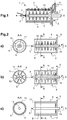
- the inlet 5 is generally connected to a peristaltic pump (not shown).
- This pump makes it possible to bring the initial suspension, contained for example in a receptacle, such as a tank, inside the grinding chamber 2 via the inlet 5.
- the pump In addition, during operation of the three-dimensional crusher, it is possible to bring this starting suspension according to a certain flow rate which is adjustable, hereinafter called “flow rate”. This flow rate also forms a current in the grinding chamber 2 making it possible to drive the starting suspension from the inlet 5 to the outlet 6.
- the outlet 6 of the grinding chamber 2 comprises in particular the system 7 for separating the microbeads from the final suspension mainly comprising the crystals of calcium zincate, water and possibly the balance of raw materials which would not have reacted.
- This separation means 7 may be a sieve the orifices of which have a dimension smaller than that of the microbeads or a separation slit whose width is also suitable for retaining the microbeads within the chamber 2.
- the internal wall 9 of the grinding chamber 2 comprises according to a first embodiment a smooth internal surface. However, according to an alternative embodiment which will be described below, it can be arranged on this internal surface 9 of the fingers 11.
- the agitator 8 which, in addition to the flow rate, also allows the setting in motion of the starting suspension.
- the agitator 8 is able to rotate around the X axis via a rotary shaft (14, figure 2 ) to impart within the grinding chamber 2 a swirling movement to the starting suspension and thus effect an intense stirring between this starting suspension and the microbeads present in the chamber 2 along the internal wall 9 of this chamber 2.
- the agitator 8 just like the internal wall 9 of the chamber 2, can have various possible configurations shown for example on the figure 2 .
- the agitator 8 comprises, along its elongated rod, discs 10, arranged perpendicular to the latter. Their number can vary from 2 to 8, preferably from 2 to 5. These discs 10 make it possible, on the one hand, to improve the grinding of the starting suspension by further mixing the microspheres and, on the other hand, to accelerate the process. reaction time.
- the agitator 8 can also comprise along its rod one or more discs 10 arranged perpendicular and which are also able to cooperate with fingers 11, arranged perpendicularly, relative to the internal wall 9 of the chamber 2.
- a finger is in particular in the form of a ring which extends perpendicularly from the wall 9.
- the discs 10 and the fingers 11 are staggered, namely the discs 10 and the fingers 11 are arranged in a staggered manner. alternately in the chamber 2.
- the thickness of the rod 8 is increased compared to the previous configuration ( figure 2a ) so that the periphery of the discs 10 is close to the internal wall 9 and that of the fingers 11 is close to the periphery of the stirrer rod 8.
- the volume of the chamber is reduced by compared to the configuration previous, consequently allowing better mixing between the starting suspension, the microbeads and the internal wall 9 of the chamber 2.
- the volume of chamber 2 can be further reduced as shown in figure 2c .
- the agitator 8 has an external diameter slightly smaller than the internal diameter of the chamber 2, thus forming an annular chamber 12 of small volume arranged between the external wall of the agitator 8 and the internal wall 9 of the chamber 2.
- the microbeads (not shown) are placed in this annular chamber 12.
- the starting suspension is introduced through the inlet 5 with a certain flow rate, which will then travel through the annular chamber 12 until the output 6 while being stirred by the microbeads.
- the grinder suitable for carrying out the process according to the invention comprises a grinding chamber having a diameter of 75 mm to 300 mm for a length of 80 mm to 900 mm and a stirrer having a size ranging from 65 mm to 260 mm.
- the volume of the grinding chamber varies from 0.35 L to 600 L, preferably from 0.35 L to 62 L.
- the geometry of the grinding chamber and of the stirrer can be adjusted by a person skilled in the art depending on the quantity of calcium zincate crystals desired, as well as the desired reaction time.
- the grinding chamber 2 includes an accelerator in order to improve the grinding of the starting slurry.
- the microspheres housed in the grinding chamber 2 and suitable for the process according to the invention are substantially spherical in shape and have an average diameter ranging from 0.05 mm to 4 mm, preferably from 0.2 to 3 mm. , in particular from 0.3 to 2 mm, and typically of the order of 0.5 to 1 mm.
- the diameter of the microbeads is less than or equal to 1 mm.
- microbeads exhibiting high hardness and relatively good abrasion resistance.
- the microbeads have a Vickers hardness measured according to standard EN ISO 6507-1 greater than or equal to 900 HV1, preferably ranging from 900 HV1 to 1600 HV1, typically ranging from 1000 to 1400 HV1.
- the microbeads according to the invention have a high real density.
- the microbeads according to the invention have a real density greater than or equal to 2 g / cm 3 , in particular ranging from 2 to 15 g / cm 3 , preferably from 3 to 12 g / cm 3 , and typically from 4 at 10 g / cm 3 .
- the microbeads according to the invention can be ceramic microbeads (zirconium oxide ZrO 2 , zirconium silicate ZrSiO 4 ); steel microbeads, tungsten carbide microbeads, glass microbeads or a combination thereof.
- the microbeads are ceramic because they do not generate pollution by their wear.
- the microspheres are made of zirconium oxide.
- the zirconium oxide microspheres can be stabilized with another oxide, such as cerium oxide, yttrium oxide and / or silicon.
- compositions are suitable for forming the microbeads according to the invention: ⁇ i> Table 1 ⁇ /i> Composition of microbeads Hardness HV1 Real density (g / cm 3 ) Maker Zirconium oxide microbeads stabilized by cerium oxide 1180 ⁇ 6.10 Saint-Gobain (Zirmil®Y Ceramic - 80% of ZrO 2 Beads) or EIP - 20% of CeO (Procerox® ZO Cer) Yttrium stabilized zirconium oxide microbeads 1250 ⁇ 5.95 EIP (Procerox® ZO (Y)) - 95% ZrO 2 - ⁇ 5% Al 2 O 3 - Remainder: Y 2 O 3 Zirconium oxide microbeads stabilized by yttrium and silicon: > 700 > 4.80 Saint-Gobain (ER120 Ceramic Beads) - 78% ZrO 2 , - 12% Si
- the microbeads represent, by volume, relative to the total volume of the stationary chamber 2 from 50% to 85%, preferably from 55% to 70%.
- the three-dimensional wet-phase microbead mill suitable for carrying out the process according to the invention may correspond to mills marketed by the companies WAB, Dyno-Mill range: Multi Lab, ECM and KD, Company NETZCH, by example LABSTAR LS1, or Alpine Hosokawa, for example, Agitated Media Mill AHM.
- the manufacture of the calcium zincate crystals according to the invention firstly comprises (1) a step of suspending at least the following compounds: calcium hydroxide (Ca (OH ) 2 ) and zinc oxide (ZnO) or one of its precursors or a mixture thereof in a large excess of water.
- the suspension obtained is hereinafter referred to as "starting suspension”.
- a precursor of zinc oxide (ZnO) may correspond to ZnO 2 or to a zinc hydroxide, such as Zn (OH) 2 .
- the starting suspension can thus comprise, in addition to calcium hydroxide (Ca (OH) 2 ), ZnO, or one of its precursors (such as ZnO 2 or Zn (OH) 2 ) or a mixture of these , namely a mixture of ZnO + precursor (s) or a mixture of precursors (such as ZnO + ZnO 2 ; ZnO + ZnO 2 + Zn (OH) 2 ; or else ZnO 2 + Zn (OH) 2 ; etc.).
- the starting suspension comprises ZnO.
- the characteristics relating to ZnO are understood to be the characteristics relating to ZnO, or one of its precursors, or a mixture of these.
- the starting suspension is conventionally prepared by mixing the raw materials (Ca (OH) 2 + ZnO) with water in a suitable device, such as a container or a tank, fitted with a stirring system (such as magnetic stirrer, stirring blades, etc.).
- a suitable device such as a container or a tank, fitted with a stirring system (such as magnetic stirrer, stirring blades, etc.).
- the device as well as the stirring system can be adapted by a person skilled in the art depending on the quantity of calcium zincate crystals to be manufactured.
- calcium hydroxide and zinc oxide are mixed, preferably, in stoichiometric proportion in the starting suspension.
- the CA / Zn molar ratio will be 1/2 to carry out the reaction: Ca (OH) 2 +2 ZnO + 4 H 2 O -> Ca [Zn (OH) 3 ] 2 .2H 2 O
- water is not only present in the starting suspension in a stoichiometric proportion. This indeed includes a large excess of water.
- the mass ratio (water): (calcium hydroxide + zinc oxide) is greater than or equal to 1, preferably ranges from 2 to 15 and in particular ranges from 3 to 5. This excess of water not only allows the synthesis of calcium zincate crystals, but also promotes the setting in motion of the microbeads of the mill for better grinding of the starting suspension and therefore better synthesis of the calcium zincate crystals.
- the raw materials for the starting suspension are in powder form.
- the calcium hydroxide suitable for the present invention preferably has a particle size less than or equal to 100 ⁇ m and preferably less than or equal to 10 ⁇ m, and in particular the size of the particles ranges from 0.01 ⁇ m to 1 ⁇ m.
- Number Calcium Hydroxide CASE: 1305-62-0 and marketed for example by the company Sigma Aldrich with a purity greater than or equal to 96% is suitable for carrying out the process of the invention.
- the zinc oxide suitable for the present invention is also in powder form and generally has a particle size of less than or equal to 100 ⁇ m and preferably less than or equal to 10 ⁇ m, and in particular the size of the particles ranges from 0. , 01 ⁇ m to 1 ⁇ m.
- Number zinc oxide CAS: 1314-13-2 and marketed for example by the company Selectra with a purity greater than or equal to 99.9% is suitable for carrying out the process of the invention.
- the calcium hydroxide and the zinc oxide have a high purity, in general greater than or equal to 90%, in particular greater than or equal to 95% and typically greater than or equal to 99%, or even greater than or equal to 99.9%.
- quicklime prepared by calcining calcium carbonate at a temperature a little higher than the industrial standard, for example 1050 ° C.
- the starting suspension is prepared, it is fed to the three-dimensional microbead mill 1 generally via the peristaltic pump with adjustable flow rate via inlet 5.
- the peristaltic pump makes it possible to continue mixing the suspension. starting before entering chamber 2.
- this pump makes it possible to introduce the starting suspension into chamber 2 with a controlled flow rate.
- the starting suspension is introduced at a flow rate of 10 to 130 L / h, preferably 20 to 100 L / h and typically 30 to 90 L / h.
- the starting suspension travels through the stationary chamber 2 from the inlet 5 to the outlet 6, while being set in motion by the agitator 8 which allows intense mixing of this suspension with the microbeads and, if necessary, with the discs 10, the fingers 11, etc., along the internal wall 9 of the chamber 2.
- the speed of rotation of the agitator may for example vary from 4 to 20 Pi rad / s, preferably from 4 to 8 Pi rad / s.
- the residence time of the starting suspension is less than or equal to 15 min, preferably less than or equal to 1 minute, and ranges in particular in the mill from 5 to 25 seconds and in particular from 10 to 20 seconds. It is in fact inherent in the apparent volume of the beads and in the flow rate. For example, if the total apparent volume of the beads is 270 cm 3 (beads with an apparent density of 3.7 g / cm 3 ) and the rate of introduction of the suspension is 30 L / h, i.e. 8, 3 cm 3 / s, then the residence time of the suspension in chamber 2 is estimated to be approximately 32 seconds. Consequently, the residence time can be advantageously adjusted, for example by controlling the bulk density of the microspheres, as well as the flow rate.
- the term “apparent volume” is understood to mean the volume of the microbeads including the interstitial air between the beads.
- the bulk density is the ratio of the mass of the microbeads to the apparent volume.
- finer grinding may be obtained if the flow rate of the starting suspension is slowed down.
- the grinding step can be carried out in continuous mode or batch mode in one or more passes (pendulum mode or in recirculation).
- the number of passages of the so-called starting suspension can be from 1 to 10, preferably from 1 to 5 (namely, after a first passage, the suspension is recovered at outlet 6 and it reinjects it again, thanks to the pump, into chamber 2 via inlet 5 to allow a second passage).
- the number of times the starting suspension passes is 1.
- this grinding step will preferably be carried out in continuous mode.
- this grinding step takes place at an ambient temperature less than or equal to 50 ° C, namely the most open at an ambient temperature ranging from 15 ° C to 45 ° C, in particular from 18 ° C to 35 ° C and in general is of the order of 20 ° C to 25 ° C.
- the process according to the invention does not require any particular heating in order to manufacture the calcium zincate crystals, contrary to the teaching disclosed in the prior arts.
- the calcium zincate suspension is recovered at the outlet 7 of the grinder 1 and is optionally (4) concentrated or dried so as to obtain a calcium zincate powder.
- the suspension of calcium zincate can be dried in the open air. It appears that the carbonation reaction is very slow between the calcium zincate and the CO 2 in the air.
- the suspension of calcium zincate can be dried by steaming or by calcination, such as at a temperature of 100 to 400 ° C. for 1 to 4 hours.
- the final product is generally stored until use as an aqueous paste or mixed with a solvent. It can also be dried and stored in an airtight container.
- the length of the major axis of these crystals ranges from 0.1 to 30 ⁇ m, preferably from 1 to 25 ⁇ m (large diagonal).
- the length of the minor axis (the smallest diagonal) ranges from 0.05 to 20 ⁇ m, preferably from 0.11 to 12 ⁇ m.
- the characteristics of the calcium zincate crystals can be adjusted, depending on the requirements of the intended use, by varying some parameters, such as the flow rate. passage, the diameter of the microbeads or the water content in the starting suspension.
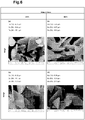
- the calcium zincate crystals according to the invention in fact intrinsically have the shape of a micro-rhombus, the opposite angles of which are equal and the consecutive angles are complementary to 180 °. As measured on the Figure 3 , these angles have approximately the values of 125 ° +/- 5 ° and 55 ° +/- 5 °. This intrinsic form is also verified on all the images of the Figures 6 , 7 and 8 , subject to breakage sometimes resulting in only a piece of rhombus.
- the length of the major axis (large diagonal) of the calcium zincate crystals preferably ranges from 0.1 to 30 ⁇ m, in particular from 1 to 25 ⁇ m, and typically ranges from 1 to 20 ⁇ m. ; while the length of the smallest axis (smallest diagonal) can range from 0.05 to 20 ⁇ m, preferably from 0.11 to 12 ⁇ m. Consequently, the method according to the invention makes it possible to obtain micro-diamonds, unlike the methods described in the prior art which only make it possible to obtain calcium zincate crystals in the shape of a diamond (and not of micro-diamonds). -losange) in which the length of the major axis is greater than 30 ⁇ m and is generally greater than or equal to 60 ⁇ m.
- the calcium zincate crystals have a lamella shape, the thickness of which is much less than their length. This means that the longer the crystals is small, the more their specific surface increases, and the more their properties are improved for the uses mentioned below.
- the calcium zincate crystals obtained from the process according to the invention are distinguished from the calcium zincate crystals obtained from the processes described in the prior art in particular by their distribution. particle size and their micro-diamond shape. These characteristics are induced by the process according to the invention and cannot be obtained by simple grinding of calcium zincate crystals, for example in a mill. Indeed, such grinding would have the particular effect of destroying the diamond shape.
- the specific surface (determined on the BET method known to those skilled in the art) of the calcium zincate crystals obtained according to the process of the invention is generally at least 6 m 2 / g, of preferably at least 10 m 2 / g, in particular at least 12 m 2 / g and typically at least 15 m 2 / g, such as 17 m 2 / g.
- a specific surface area of at least 6 m 2 / g encompasses the following values or any range between the following values: 6; 7, 8; 9; 10; 11; 12; 13; 14; 15; 16; 17; etc.
- a subject of the present invention is also the uses of the powder or of the suspension of calcium zincate crystals obtained according to the above-mentioned process.
- calcium zincate can be used as the main component in the composition of the zinc anode of an alkaline electrochemical generator.
- powdered or suspended calcium zincate crystals obtained according to the process of the invention and having an average dimension of less than 20 ⁇ m, or even 10 ⁇ m, would make it possible to obtain better performance, in particular if one combines this improvement with that which can be obtained by the addition of titanium nitride powder in the composition of the electrode as mentioned in the documents WO 03 / 015197A2 and WO 2004 / 013064A2 .
- the powder or the suspension of calcium zincate can be used to make a heterogeneous catalyst for the production of biodiesel as mentioned in the publication of JM Rubio Caballero, “Calcium zincate as precursor of active catalysts for biodiesel production under mild conditions”, Applied catalysis B: Environmental 91 (2009) 339-346 ; in the document WO 2010/112641 and in the publication of Zeljka Kesic "Mechanochemical preparation and characterization of Cao.Zno used as catalyst for biodiesel synthesis, published in the book” Applied Catalyst A: General 427-428 (2012) 58-65 (ELSEVIER ).
- calcium zincate can be used for the production of biodiesel by reaction of methanol with vegetable oils, the calcium zincate being previously calcined at a temperature greater than or equal to 400 ° C, preferably at a temperature between 500 ° C. C and 700 ° C, for example in the presence of air, an inert gas, a mixture of an inert gas and oxygen or a mixture of nitrogen and oxygen.
- This shaping has been found to be particularly stable in operation in methanol. Since the catalytic capacity of calcined calcium zincate certainly depends on the specific surface of the powder used for its implementation, the powders obtained by the process according to the invention should therefore be particularly effective.
- the powder or the suspension of calcium zincate can be used as an antifungal product.
- This use is particularly advantageous for achieving lasting protection of limestone monuments, for example Mayan monuments in Mexico, exposed to a hot and humid atmosphere.
- the growth of fungi alters the layer superficial of these monuments, as explained in the publication of NM Gomez-Ortiz “Antifungal activity of Ca [Zn (OH) 3] 2.2H2O coatings for the preservation of limestone monuments: an in vitro study”; published in the book "International Biodeterioration & Biodegradation 91 (2014) 1-8" .
- SEM Scanning electron microscopy
- the suspensions of calcium zincate crystals were previously dried in air at 50 ° C. so as to obtain a powder.
- X-ray diffractometry (XRD) spectra were collected with a D8 ADVANCE Series II diffractometer marketed by the Bruker company using CuK ⁇ 1 radiation (0.15406 nm) according to the Bragg-Brentano configuration.
- the detector used is a LynxEye 1D detector from Bruker.
- the opening angle of the detector is 3 ° (150 bands).
- the DRX measurements were carried out between 10 ° and 40 ° (on the 2 ⁇ scale) with a step of 0.008 ° (1 s / step).
- the suspensions of calcium zincate crystals were also previously dried in air at 50 ° C., so as to obtain a powder.
- liquid particle size measurements were carried out with a laser particle size analyzer from the company Malvern Model Mastersizer 3000E.
- This measurement gives the distribution by volume (in%) of the particles of the sample for each particle size class in ⁇ m (which corresponds to the longest length of the calcium zincate crystals).
- the microspheres are made of zirconium oxide and have a diameter of 0.5, 1.0 or 2.0 mm.
- the characteristics of the microbeads used for the tests are summarized in Table 2 below: ⁇ i> Table 2 ⁇ /i> Balls 500 ⁇ m 1.0mm 2.00mm Composition (% by mass) 93% ZrO 2 93% ZrO 2 93% ZrO 2 5% Y 2 O 3 5% Y 2 O 3 5% Y 2 O 3 2% other 2% other 2% other 2% other 2% other 2% other 2% other 2% other 2% other 2% other 2% other 2% other 2% other 2% other 2% other 2% other 2% other 2% other 2% other 2% other 2% other 2% other 2% other 2% other 2% other 2% other 2% other 2% other 2% other 2% other 2% other 2% other 2% other 2% other 2% other 2% other 2% other 2% other 2% other 2% other 2% other 2% other 2% other 2% other 2% other
- the 500 ⁇ m microbeads are in particular marketed under the brand name Zirmil® Y Ceramic Beads by the company Saint-Gobain.
- the grinding chamber of the mill has a capacity of 309 ml and is filled, by volume, relative to its total volume and depending on the tests, with 80% of the microbeads described above.
- the microspheres are stirred by a stirrer at a rotational speed of 2890 rev / min.
- the agitator also has two polyurethane mixing discs 64mm in diameter.
- the starting raw materials are: calcium hydroxide (Ca (OH) 2 ) having a purity ⁇ 96% marketed by the company Sigma Aldrich and zinc oxide with a purity ⁇ 99.9% marketed by the company Selectra and demineralized water.
- the suspension of calcium zincate crystals was then collected and dried in the open air at 50 ° C.
- the calcium zincate crystals obtained according to the process of the invention exhibit, surprisingly after only one passage through the microbead mill and thus a residence time of 12 seconds, a characteristic diamond shape (instead of 48 hours according to the methods of the prior art).
- the length of the major axis of this rhombus that is to say its longest diagonal, is about 19-20 ⁇ m and the length of the other diagonal is about 10.47 ⁇ m .
- the two characteristic angles of the diamonds are 55.2 ° and 126.9 ° (thus, two consecutive angles together measure approximately 180 °).
- the calcium zincate crystals obtained with the process according to the invention have a density (g / cm 3 ) which complies with that given in the literature, namely 2.60 g / cm 3 .
- the process of the invention makes it possible to immediately obtain crystals of very pure calcium zincate and of characteristic diamond shape.
- Example 2 Granulometry of the calcium zincate crystals as a function of the concentration of the starting raw materials and of the flow rate (FIG. 5).
- the process according to the invention makes it possible to obtain homogeneous zincate crystals of small sizes (between 4 and 20 ⁇ m) with the absence of large crystals regardless of the concentration of the starting raw materials and of the flow rate.
- the purpose of this example is to determine whether the size of the beads used during the implementation of the method has an influence on the quality of the calcium zincate crystals obtained.
- the beads with a diameter of 0.5 mm make it possible to obtain crystals of larger sizes (the size measured being the size of the major axis of the calcium zincate diamonds).
- the size of the major axis is less than 20 ⁇ m with total absence of large crystals.
- the size of the beads used when this is less than or equal to 2 mm, has a weak impact on the size of the calcium zincate crystals obtained.
- a bead size ⁇ 1 mm makes it possible to obtain a better synthesis of the calcium zincate in a single pass of the starting suspension through the mill.
- the images obtained by scanning electron microscopy show the diamond-shaped crystals, characteristic of calcium zincate. It also turns out that the powder obtained mainly consists of well-formed crystals, the length of the major axis of which is generally less than 20 ⁇ m.
- the laboratory mill can for example produce 54 kg / h of calcium zincate crystals. This figure could be multiplied by 10 with the addition of an accelerator accessory. Also, there are industrial versions of the mill using for example up to 100 kg of balls. With this type of mill, it would therefore be possible to produce several tonnes per hour of calcium zincate.
Landscapes
- Chemical & Material Sciences (AREA)
- Chemical Kinetics & Catalysis (AREA)
- Engineering & Computer Science (AREA)
- Organic Chemistry (AREA)
- Materials Engineering (AREA)
- Electrochemistry (AREA)
- General Chemical & Material Sciences (AREA)
- Life Sciences & Earth Sciences (AREA)
- Inorganic Chemistry (AREA)
- Manufacturing & Machinery (AREA)
- Wood Science & Technology (AREA)
- Dentistry (AREA)
- Environmental Sciences (AREA)
- Zoology (AREA)
- General Health & Medical Sciences (AREA)
- Agronomy & Crop Science (AREA)
- Pest Control & Pesticides (AREA)
- Plant Pathology (AREA)
- Health & Medical Sciences (AREA)
- Crystallography & Structural Chemistry (AREA)
- Food Science & Technology (AREA)
- Physics & Mathematics (AREA)
- Thermal Sciences (AREA)
- Geology (AREA)
- Inorganic Compounds Of Heavy Metals (AREA)
- Crushing And Grinding (AREA)
- Catalysts (AREA)
- Battery Electrode And Active Subsutance (AREA)
- Developing Agents For Electrophotography (AREA)
Priority Applications (1)
| Application Number | Priority Date | Filing Date | Title |
|---|---|---|---|
| PL16731189T PL3277632T3 (pl) | 2015-04-03 | 2016-03-31 | Sposób wytwarzania kryształów cynkanu wapnia, proszek lub zawiesina kryształów cynkanu wapnia oraz ich zastosowanie |
Applications Claiming Priority (2)
| Application Number | Priority Date | Filing Date | Title |
|---|---|---|---|
| FR1552884A FR3034412B1 (fr) | 2015-04-03 | 2015-04-03 | Procede de fabrication de cristaux de zincate de calcium, ainsi que ses utilisations |
| PCT/FR2016/050736 WO2016156749A1 (fr) | 2015-04-03 | 2016-03-31 | Procédé de fabrication de cristaux de zincate de calcium, ainsi que ses utilisations |
Publications (2)
| Publication Number | Publication Date |
|---|---|
| EP3277632A1 EP3277632A1 (fr) | 2018-02-07 |
| EP3277632B1 true EP3277632B1 (fr) | 2020-08-05 |
Family
ID=53059344
Family Applications (1)
| Application Number | Title | Priority Date | Filing Date |
|---|---|---|---|
| EP16731189.3A Active EP3277632B1 (fr) | 2015-04-03 | 2016-03-31 | Procédé de fabrication de cristaux de zincate de calcium, poudre ou suspension de cristaux de zincate de calcium ainsi que leurs utilisations |
Country Status (11)
| Country | Link |
|---|---|
| US (1) | US10472248B2 (pl) |
| EP (1) | EP3277632B1 (pl) |
| JP (1) | JP6903631B2 (pl) |
| KR (1) | KR102492012B1 (pl) |
| CN (2) | CN114084899A (pl) |
| AU (1) | AU2016239826B2 (pl) |
| CA (1) | CA2981542C (pl) |
| ES (1) | ES2826563T3 (pl) |
| FR (1) | FR3034412B1 (pl) |
| PL (1) | PL3277632T3 (pl) |
| WO (1) | WO2016156749A1 (pl) |
Families Citing this family (13)
| Publication number | Priority date | Publication date | Assignee | Title |
|---|---|---|---|---|
| FR3056980B1 (fr) * | 2016-10-05 | 2022-12-16 | Easyl | Procede de fabrication de cristaux de zincate d'au moins un metal, et/ou d'un metalloide et/ou d'un lanthanide, ainsi que leurs applications |
| FR3070544B1 (fr) | 2017-08-30 | 2023-01-27 | Centre Nat Rech Scient | Electrode a reseau multiple de collecte de courant |
| FR3081732B1 (fr) * | 2018-05-29 | 2020-09-11 | Deasyl Sa | Broyeur tridimensionnel, son procede de mise en œuvre et ses utilisations |
| CN109569829B (zh) * | 2018-11-06 | 2021-08-03 | 江苏上阳金属新材料有限公司 | 一种催化剂的研磨干燥工艺 |
| FR3091042B1 (fr) * | 2018-12-21 | 2025-07-18 | Electricite De France | Procédé de fabrication d’une électrode de zinc par voie aqueuse |
| CN109455754B (zh) * | 2019-01-02 | 2020-01-14 | 森克创能(天津)新能源科技有限公司 | 一种锌镍电池负极材料锌酸钙合成工艺及设备 |
| CN110386619A (zh) * | 2019-06-17 | 2019-10-29 | 昆明冶金研究院 | 一种锌电池用超细锌酸钙晶体的制备方法 |
| CN111841815A (zh) * | 2020-07-31 | 2020-10-30 | 黄雄景 | 一种仿瓣胃研磨式农家豆制品加工设备 |
| CN112038622B (zh) * | 2020-09-02 | 2021-11-30 | 河南超力新能源有限公司 | 一种锌基二次电池用锌酸钙负极材料及其制备方法、锌基二次电池 |
| CN112038602B (zh) * | 2020-09-02 | 2021-11-16 | 河南超力新能源有限公司 | 一种锌基二次电池用复合负极材料及其制备方法、锌基二次电池 |
| CN113144661B (zh) * | 2021-03-22 | 2022-11-22 | 无棣永利盐业有限公司 | 一种可筛控晶体的日晒重结晶盐打花旋卤装置 |
| US11228032B1 (en) * | 2021-04-06 | 2022-01-18 | ZAF Energy Systems, Incorporated | Secondary electrode including styrene-butadiene rubber |
| US11404696B1 (en) | 2022-01-05 | 2022-08-02 | ZAF Energy Systems, Incorporated | Secondary aqueous battery electrodes including vinyl acetate-ethylene |
Family Cites Families (20)
| Publication number | Priority date | Publication date | Assignee | Title |
|---|---|---|---|---|
| SU116812A1 (ru) | 1958-03-07 | 1958-11-30 | Н.А. Жулидов | Щелочной аккумул тор |
| US3607409A (en) | 1967-06-28 | 1971-09-21 | Gen Electric | Method of forming calcium zincate powder and electrode |
| US4358517A (en) * | 1979-10-30 | 1982-11-09 | General Motors Corporation | Nickel-zinc cell |
| US5863676A (en) | 1997-03-27 | 1999-01-26 | Energy Research Corporation | Calcium-zincate electrode for alkaline batteries and method for making same |
| US6620550B2 (en) * | 2001-01-23 | 2003-09-16 | The Gillette Company | Battery cathode and method of manufacture therefor |
| FR2828336B1 (fr) | 2001-08-03 | 2006-07-07 | Conseil Et De Prospective Scie | Generateurs electrochimiques secondaires alcalins a anode de zinc |
| FR2843235B1 (fr) | 2002-07-30 | 2006-07-28 | Conseil Et De Prospective Scie | Ceramique conductrice pretraitee par oxydation pour anode de zinc de generateurs electrochimiques secondaires alcalins |
| CN1397498A (zh) * | 2002-09-03 | 2003-02-19 | 南开大学 | 锌镍二次电池负极材料锌酸钙的制备方法 |
| CN1482698A (zh) * | 2003-07-17 | 2004-03-17 | 武汉大学 | 一种二次碱性锌电极材料的制备方法 |
| US20050252408A1 (en) * | 2004-05-17 | 2005-11-17 | Richardson H W | Particulate wood preservative and method for producing same |
| CN1274042C (zh) * | 2004-07-07 | 2006-09-06 | 南开大学 | 用于碱性二次锌电极的负极材料 |
| CN100355120C (zh) * | 2004-09-24 | 2007-12-12 | 比亚迪股份有限公司 | 碱性蓄电池负极活性物质锌酸钙的制备方法 |
| CN1789158A (zh) * | 2004-12-15 | 2006-06-21 | 林明助 | 一种抗菌颗粒及其制法 |
| CN101264924B (zh) | 2008-04-11 | 2010-04-07 | 中南大学 | 一种制备电池负极材料锌酸钙的密封装置 |
| KR20100056257A (ko) * | 2008-11-19 | 2010-05-27 | 에너그린(주) | 코팅용 겔 전해액을 사용하여 표면 개질된 음극 및 분리막을 포함하는 알칼리 아연 이차전지 |
| CN101746810B (zh) * | 2008-12-16 | 2012-05-02 | 天津蓝天高科电源股份有限公司 | 一种电池负极活性物质锌酸钙的制备方法 |
| ES2345866B2 (es) | 2009-04-01 | 2011-10-24 | Universidad De Málaga | Procedimiento de produccion de biocarburantes mediante catalisis heterogenea empleando un cincato metalico como precursor de catalizadores solidos. |
| JP5257372B2 (ja) * | 2009-11-30 | 2013-08-07 | 住友金属鉱山株式会社 | 酸化物蒸着材と透明導電膜および太陽電池 |
| EP2966194B1 (en) * | 2013-03-06 | 2020-04-22 | Retug, Inc. | Zinc-based composite material and use thereof |
| CN104164304B (zh) * | 2014-08-22 | 2016-08-10 | 北京科技大学 | 一种改性树脂催化制备生物柴油的新方法 |
-
2015
- 2015-04-03 FR FR1552884A patent/FR3034412B1/fr not_active Expired - Fee Related
-
2016
- 2016-03-31 ES ES16731189T patent/ES2826563T3/es active Active
- 2016-03-31 US US15/563,237 patent/US10472248B2/en active Active
- 2016-03-31 KR KR1020177029826A patent/KR102492012B1/ko active Active
- 2016-03-31 JP JP2018502338A patent/JP6903631B2/ja active Active
- 2016-03-31 CA CA2981542A patent/CA2981542C/fr active Active
- 2016-03-31 CN CN202111520464.1A patent/CN114084899A/zh active Pending
- 2016-03-31 EP EP16731189.3A patent/EP3277632B1/fr active Active
- 2016-03-31 CN CN201680031849.2A patent/CN107743475A/zh active Pending
- 2016-03-31 AU AU2016239826A patent/AU2016239826B2/en active Active
- 2016-03-31 PL PL16731189T patent/PL3277632T3/pl unknown
- 2016-03-31 WO PCT/FR2016/050736 patent/WO2016156749A1/fr not_active Ceased
Non-Patent Citations (1)
| Title |
|---|
| None * |
Also Published As
| Publication number | Publication date |
|---|---|
| CN114084899A (zh) | 2022-02-25 |
| EP3277632A1 (fr) | 2018-02-07 |
| JP6903631B2 (ja) | 2021-07-14 |
| JP2018513099A (ja) | 2018-05-24 |
| CA2981542A1 (fr) | 2016-10-06 |
| KR20170134499A (ko) | 2017-12-06 |
| FR3034412B1 (fr) | 2018-10-05 |
| US10472248B2 (en) | 2019-11-12 |
| CA2981542C (fr) | 2022-10-18 |
| FR3034412A1 (fr) | 2016-10-07 |
| AU2016239826B2 (en) | 2019-10-31 |
| KR102492012B1 (ko) | 2023-01-26 |
| CN107743475A (zh) | 2018-02-27 |
| PL3277632T3 (pl) | 2021-01-11 |
| ES2826563T3 (es) | 2021-05-18 |
| AU2016239826A1 (en) | 2017-11-16 |
| WO2016156749A1 (fr) | 2016-10-06 |
| US20180086646A1 (en) | 2018-03-29 |
Similar Documents
| Publication | Publication Date | Title |
|---|---|---|
| EP3277632B1 (fr) | Procédé de fabrication de cristaux de zincate de calcium, poudre ou suspension de cristaux de zincate de calcium ainsi que leurs utilisations | |
| EP2840633B1 (fr) | Accumulateurs au lithium à base de phosphate de fer lithié et de carbone | |
| EP1709702B1 (fr) | Procede de preparation de materiaux composites comprenant un compose actif d'electrode et un compose conducteur electronique tel que le carbone notamment pour accumulateurs au lithium | |
| CN1446180A (zh) | 锂化二氧化锰的机械化学合成方法 | |
| WO2018065736A1 (fr) | Procédé de fabrication de cristaux d'aluminate d'au moins un métal et/ou d'un métalloïde et/ou d'un lanthanide, ainsi que leurs applications | |
| EP3519381B1 (fr) | Procédé de fabrication de diglyceroxyde de calcium | |
| US20250263307A1 (en) | Methods for preparing lithium nickel manganese cobalt oxide particulate | |
| FR3138812A1 (fr) | Carbonate de cobalt dopé au manganèse et procédé de préparation et utilisation correspondants | |
| EP3523247A1 (fr) | Procédé de fabrication de cristaux de zincate d'au moins un métal, et/ou d'un métalloïde et/ou d'un lanthanide, ainsi que leurs applications | |
| EP3626681A1 (fr) | Procede de synthese | |
| CA3038368C (fr) | Procede de fabrication de diglyceroxyde de calcium | |
| WO2017055763A1 (fr) | Procédé de fabrication d'un matériau de pile au lithium, matériaux et pile au lithium | |
| EP3853188A1 (fr) | Produit fondu polycristallin a base de brownmillerite | |
| WO2014006600A1 (fr) | Produit fondu a base de lithium | |
| EP1638679A2 (fr) | Dispersion colloidale d'une perovskite de terre rare et son procede de preparation | |
| WO2025228981A1 (fr) | Poudre de billes frittees en carbure(s) metallique(s) | |
| FR3161679A1 (fr) | Utilisation d’une poudre de billes frittees en carbure(s) metallique(s) | |
| WO2024057464A1 (ja) | 単結晶球状カーボンナノ粒子 | |
| WO2013079410A1 (fr) | Obtention d'un materiau a base de li4ti5o12 avec broyage en presence de carbone |
Legal Events
| Date | Code | Title | Description |
|---|---|---|---|
| STAA | Information on the status of an ep patent application or granted ep patent |
Free format text: STATUS: THE INTERNATIONAL PUBLICATION HAS BEEN MADE |
|
| PUAI | Public reference made under article 153(3) epc to a published international application that has entered the european phase |
Free format text: ORIGINAL CODE: 0009012 |
|
| STAA | Information on the status of an ep patent application or granted ep patent |
Free format text: STATUS: REQUEST FOR EXAMINATION WAS MADE |
|
| 17P | Request for examination filed |
Effective date: 20171002 |
|
| AK | Designated contracting states |
Kind code of ref document: A1 Designated state(s): AL AT BE BG CH CY CZ DE DK EE ES FI FR GB GR HR HU IE IS IT LI LT LU LV MC MK MT NL NO PL PT RO RS SE SI SK SM TR |
|
| AX | Request for extension of the european patent |
Extension state: BA ME |
|
| DAV | Request for validation of the european patent (deleted) | ||
| DAX | Request for extension of the european patent (deleted) | ||
| GRAP | Despatch of communication of intention to grant a patent |
Free format text: ORIGINAL CODE: EPIDOSNIGR1 |
|
| STAA | Information on the status of an ep patent application or granted ep patent |
Free format text: STATUS: GRANT OF PATENT IS INTENDED |
|
| RIC1 | Information provided on ipc code assigned before grant |
Ipc: B01J 23/06 20060101ALI20200422BHEP Ipc: B01J 37/00 20060101ALI20200422BHEP Ipc: B01J 35/00 20060101ALI20200422BHEP Ipc: A01N 59/16 20060101ALI20200422BHEP Ipc: H01M 4/24 20060101ALI20200422BHEP Ipc: H01M 4/48 20100101ALI20200422BHEP Ipc: C01G 9/00 20060101AFI20200422BHEP Ipc: B01J 37/04 20060101ALI20200422BHEP Ipc: H01M 4/26 20060101ALI20200422BHEP Ipc: H01M 4/08 20060101ALI20200422BHEP Ipc: H01M 4/58 20100101ALI20200422BHEP Ipc: H01M 4/62 20060101ALI20200422BHEP Ipc: B01J 37/08 20060101ALI20200422BHEP |
|
| INTG | Intention to grant announced |
Effective date: 20200507 |
|
| GRAS | Grant fee paid |
Free format text: ORIGINAL CODE: EPIDOSNIGR3 |
|
| GRAA | (expected) grant |
Free format text: ORIGINAL CODE: 0009210 |
|
| STAA | Information on the status of an ep patent application or granted ep patent |
Free format text: STATUS: THE PATENT HAS BEEN GRANTED |
|
| AK | Designated contracting states |
Kind code of ref document: B1 Designated state(s): AL AT BE BG CH CY CZ DE DK EE ES FI FR GB GR HR HU IE IS IT LI LT LU LV MC MK MT NL NO PL PT RO RS SE SI SK SM TR |
|
| REG | Reference to a national code |
Ref country code: GB Ref legal event code: FG4D Free format text: NOT ENGLISH |
|
| REG | Reference to a national code |
Ref country code: CH Ref legal event code: EP |
|
| REG | Reference to a national code |
Ref country code: AT Ref legal event code: REF Ref document number: 1298482 Country of ref document: AT Kind code of ref document: T Effective date: 20200815 |
|
| REG | Reference to a national code |
Ref country code: DE Ref legal event code: R096 Ref document number: 602016041332 Country of ref document: DE |
|
| REG | Reference to a national code |
Ref country code: IE Ref legal event code: FG4D Free format text: LANGUAGE OF EP DOCUMENT: FRENCH |
|
| REG | Reference to a national code |
Ref country code: CH Ref legal event code: NV Representative=s name: JACOBACCI CORALIS HARLE C/O JACOBACCI AND PART, CH |
|
| REG | Reference to a national code |
Ref country code: NL Ref legal event code: FP |
|
| REG | Reference to a national code |
Ref country code: LT Ref legal event code: MG4D |
|
| REG | Reference to a national code |
Ref country code: AT Ref legal event code: MK05 Ref document number: 1298482 Country of ref document: AT Kind code of ref document: T Effective date: 20200805 |
|
| PG25 | Lapsed in a contracting state [announced via postgrant information from national office to epo] |
Ref country code: FI Free format text: LAPSE BECAUSE OF FAILURE TO SUBMIT A TRANSLATION OF THE DESCRIPTION OR TO PAY THE FEE WITHIN THE PRESCRIBED TIME-LIMIT Effective date: 20200805 Ref country code: GR Free format text: LAPSE BECAUSE OF FAILURE TO SUBMIT A TRANSLATION OF THE DESCRIPTION OR TO PAY THE FEE WITHIN THE PRESCRIBED TIME-LIMIT Effective date: 20201106 Ref country code: SE Free format text: LAPSE BECAUSE OF FAILURE TO SUBMIT A TRANSLATION OF THE DESCRIPTION OR TO PAY THE FEE WITHIN THE PRESCRIBED TIME-LIMIT Effective date: 20200805 Ref country code: AT Free format text: LAPSE BECAUSE OF FAILURE TO SUBMIT A TRANSLATION OF THE DESCRIPTION OR TO PAY THE FEE WITHIN THE PRESCRIBED TIME-LIMIT Effective date: 20200805 Ref country code: NO Free format text: LAPSE BECAUSE OF FAILURE TO SUBMIT A TRANSLATION OF THE DESCRIPTION OR TO PAY THE FEE WITHIN THE PRESCRIBED TIME-LIMIT Effective date: 20201105 Ref country code: BG Free format text: LAPSE BECAUSE OF FAILURE TO SUBMIT A TRANSLATION OF THE DESCRIPTION OR TO PAY THE FEE WITHIN THE PRESCRIBED TIME-LIMIT Effective date: 20201105 Ref country code: HR Free format text: LAPSE BECAUSE OF FAILURE TO SUBMIT A TRANSLATION OF THE DESCRIPTION OR TO PAY THE FEE WITHIN THE PRESCRIBED TIME-LIMIT Effective date: 20200805 Ref country code: PT Free format text: LAPSE BECAUSE OF FAILURE TO SUBMIT A TRANSLATION OF THE DESCRIPTION OR TO PAY THE FEE WITHIN THE PRESCRIBED TIME-LIMIT Effective date: 20201207 Ref country code: LT Free format text: LAPSE BECAUSE OF FAILURE TO SUBMIT A TRANSLATION OF THE DESCRIPTION OR TO PAY THE FEE WITHIN THE PRESCRIBED TIME-LIMIT Effective date: 20200805 |
|
| PG25 | Lapsed in a contracting state [announced via postgrant information from national office to epo] |
Ref country code: LV Free format text: LAPSE BECAUSE OF FAILURE TO SUBMIT A TRANSLATION OF THE DESCRIPTION OR TO PAY THE FEE WITHIN THE PRESCRIBED TIME-LIMIT Effective date: 20200805 Ref country code: RS Free format text: LAPSE BECAUSE OF FAILURE TO SUBMIT A TRANSLATION OF THE DESCRIPTION OR TO PAY THE FEE WITHIN THE PRESCRIBED TIME-LIMIT Effective date: 20200805 Ref country code: IS Free format text: LAPSE BECAUSE OF FAILURE TO SUBMIT A TRANSLATION OF THE DESCRIPTION OR TO PAY THE FEE WITHIN THE PRESCRIBED TIME-LIMIT Effective date: 20201205 |
|
| PG25 | Lapsed in a contracting state [announced via postgrant information from national office to epo] |
Ref country code: EE Free format text: LAPSE BECAUSE OF FAILURE TO SUBMIT A TRANSLATION OF THE DESCRIPTION OR TO PAY THE FEE WITHIN THE PRESCRIBED TIME-LIMIT Effective date: 20200805 Ref country code: CZ Free format text: LAPSE BECAUSE OF FAILURE TO SUBMIT A TRANSLATION OF THE DESCRIPTION OR TO PAY THE FEE WITHIN THE PRESCRIBED TIME-LIMIT Effective date: 20200805 Ref country code: DK Free format text: LAPSE BECAUSE OF FAILURE TO SUBMIT A TRANSLATION OF THE DESCRIPTION OR TO PAY THE FEE WITHIN THE PRESCRIBED TIME-LIMIT Effective date: 20200805 Ref country code: SM Free format text: LAPSE BECAUSE OF FAILURE TO SUBMIT A TRANSLATION OF THE DESCRIPTION OR TO PAY THE FEE WITHIN THE PRESCRIBED TIME-LIMIT Effective date: 20200805 |
|
| REG | Reference to a national code |
Ref country code: DE Ref legal event code: R097 Ref document number: 602016041332 Country of ref document: DE |
|
| REG | Reference to a national code |
Ref country code: ES Ref legal event code: FG2A Ref document number: 2826563 Country of ref document: ES Kind code of ref document: T3 Effective date: 20210518 |
|
| PG25 | Lapsed in a contracting state [announced via postgrant information from national office to epo] |
Ref country code: AL Free format text: LAPSE BECAUSE OF FAILURE TO SUBMIT A TRANSLATION OF THE DESCRIPTION OR TO PAY THE FEE WITHIN THE PRESCRIBED TIME-LIMIT Effective date: 20200805 |
|
| PLBE | No opposition filed within time limit |
Free format text: ORIGINAL CODE: 0009261 |
|
| STAA | Information on the status of an ep patent application or granted ep patent |
Free format text: STATUS: NO OPPOSITION FILED WITHIN TIME LIMIT |
|
| PG25 | Lapsed in a contracting state [announced via postgrant information from national office to epo] |
Ref country code: SK Free format text: LAPSE BECAUSE OF FAILURE TO SUBMIT A TRANSLATION OF THE DESCRIPTION OR TO PAY THE FEE WITHIN THE PRESCRIBED TIME-LIMIT Effective date: 20200805 |
|
| 26N | No opposition filed |
Effective date: 20210507 |
|
| PG25 | Lapsed in a contracting state [announced via postgrant information from national office to epo] |
Ref country code: SI Free format text: LAPSE BECAUSE OF FAILURE TO SUBMIT A TRANSLATION OF THE DESCRIPTION OR TO PAY THE FEE WITHIN THE PRESCRIBED TIME-LIMIT Effective date: 20200805 |
|
| PG25 | Lapsed in a contracting state [announced via postgrant information from national office to epo] |
Ref country code: MC Free format text: LAPSE BECAUSE OF FAILURE TO SUBMIT A TRANSLATION OF THE DESCRIPTION OR TO PAY THE FEE WITHIN THE PRESCRIBED TIME-LIMIT Effective date: 20200805 |
|
| PG25 | Lapsed in a contracting state [announced via postgrant information from national office to epo] |
Ref country code: IE Free format text: LAPSE BECAUSE OF NON-PAYMENT OF DUE FEES Effective date: 20210331 Ref country code: LU Free format text: LAPSE BECAUSE OF NON-PAYMENT OF DUE FEES Effective date: 20210331 |
|
| REG | Reference to a national code |
Ref country code: BE Ref legal event code: PD Owner name: EASYL ZINC; FR Free format text: DETAILS ASSIGNMENT: CHANGE OF OWNER(S), ASSIGNMENT; FORMER OWNER NAME: EASYL Effective date: 20230405 |
|
| REG | Reference to a national code |
Ref country code: CH Ref legal event code: PK Free format text: RECTIFICATIONS |
|
| P01 | Opt-out of the competence of the unified patent court (upc) registered |
Effective date: 20230524 |
|
| PG25 | Lapsed in a contracting state [announced via postgrant information from national office to epo] |
Ref country code: CY Free format text: LAPSE BECAUSE OF FAILURE TO SUBMIT A TRANSLATION OF THE DESCRIPTION OR TO PAY THE FEE WITHIN THE PRESCRIBED TIME-LIMIT Effective date: 20200805 |
|
| PG25 | Lapsed in a contracting state [announced via postgrant information from national office to epo] |
Ref country code: HU Free format text: LAPSE BECAUSE OF FAILURE TO SUBMIT A TRANSLATION OF THE DESCRIPTION OR TO PAY THE FEE WITHIN THE PRESCRIBED TIME-LIMIT; INVALID AB INITIO Effective date: 20160331 |
|
| REG | Reference to a national code |
Ref country code: DE Ref legal event code: R081 Ref document number: 602016041332 Country of ref document: DE Owner name: EASYL ZINC SAS, FR Free format text: FORMER OWNER: EASYL, BONNEVILLE, FR |
|
| REG | Reference to a national code |
Ref country code: NL Ref legal event code: PD Owner name: EASYL ZINC; FR Free format text: DETAILS ASSIGNMENT: CHANGE OF OWNER(S), ASSIGNMENT; FORMER OWNER NAME: EASYL Effective date: 20230925 |
|
| REG | Reference to a national code |
Ref country code: GB Ref legal event code: 732E Free format text: REGISTERED BETWEEN 20231026 AND 20231101 |
|
| PG25 | Lapsed in a contracting state [announced via postgrant information from national office to epo] |
Ref country code: MK Free format text: LAPSE BECAUSE OF FAILURE TO SUBMIT A TRANSLATION OF THE DESCRIPTION OR TO PAY THE FEE WITHIN THE PRESCRIBED TIME-LIMIT Effective date: 20200805 |
|
| REG | Reference to a national code |
Ref country code: ES Ref legal event code: PC2A Owner name: EASYL ZINC Effective date: 20240510 |
|
| PG25 | Lapsed in a contracting state [announced via postgrant information from national office to epo] |
Ref country code: MT Free format text: LAPSE BECAUSE OF FAILURE TO SUBMIT A TRANSLATION OF THE DESCRIPTION OR TO PAY THE FEE WITHIN THE PRESCRIBED TIME-LIMIT Effective date: 20200805 |
|
| PGFP | Annual fee paid to national office [announced via postgrant information from national office to epo] |
Ref country code: ES Payment date: 20250402 Year of fee payment: 10 |
|
| PGFP | Annual fee paid to national office [announced via postgrant information from national office to epo] |
Ref country code: CH Payment date: 20250401 Year of fee payment: 10 |
|
| PGFP | Annual fee paid to national office [announced via postgrant information from national office to epo] |
Ref country code: FR Payment date: 20251215 Year of fee payment: 11 |
|
| PGFP | Annual fee paid to national office [announced via postgrant information from national office to epo] |
Ref country code: BE Payment date: 20251215 Year of fee payment: 11 |
|
| PGFP | Annual fee paid to national office [announced via postgrant information from national office to epo] |
Ref country code: PL Payment date: 20251219 Year of fee payment: 11 |
|
| REG | Reference to a national code |
Ref country code: CH Ref legal event code: U11 Free format text: ST27 STATUS EVENT CODE: U-0-0-U10-U11 (AS PROVIDED BY THE NATIONAL OFFICE) Effective date: 20260401 |
|
| PGFP | Annual fee paid to national office [announced via postgrant information from national office to epo] |
Ref country code: GB Payment date: 20260115 Year of fee payment: 11 |
|
| PGFP | Annual fee paid to national office [announced via postgrant information from national office to epo] |
Ref country code: DE Payment date: 20251216 Year of fee payment: 11 |
|
| PGFP | Annual fee paid to national office [announced via postgrant information from national office to epo] |
Ref country code: RO Payment date: 20260211 Year of fee payment: 11 Ref country code: IT Payment date: 20260107 Year of fee payment: 11 |
|
| PGFP | Annual fee paid to national office [announced via postgrant information from national office to epo] |
Ref country code: NL Payment date: 20260319 Year of fee payment: 11 |
|
| PGFP | Annual fee paid to national office [announced via postgrant information from national office to epo] |
Ref country code: TR Payment date: 20260326 Year of fee payment: 11 |