EP3274412B1 - Coil und elektroband oder -blech - Google Patents
Coil und elektroband oder -blech Download PDFInfo
- Publication number
- EP3274412B1 EP3274412B1 EP16716496.1A EP16716496A EP3274412B1 EP 3274412 B1 EP3274412 B1 EP 3274412B1 EP 16716496 A EP16716496 A EP 16716496A EP 3274412 B1 EP3274412 B1 EP 3274412B1
- Authority
- EP
- European Patent Office
- Prior art keywords
- electrical
- baked enamel
- strip
- volume
- sheet according
- Prior art date
- Legal status (The legal status is an assumption and is not a legal conclusion. Google has not performed a legal analysis and makes no representation as to the accuracy of the status listed.)
- Active
Links
Images
Classifications
-
- H—ELECTRICITY
- H01—ELECTRIC ELEMENTS
- H01F—MAGNETS; INDUCTANCES; TRANSFORMERS; SELECTION OF MATERIALS FOR THEIR MAGNETIC PROPERTIES
- H01F5/00—Coils
-
- H—ELECTRICITY
- H01—ELECTRIC ELEMENTS
- H01F—MAGNETS; INDUCTANCES; TRANSFORMERS; SELECTION OF MATERIALS FOR THEIR MAGNETIC PROPERTIES
- H01F41/00—Apparatus or processes specially adapted for manufacturing or assembling magnets, inductances or transformers; Apparatus or processes specially adapted for manufacturing materials characterised by their magnetic properties
- H01F41/02—Apparatus or processes specially adapted for manufacturing or assembling magnets, inductances or transformers; Apparatus or processes specially adapted for manufacturing materials characterised by their magnetic properties for manufacturing cores, coils, or magnets
- H01F41/04—Apparatus or processes specially adapted for manufacturing or assembling magnets, inductances or transformers; Apparatus or processes specially adapted for manufacturing materials characterised by their magnetic properties for manufacturing cores, coils, or magnets for manufacturing coils
-
- C—CHEMISTRY; METALLURGY
- C08—ORGANIC MACROMOLECULAR COMPOUNDS; THEIR PREPARATION OR CHEMICAL WORKING-UP; COMPOSITIONS BASED THEREON
- C08G—MACROMOLECULAR COMPOUNDS OBTAINED OTHERWISE THAN BY REACTIONS ONLY INVOLVING UNSATURATED CARBON-TO-CARBON BONDS
- C08G59/00—Polycondensates containing more than one epoxy group per molecule; Macromolecules obtained by polymerising compounds containing more than one epoxy group per molecule using curing agents or catalysts which react with the epoxy groups
- C08G59/18—Macromolecules obtained by polymerising compounds containing more than one epoxy group per molecule using curing agents or catalysts which react with the epoxy groups ; e.g. general methods of curing
- C08G59/40—Macromolecules obtained by polymerising compounds containing more than one epoxy group per molecule using curing agents or catalysts which react with the epoxy groups ; e.g. general methods of curing characterised by the curing agents used
- C08G59/4007—Curing agents not provided for by the groups C08G59/42 - C08G59/66
- C08G59/4014—Nitrogen containing compounds
- C08G59/4021—Ureas; Thioureas; Guanidines; Dicyandiamides
-
- C—CHEMISTRY; METALLURGY
- C09—DYES; PAINTS; POLISHES; NATURAL RESINS; ADHESIVES; COMPOSITIONS NOT OTHERWISE PROVIDED FOR; APPLICATIONS OF MATERIALS NOT OTHERWISE PROVIDED FOR
- C09D—COATING COMPOSITIONS, e.g. PAINTS, VARNISHES OR LACQUERS; FILLING PASTES; CHEMICAL PAINT OR INK REMOVERS; INKS; CORRECTING FLUIDS; WOODSTAINS; PASTES OR SOLIDS FOR COLOURING OR PRINTING; USE OF MATERIALS THEREFOR
- C09D163/00—Coating compositions based on epoxy resins; Coating compositions based on derivatives of epoxy resins
-
- C—CHEMISTRY; METALLURGY
- C21—METALLURGY OF IRON
- C21D—MODIFYING THE PHYSICAL STRUCTURE OF FERROUS METALS; GENERAL DEVICES FOR HEAT TREATMENT OF FERROUS OR NON-FERROUS METALS OR ALLOYS; MAKING METAL MALLEABLE, e.g. BY DECARBURISATION OR TEMPERING
- C21D8/00—Modifying the physical properties of ferrous metals or ferrous alloys by deformation combined with, or followed by, heat treatment
- C21D8/12—Modifying the physical properties of ferrous metals or ferrous alloys by deformation combined with, or followed by, heat treatment during manufacturing of articles with special electromagnetic properties
- C21D8/1277—Modifying the physical properties of ferrous metals or ferrous alloys by deformation combined with, or followed by, heat treatment during manufacturing of articles with special electromagnetic properties involving a particular surface treatment
-
- H—ELECTRICITY
- H01—ELECTRIC ELEMENTS
- H01F—MAGNETS; INDUCTANCES; TRANSFORMERS; SELECTION OF MATERIALS FOR THEIR MAGNETIC PROPERTIES
- H01F41/00—Apparatus or processes specially adapted for manufacturing or assembling magnets, inductances or transformers; Apparatus or processes specially adapted for manufacturing materials characterised by their magnetic properties
- H01F41/02—Apparatus or processes specially adapted for manufacturing or assembling magnets, inductances or transformers; Apparatus or processes specially adapted for manufacturing materials characterised by their magnetic properties for manufacturing cores, coils, or magnets
-
- H—ELECTRICITY
- H01—ELECTRIC ELEMENTS
- H01F—MAGNETS; INDUCTANCES; TRANSFORMERS; SELECTION OF MATERIALS FOR THEIR MAGNETIC PROPERTIES
- H01F5/00—Coils
- H01F5/02—Coils wound on non-magnetic supports, e.g. formers
Definitions
- calcium carbonate (Ca-C03) may be distinguished as metal carbonate for the filler.
- Ca-C03 may be distinguished as metal carbonate for the filler.
- calcium carbonate can have a comparatively high oxidation resistance, which significantly increases the stability of the baked enamel can.
- the structure of calcium carbonate in the hardened baked enamel can be distinguished in increasing the strength.
Landscapes
- Engineering & Computer Science (AREA)
- Chemical & Material Sciences (AREA)
- Power Engineering (AREA)
- Organic Chemistry (AREA)
- Materials Engineering (AREA)
- Manufacturing & Machinery (AREA)
- Physics & Mathematics (AREA)
- Metallurgy (AREA)
- Wood Science & Technology (AREA)
- Thermal Sciences (AREA)
- Crystallography & Structural Chemistry (AREA)
- Mechanical Engineering (AREA)
- Life Sciences & Earth Sciences (AREA)
- Polymers & Plastics (AREA)
- Chemical Kinetics & Catalysis (AREA)
- Medicinal Chemistry (AREA)
- Electromagnetism (AREA)
- Health & Medical Sciences (AREA)
- Laminated Bodies (AREA)
- Organic Insulating Materials (AREA)
- Soft Magnetic Materials (AREA)
- Paints Or Removers (AREA)
- Other Surface Treatments For Metallic Materials (AREA)
- Adhesives Or Adhesive Processes (AREA)
- Insulation, Fastening Of Motor, Generator Windings (AREA)
- Adhesive Tapes (AREA)
Description
- Die Erfindung betrifft ein Elektroband oder -blech mit wenigstens einer auf einer dessen Flachseiten vorgesehenen, heißhärtenden Backlackschicht, die eine Epoxydharzbasis, mindestens einen Härter und wenigstens einen Füllstoff aufweist.
- Als Beschichtung von Elektrobändern bzw. -blechen sind aus dem Stand der Technik (
WO2014/089593A1 ) heißhärtende Schmelzklebelacke bzw. Backlacke bekannt. - Unter einem heißhärtenden Schmelzklebelack - auch als Backlack bezeichnet - wird im Stand der Technik, ein reaktives Klebstoffsystem mit Schmelzklebstoff verstanden. Solch ein beispielsweise aus der
EP0008811A1 bekannter Schmelzklebelack kann beispielsweise eine Lösung eines heißhärtenden bzw. thermohärtbaren Schmelzklebstoffs darstellen. Nach dem Entfernen des Lösungsmittels kann dieser Schmelzklebstoff durch den sogenannten Backprozess, d.h. durch Wärmezufuhr, zunächst zum Verkleben und dann zum Aushärten gebracht werden. - Nachteilig zeigte sich jedoch bei Blechpaketen aus Elektrobändern bzw. -blechen mit heißhärtenden Backlackschichten auf Epoxydharzbasis eine reduzierte Standfestigkeit. So konnte nach dem Endvernetzen des Backlacks ein deutlich über die Verwendungsdauer abfallende Haftfestigkeit und elektrischer Isolationswiderstand festgestellt werden. Die Möglichkeit, diesen Nachteilen mit einer erhöhten Vernetzungsdichte in der ausgehärteten Backlackschicht entgegen zu steuern, wird jedoch durch die Lagerstabilität der Elektrobänder bzw. -bleche mit heißhärtenden Backlack beschränkt.
- Die Erfindung hat sich daher die Aufgabe gestellt, ausgehend vom eingangs geschilderten Stand der Technik, die Backlackschicht mit einer Epoxydharzbasis derart zu verändern, dass einerseits das Elektroband oder -blech mit der heißhärtenden und damit noch aushärtbaren Backlackschicht eine hohe Lagerstabilität und andererseits die Ware aus diesem Elektroband oder -blech mit endvernetzter Backlackschicht eine hohe Standfestigkeit aufweisen können.
- Die Erfindung wird dadurch gelöst, dass ein Elektoband oder -blech gemäß Anspruch 1 bereit gestellt wird, in dem der Füllstoff der Backlackschicht ein Metallcarbonat, -sulfat, -sulfid, -silicat oder -phosphat oder eine beliebige Mischung mehrerer dieser aufweist.
Weist der Füllstoff der Backlackschicht ein Metallcarbonat, -sulfat, -sulfid, -silicat oder -phosphat oder eine beliebige Mischung mehrerer dieser auf, konnte überraschend festgestellt werden, dass damit die stoffschlüssige Backlackverbindung im endvernetzten Zustand in ihrer Standfestigkeit deutlich erhöht werden kann. Insbesondere konnte eine erhöhte Dauertemperaturfestigkeit festgestellt werden, was selbst nach einer vergleichsweise langen Betriebsdauer eine erhöhte Schälfestigkeit an der stoffschlüssig verbackenen Backlackverbindung beispielsweise eines Blechpakets garantieren kann.
Diesen Vorteilen ist gemeinsam, dass es an der Vernetzungsdichte der vernetzten Backlackschicht nicht zwingend einer Änderung bedarf, sodass erfindungsgemäß auch eine vergleichsweise hohe Lagerstabilität am, mit einem heißhärtenden und damit heißhärtbaren bzw. vernetzbaren also reaktiven Backlack beschichteten Elektroband oder -blech ermöglicht werden kann. Als besonders bevorzugt haben sich gegenüber den anderen Füllstoffen Metallcarbonat und Metallsulfat als Füllstoff herausgestellt. Metallcarbonat und Metallsulfat können gegenüber den anderen Füllstoffen nämlich zu Verbesserungen nicht nur in der Lagerstabilität des flüssigen Backlacks, sondern auch in der Festigkeit des ausgehärteten Backlacks führen. Dies gilt insbesondere für Calciumcarbonat als Metallcarbonat und Bariumsulfat als Metallsulfat. Außerdem können die erfindungsgemäßen Füllstoffe die Formstabilität eines gelagerten Coils aus dem erfindungsgemäßen Elektroblech mit einer noch vernetzbaren Backlackschicht bzw. Schmelzklebelackschicht verbessern. Die Füllstoffe können beispielsweise zur Erhöhung der Oberflächenrauigkeit der Backlackschicht beitragen und damit ein selbstständiges Abrollen des Elektrobands erschweren. Im Allgemeinen wird erwähnt, dass dies insbesondere von Vorteil sein kann, wenn beide Flachseiten des Elektrobands eine Backlackschicht aufweisen. - Weist die heißhärtende Backlackschicht 5 bis 25 Vol.-% oder 5 bis 20 Vol.-% Füllstoff auf, kann dies eine eventuelle Erhöhung der Schichtdicke bei einem drucklosen Heißhärten der Backlackschicht verhindern, was auf einen Auffederungseffekt während der Aufheizphase der Backlackschicht zurückgeführt werden kann. Die erfindungsgemäßen Füllstoffe reduzieren jedoch die Fließfähigkeit der Backlackschicht so weit, dass es bis zum Einsetzen der chemischen Reaktion zu keiner Auffederung und damit keiner erhöhten Schichtdicke an der Backlackschicht im vernetzten Zustand kommen kann. Hierbei kann sich bereits bevorzugt 7 bis 16 Vol.-% Füllstoff auszeichnen.
- Eine vorteilhafte Zusammensetzung kann sich ergeben, wenn die heißhärtende Backlackschicht 6 bis 10 Vol.-% Härter und 74 bis 85 Vol.-%, beispielsweise als Rest, die Epoxydharz als Basis aufweist. Neben der Epoxydharzbasis als Rest können in der Backlackschicht auch eventuelle Verunreinigungen enthalten sein.
- Für den Füllstoff kann sich als Metallcarbonat beispielsweise Calciumcarbonat (Ca-C03) auszeichnen. So kann Calciumcarbonat eine vergleichsweise hohe Oxidationsbeständigkeit aufweisen, was die Stabilität des Backlacks deutlich erhöhen kann. Zudem kann sich die Struktur von Calciumcarbonat im gehärteten Backlack bei der Steigerung der Festigkeit auszeichnen.
- Zur weiteren Festigkeitssteigerung am gehärteten Backlack kann beitragen, wenn als Metallsulfat Bariumsulfat (BaS04) als Füllstoff verwendet wird.
- Für den Füllstoff kann sich als Metallsulfid beispielsweise Zinksulfid (ZnS) auszeichnen. Als Metallsilicat kann sich für den Füllstoff beispielsweise Magnesiumsilicat (MgO3Si) oder Aluminiumsilicat auszeichnen. Zudem kann sich als Füllstoff Metallphosphat beispielsweise Zinkphosphat Zn3(P04)2 auszeichnen. Weiter kann sich für den Füllstoff als Mischung beispielsweise Lithopone auszeichnen.
- Die Haftfestigkeit der vernetzten Backlackschicht kann weiter erhöht werden, wenn der Füllstoff eine mittlere Korngröße von 0,6 bis 3 µm aufweist.
- Weist der Härter eine Dicyandiamidbasis auf, kann dies weiter zur Erhöhung der Lagerstabilität der Backlackschicht beitragen.
- Um die Verarbeitung des Elektrobands bzw. -blechs zu erleichtern, kann die Backlackschicht mindestens zwei Härter mit unterschiedlicher Reaktivität mit der Epoxidharzbasis, beispielsweise bei Raumtemperatur und/oder beim Trocknungsvorgang der Backlackschicht - beispielsweise bei 180 bis 240 Grad Celsius, aufweisen. Beispielsweise kann damit über eine Vorreaktion eines der beiden Härter die Lagerstabilität und/oder auch die Viskosität der Backlackschicht eingestellt werden.
- Hervoragende mechanische Eigenschaften sowie eine gute Klebrigkeit kann sichergestellt werden, indem die Epoxidharzbasis Bisphenol-A (2,2-Bis-(4-hydroxyphenyl)-propan) ist. Im Allgemeinen wird erwähnt, dass die Epoxidharzbasis auf Glycidylethern von mehrwertigen Phenolen basieren kann, wie dies Bisphenol-A beispielsweise darstellt.
- Vorzugsweise weist das Elektroband oder -blech auf dessen beiden Flachseiten die heißhärtende Backlackschicht auf, um dieses gegenüber Umwelteinflüssen zu schützen bzw. damit dessen Weiterverarbeitung zu erleichtern.
- Vorzugsweise kann das Elektroband oder -blech zu einem Coil aufgewickelt werden und in diesem aufgewickelten Zustand aufgrund der erfindungsgemäßen Füllstoffe eine hohe Formstabilität des Coils gewährleisten. Auch beispielsweise dann, wenn das Elektroband oder -blech auf dessen beiden Flachseiten die heißhärtende Backlackschicht aufweist.
- Besonders auszeichnen kann sich die Erfindung, wenn Metallcarbonat, -sulfat, -sulfid, -silicat oder -phosphat oder eine beliebige Mischung mehrerer dieser als Füllstoff bei einem heißhärtenden Backlack mit einer Epoxydharzbasis und mit einem Härter zur Erhöhung der Formstabilität eines Coils aus einem aufgewickelten Elektroband oder -blech, das auf mindestens einer dessen Flachseiten mit dem Backlack beschichtet ist, verwendet wird.
- Außerdem kann Metallcarbonat, -sulfat, -sulfid, -silicat oder -phosphat oder eine beliebige Mischung mehrerer dieser als Füllstoff bei einem heißhärtenden Backlack mit einer Epoxydharzbasis und mit einem Härter zur Erhöhung der Dauertemperaturbeständigkeit eines aus Elektroband oder -blech hergestellten Blechpakets verwendet werden, wobei das Elektroband oder -blech auf mindestens einer dessen Flachseiten mit dem Backlack beschichtet ist.
- Diese erfindungsgemäßen technischen Effekte können bereits bei 5 bis 25 Vol.-% oder 5 bis 20 Vol.-% oder selbst bei 7 bis 16 Vol.-% Metallcarbonat, -sulfat, -sulfid, - silicat oder -phosphat oder eine beliebige Mischung mehrerer dieser möglich sein.
- Im Folgenden wird die Erfindung beispielsweise anhand eines Ausführungsbeispiels näher erläutert.
- Zum Nachweis der erzielten Effekte wurden Elektrobänder mit unterschiedlichen Zusammensetzungen an Backlack beschichtet und diese backlackbeschichteten Elektrobänder auf Lagerbeständigkeit und Schälfestigkeit nach 200 Betriebsstunden bei 200 Grad Celsius hin untersucht.
Die verschiedenen Backlackschichten sind in der Tabelle 1 angeführt.Tabelle 1: Übersicht zu den untersuchten Backlackschichten Backlackschicht Epoxidharzbasis Füllstoff Härter 1 Bisphenol-A Kein Füllstoff Dicyandiamid 2 Bisphenol-A CaCO3 Dicyandiamid 3 Bisphenol-A BaSO4 Dicyandiamid - Alle getesteten Backlackschichten 1, 2 und 3 weisen eine Epoxydharzbasis und 6 bis 10 Vol.-% Härter auf, wobei die Backlackschichten 2 und 3 zum Unterschied zur ersten Backlackschicht je 5 bis 20 Vol.-% einen Füllstoff mit einer Korngröße von 0,6 bis 3 µm aufweisen. Vorzugsweise weisen die Backlackschichten 1, 2 und 3 je 74 bis 85 Vol.-% Epoxydharzbasis bzw. im Allgemeinen je als Rest eine Epoxydharzbasis auf.
- Zudem ist vorstellbar, dass mehrere Härter bei den Backlackschichten verwendet werden. Vorzugsweise wird ein weiterer Härter zugegeben, der im Vergleich zum Härter Dicyandiamid bei Raumtemperatur und/oder beim Trocknungsvorgang der Backlackschicht beispielsweise bei 180 bis 240°C, reaktionsschneller ist - so kann durch Vor-Reagieren mit der Epoxydharzbasis beispielsweise die Viskosität der Backlackschicht einstellt werden. Dies kann vorteilhaft auch ein Ausquetschen der Backlachschicht beim Klebepaketieren der vom Blechband abgetrennten Blechteile verhindern. Hierfür sind beispielsweise kaltanhärtende Amine (z.B.: AEP n-Aminoethylpiperazin, cycloaliphatisches Polyamin) als zusätzliche Härter vorstellbar. Im Allgemeinen wird zudem erwähnt, dass es sich bei den erfindungsgemäßen Füllstoffen um inaktive oder aktive bzw. diesbezüglich funktionalisierte Füllstoffe handeln kann.
- Im Allgemeinen wird erwähnt, dass die angegebenen Vol.-% auf die Gesamtmenge des Festkörpers der Backlackschicht bezogen sind - bzw. die erwähnten Vol.-% zusammen 100 Vol.-% auf die Gesamtmenge des Festkörpers ergeben.
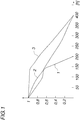
- Wie in
Fig. 1 zu erkennen, zeigen Elektrobänder mit den heißhärtenden bzw. heißhärtbaren Backlackschichten 1, 2 bzw. 3, die als Coil gelagert und anschließend zu einem Blechpaket unter Verbacken der Backlackschichten 1, 2 bzw. 3 weiterverarbeitet worden sind. Im Vergleich zum Elektroband mit der Backlackschicht 1 konnte bei den Elektrobändern mit den Backlackschichten 2 und 3 eine deutlich höhere Schälfestigkeit bei einer thermischen Alterung nach 200 Betriebsstunden unter 200 Grad Celsius festgestellt werden, was am normalisierten Verlauf der Schälfestigkeit inFig. 1 erkannt werden kann. - Zudem zeigten Coils aus den Elektrobändern mit den heißhärtenden und damit noch aushärtbaren Backlackschichten 2 und 3 vom aufgehaspelten Zustand bis zur Weiterverarbeitung zu Blechpaketen eine hohe Formstabilität. Diese Formstabilität ist außerdem deutlich höher als jene vom Coil aus dem Elektroband mit der heißhärtenden und damit noch aushärtbaren Backlackschicht 1.
Claims (14)
- Elektroband oder -blech mit wenigstens einer auf einer dessen Flachseiten vorgesehenen, heißhärtenden Schmelzklebelackschicht, nämlich Backlackschicht, die eine Epoxydharzbasis, mindestens einen Härter und wenigstens einen Füllstoff aufweist, dadurch gekennzeichnet, dass der Füllstoff der Backlackschicht ein Metallcarbonat, -sulfat, -sulfid, -silicat oder -phosphat oder eine beliebige Mischung mehrerer dieser aufweist.
- Elektroband oder -blech nach Anspruch 1, dadurch gekennzeichnet, dass die heißhärtende Backlackschicht 5 bis 25 Vol.-% oder 5 bis 20 Vol.-% oder 7 bis 16 Vol.-%, Füllstoff aufweist.
- Elektroband oder -blech nach Anspruch 2, dadurch gekennzeichnet, dass die heißhärtende Backlackschicht6 bis 10 Vol.-% Härter und74 bis 85 Vol.-% Epoxydharz als Basisaufweist.
- Elektroband oder -blech nach Anspruch 1, 2 oder 3, dadurch gekennzeichnet, dass das Metallcarbonat Calciumcarbonat (CaCO3) ist.
- Elektroband oder -blech nach Anspruch 1, 2 oder 3, dadurch gekennzeichnet, dass das Metallsulfat Bariumsulfat (BaSO4) ist.
- Elektroband oder -blech nach Anspruch 1, 2 oder 3, dadurch gekennzeichnet, dass
das Metallsulfid Zinksulfid (ZnS),
das Metallsilicat Magnesiumsilicat (MgO3Si) oder Aluminiumsilicat,
das Metallphosphat Zinkphosphat Zn3(PO4)2 oder
die Mischung Lithopone ist. - Elektroband oder -blech nach einem der Ansprüche 1 bis 6, dadurch gekennzeichnet, dass der Härter eine Dicyandiamidbasis aufweist.
- Elektroband oder -blech nach einem der Ansprüche 1 bis 7, dadurch gekennzeichnet, dass die Backlackschicht mindestens zwei Härter mit unterschiedlichen Reaktivitäten mit der Epoxidharzbasis aufweist.
- Elektroband oder -blech nach einem der Ansprüche 1 bis 8, dadurch gekennzeichnet, dass die Epoxidharzbasis Bisphenol-A ist.
- Elektroband oder -blech nach einem der Ansprüche 1 bis 9, dadurch gekennzeichnet, dass das Elektroband oder -blech auf dessen beiden Flachseiten die heißhärtende Backlackschicht aufweist.
- Coil mit einem aufgewickelten Elektroband oder -blech nach einem der Ansprüche 1 bis 10.
- Verwendung von Metallcarbonat, -sulfat, -sulfid, -silicat oder -phosphat oder eine beliebige Mischung mehrerer dieser als Füllstoff bei einem heißhärtenden Schmelzklebelack, nämlich Backlack, mit einer Epoxydharzbasis und mit einem Härter zur Erhöhung der Formstabilität eines Coils aus einem aufgewickelten Elektroband oder -blech, das auf mindestens einer dessen Flachseiten mit dem Backlack beschichtet ist.
- Verwendung von Metallcarbonat, -sulfat, -sulfid, -silicat oder -phosphat oder eine beliebige Mischung mehrerer dieser als Füllstoff bei einem heißhärtenden Schmelzklebelack, nämlich Backlack, mit einer Epoxydharzbasis und mit einem Härter zur Erhöhung der Dauertemperaturbeständigkeit eines aus Elektroband oder - blech hergestellten Blechpakets, wobei das Elektroband oder -blech auf mindestens einer dessen Flachseiten mit dem Backlack beschichtet ist.
- Verwendung nach Anspruch 12 oder 13, dadurch gekennzeichnet, dass 5 bis 25 Vol.-% oder 5 bis 20 Vol.-% oder 7 bis 16 Vol.-% Metallcarbonat, -sulfat, -sulfid, -silicat oder -phosphat oder eine beliebige Mischung mehrerer dieser verwendet wird.
Priority Applications (1)
| Application Number | Priority Date | Filing Date | Title |
|---|---|---|---|
| SI201630519T SI3274412T1 (sl) | 2015-03-24 | 2016-03-24 | Tuljava in elektrotrak ali elektropločevina |
Applications Claiming Priority (2)
| Application Number | Priority Date | Filing Date | Title |
|---|---|---|---|
| EP15160680.3A EP3072936A1 (de) | 2015-03-24 | 2015-03-24 | Coil und Elektroband oder -blech |
| PCT/EP2016/056687 WO2016151129A1 (de) | 2015-03-24 | 2016-03-24 | Coil und elektroband oder -blech |
Publications (2)
| Publication Number | Publication Date |
|---|---|
| EP3274412A1 EP3274412A1 (de) | 2018-01-31 |
| EP3274412B1 true EP3274412B1 (de) | 2019-08-21 |
Family
ID=52736898
Family Applications (2)
| Application Number | Title | Priority Date | Filing Date |
|---|---|---|---|
| EP15160680.3A Withdrawn EP3072936A1 (de) | 2015-03-24 | 2015-03-24 | Coil und Elektroband oder -blech |
| EP16716496.1A Active EP3274412B1 (de) | 2015-03-24 | 2016-03-24 | Coil und elektroband oder -blech |
Family Applications Before (1)
| Application Number | Title | Priority Date | Filing Date |
|---|---|---|---|
| EP15160680.3A Withdrawn EP3072936A1 (de) | 2015-03-24 | 2015-03-24 | Coil und Elektroband oder -blech |
Country Status (9)
| Country | Link |
|---|---|
| US (1) | US11107628B2 (de) |
| EP (2) | EP3072936A1 (de) |
| JP (1) | JP6971849B2 (de) |
| KR (1) | KR102217714B1 (de) |
| CN (1) | CN107532036B (de) |
| MX (1) | MX380895B (de) |
| RU (1) | RU2728339C2 (de) |
| SI (1) | SI3274412T1 (de) |
| WO (1) | WO2016151129A1 (de) |
Families Citing this family (15)
| Publication number | Priority date | Publication date | Assignee | Title |
|---|---|---|---|---|
| WO2018117670A2 (ko) | 2016-12-23 | 2018-06-28 | 주식회사 포스코 | 전기강판 접착 코팅 조성물, 전기강판 제품, 및 이의 제조 방법 |
| EP3569405A1 (de) * | 2018-05-18 | 2019-11-20 | voestalpine Stahl GmbH | Elektroband oder -blech, verfahren zur herstellung solch eines elektrobands oder -blechs sowie blechpaket daraus |
| DE102018122047A1 (de) * | 2018-09-10 | 2020-03-12 | voestalpine Automotive Components Dettingen GmbH & Co. KG | Verfahren und vorrichtung zum verbinden von blechteilen zu blechpaketen |
| EP3822078A1 (de) | 2019-11-15 | 2021-05-19 | voestalpine Stahl GmbH | Elektroband oder -blech, verfahren zur herstellung solch eines elektrobands oder -blechs sowie blechpaket daraus |
| DE102019134136B3 (de) * | 2019-12-12 | 2021-04-29 | Voestalpine Stahl Gmbh | Verfahren zur herstellung von beschichteten elektrobändern und beschichtetes elektroband |
| CN120718514A (zh) * | 2020-06-17 | 2025-09-30 | 日本制铁株式会社 | 电磁钢板用涂布组合物、接合用表面被覆电磁钢板及层叠铁芯 |
| US12371599B2 (en) | 2020-06-17 | 2025-07-29 | Nippon Steel Corporation | Coating composition for electrical steel sheet, adhesive surface-coated electrical steel sheet and laminated core |
| DE102020208689A1 (de) | 2020-07-10 | 2022-01-13 | Elringklinger Ag | Verbindungsmaterial, Blechstapel, Maschinenbauteil und Elektromotor |
| TWI919456B (zh) | 2023-09-26 | 2026-03-21 | 日商日本製鐵股份有限公司 | 附接著被膜之電磁鋼板及積層鐵芯、以及其等之製造方法 |
| CN121925492A (zh) | 2023-09-26 | 2026-04-24 | 日本制铁株式会社 | 带有粘接覆膜的电磁钢板、层叠铁芯以及它们的制造方法 |
| JPWO2025070594A1 (de) | 2023-09-26 | 2025-04-03 | ||
| JPWO2025070622A1 (de) | 2023-09-26 | 2025-04-03 | ||
| KR20260053576A (ko) | 2023-09-26 | 2026-04-21 | 닛폰세이테츠 가부시키가이샤 | 접착 피막 구비 전자 강판 및 적층 코어, 그리고 그들의 제조 방법 |
| CN121909302A (zh) | 2023-09-26 | 2026-04-21 | 日本制铁株式会社 | 带有粘接覆膜的电磁钢板、层叠铁芯以及它们的制造方法 |
| DE102025111816A1 (de) * | 2024-12-02 | 2026-06-03 | HELLA GmbH & Co. KGaA | Elektrische Flüssigkeitspumpe und Verfahren zum Herstellen eines Gehäuses der elektrischen Flüssigkeitspumpe |
Family Cites Families (26)
| Publication number | Priority date | Publication date | Assignee | Title |
|---|---|---|---|---|
| EP0008811B1 (de) | 1978-06-21 | 1981-09-23 | Schweizerische Isola-Werke | Thermohärtbarer Schmelzklebelack, dessen Herstellung und dessen Verwendung |
| JPS62227093A (ja) * | 1986-03-28 | 1987-10-06 | Sumitomo Metal Ind Ltd | 打抜性および絶縁抵抗性に優れた電磁鋼板 |
| FR2737338B1 (fr) * | 1995-07-26 | 1997-08-22 | Ugine Sa | Tole d'acier electrique revetue utilisee dans la fabrication de circuits magnetiques |
| JP2003026989A (ja) * | 2001-07-12 | 2003-01-29 | Kansai Paint Co Ltd | 熱硬化型粉体塗料組成物 |
| JP4112866B2 (ja) * | 2002-01-16 | 2008-07-02 | 新日本製鐵株式会社 | 被膜性能の優れる無方向性電磁鋼板 |
| US20050189067A1 (en) * | 2004-02-27 | 2005-09-01 | Michael Wimmer | Process for the production of electrical steel sheet cores |
| CN100506929C (zh) * | 2004-04-28 | 2009-07-01 | 宝山钢铁股份有限公司 | 电工钢用水性自粘接涂料 |
| CA2578530C (en) * | 2004-10-27 | 2014-04-22 | E. I. Dupont De Nemours And Company | Self-bonding coating composition |
| RU2277567C1 (ru) * | 2005-03-15 | 2006-06-10 | Государственное образовательное учреждение высшего профессионального образования Волгоградский государственный технический университет (ВолгГТУ) | Полимерная композиция |
| WO2007137829A1 (de) * | 2006-05-31 | 2007-12-06 | Huntsman Advanced Materials (Switzerland) Gmbh | Metall-kunststoff-hybrid-strukturbauteile |
| DE102007021602A1 (de) * | 2007-05-08 | 2008-11-20 | Voestalpine Stahl Gmbh | Korrosionsschutzsystem für Metalle und Pigment hierfür |
| DE502007002766D1 (de) * | 2007-11-14 | 2010-03-18 | Sika Technology Ag | Hitzehärtende Epoxidharzzusammensetzung enthaltend nichtaromatische Harnstoffe als Beschleuniger |
| RU2464290C2 (ru) * | 2007-12-18 | 2012-10-20 | Е.И. Дюпон Де Немур Энд Компани | Способ покрытия электротехнической стали |
| KR101025008B1 (ko) * | 2007-12-26 | 2011-03-25 | 주식회사 포스코 | 무방향성 전기강판의 절연피막 형성방법 및 무방향성 전기강판 |
| RU2458183C1 (ru) * | 2008-11-27 | 2012-08-10 | Ниппон Стил Корпорейшн | Лист электротехнической стали и способ его изготовления |
| US20120088096A1 (en) * | 2009-06-17 | 2012-04-12 | Kazutoshi Takeda | Electromagnetic steel sheet having insulating coating and method of manufacturing the same |
| CN102086336A (zh) * | 2009-12-07 | 2011-06-08 | 天津市新宇彩板有限公司 | 卷材用铁红环氧氨基底漆 |
| CN101824263B (zh) * | 2010-04-09 | 2015-06-24 | 常熟华冶薄板有限公司 | 变色龙涂料及其在彩色涂覆层钢板的使用方法和彩色涂覆层钢板 |
| JP5589639B2 (ja) * | 2010-07-22 | 2014-09-17 | Jfeスチール株式会社 | 半有機絶縁被膜付き電磁鋼板 |
| CN102134433A (zh) * | 2011-03-02 | 2011-07-27 | 天津通远涂料化工有限公司 | 环保水性环氧防腐烤漆 |
| KR101324260B1 (ko) * | 2011-12-28 | 2013-11-01 | 주식회사 포스코 | 무방향성 전기강판의 절연 피막 조성물, 그 제조방법 및 절연 피막조성물이 적용된 무방향성 전기강판 |
| JP6010392B2 (ja) * | 2012-02-29 | 2016-10-19 | Jfeスチール株式会社 | 絶縁被膜付き電磁鋼板およびその製造方法、ならびに絶縁被膜形成用被覆剤 |
| CN104755535B (zh) * | 2012-06-29 | 2017-03-08 | 陶氏环球技术有限公司 | 环氧树脂掺混物分散体及该分散体的制备方法 |
| JP6134497B2 (ja) * | 2012-11-08 | 2017-05-24 | 京セラ株式会社 | 積層コアの製造方法 |
| AT512931B1 (de) * | 2012-12-11 | 2013-12-15 | Voestalpine Stahl Gmbh | Blechpaket und Verfahren zum Verbinden von Blechteilen zu einem Blechpaket |
| JP6483816B2 (ja) * | 2014-09-26 | 2019-03-13 | ビーエーエスエフ コーティングス ゲゼルシャフト ミット ベシュレンクテル ハフツングBASF Coatings GmbH | 2,2−ジメチル−1,3−ジオキソラン−4−メタノールブロック化ポリイソシアネートに基づく架橋剤を含む、陰極電着材料用の水性バインダー分散液 |
-
2015
- 2015-03-24 EP EP15160680.3A patent/EP3072936A1/de not_active Withdrawn
-
2016
- 2016-03-24 US US15/561,284 patent/US11107628B2/en active Active
- 2016-03-24 KR KR1020177030325A patent/KR102217714B1/ko active Active
- 2016-03-24 JP JP2017546997A patent/JP6971849B2/ja active Active
- 2016-03-24 RU RU2017134116A patent/RU2728339C2/ru active
- 2016-03-24 WO PCT/EP2016/056687 patent/WO2016151129A1/de not_active Ceased
- 2016-03-24 MX MX2017012058A patent/MX380895B/es unknown
- 2016-03-24 EP EP16716496.1A patent/EP3274412B1/de active Active
- 2016-03-24 SI SI201630519T patent/SI3274412T1/sl unknown
- 2016-03-24 CN CN201680018117.XA patent/CN107532036B/zh active Active
Non-Patent Citations (1)
| Title |
|---|
| None * |
Also Published As
| Publication number | Publication date |
|---|---|
| KR20170132219A (ko) | 2017-12-01 |
| KR102217714B1 (ko) | 2021-02-22 |
| CN107532036B (zh) | 2021-06-22 |
| RU2017134116A3 (de) | 2019-07-17 |
| JP6971849B2 (ja) | 2021-11-24 |
| JP2018518591A (ja) | 2018-07-12 |
| EP3274412A1 (de) | 2018-01-31 |
| EP3072936A1 (de) | 2016-09-28 |
| CN107532036A (zh) | 2018-01-02 |
| RU2017134116A (ru) | 2019-04-03 |
| US20180122573A1 (en) | 2018-05-03 |
| MX380895B (es) | 2025-03-12 |
| WO2016151129A1 (de) | 2016-09-29 |
| SI3274412T1 (sl) | 2020-03-31 |
| RU2728339C2 (ru) | 2020-07-29 |
| MX2017012058A (es) | 2018-02-19 |
| US11107628B2 (en) | 2021-08-31 |
Similar Documents
| Publication | Publication Date | Title |
|---|---|---|
| EP3072936A1 (de) | Coil und Elektroband oder -blech | |
| DE112009004598B4 (de) | Verfahren zum stoffschlüssigen fügen von paketlamellen zu einem weichmagnetischen blechpaket | |
| DE69026219T2 (de) | Epoxyharz imprägnierte Glasmatte mit einer Kleberschicht | |
| DE102010001722B3 (de) | Lackzusammensetzung, deren Verwendung und Verfahren zur Herstellung von Magnetsystemen | |
| DE102006012839B4 (de) | Lackzusammensetzung und deren Verwendung | |
| EP0542160B1 (de) | Heisssiegelbeschichtung auf Dispersionsbasis | |
| EP4183028A1 (de) | Pulverlack-formulierung für ein isolationssystem einer elektrischen maschine, elektrische maschine mit einem solchen isolationssystem und verfahren zum herstellen eines solchen isolationssystems | |
| EP0101864B1 (de) | Ungesättigte, homo- und/oder copolymerisierbare Polyester, Verfahren zu ihrer Herstellung und ihre Verwendung | |
| DE2602977A1 (de) | Anstrichmittel und ihre verwendung | |
| DE60028166T2 (de) | Harzbeschichtete Metallfolie | |
| EP0528874B1 (de) | Heisssiegelbeschichtung auf dispersionsbasis | |
| EP1042757B1 (de) | Verfahren zur herstellung von imprägnierbaren feinglimmerbändern mit eingebautem beschleuniger | |
| DE69312073T2 (de) | Herstellungsverfahren einer vielschicht-leiterplatte | |
| DE19538468B4 (de) | Verfahren zur flächigen Verklebung von Werkstücken, geklebter Verbund und Verwendung davon | |
| DE602005000119T2 (de) | Verfahren zur Herstellung eines Kernes aus elektrisch leitfähigem Stahlblech | |
| EP1917316B1 (de) | Überzugsmasse | |
| DE102017125177A1 (de) | Elektrisches Bauteil mit Isolationsschicht und Verfahren zu dessen Herstellung | |
| EP4058288A1 (de) | Elektroband oder -blech, verfahren zur herstellung solch eines elektrobands oder -blechs sowie blechpaket daraus | |
| EP0508051B1 (de) | Beschichtungsmittel | |
| EP4277943B1 (de) | Zusammensetzung | |
| DE19757762B4 (de) | Verfahren zur Herstellung von Bindemittelsystemen und Verwendung | |
| DE2363259C3 (de) | Klebemasse auf der Basis von Polyesterharz, einer Isocyanatverbindung und Epoxyharz und Verwendung derselben | |
| EP0643103A1 (de) | Härtbare Bindemittel | |
| DE2205039A1 (de) | Klebstoff | |
| DE1218051B (de) | Isolierung der Bleche fuer die Blechpakete elektrischer Maschinen, vorzugsweise fuerTransformatoren, die mit hohen Druecken verarbeitet werden |
Legal Events
| Date | Code | Title | Description |
|---|---|---|---|
| STAA | Information on the status of an ep patent application or granted ep patent |
Free format text: STATUS: THE INTERNATIONAL PUBLICATION HAS BEEN MADE |
|
| PUAI | Public reference made under article 153(3) epc to a published international application that has entered the european phase |
Free format text: ORIGINAL CODE: 0009012 |
|
| STAA | Information on the status of an ep patent application or granted ep patent |
Free format text: STATUS: REQUEST FOR EXAMINATION WAS MADE |
|
| 17P | Request for examination filed |
Effective date: 20171024 |
|
| AK | Designated contracting states |
Kind code of ref document: A1 Designated state(s): AL AT BE BG CH CY CZ DE DK EE ES FI FR GB GR HR HU IE IS IT LI LT LU LV MC MK MT NL NO PL PT RO RS SE SI SK SM TR |
|
| AX | Request for extension of the european patent |
Extension state: BA ME |
|
| DAV | Request for validation of the european patent (deleted) | ||
| DAX | Request for extension of the european patent (deleted) | ||
| STAA | Information on the status of an ep patent application or granted ep patent |
Free format text: STATUS: EXAMINATION IS IN PROGRESS |
|
| 17Q | First examination report despatched |
Effective date: 20190117 |
|
| GRAP | Despatch of communication of intention to grant a patent |
Free format text: ORIGINAL CODE: EPIDOSNIGR1 |
|
| STAA | Information on the status of an ep patent application or granted ep patent |
Free format text: STATUS: GRANT OF PATENT IS INTENDED |
|
| INTG | Intention to grant announced |
Effective date: 20190408 |
|
| GRAS | Grant fee paid |
Free format text: ORIGINAL CODE: EPIDOSNIGR3 |
|
| GRAA | (expected) grant |
Free format text: ORIGINAL CODE: 0009210 |
|
| STAA | Information on the status of an ep patent application or granted ep patent |
Free format text: STATUS: THE PATENT HAS BEEN GRANTED |
|
| AK | Designated contracting states |
Kind code of ref document: B1 Designated state(s): AL AT BE BG CH CY CZ DE DK EE ES FI FR GB GR HR HU IE IS IT LI LT LU LV MC MK MT NL NO PL PT RO RS SE SI SK SM TR |
|
| REG | Reference to a national code |
Ref country code: GB Ref legal event code: FG4D Free format text: NOT ENGLISH |
|
| REG | Reference to a national code |
Ref country code: CH Ref legal event code: EP |
|
| REG | Reference to a national code |
Ref country code: DE Ref legal event code: R096 Ref document number: 502016006193 Country of ref document: DE |
|
| REG | Reference to a national code |
Ref country code: AT Ref legal event code: REF Ref document number: 1169738 Country of ref document: AT Kind code of ref document: T Effective date: 20190915 |
|
| REG | Reference to a national code |
Ref country code: IE Ref legal event code: FG4D Free format text: LANGUAGE OF EP DOCUMENT: GERMAN |
|
| REG | Reference to a national code |
Ref country code: SE Ref legal event code: TRGR |
|
| REG | Reference to a national code |
Ref country code: NL Ref legal event code: FP |
|
| REG | Reference to a national code |
Ref country code: LT Ref legal event code: MG4D |
|
| PG25 | Lapsed in a contracting state [announced via postgrant information from national office to epo] |
Ref country code: HR Free format text: LAPSE BECAUSE OF FAILURE TO SUBMIT A TRANSLATION OF THE DESCRIPTION OR TO PAY THE FEE WITHIN THE PRESCRIBED TIME-LIMIT Effective date: 20190821 Ref country code: NO Free format text: LAPSE BECAUSE OF FAILURE TO SUBMIT A TRANSLATION OF THE DESCRIPTION OR TO PAY THE FEE WITHIN THE PRESCRIBED TIME-LIMIT Effective date: 20191121 Ref country code: PT Free format text: LAPSE BECAUSE OF FAILURE TO SUBMIT A TRANSLATION OF THE DESCRIPTION OR TO PAY THE FEE WITHIN THE PRESCRIBED TIME-LIMIT Effective date: 20191223 Ref country code: BG Free format text: LAPSE BECAUSE OF FAILURE TO SUBMIT A TRANSLATION OF THE DESCRIPTION OR TO PAY THE FEE WITHIN THE PRESCRIBED TIME-LIMIT Effective date: 20191121 Ref country code: LT Free format text: LAPSE BECAUSE OF FAILURE TO SUBMIT A TRANSLATION OF THE DESCRIPTION OR TO PAY THE FEE WITHIN THE PRESCRIBED TIME-LIMIT Effective date: 20190821 |
|
| PG25 | Lapsed in a contracting state [announced via postgrant information from national office to epo] |
Ref country code: IS Free format text: LAPSE BECAUSE OF FAILURE TO SUBMIT A TRANSLATION OF THE DESCRIPTION OR TO PAY THE FEE WITHIN THE PRESCRIBED TIME-LIMIT Effective date: 20191221 Ref country code: RS Free format text: LAPSE BECAUSE OF FAILURE TO SUBMIT A TRANSLATION OF THE DESCRIPTION OR TO PAY THE FEE WITHIN THE PRESCRIBED TIME-LIMIT Effective date: 20190821 Ref country code: AL Free format text: LAPSE BECAUSE OF FAILURE TO SUBMIT A TRANSLATION OF THE DESCRIPTION OR TO PAY THE FEE WITHIN THE PRESCRIBED TIME-LIMIT Effective date: 20190821 Ref country code: LV Free format text: LAPSE BECAUSE OF FAILURE TO SUBMIT A TRANSLATION OF THE DESCRIPTION OR TO PAY THE FEE WITHIN THE PRESCRIBED TIME-LIMIT Effective date: 20190821 Ref country code: ES Free format text: LAPSE BECAUSE OF FAILURE TO SUBMIT A TRANSLATION OF THE DESCRIPTION OR TO PAY THE FEE WITHIN THE PRESCRIBED TIME-LIMIT Effective date: 20190821 Ref country code: GR Free format text: LAPSE BECAUSE OF FAILURE TO SUBMIT A TRANSLATION OF THE DESCRIPTION OR TO PAY THE FEE WITHIN THE PRESCRIBED TIME-LIMIT Effective date: 20191122 |
|
| PG25 | Lapsed in a contracting state [announced via postgrant information from national office to epo] |
Ref country code: TR Free format text: LAPSE BECAUSE OF FAILURE TO SUBMIT A TRANSLATION OF THE DESCRIPTION OR TO PAY THE FEE WITHIN THE PRESCRIBED TIME-LIMIT Effective date: 20190821 |
|
| PG25 | Lapsed in a contracting state [announced via postgrant information from national office to epo] |
Ref country code: DK Free format text: LAPSE BECAUSE OF FAILURE TO SUBMIT A TRANSLATION OF THE DESCRIPTION OR TO PAY THE FEE WITHIN THE PRESCRIBED TIME-LIMIT Effective date: 20190821 Ref country code: PL Free format text: LAPSE BECAUSE OF FAILURE TO SUBMIT A TRANSLATION OF THE DESCRIPTION OR TO PAY THE FEE WITHIN THE PRESCRIBED TIME-LIMIT Effective date: 20190821 Ref country code: RO Free format text: LAPSE BECAUSE OF FAILURE TO SUBMIT A TRANSLATION OF THE DESCRIPTION OR TO PAY THE FEE WITHIN THE PRESCRIBED TIME-LIMIT Effective date: 20190821 Ref country code: EE Free format text: LAPSE BECAUSE OF FAILURE TO SUBMIT A TRANSLATION OF THE DESCRIPTION OR TO PAY THE FEE WITHIN THE PRESCRIBED TIME-LIMIT Effective date: 20190821 |
|
| PG25 | Lapsed in a contracting state [announced via postgrant information from national office to epo] |
Ref country code: SM Free format text: LAPSE BECAUSE OF FAILURE TO SUBMIT A TRANSLATION OF THE DESCRIPTION OR TO PAY THE FEE WITHIN THE PRESCRIBED TIME-LIMIT Effective date: 20190821 Ref country code: CZ Free format text: LAPSE BECAUSE OF FAILURE TO SUBMIT A TRANSLATION OF THE DESCRIPTION OR TO PAY THE FEE WITHIN THE PRESCRIBED TIME-LIMIT Effective date: 20190821 Ref country code: IS Free format text: LAPSE BECAUSE OF FAILURE TO SUBMIT A TRANSLATION OF THE DESCRIPTION OR TO PAY THE FEE WITHIN THE PRESCRIBED TIME-LIMIT Effective date: 20200224 Ref country code: SK Free format text: LAPSE BECAUSE OF FAILURE TO SUBMIT A TRANSLATION OF THE DESCRIPTION OR TO PAY THE FEE WITHIN THE PRESCRIBED TIME-LIMIT Effective date: 20190821 |
|
| REG | Reference to a national code |
Ref country code: DE Ref legal event code: R097 Ref document number: 502016006193 Country of ref document: DE |
|
| PLBE | No opposition filed within time limit |
Free format text: ORIGINAL CODE: 0009261 |
|
| STAA | Information on the status of an ep patent application or granted ep patent |
Free format text: STATUS: NO OPPOSITION FILED WITHIN TIME LIMIT |
|
| PG2D | Information on lapse in contracting state deleted |
Ref country code: IS |
|
| 26N | No opposition filed |
Effective date: 20200603 |
|
| PG25 | Lapsed in a contracting state [announced via postgrant information from national office to epo] |
Ref country code: MC Free format text: LAPSE BECAUSE OF FAILURE TO SUBMIT A TRANSLATION OF THE DESCRIPTION OR TO PAY THE FEE WITHIN THE PRESCRIBED TIME-LIMIT Effective date: 20190821 |
|
| REG | Reference to a national code |
Ref country code: CH Ref legal event code: PL |
|
| REG | Reference to a national code |
Ref country code: BE Ref legal event code: MM Effective date: 20200331 |
|
| PG25 | Lapsed in a contracting state [announced via postgrant information from national office to epo] |
Ref country code: LU Free format text: LAPSE BECAUSE OF NON-PAYMENT OF DUE FEES Effective date: 20200324 |
|
| PG25 | Lapsed in a contracting state [announced via postgrant information from national office to epo] |
Ref country code: IE Free format text: LAPSE BECAUSE OF NON-PAYMENT OF DUE FEES Effective date: 20200324 Ref country code: LI Free format text: LAPSE BECAUSE OF NON-PAYMENT OF DUE FEES Effective date: 20200331 Ref country code: CH Free format text: LAPSE BECAUSE OF NON-PAYMENT OF DUE FEES Effective date: 20200331 |
|
| PG25 | Lapsed in a contracting state [announced via postgrant information from national office to epo] |
Ref country code: BE Free format text: LAPSE BECAUSE OF NON-PAYMENT OF DUE FEES Effective date: 20200331 |
|
| REG | Reference to a national code |
Ref country code: AT Ref legal event code: MM01 Ref document number: 1169738 Country of ref document: AT Kind code of ref document: T Effective date: 20210324 |
|
| PG25 | Lapsed in a contracting state [announced via postgrant information from national office to epo] |
Ref country code: MT Free format text: LAPSE BECAUSE OF FAILURE TO SUBMIT A TRANSLATION OF THE DESCRIPTION OR TO PAY THE FEE WITHIN THE PRESCRIBED TIME-LIMIT Effective date: 20190821 Ref country code: CY Free format text: LAPSE BECAUSE OF FAILURE TO SUBMIT A TRANSLATION OF THE DESCRIPTION OR TO PAY THE FEE WITHIN THE PRESCRIBED TIME-LIMIT Effective date: 20190821 |
|
| PG25 | Lapsed in a contracting state [announced via postgrant information from national office to epo] |
Ref country code: MK Free format text: LAPSE BECAUSE OF FAILURE TO SUBMIT A TRANSLATION OF THE DESCRIPTION OR TO PAY THE FEE WITHIN THE PRESCRIBED TIME-LIMIT Effective date: 20190821 |
|
| PG25 | Lapsed in a contracting state [announced via postgrant information from national office to epo] |
Ref country code: AT Free format text: LAPSE BECAUSE OF NON-PAYMENT OF DUE FEES Effective date: 20210324 |
|
| P01 | Opt-out of the competence of the unified patent court (upc) registered |
Effective date: 20230515 |
|
| PGFP | Annual fee paid to national office [announced via postgrant information from national office to epo] |
Ref country code: SE Payment date: 20260327 Year of fee payment: 11 |
|
| PGFP | Annual fee paid to national office [announced via postgrant information from national office to epo] |
Ref country code: GB Payment date: 20260327 Year of fee payment: 11 |
|
| PGFP | Annual fee paid to national office [announced via postgrant information from national office to epo] |
Ref country code: DE Payment date: 20260327 Year of fee payment: 11 |
|
| PGFP | Annual fee paid to national office [announced via postgrant information from national office to epo] |
Ref country code: FI Payment date: 20260325 Year of fee payment: 11 Ref country code: IT Payment date: 20260319 Year of fee payment: 11 |
|
| PGFP | Annual fee paid to national office [announced via postgrant information from national office to epo] |
Ref country code: NL Payment date: 20260326 Year of fee payment: 11 |
|
| PGFP | Annual fee paid to national office [announced via postgrant information from national office to epo] |
Ref country code: FR Payment date: 20260325 Year of fee payment: 11 |
|
| PGFP | Annual fee paid to national office [announced via postgrant information from national office to epo] |
Ref country code: SI Payment date: 20260302 Year of fee payment: 11 |