EP3270032A1 - Vacuum insulated panel, core material, and refrigerator - Google Patents
Vacuum insulated panel, core material, and refrigerator Download PDFInfo
- Publication number
- EP3270032A1 EP3270032A1 EP16761749.7A EP16761749A EP3270032A1 EP 3270032 A1 EP3270032 A1 EP 3270032A1 EP 16761749 A EP16761749 A EP 16761749A EP 3270032 A1 EP3270032 A1 EP 3270032A1
- Authority
- EP
- European Patent Office
- Prior art keywords
- core material
- vacuum insulation
- insulation panel
- low
- addition
- Prior art date
- Legal status (The legal status is an assumption and is not a legal conclusion. Google has not performed a legal analysis and makes no representation as to the accuracy of the status listed.)
- Withdrawn
Links
- 239000011162 core material Substances 0.000 title claims abstract description 71
- 239000000835 fiber Substances 0.000 claims abstract description 68
- 229920005989 resin Polymers 0.000 claims abstract description 63
- 239000011347 resin Substances 0.000 claims abstract description 63
- 238000009413 insulation Methods 0.000 claims description 91
- 239000003463 adsorbent Substances 0.000 claims description 60
- 238000001179 sorption measurement Methods 0.000 claims description 8
- 239000000463 material Substances 0.000 abstract description 4
- 239000000178 monomer Substances 0.000 abstract 1
- 239000004745 nonwoven fabric Substances 0.000 description 33
- 239000003365 glass fiber Substances 0.000 description 12
- 239000005022 packaging material Substances 0.000 description 12
- 238000000034 method Methods 0.000 description 11
- 230000007423 decrease Effects 0.000 description 9
- 230000005855 radiation Effects 0.000 description 8
- 239000002904 solvent Substances 0.000 description 7
- 230000009467 reduction Effects 0.000 description 6
- 238000009987 spinning Methods 0.000 description 6
- 238000001523 electrospinning Methods 0.000 description 5
- -1 polypropylene Polymers 0.000 description 5
- XLYOFNOQVPJJNP-UHFFFAOYSA-N water Chemical compound O XLYOFNOQVPJJNP-UHFFFAOYSA-N 0.000 description 5
- 230000009471 action Effects 0.000 description 4
- 230000015572 biosynthetic process Effects 0.000 description 4
- 238000002074 melt spinning Methods 0.000 description 4
- 229920000642 polymer Polymers 0.000 description 4
- 239000002994 raw material Substances 0.000 description 4
- ZWEHNKRNPOVVGH-UHFFFAOYSA-N 2-Butanone Chemical compound CCC(C)=O ZWEHNKRNPOVVGH-UHFFFAOYSA-N 0.000 description 3
- CSCPPACGZOOCGX-UHFFFAOYSA-N Acetone Chemical compound CC(C)=O CSCPPACGZOOCGX-UHFFFAOYSA-N 0.000 description 3
- XEKOWRVHYACXOJ-UHFFFAOYSA-N Ethyl acetate Chemical compound CCOC(C)=O XEKOWRVHYACXOJ-UHFFFAOYSA-N 0.000 description 3
- LYCAIKOWRPUZTN-UHFFFAOYSA-N Ethylene glycol Chemical compound OCCO LYCAIKOWRPUZTN-UHFFFAOYSA-N 0.000 description 3
- ZMXDDKWLCZADIW-UHFFFAOYSA-N N,N-Dimethylformamide Chemical compound CN(C)C=O ZMXDDKWLCZADIW-UHFFFAOYSA-N 0.000 description 3
- YXFVVABEGXRONW-UHFFFAOYSA-N Toluene Chemical compound CC1=CC=CC=C1 YXFVVABEGXRONW-UHFFFAOYSA-N 0.000 description 3
- 239000011521 glass Substances 0.000 description 3
- 239000011256 inorganic filler Substances 0.000 description 3
- 229910003475 inorganic filler Inorganic materials 0.000 description 3
- VLKZOEOYAKHREP-UHFFFAOYSA-N n-Hexane Chemical compound CCCCCC VLKZOEOYAKHREP-UHFFFAOYSA-N 0.000 description 3
- 238000005057 refrigeration Methods 0.000 description 3
- 230000002441 reversible effect Effects 0.000 description 3
- KFZMGEQAYNKOFK-UHFFFAOYSA-N Isopropanol Chemical compound CC(C)O KFZMGEQAYNKOFK-UHFFFAOYSA-N 0.000 description 2
- CSNNHWWHGAXBCP-UHFFFAOYSA-L Magnesium sulfate Chemical compound [Mg+2].[O-][S+2]([O-])([O-])[O-] CSNNHWWHGAXBCP-UHFFFAOYSA-L 0.000 description 2
- SECXISVLQFMRJM-UHFFFAOYSA-N N-Methylpyrrolidone Chemical compound CN1CCCC1=O SECXISVLQFMRJM-UHFFFAOYSA-N 0.000 description 2
- JUJWROOIHBZHMG-UHFFFAOYSA-N Pyridine Chemical compound C1=CC=NC=C1 JUJWROOIHBZHMG-UHFFFAOYSA-N 0.000 description 2
- WYURNTSHIVDZCO-UHFFFAOYSA-N Tetrahydrofuran Chemical compound C1CCOC1 WYURNTSHIVDZCO-UHFFFAOYSA-N 0.000 description 2
- 229910021536 Zeolite Inorganic materials 0.000 description 2
- 229910052782 aluminium Inorganic materials 0.000 description 2
- XAGFODPZIPBFFR-UHFFFAOYSA-N aluminium Chemical compound [Al] XAGFODPZIPBFFR-UHFFFAOYSA-N 0.000 description 2
- BRPQOXSCLDDYGP-UHFFFAOYSA-N calcium oxide Chemical compound [O-2].[Ca+2] BRPQOXSCLDDYGP-UHFFFAOYSA-N 0.000 description 2
- 239000000292 calcium oxide Substances 0.000 description 2
- ODINCKMPIJJUCX-UHFFFAOYSA-N calcium oxide Inorganic materials [Ca]=O ODINCKMPIJJUCX-UHFFFAOYSA-N 0.000 description 2
- 238000001816 cooling Methods 0.000 description 2
- JHIVVAPYMSGYDF-UHFFFAOYSA-N cyclohexanone Chemical compound O=C1CCCCC1 JHIVVAPYMSGYDF-UHFFFAOYSA-N 0.000 description 2
- 230000003247 decreasing effect Effects 0.000 description 2
- HNPSIPDUKPIQMN-UHFFFAOYSA-N dioxosilane;oxo(oxoalumanyloxy)alumane Chemical compound O=[Si]=O.O=[Al]O[Al]=O HNPSIPDUKPIQMN-UHFFFAOYSA-N 0.000 description 2
- 239000011888 foil Substances 0.000 description 2
- 238000010438 heat treatment Methods 0.000 description 2
- 238000002844 melting Methods 0.000 description 2
- 230000008018 melting Effects 0.000 description 2
- 229910052751 metal Inorganic materials 0.000 description 2
- 239000002184 metal Substances 0.000 description 2
- FDPIMTJIUBPUKL-UHFFFAOYSA-N pentan-3-one Chemical compound CCC(=O)CC FDPIMTJIUBPUKL-UHFFFAOYSA-N 0.000 description 2
- 239000010457 zeolite Substances 0.000 description 2
- RYHBNJHYFVUHQT-UHFFFAOYSA-N 1,4-Dioxane Chemical compound C1COCCO1 RYHBNJHYFVUHQT-UHFFFAOYSA-N 0.000 description 1
- DKPFZGUDAPQIHT-UHFFFAOYSA-N Butyl acetate Natural products CCCCOC(C)=O DKPFZGUDAPQIHT-UHFFFAOYSA-N 0.000 description 1
- 229920000049 Carbon (fiber) Polymers 0.000 description 1
- BVKZGUZCCUSVTD-UHFFFAOYSA-L Carbonate Chemical compound [O-]C([O-])=O BVKZGUZCCUSVTD-UHFFFAOYSA-L 0.000 description 1
- 229920000271 Kevlar® Polymers 0.000 description 1
- 229920000106 Liquid crystal polymer Polymers 0.000 description 1
- 239000004977 Liquid-crystal polymers (LCPs) Substances 0.000 description 1
- 239000004640 Melamine resin Substances 0.000 description 1
- 229920000877 Melamine resin Polymers 0.000 description 1
- FXHOOIRPVKKKFG-UHFFFAOYSA-N N,N-Dimethylacetamide Chemical compound CN(C)C(C)=O FXHOOIRPVKKKFG-UHFFFAOYSA-N 0.000 description 1
- CTQNGGLPUBDAKN-UHFFFAOYSA-N O-Xylene Chemical compound CC1=CC=CC=C1C CTQNGGLPUBDAKN-UHFFFAOYSA-N 0.000 description 1
- BPQQTUXANYXVAA-UHFFFAOYSA-N Orthosilicate Chemical compound [O-][Si]([O-])([O-])[O-] BPQQTUXANYXVAA-UHFFFAOYSA-N 0.000 description 1
- 229930040373 Paraformaldehyde Natural products 0.000 description 1
- 239000004696 Poly ether ether ketone Substances 0.000 description 1
- 239000004952 Polyamide Substances 0.000 description 1
- 239000004962 Polyamide-imide Substances 0.000 description 1
- 239000004695 Polyether sulfone Substances 0.000 description 1
- 239000004697 Polyetherimide Substances 0.000 description 1
- 239000004698 Polyethylene Substances 0.000 description 1
- 239000004642 Polyimide Substances 0.000 description 1
- 239000004734 Polyphenylene sulfide Substances 0.000 description 1
- 239000004743 Polypropylene Substances 0.000 description 1
- 239000004793 Polystyrene Substances 0.000 description 1
- VYPSYNLAJGMNEJ-UHFFFAOYSA-N Silicium dioxide Chemical compound O=[Si]=O VYPSYNLAJGMNEJ-UHFFFAOYSA-N 0.000 description 1
- 229910000831 Steel Inorganic materials 0.000 description 1
- QAOWNCQODCNURD-UHFFFAOYSA-L Sulfate Chemical compound [O-]S([O-])(=O)=O QAOWNCQODCNURD-UHFFFAOYSA-L 0.000 description 1
- 229920010524 Syndiotactic polystyrene Polymers 0.000 description 1
- 229920001807 Urea-formaldehyde Polymers 0.000 description 1
- OJMOMXZKOWKUTA-UHFFFAOYSA-N aluminum;borate Chemical compound [Al+3].[O-]B([O-])[O-] OJMOMXZKOWKUTA-UHFFFAOYSA-N 0.000 description 1
- 239000004760 aramid Substances 0.000 description 1
- 229920006231 aramid fiber Polymers 0.000 description 1
- 229920003235 aromatic polyamide Polymers 0.000 description 1
- UGGQKDBXXFIWJD-UHFFFAOYSA-N calcium;dihydroxy(oxo)silane;hydrate Chemical compound O.[Ca].O[Si](O)=O UGGQKDBXXFIWJD-UHFFFAOYSA-N 0.000 description 1
- 239000004917 carbon fiber Substances 0.000 description 1
- 230000005494 condensation Effects 0.000 description 1
- 238000009833 condensation Methods 0.000 description 1
- 229920001577 copolymer Polymers 0.000 description 1
- 238000000151 deposition Methods 0.000 description 1
- NJLLQSBAHIKGKF-UHFFFAOYSA-N dipotassium dioxido(oxo)titanium Chemical compound [K+].[K+].[O-][Ti]([O-])=O NJLLQSBAHIKGKF-UHFFFAOYSA-N 0.000 description 1
- 239000003822 epoxy resin Substances 0.000 description 1
- 238000005187 foaming Methods 0.000 description 1
- 239000010440 gypsum Substances 0.000 description 1
- 229910052602 gypsum Inorganic materials 0.000 description 1
- FUZZWVXGSFPDMH-UHFFFAOYSA-N hexanoic acid Chemical compound CCCCCC(O)=O FUZZWVXGSFPDMH-UHFFFAOYSA-N 0.000 description 1
- XLYOFNOQVPJJNP-UHFFFAOYSA-M hydroxide Chemical compound [OH-] XLYOFNOQVPJJNP-UHFFFAOYSA-M 0.000 description 1
- 230000006872 improvement Effects 0.000 description 1
- 239000012774 insulation material Substances 0.000 description 1
- 230000002427 irreversible effect Effects 0.000 description 1
- 239000004761 kevlar Substances 0.000 description 1
- 229910052943 magnesium sulfate Inorganic materials 0.000 description 1
- 235000019341 magnesium sulphate Nutrition 0.000 description 1
- 229910044991 metal oxide Inorganic materials 0.000 description 1
- 150000004706 metal oxides Chemical class 0.000 description 1
- VNWKTOKETHGBQD-UHFFFAOYSA-N methane Chemical compound C VNWKTOKETHGBQD-UHFFFAOYSA-N 0.000 description 1
- 239000010445 mica Substances 0.000 description 1
- 229910052618 mica group Inorganic materials 0.000 description 1
- 239000000203 mixture Substances 0.000 description 1
- 230000004048 modification Effects 0.000 description 1
- 238000012986 modification Methods 0.000 description 1
- 229920000620 organic polymer Polymers 0.000 description 1
- 239000003960 organic solvent Substances 0.000 description 1
- 238000005192 partition Methods 0.000 description 1
- 230000035699 permeability Effects 0.000 description 1
- 229920003229 poly(methyl methacrylate) Polymers 0.000 description 1
- 229920002492 poly(sulfone) Polymers 0.000 description 1
- 229920002647 polyamide Polymers 0.000 description 1
- 229920002312 polyamide-imide Polymers 0.000 description 1
- 229920001707 polybutylene terephthalate Polymers 0.000 description 1
- 229920000515 polycarbonate Polymers 0.000 description 1
- 239000004417 polycarbonate Substances 0.000 description 1
- 229920000647 polyepoxide Polymers 0.000 description 1
- 229920006393 polyether sulfone Polymers 0.000 description 1
- 229920002530 polyetherether ketone Polymers 0.000 description 1
- 229920001601 polyetherimide Polymers 0.000 description 1
- 229920000573 polyethylene Polymers 0.000 description 1
- 239000005020 polyethylene terephthalate Substances 0.000 description 1
- 229920000139 polyethylene terephthalate Polymers 0.000 description 1
- 229920001721 polyimide Polymers 0.000 description 1
- 239000004926 polymethyl methacrylate Substances 0.000 description 1
- 229920006324 polyoxymethylene Polymers 0.000 description 1
- 150000008442 polyphenolic compounds Chemical class 0.000 description 1
- 235000013824 polyphenols Nutrition 0.000 description 1
- 229920001955 polyphenylene ether Polymers 0.000 description 1
- 229920000069 polyphenylene sulfide Polymers 0.000 description 1
- 229920001155 polypropylene Polymers 0.000 description 1
- 229920002223 polystyrene Polymers 0.000 description 1
- UMJSCPRVCHMLSP-UHFFFAOYSA-N pyridine Natural products COC1=CC=CN=C1 UMJSCPRVCHMLSP-UHFFFAOYSA-N 0.000 description 1
- 239000003507 refrigerant Substances 0.000 description 1
- 229910052814 silicon oxide Inorganic materials 0.000 description 1
- 238000000638 solvent extraction Methods 0.000 description 1
- 239000010959 steel Substances 0.000 description 1
- 239000000126 substance Substances 0.000 description 1
- 238000006467 substitution reaction Methods 0.000 description 1
- 229920003002 synthetic resin Polymers 0.000 description 1
- 239000000057 synthetic resin Substances 0.000 description 1
- 239000000454 talc Substances 0.000 description 1
- 229910052623 talc Inorganic materials 0.000 description 1
- YLQBMQCUIZJEEH-UHFFFAOYSA-N tetrahydrofuran Natural products C=1C=COC=1 YLQBMQCUIZJEEH-UHFFFAOYSA-N 0.000 description 1
- 229920006305 unsaturated polyester Polymers 0.000 description 1
- 239000010456 wollastonite Substances 0.000 description 1
- 229910052882 wollastonite Inorganic materials 0.000 description 1
- 239000008096 xylene Substances 0.000 description 1
Images




Classifications
-
- F—MECHANICAL ENGINEERING; LIGHTING; HEATING; WEAPONS; BLASTING
- F16—ENGINEERING ELEMENTS AND UNITS; GENERAL MEASURES FOR PRODUCING AND MAINTAINING EFFECTIVE FUNCTIONING OF MACHINES OR INSTALLATIONS; THERMAL INSULATION IN GENERAL
- F16L—PIPES; JOINTS OR FITTINGS FOR PIPES; SUPPORTS FOR PIPES, CABLES OR PROTECTIVE TUBING; MEANS FOR THERMAL INSULATION IN GENERAL
- F16L59/00—Thermal insulation in general
- F16L59/06—Arrangements using an air layer or vacuum
- F16L59/065—Arrangements using an air layer or vacuum using vacuum
-
- F—MECHANICAL ENGINEERING; LIGHTING; HEATING; WEAPONS; BLASTING
- F25—REFRIGERATION OR COOLING; COMBINED HEATING AND REFRIGERATION SYSTEMS; HEAT PUMP SYSTEMS; MANUFACTURE OR STORAGE OF ICE; LIQUEFACTION SOLIDIFICATION OF GASES
- F25D—REFRIGERATORS; COLD ROOMS; ICE-BOXES; COOLING OR FREEZING APPARATUS NOT OTHERWISE PROVIDED FOR
- F25D23/00—General constructional features
- F25D23/06—Walls
-
- B—PERFORMING OPERATIONS; TRANSPORTING
- B32—LAYERED PRODUCTS
- B32B—LAYERED PRODUCTS, i.e. PRODUCTS BUILT-UP OF STRATA OF FLAT OR NON-FLAT, e.g. CELLULAR OR HONEYCOMB, FORM
- B32B5/00—Layered products characterised by the non- homogeneity or physical structure, i.e. comprising a fibrous, filamentary, particulate or foam layer; Layered products characterised by having a layer differing constitutionally or physically in different parts
- B32B5/02—Layered products characterised by the non- homogeneity or physical structure, i.e. comprising a fibrous, filamentary, particulate or foam layer; Layered products characterised by having a layer differing constitutionally or physically in different parts characterised by structural features of a fibrous or filamentary layer
- B32B5/022—Non-woven fabric
-
- B—PERFORMING OPERATIONS; TRANSPORTING
- B32—LAYERED PRODUCTS
- B32B—LAYERED PRODUCTS, i.e. PRODUCTS BUILT-UP OF STRATA OF FLAT OR NON-FLAT, e.g. CELLULAR OR HONEYCOMB, FORM
- B32B5/00—Layered products characterised by the non- homogeneity or physical structure, i.e. comprising a fibrous, filamentary, particulate or foam layer; Layered products characterised by having a layer differing constitutionally or physically in different parts
- B32B5/22—Layered products characterised by the non- homogeneity or physical structure, i.e. comprising a fibrous, filamentary, particulate or foam layer; Layered products characterised by having a layer differing constitutionally or physically in different parts characterised by the presence of two or more layers which are next to each other and are fibrous, filamentary, formed of particles or foamed
- B32B5/24—Layered products characterised by the non- homogeneity or physical structure, i.e. comprising a fibrous, filamentary, particulate or foam layer; Layered products characterised by having a layer differing constitutionally or physically in different parts characterised by the presence of two or more layers which are next to each other and are fibrous, filamentary, formed of particles or foamed one layer being a fibrous or filamentary layer
- B32B5/26—Layered products characterised by the non- homogeneity or physical structure, i.e. comprising a fibrous, filamentary, particulate or foam layer; Layered products characterised by having a layer differing constitutionally or physically in different parts characterised by the presence of two or more layers which are next to each other and are fibrous, filamentary, formed of particles or foamed one layer being a fibrous or filamentary layer another layer next to it also being fibrous or filamentary
-
- D—TEXTILES; PAPER
- D04—BRAIDING; LACE-MAKING; KNITTING; TRIMMINGS; NON-WOVEN FABRICS
- D04H—MAKING TEXTILE FABRICS, e.g. FROM FIBRES OR FILAMENTARY MATERIAL; FABRICS MADE BY SUCH PROCESSES OR APPARATUS, e.g. FELTS, NON-WOVEN FABRICS; COTTON-WOOL; WADDING ; NON-WOVEN FABRICS FROM STAPLE FIBRES, FILAMENTS OR YARNS, BONDED WITH AT LEAST ONE WEB-LIKE MATERIAL DURING THEIR CONSOLIDATION
- D04H3/00—Non-woven fabrics formed wholly or mainly of yarns or like filamentary material of substantial length
- D04H3/002—Inorganic yarns or filaments
-
- F—MECHANICAL ENGINEERING; LIGHTING; HEATING; WEAPONS; BLASTING
- F16—ENGINEERING ELEMENTS AND UNITS; GENERAL MEASURES FOR PRODUCING AND MAINTAINING EFFECTIVE FUNCTIONING OF MACHINES OR INSTALLATIONS; THERMAL INSULATION IN GENERAL
- F16L—PIPES; JOINTS OR FITTINGS FOR PIPES; SUPPORTS FOR PIPES, CABLES OR PROTECTIVE TUBING; MEANS FOR THERMAL INSULATION IN GENERAL
- F16L59/00—Thermal insulation in general
- F16L59/02—Shape or form of insulating materials, with or without coverings integral with the insulating materials
-
- F—MECHANICAL ENGINEERING; LIGHTING; HEATING; WEAPONS; BLASTING
- F16—ENGINEERING ELEMENTS AND UNITS; GENERAL MEASURES FOR PRODUCING AND MAINTAINING EFFECTIVE FUNCTIONING OF MACHINES OR INSTALLATIONS; THERMAL INSULATION IN GENERAL
- F16L—PIPES; JOINTS OR FITTINGS FOR PIPES; SUPPORTS FOR PIPES, CABLES OR PROTECTIVE TUBING; MEANS FOR THERMAL INSULATION IN GENERAL
- F16L59/00—Thermal insulation in general
- F16L59/06—Arrangements using an air layer or vacuum
-
- F—MECHANICAL ENGINEERING; LIGHTING; HEATING; WEAPONS; BLASTING
- F25—REFRIGERATION OR COOLING; COMBINED HEATING AND REFRIGERATION SYSTEMS; HEAT PUMP SYSTEMS; MANUFACTURE OR STORAGE OF ICE; LIQUEFACTION SOLIDIFICATION OF GASES
- F25D—REFRIGERATORS; COLD ROOMS; ICE-BOXES; COOLING OR FREEZING APPARATUS NOT OTHERWISE PROVIDED FOR
- F25D23/00—General constructional features
- F25D23/02—Doors; Covers
- F25D23/028—Details
-
- F—MECHANICAL ENGINEERING; LIGHTING; HEATING; WEAPONS; BLASTING
- F25—REFRIGERATION OR COOLING; COMBINED HEATING AND REFRIGERATION SYSTEMS; HEAT PUMP SYSTEMS; MANUFACTURE OR STORAGE OF ICE; LIQUEFACTION SOLIDIFICATION OF GASES
- F25D—REFRIGERATORS; COLD ROOMS; ICE-BOXES; COOLING OR FREEZING APPARATUS NOT OTHERWISE PROVIDED FOR
- F25D23/00—General constructional features
- F25D23/06—Walls
- F25D23/065—Details
-
- F—MECHANICAL ENGINEERING; LIGHTING; HEATING; WEAPONS; BLASTING
- F25—REFRIGERATION OR COOLING; COMBINED HEATING AND REFRIGERATION SYSTEMS; HEAT PUMP SYSTEMS; MANUFACTURE OR STORAGE OF ICE; LIQUEFACTION SOLIDIFICATION OF GASES
- F25D—REFRIGERATORS; COLD ROOMS; ICE-BOXES; COOLING OR FREEZING APPARATUS NOT OTHERWISE PROVIDED FOR
- F25D23/00—General constructional features
- F25D23/06—Walls
- F25D23/065—Details
- F25D23/066—Liners
-
- B—PERFORMING OPERATIONS; TRANSPORTING
- B32—LAYERED PRODUCTS
- B32B—LAYERED PRODUCTS, i.e. PRODUCTS BUILT-UP OF STRATA OF FLAT OR NON-FLAT, e.g. CELLULAR OR HONEYCOMB, FORM
- B32B2262/00—Composition or structural features of fibres which form a fibrous or filamentary layer or are present as additives
- B32B2262/02—Synthetic macromolecular fibres
-
- B—PERFORMING OPERATIONS; TRANSPORTING
- B32—LAYERED PRODUCTS
- B32B—LAYERED PRODUCTS, i.e. PRODUCTS BUILT-UP OF STRATA OF FLAT OR NON-FLAT, e.g. CELLULAR OR HONEYCOMB, FORM
- B32B2262/00—Composition or structural features of fibres which form a fibrous or filamentary layer or are present as additives
- B32B2262/02—Synthetic macromolecular fibres
- B32B2262/0223—Vinyl resin fibres
- B32B2262/023—Aromatic vinyl resin, e.g. styrenic (co)polymers
-
- B—PERFORMING OPERATIONS; TRANSPORTING
- B32—LAYERED PRODUCTS
- B32B—LAYERED PRODUCTS, i.e. PRODUCTS BUILT-UP OF STRATA OF FLAT OR NON-FLAT, e.g. CELLULAR OR HONEYCOMB, FORM
- B32B2262/00—Composition or structural features of fibres which form a fibrous or filamentary layer or are present as additives
- B32B2262/10—Inorganic fibres
- B32B2262/101—Glass fibres
-
- B—PERFORMING OPERATIONS; TRANSPORTING
- B32—LAYERED PRODUCTS
- B32B—LAYERED PRODUCTS, i.e. PRODUCTS BUILT-UP OF STRATA OF FLAT OR NON-FLAT, e.g. CELLULAR OR HONEYCOMB, FORM
- B32B2262/00—Composition or structural features of fibres which form a fibrous or filamentary layer or are present as additives
- B32B2262/10—Inorganic fibres
- B32B2262/105—Ceramic fibres
-
- B—PERFORMING OPERATIONS; TRANSPORTING
- B32—LAYERED PRODUCTS
- B32B—LAYERED PRODUCTS, i.e. PRODUCTS BUILT-UP OF STRATA OF FLAT OR NON-FLAT, e.g. CELLULAR OR HONEYCOMB, FORM
- B32B2307/00—Properties of the layers or laminate
- B32B2307/30—Properties of the layers or laminate having particular thermal properties
- B32B2307/304—Insulating
-
- B—PERFORMING OPERATIONS; TRANSPORTING
- B32—LAYERED PRODUCTS
- B32B—LAYERED PRODUCTS, i.e. PRODUCTS BUILT-UP OF STRATA OF FLAT OR NON-FLAT, e.g. CELLULAR OR HONEYCOMB, FORM
- B32B2509/00—Household appliances
- B32B2509/10—Refrigerators or refrigerating equipment
-
- D—TEXTILES; PAPER
- D10—INDEXING SCHEME ASSOCIATED WITH SUBLASSES OF SECTION D, RELATING TO TEXTILES
- D10B—INDEXING SCHEME ASSOCIATED WITH SUBLASSES OF SECTION D, RELATING TO TEXTILES
- D10B2101/00—Inorganic fibres
- D10B2101/02—Inorganic fibres based on oxides or oxide ceramics, e.g. silicates
- D10B2101/08—Ceramic
-
- D—TEXTILES; PAPER
- D10—INDEXING SCHEME ASSOCIATED WITH SUBLASSES OF SECTION D, RELATING TO TEXTILES
- D10B—INDEXING SCHEME ASSOCIATED WITH SUBLASSES OF SECTION D, RELATING TO TEXTILES
- D10B2503/00—Domestic or personal
-
- F—MECHANICAL ENGINEERING; LIGHTING; HEATING; WEAPONS; BLASTING
- F25—REFRIGERATION OR COOLING; COMBINED HEATING AND REFRIGERATION SYSTEMS; HEAT PUMP SYSTEMS; MANUFACTURE OR STORAGE OF ICE; LIQUEFACTION SOLIDIFICATION OF GASES
- F25D—REFRIGERATORS; COLD ROOMS; ICE-BOXES; COOLING OR FREEZING APPARATUS NOT OTHERWISE PROVIDED FOR
- F25D2201/00—Insulation
- F25D2201/10—Insulation with respect to heat
- F25D2201/14—Insulation with respect to heat using subatmospheric pressure
Definitions
- Embodiments of the present invention relate to a vacuum insulation panel, a core material constituting a vacuum insulation panel, and a refrigerator including a vacuum insulation panel.
- a vacuum insulation panel is used as a heat insulation material for various apparatuses and facilities such as, for example, a refrigerator.
- the vacuum insulation panel of this type has a problem that gas is generated after reducing the pressure inside thereof.
- Patent Literature 1 focuses on the fact that a large part of the entire gas after the reduction in pressure is moisture, and discloses that an adsorbent for adsorbing such gas and water vapor is included.
- a core material of a vacuum insulation panel is constructed of resin fibers. When such resin fibers are included, low molecules are generated from the resin fibers after the reduction in pressure. Therefore, with only the adsorbent for adsorbing moisture, it is impossible to cope with such low molecules derived from the resin fibers. Thus, there is a risk that the vacuum level of the vacuum insulation panel is deteriorated.
- the present embodiments provide: a vacuum insulation panel capable of suppressing a decrease in the vacuum level even when a core material is constructed of resin fibers; the core material constituting the vacuum insulation panel; and a refrigerator including the vacuum insulation panel.
- a vacuum insulation panel includes: a core material composed of resin fibers; and a low-molecule adsorbent, added to the core material, for adsorbing low molecules derived from the resin fibers.
- a vacuum insulation panel includes: a core material composed of resin fibers; and a low-molecule adsorbent, added to the core material, for adsorbing low molecules derived from the resin fibers.
- the core material has a groove section. Further, in a predetermined region including the groove section, a small-addition-amount region in which the addition amount of the low-molecule adsorbent is less than that in other region is provided.
- a core material 10 includes a plurality of layers of nonwoven fabric 11 stacked together.
- the nonwoven fabric 11 is made of randomly entangled resin fibers 12.
- the resin fibers 12 are formed by an electrospinning method.
- the resin fibers 12 formed by the electrospinning method are fine fibers having an average fiber diameter of about 1 ⁇ m, and are long fibers whose length is 1,000 times or more of the outer diameter.
- the resin fiber 12 is not entirely linear but is in a randomly curved wavy form. Therefore, the resin fibers 12 are easily entangled with each other, and a plurality of layers are easily formed.
- the use of the electrospinning method enables the spinning of the resin fibers 12 and the formation of the nonwoven fabric 11 to be carried out simultaneously. As a result, it is possible to easily form the core material 10 in less man-hour.
- the use of the electrospinning method easily enables the resin fibers 12 constituting the nonwoven fabric 11 to have an extremely thin outer diameter ranging from nanometer to micrometer. Hence, the thickness of each sheet of the nonwoven fabric 11 becomes very thin, and the thickness of the core material 10 is also reduced.
- the fiber length is short, and the entanglement between the fibers is less. Therefore, when the glass fibers are used, it is difficult to maintain the shape of the nonwoven fabric. Additionally, in the case of using glass fibers, it is usually difficult to simultaneously carry out the spinning of glass fibers and the formation of nonwoven fabric.
- a nonwoven fabric is formed in a paper-making manner in a state in which the glass fibers are dispersed in water. If the spinning of glass fibers and the formation of nonwoven fabric are carried out simultaneously, a cotton-like nonwoven fabric with a large thickness is formed, and it is difficult to form a thin nonwoven fabric with a small thickness.
- the core material 10 is formed by a plurality of layers of the nonwoven fabric 11 stacked together.
- the core material 10 includes, for example, several hundred to several thousand layers or more of the nonwoven fabric 11 stacked together.
- the resin fibers 12 forming the nonwoven fabric 11 of this embodiment are formed to have a substantially uniform circular or oval cross section.
- the resin fibers 12 forming the nonwoven fabric 11 are formed from an organic polymer having a density smaller than that of glass.
- the formation of the resin fibers 12 from a polymer having a density smaller than that of glass makes it possible to reduce the weight of the resin fibers 12.
- two or more kinds of resin fibers 12 may be mixed.
- polystyrene fibers and aromatic polyamide-based resin registered trademark: Kevlar
- nonwoven fabric 11 by mixed spinning of one kind or two or more kinds of polymers selected from polycarbonate, polymethyl methacrylate, polypropylene, polyethylene, polyethylene terephthalate, polybutylene terephthalate, polyamide, polyoxymethylene, polyamideimide, polyimide, polysulfone, polyethersulfone, polyetherimide, polyether ether ketone, polyphenylene sulfide, modified polyphenylene ether, syndiotactic polystyrene, liquid crystal polymer, urea resin, unsaturated polyester, polyphenol, melamine resin, epoxy resin, and copolymers including these polymers.
- polymers selected from polycarbonate, polymethyl methacrylate, polypropylene, polyethylene, polyethylene terephthalate, polybutylene terephthalate, polyamide, polyoxymethylene, polyamideimide, polyimide, polysulfone, polyethersulfone, polyetherimide, polyether ether ketone,
- the polymer is made into a solution.
- a solvent it is possible to use, for example, a volatile organic solvent, such as isopropanol, ethylene glycol, cyclohexanone, dimethylformamide, acetone, ethyl acetate, dimethylacetamide, N-methyl-2-pyrrolidone, hexane, toluene, xylene, methyl ethyl ketone, diethyl ketone, butyl acetate, tetrahydrofuran, dioxane, and pyridine, or water.
- a volatile organic solvent such as isopropanol, ethylene glycol, cyclohexanone, dimethylformamide, acetone, ethyl acetate, dimethylacetamide, N-methyl-2-pyrrolidone, hexane, toluene, xylene, methyl ethyl ketone, diethyl ketone, but
- the solvent it is possible to select one kind from the above solvents, or mix a plurality of kinds of solvents.
- the solvents applicable to this embodiment are not limited to the above-mentioned solvents.
- the above-mentioned solvents are merely examples.
- the mixed-spun resin fibers 12 are set so that the outer diameter d of each fiber satisfies d ⁇ 1 ⁇ m.
- Mixed-spinning a plurality of kinds of resin fibers 12 in this manner achieves an improvement in the heat insulation property, light-weight, and strength of the nonwoven fabric 11.
- the nonwoven fabric 11 if the volume of space formed between the entangled resin fibers 12 decreases, the number of the spaces increases contrarily. The greater the number of spaces between the resin fibers 12, the higher the heat insulation property. Therefore, it is preferred to reduce the outer diameter d of fiber of the resin fibers 12 forming the nonwoven fabric 11 to a nanometer order satisfying d ⁇ 1 ⁇ m.
- the volume of space formed between the resin fibers 12 is decreased and the number of the spaces is increased.
- the volume of space formed between the entangled resin fibers 12 becomes smaller, the number of the spaces is increased, and the heat insulation property of the nonwoven fabric 11 is improved.
- various kinds of inorganic fillers such as, for example, a silicon oxide, a hydroxide of metal, carbonate, sulfate and silicate may be added.
- the inorganic filler By adding the inorganic filler to the resin fibers 12 in this manner, it is possible to improve the strength of the nonwoven fabric 11 while keeping the heat insulation property of the nonwoven fabric 11. More specifically, as the inorganic filler to be added, it is possible to use wollastonite, potassium titanate, xonotlite, gypsum fiber, aluminum borate, MOS (basic magnesium sulfate), aramid fiber, carbon fiber, glass fiber, talc, mica, glass flake, and so on.
- the core material 10 formed by the nonwoven fabric 11 is contained in a bag-like outer packaging material 13 as shown in Figure 2 .
- the outer packaging material 13 is made of an airtight sheet material which has no gas permeability by, for example, vapor-depositing a metal or a metal oxide on one or more layers of a resin film.
- the outer packaging material 13 containing the core material 10 is sealed after reducing the pressure in the inside including the core material 10 to a pressure close to a vacuum. Consequently, the outer packaging material 13 containing the core material 10 is formed as a vacuum insulation panel 14.
- the vacuum insulation panel 14 may contain a frame member serving as the frame inside the outer packaging material 13 in order to reduce breakage of the formed vacuum insulation panel 14.
- the core material 10 may include an aluminum foil 15 on one surface of the layers. After the core material 10 formed by the nonwoven fabric 11 as described above is contained in the outer packaging material 13, the pressure inside the outer packaging material 13 is reduced to form the vacuum insulation panel 14. Therefore, there is a risk that the vacuum insulation panel 14 is broken or deformed by the reduction in pressure inside the outer packaging material 13. By providing the aluminum foil 15 on one surface of the nonwoven fabric 11, the strength of the core material 10 is improved. It is thus possible to reduce breakage and deformation caused by the reduction in pressure.
- the core material 10 may also include a glass fiber layer 16 which is stacked together with the nonwoven fabric 11 as shown in Figure 4 .
- the strength of the glass fiber layer 16 is higher than that of the nonwoven fabric 11 made of fine resin fibers 12. Therefore, by stacking the nonwoven fabric 11 and the glass fiber layer 16 together, the thickness and weight of the core material 10 are increased as compared with the case where the core material 10 is formed by only the nonwoven fabric 11, but it is possible to reduce breakage and deformation caused by the reduction in pressure.
- the glass fiber layer 16 is not limited to the two layers shown in Figure 4 , and may be one layer or three or more layers.
- a low-molecule adsorbent 100 and a moisture adsorbent 200 are added to the core material 10 of the vacuum insulation panel 14 according to this embodiment.
- the low-molecule adsorbent 100 and the moisture adsorbent 200 are spread between the nonwoven fabrics 11 made of the resin fibers 12.
- the low-molecule adsorbent 100 adsorbs low molecules generated from the resin fibers 12.
- the low-molecule adsorbent 100 is composed of synthetic zeolite, and physically adsorbs low molecules.
- the adsorption action by such a physical adsorption system is reversible, and the low molecules adsorbed by the low-molecule adsorbent 100 are easily separated from the low-molecule adsorbent 100 by, for example, the application of a certain degree of heat.
- the low-molecule adsorbent 100 is not limited to zeolite.
- the moisture adsorbent 200 adsorbs moisture.
- the moisture adsorbent 200 is composed of calcium oxide, and chemically adsorbs moisture.
- the adsorption action by such a chemical adsorption system is irreversible. Even when a certain degree of heat is applied, the moisture adsorbed by the moisture adsorbent 200 is unlikely separated from the moisture adsorbent 200.
- the moisture adsorbent 200 is not limited to calcium oxide.
- the vacuum insulation panel 14 After reducing the pressure inside the outer packaging material 13 containing the core material 10, low molecules are easily generated from the resin fibers 12. With the vacuum insulation panel 14 according to this embodiment, such low molecules derived from the resin fibers 12 are adsorbed by the low-molecule adsorbent 100. Thus, even when the core material 10 is constructed of the resin fibers 12, it is possible to suppress a decrease in the vacuum level in the vacuum insulation panel 14. Moreover, according to the vacuum insulation panel 14, the moisture in the inside is also adsorbed by the moisture adsorbent 200. Therefore, it is possible to further suppress a decrease in the vacuum level in the vacuum insulation panel 14.
- the low molecules are also easily generated from the resin film constituting the outer packaging material 13. According to the vacuum insulation panel 14, even such low molecules derived from the outer packaging material 13 are also adsorbed by the low-molecule adsorbent 100. Thus, it is possible to suppress a decrease in the vacuum level in the vacuum insulation panel 14.
- the addition amount of the low-molecule adsorbent 100 is larger than the addition amount of the moisture adsorbent 200.
- the whole or most part of the core material 10 according to this embodiment is composed of the resin fibers 12.
- the addition amount of the low-molecule adsorbent 100 it is possible to adsorb more low molecules derived from the resin fibers 12.
- This embodiment is implemented by suitably adjusting the addition amount of the low-molecule adsorbent 100 and the addition amount of the moisture adsorbent 200.
- the addition amounts of both of the adsorbents may be equal, or the addition amount of the low-molecule adsorbent 100 may be smaller than that of the moisture adsorbent 200.
- the resin fibers 12 may be molded by, for example, a melt spinning method.
- the melt spinning method is a method of producing the resin fibers 12 by heating and melting the raw material of the resin fibers 12, extruding the raw material from a nozzle into air or water and cooling down the material.
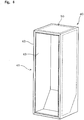
- a refrigerator 40 includes a heat insulation box 41 whose front face is open as shown in Figure 6 .
- the heat insulation box 41 is provided with a refrigeration cycle (not shown).
- the refrigerator 40 includes a partition plate (not shown) for partitioning the heat insulation box 41 into a plurality of storage compartments, a heat insulation door (not shown) covering the front side of the storage compartments, a drawer (not shown) which moves back and forth inside the storage compartment, and so on.
- the heat insulation box 41 of the refrigerator 40 includes an outer box 42, an inner box 43, and a vacuum insulation panel set 50 sandwiched between the outer box 42 and the inner box 43.
- the outer box 42 is formed from a steel plate
- the inner box 43 is formed from a synthetic resin.
- the vacuum insulation panel set 50 is divided in correspondence with the respective wall parts of the heat insulation box 41 of the refrigerator 40. More specifically, as shown in Figure 7 , the vacuum insulation panel set 50 is divided into a left wall panel 51, a right wall panel 52, a ceiling panel 53, a rear wall panel 54, and a base wall panel 55. Each of the left wall panel 51, the right wall panel 52, the ceiling panel 53, the rear wall panel 54 and the base wall panel 55 is constructed of the above-mentioned vacuum insulation panel 14. The left wall panel 51, the right wall panel 52, the ceiling panel 53, the rear wall panel 54 and the base wall panel 55 are assembled as the vacuum insulation panel set 50, and sandwiched between the outer box 42 and the inner box 43.
- Gaps formed between the respective left wall panel 51, right wall panel 52, ceiling panel 53, rear wall panel 54 and base wall panel 55 constituting the vacuum insulation panel set 50 between the outer box 42 and the inner box 43 are sealed by a heat insulation seal member (not shown).
- the seal member is formed from, for example, a foaming resin.
- the refrigerator 40 includes the vacuum insulation panel set 50 constituting the heat insulation box 41.
- the vacuum insulation panel set 50 is constructed of the above-described vacuum insulation panel 14. Therefore, it is possible to provide high heat insulation performance while further reducing thickness and weight.
- the vacuum insulation panel 14 In the case where the vacuum insulation panel 14 is applied to the refrigerator 40, it is preferred to arrange the addition amount of the low-molecule adsorbent 100 to be larger on the interior side of the vacuum insulation panel 14 than that on the exterior side of the vacuum insulation panel 14. In other words, the vacuum insulation panel 14 tends to have a lower temperature on the interior side than that on the exterior side. As described above, the adsorption action by the low-molecule adsorbent 100 is reversible. Therefore, by increasing the amount of the low-molecule adsorbent 100 existing on the thermally stable interior side, it is possible to reduce the re-release of the low molecules adsorbed once.
- the vacuum insulation panel according to this embodiment includes: the core material composed of resin fibers; and the low-molecule adsorbent, added to the core material, for adsorbing low molecules derived from the resin fibers. According to this structure, since the low molecules derived from the resin fibers 12 are adsorbed without being freed in the vacuum insulation panel 14, it is possible to suppress a decrease in the vacuum level even when the core material 10 is constructed of the resin fibers 12.
- a vacuum insulation panel 214 has a feature in the arrangement position of a low-molecule adsorbent.
- a core material 210 constituting the main body part of the vacuum insulation panel 214 has a groove section 220 in a surface thereof.
- the core material 210 has, in a predetermined area including the groove section 220, a small-addition-amount region 2100 in which the addition amount of the low-molecule adsorbent is smaller than that in other region.
- This embodiment may be implemented by suitably modifying the size or shape of the small-addition-amount region 2100.
- the vacuum insulation panel 214 only has to be constructed so that a region in which the addition amount of the low-molecule adsorbent is smaller than that in other region is provided in the vicinity of the groove section 220.
- a heat radiation pipe 230 is provided in the groove section 220.
- the heat radiation pipe 230 constitutes a part of a refrigeration cycle of the refrigerator, and releases heat when a high-temperature, high-pressure refrigerant discharged from a compressor flows in it.
- troubles such as dew condensation are avoidable.
- the adsorption action of the low-molecule adsorbent is reversible, there is a risk that the adsorbed low molecules may be released again under the influence of heat from the heat radiation pipe 230.
- the addition amount of the low-molecule adsorbent is smaller than that in other part. In other words, in a region in which there is a possibility of being affected by the heat from the heat source, the addition amount of the low-molecule adsorbent is decreased.
- the core material 210 is constructed of the resin fibers 12, it is possible to suppress a decrease in the vacuum level.
- the core material 210 of the vacuum insulation panel 214 may include, in addition to the small-addition-amount region 2100, a large-addition-amount region 2200 in which the addition amount of the low-molecule adsorbent is larger than that in the small-addition-amount region 2100.
- the core material 210 has a substantially flat plate shape as a whole; and includes the groove section 220 at a substantially central section of one surface of the core material 210.
- the large-addition-amount region 2200 is provided at both end sections in the same surface as that the groove section 220 is provided in.
- Other region of the core material 210 excluding the small-addition-amount region 2100 and the large-addition-amount region 2200 is an intermediate-addition-amount region 2300 in which the addition amount of the low-molecule adsorbent is larger than that in the small-addition-amount region 2100 but smaller than that in the large-addition-amount region 2200.
- the large-addition-amount region 2200 may be provided only at one end section in the same surface as that the groove section 220 is provided in.
- the vacuum insulation panel 214 may also be constructed so that the low-molecule adsorbent is not added in a region other than the small-addition-amount region 2100 and the large-addition-amount region 2200.
- the core material 210 has a substantially flat plate shape as a whole, and the groove section 220 is provided at an end section in one surface of the core material 210.
- the large-addition-amount region 2200 is provided at an end section on the opposite side of the groove section 220 in the same surface as that the groove section 220 is provided in.
- the core material 210 has a substantially flat plate shape as a whole, and the groove section 220 is provided at a substantially central section of one surface of the core material 210.
- the large-addition-amount region 2200 is provided at both end sections in the opposite surface to the surface where the groove section 220 is provided.
- the large-addition-amount region 2200 may be provided only at one end section in the surface opposite to the surface where the groove section 220 is provided.
- the core material 210 has a substantially flat plate shape as a whole, and the groove section 220 is provided at an end section in one surface of the core material 210.
- the large-addition-amount region 2200 is provided at an end section on the opposite side of the groove section 220 in the surface opposite to the surface where the groove section 220 is provided.
- the structure examples of Figures 10 and 12 may be combined, and the core material 210 may be constructed so that the large-addition-amount region 2200 is provided at both end sections or one end section in the same surface as that the groove section 220 is provided in, and at both end sections or one end section in the surface opposite to the surface where the groove section 220 is provided.
- Figure 11 and Figure 13 may also be combined, and the core material 210 may be constructed so that the large-addition-amount region 2200 is provided at an end section on the opposite side of the groove section 220 in the same surface as that the groove section 220 is provided in, and at an end section on the opposite side of the groove section 220 in the surface opposite to the surface where the groove section 220 is provided.
- this embodiment may be implemented by suitably modifying the arrangement position of the large-addition-amount region 2200 according to the position of the groove section 220 of the core material 210.
- the large-addition-amount region 2200 at a position away from the small-addition-amount region 2100 including the groove section 220 as much as possible, it is possible to increase the amount of the low-molecule adsorbent that is less likely affected by the heat from the heat source provided in the groove section 220. Consequently, it is possible to adsorb more low molecules and reduce the re-release of the low molecules adsorbed once.
- the resin fibers 12 may be molded by, for example, a melt spinning method.
- the melt spinning method is a method of producing the resin fibers 12 by heating and melting the raw material of the resin fibers 12, extruding the raw material from a nozzle into air or water, and cooling down the material.
- the heat radiation pipe 230 constructing a part of a refrigeration cycle is provided in the groove section 220 provided in the vacuum insulation panel 214.
- the vacuum insulation panel set 50 constituting the heat insulation box 41 is provided.
- the vacuum insulation panel set 50 is constructed of the above-described vacuum insulation panel 214. Therefore, it is possible to ensure high heat insulation performance while further reducing thickness and weight.
- the addition amount of the low-molecule adsorbent is smaller in the periphery of the groove section 220 of the vacuum insulation panel 214. Therefore, it is possible to avoid the re-release of the low molecules due to heat from the heat radiation pipe 230 provided in the groove section 220, and it is possible to keep the vacuum level of the vacuum insulation panel 214 and suppress a lowering of heat insulation performance.
- the vacuum insulation panel includes: a core material composed of resin fibers; and a low-molecule adsorbent, added to the core material, for adsorbing low molecules derived from the resin fibers.
- the core material has a groove section. Moreover, in a predetermined region including the groove section, a small-addition-amount region in which the addition amount of the low-molecule adsorbent is smaller than that in other region is provided. According to this structure, it is possible to avoid the re-release of the low molecules adsorbed by the low-molecule adsorbent, and it is possible to suppress a decrease in the vacuum level even when the core material is constructed of resin fibers.
- the vacuum insulation panel 214 may be constructed without including the moisture adsorbent.
Landscapes
- Engineering & Computer Science (AREA)
- General Engineering & Computer Science (AREA)
- Mechanical Engineering (AREA)
- Chemical & Material Sciences (AREA)
- Combustion & Propulsion (AREA)
- Physics & Mathematics (AREA)
- Thermal Sciences (AREA)
- Textile Engineering (AREA)
- Inorganic Chemistry (AREA)
- Thermal Insulation (AREA)
- Refrigerator Housings (AREA)
Abstract
Description
- Embodiments of the present invention relate to a vacuum insulation panel, a core material constituting a vacuum insulation panel, and a refrigerator including a vacuum insulation panel.
- It is conceived that a vacuum insulation panel is used as a heat insulation material for various apparatuses and facilities such as, for example, a refrigerator. The vacuum insulation panel of this type has a problem that gas is generated after reducing the pressure inside thereof. For example, Patent Literature 1 focuses on the fact that a large part of the entire gas after the reduction in pressure is moisture, and discloses that an adsorbent for adsorbing such gas and water vapor is included. By the way, in recent years, it is conceived that a core material of a vacuum insulation panel is constructed of resin fibers. When such resin fibers are included, low molecules are generated from the resin fibers after the reduction in pressure. Therefore, with only the adsorbent for adsorbing moisture, it is impossible to cope with such low molecules derived from the resin fibers. Thus, there is a risk that the vacuum level of the vacuum insulation panel is deteriorated.
- Japanese Patent Laid-Open No.
2010-53980 - The present embodiments provide: a vacuum insulation panel capable of suppressing a decrease in the vacuum level even when a core material is constructed of resin fibers; the core material constituting the vacuum insulation panel; and a refrigerator including the vacuum insulation panel.
- A vacuum insulation panel according to the present embodiment includes: a core material composed of resin fibers; and a low-molecule adsorbent, added to the core material, for adsorbing low molecules derived from the resin fibers.
- A vacuum insulation panel according to the present embodiment includes: a core material composed of resin fibers; and a low-molecule adsorbent, added to the core material, for adsorbing low molecules derived from the resin fibers. The core material has a groove section. Further, in a predetermined region including the groove section, a small-addition-amount region in which the addition amount of the low-molecule adsorbent is less than that in other region is provided.
-
- [
Figure 1] Figure 1 is a schematic view showing a core material and a nonwoven fabric of a vacuum insulation panel according to a first embodiment. - [
Figure 2] Figure 2 is a schematic cross-sectional view showing the vacuum insulation panel. - [
Figure 3A] Figure 3A is an exploded perspective view schematically showing the core material of the vacuum insulation panel. - [
Figure 3B] Figure 3B is a side view schematically showing the core material of the vacuum insulation panel. - [
Figure 4] Figure 4 is a schematic view showing a side view of the core material of the vacuum insulation panel. - [
Figure 5] Figure 5 is a view showing a state in which a low-molecule adsorbent and a moisture adsorbent are added to the core material. - [
Figure 6] Figure 6 is a schematic perspective view showing a heat insulation box of a refrigerator. - [
Figure 7] Figure 7 is a schematic perspective view showing a vacuum insulation panel set in a refrigerator. - [
Figure 8] Figure 8 is a schematic cross-sectional view showing a vacuum insulation panel according to a second embodiment. - [
Figure 9] Figure 9 is a schematic cross-sectional view of the vacuum insulation panel including a heat radiation pipe in a groove section. - [
Figure 10] Figure 10 is a perspective view (Part 1) of a core material schematically showing an arrangement example of a small-addition-amount region and a large-addition-amount region. - [
Figure 11] Figure 11 is a perspective view (Part 2) of a core material schematically showing an arrangement example of a small-addition-amount region and a large-addition-amount region. - [
Figure 12] Figure 12 is a perspective view (Part 3) of a core material schematically showing an arrangement example of a small-addition-amount region and a large-addition-amount region. - [
Figure 13] Figure 13 is a perspective view (Part 4) of a core material schematically showing an arrangement example of a small-addition-amount region and a large-addition-amount region. - The following will explain a plurality of embodiments with reference to the drawings. In each of the embodiments, substantially the same elements are denoted by the same reference numerals, and explanations are omitted.
- As shown in
Figure 1 , acore material 10 includes a plurality of layers ofnonwoven fabric 11 stacked together. Thenonwoven fabric 11 is made of randomly entangledresin fibers 12. Theresin fibers 12 are formed by an electrospinning method. Theresin fibers 12 formed by the electrospinning method are fine fibers having an average fiber diameter of about 1 µm, and are long fibers whose length is 1,000 times or more of the outer diameter. Theresin fiber 12 is not entirely linear but is in a randomly curved wavy form. Therefore, theresin fibers 12 are easily entangled with each other, and a plurality of layers are easily formed. The use of the electrospinning method enables the spinning of theresin fibers 12 and the formation of thenonwoven fabric 11 to be carried out simultaneously. As a result, it is possible to easily form thecore material 10 in less man-hour. - Moreover, the use of the electrospinning method easily enables the
resin fibers 12 constituting thenonwoven fabric 11 to have an extremely thin outer diameter ranging from nanometer to micrometer. Hence, the thickness of each sheet of thenonwoven fabric 11 becomes very thin, and the thickness of thecore material 10 is also reduced. In the case of conventional glass fibers, the fiber length is short, and the entanglement between the fibers is less. Therefore, when the glass fibers are used, it is difficult to maintain the shape of the nonwoven fabric. Additionally, in the case of using glass fibers, it is usually difficult to simultaneously carry out the spinning of glass fibers and the formation of nonwoven fabric. When the conventional glass fibers are used, a nonwoven fabric is formed in a paper-making manner in a state in which the glass fibers are dispersed in water. If the spinning of glass fibers and the formation of nonwoven fabric are carried out simultaneously, a cotton-like nonwoven fabric with a large thickness is formed, and it is difficult to form a thin nonwoven fabric with a small thickness. - Thus, in this embodiment, the
core material 10 is formed by a plurality of layers of thenonwoven fabric 11 stacked together. Thecore material 10 includes, for example, several hundred to several thousand layers or more of thenonwoven fabric 11 stacked together. Theresin fibers 12 forming thenonwoven fabric 11 of this embodiment are formed to have a substantially uniform circular or oval cross section. - The
resin fibers 12 forming thenonwoven fabric 11 are formed from an organic polymer having a density smaller than that of glass. The formation of theresin fibers 12 from a polymer having a density smaller than that of glass makes it possible to reduce the weight of theresin fibers 12. For thenonwoven fabric 11, two or more kinds ofresin fibers 12 may be mixed. As an example of thenonwoven fabric 11 formed by mixed spinning, polystyrene fibers and aromatic polyamide-based resin (registered trademark: Kevlar) are used. In addition to the above, it is possible to form thenonwoven fabric 11 by mixed spinning of one kind or two or more kinds of polymers selected from polycarbonate, polymethyl methacrylate, polypropylene, polyethylene, polyethylene terephthalate, polybutylene terephthalate, polyamide, polyoxymethylene, polyamideimide, polyimide, polysulfone, polyethersulfone, polyetherimide, polyether ether ketone, polyphenylene sulfide, modified polyphenylene ether, syndiotactic polystyrene, liquid crystal polymer, urea resin, unsaturated polyester, polyphenol, melamine resin, epoxy resin, and copolymers including these polymers. - In the case when the
resin fibers 12 are formed by the electrospinning method, the polymer is made into a solution. As a solvent, it is possible to use, for example, a volatile organic solvent, such as isopropanol, ethylene glycol, cyclohexanone, dimethylformamide, acetone, ethyl acetate, dimethylacetamide, N-methyl-2-pyrrolidone, hexane, toluene, xylene, methyl ethyl ketone, diethyl ketone, butyl acetate, tetrahydrofuran, dioxane, and pyridine, or water. As the solvent, it is possible to select one kind from the above solvents, or mix a plurality of kinds of solvents. The solvents applicable to this embodiment are not limited to the above-mentioned solvents. The above-mentioned solvents are merely examples. - In this case, the mixed-spun
resin fibers 12 are set so that the outer diameter d of each fiber satisfies d < 1 µm. Mixed-spinning a plurality of kinds ofresin fibers 12 in this manner achieves an improvement in the heat insulation property, light-weight, and strength of thenonwoven fabric 11. In thenonwoven fabric 11, if the volume of space formed between theentangled resin fibers 12 decreases, the number of the spaces increases contrarily. The greater the number of spaces between theresin fibers 12, the higher the heat insulation property. Therefore, it is preferred to reduce the outer diameter d of fiber of theresin fibers 12 forming thenonwoven fabric 11 to a nanometer order satisfying d < 1 µm. By reducing the outer diameter d of theresin fiber 12 in this manner, the volume of space formed between theresin fibers 12 is decreased and the number of the spaces is increased. Thus, by reducing the diameter in this manner, the volume of space formed between theentangled resin fibers 12 becomes smaller, the number of the spaces is increased, and the heat insulation property of thenonwoven fabric 11 is improved. - For the
resin fiber 12, various kinds of inorganic fillers such as, for example, a silicon oxide, a hydroxide of metal, carbonate, sulfate and silicate may be added. By adding the inorganic filler to theresin fibers 12 in this manner, it is possible to improve the strength of thenonwoven fabric 11 while keeping the heat insulation property of thenonwoven fabric 11. More specifically, as the inorganic filler to be added, it is possible to use wollastonite, potassium titanate, xonotlite, gypsum fiber, aluminum borate, MOS (basic magnesium sulfate), aramid fiber, carbon fiber, glass fiber, talc, mica, glass flake, and so on. - The
core material 10 formed by thenonwoven fabric 11 is contained in a bag-likeouter packaging material 13 as shown inFigure 2 . Theouter packaging material 13 is made of an airtight sheet material which has no gas permeability by, for example, vapor-depositing a metal or a metal oxide on one or more layers of a resin film. Theouter packaging material 13 containing thecore material 10 is sealed after reducing the pressure in the inside including thecore material 10 to a pressure close to a vacuum. Consequently, theouter packaging material 13 containing thecore material 10 is formed as avacuum insulation panel 14. In this case, thevacuum insulation panel 14 may contain a frame member serving as the frame inside theouter packaging material 13 in order to reduce breakage of the formedvacuum insulation panel 14. - As shown in
Figure 3A and Figure 3B , thecore material 10 may include analuminum foil 15 on one surface of the layers. After thecore material 10 formed by thenonwoven fabric 11 as described above is contained in theouter packaging material 13, the pressure inside theouter packaging material 13 is reduced to form thevacuum insulation panel 14. Therefore, there is a risk that thevacuum insulation panel 14 is broken or deformed by the reduction in pressure inside theouter packaging material 13. By providing thealuminum foil 15 on one surface of thenonwoven fabric 11, the strength of thecore material 10 is improved. It is thus possible to reduce breakage and deformation caused by the reduction in pressure. Thecore material 10 may also include aglass fiber layer 16 which is stacked together with thenonwoven fabric 11 as shown inFigure 4 . The strength of theglass fiber layer 16 is higher than that of thenonwoven fabric 11 made offine resin fibers 12. Therefore, by stacking thenonwoven fabric 11 and theglass fiber layer 16 together, the thickness and weight of thecore material 10 are increased as compared with the case where thecore material 10 is formed by only thenonwoven fabric 11, but it is possible to reduce breakage and deformation caused by the reduction in pressure. Theglass fiber layer 16 is not limited to the two layers shown inFigure 4 , and may be one layer or three or more layers. - Further, as shown in
Figure 5 , a low-molecule adsorbent 100 and amoisture adsorbent 200 are added to thecore material 10 of thevacuum insulation panel 14 according to this embodiment. In this case, the low-molecule adsorbent 100 and themoisture adsorbent 200 are spread between thenonwoven fabrics 11 made of theresin fibers 12. The low-molecule adsorbent 100 adsorbs low molecules generated from theresin fibers 12. In this case, the low-molecule adsorbent 100 is composed of synthetic zeolite, and physically adsorbs low molecules. The adsorption action by such a physical adsorption system is reversible, and the low molecules adsorbed by the low-molecule adsorbent 100 are easily separated from the low-molecule adsorbent 100 by, for example, the application of a certain degree of heat. The low-molecule adsorbent 100 is not limited to zeolite. On the other hand, themoisture adsorbent 200 adsorbs moisture. In this case, themoisture adsorbent 200 is composed of calcium oxide, and chemically adsorbs moisture. The adsorption action by such a chemical adsorption system is irreversible. Even when a certain degree of heat is applied, the moisture adsorbed by themoisture adsorbent 200 is unlikely separated from themoisture adsorbent 200. Themoisture adsorbent 200 is not limited to calcium oxide. - In particular, after reducing the pressure inside the
outer packaging material 13 containing thecore material 10, low molecules are easily generated from theresin fibers 12. With thevacuum insulation panel 14 according to this embodiment, such low molecules derived from theresin fibers 12 are adsorbed by the low-molecule adsorbent 100. Thus, even when thecore material 10 is constructed of theresin fibers 12, it is possible to suppress a decrease in the vacuum level in thevacuum insulation panel 14. Moreover, according to thevacuum insulation panel 14, the moisture in the inside is also adsorbed by themoisture adsorbent 200. Therefore, it is possible to further suppress a decrease in the vacuum level in thevacuum insulation panel 14. - In particular, after reduction in pressure inside the
outer packaging material 13 containing thecore material 10, the low molecules are also easily generated from the resin film constituting theouter packaging material 13. According to thevacuum insulation panel 14, even such low molecules derived from theouter packaging material 13 are also adsorbed by the low-molecule adsorbent 100. Thus, it is possible to suppress a decrease in the vacuum level in thevacuum insulation panel 14. - In this case, the addition amount of the low-
molecule adsorbent 100 is larger than the addition amount of themoisture adsorbent 200. In other words, the whole or most part of thecore material 10 according to this embodiment is composed of theresin fibers 12. Hence, there is a tendency to increase the amount of low molecules derived from theresin fibers 12. Therefore, by increasing the addition amount of the low-molecule adsorbent 100, it is possible to adsorb more low molecules derived from theresin fibers 12. This embodiment is implemented by suitably adjusting the addition amount of the low-molecule adsorbent 100 and the addition amount of themoisture adsorbent 200. For example, the addition amounts of both of the adsorbents may be equal, or the addition amount of the low-molecule adsorbent 100 may be smaller than that of themoisture adsorbent 200. - The
resin fibers 12 may be molded by, for example, a melt spinning method. The melt spinning method is a method of producing theresin fibers 12 by heating and melting the raw material of theresin fibers 12, extruding the raw material from a nozzle into air or water and cooling down the material. - Next, a refrigerator using the
vacuum insulation panel 14 will be described with reference toFigure 6 andFigure 7 . - A
refrigerator 40 includes aheat insulation box 41 whose front face is open as shown inFigure 6 . In therefrigerator 40, theheat insulation box 41 is provided with a refrigeration cycle (not shown). In addition, therefrigerator 40 includes a partition plate (not shown) for partitioning theheat insulation box 41 into a plurality of storage compartments, a heat insulation door (not shown) covering the front side of the storage compartments, a drawer (not shown) which moves back and forth inside the storage compartment, and so on. Theheat insulation box 41 of therefrigerator 40 includes anouter box 42, aninner box 43, and a vacuum insulation panel set 50 sandwiched between theouter box 42 and theinner box 43. Theouter box 42 is formed from a steel plate, and theinner box 43 is formed from a synthetic resin. - The vacuum insulation panel set 50 is divided in correspondence with the respective wall parts of the
heat insulation box 41 of therefrigerator 40. More specifically, as shown inFigure 7 , the vacuum insulation panel set 50 is divided into aleft wall panel 51, aright wall panel 52, aceiling panel 53, arear wall panel 54, and abase wall panel 55. Each of theleft wall panel 51, theright wall panel 52, theceiling panel 53, therear wall panel 54 and thebase wall panel 55 is constructed of the above-mentionedvacuum insulation panel 14. Theleft wall panel 51, theright wall panel 52, theceiling panel 53, therear wall panel 54 and thebase wall panel 55 are assembled as the vacuum insulation panel set 50, and sandwiched between theouter box 42 and theinner box 43. Gaps formed between the respectiveleft wall panel 51,right wall panel 52,ceiling panel 53,rear wall panel 54 andbase wall panel 55 constituting the vacuum insulation panel set 50 between theouter box 42 and theinner box 43 are sealed by a heat insulation seal member (not shown). The seal member is formed from, for example, a foaming resin. - Thus, the
refrigerator 40 includes the vacuum insulation panel set 50 constituting theheat insulation box 41. The vacuum insulation panel set 50 is constructed of the above-describedvacuum insulation panel 14. Therefore, it is possible to provide high heat insulation performance while further reducing thickness and weight. - In the case where the
vacuum insulation panel 14 is applied to therefrigerator 40, it is preferred to arrange the addition amount of the low-molecule adsorbent 100 to be larger on the interior side of thevacuum insulation panel 14 than that on the exterior side of thevacuum insulation panel 14. In other words, thevacuum insulation panel 14 tends to have a lower temperature on the interior side than that on the exterior side. As described above, the adsorption action by the low-molecule adsorbent 100 is reversible. Therefore, by increasing the amount of the low-molecule adsorbent 100 existing on the thermally stable interior side, it is possible to reduce the re-release of the low molecules adsorbed once. - The vacuum insulation panel according to this embodiment includes: the core material composed of resin fibers; and the low-molecule adsorbent, added to the core material, for adsorbing low molecules derived from the resin fibers. According to this structure, since the low molecules derived from the
resin fibers 12 are adsorbed without being freed in thevacuum insulation panel 14, it is possible to suppress a decrease in the vacuum level even when thecore material 10 is constructed of theresin fibers 12. - A
vacuum insulation panel 214 according to this embodiment has a feature in the arrangement position of a low-molecule adsorbent. In other words, as illustrated inFigure 8 , acore material 210 constituting the main body part of thevacuum insulation panel 214 has agroove section 220 in a surface thereof. Thecore material 210 has, in a predetermined area including thegroove section 220, a small-addition-amount region 2100 in which the addition amount of the low-molecule adsorbent is smaller than that in other region. This embodiment may be implemented by suitably modifying the size or shape of the small-addition-amount region 2100. In other words, thevacuum insulation panel 214 only has to be constructed so that a region in which the addition amount of the low-molecule adsorbent is smaller than that in other region is provided in the vicinity of thegroove section 220. - As illustrated in
Figure 9 , for example, in the case where thevacuum insulation panel 214 is applied to a refrigerator, aheat radiation pipe 230 is provided in thegroove section 220. Theheat radiation pipe 230 constitutes a part of a refrigeration cycle of the refrigerator, and releases heat when a high-temperature, high-pressure refrigerant discharged from a compressor flows in it. By utilizing the heat released from theheat radiation pipe 230, troubles such as dew condensation are avoidable. However, as described above, since the adsorption action of the low-molecule adsorbent is reversible, there is a risk that the adsorbed low molecules may be released again under the influence of heat from theheat radiation pipe 230. - According to the
vacuum insulation panel 214 of this embodiment, in the periphery of thegroove section 220 where a heat source such as, for example, theheat radiation pipe 230 is provided, the addition amount of the low-molecule adsorbent is smaller than that in other part. In other words, in a region in which there is a possibility of being affected by the heat from the heat source, the addition amount of the low-molecule adsorbent is decreased. With this structure, it is possible to decrease the amount of the low-molecule adsorbent that re-releases the low molecules under the influence of heat from the heat source, and consequently it is possible to reduce the low molecules being freed in thevacuum insulation panel 214. Therefore, even when thecore material 210 is constructed of theresin fibers 12, it is possible to suppress a decrease in the vacuum level. - As shown in
Figure 10 to Figure 13 , thecore material 210 of thevacuum insulation panel 214 may include, in addition to the small-addition-amount region 2100, a large-addition-amount region 2200 in which the addition amount of the low-molecule adsorbent is larger than that in the small-addition-amount region 2100. In the structure shown inFigure 10 , thecore material 210 has a substantially flat plate shape as a whole; and includes thegroove section 220 at a substantially central section of one surface of thecore material 210. The large-addition-amount region 2200 is provided at both end sections in the same surface as that thegroove section 220 is provided in. Other region of thecore material 210 excluding the small-addition-amount region 2100 and the large-addition-amount region 2200 is an intermediate-addition-amount region 2300 in which the addition amount of the low-molecule adsorbent is larger than that in the small-addition-amount region 2100 but smaller than that in the large-addition-amount region 2200. The large-addition-amount region 2200 may be provided only at one end section in the same surface as that thegroove section 220 is provided in. Thevacuum insulation panel 214 may also be constructed so that the low-molecule adsorbent is not added in a region other than the small-addition-amount region 2100 and the large-addition-amount region 2200. - In the structure shown in
Figure 11 , thecore material 210 has a substantially flat plate shape as a whole, and thegroove section 220 is provided at an end section in one surface of thecore material 210. The large-addition-amount region 2200 is provided at an end section on the opposite side of thegroove section 220 in the same surface as that thegroove section 220 is provided in. In the structure illustrated inFigure 12 , thecore material 210 has a substantially flat plate shape as a whole, and thegroove section 220 is provided at a substantially central section of one surface of thecore material 210. The large-addition-amount region 2200 is provided at both end sections in the opposite surface to the surface where thegroove section 220 is provided. The large-addition-amount region 2200 may be provided only at one end section in the surface opposite to the surface where thegroove section 220 is provided. - In the structure illustrated in
Figure 13 , thecore material 210 has a substantially flat plate shape as a whole, and thegroove section 220 is provided at an end section in one surface of thecore material 210. The large-addition-amount region 2200 is provided at an end section on the opposite side of thegroove section 220 in the surface opposite to the surface where thegroove section 220 is provided. For example, the structure examples ofFigures 10 and12 may be combined, and thecore material 210 may be constructed so that the large-addition-amount region 2200 is provided at both end sections or one end section in the same surface as that thegroove section 220 is provided in, and at both end sections or one end section in the surface opposite to the surface where thegroove section 220 is provided. The structure examples ofFigure 11 andFigure 13 may also be combined, and thecore material 210 may be constructed so that the large-addition-amount region 2200 is provided at an end section on the opposite side of thegroove section 220 in the same surface as that thegroove section 220 is provided in, and at an end section on the opposite side of thegroove section 220 in the surface opposite to the surface where thegroove section 220 is provided. - As described above, this embodiment may be implemented by suitably modifying the arrangement position of the large-addition-
amount region 2200 according to the position of thegroove section 220 of thecore material 210. In other words, by providing the large-addition-amount region 2200 at a position away from the small-addition-amount region 2100 including thegroove section 220 as much as possible, it is possible to increase the amount of the low-molecule adsorbent that is less likely affected by the heat from the heat source provided in thegroove section 220. Consequently, it is possible to adsorb more low molecules and reduce the re-release of the low molecules adsorbed once. - The
resin fibers 12 may be molded by, for example, a melt spinning method. The melt spinning method is a method of producing theresin fibers 12 by heating and melting the raw material of theresin fibers 12, extruding the raw material from a nozzle into air or water, and cooling down the material. - When the
vacuum insulation panel 214 is applied to a refrigerator, theheat radiation pipe 230 constructing a part of a refrigeration cycle is provided in thegroove section 220 provided in thevacuum insulation panel 214. According to therefrigerator 40 including thevacuum insulation panel 214, the vacuum insulation panel set 50 constituting theheat insulation box 41 is provided. The vacuum insulation panel set 50 is constructed of the above-describedvacuum insulation panel 214. Hence, it is possible to ensure high heat insulation performance while further reducing thickness and weight. The addition amount of the low-molecule adsorbent is smaller in the periphery of thegroove section 220 of thevacuum insulation panel 214. Therefore, it is possible to avoid the re-release of the low molecules due to heat from theheat radiation pipe 230 provided in thegroove section 220, and it is possible to keep the vacuum level of thevacuum insulation panel 214 and suppress a lowering of heat insulation performance. - The vacuum insulation panel according to this embodiment includes: a core material composed of resin fibers; and a low-molecule adsorbent, added to the core material, for adsorbing low molecules derived from the resin fibers. The core material has a groove section. Moreover, in a predetermined region including the groove section, a small-addition-amount region in which the addition amount of the low-molecule adsorbent is smaller than that in other region is provided. According to this structure, it is possible to avoid the re-release of the low molecules adsorbed by the low-molecule adsorbent, and it is possible to suppress a decrease in the vacuum level even when the core material is constructed of resin fibers. The
vacuum insulation panel 214 may be constructed without including the moisture adsorbent. - The above-described plurality of embodiments may be combined and implemented.
- The present embodiments are presented as examples, and are not intended to limit the scope of the invention. These novel embodiments may be implemented in other various forms, and various omissions, substitutions and changes may be made without departing from the content of the invention. The present embodiments and modifications thereof are included within the scope and content of the invention, and included within the scope of the invention as set forth in the claims and equivalents thereof.
Claims (8)
- A vacuum insulation panel comprising:a core material composed of resin fibers; anda low-molecule adsorbent, added to the core material, for adsorbing low molecules derived from the resin fibers.
- The vacuum insulation panel according to Claim 1, further comprising a moisture adsorbent, added to the core material, for adsorbing moisture,
wherein an addition amount of the low-molecule adsorbent is larger than an addition amount of the moisture adsorbent. - The vacuum insulation panel according to Claim 1 or 2,
wherein an adsorption system of the low-molecule adsorbent and an adsorption system of the moisture adsorbent are different from each other. - The vacuum insulation panel according to any one of Claims 1 to 3,
wherein the core material has a groove section, and
in a predetermined region including the groove section, a small-addition-amount region in which an addition amount of the low-molecule adsorbent is smaller than in other region is provided. - The vacuum insulation panel according to Claim 4,
wherein a large-addition-amount region in which an addition amount of the low-molecule adsorbent is larger than that in the small-addition-amount region is provided. - The vacuum insulation panel according to Claims 4 or 5,
wherein the core material has a flat plate shape,
the groove section is provided in one surface of the core material, and
the large-addition-amount region is provided in the same surface as that the groove section is provided in. - A core material included in the vacuum insulation panel according to any one of Claims 1 to 6.
- A refrigerator comprising the vacuum insulation panel according to any one of Claims 1 to 6.
Applications Claiming Priority (13)
| Application Number | Priority Date | Filing Date | Title |
|---|---|---|---|
| JP2015047266A JP2016166660A (en) | 2015-03-10 | 2015-03-10 | Vacuum insulation panel core material, vacuum insulation panel and refrigerator |
| JP2015050734A JP2016169823A (en) | 2015-03-13 | 2015-03-13 | Insulating material, core material, refrigerator, manufacturing method of insulating material |
| JP2015052093A JP2016173114A (en) | 2015-03-16 | 2015-03-16 | Heat insulation material, core material, and refrigerator |
| JP2015053454A JP2016173144A (en) | 2015-03-17 | 2015-03-17 | Core material for vacuum heat insulation panel, vacuum heat insulation panel and refrigerator |
| JP2015053460A JP2016173150A (en) | 2015-03-17 | 2015-03-17 | Vacuum insulation panel for refrigerator and method for recycling refrigerator |
| JP2015053457A JP2016173147A (en) | 2015-03-17 | 2015-03-17 | Vacuum heat insulation panel and refrigerator |
| JP2015053458A JP2016173148A (en) | 2015-03-17 | 2015-03-17 | Vacuum insulation panel, core material, refrigerator, vacuum insulation panel manufacturing method |
| JP2015053456A JP2016173146A (en) | 2015-03-17 | 2015-03-17 | Vacuum insulation panel, core material, refrigerator |
| JP2015053450A JP2016173142A (en) | 2015-03-17 | 2015-03-17 | Heat insulator, core material, refrigerator, and heat insulator manufacturing method |
| JP2015053459A JP6517551B2 (en) | 2015-03-17 | 2015-03-17 | Method of manufacturing vacuum insulation panel, vacuum insulation panel, core material, refrigerator |
| JP2015053451A JP2016173143A (en) | 2015-03-17 | 2015-03-17 | Heat insulation material, refrigerator, and method for manufacturing heat insulation material |
| JP2015053455A JP2016173145A (en) | 2015-03-17 | 2015-03-17 | Vacuum insulation panel, core material, refrigerator |
| PCT/JP2016/057132 WO2016143781A1 (en) | 2015-03-10 | 2016-03-08 | Vacuum insulated panel, core material, and refrigerator |
Publications (2)
| Publication Number | Publication Date |
|---|---|
| EP3270032A1 true EP3270032A1 (en) | 2018-01-17 |
| EP3270032A4 EP3270032A4 (en) | 2018-10-17 |
Family
ID=56880118
Family Applications (3)
| Application Number | Title | Priority Date | Filing Date |
|---|---|---|---|
| EP16761749.7A Withdrawn EP3270032A4 (en) | 2015-03-10 | 2016-03-08 | Vacuum insulated panel, core material, and refrigerator |
| EP16761748.9A Withdrawn EP3270031A4 (en) | 2015-03-10 | 2016-03-08 | Insulation, core material, refrigerator, and insulation manufacturing method |
| EP16761747.1A Withdrawn EP3270030A4 (en) | 2015-03-10 | 2016-03-08 | Vacuum insulated panel, core material, refrigerator, method for producing vacuum insulated panel, and method for recycling refrigerator |
Family Applications After (2)
| Application Number | Title | Priority Date | Filing Date |
|---|---|---|---|
| EP16761748.9A Withdrawn EP3270031A4 (en) | 2015-03-10 | 2016-03-08 | Insulation, core material, refrigerator, and insulation manufacturing method |
| EP16761747.1A Withdrawn EP3270030A4 (en) | 2015-03-10 | 2016-03-08 | Vacuum insulated panel, core material, refrigerator, method for producing vacuum insulated panel, and method for recycling refrigerator |
Country Status (5)
| Country | Link |
|---|---|
| US (3) | US20180238605A1 (en) |
| EP (3) | EP3270032A4 (en) |
| KR (4) | KR20170117508A (en) |
| CN (5) | CN110778852B (en) |
| WO (3) | WO2016143779A1 (en) |
Families Citing this family (13)
| Publication number | Priority date | Publication date | Assignee | Title |
|---|---|---|---|---|
| KR102273285B1 (en) * | 2014-12-26 | 2021-07-06 | 삼성전자주식회사 | Refrigerator and vacuum insulation module thereof |
| JP2018040421A (en) * | 2016-09-07 | 2018-03-15 | 株式会社東芝 | Core material for vacuum heat insulation panel, vacuum heat insulation panel and refrigerator |
| CN108266602B (en) * | 2018-01-23 | 2020-07-24 | 长江师范学院 | Vacuum heat insulation plate structure |
| JP7233070B2 (en) * | 2018-04-16 | 2023-03-06 | アクア株式会社 | vacuum insulation |
| CN112204327B (en) * | 2018-05-25 | 2022-04-22 | 普和希控股公司 | Insulation structure of cooling device and cooling device |
| WO2020057836A1 (en) | 2018-09-20 | 2020-03-26 | Arcelik Anonim Sirketi | A core material compound, a vacuum insulation panel and a cooling device |
| KR102005762B1 (en) | 2019-02-13 | 2019-08-01 | 주식회사 제이텍 | Insulation structure of refrigeration room wall in the ship using vacuum thermal insulation panel assembly for manufacturing eco-friendly refrigeration room wall of ship |
| KR20210100447A (en) * | 2020-02-06 | 2021-08-17 | 삼성전자주식회사 | Vacuum heat insulating material, the method of manufacturing the same and refrigerator including the same |
| US11691908B2 (en) * | 2020-10-20 | 2023-07-04 | Whirlpool Corporation | Insulation materials for a vacuum insulated structure and methods of forming |
| US11614271B2 (en) | 2020-12-29 | 2023-03-28 | Whirlpool Corporation | Vacuum insulated structure with sheet metal features to control vacuum bow |
| US11448355B2 (en) | 2021-01-12 | 2022-09-20 | Whirlpool Corporation | Vacuum insulated refrigerator structure with feature for controlling deformation and improved air withdrawal |
| CN119332412A (en) * | 2023-07-19 | 2025-01-21 | 合肥美的电冰箱有限公司 | Thermal insulation materials, thermal insulation core materials, thermal insulation panels and temperature regulating devices |
| CN120287671A (en) * | 2024-10-15 | 2025-07-11 | 广州美的华凌冰箱有限公司 | Vacuum insulation panel and its preparation method and application |
Family Cites Families (41)
| Publication number | Priority date | Publication date | Assignee | Title |
|---|---|---|---|---|
| JPS4713566Y1 (en) | 1968-08-28 | 1972-05-17 | ||
| AU692115B2 (en) * | 1995-03-07 | 1998-05-28 | Matsushita Refrigeration Company | Vacuum heat-insulator and heat-insulating box using the insulator |
| DE69619424T2 (en) * | 1995-04-14 | 2002-07-11 | Mitsubishi Gas Chemical Co., Inc. | Vacuum heat insulation |
| JP3580334B2 (en) * | 1995-04-14 | 2004-10-20 | 三菱瓦斯化学株式会社 | Vacuum insulation |
| GB2333741B (en) * | 1998-01-30 | 2002-09-04 | Jason Inc | Vehicle headliner and laminate therefor |
| JPH11311395A (en) * | 1998-04-24 | 1999-11-09 | Matsushita Refrig Co Ltd | Vacuum heat insulator, heat insulating box body, heat insulating panel, and manufacture of vacuum heat insulator |
| JPH11351493A (en) * | 1998-06-09 | 1999-12-24 | Mitsubishi Electric Corp | Vacuum insulation panel and manufacturing method thereof |
| JP2002017832A (en) * | 2000-07-03 | 2002-01-22 | Tennex Corp | Deodorizing filter and manufacturing method thereof |
| TW593919B (en) * | 2002-05-31 | 2004-06-21 | Matsushita Refrigeration | Vacuum heat insulating material and method for producing the same, and refrigerator using the vacuum heat insulating material |
| JP2006046512A (en) * | 2004-08-05 | 2006-02-16 | Matsushita Electric Ind Co Ltd | Insulation |
| JP2006105286A (en) | 2004-10-06 | 2006-04-20 | Matsushita Electric Ind Co Ltd | Insulator, refrigeration equipment and cold / hot equipment |
| JP4671895B2 (en) * | 2006-03-28 | 2011-04-20 | 日立アプライアンス株式会社 | Insulation panel, insulation box and method for producing insulation panel |
| JP4511565B2 (en) | 2007-02-20 | 2010-07-28 | 株式会社メック | Nano-fiber manufacturing equipment |
| CN100543354C (en) * | 2008-03-20 | 2009-09-23 | 绍兴纳诺气凝胶新材料研发中心有限公司 | A kind of high-strength vacuum insulation plate |
| JP5169531B2 (en) * | 2008-06-24 | 2013-03-27 | 三菱電機株式会社 | Vacuum insulation |
| JP5193713B2 (en) * | 2008-07-17 | 2013-05-08 | 日立アプライアンス株式会社 | Freezer refrigerator |
| JP5162377B2 (en) * | 2008-08-28 | 2013-03-13 | 日立アプライアンス株式会社 | Vacuum heat insulating material, heat insulating box using the same, and refrigerator |
| JP4997198B2 (en) * | 2008-08-28 | 2012-08-08 | 日立アプライアンス株式会社 | Vacuum heat insulating material, heat insulating box using the same, and refrigerator |
| JP4778996B2 (en) * | 2008-09-03 | 2011-09-21 | 日立アプライアンス株式会社 | Vacuum heat insulating material and refrigerator using the same |
| JP5111331B2 (en) * | 2008-10-28 | 2013-01-09 | 三菱電機株式会社 | Vacuum heat insulating material and heat insulating box using this vacuum heat insulating material |
| JP4969555B2 (en) * | 2008-11-17 | 2012-07-04 | 三菱電機株式会社 | Vacuum insulation and insulation box |
| JP5236550B2 (en) * | 2009-03-30 | 2013-07-17 | 三菱電機株式会社 | Vacuum heat insulating material and manufacturing method thereof, and heat insulating box provided with the vacuum heat insulating material |
| JP2011074934A (en) * | 2009-09-29 | 2011-04-14 | Mitsubishi Electric Corp | Vacuum thermal insulator and thermally insulating box including the vacuum thermal insulator |
| JP5241925B2 (en) * | 2009-10-16 | 2013-07-17 | 三菱電機株式会社 | Vacuum heat insulating material manufacturing apparatus, vacuum heat insulating material manufacturing method, vacuum heat insulating material, refrigerator and equipment |
| EP2491324B1 (en) * | 2009-10-23 | 2015-05-27 | LG Hausys, Ltd. | Vacuum insulation panel |
| CN101691900A (en) * | 2009-10-27 | 2010-04-07 | 滁州银兴电气有限公司 | Method for manufacturing vacuum insulated plate |
| CN102597115A (en) * | 2009-10-29 | 2012-07-18 | 日本化药株式会社 | Fibers consisting of thermosetting polyamide resin composition, nonwoven fabric, and process for production of same |
| JP2012013158A (en) * | 2010-07-01 | 2012-01-19 | Mitsubishi Electric Corp | Vacuum heat insulating material, heat insulating box, and method of manufacturing vacuum heat insulating material |
| JP2012042011A (en) * | 2010-08-20 | 2012-03-01 | Sharp Corp | Vacuum heat insulating material and manufacturing method thereof |
| JP2012047211A (en) * | 2010-08-25 | 2012-03-08 | Hitachi Appliances Inc | Vacuum heat insulating material and refrigerator using the same |
| JP2012092870A (en) * | 2010-10-25 | 2012-05-17 | Maeda Kosen Co Ltd | Vacuum heat insulating material and heat insulating box using the same |
| JP2012197644A (en) * | 2011-03-23 | 2012-10-18 | Nisshinbo Holdings Inc | Heat insulator |
| JP5753453B2 (en) * | 2011-07-06 | 2015-07-22 | 信越化学工業株式会社 | Thermal insulation laminate |
| JP2013053722A (en) * | 2011-09-06 | 2013-03-21 | Hitachi Appliances Inc | Vacuum heat insulating material and heat insulating apparatus using the same |
| US20130115837A1 (en) * | 2011-11-09 | 2013-05-09 | Dale S. Kitchen | Nanofiber nonwovens and nanofiber nonwoven composites containing roped fiber bundles |
| JP2013163875A (en) * | 2012-02-10 | 2013-08-22 | Japan Vilene Co Ltd | Nonwoven fabric |
| JP5611258B2 (en) * | 2012-03-13 | 2014-10-22 | 三菱電機株式会社 | Vacuum heat insulating material, manufacturing method thereof, heat insulator and dismantling method thereof |
| CN202660157U (en) * | 2012-04-24 | 2013-01-09 | 滁州银兴电气有限公司 | Vacuum insulation plate used for reducing heat bridge effect |
| JP5857231B2 (en) * | 2012-04-25 | 2016-02-10 | パナソニックIpマネジメント株式会社 | Integrated laminated sheet manufacturing system and integrated laminated sheet manufacturing method |
| WO2014162771A1 (en) * | 2013-04-05 | 2014-10-09 | 三菱電機株式会社 | Vacuum heat-insulating material, thermal insulation tank provided with same, thermal insulator, and heat pump hot water heater |
| WO2014204245A2 (en) * | 2013-06-19 | 2014-12-24 | 주식회사 아모그린텍 | Hybrid insulation sheet and electronic equipment comprising same |
-
2016
- 2016-03-08 EP EP16761749.7A patent/EP3270032A4/en not_active Withdrawn
- 2016-03-08 WO PCT/JP2016/057130 patent/WO2016143779A1/en not_active Ceased
- 2016-03-08 CN CN201911068875.4A patent/CN110778852B/en active Active
- 2016-03-08 EP EP16761748.9A patent/EP3270031A4/en not_active Withdrawn
- 2016-03-08 KR KR1020177025681A patent/KR20170117508A/en not_active Ceased
- 2016-03-08 KR KR1020177026870A patent/KR102072453B1/en not_active Expired - Fee Related
- 2016-03-08 EP EP16761747.1A patent/EP3270030A4/en not_active Withdrawn
- 2016-03-08 CN CN201680014497.XA patent/CN107429872B/en not_active Expired - Fee Related
- 2016-03-08 CN CN201680014313.XA patent/CN107407454B/en not_active Expired - Fee Related
- 2016-03-08 WO PCT/JP2016/057131 patent/WO2016143780A1/en not_active Ceased
- 2016-03-08 KR KR1020197022182A patent/KR102279401B1/en active Active
- 2016-03-08 KR KR1020177025799A patent/KR20170117181A/en not_active Ceased
- 2016-03-08 US US15/556,884 patent/US20180238605A1/en not_active Abandoned
- 2016-03-08 US US15/556,918 patent/US20180238609A1/en not_active Abandoned
- 2016-03-08 US US15/556,920 patent/US20190257573A1/en not_active Abandoned
- 2016-03-08 WO PCT/JP2016/057132 patent/WO2016143781A1/en not_active Ceased
- 2016-03-08 CN CN201680014502.7A patent/CN107429873A/en active Pending
- 2016-03-10 CN CN201610134479.7A patent/CN105972389B/en not_active Expired - Fee Related
Also Published As
| Publication number | Publication date |
|---|---|
| CN107407454B (en) | 2019-10-18 |
| CN110778852B (en) | 2022-07-08 |
| EP3270031A1 (en) | 2018-01-17 |
| KR102279401B1 (en) | 2021-07-20 |
| CN107429873A (en) | 2017-12-01 |
| KR20170121239A (en) | 2017-11-01 |
| EP3270031A4 (en) | 2018-10-10 |
| WO2016143779A1 (en) | 2016-09-15 |
| US20190257573A1 (en) | 2019-08-22 |
| EP3270030A1 (en) | 2018-01-17 |
| CN105972389A (en) | 2016-09-28 |
| CN107429872A (en) | 2017-12-01 |
| CN105972389B (en) | 2018-12-14 |
| CN107407454A (en) | 2017-11-28 |
| WO2016143780A1 (en) | 2016-09-15 |
| WO2016143781A1 (en) | 2016-09-15 |
| US20180238609A1 (en) | 2018-08-23 |
| KR20190092602A (en) | 2019-08-07 |
| EP3270030A4 (en) | 2018-10-10 |
| KR102072453B1 (en) | 2020-02-03 |
| KR20170117181A (en) | 2017-10-20 |
| CN110778852A (en) | 2020-02-11 |
| EP3270032A4 (en) | 2018-10-17 |
| KR20170117508A (en) | 2017-10-23 |
| CN107429872B (en) | 2019-12-03 |
| US20180238605A1 (en) | 2018-08-23 |
Similar Documents
| Publication | Publication Date | Title |
|---|---|---|
| US20190257573A1 (en) | Vacuum insulation panel, core material, and refrigerator | |
| CN102032421B (en) | Vacuum thermal insulator and thermally insulating box including the vacuum thermal insulator | |
| CN102301175B (en) | Vacuum Insulation Material And Insulation Box Using The Same | |
| US9207010B2 (en) | Refrigerator | |
| AU2014360996B2 (en) | Vacuum insulation panel and refrigerator including the same | |
| KR20110015323A (en) | Vacuum Insulator, Refrigerator with Vacuum Insulation and Manufacturing Method of Vacuum Insulation | |
| KR20110015322A (en) | Vacuum Insulator, Refrigerator with Vacuum Insulation and Manufacturing Method of Vacuum Insulation | |
| JP2013076459A (en) | Vacuum heat insulating material, refrigerator using the same, and equipment | |
| KR100623101B1 (en) | Refrigerator, vacuum insulation panel and method manufacturing thereof | |
| US20160136612A1 (en) | Gas-adsorbing material and vacuum insulation material including the same | |
| CN107791634A (en) | Core, vacuum heat-insulating plate and the refrigerator of vacuum heat-insulating plate | |
| WO2015115149A1 (en) | Vacuum heat-insulating material, heat-insulating box using vacuum heat-insulating material, and method for manufacturing vacuum heat-insulating material | |
| JP2016173146A (en) | Vacuum insulation panel, core material, refrigerator | |
| JP2016173145A (en) | Vacuum insulation panel, core material, refrigerator | |
| JP6517551B2 (en) | Method of manufacturing vacuum insulation panel, vacuum insulation panel, core material, refrigerator | |
| JP2016173147A (en) | Vacuum heat insulation panel and refrigerator | |
| JP2016173142A (en) | Heat insulator, core material, refrigerator, and heat insulator manufacturing method | |
| JP2016173148A (en) | Vacuum insulation panel, core material, refrigerator, vacuum insulation panel manufacturing method | |
| JP2016169823A (en) | Insulating material, core material, refrigerator, manufacturing method of insulating material | |
| JP2019143809A (en) | Vacuum heat insulation panel, core material and refrigerator | |
| JP2016176527A (en) | Vacuum heat insulation material and heat insulation box body using the same | |
| KR100620026B1 (en) | Vacuum Insulator for Refrigerator Cabinet and Insulation Structure of Refrigerator Cabinet | |
| TH109898A (en) | Vacuum insulation materials, thermos insulating boxes using vacuum insulation materials, refrigerators, refrigeration / air-conditioning units, water heaters, equipment, and manufacturing methods. Vacuum insulation |
Legal Events
| Date | Code | Title | Description |
|---|---|---|---|
| PUAI | Public reference made under article 153(3) epc to a published international application that has entered the european phase |
Free format text: ORIGINAL CODE: 0009012 |
|
| 17P | Request for examination filed |
Effective date: 20170901 |
|
| AK | Designated contracting states |
Kind code of ref document: A1 Designated state(s): AL AT BE BG CH CY CZ DE DK EE ES FI FR GB GR HR HU IE IS IT LI LT LU LV MC MK MT NL NO PL PT RO RS SE SI SK SM TR |
|
| AX | Request for extension of the european patent |
Extension state: BA ME |
|
| DAV | Request for validation of the european patent (deleted) | ||
| DAX | Request for extension of the european patent (deleted) | ||
| RIC1 | Information provided on ipc code assigned before grant |
Ipc: B32B 5/26 20060101ALI20180906BHEP Ipc: F16L 59/065 20060101AFI20180906BHEP Ipc: B32B 5/02 20060101ALI20180906BHEP Ipc: F25D 23/06 20060101ALI20180906BHEP |
|
| A4 | Supplementary search report drawn up and despatched |
Effective date: 20180913 |
|
| 17Q | First examination report despatched |
Effective date: 20191121 |
|
| STAA | Information on the status of an ep patent application or granted ep patent |
Free format text: STATUS: THE APPLICATION HAS BEEN WITHDRAWN |
|
| 18W | Application withdrawn |
Effective date: 20200124 |