EP3262002B1 - Bearbeitbare und chemisch vorspannbare glaskeramik - Google Patents
Bearbeitbare und chemisch vorspannbare glaskeramik Download PDFInfo
- Publication number
- EP3262002B1 EP3262002B1 EP16754786.8A EP16754786A EP3262002B1 EP 3262002 B1 EP3262002 B1 EP 3262002B1 EP 16754786 A EP16754786 A EP 16754786A EP 3262002 B1 EP3262002 B1 EP 3262002B1
- Authority
- EP
- European Patent Office
- Prior art keywords
- fluorine mica
- ceramic
- glass
- mica glass
- glass ceramic
- Prior art date
- Legal status (The legal status is an assumption and is not a legal conclusion. Google has not performed a legal analysis and makes no representation as to the accuracy of the status listed.)
- Active
Links
Images



Classifications
-
- C—CHEMISTRY; METALLURGY
- C03—GLASS; MINERAL OR SLAG WOOL
- C03C—CHEMICAL COMPOSITION OF GLASSES, GLAZES OR VITREOUS ENAMELS; SURFACE TREATMENT OF GLASS; SURFACE TREATMENT OF FIBRES OR FILAMENTS MADE FROM GLASS, MINERALS OR SLAGS; JOINING GLASS TO GLASS OR OTHER MATERIALS
- C03C10/00—Devitrified glass ceramics, i.e. glass ceramics having a crystalline phase dispersed in a glassy phase and constituting at least 50% by weight of the total composition
- C03C10/16—Halogen containing crystalline phase
-
- C—CHEMISTRY; METALLURGY
- C03—GLASS; MINERAL OR SLAG WOOL
- C03B—MANUFACTURE, SHAPING, OR SUPPLEMENTARY PROCESSES
- C03B27/00—Tempering or quenching glass products
- C03B27/02—Tempering or quenching glass products using liquid
- C03B27/03—Tempering or quenching glass products using liquid the liquid being a molten metal or a molten salt
-
- C—CHEMISTRY; METALLURGY
- C03—GLASS; MINERAL OR SLAG WOOL
- C03C—CHEMICAL COMPOSITION OF GLASSES, GLAZES OR VITREOUS ENAMELS; SURFACE TREATMENT OF GLASS; SURFACE TREATMENT OF FIBRES OR FILAMENTS MADE FROM GLASS, MINERALS OR SLAGS; JOINING GLASS TO GLASS OR OTHER MATERIALS
- C03C10/00—Devitrified glass ceramics, i.e. glass ceramics having a crystalline phase dispersed in a glassy phase and constituting at least 50% by weight of the total composition
- C03C10/0036—Devitrified glass ceramics, i.e. glass ceramics having a crystalline phase dispersed in a glassy phase and constituting at least 50% by weight of the total composition containing SiO2, Al2O3 and a divalent metal oxide as main constituents
- C03C10/0045—Devitrified glass ceramics, i.e. glass ceramics having a crystalline phase dispersed in a glassy phase and constituting at least 50% by weight of the total composition containing SiO2, Al2O3 and a divalent metal oxide as main constituents containing SiO2, Al2O3 and MgO as main constituents
-
- C—CHEMISTRY; METALLURGY
- C03—GLASS; MINERAL OR SLAG WOOL
- C03C—CHEMICAL COMPOSITION OF GLASSES, GLAZES OR VITREOUS ENAMELS; SURFACE TREATMENT OF GLASS; SURFACE TREATMENT OF FIBRES OR FILAMENTS MADE FROM GLASS, MINERALS OR SLAGS; JOINING GLASS TO GLASS OR OTHER MATERIALS
- C03C10/00—Devitrified glass ceramics, i.e. glass ceramics having a crystalline phase dispersed in a glassy phase and constituting at least 50% by weight of the total composition
- C03C10/0054—Devitrified glass ceramics, i.e. glass ceramics having a crystalline phase dispersed in a glassy phase and constituting at least 50% by weight of the total composition containing PbO, SnO2, B2O3
-
- C—CHEMISTRY; METALLURGY
- C03—GLASS; MINERAL OR SLAG WOOL
- C03C—CHEMICAL COMPOSITION OF GLASSES, GLAZES OR VITREOUS ENAMELS; SURFACE TREATMENT OF GLASS; SURFACE TREATMENT OF FIBRES OR FILAMENTS MADE FROM GLASS, MINERALS OR SLAGS; JOINING GLASS TO GLASS OR OTHER MATERIALS
- C03C21/00—Treatment of glass, not in the form of fibres or filaments, by diffusing ions or metals in the surface
- C03C21/001—Treatment of glass, not in the form of fibres or filaments, by diffusing ions or metals in the surface in liquid phase, e.g. molten salts, solutions
-
- C—CHEMISTRY; METALLURGY
- C03—GLASS; MINERAL OR SLAG WOOL
- C03C—CHEMICAL COMPOSITION OF GLASSES, GLAZES OR VITREOUS ENAMELS; SURFACE TREATMENT OF GLASS; SURFACE TREATMENT OF FIBRES OR FILAMENTS MADE FROM GLASS, MINERALS OR SLAGS; JOINING GLASS TO GLASS OR OTHER MATERIALS
- C03C21/00—Treatment of glass, not in the form of fibres or filaments, by diffusing ions or metals in the surface
- C03C21/001—Treatment of glass, not in the form of fibres or filaments, by diffusing ions or metals in the surface in liquid phase, e.g. molten salts, solutions
- C03C21/002—Treatment of glass, not in the form of fibres or filaments, by diffusing ions or metals in the surface in liquid phase, e.g. molten salts, solutions to perform ion-exchange between alkali ions
-
- C—CHEMISTRY; METALLURGY
- C03—GLASS; MINERAL OR SLAG WOOL
- C03C—CHEMICAL COMPOSITION OF GLASSES, GLAZES OR VITREOUS ENAMELS; SURFACE TREATMENT OF GLASS; SURFACE TREATMENT OF FIBRES OR FILAMENTS MADE FROM GLASS, MINERALS OR SLAGS; JOINING GLASS TO GLASS OR OTHER MATERIALS
- C03C21/00—Treatment of glass, not in the form of fibres or filaments, by diffusing ions or metals in the surface
- C03C21/001—Treatment of glass, not in the form of fibres or filaments, by diffusing ions or metals in the surface in liquid phase, e.g. molten salts, solutions
- C03C21/005—Treatment of glass, not in the form of fibres or filaments, by diffusing ions or metals in the surface in liquid phase, e.g. molten salts, solutions to introduce in the glass such metals or metallic ions as Ag, Cu
-
- C—CHEMISTRY; METALLURGY
- C03—GLASS; MINERAL OR SLAG WOOL
- C03C—CHEMICAL COMPOSITION OF GLASSES, GLAZES OR VITREOUS ENAMELS; SURFACE TREATMENT OF GLASS; SURFACE TREATMENT OF FIBRES OR FILAMENTS MADE FROM GLASS, MINERALS OR SLAGS; JOINING GLASS TO GLASS OR OTHER MATERIALS
- C03C3/00—Glass compositions
- C03C3/04—Glass compositions containing silica
- C03C3/076—Glass compositions containing silica with 40% to 90% silica, by weight
- C03C3/11—Glass compositions containing silica with 40% to 90% silica, by weight containing halogen or nitrogen
- C03C3/112—Glass compositions containing silica with 40% to 90% silica, by weight containing halogen or nitrogen containing fluorine
-
- C—CHEMISTRY; METALLURGY
- C03—GLASS; MINERAL OR SLAG WOOL
- C03C—CHEMICAL COMPOSITION OF GLASSES, GLAZES OR VITREOUS ENAMELS; SURFACE TREATMENT OF GLASS; SURFACE TREATMENT OF FIBRES OR FILAMENTS MADE FROM GLASS, MINERALS OR SLAGS; JOINING GLASS TO GLASS OR OTHER MATERIALS
- C03C4/00—Compositions for glass with special properties
- C03C4/18—Compositions for glass with special properties for ion-sensitive glass
-
- C—CHEMISTRY; METALLURGY
- C03—GLASS; MINERAL OR SLAG WOOL
- C03C—CHEMICAL COMPOSITION OF GLASSES, GLAZES OR VITREOUS ENAMELS; SURFACE TREATMENT OF GLASS; SURFACE TREATMENT OF FIBRES OR FILAMENTS MADE FROM GLASS, MINERALS OR SLAGS; JOINING GLASS TO GLASS OR OTHER MATERIALS
- C03C2204/00—Glasses, glazes or enamels with special properties
- C03C2204/02—Antibacterial glass, glaze or enamel
Definitions
- the present invention is directed to a machinable and chemically toughenable glass ceramic with excellent machinable properties, which exhibit improved strength by chemical toughening.
- the present invention relates to a fluorine mica glass-ceramic composition and a machinable glass ceramic produced from the fluorine mica glass-ceramic composition, with the machinable glass ceramic being doped with P 2 O 5 and Na 2 O, characterized in that P 2 O 5 + Na 2 O > 3 wt%, and Al 2 O 3 + Na 2 O + P 2 O 5 > 17 wt%, wherein mica crystalline phase can be formed and the glass ceramic can be chemically toughened by one step or multiple steps.
- Glass ceramic can find very broad applications in the fields of mechanical engineering, electrical engineering and electronics, lighting and optics, aerospace engineering, nuclear engineering, biomedical and the like due to its excellent physical properties, such as high mechanical strength, high dielectric breakdown strength, high resistivity, outstanding high-temperature resistance, high deformation resistance, high abrasion resistance, high dimensional stability and excellent thermal shock resistance.
- non-metallic materials of this type are inherently hard and brittle in nature. Due to absence of toughness and ductility exhibited by metallic materials such as copper, aluminum, iron, etc., most glass ceramic cannot be subjected to machining processing such as turning, miling, shaving, sawing, drilling, grinding by means of conventional machining tools.
- any glass and ceramic can be subjected to machining processing such as grinding, polishing, and sawing with a carborundum saw bit.
- machining processing such as grinding, polishing, and sawing with a carborundum saw bit.
- the so-called "machinable" glass ceramic here is intended to mean that the glass ceramic is similar to metals and can be subjected to machining processing at different levels by means of machinery for processing common metals.
- conventional machining tools can be used for carrying out conventional machining means, such as turning, miling, shaving, sawing, drilling, grinding, threading or the like, so as to produce components and parts with accurate tolerance and desired shape and surface smoothness.
- Such processing made to conventional glass or glass ceramic results in explosion or rupture of work pieces.
- Machinable glass ceramic greatly reduces the costs for processing.
- the machinable performances break boundaries between metal processing and glass, ceramic processing, and then extend application fields of glass and ceramic materials.
- machinable glass ceramic means glass ceramic with mica as its main crystalline phase.
- the machinable performances results from mica phase present in micro-structure of the machinable glass ceramic.
- the mica phase is easy to cleavage and dispersed and distributed in the glass matrix. It is well known that mica is a layered silicate and generally possesses characteristic in sheet form, which exhibit outstanding cleavability at the (001) plane.
- each of the double-layer groups is linked loosely to each other in general by means of potassium ions or sodium ions, and each of the double-layer groups consists of two single-layer group [Si 2 O 5 ] 2- which are linked firmly to each other, with the insides of the double-layer group firmly aggregating together by magnesium ions and fluorine ions. Cleavage processes inside the (001) plane extend rapidly (excellent cleavability). This is the mechanism for machinable performances of machinable glass ceramic with mica structure.
- a rapidly extending cleavage in linear manner results in particularly easy explosion or rupture of a glass body.
- the cleavage always extends along the (001) direction and gets across other adjacent mica crystals in the case of mica glass ceramic, resulting in changes in the extending direction and then cut-off of the cleavage. Therefore, the explosion or rupture of the glass ceramic is prevented.
- US 3756838A , US 4390634 , US 4536452A and DE 2815312A1 disclosed an alkali earth mica glass ceramic which is alkali-free.
- the glass ceramic has low strength and cannot be chemically toughened to improve its strength.
- US 4624933 and US 09134445 disclosed a sodium-containing mica glass ceramic which is free of P 2 O 5 , wherein mechanical properties are not mentioned at all.
- WO 10008443 disclosed a machinable glass ceramic with high mechanical strength (MOR > 150MPa), which is free of sodium and cannot be chemically toughened.
- DE 3306648 A1 discloses phlogopite-apatite or phlogopite-apatite-anorthite glass ceramic compositions which exhibit either excellent machining capabilities or high mechanical strength of up to 220 MPa depending on the amount of phlogopite in the crystalline phase.
- US 4789649 disclosed a micaceous-cordierite glass ceramic with high fracture toughness (Klc > 2 MPam 0.5 ) and high hardness (Hv0.07 300-1000). However, the machinable properties will be weakened due to cordierite.
- DD 242 216 A1 discloses a micaceous-cordierite glass ceramic with high hardness (H v0.07 of up to 1000), high compressive strength of up to 450 N/mm 2 and high fracture toughness of K IC up to 2.0 MPam 0.5 .
- Machinable glass ceramic exhibits good implementation and application prospect in many fields.
- machinable glass ceramic reported in the prior art has low hardness, strength, abrasive resistance and bending strength.
- Low strength and low mechanical strength are main restraining factors for popularization and application of machinable glass ceramic, which limits applications of machinable glass ceramic in many fields and limits development of machinable glass ceramic to some extent. How to improve the mechanical performances of machinable glass ceramic has become a hot topic in current studies of machinable glass ceramic.
- Machinable glass ceramic reported in the prior art is mainly focused on the aspect of fluorine mica glass ceramic.
- fluorine mica glass ceramic which can be chemically toughened to improve its strength has not been reported.
- the inventors have designed and developed a kind of machinable glass ceramic, which can be processed to all kinds of complex shapes. Then the machinable glass ceramic can be easily chemical toughened to improve hardness and mechanical strength.
- the present invention is therefore to resolve the following technical problems in the prior art: machinable glass ceramic can be easily processed into complicated shapes due to its low toughness and low strengthen. However, the low mechanical strengthen also limits the application fields of machinable glass ceramic. For this reason, it is very important to improve the mechanical strength after standard machining processes.
- the above technical problem has been resolved by a Na 2 O- and P 2 O 3 -containing mica glass ceramic with excellent machinable properties, which can be chemically toughened by ion exchanging.
- the glass ceramic can be chemically toughened to improve its mechanical strength (at least one of hardness, strength, indentation and anti-scratch properties).
- the aim of the present invention is to provide a machinable glass ceramic wiht excellent chemically toughenable properties and articles thereof, and to provide a fluorine mica glass-ceramic composition suitable for producing such machinable glass ceramic.
- the present invention discloses a P 2 O 5 and Na 2 O doped machinable glass ceramic with mica phase ceramization, which can be chemically toughened to improve mechanical strength, for example, including hardness, strength, indentation, anti-scratch properties and the like.
- the fluorine mica glass-ceramic composition according with the invention has the features of the fluorine mica glass-ceramic as from claim 1.
- the fluorine mica glass-ceramic composition which can be chemically toughened comprises the following compositions, as calculated from batches based on oxides: SiO 2 : 30-70 wt%; Al 2 O 3 : 7-29 wt%; Na 2 O: 0.5-15 wt%; K 2 O: 0.5-12 wt%; B 2 O 3 : 0.1-20 wt%; MgO: 4-25 wt%; CaO: 0-2 wt%; F: 1-15 wt%; P 2 O 5 : 0.5-9 wt%; ZrO 2 : 0-8 wt%; CeO 2 : 0-0.5 wt%; SnO 2 : 0-0.5 wt%.
- the fluorine mica glass-ceramic composition which can be chemically toughened comprises the following compositions, as calculated from batches based on oxides: SiO 2 : 35-65 wt%; Al 2 O 3 : 8-27 wt%; Na 2 O: 1-15 wt%; K 2 O: 1-1 1wt%; B 2 O 3 : 1-20 wt%; MgO: 4-20 wt%; CaO: 0-1.5 wt%; F: 2-12 wt%; P 2 O 5 : 1-8 wt%; ZrO 2 : 0-6 wt%; CeO 2 : 0-0.3 wt%; SnO 2 : 0-0.3 wt%.
- the fluorine mica glass-ceramic composition which can be chemically toughened comprises the following compositions, as calculated from batches based on oxides: SiO 2 : 40-65 wt%; Al 2 O 3 : 8-26 wt%; Na 2 O: 3-14 wt%; K 2 O: 2-10 wt%; B 2 O 3 : 1-17 wt%; MgO: 4-17 wt%; CaO: 0-1 wt%; F: 5-10 wt%; P 2 O 5 : 1-7 wt%; ZrO 2 : 0-6 wt%; CeO 2 : 0-0.2 wt%; SnO 2 : 0-0.2 wt%.
- the fluorine mica glass-ceramic composition which can be chemically toughened consists of the compositions as listed above.
- machinable glass ceramic which can be chemically toughened, wherein the machinable glass ceramic is doped with P 2 O 5 and Na 2 O, characterized in that P 2 O 5 + Na 2 O > 3 wt%, and Al 2 O 3 + Na 2 O + P 2 O 5 > 17 wt%
- mica crystalline phase is formed in the machinable glass ceramic which can be chemically toughened.
- the machinable glass ceramic which can be chemically toughened is produced from the fluorine mica glass-ceramic composition which can be chemically toughened as mentioned above.
- the machinable glass ceramic which can be chemically toughened comprises the following compositions: SiO 2 : 25-75 wt%; Al 2 O 3 : 6-30 wt%; Na 2 O: 0.1-30 wt%; K 2 O: 0.5-15 wt%; B 2 O 3 : 0.1-30 wt%; MgO: 4-35 wt%; CaO: 0-4 wt%; F: 1-20 wt%; ZrO 2 : 0-10 wt%; P 2 O 5 : 0.1-10 wt%; CeO 2 : 0-1 wt%; SnO 2 : 0-1 wt%.
- the machinable glass ceramic which can be chemically toughened preferably comprises the following compositions: SiO 2 : 30-70 wt%; Al 2 O 3 : 7-29 wt%; Na 2 O: 0.5-15 wt%; K 2 O: 0.5-12 wt%; B 2 O 3 : 0.1-20 wt%; MgO: 4-25 wt%; CaO: 0-2 wt%; F: 1-15 wt%; P 2 O 5 : 0.5-9 wt%; ZrO 2 : 0-8 wt%; CeO 2 : 0-0.5 wt%; SnO 2 : 0-0.5 wt%.
- the machinable glass ceramic which can be chemically toughened comprises the following compositions: SiO 2 : 35-65 wt%; Al 2 O 3 : 8-27 wt%; Na 2 O: 1-15 wt%; K 2 O: 1-11 wt%; B 2 O 3 : 1-20 wt%; MgO: 4-20 wt%; CaO: 0-1.5 wt%; F: 2-12 wt%; P 2 O 5 : 1-8 wt%; ZrO 2 : 0-6 wt%; CeO 2 : 0-0.3 wt%; SnO 2 : 0-0.3 wt%.
- the machinable glass ceramic which can be chemically toughened comprises the following compositions: SiO 2 : 40-65 wt%; Al 2 O 3 : 8-26 wt%; Na 2 O: 3-14 wt%; K 2 O: 2-10 wt%; B 2 O 3 : 1-17 wt%; MgO: 4-17 wt%; CaO: 0-1 wt%; F: 5-10 wt%; P 2 O 5 : 1-7 wt%; ZrO 2 : 0-6 wt%; CeO 2 : 0-0.2 wt%; SnO 2 : 0-0.2 wt%.
- the machinable glass ceramic which can be chemically toughened consists of the compositions as listed above.
- the fluorine mica glass-ceramic has a porosity of 0%, has greater than 40 Vol.% of crystalline phase and interlock crystallization structure can be formed, wherein the mica crystalline size is 5-100 ⁇ m with aspect ratio ⁇ 0.5; alternatively, fluoromica crystal with preferred lateral direction or cabbage-head shape can be formed in the fluorine mica glass-ceramic and the size of crystal grains of the fluoromica crystal is > 5 ⁇ m, > 10 ⁇ m, or > 15 ⁇ m.
- the machinable glass ceramic which can be chemically toughened before the chemically toughing, the machinable glass ceramic which can be chemically toughened exhibits an Hv hardness of higher than 200 kg/mm 2 . In some embodiments of the present invention, the machinable glass ceramic which can be chemically toughened exhibits an Hv hardness of higher than 250 kg/mm 2 .
- a chemically toughened machinable glass ceramic which is produced by chemical toughing of the machinable glass ceramic as described above.
- the machinable glass ceramic after the chemically toughing, exhibits a hardness of higher than 300 kg/mm 2 .
- the chemically toughened machinable glass ceramic exhibits an Hv hardness of higher than 350 kg/mm 2 .
- the hardness of the chemically toughened machinable glass ceramic is improved by 20% or more, 25% or more or 30% or more than that before the chemically toughing.
- the chemically toughened machinable glass ceramic has depth of K ion layer of > 15 ⁇ m, > 20 ⁇ m, or > 25 ⁇ m, and compress stress CS > 300 MPa, > 350 MPa or > 400 MPa.
- the size deviation of the glass ceramic is ⁇ 0.06%, ⁇ 0.05%, or ⁇ 0.04% after chemical toughening.
- the chemically toughened machinable glass ceramic has excellent anti-scratch properties after chemical toughening.
- the width and depth of scratch can be reduced by 10% or more, or 20% or more.
- the mica glass-ceramic and the mica glass-ceramic articles produced from the composition exhibit excellent machinable performances when processed with steel tools, and can be chemically toughened by ion-exchanging to exhibit excellent mechanical strength, moderate thermal expansion and hardness, and good chemical durability.
- the chemically toughened machinable glass ceramic as described above exhibit size of deformation of less than 0.06% after the chemical toughing and is able to be processed into any shapes, for example shapes used on solder tips, 3D mould or insulation compositions.
- the depth of the ion-exchanging layer is higher than 20 ⁇ m in sodium-containing, chemically toughened and machinable glass ceramic, Hv is increased by 26% and the anti-scratch properties can be improved.
- the glass ceramic which can be chemically toughened exhibit excellent hardness, strength and/or anti-scratch properties, and such properties can be further improved greatly by chemical toughing.
- the fluorine mica glass-ceramic composition which can be chemically toughened, the machinable glass ceramic or the chemically toughened machinable glass ceramic according to the present invention are suitable for use in the following application fields:
- compositions as listed are comprised, that is to say, no additional compositions are introduced intentionally.
- SiO 2 is the largest constituent of the glass ceramic composition and therefore, it is the largest primary constituent of the glass network.
- SiO 2 is important for the resistance of the glass ceramic on the one hand that can be increased with an increasing amount of SiO 2 .
- a higher content of SiO 2 may increase the durability and mechanical strength of the glass ceramic, but it is also important to the melting capabilities on the other hand, wherein the formability may be diminished with higher concentrations of more than 75 mol %. Therefore, it is advantageous in the technical solutions of the present invention that the amount of SiO 2 is limited within the following ranges: 25-75wt.%, preferably 30-70 wt.%, particularly preferably 35-65 wt.%, in particular 40-65 wt.%.
- Al 2 O 3 is also an important constituent for the glass ceramic composition according to the present invention since it may facilitate the ion exchange on the glass surface. A larger exchange depth of the ion exchange is favourable for the scratch-tolerance of the glass. In addition, it is an essential component for improving the chemical stability. Also, it may increase hardness of the glass. But, on the other hand, if the amount of Al 2 O 3 is too high, the melting temperature may increase and the resistance to acids may decrease. Therefore, it is advantageous in the technical solutions of the present invention that the amount of Al 2 O 3 is limited within the following ranges: 6-30 wt.%, preferably 7-29 wt.%, more preferably 8-27 wt.%, in particular 8-26 wt.%.
- B 2 O 3 exerts a very positive influence on the scratch-tolerance of the glass ceramic or glass ceramic article, respectively. Also, it is favourable to the melting properties of the glass ceramic. But, it may negatively influence the ion exchange. Therefore, it is significantly important for the glass ceramic or glass ceramic article of the invention to appropriately adjust the amount of B 2 O 3 to achieve desirable balance among scratch-tolerance, melting property and ion-exchanging performance.
- the inventors have found that it is advantageous in the technical solutions of the present invention that the amount of B 2 O 3 is limited within the following ranges: 0.1-30 wt.%, preferably 0.1-20 wt.%, particularly preferably 1-20 wt.%, in particular 2-17 wt.%.
- the glass ceramic composition also comprises alkali oxides R 2 O, wherein R 2 O is at least one of Na 2 O and K 2 O since the glass ceramic composition is substantially free of Li.
- the glass composition in accordance to the invention also comprises alkaline earth oxides R'O, wherein R'O is at least one of MgO, CaO, SrO, ZnO and BaO.
- R'O as well as R 2 O are network transformers and therefore favourable to the melting properties of the glass ceramic.
- alkaline earth oxides R'O may improve the melting behavior by stabilizing the glass ceramic.
- MgO may not greatly affect the ion exchange by moderate use, wherein heavier constituents CaO, SrO or BaO as well as ZnO may influence the ion-exchange more, especially, if the content increases up to 4 wt.%.
- the glass ceramic composition and the articles produced therefrom contain no alkaline earth oxides CaO, SrO, BaO and ZnO.
- the amount of Na 2 O is 0.1-30 wt.%, preferably 0.5-15 wt.%, particularly preferably 1-15 wt.%, in particular 3-14 wt.%;
- the amount of K 2 O is 0.5-15 wt.%, preferably 0.5-12 wt.%, particularly preferably 1-11 wt.%, in particular 2-10 wt.%;
- the amount of P 2 O 5 is 0.1-10wt.%, preferably 0.5-9wt.%, particularly preferably 1-8wt.%, in particular 1-7wt.%;
- the amount of MgO is 4-35 wt.%, preferably 4-25 wt.%, particularly preferably 4-20 wt.%, in particular 4-17 wt.%;
- the amount of CaO is 0-4 wt.%, preferably 0-2 wt.%, particularly preferably 0-1.5wt.%, in particular 0-1wt.%.
- the glass ceramic composition is able to be used for producing the machinable glass ceramic and articles thereof with excellent chemical toughening performances when P 2 O 5 + Na 2 O > 3wt.% and Al 2 O 3 + Na 2 O + P 2 O 5 > 17wt.%.
- Al 2 O 3 and P 2 O 5 are also important constituents for glass ceramic composition since they may facilitate the ion exchange on the glass ceramic surface. A larger exchange depth of the ion exchange is favourable for the strength and the scratch-tolerance of the glass ceramic.
- the inventors have surprisingly found that the strength of the machinable glass ceramic can be advantageously improved by limiting that the sum of amuont of Al 2 O 3 , Na 2 O and P 2 O 5 is higher than 16 wt.%, in particular higher than 17 wt.% (i.e. Al 2 O 3 + Na 2 O + P 2 O 5 > 17 wt.%).
- the sum of amuont of Al 2 O 3 , Na 2 O and P 2 O 5 is higher than 18 wt.%, more preferably higher than 20 wt.%, for example, higher than 22 wt.%.
- the sum of amuont of Al 2 O 3 , Na 2 O and P 2 O 5 is no more than 70wt.%, preferably no more than 60wt.%, more preferably no more than 50wt.%, in particular no more than 46wt.%.
- Sodium ions and Potassium ions are of high importance to the ion exchange of the glass ceramic of the present invention.
- a glass ceramic without alkali oxides is not suitable for chemical toughening.
- Potassium ions are advantageous for the exchange depth. Therefore, K 2 O may be present to a specific amount within the glass ceramic composition.
- ion exchange can be carried out advantageously when the sum of amount of P 2 O 5 and Na 2 O is higher than 3 wt.% (i.e. P 2 O 5 + Na 2 O > 3 wt.%).
- the sum of amount of P 2 O 5 and Na 2 O is higher than 5 wt.%, more preferably at least 6 wt.%.
- the sum of amuont of P 2 O 5 and Na 2 O is no more than 40wt.%, preferably no more than 30wt.%, more preferably no more than 25wt.%, in particular no more than 21wt.%.
- the fluorine mica glass-ceramic composition which can be chemically toughened optionally contains ZrO 2 , CeO 2 and SnO 2 .
- ZrO 2 can be used a nucleating agent to improve hardness and strength of the materials.
- CeO 2 and SnO 2 function as fining agents.
- the amount of ZrO 2 is 0-10 wt.%, preferably 0-8 wt.%, in particular 0-6 wt.%.
- the amount of ZrO 2 is 0-0.11 wt.%.
- the amount of CeO 2 is 0-1 wt.%, preferably 0-0.5 wt.%, more preferably 0-0.3wt.%, in particular 0-0.2 wt.%.
- the amount of CeO 2 is 0-0.01 wt.%.
- the amount of SnO 2 is 0-1 wt.%, preferably 0-0.5 wt.%, more preferably 0-0.3wt.%, in particular0-0.2wt.%.
- the amount of SnO 2 is 0-0.11 wt.%.
- the amounts of ZrO 2 , CeO 2 and CeO 2 can be 0-6 wt.%, 0-0.01 wt.% and 0-0.11 wt.%, respectively.
- the glass-ceramic composition is a fluorine mica glass-ceramic composition, wherein F is present in an amount of 1-20 wt.%, preferably 1-15 wt.%, particularly preferably 2-12 wt.%, in particular 5-10 wt.%.
- mica crystalline phase can be formed in the fluorine mica glass-ceramic composition of the present invention and the machinable glass ceramic produced therefrom, and the glass ceramic can be chemically toughened, for example by ion exchanging.
- Mica is classified as a phyllosilicate; its basic structure feature is a composite sheet in which a layer of octahedrally-coordinate cations is sandwiched between two identical layers of linked (Si, Al)O 4 tetrahedra.
- the general formula of the mica structure can be found in Dana's new Mineralogy, R.V. Gaines et al., eds. (John Wiley & Sons, New York, 1997 ), and the structure can be written as: A 0-5 R 2-3 T 4 O 10 X 2 , wherein,
- Micas are extremely common in rocks, and numerous classification system exist for them.
- micas are typically classified as alkaline (containing alkali ions) and non-alkaline (containing no monovalent ions), and as trisilicic (wherein T 4 is (Si 3 Al)) and tetrasilicic (Si 4 ). These compositional parameters can be varied to produce desired properties in a glass-ceramic.
- the machinable glass ceramic is based on mica crystalline phase formed.
- the crystallization begins lower than 650° C when a metastable phase forms in the magnesium-rich matrix at the interfaces of the aluminosilicate droplets (e.g. KAlSi 2 O 6 ). These crystals have been identified as a body-centred cubic form of chondrodite, Mg 3 Si 4 O 10 F 2 . At approximately higher than 750° C, the chondrodite phase recrystallizes to small platy crystals of norbergite, Mg 3 Si 4 O 10 F 2 .
- fluoromica crystal with preferred lateral direction or cabbage-head shape can be formed in the fluorine mica glass-ceramic and the size of crystal grains of the fluoromica crystal is > 5 ⁇ m, > 10 ⁇ m, or > 15 ⁇ m.
- the toughening process could be done by immersing glass ceramic into a salt bath which containing monovalent ions to exchange with alkali ions inside glass.
- the monovalent ions in the salt bath has radius larger than alkali ions inside glass.
- a compressive stress to the glass is built up after ion-exchange due to larger ions squeezing in the glass network. After the ion-exchange, the strength and flexibility of glass ceramic are surprisingly and significantly improved.
- the DoL and the CS induced by chemical toughening could increase scratch resistance of glass ceramic so that toughened glass ceramic would not get scratched easily.
- the most used salt for chemical toughening is Na + -containing or K + -containing melted salt or mixture thereof.
- the commonly used salts are NaNO 3 , KNO 3 , NaCl, KCl, K 2 SO 4 , Na 2 SO 4 , Na 2 CO 3 , and K 2 CO 3 .
- Additives like NaOH, KOH and other sodium salts or potassium salts could be also used for better controlling the speed of ion-exchange, CS and DoL during chemical toughening.
- Ag + -containing or Cu 2+ -containing salt bath could be used to add anti-microbial function to glass ceramic.
- the machinable glass ceramic can be chemically toughened by three steps, to increase the DoL to higher than 40 ⁇ m.
- the first step is to chemically toughen the glass, and the chemical-toughened layer exhibits a profile conforming to standard complementary error function.
- the first step of chemical toughing is carried out by immersion for 0.5-6h in a KNO 3 salt bath at temperatures lower than the stress temperature of the glass ceramic, and the resulted DoL conforms to typical complementary error function profile.
- the ion exchanged glass ceramic samples are heat treated at a temperature below the strain point of the glass ceramic for a desired period to promote diffusion of potassium to extend the depth of the DoL, while at the same time relaxing the surface compressive stress in the samples.
- the samples shown in Figure 6 are heat treated below strain point for 0.1-10h, which results in an extension of the DoL beyond the DoL achieved in the first step.
- the choice of heat treatment temperature and time depends on the rate of stress relaxation and rate of diffusion for a given glass ceramic composition at a given temperature.
- a second ion-exchange for short period reestablishes the surface DoL.
- the second ion-exchange at temperature below the strain point of the glass ceramic for 2-200 minutes results in that the total DoL increases from 25 ⁇ m to 53 ⁇ m.
- the thermal shock resistance of glass ceramic is especially the most important factor for the glass ceramic, because the thermal shocking resistance determines economical availability of said toughened glass ceramic with high quality. This is also why the composition of raw glass ceramic sheet is carefully designed for each type of glass ceramic which has been already described in the past paragraphs.
- thermal shock resistance parameter ⁇ 1 ⁇ ⁇ ⁇ E ⁇
- R the thermal shock resistance
- ⁇ CTE
- ⁇ the thermal conductivity
- ⁇ the maximal tension the material can resist
- E the Young's modulus
- ⁇ Poisson ratio
- R should be higher than 180 W/m 2 , preferred higher than 200 W/m 2 , preferred higher than 250 W/m 2 .
- ⁇ T should be higher than 300 °C, preferred higher than 350 °C, preferred higher than 400 °C.
- CTE is the key factor to fulfill the requirement of R and ⁇ T mentioned above for the thermal shock resistance of glass ceramic.
- the glass ceramic with lower CTE and Young's modulus has higher thermal shock resistance and is less prone to breakage caused by temperature gradient and has an advantage of reducing uneven distribution of thermal stress in chemical toughening process and other high temperature.
- CTE should be lower than 20 ⁇ 10 -6 /K, preferred lower than 18 ⁇ 10 -6 /K, preferred lower than 16 ⁇ 10 -6 /K, preferred lower than 10 ⁇ 10 -6 /K, preferred lower than 9 ⁇ 10 -6 /K.
- R is calculated to evaluate the thermal shock resistance of glass ceramic without thermal shock experiment, and the accordance with experimental data is generally good.
- the thermal shocking resistance of glass will also be affected by other factors, e.g. the shape of the sample, the thickness and processing history.
- ⁇ T is calculated from intrinsic parameters to evaluate the temperature gradient resistance of glass ceramic material without temperature difference experiment, and the accordance with experimental data is also generally good.
- the resistance to temperature difference is also highly depended on the specific conditions such as the size of glass sample, thickness of glass, and processing history of glass ceramic.
- molten mother glass is casted into desired shapes and then gradually cooled to below transformation temperature for forming. And then a two-step process is adopted to carry out crystallization: in the first step, the glass articles are heated up to about T g , for example, 750-850oC, and then heat treatment for a suitable period, for example 1-6 hours, so as to ensure production of crystal nucleus in the glass liquid; and in the second step, the system is heated up to a temperature between 850° C and 1100° C and incubated for a suitable period, for example 1-8 hours, so as to ensure growth of crystal.
- Samples for SEM test are firstly subjected to acid corrosion treatment for 5-30 minutes, and then morphology and size of the crystal are measured by means of JSM-6380 SEM.
- the X-ray diffraction patterns are measured by means of an XRD instrument of DX-2007.
- Vickers hardness is characterized by HXD-1000TM.
- lapping and polishing of both sides of the glass ceramic article can be performed, wherein the Hv hardness of the glass ceramic article is higher than 250 kgf/mm 2 , preferably higher than 260 kgf/mm 2 and more preferably higher than 270 kgf/mm 2 .
- the glass ceramic article can be chemically toughened in molten pure KNO 3 at a temperature of 390 to 450°C, the chemical toughening time could be from 1 to 10 hours, preferably from 400 to 430°C for 5 to 8 hours, and more preferably at 420°C for 6 hours, so that the glass ceramic article is toughened.
- a high strength and Dol can be achieved with a compress strength of more than 350 MPa and a DoL of more than 15 ⁇ m.
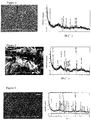
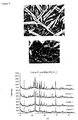
- FIGs 1 to 4 show XRD and SEM of the machinable glass ceramic (mica is formed) according to one embodiment of the present invention during different stages of its production. Specifically, crystallization begins lower than 650°C when a metastable phase forms in the magnesium-rich matrix at the interfaces of the aluminosilicate droplets (KAlSi 2 O 6 ). These crystals have been identified as a body-centered cubic form of chondrodite, Mg 3 Si 4 O 10 F 2 (see Figure 1 , by example of Example 1). At approximately higher than 750°C, the chondrodite phase recrystallizes to small platy crystals of norbergite, Mg 3 Si 4 O 10 F 2 (see Figure 2 , by example of Example 1).
- Figure 5 shows depth of K + layer by chemical toughening the machinable glass ceramic.
- the horizontal coordinate stands for the distance from cross-section ( ⁇ m)
- the vertical coordinate stands for the concentration of K ions.
- Figure 6 shows depth of K + layer by 3 steps chemical toughening the machinable glass ceramic. Compared with figure 5 , the Dol increases from 25 ⁇ m to 53 ⁇ m.
- Table 1 below presents the data of composition and performances (Dol, Hv hardness and strength) of Examples 1-12 of the present inventinon:
- the glass ceramic according to the present invention is able to achieve DoL of 20 ⁇ m or higher, Hv hardness of 250 kg/mm 2 or higher, and strength of 160 MPa or higher.
- Figure 7 shows the results of Hardness comparison before and after chemical toughening the machinable glass ceramic of Example 1. As shown in Figure 7 , the Hv hardness of the glass ceramic according to the present invention after chemical toughing is significantly improved, compared to that before chemical toughing.
- Figure 8 shows the schematic diagram of the scratch test.
- an indenter is arranged vertically to the glass ceramic sample to keep both in contact, a certain load is applied to the indenter in vertical direction, and then a tangential force is applied to the glass ceramic sample to make a displacement.
- Example 1 the glass ceramic is sampled before and after chemical toughing, and the samples are respectively subjected to scratching tests under the same testing conditions.
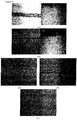
- Figure 9 shows the cross-section of scratched samples (under 750 gf) of the machinable glass ceramic of Example 1 of the present invention: (a) before chemical toughening, (b) after chemical toughening.
- the width of scratch is reduced from 169 ⁇ m to 15 ⁇ m after chemical toughening, and the depth of scratch is reduced from 84 ⁇ m to 35 ⁇ m, indicating that the glass ceramic according to the present invention is able to be chemically toughened and thus achieve significant improvement over the prior art with respect to the anti-scratching performance.
- Figure 9 further shows results of anti-scratching tests on the machinable glass ceramic according to one embodiment of the present invention (MIGC) before and after chemical toughing compared with the glass ceramic of the prior art.
- MIGC machinable glass ceramic according to one embodiment of the present invention
- the samples are scratched by orthose (hardness is 6) under 1500 g pressure load, the machinable glass ceramic of the present invention, e.g.
- ACA-2483 exhibits better anti-scratching performances than the sample MACOR (commercially available from Corning, also referred to as CorningMACOR), with the width of scratch being reduced from 1347 ⁇ m (MACOR, Fig.4(c) ) to 199 ⁇ m (ACA-2483, Fig.4(d) ), and the sample ACA-2483 exhibits no scratch ( Fig.4(e) ). That is to say, the anti-scratching performances of ACA-2483 are further improved significantly after the chemical toughing. Therefore, compared with MACOR, the machinable glass ceramic according to the present invention exhibits significantly improved anti-scratching performances, and the hardness and the strength are further improved by the chemical toughing.
- Figure 10 shows the comparative results of Hk hardness of the machinable glass ceramic according to the present invention with the glass ceramic of the prior art.
- ACA-2483 and ACA2483CT exhibits the cabbage-head shape as shown in Figure 4 .
- the Hk hardness of ACA-2483 is significantly improved, and after the chemical toughing, the Hk hardness of ACA-2483CT is further improved.
- Figure 11 shows the comparative results of 3P (three-point bending) strength of the machinable glass ceramic according to the present invention compared with the glass ceramic of the prior art.
- the 3P strength of ACA-2483 is lower than that of MACOR; whereas after the chemical toughing, the 3P strength of ACA-2483CT is significantly improved and is comparable to that of MACOR.
Landscapes
- Chemical & Material Sciences (AREA)
- Engineering & Computer Science (AREA)
- Materials Engineering (AREA)
- Organic Chemistry (AREA)
- Life Sciences & Earth Sciences (AREA)
- Chemical Kinetics & Catalysis (AREA)
- General Chemical & Material Sciences (AREA)
- Geochemistry & Mineralogy (AREA)
- Ceramic Engineering (AREA)
- Crystallography & Structural Chemistry (AREA)
- Dispersion Chemistry (AREA)
- Thermal Sciences (AREA)
- Physics & Mathematics (AREA)
- Glass Compositions (AREA)
- Surface Treatment Of Glass (AREA)
Claims (28)
- Fluorglimmer-Glaskeramik, umfassend:
SiO2: 25-75 Gew.-%; Al2O3: 6-30 Gew.-%; Na2O: 0,1-30 Gew.-%; K2O: 0,5-15 Gew.-%; B2O3: 0,1-30 Gew.-%; MgO: 4-35 Gew.-%; CaO: 0-4 Gew.-%; F: 1-20 Gew.-%; ZrO2: 0-10 Gew.-%; P2O5: 0,1-10 Gew.-%; CeO2: 0-1 Gew.-%; SnO2: 0-1 Gew.-%,
wobei die Glaskeramik eine Mikrostruktur aufweist, umfassend:1) eine Glasmatrix, und2) mindestens eine kristalline Phase mit der Formel(K,Na)1-xMg3(Al,B,P)1-xSi3+xO10F2, wobei x 0 bis 1 ist,
wobei die Glaskeramik bearbeitbar ist und Ionenaustausch unterworfen werden kann,
wobei Druckspannung CS > 300 MPa, > 350 MPa oder > 400 MPa, und Dol > 15 µm, > 20 µm oder > 25 µm erreicht werden. - Fluorglimmer-Glaskeramik gemäß Anspruch 1, umfassend die folgende Zusammensetzung, wie aus Chargen bezogen auf Oxide berechnet:
SiO2: 30-70 Gew.-%; Al2O3: 7-29 Gew.-%; Na2O: 0,5-15 Gew.-%; K2O: 0,5-12 Gew.-%; B2O3: 0,1-20 Gew.-%; MgO: 4-25 Gew.-%; CaO: 0-2 Gew.-%; F: 1-15 Gew.-%; P2O5: 0,5-9 Gew.-%; ZrO2: 0-8 Gew.-%; CeO2: 0-0,5 Gew.-%; SnO2: 0-0,5 Gew.-%. - Fluorglimmer-Glaskeramik gemäß Anspruch 1, umfassend die folgende Zusammensetzung, wie aus Chargen bezogen auf Oxide berechnet:
SiO2: 35-65 Gew.-%; Al2O3: 8-27 Gew.-%; Na2O: 1-15 Gew.-%; K2O: 1-11 Gew.-%; B2O3: 1-20 Gew.-%; MgO: 4-20 Gew.-%; CaO: 0-1,5 Gew.-%; F: 2-12 Gew.-%; P2O5: 1-8 Gew.-%; ZrO2: 0-6 Gew.-%; CeO2: 0-0,3 Gew.-%; SnO2: 0-0,3 Gew.-%. - Fluorglimmer-Glaskeramik gemäß Anspruch 1, umfassend die folgende Zusammensetzung, wie aus Chargen bezogen auf Oxide berechnet:
SiO2: 40-65 Gew.-%; Al2O3: 8-26 Gew.-%; Na2O: 3-14 Gew.-%; K2O: 2-10 Gew.-%; B2O3: 1-17 Gew.-%; MgO: 4-17 Gew.-%; CaO: 0-1 Gew.-%; F: 5-10 Gew.-%; P2O5: 1-7 Gew.-%; ZrO2: 0-6 Gew.-%; CeO2: 0-0,2 Gew.-%; SnO2: 0-0,2 Gew.-%. - Fluorglimmer-Glaskeramik gemäß einem der Ansprüche 1 bis 4, wobei die Fluorglimmer-Glaskeramik eine Porosität von 0 % aufweist, mehr als 40 Vol.-% kristalline Phase aufweist und eine zusammengebackene Kristallisationsstruktur gebildet werden kann, wobei die Glimmer-Kristallgröße 5-100 µm mit Seitenverhältnis < 0,5 ist.
- Fluorglimmer-Glaskeramik gemäß einem der Ansprüche 1-4, wobei Fluorglimmer-Kristall mit bevorzugt lateraler Richtung oder Kohlkopfform in der Fluorglimmer-Glaskeramik gebildet werden kann und die Größe von Kristallkörnern des Fluorglimmer-Kristalls > 5 µm, > 10 µm oder > 15 µm ist.
- Fluorglimmer-Glaskeramik gemäß einem der Ansprüche 1 bis 4 mit einem CTE < 20 ppm/K im Temperaturbereich von 20-300°C und einer Poissonschen Zahl von < 0,3.
- Fluorglimmer-Glaskeramik gemäß einem der Ansprüche 1 bis 4 mit einer maximalen Temperaturwechselbeständigkeit ΔT > 300°C, Wärmeleitfähigkeit niedriger als 1,8 W/m°C und maximalen Verwendungstemperatur höher als 800°C.
- Fluorglimmer-Glaskeramik gemäß einem der Ansprüche 1 bis 4, wobei der Temperaturwechselbeständigkeitsparameter R höher als 180 W/m2 ist.
- Fluorglimmer-Glaskeramik gemäß einem der Ansprüche 1 bis 4 mit einer Druckspannung höher als 300 MPa, einer mechanischen Festigkeit höher als 350 MPa, einem Bruchmodul höher als 100 MPa, einem Youngschen Modul höher als 65 GPa und einer Biegefestigkeit höher als 94 MPa.
- Fluorglimmer-Glaskeramik gemäß einem der Ansprüche 1 bis 4 mit einer Dielektrizitätskonstante im Bereich von 5,5-9 bei 25°C und 1 KHZ, und einem Verlustfaktor von < 0,002 bei 25°C und 1 MHz.
- Fluorglimmer-Glaskeramik gemäß einem der Ansprüche 1 bis 4, wobei die Fluorglimmer-Glaskeramik eine Hv-Härte höher als 200 kg/mm2 aufweist.
- Fluorglimmer-Glaskeramik gemäß einem der Ansprüche 1 bis 4, wobei chemische Verfestigungstemperatur 300°C∼500°C beträgt, chemische Verfestigungszeit 0,1∼16 h beträgt in reinem KNO3-Salzbad, bevorzugt chemische Verfestigungstemperatur 350°C∼490°C beträgt, chemische Verfestigungszeit 2∼12 h beträgt, stärker bevorzugt chemische Verfestigungstemperatur 400∼480°C beträgt, chemische Verfestigungszeit 2~8 h beträgt.
- Fluorglimmer-Glaskeramik gemäß einem der Ansprüche 1 bis 4 mit einer Tiefe der K-Ionen-Schicht > 15 µm, > 20 µm oder > 25 µm, und einer Druckspannung > 300 MPa, > 350 MPa oder > 400 MPa.
- Fluorglimmer-Glaskeramik gemäß einem der Ansprüche 1 bis 4, wobei die Härte der chemisch verfestigten bearbeitbaren Glaskeramik um mehr als 20 % nach chemischem Verfestigen verbessert sein kann.
- Fluorglimmer-Glaskeramik gemäß einem der Ansprüche 1 bis 4, wobei das Maßabweichungsverhältnis der Fluorglimmer-Glaskeramik weniger als 0,06 % beträgt, welches durch chemisches Verfestigen verursacht wird.
- Fluorglimmer-Glaskeramik gemäß einem der Ansprüche 1 bis 4, wobei die Kratzerbreiten und -tiefen um mehr als 10 % nach chemischem Verfestigen verringert werden können.
- Fluorglimmer-Glaskeramik gemäß einem der Ansprüche 1 bis 4, welche durch drei oder multiple Schritte chemisch verfestigt werden kann.
- Fluorglimmer-Glaskeramik gemäß Anspruch 18, wobei der erste Schritt Dol1 erzeugen kann und die Dol1 gemäß einer ersten Funktion variiert; der zweite Schritt Dol2 erzeugen kann und die Dol2 gemäß einer zweiten Funktion variiert, und wobei die erste Funktion verschieden von der zweiten Funktion ist; und der dritte Schritt Dol3 erzeugen kann und die Dol3 gemäß einer dritten Funktion variiert, und wobei die dritte Funktion verschieden von der ersten Funktion und der zweiten Funktion ist.
- Fluorglimmer-Glaskeramik gemäß Anspruch 19, wobei für den ersten Schritt chemische Verfestigungstemperatur 300°C∼500°C beträgt, chemische Verfestigungszeit 0,1∼16 h beträgt in reinem KNO3-Salzbad, bevorzugt chemische Verfestigungstemperatur 350°C∼490°C beträgt, chemische Verfestigungszeit 2∼12 h beträgt, stärker bevorzugt chemische Verfestigungstemperatur 400∼480°C beträgt, chemische Verfestigungszeit 2∼8 h beträgt.
- Fluorglimmer-Glaskeramik gemäß Anspruch 19, wobei für den zweiten Schritt Wärmebehandlungstemperatur 200∼600°C beträgt und Behandlungszeit 0,1∼10 h beträgt.
- Fluorglimmer-Glaskeramik gemäß Anspruch 19, wobei für den dritten Schritt chemische Verfestigungstemperatur 300°C∼500°C beträgt, chemische Verfestigungszeit 0,01∼16 h beträgt in reinem KNO3-Salzbad, bevorzugt chemische Verfestigungstemperatur 350°C∼490°C beträgt, chemische Verfestigungszeit 0,01∼4 h beträgt, stärker bevorzugt chemische Verfestigungstemperatur 400∼480°C beträgt, chemische Verfestigungszeit 0,01∼1 h beträgt.
- Fluorglimmer-Glaskeramik gemäß einem der Ansprüche 1 bis 4, wobei die Fluorglimmer-Glaskeramik durch multiple Schritte chemisch verfestigt werden kann, wobei eine Tiefe der K-Ionen-Schicht > 40 µm, > 50 µm oder > 60 µm, und eine Druckspannung > 300 MPa, > 350 MPa oder > 400 MPa erreicht werden.
- Fluorglimmer-Glaskeramik gemäß einem der Ansprüche 1 bis 4, wobei die Härte der bearbeitbaren Glaskeramik um mehr als 30 % nach multiplem chemischem Verfestigen verbessert sein kann.
- Fluorglimmer-Glaskeramik gemäß einem der Ansprüche 1 bis 4, wobei das Maßabweichungsverhältnis der bearbeitbaren Glaskeramik weniger als 0,06 % nach multiplem chemischem Verfestigen beträgt.
- Fluorglimmer-Glaskeramik gemäß einem der Ansprüche 1 bis 4, wobei die Kratzerbreiten und -tiefen um mehr als 15 % nach multiplem chemischem Verfestigen verringert werden können.
- Fluorglimmer-Glaskeramik gemäß einem der Ansprüche 1 bis 4, welche mit AgNO3 chemisch verfestigt werden kann, um die antimikrobiellen Eigenschaften zu erhalten, und mit Arten von farbgebenden Ionen (z.B. Cu2+, Fe2+, Co3+, Ni4+ und Cr3+) gefärbt werden kann.
- Fluorglimmer-Glaskeramik gemäß einem der Ansprüche 1 bis 4, wobei die Fluorglimmer-Glaskeramik, die chemisch verfestigt werden kann, zum Bereitstellen von Isolierungs- und Festigungsleistung bei der Highend-Ausrüstung (wie Luft- und Raumfahrt, medizinische Industrie); Haltern in der Ausrüstung (wie Feldionenmikroskopen, Seismograph-Spulen); Rückseitenabdeckung/Rahmen auf elektronischen Produkten (z.B. Mobiltelefonen, Smartphones, Tablet-PC, Notebooks, PDA, PC, TV, Kühlschrank, Kochgerät, ATM-Maschinen und industriellen Displays) verwendet werden kann.
Applications Claiming Priority (2)
| Application Number | Priority Date | Filing Date | Title |
|---|---|---|---|
| CN201510091475 | 2015-02-28 | ||
| PCT/CN2016/074785 WO2016134677A1 (en) | 2015-02-28 | 2016-02-29 | Machinable and chemically toughenable glass ceramic |
Publications (3)
| Publication Number | Publication Date |
|---|---|
| EP3262002A1 EP3262002A1 (de) | 2018-01-03 |
| EP3262002A4 EP3262002A4 (de) | 2018-06-06 |
| EP3262002B1 true EP3262002B1 (de) | 2019-12-18 |
Family
ID=56787875
Family Applications (1)
| Application Number | Title | Priority Date | Filing Date |
|---|---|---|---|
| EP16754786.8A Active EP3262002B1 (de) | 2015-02-28 | 2016-02-29 | Bearbeitbare und chemisch vorspannbare glaskeramik |
Country Status (5)
| Country | Link |
|---|---|
| US (1) | US10766807B2 (de) |
| EP (1) | EP3262002B1 (de) |
| JP (1) | JP7154762B2 (de) |
| CN (1) | CN105936588A (de) |
| WO (1) | WO2016134677A1 (de) |
Families Citing this family (8)
| Publication number | Priority date | Publication date | Assignee | Title |
|---|---|---|---|---|
| CN106587638A (zh) * | 2016-12-15 | 2017-04-26 | 韩王成 | 一种可机械加工玻璃陶瓷及其制备方法 |
| WO2018198968A1 (ja) * | 2017-04-27 | 2018-11-01 | Agc株式会社 | 化学強化用ガラスセラミックス複合体、化学強化ガラスセラミックス複合体及びその製造方法 |
| JP7335541B2 (ja) * | 2018-07-27 | 2023-08-30 | 日本電気硝子株式会社 | 強化ガラス及び強化用ガラス |
| CN109081595A (zh) * | 2018-09-30 | 2018-12-25 | 江苏耀兴安全玻璃有限公司 | 一种微晶玻璃的制备方法 |
| CN111377614B (zh) | 2018-12-27 | 2022-02-18 | 华为机器有限公司 | 一种铝硅酸盐微晶玻璃及其制备方法和产品 |
| KR20210147851A (ko) | 2019-04-02 | 2021-12-07 | 코닝 인코포레이티드 | 화학적으로 강화될 수 있는 기계 가공 가능한 유리-세라믹 |
| CN113003939A (zh) * | 2019-12-19 | 2021-06-22 | 湖州大享玻璃制品有限公司 | SiO2-CaO系结晶化玻璃及其制造方法 |
| JP7139384B2 (ja) * | 2020-05-21 | 2022-09-20 | 株式会社フェローテックマテリアルテクノロジーズ | ガラスセラミックス |
Family Cites Families (39)
| Publication number | Priority date | Publication date | Assignee | Title |
|---|---|---|---|---|
| US3689293A (en) | 1970-07-08 | 1972-09-05 | Corning Glass Works | Mica glass-ceramics |
| US3732087A (en) | 1971-02-24 | 1973-05-08 | Corning Glass Works | Tetrasilicic mica glass-ceramic method |
| US3839055A (en) | 1971-02-24 | 1974-10-01 | Corning Glass Works | Tetrasilicic mica glass-ceramic article |
| US3839005A (en) | 1971-05-06 | 1974-10-01 | Owens Illinois Inc | Laser beam severing of a rotating article |
| US3756838A (en) | 1971-05-28 | 1973-09-04 | Corning Glass Works | Strontium fluormica glass ceramics |
| US3801295A (en) | 1972-08-01 | 1974-04-02 | Corning Glass Works | Mica glass-ceramics |
| US3985531A (en) | 1975-03-19 | 1976-10-12 | Corning Glass Works | Spontaneously-formed fluormica glass-ceramics |
| US3997352A (en) | 1975-09-29 | 1976-12-14 | Corning Glass Works | Mica-spodumene glass-ceramic articles |
| DD132332B1 (de) * | 1977-05-25 | 1980-08-27 | Roland Ehrt | Maschinell bearbeitbare glimmerhaltige glaskeramiken und verfahren zu ihrer herstellung |
| JPS5483923A (en) * | 1977-12-16 | 1979-07-04 | Asahi Glass Co Ltd | Ion exchange strengthening of glass |
| US4111708A (en) | 1978-01-06 | 1978-09-05 | Corning Glass Works | Machinable glasses |
| US4341543A (en) | 1981-01-09 | 1982-07-27 | Corning Glass Works | Method of making strengthened transparent glass-ceramic, partially body-crystallized, and surface-crystallized glass articles |
| DD242217A1 (de) * | 1985-11-04 | 1987-01-21 | Univ Schiller Jena | Impantatmaterial fuer die kopf-hals-chirurgie |
| US4414281A (en) | 1982-02-16 | 1983-11-08 | Corning Glass Works | Glass-ceramic articles having metallic surfaces |
| US4390634A (en) | 1982-02-16 | 1983-06-28 | Corning Glass Works | Calcium fluorophlogopite glass-ceramics |
| DD219017A3 (de) * | 1982-02-26 | 1985-02-20 | Univ Schiller Jena | Maschinell bearbeitbare bioaktive glaskeramik |
| US4536452A (en) * | 1983-10-24 | 1985-08-20 | Corning Glass Works | Spontaneously-formed machinable glass-ceramics |
| DD242216A1 (de) * | 1985-11-04 | 1987-01-21 | Univ Schiller Jena | Glimmer-cordierit-glaskeramik |
| US4789649A (en) * | 1985-11-04 | 1988-12-06 | Veb Jenaer Glaswerk | Micaceous-cordierite-glass ceramic |
| US4624933A (en) | 1985-12-20 | 1986-11-25 | Corning Glass Works | Sodium fluormica glass-ceramics |
| DE19725552A1 (de) * | 1997-06-12 | 1998-12-24 | Ivoclar Ag | Alkali-Silicat-Glas |
| US6375729B1 (en) * | 1999-03-19 | 2002-04-23 | Jeneric/Pentron, Inc. | Machinable glass-ceramics |
| KR100506417B1 (ko) | 2002-07-11 | 2005-08-05 | 임범순 | 치과용 가공성 글라스-세라믹 수복 및 보철재료 |
| DE10332212A1 (de) | 2003-07-16 | 2005-02-24 | Koenig & Bauer Ag | Vorrichtungen zur Qualitätsprüfung von Prüfkörpern und ein Verfahren zum Prüfen der Qualität von Bogen |
| CN100348525C (zh) * | 2004-09-28 | 2007-11-14 | 中南大学 | 一种可切削的生物活性玻璃陶瓷及其制备方法 |
| WO2006075785A2 (en) | 2005-01-17 | 2006-07-20 | Kabushiki Kaisha Ohara | Glass |
| JP4430001B2 (ja) * | 2005-11-01 | 2010-03-10 | 湖州大享玻璃制品有限公司 | Li2O−Al2O3−SiO2−MgO−K2O−F系結晶性ガラス及び結晶化ガラス、ならびに該結晶性ガラス及び結晶化ガラスの製造方法 |
| JP4582028B2 (ja) | 2006-03-13 | 2010-11-17 | 石川県 | 快削性ガラスセラミックスの製造方法 |
| US7666511B2 (en) * | 2007-05-18 | 2010-02-23 | Corning Incorporated | Down-drawable, chemically strengthened glass for cover plate |
| US8224289B2 (en) | 2008-04-30 | 2012-07-17 | Alexander Poltorak | Multi-tier service and secure wireless communications networks |
| US8048816B2 (en) | 2008-05-01 | 2011-11-01 | Corning Incorporated | Colored machinable glass-ceramics |
| US8021999B2 (en) | 2008-06-23 | 2011-09-20 | Corning Incorporated | High strength machinable glass-ceramics |
| KR20110026508A (ko) * | 2008-07-03 | 2011-03-15 | 코닝 인코포레이티드 | 전자 장치용 내구성 유리-세라믹 하우징/인클로저 |
| EP2387729A2 (de) | 2009-01-16 | 2011-11-23 | Geco Technology B.V. | Verarbeitung von seismischen daten |
| JP5133964B2 (ja) * | 2009-11-06 | 2013-01-30 | 湖州大享玻璃制品有限公司 | MgO−Al2O3−SiO2系結晶性ガラス及び結晶化ガラス、並びに該結晶性ガラス及び結晶化ガラスの製造方法 |
| WO2013011897A1 (ja) | 2011-07-15 | 2013-01-24 | 旭硝子株式会社 | 結晶化ガラス筐体 |
| JP2013071878A (ja) * | 2011-09-29 | 2013-04-22 | Central Glass Co Ltd | 抗菌性ガラス及び該抗菌性ガラスの製造方法 |
| US9359251B2 (en) | 2012-02-29 | 2016-06-07 | Corning Incorporated | Ion exchanged glasses via non-error function compressive stress profiles |
| US9604871B2 (en) | 2012-11-08 | 2017-03-28 | Corning Incorporated | Durable glass ceramic cover glass for electronic devices |
-
2016
- 2016-02-26 CN CN201610107625.7A patent/CN105936588A/zh active Pending
- 2016-02-29 JP JP2017545548A patent/JP7154762B2/ja active Active
- 2016-02-29 WO PCT/CN2016/074785 patent/WO2016134677A1/en not_active Ceased
- 2016-02-29 EP EP16754786.8A patent/EP3262002B1/de active Active
-
2017
- 2017-08-28 US US15/688,258 patent/US10766807B2/en active Active
Non-Patent Citations (1)
| Title |
|---|
| None * |
Also Published As
| Publication number | Publication date |
|---|---|
| JP2018506501A (ja) | 2018-03-08 |
| EP3262002A4 (de) | 2018-06-06 |
| US20180044225A1 (en) | 2018-02-15 |
| JP7154762B2 (ja) | 2022-10-18 |
| WO2016134677A1 (en) | 2016-09-01 |
| US10766807B2 (en) | 2020-09-08 |
| CN105936588A (zh) | 2016-09-14 |
| EP3262002A1 (de) | 2018-01-03 |
Similar Documents
| Publication | Publication Date | Title |
|---|---|---|
| US10766807B2 (en) | Machinable and chemically toughenable fluorine glass-ceramic | |
| KR102788516B1 (ko) | 페탈라이트 및 리튬 실리케이트 구조를 갖는 고강도 유리-세라믹 | |
| KR101780136B1 (ko) | 유리 조성물, 화학 강화용 유리 조성물, 강화 유리 물품, 및 디스플레이용 커버 유리 | |
| KR102332388B1 (ko) | 화학적 강화 후 낮은 팽창을 갖는 리튬 함유 알루미노실리케이트 유리 | |
| EP3400202B1 (de) | Chemisch verstärkbare lithium-aluminosilikat-gläser mit inhärenter schadensbeständigkeit | |
| KR102273284B1 (ko) | 리튬 디실리케이트 및 베타-스포듀민 구조를 갖는 고강도 유리-세라믹 | |
| JP6791757B2 (ja) | 三次元成形のためのイオン交換可能なガラス物品 | |
| KR101785819B1 (ko) | 유리 조성물, 화학 강화용 유리 조성물, 강화 유리 물품, 및 디스플레이용 커버 유리 | |
| CN119797767A (zh) | 具有增加的抗破碎性的玻璃陶瓷制品及其制造方法 | |
| EP3164365B1 (de) | Glaszusammensetzung für chemisch verstärktes alkali-aluminosilikat-glas und verfahren zur herstellung davon | |
| CN116332504A (zh) | 玻璃、化学强化玻璃和包含化学强化玻璃的电子设备 | |
| CN112645609B (zh) | 一种化学强化玻璃的制备方法、化学强化玻璃及原料玻璃 | |
| KR102237169B1 (ko) | 화학 강화 알칼리-알루미노실리케이트 유리용 유리 조성물 및 그 유리의 제조 방법 | |
| CN112645589B (zh) | 一种化学强化玻璃、化学强化玻璃的制备方法及原料玻璃 | |
| CN112592052A (zh) | 化学性预加应力的高刮划容忍度玻璃元件及其制造方法 | |
| CN102089252A (zh) | 用于电子设备的耐用玻璃陶瓷机壳/封罩 | |
| JP2013193887A (ja) | ガラス組成物、化学強化用ガラス組成物、強化ガラス物品、ディスプレイ用のカバーガラスおよび強化ガラス物品の製造方法 | |
| CN101172771B (zh) | 化学钢化用玻璃 | |
| JP2022525485A (ja) | 化学的に強化可能かつ機械加工可能なガラスセラミック | |
| KR20170118964A (ko) | 화학적 강화에 적합한 플로트 유리 조성물 | |
| CN112321150A (zh) | 板状的、化学钢化或可化学钢化的玻璃制品及其制造方法 | |
| JP4289927B2 (ja) | 化学強化ガラスの製造方法 | |
| KR20260040067A (ko) | 낮은 결정화 경향과 결합된 높은 화학적 강화성을 갖는 유리 및 유리 물품 및 제조 방법 | |
| CN120774641A (zh) | 玻璃材料、微晶玻璃 | |
| KR20260015305A (ko) | 디스플레이 디바이스용 Al2O3 함량이 낮은 이온 교환성 유리 |
Legal Events
| Date | Code | Title | Description |
|---|---|---|---|
| STAA | Information on the status of an ep patent application or granted ep patent |
Free format text: STATUS: THE INTERNATIONAL PUBLICATION HAS BEEN MADE |
|
| PUAI | Public reference made under article 153(3) epc to a published international application that has entered the european phase |
Free format text: ORIGINAL CODE: 0009012 |
|
| STAA | Information on the status of an ep patent application or granted ep patent |
Free format text: STATUS: REQUEST FOR EXAMINATION WAS MADE |
|
| 17P | Request for examination filed |
Effective date: 20170822 |
|
| AK | Designated contracting states |
Kind code of ref document: A1 Designated state(s): AL AT BE BG CH CY CZ DE DK EE ES FI FR GB GR HR HU IE IS IT LI LT LU LV MC MK MT NL NO PL PT RO RS SE SI SK SM TR |
|
| AX | Request for extension of the european patent |
Extension state: BA ME |
|
| A4 | Supplementary search report drawn up and despatched |
Effective date: 20180508 |
|
| DAV | Request for validation of the european patent (deleted) | ||
| DAX | Request for extension of the european patent (deleted) | ||
| RIC1 | Information provided on ipc code assigned before grant |
Ipc: C03B 27/03 20060101ALI20180502BHEP Ipc: C03C 3/062 20060101ALI20180502BHEP Ipc: C03C 3/112 20060101ALI20180502BHEP Ipc: C03C 10/16 20060101AFI20180502BHEP |
|
| GRAP | Despatch of communication of intention to grant a patent |
Free format text: ORIGINAL CODE: EPIDOSNIGR1 |
|
| STAA | Information on the status of an ep patent application or granted ep patent |
Free format text: STATUS: GRANT OF PATENT IS INTENDED |
|
| RIC1 | Information provided on ipc code assigned before grant |
Ipc: C03C 10/16 20060101AFI20190612BHEP Ipc: C03C 21/00 20060101ALI20190612BHEP Ipc: C03C 3/112 20060101ALI20190612BHEP |
|
| INTG | Intention to grant announced |
Effective date: 20190709 |
|
| GRAS | Grant fee paid |
Free format text: ORIGINAL CODE: EPIDOSNIGR3 |
|
| GRAA | (expected) grant |
Free format text: ORIGINAL CODE: 0009210 |
|
| STAA | Information on the status of an ep patent application or granted ep patent |
Free format text: STATUS: THE PATENT HAS BEEN GRANTED |
|
| AK | Designated contracting states |
Kind code of ref document: B1 Designated state(s): AL AT BE BG CH CY CZ DE DK EE ES FI FR GB GR HR HU IE IS IT LI LT LU LV MC MK MT NL NO PL PT RO RS SE SI SK SM TR |
|
| REG | Reference to a national code |
Ref country code: CH Ref legal event code: EP |
|
| REG | Reference to a national code |
Ref country code: IE Ref legal event code: FG4D |
|
| REG | Reference to a national code |
Ref country code: DE Ref legal event code: R096 Ref document number: 602016026470 Country of ref document: DE |
|
| REG | Reference to a national code |
Ref country code: AT Ref legal event code: REF Ref document number: 1214429 Country of ref document: AT Kind code of ref document: T Effective date: 20200115 |
|
| REG | Reference to a national code |
Ref country code: NL Ref legal event code: MP Effective date: 20191218 |
|
| PG25 | Lapsed in a contracting state [announced via postgrant information from national office to epo] |
Ref country code: GR Free format text: LAPSE BECAUSE OF FAILURE TO SUBMIT A TRANSLATION OF THE DESCRIPTION OR TO PAY THE FEE WITHIN THE PRESCRIBED TIME-LIMIT Effective date: 20200319 Ref country code: LT Free format text: LAPSE BECAUSE OF FAILURE TO SUBMIT A TRANSLATION OF THE DESCRIPTION OR TO PAY THE FEE WITHIN THE PRESCRIBED TIME-LIMIT Effective date: 20191218 Ref country code: FI Free format text: LAPSE BECAUSE OF FAILURE TO SUBMIT A TRANSLATION OF THE DESCRIPTION OR TO PAY THE FEE WITHIN THE PRESCRIBED TIME-LIMIT Effective date: 20191218 Ref country code: BG Free format text: LAPSE BECAUSE OF FAILURE TO SUBMIT A TRANSLATION OF THE DESCRIPTION OR TO PAY THE FEE WITHIN THE PRESCRIBED TIME-LIMIT Effective date: 20200318 Ref country code: LV Free format text: LAPSE BECAUSE OF FAILURE TO SUBMIT A TRANSLATION OF THE DESCRIPTION OR TO PAY THE FEE WITHIN THE PRESCRIBED TIME-LIMIT Effective date: 20191218 Ref country code: SE Free format text: LAPSE BECAUSE OF FAILURE TO SUBMIT A TRANSLATION OF THE DESCRIPTION OR TO PAY THE FEE WITHIN THE PRESCRIBED TIME-LIMIT Effective date: 20191218 Ref country code: NO Free format text: LAPSE BECAUSE OF FAILURE TO SUBMIT A TRANSLATION OF THE DESCRIPTION OR TO PAY THE FEE WITHIN THE PRESCRIBED TIME-LIMIT Effective date: 20200318 |
|
| REG | Reference to a national code |
Ref country code: LT Ref legal event code: MG4D |
|
| PG25 | Lapsed in a contracting state [announced via postgrant information from national office to epo] |
Ref country code: RS Free format text: LAPSE BECAUSE OF FAILURE TO SUBMIT A TRANSLATION OF THE DESCRIPTION OR TO PAY THE FEE WITHIN THE PRESCRIBED TIME-LIMIT Effective date: 20191218 Ref country code: HR Free format text: LAPSE BECAUSE OF FAILURE TO SUBMIT A TRANSLATION OF THE DESCRIPTION OR TO PAY THE FEE WITHIN THE PRESCRIBED TIME-LIMIT Effective date: 20191218 |
|
| PG25 | Lapsed in a contracting state [announced via postgrant information from national office to epo] |
Ref country code: AL Free format text: LAPSE BECAUSE OF FAILURE TO SUBMIT A TRANSLATION OF THE DESCRIPTION OR TO PAY THE FEE WITHIN THE PRESCRIBED TIME-LIMIT Effective date: 20191218 |
|
| PG25 | Lapsed in a contracting state [announced via postgrant information from national office to epo] |
Ref country code: RO Free format text: LAPSE BECAUSE OF FAILURE TO SUBMIT A TRANSLATION OF THE DESCRIPTION OR TO PAY THE FEE WITHIN THE PRESCRIBED TIME-LIMIT Effective date: 20191218 Ref country code: NL Free format text: LAPSE BECAUSE OF FAILURE TO SUBMIT A TRANSLATION OF THE DESCRIPTION OR TO PAY THE FEE WITHIN THE PRESCRIBED TIME-LIMIT Effective date: 20191218 Ref country code: PT Free format text: LAPSE BECAUSE OF FAILURE TO SUBMIT A TRANSLATION OF THE DESCRIPTION OR TO PAY THE FEE WITHIN THE PRESCRIBED TIME-LIMIT Effective date: 20200513 Ref country code: CZ Free format text: LAPSE BECAUSE OF FAILURE TO SUBMIT A TRANSLATION OF THE DESCRIPTION OR TO PAY THE FEE WITHIN THE PRESCRIBED TIME-LIMIT Effective date: 20191218 Ref country code: EE Free format text: LAPSE BECAUSE OF FAILURE TO SUBMIT A TRANSLATION OF THE DESCRIPTION OR TO PAY THE FEE WITHIN THE PRESCRIBED TIME-LIMIT Effective date: 20191218 |
|
| PG25 | Lapsed in a contracting state [announced via postgrant information from national office to epo] |
Ref country code: SM Free format text: LAPSE BECAUSE OF FAILURE TO SUBMIT A TRANSLATION OF THE DESCRIPTION OR TO PAY THE FEE WITHIN THE PRESCRIBED TIME-LIMIT Effective date: 20191218 Ref country code: SK Free format text: LAPSE BECAUSE OF FAILURE TO SUBMIT A TRANSLATION OF THE DESCRIPTION OR TO PAY THE FEE WITHIN THE PRESCRIBED TIME-LIMIT Effective date: 20191218 Ref country code: IS Free format text: LAPSE BECAUSE OF FAILURE TO SUBMIT A TRANSLATION OF THE DESCRIPTION OR TO PAY THE FEE WITHIN THE PRESCRIBED TIME-LIMIT Effective date: 20200418 |
|
| REG | Reference to a national code |
Ref country code: DE Ref legal event code: R097 Ref document number: 602016026470 Country of ref document: DE |
|
| REG | Reference to a national code |
Ref country code: CH Ref legal event code: PL |
|
| REG | Reference to a national code |
Ref country code: AT Ref legal event code: MK05 Ref document number: 1214429 Country of ref document: AT Kind code of ref document: T Effective date: 20191218 |
|
| PLBE | No opposition filed within time limit |
Free format text: ORIGINAL CODE: 0009261 |
|
| STAA | Information on the status of an ep patent application or granted ep patent |
Free format text: STATUS: NO OPPOSITION FILED WITHIN TIME LIMIT |
|
| REG | Reference to a national code |
Ref country code: BE Ref legal event code: MM Effective date: 20200229 |
|
| PG25 | Lapsed in a contracting state [announced via postgrant information from national office to epo] |
Ref country code: ES Free format text: LAPSE BECAUSE OF FAILURE TO SUBMIT A TRANSLATION OF THE DESCRIPTION OR TO PAY THE FEE WITHIN THE PRESCRIBED TIME-LIMIT Effective date: 20191218 Ref country code: DK Free format text: LAPSE BECAUSE OF FAILURE TO SUBMIT A TRANSLATION OF THE DESCRIPTION OR TO PAY THE FEE WITHIN THE PRESCRIBED TIME-LIMIT Effective date: 20191218 Ref country code: LU Free format text: LAPSE BECAUSE OF NON-PAYMENT OF DUE FEES Effective date: 20200229 Ref country code: MC Free format text: LAPSE BECAUSE OF FAILURE TO SUBMIT A TRANSLATION OF THE DESCRIPTION OR TO PAY THE FEE WITHIN THE PRESCRIBED TIME-LIMIT Effective date: 20191218 |
|
| 26N | No opposition filed |
Effective date: 20200921 |
|
| PG25 | Lapsed in a contracting state [announced via postgrant information from national office to epo] |
Ref country code: SI Free format text: LAPSE BECAUSE OF FAILURE TO SUBMIT A TRANSLATION OF THE DESCRIPTION OR TO PAY THE FEE WITHIN THE PRESCRIBED TIME-LIMIT Effective date: 20191218 Ref country code: CH Free format text: LAPSE BECAUSE OF NON-PAYMENT OF DUE FEES Effective date: 20200229 Ref country code: LI Free format text: LAPSE BECAUSE OF NON-PAYMENT OF DUE FEES Effective date: 20200229 Ref country code: AT Free format text: LAPSE BECAUSE OF FAILURE TO SUBMIT A TRANSLATION OF THE DESCRIPTION OR TO PAY THE FEE WITHIN THE PRESCRIBED TIME-LIMIT Effective date: 20191218 |
|
| PG25 | Lapsed in a contracting state [announced via postgrant information from national office to epo] |
Ref country code: IE Free format text: LAPSE BECAUSE OF NON-PAYMENT OF DUE FEES Effective date: 20200229 Ref country code: IT Free format text: LAPSE BECAUSE OF FAILURE TO SUBMIT A TRANSLATION OF THE DESCRIPTION OR TO PAY THE FEE WITHIN THE PRESCRIBED TIME-LIMIT Effective date: 20191218 |
|
| PG25 | Lapsed in a contracting state [announced via postgrant information from national office to epo] |
Ref country code: PL Free format text: LAPSE BECAUSE OF FAILURE TO SUBMIT A TRANSLATION OF THE DESCRIPTION OR TO PAY THE FEE WITHIN THE PRESCRIBED TIME-LIMIT Effective date: 20191218 Ref country code: BE Free format text: LAPSE BECAUSE OF NON-PAYMENT OF DUE FEES Effective date: 20200229 |
|
| GBPC | Gb: european patent ceased through non-payment of renewal fee |
Effective date: 20200318 |
|
| PG25 | Lapsed in a contracting state [announced via postgrant information from national office to epo] |
Ref country code: GB Free format text: LAPSE BECAUSE OF NON-PAYMENT OF DUE FEES Effective date: 20200318 |
|
| PG25 | Lapsed in a contracting state [announced via postgrant information from national office to epo] |
Ref country code: TR Free format text: LAPSE BECAUSE OF FAILURE TO SUBMIT A TRANSLATION OF THE DESCRIPTION OR TO PAY THE FEE WITHIN THE PRESCRIBED TIME-LIMIT Effective date: 20191218 Ref country code: MT Free format text: LAPSE BECAUSE OF FAILURE TO SUBMIT A TRANSLATION OF THE DESCRIPTION OR TO PAY THE FEE WITHIN THE PRESCRIBED TIME-LIMIT Effective date: 20191218 Ref country code: CY Free format text: LAPSE BECAUSE OF FAILURE TO SUBMIT A TRANSLATION OF THE DESCRIPTION OR TO PAY THE FEE WITHIN THE PRESCRIBED TIME-LIMIT Effective date: 20191218 |
|
| PG25 | Lapsed in a contracting state [announced via postgrant information from national office to epo] |
Ref country code: MK Free format text: LAPSE BECAUSE OF FAILURE TO SUBMIT A TRANSLATION OF THE DESCRIPTION OR TO PAY THE FEE WITHIN THE PRESCRIBED TIME-LIMIT Effective date: 20191218 |
|
| P01 | Opt-out of the competence of the unified patent court (upc) registered |
Effective date: 20230516 |
|
| PGFP | Annual fee paid to national office [announced via postgrant information from national office to epo] |
Ref country code: DE Payment date: 20260218 Year of fee payment: 11 |
|
| PGFP | Annual fee paid to national office [announced via postgrant information from national office to epo] |
Ref country code: FR Payment date: 20260218 Year of fee payment: 11 |