EP3258151A1 - Beschichtetes metallrohr für fahrzeugrohrleitung und verfahren zur herstellung davon - Google Patents
Beschichtetes metallrohr für fahrzeugrohrleitung und verfahren zur herstellung davon Download PDFInfo
- Publication number
- EP3258151A1 EP3258151A1 EP16749282.6A EP16749282A EP3258151A1 EP 3258151 A1 EP3258151 A1 EP 3258151A1 EP 16749282 A EP16749282 A EP 16749282A EP 3258151 A1 EP3258151 A1 EP 3258151A1
- Authority
- EP
- European Patent Office
- Prior art keywords
- chemical conversion
- metal pipe
- mass
- conversion layer
- layer
- Prior art date
- Legal status (The legal status is an assumption and is not a legal conclusion. Google has not performed a legal analysis and makes no representation as to the accuracy of the status listed.)
- Granted
Links
Images

Classifications
-
- F—MECHANICAL ENGINEERING; LIGHTING; HEATING; WEAPONS; BLASTING
- F16—ENGINEERING ELEMENTS AND UNITS; GENERAL MEASURES FOR PRODUCING AND MAINTAINING EFFECTIVE FUNCTIONING OF MACHINES OR INSTALLATIONS; THERMAL INSULATION IN GENERAL
- F16L—PIPES; JOINTS OR FITTINGS FOR PIPES; SUPPORTS FOR PIPES, CABLES OR PROTECTIVE TUBING; MEANS FOR THERMAL INSULATION IN GENERAL
- F16L58/00—Protection of pipes or pipe fittings against corrosion or incrustation
- F16L58/02—Protection of pipes or pipe fittings against corrosion or incrustation by means of internal or external coatings
- F16L58/04—Coatings characterised by the materials used
- F16L58/10—Coatings characterised by the materials used by rubber or plastics
- F16L58/1054—Coatings characterised by the materials used by rubber or plastics the coating being placed outside the pipe
- F16L58/1072—Coatings characterised by the materials used by rubber or plastics the coating being placed outside the pipe the coating being a sprayed layer
-
- B—PERFORMING OPERATIONS; TRANSPORTING
- B32—LAYERED PRODUCTS
- B32B—LAYERED PRODUCTS, i.e. PRODUCTS BUILT-UP OF STRATA OF FLAT OR NON-FLAT, e.g. CELLULAR OR HONEYCOMB, FORM
- B32B1/00—Layered products having a non-planar shape
- B32B1/08—Tubular products
-
- B—PERFORMING OPERATIONS; TRANSPORTING
- B32—LAYERED PRODUCTS
- B32B—LAYERED PRODUCTS, i.e. PRODUCTS BUILT-UP OF STRATA OF FLAT OR NON-FLAT, e.g. CELLULAR OR HONEYCOMB, FORM
- B32B15/00—Layered products comprising a layer of metal
- B32B15/04—Layered products comprising a layer of metal comprising metal as the main or only constituent of a layer, which is next to another layer of the same or of a different material
- B32B15/08—Layered products comprising a layer of metal comprising metal as the main or only constituent of a layer, which is next to another layer of the same or of a different material of synthetic resin
-
- C—CHEMISTRY; METALLURGY
- C09—DYES; PAINTS; POLISHES; NATURAL RESINS; ADHESIVES; COMPOSITIONS NOT OTHERWISE PROVIDED FOR; APPLICATIONS OF MATERIALS NOT OTHERWISE PROVIDED FOR
- C09D—COATING COMPOSITIONS, e.g. PAINTS, VARNISHES OR LACQUERS; FILLING PASTES; CHEMICAL PAINT OR INK REMOVERS; INKS; CORRECTING FLUIDS; WOODSTAINS; PASTES OR SOLIDS FOR COLOURING OR PRINTING; USE OF MATERIALS THEREFOR
- C09D5/00—Coating compositions, e.g. paints, varnishes or lacquers, characterised by their physical nature or the effects produced; Filling pastes
- C09D5/08—Anti-corrosive paints
-
- C—CHEMISTRY; METALLURGY
- C23—COATING METALLIC MATERIAL; COATING MATERIAL WITH METALLIC MATERIAL; CHEMICAL SURFACE TREATMENT; DIFFUSION TREATMENT OF METALLIC MATERIAL; COATING BY VACUUM EVAPORATION, BY SPUTTERING, BY ION IMPLANTATION OR BY CHEMICAL VAPOUR DEPOSITION, IN GENERAL; INHIBITING CORROSION OF METALLIC MATERIAL OR INCRUSTATION IN GENERAL
- C23C—COATING METALLIC MATERIAL; COATING MATERIAL WITH METALLIC MATERIAL; SURFACE TREATMENT OF METALLIC MATERIAL BY DIFFUSION INTO THE SURFACE, BY CHEMICAL CONVERSION OR SUBSTITUTION; COATING BY VACUUM EVAPORATION, BY SPUTTERING, BY ION IMPLANTATION OR BY CHEMICAL VAPOUR DEPOSITION, IN GENERAL
- C23C22/00—Chemical surface treatment of metallic material by reaction of the surface with a reactive liquid, leaving reaction products of surface material in the coating, e.g. conversion coatings, passivation of metals
- C23C22/05—Chemical surface treatment of metallic material by reaction of the surface with a reactive liquid, leaving reaction products of surface material in the coating, e.g. conversion coatings, passivation of metals using aqueous solutions
- C23C22/06—Chemical surface treatment of metallic material by reaction of the surface with a reactive liquid, leaving reaction products of surface material in the coating, e.g. conversion coatings, passivation of metals using aqueous solutions using aqueous acidic solutions with pH less than 6
- C23C22/34—Chemical surface treatment of metallic material by reaction of the surface with a reactive liquid, leaving reaction products of surface material in the coating, e.g. conversion coatings, passivation of metals using aqueous solutions using aqueous acidic solutions with pH less than 6 containing fluorides or complex fluorides
-
- C—CHEMISTRY; METALLURGY
- C23—COATING METALLIC MATERIAL; COATING MATERIAL WITH METALLIC MATERIAL; CHEMICAL SURFACE TREATMENT; DIFFUSION TREATMENT OF METALLIC MATERIAL; COATING BY VACUUM EVAPORATION, BY SPUTTERING, BY ION IMPLANTATION OR BY CHEMICAL VAPOUR DEPOSITION, IN GENERAL; INHIBITING CORROSION OF METALLIC MATERIAL OR INCRUSTATION IN GENERAL
- C23C—COATING METALLIC MATERIAL; COATING MATERIAL WITH METALLIC MATERIAL; SURFACE TREATMENT OF METALLIC MATERIAL BY DIFFUSION INTO THE SURFACE, BY CHEMICAL CONVERSION OR SUBSTITUTION; COATING BY VACUUM EVAPORATION, BY SPUTTERING, BY ION IMPLANTATION OR BY CHEMICAL VAPOUR DEPOSITION, IN GENERAL
- C23C22/00—Chemical surface treatment of metallic material by reaction of the surface with a reactive liquid, leaving reaction products of surface material in the coating, e.g. conversion coatings, passivation of metals
- C23C22/82—After-treatment
-
- C—CHEMISTRY; METALLURGY
- C23—COATING METALLIC MATERIAL; COATING MATERIAL WITH METALLIC MATERIAL; CHEMICAL SURFACE TREATMENT; DIFFUSION TREATMENT OF METALLIC MATERIAL; COATING BY VACUUM EVAPORATION, BY SPUTTERING, BY ION IMPLANTATION OR BY CHEMICAL VAPOUR DEPOSITION, IN GENERAL; INHIBITING CORROSION OF METALLIC MATERIAL OR INCRUSTATION IN GENERAL
- C23C—COATING METALLIC MATERIAL; COATING MATERIAL WITH METALLIC MATERIAL; SURFACE TREATMENT OF METALLIC MATERIAL BY DIFFUSION INTO THE SURFACE, BY CHEMICAL CONVERSION OR SUBSTITUTION; COATING BY VACUUM EVAPORATION, BY SPUTTERING, BY ION IMPLANTATION OR BY CHEMICAL VAPOUR DEPOSITION, IN GENERAL
- C23C28/00—Coating for obtaining at least two superposed coatings either by methods not provided for in a single one of groups C23C2/00 - C23C26/00 or by combinations of methods provided for in subclasses C23C and C25C or C25D
-
- F—MECHANICAL ENGINEERING; LIGHTING; HEATING; WEAPONS; BLASTING
- F16—ENGINEERING ELEMENTS AND UNITS; GENERAL MEASURES FOR PRODUCING AND MAINTAINING EFFECTIVE FUNCTIONING OF MACHINES OR INSTALLATIONS; THERMAL INSULATION IN GENERAL
- F16L—PIPES; JOINTS OR FITTINGS FOR PIPES; SUPPORTS FOR PIPES, CABLES OR PROTECTIVE TUBING; MEANS FOR THERMAL INSULATION IN GENERAL
- F16L57/00—Protection of pipes or objects of similar shape against external or internal damage or wear
- F16L57/06—Protection of pipes or objects of similar shape against external or internal damage or wear against wear
-
- F—MECHANICAL ENGINEERING; LIGHTING; HEATING; WEAPONS; BLASTING
- F16—ENGINEERING ELEMENTS AND UNITS; GENERAL MEASURES FOR PRODUCING AND MAINTAINING EFFECTIVE FUNCTIONING OF MACHINES OR INSTALLATIONS; THERMAL INSULATION IN GENERAL
- F16L—PIPES; JOINTS OR FITTINGS FOR PIPES; SUPPORTS FOR PIPES, CABLES OR PROTECTIVE TUBING; MEANS FOR THERMAL INSULATION IN GENERAL
- F16L9/00—Rigid pipes
- F16L9/02—Rigid pipes of metal
-
- B—PERFORMING OPERATIONS; TRANSPORTING
- B05—SPRAYING OR ATOMISING IN GENERAL; APPLYING FLUENT MATERIALS TO SURFACES, IN GENERAL
- B05D—PROCESSES FOR APPLYING FLUENT MATERIALS TO SURFACES, IN GENERAL
- B05D1/00—Processes for applying liquids or other fluent materials
- B05D1/18—Processes for applying liquids or other fluent materials performed by dipping
-
- B—PERFORMING OPERATIONS; TRANSPORTING
- B05—SPRAYING OR ATOMISING IN GENERAL; APPLYING FLUENT MATERIALS TO SURFACES, IN GENERAL
- B05D—PROCESSES FOR APPLYING FLUENT MATERIALS TO SURFACES, IN GENERAL
- B05D2202/00—Metallic substrate
- B05D2202/10—Metallic substrate based on Fe
-
- B—PERFORMING OPERATIONS; TRANSPORTING
- B05—SPRAYING OR ATOMISING IN GENERAL; APPLYING FLUENT MATERIALS TO SURFACES, IN GENERAL
- B05D—PROCESSES FOR APPLYING FLUENT MATERIALS TO SURFACES, IN GENERAL
- B05D2254/00—Tubes
- B05D2254/02—Applying the material on the exterior of the tube
-
- B—PERFORMING OPERATIONS; TRANSPORTING
- B05—SPRAYING OR ATOMISING IN GENERAL; APPLYING FLUENT MATERIALS TO SURFACES, IN GENERAL
- B05D—PROCESSES FOR APPLYING FLUENT MATERIALS TO SURFACES, IN GENERAL
- B05D2504/00—Epoxy polymers
-
- B—PERFORMING OPERATIONS; TRANSPORTING
- B05—SPRAYING OR ATOMISING IN GENERAL; APPLYING FLUENT MATERIALS TO SURFACES, IN GENERAL
- B05D—PROCESSES FOR APPLYING FLUENT MATERIALS TO SURFACES, IN GENERAL
- B05D2505/00—Polyamides
-
- B—PERFORMING OPERATIONS; TRANSPORTING
- B05—SPRAYING OR ATOMISING IN GENERAL; APPLYING FLUENT MATERIALS TO SURFACES, IN GENERAL
- B05D—PROCESSES FOR APPLYING FLUENT MATERIALS TO SURFACES, IN GENERAL
- B05D3/00—Pretreatment of surfaces to which liquids or other fluent materials are to be applied; After-treatment of applied coatings, e.g. intermediate treating of an applied coating preparatory to subsequent applications of liquids or other fluent materials
- B05D3/02—Pretreatment of surfaces to which liquids or other fluent materials are to be applied; After-treatment of applied coatings, e.g. intermediate treating of an applied coating preparatory to subsequent applications of liquids or other fluent materials by baking
- B05D3/0254—After-treatment
-
- B—PERFORMING OPERATIONS; TRANSPORTING
- B05—SPRAYING OR ATOMISING IN GENERAL; APPLYING FLUENT MATERIALS TO SURFACES, IN GENERAL
- B05D—PROCESSES FOR APPLYING FLUENT MATERIALS TO SURFACES, IN GENERAL
- B05D5/00—Processes for applying liquids or other fluent materials to surfaces to obtain special surface effects, finishes or structures
- B05D5/08—Processes for applying liquids or other fluent materials to surfaces to obtain special surface effects, finishes or structures to obtain an anti-friction or anti-adhesive surface
- B05D5/083—Processes for applying liquids or other fluent materials to surfaces to obtain special surface effects, finishes or structures to obtain an anti-friction or anti-adhesive surface involving the use of fluoropolymers
-
- B—PERFORMING OPERATIONS; TRANSPORTING
- B05—SPRAYING OR ATOMISING IN GENERAL; APPLYING FLUENT MATERIALS TO SURFACES, IN GENERAL
- B05D—PROCESSES FOR APPLYING FLUENT MATERIALS TO SURFACES, IN GENERAL
- B05D7/00—Processes, other than flocking, specially adapted for applying liquids or other fluent materials to particular surfaces or for applying particular liquids or other fluent materials
- B05D7/14—Processes, other than flocking, specially adapted for applying liquids or other fluent materials to particular surfaces or for applying particular liquids or other fluent materials to metal, e.g. car bodies
- B05D7/146—Processes, other than flocking, specially adapted for applying liquids or other fluent materials to particular surfaces or for applying particular liquids or other fluent materials to metal, e.g. car bodies to metallic pipes or tubes
-
- B—PERFORMING OPERATIONS; TRANSPORTING
- B05—SPRAYING OR ATOMISING IN GENERAL; APPLYING FLUENT MATERIALS TO SURFACES, IN GENERAL
- B05D—PROCESSES FOR APPLYING FLUENT MATERIALS TO SURFACES, IN GENERAL
- B05D7/00—Processes, other than flocking, specially adapted for applying liquids or other fluent materials to particular surfaces or for applying particular liquids or other fluent materials
- B05D7/50—Multilayers
- B05D7/51—One specific pretreatment, e.g. phosphatation, chromatation, in combination with one specific coating
-
- C—CHEMISTRY; METALLURGY
- C23—COATING METALLIC MATERIAL; COATING MATERIAL WITH METALLIC MATERIAL; CHEMICAL SURFACE TREATMENT; DIFFUSION TREATMENT OF METALLIC MATERIAL; COATING BY VACUUM EVAPORATION, BY SPUTTERING, BY ION IMPLANTATION OR BY CHEMICAL VAPOUR DEPOSITION, IN GENERAL; INHIBITING CORROSION OF METALLIC MATERIAL OR INCRUSTATION IN GENERAL
- C23C—COATING METALLIC MATERIAL; COATING MATERIAL WITH METALLIC MATERIAL; SURFACE TREATMENT OF METALLIC MATERIAL BY DIFFUSION INTO THE SURFACE, BY CHEMICAL CONVERSION OR SUBSTITUTION; COATING BY VACUUM EVAPORATION, BY SPUTTERING, BY ION IMPLANTATION OR BY CHEMICAL VAPOUR DEPOSITION, IN GENERAL
- C23C2222/00—Aspects relating to chemical surface treatment of metallic material by reaction of the surface with a reactive medium
- C23C2222/20—Use of solutions containing silanes
Definitions
- the present invention relates to a coated metal pipe for vehicle piping and a production method therefor.
- Patent Literatures 1 to 4 An outer circumferential surface of a metal pipe used as fuel piping or the like for a vehicle is generally protected by various coating films in order to secure corrosion resistance, chemical resistance, and the like (for example, Patent Literatures 1 to 4).
- a coating film When a coating film is damaged during using a coated metal pipe having a coating film as piping, in some cases, the coating film is peeled off from the damaged portion or corrosion resistance is significantly decreased. In particular, since a coated metal pipe for vehicle piping has high possibility that a coating film thereof is damaged, adhesiveness and corrosion resistance of the coating film in the damaged portion of the coating film are very important.
- a main object of the present invention is to improve adhesiveness and corrosion resistance of a coating film when the coating film is damaged, regarding a coated metal pipe which is used for vehicle piping and includes a multi-layered coating film that covers a metal pipe.
- An aspect of the present invention relates to a coated metal pipe for vehicle piping including a metal pipe and a multi-layered coating film that covers an outer circumferential surface of the metal pipe.
- the multi-layered coating film includes a chemical conversion layer and a primer layer, and these layers are provided in this order from the inside.
- the chemical conversion layer contains a zirconium oxide and/or a zirconium hydroxide and the primer layer contains a polyamide imide and/or an epoxy resin.
- the aspect of the present invention relates to application of the coated metal pipe as vehicle piping or application of the coated metal pipe for producing vehicle piping.
- Another aspect of the present invention relates to a method for producing a coated metal pipe, including a step of forming, on an outer circumferential surface of a metal pipe, a multi-layered coating film that covers the outer circumferential surface.
- the step of forming the multi-layered coating film may include forming a chemical conversion layer on the outer circumferential surface by subjecting the outer circumferential surface of the metal pipe to surface treatment with a chemical conversion treatment solution containing hexafluorozirconic acid and/or a salt thereof and forming a primer layer containing a polyamide imide and/or an epoxy resin on an outer circumferential surface of the chemical conversion layer.
- the coated metal pipe according to the present invention it is possible to improve adhesiveness and corrosion resistance when a coating film is damaged, regarding a coated metal pipe which is used for vehicle piping and includes a multi-layered coating film that covers a metal pipe.
- the coated metal pipe according to the present invention is also excellent in adhesiveness between layers constituting the multi-layered coating film.
- Fig. 1 is a cross-sectional view illustrating a coated metal pipe according to an embodiment.
- Fig. 1 illustrates the cross-section perpendicular to the longitudinal direction of the coated metal pipe.
- a coated metal pipe 1 illustrated in Fig. 1 includes a metal pipe 10 and a multi-layered coating film 5 that covers an outer circumferential surface of the metal pipe 10.
- the multi-layered coating film 5 includes a chemical conversion layer 20 and a primer layer 30, and these layers are provided in this order from the inside.
- the multi-layered coating film 5 may cover the entire outer circumferential surface of the metal pipe 10 or the multi-layered coating film 5 may not be provided at a portion in which the coating film is not necessary.
- the metal pipe 10 is not particularly limited as long as it is a tubular metal molded body, but for example, the metal pipe may be a steel pipe or a metal alloy pipe other than the steel pipe.
- the steel pipe may be a single-wall steel pipe formed by rolling up a steel sheet in a tubular shape or a double-wall steel pipe formed by rolling up a steel sheet, the surface of which has been subjected to plating (copper plating or the like), twice in a tubular shape.
- the outer diameter of the metal pipe 10 is not particularly limited, but may be, for example, 4 to 42 mm.
- the thickness of the metal pipe 10 may be, for example, 0.35 to 2.0 mm.
- the chemical conversion layer 20 is a layer formed by substituting the outer circumferential surface of the metal pipe to surface treatment with a chemical conversion treatment solution.
- the chemical conversion treatment solution for forming the chemical conversion layer 20 may contain hexafluorozirconic acid (H 2 ZrF 6 ) and/or a salt thereof.
- hexafluorozirconic acid and/or a salt thereof is the expression also including expression of containing hexafluorozirconate ions (ZrF 6 2- ) formed by dissociating hexafluorozirconic acid and/or a salt thereof.
- the hexafluorozirconic acid salt may be, for example, ammonium hexafluorozirconate, potassium hexafluorozirconium, or the like.
- the chemical conversion layer 20 may contain a zirconium oxide (ZrO 2 or the like), a zirconium hydroxide (ZrO 2 ⁇ nH 2 O or the like), or a combination thereof.
- the zirconium oxide and the zirconium hydroxide are typically generated from hexafluorozirconic acid or a salt thereof in the chemical conversion treatment solution.
- the total content of the zirconium oxide and the zirconium hydroxide may be 1 to 30% by mass based on the mass of the chemical conversion layer 20. According to this, more excellent effect in terms of adhesiveness of the coating film can be obtained. From the same point of view, the total content of the zirconium oxide and the zirconium hydroxide may be 3 to 20% by mass or 5 to 15% by mass.
- the total concentration of hexafluorozirconic acid and a salt thereof in the chemical conversion treatment solution may be 0.1 to 1.5% by mass or 0.3 to 0.8% by mass based on the mass of the chemical conversion treatment solution. According to this, more excellent effect in terms of adhesiveness of the coating film can be obtained.
- the chemical conversion treatment solution for forming the chemical conversion layer 20 may contain a silane coupling agent having a reactive functional group and a silyl group.
- a hydrolyzable group such as an alkoxy group or an alkyloyloxy group is bonded.
- the reactive functional group may be, for example, at least one functional group selected from an amino group, an epoxy group, a (meth)acrylic group, a vinyl group, and a mercapto group. Of them, a silane coupling agent having an amino group may be selected.
- the silane coupling agent in the chemical conversion layer 20 may form a chemical bond with a metal atom or the like on the metal pipe surface or may form a silicon oxide.
- the content of the silane coupling agent in the chemical conversion treatment solution may be 100 to 600 parts by mass, 200 to 500 parts by mass, or 300 to 400 parts by mass when the mass of the hexafluorozirconate ions (including those present in the form of an acid or a salt) are regarded as 100 parts by mass.
- the content of the silane coupling agent is within these ranges, further significant effects in terms of adhesiveness and the like can be obtained.
- the chemical conversion layer 20 may contain a silicon oxide (SiO 2 or the like).
- the silicon oxide in the chemical conversion layer 20 is typically derived from the silane coupling agent in the chemical conversion treatment solution.
- the content of the silicon oxide in the chemical conversion layer 20 may be 100 to 600 (70 to 450) parts by mass, 200 to 500 (150 to 400) parts by mass, or 300 to 400 (200 to 300) parts by mass when the total content of the zirconium oxide and the zirconium hydroxide is regarded as 100 parts by mass. When the content of the silicon oxide is within these ranges, further significant effects in terms of adhesiveness and the like can be obtained.
- the chemical conversion treatment solution for forming the chemical conversion layer 20 may contain an organotitanium chelate compound.
- the organotitanium chelate compound has a titanium atom and a chelate ligand that is coordinated with the titanium atom.
- the organotitanium chelate compound having the chelate ligand is not generally hydrolyzed in an aqueous solution, and is present in a stable state.
- Examples of the organotitanium chelate compound include titanium diisopropoxy bis(triethanolaminate) and titanium lactate.
- the chemical conversion layer 20 may contain a titanium oxide (TiO 2 or the like).
- the titanium oxide in the chemical conversion layer 20 is typically derived from the organotitanium chelate compound in the chemical conversion treatment solution.
- the content of the titanium oxide in the chemical conversion layer 20 may be 10 to 60 parts by mass, 15 to 45 parts by mass, or 20 to 30 parts by mass when the total content of the zirconium oxide and zirconium hydroxide is regarded as 100 parts by mass. When the content of the titanium oxide is within these ranges, further significant effects in terms of adhesiveness and the like can be obtained.
- the chemical conversion treatment solution may contain a vanadium compound.
- This vanadium compound may contain oxovanadium ions ([VO] 2+ or the like).
- the valence of vanadium in the oxovanadium ions may be 3, 4, or 5.
- the concentration of the vanadium compound in the chemical conversion treatment solution may be, for example, 0.005 to 0.04% by mass based on the mass of the chemical conversion treatment solution.
- the chemical conversion layer 20 may contain a vanadium oxide.
- the vanadium oxide in the chemical conversion layer 20 is typically derived from the vanadium compound in the chemical conversion treatment solution.
- the content of the vanadium oxide in the chemical conversion layer 20 may be 0.1 to 40 parts by mass or 1.5 to 25 parts by mass when the total content of the zirconium oxide and the zirconium hydroxide is regarded as 100 parts by mass.
- the chemical conversion layer contains the vanadium oxide, further significant effects in terms of corrosion resistance and the like can be obtained.
- the chemical conversion layer 20 may contain an atom selected from a zirconium atom, a titanium atom, a silicon atom, and a vanadium atom as an atom constituting a compound other than the zirconium oxide, the zirconium hydroxide, the titanium oxide, and the vanadium oxide.
- the chemical conversion layer 20 may contain a metal atom or a semimetal atom selected from silicon, molybdenum, tungsten, vanadium, manganese, nickel, cobalt, chromium, lead, and the like. A part or the whole of these atoms may be contained as an atom constituting a compound such as an acid, a salt, a complex, an oxide, or the like in the chemical conversion layer 20.
- the chemical conversion layer 20 may contain a silicon oxide (SiO 2 ).
- the chemical conversion layer 20 may be a non-chromate chemical conversion layer, which does not substantially contain trivalent chromium.
- the chemical conversion layer 20 may contain at least one kind of resin selected from a urethane resin, an acrylic resin, a polyolefin, a phenolic resin, an epoxy resin, and the like. These resins may be aqueous resins that can be dissolved or dispersed in water. Of them, when the urethane resin is used in combination with a primer layer containing a polyamide imide resin and/or an epoxy resin, particularly excellent adhesiveness and corrosion resistance can be exerted. These resins can be blended in the form of an emulsion with the chemical conversion treatment solution to be described later.
- the urethane resin is not particularly limited as long as it is a polymer that contains a urethane bond.
- the acrylic resin is not particularly limited as long as it is a polymer that contains acrylic acid ester and/or (meth)acrylic acid ester as a monomer unit.
- the polyolefin is not particularly limited as long as it is a polymer of an olefin such as ethylene.
- the epoxy resin is a compound having one or two or more epoxy groups.
- the epoxy resin may be selected, for example, from bisphenol A type epoxy resins.
- the phenolic resin is typically a compound that is generated by reaction between phenol and formaldehyde and has one or two or more phenolic hydroxyl groups.
- the chemical conversion layer contains the epoxy resin or the phenolic resin, at least a part thereof may form a cross-linked structure.
- the ratio of the resin in the chemical conversion layer 20 may be 250 to 750 (250 to 950) parts by mass, 350 to 650 (350 to 850) parts by mass, or 450 to 550 (450 to 750) parts by mass when the total mass of the zirconium oxide and the zirconium hydroxide is regarded as 100 parts by mass.
- the ratio of the resin in the chemical conversion layer 20 may be, for example, 0.1 to 99.9% by mass based on the mass of the chemical conversion layer 20.
- the chemical conversion layer 20 may contain other components as necessary in addition to the above components.
- examples of the other components which the chemical conversion layer 20 may contain include a surfactant, mineral oil, and polyimide silane.
- the chemical conversion layer 20 can be formed by a method of treating the outer circumferential surface of the metal pipe 10 or a surface of a plated layer to be described later with a chemical conversion treatment solution.
- the chemical conversion treatment solution may contain the aforementioned components such as hexafluorozirconic acid (H 2 ZrF 6 ) and/or a salt thereof and water that dissolves or disperses these components.
- the pH of the chemical conversion treatment solution may be 5 to 9. According to this, a multi-layered coating film excellent in corrosion resistance can be formed.
- the adhesion amount of the chemical conversion layer 20 is not particularly limited, but may be, for example, 5 to 400 (5 to 1000) mg/m 2 .
- This adhesion amount is the mass of the chemical conversion layer per unit area of the outer circumferential surface.
- the chemical conversion layer 20 can be formed, for example, by a method including: forming a film of the chemical conversion treatment solution containing water on the outer circumferential surface of the metal pipe 10; and removing water from the film of the chemical conversion treatment solution.
- the formation of the film of the chemical conversion treatment solution can be performed by an arbitrary method such as immersing or spraying. Water in the film of the chemical conversion treatment solution is removed by heating the film as necessary.
- the heating method is not particularly limited, but for example, methods such as hot air heating, infrared heating, and high frequency heating may be selected.
- the heating temperature may be, for example, 60 to 200°C.
- a compound such as a zirconium oxide, a zirconium hydroxide, a titanium oxide, a silicon dioxide, a titanium oxide, or a vanadium oxide can be generated from the component in the chemical conversion treatment solution.
- the primer layer 30 may contain a polyamide imide, an epoxy resin, or a combination thereof.
- the polyamide imide is a polymer containing a constituent unit having an amide group and an imide group.
- the constituent unit having an amide group and an imide group is represented, for example, by the following formula.
- R represents a divalent organic group, and R of plurality in the same molecule may be the same as or different from one another.
- R may be an alkylene group or an arylene group.
- the primer layer may contain a cross-linked structure body formed by self-polymerization of the epoxy resin and/or the reaction between the epoxy resin and a curing agent.
- the primer layer 30 may contain at least one additive component selected from a polyamide, a fluorine resin, and a silicon oxide.
- a polyamide and/or a fluorine resin may be selected. By using the polyamide and the fluorine resin, further excellent corrosion resistance can be achieved.
- the polyamide which may be used in combination with the polyamide imide, may be a polymer containing a constituent unit having an amide group (not having an imide group).
- the polyamide may be selected from polyamide 6, polyamide 66, polyamide 11, polyamide 12, polyamide 612, polyamide 1010, and polyamide 1012.
- the polyamide may be dissolved with the polyamide imide to form a single phase containing the polyamide imide and the polyamide or to form a microphase-separated structure having a phase containing the polyamide imide and a phase containing the polyamide.
- the fluorine resin is a polymer composed of a constituent unit having a fluorine atom, and typically is a polyolefin containing a monomer unit derived from a fluorine-substituted olefin.
- the fluorine resin may be selected, for example, from poly(vinyl fluoride) (PVF), poly(vinylidene fluoride) (PVdF), and polytetrafluoroethylene (PTFE).
- PVF poly(vinyl fluoride)
- PVdF poly(vinylidene fluoride)
- PTFE polytetrafluoroethylene
- the silicon oxide can be generated from a compound which has an alkoxysilyl group and a reactive functional group other than the alkoxysilyl group and is known as the silane coupling agent.
- the ratio of the polyamide imide in the primer layer may be 10% by mass or more, 20% by mass or more, or 30% by mass or more, and may be 90% by mass or less, 70% by mass or less, or 50% by mass or less, based on the mass of the primer layer.
- the ratio of the epoxy resin in the primer layer may be 10% by mass or more, 20% by mass or more, or 30% by mass or more, and may be 90% by mass or less, 70% by mass or less, or 50% by mass or less, based on the mass of the primer layer.
- the ratio of the additive component may be 1% by mass or more, 10% by mass or more, or 15% by mass or more, and may be 50% by mass or less, 30% by mass or less, or 15% by mass or less, based on the mass of the primer layer.
- the ratio of the additive component may be 1% by mass or more, 10% by mass or more, or 15% by mass or more, and may be 50% by mass or less, 30% by mass or less, or 15% by mass or less, based on the mass of the primer layer. When each component is within these numerical ranges, particularly significant effects in terms of corrosion resistance improvement and the like can be easily obtained.
- the primer layer may not substantially contain a cross-linkable component (a phenolic resin or the like) which may form a cross-linked polymer by cross-linking reaction.
- a cross-linkable component a phenolic resin or the like
- the ratio of the phenolic resin in the primer layer may be 0% by mass or more and less than 11% by mass, or 0% by mass or more and less than 1% by mass, based on the mass of the primer layer.
- the ratio of the polyester in the primer layer may be 0% by mass or more and less than 11% by mass based on the mass of the primer layer.
- the primer layer does not substantially contain the polyester, or contains the polyester at a ratio of less than 11 % by mass, corrosion resistance when the coating film is damaged may be further improved.
- the thickness of the primer layer 30 is not particularly limited, but for example, may be 0.5 to 20 ⁇ m or 1 to 10 ⁇ m.
- the primer layer 30 may further contain other component as necessary in addition to the above components.
- the primer layer 30 can be formed, for example, by a method including: forming a film of the primer composition containing a solvent on the outer circumferential surface of the metal pipe 10 and then removing the solvent from the film of the primer composition.
- the formation of the film of the primer composition can be performed by an arbitrary method such as immersing or coating. Water in the film of the primer composition is removed by heating the film as necessary.
- the heating method is not particularly limited, but for example, methods such as hot air heating, infrared heating, and high frequency heating may be selected.
- the primer composition may contain the polyamide imide, the epoxy resin, and the like, a solvent that dissolves or disperses these components, and other components (for example, a curing agent of the epoxy resin) that are added as necessary.
- the ratio of the polyamide imide in the primer composition may be 10% by mass or more, 20% by mass or more, or 30% by mass or more, and may be 90% by mass or less, 70% by mass or less, or 50% by mass or less, based on the total mass of components other than the solvent in the primer composition.
- the ratio of the epoxy resin in the primer composition may be 10% by mass or more, 20% by mass or more, or 30% by mass or more, and may be 90% by mass or less, 70% by mass or less, or 50% by mass or less, based on the mass of the primer composition.
- the ratio of each component other than the solvent in the primer composition is substantially identical to the ratio of each component in the primer layer.
- the solvent used in the primer composition is selected, for example, from ⁇ -butyrolactone and N-methylpyrrolidone.
- the total ratio (concentration) of components other than the solvent in the primer composition is 5% by mass or less based on the total mass of the primer composition. When the concentration of the components other than the solvent is too high, aggregation of the resin tends to easily occur.
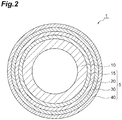
- Fig. 2 is also a cross-sectional view illustrating a coated metal pipe according to an embodiment.
- the multi-layered coating film 5 of the coated metal pipe 1 illustrated in Fig. 2 further includes a plated layer 15 that is provided between the metal pipe 10 and the chemical conversion layer 20 and a resin layer 40 that covers the outer circumferential surface of the primer layer 30, in addition to the same metal pipe 10, chemical conversion layer 20, and primer layer 30 as in the coated metal pipe of Fig. 1 .
- the plated layer 15 is not particularly limited, but for example, is metal plating formed by wet plating such as electroplating or electroless plating or dry plating such as hot dipping.
- wet plating for example, electrogalvanizing or electroless nickel plating is suitable.
- dry plating for example, hot dipping zinc coating, hot dipping aluminum coating, hot dipping zinc-aluminum alloy coating, and hot dipping Sn alloy coating are suitable.
- a metal constituting the plated layer 15 may be one kind or two or more kinds.
- the plated layer 15 may be, for example, a hot-dipped layer containing aluminum, magnesium, and zinc.
- the thickness of the plated layer 15 is not particularly limited, but for example, may be 1 to 100 ⁇ m or 10 to 30 ⁇ m.
- the resin layer 40 is a layer containing a thermosetting resin and/or a thermoplastic resin as main components.
- the thermosetting resin is generally contained as a cured product thereof in the resin layer 40.
- the resin layer 40 may contain, for example, a polyamide or a fluorine resin.
- the polyamide and the fluorine resin can be selected from examples mentioned as the components of the primer composition.
- the thickness of the resin layer 40 is not particularly limited, but for example, may be 1 to 200 ⁇ m.
- the resin layer 40 can be formed, for example, by a method of forming, on the primer layer 30, a film of a liquid composition (coating material) containing a resin such as a thermoplastic resin and a solvent that dissolves or disperses the resin and removing the solvent from the liquid composition on the primer layer 30.
- a liquid composition coating material
- a resin such as a thermoplastic resin
- a solvent that dissolves or disperses the resin and removing the solvent from the liquid composition on the primer layer 30.
- the coated metal pipe may further have other layer(s) like a top coat layer that covers the outer circumferential surface of the resin layer 40.
- the top coat layer may contain a thermoplastic resin selected from polypropylene, polyethylene, and the like.
- a coated metal steel sheet for evaluation having a hot-dipped steel sheet and a multi-layered coating film formed from a chemical conversion layer and a primer layer that are formed in this order on the surface of the steel sheet was produced by the following procedures.
- a chemical conversion treatment solution having a composition presented in Table 1 was prepared. "Y" in the table indicates that the chemical conversion treatment solution contains the corresponding component.
- a chemical conversion treatment solution of Example 2 contains about 70 parts by mass of an organotitanium chelate compound (titanium diisopropoxy bis(triethanolaminate)), about 480 parts by mass of a urethane resin (SUPERFLEX 650 (trade name), manufactured by DKS Co. Ltd.), and about 330 parts by mass of a silane coupling agent having an amino group (Sila-Ace S320 (trade name), manufactured by Chisso Corporation) when the content of hexafluorozirconate ions (ZrF 6 2- ) is regarded as 100 parts by mass.
- organotitanium chelate compound titanium diisopropoxy bis(triethanolaminate)
- SUPERFLEX 650 trade name
- silane coupling agent having an amino group Sila-Ace S320 (trade name), manufactured by Chis
- a hot-dipped steel sheet was immersed in the chemical conversion treatment solution.
- the chemical conversion treatment solution adhered to the steel sheet was dried by heating the hot-dipped steel sheet extracted from the chemical conversion treatment solution for 1 minute in a hot-air drying furnace set at 100°C to thereby form a chemical conversion layer (adhesion amount: 200 mg/m 2 ).
- a primer liquid containing a polyamide imide (PAI, VYLOMAX HR (trade name), manufactured by TOYOBO CO., LTD.), a polyamide (PA, 2015 (trade name), manufactured by ThreeBond Co., Ltd.) and ⁇ -butyrotactone as a solvent and not containing a phenolic resin was prepared.
- the ratio of the polyamide imide in the primer liquid was set to 89% by mass based on the total mass of the polyamide imide and the polyamide.
- the ratio of the polyamide was 11% by mass based on the total mass of the polyamide imide and the polyamide.
- the hot-dipped steel sheet having the chemical conversion layer formed thereon was immersed in the primer liquid.
- the primer liquid adhered to the steel sheet was dried by heating the hot-dipped steel sheet extracted from the primer liquid for 1 minute in a hot-air drying furnace set to 250°C to thereby form a primer layer.
- the thickness of the primer layer was 5 ⁇ m
- unevenness in coating of the primer layer was slightly recognized. In other Examples and Comparative Examples, unevenness in coating of the primer layer was not recognized.
- Two cutouts intersecting with each other were formed on the chemical conversion layer and the primer layer of the coated metal steel sheet for evaluation.
- the cutouts were formed to have a depth reaching the hot-dipped steel sheet.
- the coated metal steel sheet for evaluation was left to stand for 144 hours in a salt spray test (SST).
- SST salt spray test
- a pressure-sensitive adhesive tape was pasted on a portion on which the cutouts were formed and then the pressure-sensitive adhesive tape was peeled off therefrom. The existence of peeling-off of the multi-layered coating film at this time was confirmed.
- each coated steel sheet for evaluation of Examples was evaluated. Cutouts having a depth reaching the hot-dipped steel sheet were formed on the chemical conversion layer and the primer layer of the coated metal steel sheet for evaluation. Then, the coated metal steel sheet for evaluation was immersed for 168 hours in 5% by mass of NaCl aqueous solution set to 80°C. Thereafter, the width of a portion from which the multi-layered coating film was peeled off was measured.
- a coated metal pipe for evaluation having a plated metal pipe and a multi-layered coating film formed from a chemical conversion layer, a primer layer and a top layer that are formed in this order on the surface of the plated metal pipe was produced by the following procedures.
- a chemical conversion treatment solution containing a component presented in Table 2 was prepared. "Y" in the table indicates that the chemical conversion treatment solution contains the corresponding component.
- the organotitanium chelate compound is titanium diisopropoxy bis(triethanolaminate) and the urethane resin is SUPERFLEX 650 (trade name, manufactured by DKS Co. Ltd.).
- Example 5 and Comparative Example 4 are the same chemical conversion treatment solution.
- the plated metal pipe having a Zn plated layer was immersed in these chemical conversion treatment solutions.
- the chemical conversion treatment solution adhered to the plated metal pipe was dried by heating the metal pipe extracted from the chemical conversion treatment solution for 1 minute in a hot-air drying furnace set to 100°C to thereby form a chemical conversion layer (adhesion amount: 200 mg/m 2 ).
- a primer liquid containing 30% by mass of an epoxy resin (EPICLON 7050, manufactured by DIC Corporation) and an aromatic hydrocarbon-based thinner as a solvent was prepared. Further, a primer liquid containing 25% by mass of a phenolic resin (PHENOLITE, manufactured by DIC Corporation) and an aromatic hydrocarbon-based thinner as a solvent was prepared.
- the hot-dipped metal pipe having the chemical conversion layer formed thereon was immersed in these primer liquids.
- the combination of the chemical conversion layer and the primer layer is as presented in Table 2.
- the primer liquid adhered to the plated metal pipe was dried by heating the plated metal pipe extracted from the primer liquid for 1 minute in a hot-air drying furnace set to 250°C to thereby form a primer layer.
- the thickness of the primer layer was 5 ⁇ m. In any cases, abnormality regarding coating properties such as unevenness in coating was not recognized.
- the plated metal pipe having the primer layer was immersed in a coating material containing a fluorine resin.
- the coating material adhered to the plated metal pipe was dried by heating the plated metal pipe extracted from the coating material for 1 minute in a hot-air drying furnace set to 250°C to thereby form a resin layer containing the fluorine resin as an outermost layer.
- the corrosion resistance of the produced coated metal pipe for evaluation was evaluated. Cutouts having a depth reaching the plated metal pipe were formed on the multi-layered coating film of the coated metal pipe for evaluation. Then, the coated metal pipe for evaluation was immersed for 168 hours in 5% by mass of NaCl aqueous solution set to 80°C. Thereafter, the number of swollen portions of the multi-layered coating film and the state of white rust occurrence were observed.
- a coated metal steel sheet for evaluation having a hot-dip Zn-coated steel sheet and a multi-layered coating film formed from a chemical conversion layer and a primer layer that are formed in this order on the surface of the hot-dip Zn-coated steel sheet was produced by the following procedures.
- a chemical conversion treatment solution containing a component presented in Table 3 was prepared. "Y" in the table indicates that the chemical conversion treatment solution contains the corresponding component.
- the chemical conversion treatment solution of Example 7 contains oxovanadium ions at a concentration of 0.005 to 0.04% by mass.
- the hot-dip Zn-coated steel sheet was immersed in the chemical conversion treatment solution.
- the chemical conversion treatment solution adhered to the steel sheet was dried by heating the hot-dip Zn-coated steel sheet extracted from the chemical conversion treatment solution for 1 minute in a hot-air drying furnace set to 100°C to thereby form a chemical conversion layer (adhesion amount: 200 mg/m 2 ).
- the steel sheet was washed with water before drying.
- a primer liquid containing 30% by mass of an epoxy resin (EPICLON 7050, manufactured by DIC Corporation) and an aromatic hydrocarbon-based thinner as a solvent was prepared. Further, a primer liquid containing 25% by mass of a phenolic resin (PHENOLITE, manufactured by DIC Corporation) and an aromatic hydrocarbon-based thinner as a solvent was prepared.
- the hot-dip Zn-coated steel sheet having the chemical conversion layer formed thereon was immersed in these primer liquids.
- the combination of the chemical conversion layer and the primer layer is as presented in Table 3.
- the primer liquid adhered to the plated steel sheet was dried by heating the plated steel sheet extracted from the primer liquid for 1 minute in a hot-air drying furnace set to 250°C to thereby form a primer layer. Abnormality regarding coating properties such as unevenness in coating was not recognized.
- each coated steel sheet for evaluation was evaluated. Cutouts having a depth reaching the hot-dip Zn-coated steel sheet were formed on the chemical conversion layer and the primer layer of the coated metal steel sheet for evaluation. Next, the coated metal steel sheet for evaluation was immersed for 168 hours in 5% by mass of NaCl aqueous solution set to 80°C. Thereafter, the number of swollen portions of the multi-layered coating film and the state of white rust occurrence were observed. Table 3 Ex. 6 Comp. Ex. 6 Comp. Ex. 7 Ex.
- the metal pipe according to the present invention can be suitably used as vehicle piping such as brake piping and fuel piping.
Landscapes
- Chemical & Material Sciences (AREA)
- Engineering & Computer Science (AREA)
- Mechanical Engineering (AREA)
- General Engineering & Computer Science (AREA)
- Organic Chemistry (AREA)
- Materials Engineering (AREA)
- Metallurgy (AREA)
- Chemical Kinetics & Catalysis (AREA)
- General Chemical & Material Sciences (AREA)
- Life Sciences & Earth Sciences (AREA)
- Wood Science & Technology (AREA)
- Laminated Bodies (AREA)
- Other Surface Treatments For Metallic Materials (AREA)
- Application Of Or Painting With Fluid Materials (AREA)
- Rigid Pipes And Flexible Pipes (AREA)
Applications Claiming Priority (2)
| Application Number | Priority Date | Filing Date | Title |
|---|---|---|---|
| JP2015026152 | 2015-02-13 | ||
| PCT/JP2016/053979 WO2016129639A1 (ja) | 2015-02-13 | 2016-02-10 | 車輌配管用被覆金属管及びその製造方法 |
Publications (3)
| Publication Number | Publication Date |
|---|---|
| EP3258151A1 true EP3258151A1 (de) | 2017-12-20 |
| EP3258151A4 EP3258151A4 (de) | 2018-07-18 |
| EP3258151B1 EP3258151B1 (de) | 2020-05-27 |
Family
ID=56614779
Family Applications (1)
| Application Number | Title | Priority Date | Filing Date |
|---|---|---|---|
| EP16749282.6A Active EP3258151B1 (de) | 2015-02-13 | 2016-02-10 | Beschichtetes metallrohr für fahrzeugrohrleitung und verfahren zur herstellung davon |
Country Status (9)
| Country | Link |
|---|---|
| US (1) | US10281078B2 (de) |
| EP (1) | EP3258151B1 (de) |
| JP (1) | JP6665120B2 (de) |
| CN (1) | CN107208828B (de) |
| BR (1) | BR112017017343B1 (de) |
| CA (1) | CA2975868A1 (de) |
| MX (1) | MX380515B (de) |
| RU (1) | RU2711893C2 (de) |
| WO (1) | WO2016129639A1 (de) |
Cited By (1)
| Publication number | Priority date | Publication date | Assignee | Title |
|---|---|---|---|---|
| EP4417849A4 (de) * | 2021-10-15 | 2024-12-11 | Nippon Steel Corporation | Metallrohr für ölbohrungen |
Families Citing this family (3)
| Publication number | Priority date | Publication date | Assignee | Title |
|---|---|---|---|---|
| US10625487B2 (en) | 2018-08-02 | 2020-04-21 | Martinrea International US Inc. | Tubing for brake and fuel systems incorporating graphene impregnated polyamides |
| EP3940106A1 (de) * | 2020-07-15 | 2022-01-19 | TI Automotive Engineering Centre (Heidelberg) GmbH | Verfahren zum beschichten einer rohrleitung und rohrleitung |
| US11796090B2 (en) * | 2020-09-04 | 2023-10-24 | Martinrea International US Inc. | Fluid transport tubing incorporating a graphene impregnated outer coating |
Family Cites Families (25)
| Publication number | Priority date | Publication date | Assignee | Title |
|---|---|---|---|---|
| DE19634222A1 (de) * | 1996-08-24 | 1998-02-26 | Basf Lacke & Farben | Beschichtete Metallrohre, beschichteter Armierungsstahl oder Spannstahl |
| US6312812B1 (en) * | 1998-12-01 | 2001-11-06 | Ppg Industries Ohio, Inc. | Coated metal substrates and methods for preparing and inhibiting corrosion of the same |
| JP2002097408A (ja) * | 2000-09-25 | 2002-04-02 | Sumitomo Metal Ind Ltd | 耐候性に優れた塗膜と塗装金属板 |
| JP2003213456A (ja) * | 2002-01-23 | 2003-07-30 | Kansai Paint Co Ltd | 樹脂被覆金属管材およびその製造方法 |
| JP2003277982A (ja) * | 2002-03-26 | 2003-10-02 | Maruyasu Industries Co Ltd | 金属管の表面処理構造および表面処理方法 |
| FR2838127A1 (fr) * | 2002-04-08 | 2003-10-10 | Atofina | Surfaces metalliques revetues de polyamide |
| JP2004144995A (ja) | 2002-10-24 | 2004-05-20 | Canon Inc | 走査光生成装置 |
| JP2004232010A (ja) * | 2003-01-29 | 2004-08-19 | Sanoh Industrial Co Ltd | 多層保護被覆鋼管 |
| JP4416167B2 (ja) | 2005-03-08 | 2010-02-17 | 新日本製鐵株式会社 | 防食被覆鋼材用化成下地処理剤、防食被覆鋼材用化成下地処理方法及び防食被覆鋼材 |
| JP2006328445A (ja) | 2005-05-23 | 2006-12-07 | Nippon Parkerizing Co Ltd | プレコート金属材料用水系表面処理剤、表面処理方法及びプレコート金属材料の製造方法 |
| BRPI0618156A2 (pt) * | 2005-11-01 | 2012-02-28 | Sanoh Ind Co Ltd | tubo de aço para uso em uma tubulação de um automóvel |
| US7476445B2 (en) * | 2006-10-02 | 2009-01-13 | Nippon Steel Corporation | Surface-treated metal sheet |
| JP4964699B2 (ja) * | 2007-07-18 | 2012-07-04 | 新日本製鐵株式会社 | 有機樹脂被覆鋼材及びこれを用いた建造物 |
| JP5721307B2 (ja) * | 2007-10-17 | 2015-05-20 | 関西ペイント株式会社 | 複層皮膜形成方法及び塗装物品 |
| JP5225662B2 (ja) * | 2007-11-21 | 2013-07-03 | 三桜工業株式会社 | 車両配管用鋼管 |
| JP5157487B2 (ja) | 2008-01-30 | 2013-03-06 | 新日鐵住金株式会社 | 容器用鋼板とその製造方法 |
| JP5651912B2 (ja) * | 2008-03-03 | 2015-01-14 | Jfeスチール株式会社 | 樹脂被覆鋼材の製造方法 |
| JP5108820B2 (ja) * | 2008-04-17 | 2012-12-26 | 日本パーカライジング株式会社 | プレコート金属材料用水系表面処理剤、表面処理金属材料及びプレコート金属材料 |
| JP5390821B2 (ja) * | 2008-09-30 | 2014-01-15 | 中央精機株式会社 | アルミホイールの表面処理方法及びアルカリエッチング液 |
| JP5770177B2 (ja) * | 2010-06-09 | 2015-08-26 | 三桜工業株式会社 | 自動車配管用金属管およびその表面処理方法 |
| EP2405031A1 (de) * | 2010-07-07 | 2012-01-11 | Mattthias Koch | Verfahren zur Beschichtung von Formkörpern sowie beschichteter Formkörper |
| JP5760355B2 (ja) | 2010-09-15 | 2015-08-12 | Jfeスチール株式会社 | 容器用鋼板 |
| JP2014159551A (ja) * | 2013-01-28 | 2014-09-04 | Jnc Corp | 熱硬化性組成物、硬化膜および電子部品 |
| JP2014173123A (ja) * | 2013-03-08 | 2014-09-22 | Kobe Steel Ltd | 表面処理アルミニウム合金板およびその製造方法 |
| JP6467195B2 (ja) * | 2014-11-10 | 2019-02-06 | 三桜工業株式会社 | 車輌配管用被覆金属管 |
-
2016
- 2016-02-10 WO PCT/JP2016/053979 patent/WO2016129639A1/ja not_active Ceased
- 2016-02-10 MX MX2017010041A patent/MX380515B/es unknown
- 2016-02-10 BR BR112017017343-3A patent/BR112017017343B1/pt not_active IP Right Cessation
- 2016-02-10 RU RU2017131856A patent/RU2711893C2/ru active
- 2016-02-10 US US15/550,762 patent/US10281078B2/en active Active
- 2016-02-10 CA CA2975868A patent/CA2975868A1/en active Pending
- 2016-02-10 JP JP2016574836A patent/JP6665120B2/ja active Active
- 2016-02-10 CN CN201680009091.2A patent/CN107208828B/zh active Active
- 2016-02-10 EP EP16749282.6A patent/EP3258151B1/de active Active
Cited By (2)
| Publication number | Priority date | Publication date | Assignee | Title |
|---|---|---|---|---|
| EP4417849A4 (de) * | 2021-10-15 | 2024-12-11 | Nippon Steel Corporation | Metallrohr für ölbohrungen |
| US12510191B2 (en) | 2021-10-15 | 2025-12-30 | Nippon Steel Corporation | Oil-well metal pipe |
Also Published As
| Publication number | Publication date |
|---|---|
| JP6665120B2 (ja) | 2020-03-13 |
| RU2017131856A3 (de) | 2019-07-17 |
| CN107208828B (zh) | 2020-01-14 |
| WO2016129639A1 (ja) | 2016-08-18 |
| BR112017017343B1 (pt) | 2021-10-05 |
| RU2017131856A (ru) | 2019-03-14 |
| CA2975868A1 (en) | 2016-08-18 |
| BR112017017343A2 (pt) | 2018-04-10 |
| JPWO2016129639A1 (ja) | 2017-11-30 |
| US10281078B2 (en) | 2019-05-07 |
| EP3258151B1 (de) | 2020-05-27 |
| MX2017010041A (es) | 2017-12-18 |
| RU2711893C2 (ru) | 2020-01-23 |
| EP3258151A4 (de) | 2018-07-18 |
| MX380515B (es) | 2025-03-12 |
| US20180045357A1 (en) | 2018-02-15 |
| CN107208828A (zh) | 2017-09-26 |
Similar Documents
| Publication | Publication Date | Title |
|---|---|---|
| EP3219485B1 (de) | Beschichtetes metallrohr für fahrzeugrohrleitung | |
| TWI473908B (zh) | A surface treatment film, a metal surface treatment agent, and a metal surface treatment method | |
| EP3258151B1 (de) | Beschichtetes metallrohr für fahrzeugrohrleitung und verfahren zur herstellung davon | |
| TWI447264B (zh) | 金屬材料表面用處理劑 | |
| JP5860582B2 (ja) | 金属表面処理剤及び金属表面処理方法 | |
| MX2014002050A (es) | Agente de pretratamiento de pinturas para pinturas tipo revestimiento y metodo para pintar tipo revestimiento. | |
| WO2005084942A1 (ja) | 被覆金属成形品および被覆金属成形品の製造方法 | |
| JP5055822B2 (ja) | 塗膜密着性に優れた塗装鋼板 | |
| JP6564036B2 (ja) | 水系処理剤、亜鉛めっき鋼材又は亜鉛合金めっき鋼材および塗装亜鉛めっき鋼材又は塗装亜鉛合金めっき鋼材 | |
| CN1352701A (zh) | 耐蚀性、涂装性优异的磷酸盐处理锌系镀覆钢板 | |
| KR20210069457A (ko) | 내식성이 우수한 접합강판 및 이의 제조방법 | |
| JP4774629B2 (ja) | ポリエステル樹脂被覆錫合金めっき鋼板 | |
| JPH11310897A (ja) | 燃料タンク用表面処理鋼板 | |
| KR101807165B1 (ko) | 볼트 코팅용 조성물 및 볼트의 코팅 방법 | |
| JP6085503B2 (ja) | 塗装金属板の製造方法 | |
| KR20230162638A (ko) | 수성 크롬-프리 표면 처리제, 표면 처리 금속 및 표면 처리 방법 | |
| JP2008174798A (ja) | 表面処理アルミニウム材、樹脂被覆アルミニウム材、およびそれらの製造方法 | |
| JP2011036814A (ja) | アルミニウム塗装板及びその製造方法 | |
| CN1363724A (zh) | 底面接着用金属表面处理药剂及处理方法 | |
| KR20180080252A (ko) | 금속-플라스틱-복합물 컴포넌트 및 상기 유형의 복합물 컴포넌트의 제조 방법 | |
| JPH01202439A (ja) | クロメート処理鋼板 |
Legal Events
| Date | Code | Title | Description |
|---|---|---|---|
| STAA | Information on the status of an ep patent application or granted ep patent |
Free format text: STATUS: THE INTERNATIONAL PUBLICATION HAS BEEN MADE |
|
| PUAI | Public reference made under article 153(3) epc to a published international application that has entered the european phase |
Free format text: ORIGINAL CODE: 0009012 |
|
| STAA | Information on the status of an ep patent application or granted ep patent |
Free format text: STATUS: REQUEST FOR EXAMINATION WAS MADE |
|
| 17P | Request for examination filed |
Effective date: 20170822 |
|
| AK | Designated contracting states |
Kind code of ref document: A1 Designated state(s): AL AT BE BG CH CY CZ DE DK EE ES FI FR GB GR HR HU IE IS IT LI LT LU LV MC MK MT NL NO PL PT RO RS SE SI SK SM TR |
|
| AX | Request for extension of the european patent |
Extension state: BA ME |
|
| DAV | Request for validation of the european patent (deleted) | ||
| DAX | Request for extension of the european patent (deleted) | ||
| A4 | Supplementary search report drawn up and despatched |
Effective date: 20180619 |
|
| RIC1 | Information provided on ipc code assigned before grant |
Ipc: C09D 5/08 20060101ALI20180611BHEP Ipc: B05D 7/00 20060101ALI20180611BHEP Ipc: C23C 22/34 20060101ALI20180611BHEP Ipc: B05D 7/14 20060101ALI20180611BHEP Ipc: C23C 28/00 20060101ALI20180611BHEP Ipc: F16L 58/10 20060101ALI20180611BHEP Ipc: F16L 9/02 20060101AFI20180611BHEP |
|
| GRAP | Despatch of communication of intention to grant a patent |
Free format text: ORIGINAL CODE: EPIDOSNIGR1 |
|
| STAA | Information on the status of an ep patent application or granted ep patent |
Free format text: STATUS: GRANT OF PATENT IS INTENDED |
|
| INTG | Intention to grant announced |
Effective date: 20200117 |
|
| GRAS | Grant fee paid |
Free format text: ORIGINAL CODE: EPIDOSNIGR3 |
|
| GRAA | (expected) grant |
Free format text: ORIGINAL CODE: 0009210 |
|
| STAA | Information on the status of an ep patent application or granted ep patent |
Free format text: STATUS: THE PATENT HAS BEEN GRANTED |
|
| AK | Designated contracting states |
Kind code of ref document: B1 Designated state(s): AL AT BE BG CH CY CZ DE DK EE ES FI FR GB GR HR HU IE IS IT LI LT LU LV MC MK MT NL NO PL PT RO RS SE SI SK SM TR |
|
| REG | Reference to a national code |
Ref country code: GB Ref legal event code: FG4D |
|
| REG | Reference to a national code |
Ref country code: CH Ref legal event code: EP |
|
| REG | Reference to a national code |
Ref country code: DE Ref legal event code: R096 Ref document number: 602016037068 Country of ref document: DE |
|
| REG | Reference to a national code |
Ref country code: AT Ref legal event code: REF Ref document number: 1274908 Country of ref document: AT Kind code of ref document: T Effective date: 20200615 |
|
| REG | Reference to a national code |
Ref country code: LT Ref legal event code: MG4D |
|
| PG25 | Lapsed in a contracting state [announced via postgrant information from national office to epo] |
Ref country code: PT Free format text: LAPSE BECAUSE OF FAILURE TO SUBMIT A TRANSLATION OF THE DESCRIPTION OR TO PAY THE FEE WITHIN THE PRESCRIBED TIME-LIMIT Effective date: 20200928 Ref country code: IS Free format text: LAPSE BECAUSE OF FAILURE TO SUBMIT A TRANSLATION OF THE DESCRIPTION OR TO PAY THE FEE WITHIN THE PRESCRIBED TIME-LIMIT Effective date: 20200927 Ref country code: SE Free format text: LAPSE BECAUSE OF FAILURE TO SUBMIT A TRANSLATION OF THE DESCRIPTION OR TO PAY THE FEE WITHIN THE PRESCRIBED TIME-LIMIT Effective date: 20200527 Ref country code: NO Free format text: LAPSE BECAUSE OF FAILURE TO SUBMIT A TRANSLATION OF THE DESCRIPTION OR TO PAY THE FEE WITHIN THE PRESCRIBED TIME-LIMIT Effective date: 20200827 Ref country code: GR Free format text: LAPSE BECAUSE OF FAILURE TO SUBMIT A TRANSLATION OF THE DESCRIPTION OR TO PAY THE FEE WITHIN THE PRESCRIBED TIME-LIMIT Effective date: 20200828 Ref country code: FI Free format text: LAPSE BECAUSE OF FAILURE TO SUBMIT A TRANSLATION OF THE DESCRIPTION OR TO PAY THE FEE WITHIN THE PRESCRIBED TIME-LIMIT Effective date: 20200527 Ref country code: LT Free format text: LAPSE BECAUSE OF FAILURE TO SUBMIT A TRANSLATION OF THE DESCRIPTION OR TO PAY THE FEE WITHIN THE PRESCRIBED TIME-LIMIT Effective date: 20200527 |
|
| REG | Reference to a national code |
Ref country code: NL Ref legal event code: MP Effective date: 20200527 |
|
| PG25 | Lapsed in a contracting state [announced via postgrant information from national office to epo] |
Ref country code: BG Free format text: LAPSE BECAUSE OF FAILURE TO SUBMIT A TRANSLATION OF THE DESCRIPTION OR TO PAY THE FEE WITHIN THE PRESCRIBED TIME-LIMIT Effective date: 20200827 Ref country code: LV Free format text: LAPSE BECAUSE OF FAILURE TO SUBMIT A TRANSLATION OF THE DESCRIPTION OR TO PAY THE FEE WITHIN THE PRESCRIBED TIME-LIMIT Effective date: 20200527 Ref country code: HR Free format text: LAPSE BECAUSE OF FAILURE TO SUBMIT A TRANSLATION OF THE DESCRIPTION OR TO PAY THE FEE WITHIN THE PRESCRIBED TIME-LIMIT Effective date: 20200527 Ref country code: RS Free format text: LAPSE BECAUSE OF FAILURE TO SUBMIT A TRANSLATION OF THE DESCRIPTION OR TO PAY THE FEE WITHIN THE PRESCRIBED TIME-LIMIT Effective date: 20200527 |
|
| REG | Reference to a national code |
Ref country code: AT Ref legal event code: MK05 Ref document number: 1274908 Country of ref document: AT Kind code of ref document: T Effective date: 20200527 |
|
| PG25 | Lapsed in a contracting state [announced via postgrant information from national office to epo] |
Ref country code: AL Free format text: LAPSE BECAUSE OF FAILURE TO SUBMIT A TRANSLATION OF THE DESCRIPTION OR TO PAY THE FEE WITHIN THE PRESCRIBED TIME-LIMIT Effective date: 20200527 Ref country code: NL Free format text: LAPSE BECAUSE OF FAILURE TO SUBMIT A TRANSLATION OF THE DESCRIPTION OR TO PAY THE FEE WITHIN THE PRESCRIBED TIME-LIMIT Effective date: 20200527 |
|
| PG25 | Lapsed in a contracting state [announced via postgrant information from national office to epo] |
Ref country code: CZ Free format text: LAPSE BECAUSE OF FAILURE TO SUBMIT A TRANSLATION OF THE DESCRIPTION OR TO PAY THE FEE WITHIN THE PRESCRIBED TIME-LIMIT Effective date: 20200527 Ref country code: RO Free format text: LAPSE BECAUSE OF FAILURE TO SUBMIT A TRANSLATION OF THE DESCRIPTION OR TO PAY THE FEE WITHIN THE PRESCRIBED TIME-LIMIT Effective date: 20200527 Ref country code: ES Free format text: LAPSE BECAUSE OF FAILURE TO SUBMIT A TRANSLATION OF THE DESCRIPTION OR TO PAY THE FEE WITHIN THE PRESCRIBED TIME-LIMIT Effective date: 20200527 Ref country code: SM Free format text: LAPSE BECAUSE OF FAILURE TO SUBMIT A TRANSLATION OF THE DESCRIPTION OR TO PAY THE FEE WITHIN THE PRESCRIBED TIME-LIMIT Effective date: 20200527 Ref country code: DK Free format text: LAPSE BECAUSE OF FAILURE TO SUBMIT A TRANSLATION OF THE DESCRIPTION OR TO PAY THE FEE WITHIN THE PRESCRIBED TIME-LIMIT Effective date: 20200527 Ref country code: AT Free format text: LAPSE BECAUSE OF FAILURE TO SUBMIT A TRANSLATION OF THE DESCRIPTION OR TO PAY THE FEE WITHIN THE PRESCRIBED TIME-LIMIT Effective date: 20200527 Ref country code: EE Free format text: LAPSE BECAUSE OF FAILURE TO SUBMIT A TRANSLATION OF THE DESCRIPTION OR TO PAY THE FEE WITHIN THE PRESCRIBED TIME-LIMIT Effective date: 20200527 Ref country code: IT Free format text: LAPSE BECAUSE OF FAILURE TO SUBMIT A TRANSLATION OF THE DESCRIPTION OR TO PAY THE FEE WITHIN THE PRESCRIBED TIME-LIMIT Effective date: 20200527 |
|
| PG25 | Lapsed in a contracting state [announced via postgrant information from national office to epo] |
Ref country code: PL Free format text: LAPSE BECAUSE OF FAILURE TO SUBMIT A TRANSLATION OF THE DESCRIPTION OR TO PAY THE FEE WITHIN THE PRESCRIBED TIME-LIMIT Effective date: 20200527 Ref country code: SK Free format text: LAPSE BECAUSE OF FAILURE TO SUBMIT A TRANSLATION OF THE DESCRIPTION OR TO PAY THE FEE WITHIN THE PRESCRIBED TIME-LIMIT Effective date: 20200527 |
|
| REG | Reference to a national code |
Ref country code: DE Ref legal event code: R097 Ref document number: 602016037068 Country of ref document: DE |
|
| PLBE | No opposition filed within time limit |
Free format text: ORIGINAL CODE: 0009261 |
|
| STAA | Information on the status of an ep patent application or granted ep patent |
Free format text: STATUS: NO OPPOSITION FILED WITHIN TIME LIMIT |
|
| 26N | No opposition filed |
Effective date: 20210302 |
|
| PG25 | Lapsed in a contracting state [announced via postgrant information from national office to epo] |
Ref country code: SI Free format text: LAPSE BECAUSE OF FAILURE TO SUBMIT A TRANSLATION OF THE DESCRIPTION OR TO PAY THE FEE WITHIN THE PRESCRIBED TIME-LIMIT Effective date: 20200527 |
|
| PG25 | Lapsed in a contracting state [announced via postgrant information from national office to epo] |
Ref country code: MC Free format text: LAPSE BECAUSE OF FAILURE TO SUBMIT A TRANSLATION OF THE DESCRIPTION OR TO PAY THE FEE WITHIN THE PRESCRIBED TIME-LIMIT Effective date: 20200527 |
|
| GBPC | Gb: european patent ceased through non-payment of renewal fee |
Effective date: 20210210 |
|
| REG | Reference to a national code |
Ref country code: BE Ref legal event code: MM Effective date: 20210228 |
|
| PG25 | Lapsed in a contracting state [announced via postgrant information from national office to epo] |
Ref country code: LU Free format text: LAPSE BECAUSE OF NON-PAYMENT OF DUE FEES Effective date: 20210210 Ref country code: LI Free format text: LAPSE BECAUSE OF NON-PAYMENT OF DUE FEES Effective date: 20210228 Ref country code: CH Free format text: LAPSE BECAUSE OF NON-PAYMENT OF DUE FEES Effective date: 20210228 |
|
| PG25 | Lapsed in a contracting state [announced via postgrant information from national office to epo] |
Ref country code: GB Free format text: LAPSE BECAUSE OF NON-PAYMENT OF DUE FEES Effective date: 20210210 Ref country code: IE Free format text: LAPSE BECAUSE OF NON-PAYMENT OF DUE FEES Effective date: 20210210 Ref country code: FR Free format text: LAPSE BECAUSE OF NON-PAYMENT OF DUE FEES Effective date: 20210228 |
|
| PG25 | Lapsed in a contracting state [announced via postgrant information from national office to epo] |
Ref country code: BE Free format text: LAPSE BECAUSE OF NON-PAYMENT OF DUE FEES Effective date: 20210228 |
|
| PG25 | Lapsed in a contracting state [announced via postgrant information from national office to epo] |
Ref country code: CY Free format text: LAPSE BECAUSE OF FAILURE TO SUBMIT A TRANSLATION OF THE DESCRIPTION OR TO PAY THE FEE WITHIN THE PRESCRIBED TIME-LIMIT Effective date: 20200527 |
|
| PG25 | Lapsed in a contracting state [announced via postgrant information from national office to epo] |
Ref country code: HU Free format text: LAPSE BECAUSE OF FAILURE TO SUBMIT A TRANSLATION OF THE DESCRIPTION OR TO PAY THE FEE WITHIN THE PRESCRIBED TIME-LIMIT; INVALID AB INITIO Effective date: 20160210 |
|
| PG25 | Lapsed in a contracting state [announced via postgrant information from national office to epo] |
Ref country code: MK Free format text: LAPSE BECAUSE OF FAILURE TO SUBMIT A TRANSLATION OF THE DESCRIPTION OR TO PAY THE FEE WITHIN THE PRESCRIBED TIME-LIMIT Effective date: 20200527 |
|
| PG25 | Lapsed in a contracting state [announced via postgrant information from national office to epo] |
Ref country code: MT Free format text: LAPSE BECAUSE OF FAILURE TO SUBMIT A TRANSLATION OF THE DESCRIPTION OR TO PAY THE FEE WITHIN THE PRESCRIBED TIME-LIMIT Effective date: 20200527 |
|
| PGFP | Annual fee paid to national office [announced via postgrant information from national office to epo] |
Ref country code: DE Payment date: 20241231 Year of fee payment: 10 |
|
| PGFP | Annual fee paid to national office [announced via postgrant information from national office to epo] |
Ref country code: TR Payment date: 20250129 Year of fee payment: 10 |