EP3255140B1 - Milchsäurebakterien, aus diesen milchsäurebakterien abgeleiteter natürlicher immunoaktivator und infektionsprävention/-therapie sowie nahrungsmittel/getränk - Google Patents
Milchsäurebakterien, aus diesen milchsäurebakterien abgeleiteter natürlicher immunoaktivator und infektionsprävention/-therapie sowie nahrungsmittel/getränk Download PDFInfo
- Publication number
- EP3255140B1 EP3255140B1 EP16746692.9A EP16746692A EP3255140B1 EP 3255140 B1 EP3255140 B1 EP 3255140B1 EP 16746692 A EP16746692 A EP 16746692A EP 3255140 B1 EP3255140 B1 EP 3255140B1
- Authority
- EP
- European Patent Office
- Prior art keywords
- lactic acid
- acid bacteria
- innate immunity
- food
- acid bacterium
- Prior art date
- Legal status (The legal status is an assumption and is not a legal conclusion. Google has not performed a legal analysis and makes no representation as to the accuracy of the status listed.)
- Active
Links
Images

Classifications
-
- A—HUMAN NECESSITIES
- A61—MEDICAL OR VETERINARY SCIENCE; HYGIENE
- A61K—PREPARATIONS FOR MEDICAL, DENTAL OR TOILETRY PURPOSES
- A61K35/00—Medicinal preparations containing materials or reaction products thereof with undetermined constitution
- A61K35/66—Microorganisms or materials therefrom
- A61K35/74—Bacteria
- A61K35/741—Probiotics
- A61K35/744—Lactic acid bacteria, e.g. enterococci, pediococci, lactococci, streptococci or leuconostocs
- A61K35/747—Lactobacilli, e.g. L. acidophilus or L. brevis
-
- A—HUMAN NECESSITIES
- A23—FOODS OR FOODSTUFFS; TREATMENT THEREOF, NOT COVERED BY OTHER CLASSES
- A23L—FOODS, FOODSTUFFS OR NON-ALCOHOLIC BEVERAGES, NOT OTHERWISE PROVIDED FOR; PREPARATION OR TREATMENT THEREOF
- A23L33/00—Modifying nutritive qualities of foods; Dietetic products; Preparation or treatment thereof
- A23L33/10—Modifying nutritive qualities of foods; Dietetic products; Preparation or treatment thereof using additives
-
- A—HUMAN NECESSITIES
- A23—FOODS OR FOODSTUFFS; TREATMENT THEREOF, NOT COVERED BY OTHER CLASSES
- A23L—FOODS, FOODSTUFFS OR NON-ALCOHOLIC BEVERAGES, NOT OTHERWISE PROVIDED FOR; PREPARATION OR TREATMENT THEREOF
- A23L33/00—Modifying nutritive qualities of foods; Dietetic products; Preparation or treatment thereof
- A23L33/10—Modifying nutritive qualities of foods; Dietetic products; Preparation or treatment thereof using additives
- A23L33/135—Bacteria or derivatives thereof, e.g. probiotics
-
- A—HUMAN NECESSITIES
- A23—FOODS OR FOODSTUFFS; TREATMENT THEREOF, NOT COVERED BY OTHER CLASSES
- A23L—FOODS, FOODSTUFFS OR NON-ALCOHOLIC BEVERAGES, NOT OTHERWISE PROVIDED FOR; PREPARATION OR TREATMENT THEREOF
- A23L5/00—Preparation or treatment of foods or foodstuffs, in general; Food or foodstuffs obtained thereby; Materials therefor
-
- A—HUMAN NECESSITIES
- A61—MEDICAL OR VETERINARY SCIENCE; HYGIENE
- A61K—PREPARATIONS FOR MEDICAL, DENTAL OR TOILETRY PURPOSES
- A61K35/00—Medicinal preparations containing materials or reaction products thereof with undetermined constitution
- A61K35/66—Microorganisms or materials therefrom
- A61K35/74—Bacteria
-
- A—HUMAN NECESSITIES
- A61—MEDICAL OR VETERINARY SCIENCE; HYGIENE
- A61K—PREPARATIONS FOR MEDICAL, DENTAL OR TOILETRY PURPOSES
- A61K38/00—Medicinal preparations containing peptides
-
- A—HUMAN NECESSITIES
- A61—MEDICAL OR VETERINARY SCIENCE; HYGIENE
- A61P—SPECIFIC THERAPEUTIC ACTIVITY OF CHEMICAL COMPOUNDS OR MEDICINAL PREPARATIONS
- A61P31/00—Antiinfectives, i.e. antibiotics, antiseptics, chemotherapeutics
- A61P31/04—Antibacterial agents
-
- A—HUMAN NECESSITIES
- A61—MEDICAL OR VETERINARY SCIENCE; HYGIENE
- A61P—SPECIFIC THERAPEUTIC ACTIVITY OF CHEMICAL COMPOUNDS OR MEDICINAL PREPARATIONS
- A61P37/00—Drugs for immunological or allergic disorders
- A61P37/02—Immunomodulators
- A61P37/04—Immunostimulants
-
- C—CHEMISTRY; METALLURGY
- C12—BIOCHEMISTRY; BEER; SPIRITS; WINE; VINEGAR; MICROBIOLOGY; ENZYMOLOGY; MUTATION OR GENETIC ENGINEERING
- C12N—MICROORGANISMS OR ENZYMES; COMPOSITIONS THEREOF; PROPAGATING, PRESERVING, OR MAINTAINING MICROORGANISMS; MUTATION OR GENETIC ENGINEERING; CULTURE MEDIA
- C12N1/00—Microorganisms, e.g. protozoa; Compositions thereof; Processes of propagating, maintaining or preserving microorganisms or compositions thereof; Processes of preparing or isolating a composition containing a microorganism; Culture media therefor
- C12N1/20—Bacteria; Culture media therefor
-
- A—HUMAN NECESSITIES
- A23—FOODS OR FOODSTUFFS; TREATMENT THEREOF, NOT COVERED BY OTHER CLASSES
- A23V—INDEXING SCHEME RELATING TO FOODS, FOODSTUFFS OR NON-ALCOHOLIC BEVERAGES AND LACTIC OR PROPIONIC ACID BACTERIA USED IN FOODSTUFFS OR FOOD PREPARATION
- A23V2002/00—Food compositions, function of food ingredients or processes for food or foodstuffs
-
- A—HUMAN NECESSITIES
- A23—FOODS OR FOODSTUFFS; TREATMENT THEREOF, NOT COVERED BY OTHER CLASSES
- A23V—INDEXING SCHEME RELATING TO FOODS, FOODSTUFFS OR NON-ALCOHOLIC BEVERAGES AND LACTIC OR PROPIONIC ACID BACTERIA USED IN FOODSTUFFS OR FOOD PREPARATION
- A23V2200/00—Function of food ingredients
- A23V2200/30—Foods, ingredients or supplements having a functional effect on health
- A23V2200/324—Foods, ingredients or supplements having a functional effect on health having an effect on the immune system
-
- A—HUMAN NECESSITIES
- A23—FOODS OR FOODSTUFFS; TREATMENT THEREOF, NOT COVERED BY OTHER CLASSES
- A23V—INDEXING SCHEME RELATING TO FOODS, FOODSTUFFS OR NON-ALCOHOLIC BEVERAGES AND LACTIC OR PROPIONIC ACID BACTERIA USED IN FOODSTUFFS OR FOOD PREPARATION
- A23V2400/00—Lactic or propionic acid bacteria
- A23V2400/11—Lactobacillus
-
- C—CHEMISTRY; METALLURGY
- C12—BIOCHEMISTRY; BEER; SPIRITS; WINE; VINEGAR; MICROBIOLOGY; ENZYMOLOGY; MUTATION OR GENETIC ENGINEERING
- C12R—INDEXING SCHEME ASSOCIATED WITH SUBCLASSES C12C - C12Q, RELATING TO MICROORGANISMS
- C12R2001/00—Microorganisms ; Processes using microorganisms
- C12R2001/01—Bacteria or Actinomycetales ; using bacteria or Actinomycetales
- C12R2001/225—Lactobacillus
Definitions
- the present invention relates to a novel lactic acid bacterium, a dead bacterium of the novel lactic acid bacterium, the novel lactic acid bacterium for use as a medicine, and food and drink comprising them.
- Lactic acid bacteria have been traditionally used in fermented food, also used in the manufacture of food and drink, medicines, probiotics and the like. Lactic acid bacteria have characteristics such as gram-positive, catalase-negative, not forming spore, immotile, and the like.
- Lactobacillus paraplantarum (L. paraplantarum) is closely related to Lactobacillus plantarum (L. plantarum), and it has been known that L. paraplantarum and L. plantarum are non-pathogenic gram-positive lactic acid bacteria and are heterofermentative (Non-Patent Document 6) .
- Non-Patent Documents 1 and 2 the entire genomes of some species and subspecies of lactic acid bacteria have been sequenced (Non-Patent Documents 1 and 2), and recombinant L. plantarum has been utilized for presenting a specific antigen through the epidermis of intestines and has been recently noted as a viable agent for preventing infection for oral administration (Non-Patent Documents 3 and 4).
- immune cells such as macrophages and dendritic cells are responsive to substances activating innate immunity derived from bacteria or viruses to produce cytokines, thereby stimulating subsequent immune reaction.
- the mechanism of innate immunity is a mechanism for controlling infection that organisms have in common, is generally non-specific, has a good response, and effectively functions against many infectious sources.
- the inventor has developed an evaluation method (a screening method) capable of easily measuring an activity for activating innate immunity, using silkworms having only a mechanism of innate immunity (Patent Document 1 and Non-Patent Document 5).
- the evaluation method can evaluate or screen an innate immunity activator having activity for activating innate immunity against vertebrates such as humans (Patent Document 1, etc.).
- An object of the present invention is to provide a novel lactic acid bacterium having a high activity for activating innate immunity, an innate immunity activator comprising the lactic acid bacterium or dead bacterium or processed material of the lactic acid bacterium as an active ingredient, and food and drink comprising the lactic acid bacterium or an innate immunity activator derived from the lactic acid bacterium.
- the object thereof is to provide an agent for preventing or treating infection or food and drink comprising material derived from novel lactic acid bacterium as an active ingredient.
- the present inventor have earnestly investigated to solve the above problems, and as a result, the inventor has found that a specific lactic acid bacterium has an higher activity for activating innate immunity than that of ones which have been known to have an activity for activating innate immunity and that of other lactic acid bacterium such as a lactic acid bacterium belonging to genus Lactobacillus.
- the lactic acid bacterium having an activity for activating innate immunity is a novel lactic acid bacterium belonging to genus Lactobacillus (hereinafter sometimes abbreviated as "#11-1"), from the results of analysis of properties thereof, analysis of the nucleotide sequence of 16S rDNA thereof and the like.
- the inventor has unexpectedly found that silkworms eating peptidoglycan fraction of the lactic acid bacterium has longer survival time after infection with Pseudomonas aeruginosa and has tolerance to the infection with Pseudomonas aeruginosa, even though the silkworms do not have a mechanism of acquired immunity, whereby they have accomplished the present invention.
- a novel lactic acid bacterium having a significantly high activity for activating innate immunity can be provided.
- the present invention can provide a novel innate immunity activator having a significantly high activity for activating innate immunity which comprises the novel lactic acid bacterium, a dead bacterium of the lactic acid bacterium or a processed material of the lactic acid bacterium as an active ingredient, and food and drink having an excellent activity for activating innate immunity which comprises or is derived from the lactic acid bacterium or the innate immunity activator.
- an agent for preventing or treating infection comprising peptidoglycan of the novel lactic acid bacterium as an active ingredient
- oral administration of the agent for preventing or treating infection can prevent infection caused by bacteria and the like.
- food and drink comprising the agent for preventing or treating infection is effective for infection.
- a screening method having found a novel lactic acid bacterium or a novel innate immunity activator of the present invention silkworm muscle contraction with response to substances activating innate immunity is utilized, the detection of a false-positive activity for activating innate immunity with LPS is suppressed, and with measurements using silkworm, measurement result taking ADME (absorption, distribution, metabolism, and excretion) or PK (pharmacokinetics) of the samples into consideration can be obtained and compounds having toxicity can be removed.
- ADME absorption, distribution, metabolism, and excretion
- PK pharmacokinetics
- the innate immunity activator, agent for preventing or treating infection and food and drink of the present invention has excellent effect since they have passed the above test.
- the lactic acid bacterium of the present invention can be utilized not only to manufacture common food and drink, health food, medicine, fermented food and drink, probiotics and the like, but also to prevent or treat disease with innate immune activation.
- fermented food and drink it is more preferably that the lactic acid bacterium is used in fermented milk, lactic acid bacteria beverage, yogurt, pickles, and a starter for manufacturing pickles.
- the lactic acid bacterium not sensitive to acid can be delivered to small intestine without being decomposed in stomach.
- the present invention is a lactic acid bacterium belonging to genus Lactobacillus with Accession No. NITE BP-02005 in NITE Patent Microorganisms Depositary (NPMD) of Incorporated Administrative Agency National Institute of Technology and Evaluation (NITE).
- Physiological and chemical classification properties of #11-1 of the present invention are as follows.
- Nucleotide sequence of the 16S rDNA region from genome DNA of #11-1 was amplified by PCR and it was analyzed by a sequencer; and as a result, nucleotide sequence of almost entire length of the 16S rDNA was obtained.
- nucleotide sequence of the 16S rDNA region of #11-1 showed 98% homology relative to the nucleotide sequence of Lactobacillus paraplantarum DSM10667 strain (Accession No. NR_025447.1), and #11-1 belongs to L. plantarum paraplantarum.
- #11-1 of the present invention is a lactic acid bacterium strain (subspecies) different from the above strain.
- #11-1 of the present invention is a novel microorganism belonging to genus Lactobacillus.
- #11-1 Comparing with the known strains belonging to genus Lactobacillus, #11-1 has the highest activity for activating innate immunity, and #11-1 was comprehensively determined to be a novel isolated microorganism strain.
- NITE Patent Microorganisms Depositary of Incorporated Administrative Agency National Institute of Technology and Evaluation (hereinafter abbreviated as "NITE"), the address of which is Room 122, 2-5-8 Kazusakamatari, Kisarazu-shi, Chiba, with Accession No. NITE P-02005.
- mutation As the general properties of a bacterium, properties of the strain thereof tend to be mutated easily; and thus, there is a possibility that the physiological properties of #11-1 do not stay as they are shown above. Further, needless to say, "mutation" described above includes both natural mutation and artificial mutation.
- a method for culturing #11-1 is as follows.
- the method for culturing #11-1 may be one in accordance with a general method for culturing genus Lactobacillus.
- the culture is under an anaerobic condition.
- organic carbon compounds such as D-ribose, D-galactose, D-glucose, D-fructose, D-mannose, D-mannitol, N-acetylglucosamine, amygdalin, arbutin, esculin, salicin, D-cellobiose, D-maltose, sucrose, D-trehalose, gentiobiose, syrup, starch syrup, fats and oils may be used, and as to the nitrogen source, organic or inorganic nitrogen compounds such as meat extract, casein, peptone, yeast extract, dry yeast, germ, powdered soybean, urea, amino acid, and ammonium salt may be used.
- inorganic salts such as sodium salt, potassium salt, calcium salt, magnesium salt, phosphate salt, iron salt, copper salt, zinc salt, and cobalt salt may be added as necessary.
- a growth accelerator such as biotin, vitamin B1, cysteine, methyl oleate, and lard oil is preferable in order to increase a production amount of the intended substance.
- an antifoaming agent such as a silicone oil and surfactant may be added.
- a culture medium prepared for example, MRS medium or GAM medium is preferably used.
- the culture condition may be one in accordance with a general method for culturing genus Lactobacillus.
- Static culture is preferable as liquid culture.
- static culture using a glass bottle with a lid may be used.
- Culturing period is variable depending on the factor such as the composition of a culture medium used and culture temperature, for example, in a case of #11-1, culturing period is preferably 12 to 72 hours and more preferably 24 to 48 hours, during which time a sufficient amount of the intended substance can be secured.
- a colony obtained by culture is picked up to form a single colony on a culture medium again.
- the novel lactic acid bacterium #11-1 according to the present invention is the lactic acid bacterium, wherein the lactic acid bacterium has an activity for activating innate immunity.
- the present invention is a lactic acid bacterium belonging to genus Lactobacillus with Accession No. NITE BP-02005, wherein the lactic acid bacterium has an activity for activating innate immunity.
- Measurement of an activity for activating innate immunity was performed using a method described in detail in Example, that is, a method utilizing gradual muscle contraction of silkworms described in detail in Ishii K., Hamamoto H., Kamimura M., Sekimizu K., J.Biol.Chem. Jan.25;283(4):2185-91 (2008 ).
- any of “#11-1 (according to the invention), or naturally or artificially mutated lactic acid bacterium thereof (not in accordance with the invention as claimed) ", "a dead bacterium of the lactic acid bacterium” (according to the invention), and “a processed material of the lactic acid bacterium” (not in accordance with the invention as claimed) has an activity for activating innate immunity.
- the examples are at least one of the processed materials selected from the group consisting of cultured material, concentrated material, paste material, dried material, fluid material, diluted material, crushed material, sterilized material of the lactic acid bacterium, and extract from the cultured material.
- Examples of “dried material” are spray-dried material, freeze-dried material, vacuum-dried material, drum-dried material.
- Another aspect of the present invention is an innate immunity activator comprising "the above lactic acid bacterium of the present invention (#11-1 (according to the invention), or naturally or artificially mutated lactic acid bacterium thereof (not in accordance with the invention as claimed) ), a dead bacterium of the lactic acid bacterium (according to the invention) or a processed material of the lactic acid bacterium (not in accordance with the invention as claimed) as an active ingredient, wherein the processed material of the lactic acid bacterium is at least one of the processed materials selected from the group consisting of cultured material, concentrated material, paste material, dried material, fluid material, diluted material, crushed material, sterilized material of the lactic acid bacteria, and extract from the cultured material.
- the innate immunity activator can comprise the lactic acid bacterium of the present invention, a dead bacterium of the lactic acid bacteria or processed material of the lactic acid bacteria in various states.
- states are a suspension, a lactic acid bacteria cell, a medium supernatant, a medium ingredient, and the like.
- the content of lactic acid bacteria, dead bacteria of the lactic acid bacteria or processed material of the lactic acid bacteria, as an active ingredient, in the innate immunity activator is not particularly restricted; and thus, the content thereof can be appropriately selected depending on its purpose.
- the whole of innate immunity activator is 100 parts by mass
- "the total amount of lactic acid bacteria, dead bacteria of the lactic acid bacteria or processed material of the lactic acid bacteria” is preferably 0.001 to 100 parts by mass, more preferably 0.01 to 99 parts by mass, even more preferably 0.1 to 95 parts by mass, still more preferably 1 to 90 parts by mass.
- the active ingredient may be used alone or in combination of two or more.
- a content ratio of the respective active ingredients in the innate immunity activator is not particularly limited, and can be appropriately selected depending on the purpose.
- the “other ingredient” in the innate immunity activator can be appropriately selected depending on the purpose, and are a pharmaceutically acceptable carrier and the like.
- the carrier is not particularly limited and can be appropriately selected depending on the following dosage form.
- the content of "other ingredient" in the innate immunity activator is not particularly limited and can be appropriately selected depending on the purpose.
- the lactic acid bacterium of the present invention dead bacterium of the lactic acid bacterium or processed material of the lactic acid bacterium have an activity for activating innate immunity, is useful as an agent for preventing or treating infection, or an agent for preventing or treating infection for oral administration.
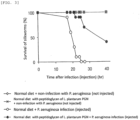
- oral administration of peptidoglycan (not in accordance with the invention as claimed) of lactic acid bacteria of the present invention induced the extended survival of silkworms infected with P. aeruginosa. It has been already demonstrated that tolerance of silkworms infected by bacteria is correlated with tolerance of mammals such as humans (For example, Patent Document 2, 3, etc.).
- peptidoglycan of Lactobacillus plantarum provided tolerance to P. aeruginosa infection to silkworms.
- Silkworms have no mechanism of acquired immunity, and cannot produce antibodies against antigens. Thus, it was thought that the orally administered peptidoglycan of Lactobacillus plantarum activated a mechanism of innate immunity of intestine and the like of the silkworm, and exhibited effect on infection control.
- peptidoglycan of lactic acid bacteria (not in accordance with the invention as claimed) provided tolerance to P. aeruginosa infection to silkworms having only a mechanism of innate immunity, not having a mechanism of acquired immunity. It was thought that the peptidoglycan activated a mechanism of innate immunity of silkworms and the silkworms had tolerance to infection, and it was suggested that an innate immunity activator comprising lactic acid bacteria of the present invention, dead bacteria of the lactic acid bacteria or processed material of the lactic acid bacteria (not in accordance with the invention as claimed) can be used as an agent for preventing or treating infection for animals such as mammals having the mechanism of innate immunity.
- An agent comprising peptidoglycan of lactic acid bacteria belonging to genus Lactobacillus, such as Lactobacillus plantarum, Lactobacillus paraplantarum and the like, as an active ingredient can be used as an agent for preventing or treating infection for mammals such as humans.
- an another aspect of the present disclosure is an agent for preventing or treating infection comprising the above innate immunity activator as an active ingredient, or an agent for preventing or treating infection comprising peptidoglycan of the above lactic acid bacteria (not in accordance with the invention as claimed) as an active ingredient.
- Lactic acid bacteria of the present invention or the innate immunity activator of the present invention derived from the lactic acid bacterium can be blended in medicines, quasi-drugs, food and drink having standards such as common food and drink, health food and powdered milk, and can also be used in various medicines and food and drink in any form.
- Food and drink, especially fermented milk, manufactured by a fermentation process using the lactic acid bacteria of the present invention is preferable in terms of exhibiting effect of lactic acid bacteria or specific effect of the present invention.
- the dosage form of the innate immunity activator or agent for preventing or treating infection of the present invention is not particularly limited, and can be appropriately selected depending on the following desired administration method.
- dosage forms are oral solid agents (tablets, coated tablets, granules, powders, hard capsules, soft capsules and the like), oral liquid agents (liquid agents for internal use, syrup agents, elixir agents and the like), injectable agents (solutions, suspensions and the like), ointments, patches, gel agents, cream agents, powders for external use, spray agents and powders for inhalation.
- the oral solid agents can be produced, for example, by adding an excipient to the active ingredient, and further if necessary adding additives such as a binder, a disintegrant, a lubricant, a coloring agent, and a flavoring agent thereto, with a standard method.
- the excipient includes, for example, lactose, saccharose, sodium chloride, glucose, starch, calcium carbonate, kaolin, fine crystalline cellulose and silic acid.
- the binder includes, for example, water, ethanol, propanol, simple syrup, a glucose solution, a starch solution, a gelatin solution, carboxymethylcellulose, hydroxypropylcellulose, hydroxypropyl starch, methylcellulose, ethylcellulose, shellac, calcium phosphate and polyvinyl pyrrolidone.
- the disintegrant includes, for example, dry starch, sodium alginate, agar powder, sodium hydrogen carbonate, calcium carbonate, sodium lauryl sulfate, monoglyceride stearate and lactose.
- the lubricant includes, for example, purified talc, stearate salts, borax and polyethylene glycol.
- the coloring agent includes, for example, titanium oxide and iron oxide.
- the flavoring agent includes, for example, saccharose, orange peel, citric acid and tartaric acid.
- the oral liquid agent can be produced, for example, by adding the additives, e.g., the flavoring agent, a buffer and a stabilizer to the active ingredient, with the standard method.
- the additives e.g., the flavoring agent, a buffer and a stabilizer
- the flavoring agent includes, for example, saccharose, orange peel, citric acid and tartaric acid.
- the buffer includes, for example, sodium citrate.
- the stabilizer includes, for example, tragacanth, gum Arabic and gelatin.
- the injectable agents for subcutaneous, intramuscular and intravenous injections can be produced with the standard method, for example, by adding a pH adjuster, the buffer, the stabilizer, a tonicity agent and a local anesthetic to the active ingredient.
- the pH adjuster and the buffer include, for example, sodium citrate, sodium acetate and sodium phosphate.
- the stabilizer includes, for example, sodium pyrosulfite, EDTA, thioglycolic acid and thiolactic acid.
- the tonicity agent includes, for example, sodium chloride and glucose.
- the local anesthetic includes, for example, procaine hydrochloride and libocaine hydrochloride.
- the ointment can be produced by combining a publicly known base, the stabilizer, a wetting agent and a preservative with the active ingredient and mixing them, with the standard method.
- the base includes, for example, liquid paraffin, white petrolatum, refined bee wax, octyldodecyl alcohol and paraffin.
- the preservative includes, for example, methyl paraoxybenzoate, ethyl paraoxybenzoate and propyl paraoxybenzoate.
- the patch can be produced by applying the cream agent, the gel agent or the paste agent as the ointment on a publicly known support, with the standard method.
- the support includes, for example, cottons, staple fibers, wovens and non-wovens composed of chemical fibers, films of soft vinyl chloride, polyethylene and polyurethane, and foam sheets.
- the innate immunity activator of the present invention or the agent for preventing or treating infection can be suitably used for individuals who require the activation of a mechanism of innate immunity, individuals who want to acquire acquired immunity against bacteria.
- the agent can be used by administering it to individuals who require health maintenance and recovery from fatigue, individuals who require the prevention or the treatment of cancers or lifestyle-related diseases, individuals infected with bacteria, fungi or viruses, and the like.
- Animals subjected to the administration of the innate immunity activator or agent for preventing or treating infection of the present invention is not particularly limited, can be appropriately selected depending on the purpose, and include, for example, humans; experimental animals such as mice and rats; monkeys; horses; domestic animals such as cattle, swines, goats, chickens; pets such as cats and dogs; and the like.
- the method of administering the innate immunity activator is not particularly limited, can be appropriately selected depending on the dosage form of the innate immunity activator, and includes oral administration, intraperitoneal administration, injection into the blood and injection into the intestine.
- the oral administration is preferable in terms of easily exhibiting the effect.
- a dosage of the innate immunity activator or the agent for preventing or treating infection is not particularly limited, can be appropriately selected depending on an age, a body weight and a degree of desired effects in an individual to be administered, and for example, is preferably 1 mg to 30 g, more preferably 10 mg to 10 g and even more preferably 100 mg to 3 g as the active ingredient per day for an adult.
- an administration period of the innate immunity activator or the agent for preventing or treating infection is not particularly limited, can be appropriately selected depending on the purpose, and for example, may be administered preventively or may be administered therapeutically.
- the content of the lactic acid bacteria, innate immunity activator or agent for preventing or treating infection, in food and drink comprising the lactic acid bacteria of the present invention, dead bacteria or processed material of the lactic acid bacteria (not in accordance with the invention as claimed), innate immunity activator or agent for preventing or treating infection (hereinafter sometimes abbreviated as "food and drink of the present invention"), is not particularly limited, can be appropriately selected depending on the purpose and aspect (kind) of drink and food.
- the whole of food and drink is 100 parts by mass, the total amount is preferably 0.001 to 100 parts by mass, more preferably 0.01 to 100 parts by mass, even more preferably 0.1 to 100 parts by mass.
- the lactic acid bacteria of the present invention dead bacteria or processed material of the lactic acid bacteria (not in accordance with the invention as claimed), innate immunity activator or agent for preventing or treating infection may be used alone or in combination of two or more.
- a content ratio of the respective substances in the food and drink is not particularly limited, and can be appropriately selected depending on the purpose.
- Food and drink of the present invention has an activity for activating innate immunity and/or an activity for preventing or treating infection.
- Food and drink of the present invention comprising the innate immunity activator or agent for preventing or treating infection of the present invention can comprise an "other ingredient”.
- the “other ingredient” is not particularly limited, can be appropriately selected depending on the purpose within the range in which the effects of the present invention are not impaired, and includes, for example, various food raw materials.
- the content of "other ingredient” is not particularly limited and can be appropriately selected depending on the purpose.
- Lactic acid bacteria of the present invention can be used for manufacturing common food and drink, health food, medicines, fermented food and drink, probiotics and the like.
- the lactic acid bacteria are preferably used in fermented milk, lactic acid beverage, yogurt, pickles, and starters of lactic acid bacteria for manufacturing pickles.
- the kinds of the food are not particularly limited, can be appropriately selected depending on the purpose, and include, for example, sweet snacks such as jellies, candies, chocolates, biscuits and gummi candies; taste beverages such as green tea, black tea, coffee and soft drinks; dairy products such as fermented milk, yogurts and ice creams; processed vegetable or fruit products such as vegetable beverages, fruit beverages and jams; liquid foods such as soups; processed grain products such as breads and noodles; various seasonings and the like. Dairy products such as yogurts and fermented milk are preferable.
- the method of manufacturing the food is not particularly limited, and can be appropriately manufactured depending on, for example, the food can be manufactured by the method of manufacturing the ordinary various foods.
- the food may be manufactured as the oral solid agents, e.g., the tablet, the granule and the capsule, and the oral liquid agents, e.g., the liquid agent for internal use and the syrup agent.
- the method of manufacturing the oral solid agent and the oral liquid agent is not particularly limited, can be manufactured, for example, according to the method of manufacturing the oral solid agent and the oral liquid agent of the medicines described above.
- Food and drink of the present invention is especially useful as functional food, health food and the like for the purpose of activating a mechanism of innate immunity or acquiring tolerance to infection.
- lactic acid bacteria of the present invention dead bacteria or processed material thereof (not in accordance with the invention as claimed) are used in manufacturing food and drink
- the manufacturing method known for a person skilled in the art can be used.
- the person skilled in the art can manufacture intended food and drink by an appropriate combination of a process of mixing viable or dead lactic acid bacteria or processed material of lactic acid bacteria (not in accordance with the invention as claimed) of the present invention with other ingredients, a forming process, sterilization process, a fermentation process, a heating process, a drying process, a cooling process, a granulation step, packaging step and the like.
- the fermented milk can be manufactured using a method known to a person skilled in the art.
- the examples include food and drink manufactured by using a process of adding a required amount of lactic acid bacteria of the present invention, as dead bacteria, to fermented milk, and food and drink manufactured by using a process of performing fermentation using lactic acid bacteria of the present invention as starters of lactic acid bacteria.
- the culture conditions can be similar to the culture conditions of the lactic acid bacteria of the present invention.
- GAM medium and MRS agar medium were respectively purchased from Nissui and BD (Becton Dickinson). Calcium carbonate (CaCO 3 ) was added as necessary.
- AnaeroPak registered trademark (Mitsubishi gas chemicals) was used for anaerobic culturing.
- Rice bran pickles were used as fermented food. Liquid suspended in saline (0.9 mass% NaCl) was spread on MRS medium, and anaerobically cultured at 37°C for 2 days.
- the colonies were picked up and re-streaked on CaCO 3 -MRS medium to form a single colony.
- a lactic acid bacteria strain (#11-1) with an excellent activity for activating innate immunity was obtained. That is, a strain of lactic acid bacteria (#11-1) was isolated.
- Lactic acid fermentation was obtained with the formation of white colonies on CaCO 3 -MRS medium and the formation of transparent band, and it was confirmed that #11-1 was lactic acid bacteria. It is also confirmed that the colonies are gram-stained and #11-1 was gram-positive.
- 16S rDNA fragments were obtained by colony PCR using PCR enzyme KOD FX Neo (Toyobo), primers 9F and 1541R.
- sequences were determined with Direct sequencing using BigDye (registered trademark) Terminator v3.1 Cycle Sequencing Kit, and ABI PRISM (registered trademark) 3100 Genetic Analyzer.
- nucleotide sequence of 16S rDNA region of #11-1 is shown in SEQ ID NO: 1 in the Sequence Listing.
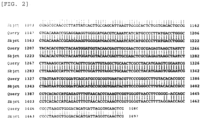
- the nucleotide sequence of 16S rDNA was determined, homology of the nucleotide sequence was analyzed by BLAST analysis, and the nucleotide sequence had high homology with a lactic acid bacterium as shown in FIGs 1 and 2 .
- this nucleotide sequence was closely related to a L. paraplantarum DSM10667 strain (nucleotide sequence: NR_025447.1), but not completely corresponded with each other, and #11-1 was novel "L. paraplantarum”.
- #11-1 of the present invention used in Examples was isolated from rice bran pickles, and was domestically deposited on February 5, 2015, as a lactic acid bacterium #11-1 belonging to genus Lactobacillus, to NITE Patent Microorganisms Depositary (NPMD) of Incorporated Administrative Agency National Institute of Technology and Evaluation (NITE), authorized as depositary institution under Regulations under the Patent Act and international depositary authority under Budapest Treaty on the international recognition of the deposit of microorganisms for the purpose of patent procedure, the address of which is Room 122, 2-5-8 Kazusakamatari, Kisarazu-shi, Chiba, with Accession No. NITE P-02005.
- NPMD NITE Patent Microorganisms Depositary
- NITE Incorporated Administrative Agency National Institute of Technology and Evaluation
- Lactobacillus paraplantarum #11-1 (L. paraplantarum #11-1) strain cultured on MRS medium overnight was subjected to sterilization at 121°C for 20 minutes, and 50 ⁇ L of the sterilized strain was injected into muscle specimen without head of fifth instar silkworm, and an activity for activating innate immunity was measured with gradual muscle contraction.
- C value (Contraction Value) was obtained by subtracting the body length after injection from the body length before injection, and dividing the subtracted value by the body length before injection, [(the body length before injection)-(the body length after injection)]/(the body length before injection), and C value of 0.15 was defined as 1 U (unit).
- Example 1 With the exception of using gram-positive bacteria #4, #11-2 and A shown in Table 1 instead of the Lactobacillus paraplantarum #11-1 (L. paraplantarum #11-1) strain in Example 1, an activity for activating innate immunity was measured with muscle contraction of silkworms in the same matter as Example 1.
- Table 1 shows origin and properties of Example 1 and Comparative Examples 1 to 3. As a reference, closely related strain and homology of the strain are shown in Table 1.
- Example 1 With the exception of using Lactobacillus bulgaricus OLL1073 strain instead of the L. paraplantarum #11-1 strain in Example 1, an activity for activating innate immunity was measured in the same matter as Example 1.
- Example 1 With the exception of using Lactobacillus casei YIT9029 strain instead of the L. paraplantarum #11-1 strain in Example 1, an activity for activating innate immunity was measured in the same matter as Example 1.
- Example 1 With the exception of using Lactococcus lactis JCM5805 strain instead of the L. paraplantarum #11-1 strain in Example 1, an activity for activating innate immunity was measured in the same matter as Example 1.
- Lactic acid bacteria of Comparative Examples 4 to 6 are lactic acid bacteria which are actually used in the manufacture of commercial fermented milk.
- lactic acid bacteria #11-1 of the present invention of Example 1 had a higher activity for activating innate immunity, compared with lactic acid bacteria of Comparative Examples 4 to 6.
- lactic acid bacteria of the present invention When the sterilized material of Lactobacillus paraplantarum #11-1 of the present invention was measured, the activity for activating innate immunity was significantly high, and it was found that lactic acid bacteria of the present invention, dead bacteria of the lactic acid bacteria of the present invention, or processed material of the lactic acid bacteria of the present (for example, cultured material, concentrated material, paste material, dried material such as spray-dried material, freeze-dried material, vacuum-dried material and drum-dried material, fluid material, diluted material, crushed material, sterilized material of the lactic acid bacteria, and extract from the cultured material) were highly suitable as an innate immunity activator.
- processed material of the lactic acid bacteria of the present for example, cultured material, concentrated material, paste material, dried material such as spray-dried material, freeze-dried material, vacuum-dried material and drum-dried material, fluid material, diluted material, crushed material, sterilized material of the lactic acid bacteria, and extract from the cultured material
- Lactobacillus paraplantarum has safety as fermented food.
- Food and drink obtained by fermenting milk using L. paraplantarum #11-1 of the present invention has an activity for activating innate immunity.
- L. plantarum PGN lactobacillus plantarum subsp. plantarum JCM 1057
- peptidoglycan fraction was prepared in accordance with an ordinary method, 2.7 mass% of the peptidoglycan fraction was mixed with an artificial diet of silkworms, and the mixed diet was given to silkworms for 2 days. That is, 0.041 g in total was given before injection.
- Pseudomonas aeruginosa (PAO1) was cultured at 30°C for overnight.
- the bacteria liquid was diluted with saline to 1000-fold, and 50 ⁇ L of the dilution was injected into body liquid of silkworm.
- an agent comprising peptidoglycan of Lactobacillus plantarum as an active ingredient was useful as an agent for preventing or treating infection for mammals such as humans.
- the agent for preventing or treating infection comprising peptidoglycan of Lactobacillus plantarum as an active ingredient is useful as food and drink for mammals such as humans.
- the culture medium of #11-1 is subjected to sterilization at 121°C for 20 minutes. After 20.0 mg of the concentrated culture medium of #11-1, 40 mg of lactose, 20 mg of starch, and 5 mg of low-degree substituted hydroxypropyl cellulose were uniformly mixed, granules for tablets were prepared by a wet granulation method by using 8 mass% of aqueous solution of hydroxypropyl cellulose as a binding material. To this was added 0.5 to 1 mg of magnesium stearate, amount necessary to afford sliding properties to the granules, and then they were tableted by a tableting machine.
- Inject solution was prepared by dissolving 10.0 mg of the above concentrated culture medium of #11-1, 2 mass% of aqueous solution of 2-hydroxypropyl- ⁇ -cyclodestrin.
- the novel lactic acid bacterium of the present invention or processed material thereof has a high activity for activating innate immunity and effect for preventing or treating infection.
- a medicine or food and drink comprising an innate immunity activator activating innate immunity or an agent for preventing or treating infection which utilizes the lactic acid bacterium of the present invention, can be provided, and they are widely available in pharmaceutical industry, food industry, etc.
- SEQ ID NO: 1 of the Sequencing Listing shows the nucleotide sequence of almost entire length of 16S rRNA of unknown strain belonging to genus Lactobacillus.
Landscapes
- Health & Medical Sciences (AREA)
- Life Sciences & Earth Sciences (AREA)
- Chemical & Material Sciences (AREA)
- Engineering & Computer Science (AREA)
- Medicinal Chemistry (AREA)
- General Health & Medical Sciences (AREA)
- Animal Behavior & Ethology (AREA)
- Veterinary Medicine (AREA)
- Public Health (AREA)
- Organic Chemistry (AREA)
- Pharmacology & Pharmacy (AREA)
- Bioinformatics & Cheminformatics (AREA)
- Mycology (AREA)
- Microbiology (AREA)
- Immunology (AREA)
- Polymers & Plastics (AREA)
- Epidemiology (AREA)
- Nutrition Science (AREA)
- Food Science & Technology (AREA)
- Genetics & Genomics (AREA)
- Biotechnology (AREA)
- Zoology (AREA)
- Wood Science & Technology (AREA)
- Molecular Biology (AREA)
- Chemical Kinetics & Catalysis (AREA)
- General Chemical & Material Sciences (AREA)
- Nuclear Medicine, Radiotherapy & Molecular Imaging (AREA)
- Virology (AREA)
- Biomedical Technology (AREA)
- Tropical Medicine & Parasitology (AREA)
- Biochemistry (AREA)
- General Engineering & Computer Science (AREA)
- Communicable Diseases (AREA)
- Oncology (AREA)
- Proteomics, Peptides & Aminoacids (AREA)
- Medicines Containing Material From Animals Or Micro-Organisms (AREA)
- Coloring Foods And Improving Nutritive Qualities (AREA)
- Micro-Organisms Or Cultivation Processes Thereof (AREA)
Claims (6)
- Milchsäurebakterium, das zur Gattung Lactobacillus gehört, mit der Akzessions-Nr. NITE BP-02005 in NITE Patent Microorganisms Depositary (NPMD) des Incorporated Administrative Agency National Institute of Technology and Evaluation (NITE).
- Milchsäurebakterium gemäß Anspruch 1, wobei das Milchsäurebakterium die in SEQ ID Nr. 1 gezeigte Nucleotidsequenz des 16S-rDNA-Bereichs aufweist.
- Totes Bakterium des Milchsäurebakteriums gemäß Anspruch 1 oder 2.
- Lebensmittel und Getränk, umfassend das Milchsäurebakterium gemäß einem der Ansprüche 1 bis 3.
- Milchsäurebakterium gemäß einem der Ansprüche 1 bis 3 zur Verwendung als Medikament.
- Milchsäurebakterium zur Verwendung gemäß Anspruch 5, das in einem Lebensmittel oder Getränk enthalten ist.
Applications Claiming Priority (2)
| Application Number | Priority Date | Filing Date | Title |
|---|---|---|---|
| JP2015022567 | 2015-02-06 | ||
| PCT/JP2016/053378 WO2016125861A1 (ja) | 2015-02-06 | 2016-02-04 | 乳酸菌、該乳酸菌由来の自然免疫活性化剤、感染症予防治療剤及び飲食品 |
Publications (4)
| Publication Number | Publication Date |
|---|---|
| EP3255140A1 EP3255140A1 (de) | 2017-12-13 |
| EP3255140A4 EP3255140A4 (de) | 2018-07-04 |
| EP3255140C0 EP3255140C0 (de) | 2024-10-16 |
| EP3255140B1 true EP3255140B1 (de) | 2024-10-16 |
Family
ID=56564200
Family Applications (1)
| Application Number | Title | Priority Date | Filing Date |
|---|---|---|---|
| EP16746692.9A Active EP3255140B1 (de) | 2015-02-06 | 2016-02-04 | Milchsäurebakterien, aus diesen milchsäurebakterien abgeleiteter natürlicher immunoaktivator und infektionsprävention/-therapie sowie nahrungsmittel/getränk |
Country Status (7)
| Country | Link |
|---|---|
| US (1) | US10265352B2 (de) |
| EP (1) | EP3255140B1 (de) |
| JP (1) | JP6594911B2 (de) |
| KR (1) | KR102332867B1 (de) |
| CN (1) | CN107208040B (de) |
| ES (1) | ES2993757T3 (de) |
| WO (1) | WO2016125861A1 (de) |
Families Citing this family (10)
| Publication number | Priority date | Publication date | Assignee | Title |
|---|---|---|---|---|
| WO2018034203A1 (ja) * | 2016-08-16 | 2018-02-22 | 株式会社ゲノム創薬研究所 | 新規乳酸菌、新規乳酸菌を有効成分として含有する自然免疫活性化剤、及び新規乳酸菌を含有する飲食品 |
| JP6576890B2 (ja) * | 2016-08-30 | 2019-09-18 | 株式会社ゲノム創薬研究所 | 野菜又は果物ジュース中の糖濃度を減少させる方法、及び該方法を用いる乳酸菌含有野菜又は果物ジュースの製造方法 |
| JP7267536B2 (ja) * | 2017-10-11 | 2023-05-02 | 株式会社ゲノム創薬研究所 | 乳酸醗酵ニンジンの製造方法 |
| WO2020017390A1 (ja) * | 2018-07-19 | 2020-01-23 | 株式会社ゲノム創薬研究所 | 乳酸菌、該乳酸菌由来の自然免疫活性化剤、感染症予防・治療薬及び飲食品 |
| EP3839042A4 (de) * | 2018-08-17 | 2022-06-01 | Ichibiki Co., Ltd. | Milchsäurebakterium, mittel zur erhöhung des eisengehaltes in blut und mittel zur verbesserung von anämie |
| MX2022008905A (es) * | 2020-01-23 | 2022-08-16 | Gervais Danone Sa | Composiciones probioticas de base vegetal fermentada y procesos de preparacion de las mismas. |
| JP7199063B2 (ja) * | 2020-07-30 | 2023-01-05 | 新潟県 | 新規乳酸菌およびこの乳酸菌を利用した粘性発酵物の製造法 |
| JP2022145446A (ja) * | 2021-03-19 | 2022-10-04 | キリンホールディングス株式会社 | 紙臭が抑制された容器詰茶飲料、及びその製造方法 |
| AU2022324851B2 (en) * | 2021-08-03 | 2025-09-11 | Kirin Beverage Company, Limited | Packaged beverage having suppressed offensive taste and odor associated with lactic acid bacteria, and method for producing same |
| JPWO2024090414A1 (de) * | 2022-10-25 | 2024-05-02 |
Citations (1)
| Publication number | Priority date | Publication date | Assignee | Title |
|---|---|---|---|---|
| JP2009112232A (ja) * | 2007-11-05 | 2009-05-28 | Nissei Bio Kk | 免疫賦活作用及び/又はアレルギー抑制作用を有し、且つ胃液耐性を有する新規乳酸菌 |
Family Cites Families (9)
| Publication number | Priority date | Publication date | Assignee | Title |
|---|---|---|---|---|
| JP4733080B2 (ja) | 2000-05-11 | 2011-07-27 | 株式会社ゲノム創薬研究所 | 獲得免疫機構を有する生物に感染する病原微生物に対し抗菌活性を有する化合物を自然免疫機構のみを有する生物を利用してスクリーニングする方法、および該抗菌活性を自然免疫機構のみを有する生物を利用して評価する方法 |
| EP2133693B1 (de) | 2007-04-10 | 2013-06-12 | Genome Pharmaceuticals Institute Co., Ltd. | Screeningverfahren für eine substanz mit aktivierender/unterdrückender wirkung auf angeborene immunität. |
| KR101486999B1 (ko) * | 2009-07-22 | 2015-01-28 | 씨제이제일제당 주식회사 | 신규한 락토바실러스 플란타룸 및 이를 포함하는 조성물 |
| US9788557B2 (en) | 2010-03-19 | 2017-10-17 | Kabushiki Kaisha Yakult Honsha | Lactobacillus classified as Lactobacillus plantarum, and use thereof |
| JP5878302B2 (ja) | 2010-05-25 | 2016-03-08 | 株式会社ゲノム創薬研究所 | 新規環状ペプチド化合物とその製造方法及び感染症治療薬 |
| WO2012063345A1 (ja) * | 2010-11-11 | 2012-05-18 | 株式会社カザミ | 免疫賦活剤及びそれを配合した免疫賦活組成物、並びに免疫賦活方法 |
| JP5916288B2 (ja) * | 2011-02-07 | 2016-05-11 | 森川健康堂株式会社 | 自然免疫促進作用が増強された自然免疫活性化剤の製造方法及びその製造方法で製造されたローヤルゼリー由来の自然免疫活性化剤 |
| WO2012173163A1 (ja) | 2011-06-14 | 2012-12-20 | 有限会社バイオメディカルリサーチグループ | 菌体破砕物及びその配合物 |
| CN105637084B (zh) * | 2013-10-17 | 2019-08-06 | 株式公司染色体创药研究所 | 新型乳酸菌、以新型乳酸菌作为有效成分的天然免疫活化剂以及含有新型乳酸菌的饮食品 |
-
2016
- 2016-02-04 CN CN201680004722.1A patent/CN107208040B/zh active Active
- 2016-02-04 EP EP16746692.9A patent/EP3255140B1/de active Active
- 2016-02-04 WO PCT/JP2016/053378 patent/WO2016125861A1/ja not_active Ceased
- 2016-02-04 US US15/547,865 patent/US10265352B2/en active Active
- 2016-02-04 KR KR1020177018233A patent/KR102332867B1/ko active Active
- 2016-02-04 JP JP2016573417A patent/JP6594911B2/ja active Active
- 2016-02-04 ES ES16746692T patent/ES2993757T3/es active Active
Patent Citations (1)
| Publication number | Priority date | Publication date | Assignee | Title |
|---|---|---|---|---|
| JP2009112232A (ja) * | 2007-11-05 | 2009-05-28 | Nissei Bio Kk | 免疫賦活作用及び/又はアレルギー抑制作用を有し、且つ胃液耐性を有する新規乳酸菌 |
Also Published As
| Publication number | Publication date |
|---|---|
| WO2016125861A1 (ja) | 2016-08-11 |
| CN107208040A (zh) | 2017-09-26 |
| EP3255140C0 (de) | 2024-10-16 |
| KR102332867B1 (ko) | 2021-11-29 |
| ES2993757T3 (en) | 2025-01-08 |
| EP3255140A4 (de) | 2018-07-04 |
| EP3255140A1 (de) | 2017-12-13 |
| CN107208040B (zh) | 2021-06-25 |
| JPWO2016125861A1 (ja) | 2017-12-14 |
| KR20170110076A (ko) | 2017-10-10 |
| US20180243352A1 (en) | 2018-08-30 |
| JP6594911B2 (ja) | 2019-10-23 |
| US10265352B2 (en) | 2019-04-23 |
Similar Documents
| Publication | Publication Date | Title |
|---|---|---|
| EP3255140B1 (de) | Milchsäurebakterien, aus diesen milchsäurebakterien abgeleiteter natürlicher immunoaktivator und infektionsprävention/-therapie sowie nahrungsmittel/getränk | |
| US10653730B2 (en) | Lactic acid bacterium, drug, food or drink, and feed which contain the lactic acid bacterium | |
| KR102267879B1 (ko) | 신규 유산균, 신규 유산균을 유효 성분으로 하는 자연 면역 활성화제, 및 신규 유산균을 함유하는 음식품 | |
| EP3135754B1 (de) | Bifidobacterium-longum-cbt-bg7-stamm und funktionale nahrungsmittelzusammensetzung damit zur wachstumsförderung | |
| JP2009545311A (ja) | 人間母乳から分離したプロバイオティック活性、及び体重増加抑制活性を有する乳酸菌 | |
| EP3135755B1 (de) | Bifidobacterium breve-cbt-br3-stamm zur wachstumsförderung und funktionale nahrungsmittelzusammensetzung damit zur wachstumsförderung | |
| US20200237837A1 (en) | Lactic acid bacterium, drug, food or drink, and feed which contain the lactic acid bacterium | |
| JP7090288B2 (ja) | 新規乳酸菌、新規乳酸菌を有効成分として含有する自然免疫活性化剤、及び新規乳酸菌を含有する飲食品 | |
| JP7369976B2 (ja) | 乳酸菌、該乳酸菌由来の自然免疫活性化剤、感染症予防・治療薬及び飲食品 | |
| WO2024090413A1 (ja) | 乳酸菌、該乳酸菌由来の自然免疫活性化剤及び該乳酸菌を含有する食品 | |
| WO2024090414A1 (ja) | 乳酸菌、該乳酸菌由来の自然免疫活性化剤及び該乳酸菌を含有する食品 | |
| WO2024090415A1 (ja) | 乳酸菌、該乳酸菌由来の自然免疫活性化剤及び該乳酸菌を含有する食品 | |
| HK1239734A1 (en) | Lactic acid bacteria, natural immunoactivator and infection preventative/therapeutic derived from said lactic acid bacteria, and food/beverage | |
| HK1239734B (zh) | 乳酸菌、来源於该乳酸菌的天然免疫活化剂、感染症预防治疗剂和饮食品 | |
| JP6588509B2 (ja) | 乳酸菌を有効成分として含有する抗真菌剤 | |
| HK1219501B (zh) | 新型乳酸菌、以新型乳酸菌作为有效成分的天然免疫活化剂以及含有新型乳酸菌的饮食品 | |
| HK1171474A1 (en) | Novel lactobacillus plantarum and composition comprising same | |
| HK1171474B (en) | Novel lactobacillus plantarum and composition comprising same |
Legal Events
| Date | Code | Title | Description |
|---|---|---|---|
| STAA | Information on the status of an ep patent application or granted ep patent |
Free format text: STATUS: THE INTERNATIONAL PUBLICATION HAS BEEN MADE |
|
| PUAI | Public reference made under article 153(3) epc to a published international application that has entered the european phase |
Free format text: ORIGINAL CODE: 0009012 |
|
| STAA | Information on the status of an ep patent application or granted ep patent |
Free format text: STATUS: REQUEST FOR EXAMINATION WAS MADE |
|
| 17P | Request for examination filed |
Effective date: 20170815 |
|
| AK | Designated contracting states |
Kind code of ref document: A1 Designated state(s): AL AT BE BG CH CY CZ DE DK EE ES FI FR GB GR HR HU IE IS IT LI LT LU LV MC MK MT NL NO PL PT RO RS SE SI SK SM TR |
|
| AX | Request for extension of the european patent |
Extension state: BA ME |
|
| DAV | Request for validation of the european patent (deleted) | ||
| DAX | Request for extension of the european patent (deleted) | ||
| RIC1 | Information provided on ipc code assigned before grant |
Ipc: A61P 31/00 20060101ALI20180523BHEP Ipc: A61K 35/74 20150101ALI20180523BHEP Ipc: A23L 5/00 20160101ALI20180523BHEP Ipc: A23L 33/10 20160101ALI20180523BHEP Ipc: C12N 1/20 20060101AFI20180523BHEP Ipc: A61K 38/00 20060101ALI20180523BHEP Ipc: A61P 37/04 20060101ALI20180523BHEP |
|
| A4 | Supplementary search report drawn up and despatched |
Effective date: 20180601 |
|
| STAA | Information on the status of an ep patent application or granted ep patent |
Free format text: STATUS: EXAMINATION IS IN PROGRESS |
|
| 17Q | First examination report despatched |
Effective date: 20220520 |
|
| GRAP | Despatch of communication of intention to grant a patent |
Free format text: ORIGINAL CODE: EPIDOSNIGR1 |
|
| STAA | Information on the status of an ep patent application or granted ep patent |
Free format text: STATUS: GRANT OF PATENT IS INTENDED |
|
| INTG | Intention to grant announced |
Effective date: 20240513 |
|
| RIN1 | Information on inventor provided before grant (corrected) |
Inventor name: SEKIMIZU, KAZUHISA |
|
| GRAS | Grant fee paid |
Free format text: ORIGINAL CODE: EPIDOSNIGR3 |
|
| RAP3 | Party data changed (applicant data changed or rights of an application transferred) |
Owner name: THE UNIVERSITY OF TOKYO Owner name: ANTENNA CO., LTD. Owner name: GENOME PHARMACEUTICALS INSTITUTE CO., LTD. |
|
| GRAA | (expected) grant |
Free format text: ORIGINAL CODE: 0009210 |
|
| STAA | Information on the status of an ep patent application or granted ep patent |
Free format text: STATUS: THE PATENT HAS BEEN GRANTED |
|
| AK | Designated contracting states |
Kind code of ref document: B1 Designated state(s): AL AT BE BG CH CY CZ DE DK EE ES FI FR GB GR HR HU IE IS IT LI LT LU LV MC MK MT NL NO PL PT RO RS SE SI SK SM TR |
|
| REG | Reference to a national code |
Ref country code: GB Ref legal event code: FG4D |
|
| REG | Reference to a national code |
Ref country code: CH Ref legal event code: EP |
|
| REG | Reference to a national code |
Ref country code: IE Ref legal event code: FG4D |
|
| REG | Reference to a national code |
Ref country code: DE Ref legal event code: R096 Ref document number: 602016089857 Country of ref document: DE |
|
| U01 | Request for unitary effect filed |
Effective date: 20241025 |
|
| U07 | Unitary effect registered |
Designated state(s): AT BE BG DE DK EE FI FR IT LT LU LV MT NL PT RO SE SI Effective date: 20241108 |
|
| REG | Reference to a national code |
Ref country code: ES Ref legal event code: FG2A Ref document number: 2993757 Country of ref document: ES Kind code of ref document: T3 Effective date: 20250108 |
|
| U20 | Renewal fee for the european patent with unitary effect paid |
Year of fee payment: 10 Effective date: 20250129 |
|
| PGFP | Annual fee paid to national office [announced via postgrant information from national office to epo] |
Ref country code: MC Payment date: 20250225 Year of fee payment: 10 |
|
| PG25 | Lapsed in a contracting state [announced via postgrant information from national office to epo] |
Ref country code: HR Free format text: LAPSE BECAUSE OF FAILURE TO SUBMIT A TRANSLATION OF THE DESCRIPTION OR TO PAY THE FEE WITHIN THE PRESCRIBED TIME-LIMIT Effective date: 20241016 Ref country code: IS Free format text: LAPSE BECAUSE OF FAILURE TO SUBMIT A TRANSLATION OF THE DESCRIPTION OR TO PAY THE FEE WITHIN THE PRESCRIBED TIME-LIMIT Effective date: 20250216 |
|
| PGFP | Annual fee paid to national office [announced via postgrant information from national office to epo] |
Ref country code: ES Payment date: 20250318 Year of fee payment: 10 |
|
| PG25 | Lapsed in a contracting state [announced via postgrant information from national office to epo] |
Ref country code: NO Free format text: LAPSE BECAUSE OF FAILURE TO SUBMIT A TRANSLATION OF THE DESCRIPTION OR TO PAY THE FEE WITHIN THE PRESCRIBED TIME-LIMIT Effective date: 20250116 |
|
| PG25 | Lapsed in a contracting state [announced via postgrant information from national office to epo] |
Ref country code: GR Free format text: LAPSE BECAUSE OF FAILURE TO SUBMIT A TRANSLATION OF THE DESCRIPTION OR TO PAY THE FEE WITHIN THE PRESCRIBED TIME-LIMIT Effective date: 20250117 |
|
| PGFP | Annual fee paid to national office [announced via postgrant information from national office to epo] |
Ref country code: CH Payment date: 20250301 Year of fee payment: 10 |
|
| PG25 | Lapsed in a contracting state [announced via postgrant information from national office to epo] |
Ref country code: PL Free format text: LAPSE BECAUSE OF FAILURE TO SUBMIT A TRANSLATION OF THE DESCRIPTION OR TO PAY THE FEE WITHIN THE PRESCRIBED TIME-LIMIT Effective date: 20241016 |
|
| PGFP | Annual fee paid to national office [announced via postgrant information from national office to epo] |
Ref country code: GB Payment date: 20250220 Year of fee payment: 10 |
|
| PG25 | Lapsed in a contracting state [announced via postgrant information from national office to epo] |
Ref country code: RS Free format text: LAPSE BECAUSE OF FAILURE TO SUBMIT A TRANSLATION OF THE DESCRIPTION OR TO PAY THE FEE WITHIN THE PRESCRIBED TIME-LIMIT Effective date: 20250116 |
|
| PG25 | Lapsed in a contracting state [announced via postgrant information from national office to epo] |
Ref country code: SM Free format text: LAPSE BECAUSE OF FAILURE TO SUBMIT A TRANSLATION OF THE DESCRIPTION OR TO PAY THE FEE WITHIN THE PRESCRIBED TIME-LIMIT Effective date: 20241016 |
|
| PG25 | Lapsed in a contracting state [announced via postgrant information from national office to epo] |
Ref country code: SK Free format text: LAPSE BECAUSE OF FAILURE TO SUBMIT A TRANSLATION OF THE DESCRIPTION OR TO PAY THE FEE WITHIN THE PRESCRIBED TIME-LIMIT Effective date: 20241016 |
|
| PG25 | Lapsed in a contracting state [announced via postgrant information from national office to epo] |
Ref country code: CZ Free format text: LAPSE BECAUSE OF FAILURE TO SUBMIT A TRANSLATION OF THE DESCRIPTION OR TO PAY THE FEE WITHIN THE PRESCRIBED TIME-LIMIT Effective date: 20241016 |
|
| PLBE | No opposition filed within time limit |
Free format text: ORIGINAL CODE: 0009261 |
|
| STAA | Information on the status of an ep patent application or granted ep patent |
Free format text: STATUS: NO OPPOSITION FILED WITHIN TIME LIMIT |
|
| 26N | No opposition filed |
Effective date: 20250717 |
|
| REG | Reference to a national code |
Ref country code: CH Ref legal event code: R17 Free format text: ST27 STATUS EVENT CODE: U-0-0-R10-R17 (AS PROVIDED BY THE NATIONAL OFFICE) Effective date: 20251212 |
|
| PG25 | Lapsed in a contracting state [announced via postgrant information from national office to epo] |
Ref country code: IE Free format text: LAPSE BECAUSE OF NON-PAYMENT OF DUE FEES Effective date: 20250204 |