EP3239123B1 - Verfahren zur herstellung einer difluorierten alkoholverbindung - Google Patents
Verfahren zur herstellung einer difluorierten alkoholverbindung Download PDFInfo
- Publication number
- EP3239123B1 EP3239123B1 EP16189248.4A EP16189248A EP3239123B1 EP 3239123 B1 EP3239123 B1 EP 3239123B1 EP 16189248 A EP16189248 A EP 16189248A EP 3239123 B1 EP3239123 B1 EP 3239123B1
- Authority
- EP
- European Patent Office
- Prior art keywords
- reaction
- group
- organic solvent
- aldehyde
- proline
- Prior art date
- Legal status (The legal status is an assumption and is not a legal conclusion. Google has not performed a legal analysis and makes no representation as to the accuracy of the status listed.)
- Active
Links
Classifications
-
- C—CHEMISTRY; METALLURGY
- C07—ORGANIC CHEMISTRY
- C07C—ACYCLIC OR CARBOCYCLIC COMPOUNDS
- C07C31/00—Saturated compounds having hydroxy or O-metal groups bound to acyclic carbon atoms
- C07C31/34—Halogenated alcohols
- C07C31/38—Halogenated alcohols containing only fluorine as halogen
-
- C—CHEMISTRY; METALLURGY
- C07—ORGANIC CHEMISTRY
- C07C—ACYCLIC OR CARBOCYCLIC COMPOUNDS
- C07C201/00—Preparation of esters of nitric or nitrous acid or of compounds containing nitro or nitroso groups bound to a carbon skeleton
- C07C201/06—Preparation of nitro compounds
- C07C201/12—Preparation of nitro compounds by reactions not involving the formation of nitro groups
-
- C—CHEMISTRY; METALLURGY
- C07—ORGANIC CHEMISTRY
- C07C—ACYCLIC OR CARBOCYCLIC COMPOUNDS
- C07C253/00—Preparation of carboxylic acid nitriles
- C07C253/30—Preparation of carboxylic acid nitriles by reactions not involving the formation of cyano groups
-
- C—CHEMISTRY; METALLURGY
- C07—ORGANIC CHEMISTRY
- C07C—ACYCLIC OR CARBOCYCLIC COMPOUNDS
- C07C29/00—Preparation of compounds having hydroxy or O-metal groups bound to a carbon atom not belonging to a six-membered aromatic ring
- C07C29/132—Preparation of compounds having hydroxy or O-metal groups bound to a carbon atom not belonging to a six-membered aromatic ring by reduction of an oxygen containing functional group
- C07C29/136—Preparation of compounds having hydroxy or O-metal groups bound to a carbon atom not belonging to a six-membered aromatic ring by reduction of an oxygen containing functional group of >C=O containing groups, e.g. —COOH
- C07C29/14—Preparation of compounds having hydroxy or O-metal groups bound to a carbon atom not belonging to a six-membered aromatic ring by reduction of an oxygen containing functional group of >C=O containing groups, e.g. —COOH of a —CHO group
-
- C—CHEMISTRY; METALLURGY
- C07—ORGANIC CHEMISTRY
- C07C—ACYCLIC OR CARBOCYCLIC COMPOUNDS
- C07C29/00—Preparation of compounds having hydroxy or O-metal groups bound to a carbon atom not belonging to a six-membered aromatic ring
- C07C29/64—Preparation of compounds having hydroxy or O-metal groups bound to a carbon atom not belonging to a six-membered aromatic ring by simultaneous introduction of -OH groups and halogens
-
- C—CHEMISTRY; METALLURGY
- C07—ORGANIC CHEMISTRY
- C07C—ACYCLIC OR CARBOCYCLIC COMPOUNDS
- C07C29/00—Preparation of compounds having hydroxy or O-metal groups bound to a carbon atom not belonging to a six-membered aromatic ring
- C07C29/74—Separation; Purification; Use of additives, e.g. for stabilisation
-
- C—CHEMISTRY; METALLURGY
- C07—ORGANIC CHEMISTRY
- C07C—ACYCLIC OR CARBOCYCLIC COMPOUNDS
- C07C41/00—Preparation of ethers; Preparation of compounds having groups, groups or groups
- C07C41/01—Preparation of ethers
- C07C41/18—Preparation of ethers by reactions not forming ether-oxygen bonds
- C07C41/22—Preparation of ethers by reactions not forming ether-oxygen bonds by introduction of halogens; by substitution of halogen atoms by other halogen atoms
-
- C—CHEMISTRY; METALLURGY
- C07—ORGANIC CHEMISTRY
- C07C—ACYCLIC OR CARBOCYCLIC COMPOUNDS
- C07C41/00—Preparation of ethers; Preparation of compounds having groups, groups or groups
- C07C41/01—Preparation of ethers
- C07C41/18—Preparation of ethers by reactions not forming ether-oxygen bonds
- C07C41/26—Preparation of ethers by reactions not forming ether-oxygen bonds by introduction of hydroxy or O-metal groups
Definitions
- the present invention relates to a method of preparing a difluorinated alcohol compound, and more particularly, to a method of preparing a difluorinated alcohol compound used for raw materials such as functional medicines, agricultural chemicals, polymerizable compounds, etc. More particularly, the present invention relates to a method of preparing a difluorinated alcohol compound, which includes reacting an aldehyde and N -fluorobenzenesulfonimide (NFSI) in the presence of L-proline and reducing the reaction product using sodium borohydride.
- NFSI N -fluorobenzenesulfonimide
- Representative medicine containing fluorine atoms include fluorouracil used as an anti-cancer drug, fluoxetine used as an anti-depressant, ciprofloxacin known as an anti-anthrax drug, etc.
- fluorouracil used as an anti-cancer drug
- fluoxetine used as an anti-depressant
- ciprofloxacin known as an anti-anthrax drug
- the fluorinated alcohol contains fluorine atoms, and thus has features in that it has high polarity and acidity and is not easily oxidized. Therefore, the fluorinated alcohol has been used as a raw material for synthesizing functional medicines, agricultural chemicals, fluorine-containing polymerizable compounds, etc.
- Surfactants may be prepared through a phosphate reaction or prepared through an ethoxylate reaction after addition of ethylene oxide, or various water- or oil-repelling agents may be prepared through an esterification reaction.
- the functions of fluorine may be imparted to urethane through a urethane reaction with isocyanates.
- Such a fluorinated alcohol has come into the spotlight since it has achievable characteristics such as hydrophobicity, oil resistance, high thermal and chemical stability, low surface energy, low solubility in hydrocarbons, lubricity, releasability, etc.
- Fluorinated paints have been known as super-weather-resistant paints, and have been mainly applied to installations or luxury apartment buildings which are difficult to maintain and repair due to their high level of price as non-contaminating paints that have very excellent physical properties and aids in maintaining the initial surface state of buildings. Also, the fluorinated paints have been applied to food processors and baking pans, or release agents for industries due to their properties such as water and oil repellency, etc.
- TFE Fluorinated alcohols such as CF 3 CH 2 OH (TFE), (CF 3 ) 2 CHOH (HFIP), HCF 2 CF 2 CH 2 OH (TFP), C 6 F 13 C 2 H 4 OH, and the like have been put to practical use.
- TFE Fluorinated alcohols such as CF 3 CH 2 OH (TFE), (CF 3 ) 2 CHOH (HFIP), HCF 2 CF 2 CH 2 OH (TFP), C 6 F 13 C 2 H 4 OH, and the like have been put to practical use.
- TFE Fluorinated alcohols such as CF 3 CH 2 OH (TFE), (CF 3 ) 2 CHOH (HFIP), HCF 2 CF 2 CH 2 OH (TFP), C 6 F 13 C 2 H 4 OH, and the like have been put to practical use.
- TFE is of importance as a source material for inhalation anesthetics such as isoflurane and desflurane.
- TFE has high thermal stability and dynamic characteristics, has been used for a working medium for Rankine cycle systems, for example, a medium for waste heat recovery power generation systems, has been used as a solvent for polymers such as polyamides, PMMA, acetylcellulose, etc., and has been used as a basic material for optical fibers when converted into monomers such as methacrylates.
- HFIP has been used as a solvent of PET, polyamides, polyvinyl alcohol, and the like, particularly used as an eluent in a solution for GPC analysis, and is of importance as a resist when HFIP is introduced into the resist.
- the resist When a substrate is coated with this resist, the resist exhibits high transparency and adhesion to the substrate in addition to hydrophilicity, and generally has high sensitivity when exposed to an argon fluoride (ArF) or krypton fluoride (KrF) light source with a wavelength of 300 nm or less, and thus has been used to prepare a radiation-sensitive resist polymer.
- ArF argon fluoride
- KrF krypton fluoride
- TFP has been used as a solvent in which, due to its nature of having no influence on the substrate, a pigment is dissolved and applied onto a polycarbonate substrate to form a recording layer for optical recording media.
- C 6 F 13 C 2 H 4 OH has been used as an oil-repelling agent for paper or a release agent when esterified with phosphoric acid.
- the urethane compounds reacting with isocyanates have medically good stability in blood or tissue, and thus have emerged as an alternative to anti-fouling coatings and materials for high-pressure emulsification devices.
- ⁇ 2 adrenergic receptor antagonists that work against congenital lung diseases such as asthma or bronchitis.
- Such medicines also have a difluorinated structure.
- the medicines have been used as therapeutic agents to treat premature labor, glaucoma, nerve disorders, cardiac disorders, etc. in addition to the lung diseases.
- 2,2-difluoro-2-(4-fluorophenyl)ethanol which is an alcohol into which two fluorine atoms are introduced is synthesized through three steps.
- 1-Bromo-4-fluorobenzene and diethyl oxalate are subjected to a Grignard reaction at -78°C in the presence of magnesium to obtain ethyl(4-fluorobenzoyl)formate with a yield of 44%
- 2-(4-fluorophenyl)-2,2-difluoroethyl ether acetate is obtained at 60°C with a yield of 52% using diethylaminosulfur trifluoride (DAST).
- DAST diethylaminosulfur trifluoride
- 2,2-difluoro-2-(4-fluorophenyl)ethanol is synthesized with a yield of 75% using sodium borohydride as a reducing agent.
- N -bromosuccinimide (NBS) and triethylamine trihydrofluoride (TEA ⁇ 3HF) are reacted at room temperature for 15 hours to synthesize (2-bromo-1-fluoroethyl)benzene from styrene, and 1-(fluorovinyl)benzene is synthesized in the presence of a solvent, tetrahydrofuran, using potassium tert-butoxide.
- (2-bromo-1,1-difluoroethyl)benzene is obtained using NBS and TEA ⁇ 3HF, and potassium acetate and 18-Crown-6 are reacted at 150°C for 15 hours in the presence of a dimethylformamide solvent to synthesize 2,2-difluoro-2-phenylethyl acetate.
- 2,2-difluoro-2-phenylethanol is synthesized using sodium hydroxide.
- (2,2-difluoro-3-(4-propylphenyl)propan-1-ol) which is an alcohol into which two fluorine atoms are introduced is synthesized through four steps.
- 2,2-Difluoro-3-hydroxy-3-(4-propylphenyl)propanoate is synthesized using ethylbromodifluoroacetate and 4-propylbenzaldehyde, and 2,2-difluoro-3-(((methylthio)carbonothioyl)oxy)-3-(4-propylphenyl)propanoate is obtained using 1,8-diazabicyclo[5.4.0]undec-7-ene (DBU) and carbon disulfide (CS 2 ).
- DBU 1,8-diazabicyclo[5.4.0]undec-7-ene
- CS 2 carbon disulfide
- Tributyltin hydride and azobisisobutyronitrile (AIBN) are added in the presence of a toluene solvent and refluxed to synthesize 2,2-difluoro-3-(4-propylphenyl)propanoate, and 2,2-difluoro-3-(4-propylphenyl)propan-1-ol is synthesized as a final compound using lithium aluminum hydride as a reducing agent.
- the starting aldehyde is difluorinated with N-fluorobenzenesulfonimide (NFSI) and proline.
- NFSI N-fluorobenzenesulfonimide
- the first related art method has drawbacks in that the synthesis is carried out with a relatively low yield through the three steps, a magnesium metal and an expensive diethylaminosulfur trifluoride reagent are used, and the reaction is carried out at an extremely low temperature (-78°C) or a high temperature (60°C).
- the second related art method has drawbacks in that the synthesis is carried out through the five steps, the expensive 18-Crown-6 is used, and the reaction is carried out at a high temperature (150°C) for a long period of time.
- the third related art method has drawbacks in that the synthesis is carried out through the four steps, zinc and tin metals and a carbon disulfide reagent having strong toxicity are used, and the reaction is dangerous due to the use of lithium aluminum hydride exhibiting violent reactivity. Also, it has a drawback in that it is uneconomical since a reflux process and 1,8-diazabicyclo[5.4.0]undec-7-ene are used.
- a method of preparing a difluorinated alcohol characterized in that the method includes reacting an aldehyde and N -fluorobenzenesulfonimide.
- a method of preparing a difluorinated alcohol characterized in that the method includes reacting the aldehyde and the N -fluorobenzenesulfonimide in the presence of L-proline.
- a method of preparing a difluorinated alcohol characterized in that the aldehyde is represented by the following Formula 1: wherein R 1 represents an unsubstituted phenyl group, or a phenyl group substituted with -OCH 3 , -CH 3 , -F, -Cl, -Br, -CF 3 , -CN, or -NO 2 .
- a method of preparing a difluorinated alcohol characterized in that the method further includes adding sodium borohydride after the reaction of the aldehyde and the N- fluorobenzenesulfonimide (NFSI).
- NFSI N- fluorobenzenesulfonimide
- a method of preparing a difluorinated alcohol characterized in that the addition of the sodium borohydride includes stirring reaction mixture at room temperature for 1 to 6 hours.
- a method of preparing a difluorinated alcohol characterized in that the reaction temperature is in a range of 0°C to 100°C.
- the reaction time can be in a range of 2 hours to 24 hours.
- the method of preparing a difluorinated alcohol according to the present invention includes reacting an aldehyde and a fluorine-containing compound.
- the use of N -fluorobenzenesulfonimide is most preferred since the N -fluorobenzenesulfonimide is inexpensive and has a high yield, and a small amount of byproducts are produced.
- the reaction is carried out using a reaction compound.
- the reaction compound comprises any one compound selected from the group consisting of L-proline, D-proline, (S)- ⁇ allyl-proline hydrochloride, (R)-pyrrolidine-2-carboxylic acid methyl ester, H-D-pro-O-ethyl hydrochloride and D-proline methyl ester hydrochloride.
- L-proline is most preferred since the L-proline has a high yield and is inexpensive.
- the aldehyde, the fluorine-containing compound, and the reaction compound are present at a ratio of 1:(2 to 4):(0.1 to 4), so that the yield may be highest, and byproducts may be produced at a slowly increasing rate.
- the ratio of the aldehyde, N -fluorobenzenesulfonimide and L-proline is in a range of 1:(2 to 4):(0.1 to 4). If each of the components is present in an amount less than in this molar ratio, the yield may be lowered. On the other hand, in terms of economy, each of the components is not present in an amount greater than in this molar ratio, as byproducts may be produced.
- a first solvent used in a fluorination reaction, and a second solvent used in a reduction reaction may be different from each other.
- the first solvent is used in the fluorination reaction and is selected from the group consisting of dimethylacetamide (DMAc) and dimethylformamide (DMF).
- DMAc dimethylacetamide
- DMF dimethylformamide
- the second solvent is preferably used in the reduction reaction.
- Alcohol-based solvents such as methanol, ethanol, butanol, isopropanol, and the like may be used as the second solvent.
- methanol is most preferred in terms of high yield.
- R 1 may represent any one selected from the group consisting of an unsubstituted phenyl group or a phenyl group substituted with OCH 3 , CH 3 , F, Cl, Br, CF 3 , CN, or NO 2 .
- R 1 may be represented by one of the following Formulas. (wherein * represents a group used to link a residue of Formula 1-1 to the R 1 group.)
- a compound represented by the following Formula 2 may be used as the aldehyde: wherein R 2 may represent any one selected from the group consisting of an unsubstituted C 1 to C 20 alkyl group, a substituted C 1 to C 20 alkyl group, an unsubstituted phenyl group, a substituted phenyl group, an unsubstituted heterocyclic group, a substituted heterocyclic group, an unsubstituted cyclohexyl group, and a substituted cyclohexyl group, and R 3 may represent any one selected from the group consisting of a hydrogen atom, an unsubstituted C 1 to C 20 alkyl group, and a substituted C 1 to C 20 alkyl group.
- an unsubstituted phenyl group may be used as R 2 .
- a phenyl group substituted with OCH 3 , CH 3 , F, Cl, Br, CF 3 , CN, or NO 2 may be used as R 2 .
- a compound represented by one of the following Formulas may be used as R 2 . (wherein * represents a group used to link a residue of Formula 2-1 to the R 2 group.)
- a hydrogen atom, CH 3 , or C 2 H 5 may be used as R 3 .
- a compound represented by the following Formula 3 may be used as the aldehyde: wherein R 4 represents any one selected from the group consisting of an unsubstituted C 1 to C 20 alkyl group, a substituted C 1 to C 20 alkyl group, an unsubstituted phenyl group, a substituted phenyl group, an unsubstituted heterocyclic group, a substituted heterocyclic group, an unsubstituted cyclohexyl group, and a substituted cyclohexyl group, and n is in a range of 1 to 20.
- R 1 represents any one selected from the group consisting of an unsubstituted phenyl group or a phenyl group substituted with OCH 3 , CH 3 , F, Cl, Br, CF 3 , CN, or NO 2 .
- R 1 may be represented by one of the following Formulas. (wherein * represents a group used to link a residue of Formula 4-1 to the R 1 group.)
- R 2 may represent any one selected from the group consisting of an unsubstituted C 1 to C 20 alkyl group, a substituted C 1 to C 20 alkyl group, an unsubstituted phenyl group, a substituted phenyl group, an unsubstituted heterocyclic group, a substituted heterocyclic group, an unsubstituted cyclohexyl group, and a substituted cyclohexyl group
- R 3 may represent any one selected from the group consisting of a hydrogen atom, an unsubstituted C 1 to C 20 alkyl group, and a substituted C 1 to C 20 alkyl group.
- R 2 may be an unsubstituted phenyl group.
- R 2 may be a phenyl group substituted with OCH 3 , CH 3 , F, Cl, Br, CF 3 , CN, or NO 2 .
- R 3 may be a hydrogen atom, -CH 3 , or C 2 H 5 .
- a compound represented by one of the following Formulas may be used as R 2 .
- R 2 a compound represented by one of the following Formulas
- * represents a group used to link a residue of Formula 5-1 to the R 2 group.
- the difluorinated alcohol representing background art is a compound represented by the following Formula 6: wherein R 4 represents any one selected from the group consisting of an unsubstituted C 1 to C 20 alkyl group, a substituted C 1 to C 20 alkyl group, an unsubstituted phenyl group, a substituted phenyl group, an unsubstituted heterocyclic group, a substituted heterocyclic group, an unsubstituted cyclohexyl group, and a substituted cyclohexyl group, and n is in a range of 1 to 20.
- the method further includes adding sodium borohydride after the reaction of the aldehyde and the fluorine-containing compound.
- the addition of the sodium borohydride may include stirring reaction mixture at room temperature for 1 hour to 6 hours.
- the temperature at which the aldehyde and the N -fluorobenzenesulfonimide are reacted may be in a range of 0°C to 100°C.
- the reaction temperature is less than 0°C, a lot of time may be required for the reaction, and the yield may be low.
- the reaction temperature is greater than 100°C, the reaction byproducts may rapidly increase.
- the reaction temperature may be room temperature.
- reaction time may be in a range of 1 hour to 24 hours.
- the reaction time When the reaction time is shorter than 1 hour, the yield may be very low. On the other hand, when the reaction time is longer than 24 hours, the reaction byproducts may increase. Preferably, the reaction time may be in a range of 1 hour to 6 hours.
- the organic solvent was removed from the organic solvent layer and then residue of the organic solvent layer was dissolved in 250 mL of methanol. After the temperature was reduced to 0°C, 62 g of sodium borohydride was added. After the temperature was warmed to room temperature, the resulting mixture was stirred for 2 hours. When the reaction was completed, a layer was separated to obtain ⁇ , ⁇ -difluorobenzenepropanol with a yield of 86%.
- the organic solvent was removed from the organic solvent layer and then residue of the organic solvent layer was dissolved in 250 mL of methanol. After the temperature was reduced to 0°C, 83 g of sodium borohydride was added. After the temperature was warmed to room temperature, the resulting mixture was stirred for 2 hours. When the reaction was completed, a layer was separated to obtain 2,2-difluoro-2-phenylethanol with a yield of 72%.
- the organic solvent was removed from the organic solvent layer and then residue of the organic solvent layer was dissolved in 250 mL of methanol. After the temperature was reduced to 0°C, 56 g of sodium borohydride was added. After the temperature was warmed to room temperature, the resulting mixture was stirred for 2 hours. When the reaction was completed, a layer was separated to obtain 2,2-difluoro-2-(4-methoxyphenyl)ethanol with a yield of 90%.
- the organic solvent was removed from the organic solvent layer and then residue of the organic solvent layer was dissolved in 250 mL of methanol. After the temperature was reduced to 0°C, 96 g of sodium borohydride was added. After the temperature was warmed to room temperature, the resulting mixture was stirred for 2 hours. When the reaction was completed, a layer was separated to obtain 2,2-difluoro-2-(4-methylphenyl)ethanol with a yield of 83%.
- the organic solvent was removed from the organic solvent layer and then residue of the organic solvent layer was dissolved in 250 mL of methanol. After the temperature was reduced to 0°C, 76 g of sodium borohydride was added. After the temperature was warmed to room temperature, the resulting mixture was stirred for 2 hours. When the reaction was completed, a layer was separated to obtain 2,2-difluoro-2-(4-fluorophenyl)ethanol with a yield of 68%.
- the organic solvent was removed from the organic solvent layer and then residue of the organic solvent layer was dissolved in 250 mL of methanol. After the temperature was reduced to 0°C, 75 g of sodium borohydride was added. After the temperature was warmed to room temperature, the resulting mixture was stirred for 2 hours. When the reaction was completed, a layer was separated to obtain 2,2-difluoro-2-(4-chlorophenyl)ethanol with a yield of 69%.
- the organic solvent was removed from the organic solvent layer and then residue of the organic solvent layer was dissolved in 250 mL of methanol. After the temperature was reduced to 0°C, 39 g of sodium borohydride was added. After the temperature was warmed to room temperature, the resulting mixture was stirred for 2 hours. When the reaction was completed, a layer was separated to obtain 2,2-difluoro-2-(4-bromophenyl)ethanol with a yield of 67%.
- the organic solvent was removed from the organic solvent layer and then residue of the organic solvent layer was dissolved in 250 mL of methanol. After the temperature was reduced to 0°C, 54 g of sodium borohydride was added. After the temperature was warmed to room temperature, the resulting mixture was stirred for 2 hours. When the reaction was completed, a layer was separated to obtain 2,2-difluoro-2-(4-trifluoromethylphenyl)ethanol with a yield of 60%.
- the organic solvent was removed from the organic solvent layer and then residue of the organic solvent layer was dissolved in 250 mL of methanol. After the temperature was reduced to 0°C, 67 g of sodium borohydride was added. After the temperature was warmed to room temperature, the resulting mixture was stirred for 2 hours. When the reaction was completed, a layer was separated to obtain 2,2-difluoro-2-(4-cyanophenyl)ethanol with a yield of 58%.
- the organic solvent was removed from the organic solvent layer and then residue of the organic solvent layer was dissolved in 250 mL of methanol. After the temperature was reduced to 0°C, 62 g of sodium borohydride was added. After the temperature was warmed to room temperature, the resulting mixture was stirred for 2 hours. When the reaction was completed, a layer was separated to obtain 2,2-difluoro-2-(4-nitrophenyl)ethanol with a yield of 57%.
- the organic solvent was removed from the organic solvent layer and then residue of the organic solvent layer was dissolved in 250 mL of methanol. After the temperature was reduced to 0°C, 36 g of sodium borohydride was added. After the temperature was warmed to room temperature, the resulting mixture was stirred for 2 hours. When the reaction was completed, a layer was separated to obtain ⁇ -difluoro- ⁇ -methylbenzene propanol with a yield of 80%.
- the present inventors have simply synthesized a difluorinated alcohol by reacting N-fluorobenzenesulfonimide and an aldehyde in the presence of L-proline.
- the method of the present invention is suitable for mass producing the difluorinated alcohol.
Landscapes
- Chemical & Material Sciences (AREA)
- Organic Chemistry (AREA)
- Chemical Kinetics & Catalysis (AREA)
- Organic Low-Molecular-Weight Compounds And Preparation Thereof (AREA)
- Pyrrole Compounds (AREA)
Claims (5)
- Verfahren zur Herstellung eines difluorierten Alkohols, umfassend
eine Fluorierungsreaktion, bei der man einen Aldehyd und eine fluorhaltige Verbindung umsetzt; und eine Reduktionsreaktion, bei der man nach der Umsetzung des Aldehyds und der fluorhaltigen Verbindung Natriumborhydrid zugibt,
wobei die fluorhaltige Verbindung eine Verbindung aus der Gruppe bestehend aus N-Fluorbenzolsulfonimid, 1-(Chlormethyl)-4-Fluor-1,4-diazoniabicyclo-[2.2.2]octanditetrafluoroborat, 1-Fluor-4-hydroxy-1,4-diazabicyclo[2.2.2]octanbis(tetrafluoroborat) (NFTh) und N-Fluorpyridinium-pyridin-heptafluorodiborat (NFPy) umfasst,
wobei der Aldehyd durch die folgende Formel 1 wiedergegeben wird,
wobei die Umsetzung des Aldehyds und der fluorhaltigen Verbindung in Gegenwart einer Reaktionsverbindung, die eine Verbindung aus der Gruppe bestehend aus L-Prolin, D-Prolin, (S)-α-Allylprolinhydrochlorid, (R)-pyrrolidin-2-carbonsäuremethylester, H-D-Pro-O-Ethylhydrochlorid und D-Prolinmethylesterhydrochlorid umfasst, durchgeführt wird,
wobei der Aldehyd, die fluorhaltige Verbindung und die Reaktionsverbindung in einem Verhältnis von 1:(2 bis 4):(0,1 bis 4) vorliegen
und wobei ein bei der Fluorierungsreaktion verwendetes Lösungsmittel eine Verbindung aus der Gruppe bestehend aus Dimethylacetamid (DMAc) und Dimethylformamid (DMF) umfasst und
wobei der difluorierte Alkohol durch die folgende Formel 4 wiedergegeben wird: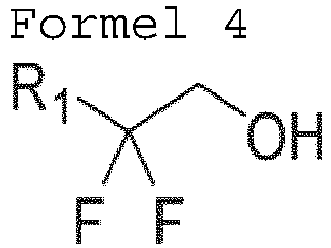
- Verfahren nach Anspruch 1, wobei
bei der Fluorierungsreaktion ein erstes Lösungsmittel verwendet wird,
bei der Reduktionsreaktion ein zweites Lösungsmittel verwendet wird und
das erste Lösungsmittel und das zweite Lösungsmittel voneinander verschieden sind. - Verfahren nach Anspruch 2, wobei das bei der Reduktionsreaktion verwendete zweite Lösungsmittel eine Verbindung aus der Gruppe bestehend aus Methanol, Ethanol, Butanol und Isopropanol umfasst.
- Verfahren nach Anspruch 1, wobei das Zugeben des Natriumborhydrids das Rühren der Reaktionsmischung bei Raumtemperatur über einen Zeitraum von 1 Stunde bis 6 Stunden umfasst.
- Verfahren nach Anspruch 1, wobei die Reaktionstemperatur im Bereich von 0 °C bis 100 °C liegt.
Applications Claiming Priority (1)
| Application Number | Priority Date | Filing Date | Title |
|---|---|---|---|
| KR1020160052121A KR101706914B1 (ko) | 2016-04-28 | 2016-04-28 | 다이플루오로 알코올 화합물의 제조방법 |
Publications (2)
| Publication Number | Publication Date |
|---|---|
| EP3239123A1 EP3239123A1 (de) | 2017-11-01 |
| EP3239123B1 true EP3239123B1 (de) | 2020-01-29 |
Family
ID=56943387
Family Applications (1)
| Application Number | Title | Priority Date | Filing Date |
|---|---|---|---|
| EP16189248.4A Active EP3239123B1 (de) | 2016-04-28 | 2016-09-16 | Verfahren zur herstellung einer difluorierten alkoholverbindung |
Country Status (5)
| Country | Link |
|---|---|
| US (1) | US10358412B2 (de) |
| EP (1) | EP3239123B1 (de) |
| JP (1) | JP6266711B2 (de) |
| KR (1) | KR101706914B1 (de) |
| CN (1) | CN107337581B (de) |
Families Citing this family (1)
| Publication number | Priority date | Publication date | Assignee | Title |
|---|---|---|---|---|
| WO2023201218A2 (en) * | 2022-04-12 | 2023-10-19 | University Of Mississippi | Fluoroalcohols as co-solvents for chemical synthesis and methods for producing the same |
Family Cites Families (8)
| Publication number | Priority date | Publication date | Assignee | Title |
|---|---|---|---|---|
| JP3598611B2 (ja) * | 1995-10-17 | 2004-12-08 | 旭硝子株式会社 | ジフルオロ化合物の製造方法 |
| WO2001030740A1 (en) * | 1999-10-26 | 2001-05-03 | Daikin Industries Ltd. | Process for the production of fluorodicarbonyl compounds |
| US7265249B2 (en) * | 2005-01-18 | 2007-09-04 | California Institute Of Technology | Enantioselective alpha-fluorination of aldehydes using chiral organic catalysts |
| FR2888845B1 (fr) * | 2005-07-19 | 2007-10-12 | Rhodia Chimie Sa | Procede de preparation de composes hydrocarbones mono- ou difluores |
| JP2009215261A (ja) * | 2008-03-12 | 2009-09-24 | Fujifilm Corp | 2−シクロヘキシル−1,3−ジオキサン化合物 |
| WO2012020643A1 (ja) * | 2010-08-11 | 2012-02-16 | Jnc株式会社 | プロピルエーテルを結合基に持つ化合物、液晶組成物、および液晶表示素子 |
| WO2012055031A1 (en) * | 2010-10-28 | 2012-05-03 | Merck Canada Inc. | Hiv protease inhibitors |
| JP5959467B2 (ja) * | 2013-04-05 | 2016-08-02 | 国立大学法人佐賀大学 | 2−フルオロ−1,3−ジカルボニル化合物の製造方法 |
-
2016
- 2016-04-28 KR KR1020160052121A patent/KR101706914B1/ko active Active
- 2016-07-21 JP JP2016143066A patent/JP6266711B2/ja active Active
- 2016-08-17 US US15/239,523 patent/US10358412B2/en active Active
- 2016-08-30 CN CN201610771248.7A patent/CN107337581B/zh active Active
- 2016-09-16 EP EP16189248.4A patent/EP3239123B1/de active Active
Non-Patent Citations (2)
| Title |
|---|
| DEREK D. STEINER ET AL: "Direct Asymmetric [alpha]-Fluorination of Aldehydes", ANGEWANDTE CHEMIE INTERNATIONAL EDITION, vol. 44, no. 24, 13 May 2005 (2005-05-13), pages 3706 - 3710, XP055399380, ISSN: 1433-7851, DOI: 10.1002/anie.200500571 * |
| SCHLOSSER M ET AL: "Beta,beta-Difluoro analogs of alpha-oxo-beta-phenylpropionic acid and phenylalanine", TETRAHEDRON, ELSEVIER SCIENCE PUBLISHERS, AMSTERDAM, NL, vol. 60, no. 35, 23 August 2004 (2004-08-23), pages 7731 - 7742, XP004771430, ISSN: 0040-4020, DOI: 10.1016/J.TET.2004.06.086 * |
Also Published As
| Publication number | Publication date |
|---|---|
| EP3239123A1 (de) | 2017-11-01 |
| US10358412B2 (en) | 2019-07-23 |
| CN107337581B (zh) | 2020-12-29 |
| JP2017197511A (ja) | 2017-11-02 |
| KR101706914B1 (ko) | 2017-02-16 |
| JP6266711B2 (ja) | 2018-01-24 |
| CN107337581A (zh) | 2017-11-10 |
| US20170313651A1 (en) | 2017-11-02 |
Similar Documents
| Publication | Publication Date | Title |
|---|---|---|
| EP3601213B1 (de) | Acrylamid-photoinitiatoren | |
| DD290188A5 (de) | Chemische prozesse | |
| DE3032471A1 (de) | Verfahren zur herstellung von fluorierten carbonylverbindungen | |
| EP3239123B1 (de) | Verfahren zur herstellung einer difluorierten alkoholverbindung | |
| EP1098891B1 (de) | Polycyclische thiazolidin-2-yliden amine, verfahren zu ihrer herstellung und ihre verwendung als arzneimittel | |
| DE69315692T2 (de) | Alkohole als kaliumchannelöffner und zur behandlung der harnincontinenz | |
| EP0312269A2 (de) | 3,5-Dihydroxy-6,8-nonadiensäuren und -derivate als hypocholesterolemische Mittel | |
| EP3088391B1 (de) | Verfahren zur herstellung von benzylester-2-aminonicotinatderivat | |
| Le et al. | Functionalized S-perfluorinated sulfoximines: Preparation and evaluation in catalytic processes | |
| JP7350771B2 (ja) | 3-フェニル-2,8-ジヒドロピラノ[2,3-f]クロメン誘導体の合成方法 | |
| DE2241252A1 (de) | Verfahren zur herstellung von 3-perfluoralkyl-1-propenen | |
| JPS6055046B2 (ja) | 含フツ素カルビノ−ルの製造方法 | |
| CN104860793A (zh) | 一类苯基c-葡萄糖苷衍生物中间体的制备方法 | |
| CH645623A5 (en) | 2-Methyl-3-acetoxy-4,5-bis(halomethyl)pyridines, process for their preparation and process for the preparation of pyridoxin | |
| Chanteau et al. | Synthesis of Polyfluorinated Nitrogen‐Containing Heterocycles from Hemifluorinated Enones or Organofluorosilicon Building Blocks as Synthetic Equivalents | |
| EP2951163B1 (de) | Verfahren zur herstellung eines polymerisierbaren uv-absorbers | |
| WO1993012060A1 (fr) | Nouveau complexe d'insertion comprenant un tetrakisphenol comme substance cage | |
| DE19926972A1 (de) | Ketosulfonderivate und Verfahren zu deren Herstellung | |
| JP2685716B2 (ja) | 新規なフッ素化アルキル誘導体及びその製造方法 | |
| KR102200558B1 (ko) | 2-플루오르메틸 사이클로펜탄온 유도체의 제조방법 | |
| DE102011104267A1 (de) | Verbindungen als PPAR beta/delta Inhibitoren für die Behandlung von PPAR beta/delta-vermittelten Erkrankungen | |
| DE60317691T2 (de) | Verfahren zur herstellung von trifluormethylsubstituierten 2-alkoxyacetophenonderivaten | |
| JP2008266313A (ja) | 新規なフルオロアダマンタン誘導体、その製造方法、および組成物 | |
| DE102023117229A1 (de) | Fluorcyclopropylierungsreagens | |
| DE2165238A1 (de) | Chromon-Verbindungen und Verfahren zu ihrer Herstellung |
Legal Events
| Date | Code | Title | Description |
|---|---|---|---|
| PUAI | Public reference made under article 153(3) epc to a published international application that has entered the european phase |
Free format text: ORIGINAL CODE: 0009012 |
|
| STAA | Information on the status of an ep patent application or granted ep patent |
Free format text: STATUS: REQUEST FOR EXAMINATION WAS MADE |
|
| 17P | Request for examination filed |
Effective date: 20160928 |
|
| AK | Designated contracting states |
Kind code of ref document: A1 Designated state(s): AL AT BE BG CH CY CZ DE DK EE ES FI FR GB GR HR HU IE IS IT LI LT LU LV MC MK MT NL NO PL PT RO RS SE SI SK SM TR |
|
| AX | Request for extension of the european patent |
Extension state: BA ME |
|
| RBV | Designated contracting states (corrected) |
Designated state(s): AL AT BE BG CH CY CZ DE DK EE ES FI FR GB GR HR HU IE IS IT LI LT LU LV MC MK MT NL NO PL PT RO RS SE SI SK SM TR |
|
| STAA | Information on the status of an ep patent application or granted ep patent |
Free format text: STATUS: EXAMINATION IS IN PROGRESS |
|
| 17Q | First examination report despatched |
Effective date: 20180905 |
|
| GRAP | Despatch of communication of intention to grant a patent |
Free format text: ORIGINAL CODE: EPIDOSNIGR1 |
|
| STAA | Information on the status of an ep patent application or granted ep patent |
Free format text: STATUS: GRANT OF PATENT IS INTENDED |
|
| INTG | Intention to grant announced |
Effective date: 20190919 |
|
| GRAS | Grant fee paid |
Free format text: ORIGINAL CODE: EPIDOSNIGR3 |
|
| GRAA | (expected) grant |
Free format text: ORIGINAL CODE: 0009210 |
|
| STAA | Information on the status of an ep patent application or granted ep patent |
Free format text: STATUS: THE PATENT HAS BEEN GRANTED |
|
| AK | Designated contracting states |
Kind code of ref document: B1 Designated state(s): AL AT BE BG CH CY CZ DE DK EE ES FI FR GB GR HR HU IE IS IT LI LT LU LV MC MK MT NL NO PL PT RO RS SE SI SK SM TR |
|
| REG | Reference to a national code |
Ref country code: GB Ref legal event code: FG4D |
|
| REG | Reference to a national code |
Ref country code: CH Ref legal event code: EP |
|
| REG | Reference to a national code |
Ref country code: AT Ref legal event code: REF Ref document number: 1228418 Country of ref document: AT Kind code of ref document: T Effective date: 20200215 |
|
| REG | Reference to a national code |
Ref country code: IE Ref legal event code: FG4D |
|
| REG | Reference to a national code |
Ref country code: DE Ref legal event code: R096 Ref document number: 602016028595 Country of ref document: DE |
|
| REG | Reference to a national code |
Ref country code: NL Ref legal event code: MP Effective date: 20200129 |
|
| PG25 | Lapsed in a contracting state [announced via postgrant information from national office to epo] |
Ref country code: RS Free format text: LAPSE BECAUSE OF FAILURE TO SUBMIT A TRANSLATION OF THE DESCRIPTION OR TO PAY THE FEE WITHIN THE PRESCRIBED TIME-LIMIT Effective date: 20200129 Ref country code: FI Free format text: LAPSE BECAUSE OF FAILURE TO SUBMIT A TRANSLATION OF THE DESCRIPTION OR TO PAY THE FEE WITHIN THE PRESCRIBED TIME-LIMIT Effective date: 20200129 Ref country code: NO Free format text: LAPSE BECAUSE OF FAILURE TO SUBMIT A TRANSLATION OF THE DESCRIPTION OR TO PAY THE FEE WITHIN THE PRESCRIBED TIME-LIMIT Effective date: 20200429 Ref country code: PT Free format text: LAPSE BECAUSE OF FAILURE TO SUBMIT A TRANSLATION OF THE DESCRIPTION OR TO PAY THE FEE WITHIN THE PRESCRIBED TIME-LIMIT Effective date: 20200621 |
|
| REG | Reference to a national code |
Ref country code: LT Ref legal event code: MG4D |
|
| PG25 | Lapsed in a contracting state [announced via postgrant information from national office to epo] |
Ref country code: GR Free format text: LAPSE BECAUSE OF FAILURE TO SUBMIT A TRANSLATION OF THE DESCRIPTION OR TO PAY THE FEE WITHIN THE PRESCRIBED TIME-LIMIT Effective date: 20200430 Ref country code: BG Free format text: LAPSE BECAUSE OF FAILURE TO SUBMIT A TRANSLATION OF THE DESCRIPTION OR TO PAY THE FEE WITHIN THE PRESCRIBED TIME-LIMIT Effective date: 20200429 Ref country code: SE Free format text: LAPSE BECAUSE OF FAILURE TO SUBMIT A TRANSLATION OF THE DESCRIPTION OR TO PAY THE FEE WITHIN THE PRESCRIBED TIME-LIMIT Effective date: 20200129 Ref country code: IS Free format text: LAPSE BECAUSE OF FAILURE TO SUBMIT A TRANSLATION OF THE DESCRIPTION OR TO PAY THE FEE WITHIN THE PRESCRIBED TIME-LIMIT Effective date: 20200529 Ref country code: LV Free format text: LAPSE BECAUSE OF FAILURE TO SUBMIT A TRANSLATION OF THE DESCRIPTION OR TO PAY THE FEE WITHIN THE PRESCRIBED TIME-LIMIT Effective date: 20200129 Ref country code: HR Free format text: LAPSE BECAUSE OF FAILURE TO SUBMIT A TRANSLATION OF THE DESCRIPTION OR TO PAY THE FEE WITHIN THE PRESCRIBED TIME-LIMIT Effective date: 20200129 |
|
| PG25 | Lapsed in a contracting state [announced via postgrant information from national office to epo] |
Ref country code: NL Free format text: LAPSE BECAUSE OF FAILURE TO SUBMIT A TRANSLATION OF THE DESCRIPTION OR TO PAY THE FEE WITHIN THE PRESCRIBED TIME-LIMIT Effective date: 20200129 |
|
| PG25 | Lapsed in a contracting state [announced via postgrant information from national office to epo] |
Ref country code: EE Free format text: LAPSE BECAUSE OF FAILURE TO SUBMIT A TRANSLATION OF THE DESCRIPTION OR TO PAY THE FEE WITHIN THE PRESCRIBED TIME-LIMIT Effective date: 20200129 Ref country code: LT Free format text: LAPSE BECAUSE OF FAILURE TO SUBMIT A TRANSLATION OF THE DESCRIPTION OR TO PAY THE FEE WITHIN THE PRESCRIBED TIME-LIMIT Effective date: 20200129 Ref country code: SM Free format text: LAPSE BECAUSE OF FAILURE TO SUBMIT A TRANSLATION OF THE DESCRIPTION OR TO PAY THE FEE WITHIN THE PRESCRIBED TIME-LIMIT Effective date: 20200129 Ref country code: SK Free format text: LAPSE BECAUSE OF FAILURE TO SUBMIT A TRANSLATION OF THE DESCRIPTION OR TO PAY THE FEE WITHIN THE PRESCRIBED TIME-LIMIT Effective date: 20200129 Ref country code: DK Free format text: LAPSE BECAUSE OF FAILURE TO SUBMIT A TRANSLATION OF THE DESCRIPTION OR TO PAY THE FEE WITHIN THE PRESCRIBED TIME-LIMIT Effective date: 20200129 Ref country code: RO Free format text: LAPSE BECAUSE OF FAILURE TO SUBMIT A TRANSLATION OF THE DESCRIPTION OR TO PAY THE FEE WITHIN THE PRESCRIBED TIME-LIMIT Effective date: 20200129 Ref country code: CZ Free format text: LAPSE BECAUSE OF FAILURE TO SUBMIT A TRANSLATION OF THE DESCRIPTION OR TO PAY THE FEE WITHIN THE PRESCRIBED TIME-LIMIT Effective date: 20200129 Ref country code: ES Free format text: LAPSE BECAUSE OF FAILURE TO SUBMIT A TRANSLATION OF THE DESCRIPTION OR TO PAY THE FEE WITHIN THE PRESCRIBED TIME-LIMIT Effective date: 20200129 |
|
| REG | Reference to a national code |
Ref country code: DE Ref legal event code: R097 Ref document number: 602016028595 Country of ref document: DE |
|
| REG | Reference to a national code |
Ref country code: AT Ref legal event code: MK05 Ref document number: 1228418 Country of ref document: AT Kind code of ref document: T Effective date: 20200129 |
|
| PLBE | No opposition filed within time limit |
Free format text: ORIGINAL CODE: 0009261 |
|
| STAA | Information on the status of an ep patent application or granted ep patent |
Free format text: STATUS: NO OPPOSITION FILED WITHIN TIME LIMIT |
|
| 26N | No opposition filed |
Effective date: 20201030 |
|
| PG25 | Lapsed in a contracting state [announced via postgrant information from national office to epo] |
Ref country code: AT Free format text: LAPSE BECAUSE OF FAILURE TO SUBMIT A TRANSLATION OF THE DESCRIPTION OR TO PAY THE FEE WITHIN THE PRESCRIBED TIME-LIMIT Effective date: 20200129 Ref country code: IT Free format text: LAPSE BECAUSE OF FAILURE TO SUBMIT A TRANSLATION OF THE DESCRIPTION OR TO PAY THE FEE WITHIN THE PRESCRIBED TIME-LIMIT Effective date: 20200129 |
|
| PG25 | Lapsed in a contracting state [announced via postgrant information from national office to epo] |
Ref country code: SI Free format text: LAPSE BECAUSE OF FAILURE TO SUBMIT A TRANSLATION OF THE DESCRIPTION OR TO PAY THE FEE WITHIN THE PRESCRIBED TIME-LIMIT Effective date: 20200129 Ref country code: PL Free format text: LAPSE BECAUSE OF FAILURE TO SUBMIT A TRANSLATION OF THE DESCRIPTION OR TO PAY THE FEE WITHIN THE PRESCRIBED TIME-LIMIT Effective date: 20200129 |
|
| REG | Reference to a national code |
Ref country code: CH Ref legal event code: PL |
|
| GBPC | Gb: european patent ceased through non-payment of renewal fee |
Effective date: 20200916 |
|
| REG | Reference to a national code |
Ref country code: BE Ref legal event code: MM Effective date: 20200930 |
|
| PG25 | Lapsed in a contracting state [announced via postgrant information from national office to epo] |
Ref country code: LU Free format text: LAPSE BECAUSE OF NON-PAYMENT OF DUE FEES Effective date: 20200916 |
|
| PG25 | Lapsed in a contracting state [announced via postgrant information from national office to epo] |
Ref country code: FR Free format text: LAPSE BECAUSE OF NON-PAYMENT OF DUE FEES Effective date: 20200930 |
|
| PG25 | Lapsed in a contracting state [announced via postgrant information from national office to epo] |
Ref country code: IE Free format text: LAPSE BECAUSE OF NON-PAYMENT OF DUE FEES Effective date: 20200916 Ref country code: LI Free format text: LAPSE BECAUSE OF NON-PAYMENT OF DUE FEES Effective date: 20200930 Ref country code: GB Free format text: LAPSE BECAUSE OF NON-PAYMENT OF DUE FEES Effective date: 20200916 Ref country code: CH Free format text: LAPSE BECAUSE OF NON-PAYMENT OF DUE FEES Effective date: 20200930 Ref country code: BE Free format text: LAPSE BECAUSE OF NON-PAYMENT OF DUE FEES Effective date: 20200930 |
|
| PG25 | Lapsed in a contracting state [announced via postgrant information from national office to epo] |
Ref country code: TR Free format text: LAPSE BECAUSE OF FAILURE TO SUBMIT A TRANSLATION OF THE DESCRIPTION OR TO PAY THE FEE WITHIN THE PRESCRIBED TIME-LIMIT Effective date: 20200129 Ref country code: MT Free format text: LAPSE BECAUSE OF FAILURE TO SUBMIT A TRANSLATION OF THE DESCRIPTION OR TO PAY THE FEE WITHIN THE PRESCRIBED TIME-LIMIT Effective date: 20200129 Ref country code: CY Free format text: LAPSE BECAUSE OF FAILURE TO SUBMIT A TRANSLATION OF THE DESCRIPTION OR TO PAY THE FEE WITHIN THE PRESCRIBED TIME-LIMIT Effective date: 20200129 |
|
| PG25 | Lapsed in a contracting state [announced via postgrant information from national office to epo] |
Ref country code: MK Free format text: LAPSE BECAUSE OF FAILURE TO SUBMIT A TRANSLATION OF THE DESCRIPTION OR TO PAY THE FEE WITHIN THE PRESCRIBED TIME-LIMIT Effective date: 20200129 Ref country code: MC Free format text: LAPSE BECAUSE OF FAILURE TO SUBMIT A TRANSLATION OF THE DESCRIPTION OR TO PAY THE FEE WITHIN THE PRESCRIBED TIME-LIMIT Effective date: 20200129 Ref country code: AL Free format text: LAPSE BECAUSE OF FAILURE TO SUBMIT A TRANSLATION OF THE DESCRIPTION OR TO PAY THE FEE WITHIN THE PRESCRIBED TIME-LIMIT Effective date: 20200129 |
|
| PGFP | Annual fee paid to national office [announced via postgrant information from national office to epo] |
Ref country code: DE Payment date: 20251020 Year of fee payment: 10 |