EP3223345B1 - Positivelektrodenaktivmaterialpartikelpulver für eine sekundärbatterie mit wasserfreiem elektrolyt, verfahren zur herstellung davon und sekundärbatterie mit wasserfreiem elektrolyt - Google Patents
Positivelektrodenaktivmaterialpartikelpulver für eine sekundärbatterie mit wasserfreiem elektrolyt, verfahren zur herstellung davon und sekundärbatterie mit wasserfreiem elektrolyt Download PDFInfo
- Publication number
- EP3223345B1 EP3223345B1 EP15860120.3A EP15860120A EP3223345B1 EP 3223345 B1 EP3223345 B1 EP 3223345B1 EP 15860120 A EP15860120 A EP 15860120A EP 3223345 B1 EP3223345 B1 EP 3223345B1
- Authority
- EP
- European Patent Office
- Prior art keywords
- positive electrode
- particle powder
- active material
- electrode active
- secondary battery
- Prior art date
- Legal status (The legal status is an assumption and is not a legal conclusion. Google has not performed a legal analysis and makes no representation as to the accuracy of the status listed.)
- Active
Links
Images



Classifications
-
- C—CHEMISTRY; METALLURGY
- C01—INORGANIC CHEMISTRY
- C01G—COMPOUNDS CONTAINING METALS NOT COVERED BY SUBCLASSES C01D OR C01F
- C01G45/00—Compounds of manganese
- C01G45/12—Complex oxides containing manganese and at least one other metal element
- C01G45/1221—Manganates or manganites with trivalent manganese, tetravalent manganese or mixtures thereof
- C01G45/1242—Manganates or manganites with trivalent manganese, tetravalent manganese or mixtures thereof of the type (Mn2O4)-, e.g. LiMn2O4 or Li(MxMn2-x)O4
-
- H—ELECTRICITY
- H01—ELECTRIC ELEMENTS
- H01M—PROCESSES OR MEANS, e.g. BATTERIES, FOR THE DIRECT CONVERSION OF CHEMICAL ENERGY INTO ELECTRICAL ENERGY
- H01M10/00—Secondary cells; Manufacture thereof
- H01M10/05—Accumulators with non-aqueous electrolyte
- H01M10/052—Li-accumulators
-
- H—ELECTRICITY
- H01—ELECTRIC ELEMENTS
- H01M—PROCESSES OR MEANS, e.g. BATTERIES, FOR THE DIRECT CONVERSION OF CHEMICAL ENERGY INTO ELECTRICAL ENERGY
- H01M10/00—Secondary cells; Manufacture thereof
- H01M10/05—Accumulators with non-aqueous electrolyte
- H01M10/052—Li-accumulators
- H01M10/0525—Rocking-chair batteries, i.e. batteries with lithium insertion or intercalation in both electrodes; Lithium-ion batteries
-
- H—ELECTRICITY
- H01—ELECTRIC ELEMENTS
- H01M—PROCESSES OR MEANS, e.g. BATTERIES, FOR THE DIRECT CONVERSION OF CHEMICAL ENERGY INTO ELECTRICAL ENERGY
- H01M4/00—Electrodes
- H01M4/02—Electrodes composed of, or comprising, active material
- H01M4/13—Electrodes for accumulators with non-aqueous electrolyte, e.g. for lithium-accumulators; Processes of manufacture thereof
- H01M4/131—Electrodes based on mixed oxides or hydroxides, or on mixtures of oxides or hydroxides, e.g. LiCoOx
-
- H—ELECTRICITY
- H01—ELECTRIC ELEMENTS
- H01M—PROCESSES OR MEANS, e.g. BATTERIES, FOR THE DIRECT CONVERSION OF CHEMICAL ENERGY INTO ELECTRICAL ENERGY
- H01M4/00—Electrodes
- H01M4/02—Electrodes composed of, or comprising, active material
- H01M4/36—Selection of substances as active materials, active masses, active liquids
- H01M4/48—Selection of substances as active materials, active masses, active liquids of inorganic oxides or hydroxides
- H01M4/50—Selection of substances as active materials, active masses, active liquids of inorganic oxides or hydroxides of manganese
- H01M4/505—Selection of substances as active materials, active masses, active liquids of inorganic oxides or hydroxides of manganese of mixed oxides or hydroxides containing manganese for inserting or intercalating light metals, e.g. LiMn2O4 or LiMn2OxFy
-
- C—CHEMISTRY; METALLURGY
- C01—INORGANIC CHEMISTRY
- C01G—COMPOUNDS CONTAINING METALS NOT COVERED BY SUBCLASSES C01D OR C01F
- C01G41/00—Compounds of tungsten
-
- C—CHEMISTRY; METALLURGY
- C01—INORGANIC CHEMISTRY
- C01G—COMPOUNDS CONTAINING METALS NOT COVERED BY SUBCLASSES C01D OR C01F
- C01G45/00—Compounds of manganese
- C01G45/12—Complex oxides containing manganese and at least one other metal element
- C01G45/1207—Permanganates ([MnO4)-] or manganates ([MnO4)2-]
- C01G45/1214—Permanganates ([MnO4)-] or manganates ([MnO4)2-] containing alkali metals
-
- C—CHEMISTRY; METALLURGY
- C01—INORGANIC CHEMISTRY
- C01P—INDEXING SCHEME RELATING TO STRUCTURAL AND PHYSICAL ASPECTS OF SOLID INORGANIC COMPOUNDS
- C01P2002/00—Crystal-structural characteristics
- C01P2002/30—Three-dimensional structures
- C01P2002/32—Three-dimensional structures spinel-type (AB2O4)
-
- C—CHEMISTRY; METALLURGY
- C01—INORGANIC CHEMISTRY
- C01P—INDEXING SCHEME RELATING TO STRUCTURAL AND PHYSICAL ASPECTS OF SOLID INORGANIC COMPOUNDS
- C01P2002/00—Crystal-structural characteristics
- C01P2002/50—Solid solutions
-
- C—CHEMISTRY; METALLURGY
- C01—INORGANIC CHEMISTRY
- C01P—INDEXING SCHEME RELATING TO STRUCTURAL AND PHYSICAL ASPECTS OF SOLID INORGANIC COMPOUNDS
- C01P2002/00—Crystal-structural characteristics
- C01P2002/50—Solid solutions
- C01P2002/52—Solid solutions containing elements as dopants
- C01P2002/54—Solid solutions containing elements as dopants one element only
-
- C—CHEMISTRY; METALLURGY
- C01—INORGANIC CHEMISTRY
- C01P—INDEXING SCHEME RELATING TO STRUCTURAL AND PHYSICAL ASPECTS OF SOLID INORGANIC COMPOUNDS
- C01P2002/00—Crystal-structural characteristics
- C01P2002/70—Crystal-structural characteristics defined by measured X-ray, neutron or electron diffraction data
- C01P2002/72—Crystal-structural characteristics defined by measured X-ray, neutron or electron diffraction data by d-values or two theta-values, e.g. as X-ray diagram
-
- C—CHEMISTRY; METALLURGY
- C01—INORGANIC CHEMISTRY
- C01P—INDEXING SCHEME RELATING TO STRUCTURAL AND PHYSICAL ASPECTS OF SOLID INORGANIC COMPOUNDS
- C01P2002/00—Crystal-structural characteristics
- C01P2002/70—Crystal-structural characteristics defined by measured X-ray, neutron or electron diffraction data
- C01P2002/76—Crystal-structural characteristics defined by measured X-ray, neutron or electron diffraction data by a space-group or by other symmetry indications
-
- C—CHEMISTRY; METALLURGY
- C01—INORGANIC CHEMISTRY
- C01P—INDEXING SCHEME RELATING TO STRUCTURAL AND PHYSICAL ASPECTS OF SOLID INORGANIC COMPOUNDS
- C01P2004/00—Particle morphology
- C01P2004/01—Particle morphology depicted by an image
- C01P2004/03—Particle morphology depicted by an image obtained by SEM
-
- C—CHEMISTRY; METALLURGY
- C01—INORGANIC CHEMISTRY
- C01P—INDEXING SCHEME RELATING TO STRUCTURAL AND PHYSICAL ASPECTS OF SOLID INORGANIC COMPOUNDS
- C01P2004/00—Particle morphology
- C01P2004/30—Particle morphology extending in three dimensions
- C01P2004/41—Particle morphology extending in three dimensions octahedron-like
-
- C—CHEMISTRY; METALLURGY
- C01—INORGANIC CHEMISTRY
- C01P—INDEXING SCHEME RELATING TO STRUCTURAL AND PHYSICAL ASPECTS OF SOLID INORGANIC COMPOUNDS
- C01P2004/00—Particle morphology
- C01P2004/30—Particle morphology extending in three dimensions
- C01P2004/45—Aggregated particles or particles with an intergrown morphology
-
- C—CHEMISTRY; METALLURGY
- C01—INORGANIC CHEMISTRY
- C01P—INDEXING SCHEME RELATING TO STRUCTURAL AND PHYSICAL ASPECTS OF SOLID INORGANIC COMPOUNDS
- C01P2004/00—Particle morphology
- C01P2004/50—Agglomerated particles
-
- C—CHEMISTRY; METALLURGY
- C01—INORGANIC CHEMISTRY
- C01P—INDEXING SCHEME RELATING TO STRUCTURAL AND PHYSICAL ASPECTS OF SOLID INORGANIC COMPOUNDS
- C01P2004/00—Particle morphology
- C01P2004/60—Particles characterised by their size
- C01P2004/61—Micrometer sized, i.e. from 1-100 micrometer
-
- C—CHEMISTRY; METALLURGY
- C01—INORGANIC CHEMISTRY
- C01P—INDEXING SCHEME RELATING TO STRUCTURAL AND PHYSICAL ASPECTS OF SOLID INORGANIC COMPOUNDS
- C01P2004/00—Particle morphology
- C01P2004/60—Particles characterised by their size
- C01P2004/62—Submicrometer sized, i.e. from 0.1-1 micrometer
-
- C—CHEMISTRY; METALLURGY
- C01—INORGANIC CHEMISTRY
- C01P—INDEXING SCHEME RELATING TO STRUCTURAL AND PHYSICAL ASPECTS OF SOLID INORGANIC COMPOUNDS
- C01P2004/00—Particle morphology
- C01P2004/60—Particles characterised by their size
- C01P2004/64—Nanometer sized, i.e. from 1-100 nanometer
-
- C—CHEMISTRY; METALLURGY
- C01—INORGANIC CHEMISTRY
- C01P—INDEXING SCHEME RELATING TO STRUCTURAL AND PHYSICAL ASPECTS OF SOLID INORGANIC COMPOUNDS
- C01P2006/00—Physical properties of inorganic compounds
- C01P2006/12—Surface area
-
- C—CHEMISTRY; METALLURGY
- C01—INORGANIC CHEMISTRY
- C01P—INDEXING SCHEME RELATING TO STRUCTURAL AND PHYSICAL ASPECTS OF SOLID INORGANIC COMPOUNDS
- C01P2006/00—Physical properties of inorganic compounds
- C01P2006/40—Electric properties
-
- Y—GENERAL TAGGING OF NEW TECHNOLOGICAL DEVELOPMENTS; GENERAL TAGGING OF CROSS-SECTIONAL TECHNOLOGIES SPANNING OVER SEVERAL SECTIONS OF THE IPC; TECHNICAL SUBJECTS COVERED BY FORMER USPC CROSS-REFERENCE ART COLLECTIONS [XRACs] AND DIGESTS
- Y02—TECHNOLOGIES OR APPLICATIONS FOR MITIGATION OR ADAPTATION AGAINST CLIMATE CHANGE
- Y02E—REDUCTION OF GREENHOUSE GAS [GHG] EMISSIONS, RELATED TO ENERGY GENERATION, TRANSMISSION OR DISTRIBUTION
- Y02E60/00—Enabling technologies; Technologies with a potential or indirect contribution to GHG emissions mitigation
- Y02E60/10—Energy storage using batteries
Definitions
- the present invention relates to positive electrode active material particle powder for non-aqueous electrolyte secondary batteries, methods for manufacturing same, and non-aqueous electrolyte secondary batteries.
- lithium ion secondary batteries which are characterized by high charging/discharging voltage and large charging/discharging capacity, have attracted attention.
- LiCoO 2 excels in that it has a high voltage and high capacity, but the supply amount of cobalt material is small, leading to increased manufacturing cost, and there is also a problem from the viewpoint of environmental safety of waste batteries after use.
- lithium manganese oxide particles when high crystallinity is developed in order to obtain high battery performance, obtained lithium manganese oxide particles have an octahedral structure that is the idiomorphic shape of a cubic spinel structure, and dissolution of Mn is likely to occur. Further, in a secondary battery using such a positive electrode active material, problems occur such as inferior storage properties at high temperatures.
- Patent Literature 1-4 Varied research and development (Patent Literature 1-4) has been undertaken to solve the problems of non-aqueous electrolyte secondary batteries using such lithium manganese oxide spinel structure positive electrode active material. Further examples of electrode active materials are disclosed in Patent Literature 5 and 6 as well as in Non-Patent Literature 1 to 3.
- Patent Literature 1 to 4 cannot be said to be sufficient for constituting a non-aqueous electrolyte secondary battery that excels in rate properties.
- the present invention has been achieved in view of such problems, and an aim thereof is to provide a positive electrode active material particle powder for a non-aqueous electrolyte secondary battery, a method for manufacturing same, and a non-aqueous electrolyte secondary battery, which excel in rate properties.
- Positive electrode active material particle powder for a non-aqueous electrolyte secondary battery pertaining to one aspect of the present invention is positive electrode active material particle powder comprising: lithium manganese oxide particle powder having Li and Mn as main components and a cubic spinel structure with an Fd-3m space group, wherein the lithium manganese oxide particle powder comprises from 0.07 mol% to 0.6 mol% in terms of W substitute with respect to Mn; wherein the lithium manganese oxide particle powder is composed of secondary particles, which are aggregates of primary particles, an average particle diameter (D50) of the secondary particles being from 4 ⁇ m to 20 ⁇ m, and at least 80 % of the primary particles exposed on surfaces of the secondary particles each have a polyhedral shape having at least one (110) plane that is adjacent to two (111) planes determined by scanning electron microscope (SEM) image observation; wherein one or more metal elements Me other than Mn are substituted at an Mn(16d) site, Me being selected from the group consisting of Li, Fe, Ni, Mg, Zn, Al
- the positive electrode active material particle powder for a non-aqueous electrolyte secondary battery pertaining to the above aspect excels in rate properties. Therefore, the positive electrode active material particle powder is applicable as a positive electrode active material of a non-aqueous electrolyte secondary battery that excels in rate properties.
- (111) plane includes any planes equivalent to a (111) plane. That is, eight planes including a (-111) plane, a (1-11) plane, and a (11-1) plane.
- the term "(110) plane” includes any planes equivalent to a (110) plane. That is, twelve planes including a (101) plane, a (011) plane, and a (-110) plane.
- the terms "(111) planes” and “(110) planes” have the meaning "including equivalent planes" as described above.
- the positive electrode active material particle powder for a non-aqueous electrolyte secondary battery pertaining to one aspect of the present invention is positive electrode active material particle powder comprising: lithium manganese oxide particle powder having Li and Mn as main components and a cubic spinel structure with an Fd-3m space group, wherein the lithium manganese oxide particle powder comprises from 0.07 mol% to 0.6 mol% in terms of W substitute with respect to Mn; wherein the lithium manganese oxide particle powder is composed of secondary particles, which are aggregates of primary particles, an average particle diameter (D50) of the secondary particles being from 4 ⁇ m to 20 ⁇ m, and at least 80 % of the primary particles exposed on surfaces of the secondary particles each have a polyhedral shape having at least one (110) plane that is adjacent to two (111) planes determined by scanning electron microscope (SEM) image observation; wherein one or more metal elements Me other than Mn are substituted at an Mn(16d) site, Me being selected from the group consisting of Li, Fe, Ni, Mg, Zn,
- a polyhedral shape having at least one (110) plane that is adjacent to two (111) plane indicates a polyhedral shape in which ridges are formed by flat crystal planes abutting each other.
- ridges may overlap in a way that crystal planes are known.
- Positive electrode active material particle powder for a non-aqueous electrolyte secondary battery is configured so that one or more metal elements Me other than Mn are substituted at an Mn(16d) site, Me being selected from the group consisting of Li, Fe, Ni, Mg, Zn, Al, Co, Cr, Si, Ti, Sn, V, or Sb; wherein, when Me denotes a metal element other than Li among the one or more metal elements, an [Li/(Mn + Me)] ratio is from 0.5 to 0.65.
- a non-aqueous electrolyte secondary battery pertaining to another aspect of the present invention comprises: a positive electrode element that includes the positive electrode active material particle powder pertaining to any one of the examples described above.
- a method of manufacturing positive electrode active material particle powder for a non-aqueous electrolyte secondary battery pertaining to another aspect of the present invention is a method as defined in claim 3.
- the method of manufacturing positive electrode active material particle powder for a non-aqueous electrolyte secondary battery pertaining to another example is configured so that the trimanganese tetroxide is composed of secondary particles, which are aggregates of primary particles, an average particle diameter (D50) of the secondary particles being from 3 ⁇ m to 20 ⁇ m, and crystallite size of the primary particles being from 50 nm to 150 nm.
- D50 average particle diameter
- the method of manufacturing positive electrode active material particle powder for a non-aqueous electrolyte secondary battery is configured so that the crystal plane growth suppressor is at least a tungsten compound.
- the crystal plane growth suppressor is at least a tungsten compound.
- metal compounds other than a tungsten compound may be included as the crystal plane growth suppressor.
- the positive electrode active material particle powder pertaining to the present embodiment is primarily composed of lithium (Li) and manganese (Mn), and is lithium manganese oxide having a cubic spinel structure of space group Fd-3m (stoichiometric composition: LiMn 2 O 4 ).
- the positive electrode active material particle powder pertaining to the present embodiment is not limited to the stoichiometric composition above, and as long as the crystal structure is maintained, cations are deficient or excessive, or it is also possible to have a composition in which oxygen ions are deficient or excessive.
- a part of Mn is partially substituted with cations of one or more metal elements selected from the group of Li, Fe, Ni, Mg, Zn, Al, Co, Cr, Si, Ti, Sn, V, or Sb.
- the positive electrode active material particle powder pertaining to the present embodiment is formed into a desired shape by using a tungsten (W) compound as a crystal plane growth suppressor.
- Content of W in the positive electrode active material particle powder in terms of molar ratio of metal substitute to Mn, is in a range from 0.0007 to 0.006, and more preferably in a range from 0.0008 to 0.005.
- a ratio of Li/(Mn + Me) is 0.5 to 0.65. This is because internal resistance can be reduced and crystal structure strengthened when compared to a stoichiometric composition of LiMn 2 O 4 , to further improve properties as a positive electrode active material of a non-aqueous electrolyte secondary battery with excellent rate properties.
- Li(Li x Mn 2 - x )O 4 (where x is a substitution amount) in which a part of Mn is substituted with Li
- Li(Li x Al y Mn 2-x-y )O 4 (where x and y are substitution amounts) in which a part of Mn is substituted with Al and Li, and the like
- Me denotes a metal element other than Li among the one or more metal elements
- a Li/(Mn + Me) ratio is from 0.50 to 0.65, and more preferably from 0.53 to 0.63.
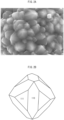
- Primary particles of the positive electrode active material particle powder pertaining to the present embodiment have shapes as shown in FIG. 1A and FIG. 2A . That is, as shown in FIG. 2B , a shape of primary particles of the positive electrode active material particle powder pertaining to the present embodiment is a polyhedral shape having at least one (110) plane that is adjacent to two (111) planes.
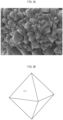
- an octahedron which is the idiomorphic form of a cubic spinel structure, and shapes close thereto, are not shown.
- Octahedral particles which are the idiomorphic form of lithium manganese oxide, become composed of (111) planes as a result of crystal growth rate of (111) being slower than the growth rate of other crystal planes. Therefore, by using a method of suppressing crystal growth other than in (111) planes as a method of controlling particle shape, it is possible for crystal planes to remain that would normally disappear in the course of crystal growth.
- octahedral particles that are the idiomorphic shape of lithium manganese oxide become composed of (111) planes as a result of growth rate of (111) planes being slower than that of other crystal planes ( FIG. 3B ).
- the primary particles have a polyhedral shape having at least one (110) plane adjacent to two (111) planes, as shown in FIG. 2B .
- Average primary particle diameter of positive electrode active material particle powder pertaining to the present embodiment is from 0.3 ⁇ m to 5 ⁇ m, preferably from 0.4 ⁇ m to 4 ⁇ m, and more preferably from 0.5 ⁇ m to 3 ⁇ m.
- Average secondary particle diameter (D50) is from 4 ⁇ m to 20 ⁇ m. Excellent high temperature performance as a secondary battery can be obtained by controlling average secondary particle diameter to the above range.
- average primary particle diameter was observed using a scanning electron microscope with energy dispersive X-ray analyzer (SEM-EDX) (manufactured by Hitachi High-Technologies Corporation) and an average value read from an SEM image.
- SEM-EDX energy dispersive X-ray analyzer
- average secondary particle diameter (D50) is a volume-based average particle diameter measured by a wet laser method using a laser particle size distribution measuring apparatus Microtrac HRA (manufactured by Nikkiso Co., Ltd.).
- Specific surface area of a positive electrode active material particle powder pertaining to the embodiment according to the BET method is from 0.1 m 2 /g to 1.2 m 2 /g.
- specific surface area according to the BET method is less than 0.1 m 2 /g, growth of primary particles proceeds excessively, which is considered to lead to a decrease in stability.
- specific surface area according to the BET method exceeds 1.2 m 2 /g and primary particles that are too small (primary particle diameter is smaller than desired) become an aggregated secondary particle body, the aggregated secondary particle is unable to maintain a framework, and properties as a positive electrode active material become unstable.
- Specific surface area according to the BET method is preferably from 0.15 m 2 /g to 0.8 m 2 /g, and more preferably from 0.2 m 2 /g to 0.75 m 2 /g.
- a lattice constant of the positive electrode active material particle powder pertaining to the present embodiment is from 0.8185 nm to 0.8225 nm.
- XRD X-ray diffraction
- a method of manufacturing positive electrode active material particle powder pertaining to the present embodiment is described below, with reference to FIG. 6 .
- Li 2 CO 3 is used as an example of a lithium compound.
- trimanganese tetroxide formed by aggregation of fine primary particles is used as trimanganese tetroxide as a manganese compound.
- the trimanganese tetroxide (Mn 3 O 4 ) has a primary particle diameter according to crystallite size from 50 nm to 150 nm, preferably from 60 nm to 140 nm, and preferably an average secondary particle diameter from 3 ⁇ m to 20 ⁇ m. This is because the primary particle diameter being too large or too small is considered to lead to deterioration of properties of lithium oxide, and the average secondary particle diameter being too small is considered to lead to deterioration of properties of lithium oxide. Further, when average secondary particle diameter is too large, reaction when combined with Li deteriorates, and as a result, it is considered to lead to instability in a crystal of lithium manganese oxide.
- crystallite size of trimanganese tetroxide was calculated by using the Rietveld method from powder X-ray diffraction.
- X-ray diffraction measurement was carried out using SmartLab (manufactured by Rigaku Corporation) (source: CuK ⁇ ), and measurement conditions were 10° to 90° in 2 ⁇ / ⁇ by 0.02° steps (1.2 s hold scan) at 0.02° increments.
- WO 3 is used as a tungsten compound.
- a tungsten compound other than WO 3 it is also possible to use a tungsten compound other than WO 3 to function as a crystal plane growth suppressor.
- the added amount of the tungsten compound as the crystal plane growth suppressor is from 0.07 mol% to 0.6 mol% in terms of W substitute with respect to Mn.
- a function as the crystal plane growth suppressor is considered to be insufficient, and conversely, when the added amount is greater than the above range, it is considered that excess tungsten substitutes into positive electrode active material particles, inhibit function of the battery using the positive electrode active material, become a resistance component, and lead to deterioration in rate properties.
- the added amount of tungsten compound in terms of W substitute with respect to Mn is preferably from 0.09 mol% to 0.6 mol%, and more preferably from 0.1 mol% to 0.5 mol%.
- Firing temperature is from 700 °C to 950 °C, and more preferably from 730 °C to 900 °C.
- positive electrode active material particle powder obtained by firing is disintegrated (step S3), and passed through a sieve of a mesh with mesh openings of 45 ⁇ m (step S4), in order to obtain positive electrode active material particle powder 10 pertaining to the present embodiment.
- a substituted metal element compound is mixed together with the lithium compound, trimanganese tetroxide, and crystal plane growth suppressor.
- the substituted metal element at least one metal element Me other than Mn, able to substitute at the Mn(16d) site and being selected from the group consisting of Li, Fe, Ni, Mg, Zn, Al, Co, Cr, Si, Ti, Sn, V, or Sb is used.
- a substituted metal element is uniformly present inside the positive electrode active material particles (a uniform solid solution). In a case in which a metal element is unevenly distributed inside a particle, it is considered to deteriorate stability in a non-aqueous electrolyte secondary battery.
- the lithium ion secondary battery 100 pertaining to the present embodiment includes a tablet-like positive electrode element 1 and a negative electrode element 2 disposed so as to sandwich a separator 3, and is stored inside a package body composed of a positive electrode case 4 and a negative electrode case 5.
- the positive electrode case 4 is electrically connected to the positive electrode element 1
- the negative electrode case 5 is electrically connected to the negative electrode element 2.
- the positive electrode case 4 and the negative electrode case 5, in a state in which a gasket 6 is closely sandwiched therebetween, are caulked by outer edge portions 4e, 5e.
- the positive electrode element 1 is formed by using the positive electrode active material particle powder 10.
- a specific method of forming the positive electrode element 1 is omitted because it is possible to adopt a publicly-known method, but the positive electrode element 1 can be formed by adding and mixing a conductive agent and a binder to the positive electrode active material particle powder 10.
- acetylene black, carbon black, graphite, and the like can be used, for example.
- binder polytetrafluoroethylene, polyvinylidene fluoride, and the like can be used.
- the negative electrode element 2 is formed by using a negative electrode active material such as lithium metal, lithium/aluminium alloy, lithium/tin alloy, or graphite.
- a negative electrode active material such as lithium metal, lithium/aluminium alloy, lithium/tin alloy, or graphite.
- Li foil having a thickness of 300 ⁇ m is used.
- an organic solvent can be used that contains at least one of a combination of ethylene carbonate and diethyl carbonate, a carbonate such as propylene carbonate or dimethyl carbonate, and an ether such as dimethoxyethane.
- At least one of lithium hexafluorophosphate or a lithium salt such as lithium perchlorate or lithium tetrafluoroborate can be used, and this electrolyte is dissolved in the solvent.
- the lithium ion secondary battery 100 pertaining to the present embodiment is, for example, a 2032 size coin cell.
- An initial discharge capacity of the lithium ion secondary battery 100 is from 80 mAh/g to 120 mAh/g. In a case of an initial discharge capacity less than 80 mAh/g, battery capacity is too low for practical use. Further, in a case of an initial discharge capacity greater than 120 mAh/g, sufficient stability cannot be ensured for battery properties.
- Initial discharge capacity of the lithium ion secondary battery 100 is preferably from 85 mAh/g to 115 mAh/g.
- a rate property of at least 95 % is preferable, and at least 96 % is more preferable.
- a capacity recovery rate of at least 96 % is preferable, and at least 96.3 % is more preferable.
- the lithium ion secondary battery 100 using the positive electrode active material particle powder 10 pertaining to the present embodiment it is possible to improve rate properties.
- the method for manufacturing the positive electrode active material particle powder when the manganese compound, the lithium compound, and crystal plane growth suppressor are homogeneously mixed and fired at a temperature from 700 °C to 950 °C in an oxidizing atmosphere (for example, in air), and resulting particle powder is used in a non-aqueous electrolyte secondary battery, it is possible to obtain the positive electrode active material particle powder 10 capable of improving rate properties.
- the positive electrode active material particle powder pertaining to Example 1 was manufactured as follows.
- the positive electrode active material particle powder pertaining to Example 1 had a composition of Li 1.10 Mn 1.89 W 0.006 O 4 .
- aggregated particles were composed of primary particles forming polyhedral shapes having one or more (110) planes that are adjacent to two (111) planes.
- the resultant positive electrode active material particle powder had an average primary particle diameter of approximately 0.8 ⁇ m and an average secondary particle diameter (D50) of 14.2 ⁇ m.
- a lithium ion secondary battery was manufactured as follows.
- the positive electrode active material particle powder 92 % the positive electrode active material particle powder, 2.5 % acetylene black and 2.5 % graphite as a conductive agent, and 3 % polyvinylidene fluoride dissolved in N-methylpyrrolidone as a binder were mixed, coated on Al metal foil and dried at 120 °C. A sheet prepared in this way was punched out to a 14 mm diameter, then pressed at 1.5 ton/cm 2 for use as a positive electrode element.
- Metal lithium having a thickness of 300 ⁇ m was punched out to a 16 mm diameter for use as a negative electrode element.
- an electrolytic solution a solution prepared by mixing 1 mol/L LiPF 6 in EC and DMC at a volume ratio of 1:2 was used.
- the lithium ion secondary battery according to this example is a 2032 type coin cell.
- composition of the positive electrode active material particle powder pertaining to Example 2 is Li 1.10 Mn 1.90 W 0.002 O 4 .
- the positive electrode active material particle powder pertaining to Example 3 was manufactured as follows.
- the positive electrode active material particle powder pertaining to Example 4 was manufactured as follows.
- composition of the positive electrode active material particle powder pertaining to Comparative example 1 is Li 1.10 Mn 1.90 O 4 .
- Lithium ion secondary batteries manufactured as described above were evaluated as follows.
- the lithium ion secondary batteries were charged to 4.3 V at a 0.1 C-rate of current density (constant current, constant voltage, (CC-CV)), then discharged to 3.0 V (constant current (CC)). Let the discharge capacity at that time be "a”.
- the lithium ion secondary batteries were charged again to 4.3 V at a 0.1 C-rate of current density (CC-CV), removed from a charge/discharge device, and left for six weeks in a constant temperature bath at 60 °C. After six weeks the lithium ion secondary batteries were removed from the constant temperature bath, attached to a charge/discharge device, discharged at a 0.1 C-rate (CC) to 3.0 V, charged to 4.3 V (CC-CV), and discharged to 3.0 V (CC). Let the discharge capacity at that time be "b".
- CC-CV current density
- Comparative example 1 and Comparative example 2 have values of 94.1 %, and Comparative example 3 93.2 %, while Examples 1-4 all show higher values.
- Example 1 shows a value about 3 points higher than Comparative example 1.
- Comparative example 1 has a value of 94.9 %, while Example 1 has a value of 96.9 %, Example 2 96.6 %, Example 3 97.3 %, and Example 4 97.2 %, which are higher values.
- Example 3 which contains A1 in the composition
- Example 4 which contains Mg in the composition, have high values over 97 %.
- FIG. 8B shows capacity recovery rates of Example 1 and Comparative example 1. As shown in FIG. 8B , according to presence/absence of W, which is a crystal plane growth suppressor, capacity recovery rates (high temperature storage properties) can increase by approximately two points.
- the positive electrode active material particle powder for a non-aqueous electrolyte secondary battery pertaining to Examples 1-4 is positive electrode active material particle powder comprising: lithium manganese oxide particle powder having Li and Mn as main components and a cubic spinel structure with an Fd-3m space group, wherein the lithium manganese oxide particle powder is composed of secondary particles, which are aggregates of primary particles, an average particle diameter (D50) of the secondary particles being from 4 ⁇ m to 20 ⁇ m, and at least 80 % of the primary particles exposed on surfaces of the secondary particles each have a polyhedral shape having at least one (110) plane that is adjacent to two (111) planes.
- lithium manganese oxide particle powder having Li and Mn as main components and a cubic spinel structure with an Fd-3m space group
- the lithium manganese oxide particle powder is composed of secondary particles, which are aggregates of primary particles, an average particle diameter (D50) of the secondary particles being from 4 ⁇ m to 20 ⁇ m, and at least 80 % of the primary particles exposed on surfaces of
- Example 3 Li and Al were used as substituted metal elements, and Li and Mg were used as substituted metal elements in Example 4, but substituted metal elements are not limited to these examples.
- a portion of Mn may be substituted with one or more cations selected from metal elements capable of substituting at the 16d site, such as Fe, Ni, Zn, Co, Cr, Si, Ti, Sn, V, or Sb.
- W is taken as an example of a crystal plane growth suppressor used in manufacturing the positive electrode active material particle powder, but the present invention is not limited to this example. As described above, as long as a substance can suppress crystal growth of (110) planes it can be used.
- a coin type of lithium ion secondary battery is used as an example of a non-aqueous electrolyte secondary battery, but the present invention is not limited to this example.
- the present invention can be applied to cylindrical non-aqueous electrolyte secondary batteries, rectangular non-aqueous electrolyte secondary batteries, and the like.
- the negative electrode element, the separator, the electrolytic solution, and the like may be changed appropriately.
- the present invention is applicable to the realization of non-aqueous electrolyte secondary batteries having excellent rate properties.
Landscapes
- Chemical & Material Sciences (AREA)
- Chemical Kinetics & Catalysis (AREA)
- Electrochemistry (AREA)
- General Chemical & Material Sciences (AREA)
- Inorganic Chemistry (AREA)
- Organic Chemistry (AREA)
- Engineering & Computer Science (AREA)
- Materials Engineering (AREA)
- Manufacturing & Machinery (AREA)
- Battery Electrode And Active Subsutance (AREA)
Claims (4)
- Positives Elektroden-Aktivmaterial-Teilchenpulver für eine Sekundärbatterie mit nichtwässrigem Elektrolyt, wobei das positive Elektroden-Aktivmaterial-Teilchenpulver umfasst:Lithiummanganoxid-Teilchenpulver mit Li und Mn als Hauptkomponenten und einer kubischen Spinellstruktur mit einer Fd-3m-Raumgruppe, wobei das Lithiummanganoxid-Teilchenpulver 0,07 Mol-% bis 0,6 Mol-% W-Ersatz in Bezug auf Mn umfasst; wobeidas Lithiummanganoxid-Partikelpulver aus sekundären Partikeln besteht, die Aggregate von primären Partikeln sind, wobei ein durchschnittlicher Partikeldurchmesser (D50) der sekundären Partikel 4 µm bis 20 µm beträgt und mindestens 80 % der primären Partikel, die auf Oberflächen der sekundären Partikel freiliegen, jeweils eine polyedrische Form mit mindestens einer (110)-Ebene aufweisen, die an zwei (111)-Ebenen angrenzt, die durch rasterelektronenmikroskopische (SEM)-Bildbeobachtung bestimmt wurden;wobei ein oder mehrere von Mn verschiedene Metallelemente Me an einer Mn(16d)-Stelle substituiert sind, wobei Me aus der Gruppe ausgewählt ist, die aus Li, Fe, Ni, Mg, Zn, Al, Co, Cr, Si, Ti, Sn, V oder Sb besteht; undwobei, wenn Me ein anderes Metallelement als Li unter dem einen oder den mehreren Metallelementen bezeichnet, ein [Li/(Mn + Me)]-Verhältnis von 0,5 bis 0,65 beträgt.
- Sekundärbatterie mit nichtwässrigem Elektrolyt, umfassend:
ein positives Elektrodenelement, das das positive Elektroden-Aktivmaterial-Teilchenpulver nach Anspruch 1 enthält. - Verfahren zur Herstellung des Partikelpulvers des aktiven Materials der positiven Elektrode für eine Sekundärbatterie mit nichtwässrigem Elektrolyt nach Anspruch 1, wobei das Verfahren umfasst:Mischen von Trimangantetroxid, einer Lithiumverbindung und einer Wolframverbindung als Unterdrücker des Kristallebenenwachstums, um ein Gemisch zu bilden, wobei die Wolframverbindung in einer Menge von 0,07 Mol-% bis 0,6 Mol-%, ausgedrückt als W in Bezug auf Mn, enthalten istwobei eine substituierte Metallelementverbindung mit der Lithiumverbindung, dem Trimangantetroxid und der Wolframverbindung zusammengemischt wird, wobei die substituierte Metallelementverbindung ein oder mehrere von Mn verschiedene Metallelemente Me umfasst, die in der Lage sind, Mn an einer Mn(16d)-Stelle zu ersetzen,wobei Me ausgewählt ist aus der Gruppe bestehend aus Li, Fe, Ni, Mg, Zn, Al, Co, Cr, Si, Ti, Sn, V oder Sb, undwobei, wenn Me ein anderes Metallelement als Li unter dem einen oder den mehreren Metallelementen bezeichnet, ein [Li/(Mn + Me)]-Verhältnis von 0,5 bis 0,65 beträgt; undBrennen der Mischung in einer oxidierenden Atmosphäre bei einer Temperatur von 700 °C bis 950 °C.
- Verfahren nach Anspruch 3, wobei
das Trimangantetroxid aus sekundären Teilchen besteht, die Aggregate von primären Teilchen sind, wobei der durchschnittliche Teilchendurchmesser (D50) der sekundären Teilchen 3 µm bis 20 µm beträgt und die Kristallitgröße der primären Teilchen 50 nm bis 150 nm beträgt.
Applications Claiming Priority (2)
| Application Number | Priority Date | Filing Date | Title |
|---|---|---|---|
| JP2014235886A JP6428192B2 (ja) | 2014-11-20 | 2014-11-20 | 非水電解質二次電池用正極活物質粒子粉末とその製造方法、および非水電解質二次電池 |
| PCT/JP2015/082694 WO2016080518A1 (ja) | 2014-11-20 | 2015-11-20 | 非水電解質二次電池用正極活物質粒子粉末とその製造方法、および非水電解質二次電池 |
Publications (3)
| Publication Number | Publication Date |
|---|---|
| EP3223345A1 EP3223345A1 (de) | 2017-09-27 |
| EP3223345A4 EP3223345A4 (de) | 2018-07-18 |
| EP3223345B1 true EP3223345B1 (de) | 2024-08-07 |
Family
ID=56014050
Family Applications (1)
| Application Number | Title | Priority Date | Filing Date |
|---|---|---|---|
| EP15860120.3A Active EP3223345B1 (de) | 2014-11-20 | 2015-11-20 | Positivelektrodenaktivmaterialpartikelpulver für eine sekundärbatterie mit wasserfreiem elektrolyt, verfahren zur herstellung davon und sekundärbatterie mit wasserfreiem elektrolyt |
Country Status (8)
| Country | Link |
|---|---|
| US (2) | US10446843B2 (de) |
| EP (1) | EP3223345B1 (de) |
| JP (1) | JP6428192B2 (de) |
| KR (1) | KR102447787B1 (de) |
| CN (1) | CN107004850B (de) |
| CA (1) | CA2967926A1 (de) |
| TW (1) | TW201626632A (de) |
| WO (1) | WO2016080518A1 (de) |
Families Citing this family (3)
| Publication number | Priority date | Publication date | Assignee | Title |
|---|---|---|---|---|
| US20180241072A1 (en) * | 2015-08-24 | 2018-08-23 | Sumitomo Metal Mining Co., Ltd. | Nonaqueous electrolyte secondary battery positive electrode active material and method for manufacturing same, and nonaqueous electrolyte secondary battery |
| US20240400406A1 (en) * | 2021-09-13 | 2024-12-05 | Mitsui Mining & Smelting Co., Ltd. | Manganese oxide, manganese oxide particles, near-infrared transmission material, and near-infrared transmission film |
| CN116247197B (zh) * | 2023-02-15 | 2023-09-26 | 安徽博石高科新材料股份有限公司 | 一种球形高电压镍锰酸锂正极材料及其制备方法、锂离子电池 |
Family Cites Families (26)
| Publication number | Priority date | Publication date | Assignee | Title |
|---|---|---|---|---|
| JPS5435278B2 (de) | 1971-12-28 | 1979-11-01 | ||
| JPS5344111B2 (de) | 1972-12-29 | 1978-11-25 | ||
| JPS61266359A (ja) * | 1985-05-20 | 1986-11-26 | 日本碍子株式会社 | 窒化珪素焼結体の製造法 |
| JP3563268B2 (ja) * | 1998-07-13 | 2004-09-08 | 日本碍子株式会社 | リチウム二次電池 |
| JP3375898B2 (ja) | 1998-10-01 | 2003-02-10 | 日本碍子株式会社 | リチウム二次電池 |
| JP2001052703A (ja) * | 1999-08-10 | 2001-02-23 | Nikko Materials Co Ltd | リチウム二次電池用正極材料及びその製造方法 |
| JP2001076727A (ja) | 1999-09-08 | 2001-03-23 | Sony Corp | 非水電解質電池用正極活物質及び非水電解質電池 |
| EP1142834A4 (de) | 1999-11-15 | 2009-06-17 | Mitsubishi Chem Corp | Lithiummanganmischoxid, positives elektrodenmaterial für sekundäre lithiumzellen, positive elektrode und sekundäre lithiumzelle und verfahren zur herstellung des lithiummanganmischoxids |
| JP4114314B2 (ja) | 1999-11-15 | 2008-07-09 | 三菱化学株式会社 | リチウムマンガン複合酸化物、リチウム二次電池用正極材料、正極、及びリチウム二次電池、並びにリチウムマンガン複合酸化物の製造方法 |
| CN102044673B (zh) | 2006-04-07 | 2012-11-21 | 三菱化学株式会社 | 锂二次电池正极材料用锂镍锰钴系复合氧化物粉体 |
| JP4613943B2 (ja) | 2006-11-10 | 2011-01-19 | 三菱化学株式会社 | リチウム遷移金属系化合物粉体、その製造方法、及びその焼成前躯体となる噴霧乾燥体、並びにそれを用いたリチウム二次電池用正極及びリチウム二次電池 |
| JP5344111B2 (ja) | 2007-03-30 | 2013-11-20 | 戸田工業株式会社 | 非水電解液二次電池用マンガン酸リチウムの製造方法、並びに非水電解液二次電池 |
| EP2214233B1 (de) * | 2007-11-12 | 2019-01-16 | Toda Kogyo Corp. | Lithium-manganat-partikelpulver für eine sekundärbatterie mit wasserfreiem elektrolyt, herstellungsverfahren dafür und sekundärbatterie mit wasserfreiem elektrolyt |
| EP2226293B1 (de) | 2007-12-28 | 2018-08-08 | Toda Kogyo Corp. | Lithium-manganat für eine sekundärbatterie mit wasserfreiem elektrolyt, herstellungsverfahren dafür und sekundärbatterie mit wasserfreiem elektrolyt |
| KR101687040B1 (ko) * | 2009-01-20 | 2016-12-15 | 도다 고교 가부시끼가이샤 | 비수전해액 이차 전지용 정극 활성 물질 및 그의 제조 방법, 비수전해액 이차 전지 |
| WO2010101307A2 (ja) * | 2009-06-25 | 2010-09-10 | 日本碍子株式会社 | 正極活物質及びそれを用いたリチウム二次電池 |
| JP5612375B2 (ja) * | 2009-09-29 | 2014-10-22 | 日本碍子株式会社 | 正極活物質及びそれを用いたリチウム二次電池 |
| JP5638232B2 (ja) * | 2009-12-02 | 2014-12-10 | 住友金属鉱山株式会社 | 非水系電解質二次電池正極活物質用ニッケルコバルトマンガン複合水酸化物粒子とその製造方法、非水系電解質二次電池用正極活物質とその製造方法、および非水系電解質二次電池 |
| KR101264333B1 (ko) * | 2011-01-12 | 2013-05-14 | 삼성에스디아이 주식회사 | 양극활물질, 이를 채용한 양극과 리튬전지 및 그 제조방법 |
| CA2831756A1 (en) * | 2011-03-31 | 2012-10-04 | Toda Kogyo Corporation | Positive electrode active substance particles for non-aqueous electrolyte secondary batteries and process of production thereof |
| US9126845B2 (en) * | 2011-05-31 | 2015-09-08 | Toyota Jidosha Kabushiki Kaisha | Lithium secondary battery |
| TWI486985B (zh) | 2012-07-25 | 2015-06-01 | Wistron Corp | 按鍵結構及其電子裝置 |
| JP5962429B2 (ja) * | 2012-10-22 | 2016-08-03 | ソニー株式会社 | 電池、電池パック、電子機器、電動車両、蓄電装置および電力システム |
| US9391322B2 (en) * | 2013-03-15 | 2016-07-12 | E I Du Pont De Nemours And Company | Cathode material and battery |
| CN203415648U (zh) * | 2013-09-12 | 2014-01-29 | 宁德新能源科技有限公司 | 电芯及电化学储能装置 |
| JP6417888B2 (ja) * | 2014-11-20 | 2018-11-07 | 戸田工業株式会社 | 非水電解質二次電池用正極活物質粒子粉末とその製造方法、および非水電解質二次電池 |
-
2014
- 2014-11-20 JP JP2014235886A patent/JP6428192B2/ja active Active
-
2015
- 2015-11-20 CN CN201580061891.4A patent/CN107004850B/zh active Active
- 2015-11-20 US US15/527,426 patent/US10446843B2/en active Active
- 2015-11-20 KR KR1020177016038A patent/KR102447787B1/ko active Active
- 2015-11-20 EP EP15860120.3A patent/EP3223345B1/de active Active
- 2015-11-20 WO PCT/JP2015/082694 patent/WO2016080518A1/ja not_active Ceased
- 2015-11-20 TW TW104138584A patent/TW201626632A/zh unknown
- 2015-11-20 CA CA2967926A patent/CA2967926A1/en not_active Abandoned
-
2019
- 2019-09-05 US US16/561,761 patent/US10892483B2/en active Active
Also Published As
| Publication number | Publication date |
|---|---|
| TW201626632A (zh) | 2016-07-16 |
| WO2016080518A1 (ja) | 2016-05-26 |
| JP2016100173A (ja) | 2016-05-30 |
| CN107004850B (zh) | 2021-03-19 |
| KR20170084229A (ko) | 2017-07-19 |
| EP3223345A4 (de) | 2018-07-18 |
| JP6428192B2 (ja) | 2018-11-28 |
| US20190393500A1 (en) | 2019-12-26 |
| EP3223345A1 (de) | 2017-09-27 |
| US10446843B2 (en) | 2019-10-15 |
| US20170331106A1 (en) | 2017-11-16 |
| CA2967926A1 (en) | 2016-05-26 |
| US10892483B2 (en) | 2021-01-12 |
| CN107004850A (zh) | 2017-08-01 |
| KR102447787B1 (ko) | 2022-09-27 |
Similar Documents
| Publication | Publication Date | Title |
|---|---|---|
| US11127940B2 (en) | Positive electrode active material particle powder for non-aqueous electrolyte secondary battery, method for producing same, and non-aqueous electrolyte secondary battery | |
| EP3514867B1 (de) | Aktivmaterial für eine positivelektrode für wasserfreien elektrolyt einer sekundärbatterie, verfahren zur herstellung davon und sekundärbatterie mit wasserfreiem elektrolyt mit dem aktivmaterial für besagte positivelektrode | |
| EP2624342B1 (de) | Positiv aktives elektrodenmaterial für den einsatz in sekundärzellen mit nichtwässrigem elektrolyt, verfahren zu seiner herstellung sowie sekundärzellen mit nichtwässrigem elektrolyt und mit diesem positiv aktiven elektrodenmaterial | |
| KR101970909B1 (ko) | 리튬 복합 화합물 입자 분말 및 그의 제조 방법, 비수전해질 이차 전지 | |
| EP3082183B1 (de) | Positivelektrodenaktivmaterialpulver, positivelektroden mit positivelektrodenaktivmaterialpulver und sekundärbatterie | |
| CN104169222B (zh) | 非水电解质二次电池用锂复合氧化物颗粒粉末及其制造方法和非水电解质二次电池 | |
| EP4023605A1 (de) | Positivelektrodenaktivmaterial für eine lithium-ionen-sekundärbatterie sowie lithium-ionen-sekundärbatterie | |
| US10361433B2 (en) | Positive electrode active material for nonaqueous electrolyte secondary battery, method for producing the same, and nonaqueous electrolyte secondary battery including the same | |
| JP5610178B2 (ja) | リチウム複合化合物粒子粉末及びその製造方法、非水電解質二次電池 | |
| EP2544272A1 (de) | Positiv aktives elektrodenmaterial für lithiumionenbatterien, positivelektrode für lithiumionenbatterien und lithiumionenbatterie | |
| EP3214673B1 (de) | Positivaktivmaterial für eine wiederaufladbare lithiumbatterie, herstellungsverfahren dafür und wiederaufladbare lithiumbatterie damit | |
| KR20130104334A (ko) | 양극 활물질, 이의 제조방법 및 이를 이용한 이차전지 | |
| EP3653581A1 (de) | Metallverbundhydroxid, verfahren zur herstellung davon, positivelektrodenaktivmaterial für sekundärbatterie mit wasserfreien elektrolyten, verfahren zur herstellung des besagten positivelektrodenaktivmaterials und sekundärbatterie mit wasserfreien elektrolyten mit verwendung des besagten positivelektrodenaktivmaterials | |
| US12015154B2 (en) | Cathode active material for lithium ion secondary battery and lithium ion secondary battery | |
| EP3993102A1 (de) | Positivelektrodenaktivmaterial für lithium-ionen-sekundärbatterien, verfahren zur herstellung davon und lithium-ionen-sekundärbatterie | |
| US11695116B2 (en) | Method for manufacturing cathode active material for lithium ion secondary battery | |
| JP2020021684A5 (de) | ||
| US10892483B2 (en) | Positive electrode active material particle powder for non-aqueous electrolyte secondary battery, method for manufacturing same, and non-aqueous electrolyte secondary battery | |
| EP4614607A1 (de) | Verfahren zur herstellung eines positivelektrodenaktivmaterials für eine lithium-ionen-sekundärbatterie | |
| WO2015037111A1 (ja) | リチウムイオン二次電池用正極活物質およびそれを用いたリチウムイオン二次電池 |
Legal Events
| Date | Code | Title | Description |
|---|---|---|---|
| STAA | Information on the status of an ep patent application or granted ep patent |
Free format text: STATUS: THE INTERNATIONAL PUBLICATION HAS BEEN MADE |
|
| PUAI | Public reference made under article 153(3) epc to a published international application that has entered the european phase |
Free format text: ORIGINAL CODE: 0009012 |
|
| STAA | Information on the status of an ep patent application or granted ep patent |
Free format text: STATUS: REQUEST FOR EXAMINATION WAS MADE |
|
| 17P | Request for examination filed |
Effective date: 20170614 |
|
| AK | Designated contracting states |
Kind code of ref document: A1 Designated state(s): AL AT BE BG CH CY CZ DE DK EE ES FI FR GB GR HR HU IE IS IT LI LT LU LV MC MK MT NL NO PL PT RO RS SE SI SK SM TR |
|
| AX | Request for extension of the european patent |
Extension state: BA ME |
|
| DAV | Request for validation of the european patent (deleted) | ||
| DAX | Request for extension of the european patent (deleted) | ||
| RIC1 | Information provided on ipc code assigned before grant |
Ipc: H01M 4/505 20100101AFI20180607BHEP Ipc: H01M 4/131 20100101ALI20180607BHEP Ipc: H01M 10/0525 20100101ALI20180607BHEP Ipc: C01G 45/12 20060101ALI20180607BHEP |
|
| A4 | Supplementary search report drawn up and despatched |
Effective date: 20180618 |
|
| STAA | Information on the status of an ep patent application or granted ep patent |
Free format text: STATUS: EXAMINATION IS IN PROGRESS |
|
| 17Q | First examination report despatched |
Effective date: 20200424 |
|
| GRAP | Despatch of communication of intention to grant a patent |
Free format text: ORIGINAL CODE: EPIDOSNIGR1 |
|
| STAA | Information on the status of an ep patent application or granted ep patent |
Free format text: STATUS: GRANT OF PATENT IS INTENDED |
|
| INTG | Intention to grant announced |
Effective date: 20240402 |
|
| P01 | Opt-out of the competence of the unified patent court (upc) registered |
Effective date: 20240522 |
|
| GRAS | Grant fee paid |
Free format text: ORIGINAL CODE: EPIDOSNIGR3 |
|
| GRAA | (expected) grant |
Free format text: ORIGINAL CODE: 0009210 |
|
| STAA | Information on the status of an ep patent application or granted ep patent |
Free format text: STATUS: THE PATENT HAS BEEN GRANTED |
|
| AK | Designated contracting states |
Kind code of ref document: B1 Designated state(s): AL AT BE BG CH CY CZ DE DK EE ES FI FR GB GR HR HU IE IS IT LI LT LU LV MC MK MT NL NO PL PT RO RS SE SI SK SM TR |
|
| REG | Reference to a national code |
Ref country code: GB Ref legal event code: FG4D |
|
| REG | Reference to a national code |
Ref country code: CH Ref legal event code: EP |
|
| REG | Reference to a national code |
Ref country code: DE Ref legal event code: R096 Ref document number: 602015089483 Country of ref document: DE |
|
| REG | Reference to a national code |
Ref country code: IE Ref legal event code: FG4D |
|
| REG | Reference to a national code |
Ref country code: LT Ref legal event code: MG9D |
|
| REG | Reference to a national code |
Ref country code: NL Ref legal event code: MP Effective date: 20240807 |
|
| PG25 | Lapsed in a contracting state [announced via postgrant information from national office to epo] |
Ref country code: NO Free format text: LAPSE BECAUSE OF FAILURE TO SUBMIT A TRANSLATION OF THE DESCRIPTION OR TO PAY THE FEE WITHIN THE PRESCRIBED TIME-LIMIT Effective date: 20241107 |
|
| REG | Reference to a national code |
Ref country code: AT Ref legal event code: MK05 Ref document number: 1711956 Country of ref document: AT Kind code of ref document: T Effective date: 20240807 |
|
| PG25 | Lapsed in a contracting state [announced via postgrant information from national office to epo] |
Ref country code: PL Free format text: LAPSE BECAUSE OF FAILURE TO SUBMIT A TRANSLATION OF THE DESCRIPTION OR TO PAY THE FEE WITHIN THE PRESCRIBED TIME-LIMIT Effective date: 20240807 Ref country code: FI Free format text: LAPSE BECAUSE OF FAILURE TO SUBMIT A TRANSLATION OF THE DESCRIPTION OR TO PAY THE FEE WITHIN THE PRESCRIBED TIME-LIMIT Effective date: 20240807 Ref country code: NL Free format text: LAPSE BECAUSE OF FAILURE TO SUBMIT A TRANSLATION OF THE DESCRIPTION OR TO PAY THE FEE WITHIN THE PRESCRIBED TIME-LIMIT Effective date: 20240807 Ref country code: PT Free format text: LAPSE BECAUSE OF FAILURE TO SUBMIT A TRANSLATION OF THE DESCRIPTION OR TO PAY THE FEE WITHIN THE PRESCRIBED TIME-LIMIT Effective date: 20241209 Ref country code: GR Free format text: LAPSE BECAUSE OF FAILURE TO SUBMIT A TRANSLATION OF THE DESCRIPTION OR TO PAY THE FEE WITHIN THE PRESCRIBED TIME-LIMIT Effective date: 20241108 |
|
| PG25 | Lapsed in a contracting state [announced via postgrant information from national office to epo] |
Ref country code: BG Free format text: LAPSE BECAUSE OF FAILURE TO SUBMIT A TRANSLATION OF THE DESCRIPTION OR TO PAY THE FEE WITHIN THE PRESCRIBED TIME-LIMIT Effective date: 20240807 |
|
| PG25 | Lapsed in a contracting state [announced via postgrant information from national office to epo] |
Ref country code: LV Free format text: LAPSE BECAUSE OF FAILURE TO SUBMIT A TRANSLATION OF THE DESCRIPTION OR TO PAY THE FEE WITHIN THE PRESCRIBED TIME-LIMIT Effective date: 20240807 |
|
| PG25 | Lapsed in a contracting state [announced via postgrant information from national office to epo] |
Ref country code: IS Free format text: LAPSE BECAUSE OF FAILURE TO SUBMIT A TRANSLATION OF THE DESCRIPTION OR TO PAY THE FEE WITHIN THE PRESCRIBED TIME-LIMIT Effective date: 20241207 Ref country code: AT Free format text: LAPSE BECAUSE OF FAILURE TO SUBMIT A TRANSLATION OF THE DESCRIPTION OR TO PAY THE FEE WITHIN THE PRESCRIBED TIME-LIMIT Effective date: 20240807 |
|
| PG25 | Lapsed in a contracting state [announced via postgrant information from national office to epo] |
Ref country code: HR Free format text: LAPSE BECAUSE OF FAILURE TO SUBMIT A TRANSLATION OF THE DESCRIPTION OR TO PAY THE FEE WITHIN THE PRESCRIBED TIME-LIMIT Effective date: 20240807 |
|
| PG25 | Lapsed in a contracting state [announced via postgrant information from national office to epo] |
Ref country code: ES Free format text: LAPSE BECAUSE OF FAILURE TO SUBMIT A TRANSLATION OF THE DESCRIPTION OR TO PAY THE FEE WITHIN THE PRESCRIBED TIME-LIMIT Effective date: 20240807 Ref country code: RS Free format text: LAPSE BECAUSE OF FAILURE TO SUBMIT A TRANSLATION OF THE DESCRIPTION OR TO PAY THE FEE WITHIN THE PRESCRIBED TIME-LIMIT Effective date: 20241107 |
|
| PG25 | Lapsed in a contracting state [announced via postgrant information from national office to epo] |
Ref country code: RS Free format text: LAPSE BECAUSE OF FAILURE TO SUBMIT A TRANSLATION OF THE DESCRIPTION OR TO PAY THE FEE WITHIN THE PRESCRIBED TIME-LIMIT Effective date: 20241107 Ref country code: PT Free format text: LAPSE BECAUSE OF FAILURE TO SUBMIT A TRANSLATION OF THE DESCRIPTION OR TO PAY THE FEE WITHIN THE PRESCRIBED TIME-LIMIT Effective date: 20241209 Ref country code: PL Free format text: LAPSE BECAUSE OF FAILURE TO SUBMIT A TRANSLATION OF THE DESCRIPTION OR TO PAY THE FEE WITHIN THE PRESCRIBED TIME-LIMIT Effective date: 20240807 Ref country code: NO Free format text: LAPSE BECAUSE OF FAILURE TO SUBMIT A TRANSLATION OF THE DESCRIPTION OR TO PAY THE FEE WITHIN THE PRESCRIBED TIME-LIMIT Effective date: 20241107 Ref country code: NL Free format text: LAPSE BECAUSE OF FAILURE TO SUBMIT A TRANSLATION OF THE DESCRIPTION OR TO PAY THE FEE WITHIN THE PRESCRIBED TIME-LIMIT Effective date: 20240807 Ref country code: LV Free format text: LAPSE BECAUSE OF FAILURE TO SUBMIT A TRANSLATION OF THE DESCRIPTION OR TO PAY THE FEE WITHIN THE PRESCRIBED TIME-LIMIT Effective date: 20240807 Ref country code: IS Free format text: LAPSE BECAUSE OF FAILURE TO SUBMIT A TRANSLATION OF THE DESCRIPTION OR TO PAY THE FEE WITHIN THE PRESCRIBED TIME-LIMIT Effective date: 20241207 Ref country code: HR Free format text: LAPSE BECAUSE OF FAILURE TO SUBMIT A TRANSLATION OF THE DESCRIPTION OR TO PAY THE FEE WITHIN THE PRESCRIBED TIME-LIMIT Effective date: 20240807 Ref country code: GR Free format text: LAPSE BECAUSE OF FAILURE TO SUBMIT A TRANSLATION OF THE DESCRIPTION OR TO PAY THE FEE WITHIN THE PRESCRIBED TIME-LIMIT Effective date: 20241108 Ref country code: FI Free format text: LAPSE BECAUSE OF FAILURE TO SUBMIT A TRANSLATION OF THE DESCRIPTION OR TO PAY THE FEE WITHIN THE PRESCRIBED TIME-LIMIT Effective date: 20240807 Ref country code: ES Free format text: LAPSE BECAUSE OF FAILURE TO SUBMIT A TRANSLATION OF THE DESCRIPTION OR TO PAY THE FEE WITHIN THE PRESCRIBED TIME-LIMIT Effective date: 20240807 Ref country code: BG Free format text: LAPSE BECAUSE OF FAILURE TO SUBMIT A TRANSLATION OF THE DESCRIPTION OR TO PAY THE FEE WITHIN THE PRESCRIBED TIME-LIMIT Effective date: 20240807 Ref country code: AT Free format text: LAPSE BECAUSE OF FAILURE TO SUBMIT A TRANSLATION OF THE DESCRIPTION OR TO PAY THE FEE WITHIN THE PRESCRIBED TIME-LIMIT Effective date: 20240807 |
|
| PG25 | Lapsed in a contracting state [announced via postgrant information from national office to epo] |
Ref country code: RO Free format text: LAPSE BECAUSE OF FAILURE TO SUBMIT A TRANSLATION OF THE DESCRIPTION OR TO PAY THE FEE WITHIN THE PRESCRIBED TIME-LIMIT Effective date: 20240807 Ref country code: DK Free format text: LAPSE BECAUSE OF FAILURE TO SUBMIT A TRANSLATION OF THE DESCRIPTION OR TO PAY THE FEE WITHIN THE PRESCRIBED TIME-LIMIT Effective date: 20240807 Ref country code: SM Free format text: LAPSE BECAUSE OF FAILURE TO SUBMIT A TRANSLATION OF THE DESCRIPTION OR TO PAY THE FEE WITHIN THE PRESCRIBED TIME-LIMIT Effective date: 20240807 |
|
| PG25 | Lapsed in a contracting state [announced via postgrant information from national office to epo] |
Ref country code: EE Free format text: LAPSE BECAUSE OF FAILURE TO SUBMIT A TRANSLATION OF THE DESCRIPTION OR TO PAY THE FEE WITHIN THE PRESCRIBED TIME-LIMIT Effective date: 20240807 |
|
| PG25 | Lapsed in a contracting state [announced via postgrant information from national office to epo] |
Ref country code: CZ Free format text: LAPSE BECAUSE OF FAILURE TO SUBMIT A TRANSLATION OF THE DESCRIPTION OR TO PAY THE FEE WITHIN THE PRESCRIBED TIME-LIMIT Effective date: 20240807 |
|
| PG25 | Lapsed in a contracting state [announced via postgrant information from national office to epo] |
Ref country code: SK Free format text: LAPSE BECAUSE OF FAILURE TO SUBMIT A TRANSLATION OF THE DESCRIPTION OR TO PAY THE FEE WITHIN THE PRESCRIBED TIME-LIMIT Effective date: 20240807 |
|
| REG | Reference to a national code |
Ref country code: DE Ref legal event code: R097 Ref document number: 602015089483 Country of ref document: DE |
|
| PLBE | No opposition filed within time limit |
Free format text: ORIGINAL CODE: 0009261 |
|
| STAA | Information on the status of an ep patent application or granted ep patent |
Free format text: STATUS: NO OPPOSITION FILED WITHIN TIME LIMIT |
|
| REG | Reference to a national code |
Ref country code: CH Ref legal event code: PL |
|
| PG25 | Lapsed in a contracting state [announced via postgrant information from national office to epo] |
Ref country code: MC Free format text: LAPSE BECAUSE OF FAILURE TO SUBMIT A TRANSLATION OF THE DESCRIPTION OR TO PAY THE FEE WITHIN THE PRESCRIBED TIME-LIMIT Effective date: 20240807 |
|
| PG25 | Lapsed in a contracting state [announced via postgrant information from national office to epo] |
Ref country code: LU Free format text: LAPSE BECAUSE OF NON-PAYMENT OF DUE FEES Effective date: 20241120 |
|
| REG | Reference to a national code |
Ref country code: CH Ref legal event code: PL |
|
| 26N | No opposition filed |
Effective date: 20250508 |
|
| PG25 | Lapsed in a contracting state [announced via postgrant information from national office to epo] |
Ref country code: CH Free format text: LAPSE BECAUSE OF NON-PAYMENT OF DUE FEES Effective date: 20241130 |
|
| REG | Reference to a national code |
Ref country code: BE Ref legal event code: MM Effective date: 20241130 |
|
| PG25 | Lapsed in a contracting state [announced via postgrant information from national office to epo] |
Ref country code: SE Free format text: LAPSE BECAUSE OF FAILURE TO SUBMIT A TRANSLATION OF THE DESCRIPTION OR TO PAY THE FEE WITHIN THE PRESCRIBED TIME-LIMIT Effective date: 20240807 |
|
| PG25 | Lapsed in a contracting state [announced via postgrant information from national office to epo] |
Ref country code: BE Free format text: LAPSE BECAUSE OF NON-PAYMENT OF DUE FEES Effective date: 20241130 |
|
| PG25 | Lapsed in a contracting state [announced via postgrant information from national office to epo] |
Ref country code: IE Free format text: LAPSE BECAUSE OF NON-PAYMENT OF DUE FEES Effective date: 20241120 |
|
| PGFP | Annual fee paid to national office [announced via postgrant information from national office to epo] |
Ref country code: DE Payment date: 20251119 Year of fee payment: 11 |
|
| PGFP | Annual fee paid to national office [announced via postgrant information from national office to epo] |
Ref country code: GB Payment date: 20251121 Year of fee payment: 11 |
|
| PGFP | Annual fee paid to national office [announced via postgrant information from national office to epo] |
Ref country code: FR Payment date: 20251126 Year of fee payment: 11 |
|
| PG25 | Lapsed in a contracting state [announced via postgrant information from national office to epo] |
Ref country code: IT Free format text: LAPSE BECAUSE OF FAILURE TO SUBMIT A TRANSLATION OF THE DESCRIPTION OR TO PAY THE FEE WITHIN THE PRESCRIBED TIME-LIMIT Effective date: 20240807 |
|
| PG25 | Lapsed in a contracting state [announced via postgrant information from national office to epo] |
Ref country code: HU Free format text: LAPSE BECAUSE OF FAILURE TO SUBMIT A TRANSLATION OF THE DESCRIPTION OR TO PAY THE FEE WITHIN THE PRESCRIBED TIME-LIMIT; INVALID AB INITIO Effective date: 20151120 |
|
| PG25 | Lapsed in a contracting state [announced via postgrant information from national office to epo] |
Ref country code: CY Free format text: LAPSE BECAUSE OF FAILURE TO SUBMIT A TRANSLATION OF THE DESCRIPTION OR TO PAY THE FEE WITHIN THE PRESCRIBED TIME-LIMIT; INVALID AB INITIO Effective date: 20151120 |