EP3207941B1 - Verfahren und zusammensetzungen auf basis von diphtherie-toxin-interleukin-konjugaten - Google Patents
Verfahren und zusammensetzungen auf basis von diphtherie-toxin-interleukin-konjugaten Download PDFInfo
- Publication number
- EP3207941B1 EP3207941B1 EP17151480.5A EP17151480A EP3207941B1 EP 3207941 B1 EP3207941 B1 EP 3207941B1 EP 17151480 A EP17151480 A EP 17151480A EP 3207941 B1 EP3207941 B1 EP 3207941B1
- Authority
- EP
- European Patent Office
- Prior art keywords
- cancer
- human
- conjugate
- cells
- diphtheria toxin
- Prior art date
- Legal status (The legal status is an assumption and is not a legal conclusion. Google has not performed a legal analysis and makes no representation as to the accuracy of the status listed.)
- Active
Links
Images


Classifications
-
- C—CHEMISTRY; METALLURGY
- C07—ORGANIC CHEMISTRY
- C07K—PEPTIDES
- C07K14/00—Peptides having more than 20 amino acids; Gastrins; Somatostatins; Melanotropins; Derivatives thereof
- C07K14/435—Peptides having more than 20 amino acids; Gastrins; Somatostatins; Melanotropins; Derivatives thereof from animals; from humans
- C07K14/52—Cytokines; Lymphokines; Interferons
- C07K14/54—Interleukins [IL]
- C07K14/5403—IL-3
-
- A—HUMAN NECESSITIES
- A61—MEDICAL OR VETERINARY SCIENCE; HYGIENE
- A61K—PREPARATIONS FOR MEDICAL, DENTAL OR TOILETRY PURPOSES
- A61K35/00—Medicinal preparations containing materials or reaction products thereof with undetermined constitution
- A61K35/12—Materials from mammals; Compositions comprising non-specified tissues or cells; Compositions comprising non-embryonic stem cells; Genetically modified cells
- A61K35/14—Blood; Artificial blood
-
- A—HUMAN NECESSITIES
- A61—MEDICAL OR VETERINARY SCIENCE; HYGIENE
- A61K—PREPARATIONS FOR MEDICAL, DENTAL OR TOILETRY PURPOSES
- A61K35/00—Medicinal preparations containing materials or reaction products thereof with undetermined constitution
- A61K35/12—Materials from mammals; Compositions comprising non-specified tissues or cells; Compositions comprising non-embryonic stem cells; Genetically modified cells
- A61K35/28—Bone marrow; Haematopoietic stem cells; Mesenchymal stem cells of any origin, e.g. adipose-derived stem cells
-
- A—HUMAN NECESSITIES
- A61—MEDICAL OR VETERINARY SCIENCE; HYGIENE
- A61K—PREPARATIONS FOR MEDICAL, DENTAL OR TOILETRY PURPOSES
- A61K38/00—Medicinal preparations containing peptides
- A61K38/16—Peptides having more than 20 amino acids; Gastrins; Somatostatins; Melanotropins; Derivatives thereof
- A61K38/164—Peptides having more than 20 amino acids; Gastrins; Somatostatins; Melanotropins; Derivatives thereof from bacteria
-
- A—HUMAN NECESSITIES
- A61—MEDICAL OR VETERINARY SCIENCE; HYGIENE
- A61K—PREPARATIONS FOR MEDICAL, DENTAL OR TOILETRY PURPOSES
- A61K38/00—Medicinal preparations containing peptides
- A61K38/16—Peptides having more than 20 amino acids; Gastrins; Somatostatins; Melanotropins; Derivatives thereof
- A61K38/17—Peptides having more than 20 amino acids; Gastrins; Somatostatins; Melanotropins; Derivatives thereof from animals; from humans
- A61K38/19—Cytokines; Lymphokines; Interferons
- A61K38/20—Interleukins [IL]
- A61K38/202—IL-3
-
- A—HUMAN NECESSITIES
- A61—MEDICAL OR VETERINARY SCIENCE; HYGIENE
- A61K—PREPARATIONS FOR MEDICAL, DENTAL OR TOILETRY PURPOSES
- A61K47/00—Medicinal preparations characterised by the non-active ingredients used, e.g. carriers or inert additives; Targeting or modifying agents chemically bound to the active ingredient
- A61K47/50—Medicinal preparations characterised by the non-active ingredients used, e.g. carriers or inert additives; Targeting or modifying agents chemically bound to the active ingredient the non-active ingredient being chemically bound to the active ingredient, e.g. polymer-drug conjugates
- A61K47/51—Medicinal preparations characterised by the non-active ingredients used, e.g. carriers or inert additives; Targeting or modifying agents chemically bound to the active ingredient the non-active ingredient being chemically bound to the active ingredient, e.g. polymer-drug conjugates the non-active ingredient being a modifying agent
- A61K47/62—Medicinal preparations characterised by the non-active ingredients used, e.g. carriers or inert additives; Targeting or modifying agents chemically bound to the active ingredient the non-active ingredient being chemically bound to the active ingredient, e.g. polymer-drug conjugates the non-active ingredient being a modifying agent the modifying agent being a protein, peptide or polyamino acid
- A61K47/64—Drug-peptide, drug-protein or drug-polyamino acid conjugates, i.e. the modifying agent being a peptide, protein or polyamino acid which is covalently bonded or complexed to a therapeutically active agent
- A61K47/642—Drug-peptide, drug-protein or drug-polyamino acid conjugates, i.e. the modifying agent being a peptide, protein or polyamino acid which is covalently bonded or complexed to a therapeutically active agent the peptide or protein in the drug conjugate being a cytokine, e.g. IL2, chemokine, growth factors or interferons being the inactive part of the conjugate
-
- A—HUMAN NECESSITIES
- A61—MEDICAL OR VETERINARY SCIENCE; HYGIENE
- A61P—SPECIFIC THERAPEUTIC ACTIVITY OF CHEMICAL COMPOUNDS OR MEDICINAL PREPARATIONS
- A61P35/00—Antineoplastic agents
- A61P35/02—Antineoplastic agents specific for leukemia
-
- C—CHEMISTRY; METALLURGY
- C07—ORGANIC CHEMISTRY
- C07K—PEPTIDES
- C07K14/00—Peptides having more than 20 amino acids; Gastrins; Somatostatins; Melanotropins; Derivatives thereof
- C07K14/195—Peptides having more than 20 amino acids; Gastrins; Somatostatins; Melanotropins; Derivatives thereof from bacteria
- C07K14/34—Peptides having more than 20 amino acids; Gastrins; Somatostatins; Melanotropins; Derivatives thereof from bacteria from Corynebacterium (G)
-
- A—HUMAN NECESSITIES
- A61—MEDICAL OR VETERINARY SCIENCE; HYGIENE
- A61K—PREPARATIONS FOR MEDICAL, DENTAL OR TOILETRY PURPOSES
- A61K38/00—Medicinal preparations containing peptides
-
- C—CHEMISTRY; METALLURGY
- C07—ORGANIC CHEMISTRY
- C07K—PEPTIDES
- C07K2319/00—Fusion polypeptide
- C07K2319/55—Fusion polypeptide containing a fusion with a toxin, e.g. diphteria toxin
Definitions
- the present invention relates to methods for targeting interleukin-3 receptor-expressing cells, and, in particular, inhibiting the growth of such cells by using a diphtheria toxin-human interleukin-3 conjugate (DT-IL3) that is toxic to cells expressing the interleukin-3 receptor.
- DT-IL3 conjugate is a recombinant construct wherein DNA encoding IL-3 is inserted in place of the receptor binding domain of the diphtheria toxin (the catalytic and translocation regions of the diphtheria toxin remaining intact) that when translated produces a protein comprising amino acids 1-388 of diphtheria toxin fused via a peptide linker to full-length, human interleukin-3.
- Cancer is one of the most significant health conditions.
- the American Cancer Society's Cancer Facts and Figures, 2003 predicts over 1.3 million Americans will receive a cancer diagnosis this year.
- cancer is second only to heart disease in mortality accounting for one of four deaths.
- the National Institutes of Health estimated total costs of cancer totaled $171.6 billion, with $61 billion in direct expenditures.
- the incidence of cancer is widely expected to increase as the US population ages, further augmenting the impact of this condition.
- the current treatment regimens for cancer established in the 1970s and 1980s, have not changed dramatically. These treatments, which include chemotherapy, radiation and other modalities including newer targeted therapies, have shown limited overall survival benefit when utilized in most advanced stage common cancers since, among other things, these therapies primarily target tumor bulk.
- chemotherapeutic agents are notoriously toxic due to non-specific side effects on fast-growing cells whether normal or malignant; e.g. chemotherapeutic agents cause significant, and often dangerous, side effects, including bone marrow depression, immunosuppression, and gastrointestinal distress, etc.
- a cancer stem cell(s) is the founder cell of a tumor (i.e., it is the progenitor of the cancer cells that comprise the tumor bulk).
- these cancer stem cells were found as ⁇ 1 in 10,000 leukemia cells yet this low frequency population was able to initiate and serially transfer a human leukemia into severe combined immunodeficiency/non-obese diabetic (NOD/SCID) mice with the same histologic phenotype as in the original tumor.
- NOD/SCID severe combined immunodeficiency/non-obese diabetic
- Cox et al. identified small subfractions of human acute lymphoblastic leukemia (ALL) cells which had the phenotypes CD34 + /CD10 - and CD34 + /CD19 - , and were capable of engrafting ALL tumors in immunocompromised mice - i.e. the cancer stem cells. In contrast, no engraftment of the mice was observed using the ALL bulk, despite, in some cases, injecting 10-fold more cells. See Cox et al., "Characterization of acute lymphoblastic leukemia progenitor cells," Blood 104(19): 2919-2925 (2004 ).
- Kondo et al. isolated a small population of cells from a C6-glioma cell line, which was identified as the cancer stem cell population by virtue of its ability to self-renew and recapitulate gliomas in immunocompromised mice. See Kondo et al., "Persistence of a small population of cancer stem-like cells in the C6 glioma cell line," Proc. Natl. Acad. Sci. USA 101:781-786 (2004 ). In this study, Kondo et al. determined that cancer cell lines contain a population of cancer stem cells that confer the ability of the line to engraft immunodeficient mice.
- Fang et al. isolated a subpopulation of cells from melanoma with cancer stem cell properties.
- this subpopulation of cells could differentiate and self-renew.
- the subpopulation formed spheres whereas the more differentiated cell fraction from the lesions were more adherent.
- the subpopulation containing sphere-like cells were more tumorigenic than the adherent cells when grafted into mice. See Fang et al., "A Tumorigenic Subpopulation with Stem Cell Properties in Melanomas," Cancer Res 65(20): 9328-9337 (2005 ).
- leukemic stem cells are relatively slow-growing or quiescent, express multi-drug resistance genes, and utilize other anti-apoptotic mechanisms-features which contribute to their chemoresistance.
- cancer stem cells by virtue of their chemoresistance may contribute to treatment failure, and may also persist in a patient after clinical remission and these remaining cancer stem cells may therefore contribute to relapse at a later date.
- Behbood et al. "Will cancer stem cells provide new therapeutic targets?" Carcinogenesis 26(4): 703-711 (2004 ). Therefore, targeting cancer stem cells is expected to provide for improved long-term outcomes for cancer patients. Accordingly, new therapeutic agents and/or regimens designed to target cancer stem cells are needed to reach this goal.
- AML acute myeloid leukemia
- MDS myelodysplastic syndrome
- MDS occurs at an increasing frequency in older people, but it can occur in children too. In less than a third of patients, MDS progresses over time to become acute leukemia. The average age of diagnosis is 70 years old. Treatments for MDS may vary considerably, depending on the type of MDS, the history of the patient, and the age and ability to tolerate certain treatment regimens. Treatment options include supportive care, chemotherapy-related agents, and stem cell transplantation (which is typically used only in patients under 50). However, the remission rate for existing treatments in relatively low, and new therapies are needed.
- the ⁇ subunit is also shared by the granulocyte macrophage-colony stimulating factor (GM-CSF) and IL-5 receptors, and is required for high affinity ligand binding and signal transduction. Binding of IL-3 induces the heterodimerization of the ⁇ - and ⁇ - receptor subunits.
- the IL-3 receptor is over-expressed, relative to certain normal hematopoietic cells, on multiple hematological cancers including AML, B cell acute lymphocytic leukemia (B-ALL), hairy cell leukemia, Hodgkin's disease, and certain aggressive non-Hodgkin's lymphomas ( Munoz. Haematologica 86:1261-1269, 2001 ; Riccioni.
- MDS myelodsyplastic syndrome
- T-ALL T cell ALL
- CML chronic myeloid leukemia
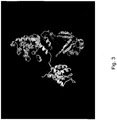
- Diphtheria toxin is a 535 amino acid protein with three domains consisting of a catalytic domain (amino acids 1-186) connected by an arginine-rich disulfide loop to a translocation domain (amino acids 187-388) and a cell binding domain (amino acids 389-535; Figure 1 ). See, e.g., Choe et al., "The crystal structure of diphtheria toxin," Nature 357: 216-222 (1992 ).
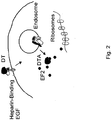
- Native DT binds to heparin-binding epidermal growth factor precursor and CD9 on the cell surface, undergoes clathrin-, dynamin- and ATP-dependent receptor-mediated endocytosis and, with endosome acidification by vesicular ATPase, the DT translocation domain undergoes protonation of acidic residues and spontaneous insertion into the vesicular membrane to form 18-22 Angstrom channels.
- the catalytic domain unfolds and is cleaved by furin in the vesicle and then the C-terminus of the catalytic domain transfers through the channel and binds to coatomer proteins, specifically ⁇ -COP.
- Protein disulfide isomerase reduces the linkage of the catalytic domain with the remainder of DT and the peptide passes into the cytosol. Hsp90 assists in refolding. The DT fragment then ADP-ribosylates elongation factor 2 leading to protein synthesis inactivation and cell death ( Figure 2 ). See Ratts et al., "A conserved motif in transmembrane helix 1 of diphtheria toxin mediates catalytic domain delivery to the cytosol," Proc. Natl. Acad. Sci. 102: 15635-15640 (2005 ).
- Recombinant protein-toxin conjugates represent a novel class of oncology biological agents that specifically target receptors on the surfaces of cancer cells. These agents typically consist of a truncated toxin, often including the catalytic and translocation (but not cell binding) domains, fused to a cell selective ligand which directs the toxin to the intended target.
- DT diphtheria toxin
- DT is a 535 amino acid protein with three domains consisting of a catalytic domain (amino acids 1-186) connected by an arginine-rich disulfide loop to a translocation domain (amino acids 187-388) and a cell binding domain (amino acids 389-535; Figure 1 ).
- Native DT binds to heparin-binding epidermal growth factor precursor and CD9 on the cell surface, undergoes clathrin-, dynamin- and ATP-dependent receptor-mediated endocytosis, and, with endosome acidification by vesicular ATPase, the DT translocation domain undergoes protonation of acidic residues and spontaneous insertion into the vesicular membrane to form 18-22 Angstrom channels.
- DT 388 IL-3 was constructed by fusing the gene encoding the catalytic and translocation domains of DT (amino acids 1-388) via a Met-His linker with human IL-3. See, e.g., Frankel et al., "Diphtheria toxin fused to human interleukin-3 is toxic to blasts from patients with myeloid leukemias," Leukemia 14: 576-585 (2000 ). DT 388 IL-3 has been shown to be potently and selectively cytotoxic to IL-3R positive AML cell lines and primary leukemia cells derived from patients.
- a diphtheria toxin interleukin-3 fusion protein is cytotoxic to primitive acute myeloid leukemia progenitors but spares normal progenitors," Cancer Res. 62: 1730-1736 (2002 )).
- Additional studies found that high affinity variants of the DT 388 IL-3 compound, named DT388-IL3[K116W] (based on the mutation of a lysine at amino acid 116 to tryptophan) and DT388IL3[ ⁇ 125-133] (based on a deletion of amino acids 125-133 in the IL3 domain), had increased potency against leukemia cells ( See, Hogge et al., "Variant diphtheria toxin-interleukin-3 conjugates with increased receptor affinity have enhanced cytotoxicity against acute myeloid leukemia progenitors," Clin.
- a diphtheria toxin-interleukin-3 fusion protein is cytotoxic to primitive acute myeloid leukemia progenitors but spares normal progenitors," Cancer Res. 62: 1730-1736 (2002 ); and Hogge et al.; "The efficacy of diphtheria-growth factor fusion proteins is enhanced by co-administration of cytosine arabinoside in an immunodeficient mouse model of human acute myeloid leukemia" Leuk Res 28: 1221-1226 (2004 )). Safety was shown at therapeutically active doses in rodents and monkeys.
- the present invention is directed to a pharmaceutical composition comprising a human interleukin (IL)-3-diphtheria toxin conjugate for use in a method for treating a plasmacytoid dendritic cell cancer in a human, wherein said method comprises administering said human IL-3 diphtheria toxin conjugate to said human, according to the claims.
- IL interleukin
- said method comprises administering said human IL-3 diphtheria toxin conjugate to said human, according to the claims.
- the growth of plasmacytoid dendritic cancer cells in said human is inhibited.
- the interleukin-3-diphtheria toxin conjugate can comprise the full-length, mature (lacking the signal peptide), human interleukin-3 connected by a covalent bond to diphtheria toxin.
- the diphtheria toxin is modified in that the cell surface binding domain is deleted.
- the conjugate is a chemical conjugate in which the diphtheria toxin portion (the catalytic and translocation domains of diphtheria toxin) and the interleukin-3 portion are chemically linked together either directly or through a chemical linker.
- the conjugate is a genetic recombinant in which the conjugate is expressed as a single polypeptide.
- the translated conjugate preferably comprises the catalytic and translocation domains of diphtheria toxin linked via a peptide bond to human interleukin-3.
- the conjugate comprises amino acids 1-388 of diphtheria toxin linked via a peptide linker to human interleukin-3.
- the conjugate can be administered at a dose of 4 ⁇ g/kg per day or greater. In other aspects, the conjugate can be administered at a dose in a range of about 4 ⁇ g/kg per day to about 20 ⁇ g/kg per day. In yet other aspects, the conjugate can be administered at a dose in a range of about 4 ⁇ g/kg per day to about 9 ⁇ g/kg per day. In yet other aspects, the conjugate can be administered at a dose in a range of about 4 ⁇ g/kg per day to about 12.5 ⁇ g/kg per day.
- the conjugate can be administered at a dose of about 5.3 ⁇ g/kg per day, or at a dose of about 7.1 ⁇ g/kg per day, or at a dose of about 9.4 ⁇ g/kg per day, or at a dose of about 12.5 ⁇ g/kg per day.
- the conjugate can be administered at or below a dose that is the maximum dose tolerated without undue toxicity.
- the conjugate can be administered at least two times a week or the conjugate can be administered at least three times a week, at least four times a week, at least five times a week, at least six times a week, or seven times a week.
- the conjugate can be administered at a dose of 4 ⁇ g/kg per day or greater each time.
- the conjugate can be administered over a period of one or two weeks or greater.
- the growth of the cells can be inhibited by at least 50%, at least 65%, at least 75%, at least 80%, at least 85%, at least 90%, at least 95% or by at least 99% as compared to a reference sample, i.e., a sample of cells not contacted with a conjugate of the invention.
- a method for inhibiting the growth of interleukin-3 receptor-expressing cells comprising administering to a human in need of such inhibition a pharmaceutical composition comprising an amount of an interleukin-3-diphtheria toxin conjugate effective in inhibiting said cells and a pharmaceutically acceptable carrier, in which the conjugate is administered at a dose greater than 4 ⁇ g/kg per day, and wherein the cells express the alpha subunit of the interleukin-3 receptor.
- the cells express both the alpha and the beta subunits of the interleukin-3 receptor.
- the conjugate can be administered at least two times a week or the conjugate can be administered at least three times a week, at least four times a week, at least five times a week, at least six times a week, or seven times a week.
- the conjugate can be administered more than once, the conjugate can be administered at a dose of greater than 4 ⁇ g/kg per day each time.
- the conjugate can be administered over a period of two weeks or greater.
- the growth of interleukin-3 receptor expressing cells can be inhibited by at least 50%, at least 65%, at least 75%, at least 80%, at least 85%, at least 90%, at least 95% or by at least 99% as compared to a reference sample, i.e ., a sample of cells not contacted with a conjugate of the invention.
- the conjugate can be administered at a dose of about 5.3 ⁇ g/kg per day, or at a dose of about 7.1 ⁇ g/kg per day, or at a dose of about 9.4 ⁇ g/kg per day, or at a dose of about 12.5 ⁇ g/kg per day.
- interleukin-3 receptor expression can be overexpression of one or more subunits of the interleukin-3 receptor on cells that normally express the interleukin-3 receptor.
- interleukin-3 receptor expression can be inappropriate expression of interleukin-3 receptor on cells that do not normally express one or more subunits of the interleukin-3 receptor.
- Exemplary diseases or disorders that can be treated in this embodiment of the invention include, but are not limited to, allergic diseases or disorders, autoimmune diseases or disorders, inflammatory diseases or disorders, or cancers that are not acute myeloid leukemia.
- the disease or disorder is cancer
- the cancer can be refractory, or multidrug resistant.
- the disease or disorder is MDS.
- the disease or disorder that displays or is characterized by the presence or over-presence of a type of cell that expresses the interleukin-3 receptor Exemplary diseases or disorders that can be treated include, but are not limited to, allergic diseases or disorders, autoimmune diseases or disorders, inflammatory diseases or disorders, or cancers (including without limitation acute myeloid leukemia).
- the disease or disorder is cancer
- the cancer can be refractory, or multidrug resistant.
- the disease or disorder is MDS.
- a method for treating, preventing, and/or managing cancer comprises administering to a human in need of such treatment, prevention and/or management a pharmaceutical composition comprising an amount of an interleukin-3-diphtheria toxin conjugate effective to treat, prevent and/or manage the cancer and a pharmaceutically acceptable carrier, wherein the cancer cells express the alpha and beta subunits of the interleukin-3 receptor, with the proviso that the cancer is not acute myeloid leukemia.
- a method for treating or preventing cancer comprising administering to a human in need of such treatment or prevention a pharmaceutical composition comprising an amount of an interleukin-3-diphtheria toxin conjugate effective to treat or prevent the cancer and a pharmaceutically acceptable carrier, wherein the cancer stem cells express the alpha and beta subunits of the interleukin-3 receptor, with the proviso that the cancer is not acute myeloid leukemia.
- the conjugate can be administered at a dose of 4 ⁇ g/kg per day or greater. In other aspects, the conjugate can be administered at a dose in a range of about 4 ⁇ g/kg per day to about 20 ⁇ g/kg per day. In yet other aspects, the conjugate can be administered at a dose in a range of about 4 ⁇ g/kg per day to about 9 ⁇ g/kg per day. In yet other aspects, the conjugate can be administered at a dose in a range of about 4 ⁇ g/kg per day to about 12.5 ⁇ g/kg per day.
- the conjugate can be administered at a dose of about 5.3 ⁇ g/kg per day, or at a dose of about 7.1 ⁇ g/kg per day, or at a dose of about 9.4 ⁇ g/kg per day, or at a dose of about 12.5 ⁇ g/kg per day.
- the conjugate can be administered at or below a dose that is the maximum dose tolerated without undue toxicity.
- the conjugate can be administered at least two times a week or the conjugate can be administered at least three times a week, at least four times a week, at least five times a week, at least six times a week, or seven times a week.
- the conjugate can be administered at a dose of 4 ⁇ g/kg per day or greater each time.
- the conjugate can be administered over a period of two weeks or greater.
- the growth of the cancer cells or the cancer stem cells can be inhibited by at least 50%, at least 65%, at least 75%, at least 80%, at least 85%, at least 90%, at least 95% or by at least 99% as compared to a reference sample, i.e., a sample of cells not contacted with a conjugate of the invention.
- the human patient can be in a state of remission from the cancer.
- the human patient has been previously treated with the conjugate or has been previously treated with conventional chemotherapeutic agents or has radiation therapy.
- the human patient, concurrent with treatment with compounds of the invention can be administered a conventional chemotherapeutic agent or can undergo radiation therapy.
- the human patient has no detectable levels of anti-diphtheria toxin antibodies prior to administration of a conjugate of the invention.
- the method further comprises administering a conventional chemotherapeutic agent.
- the cancer is a non-hematologic cancer. Further the cancer can be refractory or multi-drug resistant.
- the methods of this embodiment can further comprise monitoring the amount of cancer cells or cancer stem cells expressing the alpha subunit (in some embodiments, the alpha and beta subunits) of the interleukin-3 receptor in a sample derived from the human after administration of a conjugate of the invention and determining a further course of treatment based on the amount of cancer cells or cancer stem cells expressing the alpha subunit (in some embodiments, the alpha and beta subunits) present in the sample as compared to a reference sample or a sample of cancer cells or cancer stem cells obtained from the human before or during administration of the conjugate.
- a method for treating, preventing, and/or managing myeloid leukemia comprising administering to a human in need of such treatment, prevention, and/or management a pharmaceutical composition comprising an amount of an interleukin-3-diphtheria toxin conjugate effective to treat or prevent myeloid leukemia and a pharmaceutically acceptable carrier, in which the conjugate is administered at a dose of greater than 4 ⁇ g/kg, and wherein the myeloid leukemia cells express the alpha and beta subunits of the interleukin-3 receptor.
- the myeloid leukemia can be acute myeloid leukemia, chronic myeloid leukemia, or myelodysplastic syndrome. In some cases the myeloid leukemia may be refractory and/or multi-drug resistant.
- the myeloid leukemia cells can express both the alpha and the beta subunits of the interleukin-3 receptor.
- the conjugate can be administered at a dose of 4 ⁇ g/kg per day or greater. In other aspects, the conjugate can be administered at a dose in a range of about 4 ⁇ g/kg per day to about 20 ⁇ g/kg per day. In yet other aspects, the conjugate can be administered at a dose in a range of about 4 ⁇ g/kg per day to about 9 ⁇ g/kg per day. In yet other aspects, the conjugate can be administered at a dose in a range of about 4 ⁇ g/kg per day to about 12.5 ⁇ g/kg per day.
- the conjugate can be administered at a dose of about 5.3 ⁇ g/kg per day, or at a dose of about 7.1 ⁇ g/kg per day, or at a dose of about 9.4 ⁇ g/kg per day, or at a dose of about 12.5 ⁇ g/kg per day.
- the conjugate can be administered at least two times a week or the conjugate can be administered at least three times a week, at least four times a week, at least five times a week, at least six times a week, or seven times a week.
- the conjugate can be administered more than once, the conjugate can be administered at a dose of greater than 4 ⁇ g/kg per day each time.
- the conjugate can be administered over a period of two weeks or greater.
- the amount of myeloid leukemia cells can be decreased by at least 50%, at least 65%, at least 75%, at least 80%, at least 85%, at least 90%, at least 95% or by at least 99% as compared to a reference sample, i.e., a sample of cells not contacted with a conjugate of the invention.
- the conjugate can be administered at a dose of about 5.3 ⁇ g/kg per day, or at a dose of about 7.1 ⁇ g/kg per day, or at a dose of about 9 ⁇ g/kg per day.
- the human patient can be in a state of remission of the myeloid leukemia.
- the human patient has been previously treated with the conjugate or has been previously treated with conventional chemotherapeutic agents or radiation therapy.
- the human patient concurrently can be administered a conventional chemotherapeutic agent or radiation therapy.
- the human patient is administered the conjugate 1 day, 2 days, 3 days, 4 days, 5 days, 6 days, 7 days, 2 weeks, 3 weeks, 1 month, 2 months, 3 months, 4 months, 5 months, 6 months, 9 months, or 12 months after receiving conventional chemotherapy.
- the human patient has low levels or no detectable levels of anti-diphtheria toxin antibodies prior to administration of a conjugate of the invention.
- the method further comprises administering a conventional chemotherapeutic agent.
- the methods of this embodiment can further comprise monitoring the amount of myeloid leukemia cells expressing the alpha and/or beta subunits of the interleukin-3 receptor in a sample derived from the human after administration of a conjugate of the invention and determining a further course of treatment based on the amount of myeloid leukemia cells expressing the alpha and/or beta subunits present in the sample as compared to a reference sample or a sample of myeloid leukemia cells obtained from the human before or during administration of the conjugate.
- the methods of this embodiment can further comprise monitoring the amount of myeloid leukemia cells expressing the alpha subunit of the interleukin-3 receptor in a sample derived from the human after administration of a conjugate of the invention and determining a further course of treatment based on the amount of myeloid leukemia cells expressing the alpha subunit present in the sample as compared to a reference sample or a sample of myeloid leukemia cells obtained from the human before or during administration of the conjugate.
- a method for preventing a relapse of cancer in a human previously treated for the cancer comprising administering to a human in need of such prevention who had been previously treated for cancer, a pharmaceutical composition comprising an amount of an interleukin-3-diphtheria toxin conjugate effective to prevent the relapse of the cancer and a pharmaceutically acceptable carrier, wherein the cancer cells or the cancer stem cells express the alpha and beta subunits of the interleukin-3 receptor, with the proviso that the cancer is not myeloid leukemia.
- the method for preventing a relapse of myeloid leukemia in a human previously treated for myeloid leukemia comprising administering to a human in need of such prevention who had been previously treated for myeloid leukemia, a pharmaceutical composition comprising an amount of an interleukin-3-diphtheria toxin conjugate effective to prevent the relapse of myeloid leukemia and a pharmaceutically acceptable carrier, in which the conjugate is administered at a dose of greater than 4 ⁇ g/kg per day.
- a method for preventing a relapse of cancer in a human in remission from such cancer comprises administering to a human in need of such prevention who is in remission from said cancer, a pharmaceutical composition comprising an amount of an interleukin-3-diphtheria toxin conjugate effective to prevent the relapse of the cancer and a pharmaceutically acceptable carrier, wherein the cancer cells or the cancer stem cells express the alpha and beta subunits of the interleukin-3 receptor, with the proviso that the cancer is not myeloid leukemia.
- Another embodiment is directed to a method for preventing a relapse of myeloid leukemia in a human in remission from myeloid leukemia, comprising administering to a human in need of such prevention who is in remission from myeloid leukemia, a pharmaceutical composition comprising an amount of an interleukin-3-diphtheria toxin conjugate effective to prevent the relapse of myeloid leukemia and a pharmaceutically acceptable carrier, in which the conjugate is administered at a dose of greater than 4 ⁇ g/kg.
- a method for performing an autologous bone marrow or peripheral blood stem cell transplant comprising administering to a human an amount of significantly purged bone marrow or peripheral blood effective to reconstitute hematopoietic function in said human, wherein said purged bone marrow or peripheral blood is bone marrow or peripheral blood obtained from said human previously contacted with an amount of an interleukin-3-diphtheria toxin conjugate for a time sufficient to significantly purge the bone marrow or peripheral blood of cells expressing the alpha and beta subunits of the interleukin-3 receptor.
- composition comprising purged bone marrow or peripheral blood, wherein said purged bone marrow or peripheral blood is bone marrow or peripheral blood obtained from a human and contacted ex vivo with an amount of an interleukin-3-diphtheria toxin conjugate for a time sufficient to significantly purge the bone marrow or peripheral blood of cells expressing the alpha and beta subunits of the interleukin-3 receptor, and then possibly re-introducing the bone marrow or peripheral blood cells back into the patient.
- the composition can further comprise a pharmaceutically acceptable carrier.
- conventional chemotherapy and the methods described may be used sequentially.
- the patient's leukemia blasts are first reduced by use of conventional chemotherapy, followed by a regimen comprising administration of an amount of an interleukin-3-diphtheria toxin conjugate for a time sufficient to significantly stabilize, reduce, or eradicate cancer stem cells expressing the alpha and beta subunits of the interleukin-3 receptor.
- agent refers to any molecule, compound, and/or substance for use in the prevention, treatment, management and/or diagnosis of cancer, including the diphtheria toxin-interleukin-3 conjugate of the invention.
- conjugate of the invention refers to interleukin-3 or a portion, analog or derivative thereof that binds to the interleukin-3 receptor or subunit thereof conjugated to diphtheria toxin, a portion thereof or an analog thereof.
- conjugated to diphtheria toxin a portion thereof or an analog thereof.
- compound of the invention and composition of the invention are used as alternatives for the term “conjugate of the invention.”
- the term “amount,” as used in the context of the amount of a particular cell population or cells, refers to the frequency, quantity, percentage, relative amount, or number of the particular cell population or cells.
- the term "significantly,” as used in the context of purging of the bone marrow or peripheral blood of cells expressing the alpha and beta subunits of the interleukin-3 receptor, refers to a decrease in cells expressing the alpha and beta subunits of the interleukin-3 receptor by at least 50%, 60%, 75%, 80%, 90%, 95%, or 99%.
- small reduction in the context of a particular cell population (e.g ., circulating endothelial cells and/or circulating endothelial progenitors) refers to less than a 30% reduction in the cell population (e.g ., the circulating endothelial cell population and/or the circulating endothelial progenitor population).
- diagnostic agent refers to any molecule, compound, and/or substance that is used for the purpose of diagnosing cancer.
- diagnostic agents include antibodies, antibody fragments, or other proteins, including those conjugated to a detectable agent.
- detectable agents refer to any molecule, compound and/or substance that is detectable by any methodology available to one of skill in the art.
- detectable agents include dyes, gases, metals, or radioisotopes.
- diagnostic agent and imaging agent are equivalent terms.
- prophylactic agent refers to any molecule, compound, and/or substance that is used for the purpose of preventing cancer.
- prophylactic agents include, but are not limited to, proteins, immunoglobulins (e.g ., multi-specific Igs, single chain Igs, Ig fragments, polyclonal antibodies and their fragments, monoclonal antibodies and their fragments), binding proteins, chemospecific agents, chemotoxic agents (e.g ., anti-cancer agents), proliferation based therapy, and small molecule drugs.
- therapeutic agent refers to any molecule, compound, and/or substance that is used for the purpose of treating and/or managing a disease or disorder.
- therapeutic agents include, but are not limited to, proteins, immunoglobulins (e.g ., multi-specific Igs, single chain Igs, Ig fragments, polyclonal antibodies and their fragments, monoclonal antibodies and their fragments), peptides ( e.g. , peptide receptors, selectins), binding proteins, biologies, chemospecific agents, chemotoxic agents ( e.g ., anti-cancer agents), proliferation-based therapy, radiation, chemotherapy, anti-angiogenic agents, and small molecule drugs.
- proliferation based therapy refers to any molecule, compound, substance, and/or method that differentially impairs, inhibits or kills rapidly proliferating cell populations (e.g ., cancer cells) in comparison with cell populations that divide more slowly.
- Proliferation based therapies may include, but are not limited to those chemotherapeutic and radiation therapies that are typically used in oncology.
- fragment and portion in the context of proteinaceous agents refer to an amino acid sequence comprising an amino acid sequence of at least 5 contiguous amino acid residues, at least 10 contiguous amino acid residues, at least 1 5 contiguous amino acid residues, at least 20 contiguous amino acid residues, at least 25 contiguous amino acid residues, at least 40 contiguous amino acid residues, at least 50 contiguous amino acid residues, at least 60 contiguous amino acid residues, at least 70 contiguous amino acid residues, at least 80 contiguous amino acid residues, at least 90 contiguous amino acid residues, at least 100 contiguous amino acid residues, at least 125 contiguous amino acid residues, at least 150 contiguous amino acid residues, at least 175 contiguous amino acid residues, at least 200 contiguous amino acid residues, or at least 250 contiguous amino acid residues of a protein or polypeptide.
- the selectable marker in the recombinant plasmid confers resistance to the selection and allows cells to stably integrate the plasmid into their chromosomes and grow to form foci which in turn can be cloned and expanded into cell lines.
- This method may advantageously be used to engineer cell lines which express a conjugate of the invention.
- a number of selection systems may be used, including but not limited to the herpes simplex virus thymidine kinase ( Wigler, et al., 1977, Cell 11:223 ), hypoxanthineguanine phosphoribosyltransferase ( Szybalska & Szybalski, 1962, Proc. Natl. Acad. Sci. U.S.A. 48:2026 ), and adenine phosphoribosyltransferase ( Lowy, et al., 1980, Cell 22:817 ) genes can be employed in tk-, hgprt- or aprt- cells, respectively.
- antimetabolite resistance can be used as the basis of selection for dhfr, which confers resistance to methotrexate ( Wigler, et al., 1980, Proc. Natl. Acad. Sci. U.S.A. 77:3567 ; O'Hare, et al., 1981, Proc. Natl. Acad. Sci. U.S.A. 78:1527 ); gpt, which confers resistance to mycophenolic acid ( Mulligan & Berg, 1981, Proc. Natl. Acad. Sci. U.S.A.
- compositions of the present invention can be in any form that allows for the composition to be administered to a subject, said subject preferably being an animal, including, but not limited to a human, mammal, or non-human animal, such as a cow, horse, sheep, pig, fowl, cat, dog, mouse, rat, rabbit, guinea pig, etc., and is more preferably a mammal, and most preferably a human.
- compositions of the invention can be in the form of a solid, liquid, or gas (aerosol).
- routes of administration may include, without limitation, oral, topical, parenteral, sublingual, rectal, vaginal, ocular, intradermal, intratumoral, intracerebral, intrathecal, and intranasal.
- Parenteral administration includes subcutaneous injections, intravenous, intramuscular, intraperitoneal, intrapleural, intrasternal injection or infusion techniques.
- the compositions are administered parenterally.
- the compositions are administered intravenously.
- Pharmaceutical compositions of the invention can be formulated so as to allow a compound of the invention to be bioavailable upon administration of the composition to a subject.
- Compositions can take the form of one or more dosage units, where, for example, a tablet can be a single dosage unit, and a container of a compound of the invention in aerosol form can hold a plurality of dosage units.
- the pharmaceutically acceptable carrier or vehicle may be particulate, so that the compositions are, for example, in tablet or powder form.
- the carrier(s) can be liquid, with the compositions being, for example, an oral syrup or injectable liquid.
- the carrier(s) can be gaseous, so as to provide an aerosol composition useful in, e.g. , inhalatory administration.
- composition may be intended for oral administration, and if so, the composition is preferably in solid or liquid form, where semi-solid, semi-liquid, suspension, and gel forms are included within the forms considered herein as either solid or liquid.
- the pharmaceutical composition can be in the form of a liquid, e.g. , an elixir, syrup, solution, emulsion, or suspension.
- the liquid can be useful for oral administration or for delivery by injection.
- a composition can comprise one or more of a sweetening agent, preservatives, dye/colorant, and flavor enhancer.
- a surfactant, preservative, wetting agent, dispersing agent, suspending agent, buffer, stabilizer, and isotonic agent can also be included.
- a parenteral composition can be enclosed in an ampoule, a disposable syringe, or a multiple-dose vial made of glass, plastic or other material.
- Physiological saline is a preferred adjuvant.
- An injectable composition is preferably sterile.
- the pharmaceutical compositions comprise an effective amount of a conjugate of the invention such that a suitable dosage will be obtained ( see Section 5.3.1, infra, for suitable dosages). Typically, this amount is at least 0.01% of a conjugate of the invention by weight of the composition. When intended for oral administration, this amount can be varied to be between 0.1% and 80% by weight of the composition.
- Preferred oral compositions can comprise from between 4% and 50% of the compound of the invention by weight of the composition.
- Preferred compositions of the present invention are prepared so that a parenteral dosage unit contains from between 0.01% and 2% by weight of the compound of the invention.
- compositions of the invention can be administered by any convenient route, for example, by infusion or bolus injection, by absorption through epithelial or mucocutaneous linings ( e.g., oral mucosa, rectal, and intestinal mucosa, etc.). Administration can be systemic or local.
- Various delivery systems are known, e.g ., microparticles, microcapsules, capsules, etc., and may be useful for administering a compound of the invention.
- more than one compound of the invention is administered to a subject.
- Methods of administration may include, but are not limited to, oral administration and parenteral administration; parenteral administration including, but not limited to, intradermal, intramuscular, intraperitoneal, intravenous, subcutaneous; intranasal, epidural, sublingual, intranasal, intracerebral, intraventricular, intrathecal, intravaginal, transdermal, rectally, by inhalation, or topically to the ears, nose, eyes, or skin.
- parenteral administration including, but not limited to, intradermal, intramuscular, intraperitoneal, intravenous, subcutaneous; intranasal, epidural, sublingual, intranasal, intracerebral, intraventricular, intrathecal, intravaginal, transdermal, rectally, by inhalation, or topically to the ears, nose, eyes, or skin.
- parenteral administration including, but not limited to, intradermal, intramuscular, intraperitoneal, intravenous, subcutaneous; intranasal, epid
- the compounds of the invention are administered parenterally. In a specific embodiment, the compounds of the invention are administered intravenously. In another embodiment, the compounds of the invention are administered by continuous infusion. In a particular embodiment, the compounds of the invention are administered by an infusion that lasts for about 15 minutes, about 20 minutes, about 30 minutes, about 45 minutes, about 1 hour, or about 2 hours.
- This can be achieved, for example, and not by way of limitation, by local infusion during surgery; topical application, e.g. , in conjunction with a wound dressing after surgery; by injection; by means of a catheter; by means of a suppository; or by means of an implant, the implant being of a porous, non-porous, or gelatinous material, including membranes, such as sialastic membranes, or fibers.
- administration can be by direct injection at the site (or former site) of a cancer, tumor, or precancerous tissue.
- intraventricular injection can be facilitated by an intraventricular catheter, for example, attached to a reservoir, such as an Ommaya reservoir.
- one or more compounds of the invention can be injected intraperitoneally.
- Pulmonary administration can also be employed, e.g ., by use of an inhaler or nebulizer, and formulation with an aerosolizing agent, or via perfusion in a fluorocarbon or synthetic pulmonary surfactant.
- the compounds of the invention can be formulated as a suppository, with traditional binders and carriers such as triglycerides.
- the compounds of the invention can be delivered in a controlled release system.
- a pump can be used (see Sefton, CRC Crit. Ref Biomed. Eng. 1987, 14, 201 ; Buchwald et al., Surgery 1980, 88: 507 ; Saudek et al., N. Engl. J. Med. 1989, 321: 574 ).
- polymeric materials can be used ( see Medical Applications of Controlled Release, Langer and Wise (eds.), CRC Pres., Boca Raton, FL, 1974 ; Controlled Drug Bioavailability, Drug Product Design and Performance, Smolen and Ball (eds.), Wiley, New York, 1984 ; Ranger and Peppas, J.
- a controlled-release system can be placed in proximity of the target of the compounds of the invention, e.g., the brain, thus requiring only a fraction of the systemic dose ( see, e.g., Goodson, in Medical Applications of Controlled Release, supra, vol. 2, 1984, pp. 115-138 ).
- Other controlled-release systems discussed in the review by Langer discussed in the review by Langer (Science 1990, 249, 1527-1533 ) can also be used.
- polymeric materials can be used to achieve controlled or sustained release of the compounds of the invention (see, e.g., U.S. Pat. No. 5,679,377 ; U.S. Pat. No. 5,916,597 ; U.S. Pat. No. 5,912,015 ; U.S. Pat. No. 5,989,463 ; U.S. Pat. No. 5,128,326 ; PCT Publication No. WO 99/15154 ; and PCT Publication No. WO 99/20253 .
- polymers used in sustained release formulations include, but are not limited to, poly(2-hydroxy ethyl methacrylate), poly(methyl methacrylate), poly(acrylic acid), poly(ethylene-co-vinyl acetate), poly(methacrylic acid), polyglycolides (PLG), polyanhydrides, poly(N-vinyl pyrrolidone), poly(vinyl alcohol), polyacrylamide, poly(ethylene glycol), polylactides (PLA), poly(lactide-co-glycolides) (PLGA), and polyorthoesters.
- the polymer used in a sustained release formulation is inert, free of leachable impurities, stable on storage, sterile, and biodegradable.
- Sustained or directed release compositions that can be formulated include, but are not limited to, compounds of the invention protected with differentially degradable coatings, e.g. , by microencapsulation, multiple coatings, etc. It is also possible to freeze-dry the compositions and use the lyophilizates obtained, for example, for the preparation of products for injection.
- the conjugates of the invention are formulated in accordance with routine procedures as a pharmaceutical composition adapted for intravenous administration to animals, particularly human beings.
- the carriers or vehicles for intravenous administration are sterile isotonic aqueous buffer solutions.
- the compositions can also include a solubilizing agent.
- Compositions for intravenous administration can optionally comprise a local anaesthetic such as lignocaine to ease pain at the site of the injection.
- the ingredients are supplied either separately or mixed together in unit dosage form, for example, as a dry lyophilized powder or water free concentrate in a hermetically sealed container such as an ampoule or sachet indicating the quantity of active agent.
- a conjugate of the invention is to be administered by infusion, it can be dispensed, for example, with an infusion bottle containing sterile pharmaceutical grade water or saline.
- an ampoule of sterile water for injection or saline can be provided so that the ingredients can be mixed prior to administration.
- compositions for oral delivery can be in the form of tablets, lozenges, aqueous or oily suspensions, granules, powders, emulsions, capsules, syrups, or elixirs, for example.
- Orally administered compositions can contain one or more optional agents, for example, sweetening agents such as fructose, aspartame or saccharin; flavoring agents such as peppermint, oil of wintergreen, or cherry; coloring agents; and preserving agents, to provide a pharmaceutically palatable preparation.
- sweetening agents such as fructose, aspartame or saccharin
- flavoring agents such as peppermint, oil of wintergreen, or cherry
- coloring agents such as peppermint, oil of wintergreen, or cherry
- preserving agents to provide a pharmaceutically palatable preparation.
- the compositions can be coated to delay disintegration and absorption in the gastrointestinal tract thereby providing a sustained action over an extended period of time.
- Selectively permeable membranes surrounding an osmotically active driving complex are also suitable for orally administered compositions of the invention.
- fluid from the environment surrounding the capsule is imbibed by the driving complex, which swells to displace the agent or agent composition through an aperture.
- delivery platforms can provide an essentially zero order delivery profile as opposed to the spiked profiles of immediate release formulations.
- a time-delay material such as glycerol monostearate or glycerol stearate can also be used.
- Oral compositions can include standard carriers such as mannitol, lactose, starch, magnesium stearate, sodium saccharine, cellulose, magnesium carbonate, etc. Such carriers are preferably of pharmaceutical grade.
- compositions of the invention can be intended for topical administration, in which case the carrier can be in the form of a solution, emulsion, ointment, or gel base.
- the base for example, can comprise one or more of the following: petrolatum, lanolin, polyethylene glycols, beeswax, mineral oil, diluents such as water and alcohol, and emulsifiers and stabilizers.
- Thickening agents can be present in a composition for topical administration. If intended for transdermal administration, the composition can be in the form of a transdermal patch or an iontophoresis device.
- Topical formulations can comprise a concentration of a compound of the invention of from between 0.01% and 10% w/v (weight per unit volume of composition).
- compositions can include various materials that modify the physical form of a solid or liquid dosage unit.
- the composition can include materials that form a coating shell around the active ingredients.
- the materials that form the coating shell are typically inert, and can be selected from, for example, sugar, shellac, and other enteric coating agents.
- the active ingredients can be encased in a gelatin capsule.
- compositions can consist of gaseous dosage units, e.g. , it can be in the form of an aerosol.
- aerosol is used to denote a variety of systems ranging from those of colloidal nature to systems consisting of pressurized packages. Delivery can be by a liquefied or compressed gas or by a suitable pump system that dispenses the active ingredients. Aerosols of the compositions can be delivered in single phase, bi-phasic, or tri-phasic systems in order to deliver the composition. Delivery of the aerosol includes the necessary container, activators, valves, subcontainers, spacers and the like, which together can form a kit. Preferred aerosols can be determined by one skilled in the art, without undue experimentation.
- compositions of the present invention can comprise an additional active agent selected from among those including, but not limited to, an additional prophylactic agent, an additional therapeutic agent, an antiemetic agent, a hematopoietic colony stimulating factor, an adjuvant therapy, a vaccine or other immune stimulating agent, an antibody/antibody fragment-based agent, an anti-depressant and an analgesic agent.
- an additional active agent selected from among those including, but not limited to, an additional prophylactic agent, an additional therapeutic agent, an antiemetic agent, a hematopoietic colony stimulating factor, an adjuvant therapy, a vaccine or other immune stimulating agent, an antibody/antibody fragment-based agent, an anti-depressant and an analgesic agent.
- the pharmaceutical composition comprises a compound of the invention, an additional agent, and a pharmaceutically acceptable acceptable carrier or vehicle.
- compositions of the present invention may comprise one or more known therapeutically active agents.
- therapies which involve administering one of more the interleukin-3-diphtheria toxin conjugates of the invention and compositions comprising the interleukin-3-diphtheria toxin conjugates to a subject, preferably a human subject, for preventing, treating, managing, and/or ameliorating disease or disorder that displays or is characterized by interleukin-3 receptor expression or one or more symptoms thereof.
- a subject preferably a human subject
- the method of preventing, treating, managing, and/or ameliorating a disease or disorder that displays or is characterized by interleukin-3 receptor expression or one or more symptoms thereof said method comprising administering to a subject in need thereof an effective amount of one or more the interleukin-3-diphtheria toxin conjugates of the invention.
- diseases and disorders include cancer, allergic diseases, inflammatory diseases, and autoimmune diseases.
- interleukin-3-diphtheria toxin conjugate of the invention comprising administering to a subject in need thereof an interleukin-3-diphtheria toxin conjugate of the invention and one or more therapies (e.g., one or more prophylactic or therapeutic agents) other than the interleukin-3-diphtheria toxin conjugate of the invention that are currently being used, have been used, are known to be useful, or may be useful in the prevention, treatment, management, and/or amelioration of a disease or disorder that displays or is characterized by interleukin-3 receptor expression or one or more symptoms thereof.
- the prophylactic or therapeutic agents of the combination therapies can be administered sequentially or concurrently.
- the combination therapies comprise an effective amount of a conjugate of the invention and an effective amount of at least one other therapy which has the same mechanism of action as said conjugate.
- the combination therapies comprise an effective amount of a conjugate of the invention and an effective amount of at least one other therapy (e.g., prophylactic or therapeutic agent) which has a different mechanism of action than said conjugate.
- the combination therapies improve the prophylactic or therapeutic effect of a conjugate of the invention by functioning together with the conjugate to have an additive or synergistic effect.
- the combination therapies reduce the side effects associated with the prophylactic or therapeutic agents.
- the combination therapies are administered prior to, during, or after the administration of the compositions of the invention.
- Cancer or a neoplastic disease including, but not limited to, neoplasms, tumors, metastases, or any disease or disorder characterized by uncontrolled cell growth, can be treated, suppressed, delayed, managed, inhibited or prevented by administering to a subject in need thereof a prophylactically effective regimen or a therapeutically effective regimen, the regimen comprising administering to the patient a compound of the invention.
- a prophylactically effective regimen or a therapeutically effective regimen the regimen comprising administering to the patient a compound of the invention.
- the conjugates of the invention are administered as monotherapy for the prevention, treatment, and/or management of cancer.
- a method of preventing, treating, and/or managing cancer in a patient comprising administering to the patient a prophylactically effective regimen or a therapeutically effective regimen, the regimen comprising administering to the patient a conjugate of the invention or a pharmaceutical composition of the invention, wherein the patient has been diagnosed with cancer.
- One aspect relates to a method of preventing, treating, and/or managing cancer in a patient (e.g., a human patient), the method comprising administering to the patient a prophylactically effective regimen or a therapeutically effective regimen, the regimen comprising administering to the patient a conjugate of the invention or a pharmaceutical composition of the invention, wherein the patient has relapsed from cancer.
- a patient e.g., a human patient
- the method comprising administering to the patient a prophylactically effective regimen or a therapeutically effective regimen, the regimen comprising administering to the patient a conjugate of the invention or a pharmaceutical composition of the invention, wherein the patient has relapsed from cancer.
- One aspect relates to a method of preventing, treating, and/or managing cancer in a patient (e.g., a human patient), the method comprising administering to the patient a prophylactically effective regimen or a therapeutically effective regimen, the regimen comprising administering to the patient a conjugate of the invention or a pharmaceutical composition of the invention, wherein the patient has failed or is failing therapy.
- a patient e.g., a human patient
- the method comprising administering to the patient a prophylactically effective regimen or a therapeutically effective regimen, the regimen comprising administering to the patient a conjugate of the invention or a pharmaceutical composition of the invention, wherein the patient has failed or is failing therapy.
- One aspect relates to a method of preventing, treating, and/or managing cancer in a patient (e.g., a human patient), the method comprising administering to the patient a prophylactically effective regimen or a therapeutically effective regimen, the regimen comprising administering to the patient a conjugate of the invention or a pharmaceutical composition of the invention, wherein the patient is in remission from cancer.
- a patient e.g., a human patient
- the method comprising administering to the patient a prophylactically effective regimen or a therapeutically effective regimen, the regimen comprising administering to the patient a conjugate of the invention or a pharmaceutical composition of the invention, wherein the patient is in remission from cancer.
- One aspect relates to a method of preventing, treating, and/or managing cancer in a patient (e.g., a human patient), the method comprising administering to the patient a prophylactically effective regimen or a therapeutically effective regimen, the regimen comprising administering to the patient a conjugate of the invention or a pharmaceutical composition of the invention, wherein the patient is refractory to therapy.
- a patient e.g., a human patient
- the method comprising administering to the patient a prophylactically effective regimen or a therapeutically effective regimen, the regimen comprising administering to the patient a conjugate of the invention or a pharmaceutical composition of the invention, wherein the patient is refractory to therapy.
- the cancer is a hematologic cancer.
- the cancer can be leukemia, lymphoma, myelodysplastic syndrome (MDS), or myeloma.
- MDS myelodysplastic syndrome
- the cancer is a solid tumor.
- the patient has received or is receiving another therapy. In another embodiment of this aspect, the patient has not previously received a therapy for the prevention, treatment, and/or management of the cancer.
- the medical practitioner can diagnose the patient using any of the conventional cancer screening methods including, but not limited to physical examination (e.g., prostate examination, rectal examination, breast examination, lymph nodes examination, abdominal examination, skin surveillance, testicular exam, general palpation), visual methods (e.g., colonoscopy, bronchoscopy, endoscopy), PAP smear analyses (cervical cancer), stool guaiac analyses, blood tests (e.g., complete blood count (CBC) test, prostate specific antigen (PSA) test, carcinoembryonic antigen (CEA) test, cancer antigen (CA)-125 test, alpha-fetoprotein (AFP), liver function tests), karyotyping analyses, bone marrow analyses (e.g., in cases of hematological malignancies), histology, cytology, flow cytometry, a sputum analysis, and imaging methods (e.g., computed tomography (CT), magnetic resonance imaging (MRI), ultrasound, X-ray CT, X
- a method of preventing, treating, and/or managing a solid tumor in a patient comprising administering to a patient in need thereof a prophylactically effective regimen or a therapeutically effective regimen, the regimen comprising administering to the patient a conjugate or pharmaceutical composition of the invention wherein the patient has been diagnosed with a solid tumor, and wherein the patient has undergone a primary therapy to reduce the bulk of the tumor.
- the primary therapy to reduce the tumor bulk size is preferably a therapy other than a conjugate of the invention.
- the solid tumor is fibrosarcoma, myxosarcoma, liposarcoma, chondrosarcoma, osteogenic sarcoma, chordoma, angiosarcoma, endotheliosarcoma, lymphangiosarcoma, lymphangioendotheliosarcoma, synovioma, mesothelioma, Ewing's tumor, leiomyosarcoma, rhabdomyosarcoma, colon cancer, colorectal cancer, kidney cancer, pancreatic cancer, bone cancer, breast cancer, ovarian cancer, prostate cancer, esophageal cancer, stomach cancer, oral cancer, nasal cancer, throat cancer, squamous cell carcinoma, basal cell carcinoma, adenocarcinoma, sweat gland carcinoma, sebaceous gland carcinoma, papillary carcinoma, papillary adenocarcinomas, cystadenocarcinoma, medullary carcinoma, bronchogenic carcinoma, renal cell
- the method comprising administering to a patient in need thereof a prophylactically effective regimen or a therapeutically effective regimen, the regimen comprising administering to the patient a conjugate of the invention, wherein the patient received another therapy.
- the prior therapy is, for example, chemotherapy, small molecule therapy, radioimmunotherapy, toxin therapy, prodrug-activating enzyme therapy, biologic therapy, antibody therapy, surgical therapy, hormone therapy, immunotherapy, anti-angiogenic therapy, targeted therapy, epigenetic therapy, demethylation therapy, histone deacetylase inhibitor therapy, differentiation therapy, radiation therapy, or any combination thereof.
- the prior therapy has failed in the patient.
- the therapeutically effective regimen comprising administration of a conjugate of the invention is administered to the patient immediately after the patient has undergone the prior therapy.
- the outcome of the prior therapy may be unknown before the patient is administered the conjugate.
- Another aspect relates to a method of preventing cancer in a patient (e.g., a human patient), the method comprising administering to a patient in need thereof a prophylactically effective regimen or a therapeutically effective regimen, the regimen comprising administering to the patient a conjugate of the invention, wherein the cancer in the patient has entered remission.
- a prophylactically effective regimen or a therapeutically effective regimen the medical practitioner can effectively cure the cancer, or prevent its reoccurrence.
- Another aspect relates to a method of preventing, treating, and/or managing cancer in a patient (e.g., a human patient), the method comprising administering to a patient in need thereof a prophylactically effective regimen or a therapeutically effective regimen, the regimen comprising administering to the patient a compound or composition of the invention, wherein the conjugate is administered at a dose that is lower than the maximum tolerated dose (MTD) over a period of three months, four months, six months, nine months, 1 year, 2 years, 3 years, 4 years, or more.
- MTD maximum tolerated dose
- Another aspect relates to a method of preventing, treating, and/or managing cancer in a patient (e.g., a human patient), the method comprising administering to a patient in need thereof a prophylactically effective regimen or a therapeutically effective regimen, the regimen comprising administering to the patient a conjugate of the invention, wherein the conjugate is administered at a dose that is lower than the human equivalent dosage (HED) of the no observed adverse effect level (NOAEL) over a period of three months, four months, six months, nine months, 1 year, 2 years, 3 years, 4 years, or more.
- HED human equivalent dosage
- NOAEL no observed adverse effect level
- the NOAELs can be extrapolated to determine human equivalent dosages. Typically, such extrapolations between species are conducted based on the doses that are normalized to body surface area (i.e ., mg/m 2 ). In specific embodiments, the NOAELs are determined in mice, hamsters, rats, ferrets, guinea pigs, rabbits, dogs, primates (monkeys, marmosets, squirrel monkeys, baboons), micropigs, or minipigs.
- the regimens comprise administering a prophylactically effective regimen and/or a therapeutically effective regimen, wherein the regimen results in a reduction in the cancer stem cell population in the patient.
- the patient undergoing the regimen is monitored to determine whether the regimen has resulted in a reduction in the cancer stem cell population in the patient.
- the monitoring of the amount of cancer stem cells is conducted by detecting the amount of cancer stem cells in a specimen extracted from the patient. Methods of detecting the amount of cancer stem cells in a specimen are described infra in Section 5.4. This monitoring step is typically performed at least 1, 2, 4, 6, 7, 8, 10, 12, 14, 15, 16, 18, 20, or 30, 60, 90, 120 days, 6 months, 9 months, 12 months, or >12 months after the patient begins receiving the regimen.
- the specimen may be a blood specimen, wherein the amount of cancer stem cells per unit of volume (e.g., 1 ml) or other measured unit ( e.g., per unit field in the case of a histological analysis) is quantitated.
- the amount of cancer stem cells is determined as a portion ( e.g., a percentage) of the cancer cells present in the blood specimen, as a subset of the cancer cells present in the blood specimen, or as a subset of a subset of the cancer cells present in the blood specimen.
- the amount of cancer stem cells in other embodiments, can be determined as a percentage of the total blood cells.
- the specimen extracted from the patient is a tissue specimen (e.g., a biopsy extracted from suspected cancerous tissue), where the amount of cancer stem cells can be measured, for example, on the basis of the amount of cancer stem cells per unit weight of the tissue.
- the amount of cancer stem cells is determined as a portion ( e.g., a percentage) of the cancer cells present in the tissue, as a subset of the cancer cells present in the tissue, or as a subset of a subset of the cancer cells present in the tissue.
- the amount of cancer stem cells in the extracted specimen can be compared with the amount of cancer stem cells measured in reference samples to assess the efficacy of the regimen, and the amelioration of the cancer under therapy.
- the reference sample is a specimen extracted from the patient undergoing therapy, wherein the specimen is extracted from the patient at an earlier time point ( e.g., prior to receiving the regimen, as a baseline reference sample, or at an earlier time point while receiving the therapy).
- the reference sample is extracted from a healthy, noncancer-afflicted patient.
- the amount of cancer stem cells in the extracted specimen can be compared with a predetermined reference range.
- the predetermined reference range is based on i) the amount of cancer stem cells obtained from a population(s) of patients suffering from the same type of cancer as the patient undergoing the therapy, or ii) the amount of stem cells obtained from a population(s) of patients without cancer.
- the medical practitioner has a number of options to adjust the regimen. For instance, the medical practitioner can then increase either the dosage of the compound or composition of the invention administered, the frequency of the administration, the duration of administration, or any combination thereof.
- a second effective amount of a compound or composition of the invention can be administered to the patient.
- the medical practitioner may elect not to adjust the regimen. For instance, the medical practitioner may elect not to increase either the dosage of the compound or composition of the invention being administered, the frequency of the administration, the duration of administration, or any combination thereof. Further, the medical practitioner may elect to add additional therapies or combine therapies.
- the regimens comprise administering a prophylactically effective regimen and/or a therapeutically effective regimen, wherein the regimen results in a reduction in the amount of cancer cells in the patient.
- the patient undergoing the regimen is monitored to determine whether the regimen has resulted in a reduction in the amount of cancer cells in the patient.
- the sample obtained from the patient may be a bone marrow specimen, wherein the amount of cancer cells per unit of volume (e.g ., 1 ml) or other measured unit (e.g. , per unit field in the case of a histological analysis) is quantitated.
- the cancer cell population in certain embodiments, can be determined as a percentage of the total bone marrow cells.
- the medical practitioner has a number of options to adjust the therapeutic regimen. For instance, the medical practitioner can then either increase the dosage of the compound or composition of the invention administered, the frequency of the administration, the duration of administration, or any combination thereof.
- a second effective amount of a compound or composition of the invention can be administered to the patient.
- the above monitoring methods can also be used to monitor the amount of interleukin-3 receptor-expressing cells where the disease or disorder is not a cancer, i.e ., in allergic disease or autoimmune disease.
- the medical practitioner may elect to measure the cancer population using in vivo imaging techniques.
- a ligand for a tumor marker can be conjugated to a radioisotope, photon emitting compound, or other signal emitting compound, and then the ligand can be injected into the patient.
- the cancer cells can then be quantitated by measuring the signal generated when the ligand binds to the cancer cells in vivo.
- the prophylactic and/or therapeutic regimens comprise titrating the dosages administered to the patient so as to achieve a specified measure of therapeutic efficacy.
- measures include a reduction in the amount of cancer stem cells in or from the patient and/or a reduction in the amount of cancer cells in or from the patient.
- the prophylactic and/or therapeutic regimens comprise administering dosages and regimens of a conjugate or pharmaceutical composition of the invention that are effective to reduce cancer stem eels.
- dosages and regimens of a conjugate or pharmaceutical composition of the invention that are effective to reduce cancer stem eels.
- the dosage of the conjugate of the invention in the prophylactic and/or therapeutic regimen is adjusted so as to achieve a reduction in the amount of cancer stem cells found in a test specimen extracted from a patient after undergoing the therapeutic regimen, as compared with a reference sample.
- the reference sample is a specimen extracted from the patient undergoing therapy, wherein the specimen is extracted from the patient at an earlier time point.
- the reference sample is a specimen extracted from the same patient, prior to receiving the prophylactic or therapeutic regimen.
- the amount of cancer stem cells in the test specimen is at least 2%, 5%, 10%, 15%, 20%, 30%, 40%, 50%, 60%, 70%, 80%, 90%, 95%, or 99% lower than in the reference sample.
- the dosage of the conjugate of the invention in the prophylactic and/or therapeutic regimen is adjusted so as to achieve an amount of cancer stem cells that falls within a predetermined reference range.
- the amount of cancer stem cells in a test specimen is compared with a predetermined reference range.
- the predetermined reference range is based on the amount of cancer stem cells obtained from a population(s) of patients suffering from the same type of cancer as the patient undergoing the therapy.
- the dosage of the conjugate of the invention in the prophylactic and/or therapeutic regimen is adjusted so as to achieve a reduction in the amount of cancer cells found in a test specimen extracted from a patient after undergoing the prophylactic and/or therapeutic regimen, as compared with a reference sample.
- the reference sample is a specimen extracted from the patient undergoing therapy, wherein the specimen is extracted from the patient at an earlier time point.
- the reference sample is a specimen extracted from the same patient, prior to receiving the prophylactic and/or therapeutic regimen.
- the amount of cancer cells in the test specimen is at least 2%, 5%, 10%, 15%, 20%, 30%, 40%, 50%, or 60% lower than in the reference sample.
- the dosage of the conjugate of the invention in prophylactic and/or therapeutic regimen is adjusted so as to achieve a reduction in the amount of cancer cells found in a test specimen extracted from a patient after undergoing the prophylactic and/or therapeutic regimen, as compared with a reference sample, wherein the reference sample is a specimen extracted from a healthy, noncancer-afflicted patient.
- the amount of cancer cells in the test specimen is at least within 60%, 50%, 40%, 30%, 20%, 15%, 10%, 5%, or 2% of the amount of cancer cells in the reference sample.
- the dosage of the compounds of the invention in the prophylactic and/or therapeutic regimen for a human patient is extrapolated from doses in animal models that are effective to reduce the amount of cancer stem cells in those animal models.
- the prophylactic and/or therapeutic regimens are adjusted so as to achieve a reduction in the amount of cancer stem cells found in a test specimen extracted from an animal after undergoing the prophylactic and/or therapeutic regimen, as compared with a reference sample.
- the reference sample can be a specimen extracted from the same animal, prior to receiving the prophylactic and/or therapeutic regimen.
- the prophylactic and/or therapeutic regimens disclosed herein comprise administration of a conjugate of the invention or pharmaceutical compositions thereof to the patient in a single dose or in multiple doses (e.g ., 1, 2, 3, 4, 5, 6, 7, 8, 10, 15, 20, or more doses).
- the prophylactic and/or therapeutic regimens comprise administration of a conjugate of the invention or pharmaceutical compositions thereof in multiple doses.
- the conjugate or pharmaceutical compositions are administered with a frequency and in an amount sufficient to prevent, treat, and/or manage the condition.
- the frequency of administration ranges from once a day up to about once every eight weeks.
- the frequency of administration ranges from about once a week up to about once every six weeks.
- the frequency of administration ranges from about once every three weeks up to about once every four weeks.
- the conjugate is administered over a period of one week to two years.
- the conjugate is administered over a period of two weeks or greater.
- the conjugate is administered over a period of two weeks to one year. In further embodiments, the conjugate is administered over a period of two weeks to six months. In some embodiments, the conjugate is administered over a period of two weeks to twelve weeks. In yet other embodiments, the conjugate is administered over a period of two weeks to six weeks. In certain embodiments, the conjugate is administered once a week, twice a week, three times a week, four times a week, five times a week, six times a week, or seven times a week. In preferred embodiments, the conjugate is administered at least three times a week. In other preferred embodiments, the compound is administered daily for five consecutive days, or daily for seven consecutive days.
- the conjugate is administered once a day, twice a day, three times a day, four times a day, or five times a day. In preferred embodiments, the conjugate is administered three times a week over a period of two weeks. In some embodiments, each time the conjugate is administered, it is administered at a dose of 4 ⁇ g/kg per day or greater. In some embodiments, the compound is administered for one, two, three, four, five, six, seven, eight, nine, ten, eleven, twelve, thirteen, fourteen, or fifteen cycles.
- the conjugate can be administered at a dose of 4 ⁇ g/kg per day or greater. In other aspects, the conjugate can be administered at a dose in a range of about 4 ⁇ g/kg per day to about 20 ⁇ g/kg per day. In yet other aspects, the conjugate can be administered at a dose in a range of about 4 ⁇ g/kg per day to about 9 ⁇ g/kg per day. In yet other aspects, the conjugate can be administered at a dose in a range of about 4 ⁇ g/kg per day to about 12.5 ⁇ g/kg per day.
- the conjugate can be administered at a dose of about 5.3 ⁇ g/kg per day, or at a dose of about 7.1 ⁇ g/kg per day, or at a dose of about 9.4 ⁇ g/kg per day, or at a dose of about 12.5 ⁇ g/kg per day.
- the conjugate can be administered at or below a dose that is the maximum dose tolerated without undue toxicity.
- the dosage given is in a range of between greater than 4 ⁇ g/kg per day to about 20 ⁇ g/kg per day.
- the per day dosages described herein may be administered on consecutive and/or non-consecutive days.
- a per day dosage is administered on non-consecutive days throughout a week, e.g ., Monday, Wednesday, and Friday. In another specific embodiment, a per day dosage is administered on consecutive days throughout a week, e.g. Monday, Tuesday, Wednesday, Thursday, and Friday.
- the conjugate can be administered at a dose of 4 ⁇ g/kg per day or greater. In other aspects, the conjugate can be administered at a dose in a range of about 4 ⁇ g/kg per day to about 20 ⁇ g/kg per day. In yet other aspects, the conjugate can be administered at a dose in a range of about 4 ⁇ g/kg per day to about 9 ⁇ g/kg per day. In yet other aspects, the conjugate can be administered at a dose in a range of about 4 ⁇ g/kg per day to about 12.5 ⁇ g/kg per day.
- the conjugate can be administered at a dose of about 5.3 ⁇ g/kg per day, or at a dose of about 7.1 ⁇ g/kg per day, or at a dose of about 9.4 ⁇ g/kg per day, or at a dose of about 12.5 ⁇ g/kg per day.
- the conjugate can be administered at or below a dose that is the maximum dose tolerated without undue toxicity.
- the dosage given is in a range of between greater than 4 ⁇ g/kg to about 20 ⁇ g/kg.
- the dosage given is at least 4 ⁇ g/kg or greater.
- the dosage of a conjugate of the invention or pharmaceutical composition thereof administered is at least 1.5, 1.6, 1.8, 2, 2.5, 3, 4, 5, 6, 7, 8, 10, 20, 30, 40, 50, 60, 70, 80, 90 or 100 times lower than the maximum tolerated dose (MTD) over a period of one week, two weeks, one month, three months, four months, six months, nine months, 1 year, 2 years, 3 years, 4 years, or more.
- MTD maximum tolerated dose
- the dosage of a conjugate of the invention or pharmaceutical composition thereof administered is at least 1.1, 1.2, 1.3, 1.4, 1.5, 1.6, 1.8, 2, 2.5, 3, 4, 5, 6, 7, 8, 10, 20, 30, 40, 50, 60, 70, 80, 90, or 100 times lower than the human equivalent dose (HED) of the no observed adverse effect level (NOAEL) over a period of one week, two weeks, one month, three months, four months, six months, nine months, 1 year, 2 years, 3 years, 4 years, or more. See the discussion in Section 5.3, supra.
- the dosage of a conjugate of the invention is administered as an intravenous infusion over about 1, 2, 3, 4, 5, 6, 7, 8, 9, 10, 11, 12, 13, 14, 15, 20, 25, 30, 35, 40, 45, 50, 55, 60, 120, 180, or 240 minutes.
- the dosage of a conjugate of the invention administered to a subject to prevent, treat, and/or manage cancer is in the range of 0.01 to 500 ⁇ g/kg, and more typically, in the range of 0.1 ⁇ g/kg to 100 ⁇ g/kg, of the subject's body weight.
- the dosage administered to a subject is in the range of 0.1 ⁇ g/kg to 50 ⁇ g/kg, or 1 ⁇ g/kg to 50 ⁇ g/kg, of the subject's body weight, more preferably in the range of 0.1 ⁇ g/kg to 25 ⁇ g/kg, 1 ⁇ g/kg to 25 ⁇ g/kg, or 4 to 12.5 ⁇ g/kg, of the patient's body weight.
- the dosage of a conjugate of the invention administered to a subject to prevent, treat, and/or manage cancer in a patient is a unit dose of 0.1 ⁇ g to 20 ⁇ g, 0.1 ⁇ g to 15 ⁇ g, 0.1 ⁇ g to 12 ⁇ g, 0.1 ⁇ g to 10 ⁇ g, 0.1 ⁇ g to 8 ⁇ g, 0.1 ⁇ g to 7 ⁇ g, 0.1 ⁇ g to 5 ⁇ g, 0.1 to 2.5 ⁇ g, 0.25 ⁇ g to 20 ⁇ g, 0.25 to 15 ⁇ g, 0.25 to 12 ⁇ g, 0.25 to 10 ⁇ g, 0.25 to 8 ⁇ g, 0.25 ⁇ g to 7 ⁇ g, 0.25 ⁇ g to 5 ⁇ g, 0.5 ⁇ g to 2.5 ⁇ g, 1 ⁇ g to 20 ⁇ g, 1 ⁇ g to 15 ⁇ g, 1 ⁇ g to 12 ⁇ g, 1 ⁇ g to 10 ⁇ g, 1 ⁇ g to 8 ⁇ g, 1 ⁇ g
- the prophylactically and/or therapeutically effective regimen comprises administering to a patient one or more doses of an effective amount of a conjugate of the invention, wherein the dose of an effective amount achieves a plasma level of at least 0.1 ⁇ g/ml, at least 0.5 ⁇ g/ml, at least 1 ⁇ g/ml, at least 2 ⁇ g/ml, at least 5 ⁇ g/ml, at least 6 ⁇ g/ml, at least 10 ⁇ g/ml, at least 15 ⁇ g/ml, at least 20 ⁇ g/ml, at least 25 ⁇ g/ml, at least 50 ⁇ g/ml, at least 100 ⁇ g/ml, at least 125 ⁇ g/ml, at least 150 ⁇ g/ml, at least 175 ⁇ g/ml, at least 200 ⁇ g/ml, at least 225 ⁇ g/ml, at least 250 ⁇
- prophylactically and/or therapeutically effective regimens wherein an amount of DT-IL3 conjugate is administered to a patient to achieve plasma levels of DT-IL3 conjugate in the range of at least 0.1 ⁇ g/ml to at least 20 ⁇ g/ml; at least 0.1 ⁇ g/ml to at least 50 ⁇ g/ml, at least 0.1 ⁇ g/ml to at least 100 ⁇ g/ml, at least 0.1 ⁇ g/ml to at least 200 ⁇ g/ml, at least 0.1 ⁇ g/ml to at least 300 ⁇ g/ml, at least 0.1 ⁇ g/ml to at least 400 ⁇ g/ml, at least 0.1 ⁇ g/ml to at least 500 ⁇ g/ml, at least 0.1 ⁇ g/ml to at least 600 ⁇ g/ml, at least 0.1 ⁇ g/ml to at least 700 ⁇
- the response of a patient to a prophylactically and/or therapeutically effective regimen is monitored and the regimen is maintained or adjusted based on a comparison to a reference point and/or model.
- the regimen is maintained or adjusted based on the monitoring of cancer cells.
- the regimen is maintained or adjusted based on the monitoring of cancer stem cells.
- the patient's response to a treatment regimen is monitored through the collection and analysis of a sample from the patient such as, but not limited to, a biological sample, e.g ., the patient's blood, bone marrow, normal tissue, or tumor biopsy.
- a biological sample e.g ., the patient's blood, bone marrow, normal tissue, or tumor biopsy.
- the reference point and/or model comprises pharmacokinetic or immune response data from the patient undergoing therapy, wherein the data is collected at an earlier time point (e.g ., prior to receiving the regimen, as a baseline reference sample, or at an earlier time point while receiving therapy).
- the reference point and/or model is from a healthy, non-cancer afflicted patient.
- the reference point is from a patient that has achieved remission of cancer of the same type as the patient undergoing treatment.
- the response of a patient to a prophylactically and/or therapeutically effective regimen is monitored by measuring serum or plasma concentrations of a conjugate of the invention over time.
- the prophylactic and/or therapeutic regimen is adjusted as a result of the pharmacokinetic data obtained.
- the frequency and/or dosage administered to the patient may be adjusted.
- the response of a patient to a prophylactically and/or therapeutically effective regimen is monitored by assessing the patient's immune response to the conjugate administered to the patient.
- the patient's anti-diphtheria toxin (anti-DT) antibody titer is monitored.
- anti-DT anti-diphtheria toxin
- the titer of anti-DT antibodies in a patient is measured prior to administration of a conjugate of the invention.
- the pretreatment anti-DT antibody titer may be considered in determining the eligibility of a patient to receive a conjugate of the invention, or the prophylactically and/or therapeutically effective regimen administered to the patient.
- a patient's anti-DT antibody titer may suggest administering a conjugate of the invention at a particular dosage, at a particular frequency and/or for a certain period of time.
- the prophylactically and/or therapeutically effective regimen comprises administration of a conjugate of the invention in combination with one or more additional cancer therapeutics. See Section 5.3.2.
- the dosages of the one or more additional cancer therapeutics used in the combination therapy is lower than those which have been or are currently being used to prevent, treat, and/or manage cancer.
- the conjugate of the invention and the one or more additional cancer therapeutics can be administered separately, simultaneously, or sequentially.
- the compound of the invention and the additional cancer therapeutic are administered less than 5 minutes apart, less than 30 minutes apart, less than 1 hour apart, at about 1 hour apart, at about 1 to about 2 hours apart, at about 2 hours to about 3 hours apart, at about 3 hours to about 4 hours apart, at about 4 hours to about 5 hours apart, at about 5 hours to about 6 hours apart, at about 6 hours to about 7 hours apart, at about 7 hours to about 8 hours apart, at about 8 hours to about 9 hours apart, at about 9 hours to about 10 hours apart, at about 10 hours to about 11 hours apart, at about 11 hours to about 12 hours apart, at about 12 hours to 18 hours apart, 18 hours to 24 hours apart, 24 hours to 36 hours apart, 36 hours to 48 hours apart, 48 hours to 52 hours apart, 52 hours to 60 hours apart, 60 hours to 72 hours apart, 72 hours to 84 hours apart, 84 hours to 96 hours apart, or 96 hours to 120 hours part.
- the conjugate of the invention and the additional cancer therapeutic are cyclically administered. Cycling therapy involves the administration of one cancer therapeutic for a period of time, followed by the administration of a second cancer therapeutic for a period of time and repeating this sequential administration, i.e ., the cycle, in order to reduce the development of resistance to one or both of the cancer therapeutics, to avoid or reduce the side effects of one or both of the cancer therapeutics, and/or to improve the efficacy of the therapies.
- the cancer therapeutics are administered concurrently to a subject in separate compositions.
- the combination cancer therapeutics may be administered to a subject by the same or different routes of administration.
- cycling therapy involves the administration of a first cancer therapeutic for a period of time, followed by the administration of a second cancer therapeutic for a period of time, optionally, followed by the administration of a third cancer therapeutic for a period of time and so forth, and repeating this sequential administration, i.e., the cycle in order to reduce the development of resistance to one of the cancer therapeutics, to avoid or reduce the side effects of one of the cancer therapeutics, and/or to improve the efficacy of the cancer therapeutics.
- the term “concurrently” is not limited to the administration of the cancer therapeutics at exactly the same time, but rather, it is meant that they are administered to a subject in a sequence and within a time interval such that they can act together (e.g., synergistically to provide an increased benefit than if they were administered otherwise).
- the cancer therapeutics may be administered at the same time or sequentially in any order at different points in time; however, if not administered at the same time, they should be administered sufficiently close in time so as to provide the desired therapeutic effect, preferably in a synergistic fashion.
- the combination cancer therapeutics can be administered separately, in any appropriate form and by any suitable route.
- a conjugate of the invention can be administered prior to (e.g., 5 minutes, 15 minutes, 30 minutes, 45 minutes, 1 hour, 2 hours, 4 hours, 6 hours, 12 hours, 24 hours, 48 hours, 72 hours, 96 hours, 1 week, 2 weeks, 3 weeks, 4 weeks, 5 weeks, 6 weeks, 8 weeks, or 12 weeks before), concomitantly with, or subsequent to (e.g., 5 minutes, 15 minutes, 30 minutes, 45 minutes, 1 hour, 2 hours, 4 hours, 6 hours, 12 hours, 24 hours, 48 hours, 72 hours, 96 hours, 1 week, 2 weeks, 3 weeks, 4 weeks, 5 weeks, 6 weeks, 8 weeks, or 12 weeks after) the administration of the additional cancer therapeutic, to a subject in need thereof.
- the cancer therapeutics are administered 1 minute apart, 10 minutes apart, 30 minutes apart, less than 1 hour apart, 1 hour apart, 1 hour to 2 hours apart, 2 hours to 3 hours apart, 3 hours to 4 hours apart, 4 hours to 5 hours apart, 5 hours to 6 hours apart, 6 hours to 7 hours apart, 7 hours to 8 hours apart, 8 hours to 9 hours apart, 9 hours to 10 hours apart, 10 hours to 11 hours apart, 11 hours to 12 hours apart, no more than 24 hours apart, or no more than 48 hours apart.
- the cancer therapeutics are administered within the same office visit.
- the combination cancer therapeutics are administered at 1 minute to 24 hours apart.
- a pharmaceutical composition comprising an amount of IL-3-diphtheria toxin conjugate of the invention effective to treat or prevent the disease or disorder.
- the disease or disorder is not a hematologic cancer.
- the disease or disorder is an allergic disease or disorder.
- the disease or disorder is an inflammatory disease or disorder.
- the patient being managed or treated in accordance with the methods described is refractory to other therapies or is susceptible to adverse reactions from such therapies.
- the patient may be a person with a suppressed immune system (e.g ., post-operative patients, chemotherapy patients, and patients with immunodeficiency disease, patients with broncho-pulmonary dysplasia, patients with congenital heart disease, patients with cystic fibrosis, patients with acquired or congenital heart disease, and patients suffering from an infection), a person with impaired renal or liver function, the elderly, children, infants, infants born prematurely, persons with neuropsychiatric disorders or those who take psychotropic drugs, persons with histories of seizures, or persons on medication that would negatively interact with conventional agents used to prevent, manage, treat, or ameliorate a viral respiratory infection or one or more symptoms thereof.
- a suppressed immune system e.g ., post-operative patients, chemotherapy patients, and patients with immunodeficiency disease, patients with broncho-pulmonary dysplasia, patients with congenital heart disease, patients with cystic fibrosis, patients with acquired or congenital heart disease, and patients suffering from an infection
- diseases that are characterized by plasmacytoid dendritic cells, which cells demonstrate high expression of the alpha chain of the IL-3 receptor, are targeted.
- diseases include, but are not limited to, HIV, herpes, CMV, autoimmune diseases, and cancers including but not limited to NK blastic lymphoma, dendritic cell cancer including plasmacytoid dendritic cell cancer, and dermatologic neoplasms.
- autoimmune disorders the immune system triggers an immune response and the body's normally protective immune system causes damage to its own tissues by mistakenly attacking self.
- autoimmune disorders which affect the body in different ways. For example, the brain is affected in individuals with multiple sclerosis, the gut is affected in individuals with Crohn's disease, and the synovium, bone and cartilage of various joints are affected in individuals with rheumatoid arthritis.
- autoimmune disorders progress, destruction of one or more types of body tissues, abnormal growth of an organ, or changes in organ function may result.
- the autoimmune disorder may affect only one organ or tissue type or may affect multiple organs and tissues.
- Organs and tissues commonly affected by autoimmune disorders include red blood cells, blood vessels, connective tissues, endocrine glands (e.g., the thyroid or pancreas), muscles, joints, and skin.
- autoimmune disorders that can be prevented, treated, managed, and/or ameliorated by the methods described include, but are not limited to, adrenergic drug resistance, alopecia areata, ankylosing spondylitis, antiphospholipid syndrome, autoimmune Addison's disease, autoimmune diseases of the adrenal gland, allergic encephalomyelitis, autoimmune hemolytic anemia, autoimmune hepatitis, autoimmune inflammatory eye disease, autoimmune neonatal thrombocytopenia, autoimmune neutropenia, autoimmune oophoritis and orchitis, autoimmune thrombocytopenia, autoimmune thyroiditis, Behcet's disease, bullous pemphigoid, cardiomyopathy, cardiotomy syndrome, celiac sprue-dermatitis, chronic active hepatitis, chronic fatigue immune dysfunction syndrome (CFIDS), chronic inflammatory demyelinating polyneuropathy, Churg-Strauss syndrome, cicatrical pemphigoid, CREST syndrome, cold
- IgA nephrophathy IgA nephrophathy
- gluten-sensitive enteropathy Goodpasture's syndrome
- Graves' disease Guillain-Barre, hyperthyroidism ( i.e ., Hashimoto's thyroiditis), idiopathic pulmonary fibrosis, idiopathic Addison's disease, idiopathic thrombocytopenia purpura (ITP), IgA neuropathy, juvenile arthritis, lichen planus, lupus erythematosus, Mégro's disease, mixed connective tissue disease, multiple sclerosis, Myasthenia Gravis, myocarditis, type 1 or immune-mediated diabetes mellitus, neuritis, other endocrine gland failure, pemphigus vulgaris, pernicious anemia, polyarteritis nodosa, polychrondritis, Polyendocrinopathies, polyglandular syndromes, polymyalgia rheumatica, polymy
- Immune-mediated allergic (hypersensitivity) reactions are classified into four types (I-IV) according to the underlying mechanisms leading to the manifestation of the allergic symptoms.
- Type I allergic reactions are immediate hypersensitivity reactions characterized by IgE-mediated release of vasoactive substances such as histamine from mast cells and basophils.
- the mast cells and basophils release proinflammatory cytokines producing vasodilation, increased capillary permeability, glandular hypersecretion, smooth muscle spasm, and tissue infiltration with eosinophils and other inflammatory cells.
- Type II allergic reactions are cytotoxic hypersensitivity reactions and involve IgG or IgM antibodies bound to cell surface antigens with subsequent complement fixation. Certain cytotoxic cells, such as killer T cells or macrophages, are activated, bind to cells coated with IgG and destroy the target cells. Type II reactions may result in cytolysis or tissue damage.
- Type III reactions are immune-complex reactions resulting from deposits of circulating antigen-antibody immune complexes in blood vessels or tissues. Acute inflammation results from the immune-complex initiating a sequence of events that results in polymorphonuclear cell migration and release of lysosomal proteolytic enzymes and permeability factors in tissues.
- Type IV reactions are delayed hypersensitivity reactions caused by sensitized T lymphocytes after contact with a specific antigen.
- Activated sensitized T lymphocytes cause immunologic injury by direct toxic effect or through release of lymphokines and other soluble substances.
- the activated T lymphocytes may also release cytokines that affect the activity of macrophages, neutrophils, and lymphoid killer cells.
- Allergic reactions can be immediate, late-phase, or chronic. Continuous or chronic exposure to an allergen can result in chronic allergic inflammation. Tissues of sites of chronic inflammation contain eosinophils and T cells that release mediators that can cause tissue damage, increased inflammation, and increased sensitivity.
- a pharmaceutical composition of the invention is administered to a subject refractory to one or more therapies.
- that a cancer is refractory to a therapy means that at least some significant portion of the cancer cells are not killed or their cell division is not arrested.
- the determination of whether the cancer cells are refractory can be made either in vivo or in vitro by any method known in the art for assaying the effectiveness of a therapy on cancer cells, using the art-accepted meanings of "refractory" in such a context.
- a cancer is refractory where the amount of cancer cells has not been significantly reduced, or has increased.
- a cancer is refractory means that at least some significant portion of cancer stem cells are not killed or their cell division arrested.
- the determination of whether the cancer stem cells are refractory can be made either in vivo or in vitro by any methods known in the art or described herein.
- a pharmaceutical composition of the invention is administered to reverse the resistance to, or increase the sensitivity of cancer cells to certain hormonal, radiation and chemotherapeutic agents thereby resensitizing the cancer cells to one or more of these agents, which can then be administered (or continue to be administered) to treat or manage cancer, including to prevent metastasis.
- the regimens desribed are administered to patients with increased levels of the cytokine IL-6, which has been associated with the development of cancer cell resistance to different treatment regimens, such as chemotherapy and hormonal therapy.
- a pharmaceutical composition is administered to a subject with a mean absolute lymphocyte count of at least approximately 400 cells/mm 3 , at least 500 cells/mm 3 , at least approximately 600 cells/mm 3 , at least approximately 700 cells/mm 3 , at least approximately 800 cells/mm 3 , at least approximately 900 cells/mm 3 , at least approximately 1000 cells/mm 3 , at least approximately 1100 cells/mm 3 , at least approximately 1200 cells/mm 3 .
- a pharmaceutical composition of the invention is administered to a subject that is in remission.
- the subject has no detectable cancer, i.e., no cancer is detectable using a conventional method described herein (e.g ., MRI) or known to one of skill in the art.
- a pharmaceutical composition of the invention is administered to a patient that does not have a detectable immune response to diphtheria toxin.
- the immune response is detected by ELISA.
- the methods comprising administering to a patient (e.g ., a human patient) in need thereof, a prophylactically and/or a therapeutically effective regimen, the regimen comprising administering to the patient a pharmaceutical composition of the invention and one or more additional therapies, said additional therapy not being a conjugate of the invention.
- the combination therapies described comprise a pharmaceutical composition in accordance with the invention and at least one other therapy that has the same mechanism of action as said conjugate.
- the combination therapies comprise a pharmaceutical composition identified in accordance with the methods described and at least one other therapy (e.g ., prophylactic or therapeutic agent) which has a different mechanism of action than said conjugate.
- the pharmaceutical composition of the invention and the additional therapy can be administered separately, concurrently, or sequentially.
- the combination of agents can act additively or synergistically.
- the combination therapies of the present invention reduce the side effects associated with the therapies (e.g ., prophylactic or therapeutic agents).
- Any therapy e.g ., therapeutic or prophylactic agent which is useful, has been used, or is currently being used for the prevention, treatment, and/or management of cancer can be used in compositions and methods described.
- Therapies e.g ., therapeutic or prophylactic agents
- Non-limiting examples of cancer therapies include chemotherapy, radiation therapy, hormonal therapy, surgery, small molecule therapy, anti-angiogenic therapy, differentiation therapy, epigenetic therapy, radioimmunotherapy, targeted therapy, and/or biological therapy including immunotherapy.
- a prophylactically and/or therapeutically effective regimen comprises the administration of a combination of therapies.
- a non-limiting list of compounds that could be used to target cancer stem cells includes: inhibitors of interleukin-3 receptor (IL-3R) and CD123 (including peptides, peptide-conjugates, antibodies, antibody-conjugates, antibody fragments, and antibody fragment-conjugates that target IL-3R or CD123); cantharidin; norcantharidin and analogs and derivatives thereof; Notch pathway inhibitors including gamma secretase inhibitors; sonic hedgehog/smoothened pathway inhibitors including cyclopamine and analogs thereof; antibodies to CD96; certain NF- kB/proteasome inhibitors including parthenolide and analogs thereof; certain triterpenes including celastrol; certain mTOR inhibitors; compounds and antibodies that target the urokinase receptor; sinefungin; certain inosine monophosphate dehydrogenase (IMPDH) inhibitors; PPAR-alpha and PPAR-gamma agonists and antagonists (including pioglit
- An additional non-limiting list of compounds that could also be used to target cancer stem cells includes i) antibodies, antibody fragments, and proteins that are either naked or conjugated to a therapeutic moiety that target certain cell surface targets on cancer stem cells, or ii) small molecules known in the art including ones that can be further optimized (e.g. via chemistry) or identified via a cancer stem cell-based screen (e.g.
- the cell surface and intracellular targets including (not meant to be exhaustive) are: Rex1 (Zfp42), CTGF, Activin A, Wnt, FGF-2, HIF-1, AP-2gamma, Bmi-1, nucleostemin, hiwi, Moz-TIF2, Nanog, beta-arrestin-2, Oct-4, Sox2, stella, GDF3, RUNX3, EBAF, TDGF-1, nodal, ZFPY, PTNE, Evi-1, Pax3, Mcl-1, c-kit, Lex-1, Zfx, lactadherin, aldehyde dehydrogenase, BCRP, telomerase, CD133, Bcl-2, CD26, Gremlin, and FoxC2.
- the therapy(ies) used in combination with a compound of the invention is an immunomodulatory agent.
- immunomodulatory agents include proteinaceous agents such as cytokines, peptide mimetics, and antibodies (e.g., human, humanized, chimeric, monoclonal, polyclonal, Fvs, ScFvs, Fab or F(ab)2 fragments or epitope binding fragments), nucleic acid molecules (e.g ., antisense nucleic acid molecules and triple helices), small molecules, organic compounds, and inorganic compounds.
- immunomodulatory agents include, but are not limited to, methotrexate, leflunomide, cyclophosphamide, cytoxan, Immuran, cyclosporine A, minocycline, azathioprine, antibiotics (e.g ., FK506 (tacrolimus)), methylprednisolone (MP), corticosteroids, steroids, mycophenolate mofetil, rapamycin (sirolimus), mizoribine, deoxyspergualin, brequinar, malononitriloamindes (e.g ., leflunamide), T cell receptor modulators, cytokine receptor modulators, and modulators mast cell modulators.
- immunomodulatory agents can be found, e.g ., in U.S. Publication No. 2005/0002934 A1 at paragraphs 259-275 .
- the immunomodulatory agent is a chemotherapeutic agent.
- the immunomodulatory agent is an immunomodulatory agent other than a chemotherapeutic agent.
- the therapy(ies) used is not an immunomodulatory agent.
- the therapy(ies) used is not an anti-angiogenic agent.
- Non-limiting examples of anti-inflammatory agents include non-steroidal anti-inflammatory drugs (NSAIDs), steroidal anti-inflammatory drugs, anticholinergics (e.g ., atropine sulfate, atropine methylnitrate, and ipratropium bromide (ATROVENTTM)), beta2-agonists (e.g ., abuterol (VENTOLINTM and PROVENTILTM), bitolterol (TORNALATETM), levalbuterol (XOPONEXTM), metaproterenol (ALUPENTTM), pirbuterol (MAXAIRTM), terbutlaine (BRETHAIRETM and BRETHINETM), albuterol (PROVENTILTM, REPETABSTM, and VOLMAXTM), formoterol (FORADIL AEROLIZERTM), and salmeterol (SEREVENTTM and SEREVENT DISKUSTM)), and methylxanthines (e.g ., theophylline (UNIPHYLTM, theo
- the therapy(ies) used is not an anti-inflammatory agent.
- the therapy(ies) used is an alkylating agent, a nitrosourea, an antimetabolite, and anthracyclin, a topoisomerase II inhibitor, or a mitotic inhibitor.
- Alkylating agents include, but are not limited to, busulfan, cisplatin, carboplatin, cholormbucil, cyclophosphamide, ifosfamide, decarbazine, mechlorethamine, mephalen, and themozolomide.
- Nitrosoureas include, but are not limited to carmustine (BCNU) and lomustine (CCNU).
- Antimetabolites include but are not limited to 5-fluorouracil, capecitabine, methotrexate, gemcitabine, cytarabine, and fludarabine.
- Anthracyclins include but are not limited to daunorubicin, doxorubicin, epirubicin, idarubicin, and mitoxantrone.
- Topoisomerase II inhibitors include, but are not limited to, topotecan, irinotecan, etopiside (VP-16), and teniposide.
- Mitotic inhibitors include, but are not limited to taxanes (paclitaxel, docetaxel), and the vinca alkaloids (vinblastine, vincristine, and vinorelbine).
- Non-limiting examples of antigens on cancer stem cells that can be used to target cancer stem cells include CD34+/CD38-, CD34+/CD38-/CD123+, CD44+/CD24-, CD133+, CD34+/CD10-/CD19-, CD138-/CD34-/CD19+, CD20+, CD133+/RC2+, and CD44+/ ⁇ 2p1hi/C133+.
- the agent that binds to a marker on cancer stem cells is an antibody.
- the agent that binds to a marker on cancer stem cells is a ligand.
- the antibody or ligand is attached directly or indirectly to a therapeutic moiety.
- the agent binds specifically to the IL-3 Receptor (IL-3R).
- the agent that binds to the IL-3R is an antibody or an antibody fragment that is specific for IL-3R.
- the antibody or antibody fragment is conjugated either chemically or via recombinant technology to a therapeutic moiety (e.g ., a chemotherapeutic agent, a plant-, fungus- or bacteria-derived toxin, a radionuclide) using a linking agent to effect a cell killing response.
- a therapeutic moiety e.g ., a chemotherapeutic agent, a plant-, fungus- or bacteria-derived toxin, a radionuclide
- the antibody, antibody-conjugate, antibody fragment, or antibody fragment-conjugate binds to the ⁇ -subunit of IL-3R (i.e ., the CD123 antigen). In other embodiments, the antibody, antibody-conjugate, antibody fragment, or antibody fragment-conjugate binds to the IL-3R, containing both the ⁇ and ⁇ subunits. Methods for preparing antibodies to IL-3R and mimetics of antibodies to IL-3R are described in United States Patent No. 6,733,743 B2 .
- antibodies or fragments that bind to a marker on cancer stem cells are substantially non-immunogenic in the treated subject.
- Non-immunogenic antibodies include, but are not limited to, chimerized antibodies, humanized antibodies, and antibodies from the same species as the subject receiving the therapy.
- Antibodies or fragments that bind to markers in cancer stem cells can be produced using techniques known in the art. See, for example, paragraphs 539-573 of U.S. Publication No. 2005/0002934 A1 .
- the agent acts alone.
- the agent is attached directly or indirectly to another therapeutic moiety.
- therapeutic moieties include, but are not limited to, therapeutic enzymes, chemotherapeutic agents, cytokines, radionuclides, toxins, RNase, and antimetabolites.
- the agent used is an agent that binds to a marker, e.g ., an antigen on a cancer stem cell.
- the agent binds to an antigen that is expressed at a greater level on cancer stem cells than on normal stem cells.
- the agent binds specifically to a cancer stem cell antigen that is not a normal stem cell.
- the therapy(ies) is an agent that binds to a marker on cancer stem cells.
- the agent that binds to a marker on cancer stem cells is an antibody, an antibody fragment, an antibody conjugated to a therapeutic moiety, or an antibody fragment conjugated to a therapeutic moiety.
- a compound of the invention is used in combination with radiation therapy comprising the use of X-rays, gamma rays and other sources of radiation to destroy cancer stem cells and/or cancer cells.
- the radiation therapy is administered as external beam radiation or teletherapy, wherein the radiation is directed from a remote source.
- the radiation therapy is administered as internal therapy or brachytherapy wherein a radioactive source is placed inside the body close to cancer stem cells, cancer cells and/or a tumor mass.
- the therapy used is a proliferation-based therapy.
- Non-limiting examples of such therapies include a chemotherapy and radiation therapy as described supra.
- the cancer stem cell population can be monitored to assess the efficacy of a therapy as well as to determine prognosis of a subject with cancer or the efficacy of a therapeutically or prophylactically effective regimen.
- the therapies or regimens result in a stabilization or reduction in the cancer stem cell population in the patient.
- the subject undergoing the regimen is monitored to assess whether the regimen has resulted in a stabilization or reduction in the cancer stem cell population in the subject.
- the amount of cancer stem cells in a subject is determined using a technique well-known to one of skill in the art or described in Section 5.7 below.
- (iii) can have many features of a normal stem cell(s) (e.g ., similar cell surface antigen and/or intracellular expression profile, self-renewal programs, multi-drug resistance, an immature phenotype, etc., characteristic of normal stem cells) and may be derived from a normal stem cell(s), (iv) can be potentially responsive to its microenvironment ( e.g ., the cancer stem cells may be capable of being induced to differentiate and/or divide asymmetrically), (v) can be the source of metastases, (vi) can be slow-growing or quiescent, (vii) can be symmetrically-dividing, (viii) can be tumorigenic ( e.g . as determined by NOD/SCID implantation experiments), (ix) can be relatively resistant to traditional therapies ( i.e. chemoresistant), and (x) can be
- the amount of cancer stem cells in a sample from a subject is determined/assessed using a technique described herein or well-known to one of skill in the art.
- samples include, but are not limited to, biological samples and samples derived from a biological sample.
- the sample used in the methods comprises added water, salts, glycerin, glucose, an antimicrobial agent, paraffin, a chemical stabilizing agent, heparin, an anticoagulant, or a buffering agent.
- the biological sample is blood, serum, urine, bone marrow or interstitial fluid.
- the sample is a tissue sample.
- the biological sample is a tissue and the amount of tissue taken from the subject is less than 10 milligrams, less than 25 milligrams, less than 50 milligrams, less than 1 gram, less than 5 grams, less than 10 grams, less than 50 grams, or less than 100 grams.
- the term "has no detectable cancer,” as used herein, refers to a subject or subjects in which no cancer is detectable using a conventional method described herein (e.g. , MRI) or known to one of skill in the art. In other embodiments, the term refers to a subject or subjects free from any disorder.
- a positive or negative control sample is a sample that is obtained or derived from a corresponding tissue or biological fluid as the sample to be analyzed in accordance with the methods described. This sample may come from the same patient or different persons and at the same or different time points.
- the following pertains to analysis of a blood sample from a patient.
- a body fluid e.g . blood, bone marrow, plasma, urine, bile, ascitic fluid
- tissue sample suspected of containing material derived from a cancer e.g. a biopsy
- the amount of sample to be collected will vary with the particular type of sample and method of determining the amount of cancer stem cells used and will be an amount sufficient to detect the cancer stem cells in the sample.
- the cancer stem cell population in other embodiments, can be determined as a portion ( e.g ., percentage) of the total cells. In yet other embodiments, the cancer stem cell population is determined as a portion ( e.g. , a percentage) of the total stem cells present in the blood sample.
- the sample from the patient is a tissue sample (e.g. , a biopsy from a subject with or suspected of having cancerous tissue), where the amount of cancer stem cells can be measured, for example, by immunohistochemistry or flow cytometry, or on the basis of the amount of cancer stem cells per unit area, volume, or weight of the tissue.
- the cancer stem cell population is determined as a portion ( e.g ., a percentage) of the cancerous cells present in the tissue sample or as a subset of the cancerous cells present in the tissue sample.
- the cancerous stem cell population is determined as a portion ( e.g. , a percentage) of the overall cells or stem cells in the tissue sample.
- the amount of cancer stem cells in a test sample can be compared with the amount of cancer stem cells in a reference sample(s) to assess the efficacy of the regimen.
- the reference sample is a sample obtained from the subject undergoing therapy at an earlier time point ( e.g. , prior to receiving the regimen as a baseline reference sample, or at an earlier time point while receiving the therapy).
- the therapy desirably results in a decrease in the amount of cancer stem cells in the test sample as compared with the reference sample.
- the reference sample is obtained from a healthy, subject that has no detectable cancer, or from a patient that is in remission for the same type of cancer.
- the therapy desirably results in the test sample having an equal amount of cancer stem cells, or less than the amount of cancer stem cells than are detected in the reference sample.
- the cancer stem cell population in a test sample can be compared with a predetermined reference range and/or a previously detected amount of cancer stem cells determined for the subject to gauge the subject's response to the regimens described herein.
- a stabilization or reduction in the amount of cancer stem cells relative to a predetermined reference range and/or earlier (previously detected) cancer stem cell amount determined for the subject indicates an improvement in the subject's prognosis or a positive response to the regimen, whereas an increase relative to the predetermined reference range and/or earlier cancer stem cell amount indicates the same or worse prognosis, and/or a failure to respond to the regimen.
- the medical practitioner has a number of possible options to adjust the regimen. For instance, the medical practitioner can then increase either the dosage or intensity of the therapy administered, the frequency of the administration, the duration of administration, combine the therapy with another therapy(ies), change the management altogether including halting therapy, or any combination thereof.
- Antigen expression can be assayed, for example, by immunoassays including, but not limited to, western blots, immunohistochemistry, radioimmunoassays, ELISA (enzyme linked immunosorbent assay), "sandwich” immunoassays, immunoprecipitation assays, precipitin reactions, gel diffusion precipitin reactions, immunodiffusion assays, agglutination assays, complement-fixation assays, immunoradiometric assays, fluorescent immunoassays, immunofluorescence, protein A immunoassays, flow cytometry, and FACS analysis.
- immunoassays including, but not limited to, western blots, immunohistochemistry, radioimmunoassays, ELISA (enzyme linked immunosorbent assay), "sandwich” immunoassays, immunoprecipitation assays, precipitin reactions, gel diffusion precipitin reactions, immunodiffusion assays, agglutination assays,
- Additional cancer stem cell markers include, but are not limited to, CD123, CLL-1, combinations of SLAMs (signaling lymphocyte activation molecule family receptors; see Yilmaz et al., "SLAM family markers are conserved among hematopoietic stem cells from old and reconstituted mice and markedly increase their purity," Hematopoiesis 107: 924-930 (2006 )), such as CD150, CD244, and CD48, and those markers disclosed in U.S. Patent No. 6,004,528 to Bergstein , in pending U.S. Patent Application No. 09/468,286 , and in U.S. Patent Application Publication Nos. 2006/0083682 , 2007/0036800 , 2007/0036801 , 2007/0036802 , 2007/0041984 , 2007/0036803 , and 2007/0036804 .
- the Hoechst dye protocol can be used to identify cancer stem cells in tumors. Briefly, two Hoechst dyes of different colors (typically red and blue) are incubated with tumor cells. The cancer stem cells, in comparison with bulk cancer cells, over-express dye efflux pumps on their surface that allow these cells to pump the dye back out of the cell. Bulk tumor cells largely have fewer of these pumps, and are therefore relatively positive for the dye, which can be detected by flow cytometry. Typically a gradient of dye positive (“dye + ”) vs. dye negative (“dye - ”) cells emerges when the entire population of cells is observed.
- dye positive dye positive
- dye - dye negative
- Cancer stem cells are contained in the dye - or dye low (dye low ) population.
- dye - or dye low (dye low ) population For an example of the use of the Hoechst dye protocol to characterize a stem cell population see Goodell et al., "A leukemic stem cell with intrinsic drug efflux pump capacity in acute myeloid leukemia,” Blood, 98(4):1166-1173 (2001 ) and Kondo et al., "Persistence of a small population of cancer stem-like cells in the C6 glioma cell line,” Proc. Natl. Acad. Sci. U.S.A. 101:781-786 (2004 ). In this way, flow cytometry could be used to measure cancer stem cell amount pre- and post-therapy to assess the change in cancer stem cell amount arising from a given therapy or regimen.
- the cells in the sample may be treated with a substrate for aldehyde dehydogenase that becomes fluorescent when catalyzed by this enzyme.
- the sample can be treated with BODIPY® - aminoacetaldehyde which is commercially available from StemCell Technologies Inc. as Aldefluor®.
- Cancer stem cells express high levels of aldehyde dehydrogenase relative to bulk cancer cells and therefore become brightly fluorescent upon reaction with the substrate.
- the cancer stem cells, which become fluorescent in this type of experiment can then be detected and counted using a standard flow cytometer. In this way, flow cytometry could be used to measure cancer stem cell amount pre- and post-therapy to assess the change in cancer stem cell amount arising from a given therapy or regimen.
- a sample e.g ., a tumor or normal tissue sample, blood sample or bone marrow sample
- a sample obtained from the patient is cultured in in vitro systems to assess the cancer stem cell population.
- tumor samples can be cultured on soft agar, and the amount of cancer stem cells can be correlated to the ability of the sample to generate colonies of cells that can be visually counted. Colony formation is considered a surrogate measure of stem cell content, and thus, can be used to quantitate the amount of cancer stem cells.
- sphere formation is measured to determine the amount of cancer stem cells in a sample (e.g. , cancer stem cells form three-dimensional clusters of cells, called spheres) in appropriate media that is conducive to forming spheres.
- Spheres can be quantitated to provide a measure of cancer stem cells. See Singh et al., "Identification of a Cancer Stem Cell from Human Brain Tumors," Cancer Res. 63: 5821-5828 (2003 ). Secondary spheres can also be measured. Secondary spheres are generated when the spheres that form from the patient sample are broken apart, and then allowed to reform. In this way, the sphere-forming assay could be used to measure cancer stem cell amount pre- and post-therapy to assess the change in cancer stem cell amount arising from a given therapy or regimen.
- the amount of cancer stem cells in a sample can be determined with a cobblestone assay.
- Cancer stem cells from certain hematological cancers form "cobblestone areas" (CAs) when added to a culture containing a monolayer of bone marrow stromal cells.
- CAs cobblestone areas
- the tumor samples are added to the monolayer of bone marrow stromal cells.
- the leukemia cancer stem cells more so than the bulk leukemia cells, have the ability to migrate under the stromal layer and seed the formation of a colony of cells which can be seen visually under phase contrast microscopy in approximately 10-14 days as CAs.
- the number of CAs in the culture is a reflection of the leukemia cancer stem cell content of the tumor sample, and is considered a surrogate measure of the amount of stem cells capable of engrafting the bone marrow of immunodeficient mice.
- This assay can also be modified so that the CAs can be quantitated using biochemical labels of proliferating cells instead of manual counting, in order to increase the throughput of the assay. See Chung et al., "Enforced expression of an Flt3 internal tandem duplication in human CD34+ cells confers properties of self-renewal and enhanced erythropoiesis," Blood 105(1):77-84 (2005 ). In this way, the cobblestone assay could be used to measure cancer stem cell amount pre- and post-therapy to assess the change in cancer stem cell amount arising from a given therapy or regimen.
- mice can be injected with a decreasing amount of cells from patient samples, and the frequency of tumor formation can be plotted vs. the amount of cells injected to determine the amount of cancer stem cells in the sample.
- the rate of growth of the resulting tumor can be measured, with larger or more rapidly advancing tumors indicating a higher cancer stem cell amount in the patient sample.
- an in vivo engraftment model/assay could be used to measure cancer stem cell amount pre- and post-therapy to assess the change in cancer stem cell amount arising from a given therapy or regimen.
- the amount of cancer stem cells in a specimen can be compared to a predetermined reference range and/or an earlier amount of cancer stem cells previously determined for the subject (either prior to, or during therapy) in order to gauge the subject's response to the treatment regimens described herein.
- a stabilization or reduction in the amount of cancer stem cells relative to a predetermined reference range and/or earlier cancer stem cell amount previously determined for the subject (either prior to, or during therapy) indicates that the therapy or regimen was effective and thus possibly an improvement in the subject's prognosis
- an increase relative to the predetermined reference range and/or cancer stem cell amount detected at an earlier time point indicates that the therapy or regimen was ineffective and thus possibly the same or a worsening in the subject's prognosis.
- the cancer stem cell amount can be used with other standard measures of cancer to assess the prognosis of the subject and/or efficacy of the therapy or regimen: such as response rate, durability of response, relapse-free survival, disease-free survival, progression-free survival, and overall survival.
- the dosage, frequency and/or duration of administration of a therapy is modified as a result of the determination of the amount of cancer stem cells at various time points which may include prior to, during, and/or following therapy.
- the present invention also relates to methods for determining that a cancer therapy or regimen is effective at targeting and/or impairing cancer stem cells by virtue of monitoring cancer stem cells over time and detecting a stabilization or decrease in the amount of cancer stem cells during and/or following the course of the cancer therapy or regimen.
- a therapy or regimen may be described or marketed as an anti-cancer stem cell therapy or regimen based on the determination that a therapy or regimen is effective at targeting and/or impairing cancer stem cells by virtue of having monitored or detected a stabilization or decrease in the amount of cancer stem cells during therapy.
- the amount of cancer cells can be monitored/assessed using standard techniques known to one of skill in the art.
- the regimens result in a stabilization or reduction in the amount (expressed, e.g ., as a percentage) of cancer cells in the subject.
- the subject undergoing the regimen is monitored to determine whether the regimen has resulted in a stabilization or reduction in the amount (expressed, e.g ., as a percentage) of cancer cells in the subject.
- the tissue sample is breast, colon, lung, liver, ovarian, pancreatic, prostate, renal, bone, or skin tissue.
- the tissue sample is a biopsy, including a tumor biopsy.
- the amount of biological sample taken from the subject will vary according to the type of biological sample and the method of detection to be employed.
- the biological sample is blood, serum, or urine and the amount of blood, serum, or urine taken from the subject is 0.1 ml, 0.5 ml, 1 ml, 5 ml, 10 ml or more.
- a sample derived from a biological sample is one in which the biological sample has been subjected to one or more pretreatment steps prior to the detection and/or measurement of the cancer cell population in the sample.
- a biological fluid is pretreated by centrifugation, filtration, precipitation, dialysis, or chromatography, or by a combination of such pretreatment steps.
- a tissue sample is pretreated by freezing, chemical fixation, paraffin embedding, dehydration, permeablization, or homogenization followed by centrifugation, filtration, precipitation, dialysis, or chromatography, or by a combination of such pretreatment steps.
- the sample is pretreated by removing cells other than cancer cells from the sample, or removing debris from the sample prior to the determination of the amount of cancer cells in the sample according to the methods of the invention.
- the samples for use in the methods described may be taken from any animal subject, preferably mammal, most preferably a human.
- the subject from which a sample is obtained and utilized in accordance with the methods described includes, without limitation, an asymptomatic subject, a subject manifesting or exhibiting 1, 2, 3, 4, or more symptoms of cancer, a subject clinically diagnosed as having cancer, a subject predisposed to cancer, a subject suspected of having cancer, a subject undergoing therapy for cancer, a subject that has been medically determined to be free of cancer ( e.g ., following therapy for the cancer), a subject that is managing cancer, or a subject that has not been diagnosed with cancer.
- the amount of cancer cells is assessed in a subject or a sample from a subject at least 1, 2, 4, 6, 7, 8, 10, 12, 14, 15, 16, 18, 20, or 30, 60, 90 days 6 months, 9 months, 12 months, or > 12 months after the subject begins receiving the regimen.
- the amount of cancer cells is assessed after a number of doses (e.g ., after 1, 2, 5, 10, 20, 30, or more doses of a therapy).
- the amount of cancer cells is assessed after 2 weeks, 1 month, 2 months, 1 year, 2 years, 3 years, 4 years, or more after receiving one or more therapies.
- the amount of cancer cells in a sample can be expressed as the percentage of, e.g. , overall cells in the sample.
- the sample is a blood sample or bone marrow sample, wherein the amount of cancer cells per unit of volume (e.g ., 1 ml) or other measured unit ( e.g. , per unit field in the case of a histological analysis) is quantitated.
- the cancer cell population in certain embodiments, can be determined as a percentage of the total blood cells.
- the sample from the patient is a tissue sample (e.g., a biopsy from a subject with or suspected or having cancerous tissue), where the amount of cancer cells can be measured, for example, by immunohistochemistry or on the basis of the amount of cancer cells per unit weight of the tissue.
- tissue sample e.g., a biopsy from a subject with or suspected or having cancerous tissue
- the amount of cancer cells can be measured, for example, by immunohistochemistry or on the basis of the amount of cancer cells per unit weight of the tissue.
- the amount of cancer cells in the test sample can be compared with the amount of cancer cells measured in a reference sample(s) to assess the efficacy of the regimen.
- the reference sample is a sample from the subject undergoing therapy, at an earlier time point ( e.g ., prior to receiving the regimen as a baseline reference sample, or at an earlier time point while receiving the therapy).
- the therapy desirably results in a decrease in the amount of cancer cells in the test sample as compared with the reference sample.
- the reference sample is obtained from a healthy subject with no detectable cancer, or from a patient that is in remission for the same type of cancer.
- the therapy desirably results in the test sample having an equal amount of cancer cells as detected in the reference sample ( e.g. , no detectable cancer cells).
- the medical practitioner has a number of options to adjust the regimen. For instance, the medical practitioner can then either increase the dosage of the therapy administered, the frequency of the administration, the duration of administration, combine the therapy with another therapy(ies), halt the therapy, or any combination thereof.
- the amount of cancer cells can be monitored/assessed using standard techniques known to one of skill in the art. Cancer cells can be monitored by, e.g., obtaining a sample, such as a tumor sample, blood sample or bone marrow sample, from a subject and detecting cancer cells in the sample. The amount of cancer cells in a sample (which may be expressed as a percentage) can be assessed by detecting the expression of antigens on cancer cells and/or by detecting the proliferation of cancer cells. Techniques known to those skilled in the art can be used for measuring these activities. For example, cellular proliferation can be assayed by 3H-thymidine incorporation assays and trypan blue cell counts.
- Antigen expression can be assayed, for example, by immunoassays including, but not limited to western blots, immunohistochemistry, radioimmunoassays, ELISA (enzyme linked immunosorbent assay), "sandwich” immunoassays, immunoprecipitation assays, precipitin reactions, gel diffusion precipitin reactions, immunodiffusion assays, agglutination assays, complement-fixation assays, immunoradiometric assays, fluorescent immunoassays, protein A immunoassays, flow cytometry, fluorescence-activated cell sorting (FACS) analysis, and immunofluorescence.
- immunoassays including, but not limited to western blots, immunohistochemistry, radioimmunoassays, ELISA (enzyme linked immunosorbent assay), "sandwich” immunoassays, immunoprecipitation assays, precipitin reactions, gel diffusion precipitin reactions, immunodiffusion assays,
- the amount of cancer cells can be compared to a predetermined reference range and/or an earlier amount of cancer cells determined for the subject to gauge the subject's response to the regimens described herein.
- a reduction in the amount of cancer cells relative to a predetermined reference range and/or earlier cancer cell amount determined for the subject indicate an improvement in the subject's prognosis or response to a therapy, whereas an increase relative to the predetermined reference range and/or earlier cancer cell amount indicates the same or worse prognosis, or failure to respond to a therapy.
- the dosage, frequency and/or duration of administration of a therapy is modified as a result of the change in the amount of cancer cells.
- the cancer cell population can be monitored/assessed using gross measurements of the cancer cell population.
- the cancer cell population is determined using imaging methods such as computed tomography (CT), magnetic resonance imaging (MRI), ultrasound, X-ray imaging, mammography, radionuclide imaging, PET scan or bone scans.
- CT computed tomography
- MRI magnetic resonance imaging
- ultrasound ultrasound
- X-ray imaging mammography
- radionuclide imaging PET scan or bone scans.
- the bulk size of the tumor may provide an estimate of the cancer cell population.
- a number of known methods can be used to assess the bulk size of the tumor. Non-limiting examples of such methods include imaging methods (e.g., computed tomography (CT), magnetic resonance imaging (MRI), PET scans, ultrasound, X-ray imaging, mammography, bone scans and radioisotope imaging), visual methods (e.g ., colonoscopy, bronchoscopy, endoscopy), physical examination ( e.g ., prostate examination, breast examination, lymph nodes examination, abdominal examination, general palpation), blood tests ( e.g., prostate specific antigen (PSA) test, carcinoembryonic antigen (CEA) test, cancer antigen (CA)-125 test, alpha-fetoprotein (AFP)), bone marrow analyses (e.g ., in cases of hematological malignancies), histopathology, cytology and flow cytometry.
- imaging methods e.g., computed tomography (CT
- the bulk tumor size can be measured by assessments based on the size of tumor lesions determined from imaging methods.
- the assessments are performed in accordance with the Response Evaluation Criteria In Solid Tumors (RECIST) Guidelines, which are set forth in Therasse, P. et al., "New Guidelines to Evaluate the Response to Treatment in Solid Tumors," J. of the Nat. Canc. Inst. 92(3), 205-216 (2000 ).
- conventional imaging techniques e.g., conventional CT scan, MRI or X-ray
- peripheral blood lymphocyte counts can be monitered/assessed using standard techniques known to one of skill in the art.
- Peripheral blood lymphocyte counts in a subject can be determined by, e.g ., obtaining a sample of peripheral blood from said subject, separating the lymphocytes from other components of peripheral blood such as plasma using, e.g ., Ficoll-Hypaque (Pharmacia) gradient centrifugation, and counting the lymphocytes using trypan blue.
- Peripheral blood T-cell counts in a subject can be determined by, e.g., separating the lymphocytes from other components of peripheral blood such as plasma using, e.g ., Ficoll-Hypaque (Pharmacia) gradient centrifugation. Labeling the T-cells with an antibody directed to a T-cell antigen such as CD3, CD4, and CD8 which is conjugated to a FACS detectable agent, such as FITC or phycoerythrin, and measuring the amount of T-cells by FACS.
- a T-cell antigen such as CD3, CD4, and CD8 which is conjugated to a FACS detectable agent, such as FITC or phycoerythrin
- T cells e.g ., CD2+, CD4+, CD8+, CD45+, CD45RO+, CD45RA+, or CD8+RA+
- NK cells can be determined using standard techniques known to one of skill in the art, such as FACS.
- the subject's platelet count can be monitored/assessed using standard techniques known to one of skill in the art.
- the regimen includes monitoring the patient's platelet count in order to avoid the risk of the patient developing thrombocytopenia or becoming blood transfusion dependent. Transfusions can be given as determined by the physician.
- the compounds, pharmaceutical compositions and regimens described can be tested in vitro and/or in vivo for their ability to reduce the amount of cancer cells and/or cancer stem cells, or inhibit their proliferation.
- the ability of a compound or a regimen to reduce the amount of cancer cells, cancer stem cells and/or immune cells (e.g ., lymphocytes) or inhibit their proliferation can be assessed by: detecting the expression of antigens on cancer cells, cancer stem cells, and/or immune cells; detecting the proliferation or viability of cancer cells, cancer stem cells and immune cells; detecting the effector function of cancer cells and cancer stem cells. Techniques known to those skilled in the art can be used for measuring these activities.
- a compound, pharmaceutical composition, or regimen is preferably tested in vitro and then in vivo for the desired therapeutic or prophylactic activity prior to use in humans.
- assays which can be used to determine whether administration of a specific compound is indicated include cell culture assays in which a patient tissue sample (e.g., a cancer cell or cancer stem cell) is grown in culture and exposed to, or otherwise contacted with, a compound of the invention, and the effect of such compound upon the tissue sample is observed.
- the tissue sample can be obtained by biopsy from the patient. This test allows the identification of the therapeutically most effective therapy (e.g ., prophylactic or therapeutic agent) for each individual patient.
- CD34+ cells are isolated from human cord blood using magnetic beads coated with anti-CD34 antibody. Isolated cells are then counted and aliquoted into 96-well plates and then incubated in the presence of varying concentrations of cantharidin or norcantharidin. Cell viability is measured by the addition of the XTT colorimetric reagent. Viability is determined by the absorbance of treated cultures at approximately 450-500nm compared to untreated cultures. In other cases, the cells used in the assay may be a leukemia cell line, such as MV4;11. The assay can also be used to determine the time course of cell killing by various compounds by performing the XTT assay on cultures that are incubated with the compounds for varying periods of time.
- Cobblestone assay exploits a reproducible visual end point for the quantitation of cancer stem cells.
- Leukemia samples are added to adherent cultures of stromal cells, in some embodiments, MS-5 stromal cells.
- the cancer stem cells in the culture will migrate below the MS-5 stromal cells and form a colony of cells called a cobblestone that can be visually quantitated.
- cells are first cultured in the presence of the drug. In some embodiments the cells are cultured for 16 hours. After this incubation, the cells are added to the stromal cultures. A reduction in the cobblestone area formation in cultures that were treated with the drug compared to the untreated cells represents cancer stem cell activity for the drug.
- the compounds, pharmaceutical compositions, and regimens described can be tested in suitable animal model systems prior to use in humans.
- animal model systems include, but are not limited to, rats, mice, chicken, cows, monkeys, pigs, dogs, rabbits, etc. Any animal system well-known in the art may be used.
- Several aspects of the procedure may vary; said aspects include, but are not limited to, the temporal regime of administering the therapeutic modalities (e.g ., prophylactic and/or therapeutic agents), whether such therapeutic modalities are administered separately or as an admixture, and the frequency of administration of the therapeutic modalities.
- Animal models for cancer can be used to assess the efficacy of a compound or a combination therapy .
- animal models for lung cancer include, but are not limited to, lung cancer animal models described by Zhang & Roth (1994, In Vivo 8(5):755-69 ) and a transgenic mouse model with disrupted p53 function ( see, e.g., Morris et al. J. La. State Med. Soc. 1998, 150(4):179-85 ).
- An example of an animal model for breast cancer includes, but is not limited to, a transgenic mouse that overexpresses cyclin D1 ( see, e.g., Hosokawa et al., Transgenic Res. 2001, 10(5), 471-8 .
- An example of an animal model for colon cancer includes, but is not limited to, a TCR b and p53 double knockout mouse ( see, e.g., Kado et al., Cancer Res. 2001, 61(6):2395-8 ).
- animal models for pancreatic cancer include, but are not limited to, a metastatic model of PancO2 murine pancreatic adenocarcinoma ( see, e.g., Wang et al., Int. J. Pancreatol. 2001, 29(1):37-46 ) and nu-nu mice generated in subcutaneous pancreatic tumours ( see, e.g., Ghaneh et al., Gene Ther. 2001, 8(3):199-208 ).
- Examples of animal models for non-Hodgkin's lymphoma include, but are not limited to, a severe combined immunodeficiency ("SCID") mouse ( see, e.g., Bryant et al., Lab Invest. 2000, 80(4), 553-73 ) and an IgHmu-HOX11 transgenic mouse ( see, e.g., Hough et al., Proc. Natl. Acad. Sci. U.S.A. 1998, 95(23), 13853-8 .
- SCID severe combined immunodeficiency
- IgHmu-HOX11 transgenic mouse see, e.g., Hough et al., Proc. Natl. Acad. Sci. U.S.A. 1998, 95(23), 13853-8 .
- an animal model for esophageal cancer includes, but is not limited to, a mouse transgenic for the human papillomavirus type 16 E7 oncogene ( see, e.g., Herber et al., J. Virol. 1996, 70(3):1873-81 ).
- animal models for colorectal carcinomas include, but are not limited to, Apc mouse models ( see, e.g., Fodde & Smits, Trends Mol. Med. 2001, 7(8):369-73 and Kuraguchi et al., Oncogene 2000, 19(50), 5755-63 ).
- an imaging agent, or diagnostic moiety which binds to molecules on cancer cells or cancer stem cells, e.g., cancer cell or cancer stem cell surface antigens.
- a fluorescent tag, radionuclide, heavy metal, or photon-emitter is attached to an antibody (including an antibody fragment) that binds to a cancer stem cell surface antigen.
- Exemplary cancer stem cell surface antigens are listed above in Table 2. The medical practitioner can infuse the labeled antibody into the patient either prior to, during, or following treatment, and then the practitioner can place the patient into a total body scanner/developer which can detect the attached label (e.g ., fluorescent tag, radionuclide, heavy metal, photon-emitter).
- a large signal (relative to a reference range or a prior treatment date, or prior to treatment) at a particular location indicates the presence of cancer stem cells. If this signal is increased relative to a prior date it suggests a worsening of the disease and failure of therapy or regimen. Alternatively, a signal decrease indicates that therapy or regimen has been effective.
- the effective amount of the agent is the amount which permits the detection of the agent in the subject. This amount will vary according to the particular subject, the label used, and the detection method employed. For example, it is understood in the art that the size of the subject and the imaging system used will determine the amount of labeled agent needed to detect the agent in a subject using imaging. In the case of a radiolabeled agent for a human subject, the amount of labeled agent administered is measured in terms of radioactivity, for example from about 5 to 20 millicuries of 99 Tc.
- the time interval following the administration of the labeled agent which is sufficient to allow the labeled agent to concentrate at sites in the subject where the cancer stem cell surface marker is expressed will vary depending on several factors, for example, the type of label used, the mode of administration, and the part of the subject's body that is imaged. In a particular embodiment, the time interval that is sufficient is 6 to 48 hours, 6 to 24 hours, or 6 to 12 hours. In another embodiment the time interval is 5 to 20 days or 5 to 10 days.
- the presence of the labeled cancer stem cell surface marker-binding agent can be detected in the subject using imaging means known in the art. In general, the imaging means employed depend upon the type of label used. Skilled artisans will be able to determine the appropriate means for detecting a particular label.
- any in vitro or in vivo ( ex vivo ) assays known to those skilled in the art that can detect and/or quantify cancer stem cells can be used to monitor cancer stem cells in order to evaluate the prophylactic and/or therapeutic utility of a cancer therapy or regimen disclosed herein for cancer or one or more symptoms thereof; or these assays can be used to assess the prognosis of a patient. The results of these assays then may be used to possibly maintain or alter the cancer therapy or regimen.
- LD 50 the dose lethal to 50% of the population
- ED 50 the dose therapeutically effective in 50% of the population
- the dose ratio between toxic and therapeutic effects is the therapeutic index and it can be expressed as the ratio LD 50 /ED 50 .
- Therapeutic regimens that exhibit large therapeutic indices are preferred. While therapeutic regimens that exhibit toxic side effects may be used, care should be taken to design a delivery system that targets such agents to the site of affected tissue in order to minimize potential damage to uninfected cells and, thereby, reduce side effects.
- the pharmaceutical pack or kit comprises in one or more containers a cancer stem cell surface marker-binding agent.
- the agent is an antibody that selectively or specifically binds to a cancer stem cell surface marker.
- the agent is an antibody (including, e.g ., human, humanized, chimeric, monoclonal, polyclonal, Fvs, ScFvs, Fab or F(ab) 2 fragments or epitope binding fragments), which cross-reacts with any cancer stem cell surface marker.
- the antibody cross reacts with any one of the cancer stem cell surface markers listed in Table 2.
- the antibody reacts with any one of the cancer stem cell surface markers listed in Table 1 of U.S. Patent No.
- the pharmaceutical pack or kit comprises one or more antibodies which bind to cancer stem cell surface markers, wherein each antibody binds to a different epitope of the cancer stem cell surface marker and/or binds to the cancer stem cell surface marker with a different affinity.
- the kit can comprise, for example: (1) a first antibody (which may or may not be attached to a solid support) which binds to a cancer stem cell surface marker protein; and, optionally, (2) a second, different antibody which binds to either the cancer stem cell surface marker protein bound by the first antibody, or the first antibody and is conjugated to a detectable label (e.g ., a fluorescent label, radioactive isotope or enzyme).
- a detectable label e.g ., a fluorescent label, radioactive isotope or enzyme.
- the antibody-based kits may also comprise beads for conducting an immunoprecipitation. Each component of the antibody-based kits is generally in its own suitable container. Thus, these kits generally comprise distinct containers suitable for each antibody.
- kits may comprise instructions for performing the assay and methods for interpreting and analyzing the data resulting from the performance of the assay.
- a kit may include an anti-CD34 antibody for positive selection, an anti-CD38 antibody for negative selection, and an anti-CD 123 antibody for positive selection to isolate and/or quantify and/or assist in the determination of the amount of leukemia cancer stem cells (which are CD34+/CD38-/CD123+).
- the kits generally comprise (but are not limited to) probes specific for certain genes attached to a solid support surface.
- the probes are soluble.
- probes can be either oligonucleotides or longer length probes including probes ranging from 150 nucleotides in length to 800 nucleotides in length.
- the probes may be labeled with a detectable label.
- the microarray kits may comprise instructions for performing the assay and methods for interpreting and analyzing the data resulting from the performance of the assay.
- the kits may also comprise hybridization reagents and/or reagents necessary for detecting a signal produced when a probe hybridizes to a cancer stem cell surface marker nucleic acid sequence.
- the materials and reagents for the microarray kits are in one or more containers. Each component of the kit is generally in its own a suitable container.
- the kits generally comprise pre-selected primers specific for certain cancer stem cell surface marker nucleic acid sequences.
- the Quantitative PCR kits may also comprise enzymes suitable for amplifying nucleic acids (e.g., polymerases such as Taq), and deoxynucleotides and buffers needed for the reaction mixture for amplification.
- the Quantitative PCR kits may also comprise probes specific for the nucleic acid sequences associated with or indicative of a condition. The probes may or may not be labeled with a flourophore. The probes may or may not be labeled with a quencher molecule.
- the Quantitative PCR kits also comprise components suitable for reverse-transcribing RNA including enzymes (e.g.
- test samples e.g ., of serum or tissue, obtained from a subject can be used for diagnosis.
- the following example describes the results of a clinical study in which a diphtheria toxin-interleukin-3 conjugate was administered to patients suffering from acute myeloid leukemia (AML).
- AML acute myeloid leukemia
- Seventy-five AML patients have been screened to date and thirty-six patients treated (Table 6). The median age of treated patients was 60 years (range, 25-81 years). There were twenty males and sixteen females. Disease was de novo AML in four, first relapse AML in eleven, second relapse AML in eight, and refractory AML in twelve patients. One patient had MDS. Seven AML patients had a history of MDS, and one had a history of secondary AML. One patient each had previously received an autologous or allogeneic stem cell transplant. Cytogenetics were unfavorable in twelve including the MDS patient, intermediate in twenty-one, and not done in three.
Landscapes
- Health & Medical Sciences (AREA)
- Life Sciences & Earth Sciences (AREA)
- Chemical & Material Sciences (AREA)
- General Health & Medical Sciences (AREA)
- Medicinal Chemistry (AREA)
- Engineering & Computer Science (AREA)
- Proteomics, Peptides & Aminoacids (AREA)
- Veterinary Medicine (AREA)
- Animal Behavior & Ethology (AREA)
- Public Health (AREA)
- Pharmacology & Pharmacy (AREA)
- Epidemiology (AREA)
- Immunology (AREA)
- Organic Chemistry (AREA)
- Bioinformatics & Cheminformatics (AREA)
- Gastroenterology & Hepatology (AREA)
- Zoology (AREA)
- Molecular Biology (AREA)
- Developmental Biology & Embryology (AREA)
- Cell Biology (AREA)
- Hematology (AREA)
- Biochemistry (AREA)
- Genetics & Genomics (AREA)
- Biophysics (AREA)
- Biomedical Technology (AREA)
- Biotechnology (AREA)
- Virology (AREA)
- Toxicology (AREA)
- General Chemical & Material Sciences (AREA)
- Chemical Kinetics & Catalysis (AREA)
- Oncology (AREA)
- Nuclear Medicine, Radiotherapy & Molecular Imaging (AREA)
- Medicines That Contain Protein Lipid Enzymes And Other Medicines (AREA)
- Peptides Or Proteins (AREA)
- Medicines Containing Material From Animals Or Micro-Organisms (AREA)
- Medicinal Preparation (AREA)
- Pharmaceuticals Containing Other Organic And Inorganic Compounds (AREA)
- Medicines Containing Antibodies Or Antigens For Use As Internal Diagnostic Agents (AREA)
Claims (21)
- Pharmazeutische Zusammensetzung, ein Konjugat aus humanem Interleukin (IL)-3 und Diphtherietoxin zur Verwendung in einem Verfahren zur Behandlung eines Krebses plasmazytoider dendritischer Zellen eines Menschen umfassend, wobei das Verfahren die Verabreichung des humanen IL-3-Diphtherietoxin-Konjugats an diesen Menschen umfasst.
- Pharmazeutische Zusammensetzung zur Verwendung nach Anspruch 1, wobei die Verabreichung des Konjugats aus humanem IL-3 und Diphtherietoxin zu einer Hemmung des Wachstums plasmazytoider dendritischer Krebszellen des Menschen führt.
- Pharmazeutische Zusammensetzung zur Verwendung nach Anspruch 1, wobei das Verfahren das Verabreichen des Konjugats aus humanem IL-3 und Diphtherietoxin wie folgt umfasst:(i) mit einer Dosis von ungefähr 4,0 mg/kg pro Tag bis ungefähr 12,5 mg/kg pro Tag;(ii) mit einer Dosis von ungefähr 5,3 mg/kg pro Tag, ungefähr 7,1 mg/kg pro Tag, ungefähr 9,4 mg/kg pro Tag oder ungefähr 12,5 mg/kg pro Tag; oder(iii) mit einer Dosis, die der maximal verträglichen Dosis entspricht.
- Pharmazeutische Zusammensetzung zur Verwendung nach Anspruch 1, wobei das Verfahren das Verabreichen des Konjugats aus humanem IL-3 und Diphtherietoxin wie folgt umfasst:(i) mindestens zweimal wöchentlich;(ii) mindestens dreimal wöchentlich;(iii) über einen Zeitraum von zwei Wochen oder mehr; oder(iv) fünf Tage lang einmal täglich.
- Pharmazeutische Zusammensetzung zur Verwendung nach Anspruch 1, wobei das Verfahren das Verabreichen des Konjugats aus humanem IL-3 und Diphtherietoxin über einen, zwei, drei, vier, fünf, sechs, sieben, acht, neun, zehn, elf, zwölf, dreizehn, vierzehn oder fünfzehn Zyklen umfasst.
- Pharmazeutische Zusammensetzung zur Verwendung nach einem der Ansprüche 1 bis 5, wobei das Konjugat aus humanem IL-3 und Diphtherietoxin ein chemisches Konjugat ist.
- Pharmazeutische Zusammensetzung zur Verwendung nach Anspruch 6, wobei der Diphtherietoxinabschnitt des Konjugats aus humanem IL-3 und Diphtherietoxin durch eine kovalente Bindung an den Abschnitt des humanen IL-3 des Konjugats gebunden ist.
- Pharmazeutische Zusammensetzung für die Verwendung nach einem der Ansprüche 1 bis 5, wobei das Konjugat aus humanem IL-3 und Diphtherietoxin ein rekombinant exprimiertes Protein ist.
- Pharmazeutische Zusammensetzung zur Verwendung nach Anspruch 8, wobei das Konjugat aus humanem IL-3 und Diphtherietoxin als ein einzelnes Polypeptid exprimiert wird, das die katalytische und die Translokationsdomänen von Diphtherietoxin und humanem IL-3 umfasst.
- Pharmazeutische Zusammensetzung zur Verwendung nach Anspruch 9, wobei das Konjugat aus humanem IL-3 und Diphtherietoxin E. coli exprimiert.
- Pharmazeutische Zusammensetzung zur Verwendung nach Anspruch 9 oder 10, wobei das Konjugat aus humanem IL-3 und Diphtherietoxin ein Fusionsprotein ist, das aus einer Fusionsprotein-Kodiersequenz exprimiert wird, die ein ATG-Initiationskodon enthält.
- Pharmazeutische Zusammensetzung zur Verwendung nach einem der Ansprüche 1 bis 11, wobei das Konjugat aus humanem IL-3 und Diphtherietoxin die katalytische und die Translokationsdomänen des Diphtherietoxins umfasst, die durch einen Peptidlinker zu einem reifen humanen IL-3 in voller Länge fusioniert sind, wobei der Peptidlinker zwei Aminosäuren lang ist.
- Pharmazeutische Zusammensetzung zur Verwendung nach Anspruch 12, wobei der Peptidlinker aus einem Met und einem His besteht.
- Pharmazeutische Zusammensetzung zur Verwendung nach Anspruch 12, wobei der Peptidlinker ein Met-His-Linker ist.
- Pharmazeutische Zusammensetzung zur Verwendung nach einem der Ansprüche 12 bis 14, wobei die Aminosäuresequenz des reifen humanem IL-3 in voller Länger die Aminosäuresequenz der reifen Form des humanen IL-3 gemäß der GenBank-Hinterlegungsnummer AAC08706 ist, und wobei der reifen Form des humanen IL-3 das Signalpeptid fehlt.
- Pharmazeutische Zusammensetzung zur Verwendung nach Anspruch 9, wobei das Konjugat aus humanem IL-3 und Diphtherietoxin die Aminosäurereste 1 bis 388 von Diphtherietoxin umfasst, die durch eine Peptidbindung mit dem humanen IL-3 verbunden sind.
- Pharmazeutische Zusammensetzung zur Verwendung nach einem der Ansprüche 1 bis 16, wobei der Mensch zytogenetische Abnormalitäten aufweist.
- Pharmazeutische Zusammensetzung zur Verwendung nach einem der Ansprüche 1 bis 16, wobei bei dem Menschen:(i) eine Remission des Krebses plasmazytoider dendritischer Zellen vorliegt; oder(ii) ein Rezidiv des Krebses plasmazytoider dendritischer Zellen vorliegt;(iii) frühere Behandlungen des Krebses plasmazytoider dendritischer Zellen nicht anschlugen;(iv) eine Resistenz gegenüber anderen Therapien des Krebses plasmazytoider dendritischer Zellen vorliegt;(v) bei anderen Therapien des Krebses plasmazytoider dendritischer Zellen eine Anfälligkeit auf Nebenwirkungen vorliegt; oder(vi) bisher keine Behandlung des Krebses plasmazytoider dendritischer Zellen erfolgte.
- Pharmazeutische Zusammensetzung zur Verwendung nach einem der Ansprüche 1 bis 16, wobei der Mensch bereits mit einem herkömmlichen chemotherapeutischen Mittel behandelt wurde und/oder sich einer Strahlentherapie unterzogen hat.
- Pharmazeutische Zusammensetzung zur Verwendung nach einem der Ansprüche 1 bis 16, wobei gegenwärtig dem Menschen ein herkömmliches chemotherapeutisches Mittel verabreicht wird und/oder er sich einer Strahlentherapie unterzieht.
- Pharmazeutische Zusammensetzung zur Verwendung nach einem der Ansprüche 1 bis 16, wobei bei dem Menschen eine Resistenz gegenüber einer Chemotherapie vorliegt.
Priority Applications (6)
| Application Number | Priority Date | Filing Date | Title |
|---|---|---|---|
| SI200732148T SI3207941T1 (sl) | 2006-09-07 | 2007-09-07 | Postopki in sestavki na osnovi konjugatov toksina davice-interlevkin-3 |
| PL17151480T PL3207941T6 (pl) | 2006-09-07 | 2007-09-07 | Sposoby i kompozycje oparte na koniugacie ludzkiej interleukiny (IL)-3 z toksyną błoniczą |
| EP24155503.6A EP4414036A3 (de) | 2006-09-07 | 2007-09-07 | Verfahren und zusammensetzungen auf der basis von diphtherietoxin-interleukin-3-konjugaten |
| EP19159793.9A EP3520806B1 (de) | 2006-09-07 | 2007-09-07 | Verfahren und zusammensetzungen auf basis von diphtherie-toxin-interleukin-konjugaten |
| HUS2100013C HUS2100013I1 (hu) | 2006-09-07 | 2021-04-22 | Diftéria-toxin-interleukin-3 konjugátumokon alapuló eljárások és készítmények |
| CY2021011C CY2021011I2 (el) | 2006-09-07 | 2021-04-22 | Μεθοδοι και συνθεσεις με βαση συζευγματα τοξινης της διφθεριτιδας-ιντερλευκινης-3 |
Applications Claiming Priority (4)
| Application Number | Priority Date | Filing Date | Title |
|---|---|---|---|
| US84347106P | 2006-09-07 | 2006-09-07 | |
| US93277207P | 2007-06-01 | 2007-06-01 | |
| PCT/US2007/019481 WO2008030539A2 (en) | 2006-09-07 | 2007-09-07 | Methods and compositions based on diphtheria toxin-interleukin-3 conjugates |
| EP07837840.3A EP2063907B1 (de) | 2006-09-07 | 2007-09-07 | Verfahren und zusammensetzungen auf basis von diphtherie-toxin-interleukin-konjugaten |
Related Parent Applications (2)
| Application Number | Title | Priority Date | Filing Date |
|---|---|---|---|
| EP07837840.3A Division EP2063907B1 (de) | 2006-09-07 | 2007-09-07 | Verfahren und zusammensetzungen auf basis von diphtherie-toxin-interleukin-konjugaten |
| EP07837840.3A Division-Into EP2063907B1 (de) | 2006-09-07 | 2007-09-07 | Verfahren und zusammensetzungen auf basis von diphtherie-toxin-interleukin-konjugaten |
Related Child Applications (3)
| Application Number | Title | Priority Date | Filing Date |
|---|---|---|---|
| EP24155503.6A Division EP4414036A3 (de) | 2006-09-07 | 2007-09-07 | Verfahren und zusammensetzungen auf der basis von diphtherietoxin-interleukin-3-konjugaten |
| EP19159793.9A Division-Into EP3520806B1 (de) | 2006-09-07 | 2007-09-07 | Verfahren und zusammensetzungen auf basis von diphtherie-toxin-interleukin-konjugaten |
| EP19159793.9A Division EP3520806B1 (de) | 2006-09-07 | 2007-09-07 | Verfahren und zusammensetzungen auf basis von diphtherie-toxin-interleukin-konjugaten |
Publications (3)
| Publication Number | Publication Date |
|---|---|
| EP3207941A1 EP3207941A1 (de) | 2017-08-23 |
| EP3207941B1 true EP3207941B1 (de) | 2019-12-25 |
| EP3207941B3 EP3207941B3 (de) | 2020-08-19 |
Family
ID=39157851
Family Applications (4)
| Application Number | Title | Priority Date | Filing Date |
|---|---|---|---|
| EP24155503.6A Pending EP4414036A3 (de) | 2006-09-07 | 2007-09-07 | Verfahren und zusammensetzungen auf der basis von diphtherietoxin-interleukin-3-konjugaten |
| EP07837840.3A Active EP2063907B1 (de) | 2006-09-07 | 2007-09-07 | Verfahren und zusammensetzungen auf basis von diphtherie-toxin-interleukin-konjugaten |
| EP19159793.9A Active EP3520806B1 (de) | 2006-09-07 | 2007-09-07 | Verfahren und zusammensetzungen auf basis von diphtherie-toxin-interleukin-konjugaten |
| EP17151480.5A Active EP3207941B3 (de) | 2006-09-07 | 2007-09-07 | Verfahren und zusammensetzungen auf basis von diphtherie-toxin-interleukin-konjugaten |
Family Applications Before (3)
| Application Number | Title | Priority Date | Filing Date |
|---|---|---|---|
| EP24155503.6A Pending EP4414036A3 (de) | 2006-09-07 | 2007-09-07 | Verfahren und zusammensetzungen auf der basis von diphtherietoxin-interleukin-3-konjugaten |
| EP07837840.3A Active EP2063907B1 (de) | 2006-09-07 | 2007-09-07 | Verfahren und zusammensetzungen auf basis von diphtherie-toxin-interleukin-konjugaten |
| EP19159793.9A Active EP3520806B1 (de) | 2006-09-07 | 2007-09-07 | Verfahren und zusammensetzungen auf basis von diphtherie-toxin-interleukin-konjugaten |
Country Status (17)
| Country | Link |
|---|---|
| US (7) | US7763242B2 (de) |
| EP (4) | EP4414036A3 (de) |
| JP (7) | JP5550905B2 (de) |
| AU (1) | AU2007293047B2 (de) |
| CA (5) | CA2698595C (de) |
| CY (3) | CY1119654T1 (de) |
| DK (2) | DK3207941T6 (de) |
| ES (3) | ES2646545T3 (de) |
| FR (1) | FR21C1017I2 (de) |
| HU (2) | HUE048356T2 (de) |
| LT (2) | LT3207941T (de) |
| LU (1) | LUC00206I2 (de) |
| NL (1) | NL301103I2 (de) |
| PL (2) | PL2063907T3 (de) |
| PT (1) | PT3207941T (de) |
| SI (1) | SI3207941T1 (de) |
| WO (1) | WO2008030539A2 (de) |
Families Citing this family (33)
| Publication number | Priority date | Publication date | Assignee | Title |
|---|---|---|---|---|
| US8969372B2 (en) | 2003-11-14 | 2015-03-03 | Aptose Boisciences Inc. | Aryl imidazoles and their use as anti-cancer agents |
| ES2646545T3 (es) | 2006-09-07 | 2017-12-14 | Arthur E. Frankel | Métodos y composiciones basadas en conjugados de toxina diftérica-interleucina-3 |
| WO2010027802A2 (en) | 2008-08-25 | 2010-03-11 | New York University | Methods for treating diabetic wounds |
| WO2010031185A1 (en) * | 2008-09-19 | 2010-03-25 | Protox Therapeutics Inc. | Treating cancer stem cells using targeted cargo proteins |
| AU2011217728B2 (en) * | 2010-02-17 | 2013-03-14 | Csl Limited | Compositions and methods for targeting type 1 interferon producing cells |
| EP4056193A1 (de) | 2010-06-17 | 2022-09-14 | New York University | Therapeutische und kosmetische verwendungen und anwendungen von calreticulin |
| WO2012019061A2 (en) | 2010-08-05 | 2012-02-09 | Stem Centrx, Inc. | Novel effectors and methods of use |
| CA2809369A1 (en) | 2010-08-27 | 2012-03-01 | Stem Centrx, Inc. | Notum protein modulators and methods of use |
| CA2810016A1 (en) | 2010-09-03 | 2012-03-08 | Stem Centrx, Inc. | Novel modulators and methods of use |
| WO2012118547A1 (en) | 2010-12-08 | 2012-09-07 | Stem Centrx, Inc. | Novel modulators and methods of use |
| SA112330278B1 (ar) | 2011-02-18 | 2015-10-09 | ستيم سينتركس، انك. | مواد ضابطة جديدة وطرق للاستخدام |
| WO2013006838A1 (en) | 2011-07-06 | 2013-01-10 | Novartis Ag | Immunogenic combination compositions and uses thereof |
| US20130058947A1 (en) | 2011-09-02 | 2013-03-07 | Stem Centrx, Inc | Novel Modulators and Methods of Use |
| CA2865415C (en) | 2012-02-24 | 2022-06-21 | Stem Centrx, Inc. | Anti sez6 antibodies and methods of use |
| PE20190658A1 (es) | 2012-02-24 | 2019-05-08 | Abbvie Stemcentrx Llc | Moduladores y metodos de empleo novedosos |
| BR112015019909A2 (pt) | 2013-02-22 | 2017-08-29 | Abbvie Stemcentrx Llc | Conjugados anticorpo-fármaco, composição farmacêutica, usos dos mesmos, e kit |
| AU2014312215B2 (en) | 2013-08-28 | 2020-02-27 | Abbvie Stemcentrx Llc | Site-specific antibody conjugation methods and compositions |
| AU2014312310A1 (en) | 2013-08-28 | 2016-04-07 | Abbvie Stemcentrx Llc | Novel SEZ6 modulators and methods of use |
| ES2775579T3 (es) * | 2013-10-04 | 2020-07-27 | Aptose Biosciences Inc | Composiciones para el tratamiento del cáncer |
| PE20160870A1 (es) | 2013-11-06 | 2016-09-09 | Abbvie Stemcentrx Llc | Anticuerpos anti-claudina novedosos y metodos de uso |
| PE20160993A1 (es) | 2013-12-12 | 2016-10-14 | Abbvie Stemcentrx Llc | Nuevos anticuerpos anti-dpep3 y metodos de uso |
| PE20161209A1 (es) | 2014-02-21 | 2016-11-10 | Abbvie Stemcentrx Llc | Conjugados de anticuerpos anti-drosophila similar a delta 3 (anti-dll3) y medicamentos para usarse en el tratamiento contra melanoma |
| US9777070B2 (en) | 2014-04-30 | 2017-10-03 | Pfizer Inc | Anti-PTK7 antibody-drug conjugates |
| TW201617368A (zh) | 2014-09-05 | 2016-05-16 | 史坦森特瑞斯公司 | 新穎抗mfi2抗體及使用方法 |
| EP3454864A4 (de) | 2016-04-21 | 2021-01-13 | Abbvie Stemcentrx LLC | Neuartige anti-bmpr1b-antikörper und verfahren zur verwendung |
| CN107793481A (zh) * | 2016-08-31 | 2018-03-13 | 南京传奇生物科技有限公司 | 一种靶向人cd123的嵌合受体配体及其应用 |
| CN111417395A (zh) | 2017-10-30 | 2020-07-14 | 艾普托斯生物科学公司 | 用于治疗癌症的芳基咪唑 |
| EP3784270A1 (de) | 2018-04-27 | 2021-03-03 | Stemline Therapeutics Inc. | Verfahren zur behandlung einer autoimmunerkrankung mit einem menschlichen interleukin-3 (il-3)-diphtherietoxin-konjugat (dt-il3 ) |
| US12493044B2 (en) * | 2018-05-30 | 2025-12-09 | The Governing Council Of The University Of Toronto | Methods and kits for identifying a protein associated with receptor-ligand interactions |
| KR102900540B1 (ko) * | 2018-10-31 | 2025-12-17 | 스템라인 테라퓨틱스, 인코포레이티드 | 디프테리아 독소-인간 인터루킨-3 접합체를 다른 제제와 조합하여 사용해서 골수증식성 신생물을 치료하는 조합 치료 방법 |
| WO2020112642A1 (en) | 2018-11-30 | 2020-06-04 | Stemline Therapeutics, Inc. | Improved methods of treating myeloproliferative neoplasms with a diphtheria toxin-human interleukin-3 conjugate |
| US20220411880A1 (en) * | 2019-11-21 | 2022-12-29 | Inserm (Institut National De La Santéet De La Recherche Médicale) | Methods and compositions for diagnosing and treating chronic myelomonocytic leukemia (cmml) |
| EP4259103A1 (de) * | 2020-12-10 | 2023-10-18 | Stemline Therapeutics Inc. | Verbesserte lyophilisierte formulierung |
Family Cites Families (34)
| Publication number | Priority date | Publication date | Assignee | Title |
|---|---|---|---|---|
| US5080898A (en) | 1982-05-12 | 1992-01-14 | The University Hospital | Enzymatically active toxin coupled to a cell-specific ligand |
| WO1983003971A1 (en) | 1982-05-12 | 1983-11-24 | President And Fellows Of Harvard College | Hybrid proteins |
| US6022950A (en) | 1984-06-07 | 2000-02-08 | Seragen, Inc. | Hybrid molecules having translocation region and cell-binding region |
| US5668255A (en) | 1984-06-07 | 1997-09-16 | Seragen, Inc. | Hybrid molecules having translocation region and cell-binding region |
| US5128326A (en) | 1984-12-06 | 1992-07-07 | Biomatrix, Inc. | Drug delivery systems based on hyaluronans derivatives thereof and their salts and methods of producing same |
| GB8628068D0 (en) | 1986-11-24 | 1986-12-31 | Unilever Plc | Aqueous gel comprising carrageenan |
| WO1991006287A1 (en) | 1989-11-06 | 1991-05-16 | Enzytech, Inc. | Protein microspheres and methods of using them |
| EP0517829B2 (de) | 1990-03-02 | 2007-12-26 | Boston Medical Center Corporation | Verbesserte chimäre toxine |
| US5698155A (en) | 1991-05-31 | 1997-12-16 | Gs Technologies, Inc. | Method for the manufacture of pharmaceutical cellulose capsules |
| DE4121547A1 (de) | 1991-06-28 | 1993-01-14 | Daimler Benz Ag | Mehrschichtisolierfolie |
| US6162432A (en) | 1991-10-07 | 2000-12-19 | Biogen, Inc. | Method of prophylaxis or treatment of antigen presenting cell driven skin conditions using inhibitors of the CD2/LFA-3 interaction |
| DE4140121C2 (de) | 1991-12-05 | 1994-06-30 | Manfred Mueller | Verfahren zum Herstellen von gefaßten, gegossenen Schmuckstücken |
| US5912015A (en) | 1992-03-12 | 1999-06-15 | Alkermes Controlled Therapeutics, Inc. | Modulated release from biocompatible polymers |
| US5441050A (en) | 1992-12-18 | 1995-08-15 | Neoprobe Corporation | Radiation responsive surgical instrument |
| WO1996038571A2 (en) * | 1995-05-31 | 1996-12-05 | Regents Of The University Of Minnesota | Recombinant polypeptide cytotoxins for cancer treatment |
| EP0850051A2 (de) | 1995-08-31 | 1998-07-01 | Alkermes Controlled Therapeutics, Inc. | Mittel zur verzögerten freisetzung eines wirkstoffs |
| US5843633A (en) | 1996-04-26 | 1998-12-01 | Amcell Corporation | Characterization of a human hematopoietic progenitor cell antigen |
| US20040013664A1 (en) | 1997-01-14 | 2004-01-22 | Gentz Reiner L. | Tumor necrosis factor receptors 6 alpha & 6 beta |
| US6004528A (en) | 1997-09-18 | 1999-12-21 | Bergstein; Ivan | Methods of cancer diagnosis and therapy targeted against the cancer stemline |
| US7361336B1 (en) | 1997-09-18 | 2008-04-22 | Ivan Bergstein | Methods of cancer therapy targeted against a cancer stem line |
| US5989463A (en) | 1997-09-24 | 1999-11-23 | Alkermes Controlled Therapeutics, Inc. | Methods for fabricating polymer-based controlled release devices |
| SE512663C2 (sv) | 1997-10-23 | 2000-04-17 | Biogram Ab | Inkapslingsförfarande för aktiv substans i en bionedbrytbar polymer |
| US7030228B1 (en) | 1999-11-15 | 2006-04-18 | Miltenyi Biotec Gmbh | Antigen-binding fragments specific for dendritic cells, compositions and methods of use thereof antigens recognized thereby and cells obtained thereby |
| WO2001040308A1 (en) | 1999-12-03 | 2001-06-07 | The Corporation Of The Trustees Of The Order Of The Sisters Of Mercy In Queensland | Dendritic cell-specific antibodies |
| ATE510855T1 (de) | 2000-03-06 | 2011-06-15 | Univ Kentucky Res Found | Verwendung eines antikörpers oder eines immunotoxins, der bzw. das selektiv an cd123 bindet zur beeinträchtigung hämatologischer krebs-vorläuferzellen |
| EP1372720A4 (de) | 2001-03-02 | 2006-07-26 | Medimmune Inc | Verfahren zur prävention oder behandlung von entzündlichen erkrankungen oder autoimmunkrankheiten durch verabreichung von integrin-alphav-beta3-antagonisten |
| WO2002098370A2 (en) | 2001-03-02 | 2002-12-12 | Medimmune, Inc. | Methods of administering/dosing cd2 antagonists for the prevention and treatment of autoimmune disorders or inflammatory disorders |
| JP4764818B2 (ja) | 2003-04-11 | 2011-09-07 | メディミューン,エルエルシー | 組換えil−9抗体およびその使用 |
| ES2646545T3 (es) * | 2006-09-07 | 2017-12-14 | Arthur E. Frankel | Métodos y composiciones basadas en conjugados de toxina diftérica-interleucina-3 |
| AU2014201901B2 (en) | 2006-09-07 | 2016-05-05 | Scott & White Healthcare | Methods and compositions based on diphtheria toxin-interleukin-3 conjugates |
| WO2008127735A1 (en) | 2007-04-13 | 2008-10-23 | Stemline Therapeutics, Inc. | Il3ralpha antibody conjugates and uses thereof |
| FR2982762B1 (fr) | 2011-11-21 | 2014-12-12 | Patrick Arnoux | Appareil de brossage de dents a multiples systemes rotatifs de brossage |
| WO2013130917A1 (en) | 2012-02-29 | 2013-09-06 | Ambrx, Inc. | Interleukin-3 polypeptide conjugates their uses |
| WO2021044497A1 (ja) | 2019-09-02 | 2021-03-11 | 日本電信電話株式会社 | データ分析処理装置、データ分析処理方法及びデータ分析処理プログラム |
-
2007
- 2007-09-07 ES ES07837840.3T patent/ES2646545T3/es active Active
- 2007-09-07 PT PT171514805T patent/PT3207941T/pt unknown
- 2007-09-07 PL PL07837840T patent/PL2063907T3/pl unknown
- 2007-09-07 CA CA2698595A patent/CA2698595C/en active Active
- 2007-09-07 CA CA3153438A patent/CA3153438C/en active Active
- 2007-09-07 JP JP2009527415A patent/JP5550905B2/ja active Active
- 2007-09-07 EP EP24155503.6A patent/EP4414036A3/de active Pending
- 2007-09-07 EP EP07837840.3A patent/EP2063907B1/de active Active
- 2007-09-07 HU HUE17151480A patent/HUE048356T2/hu unknown
- 2007-09-07 WO PCT/US2007/019481 patent/WO2008030539A2/en not_active Ceased
- 2007-09-07 EP EP19159793.9A patent/EP3520806B1/de active Active
- 2007-09-07 US US11/899,747 patent/US7763242B2/en active Active
- 2007-09-07 CA CA2923381A patent/CA2923381A1/en not_active Abandoned
- 2007-09-07 CA CA3053981A patent/CA3053981C/en active Active
- 2007-09-07 CA CA3007075A patent/CA3007075C/en active Active
- 2007-09-07 DK DK17151480.5T patent/DK3207941T6/da active
- 2007-09-07 SI SI200732148T patent/SI3207941T1/sl unknown
- 2007-09-07 AU AU2007293047A patent/AU2007293047B2/en active Active
- 2007-09-07 LT LTEP17151480.5T patent/LT3207941T/lt unknown
- 2007-09-07 ES ES17151480T patent/ES2781402T7/es active Active
- 2007-09-07 ES ES19159793T patent/ES2987072T3/es active Active
- 2007-09-07 DK DK07837840.3T patent/DK2063907T3/da active
- 2007-09-07 EP EP17151480.5A patent/EP3207941B3/de active Active
- 2007-09-07 PL PL17151480T patent/PL3207941T6/pl unknown
-
2009
- 2009-02-09 US US12/368,048 patent/US8470307B2/en active Active
-
2013
- 2013-05-17 US US13/896,923 patent/US9181317B2/en active Active
-
2014
- 2014-04-01 JP JP2014075847A patent/JP5902223B2/ja active Active
-
2015
- 2015-07-17 US US14/802,398 patent/US9631006B2/en active Active
-
2016
- 2016-03-09 JP JP2016045210A patent/JP6336500B2/ja active Active
-
2017
- 2017-03-10 US US15/455,420 patent/US10259853B2/en active Active
- 2017-11-03 CY CY20171101153T patent/CY1119654T1/el unknown
-
2018
- 2018-05-02 JP JP2018088719A patent/JP6654660B2/ja active Active
-
2019
- 2019-02-08 US US16/271,456 patent/US11130792B2/en active Active
-
2020
- 2020-01-30 JP JP2020013230A patent/JP2020079260A/ja active Pending
- 2020-03-23 CY CY20201100271T patent/CY1123035T1/el unknown
-
2021
- 2021-04-22 CY CY2021011C patent/CY2021011I2/el unknown
- 2021-04-22 HU HUS2100013C patent/HUS2100013I1/hu unknown
- 2021-05-11 FR FR21C1017C patent/FR21C1017I2/fr active Active
- 2021-05-12 LU LU00206C patent/LUC00206I2/en unknown
- 2021-05-12 LT LTPA2021507C patent/LTC3207941I2/lt unknown
- 2021-05-12 NL NL301103C patent/NL301103I2/nl unknown
- 2021-08-25 US US17/411,947 patent/US12180257B2/en active Active
-
2022
- 2022-02-15 JP JP2022020917A patent/JP2022065089A/ja active Pending
-
2024
- 2024-04-04 JP JP2024060550A patent/JP2024088720A/ja active Pending
Non-Patent Citations (1)
| Title |
|---|
| None * |
Also Published As
Similar Documents
| Publication | Publication Date | Title |
|---|---|---|
| US12180257B2 (en) | Methods and compositions based on diphtheria toxin-interleukin-3 conjugates | |
| AU2023216913B2 (en) | Methods and compositions based on diphtheria toxin-interleukin-3 conjugates | |
| HK40113247A (en) | Methods and compositions based on diphtheria toxin-interleukin-3 conjugates | |
| HK1242224B (en) | Methods and compositions based on diphtheria toxin-interleukin-3 conjugates | |
| HK1242224A1 (en) | Methods and compositions based on diphtheria toxin-interleukin-3 conjugates | |
| HK40005979A (en) | Methods and compositions based on diphtheria toxin-interleukin-3 conjugates | |
| HK40005979B (en) | Methods and compositions based on diphtheria toxin-interleukin-3 conjugates |
Legal Events
| Date | Code | Title | Description |
|---|---|---|---|
| PUAI | Public reference made under article 153(3) epc to a published international application that has entered the european phase |
Free format text: ORIGINAL CODE: 0009012 |
|
| STAA | Information on the status of an ep patent application or granted ep patent |
Free format text: STATUS: THE APPLICATION HAS BEEN PUBLISHED |
|
| AC | Divisional application: reference to earlier application |
Ref document number: 2063907 Country of ref document: EP Kind code of ref document: P |
|
| AK | Designated contracting states |
Kind code of ref document: A1 Designated state(s): AT BE BG CH CY CZ DE DK EE ES FI FR GB GR HU IE IS IT LI LT LU LV MC MT NL PL PT RO SE SI SK TR |
|
| STAA | Information on the status of an ep patent application or granted ep patent |
Free format text: STATUS: REQUEST FOR EXAMINATION WAS MADE |
|
| 17P | Request for examination filed |
Effective date: 20180222 |
|
| RBV | Designated contracting states (corrected) |
Designated state(s): AT BE BG CH CY CZ DE DK EE ES FI FR GB GR HU IE IS IT LI LT LU LV MC MT NL PL PT RO SE SI SK TR |
|
| REG | Reference to a national code |
Ref country code: HK Ref legal event code: DE Ref document number: 1242224 Country of ref document: HK |
|
| STAA | Information on the status of an ep patent application or granted ep patent |
Free format text: STATUS: EXAMINATION IS IN PROGRESS |
|
| 17Q | First examination report despatched |
Effective date: 20190319 |
|
| REG | Reference to a national code |
Ref country code: DE Ref legal event code: R079 Ref document number: 602007059682 Country of ref document: DE Free format text: PREVIOUS MAIN CLASS: A61K0038190000 Ipc: A61K0038200000 |
|
| RIC1 | Information provided on ipc code assigned before grant |
Ipc: A61K 38/16 20060101ALI20190517BHEP Ipc: A61K 38/20 20060101AFI20190517BHEP Ipc: A61P 35/00 20060101ALI20190517BHEP |
|
| GRAP | Despatch of communication of intention to grant a patent |
Free format text: ORIGINAL CODE: EPIDOSNIGR1 |
|
| GRAJ | Information related to disapproval of communication of intention to grant by the applicant or resumption of examination proceedings by the epo deleted |
Free format text: ORIGINAL CODE: EPIDOSDIGR1 |
|
| INTG | Intention to grant announced |
Effective date: 20190702 |
|
| INTC | Intention to grant announced (deleted) | ||
| GRAP | Despatch of communication of intention to grant a patent |
Free format text: ORIGINAL CODE: EPIDOSNIGR1 |
|
| RAP1 | Party data changed (applicant data changed or rights of an application transferred) |
Owner name: SCOTT & WHITE MEMORIAL HOSPITAL |
|
| RIN1 | Information on inventor provided before grant (corrected) |
Inventor name: FRANKEL, ARTHUR E. |
|
| STAA | Information on the status of an ep patent application or granted ep patent |
Free format text: STATUS: GRANT OF PATENT IS INTENDED |
|
| INTG | Intention to grant announced |
Effective date: 20191010 |
|
| GRAS | Grant fee paid |
Free format text: ORIGINAL CODE: EPIDOSNIGR3 |
|
| GRAA | (expected) grant |
Free format text: ORIGINAL CODE: 0009210 |
|
| STAA | Information on the status of an ep patent application or granted ep patent |
Free format text: STATUS: THE PATENT HAS BEEN GRANTED |
|
| AC | Divisional application: reference to earlier application |
Ref document number: 2063907 Country of ref document: EP Kind code of ref document: P |
|
| AK | Designated contracting states |
Kind code of ref document: B1 Designated state(s): AT BE BG CH CY CZ DE DK EE ES FI FR GB GR HU IE IS IT LI LT LU LV MC MT NL PL PT RO SE SI SK TR |
|
| REG | Reference to a national code |
Ref country code: GB Ref legal event code: FG4D |
|
| REG | Reference to a national code |
Ref country code: DE Ref legal event code: R055 Ref document number: 602007059682 Country of ref document: DE |
|
| REG | Reference to a national code |
Ref country code: CH Ref legal event code: EP |
|
| PLCP | Request for limitation filed |
Free format text: ORIGINAL CODE: EPIDOSNLIM1 |
|
| PLCQ | Request for limitation of patent found admissible |
Free format text: ORIGINAL CODE: 0009231 |
|
| REG | Reference to a national code |
Ref country code: AT Ref legal event code: REF Ref document number: 1216415 Country of ref document: AT Kind code of ref document: T Effective date: 20200115 |
|
| REG | Reference to a national code |
Ref country code: DE Ref legal event code: R096 Ref document number: 602007059682 Country of ref document: DE |
|
| REG | Reference to a national code |
Ref country code: IE Ref legal event code: FG4D |
|
| LIM1 | Request for limitation found admissible |
Free format text: SEQUENCE NO: 1; FILED DURING OPPOSITION PERIOD Filing date: 20191229 Effective date: 20200102 |
|
| REG | Reference to a national code |
Ref country code: FI Ref legal event code: FGE Ref country code: RO Ref legal event code: EPE |
|
| REG | Reference to a national code |
Ref country code: DK Ref legal event code: T3 Effective date: 20200325 |
|
| REG | Reference to a national code |
Ref country code: PT Ref legal event code: SC4A Ref document number: 3207941 Country of ref document: PT Date of ref document: 20200402 Kind code of ref document: T Free format text: AVAILABILITY OF NATIONAL TRANSLATION Effective date: 20200324 |
|
| REG | Reference to a national code |
Ref country code: NL Ref legal event code: FP |
|
| REG | Reference to a national code |
Ref country code: SE Ref legal event code: TRGR |
|
| PLCO | Limitation procedure: reply received to communication from examining division + time limit |
Free format text: ORIGINAL CODE: EPIDOSNLIR3 |
|
| PLCR | Communication despatched that request for limitation of patent was allowed |
Free format text: ORIGINAL CODE: 0009245 |
|
| REG | Reference to a national code |
Ref country code: DE Ref legal event code: R056 Ref document number: 602007059682 Country of ref document: DE |
|
| REG | Reference to a national code |
Ref country code: GR Ref legal event code: EP Ref document number: 20200400830 Country of ref document: GR Effective date: 20200615 |
|
| REG | Reference to a national code |
Ref country code: SK Ref legal event code: T3 Ref document number: E 34008 Country of ref document: SK |
|
| PLCN | Payment of fee for limitation of patent |
Free format text: ORIGINAL CODE: EPIDOSNRAL3 |
|
| REG | Reference to a national code |
Ref country code: EE Ref legal event code: FG4A Ref document number: E019071 Country of ref document: EE Effective date: 20200409 |
|
| PUAM | (expected) publication of b3 document |
Free format text: ORIGINAL CODE: 0009410 |
|
| STAA | Information on the status of an ep patent application or granted ep patent |
Free format text: STATUS: THE PATENT HAS BEEN LIMITED |
|
| REG | Reference to a national code |
Ref country code: HU Ref legal event code: AG4A Ref document number: E048356 Country of ref document: HU |
|
| REG | Reference to a national code |
Ref country code: CH Ref legal event code: AELM |
|
| REG | Reference to a national code |
Ref country code: ES Ref legal event code: FG2A Ref document number: 2781402 Country of ref document: ES Kind code of ref document: T3 Effective date: 20200901 |
|
| REG | Reference to a national code |
Ref country code: DE Ref legal event code: R097 Ref document number: 602007059682 Country of ref document: DE |
|
| PLBE | No opposition filed within time limit |
Free format text: ORIGINAL CODE: 0009261 |
|
| REG | Reference to a national code |
Ref country code: EE Ref legal event code: LD4A Ref document number: E019071 Country of ref document: EE |
|
| REG | Reference to a national code |
Ref country code: SE Ref legal event code: REB3 Effective date: 20200819 |
|
| 26N | No opposition filed |
Effective date: 20200928 |
|
| REG | Reference to a national code |
Ref country code: NL Ref legal event code: FP |
|
| REG | Reference to a national code |
Ref country code: GR Ref legal event code: EP Ref document number: 20200402828 Country of ref document: GR Effective date: 20201116 |
|
| REG | Reference to a national code |
Ref country code: SK Ref legal event code: T5 Ref document number: E 34008 Country of ref document: SK |
|
| REG | Reference to a national code |
Ref country code: FR Ref legal event code: CP Free format text: PRODUCT NAME: TAGRAXOFUSP; REGISTRATION NO/DATE: EU/1/20/1504 20210113 Spc suppl protection certif: 21C1017 Filing date: 20210511 Ref country code: FR Ref legal event code: CP Free format text: PRODUCT NAME: TAGRAXOFUSP; REGISTRATION NO/DATE: EU/1/20/1504 20210113 Spc suppl protection certif: 21C1017 Filing date: 20210511 Extension date: 20320906 |
|
| REG | Reference to a national code |
Ref country code: IT Ref legal event code: SPCF Ref document number: 502020000028327 Country of ref document: IT Free format text: PRODUCT NAME: TAGRAXOFUSP(ELZONRIS); AUTHORISATION NUMBER(S) AND DATE(S): EU/1/20/1504, 20210113 Spc suppl protection certif: 132021000000056 Ref country code: FI Ref legal event code: SPCF Spc suppl protection certif: C20210011 |
|
| REG | Reference to a national code |
Ref country code: DE Ref legal event code: R065 Ref document number: 602007059682 Country of ref document: DE Free format text: PRODUCT NAME: TAGRAXOFUSP; REGISTRATION NO/DATE: EU/1/20/1504 20210107 Spc suppl protection certif: 122021000022 Filing date: 20210507 Expiry date: 20270908 |
|
| REG | Reference to a national code |
Ref country code: SE Ref legal event code: SPCF Free format text: PRODUCT NAME: TAGRAXOFUSP; REG. NO/DATE: EU/1/20/1504 20210113 Spc suppl protection certif: 2190012-1 |
|
| REG | Reference to a national code |
Ref country code: HU Ref legal event code: AA1S Ref document number: E048356 Country of ref document: HU Spc suppl protection certif: S2100013 Filing date: 20210422 |
|
| REG | Reference to a national code |
Ref country code: LU Ref legal event code: SPCF Free format text: PRODUCT NAME: TAGRAXOFUSP; AUTHORISATION NUMBER AND DATE: EU/1/20/1504 20210113 Spc suppl protection certif: LUC00206 Filing date: 20210512 Expiry date: 20270907 Extension date: 20320907 |
|
| REG | Reference to a national code |
Ref country code: IE Ref legal event code: SPCF Free format text: PRODUCT NAME: TAGRAXOFUSP; REGISTRATION NO/DATE: EU/1/20/1504/001 20210107 Spc suppl protection certif: 2021/015 Filing date: 20210511 Ref country code: GB Ref legal event code: CTFF Free format text: PRODUCT NAME: TAGRAXOFUSP; REGISTERED: UK EU/1/20/1504(FOR NI) 20210113 Spc suppl protection certif: SPC/GB21/028 Filing date: 20210514 |
|
| REG | Reference to a national code |
Ref country code: LT Ref legal event code: SPCF Free format text: PRODUCT NAME: TAGRAKSOFUSPAS; REGISTRATION NO/DATE: EU/1/20/1504 20210107 Spc suppl protection certif: PA2021507 Filing date: 20210512 Expiry date: 20270907 |
|
| REG | Reference to a national code |
Ref country code: EE Ref legal event code: AA1Y Ref document number: E019071 Country of ref document: EE Free format text: PRODUCT NAME: TAGRAKSOFUSP;REG NO/DATE: EU/1/20/1504 13.01.2021 Spc suppl protection certif: C20210008 Filing date: 20210504 |
|
| REG | Reference to a national code |
Ref country code: NL Ref legal event code: SPCF Free format text: PRODUCT NAME: TAGRAXOFUSP; REGISTRATION NO/DATE: EU/1/20/1504 20210113 Spc suppl protection certif: 301103 Filing date: 20210512 Expiry date: 20270906 Extension date: 20320906 |
|
| REG | Reference to a national code |
Ref country code: BE Ref legal event code: SPCF Free format text: PRODUCT NAME: ELZONRIS-TAGRAXOFUSP; AUTHORISATION NUMBER AND DATE: EU/1/20/1504 20210113 Spc suppl protection certif: 2021C/516 Filing date: 20210518 Expiry date: 20270907 Extension date: 20320907 |
|
| REG | Reference to a national code |
Ref country code: SI Ref legal event code: SPCF Ref document number: 3207941 Country of ref document: SI Kind code of ref document: T1 Free format text: PRODUCT NAME: TAGRAXOFUSP; NATIONAL AUTHORISATION NUMBER: EU/1/20/1504; DATE OF NATIONAL AUTHORISATION: 20210107; AUTHORITY FOR NATIONAL AUTHORISATION: EU Spc suppl protection certif: 202140010 Filing date: 20210514 |
|
| REG | Reference to a national code |
Ref country code: DK Ref legal event code: CTFF Free format text: PRODUCT NAME: TAGRAXOFUSP; REG. NO/DATE: EU/1/20/1504 20210113 Spc suppl protection certif: CA 2021 00012 Filing date: 20210517 Expiry date: 20270907 Extension date: 20320907 |
|
| REG | Reference to a national code |
Ref country code: ES Ref legal event code: SPCF Free format text: PRODUCT NAME: TAGRAXOFUSP; NATIONAL AUTHORISATION NUMBER: EU/1/20/1504; DATE OF AUTHORISATION: 20210107; NUMBER OF FIRST AUTHORISATION IN EUROPEAN ECONOMIC AREA (EEA): EU/1/20/1504; DATE OF FIRST AUTHORISATION IN EEA: 20210107 Spc suppl protection certif: C202130020 Effective date: 20210507 |
|
| REG | Reference to a national code |
Ref country code: NL Ref legal event code: SPCG Free format text: PRODUCT NAME: TAGRAXOFUSP; REGISTRATION NO/DATE: EU/1/20/1504 20210113 Spc suppl protection certif: 301103 Filing date: 20210512 Expiry date: 20270906 Extension date: 20320906 Effective date: 20210802 |
|
| REG | Reference to a national code |
Ref country code: AT Ref legal event code: SPCG Ref document number: 1216415 Country of ref document: AT Kind code of ref document: T Free format text: PRODUCT NAME: TAGRAXOFUSP; REGISTRATION NO/DATE: EU/1/20/1504 (MITTEILUNG) 20210113 Spc suppl protection certif: 20/2021 Filing date: 20210618 Expiry date: 20270907 Extension date: 20320907 Effective date: 20210815 Ref country code: AT Ref legal event code: SPCF Ref document number: 1216415 Country of ref document: AT Kind code of ref document: T Free format text: PRODUCT NAME: TAGRAXOFUSP; REGISTRATION NO/DATE: EU/1/20/1504 (MITTEILUNG) 20210113 Spc suppl protection certif: 20/2021 Filing date: 20210618 Expiry date: 20270907 Extension date: 20320907 Effective date: 20210815 |
|
| REG | Reference to a national code |
Ref country code: IT Ref legal event code: SPCG Ref document number: 502020000028327 Country of ref document: IT Free format text: PRODUCT NAME: TAGRAXOFUSP(ELZONRIS); AUTHORISATION NUMBER(S) AND DATE(S): EU/1/20/1504, 20210113 Spc suppl protection certif: 132021000000056 Extension date: 20320907 |
|
| REG | Reference to a national code |
Ref country code: SI Ref legal event code: SPCG Ref document number: 3207941 Country of ref document: SI Kind code of ref document: T1 Free format text: PRODUCT NAME: TAGRAXOFUSP; NATIONAL AUTHORISATION NUMBER: EU/1/20/1504; DATE OF NATIONAL AUTHORISATION: 20210107; AUTHORITY FOR NATIONAL AUTHORISATION: EU Spc suppl protection certif: 202140010 Filing date: 20210514 Expiry date: 20270907 Extension date: 20320907 |
|
| REG | Reference to a national code |
Ref country code: AT Ref legal event code: UEP Ref document number: 1216415 Country of ref document: AT Kind code of ref document: T Effective date: 20200819 Ref country code: AT Ref legal event code: UEP Ref document number: 1216415 Country of ref document: AT Kind code of ref document: T Effective date: 20191225 |
|
| REG | Reference to a national code |
Ref country code: ES Ref legal event code: SPCG Free format text: PRODUCT NAME: TAGRAXOFUSP; NATIONAL AUTHORISATION NUMBER: EU/1/20/1504; DATE OF AUTHORISATION: 20210107; NUMBER OF FIRST AUTHORISATION IN EUROPEAN ECONOMIC AREA (EEA): EU/1/20/1504; DATE OF FIRST AUTHORISATION IN EEA: 20210107 Spc suppl protection certif: C202130020 Extension date: 20320907 Effective date: 20220321 |
|
| REG | Reference to a national code |
Ref country code: FR Ref legal event code: CT Free format text: PRODUCT NAME: TAGRAXOFUSP; REGISTRATION NO/DATE: EU/1/20/1504 20210113 Spc suppl protection certif: 21C1017 Filing date: 20210511 Extension date: 20320906 |
|
| REG | Reference to a national code |
Ref country code: SE Ref legal event code: SPCG Free format text: PRODUCT NAME: TAGRAXOFUSP; REG. NO/DATE: EU/1/20/1504 20210113 Spc suppl protection certif: 2190012-1 Expiry date: 20270908 Extension date: 20320907 |
|
| REG | Reference to a national code |
Ref country code: LT Ref legal event code: SPCG Free format text: PRODUCT NAME: TAGRAKSOFUSPAS; REGISTRATION NO/DATE: EU/1/20/1504 20210107 Spc suppl protection certif: PA2021507,C3207941 Filing date: 20210512 Expiry date: 20270907 Extension date: 20320907 |
|
| REG | Reference to a national code |
Ref country code: LU Ref legal event code: SPCG Free format text: PRODUCT NAME: TAGRAXOFUSP; AUTHORISATION NUMBER AND DATE: EU/1/20/1504 20210113 Spc suppl protection certif: LUC00206 Filing date: 20210512 Expiry date: 20270907 Extension date: 20320907 Effective date: 20221007 |
|
| REG | Reference to a national code |
Ref country code: HU Ref legal event code: FG4S Ref document number: E048356 Country of ref document: HU Spc suppl protection certif: S2100013 Filing date: 20210422 |
|
| REG | Reference to a national code |
Ref country code: DK Ref legal event code: CTFG Free format text: PRODUCT NAME: TAGRAXOFUSP; REG. NO/DATE: EU/1/20/1504 20210113 Spc suppl protection certif: CR 2021 00012 Filing date: 20210517 Expiry date: 20270907 Extension date: 20320907 |
|
| REG | Reference to a national code |
Ref country code: CH Ref legal event code: SPCF Free format text: PRODUCT NAME: TAGRAXOFUSP; REGISTRATION NO/DATE: SWISSMEDIC-ZULASSUNG 68797 03.02.2023 Filing date: 20230515 Ref country code: EE Ref legal event code: FG1Y Ref document number: E019071 Country of ref document: EE Free format text: PRODUCT NAME: TAGRAKSOFUSP;REG NO/DATE: EU/1/20/1504 13.01.2021 Spc suppl protection certif: C20210008 00393 Filing date: 20210504 Extension date: 20320907 |
|
| REG | Reference to a national code |
Ref country code: RO Ref legal event code: SPCG Free format text: PRODUCT NAME: TAGRAXOFUSP; NATIONAL AUTHORISATION NUMBER: DATA NOTFICARE 13.01.2021 EU/1/20/1504; DATE OF NATIONAL AUTHORISATION: 20210107; NUMBER OF FIRST AUTHORISATION IN EUROPEAN ECONOMIC AREA (EEA): EU/1/20/1504; DATE OF FIRST AUTHORISATION IN EEA: 20210107 Spc suppl protection certif: C 2021 013 Extension date: 20320907 Effective date: 20230630 |
|
| P01 | Opt-out of the competence of the unified patent court (upc) registered |
Effective date: 20230526 |
|
| REG | Reference to a national code |
Ref country code: CH Ref legal event code: SPCG Free format text: PRODUCT NAME: TAGRAXOFUSP; REGISTRATION NO/DATE: SWISSMEDIC-ZULASSUNG 68797 03.02.2023 Spc suppl protection certif: C03207941/01 Filing date: 20230515 Extension date: 20320906 |
|
| REG | Reference to a national code |
Ref country code: GB Ref legal event code: CTFG Free format text: PRODUCT NAME: TAGRAXOFUSP; REGISTERED: UK EU/1/20/1504(FOR NI) 20210113; UK FURTHER MA ON IPSUM 20210113 Spc suppl protection certif: SPC/GB21/028 Filing date: 20210514 Extension date: 20320906 Effective date: 20230928 |
|
| REG | Reference to a national code |
Ref country code: EE Ref legal event code: SPCT Free format text: PARTY DATA CHANGE RELATED TO A GRANTED SPC Spc suppl protection certif: 00393 |
|
| PGFP | Annual fee paid to national office [announced via postgrant information from national office to epo] |
Ref country code: NL Payment date: 20250704 Year of fee payment: 19 |
|
| PGFP | Annual fee paid to national office [announced via postgrant information from national office to epo] |
Ref country code: LU Payment date: 20250829 Year of fee payment: 19 |
|
| REG | Reference to a national code |
Ref country code: CH Ref legal event code: U11 Free format text: ST27 STATUS EVENT CODE: U-0-0-U10-U11 (AS PROVIDED BY THE NATIONAL OFFICE) Effective date: 20251001 |
|
| PGFP | Annual fee paid to national office [announced via postgrant information from national office to epo] |
Ref country code: FI Payment date: 20250912 Year of fee payment: 19 Ref country code: PT Payment date: 20250904 Year of fee payment: 19 |
|
| PGFP | Annual fee paid to national office [announced via postgrant information from national office to epo] |
Ref country code: LT Payment date: 20250724 Year of fee payment: 19 Ref country code: DK Payment date: 20250911 Year of fee payment: 19 Ref country code: DE Payment date: 20250702 Year of fee payment: 19 |
|
| PGFP | Annual fee paid to national office [announced via postgrant information from national office to epo] |
Ref country code: MC Payment date: 20250828 Year of fee payment: 19 Ref country code: GR Payment date: 20250818 Year of fee payment: 19 |
|
| PGFP | Annual fee paid to national office [announced via postgrant information from national office to epo] |
Ref country code: TR Payment date: 20250903 Year of fee payment: 19 Ref country code: PL Payment date: 20250704 Year of fee payment: 19 Ref country code: IT Payment date: 20250825 Year of fee payment: 19 |
|
| PGFP | Annual fee paid to national office [announced via postgrant information from national office to epo] |
Ref country code: BG Payment date: 20250715 Year of fee payment: 19 Ref country code: HU Payment date: 20250813 Year of fee payment: 19 Ref country code: BE Payment date: 20250703 Year of fee payment: 19 Ref country code: GB Payment date: 20250703 Year of fee payment: 19 |
|
| PGFP | Annual fee paid to national office [announced via postgrant information from national office to epo] |
Ref country code: FR Payment date: 20250703 Year of fee payment: 19 Ref country code: AT Payment date: 20250827 Year of fee payment: 19 |
|
| PGFP | Annual fee paid to national office [announced via postgrant information from national office to epo] |
Ref country code: SE Payment date: 20250702 Year of fee payment: 19 Ref country code: MT Payment date: 20250918 Year of fee payment: 19 |
|
| PGFP | Annual fee paid to national office [announced via postgrant information from national office to epo] |
Ref country code: IE Payment date: 20250702 Year of fee payment: 19 Ref country code: EE Payment date: 20250730 Year of fee payment: 19 Ref country code: CZ Payment date: 20250821 Year of fee payment: 19 |
|
| PGFP | Annual fee paid to national office [announced via postgrant information from national office to epo] |
Ref country code: RO Payment date: 20250807 Year of fee payment: 19 |
|
| PGFP | Annual fee paid to national office [announced via postgrant information from national office to epo] |
Ref country code: SK Payment date: 20250723 Year of fee payment: 19 |
|
| PGFP | Annual fee paid to national office [announced via postgrant information from national office to epo] |
Ref country code: IS Payment date: 20250909 Year of fee payment: 19 |
|
| PGFP | Annual fee paid to national office [announced via postgrant information from national office to epo] |
Ref country code: LV Payment date: 20250721 Year of fee payment: 19 |
|
| PGFP | Annual fee paid to national office [announced via postgrant information from national office to epo] |
Ref country code: SI Payment date: 20250724 Year of fee payment: 19 |
|
| PGFP | Annual fee paid to national office [announced via postgrant information from national office to epo] |
Ref country code: CH Payment date: 20251001 Year of fee payment: 19 |
|
| PGFP | Annual fee paid to national office [announced via postgrant information from national office to epo] |
Ref country code: CY Payment date: 20250806 Year of fee payment: 19 |
|
| PGFP | Annual fee paid to national office [announced via postgrant information from national office to epo] |
Ref country code: ES Payment date: 20251017 Year of fee payment: 19 |