EP3184646A1 - Spezifische signaturen in alzheimer durch multizentrische mirna-profile - Google Patents
Spezifische signaturen in alzheimer durch multizentrische mirna-profile Download PDFInfo
- Publication number
- EP3184646A1 EP3184646A1 EP15201815.6A EP15201815A EP3184646A1 EP 3184646 A1 EP3184646 A1 EP 3184646A1 EP 15201815 A EP15201815 A EP 15201815A EP 3184646 A1 EP3184646 A1 EP 3184646A1
- Authority
- EP
- European Patent Office
- Prior art keywords
- hsa
- mir
- sequence
- bases
- mirna
- Prior art date
- Legal status (The legal status is an assumption and is not a legal conclusion. Google has not performed a legal analysis and makes no representation as to the accuracy of the status listed.)
- Granted
Links
Classifications
-
- C—CHEMISTRY; METALLURGY
- C12—BIOCHEMISTRY; BEER; SPIRITS; WINE; VINEGAR; MICROBIOLOGY; ENZYMOLOGY; MUTATION OR GENETIC ENGINEERING
- C12Q—MEASURING OR TESTING PROCESSES INVOLVING ENZYMES, NUCLEIC ACIDS OR MICROORGANISMS; COMPOSITIONS OR TEST PAPERS THEREFOR; PROCESSES OF PREPARING SUCH COMPOSITIONS; CONDITION-RESPONSIVE CONTROL IN MICROBIOLOGICAL OR ENZYMOLOGICAL PROCESSES
- C12Q1/00—Measuring or testing processes involving enzymes, nucleic acids or microorganisms; Compositions therefor; Processes of preparing such compositions
- C12Q1/68—Measuring or testing processes involving enzymes, nucleic acids or microorganisms; Compositions therefor; Processes of preparing such compositions involving nucleic acids
- C12Q1/6876—Nucleic acid products used in the analysis of nucleic acids, e.g. primers or probes
- C12Q1/6883—Nucleic acid products used in the analysis of nucleic acids, e.g. primers or probes for diseases caused by alterations of genetic material
-
- C—CHEMISTRY; METALLURGY
- C12—BIOCHEMISTRY; BEER; SPIRITS; WINE; VINEGAR; MICROBIOLOGY; ENZYMOLOGY; MUTATION OR GENETIC ENGINEERING
- C12Q—MEASURING OR TESTING PROCESSES INVOLVING ENZYMES, NUCLEIC ACIDS OR MICROORGANISMS; COMPOSITIONS OR TEST PAPERS THEREFOR; PROCESSES OF PREPARING SUCH COMPOSITIONS; CONDITION-RESPONSIVE CONTROL IN MICROBIOLOGICAL OR ENZYMOLOGICAL PROCESSES
- C12Q2600/00—Oligonucleotides characterized by their use
- C12Q2600/158—Expression markers
-
- C—CHEMISTRY; METALLURGY
- C12—BIOCHEMISTRY; BEER; SPIRITS; WINE; VINEGAR; MICROBIOLOGY; ENZYMOLOGY; MUTATION OR GENETIC ENGINEERING
- C12Q—MEASURING OR TESTING PROCESSES INVOLVING ENZYMES, NUCLEIC ACIDS OR MICROORGANISMS; COMPOSITIONS OR TEST PAPERS THEREFOR; PROCESSES OF PREPARING SUCH COMPOSITIONS; CONDITION-RESPONSIVE CONTROL IN MICROBIOLOGICAL OR ENZYMOLOGICAL PROCESSES
- C12Q2600/00—Oligonucleotides characterized by their use
- C12Q2600/178—Oligonucleotides characterized by their use miRNA, siRNA or ncRNA
Definitions
- the invention relates to a method for diagnosing Alzheimer 's disease (AD, Alzheimer' s Disease) in a patient, in which the expression profile of miRNAs in a blood sample is determined and a comparison of the expression levels of defined miRNAs to a reference sample is carried out, the use of these defined miRNAs as markers for the diagnosis of Alzheimer's, and a kit for diagnosing Alzheimer's.
- AD Alzheimer's disease
- Alzheimer's disease is usually diagnosed clinically from the patient's history, the median history of relatives, and clinical observations based on the presence of characteristic neurological and neuropsychological features and the absence of alternative conditions such as other diseases or transient conditions such as alcoholization (exclusion procedure).
- advanced medical imaging can be used with computed tomography (CT), magnetic resonance imaging (MRI), single photon emission computed tomography (SPECT) and / or positron emission tomography (PET) to exclude other cerebral symptoms or subspecies of dementia.
- CT computed tomography
- MRI magnetic resonance imaging
- SPECT single photon emission computed tomography
- PET positron emission tomography
- it may predict the transition from prodromal phases (mild cognitive impairment, mild cognitive impairment) to Alzheimer's disease.
- SPECT and PET neuroimaging are used to confirm Alzheimer's diagnosis in conjunction with evaluations involving mental status assessment.
- SPECT appears to be better at differentiating between Alzheimer's and other potential causes compared to the usual approaches, which use psychological tests
- PiB PET A new technique, known as PiB PET, was developed to directly and clearly map beta-amyloid deposits in vivo using a tracer that selectively binds to A-beta deposits.
- the PiB-PET compound uses carbon-11 PET scanning.
- Recent studies suggest that PiB-PET is 86% accurate in predicting which patients with mild cognitive impairment will develop Alzheimer's within two years, and this procedure is approximately 92% accurate in excluding the likelihood of developing Alzheimer's. It has been suggested that amyloid tomography will likely be used in conjunction with other brands in the future, rather than as an alternative.
- the inventors suggest the preparation of an expression profile a combination of non-coding microRNAs (miRNAs) for the diagnosis of Alzheimer's from blood samples, especially blood cells.
- miRNAs non-coding microRNAs
- the inventors have found that a change in the expression profile of certain miRNAs in comparison to healthy patients makes it possible to diagnose Alzheimer's.
- the invention relates to a method for diagnosing Alzheimer's in a patient, comprising: providing a blood sample of a patient, Creating an expression profile of miRNAs from the blood sample, and Comparison of the level of expression of at least one miRNA comprising a sequence selected from the group consisting of hsa-miR-345-5p, hsa-miR-5006-3p, hsa-miR-7848-3p, hsa-miR-6817 3p, hsa-miR-361-5p, hsa-miR-3157-3p, and hsa-miR-4482-3p, and / or comprising a sequence of these sequences of up to 3 bases each, preferably up to 2 bases, more preferably 1 base differs, with a reference level, the comparison allows the diagnosis of Alzheimer's disease.
- Another aspect of the invention relates to the use of a miRNA comprising a sequence selected from the group consisting of hsa-miR-345-5p, hsa-miR-5006-3p, hsa-miR-7848-3p, hsa -miR-6817-3p, hsa-miR-361-5p, hsa-miR-3157-3p, and hsa-miR-4482-3p, and / or comprising a sequence of these sequences of up to 3 bases each , preferably up to 2 bases, more preferably 1 base differs, as a marker for the diagnosis of Alzheimer's disease.
- MicroRNAs or miRNAS or micro-ribonucleic acids are a class of short, non-coding RNAs, for example, play a role in gene expression.
- a miRNA is here a polynucleotide having a fixed number of bases, for example less than 500, less than 200, less than 100, less than 50 or less than 30, but for example more than 5, 10 or 14 bases, and a defined sequence ,
- cDNA can also be obtained therefrom so that cDNAs can also be prepared from the miRNAs in the method according to the invention, which can then likewise be compared with cDNA levels which are obtained from miRNAs of patients who have no MS, in particular no RRMS, exhibit.
- references to certain miRNAs refer to the sequences as they can be found in the database Mirbase (http://mirbase.org/), in particular Mirbase20 - ie the version 20 of Mirbase.
- Table 1 shows the miRNAs in the mature form (mature form), which may deviate from the hairpin shape (stem loop form).
- Table 1 Sequences of the miRNAs which find application in the method according to the invention as well as the use according to the invention and the kit according to the invention Mature shape Sequence of the mature form SEQ ID NO: hsa-miR-345-5p gcugacuccuaguccagggcuc 1 hsa-miR-5006-3p uuucccuuuccauccuggcag 2 hsa-miR-7848-3p cuacccucggucugcuuaccaca 3 hsa-miR-6817-3p ucucucugacuccauggca 4 hsa-miR-361-5p uuaucagaaucuccagggguac 5 hsa-miR-3157-3p cugcccuagucuagcugaagcu 6 hsa-miR-4482-3p uuucuauuucucaguggggcuc 7 hsa-miR-28-3p cacuagauu
- the expression profile here is a profile of the expression of miRNAs, for example 1, 2, 3, 4, 5, 6, 7, 8, 9, 10, 11, 12, 13, 14, 15, 16, 17, 18, 19, 20, 30, 40, 50, 60, 70, 80, 90, 100 or more miRNAs, in the sample, according to certain embodiments in quantitative form, while the expression level indicates the particular amount of expressed miRNA.
- a blood sample here comprises a whole blood sample as well as fractions of blood samples such as the plasma, serum, etc., or cells in the blood sample such as peripheral blood mononuclear cells.
- the blood sample comprises blood cells or consists of blood cells.
- the patient from whom the blood sample is provided is also not particularly limited, and may include, for example, vertebrates, particularly mammals, but according to certain embodiments is a human.
- the present method is applied to patients, e.g. People who are suspected of having Alzheimer's disease and / or who have been diagnosed with mild cognitive impairment (MCI).
- MCI mild cognitive impairment
- sequences which are used in the method according to the invention can hereby be used in particular in the case of a change in the expression level of one or more of the miRNAs which comprise a corresponding sequence.
- the method for creating an expression profile of miRNAs is not particularly limited and may include, for example, common microbiological methods for the determination of nucleic acids, in which case a semiquantitative or quantitative, in particular quantitative method is used for comparison with the reference level according to certain embodiments.
- the establishment of the expression profile of miRNAs comprises at least one method selected from the group comprising a nucleic acid hybridization, a nucleic acid amplification, a polymerase extension, a sequencing, a mass spectrometry, and any combination thereof.
- Nucleic acid hybridization may in this case include the use of arrays, eg microarrays, and / or in situ hybridization.
- an array may include the use of complementary sequences to the particular sequences, ie, miRNAs comprising a sequence selected from the group consisting of hsa-miR-345-5p, hsa-miR-5006-3p, hsa-miR Hsa-miR-3617-5p, hsa-miR-3157-3p, and hsa-miR-4482-3p, preferably hsa-miR-345-5p, hsa-miR -5006-3p, hsa-miR-361-5p, and hsa-miR-3157-3p, and additionally, according to certain embodiments, additional miRNAs comprising a sequence selected from the group consisting of hsa-miR-28- 3p, hsa-miR-151a-3p
- PCR polymerase chain reaction
- qPCR quantitative PCR
- qRT-PCR quantitative real-time PCR
- Sequencing methods such as Next Generation Sequencing and / or mass spectrometry, in particular quantitative mass spectrometry, are also conceivable.
- the comparison with a reference level in the method according to the invention is not particularly limited and may in particular comprise a comparison with the sample of a healthy individual and / or an individual with an MCI diagnosis in which no Alzheimer's is diagnosed.
- the method not only allows a diagnosis, but also a staging.
- a comparison for example, the diagnosis of Alzheimer's disease can be made possible.
- a comparison may be based on mathematical approaches such as correlations, statistical methods, probability theories, information theory approaches, or combinations thereof.
- a statistical comparison with a large number of samples of healthy patients suffering from Alzheimer's is advantageous, whereby such data can also be taken, for example, from a suitable database and / or determined using a mathematical function or algorithm developed therefrom ,
- the statistical method is not particularly limited in this case and can be carried out, for example, computer-aided.
- a t-test, a Wilcoxon-Mann-Whitney test, the area under curve (AUC), etc. can be used.
- the reference level is obtained from a plurality of samples from patients of whom a first group has been diagnosed with AD, and a second group has no AD diagnosis, that is healthy in this regard, preferably the age and sex groups and the reference level is determined from the group of healthy patients.
- control groups with a diagnosis of MCI and / or MS.
- a reference level from the same type of sample is determined as the sample to be determined.
- a deletion of 1 or 2 bases may take place at one and / or both ends of the sequence, wherein a maximum of 3 bases, preferably a maximum of 2 bases, more preferably 1 base are deleted and in particular no base is deleted.
- a change of 1 or more bases within the sequence is possible, again with a maximum of a change of 3 bases, preferably 2 bases, more preferably 1 base, and most preferably no base in comparison to the sequences of hsa-miR 345-5p, hsa-miR-5006-3p, hsa-miR-7848-3p, hsa-miR-6817-3p, hsa-miR-361-5p, hsa-miR-3157-3p, and hsa-miR-4482 3p, preferably hsa-miR-345-5p, hsa-miR-5006-3p, hsa-miR-361-5p, and hsa-miR-3157-3p, and / or hsa-miR-28-3p, hsa miR-151a-3p, hsa-miR-1468-5p, hs
- a comparison of the expression levels of at least one miRNA comprising a sequence selected from the group consisting is found from hsa-miR-345-5p, hsa-miR-5006-3p, hsa-miR-7848-3p, hsa-miR-6817-3p, hsa-miR-361-5p, hsa-miR-3157-3p, and hsa-miR-4482-3p, preferably hsa-miR-345-5p, hsa-miR-5006-3p, hsa-miR-361-5p, and hsa-miR-3157-3p, with a reference level.
- At least one comparison with a sequence comprising the miRNA hsa-miR-345-5p and / or a sequence which proceeds from this sequence, ie the sequence of the miRNA, by up to 3 bases, preferably up to 2 bases preferably 1 base differs, instead.
- at least one comparison with a sequence comprising the miRNA hsa-miR-5006-3p and / or a sequence which differs from this sequence by up to 3 bases, preferably up to 2 bases, more preferably 1 base takes place.
- at least one comparison with a sequence comprising the miRNA hsa-miR-6817-3p and / or a sequence which differs from this sequence by up to 3 bases, preferably up to 2 bases, more preferably 1 base takes place.
- at least one comparison with a sequence comprising the miRNA hsa-miR-3157-3p and / or a sequence which deviates from this sequence by up to 3 bases, preferably up to 2 bases, more preferably 1 base takes place.
- At least one comparison with a sequence comprising the miRNA hsa-miR-345-5p takes place.
- at least one comparison with a sequence comprising the miRNA hsa-miR-5006-3p takes place.
- at least one comparison is made with a sequence comprising the miRNA hsa-miR-7848-3p.
- at least one comparison with a sequence comprising the miRNA hsa-miR-6817-3p takes place.
- at least one comparison with a sequence comprising the miRNA hsa-miR-361-5p takes place.
- At least one comparison with a sequence comprising the miRNA hsa-miR-3157-3p takes place.
- at least one comparison with a sequence comprising the miRNA hsa-miR-4482-3p takes place.
- the expression level of at least one miRNA comprising a sequence selected from the group consisting of hsa-miR-28-3p, hsa-miR-151a-3p, hsa-miR-1468-5p, hsa -miR-532-5p, hsa-miR-17-3p, and hsa-miR-30a-3p, and / or comprising a sequence further from these sequences by up to 3 bases each, preferably up to 2 bases preferably 1 base differs, compared with a reference level, the comparison allows the diagnosis of a disease with Alzheimer's.
- miRNAs comprising a sequence selected from the group consisting of hsa-miR-345 -5p, hsa-miR-5006-3p, hsa-miR-7848-3p, hsa-miR-6817-3p, hsa-miR-361-5p, hsa-miR-3157-3p, hsa-miR-4482-3p , hsa-miR-28-3p, hsa-miR-151a-3p, hsa-miR-1468-5p, hsa-miR-532-5p, hsa-miR-17-3p, and hsa-miR-30a-3p, and / or comprising a sequence which differs from these sequences by in each case up to 3 bases, preferably up to 2 bases, more preferably 1 base, a change in the group consisting of hsa-miR-345 -5p, hs
- RNAs comprising a sequence selected from the group consisting of hsa-miR-345-5p, hsa-miR-5006-3p, hsa-miR-7848-3p, hsa-miR-6817-3p, hsa-miR-361-5p, hsa-miR-3157-3p, hsa-miR-4482-3p, hsa miR-28-3p, hsa-miR-151a-3p, hsa-miR-1468-5p, hsa-miR-532-5p, hsa-miR-17-3p, and hsa-miR-30a-3p, a change in Level of expression compared to a reference level.
- miRNAs comprising a sequence selected from the group consisting of hsa-miR-345-5p, hsa-miR-5006-3p, hsa-miR-7848-3p, hsa-miR-6817-3p, hsa-miR-361-5p, hsa-miR-3157-3p, and hsa-miR-4482-3p, preferably hsa-miR-345-5p, hsa-miR-5006-3p, hsa-miR-361-5p, and hsa-miR-3157-3p, and / or comprising a sequence of these sequences of up to 3 bases each, preferably up to 2 bases, more preferably 1 base differs, a change in the level of expression compared to a reference level observed.
- miRNAs comprising a sequence selected from the group consisting of hsa-miR-345-5p, hsa-miR-5006-3p, hsa-miR-7848-3p, hsa-miR-6817-3p, hsa-miR-361-5p, hsa-miR-3157-3p, and hsa-miR-4482-3p, preferably hsa-miR-345-5p, hsa-miR-5006-3p, hsa-miR-361-5p, and hsa-miR-3157-3p, a change in level of expression compared to a reference level.
- the level of significance for a diagnosis with Alzheimer's disease can be greatly increased.
- the miRNA is at least one selected from the group consisting of hsa-miR-345, hsa-miR-5006, hsa-miR-7848, hsa-miR-6817, hsa-miR-361, hsa miR-3157 and hsa-miR-4482, preferably hsa-miR-345, hsa-miR-5006, hsa-miR-361, and hsa-miR-3157, and / or having a sequence which differs from this sequence by up to 3 bases, preferably up to 2 bases, more preferably 1 base.
- the miRNA is at least one selected from the group consisting of hsa-miR-345, hsa-miR-5006, hsa-miR-7848, hsa-miR-6817, hsa-miR-361, hsa miR-3157 and hsa-miR-4482, preferably hsa-miR-345, hsa-miR-5006, hsa-miR-361, and hsa-miR-3157.
- the additional miRNA that is further determined is the miRNA comprising a sequence selected from the group consisting of hsa-miR-345-5p, hsa-miR-5006-3p, hsa-miR 7848-3p, hsa-miR-6817-3p, hsa-miR-361-5p, hsa-miR-3157-3p, and hsa-miR-4482-3p, and / or comprising a sequence derived from these sequences each up to 3 bases, preferably up to 2 bases, more preferably 1 base differs, at least one which is selected from the group consisting of hsa-miR-28, hsa-miR-151a, hsa-miR-1468, hsa miR-532, hsa-miR-17, and hsa-miR-30a, and / or having a sequence that differs from this sequence by up to
- the additional miRNA that is further determined is the miRNA comprising a sequence selected from the group consisting of hsa-miR-345-5p, hsa-miR-5006-3p, hsa-miR 7848-3p, hsa-miR-6817-3p, hsa-miR-361-5p, hsa-miR-3157-3p, and hsa-miR-4482-3p, and / or comprising a sequence derived from these sequences each up to 3 bases, preferably up to 2 bases, more preferably 1 base differs, at least one which is selected from the group consisting of hsa-miR-28, hsa-miR-151a, hsa-miR-1468, hsa miR-532, hsa-miR-17, and hsa-miR-30a.
- the expression level of at least one miRNA selected from the group consisting of hsa-miR-28, hsa-miR-151a, hsa-miR-1468, hsa-miR-532, hsa-miR, is also determined. 17 and hsa-miR-30a.
- miRNA correspond here to the stem-loop shape or hairpin shape, which with the detected mature form as shown in Table 2 (both for the miRNAs of the use according to the invention and for the other miRNAs which can be used in the process according to the invention), and which may be present as such in the samples, for example. Accordingly, the comparison can be made with the corresponding stem-loop shape instead of the respective mature shape.
- nucleic acid sequences of the stem-loop forms according to Table 2 are as follows:
- miRNAs comprising a sequence selected from the group consisting of hsa-miR-345, hsa-miR-5006, hsa-miR -7848, hsa-miR-6817, hsa-miR-361, hsa-miR-3157 and hsa-miR-4482, and / or comprising a sequence of these sequences of up to 3 bases each, preferably up to 2 Bases, more preferably 1 base differs, a change in the level of expression compared to a reference level observed.
- miRNAs comprising a sequence selected from the group consisting of hsa-miR-345, hsa-miR-5006, hsa-miR -7848, hsa-miR-6817, hsa-miR-361, hsa-miR-3157 and hsa-miR-4482, a change in level of expression compared to a reference level was observed.
- the invention features the use of at least one miRNA comprising a sequence selected from the group consisting of hsa-miR-345-5p, hsa-miR-5006-3p, hsa-miR-7848-3p , hsa-miR-6817-3p, hsa-miR-361-5p, hsa-miR-3157-3p, and hsa-miR-4482-3p, preferably hsa-miR-345-5p, hsa-miR-5006-3p, hsa-miR-361-5p, and hsa-miR-3157-3p, and / or comprising a sequence of these sequences of up to 3 bases each, preferably up to 2 bases, more preferably 1 base deviates, as a marker for the diagnosis of Alzheimer's.
- At least one miRNA comprising a sequence selected from the group consisting of hsa-miR-345-5p, hsa-miR-5006-3p, hsa-miR-7848-3p, hsa-miR Hsa-miR-3157-3p, and hsa-miR-4482-3p, preferably hsa-miR-345-5p, hsa-miR-5006-3p, hsa-miR 361-5p, and hsa-miR-3157-3p.
- the miRNA is at least one having a sequence selected from the group consisting of hsa-miR-345, hsa-miR-5006, hsa-miR-7848, hsa-miR-6817, hsa miR-361, hsa-miR-3157 and hsa-miR-4482, preferably hsa-miR-345, hsa-miR-5006, hsa-miR-361, and hsa-miR-3157, and / or having a sequence, which differs from these sequences by in each case up to 3 bases, preferably up to 2 bases, more preferably 1 base.
- the miRNA is at least one having a sequence selected from the group consisting of hsa-miR-345, hsa-miR-5006, hsa-miR-7848, hsa-miR-6817, hsa miR-361, hsa-miR-3157 and hsa-miR-4482, preferably hsa-miR-345, hsa-miR-5006, hsa-miR-361, and hsa-miR-3157.
- the kit comprises probes and / or primers for detecting at least one miRNA sequence comprising a sequence selected from the group consisting of hsa-miR-345-5p, hsa-miR-5006-3p, hsa -miR-7848-3p, hsa-miR-6817-3p, hsa-miR-361-5p, hsa-miR-3157-3p, and hsa-miR-4482-3p, preferably hsa-miR-345-5p, hsa -miR-5006-3p, hsa-miR-361-5p, and hsa-miR-3157-3p.
- the kit comprises probes and / or primers for detecting at least one miRNA sequence having a sequence selected from the group consisting of hsa-miR-345, hsa-miR-5006, hsa-miR-7848 , hsa-miR-6817, hsa-miR-361, hsa-miR-3157 and hsa-miR-4482, preferably hsa-miR-345, hsa-miR-5006, hsa-miR-361, and hsa-miR-3157 , and / or which has a sequence which differs from these sequences by up to 3 bases in each case, preferably up to 2 bases, more preferably 1 base.
- the kit comprises probes and / or primers for detecting at least one miRNA sequence having a sequence selected from the group consisting of hsa-miR-345, hsa-miR-5006, hsa-miR-7848 , hsa-miR-6817, hsa-miR-361, hsa-miR-3157 and hsa-miR-4482, preferably hsa-miR-345, hsa-miR-5006, hsa-miR-361, and hsa-miR-3157.
- the kit of the invention may further comprise probes and / or primers for detecting at least one miRNA sequence comprising a sequence selected from the group consisting of hsa-miR-28-3p, hsa-miR-151a-3p, hsa -miR-1468-5p, hsa-miR-532-5p, hsa-miR-17-3p, and hsa-miR-30a-3p, and / or comprising a sequence of these sequences of up to 3 bases each , preferably up to 2 bases, more preferably 1 base differs, preferably probes and / or primers for detection at least one miRNA sequence comprising a sequence selected from the group consisting of hsa-miR-28-3p, hsa-miR-151a-3p, hsa-miR-1468-5p, hsa-miR-532 5p, hsa-miR-17-3p, and hsa-
- the kit according to the invention may additionally comprise probes and / or primers for the detection of at least one miRNA sequence which has a sequence which is selected from the group consisting of hsa-miR-28, hsa-miR-151a, hsa-miR 1468, hsa-miR-532, hsa-miR-17 and hsa-miR-30a, and / or having a sequence which differs from these sequences by up to 3 bases each, preferably up to 2 bases, more preferably 1 base
- the kit comprises probes and / or primers for detecting 2, 3, 4, 5, 6, 7, 8, 9, 10, 11, 12 or 13 of the above sequences.
- the probes and / or primers are not particularly limited in this case and may comprise, for example, oligomers which have a nucleotide sequence, for example also a cDNA sequence which is complementary to the sequence to be detected.
- probes and / or primers may also be provided as controls, for example of further miRNAs in which no change in the expression profile occurs in comparison to patients without AD disease.
- controls for non-specific binding and / or hybridization may be provided.
- the primers and / or probes and optionally controls may be applied to a suitable substrate according to certain embodiments.
- the kit further comprises enzymes and / or reagents for carrying out an RT-PCR, in particular qRT-PCR, although these are not particularly limited.
- Reagents may also include, for example, markers, e.g. for fluorescent labeling and / or radionucleotide labeling.
- the kit may also comprise reagents for cDNA synthesis from the miRNAs prior to the PCR, preferably qPCR and / or RT-PCR, in particular qRT-PCR.
- samples of individuals were examined by high throughput sequencing as an unbiased technology.
- a blind multicenter case-control study was conducted with 294 individuals, including 107 AD patients, 20 MCI patients, 90 MS patients, and 77 age- and sex-matched controls.
- the miRNomes - all microRNAs - of all individuals were examined in a conventional manner using Next Generation Sequencing (NGS).
- AD patients and controls were divided into a first cohort of 54 AD patients and 22 controls from the United States, which were initially reviewed, and a second replication cohort with 53 AD Patients and 55 controls of a German university hospital.
- RNA sequences were generated as readings. From the data from the USA and Germany, an AD group and a control group were profiled. A total of 586 miRNAs were found in the blood. In the US cohort, 210 miRNAs were altered in expression between the AD and control samples, and in the German cohort 135 miRNAs. In both studies, a significant (p ⁇ 0.00001) overlap of 69 miRNAs was found. Of these, the 96% expression direction was consistent in both cohorts and the area under curve (AUC) values showed a highly significant correlation (p ⁇ 10 -16 ) of 0.92 (95% confidence interval (CI)). from 0.87-0.95).
- AUC area under curve
- Table 3 miRNAs with significantly different expression levels in AD patients compared to the control group Mature shape t-Test AD vs. control AUC AD vs.
- Example 5 To assess the specificity of miRNAs for Alzheimer's found in Example 1, their expression levels were further compared with those of MCI and MS (multiple sclerosis) patients obtained as in Example 1. The results are shown in Table 5. Table 5: miRNAs with significantly different levels of expression in AD patients compared to MCI and MS patients Mature shape t-Test AD vs. MCI AUC AD vs. MCI t-Test AD vs. MS AUC AD vs.
- AD miRNAs from the panel of Example 1 were also dysregulated between MS and AD, MCI patients were more similar to AD patients.
Landscapes
- Chemical & Material Sciences (AREA)
- Life Sciences & Earth Sciences (AREA)
- Proteomics, Peptides & Aminoacids (AREA)
- Health & Medical Sciences (AREA)
- Organic Chemistry (AREA)
- Wood Science & Technology (AREA)
- Analytical Chemistry (AREA)
- Zoology (AREA)
- Genetics & Genomics (AREA)
- Engineering & Computer Science (AREA)
- Pathology (AREA)
- Immunology (AREA)
- Microbiology (AREA)
- Molecular Biology (AREA)
- Biotechnology (AREA)
- Biophysics (AREA)
- Physics & Mathematics (AREA)
- Biochemistry (AREA)
- Bioinformatics & Cheminformatics (AREA)
- General Engineering & Computer Science (AREA)
- General Health & Medical Sciences (AREA)
- Measuring Or Testing Involving Enzymes Or Micro-Organisms (AREA)
Abstract
Description
- Die Erfindung betrifft ein Verfahren zur Diagnose von Alzheimer (AD, Alzheimer's Disease) in einem Patienten, bei dem das Expressionsprofil von miRNAs in einer Blutprobe bestimmt und ein Vergleich der Expressionsniveaus definierter miRNAs zu einer Referenzprobe durchgeführt wird, die Verwendung dieser definierten miRNAs als Marker für die Diagnose von Alzheimer, und ein Kit zur Diagnose Alzheimer.
- Alzheimer wird gewöhnlich klinisch aus der Patientenhistorie, der mittelbaren Anamnese der Verwandtschaft und anhand klinischer Beobachtungen, basierend auf der Anwesenheit charakteristischer neurologischer und neuropsychologischer Merkmale und der Abwesenheit alternativer Zustände wie anderen Erkrankungen oder vorübergehenden Zuständen wie Alkoholisierung (Ausschlussverfahren), diagnostiziert. Zudem kann moderne medizinische Bildgebung mit Computertomografie (CT), Magnetresonanztomografie (MRI, magnetic resonance imaging), mit Einzelphotonen-Emissionscomputertomographie (SPECT, single photon emission computed tomography) und/oder Positronen-Emissions-Tomografie (PET, positron emission tomography) verwendet werden, um andere zerebrale Symptome oder Unterarten von Demenz auszuschließen. Darüber hinaus kann sie den Übergang von prodromalen Phasen (leichte kognitive Beeinträchtigung, MCI (mild cognitive impairment)) zu Alzheimer vorhersagen. Wenn sie als diagnostisches Werkzeug verfügbar sind werden SPECT- und PET-Neuroimaging verwendet, um eine Alzheimerdiagnose in Verbindung mit Evaluierungen, welche eine Untersuchung des Geisteszustands beinhalten, zu bestätigen. Bei einer Person, welche bereits Demenz hat, scheint SPECT besser bei der Differenzierung zwischen Alzheimer und anderen möglichen Ursachen zu sein im Vergleich zu den gewöhnlichen Ansätzen, welche psychologische Tests und eine Analyse der Anamnese anwenden.
- Fortschritte haben zu Vorschlägen neuer diagnostischer Kriterien geführt. Eine neue, als PiB PET bekannte Technik wurde entwickelt, um direkt und klar Beta-Amyloid-Ablagerungen in vivo unter Verwendung eines Tracers, der selektiv an die A-beta Ablagerungen bindet, abbilden zu können. Die PiB-PET Verbindung verwendet Kohlenstoff-11 PET-Scannen. Neuere Studien deuten an, dass PiB-PET 86% akkurat in der Vorhersage ist, welche Patienten mit einer leichten kognitiven Beeinträchtigung Alzheimer innerhalb von zwei Jahren entwickeln, und dieses Verfahren zu ca. 92% akkurat beim Ausschluss der Wahrscheinlichkeit der Entwicklung von Alzheimer ist. Es wurde angedeutet, dass die Amyloid-Tomografie zukünftig wahrscheinlich in Verbindung mit anderen Marken benutzt werden wird, und nicht als Alternative. Jüngste Studien haben gezeigt, dass Patienten mit AD verminderte Glutamat- Werte (Glu) wie auch herabgesetzte Verhältnisse von Glu/Kreatin (Cr), Glu/Myo-Inosit (mI), Glu/N-Acetylaspartat (NAA) und NAA/Cr im Vergleich zu Menschen ohne AD aufweisen. Sowohl ein vermindertes Verhältnis NAA/Cr wie auch vermindertes Glu im Hippocampus kann ein früher Hinweis auf Alzheimer sein. Auch wurde herausgefunden, dass die Kontrolle von Abweichungen an Dehydroepiandrosteron (DHEA) im Blut in Antwort auf oxidativen Stress ein nützlicher Test sein kann: Patienten mit MCI zeigten keine DHEA-Änderung, wohingegen die gesunden Kontrollen diese zeigten. Vor kurzem wurde ein miRNA (microRNA) Diagnosetest aus dem Serum vorgeschlagen (H. Geekiyanage, G.A. Jicha, P.T. Nelson, und C. Chan; Blood serum miRNA: Noninvasive biomarkers for Alzheimer's disease, Exp Neurol. 2012; 235(2): 491-496. doi:10.1016/j.expneurol.2011.11.026).
- Jedoch bleibt die sichere und frühe Diagnose von Alzheimer (AD) auf der Basis nicht-invasiver molekularer Biomarker eine Herausforderung. Zur Lösung der Aufgabe der vorliegenden Erfindung schlagen die Erfinder die Erstellung eines Expresssionsprofils einer Kombination von nicht-kodierenden microRNAs (miRNAs) zur Diagnose von Alzheimer aus Blutproben, insbesondere Blutzellen, vor.
- Die Erfinder haben herausgefunden, dass mithilfe einer Änderung im Expressionsprofil von bestimmten miRNAs im Vergleich zu gesunden Patienten eine Diagnose von Alzheimer möglich ist.
- Gemäß einem ersten Aspekt betrifft die Erfindung ein Verfahren zur Diagnose von Alzheimer in einem Patienten, umfassend: Bereitstellen einer Blutprobe eines Patienten,
Erstellen eines Expressionsprofils von miRNAs aus der Blutprobe, und
Vergleich des Expressionsniveaus mindestens einer miRNA, die eine Sequenz umfasst, die ausgewählt ist aus der Gruppe, bestehend aus hsa-miR-345-5p, hsa-miR-5006-3p, hsa-miR-7848-3p, hsa-miR-6817-3p, hsa-miR-361-5p, hsa-miR-3157-3p, und hsa-miR-4482-3p, und/oder die eine Sequenz umfasst, die von diesen Sequenzen um jeweils bis zu 3 Basen, bevorzugt bis zu 2 Basen, weiter bevorzugt 1 Base abweicht, mit einem Referenzniveau, wobei der Vergleich die Diagnose einer Erkrankung mit Alzheimer ermöglicht. - Ein weiterer Aspekt der Erfindung betrifft die Verwendung einer miRNA, die eine Sequenz umfasst, die ausgewählt ist aus der Gruppe, bestehend aus hsa-miR-345-5p, hsa-miR-5006-3p, hsa-miR-7848-3p, hsa-miR-6817-3p, hsa-miR-361-5p, hsa-miR-3157-3p, und hsa-miR-4482-3p, und/oder die eine Sequenz umfasst, die von diesen Sequenzen um jeweils bis zu 3 Basen, bevorzugt bis zu 2 Basen, weiter bevorzugt 1 Base abweicht, als Marker für die Diagnose von Alzheimer.
- Zudem betrifft die Erfindung ein Kit zur Diagnose von Alzheimer in einer Blutprobe eines Patienten, umfassend:
- Sonden und/oder Primer zur Detektion mindestens einer miRNA-Sequenz, die eine Sequenz umfasst, die ausgewählt ist aus der Gruppe, bestehend aus hsa-miR-345-5p, hsa-miR-5006-3p, hsa-miR-7848-3p, hsa-miR-6817-3p, hsa-miR-361-5p, hsa-miR-3157-3p, und hsa-miR-4482-3p, und/oder die eine Sequenz umfasst, die von diesen Sequenzen um jeweils bis zu 3 Basen, bevorzugt bis zu 2 Basen, weiter bevorzugt 1 Base abweicht.
- Weitere Aspekte der vorliegenden Erfindung sind den abhängigen Ansprüchen und der detaillierten Beschreibung zu entnehmen.
- Sofern nicht anderweitig definiert haben hierin verwendete technische und wissenschaftliche Begriffe dieselbe Bedeutung, wie sie im Allgemeinen von einem Fachmann im Gebiet der Erfindung verstanden wird.
- MicroRNAs bzw. miRNAS bzw. micro-Ribonukleinsäuren sind eine Klasse von kurzen, nichtkodierenden RNAs, die beispielsweise eine Rolle bei der Genexpression spielen. Eine miRNA ist hierbei ein Polynucleotid mit einer festen Anzahl von Basen, beispielsweise von weniger als 500, weniger als 200, weniger als 100, weniger als 50 oder weniger als 30, aber beispielsweise mehr als 5, 10 oder 14 Basen, und einer definierten Sequenz. Aus dieser kann beispielsweise auch cDNA gewonnen werden, so dass aus den miRNAs im erfindungsgemäßen Verfahren auch cDNAs hergestellt werden können, welche dann ebenfalls mit cDNA-Niveaus verglichen werden können, die aus miRNAs von Patienten gewonnen werden, welche keine MS, insbesondere keine RRMS, aufweisen.
- Im Folgenden wie auch zuvor beziehen sich die Verweise auf bestimmte miRNAs auf die Sequenzen, wie sie der Datenbank Mirbase (http://mirbase.org/), insbesondere Mirbase20 - also der Version 20 von Mirbase, entnommen werden können.
- Des Weiteren sind die Sequenzen, die im erfindungsgemäßen Verfahren sowie der erfindungsgemäßen Verwendung Anwendung finden können, auch der folgenden Tabelle 1 zu entnehmen. In Tabelle 1 sind hierbei die miRNAs in der reifen Form (mature Form) angegeben, welche von der Haarnadelform (stem loop form) abweichen kann.
Tabelle 1: Sequenzen der miRNAs, die im erfindungsgemäßen Verfahren sowie der erfindungsgemäßen Verwendung und dem erfindungsgemäßen Kit Anwendung finden Reife Form Sequenz der reifen Form SEQ ID NO: hsa-miR-345-5p gcugacuccuaguccagggcuc 1 hsa-miR-5006-3p uuucccuuuccauccuggcag 2 hsa-miR-7848-3p cuacccucggucugcuuaccaca 3 hsa-miR-6817-3p ucucucugacuccauggca 4 hsa-miR-361-5p uuaucagaaucuccagggguac 5 hsa-miR-3157-3p cugcccuagucuagcugaagcu 6 hsa-miR-4482-3p uuucuauuucucaguggggcuc 7 hsa-miR-28-3p cacuagauugugagcuccugga 8 hsa-miR-151a-3p cuagacugaagcuccuugagg 9 hsa-miR-1468-5p cuccguuugccuguuucgcug 10 hsa-miR-532-5p caugccuugaguguaggaccgu 11 hsa-miR-17-3p acugcagugaaggcacuuguag 12 hsa-miR-30a-3p cuuucagucggauguuugcagc 13 - Die vorliegende Erfindung betrifft in einem ersten Aspekt ein Verfahren zur Diagnose von Alzheimer in einem Patienten, umfassend:
- Bereitstellen einer Blutprobe eines Patienten,
- Erstellen eines Expressionsprofils von miRNAs aus der Blutprobe, und
- Vergleich des Expressionsniveaus mindestens einer miRNA, die eine Sequenz umfasst, die ausgewählt ist aus der Gruppe, bestehend aus hsa-miR-345-5p, hsa-miR-5006-3p, hsa-miR-7848-3p, hsa-miR-6817-3p, hsa-miR-361-5p, hsa-miR-3157-3p, und hsa-miR-4482-3p, bevorzugt hsa-miR-345-5p, hsa-miR-5006-3p, hsa-miR-361-5p, und hsa-miR-3157-3p, und/oder die eine Sequenz umfasst, die von diesen Sequenzen um jeweils bis zu 3 Basen, bevorzugt bis zu 2 Basen, weiter bevorzugt 1 Base abweicht, mit einem Referenzniveau, wobei der Vergleich die Diagnose einer Erkrankung mit Alzheimer ermöglicht.
- Das Expressionsprofil ist hierbei ein Profil der Expression von miRNAs, beispielsweise 1, 2, 3, 4, 5, 6, 7, 8, 9, 10, 11, 12, 13, 14, 15, 16, 17, 18, 19, 20, 30, 40, 50, 60, 70, 80, 90, 100 oder mehr miRNAs, in der Probe, gemäß bestimmten Ausführungsformen in quantitativer Form, während das Expressionsniveau die jeweilige Menge einer exprimierten miRNA angibt.
- Das Bereitstellen der Blutprobe ist hierbei nicht besonders beschränkt, ist insbesondere jedoch nichtinvasiv, sondern es wird eine bereits genommene Blutprobe verwendet. Gemäß bestimmten Ausführungsformen kann auch die Entnahme und/oder Aufbereitung einer Blutprobe umfasst sein. Eine Blutprobe umfasst hierbei eine Vollblutprobe wie auch Fraktionen von Blutproben wie etwa das Plasma, Serum, etc., oder auch Zellen in der Blutprobe wie mononukleäre Zellen des peripheren Blutes. Gemäß bestimmten Ausführungsformen umfasst die Blutprobe Blutkörperchen oder besteht aus Blutkörperchen.
- Der Patient, von dem die Blutprobe bereitgestellt wird, ist ebenfalls nicht besonders beschränkt, und kann beispielsweise Wirbeltiere, insbesondere Säugetiere umfassen, ist jedoch gemäß bestimmten Ausführungsformen ein Mensch. Insbesondere wird das vorliegende Verfahren gemäß bestimmten Ausführungsformen bei Patienten angewendet, z.B. Menschen, bei denen ein Verdacht auf eine Erkrankung mit Alzheimer besteht und/oder bei denen eine leichte kognitive Beeinträchtigung (MCI) diagnostiziert wurde.
- Die Sequenzen, die im erfindungsgemäßen Verfahren zur Anwendung kommen, können hierbei insbesondere bei einer Veränderung des Expressionsniveaus einer oder mehrerer der miRNAs, die eine entsprechende Sequenz umfassen, zur Anwendung kommen.
- Auch ist das Verfahren zum Erstellen eines Expressionsprofils von miRNAs nicht besonders beschränkt und kann hierbei beispielsweise gängige mikrobiologische Verfahren zur Bestimmung von Nukleinsäuren umfassen, wobei hier zum Vergleich mit dem Referenzniveau gemäß bestimmten Ausführungsformen ein semiquantitatives oder quantitatives, insbesondere quantitatives Verfahren zur Anwendung kommt. Gemäß bestimmten Ausführungsformen umfasst das Erstellen des Expressionsprofils von miRNAs mindestens ein Verfahren, dass ausgewählt ist aus der Gruppe, umfassend eine Nukleinsäurehybridisierung, eine Nukleinsäureamplifikation, eine Polymeraseextension, eine Sequenzierung, eine Massenspektrometrie, und jegliche Kombination davon.
- Eine Nukleinsäurehybridisierung kann hierbei die Verwendung von Arrays, z.B. Mikroarrays, und/oder eine in situ Hybridisierung umfassen. Ein Array kann dazu beispielsweise die Verwendung komplementärer Sequenzen zu den bestimmten Sequenzen, also miRNAs, die eine Sequenz umfassen, die ausgewählt ist aus der Gruppe, bestehend aus hsa-miR-345-5p, hsa-miR-5006-3p, hsa-miR-7848-3p, hsa-miR-6817-3p, hsa-miR-361-5p, hsa-miR-3157-3p, und hsa-miR-4482-3p, bevorzugt hsa-miR-345-5p, hsa-miR-5006-3p, hsa-miR-361-5p, und hsa-miR-3157-3p, und zudem gemäß bestimmten Ausführungsformen zusätzlich miRNAs, die eine Sequenz umfassen, die ausgewählt ist aus der Gruppe, bestehend aus hsa-miR-28-3p, hsa-miR-151a-3p, hsa-miR-1468-5p, hsa-miR-532-5p, hsa-miR-17-3p, und hsa-miR-30a, und/oder die eine Sequenz umfassen, die von diesen Sequenzen um jeweils bis zu 3 Basen, bevorzugt bis zu 2 Basen, weiter bevorzugt 1 Base abweicht, umfassen, welche beispielsweise geeignet auf einen Träger angebracht werden können. Für eine Quantifizierung kann dann beispielsweise eine Markierung der miRNAs der Probe mit Markern wie Fluoreszenzmarkern oder Radionukleotidmarkern erfolgen.
- Alternativ oder zusätzlich kann auch eine Polymerase-Kettenreaktion (PCR, polymerase chain reaction), bevorzugt eine quantitative PCR (qPCR), insbesondere eine quantitative Echtzeit-PCR (qRT-PCR, quantitative real-time PCR) auf geeignete Weise durchgeführt werden.
- Auch sind Sequenzierungsmethoden wie Next Generation Sequenzing und/oder Massenspektrometrie, insbesondere quantitative Massenspektrometrie, denkbar.
- Der Vergleich mit einem Referenzniveau im erfindungsgemäßen Verfahren ist nicht besonders beschränkt und kann hierbei insbesondere einen Vergleich mit der Probe eines gesunden Individuums und/oder eines Individuums mit einer MCI-Diagnose, bei dem kein Alzheimer diagnostiziert wird, umfassen. Das Verfahren erlaubt also nicht nur eine Diagnose, sondern auch ein Stadienbestimmung (Staging). Durch solch einen Vergleich kann beispielsweise die Diagnose einer Erkrankung mit Alzheimer ermöglicht werden. Ein Vergleich kann hierbei beispielsweise anhand mathematischer Ansätze wie Korrelationen, anhand statistischer Verfahren, anhand Wahrscheinlichkeitstheorien, anhand informationstheoretischer Ansätze oder Kombinationen davon stattfinden.
- Für eine verbesserte Aussage ist hierbei ein statistischer Vergleich mit einer Vielzahl von Proben von gesunden und an Alzheimer erkrankten Patienten vorteilhaft, wobei solche Daten auch beispielsweise einer geeigneten Datenbank entnommen werden können und/oder anhand einer daraus entwickelten mathematischen Funktion bzw. eines Algorithmus bestimmt werden können. Das statistische Verfahren ist hierbei nicht besonders beschränkt und kann beispielsweise auch computergestützt durchgeführt werden. Beispielsweise kann hierbei ein t-Test, ein Wilcoxon-Mann-Whitney-Test, die Bestimmung der Fläche unter der Kurve (AUC, area under curve), etc. zur Anwendung kommen.
- Gemäß bestimmten Ausführungsformen wird das Referenzniveau aus einer Vielzahl von Proben von Patienten erhalten, von denen eine erste Gruppe mit AD diagnostiziert wurde, und eine zweite Gruppe keine AD-Diagnose aufweist, also in dieser Hinsicht gesund ist, wobei bevorzugt die Gruppen gemäß Alter und Geschlecht angepasst sind, und wobei das Referenzniveau aus der Gruppe der gesunden Patienten bestimmt wird. Für eine weiterreichende Aussage können gemäß bestimmten Ausführungsformen auch noch Kontrollgruppen mit einer Diagnose von MCI und/oder MS herangezogen werden. Gemäß bestimmten Ausführungsformen wird hierbei ein Referenzniveau aus derselben Art von Probe bestimmt wie die zu bestimmende Probe.
- Als Abweichung von der Sequenz ist hierbei eine Variation in der Sequenz, z.B. eine Addition, eine Insertion, eine Deletion, oder ein Austausch einer Base in der Sequenz im Vergleich zur ursprünglichen Sequenz, welche beispielsweise in Tabelle 1 angegeben ist, zu verstehen, insbesondere eine Deletion und/oder ein Einzelbasenaustausch. So kann beispielsweise eine Deletion von 1 oder 2 Basen an einem und/oder beiden Enden der Sequenz stattfinden, wobei maximal 3 Basen, bevorzugt maximal 2 Basen, weiter bevorzugt 1 Base deletiert werden und insbesondere keine Base deletiert wird. Auch ist zusätzlich dazu oder alternativ eine Änderung von 1 oder mehr Basen innerhalb der Sequenz möglich, wobei wiederum maximal eine Änderung um 3 Basen, bevorzugt 2 Basen, weiter bevorzugt 1 Base und insbesondere bevorzugt keiner Base im Vergleich zu den Sequenzen von hsa-miR-345-5p, hsa-miR-5006-3p, hsa-miR-7848-3p, hsa-miR-6817-3p, hsa-miR-361-5p, hsa-miR-3157-3p, und hsa-miR-4482-3p, bevorzugt hsa-miR-345-5p, hsa-miR-5006-3p, hsa-miR-361-5p, und hsa-miR-3157-3p, und/oder hsa-miR-28-3p, hsa-miR-151a-3p, hsa-miR-1468-5p, hsa-miR-532-5p, hsa-miR-17-3p, und hsa-miR-30a stattfindet.
- Gemäß bestimmten Ausführungsformen findet also ein Vergleich des Expressionsniveaus mindestens einer miRNA, die eine Sequenz umfasst, die ausgewählt ist aus der Gruppe, bestehend aus hsa-miR-345-5p, hsa-miR-5006-3p, hsa-miR-7848-3p, hsa-miR-6817-3p, hsa-miR-361-5p, hsa-miR-3157-3p, und hsa-miR-4482-3p, bevorzugt hsa-miR-345-5p, hsa-miR-5006-3p, hsa-miR-361-5p, und hsa-miR-3157-3p, mit einem Referenzniveau statt.
- Gemäß bestimmten Ausführungsformen findet mindestens ein Vergleich mit einer Sequenz umfassend die miRNA hsa-miR-345-5p und/oder eine Sequenz, die von dieser Sequenz, also der Sequenz der miRNA, um bis zu 3 Basen, bevorzugt bis zu 2 Basen, weiter bevorzugt 1 Base abweicht, statt. Gemäß bestimmten Ausführungsformen findet mindestens ein Vergleich mit einer Sequenz umfassend die miRNA hsa-miR-5006-3p und/oder eine Sequenz, die von dieser Sequenz um bis zu 3 Basen, bevorzugt bis zu 2 Basen, weiter bevorzugt 1 Base abweicht, statt. Gemäß bestimmten Ausführungsformen findet mindestens ein Vergleich mit einer Sequenz umfassend die miRNA hsa-miR-7848-3p und/oder eine Sequenz, die von dieser Sequenz um bis zu 3 Basen, bevorzugt bis zu 2 Basen, weiter bevorzugt 1 Base abweicht, statt. Gemäß bestimmten Ausführungsformen findet mindestens ein Vergleich mit einer Sequenz umfassend die miRNA hsa-miR-6817-3p und/oder eine Sequenz, die von dieser Sequenz um bis zu 3 Basen, bevorzugt bis zu 2 Basen, weiter bevorzugt 1 Base abweicht, statt. Gemäß bestimmten Ausführungsformen findet mindestens ein Vergleich mit einer Sequenz umfassend die miRNA hsa-miR-361-5p und/oder eine Sequenz, die von dieser Sequenz um bis zu 3 Basen, bevorzugt bis zu 2 Basen, weiter bevorzugt 1 Base abweicht, statt. Gemäß bestimmten Ausführungsformen findet mindestens ein Vergleich mit einer Sequenz umfassend die miRNA hsa-miR-3157-3p und/oder eine Sequenz, die von dieser Sequenz um bis zu 3 Basen, bevorzugt bis zu 2 Basen, weiter bevorzugt 1 Base abweicht, statt. Gemäß bestimmten Ausführungsformen findet mindestens ein Vergleich mit einer Sequenz umfassend die miRNA hsa-miR-4482-3p und/oder eine Sequenz, die von dieser Sequenz um bis zu 3 Basen, bevorzugt bis zu 2 Basen, weiter bevorzugt 1 Base abweicht, statt.
- Gemäß bestimmten Ausführungsformen findet mindestens ein Vergleich mit einer Sequenz umfassend die miRNA hsa-miR-345-5p statt. Gemäß bestimmten Ausführungsformen findet mindestens ein Vergleich mit einer Sequenz umfassend die miRNA hsa-miR-5006-3p statt. Gemäß bestimmten Ausführungsformen findet mindestens ein Vergleich mit einer Sequenz umfassend die miRNA hsa-miR-7848-3p statt. Gemäß bestimmten Ausführungsformen findet mindestens ein Vergleich mit einer Sequenz umfassend die miRNA hsa-miR-6817-3p statt. Gemäß bestimmten Ausführungsformen findet mindestens ein Vergleich mit einer Sequenz umfassend die miRNA hsa-miR-361-5p statt. Gemäß bestimmten Ausführungsformen findet mindestens ein Vergleich mit einer Sequenz umfassend die miRNA hsa-miR-3157-3p statt. Gemäß bestimmten Ausführungsformen findet mindestens ein Vergleich mit einer Sequenz umfassend die miRNA hsa-miR-4482-3p statt.
- Gemäß bestimmten Ausführungsformen wird zudem das Expressionsniveau mindestens einer miRNA, die eine Sequenz umfasst, die ausgewählt ist aus der Gruppe, bestehend aus hsa-miR-28-3p, hsa-miR-151a-3p, hsa-miR-1468-5p, hsa-miR-532-5p, hsa-miR-17-3p, und hsa-miR-30a-3p, und/oder die eine Sequenz umfasst, die von diesen Sequenzen um jeweils bis zu 3 Basen, bevorzugt bis zu 2 Basen, weiter bevorzugt 1 Base abweicht, mit einem Referenzniveau verglichen, wobei der Vergleich die Diagnose einer Erkrankung mit Alzheimer ermöglicht.
- Gemäß bestimmten Ausführungsformen wird in mindestens 2, 3, 4, 5, 6, 7, 8, 9, 10, 11, 12 oder 13 miRNAs, die eine Sequenz umfassen, die ausgewählt ist aus der Gruppe, bestehend aus hsa-miR-345-5p, hsa-miR-5006-3p, hsa-miR-7848-3p, hsa-miR-6817-3p, hsa-miR-361-5p, hsa-miR-3157-3p, hsa-miR-4482-3p, hsa-miR-28-3p, hsa-miR-151a-3p, hsa-miR-1468-5p, hsa-miR-532-5p, hsa-miR-17-3p, und hsa-miR-30a-3p, und/oder die eine Sequenz umfassen, die von diesen Sequenzen um jeweils bis zu 3 Basen, bevorzugt bis zu 2 Basen, weiter bevorzugt 1 Base abweicht, eine Änderung im Expressionsniveau im Vergleich zu einem Referenzniveau beobachtet. Gemäß bestimmten Ausführungsformen wird in mindestens 2, 3, 4, 5, 6, 7, 8, 9, 10, 11, 12 oder 13 miRNAs, die eine Sequenz umfassen, die ausgewählt ist aus der Gruppe, bestehend aus hsa-miR-345-5p, hsa-miR-5006-3p, hsa-miR-7848-3p, hsa-miR-6817-3p, hsa-miR-361-5p, hsa-miR-3157-3p, hsa-miR-4482-3p, hsa-miR-28-3p, hsa-miR-151a-3p, hsa-miR-1468-5p, hsa-miR-532-5p, hsa-miR-17-3p, und hsa-miR-30a-3p, eine Änderung im Expressionsniveau im Vergleich zu einem Referenzniveau beobachtet.
- Gemäß bestimmten Ausführungsformen wird in mindestens 2, 3, 4, 5, 6, oder 7 miRNAs, die eine Sequenz umfassen, die ausgewählt ist aus der Gruppe, bestehend aus hsa-miR-345-5p, hsa-miR-5006-3p, hsa-miR-7848-3p, hsa-miR-6817-3p, hsa-miR-361-5p, hsa-miR-3157-3p, und hsa-miR-4482-3p, bevorzugt hsa-miR-345-5p, hsa-miR-5006-3p, hsa-miR-361-5p, und hsa-miR-3157-3p, und/oder die eine Sequenz umfassen, die von diesen Sequenzen um jeweils bis zu 3 Basen, bevorzugt bis zu 2 Basen, weiter bevorzugt 1 Base abweicht, eine Änderung im Expressionsniveau im Vergleich zu einem Referenzniveau beobachtet. Gemäß bestimmten Ausführungsformen wird in mindestens 2, 3, 4, 5, 6, oder 7 miRNAs, die eine Sequenz umfassen, die ausgewählt ist aus der Gruppe, bestehend aus hsa-miR-345-5p, hsa-miR-5006-3p, hsa-miR-7848-3p, hsa-miR-6817-3p, hsa-miR-361-5p, hsa-miR-3157-3p, und hsa-miR-4482-3p, bevorzugt hsa-miR-345-5p, hsa-miR-5006-3p, hsa-miR-361-5p, und hsa-miR-3157-3p, eine Änderung im Expressionsniveau im Vergleich zu einem Referenzniveau beobachtet.
- Bei einer Änderung im Expressionsniveau von mehr als einer miRNA kann hierbei das Signifikanzniveau für eine Diagnose mit einer Alzheimer-Erkrankung außerordentlich gesteigert werden.
- Gemäß bestimmten Ausführungsformen ist die miRNA mindestens eine, die ausgewählt ist aus der Gruppe, bestehend aus hsa-miR-345, hsa-miR-5006, hsa-miR-7848, hsa-miR-6817, hsa-miR-361, hsa-miR-3157 und hsa-miR-4482, bevorzugt hsa-miR-345, hsa-miR-5006, hsa-miR-361, und hsa-miR-3157, und/oder mit einer Sequenz, die von dieser Sequenz um bis zu 3 Basen, bevorzugt bis zu 2 Basen, weiter bevorzugt 1 Base abweicht. Gemäß bestimmten Ausführungsformen ist die miRNA mindestens eine, die ausgewählt ist aus der Gruppe, bestehend aus hsa-miR-345, hsa-miR-5006, hsa-miR-7848, hsa-miR-6817, hsa-miR-361, hsa-miR-3157 und hsa-miR-4482, bevorzugt hsa-miR-345, hsa-miR-5006, hsa-miR-361, und hsa-miR-3157. Gemäß bestimmten Ausführungsformen ist die weitere miRNA, die zudem bestimmt wird zu der miRNA, die eine Sequenz umfasst, die ausgewählt ist aus der Gruppe, bestehend aus hsa-miR-345-5p, hsa-miR-5006-3p, hsa-miR-7848-3p, hsa-miR-6817-3p, hsa-miR-361-5p, hsa-miR-3157-3p, und hsa-miR-4482-3p, und/oder die eine Sequenz umfasst, die von diesen Sequenzen um jeweils bis zu 3 Basen, bevorzugt bis zu 2 Basen, weiter bevorzugt 1 Base abweicht, mindestens eine, die ausgewählt ist aus der Gruppe, bestehend aus hsa-miR-28, hsa-miR-151a, hsa-miR-1468, hsa-miR-532, hsa-miR-17, und hsa-miR-30a, und/oder mit einer Sequenz, die von dieser Sequenz um bis zu 3 Basen, bevorzugt bis zu 2 Basen, weiter bevorzugt 1 Base abweicht. Gemäß bestimmten Ausführungsformen ist die weitere miRNA, die zudem bestimmt wird zu der miRNA, die eine Sequenz umfasst, die ausgewählt ist aus der Gruppe, bestehend aus hsa-miR-345-5p, hsa-miR-5006-3p, hsa-miR-7848-3p, hsa-miR-6817-3p, hsa-miR-361-5p, hsa-miR-3157-3p, und hsa-miR-4482-3p, und/oder die eine Sequenz umfasst, die von diesen Sequenzen um jeweils bis zu 3 Basen, bevorzugt bis zu 2 Basen, weiter bevorzugt 1 Base abweicht, mindestens eine, die ausgewählt ist aus der Gruppe, bestehend aus hsa-miR-28, hsa-miR-151a, hsa-miR-1468, hsa-miR-532, hsa-miR-17, und hsa-miR-30a. Gemäß bestimmten Ausführungsformen wird also zudem das Expressionsniveau mindestens einer miRNA bestimmt, die ausgewählt ist aus der Gruppe, bestehend aus hsa-miR-28, hsa-miR-151a, hsa-miR-1468, hsa-miR-532, hsa-miR-17 und hsa-miR-30a.
- Diese Ausführungsformen der miRNA entsprechen hierbei der Stem-Loop Form bzw. Haarnadelform, welche mit der detektierten reifen Form wie in Tabelle 2 (sowohl für die miRNAs der erfindungsgemäßen Verwendung wie auch für die weiteren, im erfindungsgemäßen Verfahren anwendbaren miRNAs) gezeigt korreliert, und welche beispielsweise in den Proben als solche enthalten sein können. Entsprechend kann der Vergleich anstelle mit der jeweiligen reifen Form auch mit der entsprechenden Stem-Loop Form erfolgen.
Tabelle 2: Korrelation zwischen Stem-Loop Form und reifen Form Stem-Loop form SEQ ID NO: Reife Form Sequenz der reifen Form hsa-miR-345 14 hsa-miR-345-5p gcugacuccuaguccagggcuc hsa-miR-5006 15 hsa-miR-5006-3p uuucccuuuccauccuggcag hsa-miR-7848 16 hsa-miR-7848-3p cuacccucggucugcuuaccaca hsa-miR-6817 17 hsa-miR-6817-3p ucucucugacuccauggca hsa-miR-361 18 hsa-miR-361-5p uuaucagaaucuccagggguac hsa-miR-3157 19 hsa-miR-3157-3p cugcccuagucuagcugaagcu hsa-miR-4482 20 hsa-miR-4482-3p uuucuauuucucaguggggcuc hsa-miR-28 21 hsa-miR-28-3p cacuagauugugagcuccugga hsa-miR-151a 22 hsa-miR-151a-3p cuagacugaagcuccuugagg hsa-miR-1468 23 hsa-miR-1468-5p cuccguuugccuguuucgcug hsa-miR-532 24 hsa-miR-532-5p caugccuugaguguaggaccgu hsa-miR-17 25 hsa-miR-17-3p acugcagugaaggcacuuguag hsa-miR-30a 26 hsa-miR-30a-3p cuuucagucggauguuugcagc - Die Nukleinsäuresequenzen der Stem-Loop Formen gemäß Tabelle 2 sind wie folgt:


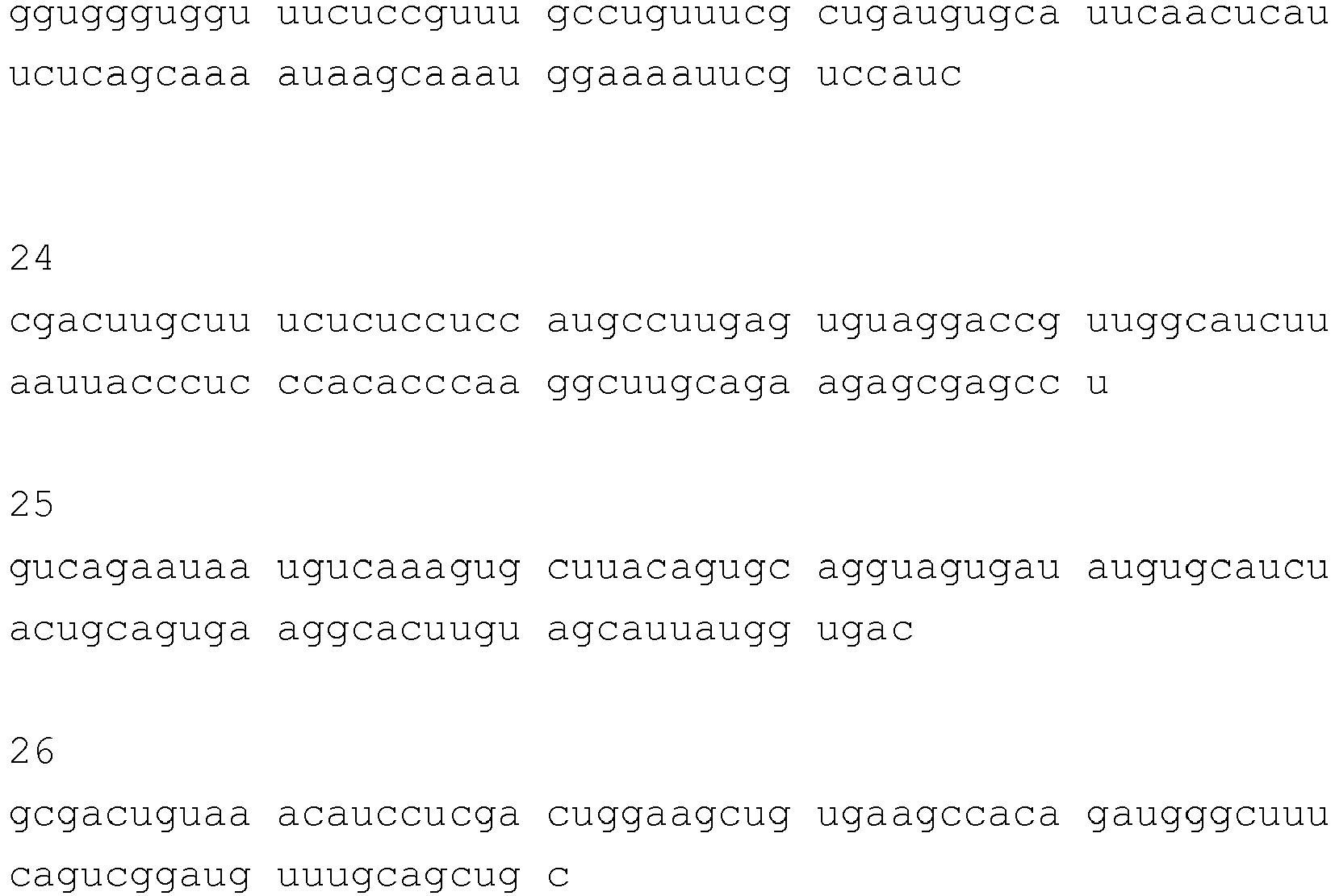
- Gemäß bestimmten Ausführungsformen wird in mindestens 2, 3, 4, 5, 6, oder 7, miRNAs, die eine Sequenz umfassen, die ausgewählt ist aus der Gruppe, bestehend aus hsa-miR-345, hsa-miR-5006, hsa-miR-7848, hsa-miR-6817, hsa-miR-361, hsa-miR-3157 und hsa-miR-4482, und/oder die eine Sequenz umfassen, die von diesen Sequenzen um jeweils bis zu 3 Basen, bevorzugt bis zu 2 Basen, weiter bevorzugt 1 Base abweicht, eine Änderung im Expressionsniveau im Vergleich zu einem Referenzniveau beobachtet. Gemäß bestimmten Ausführungsformen wird in mindestens 2, 3, 4, 5, 6, oder 7, miRNAs, die eine Sequenz umfassen, die ausgewählt ist aus der Gruppe, bestehend aus hsa-miR-345, hsa-miR-5006, hsa-miR-7848, hsa-miR-6817, hsa-miR-361, hsa-miR-3157 und hsa-miR-4482, eine Änderung im Expressionsniveau im Vergleich zu einem Referenzniveau beobachtet.
- Gemäß einem weiteren Aspekt betrifft die Erfindung die Verwendung mindestens einer miRNA, die eine Sequenz umfasst, die ausgewählt ist aus der Gruppe, bestehend aus hsa-miR-345-5p, hsa-miR-5006-3p, hsa-miR-7848-3p, hsa-miR-6817-3p, hsa-miR-361-5p, hsa-miR-3157-3p, und hsa-miR-4482-3p, bevorzugt hsa-miR-345-5p, hsa-miR-5006-3p, hsa-miR-361-5p, und hsa-miR-3157-3p, und/oder die eine Sequenz umfasst, die von diesen Sequenzen um jeweils bis zu 3 Basen, bevorzugt bis zu 2 Basen, weiter bevorzugt 1 Base abweicht, als Marker für die Diagnose von Alzheimer. Gemäß bestimmten Ausführungsformen wird mindestens eine miRNA, die eine Sequenz umfasst, die ausgewählt ist aus der Gruppe, bestehend aus hsa-miR-345-5p, hsa-miR-5006-3p, hsa-miR-7848-3p, hsa-miR-6817-3p, hsa-miR-361-5p, hsa-miR-3157-3p, und hsa-miR-4482-3p, bevorzugt hsa-miR-345-5p, hsa-miR-5006-3p, hsa-miR-361-5p, und hsa-miR-3157-3p, verwendet.
- Gemäß bestimmten Ausführungsformen ist hierbei die miRNA mindestens eine, die eine Sequenz aufweist, die ausgewählt ist aus der Gruppe, bestehend aus hsa-miR-345, hsa-miR-5006, hsa-miR-7848, hsa-miR-6817, hsa-miR-361, hsa-miR-3157 und hsa-miR-4482, bevorzugt hsa-miR-345, hsa-miR-5006, hsa-miR-361, und hsa-miR-3157, und/oder die eine Sequenz aufweist, die von diesen Sequenzen um jeweils bis zu 3 Basen, bevorzugt bis zu 2 Basen, weiter bevorzugt 1 Base abweicht. Gemäß bestimmten Ausführungsformen ist hierbei die miRNA mindestens eine, die eine Sequenz aufweist, die ausgewählt ist aus der Gruppe, bestehend aus hsa-miR-345, hsa-miR-5006, hsa-miR-7848, hsa-miR-6817, hsa-miR-361, hsa-miR-3157 und hsa-miR-4482, bevorzugt hsa-miR-345, hsa-miR-5006, hsa-miR-361, und hsa-miR-3157.
- In einem weiteren Aspekt betrifft die vorliegende Erfindung ein Kit zur Diagnose von Alzheimer in einer Blutprobe eines Patienten, umfassend:
- Sonden und/oder Primer zur Detektion mindestens einer miRNA-Sequenz, die eine Sequenz umfasst, die ausgewählt ist aus der Gruppe, bestehend aus hsa-miR-345-5p, hsa-miR-5006-3p, hsa-miR-7848-3p, hsa-miR-6817-3p, hsa-miR-361-5p, hsa-miR-3157-3p, und hsa-miR-4482-3p, bevorzugt hsa-miR-345-5p, hsa-miR-5006-3p, hsa-miR-361-5p, und hsa-miR-3157-3p, und/oder die eine Sequenz umfasst, die von diesen Sequenzen um jeweils bis zu 3 Basen, bevorzugt bis zu 2 Basen, weiter bevorzugt 1 Base abweicht.
- Gemäß bestimmten Ausführungsformen umfasst das Kit Sonden und/oder Primer zur Detektion mindestens einer miRNA-Sequenz, die eine Sequenz umfasst, die ausgewählt ist aus der Gruppe, bestehend aus hsa-miR-345-5p, hsa-miR-5006-3p, hsa-miR-7848-3p, hsa-miR-6817-3p, hsa-miR-361-5p, hsa-miR-3157-3p, und hsa-miR-4482-3p, bevorzugt hsa-miR-345-5p, hsa-miR-5006-3p, hsa-miR-361-5p, und hsa-miR-3157-3p.
- Gemäß bestimmten Ausführungsformen umfasst das Kit Sonden und/oder Primer zur Detektion mindestens einer miRNA-Sequenz, die eine Sequenz aufweist, die ausgewählt ist aus der Gruppe, bestehend aus hsa-miR-345, hsa-miR-5006, hsa-miR-7848, hsa-miR-6817, hsa-miR-361, hsa-miR-3157 und hsa-miR-4482, bevorzugt hsa-miR-345, hsa-miR-5006, hsa-miR-361, und hsa-miR-3157, und/oder die eine Sequenz aufweist, die von diesen Sequenzen um jeweils bis zu 3 Basen, bevorzugt bis zu 2 Basen, weiter bevorzugt 1 Base abweicht.
- Gemäß bestimmten Ausführungsformen umfasst das Kit Sonden und/oder Primer zur Detektion mindestens einer miRNA-Sequenz, die eine Sequenz aufweist, die ausgewählt ist aus der Gruppe, bestehend aus hsa-miR-345, hsa-miR-5006, hsa-miR-7848, hsa-miR-6817, hsa-miR-361, hsa-miR-3157 und hsa-miR-4482 bevorzugt hsa-miR-345, hsa-miR-5006, hsa-miR-361, und hsa-miR-3157.
- Das erfindungsgemäße Kit kann zudem Sonden und/oder Primer umfassen zur Detektion mindestens einer miRNA-Sequenz, die eine Sequenz umfasst, die ausgewählt ist aus der Gruppe, bestehend aus hsa-miR-28-3p, hsa-miR-151a-3p, hsa-miR-1468-5p, hsa-miR-532-5p, hsa-miR-17-3p, und hsa-miR-30a-3p, und/oder die eine Sequenz umfasst, die von diesen Sequenzen um jeweils bis zu 3 Basen, bevorzugt bis zu 2 Basen, weiter bevorzugt 1 Base abweicht, bevorzugt Sonden und/oder Primer zur Detektion mindestens einer miRNA-Sequenz, die eine Sequenz umfasst, die ausgewählt ist aus der Gruppe, bestehend aus hsa-miR-28-3p, hsa-miR-151a-3p, hsa-miR-1468-5p, hsa-miR-532-5p, hsa-miR-17-3p, und hsa-miR-30a-3p. Das erfindungsgemäße Kit kann insbesondere zudem Sonden und/oder Primer umfassen zur Detektion mindestens einer miRNA-Sequenz, die eine Sequenz aufweist, die ausgewählt ist aus der Gruppe, bestehend aus hsa-miR-28, hsa-miR-151a, hsa-miR-1468, hsa-miR-532, hsa-miR-17 und hsa-miR-30a, und/oder die eine Sequenz aufweist, die von diesen Sequenzen um jeweils bis zu 3 Basen, bevorzugt bis zu 2 Basen, weiter bevorzugt 1 Base abweicht, bevorzugt Sonden und/oder Primer zur Detektion mindestens einer miRNA-Sequenz, die eine Sequenz aufweist, die ausgewählt ist aus der Gruppe, bestehend aus hsa-miR-28, hsa-miR-151a, hsa-miR-1468, hsa-miR-532, hsa-miR-17 und hsa-miR-30a.
- Gemäß bestimmten Ausführungsformen umfasst das Kit Sonden und/oder Primer zur Detektion von 2, 3, 4, 5, 6, 7, 8, 9, 10, 11, 12 oder 13 der obigen Sequenzen.
- Die Sonden und/oder Primer sind hierbei nicht besonders beschränkt und können beispielsweise Oligomere umfassen, welche eine Nukleotidsequenz aufweisen, beispielsweise auch eine cDNA-Sequenz, welche komplementär zur Sequenz ist, die zu detektieren ist.
- Daneben können auch weitere Sonden und/oder Primer als Kontollen vorgesehen sein, beispielsweise von weiteren miRNAs, bei denen keine Änderung des Expressionsprofils im Vergleich zu Patienten ohne AD-Erkrankung auftritt. Auch können Kontrollen für nicht-spezifisches Binden und/oder Hybridisieren vorgesehen sein.
- Die Primer und/oder Sonden sowie ggf. Kontrollen können gemäß bestimmten Ausführungsformen auf ein geeignetes Substrat aufgebracht sein.
- Gemäß bestimmten Ausführungsformen umfasst das Kit weiter Enzyme und/oder Reagenzien zur Durchführung einer RT-PCR, insbesondere qRT-PCR, wobei diese nicht besonders beschränkt sind. Reagenzien können hierbei beispielsweise auch Marker, z.B. zur Fluoreszenzmarkierung und/oder Radionukleotid-Markierung, umfassen. Auch kann das Kit Reagenzien zur cDNA-Synthese aus den miRNAs vor der PCR, bevorzugt qPCR und/oder RT-PCR, insbesondere qRT-PCR, umfassen.
- Die obigen Ausführungsformen, Ausgestaltungen und Weiterbildungen lassen sich, sofern sinnvoll, beliebig miteinander kombinieren. Weitere mögliche Ausgestaltungen, Weiterbildungen und Implementierungen der Erfindung umfassen auch nicht explizit genannte Kombinationen von zuvor oder im Folgenden bezüglich der Ausführungsbeispiele beschriebenen Merkmalen der Erfindung. Insbesondere wird der Fachmann auch Einzelaspekte als Verbesserungen oder Ergänzungen zu der jeweiligen Grundform der vorliegenden Erfindung hinzufügen.
- Die Erfindung wird im Anschluss anhand von beispielhaften Ausführungsformen weiter verdeutlicht, welche die Erfindung jedoch nicht einschränken.
- Im Beispiel wurden Proben von Individuen mittels Hochdurchsatz-Sequenzierung (high throughput sequencing) als unbefangene Technologie untersucht. Es wurde eine blinde multizentrische Fall-Kontroll-Studie (multi-centric case-control study) mit 294 Individuen, welche 107 AD Patienten, 20 MCI Patienten 90 MS Patienten und 77 im Alter und Geschlecht angepasste Kontollen beinhalteten, durchgeführt. Die miRNome - also Gesamtheiten der microRNAs - aller Individuen wurden unter Verwendung von Next-Generation-Sequencing (NGS) auf übliche Weise untersucht. DIE AD-Patienten und Kontrollen teilten sich hierbei in eine erste Kohorte mit 54 AD Patienten und 22 Kontrollen aus den Vereinigten Staaten, die zunächst überprüft wurden, und eine zweite Replikations-Kohorte mit 53 AD Patienten und 55 Kontrollen eines deutschen Universitätsklinikums auf.
- Bei der Durchführung des NGS mit den 294 Individuen wurden in etwa 6 Milliarden kurze RNA-Sequenzen als ausgelesene Werte (reads) erzeugt. Aus den Daten aus den USA und Deutschland wurden eine AD-Gruppe und eine Kontroll-Gruppe profiliert. Es wurden insgesamt 586 miRNAs im Blut gefunden. In der US-Kohorte waren 210 miRNAs in der Expression zwischen den AD- und Kontroll-Proben verändert, und in der deutschen Kohorte 135 miRNAs. In beiden Studien wurde ein signifikanter (p < 0,00001) Überlapp von 69 miRNAs gefunden. Von diesen stimmte die Expressionsrichtung von 96% in beiden Kohorten überein, und die Flächen unter der Kurve (AUC, area under curve) Werte zeigten eine hoch signifikante Korrelation (p < 10-16) von 0,92 (95% Konfidenzintervall (CI) von 0,87-0,95).
- Die hierin gefundenen statistisch signifikanten miRNAs, welche zur Diagnose von Alzheimer herangezogen werden können, sind in Tabelle 3 gegeben.
- Die miRNAs in der Signatur scheinen in der mitochondrialen Dysfunktion durch die potentiellen Ziel- bzw. Target-Gene PARL (p = 0,004) und SLC25A5 (p = 0,002) involviert zu sein.
Tabelle 3: miRNAs mit signifikant unterschiedlichem Expressionsniveau in AD-Patienten im Vergleich zur Kontrollgruppe Reife Form t-Test AD vs. Kontrolle AUC AD vs. Kontrolle hsa-miR-345-5p 3,20E-04 0,33 hsa-miR-5006-3p 1,26E-04 0,36 hsa-miR-7848-3p 2,28E-03 0,40 hsa-miR-6817-3p 1,02E-03 0,42 hsa-miR-361-5p 1,25E-07 0,29 hsa-miR-3157-3p 1,14E-07 0,29 hsa-miR-4482-3p 3,46E-03 0,35 hsa-miR-28-3p 1,70E-10 0,24 hsa-miR-151a-3p 7,13E-11 0,25 hsa-miR-1468-5p 7,11E-08 0,32 hsa-miR-532-5p 6,94E-04 0,65 hsa-miR-17-3p 5,63E-08 0,78 hsa-miR-30a-3p 1,65E-08 0,24 - Weitere gefundene relevante reife miRNA-Sequenzen für die beiden untersuchten Kohorten, die anhand eines Wilcoxon-Mann-Whitney-Tests bestimmt wurden, sind in Tabelle 4 mit den gefundenen Werten aus jeweils einem pro Kohorte durchgeführten Wilcoxon-Mann-Whitney-Test gezeigt.
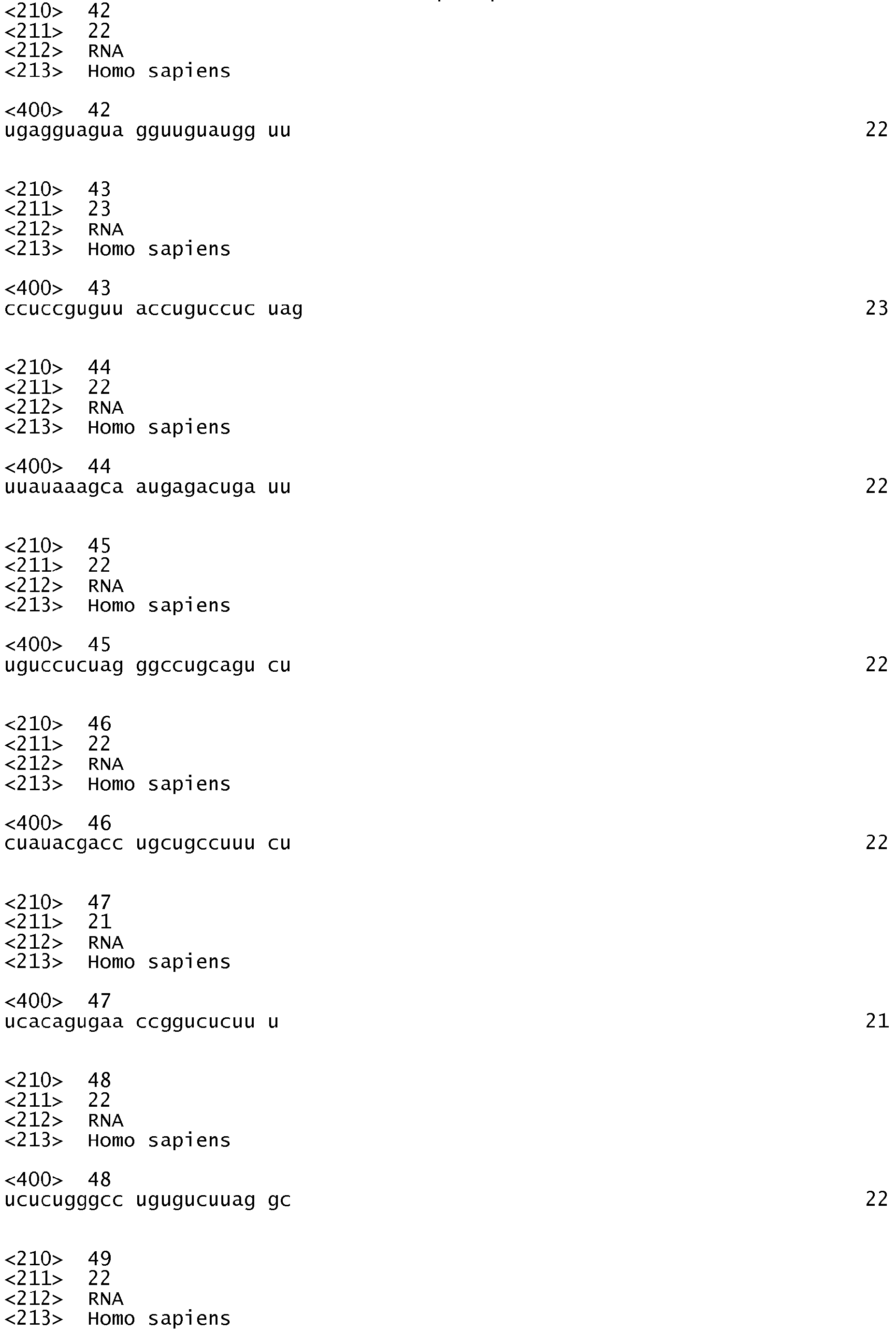
Tabelle 4: miRNAs mit unterschiedlichem Expressionsniveau in AD-Patienten im Vergleich zur Kontrollgruppe anhand der Ergebnisse von Wilcoxon-Mann-Whitney-Tests für die erste und zweite Kohorte miRNA Reife Sequenz SEQ ID NO: Wilcoxon Mann Whitney Test (1.Kohorte) Wilcoxon Mann Whitney Test (2.Kohorte) hsa-miR-17-3p acugcagugaaggcacuuguag 12 1,15E-05 0,00020271 hsa-miR-30a-3p cuuucagucggauguuugcagc 13 0,0035552 4,14E-06 hsa-miR-28-3p cacuagauugugagcuccugga 8 0,00038033 6,33E-06 hsa-miR-30e-3p cuuucagucggauguuuacagc 27 0,0073513 2,34E-06 hsa-miR-151a-3p cuagacugaagcuccuugagg 9 1,70E-07 0,0045649 hsa-miR-4781-3p aauguuggaauccucgcuagag 28 2,44E-06 0,043509 hsa-miR-4508 gcggggcugggcgcgcg 29 0,020063 0,0011682 hsa-miR-361-5p uuaucagaaucuccagggguac 5 3,13E-05 0,00010372 hsa-miR-3157-3p cugcccuagucuagcugaagcu 6 5,74E-06 0,0052611 hsa-miR-33b-5p gugcauugcuguugcauugc 30 9,95E-05 0,0035992 hsa-miR-16-2-3p ccaauauuacugugcugcuuua 31 0,027024 0,00018878 hsa-miR-574-5p ugagugugugugugugagugugu 32 0,025881 0,0046907 hsa-miR-5690 ucagcuacuaccucuauuagg 33 0,0023133 0,0067456 hsa-miR-363-3p aauugcacgguauccaucugua 34 0,0043552 0,0017395 hsa-miR-4746-5p ccggucccaggagaaccugcaga 35 0,018015 0,003912 hsa-let-7b-5p ugagguaguagguugugugguu 36 0,029466 0,0060788 hsa-miR-1468-5p cuccguuugccuguuucgcug 10 0,0041147 0,0019343 hsa-miR-345-5p gcugacuccuaguccagggcuc 1 0,0012034 0,019022 hsa-miR-378d acuggacuuggagucagaaa 37 0,0027945 0,00033694 hsa-miR-378g acugggcuuggagucagaag 38 0,0031832 0,00021093 hsa-miR-221-3p agcuacauugucugcuggguuuc 39 0,004188 0,0068757 hsa-miR-378f acuggacuuggagccagaag 40 0,0024916 0,0023304 hsa-miR-340-3p uccgucucaguuacuuuauagc 41 0,0002208 0,00063591 hsa-let-7c-5p ugagguaguagguuguaugguu 42 8,00E-06 0,0047904 hsa-miR-532-5p caugccuugaguguaggaccgu 11 0,0056523 0,0061427 hsa-miR-3605-3p ccuccguguuaccuguccucuag 43 0,031272 8,42E-06 hsa-miR-340-5p uuauaaagcaaugagacugauu 44 0,00092804 0,0023566 hsa-miR-5006-3p uuucccuuuccauccuggcag 2 0,015025 0,034036 hsa-miR-3909 uguccucuagggccugcagucu 45 0,00072755 0,0072214 hsa-let-7d-3p cuauacgaccugcugccuuucu 46 0,014922 0,00060374 hsa-miR-128-3p ucacagugaaccggucucuuu 47 1,04E-05 0,010414 hsa-miR-330-5p ucucugggccugugucuuaggc 48 7,40E-05 0,00086506 hsa-miR-548e-3p aaaaacugagacuacuuuugca 49 0,0090437 0,036586 hsa-miR-548ad-5p aaaaguaauugugguuuuug 50 0,0047025 0,00040004 hsa-miR-548d-5p aaaaguaauugugguuuuugcc 51 0,0047025 0,00040004 hsa-miR-548ae-5p aaaaguaauugugguuuuug 52 0,0031776 0,0040292 hsa-miR-548ay-5p aaaaguaauugugguuuuugc 53 0,0031776 0,0040292 hsa-miR-107 agcagcauuguacagggcuauca 54 6,13E-05 0,00026867 hsa-miR-106b-5p uaaagugcugacagugcagau 55 0,028274 0,0020005 hsa-miR-548az-5p caaaagugauugugguuuuugc 56 0,0051462 0,0037591 hsa-miR-103a-3p agcagcauuguacagggcuauga 57 0,00017315 0,00048883 hsa-let-7d-5p agagguaguagguugcauaguu 58 0,014163 0,0079347 hsa-miR-190a-5p ugauauguuugauauauuaggu 59 1,61E-05 0,0019051 hsa-miR-3074-5p guuccugcugaacugagccag 60 0,0081401 0,018552 hsa-miR-550a-3p ugucuuacucccucaggcacau 61 0,0066173 0,0034703 hsa-miR-106a-5p aaaagugcuuacagugcagguag 62 0,014462 0,016999 hsa-miR-598-3p uacgucaucguugucaucguca 63 0,0042481 0,0055876 hsa-miR-1294 ugugagguuggcauuguugucu 64 1,88E-05 0,026805 hsa-miR-5010-3p uuuugugucucccauuccccag 65 2,25E-05 0,037426 hsa-let-7i-5p ugagguaguaguuugugcuguu 66 0,00012721 0,042682 hsa-miR-17-5p caaagugcuuacagugcagguag 67 0,039237 0,033477 hsa-miR-660-5p uacccauugcauaucggaguug 68 3,50E-06 0,011728 hsa-miR-6754-3p ucuucaccugccucugccugca 69 0,018408 0,013335 hsa-miR-101-3p uacaguacugugauaacugaa 70 1,06E-06 0,0019576 hsa-let-7e-5p ugagguaggagguuguauaguu 71 8,31E-07 0,0034125 hsa-miR-6842-3p uuggcuggucucugcuccgcag 72 0,0030116 0,0022308 hsa-miR-328-3p cuggcccucucugcccuuccgu 73 0,0087011 0,0018858 hsa-miR-1285-5p gaucucacuuuguugcccagg 74 6,09E-05 0,0048518 hsa-let-7f-5p ugagguaguagauuguauaguu 75 4,82E-09 0,0028229 hsa-let-7a-5p ugagguaguagguuguauaguu 76 1,51E-08 0,004414 hsa-miR-301a-3p cagugcaauaguauugucaaagc 77 0,0018718 0,012808 hsa-miR-3127-3p uccccuucugcaggccugcugg 78 2,04E-05 0,045572 hsa-miR-20a-5p uaaagugcuuauagugcagguag 79 0,025138 0,010058 hsa-miR-6783-3p uuccugggcuucuccucuguag 80 0,029479 0,0093665 hsa-miR-3615 ucucucggcuccucgcggcuc 81 0,016317 0,046337 hsa-miR-98-5p ugagguaguaaguuguauuguu 82 9,18E-07 0,020253 hsa-miR-5001-3p uucugccucuguccagguccuu 83 2,24E-06 0,01183 hsa-let-7g-5p ugagguaguaguuuguacaguu 84 1,81E-07 0,017748 - Zum Abschätzen der Spezifizität der in Beispiel 1 gefundenen miRNAs für Alzheimer wurde weiterhin deren Expressionswert mit denen von MCI- und MS-(Multiple Sklerose)Patienten, die wie in Beispiel 1 gewonnen wurden, verglichen. Die Ergebnisse hierzu sind in Tabelle 5 gezeigt.
Tabelle 5: miRNAs mit signifikant unterschiedlichem Expressionsniveau in AD-Patienten im Vergleich zu MCI- und MS-Patienten Reife Form t-Test AD vs. MCI AUC AD vs. MCI t-Test AD vs. MS AUC AD vs. MS hsa-miR-345-5p 4,96E-02 0,38 6,83E-04 0,39 hsa-miR-5006-3p 2,88E-02 0,32 1,16E-02 0,37 hsa-miR-7848-3p 8, 76E-01 0,44 1,81E-06 0,27 hsa-miR-6817-3p 5, 03E-01 0,40 3,98E-10 0,28 hsa-miR-361-5p 3,81E-02 0,28 3,93E-04 0,36 hsa-miR-3157-3p 1,74E-02 0,29 5,17E-13 0,21 hsa-miR-4482-3p 8,30E-02 0,38 4,83E-03 0,37 hsa-miR-28-3p 3, 56E-01 0,44 1,24E-06 0,32 hsa-miR-151a-3p 5, 87E-01 0,44 1,29E-15 0,20 hsa-miR-1468-5p 7,11E-02 0,39 8,61E-17 0,14 hsa-miR-532-5p 5,89E-03 0,71 4,37E-21 0,87 hsa-miR-17-3p 2,59E-01 0,59 1,23E-16 0, 82 hsa-miR-30a-3p 5,84E-01 0,58 6,06E-03 0,44 - Während die signifikantesten AD-miRNAs aus dem Panel aus Beispiel 1 auch dys-reguliert zwischen MS und AD waren, waren MCI-Patienten ähnlicher zu AD-Patienten.
- Da dasselbe Panel an miRNAs auch zwischen MCI, MS und AD unterscheiden kann, kann gefolgert werden, dass die miRNAs in der gefundenen Signatur spezifisch für Alzheimer sind und entsprechend für eine frühe Detektion bzw. Diagnose der Erkrankung verwendet werden können.




Claims (12)
- Verfahren zur Diagnose von Alzheimer in einem Patienten, umfassend:Bereitstellen einer Blutprobe eines Patienten,Erstellen eines Expressionsprofils von miRNAs aus der Blutprobe, undVergleich des Expressionsniveaus mindestens einer miRNA, die eine Sequenz umfasst, die ausgewählt ist aus der Gruppe, bestehend aus hsa-miR-345-5p, hsa-miR-5006-3p, hsa-miR-7848-3p, hsa-miR-6817-3p, hsa-miR-361-5p, hsa-miR-3157-3p, und hsa-miR-4482-3p, und/oder die eine Sequenz umfasst, die von diesen Sequenzen um jeweils bis zu 3 Basen, bevorzugt bis zu 2 Basen, weiter bevorzugt 1 Base abweicht, mit einem Referenzniveau, wobei der Vergleich die Diagnose einer Erkrankung mit Alzheimer ermöglicht.
- Verfahren nach Anspruch 1, wobei zudem das Expressionsniveau mindestens einer miRNA, die eine Sequenz umfasst, die ausgewählt ist aus der Gruppe, bestehend aus hsa-miR-28-3p, hsa-miR-151a-3p, hsa-miR-1468-5p, hsa-miR-532-5p, hsa-miR-17-3p, und hsa-miR-30a-3p, und/oder die eine Sequenz umfasst, die von diesen Sequenzen um jeweils bis zu 3 Basen, bevorzugt bis zu 2 Basen, weiter bevorzugt 1 Base abweicht, mit einem Referenzniveau verglichen wird, wobei der Vergleich die Diagnose einer Erkrankung mit Alzheimer ermöglicht.
- Verfahren nach Anspruch 1 oder 2, wobei der Patient ein Mensch ist.
- Verfahren nach einem der vorigen Ansprüche, wobei in mindestens 2, 3, 4, 5, 6, 7, 8, 9, 10, 11, 12 oder 13 miRNAs, die eine Sequenz umfassen, die ausgewählt ist aus der Gruppe, bestehend aus hsa-miR-345-5p, hsa-miR-5006-3p, hsa-miR-7848-3p, hsa-miR-6817-3p, hsa-miR-361-5p, hsa-miR-3157-3p, hsa-miR-4482-3p, hsa-miR-28-3p, hsa-miR-151a-3p, hsa-miR-1468-5p, hsa-miR-532-5p, hsa-miR-17-3p, und hsa-miR-30a-3p, und/oder die eine Sequenz umfassen, die von diesen Sequenzen um jeweils bis zu 3 Basen, bevorzugt bis zu 2 Basen, weiter bevorzugt 1 Base abweicht, eine Änderung im Expressionsniveau im Vergleich zu einem Referenzniveau beobachtet wird.
- Verfahren nach einem der vorigen Ansprüche, wobei die miRNA mindestens eine ist, die ausgewählt ist aus der Gruppe, bestehend aus hsa-miR-345, hsa-miR-5006, hsa-miR-7848, hsa-miR-6817, hsa-miR-361, hsa-miR-3157 und hsa-miR-4482.
- Verfahren nach einem der Ansprüche 2 bis 5, wobei zudem das Expressionsniveau mindestens einer miRNA bestimmt wird, die ausgewählt ist aus der Gruppe, bestehend aus hsa-miR-28, hsa-miR-151a, hsa-miR-1468, hsa-miR-532, hsa-miR-17 und hsa-miR-30a.
- Verfahren nach einem der vorigen Ansprüche, wobei die Erstellung des Expressionsprofils eine Nukleinsäurehybridisierung, eine Nukleinsäureamplifikation, eine Polymeraseextension, eine Sequenzierung, eine Massenspektrometrie, oder jegliche Kombination davon umfasst.
- Verwendung einer miRNA, die eine Sequenz umfasst, die ausgewählt ist aus der Gruppe, bestehend aus hsa-miR-345-5p, hsa-miR-5006-3p, hsa-miR-7848-3p, hsa-miR-6817-3p, hsa-miR-361-5p, hsa-miR-3157-3p, und hsa-miR-4482-3p, und/oder die eine Sequenz umfasst, die von diesen Sequenzen um jeweils bis zu 3 Basen, bevorzugt bis zu 2 Basen, weiter bevorzugt 1 Base abweicht, als Marker für die Diagnose von Alzheimer.
- Verwendung nach Anspruch 8, wobei die miRNA mindestens eine ist, die ausgewählt ist aus der Gruppe, bestehend aus hsa-miR-345, hsa-miR-5006, hsa-miR-7848, hsa-miR-6817, hsa-miR-361, hsa-miR-3157 und hsa-miR-4482.
- Kit zur Diagnose von Alzheimer in einer Blutprobe eines Patienten, umfassend:Sonden und/oder Primer zur Detektion mindestens einer miRNA-Sequenz, die eine Sequenz umfasst, die ausgewählt ist aus der Gruppe, bestehend aus hsa-miR-345-5p, hsa-miR-5006-3p, hsa-miR-7848-3p, hsa-miR-6817-3p, hsa-miR-361-5p, hsa-miR-3157-3p, und hsa-miR-4482-3p, und/oder die eine Sequenz umfasst, die von diesen Sequenzen um jeweils bis zu 3 Basen, bevorzugt bis zu 2 Basen, weiter bevorzugt 1 Base abweicht.
- Kit nach Anspruch 10, weiter umfassend Sonden und/oder Primer zur Detektion mindestens einer miRNA-Sequenz, die eine Sequenz umfasst, die ausgewählt ist aus der Gruppe, bestehend aus hsa-miR-28-3p, hsa-miR-151a-3p, hsa-miR-1468-5p, hsa-miR-532-5p, hsa-miR-17-3p, und hsa-miR-30a-3p, und/oder die eine Sequenz umfasst, die von diesen Sequenzen um jeweils bis zu 3 Basen, bevorzugt bis zu 2 Basen, weiter bevorzugt 1 Base abweicht.
- Kit nach Anspruch 10 oder 11, weiter umfassend Enzyme und/oder Reagenzien zur Durchführung einer RT-PCR.
Priority Applications (5)
| Application Number | Priority Date | Filing Date | Title |
|---|---|---|---|
| EP15201815.6A EP3184646B1 (de) | 2015-12-22 | 2015-12-22 | Spezifische signaturen in alzheimer durch multizentrische mirna-profile |
| ES15201815T ES2734678T3 (es) | 2015-12-22 | 2015-12-22 | Firmas específicas en enfermedad de alzheimer por perfiles de miarn multicéntricos |
| CN201680081938.8A CN108884492A (zh) | 2015-12-22 | 2016-12-14 | 借助多中心mirna谱的阿尔茨海默病中的特定标记 |
| US16/061,755 US20180371548A1 (en) | 2015-12-22 | 2016-12-14 | Specific signatures in alzheimer's disease by multicenter micro-rna profiles |
| PCT/EP2016/081009 WO2017108535A1 (de) | 2015-12-22 | 2016-12-14 | Spezifische signaturen in alzheimer durch multizentrische mirna-profile |
Applications Claiming Priority (1)
| Application Number | Priority Date | Filing Date | Title |
|---|---|---|---|
| EP15201815.6A EP3184646B1 (de) | 2015-12-22 | 2015-12-22 | Spezifische signaturen in alzheimer durch multizentrische mirna-profile |
Publications (2)
| Publication Number | Publication Date |
|---|---|
| EP3184646A1 true EP3184646A1 (de) | 2017-06-28 |
| EP3184646B1 EP3184646B1 (de) | 2019-04-17 |
Family
ID=55070738
Family Applications (1)
| Application Number | Title | Priority Date | Filing Date |
|---|---|---|---|
| EP15201815.6A Not-in-force EP3184646B1 (de) | 2015-12-22 | 2015-12-22 | Spezifische signaturen in alzheimer durch multizentrische mirna-profile |
Country Status (5)
| Country | Link |
|---|---|
| US (1) | US20180371548A1 (de) |
| EP (1) | EP3184646B1 (de) |
| CN (1) | CN108884492A (de) |
| ES (1) | ES2734678T3 (de) |
| WO (1) | WO2017108535A1 (de) |
Cited By (3)
| Publication number | Priority date | Publication date | Assignee | Title |
|---|---|---|---|---|
| WO2019048500A1 (en) * | 2017-09-05 | 2019-03-14 | Amoneta Diagnostics | NON-CODING RNA (RNANC) FOR THE DIAGNOSIS OF COGNITIVE DISORDERS |
| CN115245521A (zh) * | 2021-04-28 | 2022-10-28 | 西比曼生物科技(上海)有限公司 | 含有干细胞胞外囊泡的滴鼻剂及其在治疗脑神经血管疾病中的应用 |
| WO2025011736A1 (en) | 2023-07-07 | 2025-01-16 | Genxpro Gmbh | A METHOD FOR AN IN VITRO DIAGNOSIS, PROGNOSIS, STAGING AND/OR TREATMENT MONITORING OF A NEURODEGENERATIVE DISEASE, NEUROLOGICAL DISEASE OR AMYLOID β-RELATED DISEASE |
Families Citing this family (4)
| Publication number | Priority date | Publication date | Assignee | Title |
|---|---|---|---|---|
| WO2019081497A1 (en) * | 2017-10-25 | 2019-05-02 | Hummingbird Diagnostics Gmbh | MIARN AS BIOMARKERS OF ALZHEIMER'S DISEASE |
| CN111624179A (zh) * | 2020-05-11 | 2020-09-04 | 深圳大学 | 荧光检测体系、荧光生物传感器及其用途 |
| CN111521592A (zh) * | 2020-05-11 | 2020-08-11 | 深圳大学 | 一种信号放大的荧光检测体系、荧光生物传感器及其用途 |
| CN116024328A (zh) * | 2022-09-13 | 2023-04-28 | 上海近则生物科技有限责任公司 | 外泌体中miRNA在制备神经退行性疾病鉴别诊断及早筛试剂盒中的用途 |
Citations (3)
| Publication number | Priority date | Publication date | Assignee | Title |
|---|---|---|---|---|
| WO2009009457A1 (en) * | 2007-07-06 | 2009-01-15 | University Of Louisville Research Foundation, Inc. | Alzheimer's disease-specific micro-rna microarray and related methods |
| WO2013003350A2 (en) * | 2011-06-27 | 2013-01-03 | Eisai R&D Management Co., Ltd. | Microrna biomarkers indicative of alzheimer's disease |
| EP2733220A1 (de) * | 2012-11-16 | 2014-05-21 | Siemens Aktiengesellschaft | Neuartige miRNA als Diagnosemarker |
Family Cites Families (6)
| Publication number | Priority date | Publication date | Assignee | Title |
|---|---|---|---|---|
| WO2008153692A2 (en) * | 2007-05-22 | 2008-12-18 | The Brigham And Women's Hospital, Inc. | Microrna expression profiling of cerebrospinal fluid |
| ES2597554T3 (es) * | 2009-11-04 | 2017-01-19 | Diamir, Llc | Métodos de utilización de micro-ARN de fluidos corporales para el diagnóstico y control del deterioro cognitivo leve |
| EP2699666B1 (de) * | 2011-04-18 | 2016-10-05 | DiamiR, LLC | Universeller screening-test auf mirna-basis |
| WO2013022953A2 (en) * | 2011-08-08 | 2013-02-14 | Eugenia Wang | Biomarker for alzheimer's disease and/or mild cognitively impairment, and use thereof |
| FR2986538B1 (fr) * | 2012-02-06 | 2016-03-11 | Centre Nat Rech Scient | Utilisation du mir-199a-5p de ses cibles et/ou inhibiteurs pour le diagnostic, le pronostic et le traitement des pathologies fibroproliferatives |
| EP2733219B1 (de) * | 2012-11-16 | 2017-09-20 | Siemens Aktiengesellschaft | Diagnostische mRNA-Marker für Alzheimer |
-
2015
- 2015-12-22 ES ES15201815T patent/ES2734678T3/es active Active
- 2015-12-22 EP EP15201815.6A patent/EP3184646B1/de not_active Not-in-force
-
2016
- 2016-12-14 US US16/061,755 patent/US20180371548A1/en not_active Abandoned
- 2016-12-14 CN CN201680081938.8A patent/CN108884492A/zh active Pending
- 2016-12-14 WO PCT/EP2016/081009 patent/WO2017108535A1/de not_active Ceased
Patent Citations (3)
| Publication number | Priority date | Publication date | Assignee | Title |
|---|---|---|---|---|
| WO2009009457A1 (en) * | 2007-07-06 | 2009-01-15 | University Of Louisville Research Foundation, Inc. | Alzheimer's disease-specific micro-rna microarray and related methods |
| WO2013003350A2 (en) * | 2011-06-27 | 2013-01-03 | Eisai R&D Management Co., Ltd. | Microrna biomarkers indicative of alzheimer's disease |
| EP2733220A1 (de) * | 2012-11-16 | 2014-05-21 | Siemens Aktiengesellschaft | Neuartige miRNA als Diagnosemarker |
Non-Patent Citations (3)
| Title |
|---|
| H. GEEKIYANAGE; G.A. JICHA; P.T. NELSON; C. CHAN: "Blood serum miRNA: Noninvasive biomarkers for Alzheimer's disease", EXP NEUROL., vol. 235, no. 2, 2012, pages 491 - 496, XP055058220, DOI: doi:10.1016/j.expneurol.2011.11.026 |
| HIROSHA GEEKIYANAGE ET AL: "Blood serum miRNA: Non-invasive biomarkers for Alzheimer's disease", EXPERIMENTAL NEUROLOGY, vol. 235, no. 2, 1 June 2012 (2012-06-01), pages 491 - 496, XP055058220, ISSN: 0014-4886, DOI: 10.1016/j.expneurol.2011.11.026 * |
| HUI DONG ET AL: "Serum MicroRNA Profiles Serve as Novel Biomarkers for the Diagnosis of Alzheimer's Disease", DISEASE MARKERS., vol. 14, no. 1, 20 May 2015 (2015-05-20), GB, pages 27 - 11, XP055274672, ISSN: 0278-0240, DOI: 10.1159/000343452 * |
Cited By (5)
| Publication number | Priority date | Publication date | Assignee | Title |
|---|---|---|---|---|
| WO2019048500A1 (en) * | 2017-09-05 | 2019-03-14 | Amoneta Diagnostics | NON-CODING RNA (RNANC) FOR THE DIAGNOSIS OF COGNITIVE DISORDERS |
| US11718879B2 (en) | 2017-09-05 | 2023-08-08 | Amoneta Diagnostics | Non-coding RNAS (NCRNA) for the diagnosis of cognitive disorders |
| EP3679157B1 (de) * | 2017-09-05 | 2024-12-18 | Amoneta Diagnostics | Nichtcodierende rnas (ncrna) zur diagnose von kognitiven störungen |
| CN115245521A (zh) * | 2021-04-28 | 2022-10-28 | 西比曼生物科技(上海)有限公司 | 含有干细胞胞外囊泡的滴鼻剂及其在治疗脑神经血管疾病中的应用 |
| WO2025011736A1 (en) | 2023-07-07 | 2025-01-16 | Genxpro Gmbh | A METHOD FOR AN IN VITRO DIAGNOSIS, PROGNOSIS, STAGING AND/OR TREATMENT MONITORING OF A NEURODEGENERATIVE DISEASE, NEUROLOGICAL DISEASE OR AMYLOID β-RELATED DISEASE |
Also Published As
| Publication number | Publication date |
|---|---|
| ES2734678T3 (es) | 2019-12-11 |
| US20180371548A1 (en) | 2018-12-27 |
| WO2017108535A1 (de) | 2017-06-29 |
| CN108884492A (zh) | 2018-11-23 |
| EP3184646B1 (de) | 2019-04-17 |
Similar Documents
| Publication | Publication Date | Title |
|---|---|---|
| EP3184646B1 (de) | Spezifische signaturen in alzheimer durch multizentrische mirna-profile | |
| DE102012101557A1 (de) | Verwendung von microRNAs oder Genen als Marker zur Identifizierung, Diagnose und Therapie einzelner nicht-ischämischer Kardiomyopathien oder Speichererkrankungen des Herzens | |
| DE102015216782B3 (de) | Verwendung von im Blutserum oder Blutplasma zirkulierenden microRNAs zur Identifikation biopsiepflichtiger Patienten und als Marker zur Differentialdiagnose einzelner nicht-ischämischer Kardiomyopathien oder Speichererkrankungen des Herzens | |
| JP2012523009A5 (de) | ||
| Deschauer et al. | A novel Twinkle gene mutation in autosomal dominant progressive external ophthalmoplegia | |
| DE102007036678B4 (de) | Verwendung von Polynukleotiden zur Erfassung von Genaktivitäten für die Unterscheidung zwischen lokaler und systemischer Infektion | |
| DE69121975T2 (de) | Spezifischer Nachweis von Mycobacterium Tuberculosis | |
| Wilson et al. | Neurodegenerative disease and cognitive retest learning | |
| DE102013109065B4 (de) | Anordnung zum schnellen Diagnostizieren der Tuberkulose und zum Testen der pharmazeutischen Wirkung | |
| DE102007015775A1 (de) | Verfahren zum Nachweis von Paratuberkolose | |
| CN108300788B (zh) | 一种用于检测轻型脑外伤的微小核糖核酸组合及其应用 | |
| DE102017125150B4 (de) | Endosialin (CD248) als epigenetischer Marker zur Identifizierung von Immunzellen, insbesondere naïver CD8+ T-Zellen | |
| DE112015004935B4 (de) | Primersatz zum Nachweis der 8bp-Deletion-Mutation in Exon 3 des 21-Hydroxylase(CYP 21)-Gens und Verfahren hierfür | |
| DE102020111423B4 (de) | MYH11/NDE1 Region als epigenetischer Marker für die Identifizierung von Endothel-Vorläuferzellen (EPCs) | |
| DE102015216521B3 (de) | Verwendung spezifischer Gene zur diagnostischen Abgrenzung einer eosinophilen Myokarditis von anderen fulminanten entzündlichen Herzmuskelerkrankungen | |
| WO2017108491A1 (de) | Diagnostische mirna signaturen in ms und cis patienten | |
| EP2467496A1 (de) | Verfahren zur bestimmung des metastasierungsrisikos als indikator für eine bildgebende diagnostik | |
| DE102012110469A1 (de) | Verfahren zur geschlechtsunabhängigen Bestimmung von Alterung | |
| EP0991780A2 (de) | Verfahren und testkit zum nachweis bösartiger tumore | |
| WO2004083459A1 (de) | Verfahren und kit zum spezifischen nachweis von m. tuberculosis | |
| WO2001036670A2 (de) | Diagnose-kit, verfahren und mikroarray zur bestimmung der menschlichen entgiftungsfähigkeit | |
| Thomas-Odenthal et al. | Neuropsychopharmakologie und Pharmakopsychiatrie (AGNP) e. V. and Deutsche Gesellschaft für Biologische Psychiatrie (DGBP) e. V. | |
| WO2025003527A1 (de) | Markersequenzen zur diagnose und therapiesteuerung von patienten mit testosteron-defizienz | |
| EP4090765A1 (de) | Verfahren zur bestimmung der allelfrequenz / mutationsrate und diagnostik | |
| DE102007036404A1 (de) | Nachweis der Platinresistenz |
Legal Events
| Date | Code | Title | Description |
|---|---|---|---|
| PUAI | Public reference made under article 153(3) epc to a published international application that has entered the european phase |
Free format text: ORIGINAL CODE: 0009012 |
|
| STAA | Information on the status of an ep patent application or granted ep patent |
Free format text: STATUS: THE APPLICATION HAS BEEN PUBLISHED |
|
| AK | Designated contracting states |
Kind code of ref document: A1 Designated state(s): AL AT BE BG CH CY CZ DE DK EE ES FI FR GB GR HR HU IE IS IT LI LT LU LV MC MK MT NL NO PL PT RO RS SE SI SK SM TR |
|
| AX | Request for extension of the european patent |
Extension state: BA ME |
|
| RAP1 | Party data changed (applicant data changed or rights of an application transferred) |
Owner name: SIEMENS AKTIENGESELLSCHAFT |
|
| RAP1 | Party data changed (applicant data changed or rights of an application transferred) |
Owner name: SIEMENS AKTIENGESELLSCHAFT |
|
| STAA | Information on the status of an ep patent application or granted ep patent |
Free format text: STATUS: REQUEST FOR EXAMINATION WAS MADE |
|
| 17P | Request for examination filed |
Effective date: 20171220 |
|
| RBV | Designated contracting states (corrected) |
Designated state(s): AL AT BE BG CH CY CZ DE DK EE ES FI FR GB GR HR HU IE IS IT LI LT LU LV MC MK MT NL NO PL PT RO RS SE SI SK SM TR |
|
| STAA | Information on the status of an ep patent application or granted ep patent |
Free format text: STATUS: EXAMINATION IS IN PROGRESS |
|
| 17Q | First examination report despatched |
Effective date: 20180201 |
|
| REG | Reference to a national code |
Ref country code: DE Ref legal event code: R079 Ref document number: 502015008716 Country of ref document: DE Free format text: PREVIOUS MAIN CLASS: C12Q0001680000 Ipc: C12Q0001688300 |
|
| GRAP | Despatch of communication of intention to grant a patent |
Free format text: ORIGINAL CODE: EPIDOSNIGR1 |
|
| STAA | Information on the status of an ep patent application or granted ep patent |
Free format text: STATUS: GRANT OF PATENT IS INTENDED |
|
| RIC1 | Information provided on ipc code assigned before grant |
Ipc: C12Q 1/6883 20170628AFI20181019BHEP |
|
| INTG | Intention to grant announced |
Effective date: 20181127 |
|
| RIC1 | Information provided on ipc code assigned before grant |
Ipc: C12Q 1/6883 20180101AFI20181019BHEP |
|
| RIC1 | Information provided on ipc code assigned before grant |
Ipc: C12Q 1/6883 20180101AFI20181019BHEP |
|
| GRAS | Grant fee paid |
Free format text: ORIGINAL CODE: EPIDOSNIGR3 |
|
| GRAA | (expected) grant |
Free format text: ORIGINAL CODE: 0009210 |
|
| STAA | Information on the status of an ep patent application or granted ep patent |
Free format text: STATUS: THE PATENT HAS BEEN GRANTED |
|
| AK | Designated contracting states |
Kind code of ref document: B1 Designated state(s): AL AT BE BG CH CY CZ DE DK EE ES FI FR GB GR HR HU IE IS IT LI LT LU LV MC MK MT NL NO PL PT RO RS SE SI SK SM TR |
|
| REG | Reference to a national code |
Ref country code: GB Ref legal event code: FG4D Free format text: NOT ENGLISH |
|
| REG | Reference to a national code |
Ref country code: CH Ref legal event code: EP |
|
| REG | Reference to a national code |
Ref country code: DE Ref legal event code: R096 Ref document number: 502015008716 Country of ref document: DE |
|
| REG | Reference to a national code |
Ref country code: AT Ref legal event code: REF Ref document number: 1121598 Country of ref document: AT Kind code of ref document: T Effective date: 20190515 Ref country code: IE Ref legal event code: FG4D Free format text: LANGUAGE OF EP DOCUMENT: GERMAN |
|
| REG | Reference to a national code |
Ref country code: NL Ref legal event code: MP Effective date: 20190417 |
|
| REG | Reference to a national code |
Ref country code: LT Ref legal event code: MG4D |
|
| PG25 | Lapsed in a contracting state [announced via postgrant information from national office to epo] |
Ref country code: NL Free format text: LAPSE BECAUSE OF FAILURE TO SUBMIT A TRANSLATION OF THE DESCRIPTION OR TO PAY THE FEE WITHIN THE PRESCRIBED TIME-LIMIT Effective date: 20190417 |
|
| PG25 | Lapsed in a contracting state [announced via postgrant information from national office to epo] |
Ref country code: AL Free format text: LAPSE BECAUSE OF FAILURE TO SUBMIT A TRANSLATION OF THE DESCRIPTION OR TO PAY THE FEE WITHIN THE PRESCRIBED TIME-LIMIT Effective date: 20190417 Ref country code: PT Free format text: LAPSE BECAUSE OF FAILURE TO SUBMIT A TRANSLATION OF THE DESCRIPTION OR TO PAY THE FEE WITHIN THE PRESCRIBED TIME-LIMIT Effective date: 20190817 Ref country code: HR Free format text: LAPSE BECAUSE OF FAILURE TO SUBMIT A TRANSLATION OF THE DESCRIPTION OR TO PAY THE FEE WITHIN THE PRESCRIBED TIME-LIMIT Effective date: 20190417 Ref country code: LT Free format text: LAPSE BECAUSE OF FAILURE TO SUBMIT A TRANSLATION OF THE DESCRIPTION OR TO PAY THE FEE WITHIN THE PRESCRIBED TIME-LIMIT Effective date: 20190417 Ref country code: NO Free format text: LAPSE BECAUSE OF FAILURE TO SUBMIT A TRANSLATION OF THE DESCRIPTION OR TO PAY THE FEE WITHIN THE PRESCRIBED TIME-LIMIT Effective date: 20190717 Ref country code: SE Free format text: LAPSE BECAUSE OF FAILURE TO SUBMIT A TRANSLATION OF THE DESCRIPTION OR TO PAY THE FEE WITHIN THE PRESCRIBED TIME-LIMIT Effective date: 20190417 Ref country code: FI Free format text: LAPSE BECAUSE OF FAILURE TO SUBMIT A TRANSLATION OF THE DESCRIPTION OR TO PAY THE FEE WITHIN THE PRESCRIBED TIME-LIMIT Effective date: 20190417 |
|
| PG25 | Lapsed in a contracting state [announced via postgrant information from national office to epo] |
Ref country code: RS Free format text: LAPSE BECAUSE OF FAILURE TO SUBMIT A TRANSLATION OF THE DESCRIPTION OR TO PAY THE FEE WITHIN THE PRESCRIBED TIME-LIMIT Effective date: 20190417 Ref country code: PL Free format text: LAPSE BECAUSE OF FAILURE TO SUBMIT A TRANSLATION OF THE DESCRIPTION OR TO PAY THE FEE WITHIN THE PRESCRIBED TIME-LIMIT Effective date: 20190417 Ref country code: GR Free format text: LAPSE BECAUSE OF FAILURE TO SUBMIT A TRANSLATION OF THE DESCRIPTION OR TO PAY THE FEE WITHIN THE PRESCRIBED TIME-LIMIT Effective date: 20190718 Ref country code: LV Free format text: LAPSE BECAUSE OF FAILURE TO SUBMIT A TRANSLATION OF THE DESCRIPTION OR TO PAY THE FEE WITHIN THE PRESCRIBED TIME-LIMIT Effective date: 20190417 Ref country code: BG Free format text: LAPSE BECAUSE OF FAILURE TO SUBMIT A TRANSLATION OF THE DESCRIPTION OR TO PAY THE FEE WITHIN THE PRESCRIBED TIME-LIMIT Effective date: 20190717 |
|
| REG | Reference to a national code |
Ref country code: ES Ref legal event code: FG2A Ref document number: 2734678 Country of ref document: ES Kind code of ref document: T3 Effective date: 20191211 |
|
| PG25 | Lapsed in a contracting state [announced via postgrant information from national office to epo] |
Ref country code: IS Free format text: LAPSE BECAUSE OF FAILURE TO SUBMIT A TRANSLATION OF THE DESCRIPTION OR TO PAY THE FEE WITHIN THE PRESCRIBED TIME-LIMIT Effective date: 20190817 |
|
| REG | Reference to a national code |
Ref country code: DE Ref legal event code: R097 Ref document number: 502015008716 Country of ref document: DE |
|
| PG25 | Lapsed in a contracting state [announced via postgrant information from national office to epo] |
Ref country code: SK Free format text: LAPSE BECAUSE OF FAILURE TO SUBMIT A TRANSLATION OF THE DESCRIPTION OR TO PAY THE FEE WITHIN THE PRESCRIBED TIME-LIMIT Effective date: 20190417 Ref country code: RO Free format text: LAPSE BECAUSE OF FAILURE TO SUBMIT A TRANSLATION OF THE DESCRIPTION OR TO PAY THE FEE WITHIN THE PRESCRIBED TIME-LIMIT Effective date: 20190417 Ref country code: CZ Free format text: LAPSE BECAUSE OF FAILURE TO SUBMIT A TRANSLATION OF THE DESCRIPTION OR TO PAY THE FEE WITHIN THE PRESCRIBED TIME-LIMIT Effective date: 20190417 Ref country code: DK Free format text: LAPSE BECAUSE OF FAILURE TO SUBMIT A TRANSLATION OF THE DESCRIPTION OR TO PAY THE FEE WITHIN THE PRESCRIBED TIME-LIMIT Effective date: 20190417 Ref country code: EE Free format text: LAPSE BECAUSE OF FAILURE TO SUBMIT A TRANSLATION OF THE DESCRIPTION OR TO PAY THE FEE WITHIN THE PRESCRIBED TIME-LIMIT Effective date: 20190417 |
|
| PLBE | No opposition filed within time limit |
Free format text: ORIGINAL CODE: 0009261 |
|
| STAA | Information on the status of an ep patent application or granted ep patent |
Free format text: STATUS: NO OPPOSITION FILED WITHIN TIME LIMIT |
|
| PG25 | Lapsed in a contracting state [announced via postgrant information from national office to epo] |
Ref country code: SM Free format text: LAPSE BECAUSE OF FAILURE TO SUBMIT A TRANSLATION OF THE DESCRIPTION OR TO PAY THE FEE WITHIN THE PRESCRIBED TIME-LIMIT Effective date: 20190417 Ref country code: IT Free format text: LAPSE BECAUSE OF FAILURE TO SUBMIT A TRANSLATION OF THE DESCRIPTION OR TO PAY THE FEE WITHIN THE PRESCRIBED TIME-LIMIT Effective date: 20190417 |
|
| 26N | No opposition filed |
Effective date: 20200120 |
|
| PG25 | Lapsed in a contracting state [announced via postgrant information from national office to epo] |
Ref country code: TR Free format text: LAPSE BECAUSE OF FAILURE TO SUBMIT A TRANSLATION OF THE DESCRIPTION OR TO PAY THE FEE WITHIN THE PRESCRIBED TIME-LIMIT Effective date: 20190417 |
|
| PG25 | Lapsed in a contracting state [announced via postgrant information from national office to epo] |
Ref country code: SI Free format text: LAPSE BECAUSE OF FAILURE TO SUBMIT A TRANSLATION OF THE DESCRIPTION OR TO PAY THE FEE WITHIN THE PRESCRIBED TIME-LIMIT Effective date: 20190417 |
|
| REG | Reference to a national code |
Ref country code: CH Ref legal event code: PL |
|
| REG | Reference to a national code |
Ref country code: BE Ref legal event code: MM Effective date: 20191231 |
|
| PG25 | Lapsed in a contracting state [announced via postgrant information from national office to epo] |
Ref country code: MC Free format text: LAPSE BECAUSE OF FAILURE TO SUBMIT A TRANSLATION OF THE DESCRIPTION OR TO PAY THE FEE WITHIN THE PRESCRIBED TIME-LIMIT Effective date: 20190417 |
|
| PG25 | Lapsed in a contracting state [announced via postgrant information from national office to epo] |
Ref country code: IE Free format text: LAPSE BECAUSE OF NON-PAYMENT OF DUE FEES Effective date: 20191222 Ref country code: LU Free format text: LAPSE BECAUSE OF NON-PAYMENT OF DUE FEES Effective date: 20191222 |
|
| PG25 | Lapsed in a contracting state [announced via postgrant information from national office to epo] |
Ref country code: CH Free format text: LAPSE BECAUSE OF NON-PAYMENT OF DUE FEES Effective date: 20191231 Ref country code: LI Free format text: LAPSE BECAUSE OF NON-PAYMENT OF DUE FEES Effective date: 20191231 Ref country code: BE Free format text: LAPSE BECAUSE OF NON-PAYMENT OF DUE FEES Effective date: 20191231 |
|
| PG25 | Lapsed in a contracting state [announced via postgrant information from national office to epo] |
Ref country code: CY Free format text: LAPSE BECAUSE OF FAILURE TO SUBMIT A TRANSLATION OF THE DESCRIPTION OR TO PAY THE FEE WITHIN THE PRESCRIBED TIME-LIMIT Effective date: 20190417 |
|
| PG25 | Lapsed in a contracting state [announced via postgrant information from national office to epo] |
Ref country code: HU Free format text: LAPSE BECAUSE OF FAILURE TO SUBMIT A TRANSLATION OF THE DESCRIPTION OR TO PAY THE FEE WITHIN THE PRESCRIBED TIME-LIMIT; INVALID AB INITIO Effective date: 20151222 Ref country code: MT Free format text: LAPSE BECAUSE OF FAILURE TO SUBMIT A TRANSLATION OF THE DESCRIPTION OR TO PAY THE FEE WITHIN THE PRESCRIBED TIME-LIMIT Effective date: 20190417 |
|
| REG | Reference to a national code |
Ref country code: AT Ref legal event code: MM01 Ref document number: 1121598 Country of ref document: AT Kind code of ref document: T Effective date: 20201222 |
|
| PG25 | Lapsed in a contracting state [announced via postgrant information from national office to epo] |
Ref country code: AT Free format text: LAPSE BECAUSE OF NON-PAYMENT OF DUE FEES Effective date: 20201222 |
|
| PG25 | Lapsed in a contracting state [announced via postgrant information from national office to epo] |
Ref country code: MK Free format text: LAPSE BECAUSE OF FAILURE TO SUBMIT A TRANSLATION OF THE DESCRIPTION OR TO PAY THE FEE WITHIN THE PRESCRIBED TIME-LIMIT Effective date: 20190417 |
|
| PGFP | Annual fee paid to national office [announced via postgrant information from national office to epo] |
Ref country code: FR Payment date: 20221214 Year of fee payment: 8 Ref country code: DE Payment date: 20220620 Year of fee payment: 8 |
|
| PGFP | Annual fee paid to national office [announced via postgrant information from national office to epo] |
Ref country code: ES Payment date: 20230327 Year of fee payment: 8 |
|
| PGFP | Annual fee paid to national office [announced via postgrant information from national office to epo] |
Ref country code: GB Payment date: 20230103 Year of fee payment: 8 |
|
| P01 | Opt-out of the competence of the unified patent court (upc) registered |
Effective date: 20230512 |
|
| REG | Reference to a national code |
Ref country code: DE Ref legal event code: R119 Ref document number: 502015008716 Country of ref document: DE |
|
| GBPC | Gb: european patent ceased through non-payment of renewal fee |
Effective date: 20231222 |
|
| PG25 | Lapsed in a contracting state [announced via postgrant information from national office to epo] |
Ref country code: DE Free format text: LAPSE BECAUSE OF NON-PAYMENT OF DUE FEES Effective date: 20240702 |
|
| PG25 | Lapsed in a contracting state [announced via postgrant information from national office to epo] |
Ref country code: GB Free format text: LAPSE BECAUSE OF NON-PAYMENT OF DUE FEES Effective date: 20231222 |
|
| PG25 | Lapsed in a contracting state [announced via postgrant information from national office to epo] |
Ref country code: FR Free format text: LAPSE BECAUSE OF NON-PAYMENT OF DUE FEES Effective date: 20231231 |
|
| PG25 | Lapsed in a contracting state [announced via postgrant information from national office to epo] |
Ref country code: GB Free format text: LAPSE BECAUSE OF NON-PAYMENT OF DUE FEES Effective date: 20231222 Ref country code: FR Free format text: LAPSE BECAUSE OF NON-PAYMENT OF DUE FEES Effective date: 20231231 Ref country code: DE Free format text: LAPSE BECAUSE OF NON-PAYMENT OF DUE FEES Effective date: 20240702 |
|
| REG | Reference to a national code |
Ref country code: ES Ref legal event code: FD2A Effective date: 20250204 |
|
| PG25 | Lapsed in a contracting state [announced via postgrant information from national office to epo] |
Ref country code: ES Free format text: LAPSE BECAUSE OF NON-PAYMENT OF DUE FEES Effective date: 20231223 |