EP3170854B1 - Flow reactor synthesis of polymers - Google Patents
Flow reactor synthesis of polymers Download PDFInfo
- Publication number
- EP3170854B1 EP3170854B1 EP16204785.6A EP16204785A EP3170854B1 EP 3170854 B1 EP3170854 B1 EP 3170854B1 EP 16204785 A EP16204785 A EP 16204785A EP 3170854 B1 EP3170854 B1 EP 3170854B1
- Authority
- EP
- European Patent Office
- Prior art keywords
- tubing
- flow reactor
- aniline
- flow
- length
- Prior art date
- Legal status (The legal status is an assumption and is not a legal conclusion. Google has not performed a legal analysis and makes no representation as to the accuracy of the status listed.)
- Active
Links
Images



Classifications
-
- C—CHEMISTRY; METALLURGY
- C08—ORGANIC MACROMOLECULAR COMPOUNDS; THEIR PREPARATION OR CHEMICAL WORKING-UP; COMPOSITIONS BASED THEREON
- C08G—MACROMOLECULAR COMPOUNDS OBTAINED OTHERWISE THAN BY REACTIONS ONLY INVOLVING UNSATURATED CARBON-TO-CARBON BONDS
- C08G85/00—General processes for preparing compounds provided for in this subclass
-
- B—PERFORMING OPERATIONS; TRANSPORTING
- B01—PHYSICAL OR CHEMICAL PROCESSES OR APPARATUS IN GENERAL
- B01J—CHEMICAL OR PHYSICAL PROCESSES, e.g. CATALYSIS OR COLLOID CHEMISTRY; THEIR RELEVANT APPARATUS
- B01J19/00—Chemical, physical or physico-chemical processes in general; Their relevant apparatus
- B01J19/0006—Controlling or regulating processes
- B01J19/0013—Controlling the temperature of the process
-
- B—PERFORMING OPERATIONS; TRANSPORTING
- B01—PHYSICAL OR CHEMICAL PROCESSES OR APPARATUS IN GENERAL
- B01J—CHEMICAL OR PHYSICAL PROCESSES, e.g. CATALYSIS OR COLLOID CHEMISTRY; THEIR RELEVANT APPARATUS
- B01J19/00—Chemical, physical or physico-chemical processes in general; Their relevant apparatus
- B01J19/0053—Details of the reactor
-
- B—PERFORMING OPERATIONS; TRANSPORTING
- B01—PHYSICAL OR CHEMICAL PROCESSES OR APPARATUS IN GENERAL
- B01J—CHEMICAL OR PHYSICAL PROCESSES, e.g. CATALYSIS OR COLLOID CHEMISTRY; THEIR RELEVANT APPARATUS
- B01J19/00—Chemical, physical or physico-chemical processes in general; Their relevant apparatus
- B01J19/0093—Microreactors, e.g. miniaturised or microfabricated reactors
-
- B—PERFORMING OPERATIONS; TRANSPORTING
- B01—PHYSICAL OR CHEMICAL PROCESSES OR APPARATUS IN GENERAL
- B01J—CHEMICAL OR PHYSICAL PROCESSES, e.g. CATALYSIS OR COLLOID CHEMISTRY; THEIR RELEVANT APPARATUS
- B01J19/00—Chemical, physical or physico-chemical processes in general; Their relevant apparatus
- B01J19/24—Stationary reactors without moving elements inside
- B01J19/2415—Tubular reactors
-
- B—PERFORMING OPERATIONS; TRANSPORTING
- B01—PHYSICAL OR CHEMICAL PROCESSES OR APPARATUS IN GENERAL
- B01J—CHEMICAL OR PHYSICAL PROCESSES, e.g. CATALYSIS OR COLLOID CHEMISTRY; THEIR RELEVANT APPARATUS
- B01J19/00—Chemical, physical or physico-chemical processes in general; Their relevant apparatus
- B01J19/24—Stationary reactors without moving elements inside
- B01J19/2415—Tubular reactors
- B01J19/242—Tubular reactors in series
-
- B—PERFORMING OPERATIONS; TRANSPORTING
- B01—PHYSICAL OR CHEMICAL PROCESSES OR APPARATUS IN GENERAL
- B01J—CHEMICAL OR PHYSICAL PROCESSES, e.g. CATALYSIS OR COLLOID CHEMISTRY; THEIR RELEVANT APPARATUS
- B01J19/00—Chemical, physical or physico-chemical processes in general; Their relevant apparatus
- B01J19/24—Stationary reactors without moving elements inside
- B01J19/2415—Tubular reactors
- B01J19/2425—Tubular reactors in parallel
-
- B—PERFORMING OPERATIONS; TRANSPORTING
- B01—PHYSICAL OR CHEMICAL PROCESSES OR APPARATUS IN GENERAL
- B01J—CHEMICAL OR PHYSICAL PROCESSES, e.g. CATALYSIS OR COLLOID CHEMISTRY; THEIR RELEVANT APPARATUS
- B01J19/00—Chemical, physical or physico-chemical processes in general; Their relevant apparatus
- B01J19/24—Stationary reactors without moving elements inside
- B01J19/2415—Tubular reactors
- B01J19/243—Tubular reactors spirally, concentrically or zigzag wound
-
- B—PERFORMING OPERATIONS; TRANSPORTING
- B01—PHYSICAL OR CHEMICAL PROCESSES OR APPARATUS IN GENERAL
- B01J—CHEMICAL OR PHYSICAL PROCESSES, e.g. CATALYSIS OR COLLOID CHEMISTRY; THEIR RELEVANT APPARATUS
- B01J8/00—Chemical or physical processes in general, conducted in the presence of fluids and solid particles; Apparatus for such processes
- B01J8/18—Chemical or physical processes in general, conducted in the presence of fluids and solid particles; Apparatus for such processes with fluidised particles
- B01J8/1809—Controlling processes
-
- C—CHEMISTRY; METALLURGY
- C08—ORGANIC MACROMOLECULAR COMPOUNDS; THEIR PREPARATION OR CHEMICAL WORKING-UP; COMPOSITIONS BASED THEREON
- C08G—MACROMOLECULAR COMPOUNDS OBTAINED OTHERWISE THAN BY REACTIONS ONLY INVOLVING UNSATURATED CARBON-TO-CARBON BONDS
- C08G61/00—Macromolecular compounds obtained by reactions forming a carbon-to-carbon link in the main chain of the macromolecule
-
- C—CHEMISTRY; METALLURGY
- C08—ORGANIC MACROMOLECULAR COMPOUNDS; THEIR PREPARATION OR CHEMICAL WORKING-UP; COMPOSITIONS BASED THEREON
- C08G—MACROMOLECULAR COMPOUNDS OBTAINED OTHERWISE THAN BY REACTIONS ONLY INVOLVING UNSATURATED CARBON-TO-CARBON BONDS
- C08G73/00—Macromolecular compounds obtained by reactions forming a linkage containing nitrogen with or without oxygen or carbon in the main chain of the macromolecule, not provided for in groups C08G12/00 - C08G71/00
- C08G73/02—Polyamines
- C08G73/026—Wholly aromatic polyamines
- C08G73/0266—Polyanilines or derivatives thereof
-
- C—CHEMISTRY; METALLURGY
- C08—ORGANIC MACROMOLECULAR COMPOUNDS; THEIR PREPARATION OR CHEMICAL WORKING-UP; COMPOSITIONS BASED THEREON
- C08G—MACROMOLECULAR COMPOUNDS OBTAINED OTHERWISE THAN BY REACTIONS ONLY INVOLVING UNSATURATED CARBON-TO-CARBON BONDS
- C08G75/00—Macromolecular compounds obtained by reactions forming a linkage containing sulfur with or without nitrogen, oxygen, or carbon in the main chain of the macromolecule
- C08G75/02—Polythioethers
- C08G75/0204—Polyarylenethioethers
- C08G75/025—Preparatory processes
-
- C—CHEMISTRY; METALLURGY
- C08—ORGANIC MACROMOLECULAR COMPOUNDS; THEIR PREPARATION OR CHEMICAL WORKING-UP; COMPOSITIONS BASED THEREON
- C08K—Use of inorganic or non-macromolecular organic substances as compounding ingredients
- C08K5/00—Use of organic ingredients
- C08K5/36—Sulfur-, selenium-, or tellurium-containing compounds
- C08K5/41—Compounds containing sulfur bound to oxygen
- C08K5/42—Sulfonic acids; Derivatives thereof
-
- C—CHEMISTRY; METALLURGY
- C09—DYES; PAINTS; POLISHES; NATURAL RESINS; ADHESIVES; COMPOSITIONS NOT OTHERWISE PROVIDED FOR; APPLICATIONS OF MATERIALS NOT OTHERWISE PROVIDED FOR
- C09D—COATING COMPOSITIONS, e.g. PAINTS, VARNISHES OR LACQUERS; FILLING PASTES; CHEMICAL PAINT OR INK REMOVERS; INKS; CORRECTING FLUIDS; WOODSTAINS; PASTES OR SOLIDS FOR COLOURING OR PRINTING; USE OF MATERIALS THEREFOR
- C09D179/00—Coating compositions based on macromolecular compounds obtained by reactions forming in the main chain of the macromolecule a linkage containing nitrogen, with or without oxygen, or carbon only, not provided for in groups C09D161/00 - C09D177/00
- C09D179/02—Polyamines
-
- B—PERFORMING OPERATIONS; TRANSPORTING
- B01—PHYSICAL OR CHEMICAL PROCESSES OR APPARATUS IN GENERAL
- B01J—CHEMICAL OR PHYSICAL PROCESSES, e.g. CATALYSIS OR COLLOID CHEMISTRY; THEIR RELEVANT APPARATUS
- B01J2208/00—Processes carried out in the presence of solid particles; Reactors therefor
- B01J2208/00008—Controlling the process
- B01J2208/00017—Controlling the temperature
-
- B—PERFORMING OPERATIONS; TRANSPORTING
- B01—PHYSICAL OR CHEMICAL PROCESSES OR APPARATUS IN GENERAL
- B01J—CHEMICAL OR PHYSICAL PROCESSES, e.g. CATALYSIS OR COLLOID CHEMISTRY; THEIR RELEVANT APPARATUS
- B01J2208/00—Processes carried out in the presence of solid particles; Reactors therefor
- B01J2208/00008—Controlling the process
- B01J2208/00654—Controlling the process by measures relating to the particulate material
-
- B—PERFORMING OPERATIONS; TRANSPORTING
- B01—PHYSICAL OR CHEMICAL PROCESSES OR APPARATUS IN GENERAL
- B01J—CHEMICAL OR PHYSICAL PROCESSES, e.g. CATALYSIS OR COLLOID CHEMISTRY; THEIR RELEVANT APPARATUS
- B01J2219/00—Chemical, physical or physico-chemical processes in general; Their relevant apparatus
- B01J2219/00049—Controlling or regulating processes
- B01J2219/00051—Controlling the temperature
- B01J2219/00054—Controlling or regulating the heat exchange system
-
- B—PERFORMING OPERATIONS; TRANSPORTING
- B01—PHYSICAL OR CHEMICAL PROCESSES OR APPARATUS IN GENERAL
- B01J—CHEMICAL OR PHYSICAL PROCESSES, e.g. CATALYSIS OR COLLOID CHEMISTRY; THEIR RELEVANT APPARATUS
- B01J2219/00—Chemical, physical or physico-chemical processes in general; Their relevant apparatus
- B01J2219/00049—Controlling or regulating processes
- B01J2219/00051—Controlling the temperature
- B01J2219/00074—Controlling the temperature by indirect heating or cooling employing heat exchange fluids
- B01J2219/00087—Controlling the temperature by indirect heating or cooling employing heat exchange fluids with heat exchange elements outside the reactor
-
- B—PERFORMING OPERATIONS; TRANSPORTING
- B01—PHYSICAL OR CHEMICAL PROCESSES OR APPARATUS IN GENERAL
- B01J—CHEMICAL OR PHYSICAL PROCESSES, e.g. CATALYSIS OR COLLOID CHEMISTRY; THEIR RELEVANT APPARATUS
- B01J2219/00—Chemical, physical or physico-chemical processes in general; Their relevant apparatus
- B01J2219/00049—Controlling or regulating processes
- B01J2219/00164—Controlling or regulating processes controlling the flow
-
- B—PERFORMING OPERATIONS; TRANSPORTING
- B01—PHYSICAL OR CHEMICAL PROCESSES OR APPARATUS IN GENERAL
- B01J—CHEMICAL OR PHYSICAL PROCESSES, e.g. CATALYSIS OR COLLOID CHEMISTRY; THEIR RELEVANT APPARATUS
- B01J2219/00—Chemical, physical or physico-chemical processes in general; Their relevant apparatus
- B01J2219/00781—Aspects relating to microreactors
- B01J2219/00788—Three-dimensional assemblies, i.e. the reactor comprising a form other than a stack of plates
- B01J2219/00792—One or more tube-shaped elements
-
- B—PERFORMING OPERATIONS; TRANSPORTING
- B01—PHYSICAL OR CHEMICAL PROCESSES OR APPARATUS IN GENERAL
- B01J—CHEMICAL OR PHYSICAL PROCESSES, e.g. CATALYSIS OR COLLOID CHEMISTRY; THEIR RELEVANT APPARATUS
- B01J2219/00—Chemical, physical or physico-chemical processes in general; Their relevant apparatus
- B01J2219/00781—Aspects relating to microreactors
- B01J2219/00788—Three-dimensional assemblies, i.e. the reactor comprising a form other than a stack of plates
- B01J2219/00792—One or more tube-shaped elements
- B01J2219/00795—Spiral-shaped
-
- B—PERFORMING OPERATIONS; TRANSPORTING
- B01—PHYSICAL OR CHEMICAL PROCESSES OR APPARATUS IN GENERAL
- B01J—CHEMICAL OR PHYSICAL PROCESSES, e.g. CATALYSIS OR COLLOID CHEMISTRY; THEIR RELEVANT APPARATUS
- B01J2219/00—Chemical, physical or physico-chemical processes in general; Their relevant apparatus
- B01J2219/00781—Aspects relating to microreactors
- B01J2219/00819—Materials of construction
- B01J2219/00822—Metal
-
- B—PERFORMING OPERATIONS; TRANSPORTING
- B01—PHYSICAL OR CHEMICAL PROCESSES OR APPARATUS IN GENERAL
- B01J—CHEMICAL OR PHYSICAL PROCESSES, e.g. CATALYSIS OR COLLOID CHEMISTRY; THEIR RELEVANT APPARATUS
- B01J2219/00—Chemical, physical or physico-chemical processes in general; Their relevant apparatus
- B01J2219/00781—Aspects relating to microreactors
- B01J2219/00819—Materials of construction
- B01J2219/00831—Glass
-
- B—PERFORMING OPERATIONS; TRANSPORTING
- B01—PHYSICAL OR CHEMICAL PROCESSES OR APPARATUS IN GENERAL
- B01J—CHEMICAL OR PHYSICAL PROCESSES, e.g. CATALYSIS OR COLLOID CHEMISTRY; THEIR RELEVANT APPARATUS
- B01J2219/00—Chemical, physical or physico-chemical processes in general; Their relevant apparatus
- B01J2219/00781—Aspects relating to microreactors
- B01J2219/00819—Materials of construction
- B01J2219/00833—Plastic
-
- B—PERFORMING OPERATIONS; TRANSPORTING
- B01—PHYSICAL OR CHEMICAL PROCESSES OR APPARATUS IN GENERAL
- B01J—CHEMICAL OR PHYSICAL PROCESSES, e.g. CATALYSIS OR COLLOID CHEMISTRY; THEIR RELEVANT APPARATUS
- B01J2219/00—Chemical, physical or physico-chemical processes in general; Their relevant apparatus
- B01J2219/00781—Aspects relating to microreactors
- B01J2219/00819—Materials of construction
- B01J2219/00837—Materials of construction comprising coatings other than catalytically active coatings
-
- B—PERFORMING OPERATIONS; TRANSPORTING
- B01—PHYSICAL OR CHEMICAL PROCESSES OR APPARATUS IN GENERAL
- B01J—CHEMICAL OR PHYSICAL PROCESSES, e.g. CATALYSIS OR COLLOID CHEMISTRY; THEIR RELEVANT APPARATUS
- B01J2219/00—Chemical, physical or physico-chemical processes in general; Their relevant apparatus
- B01J2219/00781—Aspects relating to microreactors
- B01J2219/00851—Additional features
- B01J2219/00858—Aspects relating to the size of the reactor
- B01J2219/0086—Dimensions of the flow channels
-
- B—PERFORMING OPERATIONS; TRANSPORTING
- B01—PHYSICAL OR CHEMICAL PROCESSES OR APPARATUS IN GENERAL
- B01J—CHEMICAL OR PHYSICAL PROCESSES, e.g. CATALYSIS OR COLLOID CHEMISTRY; THEIR RELEVANT APPARATUS
- B01J2219/00—Chemical, physical or physico-chemical processes in general; Their relevant apparatus
- B01J2219/00781—Aspects relating to microreactors
- B01J2219/00851—Additional features
- B01J2219/00867—Microreactors placed in series, on the same or on different supports
-
- B—PERFORMING OPERATIONS; TRANSPORTING
- B01—PHYSICAL OR CHEMICAL PROCESSES OR APPARATUS IN GENERAL
- B01J—CHEMICAL OR PHYSICAL PROCESSES, e.g. CATALYSIS OR COLLOID CHEMISTRY; THEIR RELEVANT APPARATUS
- B01J2219/00—Chemical, physical or physico-chemical processes in general; Their relevant apparatus
- B01J2219/00781—Aspects relating to microreactors
- B01J2219/00851—Additional features
- B01J2219/00869—Microreactors placed in parallel, on the same or on different supports
-
- B—PERFORMING OPERATIONS; TRANSPORTING
- B01—PHYSICAL OR CHEMICAL PROCESSES OR APPARATUS IN GENERAL
- B01J—CHEMICAL OR PHYSICAL PROCESSES, e.g. CATALYSIS OR COLLOID CHEMISTRY; THEIR RELEVANT APPARATUS
- B01J2219/00—Chemical, physical or physico-chemical processes in general; Their relevant apparatus
- B01J2219/00781—Aspects relating to microreactors
- B01J2219/00873—Heat exchange
-
- B—PERFORMING OPERATIONS; TRANSPORTING
- B01—PHYSICAL OR CHEMICAL PROCESSES OR APPARATUS IN GENERAL
- B01J—CHEMICAL OR PHYSICAL PROCESSES, e.g. CATALYSIS OR COLLOID CHEMISTRY; THEIR RELEVANT APPARATUS
- B01J2219/00—Chemical, physical or physico-chemical processes in general; Their relevant apparatus
- B01J2219/00781—Aspects relating to microreactors
- B01J2219/00889—Mixing
-
- B—PERFORMING OPERATIONS; TRANSPORTING
- B01—PHYSICAL OR CHEMICAL PROCESSES OR APPARATUS IN GENERAL
- B01J—CHEMICAL OR PHYSICAL PROCESSES, e.g. CATALYSIS OR COLLOID CHEMISTRY; THEIR RELEVANT APPARATUS
- B01J2219/00—Chemical, physical or physico-chemical processes in general; Their relevant apparatus
- B01J2219/00781—Aspects relating to microreactors
- B01J2219/00891—Feeding or evacuation
-
- B—PERFORMING OPERATIONS; TRANSPORTING
- B01—PHYSICAL OR CHEMICAL PROCESSES OR APPARATUS IN GENERAL
- B01J—CHEMICAL OR PHYSICAL PROCESSES, e.g. CATALYSIS OR COLLOID CHEMISTRY; THEIR RELEVANT APPARATUS
- B01J2219/00—Chemical, physical or physico-chemical processes in general; Their relevant apparatus
- B01J2219/00781—Aspects relating to microreactors
- B01J2219/0095—Control aspects
- B01J2219/00952—Sensing operations
- B01J2219/00954—Measured properties
- B01J2219/00963—Pressure
-
- B—PERFORMING OPERATIONS; TRANSPORTING
- B01—PHYSICAL OR CHEMICAL PROCESSES OR APPARATUS IN GENERAL
- B01J—CHEMICAL OR PHYSICAL PROCESSES, e.g. CATALYSIS OR COLLOID CHEMISTRY; THEIR RELEVANT APPARATUS
- B01J2219/00—Chemical, physical or physico-chemical processes in general; Their relevant apparatus
- B01J2219/24—Stationary reactors without moving elements inside
Definitions
- flow reactor is inclusive of a micro-flow reactor.
- a micro-flow reactor is used herein as a flow reactor having flow dimensions, e.g., tubing inner diameter (I. D.), less than 1 mm (1000 microns).
- the polymeric product can be purified by washing with water to remove aqueous soluble reactants, reagents, and side products.
- the conductive polymer salts formed in the flow reactor and deposited on the walls of the tubing are eluted with organic solvent to provide soluble conductive polymer salt suitable for solid casting, film forming, or precipitation.
- the method provides for the preparation of conductive polymer salts having a ratio of conductive polymer monomer to salt of about 1:1 to about 1:0.2.
- the apparatus is configurable for in-situ characterization e.g., by UV-Vis spectroscopy, infrared, and/or mass spectroscopy.
- the apparatus is a microfluidic apparatus comprising a mixing chamber and microchannel.
- the reactor can further comprise an output chamber and a detection unit that is operatively connected to the microchannel.
- flow reactor system 100 shown. First reactant 10 and second reactant 20 are introduced to first mixing unit 30.
- the reactor system 100 shown in FIG. 1A can produce conductive polymer salts (mass/per unit time) more efficiently than conventional macroscale devices or batch reactors.
- Flow reactor 100 is capable of operating at a range of processing temperatures from room temperature to about 250° C., and most advantageously at process temperatures less than 100° C. Room temperature is inclusive of at least above the freezing point of water to less than the boiling point of water. In some examples, ambient temperature is between about 50 ° F (10 ° C) to about 90 ° F (32 ° C).
- reactants 10, 20 are introduced, independently, to the first mixing unit 30 at a predetermined flow rate and/or predetermined concentration such that a desired molar ratio of reactants 10, 20 are mixed prior to being introduced to the flow reactor.
- reactants 10, 20 are introduced together to the first mixing unit 30 such that a desired molar ratio of reactants 10, 20 are mixed prior to being introduced to the flow reactor.
- First mixing unit 30 can be any conventional mixing device.
- the mixing device is a high-speed or ultrahigh speed mixing device capable of emulsifying one or more solutions, for example an aqueous solution and a non-aqueous solution.
- first reactant 10 is contained in an aqueous solution and second reactant 20 is contained in a non-aqueous solution, whereas first mixing unit 30 is designed for emulsifying first reactant 10 and second reactant 20.
- Third reactant 50 joins first and second reactants in second mixing unit 60.
- reactant 50 is a catalyst.
- reactants are introduced to tubing 70 via inlet port 65.
- Tubing 70 comprises discharge port 80, which can be monitored by analysis equipment 90.
- Analysis equipment 90 can include spectroscopic equipment to interrogate and analyze materials flowing from discharge port 80, such as unreacted materials and/or reaction products.
- Spectroscopic equipment includes UV-Vis, IR (near-, mid-, and far-IR), and mass spectroscopy. Other analytical and interrogating techniques can be used, such as capacitance, pH.
- Pressure regulating unit 67 can be positioned at the outlet of flow reactor 70 for monitoring a change in pressure during polymerization or during the collection step of polymerized material and information from pressure regulating unit 67 can be used by a controller to cease introduction of the monomer to the flow reactor.
- An additional pressure regulating unit 67 can also be positioned at the inlet of flow reactor 70 for example, for monitoring changes in pressure during the process.
- Fluid lines 69 can be independently fluidically coupled to flow reactor 70 so as to introduce purging media 66 (e.g., water) or collecting medium 68 (e.g., solvent) for collecting polymerization product from flow reactor units 70.
- tubing 70 is contained in housing 40 that provides temperature control and/or support and/or protection from damage of the tubing 70.
- housing 40 has an inside surface surrounding at least a portion of the tubing 70 such that the coiled tubing 70 is at least partially contained within the housing 40.
- housing 40 is configured to provide temperature control to the tubing 70, which includes heating and/or cooling.
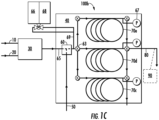
- FIG. 1C an exemplary flow reactor system 100b is shown.
- a plurality of flow reactor units 70c, 70d, and 70e, are shown in a parallel flow configuration.
- Each flow reactor 70c, 70d, and 70e, independently, can be isolated via flow control valves 63 situated at the inlet and outlet of each flow reactor introduction of monomer solution to the corresponding flow reactor.
- Flow control valves 63 can be manually operated and/or solenoid-based configured for computer-control using conventional controlling devices.
- Flow control valves 63 can contain one or more check valves for preventing backflow of dispersion solution.
- One or more pressure regulating units 67 can be positioned at the outlet of one or more of the flow reactors for monitoring a change in pressure during polymerization or during the collection step of polymerized material. Additional pressure regulating units 67 can also be positioned at the inlet of each flow reactor.
- Flow control valves 63 can be coupled to pressure data from the controller so as to isolate one or more of the flow reactors 70c, 70d, and 70e, for activating purge and/or polymer recovery.
- flow reactor system 100b can be continuously operated by selectively isolating one or more flow reactor units 70c, 70d, and 70e for collecting polymerization product and/or maintenance while maintaining monomer introduction to one or more of the remaining flow reactor units.
- flow reactor system 100b can be semi-continuously operated, for example by temporarily ceasing the introduction of monomer to one or more of the flow reactor units 70c, 70d, and 70e.
- Additional fluid lines 69 can be independently fluidically coupled to one or more of the flow control valves 63 so as to introduce purging media 66 (e.g., water) or collecting medium 68 (e.g., solvent) for collecting polymerization product selectively from one or more flow reactor units 70c, 70d, and 70e.
- purging media 66 e.g., water
- collecting medium 68 e.g., solvent
- One or more of flow reactor units 70c, 70d, and 70e can be physically removed from flow reactor system 100b for transport with or without polymerization product recovered from in the inner diameter of the tubing.
- system 100b has a linear tubing 70 arrangement.
- FIG. 3 shows system 100c that includes pumping equipment 15, 25, 55 for introducing reactants 10, 20, and 52 mixing units 30, 60.
- Pumping equipment can include, for example, syringe pumps, rotary valve pumps and displacement pumps.
- tubing 70 is coiled or wound as shown on or about the surface of temperature control member 75.
- Temperature control member 75 is of a length L separated by member 78, which can be a cylinder, between members 75a, 75b of height H for providing the predetermined length of tubing and/or support and/or heating/cooling.
- tubing 70 is coiled or wound substantially about the surface of temperature control member 75.
- the longitudinal axis of the surface of temperature control member 75 (as shown by line B-B) is substantially perpendicular to the turns of the tubing 70.
- the system can be configured to allow heat to enter from the block (inner side of the coiled or wound tubing) and at least partially exit through convection through the outside against the environment.
- a complete immersion of the reactor tubing in housing 40 can be provided.
- tubing 70 is not wound coils but some other arrangement configured for heat management from all sides of the tubing, not just one side or face.
- Temperature control member 75 can be configured for cooling medium or for receiving an electrical resistance heating or other forms of heat that can be controlled by one or more processors configured to a control unit.
- coiled tubing 70 is essentially the same interior diameter throughout the coiled section. In other examples the interior diameter of coiled tubing 70 varies from inlet port 65 to discharge port 80.
- housing 40 is used in combination with temperature control member 75.
- the housing can be constructed of metal, ceramic, or plastic and may include one or more of heating elements, cooling elements, temperature sensors, and pressure sensors.
- Tubing 70 can be encompassed by housing 40 to provide support and/or protection.
- the flow reactor system 100 is a microfluidic reactor.
- reactor system 100 comprises microfluidic tubing 70, such as tubing with an inner diameter of less than about 1000 microns, less than about 900 microns, or less than about 800 microns to a minimum diameter of about 100 microns, coiled or wound into a coil about an outer surface of temperature control member 75.
- the turns of the tubing 70 are very closely spaced with one another.
- the distance, independently, between one or more turns of the tubing 70 is between about zero (0) and 100 microns. In some examples, turns do not result in the touching of the tubing. In other examples, turns of the tubing result in restricting or preventing airflow between the turns of the tubing for improving heat management.
- housing 40 is a climate controlled environment configured for heating and/or cooling of the tubing.
- spacing between turns of the tubing 70 can be used to facilitate heat management.
- Heat management configurations of the housing 40 in combination with the tubing 70 can comprise the use of either liquid, solid, or gas.
- process flow 101 is depicted as exemplary of the methods disclosed herein.
- Step 105 preparing an emulsion of aqueous monomer and a salt in a non-aqueous solvent is depicted in Step 105.
- Step 110 Introducing the emulsion and a catalyst to the micro reactor tubing is depicted in Step 110.
- flow of one or more of the reactants can be terminated and optionally, flushing of the micro reactor tubing with water can be performed as shown in Step 115.
- Step 115 can be performed so as to remove unreacted reactants and/or low molecular weight products.
- Recovering polymer from the micro reactor tubing with organic solvent is performed in Step 120.
- a maximum diameter is less than the diameter at which advantages of diffusion-limited reaction diminishes. This maximum diameter can be as much as 4000 microns, similar to tubing diameter used for high pressure tubing. In other examples outside the scope of the claims, optimal results may be obtained using diameters less than 4000 microns or less than 3000 microns.
- the tubing has an inner diameter between 1 to 1000 micrometers. While not to be held to any particular theory, it is believed that faster reaction rates for the reactions disclosed and described herein occur with decreasing reactor tubing inner diameter dimensions, as much as 10 4 to 10 6 in microfluidic systems as previously reported with some trade-off of reaction volume per unit time.
- the tubing 70 is fluoropolymer tubing .
- Tubing length can be chosen based on the ability of the selected components of the system (pump, tubing burst strength, fittings) to handle pressure.
- the maximum length of tubing suitable for use with the presently disclosed system is a function of back-pressure and the ability to transport product through the entire length of the tubing.
- the system can be configured to operate at a tubing length coupled with a tubing inner diameter such that the system operates at or below about 20 bar (2 MPa).
- the tubing 70 is tubing of diameter less than 1000 microns (microfluidic tubing) with a length of about 100 meters or less. Other combinations of tubing diameter and to be length can be used commensurate with the operating parameters of the system and the desired reaction volume per unit time.
- the cross-section of the tubing may be any shape, but preferably is circular.
- polymerization occurs on internal surface 71 of tube bore as shown in FIG. 7 where polymerization product 73 restricts the internal diameter D to a reduced diameter D'.
- the tubing inner diameter or the reduction in internal diameter D is symmetrical about longitudinal axes A-A, B-B.
- the tubing inner diameter or the reduction in internal diameter D is non-symmetrical about longitudinal axes A-A, B-B. This reduction in diameter D to diameter D' of the tubing 70 causes a back pressure that can be measured and/or used in part to control the process herein.
- this back pressure can be monitored whereas at the beginning of polymerization back pressure 400 at time T1 is consistent with the viscosity and flow rate of the emulsified reactant mixture being fed into tubing 70.
- the back pressure begins to increase and approaches a threshold 450.
- the system is designed to terminate polymerization when the back pressure value 420 reaches the predetermined threshold 450.
- FIG. 9 depicts a process flow diagram 200 that represents an example of the presently disclosed method.
- pumping reactant emulsion and catalyst into the micro reactor tubing is depicted by Step 205.
- Monitoring back pressure of the reactant emulsion during the polymerization process is depicted in Step 210.
- Introduction of the reactant emulsion is terminated once the threshold back pressure is reached as depicted in Step 215.
- Recovering the product polymer from the micro reactor tubing by flushing with organic solvent is depicted in Step 220.
- PANI-DNNSA conjugated conductive polymer polyaniline-dinonylnaphthalene sulfonic acid salt
- OLED organic light-emitting diodes
- Steps 302 and 304 introduce an aqueous composition comprising aniline and a non-aqueous composition comprising dinonylnaphthalene sulfonic acid (DNNSA), respectively into a first mixer.
- Forming a reactant emulsion in the first mixer is performed in Step 310.
- Introducing a catalyst and the reactant emulsion into a second mixer is performed in Step 315.
- Introducing to the micro reactor tubing and obtaining a threshold back pressure is performed in Step 320.
- Terminating introduction of reactant emulsion and catalyst to micro reactor tubing is performed in step 325.
- the micro reactor tubing can be flushed with water in Step 330 to remove unreacted material and/or low molecular weight polymer.
- Recovering polyaniline polymer salt from micro reactor tubing with organic solvent is carried out in Step 335.
- DNNSA Dinonylnaphthalene sulfonic acid
- King Industries Norwalk, CT, USA
- the UV-Vis spectra were collected using a Hitachi U-3900 spectrometer.
- a film of the sample was prepared by drying a xylene solution in a quartz cuvette overnight and subsequent drying in vacuo. The cuvettes were placed on the side to allow for a consistent film to form over the quartz glass.
- Impurity profiles of the PANI:DNNSA samples were analyzed by reverse phase High Performance Liquid Chromatography (HPLC) to check for residual starting materials and solvents.
- HPLC High Performance Liquid Chromatography
- a tubular flow reactor coil was prepared from 1/16" (1.6 mm) O.D. X 0.031" (0.79 mm) I.D. TEFLON° tubing of approximately 21 m (70 ft) in Length.
- the tubing was wrapped around an aluminum spool 4" (10 cm) in diameter with a height of 4.25" (10.8 cm). These dimensions for the spool allow for a single layer of 65 turns of the TEFLON° tubing.
- a calculated volume of the 'TEFLON° flow reactor was 10.4 mL based on the dimensions.
- Measured volume including dead volume before and after the reactor coil was 11.4 mL.
- the assembled TEFLON° flow reactor was fitted to a custom built aluminum spindle fitted with a 120V Firewire heater. Temperature control was achieved with a Model 150 J-KEM temperature controller (J-KEM Scientific, Inc., St. Louis, MO) attached to a K-type thermocouple and the heating unit in the aluminum block. Reagents were introduced into the reactor coil by the use of three separated syringe pumps equipped with plastic or glass syringes. Two KD Scientific (K-100 and K-250) and a Sage (Model #355) syringe pumps were employed.
- the first mixer for combining solutions of aniline and DNNSA consisted of a modified Rainin HPLC mixer unit with a magnetically driven TEFLON° stirrer in a stainless steel cylinder.
- Introduction of the oxidation catalyst ammonium persulfate was carried out with a standard HPLC T-fitting (SS, 0.040" (1 mm) I.D.). Collection of fractions from the reactor coil was achieved either by manually changing fractions or with a Gilson 20313 fraction collector.
- Components of the flow system were connected with standard 1/16" (1.6 mm) TEFLON° tubing and HPLC grade fittings of either stainless steel or polyetheretherketone (PEEK).
Landscapes
- Chemical & Material Sciences (AREA)
- Organic Chemistry (AREA)
- Chemical Kinetics & Catalysis (AREA)
- Health & Medical Sciences (AREA)
- Medicinal Chemistry (AREA)
- Polymers & Plastics (AREA)
- Engineering & Computer Science (AREA)
- Materials Engineering (AREA)
- Life Sciences & Earth Sciences (AREA)
- Wood Science & Technology (AREA)
- Combustion & Propulsion (AREA)
- Macromolecular Compounds Obtained By Forming Nitrogen-Containing Linkages In General (AREA)
- Physical Or Chemical Processes And Apparatus (AREA)
- Polymerisation Methods In General (AREA)
- Polyoxymethylene Polymers And Polymers With Carbon-To-Carbon Bonds (AREA)
- Organic Low-Molecular-Weight Compounds And Preparation Thereof (AREA)
Applications Claiming Priority (2)
| Application Number | Priority Date | Filing Date | Title |
|---|---|---|---|
| US14/882,073 US9481764B1 (en) | 2015-10-13 | 2015-10-13 | Flow reactor synthesis of polymers |
| EP16192931.0A EP3156122B1 (en) | 2015-10-13 | 2016-10-07 | Flow reactor synthesis of polymers |
Related Parent Applications (2)
| Application Number | Title | Priority Date | Filing Date |
|---|---|---|---|
| EP16192931.0A Division-Into EP3156122B1 (en) | 2015-10-13 | 2016-10-07 | Flow reactor synthesis of polymers |
| EP16192931.0A Division EP3156122B1 (en) | 2015-10-13 | 2016-10-07 | Flow reactor synthesis of polymers |
Publications (2)
| Publication Number | Publication Date |
|---|---|
| EP3170854A1 EP3170854A1 (en) | 2017-05-24 |
| EP3170854B1 true EP3170854B1 (en) | 2024-12-04 |
Family
ID=57136683
Family Applications (3)
| Application Number | Title | Priority Date | Filing Date |
|---|---|---|---|
| EP16204785.6A Active EP3170854B1 (en) | 2015-10-13 | 2016-10-07 | Flow reactor synthesis of polymers |
| EP22158615.9A Withdrawn EP4039364A1 (en) | 2015-10-13 | 2016-10-07 | Flow reactor synthesis of polymers |
| EP16192931.0A Active EP3156122B1 (en) | 2015-10-13 | 2016-10-07 | Flow reactor synthesis of polymers |
Family Applications After (2)
| Application Number | Title | Priority Date | Filing Date |
|---|---|---|---|
| EP22158615.9A Withdrawn EP4039364A1 (en) | 2015-10-13 | 2016-10-07 | Flow reactor synthesis of polymers |
| EP16192931.0A Active EP3156122B1 (en) | 2015-10-13 | 2016-10-07 | Flow reactor synthesis of polymers |
Country Status (7)
| Country | Link |
|---|---|
| US (7) | US9481764B1 (https=) |
| EP (3) | EP3170854B1 (https=) |
| JP (3) | JP6953123B2 (https=) |
| KR (1) | KR102666306B1 (https=) |
| CN (2) | CN106563400A (https=) |
| AU (2) | AU2016244187B2 (https=) |
| CA (1) | CA2944762C (https=) |
Families Citing this family (28)
| Publication number | Priority date | Publication date | Assignee | Title |
|---|---|---|---|---|
| US9481764B1 (en) | 2015-10-13 | 2016-11-01 | The Boeing Company | Flow reactor synthesis of polymers |
| US10923723B1 (en) | 2017-05-11 | 2021-02-16 | Richard Carl Auchterlonie | Electro-conductive polymers of halogenated para-aminophenol, and electrochemical cells employing same |
| JPWO2019026425A1 (ja) * | 2017-07-31 | 2020-05-28 | 株式会社カネカ | フロー式リアクター |
| WO2019113640A1 (en) * | 2017-12-12 | 2019-06-20 | Commonwealth Scientific And Industrial Research Organisation | Continuous flow process for preparing conducting polymers |
| CN108822250A (zh) * | 2018-09-03 | 2018-11-16 | 安徽联合辐化有限公司 | 水性高分子乳液的合成方法及设备 |
| CN109942733A (zh) * | 2018-10-26 | 2019-06-28 | 复旦大学 | 一种连续流动合成聚合物的方法 |
| US12150752B2 (en) | 2018-12-10 | 2024-11-26 | Anastasia Rigas | Hydrogen breath analyzer and breath test method |
| EP4011290A1 (en) | 2018-12-10 | 2022-06-15 | Anastasia Rigas | Breath analyzer devices and breath test methods |
| CN111434377B (zh) * | 2019-01-11 | 2022-07-15 | 中国石油化工股份有限公司 | 一种盘管微反应器和一种微反应器系统 |
| US11248089B2 (en) * | 2019-04-10 | 2022-02-15 | The Boeing Company | Polyanilines and methods thereof |
| CN113891900A (zh) | 2019-05-29 | 2022-01-04 | 沙特阿拉伯石油公司 | 聚合物纳米粒子的流动合成 |
| US11566165B2 (en) | 2019-05-30 | 2023-01-31 | Saudi Arabian Oil Company | Polymers and nanoparticles for flooding |
| WO2021002108A1 (ja) * | 2019-07-03 | 2021-01-07 | 富士フイルム株式会社 | 最適化支援装置、方法およびプログラム |
| EP3999236B1 (en) | 2019-07-16 | 2023-09-06 | Saudi Arabian Oil Company | Multipurpose microfluidics devices for rapid on-site optical chemical analysis |
| CN110918021A (zh) * | 2019-11-21 | 2020-03-27 | 南京先进生物材料与过程装备研究院有限公司 | 一种微反应装置及用其制备二甲苯甲醛树脂的方法 |
| CN110898774A (zh) * | 2019-11-27 | 2020-03-24 | 迪亚莱博(张家港)生物科技有限公司 | 胶乳颗粒的连续生产方法 |
| BR112022017813A2 (pt) * | 2020-03-09 | 2022-12-20 | Kemira Oyj | Sistemas e métodos de produção de ácido perfórmico |
| US11773715B2 (en) | 2020-09-03 | 2023-10-03 | Saudi Arabian Oil Company | Injecting multiple tracer tag fluids into a wellbore |
| KR102376167B1 (ko) * | 2020-09-04 | 2022-03-17 | 인하대학교 산학협력단 | 연속흐름반응공정을 이용한 전도성 고분자의 제조방법 |
| US11987669B2 (en) | 2020-10-08 | 2024-05-21 | The Boeing Company | Polyaniline compositions, articles thereof, and methods thereof |
| US12043762B2 (en) | 2020-12-21 | 2024-07-23 | The Boeing Company | Compositions and methods thereof |
| US11660595B2 (en) | 2021-01-04 | 2023-05-30 | Saudi Arabian Oil Company | Microfluidic chip with multiple porosity regions for reservoir modeling |
| US11534759B2 (en) | 2021-01-22 | 2022-12-27 | Saudi Arabian Oil Company | Microfluidic chip with mixed porosities for reservoir modeling |
| CN113929881A (zh) * | 2021-11-08 | 2022-01-14 | 上海交通大学 | 一种基于连续流微反应器合成共轭光电高分子的制备方法 |
| US12253467B2 (en) | 2021-12-13 | 2025-03-18 | Saudi Arabian Oil Company | Determining partition coefficients of tracer analytes |
| US12000278B2 (en) | 2021-12-16 | 2024-06-04 | Saudi Arabian Oil Company | Determining oil and water production rates in multiple production zones from a single production well |
| CN115656159A (zh) * | 2022-10-12 | 2023-01-31 | 国家海洋局南海环境监测中心(中国海监南海区检验鉴定中心) | 一种酸可挥发性硫化物的在线流动反应非在线检测分析方法 |
| CN121398904A (zh) * | 2023-06-29 | 2026-01-23 | 赢创运营有限公司 | 用于通过强放热反应来合成产物的反应器、设备和方法 |
Family Cites Families (22)
| Publication number | Priority date | Publication date | Assignee | Title |
|---|---|---|---|---|
| US4877587A (en) * | 1984-08-24 | 1989-10-31 | Union Carbide Chemicals And Plastics Company Inc. | Fluidized bed polymerization reactors |
| US5324453A (en) | 1992-08-07 | 1994-06-28 | Neste Oy | Electrically conducting polyaniline: method for emulsion polymerization |
| US5567356A (en) | 1994-11-07 | 1996-10-22 | Monsanto Company | Emulsion-polymerization process and electrically-conductive polyaniline salts |
| ATE335037T1 (de) * | 2000-04-04 | 2006-08-15 | Panipol Oy | Verfahren und apparatur zur herstellung von polyanilin |
| FI113053B (fi) * | 2000-04-04 | 2004-02-27 | Panipol Oy | Menetelmä polyaniliinin valmistamiseksi |
| ES2540542T3 (es) * | 2000-12-07 | 2015-07-10 | Grupo Petrotemex, S.A. De C.V. | Procedimiento de poliéster de bajo coste que usa un reactor tubular |
| DE10301874A1 (de) * | 2003-01-17 | 2004-07-29 | Celanese Emulsions Gmbh | Verfahren und Vorrichtung zur Herstellung von Emulsionspolymerisaten |
| RU2007108795A (ru) * | 2004-08-12 | 2008-09-20 | Е.И.Дюпон де Немур энд Компани (US) | Устройство и способ получения низкомолекулярных полимеров |
| US7795359B2 (en) | 2005-03-04 | 2010-09-14 | Novartis Ag | Continuous process for production of polymeric materials |
| DE102005055866A1 (de) | 2005-11-23 | 2007-05-24 | Hte Ag The High Throughput Experimentation Company | Verfahren zur Herstellung von Aryl-Aryl gekoppelter Verbindungen |
| DE102006061967A1 (de) * | 2006-12-21 | 2008-06-26 | Bayer Technology Services Gmbh | Verfahren zur Darstellung von oligomeren Thiophenen |
| US7819967B2 (en) | 2007-11-08 | 2010-10-26 | Fujifilm Corporation | Method of producing an organic fine particle dispersion, organic fine particle dispersion obtained by the same, and ink-jet recording ink and paint using the dispersion |
| FR2928646B1 (fr) * | 2008-03-13 | 2012-04-27 | Centre Nat Rech Scient | Procede de preparation de polyaniline et films hautement auto-orientes obtenus. |
| EP2133141A1 (en) | 2008-06-10 | 2009-12-16 | Nederlandse Organisatie voor Toegepast-Natuuurwetenschappelijk Onderzoek TNO | Process for carrying out multi-phase reactions |
| KR101211856B1 (ko) * | 2008-11-21 | 2012-12-12 | 주식회사 엘지화학 | 고분자 입자의 제조 장치 및 제조 방법 |
| KR101295762B1 (ko) | 2009-02-17 | 2013-08-12 | 소켄 케미칼 앤드 엔지니어링 캄파니, 리미티드 | 복합 전기 전도성 폴리머 조성물, 이의 제조 방법, 이를 함유하는 용액, 및 이의 용도 |
| JP5945829B2 (ja) * | 2010-04-01 | 2016-07-05 | ディーピーエックス ファイン ケミカルズ オーストリア ゲーエムベーハー ウント ツェーオー カーゲー | 連続乳化重合方法 |
| WO2012037596A1 (en) | 2010-09-22 | 2012-03-29 | Commonwealth Scientific And Industrial Research Organisation | Continuous flow polymerisation process |
| JP2012092249A (ja) * | 2010-10-28 | 2012-05-17 | Osaka Prefecture Univ | 粒子状重合体及びその製造方法 |
| CN103408754B (zh) | 2013-07-11 | 2015-10-28 | 东华大学 | 一种聚苯胺纳米纤维的制备方法 |
| KR20160091362A (ko) | 2013-11-27 | 2016-08-02 | 코닝 인코포레이티드 | 반전도성 중합체의 향상된 유동 반응기 합성 |
| US9481764B1 (en) | 2015-10-13 | 2016-11-01 | The Boeing Company | Flow reactor synthesis of polymers |
-
2015
- 2015-10-13 US US14/882,073 patent/US9481764B1/en active Active
-
2016
- 2016-09-09 US US15/261,441 patent/US9751983B2/en not_active Ceased
- 2016-10-05 CA CA2944762A patent/CA2944762C/en active Active
- 2016-10-07 JP JP2016199310A patent/JP6953123B2/ja active Active
- 2016-10-07 EP EP16204785.6A patent/EP3170854B1/en active Active
- 2016-10-07 EP EP22158615.9A patent/EP4039364A1/en not_active Withdrawn
- 2016-10-07 EP EP16192931.0A patent/EP3156122B1/en active Active
- 2016-10-11 AU AU2016244187A patent/AU2016244187B2/en active Active
- 2016-10-11 KR KR1020160131064A patent/KR102666306B1/ko active Active
- 2016-10-13 CN CN201610892755.6A patent/CN106563400A/zh active Pending
- 2016-10-13 CN CN202210816658.4A patent/CN115178204A/zh active Pending
-
2017
- 2017-07-28 US US15/662,503 patent/US10118992B2/en active Active
-
2018
- 2018-08-08 US US16/058,680 patent/USRE48166E1/en active Active
- 2018-10-02 US US16/149,867 patent/US10584208B2/en active Active
-
2020
- 2020-01-14 US US16/742,282 patent/US11104765B2/en active Active
-
2021
- 2021-05-25 AU AU2021203395A patent/AU2021203395B2/en active Active
- 2021-06-30 JP JP2021108462A patent/JP7411608B2/ja active Active
- 2021-08-02 US US17/391,806 patent/US12104016B2/en active Active
-
2023
- 2023-02-17 JP JP2023023428A patent/JP7627713B2/ja active Active
Also Published As
| Publication number | Publication date |
|---|---|
| AU2021203395A1 (en) | 2021-06-24 |
| KR20170043456A (ko) | 2017-04-21 |
| US10584208B2 (en) | 2020-03-10 |
| EP3156122B1 (en) | 2023-01-04 |
| US9481764B1 (en) | 2016-11-01 |
| CN115178204A (zh) | 2022-10-14 |
| CA2944762C (en) | 2021-08-31 |
| USRE48166E1 (en) | 2020-08-18 |
| JP7411608B2 (ja) | 2024-01-11 |
| AU2016244187A1 (en) | 2017-04-27 |
| JP2021169609A (ja) | 2021-10-28 |
| JP7627713B2 (ja) | 2025-02-06 |
| AU2021203395B2 (en) | 2022-12-08 |
| AU2016244187B2 (en) | 2021-02-25 |
| US20200157282A1 (en) | 2020-05-21 |
| JP2023071775A (ja) | 2023-05-23 |
| US20170321010A1 (en) | 2017-11-09 |
| US20190062502A1 (en) | 2019-02-28 |
| US11104765B2 (en) | 2021-08-31 |
| JP6953123B2 (ja) | 2021-10-27 |
| US20210363302A1 (en) | 2021-11-25 |
| CA2944762A1 (en) | 2017-04-13 |
| EP3170854A1 (en) | 2017-05-24 |
| US10118992B2 (en) | 2018-11-06 |
| CN106563400A (zh) | 2017-04-19 |
| EP3156122A1 (en) | 2017-04-19 |
| KR102666306B1 (ko) | 2024-05-14 |
| US12104016B2 (en) | 2024-10-01 |
| US20170101508A1 (en) | 2017-04-13 |
| JP2017110181A (ja) | 2017-06-22 |
| EP4039364A1 (en) | 2022-08-10 |
| US9751983B2 (en) | 2017-09-05 |
Similar Documents
| Publication | Publication Date | Title |
|---|---|---|
| US12104016B2 (en) | Flow reactor synthesis of polymers | |
| EP1259316B1 (en) | Capillary reactor distribution device and method | |
| Hartman et al. | Microchemical systems for continuous-flow synthesis | |
| WO2002009866A2 (de) | Mikroreaktor für reaktionen zwischen gasen und flüssigkeiten | |
| WO2009009129A1 (en) | Process intensified microfluidic devices | |
| Yang et al. | Pilot-scale microfluidic solvent extraction of high-value metals | |
| Song et al. | Synthesis of million molecular weight polyacrylamide with droplet flow microreactors | |
| Bhattacharyya et al. | Improved slit-shaped microseparator and its integration with a microreactor for modular biomanufacturing | |
| KR20160121159A (ko) | 비혼화성 액-액 반응을 위한 연속식 미세유체 반응 시스템 및 이를 이용한 반응 방법 | |
| EP1965901A2 (de) | Verfahren zur herstellung aryl-aryl gekoppelter verbindungen | |
| US10562873B1 (en) | Methods of producing glycidyl nitrate | |
| KR101114657B1 (ko) | 케타진 화합물의 제조 방법 | |
| EP1743908A1 (en) | Process for preparing a halogenated polymer and device for its implementation | |
| RU2828259C1 (ru) | Способ получения нитробензола | |
| Sheik et al. | Solvent Extraction of Copper Enhanced by Mixing Cavities in Micromixer | |
| Parida | Intensification of ATRP polymer syntheses by microreaction technologies | |
| Kubota et al. | Solvent Extraction of Rare Earth Metals by Microchannel Extractor |
Legal Events
| Date | Code | Title | Description |
|---|---|---|---|
| PUAI | Public reference made under article 153(3) epc to a published international application that has entered the european phase |
Free format text: ORIGINAL CODE: 0009012 |
|
| STAA | Information on the status of an ep patent application or granted ep patent |
Free format text: STATUS: REQUEST FOR EXAMINATION WAS MADE |
|
| 17P | Request for examination filed |
Effective date: 20161216 |
|
| AC | Divisional application: reference to earlier application |
Ref document number: 3156122 Country of ref document: EP Kind code of ref document: P |
|
| AK | Designated contracting states |
Kind code of ref document: A1 Designated state(s): AL AT BE BG CH CY CZ DE DK EE ES FI FR GB GR HR HU IE IS IT LI LT LU LV MC MK MT NL NO PL PT RO RS SE SI SK SM TR |
|
| AX | Request for extension of the european patent |
Extension state: BA ME |
|
| STAA | Information on the status of an ep patent application or granted ep patent |
Free format text: STATUS: EXAMINATION IS IN PROGRESS |
|
| 17Q | First examination report despatched |
Effective date: 20181108 |
|
| RAP3 | Party data changed (applicant data changed or rights of an application transferred) |
Owner name: THE BOEING COMPANY |
|
| GRAP | Despatch of communication of intention to grant a patent |
Free format text: ORIGINAL CODE: EPIDOSNIGR1 |
|
| STAA | Information on the status of an ep patent application or granted ep patent |
Free format text: STATUS: GRANT OF PATENT IS INTENDED |
|
| INTG | Intention to grant announced |
Effective date: 20240703 |
|
| P01 | Opt-out of the competence of the unified patent court (upc) registered |
Free format text: CASE NUMBER: APP_41187/2024 Effective date: 20240711 |
|
| GRAS | Grant fee paid |
Free format text: ORIGINAL CODE: EPIDOSNIGR3 |
|
| GRAA | (expected) grant |
Free format text: ORIGINAL CODE: 0009210 |
|
| STAA | Information on the status of an ep patent application or granted ep patent |
Free format text: STATUS: THE PATENT HAS BEEN GRANTED |
|
| AC | Divisional application: reference to earlier application |
Ref document number: 3156122 Country of ref document: EP Kind code of ref document: P |
|
| AK | Designated contracting states |
Kind code of ref document: B1 Designated state(s): AL AT BE BG CH CY CZ DE DK EE ES FI FR GB GR HR HU IE IS IT LI LT LU LV MC MK MT NL NO PL PT RO RS SE SI SK SM TR |
|
| REG | Reference to a national code |
Ref country code: GB Ref legal event code: FG4D |
|
| REG | Reference to a national code |
Ref country code: CH Ref legal event code: EP |
|
| REG | Reference to a national code |
Ref country code: DE Ref legal event code: R096 Ref document number: 602016090482 Country of ref document: DE |
|
| REG | Reference to a national code |
Ref country code: IE Ref legal event code: FG4D |
|
| REG | Reference to a national code |
Ref country code: LT Ref legal event code: MG9D |
|
| REG | Reference to a national code |
Ref country code: NL Ref legal event code: MP Effective date: 20241204 |
|
| PG25 | Lapsed in a contracting state [announced via postgrant information from national office to epo] |
Ref country code: HR Free format text: LAPSE BECAUSE OF FAILURE TO SUBMIT A TRANSLATION OF THE DESCRIPTION OR TO PAY THE FEE WITHIN THE PRESCRIBED TIME-LIMIT Effective date: 20241204 |
|
| PG25 | Lapsed in a contracting state [announced via postgrant information from national office to epo] |
Ref country code: FI Free format text: LAPSE BECAUSE OF FAILURE TO SUBMIT A TRANSLATION OF THE DESCRIPTION OR TO PAY THE FEE WITHIN THE PRESCRIBED TIME-LIMIT Effective date: 20241204 |
|
| PG25 | Lapsed in a contracting state [announced via postgrant information from national office to epo] |
Ref country code: BG Free format text: LAPSE BECAUSE OF FAILURE TO SUBMIT A TRANSLATION OF THE DESCRIPTION OR TO PAY THE FEE WITHIN THE PRESCRIBED TIME-LIMIT Effective date: 20241204 |
|
| PG25 | Lapsed in a contracting state [announced via postgrant information from national office to epo] |
Ref country code: ES Free format text: LAPSE BECAUSE OF FAILURE TO SUBMIT A TRANSLATION OF THE DESCRIPTION OR TO PAY THE FEE WITHIN THE PRESCRIBED TIME-LIMIT Effective date: 20241204 |
|
| PG25 | Lapsed in a contracting state [announced via postgrant information from national office to epo] |
Ref country code: NO Free format text: LAPSE BECAUSE OF FAILURE TO SUBMIT A TRANSLATION OF THE DESCRIPTION OR TO PAY THE FEE WITHIN THE PRESCRIBED TIME-LIMIT Effective date: 20250304 |
|
| PG25 | Lapsed in a contracting state [announced via postgrant information from national office to epo] |
Ref country code: LV Free format text: LAPSE BECAUSE OF FAILURE TO SUBMIT A TRANSLATION OF THE DESCRIPTION OR TO PAY THE FEE WITHIN THE PRESCRIBED TIME-LIMIT Effective date: 20241204 Ref country code: GR Free format text: LAPSE BECAUSE OF FAILURE TO SUBMIT A TRANSLATION OF THE DESCRIPTION OR TO PAY THE FEE WITHIN THE PRESCRIBED TIME-LIMIT Effective date: 20250305 |
|
| PG25 | Lapsed in a contracting state [announced via postgrant information from national office to epo] |
Ref country code: RS Free format text: LAPSE BECAUSE OF FAILURE TO SUBMIT A TRANSLATION OF THE DESCRIPTION OR TO PAY THE FEE WITHIN THE PRESCRIBED TIME-LIMIT Effective date: 20250304 |
|
| PG25 | Lapsed in a contracting state [announced via postgrant information from national office to epo] |
Ref country code: NL Free format text: LAPSE BECAUSE OF FAILURE TO SUBMIT A TRANSLATION OF THE DESCRIPTION OR TO PAY THE FEE WITHIN THE PRESCRIBED TIME-LIMIT Effective date: 20241204 |
|
| REG | Reference to a national code |
Ref country code: AT Ref legal event code: MK05 Ref document number: 1748108 Country of ref document: AT Kind code of ref document: T Effective date: 20241204 |
|
| PG25 | Lapsed in a contracting state [announced via postgrant information from national office to epo] |
Ref country code: SM Free format text: LAPSE BECAUSE OF FAILURE TO SUBMIT A TRANSLATION OF THE DESCRIPTION OR TO PAY THE FEE WITHIN THE PRESCRIBED TIME-LIMIT Effective date: 20241204 |
|
| PG25 | Lapsed in a contracting state [announced via postgrant information from national office to epo] |
Ref country code: PL Free format text: LAPSE BECAUSE OF FAILURE TO SUBMIT A TRANSLATION OF THE DESCRIPTION OR TO PAY THE FEE WITHIN THE PRESCRIBED TIME-LIMIT Effective date: 20241204 |
|
| PG25 | Lapsed in a contracting state [announced via postgrant information from national office to epo] |
Ref country code: IS Free format text: LAPSE BECAUSE OF FAILURE TO SUBMIT A TRANSLATION OF THE DESCRIPTION OR TO PAY THE FEE WITHIN THE PRESCRIBED TIME-LIMIT Effective date: 20250404 |
|
| PG25 | Lapsed in a contracting state [announced via postgrant information from national office to epo] |
Ref country code: PT Free format text: LAPSE BECAUSE OF FAILURE TO SUBMIT A TRANSLATION OF THE DESCRIPTION OR TO PAY THE FEE WITHIN THE PRESCRIBED TIME-LIMIT Effective date: 20250404 |
|
| PG25 | Lapsed in a contracting state [announced via postgrant information from national office to epo] |
Ref country code: EE Free format text: LAPSE BECAUSE OF FAILURE TO SUBMIT A TRANSLATION OF THE DESCRIPTION OR TO PAY THE FEE WITHIN THE PRESCRIBED TIME-LIMIT Effective date: 20241204 |
|
| PG25 | Lapsed in a contracting state [announced via postgrant information from national office to epo] |
Ref country code: AT Free format text: LAPSE BECAUSE OF FAILURE TO SUBMIT A TRANSLATION OF THE DESCRIPTION OR TO PAY THE FEE WITHIN THE PRESCRIBED TIME-LIMIT Effective date: 20241204 Ref country code: RO Free format text: LAPSE BECAUSE OF FAILURE TO SUBMIT A TRANSLATION OF THE DESCRIPTION OR TO PAY THE FEE WITHIN THE PRESCRIBED TIME-LIMIT Effective date: 20241204 |
|
| PG25 | Lapsed in a contracting state [announced via postgrant information from national office to epo] |
Ref country code: SK Free format text: LAPSE BECAUSE OF FAILURE TO SUBMIT A TRANSLATION OF THE DESCRIPTION OR TO PAY THE FEE WITHIN THE PRESCRIBED TIME-LIMIT Effective date: 20241204 |
|
| PG25 | Lapsed in a contracting state [announced via postgrant information from national office to epo] |
Ref country code: CZ Free format text: LAPSE BECAUSE OF FAILURE TO SUBMIT A TRANSLATION OF THE DESCRIPTION OR TO PAY THE FEE WITHIN THE PRESCRIBED TIME-LIMIT Effective date: 20241204 |
|
| PG25 | Lapsed in a contracting state [announced via postgrant information from national office to epo] |
Ref country code: IT Free format text: LAPSE BECAUSE OF FAILURE TO SUBMIT A TRANSLATION OF THE DESCRIPTION OR TO PAY THE FEE WITHIN THE PRESCRIBED TIME-LIMIT Effective date: 20241204 |
|
| REG | Reference to a national code |
Ref country code: DE Ref legal event code: R097 Ref document number: 602016090482 Country of ref document: DE |
|
| PG25 | Lapsed in a contracting state [announced via postgrant information from national office to epo] |
Ref country code: SE Free format text: LAPSE BECAUSE OF FAILURE TO SUBMIT A TRANSLATION OF THE DESCRIPTION OR TO PAY THE FEE WITHIN THE PRESCRIBED TIME-LIMIT Effective date: 20241204 |
|
| PG25 | Lapsed in a contracting state [announced via postgrant information from national office to epo] |
Ref country code: DK Free format text: LAPSE BECAUSE OF FAILURE TO SUBMIT A TRANSLATION OF THE DESCRIPTION OR TO PAY THE FEE WITHIN THE PRESCRIBED TIME-LIMIT Effective date: 20241204 |
|
| PLBE | No opposition filed within time limit |
Free format text: ORIGINAL CODE: 0009261 |
|
| STAA | Information on the status of an ep patent application or granted ep patent |
Free format text: STATUS: NO OPPOSITION FILED WITHIN TIME LIMIT |
|
| 26N | No opposition filed |
Effective date: 20250905 |
|
| PGFP | Annual fee paid to national office [announced via postgrant information from national office to epo] |
Ref country code: DE Payment date: 20251029 Year of fee payment: 10 |
|
| PGFP | Annual fee paid to national office [announced via postgrant information from national office to epo] |
Ref country code: GB Payment date: 20251027 Year of fee payment: 10 |
|
| PGFP | Annual fee paid to national office [announced via postgrant information from national office to epo] |
Ref country code: FR Payment date: 20251027 Year of fee payment: 10 |