EP3168254A1 - Verfahren zur herstellung oder härtung von polymeren mittels thiol-en polyadditionsreaktionen - Google Patents
Verfahren zur herstellung oder härtung von polymeren mittels thiol-en polyadditionsreaktionen Download PDFInfo
- Publication number
- EP3168254A1 EP3168254A1 EP15194064.0A EP15194064A EP3168254A1 EP 3168254 A1 EP3168254 A1 EP 3168254A1 EP 15194064 A EP15194064 A EP 15194064A EP 3168254 A1 EP3168254 A1 EP 3168254A1
- Authority
- EP
- European Patent Office
- Prior art keywords
- alkenyl ether
- carbon atoms
- substituted
- group
- groups
- Prior art date
- Legal status (The legal status is an assumption and is not a legal conclusion. Google has not performed a legal analysis and makes no representation as to the accuracy of the status listed.)
- Granted
Links
- 0 C*C(NC)=COC(C)(C)*(C)C Chemical compound C*C(NC)=COC(C)(C)*(C)C 0.000 description 4
Classifications
-
- C—CHEMISTRY; METALLURGY
- C08—ORGANIC MACROMOLECULAR COMPOUNDS; THEIR PREPARATION OR CHEMICAL WORKING-UP; COMPOSITIONS BASED THEREON
- C08G—MACROMOLECULAR COMPOUNDS OBTAINED OTHERWISE THAN BY REACTIONS ONLY INVOLVING UNSATURATED CARBON-TO-CARBON BONDS
- C08G75/00—Macromolecular compounds obtained by reactions forming a linkage containing sulfur with or without nitrogen, oxygen, or carbon in the main chain of the macromolecule
- C08G75/02—Polythioethers
- C08G75/04—Polythioethers from mercapto compounds or metallic derivatives thereof
- C08G75/045—Polythioethers from mercapto compounds or metallic derivatives thereof from mercapto compounds and unsaturated compounds
-
- C—CHEMISTRY; METALLURGY
- C08—ORGANIC MACROMOLECULAR COMPOUNDS; THEIR PREPARATION OR CHEMICAL WORKING-UP; COMPOSITIONS BASED THEREON
- C08G—MACROMOLECULAR COMPOUNDS OBTAINED OTHERWISE THAN BY REACTIONS ONLY INVOLVING UNSATURATED CARBON-TO-CARBON BONDS
- C08G71/00—Macromolecular compounds obtained by reactions forming a ureide or urethane link, otherwise, than from isocyanate radicals in the main chain of the macromolecule
- C08G71/04—Polyurethanes
-
- C—CHEMISTRY; METALLURGY
- C09—DYES; PAINTS; POLISHES; NATURAL RESINS; ADHESIVES; COMPOSITIONS NOT OTHERWISE PROVIDED FOR; APPLICATIONS OF MATERIALS NOT OTHERWISE PROVIDED FOR
- C09J—ADHESIVES; NON-MECHANICAL ASPECTS OF ADHESIVE PROCESSES IN GENERAL; ADHESIVE PROCESSES NOT PROVIDED FOR ELSEWHERE; USE OF MATERIALS AS ADHESIVES
- C09J175/00—Adhesives based on polyureas or polyurethanes; Adhesives based on derivatives of such polymers
- C09J175/04—Polyurethanes
- C09J175/14—Polyurethanes having carbon-to-carbon unsaturated bonds
- C09J175/16—Polyurethanes having carbon-to-carbon unsaturated bonds having terminal carbon-to-carbon unsaturated bonds
Definitions
- the present invention relates to a process for the preparation of polymers, in particular polyhydroxyurethanes (PHU), from alkenyl ether polyols or prepolymers containing monomer units derived from such alkenyl ether polyols, and to polythiol compounds and to a process for crosslinking alkenyl ether group-containing compounds with polythiol compounds. Furthermore, the invention is directed to the polymers and crosslinked polymers obtainable by the process according to the invention.
- PHU polyhydroxyurethanes
- Photopolymers are of growing interest because they can be used in a variety of important fields of technology, such as stereolithography, nanoimprint lithography, 3D printing, and are widely available for energy efficient LEDs suitable for reacting appropriately matched photopolymer systems.
- Photopolymerization in general requires small amounts of energy and is being used more and more as a replacement for environmentally harmful solvent-based product formulations and processes in the field of adhesives and coatings. There is therefore a general interest in replacing existing manufacturing and curing processes with alternatives based on photopolymerization.
- Polyhydroxyurethanes i. Polyurethanes containing several free hydroxy groups per molecule are currently produced mainly via the aminolysis of cyclic carbonates. Although this synthetic route is environmentally friendly, as the use of isocyanates and phosgene can be dispensed with, thermoplastic polymer systems (i.e., uncrosslinked and largely unbranched linear polymer chains) are only polyurethanes of comparatively low molecular weight.
- alkenyl ether-functionalized polyols are excellent precursors for numerous UV-initiated cationic polycondensation and polyaddition reactions and, depending on the structure and degree of functionalization, allow good control over the crosslinking density in the resulting polymeric systems.
- Alkenyl ether polyols can be used very generally as starting materials for the synthesis of oligomers and polymers which are accessible via the reaction of the OH groups, such as, for example, polyaddition processes or polycondensation reactions.
- Such available Polymers include, for example, polyesters, polyethers, polyurethanes and polyureas.
- the alkenyl ether functionalities allow further functionalization, cross-linking and polymerization reactions, for example cationic polymerization or radical copolymerization, of the polyols and their reaction products.
- a first aspect of the present invention is therefore a process for preparing a polymer, in particular a polyhydroxyurethane polymer, comprising reacting at least one alkenyl ether polyol containing at least one alkenyl ether group, in particular a 1-alkenyl ether group, and at least two hydroxyl groups (-OH), or a prepolymer containing at least such an alkenyl ether polyol as a monomer unit containing a compound containing at least two thiol groups (-SH).
- the invention is directed to a process for crosslinking a compound containing at least one alkenyl ether group, preferably an alkenyl ether polyol containing at least one alkenyl ether group, especially a 1-alkenyl ether group, and at least two hydroxyl groups (-OH), or a polymer containing at least one such alkenyl ether polyol as a monomer unit, in particular, a polyurethane or polyester comprising reacting the compound with a compound containing at least two thiol groups.
- a compound containing at least one alkenyl ether group preferably an alkenyl ether polyol containing at least one alkenyl ether group, especially a 1-alkenyl ether group, and at least two hydroxyl groups (-OH), or a polymer containing at least one such alkenyl ether polyol as a monomer unit, in particular, a polyurethane or polyester comprising reacting the compound with a compound containing at least
- the present invention is further directed to polymers, especially polyhydroxyurethanes (PUHs), or crosslinked polymers obtainable by a process according to the present invention.
- PHYs polyhydroxyurethanes
- urethane group refers to groups of the formula -O-C (O) -NH- and -NH-C (O) -O-, respectively.
- alkyl refers to a linear or branched, unsubstituted or substituted saturated hydrocarbon radical, especially radicals of the formula C n H 2n + 1 .
- alkyl radicals include, but are not limited to, methyl, ethyl, n -propyl, iso-propyl, n-butyl, 2-butyl, tert -butyl, n -pentyl, n -hexyl and the like.
- Heteroalkyl refers to alkyl radicals in which at least one carbon atom is replaced by a heteroatom, such as in particular oxygen, nitrogen or sulfur, is replaced. Examples include, without limitation, ethers and polyethers, for example, diethyl ether or polyethylene oxide.
- alkenyl refers to a linear or branched, unsubstituted or substituted hydrocarbon radical containing at least one C-C double bond.
- Substituted as used herein in particular in the context of alkyl and heteroalkyl groups refers to compounds in which one or more carbon and / or hydrogen atoms are replaced by other atoms or groups. Suitable substituents include, but are not limited to, -OH, -NH 2 , -NO 2 , -CN, -OCN, -SCN, -NCO, -NCS, -SH, -SO 3 H, -SO 2 H, -COOH, - CHO and similar.
- organic radical refers to any organic radical containing carbon atoms.
- Organic radicals may in particular be derived from hydrocarbons, it being possible for any carbon and hydrogen atoms to be replaced by other atoms or groups.
- Organic radicals within the meaning of the invention contain in various embodiments 1 to 1000 carbon atoms.
- Epoxide refers to compounds containing an epoxide group.
- alcohol refers to an organic compound containing at least one hydroxyl group (-OH).
- amine refers to an organic compound comprising at least one primary or secondary amino group (-NH 2 , -NHR).
- thiol or “mercaptan” refers to an organic compound containing at least one thiol group (-SH).
- derivative refers to a chemical compound that is altered from a reference compound by one or more chemical reactions.
- the term “derivative” includes in particular the corresponding ionic groups / compounds and their salts, ie alcoholates, Carboxylates, thiolates and compounds containing quaternary nitrogen atoms.
- the term derivative can also include the thio derivatives of the carbonates described in more detail below, ie compounds in which one, two or all three oxygen atoms of the group -OC (OO) -O- are replaced by sulfur atoms.
- At least refers to exactly this numerical value or more. “At least one” thus means 1 or more, i. for example, 2, 3, 4, 5, 6, 7, 8, 9, 10 or more. In the context of one type of compound, the term does not refer to the absolute number of molecules, but rather to the number of types of substances that fall under the respective generic term. "At least one epoxide” thus means, for example, that at least one type of epoxide, but also several different epoxides may be included.
- curable refers to a change in state and / or structure in a material by chemical reaction that is usually, but not necessarily, affected by at least one variable, such as time, temperature, humidity, radiation, Presence and quantity of a curing-imparting catalyst or accelerator and the like is induced.
- the term refers to both complete and partial curing of the material.
- Random-curable or “radiation-crosslinkable”, thus refers to compounds that react chemically when exposed to radiation and form new bonds (intra- or intermolecular).
- Randomtion refers to electromagnetic radiation, particularly UV and visible light, as well as electron beams.
- the cure takes place by exposure to light, such as UV light or visible light.
- divalent or “divalent” as used herein in reference to radicals or groups refers to a radical or group having at least two attachment sites that connect to other moieties.
- a divalent alkyl radical thus means in the context of the present invention a radical of the formula -alkyl-. Such a divalent alkyl radical is also referred to herein as alkylenyl radical.
- multi-valued means that a remainder or a group has more than one point of attachment. For example, such a residue may also be three, four, five or six valent.
- At least 2-valued thus means 2 or more.
- poly refers to a repeating unit of a (functional) group or structural unit following this prefix.
- a polyol refers to a compound having at least 2 hydroxy groups
- a polyalkylene glycol refers to a polymer of alkylene glycol monomer units.
- Polyisocyanate refers to organic compounds containing more than one isocyanate group (-NCO).
- the molecular weights given herein are based on the number average molecular weight (M n ).
- the number average molecular weight can be determined based on an end group analysis (OH number according to DIN 53240, NCO content as determined by titration according to Spiegelberger according to EN ISO 11909) or by gel permeation chromatography according to DIN 55672-1: 2007-08 with THF as the eluent. Unless otherwise indicated, all molecular weights given are those determined by end group analysis.
- the alkenyl ethers may be aliphatic compounds containing, in addition to the alkenyl ether group (s), at least one other functional group reactive with epoxy or cyclocarbonate groups, including -OH, -COOH, -SH, -NH 2 and their derivatives.
- the functional groups attack nucleophilically at the ring carbon of the epoxide ring or at the carbonyl carbon atom of the cyclocarbonate, opening the ring and forming a hydroxyl group.
- the preparation of the alkenyl ether polyol can be realized, for example, via two alternative routes A) and B).
- Route A is an alkenyl ether, which contains at least one alkenyl ether group and at least one functional group selected from -OH, -COOH, -SH, -NH 2 and derivatives thereof, with (i) an epoxide or (ii) a cyclic carbonate or Derivative thereof implemented.
- an alkenyl ether containing at least one alkenyl ether group and at least one functional group selected from (i) epoxide groups and (ii) cyclic carbonate groups or derivatives thereof is reacted with an alcohol, thiol, carboxylic acid or amine or derivatives of the foregoing ,
- the aforementioned alcohols, thiols, carboxylic acids and amines can be mono- or polyfunctional.
- the alkenyl ether polyols are formed by reaction of the hydroxy, thiol, carboxyl or amino groups with an epoxide or cyclic carbonate group with ring opening.
- the reactants are selected such that the reaction product, i. the resulting alkenyl ether polyol carries at least two hydroxyl groups.
- Each R and R ' is independently selected from H, C 1-20 alkyl and C 2-20 alkenyl, in particular one of R and R' being H and the other being C 1-4 alkyl or both H. Particularly preferred is RH and R 'is H or -CH 3 .
- Each A, B and C is independently selected from carbon-containing groups of the formula CR “R”', where R “and R'” are independently selected from H, a functional group such as --OH, -NH 2 , -NO 2 , -CN, -OCN, -SCN, -NCO, -NCS, -SH, -SO 3 H or -SO 2 H, and an organic radical.
- R “and R '” are independently H or C 1-20 alkyl.
- R “and R '” may also together or together with the carbon atom to which they are attached form an organic radical, including cyclic radicals, or a functional group.
- m is an integer from 1 to 10, preferably 1 or 2, more preferably 1. the compounds preferably carry only one or two alkenyl ether group (s).
- R x is H, an organic radical or
- the compound of formula (I) further satisfies the condition that when R x does not is R 2 has at least one substituent selected from -OH and
- the second hydroxyl group of the compound of formula (I) is therefore either included as a substituent in the organic radical R 2 or X contains another radical of the formula
- the alkenyl ether polyol of formula (I) contains at least one urethane group.
- polythiols By reaction with polythiols according to the methods described herein, polyhydroxyurethanes (PHUs) can then be prepared.
- the alkenyl ether containing at least one alkenyl ether group and at least one functional group selected from -OH, -COOH, -SH, -NH 2 and derivatives thereof is an alkenyl ether of the formula (II).
- Such an alkenyl ether can be used, for example, to synthesize an alkenyl ether polyol of the formula (I) by reacting with an epoxide or a cyclic carbonate.
- R 1 , R, R 'and m are as defined above for formula (I).
- the preferred embodiments of R 1 , R, R 'and m described above for the compounds of formula (I) are equally applicable to the compounds of formula (II).
- X 1 is a functional group selected from -OH, -COOH, -SH, -NHR y and their derivatives, and R y is H or an organic radical, preferably H.
- the derivatives of the functional groups -OH, -COOH, -SH, -NHR y are preferably the ionic variants already described above in connection with the definition of the term, which result from removal or binding of a proton, in particular the alcoholates, thiolates and carboxylates, most preferably the alkoxides.
- X 1 is -OH or -O- or -NH 2 .
- An embodiment of the described process for preparing the alkenyl ether polyols is further characterized in that in the alkenyl ether of the formula (II) m is 1, X 1 is -OH or -NH 2 , preferably -OH, R 1 is a divalent, linear or branched one C 1-10 is alkyl (alkylenyl), especially ethylenyl, propylenyl, butylenyl, pentylenyl or hexylenyl, and one of R and R 'is H and the other is H or -CH 3 .
- alkenyl ethers which can be used in the described process for the preparation of the alkenyl ether, in particular those of the formula (II), it may be, for.
- reaction products of various optionally substituted alkanols (monoalcohols and polyols) with acetylene include, but are not limited to, 4-hydroxybutyl vinyl ether (HBVE) and 3-aminopropyl vinyl ether (APVE).
- a further embodiment of the described process for the preparation of the alkenyl ether polyols is characterized in that the epoxide which is reacted with the alkenyl ether is an epoxide of the formula (III) or (IIIa)
- R 2 is as defined above for formula (I).
- R 11 , R 12 and R 13 are independently H or an organic radical, optionally with at least one -OH group, in particular a linear or branched, substituted or unsubstituted alkyl having 1 to 20 carbon atoms or linear or branched, substituted or unsubstituted heteroalkyl 1 to 20 carbon atoms and at least one oxygen or nitrogen atom.
- q is an integer from 1 to 10, preferably 1 or 2.
- epoxy compounds which can be used in the processes for preparing alkenyl ether polyols are preferably linear or branched, substituted or unsubstituted alkanes having a carbon atom number of 1 to 1000, preferably 1 to 50 or 1 to 20, which carry at least one epoxy group.
- these epoxy compounds can additionally carry one or more hydroxy groups, whereby the hydroxyl functionalization degree of the alkenyl ether polyol formed from the reaction of an epoxide-reactive alkenyl ether, as described above, with an epoxide is high.
- the crosslinking density of the desired polymer can be controlled and controlled.
- an epoxide-reactive alkenyl ether compound alkenyl ethers having at least one functional group selected from -OH, -COOH, -SH, -NH 2 and derivatives thereof
- an alcohol is formed by ring-opening the epoxide. From the reactions of a first alcohol or a compound chemically related in this context (amine, thiol, carboxylic acid, etc.) with an epoxide, the alcoholic group is thus "regenerated" in the course of the bond formation.
- the epoxy compound may carry more than one epoxy group. This enables the reaction of such an epoxy compound with more than one epoxide-reactive alkenyl ether compound, for example, an aminoalkenyl ether or hydroxyalkenyl ether.
- the epoxide is an epoxide of formula (III) wherein q is 1 or 2, and when q is 2, R 2 is -CH 2 -OC 1-10 -alkylenyl-O-CH 2 -, and when q is 1, R 2 is -CH 2 -OC 1-10 -alkyl.
- epoxy compounds which can be used in the preparation processes of the alkenyl ether polyols are in particular glycidyl ethers, such as, without limitation, 1,4-butanediol diglycidyl ether (BDDGE), polyalkylene glycol diglycidyl ether, trimethylolpropane triglycidyl ether, Bisphenol A diglycidyl ether (BADGE), novolak based epoxies and epoxidized polybutadienes or fatty acid esters.
- BDDGE 1,4-butanediol diglycidyl ether
- BADGE Bisphenol A diglycidyl ether
- novolak based epoxies novolak based epoxies and epoxidized polybutadienes or fatty acid esters.
- the alkenyl ether polyol of formula (I) is preparable by reacting an alkenyl ether of formula (II) with an epoxide of formula (III) or (IIIa).
- cyclic carbonates which can be reacted in the described process for preparing the alkenyl ether polyols with an alkenyl ether, in particular an alkenyl ether of the formula (II), are in preferred embodiments cyclocarbonates of the formula (IV) or (IVa)
- R 2 is as defined for formula (I), (III) and (IIIa).
- R 2 is a C 1-10 hydroxyalkyl.
- R 2 CH 2 .
- d is 0, 1, 2, 3, 4 or 5, preferably 0 or 1, more preferably 0, and r is an integer from 1 to 10, preferably 1 or 2, most preferably 1.
- R 2 may be in the 4- or 5-position, but is preferably in the 5-position.
- Exemplary cyclic carbonates include, but are not limited to, 1,3-dioxolan-2-one, 4,5-dehydro-1,3-dioxolan-2-one, 4-methylene-1,3-dioxolane-2 on, and 1,3-dioxan-2-one, which are substituted in the 4- or 5-position with R 2 .
- cyclic carbonate which are derivatives of the carbonates of the formulas (IV) and (IVa) are used.
- Such derivatives include, for example, 4-methylene-1,3-dioxolan-2-one bearing the R 2 radical at the 5-position, or di- (trimethylolpropane) dicarbonate, where the R 2 radical is in the 5-position is a methylene-trimethylol monocarbonate radical.
- the ring carbon atom bearing the R 2 radical may be substituted with another substituent which is defined as the abovementioned substituents for the other ring methylene group.
- Further derivatives are those in which one or both of the ring oxygen atoms are replaced by sulfur atoms and those in which, alternatively or additionally, the carbonyl oxygen atom is replaced by a sulfur atom.
- a particularly preferred derivative is 1,3-oxathiolane-2-thione.
- the cyclic carbonate is 4-methylene-1,3-dioxolan-2-one which carries the R 2 radical at the 5-position.
- a compound of the formula (Ia) may form:
- R 1 , R, R ', R 2 and R x are as defined above for the compounds of formula (I) - (IV).
- These compounds of the formula (Ia) contain no alkenyl ether group and can therefore Although used as polyols for the production of polyurethanes or polyesters, but only in combination with other polyols containing Alkenylether phenomenon. Such compounds of the formula (Ia) are therefore not preferred according to the invention.
- alkenyl ether polyols containing at least one urethane group are preferred. These can be prepared by reacting the alkenyl ethers defined above which carry an amino group as a reactive group with the cyclic carbonates described.
- the alkenyl ether polyol can be prepared by reacting the compounds listed in route B).
- the alkenyl ether polyol is prepared by reacting an alkenyl ether containing at least one alkenyl ether group and at least one functional group selected from (i) epoxide groups and (ii) cyclic carbonate groups or derivatives thereof, with an alcohol, thiol, a carboxylic acid or an amine or derivatives of the foregoing ,
- the alkenyl ether polyol is an alkenyl ether polyol of the formula (V)
- R 1 is as defined above for the compounds of formula (I).
- R 3 is an organic radical, optionally having at least one -OH group and / or 1 to 1000 carbon atoms, in particular a (optionally 2- or polyvalent) linear or branched, substituted or unsubstituted alkyl having 1 to 50, preferably 1 to 20 carbon atoms or a (optionally 2- or polyvalent) linear or branched, substituted or unsubstituted heteroalkyl having 1 to 50, preferably 1 to 20 carbon atoms and at least one oxygen or nitrogen atom.
- R 2 can also be a high molecular weight radical, such as a polyalkylene glycol radical.
- Such a (poly) alkylene glycol radical may have, for example, the formula -O- [CHR a CH 2 O] b -R b , where R a is H or a C 1-4 -alkyl radical, R b is -H or an organic radical or and b is 1 to 100.
- Each R and R ' is independently selected from H, C 1-20 alkyl and C 2-20 alkenyl, in particular one of R and R' being H and the other being C 1-4 alkyl or both H. Particularly preferred is RH and R 'is H or -CH 3 .
- Each A and B is independently selected from CR “R”', wherein R “and R'” are independently selected from H, a functional group such as -OH, -NH 2 , -NO 2 , -CN, -OCN, -SCN, -NCO, -NCS, -SH, -SO 3 H or -SO 2 H, and an organic radical.
- R “and R '” are independently H or C 1-20 alkyl.
- R “and R '” may also together or together with the carbon atom to which they are attached form an organic radical, including cyclic radicals, or a functional group.
- m is an integer from 1 to 10, preferably 1 or 2, more preferably 1. the compounds preferably carry only one or two alkenyl ether group (s).
- R z is H, an organic radical or
- the Alkyletherpolyol of formula (V) satisfies the condition that it carries at least two hydroxyl groups, when R z is not is R 3 substituted with at least one substituent selected from -OH and
- the process is characterized in that the alkenyl ether containing at least one alkenyl ether group and at least one functional group selected from (i) epoxide groups and (ii) cyclic carbonate groups or derivatives thereof, an alkenyl ether of the formula (VI) or (VII )
- R 1 , R, R 'and m are as defined above for the compounds of formulas (I) and (II).
- d is as defined above for the formulas (IV) and (IVa), ie d is 0, 1, 2, 3, 4 or 5, preferably 0 or 1, particularly preferably 0.
- R 1 in the alkenyl ethers of the formula (VI) or (VII) is C 1-10 -alkylenyl-O-CH 2 -.
- the alkenyl ethers bearing the epoxy groups of the formula (VI) may be substituted on the epoxy radical, ie the methylene groups of the oxirane ring may be substituted by R 11 -R 13 , as shown in formula (IIIa).
- the alkenyl ethers of formula (VII) are substituted on the cyclocarbonate ring or the cyclocarbonate ring is replaced by a corresponding derivative.
- Suitable substituted cyclocarbonates and derivatives thereof are those described above in connection with formula (IV) and (IVa).
- the cyclocarbonate radical is preferably a 1,3-dioxolan-2-one or 1,3-dioxan-2-one radical, which may optionally be substituted, for example with a methylene group.
- Suitable compounds of formula (VI) include, but are not limited to, vinyl glycidyl ether and 4-glycidyl butyl vinyl ether (GBVE), the latter being preparable by reacting 4-hydroxybutyl vinyl ether with epichlorohydrin.
- GBVE 4-glycidyl butyl vinyl ether
- Suitable compounds of formula (VII) include, but are not limited to, 4- (ethenyloxymethyl) -1,3-dioxolan-2-one, which is exemplified by transesterification of glycerol carbonate with ethyl vinyl ether or 4-glycerin carbonate (4-butyl vinyl ether ) ether (GCBVE), which can be prepared by epoxidation of hydroxybutyl vinyl ether (HBVE) and subsequent CO 2 insertion.
- GCBVE 4-glycerin carbonate (4-butyl vinyl ether ) ether
- the alkenyl ether containing at least one alkenyl ether group and at least one functional group selected from (i) epoxide groups and (ii) cyclic carbonate groups or derivatives thereof, in particular one of formula (VI) or (VII) is reacted with an alcohol or amine
- the alcohol may be a diol or polyol or a corresponding alcoholate.
- the alcohol may be a polyalkylene glycol of the formula HO- [CHR a CH 2 O] b -H, wherein R a is H or a C 1-4 alkyl radical and b is 1 to 100, in particular 1 to 10.
- Route B thus represents an alternative embodiment in which the epoxide or cyclic carbonate compounds (for example, ethylene carbonate or trimethylene carbonate compounds) have at least one or more alkenyl ether groups.
- epoxide or cyclic carbonate compounds for example, ethylene carbonate or trimethylene carbonate compounds
- cyclic carbonates in particular those which carry -OH, -COOH, -SH, -NH 2 and similar groups or derivatives thereof
- cyclic carbonates in particular those which carry -OH, -COOH, -SH, -NH 2 and similar groups or derivatives thereof
- cyclic or linear (hetero) alkyls and (hetero) aryls - gives the desired Alkenyletherpolyole.
- Examples of compounds which have at least one of the groups -OH, -COOH, -SH, -NH 2 and their derivatized forms but no alkenyl ether groups are, for example, without limitation, glycols, polyglycols, amino acids, polyols and di- and polyamines, such as For example, glycine, glycerol, hexamethylenediamine, 1,4-butanediol and 1,6-hexanediol.
- alkenyl ether polyols having at least one urethane group which can be prepared by reacting an alkenyl ether having cyclic carbonate groups and an amine are preferred.
- alkenyl ether polyols which can be prepared or obtainable by the described processes are, for example, compounds of the formulas (I), (Ia) and (V), as defined above.
- R 2 is preferably bonded via a single bond and may be, for example, a heteroalkyl radical, in particular an alkyl ether radical having 2 to 10 carbon atoms. Suitable examples are radicals of the formula -CH 2 -O- (CH 2 ) 4 -O-CH 2 - (in the case where R 2 bears two alkenyl ether radicals of the above formula) or -CH 2 -O-CH (CH 3 ) 2 .
- R 3 is, for example, a heteroalkyl radical, in particular a (poly) alkylene glycol, in particular polypropylene glycol, or a C 1-10 alkyl or alkylenyl radical.
- the implementation of the individual steps of the described process for preparing the alkenyl ether polyols of the formula (I) or (V) can be carried out by the methods customary for such reactions.
- the reactants, if appropriate after activation for example preparation of alcoholates by reaction with sodium, are brought into contact with one another and, if appropriate, reacted under a protective gas atmosphere and control of the temperature.
- alkenyl ether polyols described above are then used in the process according to the invention for the synthesis of polymers, in particular polyhydroxyurethanes, by reaction with thiol compounds via a thiol-ene polyaddition reaction.
- prepolymers which contain these as monomer units. Examples of such prepolymers are, for example, polyurethanes and polyesters which can be prepared by reacting at least one of the described alkenyl ether polyols or a mixture of polyols which contains at least one of the described alkenyl ether polyols with polyisocyanates or polycarboxylic acids.
- alkenyl group-containing compounds can be crosslinked (cured) by reaction with polythiol compounds.
- the alkenyl group-containing compounds may be alkenyl ether polyols as defined above or polymers containing these alkenyl ether polyols as monomer units.
- the polymers may, for example, be polyurethanes or polyesters which can be prepared by reacting at least one of the described alkenyl ether polyols or a mixture of polyols containing at least one of the described alkenyl ether polyols with polyisocyanates or polycarboxylic acids.
- polythiol compounds are, for example, 1,2-ethanedithiol, 1,8-dimercapto-3,6-dioxaoctane (DMDO), glycol di (3-mercaptopropionate) (GDMP), trimethylolpropane tri (3-mercapto-propionate) (TMPMP), pentaerythritol tetra (3-mercaptopropionate) (PETMP), dipentaerythritolhexakis (3-mercaptopropionate) (Di-PETMP), ditrimethylolpropane tetra (3-mercaptopropionate) (Di-TMPMP), glycol dimercaptoacetate (GDMA), trimethylolpropane trimercaptoacetate (TMPMA), pentaerythritol tetramercaptoacetate (PETMA), ethoxylated TMPMP (ETTMP), propylene glycol (3-mercaptopropionate)
- dithiols preference is given to using dithiols, more preferably higher-value thiols, such as trithiols or tetrathiols.
- the reactants ie the alkenyl ether / alkenyl ether group-containing polymers and the thiols
- a photoinitiator such as 2,2'-azobis (2,4-dimethylvaleronitrile) by exposure to electromagnetic radiation to the reaction brought.
- the reaction mechanism is a radical-mediated polyaddition (thiols).
- the reaction may be carried out in solution in a suitable organic solvent, such as THF, as the reaction control may be simpler.
- initiators for radical reactions are suitable in principle, which can be activated by temperature and / or redox reactions.
- azo initiators such as AIBN, organic peroxide compounds, redox couples (SFS, H 2 O 2 , tert-butyl peroxide, acscorbic acid) and all other known to those skilled in the art for this purpose.
- photoinitiator systems all photoinitiators known in the prior art being generally suitable. These can optionally be used in combination with known sensitizers or other radical initiators.
- the electromagnetic radiation may in particular be visible light or UV light and is chosen depending on the photoinitiators used.
- the initiation of polymer synthesis by radiation is a significant advantage over conventional polymerization, especially for crosslinking systems.
- the corresponding formulations, which contain the reactants, represent a latently reactive 1 K system, the curing of which is only actively initiated upon irradiation.
- the alkenyl ether polyols or the (pre) polymers containing the alkenyl ether polyols as monomer units, and thiols are used in various embodiments in amounts such that the molar ratio of alkenyl ether groups to thiol groups in the range of 0.1 to 10, preferably in Range from 0.8 to 2.0.
- the invention also relates to the polymers which can be prepared by the processes described herein, in particular the polyhydroxyurethanes and crosslinked polymers.
- the polyhydroxyurethanes can also be provided in the form of water-based dispersions (PUD).
- compositions containing the polymers described herein in particular adhesives, sealants and coating agents.
- the invention also relates to the use of the polymers described herein as a component of adhesive, sealant and coating composition.
- Such compositions may further contain all conventional additives and auxiliaries known to the person skilled in the art.
- HBVE 4-hydroxybutyl vinyl ether
- ECH epichlorohydrin
- TBAB tetrabutylammonium bromide
- TEAB tetraethylammonium bromides
- BDDGE 1,4-butanediol diglycidyl ether
- di-TMP di (trimethylolpropane)
- ethyl chloroformate Alfa Aesar, 97%)
- Acros Organics 99 %)
- Ethylene glycol bis (aminopropyl) ether EGBAPE, Huntsman, Jeffamine EDR-176
- 3-aminopropyl vinyl ether APVE, BASF, 99.7%
- Di-TMPDC was prepared according to Yang et al. (Polymer 2013, 54, (11), 2668-2675 ). To this was added 37.55 g (0.15 mol) of di-TMP in 1 L dry THF and cooled to -10 ° C. 97.67 g (0.9 mol) of ethyl chloroformate were added dropwise at this temperature. Thereafter, triethylamine was added under the same conditions before the mixture was stirred overnight without cooling. The mixture was filtered and washed with water. The organic solution was concentrated under reduced pressure, the product precipitated in diethyl ether and recrystallised from THF to give a white solid. Yield: 76%.
- a normal force of 0 was used to avoid stress due to contraction or expansion of the sample.
- the measurement was carried out at 75 ° C under instrumental air atmosphere (H 2 O: 1.1 mg / m 3 ). Initially, the data was acquired every 5 s with a 10% sinusoidal voltage at a frequency of 10 Hz. The sample was then irradiated for 30 seconds at an intensity of 189 mW cm -2 UVA-C. This intensity was determined on the surface of the quartz plate using a spectroradiometer (OpSyTec Dr. Göbel). During irradiation, mechanical data was acquired at a rate of 1 s -1 and the sinusoidal voltage was ramped to 0.5% within 210 s and kept constant for a further 360 s. NIR spectra were recorded at a rate of approximately 2 s -1 with a resolution of 16 cm -1 . The conversion of the vinyl ether double bond was followed by observing the characteristic absorption of the CH stretching ohmic at 6200 cm -1 .
Landscapes
- Chemical & Material Sciences (AREA)
- Organic Chemistry (AREA)
- Health & Medical Sciences (AREA)
- Chemical Kinetics & Catalysis (AREA)
- Medicinal Chemistry (AREA)
- Polymers & Plastics (AREA)
- Polyurethanes Or Polyureas (AREA)
- Polymers With Sulfur, Phosphorus Or Metals In The Main Chain (AREA)
- Organic Low-Molecular-Weight Compounds And Preparation Thereof (AREA)
Abstract
Description
- Die vorliegende Erfindung betrifft ein Verfahren zur Herstellung von Polymeren, insbesondere Polyhydroxyurethanen (PHU), aus Alkenyletherpolyolen bzw. Präpolymeren, die von solchen Alkenyletherpolyolen abgeleitete Monomereinheiten enthalten, und Polythiolverbindungen sowie ein Verfahren zur Vernetzung von Alkenylethergruppen-haltigen Verbindungen mit Polythiolverbindungen. Des Weiteren richtet sich die Erfindung auf die Polymere und vernetzten Polymere, die mittels des erfindungsgemäßen Verfahrens erhältlich sind.
- Photopolymere sind Gegenstand wachsenden Interesses, da sie sich in einer Vielzahl von wichtigen Technologiefeldern, wie beispielsweise Stereolithographie, Nanoprägelithographie, 3D Druck, einsetzen lassen und energiesparende LEDs, geeignet um entsprechend angepasste Photopolymersysteme zur Reaktion zu bringen, weithin verfügbar sind. Photopolymerisation im Allgemeinen erfordert geringe Energiemengen und wird im Bereich der Klebstoffe und Beschichtungen mehr und mehr als Ersatz für umweltschädliche Lösungsmittel-basierte Produktformulierungen und Prozesse eingesetzt. Es besteht daher generell Interesse daran, existierende Herstellungs- und Härtungsverfahren durch Alternativen, die auf Photopolymerisation basieren, zu ersetzen.
- Polyhydroxyurethane, d.h. Polyurethane mit mehreren freien Hydroxygruppen pro Molekül, werden derzeit hauptsächlich über die Aminolyse von zyklischen Carbonaten hergestellt. Obwohl dieser Syntheseweg umweltfreundlich ist, da auf den Einsatz von Isocyanaten und Phosgen verzichtet werden kann, lassen sich sofern thermoplastische Polymersysteme gewünscht sind (d.h. unvernetzte und weitgehend unverzweigte, lineare Polymerketten) hierüber nur Polyurethane mit vergleichsweise niedrigen Molekulargewichten darstellen.
- Es besteht folglich Bedarf an einem gegenüber dem Stand der Technik verbesserten Verfahren zur Herstellung von Polyhydroxyurethanen (PHUs), das die Darstellung von höhermolekularen Polymeren ermöglicht, aber dabei nach wie vor insoweit umweltfreundlich ist, als dass auf den Einsatz von Isocyanaten und Phosgen verzichtet werden kann.
- Es wurde nun gefunden, dass sich PHUs und auch andere Hydroxylgruppen-haltige Polymere alternativ über eine Thiol-en Click Polyaddition unter Verwendung von Alkenyletherpolyolen darstellen lassen. Generell sind Alkenylether-funktionalisierte Polyole hervorragende Vorstufen für zahlreiche UV-initiierte kationische Polykondensations- und Polyadditionsreaktionen und ermöglichen je nach Struktur und Funktionalisierungsgrad eine gute Kontrolle über die Quervernetzungsdichte in den resultierenden polymeren Systemen. Alkenyletherpolyole können ganz allgemein als Ausgangsstoffe für die Synthese von Oligomeren und Polymeren dienen, die über die Reaktion der OH-Gruppen, wie beispielsweise Polyadditionsverfahren oder Polykondensationsreaktionen, zugänglich sind. Derart erhältliche Polymere schließen beispielsweise Polyester, Polyether, Polyurethane und Polyharnstoffe ein. Die Alkenyletherfunktionalitäten ermöglichen weitere Funktionalisierungs-, Quervernetzungs- und Polymerisationsreaktionen, beispielsweise kationische Polymerisation oder auch radikalische Copolymerisation, der Polyole und ihrer Reaktionsprodukte.
- Ein erster Gegenstand der vorliegenden Erfindung ist daher ein Verfahren zur Herstellung eines Polymers, insbesondere eines Polyhydroxyurethanpolymers, umfassend Umsetzen mindestens eines Alkenyletherpolyols enthaltend mindestens eine Alkenylethergruppe, insbesondere eine 1-Alkenylethergruppe, und mindestens zwei Hydroxylgruppen (-OH), oder eines Präpolymers, das mindestens ein solches Alkenyletherpolyol als Monomereinheit enthält, mit einer Verbindung, die mindestens zwei Thiolgruppen (-SH) enthält.
- Des Weiteren richtet sich die Erfindung auf ein Verfahren zum Vernetzen einer Verbindung, die mindestens eine Alkenylethergruppe enthält, vorzugsweise eines Alkenyletherpolyols enthaltend mindestens eine Alkenylethergruppe, insbesondere eine 1-Alkenylethergruppe, und mindestens zwei Hydroxylgruppen (-OH), oder eines Polymers, das mindestens ein solches Alkenyletherpolyol als Monomereinheit enthält, insbesondere eines Polyurethans oder Polyesters, umfassend Umsetzen der Verbindung mit einer Verbindung, die mindestens zwei Thiolgruppen enthält.
- Die vorliegende Erfindung richtet sich darüber hinaus auf Polymere, insbesondere Polyhydroxyurethane (PUHs), oder vernetzte Polymere, die erhältlich sind nach einem Verfahren gemäß der vorliegenden Erfindung.
- "Alkenyletherpolyol", wie hierin verwendet, bezeichnet Verbindungen, die mindestens eine Gruppe der Formel -O-Alkenyl, die an ein Kohlenstoffatom gebunden ist, und mindestens zwei Hydroxylgruppen (-OH) enthalten. Es ist bevorzugt, dass das Alkenyletherpolyol einen, optional Urethangruppen-haltigen, organischen Rest umfasst, an den sowohl die Alkenylethergruppe als auch die Hydroxygruppen gebunden sind, d.h. die Hydroxygruppen nicht an die Alkenylgruppe gebunden sind. Es ist ferner bevorzugt, dass die Alkenylethergruppe eine 1-Alkenylethergruppe ist, d.h. die C-C-Doppelbindung benachbart zu dem Sauerstoffatom liegt. Ganz besonders bevorzugt sind Vinylethergruppen, d.h. Gruppen der Formel -O-CH=CH2.
- Der Begriff "Urethangruppe", wie hierin verwendet, bezeichnet Gruppen der Formel -O-C(O)-NH- bzw. -NH-C(O)-O-.
- Der Begriff "Alkyl", wie hierin verwendet, bezeichnet einen linearen oder verzweigten, unsubstituierten oder substituierten gesättigten Kohlenwasserstoffrest, insbesondere Reste der Formel CnH2n+1. Beispiele für Alkylreste schließen ein, ohne darauf beschränkt zu sein, Methyl, Ethyl, n-Propyl, isoPropyl, n-Butyl, 2-Butyl, tert-Butyl, n-Pentyl, n-Hexyl und ähnliche. "Heteroalkyl", wie hierin verwendet, bezeichnet Alkylreste, in denen mindestens ein Kohlenstoffatom durch ein Heteroatom, wie insbesondere Sauerstoff, Stickstoff oder Schwefel, ersetzt ist. Beispiele schließen, ohne Beschränkung, Ether und Polyether ein, beispielsweise Diethylether oder Polyethylenoxid.
- Der Begriff "Alkenyl", wie hierin verwendet, bezeichnet einen linearen oder verzweigten, unsubstituierten oder substituierten Kohlenwasserstoffrest, der mindestens eine C-C Doppelbindung enthält.
- "Substituiert", wie hierin insbesondere im Zusammenhang mit Alkyl- und Heteroalkylgruppen verwendet, bezieht sich auf Verbindungen, in denen ein oder mehrere Kohlenstoff- und/oder Wasserstoffatome durch andere Atome oder Gruppen ersetzt sind. Geeignete Substituenten schließen ein, ohne darauf beschränkt zu sein, -OH, -NH2, -NO2, -CN, -OCN, -SCN, -NCO, -NCS, -SH, -SO3H, -SO2H, -COOH, - CHO und ähnliche.
- Der Begriff "organischer Rest", wie hierin verwendet, bezieht sich auf jeden organischen Rest, der Kohlenstoffatome enthält. Organische Reste können insbesondere von Kohlenwasserstoffen abgeleitet sein, wobei beliebige Kohlenstoff- und Wasserstoffatome durch andere Atome oder Gruppen ersetzt sein können. Organische Reste im Sinne der Erfindung enthalten in verschiedenen Ausführungsformen 1 bis 1000 Kohlenstoffatome.
- "Epoxid", wie hierin verwendet, bezeichnet Verbindungen, die eine Epoxidgruppe enthalten.
- "Cyclisches Carbonat", wie hierin verwendet, bezeichnet ringförmige Verbindungen, die als Ringbestandteil die Gruppe -O-C(=O)-O- enthalten.
- Der Begriff "Alkohol" bezeichnet eine organische Verbindung, die mindestens eine Hydroxylgruppe (-OH) enthält.
- Der Begriff "Amin" bezeichnet eine organische Verbindung, die mindestens eine primäre oder sekundäre Aminogruppe (-NH2, -NHR) umfasst.
- Der Begriff "Thiol" oder "Mercaptan" bezeichnet eine organische Verbindung, die mindestens eine Thiolgruppe (-SH) enthält.
- Der Begriff "Carbonsäure" bezeichnet eine Verbindung, die mindestens eine Carboxylgruppe (-C(=O)OH) enthält.
- Der Begriff "Derivat", wie hierin verwendet, bezeichnet eine chemische Verbindung, die gegenüber einer Referenzverbindung durch eine oder mehrerer chemischer Reaktionen verändert ist. Im Zusammenhang mit den funktionellen Gruppen -OH, -COOH, -SH und -NH2 bzw. den Verbindungsklassen der Alkohole, Carbonsäuren, Thiole und Amine umfasst der Begriff "Derivat" insbesondere die korrespondierenden ionischen Gruppen/Verbindungen und deren Salze, d.h. Alkoholate, Carboxylate, Thiolate und Verbindungen, die quaternäre Stickstoffatome enthalten. Im Zusammenhang mit den cyclischen Carbonaten, kann der Begriff Derivat auch die unten genauer beschriebenen Thioderivate der Carbonate umfassen, d.h. Verbindungen in den ein, zwei oder alle drei Sauerstoffatome der Gruppierung -O-C(=O)-O- durch Schwefelatome ersetzt sind.
- "Mindestens", wie hierin im Zusammenhang mit einem Zahlenwert verwendet, bezieht sich auf genau diesen Zahlenwert oder mehr. "Mindestens ein" bedeutet somit 1 oder mehr, d.h. beispielsweise 2, 3, 4, 5, 6, 7, 8, 9, 10 oder mehr. Im Zusammenhang mit einer Art von Verbindung bezieht sich der Begriff nicht auf die absolute Anzahl der Moleküle, sondern vielmehr auf die Anzahl der Arten von Stoffen, die unter den jeweiligen Oberbegriff fallen. "Mindestens ein Epoxid" bedeutet somit beispielsweise, dass mindestens eine Art von Epoxid, aber auch mehrere verschiedene Epoxide enthalten sein können.
- Der Begriff "härtbar", wie hierin verwendet, bezeichnet eine Veränderung des Zustandes und/oder der Struktur in einem Material durch chemische Reaktion, die für gewöhnlich, aber nicht zwingend, durch mindestens eine Variable, wie die Zeit, Temperatur, Feuchtigkeit, Strahlung, Anwesenheit und Quantität eines härtungs-vermittelnden Katalysators oder Beschleunigers und dergleichen induziert wird. Der Begriff bezieht sich sowohl auf das komplette wie auch partielle Aushärten des Materials.
- "Strahlen-härtbar" oder "strahlen-vernetzbar", bezeichnet somit Verbindungen, die bei Exposition gegenüber Strahlung chemisch reagieren und neue Bindungen (intra- oder intermolekular) ausbilden.
- "Strahlung", wie hierin verwendet, bezieht sich auf elektromagnetische Strahlung, insbesondere UV-Licht und sichtbares Licht, sowie Elektronenstrahlen. Vorzugsweise findet die Härtung durch Exposition gegenüber Licht, beispielsweise UV-Licht oder sichtbarem Licht, statt.
- Der Begriff "zweiwertig" oder "2-wertig", wie hierin im Zusammenhang mit Resten oder Gruppen verwendet, bezeichnet einen Rest oder eine Gruppe, die mindestens zwei Anknüpfungsstellen hat, die eine Verbindung zu weiteren Molekülteilen herstellen. Ein zweiwertiger Alkylrest bedeutet somit im Sinne der vorliegenden Erfindung einen Rest der Formel -Alkyl-. Ein solcher zweiwertiger Alkylrest wird hierin auch als Alkylenylrest bezeichnet. "Mehrwertig" bedeutet dementsprechend, dass ein Rest oder einer Gruppe mehr als einen Anknüpfungspunkt besitzt. Beispielsweise kann ein solcher Rest auch drei-, vier-, fünf- oder sechswertig sein. "Mindestens 2-wertig" bedeutet somit 2- oder höherwertig.
- Der Begriff "Poly-" bezieht sich auf eine sich wiederholende Einheit einer diesem Präfix nachgestellten (funktionellen) Gruppe oder strukturellen Einheit. So bezeichnet ein Polyol eine Verbindung mit mindestens 2 Hydroxygruppen, ein Polyalkylenglykol bezeichnet ein Polymer aus Alkylenglykol-Monomereinheiten.
- "Polyisocyanat", wie hierin verwendet, bezieht sich auf organische Verbindungen, die mehr als eine Isocyanatgruppe (-NCO) enthalten.
- Die im vorliegenden Text angegebenen Molekulargewichte beziehen sich, soweit nicht anders angegeben, auf das Zahlenmittel des Molekulargewichts (Mn). Das zahlenmittlere Molekulargewicht kann basierend auf einer Endgruppenanalyse (OH Zahl gemäß DIN 53240; NCO Gehalt wie bestimmt durch Titration nach Spiegelberger gemäß EN ISO 11909) oder mittels Gelpermeationschromatographie gemäß DIN 55672-1:2007-08 mit THF als Eluent bestimmt werden. Wenn nicht anders angegeben, sind alle angegebenen Molekulargewichte solche, die mittels Endgruppenanalyse bestimmt wurden.
- Bei den Alkenylethern kann es sich um aliphatische Verbindungen handeln, welche außer der oder den Alkenylethergruppe(n) mindestens eine andere funktionelle Gruppen enthalten, die reaktiv gegenüber Epoxy bzw. Cyclocarbonatgruppen ist, darunter -OH, -COOH, -SH, -NH2 und deren Derivate. Die funktionellen Gruppen greifen nucleophil am Ringkohlenstoff des Epoxidrings oder am Carbonyl-Kohlenstoffatom des Cyclocarbonats an, wobei sich der Ring öffnet und eine Hydroxylgruppe entsteht. In Abhängigkeit der reaktiven, nucleophilen Gruppe wird dabei, eine O-C-, N-C, S-C, oder O-/N-/S-C(=O)O-Bindung geknüpft.
- Die Herstellung des Alkenyletherpolyols kann beispielsweise über zwei alternative Routen A) und B) realisiert werden.
- Bei Route A) wird ein Alkenylether, der mindestens eine Alkenylethergruppe und mindestens eine funktionelle Gruppe ausgewählt aus -OH, -COOH, -SH, -NH2 und deren Derivaten enthält, mit (i) einem Epoxid oder (ii) einem cyclischen Carbonat oder Derivat davon umgesetzt.
- Bei Route B) wird ein Alkenylether, der mindestens eine Alkenylethergruppe und mindestens eine funktionelle Gruppe ausgewählt aus (i) Epoxidgruppen und (ii) cyclischen Carbonatgruppen oder Derivaten davon enthält, mit einem Alkohol, Thiol, einer Carbonsäure oder einem Amin oder Derivaten der vorgenannten umgesetzt. Die vorstehend genannten Alkohole, Thiole, Carbonsäuren und Amine können dabei mono- oder polyfunktionell sein.
- Unabhängig von der Route entstehen die Alkenyletherpolyole durch Reaktion der Hydroxy-, Thiol-, Carboxyl- oder Aminogruppen mit einer Epoxid- oder cyclischen Carbonatgruppe unter Ringöffnung.
- In allen Ausführungsformen werden die Reaktionspartner derart ausgewählt, dass das Reaktionsprodukt, d.h. das erhaltene Alkenyletherpolyol mindestens zwei Hydroxylgruppen trägt.
- Beispielsweise wird das Alkenyletherpolyol hergestellt durch Umsetzen eines Alkenylethers, enthaltend mindestens eine Alkenylethergruppe und mindestens eine funktionelle Gruppe ausgewählt aus -OH, - COOH, -SH, -NH2 und deren Derivaten, mit (i) einem Epoxid oder (ii) einem cyclischen Carbonat oder Derivat davon, wobei das derart hergestellte Alkenyletherpolyol ein Alkenyletherpolyol der Formel (I) ist

- R1 ein mindestens 2-wertiger organischer Rest, optional mit 1 bis 1000 Kohlenstoffatomen, insbesondere ein mindestens 2-wertiges lineares oder verzweigtes, substituiertes oder unsubstituiertes Alkyl mit 1 bis 50, vorzugsweise 1 bis 20 Kohlenstoffatomen, oder ein mindestens 2-wertiges lineares oder verzweigtes, substituiertes oder unsubstituiertes Heteroalkyl mit 1 bis 50, vorzugsweise 1 bis 20 Kohlenstoffatomen, und mindestens einem Sauerstoff- oder Stickstoffatom,
- R2 ein organischer Rest, optional mit mindestens einer -OH Gruppe und/oder 1 bis 1000 Kohlenstoffatomen, insbesondere ein (optional 2- oder mehrwertiges) lineares oder verzweigtes, substituiertes oder unsubstituiertes Alkyl mit 1 bis 50, vorzugsweise 1 bis 20 Kohlenstoffatomen oder ein (optional 2- oder mehrwertiges) lineares oder verzweigtes, substituiertes oder unsubstituiertes Heteroalkyl mit 1 bis 50, vorzugsweise 1 bis 20 Kohlenstoffatomen und mindestens einem Sauerstoff- oder Stickstoffatom. R2 kann aber auch ein hochmolekularer Rest, wie beispielweise ein Polyalkylenglykolrest sein. Ein solcher (Poly)alkylenglykolrest kann beispielsweise die Formel -O-[CHRaCH2O]b-Rb aufweisen, wobei Ra H oder ein C1-4-Alkylrest, Rb -H oder ein organischer Rest und b 1 bis 100 ist.
- In den Verbindungen der Formel (I) ist X O, S, C(=O)O, OC(=O)O, C(=O)OC(=O)O, NRx, NRxC(=O)O, NRxC(=O)NRx oder OC(=O)NRx. In bevorzugten Ausführungsformen ist X O, OC(=O)O, NRx oder NRxC(=O)O.
- Jedes R und R' ist unabhängig ausgewählt aus H, C1-20 Alkyl und C2-20 Alkenyl, wobei insbesondere eines von R und R' H und das andere C1-4 Alkyl oder beide H sind. Besonders bevorzugt ist R H und R' ist H oder -CH3.
- Jedes A, B und C ist unabhängig ausgewählt aus kohlenstoffhaltigen Gruppen der Formel CR"R"', wobei R" und R'" unabhängig ausgewählt sind aus H, einer funktionellen Gruppe, wie beispielsweise - OH, -NH2, -NO2, -CN, -OCN, -SCN, -NCO, -NCS, -SH, -SO3H oder -SO2H, und einem organischen Rest. Insbesondere sind R" und R'" unabhängig H oder C1-20 Alkyl. R" und R'" können aber auch gemeinsam oder zusammen mit dem Kohlenstoffatom an das sie gebunden sind einen organischen Rest, einschließlich zyklischer Reste, oder eine funktionelle Gruppe bilden. Beispiele für solche Reste sind =CH2, =CH-Alkyl oder =C(Alkyl)2, =O, =S, -(CH2)aa- mit aa = 3 bis 5 bzw. Derivate davon, in denen eine oder mehrere Methylengruppen durch Heteroatome wie N, O oder S ersetzt sind. Zwei von R" und R"', die an benachbarte Kohlenstoffatome gebunden sind, können aber auch zusammen eine Bindung bilden. Dadurch wird zwischen den beiden benachbarten Kohlenstoffatome eine Doppelbindung ausgebildet (d.h. -C(R")=C(R")-).
- ------ steht für eine Einfach- oder Doppelbindung. Wenn es für eine Doppelbindung steht, trägt das Kohlenstoffatom, das an R2 gebunden ist nur einen Substituenten R" oder R"'.
- In den Verbindungen der Formel (I) ist m eine ganze Zahl von 1 bis 10, vorzugsweise 1 oder 2, besonders bevorzugt 1. D.h. die Verbindungen tragen vorzugsweise nur eine oder 2 Alkenylethergruppe(n).
- n, p und o sind jeweils 0 oder eine ganze Zahl von 1 bis 10. Dabei erfüllen sie die Bedingung n+p+o=1 oder mehr, insbesondere 1 oder 2. Es ist besonders bevorzugt, dass n oder o 1 ist und die anderen 0 sind. Alternativ ist besonders bevorzugt, dass n oder o 2 ist und die anderen 0 sind. Es ist ferner bevorzugt, dass p 0 ist und eines von n und o 1 oder 2 ist und das andere 0 ist. Ebenfalls bevorzugt sind Ausführungsformen, in denen n und o 1 sind und p 0 ist.
- Rx ist H, ein organischer Rest oder

- Damit das Alkenyletherpolyol mindestens zwei Hydroxylgruppen aufweist, erfüllt die Verbindung der Formel (I) ferner die Bedingung, dass wenn Rx nicht
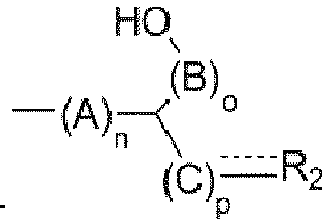
R2 mindestens einen Substituenten aufweist, der ausgewählt ist aus -OH und
- Die zweite Hydroxylgruppe der Verbindung der Formel (I) ist daher entweder als Substituent in dem organischen Rest R2 enthalten oder X enthält einen weiteren Rest der Formel

- In verschiedenen Ausführungsformen enthält das Alkenyletherpolyol der Formel (I) mindestens eine Urethangruppe. Durch die Umsetzung mit Polythiolen gemäß den hierin beschriebenen Verfahren lassen sich dann Polyhydroxyurethane (PHUs) darstellen.
- In verschiedenen Ausführungsformen des beschriebenen Herstellungsverfahren zur Darstellung eines Alkenyletherpolyols ist der Alkenylether, der mindestens eine Alkenylethergruppe und mindestens eine funktionelle Gruppe ausgewählt aus -OH, -COOH, -SH, -NH2 und deren Derivaten enthält, ein Alkenylether der Formel (II).

- Ein solcher Alkenylether kann beispielsweise verwendet werden, um ein Alkenyletherpolyol der Formel (I) zu synthetisieren, indem er mit einem Epoxid oder einem cyclischen Carbonat umgesetzt wird.
- In den Verbindungen der Formel (II) sind R1, R, R' und m wie oben für Formel (I) definiert. Insbesondere sind die oben für die Verbindungen der Formel (I) beschriebenen bevorzugten Ausführungsformen von R1, R, R' und m in gleicher Weise auf die Verbindungen der Formel (II) übertragbar.
- In den Verbindungen der Formel (II) ist
X1 eine funktionelle Gruppe ausgewählt aus -OH, -COOH, -SH, -NHRy und deren Derivaten, und
Ry ist H oder ein organischer Rest, vorzugsweise H. - Die Derivate der funktionellen Gruppen -OH, -COOH, -SH, -NHRy sind vorzugsweise die bereits oben im Zusammenhang mit der Definition des Begriffs beschriebenen ionischen Varianten, die sich durch Entfernen bzw. Bindung eines Protons ergeben, hierbei insbesondere die Alkoholate, Thiolate und Carboxylate, ganz besonders bevorzugt die Alkoholate.
- Besonders bevorzugt ist X1 -OH oder -O- oder -NH2.
- Eine Ausführungsform des beschriebenen Verfahrens zur Herstellung der Alkenyletherpolyole ist weiterhin dadurch gekennzeichnet, dass in dem Alkenylether der Formel (II) m 1 ist, X1 -OH oder -NH2, vorzugsweise -OH, ist, R1 ein zweiwertiger, linearer oder verzweigter C1-10 Alkylrest (Alkylenylrest), insbesondere Ethylenyl, Propylenyl, Butylenyl, Pentylenyl oder Hexylenyl, ist, und eines von R und R' H und das andere H oder -CH3 ist.
- Bei den Alkenylethern, die im Rahmen der beschriebenen Verfahren zur Herstellung der Alkenyletherpolyole eingesetzt werden können, insbesondere denen der Formel (II), kann es sich z. B. um Reaktionsprodukte von verschiedenen optional substituierten Alkanolen (Monoalkohole und Polyole) mit Acetylen handeln. Konkrete Beispiele schließen ein, ohne darauf beschränkt zu sein, 4-Hydroxybutylvinylether (HBVE) und 3-Aminopropylvinylether (APVE).
- Eine weitere Ausführungsform des beschriebenen Verfahrens zur Herstellung der Alkenyletherpolyole ist dadurch gekennzeichnet, dass das Epoxid, das mit dem Alkenylether umgesetzt wird, ein Epoxid der Formel (III) oder (IIIa) ist


- In Verbindungen der Formel (III) und (IIIa) ist R2 wie oben für Formel (I) definiert.
- R11, R12 und R13 sind unabhängig voneinander H oder ein organischer Rest, optional mit mindestens einer -OH Gruppe, insbesondere ein lineares oder verzweigtes, substituiertes oder unsubstituiertes Alkyl mit 1 bis 20 Kohlenstoffatomen oder lineares oder verzweigtes, substituiertes oder unsubstituiertes Heteroalkyl mit 1 bis 20 Kohlenstoffatomen und mindestens einem Sauerstoff- oder Stickstoffatom.
- q ist eine ganze Zahl von 1 bis 10, vorzugsweise 1 oder 2.
- Epoxyverbindungen, die in den Verfahren zur Herstellung von Alkenyletherpolyolen Anwendung finden können, sind demnach vorzugsweise lineare oder verzweigte, substituierte oder unsubstituierte Alkane mit einer Kohlenstoffatomanzahl von 1 bis 1000, vorzugsweise 1 bis 50 oder 1 bis 20, die mindestens eine Epoxygruppe tragen. Optional können diese Epoxyverbindungen zusätzlich noch eine oder mehrere Hydroxygruppen tragen, wodurch der Hydroxyl-Funktionalisierungsgrad des aus der Reaktion eines gegenüber Epoxiden reaktiven Alkenylethers, wie zuvor beschrieben, mit einem Epoxid entstandenen Alkenyletherpolyols hoch ist. Dadurch wiederum kann in späteren Polymerisierungsreaktionen die Quervernetzungsdichte des gewünschten Polymers kontrolliert und gesteuert werden.
- Bei der Reaktion einer gegenüber Epoxiden reaktiven Alkenyletherverbindung (Alkenylether mit mindestens einer funktionellen Gruppe ausgewählt aus -OH, -COOH, -SH, -NH2 und deren Derivaten) entsteht unter Ringöffnung des Epoxids ein Alkohol. Aus der Reaktionen eines ersten Alkohols oder einer in diesem Kontext chemisch verwandten Verbindung (Amin, Thiol, Carbonsäure, etc.) mit einem Epoxid wird somit die alkoholische Gruppe im Zuge der Bindungsknüpfung "regeneriert".
- In verschiedenen Ausführungsformen kann die Epoxyverbindung mehr als eine Epoxygruppe tragen. Dies ermöglicht die Umsetzung einer solchen Epoxyverbindung mit mehr als einer gegenüber Epoxiden reaktiven Alkenyletherverbindung, beispielsweise einem Aminoalkenylether oder Hydroxyalkenylether.
- In besonders bevorzugten Ausführungsformen ist das Epoxid ein Epoxid der Formel (III), wobei q 1 oder 2 ist, und wenn q 2 ist, R2-CH2-O-C1-10-Alkylenyl-O-CH2- ist, und wenn q 1 ist, R2 -CH2-O-C1-10-Alkyl ist.
- Beispiele für Epoxyverbindugen, die in den Herstellungsverfahren der Alkenyletherpolyole zum Einsatz kommen können, sind insbesonders Glycidylether, wie z.B., ohne Einschränkung, 1,4-Butandioldiglycidylether (BDDGE), Polyalkylenglycoldiglycidylether, Trimethylolpropanetriglycidylether, Bisphenol-A-diglycidylether (BADGE), Novolak basierte Epoxide und epoxidierte Polybutadiene oder Fettsäureester.
- In verschiedenen Ausführungsformen, ist das Alkenyletherpolyol der Formel (I) durch Umsetzen eines Alkenylethers der Formel (II) mit einem Epoxid der Formel (III) oder (IIIa) darstellbar.
- Anstelle eines Epoxids kann es sich bei den Verbindungen, die mit den gegenüber Epoxiden reaktiven Verbindungen (Alkenyletherverbindungen) umgesetzt werden, auch um cyclische Carbonate oder deren Derivate handeln. Cyclische Carbonatverbindungen unterliegen einer ähnlich den Epoxiden gearteten Reaktivität gegenüber den als Reaktionspartner dienenden Verbindungen, die sowohl Epoxide als auch cyclische Carbonatverbindungen unter Ringöffnung und "Regeneration" einer alkoholischen funktionellen Gruppe nucleophil am, im Falle eines Epoxids, Methylen des Epoxidrings, oder, im Falle eines cyclischen Carbonats, Carbonyl-Kohlenstoffatom addieren, wodurch, in Abhängigkeit des reaktiven, nucleophilen Restes, eine O-C-, N-C, S-C, oder O-/N-/S-C(=O)O-Bindung geknüpft wird.
- Die cyclischen Carbonate, welche im beschriebenen Verfahren zur Herstellung der Alkenyletherpolyole mit einem Alkenylether, insbesondere einem Alkenylether der Formel (II), umgesetzt werden können, sind in bevorzugten Ausführungsformen Cyclocarbonate der Formel (IV) oder (IVa)

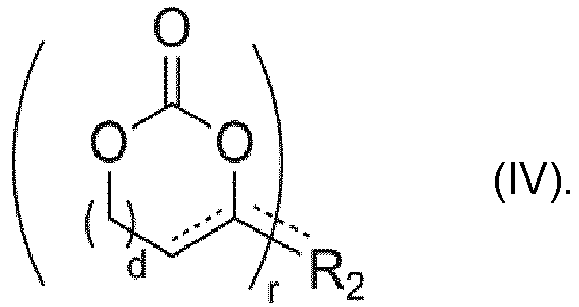
- In Verbindungen der Formel (IV) und (IVa) ist R2 wie für Formel (I), (III) und (IIIa) definiert. Insbesondere ist R2 ein C1-10 Hydroxyalkyl. In weiteren Ausführungsformen kann R2 =CH2 sein.
- ------ ist eine Einfach- oder Doppelbindung, vorzugsweise eine Einfachbindung. Es ist selbstverständlich, dass wenn der Ring eine Doppelbindung enthält, R2 nicht über eine exo-Doppelbindung sondern über eine Einfachbindung gebunden ist und umgekehrt.
- d ist 0, 1, 2, 3, 4 oder 5, vorzugsweise 0 oder 1, besonders bevorzugt 0, und r ist eine ganze Zahl von 1 bis 10, vorzugsweise 1 oder 2, ganz besonders bevorzugt 1.
- Wenn d 1 ist, d.h. das Cyclocarbonat ein 1,3-Dioxan-2-on ist, kann R2 in der 4- oder 5-Position sein, ist aber vorzugsweise in der 5-Position.
- Beispielhafte cyclische Carbonate schließen ein, ohne darauf beschränkt zu sein, 1,3-Dioxolan-2-on, 4,5-Dehydro-1,3-Dioxolan-2-on, 4-Methylen-1,3-Dioxolan-2-on, und 1,3-Dioxan-2-on, die in der 4- bzw. 5-Position mit R2 substituiert sind.
- In verschiedenen Ausführungsformen der beschriebenen Verfahren zur Herstellung der Alkenyletherpolyole werden cyclische Carbonat eingesetzt, die Derivate der Carbonate der Formeln (IV) und (IVa) sind. Beispielhafte Derivate schließen solche ein, die an den Ring-Methylengruppen, insbesondere denen die nicht den R2 Rest tragen, substituiert sind, beispielsweise mit organischen Resten, insbesondere linearen oder verzweigten, substituierten oder unsubstituierten Alkyl- oder Alkenylresten mit bis zu 20 Kohlenstoffatomen, insbesondere =CH2 und -CH=CH2, oder linearen oder verzweigten, substituierten oder unsubstituierten Heteroalkyl- oder Heteroalkenylresten mit bis zu 20 Kohlenstoffatomen und mindestens einem Sauerstoff- oder Stickstoffatom, oder funktionellen Gruppen, wie beispielsweise -OH oder -COOH. Beispiele für solche Derivate schließen beispielsweise 4-Methylen-1,3-Dioxolan-2-on, das an der 5-Position den R2 Rest trägt, oder di-(Trimethylolpropan)dicarbonat, wobei der R2 Rest in der 5-Position ein Methylen-Trimethylolmonocarbonatrest ist.
- In verschiedenen Ausführungsformen in denen der R2 Rest über eine Einfachbindung gebunden ist, kann das Ring-Kohlenstoffatom, dass den R2 Rest trägt mit einem weiteren Substituenten, der wie die oben genannten Substituenten für die anderen Ring-Methylengruppe definiert ist, substituiert sein.
- Weitere Derivate sind solche in denen eines oder beide der Ring-Sauerstoffatome durch Schwefelatome ersetzt sind sowie solche in denen alternativ oder zusätzlich das Carbonyl-Sauerstoffatom durch ein Schwefelatom ersetzt ist. Ein besonders bevorzugtes Derivat ist das 1,3-Oxathiolan-2-thion.
- In verschiedenen Ausführungsformen ist das cyclische Carbonat 4-Methylen-1,3-Dioxolan-2-on, das an der 5-Position den R2 Rest trägt. Wenn ein solches cyclisches Carbonat mit einem Alkenylether umgesetzt wird, der als reaktive Gruppe eine Aminogruppe trägt, kann sich eine Verbindung der Formel (la) bilden:

- In dieser Verbindung sind m, R1, R, R', R2 und Rx wie oben für die Verbindungen der Formel (I)-(IV) definiert. Diese Verbindungen der Formel (la) enthalten keine Alkenylethergruppe und können daher zwar als Polyole für die Herstellung von Polyurethanen oder Polyestern verwendet werden, allerdings nur in Kombination mit weiteren Polyolen, die Alkenylethergruppen enthalten. Solche Verbindungen der Formel (la) sind daher erfindungsgemäß nicht bevorzugt.
- Bei der Umsetzung der vorstehend beschriebenen Cyclocarbonate und deren Derivate der Formeln (IV) und (IVa) mit einer Verbindung der Formel (II), ist in verschiedenen Ausführungsformen in den Verbindungen der Formel (II) (i) X1 -NH2 oder ein Derivat davon, und in der Verbindung der Formel (IV) oder (IVa) ist r 1; oder (ii) X1 ist -OH oder ein Derivat davon, und in der Verbindung der Formel (IV) oder (IVa) ist r 2.
- In verschiedenen Ausführungsformen der Erfindung sind Alkenyletherpolyole bevorzugt, die mindestens eine Urethangruppe enthalten. Diese sind darstellbar durch Umsetzen der oben definierten Alkenylether die als reaktive Gruppe eine Aminogruppe tragen mit den beschriebenen zyklischen Carbonaten.
- In weiteren Ausführungsformen ist das Alkenyletherpolyol durch Umsetzen der in Route B) aufgeführten Verbindungen darstellbar. Dabei wird das Alkenyletherpolyol hergestellt durch Umsetzen eines Alkenylethers, enthaltend mindestens eine Alkenylethergruppe und mindestens eine funktionelle Gruppe ausgewählt aus (i) Epoxidgruppen und (ii) cyclischen Carbonatgruppen oder Derivaten davon, mit einem Alkohol, Thiol, einer Carbonsäure oder einem Amin oder Derivaten der vorgenannten.
- In verschiedenen Ausführungsformen dieses Verfahrens ist das Alkenyletherpolyol ein Alkenyletherpolyol der Formel (V)

- In den Verbindungen der Formel (V) ist R1 wie oben für die Verbindungen der Formel (I) definiert. R3 ist ein organischer Rest, optional mit mindestens einer -OH Gruppe und/oder 1 bis 1000 Kohlenstoffatomen, insbesondere ein (optional 2- oder mehrwertiges) lineares oder verzweigtes, substituiertes oder unsubstituiertes Alkyl mit 1 bis 50, vorzugsweise 1 bis 20 Kohlenstoffatomen oder ein (optional 2- oder mehrwertiges) lineares oder verzweigtes, substituiertes oder unsubstituiertes Heteroalkyl mit 1 bis 50, vorzugsweise 1 bis 20 Kohlenstoffatomen und mindestens einem Sauerstoff- oder Stickstoffatom. R2 kann aber auch ein hochmolekularer Rest, wie beispielweise ein Polyalkylenglykolrest sein. Ein solcher (Poly)alkylenglykolrest kann beispielsweise die Formel -O-[CHRaCH2O]b-Rb aufweisen, wobei Ra H oder ein C1-4-Alkylrest, Rb -H oder ein organischer Rest oder

- In den Verbindungen der Formel (V) ist X O, S, OC(=O), OC(=O)O, OC(=O)OC(=O), NRz, NRzC(=O)O, NRzC(=O)NRz oder OC(=O)NRz. In bevorzugten Ausführungsformen ist X O, OC(=O)O, NRz oder OC(=O)NRz.
- Jedes R und R' ist unabhängig ausgewählt aus H, C1-20 Alkyl und C2-20 Alkenyl, wobei insbesondere eines von R und R' H und das andere C1-4 Alkyl oder beide H sind. Besonders bevorzugt ist R H und R' ist H oder -CH3.
- Jedes A und B ist unabhängig ausgewählt aus CR"R"', wobei R" und R'" unabhängig ausgewählt sind aus H, einer funktionellen Gruppe, wie beispielsweise -OH, -NH2, -NO2, -CN, -OCN, -SCN, -NCO, -NCS, -SH, -SO3H oder -SO2H, und einem organischen Rest. Insbesondere sind R" und R'" unabhängig H oder C1-20 Alkyl. R" und R'" können aber auch gemeinsam oder zusammen mit dem Kohlenstoffatom an das sie gebunden sind einen organischen Rest, einschließlich zyklischer Reste, oder eine funktionelle Gruppe bilden. Beispiele für solche Reste sind =CH2, =CH-Alkyl oder =C(Alkyl)2, =O, =S, - (CH2)aa- mit aa = 3 bis 5 bzw. Derivate davon, in denen eine oder mehrere Methylengruppen durch Heteroatome wie N, O oder S ersetzt sind. Zwei von R" und R"', die an benachbarte Kohlenstoffatome gebunden sind, können aber auch zusammen eine Bindung bilden. Dadurch wird zwischen den beiden benachbarten Kohlenstoffatome eine Doppelbindung ausgebildet (d.h. -C(R")=C(R")-).
- In den Verbindungen der Formel (V) ist m eine ganze Zahl von 1 bis 10, vorzugsweise 1 oder 2, besonders bevorzugt 1. D.h. die Verbindungen tragen vorzugsweise nur eine oder 2 Alkenylethergruppe(n).
- s und t sind jeweils 0 oder eine ganze Zahl von 1 bis 10. Dabei erfüllen sie die Bedingung s+t=1 oder mehr, insbesondere 1 oder 2. Es ist besonders bevorzugt, dass s oder t 1 ist und die andere 0 ist.
- Rz ist H, ein organischer Rest oder

- Damit das Alkyletherpolyol der Formel (V) die Bedingung erfüllt, dass es mindestens zwei Hydroxylgruppen trägt, ist wenn Rz nicht

R3 mit mindestens einem Substituenten substituiert, der ausgewählt ist aus -OH und
- In weiteren bevorzugten Ausführungsformen ist das Verfahren dadurch gekennzeichnet, dass der Alkenylether, der mindestens eine Alkenylethergruppe und mindestens eine funktionelle Gruppe ausgewählt aus (i) Epoxidgruppen und (ii) cyclischen Carbonatgruppen oder Derivaten davon enthält, ein Alkenylether der Formel (VI) oder (VII) ist


- In den Verbindungen der Formel (VI) oder (VII) sind R1, R, R' und m wie oben für die Verbindungen der Formeln (I) und (II) definiert.
d ist wie oben für die Formeln (IV) und (IVa) definiert, d.h. d ist 0, 1, 2, 3, 4 oder 5, vorzugsweise 0 oder 1, besonders bevorzugt 0. - In besonders bevorzugten Ausführungsformen ist R1 in den Alkenylethern der Formel (VI) oder (VII) -C1-10-Alkylenyl-O-CH2-.
- Die Epoxygruppen tragenden Alkenylether der Formel (VI) können am Epoxyrest substituiert sein, d.h. die Methylengruppen des Oxiranrings können, wie in Formel (IIIa) gezeigt, mit R11-R13 substituiert sein.
- In verschiedenen Ausführungsformen sind die Alkenylether der Formel (VII) am Cyclocarbonatring substituiert oder der Cyclocarbonatring ist durch ein entsprechendes Derivat ersetzt. Geeignete substituierte Cyclocarbonate sowie Derivate davon sind solche, die oben im Zusammenhang mit Formel (IV) und (IVa) beschrieben wurden. Insbesondere ist der Cyclocarbonatrest vorzugsweise ein 1,3-Dioxolan-2-on- oder 1,3-Dioxan-2-on-Rest, der ggf. substituiert sein kann, beispielsweise mit einer Methylengruppe.
- Geeignete Verbindungen der Formel (VI) schließen ein, ohne darauf beschränkt zu sein, Vinylglycidylether und 4-Glycidylbutylvinylether (GBVE), wobei letzterer durch Umsetzen von 4-Hydroxybutylvinylether mit Epichlorhydrin darstellbar ist.
- Geeignete Verbindungen der Formel (VII) schließen ein, ohne darauf beschränkt zu sein, 4-(Ethenyloxymethyl)-1,3-Dioxolan-2-on, das beispielsweise durch Umesterung von Glycerincarbonat mit Ethylvinylether darstellbar ist oder 4-Glycerincarbonat(4-butylvinylether)ether (GCBVE), das durch Epoxidierung von Hydroxybutylvinylether (HBVE) und anschließende CO2-Insertion darstellbar ist.
- In verschiedenen Ausführungsformen wird der Alkenylether, der mindestens eine Alkenylethergruppe und mindestens eine funktionelle Gruppe ausgewählt aus (i) Epoxidgruppen und (ii) cyclischen Carbonatgruppen oder Derivaten davon enthält, insbesondere einer der Formel (VI) oder (VII) mit einem Alkohol oder Amin umgesetzt. Bei dem Alkohol kann es sich um ein Diol oder Polyol oder ein entsprechendes Alkoholat handeln. Insbesondere kann der Alkohol ein Polyalkylenglykol der Formel HO-[CHRaCH2O]b-H sein, wobei Ra H oder ein C1-4-Alkylrest und b 1 bis 100, insbesondere 1 bis 10, ist.
- Route B) stellt somit eine alternative Ausführungsform dar, in der die Epoxid- oder die cyclischen Carbonatverbindungen (beispielsweise Ethylencarbonat- oder Trimethylencarbonatverbindungen) mindestens eine oder mehrere Alkenylethergruppen aufweisen. Die Umsetzung dieser Epoxid- oder cyclischen Carbonatverbindungen mit gegenüber Epoxiden oder im Kontext dieser Erfindung chemisch ähnlich reagierenden Verbindungen (cyclische Carbonate) reaktiven Verbindungen, insbesondere solchen, die -OH, -COOH, -SH, -NH2 und ähnliche Gruppen oder deren Derivate tragen - beispielsweise entsprechend funktionalisierte, vorzugsweise mehrfach entsprechend funktionalisierte lineare oder verzweigte, gesättigte oder teilweise ungesättigte, zusätzlich substituierte oder unsubstituierte, zyklische oder lineare (Hetero)Alkyle und (Hetero)Aryle - ergibt die gewünschten Alkenyletherpolyole.
- Beispiele für Verbindungen, die mindestens eine der Gruppen -OH, -COOH, -SH, -NH2 und deren derivatisierte Formen aber keine Alkenylethergruppen aufweisen, sind beispielsweise, ohne Einschränkung, Glykole, Polyglykole, Aminosäuren, Polyole und Di- und Polyamine, wie z.B. Glycin, Glycerol, Hexamethylendiamin, 1,4-Butandiol und 1,6-Hexandiol.
- In verschiedenen Ausführungsformen sind Alkenyletherpolyole mit mindestens einer Urethangruppe, die sich durch Umsetzen von einem Alkenylether mit zyklischen Carbonatgruppen und einem Amin darstellen lassen, bevorzugt.
- Bei den mittels der beschriebenen Verfahren herstellbaren oder erhältlichen Alkenyletherpolyole handelt es sich beispielsweise um Verbindungen der Formeln (I), (la) und (V), wie oben definiert.
- In verschiedenen Ausführungsformen der Alkenyletherpolyole der Formel (I) ist:
- (1) m = 1; R und R' sind H oder R ist H und R' ist Methyl; R1 ist C1-10 Alkylenyl, insbesondere C1-6 Alkylenyl, X ist O, A und B sind CH2, n und o sind 1 oder 0 und p ist 0, wobei n+o=1, und R2 ist ein organischer Rest, der mit -OH substituiert ist oder einen weiteren Rest der Formel

- (2) m = 1; R und R' sind H oder R ist H und R' ist Methyl; R1 ist C1-10 Alkylenyl, insbesondere C1-6 Alkylenyl, X ist NRx, A und B sind CH2, n und o sind 1 oder 0 und p ist 0, wobei n+o=1, Rx ist H oder


- (3) m = 1; R und R' sind H oder R ist H und R' ist Methyl; R1 ist C1-10 Alkylenyl, insbesondere C1-6 Alkylenyl, X ist OC(=O)O, A und B sind CH2, n und o sind 1 oder 0 und p ist 0, wobei n+o=1, und R2 ist ein organischer Rest, der mit -OH substituiert ist oder einen weiteren Rest der Formel

- (4) m = 1; R und R' sind H oder R ist H und R' ist Methyl; R1 ist C1-10 Alkylenyl, insbesondere C1-6 Alkylenyl, X ist NRxC(=O)O, A und B sind CH2, n und o sind 1 oder 0 und p ist 0, wobei n+o=1, Rx ist H oder


- In den vorstehend genannten Ausführungsformen ist R2 vorzugsweise über eine Einfachbindung gebunden und kann beispielsweise ein Heteroalkylrest, insbesondere ein Alkyletherrest mit 2 bis 10 Kohlenstoffatomen sein. Geeignet sind beispielsweise Reste der Formel -CH2-O-(CH2)4-O-CH2- (für den Fall, dass R2 zwei Alkenyletherreste der obigen Formel trägt) oder -CH2-O-CH(CH3)2.
- In verschiedenen Ausführungsformen der Alkenyletherpolyole der Formel (V) ist:
- (1) m = 1; R und R' sind H oder R ist H und R' ist Methyl; R1 ist -(CH2)1-10-O-CH2-, insbesondere -(CH2)1-6-O-CH2-, X ist O, A und B sind CH2, s und t sind 1 oder 0, wobei s+t=1, und R3 ist ein organischer Rest, der mit -OH substituiert ist oder einen weiteren Rest der Formel

- (2) m = 1; R und R' sind H oder R ist H und R' ist Methyl; R1 ist -(CH2)1-10-O-CH2-, insbesondere -(CH2)1-6-O-CH2-, X ist NRz, A und B sind CH2, s und t sind 1 oder 0, wobei s+t=1, Rz ist H oder
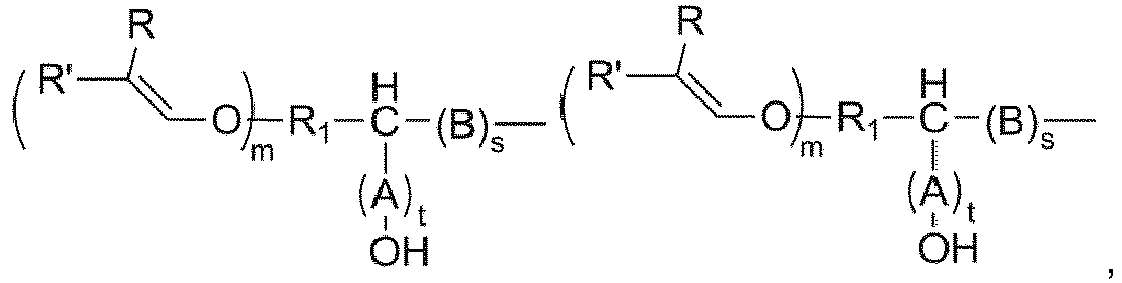

- (3) m = 1; R und R' sind H oder R ist H und R' ist Methyl; R1 ist -(CH2)1-10-O-CH2-, insbesondere -(CH2)1-6-O-CH2-, X ist OC(=O)O, A und B sind CH2, s und t sind 1 oder 0, wobei s+t=1, und R3 ist ein organischer Rest, der mit -OH substituiert ist oder einen weiteren Rest der Formel

- (4) m = 1; R und R' sind H oder R ist H und R' ist Methyl; R1 ist -(CH2)1-10-O-CH2-, insbesondere -(CH2)1-6-O-CH2-, X ist OC(=O)NRz, A und B sind CH2, s und t sind 1 oder 0, wobei s+t=1, Rz ist H oder
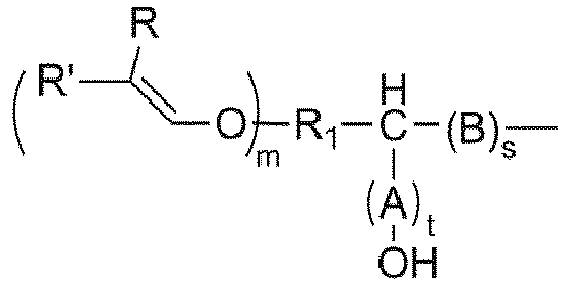

- In den vorstehend genannten Ausführungsformen der Verbindungen der Formel (V) ist R3 beispielsweise ein Heteroalkylrest, insbesondere ein (Poly)Alkylenglykol, wie insbesondere Polypropylenglykol, oder ein C1-10 Alkyl- oder Alkylenylrest.
- Die Durchführung der einzelnen Stufen des beschriebenen Verfahrens zur Herstellung der Alkenyletherpolyole der Formel (I) oder (V) kann nach den für solche Reaktionen üblichen Methoden erfolgen. Dazu werden die Reaktionspartner, ggf. nach Aktivierung (beispielsweise Herstellung von Alkoholaten durch Umsetzen mit Natrium, miteinander in Kontakt gebracht und ggf. unter Schutzgasatmosphäre und Kontrolle der Temperatur umgesetzt.
- Die vorstehend beschriebenen Alkenyletherpolyole werden dann in den erfindungsgemäßen Verfahren für die Synthese von Polymeren, insbesondere Polyhydroxyurethanen, durch Umsetzen mit Thiolverbindungen über eine Thiol-en Polyadditionsreaktion eingesetzt. Alternativ können anstelle der Alkenyletherpolyole auch Präpolymere, die diese als Monomereinheiten enthalten, eingesetzt werden. Beispiele für solche Präpolymere sind beispielsweise Polyurethane und Polyester, die sich durch Umsetzen mindestens eines der beschriebenen Alkenyletherpolyole oder einer Mischung von Polyolen, die mindestens eines der beschriebenen Alkenyletherpolyole enthält, mit Polyisocyanaten oder Polycarbonsäuren darstellen lassen. Je nachdem welche Komponente im Überschuß eingesetzt wird, lassen sich so OH- oder NCO-terminierte Polyurethane mit Alkenyletherseitenketten bzw. OH- oder COOH-terminierte Polyester mit Alkenyletherseitenketten erhalten. Diese können dann mit den Polythiolen erfindungsgemäß zu Polymeren umgesetzt werden.
- Alternativ können Alkenylgruppen-haltige Verbindungen durch die Umsetzung mit Polythiolverbindungen vernetzt (gehärtet) werden. Bei den Alkenylgruppen-haltigen Verbindungen kann es sich um Alkenyletherpolyole wie oben definiert oder Polymere, die diese Alkenyletherpolyole als Monomereinheiten enthalten, handeln. Bei den Polymeren kann es sich beispielsweise um Polyurethane oder Polyester handeln, die sich durch Umsetzen mindestens eines der beschriebenen Alkenyletherpolyole oder einer Mischung von Polyolen, die mindestens eines der beschriebenen Alkenyletherpolyole enthält, mit Polyisocyanaten oder Polycarbonsäuren darstellen lassen.
- Dabei sind die eingesetzen Thiolverbindungen organische Verbindungen, die mindestens zwei Thiolgruppen aufweisen, beispielsweise Dimercaptoverbindungen, vorzugsweise optional substituierte Dimercaptoalkane. Beispielhafte Verbindungen sind solche der Formel (VIII)
(HS)u-R4-SH (VIII)
wobei - R4 ein mindestens 2-wertiger organischer Rest ist, insbesondere ein mindestens 2-wertiges lineares oder verzweigtes, substituiertes oder unsubstituiertes Alkyl mit 1 bis 20 Kohlenstoffatomen oder lineares oder verzweigtes, substituiertes oder unsubstituiertes Heteroalkyl mit 1 bis 20 Kohlenstoffatomen und mindestens einem Sauerstoff- oder Stickstoffatom; und
- u eine ganze Zahl von 1 bis 10, vorzugsweise 1 bis 5 ist.
- Beispiele für geeignete Polythiolverbindungen sind beispielsweise 1,2-Ethandithiol, 1,8-Dimercapto-3,6-dioxaoctane (DMDO), Glycoldi(3-mercaptopropionat) (GDMP), Trimethylolpropantri(3-mercapto-propionat) (TMPMP), Pentaerythritoltetra(3-mercaptopropionat) (PETMP), Dipentaerythritolhexakis(3-mercaptopropionat) (Di-PETMP), Ditrimethylolpropantetra(3-mercaptopropionat) (Di-TMPMP), Glycoldimercaptoacetat (GDMA), Trimethylolpropantrimercaptoacetat (TMPMA), Pentaerythritoltetramercaptoacetat (PETMA), Ethoxyliertes TMPMP (ETTMP), Propylenglykol(3-mercaptopropionat) (PPGMP), 2,3-Di((2-mercaptoethyl)thio)-1-propanethiol (DMPT), Dimercaptodiethylsulfid (DMDS), Tris[2-(3-mercaptopropionyloxy)ethyl]isocyanurat (TEMPIC), oder Mercaptoacetate und Mercaptopropionate diverser alkoxylierter Polyole. Derartige Polythiole sind kommerziell von Bruno Bock GmbH & Co. KG (Marschacht, DE) erhältlich.
- Bei den erfindungsgemäßen Verfahren zur Herstellung von Polymeren, insbesondere linearen Polymeren, werden vorzugsweise Dithiole eingesetzt. Bei den erfindungsgemäßen Verfahren zur Vernetzung von Polymeren werden vorzugsweise Dithiole noch bevorzugter höherwertige Thiole, wie Trithiole oder Tetrathiole eingesetzt.
- In verschiedenen Ausführungsformen des erfindungsgemäßen Verfahrens, werden die Reaktionspartner, d.h. die Alkenyletherpolyole/Alkenylethergruppe-haltigen Polymere und die Thiole, in Anwesenheit eines Photoinitiators, wie z.B. 2,2'-Azobis(2,4-dimethylvaleronitril) durch Exposition gegenüber elektromagnetischer Strahlung zur Reaktion gebracht. Bei dem Reaktionsmechanismus handelt es sich um eine Radikal-vermittelte Polyaddition (Thiol-en). Die Reaktion kann in Lösung in einem geeigneten organischen Lösungsmittel, wie z.B. THF, erfolgen, da dabei die Reaktionskontrolle einfacher sein kann. Darüber hinaus sind neben entsprechenden Photoinitiatoren prinzipiell auch Initiatoren für radikalischen Umsetzungen geeignet, die sich durch Temperatur und/oder Redoxreaktionen aktivieren lassen. Beispiele hierfür sind Azoinitiatoren wie AIBN, organische Peroxidverbindungen, Redoxpaare (SFS, H2O2, tert.-Butylperoxid, Acscorbinsäure) und alle weiteren dam Fachmann für diesen Zweck bekannten System.
- Bevorzugt ist die Verwendung von Photoinitiatorsystemen, wobei generell alle im Stand der Technik bekannten Photoinitiatoren geeignet sind. Diese können optional auch in Kombination mit bekannten Sensitizern oder auch anderen Radikalinitiatoren eingesetzt werden.
- Die elektromagnetische Strahlung kann insbesondere sichtbares Licht oder UV-Licht sein und wird in Abhängigkeit der eingesetzten Photoinitiatoren gewählt.
- Die Initiierung der Polymersynthese durch Strahlung ist ein deutlicher Anwendungsvorteil gegenüber der gewöhnlichen Polymerisation, insbesondere für vernetzende Systeme. Die entsprechenden Formulierungen, die die Reaktionspartner enthalten, stellen ein latent reaktives 1 K-System dar, dessen Härtung erst bei Bestrahlung aktiv eingeleitet wird.
- In den Verfahren werden die Alkenyletherpolyole bzw. die (Prä)Polymere, die die Alkenyletherpolyole als Monomereinheiten enthalten, und Thiole in verschiedenen Ausführungsformen in solchen Mengen eingesetzt, dass das molare Verhältnis von Alkenylethergruppen zu Thiolgruppen im Bereich von 0,1 bis 10, vorzugsweise im Bereich von 0,8 bis 2,0 liegt.
- Die Erfindung betrifft schließlich auch die mittels der hierin beschriebenen Verfahren herstellbaren Polymere, insbesondere die Polyhydroxyurethane und vernetzten Polymere. Die Polyhydroxyurethane können auch in Form von wasserbasierten Dispersionen (PUD) bereitgestellt werden.
- Ferner erfasst die Erfindung auch Zusammensetzungen, die die hierin beschriebenen Polymere enthalten, insbesondere Klebstoffe, Dichtstoffe und Beschichtungsmittel.
- Ebenfalls Gegenstand der Erfindung ist die Verwendung der hierin beschriebenen Polymere als Bestandteil von Klebstoff-, Dichtstoff- und Beschichtungsmittelzusammensetzung. Derartige Zusammensetzungen können ferner alle dem Fachmann bekannten üblichen Zusatz- und Hilfsstoffe enthalten.
- Alle hierin im Zusammenhang mit den erfindungsgemäßen Verfahren zur Herstellung der Polymere bzw. den Verfahren zur Vernetzung von alkenylethergruppen-haltigen Polymeren mit Thiolverbindungen offenbarten Ausführungsformen sind ebenso auf die beschriebenen Polymere als solche, sowie deren Verwendung und Verfahren zu deren Verwendung übertragbar und umgekehrt.
- Die Erfindung wird im Folgenden anhand von Beispielen weiter veranschaulicht, wobei diese nicht als Einschränkung verstanden werden sollten.
- 4-Hydroxybutylvinylether (HBVE) (BASF, 99% stabilisiert mit 0,01 % KOH), Epichlorhydrin (ECH, Solvay, 99,8%), Tetrabutylammoniumbromid (TBAB, Merck, 99%), Tetraethylammoniumbromide (TEAB, Merck, 99%), 1,4-Butandioldiglycidylether(BDDGE, Sigma-Aldrich, 95%), Di(trimethylolpropan) (di-TMP, Sigma-Aldrich, 97%), Ethylchloroformiat (Alfa Aesar, 97%), Triethylamin (Acros Organics, 99%), Ethylenglykol-bis(aminopropyl)ether (EGBAPE, Huntsman, Jeffamin EDR-176), 3-Aminopropylvinylether (APVE, BASF, 99.7%), Hexamethylendiisocyanat (HDI, Acros Organics, 99%), Dimethylzinndineodecanoat (Momentive, Fomrez catalyst UL-28), Methanol (VWR Chemicals), 10-[1,1'-Biphenyl]-4-yl-2-(1-methylethyl)-9-oxo-9H-thioxanthenium hexafluorophosphat (Omnicat 550, IGM), Dimercapto-1,8-dioxa-3,6-octane (DMDO, Arkema), Pentaerythritoltetra(3-mercaptopropionat) (Bruno Bock, Thiocure PETMP, 95%) und 2,2'Azobis(2,4-dimethylvaleronitril) (Wako V65) wurden wie erhalten verwendet.
- Di-TMPDC wurde gemäß Yang et al. (Polymer 2013, 54, (11), 2668-2675) synthetisiert. Dazu wurden 37.55 g (0.15 mol) di-TMP in 1 L trockenem THF aufgelöst und auf -10 °C gekühlt. 97.67 g (0.9 mol) Ethylchloroformiat wurden bei dieser Temperatur tropfenweise zugegeben. Danach wurde unter denselben Bedingungen Triethylamin zugegeben bevor die Mischung über Nacht ohne Kühlen gerührt wurde. Die Mischung wurde filtriert und mit Wasser gewaschen. Die organische Lösung wurde unter reduziertem Druck konzentriert, das Produkt in Diethylether gefällt und aus THF umkristallisiert um einen weißen Feststoff zu ergeben. Ausbeute: 76%. Elementaranalyse: C, 55.69; H, 7.37; O, 36.94 (berechnet: C, 55.62; H, 7.33; O, 37.05 for C14H22O7). MS (Cl): m/z = 320.1 [M+NH4]+ (berechnet: 302.2 for C14H22O7NH4). 1H NMR (400 MHz, CDCl3, 298 K) δ (ppm): 0.95 (t, 6H, CH3), 1.49 (q, 4H, CH2-CH3), 3.49 (s, 4H, CH2-O), 4.22 (dd, 8H, CH2 cyclisches Carbonat).
- 9.10 g (30 mmol) di-TMPDC aus Beispiel 1 und 6.09 g (60 mmol) APVE wurden gemischt und für 22 h unter Stickstoffatmosphäre auf 80 °C erhitzt. Die Konversion wurde mittels IR Spektroskopie unter Verwendung der C=O Streckschwingung des fünf-gliedrigen Carbonats und dem Urethan bei 1780 cm-1 bzw. 1690 cm-1 verfolgt.
- 4,28 g (8,5 mmol) des Vinyletherpolyols aus Beispiel 2, 1,55 g (8,5 mmol) 1,8-Dimercapto-3,6-dioxaoctan (DMDO) und 0,058 g (1 Gew.-%) 2,2'-Azobis(2,4-dimethylvaleronitril) wurden in einen 100 ml Dreihalsrundkolben gegeben, in 50 ml THF aufgelöst und mit Stickstoff gespült. Eine Loctite 97034 Lichtquelle ausgerüstet mit einem UVC 97327 Lichtleiter wurde an den mittleren Hals angeschlossen und die Reaktion durch UV Bestrahlung für 900 Sekunden bei Raumtemperatur unter Rühren mit 500 U/min gestartet. THF wurde unter reduziertem Druck entfernt und IR Spektroskopie zeigte den Verbrauch von Vinylether und funktionellen Thiolgruppen an.
- 1,01 g (2 mmol) des Vinyletherpolyols aus Beispiel 2, 0,43 g (1 mmol) PETMP und 7,3 mg g (0,5 Gew.-%) 2,2'-Azobis(2,4-dimethylvaleronitril) wurden gemischt und die Probe in einem Rheometer gehärtet. Rheologische und NIR spektroskopische Untersuchungen der UV-induzierten Härtungsreaktion wurden unter Verwendung eines Anton Paar MCR 302 Rheometers gekoppelt an ein Bruker MPA FT-NIR Spektrometer und eine Omnicure S 2000 SC Lichtquelle durchgeführt. Das Instrument war in einer Platten/Platten Geometrie unter Verwendung einer Quarzglas Bodenplatte und einer wegwerfbaren Aluminiumdeckplatte mit einem Durchmesser von 25 mm bei einer anfänglichen Spaltdistanz von 100 µm aufgebaut. Eine Normalkraft von 0 wurde angewendet, um Spannung durch die Kontraktion oder Expansion der Probe zu vermeiden. Die Messung wurde bei 75°C unter instrumenteller Luftatmosphäre (H2O: 1.1 mg/m3) durchgeführt. Anfänglich wurden die Daten alle 5 s mit einer sinusoidalen Spannung von 10% bei einer Frequenz von 10 Hz aufgenommen. Die Probe wurde dann für 30 s mit einer Intensität von 189 mW cm-2 UVA-C bestrahlt. Diese Intensität wurde an der Oberfläche der Quarzplatte unter Verwendung eines Spektralradiometers (OpSyTec Dr. Göbel) bestimmt. Während der Bestrahlung wurden mechanische Daten mit einer Rate von 1 s-1 aufgenommen und die sinusoidale Spannung wurde linear auf 0.5% innerhalb von 210 s angehoben und für weitere 360 s konstant gehalten. NIR Spektren wurden mit einer Rate von ungefähr 2 s-1 mit einer Auflösung von 16 cm-1 aufgenommen. Die Umwandlung der Vinyletherdoppelbindung wurde durch das Beobachten der charakteristischen Absorption der C-H Streckoberschwingung bei 6200 cm-1 verfolgt.
Claims (12)
- Verfahren zur Herstellung eines Polymers, insbesondere eines Polyhydroxyurethanpolymers, umfassend Umsetzen mindestens eines Alkenyletherpolyols enthaltend mindestens eine Alkenylethergruppe, insbesondere eine 1-Alkenylethergruppe, und mindestens zwei Hydroxylgruppen (-OH), oder eines Präpolymers, das mindestens ein solches Alkenyletherpolyol als Monomereinheit enthält, mit einer Verbindung, die mindestens zwei Thiolgruppen enthält.
- Verfahren zum Vernetzen einer Verbindung, die mindestens eine Alkenylethergruppe enthält, vorzugsweise eines Alkenyletherpolyols enthaltend mindestens eine Alkenylethergruppe, insbesondere eine 1-Alkenylethergruppe, und mindestens zwei Hydroxylgruppen (-OH), oder eines Polymers, das mindestens ein solches Alkenyletherpolyol als Monomereinheit enthält, insbesondere eines Polyurethans oder Polyesters, umfassend Umsetzen der Verbindung mit einer Verbindung, die mindestens zwei Thiolgruppen enthält.
- Verfahren nach Anspruch 1 oder 2, dadurch gekennzeichnet, dass das Alkenyletherpolyol erhältlich ist durchA) Umsetzen eines Alkenylethers, enthaltend mindestens eine Alkenylethergruppe und mindestens eine funktionelle Gruppe ausgewählt aus -OH, -COOH, -SH, -NH2 und deren Derivaten, mit (i) einem Epoxid oder (ii) einem cyclischen Carbonat oder Derivat davon; oderB) Umsetzen eines Alkenylethers, enthaltend mindestens eine Alkenylethergruppe und mindestens eine funktionelle Gruppe ausgewählt aus (i) Epoxidgruppen und (ii) cyclischen Carbonatgruppen oder Derivaten davon, mit einem Alkohol, Thiol, einer Carbonsäure oder einem Amin oder Derivaten der vorgenannten.
- Verfahren nach Anspruch 3, wobei das Alkenyletherpolyol erhältlich ist durch Umsetzen eines Alkenylethers, enthaltend mindestens eine Alkenylethergruppe und mindestens eine funktionelle Gruppe ausgewählt aus -OH, -COOH, -SH, -NH2 und deren Derivaten, mit (i) einem Epoxid oder (ii) einem cyclischen Carbonat oder Derivat davon, dadurch gekennzeichnet, dass das Alkenyletherpolyol ein Alkenyletherpolyol der Formel (I) ist wobei
 R1 ein mindestens 2-wertiger organischer Rest ist, insbesondere ein mindestens 2-wertiges lineares oder verzweigtes, substituiertes oder unsubstituiertes Alkyl mit 1 bis 20 Kohlenstoffatomen oder lineares oder verzweigtes, substituiertes oder unsubstituiertes Heteroalkyl mit 1 bis 20 Kohlenstoffatomen und mindestens einem Sauerstoff- oder Stickstoffatom,R2 ein organischer Rest ist, optional mit mindestens einer -OH Gruppe und/oder 1 bis 1000 Kohlenstoffatomen, insbesondere ein optional 2- oder mehrwertiges, lineares oder verzweigtes, substituiertes oder unsubstituiertes Alkyl mit 1 bis 20 Kohlenstoffatomen oder lineares oder verzweigtes, substituiertes oder unsubstituiertes Heteroalkyl mit 1 bis 20 Kohlenstoffatomen und mindestens einem Sauerstoff- oder Stickstoffatom,X O, S, C(=O)O, OC(=O)O, C(=O)OC(=O)O, NRx, NRxC(=O)O, NRxC(=O)NRx oder OC(=O)NRx ist,jedes R und R' unabhängig ausgewählt ist aus H, C1-20 Alkyl und C2-20 Alkenyl, wobei insbesondere eines von R und R' H und das andere C1-4 Alkyl oder beide H sind,jedes A, B und C unabhängig ausgewählt ist aus CR"R"',R" und R'" unabhängig ausgewählt sind aus H, einer funktionellen Gruppe, und einem organischen Rest, insbesondere H und C1-20 Alkyl, oder R" und R'" gemeinsam oder mit dem Kohlenstoffatom an welches sie gebunden sind ein organischer Rest sind, oder zwei von R" und R'" die an benachbarte Kohlenstoffatome gebunden sind, zusammen eine Bindung bilden um eine Doppelbindung zwischen den benachbarten Kohlenstoffatomen auszubilden,------ eine Einfach- oder Doppelbindung ist, wobei wenn es eine Doppelbindung ist, das Kohlenstoffatom, das an R2 gebunden ist, nur einen Substituenten R" oder R'" trägt,m eine ganze Zahl von 1 bis 10, vorzugsweise 1, ist,n, p und o jeweils 0 oder eine ganze Zahl von 1 bis 10 sind, wobei n+p+o=1 oder mehr ist, insbesondere 1 oder 2, undRx H, ein organischer Rest oder
 wobei wenn Rx nicht

- Verfahren nach Anspruch 3, wobei das Alkenyletherpolyol erhältlich ist durch Umsetzen eines Alkenylethers, enthaltend mindestens eine Alkenylethergruppe und mindestens eine funktionelle Gruppe ausgewählt aus (i) Epoxidgruppen und (ii) cyclischen Carbonatgruppen oder Derivaten davon, mit einem Alkohol, Thiol, einer Carbonsäure oder einem Amin oder Derivaten der vorgenannten, dadurch gekennzeichnet, dass das Alkenyletherpolyol ein Alkenyletherpolyol der Formel (V) ist
 R1 ein mindestens 2-wertiger organischer Rest ist, insbesondere ein mindestens 2-wertiges lineares oder verzweigtes, substituiertes oder unsubstituiertes Alkyl mit 1 bis 20 Kohlenstoffatomen oder lineares oder verzweigtes, substituiertes oder unsubstituiertes Heteroalkyl mit 1 bis 20 Kohlenstoffatomen und mindestens einem Sauerstoff- oder Stickstoffatom,R3 ein organischer Rest ist, optional mit 1 bis 1000 Kohlenstoffatomen, insbesondere ein optional 2- oder mehrwertiges, lineares oder verzweigtes, substituiertes oder unsubstituiertes Alkyl mit 1 bis 20 Kohlenstoffatomen, lineares oder verzweigtes, substituiertes oder unsubstituiertes Heteroalkyl mit 1 bis 20 Kohlenstoffatomen und mindestens einem Sauerstoff- oder Stickstoffatom, oder ein (Poly)Alkylenglykol der Formel -O-[CHRaCH2O]b-Rb ist, wobei Ra H oder ein C1-4-Alkylrest, Rb H oder
 X O, S, OC(=O), OC(=O)O, OC(=O)OC(=O), NRz, NRz(=O)O, NRzC(=O)NRz oder OC(=O)NRz ist,jedes R und R' unabhängig ausgewählt ist aus H, C1-20 Alkyl und C2-20 Alkenyl, wobei insbesondere eines von R und R' H und das andere C1-4 Alkyl oder beide H sind,jedes A und B unabhängig ausgewählt ist aus CR"R"',R" und R'" unabhängig ausgewählt sind aus H, einer funktionellen Gruppe, und einem organischen Rest, insbesondere H und C1-20 Alkyl, oder R" und R'" gemeinsam oder mit dem Kohlenstoffatom an welches sie gebunden sind ein organischer Rest sind, oder zwei von R" und R'" die an benachbarte Kohlenstoffatome gebunden sind, zusammen eine Bindung bilden um eine Doppelbindung zwischen den benachbarten Kohlenstoffatomen auszubilden,m eine ganze Zahl von 1 bis 10, vorzugsweise 1, ist,s und t jeweils 0 oder eine ganze Zahl von 1 bis 10 sind, wobei s+t=1 oder mehr ist, insbesondere 1 oder 2, undRz H, ein organischer Rest oder
 wobei wenn Rz nicht
 R3 mindestens einen Substituenten aufweist, der ausgewählt ist aus -OH und
- Verfahren nach einem der Ansprüche 1 bis 5, dadurch gekennzeichnet, dass die Verbindung die mindestens zwei Thiolgruppen enthält, eine Dimercaptoverbindung, vorzugsweise ein optional substituiertes Dimercaptoalkan ist.
- Verfahren nach Anspruch 6, dadurch gekennzeichnet, dass die Verbindung die mindestens zwei Thiolgruppen enthält, eine Verbindung der Formel (VI) ist
(HS)u-R4-SH (VI)
wobeiR4 ein mindestens 2-wertiger organischer Rest ist, insbesondere ein mindestens 2-wertiges lineares oder verzweigtes, substituiertes oder unsubstituiertes Alkyl mit 1 bis 20 Kohlenstoffatomen oder lineares oder verzweigtes, substituiertes oder unsubstituiertes Heteroalkyl mit 1 bis 20 Kohlenstoffatomen und mindestens einem Sauerstoff- oder Stickstoffatom; undu eine ganze Zahl von 1 bis 10, vorzugsweise 1 bis 5 ist. - Verfahren nach einem der Ansprüche 1 bis 7, dadurch gekennzeichnet, dass das molare Verhältnis von Alkenylethergruppen zu Thiolgruppen im Bereich von 0,1 bis 10, vorzugsweise 0,8 bis 2,0 liegt.
- Hydroxylgruppen-haltiges Polymer oder vernetzte Verbindung erhältlich mittels des Verfahrens nach einem der Ansprüche 1-8.
- Hydroxylgruppenhaltiges Polymer, insbesondere Polyhydroxyurethan, nach Anspruch 9, dadurch gekennzeichnet, dass das Polymer ein zahlenmittleres Molekulargewicht Mn von mindestens 1000 g/mol, vorzugsweise mindesten 2000 g/mol, noch bevorzugter mindestens 4000 g/mol aufweist.
- Zusammensetzung, insbesondere Klebstoff-, Dichtstoff- oder Beschichtungsmittelzusammensetzung, enthaltend ein Hydroxylgruppen-haltiges Polymer nach Anspruch 9 oder 10.
- Verwendung eines Hydroxylgruppen-haltigen Polymers nach Anspruch 9 oder 10 als Bestandteil einer Klebstoff-, Dichtstoff- oder Beschichtungsmittelzusammensetzung.
Priority Applications (5)
| Application Number | Priority Date | Filing Date | Title |
|---|---|---|---|
| EP15194064.0A EP3168254B1 (de) | 2015-11-11 | 2015-11-11 | Verfahren zur herstellung oder härtung von polymeren mittels thiol-en polyadditionsreaktionen |
| CN201680078471.1A CN108431084A (zh) | 2015-11-11 | 2016-11-10 | 使用硫醇-烯加聚反应制备或固化聚合物的方法 |
| PCT/EP2016/077207 WO2017081120A1 (de) | 2015-11-11 | 2016-11-10 | Verfahren zur herstellung oder härtung von polymeren mittels thiol-en polyadditionsreaktionen |
| JP2018524240A JP2018533661A (ja) | 2015-11-11 | 2016-11-10 | チオールエン重付加反応を使用してポリマーを製造または硬化する方法 |
| US15/977,184 US20180258226A1 (en) | 2015-11-11 | 2018-05-11 | Method for producing or curing polymers using thiol-ene polyaddition reactions |
Applications Claiming Priority (1)
| Application Number | Priority Date | Filing Date | Title |
|---|---|---|---|
| EP15194064.0A EP3168254B1 (de) | 2015-11-11 | 2015-11-11 | Verfahren zur herstellung oder härtung von polymeren mittels thiol-en polyadditionsreaktionen |
Publications (2)
| Publication Number | Publication Date |
|---|---|
| EP3168254A1 true EP3168254A1 (de) | 2017-05-17 |
| EP3168254B1 EP3168254B1 (de) | 2018-06-27 |
Family
ID=54754419
Family Applications (1)
| Application Number | Title | Priority Date | Filing Date |
|---|---|---|---|
| EP15194064.0A Not-in-force EP3168254B1 (de) | 2015-11-11 | 2015-11-11 | Verfahren zur herstellung oder härtung von polymeren mittels thiol-en polyadditionsreaktionen |
Country Status (5)
| Country | Link |
|---|---|
| US (1) | US20180258226A1 (de) |
| EP (1) | EP3168254B1 (de) |
| JP (1) | JP2018533661A (de) |
| CN (1) | CN108431084A (de) |
| WO (1) | WO2017081120A1 (de) |
Families Citing this family (3)
| Publication number | Priority date | Publication date | Assignee | Title |
|---|---|---|---|---|
| JP7592604B2 (ja) * | 2019-02-08 | 2024-12-02 | ビーエーエスエフ ソシエタス・ヨーロピア | ウレタン基及びケイ素原子を含む硬化したポリマーの調製 |
| KR20220007611A (ko) | 2019-05-13 | 2022-01-18 | 바스프 에스이 | 시클릭 모노티오카르보네이트로부터의 폴리카르보네이트의 합성 방법 |
| WO2022086317A1 (en) * | 2020-10-19 | 2022-04-28 | Petroliam Nasional Berhad (Petronas) | Boronic esters and coatings comprising them |
Citations (1)
| Publication number | Priority date | Publication date | Assignee | Title |
|---|---|---|---|---|
| US20140182784A1 (en) * | 2011-11-03 | 2014-07-03 | David Luebke | Poly(hydroxyl urethane) compositions and methods of making and using the same |
Family Cites Families (13)
| Publication number | Priority date | Publication date | Assignee | Title |
|---|---|---|---|---|
| US4751273A (en) * | 1986-08-19 | 1988-06-14 | Allied-Signal, Inc. | Vinyl ether terminated urethane resins |
| DE4109649A1 (de) * | 1991-03-23 | 1992-09-24 | Basf Ag | Polyurethanvinylether |
| JPH07224131A (ja) * | 1994-02-10 | 1995-08-22 | Dainippon Ink & Chem Inc | 活性エネルギー線硬化型水性樹脂組成物 |
| US5539014A (en) * | 1994-07-13 | 1996-07-23 | Alliedsignal Inc. | Adhesion promoters for vinyl ether-based coating systems |
| JP5836123B2 (ja) * | 2009-08-19 | 2015-12-24 | 株式会社ブリヂストン | 光硬化性組成物 |
| US9073836B2 (en) * | 2010-08-03 | 2015-07-07 | Basf Se | Process for preparing allyl alcohol alkoxylates |
| KR101884165B1 (ko) * | 2011-02-22 | 2018-08-30 | 바스프 에스이 | 글리세린 카르보네이트 및 알코올 기반 중합체 |
| KR20140044868A (ko) * | 2011-07-22 | 2014-04-15 | 에이치. 비. 풀러, 컴퍼니 | 전자장치 상에 사용하기 위한 1성분 이중 경화 접착제 |
| CN102443150B (zh) * | 2011-08-28 | 2013-08-21 | 浙江大学 | 主链和侧链均为碳-氧杂链结构的聚合物分子刷、合成方法 |
| CN102558491A (zh) * | 2011-10-20 | 2012-07-11 | 湖北固润科技股份有限公司 | 端基为乙烯基醚的聚氨酯低聚物及合成方法 |
| EP2831923B1 (de) * | 2012-03-27 | 2019-07-31 | Covestro Deutschland AG | Verwendung von uv-strahlenhärtbaren polyurethanharzen zur herstellung von solarlaminaten |
| US8710159B2 (en) * | 2012-06-21 | 2014-04-29 | Prc Desoto International, Inc. | Polyfunctional sulfur-containing epoxies and compositions thereof |
| CN103130978B (zh) * | 2012-12-17 | 2014-09-10 | 华南理工大学 | 一种大分子受阻酚类抗氧剂及其制备方法和应用 |
-
2015
- 2015-11-11 EP EP15194064.0A patent/EP3168254B1/de not_active Not-in-force
-
2016
- 2016-11-10 WO PCT/EP2016/077207 patent/WO2017081120A1/de not_active Ceased
- 2016-11-10 JP JP2018524240A patent/JP2018533661A/ja not_active Withdrawn
- 2016-11-10 CN CN201680078471.1A patent/CN108431084A/zh active Pending
-
2018
- 2018-05-11 US US15/977,184 patent/US20180258226A1/en not_active Abandoned
Patent Citations (1)
| Publication number | Priority date | Publication date | Assignee | Title |
|---|---|---|---|---|
| US20140182784A1 (en) * | 2011-11-03 | 2014-07-03 | David Luebke | Poly(hydroxyl urethane) compositions and methods of making and using the same |
Non-Patent Citations (3)
| Title |
|---|
| ASKIM F. SENYURT ET AL: "Thermal and Mechanical Properties of Cross-Linked Photopolymers Based on Multifunctional Thiol-Urethane Ene Monomers", MACROMOLECULES, vol. 40, no. 9, 1 May 2007 (2007-05-01), US, pages 3174 - 3182, XP055267353, ISSN: 0024-9297, DOI: 10.1021/ma0626463 * |
| CHARLES E. HOYLE ET AL: "Thiol-Ene Click Chemistry", ANGEWANDTE CHEMIE INTERNATIONAL EDITION, vol. 49, no. 9, 22 February 2010 (2010-02-22), pages 1540 - 1573, XP055151318, ISSN: 1433-7851, DOI: 10.1002/anie.200903924 * |
| YANG ET AL., POLYMER, vol. 54, no. 11, 2013, pages 2668 - 2675 |
Also Published As
| Publication number | Publication date |
|---|---|
| JP2018533661A (ja) | 2018-11-15 |
| CN108431084A (zh) | 2018-08-21 |
| US20180258226A1 (en) | 2018-09-13 |
| WO2017081120A1 (de) | 2017-05-18 |
| EP3168254B1 (de) | 2018-06-27 |
Similar Documents
| Publication | Publication Date | Title |
|---|---|---|
| Liu et al. | Synthesis, modification and properties of rosin-based non-isocyanate polyurethanes coatings | |
| KR102652122B1 (ko) | 우레탄 기를 갖는 중합체의 제조 방법 | |
| DE602004007272T2 (de) | Epoxyendgruppen-enthaltende polythioether | |
| DE69214316T2 (de) | Polyoxazolidine mit Carbonat-Gruppen, Verfahren zu ihrer Herstellung und ihre Anwendung | |
| DE2700063C2 (de) | ||
| DE69617157T2 (de) | Härtbare Zusammensetzungen für Beschichtungen | |
| KR102713940B1 (ko) | 모노티오카르보네이트 기 및 에틸렌계 불포화 기를 포함하는 화합물의 중합체 | |
| CN106068259B (zh) | 2-氧代-1,3-二氧戊环-4-甲酸2-羟乙酯,其制备及用途 | |
| EP3168254B1 (de) | Verfahren zur herstellung oder härtung von polymeren mittels thiol-en polyadditionsreaktionen | |
| EP0390777A1 (de) | Cyclocarbonatverbindungen | |
| EP3877438B1 (de) | Verfahren zur herstellung von silanmodifizierten polymeren | |
| EP3168248B1 (de) | Härtungsverfahren für polyurethane | |
| EP2995609B1 (de) | Alkenyletherpolyole | |
| DE3504336A1 (de) | Polymerisierbare, hydroxylgruppen tragende carbamoyloxyalkyldicarbonsaeureester, verfahren zu ihrer herstellung und ihre verwendung | |
| DE69228434T2 (de) | Verfahren zur Herstellung von Urethangruppen enthaltende Bisoxazolidinen | |
| WO2017089153A1 (de) | Kationische phototransferpolymerisation | |
| DE69005333T2 (de) | Polyoxazolidine, Verfahren zu ihrer Herstellung und ihre Verwendung. | |
| DE68908165T2 (de) | Polyfunktionelle esteroligomere mit endständigen vinyläthergruppen. | |
| DE69527315T2 (de) | Isomaleimide und davon abgeleitete polymere | |
| KR20220007611A (ko) | 시클릭 모노티오카르보네이트로부터의 폴리카르보네이트의 합성 방법 | |
| WO2013041482A1 (de) | Seitenketten-funktionalisiertes peg | |
| DE102023000410A1 (de) | Verfahren zur Wiederverwertung von Polythiourethanen, Thioverbindungen und deren Verwendung | |
| DE3841413C2 (de) | ||
| JPS62241925A (ja) | ポリエン−ポリチオ−ル系硬化性樹脂組成物 | |
| DE10356489A1 (de) | Azetidin-Derivate, Verfahren zu ihrer Hertstellung sowie deren Verwendung |
Legal Events
| Date | Code | Title | Description |
|---|---|---|---|
| PUAI | Public reference made under article 153(3) epc to a published international application that has entered the european phase |
Free format text: ORIGINAL CODE: 0009012 |
|
| AK | Designated contracting states |
Kind code of ref document: A1 Designated state(s): AL AT BE BG CH CY CZ DE DK EE ES FI FR GB GR HR HU IE IS IT LI LT LU LV MC MK MT NL NO PL PT RO RS SE SI SK SM TR |
|
| AX | Request for extension of the european patent |
Extension state: BA ME |
|
| 17P | Request for examination filed |
Effective date: 20171010 |
|
| RBV | Designated contracting states (corrected) |
Designated state(s): AL AT BE BG CH CY CZ DE DK EE ES FI FR GB GR HR HU IE IS IT LI LT LU LV MC MK MT NL NO PL PT RO RS SE SI SK SM TR |
|
| 17Q | First examination report despatched |
Effective date: 20180116 |
|
| GRAP | Despatch of communication of intention to grant a patent |
Free format text: ORIGINAL CODE: EPIDOSNIGR1 |
|
| INTG | Intention to grant announced |
Effective date: 20180327 |
|
| GRAS | Grant fee paid |
Free format text: ORIGINAL CODE: EPIDOSNIGR3 |
|
| GRAA | (expected) grant |
Free format text: ORIGINAL CODE: 0009210 |
|
| AK | Designated contracting states |
Kind code of ref document: B1 Designated state(s): AL AT BE BG CH CY CZ DE DK EE ES FI FR GB GR HR HU IE IS IT LI LT LU LV MC MK MT NL NO PL PT RO RS SE SI SK SM TR |
|
| REG | Reference to a national code |
Ref country code: GB Ref legal event code: FG4D Free format text: NOT ENGLISH |
|
| REG | Reference to a national code |
Ref country code: AT Ref legal event code: REF Ref document number: 1012274 Country of ref document: AT Kind code of ref document: T Effective date: 20180715 |
|
| REG | Reference to a national code |
Ref country code: IE Ref legal event code: FG4D Free format text: LANGUAGE OF EP DOCUMENT: GERMAN |
|
| REG | Reference to a national code |
Ref country code: DE Ref legal event code: R096 Ref document number: 502015004816 Country of ref document: DE |
|
| REG | Reference to a national code |
Ref country code: NL Ref legal event code: FP |
|
| PG25 | Lapsed in a contracting state [announced via postgrant information from national office to epo] |
Ref country code: SE Free format text: LAPSE BECAUSE OF FAILURE TO SUBMIT A TRANSLATION OF THE DESCRIPTION OR TO PAY THE FEE WITHIN THE PRESCRIBED TIME-LIMIT Effective date: 20180627 Ref country code: LT Free format text: LAPSE BECAUSE OF FAILURE TO SUBMIT A TRANSLATION OF THE DESCRIPTION OR TO PAY THE FEE WITHIN THE PRESCRIBED TIME-LIMIT Effective date: 20180627 Ref country code: NO Free format text: LAPSE BECAUSE OF FAILURE TO SUBMIT A TRANSLATION OF THE DESCRIPTION OR TO PAY THE FEE WITHIN THE PRESCRIBED TIME-LIMIT Effective date: 20180927 Ref country code: FI Free format text: LAPSE BECAUSE OF FAILURE TO SUBMIT A TRANSLATION OF THE DESCRIPTION OR TO PAY THE FEE WITHIN THE PRESCRIBED TIME-LIMIT Effective date: 20180627 Ref country code: BG Free format text: LAPSE BECAUSE OF FAILURE TO SUBMIT A TRANSLATION OF THE DESCRIPTION OR TO PAY THE FEE WITHIN THE PRESCRIBED TIME-LIMIT Effective date: 20180927 |
|
| REG | Reference to a national code |
Ref country code: LT Ref legal event code: MG4D |
|
| PG25 | Lapsed in a contracting state [announced via postgrant information from national office to epo] |
Ref country code: HR Free format text: LAPSE BECAUSE OF FAILURE TO SUBMIT A TRANSLATION OF THE DESCRIPTION OR TO PAY THE FEE WITHIN THE PRESCRIBED TIME-LIMIT Effective date: 20180627 Ref country code: RS Free format text: LAPSE BECAUSE OF FAILURE TO SUBMIT A TRANSLATION OF THE DESCRIPTION OR TO PAY THE FEE WITHIN THE PRESCRIBED TIME-LIMIT Effective date: 20180627 Ref country code: LV Free format text: LAPSE BECAUSE OF FAILURE TO SUBMIT A TRANSLATION OF THE DESCRIPTION OR TO PAY THE FEE WITHIN THE PRESCRIBED TIME-LIMIT Effective date: 20180627 Ref country code: GR Free format text: LAPSE BECAUSE OF FAILURE TO SUBMIT A TRANSLATION OF THE DESCRIPTION OR TO PAY THE FEE WITHIN THE PRESCRIBED TIME-LIMIT Effective date: 20180928 |
|
| PG25 | Lapsed in a contracting state [announced via postgrant information from national office to epo] |
Ref country code: IS Free format text: LAPSE BECAUSE OF FAILURE TO SUBMIT A TRANSLATION OF THE DESCRIPTION OR TO PAY THE FEE WITHIN THE PRESCRIBED TIME-LIMIT Effective date: 20181027 Ref country code: SK Free format text: LAPSE BECAUSE OF FAILURE TO SUBMIT A TRANSLATION OF THE DESCRIPTION OR TO PAY THE FEE WITHIN THE PRESCRIBED TIME-LIMIT Effective date: 20180627 Ref country code: EE Free format text: LAPSE BECAUSE OF FAILURE TO SUBMIT A TRANSLATION OF THE DESCRIPTION OR TO PAY THE FEE WITHIN THE PRESCRIBED TIME-LIMIT Effective date: 20180627 Ref country code: CZ Free format text: LAPSE BECAUSE OF FAILURE TO SUBMIT A TRANSLATION OF THE DESCRIPTION OR TO PAY THE FEE WITHIN THE PRESCRIBED TIME-LIMIT Effective date: 20180627 Ref country code: PL Free format text: LAPSE BECAUSE OF FAILURE TO SUBMIT A TRANSLATION OF THE DESCRIPTION OR TO PAY THE FEE WITHIN THE PRESCRIBED TIME-LIMIT Effective date: 20180627 Ref country code: RO Free format text: LAPSE BECAUSE OF FAILURE TO SUBMIT A TRANSLATION OF THE DESCRIPTION OR TO PAY THE FEE WITHIN THE PRESCRIBED TIME-LIMIT Effective date: 20180627 |
|
| PG25 | Lapsed in a contracting state [announced via postgrant information from national office to epo] |
Ref country code: ES Free format text: LAPSE BECAUSE OF FAILURE TO SUBMIT A TRANSLATION OF THE DESCRIPTION OR TO PAY THE FEE WITHIN THE PRESCRIBED TIME-LIMIT Effective date: 20180627 Ref country code: SM Free format text: LAPSE BECAUSE OF FAILURE TO SUBMIT A TRANSLATION OF THE DESCRIPTION OR TO PAY THE FEE WITHIN THE PRESCRIBED TIME-LIMIT Effective date: 20180627 Ref country code: IT Free format text: LAPSE BECAUSE OF FAILURE TO SUBMIT A TRANSLATION OF THE DESCRIPTION OR TO PAY THE FEE WITHIN THE PRESCRIBED TIME-LIMIT Effective date: 20180627 |
|
| REG | Reference to a national code |
Ref country code: DE Ref legal event code: R097 Ref document number: 502015004816 Country of ref document: DE |
|
| PLBE | No opposition filed within time limit |
Free format text: ORIGINAL CODE: 0009261 |
|
| STAA | Information on the status of an ep patent application or granted ep patent |
Free format text: STATUS: NO OPPOSITION FILED WITHIN TIME LIMIT |
|
| PG25 | Lapsed in a contracting state [announced via postgrant information from national office to epo] |
Ref country code: DK Free format text: LAPSE BECAUSE OF FAILURE TO SUBMIT A TRANSLATION OF THE DESCRIPTION OR TO PAY THE FEE WITHIN THE PRESCRIBED TIME-LIMIT Effective date: 20180627 |
|
| 26N | No opposition filed |
Effective date: 20190328 |
|
| REG | Reference to a national code |
Ref country code: CH Ref legal event code: PL |
|
| PG25 | Lapsed in a contracting state [announced via postgrant information from national office to epo] |
Ref country code: MC Free format text: LAPSE BECAUSE OF FAILURE TO SUBMIT A TRANSLATION OF THE DESCRIPTION OR TO PAY THE FEE WITHIN THE PRESCRIBED TIME-LIMIT Effective date: 20180627 Ref country code: LU Free format text: LAPSE BECAUSE OF NON-PAYMENT OF DUE FEES Effective date: 20181111 |
|
| REG | Reference to a national code |
Ref country code: IE Ref legal event code: MM4A |
|
| PG25 | Lapsed in a contracting state [announced via postgrant information from national office to epo] |
Ref country code: SI Free format text: LAPSE BECAUSE OF FAILURE TO SUBMIT A TRANSLATION OF THE DESCRIPTION OR TO PAY THE FEE WITHIN THE PRESCRIBED TIME-LIMIT Effective date: 20180627 Ref country code: LI Free format text: LAPSE BECAUSE OF NON-PAYMENT OF DUE FEES Effective date: 20181130 Ref country code: CH Free format text: LAPSE BECAUSE OF NON-PAYMENT OF DUE FEES Effective date: 20181130 |
|
| PG25 | Lapsed in a contracting state [announced via postgrant information from national office to epo] |
Ref country code: IE Free format text: LAPSE BECAUSE OF NON-PAYMENT OF DUE FEES Effective date: 20181111 |
|
| PG25 | Lapsed in a contracting state [announced via postgrant information from national office to epo] |
Ref country code: AL Free format text: LAPSE BECAUSE OF FAILURE TO SUBMIT A TRANSLATION OF THE DESCRIPTION OR TO PAY THE FEE WITHIN THE PRESCRIBED TIME-LIMIT Effective date: 20180627 |
|
| PG25 | Lapsed in a contracting state [announced via postgrant information from national office to epo] |
Ref country code: MT Free format text: LAPSE BECAUSE OF FAILURE TO SUBMIT A TRANSLATION OF THE DESCRIPTION OR TO PAY THE FEE WITHIN THE PRESCRIBED TIME-LIMIT Effective date: 20180627 |
|
| PGFP | Annual fee paid to national office [announced via postgrant information from national office to epo] |
Ref country code: NL Payment date: 20191120 Year of fee payment: 5 Ref country code: DE Payment date: 20191121 Year of fee payment: 5 |
|
| PGFP | Annual fee paid to national office [announced via postgrant information from national office to epo] |
Ref country code: FR Payment date: 20191120 Year of fee payment: 5 Ref country code: BE Payment date: 20191120 Year of fee payment: 5 |
|
| PG25 | Lapsed in a contracting state [announced via postgrant information from national office to epo] |
Ref country code: TR Free format text: LAPSE BECAUSE OF FAILURE TO SUBMIT A TRANSLATION OF THE DESCRIPTION OR TO PAY THE FEE WITHIN THE PRESCRIBED TIME-LIMIT Effective date: 20180627 |
|
| PGFP | Annual fee paid to national office [announced via postgrant information from national office to epo] |
Ref country code: GB Payment date: 20191120 Year of fee payment: 5 |
|
| PG25 | Lapsed in a contracting state [announced via postgrant information from national office to epo] |
Ref country code: PT Free format text: LAPSE BECAUSE OF FAILURE TO SUBMIT A TRANSLATION OF THE DESCRIPTION OR TO PAY THE FEE WITHIN THE PRESCRIBED TIME-LIMIT Effective date: 20180627 |
|
| PG25 | Lapsed in a contracting state [announced via postgrant information from national office to epo] |
Ref country code: CY Free format text: LAPSE BECAUSE OF FAILURE TO SUBMIT A TRANSLATION OF THE DESCRIPTION OR TO PAY THE FEE WITHIN THE PRESCRIBED TIME-LIMIT Effective date: 20180627 Ref country code: HU Free format text: LAPSE BECAUSE OF FAILURE TO SUBMIT A TRANSLATION OF THE DESCRIPTION OR TO PAY THE FEE WITHIN THE PRESCRIBED TIME-LIMIT; INVALID AB INITIO Effective date: 20151111 Ref country code: MK Free format text: LAPSE BECAUSE OF NON-PAYMENT OF DUE FEES Effective date: 20180627 |
|
| REG | Reference to a national code |
Ref country code: DE Ref legal event code: R119 Ref document number: 502015004816 Country of ref document: DE |
|
| REG | Reference to a national code |
Ref country code: NL Ref legal event code: MM Effective date: 20201201 |
|
| GBPC | Gb: european patent ceased through non-payment of renewal fee |
Effective date: 20201111 |
|
| REG | Reference to a national code |
Ref country code: BE Ref legal event code: MM Effective date: 20201130 |
|
| PG25 | Lapsed in a contracting state [announced via postgrant information from national office to epo] |
Ref country code: NL Free format text: LAPSE BECAUSE OF NON-PAYMENT OF DUE FEES Effective date: 20201201 |
|
| PG25 | Lapsed in a contracting state [announced via postgrant information from national office to epo] |
Ref country code: FR Free format text: LAPSE BECAUSE OF NON-PAYMENT OF DUE FEES Effective date: 20201130 |
|
| PG25 | Lapsed in a contracting state [announced via postgrant information from national office to epo] |
Ref country code: GB Free format text: LAPSE BECAUSE OF NON-PAYMENT OF DUE FEES Effective date: 20201111 Ref country code: DE Free format text: LAPSE BECAUSE OF NON-PAYMENT OF DUE FEES Effective date: 20210601 |
|
| REG | Reference to a national code |
Ref country code: AT Ref legal event code: MM01 Ref document number: 1012274 Country of ref document: AT Kind code of ref document: T Effective date: 20201111 |
|
| PG25 | Lapsed in a contracting state [announced via postgrant information from national office to epo] |
Ref country code: AT Free format text: LAPSE BECAUSE OF NON-PAYMENT OF DUE FEES Effective date: 20201111 |
|
| PG25 | Lapsed in a contracting state [announced via postgrant information from national office to epo] |
Ref country code: BE Free format text: LAPSE BECAUSE OF NON-PAYMENT OF DUE FEES Effective date: 20201130 |