EP3152179B1 - Zusammensetzung auf basis von calciumsilikat-hydrat - Google Patents
Zusammensetzung auf basis von calciumsilikat-hydrat Download PDFInfo
- Publication number
- EP3152179B1 EP3152179B1 EP15723203.4A EP15723203A EP3152179B1 EP 3152179 B1 EP3152179 B1 EP 3152179B1 EP 15723203 A EP15723203 A EP 15723203A EP 3152179 B1 EP3152179 B1 EP 3152179B1
- Authority
- EP
- European Patent Office
- Prior art keywords
- atoms
- radical
- water
- group
- represented
- Prior art date
- Legal status (The legal status is an assumption and is not a legal conclusion. Google has not performed a legal analysis and makes no representation as to the accuracy of the status listed.)
- Active
Links
- 0 *C1=C(*)***1 Chemical compound *C1=C(*)***1 0.000 description 1
Images

Classifications
-
- C—CHEMISTRY; METALLURGY
- C04—CEMENTS; CONCRETE; ARTIFICIAL STONE; CERAMICS; REFRACTORIES
- C04B—LIME, MAGNESIA; SLAG; CEMENTS; COMPOSITIONS THEREOF, e.g. MORTARS, CONCRETE OR LIKE BUILDING MATERIALS; ARTIFICIAL STONE; CERAMICS; REFRACTORIES; TREATMENT OF NATURAL STONE
- C04B28/00—Compositions of mortars, concrete or artificial stone, containing inorganic binders or the reaction product of an inorganic and an organic binder, e.g. polycarboxylate cements
- C04B28/02—Compositions of mortars, concrete or artificial stone, containing inorganic binders or the reaction product of an inorganic and an organic binder, e.g. polycarboxylate cements containing hydraulic cements other than calcium sulfates
-
- C—CHEMISTRY; METALLURGY
- C04—CEMENTS; CONCRETE; ARTIFICIAL STONE; CERAMICS; REFRACTORIES
- C04B—LIME, MAGNESIA; SLAG; CEMENTS; COMPOSITIONS THEREOF, e.g. MORTARS, CONCRETE OR LIKE BUILDING MATERIALS; ARTIFICIAL STONE; CERAMICS; REFRACTORIES; TREATMENT OF NATURAL STONE
- C04B14/00—Use of inorganic materials as fillers, e.g. pigments, for mortars, concrete or artificial stone; Treatment of inorganic materials specially adapted to enhance their filling properties in mortars, concrete or artificial stone
- C04B14/02—Granular materials, e.g. microballoons
- C04B14/04—Silica-rich materials; Silicates
- C04B14/06—Quartz; Sand
-
- C—CHEMISTRY; METALLURGY
- C04—CEMENTS; CONCRETE; ARTIFICIAL STONE; CERAMICS; REFRACTORIES
- C04B—LIME, MAGNESIA; SLAG; CEMENTS; COMPOSITIONS THEREOF, e.g. MORTARS, CONCRETE OR LIKE BUILDING MATERIALS; ARTIFICIAL STONE; CERAMICS; REFRACTORIES; TREATMENT OF NATURAL STONE
- C04B22/00—Use of inorganic materials as active ingredients for mortars, concrete or artificial stone, e.g. accelerators or shrinkage compensating agents
-
- C—CHEMISTRY; METALLURGY
- C04—CEMENTS; CONCRETE; ARTIFICIAL STONE; CERAMICS; REFRACTORIES
- C04B—LIME, MAGNESIA; SLAG; CEMENTS; COMPOSITIONS THEREOF, e.g. MORTARS, CONCRETE OR LIKE BUILDING MATERIALS; ARTIFICIAL STONE; CERAMICS; REFRACTORIES; TREATMENT OF NATURAL STONE
- C04B24/00—Use of organic materials as active ingredients for mortars, concrete or artificial stone, e.g. plasticisers
- C04B24/24—Macromolecular compounds
- C04B24/28—Macromolecular compounds obtained otherwise than by reactions only involving carbon-to-carbon unsaturated bonds
- C04B24/32—Polyethers, e.g. alkylphenol polyglycolether
-
- C—CHEMISTRY; METALLURGY
- C04—CEMENTS; CONCRETE; ARTIFICIAL STONE; CERAMICS; REFRACTORIES
- C04B—LIME, MAGNESIA; SLAG; CEMENTS; COMPOSITIONS THEREOF, e.g. MORTARS, CONCRETE OR LIKE BUILDING MATERIALS; ARTIFICIAL STONE; CERAMICS; REFRACTORIES; TREATMENT OF NATURAL STONE
- C04B28/00—Compositions of mortars, concrete or artificial stone, containing inorganic binders or the reaction product of an inorganic and an organic binder, e.g. polycarboxylate cements
- C04B28/02—Compositions of mortars, concrete or artificial stone, containing inorganic binders or the reaction product of an inorganic and an organic binder, e.g. polycarboxylate cements containing hydraulic cements other than calcium sulfates
- C04B28/04—Portland cements
-
- C—CHEMISTRY; METALLURGY
- C04—CEMENTS; CONCRETE; ARTIFICIAL STONE; CERAMICS; REFRACTORIES
- C04B—LIME, MAGNESIA; SLAG; CEMENTS; COMPOSITIONS THEREOF, e.g. MORTARS, CONCRETE OR LIKE BUILDING MATERIALS; ARTIFICIAL STONE; CERAMICS; REFRACTORIES; TREATMENT OF NATURAL STONE
- C04B40/00—Processes, in general, for influencing or modifying the properties of mortars, concrete or artificial stone compositions, e.g. their setting or hardening ability
- C04B40/0028—Aspects relating to the mixing step of the mortar preparation
- C04B40/0039—Premixtures of ingredients
- C04B40/0042—Powdery mixtures
-
- C—CHEMISTRY; METALLURGY
- C08—ORGANIC MACROMOLECULAR COMPOUNDS; THEIR PREPARATION OR CHEMICAL WORKING-UP; COMPOSITIONS BASED THEREON
- C08K—Use of inorganic or non-macromolecular organic substances as compounding ingredients
- C08K3/00—Use of inorganic substances as compounding ingredients
- C08K3/34—Silicon-containing compounds
-
- C—CHEMISTRY; METALLURGY
- C04—CEMENTS; CONCRETE; ARTIFICIAL STONE; CERAMICS; REFRACTORIES
- C04B—LIME, MAGNESIA; SLAG; CEMENTS; COMPOSITIONS THEREOF, e.g. MORTARS, CONCRETE OR LIKE BUILDING MATERIALS; ARTIFICIAL STONE; CERAMICS; REFRACTORIES; TREATMENT OF NATURAL STONE
- C04B2103/00—Function or property of ingredients for mortars, concrete or artificial stone
- C04B2103/10—Accelerators; Activators
- C04B2103/14—Hardening accelerators
Definitions
- the invention relates to a composition based on calcium silicate hydrate, at least one water-soluble polymer containing acid groups, comprising polyether groups and at least one polyalkylene glycol ether. Furthermore, a method for producing this composition and cement mixtures comprising the composition are disclosed. Another aspect of the present invention is the use of the composition according to the invention in cementitious mixtures to accelerate the temporal development of the dispersing effect of the acid group-containing polymer after addition of the mixing water and a subsequent accelerated hardening of the mixture.
- the inorganic solid suspensions usually contain fillers, in particular aggregates consisting of z. B.
- additives for the targeted influence of properties of construction chemical products such. B. hydration kinetics, rheology or air content.
- organic binders such as. B. latex powder may be included.
- additives are used which are generally referred to in construction chemistry as water reducing agents or flow agents.
- water reducing agents are generally referred to in construction chemistry.
- Such means are mainly polycondensation products based on Naphthalene or alkylnaphthalene sulfonic acids or melamine-formaldehyde resins containing sulfonic acid groups are known.
- DE 3530258 describes the use of water-soluble sodium naphthalenesulfonic acid-formaldehyde condensates as additives for inorganic binders and building materials. These additives are used to improve the flowability of the binders such. B. cement, anhydrite or gypsum and the building materials made with them are described.
- DE 2948698 describes hydraulic mortars for screeds that contain superplasticizers based on melamine-formaldehyde condensation products and / or sulfonated formaldehyde-naphthalene condensates and / or lignosulfonate and, as a binder, Portland cement, clay-containing marl, clay and light-fire clinker.
- Polycarboxylate ethers not only disperse the inorganic particles via electrostatic charging due to the anionic groups (carboxylate groups, sulfonate groups) contained on the main chain, but also stabilize the dispersed particles through steric effects due to the polyalkylene oxide side chains, which form a stabilizing protective layer around the particles through absorption of water molecules form. This means that either the amount of water required to achieve a certain consistency can be reduced compared to conventional superplasticizers, or the plasticity of the moist building material mixture is reduced by adding polycarboxylate ethers to such an extent that self-compacting concrete or self-compacting mortar is produced with low water / cement ratios can be.
- polycarboxylate ethers also enables the production of ready-mixed concrete or transport mortar, which remains pumpable over longer periods of time, or the production of high-strength concrete or high-strength mortar by setting a low water / cement ratio.
- WO 01/96007 describes these weakly anionic flow and grinding aids for aqueous mineral suspensions, which are prepared by radical polymerization of monomers containing vinyl groups and which contain polyalkylene oxide groups as a main component.
- WO 2006/042709 Another class of compounds of dispersants with polyether side chains is disclosed in WO 2006/042709 described. These are polycondensation products based on an aromatic or heteroaromatic compound (A) with 5 to 10 carbon atoms or heteroatoms with at least one oxyethylene or oxypropylene radical and one aldehyde (C) selected from the group of formaldehyde, glyoxylic acid and benzaldehyde or mixtures thereof described which bring about a very good liquefying effect of inorganic binder suspensions and maintain this effect over a longer period of time. In a particular embodiment, these can be phosphated pole condensation products.
- plasticizers based on lignin sulfonate, melamine sulfonate and polynaphthalene sulfonate the weakly anionic, polyalkylene oxide-containing copolymers and those in the WO 2006/042709 described condensation products are clearly inferior in their effectiveness.
- Dispersants based on polycarboxylate ethers and their derivatives as well as those in the WO 2006/042709 Condensation products are described as either
- Powdered dispersants can, for example, be mixed into a premixed dry mortar during its production. When the ready-mixed dry mortar is mixed with water, the dispersants dissolve and can subsequently develop their effect.
- polycarboxylate ethers or their derivatives and those in the WO 2006/042709 add condensation products described in the inorganic solid suspension in dissolved form.
- the dispersant can be dosed directly into the mixing water.
- the EP2574636 describes a powdery composition, producible by bringing a powder which comprises at least one inorganic binder into contact with 0.01 to 10 wt .-%, based on the total mass of the composition, of a liquid component comprising a dispersant based on acid group-containing polymers which comprise polyether groups and at least 30% by weight of an organic solvent.
- the powders produced in this way show a significantly improved development of the dispersing effect over time.
- the relatively slow curing of these systems is a disadvantage for many applications.
- the stabilization time can be calculated from the recorded performance curve of a mixing tool.
- the stabilization time can be calculated from the recorded performance curve of a mixing tool.
- the stabilization time is defined as the time at which the power curve of the mixing tool approaches the asymptote after reaching the maximum drive power. This results in a homogeneous suspension of solids as soon as the performance curve no longer drops significantly.
- ts The stabilization time
- the object of the present invention was therefore to provide a cementitious binder system which shows a rapid development of the dispersing effect of the superplasticizer over time after the addition of mixing water and, at the same time, rapid hardening of the cementitious system.
- the structural units (II) and (III) are preferably represented by the following general formulas (II) AU- (C (O) k -X- (AlkO) n -W
- A is identical or different and is represented by a substituted or unsubstituted aromatic or heteroaromatic compound with 5 to 10 carbon atoms in the aromatic System, where the further radicals have the meaning mentioned for structural unit (I);
- D are identical or different and are represented by a substituted or unsubstituted aromatic or heteroaromatic compound having 5 to 10 carbon atoms in the aromatic system.
- R 3 and R 4 are, independently of one another, the same or different and are represented by a branched or unbranched C 1 - to C 10 -alkyl radical, C 5 - to C 8 -cycloalkyl radical, aryl radical, heteroaryl radical or H, preferably by H, methyl, ethyl or Phenyl, particularly preferably H or methyl and particularly preferably H.
- the polycondensation product preferably contains a further structural unit (IV) which is represented by the following formula With Y independently of one another, identical or different, and represented by (II), (III) or further constituents of the polycondensation product.
- R 5 and R 6 are preferably identical or different and represented by H, CH 3 , COOH or a substituted or unsubstituted aromatic or heteroaromatic one Compound with 5 to 10 carbon atoms.
- R 5 and R 6 in structural unit (IV), independently of one another, are preferably represented by H, COOH and / or methyl.
- R 5 and R 6 are represented by H.
- the molar ratio of structural units (II), (III) and (IV) of the phosphated polycondensation product according to the invention can be varied within wide ranges. It has proven to be expedient that the molar ratio of the structural units [(II) + (III)]: (IV) 1: 0.8 to 3, preferably 1: 0.9 to 2 and particularly preferably 1: 0.95 to Is 1.2.
- the molar ratio of the structural units (II): (III) is normally 1:10 to 10: 1, preferably 1: 7 to 5: 1 and particularly preferably 1: 5 to 3: 1.
- the groups A and D in the structural units (II) and (III) of the polycondensation product are usually replaced by phenyl, 2-hydroxyphenyl, 3-hydroxyphenyl, 4-hydroxyphenyl, 2-methoxyphenyl, 3-methoxyphenyl, 4-methoxyphenyl, naphthyl, 2- Hydroxynaphthyl, 4-hydroxynaphthyl, 2-methoxynaphthyl, 4-methoxynaphthyl preferably represents phenyl, where A and D can be selected independently of one another and can also each consist of a mixture of the compounds mentioned.
- the groups X and E are preferably represented by O, independently of one another.
- n in structural unit (I) is represented by an integer from 5 to 280, in particular 10 to 160 and particularly preferably 12 to 120, and b in structural unit (III) by an integer from 0 to 10, preferably 1 to 7 and especially preferably 1 to 5.
- the respective residues, the length of which is defined by n or b, can consist of uniform assemblies, but it can also be useful that it is a mixture of different assemblies.
- the radicals of the structural units (II) and (III) can each independently have the same chain length, where n and b are each represented by a number. As a rule, however, it will be expedient for mixtures with different chain lengths to be involved, so that the residues of the structural units in the polycondensation product have different numerical values for n and, independently, for b.
- the present invention further provides that the phosphated polycondensation product is a sodium, potassium, ammonium and / or calcium salt and preferably a sodium and / or potassium salt.
- the phosphated polycondensation product according to the invention frequently has a weight-average molecular weight of 4000 g / mol to 150,000 g / mol, preferably 10,000 to 100,000 g / mol and particularly preferably 20,000 to 75,000 g / mol.
- copolymers according to the present invention contain at least two monomer units. However, it can also be advantageous to use copolymers with three or more monomer units.
- the ethylenically unsaturated monomer (V) is represented by at least one of the following general formulas from group (Va), (Vb) and (Vc):
- R 7 and R 8 independently of one another represent hydrogen or an aliphatic Hydrocarbon radical with 1 to 20 carbon atoms, preferably a methyl group.
- B means H, -COOM a , -CO-O (C q H 2q O) r -R 9 , -CO-NH- (C q H 2q O) r -R 9 .
- Substituted ammonium groups derived from primary, secondary or tertiary C 1-20 -alkylamines, C 1-20 -alkanolamines, C 5-8 -cycloalkylamines and C 6-14 -arylamines are preferably used as organic amine radicals.
- Examples of the corresponding amines are methylamine, dimethylamine, trimethylamine, ethanolamine, diethanolamine, triethanolamine, methyldiethanolamine, cyclohexylamine, dicyclohexylamine, phenylamine, diphenylamine in the protonated (ammonium) form.
- the aliphatic hydrocarbons here can be linear or branched and also saturated or unsaturated.
- Preferred cycloalkyl radicals are cyclopentyl or cyclohexyl radicals
- preferred aryl radicals are phenyl or naphthyl radicals, which in particular can also be substituted by hydroxyl, carboxyl or sulfonic acid groups.
- Z stands for O or NR 16 , where R 16, independently of one another, identically or differently, is represented by a branched or unbranched C 1 - to C 10 -alkyl radical, C 5 - to C 8 -cycloalkyl radical, aryl radical, heteroaryl radical or H.
- R 10 and R 11 independently represent hydrogen or an aliphatic hydrocarbon radical with 1 to 20 carbon atoms, a cycloaliphatic hydrocarbon radical with 5 to 8 carbon atoms, an optionally substituted aryl radical with 6 to 14 carbon atoms.
- R 13 means H, -COOM a , -CO-O (C q H 2q O) r -R 9 , -CO-NH- (C q H 2q O) r -R 9 , where M a , R 9 , q and r have the meanings given above.
- R 14 stands for hydrogen, an aliphatic hydrocarbon radical with 1 to 10 carbon atoms, a cycloaliphatic hydrocarbon radical with 5 to 8 carbon atoms, an optionally substituted aryl radical with 6 to 14 carbon atoms.
- Q is identical or different and is represented by NH, NR 15 or O, where R 15 stands for an aliphatic hydrocarbon radical with 1 to 10 carbon atoms, a cycloaliphatic hydrocarbon radical with 5 to 8 carbon atoms or an optionally substituted aryl radical with 6 to 14 carbon atoms.
- the ethylenically unsaturated monomer (VI) is represented by the following general formulas in which all radicals have the meanings given above.
- the mean molecular weight M w of the copolymer according to the invention is preferably 5,000 to 200,000 g / mol, particularly preferably 10,000 to 80,000 g / mol, and very particularly preferably 20,000 to 70,000 g / mol.
- the polymers were analyzed for mean molar mass and conversion by means of size exclusion chromatography (column combinations: OH-Pak SB-G, OH-Pak SB 804 HQ and OH-Pak SB 802.5 HQ from Shodex, Japan; eluent: 80% by volume aqueous solution from HCO 2 NH 4 (0.05 mol / l) and 20% by volume acetonitrile; injection volume 100 ⁇ l; flow rate 0.5 ml / min).
- the calibration to determine the mean molar mass was carried out using linear polyethylene glycol standards.
- the peak of the copolymer is normalized to a relative height of 1 and the height of the peak of the unconverted macromonomer / PEG-containing oligomer is used as a measure of the residual monomer content.
- the copolymer according to the invention preferably meets the requirements of industrial standard EN 934-2 (February 2002).
- R ⁇ is an aliphatic hydrocarbon radical having 1 to 4 carbon atoms, in particular 1 C atom ⁇ independently for each (C ⁇ H 2 ⁇ O) moiety are identical or different 2 or 3, especially 2, and ⁇ for 8 to 100, especially 10 to 25th
- the polyalkylene glycol ethers of the formula (1) are polyethylene glycol ethers or polypropylene glycol ethers or random ethylene oxide / propylene oxide copolymers with an average molar mass of 200 to 2000 g / mol, methyl, ethyl, propyl, butyl or higher-value alkyl polyalkylene glycol ethers, for example polypropylene glycol monomethyl ether, butyl polyethylene glycol ether, propyl polyethylene glycol ether, ethyl polyethylene glycol ether, methyl polyethylene glycol ether with an average molecular weight of 200 to 2000 g / mol.
- the polyalkylene glycol ethers of the formula (1) are methyl polyethylene glycol ethers with an average molar mass of 200 to 1000 g / mol, in particular 500 g / mol.
- the calcium silicate hydrate in the composition according to the invention is preferably in the form of foshagite, hillebrandite, xonotlite, nekoite, clinotobermorite, 9 ⁇ tobermorite (riversiderite), 11 ⁇ tobermorite, 14 ⁇ tobermorite (plombierite), jennite, metajennite, calcium chondrodite , ⁇ -Ca 2 [SiO 3 (OH)] (OH), dellaite, jaffeit, rosenhahnite, killalaite and / or suolunite, particularly preferred as xonotlite, 9 ⁇ -tobermorite (riversiderite), 11 ⁇ - tobermorite, 14 ⁇ - tobermorite ( Plombierit), Jennit, Metajennit, Afwillit and / or Jaffeit.
- the calcium silicate hydrate is in amorphous form.
- the molar ratio of calcium to silicon in the calcium silicate hydrate is preferably from 0.6 to 2, preferably from 0.8 to 1.8, particularly preferably from 0.9 to 1.6, particularly preferably from 1.0 to 1.5.
- the molar ratio of calcium to water in the calcium silicate hydrate is preferably 0.6 to 6, particularly preferably 0.6 to 2 and particularly preferably 0.8 to 2.
- the composition according to the invention is in the form of a powder. It is preferred here that the acid group-containing polymer and the polyalkylene glycol ether are distributed on the surface of particles comprising the calcium silicate hydrate.
- the particles can also comprise further compounds and, in particular, salts, which in particular can originate from the manufacturing process of the calcium silicate hydrate. For example, this can be sodium nitrate, sodium acetate and / or silicon dioxide.
- these further compounds can be present in the composition according to the invention in particular in an amount of 0.1 to 35% by weight, preferably 5 to 30% by weight.
- the mean particle size of the powders according to the invention is preferably smaller than 400 ⁇ m, particularly preferably smaller than 100 ⁇ m and in particular between 1 and 250 ⁇ m, particularly preferably between 1 and 75 ⁇ m, measured by laser granulometry.
- the term mean particle size corresponds to the median value of the particle volume distribution, ie the D50 value.
- Another object of the present invention is a process for the production of the composition according to the invention, wherein a water-soluble calcium compound is reacted with a water-soluble silicate compound, the reaction of the water-soluble calcium compound with the water-soluble silicate compound taking place in the presence of water, which at least one acid group-containing polymer according to the invention partially included.
- the at least one polyalkylene glycol ether according to the invention of the formula (1) and optionally the remaining amount of the at least one acid group-containing polymer according to the invention can be presented independently of one another in the aqueous phase before the reaction of the water-soluble calcium compound with the water-soluble silicate compound or added during the reaction.
- the at least one polyalkylene glycol ether of the invention of the formula (1) and optionally the remaining amount of the at least one acid group-containing polymer according to the invention are preferably added after the reaction of the water-soluble calcium compound with the water-soluble silicate compound.
- water-soluble calcium compounds and water-soluble silicate compounds are also compounds which are only relatively poorly soluble in water, although compounds which are readily soluble in water (which dissolve completely or almost completely in water) are each preferred. However, it must be ensured that there is sufficient reactivity for the reaction in the aqueous environment with the corresponding reactant (either water-soluble calcium compound or water-soluble silicate compound).
- the solubility of the calcium compound and the silicate compound is preferably greater than 0.005 mol / l of water, determined at 20 ° C. and normal pressure.
- the at least one acid-group-containing polymer according to the invention is at least partially initially introduced into water and the water-soluble calcium compounds and the water-soluble silicate compounds are then added simultaneously separately from one another.
- the molar ratio of calcium to silicon is in particular 0.6 to 2.0, preferably 0.8 to 1.8, particularly preferably 0.9 to 1.6, particularly preferably 0.9 to 1.5.
- Calcium nitrate, calcium hydroxide, calcium acetate, calcium sulfamate and / or calcium methanesulfonate are particularly suitable as water-soluble calcium compounds.
- the water-soluble silicate compound is selected from sodium silicate, potassium silicate, water glass, aluminum silicate, calcium silicate, silicic acid, sodium metasilicate, potassium metasilicate and mixtures of two or more of these components.
- the water-soluble silicate compound is preferably selected from an alkali metal silicate of the formula m SiO 2 • n M 2 O, where M is Li, Na, K and NH 4 , preferably Na or K, or mixtures thereof, m and n are molar numbers and the ratio of m: n is about 0.9 to about 4, preferably about 0.9 to about 3.8 and in particular about 0.9 to about 3.6.
- water glass is understood to mean water-soluble salts of silicic acids solidified from the melt flow, in particular potassium and sodium silicates or their aqueous solutions, as described in the online reference work R ⁇ MPP (Thieme Verlagsucc) under the keyword “water glass” (last updated May 2004 ) can be found.
- a suspension containing the calcium silicate hydrate is obtained in finely dispersed form.
- the solids content of the suspension is preferably between 5 and 40% by weight, particularly preferably between 10 and 35% by weight, particularly preferably between 10 and 30% by weight.
- the mean primary particle size of the individual calcium silicate hydrate particles in the suspension according to the invention is preferably less than 500 nm, particularly preferably less than 250 nm and in particular between 1 and 150 nm, measured by ultra-small-angle X-rays ( Soft Matter, 2013, 9, 4864 ).
- the method according to the invention further comprises a drying step.
- the drying can be carried out by roller drying, spray drying, drying in the fluidized bed process, by substance drying at elevated temperature or other customary drying processes.
- the preferred range of drying temperature is between 50 and 250 ° C.
- Spray drying is particularly preferred for the drying step, this preferably being carried out at a temperature between 100 and 240 ° C.
- the composition according to the invention is preferably obtained in the form of a powder.
- the residual moisture of the powder is preferably less than 10% by weight, particularly preferably less than 5% by weight and particularly preferably less than 3% by weight.
- the present invention also provides a dry mortar comprising a cementitious binder and 0.01 to 10% by weight of the composition according to the invention, based on the total mass of the dry mortar.
- the reference value "Total mass of the dry mortar” here comprises the composition according to the invention. In other words, this is a dry mortar produced from a component comprising a cementitious binder and 0.01 to 10% by weight of the composition according to the invention, based on the total mass of the dry mortar.
- the cementitious binding agent is preferably at least one from the series of cement based on Portland cement, white cement, calcium aluminate cement, calcium sulfoaluminate cement and latent hydraulic or pozzolanic binding agent.
- the dry mortar which comprises a cementitious binder, comprises at least one compound from the series consisting of quartz sand, quartz powder, limestone, barite, calcite, aragonite, vaterite, dolomite, talc, kaolin, non-swellable two-layer silicates (such as mica), swellable two-layer silicates (such as bentonite), chalk, titanium dioxide, rutile, anatase, aluminum hydroxide, aluminum oxide, magnesium hydroxide and brucite.
- the total mass of the dry mortar can consist of at least 30% by weight, in particular at least 40% by weight and particularly preferably at least 50% by weight, from at least one compound from the group consisting of quartz sand, quartz powder, limestone, barite, calcite, aragonite , Vaterite, dolomite, talc, kaolin, non-swellable two-layer silicates (such as mica), swellable two-layer silicates (such as bentonite), chalk, titanium dioxide, rutile, anatase, aluminum hydroxide, aluminum oxide, magnesium hydroxide and brucite.
- the ready-mixed dry mortar according to the invention can in particular be masonry mortar, plaster mortar, mortar for thermal insulation composite systems, renovation plaster, joint mortar, tile adhesive, thin-bed mortar, screed mortar, grouting mortar, grout, Trade fillers, sealing slurries or lining mortar (e.g. for drinking water pipes).
- the dry mortar according to the invention can also be a self-leveling leveling compound. This is particularly advantageous since such pulverulent compositions are generally very fine for thin layers and can therefore be mixed with water comparatively slowly.
- Factory mortars are also included, which, in addition to water, can also be provided with other components, in particular liquid and / or powder additives and / or with aggregates (two-component systems) during production on the construction site.
- Another object of the present invention is the use of the composition according to the invention in a powdery mixture comprising a cementitious binder to accelerate the temporal development of the dispersing effect of the acid group-containing polymer after adding the mixing water and a subsequent accelerated hardening of the mixture.
- the reference variable "total mass" here comprises the composition according to the invention.
- the sample preparation for the molecular weight determination was carried out by dissolving the polymer solution in the GPC eluent, so that the polymer concentration in the GPC eluent is 0.5% by weight. This solution was then filtered through a syringe filter with a polyethersulfone membrane and a pore size of 0.45 ⁇ m. The injection volume of this filtrate was 50-100 ⁇ l.
- the average molecular weights were determined on a GPC device from Waters with the type name Alliance 2690 with UV detector (Waters 2487) and RI detector (Waters 2410).
- the molecular weights of the polymers were determined with two different calibrations. Firstly, the determination was made relative to polyethylene glycol standards from PSS Polymer Standards Service GmbH. The molecular weight distribution curves of the polyethylene glycol standards were determined by means of light scattering. The masses of the polyethylene glycol standards were 682,000, 164,000, 114,000, 57,100, 40,000, 26,100, 22,100, 12,300, 6,240, 3,120, 2,010, 970, 430, 194, 106 g / mol.
- the polymers used have the following composition Table 1: polymer Moles of acrylic acid Moles of macromonomer Macromonomer Mw (g / mol) A. 10 1 VOBPEPG-3000 21,000 B. 5 1 VOBPEPG-3000 27,000
- VOBPEPG-3000 stands for vinyl-oxy-butyl polyethylene / propylene glycol with a block-like structure.
- Block A only contains polyethylene glycol
- Block B one random mixture of ethylene glycol and propylene glycol.
- the molar mass is 3000 g / mol.
- the structure corresponds to formula ⁇ with n ⁇ 23, k ⁇ 13, l ⁇ 28.
- the MPEG500 and MPEG1000 used in all examples correspond to the Pluriol® A 500 E, or the Pluriol A 1020 E (sales product from BASF SE).
- the reaction After about 2 minutes, the reaction reaches the maximum temperature at about 42 ° C and a pH of 4.2. After a further 5 minutes, the batch is adjusted to pH 5.5 with 30 g of 20% strength NaOH solution. A slightly yellowish colored, clear aqueous polymer solution with a solids content of 50% by weight is obtained.
- the polycarboxylate ether A is prepared analogously, the solids content likewise being 50% by weight.
- the solution of the polymer A and for the production of the additive V2 the solution of the polymer B is dried with a Niro Mobil Minor spray dryer.
- the atomization was carried out with a two-substance nozzle with a stream of nitrogen. Inlet temperature 230 ° C, outlet temperature 100 ° C.
- the calcium source CL is composed as follows: material Proportion% by weight Calcium hydroxide suspension (30% by weight) 32.7 Calcium acetate monohydrate 10.1 water 57.2
- the suspension is stirred permanently at 40 rpm (revolutions per minute) with a mechanical stirrer with a paddle stirrer in order to avoid sedimentation of the calcium hydroxide.
- the silicate source SL is composed as follows: material Proportion% by weight Na water glass (36.1% by weight) 49.8 water 50.2
- the silicate source SL is produced by introducing water and adding sodium water glass with stirring at 40 rpm.
- the STL stabilizer solution is composed as follows: material Proportion% by weight Polymer A (36.1% by weight aqueous solution) 38.7 Melflux DF 93 (defoamer) 2.3 water 61.0
- the stabilizer solution STL is placed in a reactor and stirred at 40 rpm.
- a 20 ml 3-channel mixing cell is connected to this reactor.
- the mixing cell is equipped with an Ika Ultra Turrax, which drives a rotor-stator dispersion tool (Ika, S 25 KV - 25F) at 10,000 rpm.
- the stabilizer solution STL is pumped in a circle over the mixing cell using an Ismatec MCP Process hose pump at a pumping rate of 108.83 g / min at a rotational speed of 50 rpm.
- the calcium source CL is pumped into the mixing cell at a constant pumping rate of 2.33 g / min and the silicate source SL at a constant pumping rate of 1.71 g / min.
- a total of 1.53 parts by weight of the stabilizer solution STL are mixed with 1.36 parts by weight of the calcium source and 1.0 part by weight of the silicate source.
- the reaction mixture is stirred for a further 15 min at 40 rpm.
- the resulting solids content of the carrier component T is 16.5% by weight.
- the amounts of MPEG 500 and polymer A or polymer B indicated in Table 2 are mixed into 1 kg of 16.5% carrier component T (nanoscale CSH suspension) with stirring. This mixture is dried with a Niro Mobil Minor spray dryer. The atomization was carried out with a two-substance nozzle with a stream of nitrogen. Inlet temperature 230 ° C, outlet temperature 100 ° C. The result is a fine, non-sticky white powder. The powder has a residual moisture content of 1.7% by weight.
- polycarboxylate ether solution in methyl polyethylene glycol is based on example 4 of EP 2574636 A1 (see page 10, lines 20-27) using pure MPEG500 instead of a MPEG500 / glycerol carbonate mixture. It is obtained as an anhydrous liquid.
- the polycarboxylate ether solution is mixed with the binder system in analogy to application example 1 on page 10 of EP 2574636 A1 .
- 1000 g binder system consisting of 500 g cement (CEM I 52.5 R, type Milke from HeidelbergCement) and 500 g fine quartz sand (type H33 from Quarzwerke Frechen), are stirred in a beaker with an axial stirrer at 500 revolutions per minute.
- 500 g cement CEM I 52.5 R, type Milke from HeidelbergCement
- 500 g fine quartz sand type H33 from Quarzwerke Frechen
- Table 2 Production of the comparative product V4 and the products V 5 to V9 according to the invention product Carrier component Amount of carrier component solution in g Type polyethylene glycol component MPEG500 in g Type polymer Amount of polymer solution in g (50% by weight solution) Proportion of polymer in the product in% by weight % Residual moisture after spray drying V4 T 1000 0 A. 110 47.7 1.9 V5 T 1000 MPEG500 55 A. 110 38.1 1.7 V6 T 1000 MPEG500 35.4 A. 70.8 36.2 2.2 V7 T 1000 MPEG500 27.5 A. 165 48.1 2.3 V8 T 1000 MPEG1000 55 A. 110 38.1 1.5 V9 T 1000 MPEG500 55 B. 110 38.1 2.1
- the residual moisture in Table 2 was determined by drying the sample at 90 ° C. to constant weight.
- Proportion of polymer in the product in% by weight indicates the total amount of polymer in the product which originates from the production of the carrier component and in each case from the production of the products V4 to V9.
- the particle size of the powder V5 was determined by laser granulometry on a Mastersizer 2000 (Malvern Instruments Ltd, Great Britain) using the fully automated measuring program implemented in the device (selected settings: vibration rate 40% and air pressure 1.5 bar), with a value of 11 ⁇ m (D50- Value) was measured.
- An intensive mixer from Eirich, type EL 1 Laboratory with an eccentrically arranged mixing tool and inclined mixing container was selected to test the adsorption and liquefaction speed of the various flow agents.
- the mixer was selected against the background that a reliable and reproducible production of the cement mortar is possible with the mixer, the speed of the mixing tool can be variably adjusted and the electrical drive power can be recorded during the mixing process.
- the mixing container is actively driven, which transports the material to be mixed to the mixing tool. Due to the eccentric position of the mixing tool in combination with the inclined mixing container, there is a large change in position of the mix, both vertically and horizontally.
- the inclination of the mixing container also counteracts the segregation of heavy particles into the outer areas, as the entire mix is constantly returned to the mixed flow due to gravity.
- a computer control in connection with a frequency converter enables the speed of the mixing tool to be continuously regulated in a range from 1 to 30 m / s.
- the speed of the mixing tool was set at 4 m / s using the direct current principle.
- the speed of the mixing container was 1 m / s. All tests were carried out with a constant dry mortar weight of 1 kg.
- the so-called stabilization time ts was calculated on the basis of the recorded performance curve of the mixing tool.
- the numerical value of the stabilization time ts is a direct measure of the development over time of the dispersing effect of the acid group-containing Polymers. The smaller this value, the faster the time development of the dispersing effect of the acid group-containing polymer.
- the stabilization time (ts) is defined as the time at which the power curve of the mixing tool approaches the asymptote after reaching the maximum drive power.
- the material properties are optimal as soon as the performance curve no longer drops significantly.
- the required mixing time can be determined.
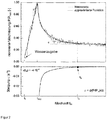
- the power P was normalized to the maximum power P max (see Figure 1 ).
- the recorded power curve was approximated with a mathematical function. This took place between the start of mixing to and until the maximum power was reached at time t max by linear approximation.
- An example is the standardized mixing power P / P max and its curve slope during the mixing process, on the basis of which the stabilization time t S can be calculated in Figure 2 shown.
- the subsequent range was approximated with a decreasing exponential function (equation 1).
- P P Max P 0 + P 1 e - t - t Max t 1 + P 2 e - t - t Max t 2
- P 0 , P 1 and P 2 are adapted performance parameters
- t 1 and t 2 are adapted time parameters.
- the cement mortar of Examples I to X was composed of 500 g of cement (CEM I 52.5 R, type Milke from HeidelbergCement) and 500 g of fine quartz sand (type H33 from Quarzwerke Frechen).
- the cement hydration was characterized qualitatively with isothermal heat flow calorimetry (TAM Air Thermostat, Thermometric with 12 channels).
- TAM Air Thermostat Thermometric with 12 channels.
- the temperature in the heat flow calorimeter at the beginning of hydration was 20 ° C.
- Cement, sand and water (w / c value of 0.30) were mixed with the respective additive for one minute in a test tube.
- the test tube was then inserted into the sample space of the heat flow calorimeter and data recording started.
- the hydration data were recorded over a period of at least 24 hours.
- the cumulative heat flow in J / g cement was calculated for evaluation. Table 4 shows the cumulative heat flow after 12 hours. The higher the heat flow, the lower the retarding effect of the superplasticizer.
Landscapes
- Chemical & Material Sciences (AREA)
- Engineering & Computer Science (AREA)
- Ceramic Engineering (AREA)
- Organic Chemistry (AREA)
- Materials Engineering (AREA)
- Structural Engineering (AREA)
- Chemical Kinetics & Catalysis (AREA)
- Inorganic Chemistry (AREA)
- Civil Engineering (AREA)
- Health & Medical Sciences (AREA)
- Medicinal Chemistry (AREA)
- Polymers & Plastics (AREA)
- Curing Cements, Concrete, And Artificial Stone (AREA)
- Compositions Of Macromolecular Compounds (AREA)
- Macromonomer-Based Addition Polymer (AREA)
Description
- Die Erfindung betrifft eine Zusammensetzung auf Basis von Calciumsilikat-Hydrat, mindestens einem wasserlöslichen, säuregruppenhaltigen Polymer, umfassend Polyethergruppen und mindestens einen Polyalkylenglycolether. Weiterhin werden ein Verfahren zur Herstellung dieser Zusammensetzung sowie zementäre Mischungen umfassend die Zusammensetzung offenbart. Ein weiterer Aspekt der vorliegenden Erfindung ist die Verwendung der erfindungsgemäßen Zusammensetzung in zementären Mischungen, zur Beschleunigung der zeitlichen Entfaltung der dispergierenden Wirkung des säuregruppenhaltigen Polymers nach Zugabe des Anmachwassers und einer nachfolgend beschleunigten Härtung der Mischung.
- Um eine verbesserte Verarbeitbarkeit, d. h. Knetbarkeit, Streichfähigkeit, Spritzbarkeit, Pumpbarkeit oder Fließfähigkeit, anorganischer Feststoffsuspensionen zu erreichen, werden diesen oft Zusatzmittel in Form von Dispergier- oder Fließmitteln zugesetzt.
- Derartige anorganische Feststoffe umfassen in der Bauindustrie meistens anorganische Bindemittel wie z.B. Zement auf Basis Portlandzement (EN 197), Zement mit besonderen Eigenschaften (DIN 1164), Weißzement, Calciumaluminatzement bzw. Tonerdezement (EN 14647), Calciumsulfoaluminatzement, Spezialzemente, Calciumsulfat-n-Hydrat (n=0 bis 2), Kalk bzw. Baukalk (EN 459) sowie Puzzolane bzw. latent hydraulische Bindemittel wie z. B. Flugasche, Metakaolin, Silicastaub, Hüttensand. Weiterhin enthalten die anorganischen Feststoffsuspensionen in der Regel Füllstoffe, insbesondere Gesteinskörnung bestehend aus z. B. Calciumcarbonat, Quarz oder anderen natürlichen Gesteinen verschiedener Korngröße und Kornform sowie weitere anorganische und/oder organische Additive (Zusatzmittel) zur gezielten Beeinflussung von Eigenschaften bauchemischer Produkte z. B. Hydratationskinetik, Rheologie oder Luftgehalt. Außerdem können organische Bindemittel wie z. B. Latexpulver enthalten sein.
- Um Baustoffmischungen, insbesondere auf Basis von anorganischen Bindemitteln in eine gebrauchsfertige, verarbeitbare Form zu überführen, ist in der Regel wesentlich mehr Anmachwasser erforderlich, als für den nachfolgenden Hydratations- bzw. Erhärtungsprozess notwendig wäre. Der durch das überschüssige, später verdunstende Wasser gebildete Hohlraumanteil im Baukörper führt zu einer signifikant verschlechterten mechanischen Festigkeit, Beständigkeit und Dauerhaftigkeit.
- Um diesen überschüssigen Wasseranteil bei einer vorgegebenen Verarbeitungskonsistenz zu reduzieren und/oder die Verarbeitbarkeit bei einem vorgegebenen Wasser/Bindemittel-Verhältnis zu verbessern, werden Zusatzmittel eingesetzt, die im allgemeinen in der Bauchemie als Wasserreduktions- oder Fließmittel bezeichnet werden. Als derartige Mittel sind vor allem Polykondensationsprodukte auf Basis von Naphthalin- oder Alkylnaphthalinsulfonsäuren bzw. Sulfonsäuregruppen enthaltende Melamin-Formaldehydharze bekannt.
-
DE 3530258 beschreibt die Verwendung von wasserlöslichen Natriumnaphthalinsulfonsäure-Formaldehydkondensaten als Zusatzmittel für anorganische Bindemittel und Baustoffe. Diese Zusatzmittel werden zur Verbesserung der Fließfähigkeit der Bindemittel wie z. B. Zement, Anhydrit oder Gips sowie den damit hergestellten Baustoffen beschrieben. -
DE 2948698 beschreibt hydraulische Mörtel für Estriche, die Fließmittel auf Basis von Melamin-Formaldehyd-Kondensationsprodukten und/oder sulfonierte Formaldehyd-Naphthalinkondensate und/oder Ligninsulfonat und als Binder Portlandzement, tonhaltiger Kalkmergel, Ton- und Schwachbrandklinker enthalten. - Neben den rein anionischen Fließmitteln, die im wesentlichen Carbonsäure- und Sulfonsäuregruppen enthalten, werden als neuere Gruppe von Fließmitteln schwach anionische Kammpolymere beschrieben, die üblicherweise anionische Ladungen an der Hauptkette tragen und nichtionische Polyalkylenoxidseitenketten enthalten. Diese Copolymere werden auch als Polycarboxylatether (PCE) bezeichnet.
- Polycarboxylatether dispergieren die anorganischen Partikel nicht nur über elektrostatische Aufladung aufgrund der an der Hauptkette enthaltenen anionischen Gruppen (Carboxylatgruppen, Sulfonatgruppen), sondern stabilisieren zusätzlich die dispergierten Teilchen durch sterische Effekte aufgrund der Polyalkylenoxid-Seitenketten, die durch Absorption von Wassermolekülen eine stabilisierende Schutzschicht um die Partikel bilden. Dadurch kann entweder die benötige Menge Wasser für das Einstellen einer bestimmten Konsistenz gegenüber den klassischen Fließmitteln reduziert werden oder aber die Plastizität der feuchten Baustoffmischung wird durch die Zugabe der Polycarboxylatether so weit reduziert, dass selbstverdichtender Beton oder selbstverdichtender Mörtel bei niedrigen Wasser/Zement-Verhältnissen hergestellt werden kann. Auch ermöglicht die Verwendung der Polycarboxylatether die Herstellung von Transportbeton oder Transportmörtel, der über längere Zeiträume pumpbar bleibt oder die Herstellung von hochfesten Betonen oder hochfesten Mörteln durch die Einstellung eines niedrigen Wasser/Zement-Verhältnisses.
-
WO 01/96007 -
DE 19513126 undDE 19834173 beschreiben Copolymere auf Basis von ungesättigten Dicarbonsäurederivaten und Oxyalkylenglycol-Alkenylethern und deren Verwendung als Zusatzmittel für hydraulische Bindemittel, insbesondere Zement. - Neben den beschriebenen Polycarboxylatethern sind inzwischen auch eine Reihe von Derivaten mit modifiziertem Wirkungsprofil bekannt. So beschreibt beispielsweise die
US 2009312460 Polycarboxylatester, wobei die Esterfunktion nach Einbringen in eine zementäre, wässrige Mischung hydrolysiert wird und hierdurch ein Polycarboxylatether gebildet wird. Polycarboxylatester haben den Vorteil, dass sie ihre Wirkung erst nach einiger Zeit in der zementären Mischung entfalten und hierdurch die dispergierende Wirkung über einen längeren Zeitraum aufrechterhalten werden kann. - Weiterhin sind aus der
DE 199 05 488 pulverförmige Polymerzusammensetzungen auf Basis von Polyethercarboxylaten bekannt, wobei diese 5 bis 95 Gew.-% des wasserlöslichen Polymers und 5 bis 95 Gew.-% eines feinteiligen mineralischen Trägermaterials umfassen. Die Produkte werden durch in Kontakt bringen des mineralischen Trägermaterials mit einer Schmelze oder einer wässrigen Lösung des Polymers hergestellt. Als Vorteile dieses Produktes wird im Vergleich zu sprühgetrockneten Produkten eine deutlich erhöhte Verklebungs- und Verbackungsresistenz genannt. - Aus der
WO 2006/027363 ist ein Verfahren zur Herstellung eines beschichteten Grundstoffs für eine hydraulische Zusammensetzung bekannt. In den Beispielen wird unter anderem die Beschichtung eines Portlandzements mit 1 % einer wässrigen Polycarboxylatether-Lösung, bezogen auf das Bindemittelgewicht, offenbart. - Eine weitere Verbindungsklasse von Dispergiermitteln mit Polyetherseitenketten wird in der
WO 2006/042709 beschrieben. Hierbei handelt es sich um Polykondensationprodukte auf Basis einer aromatischen oder heteroaromatischen Verbindung (A) mit 5 bis 10 C-Atomen bzw. Heteroatomen mit mindestens einem Oxyethylen- oder Oxypropylen-Rest und einem Aldehyd (C) ausgewählt aus der Gruppe Formaldehyd, Glyoxylsäure und Benzaldehyd oder Mischungen davon beschriebe, welche eine sehr gute verflüssigende Wirkung von anorganischen Bindemittel-Suspensionen bewirken und diesen Effekt über einen längeren Zeitraum aufrechterhalten. In einer besonderen Ausführungsform kann es sich hierbei um phosphatierte Polkondensationsprodukten handeln. - Es hat sich gezeigt, dass Fließmittel auf Basis von Ligninsulfonat, Melaminsulfonat und Polynaphthalinsulfonat den schwach anionischen, polyalkylenoxidhaltigen Copolymeren und den in der
WO 2006/042709 beschrieben Kondensationsprodukten in ihrer Wirksamkeit deutlich unterlegen sind.
Dispergiermittel auf Basis von Polycarboxylatethern und deren Derivate sowie die in derWO 2006/042709 beschrieben Kondensationsprodukten werden entweder als - Feststoff in Pulverform oder als wässrige Lösung angeboten. Pulverförmige Dispergiermittel können beispielsweise einem Werktrockenmörtel bei dessen Herstellung zugemischt werden. Beim Anmachen des Werktrockenmörtels mit Wasser lösen sich die Dispergiermittel und können nachfolgend ihre Wirkung entfalten.
- Alternativ ist es auch möglich, Polycarboxylatether oder deren Derivate sowie die in der
WO 2006/042709 beschrieben Kondensationsprodukten der anorganischen Feststoffsuspension in gelöster Form zuzusetzen. Insbesondere kann das Dispergiermittel direkt in das Anmachwasser dosiert werden. - Diese Verfahren Fließmittel in eine anorganische Feststoffsuspension einzubringen haben jedoch den Nachteil, dass die dispergierende Wirkung sich nicht unmittelbar nach Zugabe des Anmachwassers entfaltet. Unabhängig davon ob das Dispergiermittel als Pulver oder in wässriger Lösung zugesetzt wird, kann es beispielsweise bei einem Trockenmörtel - je nach Wasser zu Zement Verhältnis (w/z Wert) bzw. Wasseranspruch - über 100 Sekunden dauern, bis man nach Zugabe des Anmachwassers unter starkem Rühren eine homogene Suspension erhält. Dies ist insbesondere bei der Verwendung von Mischpumpen problematisch.
- Die
EP2574636 beschreibt eine pulverförmige Zusammensetzung, herstellbar durch in Kontakt bringen eines Pulvers, welches mindestens ein anorganisches Bindemittel umfasst, mit 0,01 bis 10 Gew.-%, bezogen auf die Gesamtmasse der Zusammensetzung, einer flüssigen Komponente, umfassend ein Dispergiermittel auf Basis von säuregruppenhaltigen Polymeren, welche Polyethergruppen umfassen und mindestens 30 Gew.-% eines organischen Lösungsmittels. Die so hergestellten Pulver zeigen eine deutlich verbesserte zeitliche Entfaltung der dispergierenden Wirkung. Nachteilig für viele Anwendungen ist jedoch die relativ langsame Aushärtung dieser Systeme. - Um vergleichen zu können, welche Zeit benötigt wird eine homogene anorganische Feststoffsuspension zu erhalten, ist es bekannt, die sogenannte Stabilisationszeit ts zu bestimmen. Die Stabilisationszeit kann anhand der aufgezeichneten Leistungskurve eines Mischwerkzeugs berechnet werden. Diesbezüglich wird auf folgende Veröffentlichungen verwiesen: 1.) Chopin, D.; de Larrad, F.; Cazacliu, B.: Why do HPC and SCC require a longer mixing time? Cement and Concrete Research 34, 2004, S. 2237-2243; 2.) Mazanec, O.: Charakterisierung der Mischzeit und des rheologischen Verhaltens ultrahochfester Betone unter Einbeziehung interpartikulärer Wechselwirkungen, Dissertation, Technische Universität München, 2013; 3.) Mazanec, O.; Schießl, P.: Mixing Time Optimisation for UHPC. Ultra High Performance Concrete (UHPC). In: Second International Symposium on Ultra High Performance Concrete, March 05-07, 2008, S. 401-408, ISBN: 978-3-89958-376-2.
- Die Stabilisationszeit (ts) ist als die Zeit definiert, bei der sich die Leistungskurve des Mischwerkzeugs nach dem Erreichen der maximalen Antriebsleistung der Asymptote annähert. Dabei liegt eine homogene Feststoffsuspension vor, sobald die Leistungskurve nicht mehr signifikant sinkt. Diesbezüglich wird auch auf die Veröffentlichung "Schießl, P.; Mazanec, O.; Lowke, D.: SCC and UHPC - Effect of Mixing Technology on Fresh Concrete Properties. Advances in Constructions Materials 2007, Symposium to honor H.W. Reinhardt, University of Stuttgart, 23-24 July 2007" verwiesen.
- Aufgabe der vorliegenden Erfindung war es demzufolge, ein zementäres Bindemittelsystem zur Verfügung zu stellen, das eine schnelle zeitliche Entfaltung der dispergierenden Wirkung des Fließmittels nach Zugabe von Anmachwasser und gleichzeitig eine schnelle Erhärtung des zementären Systems zeigt.
- Gelöst wurde diese Aufgabe durch eine Zusammensetzung umfassend,
- 5 - 50 Gew.-%, insbesondere 10 bis 45 Gew.-%, bevorzugt 15 bis 40 Gew.-%, insbesondere bevorzugt 20 bis 40 Gew.-% Calciumsilikat-Hydrat,
- 10 - 60 Gew.-%, insbesondere 20 bis 55 Gew.-%, bevorzugt 25 bis 50 Gew.-%, insbesondere bevorzugt 25 bis 40 Gew.-% mindestens eines wasserlöslichen, säuregruppenhaltigen Polymers, umfassend Polyethergruppen,
- 5 - 40 Gew.-%, insbesondere 10 bis 40 Gew.-%, bevorzugt 20 bis 40 Gew.-%, insbesondere bevorzugt 25 bis 35 Gew.-% mindestens eines Polyalkylenglycolethers der Formel (1)
Rα-(CβH2βO)ω-H (1)
wobei- Rα
- für Wasserstoff oder einen aliphatischen Kohlenwasserstoffrest mit 1 bis 20 C-Atomen, einen cycloaliphatischen Kohlenwasserstoffrest mit 5 bis 8 C-Atomen, einen ggf. substituierten Arylrest mit 6 bis 14 C-Atomen, wobei der Arylrest keine Säuregruppen umfasst und
- β
- unabhängig voneinander für jede (CβH2βO)-Einheit gleich oder verschieden 2, 3, 4 oder 5 und
- ω
- für 3 bis 200 steht.
- Es ist erfindungswesentlich, dass das erfindungsgemäße Polymer eine Säuregruppe umfasst. Unter dem Begriff "Säuregruppe" wird in der vorliegenden Anmeldung sowohl die freie Säure als auch deren Salze verstanden. Bevorzugt kann es sich bei der Säure um mindestens eine aus der Reihe Carboxy-, Phosphono-, Sulfino-, Sulfo-, Sulfamido-, Sulfoxy-, Sulfoalkyloxy-, Sulfinoalkyloxy und Phosphonooxygruppe handeln. Besonders bevorzugt sind Carboxy- und Phosphonooxygruppen.
In einer bevorzugten Ausführungsform handelt es sich bei den Polyethergruppen des mindestens einen wasserlöslichen, säuregruppenhaltigen Polymers um Polyethergruppen der Struktureinheit (I),
*-U-(C(O))k-X-(AlkO)n-W (I)
wobei - *
- die Bindungsstelle an das säuregruppenhaltige Polymer anzeigt,
- U
- für eine chemische Bindung oder eine Alkylengruppe mit 1 bis 8 C-Atomen steht,
- X
- Sauerstoff, Schwefel oder eine Gruppe NR1 bedeutet,
- k
- 0 oder 1 ist,
- n
- für eine ganze Zahl steht, deren Mittelwert, bezogen auf das säuregruppenhaltige Polymer im Bereich von 3 bis 300 liegt,
- Alk
- für C2-C4-Alkylen steht, wobei Alk innerhalb der Gruppe (Alk-O)n gleich oder verschieden sein kann,
- W
- einen Wasserstoff-, einen C1-C6-Alkyl- oder einen Arylrest bedeutet oder die Gruppe Y-F bedeutet, wobei
- Y
- für eine lineare oder verzweigte Alkylengruppe mit 2 bis 8 C-Atomen steht, die einen Phenylring tragen kann,
- F
- für einen über Stickstoff gebundenen 5- bis 10-gliedrigen Stickstoffheterocyclus steht, der als Ringglieder, neben dem Stickstoffatom und neben Kohlenstoffatomen, 1 , 2 oder 3 zusätzliche Heteroatome, ausgewählt unter Sauerstoff, Stickstoff und Schwefel aufweisen kann, wobei die Stickstoffringlieder eine Gruppe R2 aufweisen können, und wobei 1 oder 2 Kohlenstoffringglieder als Carbonylgruppe vorliegen können,
- R1
- für Wasserstoff, C1-C4-Alkyl oder Benzyl steht, und
- R2
- für Wasserstoff, C1-C4-Alkyl oder Benzyl steht.
- In einer besonders bevorzugten Ausführungsform stellt das wasserlösliche, säuregruppenhaltige Polymer, umfassend Polyethergruppen, ein Polykondensationsprodukt dar, enthaltend
- (II) eine einen Aromaten oder Heteroaromaten und eine Polyethergruppe aufweisende Struktureinheit sowie
- (III) eine phosphatierte einen Aromaten oder Heteroaromaten aufweisende Struktureinheit.
- Die Struktureinheiten (II) und (III) werden bevorzugt durch folgende allgemeine Formeln repräsentiert
(II) A-U-(C(O)k-X-(AlkO)n-W
mit
A gleich oder verschieden sowie repräsentiert durch eine substituierte oder unsubstituierte aromatische oder heteroaromatische Verbindung mit 5 bis 10 C-Atomen im aromatischen System, wobei die weiteren Reste die für Struktureinheit (I) genannte Bedeutung besitzen;
D gleich oder verschieden sowie repräsentiert durch eine substituierte oder unsubstituierte aromatische oder heteroaromatische Verbindung mit 5 bis 10 C-Atomen im aromatischen System. - Weiterhin ist E gleich oder verschieden sowie repräsentiert durch N, NH oder O, m = 2 falls E = N und m = 1 falls E = NH oder O.
- R3 und R4 sind unabhängig voneinander gleich oder verschieden sowie repräsentiert durch einen verzweigten oder unverzweigten C1- bis C10-Alkylrest, C5- bis C8-Cycloalkylrest, Arylrest, Heteroarylrest oder H, bevorzugt durch H, Methyl, Ethyl oder Phenyl, besonders bevorzugt durch H oder Methyl und insbesondere bevorzugt durch H. Weiterhin ist b gleich oder verschieden sowie repräsentiert durch eine ganze Zahl von 0 bis 300. Falls b = 0 ist E = O. Besonders bevorzugt ist D = Phenyl, E = O, R3 und R4 = H und b = 1.
- Bevorzugt enthält das Polykondensationsprodukt eine weitere Struktureinheit (IV), welche durch folgende Formel repräsentiert wird

Y unabhängig voneinander gleich oder verschieden und repräsentiert durch (II), (III) oder weitere Bestandteile des Polykondensationsproduktes. - R5 und R6 sind bevorzugt gleich oder verschieden und repräsentiert durch H, CH3, COOH oder eine substituierte oder unsubstituierte aromatische oder heteroaromatische Verbindung mit 5 bis 10 C-Atomen. Hierbei werden R5 und R6 in Struktureinheit (IV) unabhängig voneinander bevorzugt durch H, COOH und/oder Methyl repräsentiert. In einer besonders bevorzugten Ausführungsform werden R5 und R6 durch H repräsentiert.
- Das molare Verhältnis der Struktureinheiten (II), (III) und (IV) des erfindungsgemäßen phosphatierten Polykondensationsproduktes kann in weiten Bereichen variiert werden. Als zweckmäßig hat es sich erwiesen, dass das Molverhältnis der Struktureinheiten [(II) + (III)] : (IV) 1 : 0,8 bis 3, bevorzugt 1 : 0,9 bis 2 und besonders bevorzugt 1: 0,95 bis 1,2 beträgt.
- Das Molverhältnis der Struktureinheiten (II) : (III) liegt normalerweise bei 1 : 10 bis 10 : 1, bevorzugt bei 1 : 7 bis 5 : 1 und besonders bevorzugt bei 1 : 5 bis 3 : 1.
- Die Gruppen A und D in den Struktureinheiten (II) und (III) des Polykondensationsproduktes werden meist durch Phenyl, 2-Hydroxyphenyl, 3-Hydroxyphenyl, 4-Hydroxyphenyl, 2-Methoxyphenyl, 3-Methoxyphenyl, 4-Methoxyphenyl, Naphthyl, 2-Hydroxynaphthyl, 4-Hydroxynaphthyl, 2-Methoxynaphthyl, 4-Methoxynaphthyl bevorzugt Phenyl repräsentiert, wobei A und D unabhängig voneinander gewählt werden können und auch jeweils aus einem Gemisch der genannten Verbindungen bestehen können. Die Gruppen X und E werden unabhängig voneinander bevorzugt durch O repräsentiert.
- Bevorzugt wird n in Struktureinheit (I) durch eine ganze Zahl von 5 bis 280, insbesondere 10 bis 160 und besonders bevorzugt 12 bis 120 repräsentiert und b in Struktureinheit (III) durch eine ganze Zahl von 0 bis 10, bevorzugt 1 bis 7 und besonders bevorzugt 1 bis 5. Die jeweiligen Reste, deren Länge durch n bzw. b definiert wird, können hierbei aus einheitlichen Baugruppen bestehen, es kann aber auch zweckmäßig sein, dass es sich um eine Mischung aus unterschiedlichen Baugruppen handelt. Weiterhin können die Reste der Struktureinheiten (II) und (III) unabhängig voneinander jeweils die gleiche Kettenlänge besitzen, wobei n bzw. b jeweils durch eine Zahl repräsentiert wird. Es wird aber in der Regel zweckmäßig sein, dass es sich jeweils um Mischungen mit unterschiedlichen Kettenlängen handelt, so dass die Reste der Struktureinheiten im Polykondensationsprodukt für n und unabhängig für b unterschiedliche Zahlenwerte aufweisen.
- In einer besonderen Ausführungsform sieht die vorliegende Erfindung weiterhin vor, dass es sich um ein Natrium-, Kalium-, Ammonium- und/oder Calcium-Salz und bevorzugt um ein Natrium- und/oder Kalium-Salz, des phosphatierten Polykondensationsproduktes handelt.
- Häufig weist das erfindungsgemäße phosphatierte Polykondensationsprodukt ein gewichtsmittleres Molekulargewicht von 4000 g/mol bis 150.000 g/mol, vorzugsweise 10.000 bis 100.000 g/mol und besonders bevorzugt 20.000 bis 75.000 g/mol auf.
- Bezüglich der gemäß vorliegender Erfindung bevorzugt zu verwendenden phosphatierten Polykondensationsprodukte und deren Herstellung wird weiterhin auf die Patentanmeldungen
WO 2006/042709 undWO 2010/040612 Bezug genommen. - In einer weiteren bevorzugten Ausführungsform handelt es sich bei dem säuregruppenhaltigen Polymer um mindestens ein Copolymer, welches erhältlich ist durch Polymerisation einer Mischung von Monomeren, umfassend
- (V) mindestens ein ethylenisch ungesättigtes Monomer, welches mindestens einen Rest aus der Reihe Carbonsäure, Carbonsäuresalz, Carbonsäureester, Carbonsäureamid, Carbonsäureanhydrid und Carbonsäureimid umfasst
und - (VI) mindestens ein ethylenisch ungesättigtes Monomer mit
einer Polyethergruppe, wobei die Polyethergruppe bevorzugt durch die Struktureinheit (I) repräsentiert wird. - Die Copolymere entsprechend der vorliegenden Erfindung enthalten mindestens zwei Monomerbausteine. Es kann aber auch vorteilhaft sein, Copolymere mit drei oder mehr Monomerbausteinen zu verwenden.
- In einer bevorzugten Ausführungsform wird das ethylenisch ungesättigte Monomer (V) durch mindestens eine der folgenden allgemeinen Formeln aus der Gruppe (Va), (Vb) und (Vc) repräsentiert:

- Bei dem Mono- oder Dicarbonsäure-Derivat (Va) und dem in cyclischer Form vorliegenden Monomer (Vb), wobei Z = O (Säureanhydrid) oder NR16 (Säureimid) darstellen, steht R7 und R8 unabhängig voneinander für Wasserstoff oder einen aliphatischen Kohlenwasserstoffrest mit 1 bis 20 C-Atomen, vorzugsweise eine Methylgruppe. B bedeutet H, -COOMa, -CO-O(CqH2qO)r-R9, -CO-NH-(CqH2qO)r-R9.
- M bedeutet Wasserstoff, ein ein-, zwei- oder dreiwertiges Metallkation, vorzugsweise Natrium-, Kalium-, Calcium- oder Magnesium-Ion, weiterhin Ammonium oder ein organischer Aminrest sowie a = 1/3, 1/2 oder 1, je nachdem, ob es sich bei M um ein ein-, zwei- oder dreiwertiges Kation handelt. Als organische Aminreste werden vorzugsweise substituierte Ammonium-Gruppen eingesetzt, die sich ableiten von primären, sekundären oder tertiären C1-20-Alkylaminen, C1-20-Alkanolaminen, C5-8-Cycloalkylaminen und C6-14-Arylaminen. Beispiele für die entsprechenden Amine sind Methylamin, Dimethylamin, Trimethylamin, Ethanolamin, Diethanolamin, Triethanolamin, Methyldiethanolamin, Cyclohexylamin, Dicyclohexylamin, Phenylamin, Diphenylamin in der protonierten (Ammonium)Form.
- R9 bedeutet Wasserstoff, ein aliphatischer Kohlenwasserstoffrest mit 1 bis 20 C-Atomen, ein cycloaliphatischer Kohlenwasserstoffrest mit 5 bis 8 C-Atomen, ein Arylrest mit 6 bis 14 C-Atomen, der ggf. noch substituiert sein kann, q = 2, 3 oder 4 sowie r = 0 bis 200, vorzugsweise 1 bis 150. Die aliphatischen Kohlenwasserstoffe können hierbei linear oder verzweigt sowie gesättigt oder ungesättigt sein. Als bevorzugte Cycloalkylreste sind Cyclopentyl- oder Cyclohexylreste, als bevorzugte Arylreste Phenyl- oder Naphthylreste anzusehen, die insbesondere noch durch Hydroxyl-, Carboxyl- oder Sulfonsäuregruppen substituiert sein können.
Weiterhin steht Z für O oder NR16, wobei R16 unabhängig voneinander gleich oder verschieden sowie repräsentiert wird durch einen verzweigten oder unverzweigten C1- bis C10-Alkylrest, C5- bis C8-Cycloalkylrest, Arylrest, Heteroarylrest oder H. - Die folgende Formel stellt das Monomer (Vc) dar:

- Hierbei steht R10 und R11 unabhängig voneinander für Wasserstoff oder einen aliphatischen Kohlenwasserstoffrest mit 1 bis 20 C-Atomen, einen cycloaliphatischen Kohlenwasserstoffrest mit 5 bis 8 C-Atomen, einen ggf. substituierten Arylrest mit 6 bis 14 C-Atomen.
- Weiterhin ist R12 gleich oder verschieden und wird durch (CnH2n)-SO3H mit n = 0, 1, 2, 3 oder 4, (CnH2n)-OH mit n = 0, 1, 2, 3 oder 4; (CnH2n)-PO3H2 mit n = 0, 1, 2, 3 oder 4, (CnH2n)-OPO3H2 mit n = 0, 1, 2, 3 oder 4, (C6H4)-SO3H, (C6H4)-PO3H2, (C6H4)-OPO3H2 und (CnH2n)-NR14 b mit n = 0, 1, 2, 3 oder 4 und b durch 2 oder 3 repräsentiert.
- R13 bedeutet H, -COOMa, -CO-O(CqH2qO)r-R9, -CO-NH-(CqH2qO)r-R9, wobei Ma, R9, q und r die oben genannte Bedeutungen besitzen.
- R14 steht für Wasserstoff, einen aliphatischen Kohlenwasserstoffrest mit 1 bis 10 C-Atomen, einen cycloaliphatischen Kohlenwasserstoffrest mit 5 bis 8 C-Atomen, ein ggf. substituierter Arylrest mit 6 bis 14 C-Atomen.
- Weiterhin ist Q gleich oder verschieden sowie repräsentiert durch NH, NR15 oder O, wobei R15 für einen aliphatischen Kohlenwasserstoffrest mit 1 bis 10 C-Atomen, einen cycloaliphatischen Kohlenwasserstoffrest mit 5 bis 8 C-Atomen oder ein ggf. substituierter Arylrest mit 6 bis 14 C-Atomen steht.
- In einer besonders bevorzugten Ausführungsform wird das ethylenisch ungesättigte Monomer (VI) durch folgende allgemeine Formeln repräsentiert

- Das durch Gelpermeationschromatographie (GPC) bestimmte mittlere Molekulargewicht Mw des erfindungsgemäßen Copolymers beträgt vorzugsweise 5,000 bis 200,000 g/mol, besonders bevorzugt 10,000 bis 80,000 g/mol, und ganz besonders bevorzugt 20,000 bis 70,000 g/mol. Die Polymere wurden mittels Größenausschlusschromatographie auf mittlere Molmasse und Umsatz analysiert (Säulenkombinationen: OH-Pak SB-G, OH-Pak SB 804 HQ und OH-Pak SB 802.5 HQ von Shodex, Japan; Elutionsmittel: 80 Vol.-% wässrige Lösung von HCO2NH4 (0,05 mol/l) und 20 Vol.-% Acetonitril; Injektionsvolumen 100 µl; Durchflussrate 0,5 ml/min). Die Kalibrierung zur Bestimmung der mittleren Molmasse erfolgte mit linearen Polyethylenglycol-Standards. Als Maß für den Umsatz wird der Peak des Copolymers auf eine relative Höhe von 1 normiert und die Höhe des Peaks des nichtumgesetzten Makromonomer/PEG-haltigen Oligomers als Maß für den Restmonomerengehalt verwendet.
- Vorzugsweise erfüllt das erfindungsgemäße Copolymer die Anforderungen der Industrienorm EN 934-2 (Februar 2002).
- In einer bevorzugten Ausführungsform steht in Formel (1) des Polyalkylenglycolethers Rα für einen aliphatischen Kohlenwasserstoffrest mit 1 bis 4 C-Atomen, insbesondere 1 C-Atom, β unabhängig voneinander für jede (CβH2βO)-Einheit gleich oder verschieden für 2 oder 3, insbesondere 2 und ω für 8 bis 100, insbesondere 10 bis 25.
- In einer weiterhin bevorzugten Ausführungsform handelt es sich bei den Polyalkylenglycolethern der Formel (1) um Polyethylenglycolether oder Polypropylenglycolether oder statistische Ethylenoxid/Propylenoxid-Copolymere mit einer mittleren Molmasse von 200 bis 2000 g/mol, Methy-, Ethyl- Propyl-, Butyl- oder höherwertige Alkylpolyalkylenglycolether, beispielsweise Polypropylenglycolmonomethylether, Butylpolyethylenglycolether, Propylpolyethylenglycolether, Ethylpolyethylenglycolether, Methylpolyethylenglycolether mit einer mittleren Molmasse von 200 bis 2000 g/mol.
In einer besonders bevorzugten Ausführungsform handelt es sich bei den Polyalkylenglycolethers der Formel (1) um Methylpolyethylenglycolether mit einer mittleren Molmasse von 200 bis 1000 g/mol, insbesondere 500 g/mol. - Vorzugsweise liegt das Calciumsilikat-Hydrat in der erfindungsgemäßen Zusammensetzung in Form von Foshagit, Hillebrandit, Xonotlit, Nekoit, Clinotobermorit, 9Å - Tobermorit (Riversiderit), 11Å - Tobermorit, 14 Å - Tobermorit (Plombierit), Jennit, Metajennit, Calcium Chondrodit, Afwillit, α-Ca2[SiO3(OH)](OH), Dellait, Jaffeit, Rosenhahnit, Killalait und/oder Suolunit vor, besonders bevorzugt als Xonotlit, 9Ä-Tobermorit (Riversiderit), 11Å - Tobermorit, 14 Å - Tobermorit (Plombierit), Jennit, Metajennit, Afwillit und/oder Jaffeit. In einer weiterhin bevorzugten Ausführungsform liegt das Calciumsilikat-Hydrat in amorpher Form vor. Bevorzugt beträgt das molare Verhältnis von Calcium zu Silicium im Calciumsilikat-Hydrat von 0,6 bis 2, bevorzugt 0,8 bis 1,8, besonders bevorzugt 0,9 bis 1,6, insbesondere bevorzugt 1,0 bis 1,5. Das molare Verhältnis von Calcium zu Wasser im Calciumsilikat-Hydrat beträgt vorzugsweise 0,6 bis 6, besonders bevorzugt 0,6 bis 2 und insbesondere bevorzugt 0,8 bis 2.
- In einer besonders bevorzugten Ausführungsform liegt die erfindungsgemäße Zusammensetzung als Pulver vor. Bevorzugt ist hierbei, dass das säuregruppenhaltige Polymer und der Polyalkylenglycolether auf der Oberfläche von Partikeln, umfassend das Calciumsilikat-Hydrat, verteilt vorliegen. Die Partikel können hierbei neben dem erfindungswesentlichen Calciumsilikat-Hydrat noch weitere Verbindungen und insbesondere Salze umfassen, welche insbesondere aus dem Herstellungsprozess des Calciumsilikat-Hydrats stammen können. Beispielsweise kann es sich hierbei um Natriumnitrat, Natriumacetat und/oder Siliciumdioxid handeln. Diese weiteren Verbindungen können in der erfindungsgemäßen Zusammensetzung insbesondere in einer Menge von 0,1 bis 35 Gew.-%, bevorzugt 5 bis 30 Gew.-% vorhanden sein. Bevorzugt ist die mittlere Partikelgröße der erfindungsgemäßen Pulver kleiner als 400 µm, besonders bevorzugt kleiner als 100 µm und insbesondere zwischen 1 und 250 µm, besonders bevorzugt zwischen 1 und 75 µm, gemessen durch Lasergranulometrie. Der Begriff mittlere Partikelgröße entspricht im Sinne der vorliegenden Anmeldung dem Median-Wert der Partikel Volumenverteilung, d.h. dem D50-Wert.
- Ein weiterer Gegenstand der vorliegenden Erfindung ist ein Verfahren zur Herstellung der erfindungsgemäßen Zusammensetzung, wobei eine wasserlösliche Calciumverbindung mit einer wasserlöslichen Silikatverbindung umgesetzt wird, wobei die Umsetzung der wasserlöslichen Calciumverbindung mit der wasserlöslichen Silikatverbindung in Anwesenheit von Wasser erfolgt, welches das mindestens eine erfindungsgemäße säuregruppenhaltige Polymer zumindest teilweise umfasst. Der mindestens eine erfindungsgemäße Polyalkylenglycolether der Formel (1) und ggf. die restliche Menge des mindestens einen erfindungsgemäßen säuregruppenhaltigen Polymers können hierbei unabhängig voneinander in der wässrigen Phase vor der Umsetzung der wasserlösliche Calciumverbindung mit der wasserlöslichen Silikatverbindung vorgelegt werden oder während der Umsetzung zugegeben werden. Bevorzugt wird der mindestens eine erfindungsgemäße Polyalkylenglycolether der Formel (1) und ggf. die restliche Menge des mindestens einen erfindungsgemäßen säuregruppenhaltigen Polymers nach der Umsetzung der wasserlösliche Calciumverbindung mit der wasserlöslichen Silikatverbindung zugegeben.
- Als wasserlösliche Calciumverbindungen und wasserlösliche Silikatverbindungen kommen jeweils prinzipiell auch nur verhältnismäßig schlecht in Wasser lösliche Verbindungen in Frage, obwohl gut wasserlösliche Verbindungen (welche sich vollständig oder nahezu vollständig in Wasser lösen) jeweils bevorzugt sind. Es muss jedoch gewährleistet sein, dass eine für die Umsetzung in der wässrigen Umgebung mit dem entsprechenden Reaktionspartner (entweder wasserlösliche Calciumverbindung oder wasserlösliche Silikatverbindung) ausreichende Reaktivität vorliegt. Die Löslichkeit der Calciumverbindung und der Silikatverbindung liegt bevorzugt bei größer 0,005 Mol/l Wasser, bestimmt bei 20 °C und Normaldruck.
- In einer bevorzugten Ausführungsform wird das mindestens eine erfindungsgemäße säuregruppenhaltige Polymer zumindest teilweise in Wasser vorgelegt und die wasserlösliche Calciumverbindungen und die wasserlösliche Silikatverbindungen anschließend gleichzeitig getrennt voneinander zugegeben.
- Hinsichtlich des erfindungsgemäßen Verfahrens beträgt das molare Verhältnis von Calcium zu Silizium insbesondere 0,6 bis 2,0, bevorzugt 0,8 bis 1,8, besonders bevorzugt 0,9 bis 1,6, insbesondere bevorzugt 0,9 bis 1,5.
- Als wasserlösliche Calciumverbindungen eignen sich insbesondere Calciumnitrat, Calciumhydroxid, Calciumacetat, Calciumsulfamat und/oder Calciummethansulfonat.
- Die wasserlösliche Silikatverbindung ist ausgewählt unter Natriumsilikat, Kaliumsilikat, Wasserglas, Aluminiumsilikat, Calciumsilikat, Kieselsäure, Natriummetasilikat, Kaliummetasilikat und Mischungen von zwei oder mehreren dieser Komponenten. Besonders bevorzugt ist die wasserlösliche Silikatverbindung ausgewählt unter einem Alkalimetallsilikat der Formel m SiO2 • n M2O, wobei M für Li, Na, K und NH4, vorzugsweise für Na oder K, steht, oder Gemischen davon, m und n Molzahlen bedeuten und das Verhältnis von m:n etwa 0.9 bis etwa 4, vorzugsweise etwa 0.9 bis etwa 3,8 und insbesondere etwa 0.9 bis etwa 3,6, beträgt. Unter dem Begriff "Wasserglas" sind aus dem Schmelzfluss erstarrte wasserlösliche Salze der Kieselsäuren, insbesondere Kalium- und Natriumsilikate oder deren wässrige Lösungen zu verstehen, wie sie im Online-Nachschlagewerk RÖMPP (Thieme Verlagsgruppe) unter dem Stichwort "Wasserglas" (letzte Aktualisierung Mai 2004) zu finden sind.
- Üblicherweise wird im ersten Schritt eine das Calciumsilikat-Hydrat in feindisperser Form enthaltende Suspension erhalten. Bevorzugt beträgt der Feststoffgehalt der Suspension zwischen 5 und 40 Gew.-%, besonders bevorzugt zwischen 10 und 35 Gew.-%, insbesondere bevorzugt zwischen 10 und 30 Gew.-%. Bevorzugt ist die mittlere primäre Partikelgröße der individuellen Calciumsilikat-Hydrat Partikel in den erfindungsgemäßen Suspension kleiner als 500 nm, besonders bevorzugt kleiner als 250 nm und insbesondere zwischen 1 und 150 nm, gemessen durch Ultrakleinwinkelröntgenstrahlung (Soft Matter, 2013, 9, 4864).
- Bezüglich der Herstellung des Calciumsilikat-Hydrats gemäß vorliegender Erfindung wird weiterhin auf die Patentanmeldungen
WO2010/026155 ,WO2011/026720 undWO2011/029711 Bezug genommen. Weiterhin wird diesbezüglich auch auf die noch unveröffentlichten AnmeldungenPCT/EP2014/051494 PCT/EP2014/051485 - In einer besonders bevorzugten Ausführungsform umfasst das erfindungsgemäße Verfahren weiterhin einen Trocknungsschritt. Insbesondere kann die Trocknung durch Walzentrocknung, Sprühtrocknung, Trocknung im Wirbelbettverfahren, durch Substanztrocknung bei erhöhter Temperatur oder sonstige übliche Trocknungsverfahren erfolgen. Der bevorzugte Bereich der Trocknungstemperatur liegt zwischen 50 und 250 °C. Insbesondere bevorzugt für den Trocknungsschritt ist eine Sprühtrocknung, wobei diese bevorzugt bei einer Temperatur zwischen 100 und 240°C durchgeführt wird. Die erfindungsgemäße Zusammensetzung wird hierbei bevorzugt in Form eines Pulvers erhalten.
- Die Restfeuchte des Pulvers beträgt bevorzugt kleiner 10 Gew.-%, besonders bevorzugt kleiner 5 Gew.-% und insbesondere bevorzugt kleiner 3 Gew.-%.
- Ein weiterer Gegenstand der vorliegenden Erfindung ist ein Trockenmörtel, umfassend ein zementäres Bindemittel und 0,01 bis 10 Gew.-% der erfindungsgemäßen Zusammensetzung, bezogen auf die Gesamtmasse des Trockenmörtels. Die Bezugsgröße "Gesamtmasse des Trockenmörtels" umfasst hierbei die erfindungsgemäße Zusammensetzung.
Anders ausgedrückt handelt es sich hierbei um einen Trockenmörtel, hergestellt aus einer Komponente, umfassend ein zementäres Bindemittel und 0,01 bis 10 Gew.-% der erfindungsgemäßen Zusammensetzung, bezogen auf die Gesamtmasse des Trockenmörtels. - Bevorzugt handelt es sich bei dem zementären Bindemittel um mindestens eines aus der Reihe Zement auf Basis Portlandzement, Weißzement, Calciumaluminatzement, Calciumsulfoaluminatzement und latent hydraulisches bzw. puzzolanisches Bindemittel.
In einer besonders bevorzugten Ausführungsform umfasst der Trockenmörtel, welcher ein zementäres Bindemittel umfasst, mindestens eine Verbindung aus der Reihe Quarzsand, Quarzmehl, Kalkstein, Schwerspat, Calcit, Aragonit, Vaterit, Dolomit, Talk, Kaolin, nicht quellfähige Zweischichtsilikate (wie z.B. Glimmer), quellfähige Zweischichtsilikate (wie z.B. Bentonite), Kreide, Titandioxid, Rutil, Anatas, Aluminiumhydroxid, Aluminiumoxid, Magnesiumhydroxid und Brucit. Insbesondere kann die Gesamtmasse des Trockenmörtels zu mindestens 30 Gew.-%, insbesondere zu mindestens 40 Gew.-% und besonders bevorzugt zu mindestens 50 Gew.-% aus mindestens einer Verbindung aus der Reihe Quarzsand, Quarzmehl, Kalkstein, Schwerspat, Calcit, Aragonit, Vaterit, Dolomit, Talk, Kaolin, nicht quellfähige Zweischichtsilikate (wie z.B. Glimmer), quellfähige Zweischichtsilikate (wie z.B. Bentonite), Kreide, Titandioxid, Rutil, Anatas, Aluminiumhydroxid, Aluminiumoxid, Magnesiumhydroxid und Brucit bestehen.
Das ständige Streben nach weitgehender Rationalisierung sowie verbesserter Produktqualität hat dazu geführt, dass im Baubereich Mörtel für die verschiedensten Einsatzbereiche heute praktisch nicht mehr auf der Baustelle selbst aus den Ausgangsstoffen zusammengemischt wird. Diese Aufgabe wird heute weitgehend von der Baustoffindustrie werksseitig übernommen und die gebrauchsfertigen Mischungen als sogenannte Werktrockenmörtel zur Verfügung gestellt. Dabei werden fertige Gemische, die auf der Baustelle ausschließlich durch Zugabe von Wasser und Durchmischen verarbeitbar gemacht werden, gemäß DIN 18557 als Werkmörtel, insbesondere als Werktrockenmörtel bezeichnet. Derartige Mörtelsysteme können die verschiedensten bauphysikalischen Aufgaben erfüllen. Je nach gestellter Aufgabe werden dem zementären Bindemittel weitere Additive bzw. Zusatzmittel beigemengt, um den Werktrockenmörtel an den speziellen Einsatzzweck anzupassen. Hierbei kann es sich bspw. um Schwundreduzierer, Expansionsmittel, Beschleuniger, Verzögerer, Verdicker, Entschäumer, Luftporenbildner, Korrosionsinhibitoren handeln.
Bei dem erfindungsgemäßen Werktrockenmörtel kann es sich insbesondere um Mauermörtel, Putzmörtel, Mörtel für Wärmedämmverbundsysteme, Sanierputze, Fugenmörtel, Fliesenkleber, Dünnbettmörtel, Estrichmörtel, Vergussmörtel, Einpressmörtel, Spachtelmassen, Dichtschlämmen oder Auskleidungsmörtel (z. B. für Trinkwasserrohre) handeln. - In einer besonderen Ausführungsform kann es sich bei der erfindungsgemäßen Trockenmörtel auch um eine selbstnivellierende Verlaufsmasse handeln. Dies ist besonders vorteilhaft, da solche pulverförmigen Zusammensetzungen für geringe Schichtdicken in der Regel sehr fein sind und sich daher vergleichsweise langsam mit Wasser anmischen lassen. Ebenso eingeschlossen sind Werkmörtel, welche bei der Herstellung auf der Baustelle außer mit Wasser auch noch mit weiteren Komponenten, insbesondere flüssigen und/oder pulverförmigen Additiven und/oder mit Gesteinskörnung versehen werden können (Zweikomponenten Systeme).
- Ein weiterer Gegenstand der vorliegenden Erfindung ist die Verwendung der erfindungsgemäßen Zusammensetzung in einer pulverförmigen Mischung, umfassend ein zementäres Bindemittel, zur Beschleunigung der zeitlichen Entfaltung der dispergierenden Wirkung des säuregruppenhaltigen Polymers nach Zugabe des Anmachwassers und einer nachfolgend beschleunigten Härtung der Mischung. Bevorzugt werden 0,01 bis 10 Gew.-%, insbesondere 0,01 bis 5 Gew.-%, insbesondere bevorzugt 0,1 bis 2 Gew.-% der erfindungsgemäßen Zusammensetzung, bezogen auf die Gesamtmasse der pulverförmigen Mischung, umfassend ein zementäres Bindemittel, eingesetzt.
Die Bezugsgröße "Gesamtmasse" umfasst hierbei die erfindungsgemäße Zusammensetzung. - Die nachfolgenden Beispiele verdeutlichen die Vorteile der vorliegenden Erfindung.
- Die Probenpräparation für die Molgewichtsbestimmung erfolgte durch Lösen von Polymerlösung im GPC Eluent, so dass die Polymerkonzentration im GPC-Eluent 0.5 Gew.-% beträgt. Danach wurde diese Lösung über einen Spritzenvorsatzfilter mit Polyethersulfonmembran und Porengröße 0.45 µm filtriert. Das Injektionsvolumen dieses Filtrats betrug 50 - 100 µl.
Die Bestimmung der mittleren Molekulargewichte erfolgte auf einem GPC Gerät der Firma Waters mit dem Typnamen Alliance 2690 mit UV-Detektor (Waters 2487) und RI-Detektor (Waters 2410).Säulen: Shodex SB-G Guard Column for SB-800 HQ series Shodex OHpak SB 804HQ and 802.5HQ (PHM gel, 8 x 300 mm, pH 4,0 bis 7,5) Eluent: 0,05 M wässrige Ammoniumformiat / Methanol-Mischung = 80:20 (Volumenteile) Flußrate: 0,5 ml/min Temperatur: 50° C Injektion: 50 bis 100 µl Detektion: RI und UV - Die Molekulargewichte der Polymere wurden mit zwei unterschiedlichen Kalibrierungen bestimmt. Erstens erfolgte die Bestimmung relativ zu Polyethylenglycol Standards der Firma PSS Polymer Standards Service GmbH. Die Molekulargewichtsverteilungskurven der Polyethylenglycolstandards wurden mittels Lichtstreuung bestimmt. Die Massen der Polyethylenglycolstandards betrugen 682 000, 164 000, 114 000, 57 100, 40 000, 26 100, 22 100, 12 300, 6 240, 3 120, 2 010, 970, 430, 194, 106 g/mol.
- Die verwendeten Polymere haben folgende Zusammensetzung Tabelle 1:
Polymer Mol Acrylsäure Mol Makromonomer Makromonomer Mw (g/mol) A 10 1 VOBPEPG-3000 21.000 B 5 1 VOBPEPG-3000 27.000 - Die Abkürzung VOBPEPG-3000 steht für blockartig aufgebautes Vinyl-oxy-butylpolyethylen/propylen-glycol. Block A enthält lediglich Polyethylenglycol, Block B eine statistische Mischung aus Ethylenglycol und Propylenglycol. Die molare Masse beträgt 3000 g/mol. Die Struktur entspricht Formel ω mit n∼23, k∼13, l∼28.

- Das verwendete MPEG500 und MPEG1000 in allen Beispielen entspricht dem Pluriol® A 500 E, bzw. dem Pluriol A 1020 E (Verkaufsprodukt der BASF SE).
- In einem 1000 ml Vierhalskolben mit Thermometer, pH-Meter und Rückflusskühler werden 385 g Wasser, 360 g (0,12 mol) VOBPEPG-3000 vorgelegt.
Diese Mischung wird auf 15 °C abgekühlt. Danach gibt man 0,5 g 2%ige FeSO4 ∗18H2O-Lösung und 42,4 g (0,59 mol) Acrylsäure 99%-ig zu. Danach fügt man 1,8 g Mercaptoethanol und 5 g Brüggolit FF6 zu. Darauf stellt sich ein pH-Wert von ca. 4,6 ein. Nach einer Mischzeit von 2 Minuten werden 2,5 g 50%ige H2O2-Lösung zugegeben. Nach kurzer Zeit beginnt die Polymerisation und ein stetiger Temperaturanstieg stellt sich ein. Nach ca. 2 Minuten erreicht die Reaktion das Temperaturmaximum bei etwa 42 °C und einen pH-Wert von 4,2. Nach weiteren 5 Minuten wird der Ansatz mit 30 g 20%iger NaOH-Lösung auf pH = 5,5 gestellt. Man erhält eine leicht gelblich gefärbte, klare wässerige Polymerlösung mit einem Feststoffgehalt von 50 Gew.-%.
Die Herstellung des Polycarboxylatethers A erfolgt analog, wobei der Feststoffgehalt ebenfalls 50 Gew.-% betrug. - Zur Herstellung des Additivs V1 wird die Lösung des Polymers A und für die Herstellung des Additivs V2 wird die Lösung des Polymers B mit einem Niro Mobil Minor Sprühtrockner getrocknet. Die Zerstäubung erfolgte mit einer Zweistoffdüse mit einem Stickstoffstrom. Eingangstemperatur 230°C, Ausgangstemperatur 100°C.
- Calciumhydroxid (Merck KGaA, Reinheit 97 %)
Calciumacetat Monohydrat (Sigma Aldrich Co. LLC, > 99,0 %)
Entschäumer (Melflux DF 93 der BASF Construction Solutions GmbH, Feststoffgehalt = 60,0 Gew.-%)
Na-Wasserglas (BASF SE, Natriumwasserglas 37/40 PE, Feststoffgehalt 36,1 Gew.-%, Modul n(SiO2)/n(Na2O) = 3,4)
Polymer A als 36,1 Gew.-%ige wässrige Lösung. - Die Calciumquelle CL ist wie folgt zusammengesetzt:
Stoff Anteil Gew.-% Calciumhydroxid-Suspension (30 Gew.-%ig) 32,7 Calciumacetat Monohydrat 10,1 Wasser 57,2 - Die Calciumquelle wird durch folgende Schritte hergestellt:
- (i) Vorlage des Wasser
- (ii) Zugabe einer wässrigen 30 Gew.-%igen Calciumhydroxid Suspension
- (iii) Zugabe von Calciumacetat Monohydrat
- Die Suspension wird permanent mit 40 rpm (Umdrehungen pro Minute) mit einem mechanischen Rührwerk mit Flügelrührer gerührt um ein Sedimentieren vom Calciumhydroxid zu vermeiden.
- Die Silikatquelle SL ist wie folgt zusammengesetzt:
Stoff Anteil Gew.-% Na-Wasserglas (36,1 Gew.-%ig) 49,8 Wasser 50,2 - Die Silikatquelle SL wird hergestellt indem Wasser vorgelegt wird und unter Rühren bei 40 rpm Na-Wasserglas zugegeben wird.
- Die Stabilisatorlösung STL ist wie folgt zusammengesetzt:
Stoff Anteil Gew.-% Polymer A (36,1 Gew.-%ige wässrige Lösung) 38,7 Melflux DF 93 (Entschäumer) 2,3 Wasser 61,0 - Die Stabilisatorlösung STL wird durch folgende Schritte hergestellt:
- (i) Vorlage des Wassers
- (ii) Zugabe von Polymer A
- (iii) Zugabe von Melflux DF 93
- Zur Herstellung der Trägerkomponente T wird die Sabilisatorlösung STL in einen Reaktor vorgelegt und bei 40 rpm gerührt. An diesen Reaktor ist eine 20 ml 3-Kanal-Mischzelle angeschlossen. Die Mischzelle ist mit einem Ika Ultra Turrax ausgestattet, der ein Rotor-Stator Dispergierwerkzeug (Ika, S 25 KV - 25F) bei 10000 rpm antreibt. Die Stabilisatorlösung STL wird mittels Schlauchpumpe Ismatec MCP Process mit einer Pumprate von 108,83 g /min bei einer Umdrehungsgeschwindigkeit von 50 rpm im Kreis über die Mischzelle gepumpt. Während 150 min Synthesedauer werden parallel die Calciumquelle CL und die Silikatquelle SL in einem konstanten Massenverhältnis von CL/SL = 1,36 mittels Schlauchpumpen in die Mischzelle eingetragen und mit der Stabilisatorlösung STL vermischt. Die Calciumquelle CL wird dabei mit einer konstanten Pumprate von 2,33 g/min und die Silicatquelle SL mit einer konstanten Pumprate von 1,71 g/min ein die Mischzelle gepumpt. Insgesamt werden 1,53 Gewichtsteile der Stabilisatorlösung STL mit 1,36 Gewichtsteilen der Calciumquelle und 1,0 Gewichtsteilen der Silikatquelle vermischt. Nach vollständiger Dosierung der Calciumquelle CV und der Silikatquelle SL wird das Reaktionsgemisch noch 15 min bei 40 rpm nachgerührt. Der resultierende Feststoffgehalt der Trägerkomponente T beträgt 16,5 Gew.-%.
- In 1 kg 16,5 %iger Trägerkomponente T (nanoskalige CSH-Suspension) werden unter Rühren die in Tabelle 2 angegebenen Mengen an MPEG 500 und Polymer A oder Polymer B eingemischt.
Diese Mischung wird mit einem Niro Mobil Minor Sprühtrockner getrocknet. Die Zerstäubung erfolgte mit einer Zweistoffdüse mit einem Stickstoffstrom. Eingangstemperatur 230°C, Ausgangstemperatur 100°C. Das Resultat ist ein feines nicht klebendes weißes Pulver. Das Pulver hat eine Rest-Feuchte von 1,7 Gew.-%. - Für das Vergleichsbeispiel V3 wird Polycarboxylatether-Lösung in Methylpolyethylenglycol (MPEG500) in Anlehnung an Beispiel 4 der
EP 2574636 A1 (siehe Seite 10, Zeile 20-27) hergestellt, wobei reines MPEG500 anstatt eines MPEG500 / Glycerincarbonatgemischs verwendet wird. Es fällt als wasserfreie Flüssigkeit an. Die Vermischung der Polycarboxylatether-Lösung mit dem Bindemittelsystem erfolgt in Analogie zu Anwendungsbeispiel 1 auf Seite 10 derEP 2574636 A1 . 1000 g Bindemittelsystem, besteht aus 500 g Zement (CEM I 52.5 R, Typ Milke von HeidelbergCement) und 500 g feinem Quarzsand (Typ H33 von Quarzwerke Frechen), werden in einem Becher mit einem Axialrührer bei 500 Umdrehungen pro Minute gerührt. Dazu werden 3,0 g Polycarboxylatether-Lösung in Methylpolyethylenglycol (Additiv V3A) (entspricht 0.30 Gew.-% reinem Polycarboxylatether bezogen auf den Zementgehalt) zugegeben.Tabelle 2: Herstellung des Vergleichsproduktes V4 und der erfindungsgemäßen Produkte V 5 bis V9 Produkt Trägerkomponente Menge Träger-Komponente Lösung in g Typ Polyethylen-glycol Komponente MPEG500 in g Typ Polymer Menge Polymerlösung in g (50 Gew.-%igeLösung) Anteil Polymer im Produkt in Gew.-% Restfeuchte % nach Sprühtrocknung V4 T 1000 0 A 110 47,7 1,9 V5 T 1000 MPEG500 55 A 110 38,1 1,7 V6 T 1000 MPEG500 35.4 A 70.8 36,2 2,2 V7 T 1000 MPEG500 27,5 A 165 48,1 2,3 V8 T 1000 MPEG1000 55 A 110 38,1 1,5 V9 T 1000 MPEG500 55 B 110 38,1 2,1 - Die Restfeuchte in Tabelle 2 wurde durch Trocknung der Probe bei 90°C bis Gewichtskonstanz ermittelt.
- "Anteil Polymer im Produkt in Gew.-%" gibt die Gesamtmenge an Polymer im Produkt an, welche aus der Herstellung der Trägerkomponente und jeweils aus der Herstellung der Produkte V4 bis V9 stammt.
- Die Partikelgröße des Pulvers V5 wurde durch Lasergranulometrie an einem Mastersizer 2000 (Malvern Instruments Ltd, Großbritannien) durch das im Gerät implementierte vollständig automatisierte Messprogramm bestimmt (gewählte Einstellungen: Rüttelrate 40% sowie Luftdruck 1.5 bar), wobei ein Wert von 11 µm (D50-Wert) gemessen wurde.
- Zur Prüfung der Adsorptions- und Verflüssigungsgeschwindigkeit der verschiedenen Fließmittel wurde ein Intensivmischer der Fa. Eirich, Typ EL 1 Laboratory mit exzentrisch angeordnetem Mischwerkzeug und geneigtem Mischbehälter gewählt. Die Auswahl des Mischers erfolgte vor dem Hintergrund, dass mit dem Mischer eine zuverlässige und reproduzierbare Herstellung der Zementmörtel möglich ist, die Geschwindigkeit des Mischwerkzeugs variabel angepasst und die elektrische Antriebsleistung während des Mischprozesses erfasst werden kann. Bei dem Mischer wird der Mischbehälter aktiv angetrieben, wodurch das Mischgut zum Mischwerkzeug transportiert wird. Durch die exzentrische Lage des Mischwerkzeugs in Kombination mit dem schrägstehenden Mischbehälter kommt es zu einer weiträumigen Lageveränderung des Mischgutes sowohl vertikal als auch horizontal. Die Neigung des Mischbehälters wirkt außerdem der Entmischung schwerer Partikel in die Außenbereiche entgegen, da das gesamte Mischgut infolge der Schwerkraft ständig in den Mischstrom zurückgeführt wird. Eine Computersteuerung in Verbindung mit einem Frequenzumrichter ermöglicht, die Geschwindigkeit des Mischwerkzeugs stufenlos in einem Bereich von 1 bis 30 m/s zu regeln. Zudem ist während des Mischprozesses die Erfassung und Aufzeichnung der elektrischen Antriebsleistung P am Mischwerkzeug möglich. Die Geschwindigkeit des Mischwerkzeugs wurde bei allen Versuchen mit 4 m/s im Gleichstromprinzip festgelegt. Der Geschwindigkeit des Mischbehälters betrug 1 m/s. Alle Versuche wurden mit einem konstanten Trockenmörtelgewicht von 1 kg durchgeführt.
- Um die Beschleunigung der zeitlichen Entfaltung der dispergierenden Wirkung des säuregruppenhaltigen Polymers quantitativ vergleichen zu können, wurde die sogenannte Stabilisationszeit ts anhand der aufgezeichneten Leistungskurve des Mischwerkzeugs berechnet. Der Zahlenwert der Stabilisationszeit ts ist hierbei ein direktes Maß für die zeitliche Entfaltung der dispergierenden Wirkung des säuregruppenhaltigen Polymers. Je kleiner dieser Wert ist, desto schneller ist die zeitliche Entfaltung der dispergierenden Wirkung des säuregruppenhaltigen Polymers.
- Die Stabilisationszeit (ts) ist als die Zeit definiert, bei der sich die Leistungskurve des Mischwerkzeugs nach dem Erreichen der maximalen Antriebsleistung der Asymptote annähert. Dabei liegen optimale Werkstoffeigenschaften vor, sobald die Leistungskurve nicht mehr signifikant sinkt.
- Durch die Berechnung der Stabilisationszeit lässt sich somit die benötigte Mischzeit bestimmen. Zur Berechnung der Stabilisationszeit wurde die Leistung P auf die maximale Leistung Pmax normiert (siehe
Figur 1 ). Danach wurde die aufgezeichnete Leistungskurve mit einer mathematischen Funktion approximiert. Dies erfolgte zwischen dem Mischbeginn to und bis zum Erreichen der maximalen Leistung zum Zeitpunkt tmax durch lineare Approximation. Exemplarische ist die normierte Mischleistung P/P max und deren Kurvensteigung während des Mischprozesses, anhand derer sich die Stabilisationszeit tS berechnen lässt inFigur 2 dargestellt. Der anschließende Bereich wurde mit einer abnehmenden Exponentialfunktion (Gleichung 1) angenähert.
- Darin sind P0, P1 und P2 angepasste Leistungsparameter, t1 und t2 angepasste Zeitparameter. Die Stabilisationszeit tS ist als die Zeit definiert, die benötigt wird bis die Kurvensteigung ein Kriterium von ε(tS) = -4·10-4 s-1 erreicht (siehe hierzu: Chopin, D.; de Larrad, F.; Cazacliu, B.: Why do HPC and SCC require a longer mixing time? Cement and Concrete Research 34, 2004, S. 2237-2243 und Mazanec, O.; Schießl, P.: Mixing Time Optimisation for UHPC. Ultra High Performance Concrete (UHPC). In: Second International Symposium on Ultra High Performance Concrete, March 05-07, 2008, S. 401-408, ISBN: 978-3-89958-376-2).
Beim Erreichen der Stabilisationszeit ts wiesen alle untersuchten Mörtel optimale Frischmörteleigenschaften auf, was ein Anzeichen für eine vollständige Dispergierung der Ausgangsstoffe ist. - Alle Versuche wurden in einem klimatisierten Raum bei einer Temperatur von 20±2 °C / 65 % relativer Feuchtigkeit durchgeführt. Die trockenen Ausgangsstoffe lagerten in einem Klimaraum bei einer Temperatur von 20±2 °C unter Luftabschluss. Die Temperatur des Anmachwassers wurde so eingestellt, dass am Ende des Mischprozesses die Temperatur des Mischgutes 20±2 °C betrug. Vor der Wasserzugabe wurden die trockenen Ausgangsstoffe (Zement, Quarzsand und pulverförmiges Fließmittel) für 30 s bei einer Werkzeuggeschwindigkeit von 4 m/s homogenisiert. Anschließend wurde das gesamte Anmachwasser über einen Trichter innerhalb von 10 s der Trockenmörtelmischung zugegeben und für 120 s mit den anderen Ausgangsstoffen vermischt. Die angegebenen Stabilisationszeiten beziehen sich immer auf die Nassmischzeit inklusive Wasserzugabe.
- Der Zementmörtel der Beispiele I bis X war aus 500 g Zement (CEM I 52.5 R, Typ Milke von HeidelbergCement) und 500 g feinem Quarzsand (Typ H33 von Quarzwerke Frechen) zusammengesetzt. Der Wassergehalt betrug 150 g (w/z-Wert = 0.30).
- Die Zementhydratation wurde qualitativ mit isothermer Wärmeflusskalorimetrie (TAM Air Thermostat, Thermometric mit 12 Kanälen) charakterisiert. Die Temperatur im Wärmeflusskalorimeter betrug zu Beginn der Hydratation 20 °C. Zement, Sand und Wasser (w/z-Wert von 0,30) wurden mit dem jeweiligen Additiv für eine Minute im Reagenzglas vermischt. Anschließend wurde das Reagenzglas in den Probenraum des Wärmeflusskalorimeters eingesetzt und die Datenaufnahme gestartet. Die Aufzeichnung der Hydratationsdaten erfolgte über eine Dauer von mindestens 24 Stunden. Zur Auswertung wurde der kumulative Wärmefluss in J/g Zement berechnet. In Tabelle 4 ist der kumulative Wärmefluss nach 12 h dargestellt. Je höher der Wärmefluss ist, desto geringer ist die verzögernde Wirkung des Fließmittels.
Tabelle 3 Beispiel Additiv Additiv in Gew.-% bwoc Polymer in Gew-% bwoc Stabilisationszeit tS [s] kumulativer Wärmefluss nach 12 h [J/g] Bemerkung I - 0 0 - 73,9 erdfeuchtes Haufwerk, keine Verflüssigung II V1 0,30 0,30 96 - III V2 0,30 0,30 51 52,4 IV V4 0,63 0,30 73 - V3 V3A 0,60 0,30 35 48,7 VI V5 0,79 0,30 22 75,8 VII V6 0,83 0,30 25 72,5 VIII V7 0,62 0,30 33 71,1 IX V8 0,79 0,30 31 73,4 X V9 0,79 0,30 34 76,1 - Tabelle 3 ist zu entnehmen, dass nur die erfindungsgemäßen Beispiele VI bis X eine Beschleunigung der zeitlichen Entfaltung der dispergierenden Wirkung des säuregruppenhaltigen Polymers, hier eines Polycarboxylatethers, nach Zugabe des Anmachwassers, erkennbar an den geringen Werten für tS und gleichzeitig eine nachfolgend beschleunigte Härtung der Mischung, welche über den kumulativen Wärmefluss nach 12 Stunden gemessen wurde, ermöglichen.
Claims (15)
- Zusammensetzung umfassend
5 - 50 Gew.-% Calciumsilikat-Hydrat, 10 - 60 Gew.-% mindestens eines wasserlöslichen, säuregruppenhaltigen Polymers, umfassend Polyethergruppen, 5 - 40 Gew.-% mindestens eines Polyalkylenglycolethers der Formel (1)
Rα-(CβH2βO)ω-H (1)
wobeiRα für Wasserstoff oder einen aliphatischen Kohlenwasserstoffrest mit 1 bis 20 C-Atomen, einen cycloaliphatischen Kohlenwasserstoffrest mit 5 bis 8 C-Atomen, einen ggf. substituierten Arylrest mit 6 bis 14 C-Atomen, wobei der Arylrest keine Säuregruppen umfasst undβ unabhängig voneinander für jede (CβH2βO)-Einheit gleich oder verschieden 2, 3, 4 oder 5 undω für 3 bis 200 steht. - Zusammensetzung nach Anspruch 1, dadurch gekennzeichnet, dass es sich bei den Polyethergruppen des mindestens einem wasserlöslichen, säuregruppenhaltigen Polymers um Polyethergruppen der Struktureinheit (I),
*-U-(C(O))k-X-(AlkO)n-W (I)
wobei* die Bindungsstelle an das säuregruppenhaltige Polymer anzeigt,U für eine chemische Bindung oder eine Alkylengruppe mit 1 bis 8 C-Atomen steht,X Sauerstoff, Schwefel oder eine Gruppe NR1 bedeutet,k 0 oder 1 ist,n für eine ganze Zahl steht, deren Mittelwert, bezogen auf das säuregruppenhaltige Polymer im Bereich von 3 bis 300 liegt,Alk für C2-C4-Alkylen steht, wobei Alk innerhalb der Gruppe (Alk-O)n gleich oder verschieden sein kann,W einen Wasserstoff-, einen C1-C6-Alkyl- oder einen Arylrest bedeutet oder die Gruppe Y-F bedeutet, wobeiY für eine lineare oder verzweigte Alkylengruppe mit 2 bis 8 C-Atomen steht, die einen Phenylring tragen kann,F für einen über Stickstoff gebundenen 5- bis 10-gliedrigen Stickstoffheterocyclus steht, der als Ringglieder, neben dem Stickstoffatom und neben Kohlenstoffatomen, 1, 2 oder 3 zusätzliche Heteroatome, ausgewählt unter Sauerstoff, Stickstoff und Schwefel aufweisen kann, wobei die Stickstoffringlieder eine Gruppe R2 aufweisen können, und wobei 1 oder 2 Kohlenstoffringglieder als Carbonylgruppe vorliegen können,R1 für Wasserstoff, C1-C4-Alkyl oder Benzyl steht, undR2 für Wasserstoff, C1-C4-Alkyl oder Benzyl steht,handelt. - Zusammensetzung nach Anspruch 1 oder 2, dadurch gekennzeichnet, dass es sich bei der Säuregruppe des wasserlöslichen Polymers um mindestens eine aus der Reihe Carboxy-, Phosphono-, Sulfino-, Sulfo-, Sulfamido-, Sulfoxy-, Sulfoalkyloxy-, Sulfinoalkyloxy und Phosphonooxygruppe handelt.
- Zusammensetzung nach Anspruch 1 oder 2, dadurch gekennzeichnet, dass das wasserlösliche, säuregruppenhaltige Polymer, umfassend Polyethergruppen, ein Polykondensationsprodukt darstellt, enthaltend(II) eine einen Aromaten oder Heteroaromaten und eine Polyethergruppe aufweisende Struktureinheit,(III) eine phosphatierte einen Aromaten oder Heteroaromaten aufweisende Struktureinheit.
- Zusammensetzung nach Anspruch 4, dadurch gekennzeichnet, dass die Struktureinheiten (II) und (III) durch folgende allgemeine Formeln repräsentiert werden
(II) A-U-(C(O))k-X-(AlkO)n-W
mit
A gleich oder verschieden sowie repräsentiert durch eine substituierte oder unsubstituierte aromatische oder heteroaromatische Verbindung mit 5 bis 10 C-Atomen im aromatischen System, wobei die weiteren Reste die für Struktureinheit (I) genannte Bedeutung besitzen; mit
mit
D gleich oder verschieden sowie repräsentiert durch eine substituierte oder unsubstituierte aromatische oder heteroaromatische Verbindung mit 5 bis 10 C-Atomen im aromatischen Systemmit
E gleich oder verschieden sowie repräsentiert durch N, NH oder Omit
m = 2 falls E = N und m = 1 falls E = NH oder Omit
R3 und R4 unabhängig voneinander gleich oder verschieden sowie repräsentiert durch einen verzweigten oder unverzweigten C1- bis C10-Alkylrest, C5- bis C8-Cycloalkylrest, Arylrest, Heteroarylrest oder Hmit b
gleich oder verschieden sowie repräsentiert durch eine ganze Zahl von 0 bis 300. - Zusammensetzung nach Anspruch 4 oder 5, dadurch gekennzeichnet, dass das Polykondensationsprodukt eine weitere Struktureinheit (IV) enthält, welche durch folgende Formel repräsentiert wird

Y unabhängig voneinander gleich oder verschieden und repräsentiert durch (II), (III) oder weitere Bestandteile des Polykondensationsproduktes. - Zusammensetzung nach Anspruch 1 oder 2, dadurch gekennzeichnet, dass das wasserlösliche, säuregruppenhaltige Polymer, umfassend Polyethergruppen, mindestens ein Copolymer darstellt, welches erhältlich ist durch Polymerisation einer Mischung von Monomeren, umfassend(V) mindestens ein ethylenisch ungesättigtes Monomer, welches mindestens einen Rest aus der Reihe Carbonsäure, Carbonsäuresalz, Carbonsäureester, Carbonsäureamid, Carbonsäureanhydrid und Carbonsäureimid umfasst
und(VI) mindestens ein ethylenisch ungesättigtes Monomer mit einer Polyethergruppe. - Zusammensetzung nach Anspruch 7, dadurch gekennzeichnet, dass das ethylenisch ungesättigte Monomer (V) durch mindestens eine der folgenden allgemeinen Formeln aus der Gruppe (Va), (Vb) und (Vc) repräsentiert wird
 R7 und R8 unabhängig voneinander für Wasserstoff oder einen aliphatischen Kohlenwasserstoffrest mit 1 bis 20 C-AtomenB für H, -COOMa, -CO-O(CqH2qO)r-R9, -CO-NH-(CqH2qO)r-R9M für Wasserstoff, ein ein-, zwei- oder dreiwertiges Metallkation, Ammoniumion oder einen organischen Aminresta für 1/3, 1/2 oder 1R9 für Wasserstoff, einen aliphatischen Kohlenwasserstoffrest mit 1 bis 20 C-Atomen, einen cycloaliphatischen Kohlenwasserstoffrest mit 5 bis 8 C-Atomen, einen ggf. substituierten Arylrest mit 6 bis 14 C-Atomenq unabhängig voneinander für jede (CqH2qO)-Einheit gleich oder verschieden 2, 3 oder 4 undr für 0 bis 200Z für O, NR16R16 unabhängig voneinander gleich oder verschieden sowie repräsentiert durch einen verzweigten oder unverzweigten C1- bis C10-Alkylrest, C5-bis C8-Cycloalkylrest, Arylrest, Heteroarylrest oder Hstehen,
 R10 und R11 unabhängig voneinander für Wasserstoff oder einen aliphatischen Kohlenwasserstoffrest mit 1 bis 20 C-Atomen, einen cycloaliphatischen Kohlenwasserstoffrest mit 5 bis 8 C-Atomen, einen ggf. substituierten Arylrest mit 6 bis 14 C-AtomenR12 gleich oder verschieden sowie repräsentiert durch (CnH2n)-SO3H mit n = 0, 1, 2, 3 oder 4, (CnH2n)-OH mit n = 0, 1, 2, 3 oder 4; (CnH2n)-PO3H2 mit n = 0, 1, 2, 3 oder 4, (CnH2n)-OPO3H2 mit n= 0, 1, 2, 3 oder 4, (C6H4)-SO3H, (C6H4)-PO3H2, (C6H4)-OPO3H2 und (CnH2n)-NR14 b mit n = 0, 1, 2, 3 oder 4 und b = 2 oder 3R13 für H, -COOMa, -CO-O(CqH2qO)r-R9, -CO-NH-(CqH2qO)r-R9, wobei Ma, R9, q und r oben genannte Bedeutungen besitzenR14 für Wasserstoff, einen aliphatischen Kohlenwasserstoffrest mit 1 bis 10 C-Atomen, einen cycloaliphatischen Kohlenwasserstoffrest mit 5 bis 8 C-Atomen, ein ggf. substituierter Arylrest mit 6 bis 14 C-Atomen.Q gleich oder verschieden sowie repräsentiert durch NH, NR15 oder O; wobei R15 für einen aliphatischen Kohlenwasserstoffrest mit 1 bis 10 C-Atomen, einen cycloaliphatischen Kohlenwasserstoffrest mit 5 bis 8 C-Atomen oder ein ggf. substituierter Arylrest mit 6 bis 14 C-Atomen steht.
 - Zusammensetzung nach einem der Ansprüche 1 bis 8, dadurch gekennzeichnet, dass die Zusammensetzung als Pulver vorliegt.
- Zusammensetzung nach einem der Ansprüche 1 bis 9, dadurch gekennzeichnet, dass das molare Verhältnis von Calcium zu Silicium im Calciumsilikat-Hydrat 0,6 bis 2,0 beträgt.
- Zusammensetzung nach einem der Ansprüche 1 bis 10, dadurch gekennzeichnet, dass in Formel (1) des PolyalkylenglycolethersRα für einen aliphatischen Kohlenwasserstoffrest mit 1 bis 4 C-Atomen,β unabhängig voneinander für jede (CβH2βO)-Einheit gleich oder verschieden 2 oder 3 undω für 8 bis 100 steht.
- Verfahren zur Herstellung einer Zusammensetzung nach einem der Ansprüche 1 bis 11, dadurch gekennzeichnet, dass eine wasserlösliche Calciumverbindung mit einer wasserlöslichen Silikatverbindung umgesetzt wird, wobei die Umsetzung der wasserlöslichen Calciumverbindung mit der wasserlöslichen Silikatverbindung in Anwesenheit von Wasser erfolgt, welches das mindestens eine erfindungsgemäße säuregruppenhaltige Polymer zumindest teilweise umfasst.
- Verfahren nach Anspruch 12, dadurch gekennzeichnet, dass das molare Verhältnis von Calcium zu Silizium 0,6 bis 2,0 beträgt.
- Trockenmörtel, umfassend ein zementäres Bindemittel und 0,01 bis 10 Gew.-% einer Zusammensetzung nach einem der Ansprüche 1 bis 11, bezogen auf die Gesamtmasse des Trockenmörtels.
- Verwendung einer Zusammensetzung nach Anspruch 1 bis 11 in einer pulverförmigen Mischung, umfassend ein zementäres Bindemittel, zur Beschleunigung der zeitlichen Entfaltung der dispergierenden Wirkung des säuregruppenhaltigen Polymers nach Zugabe des Anmachwassers und einer nachfolgend beschleunigten Härtung der Mischung.
Applications Claiming Priority (2)
| Application Number | Priority Date | Filing Date | Title |
|---|---|---|---|
| EP14171521.9A EP2952492A1 (de) | 2014-06-06 | 2014-06-06 | Zusammensetzung auf Basis von Calciumsilikat-Hydrat |
| PCT/EP2015/060424 WO2015185333A1 (de) | 2014-06-06 | 2015-05-12 | Zusammensetzung auf basis von calciumsilikat-hydrat |
Publications (2)
| Publication Number | Publication Date |
|---|---|
| EP3152179A1 EP3152179A1 (de) | 2017-04-12 |
| EP3152179B1 true EP3152179B1 (de) | 2020-12-30 |
Family
ID=50897429
Family Applications (2)
| Application Number | Title | Priority Date | Filing Date |
|---|---|---|---|
| EP14171521.9A Withdrawn EP2952492A1 (de) | 2014-06-06 | 2014-06-06 | Zusammensetzung auf Basis von Calciumsilikat-Hydrat |
| EP15723203.4A Active EP3152179B1 (de) | 2014-06-06 | 2015-05-12 | Zusammensetzung auf basis von calciumsilikat-hydrat |
Family Applications Before (1)
| Application Number | Title | Priority Date | Filing Date |
|---|---|---|---|
| EP14171521.9A Withdrawn EP2952492A1 (de) | 2014-06-06 | 2014-06-06 | Zusammensetzung auf Basis von Calciumsilikat-Hydrat |
Country Status (6)
| Country | Link |
|---|---|
| US (1) | US10005695B2 (de) |
| EP (2) | EP2952492A1 (de) |
| JP (1) | JP6312186B2 (de) |
| CN (1) | CN106573844B (de) |
| RU (1) | RU2655333C1 (de) |
| WO (1) | WO2015185333A1 (de) |
Families Citing this family (3)
| Publication number | Priority date | Publication date | Assignee | Title |
|---|---|---|---|---|
| CN112041337B (zh) * | 2018-04-16 | 2025-01-07 | 日本医事物理股份有限公司 | 修饰抗体、及放射性金属标记抗体 |
| CN112513197A (zh) * | 2018-08-13 | 2021-03-16 | 巴斯夫欧洲公司 | 通过使用载体材料的高效润湿剂 |
| KR102007912B1 (ko) * | 2019-01-08 | 2019-08-06 | 장태민 | 내진 및 액상화 방지용 그라우트 조성물 및 이를 이용한 그라우팅 공법 |
Family Cites Families (24)
| Publication number | Priority date | Publication date | Assignee | Title |
|---|---|---|---|---|
| DE2948698A1 (de) | 1979-12-04 | 1981-06-11 | Cempro Ag, Vaduz | Hydraulischer estrichmoertel |
| DE3530258A1 (de) | 1985-08-23 | 1987-02-26 | Lentia Gmbh | Verwendung von salzen wasserloeslicher naphtalinsulfonsaeure-formaldehydkondensate als zusatzmittel fuer anorganische bindemittel und baustoff |
| CH686780A5 (de) | 1992-07-22 | 1996-06-28 | Sandoz Ag | Fliessfaehige Zementmischungen. |
| DE19513126A1 (de) | 1995-04-07 | 1996-10-10 | Sueddeutsche Kalkstickstoff | Copolymere auf Basis von Oxyalkylenglykol-Alkenylethern und ungesättigten Dicarbonsäure-Derivaten |
| DE19834173A1 (de) | 1997-08-01 | 1999-02-04 | Sueddeutsche Kalkstickstoff | Copolymere auf Basis von ungesättigten Dicarbonsäure-Derivaten und Oxyalkylenglykol-Alkenylethern |
| DE19905488A1 (de) | 1999-02-10 | 2000-08-17 | Sueddeutsche Kalkstickstoff | Pulverförmige Polymerzusammensetzungen auf der Basis von Polyethercarboxylaten |
| FR2810261B1 (fr) | 2000-06-15 | 2002-08-30 | Coatex Sa | Utilisation de copolymeres faiblement anioniques comme agent dispersant et/ou d'aide au broyage de suspension aqueuse de matieres minerales, suspensions aqueuses obtenues et leurs utilisations |
| JP4057446B2 (ja) * | 2003-03-03 | 2008-03-05 | 株式会社竹中工務店 | コンクリート用多機能混和剤及びコンクリート |
| KR20070101224A (ko) | 2004-09-06 | 2007-10-16 | 시카 테크놀러지 아게 | 수경 조성물을 위한 코팅된 기초재료의 제조방법, 수경조성물을 위한 코팅된 기초재료, 수경 조성물용 첨가제 및수경 조성물의 제조방법 |
| DE102004050395A1 (de) | 2004-10-15 | 2006-04-27 | Construction Research & Technology Gmbh | Polykondensationsprodukt auf Basis von aromatischen oder heteroaromatischen Verbindungen, Verfahren zu seiner Herstellung und dessen Verwendung |
| US7973110B2 (en) | 2008-06-16 | 2011-07-05 | Construction Research & Technology Gmbh | Copolymer synthesis process |
| PT2321235T (pt) * | 2008-09-02 | 2019-06-25 | Construction Research & Technology Gmbh | Utilização de uma composição aceleradora de endurecimento que contém plastificante |
| CN102239127B (zh) | 2008-10-06 | 2014-08-06 | 建筑研究和技术有限公司 | 磷酸化缩聚产物、其制备方法及用途 |
| AU2010294400B2 (en) | 2009-09-02 | 2014-03-20 | Basf Construction Solutions Gmbh | Formulation and its use |
| JP5762415B2 (ja) | 2009-09-02 | 2015-08-12 | コンストラクション リサーチ アンド テクノロジー ゲーエムベーハーConstruction Research & Technology GmbH | リン酸化重縮合物を含有する硬化促進剤組成物 |
| CN107082618A (zh) * | 2010-10-11 | 2017-08-22 | 巴斯夫聚合建材有限公司 | 含分散剂的石膏浆料 |
| JP6091049B2 (ja) * | 2011-02-09 | 2017-03-08 | 株式会社日本触媒 | 水硬性材料用収縮低減剤 |
| CN103492341B (zh) * | 2011-04-21 | 2016-06-08 | 建筑研究和技术有限公司 | 促进剂组合物 |
| US9434648B2 (en) * | 2011-04-21 | 2016-09-06 | Construction Research & Technology Gmbh | Accelerator composition |
| EP2574636B1 (de) * | 2011-09-30 | 2014-04-16 | BASF Construction Solutions GmbH | Schnell suspendierbare pulverförmige Zusammensetzung |
| EP2687496A1 (de) * | 2012-07-20 | 2014-01-22 | BASF Construction Polymers GmbH | Synthese und Anwendung von Gips-Seeding-Material |
| CA2881217C (en) * | 2012-08-13 | 2019-04-02 | Construction Research & Technology Gmbh | Hardening accelerator composition for cementitious compositions |
| MX382381B (es) | 2013-01-25 | 2025-03-13 | Basf Se | Composición aceleradora de endurecimiento. |
| EP2759337A1 (de) | 2013-01-25 | 2014-07-30 | Basf Se | Additiv für hydraulisch abbindende Massen |
-
2014
- 2014-06-06 EP EP14171521.9A patent/EP2952492A1/de not_active Withdrawn
-
2015
- 2015-05-12 JP JP2017516036A patent/JP6312186B2/ja active Active
- 2015-05-12 CN CN201580041902.2A patent/CN106573844B/zh active Active
- 2015-05-12 EP EP15723203.4A patent/EP3152179B1/de active Active
- 2015-05-12 WO PCT/EP2015/060424 patent/WO2015185333A1/de not_active Ceased
- 2015-05-12 RU RU2016152471A patent/RU2655333C1/ru active
- 2015-05-12 US US15/316,547 patent/US10005695B2/en active Active
Non-Patent Citations (1)
| Title |
|---|
| None * |
Also Published As
| Publication number | Publication date |
|---|---|
| EP3152179A1 (de) | 2017-04-12 |
| CN106573844B (zh) | 2018-12-25 |
| RU2655333C1 (ru) | 2018-05-25 |
| US20170158561A1 (en) | 2017-06-08 |
| CN106573844A (zh) | 2017-04-19 |
| JP2017518957A (ja) | 2017-07-13 |
| JP6312186B2 (ja) | 2018-04-18 |
| EP2952492A1 (de) | 2015-12-09 |
| WO2015185333A1 (de) | 2015-12-10 |
| US10005695B2 (en) | 2018-06-26 |
Similar Documents
| Publication | Publication Date | Title |
|---|---|---|
| EP2948239B1 (de) | Additiv für hydraulisch abbindende massen | |
| EP2574636B1 (de) | Schnell suspendierbare pulverförmige Zusammensetzung | |
| EP1966103B1 (de) | Pulverförmige polykondensationsprodukte | |
| EP3455188B1 (de) | Verfahren zur behandlung von schlacke | |
| JP6436969B2 (ja) | 急速懸濁性粉末状組成物 | |
| EP2978725B1 (de) | Zusammensetzung mit einem copolymer | |
| EP3097061B1 (de) | Calciumsulfat-zusammensetzung umfassend ein additiv | |
| EP2952492A1 (de) | Zusammensetzung auf Basis von Calciumsilikat-Hydrat | |
| EP2609055B1 (de) | Beschleuniger | |
| EP3268327B1 (de) | Verfahren zur herstellung eines dispergiermittels | |
| EP3497069A1 (de) | Dispergiermittelzusammensetzung für anorganische feststoffsuspensionen | |
| EP3221281A1 (de) | Rheologiemodifizierer für anorganische suspensionen | |
| EP2784040A1 (de) | Schnell suspendierbare pulverförmige Zusammensetzung | |
| EP3818025A1 (de) | ZUSAMMENSETZUNG FÜR FLIEßFÄHIGE FEUERFESTE MASSEN | |
| EP4660169A1 (de) | Zusatzmittel zur verbesserung der rheologie von mineralischen bindemittelzusammensetzungen und mineralische bindemittelzusammensetzungen damit |
Legal Events
| Date | Code | Title | Description |
|---|---|---|---|
| STAA | Information on the status of an ep patent application or granted ep patent |
Free format text: STATUS: THE INTERNATIONAL PUBLICATION HAS BEEN MADE |
|
| PUAI | Public reference made under article 153(3) epc to a published international application that has entered the european phase |
Free format text: ORIGINAL CODE: 0009012 |
|
| STAA | Information on the status of an ep patent application or granted ep patent |
Free format text: STATUS: REQUEST FOR EXAMINATION WAS MADE |
|
| 17P | Request for examination filed |
Effective date: 20170109 |
|
| AK | Designated contracting states |
Kind code of ref document: A1 Designated state(s): AL AT BE BG CH CY CZ DE DK EE ES FI FR GB GR HR HU IE IS IT LI LT LU LV MC MK MT NL NO PL PT RO RS SE SI SK SM TR |
|
| AX | Request for extension of the european patent |
Extension state: BA ME |
|
| DAV | Request for validation of the european patent (deleted) | ||
| DAX | Request for extension of the european patent (deleted) | ||
| REG | Reference to a national code |
Ref country code: DE Ref legal event code: R079 Ref document number: 502015014074 Country of ref document: DE Free format text: PREVIOUS MAIN CLASS: C04B0028020000 Ipc: C04B0040000000 |
|
| GRAP | Despatch of communication of intention to grant a patent |
Free format text: ORIGINAL CODE: EPIDOSNIGR1 |
|
| STAA | Information on the status of an ep patent application or granted ep patent |
Free format text: STATUS: GRANT OF PATENT IS INTENDED |
|
| RIC1 | Information provided on ipc code assigned before grant |
Ipc: C04B 28/02 20060101ALI20200716BHEP Ipc: C04B 103/14 20060101ALN20200716BHEP Ipc: C04B 40/00 20060101AFI20200716BHEP |
|
| INTG | Intention to grant announced |
Effective date: 20200728 |
|
| RIC1 | Information provided on ipc code assigned before grant |
Ipc: C04B 103/14 20060101ALN20200717BHEP Ipc: C04B 40/00 20060101AFI20200717BHEP Ipc: C04B 28/02 20060101ALI20200717BHEP |
|
| GRAS | Grant fee paid |
Free format text: ORIGINAL CODE: EPIDOSNIGR3 |
|
| GRAA | (expected) grant |
Free format text: ORIGINAL CODE: 0009210 |
|
| STAA | Information on the status of an ep patent application or granted ep patent |
Free format text: STATUS: THE PATENT HAS BEEN GRANTED |
|
| AK | Designated contracting states |
Kind code of ref document: B1 Designated state(s): AL AT BE BG CH CY CZ DE DK EE ES FI FR GB GR HR HU IE IS IT LI LT LU LV MC MK MT NL NO PL PT RO RS SE SI SK SM TR |
|
| REG | Reference to a national code |
Ref country code: GB Ref legal event code: FG4D Free format text: NOT ENGLISH |
|
| REG | Reference to a national code |
Ref country code: AT Ref legal event code: REF Ref document number: 1349787 Country of ref document: AT Kind code of ref document: T Effective date: 20210115 |
|
| REG | Reference to a national code |
Ref country code: DE Ref legal event code: R096 Ref document number: 502015014074 Country of ref document: DE |
|
| REG | Reference to a national code |
Ref country code: IE Ref legal event code: FG4D Free format text: LANGUAGE OF EP DOCUMENT: GERMAN |
|
| REG | Reference to a national code |
Ref country code: FI Ref legal event code: FGE |
|
| PG25 | Lapsed in a contracting state [announced via postgrant information from national office to epo] |
Ref country code: GR Free format text: LAPSE BECAUSE OF FAILURE TO SUBMIT A TRANSLATION OF THE DESCRIPTION OR TO PAY THE FEE WITHIN THE PRESCRIBED TIME-LIMIT Effective date: 20210331 Ref country code: NO Free format text: LAPSE BECAUSE OF FAILURE TO SUBMIT A TRANSLATION OF THE DESCRIPTION OR TO PAY THE FEE WITHIN THE PRESCRIBED TIME-LIMIT Effective date: 20210330 Ref country code: RS Free format text: LAPSE BECAUSE OF FAILURE TO SUBMIT A TRANSLATION OF THE DESCRIPTION OR TO PAY THE FEE WITHIN THE PRESCRIBED TIME-LIMIT Effective date: 20201230 |
|
| PG25 | Lapsed in a contracting state [announced via postgrant information from national office to epo] |
Ref country code: LV Free format text: LAPSE BECAUSE OF FAILURE TO SUBMIT A TRANSLATION OF THE DESCRIPTION OR TO PAY THE FEE WITHIN THE PRESCRIBED TIME-LIMIT Effective date: 20201230 Ref country code: SE Free format text: LAPSE BECAUSE OF FAILURE TO SUBMIT A TRANSLATION OF THE DESCRIPTION OR TO PAY THE FEE WITHIN THE PRESCRIBED TIME-LIMIT Effective date: 20201230 Ref country code: BG Free format text: LAPSE BECAUSE OF FAILURE TO SUBMIT A TRANSLATION OF THE DESCRIPTION OR TO PAY THE FEE WITHIN THE PRESCRIBED TIME-LIMIT Effective date: 20210330 |
|
| REG | Reference to a national code |
Ref country code: NL Ref legal event code: MP Effective date: 20201230 |
|
| PG25 | Lapsed in a contracting state [announced via postgrant information from national office to epo] |
Ref country code: HR Free format text: LAPSE BECAUSE OF FAILURE TO SUBMIT A TRANSLATION OF THE DESCRIPTION OR TO PAY THE FEE WITHIN THE PRESCRIBED TIME-LIMIT Effective date: 20201230 |
|
| REG | Reference to a national code |
Ref country code: LT Ref legal event code: MG9D |
|
| PG25 | Lapsed in a contracting state [announced via postgrant information from national office to epo] |
Ref country code: LT Free format text: LAPSE BECAUSE OF FAILURE TO SUBMIT A TRANSLATION OF THE DESCRIPTION OR TO PAY THE FEE WITHIN THE PRESCRIBED TIME-LIMIT Effective date: 20201230 Ref country code: SK Free format text: LAPSE BECAUSE OF FAILURE TO SUBMIT A TRANSLATION OF THE DESCRIPTION OR TO PAY THE FEE WITHIN THE PRESCRIBED TIME-LIMIT Effective date: 20201230 Ref country code: RO Free format text: LAPSE BECAUSE OF FAILURE TO SUBMIT A TRANSLATION OF THE DESCRIPTION OR TO PAY THE FEE WITHIN THE PRESCRIBED TIME-LIMIT Effective date: 20201230 Ref country code: PT Free format text: LAPSE BECAUSE OF FAILURE TO SUBMIT A TRANSLATION OF THE DESCRIPTION OR TO PAY THE FEE WITHIN THE PRESCRIBED TIME-LIMIT Effective date: 20210430 Ref country code: EE Free format text: LAPSE BECAUSE OF FAILURE TO SUBMIT A TRANSLATION OF THE DESCRIPTION OR TO PAY THE FEE WITHIN THE PRESCRIBED TIME-LIMIT Effective date: 20201230 Ref country code: CZ Free format text: LAPSE BECAUSE OF FAILURE TO SUBMIT A TRANSLATION OF THE DESCRIPTION OR TO PAY THE FEE WITHIN THE PRESCRIBED TIME-LIMIT Effective date: 20201230 Ref country code: NL Free format text: LAPSE BECAUSE OF FAILURE TO SUBMIT A TRANSLATION OF THE DESCRIPTION OR TO PAY THE FEE WITHIN THE PRESCRIBED TIME-LIMIT Effective date: 20201230 |
|
| PG25 | Lapsed in a contracting state [announced via postgrant information from national office to epo] |
Ref country code: PL Free format text: LAPSE BECAUSE OF FAILURE TO SUBMIT A TRANSLATION OF THE DESCRIPTION OR TO PAY THE FEE WITHIN THE PRESCRIBED TIME-LIMIT Effective date: 20201230 |
|
| PG25 | Lapsed in a contracting state [announced via postgrant information from national office to epo] |
Ref country code: IS Free format text: LAPSE BECAUSE OF FAILURE TO SUBMIT A TRANSLATION OF THE DESCRIPTION OR TO PAY THE FEE WITHIN THE PRESCRIBED TIME-LIMIT Effective date: 20210430 |
|
| REG | Reference to a national code |
Ref country code: DE Ref legal event code: R097 Ref document number: 502015014074 Country of ref document: DE |
|
| PG25 | Lapsed in a contracting state [announced via postgrant information from national office to epo] |
Ref country code: AL Free format text: LAPSE BECAUSE OF FAILURE TO SUBMIT A TRANSLATION OF THE DESCRIPTION OR TO PAY THE FEE WITHIN THE PRESCRIBED TIME-LIMIT Effective date: 20201230 Ref country code: IT Free format text: LAPSE BECAUSE OF FAILURE TO SUBMIT A TRANSLATION OF THE DESCRIPTION OR TO PAY THE FEE WITHIN THE PRESCRIBED TIME-LIMIT Effective date: 20201230 |
|
| PLBE | No opposition filed within time limit |
Free format text: ORIGINAL CODE: 0009261 |
|
| STAA | Information on the status of an ep patent application or granted ep patent |
Free format text: STATUS: NO OPPOSITION FILED WITHIN TIME LIMIT |
|
| PG25 | Lapsed in a contracting state [announced via postgrant information from national office to epo] |
Ref country code: ES Free format text: LAPSE BECAUSE OF FAILURE TO SUBMIT A TRANSLATION OF THE DESCRIPTION OR TO PAY THE FEE WITHIN THE PRESCRIBED TIME-LIMIT Effective date: 20201230 Ref country code: DK Free format text: LAPSE BECAUSE OF FAILURE TO SUBMIT A TRANSLATION OF THE DESCRIPTION OR TO PAY THE FEE WITHIN THE PRESCRIBED TIME-LIMIT Effective date: 20201230 |
|
| 26N | No opposition filed |
Effective date: 20211001 |
|
| GBPC | Gb: european patent ceased through non-payment of renewal fee |
Effective date: 20210512 |
|
| PG25 | Lapsed in a contracting state [announced via postgrant information from national office to epo] |
Ref country code: LU Free format text: LAPSE BECAUSE OF NON-PAYMENT OF DUE FEES Effective date: 20210512 Ref country code: MC Free format text: LAPSE BECAUSE OF FAILURE TO SUBMIT A TRANSLATION OF THE DESCRIPTION OR TO PAY THE FEE WITHIN THE PRESCRIBED TIME-LIMIT Effective date: 20201230 |
|
| REG | Reference to a national code |
Ref country code: BE Ref legal event code: MM Effective date: 20210531 |
|
| PG25 | Lapsed in a contracting state [announced via postgrant information from national office to epo] |
Ref country code: SI Free format text: LAPSE BECAUSE OF FAILURE TO SUBMIT A TRANSLATION OF THE DESCRIPTION OR TO PAY THE FEE WITHIN THE PRESCRIBED TIME-LIMIT Effective date: 20201230 |
|
| PG25 | Lapsed in a contracting state [announced via postgrant information from national office to epo] |
Ref country code: IE Free format text: LAPSE BECAUSE OF NON-PAYMENT OF DUE FEES Effective date: 20210512 Ref country code: GB Free format text: LAPSE BECAUSE OF NON-PAYMENT OF DUE FEES Effective date: 20210512 |
|
| PG25 | Lapsed in a contracting state [announced via postgrant information from national office to epo] |
Ref country code: IS Free format text: LAPSE BECAUSE OF FAILURE TO SUBMIT A TRANSLATION OF THE DESCRIPTION OR TO PAY THE FEE WITHIN THE PRESCRIBED TIME-LIMIT Effective date: 20210430 Ref country code: FR Free format text: LAPSE BECAUSE OF NON-PAYMENT OF DUE FEES Effective date: 20210531 |
|
| REG | Reference to a national code |
Ref country code: AT Ref legal event code: MM01 Ref document number: 1349787 Country of ref document: AT Kind code of ref document: T Effective date: 20210512 |
|
| PG25 | Lapsed in a contracting state [announced via postgrant information from national office to epo] |
Ref country code: BE Free format text: LAPSE BECAUSE OF NON-PAYMENT OF DUE FEES Effective date: 20210531 |
|
| PG25 | Lapsed in a contracting state [announced via postgrant information from national office to epo] |
Ref country code: AT Free format text: LAPSE BECAUSE OF NON-PAYMENT OF DUE FEES Effective date: 20210512 |
|
| PG25 | Lapsed in a contracting state [announced via postgrant information from national office to epo] |
Ref country code: HU Free format text: LAPSE BECAUSE OF FAILURE TO SUBMIT A TRANSLATION OF THE DESCRIPTION OR TO PAY THE FEE WITHIN THE PRESCRIBED TIME-LIMIT; INVALID AB INITIO Effective date: 20150512 |
|
| PG25 | Lapsed in a contracting state [announced via postgrant information from national office to epo] |
Ref country code: CY Free format text: LAPSE BECAUSE OF FAILURE TO SUBMIT A TRANSLATION OF THE DESCRIPTION OR TO PAY THE FEE WITHIN THE PRESCRIBED TIME-LIMIT Effective date: 20201230 |
|
| PG25 | Lapsed in a contracting state [announced via postgrant information from national office to epo] |
Ref country code: SM Free format text: LAPSE BECAUSE OF FAILURE TO SUBMIT A TRANSLATION OF THE DESCRIPTION OR TO PAY THE FEE WITHIN THE PRESCRIBED TIME-LIMIT Effective date: 20201230 |
|
| PGFP | Annual fee paid to national office [announced via postgrant information from national office to epo] |
Ref country code: DE Payment date: 20230530 Year of fee payment: 9 |
|
| PG25 | Lapsed in a contracting state [announced via postgrant information from national office to epo] |
Ref country code: MK Free format text: LAPSE BECAUSE OF FAILURE TO SUBMIT A TRANSLATION OF THE DESCRIPTION OR TO PAY THE FEE WITHIN THE PRESCRIBED TIME-LIMIT Effective date: 20201230 |
|
| PG25 | Lapsed in a contracting state [announced via postgrant information from national office to epo] |
Ref country code: TR Free format text: LAPSE BECAUSE OF FAILURE TO SUBMIT A TRANSLATION OF THE DESCRIPTION OR TO PAY THE FEE WITHIN THE PRESCRIBED TIME-LIMIT Effective date: 20201230 |
|
| PGFP | Annual fee paid to national office [announced via postgrant information from national office to epo] |
Ref country code: CH Payment date: 20240602 Year of fee payment: 10 |
|
| PGFP | Annual fee paid to national office [announced via postgrant information from national office to epo] |
Ref country code: FI Payment date: 20240527 Year of fee payment: 10 |
|
| PG25 | Lapsed in a contracting state [announced via postgrant information from national office to epo] |
Ref country code: MT Free format text: LAPSE BECAUSE OF FAILURE TO SUBMIT A TRANSLATION OF THE DESCRIPTION OR TO PAY THE FEE WITHIN THE PRESCRIBED TIME-LIMIT Effective date: 20201230 |
|
| REG | Reference to a national code |
Ref country code: DE Ref legal event code: R119 Ref document number: 502015014074 Country of ref document: DE |
|
| REG | Reference to a national code |
Ref country code: CH Ref legal event code: H13 Free format text: ST27 STATUS EVENT CODE: U-0-0-H10-H13 (AS PROVIDED BY THE NATIONAL OFFICE) Effective date: 20251223 |
|
| PG25 | Lapsed in a contracting state [announced via postgrant information from national office to epo] |
Ref country code: FI Free format text: LAPSE BECAUSE OF NON-PAYMENT OF DUE FEES Effective date: 20250512 |
|
| PG25 | Lapsed in a contracting state [announced via postgrant information from national office to epo] |
Ref country code: CH Free format text: LAPSE BECAUSE OF NON-PAYMENT OF DUE FEES Effective date: 20250531 |
|
| PG25 | Lapsed in a contracting state [announced via postgrant information from national office to epo] |
Ref country code: DE Free format text: LAPSE BECAUSE OF NON-PAYMENT OF DUE FEES Effective date: 20251202 |