EP3145283B1 - Dehnbare elektrisch leitende schaltung und herstellungsverfahren dafür - Google Patents
Dehnbare elektrisch leitende schaltung und herstellungsverfahren dafür Download PDFInfo
- Publication number
- EP3145283B1 EP3145283B1 EP15793610.5A EP15793610A EP3145283B1 EP 3145283 B1 EP3145283 B1 EP 3145283B1 EP 15793610 A EP15793610 A EP 15793610A EP 3145283 B1 EP3145283 B1 EP 3145283B1
- Authority
- EP
- European Patent Office
- Prior art keywords
- electrically
- conductive fiber
- conductive
- fiber materials
- stretchable
- Prior art date
- Legal status (The legal status is an assumption and is not a legal conclusion. Google has not performed a legal analysis and makes no representation as to the accuracy of the status listed.)
- Active
Links
Images




Classifications
-
- G—PHYSICS
- G01—MEASURING; TESTING
- G01L—MEASURING FORCE, STRESS, TORQUE, WORK, MECHANICAL POWER, MECHANICAL EFFICIENCY, OR FLUID PRESSURE
- G01L1/00—Measuring force or stress, in general
- G01L1/14—Measuring force or stress, in general by measuring variations in capacitance or inductance of electrical elements, e.g. by measuring variations of frequency of electrical oscillators
- G01L1/142—Measuring force or stress, in general by measuring variations in capacitance or inductance of electrical elements, e.g. by measuring variations of frequency of electrical oscillators using capacitors
- G01L1/144—Measuring force or stress, in general by measuring variations in capacitance or inductance of electrical elements, e.g. by measuring variations of frequency of electrical oscillators using capacitors with associated circuitry
-
- H—ELECTRICITY
- H05—ELECTRIC TECHNIQUES NOT OTHERWISE PROVIDED FOR
- H05K—PRINTED CIRCUITS; CASINGS OR CONSTRUCTIONAL DETAILS OF ELECTRIC APPARATUS; MANUFACTURE OF ASSEMBLAGES OF ELECTRICAL COMPONENTS
- H05K1/00—Printed circuits
- H05K1/02—Details
- H05K1/09—Use of materials for the conductive, e.g. metallic pattern
-
- B—PERFORMING OPERATIONS; TRANSPORTING
- B32—LAYERED PRODUCTS
- B32B—LAYERED PRODUCTS, i.e. PRODUCTS BUILT-UP OF STRATA OF FLAT OR NON-FLAT, e.g. CELLULAR OR HONEYCOMB, FORM
- B32B25/00—Layered products comprising a layer of natural or synthetic rubber
- B32B25/10—Layered products comprising a layer of natural or synthetic rubber next to a fibrous or filamentary layer
-
- H—ELECTRICITY
- H01—ELECTRIC ELEMENTS
- H01B—CABLES; CONDUCTORS; INSULATORS; SELECTION OF MATERIALS FOR THEIR CONDUCTIVE, INSULATING OR DIELECTRIC PROPERTIES
- H01B13/00—Apparatus or processes specially adapted for manufacturing conductors or cables
-
- H—ELECTRICITY
- H01—ELECTRIC ELEMENTS
- H01B—CABLES; CONDUCTORS; INSULATORS; SELECTION OF MATERIALS FOR THEIR CONDUCTIVE, INSULATING OR DIELECTRIC PROPERTIES
- H01B5/00—Non-insulated conductors or conductive bodies characterised by their form
-
- H—ELECTRICITY
- H01—ELECTRIC ELEMENTS
- H01B—CABLES; CONDUCTORS; INSULATORS; SELECTION OF MATERIALS FOR THEIR CONDUCTIVE, INSULATING OR DIELECTRIC PROPERTIES
- H01B5/00—Non-insulated conductors or conductive bodies characterised by their form
- H01B5/02—Single bars, rods, wires, or strips
-
- H—ELECTRICITY
- H01—ELECTRIC ELEMENTS
- H01B—CABLES; CONDUCTORS; INSULATORS; SELECTION OF MATERIALS FOR THEIR CONDUCTIVE, INSULATING OR DIELECTRIC PROPERTIES
- H01B5/00—Non-insulated conductors or conductive bodies characterised by their form
- H01B5/14—Non-insulated conductors or conductive bodies characterised by their form comprising conductive layers or films on insulating-supports
-
- H—ELECTRICITY
- H01—ELECTRIC ELEMENTS
- H01B—CABLES; CONDUCTORS; INSULATORS; SELECTION OF MATERIALS FOR THEIR CONDUCTIVE, INSULATING OR DIELECTRIC PROPERTIES
- H01B7/00—Insulated conductors or cables characterised by their form
- H01B7/06—Extensible conductors or cables, e.g. self-coiling cords
-
- H—ELECTRICITY
- H01—ELECTRIC ELEMENTS
- H01R—ELECTRICALLY-CONDUCTIVE CONNECTIONS; STRUCTURAL ASSOCIATIONS OF A PLURALITY OF MUTUALLY-INSULATED ELECTRICAL CONNECTING ELEMENTS; COUPLING DEVICES; CURRENT COLLECTORS
- H01R11/00—Individual connecting elements providing two or more spaced connecting locations for conductive members which are, or may be, thereby interconnected, e.g. end pieces for wires or cables supported by the wire or cable and having means for facilitating electrical connection to some other wire, terminal, or conductive member, blocks of binding posts
- H01R11/01—Individual connecting elements providing two or more spaced connecting locations for conductive members which are, or may be, thereby interconnected, e.g. end pieces for wires or cables supported by the wire or cable and having means for facilitating electrical connection to some other wire, terminal, or conductive member, blocks of binding posts characterised by the form or arrangement of the conductive interconnection between the connecting locations
-
- H—ELECTRICITY
- H05—ELECTRIC TECHNIQUES NOT OTHERWISE PROVIDED FOR
- H05K—PRINTED CIRCUITS; CASINGS OR CONSTRUCTIONAL DETAILS OF ELECTRIC APPARATUS; MANUFACTURE OF ASSEMBLAGES OF ELECTRICAL COMPONENTS
- H05K1/00—Printed circuits
- H05K1/02—Details
-
- H—ELECTRICITY
- H05—ELECTRIC TECHNIQUES NOT OTHERWISE PROVIDED FOR
- H05K—PRINTED CIRCUITS; CASINGS OR CONSTRUCTIONAL DETAILS OF ELECTRIC APPARATUS; MANUFACTURE OF ASSEMBLAGES OF ELECTRICAL COMPONENTS
- H05K1/00—Printed circuits
- H05K1/02—Details
- H05K1/0277—Bendability or stretchability details
- H05K1/0283—Stretchable printed circuits
-
- H—ELECTRICITY
- H05—ELECTRIC TECHNIQUES NOT OTHERWISE PROVIDED FOR
- H05K—PRINTED CIRCUITS; CASINGS OR CONSTRUCTIONAL DETAILS OF ELECTRIC APPARATUS; MANUFACTURE OF ASSEMBLAGES OF ELECTRICAL COMPONENTS
- H05K1/00—Printed circuits
- H05K1/02—Details
- H05K1/03—Use of materials for the substrate
-
- H—ELECTRICITY
- H05—ELECTRIC TECHNIQUES NOT OTHERWISE PROVIDED FOR
- H05K—PRINTED CIRCUITS; CASINGS OR CONSTRUCTIONAL DETAILS OF ELECTRIC APPARATUS; MANUFACTURE OF ASSEMBLAGES OF ELECTRICAL COMPONENTS
- H05K3/00—Apparatus or processes for manufacturing printed circuits
- H05K3/10—Apparatus or processes for manufacturing printed circuits in which conductive material is applied to the insulating support in such a manner as to form the desired conductive pattern
-
- H—ELECTRICITY
- H05—ELECTRIC TECHNIQUES NOT OTHERWISE PROVIDED FOR
- H05K—PRINTED CIRCUITS; CASINGS OR CONSTRUCTIONAL DETAILS OF ELECTRIC APPARATUS; MANUFACTURE OF ASSEMBLAGES OF ELECTRICAL COMPONENTS
- H05K3/00—Apparatus or processes for manufacturing printed circuits
- H05K3/10—Apparatus or processes for manufacturing printed circuits in which conductive material is applied to the insulating support in such a manner as to form the desired conductive pattern
- H05K3/103—Apparatus or processes for manufacturing printed circuits in which conductive material is applied to the insulating support in such a manner as to form the desired conductive pattern by bonding or embedding conductive wires or strips
-
- H—ELECTRICITY
- H05—ELECTRIC TECHNIQUES NOT OTHERWISE PROVIDED FOR
- H05K—PRINTED CIRCUITS; CASINGS OR CONSTRUCTIONAL DETAILS OF ELECTRIC APPARATUS; MANUFACTURE OF ASSEMBLAGES OF ELECTRICAL COMPONENTS
- H05K3/00—Apparatus or processes for manufacturing printed circuits
- H05K3/10—Apparatus or processes for manufacturing printed circuits in which conductive material is applied to the insulating support in such a manner as to form the desired conductive pattern
- H05K3/14—Apparatus or processes for manufacturing printed circuits in which conductive material is applied to the insulating support in such a manner as to form the desired conductive pattern using spraying techniques to apply the conductive material, e.g. vapour evaporation
- H05K3/143—Masks therefor
-
- H—ELECTRICITY
- H01—ELECTRIC ELEMENTS
- H01G—CAPACITORS; CAPACITORS, RECTIFIERS, DETECTORS, SWITCHING DEVICES, LIGHT-SENSITIVE OR TEMPERATURE-SENSITIVE DEVICES OF THE ELECTROLYTIC TYPE
- H01G5/00—Capacitors in which the capacitance is varied by mechanical means, e.g. by turning a shaft; Processes of their manufacture
- H01G5/16—Capacitors in which the capacitance is varied by mechanical means, e.g. by turning a shaft; Processes of their manufacture using variation of distance between electrodes
- H01G5/18—Capacitors in which the capacitance is varied by mechanical means, e.g. by turning a shaft; Processes of their manufacture using variation of distance between electrodes due to change in inclination, e.g. by flexing, by spiral wrapping
-
- H—ELECTRICITY
- H05—ELECTRIC TECHNIQUES NOT OTHERWISE PROVIDED FOR
- H05K—PRINTED CIRCUITS; CASINGS OR CONSTRUCTIONAL DETAILS OF ELECTRIC APPARATUS; MANUFACTURE OF ASSEMBLAGES OF ELECTRICAL COMPONENTS
- H05K1/00—Printed circuits
- H05K1/02—Details
- H05K1/03—Use of materials for the substrate
- H05K1/0393—Flexible materials
-
- H—ELECTRICITY
- H05—ELECTRIC TECHNIQUES NOT OTHERWISE PROVIDED FOR
- H05K—PRINTED CIRCUITS; CASINGS OR CONSTRUCTIONAL DETAILS OF ELECTRIC APPARATUS; MANUFACTURE OF ASSEMBLAGES OF ELECTRICAL COMPONENTS
- H05K2201/00—Indexing scheme relating to printed circuits covered by H05K1/00
- H05K2201/01—Dielectrics
- H05K2201/0104—Properties and characteristics in general
- H05K2201/0133—Elastomeric or compliant polymer
-
- H—ELECTRICITY
- H05—ELECTRIC TECHNIQUES NOT OTHERWISE PROVIDED FOR
- H05K—PRINTED CIRCUITS; CASINGS OR CONSTRUCTIONAL DETAILS OF ELECTRIC APPARATUS; MANUFACTURE OF ASSEMBLAGES OF ELECTRICAL COMPONENTS
- H05K2201/00—Indexing scheme relating to printed circuits covered by H05K1/00
- H05K2201/03—Conductive materials
- H05K2201/0302—Properties and characteristics in general
- H05K2201/0314—Elastomeric connector or conductor, e.g. rubber with metallic filler
Definitions
- the present invention relates to a stretchable electrically-conductive circuit having excellent stretchability and bendability and a method for manufacturing the same.
- stretchable electrically-conductive circuit has been increased in various fields, for example, an antenna or a wire for RFID devices requiring flexibility, a wire for a motion analysis sensor in sports science, a wearable heartbeat/electrocardiogram monitor, a wire in a robot movable portion, and a wire for a finger sensor in order to transmit commands to a computer.
- the stretchable electrically-conductive circuit has been demanded as a wire for a bendable sensor attached to a finger, an elbow joint, and a knee joint in order to remotely control a robot.
- Patent Document 1 discloses a method for manufacturing an electrically-conductive rubber having stretchability by dispersing ionic liquids and carbon nanotubes in rubber.
- Patent Document 2 discloses a method for manufacturing a stretchable circuit substrate by sticking a copper wire having a wavelike structure on an elastomer.
- Patent Document 3 discloses a method of providing a wire including urethane rubber and silver powder to a lower surface of an elastomer sheet made from ester urethane rubber.
- Patent Document 4 discloses a method of providing an antenna for a booster including electrically-conductive fibers to an antenna of an IC chip such that the antenna for a booster is disposed to face each other in a state in which the antenna of the IC chip does not adhere to the antenna for the booster.
- Non patent document 1 Reversibly Stretchable Transparent Conductive Coatings of Spray-Deposited Silver Nanowires,ACS APPLIED MATERIALS & INTERFACES
- Patent Document 1 discloses a method for forming a stretchable electrical conductor by dispersing carbon nanotubes, metallic nanowires, and the like so as to achieve electrical conductivity. Although these materials are expensive, it is necessary to extremely enhance contents of these materials in order to obtain sufficient electrical conductivity. Accordingly, a final product becomes expensive, which prevents popularization of the stretchable electrical conductor in fields of sports science and medicine.
- Patent Document 2 discloses that stretchability is realized by a structure of a metallic pattern itself such as a wavelike wire, and there are problems that a manufacturing process is complicated and a stretch rate is poor.
- Patent Document 3 discloses that silver powder is enclosed inside urethane rubber so as to manufacture a stretchable conducting wire individually, and there are problems that cost is high and flexibility is impaired. Also, a function as the conducting wire is impaired when an electrical contact among the silver powder is cut off in any positions.
- Patent document 5 discloses a manufacturing technology for conductive printed circuit boards in which a predetermined pattern is formed on a substrate using a thermosetting adhesive, metal powder and/or metal fibers are adhered to the pattern, the pattern surface is then pressed, and the thermosetting adhesive is cured by heat treatment, simultaneously with pressing or after pressing.
- Non Patent Document 1 discloses a technique that allows production of thin, stretchable, transparent, and highly conductive films by spray-depositing a solution of dispersed silver nanowires onto an elastomeric substrate modified with polydopamine.
- an object of the present invention is to provide a low-cost stretchable electrically-conductive circuit having excellent stretchability, bendability, durability, as well as used as a stretch sensor and capacitive pressure sensor, by adsorbing electrically-conductive fiber materials such as stretchable fibers, for example, nylon, whose surfaces are attached with silver by a vacuum evaporation to a front surface of a base material having both viscosity and stretchability, and to provide a manufacturing method therefor.
- a stretchable electrically-conductive circuit according to the present invention is as defined in the appended claim 1.
- a method for manufacturing a stretchable electrically-conductive circuit according to the present invention is as defined in the appended claim 10.
- electrically-conductive fiber materials each having a predetermined diameter and a predetermined length are attached to a front surface of an elastomer sheet adhesive layer corresponding to a wiring region with a predetermined pattern, and electrically-conductive fiber materials relatively move maintaining mutual electrical continuity so as to maintain the electrical continuity in the wiring region when the elastomer sheet is stretched or bent. Therefore, it is possible to achieve a low-cost stretchable electrically-conductive circuit having excellent stretchability, bendability, and durability without impairing flexibility of the elastomer sheet.
- the stretchable electrically-conductive circuit can be used as a stretch amount sensor by making use of such an advantage that electrical continuity with respect to a stretch rate, that is, a characteristic of a change in resistance value can be variously adjusted by selecting fiber lengths and the like of the electrically-conductive fiber materials.
- an elastomer sheet is interposed between attached layers of the electrically-conductive fiber materials in such a way that the attached layers of the electrically-conductive fiber materials are opposed to each other, and accordingly, capacitance between opposing electrodes is changed in accordance with pressure and load applied on a front surface of the elastomer sheet, so that the stretchable electrically-conductive circuit can be used as a pressure sensor.
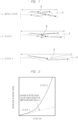
- FIG. 1(a) is a schematic view illustrating an initial state of electrically-conductive fiber materials
- FIG. 1(b) and FIG. 1(c) are schematic views illustrating a bending state of electrically-conductive fiber materials.
- an adhesive layer is formed on an elastomer sheet 1 including urethane elastomer and the like along a desired circuit wire.
- Electrically-conductive fiber materials 2 each having a predetermined length and a predetermined diameter are attached to the adhesive layer.
- closed circles indicate connecting points of the electrically-conductive fiber materials 2 and arrows indicate flows of electric currents in which an upper left electrically-conductive fiber material 2 is regarded as a starting point.
- the respective electrically-conductive fiber materials 2 When the elastomer sheet 1 is stretched or bent, the respective electrically-conductive fiber materials 2 relatively move maintaining intersection with the other electrically-conductive fiber materials 2 on the front surface of the adhesive layer as a state 1 illustrated in FIG. 1(b) , so that electrical continuity securely can be maintained without affecting flexibility of the elastomer sheet 1.
- FIG. 2 A relation between the stretch of the elastomer sheet and the increase in resistance value is illustrated in FIG. 2 .
- a lower straight line represents an ideal state in which all the electrical connections of the respective electrically-conductive fiber materials are maintained regardless of a stretch amount of the elastomer sheet.
- a resistance value increases in proportion to a distance between both ends of the electrically-conductive fiber materials accompanying the stretch of the elastomer sheet.
- the electrically-conductive fiber materials since the electrically-conductive fiber materials relatively move maintaining intersection with the other electrically-conductive fiber materials on the front surface of the adhesive layer, it is preferable that a quality of the electrically-conductive fiber material has high flexibility in order to maintain electrical connection between the electrically-conductive fiber materials even when the elastomer sheet is largely stretched or bent.
- a silver-coated fiber in which a front surface of a nylon fiber is coated with silver is particularly advantageous.
- the longer the electrically-conductive fiber material the longer the length from an intersection portion between adjacent electrically-conductive fiber materials can be secured. Therefore, even when the stretch amount of the elastomer sheet increases, the electrical connection between the adjacent electrically-conductive fiber materials is hardly cut off, so that increase in resistance value can be reduced.
- an optimum length is selected taking into consideration a bending rate of the elastomer sheet and the like.
- each electrically-conductive fiber material When the diameter of each electrically-conductive fiber material is enlarged, electric resistance per one material can be decreased, but rigidity increases, and accordingly, electrical contact between other adjacent electrically-conductive fiber materials cannot be conducted smoothly.
- the electrically-conductive fiber material As described later, in the invention where a material in which fibers of nylon are coated with silver, a metal having excellent electrical conductivity, is used as the electrically-conductive fiber material, electric resistance is determined based on a front surface area of the electrically-conductive fiber material. Therefore, it is not always possible to obtain a desired electric resistance with respect to a total amount of the attached electrically-conductive fiber material. Therefore, an optimum diameter is selected taking into consideration characteristics of the electrically-conductive fiber material to be used, a rate of change in electric resistance accompanying bending of the elastomer sheet.
- a brush roller method or a spray method is applicable.
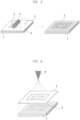
- a mask 4 corresponding to a circuit wire 3 is disposed, and after an adhesive is applied to form the adhesive layer, the electrically-conductive fiber materials 2 are then buried into the adhesive layer by a rotation brush 5.
- the electrically-conductive fiber materials 2 can be oriented to some extent. Even when the elastomer sheet 1 is largely stretched in the longitudinal direction, it is possible to maintain electrical contact between the electrically-conductive fiber materials 2.
- a mask 4 composed of a material having high detachability may be disposed, the electrically-conductive fiber materials 2 may be buried in the adhesive layer with the rotation brush 5, and then, the mask 4 may be detached from the adhesive layer.
- the electrically-conductive fiber materials 2 are sprayed to the adhesive layer from above the mask 4 corresponding to the circuit wire 3 by a spray 6 with high pressure as illustrated in FIG. 4 .
- a spray 6 with high pressure as illustrated in FIG. 4 .
- the electrically-conductive fiber materials 2 are supplied and excessively attached to the adhesive layer until exceeding a saturated state where the electrically-conductive fiber materials 2 can be attached to the adhesive layer. Then, excess electrically-conductive fiber materials 2 are removed by compressed air to form a circuit wire.
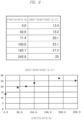
- each length of the silver-coated fibers and actual measured values of a change in resistance value accompanying the stretch are illustrated in FIG. 5 .
- sealing in the drawing represents an aspect in which the silver-coated fibers attached to the adhesive layer are sealed with a similar elastomer sheet or a coated layer formed of a thin film and the like having flexibility equivalent to or more than the elastomer sheet and front surfaces of the silver-coated fibers attached to the adhesive layer is pressed.
- each graph represents [silver-coated fiber of 3.0 mm with sealing], [silver-coated fiber of 0.5 mm with sealing], [3.0 mm, no sealing], [mixture of silver-coated fibers of 0.5 mm and of 3.0 mm, no sealing], and [silver-coated fiber 0.5 mm, no sealing] in the order from one having smaller increase in resistance value.
- the resistance value is hardly increased even at the maximum stretch amount of 30 mm.
- the silver-coated fibers have a sufficient length in the upper surface of the adhesive layer even when stretched to the maximum stretch amount.
- this represents that the electrical connection between the silver-coated fibers is mostly maintained since the upper surface is pressed by the elastomer sheet or thin film.
- Coating the upper surface with use of the elastomer sheet or thin film causes a cost increase or deterioration of flexibility.
- a length and a combination of the silver-coated fibers, and presence or absence of the upper surface coated layer may be selected in accordance with uses, for example, a degree of stretch generated when the elastomer sheet or thin film is used.
- An adhesive layer was applied to the whole surface of an elastomer sheet (for example, a urethane elastomer sheet having a size of 3 cm ⁇ 8 cm and a thickness of 1 mm) having predetermined flexibility.
- an elastomer sheet for example, a urethane elastomer sheet having a size of 3 cm ⁇ 8 cm and a thickness of 1 mm
- silver-plated nylon fibers each having a length of 0.5 mm to 3 mm and a diameter of 17.6 ⁇ m were attached to the adhesive layer as the electrically-conductive fiber materials by the brush roller method.
- Sheet resistance of the stretchable electrically-conductive sheet was measured by a resistance meter. Actual measured results are indicated in FIG. 6 .
- Silver-plated nylon fibers (a fiber length of 0.3 mm to 3 mm, a fiber diameter of 17.6 ⁇ m) were adsorbed to an adhesive layer of an elastomer adhesive sheet (a size of 3 cm ⁇ 8 cm, a thickness of 1 mm) by the brush roller spray method.
- the electrically-conductive sheet was brought into contact with an LED lighting circuit wire, and luminance of the LED was visually observed when a stretch rate was approximately 100%. Comparing to a case when the stretch rate was 0%, change in luminance was not observed.
- An antenna pattern for UHF-RFID was formed by forming a mask in which PET was cut on an adhesive layer of an elastomer adhesive sheet (a size of 3 cm ⁇ 9 cm, a thickness of 1 mm) and by adsorbing silver-plated nylon fibers (a fiber length of 0.3 mm to 3 mm, a fiber diameter of 17.6 ⁇ m) to the mask by the brush roller method.
- the antenna pattern was mounted with an IC chip for RFID conforming to EPC global gen2 to form a stretchable RFID tag. Attaching the stretchable RFID tag to clothing, a readout experiment was carried out by an RFID readout device (BHT-604QUWB made by DENSO WAVE Inc., at an output of 10 mW).
- the ID could be read out within a communication distance of approximately 3 cm. Even when a stretch rate reached approximately 100%, the communication distance could be maintained within approximately 2.5 cm.
- an elastomer sheet for example, a urethane elastomer sheet having a size of 20 cm ⁇ 10 cm, a thickness of 40 ⁇ m
- an adhesive layer applied to one surface thereof, with viscosity to some extent appearing on the adhesive layer of one surface of the elastomer sheet
- silver-plated nylon fibers each having a length of 0.5 mm to 3 mm and a diameter of 17.6 ⁇ m were attached in a width of 5 cm and a length of 15 cm in a length direction of the elastomer sheet to the elastomer sheet by the brush roller method.
- a width of the elastomer sheet was made larger than a width of a layer to which the silver-plated nylon fibers were stuck (hereinafter, referred to as a "wire width W"), and after being stuck, the elastomer sheet was rolled so as to make a cable-like stretchable wire of which a cross-section was in a circular shape.
- FIG. 8 indicates results obtained by measuring a change in resistance with respect to the stretch of the stretchable wire by the resistance meter. It was possible to obtain an excellent cable-like stretchable wire in which a resistance value was hardly changed even with respect to a 100% stretch rate (double stretch).
- Examples 1 to 4 relate to a stretchable electrically-conductive sheet or a cable-like stretchable wire in which change in resistance value is restrained as much as possible with respect to stretch
- Example 5 relates to a stretch amount detection sensor in which a resistance value with respect to a stretch amount is used positively.
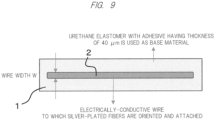
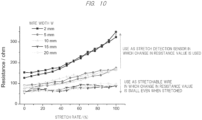
- FIG. 9 similarly to the above-described Example, a urethane elastomer with an adhesive and having a thickness of 40 ⁇ m was used as a base material, and silver-plated nylon fibers each having a length of 0.5 mm to 3 mm and a diameter of 17.6 ⁇ m were stuck in a saturated state to a wire width W to which the electrically-conductive fiber materials were attached.
- FIG. 10 indicates measured results in regard to change in resistance value with respect to stretch rate when changing W.
- the stretchable electrically-conductive circuits according to the present invention intersect with each other, in an intersection portion, opposing, attached electrically-conductive fiber materials function as opposing electrodes, and elastomer sheets present between the opposing electrodes function as electricity storage units (capacitors), so that the stretchable electrically-conductive circuits can be used as a stretchable capacitive pressure sensor.
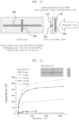
- an elastomer sheet 1a in which an electrically-conductive fiber material attached layer 2a extends in a horizontal direction and an elastomer sheet 1b in which an electrically-conductive fiber material attached layer 2b extends in a perpendicular direction are overlapped and attached to each other, so that the elastomer sheets 1a and 1b present in an intersection portion 7 of the electrically-conductive fiber material attached layers 2a and 2b function as the capacitors which stores electrons.
- FIG. 12 illustrates measured results in regard to a change in capacitance with respect to an increase in pressure when the wire widths W of the electrically-conductive fiber material attached layers 2a and 2b intersecting with each other in the perpendicular direction were set to be from 2 mm to 20 mm. It is found that, the larger the wire widths W are set to be, the larger the capacitance increases till reaching high pressure.
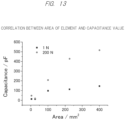
- FIG. 13 illustrates measured results in regard to a change in capacitance with respect to an overlapping area when pressure was set to be 1 N (square) and 200 N (circle), the overlapping area of the electrically-conductive fiber material attached layers 2a and 2b is taken along an axis of the abscissas, and the capacitance is taken along an axis of the ordinate.
- the capacitance and the overlapping area are in a substantially direct proportional relation.
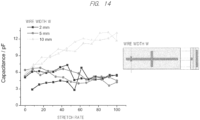
- FIG. 14 illustrates measured results in regard to a change in capacitance when the wire widths W were set to be 2 mm, 5 mm, and 10 mm and when stress in the horizontal direction was applied to the front surfaces of the elastomer sheets 1a and 1b, so that the elastomer sheets 1a and 1b were stretched.
- the capacitance with respect to a stretch rate is hardly changed.
- the elastomer sheets 1a and 1b contract and the capacitance increases due to the stretch, but the area of the overlapping portion also decreases along with the contraction, so that it can be considered that they offset each other.
- the stretchable capacitive pressure sensor of the present Example can accurately detect the pressure or load applied in the perpendicular direction by selecting the wire width W regardless of the stretch in the horizontal direction.
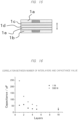
- FIG. 15 illustrates an example of widening an interelectrode gap by interposing, between the elastomer sheets 1a and 1b, elastomer sheets 1c and 1d without electrically-conductive fiber material attached layer and having a predetermined thickness.
- FIG. 16 illustrates a change in capacitance with respect to the elastomer sheets to be interposed when applying a pressure of 500 N to the stretchable electrically-conductive circuits.
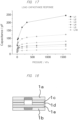
- FIG. 17 illustrates a change in capacitance with respect to a change in pressure and a change in load in a case of increasing the electrode gap due to the interposed elastomer sheets in order from L1 (first layer) to L10 (tenth layer).
- a small number of layers of the elastomer sheet can enhance sensitivity with respect to a small change in pressure and a small change in load.
- the layers of the elastomer sheet are increased, in a case where pressure and load are small, capacitance decreases in accordance with increase of the electrode gap, but an amount of contraction with respect to change in pressure of the interposed elastomer sheet increases, and accordingly, change in capacitance can be measured in a wide range.
- FIG. 18 illustrates an example in which the elastomer sheets 1c to 1e to be interposed are provided with an opening corresponding to a portion where the electrically-conductive fiber material attached layers 2a and 2b overlap.
- FIG. 19 illustrates measured results of a change in capacitance with respect to the pressure in a case of laminating the elastomer sheets from one layer with no opening (L1) to four layers with the opening (L5) sequentially.
- a second stretchable electrically-conductive circuit intersecting with the first stretchable electrically-conductive circuit is used as a stretchable capacitive pressure sensor, so that it is possible to measure pressure, load, and stretch simultaneously.
- an elastomer sheet 1a constituting the first stretchable electrically-conductive circuit has one electrically-conductive fiber material attached layer 2a formed therein in a horizontal direction
- the elastomer sheet 1b constituting the second stretchable electrically-conductive circuit 1b has five electrically-conductive fiber material attached layers 2b formed therein in a perpendicular direction.
- a resistance value of each of the electrically-conductive fiber material attached layer 2a disposed between both ends is measured at each of portions where the electrically-conductive fiber material attached layer 2a and the electrically-conductive fiber material attached layers 2b overlap, and accordingly, stretch can be measured similarly to Example 5.
- pressure and load can be measured.
- stretch, pressure, and load in the five portions can be measured independently and simultaneously.
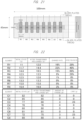
- the elastomer sheet 1a constituting the first stretchable electrically-conductive circuit and the elastomer sheet 1b constituting the second stretchable electrically-conductive circuit are both rectangular having a size of 100 mm ⁇ 45 mm.
- the elastomer sheet 1a has one electrically-conductive fiber material attached layer 2a formed therein in the horizontal direction
- the elastomer sheet 1b has eight electrically-conductive fiber material attached layers 2b formed therein in the perpendicular direction
- overlapping portions are formed at eight points from C1 to C8.
- FIG. 22 illustrates measured results of resistance values R1 to R8 among the eight electrically-conductive fiber material attached layers 2b when stretch is applied to a portion between C1 and C4 among the eight overlapping portions where capacitance elements are formed and when load is applied to the portions C3 and C7.
- FIG. 22 further illustrates measured results of capacitance in each of the eight overlapping portions C1 to C8 where the capacitance elements are formed.
- the measured results are indicated in an upper row, while the actual measured results of stretch rate and load are indicated in a lower row. Based on FIG. 23 , it is found that they are highly correlated.
- the stretchable electrically-conductive circuit can be expected to be widely used, for example, as an antenna or wire for RFID devices, a wire for a motion analysis sensor in sports science, a wearable heartbeat/electrocardiogram monitor, a wire in a robot movable portion, a wire for a finger sensor, and a wire for a bendable sensor attached to a finger, an elbow joint, and a knee joint.
- the stretchable electrically-conductive circuit can be used as a stretch amount sensor.
- the elastomer sheet is interposed between the electrically-conductive fiber material attached layers in such a way that the electrically-conductive fiber material attached layers are opposed to each other, and accordingly, the stretchable electrically-conductive circuit can also be used as a pressure sensor.
Landscapes
- Engineering & Computer Science (AREA)
- Microelectronics & Electronic Packaging (AREA)
- Manufacturing & Machinery (AREA)
- Power Engineering (AREA)
- Physics & Mathematics (AREA)
- General Physics & Mathematics (AREA)
- Laminated Bodies (AREA)
- Structure Of Printed Boards (AREA)
Claims (12)
- Dehnbare, elektrisch leitfähige Schaltung, die Folgendes umfasst:eine Elastomerfolie mit einer Klebeschicht, die einem Verdrahtungsbereich mit einem vorbestimmten Muster entspricht, das auf einer Vorderseite der Elastomerfolie ausgebildet ist; undelektrisch leitfähigen Fasermaterialien, die jeweils einen vorbestimmten Durchmesser und eine vorbestimmte Länge aufweisen und an der Klebeschicht befestigt sind und entlang des Verdrahtungsbereichs miteinander in Kontakt kommen, um eine gegenseitige elektrische Durchgängigkeit zu gewährleisten,wobei die elektrisch leitfähigen Fasermaterialien sich unter Beibehaltung der gegenseitigen elektrischen Durchgängigkeit relativ bewegen, um die gegenseitige elektrische Durchgängigkeit im Verdrahtungsbereich aufrechtzuerhalten, wenn die Elastomerfolie gedehnt oder gebogen wird,dadurch gekennzeichnet, dass die elektrisch leitfähigen Fasermaterialien versilberte/beschichtete Nylonfasern sind, die jeweils eine Länge von 0,5 mm bis 3 mm und einem Durchmesser von 17,6 µm aufweisen.
- Dehnbare, elektrisch leitfähige Schaltung nach Anspruch 1, wobei eine Vorderseite eines jeden der elektrisch leitfähigen Fasermaterialien, die an der Klebeschicht befestigt sind, mit der Elastomerfolie oder einer Überzugsschicht versiegelt ist, die aus einem dünnen Film gebildet ist, der eine höhere Elastizität als die Elastomerfolie aufweist.
- Dehnbare elektrisch leitfähige Schaltung nach Anspruch 1, wobei beide Oberflächen der Elastomerfolie als Klebeschichten ausgebildet sind und die Elastomerfolie gewalzt wird, sodass das elektrisch leitfähige Fasermaterial, das an einer der Klebeschichten befestigt ist, nach innen gelangt, um eine leitfähige drahtähnliche Form zu bilden.
- Dehnbare, elektrisch leitfähige Schaltung nach Anspruch 2, wobei eine Faserlänge jeder Faser der elektrisch leitfähigen Fasermaterialien oder eine Drahtbreite der zu befestigenden elektrisch leitfähigen Fasermaterialien so gewählt ist, dass die elektrisch zu lösenden elektrisch leitfähigen Fasermaterialien gemäß einer Dehnungsrate zunehmen und der elektrische Widerstand zunimmt, wenn die Elastomerfolie gedehnt oder gebogen wird, sodass die dehnbare, elektrisch leitfähige Schaltung als Dehnungsbetrag-Erfassungssensor fungiert, der den Dehnungsbetrag erfasst.
- Dehnbare, elektrisch leitfähige Schaltung nach Anspruch 1 oder 4, wobei die elektrisch leitfähigen Fasermaterialien, die an zwei Elastomerfolien befestigt sind, einander kreuzen, und die befestigten Schichten der elektrisch leitfähigen Fasermaterialien in einem Kreuzungsabschnitt als gegenüberliegende Elektroden fungieren und eine zwischen den gegenüberliegenden Elektroden angeordnete Elastomerfolie als Kondensator fungiert, und die Kapazität zwischen den gegenüberliegenden Elektroden sich gemäß einer Dehnung der Elastomerfolie zwischen den Elektroden aufgrund von Druck und Last, die in senkrechter Richtung ausgeübt werden, verändert, sodass die dehnbare elektrisch leitfähige Schaltung als Drucksensor fungiert.
- Dehnbare, elektrisch leitfähige Schaltung nach Anspruch 5, wobei Elastomerfolien, an denen die elektrisch leitfähigen Fasermaterialien nicht befestigt sind, im Kreuzungsabschnitt laminiert sind.
- Dehnbare, elektrisch leitfähige Schaltung nach Anspruch 6, wobei eine Öffnung in einem unteren Bereich des Kreuzungsabschnitts von zumindest einer Schicht der Elastomerfolien, in der die elektrisch leitfähigen Fasermaterialien nicht befestigt sind, vorgesehen ist.
- Dehnbare, elektrisch leitfähige Schaltung nach Anspruch 5, wobei eine Vielzahl von Reihen der befestigten Schichten der elektrisch leitfähigen Fasermaterialien auf einer der beiden Elastomerfolien ausgebildet sind, und die Kreuzungsabschnitte an einer Vielzahl von Abschnitten in Längsrichtung in Bezug auf die befestigte Schicht der elektrisch leitfähigen Fasermaterialien ausgebildet sind, die in der anderen Elastomerfolie ausgebildet sind.
- Dehnbare, elektrisch leitfähige Schaltung nach Anspruch 5, wobei eine der beiden Elastomerfolien als Dehnungsbetrag-Erfassungssensor fungiert und der Kreuzungsabschnitt als Drucksensor fungiert.
- Verfahren zum Herstellen einer dehnbaren, elektrisch leitfähigen Schaltung, das folgende Schritte umfasst:Ausbilden einer Klebeschicht auf einer Vorderseite einer Elastomerfolie unter Verwendung einer Maske, die einem Verdrahtungsbereich mit einem vorbestimmten Muster entspricht;Befestigen von elektrisch leitfähigen Fasermaterialien auf der Klebeschicht;Entfernen eines elektrisch leitfähigen Fasermaterials unter den elektrisch leitfähigen Fasermaterialien, das nicht auf die Klebeschicht aufgebracht werden kann; undEntfernen der Maske nach dem Aushärten der Klebeschicht,dadurch gekennzeichnet, dass die elektrisch leitfähigen Fasermaterialien jeweils eine Länge von 0,5 mm bis 3 mm aufweisen und versilberte/beschichtete Nylonfasern mit einem Durchmesser von 17,6 µm sind.
- Verfahren zum Herstellen einer dehnbaren, elektrisch leitfähigen Schaltung nach Anspruch 10, wobei die elektrisch leitfähigen Fasermaterialien durch ein Bürstenwalzenverfahren an der Klebeschicht befestigt werden.
- Verfahren zur Herstellung einer dehnbaren, elektrisch leitfähigen Schaltung nach Anspruch 11, wobei die elektrisch leitfähigen Fasermaterialien durch ein Sprühverfahren an der Klebeschicht befestigt werden.
Applications Claiming Priority (3)
| Application Number | Priority Date | Filing Date | Title |
|---|---|---|---|
| JP2014102087 | 2014-05-16 | ||
| JP2014252330 | 2014-12-12 | ||
| PCT/JP2015/063943 WO2015174505A1 (ja) | 2014-05-16 | 2015-05-14 | ストレッチャブル導電回路及びその製造方法 |
Publications (4)
| Publication Number | Publication Date |
|---|---|
| EP3145283A1 EP3145283A1 (de) | 2017-03-22 |
| EP3145283A4 EP3145283A4 (de) | 2018-02-28 |
| EP3145283B1 true EP3145283B1 (de) | 2024-10-30 |
| EP3145283C0 EP3145283C0 (de) | 2024-10-30 |
Family
ID=54480041
Family Applications (1)
| Application Number | Title | Priority Date | Filing Date |
|---|---|---|---|
| EP15793610.5A Active EP3145283B1 (de) | 2014-05-16 | 2015-05-14 | Dehnbare elektrisch leitende schaltung und herstellungsverfahren dafür |
Country Status (5)
| Country | Link |
|---|---|
| US (1) | US10386248B2 (de) |
| EP (1) | EP3145283B1 (de) |
| JP (1) | JP6377147B2 (de) |
| KR (1) | KR101985065B1 (de) |
| WO (1) | WO2015174505A1 (de) |
Families Citing this family (18)
| Publication number | Priority date | Publication date | Assignee | Title |
|---|---|---|---|---|
| DE112017005605T5 (de) * | 2016-11-07 | 2019-09-05 | E.I. Du Pont De Nemours And Company | Artikel und Substrate, die eine verbesserte Leistungsfähigkeit durckbarer Elektronik bereitstellen |
| JP6829365B2 (ja) * | 2017-01-12 | 2021-02-10 | 国立研究開発法人産業技術総合研究所 | 圧力センサ、圧力センサの製造方法、ベッド装置及び自動車用シート |
| WO2018161099A1 (en) * | 2017-02-28 | 2018-09-07 | Detnet South Africa (Pty) Ltd | Stretchable detonator connection cable |
| JP2019032733A (ja) * | 2017-08-09 | 2019-02-28 | 日本メクトロン株式会社 | 貼付タグ、タグシステム |
| WO2019039511A1 (ja) * | 2017-08-24 | 2019-02-28 | 東洋紡株式会社 | 導電性ペースト、伸縮性導体およびそれを用いた電子部品、衣服型電子機器 |
| JP7161738B2 (ja) * | 2018-02-08 | 2022-10-27 | ナミックス株式会社 | 導電性ペースト、硬化物、導電性パターン、衣服及びストレッチャブルペースト |
| CN110403589B (zh) * | 2018-04-28 | 2022-04-01 | 五邑大学 | 一种一次性心率贴 |
| CN110403592B (zh) * | 2018-04-28 | 2022-03-29 | 五邑大学 | 一种腕带式心率计 |
| KR102678182B1 (ko) * | 2018-11-16 | 2024-06-26 | 다이니폰 인사츠 가부시키가이샤 | 배선 기판 및 배선 기판의 제조 방법 |
| US11395404B2 (en) * | 2018-11-16 | 2022-07-19 | Dai Nippon Printing Co., Ltd. | Wiring board and method for manufacturing the wiring board |
| JP7249512B2 (ja) * | 2018-11-30 | 2023-03-31 | 大日本印刷株式会社 | 配線基板及び配線基板の製造方法 |
| RU2719733C1 (ru) * | 2018-12-26 | 2020-04-22 | Автономная некоммерческая образовательная организация высшего образования «Сколковский институт науки и технологий» (Сколковский институт науки и технологий) | Эластичная электрическая схема и способ ее изготовления |
| KR102172366B1 (ko) * | 2019-01-31 | 2020-10-30 | 포항공과대학교 산학협력단 | 미세섬유 네트워크 복합유연기판, 그를 포함하는 복합유연전극 및 그의 제조방법 |
| JP7323613B2 (ja) * | 2019-06-27 | 2023-08-08 | 株式会社巴川製紙所 | フレキシブル電線 |
| CN114222904B (zh) * | 2019-08-27 | 2024-07-26 | 松下知识产权经营株式会社 | 负荷传感器 |
| KR102256074B1 (ko) | 2020-05-21 | 2021-05-26 | (주)케이디엔에이 | 스마트 헬스 케어용 스트레처블 근적외선 led 밴드 |
| EP4227084A4 (de) * | 2020-10-07 | 2024-11-06 | NOK Corporation | Mit leitfähigem gummi beschichtetes gewebe |
| CN113995404B (zh) * | 2021-10-29 | 2023-05-05 | 华中科技大学 | 用于肌肉形变测量的水陆两用电容式柔性传感单元及系统 |
Family Cites Families (31)
| Publication number | Priority date | Publication date | Assignee | Title |
|---|---|---|---|---|
| JPS53133151U (de) * | 1977-03-29 | 1978-10-21 | ||
| JPS60139845A (ja) * | 1983-12-28 | 1985-07-24 | ジェイエスアール株式会社 | 感圧導電性織布 |
| JPS61201045A (ja) * | 1985-03-04 | 1986-09-05 | 旭化成株式会社 | 変形導電性編織物 |
| JPS6276602A (ja) * | 1985-09-30 | 1987-04-08 | 旭化成株式会社 | 伸長導電性布帛片 |
| JPS62163903A (ja) * | 1986-01-16 | 1987-07-20 | Asahi Chem Ind Co Ltd | 対被検物絶縁型伸長導電素子 |
| JPS62200204A (ja) * | 1986-02-28 | 1987-09-03 | Asahi Chem Ind Co Ltd | 調節機構を有する固定手段付伸長導電素子 |
| JPS62200203A (ja) * | 1986-02-28 | 1987-09-03 | Asahi Chem Ind Co Ltd | 固定手段付伸長導電素子 |
| JPS62200701A (ja) * | 1986-02-28 | 1987-09-04 | 旭化成株式会社 | 変形導電性編物 |
| JPH03179794A (ja) | 1989-10-30 | 1991-08-05 | Tokuyama Soda Co Ltd | 導電性プリント基板の製造方法 |
| ATE279718T1 (de) * | 1998-08-20 | 2004-10-15 | Iee Sarl | Flächenelektrode für kapazitive erkennungssysteme |
| JP2000071418A (ja) | 1998-08-28 | 2000-03-07 | Canon Inc | スクリーン印刷方法およびその装置 |
| JP2001047728A (ja) | 1999-08-05 | 2001-02-20 | Ricoh Microelectronics Co Ltd | パターン形成方法、パターン形成装置、バンプ電極形成方法、配線パターン形成方法、液晶表示装置用スペーサ形成方法、タッチパネル用スペーサ形成方法、及び、プラズマディスプレイパネル用障壁形成方法 |
| JP2003266599A (ja) * | 2002-03-19 | 2003-09-24 | Teijin Ltd | 耐屈曲性を有する表面導電性布帛 |
| JP2006153471A (ja) | 2004-11-25 | 2006-06-15 | Hitachi Cable Ltd | 感圧センサ |
| EP1742013A1 (de) * | 2005-07-06 | 2007-01-10 | Nederlandse Organisatie voor Toegepast-Natuuurwetenschappelijk Onderzoek TNO | System zum Messen von Änderungen in der Länge oder der Form eines Objekts |
| JP2008108583A (ja) * | 2006-10-25 | 2008-05-08 | Sumitomo Precision Prod Co Ltd | 導電線と導電コイルと導電線製造方法 |
| JP2009141129A (ja) | 2007-12-06 | 2009-06-25 | Sumitomo Electric Printed Circuit Inc | フレキシブルプリント配線板およびその製造方法 |
| WO2009102077A1 (ja) | 2008-02-11 | 2009-08-20 | The University Of Tokyo | カーボンナノチューブゴム組成物、配線、導電性ペースト、電子回路およびその製造方法 |
| US8191433B2 (en) * | 2008-05-19 | 2012-06-05 | The Hong Kong Polytechnic University | Method for manufacturing fabric strain sensors |
| JP5256143B2 (ja) | 2009-08-03 | 2013-08-07 | 東海ゴム工業株式会社 | 配線体接続構造体およびその製造方法 |
| US8880358B2 (en) * | 2010-04-16 | 2014-11-04 | Thomas J. Cunningham | Sensing device |
| JP2012168064A (ja) * | 2011-02-15 | 2012-09-06 | Tokai Rubber Ind Ltd | 外力計測装置とそれを備えるクッション体 |
| JP2012220315A (ja) * | 2011-04-07 | 2012-11-12 | Seiko Epson Corp | 圧力検出装置 |
| US20140035603A1 (en) * | 2012-08-03 | 2014-02-06 | Xerox Corporation | Printed Stretch Sensor |
| DE102012103856B4 (de) * | 2012-02-16 | 2016-09-29 | Peter Seitz | Textiler Drucksensor |
| JP2013187380A (ja) | 2012-03-08 | 2013-09-19 | Nippon Mektron Ltd | 伸縮性フレキシブル回路基板およびその製造方法 |
| JP5952609B2 (ja) | 2012-03-28 | 2016-07-13 | トッパン・フォームズ株式会社 | 非接触型データ受送信体 |
| JP2014077952A (ja) | 2012-10-12 | 2014-05-01 | Brother Ind Ltd | 画像形成装置用ブラシローラおよびその製造方法、現像用ブラシローラならびに現像装置 |
| US9322121B2 (en) * | 2013-02-28 | 2016-04-26 | Regents Of The University Of Minnesota | Stitched stretch sensor |
| EP3261097A4 (de) * | 2015-02-20 | 2018-10-24 | National Institute of Advanced Industrial Science and Technology | Hochelastische verdrahtung sowie verfahren und vorrichtung zur herstellung davon |
| JP6666806B2 (ja) * | 2016-07-14 | 2020-03-18 | トクセン工業株式会社 | 伸縮性配線シート及びその製造方法、伸縮性タッチセンサシート |
-
2015
- 2015-05-14 WO PCT/JP2015/063943 patent/WO2015174505A1/ja not_active Ceased
- 2015-05-14 US US15/311,659 patent/US10386248B2/en active Active
- 2015-05-14 JP JP2016519306A patent/JP6377147B2/ja not_active Expired - Fee Related
- 2015-05-14 KR KR1020167032895A patent/KR101985065B1/ko not_active Expired - Fee Related
- 2015-05-14 EP EP15793610.5A patent/EP3145283B1/de active Active
Also Published As
| Publication number | Publication date |
|---|---|
| EP3145283A1 (de) | 2017-03-22 |
| US20170153152A1 (en) | 2017-06-01 |
| JP6377147B2 (ja) | 2018-08-22 |
| EP3145283C0 (de) | 2024-10-30 |
| EP3145283A4 (de) | 2018-02-28 |
| JPWO2015174505A1 (ja) | 2017-04-20 |
| WO2015174505A1 (ja) | 2015-11-19 |
| KR101985065B1 (ko) | 2019-05-31 |
| US10386248B2 (en) | 2019-08-20 |
| KR20160147921A (ko) | 2016-12-23 |
Similar Documents
| Publication | Publication Date | Title |
|---|---|---|
| EP3145283B1 (de) | Dehnbare elektrisch leitende schaltung und herstellungsverfahren dafür | |
| US9814134B2 (en) | Elastic flexible substrate and manufacturing method thereof | |
| CN109781315B (zh) | 一种触觉传感器 | |
| US20220171502A1 (en) | Flexible capacitive tactile sensor and method for manufacturing same and tactile sensing system | |
| Khan et al. | Graphene tribotronics for electronic skin and touch screen applications | |
| EP3273754B1 (de) | Dehnbares kabel und dehnbare leiterplatte | |
| US9945739B2 (en) | Flexible pressure sensor using amorphous metal and flexible bimodal sensor for simultaneously sensing pressure and temperature | |
| Gillan et al. | Advances in design and manufacture of stretchable electronics | |
| US11740141B2 (en) | Pressure-sensitive element | |
| US20180033520A1 (en) | Highly stretchable wiring, and method and device for producing the same | |
| CN206291983U (zh) | 一种用于触摸检测的电子皮肤 | |
| Lee et al. | Ultraflexible vertical Corbino organic electrochemical transistors for epidermal signal monitoring | |
| CN114674465A (zh) | 基于柔性材料的电容式压力传感器及其制作方法 | |
| Eshkeiti et al. | A stretchable and wearable printed sensor for human body motion monitoring | |
| Rahimi et al. | A low-cost fabrication technique for direct sewing stretchable interconnetions for wearable electronics | |
| CN113819836B (zh) | 一种多材料剪纸结构可延展应变传感器及其制备方法 | |
| CN105509937A (zh) | 一种压感传感器、压力检测方法及制造工艺 | |
| WO2022181254A1 (ja) | 荷重センサ | |
| WO2016059288A1 (en) | A deformable apparatus and method | |
| JP2025089991A (ja) | 回路基板 | |
| Zuk | Capacitive sensors realized on flexible substrates | |
| Panahi et al. | Condition monitoring system: a flexible hybrid electronics approach for sealed container applications | |
| CN118518001B (zh) | 一种含缝阵列的电阻柔性应变传感器及其制备方法 | |
| CN118067159B (zh) | 一种曲面分片式的柔性传感器以及敏感层的制作方法 | |
| JP6489710B2 (ja) | 静電容量式3次元センサ |
Legal Events
| Date | Code | Title | Description |
|---|---|---|---|
| STAA | Information on the status of an ep patent application or granted ep patent |
Free format text: STATUS: THE INTERNATIONAL PUBLICATION HAS BEEN MADE |
|
| PUAI | Public reference made under article 153(3) epc to a published international application that has entered the european phase |
Free format text: ORIGINAL CODE: 0009012 |
|
| STAA | Information on the status of an ep patent application or granted ep patent |
Free format text: STATUS: REQUEST FOR EXAMINATION WAS MADE |
|
| 17P | Request for examination filed |
Effective date: 20161215 |
|
| AK | Designated contracting states |
Kind code of ref document: A1 Designated state(s): AL AT BE BG CH CY CZ DE DK EE ES FI FR GB GR HR HU IE IS IT LI LT LU LV MC MK MT NL NO PL PT RO RS SE SI SK SM TR |
|
| AX | Request for extension of the european patent |
Extension state: BA ME |
|
| DAV | Request for validation of the european patent (deleted) | ||
| DAX | Request for extension of the european patent (deleted) | ||
| A4 | Supplementary search report drawn up and despatched |
Effective date: 20180130 |
|
| RIC1 | Information provided on ipc code assigned before grant |
Ipc: H01B 13/00 20060101ALI20180124BHEP Ipc: H01B 5/02 20060101ALI20180124BHEP Ipc: H01B 5/14 20060101ALI20180124BHEP Ipc: B32B 25/10 20060101ALI20180124BHEP Ipc: H01B 5/00 20060101ALI20180124BHEP Ipc: H01R 11/01 20060101ALI20180124BHEP Ipc: H05K 1/09 20060101ALI20180124BHEP Ipc: H05K 1/03 20060101ALI20180124BHEP Ipc: H05K 3/10 20060101ALI20180124BHEP Ipc: H01B 7/06 20060101ALI20180124BHEP Ipc: H05K 3/14 20060101ALI20180124BHEP Ipc: H05K 1/02 20060101AFI20180124BHEP |
|
| STAA | Information on the status of an ep patent application or granted ep patent |
Free format text: STATUS: EXAMINATION IS IN PROGRESS |
|
| 17Q | First examination report despatched |
Effective date: 20180907 |
|
| GRAP | Despatch of communication of intention to grant a patent |
Free format text: ORIGINAL CODE: EPIDOSNIGR1 |
|
| STAA | Information on the status of an ep patent application or granted ep patent |
Free format text: STATUS: GRANT OF PATENT IS INTENDED |
|
| INTG | Intention to grant announced |
Effective date: 20240529 |
|
| RIN1 | Information on inventor provided before grant (corrected) |
Inventor name: NOBESHIMA, TAIKI Inventor name: UEMURA, SEI Inventor name: YOSHIDA, MANABU |
|
| GRAS | Grant fee paid |
Free format text: ORIGINAL CODE: EPIDOSNIGR3 |
|
| GRAA | (expected) grant |
Free format text: ORIGINAL CODE: 0009210 |
|
| STAA | Information on the status of an ep patent application or granted ep patent |
Free format text: STATUS: THE PATENT HAS BEEN GRANTED |
|
| AK | Designated contracting states |
Kind code of ref document: B1 Designated state(s): AL AT BE BG CH CY CZ DE DK EE ES FI FR GB GR HR HU IE IS IT LI LT LU LV MC MK MT NL NO PL PT RO RS SE SI SK SM TR |
|
| REG | Reference to a national code |
Ref country code: GB Ref legal event code: FG4D |
|
| REG | Reference to a national code |
Ref country code: CH Ref legal event code: EP |
|
| REG | Reference to a national code |
Ref country code: IE Ref legal event code: FG4D |
|
| REG | Reference to a national code |
Ref country code: DE Ref legal event code: R096 Ref document number: 602015090265 Country of ref document: DE |
|
| U01 | Request for unitary effect filed |
Effective date: 20241122 |
|
| U07 | Unitary effect registered |
Designated state(s): AT BE BG DE DK EE FI FR IT LT LU LV MT NL PT RO SE SI Effective date: 20241220 |
|
| PG25 | Lapsed in a contracting state [announced via postgrant information from national office to epo] |
Ref country code: IS Free format text: LAPSE BECAUSE OF FAILURE TO SUBMIT A TRANSLATION OF THE DESCRIPTION OR TO PAY THE FEE WITHIN THE PRESCRIBED TIME-LIMIT Effective date: 20250228 Ref country code: HR Free format text: LAPSE BECAUSE OF FAILURE TO SUBMIT A TRANSLATION OF THE DESCRIPTION OR TO PAY THE FEE WITHIN THE PRESCRIBED TIME-LIMIT Effective date: 20241030 |
|
| PG25 | Lapsed in a contracting state [announced via postgrant information from national office to epo] |
Ref country code: ES Free format text: LAPSE BECAUSE OF FAILURE TO SUBMIT A TRANSLATION OF THE DESCRIPTION OR TO PAY THE FEE WITHIN THE PRESCRIBED TIME-LIMIT Effective date: 20241030 |
|
| PG25 | Lapsed in a contracting state [announced via postgrant information from national office to epo] |
Ref country code: NO Free format text: LAPSE BECAUSE OF FAILURE TO SUBMIT A TRANSLATION OF THE DESCRIPTION OR TO PAY THE FEE WITHIN THE PRESCRIBED TIME-LIMIT Effective date: 20250130 |
|
| PG25 | Lapsed in a contracting state [announced via postgrant information from national office to epo] |
Ref country code: GR Free format text: LAPSE BECAUSE OF FAILURE TO SUBMIT A TRANSLATION OF THE DESCRIPTION OR TO PAY THE FEE WITHIN THE PRESCRIBED TIME-LIMIT Effective date: 20250131 |
|
| PG25 | Lapsed in a contracting state [announced via postgrant information from national office to epo] |
Ref country code: PL Free format text: LAPSE BECAUSE OF FAILURE TO SUBMIT A TRANSLATION OF THE DESCRIPTION OR TO PAY THE FEE WITHIN THE PRESCRIBED TIME-LIMIT Effective date: 20241030 |
|
| PG25 | Lapsed in a contracting state [announced via postgrant information from national office to epo] |
Ref country code: RS Free format text: LAPSE BECAUSE OF FAILURE TO SUBMIT A TRANSLATION OF THE DESCRIPTION OR TO PAY THE FEE WITHIN THE PRESCRIBED TIME-LIMIT Effective date: 20250130 |
|
| U20 | Renewal fee for the european patent with unitary effect paid |
Year of fee payment: 11 Effective date: 20250523 |
|
| PG25 | Lapsed in a contracting state [announced via postgrant information from national office to epo] |
Ref country code: SM Free format text: LAPSE BECAUSE OF FAILURE TO SUBMIT A TRANSLATION OF THE DESCRIPTION OR TO PAY THE FEE WITHIN THE PRESCRIBED TIME-LIMIT Effective date: 20241030 |
|
| PG25 | Lapsed in a contracting state [announced via postgrant information from national office to epo] |
Ref country code: SK Free format text: LAPSE BECAUSE OF FAILURE TO SUBMIT A TRANSLATION OF THE DESCRIPTION OR TO PAY THE FEE WITHIN THE PRESCRIBED TIME-LIMIT Effective date: 20241030 |
|
| PG25 | Lapsed in a contracting state [announced via postgrant information from national office to epo] |
Ref country code: CZ Free format text: LAPSE BECAUSE OF FAILURE TO SUBMIT A TRANSLATION OF THE DESCRIPTION OR TO PAY THE FEE WITHIN THE PRESCRIBED TIME-LIMIT Effective date: 20241030 |
|
| PLBE | No opposition filed within time limit |
Free format text: ORIGINAL CODE: 0009261 |
|
| STAA | Information on the status of an ep patent application or granted ep patent |
Free format text: STATUS: NO OPPOSITION FILED WITHIN TIME LIMIT |
|
| 26N | No opposition filed |
Effective date: 20250731 |
|
| REG | Reference to a national code |
Ref country code: CH Ref legal event code: H13 Free format text: ST27 STATUS EVENT CODE: U-0-0-H10-H13 (AS PROVIDED BY THE NATIONAL OFFICE) Effective date: 20251223 |
|
| PG25 | Lapsed in a contracting state [announced via postgrant information from national office to epo] |
Ref country code: CH Free format text: LAPSE BECAUSE OF NON-PAYMENT OF DUE FEES Effective date: 20250531 |
|
| GBPC | Gb: european patent ceased through non-payment of renewal fee |
Effective date: 20250514 |
|
| PG25 | Lapsed in a contracting state [announced via postgrant information from national office to epo] |
Ref country code: MC Free format text: LAPSE BECAUSE OF FAILURE TO SUBMIT A TRANSLATION OF THE DESCRIPTION OR TO PAY THE FEE WITHIN THE PRESCRIBED TIME-LIMIT Effective date: 20241030 |
|
| PG25 | Lapsed in a contracting state [announced via postgrant information from national office to epo] |
Ref country code: GB Free format text: LAPSE BECAUSE OF NON-PAYMENT OF DUE FEES Effective date: 20250514 |
|
| PG25 | Lapsed in a contracting state [announced via postgrant information from national office to epo] |
Ref country code: IE Free format text: LAPSE BECAUSE OF NON-PAYMENT OF DUE FEES Effective date: 20250514 |