EP3144302B1 - Heterocyclische verbindung mit aromatischer amingruppe und organische lichtemittierende vorrichtung damit - Google Patents
Heterocyclische verbindung mit aromatischer amingruppe und organische lichtemittierende vorrichtung damit Download PDFInfo
- Publication number
- EP3144302B1 EP3144302B1 EP15793316.9A EP15793316A EP3144302B1 EP 3144302 B1 EP3144302 B1 EP 3144302B1 EP 15793316 A EP15793316 A EP 15793316A EP 3144302 B1 EP3144302 B1 EP 3144302B1
- Authority
- EP
- European Patent Office
- Prior art keywords
- carbon atoms
- chemical formula
- substituted
- structural formula
- ring
- Prior art date
- Legal status (The legal status is an assumption and is not a legal conclusion. Google has not performed a legal analysis and makes no representation as to the accuracy of the status listed.)
- Active
Links
- 0 CCC1*(CC**2)C2C1C Chemical compound CCC1*(CC**2)C2C1C 0.000 description 24
- FMRKYYLMTCKYCO-UHFFFAOYSA-N CC(C)(C)c(cc1)ccc1N(c1ccc(CCC2)c2c1)c(cc1C2(c3ccccc3-c3ccccc23)c2c3)c(c4ccccc4[o]4)c4c1-c2c1[o]c(cccc2)c2c1c3N(c1ccc(C(C)(C)C)cc1)c1ccc(CCC2)c2c1 Chemical compound CC(C)(C)c(cc1)ccc1N(c1ccc(CCC2)c2c1)c(cc1C2(c3ccccc3-c3ccccc23)c2c3)c(c4ccccc4[o]4)c4c1-c2c1[o]c(cccc2)c2c1c3N(c1ccc(C(C)(C)C)cc1)c1ccc(CCC2)c2c1 FMRKYYLMTCKYCO-UHFFFAOYSA-N 0.000 description 1
- OQISZGZKDLKVFG-UHFFFAOYSA-N CC(C)(C)c(cc1)ccc1N(c1ccc(c2cccc([Si](C)(C)C)c2[o]2)c2c1)c1cc(C2(c3ccccc3-c3ccccc23)c2cc(N(c3ccc(C(C)(C)C)cc3)c(cc3)cc4c3c3cccc([Si](C)(C)C)c3[o]4)c(c3ccccc3[o]3)c3c2-2)c-2c2c1c(cccc1)c1[o]2 Chemical compound CC(C)(C)c(cc1)ccc1N(c1ccc(c2cccc([Si](C)(C)C)c2[o]2)c2c1)c1cc(C2(c3ccccc3-c3ccccc23)c2cc(N(c3ccc(C(C)(C)C)cc3)c(cc3)cc4c3c3cccc([Si](C)(C)C)c3[o]4)c(c3ccccc3[o]3)c3c2-2)c-2c2c1c(cccc1)c1[o]2 OQISZGZKDLKVFG-UHFFFAOYSA-N 0.000 description 1
- MNZHSPVVZMYBOZ-ILWJIGKKSA-N CC(C)[C@H]1[C@@H]2[C@H]1CCCC2 Chemical compound CC(C)[C@H]1[C@@H]2[C@H]1CCCC2 MNZHSPVVZMYBOZ-ILWJIGKKSA-N 0.000 description 1
- JBGJVMVWYWUVOW-UHFFFAOYSA-N CC(c(ccc1ccccc11)c1O)=O Chemical compound CC(c(ccc1ccccc11)c1O)=O JBGJVMVWYWUVOW-UHFFFAOYSA-N 0.000 description 1
- CUSHHIZTNAOHMT-UHFFFAOYSA-N CCNC(C)CC=C Chemical compound CCNC(C)CC=C CUSHHIZTNAOHMT-UHFFFAOYSA-N 0.000 description 1
- JBGRDJYDLZRZLK-ZFDZMSFRSA-N CC[C@@H](C1)C(CC=CC2)C2O[C@@H]1C=C Chemical compound CC[C@@H](C1)C(CC=CC2)C2O[C@@H]1C=C JBGRDJYDLZRZLK-ZFDZMSFRSA-N 0.000 description 1
- JSNFPARDBVJFGZ-UHFFFAOYSA-N COC(c(ccc1c2[o]c3c1cccc3)c2-c1c2[s]c3ccccc3c2ccc1)=O Chemical compound COC(c(ccc1c2[o]c3c1cccc3)c2-c1c2[s]c3ccccc3c2ccc1)=O JSNFPARDBVJFGZ-UHFFFAOYSA-N 0.000 description 1
- HEIYWIYRGQXMGX-UHFFFAOYSA-N COC(c1ccc(c2ccccc2[o]2)c2c1I)=O Chemical compound COC(c1ccc(c2ccccc2[o]2)c2c1I)=O HEIYWIYRGQXMGX-UHFFFAOYSA-N 0.000 description 1
- MKJMFEGZBRUPHO-UHFFFAOYSA-N COC(c1ccc(c2ccccc2[o]2)c2c1N)=O Chemical compound COC(c1ccc(c2ccccc2[o]2)c2c1N)=O MKJMFEGZBRUPHO-UHFFFAOYSA-N 0.000 description 1
- DDDRBBNKBQWDPP-UHFFFAOYSA-N CS(C)(C)c(cc1)ccc1N(c(cc1C(c2c3)(c4ccccc4)c4ccccc4)ccc1-c2c(c(cccc1)c1[o]1)c1c3N(c1ccccc1)c(cc1)ccc1S(C)(C)C)c(cc1)cc2c1c1cccnc1[o]2 Chemical compound CS(C)(C)c(cc1)ccc1N(c(cc1C(c2c3)(c4ccccc4)c4ccccc4)ccc1-c2c(c(cccc1)c1[o]1)c1c3N(c1ccccc1)c(cc1)ccc1S(C)(C)C)c(cc1)cc2c1c1cccnc1[o]2 DDDRBBNKBQWDPP-UHFFFAOYSA-N 0.000 description 1
- QLFNBKNMRHOHSL-UHFFFAOYSA-N Nc(c1c(cc2)c(cccc3)c3[o]1)c2C#N Chemical compound Nc(c1c(cc2)c(cccc3)c3[o]1)c2C#N QLFNBKNMRHOHSL-UHFFFAOYSA-N 0.000 description 1
- UMCKMPNGKPEIRL-UHFFFAOYSA-N O=C1c2cc(Br)c(cccc3)c3c2-c2c3[o]c4ccccc4c3ccc12 Chemical compound O=C1c2cc(Br)c(cccc3)c3c2-c2c3[o]c4ccccc4c3ccc12 UMCKMPNGKPEIRL-UHFFFAOYSA-N 0.000 description 1
- IANNUDCXVWAWDL-UHFFFAOYSA-N OC(c1c(-c2c3[o]c(cccc4)c4c3ccc2)c(cccc2)c2c(Br)c1)=O Chemical compound OC(c1c(-c2c3[o]c(cccc4)c4c3ccc2)c(cccc2)c2c(Br)c1)=O IANNUDCXVWAWDL-UHFFFAOYSA-N 0.000 description 1
- QRAVOJOOXRDMQF-UHFFFAOYSA-N [O-][N+](c1c2[o]c3ccccc3c2ccc1)=O Chemical compound [O-][N+](c1c2[o]c3ccccc3c2ccc1)=O QRAVOJOOXRDMQF-UHFFFAOYSA-N 0.000 description 1
- MNGOFLVPSUWWNC-UHFFFAOYSA-N c1ccc(C(c2c3)(c4cc(N(c5cccc6c5[o]c5c6cccc5)c(cccc5)c5-c5ccccc5)c5[o]c(cccc6)c6c5c4-c2ccc3N(c2c3[o]c(cccc4)c4c3ccc2)c(cccc2)c2-c2ccccc2)c2ccccc2)cc1 Chemical compound c1ccc(C(c2c3)(c4cc(N(c5cccc6c5[o]c5c6cccc5)c(cccc5)c5-c5ccccc5)c5[o]c(cccc6)c6c5c4-c2ccc3N(c2c3[o]c(cccc4)c4c3ccc2)c(cccc2)c2-c2ccccc2)c2ccccc2)cc1 MNGOFLVPSUWWNC-UHFFFAOYSA-N 0.000 description 1
Images

Classifications
-
- C—CHEMISTRY; METALLURGY
- C07—ORGANIC CHEMISTRY
- C07D—HETEROCYCLIC COMPOUNDS
- C07D307/00—Heterocyclic compounds containing five-membered rings having one oxygen atom as the only ring hetero atom
- C07D307/94—Heterocyclic compounds containing five-membered rings having one oxygen atom as the only ring hetero atom spiro-condensed with carbocyclic rings or ring systems, e.g. griseofulvins
-
- C—CHEMISTRY; METALLURGY
- C07—ORGANIC CHEMISTRY
- C07C—ACYCLIC OR CARBOCYCLIC COMPOUNDS
- C07C211/00—Compounds containing amino groups bound to a carbon skeleton
- C07C211/43—Compounds containing amino groups bound to a carbon skeleton having amino groups bound to carbon atoms of six-membered aromatic rings of the carbon skeleton
- C07C211/57—Compounds containing amino groups bound to a carbon skeleton having amino groups bound to carbon atoms of six-membered aromatic rings of the carbon skeleton having amino groups bound to carbon atoms of six-membered aromatic rings being part of condensed ring systems of the carbon skeleton
- C07C211/61—Compounds containing amino groups bound to a carbon skeleton having amino groups bound to carbon atoms of six-membered aromatic rings of the carbon skeleton having amino groups bound to carbon atoms of six-membered aromatic rings being part of condensed ring systems of the carbon skeleton with at least one of the condensed ring systems formed by three or more rings
-
- C—CHEMISTRY; METALLURGY
- C07—ORGANIC CHEMISTRY
- C07D—HETEROCYCLIC COMPOUNDS
- C07D209/00—Heterocyclic compounds containing five-membered rings, condensed with other rings, with one nitrogen atom as the only ring hetero atom
- C07D209/56—Ring systems containing three or more rings
- C07D209/80—[b, c]- or [b, d]-condensed
- C07D209/94—[b, c]- or [b, d]-condensed containing carbocyclic rings other than six-membered
-
- C—CHEMISTRY; METALLURGY
- C07—ORGANIC CHEMISTRY
- C07D—HETEROCYCLIC COMPOUNDS
- C07D307/00—Heterocyclic compounds containing five-membered rings having one oxygen atom as the only ring hetero atom
- C07D307/77—Heterocyclic compounds containing five-membered rings having one oxygen atom as the only ring hetero atom ortho- or peri-condensed with carbocyclic rings or ring systems
-
- C—CHEMISTRY; METALLURGY
- C07—ORGANIC CHEMISTRY
- C07D—HETEROCYCLIC COMPOUNDS
- C07D405/00—Heterocyclic compounds containing both one or more hetero rings having oxygen atoms as the only ring hetero atoms, and one or more rings having nitrogen as the only ring hetero atom
- C07D405/14—Heterocyclic compounds containing both one or more hetero rings having oxygen atoms as the only ring hetero atoms, and one or more rings having nitrogen as the only ring hetero atom containing three or more hetero rings
-
- C—CHEMISTRY; METALLURGY
- C07—ORGANIC CHEMISTRY
- C07D—HETEROCYCLIC COMPOUNDS
- C07D493/00—Heterocyclic compounds containing oxygen atoms as the only ring hetero atoms in the condensed system
- C07D493/02—Heterocyclic compounds containing oxygen atoms as the only ring hetero atoms in the condensed system in which the condensed system contains two hetero rings
- C07D493/04—Ortho-condensed systems
-
- C—CHEMISTRY; METALLURGY
- C07—ORGANIC CHEMISTRY
- C07D—HETEROCYCLIC COMPOUNDS
- C07D493/00—Heterocyclic compounds containing oxygen atoms as the only ring hetero atoms in the condensed system
- C07D493/02—Heterocyclic compounds containing oxygen atoms as the only ring hetero atoms in the condensed system in which the condensed system contains two hetero rings
- C07D493/10—Spiro-condensed systems
-
- C—CHEMISTRY; METALLURGY
- C07—ORGANIC CHEMISTRY
- C07D—HETEROCYCLIC COMPOUNDS
- C07D495/00—Heterocyclic compounds containing in the condensed system at least one hetero ring having sulfur atoms as the only ring hetero atoms
- C07D495/02—Heterocyclic compounds containing in the condensed system at least one hetero ring having sulfur atoms as the only ring hetero atoms in which the condensed system contains two hetero rings
- C07D495/10—Spiro-condensed systems
-
- C—CHEMISTRY; METALLURGY
- C07—ORGANIC CHEMISTRY
- C07F—ACYCLIC, CARBOCYCLIC OR HETEROCYCLIC COMPOUNDS CONTAINING ELEMENTS OTHER THAN CARBON, HYDROGEN, HALOGEN, OXYGEN, NITROGEN, SULFUR, SELENIUM OR TELLURIUM
- C07F7/00—Compounds containing elements of Groups 4 or 14 of the Periodic Table
- C07F7/02—Silicon compounds
- C07F7/08—Compounds having one or more C—Si linkages
- C07F7/0803—Compounds with Si-C or Si-Si linkages
- C07F7/081—Compounds with Si-C or Si-Si linkages comprising at least one atom selected from the elements N, O, halogen, S, Se or Te
- C07F7/0812—Compounds with Si-C or Si-Si linkages comprising at least one atom selected from the elements N, O, halogen, S, Se or Te comprising a heterocyclic ring
-
- C—CHEMISTRY; METALLURGY
- C09—DYES; PAINTS; POLISHES; NATURAL RESINS; ADHESIVES; COMPOSITIONS NOT OTHERWISE PROVIDED FOR; APPLICATIONS OF MATERIALS NOT OTHERWISE PROVIDED FOR
- C09K—MATERIALS FOR MISCELLANEOUS APPLICATIONS, NOT PROVIDED FOR ELSEWHERE
- C09K11/00—Luminescent materials, e.g. electroluminescent or chemiluminescent
- C09K11/06—Luminescent materials, e.g. electroluminescent or chemiluminescent containing organic luminescent materials
-
- H—ELECTRICITY
- H10—SEMICONDUCTOR DEVICES; ELECTRIC SOLID-STATE DEVICES NOT OTHERWISE PROVIDED FOR
- H10K—ORGANIC ELECTRIC SOLID-STATE DEVICES
- H10K50/00—Organic light-emitting devices
- H10K50/10—OLEDs or polymer light-emitting diodes [PLED]
- H10K50/11—OLEDs or polymer light-emitting diodes [PLED] characterised by the electroluminescent [EL] layers
-
- H—ELECTRICITY
- H10—SEMICONDUCTOR DEVICES; ELECTRIC SOLID-STATE DEVICES NOT OTHERWISE PROVIDED FOR
- H10K—ORGANIC ELECTRIC SOLID-STATE DEVICES
- H10K50/00—Organic light-emitting devices
- H10K50/10—OLEDs or polymer light-emitting diodes [PLED]
- H10K50/14—Carrier transporting layers
- H10K50/15—Hole transporting layers
-
- H—ELECTRICITY
- H10—SEMICONDUCTOR DEVICES; ELECTRIC SOLID-STATE DEVICES NOT OTHERWISE PROVIDED FOR
- H10K—ORGANIC ELECTRIC SOLID-STATE DEVICES
- H10K85/00—Organic materials used in the body or electrodes of devices covered by this subclass
- H10K85/40—Organosilicon compounds, e.g. TIPS pentacene
-
- H—ELECTRICITY
- H10—SEMICONDUCTOR DEVICES; ELECTRIC SOLID-STATE DEVICES NOT OTHERWISE PROVIDED FOR
- H10K—ORGANIC ELECTRIC SOLID-STATE DEVICES
- H10K85/00—Organic materials used in the body or electrodes of devices covered by this subclass
- H10K85/60—Organic compounds having low molecular weight
- H10K85/615—Polycyclic condensed aromatic hydrocarbons, e.g. anthracene
-
- H—ELECTRICITY
- H10—SEMICONDUCTOR DEVICES; ELECTRIC SOLID-STATE DEVICES NOT OTHERWISE PROVIDED FOR
- H10K—ORGANIC ELECTRIC SOLID-STATE DEVICES
- H10K85/00—Organic materials used in the body or electrodes of devices covered by this subclass
- H10K85/60—Organic compounds having low molecular weight
- H10K85/631—Amine compounds having at least two aryl rest on at least one amine-nitrogen atom, e.g. triphenylamine
-
- H—ELECTRICITY
- H10—SEMICONDUCTOR DEVICES; ELECTRIC SOLID-STATE DEVICES NOT OTHERWISE PROVIDED FOR
- H10K—ORGANIC ELECTRIC SOLID-STATE DEVICES
- H10K85/00—Organic materials used in the body or electrodes of devices covered by this subclass
- H10K85/60—Organic compounds having low molecular weight
- H10K85/631—Amine compounds having at least two aryl rest on at least one amine-nitrogen atom, e.g. triphenylamine
- H10K85/633—Amine compounds having at least two aryl rest on at least one amine-nitrogen atom, e.g. triphenylamine comprising polycyclic condensed aromatic hydrocarbons as substituents on the nitrogen atom
-
- H—ELECTRICITY
- H10—SEMICONDUCTOR DEVICES; ELECTRIC SOLID-STATE DEVICES NOT OTHERWISE PROVIDED FOR
- H10K—ORGANIC ELECTRIC SOLID-STATE DEVICES
- H10K85/00—Organic materials used in the body or electrodes of devices covered by this subclass
- H10K85/60—Organic compounds having low molecular weight
- H10K85/631—Amine compounds having at least two aryl rest on at least one amine-nitrogen atom, e.g. triphenylamine
- H10K85/636—Amine compounds having at least two aryl rest on at least one amine-nitrogen atom, e.g. triphenylamine comprising heteroaromatic hydrocarbons as substituents on the nitrogen atom
-
- H—ELECTRICITY
- H10—SEMICONDUCTOR DEVICES; ELECTRIC SOLID-STATE DEVICES NOT OTHERWISE PROVIDED FOR
- H10K—ORGANIC ELECTRIC SOLID-STATE DEVICES
- H10K85/00—Organic materials used in the body or electrodes of devices covered by this subclass
- H10K85/60—Organic compounds having low molecular weight
- H10K85/649—Aromatic compounds comprising a hetero atom
- H10K85/654—Aromatic compounds comprising a hetero atom comprising only nitrogen as heteroatom
-
- H—ELECTRICITY
- H10—SEMICONDUCTOR DEVICES; ELECTRIC SOLID-STATE DEVICES NOT OTHERWISE PROVIDED FOR
- H10K—ORGANIC ELECTRIC SOLID-STATE DEVICES
- H10K85/00—Organic materials used in the body or electrodes of devices covered by this subclass
- H10K85/60—Organic compounds having low molecular weight
- H10K85/649—Aromatic compounds comprising a hetero atom
- H10K85/657—Polycyclic condensed heteroaromatic hydrocarbons
-
- H—ELECTRICITY
- H10—SEMICONDUCTOR DEVICES; ELECTRIC SOLID-STATE DEVICES NOT OTHERWISE PROVIDED FOR
- H10K—ORGANIC ELECTRIC SOLID-STATE DEVICES
- H10K85/00—Organic materials used in the body or electrodes of devices covered by this subclass
- H10K85/60—Organic compounds having low molecular weight
- H10K85/649—Aromatic compounds comprising a hetero atom
- H10K85/657—Polycyclic condensed heteroaromatic hydrocarbons
- H10K85/6572—Polycyclic condensed heteroaromatic hydrocarbons comprising only nitrogen in the heteroaromatic polycondensed ring system, e.g. phenanthroline or carbazole
-
- H—ELECTRICITY
- H10—SEMICONDUCTOR DEVICES; ELECTRIC SOLID-STATE DEVICES NOT OTHERWISE PROVIDED FOR
- H10K—ORGANIC ELECTRIC SOLID-STATE DEVICES
- H10K85/00—Organic materials used in the body or electrodes of devices covered by this subclass
- H10K85/60—Organic compounds having low molecular weight
- H10K85/649—Aromatic compounds comprising a hetero atom
- H10K85/657—Polycyclic condensed heteroaromatic hydrocarbons
- H10K85/6574—Polycyclic condensed heteroaromatic hydrocarbons comprising only oxygen in the heteroaromatic polycondensed ring system, e.g. cumarine dyes
-
- H—ELECTRICITY
- H10—SEMICONDUCTOR DEVICES; ELECTRIC SOLID-STATE DEVICES NOT OTHERWISE PROVIDED FOR
- H10K—ORGANIC ELECTRIC SOLID-STATE DEVICES
- H10K85/00—Organic materials used in the body or electrodes of devices covered by this subclass
- H10K85/60—Organic compounds having low molecular weight
- H10K85/649—Aromatic compounds comprising a hetero atom
- H10K85/657—Polycyclic condensed heteroaromatic hydrocarbons
- H10K85/6576—Polycyclic condensed heteroaromatic hydrocarbons comprising only sulfur in the heteroaromatic polycondensed ring system, e.g. benzothiophene
-
- C—CHEMISTRY; METALLURGY
- C07—ORGANIC CHEMISTRY
- C07C—ACYCLIC OR CARBOCYCLIC COMPOUNDS
- C07C2603/00—Systems containing at least three condensed rings
- C07C2603/93—Spiro compounds
- C07C2603/94—Spiro compounds containing "free" spiro atoms
-
- C—CHEMISTRY; METALLURGY
- C09—DYES; PAINTS; POLISHES; NATURAL RESINS; ADHESIVES; COMPOSITIONS NOT OTHERWISE PROVIDED FOR; APPLICATIONS OF MATERIALS NOT OTHERWISE PROVIDED FOR
- C09K—MATERIALS FOR MISCELLANEOUS APPLICATIONS, NOT PROVIDED FOR ELSEWHERE
- C09K2211/00—Chemical nature of organic luminescent or tenebrescent compounds
- C09K2211/10—Non-macromolecular compounds
- C09K2211/1003—Carbocyclic compounds
- C09K2211/1007—Non-condensed systems
-
- C—CHEMISTRY; METALLURGY
- C09—DYES; PAINTS; POLISHES; NATURAL RESINS; ADHESIVES; COMPOSITIONS NOT OTHERWISE PROVIDED FOR; APPLICATIONS OF MATERIALS NOT OTHERWISE PROVIDED FOR
- C09K—MATERIALS FOR MISCELLANEOUS APPLICATIONS, NOT PROVIDED FOR ELSEWHERE
- C09K2211/00—Chemical nature of organic luminescent or tenebrescent compounds
- C09K2211/10—Non-macromolecular compounds
- C09K2211/1003—Carbocyclic compounds
- C09K2211/1011—Condensed systems
-
- C—CHEMISTRY; METALLURGY
- C09—DYES; PAINTS; POLISHES; NATURAL RESINS; ADHESIVES; COMPOSITIONS NOT OTHERWISE PROVIDED FOR; APPLICATIONS OF MATERIALS NOT OTHERWISE PROVIDED FOR
- C09K—MATERIALS FOR MISCELLANEOUS APPLICATIONS, NOT PROVIDED FOR ELSEWHERE
- C09K2211/00—Chemical nature of organic luminescent or tenebrescent compounds
- C09K2211/10—Non-macromolecular compounds
- C09K2211/1003—Carbocyclic compounds
- C09K2211/1014—Carbocyclic compounds bridged by heteroatoms, e.g. N, P, Si or B
-
- C—CHEMISTRY; METALLURGY
- C09—DYES; PAINTS; POLISHES; NATURAL RESINS; ADHESIVES; COMPOSITIONS NOT OTHERWISE PROVIDED FOR; APPLICATIONS OF MATERIALS NOT OTHERWISE PROVIDED FOR
- C09K—MATERIALS FOR MISCELLANEOUS APPLICATIONS, NOT PROVIDED FOR ELSEWHERE
- C09K2211/00—Chemical nature of organic luminescent or tenebrescent compounds
- C09K2211/10—Non-macromolecular compounds
- C09K2211/1018—Heterocyclic compounds
- C09K2211/1025—Heterocyclic compounds characterised by ligands
- C09K2211/1029—Heterocyclic compounds characterised by ligands containing one nitrogen atom as the heteroatom
-
- C—CHEMISTRY; METALLURGY
- C09—DYES; PAINTS; POLISHES; NATURAL RESINS; ADHESIVES; COMPOSITIONS NOT OTHERWISE PROVIDED FOR; APPLICATIONS OF MATERIALS NOT OTHERWISE PROVIDED FOR
- C09K—MATERIALS FOR MISCELLANEOUS APPLICATIONS, NOT PROVIDED FOR ELSEWHERE
- C09K2211/00—Chemical nature of organic luminescent or tenebrescent compounds
- C09K2211/10—Non-macromolecular compounds
- C09K2211/1018—Heterocyclic compounds
- C09K2211/1025—Heterocyclic compounds characterised by ligands
- C09K2211/1088—Heterocyclic compounds characterised by ligands containing oxygen as the only heteroatom
-
- C—CHEMISTRY; METALLURGY
- C09—DYES; PAINTS; POLISHES; NATURAL RESINS; ADHESIVES; COMPOSITIONS NOT OTHERWISE PROVIDED FOR; APPLICATIONS OF MATERIALS NOT OTHERWISE PROVIDED FOR
- C09K—MATERIALS FOR MISCELLANEOUS APPLICATIONS, NOT PROVIDED FOR ELSEWHERE
- C09K2211/00—Chemical nature of organic luminescent or tenebrescent compounds
- C09K2211/10—Non-macromolecular compounds
- C09K2211/1018—Heterocyclic compounds
- C09K2211/1025—Heterocyclic compounds characterised by ligands
- C09K2211/1092—Heterocyclic compounds characterised by ligands containing sulfur as the only heteroatom
-
- H—ELECTRICITY
- H10—SEMICONDUCTOR DEVICES; ELECTRIC SOLID-STATE DEVICES NOT OTHERWISE PROVIDED FOR
- H10K—ORGANIC ELECTRIC SOLID-STATE DEVICES
- H10K85/00—Organic materials used in the body or electrodes of devices covered by this subclass
- H10K85/60—Organic compounds having low molecular weight
- H10K85/615—Polycyclic condensed aromatic hydrocarbons, e.g. anthracene
- H10K85/624—Polycyclic condensed aromatic hydrocarbons, e.g. anthracene containing six or more rings
-
- H—ELECTRICITY
- H10—SEMICONDUCTOR DEVICES; ELECTRIC SOLID-STATE DEVICES NOT OTHERWISE PROVIDED FOR
- H10K—ORGANIC ELECTRIC SOLID-STATE DEVICES
- H10K85/00—Organic materials used in the body or electrodes of devices covered by this subclass
- H10K85/60—Organic compounds having low molecular weight
- H10K85/615—Polycyclic condensed aromatic hydrocarbons, e.g. anthracene
- H10K85/626—Polycyclic condensed aromatic hydrocarbons, e.g. anthracene containing more than one polycyclic condensed aromatic rings, e.g. bis-anthracene
Definitions
- the present disclosure relates to a heterocyclic compound containing an aromatic amine group and an organic light-emitting device comprising the same. More particularly, the present disclosure relates to a heterocyclic compound that is superior in luminance and light emission efficiency when used as an organic light-emitting material and that secures a long lifetime and excellent properties for organic light-emitting devices, and to an organic light-emitting device containing the same.
- OLEDs Organic light-emitting diodes
- LCDs liquid crystal displays
- OLEDs organic light-emitting diodes
- an OLED display exhibits a much faster response time than an LCD. Accordingly, organic light-emitting diodes find applications in the illumination field as well as the full-color display field.
- organic light-emitting phenomenon refers to a phenomenon in which electric energy is converted to light energy by means of an organic material.
- An organic light-emitting device using the organic light-emitting phenomenon has a structure usually comprising an anode, a cathode, and an organic material layer interposed therebetween.
- the organic material layer may be of a multilayer structure consisting of different materials, for example, a hole injection layer, a hole transport layer, a light-emitting layer, an electron transport layer, and an electron injection layer, in order to improve efficiency and stability of the organic light emitting device.
- the organic light-emitting device having such a structure, when a voltage is applied between the two electrodes, a hole injected from the anode migrates to the organic layer while an electron is released from the cathode and moves toward the organic layer. In the luminescent zone, the hole and the electron recombine to produce an exciton. When the exciton returns to the ground state from the excited state, the molecule of the organic layer emits light.
- Such an organic light emitting device is known to have characteristics such as self-luminescence, high luminance, high efficiency, low driving voltage, wide viewing angle, high contrast and highspeed response.
- the materials used as organic layers in organic light-emitting diodes may be divided into luminescent materials and charge-carrying materials, for example, a hole injection material, a hole transport material, an electron injection material, and an electron transport material.
- the luminescent materials there are two main families of OLED: those based on small molecules and those employing polymers.
- the light-emitting mechanism allows the luminescent materials to be classified as fluorescent and phosphorescent materials, which use excitons in singlet and triplet states, respectively.
- luminescent materials may be divided according to color into blue, green, and red light-emitting materials. Further, yellow and reddish yellow light-emitting materials have been developed in order to achieve more natural colors.
- a host-dopant system may be used as a luminescent material so as to increase the color purity and the light emission efficiency through energy transfer.
- Korean Unexamined Patent Application Publication No. 10-2008-0015865 (February 20, 2008 ), which describes an organic light-emitting device using an arylamine-coupled indenofluorene derivative
- Korean Unexamined Patent Application Publication No. 10-2012-0047706 (May 14, 2012 ), which describes an organic photoelectric device using a compound in which dibenzofuran or dibenzothiophene coexists with fluorene or carbazole.
- WO 2009/122445 A2 relates to amine donor and nitrile/ester acceptor fluorenes, fluorenones their ⁇ -conjugated systems and related compounds, processes for preparing the said compounds including oxidation of fluorenes to corresponding fluorenones and their use in preparing organic electronic devices such as organic light emitting diodes (OLEDs), photovoltaic/solar cell, Field effect transistors and.other useful electroluminescent devices.
- OLEDs organic light emitting diodes
- Photovoltaic/solar cell Field effect transistors and.other useful electroluminescent devices.
- WO 2014/058124 A2 discloses an amine compound for an organic optoelectric device, an organic light emitting diode comprising same, and a display device comprising the organic light emitting diode.
- WO 2006/080640 A2 relates to an amine compound which is capable of significantly improving a lifespan, efficiency, and electrochemical and thermal stabilities of an organic light emitting device, the production of the compound, and an organic light emitting device in which the compound is contained in an organic compound layer.
- EP 2450975 A2 relates to an amine compound for an organic optoelectronic device and an organic photoelectric device.
- US 2014/054559 A1 discloses an organic light-emitting device is disclosed, the organic light-emitting device comprising a first electrode, a second electrode disposed opposite to the first electrode, and an emission layer comprising organic materials and disposed between the two electrodes.
- the emission layer may include a host and a dopant.
- the host may be a silane derivative of anthracene having at least one silicon substituent that is an aryl group having at least two rings that are fused to each other.
- the dopant may be a 7H-benzo[c]fluorene having diarylamino substituents at the 5- and 9-positions. This scheme provides organic light-emitting devices having low driving voltages, high light-emitting efficiencies and long lifetimes.
- OLED organic light-emitting diode
- the present disclosure provides an amine compound according to claim 1, and an organic light-emitting diode according to claim 6.
- Preferred embodiments are set forth in the subclaims.
- the amine compound of the present disclosure represented by Chemical Formula A or B, is available for use in organic light-emitting diodes having improved properties.
- the present invention provides a novel organic light-emitting material represented by Chemical Formula A or B as defined in claim 1, which is available for use in a light-emitting layer of an organic light-emitting diode (OLED).
- OLED organic light-emitting diode
- the amine compound represented by Chemical Formula A or B used in the present disclosure is characterized by a structure in which the moiety of Chemical Formula Q 1 in Chemical Formula A is connected to the ring A 2 while an amine moiety containing both Ar 1 and Ar 2 is bonded to the ring A 2 , or in which the moieties of Chemical Formula s Q 2 and Q 1 in Chemical Formula B are respectively connected to the rings A 1 and A 2 while an amine moiety containing both Ar 1 and Ar 2 is bonded to the ring A 2 .
- a number of carbon atoms such as in "a substituted or unsubstituted alkyl of 1 to 30 carbon atoms", "a substituted or unsubstituted aryl of 6 to 50 carbon atoms", etc. means the total number of carbon atoms in, for example, the alkyl or aryl radical or moiety alone, exclusive of the number of carbon atoms of the substituent. For instance, a phenyl group with a butyl at the para position falls within the scope of an aryl of 6 carbon atoms, even if it is substituted with a butyl radical of 4 carbon atoms.
- aryl means an aromatic system composed of hydrocarbon containing one or more rings. Further, the aromatic system may include a fused ring that is formed by adjacent substituents on the aryl radical.
- aryl examples include phenyl, o-biphenyl, m-biphenyl, p-biphenyl, o-terphenyl, m-terphenyl, p-terphenyl, naphthyl, anthryl, phenanthryl, pyrenyl, indenyl, fluorenyl, tetrahydronaphthyl, perylenyl, chrysenyl, naphthacenyl, and fluoranthenyl, at least one hydrogen atom of which may be substituted by a deuterium atom, a halogen atom, a hydroxy, a nitro, a cyano, a silyl, an amino (-NH 2 , -NH(R), -N(R') (R") wherein R' and R" are each independently an alkyl of 1 to 10 carbon atoms, in this case, called “alkylamino”), an amidino,
- the substituent heteroaryl used in the compound of the present disclosure refers to a cyclic aromatic system of 2 to 24 carbon atoms containing one to three heteroatoms selected from among N, O, Si, and S. In the aromatic system, two or more rings may be fused. One or more hydrogen atoms on the heteroaryl may be substituted by the same substituents as on the aryl.
- heteromatic ring refers to an aromatic hydrocarbon ring containing as a ring member at least one heteroatom selected from among N, O, P, Si, S, Ge, Se, and Te.
- substituent alkyl useful in the present disclosure include methyl, ethyl, propyl, isopropyl, isobutyl, sec-butyl, tert-butyl, pentyl, iso-amyl, and hexyl. At least one hydrogen atom of the alkyl may be substituted by the same substituent as in the aryl.
- substituent alkoxy useful in the present disclosure include methoxy, ethoxy, propoxy, isobutyloxy, sec-butyloxy, pentyloxy, iso-amyloxy, and hexyloxy. At least one hydrogen atom of the alkoxy may be substituted by the same substituent as in the aryl.
- silyl useful in the present disclosure are trimethylsilyl, triethylsilyl, triphenylsilyl, trimethoxysilyl, dimethoxyphenylsilyl, diphenylmethylsilyl, silyl, diphenylvinylsilyl, methylcyclobutylsilyl, and dimethylfurylsilyl.
- One or more hydrogen atoms of the silyl may be substituted by the same substituent as in the aryl.
- a 1 , E, and F in Chemical Formula A or B may be the same or different and are each independently a substituted or unsubstituted aromatic hydrocarbon ring selected from among [Structural Formula 10] to [Structural Formula 21]. wherein,
- a 1 , E, and F in Chemical Formula A or B may be the same or different and are each independently a substituted or unsubstituted heteroaromatic ring selected from among [Structural Formula 31] to [Structural Formula 40].
- the compound of [Structural Formula 33] may include the compound represented by the following [Structural Formula 33-1] due to a resonance structure based on delocalized electrons.
- T 1 to T 7 are as defined for T 1 to T 12 in [Structural Formula 31] to [Structural Formula 40].
- [Structural Formula 31] to [Structural Formula 40] may be selected from among the hetero rings represented by the following [Structural Formula 41]: wherein,
- the substituents R 1 and R 2 of Chemical Formula A or Chemical Formula B which is the same or different, may each be independently a substituted or unsubstituted aryl of 6 to 20 carbon atoms, and may be connected to each other to form a ring or may be not.
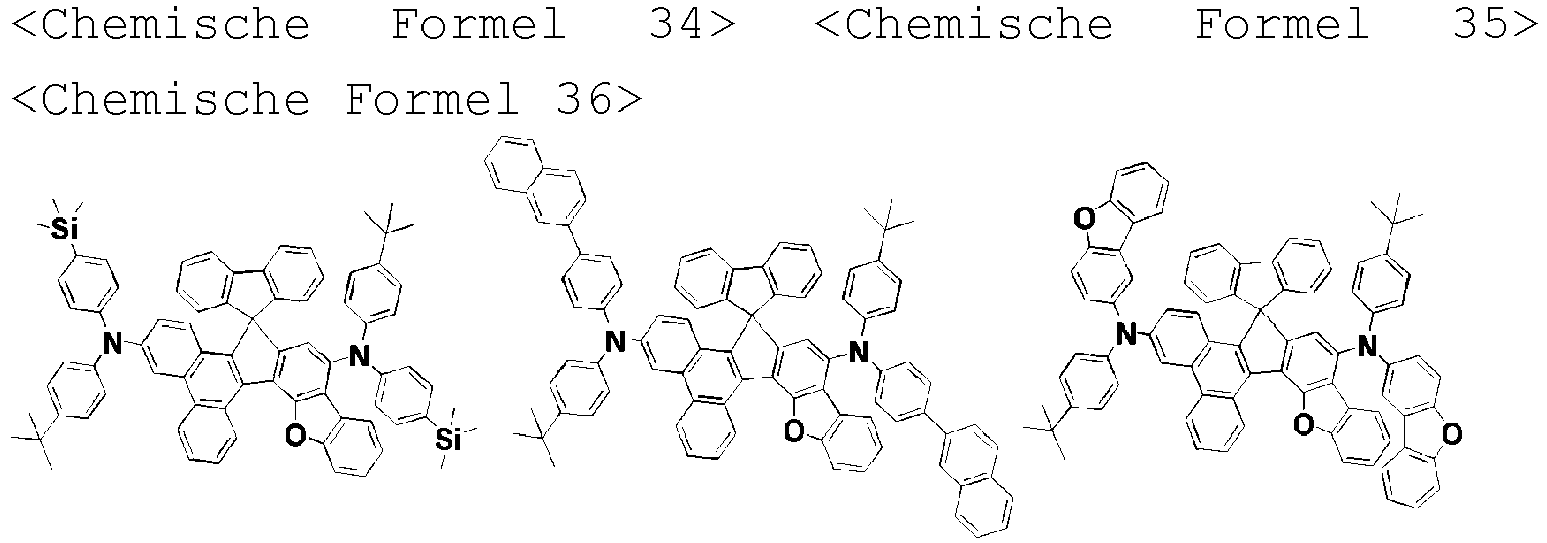
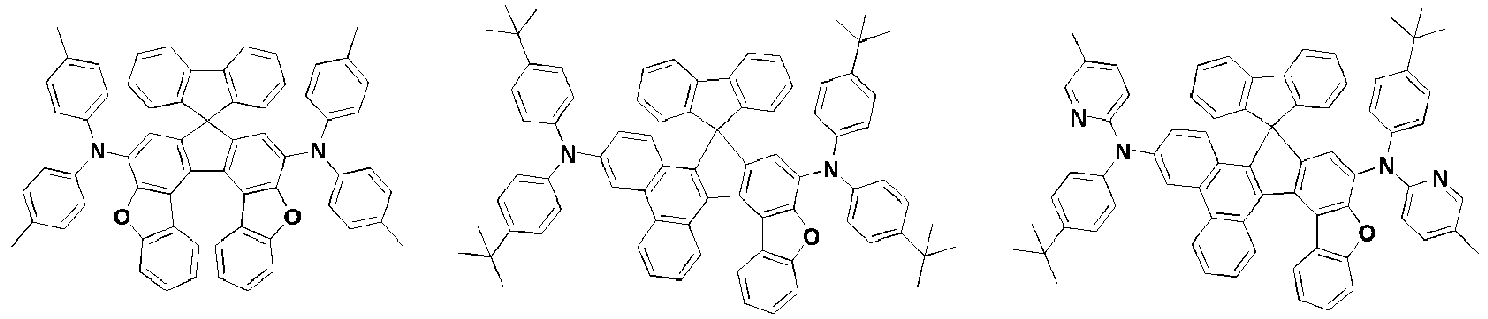
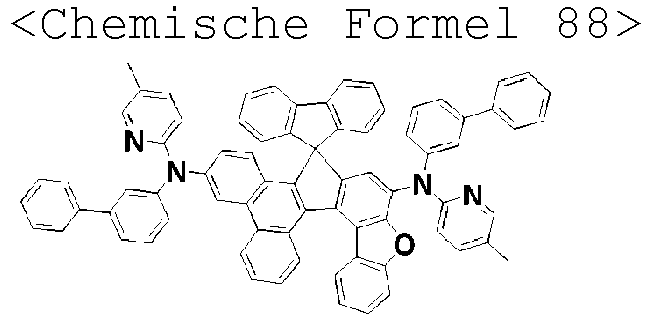
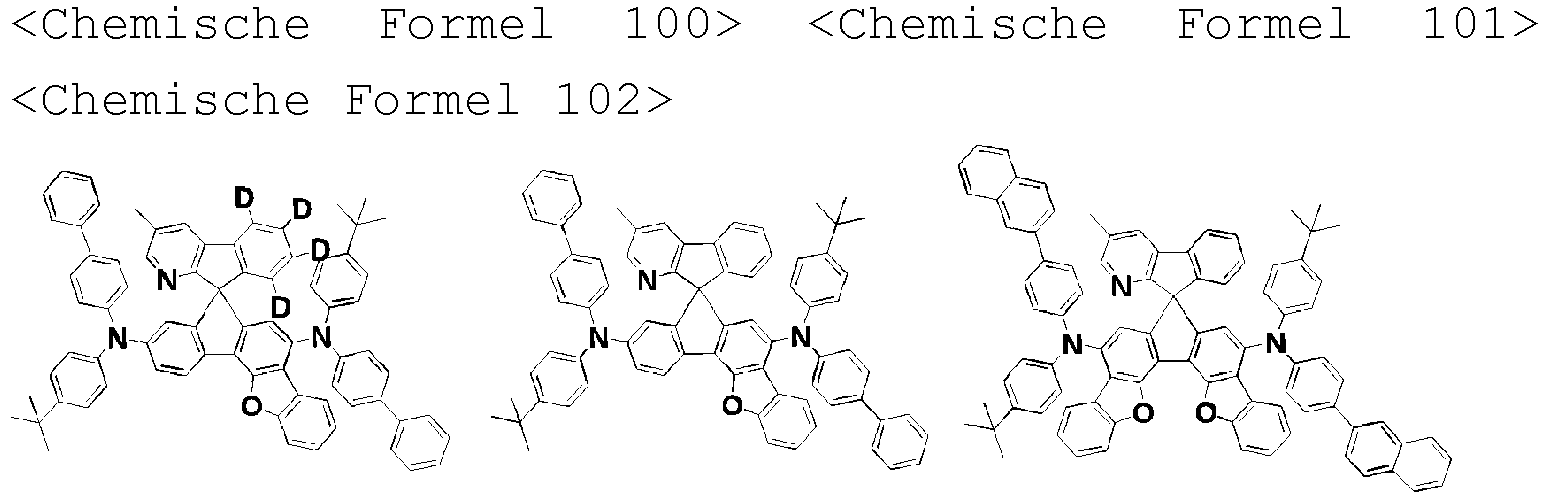
- the amine compound of the present disclosure may be selected from compounds represented by the following [Chemical Formula 1] to [Chemical Formula 88], [Chemical Formula 97] to [Chemical Formula 112], [Chemical Formula 117] to [Chemical Formula 196], [Chemical Formula 202] to [Chemical Formula 212], [Chemical Formula 214] to [Chemical Formula 215], [Chemical Formula 218] to [Chemical Formula 239], as defined in claim 5.
- the present disclosure addresses an organic light-emitting diode, comprising a first electrode; a second electrode facing the first electrode; an organic layer interposed between the first electrode and the second electrode, wherein the organic layer comprises at least one of the organic luminescent compounds of the present disclosure.
- the expression "(the organic layer)... comprising at least one organic compound” is construed to mean that the organic layer may comprise one or two or more different compounds that fall within the scope of the present disclosure.
- the organic layer comprising the organic luminescent compound of the present disclosure may further comprise at least one of a hole injection layer, a hole transport layer, a functional layer capable of both hole injection and hole transport, a light-emitting layer, an electron transport layer, and an electron injection layer in addition to the light-emitting layer.
- the organic layer interposed between the first electrode and the second electrode may include a light-emitting layer that comprises a host and a dopant, the organic luminescent compound of the present disclosure serving as the dopant.
- a host material may be employed in addition to the dopant.
- the amount of the dopant may range from about 0.01 to about 20 weight parts, based on 100 weight parts of the host, but is not limited thereto.
- the material used in the electron transport layer functions to stably carry the electrons injected from the electron injection electrode (cathode), and may be an electron transport material known in the art.
- the electron transport material known in the art include quinoline derivatives, particularly, tris(8-quinolinorate)aluminum(Alq3), TAZ, Balq, beryllium bis(benzoquinolin-10-olate (BebQ 2 ), ADN, Compound 201, Compound 202, BCP, and oxadiazole derivatives such as PBD, BMD, BND, etc., but are not limited thereto.
- the electron transport layer may be made of the organic metal compound represented by Chemical Formula C, either alone or in combination with the aforementioned material.
- the term 'substituted' in the expression 'substituted or unsubstituted' means having at least one substituent selected from the group consisting of a deuterium atom, a cyano, a halogen, a hydroxy, a nitro, an alkyl, an alkoxy, an alkylamino, an arylamino, a hetero arylamino, an alkylsilyl, an arylsilyl, an aryloxy, an aryl, a heteroaryl, germanium, phosphorus, and boron.
- the Y's may be the same or different and are each independently selected from among the following Structural Formula s C1 to C39, but are not limited thereto: wherein, R's, which may be the same or different, are each independently selected from among halogen, deuterium, halogen, cyano, a substituted or unsubstituted alkyl of 1 to 30 carbon atoms, a substituted or unsubstituted aryl of 6 to 60 carbon atoms, a substituted or unsubstituted heteroaryl of 3 to 30 carbon atoms, a substituted or unsubstituted alkoxy of 1 to 30 carbon atoms, a substituted or unsubstituted cycloalkyl of 3 to 30 carbon atoms, a substituted or unsubstituted alkenyl of 2 to 30 carbon atoms, a substituted or unsubstituted alkylamino of 1 to 30 carbon atoms, a substituted or un
- FIG. 1 is a schematic cross-sectional view of the structure of an organic light-emitting diode according to some embodiments of the present disclosure.
- the organic light-emitting diode comprises an anode 20, a hole transport layer 40, an organic light-emitting layer 50, an electron transport layer 60, and a cathode 80, and optionally a hole injection layer 30 and an electron injection layer 70.
- one or two intermediate layers may be further formed in the organic light-emitting diode, or a hole barrier layer or an electron barrier layer may also be employed.
- a substrate 10 is coated with an anode electrode material to form an anode 20. So long as it is used in a typical organic EL device, any substrate may be used as the substrate 10. Preferable is an organic substrate or transparent plastic substrate that exhibits excellent transparency, surface smoothness, and handleability.
- anode electrode material indium tin oxide (ITO), indium zinc oxide (IZO), tin oxide (SnO 2 ), or zinc oxide (ZnO) may be used.
- a hole injection layer material is applied on the anode electrode 20 by thermal deposition in a vacuum or by spin coating to form a hole injection layer 30. Subsequently, thermal deposition in a vacuum or by spin coating may also be conducted to form a hole transport layer 40 with a hole transport layer material on the hole injection layer 30.
- hole injection layer material No particular limitations are imposed on the hole injection layer material, as long as it is one that is typically used in the art.
- 2-TNATA 4,4',4"-tris(2-naphthylphenyl-phenylamino)-triphenylamine]
- NPD N,N'-di(1-naphthyl)-N,N'-diphenylbenzidine)
- TPD TPD
- DNTPD N,N'-diphenyl-N,N'-bis-[4-(phenyl-m-tolyl-amino)-phenyl]-biphenyl-4,4'-diamine].
- any material for the hole transport layer may be selected without particular limitation.
- examples include, but are not limted to, N,N'-bis(3-methylphenyl)-N,N'-diphenyl-[1,1-biphenyl]-4,4'-diamine(TPD) or N,N'-di(naphthalen-1-yl)-N,N'-diphenylbenzidine (a-NPD).
- an organic light-emitting layer 50 is deposited on the hole transport layer 40, optionally followed by the formation of a hole barrier layer (not shown) on the organic light-emitting layer 50 by deposition in a vacuum or by spin coating.
- a hole barrier layer (not shown) on the organic light-emitting layer 50 by deposition in a vacuum or by spin coating.
- the hole barrier layer serves to prevent the introduction of holes into the cathode. Any material that has a higher ionization potential than the light-emitting compound and is also able to carry electrons may be used for the hole barrier layer without limitation. Representative among hole barrier materials are BAlq, BCP, and TPBI.
- an electron transport layer 60 may be deposited on the hole barrier layer and may then be overlaid with an electron injection layer 70.
- a cathode metal is deposited on the electron injection layer 70 by thermal deposition in a vacuum to form a cathode 80, thus obtaining an organic EL diode.
- the cathode may be made of lithium (Li), magnesium (Mg), aluminum (Al), aluminu-lithium (Al-Li), calcium (Ca), magnesium-indium (Mg-In), or magnesium-silver (Mg-Ag).
- a transparent cathode made of ITO or IZO may be employed.
- the light-emitting layer may consist of a host and a dopant.
- the light-emitting layer particularly ranges in thickness from 50 to 2,000 ⁇ .
- the host available for use in the light-emitting layer may be selected from among the compounds represented by the following Chemical Formula 1A to Chemical Formula 1D. wherein,
- the host may be selected from among compounds represented by the following [Host 1] to [Host 56], but is not limited thereto.
- the light-emitting layer may further include various hosts and dopant materials.
- one or more layers selected from among a hole injection layer, a hole transport layer, an electron barrier layer, a light-emitting layer, a hole barrier layer, an electron transport layer, and an electron injection layer may be deposited using a single molecule deposition process or a solution process.
- the deposition process refers to a process by which a maerial is vaporized in a vacuum or at a low pressure and deposited to form a layer
- the solution process means a method in which a material is dissolved in a solvent and applied for the formation of a thin film by means of inkjet printing, roll-to-roll coating, screen printing, spray coating, dip coating, spin coating, etc.
- the organic light-emitting device of the present disclosure may be applied to a device selected from among flat display devices; flexible display devices; monochrome or white flat illumination devices; and monochrome or white flexible illumination devices.
- the organic layer thus formed was separated, dried over magnesium sulfate, and concentrated in a vacuum.
- the concentrate was purified by column chromatography and recrystallized in dichloromethane and acetone to yield the compound of Chemical Formula 1 as a solid (3.1 g, 38%).
- 1-bromodibenzofuran (20.0g, 0.081mmol), bis(pinacolato)diboron (26.7g, 0.105mol), [1,1'-bis(diphenylphosphino)ferrocene]dichloropalladium (1.3g, 0.002mol), potassium acetate (19.9g, 0.202mol), and 1,4-dioxane (200ml) were stirred together for 10 hrs under reflux.
- 1-bromo-4-(2-naphthyl)benzene (10.0g, 0.035mol), 4-tert-butyl aniline (5.8g, 0.039mol), tris(dibenzylidne acetone)dipalladium(0) (0.65g, 0.0007mol), sodium tert-butoxide (6.79g, 0.0706mol), 2,2'-bis(diphenylphosphino)-1,1'-binaphthalene (0.44g, 0.0007mol), and toluene (100ml) were stirred together for 3 hrs under reflux.
- An ITO glass substrate was patterned to have a translucent area of 2 mm x 2 mm and cleansed.
- the ITO glass was mounted in a vacuum chamber that was then set to have a base pressure of 1 ⁇ 10 -7 torr.
- films were formed of DNTPD(700 ⁇ ) and ⁇ -NPD (300 ⁇ ) in that order.
- a light-emitting layer 250 ⁇ was formed of a mixture including [BH1] and 3% of each of the compounds shown in Table 1 according to the present disclosure.
- [Chemical Formula E-1] and [Chemical Formula E-2] were deposited at a ratio of 1:1 to form an electron transport layer 300 ⁇ thick, on which an electron injection layer of [Chemical Formula E-1] (5 ⁇ thick) was formed and then covered with an Al layer (1000 ⁇ ) to fabricate an organic light-emitting diode.
- the organic light-emitting diodes thus obtained were measured at 0.4 mA for luminescence properties.
- Organic light-emitting diodes were fabricated in the same manner as in Examples 1 to 11, with the exception that [BD1] and [BD2] were used, instead of the compounds used in Examples 1 to 11.
- the luminescence of the organic light-emitting diodes was measured at 0.4 mA.
- the structures of [BD1] and [BD2] are as follows.
- T97 refers to the time taken for the initial luminance to decrease by 3 %.
- TABLE 1 Ex. No. Volt. Current Density (mA/cm 2 ) Luminance (cd/m 2 ) CIEx CIEy T97 C. 1 [BD1] 4.1 10 515 0.143 0.150 42 C. 2 [BD2] 4.0 10 550 0.141 0.154 40 1 [Cpd. 1] 3.8 10 750 0.130 0.133 98 2 [Cpd.
- the amine compounds of the present disclosure exhibited far higher luminanace and light emission efficiency and a longer lifetime than the compounds of Comparative Examples 1 to 4, thereby demonstrating their high applicability to organic electroluminescence devices.
- the present disclosure is industrially applicable.
Landscapes
- Chemical & Material Sciences (AREA)
- Organic Chemistry (AREA)
- Engineering & Computer Science (AREA)
- Materials Engineering (AREA)
- Physics & Mathematics (AREA)
- Spectroscopy & Molecular Physics (AREA)
- Optics & Photonics (AREA)
- Electroluminescent Light Sources (AREA)
- Furan Compounds (AREA)
- Heterocyclic Carbon Compounds Containing A Hetero Ring Having Oxygen Or Sulfur (AREA)
- Indole Compounds (AREA)
- Organic Low-Molecular-Weight Compounds And Preparation Thereof (AREA)
Claims (8)
- Aminverbindung, wiedergegeben durch die folgende [Chemische Formel A] oder [Chemische Formel B]:


A1, E und F gleich oder verschieden sein können und jeweils unabhängig für einen substituierten oder unsubstituierten aromatischen Kohlenwasserstoffring oder einen substituierten oder unsubstituierten heteroaromatischen Ring stehen, wobei zwei benachbarte Kohlenstoffatome des aromatischen Rings A1 und zwei benachbarte Kohlenstoffatome des aromatischen Rings A2 zusammen mit einem Kohlenstoffatom, an das Substituenten R1 und R2 gebunden sind, einen 5-gliedrigen anellierten Ring bilden;
wobei der aromatische Kohlenwasserstoffring aus [Strukturformel 10] bis [Strukturformel 21] ausgewählt ist:


 "-*" eine Bindungsstelle für die Bildung eines 5-gliedrigen Rings, der das an beide der Substituenten R1 und R2 gebundene Kohlenstoffatom enthält, oder eine Bindungsstelle zur Bildung eines 5-gliedrigen Rings, der M der Strukturformel Q1 und Q2 enthält, mit Gruppierung A1 oder A2 anzeigt, dann, wenn einer der aromatischen Kohlenwasserstoffringe von [Strukturformel 10] bis [Strukturformel 21] für A1 oder A2 an Strukturformel Q1 oder Strukturformel Q2 gebunden ist, zwei benachbarte Kohlenstoffatome des aromatischen Kohlenwasserstoffrings jeweilige Positionen * von Strukturformel Q1 oder Strukturformel Q2 zur Bildung eines anellierten Rings besetzen; unddie Reste R wie für R1 und R2 definiert sind undm für eine ganze Zahl von 1 bis 8 steht, mit der Maßgabe, dass dann, wenn m für 2 oder mehr steht oder zwei oder mehr Reste R vorliegen, die entsprechenden Reste R gleich oder verschieden sein können,der heteroaromatische Ring jeweils unabhängig aus [Strukturformel 31] bis [Strukturformel 40] ausgewählt ist:wobei

 T1 bis T12 gleich oder verschieden sein können und jeweils unabhängig aus C(R41), C(R42)(R43), N(R44), O und S ausgewählt sind, mit der Maßgabe, dass nicht alle von T1 bis T12 gleichzeitig für Kohlenstoffatome stehen,R41 bis R44 wie in R1 und R2 definiert sind und zwei benachbarte von T1 bis T12 in den aromatischen Ringen eine Einfachbindung zur Bildung eines fünfgliedrigen Rings, der ein an die Substituenten R1 und R2 gebundenes Kohlenstoffatom enthält, oder zur Bildung eines fünfgliedrigen Rings, der ein Sauerstoffatom der Strukturformeln Q1 und Q2 enthält, enthalten; unddann, wenn einer der heteroaromatischen Ringe von [Strukturformel 31] bis [Strukturformel 40] für A1 oder A2 an Strukturformel Q1 oder Strukturformel Q2 gebunden ist, zwei benachbarte Kohlenstoffatome von T1 bis T12 jeweilige Positionen * von Strukturformel Q1 oder Strukturformel Q2 zur Bildung eines anellierten Rings besetzen;A2 für einen substituierten oder unsubstituierten aromatischen Kohlenwasserstoffring mit 6 Kohlenstoffatomen steht;die Linker L1 bis L12 gleich oder verschieden sein können und jeweils unabhängig aus einer direkten Bindung oder einer der folgenden [Strukturformel 22], [Strukturformel 23], [Strukturformel 25], [Strukturformel 27], [Strukturformel 28] und [Strukturformel 30] ausgewählt sind, wobei jedes der unsubstituierten Kohlenstoffatome der aromatischen Ringgruppierung an ein Sauerstoffatom oder ein Deuteriumatom gebunden ist;
 M aus N-R3, CR4R5, O und S ausgewählt ist;R1 bis R2 und Ar1 bis Ar8 gleich oder verschieden sein können und jeweils unabhängig aus Wasserstoff, Deuterium, einem substituierten oder unsubstituierten Alkyl mit 1 bis 30 Kohlenstoffatomen, einem substituierten oder unsubstituierten Aryl mit 6 bis 20 Kohlenstoffatomen, einem substituierten oder unsubstituierten Cycloalkyl mit 3 bis 30 Kohlenstoffatomen und einem substituierten oder unsubstituierten Heteroaryl mit 2 bis 20 Kohlenstoffatomen, das ein bis drei Heteroatome, die aus N, O, Si und S ausgewählt sind, enthält, ausgewählt sind, mit der Maßgabe, dass R1 bis R2 zusammen einen Mono- oder polycyclischen aliphatischen oder aromatischen Ring bilden können;R3 bis R5 gleich oder verschieden sein können und jeweils unabhängig aus Wasserstoff, Deuterium, einem substituierten oder unsubstituierten Alkyl mit 1 bis 30 Kohlenstoffatomen, einem substituierten oder unsubstituierten Aryl mit 6 bis 20 Kohlenstoffatomen und einem substituierten oder unsubstituierten Cycloalkyl mit 3 bis 30 Kohlenstoffatomen ausgewählt sind;p1 bis p4, r1 bis r4 und s1 bis s4 jeweils unabhängig für eine ganze Zahl mit einem Wert von 1 oder 2 stehen, mit der Maßgabe, dass dann, wenn eines davon für 2 steht, die entsprechenden Linker gleich oder verschieden sein können,x für 1 steht,y für 1 steht und z für 0 stehtund Ar1 mit Ar2 einen Ring bilden kann, Ar3 mit Ar4 einen Ring bilden kann, Ar8 mit Ar6 einen Ring bilden kann und Ar7 mit Ar8 einen Ring bilden kann, zwei benachbarte Kohlenstoffatome der A2-Ringgruppierung der Chemischen Formel A jeweilige Positionen * von Strukturformel Q1 zur Bildung eines anellierten Rings besetzen undzwei benachbarte Kohlenstoffatome der A2-Ringgruppierung der Chemischen Formel B jeweilige Positionen * von Strukturformel Q1 zur Bildung eines anellierten Rings besetzen und zwei benachbarte Kohlenstoffatome der A1-Ringgruppierung der Chemischen Formel B jeweilige Positionen * von Strukturformel Q2 zur Bildung eines anellierten Rings besetzen,wobei der Begriff "substituiert" in dem Ausdruck "substituiert oder unsubstituiert" bedeutet, dass mindestens ein Substituent aus der Gruppe bestehend aus einem Deuterium, einem Cyano, einem Halogen, einem Alkyl mit 1 bis 6 Kohlenstoffatomen, einem Aryl mit 6 bis 18 Kohlenstoffatomen, einem Heteroaryl mit 3 bis 18 Kohlenstoffatomen, das ein bis drei Heteroatome, die aus N, O, Si und S ausgewählt sind, enthält, einem Alkylsilyl mit 1 bis 12 Kohlenstoffatomen und einem Arylsilyl mit 6 bis 18 Kohlenstoffatomen vorliegt.
 - Aminverbindung nach Anspruch 1, wobei die Substituenten R1 und R2 der Chemischen Formel A oder Chemischen Formel B, die gleich oder verschieden sein können, jeweils unabhängig für ein substituiertes oder unsubstituiertes Aryl mit 6 bis 20 Kohlenstoffatomen stehen und miteinander zu einem Ring verbunden sind.
- Aminverbindung nach Anspruch 1, wobei die Substituenten R1 und R2 der Chemischen Formel A oder Chemischen Formel B, die gleich oder verschieden sein können, jeweils unabhängig für ein substituiertes oder unsubstituiertes Aryl mit 6 bis 20 Kohlenstoffatomen stehen und nicht miteinander zu einem Ring verbunden sind.
- Aminverbindung nach Anspruch 1, wobei R1 und R2 und Ar1 bis Ar8 gleich oder verschieden sein können und jeweils unabhängig für ein substituiertes oder unsubstituiertes Aryl mit 6 bis 20 Kohlenstoffatomen stehen und
R3 bis R5 gleich oder verschieden sein können und jeweils unabhängig aus Wasserstoff, Deuterium, einem substituierten oder unsubstituierten Alkyl mit 1 bis 30 Kohlenstoffatomen, einem substituierten oder unsubstituierten Cycloalkyl mit 3 bis 30 Kohlenstoffatomen und einem substituierten oder unsubstituierten Aryl mit 6 bis 20 Kohlenstoffatomen ausgewählt sind. - Aminverbindung nach Anspruch 1, ausgewählt aus Verbindungen der folgenden [Chemischen Formel 1] bis [Chemischen Formel 88], [Chemischen Formel 97] bis [Chemischen Formel 112], [Chemischen Formel 117] bis [Chemischen Formel 196], [Chemischen Formel 202] bis [Chemischen Formel 212], [Chemischen Formel 214] bis [Chemischen Formel 215], [Chemischen Formel 218] bis [[Chemischen Formel 239]:











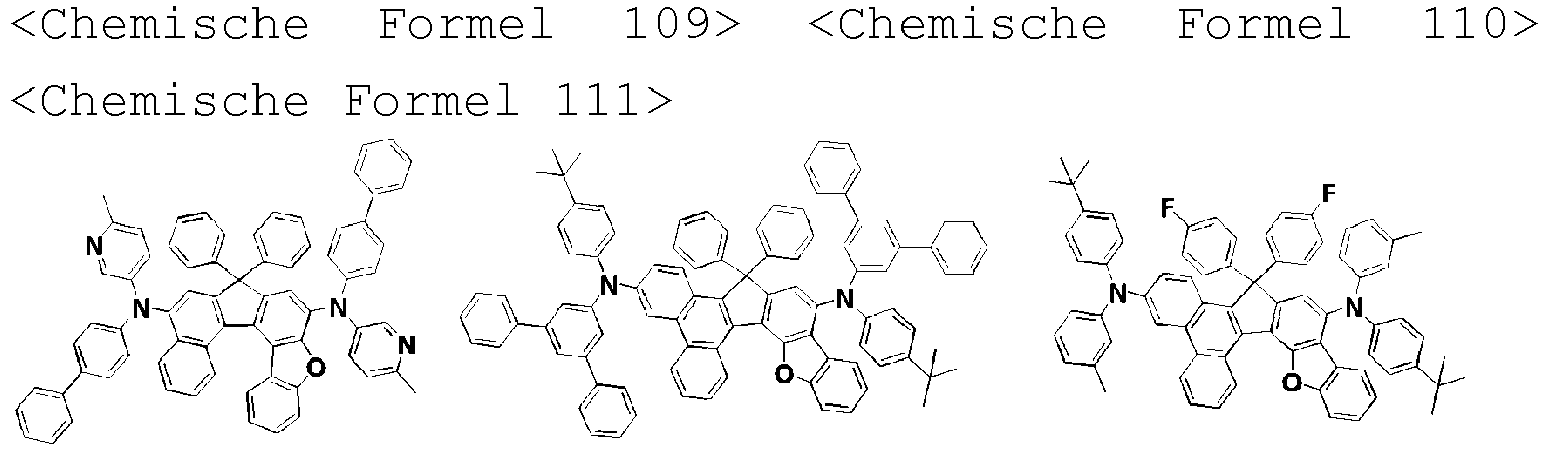


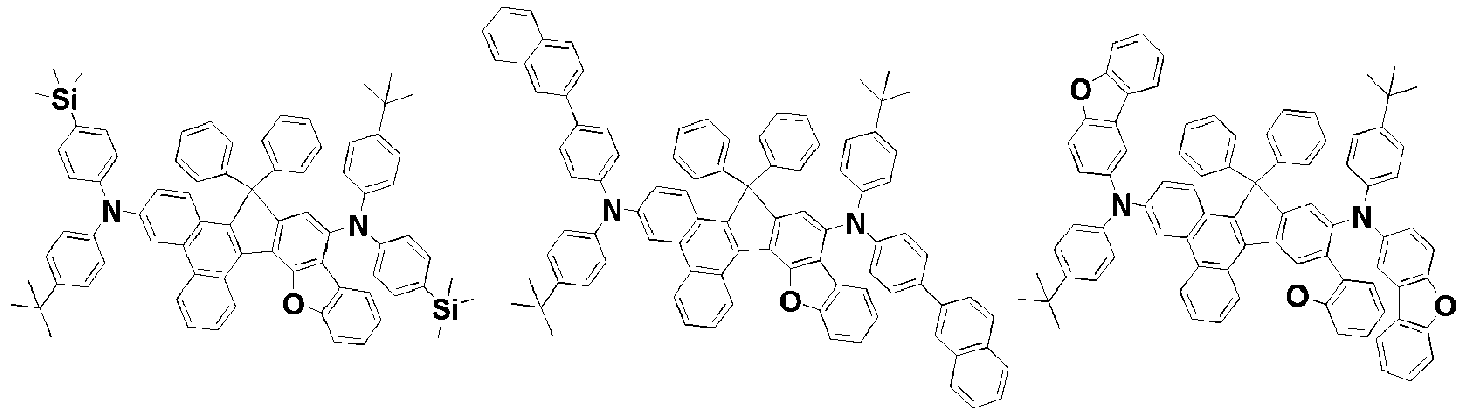

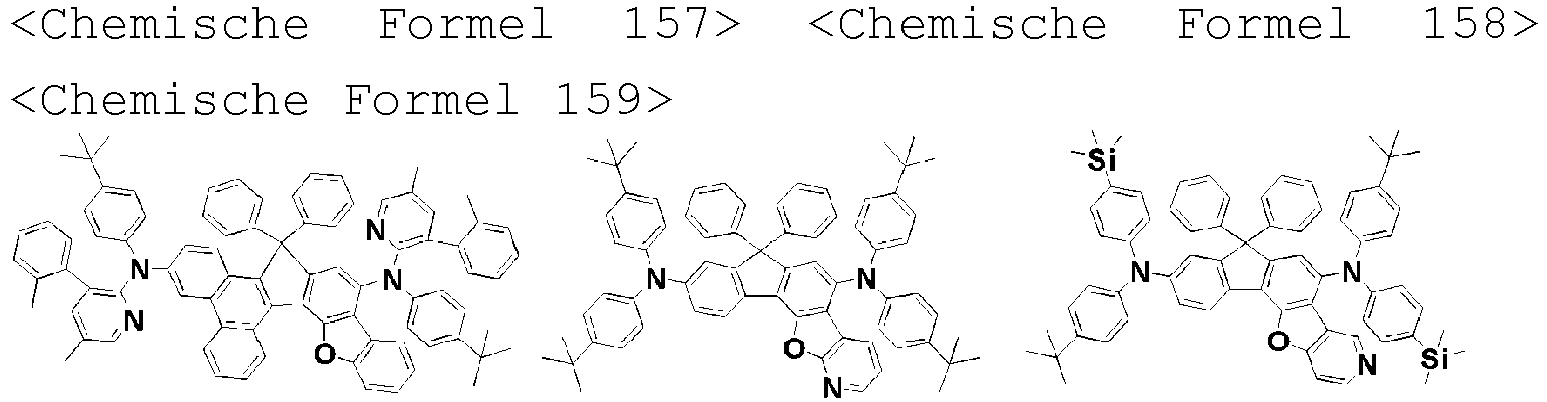


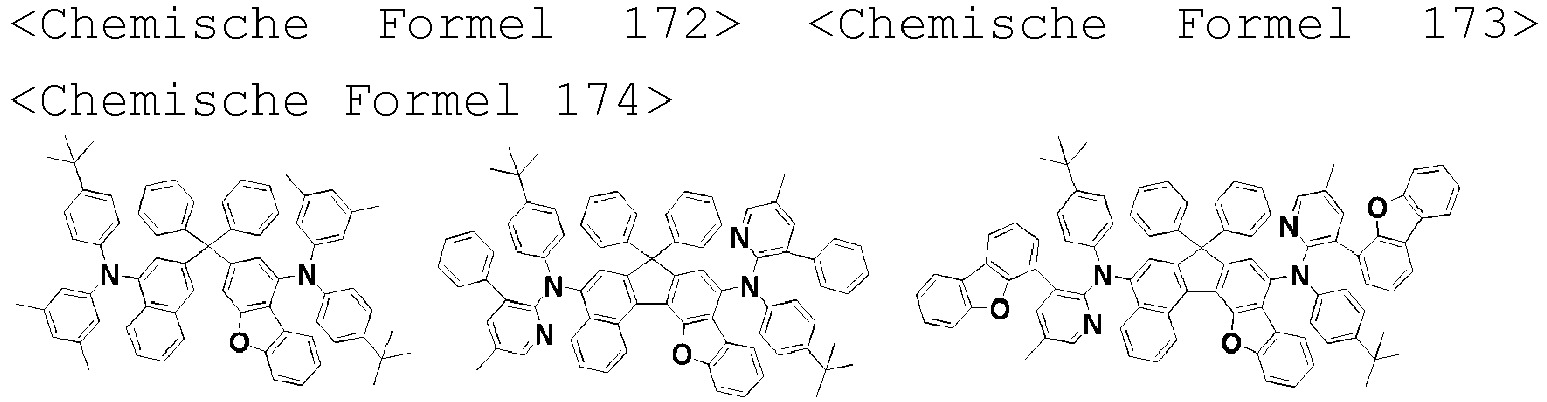


- Organische Leuchtdiode, umfassend:eine erste Elektrode;eine der ersten Elektrode zugewandte zweite Elektrode undeine zwischen der ersten Elektrode und der zweiten Elektrode angeordnete organische Schicht,wobei die organische Schicht mindestens eine der Verbindungen der Ansprüche 1 bis 5 umfasst.
- Organische Leuchtdiode nach Anspruch 6, wobei die organische Schicht mindestens eine Lochinjektionsschicht, eine Lochtransportschicht, eine funktionale Schicht, die sowohl zur Lochinjektion als auch zum Lochtransport befähigt ist, eine lichtemittierende Schicht, eine Elektronentransportschicht und eine Elektroneninjektionsschicht umfasst.
- organische Leuchtdiode nach Anspruch 7, wobei die zwischen der ersten Elektrode und der zweiten Elektrode angeordnete organische Schicht eine lichtemittierende Schicht umfasst, wobei die lichtemittierende Schicht aus einem Wirt und einem Dotanden besteht, wobei die lumineszierende Verbindung als Dotand dient.
Applications Claiming Priority (3)
| Application Number | Priority Date | Filing Date | Title |
|---|---|---|---|
| KR20140056951 | 2014-05-13 | ||
| KR1020140072710A KR102030354B1 (ko) | 2014-05-13 | 2014-06-16 | 방향족 아민기를 포함하는 헤테로고리 화합물 및 이를 포함하는 유기 발광 소자 |
| PCT/KR2015/004552 WO2015174682A1 (ko) | 2014-05-13 | 2015-05-07 | 방향족아민기를 포함하는 헤테로고리 화합물및 이를 포함하는 유기 발광 소자 |
Publications (3)
| Publication Number | Publication Date |
|---|---|
| EP3144302A1 EP3144302A1 (de) | 2017-03-22 |
| EP3144302A4 EP3144302A4 (de) | 2017-11-15 |
| EP3144302B1 true EP3144302B1 (de) | 2021-10-06 |
Family
ID=54844695
Family Applications (1)
| Application Number | Title | Priority Date | Filing Date |
|---|---|---|---|
| EP15793316.9A Active EP3144302B1 (de) | 2014-05-13 | 2015-05-07 | Heterocyclische verbindung mit aromatischer amingruppe und organische lichtemittierende vorrichtung damit |
Country Status (5)
| Country | Link |
|---|---|
| US (1) | US11672172B2 (de) |
| EP (1) | EP3144302B1 (de) |
| JP (1) | JP6367367B2 (de) |
| KR (2) | KR102030354B1 (de) |
| CN (1) | CN106458953B (de) |
Families Citing this family (52)
| Publication number | Priority date | Publication date | Assignee | Title |
|---|---|---|---|---|
| KR102030377B1 (ko) * | 2014-07-28 | 2019-10-10 | 에스에프씨주식회사 | 헤테로고리를 포함하는 축합 플루오렌 유도체 |
| KR102526212B1 (ko) * | 2014-08-08 | 2023-04-28 | 롬엔드하스전자재료코리아유한회사 | 유기 전계 발광 화합물 및 이를 포함하는 유기 전계 발광 소자 |
| KR102190108B1 (ko) * | 2014-12-31 | 2020-12-11 | 에스에프씨주식회사 | 고효율과 장수명을 갖는 유기 발광 소자 |
| KR102201104B1 (ko) * | 2015-01-13 | 2021-01-11 | 에스에프씨주식회사 | 고효율과 장수명을 갖는 유기 발광 소자 |
| JP6925982B2 (ja) * | 2015-02-16 | 2021-08-25 | メルク パテント ゲーエムベーハー | 電子素子のための材料 |
| KR102338908B1 (ko) | 2015-03-03 | 2021-12-14 | 삼성디스플레이 주식회사 | 유기 발광 소자 |
| KR102424977B1 (ko) | 2015-04-14 | 2022-07-26 | 삼성디스플레이 주식회사 | 축합환 화합물 및 이를 포함한 유기 발광 소자 |
| KR102593531B1 (ko) * | 2015-05-27 | 2023-10-26 | 삼성디스플레이 주식회사 | 유기 발광 소자 |
| US10367147B2 (en) * | 2015-05-27 | 2019-07-30 | Samsung Display Co., Ltd. | Organic light-emitting device |
| US10312449B2 (en) | 2015-05-27 | 2019-06-04 | Samsung Display Co., Ltd. | Organic light-emitting device |
| US20160351817A1 (en) * | 2015-05-27 | 2016-12-01 | Samsung Display Co., Ltd. | Organic light-emitting device |
| KR102591635B1 (ko) | 2015-10-27 | 2023-10-20 | 삼성디스플레이 주식회사 | 유기 발광 소자 |
| KR101817775B1 (ko) | 2015-11-12 | 2018-01-11 | 에스에프씨주식회사 | 신규한 유기발광 화합물 및 이를 포함하는 유기 발광 소자 |
| KR102656066B1 (ko) | 2015-11-13 | 2024-04-09 | 에스에프씨 주식회사 | 신규한 아민 화합물 및 이를 포함하는 유기 발광 소자 |
| KR20170061770A (ko) * | 2015-11-26 | 2017-06-07 | 삼성디스플레이 주식회사 | 유기 발광 소자 |
| KR102630644B1 (ko) * | 2015-12-17 | 2024-01-30 | 삼성디스플레이 주식회사 | 유기 발광 소자 |
| CN108698982B (zh) | 2016-01-14 | 2021-07-16 | 日产化学工业株式会社 | 含有氟原子的化合物及其利用 |
| JP6810710B2 (ja) * | 2016-01-14 | 2021-01-06 | 保土谷化学工業株式会社 | 有機エレクトロルミネッセンス素子 |
| KR102719558B1 (ko) | 2016-02-12 | 2024-10-18 | 호도가야 가가쿠 고교 가부시키가이샤 | 유기 일렉트로 루미네선스 소자 |
| KR102708083B1 (ko) | 2016-02-22 | 2024-09-20 | 에스에프씨 주식회사 | 신규한 아민 화합물 및 이를 포함하는 유기 발광 소자 |
| KR102740106B1 (ko) | 2016-03-03 | 2024-12-09 | 메르크 파텐트 게엠베하 | 유기 전계 발광 장치용 재료 |
| KR20170127101A (ko) | 2016-05-10 | 2017-11-21 | 삼성디스플레이 주식회사 | 유기 발광 소자 |
| US11974497B2 (en) * | 2016-07-01 | 2024-04-30 | Lg Chem, Ltd. | Compound and organic electronic element comprising same |
| KR102032023B1 (ko) | 2016-09-09 | 2019-10-14 | 주식회사 엘지화학 | 화합물 및 이를 포함하는 유기 전자 소자 |
| WO2018048247A1 (ko) * | 2016-09-09 | 2018-03-15 | 주식회사 엘지화학 | 화합물 및 이를 포함하는 유기 전자 소자 |
| WO2018056524A1 (ko) * | 2016-09-26 | 2018-03-29 | 에스에프씨 주식회사 | 신규한 아민 화합물 및 이를 포함하는 유기 발광 소자 |
| US20180093962A1 (en) * | 2016-10-05 | 2018-04-05 | Sfc Co., Ltd. | Novel organic compound and oranic light-emitting diode comprising same background of the invention |
| EP3544073A4 (de) | 2016-11-16 | 2020-11-25 | Hodogaya Chemical Co., Ltd. | Organisches elektrolumineszenzelement |
| KR101938826B1 (ko) * | 2016-11-29 | 2019-01-16 | 에스에프씨주식회사 | 신규한 헤테로고리 화합물 및 이를 포함하는 유기 발광 소자 |
| US11634430B2 (en) | 2017-04-27 | 2023-04-25 | Lg Chem, Ltd. | Heterocyclic compound and organic light emitting element comprising same |
| KR102637968B1 (ko) * | 2017-07-11 | 2024-02-19 | 에스에프씨 주식회사 | 고효율을 갖는 유기 발광 소자 |
| KR102506419B1 (ko) * | 2017-07-13 | 2023-03-07 | 솔루스첨단소재 주식회사 | 유기 화합물 및 이를 포함하는 유기 전계 발광 소자 |
| KR102393153B1 (ko) * | 2017-07-27 | 2022-05-02 | 에스에프씨주식회사 | 저전압 구동이 가능하며, 고효율 및 장수명 특성을 가지는 유기 발광 소자 |
| WO2019020654A1 (en) * | 2017-07-28 | 2019-01-31 | Merck Patent Gmbh | SPIROBIFLUORENE DERIVATIVES FOR USE IN ELECTRONIC DEVICES |
| US11177446B2 (en) * | 2017-09-14 | 2021-11-16 | Beijing Summer Sprout Technology Co., Ltd. | Silicon containing organic fluorescent materials |
| CN108675975A (zh) * | 2017-10-17 | 2018-10-19 | 默克专利有限公司 | 用于有机电致发光器件的材料 |
| TWI820057B (zh) * | 2017-11-24 | 2023-11-01 | 德商麥克專利有限公司 | 用於有機電致發光裝置的材料 |
| KR102148289B1 (ko) * | 2018-07-04 | 2020-08-26 | 에스에프씨주식회사 | 고효율의 유기 발광 소자 |
| KR102692181B1 (ko) * | 2018-07-12 | 2024-08-06 | 에스에프씨 주식회사 | 저전압구동이 가능하며 고효율의 유기 발광 소자 |
| CN109134349B (zh) * | 2018-09-05 | 2020-08-25 | 大连九信精细化工有限公司 | 一种制备芴并咔唑的方法 |
| KR102290022B1 (ko) * | 2018-11-02 | 2021-08-17 | 주식회사 엘지화학 | 화합물 및 이를 포함하는 유기 발광 소자 |
| KR102308281B1 (ko) | 2018-11-06 | 2021-10-01 | 주식회사 엘지화학 | 유기 발광 소자 |
| JP7421494B2 (ja) | 2018-11-29 | 2024-01-24 | 保土谷化学工業株式会社 | 有機エレクトロルミネッセンス素子 |
| TWI866952B (zh) | 2019-02-07 | 2024-12-21 | 日商保土谷化學工業股份有限公司 | 有機電致發光元件 |
| KR102691961B1 (ko) * | 2019-07-15 | 2024-08-02 | 주식회사 엘지화학 | 화합물, 이를 포함하는 코팅 조성물, 이를 이용한 유기 발광 소자 및 이의 제조방법 |
| CN112794833B (zh) * | 2019-11-14 | 2023-12-26 | 石家庄诚志永华显示材料有限公司 | 一种蓝光染料化合物及其应用 |
| CN112794798A (zh) * | 2019-11-14 | 2021-05-14 | 材料科学有限公司 | 氘化芳香族化合物的中间产物及利用该中间产物的氘化芳香族化合物的制备方法 |
| KR102924937B1 (ko) * | 2020-03-12 | 2026-02-09 | 에스에프씨 주식회사 | 축합 고리를 갖는 아민 화합물 및 이를 포함하는 유기발광소자 |
| JP7665314B2 (ja) * | 2020-11-02 | 2025-04-21 | キヤノン株式会社 | 有機化合物及び有機発光素子 |
| CN114907298B (zh) * | 2021-02-09 | 2025-12-26 | 德山新勒克斯有限公司 | 用于有机电子元件的化合物、使用该化合物的有机电子元件及其电子装置 |
| CN113735694B (zh) * | 2021-09-14 | 2024-09-13 | 西安瑞联新材料股份有限公司 | 一种合成9-卤-7H-苯并[c]芴-7-酮的方法 |
| WO2024228496A1 (ko) | 2023-05-04 | 2024-11-07 | 에스에프씨 주식회사 | 비형광성 화합물 및 이의 용도 |
Family Cites Families (25)
| Publication number | Priority date | Publication date | Assignee | Title |
|---|---|---|---|---|
| EP1794257B1 (de) | 2004-09-24 | 2011-01-19 | LG Chem, Ltd. | Neue verbindung und organische lichtemittierende vorrichtung damit (3) |
| DE102005023437A1 (de) | 2005-05-20 | 2006-11-30 | Merck Patent Gmbh | Verbindungen für organische elektronische Vorrichtungen |
| CN102046598B (zh) * | 2008-03-31 | 2015-02-04 | 科学与工业研究委员会 | 给体-受体芴支架:其方法和用途 |
| DE102008017591A1 (de) * | 2008-04-07 | 2009-10-08 | Merck Patent Gmbh | Neue Materialien für organische Elektrolumineszenzvorrichtungen |
| JP5532705B2 (ja) * | 2008-07-01 | 2014-06-25 | 東レ株式会社 | 発光素子 |
| KR101477613B1 (ko) * | 2009-03-31 | 2014-12-30 | 롬엔드하스전자재료코리아유한회사 | 신규한 유기 전자재료용 화합물 및 이를 포함하는 유기 전자 소자 |
| KR20110000006A (ko) | 2009-06-26 | 2011-01-03 | 단국대학교 산학협력단 | 아민계 스파이로 화합물 및 이를 포함하는 유기 전기 발광 소자 |
| KR101108512B1 (ko) * | 2009-08-11 | 2012-01-30 | 덕산하이메탈(주) | 오원자 헤테로 고리를 포함하는 화합물 및 이를 이용한 유기전기소자, 그 단말 |
| KR20120009761A (ko) * | 2010-07-21 | 2012-02-02 | 롬엔드하스전자재료코리아유한회사 | 신규한 유기 발광 화합물 및 이를 포함하는 유기 전계 발광 소자 |
| JP5499972B2 (ja) * | 2010-07-23 | 2014-05-21 | コニカミノルタ株式会社 | 有機エレクトロルミネッセンス素子用材料、および有機エレクトロルミネッセンス素子、これを用いた表示装置、照明装置 |
| KR101423173B1 (ko) * | 2010-11-04 | 2014-07-25 | 제일모직 주식회사 | 유기광전소자용 화합물 및 이를 포함하는 유기광전소자 |
| CN102668160B (zh) * | 2010-11-22 | 2016-06-22 | 出光兴产株式会社 | 有机电致发光器件 |
| US9238623B2 (en) * | 2011-01-17 | 2016-01-19 | Samsung Display Co., Ltd. | Condensed-cyclic compound and organic light-emitting diode including the same |
| KR101507001B1 (ko) * | 2011-12-30 | 2015-03-31 | 제일모직 주식회사 | 유기광전자소자용 화합물, 이를 포함하는 유기발광소자 및 상기 유기발광소자를 포함하는 표시장치 |
| WO2013105747A1 (ko) | 2012-01-13 | 2013-07-18 | 덕산하이메탈(주) | 유기전기 소자용 화합물, 이를 이용한 유기전기소자 및 그 전자 장치 |
| KR101552135B1 (ko) | 2012-07-13 | 2015-09-10 | 덕산네오룩스 주식회사 | 화합물, 이를 이용한 유기전기소자 및 그 전자 장치 |
| KR101950474B1 (ko) * | 2012-08-22 | 2019-02-21 | 삼성디스플레이 주식회사 | 유기 발광 소자 |
| KR101636864B1 (ko) * | 2012-10-08 | 2016-07-06 | 제일모직 주식회사 | 유기광전자소자용 화합물, 이를 포함하는 유기발광소자 및 상기 유기발광소자를 포함하는 표시장치 |
| WO2014058232A2 (ko) * | 2012-10-10 | 2014-04-17 | 대주전자재료 주식회사 | 스파이로형 유기 재료 및 이를 이용한 유기 전기발광 소자 |
| KR101490446B1 (ko) * | 2012-10-10 | 2015-02-09 | 대주전자재료 주식회사 | 스파이로형 유기 재료 및 이를 이용한 유기 전기발광 소자 |
| KR101516965B1 (ko) * | 2013-04-29 | 2015-05-04 | 덕산네오룩스 주식회사 | 유기전기 소자용 화합물, 이를 이용한 유기전기소자 및 그 전자 장치 |
| CN110003155B (zh) * | 2013-08-15 | 2023-11-24 | 默克专利有限公司 | 用于电子器件的材料 |
| US20170062732A1 (en) * | 2014-02-21 | 2017-03-02 | Merck Patent Gmbh | Materials for organic electroluminescent devices |
| WO2016013184A1 (ja) * | 2014-07-25 | 2016-01-28 | 保土谷化学工業株式会社 | 有機エレクトロルミネッセンス素子 |
| EP3223330B1 (de) * | 2014-11-18 | 2022-02-23 | Hodogaya Chemical Co., Ltd. | Organisches elektrolumineszentes element |
-
2014
- 2014-06-16 KR KR1020140072710A patent/KR102030354B1/ko active Active
-
2015
- 2015-05-07 US US15/306,867 patent/US11672172B2/en active Active
- 2015-05-07 EP EP15793316.9A patent/EP3144302B1/de active Active
- 2015-05-07 JP JP2016565495A patent/JP6367367B2/ja active Active
- 2015-05-07 CN CN201580020254.2A patent/CN106458953B/zh active Active
-
2019
- 2019-09-19 KR KR1020190115404A patent/KR102230153B1/ko active Active
Non-Patent Citations (1)
| Title |
|---|
| None * |
Also Published As
| Publication number | Publication date |
|---|---|
| KR102030354B1 (ko) | 2019-10-10 |
| KR20150130206A (ko) | 2015-11-23 |
| JP6367367B2 (ja) | 2018-08-01 |
| KR102230153B1 (ko) | 2021-03-22 |
| US11672172B2 (en) | 2023-06-06 |
| KR20190111855A (ko) | 2019-10-02 |
| CN106458953A (zh) | 2017-02-22 |
| EP3144302A4 (de) | 2017-11-15 |
| US20170062729A1 (en) | 2017-03-02 |
| EP3144302A1 (de) | 2017-03-22 |
| CN106458953B (zh) | 2021-12-10 |
| JP2017515817A (ja) | 2017-06-15 |
Similar Documents
| Publication | Publication Date | Title |
|---|---|---|
| KR102230153B1 (ko) | 방향족 아민기를 포함하는 헤테로고리 화합물 및 이를 포함하는 유기 발광 소자 | |
| KR102206195B1 (ko) | 고효율을 갖는 유기 발광 소자 | |
| EP3266848B1 (de) | Organisches lichtemittierendes element für niederspannungsantrieb und mit langer lebensdauer | |
| EP4116297B1 (de) | Kondensiertes fluorenderivat, das einen heterocyclischen ring umfasst | |
| EP3269790B1 (de) | Organische leuchtdiode mit hoher effizienz | |
| US10947449B2 (en) | Organic light-emitting diode with high efficiency and long lifetime | |
| KR102436175B1 (ko) | 신규한 방향족 유기발광 화합물 및 이를 포함하는 유기 발광 소자 | |
| EP3754737B1 (de) | Organische verbindung für organische lichtemittierende diode und organische lichtemittierende diode damit | |
| EP3654395B9 (de) | Organische leuchtdiode mit hoher effizienz | |
| EP3981855A1 (de) | Verbindung für organisches lichtemittierendes element und organisches lichtemittierendes element damit | |
| KR20210117974A (ko) | 다환 방향족 유도체 화합물을 이용한 유기발광소자 | |
| KR20210117975A (ko) | 다환 방향족 유도체 화합물을 이용한 유기발광소자 | |
| KR20210115259A (ko) | 축합 고리를 갖는 아민 화합물 및 이를 포함하는 유기발광소자 | |
| KR102293894B1 (ko) | 헤테로고리를 포함하는 축합 플루오렌 유도체 |
Legal Events
| Date | Code | Title | Description |
|---|---|---|---|
| STAA | Information on the status of an ep patent application or granted ep patent |
Free format text: STATUS: THE INTERNATIONAL PUBLICATION HAS BEEN MADE |
|
| PUAI | Public reference made under article 153(3) epc to a published international application that has entered the european phase |
Free format text: ORIGINAL CODE: 0009012 |
|
| STAA | Information on the status of an ep patent application or granted ep patent |
Free format text: STATUS: REQUEST FOR EXAMINATION WAS MADE |
|
| 17P | Request for examination filed |
Effective date: 20161103 |
|
| AK | Designated contracting states |
Kind code of ref document: A1 Designated state(s): AL AT BE BG CH CY CZ DE DK EE ES FI FR GB GR HR HU IE IS IT LI LT LU LV MC MK MT NL NO PL PT RO RS SE SI SK SM TR |
|
| AX | Request for extension of the european patent |
Extension state: BA ME |
|
| RIN1 | Information on inventor provided before grant (corrected) |
Inventor name: LEE, YU-RIM Inventor name: CHA, SOON-WOOK Inventor name: PARK, SANG-WOO Inventor name: PARK, SEOK-BAE Inventor name: KIM, HEE-DAE Inventor name: SONG, JU-MAN |
|
| DAV | Request for validation of the european patent (deleted) | ||
| DAX | Request for extension of the european patent (deleted) | ||
| TPAC | Observations filed by third parties |
Free format text: ORIGINAL CODE: EPIDOSNTIPA |
|
| A4 | Supplementary search report drawn up and despatched |
Effective date: 20171013 |
|
| RIC1 | Information provided on ipc code assigned before grant |
Ipc: C07D 307/91 20060101AFI20171009BHEP Ipc: C09K 11/06 20060101ALI20171009BHEP Ipc: C07D 493/04 20060101ALI20171009BHEP Ipc: H01L 51/50 20060101ALI20171009BHEP |
|
| STAA | Information on the status of an ep patent application or granted ep patent |
Free format text: STATUS: EXAMINATION IS IN PROGRESS |
|
| 17Q | First examination report despatched |
Effective date: 20181017 |
|
| GRAP | Despatch of communication of intention to grant a patent |
Free format text: ORIGINAL CODE: EPIDOSNIGR1 |
|
| STAA | Information on the status of an ep patent application or granted ep patent |
Free format text: STATUS: GRANT OF PATENT IS INTENDED |
|
| INTG | Intention to grant announced |
Effective date: 20210616 |
|
| GRAS | Grant fee paid |
Free format text: ORIGINAL CODE: EPIDOSNIGR3 |
|
| GRAA | (expected) grant |
Free format text: ORIGINAL CODE: 0009210 |
|
| STAA | Information on the status of an ep patent application or granted ep patent |
Free format text: STATUS: THE PATENT HAS BEEN GRANTED |
|
| AK | Designated contracting states |
Kind code of ref document: B1 Designated state(s): AL AT BE BG CH CY CZ DE DK EE ES FI FR GB GR HR HU IE IS IT LI LT LU LV MC MK MT NL NO PL PT RO RS SE SI SK SM TR |
|
| REG | Reference to a national code |
Ref country code: GB Ref legal event code: FG4D |
|
| REG | Reference to a national code |
Ref country code: CH Ref legal event code: EP Ref country code: AT Ref legal event code: REF Ref document number: 1436123 Country of ref document: AT Kind code of ref document: T Effective date: 20211015 |
|
| REG | Reference to a national code |
Ref country code: IE Ref legal event code: FG4D |
|
| REG | Reference to a national code |
Ref country code: DE Ref legal event code: R096 Ref document number: 602015073941 Country of ref document: DE |
|
| REG | Reference to a national code |
Ref country code: NL Ref legal event code: FP |
|
| REG | Reference to a national code |
Ref country code: LT Ref legal event code: MG9D |
|
| REG | Reference to a national code |
Ref country code: AT Ref legal event code: MK05 Ref document number: 1436123 Country of ref document: AT Kind code of ref document: T Effective date: 20211006 |
|
| PG25 | Lapsed in a contracting state [announced via postgrant information from national office to epo] |
Ref country code: RS Free format text: LAPSE BECAUSE OF FAILURE TO SUBMIT A TRANSLATION OF THE DESCRIPTION OR TO PAY THE FEE WITHIN THE PRESCRIBED TIME-LIMIT Effective date: 20211006 Ref country code: LT Free format text: LAPSE BECAUSE OF FAILURE TO SUBMIT A TRANSLATION OF THE DESCRIPTION OR TO PAY THE FEE WITHIN THE PRESCRIBED TIME-LIMIT Effective date: 20211006 Ref country code: FI Free format text: LAPSE BECAUSE OF FAILURE TO SUBMIT A TRANSLATION OF THE DESCRIPTION OR TO PAY THE FEE WITHIN THE PRESCRIBED TIME-LIMIT Effective date: 20211006 Ref country code: BG Free format text: LAPSE BECAUSE OF FAILURE TO SUBMIT A TRANSLATION OF THE DESCRIPTION OR TO PAY THE FEE WITHIN THE PRESCRIBED TIME-LIMIT Effective date: 20220106 Ref country code: AT Free format text: LAPSE BECAUSE OF FAILURE TO SUBMIT A TRANSLATION OF THE DESCRIPTION OR TO PAY THE FEE WITHIN THE PRESCRIBED TIME-LIMIT Effective date: 20211006 |
|
| PG25 | Lapsed in a contracting state [announced via postgrant information from national office to epo] |
Ref country code: IS Free format text: LAPSE BECAUSE OF FAILURE TO SUBMIT A TRANSLATION OF THE DESCRIPTION OR TO PAY THE FEE WITHIN THE PRESCRIBED TIME-LIMIT Effective date: 20220206 Ref country code: SE Free format text: LAPSE BECAUSE OF FAILURE TO SUBMIT A TRANSLATION OF THE DESCRIPTION OR TO PAY THE FEE WITHIN THE PRESCRIBED TIME-LIMIT Effective date: 20211006 Ref country code: PT Free format text: LAPSE BECAUSE OF FAILURE TO SUBMIT A TRANSLATION OF THE DESCRIPTION OR TO PAY THE FEE WITHIN THE PRESCRIBED TIME-LIMIT Effective date: 20220207 Ref country code: PL Free format text: LAPSE BECAUSE OF FAILURE TO SUBMIT A TRANSLATION OF THE DESCRIPTION OR TO PAY THE FEE WITHIN THE PRESCRIBED TIME-LIMIT Effective date: 20211006 Ref country code: NO Free format text: LAPSE BECAUSE OF FAILURE TO SUBMIT A TRANSLATION OF THE DESCRIPTION OR TO PAY THE FEE WITHIN THE PRESCRIBED TIME-LIMIT Effective date: 20220106 Ref country code: LV Free format text: LAPSE BECAUSE OF FAILURE TO SUBMIT A TRANSLATION OF THE DESCRIPTION OR TO PAY THE FEE WITHIN THE PRESCRIBED TIME-LIMIT Effective date: 20211006 Ref country code: HR Free format text: LAPSE BECAUSE OF FAILURE TO SUBMIT A TRANSLATION OF THE DESCRIPTION OR TO PAY THE FEE WITHIN THE PRESCRIBED TIME-LIMIT Effective date: 20211006 Ref country code: GR Free format text: LAPSE BECAUSE OF FAILURE TO SUBMIT A TRANSLATION OF THE DESCRIPTION OR TO PAY THE FEE WITHIN THE PRESCRIBED TIME-LIMIT Effective date: 20220107 Ref country code: ES Free format text: LAPSE BECAUSE OF FAILURE TO SUBMIT A TRANSLATION OF THE DESCRIPTION OR TO PAY THE FEE WITHIN THE PRESCRIBED TIME-LIMIT Effective date: 20211006 |
|
| REG | Reference to a national code |
Ref country code: DE Ref legal event code: R097 Ref document number: 602015073941 Country of ref document: DE |
|
| PG25 | Lapsed in a contracting state [announced via postgrant information from national office to epo] |
Ref country code: SM Free format text: LAPSE BECAUSE OF FAILURE TO SUBMIT A TRANSLATION OF THE DESCRIPTION OR TO PAY THE FEE WITHIN THE PRESCRIBED TIME-LIMIT Effective date: 20211006 Ref country code: SK Free format text: LAPSE BECAUSE OF FAILURE TO SUBMIT A TRANSLATION OF THE DESCRIPTION OR TO PAY THE FEE WITHIN THE PRESCRIBED TIME-LIMIT Effective date: 20211006 Ref country code: RO Free format text: LAPSE BECAUSE OF FAILURE TO SUBMIT A TRANSLATION OF THE DESCRIPTION OR TO PAY THE FEE WITHIN THE PRESCRIBED TIME-LIMIT Effective date: 20211006 Ref country code: EE Free format text: LAPSE BECAUSE OF FAILURE TO SUBMIT A TRANSLATION OF THE DESCRIPTION OR TO PAY THE FEE WITHIN THE PRESCRIBED TIME-LIMIT Effective date: 20211006 Ref country code: DK Free format text: LAPSE BECAUSE OF FAILURE TO SUBMIT A TRANSLATION OF THE DESCRIPTION OR TO PAY THE FEE WITHIN THE PRESCRIBED TIME-LIMIT Effective date: 20211006 Ref country code: CZ Free format text: LAPSE BECAUSE OF FAILURE TO SUBMIT A TRANSLATION OF THE DESCRIPTION OR TO PAY THE FEE WITHIN THE PRESCRIBED TIME-LIMIT Effective date: 20211006 |
|
| PLBE | No opposition filed within time limit |
Free format text: ORIGINAL CODE: 0009261 |
|
| STAA | Information on the status of an ep patent application or granted ep patent |
Free format text: STATUS: NO OPPOSITION FILED WITHIN TIME LIMIT |
|
| 26N | No opposition filed |
Effective date: 20220707 |
|
| PG25 | Lapsed in a contracting state [announced via postgrant information from national office to epo] |
Ref country code: AL Free format text: LAPSE BECAUSE OF FAILURE TO SUBMIT A TRANSLATION OF THE DESCRIPTION OR TO PAY THE FEE WITHIN THE PRESCRIBED TIME-LIMIT Effective date: 20211006 |
|
| PG25 | Lapsed in a contracting state [announced via postgrant information from national office to epo] |
Ref country code: SI Free format text: LAPSE BECAUSE OF FAILURE TO SUBMIT A TRANSLATION OF THE DESCRIPTION OR TO PAY THE FEE WITHIN THE PRESCRIBED TIME-LIMIT Effective date: 20211006 |
|
| REG | Reference to a national code |
Ref country code: CH Ref legal event code: PL |
|
| REG | Reference to a national code |
Ref country code: BE Ref legal event code: MM Effective date: 20220531 |
|
| GBPC | Gb: european patent ceased through non-payment of renewal fee |
Effective date: 20220507 |
|
| PG25 | Lapsed in a contracting state [announced via postgrant information from national office to epo] |
Ref country code: MC Free format text: LAPSE BECAUSE OF FAILURE TO SUBMIT A TRANSLATION OF THE DESCRIPTION OR TO PAY THE FEE WITHIN THE PRESCRIBED TIME-LIMIT Effective date: 20211006 Ref country code: LU Free format text: LAPSE BECAUSE OF NON-PAYMENT OF DUE FEES Effective date: 20220507 Ref country code: LI Free format text: LAPSE BECAUSE OF NON-PAYMENT OF DUE FEES Effective date: 20220531 Ref country code: CH Free format text: LAPSE BECAUSE OF NON-PAYMENT OF DUE FEES Effective date: 20220531 |
|
| PG25 | Lapsed in a contracting state [announced via postgrant information from national office to epo] |
Ref country code: IE Free format text: LAPSE BECAUSE OF NON-PAYMENT OF DUE FEES Effective date: 20220507 Ref country code: FR Free format text: LAPSE BECAUSE OF NON-PAYMENT OF DUE FEES Effective date: 20220531 |
|
| PG25 | Lapsed in a contracting state [announced via postgrant information from national office to epo] |
Ref country code: IT Free format text: LAPSE BECAUSE OF FAILURE TO SUBMIT A TRANSLATION OF THE DESCRIPTION OR TO PAY THE FEE WITHIN THE PRESCRIBED TIME-LIMIT Effective date: 20211006 Ref country code: GB Free format text: LAPSE BECAUSE OF NON-PAYMENT OF DUE FEES Effective date: 20220507 Ref country code: BE Free format text: LAPSE BECAUSE OF NON-PAYMENT OF DUE FEES Effective date: 20220531 |
|
| P01 | Opt-out of the competence of the unified patent court (upc) registered |
Effective date: 20230526 |
|
| PG25 | Lapsed in a contracting state [announced via postgrant information from national office to epo] |
Ref country code: HU Free format text: LAPSE BECAUSE OF FAILURE TO SUBMIT A TRANSLATION OF THE DESCRIPTION OR TO PAY THE FEE WITHIN THE PRESCRIBED TIME-LIMIT; INVALID AB INITIO Effective date: 20150507 |
|
| PG25 | Lapsed in a contracting state [announced via postgrant information from national office to epo] |
Ref country code: MK Free format text: LAPSE BECAUSE OF FAILURE TO SUBMIT A TRANSLATION OF THE DESCRIPTION OR TO PAY THE FEE WITHIN THE PRESCRIBED TIME-LIMIT Effective date: 20211006 Ref country code: CY Free format text: LAPSE BECAUSE OF FAILURE TO SUBMIT A TRANSLATION OF THE DESCRIPTION OR TO PAY THE FEE WITHIN THE PRESCRIBED TIME-LIMIT Effective date: 20211006 |
|
| PG25 | Lapsed in a contracting state [announced via postgrant information from national office to epo] |
Ref country code: TR Free format text: LAPSE BECAUSE OF FAILURE TO SUBMIT A TRANSLATION OF THE DESCRIPTION OR TO PAY THE FEE WITHIN THE PRESCRIBED TIME-LIMIT Effective date: 20211006 |
|
| PG25 | Lapsed in a contracting state [announced via postgrant information from national office to epo] |
Ref country code: MT Free format text: LAPSE BECAUSE OF FAILURE TO SUBMIT A TRANSLATION OF THE DESCRIPTION OR TO PAY THE FEE WITHIN THE PRESCRIBED TIME-LIMIT Effective date: 20211006 |
|
| PGFP | Annual fee paid to national office [announced via postgrant information from national office to epo] |
Ref country code: NL Payment date: 20250522 Year of fee payment: 11 |
|
| PGFP | Annual fee paid to national office [announced via postgrant information from national office to epo] |
Ref country code: DE Payment date: 20250523 Year of fee payment: 11 |