EP3085843A1 - Vorrichtung und verfahren zur wärmeentkopplung von betonierten gebäudeteilen - Google Patents
Vorrichtung und verfahren zur wärmeentkopplung von betonierten gebäudeteilen Download PDFInfo
- Publication number
- EP3085843A1 EP3085843A1 EP16164252.5A EP16164252A EP3085843A1 EP 3085843 A1 EP3085843 A1 EP 3085843A1 EP 16164252 A EP16164252 A EP 16164252A EP 3085843 A1 EP3085843 A1 EP 3085843A1
- Authority
- EP
- European Patent Office
- Prior art keywords
- thermal insulation
- insulation element
- concrete
- building
- heat
- Prior art date
- Legal status (The legal status is an assumption and is not a legal conclusion. Google has not performed a legal analysis and makes no representation as to the accuracy of the status listed.)
- Granted
Links
Images

Classifications
-
- E—FIXED CONSTRUCTIONS
- E04—BUILDING
- E04B—GENERAL BUILDING CONSTRUCTIONS; WALLS, e.g. PARTITIONS; ROOFS; FLOORS; CEILINGS; INSULATION OR OTHER PROTECTION OF BUILDINGS
- E04B1/00—Constructions in general; Structures which are not restricted either to walls, e.g. partitions, or floors or ceilings or roofs
- E04B1/38—Connections for building structures in general
- E04B1/41—Connecting devices specially adapted for embedding in concrete or masonry
-
- E—FIXED CONSTRUCTIONS
- E04—BUILDING
- E04B—GENERAL BUILDING CONSTRUCTIONS; WALLS, e.g. PARTITIONS; ROOFS; FLOORS; CEILINGS; INSULATION OR OTHER PROTECTION OF BUILDINGS
- E04B1/00—Constructions in general; Structures which are not restricted either to walls, e.g. partitions, or floors or ceilings or roofs
- E04B1/16—Structures made from masses, e.g. of concrete, cast or similarly formed in situ with or without making use of additional elements, such as permanent forms, substructures to be coated with load-bearing material
- E04B1/165—Structures made from masses, e.g. of concrete, cast or similarly formed in situ with or without making use of additional elements, such as permanent forms, substructures to be coated with load-bearing material with elongated load-supporting parts, cast in situ
-
- E—FIXED CONSTRUCTIONS
- E04—BUILDING
- E04B—GENERAL BUILDING CONSTRUCTIONS; WALLS, e.g. PARTITIONS; ROOFS; FLOORS; CEILINGS; INSULATION OR OTHER PROTECTION OF BUILDINGS
- E04B1/00—Constructions in general; Structures which are not restricted either to walls, e.g. partitions, or floors or ceilings or roofs
- E04B1/62—Insulation or other protection; Elements or use of specified material therefor
- E04B1/74—Heat, sound or noise insulation, absorption, or reflection; Other building methods affording favourable thermal or acoustical conditions, e.g. accumulating of heat within walls
- E04B1/76—Heat, sound or noise insulation, absorption, or reflection; Other building methods affording favourable thermal or acoustical conditions, e.g. accumulating of heat within walls specifically with respect to heat only
-
- E—FIXED CONSTRUCTIONS
- E04—BUILDING
- E04B—GENERAL BUILDING CONSTRUCTIONS; WALLS, e.g. PARTITIONS; ROOFS; FLOORS; CEILINGS; INSULATION OR OTHER PROTECTION OF BUILDINGS
- E04B1/00—Constructions in general; Structures which are not restricted either to walls, e.g. partitions, or floors or ceilings or roofs
- E04B1/62—Insulation or other protection; Elements or use of specified material therefor
- E04B1/74—Heat, sound or noise insulation, absorption, or reflection; Other building methods affording favourable thermal or acoustical conditions, e.g. accumulating of heat within walls
- E04B1/76—Heat, sound or noise insulation, absorption, or reflection; Other building methods affording favourable thermal or acoustical conditions, e.g. accumulating of heat within walls specifically with respect to heat only
- E04B1/78—Heat insulating elements
-
- E—FIXED CONSTRUCTIONS
- E04—BUILDING
- E04C—STRUCTURAL ELEMENTS; BUILDING MATERIALS
- E04C5/00—Reinforcing elements, e.g. for concrete; Auxiliary elements therefor
- E04C5/01—Reinforcing elements of metal, e.g. with non-structural coatings
- E04C5/06—Reinforcing elements of metal, e.g. with non-structural coatings of high bending resistance, i.e. of essentially three-dimensional extent, e.g. lattice girders
-
- E—FIXED CONSTRUCTIONS
- E04—BUILDING
- E04B—GENERAL BUILDING CONSTRUCTIONS; WALLS, e.g. PARTITIONS; ROOFS; FLOORS; CEILINGS; INSULATION OR OTHER PROTECTION OF BUILDINGS
- E04B1/00—Constructions in general; Structures which are not restricted either to walls, e.g. partitions, or floors or ceilings or roofs
- E04B1/62—Insulation or other protection; Elements or use of specified material therefor
- E04B1/74—Heat, sound or noise insulation, absorption, or reflection; Other building methods affording favourable thermal or acoustical conditions, e.g. accumulating of heat within walls
- E04B1/76—Heat, sound or noise insulation, absorption, or reflection; Other building methods affording favourable thermal or acoustical conditions, e.g. accumulating of heat within walls specifically with respect to heat only
- E04B2001/7679—Means preventing cold bridging at the junction of an exterior wall with an interior wall or a floor
-
- E—FIXED CONSTRUCTIONS
- E04—BUILDING
- E04C—STRUCTURAL ELEMENTS; BUILDING MATERIALS
- E04C3/00—Structural elongated elements designed for load-supporting
- E04C3/30—Columns; Pillars; Struts
- E04C3/34—Columns; Pillars; Struts of concrete other stone-like material, with or without permanent form elements, with or without internal or external reinforcement, e.g. metal coverings
-
- E—FIXED CONSTRUCTIONS
- E04—BUILDING
- E04C—STRUCTURAL ELEMENTS; BUILDING MATERIALS
- E04C5/00—Reinforcing elements, e.g. for concrete; Auxiliary elements therefor
- E04C5/01—Reinforcing elements of metal, e.g. with non-structural coatings
- E04C5/06—Reinforcing elements of metal, e.g. with non-structural coatings of high bending resistance, i.e. of essentially three-dimensional extent, e.g. lattice girders
- E04C5/0604—Prismatic or cylindrical reinforcement cages composed of longitudinal bars and open or closed stirrup rods
Definitions
- the present invention relates to a thermal insulation element for heat decoupling between building concrete parts to be created from concrete, preferably between a vertical part of the building, in particular a Sagittarius, and an overlying or underlying horizontal building part, in particular a floor slab or a floor slab.
- load-bearing parts of buildings are often made of reinforced concrete structures.
- building parts are usually provided with an externally mounted thermal insulation.
- the floor slab between basement, such as basement or underground car park, and ground floor is often equipped on the basement side with a heat insulation applied to the ceiling.
- This results in the difficulty that the load-bearing parts of the building, on which the building rests, such as columns and outer walls, in load-bearing manner with the overlying building parts, in particular the floor ceiling must be connected.
- This is usually achieved by connecting the floor slab monolithically to the supporting pillars and outer walls with continuous reinforcement.
- this creates thermal bridges, which can be eliminated only badly by a later externally mounted thermal insulation.
- the thermal insulation element has a pressure-resistant support structure with arranged in the interstices insulating elements.
- the support structure may for example consist of a lightweight concrete.
- Such a thermal insulation element is used for thermal insulation masonry exterior walls, for example, as it is used as a conventional brick as the first stone layer of the supporting outer wall above the basement ceiling.
- EP 2 405 065 is a pressure-transmitting and insulating connection element known, which is used for the vertical load-bearing connection of building sections to be created from concrete. It consists of an insulating body with one or more printing elements embedded therein. By the pressure elements transverse shear reinforcement elements extending for connection to the building concrete parts to be created extend substantially vertically beyond the top and bottom of the insulating body.
- the insulating body can be made of foam glass or expanded polystyrene rigid foam and the pressure elements made of concrete, fiber concrete or fiber plastic, for example.
- connection element When installing such a prefabricated connection element, the reinforcing elements must be potted when concreting the adjacent building parts.
- the connection element must be installed in a closed formwork for the underlying building part and it must be concreted from below against the existing, inaccessible and invisible underside of the connection element.
- a control and monitoring of the execution is hardly possible.
- a visual inspection before and during concreting because of the installation situation in the formwork is not given.
- On the finished part of a building examination is also hardly possible because the connection surface between the building part and connection element is not accessible.
- the invention is therefore based on the object to provide a thermal insulation element, which allows reliable installation on a vertical load-bearing connection point between two building parts to be created from concrete.
- the object is solved by the features of claim 1.
- Advantageous embodiments are given in the appended claims.
- the invention relates to a method for installing a corresponding heat-insulating element.
- a thermal insulation element which consists at least partially of a pressure-transmitting material and has an upper and a lower support surface for vertical connection to the building parts to be made of concrete
- the object is achieved in that the thermal insulation element at least one from the top to the bottom Supporting surface extending through opening, which is designed for performing a compacting device.
- the passage opening thus serves as a dipping point for an internal vibrator.
- the passage opening in the thermal insulation element is arranged approximately centrally.
- the present invention is based on the finding that during installation and subsequent concreting against the underside of the thermal insulation element an inadequate and undefined compaction of the in-situ concrete below the thermal insulation element can occur, which also depends strongly on the composition of the used concrete in situ.
- two processes can lead to the underside of the thermal insulation element when setting the in-situ concrete that the load-bearing connection of the thermal insulation element to the underlying building part is deficient.
- rising air bubbles, so-called compression pores, on the underside of the heat-insulating element lead to voids formation and thus provide a statically insufficient connection.
- a passage opening is provided in the thermal insulation element according to the invention, through which a compacting device such as the vibrating bottle of a concrete vibrator can be passed after the installation of the thermal insulation element to compact or recompress the underlying concrete located underneath.
- the thermal insulation element is at least partially made of a pressure-transmitting and heat-insulating material.
- this material may be a lightweight concrete.
- Made of lightweight concrete can be manufactured under factory conditions high pressure resistant mold elements with low specific thermal conductivity.
- such a lightweight concrete molded part can comprise, in addition to the passage opening according to the invention, further hollow chambers or enclosed insulating elements.
- lightweight concrete is defined as a concrete with a dry bulk density of a maximum of 2000 kg / m 3 .
- the low density compared to normal concrete is achieved by appropriate manufacturing process and different lightweight concrete grains such as grains with grain porosity such as expanded clay.
- Lightweight concrete has, depending on the composition, a thermal conductivity between 0.2 and 1.6 W / (m ⁇ K).
- the modulus of elasticity of lightweight concrete is only about 30 to 70% of the value of normal concrete. Therefore, the elastic deformations at the same stress (stress) on average 1.5 to 3 times as large. For this reason, a thermal insulation element made of lightweight concrete acts simultaneously as a stress-damping element and is able to compensate for smaller settlements and elastic deformations of the overlying building part and a more even distribution and force of eccentric bearing forces on or in the underlying building part, in particular a support, sure.
- the significantly lower modulus of elasticity of the lightweight concrete used has a particularly favorable effect on load eccentricities and bearing misalignments, which result in increased edge pressure.
- the thermal insulation element acts as a kind of "centering element” due to its elastic properties. in the In contrast, compression under centric loading is of secondary importance.
- the typical modulus of elasticity of normal concrete, as used for a column, is about E cm ⁇ 30,000 to 40,000 N / mm 2 .
- the modulus of elasticity of the lightweight concrete preferred in the invention is on the other hand between about 9,000 and 22,000 N / mm 2 , preferably 12,000 and 16,000 N / mm 2 , most preferably about 14,000 N / mm 2 .
- the thermal insulation element may also consist of a heat-insulating but not pressure-transmitting insulating body, for example made of extruded polystyrene with one or more pressure bodies embedded therein.
- Such pressure body can be made of high-strength concrete, with a reduction in the thermal conductivity of the thermal insulation element is achieved in this case by a correspondingly small footprint of the printing elements.
- thermal insulation element made of lightweight concrete Compared to a solid or manufactured in hollow block construction thermal insulation element made of lightweight concrete, the latter variant due to the much smaller surface area, however, has the disadvantage that even minor vulnerabilities in the connection to the underlying building part due to cavitation or sedimentation have significantly stronger impact on the static stability of the construction. In the worst case, it can lead to a local overload and thus a failure of individual pressure elements of the thermal insulation element. This risk is much lower due to the much larger contact surface with a thermal insulation element of a pressure-transmitting material such as lightweight concrete.
- the lower bearing surface of the heat-insulating element has a surface with a three-dimensional profile.
- the surface may have elevations and depressions, as well as inclined surfaces, furrows, or the like, so that in the event of sedimentation, the settling surface water can run into noncritical regions or settle there, while in areas of the thermal insulation element that are critical for the static connection intimate connection to the fresh concrete of the underlying building part is created.
- the lower bearing surface has a funnel-shaped inclined or curved surface in the direction of the passage opening. This ensures that in the event of sedimentation, the settling surface water is displaced in the direction of the passage opening or forms only in this area, which does not contribute to the static of the construction anyway.
- one or more rod-shaped reinforcing elements are also provided, which penetrate the heat-insulating element and extend substantially vertically beyond the upper and lower bearing surfaces.
- the thermal insulation element can be connected to the adjacent building parts and optionally connected to the reinforcement.
- the reinforcing elements can be formed as reinforcing bars, which serve primarily for the transmission of tensile forces. Often reinforcing elements, which must traverse a thermal insulation, made of structural-physical reasons of stainless steel or stainless steel. In the context of the present invention, for reasons of better thermal insulation, the reinforcing elements can preferably be made of a fiber composite material, such as glass fiber reinforced plastic.
- a reinforcing bracket is arranged in the interior of the pressure-transmitting material in the thermal insulation element.
- a reinforcing bar in the form of a self-contained reinforcing ring with, for example, circular or rounded polygonal base, which is arranged in a plane substantially parallel to the support surfaces, can further increase the compressive strength of the heat-insulating element by minimizing the transverse strain of the heat-insulating element under pressure.
- a further advantageous aspect of the present invention results if at least one seal surrounding the vertical boundary surfaces of the heat-insulating element is provided, which ensures a tight installation of the heat-insulating element into a formwork for the underlying building part.
- On the one hand is prevented by such a seal that when inserting the thermal insulation element or concreting the underlying building part fresh concrete penetrate between formwork and thermal insulation element and can rise.
- such a seal prevents the ingress of air between the formwork and the thermal insulation element, after the compacting the vibrating tool is pulled out of the passage opening of the heat-insulating element and the heat-insulating element falls to the volume previously displaced by the vibrating tool within the formwork of the underlying building part.
- Vergussö Maschinenbaum can be provided in the thermal insulation element, on the required case after hardening of the concrete additional potting compound, such as grout can be filled to fill any remaining voids between the underlying building part and the thermal insulation element.
- additional potting compound such as grout can be filled to fill any remaining voids between the underlying building part and the thermal insulation element.
- the respective potting holes are closed by means of removable blind plugs, so that they can not be clogged with in situ concrete during installation of the thermal insulation element.
- a sealing plug is provided, with which the passage opening can be subsequently closed.
- the sealing plug consists of a heat-insulating, but non-bearing material, such as extruded polystyrene.
- such a closure plug may be conically shaped, so that it can be sealingly inserted into the, preferably also conically downwardly tapered passage opening.
- one or more indicators can be provided in the thermal insulation element, which indicate sufficient contact of the lower contact surface with the fresh concrete of the building part to be created below.
- Such indicators may be designed, for example, in the manner of a float.
- the through-opening has an opening dimension which is large enough to allow the execution of shaking bottles customary in the field, in particular of at least 50 mm, preferably between 60 and 80 mm.
- the invention further relates to a method for installing such a thermal insulation element between two bearing concrete parts to be created from concrete, preferably between a vertical part of the building, in particular a support, and an overlying horizontal or horizontal building part, in particular a floor slab or a floor slab.
- a formwork for the lower part of the building is first created and concreted the lower part of the building by in-situ concrete is poured into the formwork and compacted.
- the thermal insulation element is inserted into the formwork for the lower part of the building.
- the downwardly projecting beyond the thermal insulation element reinforcing elements are pressed into the fresh in-situ concrete of the lower part of the building.
- the concrete is recompressed by means of a compacting device, which is guided through the passage opening in the thermal insulation element.
- the Passage opening are then closed by means of a sealing plug.
- the upper part of the building for example a floor ceiling can be created.
- the thermal insulation element can also be installed before filling the formwork with in-situ concrete.
- the passage opening can initially be used as a filling opening for the in-situ concrete. Subsequently, a compression of the filled concrete is carried out by the vibrating tool is introduced into the fresh in-situ concrete through the passage opening.
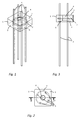
- thermal insulation element 1 is used for monolithic connection and load-bearing connection of a concrete pillar in the basement of a building to the overlying basement ceiling. It has a cuboid basic element 1 with a top side 2 and a bottom side 3, which serves in each case as bearing surfaces for the basement ceiling or the closure of the support supporting it. In the middle of the cuboid heat-insulating element 1 there is a central through-opening 4, which extends from the upper side 2 to the underside 3 of the heat-insulating element 1. The reinforcing element projects through four reinforcing rods 5.
- the underside 3 of the heat-insulating element 1 has a three-dimensional profiling in the form of a funnel-shaped recess 6 extending in the direction of the through-opening 4.
- a reinforcement arranged at right angles thereto, for example a reinforcing bar 7, is embedded, which surrounds the reinforcing bars 5 and gives the heat-insulating element additional stability.
- the thermal insulation element 1 consists of a lightweight concrete, which on the one hand has a high pressure stability, on the other hand, a good thermal insulation property. Compared to concrete with a thermal conductivity of about 1.6 W / (m ⁇ K) When using a suitable lightweight concrete material, the thermal conductivity is in the range of about 0.5 W / (m ⁇ K), which corresponds to an improvement of about 70%.
- the lightweight concrete used consists essentially of expanded clay, fine sands, preferably light sand, flow agents and stabilizers that prevent segregation by floating the grain and improve the processability.
- the compressive strength of the thermal insulation element is sufficiently high to enable the statically planned utilization of the underlying in situ concrete support, for example in accordance with compressive strength class C25 / 30.
- the compressive strength of the thermal insulation element even corresponds to at least 1.5 times the statically required value. This ensures that, even in the event of possible faulty surfaces on the connecting surface between the thermal insulation element and support safety reserves are available, so that the thermal insulation element remains statically stable even at points higher load.
- the reinforcing rods 5 can be embedded in the lightweight concrete material of the cuboid base body 1 in the manufacture of the heat-insulating element. Alternatively, it is possible for easier production of the thermal insulation element to install in the production of sleeves as a kind of lost circuit through which the reinforcing rods 5 are inserted therethrough after curing of the lightweight concrete element 1.
- the reinforcing bars 5 themselves are in the embodiment of a fiber composite material such as the proven reinforcing rod ComBAR® Schöck, which consists of oriented in the direction of force glass fibers and a resin matrix.
- a glass fiber reinforcing rod has an extremely low thermal conductivity, which is up to 100 times lower than with reinforcing steel, and is thus ideally suited for use in the thermal insulation element.
- rebars of conventional type made of stainless steel or structural steel can be used.
- reinforcing bars made of a fiber composite material can transmit very high tensile forces, but in contrast to that, significantly lower pressure forces can lead to the destruction of the reinforcing bars.
- sleeves Through the use of sleeves, a positive embedding of the reinforcing bars in the surrounding concrete, which is normally intended and almost indispensable for concrete reinforcements, is avoided. If there is now a compressive force load, for example, subsidence in the building, so the reinforcing rods can deform elastically in their sleeves until the pressure forces are completely removed by the pressure-stable insulating body 1, so that a harmful compressive load on the reinforcing bars is avoided.
- the reinforcement in the thermal insulation element is designed only as tensile reinforcement, since the connection between the support and the floor above it can be statically considered anyway as articulated connection.
- a static, stable and permanent connection or monolithic connection between support and floor ceiling is achieved with continuous reinforcement the static requirements.
- the arrangement of the reinforcing bars 5 relative to the Base of the body 1 is slightly outside the main diagonal selected. The reason for this is that with a support in which the reinforcing bars 5 of the thermal insulation element 1 are installed, the reinforcement of the support is already in the corners.
- the reinforcing bracket 7 is made of a stainless steel bent into a ring, which is welded at the joint.
- the reinforcing bracket 7 has a diameter of about 200 mm with a material thickness of 8 mm or 10 mm.
- the main body of the heat-insulating element 1 has an edge length of 250 ⁇ 250 mm in the exemplary embodiment.
- the height is 100 mm and thus corresponds to the usual strength of a subsequently applied thermal barrier coating.
- the passage opening runs, as especially in Fig. 3 can be seen, slightly conical in that the passage opening 4 tapers from an upper dimension of 70 mm to a lower dimension of 65 mm.
- the passage opening can be closed by means of a corresponding likewise slightly conical plug (not shown).
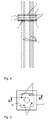
- Fig. 4 shows the heat-insulating element in a side view, wherein on the main body 1 additionally circumferential seals 8 are mounted.
- the seals 8 may for example be designed as rubber lips or conventional sealing bands. They serve to seal the body of the thermal insulation element 1 edge-sealing against a formwork for the support to be created underneath to prevent rising of concrete or air ingress.
- Fig. 5 shows the installation situation of the thermal insulation element with respect to a support 23.
- the cross section shown extends below the body of the heat-insulating element 1.
- the made of in-situ concrete support 23 has a reinforcement with four arranged in the corners of the support 23 vertical reinforcing bars 25 and a plurality of horizontally the reinforcing bars 25 extending approximately square executed reinforcing bracket 26.
- the reinforcing bars 5 of the thermal insulation element are each slightly offset next to one of the reinforcing bars 25 of the support 23.
- Die in Fig. 5 drawn Section line BB corresponds to the cut of the in Fig. 7 shown longitudinal section through the column reinforcement.
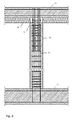
- FIG. 6 First, a longitudinal section through the support 23 and the connected building parts is shown.
- the support 23 is placed on a base plate 21 and carries a projecting ceiling 22 arranged above it. This may, for example, be the basement or basement ceiling of a building.
- Base plate 21, support 23 and floor slab 22 are statically connected.
- the pressure-transmitting heat-insulating element 1 is arranged, the reinforcing bars 5 are shed monolithic both in the support 23 and in the overlying floor slab 22.
- a thermal barrier coating 24 is applied, the thickness of which substantially corresponds at least to the height of the main body of the thermal insulation element 1.
- the thermal barrier coating 24 is applied from a highly insulating material, such as mineral insulation panels or wood wool multi-layer panels.
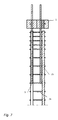
- Fig. 7 the reinforcement of the support 23 is shown together with the thermal insulation element 1 in a longitudinal section.
- the cutting guide corresponds to the section line BB Fig. 5 .
- the reinforcement of the support 23 consists of four arranged in the corners of the support vertical reinforcing bars 25, which may be made of structural steel with a rod diameter of 28 mm at a length of 2000 mm, and a plurality of horizontally around the reinforcing bars 25 encircling reinforcing bar with in about square floor plan.
- Above the column reinforcement is the thermal insulation element 1, the reinforcing rods 5 projecting downwards into the column reinforcement.
- the reinforcement content of the support 23 is about 3-4%. At a typical thermal conductivity of the structural steel of about 50 W / (m ⁇ K), it contributes about 1.6% of the total weight of 1.6 W / (m ⁇ K) to the overall thermal conductivity of the column.
- a typical thermal conductivity of the structural steel of about 50 W / (m ⁇ K)
- it contributes about 1.6% of the total weight of 1.6 W / (m ⁇ K) to the overall thermal conductivity of the column.
- the vibrating bottle of a concrete vibrator is passed through the passage opening 4 in the fresh in-situ concrete underneath in order to recompress it again.
- the heat-insulating element can be slightly lifted by the volume of the concrete displaced by the vibrating bottle.
- the circumferential seal 8 in this case prevents air between formwork 27 and thermal insulation element 1 can penetrate or the thermal insulation element 1 in the formwork 27 can tilt.
- FIG. 9 is the detail referred to as D detail around one of the seals 8 again drawn out enlarged.
- the passage opening 4 by means a conical plug (not shown) closed.
- the closure plug can be made of an insulating material such as polystyrene or similar. exist and serves to prevent the ingress of in-situ concrete in the through hole 4, when subsequently the floor slab 22 is created. In this way, any thermal bridges due to a concrete filling in the through hole 4 are avoided.
- the overlying floor slab 22 is created above the heat-insulating element 1 in a conventional manner.
- the passage opening 4 can also be used as a filling opening for filling the formwork for the support 23 with in-situ concrete.
- the thermal insulation element is inserted into the still empty formwork of the support 23 and optionally the reinforcing bars 5 connected to the column reinforcement.
- fresh concrete is filled through the passage opening 4 of the heat-insulating element in the formwork and then compressed by a through-opening 4 a vibrator bottle of an internal vibrator is introduced.
- a compression of the fresh concrete against the underside of the thermal insulation element takes place from above through the passage opening 4.
- the support 23 can also be made of self-compacting concrete, or the support can be compacted by an external vibrator. In the latter two cases, the passage opening 4 thus serves only as a filling opening.
- FIG. 10 In addition to installation in the upper region of a support, installation in the foot region of a support is also conceivable. Such an arrangement is in an alternative embodiment in FIG. 10 shown.
- the support 23 is arranged here between the bottom plate 21 and the upper floor ceiling 22.
- an inventive thermal insulation element 1 is installed, projecting the reinforcing rods 5 of the bottom plate 21 into the upper region of the support 1 and there are connected to the reinforcement 25 of the support 1.
- a thermal barrier coating 24 'of insulation boards of known type is mounted in this case on the top of the bottom plate 21.
- the preparation can take place in such a way that the thermal insulation element 1 is connected before concreting the bottom plate 21 with its reinforcement 21 '.
- the bottom plate 21 is then cast from cast-in-place concrete, so that the concrete of rises down against the thermal insulation element 1.
- the in-situ concrete in turn can be compacted through the central passage opening 4 with a vibrating tool.
- the reinforcement 25 of the support is created and connected to the reinforcing bars 5 of the thermal insulation element.
- Around the thermal insulation element 1 around the formwork 27 is then constructed for the support 23 and then poured the support 23 in a conventional manner from in-situ concrete and compacted.
- a further embodiment of a heat-insulating element is shown.
- the base body 10 of the thermal insulation element shown here is not made of lightweight concrete but of a non-compressive heat insulating material such as foam glass or polystyrene foam.
- the individual printing elements 11a to 11d are made of a high-strength concrete in order to be able to remove the ballast through the overlying building part 22.
- Reinforcing bars 15 are cast into the individual pressure elements 11a to 11d and protrude in the vertical direction over the top 12 and the bottom 13 of the heat-insulating element 15 addition.
- a through hole 14 is provided, which serves as a filling and / or compression opening.
- the installation of the thermal insulation element 10 takes place as in the previous embodiment.
- the heat-insulating property is achieved in this embodiment mainly by the areal reduction of thermal bridges to the few individual pressure elements 11a to 11d.
- the present invention is not limited to the form and number of individual printing elements shown in the embodiment. Rather, the provided within the insulating body 10 portion of pressure-transmitting material can be performed in a variety of other geometries, such as in the form of a pressure-transmitting cylindrical ring.
- the reinforcing rods 15 need not necessarily be guided by the arranged in the insulating body 10 pressure-transmitting areas 11 a to 11 d, but can also be plugged separately thereof by the non-compressive force transmitting areas of the thermal insulation element 10.
- thermal insulation element itself may be adapted in its dimensions to the underlying and / or overlying component.
- thermal insulation elements can be adapted to the typical cross sections of supports with a round, square or rectangular layout. Typical dimensions of round columns are diameters of 24 and 30 cm, and of rectangular bases 25 x 25 cm and 30 x 30 cm. Thermal insulation elements with such a geometry can also be combined as desired to larger columns or support walls.
- the heat insulation elements described herein are particularly suitable for use with pendulum supports and wall supports with low clamping moments.
- the use of supporting outer walls is possible by the heat insulation elements are installed at a suitable distance from each other and any remaining gaps between the individual thermal insulation elements are filled with non-supporting insulation material.
- the geometric design of the profiled underside of the thermal insulation element can be realized in many other ways besides the conical shape shown here, for example in a stepped shape, a radial toothing, an annular bead and much more.
- openings may also be provided for subsequent encapsulation of possibly remaining cavities between the thermal-insulating element and the concrete surface located thereunder.
- Such openings can be closed by means of blind plugs and opened as needed to subsequently fill any remaining cavity by means of a potting compound such as a grout or a synthetic resin composition and thus produce a secure static connection, even if in an individual case a faulty design in the preparation of the support or the installation of the thermal insulation element had led to a poor connection.
- indicators may be provided on the thermal insulation element, which can be pushed up in the manner of a float and indicate here, that the heat-insulating element has contact with the underlying in-situ concrete on its underside.
- thermal insulation element When installing the thermal insulation element in the already compacted, fresh concrete of the underlying support, the subsequent recompression and when pulling out of the compaction tool from the passage opening of the thermal element, it may optionally be advantageous if a defined pressure force is exerted on the thermal insulation element.
- rod-shaped reinforcing means for connecting the heat-insulating element to the above and below building parts can be used, for example threaded rods, dowels or the like, as explained above, the connection between a support and a floor above it static as articulated connection can be considered and the reinforcement therefore preferably has to fulfill a constructive function at this point.
Landscapes
- Engineering & Computer Science (AREA)
- Architecture (AREA)
- Physics & Mathematics (AREA)
- Civil Engineering (AREA)
- Structural Engineering (AREA)
- Electromagnetism (AREA)
- Acoustics & Sound (AREA)
- Building Environments (AREA)
Abstract
Description
- Die vorliegende Erfindung betrifft ein Wärmedämmelement zur Wärmeentkopplung zwischen aus Beton zu erstellenden, tragenden Gebäudeteilen, vorzugsweise zwischen einem vertikalen Gebäudeteil, insbesondere einer Schütze, und einem darüber oder darunter liegenden, horizontalen Gebäudeteil, insbesondere einer Geschossdecke oder einer Bodenplatte.
- Im Hochbau werden tragende Gebäudeteile häufig aus mit einer Bewehrung versehenen Betonkonstruktionen erstellt. Aus energetischen Gründen werden solche Gebäudeteile in der Regel mit einer von außen angebrachten Wärmedämmung versehen. Insbesondere die Geschossdecke zwischen Tiefgeschoss, wie beispielsweise Keller oder Tiefgarage, und Erdgeschoss wird häufig auf der Tiefgeschossseite mit einer deckenseitig angebrachten Wärmedämmung ausgerüstet. Hierbei ergibt sich die Schwierigkeit, dass die tragenden Gebäudeteile, auf denen das Gebäude ruht, wie etwa Stützen und Außenwände, in lastabtragender Weise mit den darüber befindlichen Gebäudeteilen, insbesondere der Geschossdecke, verbunden sein müssen. Dies wird in der Regel dadurch erreicht, dass die Geschossdecke bei durchgehender Bewehrung monolithisch mit den tragenden Stützen und Außenwänden verbunden wird. Hierbei entstehen jedoch Wärmebrücken, die sich nur schlecht durch eine nachträglich von außen angebrachte Wärmedämmung beseitigen lassen. In Tiefgaragen wird beispielsweise häufig der obere, zur Geschossdecke weisende Abschnitt der tragenden Betonstützen ebenfalls mit einer Wärmedämmung ummantelt. Dies ist nicht nur aufwendig und optisch wenig ansprechend, sondern führt auch zu unbefriedigenden bauphysikalischen Ergebnissen und vermindert zudem den in der Tiefgarage verfügbaren Parkraum.
- Aus der Schrift
DE 101 06 222 ist ein mauersteinförmiges Wandelement zur Wärmeentkopplung zwischen Wandteilen und Boden- oder Deckenteilen beschrieben. Das Wärmedämmelement besitzt eine druckfeste Tragstruktur mit in den Zwischenräumen angeordneten Isolierelementen. Die Tragstruktur kann beispielsweise aus einem Leichtbeton bestehen. Ein solches Wärmedämmelement dient zur Wärmedämmung gemauerter Außenwände, indem es beispielsweise wie ein herkömmlicher Mauerstein als erste Steinschicht der tragenden Außenwand oberhalb der Kellerdecke eingesetzt wird. - Aus der Schrift
EP 2 405 065 ist ein druckkraftübertragendes und isolierendes Anschlusselement bekannt, welches zur vertikalen, lastabtragenden Verbindung von aus Beton zu erstellenden Gebäudeteilen zum Einsatz kommt. Es besteht aus einem Isolationskörper mit einem oder mehreren darin eingebetteten Druckelementen. Durch die Druckelemente verlaufen Querkraftbewehrungselemente, die sich zum Anschluss an die aus Beton zu erstellenden Gebäudeteile im Wesentlichen vertikal über die Oberseite und die Unterseite des Isolationskörpers hinaus erstrecken. Der Isolationskörper kann beispielsweise aus Schaumglas oder expandiertem Polystyrol-Hartschaum und die Druckelemente aus Beton, Faserbeton oder Faserkunststoff hergestellt werden. - Beim Einbau eines solchen vorgefertigten Anschlusselements müssen die Bewehrungselemente beim Betonieren der angrenzenden Gebäudeteile mit vergossen werden. Zu diesem Zweck muss das Anschlusselement in eine geschlossene Schalung für das darunter liegende Gebäudeteil eingebaut werden und es muss von unten gegen die bestehende, nicht zugängliche und nicht sichtbare Unterseite des Anschlusselements betoniert werden. Insbesondere bei Stützen und Außenwänden, bei denen es sich um tragende Bauwerksteile handelt, kann eine mangelhaft Ausführung beim Erstellen der Gebäudeteile insbesondere an der Verbindungsstelle zu dem Anschlusselement später zu gravierenden statischen Problemen am Gebäude führen. Hinzu kommt, dass eine Kontrolle und Überwachung der Ausführung kaum möglich ist. Insbesondere ist eine Sichtkontrolle vor und während des Betonierens wegen der Einbausituation in die Schalung nicht gegeben. Am fertigen Gebäudeteil ist eine Prüfung ebenfalls kaum mehr möglich, da die Verbindungsfläche zwischen Gebäudeteil und Anschlusselement nicht zugänglich ist.
- Der Erfindung liegt daher die Aufgabe zugrunde, ein Wärmedämmelement anzugeben, welches einen zuverlässigen Einbau an einer vertikal lastabtragenden Verbindungsstelle zwischen zwei aus Beton zu erstellenden Gebäudeteilen ermöglicht.
- Die Aufgabe wird gelöst durch die Merkmale des Anspruchs 1. Vorteilhafte Ausgestaltungen sind den anhängigen Ansprüchen zu entnehmen. Darüber hinaus betrifft die Erfindung ein Verfahren zum Einbau eines entsprechenden Wärmedämmelements.
- Bei einem erfindungsgemäßen Wärmedämmelement, welches zumindest teilweise aus einem druckkraftübertragenden Werkstoff besteht und eine obere und eine untere Auflagefläche zum vertikalen Anschluss an die aus Beton zu erstellenden Gebäudeteile aufweist, wird die Aufgabe dadurch gelöst, dass das Wärmedämmelement zumindest eine sich von der oberen bis zur unteren Auflagefläche erstreckende Durchgangsöffnung aufweist, welche zum Durchführen eines Verdichtungsgeräts ausgebildet ist. Die Durchgangsöffnung dient somit als Eintauchstelle für einen Innenrüttler. Vorzugsweise ist die Durchgangsöffnung in dem Wärmedämmelement in etwa mittig angeordnet.
- Der vorliegenden Erfindung liegt die Erkenntnis zugrunde, dass beim Einbau und anschließendem Betonieren gegen die Unterseite des Wärmedämmelements eine unzureichende und undefinierte Verdichtung des Ortbeton unterhalb des Wärmedämmelements auftreten kann, die zudem stark von der Zusammensetzung des verwendeten Ortbetons abhängt. Nach Erkenntnis der Erfindung können an der Unterseite des Wärmedämmelements beim Abbinden des Ortbetons zwei Prozesse dazu führen, dass die lastabtragende Anbindung des Wärmedämmelements an das darunter liegende Gebäudeteil mangelhaft ist. Einerseits können aufsteigende Luftblasen, sogenannte Verdichtungsporen, an der Unterseite des Wärmedämmelements zu Lunkerbildung führen und so für eine statisch unzureichende Anbindung sorgen. Ein noch kritischerer Prozess stellt eine Sedimentation im noch nicht abgebundenen Ortbeton dar, bei dem schwerere Zuschlagstoffe langsam absinken und an der Betonoberfläche Wasser bzw. Zementleim abgesondert wird. Nach dem Abbinden und Austrocknen des Betonteils können in diesem Fall großflächige Hohlstellen zwischen dem Wärmedämmelement und dem darunter befindlichen Betonteil verbleiben, die von außen nicht sichtbar sind.
- Um dies zu vermeiden wird in dem erfindungsgemäßen Wärmedämmelement eine Durchgangsöffnung vorgesehen, durch welche ein Verdichtungsgerät wie etwa die Rüttelflasche eines Betonrüttlers hindurchgeführt werden kann, um nach dem Einbau des Wärmedämmelementes den darunter befindlichen Ortbeton zu verdichten bzw. nachzuverdichten. Durch diese Verdichtung bzw. Nachverdichtung können die beschriebenen Probleme vermieden und eine zuverlässige Anbindung des Wärmedämmelementes an das darunter befindliche Gebäudeteil erreicht werden.
- Bei einer bevorzugten Ausführungsform ist das Wärmedämmelement zumindest teilweise aus einem druckkraftübertragenden und wärmedämmenden Werkstoff hergestellt. Vorzugsweise kann es sich bei diesem Werkstoff um einen Leichtbeton handeln. Aus Leichtbeton lassen sich unter Fabrikbedingungen hochdruckfeste Formelemente mit niedriger spezifischer Wärmeleitfähigkeit herstellen. Je nach statischer Anforderung kann ein solches Leichtbetonformteil neben der erfindungsgemäßen Durchgangsöffnung weitere Hohlkammern oder eingeschlossene Isolierelemente umfassen.
- Unter Leichtbeton ist nach dem geltenden Regelwerk ein Beton mit einer trockenen Rohdichte von maximal 2000 kg/m3 definiert. Die geringe Dichte im Vergleich zu Normalbeton wird durch entsprechende Herstellverfahren und unterschiedliche Leichtbetonkörnungen wie etwa Körnungen mit Kornporosität wie Blähton erreicht. Leichtbeton besitzt je nach Zusammensetzung eine Wärmeleitfähigkeit zwischen 0,2 und 1,6 W/(m · K).
- Als weiterer Vorteil ergibt sich, dass bei gleicher Festigkeitsklasse der E-Modul von Leichtbeton nur etwa 30 bis 70 % der Werte von Normalbeton beträgt. Daher sind die elastischen Verformungen bei gleicher Beanspruchung (Spannung) im Mittel 1,5- bis 3-mal so groß. Aus diesem Grund wirkt ein Wärmedämmelement aus Leichtbeton gleichzeitig als Spannungs-Dämpfungselement und ist in der Lage, kleinere Setzungen und elastische Verformungen des darüber liegenden Gebäudeteils auszugleichen und eine gleichmäßigere Verteilung und Krafteinleitung von außerzentrischen Auflagekräften auf bzw. in das darunterliegende Gebäudeteil, insbesondere eine Stütze, sicherzustellen.
- Das wesentlich geringere E-Modul des verwendeten Leichtbetons wirkt sich hierbei besonders günstig bei Last-Ausmitten und Auflagerverdrehungen aus, die erhöhte Kantenpressungen zur Folge haben. Das Wärmedämmelement wirkt aufgrund seiner elastischen Eigenschaften sozusagen als "Zentrierelement". Im Gegensatz dazu ist die Stauchung bei zentrischer Belastung von untergeordneter Bedeutung.
- Das typische E-Modul von Normalbeton, wie er für eine Stütze verwendet wird, beträgt etwa Ecm≈30.000 bis 40.000 N/mm2. Das E-Modul des im Rahmen der Erfindung bevorzugten Leichtbetons beträgt dem gegenüber zwischen etwa 9.000 und 22.000 N/mm2, vorzugsweise 12.000 und 16.000 N/mm2, höchstvorzugsweise etwa 14.000 N/mm2.
- Alternativ kann das Wärmedämmelement auch aus einem wärmedämmenden aber nicht druckkraftübertragenden Isolierkörper, beispielsweise aus extrudiertem Polystyrol mit einem oder mehreren darin eingebetteten Druckkörpern bestehen. Solche Druckkörper können aus hochfestem Beton hergestellt werden, wobei eine Reduzierung der Wärmeleitfähigkeit des Wärmedämmelements in diesem Falle durch eine entsprechend kleine Grundfläche der Druckelemente erreicht wird. Auch in diesem Fall ist wesentlich, dass beim Einbau des Wärmedämmelements eine Nachverdichtung des darunter betonierten Gebäudeteils erfolgt, indem ein entsprechendes Rüttelwerkzeug durch die im Wärmedämmelement vorgesehene Durchgangsöffnung in den darunterliegenden Ortbeton des angrenzenden frisch betonierten Gebäudeteils eingeführt wird.
- Gegenüber einem massiven oder in Hohlblockbauweise gefertigten Wärmedämmelement aus Leichtbeton hat die letztgenannte Variante aufgrund der deutlich kleineren Auflagefläche allerdings den Nachteil, dass bereits kleinere Schwachstellen in der Anbindung an das darunterliegende Gebäudeteil aufgrund von Lunkerbildung oder Sedimentation deutlich stärkere Auswirkung auf die statische Stabilität der Konstruktion haben. Schlimmstenfalls kann es zu einer lokalen Überlastung und damit einem Versagen einzelner Druckelemente des Wärmedämmelements kommen. Diese Gefahr ist aufgrund der wesentlich größeren Auflagefläche bei einem Wärmedämmelement aus einem druckkraftübertragenden Werkstoff wie Leichtbeton wesentlich geringer.
- Ein weiterer Vorteil der vorliegenden Erfindung ergibt sich, wenn die untere Auflagefläche des Wärmedämmelements eine Oberfläche mit dreidimensionalem Profil aufweist. Durch geeignete Profilierung der Oberfläche lassen sich Defekte in der Verbindung zwischen Wärmedämmelement und dem darunter liegenden frisch betonierten Gebäudeteil weiter vermindern. So kann die Oberfläche beispielsweise Erhöhungen und Vertiefungen aufweisen sowie geneigte Flächen, Furchen, oder ähnliches, so dass im Falle auftretender Sedimentation das sich absetzende Oberflächenwasser in unkritische Bereiche ablaufen bzw. sich dort absetzen kann, während in für die statische Anbindung kritischen Bereichen des Wärmedämmelements eine innige Verbindung zum Frischbeton des darunterliegenden Gebäudeteils entsteht.
- Als besonders bevorzugt wird in diesem Zusammenhang eine Ausführungsform angesehen, bei der die untere Auflagefläche eine trichterförmig in Richtung der Durchgangsöffnung geneigte oder gewölbte Oberfläche aufweist. Hierdurch wird erreicht, dass im Falle auftretender Sedimentation das sich absetzende Oberflächenwasser in Richtung der Durchgangsöffnung verdrängt wird bzw. sich nur in diesem Bereich bildet, der zur Statik der Konstruktion ohnehin nicht beiträgt.
- Bei einer bevorzugten Ausführungsform der vorliegenden Erfindung sind außerdem ein oder mehrere stabförmige Bewehrungselemente vorgesehen, die das Wärmedämmelement durchdringen und sich im Wesentlichen vertikal über die obere und untere Auflagefläche hinaus erstrecken. Mit solchen Bewehrungselementen kann das Wärmedämmelement mit den angrenzenden Gebäudeteilen verbunden und gegebenenfalls an deren Bewehrung angeschlossen werden. Somit wird eine monolithische Verbindung der Gebäudeteile erreicht, auch wenn aufgrund statischer Anforderungen die Verbindung lediglich als Betongelenk betrachtet und die Bewehrungselemente somit eine eher konstruktive Funktion ohne größere Bedeutung für die Gebäudestatik erfüllen.
- Vorzugsweise können die Bewehrungselemente als Bewehrungsstäbe ausgebildet werden, die vorwiegend zur Übertragung von Zugkräften dienen. Häufig werden Bewehrungselemente, die eine Wärmedämmung durchqueren müssen, aus bauphysikalischen Gründen aus Edelstahl bzw. nichtrostendem Stahl gefertigt. Im Rahmen der vorliegenden Erfindung können aus Gründen der besseren thermischen Isolierung die Bewehrungselemente vorzugsweise aus einem Faserverbundwerkstoff wie etwa glasfaserverstärkten Kunststoff hergestellt werden.
- Des Weiteren erweist es sich als vorteilhaft, wenn im Inneren des druckkraftübertragenden Werkstoffs in dem Wärmedämmelement ein Bewehrungsbügel angeordnet wird. Ein solcher Bewehrungsbügel in Form eines in sich geschlossenen Bewehrungsringes mit beispielsweise kreisrunder oder abgerundet mehreckiger Grundfläche, der in einer bezüglich der Auflageflächen im Wesentlichen parallelen Ebene angeordnet wird, kann die Druckkraftbeständigkeit des Wärmedämmelements weiter steigern, indem dieser die Querdehnung des Wärmedämmelements unter Druck minimiert.
- Ein weiterer vorteilhafter Aspekt der vorliegenden Erfindung ergibt sich, wenn an dem Wärmedämmelement mindestens eine um dessen vertikale Begrenzungsflächen umlaufende Dichtung vorgesehen wird, welche einen dichten Einbau des Wärmedämmelements in eine Schalung für das darunter liegende Gebäudeteil gewährleistet. Einerseits wird durch eine solche Dichtung verhindert, dass beim Einsetzen des Wärmedämmelements oder Betonieren des darunterliegenden Gebäudeteils Frischbeton zwischen Schalung und Wärmedämmelement eindringen und aufsteigen kann. Andererseits verhindert eine solche Dichtung das Eindringen von Luft zwischen Schalung und Wärmedämmelement, wenn nach erfolgtem Verdichten das Rüttelwerkzeug aus der Durchgangsöffnung des Wärmedämmelements herausgezogen wird und das Wärmedämmelement um das zuvor vom Rüttelwerkzeug verdrängte Volumen innerhalb der Schalung des darunterliegenden Gebäudeteils absinkt.
- Neben der Durchgangsöffnung für das Rüttelwerkzeug können in dem Wärmedämmelement weitere Vergussöffnungen vorgesehen sein, über die erforderlichenfalls nach Aushärten des Betons zusätzlich Vergussmasse, wie etwa Vergussmörtel eingefüllt werden kann, um etwaige noch bestehende Hohlräume zwischen dem darunterliegenden Gebäudeteil und dem Wärmedämmelement auszufüllen. Vorzugsweise sind die betreffenden Vergussöffnungen mittels herausnehmbarer Blindstopfen verschlossen, so dass diese beim Einbau des Wärmedämmelementes nicht von Ortbeton verstopft werden können.
- Weiterhin ist im Rahmen der vorliegenden Erfindung bevorzugt, dass ein Verschlussstopfen vorgesehen wird, mit dem die Durchgangsöffnung nachträglich verschlossen werden kann. Hierbei ist weiter bevorzugt, dass der Verschlussstopfen aus einem wärmedämmenden, aber nichttragenden Material besteht, wie beispielsweise extrudiertem Polystyrol. Außerdem kann ein solcher Verschlussstopfen konisch geformt sein, so dass er dichtend in die, vorzugsweise ebenfalls konisch nach unten hin zulaufende Durchgangsöffnung eingesetzt werden kann. Somit ist sichergestellt, dass nach dem Einbau des Wärmedämmelementes keine Wärmebrücke durch die Durchgangsöffnung bestehen bleibt, beispielsweise aufgrund in der Durchgangsöffnung eintretenden Ortbetons beim Betonieren der darüber liegenden Geschossdecke.
- Zusätzlich können in dem Wärmedämmelement ein oder mehrere Indikatoren vorgesehen werden, die einen ausreichenden Kontakt der unteren Anlagefläche mit dem Frischbeton des darunter zu erstellenden Gebäudeteils anzeigen. solche Indikatoren können beispielsweise in der Art eines Schwimmers ausgebildet sein. Wenn somit bei ausreichendem Kontakt die Indikatoren an der oberen Auflagefläche des Wärmedämmelements sichtbar werden ist sichergestellt, dass ausreichend Kontakt zu der darunterliegenden Betonfläche besteht.
- Um ein Durchführen eines Rüttelwerkzeuges, beispielsweise der Rüttelflasche eines Betonrüttlers, zu ermöglichen, besitzt die Durchgangsöffnung ein Öffnungsmaß dass groß genug ist, um das Durchführen baustellenüblicher Rüttelflaschen zu ermöglichen, insbesondere von mindestens 50 mm, vorzugsweise zwischen 60 und 80 mm.
- Die Erfindung betrifft darüber hinaus ein Verfahren zum Einbau eines solchen Wärmedämmelementes zwischen zwei aus Beton zu erstellenden, tragenden Gebäudeteilen, vorzugsweise zwischen einem vertikalen Gebäudeteil, insbesondere einer Stütze, und einem darüber oder darunter liegenden horizontalen Gebäudeteil, insbesondere einer Geschossdecke oder einer Bodenplatte. Hierbei wird zunächst eine Schalung für das untere Gebäudeteil erstellt und das untere Gebäudeteil betoniert, indem Ortbeton in die Schalung eingefüllt und verdichtet wird. Dann wird in einem zweiten Schritt das Wärmedämmelement in die Schalung für das untere Gebäudeteil eingesetzt. Hierbei werden die gegebenenfalls nach unten über das Wärmedämmelement hinausragenden Bewehrungselemente in den frischen Ortbeton des unteren Gebäudeteils eingedrückt. Erfindungsgemäß erfolgt in einem anschließenden Schritt ein Nachverdichten des Betons mittels eines Verdichtungsgerätes, welches durch die Durchgangsöffnung in dem Wärmedämmelement hindurch geführt wird. Vorzugsweise kann die Durchgangsöffnung anschließend mittels eines Verschlussstopfens verschlossen werden. Danach kann oberhalb des Wärmedämmelements in an sich üblicher Weise das obere Gebäudeteil, zum Beispiel eine Geschossdecke erstellt werden.
- Durch das Nachverdichten des noch frischen Ortbetons des unteren Gebäudeteils nach Einsetzen des Wärmedämmelements wird sichergestellt, dass zu dessen unterer Anlagefläche inniger Kontakt besteht und Hohlräume aufgrund von Lunkerbildung und Sedimentation zwischen Wärmedämmelement und dem darunter befindlichen Gebäudeteil vermieden werden.
- Bei einem alternativen Einbauverfahren kann das Wärmedämmelement auch vor dem Verfüllen der Schalung mit Ortbeton eingebaut werden. In diesem Fall kann die Durchgangsöffnung zunächst als Einfüllöffnung für den Ortbeton verwendet werden. Anschließend erfolgt eine Verdichtung des eingefüllten Betons, indem durch die Durchgangsöffnung das Rüttelwerkzeug in den frischen Ortbeton eingeführt wird.
- Weitere Merkmale, Vorteile und Eigenschaften der vorliegenden Erfindung werden im Folgenden anhand der Figuren und anhand von Ausführungsbeispielen erläutert. Dabei zeigt:
- Fig. 1
- eine isometrische Ansicht eines erfindungsgemäßen Wärmedämmelements aus einem druckkraftübertragenden Werkstoff, insbesondere Leichtbeton
- Fig. 2
- eine Draufsicht auf das Wärmedämmelement aus
Fig. 1 , - Fig. 3
- einen vertikalen Schnitt durch das Wärmedämmelement entlang der Schnittlinie C-C aus
Fig. 2 , - Fig. 4
- eine Weiterbildung des Wärmedämmelements aus
Fig. 1 in einer Seitenansicht, - Fig. 5
- einen Querschnitt einer Stütze eines Gebäudes, die mit einem Wärmedämmelement ausgestattet ist,
- Fig. 6
- einen Schnitt durch die Stütze aus
Figur 5 und der darüber und darunter befindlichen Gebäudeteile entlang der Schnittlinie B-B, - Fig. 7
- die Armierung der Stütze aus
Figur 6 mit dem Wärmedämmelement vor dem Betonieren der Stütze, - Fig. 8
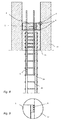
- die mit einer Schalung versehene Stütze nach dem Verfüllen mit Beton,
- Fig. 9
- ein vergrößerter Ausschnitt aus
Figur 8 , - Fig. 10
- ein alternatives Ausführungsbeispiel mit im Fußbereich einer Stütze angeordnetem Wärmedämmelement und.
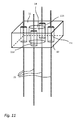
- Fig. 11
- ein zweites Ausführungsbeispiel eines Wärmedämmelements aus einem nichttragenden Dämmmaterial mit eingesetzten Einzeldruckkörpern.
- Das in den
Figuren 1 bis 3 gezeigte Wärmedämmelement 1 dient zum monolithischen Anschluss und zur lastabtragenden Verbindung einer betonierten Stütze im Untergeschoss eines Gebäudes an die darüber liegende Kellerdecke. Es besitzt ein quaderförmiges Grundelement 1 mit einer Oberseite 2 und einer Unterseite 3, die jeweils als Auflageflächen für die Kellerdecke bzw. den Abschluss der diese tragenden Stütze dient. In der Mitte des quaderförmigen Wärmedämmelements 1 befindet sich eine zentrale Durchgangsöffnung 4, die sich von der Oberseite 2 bis zur Unterseite 3 des Wärmedämmelements 1 erstreckt. Durch das Wärmedämmelement ragen vier Bewehrungsstäbe 5. Die Unterseite 3 des Wärmedämmelements 1 weist eine dreidimensionale Profilierung in Form einer sich trichterförmig in Richtung der Durchgangsöffnung 4 erstreckenden Ausnehmung 6 auf. Im Inneren des Wärmedämmelements 1 ist außerdem eine rechtwinkelig dazu angeordnete Bewehrung, beispielsweise ein Bewehrungsbügel 7 eingebettet, der um die Bewehrungsstäbe 5 herum liegt und dem Wärmedämmelement zusätzliche Stabilität verleiht. - Das Wärmedämmelement 1 besteht aus einem Leichtbeton, welcher einerseits eine hohe Druckstabilität, andererseits eine gute Wärmedämmeigenschaft aufweist. Gegenüber Beton mit einer Wärmeleitfähigkeit von etwa 1,6 W/(m · K) liegt die Wärmeleitfähigkeit bei Verwendung eines geeigneten Leichtbetonwerkstoffs im Bereich von etwa 0,5 W/(m · K), was einer Verbesserung um etwa 70 % entspricht. Der verwendete Leichtbeton besteht im Wesentlichen aus Blähton, Feinsanden, vorzugsweise Leichtsand, Fließmitteln sowie Stabilisatoren, die ein Entmischen durch Aufschwimmen der Körnung verhindern und die Verarbeitbarkeit verbessern.
- Die Druckfestigkeit des Wärmedämmelements ist dabei ausreichend hoch, um die statisch geplante Ausnutzung der darunter liegenden Stütze aus Ortbeton zu ermöglichen, beispielsweise entsprechend der Druckfestigkeitsklasse C25/30. Vorzugsweise entspricht die Druckfestigkeit des Wärmedämmelements aber sogar mindestens dem 1,5-fachen des statisch erforderlichen Wertes. Damit wird erreicht, dass auch im Falle von eventuellen Fehlflächen an der Verbindungsfläche zwischen Wärmedämmelement und Stütze Sicherheitsreserven vorhanden sind, so dass das Wärmedämmelement auch bei punktuell höherer Belastung statisch stabil bleibt.
- Die Bewehrungsstäbe 5, die den Grundkörper des Wärmedämmelements 1 in vertikaler Richtung durchqueren, dienen vor allem als Zugstäbe zur Übertragung gegebenenfalls auftretender Zugkräfte. Die Bewehrungsstäbe 5 können bei der Herstellung des Wärmedämmelements in den Leichtbetonwerkstoff des quaderförmigen Grundkörpers 1 einbetoniert werden. Alternativ ist es zur einfacheren Herstellung des Wärmedämmelementes möglich, bei der Herstellung Hülsen als eine Art verlorene Schaltung zu verbauen, durch die die Bewehrungsstäbe 5 nach dem Aushärten des Leichtbetonelements 1 hindurchgesteckt werden.
- Die Bewehrungsstäbe 5 selbst sind im Ausführungsbeispiel aus einem Faserverbundwerkstoff wie etwa dem bewährten Bewehrungsstab ComBAR® von Schöck, der aus in Kraftrichtung ausgerichteten Glasfasern und einer Kunstharz-Matrix besteht. Ein solcher Glasfaserbewehrungsstab weist eine extrem niedrige Wärmeleitfähigkeit auf, die bis zu 100 mal geringer ist als bei Betonstahl, und ist somit ideal für die Anwendung in dem Wärmedämmelement geeignet. Alternativ können jedoch auch Bewehrungsstäbe herkömmlicher Art aus nichtrostendem Stahl oder Baustahl zum Einsatz kommen.
- Vor allem bei Einsatz von Bewehrungsstäben aus einem Faserverbundwerkstoff ist die beschriebene Verwendung von Hülsen als verlorener Schalung zum nachträglichen Einstecken der Bewehrungsstäbe vorteilhaft. Bewehrungsstäbe aus Faserverbundwerkstoffen können zwar sehr hohe Zugkräfte übertragen, im Gegensatz dazu können aber schon deutlich geringere Druckkräfte zur Zerstörung der Bewehrungsstäbe führen. Durch den Einsatz von Hülsen wird eine formschlüssige Einbettung der Bewehrungsstäbe in den umgebenden Beton, die normalerweise bei Betonbewehrungen beabsichtigt und nahezu unerlässlich ist, vermieden. Kommt es nun zu einer Druckkraftbelastung, beispielsweise durch Setzungen im Gebäude, so können sich die Bewehrungsstäbe in ihren Hülsen elastisch verformen, bis die Druckkräfte vollständig durch den druckkraftstabilen Dämmkörper 1 abgetragen werden, so dass eine schädliche Druckkraftbelastung auf die Bewehrungsstäbe vermieden wird.
- Die Bewehrung in dem Wärmedämmelement ist lediglich als Zugkraftbewehrung ausgelegt, da die Anbindung zwischen Stütze und darüber befindlicher Geschossdecke statisch ohnehin als Gelenkverbindung betrachtet werden kann. Somit wird durch den Einsatz der Hülsen zur verbindungsfreien Durchführung einer Faserverbundwerkstoffbewehrung eine den statischen Anforderungen entsprechende, stabile und dauerhafte Verbindung bzw. monolithische Anbindung zwischen Stütze und Geschossdecke bei durchgehender Bewehrung erreicht.
- Die Verwendung von Hülsen als verlorener Schalung zum nachträglichen Einbau von Bewehrungsstäben weist außerdem erhebliche Vorteile bei der Herstellung auf. Bei der Herstellung unter Fabrikbedingungen ist es einfacher, in eine Schalung für das Wärmedämmelement Hülsen einzusetzen, als Bewehrungsstäbe, die das Wärmedämmelement auf beiden Seiten durchdringen sollen und die gegenüber der Schalung abgedichtet werden müssen. Auch die Lagerung vereinfacht sich wesentlich, wenn vorgefertigte Wärmedämmelemente ohne sperrige Bewehrungsstäbe ausgeführt sind und letztere erst auf der Baustelle beim Einbau des Wärmedämmelements in die Hülsen des Wärmedämmelements eingesteckt werden.
- Die Abmessungen der Bewehrungsstäbe 5 betragen, ohne dass die Erfindung hierauf beschränkt wäre, im Ausführungsbeispiel 16 mm Durchmesser bei einer Länge von 930 mm. Die Anordnung der Bewehrungsstäbe 5 bezogen auf die Grundfläche des Grundkörpers 1 ist leicht außerhalb der Hauptdiagonalen gewählt. Grund hierfür ist, dass sich bei einer Stütze, in die die Bewehrungsstäbe 5 des Wärmedämmelements 1 verbaut werden, in den Ecken bereits die Bewehrung der Stütze befinden.
- Der Bewehrungsbügel 7 besteht aus zu einem Ring gebogenen nichtrostendem Stahl, der an der Verbindungsstelle verschweißt ist. Der Bewehrungsbügel 7 hat einen Durchmesser von etwa 200 mm bei einer Materialstärke von 8 mm oder 10 mm.
- Der Grundkörper des Wärmedämmelements 1 hat im Ausführungsbeispiel eine Kantenlänge von 250 x 250 mm. Die Höhe beträgt 100 mm und entspricht somit der üblichen Stärke einer nachträglich angebrachten Wärmedämmschicht. Die Durchgangsöffnung verläuft, wie vor allem in
Fig. 3 ersichtlich, leicht konisch indem sich die Durchgangsöffnung 4 von einem oberen Maß von 70 mm zu einem unteren Maß von 65 mm hin verjüngt. Die Durchgangsöffnung kann mittels eines entsprechenden ebenfalls leicht konischen Stopfens (nicht gezeigt) verschlossen werden. -
Fig. 4 zeigt das Wärmedämmelement in einer Seitenansicht, wobei an dem Grundkörper 1 zusätzlich umlaufende Dichtungen 8 angebracht sind. Die Dichtungen 8 können beispielsweise als Gummilippen oder herkömmliche Dichtungsbänder ausgeführt sein. Sie dienen dazu, den Grundkörper des Wärmedämmelementes 1 randdicht gegenüber einer Schalung für die darunter zu erstellende Stütze abzudichten, um ein Aufsteigen von Beton oder Eindringen von Luft zu verhindern. -
Fig. 5 zeigt die Einbausituation des Wärmedämmelementes in Bezug auf eine Stütze 23. Der gezeigt Querschnitt verläuft dabei unterhalb des Grundkörpers des Wärmedämmelements 1. Die aus Ortbeton erstellte Stütze 23 weist eine Bewehrung mit vier in den Ecken der Stütze 23 angeordneten vertikalen Bewehrungsstäben 25 und einer Vielzahl horizontal um die Bewehrungsstäben 25 verlaufender in etwa quadratisch ausgeführter Bewehrungsbügel 26 auf. Die Bewehrungsstäbe 5 des Wärmedämmelements befinden sich jeweils leicht versetzt neben einem der Bewehrungsstäbe 25 der Stütze 23. Die inFig. 5 eingezeichnete Schnittlinie B-B entspricht der Schnittführung des inFig. 7 gezeigten Längsschnittes durch die Stützenbewehrung. - In
Figur 6 ist zunächst ein Längsschnitt durch die Stütze 23 und die angeschlossenen Gebäudeteile gezeigt. Die Stütze 23 ist auf einer Bodenplatte 21 aufgesetzt und trägt eine darüber angeordnete Geschossdecke 22. Hierbei kann es sich beispielsweise um die Keller- oder Tiefgeschossdecke eines Gebäudes handeln. Bodenplatte 21, Stütze 23 und Geschossdecke 22 sind statisch miteinander verbunden. Zwischen der Stütze 23 und der Geschossdecke 22 ist das druckkraftübertragende Wärmedämmelement 1 angeordnet, dessen Bewehrungsstäbe 5 sowohl in der Stütze 23 als auch in der darüber befindlichen Geschossdecke 22 monolithisch vergossen sind. Auf der Unterseite der Geschossdecke 22 ist eine Wärmedämmschicht 24 aufgebracht, deren Stärke im Wesentlichen zumindest der Höhe des Grundkörpers des Wärmedämmelements 1 entspricht. Die Wärmedämmschicht 24 besteht aus einem hochdämmenden Werkstoff aufgebracht, beispielsweise aus Mineraldämmplatten oder Holzwolle-Mehrschichtplatten. - In
Fig. 7 ist die Bewehrung der Stütze 23 zusammen mit dem Wärmedämmelement 1 in einem Längsschnitt gezeigt. Die Schnittführung entspricht hierbei der Schnittlinie B-B ausFig. 5 . Die Bewehrung der Stütze 23 besteht aus vier in den Ecken der Stütze angeordneten vertikalen Bewehrungsstäben 25, die beispielsweise aus Baustahl mit einem Stabdurchmesser von 28 mm bei einer Länge von 2000 mm ausgeführt sein können, sowie einer Mehrzahl horizontal um die Bewehrungsstäbe 25 umlaufender Bewehrungsbügel mit in etwa quadratischen Grundriss. Oberhalb der Stützenbewehrung befindet sich das Wärmedämmelement 1, dessen Bewehrungsstäbe 5 nach unten hin in die Stützenbewehrung hineinragen. - Der Bewehrungsgehalt der Stütze 23 beträgt etwa 3-4 %. Er trägt bei einem typischen Wärmeleitwert des Baustahls von ca. 50 W/(m · K) gegenüber Beton mit 1,6 W/(m · K) in etwa die Hälfte zur Gesamtwärmeleitfähigkeit der Stütze bei. Durch die Verwendung der Kombination aus Leichtbeton und einer Glasfaserbewehrung im Bereich des Wärmedämmelements 1 kann die Wärmeübertragung zwischen Stütze 23 und Geschossdecke 22 somit um ca. 90% gegenüber einem direkten monolithisch Anschluss gesenkt werden.
- Zum Erstellen der Stütze 23 wird, wie in
Figur 8 in der oberen Hälfte dargestellt, um die Stützenbewehrung 25, 26 eine Schalung 27 installiert und mit Ortbeton verfüllt. Dieser wird in herkömmlicher Weise mit einem Innenrüttler verdichtet. Anschließend wird das Wärmedämmelement 1 von oben in die Schalung 27 eingesetzt und dessen Bewehrungsstäbe 5 in den noch flüssigen Ortbeton eingedrückt. Der Grundkörper 1 wird an den frischen Ortbeton angedrückt, bis der flüssige Beton in der Durchgangsöffnung 4 leicht nach oben steigt, so dass sichergestellt ist, dass sich zwischen dem Beton der Stütze 23 und dem Wärmedämmelement 1 kein Luftspalt mehr befindet. Anschließend wird durch die Durchgangsöffnung 4 die Rüttelflasche eines Betonrüttlers in den darunter befindlichen frischen Ortbeton hindurchgeführt, um diesen nochmals nachzuverdichten. Beim Einführen der Rüttelflasche kann das Wärmedämmelement um das Volumen des von der Rüttelflasche verdrängten Betons leicht angehoben werden. Beim Herausziehen der Rüttelflasche wird deshalb darauf geachtet, dass das Wärmedämmelement 1 um dieses Volumen wieder absinkt indem das Wärmedämmelement 1 beim Herausziehen des Rüttlers entsprechend heruntergedrückt wird. Die umlaufende Dichtung 8 verhindert hierbei, dass Luft zwischen Schalung 27 und Wärmedämmelement 1 eindringen kann oder das Wärmedämmelement 1 in der Schalung 27 verkippen kann. InFigur 9 ist der als Detail D bezeichnete Ausschnitt um eine der Dichtungen 8 nochmals vergrößert herausgezeichnet. - Das Nachverdichten des noch flüssigen Frischbetons durch die Durchgangsöffnung des Wärmedämmelements 1 hindurch führt zu einer innigen Verbindung des Wärmedämmelements 1 mit dem darunter befindlichen Ortbeton. Insbesondere werden hohle Stellen aufgrund von Lunkerbildung oder Sedimentation im frischen Beton zwischen Wärmedämmelement 1 und der Stütze verhindert. Hierzu trägt vor allem auch die konisch verlaufende Profilierung an der Unterseite des Grundkörpers 1 bei, aufgrund der sich aufsteigende Luftblasen bzw. an der Oberfläche abgesondertes Zementwasser hauptsächlich im mittigen Bereich der Durchgangsöffnung 4 sammeln.
- Nach dem Betonieren der Stütze und dem Nachverdichten durch die Durchgangsöffnung 4 hindurch werden etwaige in der Durchgangsöffnung 4 verbliebene Betonrest entfernt. Anschließend wird die Durchgangsöffnung 4 mittels eines konischen Stopfens (nicht gezeigt) verschlossen. Der Verschlusstopfen kann aus einem Dämmmaterial wie etwa Polystyrol o.ä. bestehen und dient dazu, das Eindringen von Ortbeton in die Durchgangsöffnung 4 zu verhindern, wenn anschließend die Geschossdecke 22 erstellt wird. Auf diese Weise werden etwaige Wärmebrücken aufgrund einer Betonfüllung in der Durchgangsöffnung 4 vermieden. Anschließend wird oberhalb des Wärmedämmelements 1 in an sich gewohnter Weise die darüber liegende Geschossdecke 22 erstellt.
- Außer zum Verdichten bzw. Nachverdichten kann die Durchgangsöffnung 4 darüber hinaus auch als Einfüllöffnung zum Befüllen der Schalung für die Stütze 23 mit Ortbeton verwendet werden. In diesem Fall wird das Wärmedämmelement in die noch leere Schalung der Stütze 23 eingesetzt und gegebenenfalls die Bewehrungsstäbe 5 mit der Stützenbewehrung verbunden. Anschließend wird Frischbeton durch die Durchgangsöffnung 4 des Wärmedämmelements in die Schalung eingefüllt und anschließend verdichtet, indem durch die Durchgangsöffnung 4 eine Rüttelflasche eines Innenrüttlers eingeführt wird. Auch hier erfolgt also ein Verdichten des Frischbetons gegen die Unterseite des Wärmdämmelementes von oben durch die Durchgangsöffnung 4 hindurch. Alternativ kann die Stütze 23 auch aus selbstverdichtendem Beton erstellt werden oder das Verdichten der Stütze kann durch einen Außenrüttler erfolgen. In den beiden letztgenannten Fällen dient die Durchgangsöffnung 4 somit lediglich als Einfüllöffnung.
- Neben einem Einbau im oberen Bereich einer Stütze ist auch der Einbau im Fußbereich einer Stütze denkbar. Eine solche Anordnung ist in einem alternativen Ausführungsbeispiel in
Figur 10 gezeigt. Die Stütze 23 ist hier zwischen der Bodenplatte 21 und der oberen Geschossdecke 22 angeordnet. Im Fußbereich der Stütze 23 ist ein erfindungsgemäßes Wärmedämmelement 1 verbaut, dessen Bewehrungsstäbe 5 von der Bodenplatte 21 bis in den oberen Bereich der Stütze 1 hineinragen und dort mit der Bewehrung 25 der Stütze 1 verbunden sind. Eine Wärmedämmschicht 24' aus Dämmplatten an sich bekannter Art ist in diesem Fall auf der Oberseite der Bodenplatte 21 angebracht. - Die Herstellung kann dergestalt erfolgen, indem das Wärmedämmelement 1 vor dem Betonieren der Bodenplatte 21 mit deren Bewehrung 21' verbunden wird. Die Bodenplatte 21 wird dann aus Ortbeton gegossen, so dass der Beton von unten gegen das Wärmedämmelement 1 steigt. Um hier eine gute und zwischenraumfreie Verbindung zu erhalten, kann der Ortbeton wiederum durch die mittige Durchgangsöffnung 4 hindurch mit einem Rüttelwerkzeug verdichtet werden. Nach dem Aushärten wird die Bewehrung 25 der Stütze erstellt und mit den Bewehrungsstäben 5 des Wärmedämmelements verbunden. Um das Wärmedämmelement 1 herum wird anschließend die Schalung 27 für die Stütze 23 aufgebaut und anschließend die Stütze 23 in herkömmlicher Weise aus Ortbeton gegossen und verdichtet.
- In
Fig. 11 ist ein weiteres Ausführungsbeispiel eines Wärmedämmelements gezeigt. Anders als im vorangegangen Ausführungsbeispiel ist der Grundkörper 10 des hier gezeigten Wärmedämmelementes nicht aus Leichtbeton sondern aus einem nicht druckkraftübertragenden Wärmedämmstoff wie etwa Schaumglas oder Polystyrol-Hartschaum hergestellt. Zur Druckkraftübertragung dienen insgesamt vier Einzeldruckkörper 11a bis 11 d, die in den Isolationskörper 10 eingesetzt sind. - Die Einzeldruckelemente 11a bis 11 d sind aus einem hochfesten Beton gefertigt, um die Auflast durch das darüber liegende Gebäudeteil 22 abtragen zu können. Bewehrungsstäbe 15 sind in die Einzeldruckelemente 11a bis 11d eingegossen und ragen in vertikaler Richtung über die Oberseite 12 und die Unterseite 13 des Wärmedämmelements 15 hinaus. In etwa mittig ist wie im vorangegangenen Ausführungsbeispiel eine Durchgangsöffnung 14 vorgesehen, die als Einfüll- und/oder Verdichtungsöffnung dient.
- Der Einbau des Wärmedämmelements 10 erfolgt wie im vorangegangenen Ausführungsbeispiel. Die Wärmedämmeigenschaft wird in diesem Ausführungsbeispiel hauptsächlich durch die flächenmäßige Reduktion von Wärmebrücken auf die wenigen Einzeldruckelemente 11a bis 11d erreicht. Die vorliegende Erfindung ist hierbei nicht auf die im Ausführungsbeispiel gezeigte Form und Anzahl von Einzeldruckelementen beschränkt. Vielmehr kann der innerhalb des Isolationskörpers 10 vorgesehene Anteil aus druckkraftübertragendem Werkstoff in vielfältigen anderen Geometrien ausgeführt werden, wie beispielsweise in Form eines druckkraftübertragenden zylindrischen Rings. Die Bewehrungsstäbe 15 müssen auch nicht zwingend durch die im Isolationskörper 10 angeordneten druckkraftübertragenden Bereiche 11a bis 11 d geführt sein, sondern können auch separat hiervon durch die nicht druckkraftübertragenden Bereiche des Wärmedämmelements 10 gesteckt werden.
- Das Wärmedämmelement selbst kann in seinen Abmessungen an das darunter und/oder darüber befindliche Bauteil angepasst sein. Insbesondere können Wärmedämmelemente an die typischen Querschnitte von Stützen mit rundem, quadratischem oder rechteckigem Grundriss angepasst sein. Typische Abmessungen von runden Stützen sind Durchmesser von 24 und 30 cm, bzw. von Stützen mit rechteckigem Grundriss 25 x 25 cm und 30 x 30 cm. Wärmedämmelemente mit einer solchen Geometrie können auch zu größeren Stützen oder Stützwänden beliebig kombiniert werden.
- Die vorliegend beschriebenen Wärmedämmelemente eignen sich besonders zum Einsatz bei Pendelstützen sowie Wandstützen mit geringen Einspannmomenten. Daneben ist auch der Einsatz bei tragenden Außenwänden möglich, indem die Wärmedämmelemente in geeignetem Abstand zueinander verbaut werden und gegebenenfalls verbleibende Lücken zwischen den einzelnen Wärmedämmelementen mit nicht tragendem Isolationsmaterial ausgefüllt werden.
- Die geometrische Gestaltung der profilierten Unterseite des Wärmedämmelementes kann neben der hier gezeigten Kegelform auch in vielfältiger anderer Weise realisiert werden, beispielsweise in einer Stufenform, einer radialen Verzahnung, einem ringförmigen Wulst und vielem mehr.
- Neben einer Geometrieoptimierung der Unterseite des Wärmedämmelementes können zusätzlich bzw. alternativ kleinere Öffnungen zum nachträglichen Verguss eventuell verbliebener Hohlräume zwischen dem Wärmedämmelement und der darunter befindlichen Betonfläche vorgesehen sein. Solche Öffnungen können mittels Blindstopfen verschlossen und bei Bedarf geöffnet werden, um einen eventuell verbliebenen Hohlraum mittels einer Vergussmasse wie etwa einem Vergussmörtel oder einer Kunstharzmasse nachträglich zu verfüllen und damit eine sichere statische Anbindung herzustellen, auch wenn im Einzelfall eine fehlerhafte Ausführung bei der Erstellung der Stütze bzw. dem Einbau des Wärmedämmelementes zu einer mangelhaften Anbindung geführt hatte. Außerdem können an dem Wärmedämmelement Indikatoren vorgesehen sein, die in der Art eines Schwimmers nach oben gedrückt werden können und hierbei anzeigen, dass das Wärmedämmelement an seiner Unterseite Kontakt mit dem darunter befindlichen Ortbeton hat.
- Beim Einbau des Wärmedämmelements in den bereits verdichteten, frischen Beton der darunter befindlichen Stütze, beim anschließenden Nachverdichten sowie beim Herausziehen des Verdichtungswerkzeuges aus der Durchgangsöffnung des Wärmedämmelementes kann es gegebenenfalls vorteilhaft sein, wenn auf das Wärmedämmelement eine definierte Andruckkraft ausgeübt wird.
- Neben Bewehrungsstäben können im Rahmen der vorliegenden Erfindung auch andere stabförmige Bewehrungsmittel zur Anbindung des Wärmedämmelements an die darüber und darunterliegenden Gebäudeteile zum Einsatz kommen, beispielsweise Gewindestangen, Dübel oder ähnliches, da wie vorstehend erläutert die Anbindung zwischen einer Stütze und einer darüber befindlichen Geschossdecke statisch als Gelenkverbindung betrachtet werden kann und die Bewehrung an dieser Stelle somit vorzugsweise eine konstruktive Funktion erfüllen muss.
Claims (15)
- Wärmedämmelement zur Wärmeentkopplung zwischen aus Beton zu erstellenden, tragenden Gebäudeteilen (23, 22), vorzugsweise zwischen einem vertikalen Gebäudeteil, insbesondere einer Stütze (23), und einem darüber oder darunter liegenden horizontalen Gebäudeteil, insbesondere einer Geschossdecke (22) oder einer Bodenplatte (21), wobei das Wärmedämmelement (1) zumindest teilweise aus einem druckkraftübertragenden Werkstoff besteht und eine oberen und eine unteren Auflagefläche (2, 3) zum vertikalen Anschluss an die Gebäudeteile (23, 22) aufweist,
dadurch gekennzeichnet,dass
das Wärmedämmelement (1) zumindest eine sich von der oberen bis zur unteren Auflagefläche (2, 3) erstreckende Durchgangsöffnung (4) aufweist, welche zum Durchführen eines Verdichtungsgerätes für Frischbeton ausgebildet ist. - Wärmedämmelement nach Anspruch 1, welches zumindest teilweise aus einem druckkraftübertragenden und wärmedämmenden Werkstoff besteht.
- Wärmedämmelement nach Anspruch 2, welches zumindest teilweise aus einem Leichtbeton besteht.
- Wärmedämmelement nach einem der vorangehenden Ansprüche, bei dem die untere Auflagefläche (3) eine dreidimensional profilierte Oberfläche aufweist.
- Wärmedämmelement nach Anspruch 4, bei dem die untere Auflagefläche (3) eine trichterförmig in Richtung der Durchgangsöffnung (4) geneigte oder gewölbte Oberfläche aufweist.
- Wärmedämmelement nach einem der vorangehenden Ansprüche, welches einen oder mehrere das Wärmedämmelement (1) durchdringende und sich im Wesentlichen vertikal über die obere und die untere Auflagefläche (2, 3) hinaus erstreckende stabförmige Bewehrungselemente (5) aufweist.
- Wärmedämmelement nach Anspruch 6, bei dem die stabförmigen Bewehrungselemente (5) als Bewehrungsstäbe ausgebildet sind, die vorzugsweise aus einem Faserverbundwerkstoff bestehen.
- Wärmedämmelement nach Anspruch 6 oder 7, bei dem die stabförmigen Bewehrungselemente (5) in Hülsen eingesetzt sind, die in den druckkraftübertragenden Werkstoff eingebettet sind.
- Wärmedämmelement nach einem der vorangehenden Ansprüche mit einem im Inneren des druckkraftübertragenden Werkstoffs angeordneten Bewehrungsbügel (7).
- Wärmedämmelement nach einem der vorangehenden Ansprüche, welche mindestens eine um dessen vertikale Begrenzungsflächen umlaufende Dichtung (8) zum dichtenden Einbau des Wärmedämmelements (1) in eine Schalung (27) für das darunter liegende Gebäudeteil (23) aufweist.
- Wärmedämmelement nach einem der vorangehenden Ansprüche, welches zusätzlich ein oder mehrere gegenüber der Durchgangsöffnung (4) kleinere Vergussöffnungen aufweist, die vorzugsweise mittels herausnehmbarer Blindstopfen verschlossen sind.
- Wärmedämmelement nach einem der vorangehenden Ansprüche, mit einem vorzugsweise konischen Verschlussstopfen zum nachträglichen Verschluss der Durchgangsöffnung (4), wobei der Verschlussstopfen vorzugsweise aus einem wärmedämmenden Werkstoff besteht.
- Wärmedämmelement nach einem der vorangehenden Ansprüche, mit einem oder mehreren Indikatoren zum Anzeigen, eines ausreichenden Kontakts der unteren Auflagefläche (3) mit nicht abgebundenem Beton des darunter zu erstellenden Gebäudeteils (23).
- Wärmedämmelement nach einem der vorangehenden Ansprüche, bei dem die Durchgangsöffnung (4) ein Öffnungsmaß von mindestens 50 mm, vorzugsweise zwischen 60 und 80 mm aufweist.
- Verfahren zum Einbau eines Wärmedämmelements (1) zur Wärmeentkopplung zwischen aus Beton zu erstellenden, tragenden Gebäudeteilen (23, 22, 21), vorzugsweise zwischen einem vertikalen Gebäudeteil, insbesondere einer Stütze (23), und einem darüber oder darunter liegenden horizontalen Gebäudeteil, insbesondere einer Geschossdecke (22) oder einer Bodenplatte (21), wobei das Wärmedämmelement (1) zumindest teilweise aus einem druckkraftübertragenden Werkstoff besteht und eine oberen und eine unteren Auflagefläche (2, 3) zum vertikalen Anschluss an die Gebäudeteile (23, 22, 21) aufweist, und wobei das Wärmedämmelement (1) zumindest eine sich von der oberen bis zur unteren Auflagefläche erstreckende Durchgangsöffnung (4) aufweist,
umfassend die folgende Schritte:- Einfüllen von Beton in eine Schalung für das untere Gebäudeteil (23) und Verdichten des Betons,- Einsetzen des Wärmedämmelements (1) in die Schalung für das untere Gebäudeteil (23),- Nachverdichten des Betons mittels eines Verdichtungsgerätes für Frischbeton, welches durch die Durchgangsöffnung (4) hindurchgeführt wird, und vorzugsweise- anschießendes Verschließen der Durchgangsöffnung (4) mittels eines Verschlussstopfens.
Priority Applications (1)
| Application Number | Priority Date | Filing Date | Title |
|---|---|---|---|
| PL16164252T PL3085843T3 (pl) | 2015-04-23 | 2016-04-07 | Przyrząd i sposób odsprzęgania termicznego betonowanych części budynku |
Applications Claiming Priority (1)
| Application Number | Priority Date | Filing Date | Title |
|---|---|---|---|
| DE102015106296.8A DE102015106296A1 (de) | 2015-04-23 | 2015-04-23 | Wärmedämmelement |
Publications (2)
| Publication Number | Publication Date |
|---|---|
| EP3085843A1 true EP3085843A1 (de) | 2016-10-26 |
| EP3085843B1 EP3085843B1 (de) | 2020-07-29 |
Family
ID=55745585
Family Applications (1)
| Application Number | Title | Priority Date | Filing Date |
|---|---|---|---|
| EP16164252.5A Active EP3085843B1 (de) | 2015-04-23 | 2016-04-07 | Vorrichtung und verfahren zur wärmeentkopplung von betonierten gebäudeteilen |
Country Status (6)
| Country | Link |
|---|---|
| US (1) | US10125487B2 (de) |
| EP (1) | EP3085843B1 (de) |
| CA (1) | CA2927834A1 (de) |
| DE (1) | DE102015106296A1 (de) |
| HU (1) | HUE051110T2 (de) |
| PL (1) | PL3085843T3 (de) |
Cited By (3)
| Publication number | Priority date | Publication date | Assignee | Title |
|---|---|---|---|---|
| CN106836644A (zh) * | 2016-12-26 | 2017-06-13 | 中国化学工程第三建设有限公司 | 一种钢筋混凝土柱的建造方法 |
| DE102018130844A1 (de) | 2018-12-04 | 2020-06-04 | Schöck Bauteile GmbH | Vorrichtung zur Wärmeentkopplung zwischen einer betonierten Gebäudewand und einer Geschossdecke sowie Herstellverfahren |
| AT17361U1 (de) * | 2020-12-11 | 2022-02-15 | Porr Bau Gmbh | Gebäudekonstruktion, Verfahren zur Bildung derselben und Funktionsteil |
Families Citing this family (8)
| Publication number | Priority date | Publication date | Assignee | Title |
|---|---|---|---|---|
| PT2966232T (pt) * | 2014-07-07 | 2017-05-03 | Fundación Tecnalia Res & Innovation | Dispositivo de união com junta seca entre colunas e vigas de betão reforçado pré-moldado |
| US9598891B2 (en) * | 2015-03-23 | 2017-03-21 | Jk Worldwide Enterprises Inc. | Thermal break for use in construction |
| US9863137B2 (en) * | 2015-03-23 | 2018-01-09 | Jk Worldwide Enterprises Inc. | Thermal break for use in construction |
| US10787809B2 (en) * | 2015-03-23 | 2020-09-29 | Jk Worldwide Enterprises Inc. | Thermal break for use in construction |
| DE102015109887A1 (de) * | 2015-06-19 | 2016-12-22 | Schöck Bauteile GmbH | Wärmedämmsystem zur vertikalen, lastabtragenden Verbindung von aus Beton zu erstellenden Gebäudeteilen |
| GB2574406B (en) * | 2018-06-04 | 2020-07-08 | Pbp Berlani Holding Ltd | Improvements in or relating to building structures |
| DE102020113637A1 (de) | 2020-05-20 | 2021-11-25 | Schöck Bauteile GmbH | Verfahren zur liegenden Herstellung eines tragenden, vertikalen Betonfertigteils und tragendes, vertikales Betonfertigteil |
| CN114004085A (zh) * | 2021-10-29 | 2022-02-01 | 郑州大学 | 一种frp复合螺旋箍筋约束混凝土柱及其受压设计方法 |
Citations (5)
| Publication number | Priority date | Publication date | Assignee | Title |
|---|---|---|---|---|
| DE3105489A1 (de) * | 1981-02-14 | 1982-11-11 | Jürgen 7440 Nürtingen Baumgärtner | Hochwaermedaemmender blockstein |
| EP0745733A1 (de) * | 1995-05-29 | 1996-12-04 | SFS Handels Holding AG | Kragplatten- und/oder Fugenelement für bewehrte baukonstruktionen |
| DE10106222A1 (de) | 2001-02-10 | 2002-08-14 | Schoeck Entwicklungsgmbh | Mauersteinförmiges Wärmedämmelement |
| DE102005001270A1 (de) * | 2004-03-11 | 2005-09-29 | Neng-I Tu | Bauelement für den Stahlbetonbau |
| EP2405065A1 (de) | 2010-11-19 | 2012-01-11 | Georg Koch | Druckkraft übertragendes und isolierendes Anschlusselement |
Family Cites Families (27)
| Publication number | Priority date | Publication date | Assignee | Title |
|---|---|---|---|---|
| US3724145A (en) * | 1971-04-05 | 1973-04-03 | D Daniel | Apparatus for anchoring a structure to earth matter |
| US4209560A (en) * | 1978-04-28 | 1980-06-24 | Avco Corporation | Composite structure reinforced in the X, Y, and Z directions and method of making same |
| US4378032A (en) * | 1979-10-31 | 1983-03-29 | Saggese Vincent A | Slotted concrete pipe |
| US4338759A (en) * | 1980-07-28 | 1982-07-13 | Universal Component Systems, Inc. | Method of building construction using concrete reinforced wall modules |
| US4394201A (en) * | 1980-10-31 | 1983-07-19 | Ernst Haeussler | Concrete slab assembly, especially for building facades |
| US4953332A (en) * | 1989-05-15 | 1990-09-04 | Galloway Craig D | Masonry structure system |
| US5218809A (en) * | 1990-04-14 | 1993-06-15 | Baumann Hanns U | Earthquake resistant structure utilizing a confinement reinforcing framework |
| US6519909B1 (en) * | 1994-03-04 | 2003-02-18 | Norman C. Fawley | Composite reinforcement for support columns |
| US5867964A (en) * | 1995-12-20 | 1999-02-09 | Perrin; Arthur | Prefabricated construction panels and modules for multistory buildings and method for their use |
| DE19823100C1 (de) * | 1998-05-22 | 2000-01-13 | Sfs Handels Holding Ag Heerbru | Kragplatten- und/oder Fugenelement für bewehrte Baukonstruktionen |
| NL1020949C2 (nl) * | 2002-06-27 | 2004-01-16 | Connector Vinkeveen B V | Werkwijze voor het vervaardigen van een holte in een betonnen deel alsmede betonnen deel voorzien van een wapening. |
| US20050097854A1 (en) | 2003-11-07 | 2005-05-12 | Neng-I Tu | L-shaped steel element joint |
| US7814719B2 (en) * | 2004-06-14 | 2010-10-19 | Plastedil S.A. | Self-supporting construction element made of expanded plastic material, in particular for manufacturing building floors and floor structure incorporating such element |
| US20080134606A1 (en) * | 2006-12-07 | 2008-06-12 | Shaw And Sons, Inc. | Monolithic concrete wall expansion joint system |
| US20100024346A1 (en) * | 2008-07-31 | 2010-02-04 | Strahin Kiel E | Reinforcement bar support |
| CA2750884A1 (en) * | 2008-12-30 | 2010-07-22 | Harbin Wushuhuan Construction Engineering Technology Research Co., Ltd. | Composite thermal insulation wall body of a building |
| IES20100101A2 (en) * | 2009-04-24 | 2010-10-27 | Maurice O'brien | A construction system |
| US8381479B1 (en) * | 2009-09-28 | 2013-02-26 | Felix E. Ferrer | Pre-fabricated modular reinforcement cages for concrete structures |
| US8381485B2 (en) * | 2010-05-04 | 2013-02-26 | Plattforms, Inc. | Precast composite structural floor system |
| DE102010027661B4 (de) * | 2010-07-19 | 2012-08-02 | Schöck Bauteile GmbH | Schalungsvorrichtung und Verfahren zum Schaffen einer Aussparung beim Gießen eines Gebäudebauteils |
| EA023516B1 (ru) * | 2010-10-12 | 2016-06-30 | Свенск Селлармеринг Фабрик Аб | Арматурный элемент для заливки, состоящий из кольцевых частей, и арматура из таких элементов |
| US9561606B2 (en) * | 2011-04-15 | 2017-02-07 | Owens Corning Intellectual Capital, Llc | Contained foam envelope for insulating and sealing large volumes |
| US8555584B2 (en) * | 2011-09-28 | 2013-10-15 | Romeo Ilarian Ciuperca | Precast concrete structures, precast tilt-up concrete structures and methods of making same |
| US8840336B2 (en) * | 2011-11-08 | 2014-09-23 | Fort Miller Co., Inc. | Removable dowel connector and system and method of installing and removing the same |
| AU2013302214B2 (en) * | 2012-08-07 | 2018-01-18 | Nandor Koszo | A wall assembly and a building structure including the wall assembly |
| US9388841B2 (en) * | 2013-03-14 | 2016-07-12 | James A. Allmon | Ratcheting-type shrinkage compensating device for use in continuous tie-down systems |
| US20150013255A1 (en) * | 2013-03-14 | 2015-01-15 | Christopher M. Hunt | Hybrid cementitious buildings for a multi-level habitat |
-
2015
- 2015-04-23 DE DE102015106296.8A patent/DE102015106296A1/de active Pending
-
2016
- 2016-04-07 EP EP16164252.5A patent/EP3085843B1/de active Active
- 2016-04-07 PL PL16164252T patent/PL3085843T3/pl unknown
- 2016-04-07 HU HUE16164252A patent/HUE051110T2/hu unknown
- 2016-04-20 CA CA2927834A patent/CA2927834A1/en not_active Abandoned
- 2016-04-25 US US15/137,488 patent/US10125487B2/en active Active
Patent Citations (5)
| Publication number | Priority date | Publication date | Assignee | Title |
|---|---|---|---|---|
| DE3105489A1 (de) * | 1981-02-14 | 1982-11-11 | Jürgen 7440 Nürtingen Baumgärtner | Hochwaermedaemmender blockstein |
| EP0745733A1 (de) * | 1995-05-29 | 1996-12-04 | SFS Handels Holding AG | Kragplatten- und/oder Fugenelement für bewehrte baukonstruktionen |
| DE10106222A1 (de) | 2001-02-10 | 2002-08-14 | Schoeck Entwicklungsgmbh | Mauersteinförmiges Wärmedämmelement |
| DE102005001270A1 (de) * | 2004-03-11 | 2005-09-29 | Neng-I Tu | Bauelement für den Stahlbetonbau |
| EP2405065A1 (de) | 2010-11-19 | 2012-01-11 | Georg Koch | Druckkraft übertragendes und isolierendes Anschlusselement |
Cited By (5)
| Publication number | Priority date | Publication date | Assignee | Title |
|---|---|---|---|---|
| CN106836644A (zh) * | 2016-12-26 | 2017-06-13 | 中国化学工程第三建设有限公司 | 一种钢筋混凝土柱的建造方法 |
| CN106836644B (zh) * | 2016-12-26 | 2019-01-01 | 中国化学工程第三建设有限公司 | 一种钢筋混凝土柱的建造方法 |
| DE102018130844A1 (de) | 2018-12-04 | 2020-06-04 | Schöck Bauteile GmbH | Vorrichtung zur Wärmeentkopplung zwischen einer betonierten Gebäudewand und einer Geschossdecke sowie Herstellverfahren |
| EP3663475A2 (de) | 2018-12-04 | 2020-06-10 | Schöck Bauteile GmbH | Vorrichtung zur wärmeentkopplung zwischen einer betonierten gebäudewand und einer geschossdecke sowie herstellverfahren |
| AT17361U1 (de) * | 2020-12-11 | 2022-02-15 | Porr Bau Gmbh | Gebäudekonstruktion, Verfahren zur Bildung derselben und Funktionsteil |
Also Published As
| Publication number | Publication date |
|---|---|
| CA2927834A1 (en) | 2016-10-23 |
| HUE051110T2 (hu) | 2021-01-28 |
| PL3085843T3 (pl) | 2020-11-30 |
| US20160312459A1 (en) | 2016-10-27 |
| US10125487B2 (en) | 2018-11-13 |
| DE102015106296A1 (de) | 2016-10-27 |
| EP3085843B1 (de) | 2020-07-29 |
Similar Documents
| Publication | Publication Date | Title |
|---|---|---|
| EP3112542B1 (de) | Vorrichtung und verfahren zur wärmeentkopplung von betonierten gebäudeteilen | |
| EP3085843B1 (de) | Vorrichtung und verfahren zur wärmeentkopplung von betonierten gebäudeteilen | |
| EP2486196B1 (de) | Verfahren und vorrichtung zum nachträglichen anfügen eines vorkragenden aussenteils an ein bestehendes tragendes gedäudeteil | |
| DE102017118375A1 (de) | Offshore Bauwerk | |
| EP3225758B1 (de) | Anschlussbauteil zur wärmeentkopplung zwischen einem vertikalen und einem horizontalen gebäudeteil | |
| EP3106581B1 (de) | Wärmedämmsystem zur vertikalen, lastabtragenden verbindung von aus beton zu erstellenden gebäudeteilen | |
| EP3492665A1 (de) | Betonfertigteil mit mindestens einem eine last aufnehmenden bauteil sowie anschlussplatte zur anordnung in der anschlussfuge zwischen einem solchen betonfertigteil und lastaufnehmendem bauteil | |
| EP3663474B1 (de) | Vorrichtung zur wärmeentkopplung zwischen einer betonierten gebäudewand und einer geschossdecke sowie herstellverfahren | |
| EP0457969B1 (de) | Verfahren und Vorrichtung zum Heben von Bauwerken | |
| DE20219324U1 (de) | Gebäudegeschoss | |
| DE10120368A1 (de) | Gebäude oder Gebäudeteil | |
| EP3912778B1 (de) | Verfahren zur liegenden herstellung eines tragenden, vertikalen betonfertigteils und tragendes, vertikales betonfertigteil | |
| EP3225759B1 (de) | Anschlussbauteil zur wärmeentkopplung von vertikal verbundenen gebäudeteilen | |
| DE20120365U1 (de) | Schalungssteinwand mit Lehm- und Strohfüllung | |
| DE202011002466U1 (de) | Profilelement zur Anordnung an einer Gebäudewandöffnung | |
| EP1457609B1 (de) | Gebäudegeschoss | |
| EP3467220B1 (de) | Gebäudeabschnitt und verfahren zum herstellen eines solchen gebäudeabschnitts | |
| DE102005048147B3 (de) | Wandelement | |
| EP3663475B1 (de) | Vorrichtung zur wärmeentkopplung zwischen einer betonierten gebäudewand und einer geschossdecke sowie herstellverfahren | |
| DE2742000C3 (de) | Freistehender Schornstein | |
| EP0048959A2 (de) | Lastaufnehmendes Gründungselement, insbesondere aus Stahlbeton | |
| DE10121864B4 (de) | Drempelwandvorrichtung | |
| EP4623167A1 (de) | Wandelement und verfahren für das set zen derartiger wandelemente | |
| AT405070B (de) | Mehrschaliges mauerwerk | |
| DE102013005747A1 (de) | Betonbauteile und Verfahren zur Errichtung desselben |
Legal Events
| Date | Code | Title | Description |
|---|---|---|---|
| PUAI | Public reference made under article 153(3) epc to a published international application that has entered the european phase |
Free format text: ORIGINAL CODE: 0009012 |
|
| AK | Designated contracting states |
Kind code of ref document: A1 Designated state(s): AL AT BE BG CH CY CZ DE DK EE ES FI FR GB GR HR HU IE IS IT LI LT LU LV MC MK MT NL NO PL PT RO RS SE SI SK SM TR |
|
| AX | Request for extension of the european patent |
Extension state: BA ME |
|
| STAA | Information on the status of an ep patent application or granted ep patent |
Free format text: STATUS: REQUEST FOR EXAMINATION WAS MADE |
|
| 17P | Request for examination filed |
Effective date: 20161214 |
|
| RBV | Designated contracting states (corrected) |
Designated state(s): AL AT BE BG CH CY CZ DE DK EE ES FI FR GB GR HR HU IE IS IT LI LT LU LV MC MK MT NL NO PL PT RO RS SE SI SK SM TR |
|
| STAA | Information on the status of an ep patent application or granted ep patent |
Free format text: STATUS: EXAMINATION IS IN PROGRESS |
|
| 17Q | First examination report despatched |
Effective date: 20170721 |
|
| GRAP | Despatch of communication of intention to grant a patent |
Free format text: ORIGINAL CODE: EPIDOSNIGR1 |
|
| STAA | Information on the status of an ep patent application or granted ep patent |
Free format text: STATUS: GRANT OF PATENT IS INTENDED |
|
| RIC1 | Information provided on ipc code assigned before grant |
Ipc: E04C 5/06 20060101ALN20200311BHEP Ipc: E04B 1/76 20060101ALN20200311BHEP Ipc: E04B 1/16 20060101AFI20200311BHEP Ipc: E04B 1/78 20060101ALI20200311BHEP Ipc: E04C 3/34 20060101ALN20200311BHEP |
|
| RIC1 | Information provided on ipc code assigned before grant |
Ipc: E04B 1/16 20060101AFI20200319BHEP Ipc: E04C 5/06 20060101ALN20200319BHEP Ipc: E04B 1/76 20060101ALN20200319BHEP Ipc: E04B 1/78 20060101ALI20200319BHEP Ipc: E04C 3/34 20060101ALN20200319BHEP |
|
| INTG | Intention to grant announced |
Effective date: 20200403 |
|
| GRAS | Grant fee paid |
Free format text: ORIGINAL CODE: EPIDOSNIGR3 |
|
| GRAA | (expected) grant |
Free format text: ORIGINAL CODE: 0009210 |
|
| STAA | Information on the status of an ep patent application or granted ep patent |
Free format text: STATUS: THE PATENT HAS BEEN GRANTED |
|
| AK | Designated contracting states |
Kind code of ref document: B1 Designated state(s): AL AT BE BG CH CY CZ DE DK EE ES FI FR GB GR HR HU IE IS IT LI LT LU LV MC MK MT NL NO PL PT RO RS SE SI SK SM TR |
|
| REG | Reference to a national code |
Ref country code: CH Ref legal event code: EP |
|
| REG | Reference to a national code |
Ref country code: CH Ref legal event code: NV Representative=s name: VALIPAT S.A. C/O BOVARD SA NEUCHATEL, CH |
|
| REG | Reference to a national code |
Ref country code: AT Ref legal event code: REF Ref document number: 1295953 Country of ref document: AT Kind code of ref document: T Effective date: 20200815 |
|
| REG | Reference to a national code |
Ref country code: IE Ref legal event code: FG4D Free format text: LANGUAGE OF EP DOCUMENT: GERMAN |
|
| REG | Reference to a national code |
Ref country code: DE Ref legal event code: R096 Ref document number: 502016010622 Country of ref document: DE |
|
| REG | Reference to a national code |
Ref country code: NL Ref legal event code: FP |
|
| REG | Reference to a national code |
Ref country code: FI Ref legal event code: FGE |
|
| REG | Reference to a national code |
Ref country code: NO Ref legal event code: T2 Effective date: 20200729 |
|
| REG | Reference to a national code |
Ref country code: LT Ref legal event code: MG4D |
|
| REG | Reference to a national code |
Ref country code: HU Ref legal event code: AG4A Ref document number: E051110 Country of ref document: HU |
|
| PG25 | Lapsed in a contracting state [announced via postgrant information from national office to epo] |
Ref country code: HR Free format text: LAPSE BECAUSE OF FAILURE TO SUBMIT A TRANSLATION OF THE DESCRIPTION OR TO PAY THE FEE WITHIN THE PRESCRIBED TIME-LIMIT Effective date: 20200729 Ref country code: BG Free format text: LAPSE BECAUSE OF FAILURE TO SUBMIT A TRANSLATION OF THE DESCRIPTION OR TO PAY THE FEE WITHIN THE PRESCRIBED TIME-LIMIT Effective date: 20201029 Ref country code: ES Free format text: LAPSE BECAUSE OF FAILURE TO SUBMIT A TRANSLATION OF THE DESCRIPTION OR TO PAY THE FEE WITHIN THE PRESCRIBED TIME-LIMIT Effective date: 20200729 Ref country code: LT Free format text: LAPSE BECAUSE OF FAILURE TO SUBMIT A TRANSLATION OF THE DESCRIPTION OR TO PAY THE FEE WITHIN THE PRESCRIBED TIME-LIMIT Effective date: 20200729 Ref country code: PT Free format text: LAPSE BECAUSE OF FAILURE TO SUBMIT A TRANSLATION OF THE DESCRIPTION OR TO PAY THE FEE WITHIN THE PRESCRIBED TIME-LIMIT Effective date: 20201130 Ref country code: SE Free format text: LAPSE BECAUSE OF FAILURE TO SUBMIT A TRANSLATION OF THE DESCRIPTION OR TO PAY THE FEE WITHIN THE PRESCRIBED TIME-LIMIT Effective date: 20200729 |
|
| PG25 | Lapsed in a contracting state [announced via postgrant information from national office to epo] |
Ref country code: RS Free format text: LAPSE BECAUSE OF FAILURE TO SUBMIT A TRANSLATION OF THE DESCRIPTION OR TO PAY THE FEE WITHIN THE PRESCRIBED TIME-LIMIT Effective date: 20200729 Ref country code: LV Free format text: LAPSE BECAUSE OF FAILURE TO SUBMIT A TRANSLATION OF THE DESCRIPTION OR TO PAY THE FEE WITHIN THE PRESCRIBED TIME-LIMIT Effective date: 20200729 Ref country code: IS Free format text: LAPSE BECAUSE OF FAILURE TO SUBMIT A TRANSLATION OF THE DESCRIPTION OR TO PAY THE FEE WITHIN THE PRESCRIBED TIME-LIMIT Effective date: 20201129 |
|
| PG25 | Lapsed in a contracting state [announced via postgrant information from national office to epo] |
Ref country code: DK Free format text: LAPSE BECAUSE OF FAILURE TO SUBMIT A TRANSLATION OF THE DESCRIPTION OR TO PAY THE FEE WITHIN THE PRESCRIBED TIME-LIMIT Effective date: 20200729 Ref country code: IT Free format text: LAPSE BECAUSE OF FAILURE TO SUBMIT A TRANSLATION OF THE DESCRIPTION OR TO PAY THE FEE WITHIN THE PRESCRIBED TIME-LIMIT Effective date: 20200729 Ref country code: EE Free format text: LAPSE BECAUSE OF FAILURE TO SUBMIT A TRANSLATION OF THE DESCRIPTION OR TO PAY THE FEE WITHIN THE PRESCRIBED TIME-LIMIT Effective date: 20200729 Ref country code: SM Free format text: LAPSE BECAUSE OF FAILURE TO SUBMIT A TRANSLATION OF THE DESCRIPTION OR TO PAY THE FEE WITHIN THE PRESCRIBED TIME-LIMIT Effective date: 20200729 Ref country code: RO Free format text: LAPSE BECAUSE OF FAILURE TO SUBMIT A TRANSLATION OF THE DESCRIPTION OR TO PAY THE FEE WITHIN THE PRESCRIBED TIME-LIMIT Effective date: 20200729 |
|
| REG | Reference to a national code |
Ref country code: DE Ref legal event code: R097 Ref document number: 502016010622 Country of ref document: DE |
|
| PG25 | Lapsed in a contracting state [announced via postgrant information from national office to epo] |
Ref country code: AL Free format text: LAPSE BECAUSE OF FAILURE TO SUBMIT A TRANSLATION OF THE DESCRIPTION OR TO PAY THE FEE WITHIN THE PRESCRIBED TIME-LIMIT Effective date: 20200729 |
|
| PLBE | No opposition filed within time limit |
Free format text: ORIGINAL CODE: 0009261 |
|
| STAA | Information on the status of an ep patent application or granted ep patent |
Free format text: STATUS: NO OPPOSITION FILED WITHIN TIME LIMIT |
|
| PG25 | Lapsed in a contracting state [announced via postgrant information from national office to epo] |
Ref country code: SK Free format text: LAPSE BECAUSE OF FAILURE TO SUBMIT A TRANSLATION OF THE DESCRIPTION OR TO PAY THE FEE WITHIN THE PRESCRIBED TIME-LIMIT Effective date: 20200729 |
|
| 26N | No opposition filed |
Effective date: 20210430 |
|
| PG25 | Lapsed in a contracting state [announced via postgrant information from national office to epo] |
Ref country code: SI Free format text: LAPSE BECAUSE OF FAILURE TO SUBMIT A TRANSLATION OF THE DESCRIPTION OR TO PAY THE FEE WITHIN THE PRESCRIBED TIME-LIMIT Effective date: 20200729 |
|
| PG25 | Lapsed in a contracting state [announced via postgrant information from national office to epo] |
Ref country code: MC Free format text: LAPSE BECAUSE OF FAILURE TO SUBMIT A TRANSLATION OF THE DESCRIPTION OR TO PAY THE FEE WITHIN THE PRESCRIBED TIME-LIMIT Effective date: 20200729 |
|
| PG25 | Lapsed in a contracting state [announced via postgrant information from national office to epo] |
Ref country code: LU Free format text: LAPSE BECAUSE OF NON-PAYMENT OF DUE FEES Effective date: 20210407 |
|
| PG25 | Lapsed in a contracting state [announced via postgrant information from national office to epo] |
Ref country code: IE Free format text: LAPSE BECAUSE OF NON-PAYMENT OF DUE FEES Effective date: 20210407 |
|
| PG25 | Lapsed in a contracting state [announced via postgrant information from national office to epo] |
Ref country code: IS Free format text: LAPSE BECAUSE OF FAILURE TO SUBMIT A TRANSLATION OF THE DESCRIPTION OR TO PAY THE FEE WITHIN THE PRESCRIBED TIME-LIMIT Effective date: 20201129 |
|
| PGFP | Annual fee paid to national office [announced via postgrant information from national office to epo] |
Ref country code: PL Payment date: 20230324 Year of fee payment: 8 |
|
| P01 | Opt-out of the competence of the unified patent court (upc) registered |
Effective date: 20230513 |
|
| PG25 | Lapsed in a contracting state [announced via postgrant information from national office to epo] |
Ref country code: CY Free format text: LAPSE BECAUSE OF FAILURE TO SUBMIT A TRANSLATION OF THE DESCRIPTION OR TO PAY THE FEE WITHIN THE PRESCRIBED TIME-LIMIT Effective date: 20200729 |
|
| PG25 | Lapsed in a contracting state [announced via postgrant information from national office to epo] |
Ref country code: GR Free format text: LAPSE BECAUSE OF FAILURE TO SUBMIT A TRANSLATION OF THE DESCRIPTION OR TO PAY THE FEE WITHIN THE PRESCRIBED TIME-LIMIT Effective date: 20200729 |
|
| PGFP | Annual fee paid to national office [announced via postgrant information from national office to epo] |
Ref country code: NO Payment date: 20230418 Year of fee payment: 8 |
|
| PGFP | Annual fee paid to national office [announced via postgrant information from national office to epo] |
Ref country code: HU Payment date: 20230330 Year of fee payment: 8 |
|
| PG25 | Lapsed in a contracting state [announced via postgrant information from national office to epo] |
Ref country code: MK Free format text: LAPSE BECAUSE OF FAILURE TO SUBMIT A TRANSLATION OF THE DESCRIPTION OR TO PAY THE FEE WITHIN THE PRESCRIBED TIME-LIMIT Effective date: 20200729 |
|
| PG25 | Lapsed in a contracting state [announced via postgrant information from national office to epo] |
Ref country code: TR Free format text: LAPSE BECAUSE OF FAILURE TO SUBMIT A TRANSLATION OF THE DESCRIPTION OR TO PAY THE FEE WITHIN THE PRESCRIBED TIME-LIMIT Effective date: 20200729 |
|
| PG25 | Lapsed in a contracting state [announced via postgrant information from national office to epo] |
Ref country code: MT Free format text: LAPSE BECAUSE OF FAILURE TO SUBMIT A TRANSLATION OF THE DESCRIPTION OR TO PAY THE FEE WITHIN THE PRESCRIBED TIME-LIMIT Effective date: 20200729 |
|
| PG25 | Lapsed in a contracting state [announced via postgrant information from national office to epo] |
Ref country code: HU Free format text: LAPSE BECAUSE OF NON-PAYMENT OF DUE FEES Effective date: 20240408 |
|
| PG25 | Lapsed in a contracting state [announced via postgrant information from national office to epo] |
Ref country code: NO Free format text: LAPSE BECAUSE OF NON-PAYMENT OF DUE FEES Effective date: 20240430 |
|
| PG25 | Lapsed in a contracting state [announced via postgrant information from national office to epo] |
Ref country code: NO Free format text: LAPSE BECAUSE OF NON-PAYMENT OF DUE FEES Effective date: 20240430 Ref country code: HU Free format text: LAPSE BECAUSE OF NON-PAYMENT OF DUE FEES Effective date: 20240408 |
|
| PG25 | Lapsed in a contracting state [announced via postgrant information from national office to epo] |
Ref country code: PL Free format text: LAPSE BECAUSE OF NON-PAYMENT OF DUE FEES Effective date: 20240407 |
|
| PGFP | Annual fee paid to national office [announced via postgrant information from national office to epo] |
Ref country code: CZ Payment date: 20250325 Year of fee payment: 10 |
|
| PGFP | Annual fee paid to national office [announced via postgrant information from national office to epo] |
Ref country code: NL Payment date: 20250422 Year of fee payment: 10 |
|
| PGFP | Annual fee paid to national office [announced via postgrant information from national office to epo] |
Ref country code: FI Payment date: 20250417 Year of fee payment: 10 |
|
| PGFP | Annual fee paid to national office [announced via postgrant information from national office to epo] |
Ref country code: DE Payment date: 20250312 Year of fee payment: 10 |
|
| PGFP | Annual fee paid to national office [announced via postgrant information from national office to epo] |
Ref country code: GB Payment date: 20250423 Year of fee payment: 10 |
|
| PGFP | Annual fee paid to national office [announced via postgrant information from national office to epo] |
Ref country code: BE Payment date: 20250422 Year of fee payment: 10 |
|
| PGFP | Annual fee paid to national office [announced via postgrant information from national office to epo] |
Ref country code: FR Payment date: 20250425 Year of fee payment: 10 |
|
| PGFP | Annual fee paid to national office [announced via postgrant information from national office to epo] |
Ref country code: CH Payment date: 20250501 Year of fee payment: 10 |
|
| PGFP | Annual fee paid to national office [announced via postgrant information from national office to epo] |
Ref country code: AT Payment date: 20250416 Year of fee payment: 10 |