EP3056545B1 - Transparent plastic substrate and plastic lens - Google Patents
Transparent plastic substrate and plastic lens Download PDFInfo
- Publication number
- EP3056545B1 EP3056545B1 EP14847241.8A EP14847241A EP3056545B1 EP 3056545 B1 EP3056545 B1 EP 3056545B1 EP 14847241 A EP14847241 A EP 14847241A EP 3056545 B1 EP3056545 B1 EP 3056545B1
- Authority
- EP
- European Patent Office
- Prior art keywords
- bis
- transparent plastic
- benzotriazole
- benzene
- plastic substrate
- Prior art date
- Legal status (The legal status is an assumption and is not a legal conclusion. Google has not performed a legal analysis and makes no representation as to the accuracy of the status listed.)
- Revoked
Links
- 0 C[C@](*)CC=C1N2N(C(C=C*(*)C=C3C)=C3[N+]([O-])=O)N2C1=CC Chemical compound C[C@](*)CC=C1N2N(C(C=C*(*)C=C3C)=C3[N+]([O-])=O)N2C1=CC 0.000 description 1
Classifications
-
- C—CHEMISTRY; METALLURGY
- C08—ORGANIC MACROMOLECULAR COMPOUNDS; THEIR PREPARATION OR CHEMICAL WORKING-UP; COMPOSITIONS BASED THEREON
- C08K—Use of inorganic or non-macromolecular organic substances as compounding ingredients
- C08K5/00—Use of organic ingredients
- C08K5/16—Nitrogen-containing compounds
- C08K5/34—Heterocyclic compounds having nitrogen in the ring
- C08K5/3467—Heterocyclic compounds having nitrogen in the ring having more than two nitrogen atoms in the ring
- C08K5/3472—Five-membered rings
- C08K5/3475—Five-membered rings condensed with carbocyclic rings
-
- C—CHEMISTRY; METALLURGY
- C08—ORGANIC MACROMOLECULAR COMPOUNDS; THEIR PREPARATION OR CHEMICAL WORKING-UP; COMPOSITIONS BASED THEREON
- C08G—MACROMOLECULAR COMPOUNDS OBTAINED OTHERWISE THAN BY REACTIONS ONLY INVOLVING UNSATURATED CARBON-TO-CARBON BONDS
- C08G18/00—Polymeric products of isocyanates or isothiocyanates
- C08G18/06—Polymeric products of isocyanates or isothiocyanates with compounds having active hydrogen
- C08G18/83—Chemically modified polymers
- C08G18/834—Chemically modified polymers by compounds containing a thiol group
-
- C—CHEMISTRY; METALLURGY
- C08—ORGANIC MACROMOLECULAR COMPOUNDS; THEIR PREPARATION OR CHEMICAL WORKING-UP; COMPOSITIONS BASED THEREON
- C08J—WORKING-UP; GENERAL PROCESSES OF COMPOUNDING; AFTER-TREATMENT NOT COVERED BY SUBCLASSES C08B, C08C, C08F, C08G or C08H
- C08J7/00—Chemical treatment or coating of shaped articles made of macromolecular substances
- C08J7/04—Coating
-
- C—CHEMISTRY; METALLURGY
- C08—ORGANIC MACROMOLECULAR COMPOUNDS; THEIR PREPARATION OR CHEMICAL WORKING-UP; COMPOSITIONS BASED THEREON
- C08J—WORKING-UP; GENERAL PROCESSES OF COMPOUNDING; AFTER-TREATMENT NOT COVERED BY SUBCLASSES C08B, C08C, C08F, C08G or C08H
- C08J7/00—Chemical treatment or coating of shaped articles made of macromolecular substances
- C08J7/04—Coating
- C08J7/06—Coating with compositions not containing macromolecular substances
-
- C—CHEMISTRY; METALLURGY
- C08—ORGANIC MACROMOLECULAR COMPOUNDS; THEIR PREPARATION OR CHEMICAL WORKING-UP; COMPOSITIONS BASED THEREON
- C08L—COMPOSITIONS OF MACROMOLECULAR COMPOUNDS
- C08L101/00—Compositions of unspecified macromolecular compounds
-
- C—CHEMISTRY; METALLURGY
- C08—ORGANIC MACROMOLECULAR COMPOUNDS; THEIR PREPARATION OR CHEMICAL WORKING-UP; COMPOSITIONS BASED THEREON
- C08L—COMPOSITIONS OF MACROMOLECULAR COMPOUNDS
- C08L75/00—Compositions of polyureas or polyurethanes; Compositions of derivatives of such polymers
- C08L75/04—Polyurethanes
-
- C—CHEMISTRY; METALLURGY
- C08—ORGANIC MACROMOLECULAR COMPOUNDS; THEIR PREPARATION OR CHEMICAL WORKING-UP; COMPOSITIONS BASED THEREON
- C08L—COMPOSITIONS OF MACROMOLECULAR COMPOUNDS
- C08L81/00—Compositions of macromolecular compounds obtained by reactions forming in the main chain of the macromolecule a linkage containing sulfur with or without nitrogen, oxygen or carbon only; Compositions of polysulfones; Compositions of derivatives of such polymers
- C08L81/04—Polysulfides
-
- G—PHYSICS
- G02—OPTICS
- G02B—OPTICAL ELEMENTS, SYSTEMS OR APPARATUS
- G02B1/00—Optical elements characterised by the material of which they are made; Optical coatings for optical elements
- G02B1/04—Optical elements characterised by the material of which they are made; Optical coatings for optical elements made of organic materials, e.g. plastics
-
- G—PHYSICS
- G02—OPTICS
- G02B—OPTICAL ELEMENTS, SYSTEMS OR APPARATUS
- G02B1/00—Optical elements characterised by the material of which they are made; Optical coatings for optical elements
- G02B1/04—Optical elements characterised by the material of which they are made; Optical coatings for optical elements made of organic materials, e.g. plastics
- G02B1/041—Lenses
-
- G—PHYSICS
- G02—OPTICS
- G02B—OPTICAL ELEMENTS, SYSTEMS OR APPARATUS
- G02B5/00—Optical elements other than lenses
- G02B5/20—Filters
- G02B5/22—Absorbing filters
-
- G—PHYSICS
- G02—OPTICS
- G02B—OPTICAL ELEMENTS, SYSTEMS OR APPARATUS
- G02B5/00—Optical elements other than lenses
- G02B5/20—Filters
- G02B5/22—Absorbing filters
- G02B5/223—Absorbing filters containing organic substances, e.g. dyes, inks or pigments
-
- C—CHEMISTRY; METALLURGY
- C08—ORGANIC MACROMOLECULAR COMPOUNDS; THEIR PREPARATION OR CHEMICAL WORKING-UP; COMPOSITIONS BASED THEREON
- C08J—WORKING-UP; GENERAL PROCESSES OF COMPOUNDING; AFTER-TREATMENT NOT COVERED BY SUBCLASSES C08B, C08C, C08F, C08G or C08H
- C08J2375/00—Characterised by the use of polyureas or polyurethanes; Derivatives of such polymers
- C08J2375/04—Polyurethanes
-
- C—CHEMISTRY; METALLURGY
- C08—ORGANIC MACROMOLECULAR COMPOUNDS; THEIR PREPARATION OR CHEMICAL WORKING-UP; COMPOSITIONS BASED THEREON
- C08L—COMPOSITIONS OF MACROMOLECULAR COMPOUNDS
- C08L2201/00—Properties
- C08L2201/10—Transparent films; Clear coatings; Transparent materials
Definitions
- the present invention relates to a transparent plastic substrate, a plastic lens, and a transparent plastic member, and particularly relates to a transparent plastic substrate and a plastic lens that have a high cut rate of blue light.
- the glare can be reduced, and the visibility and the contrast can be enhanced, by cutting a light ray in the blue region (having a wavelength range of 380-500 nm).
- a light ray in the blue region (380-500 nm) has large energy and thus is said to be a factor damaging e.g. retina.
- the damage due to blue light is referred to as "blue light hazard", and light in the low wavelength side around 380-420 nm is the most dangerous, and the light in the region is said to be desirably cut.
- JP-A-2012-093689 proposes a lens having a multilayer film disposed on a convex surface of a plastic member, in which the multilayer film has an average reflectance of 2-10% in a wavelength range of 400-500 nm.
- the cut rate of blue light measured for the lens is approximately 30%.
- JP-A-2004-131652 discloses an aromatic polycarbonate resin composition suitable for sunglasses, which resin is obtained by blending (b) 0.1-1 pbw of a benzotriazole UV absorbing agent having a maximum absorption wavelength of 350 nm, (c) 0.003-1 pbw of a benzofurano-2-on compound, (d) 0.01-2 pbw of a phosphite ester stabilizer, and (e) 0.01-2 pbw of a phenolic antioxidant, based on 100 pbw of resin material composed of (a) 80-99.9 pbw of an aromatic polycarbonate resin and 0.1-20 pbw of a specified copolyester resin.
- WO 2008/029994 relates to an resin composition for an optical lens, comprising (a) 30-60 wt.-% of a mixture of isophorone diisocyanate and hexamethylene diisocyanate, (b) 40-70 wt.-% of pentaerythritol tetrakis(3-mercapto propionate) optionally in admixture with pentaerythritol tetrakis(mercapto acetate), (c) 0.005-6 wt.-% of a UV absorber, 0.001-5 wt.-% of a release agent and 0.01-5 wt.-% of a polymerization initiator, based on the total weight of (a) and (b).
- the UV-absorber is preferably selected from a variety of specified benzotriazole compounds.
- JP-A-2012-173704 defines a multilayer optical element having a transparent base material layer on at least one side of a thin plate polarizing element and in which any one of the same layer or another layer contains a specific wavelength absorbing dye together with an ultraviolet absorber, and has at least one valley long wavelength side and a valley short wavelength side at 550-605 nm and 450-550 nm, respectively, in the transmittance curve measured with a spectrophotometer.
- US 6,187,844 relates to an optical material which absorbing UV light including the long-wavelength region, comprising a polymerizable monomer component consisting of a di(meth)acrylate of a general formula (1) and a monomer (M) having at least one vinyl group in the molecule and at least one of a specified additive component selected from (A1) chlorinated benzotriazole UV-absorbers, (A2) chlorine-free benzotriazole UV-absorbers and (B) dyes having absorption maximum wavelengths of 520-650nm.
- a polymerizable monomer component consisting of a di(meth)acrylate of a general formula (1) and a monomer (M) having at least one vinyl group in the molecule and at least one of a specified additive component selected from (A1) chlorinated benzotriazole UV-absorbers, (A2) chlorine-free benzotriazole UV-absorbers and (B) dyes having absorption maximum wavelengths of 520-650nm.
- CN-A-101712742 discloses a solution containing a specific thiol-terminated polythiourethane prepolymer which is suitable for use in the manufacture of plastic lenses.
- the lenses produced from the solution also included "UV362" (2-(3-tert-butyl-2-hydroxy-5-methyl phenyl)-5-chloro-2H-benzotriazole) as UV-absorber.
- the object can be achieved by adding an ultraviolet ray absorbent containing a benzotriazole compound having a particular structure containing a group imparting a mesomeric effect into a transparent plastic substrate, and thus the present invention has been completed.
- the present invention thus provides a transparent plastic substrate comprising
- a transparent plastic substrate having a high cut rate of blue light, and a plastic lens and a transparent plastic member, each containing the same, can be provided.
- the present transparent plastic substrate contains the benzotriazole compound of formula (1-1) as an ultraviolet ray absorbent.
- Cl is a group imparting a mesomeric effect. It is expected that the group imparting a mesomeric effect present on the benzotriazole ring enhances the cut rate of blue light.
- the substitution position of Cl is preferably the 5-position of the triazole ring.
- R 2 is C 1-12 -alkyl or C 1-12 -alkoxy, and for each of the alkyl group and the alkoxy group, the number of carbon atoms is preferably 1-8, more preferably 2-8, and further preferably 4-8.
- alkyl group and the alkoxy group each may be branched or linear. Among alkyl and alkoxy, alkyl is preferred.
- alkyl group examples include methyl, ethyl, n-propyl, isopropyl, n-butyl, sec-butyl, tert-butyl, pentyl, hexyl, heptyl, n-octyl, 1,1,3,3-tetramethylbutyl, nonyl, decyl, undecyl and dodecyl, and among these, n-propyl, isopropyl, n-butyl sec-butyl, tert-butyl and 1,1,3,3-tetramethylbutyl are preferred, n-butyl, sec-butyl, tert-butyl and 1,1,3,3-tetramethylbutyl are more preferred, and tert-butyl is further preferred.
- alkoxy group examples include methoxy, ethoxy, propoxy, butoxy, pentyloxy, hexyloxy, heptyloxy, octyloxy, nonyloxy decyloxy, undecyloxy and dodecyloxy, and among these, butoxy and ethoxy are preferred.
- the substitution position of R 2 is preferably the 3-position, the 4-position or the 5-position with respect to the substitution position of the benzotriazolyl group.
- R 1 is C 1-3 -alkyl or C 1-3 -alkoxy, and specific examples thereof include the groups described for R 2 that conform in the number of carbon atoms. Among the groups, methyl and ethyl are preferred. In the case where R 1 is one of these groups, an excellent cut rate of blue light is obtained. In the case where the number of carbon atoms of R 1 is ⁇ 4 (for example, 2-(3,5-di-t-butyl-2-hydroxyphenyl)-5-chlorobenzotriazole), the compound is a persistent compound, which has a large environment load and may bring possible influence to human body, and thus may be designated as a manufacturing prohibited substance in some cases. However, the compound of formula (1-1) can be decomposed relatively easily, and also has an advantage of less influence on human body.
- m is 0 or 1.
- substitution position of R 2 is preferably the 5-position with respect to the substitution position of the benzotriazolyl group.
- benzotriazole compound of formula (1-1) examples include 2-(3-tert-butyl-2-hydroxy-5-methylphenyl)-5-chloro-2H-benzotriazole, 2-(3-tert-butyl-2-hydroxy-5-ethylphenyl)-5-chloro-2H-benzotriazole, 5-chloro-2-(3,5-dimethyl-2-hydroxyphenyl)-2H-benzotriazole, 5-chloro-2-(3,5-diethyl-2-hydroxyphenyl)-2H-benzotriazole, 5-chloro-2-(2-hydroxy-4-methoxyphenyl)-2H-benzotriazole, 5-chloro-2-(4-ethoxy-2-hydroxyphenyl)-2H-benzotriazole, 2-(4-butoxy-2-hydroxyphenyl)-5-chloro-2H-benzotriazole and 5-chloro-2-(2-hydroxy-4-octyloxyphenyl)-2H-benzotriazo
- 2-(3-tert-butyl-2-hydroxy-5-methylphenyl)-5-chloro-2H-benzotriazole, 2-(3-tert-butyl-2-hydroxy-5-ethylphenyl)-5-chloro-2H-benzotriazole, 5-chloro-2-(4-ethoxy-2-hydroxyphenyl)-2H-benzotriazole and 2-(4-butoxy-2-hydroxyphenyl)-5-chloro-2H-benzotriazole are preferred.
- the present transparent plastic substrate preferably contains the benzotriazole compound that is used in an amount of 0.05-3.00 parts by mass (pbm), more preferably 0.05-2.50 pbm, further preferably 0.10-2.00 pbm, and still further preferably 0.30-2.00 pbm, per 100 pbm of the resin component (i.e., a monomer and/or a polymer) constituting the transparent plastic substrate.
- the amount of the benzotriazole compound added may vary depending on, for example, the kind of the resin component or the target ultraviolet ray absorbing characteristics.
- the resin component constituting the transparent plastic substrate is preferably at least one of a (thio)urethane resin, an episulfide resin, a polycarbonate resin, a polyamide resin, an acrylic resin, a vinyl resin and a polyester resin, and in the case where the transparent plastic substrate is a plastic lens, a (thio)urethane resin and/or an episulfide resin are preferred.
- a (thio)urethane resin herein means at least one of a urethane resin and a thiourethane resin.
- a monomer for forming the (thio)urethane resin in the invention is a raw material monomer for producing a polythiourethane lens or a polyurethane lens, and specific examples thereof include a combination of a polyisocyanate compound and a polythiol compound, and a combination of a polyisocyanate compound and a polyol compound.
- polythiol compound examples include an aliphatic thiol, such as, methanedithiol, 1,2-ethanedithiol, 1,1-propanedithiol, 1,2-propanedithiol, 1,3-propanedithiol, 2,2-propanedithiol, 1,6-hexanedithiol, 1,2,3-propanetrithiol, tetrakis(mercaptomethyl)methane, 1,1-cyclohexanedithiol, 1,2-cyclohexanedithiol, 2,2-dimethylpropane-1,3-dithiol, 3,4-dimethoxybutane-1,2-dithiol, 2-methylcyclohexane-2,3-dithiol, 1,1-bis(mercaptomethyl)cyclohexane, thiomalic acid bis(2-mercaptoethyl ester), 2,3-dimercaptosuccinic acid (2-
- the monomer for forming the (thio)urethane resin has been known, and specific examples of the known publications that describe the monomer include JP-A-58-127914 , JP-A-57-136601 , JP-A-01-163012 , JP-A-03-236386 , JP-A-03-281312 , JP-A-04-159275 , JP-A-05-148340 , JP-A-06-065193 , JP-A-06-256459 , JP-A-06-313801 , JP-A-06-192250 , JP-A-07-063902 , JP-A-07-104101 , JP-A-07-118263 , JP-A-07-118390 , JP-A-07-316250 , JP-A-60-199016 , JP-A-60-217229 , JP-A-62-236818 , JP-A-62-255901 , J
- the polyisocyanate compounds, the polyol compounds and the polythiol compounds described in these publications correspond to the (thio)urethane monomers in the present invention.
- a monomer forming the episulfide resin described later, and other monomers, such as, diethylene glycol allyl carbonate, may be added to these monomers for modifying the properties, including the heat resistance and the refractive index.
- the monomer for forming the episulfide resin in the present invention may also be referred to as a monomer forming an epithio structure, and means a monomer having an episulfide group (epithio group) and a monomer mixture containing the monomer.
- the monomer having an episulfide group include an episulfide compound having an alicyclic structure, such as, 1,3- and 1,4-bis( ⁇ -epithiopropylthio)cyclohexane, 1,3- and 1,4-bis( ⁇ -epithiopropylthiomethyl)cyclohexane, bis(4-( ⁇ -epithiopropylthio)cyclohexyl)methane, 2,2-bis(4-( ⁇ -epithiopropylthio)cyclohexyl)propane and bis(4-( ⁇ -epithiopropylthio)cyclohexyl)sulfide; an episulfide compound having an aromatic structure, such as, 1,3- and 1,4-bis( ⁇ -epithiopropylthio)benzene, 1,3- and 1,4-bis( ⁇ -epithiopropylthiomethyl)benzene, bis(4-((4
- a diethylene glycol bisallyl carbonate monomer as an optional component may be added to the monomer forming the (thio)urethane resin and/or the episulfide resin.
- diethylene glycol bisallyl carbonate monomer applicable are sole diethylene glycol bisallyl carbonate, and a monomer mixture containing diethylene glycol bisallyl carbonate and a monomer that is copolymerizable therewith.
- the copolymerizable monomer include an aromatic vinyl compound, such as, styrene, ⁇ -methylstyrene, vinyltoluene, chlorostyrene, chloromethylstyrene and divinylbenzene; a mono(meth)acrylate compound, such as, methyl (meth)acrylate, n-butyl (meth)acrylate, n-hexyl (meth)acrylate, cyclohexyl (meth)acrylate, 2-ethylhexyl (meth)acrylate, methoxydiethylene glycol (meth)acrylate, methoxypolyethylene glycol (meth)acrylate, 3-chloro-2-hydroxypropyl (meth)acrylate,
- the transparent plastic substrate in the case where the monomer having a thiourethane structure is used as a main component, the transparent plastic substrate is preferably polymerized from a raw material having a total mass of the polyisocyanate compound and the polythiol compound as the raw material monomers of 0.6 or more with respect to the total mass of the raw material monomers being 1.
- the transparent plastic substrate is preferably polymerized from a raw material having an amount of the compound having an episulfide group as the raw material monomer of 0.6 or more with respect to the total mass of the raw material monomers being 1.
- Examples of the production method of the present transparent plastic substrate include a method of mixing at least one benzotriazole compound of formula (1-1) with, for example, a monomer forming a (thio)urethane resin and/or an episulfide resin, and then polymerizing the monomers.
- the polymerization method of the raw material monomer is not particularly limited, and in general, cast polymerization is employed.
- at least one benzotriazole compound of formula (1-1) may be mixed with the raw material monomer, and then the mixed liquid may be charged in a mold for forming a lens and heated to a temperature generally of 20-150°C, thereby providing the transparent plastic substrate.
- such a method may also be employed that at least one benzotriazole compound of formula (1-1) and an appropriate surfactant are dissolved or dispersed in water, and a transparent plastic substrate is immersed therein to infiltrate the transparent plastic substrate with the benzotriazole compound, thereby providing the transparent plastic substrate.
- the mixed liquid of the benzotriazole compound of formula (1-1) and the raw material monomer for the transparent plastic substrate may contain depending on necessity a polymerization catalyst described in e.g. JP-A-07-063902 , JP-A-07-104101 , JP-A-09-208621 , JP-A-09-255781 , and an assistant, such as, an internal releasing agent, an antioxidant, a fluorescent whitening agent and a bluing agent, described in e.g. JP-A-01-163012 , JP-A-03-281312 .
- the transparent plastic substrate obtained in the present invention may be subjected to a dyeing treatment using a colorant.
- the present transparent plastic member contains the benzotriazole compound of formula (1-1), and may have, for example, a functional layer, and preferably contains the transparent plastic substrate and a functional layer.
- the present transparent plastic member is preferably a plastic lens, and more preferably a plastic lens for spectacles.
- the functional layer at least one selected from a cured film, a primer layer, an antireflection film and a water-repellent film may be exemplified.
- a cured film may be formed on the transparent plastic substrate by using a coating liquid containing fine particles of an inorganic material, such as, an organosilicon compound, tin oxide, silicon oxide, zirconium oxide and titanium oxide.
- an inorganic material such as, an organosilicon compound, tin oxide, silicon oxide, zirconium oxide and titanium oxide.
- a primer layer containing a polyurethane as a main component may be provided.
- an antireflection film may be formed by using e.g. silicon oxide, titanium dioxide, zirconium oxide or tantalum oxide.
- a water-repellent film may be formed on the antireflection film by using an organosilicon compound having a fluorine atom.
- the portion thereof that contains the benzotriazole compound of formula (1-1) is not particularly limited, and the benzotriazole compound may be contained in any of the functional layer and the transparent plastic substrate. More specifically, the benzotriazole compound may be contained in any of the transparent plastic substrate, the cured film, the primer layer, the antireflection film, and the water-repellent film.
- the benzotriazole compound of formula (1-1) is preferably contained in the transparent plastic substrate.
- the transparent plastic member having the benzotriazole compound contained in the functional layer thereof such a method may be employed that at least one benzotriazole compound of formula (1-1), the resin components, and depending on necessity e.g. a solvent are mixed to prepare a composition, and the composition is coated on at least one surface of a plastic lens substrate, and then cured to form the functional layer, thereby providing the transparent plastic member.
- a method for producing the transparent plastic member having the benzotriazole compound contained in the functional layer thereof such a method may be employed that at least one benzotriazole compound of formula (1-1), the resin components, and depending on necessity e.g. a solvent are mixed to prepare a composition, and the composition is coated on at least one surface of a plastic lens substrate, and then cured to form the functional layer, thereby providing the transparent plastic member.
- the present transparent plastic member (or the transparent plastic substrate) preferably has a cut rate of light in the blue region of 380-500 nm of ⁇ 35%, and more preferably ⁇ 40%, and while not limited, preferably ⁇ 60%, and more preferably ⁇ 50%.
- the cut rate of light having a wavelength of 410 nm is preferably ⁇ 50%, and more preferably ⁇ 60%.
- transparent in the present invention means that a material is transparent to such an extent that the side therebehind can be viewed.
- the transparent plastic substrate of the present invention preferably has a light transmittance in a wavelength range of 400-700 nm of ⁇ 70%, more preferably ⁇ 80%, and further preferably ⁇ 90%.
- a plastic lens will be described as an example of the transparent plastic member.
- the plastic lenses thus obtained were measured for the properties in the following manners.
- the transmittances in a wavelength range of 380-500 nm were measured with a spectrophotometer (U-4100, produced by Hitachi, Ltd.), and the cut rate of blue light was calculated from the transmittances (T) of every 10 nm according to the following expression.
- Blue light cut rate % 100 ⁇ ⁇ 380 nm 500 nm T 13
- Cut rate of light % 100 ⁇ transmittance at 410 nm
- the monomer composition for a lens was charged in a mold for molding a lens formed of a glass mold and a resin gasket (set to 0.00D and thickness of 1.6 mm) provided in advance and polymerized in an electric furnace at a temperature over 20°C to 120°C for 24 hours. After completing the polymerization, the gasket and the mold were removed, and the resulting molded article was heat-treated at 120°C for 2 hours, thereby providing a transparent plastic lens.
- a resin gasket set to 0.00D and thickness of 1.6 mm
- Transparent plastic lenses were obtained in the same manner as in Example 1 except that the kinds and the amounts of the raw material monomer for a lens and the ultraviolet ray absorbent were changed as shown in Table 1.
- the monomer composition for a lens was charged in a mold for molding a lens formed of a glass mold and a resin gasket (set to 0.00D and thickness of 1.6 mm) provided in advance and polymerized in an electric furnace at a temperature over 40°C to 85°C for 24 hours. After completing the polymerization, the gasket and the mold were removed, and the resulting molded article was heat-treated at 100°C for 2 hours, thereby providing a transparent plastic lens.
- a resin gasket set to 0.00D and thickness of 1.6 mm
- a transparent plastic lens was obtained in the same manner as in Example 8 except that 0.40 pbm of 2-(2-hydroxy-4-octyloxyphenyl)-2H-benzotriazole was used as an ultraviolet ray absorbent.
- Table 1 Lens raw material monomer/resin (proportion in 100 pbm) Ultraviolet ray absorbent (part by mass) Cut rate at 410 nm Cut rate of blue light
- Example 1 M-1 50.28% U-1 1.90 99% 46% M-2 25.50% M-3 24.22%
- Example 2 M-1 50.28% U-1 1.00 99% 45% M-2 25.50% M-3 24.22%
- Example 3 M-4 52.02% U-1 0.20 87% 41% M-3 47.98%
- Example 6 M-5 47.54% U-4 2.50 88% 41% M-6 26.46% M-7 26.00%
- Example 7 M-4 52.02% U-1 0.10 69% 40% M-3 47.98%
- Example 8 M-8 93.00% U-1 0.40
- Each monomer or resin, and each ultraviolet absorbent shown in the table are as follows.
- plastic lenses are shown in the examples, the same effect can be obtained by providing a transparent plastic member containing the benzotriazole compound of formula (1-1), for example, on a display screen of a personal computer, a mobile phone and a smartphone.
Landscapes
- Chemical & Material Sciences (AREA)
- Physics & Mathematics (AREA)
- Chemical Kinetics & Catalysis (AREA)
- Medicinal Chemistry (AREA)
- Polymers & Plastics (AREA)
- Organic Chemistry (AREA)
- Health & Medical Sciences (AREA)
- General Physics & Mathematics (AREA)
- Optics & Photonics (AREA)
- General Chemical & Material Sciences (AREA)
- Polyurethanes Or Polyureas (AREA)
- Compositions Of Macromolecular Compounds (AREA)
- Eyeglasses (AREA)
- Optical Filters (AREA)
- Surface Treatment Of Optical Elements (AREA)
- Inorganic Chemistry (AREA)
- Manufacture Of Macromolecular Shaped Articles (AREA)
Description
- The present invention relates to a transparent plastic substrate, a plastic lens, and a transparent plastic member, and particularly relates to a transparent plastic substrate and a plastic lens that have a high cut rate of blue light.
- In a transparent plastic substrate and a plastic lens, the glare can be reduced, and the visibility and the contrast can be enhanced, by cutting a light ray in the blue region (having a wavelength range of 380-500 nm). With respect to the health of eyes, a light ray in the blue region (380-500 nm) has large energy and thus is said to be a factor damaging e.g. retina. The damage due to blue light is referred to as "blue light hazard", and light in the low wavelength side around 380-420 nm is the most dangerous, and the light in the region is said to be desirably cut.
- For solving the problem, for example,
JP-A-2012-093689 -
JP-A-2008-056854 -
JP-A-2004-131652 -
WO 2008/029994 relates to an resin composition for an optical lens, comprising (a) 30-60 wt.-% of a mixture of isophorone diisocyanate and hexamethylene diisocyanate, (b) 40-70 wt.-% of pentaerythritol tetrakis(3-mercapto propionate) optionally in admixture with pentaerythritol tetrakis(mercapto acetate), (c) 0.005-6 wt.-% of a UV absorber, 0.001-5 wt.-% of a release agent and 0.01-5 wt.-% of a polymerization initiator, based on the total weight of (a) and (b). The UV-absorber is preferably selected from a variety of specified benzotriazole compounds. -
US-A-2009/0029172 describes a thermoplastic resin composition comprising (A) 100 pbw of a transparent thermoplastic resin, (B) 01-20 pbw of a UV-absorber having an absorption band in the range of 340-410 nm and (C) 0.005-0.25 pbw of iron oxide particles having a mean primary particle diameter of 10-80 nm. In a preferred embodiment the UV-absorber is selected from benzotriazole compounds. -
JP-A-2012-173704 -
US 6,187,844 relates to an optical material which absorbing UV light including the long-wavelength region, comprising a polymerizable monomer component consisting of a di(meth)acrylate of a general formula (1) and a monomer (M) having at least one vinyl group in the molecule and at least one of a specified additive component selected from (A1) chlorinated benzotriazole UV-absorbers, (A2) chlorine-free benzotriazole UV-absorbers and (B) dyes having absorption maximum wavelengths of 520-650nm. -
CN-A-101712742 discloses a solution containing a specific thiol-terminated polythiourethane prepolymer which is suitable for use in the manufacture of plastic lenses. In some specific embodiments the lenses produced from the solution also included "UV362" (2-(3-tert-butyl-2-hydroxy-5-methyl phenyl)-5-chloro-2H-benzotriazole) as UV-absorber. -
JP-A-2005-292240 - An object of the present invention is to provide a transparent plastic substrate having a high cut rate of blue light, and a plastic lens and a transparent plastic member, each containing the same.
- As a result of earnest investigations made by the present inventors for achieving the object, it has been found that the object can be achieved by adding an ultraviolet ray absorbent containing a benzotriazole compound having a particular structure containing a group imparting a mesomeric effect into a transparent plastic substrate, and thus the present invention has been completed.
- The present invention thus provides a transparent plastic substrate comprising
- (i) a resin component constituting the transparent plastic substrate, which resin component is an episulfide resin; and
- (ii) 0.10-2.00 parts by mass, per 100 parts by mass of the resin component constituting the transparent plastic substrate, of a benzotriazole compound of the formula (1-1):

- Preferred embodiments of the invention are as defined in the appended dependent claims and/or in the following detailed description.
- According to the present invention, a transparent plastic substrate having a high cut rate of blue light, and a plastic lens and a transparent plastic member, each containing the same, can be provided.
- The present transparent plastic substrate contains the benzotriazole compound of formula (1-1) as an ultraviolet ray absorbent.
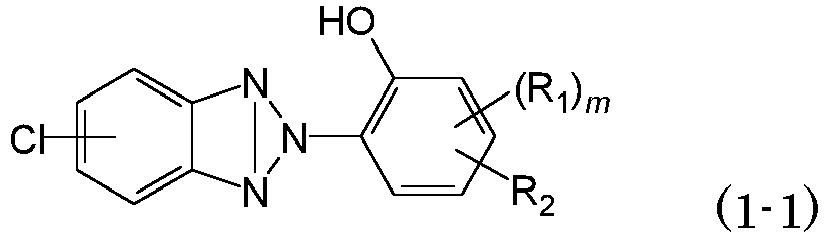
- In formula (1-1), Cl is a group imparting a mesomeric effect. It is expected that the group imparting a mesomeric effect present on the benzotriazole ring enhances the cut rate of blue light.
- The substitution position of Cl is preferably the 5-position of the triazole ring.
- In formula (1-1), R2 is C1-12-alkyl or C1-12-alkoxy, and for each of the alkyl group and the alkoxy group, the number of carbon atoms is preferably 1-8, more preferably 2-8, and further preferably 4-8.
- The alkyl group and the alkoxy group each may be branched or linear. Among alkyl and alkoxy, alkyl is preferred.
- Examples of the alkyl group include methyl, ethyl, n-propyl, isopropyl, n-butyl, sec-butyl, tert-butyl, pentyl, hexyl, heptyl, n-octyl, 1,1,3,3-tetramethylbutyl, nonyl, decyl, undecyl and dodecyl, and among these, n-propyl, isopropyl, n-butyl sec-butyl, tert-butyl and 1,1,3,3-tetramethylbutyl are preferred, n-butyl, sec-butyl, tert-butyl and 1,1,3,3-tetramethylbutyl are more preferred, and tert-butyl is further preferred.
- Examples of the alkoxy group include methoxy, ethoxy, propoxy, butoxy, pentyloxy, hexyloxy, heptyloxy, octyloxy, nonyloxy decyloxy, undecyloxy and dodecyloxy, and among these, butoxy and ethoxy are preferred.
- In formula (1-1), the substitution position of R2 is preferably the 3-position, the 4-position or the 5-position with respect to the substitution position of the benzotriazolyl group.
- In formula (1-1), R1 is C1-3-alkyl or C1-3-alkoxy, and specific examples thereof include the groups described for R2 that conform in the number of carbon atoms. Among the groups, methyl and ethyl are preferred. In the case where R1 is one of these groups, an excellent cut rate of blue light is obtained. In the case where the number of carbon atoms of R1 is ≥ 4 (for example, 2-(3,5-di-t-butyl-2-hydroxyphenyl)-5-chlorobenzotriazole), the compound is a persistent compound, which has a large environment load and may bring possible influence to human body, and thus may be designated as a manufacturing prohibited substance in some cases. However, the compound of formula (1-1) can be decomposed relatively easily, and also has an advantage of less influence on human body.
- In formula (1-1), m is 0 or 1.
- In formula (1-1), the substitution position of R2 is preferably the 5-position with respect to the substitution position of the benzotriazolyl group.
- Specific examples of the benzotriazole compound of formula (1-1) include 2-(3-tert-butyl-2-hydroxy-5-methylphenyl)-5-chloro-2H-benzotriazole, 2-(3-tert-butyl-2-hydroxy-5-ethylphenyl)-5-chloro-2H-benzotriazole, 5-chloro-2-(3,5-dimethyl-2-hydroxyphenyl)-2H-benzotriazole, 5-chloro-2-(3,5-diethyl-2-hydroxyphenyl)-2H-benzotriazole, 5-chloro-2-(2-hydroxy-4-methoxyphenyl)-2H-benzotriazole, 5-chloro-2-(4-ethoxy-2-hydroxyphenyl)-2H-benzotriazole, 2-(4-butoxy-2-hydroxyphenyl)-5-chloro-2H-benzotriazole and 5-chloro-2-(2-hydroxy-4-octyloxyphenyl)-2H-benzotriazole.
- Among these, 2-(3-tert-butyl-2-hydroxy-5-methylphenyl)-5-chloro-2H-benzotriazole, 2-(3-tert-butyl-2-hydroxy-5-ethylphenyl)-5-chloro-2H-benzotriazole, 5-chloro-2-(4-ethoxy-2-hydroxyphenyl)-2H-benzotriazole and 2-(4-butoxy-2-hydroxyphenyl)-5-chloro-2H-benzotriazole are preferred.
- The present transparent plastic substrate preferably contains the benzotriazole compound that is used in an amount of 0.05-3.00 parts by mass (pbm), more preferably 0.05-2.50 pbm, further preferably 0.10-2.00 pbm, and still further preferably 0.30-2.00 pbm, per 100 pbm of the resin component (i.e., a monomer and/or a polymer) constituting the transparent plastic substrate. The amount of the benzotriazole compound added may vary depending on, for example, the kind of the resin component or the target ultraviolet ray absorbing characteristics.
- The resin component constituting the transparent plastic substrate is preferably at least one of a (thio)urethane resin, an episulfide resin, a polycarbonate resin, a polyamide resin, an acrylic resin, a vinyl resin and a polyester resin, and in the case where the transparent plastic substrate is a plastic lens, a (thio)urethane resin and/or an episulfide resin are preferred.
- A (thio)urethane resin herein means at least one of a urethane resin and a thiourethane resin.
- A monomer for forming the (thio)urethane resin in the invention is a raw material monomer for producing a polythiourethane lens or a polyurethane lens, and specific examples thereof include a combination of a polyisocyanate compound and a polythiol compound, and a combination of a polyisocyanate compound and a polyol compound.
- The polyisocyanate compound is not particularly limited, and specific examples thereof include an alicyclic isocyanate compound, such as, bis(isocyanatomethyl)cyclohexane, bis(isocyanatomethyl)bicyclo[2.2.1]heptane, hydrogenated 2,6-tolylene diisocyanate, hydrogenated m- and p-phenylene diisocyanate, hydrogenated 2,4-tolylene diisocyanate, hydrogenated diphenylmethane diisocyanate, hydrogenated m-xylylene diisocyanate, hydrogenated p-xylylene diisocyanate and isophorone diisocyanate; an isocyanate compound that does not have an alicyclic ring or an aromatic ring, such as, m- and p-phenylene diisocyanate, 2,6-tolylene diisocyanate, 2,4-tolylene diisocyanate, 4,4'-diphenylmethane diisocyanate, m- and p-xylylene diisocyanate (bis(isocyanatomethyl)benzene), m- and p-tetramethylxylylene diisocyanate, 2,6-naphthalene diisocyanate, 1,5-naphthalene diisocyanate, hexamethylene diisocyanate, octamethylene diisocyanate, 2,2,4-trimethylhexamethylene diisocyanate, tetramethylene diisocyanate, a biuret reaction product of hexamethylene diisocyanate, a trimer of hexamethylene diisocyanate, lysine diisocyanate, lysine triisocyanate, 1,6,11-undecane triisocyanate and triphenylmethane triisocyanate; and a sulfur-containing isocyanate compound, such as, diphenyl disulfide-4,4'-diisocyanate, 2,2'-dimethyldiphenyl disulfide-5,5'-diisocyanate, 3,3'-dimethyldiphenyl disulfide-5,5'-diisocyanate, 3,3'-dimethyldiphenyl disulfide-6,6'-diisocyanate, 4,4'-dimethyldiphenyl disulfide-5,5'-diisocyanate, 3,3'-dimethoxydiphenyl disulfide-4,4'-diisocyanate, 4,4'-dimethoxydiphenyl disulfide-3,3'-diisocyanate, diphenylsulfone-4,4'-diisocyanate, diphenylsulfone-3,3'-diisocyanate, benzylidenesulfone-4,4'-diisocyanate, diphenylmethanesulfone-4,4'-diisocyanate, 4-methyldiphenylmethanesulfone-2,4'-diisocyanate, 4,4'-dimethoxydiphenylsulfone-3,3'-diisocyanate, 3,3'-dimethoxy-4,4'-diisocyanatodibenzylsulfone, 4,4'-dimethyldiphenylsulfone-3,3'-diisocyanate, 4,4'-di-tert-butyldiphenylsulfone-3,3'-diisocyanate, 4,4'-dimethoxybenzeneethylenesulfone-3,3'-diisocyanate, 4,4'-dichlorodiphenylsulfone-3,3'-diisocyanate, 4-methyl-3-isocyanatobenzenesulfonyl-4'-isocyanatophenol ester, 4-methoxy-3-isocyanatobenzenesulfonyl-4'-isocyanatophenol ester, 4-methyl-3-isocyanatobenzenesulfonylanilide-3'-methyl-4'-isocyanate, dibenzenesulfonyl-ethylenediamine-4,4'-diisocyanate, 4,4'-dimethoxybenzenesulfonyl-ethylenediamine-3,3'-diisocyanate, 4-methyl-3-isocyanatobenzenesulfonylanilide-4-methyl-3'-isocyanate, thiophene-2,5-diisocyanate, thiophene-2,5-diisocyanatomethyl, 1,4-dithiane-2,5-diisocyanate, 1,4-dithiane-2,5-diisocyanatomethyl, 1,4-dithiane-2,3-diisocyanatomethyl, 1,4-dithiane-2-isocyanatomethyl-5-isocyanatopropyl, 1,3-dithiolane-4,5-diisocyanate, 1,3-dithiolane-4,5-diisocyanatomethyl, 1,3-dithiolane-2-methyl-4,5-diisocyanatomethyl, 1,3-dithiolane-2,2-diisocyanatoethyl, tetrahydrothiophene-2,5-diisocyanate, tetrahydrothiophene-2,5-diisocyanatomethyl, tetrahydrothiophene-2,5-diisocyanatoethyl and tetrahydrothiophene-3,4-diisocyanatomethyl. Among these, an alicyclic isocyanate compound is preferred.
- Examples of the polythiol compound include an aliphatic thiol, such as, methanedithiol, 1,2-ethanedithiol, 1,1-propanedithiol, 1,2-propanedithiol, 1,3-propanedithiol, 2,2-propanedithiol, 1,6-hexanedithiol, 1,2,3-propanetrithiol, tetrakis(mercaptomethyl)methane, 1,1-cyclohexanedithiol, 1,2-cyclohexanedithiol, 2,2-dimethylpropane-1,3-dithiol, 3,4-dimethoxybutane-1,2-dithiol, 2-methylcyclohexane-2,3-dithiol, 1,1-bis(mercaptomethyl)cyclohexane, thiomalic acid bis(2-mercaptoethyl ester), 2,3-dimercaptosuccinic acid (2-mercaptoethyl ester), 2,3-dimercapto-1-propanol (2-mercaptoacetate), 2,3-dimercapto-1-propanol (3-mercaptoacetate), diethylene glycol bis(2-mercaptoacetate), diethylene glycol bis(3-merecaptopropionate), 1,2-dimercaptopropyl methyl ether, 2,3-dimercaptopropyl methyl ether, 2,2-bis(mercaptomethyl)-1,3-propanedithiol, bis(2-mercaptoethyl) ether, ethylene glycol bis(2-mercaptoaectate), ethylene glycol bis(3-mercaptopropionate), trimethylolpropane tris(2-mercaptoacetate), trimethylolpropane tris(3-mercaptopropionate), pentaerythritol tetrakis(2-mercaptoacetate), pentaerythritol tetrakis(3-mercaptopropionate) and 1,2-bis(2-mercaptoethylthio)-3-mercaptopropane; an aromatic thiol, such as, 1,2-dimercaptobenzene, 1,3-dimercaptobenzene, 1,4-dimercaptobenzene, 1,2-bis(mercaptomethyl)benzene, 1,3-bis(mercaptomethyl)benzene, 1,4-bis(mercaptomethyl)benzene, 1,3-bis(mercaptoethyl)benzene, 1,4-bis(mercaptoethyl)benzene, 1,2-bis(mercaptomethoxy)benzene, 1,3-bis(mercaptomethoxy)benzene, 1,4-bis(mercaptomethoxy)benzene, 1,2-bis(mercaptoethoxy)benzene, 1,3-bis(mercaptoethoxy)benzene, 1,4-bis(mercaptoethoxy)benzene, 1,2,3-trimercaptobenzene, 1,2,4-trimercaptobenzene, 1,3,5-trimercaptobenzene, 1,2,3-tris(mercaptomethyl)benzene, 1,2,4-tris(mercaptomethyl)benzene, 1,3,5-tris(mercaptomethyl)benzene, 1,2,3-tris(mercaptoethyl)benzene, 1,2,4-tris(mercaptoethyl)benzene, 1,3,5-tris(mercaptoethyl)benzene, 1,2,3-tris(mercaptomethoxy)benzene, 1,2,4-tris(mercaptomethoxy)benzene, 1,3,5-tris(mercaptomethoxy)benzene, 1,2,3-tris(mercaptoethoxy)benzene, 1,2,4-tris(mercaptoethoxy)benzene, 1,3,5-tris(mercaptoethoxy)benzene, 1,2,3,4-tetramercaptobenzene, 1,2,3,5-tetramercaptobenzene, 1,2,4,5-tetramercaptobenzene, 1,2,3,4-tetrakis(mercaptomethyl)benzene, 1,2,3,5-tetrakis(mercaptomethyl)benzene, 1,2,4,5-tetrakis(mercaptomethyl)benzene, 1,2,3,4-tetrakis(mercaptoethyl)benzene, 1,2,3,5-tetrakis(mercaptoethyl)benzene, 1,2,4,5-tetrakis(mercaptoethyl)benzene, 1,2,3,4-tetrakis(mercaptoethyl)benzene, 1,2,3,5-tetrakis(mercaptomethoxy)benzene, 1,2,4,5-tetrakis(mercaptomethoxy)benzene, 1,2,3,4-tetrakis(mercaptoethoxy)benzene, 1,2,3,5-tetrakis(mercaptoethoxy)benzene, 1,2,4,5-tetrakis(mercaptoethoxy)benzene, 2,2'-dimercaptobiphenyl, 4,4'-dimercaptobiphenyl, 4,4'-dimercaptobibenzyl, 2,5-toluenedithiol, 3,4-toluenedithiol, 1,4-naphthalenedithiol, 1,5-naphthalenedithiol, 2,6-naphthalenedithiol, 2,7-naphthalenedithiol, 2,4-dimethylbenzene-1,3-dithiol, 4,5-dimethylbenzene-1,3-dithiol, 9,10-anthracenedimethanethiol, 1,3-di(p-methoxyphenyl)propane-2,2-dithiol, 1,3-diphenylpropane-2,2-dithiol, phenylmethane-1,1-dithiol and 2,4-di(p-mercaptophenyl)pentane; a halogen-substituted aromatic thiol, including a chlorine-substituted compound and a bromine-substituted compound, such as, 2,5-dichlorobenzene-1,3-dithiol, 1,3-di(p-chlorophenyl)propane-2,2-dithiol, 3,4,5-tribromo-1,2-dimercaptobenzene and 2,3,4,6-tetrachloro-1,5-bis(mercaptomethyl)benzene; an aromatic thiol containing a sulfur atom other than a mercapto group, such as, 1,2-bis(mercaptomethylthio)benzene, 1,3-bis(mercaptomethylthio)benzene, 1,4-bis(mercaptomethylthio)benzene, 1,2-bis(mercaptoethylthio)benzene, 1,3-bis(mercaptoethylthio)benzene, 1,4-bis(mercaptoethylthio)benzene, 1,2,3-tris(mercaptomethylthio)benzene, 1,2,4-tris(mercaptomethylthio)benzene, 1,3,5-tris(mercaptomethylthio)benzene, 1,2,3-tris(mercaptoethylthio)benzene, 1,2,4-tris(mercaptoethylthio)benzene, 1,3,5-tris(mercaptoethylthio)benzene, 1,2,3,4-tetrakis(mercaptomethyl thio)benzene, 1,2,3,5-tetrakis(mercaptomethylthio)benzene, 1,2,4,5-tetrakis(mercaptomethylthio)benzene, 1,2,3,4-tetrakis(mercaptoethylthio)benzene, 1,2,3,5-tetrakis(mercaptoethylthio)benzene, 1,2,4,5-tetrakis(mercaptoethylthio)benzene, and nuclear alkylated compounds thereof; an aliphatic thiol containing a sulfur atom other than a mercapto group, such as, bis(mercaptomethyl) sulfide, bis(mercaptoethyl) sulfide, bis(mercaptopropyl) sulfide, bis(mercaptomethylthio)methane, bis(2-mercaptoethylthio)methane, bis(3-mercaptopropylthio)methane, 1,2-bis(mercaptomethylthio)ethane, 1,2-bis(2-mercaptoethylthio)ethane, 1,2-bis(3-mercaptopropylthio)ethane, 1,3-bis(mercaptomethylthio)propane, 1,3-bis(2-mercaptoethylthio)propane, 1,3-bis(3-mercaptopropylthio)propane, 1,2-bis(2-mercaptoethylthio)-3-mercaptopropane, 2-mercaptoethylthio-1,3-propanedithiol, 1,2,3-tris(mercaptomethylthio)propane, 1,2,3-tris(2-mercaptoethylthio)propane, 1,2,3-tris(3-mercaptopropylthio)propane, tetrakis(mercaptomethythiomethyl)methane, tetrakis(2-mercaptoethylthiomethyl)methane, tetrakis(3-mercaptopropylthiomethyl)methane, bis(2,3-dimercaptopropyl) sulfide, 2,5-dimercapto-1,4-dithiane, bis(mercaptomethyl) disulfide, bis(mercaptoethyl) disulfide, bis(mercaptopropyl) disulfide, and esters of these compounds with thioglycolic acid and mercaptopropionic acid, hydroxymethyl sulfide bis(2-mercaptoacetate), hydroxymethyl sulfide bis(3-mercaptopropionate), hydroxyethyl sulfide bis(2-mercaptoacetate), hydroxyethyl sulfide bis(3-mercaptopropyonate), hydroxypropyl sulfide bis(2-mercaptoacetate), hydroxypropyl sulfide bis(3-mercaptopropionate), hydroxymethyl disulfide bis(2-mercaptoacetate), hydroxymethyl disulfide bis(3-mercaptopropionate), hydroxyethyl disulfide bis(2-mercaptoacetate), hydroxyethyl disulfide bis(3-mercaptopropionate), hydroxypropyl disulfide bis(2-mercaptoacetate), hydroxypropyl disulfide bis(3-mercaptopropionate), 2-mercaptoethyl ether bis(2-mercaptoacetate), 2-mercaptoethyl ether bis(3-mercaptopropionate), 1,4-dithiane-2,5-diol bis(2-mercaptoacetate), 1,4-dithiane-2,5-diol bis(3-mercaptopropionate), thioglycolic acid (2-mercaptoethyl ester), thiodipropionic acid bis(2-mercaptoethyl ester), 4,4'-thiodibutyric acid bis(2-mercaptoethyl ester), dithiodiglycolic acid bis(2-mercaptoethyl ester), dithiodipropionic acid bis(2-mercaptoethyl ester), 4,4'-dithiodibtyric acid bis(2-mercaptoethyl ester), thiodiglycolic acid bis(2,3-dimercaptopropyl ester), thiodipropionic acid bis(2,3-dimercaptopropyl ester), dithiodiglycolic acid bis(2,3-dimercaptopropyl ester), dithiodipropionic acid bis(2,3-dimercaptopropyl ester), 4-mercaptomethyl-3,6-dithiaoctane-1,8-dithiol, bis(mercaptomethyl)-3,6,9-trithia-1,11-undecanedithiol and bis(1,3-dimercapto-2-propyl) sulfide; and a heterocyclic compound containing a sulfur atom other than a mercapto group, such as, 3,4-thiophenedithiol, tetrahydrothiophene-2,5-dimercaptomethyl, 2,5-dimercapto-1,3,4-thiadiazole, 2,5-dimercapto-1,4-dithiane and 2,5-dimercaptomethyl-1,4-dithiane.
- Examples of the polyol compound include an aliphatic polyol, such as, ethylene glycol, diethylene glycol, propylene glycol, dipropylene glycol, butylene glycol, neopentyl glycol, glycerin, trimethylolethane, trimethylolpropane, butanetriol, 1,2-methylglycoside, pentaerythritol, dipentaerythritol, tripentaerythritol, triethylene glycol, polyethylene glycol, tris(2-hydroxyethyl) isocyanurate, cyclobutanediol, cyclopentanediol, cyclohexanediol, cycloheptanediol, cyclooctanediol, bicyclo[4.3.0]nonanediol, dicyclohexanediol, tricyclo[5.3.1.1]dodecanediol, spiro[3.4]octanediol and butylcyclohexanediol; an aromatic polyol, such as, dihydroxynaphthalene, trihydroxynaphthalene, tetrahydroxynaphthalene, dihydroxybenzene, benzenetriol, trihydroxyphenanthrene, bisphenol A, bisphenol F, xylylene glycol and tetrabromobisphenol A, and addition reaction products of these compounds with an alkylene oxide, such as, ethylene oxide and propylene oxide; bis(4-(hydroxyethoxy)phenyl) sulfide, bis(4-(2-hydroxypropoxy)phenyl) sulfide, bis(4-(2,3-dihydroxypropoxy)phenyl) sulfide, bis(4-(4-hydroxycyclohexyloxy)phenyl) sulfide, bis(2-methyl-4-(hydroxyethoxy)-6-butylphenyl) sulfide, and these compounds having ethylene oxide and/or propylene oxide added thereto in an amount of 3 molecules in average or less per one hydroxyl group; and a polyol containing a sulfur atom, such as, di(2-hydroxyethyl) sulfide, 1,2-bis(2-hydroxyethylmercapto)ethane, bis(2-hydroxyethyl) disulfide, 1,4-dithiane-2,5-diol, bis(2,3-dihydroxypropyl) sulfide, tetrakis(4-hydroxy-2-thiabutyl)methane, bis(4-hydroxyphenyl)sulfone (trade name: bisphenol S), tetrabromobisphenol S, tetramethylbisphenol S, 4,4'-thiobis(6-tert-butyl-3-methylphenol) and 1,3-bis(2-hydroxyethylthioethyl)cyclohexane.
- The monomer for forming the (thio)urethane resin has been known, and specific examples of the known publications that describe the monomer include
JP-A-58-127914 JP-A-57-136601 JP-A-01-163012 JP-A-03-236386 JP-A-03-281312 JP-A-04-159275 JP-A-05-148340 JP-A-06-065193 JP-A-06-256459 JP-A-06-313801 JP-A-06-192250 JP-A-07-063902 JP-A-07-104101 JP-A-07-118263 JP-A-07-118390 JP-A-07-316250 JP-A-60-199016 JP-A-60-217229 JP-A-62-236818 JP-A-62-255901 JP-A-62-267316 JP-A-63-130615 JP-A-63-130614 JP-A-63-046213 JP-A-63-245421 JP-A-63-265201 JP-A-01-090167 JP-A-01-090168 JP-A-01-090169 JP-A-01-090170 JP-A-01-096208 JP-A-01-152019 JP-A-01-045611 JP-A-01-213601 JP-A-01-026622 JP-A-01-054021 JP-A-01-311118 JP-A-01-295201 JP-A-01-302202 JP-A-02-153302 JP-A-01-295202 JP-A-02-000802 JP-A-02-036216 JP-A-02-058517 JP-A-02-167330 JP-A-02-270859 JP-A-03-084031 JP-A-03-084021 JP-A-03-124722 JP-A-04-078801 JP-A-04-117353 JP-A-04-117354 JP-A-04-256558 JP-A-05-078441 JP-A-05-273401 JP-A-05-093801 JP-A-05-080201 JP-A-05-297201 JP-A-05-320301 JP-A-05-208950 JP-A-06-072989 JP-A-06-256342 JP-A-06-122748 JP-A-07-165859 JP-A-07-118357 JP-A-07-242722 JP-A-07-247335 JP-A-07-252341 JP-A-08-073732 JP-A-08-092345 JP-A-07-228659 JP-A-08-003267 JP-A-07-252207 JP-A-07-324118 JP-A-09-208651 - The monomer for forming the episulfide resin in the present invention may also be referred to as a monomer forming an epithio structure, and means a monomer having an episulfide group (epithio group) and a monomer mixture containing the monomer. Specific examples of the monomer having an episulfide group include an episulfide compound having an alicyclic structure, such as, 1,3- and 1,4-bis(β-epithiopropylthio)cyclohexane, 1,3- and 1,4-bis(β-epithiopropylthiomethyl)cyclohexane, bis(4-(β-epithiopropylthio)cyclohexyl)methane, 2,2-bis(4-(β-epithiopropylthio)cyclohexyl)propane and bis(4-(β-epithiopropylthio)cyclohexyl)sulfide; an episulfide compound having an aromatic structure, such as, 1,3- and 1,4-bis(β-epithiopropylthio)benzene, 1,3- and 1,4-bis(β-epithiopropylthiomethyl)benzene, bis(4-(β-epithiopropylthio)phenyl)methane, 2,2-bis(4-(β-epithiopropylthio)phenyl)propane, bis(4-(β-epithiopropylthio)phenyl) sulfide, bis(4-(β-epithiopropylthio)phenyl)sulfine and 4,4-bis(β-epithiopropylthio)biphenyl; an episulfide compound having a dithiane ring structure, such as, 2,5-bis(β-epithiopropylthiomethyl)-1,4-dithiane, 2,5-bis(β-epithiopropylthioethylthiomethyl)-1,4-dithiane, 2,5-bis(β-epithiopropylthioethyl)-1,4-dithiane and 2,3,5-tri(β-epithiopropylthioethyl)-1,4-dithiane; and an episulfide compound having an aliphatic structure, such as, 2-(2-β-epithiopropylthioethylthio)-1,3-bis(β-epithiopropylthio)propane, 1,2-bis((2-β-epithiopropylthioethyl)thio)-3-(β-epithiopropylthio)propane, tetrakis(β-epithiopropylthiomethyl)methane, 1,1,1-tris(β-epithiopropylthiomethyl)propane and bis(β-epithiopropyl) sulfide.
- The monomer forming the episulfide resin has been known, and specific examples of the known publications therefore include
JP-A-09-071580 JP-A-09-110979 JP-A-09-255781 JP-A-03-081320 JP-A-11-140070 JP-A-11-183702 JP-A-11-189592 JP-A-11-180977 JP-A-01-810575 - In the present invention, a diethylene glycol bisallyl carbonate monomer as an optional component may be added to the monomer forming the (thio)urethane resin and/or the episulfide resin.
- As the diethylene glycol bisallyl carbonate monomer, applicable are sole diethylene glycol bisallyl carbonate, and a monomer mixture containing diethylene glycol bisallyl carbonate and a monomer that is copolymerizable therewith. Specific examples of the copolymerizable monomer include an aromatic vinyl compound, such as, styrene, α-methylstyrene, vinyltoluene, chlorostyrene, chloromethylstyrene and divinylbenzene; a mono(meth)acrylate compound, such as, methyl (meth)acrylate, n-butyl (meth)acrylate, n-hexyl (meth)acrylate, cyclohexyl (meth)acrylate, 2-ethylhexyl (meth)acrylate, methoxydiethylene glycol (meth)acrylate, methoxypolyethylene glycol (meth)acrylate, 3-chloro-2-hydroxypropyl (meth)acrylate, stearyl (meth)acrylate, lauryl (meth)acrylate, phenyl (meth)acrylate, glycidyl (meth)acrylate and benzyl methacrylate; a mono(meth)acrylate compound having a hydroxyl group, such as, 2-hydroxyethyl (meth)acrylate, 2-hydroxypropyl (meth)acrylate, 3-hydroxypropyl (meth)acrylate, 3-phenoxy-2-hydroxypropyl (meth)acrylate and 4-hydroxybutyl (meth)acrylate; a di(meth)acrylate compound, such as, ethylene glycol di(meth)acrylate, diethylene glycol di(meth)acrylate, triethylene glycol di(meth)acrylate, polyethylene glycol di(meth)acrylate, 1,3-butylene glycol di(meth)acrylate, 1,6-hexanediol di(meth)acrylate, neopentyl glycol di(meth)acrylate, polypropylene glycol di(meth)acrylate, 2-hydroxy-1,3-di(meth)acryloxypropane, 2,2-bis(4-((meth)acryloxyethoxy)phenyl)propane, 2,2-bis(4-((meth)acryloxy·diethoxy)phenyl)propane and 2,2-bis (4-((meth)acryloxy·polyethoxy)phenyl)propane; a tri(meth) acrylate compound, such as, trimethylolpropane trimethacrylate and tetramethylolmethane trimethacrylate; a tetra(meth)acrylate compound, such as, tetramethylolmethane tetra(meth)acrylate (provided that the term (meth)acrylate in the description means methacrylate or acrylate); diallyl phthalate, diallyl isophthalate, diallyl terephthalate.
- In the present transparent plastic substrate, in the case where the monomer having a thiourethane structure is used as a main component, the transparent plastic substrate is preferably polymerized from a raw material having a total mass of the polyisocyanate compound and the polythiol compound as the raw material monomers of 0.6 or more with respect to the total mass of the raw material monomers being 1.
- In the case where the monomer forming the episulfide resin is used as a main component, the transparent plastic substrate is preferably polymerized from a raw material having an amount of the compound having an episulfide group as the raw material monomer of 0.6 or more with respect to the total mass of the raw material monomers being 1.
- Examples of the production method of the present transparent plastic substrate include a method of mixing at least one benzotriazole compound of formula (1-1) with, for example, a monomer forming a (thio)urethane resin and/or an episulfide resin, and then polymerizing the monomers. The polymerization method of the raw material monomer is not particularly limited, and in general, cast polymerization is employed. Specifically, at least one benzotriazole compound of formula (1-1) may be mixed with the raw material monomer, and then the mixed liquid may be charged in a mold for forming a lens and heated to a temperature generally of 20-150°C, thereby providing the transparent plastic substrate.
- As another production method of the present transparent plastic substrate, such a method may also be employed that at least one benzotriazole compound of formula (1-1) and an appropriate surfactant are dissolved or dispersed in water, and a transparent plastic substrate is immersed therein to infiltrate the transparent plastic substrate with the benzotriazole compound, thereby providing the transparent plastic substrate.
- The mixed liquid of the benzotriazole compound of formula (1-1) and the raw material monomer for the transparent plastic substrate may contain depending on necessity a polymerization catalyst described in e.g.
JP-A-07-063902 JP-A-07-104101 JP-A-09-208621 JP-A-09-255781 JP-A-01-163012 JP-A-03-281312 - The present transparent plastic member contains the benzotriazole compound of formula (1-1), and may have, for example, a functional layer, and preferably contains the transparent plastic substrate and a functional layer.
- The present transparent plastic member is preferably a plastic lens, and more preferably a plastic lens for spectacles.
- As the functional layer, at least one selected from a cured film, a primer layer, an antireflection film and a water-repellent film may be exemplified.
- Specifically, for enhancing the scratch resistance, a cured film may be formed on the transparent plastic substrate by using a coating liquid containing fine particles of an inorganic material, such as, an organosilicon compound, tin oxide, silicon oxide, zirconium oxide and titanium oxide. For enhancing the impact resistance, a primer layer containing a polyurethane as a main component may be provided. For imparting an antireflection function, an antireflection film may be formed by using e.g. silicon oxide, titanium dioxide, zirconium oxide or tantalum oxide. For enhancing the water repelling property, a water-repellent film may be formed on the antireflection film by using an organosilicon compound having a fluorine atom.
- In the present transparent plastic member, the portion thereof that contains the benzotriazole compound of formula (1-1) is not particularly limited, and the benzotriazole compound may be contained in any of the functional layer and the transparent plastic substrate. More specifically, the benzotriazole compound may be contained in any of the transparent plastic substrate, the cured film, the primer layer, the antireflection film, and the water-repellent film.
- The benzotriazole compound of formula (1-1) is preferably contained in the transparent plastic substrate.
- As a method for producing the transparent plastic member having the benzotriazole compound contained in the functional layer thereof, such a method may be employed that at least one benzotriazole compound of formula (1-1), the resin components, and depending on necessity e.g. a solvent are mixed to prepare a composition, and the composition is coated on at least one surface of a plastic lens substrate, and then cured to form the functional layer, thereby providing the transparent plastic member.
- The present transparent plastic member (or the transparent plastic substrate) preferably has a cut rate of light in the blue region of 380-500 nm of ≥ 35%, and more preferably ≥ 40%, and while not limited, preferably ≤ 60%, and more preferably ≤ 50%.
- The cut rate of light having a wavelength of 410 nm is preferably ≥ 50%, and more preferably ≥ 60%.
- The term transparent in the present invention means that a material is transparent to such an extent that the side therebehind can be viewed.
- The transparent plastic substrate of the present invention preferably has a light transmittance in a wavelength range of 400-700 nm of ≥ 70%, more preferably ≥ 80%, and further preferably ≥ 90%.
- The present invention will be described specifically with reference to examples, but the present invention is not limited to the examples. A plastic lens will be described as an example of the transparent plastic member. The plastic lenses thus obtained were measured for the properties in the following manners.
- The transmittances in a wavelength range of 380-500 nm were measured with a spectrophotometer (U-4100, produced by Hitachi, Ltd.), and the cut rate of blue light was calculated from the transmittances (T) of every 10 nm according to the following expression.

- The light transmittance at a wavelength of 410 nm was measured with a spectrophotometer, and the cut rate of light was calculated according to the following expression.

- 50.28 pbm of bis(isocyanatomethyl)bicyclo[2.2.1]heptane as a raw material monomer for a lens, 0.06 pbm of dimethyltin dichloride as a catalyst, 0.15 pbm of an acidic phosphate ester, JP-506H (produced by Johoku Chemical Co., Ltd.), as a releasing agent, and 1.90 pbm of 2-(3-tert-butyl-2-hydroxy-5-methylphenyl)-5-chloro-2H-benzotriazole as an ultraviolet ray absorbent were mixed by stirring, to which 25.50 pbm of pentaerythritol tetrakis(3-mercaptopropionate) and 24.22 pbm of 1,2-bis(2-mercaptoethylthio)-3-mercaptopropane as lens raw materials were then further added, and the components were mixed by stirring under a reduced pressure of 10 mmHg for 30 minutes, thereby preparing a monomer composition for a lens. The monomer composition for a lens was charged in a mold for molding a lens formed of a glass mold and a resin gasket (set to 0.00D and thickness of 1.6 mm) provided in advance and polymerized in an electric furnace at a temperature over 20°C to 120°C for 24 hours. After completing the polymerization, the gasket and the mold were removed, and the resulting molded article was heat-treated at 120°C for 2 hours, thereby providing a transparent plastic lens.
- The results obtained by measuring the resulting lens for the cut rate at 410 nm and the cut rate of blue light are shown in Table 1.
- Transparent plastic lenses were obtained in the same manner as in Example 1 except that the kinds and the amounts of the raw material monomer for a lens and the ultraviolet ray absorbent were changed as shown in Table 1.
- The results obtained by measuring the resulting lenses for the cut rate at 410 nm and the cut rate of blue light are shown in Table 1.
- 93.00 pbm of bis(β-epithiopropyl) sulfide and 1.00 pbm of 2-hydroxyethyl methacrylate as raw materials for a lens, and 0.40 pbm of 2-(3-tert-butyl-2-hydroxy-5-methylphenyl)-5-chloro-2H-benzotriazole as an ultraviolet ray absorbent were mixed by stirring, to which 6.00 pbm of n-butyl thioglycolate and 0.05 pbm of tetra-n-butylphosphonium bromide as a catalyst were further added, and the components were mixed by stirring under a reduced pressure of 10 mmHg for 3 minutes, thereby preparing a monomer composition for a lens. The monomer composition for a lens was charged in a mold for molding a lens formed of a glass mold and a resin gasket (set to 0.00D and thickness of 1.6 mm) provided in advance and polymerized in an electric furnace at a temperature over 20°C to 100°C for 20 hours. After completing the polymerization, the gasket and the mold were removed, and the resulting molded article was heat-treated at 110°C for 1 hour, thereby providing a transparent plastic lens.
- The results obtained by measuring the resulting lens for the cut rate at 410 nm and the cut rate of blue light are shown in Table 1.
- 90.00 pbm of methyl methacrylate and 10.00 pbm of ethylene glycol dimethacrylate as raw materials for a lens, 1.00 pbm of 2-(3-tert-butyl-2-hydroxy-5-methylphenyl)-5-chloro-2H-benzotriazole as an ultraviolet ray absorbent, and 0.10 pbm of azobisisobutyronitrile as a thermal polymerization initiator were mixed by stirring, and the components were well agitated at room temperature and then deaerated under a reduced pressure of 50 mmHg for 10 minutes. The monomer composition for a lens was charged in a mold for molding a lens formed of a glass mold and a resin gasket (set to 0.00D and thickness of 1.6 mm) provided in advance and polymerized in an electric furnace at a temperature over 40°C to 85°C for 24 hours. After completing the polymerization, the gasket and the mold were removed, and the resulting molded article was heat-treated at 100°C for 2 hours, thereby providing a transparent plastic lens.
- The results obtained by measuring the resulting lens for the cut rate at 410 nm and the cut rate of blue light are shown in Table 1.
- To 100 pbm of polycarbonate resin powder, which was obtained by polymerization by an ordinary interface polymerization of bisphenol A and phosgene, 1.00 pbm of 2-(3-tert-butyl-2-hydroxy-5-methylphenyl)-5-chloro-2H-benzotriazole as an ultraviolet ray absorbent was added, sufficiently mixed with a tumbler mixer, and then formed into pellets with a vent-type twin screw extruder having a diameter of 30 mm at a temperature of 290°C and a vacuum degree of 4.7 kPa. The resulting pellets were subjected to injection compression molding, thereby providing a transparent plastic lens.
- The results obtained by measuring the resulting lens for the cut rate at 410 nm and the cut rate of blue light are shown in Table 1.
- A transparent plastic lens was obtained in the same manner as in Example 8 except that 0.40 pbm of 2-(2-hydroxy-4-octyloxyphenyl)-2H-benzotriazole was used as an ultraviolet ray absorbent.
- The results obtained by measuring the resulting lens for the cut rate at 410 nm and the cut rate of blue light are shown in Table 1.
Table 1 Lens raw material monomer/resin (proportion in 100 pbm) Ultraviolet ray absorbent (part by mass) Cut rate at 410 nm Cut rate of blue light Example 1 M-1 50.28% U-1 1.90 99% 46% M-2 25.50% M-3 24.22% Example 2 M-1 50.28% U-1 1.00 99% 45% M-2 25.50% M-3 24.22% Example 3 M-4 52.02% U-1 0.20 87% 41% M-3 47.98% Example 4 M-5 47.54% U-2 1.20 99% 45% M-6 26.46% M-7 26.00% Example 5 M-5 47.54% U-3 2.00 87% 40% M-6 26.46% M-7 26.00% Example 6 M-5 47.54% U-4 2.50 88% 41% M-6 26.46% M-7 26.00% Example 7 M-4 52.02% U-1 0.10 69% 40% M-3 47.98% Example 8 M-8 93.00% U-1 0.40 99% 45% M-9 M-10 1.00% 6.00% Example 9 M-11 90.00% U-1 1.00 99% 45% M-12 10.00% Example 10 M-13 100.00% U-1 1.00 99% 45% Comparative Example 1 M-1 50.28% U-5 1.00 35% 32% M-2 25.50% M-3 24.22% Comparative Example 2 M-4 52.02% U-5 0.50 35% 32% M-3 47.98% Comparative Example 3 M-8 93.00% U-5 0.40 32% 30% M-9 1.00% M-10 6.00% - Each monomer or resin, and each ultraviolet absorbent shown in the table are as follows.
-
- M-1: bis(isocyanatomethyl)bicyclo[2.2.1]heptane
- M-2: pentaerythritol tetrakis(3-mercaptopropionate)
- M-3: 1,2-bis(2-mercaptoethylthio)-3-mercaptopropane
- M-4: bis(isocyanatomethyl)benzene
- M-5: bis(isocyanatomethyl)cyclohexane
- M-6: pentaerythritol tetrakismercaptoacetate
- M-7: 2,5-bismercaptomethyl-1,4-dithiane
- M-8: bis(β-epithiopropyl) sulfide
- M-9: 2-hydroxyethyl methacrylate
- M-10: n-butyl thioglycolate
- M-11: methyl methacrylate
- M-12: ethylene glycol dimethacrylate
- M-13: polycarbonate resin
-
- U-1: 2-(3-tert-butyl-2-hydroxy-5-methylphenyl)-5-chloro-2H-benzotriazole
- U-2: 2-(3-tert-butyl-2-hydroxy-5-ethylphenyl)-5-chloro-2H-benzotriazole
- U-3: 2-(4-ethoxy-2-hydroxyphenyl)-5-chloro-2H-benzotriazole
- U-4: 2-(4-butoxy-2-hydroxyphenyl)-5-chloro-2H-benzotriazole
- U-5: 2-(2-hydroxy-4-octyloxyphenyl)-2H-benzotriazole
- While the plastic lenses are shown in the examples, the same effect can be obtained by providing a transparent plastic member containing the benzotriazole compound of formula (1-1), for example, on a display screen of a personal computer, a mobile phone and a smartphone.
Claims (5)
- A transparent plastic substrate comprising(i) a resin component constituting the transparent plastic substrate, which resin component is an episulfide resin; and(ii) 0.10-2.00 parts by mass, per 100 parts by mass of the resin component constituting the transparent plastic substrate, of a benzotriazole compound of the formula (1-1) :

- The transparent plastic substrate of claim 1, wherein the benzotriazole compound is at least one selected from 2-(3-tert-butyl-2-hydroxy-5-methylphenyl)-5-chloro-2H-benzotriazole, 2-(3-tert-butyl-2-hydroxy-5-ethylphenyl)-5-chloro-2H-benzotriazole, 2-(4-ethoxy-2-hydroxyphenyl)-5-chloro-2H-benzotriazole and 2-(4-butoxy-2-hydroxyphenyl)-5-chloro-2H-benzotriazole.
- The transparent plastic substrate of claims 1 or 2, which has a cut rate of light in the wavelength range of 380-500 nm of ≥ 35%.
- The transparent plastic substrate of any of claims 1-3, which has a cut rate of light having a wavelength of 410 nm of ≥ 50%.
- A plastic lens comprising the transparent plastic substrate of any of claims 1-4.
Priority Applications (4)
| Application Number | Priority Date | Filing Date | Title |
|---|---|---|---|
| EP18211291.2A EP3483220B1 (en) | 2013-09-30 | 2014-09-29 | Transparent plastic substrate and plastic lens |
| EP18211290.4A EP3483219B1 (en) | 2013-09-30 | 2014-09-29 | Transparent plastic substrate and plastic lens |
| EP21184222.4A EP3936904A1 (en) | 2013-09-30 | 2014-09-29 | Transparent plastic substrate and plastic lens |
| EP21184223.2A EP3936905B1 (en) | 2013-09-30 | 2014-09-29 | Transparent plastic substrate and plastic lens |
Applications Claiming Priority (2)
| Application Number | Priority Date | Filing Date | Title |
|---|---|---|---|
| JP2013205517 | 2013-09-30 | ||
| PCT/JP2014/075963 WO2015046540A1 (en) | 2013-09-30 | 2014-09-29 | Transparent plastic substrate and plastic lens |
Related Child Applications (6)
| Application Number | Title | Priority Date | Filing Date |
|---|---|---|---|
| EP18211290.4A Division EP3483219B1 (en) | 2013-09-30 | 2014-09-29 | Transparent plastic substrate and plastic lens |
| EP18211290.4A Division-Into EP3483219B1 (en) | 2013-09-30 | 2014-09-29 | Transparent plastic substrate and plastic lens |
| EP18211291.2A Division EP3483220B1 (en) | 2013-09-30 | 2014-09-29 | Transparent plastic substrate and plastic lens |
| EP18211291.2A Division-Into EP3483220B1 (en) | 2013-09-30 | 2014-09-29 | Transparent plastic substrate and plastic lens |
| EP21184222.4A Division EP3936904A1 (en) | 2013-09-30 | 2014-09-29 | Transparent plastic substrate and plastic lens |
| EP21184223.2A Division EP3936905B1 (en) | 2013-09-30 | 2014-09-29 | Transparent plastic substrate and plastic lens |
Publications (3)
| Publication Number | Publication Date |
|---|---|
| EP3056545A1 EP3056545A1 (en) | 2016-08-17 |
| EP3056545A4 EP3056545A4 (en) | 2018-04-18 |
| EP3056545B1 true EP3056545B1 (en) | 2020-10-21 |
Family
ID=52743661
Family Applications (5)
| Application Number | Title | Priority Date | Filing Date |
|---|---|---|---|
| EP18211291.2A Revoked EP3483220B1 (en) | 2013-09-30 | 2014-09-29 | Transparent plastic substrate and plastic lens |
| EP18211290.4A Active EP3483219B1 (en) | 2013-09-30 | 2014-09-29 | Transparent plastic substrate and plastic lens |
| EP21184222.4A Pending EP3936904A1 (en) | 2013-09-30 | 2014-09-29 | Transparent plastic substrate and plastic lens |
| EP14847241.8A Revoked EP3056545B1 (en) | 2013-09-30 | 2014-09-29 | Transparent plastic substrate and plastic lens |
| EP21184223.2A Active EP3936905B1 (en) | 2013-09-30 | 2014-09-29 | Transparent plastic substrate and plastic lens |
Family Applications Before (3)
| Application Number | Title | Priority Date | Filing Date |
|---|---|---|---|
| EP18211291.2A Revoked EP3483220B1 (en) | 2013-09-30 | 2014-09-29 | Transparent plastic substrate and plastic lens |
| EP18211290.4A Active EP3483219B1 (en) | 2013-09-30 | 2014-09-29 | Transparent plastic substrate and plastic lens |
| EP21184222.4A Pending EP3936904A1 (en) | 2013-09-30 | 2014-09-29 | Transparent plastic substrate and plastic lens |
Family Applications After (1)
| Application Number | Title | Priority Date | Filing Date |
|---|---|---|---|
| EP21184223.2A Active EP3936905B1 (en) | 2013-09-30 | 2014-09-29 | Transparent plastic substrate and plastic lens |
Country Status (9)
| Country | Link |
|---|---|
| US (4) | US20160215121A1 (en) |
| EP (5) | EP3483220B1 (en) |
| JP (9) | JP6791546B2 (en) |
| KR (5) | KR102358067B1 (en) |
| CN (10) | CN106977901A (en) |
| AU (5) | AU2014324967B2 (en) |
| BR (1) | BR112016006703A2 (en) |
| ES (1) | ES3071463T3 (en) |
| WO (1) | WO2015046540A1 (en) |
Families Citing this family (37)
| Publication number | Priority date | Publication date | Assignee | Title |
|---|---|---|---|---|
| BR112016006703A2 (en) * | 2013-09-30 | 2017-08-01 | Hoya Lens Thailand Ltd | clear plastic substrate and plastic lens |
| CN105793737B (en) * | 2013-12-13 | 2020-03-03 | 三井化学株式会社 | Polymerizable composition for optical materials |
| MX388859B (en) | 2015-09-29 | 2025-03-20 | Vision Ease Lp | UV LIGHT AND HIGH ENERGY VISIBLE LIGHT ABSORBING OPHTHALMIC LENSES. |
| EP3203271B1 (en) | 2016-02-08 | 2021-01-27 | Essilor International | Blue light cutting optical material comprising a benzotriazole uv absorber |
| WO2017150739A1 (en) | 2016-03-04 | 2017-09-08 | 大日本印刷株式会社 | Optical laminate, image display device, or touch panel sensor |
| CN108474966A (en) * | 2016-03-31 | 2018-08-31 | 豪雅镜片泰国有限公司 | Spectacle Lenses & Glasses |
| EP3236296B1 (en) | 2016-04-21 | 2019-03-06 | Essilor International | Optical material comprising a red-shifted benzotriazole uv absorber |
| EP3480635A4 (en) * | 2016-06-30 | 2020-04-29 | Hoya Lens Thailand Ltd. | PROCESS FOR MANUFACTURING GLASSES OF GLASSES |
| JPWO2018008179A1 (en) * | 2016-07-06 | 2019-04-18 | 伊藤光学工業株式会社 | Glasses material |
| US10890699B2 (en) * | 2016-09-07 | 2021-01-12 | Largan Precision Co., Ltd. | Optical image lens assembly, image capturing apparatus and electronic device |
| JP6354888B2 (en) * | 2016-12-28 | 2018-07-11 | 住友ベークライト株式会社 | Optical layer |
| US10908333B2 (en) | 2017-01-31 | 2021-02-02 | Dai Nippon Printing Co., Ltd. | Optical film, polarization plate, and image display device |
| EP3605203A4 (en) * | 2017-03-31 | 2020-12-30 | Hoya Lens Thailand Ltd. | Spectacle lens |
| WO2018221466A1 (en) * | 2017-05-31 | 2018-12-06 | 株式会社ニコン・エシロール | Eyeglass lens, composition for primer layer formation, and method for manufacturing eyeglass lens |
| JP7116727B2 (en) | 2017-06-14 | 2022-08-10 | 株式会社トクヤマ | Primer composition and laminate for optical article |
| US11472943B2 (en) | 2017-07-26 | 2022-10-18 | Mitsui Chemicals, Inc. | Polymerizable composition for optical material, optical material, and application thereof |
| CN107446478A (en) * | 2017-08-04 | 2017-12-08 | 江苏明月光电科技有限公司 | A kind of manufacture method of anti-high energy blue light and high-energy gold-tinted resin lens |
| CN107479123A (en) * | 2017-08-04 | 2017-12-15 | 江苏明月光电科技有限公司 | A kind of anti-high energy blue light resin lens and its manufacturing process |
| CN107703565A (en) * | 2017-08-04 | 2018-02-16 | 江苏明月光电科技有限公司 | A kind of anti-high-energy gold-tinted resin lens and its production method |
| JP7083350B2 (en) * | 2017-09-15 | 2022-06-10 | 株式会社ニコン・エシロール | Plastic base material, plastic lens |
| WO2019065985A1 (en) * | 2017-09-29 | 2019-04-04 | ホヤ レンズ タイランド リミテッド | Spectacle lens and spectacles |
| JP6473282B1 (en) * | 2017-09-29 | 2019-02-20 | ホヤ レンズ タイランド リミテッドHOYA Lens Thailand Ltd | Eyeglass lenses and eyeglasses |
| JP7036502B2 (en) * | 2017-09-29 | 2022-03-15 | ホヤ レンズ タイランド リミテッド | Manufacturing method of resin for optical members, resin for optical members, spectacle lenses and spectacles |
| JP6873880B2 (en) * | 2017-09-29 | 2021-05-19 | ホヤ レンズ タイランド リミテッドHOYA Lens Thailand Ltd | Eyeglass lenses and eyeglasses |
| CN111138617B (en) * | 2018-11-02 | 2022-07-12 | 万华化学集团股份有限公司 | Polyurethane optical material resin and preparation method thereof |
| JP7223771B2 (en) | 2018-12-17 | 2023-02-16 | 株式会社トクヤマ | Curable composition for optical material and optical material |
| JP7654408B2 (en) * | 2019-02-08 | 2025-04-01 | 三井化学株式会社 | Polymerizable composition for optical material, optical material and use thereof |
| EP4435499A3 (en) | 2019-09-18 | 2024-11-27 | Mitsui Chemicals, Inc. | Benzotriazole compound, light absorber, and resin composition |
| CN111303612B (en) * | 2019-11-18 | 2022-02-15 | 万华化学集团股份有限公司 | Blue-light-proof polyurethane optical resin material |
| WO2021111830A1 (en) * | 2019-12-06 | 2021-06-10 | 株式会社ニコン・エシロール | Plastic substrate and plastic lens |
| JP7687874B2 (en) * | 2021-06-15 | 2025-06-03 | 株式会社シード | Blue light absorbing hydrogel |
| CN113956457A (en) * | 2021-11-16 | 2022-01-21 | 丹阳市精通眼镜技术创新服务中心有限公司 | PC-based blue-light-proof resin and preparation method thereof |
| TWI793944B (en) * | 2021-12-24 | 2023-02-21 | 永勝光學股份有限公司 | Blue light filtering ophthalmic lens and manufacturing method for the same |
| US20240111077A1 (en) * | 2022-09-16 | 2024-04-04 | Canon Kabushiki Kaisha | Optical element, optical apparatus, and image pickup apparatus |
| KR20250151648A (en) * | 2023-03-31 | 2025-10-21 | 호야 렌즈 타일랜드 리미티드 | UV absorbers and eyeglass lenses |
| WO2024204494A1 (en) * | 2023-03-31 | 2024-10-03 | ホヤ レンズ タイランド リミテッド | Ultraviolet absorber and spectacle lens |
| WO2026164249A1 (en) * | 2025-01-31 | 2026-08-06 | ホヤ レンズ タイランド リミテッド | Polymerizable composition, optical article, and spectacles |
Citations (13)
| Publication number | Priority date | Publication date | Assignee | Title |
|---|---|---|---|---|
| US4795461A (en) | 1985-07-19 | 1989-01-03 | Pharmacia Ab | UV absorbing lens material |
| US6117923A (en) | 1997-04-22 | 2000-09-12 | Mitsubishi Gas Chemical Company, Inc. | Resin for optical material |
| US6187844B1 (en) | 1998-02-10 | 2001-02-13 | Asahi Kogaku Kogyo Kabushiki Kaisha | Plastic lens |
| US6201061B1 (en) | 1998-03-26 | 2001-03-13 | Mitsubishi Gas Chemical Company, Inc. | Process for producing a novel resin for optical materials having excellent color tone and transparency |
| JP2001164110A (en) | 1999-12-10 | 2001-06-19 | Mitsui Chemicals Inc | Polymerizable composition |
| JP3491660B2 (en) | 1995-08-16 | 2004-01-26 | 三菱瓦斯化学株式会社 | Novel linear alkyl sulfide type episulfide compound |
| JP2004131652A (en) | 2002-10-11 | 2004-04-30 | Mitsubishi Engineering Plastics Corp | Aromatic polycarbonate resin composition and molded article using the composition |
| JP2005292240A (en) | 2004-03-31 | 2005-10-20 | Hoya Corp | Ultraviolet absorber, plastic spectacle lens using the same, and its manufacturing method |
| JP2007090574A (en) | 2005-09-27 | 2007-04-12 | Hoya Corp | Manufacturing method of plastic lens |
| WO2008029994A1 (en) | 2006-09-06 | 2008-03-13 | Shin Dae Specialties Co., Ltd. | Optical resin composition having excellent impact resistance and method for fabricating optical lens using the same |
| US20090029172A1 (en) | 2005-02-17 | 2009-01-29 | Idemitsu Kosan Co., Ltd. | Thermoplastic resin composition having ability to absorb light with wavelength of 420 nm and molded body thereof |
| EP2058346A1 (en) | 2006-09-19 | 2009-05-13 | Mitsubishi Gas Chemical Company, Inc. | Resin composition for optical material and optical material using the same |
| JP2012173704A (en) | 2011-02-24 | 2012-09-10 | Ito Kogaku Kogyo Kk | Antiglare optical element |
Family Cites Families (154)
| Publication number | Priority date | Publication date | Assignee | Title |
|---|---|---|---|---|
| JPS57136601A (en) | 1981-02-19 | 1982-08-23 | Toray Ind Inc | Urethan resin plastic lens |
| US4440918A (en) | 1982-01-18 | 1984-04-03 | Minnesota Mining And Manufacturing Company | Contact lens containing a fluorinated telechelic polyether |
| JPS60199016A (en) | 1984-03-23 | 1985-10-08 | Mitsui Toatsu Chem Inc | Thiocarbomic acid s-alkyl ester resin for lens |
| JPS60217229A (en) | 1984-04-11 | 1985-10-30 | Mitsui Toatsu Chem Inc | Sulfur atom-containing polyurethane resin for lens |
| JPH079481B2 (en) | 1984-04-11 | 1995-02-01 | 三井東圧化学株式会社 | Polyurethane-based plastic lens containing sulfur atoms |
| JPS6346213A (en) | 1986-03-01 | 1988-02-27 | Mitsui Toatsu Chem Inc | Resin for high-refractive index plastic lens |
| JPS62236818A (en) | 1986-04-07 | 1987-10-16 | Mitsui Toatsu Chem Inc | Casting of sulfur-containing urethane resin |
| JPS62255901A (en) | 1986-04-30 | 1987-11-07 | Mitsui Toatsu Chem Inc | Method for coloring lens made of sulfur-containing urethane |
| JPS62267316A (en) | 1986-05-16 | 1987-11-20 | Mitsui Toatsu Chem Inc | Resin for plastic lens having high refractive index |
| JPH0678415B2 (en) | 1986-11-21 | 1994-10-05 | 三井東圧化学株式会社 | Resin for high refractive index plastic lenses |
| JPH0689097B2 (en) | 1986-11-21 | 1994-11-09 | 三井東圧化学株式会社 | Method for producing resin for high refractive index plastic lens |
| JPH0777733B2 (en) | 1986-12-15 | 1995-08-23 | 三井東圧化学株式会社 | Cast polymerization method for lenses made of sulfur-containing urethane resin |
| JPS63245421A (en) | 1987-04-01 | 1988-10-12 | Mitsui Toatsu Chem Inc | Lowly hygroscopic, sulfur-containing urethane resin |
| JP2612295B2 (en) | 1987-04-01 | 1997-05-21 | 三井東圧化学株式会社 | Resins for high refractive index plastic lenses and lenses made of these resins |
| JPS63265201A (en) | 1987-04-23 | 1988-11-01 | Mitsui Toatsu Chem Inc | Production of colored plastic lens |
| JPH0816144B2 (en) | 1987-05-26 | 1996-02-21 | 三井東圧化学株式会社 | Method for producing resin for high refractive index plastic lens and lens made of resin obtained by the method |
| JP2668364B2 (en) | 1987-09-19 | 1997-10-27 | 三井東圧化学株式会社 | High refractive index plastic lens |
| JPH07118989B2 (en) | 1987-09-22 | 1995-12-20 | ホーヤ株式会社 | Polyurethane lens manufacturing method |
| JP2541582B2 (en) | 1987-09-29 | 1996-10-09 | 三井東圧化学株式会社 | Polythiol |
| JPH07116129B2 (en) | 1987-09-29 | 1995-12-13 | 三井東圧化学株式会社 | Polythiol |
| JPH07116127B2 (en) | 1987-09-29 | 1995-12-13 | 三井東圧化学株式会社 | Polythiol |
| JPH07116128B2 (en) | 1987-09-29 | 1995-12-13 | 三井東圧化学株式会社 | Polythiol |
| JPH0196208A (en) | 1987-10-09 | 1989-04-14 | Mitsui Toatsu Chem Inc | Thermosetting composition |
| JPH01152019A (en) | 1987-11-16 | 1989-06-14 | Mitsui Toatsu Chem Inc | Molding method for sulfuric polyurethane |
| JPH01180575A (en) | 1988-01-12 | 1989-07-18 | Konica Corp | Image forming device |
| US4929707A (en) | 1988-02-16 | 1990-05-29 | Mitsui Toatsu Chemicals, Inc. | Polyurethane base lens resin, plastic lens comprising the resin and preparation method of the lens |
| JP2615182B2 (en) | 1988-02-17 | 1997-05-28 | 三井東圧化学株式会社 | Method for producing high refractive index optical element and plastic lens, optical element obtained by the method, and plastic lens |
| CA1320806C (en) | 1988-02-17 | 1993-08-03 | Teruyuki Nagata | Plastic lenses having a high-refracting index and process for the preparation thereof |
| JP2615183B2 (en) | 1988-02-18 | 1997-05-28 | 三井東圧化学株式会社 | Method for producing optical element and lens made of thiocarbamic acid S-alkyl ester resin, optical element and lens obtained by the method |
| CA1316315C (en) | 1988-02-22 | 1993-04-20 | Nobuyuki Kajimoto | Highly-refractive plastic lens and process for making the lens |
| JP2680593B2 (en) | 1988-02-22 | 1997-11-19 | 三井東圧化学株式会社 | Urethane resin lens and manufacturing method thereof |
| JP2575811B2 (en) | 1988-06-09 | 1997-01-29 | 三井東圧化学株式会社 | Thiocarbamic acid S-alkyl ester resin for lenses and lens made of the resin |
| EP0351073B1 (en) * | 1988-07-14 | 1994-09-21 | MITSUI TOATSU CHEMICALS, Inc. | Lens comprising a resin having a large refractive index and process for preparing the lens |
| JP2621991B2 (en) | 1988-12-22 | 1997-06-18 | 三井東圧化学株式会社 | Mercapto compound and method for producing the same |
| JPH0618849B2 (en) | 1989-05-24 | 1994-03-16 | 三井東圧化学株式会社 | Method for producing resin for high refractive index plastic lens |
| JP2955298B2 (en) | 1989-08-24 | 1999-10-04 | 三井化学株式会社 | Epoxy resin lens and manufacturing method thereof |
| JP2950862B2 (en) | 1989-08-29 | 1999-09-20 | 三井化学株式会社 | Thiocarbamic acid S-alkyl ester-based lens and method for producing the same |
| JP3084028B2 (en) | 1989-08-29 | 2000-09-04 | 三井化学株式会社 | Polysulfide resin and lens made of the resin |
| JPH0768326B2 (en) | 1989-10-09 | 1995-07-26 | 三井東圧化学株式会社 | Method for manufacturing urethane lens resin |
| JPH065323B2 (en) | 1989-12-28 | 1994-01-19 | ホーヤ株式会社 | Optical material and optical product obtained by using polythiol compound |
| JPH0620752B2 (en) | 1990-03-30 | 1994-03-23 | ホーヤ株式会社 | Polyurethane lens manufacturing method |
| JP3171589B2 (en) | 1990-07-23 | 2001-05-28 | 三井化学株式会社 | Manufacturing method of lens |
| JP2854944B2 (en) | 1990-09-06 | 1999-02-10 | 三井化学株式会社 | Isocyanate compound and sulfur-containing urethane resin and lens using the same |
| JP2871039B2 (en) | 1990-09-06 | 1999-03-17 | 三井化学株式会社 | Isocyanate compound and sulfur-containing urethane resin and lens using the same |
| JP2998982B2 (en) | 1990-10-19 | 2000-01-17 | ホーヤ株式会社 | Polyisocyanate compound, optical material and optical product obtained using the same |
| JPH04256558A (en) | 1991-02-06 | 1992-09-11 | Mitsui Toatsu Chem Inc | Processing method for sulphur containing lens |
| JP3222182B2 (en) | 1991-03-25 | 2001-10-22 | 三井化学株式会社 | Plastic lens made of resin with improved hue, total light transmittance and optical distortion of urethane resin for optical use |
| JP2740714B2 (en) | 1991-08-08 | 1998-04-15 | 三井東圧化学株式会社 | Mercapto compound and method for producing the same |
| JP3115371B2 (en) | 1991-09-03 | 2000-12-04 | ホーヤ株式会社 | Polymer for optical material and method for producing the same |
| JPH05105772A (en) * | 1991-10-16 | 1993-04-27 | Toray Ind Inc | High light resistance plastic lens and manufacturing method thereof |
| JP3083196B2 (en) | 1992-03-25 | 2000-09-04 | 三井化学株式会社 | Sulfur-containing plastic lens and manufacturing method thereof |
| JP3118304B2 (en) | 1992-04-17 | 2000-12-18 | 三井化学株式会社 | Sulfur-containing plastic lens and manufacturing method thereof |
| JP3103670B2 (en) | 1992-05-22 | 2000-10-30 | 三井化学株式会社 | Method for producing sulfur-containing urethane resin and lens |
| JP2931161B2 (en) | 1992-08-11 | 1999-08-09 | ホーヤ株式会社 | Polyisocyanate compound |
| JP3222940B2 (en) | 1992-08-26 | 2001-10-29 | 三井化学株式会社 | Method for producing pentaerythrithiol |
| JP3270581B2 (en) | 1992-08-26 | 2002-04-02 | 三井化学株式会社 | Composition and lens for high refractive index plastic lens |
| JPH06256459A (en) | 1993-03-02 | 1994-09-13 | Hoya Corp | Polymer for optical material and its production |
| JP3205115B2 (en) | 1993-03-05 | 2001-09-04 | 三井化学株式会社 | Polythiol compound, resin and lens using the same |
| JP3571358B2 (en) | 1993-04-27 | 2004-09-29 | Hoya株式会社 | Dyeing method for plastic lens and dyed lens |
| JP2644671B2 (en) | 1993-08-31 | 1997-08-25 | ホーヤ株式会社 | Composition for plastic lens and method for producing plastic lens |
| JP3279784B2 (en) | 1993-09-03 | 2002-04-30 | 三井化学株式会社 | Composition for plastic lens, lens, and method for producing them |
| JP2695599B2 (en) | 1993-09-29 | 1997-12-24 | ホーヤ株式会社 | Manufacturing method of polyurethane lens |
| JP2766611B2 (en) | 1993-10-19 | 1998-06-18 | ホーヤ株式会社 | Reactive oligomer |
| JP2813535B2 (en) | 1993-10-19 | 1998-10-22 | ホーヤ株式会社 | Optical material and method for manufacturing the same |
| JP3256358B2 (en) | 1993-12-17 | 2002-02-12 | 三井化学株式会社 | Composition and lens for high refractive index plastic lens |
| JP3279848B2 (en) | 1993-12-20 | 2002-04-30 | 三井化学株式会社 | High-speed polymerizable resin composition and lens |
| US5608115A (en) | 1994-01-26 | 1997-03-04 | Mitsui Toatsu Chemicals, Inc. | Polythiol useful for preparing sulfur-containing urethane-based resin and process for producing the same |
| JP3238269B2 (en) | 1994-03-04 | 2001-12-10 | 三井化学株式会社 | Composition and lens for high refractive index plastic lens |
| JP3205163B2 (en) | 1994-03-11 | 2001-09-04 | 三井化学株式会社 | Composition for plastic lens, lens, and method for producing them |
| JP3205164B2 (en) | 1994-03-16 | 2001-09-04 | 三井化学株式会社 | Composition for plastic lens, lens, and method for producing them |
| DE69507657T2 (en) * | 1994-04-06 | 1999-09-30 | Mitsui Chemicals, Inc. | Composition for low specific weight plastic lenses based on urethane |
| JPH07324118A (en) | 1994-04-06 | 1995-12-12 | Mitsui Toatsu Chem Inc | Low specific gravity urethane-based plastic lens composition, lens obtained therefrom, lens resin, and methods for producing the same |
| JP3220614B2 (en) * | 1994-04-08 | 2001-10-22 | 三井化学株式会社 | Composition for urethane-based plastic lens, plastic lens comprising the same, and method for producing the same |
| JPH07316250A (en) | 1994-05-30 | 1995-12-05 | Hoya Corp | Plastic lens for spectacles |
| KR970009667B1 (en) * | 1994-06-11 | 1997-06-17 | 현대전자산업 주식회사 | Receiving frequency conversion method of satellite broadcasting receiver |
| JP3444660B2 (en) * | 1994-07-15 | 2003-09-08 | Hoya株式会社 | Hard contact lens materials and hard contact lenses |
| JP3328440B2 (en) | 1994-09-08 | 2002-09-24 | 三井化学株式会社 | Method for producing near-infrared absorbing urethane resin |
| JPH0892345A (en) | 1994-09-26 | 1996-04-09 | Mitsui Toatsu Chem Inc | Method for producing thermosetting polyurethane resin-based molded article |
| JP2614427B2 (en) | 1994-12-28 | 1997-05-28 | 三井東圧化学株式会社 | Urethane lens |
| JP3864998B2 (en) | 1995-09-08 | 2007-01-10 | 三菱瓦斯化学株式会社 | Novel branched alkyl sulfide type episulfide compounds |
| JPH09255781A (en) | 1996-01-17 | 1997-09-30 | Mitsubishi Gas Chem Co Inc | New episulfide compound |
| JPH09208651A (en) | 1996-01-30 | 1997-08-12 | Mitsui Toatsu Chem Inc | Method for producing urethane plastic lens and urethane plastic lens obtained by the method |
| JP3709901B2 (en) | 1996-01-31 | 2005-10-26 | 日本ゼオン株式会社 | Rubber composition |
| JPH10186291A (en) | 1996-12-26 | 1998-07-14 | Toray Ind Inc | Plastic lens |
| JP3883272B2 (en) | 1997-09-03 | 2007-02-21 | 三井化学株式会社 | Novel (thio) epoxy compounds |
| JPH11180977A (en) | 1997-10-16 | 1999-07-06 | Mitsubishi Gas Chem Co Inc | New episulfide compounds |
| JP3963546B2 (en) | 1997-12-18 | 2007-08-22 | 三井化学株式会社 | New (thio) epoxy resin |
| JP3987179B2 (en) | 1997-12-25 | 2007-10-03 | 三井化学株式会社 | Sulfur-containing epoxy compounds and uses thereof |
| JP3538310B2 (en) | 1998-02-10 | 2004-06-14 | ペンタックス株式会社 | Plastic lens |
| JP3538332B2 (en) * | 1998-02-10 | 2004-06-14 | ペンタックス株式会社 | Plastic lens |
| JP4334633B2 (en) * | 1998-03-18 | 2009-09-30 | セイコーエプソン株式会社 | Polymerized composition for plastic lens |
| US6187845B1 (en) | 1999-05-03 | 2001-02-13 | Ciba Specialty Chemicals Corporation | Stabilized adhesive compositions containing highly soluble, red-shifted, photostable benzotriazole UV absorbers and laminated articles derived therefrom |
| US6268415B1 (en) | 1999-05-03 | 2001-07-31 | Ciba Specialty Chemicals Corporation | Stabilized adhesive compositions containing highly soluble, photostable benzotriazole UV absorbers and laminated articles derived therefrom |
| KR100642675B1 (en) | 1999-05-03 | 2006-11-10 | 시바 스폐셜티 케미칼스 홀딩 인코포레이티드 | Stabilized adhesive composition containing highly soluble, red shifted light stable benzotriazole UV absorbent and laminated articles derived therefrom |
| US6245915B1 (en) | 1999-05-03 | 2001-06-12 | Ciba Specialty Chemicals Corporation | Asymmetrical bisbenzotriazoles substituted by a perfluoroalkyl moiety |
| JP2001089653A (en) * | 1999-09-22 | 2001-04-03 | Teijin Chem Ltd | Aromatic polycarbonate resin composition |
| JP3868683B2 (en) | 1999-11-05 | 2007-01-17 | 株式会社アサヒオプティカル | Plastic substrate |
| JP2001243915A (en) * | 1999-12-28 | 2001-09-07 | Sumitomo Dow Ltd | Light cut cover for fluorescent lamp |
| WO2002041042A1 (en) | 2000-11-20 | 2002-05-23 | Nof Corporation | Composition for optical material, optical material and lenses |
| JP2003107202A (en) * | 2001-09-28 | 2003-04-09 | Nof Corp | Coating composition for lenses |
| JP4152732B2 (en) | 2001-12-27 | 2008-09-17 | 株式会社トクヤマ | Resin composition |
| JP2003231804A (en) * | 2002-02-12 | 2003-08-19 | Mitsubishi Engineering Plastics Corp | Polycarbonate resin composition and molded article comprising the composition |
| EP1505094B1 (en) * | 2002-04-19 | 2014-01-22 | Mitsui Chemicals, Inc. | Thiourethane-based optical material |
| JP2004051851A (en) * | 2002-07-22 | 2004-02-19 | Nof Corp | Monomer composition for optical material and cured product thereof |
| JP2004061879A (en) | 2002-07-29 | 2004-02-26 | Ito Kogaku Kogyo Kk | Optical element having surface protective film |
| JP2004325511A (en) * | 2003-04-21 | 2004-11-18 | Sumitomo Dow Ltd | Spectacle lens |
| JP4609694B2 (en) * | 2003-06-11 | 2011-01-12 | セイコーエプソン株式会社 | Manufacturing method of resin for optical material, resin for optical material and plastic lens |
| WO2005103772A1 (en) | 2004-04-19 | 2005-11-03 | Sunlux Co., Ltd | Polarizing plastic optical device and process for producing the same |
| CN1997708A (en) * | 2004-06-25 | 2007-07-11 | 三菱工程塑胶株式会社 | Aromatic polycarbonate resin composition, and substrate for optical information recording medium using the same, transparent optical part, cover for luminaire and transparent member for vehicle |
| JP4804135B2 (en) * | 2005-01-25 | 2011-11-02 | 東海光学株式会社 | Manufacturing method of plastic lens for spectacles that can be manufactured with high productivity |
| TW200726797A (en) * | 2005-09-27 | 2007-07-16 | Nippon Catalytic Chem Ind | Resin composition for forming UV-absorbing layer and UV-absorbing-layer-containing multilayer body |
| DE502006001441D1 (en) * | 2006-01-27 | 2008-10-09 | Ems Chemie Ag | Photochromic molding compounds and articles made therefrom |
| US9377569B2 (en) | 2006-03-20 | 2016-06-28 | High Performance Optics, Inc. | Photochromic ophthalmic systems that selectively filter specific blue light wavelengths |
| JP4783697B2 (en) | 2006-09-01 | 2011-09-28 | 三井化学株式会社 | Polymerizable composition comprising polythiol compound and polyiso (thio) cyanate compound |
| JP2008088195A (en) * | 2006-09-29 | 2008-04-17 | Asahi Kasei Electronics Co Ltd | Organic-inorganic photosensitive resin composition |
| ATE509132T1 (en) | 2006-09-29 | 2011-05-15 | Hoya Corp | VAPOR DEPOSITION MATERIAL, METHOD FOR PRODUCING AN OPTICAL ELEMENT OR A PLASTIC LENS FOR EYEGLASSES USING THERETO, AND PLASTIC LENS FOR EYEGLASSES |
| KR20140089436A (en) * | 2006-10-16 | 2014-07-14 | 미쓰이 가가쿠 가부시키가이샤 | Method for producing resin for optical material |
| JP4805785B2 (en) * | 2006-10-24 | 2011-11-02 | Mgcフィルシート株式会社 | Anti-glare laminate, coated anti-glare laminate, anti-glare material, and method for producing the anti-glare material |
| EP2093605B1 (en) | 2006-12-08 | 2012-04-04 | Hoya Corporation | Plastic lens for spectacles and process for producing the same |
| KR100704314B1 (en) | 2006-12-11 | 2007-04-09 | 주식회사 신대특수재료 | Ultra high refractive optical resin composition having excellent heat resistance and manufacturing method of optical lens using the same |
| TWI482814B (en) * | 2007-03-16 | 2015-05-01 | Mitsubishi Gas Chemical Co | Resin composition for optical materials and optical material obtained from the composition |
| KR100912274B1 (en) | 2007-08-01 | 2009-08-17 | 주식회사 신대특수재료 | Lightweight High Refractive Resin for Optical Lens and Optical Lens Using the Same |
| JP5336059B2 (en) | 2007-09-11 | 2013-11-06 | Hoya株式会社 | Composition for forming a spectacle lens primer, plastic lens for spectacles having a primer layer using the composition, and method for producing the same |
| JP2008090327A (en) | 2007-12-11 | 2008-04-17 | Seiko Epson Corp | Manufacturing method of UV-absorbing plastic lens |
| WO2009133833A1 (en) | 2008-04-30 | 2009-11-05 | Hoya株式会社 | Optical device and antireflection film |
| EP2128657A1 (en) | 2008-05-30 | 2009-12-02 | Hoya Corporation | Plastic lens, manufacturing method thereof, and manufacturing method of hard coat liquid |
| KR101074450B1 (en) | 2008-12-29 | 2011-10-17 | 주식회사 케이오씨솔루션 | Resin Composition Using New Thiol Compound for Optical Lens Having Light Weight and High Refractive Index, and the Optical Lens Using It |
| KR101142266B1 (en) * | 2009-02-17 | 2012-05-07 | 주식회사 케이오씨솔루션 | High Refractive Index Optical Resin Composition Having Improved Impact Resistance, High Refractive Index Plastic Optical Lens and Manufacturing Method of the Plastic Optical Lens |
| WO2010128770A2 (en) * | 2009-05-04 | 2010-11-11 | 주식회사 케이오씨솔루션 | Resin composition for urethane optical lens having excellent thermal resistance and reactivity |
| JP2011024916A (en) | 2009-07-28 | 2011-02-10 | Adeka Corp | Lens for medical use |
| KR101594407B1 (en) * | 2009-08-26 | 2016-02-17 | 주식회사 케이오씨솔루션 | Method of Preparing Clear and Transparent Polythiol Compound Resin Composition Including the Polythiol Compound for Optical Lens and Preparation Method of the Optical Lens |
| CN101712742A (en) | 2009-11-10 | 2010-05-26 | 江阴市茂盛光学材料有限公司 | Solution of sulfhydryl-containing terminated polythiourethane prepolymer and preparation method thereof |
| CN101712743A (en) | 2009-11-10 | 2010-05-26 | 江阴市茂盛光学材料有限公司 | Solution of isocyanato group containing terminated polythiourethane prepolymer and preparation method thereof |
| KR101745469B1 (en) * | 2010-08-23 | 2017-06-09 | 주식회사 케이오씨솔루션 | Resin Composition Having Superhigh Refractive Index for Urethane Optical Lens and Optical Lens Using It |
| KR20120060254A (en) * | 2010-09-07 | 2012-06-12 | 주식회사 케이오씨솔루션 | Resin Composition of Superhigh Refractive Index Having Excellent Thermal Stable for Urethane Optical Lens and Optical Lens Using It |
| JP2012093689A (en) | 2010-09-29 | 2012-05-17 | Nikon-Essilor Co Ltd | Optical component and manufacturing method thereof |
| JP5655613B2 (en) * | 2011-02-15 | 2015-01-21 | 三菱瓦斯化学株式会社 | Composition for optical materials |
| KR101918294B1 (en) | 2011-02-21 | 2019-01-29 | 주식회사 케이오씨솔루션 | Resin composition for optical material having advanced property and preparation method of optical material using it |
| JP5795865B2 (en) | 2011-02-28 | 2015-10-14 | Hoya株式会社 | Plastic lens |
| JP5626081B2 (en) * | 2011-04-07 | 2014-11-19 | 三菱エンジニアリングプラスチックス株式会社 | Thermoplastic resin composition for spectacle lens and spectacle lens |
| JP5985167B2 (en) | 2011-06-02 | 2016-09-06 | 伊藤光学工業株式会社 | Anti-glare optical element |
| JP2013054275A (en) | 2011-09-06 | 2013-03-21 | Nikon-Essilor Co Ltd | Dyed lens and method of manufacturing the same |
| WO2013069964A1 (en) | 2011-11-07 | 2013-05-16 | 주식회사 케이오씨솔루션 | Method for manufacturing thiourethane-based optical material |
| JP6276754B2 (en) * | 2012-04-23 | 2018-02-07 | コベストロ、ドイチュラント、アクチエンゲゼルシャフトCovestro Deutschland Ag | Light-resistant polyurethane composition |
| CN102928992B (en) | 2012-11-23 | 2014-07-30 | 李国荣 | Efficient blu-ray inhibition lens and preparation method thereof |
| US9933635B2 (en) | 2013-02-27 | 2018-04-03 | Mitsui Chemicals Inc. | Optical material, composition for optical material, and use thereof |
| BR112016006703A2 (en) * | 2013-09-30 | 2017-08-01 | Hoya Lens Thailand Ltd | clear plastic substrate and plastic lens |
| JP5817083B1 (en) * | 2014-09-17 | 2015-11-18 | 学校法人神奈川大学 | Antiperspirant or deodorant |
| JP6580907B2 (en) * | 2014-11-20 | 2019-09-25 | 花王株式会社 | Skin cosmetics |
| JP2016104711A (en) * | 2014-11-21 | 2016-06-09 | 国立大学法人 東京大学 | Pharmaceutical composition for use in assisting hematopoietic stem cell transplantation, and production method thereof |
| JP2016104710A (en) * | 2014-12-01 | 2016-06-09 | キユーピー株式会社 | Tablet or capsule molded product |
| JP2016104708A (en) * | 2014-12-01 | 2016-06-09 | 参天製薬株式会社 | Non-aqueous injection containing ascorbic acid derivative, and depot formation method |
| JP2016104709A (en) * | 2014-12-01 | 2016-06-09 | 参天製薬株式会社 | Non-aqueous injection containing cystine derivative, and depot formation method |
| KR101612940B1 (en) * | 2015-09-15 | 2016-04-15 | (주)케미그라스 | Functional glasses lens having Fuction of Blocking UV Light And Blue Light |
-
2014
- 2014-09-29 BR BR112016006703A patent/BR112016006703A2/en not_active Application Discontinuation
- 2014-09-29 US US15/025,440 patent/US20160215121A1/en not_active Abandoned
- 2014-09-29 CN CN201611051967.8A patent/CN106977901A/en active Pending
- 2014-09-29 EP EP18211291.2A patent/EP3483220B1/en not_active Revoked
- 2014-09-29 WO PCT/JP2014/075963 patent/WO2015046540A1/en not_active Ceased
- 2014-09-29 EP EP18211290.4A patent/EP3483219B1/en active Active
- 2014-09-29 KR KR1020207026228A patent/KR102358067B1/en active Active
- 2014-09-29 CN CN202210441196.2A patent/CN114891336A/en active Pending
- 2014-09-29 CN CN202111651248.0A patent/CN114525027A/en active Pending
- 2014-09-29 CN CN202110108418.4A patent/CN113045885B/en not_active Ceased
- 2014-09-29 AU AU2014324967A patent/AU2014324967B2/en active Active
- 2014-09-29 CN CN202210441202.4A patent/CN114891337A/en active Pending
- 2014-09-29 JP JP2015539442A patent/JP6791546B2/en active Active
- 2014-09-29 EP EP21184222.4A patent/EP3936904A1/en active Pending
- 2014-09-29 KR KR1020217000201A patent/KR102247123B1/en active Active
- 2014-09-29 KR KR1020217012494A patent/KR102486077B1/en active Active
- 2014-09-29 CN CN201611050668.2A patent/CN106916436A/en active Pending
- 2014-09-29 CN CN201480053717.0A patent/CN105612220A/en active Pending
- 2014-09-29 EP EP14847241.8A patent/EP3056545B1/en not_active Revoked
- 2014-09-29 KR KR1020207026230A patent/KR102201833B1/en active Active
- 2014-09-29 KR KR1020167008388A patent/KR102187727B1/en active Active
- 2014-09-29 CN CN201611051968.2A patent/CN106977902A/en active Pending
- 2014-09-29 EP EP21184223.2A patent/EP3936905B1/en active Active
- 2014-09-29 CN CN202010533659.9A patent/CN111732831A/en active Pending
- 2014-09-29 CN CN201611050894.0A patent/CN106977900A/en active Pending
- 2014-09-29 ES ES21184223T patent/ES3071463T3/en active Active
-
2016
- 2016-05-25 JP JP2016104710A patent/JP2016186083A/en active Pending
- 2016-05-25 JP JP2016104713A patent/JP2016166375A/en active Pending
- 2016-05-25 JP JP2016104711A patent/JP6294386B2/en active Active
- 2016-05-25 JP JP2016104708A patent/JP6383754B2/en active Active
- 2016-05-25 JP JP2016104712A patent/JP6294387B2/en active Active
- 2016-05-25 JP JP2016104709A patent/JP6383755B2/en active Active
-
2018
- 2018-02-09 AU AU2018200983A patent/AU2018200983B2/en active Active
- 2018-02-09 AU AU2018200980A patent/AU2018200980B2/en active Active
- 2018-02-09 AU AU2018200984A patent/AU2018200984B2/en active Active
- 2018-02-09 AU AU2018200972A patent/AU2018200972B2/en active Active
- 2018-08-27 US US16/113,673 patent/US10947365B2/en active Active
- 2018-08-27 US US16/113,603 patent/US11001699B2/en active Active
- 2018-11-29 JP JP2018223060A patent/JP7004273B2/en active Active
- 2018-11-29 JP JP2018223058A patent/JP7004272B2/en active Active
- 2018-12-17 US US16/222,577 patent/US10745539B2/en active Active
Patent Citations (13)
| Publication number | Priority date | Publication date | Assignee | Title |
|---|---|---|---|---|
| US4795461A (en) | 1985-07-19 | 1989-01-03 | Pharmacia Ab | UV absorbing lens material |
| JP3491660B2 (en) | 1995-08-16 | 2004-01-26 | 三菱瓦斯化学株式会社 | Novel linear alkyl sulfide type episulfide compound |
| US6117923A (en) | 1997-04-22 | 2000-09-12 | Mitsubishi Gas Chemical Company, Inc. | Resin for optical material |
| US6187844B1 (en) | 1998-02-10 | 2001-02-13 | Asahi Kogaku Kogyo Kabushiki Kaisha | Plastic lens |
| US6201061B1 (en) | 1998-03-26 | 2001-03-13 | Mitsubishi Gas Chemical Company, Inc. | Process for producing a novel resin for optical materials having excellent color tone and transparency |
| JP2001164110A (en) | 1999-12-10 | 2001-06-19 | Mitsui Chemicals Inc | Polymerizable composition |
| JP2004131652A (en) | 2002-10-11 | 2004-04-30 | Mitsubishi Engineering Plastics Corp | Aromatic polycarbonate resin composition and molded article using the composition |
| JP2005292240A (en) | 2004-03-31 | 2005-10-20 | Hoya Corp | Ultraviolet absorber, plastic spectacle lens using the same, and its manufacturing method |
| US20090029172A1 (en) | 2005-02-17 | 2009-01-29 | Idemitsu Kosan Co., Ltd. | Thermoplastic resin composition having ability to absorb light with wavelength of 420 nm and molded body thereof |
| JP2007090574A (en) | 2005-09-27 | 2007-04-12 | Hoya Corp | Manufacturing method of plastic lens |
| WO2008029994A1 (en) | 2006-09-06 | 2008-03-13 | Shin Dae Specialties Co., Ltd. | Optical resin composition having excellent impact resistance and method for fabricating optical lens using the same |
| EP2058346A1 (en) | 2006-09-19 | 2009-05-13 | Mitsubishi Gas Chemical Company, Inc. | Resin composition for optical material and optical material using the same |
| JP2012173704A (en) | 2011-02-24 | 2012-09-10 | Ito Kogaku Kogyo Kk | Antiglare optical element |
Non-Patent Citations (1)
| Title |
|---|
| ANONYMOUS: "CIBA ® TINUVIN® 326 Benzotriazole UV Absorber", CIBA SPECIALTY CHEMICALS, 1 June 2002 (2002-06-01), pages 1 - 2, XP055777553 |
Also Published As
Similar Documents
| Publication | Publication Date | Title |
|---|---|---|
| US10947365B2 (en) | Transparent plastic substrate and plastic lens | |
| US20020132954A1 (en) | Optical materials having good ultraviolet absorbability and method for producing them | |
| EP3270212B1 (en) | Plastic optical member | |
| EP3521909A1 (en) | Method for manufacturing spectacle lens, and spectacle lens |
Legal Events
| Date | Code | Title | Description |
|---|---|---|---|
| TPAC | Observations filed by third parties |
Free format text: ORIGINAL CODE: EPIDOSNTIPA |
|
| PUAI | Public reference made under article 153(3) epc to a published international application that has entered the european phase |
Free format text: ORIGINAL CODE: 0009012 |
|
| 17P | Request for examination filed |
Effective date: 20160330 |
|
| AK | Designated contracting states |
Kind code of ref document: A1 Designated state(s): AL AT BE BG CH CY CZ DE DK EE ES FI FR GB GR HR HU IE IS IT LI LT LU LV MC MK MT NL NO PL PT RO RS SE SI SK SM TR |
|
| AX | Request for extension of the european patent |
Extension state: BA ME |
|
| DAX | Request for extension of the european patent (deleted) | ||
| TPAC | Observations filed by third parties |
Free format text: ORIGINAL CODE: EPIDOSNTIPA |
|
| A4 | Supplementary search report drawn up and despatched |
Effective date: 20180321 |
|
| RIC1 | Information provided on ipc code assigned before grant |
Ipc: G02B 1/04 20060101ALI20180315BHEP Ipc: C08L 101/00 20060101AFI20180315BHEP Ipc: G02B 5/22 20060101ALI20180315BHEP Ipc: C08K 5/3475 20060101ALI20180315BHEP |
|
| STAA | Information on the status of an ep patent application or granted ep patent |
Free format text: STATUS: EXAMINATION IS IN PROGRESS |
|
| 17Q | First examination report despatched |
Effective date: 20190313 |
|
| GRAP | Despatch of communication of intention to grant a patent |
Free format text: ORIGINAL CODE: EPIDOSNIGR1 |
|
| STAA | Information on the status of an ep patent application or granted ep patent |
Free format text: STATUS: GRANT OF PATENT IS INTENDED |
|
| INTG | Intention to grant announced |
Effective date: 20200604 |
|
| GRAS | Grant fee paid |
Free format text: ORIGINAL CODE: EPIDOSNIGR3 |
|
| GRAA | (expected) grant |
Free format text: ORIGINAL CODE: 0009210 |
|
| STAA | Information on the status of an ep patent application or granted ep patent |
Free format text: STATUS: THE PATENT HAS BEEN GRANTED |
|
| AK | Designated contracting states |
Kind code of ref document: B1 Designated state(s): AL AT BE BG CH CY CZ DE DK EE ES FI FR GB GR HR HU IE IS IT LI LT LU LV MC MK MT NL NO PL PT RO RS SE SI SK SM TR |
|
| REG | Reference to a national code |
Ref country code: GB Ref legal event code: FG4D |
|
| REG | Reference to a national code |
Ref country code: CH Ref legal event code: EP |
|
| REG | Reference to a national code |
Ref country code: DE Ref legal event code: R096 Ref document number: 602014071534 Country of ref document: DE |
|
| REG | Reference to a national code |
Ref country code: IE Ref legal event code: FG4D |
|
| REG | Reference to a national code |
Ref country code: AT Ref legal event code: REF Ref document number: 1325842 Country of ref document: AT Kind code of ref document: T Effective date: 20201115 |
|
| REG | Reference to a national code |
Ref country code: AT Ref legal event code: MK05 Ref document number: 1325842 Country of ref document: AT Kind code of ref document: T Effective date: 20201021 |
|
| REG | Reference to a national code |
Ref country code: NL Ref legal event code: MP Effective date: 20201021 |
|
| PG25 | Lapsed in a contracting state [announced via postgrant information from national office to epo] |
Ref country code: GR Free format text: LAPSE BECAUSE OF FAILURE TO SUBMIT A TRANSLATION OF THE DESCRIPTION OR TO PAY THE FEE WITHIN THE PRESCRIBED TIME-LIMIT Effective date: 20210122 Ref country code: RS Free format text: LAPSE BECAUSE OF FAILURE TO SUBMIT A TRANSLATION OF THE DESCRIPTION OR TO PAY THE FEE WITHIN THE PRESCRIBED TIME-LIMIT Effective date: 20201021 Ref country code: FI Free format text: LAPSE BECAUSE OF FAILURE TO SUBMIT A TRANSLATION OF THE DESCRIPTION OR TO PAY THE FEE WITHIN THE PRESCRIBED TIME-LIMIT Effective date: 20201021 Ref country code: NL Free format text: LAPSE BECAUSE OF FAILURE TO SUBMIT A TRANSLATION OF THE DESCRIPTION OR TO PAY THE FEE WITHIN THE PRESCRIBED TIME-LIMIT Effective date: 20201021 Ref country code: NO Free format text: LAPSE BECAUSE OF FAILURE TO SUBMIT A TRANSLATION OF THE DESCRIPTION OR TO PAY THE FEE WITHIN THE PRESCRIBED TIME-LIMIT Effective date: 20210121 Ref country code: PT Free format text: LAPSE BECAUSE OF FAILURE TO SUBMIT A TRANSLATION OF THE DESCRIPTION OR TO PAY THE FEE WITHIN THE PRESCRIBED TIME-LIMIT Effective date: 20210222 |
|
| REG | Reference to a national code |
Ref country code: LT Ref legal event code: MG4D |
|
| PG25 | Lapsed in a contracting state [announced via postgrant information from national office to epo] |
Ref country code: PL Free format text: LAPSE BECAUSE OF FAILURE TO SUBMIT A TRANSLATION OF THE DESCRIPTION OR TO PAY THE FEE WITHIN THE PRESCRIBED TIME-LIMIT Effective date: 20201021 Ref country code: SE Free format text: LAPSE BECAUSE OF FAILURE TO SUBMIT A TRANSLATION OF THE DESCRIPTION OR TO PAY THE FEE WITHIN THE PRESCRIBED TIME-LIMIT Effective date: 20201021 Ref country code: LV Free format text: LAPSE BECAUSE OF FAILURE TO SUBMIT A TRANSLATION OF THE DESCRIPTION OR TO PAY THE FEE WITHIN THE PRESCRIBED TIME-LIMIT Effective date: 20201021 Ref country code: IS Free format text: LAPSE BECAUSE OF FAILURE TO SUBMIT A TRANSLATION OF THE DESCRIPTION OR TO PAY THE FEE WITHIN THE PRESCRIBED TIME-LIMIT Effective date: 20210221 Ref country code: BG Free format text: LAPSE BECAUSE OF FAILURE TO SUBMIT A TRANSLATION OF THE DESCRIPTION OR TO PAY THE FEE WITHIN THE PRESCRIBED TIME-LIMIT Effective date: 20210121 Ref country code: AT Free format text: LAPSE BECAUSE OF FAILURE TO SUBMIT A TRANSLATION OF THE DESCRIPTION OR TO PAY THE FEE WITHIN THE PRESCRIBED TIME-LIMIT Effective date: 20201021 Ref country code: ES Free format text: LAPSE BECAUSE OF FAILURE TO SUBMIT A TRANSLATION OF THE DESCRIPTION OR TO PAY THE FEE WITHIN THE PRESCRIBED TIME-LIMIT Effective date: 20201021 |
|
| PG25 | Lapsed in a contracting state [announced via postgrant information from national office to epo] |
Ref country code: HR Free format text: LAPSE BECAUSE OF FAILURE TO SUBMIT A TRANSLATION OF THE DESCRIPTION OR TO PAY THE FEE WITHIN THE PRESCRIBED TIME-LIMIT Effective date: 20201021 |
|
| REG | Reference to a national code |
Ref country code: DE Ref legal event code: R026 Ref document number: 602014071534 Country of ref document: DE |
|
| PLBI | Opposition filed |
Free format text: ORIGINAL CODE: 0009260 |
|
| PG25 | Lapsed in a contracting state [announced via postgrant information from national office to epo] |
Ref country code: SM Free format text: LAPSE BECAUSE OF FAILURE TO SUBMIT A TRANSLATION OF THE DESCRIPTION OR TO PAY THE FEE WITHIN THE PRESCRIBED TIME-LIMIT Effective date: 20201021 Ref country code: CZ Free format text: LAPSE BECAUSE OF FAILURE TO SUBMIT A TRANSLATION OF THE DESCRIPTION OR TO PAY THE FEE WITHIN THE PRESCRIBED TIME-LIMIT Effective date: 20201021 Ref country code: EE Free format text: LAPSE BECAUSE OF FAILURE TO SUBMIT A TRANSLATION OF THE DESCRIPTION OR TO PAY THE FEE WITHIN THE PRESCRIBED TIME-LIMIT Effective date: 20201021 Ref country code: LT Free format text: LAPSE BECAUSE OF FAILURE TO SUBMIT A TRANSLATION OF THE DESCRIPTION OR TO PAY THE FEE WITHIN THE PRESCRIBED TIME-LIMIT Effective date: 20201021 Ref country code: RO Free format text: LAPSE BECAUSE OF FAILURE TO SUBMIT A TRANSLATION OF THE DESCRIPTION OR TO PAY THE FEE WITHIN THE PRESCRIBED TIME-LIMIT Effective date: 20201021 Ref country code: SK Free format text: LAPSE BECAUSE OF FAILURE TO SUBMIT A TRANSLATION OF THE DESCRIPTION OR TO PAY THE FEE WITHIN THE PRESCRIBED TIME-LIMIT Effective date: 20201021 |
|
| PLAX | Notice of opposition and request to file observation + time limit sent |
Free format text: ORIGINAL CODE: EPIDOSNOBS2 |
|
| 26 | Opposition filed |
Opponent name: ZIMMER, MICHAEL Effective date: 20210721 |
|
| PG25 | Lapsed in a contracting state [announced via postgrant information from national office to epo] |
Ref country code: DK Free format text: LAPSE BECAUSE OF FAILURE TO SUBMIT A TRANSLATION OF THE DESCRIPTION OR TO PAY THE FEE WITHIN THE PRESCRIBED TIME-LIMIT Effective date: 20201021 |
|
| PG25 | Lapsed in a contracting state [announced via postgrant information from national office to epo] |
Ref country code: AL Free format text: LAPSE BECAUSE OF FAILURE TO SUBMIT A TRANSLATION OF THE DESCRIPTION OR TO PAY THE FEE WITHIN THE PRESCRIBED TIME-LIMIT Effective date: 20201021 Ref country code: IT Free format text: LAPSE BECAUSE OF FAILURE TO SUBMIT A TRANSLATION OF THE DESCRIPTION OR TO PAY THE FEE WITHIN THE PRESCRIBED TIME-LIMIT Effective date: 20201021 |
|
| PG25 | Lapsed in a contracting state [announced via postgrant information from national office to epo] |
Ref country code: SI Free format text: LAPSE BECAUSE OF FAILURE TO SUBMIT A TRANSLATION OF THE DESCRIPTION OR TO PAY THE FEE WITHIN THE PRESCRIBED TIME-LIMIT Effective date: 20201021 |
|
| PLBB | Reply of patent proprietor to notice(s) of opposition received |
Free format text: ORIGINAL CODE: EPIDOSNOBS3 |
|
| REG | Reference to a national code |
Ref country code: CH Ref legal event code: PL |
|
| REG | Reference to a national code |
Ref country code: BE Ref legal event code: MM Effective date: 20210930 |
|
| PG25 | Lapsed in a contracting state [announced via postgrant information from national office to epo] |
Ref country code: IS Free format text: LAPSE BECAUSE OF FAILURE TO SUBMIT A TRANSLATION OF THE DESCRIPTION OR TO PAY THE FEE WITHIN THE PRESCRIBED TIME-LIMIT Effective date: 20210221 Ref country code: MC Free format text: LAPSE BECAUSE OF FAILURE TO SUBMIT A TRANSLATION OF THE DESCRIPTION OR TO PAY THE FEE WITHIN THE PRESCRIBED TIME-LIMIT Effective date: 20201021 |
|
| PG25 | Lapsed in a contracting state [announced via postgrant information from national office to epo] |
Ref country code: LU Free format text: LAPSE BECAUSE OF NON-PAYMENT OF DUE FEES Effective date: 20210929 Ref country code: IE Free format text: LAPSE BECAUSE OF NON-PAYMENT OF DUE FEES Effective date: 20210929 Ref country code: BE Free format text: LAPSE BECAUSE OF NON-PAYMENT OF DUE FEES Effective date: 20210930 |
|
| REG | Reference to a national code |
Ref country code: FR Ref legal event code: PLFP Year of fee payment: 9 |
|
| PG25 | Lapsed in a contracting state [announced via postgrant information from national office to epo] |
Ref country code: LI Free format text: LAPSE BECAUSE OF NON-PAYMENT OF DUE FEES Effective date: 20210930 Ref country code: CH Free format text: LAPSE BECAUSE OF NON-PAYMENT OF DUE FEES Effective date: 20210930 |
|
| PG25 | Lapsed in a contracting state [announced via postgrant information from national office to epo] |
Ref country code: HU Free format text: LAPSE BECAUSE OF FAILURE TO SUBMIT A TRANSLATION OF THE DESCRIPTION OR TO PAY THE FEE WITHIN THE PRESCRIBED TIME-LIMIT; INVALID AB INITIO Effective date: 20140929 |
|
| P01 | Opt-out of the competence of the unified patent court (upc) registered |
Effective date: 20230418 |
|
| PG25 | Lapsed in a contracting state [announced via postgrant information from national office to epo] |
Ref country code: CY Free format text: LAPSE BECAUSE OF FAILURE TO SUBMIT A TRANSLATION OF THE DESCRIPTION OR TO PAY THE FEE WITHIN THE PRESCRIBED TIME-LIMIT Effective date: 20201021 |
|
| PLCK | Communication despatched that opposition was rejected |
Free format text: ORIGINAL CODE: EPIDOSNREJ1 |
|
| APAH | Appeal reference modified |
Free format text: ORIGINAL CODE: EPIDOSCREFNO |
|
| APBM | Appeal reference recorded |
Free format text: ORIGINAL CODE: EPIDOSNREFNO |
|
| APBP | Date of receipt of notice of appeal recorded |
Free format text: ORIGINAL CODE: EPIDOSNNOA2O |
|
| APBQ | Date of receipt of statement of grounds of appeal recorded |
Free format text: ORIGINAL CODE: EPIDOSNNOA3O |
|
| PG25 | Lapsed in a contracting state [announced via postgrant information from national office to epo] |
Ref country code: MK Free format text: LAPSE BECAUSE OF FAILURE TO SUBMIT A TRANSLATION OF THE DESCRIPTION OR TO PAY THE FEE WITHIN THE PRESCRIBED TIME-LIMIT Effective date: 20201021 |
|
| PLAB | Opposition data, opponent's data or that of the opponent's representative modified |
Free format text: ORIGINAL CODE: 0009299OPPO |
|
| R26 | Opposition filed (corrected) |
Opponent name: ZIMMER, MICHAEL Effective date: 20210721 |
|
| PG25 | Lapsed in a contracting state [announced via postgrant information from national office to epo] |
Ref country code: MT Free format text: LAPSE BECAUSE OF FAILURE TO SUBMIT A TRANSLATION OF THE DESCRIPTION OR TO PAY THE FEE WITHIN THE PRESCRIBED TIME-LIMIT Effective date: 20201021 |
|
| PGFP | Annual fee paid to national office [announced via postgrant information from national office to epo] |
Ref country code: DE Payment date: 20250805 Year of fee payment: 12 |
|
| PGFP | Annual fee paid to national office [announced via postgrant information from national office to epo] |
Ref country code: GB Payment date: 20250807 Year of fee payment: 12 |
|
| PGFP | Annual fee paid to national office [announced via postgrant information from national office to epo] |
Ref country code: FR Payment date: 20250808 Year of fee payment: 12 |
|
| PG25 | Lapsed in a contracting state [announced via postgrant information from national office to epo] |
Ref country code: TR Free format text: LAPSE BECAUSE OF FAILURE TO SUBMIT A TRANSLATION OF THE DESCRIPTION OR TO PAY THE FEE WITHIN THE PRESCRIBED TIME-LIMIT Effective date: 20201021 |
|
| REG | Reference to a national code |
Ref country code: DE Ref legal event code: R064 Ref document number: 602014071534 Country of ref document: DE Ref country code: DE Ref legal event code: R103 Ref document number: 602014071534 Country of ref document: DE |
|
| APBU | Appeal procedure closed |
Free format text: ORIGINAL CODE: EPIDOSNNOA9O |
|
| RDAF | Communication despatched that patent is revoked |
Free format text: ORIGINAL CODE: EPIDOSNREV1 |
|
| STAA | Information on the status of an ep patent application or granted ep patent |
Free format text: STATUS: PATENT REVOKED |
|
| RDAG | Patent revoked |
Free format text: ORIGINAL CODE: 0009271 |
|
| REG | Reference to a national code |
Ref country code: CH Ref legal event code: N12 Free format text: ST27 STATUS EVENT CODE: U-0-0-N10-N12 (AS PROVIDED BY THE NATIONAL OFFICE) Effective date: 20260611 |
|
| 27W | Patent revoked |
Effective date: 20260304 |
|
| GBPR | Gb: patent revoked under art. 102 of the ep convention designating the uk as contracting state |
Effective date: 20260304 |