EP3046925B2 - Verfahren zur herstellung von carbamatoorganosilanen - Google Patents
Verfahren zur herstellung von carbamatoorganosilanen Download PDFInfo
- Publication number
- EP3046925B2 EP3046925B2 EP14771839.9A EP14771839A EP3046925B2 EP 3046925 B2 EP3046925 B2 EP 3046925B2 EP 14771839 A EP14771839 A EP 14771839A EP 3046925 B2 EP3046925 B2 EP 3046925B2
- Authority
- EP
- European Patent Office
- Prior art keywords
- reaction
- radical
- radicals
- process according
- temperature
- Prior art date
- Legal status (The legal status is an assumption and is not a legal conclusion. Google has not performed a legal analysis and makes no representation as to the accuracy of the status listed.)
- Active
Links
Classifications
-
- C—CHEMISTRY; METALLURGY
- C07—ORGANIC CHEMISTRY
- C07F—ACYCLIC, CARBOCYCLIC OR HETEROCYCLIC COMPOUNDS CONTAINING ELEMENTS OTHER THAN CARBON, HYDROGEN, HALOGEN, OXYGEN, NITROGEN, SULFUR, SELENIUM OR TELLURIUM
- C07F7/00—Compounds containing elements of Groups 4 or 14 of the Periodic Table
- C07F7/02—Silicon compounds
- C07F7/08—Compounds having one or more C—Si linkages
- C07F7/18—Compounds having one or more C—Si linkages as well as one or more C—O—Si linkages
- C07F7/1804—Compounds having Si-O-C linkages
- C07F7/1872—Preparation; Treatments not provided for in C07F7/20
- C07F7/1892—Preparation; Treatments not provided for in C07F7/20 by reactions not provided for in C07F7/1876 - C07F7/1888
-
- C—CHEMISTRY; METALLURGY
- C07—ORGANIC CHEMISTRY
- C07F—ACYCLIC, CARBOCYCLIC OR HETEROCYCLIC COMPOUNDS CONTAINING ELEMENTS OTHER THAN CARBON, HYDROGEN, HALOGEN, OXYGEN, NITROGEN, SULFUR, SELENIUM OR TELLURIUM
- C07F7/00—Compounds containing elements of Groups 4 or 14 of the Periodic Table
- C07F7/02—Silicon compounds
- C07F7/08—Compounds having one or more C—Si linkages
- C07F7/18—Compounds having one or more C—Si linkages as well as one or more C—O—Si linkages
- C07F7/1804—Compounds having Si-O-C linkages
Definitions
- the invention relates to a process for the preparation of carbamatoorganosilanes from corresponding aminoorganosilanes and dialkyl carbonate.
- a further disadvantage of the processes described in the prior art is either moderate yields of 78-92% ( US 6,673,954 ) or relatively large amounts (approx. 2%) of unreacted aminosilanes (EP 0 583 581 ).
- Unreacted aminosilanes in particular represent a major problem, since on the one hand they are difficult to remove from the product and on the other hand they react with the carbamatosilanes in their most important application, namely the synthesis of the corresponding isocyanatosilanes, which leads to urea-biuret or even oligomeric or polymeric by-products.
- the invention is based on the completely surprising discovery that the reaction rate can only be increased to a very limited extent by increasing the reaction temperature, particularly at the preferred lower catalyst contents. On the contrary, it was found that the reaction comes to a near complete standstill if the reaction temperature is too high for a longer period of time.
- the process according to the invention solves this dilemma by carrying out large parts of the reaction during a first period at a lower temperature range, which is then followed by a second period at a higher temperature in which the reaction is completed before the reaction stops due to the higher reaction temperature.
- the process according to the invention is characterized in that at the end of the reaction in the reaction product mixture there is preferably a residual content of aminoorganosilane (AS) of less than 1 mol%, particularly preferably of less than 0.5 mol%, in particular less than 0.3 mol%, based on the total content of aminoorganosilane (AS) and carbamatoorganosilanes (CS).
- AS aminoorganosilane
- CS carbamatoorganosilanes
- radicals R 1 are alkyl radicals, such as the methyl, ethyl, n-propyl, isopropyl, 1-n-butyl, 2-n-butyl, isobutyl, tert-butyl, n-pentyl, isopentyl, neopentyl, tert-pentyl radical; hexyl radicals, such as the n-hexyl radical; heptyl radicals, such as the n-heptyl radical; octyl radicals, such as the n-octyl radical, isooctyl radicals and the 2,2,4-trimethylpentyl radical; nonyl radicals, such as the n-nonyl radical; decyl radicals, such as the n-decyl radical; dodecyl radicals, such as the n-dodecyl radical; octadecyl radicals, such as
- substituted radicals R 1 are haloalkyl radicals, such as the 3,3,3-trifluoro-n-propyl radical, the 2,2,2,2',2',2'-hexafluoroisopropyl radical and the heptafluoroisopropyl radical, and haloaryl radicals, such as the o-, m- and p-chlorophenyl radical.
- the radical R 1 is preferably an unsubstituted or halogen-substituted, monovalent hydrocarbon radical having 1 to 6 carbon atoms, particularly preferably an alkyl radical having 1 or 4 carbon atoms, in particular the ethyl or methyl radical.
- radicals R 5 are the radicals indicated for R 1.
- the radical R 5 is preferably an unsubstituted or halogen-substituted monovalent hydrocarbon radical having 1 to 6 carbon atoms, particularly preferably an alkyl radical having 1 or 4 carbon atoms, in particular the ethyl or methyl radical.
- R 1 and R 5 are particularly preferably identical, with both R 1 and R 5 being particularly preferably ethyl or methyl radicals.
- radicals R 4 are, independently of one another, the radicals given for R 1 .
- the radicals R 4 are an unsubstituted or halogen-substituted, monovalent hydrocarbon radical having 1 to 6 carbon atoms, particularly preferably an alkyl radical having 1 to 4 carbon atoms, in particular the ethyl or methyl radical.
- radicals R 4 , R 1 and R 5 are identical, and particularly preferably all of these radicals are either ethyl or methyl radicals.
- radicals R 3 are the radicals given for R 1.
- the radical R 3 is preferably an unsubstituted or halogen-substituted, monovalent hydrocarbon radical having 1 to 6 carbon atoms, particularly preferably an alkyl radical having 1 or 4 carbon atoms, in particular the methyl radical.
- R 2 radicals are divalent alkylene radicals with 1 to 20 carbon atoms, such as methylene, ethylene, n-propylene, butylene, pentylene, hexylene, heptylene, octylene, nonylene or n-decylene radicals.
- the radicals mentioned can also have further alkyl substituents such as methyl, ethyl or propyl substituents. Halogen substituents, eg chlorine or bromine substituents, are also possible.
- the R 2 radicals can also be divalent cyclic radicals, eg cyclopentylene, cyclohexylene or phenyl radicals. These can also have the alkyl or halogen substituents mentioned above.
- the radicals R 2 are preferably alkylene radicals having one to 6 carbon atoms, particularly preferably butylene, 2-methylpropylene, propylene and methylene, in particular propylene and methylene.
- variable x preferably has the value 2 or 3.
- the temperature during the earlier reaction period (P1) is at least 50 °C.
- the temperature during the later reaction period (P2) is at least 20 °C higher than during the earlier period (P1).
- the preferred temperature range during the second period (P2) is between 70 and 100 °C.
- the components aminosilane (AS), dialkyl carbonate (DAC) and catalyst (K) are fully combined before or during the first reaction period (P1).
- the period (P1) lasts at least an additional 30 minutes, particularly preferably at least an additional 45 minutes, before the reaction mixture is heated and the period (P2) begins.
- carbamatosilanes (CS) of the general formula (3) are N -(3-trimethoxysilylpropyl) -O- methylcarbamate, N- (3-triethoxysilylpropyl) -O -ethylcarbamate, N- (3-methyldimethoxysilylpropyl) -O- methylcarbamate, N- (3-Methyldiethoxysilylpropyl) -O - ethylcarbamate, N- (trimethoxysilylmethyl) -O -methylcarbamate, N- (triethoxysilylmethyl)-O-ethylcarbamate, N- (methyldimethoxysilylmethyl) -O- methylcarbamate and N- (methyldiethoxysilylmethyl) -O- ethyl carbamate, in particular N -(3-trimethoxysilylpropyl) -O -methylcarbamate
- carbamatosilanes are preferably prepared from aminosilanes (AS) of the general formula (4) and dialkyl carbonates (DAC) of the general formula (5), which have exactly the same radicals R 1 to R 4 and the same variable x as the resulting carbamatosilane (CS).
- the radical R 5 in the dialkyl carbonate (DAC) preferably has the same meaning as the radical R 1 .
- the aminosilanes (AS) and the dialkyl carbonates (DAC) are preferably used in a ratio of 1.0:0.9 to 1.0:3.0, particularly preferably in a ratio of 1.0:1.0 to 1.0:2.0, in particular in a ratio of 1.0:1.0 to 1.0:1.5.
- a ratio between aminosilane (AS) and dialkyl carbonate (DAC) of 1:1.1 to 1:1.4 represents a particularly preferred optimum.
- Metal alcoholates in particular alkali or alkaline earth metal alcoholates, are preferably used as catalyst (K).
- Particularly preferred catalysts are sodium methoxide, sodium ethoxide, potassium methoxide, potassium ethoxide, calcium methoxide or calcium ethoxide.
- an alcoholate is used whose alkyl group corresponds to the radicals R 4 in formula (3) This is particularly advantageous when all radicals R 1 , R 4 and R 5 are identical.
- the catalyst can be used in bulk or in the form of a solution, in particular in the form of an alcoholic solution.
- a solution in particular in the form of an alcoholic solution.
- the alkyl groups of the alcohol and the alkoxide are preferably identical.
- Suitable catalyst solutions with typically 10-33% solution of the metal alkoxide in the corresponding alcohol are commercially available and are particularly preferred because of their easy dosing.
- the content of the catalyst (K) is at most 0.2 wt. %, particularly preferably at most 0.19 wt. %, in particular at most 0.15 wt. %, in each case based on the weight of the total reaction mixture.
- the reaction mixture contains, in addition to the components aminosilane (AS), dialkyl carbonate (DAC) and catalyst (K), other substances such as solvents in amounts of at most 50% by weight, particularly preferably at most 30% by weight, in particular at most 15% by weight, based in each case on the total reaction mixture.
- the reaction mixture contains no other components, in particular no other solvents, apart from the reactants and the catalyst (K) and any solvent present in which the catalyst (K) was dissolved.
- the reaction mixture is preferably neutralized by adding an acid.
- this can be any acid.
- organic acids in particular carboxylic acids, such as formic acid, Acetic acid, propionic acid, butyric acid, citric acid, oxalic acid, tartaric acid, benzoic acid, ammonium acetate, ammonium formate or alkylammonium compounds such as triethylammonium chloride, as well as inorganic acids such as hydrochloric acid, sulfuric acid, phosphoric acid, partially esterified sulfuric or phosphoric acid, toluenesulfonic acid, nitric acid or ammonium compounds such as ammonium sulfate, ammonium chloride.
- anhydrous acids are used.
- the acid is added in an amount such that there are 0.8 to 10 moles, particularly preferably 0.9 to 2, in particular 0.99 to 1.5 moles of acidic functions per mole of basic functions in the catalyst (K).
- the acid is added in an amount such that the pH of the reaction mixture changes from strongly alkaline to acidic, weakly acidic, neutral or weakly basic, depending on the acid used.
- the pH can be determined, for example, using a pH electrode or by bringing a sample of the reaction mixture into contact with a moistened pH paper.
- the neutralization can be carried out at room temperature or at elevated temperatures. In a particularly preferred process, the neutralization is carried out immediately after the end of the reaction, without the reaction mixture being heated or cooled significantly, ie by more than 10 °C. In the industrial process, this has the advantage that no additional times are required for heating and cooling processes.
- the subsequent distillative removal of the low boilers can be started immediately afterwards without any significant warm-up or cool-down steps, i.e. temperature changes of more than 10 °C.
- the preferably solid neutralization product from the catalyst is preferably removed by a filtration step.
- the amount of catalyst salt is so small that this filtration is unproblematic, e.g. by not taking place in the form of a separate filtration step, but rather the reaction mixture is simply drained from the reaction vessel via a filter built into the pipeline.
- the alcohol released during the reaction and any excess dialkyl carbonate (DAC) used are preferably removed by distillation. This can be done immediately after the reaction by distilling the low boilers to be removed directly from the reaction mixture, but also in a separate distillation step, e.g. via a thin-film or falling-film evaporator. The distillation can also be carried out in the presence of the neutralized but not yet removed catalyst (K).
- the process according to the invention can be carried out both batchwise and continuously. This applies both to the actual reaction and to the processing steps described. It is also conceivable that only individual process steps are carried out continuously, e.g. that the reaction is continuous but the processing is carried out batchwise. Conversely, the reaction can of course also be carried out batchwise, while subsequent processing steps - in particular the distillative removal of the low boilers - are carried out continuously.
- the process according to the invention has the advantage that the carbamatosilane (CS) is obtained in a high purity of preferably >95%, in particular >97%, even without further purification steps.
- the process according to the invention has the advantage that it delivers very good space-time yields and is therefore cost-effective.
- the process according to the invention has the advantage that it requires the specified very low catalyst contents, which makes the removal of the neutralized, usually solid and salt-form catalyst very easy.
- the process according to the invention has the advantage that it leads to very high conversion rates and very low residual contents of unreacted aminosilane (AS).
- the method according to the invention has the advantage of being very simple and robust.
- the carbamatosilane (CS) produced by the process according to the invention can be used without further purification steps in moisture-curing systems, e.g. in silane-curing adhesives and sealants, as a water scavenger and/or adhesion promoter.
- a preferred use of the carbamatosilane (CS) produced by the process according to the invention is further processing to corresponding isocyanatosilanes. This is carried out via thermal cleavage of the carbamate group to the respective isocyanate and methanol. Suitable processes are described in EP 2 097 426 described.
- a mixture of 275.1 g (3.054 mol) of dimethyl carbonate and 3.14 g of a 30 wt. % solution of sodium methoxide in methanol (corresponds to 0.94 g of pure sodium methoxide) is placed in a 1 l four-necked flask with dropping funnel, Liebig condenser, KPG stirrer and thermometer and heated to 55 °C. At this temperature, 456.3 g (2.545 mol) of aminopropyltrimethoxysilane are added within 30 min. Slight cooling is required to maintain the temperature.
- the mixture is then stirred for 1 h at 55 °C and then heated to 80 °C. The mixture is kept at this temperature for a further 2 hours.
- the low boilers are removed from the neutralized reaction mixture by distillation.
- the pressure gradually reduced to as little as one mbar, while the bottom temperature initially remains at 80 °C and is finally increased again to 110 °C.
- the distillation is complete as soon as no more distillate passes over.
- An analysis of the distillate using GC and/or 1 H-NMR shows that the distillate consists almost exclusively (ie more than 99%) of the released methanol and the excess dimethyl carbonate used.
- Example 2 The procedure is the same as in Example 1. However, this time a mixture of 456.3 g (2.545 mol) of aminopropyltrimethoxysilane and 3.14 g of a 30 wt. % solution of sodium methoxide in methanol (corresponds to 0.94 g of pure sodium methoxide) is introduced and heated to 55 °C. At this temperature, 275.1 g (3.054 mol) of Dimethyl carbonate is added. To maintain the temperature, slight cooling is required.
- Example 2 The procedure is the same as in Example 1. However, this time a reaction temperature of 40 °C is set from the beginning. This means that the aminopropyltrimethoxysilane is added at this temperature and then stirred for 3 hours at this temperature.
- Table 1 shows the contents of unreacted 3-aminopropyltrimethoxysilane after the respective stirring time.
- Table 1 Stirring time: 1h Stirring time: 2h Stirring time: 3h
- Example 1 stirring conditions: 1 h at 55 °C, 2 h at 80 ° 15.2% 0.0% 0.0%
- Example 2 stirring conditions: 1 h at 55 °C, 2 h at 80 ° 5.6% 0.0% 0.0%
- Example 3 stirring conditions: 3 h at 80 °C * 9.1% 8.3% 8.3%
- Example 4 stirring conditions: 3 h under reflux * 51.2% 45.9% 41.1%
- Example 5 stirring conditions: 3 h at 55 °C * 14.6% 8.3% 4.8%
- Example 6 stirring conditions: 3 h at 40 °C * 20.6% 14.5% 10.0%
- Example 7 stirring conditions: 3 h at 80 °C * 5.2% 4.9% 4.8% *not according to the invention
- a mixture of 522.7 g (1.781 mol) of aminopropyltriethoxysilane and 2.80 g of a 30 wt. % solution of sodium ethanolate in ethanol (corresponds to 0.83 g of pure sodium ethanolate) is placed in a 2 l four-necked flask with dropping funnel, Liebig condenser, KPG stirrer and thermometer and heated to 55 °C. At this temperature, 252.6 g (2,138 mol) of diethyl carbonate are added within 30 min. Slight cooling is required to maintain the temperature.
- the mixture is then stirred for 2 hours at 55 °C and then heated to 80 °C. The mixture is kept at this temperature for a further 2 hours.
- the low boilers are removed from the neutralized reaction mixture by distillation. To do this, the pressure is gradually reduced to as little as one mbar, while the bottom temperature initially remains at 80 °C and is finally increased again to 130 °C. Distillation is complete as soon as no more distillate passes over.
- An analysis of the distillate using GC and/or 1H-NMR shows that the distillate consists almost exclusively (i.e. more than 99%) of the ethanol released during the reaction and the excess diethyl carbonate used.
- a pale yellow product with a purity of 97.9% is obtained.
- the residual content of the aminopropyltriethoxysilane used is 0.8%.
- the yield is very high (>97%) in relation to the aminosilane used.
Landscapes
- Chemical & Material Sciences (AREA)
- Organic Chemistry (AREA)
- Chemical Kinetics & Catalysis (AREA)
Description
- Die Erfindung betrifft ein Verfahren zur Herstellung von Carbamatoorganosilanen aus entsprechenden Aminoorganosilanen, und Dialkylcarbonat.
- Aus dem Stand der Technik sind verschiedene Verfahren zur Herstellung von 3-Carbamatopropylsilanen der Formel (1) bekannt.

- Gängige Herstellverfahren gehen meist von 3-Aminopropylsilanen der Formel (2) aus, mit Dialkylcarbonaten unter Abspaltung eines Alkohols zum Produkt umgesetzt werden. Derartige Verfahren sind beispielsweise in
EP 0 583 581 ,US 6,673,954 oderWO 2007/037817 beschrieben.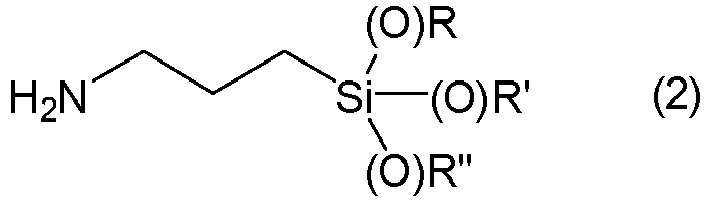
- Allerdings besitzen die Verfahren, wie sie im Stand der Technik beschrieben sind, noch mehrere Nachteile. Zum einen werden vergleichsweise große Mengen (> 0,25%) eines basisches Metallalkoholates als Katalysator eingesetzt. Diese müssen vor der Aufarbeitung der Rohproduktmischung neutralisiert werden, wobei die dabei entstehenden Metallsalze einen zusätzlichen Filtrationsschritt erforderlich machen. Wünschenswert wäre daher, die Katalysatormenge auf ein Minimum zu reduzieren, idealerweise so weit, dass es im industriellen Prozess ausreichend ist, die fertig aufgearbeitete Produktmischung über eine einfache Filtereinheit im Reaktorauslas abzulassen. Derartige "Polizeifilter", die sehr kleine Mengen eventuelle Schwebstoffe aus einem Reaktionsprodukt entfernen, sind Stand der Technik und in den meisten industriellen Produktionsanlagen vorhanden.
- Ein weiterer Nachteil der im Stand der Technik beschriebenen Verfahren zeigen sich entweder in moderaten Ausbeuten von 78-92% (
US 6,673,954 ) oder relativ großen Mengen (ca. 2%) nicht umgesetzter Aminosilane (EP 0 583 581 ). Dabei stellen insbesondere nicht umgesetzte Aminosilane ein großes Problem dar, da sie einerseits nur schwer aus dem Produkt entfernbar sind, und andererseits bei der wichtigsten Anwendung der Carbamatosilane, dem Einsatz zur Synthese der entsprechenden Isocyanatosilane, mit letzteren reagieren, was zu Harnstoff-Biuret- oder sogar oligomeren bzw. polymeren Nebenprodukten führt. - Wünschenswert wäre daher ein Verfahren, das diese Nachteile nicht mehr aufweist.
- Gegenstand der Erfindung ist ein Verfahren zur Herstellung von Carbamatoorganosilanen (CS) der allgemeinen Formel (3),
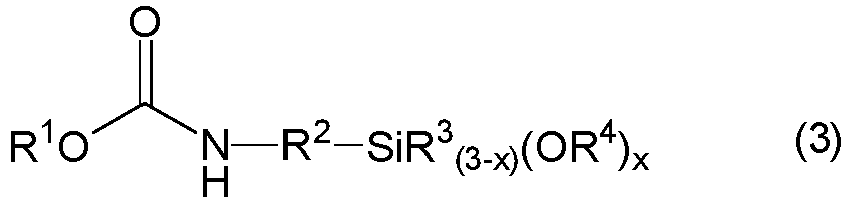


- R1, R3, R4 und R5
- gleich oder verschieden sein können und jeweils einen einwertigen, unsubstituierten oder substituierten Kohlenwasserstoffrest darstellen,
- R2
- einen zweiwertigen, unsubstituierten oder substituierten Kohlenwasserstoffrest darstellt, und
- x
- einen Wert 1, 2 oder 3 bedeutet,
- Der Erfindung liegt die vollkommen überraschende Entdeckung zugrunde, dass sich die Reaktionsgeschwindigkeit insbesondere bei den bevorzugten niedrigeren Katalysatorgehalten durch höhere Reaktionstemperaturen nur sehr bedingt steigern lässt. Im Gegenteil wurde gefunden, dass die Reaktion nahezu vollständig zum Erliegen kommt, wenn die Reaktionstemperatur für einen längeren Zeitraum bei zu hohen Temperaturen liegt.
- Andererseits wurde gefunden, dass die Reaktion bei niedrigen Reaktionstemperaturen, insbesondere gegen Reaktionsende sehr langsam wird.
- Diese überraschende Entdeckung führt zu dem Dilemma, das man entweder höhere Katalysatorkonzentrationen einsetzen muss, oder - bei höherer Reaktionstemperatur - nur einen unvollständigen Umsatz erreicht, oder - bei niedriger Reaktionstemperatur - sehr lange Reaktionszeiten benötigt. Keines dieser drei Alternativen ist wünschenswert.
- Das erfindungsgemäße Verfahren löst dieses Dilemma, indem große Teile der Reaktion während einer ersten Periode in einem niedrigeren Temperaturbereich durchgeführt werden, an dem sich anschließend eine zweite Periode mit höherer Temperatur anschließt, in dem die Reaktion vervollständigt wird, noch bevor die Reaktion auf Grund der höheren Reaktionstemperatur zum Erliegen kommt.
- Das erfindungsgemäße Verfahren zeichnet sich dadurch aus, dass bei Reaktionsende in der Reaktionsproduktmischung vorzugsweise ein Restgehalt an Aminoorganosilan (AS) von unter 1 Mol-%, besonders bevorzugt von unter 0,5 Mol-%, insbesondere unter 0,3 Mol-%, bezogen auf den Gesamtgehalt Aminoorganosilan (AS) und Carbamatoorganosilanen (CS) vorliegt.
- Beispiele für Reste R1 sind Alkylreste, wie der Methyl-, Ethyl-, n-Propyl-, iso-Propyl-, 1-n-Butyl-, 2-n-Butyl-, iso-Butyl-, tert.-Butyl-, n-Pentyl-, iso-Pentyl-, neo-Pentyl-, tert.-Pentylrest; Hexylreste, wie der n-Hexylrest; Heptylreste, wie der n-Heptylrest; Octylreste, wie der n-Octylrest, iso-Octylreste und der 2,2,4-Trimethylpentylrest; Nonylreste, wie der n-Nonylrest; Decylreste, wie der n-Decylrest; Dodecylreste, wie der n-Dodecylrest; Octadecylreste, wie der n-Octadecylrest; Cycloalkylreste, wie der Cyclopentyl-, Cyclohexyl-, Cycloheptylrest und Methylcyclohexylreste; Alkenylreste, wie der Vinyl-, 1-Propenyl- und der 2-Propenylrest; Arylreste, wie der Phenyl-, Naphthyl-, Anthryl- und Phenanthrylrest; Alkarylreste, wie o-, m-, p-Tolylreste; Xylylreste und Ethylphenylreste; und Aralkylreste, wie der Benzylrest, der α- und der β-Phenylethylrest.
- Beispiele für substituierte Reste R1 sind Halogenalkylreste, wie der 3,3,3-Trifluor-n-propylrest, der 2,2,2,2',2',2'-Hexafluor- isopropylrest und der Heptafluorisopropylrest, und Halogenarylreste, wie der o-, m- und p-Chlorphenylrest.
- Bevorzugt handelt es sich bei dem Rest R1 um einen unsubstituierten oder mit Halogenatomen substituierten, einwertigen Kohlenwasserstoffreste mit 1 bis 6 Kohlenstoffatomen, besonders bevorzugt um einen Alkylrest mit 1 oder 4 Kohlenstoffatomen, insbesondere um den Ethyl- oder Methylrest.
- Beispiele für Reste R5 sind die für R1 angegebenen Reste. Bevorzugt handelt es sich bei dem Rest R5 um einen unsubstituierten oder mit Halogenatomen substituierten einwertigen Kohlenwasserstoffrest mit 1 bis 6 Kohlenstoffatomen, besonders bevorzugt um einen Alkylrest mit 1 oder 4 Kohlenstoffatomen, insbesondere um den Ethyl- oder Methylrest.
- Besonders bevorzugt sind R1 und R5 identisch, wobei es sich besonders bevorzugt sowohl bei R1 als auch bei R5 jeweils um Ethyl- oder aber jeweils um Methylreste handelt.
- Beispiele für Reste R4 sind unabhängig voneinander die für R1 angegebenen Reste.
- Bevorzugt handelt es sich bei den Resten R4 um einen unsubstituierten oder mit Halogenatomen substituierten, einwertigen Kohlenwasserstoffrest mit 1 bis 6 Kohlenstoffatomen, besonders bevorzugt um einen Alkylrest mit 1 bis 4 Kohlenstoffatomen, insbesondere um den Ethyl- oder Methylrest.
- Besonders bevorzugt sind sämtliche Reste R4, der R1 und der Rest R5 identisch, wobei es sich besonders bevorzugt bei all diesen Resten entweder jeweils um Ethyl- oder aber jeweils um Methylreste handelt.
- Beispiele für Reste R3 sind die für R1 angegebenen Reste. Bevorzugt handelt es sich bei dem Rest R3 um einen unsubstituierten oder mit Halogenatomen substituierten, einwertigen Kohlenwasserstoffrest mit 1 bis 6 Kohlenstoffatomen, besonders bevorzugt um einen Alkylrest mit 1 oder 4 Kohlenstoffatomen, insbesondere um den Methylrest.
- Beispiele für Reste R2 sind zweiwertige Alkylenreste mit 1 bis 20 Kohlenstoffatomen, wie der Methylen-, Ethylen-, n-Propylen-, Butylen-, Pentylen-, Hexylen-, Heptylen-, Octylen, Nonylen oder der n-Decylenrest. Die genannten Reste können dabei auch über weitere Alkylsubstituenten wie z.B. über Methyl-, Ethyl- oder Propylsubstituenten verfügen. Auch Halogensubstituenten, z.B. Chlor- oder Bromsubstituenten sind möglich. Zudem kann es sich bei den Resten R2 auch um zweiwertige cyclische Reste, z.B. Cyclopentylen-, Cyclohexylen- oder Phenylreste handeln. Auch diese können über die oben genannten Alkyl- oder Halogensubstituenten verfügen.
- Bevorzugt handelt es sich bei den Resten R2 um Alkylenreste mit ein bis 6 Kohlenstoffatomen, besonders bevorzugt um den Butylen, 2-Methylpropylen, Propylen- und den Methylenrest, insbesondere um den Propylen- und den Methylenrest.
- Die Variable x hat vorzugsweise den Wert 2 oder 3.
- Vorzugsweise liegt die Temperatur während der zeitlich früheren Reaktionsperiode (P1) bei mindestens 50 °C.
- Vorzugsweise liegt die Temperatur während der zeitlich späteren Reaktionsperiode (P2) mindestens 20 °C, höher als bei der früheren Periode (P1). Der bevorzugte Temperaturbereich während der zweiten Periode (P2) liegt zwischen 70 und 100 °C.
- Vorzugsweise werden die Komponenten Aminosilan (AS), Dialkylcarbonat (DAC) und Katalysator (K) vor oder während der ersten Reaktionsperiode (P1) vollständig zusammengeben. Vorzugsweise dauert die Periode (P1) auch nach der vollständigen Zugabe aller Komponenten noch mindestens zusätzliche 30 Minuten, besonders bevorzugt mindestens zusätzliche 45 Minuten, bevor die Reaktionsmischung erwärmt wird und die Periode (P2) beginnt.
- Bevorzugte Beispiele für Carbamatosilane (CS) der allgemeinen Formel (3) sind N-(3-Trimethoxysilylpropyl)-O-methylcarbamat, N-(3-Triethoxysilylpropyl)-O-ethylcarbamat, N-(3-Methyldimethoxysilylpropyl)-O-methylcarbamat, N-(3-Methyldiethoxysilylpropyl)-O-ethylcarbamat, N-(Trimethoxysilylmethyl)-O-methylcarbamat, N-(Triethoxysilylmethyl)-O-ethylcarbamat, N-(Methyldimethoxysilylmethyl)-O-methylcarbamat und N-(Methyldiethoxysilylmethyl)-O-ethylcarbamat, insbesondere N-(3-Trimethoxysilylpropyl)-O-methylcarbamat, N-(3-Triethoxysilylpropyl)-O-ethylcarbamat, N-(Trimethoxysilylmethyl)-O-methylcarbamat, N-(Triethoxysilylmethyl)-O-ethylcarbamat und N-(Methyldimethoxysilylmethyl)-O-methylcarbamat.
- Diese bevorzugte Carbamatosilane (CS) werden vorzugsweise aus Aminosilanen (AS) der allgemeinen Formel (4) und Dialkylcarbonaten (DAC) der allgemeinen Formel (5) hergestellt, die über genau dieselben Reste R1 bis R4 sowie dieselbe Variable x verfügen, wie das erhaltene Carbamatosilan (CS). Der Rest R5 im Dialkylcarbonat (DAC) weist dabei vorzugsweise dieselbe Bedeutung auf wie der Rest R1.
- Vorzugsweise werden bei der erfindungsgemäßen Reaktion die Aminosilane (AS) und die Dialkylcarbonate (DAC) in einem Verhältnis von 1,0:0,9 bis 1,0:3,0, besonders bevorzugt in einem Verhältnis von 1,0:1,0 bis 1,0:2,0, insbesondere in einem Verhältnis von 1,0:1,0 bis 1,0:1,5 eingesetzt. Um einerseits einen möglichst vollständigen Umsatz der Aminosilankomponente (AS) zu erzielen, andererseits aber auch eine möglichst gute Raum-Zeit-Ausbeute erreichen, d.h. einen möglichst kleinen Überschuss an Dialkylcarbonat (DAC) einzusetzen, stellt ein Mengenverhältnis zwischen Aminosilan (AS) und Dialkylcarbonat (DAC) von 1:1,1 bis 1:1,4 ein besonders bevorzugtes Optimum dar.
- Sowohl die entsprechenden Aminosilane (AS) als auch die Dialkylcarbonate (DAC) sind kommerziell in großen Mengen von zahlreichen verschiedenen Anbietern erhältlich.
- Als Katalysator (K) werden vorzugsweise Metallalkoholate, insbesondere Alkali- oder Erdalkalialkoholate eingesetzt. Besonders bevorzugte Katalysatoren sind Natriummethanolat, Natriumethanolat, Kaliummethanolat, Kaliumethanolat, Calciummethanolat oder Caliumethanolat. In einer besonders bevorzugten Ausführung der Erfindung wird ein Alhoholat eingesetzt, dessen Alkylgruppe den Resten R4 in Formel (3) entspricht. Dies ist vor allem dann von Vorteil, wenn alle Reste R1, R4 und R5 identisch sind.
- Der Katalysator kann dabei in Substanz aber auch in Form einer Lösung, insbesondere in Form einer alkoholischen Lösung eingesetzt werden. Im Falle einer alkoholischen Lösung sind die Alkylgruppen des Alkohols und des Alkoholates vorzugsweise identisch. Geeignete Katalysatorlösungen mit typischerweise 10-33 %-iger Lösung des Metallalkoholates in dem entsprechenden Alkohol sind kommerziell verfügbar und werden ob ihrer leichten Dosierbarkeit besonders bevorzugt eingesetzt.
- Vorzugsweise liegt der Gehalt des Katalysators (K) bei höchstens 0,2 Gew.-%, besonders bevorzugt bei höchstens 0,19 Gew.-%, insbesondere höchstens bei 0,15 Gew.-%, jeweils bezogen auf das Gewicht der gesamten Reaktionsmischung.
- Vorzugsweise enthält die Reaktionsmischung außer den Komponenten Aminosilan (AS), Dialkylcarbonat (DAC) und Katalysator (K) weitere Stoffe wie z.B. Lösungsmittel in Mengen von höchstens 50 Gew.-%, besonders bevorzugt höchstens 30 Gew.-%, insbesondere höchstens 15 Gew.-%, jeweils bezogen auf die gesamte Reaktionsmischung. Bei einer besonders bevorzugten Verfahrensvariante enthält die Reaktionsmischung außer den Reaktanden und dem Katalysator (K) sowie dem gegebenenfalls vorhandenen Lösungsmittel, in dem der Katalysator (K) gelöst war, keinerlei weitere Komponenten, insbesondere keine weiteren Lösungsmittel.
- Nach Ende der Reaktion wird die Reaktionsmischung vorzugsweise durch Zusatz einer Säure neutralisiert. Dabei kann es sich prinzipiell um jedwede Säure handeln. Beispiele sind organische Säuren, insbesondere Carbonsäuren, wie Ameisensäure, Essigsäure, Propionsäure, Buttersäure, Zitronensäure, Oxalsäure, Weinsäure, Benzoesäure, Ammoniumacetat Ammoniumformiat oder auch Alkylammoniumverbindungen wie Triethylammoniumchlorid, ebenso wie auch anorganische Säuren wie Salzsäure, Schwefelsäure, Phosphorsäure, partial veresterte Schwefel- oder Phosphorsäure, Toluolsulfonsäure, Salpetersäure oder auch um Ammoniumverbindungen wie Ammoniumsulfat, Amoniumchlorid. Vorzugsweise werden dabei wasserfreie Säuren eingesetzt.
- Vorzugsweise wird die Säure in einer Menge zugegeben, dass auf ein Mol basischer Funktionen im Katalysator (K) 0,8 bis 10 Mol, besonders bevorzugt 0,9 bis 2 insbesondere 0,99 bis 1,5 Mol saure Funktionen kommen.
- In einer bevorzugten Ausführung der Erfindung wird die Säure in einer Menge zugegeben, dass der pH-Wert der Reaktionsmischung je nach eingesetzter Säure vom stark Alkalischen gerade eben ins Saure, schwach Saure, Neutrale oder aber schwach Basische umschlägt. Der pH-Wert kann dabei beispielsweise durch eine pH Elektrode oder aber auch durch in Kontaktbringen von einer Probe der Reaktionsmischung mit einem angefeuchteten pH-Papier bestimmt werden.
- Die Neutralisation kann dabei sowohl bei Raumtemperatur als auch bei erhöhten Temperaturen durchgeführt werden. Bei einem besonders bevorzugten Verfahren wird die Neutralisation direkt nach Reaktionsende durchgeführt, ohne dass die Reaktionsmischung nennenswert, d.h. um mehr als 10 °C, aufgewärmt oder abgekühlt wird. Dies hat im industriellen Prozess den Vorteil, dass keine zusätzlichen Zeiten für Aufwärm- und Abkühlvorgänge benötigt werden. Auch die nachfolgende destillative Entfernung der Leichtsieder (s.u.) kann direkt im Anschluss ohne nennenswerte Aufwärm- oder Abkühlschritte, d.h. Temperaturänderungen von mehr als 10 °C, begonnen werden.
- Das vorzugsweise feste Neutralisationsprodukt aus dem Katalysator wird bevorzugt durch einen Filtrationsschritt entfernt. In einer besonders bevorzugten Ausführung der Erfindung ist die Menge des Katalysatorsalzes jedoch so gering, dass diese Filtration unproblematisch ist, z.B. indem sie nicht in Form eines gesonderten Filtrationsschrittes erfolgt, sondern die Reaktionsmischung lediglich über einen in die Rohrleitung eingebauten Filter aus dem Reaktionsgefäß abgelassen wird.
- Der bei der Reaktion freigesetzte Alkohol sowie der gegebenenfalls eingesetzte Dialkylcarbonatüberschuss (DAC) werden vorzugsweise destillativ entfernt. Dies kann direkt im Anschluss an die Reaktion erfolgen, indem die zu entfernenden Leichtsieder direkt aus dem Reaktionsgemisch abdestilliert werden, aber auch in einen gesonderten Destillationsschritt, z.B. über einen Dünnschicht- oder Fallfilmverdampfer. Die Destillation kann dabei auch in Gegenwart des neutralisierten, aber noch nicht entfernten Katalysators (K) erfolgen.
- Das erfindungsgemäße Verfahren kann dabei sowohl batchweise als auch kontinuierlich durchgeführt werden. Dies kann gilt sowohl für die eigentliche Reaktion als auch für die beschriebenen Aufarbeitungsschritte. Ebenso ist vorstellbar, dass nur einzelne Prozessschritte kontinuierlich durchgeführt werden, z.B. dass die Reaktion kontinuierlich, die Aufarbeitung aber batchweise erfolgt. Umgekehrt kann selbstverständlich auch die Reaktion batchweise, anschließende Aufarbeitungsschritte - insbesondere die destillative Entfernung der Leichtsieder - hingegen kontinuierlich erfolgen.
- Das erfindungsgemäße Verfahren hat den Vorteil, dass das Carbamatosilan (CS) auch ohne weitere Aufreinigungsschritte in einer hohen Reinheit von vorzugsweise >95 % insbesondere >97 % erhalten wird.
- Das erfindungsgemäße Verfahren hat den Vorteil, dass es sehr gute Raum-Zeit-Ausbeuten liefert und somit kostengünstig ist.
- Das erfindungsgemäße Verfahren hat den Vorteil, dass es mit den angegebenen sehr niedrigen Katalysatorgehalten auskommt, was die Entfernung des neutralisierten, meist festen und salzförmigen Katalysators sehr einfach macht.
- Das erfindungsgemäße Verfahren hat den Vorteil, dass es zu sehr hohen Umsatzraten und sehr niedrigen Restgehalten an nicht umgesetzten Aminosilan (AS) führt.
- Das erfindungsgemäße Verfahren hat den Vorteil, sehr einfach und robust zu sein.
- Das nach dem erfindungsgemäßen Verfahren hergestellte Carbamatosilan (CS) kann ohne weitere Aufreinigungsschritte in feuchtigkeitshärtenden Systemen, z.B. in silanvernetzenden Kleb- und Dichtstoffen, als Wasserfänger und/oder Haftvermittler eingesetzt werden.
- Eine bevorzugte Verwendung der nach dem erfindungsgemäßen Verfahren hergestellten Carbamatosilans (CS) stellt eine Weiterverarbeitung zu entsprechenden Isocyanatosilanen dar. Diese erfolgt über eine thermische Spaltung der Carbamatgruppe zum jeweiligen Isocyanat und Methanol. Geeignete Verfahren sind u.a. in
EP 2 097 426 beschrieben. - Alle vorstehenden Symbole der vorstehenden Formeln weisen ihre Bedeutungen jeweils unabhängig voneinander auf. In allen Formeln ist das Siliciumatom vierwertig.
- In den folgenden Beispielen sind, falls jeweils nicht anders angegeben, alle Mengen- und Prozentangaben auf das Gewicht bezogen, alle Drücke 0,10 MPa (abs.) und alle Temperaturen 20°C.
- In einem 1 l-Vierhalskolben mit Tropftrichter, Liebigkühler, KPG-Rührer und Thermometer wird eine Mischung aus 275,1 g (3,054 Mol) Dimethylcarbonat und 3,14 g einer 30 Gew.-%igen Lösung Natriummethanolat in Methanol (entspricht 0,94 g reines Natriummethanolat) vorgelegt und auf 55 °C erwärmt. Bei dieser Temperatur werden innerhalb von 30 min 456,3 g (2,545 mol) Aminopropyltrimethoxysilan zudosiert. Um die Temperatur zu halten, ist dabei eine leichte Kühlung erforderlich.
- Anschließend wird für 1 h bei 55 °C nachgerührt und daraufhin auf 80 °C erwärmt. Bei dieser Temperatur wird für 2 weitere Stunden geführt.
- Schließlich werden 1,15 g Essigsäure hinzugegeben. Ein aus der Reaktionsmischung entnommener Tropfen wird auf ein zuvor angefeuchtetes pH-Papier gegeben. Die Reaktionsmischung zeigt einen pH von 5 bis 6.
- Aus der neutralisierten Reaktionsmischung werden die Leichtsieder destillativ entfernt. Dazu wird der Druck stufenweise auf bis zu ein mbar abgesenkt, während die Sumpftemperatur zunächst bei 80 °C verbleibt und zum Schluss noch einmal 110 °C erhöht wird. Die Destillation ist abgeschlossen, sobald kein Destillat mehr übertritt. Eine Analyse des Destillates mittels GC und/oder 1H-NMR zeigt, dass das Destillat nahezu ausschließlich (d.h. zu mehr als 99 %) aus dem freigesetzten Methanol und dem im Überschuss eingesetzten Dimethylcarbonat besteht.
- Es wird ein schwach gelbes Produkt in einer Reinheit von 98,4 % erhalten. Die Ausbeute ist bezogen auf das eingesetzte Aminosilan nahezu quantitativ (>99 %).
- Während der Reaktionsführung werden sowohl am Ende der Nachrührzeit bei 55 °C, nach 1 h Nachrühren bei 80 °C und am Reaktionsende, d.h. nach 2 h Nachrühren bei 80 °C, kleine Proben (<5 ml) entnommen, mit Essigsäure neutralisiert, wobei der pH-Wert mittels zuvor angefeuchtetem pH-Papier kontrolliert wird (s.o.), und mittels 1H-NMR vermessen. Die dabei bestimmten Restgehalte nicht umgesetzten Aminosilans sind in Tabelle 1 aufgeführt.
- (Anmerkung: Nach der Zugabe der Essigsäure liegt das Aminosilan in teilweise protonierter Form vor)
- Es wird so vorgegangen wie in Beispiel 1. Allerdings wird dieses Mal eine Mischung aus 456,3 g (2,545 mol) Aminopropyltrimethoxysilan und 3,14 g einer 30 Gew.-%igen Lösung Natriummethanolat in Methanol (entspricht 0,94 g reines Natriummethanolat) vorgelegt und auf 55 °C erwärmt. Bei dieser Temperatur werden innerhalb von 30 min 275,1 g (3,054 Mol) Dimethylcarbonat zudosiert. Um die Temperatur zu halten, ist dabei eine leichte Kühlung erforderlich.
- Die weitere Versuchsdurchführung wird exakt genauso durchgeführt, wie bei Beispiel 1 beschrieben.
- Es wird ein schwach gelbes Produkt in einer Reinheit von 98,6 % erhalten. Die Ausbeute ist bezogen auf das eingesetzte Aminosilan nahezu quantitativ (>99 %).
- Erneut werden während der Reaktionsführung sowohl am Ende der Nachrührzeit bei 55 °C, nach 1 h Nachrühren bei 80 °C und am Reaktionsende, d.h. nach 2 h Nachrühren bei 80 °C, kleine Proben (<5 ml) entnommen, mit Essigsäure neutralisiert, wobei der pH-Wert mittels zuvor angefeuchtetem pH-Papier kontrolliert wird (s.o.), und mittels 1H-NMR vermessen. Die dabei bestimmten Restgehalte nicht umgesetzten Aminosilans sind in Tabelle 1 aufgeführt.
- Es wird so vorgegangen wie in Beispiel 1. Allerdings wird dieses Mal von Anfang an eine Reaktionstemperatur von 80 °C eingestellt. D.h. das Aminopropyltrimethoxysilan wird bei dieser Temperatur dosiert, und anschließend wird für 3 Stunden bei dieser Temperatur nachgerührt.
- Die weitere Versuchsdurchführung wird exakt genauso durchgeführt, wie bei Beispiel 1 beschrieben.
- Es wird ein schwach gelbes Produkt erhalten, das noch erhebliche Mengen nicht umgesetztes Aminosilan enthält (s. Tabelle 1)
- Auch bei diesem Versuch werden während der Reaktionsführung nach einer Nachrührzeit nach 1 h, 2 h und 3 Stunden (Reaktionsende) kleine Proben (<5 ml) entnommen, mit Essigsäure neutralisiert, wobei der pH-Wert mittels zuvor angefeuchtetem pH-Papier kontrolliert wird (s.o.), und mittels 1H-NMR vermessen. Die dabei bestimmten Restgehalte nicht umgesetzten Aminosilans sind in Tabelle 1 aufgeführt.
- Es wird so vorgegangen wie in Beispiel 1. Allerdings wird dieses Mal von Anfang an eine Reaktionstemperatur von 55 °C eingestellt. D.h. das Aminopropyltrimethoxysilan wird bei dieser Temperatur dosiert, und anschließend wird für 3 Stunden bei dieser Temperatur nachgerührt.
- Die weitere Versuchsdurchführung wird exakt genauso durchgeführt, wie bei Beispiel 1 beschrieben.
- Es wird ein schwach gelbes Produkt erhalten, das noch erhebliche Mengen nicht umgesetztes Aminosilan enthält (s. Tabelle 1)
- Auch bei diesem Versuch werden während der Reaktionsführung nach einer Nachrührzeit nach 1 h, 2 h und 3 Stunden (Reaktionsende) kleine Proben (<5 ml) entnommen, mit Essigsäure neutralisiert, wobei der pH-Wert mittels zuvor angefeuchtetem pH-Papier kontrolliert wird (s.o.), und mittels 1H-NMR vermessen. Die dabei bestimmten Restgehalte nicht umgesetzten Aminosilans sind in Tabelle 1 aufgeführt.
- Es wird so vorgegangen wie in Beispiel 1. Allerdings wird dieses Mal von Anfang an eine Reaktionstemperatur von 40 °C eingestellt. D.h. das Aminopropyltrimethoxysilan wird bei dieser Temperatur dosiert, und anschließend wird für 3 Stunden bei dieser Temperatur nachgerührt.
- Die weitere Versuchsdurchführung wird exakt genauso durchgeführt, wie bei Beispiel 1 beschrieben.
- Es wird ein schwach gelbes Produkt erhalten, das noch erhebliche Mengen nicht umgesetztes Aminosilan enthält (s. Tabelle 1)
- Auch bei diesem Versuch werden während der Reaktionsführung nach einer Nachrührzeit nach 1 h, 2 h und 3 Stunden (Reaktionsende) kleine Proben (<5 ml) entnommen, mit Essigsäure neutralisiert, wobei der pH-Wert mittels zuvor angefeuchtetem pH-Papier kontrolliert wird (s.o.), und mittels 1H-NMR vermessen. Die dabei bestimmten Restgehalte nicht umgesetzten Aminosilans sind in Tabelle 1 aufgeführt.
- Es wird so vorgegangen wie in Beispiel 2. Allerdings wird dieses Mal von Anfang an eine Reaktionstemperatur von 80 °C eingestellt. D.h. das Dimethylcarbonat wird bei dieser Temperatur dosiert, und anschließend wird für 3 Stunden bei dieser Temperatur nachgerührt.
- Die weitere Versuchsdurchführung wird exakt genauso durchgeführt, wie bei Beispiel 1 beschrieben.
- Es wird ein schwach gelbes Produkt erhalten, das noch erhebliche Mengen nicht umgesetztes Aminosilan enthält (s. Tabelle 1)
- Auch bei diesem Versuch werden während der Reaktionsführung nach einer Nachrührzeit nach 1 h, 2 h und 3 Stunden (Reaktionsende) kleine Proben (<5 ml) entnommen, mit Essigsäure neutralisiert, wobei der pH-Wert mittels zuvor angefeuchtetem pH-Papier kontrolliert wird (s.o.), und mittels 1H-NMR vermessen. Die dabei bestimmten Restgehalte nicht umgesetzten Aminosilans sind in Tabelle 1 aufgeführt.
- In Tabelle 1 sind die Gehalte an nicht umgesetztem 3-Aminopropyltrimethoxysilan nach der jeweiligen Nachrührzeit angegeben.
Tabelle 1 Nachrühr -zeit: 1h Nachrühr -zeit: 2h Nachrühr -zeit: 3h Beispiel 1, Nachrührbedingungen: 1 h bei 55 °C, 2 h bei 80 ° 15,2 % 0,0 % 0,0 % Beispiel 2, Nachrührbedingungen: 1 h bei 55 °C, 2 h bei 80 ° 5,6 % 0,0 % 0,0 % Beispiel 3, Nachrührbedingungen: 3 h bei 80 °C * 9,1 % 8,3 % 8,3 % Beispiel 4, Nachrührbedingungen: 3 h unter Rückfluss * 51,2 % 45,9 % 41,1 % Beispiel 5, Nachrührbedingungen: 3 h bei 55 °C * 14,6 % 8,3 % 4,8 % Beispiel 6, Nachrührbedingungen: 3 h bei 40 °C * 20,6 % 14,5 % 10,0 % Beispiel 7, Nachrührbedingungen: 3 h bei 80 °C * 5,2 % 4,9 % 4,8 % *nicht erfindungsgemäß - In einem 2 l-Vierhalskolben mit Tropftrichter, Liebigkühler, KPG-Rührer und Thermometer wird eine Mischung aus 522,7 g (1,781 mol) Aminopropyltriethoxysilan und 2,80 g einer 30 Gew.-%igen Lösung Natriumethanolat in Ethanol (entspricht 0,83 g reines Natriumethanolat) vorgelegt und auf 55 °C erwärmt. Bei dieser Temperatur werden innerhalb von 30 min 252,6 g (2.138 Mol) Diethylcarbonat zudosiert. Um die Temperatur zu halten, ist dabei eine leichte Kühlung erforderlich.
- Anschließend wird für 2 h bei 55 °C nachgerührt und daraufhin auf 80 °C erwärmt. Bei dieser Temperatur wird für 2 weitere Stunden geführt.
- Schließlich werden 0,92 g Essigsäure hinzugegeben. Ein aus der Reaktionsmischung entnommener Tropfen wird auf ein zuvor angefeuchtetes pH-Papier gegeben. Die Reaktionsmischung zeigt einen pH von 5.
- Aus der neutralisierten Reaktionsmischung werden die Leichtsieder destillativ entfernt. Dazu wird der Druck stufenweise auf bis zu ein mbar abgesenkt, während die Sumpftemperatur zunächst bei 80 °C verbleibt und zum Schluss noch einmal 130 °C erhöht wird. Die Destillation ist abgeschlossen, sobald kein Destillat mehr übertritt. Eine Analyse des Destillates mittels GC und/oder 1H-NMR zeigt, dass das Destillat nahezu ausschließlich (d.h. zu mehr als 99 %) aus dem während der Reaktion freigesetzten Ethanol und dem im Überschuss eingesetzten Diethylcarbonat besteht.
- Es wird ein schwach gelbes Produkt in einer Reinheit von 97,9 % erhalten. Der Restgehalt des eingesetzten Aminopropyltriethoxysilans liegt bei 0,8 %. Die Ausbeute ist bezogen auf das eingesetzte Aminosilan sehr hoch (>97 %).
Claims (8)
- Verfahren zur Herstellung von Carbamatoorganosilanen (CS) der allgemeinen Formel (3),
 bei dem ein Aminoorganosilan (AS) der allgemeinen Formel (4),
NH2-R2-SiR3 (3-x)(OR4)x (4)
mit einem Dialkylcarbonat (DAC) der allgemeinen Formel (5), in Gegenwart eines basischen Katalysators (K) umgesetzt wird, wobeiR1, R3, R4 und R5 gleich oder verschieden sein können und jeweils einen einwertigen, unsubstituierten oder substituierten Kohlenwasserstoffrest darstellen,R2 einen zweiwertigen, unsubstituierten oder substituierten Kohlenwasserstoffrest darstellt, undx einen Wert 1, 2 oder 3 bedeutet, bei dem es während der Reaktion eine Periode (P1) gibt, in der die Reaktionstemperatur für die Dauer von mindestens 30 Minuten in einem Bereich von 45 bis 65 °C liegt, und es eine zeitlich später liegende Reaktionsperiode (P2) gibt, in der die Reaktionstemperatur zwischen 70 und 130 °C und mindestens 15 °C höher liegt als während der Periode (P1).
 - Verfahren nach Anspruch 1, bei dem der Rest R5 ein unsubstituierter einwertiger Kohlenwasserstoffrest mit 1 bis 6 Kohlenstoffatomen ist.
- Verfahren nach einem der vorangehenden Ansprüche, bei dem der Rest R4 ein unsubstituierter Alkylrest mit 1 bis 4 Kohlenstoffatomenen ist.
- Verfahren nach einem der vorangehenden Ansprüche, bei dem der Rest R2 ein unsubstituierter Alkylenrest mit ein bis 6 Kohlenstoffatomen ist.
- Verfahren nach einem der vorangehenden Ansprüche, bei dem die Temperatur während der Reaktionsperiode (P2) mindestens 20 °C höher als bei der früheren Periode (P1) liegt.
- Verfahren nach einem der vorangehenden Ansprüche, bei dem die Aminosilane (AS) der allgemeinen Formel (4) und die Dialkylcarbonate (DAC) der allgemeinen Formel (5) in einem Verhältnis von 1,0:1,0 bis 1,0:2,0 eingesetzt werden.
- Verfahren nach einem der vorangehenden Ansprüche, bei dem als Katalysator (K) Metallalkoholate eingesetzt werden.
- Verfahren nach einem der vorangehenden Ansprüche, bei dem der Gehalt des Katalysators (K) bei höchstens 0,2 Gew.-%, bezogen auf das Gewicht der gesamten Reaktionsmischung liegt.
Applications Claiming Priority (2)
| Application Number | Priority Date | Filing Date | Title |
|---|---|---|---|
| DE102013218972.9A DE102013218972A1 (de) | 2013-09-20 | 2013-09-20 | Verfahren zur Herstellung von Carbamatoorganosilanen |
| PCT/EP2014/069818 WO2015040070A1 (de) | 2013-09-20 | 2014-09-17 | Verfahren zur herstellung von carbamatoorganosilanen |
Publications (3)
| Publication Number | Publication Date |
|---|---|
| EP3046925A1 EP3046925A1 (de) | 2016-07-27 |
| EP3046925B1 EP3046925B1 (de) | 2017-05-31 |
| EP3046925B2 true EP3046925B2 (de) | 2024-10-16 |
Family
ID=51589283
Family Applications (1)
| Application Number | Title | Priority Date | Filing Date |
|---|---|---|---|
| EP14771839.9A Active EP3046925B2 (de) | 2013-09-20 | 2014-09-17 | Verfahren zur herstellung von carbamatoorganosilanen |
Country Status (4)
| Country | Link |
|---|---|
| US (1) | US9914744B2 (de) |
| EP (1) | EP3046925B2 (de) |
| DE (1) | DE102013218972A1 (de) |
| WO (1) | WO2015040070A1 (de) |
Families Citing this family (4)
| Publication number | Priority date | Publication date | Assignee | Title |
|---|---|---|---|---|
| JP6631407B2 (ja) * | 2016-05-20 | 2020-01-15 | 信越化学工業株式会社 | カルバマトアルキルシランの製造方法 |
| EP3263616B8 (de) * | 2016-06-27 | 2020-01-15 | Evonik Operations GmbH | Alkoxysilan-funktionalisierte allophanat-haltige beschichtungsmittel |
| EP3263618A1 (de) * | 2016-06-27 | 2018-01-03 | Evonik Degussa GmbH | Alkoxysilan-funktionalisierte allophanate |
| CN111732604B (zh) * | 2020-04-29 | 2024-03-29 | 浙江皇马科技股份有限公司 | 一种3-三甲氧基硅烷氨基甲酸甲酯的制备方法 |
Citations (1)
| Publication number | Priority date | Publication date | Assignee | Title |
|---|---|---|---|---|
| US5218133A (en) † | 1992-08-20 | 1993-06-08 | Union Carbide Chemicals & Plastics Technology Corporation | Process for making a silylisocyanurate |
Family Cites Families (5)
| Publication number | Priority date | Publication date | Assignee | Title |
|---|---|---|---|---|
| US5220047A (en) | 1990-09-17 | 1993-06-15 | Union Carbide Chemicals & Plastics Technology Corporation | Carbamate silicon compounds as latent coupling agents and process for preparation and use |
| US6284911B1 (en) | 1999-06-29 | 2001-09-04 | Wright Chemical Corporation | Synthesis of vinyl carbonates for use in producing vinyl carbamates |
| US6673954B1 (en) | 2003-02-19 | 2004-01-06 | General Electric Company | Process for the preparation of N-silylorganocarbamates |
| US7060849B1 (en) | 2005-09-15 | 2006-06-13 | General Electric Company | Method for production of isocyanatosilanes |
| DE102006057118A1 (de) | 2006-12-04 | 2008-06-05 | Wacker Chemie Ag | Verfahren zur Herstellung von Isocyanatoorganosilanen |
-
2013
- 2013-09-20 DE DE102013218972.9A patent/DE102013218972A1/de not_active Withdrawn
-
2014
- 2014-09-17 EP EP14771839.9A patent/EP3046925B2/de active Active
- 2014-09-17 US US15/023,374 patent/US9914744B2/en active Active
- 2014-09-17 WO PCT/EP2014/069818 patent/WO2015040070A1/de not_active Ceased
Patent Citations (1)
| Publication number | Priority date | Publication date | Assignee | Title |
|---|---|---|---|---|
| US5218133A (en) † | 1992-08-20 | 1993-06-08 | Union Carbide Chemicals & Plastics Technology Corporation | Process for making a silylisocyanurate |
Also Published As
| Publication number | Publication date |
|---|---|
| EP3046925A1 (de) | 2016-07-27 |
| US9914744B2 (en) | 2018-03-13 |
| US20160200745A1 (en) | 2016-07-14 |
| DE102013218972A1 (de) | 2015-03-26 |
| EP3046925B1 (de) | 2017-05-31 |
| WO2015040070A1 (de) | 2015-03-26 |
Similar Documents
| Publication | Publication Date | Title |
|---|---|---|
| EP3221324B1 (de) | Herstellung von isocyanatfunktionellen organosilanen | |
| DE69104312T2 (de) | Verfahren zur Herstellung von Hydroxyamiden. | |
| EP0638575B1 (de) | Verfahren zur Herstellung von Diorganodialkoxysilanen | |
| EP3046925B1 (de) | Verfahren zur herstellung von carbamatoorganosilanen | |
| WO2011076194A1 (de) | Verfahren zur reinigung von pyrazolen | |
| DE2349496A1 (de) | Verfahren zur herstellung von dl-threobeta-p-methylsulfonylphenylserinderivaten | |
| EP3655413B1 (de) | Herstellung von glufosinat durch umsetzung von 3-[n-butoxy(methyl)phosphoryl]-1-cyanopropylacetat zu einer mischung aus n-butyl(3-amino-3-cyanopropyl)-methylphosphinat und (3-amino-3-cyanopropyl)-methylphosphinsäure ammoniumsalz | |
| AT391691B (de) | Verfahren zur herstellung von kohlensaeureestern, die sich von ungesaettigten alkoholen und mehrwertigen alkoholen ableiten | |
| EP2455385B1 (de) | Verfahren zur Herstellung von Carbamatoorganosilanen | |
| CH702298B1 (de) | Verfahren zur Herstellung von Cyanoalkylpropionat-Derivaten. | |
| WO2018137874A1 (de) | Verfahren zur herstellung von dihydroliponsäure | |
| CH661928A5 (de) | Verfahren zur herstellung funktionell substituierter silane. | |
| EP1541540A1 (de) | Verfahren zur Herstellung alkoxyreiner Erdalkalialkoxide | |
| EP0845470A2 (de) | Verfahren zur kontinuierlichen Herstellung von Carbonoyloxysilanen | |
| DE3303815C2 (de) | ||
| EP2072499B1 (de) | Verfahren zur Herstellung von Thiodiglycolsäuredialkylester | |
| DE874313C (de) | Verfahren zur Herstellung von Tetrahydropyranderivaten | |
| DE60302309T2 (de) | Herstellung von 5-Formyl-2-furylborsäure | |
| EP2139863A2 (de) | Verfahren zur herstellung von (meth) acrylsäureestern von n-hydroxyalkylierten imidazolen | |
| DE69011977T2 (de) | In bezug auf die Umwelt sicheres Verfahren zur Herstellung eines bestimmten Dialkylamins. | |
| EP0076379B1 (de) | Verfahren zur Herstellung von 4-Alkoxyacetessigestern | |
| DE4009709A1 (de) | Optisch aktive verbindung und verfahren zu ihrer herstellung | |
| DE69813388T2 (de) | Verfahren zur Herstellung von 2,4-Oxazolidindion | |
| DE2117028A1 (de) | Verfahren zum Silylieren von organi sehen Verbindungen | |
| EP0193066B1 (de) | Neue Ketosultame und Verfahren zu ihrer Herstellung |
Legal Events
| Date | Code | Title | Description |
|---|---|---|---|
| PUAI | Public reference made under article 153(3) epc to a published international application that has entered the european phase |
Free format text: ORIGINAL CODE: 0009012 |
|
| 17P | Request for examination filed |
Effective date: 20160315 |
|
| AK | Designated contracting states |
Kind code of ref document: A1 Designated state(s): AL AT BE BG CH CY CZ DE DK EE ES FI FR GB GR HR HU IE IS IT LI LT LU LV MC MK MT NL NO PL PT RO RS SE SI SK SM TR |
|
| AX | Request for extension of the european patent |
Extension state: BA ME |
|
| DAX | Request for extension of the european patent (deleted) | ||
| GRAP | Despatch of communication of intention to grant a patent |
Free format text: ORIGINAL CODE: EPIDOSNIGR1 |
|
| STAA | Information on the status of an ep patent application or granted ep patent |
Free format text: STATUS: GRANT OF PATENT IS INTENDED |
|
| INTG | Intention to grant announced |
Effective date: 20170215 |
|
| GRAS | Grant fee paid |
Free format text: ORIGINAL CODE: EPIDOSNIGR3 |
|
| GRAA | (expected) grant |
Free format text: ORIGINAL CODE: 0009210 |
|
| STAA | Information on the status of an ep patent application or granted ep patent |
Free format text: STATUS: THE PATENT HAS BEEN GRANTED |
|
| AK | Designated contracting states |
Kind code of ref document: B1 Designated state(s): AL AT BE BG CH CY CZ DE DK EE ES FI FR GB GR HR HU IE IS IT LI LT LU LV MC MK MT NL NO PL PT RO RS SE SI SK SM TR |
|
| REG | Reference to a national code |
Ref country code: CH Ref legal event code: EP Ref country code: GB Ref legal event code: FG4D Free format text: NOT ENGLISH |
|
| REG | Reference to a national code |
Ref country code: AT Ref legal event code: REF Ref document number: 897358 Country of ref document: AT Kind code of ref document: T Effective date: 20170615 |
|
| REG | Reference to a national code |
Ref country code: IE Ref legal event code: FG4D Free format text: LANGUAGE OF EP DOCUMENT: GERMAN |
|
| REG | Reference to a national code |
Ref country code: DE Ref legal event code: R096 Ref document number: 502014004045 Country of ref document: DE |
|
| REG | Reference to a national code |
Ref country code: NL Ref legal event code: FP |
|
| REG | Reference to a national code |
Ref country code: FR Ref legal event code: PLFP Year of fee payment: 4 |
|
| REG | Reference to a national code |
Ref country code: LT Ref legal event code: MG4D |
|
| PG25 | Lapsed in a contracting state [announced via postgrant information from national office to epo] |
Ref country code: ES Free format text: LAPSE BECAUSE OF FAILURE TO SUBMIT A TRANSLATION OF THE DESCRIPTION OR TO PAY THE FEE WITHIN THE PRESCRIBED TIME-LIMIT Effective date: 20170531 Ref country code: FI Free format text: LAPSE BECAUSE OF FAILURE TO SUBMIT A TRANSLATION OF THE DESCRIPTION OR TO PAY THE FEE WITHIN THE PRESCRIBED TIME-LIMIT Effective date: 20170531 Ref country code: HR Free format text: LAPSE BECAUSE OF FAILURE TO SUBMIT A TRANSLATION OF THE DESCRIPTION OR TO PAY THE FEE WITHIN THE PRESCRIBED TIME-LIMIT Effective date: 20170531 Ref country code: NO Free format text: LAPSE BECAUSE OF FAILURE TO SUBMIT A TRANSLATION OF THE DESCRIPTION OR TO PAY THE FEE WITHIN THE PRESCRIBED TIME-LIMIT Effective date: 20170831 Ref country code: LT Free format text: LAPSE BECAUSE OF FAILURE TO SUBMIT A TRANSLATION OF THE DESCRIPTION OR TO PAY THE FEE WITHIN THE PRESCRIBED TIME-LIMIT Effective date: 20170531 Ref country code: GR Free format text: LAPSE BECAUSE OF FAILURE TO SUBMIT A TRANSLATION OF THE DESCRIPTION OR TO PAY THE FEE WITHIN THE PRESCRIBED TIME-LIMIT Effective date: 20170901 |
|
| PG25 | Lapsed in a contracting state [announced via postgrant information from national office to epo] |
Ref country code: SE Free format text: LAPSE BECAUSE OF FAILURE TO SUBMIT A TRANSLATION OF THE DESCRIPTION OR TO PAY THE FEE WITHIN THE PRESCRIBED TIME-LIMIT Effective date: 20170531 Ref country code: BG Free format text: LAPSE BECAUSE OF FAILURE TO SUBMIT A TRANSLATION OF THE DESCRIPTION OR TO PAY THE FEE WITHIN THE PRESCRIBED TIME-LIMIT Effective date: 20170831 Ref country code: RS Free format text: LAPSE BECAUSE OF FAILURE TO SUBMIT A TRANSLATION OF THE DESCRIPTION OR TO PAY THE FEE WITHIN THE PRESCRIBED TIME-LIMIT Effective date: 20170531 Ref country code: IS Free format text: LAPSE BECAUSE OF FAILURE TO SUBMIT A TRANSLATION OF THE DESCRIPTION OR TO PAY THE FEE WITHIN THE PRESCRIBED TIME-LIMIT Effective date: 20170930 Ref country code: LV Free format text: LAPSE BECAUSE OF FAILURE TO SUBMIT A TRANSLATION OF THE DESCRIPTION OR TO PAY THE FEE WITHIN THE PRESCRIBED TIME-LIMIT Effective date: 20170531 |
|
| PG25 | Lapsed in a contracting state [announced via postgrant information from national office to epo] |
Ref country code: RO Free format text: LAPSE BECAUSE OF FAILURE TO SUBMIT A TRANSLATION OF THE DESCRIPTION OR TO PAY THE FEE WITHIN THE PRESCRIBED TIME-LIMIT Effective date: 20170531 Ref country code: SK Free format text: LAPSE BECAUSE OF FAILURE TO SUBMIT A TRANSLATION OF THE DESCRIPTION OR TO PAY THE FEE WITHIN THE PRESCRIBED TIME-LIMIT Effective date: 20170531 Ref country code: EE Free format text: LAPSE BECAUSE OF FAILURE TO SUBMIT A TRANSLATION OF THE DESCRIPTION OR TO PAY THE FEE WITHIN THE PRESCRIBED TIME-LIMIT Effective date: 20170531 Ref country code: CZ Free format text: LAPSE BECAUSE OF FAILURE TO SUBMIT A TRANSLATION OF THE DESCRIPTION OR TO PAY THE FEE WITHIN THE PRESCRIBED TIME-LIMIT Effective date: 20170531 Ref country code: DK Free format text: LAPSE BECAUSE OF FAILURE TO SUBMIT A TRANSLATION OF THE DESCRIPTION OR TO PAY THE FEE WITHIN THE PRESCRIBED TIME-LIMIT Effective date: 20170531 |
|
| PG25 | Lapsed in a contracting state [announced via postgrant information from national office to epo] |
Ref country code: IT Free format text: LAPSE BECAUSE OF FAILURE TO SUBMIT A TRANSLATION OF THE DESCRIPTION OR TO PAY THE FEE WITHIN THE PRESCRIBED TIME-LIMIT Effective date: 20170531 Ref country code: PL Free format text: LAPSE BECAUSE OF FAILURE TO SUBMIT A TRANSLATION OF THE DESCRIPTION OR TO PAY THE FEE WITHIN THE PRESCRIBED TIME-LIMIT Effective date: 20170531 Ref country code: SM Free format text: LAPSE BECAUSE OF FAILURE TO SUBMIT A TRANSLATION OF THE DESCRIPTION OR TO PAY THE FEE WITHIN THE PRESCRIBED TIME-LIMIT Effective date: 20170531 |
|
| REG | Reference to a national code |
Ref country code: DE Ref legal event code: R026 Ref document number: 502014004045 Country of ref document: DE |
|
| PLBI | Opposition filed |
Free format text: ORIGINAL CODE: 0009260 |
|
| PLAX | Notice of opposition and request to file observation + time limit sent |
Free format text: ORIGINAL CODE: EPIDOSNOBS2 |
|
| 26 | Opposition filed |
Opponent name: MOMENTIVE PERFORMANCE MATERIALS, INC. Effective date: 20180228 |
|
| REG | Reference to a national code |
Ref country code: CH Ref legal event code: PL |
|
| PG25 | Lapsed in a contracting state [announced via postgrant information from national office to epo] |
Ref country code: MC Free format text: LAPSE BECAUSE OF FAILURE TO SUBMIT A TRANSLATION OF THE DESCRIPTION OR TO PAY THE FEE WITHIN THE PRESCRIBED TIME-LIMIT Effective date: 20170531 |
|
| REG | Reference to a national code |
Ref country code: IE Ref legal event code: MM4A |
|
| PG25 | Lapsed in a contracting state [announced via postgrant information from national office to epo] |
Ref country code: LU Free format text: LAPSE BECAUSE OF NON-PAYMENT OF DUE FEES Effective date: 20170917 |
|
| PLBB | Reply of patent proprietor to notice(s) of opposition received |
Free format text: ORIGINAL CODE: EPIDOSNOBS3 |
|
| PG25 | Lapsed in a contracting state [announced via postgrant information from national office to epo] |
Ref country code: IE Free format text: LAPSE BECAUSE OF NON-PAYMENT OF DUE FEES Effective date: 20170917 Ref country code: CH Free format text: LAPSE BECAUSE OF NON-PAYMENT OF DUE FEES Effective date: 20170930 Ref country code: LI Free format text: LAPSE BECAUSE OF NON-PAYMENT OF DUE FEES Effective date: 20170930 |
|
| REG | Reference to a national code |
Ref country code: FR Ref legal event code: PLFP Year of fee payment: 5 |
|
| PG25 | Lapsed in a contracting state [announced via postgrant information from national office to epo] |
Ref country code: MT Free format text: LAPSE BECAUSE OF FAILURE TO SUBMIT A TRANSLATION OF THE DESCRIPTION OR TO PAY THE FEE WITHIN THE PRESCRIBED TIME-LIMIT Effective date: 20170531 |
|
| GBPC | Gb: european patent ceased through non-payment of renewal fee |
Effective date: 20180917 |
|
| PG25 | Lapsed in a contracting state [announced via postgrant information from national office to epo] |
Ref country code: HU Free format text: LAPSE BECAUSE OF FAILURE TO SUBMIT A TRANSLATION OF THE DESCRIPTION OR TO PAY THE FEE WITHIN THE PRESCRIBED TIME-LIMIT; INVALID AB INITIO Effective date: 20140917 |
|
| PG25 | Lapsed in a contracting state [announced via postgrant information from national office to epo] |
Ref country code: SI Free format text: LAPSE BECAUSE OF FAILURE TO SUBMIT A TRANSLATION OF THE DESCRIPTION OR TO PAY THE FEE WITHIN THE PRESCRIBED TIME-LIMIT Effective date: 20170531 |
|
| PG25 | Lapsed in a contracting state [announced via postgrant information from national office to epo] |
Ref country code: CY Free format text: LAPSE BECAUSE OF FAILURE TO SUBMIT A TRANSLATION OF THE DESCRIPTION OR TO PAY THE FEE WITHIN THE PRESCRIBED TIME-LIMIT Effective date: 20170531 Ref country code: GB Free format text: LAPSE BECAUSE OF NON-PAYMENT OF DUE FEES Effective date: 20180917 |
|
| PG25 | Lapsed in a contracting state [announced via postgrant information from national office to epo] |
Ref country code: MK Free format text: LAPSE BECAUSE OF FAILURE TO SUBMIT A TRANSLATION OF THE DESCRIPTION OR TO PAY THE FEE WITHIN THE PRESCRIBED TIME-LIMIT Effective date: 20170531 |
|
| PG25 | Lapsed in a contracting state [announced via postgrant information from national office to epo] |
Ref country code: TR Free format text: LAPSE BECAUSE OF FAILURE TO SUBMIT A TRANSLATION OF THE DESCRIPTION OR TO PAY THE FEE WITHIN THE PRESCRIBED TIME-LIMIT Effective date: 20170531 |
|
| APBM | Appeal reference recorded |
Free format text: ORIGINAL CODE: EPIDOSNREFNO |
|
| APBP | Date of receipt of notice of appeal recorded |
Free format text: ORIGINAL CODE: EPIDOSNNOA2O |
|
| APAH | Appeal reference modified |
Free format text: ORIGINAL CODE: EPIDOSCREFNO |
|
| PG25 | Lapsed in a contracting state [announced via postgrant information from national office to epo] |
Ref country code: PT Free format text: LAPSE BECAUSE OF FAILURE TO SUBMIT A TRANSLATION OF THE DESCRIPTION OR TO PAY THE FEE WITHIN THE PRESCRIBED TIME-LIMIT Effective date: 20170531 |
|
| APBQ | Date of receipt of statement of grounds of appeal recorded |
Free format text: ORIGINAL CODE: EPIDOSNNOA3O |
|
| PG25 | Lapsed in a contracting state [announced via postgrant information from national office to epo] |
Ref country code: AL Free format text: LAPSE BECAUSE OF FAILURE TO SUBMIT A TRANSLATION OF THE DESCRIPTION OR TO PAY THE FEE WITHIN THE PRESCRIBED TIME-LIMIT Effective date: 20170531 |
|
| REG | Reference to a national code |
Ref country code: AT Ref legal event code: MM01 Ref document number: 897358 Country of ref document: AT Kind code of ref document: T Effective date: 20190917 |
|
| PG25 | Lapsed in a contracting state [announced via postgrant information from national office to epo] |
Ref country code: AT Free format text: LAPSE BECAUSE OF NON-PAYMENT OF DUE FEES Effective date: 20190917 |
|
| APBU | Appeal procedure closed |
Free format text: ORIGINAL CODE: EPIDOSNNOA9O |
|
| PLAY | Examination report in opposition despatched + time limit |
Free format text: ORIGINAL CODE: EPIDOSNORE2 |
|
| PLBC | Reply to examination report in opposition received |
Free format text: ORIGINAL CODE: EPIDOSNORE3 |
|
| PLAP | Information related to despatch of examination report in opposition + time limit deleted |
Free format text: ORIGINAL CODE: EPIDOSDORE2 |
|
| PLAT | Information related to reply to examination report in opposition deleted |
Free format text: ORIGINAL CODE: EPIDOSDORE3 |
|
| PLAY | Examination report in opposition despatched + time limit |
Free format text: ORIGINAL CODE: EPIDOSNORE2 |
|
| PLBC | Reply to examination report in opposition received |
Free format text: ORIGINAL CODE: EPIDOSNORE3 |
|
| RAP4 | Party data changed (patent owner data changed or rights of a patent transferred) |
Owner name: WACKER CHEMIE AG |
|
| REG | Reference to a national code |
Ref country code: DE Ref legal event code: R081 Ref document number: 502014004045 Country of ref document: DE Owner name: WACKER CHEMIE AG, DE Free format text: FORMER OWNER: WACKER CHEMIE AG, 81737 MUENCHEN, DE |
|
| PUAH | Patent maintained in amended form |
Free format text: ORIGINAL CODE: 0009272 |
|
| STAA | Information on the status of an ep patent application or granted ep patent |
Free format text: STATUS: PATENT MAINTAINED AS AMENDED |
|
| 27A | Patent maintained in amended form |
Effective date: 20241016 |
|
| AK | Designated contracting states |
Kind code of ref document: B2 Designated state(s): AL AT BE BG CH CY CZ DE DK EE ES FI FR GB GR HR HU IE IS IT LI LT LU LV MC MK MT NL NO PL PT RO RS SE SI SK SM TR |
|
| REG | Reference to a national code |
Ref country code: DE Ref legal event code: R102 Ref document number: 502014004045 Country of ref document: DE |
|
| P01 | Opt-out of the competence of the unified patent court (upc) registered |
Free format text: CASE NUMBER: UPC_APP_119511/2023 Effective date: 20230510 |
|
| REG | Reference to a national code |
Ref country code: NL Ref legal event code: FP |
|
| PGFP | Annual fee paid to national office [announced via postgrant information from national office to epo] |
Ref country code: DE Payment date: 20250919 Year of fee payment: 12 |
|
| PGFP | Annual fee paid to national office [announced via postgrant information from national office to epo] |
Ref country code: NL Payment date: 20250918 Year of fee payment: 12 |
|
| PGFP | Annual fee paid to national office [announced via postgrant information from national office to epo] |
Ref country code: BE Payment date: 20250918 Year of fee payment: 12 |
|
| PGFP | Annual fee paid to national office [announced via postgrant information from national office to epo] |
Ref country code: FR Payment date: 20250922 Year of fee payment: 12 |