EP3045238B1 - Verfahren zur herstellung zweiteiliger lebensmitteldosen - Google Patents
Verfahren zur herstellung zweiteiliger lebensmitteldosen Download PDFInfo
- Publication number
- EP3045238B1 EP3045238B1 EP13893326.2A EP13893326A EP3045238B1 EP 3045238 B1 EP3045238 B1 EP 3045238B1 EP 13893326 A EP13893326 A EP 13893326A EP 3045238 B1 EP3045238 B1 EP 3045238B1
- Authority
- EP
- European Patent Office
- Prior art keywords
- temperature
- thermoplastic resin
- food
- seconds
- resin
- Prior art date
- Legal status (The legal status is an assumption and is not a legal conclusion. Google has not performed a legal analysis and makes no representation as to the accuracy of the status listed.)
- Active
Links
Images


Classifications
-
- B—PERFORMING OPERATIONS; TRANSPORTING
- B21—MECHANICAL METAL-WORKING WITHOUT ESSENTIALLY REMOVING MATERIAL; PUNCHING METAL
- B21D—WORKING OR PROCESSING OF SHEET METAL OR METAL TUBES, RODS OR PROFILES WITHOUT ESSENTIALLY REMOVING MATERIAL; PUNCHING METAL
- B21D51/00—Making hollow objects
- B21D51/16—Making hollow objects characterised by the use of the objects
- B21D51/26—Making hollow objects characterised by the use of the objects cans or tins; Closing same in a permanent manner
-
- B—PERFORMING OPERATIONS; TRANSPORTING
- B21—MECHANICAL METAL-WORKING WITHOUT ESSENTIALLY REMOVING MATERIAL; PUNCHING METAL
- B21D—WORKING OR PROCESSING OF SHEET METAL OR METAL TUBES, RODS OR PROFILES WITHOUT ESSENTIALLY REMOVING MATERIAL; PUNCHING METAL
- B21D22/00—Shaping without cutting, by stamping, spinning, or deep-drawing
- B21D22/20—Deep-drawing
- B21D22/208—Deep-drawing by heating the blank or deep-drawing associated with heat treatment
-
- B—PERFORMING OPERATIONS; TRANSPORTING
- B21—MECHANICAL METAL-WORKING WITHOUT ESSENTIALLY REMOVING MATERIAL; PUNCHING METAL
- B21D—WORKING OR PROCESSING OF SHEET METAL OR METAL TUBES, RODS OR PROFILES WITHOUT ESSENTIALLY REMOVING MATERIAL; PUNCHING METAL
- B21D22/00—Shaping without cutting, by stamping, spinning, or deep-drawing
- B21D22/20—Deep-drawing
- B21D22/28—Deep-drawing of cylindrical articles using consecutive dies
-
- B—PERFORMING OPERATIONS; TRANSPORTING
- B21—MECHANICAL METAL-WORKING WITHOUT ESSENTIALLY REMOVING MATERIAL; PUNCHING METAL
- B21D—WORKING OR PROCESSING OF SHEET METAL OR METAL TUBES, RODS OR PROFILES WITHOUT ESSENTIALLY REMOVING MATERIAL; PUNCHING METAL
- B21D51/00—Making hollow objects
- B21D51/16—Making hollow objects characterised by the use of the objects
- B21D51/26—Making hollow objects characterised by the use of the objects cans or tins; Closing same in a permanent manner
- B21D51/2607—Locally embossing the walls of formed can bodies
-
- B—PERFORMING OPERATIONS; TRANSPORTING
- B32—LAYERED PRODUCTS
- B32B—LAYERED PRODUCTS, i.e. PRODUCTS BUILT-UP OF STRATA OF FLAT OR NON-FLAT, e.g. CELLULAR OR HONEYCOMB, FORM
- B32B1/00—Layered products having a non-planar shape
- B32B1/08—Tubular products
-
- B—PERFORMING OPERATIONS; TRANSPORTING
- B32—LAYERED PRODUCTS
- B32B—LAYERED PRODUCTS, i.e. PRODUCTS BUILT-UP OF STRATA OF FLAT OR NON-FLAT, e.g. CELLULAR OR HONEYCOMB, FORM
- B32B15/00—Layered products comprising a layer of metal
- B32B15/04—Layered products comprising a layer of metal comprising metal as the main or only constituent of a layer, which is next to another layer of the same or of a different material
- B32B15/08—Layered products comprising a layer of metal comprising metal as the main or only constituent of a layer, which is next to another layer of the same or of a different material of synthetic resin
-
- B—PERFORMING OPERATIONS; TRANSPORTING
- B32—LAYERED PRODUCTS
- B32B—LAYERED PRODUCTS, i.e. PRODUCTS BUILT-UP OF STRATA OF FLAT OR NON-FLAT, e.g. CELLULAR OR HONEYCOMB, FORM
- B32B15/00—Layered products comprising a layer of metal
- B32B15/04—Layered products comprising a layer of metal comprising metal as the main or only constituent of a layer, which is next to another layer of the same or of a different material
- B32B15/08—Layered products comprising a layer of metal comprising metal as the main or only constituent of a layer, which is next to another layer of the same or of a different material of synthetic resin
- B32B15/09—Layered products comprising a layer of metal comprising metal as the main or only constituent of a layer, which is next to another layer of the same or of a different material of synthetic resin comprising polyesters
-
- B—PERFORMING OPERATIONS; TRANSPORTING
- B32—LAYERED PRODUCTS
- B32B—LAYERED PRODUCTS, i.e. PRODUCTS BUILT-UP OF STRATA OF FLAT OR NON-FLAT, e.g. CELLULAR OR HONEYCOMB, FORM
- B32B15/00—Layered products comprising a layer of metal
- B32B15/18—Layered products comprising a layer of metal comprising iron or steel
-
- B—PERFORMING OPERATIONS; TRANSPORTING
- B32—LAYERED PRODUCTS
- B32B—LAYERED PRODUCTS, i.e. PRODUCTS BUILT-UP OF STRATA OF FLAT OR NON-FLAT, e.g. CELLULAR OR HONEYCOMB, FORM
- B32B15/00—Layered products comprising a layer of metal
- B32B15/20—Layered products comprising a layer of metal comprising aluminium or copper
-
- B—PERFORMING OPERATIONS; TRANSPORTING
- B32—LAYERED PRODUCTS
- B32B—LAYERED PRODUCTS, i.e. PRODUCTS BUILT-UP OF STRATA OF FLAT OR NON-FLAT, e.g. CELLULAR OR HONEYCOMB, FORM
- B32B27/00—Layered products comprising a layer of synthetic resin
- B32B27/32—Layered products comprising a layer of synthetic resin comprising polyolefins
-
- B—PERFORMING OPERATIONS; TRANSPORTING
- B32—LAYERED PRODUCTS
- B32B—LAYERED PRODUCTS, i.e. PRODUCTS BUILT-UP OF STRATA OF FLAT OR NON-FLAT, e.g. CELLULAR OR HONEYCOMB, FORM
- B32B27/00—Layered products comprising a layer of synthetic resin
- B32B27/34—Layered products comprising a layer of synthetic resin comprising polyamides
-
- B—PERFORMING OPERATIONS; TRANSPORTING
- B32—LAYERED PRODUCTS
- B32B—LAYERED PRODUCTS, i.e. PRODUCTS BUILT-UP OF STRATA OF FLAT OR NON-FLAT, e.g. CELLULAR OR HONEYCOMB, FORM
- B32B27/00—Layered products comprising a layer of synthetic resin
- B32B27/36—Layered products comprising a layer of synthetic resin comprising polyesters
-
- B—PERFORMING OPERATIONS; TRANSPORTING
- B32—LAYERED PRODUCTS
- B32B—LAYERED PRODUCTS, i.e. PRODUCTS BUILT-UP OF STRATA OF FLAT OR NON-FLAT, e.g. CELLULAR OR HONEYCOMB, FORM
- B32B27/00—Layered products comprising a layer of synthetic resin
- B32B27/36—Layered products comprising a layer of synthetic resin comprising polyesters
- B32B27/365—Layered products comprising a layer of synthetic resin comprising polyesters comprising polycarbonates
-
- B—PERFORMING OPERATIONS; TRANSPORTING
- B32—LAYERED PRODUCTS
- B32B—LAYERED PRODUCTS, i.e. PRODUCTS BUILT-UP OF STRATA OF FLAT OR NON-FLAT, e.g. CELLULAR OR HONEYCOMB, FORM
- B32B3/00—Layered products comprising a layer with external or internal discontinuities or unevennesses, or a layer of non-planar shape; Layered products comprising a layer having particular features of form
- B32B3/26—Layered products comprising a layer with external or internal discontinuities or unevennesses, or a layer of non-planar shape; Layered products comprising a layer having particular features of form characterised by a particular shape of the outline of the cross-section of a continuous layer; characterised by a layer with cavities or internal voids ; characterised by an apertured layer
- B32B3/28—Layered products comprising a layer with external or internal discontinuities or unevennesses, or a layer of non-planar shape; Layered products comprising a layer having particular features of form characterised by a particular shape of the outline of the cross-section of a continuous layer; characterised by a layer with cavities or internal voids ; characterised by an apertured layer characterised by a layer comprising a deformed thin sheet, i.e. the layer having its entire thickness deformed out of the plane, e.g. corrugated, crumpled
-
- B—PERFORMING OPERATIONS; TRANSPORTING
- B65—CONVEYING; PACKING; STORING; HANDLING THIN OR FILAMENTARY MATERIAL
- B65D—CONTAINERS FOR STORAGE OR TRANSPORT OF ARTICLES OR MATERIALS, e.g. BAGS, BARRELS, BOTTLES, BOXES, CANS, CARTONS, CRATES, DRUMS, JARS, TANKS, HOPPERS, FORWARDING CONTAINERS; ACCESSORIES, CLOSURES, OR FITTINGS THEREFOR; PACKAGING ELEMENTS; PACKAGES
- B65D1/00—Rigid or semi-rigid containers having bodies formed in one piece, e.g. by casting metallic material, by moulding plastics, by blowing vitreous material, by throwing ceramic material, by moulding pulped fibrous material or by deep-drawing operations performed on sheet material
- B65D1/12—Cans, casks, barrels, or drums
- B65D1/14—Cans, casks, barrels, or drums characterised by shape
- B65D1/16—Cans, casks, barrels, or drums characterised by shape of curved cross-section, e.g. cylindrical
- B65D1/165—Cylindrical cans
-
- B—PERFORMING OPERATIONS; TRANSPORTING
- B65—CONVEYING; PACKING; STORING; HANDLING THIN OR FILAMENTARY MATERIAL
- B65D—CONTAINERS FOR STORAGE OR TRANSPORT OF ARTICLES OR MATERIALS, e.g. BAGS, BARRELS, BOTTLES, BOXES, CANS, CARTONS, CRATES, DRUMS, JARS, TANKS, HOPPERS, FORWARDING CONTAINERS; ACCESSORIES, CLOSURES, OR FITTINGS THEREFOR; PACKAGING ELEMENTS; PACKAGES
- B65D1/00—Rigid or semi-rigid containers having bodies formed in one piece, e.g. by casting metallic material, by moulding plastics, by blowing vitreous material, by throwing ceramic material, by moulding pulped fibrous material or by deep-drawing operations performed on sheet material
- B65D1/22—Boxes or like containers with side walls of substantial depth for enclosing contents
- B65D1/26—Thin-walled containers, e.g. formed by deep-drawing operations
- B65D1/28—Thin-walled containers, e.g. formed by deep-drawing operations formed of laminated material
-
- C—CHEMISTRY; METALLURGY
- C09—DYES; PAINTS; POLISHES; NATURAL RESINS; ADHESIVES; COMPOSITIONS NOT OTHERWISE PROVIDED FOR; APPLICATIONS OF MATERIALS NOT OTHERWISE PROVIDED FOR
- C09D—COATING COMPOSITIONS, e.g. PAINTS, VARNISHES OR LACQUERS; FILLING PASTES; CHEMICAL PAINT OR INK REMOVERS; INKS; CORRECTING FLUIDS; WOODSTAINS; PASTES OR SOLIDS FOR COLOURING OR PRINTING; USE OF MATERIALS THEREFOR
- C09D5/00—Coating compositions, e.g. paints, varnishes or lacquers, characterised by their physical nature or the effects produced; Filling pastes
-
- C—CHEMISTRY; METALLURGY
- C09—DYES; PAINTS; POLISHES; NATURAL RESINS; ADHESIVES; COMPOSITIONS NOT OTHERWISE PROVIDED FOR; APPLICATIONS OF MATERIALS NOT OTHERWISE PROVIDED FOR
- C09D—COATING COMPOSITIONS, e.g. PAINTS, VARNISHES OR LACQUERS; FILLING PASTES; CHEMICAL PAINT OR INK REMOVERS; INKS; CORRECTING FLUIDS; WOODSTAINS; PASTES OR SOLIDS FOR COLOURING OR PRINTING; USE OF MATERIALS THEREFOR
- C09D5/00—Coating compositions, e.g. paints, varnishes or lacquers, characterised by their physical nature or the effects produced; Filling pastes
- C09D5/08—Anti-corrosive paints
-
- C—CHEMISTRY; METALLURGY
- C09—DYES; PAINTS; POLISHES; NATURAL RESINS; ADHESIVES; COMPOSITIONS NOT OTHERWISE PROVIDED FOR; APPLICATIONS OF MATERIALS NOT OTHERWISE PROVIDED FOR
- C09D—COATING COMPOSITIONS, e.g. PAINTS, VARNISHES OR LACQUERS; FILLING PASTES; CHEMICAL PAINT OR INK REMOVERS; INKS; CORRECTING FLUIDS; WOODSTAINS; PASTES OR SOLIDS FOR COLOURING OR PRINTING; USE OF MATERIALS THEREFOR
- C09D7/00—Features of coating compositions, not provided for in group C09D5/00; Processes for incorporating ingredients in coating compositions
- C09D7/40—Additives
- C09D7/65—Additives macromolecular
-
- B—PERFORMING OPERATIONS; TRANSPORTING
- B32—LAYERED PRODUCTS
- B32B—LAYERED PRODUCTS, i.e. PRODUCTS BUILT-UP OF STRATA OF FLAT OR NON-FLAT, e.g. CELLULAR OR HONEYCOMB, FORM
- B32B2255/00—Coating on the layer surface
- B32B2255/06—Coating on the layer surface on metal layer
-
- B—PERFORMING OPERATIONS; TRANSPORTING
- B32—LAYERED PRODUCTS
- B32B—LAYERED PRODUCTS, i.e. PRODUCTS BUILT-UP OF STRATA OF FLAT OR NON-FLAT, e.g. CELLULAR OR HONEYCOMB, FORM
- B32B2255/00—Coating on the layer surface
- B32B2255/26—Polymeric coating
-
- B—PERFORMING OPERATIONS; TRANSPORTING
- B32—LAYERED PRODUCTS
- B32B—LAYERED PRODUCTS, i.e. PRODUCTS BUILT-UP OF STRATA OF FLAT OR NON-FLAT, e.g. CELLULAR OR HONEYCOMB, FORM
- B32B2270/00—Resin or rubber layer containing a blend of at least two different polymers
-
- B—PERFORMING OPERATIONS; TRANSPORTING
- B32—LAYERED PRODUCTS
- B32B—LAYERED PRODUCTS, i.e. PRODUCTS BUILT-UP OF STRATA OF FLAT OR NON-FLAT, e.g. CELLULAR OR HONEYCOMB, FORM
- B32B2307/00—Properties of the layers or laminate
- B32B2307/30—Properties of the layers or laminate having particular thermal properties
- B32B2307/31—Heat sealable
-
- B—PERFORMING OPERATIONS; TRANSPORTING
- B32—LAYERED PRODUCTS
- B32B—LAYERED PRODUCTS, i.e. PRODUCTS BUILT-UP OF STRATA OF FLAT OR NON-FLAT, e.g. CELLULAR OR HONEYCOMB, FORM
- B32B2307/00—Properties of the layers or laminate
- B32B2307/70—Other properties
- B32B2307/714—Inert, i.e. inert to chemical degradation, corrosion
-
- B—PERFORMING OPERATIONS; TRANSPORTING
- B32—LAYERED PRODUCTS
- B32B—LAYERED PRODUCTS, i.e. PRODUCTS BUILT-UP OF STRATA OF FLAT OR NON-FLAT, e.g. CELLULAR OR HONEYCOMB, FORM
- B32B2307/00—Properties of the layers or laminate
- B32B2307/70—Other properties
- B32B2307/732—Dimensional properties
-
- B—PERFORMING OPERATIONS; TRANSPORTING
- B32—LAYERED PRODUCTS
- B32B—LAYERED PRODUCTS, i.e. PRODUCTS BUILT-UP OF STRATA OF FLAT OR NON-FLAT, e.g. CELLULAR OR HONEYCOMB, FORM
- B32B2439/00—Containers; Receptacles
- B32B2439/70—Food packaging
Definitions
- the present invention relates to a method of manufacturing a two-piece food can by using a thermoplastic resin-coated metal sheet, said can having annular uneven beads and/or a bottom rim and improved corrosion resistance by preventing the inner resin coating to peel off during formation.
- so-called two-piece cans are manufactured by punching aluminum or steel metal sheets used for can manufacturing, drawing and ironing to form a bottomed cylindrical can body, and after filling the can body with beverage or food, an upper lid is mounted thereto and seamed to seal hermetically.
- the inner face of the can is protected by coating or applying a resin to the surface of metal sheet.
- resin coatings peel off, and the beverage or food may reach the metal surface from the peeled area and cause corrosion.
- bottom rims are formed, which makes the outer peripheral diameter of the bottom face of the can the same as the outer peripheral diameter of the upper lid by pressing and extending the outer periphery of the bottom of the can outwards.
- uneven beads or bottom rims are formed after drawing and ironing, since not only adhesion of the coating resins are lowered, but also the state of the surface coating will be damaged. Therefore, corrosion is likely to occur. Further, when it is used for food cans which contain more salt, corrosion is likely to occur immediately when only a small amount of the resin layer peels off.
- JP 2001-276946A before and after performing the processes to the can body, by quenching after heating the resin-coated metal sheet to the melting point of the resin or higher, the resin becomes amorphous and adhesion of the metal sheet surface and the resin are enhanced to prevent peeling off of the resin layer, such that corrosion resistance and impact resistance are improved.
- the method disclosed in JP 2001-276946A is aimed at forming process of a two-piece bottle type cans for containing beverage, and it could not be said that is suitable for manufacturing a two-piece food cans having uneven beads and bottom rims.
- JP 2001-262370A discloses a method of manufacturing a two-piece food can including the forming of the can body by punching a metal sheet that has a thermoplastic resin coated at least on one side into an approximately circular shape, drawing and ironing the metal sheet to form a bottomed cylindrical can body with the resin-coated surface on the inner surface, heating the bottomed cylindrical can body and holding the surface temperature of the can body at the melting temperature of the thermoplastic resin or higher, and a quenching process immediately carried out after the heating process to quickly cool the can body.
- the present invention is to solve the problems of the conventional technique described above.
- the purpose of the present invention is to provide a method of manufacturing a two-piece food can having improved corrosion resistance, wherein the two-piece food can uses a thermoplastic resin-coated metal sheet and has annular uneven beads and/or bottom rims.
- the inventors have achieved the present invention. That is, in manufacturing of a two-piece food can using a thermoplastic resin-coated metal sheet, after forming a bottomed cylindrical can body by drawing and ironing, by adding processes of heating at a temperature higher than the melting temperature of the thermoplastic resin for a predetermined time before forming uneven beads and/or a bottom rim to the can body and quenching within a predetermined time after heating, the inner resin coating hardly peels off during the following formation of uneven beads and/or the bottom rim. As a result, the inventors found that a two-piece food can having excellent corrosion resistance may be obtained in this way.
- the surface temperature of the can body it is preferable to heat the surface temperature of the can body to a temperature within a range of the melting temperature of the thermoplastic resin to +30 °C of the melting temperature.
- the surface temperature of the can body at the melting temperature of the thermoplastic resin or higher for 25 to 45 seconds.
- the can body such that the surface temperature of the can body is 160 °C or lower at least within 20 seconds.
- thermoplastic resin is a polyester resin mainly composed of a repeating unit of polyethylene terephthalate, and the melting temperature of the thermoplastic resin is 200 to 280 °C.
- thermoplastic resin-coated metal sheet after forming a bottomed cylindrical can body by drawing and ironing, by heating the can body at the melting temperature of the thermoplastic resin or higher for a predetermined time before forming uneven beads and/or a bottom rim and quenching the can body within a predetermined time after heating, the inner resin coating hardly peels off during the following process of forming uneven beads and/or the bottom rim. As a result, a two-piece food can having excellent corrosion resistance may be obtained.
- thermoplastic resin is not limited in particular.
- the examples include polyester resins such as polyethylene terephthalate, polybutylene terephthalate, polyethylene naphthalate, ethylene terephthalate/isophthalate copolymer and butylene terephthalate/isophthalate copolymer, olefin resins such as polyethylene, polypropylene, ethylene-propylene copolymer and modified olefin, polycarbonate, nylon resin and a mixture thereof.
- the polyester resin is mainly composed of a repeating unit of ethylene terephthalate.
- a copolymerization component other than terephthalic acid and ethylene glycol for example, less than 25 mol% of isophthalic acid, adipic acid, sebacic acid and the like in dicarboxylic acid component, or, for example, less than 25 mol% of diethylene glycol, butanediol, 1,4-cyclohexanedimethanol and the like in diol component may be contained.
- the melting temperature of the thermoplastic resin is preferably 200 to 280 °C, and more preferably 220 to 250 °C.
- a metal sheet as a substrate is not limited in particular, and metal sheets generally used for manufacturing a can may be used.
- the examples include aluminum alloy sheet, tin-plated steel sheet, nickel-plated steel sheet, electrolytic chromic acid treated steel sheet, zinc-plated steel sheet and the like.
- the forming force at the formation of uneven beads and/or the bottom rims is greater than that of aluminum alloy sheets, and the inner resin coating is easier to peel off.
- the present invention prevents peeling off of such resin coatings and thereby obtains improved corrosion resistance, it is effective in manufacturing two-piece food cans using steel sheets in particular.
- the thickness of the metal sheet is not limited in particular, too.
- the thickness of the substrate is usually approximately 0.1 to 0.3 nm.
- At least one side of the metal sheet may be coated with the thermoplastic resin, and both sides may be coated.
- the thickness of the thermoplastic resin layer coated onto the surface of the metal sheet may be within a range of 5 to 50 ⁇ m.
- the thickness of one side of the resin-coated layer is usually approximately 10 to 25 ⁇ m (both sides in total of 20 to 50 ⁇ m).
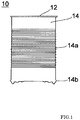
- FIG. 1 one example of a two-piece food can manufactured by the method of the present invention is shown.
- the two-piece food can 10 is integrated by mounting an upper lid 12 onto the upper end surface of a bottomed cylindrical can body 14 and seaming it.
- annular uneven beads are provided around the entire outer periphery surface, and at the outer periphery surface of the bottom surface, a bottom rim 14b is provided such that it projects outwards.
- FIG. 2 a schematic drawing of one embodiment of the method of manufacturing a two-piece food can of the present invention is shown.
- a metal sheet coated with a thermoplastic resin is punched into an approximately circular shape.
- a suitable sized mold a punch and a dice
- drawing and ironing a bottomed cylindrical can body that the body part and the bottom part are formed integrally is formed.
- the bottomed cylindrical can body is heated and held in a state as the surface temperature of the can body is at the melting temperature of the thermoplastic resin or higher for at least 20 seconds or more as (ii) process.
- the melting temperature of the thermoplastic resin may be determined by JIS K7121. That is, by using a differential thermal analyzer (DTA) or a differential scanning calorimeter (DSC), a specimen consisted of adequate amount of the thermoplastic resin is heated to a temperature that is about 20 °C higher than the melting peak ending point at heating rate of about 10 °C per minute and melted, and a DTA or DSC curve is depicted.
- the temperature at the peak of the melting peak is the melting temperature of the thermoplastic resin.
- the temperature of the melting peak that is the highest in the high temperature side is adopted as the melting temperature.
- thermoplastic resin As the heating process of (ii) process, when the surface temperature of the can body does not reach the melting temperature of the thermoplastic resin, desired corrosion resistance for a two-piece food can may not be obtained because peeling off and orientation or strain of the resin caused by (i) process would not sufficiently disappear. Further, as the surface temperature of the can body, it is preferable to heat the surface of the can body within the range of the melting temperature to +30 °C of the melting temperature. When it is higher than the melting temperature by 30 °C or higher, the thermoplastic resin may be decomposed and deteriorated.
- the heating time of (ii) process it is necessary to hold the surface temperature of the can body at the melting temperature or higher for at least 20 seconds or more. If the heating and holding time is shorter than 20 seconds, peeling off and orientation or strain of the resin caused by (i) process would not sufficiently disappear.
- the center part of the can body where beads are formed or the bottom part of the can body where the bottom rim is formed are important, and heating and holding time less than 20 seconds is not sufficient to repair the resins at such parts.
- the heating and holding temperature at the melting temperature or higher is within 25 to 45 seconds.
- (ii) process for example, when a metal sheet coated with polyester resin having melting temperature of 240 °C is used as a can material, it is necessary to hold at 240 °C or higher for 20 seconds or more, and more preferably, it is desirable to hold for 30 to 40 seconds within the range of 240 to 255 °C.
- the heating process of (ii) process is not limited in particular.
- can bodies may be placed on a conveyor for transportation, and let them pass through the heating oven provided in the passage. According to the setting temperature of the heating oven and the transportation rate of the conveyor, the heating temperature and time can be adequately adjusted to fall within their suitable range.
- the can body is quenched such that the surface temperature of the can body is Y °C or lower at least within X seconds represented by the formula shown below.
- X second s T peak ° C ⁇ Y ° C / 5
- the crystallization ending temperature of the thermoplastic resin may be determined by JIS K7121, using a differential thermal analyzer (DTA) or a differential scanning calorimeter (DSC), as described for the melting temperature.
- DTA differential thermal analyzer
- DSC differential scanning calorimeter
- a specimen consisted of adequate amount of the thermoplastic resin is heated to a temperature that is about 30 °C higher than the temperature at the melting peak ending point and melted. After holding the specimen for 10 minutes at that temperature, the specimen is cooled to a temperature that is about 50 °C lower than the temperature at the crystallization peak ending point at a cooling rate of 5 °C per minute or 10 °C per minute, and a DTA or DSC curve is depicted.
- the temperature at the intersection point of the straight line, which is the baseline in the low temperature side extended to the high temperature side, and the tangent line, which is drawn at the point where the gradient is at the maximum on the curved line in the lower temperature side of the crystallization peak, is set as the (extrapolation) crystallization ending temperature of the thermoplastic resin.
- the temperature that is the lowest in the low temperature side is adopted as the crystallization ending temperature.
- the quenching method is not limited in particular.
- the can body may be cooled by exposing it under room temperature atmosphere instantaneously. It also may be immersed into a solvent such as water as a cooling solvent, or may be sprayed with such solvents. If it takes a long time to cool the surface temperature of the can body to the crystallization temperature or lower, the resin begins to crystallize partially, and the interface of the crystal becomes weak and tends to cause cracks. Therefore, the corrosion resistance and impact resistance is deteriorated.
- polyethylene terephthalate begins to crystallize at around 150 to 200 °C.
- the resin is heated to the melting temperature or higher and crystallize temporarily, when it is held for a long time at a temperature around the crystallization temperature at cooling, it gradually re-crystallizes.
- the resin is solidified maintaining almost the amorphous state at melting. Therefore, good corrosion resistance and impact resistance may be obtained.
- Y °C the crystallization ending temperature of the thermoplastic resin
- X seconds the highest temperature (°C) of the can body surface at the heating process)-the crystallization ending temperature of the thermoplastic resin (°C) /5.
- the can body is quenched to 165 °C or lower within 20 seconds after the heating process.
- the elapsed time after heating is the time calculated from the highest temperature reaching time of the can body surface by heating. Further, in the method of the present invention, it is more desirable to quench to 160 °C or lower within 20 seconds.
- uneven beads are, for example, uneven parts of grooves formed around the whole circumference of the side surface of the body part of the can body.
- the method of forming uneven beads is not limited in particular.
- the can body part is welded with pressure by placing it in between a receiving mold, which is set at the inner face side of the can body, and a pressing mold, which is set at the outer face side, and groove-shaped beads are formed thereby.
- the resin becomes easier to peel off during formation. Or, there are problems that as the thickness of the resin may become uneven or partially weak due to the pressure applied from unfixed directions, the corrosion resistance and the impact resistance is deteriorated.
- the bottom rim is a projected part provided to project out to the outer direction around the whole circumference of the bottom part of the can body.
- the bottom rim is provided to solve the deviation of the outer peripheral diameter of the two-piece can by extending the outer peripheral diameter of the bottom part outwards, such that the diameter of the bottom part and the upper lid will become the same.
- the method of forming the bottom rim is not limited in particular.
- the can body part is welded with pressure by placing it in between a receiving mold, which is set at the inner face side, and a pressing mold, which is set at the outer face side, and the projected part that projects outwards is formed. Therefore, similar to the forming of uneven beads, the corrosion resistance may be deteriorated due to the peeling off of the resin.
- filling and hermetic sealing of food is performed as (v) process.
- the filling and hermetic sealing may be done by the conventional technique.
- the upper end face of the can body is cut uniformly by trimming in advance, and a flange is formed by a flanger. After washing and sterilizing, food is filled.
- an upper lid that is manufactured separately is mounted onto the upper end face of the can body and is hermetically sealed by seaming it with a seamer. Then, heat sterilization at predetermined temperature and time is performed as needed.
- the kind of food is not limited in particular.
- the present invention is directed to a method of manufacturing a two-piece food can filled with food having high salt content with a chloride ion concentration of 4000 ppm or higher.
- Inner face resin layer (thickness of 20 ⁇ m) Polyethylene terephthalate/isophthalate (Isophthalic acid 2 mol% copolymer) 80 % by mass Polybutylene terephthalate 20 % by mass
- thermoplastic resin-coated metal sheet of above-described compositions is punched into a shape having diameter of 179mm, drawn and ironed, and formed into a bottomed cylindrical can body having an inner diameter of 73.3mm and a height of 123mm (i process). Then, the can body is placed onto a conveyor and transported to pass through the heating oven at a predetermined speed. The set temperature and the transportation speed of the conveyor is adjusted in order to hold the temperature of the can body surface higher than the melting temperature of the inner face resin layer (245 °C) for about 30 seconds (ii process).
- Figure 3 the temperature change of the surface temperature of each parts of the can body in the heating and quenching process of Example 1 is shown.
- the holding time at 245 °C or higher was 30 seconds at the bottom face of the can, 30 seconds at the lower outer periphery of the can (bottom rim forming area), 27.5 seconds at the center of the can body (beads forming area), 24.5 seconds for the upper part of the can, and the average was 28 seconds.
- the can body is quenched so that the surface temperature will be the crystallization ending temperature or lower of the inner face resin layer (165 °C) at least within about 20 seconds after heating (iii process).
- the highest temperature of the can body surface at heating process is 264.2 °C and the crystallization ending temperature is 165 °C.
- the time required to cool the can body to 165 °C or lower from the time of the highest temperature of the can body surface is 17.0 seconds at the bottom face of the can, 19.5 seconds at the lower outer periphery of the can (bottom rim forming area), 17.0 seconds at the center of the can body (beads forming area), 16.5 seconds at the upper part of the can, and the average was 17.5 seconds.
- beads were formed by welding with pressure by pressing molds from inside and outside of the can body (iv process).
- the forming range of the beads is set at a pitch of 4.3mm and a depth of 0.6mm, and 15 beads were formed within the range of 30 to 90.2mm of the can height.
- the bottom rim was formed by welding with pressure by pressing molds from inside and outside at the bottom part of the can body (iv process).
- the bottom rim was provided to project 0.5 mm outwards than the outer diameter of the can body.
- the upper end face of the can body is cut uniformly by trimming, and a flange is formed by a flanger.
- the two-piece cans filled with food of Examples 1 to 7 obtained as described above were kept for 4 weeks at 38 °C, and the internal corrosion state for each parts of the can (the upper part, beads, the bottom rim and the bottom face) were evaluated. Further, 3 identical cans were made respectively for each examples, and each of them were evaluated. The evaluation results are shown below.
- the evaluation criteria is as follows.
- the two-piece can filled with food of Example 1 that was held for about 28 seconds at 245 °C or higher, which is the melting temperature of the thermoplastic resin coated onto the inner face of the can body, as (ii) heating process and quenched to 165 °C (the crystallization ending temperature) or lower within about 18 seconds from the time of the highest temperature (about 265 °C) of the can body surface as (iii) quenching process before forming beads and/or bottom rims, only slight corrosion could be found in the inner face at the beads and the bottom rim after 4 weeks of storage. The state of corrosion was good overall.
- Example 2 and 3 that required about 30 seconds and about 60 seconds to lower the temperature to 165 °C (the crystallization ending temperature) or lower from the time of the highest temperature (about 265 °C) after the heating process, corrosion of a depth of about 1 to 25 % particularly at the inner face of the beads and the bottom rims occured. Further, in Examples 4 to 6 that their heating temperature had not reached the melting temperature of the thermoplastic resin (245 °C), sufficient corrosion resistance could not be obtained particularly at the inner face of the beads and the bottom rims. Moreover, in Example 7 that (ii) heating and (iii) quenching process had not been performed at all, significant corrosion occurred particularly at the inner face of the beads and the bottom rims.
- thermoplastic resin-coated metal sheet By using the above-described thermoplastic resin-coated metal sheet and performing (i) to (v) processes in the same way as Example 1, two-piece cans filled with food having same dimensions were obtained.
- the holding time at 251 °C or higher which is the melting temperature (the melting peak that is the most in the high temperature side) of the inner face resin layer at (ii) heating process, was 25.5 seconds in average.
- the time required for lowering the surface temperature to 164 °C or lower, which is the crystallization ending temperature, from the time of the highest temperature (about 265 °C) after heating was 18.0 seconds in average.
- Inner face resin layer (thickness of 20 ⁇ m/upper layer 10 ⁇ m, bottom layer 10 ⁇ m)
- Upper layer (10 ⁇ m) Polybutylene terephthalate 60 % by mass Polyethylene terephthalate 40 % by mass
- Bottom layer (10 ⁇ m) Polyethylene terephthalate/isophthalate (Isophthalic acid 10 mol% copolymer) 70 % by mass
- thermoplastic resin-coated metal sheet By using the above-described thermoplastic resin-coated metal sheet and performing (i) to (v) processes in the same way as Example 1, two-piece cans filled with food having same dimensions were obtained.
- the holding time at 249 °C or higher which is the melting temperature (the melting peak that is the most in the high temperature side) of the inner face resin layer at (ii) heating process, was 27 seconds in average.
- the time required for lowering the surface temperature to 169 °C or lower, which is the crystallization ending temperature, from the time of the highest temperature (about 265 °C) after heating was 17.5 seconds in average.
Landscapes
- Engineering & Computer Science (AREA)
- Mechanical Engineering (AREA)
- Chemical & Material Sciences (AREA)
- Life Sciences & Earth Sciences (AREA)
- Materials Engineering (AREA)
- Wood Science & Technology (AREA)
- Organic Chemistry (AREA)
- Ceramic Engineering (AREA)
- Physics & Mathematics (AREA)
- Thermal Sciences (AREA)
- Containers Having Bodies Formed In One Piece (AREA)
- Rigid Containers With Two Or More Constituent Elements (AREA)
Claims (5)
- Ein Verfahren zum Herstellen einer zweiteiligen Lebensmitteldose (10), wobei das Verfahren aufweist:(i) einen Dosenkörper-Bildungsprozess des Stanzens einer Metallage, die auf zumindest einer Seite ein thermoplastisches Harz beschichtet aufweist, in eine annähernd runde Form, des Ziehens und des Abstreckens der Metallage so, dass die mit Harz beschichtete Oberfläche die innere Oberfläche wird, und des Formens eines zylindrischen Dosenkörpers mit Boden (14), der das Körperteil und das Bodenteil integral ausgebildet hat,(ii) einen Erwärmungsprozess des Erwärmens des Dosenkörpers (14), der durch den oben beschriebenen Prozess geformt wurde, und des Haltens der Oberflächentemperatur des Dosenkörpers (14) bei der Schmelztemperatur des thermoplastischen Harzes oder höher für zumindest 20 Sekunden,(iii) einen Abschreckprozess, nach dem Erwärmungsprozess, des Kühlens des Dosenkörpers (14) so, dass die Oberflächentemperatur des Dosenkörpers (14) Y °C oder weniger zumindest innerhalb von X Sekunden ist, angegeben durch die folgende Formel
 Tpeak (°C): die höchste Temperatur der Dosenkörperoberfläche bei dem Erwärmungsprozess, undY (°C): die Kristallisations-Endtemperatur des thermoplastischen Harzes,(iv) einen Sicken-Bildungsprozess des Ausbildens von zumindest einer ringförmigen ungleichmäßigen Sicke (14a) um den gesamten Umfang der Seitenoberfläche des Körperteils des Dosenkörpers (14) nach dem Erwärmungsprozess und dem Abschreckprozess, und/oder einen Bodenrand-Ausbildungsprozess des Ausbildens eines Bodenrands (14b) um den gesamten Umfang, der zu der Außenumfangsseitenoberfläche des Bodenteils des Dosenkörpers (14) nach außen vorsteht, nach den oben beschriebenen Prozessen,(v) einen Befüllungs- und hermetischen Versiegelungsprozess des Einfüllens von Nahrungsmittel mit einer Chlorionenkonzentration von 4000 ppm oder mehr in den Dosenkörper (14) mit der/den Sicke(n) (14a) und/oder dem Bodenrand (14b), der/die durch die oben beschriebenen Prozesse ausgebildet wurde(n), und hermetisches Verschließen des Dosenkörpers (14) durch Anbringen eines Deckelteils (12) an bzw. auf der oberen Endoberfläche des Dosenkörpers (14) und Verschließen bzw. Falzen desselben.
 - Das Verfahren zum Herstellen einer zweiteiligen Lebensmitteldose (10) gemäß Anspruch 1, wobei in dem (ii) Erwärmungsprozess die Oberflächentemperatur des Dosenkörpers (14) auf eine Temperatur in einem Bereich von einer Schmelztemperatur des thermoplastischen Harzes bis +30°C der Schmelztemperatur erwärmt wird.
- Das Verfahren zum Herstellen einer zweiteiligen Lebensmitteldose (10) gemäß Anspruch 1 oder 2, wobei in dem (ii) Erwärmungsprozess die Oberflächentemperatur des Dosenkörpers (14) bei der Schmelztemperatur des thermoplastischen Harzes oder höher für 25 bis 45 Sekunden gehalten wird.
- Das Verfahren zum Herstellen einer zweiteiligen Lebensmitteldose (10) gemäß einem der Ansprüche 1 bis 3, wobei in dem (iii) Abschreckprozess der Dosenkörper (14) so abgeschreckt wird, dass die Oberflächentemperatur des Dosenkörpers 160°C oder weniger zumindest innerhalb 20 Sekunden ist.
- Das Verfahren zum Herstellen einer zweiteiligen Lebensmitteldose (10) gemäß einem der Ansprüche 1 bis 4, wobei das thermoplastische Harz ein Polyesterharz, hauptsächlich aufgebaut aus einer sich wiederholenden Einheit von Polyethylen-Terephthalat ist und die Schmelztemperatur des thermoplastischen Harzes 200 bis 280°C beträgt.
Applications Claiming Priority (1)
| Application Number | Priority Date | Filing Date | Title |
|---|---|---|---|
| PCT/JP2013/074505 WO2015037074A1 (ja) | 2013-09-11 | 2013-09-11 | 食品用2ピース缶の製造方法 |
Publications (3)
| Publication Number | Publication Date |
|---|---|
| EP3045238A1 EP3045238A1 (de) | 2016-07-20 |
| EP3045238A4 EP3045238A4 (de) | 2017-06-14 |
| EP3045238B1 true EP3045238B1 (de) | 2018-07-04 |
Family
ID=52665216
Family Applications (1)
| Application Number | Title | Priority Date | Filing Date |
|---|---|---|---|
| EP13893326.2A Active EP3045238B1 (de) | 2013-09-11 | 2013-09-11 | Verfahren zur herstellung zweiteiliger lebensmitteldosen |
Country Status (4)
| Country | Link |
|---|---|
| US (1) | US10052675B2 (de) |
| EP (1) | EP3045238B1 (de) |
| JP (1) | JP6276771B2 (de) |
| WO (1) | WO2015037074A1 (de) |
Families Citing this family (8)
| Publication number | Priority date | Publication date | Assignee | Title |
|---|---|---|---|---|
| GB201205243D0 (en) | 2012-03-26 | 2012-05-09 | Kraft Foods R & D Inc | Packaging and method of opening |
| GB2511560B (en) | 2013-03-07 | 2018-11-14 | Mondelez Uk R&D Ltd | Improved Packaging and Method of Forming Packaging |
| GB2511559B (en) | 2013-03-07 | 2018-11-14 | Mondelez Uk R&D Ltd | Improved Packaging and Method of Forming Packaging |
| CN105834322A (zh) * | 2016-04-26 | 2016-08-10 | 奥瑞金包装股份有限公司 | 无缝罐的制造方法和无缝罐 |
| CN106180462B (zh) * | 2016-07-15 | 2018-06-01 | 东莞市满贯包装有限公司 | 一种大口径包装罐制备方法及其制品 |
| JP6735651B2 (ja) * | 2016-10-20 | 2020-08-05 | ユニバーサル製缶株式会社 | ボトル缶の製造方法 |
| JP7154784B2 (ja) * | 2018-03-16 | 2022-10-18 | 大和製罐株式会社 | ツーピース缶の製造方法及び缶胴 |
| WO2021049029A1 (ja) | 2019-09-13 | 2021-03-18 | 大和製罐株式会社 | ツーピース缶の製造方法、缶胴及び金属板 |
Family Cites Families (10)
| Publication number | Priority date | Publication date | Assignee | Title |
|---|---|---|---|---|
| JPS5935344B2 (ja) * | 1978-04-25 | 1984-08-28 | 東レ株式会社 | 被覆金属容器の熱処理方法 |
| US4264017A (en) * | 1979-08-20 | 1981-04-28 | American Can Company | Container shape |
| JPH0757385B2 (ja) * | 1989-06-13 | 1995-06-21 | 東洋製罐株式会社 | 被覆深絞り缶の製造方法 |
| JPH0796139B2 (ja) * | 1991-03-29 | 1995-10-18 | 東洋製罐株式会社 | 周状多面体壁缶の製造方法及び装置 |
| JP2677172B2 (ja) * | 1993-10-14 | 1997-11-17 | 東洋製罐株式会社 | 保香性及び耐衝撃性に優れたラミネート絞り容器 |
| JP3601165B2 (ja) * | 1996-03-15 | 2004-12-15 | 東洋紡績株式会社 | ポリエステル系フィルム、ラミネート金属板および金属容器 |
| JP4646164B2 (ja) * | 1999-09-30 | 2011-03-09 | 大和製罐株式会社 | ボトル型缶の製造方法 |
| JP4278270B2 (ja) * | 2000-03-22 | 2009-06-10 | 新日本製鐵株式会社 | フィルムラミネートツーピース缶 |
| JP4293330B2 (ja) | 2000-03-30 | 2009-07-08 | 大和製罐株式会社 | 製缶用オーブン装置 |
| JP4692147B2 (ja) * | 2005-08-12 | 2011-06-01 | Jfeスチール株式会社 | 2ピース缶の製造方法および2ピースラミネート缶 |
-
2013
- 2013-09-11 WO PCT/JP2013/074505 patent/WO2015037074A1/ja not_active Ceased
- 2013-09-11 JP JP2015536347A patent/JP6276771B2/ja active Active
- 2013-09-11 US US15/021,146 patent/US10052675B2/en active Active
- 2013-09-11 EP EP13893326.2A patent/EP3045238B1/de active Active
Non-Patent Citations (1)
| Title |
|---|
| None * |
Also Published As
| Publication number | Publication date |
|---|---|
| JPWO2015037074A1 (ja) | 2017-03-02 |
| US10052675B2 (en) | 2018-08-21 |
| US20160221064A1 (en) | 2016-08-04 |
| EP3045238A4 (de) | 2017-06-14 |
| EP3045238A1 (de) | 2016-07-20 |
| JP6276771B2 (ja) | 2018-02-07 |
| WO2015037074A1 (ja) | 2015-03-19 |
Similar Documents
| Publication | Publication Date | Title |
|---|---|---|
| US10052675B2 (en) | Method of manufacturing two-piece food can | |
| JP5937337B2 (ja) | ボトル型缶の製造方法およびボトル型缶 | |
| EP2962951B1 (de) | Laminierte metallplatten für zweiteilige dosen und laminierter zweiteiliger dosenkörper | |
| JP4492103B2 (ja) | 表面処理金属材料及びその表面処理方法、並びに樹脂被覆金属材料、金属缶、缶蓋 | |
| GB1566422A (en) | Coated metal sheet and process for production therefor | |
| WO2006123666A1 (ja) | 3ピース角形缶及びその製造方法 | |
| CN104023974B (zh) | 层压金属板及食品用罐装容器 | |
| EP2085318A1 (de) | Laminatstahlblech für zweiteiligen dosenkörper, aus laminatstahlblech hergestellter dosenkörper und verfahren zur herstellung des zweiteiligen dosenkörpers | |
| EP0928684A3 (de) | Polyestermehrschichtfolie, eine mit dieser Folie beschichtete Metallplatte und ein mit einer Folie beschichteter Behälter aus Metall | |
| EP1690675B1 (de) | Laminierte metallplatte für dosendeckel mit ansprechendem aussehen nach dem sterilisieren | |
| US20090218250A1 (en) | Method for producing two-piece can and two-piece laminated can | |
| US20230264854A1 (en) | Seam seal for wine in beverage cans | |
| JP4631111B2 (ja) | アルミニウム製缶材料、缶及び缶蓋 | |
| JP4692146B2 (ja) | 2ピース缶の製造方法および2ピースラミネート缶 | |
| CA2617892C (en) | Laminated steel sheet for two-piece can, method for manufacturing two-piece can, and two-piece laminated can | |
| EP1669189B1 (de) | Mit harz beschichtetes metallblech und dieses verwendende tiefgezogene dose | |
| CN108367542B (zh) | 两面树脂被覆容器用层压钢板 | |
| JP2806249B2 (ja) | 大型角形缶およびその製造方法 | |
| JPH0631362A (ja) | 密着性の優れたラミネート鋼板製多段絞り缶の製造方法 | |
| CN112203941A (zh) | 树脂覆盖的钢罐及其制造方法 | |
| JP3826450B2 (ja) | 製缶加工用フィルム被覆金属板の製造方法及び印刷缶の製造方法 | |
| EP1914064B1 (de) | Laminiertes stahlblech für den dosenkörper einer zweiteiligen dose und zweiteilige dose mit laminatstahlblech | |
| JP3693820B2 (ja) | 熱可塑性樹脂被覆金属板を用いた缶蓋の製造方法および缶蓋 | |
| EP0630703B1 (de) | Verfahren zum herstellen leicht zu öffnender deckel aus laminierten polyesterharzmetallplatten , leicht zu öffnender deckel und laminierte polyesterharzmetallplatte für leicht zu öffnende deckel | |
| KR100261507B1 (ko) | 수지필름 피복 금속판의 제조방법 |
Legal Events
| Date | Code | Title | Description |
|---|---|---|---|
| PUAI | Public reference made under article 153(3) epc to a published international application that has entered the european phase |
Free format text: ORIGINAL CODE: 0009012 |
|
| 17P | Request for examination filed |
Effective date: 20160314 |
|
| AK | Designated contracting states |
Kind code of ref document: A1 Designated state(s): AL AT BE BG CH CY CZ DE DK EE ES FI FR GB GR HR HU IE IS IT LI LT LU LV MC MK MT NL NO PL PT RO RS SE SI SK SM TR |
|
| AX | Request for extension of the european patent |
Extension state: BA ME |
|
| DAX | Request for extension of the european patent (deleted) | ||
| A4 | Supplementary search report drawn up and despatched |
Effective date: 20170517 |
|
| RIC1 | Information provided on ipc code assigned before grant |
Ipc: B32B 15/20 20060101ALI20170510BHEP Ipc: B65D 1/16 20060101ALI20170510BHEP Ipc: B32B 15/18 20060101ALI20170510BHEP Ipc: B32B 15/08 20060101ALI20170510BHEP Ipc: B21D 51/26 20060101AFI20170510BHEP Ipc: B65D 1/28 20060101ALI20170510BHEP Ipc: B21D 22/28 20060101ALI20170510BHEP |
|
| GRAP | Despatch of communication of intention to grant a patent |
Free format text: ORIGINAL CODE: EPIDOSNIGR1 |
|
| RIC1 | Information provided on ipc code assigned before grant |
Ipc: B21D 51/26 20060101AFI20171219BHEP Ipc: B32B 15/18 20060101ALI20171219BHEP Ipc: B65D 1/16 20060101ALI20171219BHEP Ipc: B21D 22/28 20060101ALI20171219BHEP Ipc: B32B 15/08 20060101ALI20171219BHEP Ipc: B32B 15/20 20060101ALI20171219BHEP Ipc: B65D 1/28 20060101ALI20171219BHEP |
|
| INTG | Intention to grant announced |
Effective date: 20180118 |
|
| GRAS | Grant fee paid |
Free format text: ORIGINAL CODE: EPIDOSNIGR3 |
|
| GRAA | (expected) grant |
Free format text: ORIGINAL CODE: 0009210 |
|
| AK | Designated contracting states |
Kind code of ref document: B1 Designated state(s): AL AT BE BG CH CY CZ DE DK EE ES FI FR GB GR HR HU IE IS IT LI LT LU LV MC MK MT NL NO PL PT RO RS SE SI SK SM TR |
|
| REG | Reference to a national code |
Ref country code: GB Ref legal event code: FG4D |
|
| REG | Reference to a national code |
Ref country code: CH Ref legal event code: EP |
|
| REG | Reference to a national code |
Ref country code: AT Ref legal event code: REF Ref document number: 1013953 Country of ref document: AT Kind code of ref document: T Effective date: 20180715 |
|
| REG | Reference to a national code |
Ref country code: IE Ref legal event code: FG4D |
|
| REG | Reference to a national code |
Ref country code: DE Ref legal event code: R096 Ref document number: 602013039932 Country of ref document: DE |
|
| REG | Reference to a national code |
Ref country code: NL Ref legal event code: FP |
|
| REG | Reference to a national code |
Ref country code: FR Ref legal event code: PLFP Year of fee payment: 6 |
|
| REG | Reference to a national code |
Ref country code: LT Ref legal event code: MG4D |
|
| REG | Reference to a national code |
Ref country code: AT Ref legal event code: MK05 Ref document number: 1013953 Country of ref document: AT Kind code of ref document: T Effective date: 20180704 |
|
| PG25 | Lapsed in a contracting state [announced via postgrant information from national office to epo] |
Ref country code: PL Free format text: LAPSE BECAUSE OF FAILURE TO SUBMIT A TRANSLATION OF THE DESCRIPTION OR TO PAY THE FEE WITHIN THE PRESCRIBED TIME-LIMIT Effective date: 20180704 Ref country code: IS Free format text: LAPSE BECAUSE OF FAILURE TO SUBMIT A TRANSLATION OF THE DESCRIPTION OR TO PAY THE FEE WITHIN THE PRESCRIBED TIME-LIMIT Effective date: 20181104 Ref country code: AT Free format text: LAPSE BECAUSE OF FAILURE TO SUBMIT A TRANSLATION OF THE DESCRIPTION OR TO PAY THE FEE WITHIN THE PRESCRIBED TIME-LIMIT Effective date: 20180704 Ref country code: NO Free format text: LAPSE BECAUSE OF FAILURE TO SUBMIT A TRANSLATION OF THE DESCRIPTION OR TO PAY THE FEE WITHIN THE PRESCRIBED TIME-LIMIT Effective date: 20181004 Ref country code: SE Free format text: LAPSE BECAUSE OF FAILURE TO SUBMIT A TRANSLATION OF THE DESCRIPTION OR TO PAY THE FEE WITHIN THE PRESCRIBED TIME-LIMIT Effective date: 20180704 Ref country code: GR Free format text: LAPSE BECAUSE OF FAILURE TO SUBMIT A TRANSLATION OF THE DESCRIPTION OR TO PAY THE FEE WITHIN THE PRESCRIBED TIME-LIMIT Effective date: 20181005 Ref country code: RS Free format text: LAPSE BECAUSE OF FAILURE TO SUBMIT A TRANSLATION OF THE DESCRIPTION OR TO PAY THE FEE WITHIN THE PRESCRIBED TIME-LIMIT Effective date: 20180704 Ref country code: FI Free format text: LAPSE BECAUSE OF FAILURE TO SUBMIT A TRANSLATION OF THE DESCRIPTION OR TO PAY THE FEE WITHIN THE PRESCRIBED TIME-LIMIT Effective date: 20180704 Ref country code: BG Free format text: LAPSE BECAUSE OF FAILURE TO SUBMIT A TRANSLATION OF THE DESCRIPTION OR TO PAY THE FEE WITHIN THE PRESCRIBED TIME-LIMIT Effective date: 20181004 Ref country code: CZ Free format text: LAPSE BECAUSE OF FAILURE TO SUBMIT A TRANSLATION OF THE DESCRIPTION OR TO PAY THE FEE WITHIN THE PRESCRIBED TIME-LIMIT Effective date: 20180704 Ref country code: LT Free format text: LAPSE BECAUSE OF FAILURE TO SUBMIT A TRANSLATION OF THE DESCRIPTION OR TO PAY THE FEE WITHIN THE PRESCRIBED TIME-LIMIT Effective date: 20180704 |
|
| PG25 | Lapsed in a contracting state [announced via postgrant information from national office to epo] |
Ref country code: HR Free format text: LAPSE BECAUSE OF FAILURE TO SUBMIT A TRANSLATION OF THE DESCRIPTION OR TO PAY THE FEE WITHIN THE PRESCRIBED TIME-LIMIT Effective date: 20180704 Ref country code: LV Free format text: LAPSE BECAUSE OF FAILURE TO SUBMIT A TRANSLATION OF THE DESCRIPTION OR TO PAY THE FEE WITHIN THE PRESCRIBED TIME-LIMIT Effective date: 20180704 Ref country code: AL Free format text: LAPSE BECAUSE OF FAILURE TO SUBMIT A TRANSLATION OF THE DESCRIPTION OR TO PAY THE FEE WITHIN THE PRESCRIBED TIME-LIMIT Effective date: 20180704 Ref country code: ES Free format text: LAPSE BECAUSE OF FAILURE TO SUBMIT A TRANSLATION OF THE DESCRIPTION OR TO PAY THE FEE WITHIN THE PRESCRIBED TIME-LIMIT Effective date: 20180704 |
|
| REG | Reference to a national code |
Ref country code: DE Ref legal event code: R097 Ref document number: 602013039932 Country of ref document: DE |
|
| PG25 | Lapsed in a contracting state [announced via postgrant information from national office to epo] |
Ref country code: RO Free format text: LAPSE BECAUSE OF FAILURE TO SUBMIT A TRANSLATION OF THE DESCRIPTION OR TO PAY THE FEE WITHIN THE PRESCRIBED TIME-LIMIT Effective date: 20180704 Ref country code: MC Free format text: LAPSE BECAUSE OF FAILURE TO SUBMIT A TRANSLATION OF THE DESCRIPTION OR TO PAY THE FEE WITHIN THE PRESCRIBED TIME-LIMIT Effective date: 20180704 Ref country code: EE Free format text: LAPSE BECAUSE OF FAILURE TO SUBMIT A TRANSLATION OF THE DESCRIPTION OR TO PAY THE FEE WITHIN THE PRESCRIBED TIME-LIMIT Effective date: 20180704 Ref country code: IT Free format text: LAPSE BECAUSE OF FAILURE TO SUBMIT A TRANSLATION OF THE DESCRIPTION OR TO PAY THE FEE WITHIN THE PRESCRIBED TIME-LIMIT Effective date: 20180704 |
|
| REG | Reference to a national code |
Ref country code: CH Ref legal event code: PL |
|
| PLBE | No opposition filed within time limit |
Free format text: ORIGINAL CODE: 0009261 |
|
| STAA | Information on the status of an ep patent application or granted ep patent |
Free format text: STATUS: NO OPPOSITION FILED WITHIN TIME LIMIT |
|
| PG25 | Lapsed in a contracting state [announced via postgrant information from national office to epo] |
Ref country code: DK Free format text: LAPSE BECAUSE OF FAILURE TO SUBMIT A TRANSLATION OF THE DESCRIPTION OR TO PAY THE FEE WITHIN THE PRESCRIBED TIME-LIMIT Effective date: 20180704 Ref country code: SK Free format text: LAPSE BECAUSE OF FAILURE TO SUBMIT A TRANSLATION OF THE DESCRIPTION OR TO PAY THE FEE WITHIN THE PRESCRIBED TIME-LIMIT Effective date: 20180704 Ref country code: SM Free format text: LAPSE BECAUSE OF FAILURE TO SUBMIT A TRANSLATION OF THE DESCRIPTION OR TO PAY THE FEE WITHIN THE PRESCRIBED TIME-LIMIT Effective date: 20180704 |
|
| 26N | No opposition filed |
Effective date: 20190405 |
|
| REG | Reference to a national code |
Ref country code: BE Ref legal event code: MM Effective date: 20180930 |
|
| REG | Reference to a national code |
Ref country code: IE Ref legal event code: MM4A |
|
| PG25 | Lapsed in a contracting state [announced via postgrant information from national office to epo] |
Ref country code: LU Free format text: LAPSE BECAUSE OF NON-PAYMENT OF DUE FEES Effective date: 20180911 |
|
| PG25 | Lapsed in a contracting state [announced via postgrant information from national office to epo] |
Ref country code: IE Free format text: LAPSE BECAUSE OF NON-PAYMENT OF DUE FEES Effective date: 20180911 |
|
| PG25 | Lapsed in a contracting state [announced via postgrant information from national office to epo] |
Ref country code: SI Free format text: LAPSE BECAUSE OF FAILURE TO SUBMIT A TRANSLATION OF THE DESCRIPTION OR TO PAY THE FEE WITHIN THE PRESCRIBED TIME-LIMIT Effective date: 20180704 Ref country code: CH Free format text: LAPSE BECAUSE OF NON-PAYMENT OF DUE FEES Effective date: 20180930 Ref country code: BE Free format text: LAPSE BECAUSE OF NON-PAYMENT OF DUE FEES Effective date: 20180930 Ref country code: LI Free format text: LAPSE BECAUSE OF NON-PAYMENT OF DUE FEES Effective date: 20180930 |
|
| PG25 | Lapsed in a contracting state [announced via postgrant information from national office to epo] |
Ref country code: MT Free format text: LAPSE BECAUSE OF NON-PAYMENT OF DUE FEES Effective date: 20180911 |
|
| PG25 | Lapsed in a contracting state [announced via postgrant information from national office to epo] |
Ref country code: TR Free format text: LAPSE BECAUSE OF FAILURE TO SUBMIT A TRANSLATION OF THE DESCRIPTION OR TO PAY THE FEE WITHIN THE PRESCRIBED TIME-LIMIT Effective date: 20180704 |
|
| PG25 | Lapsed in a contracting state [announced via postgrant information from national office to epo] |
Ref country code: PT Free format text: LAPSE BECAUSE OF FAILURE TO SUBMIT A TRANSLATION OF THE DESCRIPTION OR TO PAY THE FEE WITHIN THE PRESCRIBED TIME-LIMIT Effective date: 20180704 |
|
| PG25 | Lapsed in a contracting state [announced via postgrant information from national office to epo] |
Ref country code: MK Free format text: LAPSE BECAUSE OF NON-PAYMENT OF DUE FEES Effective date: 20180704 Ref country code: HU Free format text: LAPSE BECAUSE OF FAILURE TO SUBMIT A TRANSLATION OF THE DESCRIPTION OR TO PAY THE FEE WITHIN THE PRESCRIBED TIME-LIMIT; INVALID AB INITIO Effective date: 20130911 Ref country code: CY Free format text: LAPSE BECAUSE OF FAILURE TO SUBMIT A TRANSLATION OF THE DESCRIPTION OR TO PAY THE FEE WITHIN THE PRESCRIBED TIME-LIMIT Effective date: 20180704 |
|
| PGFP | Annual fee paid to national office [announced via postgrant information from national office to epo] |
Ref country code: DE Payment date: 20250919 Year of fee payment: 13 |
|
| PGFP | Annual fee paid to national office [announced via postgrant information from national office to epo] |
Ref country code: NL Payment date: 20250918 Year of fee payment: 13 |
|
| PGFP | Annual fee paid to national office [announced via postgrant information from national office to epo] |
Ref country code: GB Payment date: 20250919 Year of fee payment: 13 |
|
| PGFP | Annual fee paid to national office [announced via postgrant information from national office to epo] |
Ref country code: FR Payment date: 20250922 Year of fee payment: 13 |