EP3012287B1 - Polypropylenharz-schaumpartikel mit hervorragender flammfestigkeit und leitfähigkeit sowie in einer form geschäumter polypropylenharz-formkörper - Google Patents
Polypropylenharz-schaumpartikel mit hervorragender flammfestigkeit und leitfähigkeit sowie in einer form geschäumter polypropylenharz-formkörper Download PDFInfo
- Publication number
- EP3012287B1 EP3012287B1 EP14813497.6A EP14813497A EP3012287B1 EP 3012287 B1 EP3012287 B1 EP 3012287B1 EP 14813497 A EP14813497 A EP 14813497A EP 3012287 B1 EP3012287 B1 EP 3012287B1
- Authority
- EP
- European Patent Office
- Prior art keywords
- polypropylene resin
- foamed particles
- weight
- less
- parts
- Prior art date
- Legal status (The legal status is an assumption and is not a legal conclusion. Google has not performed a legal analysis and makes no representation as to the accuracy of the status listed.)
- Active
Links
Images
Classifications
-
- C—CHEMISTRY; METALLURGY
- C08—ORGANIC MACROMOLECULAR COMPOUNDS; THEIR PREPARATION OR CHEMICAL WORKING-UP; COMPOSITIONS BASED THEREON
- C08J—WORKING-UP; GENERAL PROCESSES OF COMPOUNDING; AFTER-TREATMENT NOT COVERED BY SUBCLASSES C08B, C08C, C08F, C08G or C08H
- C08J9/00—Working-up of macromolecular substances to porous or cellular articles or materials; After-treatment thereof
- C08J9/16—Making expandable particles
- C08J9/18—Making expandable particles by impregnating polymer particles with the blowing agent
-
- C—CHEMISTRY; METALLURGY
- C08—ORGANIC MACROMOLECULAR COMPOUNDS; THEIR PREPARATION OR CHEMICAL WORKING-UP; COMPOSITIONS BASED THEREON
- C08J—WORKING-UP; GENERAL PROCESSES OF COMPOUNDING; AFTER-TREATMENT NOT COVERED BY SUBCLASSES C08B, C08C, C08F, C08G or C08H
- C08J9/00—Working-up of macromolecular substances to porous or cellular articles or materials; After-treatment thereof
- C08J9/0014—Use of organic additives
- C08J9/0023—Use of organic additives containing oxygen
-
- C—CHEMISTRY; METALLURGY
- C08—ORGANIC MACROMOLECULAR COMPOUNDS; THEIR PREPARATION OR CHEMICAL WORKING-UP; COMPOSITIONS BASED THEREON
- C08J—WORKING-UP; GENERAL PROCESSES OF COMPOUNDING; AFTER-TREATMENT NOT COVERED BY SUBCLASSES C08B, C08C, C08F, C08G or C08H
- C08J9/00—Working-up of macromolecular substances to porous or cellular articles or materials; After-treatment thereof
- C08J9/0014—Use of organic additives
- C08J9/0028—Use of organic additives containing nitrogen
-
- C—CHEMISTRY; METALLURGY
- C08—ORGANIC MACROMOLECULAR COMPOUNDS; THEIR PREPARATION OR CHEMICAL WORKING-UP; COMPOSITIONS BASED THEREON
- C08J—WORKING-UP; GENERAL PROCESSES OF COMPOUNDING; AFTER-TREATMENT NOT COVERED BY SUBCLASSES C08B, C08C, C08F, C08G or C08H
- C08J9/00—Working-up of macromolecular substances to porous or cellular articles or materials; After-treatment thereof
- C08J9/0061—Working-up of macromolecular substances to porous or cellular articles or materials; After-treatment thereof characterized by the use of several polymeric components
-
- C—CHEMISTRY; METALLURGY
- C08—ORGANIC MACROMOLECULAR COMPOUNDS; THEIR PREPARATION OR CHEMICAL WORKING-UP; COMPOSITIONS BASED THEREON
- C08J—WORKING-UP; GENERAL PROCESSES OF COMPOUNDING; AFTER-TREATMENT NOT COVERED BY SUBCLASSES C08B, C08C, C08F, C08G or C08H
- C08J9/00—Working-up of macromolecular substances to porous or cellular articles or materials; After-treatment thereof
- C08J9/0066—Use of inorganic compounding ingredients
-
- C—CHEMISTRY; METALLURGY
- C08—ORGANIC MACROMOLECULAR COMPOUNDS; THEIR PREPARATION OR CHEMICAL WORKING-UP; COMPOSITIONS BASED THEREON
- C08J—WORKING-UP; GENERAL PROCESSES OF COMPOUNDING; AFTER-TREATMENT NOT COVERED BY SUBCLASSES C08B, C08C, C08F, C08G or C08H
- C08J9/00—Working-up of macromolecular substances to porous or cellular articles or materials; After-treatment thereof
- C08J9/04—Working-up of macromolecular substances to porous or cellular articles or materials; After-treatment thereof using blowing gases generated by a previously added blowing agent
- C08J9/12—Working-up of macromolecular substances to porous or cellular articles or materials; After-treatment thereof using blowing gases generated by a previously added blowing agent by a physical blowing agent
- C08J9/122—Hydrogen, oxygen, CO2, nitrogen or noble gases
-
- C—CHEMISTRY; METALLURGY
- C08—ORGANIC MACROMOLECULAR COMPOUNDS; THEIR PREPARATION OR CHEMICAL WORKING-UP; COMPOSITIONS BASED THEREON
- C08J—WORKING-UP; GENERAL PROCESSES OF COMPOUNDING; AFTER-TREATMENT NOT COVERED BY SUBCLASSES C08B, C08C, C08F, C08G or C08H
- C08J9/00—Working-up of macromolecular substances to porous or cellular articles or materials; After-treatment thereof
- C08J9/22—After-treatment of expandable particles; Forming foamed products
- C08J9/228—Forming foamed products
- C08J9/232—Forming foamed products by sintering expandable particles
-
- H—ELECTRICITY
- H01—ELECTRIC ELEMENTS
- H01B—CABLES; CONDUCTORS; INSULATORS; SELECTION OF MATERIALS FOR THEIR CONDUCTIVE, INSULATING OR DIELECTRIC PROPERTIES
- H01B1/00—Conductors or conductive bodies characterised by the conductive materials; Selection of materials as conductors
- H01B1/20—Conductive material dispersed in non-conductive organic material
- H01B1/24—Conductive material dispersed in non-conductive organic material the conductive material comprising carbon-silicon compounds, carbon or silicon
-
- C—CHEMISTRY; METALLURGY
- C08—ORGANIC MACROMOLECULAR COMPOUNDS; THEIR PREPARATION OR CHEMICAL WORKING-UP; COMPOSITIONS BASED THEREON
- C08J—WORKING-UP; GENERAL PROCESSES OF COMPOUNDING; AFTER-TREATMENT NOT COVERED BY SUBCLASSES C08B, C08C, C08F, C08G or C08H
- C08J2201/00—Foams characterised by the foaming process
- C08J2201/02—Foams characterised by the foaming process characterised by mechanical pre- or post-treatments
- C08J2201/034—Post-expanding of foam beads or sheets
-
- C—CHEMISTRY; METALLURGY
- C08—ORGANIC MACROMOLECULAR COMPOUNDS; THEIR PREPARATION OR CHEMICAL WORKING-UP; COMPOSITIONS BASED THEREON
- C08J—WORKING-UP; GENERAL PROCESSES OF COMPOUNDING; AFTER-TREATMENT NOT COVERED BY SUBCLASSES C08B, C08C, C08F, C08G or C08H
- C08J2203/00—Foams characterized by the expanding agent
- C08J2203/06—CO2, N2 or noble gases
-
- C—CHEMISTRY; METALLURGY
- C08—ORGANIC MACROMOLECULAR COMPOUNDS; THEIR PREPARATION OR CHEMICAL WORKING-UP; COMPOSITIONS BASED THEREON
- C08J—WORKING-UP; GENERAL PROCESSES OF COMPOUNDING; AFTER-TREATMENT NOT COVERED BY SUBCLASSES C08B, C08C, C08F, C08G or C08H
- C08J2205/00—Foams characterised by their properties
- C08J2205/04—Foams characterised by their properties characterised by the foam pores
- C08J2205/052—Closed cells, i.e. more than 50% of the pores are closed
-
- C—CHEMISTRY; METALLURGY
- C08—ORGANIC MACROMOLECULAR COMPOUNDS; THEIR PREPARATION OR CHEMICAL WORKING-UP; COMPOSITIONS BASED THEREON
- C08J—WORKING-UP; GENERAL PROCESSES OF COMPOUNDING; AFTER-TREATMENT NOT COVERED BY SUBCLASSES C08B, C08C, C08F, C08G or C08H
- C08J2323/00—Characterised by the use of homopolymers or copolymers of unsaturated aliphatic hydrocarbons having only one carbon-to-carbon double bond; Derivatives of such polymers
- C08J2323/02—Characterised by the use of homopolymers or copolymers of unsaturated aliphatic hydrocarbons having only one carbon-to-carbon double bond; Derivatives of such polymers not modified by chemical after treatment
- C08J2323/10—Homopolymers or copolymers of propene
- C08J2323/12—Polypropene
-
- C—CHEMISTRY; METALLURGY
- C08—ORGANIC MACROMOLECULAR COMPOUNDS; THEIR PREPARATION OR CHEMICAL WORKING-UP; COMPOSITIONS BASED THEREON
- C08J—WORKING-UP; GENERAL PROCESSES OF COMPOUNDING; AFTER-TREATMENT NOT COVERED BY SUBCLASSES C08B, C08C, C08F, C08G or C08H
- C08J2323/00—Characterised by the use of homopolymers or copolymers of unsaturated aliphatic hydrocarbons having only one carbon-to-carbon double bond; Derivatives of such polymers
- C08J2323/02—Characterised by the use of homopolymers or copolymers of unsaturated aliphatic hydrocarbons having only one carbon-to-carbon double bond; Derivatives of such polymers not modified by chemical after treatment
- C08J2323/10—Homopolymers or copolymers of propene
- C08J2323/14—Copolymers of propene
-
- C—CHEMISTRY; METALLURGY
- C08—ORGANIC MACROMOLECULAR COMPOUNDS; THEIR PREPARATION OR CHEMICAL WORKING-UP; COMPOSITIONS BASED THEREON
- C08J—WORKING-UP; GENERAL PROCESSES OF COMPOUNDING; AFTER-TREATMENT NOT COVERED BY SUBCLASSES C08B, C08C, C08F, C08G or C08H
- C08J2471/00—Characterised by the use of polyethers obtained by reactions forming an ether link in the main chain; Derivatives of such polymers
- C08J2471/02—Polyalkylene oxides
-
- C—CHEMISTRY; METALLURGY
- C08—ORGANIC MACROMOLECULAR COMPOUNDS; THEIR PREPARATION OR CHEMICAL WORKING-UP; COMPOSITIONS BASED THEREON
- C08J—WORKING-UP; GENERAL PROCESSES OF COMPOUNDING; AFTER-TREATMENT NOT COVERED BY SUBCLASSES C08B, C08C, C08F, C08G or C08H
- C08J2471/00—Characterised by the use of polyethers obtained by reactions forming an ether link in the main chain; Derivatives of such polymers
- C08J2471/08—Polyethers derived from hydroxy compounds or from their metallic derivatives
Definitions
- the present invention relates to polypropylene resin foamed particles and a polypropylene resin in-mold foam molded article used for cushioning packaging materials, radio wave absorbers, and other purposes.
- Polypropylene resin in-mold foam molded articles produced by using polypropylene resin foamed particles have shape arbitrariness, cushioning properties, lightweight properties, heat-insulating properties, and other properties, which are advantages of the in-mold foam molded articles.
- the polypropylene resin in-mold foam molded articles have better chemical resistance, heat resistance, and strain recovery after compression than those of in-mold foam molded articles produced by using polystyrene resin foamed particles, and have better dimensional accuracy, heat resistance, and compressive strength than those of in-mold foam molded articles produced by using polyethylene resin foamed particles. Due to these features, the polypropylene resin in-mold foam molded articles produced by using polypropylene resin foamed particles are used for cushioning materials, returnable boxes, heat insulating materials, automobile members, and various purposes.
- the polypropylene resin in-mold foam molded articles are also used as cushioning materials for electronic devices and precision apparatuses, a parts tray of a robotized line, and radio wave absorbers used for suppressing radiation noises or radio reflection of anechoic chambers and electronic devices, for example.
- the electroconductive polypropylene resin in-mold foam molded articles used in such a case contain 10% by weight or more of electroconductive carbon black (for example, Patent Documents 1 to 6).
- the polypropylene resin in-mold foam molded article When containing 10% by weight or more of electroconductive carbon black, the polypropylene resin in-mold foam molded article unfortunately has lower flame retardancy. When applied to members requiring flame retardancy, such an in-mold foam molded article needs to contain a large amount of a flame retardant.
- Patent Documents 1 to 6 do not clearly indicate such a disadvantage of the reduction in flame retardancy of electroconductive polypropylene resin in-mold foam molded articles, particularly the disadvantage of a marked reduction in flame retardancy when an inorganic foaming agent is used.
- Carbon black includes carbon black for coloring in addition to the electroconductive carbon black, and the carbon black is typically used for coloring polypropylene resin in-mold foam molded articles. It is known that the flame retardancy of polypropylene resin in-mold foam molded articles is deteriorated when carbon black for coloring is used (for example, Patent Documents 7 to 9).
- the flame retardancy of black-colored, polypropylene resin in-mold foam molded articles with carbon black is improved as follows: in Patent Document 7, a nitrogen-containing flame retardant (hindered amine flame retardant) is added to improve the flame retardancy; in Patent Document 8, an aggregate of carbon black agglomerate having a particular average area is used to improve the flame retardancy; and in Patent Document 9, a particular polyhydric alcohol is added to improve the flame retardancy.
- a nitrogen-containing flame retardant hindere flame retardant
- Patent Document 8 an aggregate of carbon black agglomerate having a particular average area is used to improve the flame retardancy
- Patent Document 9 a particular polyhydric alcohol is added to improve the flame retardancy.
- the carbon black for coloring is added in a sufficient amount of 10% by weight or less in practice to color an in-mold foam molded article black although some of Patent Documents above describe an amount of 10% by weight or more. In examples in the Patent Documents above, carbon black for coloring is added in a small amount of less than 5% by weight, and the improvement of flame retardancy is not shown when the amount is 10% by weight or more, which is the amount of electroconductive carbon black typically added.
- Patent Document 8 describes that hydrophilic polymers and polyhydric alcohols such as polyethylene glycol and glycerin can be used in order to improve the expansion ratio, but does not suggest that such a compound affects the flame retardancy. In addition, it does not describe that the disadvantage of the reduction in flame retardancy is marked when 10% by weight or more of carbon black is added or an inorganic foaming agent is used.
- Patent Document 9 describes that the flame retardancy can be improved by the addition of a particular polyhydric alcohol when 10% by weight or less of carbon black for coloring is added, but indicates that the flame retardancy cannot be improved only by the addition of a particular polyhydric alcohol when carbon black for coloring is added in an amount of more than 10% by weight, for example, 15% by weight, as described in Comparative Examples.
- the electroconductive carbon black and the carbon black for coloring, which are added to resins, are typically different in dibutyl phthalate (DBP) absorption amount.
- DBP dibutyl phthalate
- Carbon blacks having a DBP absorption amount of about 200 cm 3 /100 g or more have excellent electric conductivity and thus are used as the electroconductive carbon black, whereas carbon blacks having a DBP absorption amount of less than 200 cm 3 /100 g have excellent black coloring properties and thus are used as the carbon black for coloring.
- the carbon black for coloring is used to impart electric conductivity.
- the carbon black for coloring needs to be added in a larger amount than that of the electroconductive carbon black. This makes foam molding difficult, for example, and thus is impractical.
- Patent Document 10 describes a molded article of inorganic substance-containing polypropylene resin foamed particles.
- the molded article includes a polypropylene resin composition, as a base material, containing 57 to 92% by weight of a polypropylene resin, 3 to 30% by weight of an ethylene- ⁇ -olefin copolymer rubber, and 5 to 40% by weight of an inorganic substance.
- Patent Document 10 describes that when electric conductivity is imparted, 10% by weight or more of electroconductive carbon can be added to foamed particles, thereby expressing excellent electric conductivity.
- Comparative Example 2 describes foamed particles and a foam molded article containing 14% by weight of ketjen black (manufactured by Ketjen Black International Co.; Ketjen Black EC, a BET specific surface area of 800 m 2 /g) as the electric conductive carbon.
- the "open-cell ratio” is the ratio of open cells relative to the whole cells in foamed particles.
- the "dimensional accuracy” is the dimensional shrinkage ratio of an in-mold foam molded article with respect to a mold dimension, and a product having a smaller shrinkage ratio is considered to have a higher dimensional accuracy.
- Patent Document 11 discloses an electroconductive polyolefin-based foam having excellent flame retardancy.
- the foam includes electroconductive carbon black, which has a DBP absorption of 365 cm 3 /100g or 495 cm 3 /100g in an amount from 5 to 25 parts by weight, melamine cyanurate in an amount from 2 to 30 parts by weight together with an olefin-based resin, which can be polypropylene or ethylene-propylene copolymer.
- An object of the present invention is to provide a polypropylene resin in-mold foam molded article having excellent electric conductivity and also having excellent flame retardancy, surface nature, and dimensional accuracy without increasing the open-cell ratio.
- Another object of the present invention is to provide polypropylene resin foamed particles constituting the polypropylene resin in-mold foam molded article.
- the present invention aims to enable the achievement of excellent flame retardancy in a polypropylene resin in-mold foam molded article produced from polypropylene resin foamed particles containing an inorganic foaming agent and conventionally having low flame retardancy.
- the inventors of the present invention have found that in a polypropylene resin in-mold foam molded article containing an electroconductive carbon black having a particular dibutyl phthalate absorption amount (hereinafter also called "DBP absorption amount") and exhibiting excellent electric conductivity, the flame retardancy is improved by adding a predetermined amount of melamine cyanurate while the increase in open-cell ratio is suppressed.
- DBP absorption amount dibutyl phthalate absorption amount
- the present invention includes the following aspects.
- a polypropylene resin in-mold foam molded article produced by in-mold foam molding of polypropylene resin foamed particles pertaining to the present invention has excellent electric conductivity and also has excellent flame retardancy, surface nature, and dimensional accuracy.
- the present invention can advantageously provide polypropylene resin foamed particles and a polypropylene resin in-mold foam molded article having excellent electric conductivity, flame retardancy, surface nature, and dimensional accuracy.
- a polypropylene resin in-mold foam molded article having an excellent electric conductivity is produced by using an environment-friendly, halogen-free flame retardant that does not increase the open-cell ratio of foamed particles, and thus the present invention can advantageously suppress the reduction in surface nature or dimensional accuracy of the molded article and the increase in open-cell ratio, which leads to a reduction in strength, and improve the flame retardancy.
- the electroconductive carbon black used in the present invention has a dibutyl phthalate absorption amount (DBP absorption amount) of 300 cm 3 /100 g or more and 600 cm 3 /100 g or less, and more preferably, 350 cm 3 /100 g or more and 500 cm 3 /100 g or less. If having a DBP absorption amount of less than 300 cm 3 /100 g, the electroconductive carbon black needs to be added in a large amount in order to impart excellent electric conductivity, and this may make it difficult to produce foamed particles. Even when foamed particles are produced, the polypropylene resin foamed particles are likely to have a smaller average bubble size, and the flame retardancy is likely to be markedly deteriorated. If the DBP absorption amount exceeds 600 cm 3 /100 g, the electric conductivity or the flame retardancy is not improved, and much higher performances are not achieved.
- DBP absorption amount dibutyl phthalate absorption amount
- the DBP absorption amount is a value determined in accordance with JIS K6217-4: 2008.
- Typical carbon blacks for coloring have a DBP absorption amount of less than 300 cm 3 /100 g, and good electric conductivity and flame retardancy cannot be simultaneously satisfied.
- any electroconductive carbon blacks having a DBP absorption amount of 300 cm 3 /100 g or more and 600 cm 3 /100 g or less can be used, and furnace black, channel black, acetylene black, and thermal black can be used, for example.
- the electroconductive carbon black used in the present invention can have any BET specific surface area, but the BET specific surface area is preferably 600 m 2 /g or more, and more preferably, 700 m 2 /g or more from the viewpoint of achieving good electric conductivity. If the BET specific surface area is 600 m 2 /g or more, the amount of the electroconductive carbon black for imparting excellent electric conductivity can be reduced, and the polypropylene resin foamed particles can be prevented from having a smaller average bubble size. As a result, an excellent flame retardancy can be readily achieved, and such a condition is preferred.
- the BET specific surface area is a value determined by the nitrogen adsorption method in accordance with JIS K6217-2: 2001.
- Electroconductive carbon black used in the present invention examples include Ketjen Black EC300J (manufactured by Lion Corporation, a DBP absorption amount of 365 cm 3 /100 g, a BET specific surface area of 800 m 2 /g), Ketjen Black EC600JD (manufactured by Lion Corporation, a DBP absorption amount of 495 cm 3 /100 g, a BET specific surface area of 1,270 m 2 /g), ENSACO 350G (manufactured by Timcal, a DBP absorption amount of 320 cm 3 /100 g, a BET specific surface area of 770 m 2 /g), and Printex XE2 (manufactured by Degussa, a DBP absorption amount of 380 cm 3 /100 g, a BET specific surface area of 950 m 2 /g), in terms of trade name.
- Ketjen Black EC300J manufactured by Lion Corporation, a DBP absorption amount of
- the amount of the electroconductive carbon black is 11 parts by weight or more and 25 parts by weight or less, more preferably, 13 parts by weight or more and 23 parts by weight or less, and even more preferably, 17 parts by weight or more and 22 parts by weight or less relative to 100 parts by weight of the polypropylene resin. If added in an amount of less than 11 parts by weight, the electroconductive carbon black can be unlikely to express good electric conductivity. If the amount is more than 25 parts by weight, the average bubble size becomes small, and good flame retardancy is unlikely to be achieved.
- the polypropylene resin used in the present invention is not limited to particular resins and is exemplified by polypropylene homopolymers, ethylene/propylene random copolymers, butene-1/propylene random copolymers, ethylene/butene-1/propylene random copolymers, ethylene/propylene block copolymers, butene-1/propylene block copolymers, propylene-chlorinated vinyl copolymers, and propylene/maleic anhydride copolymers.
- ethylene/propylene random copolymers and ethylene/butene-1/propylene random copolymers are preferred due to good foamability and good moldability.
- the ethylene content in the ethylene/propylene random copolymer or the ethylene/butene-1/propylene random copolymer is preferably 0.2% by weight or more and 10% by weight or less relative to 100% by weight of the corresponding copolymer.
- the butene-1 content in the ethylene/butene-1/propylene random copolymer is preferably 0.2% by weight or more and 10% by weight or less relative to 100% by weight of the copolymer.
- the total content of ethylene and butene-1 is preferably 0.5% by weight or more and 10% by weight or less.
- the contents of ethylene and butene-1 in the respective copolymers are within the range, the foamability and the moldability can be improved while the reduction in mechanical properties is suppressed.
- the melting point of the polypropylene resin is not limited to particular values and, for example, it is preferably 125°C or more and 150°C or less, and more preferably, 130°C or more and 145°C or less. If the polypropylene resin has a melting point of less than 125°C, the heat resistance is likely to be deteriorated, whereas if the polypropylene resin has a melting point of more than 150°C, it is likely to become difficult to improve the expansion ratio.
- the melting point of the polypropylene resin is a value determined through calorimetric measurement by differential scanning calorimetry (hereinafter also called "DSC method"). Specifically, 5 to 6 mg of the resin is melted by increasing the temperature at a temperature increase rate of 10°C/min from 40°C to 220°C, then the melted resin is crystallized by decreasing the temperature at a temperature decrease rate of 10°C/min from 220°C to 40°C, and the temperature is increased at a temperature increase rate of 10°C/min from 40°C to 220°C. On the DSC curve obtained, the melting peak temperature in the second temperature increase is regarded as the melting point.
- DSC method differential scanning calorimetry
- the melt index (hereinafter also called "MI") of the polypropylene resin used in the present invention is not limited to particular values, but is preferably 3 g/10 min or more and 30 g/10 min or less, more preferably, 4 g/10 min or more and 20 g/10 min or less, and even more preferably, 5 g/10 min or more and 18 g/10 min or less.
- the polypropylene resin has an MI of less than 3 g/10 min, the resin composition after the addition of electroconductive carbon black has an excessively low MI, and thus it is likely to become difficult to improve the expansion ratio. If the polypropylene resin has an MI of more than 30 g/10 min, bubbles communicate in the resulting polypropylene resin foamed particles, and thus the polypropylene resin in-mold foam molded article is likely to have lower compressive strength or to have poor surface nature.
- the polypropylene resin has an MI of 3 g/10 min or more and 30 g/10 min or less, polypropylene resin foamed particles having a comparatively large expansion ratio are easily obtained.
- the polypropylene resin in-mold foam molded article obtained by in-mold foam molding of the polypropylene resin foamed particles has excellent surface appearance, a small dimensional shrinkage ratio, and excellent dimensional accuracy.
- the MI value is determined with an MI measurement apparatus described in JIS K7210: 1999 in conditions of an orifice size of 2.0959 ⁇ 0.005 mm ⁇ , an orifice length of 8.000 ⁇ 0.025 mm, a load of 2,160 g, and a temperature of 230 ⁇ 0.2°C.
- the polymerization catalyst for monomers to synthesize the polypropylene resin used in the present invention can be a Ziegler catalyst or a metallocene catalyst, for example, but is not limited to them.
- the addition of melamine cyanurate enables an improvement in flame retardancy without an increase in open-cell ratio.
- the melamine cyanurate is contained in an amount of 3 parts by weight or more and 15 parts by weight or less, and more preferably, 4 parts by weight or more and 14 parts by weight or less relative to 100 parts by weight of the polypropylene resin. If contained in an amount of less than 3 parts by weight, the melamine cyanurate is likely to give a smaller effect of improving the flame retardancy. If contained in an amount of more than 15 parts by weight, the melamine cyanurate does not give an effect of improving the flame retardancy corresponding to the amount and unnecessarily increases the cost. In addition, the melamine cyanurate excessively increases the water content during foaming, thus cell walls are likely to be broken, and the open-cell ratio is likely to increase.
- the addition of a bubble size enlarging agent to the polypropylene resin has a beneficial effect on an improvement in flame retardancy of the polypropylene resin in-mold foam molded article.
- the resulting in-mold foam molded article is likely to have a smaller average bubble size than that when an organic foaming agent is used, and thus the addition of a bubble size enlarging agent produces a marked effect.
- a “bubble size enlarging agent” can be the compound (substance) defined as below.
- a test substance A giving " ⁇ > ⁇ " is defined as the "bubble size enlarging agent" where ⁇ is the average bubble size of electroconductive polypropylene resin foamed particles (one-step foamed particles described later) produced by foaming resin particles that are prepared from a polypropylene resin containing the test substance A together with electroconductive carbon black, and ⁇ is the average bubble size of electroconductive polypropylene resin foamed particles (one-step foamed particles described later) produced by foaming in the same formulation and the same foaming conditions (foaming manner) as the above except that no test substance A is added.
- specific formulations and foaming conditions are as described below.
- the “formulation” is as follows: To 100 parts by weight of a polypropylene resin, a certain amount of 0.1 parts by weight or more and 1 part by weight or less of a test substance A and 18 parts by weight of an electroconductive carbon black having a dibutyl phthalate absorption amount of 300 cm 3 /100 g or more and 600 cm 3 /100 g or less are added, thereby giving polypropylene resin particles that contain the test substance A and the electroconductive carbon black and have a single particle weight of about 1.8 mg.
- the "foaming conditions (foaming manner)" mean the following conditions (manner).
- 100 parts by weight of the polypropylene resin particles obtained in accordance with the formulation, 170 parts by weight of water, 2.0 parts by weight of tribasic calcium phosphate as the inorganic dispersant described later, and 0.075 parts by weight of sodium alkylsulfonate as a dispersion assistant are placed in a pressure-resistant autoclave having a volume of 10 L, and 5.0 parts by weight of carbon dioxide as a foaming agent is added with stirring.
- the contents in the autoclave are heated to a certain foaming temperature that is equal to or higher than the "temperature 5°C higher than a melting point" of the polypropylene resin and equal to or lower than the "temperature 10°C higher than the melting point", and then carbon dioxide (carbon dioxide gas) is added into the autoclave to adjust the autoclave internal pressure to 3.0 MPa (gauge pressure).
- carbon dioxide carbon dioxide gas
- the conditions are maintained for 30 minutes, and then a valve at a lower part of the autoclave is opened.
- the contents in the autoclave are discharged into an atmosphere (1 atm), giving polypropylene resin foamed particles containing the test substance A and the electroconductive carbon black.
- polypropylene resin foamed particles containing no test substance A are obtained in the same foaming conditions as the above except that no test substance A is added.
- the average bubble size ⁇ of the obtained polypropylene resin foamed particles containing no test substance A is determined.
- test substance A giving " ⁇ > ⁇ " is defined as the "bubble size enlarging agent”.
- test substance A is evaluated in a certain amount of 0.1 parts by weight or more and 1 part by weight or less, and a test substance A giving " ⁇ > ⁇ " when evaluated at any amount within the range is defined as the bubble size enlarging agent in the present invention.
- a test substance A1 fails to give " ⁇ > ⁇ " when added in an amount of 0.1 parts by weight, but gives " ⁇ > ⁇ " when added in an amount of 0.5 parts by weight or of 1 part by weight.
- another test substance A2 cannot be evaluated when added in an amount of 1 part by weight because no polypropylene resin particles are obtained due to the excess amount of the substance, but can be evaluated to give " ⁇ > ⁇ " when added in an amount of 0.5 parts by weight.
- the average bubble size of polypropylene resin foamed particles is determined by the following process.
- substantially the center of a polypropylene resin foamed particle is cut with careful attention not to break bubble films (cell films) of the foamed particle, and the cut section is observed under a microscope [manufactured by Keyence Corporation: VHX digital microscope] (an observation photograph is taken).
- a line segment corresponding to a length of 1,000 pm is drawn except the surface layer part of the foamed particle.
- the same operation is carried out with respect to ten foamed particles, and the average of the respective bubble sizes calculated is regarded as the average bubble size of the polypropylene resin foamed particles.
- the bubble enlarging agent is compounds that are present as a liquid at 150°C under normal pressure (1 atm) and have a hydroxy group.
- the foaming temperature when polypropylene resin foamed particles are produced is about 150°C, which varies, for example, with the melting point of a polypropylene resin to be used.
- the compound that is present as a liquid at 150°C under normal pressure has a hydroxy group, and contained in a polypropylene resin is accordingly present in a liquid state at a foaming temperature, and consequently does not function as a foaming nucleating point.
- the compound, which has a hydroxy group absorbs water used in a foaming process as described later, and the absorbed water vaporizes in a moment of foaming to enlarge the bubble size.
- bubble size enlarging agent used in the present invention examples include polyethylene glycol and glycerin.
- glycerin fatty acid monoesters examples include polyoxyethylene alkyl ethers, sorbitan fatty acid esters, polyoxyethylene monoesters, alkylalkanolamides, polyoxyethylene alkylamines, polyolefin-polyether block copolymers, and similar compounds
- compounds (substances) having a melting point of less than 150°C and having a boiling point of more than 150°C also function as the bubble size enlarging agent in the present invention.
- Such a compound is specifically exemplified by glycerol monostearate and glycerol distearate.
- a compound can be used singly or a plurality of compounds can be used in combination.
- polyethylene glycols are more preferred, and polyethylene glycols having an average molecular weight of 200 or more and 6,000 or less are even more preferred.
- the bubble size enlarging agent used in the present invention is added in an amount of 0.01 parts by weight or more and 10 parts by weight or less, more preferably, 0.2 parts by weight or more and 5 parts by weight or less, and even more preferably, 0.3 parts by weight or more and 2 parts by weight or less relative to 100 parts by weight of the polypropylene resin.
- the bubble size enlarging agent is likely to give a small effect on the enlargement of the average bubble size. If the bubble size enlarging agent is added in an amount of more than 10 parts by weight, the enlargement effect is not increased and much higher effect is unlikely to be achieved.
- the effective amount for enlarging the average bubble size varies with the type of the bubble size enlarging agent.
- the polypropylene resin composition containing 11 parts by weight or more and 25 parts by weight or less of an electroconductive carbon black having a DBP absorption amount of 300 cm 3 /100 g or more and 600 cm 3 /100 g or less and 3 parts by weight or more and 15 parts by weight or less of melamine cyanurate and, as necessary, containing 0.01 parts by weight or more and 10 parts by weight or less of a bubble size enlarging agent relative to 100 parts by weight of the polypropylene resin is typically, previously melted and kneaded with an extruder, a kneader, a Banbury mixer, rolls, or other apparatuses and processed into a desired particle shape such as a column shape, an oval shape, a spherical shape, a cubic shape, and a rectangular parallelepiped shape, giving polypropylene resin particles so as to be easily used for foaming.
- a single particle preferably has a weight of 0.1 mg to 30 mg, and more preferably, 0.3 mg to 10 mg.
- the weight of a single resin particle is an average resin particle weight calculated from 100 resin particles randomly selected and is indicated in terms of mg/particle.
- the polypropylene resin may further contain various additives such as antioxidants, light resistance improvers, antistatic agents, pigments, flame retardants, and bubble nucleating agents, as necessary, giving polypropylene resin particles.
- additives such as antioxidants, light resistance improvers, antistatic agents, pigments, flame retardants, and bubble nucleating agents, as necessary, giving polypropylene resin particles.
- Such an additive is preferably added to a resin in a production process of the polypropylene resin particles as with the bubble size enlarging agent.
- additives impairing the advantageous effects of the present invention for example, additives impairing the enlargement of the bubble size (additives reducing the bubble size) be not used.
- bubble nucleating agents such as talc, kaolin, and zinc borate are typically likely to reduce the bubble size, and thus the type and the amount thereof need to be carefully selected so as not to reduce the bubble size when such an agent is added.
- talc has very strong effect of reducing the bubble size, and thus no talc is preferably added in the present invention.
- a compound commonly known as the flame retardant but impairing the enlargement of the bubble size (reducing the bubble size) does not improve the flame retardancy but functions to deteriorate the flame retardancy, and thus it is preferable that such a compound be not used.
- the addition of melamine cyanurate and the bubble size enlarging agent allows a polypropylene resin in-mold foam molded article to have higher flame retardancy, and thus when a flame retardant is added, the amount thereof can be reduced as compared with conventional amounts in some cases.
- the addition of a flame retardant in a smaller amount is therefore a preferred aspect in the polypropylene resin in-mold foam molded article pertaining to the present invention.
- the polypropylene resin foamed particles pertaining to the present invention is produced by the production method shown below.
- the polypropylene resin particles, water, and a foaming agent are placed in a pressure-resistant container.
- the contents in the container are dispersed under stirring, and the temperature of the contents in the pressure-resistant container is increased to a temperature equal to or higher than a softening point of the polypropylene resin particles.
- the dispersion liquid in the pressure-resistant container is discharged into an area having a pressure lower than an internal pressure of the pressure-resistant container to foam the polypropylene resin particles (subjected to a foaming process), thereby producing the polypropylene resin foamed particles.
- the area having a pressure lower than an internal pressure of the pressure-resistant container preferably has atmospheric pressure (1 atm).
- the above foaming process in which polypropylene resin particles are foamed is called one-step foaming process.
- the temperature of contents in the pressure-resistant container is increased to a temperature equal to or higher than a softening point of the polypropylene resin particles
- the temperature is equal to or higher than the "temperature 20°C lower than a melting point" of the polypropylene resin particles and equal to or lower than the "temperature 10°C higher than the melting point” of the polypropylene resin particles in order to achieve the foamability of the polypropylene resin particles.
- the foaming agent used can be organic foaming agents such as propane, n-butane, isobutane, n-pentane, isopentane, hexane, cyclobutane, and cyclopentane and inorganic foaming agents such as carbon dioxide, water, air, and nitrogen. These foaming agents can be used singly or in combination of two or more of them.
- n-butane and isobutane are more preferred because the agents can increase the average bubble size and can improve the flame retardancy of the polypropylene resin in-mold foam molded article.
- inorganic foaming agents such as carbon dioxide, water, air, and nitrogen are more preferred, and according to the present invention the foaming agent includes an inorganic physical foaming agent, which includes carbon dioxide.
- the polypropylene resin foamed particles when containing the inorganic foaming agent, the polypropylene resin foamed particles are likely to have a smaller average bubble size.
- the foamed particles when containing 11 parts by weight or more and 25 parts by weight or less of an electroconductive carbon black, the foamed particles are likely to have a much smaller average bubble size, and this greatly deteriorates the flame retardancy of the polypropylene resin in-mold foam molded article unfortunately.
- the combination use of the bubble size enlarging agent described above surprisingly enables an improvement of the flame retardancy without a flame retardant.
- the amount of the foaming agent is not limited to particular values, and an appropriate amount can be used depending on a desired expansion ratio of the polypropylene resin foamed particles.
- the amount of the foaming agent used is preferably 2 parts by weight or more and 60 parts by weight or less relative to 100 parts by weight of the polypropylene resin particles, for example.
- the water used for dispersing the polypropylene resin particles in the pressure-resistant container can also be used as the foaming agent.
- the polypropylene resin particles easily absorb water in the pressure-resistant container, and this facilitates the use of water as the foaming agent.
- the hydrophilic compound and the water-absorbing compound can be any types and can be used in any amounts.
- the above-mentioned bubble size enlarging agent is in liquid state at 150 °C and at 1 atm and contains a hydroxy group and has hydrophilic properties or water absorbability and can enlarge bubble sizes, and thus the bubble size enlarging agent is preferably also used as the hydrophilic compound or the water-absorbing compound.
- the amount thereof used is preferably 50 parts by weight or more and 500 parts by weight or less, and more preferably, 100 parts by weight or more and 350 parts by weight or less relative to 100 parts by weight of the polypropylene resin particles. This enables the polypropylene resin particles and other materials to be dispersed in the pressure-resistant container and also enables water to be used as the foaming agent.
- the bubble size enlarging agent used is more preferably polyethylene glycol, glycerin, or a similar compound.
- the pressure-resistant container used for producing the polypropylene resin foamed particles can be any containers that can withstand an internal pressure and an inner temperature of the container in the production method pertaining to the present invention. Specifically exemplified is an autoclave pressure-resistant container.
- an inorganic dispersant is more preferably used together with the polypropylene resin particles, water, and the foaming agent.
- the inorganic dispersant include tribasic calcium phosphate, tribasic magnesium phosphate, basic magnesium carbonate, calcium carbonate, basic zinc carbonate, aluminum oxide, iron oxide, titanium oxide, aluminosilicate, kaolin, and barium sulfate.
- a dispersion assistant is preferably also used in combination in order to increase the dispersibility of the polypropylene resin particles in the pressure-resistant container.
- the dispersion assistant include sodium dodecylbenzenesulfonate, sodium alkanesulfonate, sodium alkylsulfonate, sodium alkyl diphenyl ether disulfonate, and sodium ⁇ -olefin sulfonate.
- the amounts of the inorganic dispersant and the dispersion assistant can be set depending on the type thereof and the type and the amount of polypropylene resin particles used, and are not limited to particular values.
- the inorganic dispersant is preferably used in an amount of 0.2 parts by weight or more and 3 parts by weight or less and the dispersion assistant is preferably used in an amount of 0.001 parts by weight or more and 0.1 parts by weight or less relative to 100 parts by weight of water.
- the polypropylene resin foamed particles pertaining to the present invention preferably have an average bubble size of 0.05 mm or more and less than 0.17 mm, and more preferably, 0.06 mm or more and 0.16 mm or less. If having an average bubble size of less than 0.05 mm, the polypropylene resin foamed particles are likely to have lower moldability. In the present invention in which melamine cyanurate, which also functions as a foam nucleating agent, is contained, it is practically difficult to obtain polypropylene resin foamed particles having an average bubble size of more than 0.17 mm.
- the polypropylene resin foamed particles pertaining to the present invention preferably have a comparatively low bulk density of 20 g/L or more and 40 g/L or less. If having a bulk density of less than 20g/L, the polypropylene resin foamed particles cannot pass the standard for flame retardancy, UL94 HBF test, which is an advanced standard for flame retardancy, in some cases, whereas if having a bulk density of more than 40 g/L, the polypropylene resin foamed particles are naturally likely to express flame retardancy, and thus the advantageous effect by the present invention is likely to be reduced.
- Polypropylene resin foamed particles having a comparatively low bulk density can be produced only through the one-step foaming process.
- polypropylene resin foamed particles having a comparatively low bulk density cannot be produced only through the one-step foaming process in some cases.
- polypropylene resin foamed particles having a comparatively low bulk density can be obtained by carrying out a two-step foaming process of further foaming the polypropylene resin foamed particles obtained through the one-step foaming process, or by carrying out a three-step foaming process of further foaming foamed particles after the two-step foaming process.
- the two-step foaming process (also the three-step foaming process) can be exemplified by the methods shown below.
- the polypropylene resin foamed particles obtained through the one-step foaming process are placed in a pressure-resistant closed container, and then an inorganic gas such as nitrogen, air, and carbon dioxide is injected under pressure into the container at 0.1 MPa or more and 0.6 MPa or less (gauge pressure).
- an inorganic gas such as nitrogen, air, and carbon dioxide is injected under pressure into the container at 0.1 MPa or more and 0.6 MPa or less (gauge pressure).
- the polypropylene resin foamed particles are pressurized and impregnated with the inorganic gas for 1 hour or more and 48 hours or less (pressurization treatment) to increase the pressure in the polypropylene resin foamed particles higher than normal pressure (1 atm), and then the polypropylene resin foamed particles are heated with water vapor at a pressure of 0.01 MPa or more and 0.4 MPa or less (gauge pressure) to be further foamed.
- This process can give polypropylene resin foamed particles having a lower bulk density (larger expansion ratio).
- polypropylene resin foamed particles having a much lower bulk density (much higher expansion ratio) can be obtained.
- the polypropylene resin foamed particles obtained through the one-step foaming process are called one-step foamed particles
- the polypropylene resin foamed particles obtained through the two-step foaming process are called two-step foamed particles
- the polypropylene resin foamed particles obtained through the three-step foaming process are called three-step foamed particles.
- the polypropylene resin foamed particles pertaining to the present invention preferably have an average bubble size of 0.05 mm or more and less than 0.17 mm. Even when one-step foamed particles have an average bubble size of less than 0.05 mm, the two-step foaming process (or three-step foaming process) allows foamed particles to have a larger average bubble size, and thus polypropylene resin foamed particles having an average bubble size of 0.05 mm or more and less than 0.17 mm can be produced.
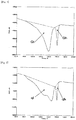
- the polypropylene resin foamed particles pertaining to the present invention preferably have two melting peaks on the DSC curve obtained through calorimetric measurement by differential scanning calorimetry, and the ratio of the melting peak at the high temperature side " ⁇ Qh/(Ql + Qh) ⁇ ⁇ 100" (hereinafter also called "DSC ratio") calculated from a heat quantity Ql of the melting peak at the low temperature side and a heat quantity Qh of the melting peak at the high temperature side is preferably 6% or more and 20% or less, and more preferably, 8% or more and less than 16%.
- the polypropylene resin foamed particles have a DSC ratio within the range, the bulk density is easily reduced, and a polypropylene resin in-mold foam molded article having excellent fusion properties and excellent surface appearance is readily obtained. If polypropylene resin foamed particles have a DSC ratio of less than 6%, bubbles in the polypropylene resin foamed particles are likely to communicate, and a molded article after in-mold foam molding is likely to be shrunk or to have a surface with wrinkles. If the DSC ratio exceeds 20%, the bulk density is unlikely to be reduced.
- Ql shows the heat quantity of the melting peak at the low temperature side, that is, the heat quantity surrounded by the DSC curve of the low temperature peak and a tangent line drawn from a maximum point between the low temperature peak and the high temperature peak to a melting start base line.
- Qh shows the heat quantity of the melting peak at the high temperature side, that is, the heat quantity surrounded by the DSC curve of the high temperature peak and a tangent line drawn from a maximum point between the low temperature peak and the high temperature peak to a melting end base line.
- the heat quantity Qh of the melting peak at the high temperature side of the polypropylene resin foamed particles is not limited to particular values, but is preferably 2 J/g or more and 20 J/g or less, more preferably, 3 J/g or more and 15 J/g or less, and even more preferably, 4 J/g or more and 10 J/g or less. If the heat quantity Qh of the melting peak at the high temperature side of the polypropylene resin foamed particles is less than 2 J/g, bubbles in the polypropylene resin foamed particles are likely to communicate, and a molded article after in-mold foam molding is likely to be shrunk or to have a surface with wrinkles. If the heat quantity Qh of the melting peak at the high temperature side exceeds 20 J/g, the expansion ratio is unlikely to be increased.
- the DSC ratio and the heat quantity of the melting peak at the high temperature side can be appropriately controlled, for example, by the holding time from the completion of temperature increase to the foaming in the one-step foaming process (holding time after the temperature substantially reaches a foaming temperature until foaming), the foaming temperature (temperature during foaming), and the foaming pressure (pressure during foaming).
- the holding time from the completion of temperature increase to the foaming in the one-step foaming process holding time after the temperature substantially reaches a foaming temperature until foaming
- the foaming temperature temperature during foaming
- the foaming pressure pressure during foaming
- a condition giving a desired DSC ratio and a desired heat quantity of the melting peak at the high temperature side can be easily found by repeating several experiments in which the holding time, the foaming temperature, and the foaming pressure are systematically and appropriately changed.
- the foaming pressure can be controlled by the amount of a foaming agent.
- the polypropylene resin foamed particles pertaining to the present invention preferably have an open-cell ratio of 3.0% or less, and more preferably, 2.9% or less. If having an open-cell ratio of more than 3.0%, the polypropylene resin foamed particles are likely to cause a reduction in surface nature or dimensional accuracy of a molded article during in-mold foam molding and to cause a reduction in mechanical strengths such as compressive strength of the resulting in-mold foam molded article.
- the open-cell ratio can be controlled by selecting an appropriate flame retardant for polypropylene resins having excellent electric conductivity.
- a common flame retardant such as flame retardants containing a halogen such as bromine, phosphorus flame retardants, and inorganic flame retardants is used, the open-cell ratio is likely to increase.
- melamine cyanurate of the present invention is used, the increase of the open-cell ratio can be suppressed although the mechanism is unclear.
- the amount of the inorganic dispersant adhering to the surface of the polypropylene resin foamed particles pertaining to the present invention is preferably 2,000 ppm or less, more preferably, 1,300 ppm or less, and even more preferably, 800 ppm or less. If the amount of the inorganic dispersant adhering to the surface exceeds 2,000 ppm, the fusion properties during in-mold foam molding are likely to be reduced.
- the method of producing a polypropylene resin in-mold foam molded article by using the polypropylene resin foamed particles pertaining to the present invention is specifically exemplified as follows: Polypropylene resin foamed particles are placed in a pressure-resistant container and then are previously pressurized by using an inorganic gas, thereby injecting the inorganic gas into the polypropylene resin foamed particles under pressure to impart an internal pressure (foamability).
- the polypropylene resin foamed particles are filled in a molding space that is composed of two molds (a male die and a female die) and can be closed but cannot be tightly sealed, and are molded, for example, by using water vapor (heated water vapor) as the heating medium at a pressure of about 0.1 MPa or more and 0.4 MPa or less (gauge pressure) for a heating time of about 3 seconds or more and 30 seconds or less, and consequently the polypropylene resin foamed particles are foamed and fused with each other.
- water vapor heated water vapor
- the mold is then cooled, for example, with water to such a degree that deformation of the polypropylene resin in-mold foam molded article after release can be suppressed, and the molds are unclosed, giving the polypropylene resin in-mold foam molded article.
- the internal pressure of the polypropylene resin foamed particles can be adjusted, for example, by applying a pressure of 0.1 MPa (gauge pressure) or more and 2.0 MPa (gauge pressure) or less with an inorganic gas such as air and nitrogen in a pressure-resistant container for a pressurizing time of 1 hour or more and 48 hours or less at a pressurizing temperature of room temperature (25°C) or more and 80°C or less.
- a pressure of 0.1 MPa (gauge pressure) or more and 2.0 MPa (gauge pressure) or less with an inorganic gas such as air and nitrogen in a pressure-resistant container for a pressurizing time of 1 hour or more and 48 hours or less at a pressurizing temperature of room temperature (25°C) or more and 80°C or less.
- the polypropylene resin in-mold foam molded article pertaining to the present invention preferably has a volume resistivity value of 10 ⁇ •cm or more and 5,000 ⁇ •cm or less, more preferably, 10 ⁇ •cm or more and 3,000 ⁇ •cm or less, and even more preferably, 10 ⁇ •cm or more and 2,000 ⁇ •cm or less. If having a volume resistivity value of more than 5,000 ⁇ •cm, the polypropylene resin in-mold foam molded article is likely to have insufficient electric conductivity for applications as cushioning materials for electronic devices and precision apparatuses, a parts tray of a robotized line, and radio wave absorbers used for suppressing radiation noises or radio reflection of anechoic chambers and electronic devices. If containing the electroconductive carbon black of the present invention, the polypropylene resin in-mold foam molded article is difficult to have a volume resistivity value of less than 10 ⁇ •cm.
- the polypropylene resin in-mold foam molded article pertaining to the present invention preferably passes the standard for flame retardancy, UL94 HBF test.
- the polypropylene resin in-mold foam molded article pertaining to the present invention preferably has a comparatively low molded article density of 20 g/L or more and 40 g/L or less, and more preferably, 25 g/L or more and 35 g/L or less. If having a molded article density of less than 20 g/L, the polypropylene resin in-mold foam molded article does not pass the standard for flame retardancy, UL94 HBF test, which is an advanced standard for flame retardancy, in some cases. If the molded article density exceeds 40 g/L, the flame retardancy is readily expressed, and thus the advantageous effect by the present invention is likely to be reduced.
- the ratio of the melting peak at the high temperature side " ⁇ qh/(ql + qh) ⁇ ⁇ 100" (hereinafter also called "DSC ratio") calculated from a heat quantity ql of the melting peak at the low temperature side and a heat quantity qh of the melting peak at the high temperature side is preferably 6% or more and 20% or less, and more preferably, 6% or more and less than 16%.
- the polypropylene resin in-mold foam molded article has a DSC ratio within the range above, the polypropylene resin in-mold foam molded article having excellent fusion properties and excellent surface appearance is readily obtained. If the DSC ratio of a polypropylene resin in-mold foam molded article is less than 6%, bubbles in the polypropylene resin in-mold foam molded article are likely to communicate, whereas if the DSC ratio exceeds 20%, the fusion properties are likely to be deteriorated.
- the polypropylene resin in-mold foam molded article having a DSC ratio within the range can be obtained by in-mold foam molding of polypropylene resin foamed particles having a DSC ratio of 6% or more and 20% or less.
- the DSC curve of a polypropylene resin in-mold foam molded article is affected by heat history during in-mold foam molding, and thus is not completely the same as the DSC curve of the corresponding polypropylene resin foamed particles.
- a low temperature peak a melting peak at the low temperature side
- shoulder peaks or small peaks can be observed in some cases.
- these shoulder peaks and small peaks are regarded as parts of the low temperature peak.
- the polypropylene resin in-mold foam molded article has two melting peaks on the DSC curve obtained when the temperature of the molded article is increased from 40°C to 220°C at a rate of 10°C/min, and ql shows the heat quantity of the melting peak at the low temperature side, that is, the heat quantity surrounded by the DSC curve of the low temperature peak and a tangent line drawn from a maximum point between the low temperature peak and the high temperature peak to a melting start base line.
- qh shows the heat quantity of the melting peak at the high temperature side, that is, the heat quantity surrounded by the DSC curve of the high temperature peak and a tangent line drawn from a maximum point between the low temperature peak and the high temperature peak to a melting end base line.
- the heat quantity qh of the melting peak at the high temperature side of the polypropylene resin in-mold foam molded article is not limited to particular values, but is preferably 2 J/g or more and 20 J/g or less, more preferably, 3 J/g or more and 15 J/g or less, and even more preferably, 4 J/g or more and 10 J/g or less. If the heat quantity qh of the melting peak at the high temperature side of the polypropylene resin in-mold foam molded article is less than 2 J/g, the mechanical strength is likely to be reduced, whereas if the heat quantity qh of the melting peak at the high temperature side exceeds 20 J/g, the fusion properties are likely to be reduced.
- the melt index of a polypropylene resin was determined with an MI measurement apparatus described in JIS K7210: 1999 in conditions of an orifice size of 2.0959 ⁇ 0.005 mm ⁇ , an orifice length of 8.000 ⁇ 0.025 mm, a load of 2,160 g, and a temperature of 230 ⁇ 0.2°C.
- substantially the center of a polypropylene resin foamed particle was cut with careful attention not to break bubble films (cell films) of the foamed particle, and the cut section was observed under a microscope [manufactured by Keyence Corporation: VHX digital microscope] (an observation photograph was taken).
- the weight w (g) of polypropylene resin foamed particles was determined.
- the polypropylene resin foamed particles were then immersed in ethanol, and the increase in volume (ethanol submergence volume) v (cm 3 ) was determined.
- the ratio of the melting peak at the high temperature side " ⁇ Qh/(Ql + Qh) ⁇ ⁇ 100" was calculated from the heat quantity Ql of the melting peak at the low temperature side, that is, the heat quantity surrounded by the DSC curve of the low temperature peak and a tangent line drawn from a maximum point between the low temperature peak and the high temperature peak to a melting start base line, and from the heat quantity Qh of the melting peak at the high temperature side, that is, the heat quantity surrounded by the DSC curve of the high temperature peak and a tangent line drawn from a maximum point between the low temperature peak and the high temperature peak to a melting end base line.
- Polypropylene resin foamed particles were slowly added and filled into a container having a volume of about 5 L, and the polypropylene resin foamed particles in the container were weighed. The weight was divided by the volume of the container, giving a bulk density (g/L).
- test pieces having a rectangular parallelepiped shape with a length of 150 mm, a width of 50 mm, and a thickness of 12 mm were cut out (without the skin layer) for UL94 HBF test.
- the weight, the length, the width, and the thickness of the cut out test piece were then measured.
- the product of the length, the width, and the thickness was calculated as the volume of the test piece, and the weight was divided by the volume.
- the average of five test pieces was regarded as the molded article density (g/L).
- a polypropylene resin in-mold foam molded article that had been molded to have a length of about 300 mm, a width of about 400 mm, and a thickness of about 50 mm was cut in the thickness direction with a cutter knife to make an incision with a size of about 3 mm, then the polypropylene resin in-mold foam molded article was broken from the incision by hand, and the broken-out section was observed.
- the ratio of the number of broken polypropylene resin foamed particles relative to the number of polypropylene resin foamed particles included in the broken-out section was determined as a fusion ratio (%), and the fusion properties were evaluated on the basis of the following criteria. The evaluation results are indicated by " ⁇ " or " ⁇ ".
- ⁇ The fusion ratio is 60% or more.
- ⁇ The fusion ratio is less than 60%.
- the surface of a polypropylene resin in-mold foam molded article that had been molded to have a length of about 300 mm, a width of about 400 mm, and a thickness of about 50 mm was visually observed, and the surface nature was evaluated on the basis of the following criteria.
- the evaluation results are indicated by " ⁇ ", " ⁇ ", or " ⁇ ".
- ⁇ The surface has almost no wrinkles, sink marks, or voids.
- ⁇ The surface has at least any of a few wrinkles, a few sink marks, and a few voids.
- the surface has at least any of marked wrinkles, marked sink marks, and marked voids.
- the void means a clearance among foamed resin particles fused to each other on the surface of an in-mold foam molded article.
- the dimension (L 1 , unit: mm) in the longitudinal direction of a polypropylene resin in-mold foam molded article that had been molded to have a length of about 300 mm, a width of about 400 mm, and a thickness of about 50 mm was measured with a vernier calipers.
- the dimensional shrinkage ratio with respect to mold was calculated in accordance with the following expression, and the dimensional accuracy was evaluated on the basis of the following criteria. The evaluation results are indicated by " ⁇ " or " ⁇ ".
- Dimensional shrinkage ratio with respect to mold (%) ⁇ (300 - L 1 )/300 ⁇ ⁇ 100 ⁇ : The dimensional shrinkage ratio with respect to mold is less than 2.0%. ⁇ : The dimensional shrinkage ratio with respect to mold is 2.0% or more.
- a test piece with a length of 50 mm, a width of 50 mm, and a thickness of 25 mm was cut out.
- the molded article was cut off by about 12.5 mm from each surface, giving the test piece with a thickness of 25 mm.
- the compressive stress at 50% compression of the obtained test piece was determined when the test piece was compressed at a speed of 10 mm/min in accordance with NDZ-Z0504 with a tension and compression testing machine [manufactured by Minebea Co., Ltd., TG series].
- the compressive stress at 50% compression indicates the degree of rigidity of an in-mold foam molded article.
- the volume resistivity of a polypropylene resin in-mold foam molded article was determined in accordance with JIS K7194-1994 by using a resistivity meter [manufactured by Mitsubishi Chemical Analytech Co., Ltd., "Loresta GP"], and the electric conductivity was evaluated on the basis of the following criteria. The evaluation results are indicated by " ⁇ ", " ⁇ " or " ⁇ ".
- ⁇ The volume resistivity is 2,000 ⁇ •cm or less.
- the volume resistivity is more than 2,000 ⁇ •cm and not more than 5,000 ⁇ •cm.
- the volume resistivity is more than 5,000 ⁇ •cm.
- test piece having a rectangular parallelepiped shape with a length of 150 mm, a width of 50 mm, and a thickness of 12 mm was cut out (without the skin layer) for the standard for flame retardancy, UL94 HBF test.
- the obtained test piece was subjected to the standard for flame retardancy, UL94 HBF test, and the flame retardancy was evaluated on the basis of the following criteria.
- the evaluation results are indicated by " ⁇ ", " ⁇ ", or " ⁇ ".
- ⁇ The advanced standard of HBF test is satisfied (the burning rate between 100-mm marked lines is less than 35 mm/min).
- ⁇ The standard of HBF test is satisfied (the burning rate between 100-mm marked lines is 35 mm/min or more and 40 mm/min or less or a burning distance is less than 125 mm).
- ⁇ The standard of HBF test is not satisfied.
- ENSACO 350G manufactured by Timcal, a DBP absorption amount of 320 cm 3 /100 g, a BET specific surface area of 770 m 2 /g
- an electroconductive carbon black was added, and the whole was mixed with a Banbury mixer, giving a polypropylene resin composition.
- the polypropylene resin composition was placed in a 45-mm ⁇ twin-screw extruder [manufactured by ON Machinery, TEK 45-mm extruder], and then melted and kneaded at a resin temperature of 220°C.
- melamine cyanurate and polyethylene glycol as a bubble size enlarging agent were added so as to give an amount of 5 parts by weight and an amount of 0.5 parts by weight, respectively, relative to 100 parts by weight of the ethylene-propylene random copolymer.
- the contents in the autoclave were heated to a foaming temperature of 147°C, and carbon dioxide (carbon dioxide gas) was further added to adjust the autoclave internal pressure to 3.0 MPa (gauge pressure). The conditions were maintained for 30 minutes, and then a valve at a lower part of the autoclave was opened. Through a 3.6-mm ⁇ open orifice, the contents in the autoclave were discharged into an atmosphere, giving one-step foamed particles. At the time, carbon dioxide was injected under pressure from the upper part of the autoclave to apply back pressure so as to keep a constant foaming pressure.
- carbon dioxide carbon dioxide gas
- the obtained one-step foamed particles had an average bubble size of 110 ⁇ m, an expansion ratio of 13, a DSC ratio of 12%, and an open-cell ratio of 1.5%.
- An internal pressure of 0.26 MPa absolute pressure was applied into the obtained one-step foamed particles by air impregnation, and the particles were heated by water vapor at 0.07 MPa (gauge pressure), giving two-step foamed particles having an average bubble size of 140 ⁇ m, a bulk density of 31 g/L, a DSC ratio of 12%, and an open-cell ratio of 1.6%.
- a mold having a box shape with a length of 300 mm, a width of 400 mm, and a thickness of 50 mm was filled with the two-step foamed particles (polypropylene resin foamed particles) that had been adjusted so as to have an internal air pressure (internal pressure of foamed particles) of 0.20 MPa (absolute pressure).
- the particles were heated and molded at a heated vapor pressure (vapor pressure) for molding of 0.30 MPa (gauge pressure) while compressed by 10% in the thickness direction, giving a polypropylene resin in-mold foam molded article.
- the obtained polypropylene resin in-mold foam molded article was allowed to stand at room temperature (25°C) for 1 hour, and then was dried and aged for 3 hours in a thermostatic chamber at 75°C. The molded article was taken out of the thermostatic chamber, and then further allowed to stand at room temperature for 24 hours.
- the molded article density and the DSC ratio of the polypropylene resin in-mold foam molded article were determined, and the fusion properties, the surface nature, the dimensional accuracy, the compressive strength, the electric conductivity, and the flame retardancy were evaluated. Table 1 shows these measurement and evaluation results.
- Polypropylene resin particles were obtained by carrying out the same operations as in Example 1 except that the types and the amounts of the electroconductive carbon black, the bubble size enlarging agent, and the melamine cyanurate were changed as described in Table 1.
- One-step foamed particles and two-step foamed particles were obtained by carrying out the same operations as in Example 1 except that the foaming conditions (vapor pressure) for two-step foaming were changed to the conditions described in Table 1 in order to achieve an intended bulk density (about 30 g/L) of pre-foamed particles (two-step foamed particles) to be obtained.
- Table 1 shows the measurement results of the obtained one-step foamed particles and the two-step foamed particles.
- Polypropylene resin in-mold foam molded articles were obtained from the obtained two-step foamed particles by carrying out the same operations as in Example 1.
- Table 1 shows the measurement and evaluation results of the obtained polypropylene resin in-mold foam molded articles.
- Polypropylene resin particles were obtained by carrying out the same operations as in Example 1 except that the types and the amounts of the electroconductive carbon black, the bubble size enlarging agent, the melamine cyanurate, and the flame retardant were changed as described in Table 1. The flame retardant was added when the polypropylene resin composition was produced.
- One-step foamed particles and two-step foamed particles were obtained by carrying out the same operations as in Example 1 except that the foaming conditions (internal pressure of foamed particles and vapor pressure) for two-step foaming were changed to the conditions described in Table 1 in order to achieve an intended bulk density (about 30 g/L) of pre-foamed particles (two-step foamed particles) to be obtained.
- Table 1 shows the measurement results of the obtained one-step foamed particles and the two-step foamed particles.
- Polypropylene resin in-mold foam molded articles were obtained from the obtained two-step foamed particles by carrying out the same operations as in Example 1.
- Table 1 shows the measurement and evaluation results of the obtained polypropylene resin in-mold foam molded articles.
- Polypropylene resin particles were obtained by carrying out the same operations as in Example 1 except that no melamine cyanurate was added as described in Table 1.
- One-step foamed particles and two-step foamed particles were obtained by carrying out the same operations as in Example 1 except that the foaming conditions were changed to the conditions described in Table 1.
- Table 1 shows the measurement results of the obtained one-step foamed particles and the two-step foamed particles.
- a polypropylene resin in-mold foam molded article was obtained from the obtained two-step foamed particles by carrying out the same operations as in Example 1.
- Table 1 shows the measurement and evaluation results of the obtained polypropylene resin in-mold foam molded article.
- the polypropylene resin in-mold foam molded article of the present invention has excellent electric conductivity and flame retardancy and thus can be suitably used for cushioning materials for electronic devices and precision apparatuses, a parts tray of a robotized line, and radio wave absorbers used for suppressing radiation noises or radio reflection of anechoic chambers and electronic devices, for example.
Landscapes
- Chemical & Material Sciences (AREA)
- Materials Engineering (AREA)
- Engineering & Computer Science (AREA)
- Health & Medical Sciences (AREA)
- Medicinal Chemistry (AREA)
- Chemical Kinetics & Catalysis (AREA)
- Polymers & Plastics (AREA)
- Organic Chemistry (AREA)
- Physics & Mathematics (AREA)
- Dispersion Chemistry (AREA)
- Spectroscopy & Molecular Physics (AREA)
- Inorganic Chemistry (AREA)
- Emergency Medicine (AREA)
- Manufacture Of Porous Articles, And Recovery And Treatment Of Waste Products (AREA)
- Compositions Of Macromolecular Compounds (AREA)
Claims (12)
- Polypropylenharz-Schaumpartikel, hergestellt durch ein Verfahren, umfassend ein einstufiges Schäumverfahren, welches Platzieren von Polypropylenharzteilchen, Wasser und eines Schaumbildners in einen druckfesten Behälter, wobei der Schaumbildner einen anorganischen physikalischen Schaumbildner einschließlich Kohlendioxid enthält, Dispergieren der Inhalte in den druckfesten Behälter unter Rühren und Erhöhen der Temperatur der Inhalte auf eine Temperatur gleich oder höher als die Temperatur 20°C niedriger als ein Schmelzpunkt der Polypropylenharzteilchen und gleich oder niedriger als die Temperatur 10°C höher als der Schmelzpunkt der Polypropylenharzteilchen, und dann Abgeben der Dispersionsflüssigkeit in den druckfesten Behälter in einem Bereich mit einem Druck niedriger als ein innerer Druck des druckfesten Behälters, um die Polypropylenharzteilchen zu schäumen, beinhaltet, wobei der Schmelzpunkt des Polypropylenharzes ein Wert ist, der durch kalorimetrische Messung mithilfe der Differentialscanningkalorimetrie, wie in der Beschreibung offenbart, bestimmt wird,
wobei die Polypropylenharzteilchen eine Polypropylenharzzusammensetzung umfassen, die 11 Gewichtsteile oder mehr und 25 Gewichtsteile oder weniger eines elektrisch leitenden Rußes mit einer DBP-Absorptionsmenge von 300 cm3/100 g oder mehr und 600 cm3/100 g oder weniger, 3 Gewichtsteile oder mehr und 15 Gewichtsteile oder weniger an Melamincyanurat und 0,01 Gewichtsteile oder mehr und 10 Gewichtsteile oder weniger eines Mittels zur Vergrößerung der Blasengröße, jeweils bezogen auf 100 Gewichtsteile des Polypropylenharzes, enthält, wobei das Mittel zur Vergrößerung der Blasengröße eine Verbindung ist, die bei 150°C unter normalem Druck als eine Flüssigkeit vorliegt, eine Hydroxygruppe aufweist und in dem Polypropylenharz in einem flüssigen Zustand bei einer Schäumtemperatur enthalten ist, wobei die DBP-Absorptionsmenge ein gemäß JIS K6217-4: 2008 ermittelter Wert ist. - Die Polypropylenharz-Schaumpartikel nach Anspruch 1, wobei das Mittel zur Vergrößerung der Blasengröße Polyethylenglykol ist.
- Die Polypropylenharz-Schaumpartikel nach Anspruch 1 oder 2, wobei die Schaumpartikel eine durchschnittliche Blasengröße von 0,05 mm oder mehr und weniger als 0,17 mm aufweisen.
- Die Polypropylenharz-Schaumpartikel nach einem der Ansprüche 1 bis 3, wobei die Schaumpartikel eine Schüttdichte von 20 g/l oder mehr und 40 g/l oder weniger aufweisen.
- Die Polypropylenharz-Schaumpartikel nach einem der Ansprüche 1 bis 4, wobei die Schaumpartikel ein offene-Zelle-Verhältnis von 3,0% oder weniger aufweisen.
- Die Polypropylenharz-Schaumpartikel nach einem der Ansprüche 1 bis 5, wobei die Schaumpartikel zwei Schmelzpeaks bei einer Messung durch Differentialscanningkalorimetrie aufweisen, und ein Verhältnis des Schmelzpeaks an einer Hochtemperaturseite, {Qh/(Ql + Qh)} x 100, berechnet anhand einer Wärmemenge Q1 des Schmelzpeaks an einer Niedrigtemperaturseite und einer Wärmemenge Qh des Schmelzpeaks an der Hochtemperaturseite, 6% oder mehr und 20% oder weniger beträgt.
- Ein in einer Form geschäumter Polypropylenharz-Formkörper, hergestellt aus den Polypropylenharz-Schaumpartikeln nach einem der Ansprüche 1 bis 6, wobei der in einer Form geschäumte Polypropylenharz-Formkörper einen Volumenwiderstandswert von 10Ω•cm oder mehr und 5.000Ω•cm oder weniger aufweist.
- Der in einer Form geschäumte Polypropylenharz-Formkörper nach Anspruch 7, wobei der Formkörper den UL94 HBF-Entflammbarkeitstest besteht.
- Der in einer Form geschäumte Polypropylenharz-Formkörper nach Anspruch 7 oder 8, wobei der Formkörper eine Formkörperdichte von 20 g/l oder mehr und 40 g/l oder weniger aufweist.
- Der in einer Form geschäumte Polypropylenharz-Formkörper nach einem der Ansprüche 7 bis 9, wobei der Formkörper zwei Schmelzpeaks bei der Messung durch Differentialscanningkalorimetrie aufweist und ein Verhältnis des Schmelzpeaks an einer Hochtemperaturseite {qh/(ql + qh)} x 100, berechnet anhand einer Wärmemenge ql des Schmelzpeaks an einer Niedertemperaturseite und einer Wärmemenge qh des Schmelzpeaks an der Hochtemperaturseite, 6% oder mehr und 20% oder weniger beträgt.
- Ein Verfahren zur Herstellung von Polypropylenharz-Schaumpartikeln, wobei das Verfahren ein einstufiges Schäumverfahren umfasst, welches Platzieren von Polypropylenharzteilchen, Wasser und eines Schaumbildners in einen druckfesten Behälter, wobei der Schaumbildner einen anorganischen physikalischen Schaumbildner einschließlich Kohlendioxid enthält, Dispergieren der Inhalte in den druckfesten Behälter unter Rühren und Erhöhen einer Temperatur der Inhalte auf eine Temperatur gleich oder höher als die Temperatur 20°C niedriger als ein Schmelzpunkt der Polypropylenharzteilchen ist und gleich oder niedriger als die Temperatur 10°C höher als der Schmelzpunkt der Polypropylenharzteilchen, und dann Abgeben der Dispersionsflüssigkeit in den druckfesten Behälter in einem Bereich mit einem Druck niedriger als ein innerer Druck des druckfesten Behälters, um die Polypropylenharzteilchen zu schäumen, beinhaltet, wobei der Schmelzpunkt des Polypropylenharzes ein Wert ist, der durch kalorimetrische Messung mithilfe der Differentialscanningkalorimetrie, wie in der Beschreibung offenbart, bestimmt wird,
wobei die Polypropylenharzteilchen eine Polypropylenharzzusammensetzung umfassen, die 11 Gewichtsteile oder mehr und 25 Gewichtsteile oder weniger eines elektrisch leitenden Rußes mit einer DBP-Absorptionsmenge von 300 cm3/100 g oder mehr und 600 cm3/100 g oder weniger, 3 Gewichtsteile oder mehr und 15 Gewichtsteile oder weniger an Melamincyanurat und 0,01 Gewichtsteile oder mehr und 10 Gewichtsteile oder weniger eines Mittels zur Vergrößerung der Blasengröße, jeweils bezogen auf 100 Gewichtsteile des Polypropylenharzes, enthält, wobei das Mittel zur Vergrößerung der Blasengröße eine Verbindung ist, die bei 150°C unter normalem Druck als eine Flüssigkeit vorliegt, eine Hydroxygruppe aufweist und in dem Polypropylenharz in einem flüssigen Zustand bei einer Schäumtemperatur enthalten ist, wobei die DBP-Absorptionsmenge ein gemäß JIS K6217-4: 2008 ermittelter Wert ist. - Das Verfahren zur Herstellung von Polypropylenharz-Schaumpartikeln nach Anspruch 11, wobei das Mittel zur Vergrößerung der Blasengröße Polyethylenglykol ist.
Applications Claiming Priority (2)
| Application Number | Priority Date | Filing Date | Title |
|---|---|---|---|
| JP2013130769 | 2013-06-21 | ||
| PCT/JP2014/065982 WO2014203876A1 (ja) | 2013-06-21 | 2014-06-17 | 難燃性および導電性に優れたポリプロピレン系樹脂発泡粒子およびポリプロピレン系樹脂型内発泡成形体 |
Publications (3)
| Publication Number | Publication Date |
|---|---|
| EP3012287A1 EP3012287A1 (de) | 2016-04-27 |
| EP3012287A4 EP3012287A4 (de) | 2017-01-25 |
| EP3012287B1 true EP3012287B1 (de) | 2019-08-07 |
Family
ID=52104608
Family Applications (1)
| Application Number | Title | Priority Date | Filing Date |
|---|---|---|---|
| EP14813497.6A Active EP3012287B1 (de) | 2013-06-21 | 2014-06-17 | Polypropylenharz-schaumpartikel mit hervorragender flammfestigkeit und leitfähigkeit sowie in einer form geschäumter polypropylenharz-formkörper |
Country Status (5)
| Country | Link |
|---|---|
| US (1) | US20160137805A1 (de) |
| EP (1) | EP3012287B1 (de) |
| JP (1) | JP6387962B2 (de) |
| CN (1) | CN105308107B (de) |
| WO (1) | WO2014203876A1 (de) |
Families Citing this family (4)
| Publication number | Priority date | Publication date | Assignee | Title |
|---|---|---|---|---|
| EP3273817A4 (de) * | 2015-03-25 | 2018-11-14 | Cocona, Inc. | Verbesserte metaaramid- und paraaramidtextilien, kleidung und verfahren |
| WO2022014459A1 (ja) | 2020-07-17 | 2022-01-20 | 東レ株式会社 | 電波吸収体部材用難燃紙およびその製造方法 |
| EP4306581A4 (de) | 2021-03-12 | 2025-01-01 | JSP Corporation | Polypropylenbasierte harzschaumpartikel und verfahren zur herstellung von polypropylenbasierten harzschaumpartikeln |
| KR102778590B1 (ko) | 2021-03-12 | 2025-03-07 | 가부시키가이샤 제이에스피 | 폴리프로필렌계 수지 발포 입자의 제조 방법 및 폴리프로필렌계 수지 발포 입자 |
Family Cites Families (22)
| Publication number | Priority date | Publication date | Assignee | Title |
|---|---|---|---|---|
| US4465616A (en) * | 1981-02-04 | 1984-08-14 | Rca Corporation | Formulation of electrically conductive plastics |
| JP3525947B2 (ja) | 1994-05-06 | 2004-05-10 | 株式会社ジェイエスピー | 導電性ポリプロピレン系樹脂発泡粒子、該発泡粒子から形成される型内成型体、及び型内成型体の製造方法 |
| JPH09202837A (ja) | 1996-01-25 | 1997-08-05 | Jsp Corp | 導電性ポリプロピレン系樹脂発泡粒子及びその製造方法 |
| JPH10251436A (ja) * | 1997-03-10 | 1998-09-22 | Jsp Corp | 無機物含有ポリプロピレン系樹脂発泡粒子成形体 |
| JP2000169619A (ja) | 1998-12-03 | 2000-06-20 | Kanegafuchi Chem Ind Co Ltd | 導電性ポリプロピレン系樹脂発泡成形体とその製造方法 |
| JP2003229691A (ja) | 2002-01-31 | 2003-08-15 | Riken Corp | 電波吸収体 |
| JP4207544B2 (ja) * | 2002-11-22 | 2009-01-14 | 株式会社カネカ | 導電性ポリプロピレン系樹脂予備発泡粒子及びその製造方法 |
| JP4077745B2 (ja) | 2003-02-28 | 2008-04-23 | 株式会社ジェイエスピー | ポリオレフィン系樹脂型内発泡成形体 |
| JP2004319603A (ja) | 2003-04-11 | 2004-11-11 | Riken Corp | 電波吸収体 |
| JP4774199B2 (ja) * | 2004-03-19 | 2011-09-14 | 三和化工株式会社 | 難燃性導電性架橋ポリオレフィン系発泡体の製造方法 |
| JP3966521B2 (ja) * | 2005-04-27 | 2007-08-29 | 株式会社ジェイエスピー | 導電性ポリプロピレン系樹脂発泡粒子の製造方法 |
| JP5080849B2 (ja) * | 2007-04-23 | 2012-11-21 | 株式会社カネカ | カーボンブラック含有ポリプロピレン系樹脂発泡粒子および該カーボンブラック含有ポリプロピレン系樹脂発泡粒子からなる型内発泡成形体 |
| JP5170865B2 (ja) * | 2007-10-01 | 2013-03-27 | 古河電気工業株式会社 | 層間化合物フィラーを含有する発泡性ポリオレフィン系樹脂組成物およびポリオレフィン系難燃発泡体 |
| EP2221337B1 (de) * | 2007-12-11 | 2017-05-17 | Kaneka Corporation | Verfahren zur herstellung von expandiertem polyolefinharzteilchen und expandiertes polyolefinharzteilchen |
| JP5107692B2 (ja) * | 2007-12-17 | 2012-12-26 | 株式会社ジェイエスピー | ポリプロピレン系樹脂発泡粒子、及びその発泡粒子成形体 |
| JP2009203256A (ja) * | 2008-02-26 | 2009-09-10 | Toray Ind Inc | 架橋ポリオレフィン系樹脂発泡体 |
| JP5518349B2 (ja) | 2009-03-06 | 2014-06-11 | 株式会社カネカ | 難燃性ポリプロピレン系樹脂発泡粒子 |
| JP5410157B2 (ja) | 2009-05-22 | 2014-02-05 | 株式会社カネカ | ポリプロピレン系樹脂型内発泡成形体 |
| KR101401917B1 (ko) * | 2011-01-21 | 2014-05-30 | 에스케이이노베이션 주식회사 | 폴리프로필렌 카보네이트 발포체 제조용 조성물 및 이로부터 제조된 성형품 |
| CN103748148B (zh) * | 2011-08-09 | 2015-07-29 | 株式会社钟化 | 聚烯烃系树脂发泡颗粒及其模内成形体 |
| US20140346411A1 (en) * | 2011-12-21 | 2014-11-27 | Kaneka Corporation | Polypropylene-based resin foamed particles having excellent flame retardancy and conductivity and polypropylene-based resin in-mold foamed molded product |
| JP2013117037A (ja) * | 2013-03-19 | 2013-06-13 | Sekisui Plastics Co Ltd | 発泡成形体 |
-
2014
- 2014-06-17 US US14/899,674 patent/US20160137805A1/en not_active Abandoned
- 2014-06-17 WO PCT/JP2014/065982 patent/WO2014203876A1/ja not_active Ceased
- 2014-06-17 JP JP2015522922A patent/JP6387962B2/ja active Active
- 2014-06-17 CN CN201480035096.3A patent/CN105308107B/zh active Active
- 2014-06-17 EP EP14813497.6A patent/EP3012287B1/de active Active
Non-Patent Citations (1)
| Title |
|---|
| None * |
Also Published As
| Publication number | Publication date |
|---|---|
| US20160137805A1 (en) | 2016-05-19 |
| CN105308107A (zh) | 2016-02-03 |
| EP3012287A4 (de) | 2017-01-25 |
| WO2014203876A1 (ja) | 2014-12-24 |
| JP6387962B2 (ja) | 2018-09-12 |
| CN105308107B (zh) | 2018-11-09 |
| JPWO2014203876A1 (ja) | 2017-02-23 |
| EP3012287A1 (de) | 2016-04-27 |
Similar Documents
| Publication | Publication Date | Title |
|---|---|---|
| EP2796489B1 (de) | Geschäumte partikel aus polypropylenbasiertem harz mit hervorragender flammhemmung und leitfähigkeit sowie in einem spritzgiesswerkzeug geformtes formprodukt auf der basis von polypropylenbasiertem harz | |
| EP3088454B1 (de) | Polyolefinharzschaumteilchen und expansionsgeformter gegenstand aus polyolefinharz | |
| CN103748148A (zh) | 聚烯烃系树脂发泡颗粒及其模内成形体 | |
| EP3309196B1 (de) | Expandierte partikel aus thermoplastischem harz | |
| EP3012287B1 (de) | Polypropylenharz-schaumpartikel mit hervorragender flammfestigkeit und leitfähigkeit sowie in einer form geschäumter polypropylenharz-formkörper | |
| EP3943533B1 (de) | Harzschaumteilchen auf polyolefinbasis, formkörper aus harzschaumteilchen auf polyolefinbasis und herstellungsverfahren für harzschaumteilchen auf polyolefinbasis | |
| JP5630591B2 (ja) | ポリオレフィン系樹脂予備発泡粒子およびその製造方法 | |
| JP5591965B2 (ja) | ポリオレフィン系樹脂予備発泡粒子およびその製造方法 | |
| EP3438173B1 (de) | Verfahren zur herstellung von expandierten harzperlen auf der basis von polyethylen und verfahren zur herstellung von polyethylenbasierten gussharzartikeln durch in-mold-giessen | |
| EP3015497B1 (de) | Elektrisch leitfähige polypropylenharzschaumteilchen mit hervorragender feuerbeständigkeit und elektrischer leitfähigkeit sowie in einer form geschäumter formkörper aus elektrisch leitfähigem polypropylenharz | |
| JPH10251436A (ja) | 無機物含有ポリプロピレン系樹脂発泡粒子成形体 | |
| EP4306581A1 (de) | Polypropylenbasierte harzschaumpartikel und verfahren zur herstellung von polypropylenbasierten harzschaumpartikeln | |
| JP5722564B2 (ja) | 自動車用外装材 | |
| JP5220486B2 (ja) | ポリオレフィン系樹脂予備発泡粒子およびその製造方法 | |
| CN115678167A (zh) | 聚丙烯类树脂发泡粒子及其制造方法 | |
| EP4177303B1 (de) | Polyolefinharzschaumpartikel, verfahren zur herstellung davon und formartikel aus polyolefinharzschaumpartikeln | |
| JP7817933B2 (ja) | ポリオレフィン系樹脂発泡粒子及びそのポリオレフィン系樹脂発泡成形体 | |
| JP2012025908A (ja) | 自動車用内装材 | |
| EP4692190A1 (de) | Geschäumte partikel auf polypropylenbasis, geschäumter artikel auf polypropylenbasis und verfahren zur herstellung davon | |
| JP2000219766A (ja) | ポリプロピレン系樹脂発泡成型体及び自動車内装材 |
Legal Events
| Date | Code | Title | Description |
|---|---|---|---|
| PUAI | Public reference made under article 153(3) epc to a published international application that has entered the european phase |
Free format text: ORIGINAL CODE: 0009012 |
|
| 17P | Request for examination filed |
Effective date: 20160118 |
|
| AK | Designated contracting states |
Kind code of ref document: A1 Designated state(s): AL AT BE BG CH CY CZ DE DK EE ES FI FR GB GR HR HU IE IS IT LI LT LU LV MC MK MT NL NO PL PT RO RS SE SI SK SM TR |
|
| AX | Request for extension of the european patent |
Extension state: BA ME |
|
| DAX | Request for extension of the european patent (deleted) | ||
| A4 | Supplementary search report drawn up and despatched |
Effective date: 20170102 |
|
| RIC1 | Information provided on ipc code assigned before grant |
Ipc: C08J 9/18 20060101AFI20161221BHEP |
|
| STAA | Information on the status of an ep patent application or granted ep patent |
Free format text: STATUS: EXAMINATION IS IN PROGRESS |
|
| 17Q | First examination report despatched |
Effective date: 20170803 |
|
| GRAP | Despatch of communication of intention to grant a patent |
Free format text: ORIGINAL CODE: EPIDOSNIGR1 |
|
| STAA | Information on the status of an ep patent application or granted ep patent |
Free format text: STATUS: GRANT OF PATENT IS INTENDED |
|
| INTG | Intention to grant announced |
Effective date: 20190111 |
|
| GRAJ | Information related to disapproval of communication of intention to grant by the applicant or resumption of examination proceedings by the epo deleted |
Free format text: ORIGINAL CODE: EPIDOSDIGR1 |
|
| STAA | Information on the status of an ep patent application or granted ep patent |
Free format text: STATUS: EXAMINATION IS IN PROGRESS |
|
| INTC | Intention to grant announced (deleted) | ||
| GRAR | Information related to intention to grant a patent recorded |
Free format text: ORIGINAL CODE: EPIDOSNIGR71 |
|
| GRAS | Grant fee paid |
Free format text: ORIGINAL CODE: EPIDOSNIGR3 |
|
| STAA | Information on the status of an ep patent application or granted ep patent |
Free format text: STATUS: GRANT OF PATENT IS INTENDED |
|
| GRAA | (expected) grant |
Free format text: ORIGINAL CODE: 0009210 |
|
| STAA | Information on the status of an ep patent application or granted ep patent |
Free format text: STATUS: THE PATENT HAS BEEN GRANTED |
|
| INTG | Intention to grant announced |
Effective date: 20190625 |
|
| AK | Designated contracting states |
Kind code of ref document: B1 Designated state(s): AL AT BE BG CH CY CZ DE DK EE ES FI FR GB GR HR HU IE IS IT LI LT LU LV MC MK MT NL NO PL PT RO RS SE SI SK SM TR |
|
| REG | Reference to a national code |
Ref country code: GB Ref legal event code: FG4D |
|
| REG | Reference to a national code |
Ref country code: CH Ref legal event code: EP Ref country code: AT Ref legal event code: REF Ref document number: 1163785 Country of ref document: AT Kind code of ref document: T Effective date: 20190815 |
|
| REG | Reference to a national code |
Ref country code: DE Ref legal event code: R096 Ref document number: 602014051440 Country of ref document: DE |
|
| REG | Reference to a national code |
Ref country code: IE Ref legal event code: FG4D |
|
| REG | Reference to a national code |
Ref country code: NL Ref legal event code: MP Effective date: 20190807 |
|
| REG | Reference to a national code |
Ref country code: LT Ref legal event code: MG4D |
|
| PG25 | Lapsed in a contracting state [announced via postgrant information from national office to epo] |
Ref country code: LT Free format text: LAPSE BECAUSE OF FAILURE TO SUBMIT A TRANSLATION OF THE DESCRIPTION OR TO PAY THE FEE WITHIN THE PRESCRIBED TIME-LIMIT Effective date: 20190807 Ref country code: HR Free format text: LAPSE BECAUSE OF FAILURE TO SUBMIT A TRANSLATION OF THE DESCRIPTION OR TO PAY THE FEE WITHIN THE PRESCRIBED TIME-LIMIT Effective date: 20190807 Ref country code: SE Free format text: LAPSE BECAUSE OF FAILURE TO SUBMIT A TRANSLATION OF THE DESCRIPTION OR TO PAY THE FEE WITHIN THE PRESCRIBED TIME-LIMIT Effective date: 20190807 Ref country code: NO Free format text: LAPSE BECAUSE OF FAILURE TO SUBMIT A TRANSLATION OF THE DESCRIPTION OR TO PAY THE FEE WITHIN THE PRESCRIBED TIME-LIMIT Effective date: 20191107 Ref country code: FI Free format text: LAPSE BECAUSE OF FAILURE TO SUBMIT A TRANSLATION OF THE DESCRIPTION OR TO PAY THE FEE WITHIN THE PRESCRIBED TIME-LIMIT Effective date: 20190807 Ref country code: PT Free format text: LAPSE BECAUSE OF FAILURE TO SUBMIT A TRANSLATION OF THE DESCRIPTION OR TO PAY THE FEE WITHIN THE PRESCRIBED TIME-LIMIT Effective date: 20191209 Ref country code: BG Free format text: LAPSE BECAUSE OF FAILURE TO SUBMIT A TRANSLATION OF THE DESCRIPTION OR TO PAY THE FEE WITHIN THE PRESCRIBED TIME-LIMIT Effective date: 20191107 Ref country code: NL Free format text: LAPSE BECAUSE OF FAILURE TO SUBMIT A TRANSLATION OF THE DESCRIPTION OR TO PAY THE FEE WITHIN THE PRESCRIBED TIME-LIMIT Effective date: 20190807 |
|
| REG | Reference to a national code |
Ref country code: AT Ref legal event code: MK05 Ref document number: 1163785 Country of ref document: AT Kind code of ref document: T Effective date: 20190807 |
|
| PG25 | Lapsed in a contracting state [announced via postgrant information from national office to epo] |
Ref country code: IS Free format text: LAPSE BECAUSE OF FAILURE TO SUBMIT A TRANSLATION OF THE DESCRIPTION OR TO PAY THE FEE WITHIN THE PRESCRIBED TIME-LIMIT Effective date: 20191207 Ref country code: RS Free format text: LAPSE BECAUSE OF FAILURE TO SUBMIT A TRANSLATION OF THE DESCRIPTION OR TO PAY THE FEE WITHIN THE PRESCRIBED TIME-LIMIT Effective date: 20190807 Ref country code: GR Free format text: LAPSE BECAUSE OF FAILURE TO SUBMIT A TRANSLATION OF THE DESCRIPTION OR TO PAY THE FEE WITHIN THE PRESCRIBED TIME-LIMIT Effective date: 20191108 Ref country code: AL Free format text: LAPSE BECAUSE OF FAILURE TO SUBMIT A TRANSLATION OF THE DESCRIPTION OR TO PAY THE FEE WITHIN THE PRESCRIBED TIME-LIMIT Effective date: 20190807 Ref country code: LV Free format text: LAPSE BECAUSE OF FAILURE TO SUBMIT A TRANSLATION OF THE DESCRIPTION OR TO PAY THE FEE WITHIN THE PRESCRIBED TIME-LIMIT Effective date: 20190807 Ref country code: ES Free format text: LAPSE BECAUSE OF FAILURE TO SUBMIT A TRANSLATION OF THE DESCRIPTION OR TO PAY THE FEE WITHIN THE PRESCRIBED TIME-LIMIT Effective date: 20190807 |
|
| PG25 | Lapsed in a contracting state [announced via postgrant information from national office to epo] |
Ref country code: TR Free format text: LAPSE BECAUSE OF FAILURE TO SUBMIT A TRANSLATION OF THE DESCRIPTION OR TO PAY THE FEE WITHIN THE PRESCRIBED TIME-LIMIT Effective date: 20190807 |
|
| PG25 | Lapsed in a contracting state [announced via postgrant information from national office to epo] |
Ref country code: AT Free format text: LAPSE BECAUSE OF FAILURE TO SUBMIT A TRANSLATION OF THE DESCRIPTION OR TO PAY THE FEE WITHIN THE PRESCRIBED TIME-LIMIT Effective date: 20190807 Ref country code: DK Free format text: LAPSE BECAUSE OF FAILURE TO SUBMIT A TRANSLATION OF THE DESCRIPTION OR TO PAY THE FEE WITHIN THE PRESCRIBED TIME-LIMIT Effective date: 20190807 Ref country code: PL Free format text: LAPSE BECAUSE OF FAILURE TO SUBMIT A TRANSLATION OF THE DESCRIPTION OR TO PAY THE FEE WITHIN THE PRESCRIBED TIME-LIMIT Effective date: 20190807 Ref country code: IT Free format text: LAPSE BECAUSE OF FAILURE TO SUBMIT A TRANSLATION OF THE DESCRIPTION OR TO PAY THE FEE WITHIN THE PRESCRIBED TIME-LIMIT Effective date: 20190807 Ref country code: RO Free format text: LAPSE BECAUSE OF FAILURE TO SUBMIT A TRANSLATION OF THE DESCRIPTION OR TO PAY THE FEE WITHIN THE PRESCRIBED TIME-LIMIT Effective date: 20190807 Ref country code: EE Free format text: LAPSE BECAUSE OF FAILURE TO SUBMIT A TRANSLATION OF THE DESCRIPTION OR TO PAY THE FEE WITHIN THE PRESCRIBED TIME-LIMIT Effective date: 20190807 |
|
| PG25 | Lapsed in a contracting state [announced via postgrant information from national office to epo] |
Ref country code: SM Free format text: LAPSE BECAUSE OF FAILURE TO SUBMIT A TRANSLATION OF THE DESCRIPTION OR TO PAY THE FEE WITHIN THE PRESCRIBED TIME-LIMIT Effective date: 20190807 Ref country code: IS Free format text: LAPSE BECAUSE OF FAILURE TO SUBMIT A TRANSLATION OF THE DESCRIPTION OR TO PAY THE FEE WITHIN THE PRESCRIBED TIME-LIMIT Effective date: 20200224 Ref country code: CZ Free format text: LAPSE BECAUSE OF FAILURE TO SUBMIT A TRANSLATION OF THE DESCRIPTION OR TO PAY THE FEE WITHIN THE PRESCRIBED TIME-LIMIT Effective date: 20190807 Ref country code: SK Free format text: LAPSE BECAUSE OF FAILURE TO SUBMIT A TRANSLATION OF THE DESCRIPTION OR TO PAY THE FEE WITHIN THE PRESCRIBED TIME-LIMIT Effective date: 20190807 |
|
| REG | Reference to a national code |
Ref country code: DE Ref legal event code: R097 Ref document number: 602014051440 Country of ref document: DE |
|
| PLBE | No opposition filed within time limit |
Free format text: ORIGINAL CODE: 0009261 |
|
| STAA | Information on the status of an ep patent application or granted ep patent |
Free format text: STATUS: NO OPPOSITION FILED WITHIN TIME LIMIT |
|
| PG2D | Information on lapse in contracting state deleted |
Ref country code: IS |
|
| 26N | No opposition filed |
Effective date: 20200603 |
|
| PG25 | Lapsed in a contracting state [announced via postgrant information from national office to epo] |
Ref country code: SI Free format text: LAPSE BECAUSE OF FAILURE TO SUBMIT A TRANSLATION OF THE DESCRIPTION OR TO PAY THE FEE WITHIN THE PRESCRIBED TIME-LIMIT Effective date: 20190807 |
|
| PG25 | Lapsed in a contracting state [announced via postgrant information from national office to epo] |
Ref country code: MC Free format text: LAPSE BECAUSE OF FAILURE TO SUBMIT A TRANSLATION OF THE DESCRIPTION OR TO PAY THE FEE WITHIN THE PRESCRIBED TIME-LIMIT Effective date: 20190807 |
|
| REG | Reference to a national code |
Ref country code: CH Ref legal event code: PL |
|
| PG25 | Lapsed in a contracting state [announced via postgrant information from national office to epo] |
Ref country code: LU Free format text: LAPSE BECAUSE OF NON-PAYMENT OF DUE FEES Effective date: 20200617 |
|
| PG25 | Lapsed in a contracting state [announced via postgrant information from national office to epo] |
Ref country code: IE Free format text: LAPSE BECAUSE OF NON-PAYMENT OF DUE FEES Effective date: 20200617 Ref country code: CH Free format text: LAPSE BECAUSE OF NON-PAYMENT OF DUE FEES Effective date: 20200630 Ref country code: LI Free format text: LAPSE BECAUSE OF NON-PAYMENT OF DUE FEES Effective date: 20200630 Ref country code: FR Free format text: LAPSE BECAUSE OF NON-PAYMENT OF DUE FEES Effective date: 20200630 |
|
| PG25 | Lapsed in a contracting state [announced via postgrant information from national office to epo] |
Ref country code: MT Free format text: LAPSE BECAUSE OF FAILURE TO SUBMIT A TRANSLATION OF THE DESCRIPTION OR TO PAY THE FEE WITHIN THE PRESCRIBED TIME-LIMIT Effective date: 20190807 Ref country code: CY Free format text: LAPSE BECAUSE OF FAILURE TO SUBMIT A TRANSLATION OF THE DESCRIPTION OR TO PAY THE FEE WITHIN THE PRESCRIBED TIME-LIMIT Effective date: 20190807 |
|
| PG25 | Lapsed in a contracting state [announced via postgrant information from national office to epo] |
Ref country code: MK Free format text: LAPSE BECAUSE OF FAILURE TO SUBMIT A TRANSLATION OF THE DESCRIPTION OR TO PAY THE FEE WITHIN THE PRESCRIBED TIME-LIMIT Effective date: 20190807 |
|
| PGFP | Annual fee paid to national office [announced via postgrant information from national office to epo] |
Ref country code: BE Payment date: 20230517 Year of fee payment: 10 |
|
| PGFP | Annual fee paid to national office [announced via postgrant information from national office to epo] |
Ref country code: GB Payment date: 20230427 Year of fee payment: 10 |
|
| GBPC | Gb: european patent ceased through non-payment of renewal fee |
Effective date: 20240617 |
|
| PG25 | Lapsed in a contracting state [announced via postgrant information from national office to epo] |
Ref country code: BE Free format text: LAPSE BECAUSE OF NON-PAYMENT OF DUE FEES Effective date: 20240630 |
|
| PG25 | Lapsed in a contracting state [announced via postgrant information from national office to epo] |
Ref country code: GB Free format text: LAPSE BECAUSE OF NON-PAYMENT OF DUE FEES Effective date: 20240617 |
|
| REG | Reference to a national code |
Ref country code: BE Ref legal event code: MM Effective date: 20240630 |
|
| PGFP | Annual fee paid to national office [announced via postgrant information from national office to epo] |
Ref country code: DE Payment date: 20250429 Year of fee payment: 12 |