EP2967415B1 - Apparatus and method for electrodermal activity measurement with current compensation - Google Patents
Apparatus and method for electrodermal activity measurement with current compensation Download PDFInfo
- Publication number
- EP2967415B1 EP2967415B1 EP14710565.4A EP14710565A EP2967415B1 EP 2967415 B1 EP2967415 B1 EP 2967415B1 EP 14710565 A EP14710565 A EP 14710565A EP 2967415 B1 EP2967415 B1 EP 2967415B1
- Authority
- EP
- European Patent Office
- Prior art keywords
- electrode
- stratum corneum
- conductance
- output voltage
- processing module
- Prior art date
- Legal status (The legal status is an assumption and is not a legal conclusion. Google has not performed a legal analysis and makes no representation as to the accuracy of the status listed.)
- Active
Links
Images






Classifications
-
- A—HUMAN NECESSITIES
- A61—MEDICAL OR VETERINARY SCIENCE; HYGIENE
- A61B—DIAGNOSIS; SURGERY; IDENTIFICATION
- A61B5/00—Measuring for diagnostic purposes; Identification of persons
- A61B5/05—Detecting, measuring or recording for diagnosis by means of electric currents or magnetic fields; Measuring using microwaves or radio waves
- A61B5/053—Measuring electrical impedance or conductance of a portion of the body
-
- A—HUMAN NECESSITIES
- A61—MEDICAL OR VETERINARY SCIENCE; HYGIENE
- A61B—DIAGNOSIS; SURGERY; IDENTIFICATION
- A61B5/00—Measuring for diagnostic purposes; Identification of persons
- A61B5/02—Detecting, measuring or recording for evaluating the cardiovascular system, e.g. pulse, heart rate, blood pressure or blood flow
- A61B5/0205—Simultaneously evaluating both cardiovascular conditions and different types of body conditions, e.g. heart and respiratory condition
-
- A—HUMAN NECESSITIES
- A61—MEDICAL OR VETERINARY SCIENCE; HYGIENE
- A61B—DIAGNOSIS; SURGERY; IDENTIFICATION
- A61B5/00—Measuring for diagnostic purposes; Identification of persons
- A61B5/05—Detecting, measuring or recording for diagnosis by means of electric currents or magnetic fields; Measuring using microwaves or radio waves
- A61B5/053—Measuring electrical impedance or conductance of a portion of the body
- A61B5/0531—Measuring skin impedance
-
- A—HUMAN NECESSITIES
- A61—MEDICAL OR VETERINARY SCIENCE; HYGIENE
- A61B—DIAGNOSIS; SURGERY; IDENTIFICATION
- A61B5/00—Measuring for diagnostic purposes; Identification of persons
- A61B5/05—Detecting, measuring or recording for diagnosis by means of electric currents or magnetic fields; Measuring using microwaves or radio waves
- A61B5/053—Measuring electrical impedance or conductance of a portion of the body
- A61B5/0531—Measuring skin impedance
- A61B5/0533—Measuring galvanic skin response
-
- A—HUMAN NECESSITIES
- A61—MEDICAL OR VETERINARY SCIENCE; HYGIENE
- A61B—DIAGNOSIS; SURGERY; IDENTIFICATION
- A61B5/00—Measuring for diagnostic purposes; Identification of persons
- A61B5/68—Arrangements of detecting, measuring or recording means, e.g. sensors, in relation to patient
- A61B5/6801—Arrangements of detecting, measuring or recording means, e.g. sensors, in relation to patient specially adapted to be attached to or worn on the body surface
- A61B5/6802—Sensor mounted on worn items
-
- A—HUMAN NECESSITIES
- A61—MEDICAL OR VETERINARY SCIENCE; HYGIENE
- A61B—DIAGNOSIS; SURGERY; IDENTIFICATION
- A61B5/00—Measuring for diagnostic purposes; Identification of persons
- A61B5/68—Arrangements of detecting, measuring or recording means, e.g. sensors, in relation to patient
- A61B5/6801—Arrangements of detecting, measuring or recording means, e.g. sensors, in relation to patient specially adapted to be attached to or worn on the body surface
- A61B5/6802—Sensor mounted on worn items
- A61B5/681—Wristwatch-type devices
-
- A—HUMAN NECESSITIES
- A61—MEDICAL OR VETERINARY SCIENCE; HYGIENE
- A61B—DIAGNOSIS; SURGERY; IDENTIFICATION
- A61B2562/00—Details of sensors; Constructional details of sensor housings or probes; Accessories for sensors
- A61B2562/02—Details of sensors specially adapted for in-vivo measurements
- A61B2562/0209—Special features of electrodes classified in A61B5/24, A61B5/25, A61B5/283, A61B5/291, A61B5/296, A61B5/053
- A61B2562/0215—Silver or silver chloride containing
-
- A—HUMAN NECESSITIES
- A61—MEDICAL OR VETERINARY SCIENCE; HYGIENE
- A61B—DIAGNOSIS; SURGERY; IDENTIFICATION
- A61B2562/00—Details of sensors; Constructional details of sensor housings or probes; Accessories for sensors
- A61B2562/02—Details of sensors specially adapted for in-vivo measurements
- A61B2562/0219—Inertial sensors, e.g. accelerometers, gyroscopes, tilt switches
-
- A—HUMAN NECESSITIES
- A61—MEDICAL OR VETERINARY SCIENCE; HYGIENE
- A61B—DIAGNOSIS; SURGERY; IDENTIFICATION
- A61B5/00—Measuring for diagnostic purposes; Identification of persons
- A61B5/02—Detecting, measuring or recording for evaluating the cardiovascular system, e.g. pulse, heart rate, blood pressure or blood flow
- A61B5/024—Measuring pulse rate or heart rate
- A61B5/02405—Determining heart rate variability
-
- A—HUMAN NECESSITIES
- A61—MEDICAL OR VETERINARY SCIENCE; HYGIENE
- A61B—DIAGNOSIS; SURGERY; IDENTIFICATION
- A61B5/00—Measuring for diagnostic purposes; Identification of persons
- A61B5/02—Detecting, measuring or recording for evaluating the cardiovascular system, e.g. pulse, heart rate, blood pressure or blood flow
- A61B5/024—Measuring pulse rate or heart rate
- A61B5/02438—Measuring pulse rate or heart rate with portable devices, e.g. worn by the patient
Definitions
- Embodiments described herein relate generally to devices, systems and methods for measuring electrodermal activity, and in particular to wearable devices and methods for measuring electrodermal activity of the skin of a user.
- the human skin is composed of different layers of tissue. These layers of tissue perform several functions, for example, forming an interface between the internal and external parts of the body, serve as a protection mechanism, have a thermoregulatory function, and allow exchange of fluids through the skin.
- the human skin also includes sweat glands that produce sweat.
- the sweat includes various electrolytes which allow current to be conducted through the skin. For example, if two electrodes capable of producing free ions such as, for example, silver (Ag) electrodes are disposed on the skin, free ions can be electronically communicated between the two electrodes via the skin.
- the conductance of skin which is generally referred to as the electrodermal activity, is extremely low and is generally measured in Siemens (S).
- the conductance of the skin depends upon the thickness of the stratum corneum.
- the inner layer of the skin creates a potential barrier which changes in size and allows the current to flow in a less or more restricted way in the stratum corneum.
- the conductance of skin at the finger tips can be in the range of about 0.5 ⁇ S to about 50 ⁇ S
- the conductance of the skin at the wrist can be in the range of about 0.05 ⁇ S to about 80 ⁇ S.
- the electrodermal activity signal generally includes two interleaved signals; the tonic level and phasic level.
- the tonic level (also referred to herein as "tonic level conductance") is the skin conductance in the absence of any external or environmental stimuli, is slow changing (i.e., low frequency), and is caused by the human physiological factors as described herein.
- the tonic level can have a range of about 0.05 ⁇ S to about 50 ⁇ S at the wrist of a user.
- the phasic level (also referred to herein as “phasic level conductance”) is typically associated with short-term events and occurs in the presence of discrete environmental stimuli such as for example, sight, sound, smell, and cognitive processes that precede an event such as anticipation, decision making, etc. Phasic changes usually show up as abrupt increases in the skin conductance, or "peaks" in the skin conductance.
- HRV heart rate variability
- the HRV is defined as the beat-to-beat variations in heart rate. The larger the alterations, the larger the HRV.
- HRV is a known predictor of mortality of myocardial infarction and other pathological conditions may also be associated with modified (usually lower) HRV, including congestive heart failure, diabetic neuropathy, depression post-cardiac transplant, susceptibility to sudden infant death syndrome (SIDS), and poor survival in premature babies.
- SIDS sudden infant death syndrome
- HRV is also related to emotional arousal. HRV has been found to decrease during conditions of acute time pressure and emotional strain, elevated levels of anxiety, or in individuals reporting a greater frequency and duration of daily worry.
- HRV includes two primary components: respiratory sinus arrhythmia (RSA) which is also referred to as high frequency (HF) oscillations, and low frequency (LF) oscillations.
- HF oscillations are associated with respiration and track the respiratory rate across a range of frequencies
- low frequency oscillations are associated with Mayer waves (Traube-Hering- Mayer waves) of blood pressure.
- the total energy contained by these spectral bands in combination with the way energy is allocated to them gives an indication of the heart rate regulation pattern given by the central nervous system, and an indication of the state of mental and physical health.
- HRV spectral analysis methods use non-parametric approaches (e.g., Fast Fourier transforms) or parametric approaches. These strategies rely on the approximation that the tachogram is "sampled" at a constant frequency.
- Such known methods are susceptible to missing beat data or high variability in the heart beat data.
- high activity can also lead to high variability in the heart beat data which cannot be analyzed properly by known methods.
- EP 2131731 and US 3556083 both disclose apparatus for monitoring the skin.
- Embodiments described herein relate generally to devices, systems and methods for measuring electrodermal activity, and in particular to wearable devices and methods for measuring electrodermal activity of the skin of a user and are defined in the appended claims.
- Embodiments described herein relate generally to devices, systems and methods for measuring electrodermal activity, and in particular to wearable devices and methods for measuring electrodermal activity of the skin of a user. Measurement of the two different frequency conductances that define the electrodermal activity of a human can be challenging.
- the tonic level has a wide range which can be difficult to encompass with conventional electrodermal activity monitors.
- the phasic level is fast changing and can be difficult to resolve with conventional electrodermal activity monitors.
- Electrodes used for electrodermal sensing can also undergo electrolysis on the skin. As the current flows through the skin, the electrode (e.g., a Ag electrode) can lose metal ions which can get deposited on the skin. This can lead to corrosion of the electrode, and can also lead to skin irritation because of the metal ions.
- the electrode e.g., a Ag electrode
- Electrodermal activity sensors can be DC current sensors or AC current sensors.
- DC current based electrodermal activity sensors generally give good performance in measuring both tonic level conductance and phasic level conductance but can suffer from electrolysis.
- AC current based electrodermal activity sensors give good performance in measuring tonic level conductance and have little or no electrolysis but demonstrate poor performance in measuring phasic level conductance.
- Embodiments of the systems, devices and methods described herein provide a compensation mechanism for reliably measuring the tonic level and phasic levels of the conductance of the skin.
- the electrodermal activity measurement systems, devices and methods described herein provide several advantages over conventional electrodermal activity sensors including, for example: (1) capability of measuring electrodermal activity over a wide range that covers the entire range of expected tonic level conductances, (2) capability of measuring phasic level conductances with high resolution, (3) reduction in electrolysis of sensing electrodes, and (4) allowing real time electrodermal activity measurement by integration in a wearable device, for example, a wrist band.
- an apparatus for measuring electrodermal activity includes a first electrode in contact with a first portion of a stratum corneum of skin and a second electrode in contact with a second portion of the stratum corneum.
- the first electrode is
- a processing module is electrically coupled to the first electrode and the second electrode.
- the processing module is operable to (a) bias the first electrode at a first voltage V+ and the second electrode at a second voltage V-, (b) measure a current flowing between the first electrode and the second electrode, the current corresponding to the conductance of the stratum corneum, (c) subtract a compensation current from the measured current, (d) measure a resulting current and produce an amplified output voltage, (e) measure a conductance of the stratum corneum, and (f) adjust the compensation current to desaturate the output voltage.
- a wearable device for measuring electrodermal activity includes a housing configured to be removably associated with the skin of a user.
- a first electrode and a second electrode are included in the device such that at least a portion of the first electrode and the second electrode are disposed outside the housing.
- the first electrode is configured to contact a first portion of a stratum corneum of skin and the second electrode is configured to contact a second portion of the stratum corneum of the skin when the housing is associated with the user.
- a processing module is also disposed in the housing and coupled to the first electrode and the second electrode.
- the processing module is operable to (a) bias the first electrode at a first voltage V+ and the second electrode at a second voltage V-, (b) measure a current flowing between the first electrode and the second electrode, the current corresponding to the conductance of the stratum corneum, (c) subtract a compensation current from the measured current, (d) measure a resulting current and produce an amplified output voltage, (e) measure a conductance of the stratum corneum, and (f) the compensation current to desaturate the output voltage.
- a communications module is also disposed in the housing and coupled to the processing module. The communications module can be configured to at least one of a display an electrodermal activity of the user and communicate electrodermal activity data from the processing module to an external device.
- a power source is also disposed in the housing and is configured to provide electrical power to the processing module and the communications module.
- the wearable device can be a wrist band.
- a method for measuring electrodermal activity includes disposing a first electrode and a second electrode on a stratum corneum of a user.
- the first electrode is biased at a first voltage and the second electrode is biased at a second voltage.
- An output voltage proportional to the current flowing through the skin is measured.
- the method transforms the output voltage into a conductance level and determines if it is saturated or not. If the output voltage is saturated low, the compensation current is increased to change the output voltage such that it is not saturated. If the output voltage is saturated high, the compensation current is decreased to change the output voltage such that it is not saturated.
- the measured conductance is a tonic level conductance having a value in the range of about 0.05 ⁇ S to about 50 ⁇ S.
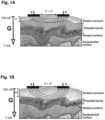
- FIG. 1A shows a cross section of a skin of a human.
- the outermost layer of the skin is the stratum corneum.
- Below the stratum corneum is the stratum lucidum.
- the conductance of the skin varies, as shown by the arrow G from about 100 nS at a top surface of the stratum corneum to about 1 mS near a bottom surface of the skin which is a substantially equally potential surface.
- FIG. 1A shows a cross section of a skin of a human.
- the outermost layer of the skin is the stratum corneum.
- Below the stratum corneum is the stratum lucidum.
- a potential barrier exists between the stratum corneum and the stratum lucidum.
- the conductance of the skin varies, as shown by the arrow G from about 100 nS at a top surface of the stratum corneum to about 1 mS near
- the stratum corneum can have a first thickness s1 measured from a top surface of the stratum corneum to the potential barrier.
- a pair of electrodes "a-a” are placed in electronic communication with the stratum corneum such that the distance between the electrodes is greater than the first thickness s1 of the stratum corneum the stratum corneum can have a first conductance.
- the various factors affecting the conductance of the skin for example, the physiology of an individual, temperature, skin structure, and autonomous nervous system (ANS) activity, do so by changing the thickness of the stratum corneum.
- the stratum corneum serves essentially as a potential barrier that changes in size and thickness. As shown in FIG.
- the thickness of the stratum corneum can increase to a second thickness s2 substantially greater than s1.
- Change in thickness also changes the conductance of the stratum corneum. The thinner the stratum corneum, the higher the conductance.
- the pair of electrodes a-a when placed in electronic communication with the stratum corneum such that the distance between the electrodes a-a is greater than the second thickness s2 of the stratum corneum, will measure a second conductance less than the first conductance.
- changes in conductance of the stratum corneum can be directly correlated to the physiological status of a user, for example, the ANS activity.
- FIG. 2A shows an exemplary electrodermal activity measurement showing changes in the tonic level and phasic level conductances of a human.
- the tonic level can be characterized as "a smooth underlying slowly-changing conductance level.”
- the phasic level conductance can be characterized as "rapidly changing peaks.”
- Tonic level conductance level can slowly vary over time in an individual depending upon his or her psychological state, hydration, skin dryness, and autonomic regulation. Tonic changes in the skin conductance level typically occur in a period from tens of seconds to minutes.
- Phasic level conductance measurements are typically associated with short-term events and occur in the presence of discrete environmental stimuli (sight, sound, smell, cognitive processes that precede an event such as anticipation, decision making, etc). Phasic changes usually show up as abrupt increases in the skin conductance, or "peaks" in the skin conductance.
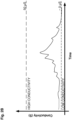
- FIG. 2B shows a typical electrodermal activity signal ranging from low to high values.
- an apparatus for measuring electrodermal activity includes a first electrode and a second electrode.
- an apparatus 100 for measuring the electrodermal activity includes a first electrode 110a, a second electrode 110b (collectively referred to as "the electrodes 110") and a processing module 130.
- the first electrode 110a and the second electrode 110b are disposed on a stratum corneum SC of a skin of a target, such that the first electrode 110a and the second electrode 110b are in electronic communication through the stratum corneum SC and measure a conductance of the stratum corneum SC.
- the electrodes 110 can include any suitable electrodes that can allow electronic communication through the stratum corneum SC and measure a conductance of the stratum corneum SC.
- the first electrode 110a is brought into contact with a first portion of the stratum corneum SC of the skin
- the second electrode 110b is brought into contact with a second portion of the stratum corneum SC, such that the first electrode 110a is in electronic communication with the second electrode 110b through the stratum corneum SC.
- the electrodes 110 can have any suitable shape.
- the electrodes 110 can be discs, plates, or rods, a solid state microfabricated electrode (e.g., of the type used in MEMS devices), or a screen printed electrode.
- the electrodes 110 can have any suitable cross section, for example circular, square, rectangle, elliptical, polygonal, or any other suitable cross-section.
- at least a portion of the electrodes 110 can be insulated with an insulating material, for example, rubber, TEFLON ® , plastic, parylene, silicon dioxide, silicon nitride, any other suitable insulation material or combination thereof.
- the insulation material can, for example, be used to define an active area of the electrodes 110.
- the electrodes 110 can be subjected to a surface modification process to modify a surface area of the electrodes 110, for example, to provide a larger surface area.
- Such surface modification processes can include, for example, etching (e.g., etching in an acidic or basic solution), voltage cycling (e.g., cyclic voltammetry), electrodeposition of nanoparticles, and/or any other suitable surface modification process or combination thereof.
- the electrodes 110 can be formed from any suitable material capable of electronic communication (i.e., ionic and electric communication) through the stratum corneum. Suitable materials can include, for example, silver (Ag), gold, platinum, palladium, iridium, carbon, graphite, carbon nanotubes, graphenes, conductive polymers, ceramics, alloys, any other suitable material or combination thereof.
- the electrodes 110 can include Ag electrodes, for example, metallic plates coated with Ag. The Ag electrodes can dissociate into Ag + ions at the surface of the electrode allowing electronic communication through the stratum corneum. Ag can also prevent any damage to the stratum corneum and has inherent anti-bacterial properties that can prevent any bacterial growth on the stratum corneum in proximity of the electrodes 110.
- the processing module 130 is coupled to the first electrode 110a and the second electrode 110b.
- the processing module 130 is operable to (a) bias the first electrode at a first voltage V+ and the second electrode at a second voltage V-, (b) measure a current flowing between the first electrode and the second electrode, the current corresponding to the conductance of the stratum corneum, (c) subtract a compensation current from the measured current, (d) measure a resulting current and produce an amplified output voltage, (e) measure a conductance of the stratum corneum, and (f) adjust the compensation current to desaturate the output voltage.
- the processing module 130 can include an electrical circuit (not shown) configured to polarize the first electrode 110a at the first voltage and the second electrode 110b at the second voltage.
- the electrical circuit can include a resistor and an amplifier, for example, an operational amplifier, a transimpedance amplifier, a voltage amplifier, a current amplifier, a transconductance amplifier, any other suitable amplifier or combination thereof.
- the electrical circuit can be further configured to measure a conductance (e.g., the tonic level conductance and/or the phasic level conductance of the stratum corneum SC) and an output voltage which corresponds to the conductance of the stratum corneum SC.
- the processing module 130 includes a compensation mechanism (not shown) configured to communicate a compensation voltage to the electrical circuit to modify the compensation current.
- the compensation mechanism can be configured to optimally measure the current flowing between the first electrode and the second electrode, corresponding to the conductance of the stratum corneum.
- the compensation mechanism is configured to adjust the compensation current if the output voltage reaches a saturation value, for example a high saturation or a low saturation.
- the compensation mechanism can be configured to adjust the compensation current if the conductance of the stratum corneum SC is too low.
- the compensation mechanism can be configured to increase the compensation current if the output voltage reaches a saturation value or decrease the compensation current if the conductance of the stratum corneum is too low. In this manner, the compensation mechanism can serve as voltage feedback mechanism to maintain the output voltage at an optimal value.
- the processing module 130 can include a filtering circuit, for example, a low pass filter, a high pass filter, a band pass filter, any other suitable filtering circuit, or combination thereof, configured to substantially reduce signal noise.
- the processing module 130 can include a processor, for example, a microcontroller, a microprocessor, an ASIC chip, an ARM chip, or a programmable logic controller (PLC).
- the processor can include signal processing algorithms, for example, band pass filters, and/or any other signal processing algorithms or combination thereof.
- the processing module 130 can include a memory configured to store at least one of an electrodermal activity data, or a physiological status data, for example, ANS activity data.
- the memory can also be configured to store a reference signature, for example, a calibration equation.
- the processor can include algorithms which can be configured to correlate the measured electrodermal activity data to an ANS activity or any other physiological status parameter of the user.
- the memory can also include algorithms to maximize the signal to noise ratio of the electrodermal activity signal.
- the processing module 130 can also include a generator of clock signals coupled to the processor.
- the processing module 130 can also include an RFID or bluetooth chip configured to store or send information in real-time for example, the electrodermal activity data, and allow a near field communication (NFC) device to read the stored information.
- NFC near field communication
- the processing module 130 can be configured to measure a compensated value of conductance from which a tonic level conductance is removed. In some embodiments, the processing module 130 can be configured to reverse a polarity of the at least one of the first electrode 110 and the second electrode 110b after a predetermined period of time to substantially reduce electrolysis. For example, reversing the plurality can urge any dissolved ions of the electrodes 110, for example, Ag + ions to be reabsorbed into the electrodes 110. This can reduce fouling of the electrodes 110, increase shelf life, and/or prevent irritation of the skin. In some embodiments, the processing module can be configured to allow a tuning of the compensation current that is subtracted from the current flowing between the electrodes before the current is amplified.
- the processing module 130 can be configured to allow a tuning of the current corresponding to the conductance of the stratum corneum SC in the range of about -1 ⁇ A to about 1 ⁇ A.
- the apparatus 100 can be configured to measure a conductance of a stratum corneum SC of any portion of the skin of the use, for example, the skin of a wrist of a user.
- the processing module 130 can be configured to measure a tonic level conductance of the stratum corneum SC of the wrist in the range of about 0.05 ⁇ S to about 80 ⁇ S.
- the apparatus 100 can be configured to measure a conductance of a stratum corneum of a finger of a user.
- the processing module 130 can be configured to measure a tonic level conductance of the stratum corneum SC of the finger in the range of about 0.5 ⁇ S to about 50 ⁇ S. In some embodiments, the processing module 130 can be configured to measure a phasic level conductance of up to about 5 mS. In some embodiments, the apparatus 100 can be configured to measure the conductance of the stratum corneum with a resolution of 0.0001 ⁇ S.
- the apparatus 100 can also include a communications module (not shown) coupled to the processing module 130.
- the communications module can be configured to display an electrodermal activity of the user or communicate electrodermal activity data from the processing module 130 to an external device, for example, a smart phone app, a local computer and/or a remote server.
- the communications module includes a communication interface to provide wired communication with the external device, for example, a USB, USB 2.0, or fire wire (IEEE 1394) interface.
- the communication interface can also be used to recharge a power source (not shown), for example, a rechargeable battery which can be included in the apparatus 100.
- the power source can include for example, coin cells, Li-ion or Ni-Cad batteries of the type used in cellular phones.
- the communications module can include means for wireless communication with the external device, for example, Wi-Fi, BLUETOOTH ® , low powered BLUETOOTH ® , Wi-Fi, Zigbee and the like.
- the communications module can include a display, for example, a touch screen display, configured to communicate information to the user for example, electrodermal activity, ANS activity, physiological activity of use, remaining battery life, wireless connectivity status, time, date, and/or user reminders.
- the communications module can also include microphones and/or vibration mechanisms to convey audio and tactile alerts.
- the communications module can include a user input interface, for example, a button, a switch, an alphanumeric keypad, and/or a touch screen, for example, to allow a user to input information into the dose measurement system 100, for example, power ON the system, power OFF the system, reset the system, manually input details of a user behavior, manually input details of apparatus 100 usage and/or manually initiate communication between the apparatus 100 and a remote device.
- a user input interface for example, a button, a switch, an alphanumeric keypad, and/or a touch screen, for example, to allow a user to input information into the dose measurement system 100, for example, power ON the system, power OFF the system, reset the system, manually input details of a user behavior, manually input details of apparatus 100 usage and/or manually initiate communication between the apparatus 100 and a remote device.
- the apparatus can also include various physiological sensors, for example, a heart beat sensor (e.g., a photoplethysmography sensor), an accelerometer, a temperature sensor, a blood oxygen sensors, a glucose sensor, a barometer, a gyroscope, any other physiological sensor or combination thereof.
- the processing module 130 can be configured to process signals form each sensor to determine a physiological status of the user.
- data processing of the signal received from each sensor can be performed on an external device, for example, a smart phone, a tablet, a personal computer, or a remote server.
- the communications module can be configured to communicate the physiological data from each of the sensors to the user, for example, via a display included in the apparatus or the external device.
- Such physiological data can include, for example, electrodermal activity (e.g., skin conductance), heart rate, heart rate variability, metabolic equivalent of task (MET), a stress level, a relaxation level, a movement or activity level, a temperature, a heat flux, and/or an ANS activity (e.g., an arousal or excitement).
- electrodermal activity e.g., skin conductance
- heart rate heart rate variability
- MET metabolic equivalent of task
- a stress level e.g., a relaxation level
- a movement or activity level e.g., a temperature
- a heat flux e.g., an arousal or excitement
- the apparatus can include a housing (not shown) which can be configured to removably associate with the stratum corneum SC of the user.
- the housing can define an internal volume within which the electrodes 110, the processing module 130, the communications module, and the power source, and/or any other components included in the apparatus 100 can be disposed. At least a portion of the first electrode 110a and the second electrode 110b can be disposed outside the housing.
- the electrodes 110 can be configured such that the first electrode 110 contacts a first portion of the stratum corneum SC and the second electrode 110b contacts a second portion of the stratum corneum SC when the housing is associated with the skin of the user.
- the housing can be formed from a material that is relatively lightweight and flexible, yet sturdy.
- the housing also can be formed from a combination of materials such as to provide specific portions that are rigid and specific portions that are flexible.
- Example materials include plastic and rubber materials, such as polystyrene, polybutene, carbonate, urethane rubbers, butene rubbers, silicone, and other comparable materials and mixtures thereof, or a combination of these materials or any other suitable material can be used.
- the housing can have a relatively smooth surface, curved sides, and/or otherwise an ergonomic shape.
- the apparatus 100 can have a small form factor such that the apparatus 100 is wearable (i.e., can be worn on a body part of a user).
- the apparatus 100 can be a wrist band.
- a flexible strap for example, leather strap, a rubber strap, a fiber strap, or a metal strap can be coupled to the housing and configured to secure the housing to the body part of the user.
- the housing can have a small form factor.
- the strap can be hollow such that the strap defines an internal volume.
- any one of the sensors included in the apparatus 100 for example, the electrodes 110 configured to measure electrodermal activity can be disposed in the internal volume defined by the strap.
- At least a portion of the electrodes 110 can be disposed outside the housing to contact the stratum corneum SC of the skin of the user.
- the apparatus 100 can be a head band, an arm band, a foot band, an ankle band, or a ring.
- the apparatus 110 can be a glove configured to be worn on a hand of the user.
- the apparatus 100 is disposed on the skin of a user such that the first electrode 110a contacts a first portion of the stratum corneum SC of the skin (e.g., the skin of a wrist of the user), and the second electrode 110b contacts a second portion of the stratum corneum SC.
- the processing module 130 biases the first electrode at a first voltage and the second electrode at a second voltage different than the first voltage, and measures a skin current flowing through the stratum corneum.
- a compensation current is subtracted from the skin current to obtain an input current.
- the compensation current is set by a compensation voltage, for example, a compensation voltage provided by the compensation mechanism.
- the processing module 130 transforms the input current to measure an output voltage and a conductance of the stratum corneum SC (e.g., derived from the output voltage). The processing module 130 determines if the output voltage is saturated or unsaturated. If the output voltage is saturated, for example, saturated high or saturated low, the processing module 130 adjusts the compensation current (e.g., by adjusting the compensating voltage) to desaturate the output voltage.
- the apparatus 100 can be configured to perform real time measurements of the electrodermal activity and/or any other physiological parameters such that a physiological status of the user can be determined. This information can be used to generate a physiological profile of the user over a period of time.
- an apparatus for measuring electrodermal activity can include a wearable device configured to be worn on the wrist of a user.
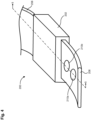
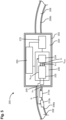
- a wearable device 200 for measuring electrodermal activity includes a housing 202, a first strap 206a and a second strap 206b, a first electrode 210a, a second electrode 210b (collectively referred to as the "electrodes 210"), a processing module 230, a communications module 250, and a power source 270.
- the wearable device 200 is configured to be worn on the wrist of the user, analogous to a watch and to measure at least an electrodermal activity of the stratum corneum of a skin on the wrist of the user.
- the housing 202 defines an internal volume 204 configured to house the processing module 230, the communications module 250 and the power source 270.
- the housing 202 can be formed from a material that is relatively lightweight and flexible, yet sturdy.
- the housing 202 also can be formed from a combination of materials such as to provide specific portions that are rigid and specific portions that are flexible.
- Example materials include plastic and rubber materials, such as polystyrene, polybutene, carbonate, urethane rubbers, butene rubbers, silicone, and other comparable materials and mixtures thereof, or a combination of these materials or any other suitable material can be used.
- the housing 202 can have a relatively smooth surface, curved sides, and/or otherwise an ergonomic shape.
- the housing 202 can include a base and a cover such that the base is removably coupled to the cover to define the internal volume 204.
- the base can be removed to access the components disposed in the housing 204 (e.g., the replace the power source 270).
- a first strap 206a and a second strap 206b are coupled to a first side and a second side of the housing 202, respectively.
- the straps 206 can be formed from any suitable material such as, for example, leather, rubber, fiber, polyurethane, or metal.
- the straps 206 can include a coupling mechanism, for example, a hole and pin, clamp, notches, grooves, indents, detents, magnets, Velcro, bands, or any other suitable coupling mechanism to couple the straps 206 to each other. In this manner, the strap 206 can be removably secured on the wrist of the user such that the electrodes 210 can be associated with stratum corneum of the wrist of the user.
- Each strap 206 defines an internal volume 208 which is coupled to the housing 202 via an opening 205 defined in a side wall of the housing 202.
- the opening can allow the processing module 230 to be electrically coupled to the electrodes 210 via electrical couplings, for example, electrical leads, that can pass through the opening 205 between the internal volume 204 of the housing 202, and the internal volume 208 of the strap 206.
- the electrodes 210 are disposed in the internal volume 208 defined by the first strap 206a such that at least a portion of each of the electrodes 210 is disposed outside the internal volume. In this manner, the electrodes 210 are configured to contact the stratum corneum of the skin of the user when the wearable device 200 is associated with the wrist of the user.
- the electrodes 210 can includes any suitable electrodes that can allow electronic communication through the stratum corneum and measure a conductance of the stratum corneum. For example, the first electrode 210a is brought into contact with a first portion of the stratum corneum of the skin, and the second electrode 210b is brought into contact with a second portion of the stratum corneum of the skin, such that the first electrode 210a is in electronic communication with the second electrode 210b through the stratum corneum.
- the electrodes 210 can have any suitable shape.
- the electrodes 210 can have any suitable shape
- the electrodes 210 can be discs, plates, or rods, a solid state microfabricated electrode (e.g., of the type used in MEMS devices), or a screen printed electrode.
- the electrodes 210 can have any suitable cross section, for example circular, square, rectangle, elliptical, polygonal, or any other suitable cross-section.
- at least a portion of the electrodes 210 can be insulated with an insulating material, for example, rubber, TEFLON ® , plastic, parylene, silicon dioxide, silicon nitride, any other suitable insulation material or combination thereof.
- the insulation material can, for example, be used to define an active area of the electrodes 210.
- the electrodes 210 can be subjected to a surface modification process to modify a surface area of the electrodes 210 for example, to provide a larger surface area.
- Such surface modification processes can include, for example, etching (e.g., etching in an acidic or basic solution), voltage cycling (e.g., cyclic voltammetry), electrodeposition of nanoparticles, and/or any other suitable surface modification process or combination thereof.
- the electrodes 210 can be formed from any suitable material capable of electronic communication (i.e., ionic and electric communication) through the stratum corneum. Suitable materials can include, for example, silver (Ag), gold, platinum, palladium, rhodium, iridium, carbon, graphite, carbon nanotubes, graphenes, conductive polymers, ceramics, alloys, any other suitable material or combination thereof.
- the electrodes 210 can include Ag electrodes, for example, metallic plates coated with Ag. The Ag electrodes can dissociate into Ag + ions at the surface of the electrode allowing that can exchange ions with the electrolytes included in the sweat produced on the stratum corneum, thereby allowing electronic communication through the stratum corneum. Ag can also prevent any damage to the stratum corneum and has inherent anti-bacterial properties that can prevent any bacterial growth on the stratum corneum in proximity of the electrodes 210.
- the processing module 230 is disposed in the internal volume 204 defined by the housing 202.
- the processing module 230 includes an electrical circuit 232 and a compensation mechanism 234.
- the electrical circuit 232 can include an amplifier A, for example, an operational amplifier, a transimpedance amplifier, a voltage amplifier, a current amplifier, a transconductance amplifier, a transimpedance amplifier, any other suitable amplifier or combination thereof.
- the electrical circuit 232 also includes an analog to digital converter (ADC).
- ADC analog to digital converter
- the electrical circuit 232 can be configured to measure and output voltage V OUT and obtain the conductance of the stratum corneum from the output voltage V OUT as described herein.
- the compensation mechanism 234 includes at least a digital to analog converter. The compensation mechanism is configured to read the output voltage V OUT and set a compensation voltage V DAC corresponding to a compensation current I comp as described herein.
- the processing module 230 can also be configured to reverse a polarity of the at least one of the first electrode 210a and the second electrode 210b after a predetermined period of time to substantially reduce electrolysis. For example, reversing the plurality can urge any dissolved ions of the electrodes 210, for example, Ag + ions to reabsorb into the electrodes 210. This can, for example, reduce fouling of the electrodes 210, increase shelf life, and/or prevent irritation of the skin.
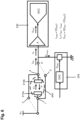
- FIG. 6 shows a circuit diagram of the processing module 230 that can be used for current compensation and polarity inversion.
- the electrodes 210 can be in contact with the skin, for example, the stratum corneum of the skin.
- the stratum corneum acts as a variable resistor disposed between the electrodes 210.
- the conductance of the stratum corneum changes as the thickness of the stratum corneum changes, for example, because of a change in the physiological status of the user.
- the power source 270 can be used to provide a positive voltage V+ at a first node 1 and a negative voltage V- at a third node 3.
- the first electrode 210a receives the positive voltage V+ and the second electrode 210b receives the negative voltage V-.
- a polarity inversion mechanism for example, a directional switch, can be used to divert the positive voltage towards a second node 2 and the negative voltage towards a fourth node 4. As shown in FIG. 6 , this reverses the polarity of the electrodes 210, such that the first electrode 210a is now biased at the negative voltage V- and the second electrode 210b is biased at the positive voltage V+.
- the digital to analog converter (DAC) included in the compensation mechanism 234 is configured to subtract a compensation current I comp from entering the amplifier A.
- I in I skin ⁇ I comp
- the amplifier A is responsible for amplifying the current I in for a given gain G and transform the input current I in into the output voltage V OUT .
- the output voltage V OUT is used to obtain a conductance of the stratum corneum.
- the processing module 230 also includes an analog to digital converter (ADC) configured to convert the analog signal to a digital signal.
- ADC can have any suitable resolution, for example, 10 bits, 12 bits or 16 bits.
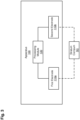
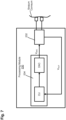
- FIG. 7 shows an overall schematic of the processing module 230.
- the control unit CU included in the compensation mechanism 234 sets a value of the compensation voltage V DAC and reads the output voltage V OUT of the electrical circuit 232. Since the gain G of the amplifier A is substantially high to magnify the weak conductance signal obtained from the electrodes 210, V OUT tends to saturate towards a maximum value V MAX or 0. When this happens, the control unit CU acts on the compensation voltage V DAC in order to de-saturate the output voltage V OUT . For instance, if the skin conductance keeps increasing the output voltage V OUT will saturate. The compensation mechanism 234 can then increase the compensation current I comp to reduce the output voltage V OUT to a readable range.
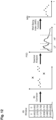
- FIG. 8 This concept is further illustrated in FIG. 8 .
- the top panel of FIG. 8 shows real time conductance of the stratum corneum which includes the tonic and the phasic levels.
- the middle panel shows the output voltage V OUT measured by the electrical circuit 232
- the bottom panel shows the compensation voltage V DAC set by the control unit CU.
- the electrodes 210 can be initialized at an initial value of the compensation voltage V DAC .
- the magnitude of the output voltage V OUT can be measured by the compensation mechanism 234. As soon as the conductance increases and the output voltage V OUT increases and eventually reaches its saturation value (e.g., about 3.3 volts). In this scenario a substantial amount of current is flowing through the stratum corneum.
- the compensation mechanism 234 can compensate for the current by increasing the compensation voltage V DAC . This allows a higher current to flow away from the amplifier A and thereby, leads to desaturation of the output voltage V OUT .
- the compensation mechanism 234 can decrease the compensation voltage V DAC , thereby allowing more current to flow towards the amplifier A and increasing the magnitude of the output voltage V OUT .
- the compensation mechanism 234 can be configured to dynamically set the compensation value for the tonic level conductance that is subtracted from the real conductance level.
- the compensation voltage V DAC is proportional to the current tonic level conductance of the user.
- the compensation mechanism 234 can measure the entire range of tonic level conductances associate with the stratum corneum of the wrist of the user, for example, in the range of about 0.05 ⁇ S to about 80 ⁇ S. In some embodiments, the compensation mechanism can allow a fine tuning of the current in the range of about - 1 ⁇ A to about 1 ⁇ A.
- the compensation mechanism 234 allows for the subtraction of the tonic level from the real time conductance such that the output voltage V OUT represents the phasic value of the electrodermal activity.
- the phasic level conductance can be measured with high resolution, for example, by an analog to digital converter (ADC) included in the processing module 230.
- ADC analog to digital converter
- the phasic level can be measured with a resolution of about 0.0001 ⁇ S.
- the current compensation enables the range to be increased by focusing on a dynamic portion of the total range.
- the compensation mechanism 234 dynamically sets the compensation current to fit the tonic level conductance while the amplifier A and the ADC observe the phasic level conductance.
- the gain G provided by the amplifier A and the high resolution of the ADC enables the signal to be resolved with high resolution.
- the switching mechanism reduces electrolysis of the electrodes by allowing polarity inversion of the electrodes at predetermined intervals.
- the processing module 230 can include any other components.
- the processing module 230 can include a filtering circuit, for example, a low pass filter, a high pass filter, a band pass filter, any other suitable filtering circuit, or combination thereof, configured to substantially reduce signal noise.
- the processing module 230 can include a processor, for example, a microcontroller, a microprocessor, an ASIC chip, an ARM chip, or a programmable logic controller (PLC).
- the processor can include signal processing algorithms, for example, band pass filters, low pass filters, any other signal processing algorithms or combination thereof.
- the processing module 230 can include a memory configured to store at least one of an electrodermal activity data, or a physiological status data, for example, ANS activity data.
- the memory can also be configured to store a reference signature, for example, a calibration equation.
- the processor can include algorithms which can be configured to correlate the measured electrodermal activity data to an ANS activity or any other physiological status parameter of the user.
- the memory can also include algorithms to maximize the signal to noise ratio of the electrodermal activity signal.
- the processing module 230 can also include a generator of clock signals coupled to the processor.
- the processing module 230 can also include an RFID chip configured to store information, for example, the electrodermal activity data, and allow a near field communication (NFC) device to read the stored information.
- NFC near field communication
- the processing module 230 can be configured to measure a compensated value of conductance from which a tonic level conductance is removed. In some embodiments, the processing module 230 can be configured to allow a tuning of the current corresponding to the conductance of the stratum corneum in the range of about -1 ⁇ A to about 1 ⁇ A. In some embodiments, the processing module 230 can be configured to measure a tonic level conductance of the stratum corneum of the wrist in the range of about 0.05 ⁇ S to about 80 ⁇ S.
- the communications module 250 is coupled to the processing module 230.
- the communications module 250 can be configured to display an electrodermal activity of the user or communicate electrodermal activity data from the processing module 230 to an external device, for example, a smart phone app, a local computer and/or a remote server.
- the communications module 250 includes a communication interface to provide wired communication with the external device, for example, a USB, USB 2.0, or fire wire (IEEE 1394) interface.
- the communications module 250 can include means for wireless communication with the external device, for example, Wi-Fi, BLUETOOTH ® , low powered BLUETOOTH ® , Wi-Fi, Zigbee and the like.
- the communications module 250 can include a display, for example, a touch screen display, configured to communicate information to the user, for example, electrodermal activity, ANS activity, physiological activity of the user, remaining battery life, wireless connectivity status, time, date, and/or user reminders.
- the communications module 250 can also include microphones and/or vibration mechanisms to convey audio and tactile alerts.
- the communications module 250 can include a user input interface, for example, a button, a switch, an alphanumeric keypad, and/or a touch screen, for example, to allow a user to input information into the wearable device 200, for example, power ON the system, power OFF the system, reset the system, manually input details of a user behavior, manually input details of the wearable device 200 usage and/or manually initiate communication between the wearable device and the external device.
- a user input interface for example, a button, a switch, an alphanumeric keypad, and/or a touch screen, for example, to allow a user to input information into the wearable device 200, for example, power ON the system, power OFF the system, reset the system, manually input details of a user behavior, manually input details of the wearable device 200 usage and/or manually initiate communication between the wearable device and the external device.
- the power source 270 is coupled to the processing module 230 and the communications module 250 and configured to supply electrical power to the processing module 230 and the communications module 250.
- the power source can include for example, coin cells, Li-ion or Ni-Cad batteries of the type used in cellular phones.
- the communications module 250 can also be used to recharge the power source 270, for example, by providing power to the power source 270 from an external source through a communications lead.
- the power source 270 can be recharged using inductive coupling.
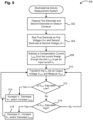
- FIG. 9 shows an exemplary method 300 for measuring electrodermal activity including the tonic level and the phasic level over a wide range, for example, in the range of about 0.05 ⁇ A and 80 ⁇ A.
- the method 300 can be used with any electrodermal activity measurement system, for example, the apparatus 100, the wearable device 200, or any other apparatus or device described herein.
- the method 300 involves disposing a first electrode and a second electrode on the stratum corneum 302.
- the electrodes can include the electrodes 110, 210 or any other electrode described herein.
- the first electrode is biased at a first voltage V+ and the second electrode is biased at a second voltage V- 304.
- the first electrode can be positively charged and the second electrode can be negatively charged or vice versa.
- a compensation current I comp is subtracted from a current I skin flowing through the stratum corneum to obtain an input current I in 308.
- a compensation mechanism e.g., the compensation mechanism 234 or any other compensation mechanism described herein
- the input current I in is transformed into an output voltage which is measured 310.
- a transimpedance amplifier e.g., a transimpedance amplifier included in the electrical circuit 232 or any other electrical circuit described herein
- the output voltage is related to a conductance of the stratum corneum and is used to measure the conductance of the stratum corneum.
- the method determines if the output voltage V OUT is saturated low 312.
- the output voltage V OUT can be communicated to a compensation mechanism (e.g., the compensation mechanism 234 or any other compensation mechanism described herein) which can determine if the output voltage V OUT is saturated low (i.e., reached a minimum value).
- the compensation current I comp is increased 314 to change the output voltage V OUT such that the output voltage V OUT is not saturated low.
- the method determines if the output voltage V OUT is saturated high 316, i.e., reached very high values. For example, if the conductance of the stratum corneum is too high, the output voltage V OUT can drop to very high values. If the output voltage V OUT is saturated high, the compensation current I comp is decreased 318 to change the output voltage V OUT such that the output voltage V OUT is not saturated high. If the output voltage is not saturated low or high, the method continues to measure the output voltage V OUT . In this manner, the method enables continuous monitoring and control of the output voltage V OUT such that the conductance of the stratum corneum can be measured over a wide range.
- a wearable device can include an electrodermal activity sensor and a heart beat sensor.
- a wearable device 400 includes a housing 402, a first strap 406a, a second strap 406b, a first electrode 410a, a second electrode 410b (collectively referred to as the "electrodes 410"), a pair of heart beat sensors 420, a processing module 430, a communications module 450, and a power source 470.
- the wearable device 400 is configured to be worn on the wrist of a user, analogous to a watch and to measure an electrodermal activity of the stratum corneum skin as well as the heart beat variability of the user.
- the housing 402 defines an internal volume 404 configured to house at least a portion of the heart beat sensors 420, the processing module 430, the communications module 450 and the power source 470.
- the housing 470 can be substantially similar to the housing 470 described with respect to the wearable device 200, and is therefore not described in further detail herein.
- the first strap 406a and the second strap 406b are coupled to a first side and a second side of the housing 402 respectively.
- the straps 406 define an internal volume 408. At least a portion of the electrodes 410 can be disposed in the internal volume 408.
- the straps 406 can be substantially similar to the straps 406 described with reference to the wearable device 200, and are therefore not described in further detail herein.
- the electrodes 410 can include any suitable electrodes that can allow electronic communication through the stratum corneum and measure a conductance of the stratum corneum.
- the electrodes 410 can be configured to measure an electrodermal activity of the stratum corneum of the user.
- the electrodes 410 can be substantially similar to the electrodes 210 described with respect to the wearable device 200, and are therefore not described in further detail herein.
- the heart beat sensors 420 can be disposed in the internal volume defined by the housing 402.
- the heart beat sensors 420 can be any suitable sensors.
- the heart beat sensors 420 can include electrodes such as those included in EKG monitors.
- the heart beat sensors 420 can include optical sensors.
- the heart beat sensors can include a light emitter and a light receiver that can convert reflected light form the skin, or blood below the skin into an electrical signal corresponding to the heart beat of the user.
- the light emitter can include an LED diode.
- the light receiver can include a photodiode or a phototransistor.
- the electrical signal measured by the light detector which corresponds to the light reflected from the skin can be communicated to the processing module 430 for calculating a heart rate of the user.
- the wearable device 400 can also include optical filters, for example, monochromators to dynamically select a wavelength of the reflected light.
- the monochromators can be tunable Fabry-Perot filters.
- the processing module 430 is disposed in the internal volume 404 defined by the housing 402.
- the processing module 430 includes an electrical circuit 432 and a compensation mechanism 434.
- the electrical circuit 432 and the compensation mechanism 434 can be substantially similar to the electrical circuit 232 and the compensation mechanism 234 described with respect to the wearable device 200, and are therefore not described in further detail herein.
- the processing module 430 can include a circuit to control the electrical power communicated to the light emitter, for example, to control a luminosity of the light emitted by the light emitter included in the heart beat sensors 420.
- the apparatus can also include various physiological sensors, for example, a heart beat sensor (e.g., a photoplethysmography sensor), an accelerometer, a temperature sensor, a blood oxygen sensors, a glucose sensor, any other physiological sensor or combination thereof.
- the processing module 430 can be configured to process signals form each sensor to determine a physiological status of the user.
- data processing of the signal received from each sensor can be performed on an external device, for example, a smart phone, a tablet, a personal computer, or a remote server.
- the communications module can be configured to communicate the physiological data from each of the sensors to the user, for example, via a display included in the apparatus or the external device.
- Such physiological data can include, for example, electrodermal activity (e.g., skin conductance), heart rate, heart rate variability, metabolic equivalent of task (MET), a stress level, a relaxation level, a movement or activity level, a temperature, a heat flux, and/or an ANS activity (e.g., an arousal or excitement).
- electrodermal activity e.g., skin conductance
- heart rate heart rate variability
- MET metabolic equivalent of task
- a stress level e.g., a relaxation level
- a movement or activity level e.g., a temperature
- a heat flux e.g., an arousal or excitement
- the processing module 430 can include algorithms to determine a well being index (WBI) of the user from the HRV data.
- FIG. 12 shows a method that can be incorporated into an algorithm to determine a WBI of the user from the heart rate variability data.
- the inter beat interval (IBI) time series is processed to identify and delete wrongly recognized and ectopic beats.
- a spectral analysis of the corrected time series is performed to assess the total power, the high frequency power and the low frequency power of the cardiac rhythm.
- the values obtained are given as input to the WBI function together with other cardiac parameters, and in the fourth step a WBI of the user is determined.
- the IBI time series is processed in the first step.
- the first column of the time series shown in FIG. 12 includes the time stamps at which the heart beat occurred.
- the second column includes the time interval between each subsequent heart beat.
- the first column is a cumulative sum of the first column.
- the obtained IBI time series is split into subsequent windows of five minutes.
- Errors in the location of the instantaneous heart beat can translate into errors in the calculation of the HRV.
- HRV is highly sensitive to artifact and errors in 2% to 5% of the data can result in unwanted biases in HRV calculations.
- it is critical to manage artifacts and ectopic heart beats appropriately prior to performing any HRV analysis.
- the method applies four parallel filters to the five minute IBI windows. The filters are applied to the second column of the IBI time series, assigning progressive natural numbers to the beats, as shown in FIG. 13 .
- the first filter includes a plain selection filter.
- the tachogram is initially filtered by a low-pass numerical filter. Beats falling outside a confidence region A centered in the filtered curve are discarded.
- the mean IBI equals the mean values of the IBI calculated in the window.
- the second filter is a one-step selection filter.
- a plain selection filter is first applied, with a confidence region B centered in the filtered curve, as described herein with respect to the plain selection filter.
- FIG. 14 shows a visual representation of the one-step selection filter. The selected beats are discarded only if subsequent points fall outside the confidence region in an opposite fashion which can happen when one beat is misrecognized.
- the third filter is a two-step selection filter.
- a plain selection is first applied, with a confidence region C centered in the filtered curve, as described herein with respect to the plain selection filter.
- FIG. 15 shows a visual representation of the two-step selection filter. The selected beats are discarded only if points with a two beat distance fall outside the confidence region in an opposite fashion.
- the fourth selection filter is a gross selection filter.
- the signal is linearly detrended before multiplying it by a hamming window of the same length.
- a constant detrend is applied to subtract the zero frequency component.
- the non-autonomic regulation of the heart rate for example, due to vigorous exercise or voluntary physical activity is removed from the signal.
- Applying a hamming window to the IBI time series before the spectral analysis can thereby enhance spectral information.
- PSD power spectral density
- the PSD equation can be applied only if the time-domain signal to be transformed has zero mean value.
- the integral in the equation can be a trapezoidal numerical integral.
- low frequency (LF), high frequency (HF), and total power (TP) values can be obtained by numerically integrating the PSD in the standard bands of 0.04 Hz to 0.15, from 0.15 Hz to 0.4 Hz, and from 0.4 Hz to maximum frequency, respectively.
- the WBI function is determined.
- the goal of the WBI is to encourage healthy behaviors among individuals. Thus, exertion as well as meditation and relaxation are awarded a high index value. On the contrary, stressful situations that limit the HRV are given a low score.
- the Haskell and Fox formula, or any other suitable formula can be used to determine the HRmax.
- the WBI provides a daily comprehensive value that indicates the quality of the day of the user from an HRV point of view. For example, a healthy nutritional regime increases the quality of sleep and wakefulness, and in turn the magnitude of HRV can urge the user towards such healthy behavior. Thus an increase of the daily WBI through weeks, months and years would indicate the effectiveness of the method described herein.
- the method described herein can allow the tracking of the level of the psychophysical health over a period of time. Awareness of a user's own well being level can provide the user encouragement as well as guidance to enhance daily interactions and quality of life. Furthermore, the method described herein can be incorporated in devices, for example, the wearable device 300 to help the user cope with stressful situations by providing compensational feedback, other than supporting healthy behaviors such as, for example, healthy eating and exercise.
Landscapes
- Health & Medical Sciences (AREA)
- Life Sciences & Earth Sciences (AREA)
- Molecular Biology (AREA)
- Medical Informatics (AREA)
- Physics & Mathematics (AREA)
- Veterinary Medicine (AREA)
- Biophysics (AREA)
- Pathology (AREA)
- Engineering & Computer Science (AREA)
- Biomedical Technology (AREA)
- Heart & Thoracic Surgery (AREA)
- Public Health (AREA)
- Animal Behavior & Ethology (AREA)
- Surgery (AREA)
- General Health & Medical Sciences (AREA)
- Dermatology (AREA)
- Radiology & Medical Imaging (AREA)
- Nuclear Medicine, Radiotherapy & Molecular Imaging (AREA)
- Cardiology (AREA)
- Physiology (AREA)
- Pulmonology (AREA)
- Measurement And Recording Of Electrical Phenomena And Electrical Characteristics Of The Living Body (AREA)
- Measuring And Recording Apparatus For Diagnosis (AREA)
- Measuring Pulse, Heart Rate, Blood Pressure Or Blood Flow (AREA)
- Measurement Of The Respiration, Hearing Ability, Form, And Blood Characteristics Of Living Organisms (AREA)
- Measuring Or Testing Involving Enzymes Or Micro-Organisms (AREA)
- Investigating Or Analyzing Materials By The Use Of Electric Means (AREA)
Priority Applications (1)
| Application Number | Priority Date | Filing Date | Title |
|---|---|---|---|
| EP23173992.1A EP4241668A3 (en) | 2013-03-16 | 2014-03-17 | Apparatus and method for electrodermal activity measurement with current compensation |
Applications Claiming Priority (3)
| Application Number | Priority Date | Filing Date | Title |
|---|---|---|---|
| US201361802500P | 2013-03-16 | 2013-03-16 | |
| US201361802519P | 2013-03-16 | 2013-03-16 | |
| PCT/EP2014/055304 WO2014147024A1 (en) | 2013-03-16 | 2014-03-17 | Apparatus for electrodermal activity measurement with current compensation |
Related Child Applications (1)
| Application Number | Title | Priority Date | Filing Date |
|---|---|---|---|
| EP23173992.1A Division EP4241668A3 (en) | 2013-03-16 | 2014-03-17 | Apparatus and method for electrodermal activity measurement with current compensation |
Publications (2)
| Publication Number | Publication Date |
|---|---|
| EP2967415A1 EP2967415A1 (en) | 2016-01-20 |
| EP2967415B1 true EP2967415B1 (en) | 2023-05-24 |
Family
ID=50288076
Family Applications (2)
| Application Number | Title | Priority Date | Filing Date |
|---|---|---|---|
| EP14710565.4A Active EP2967415B1 (en) | 2013-03-16 | 2014-03-17 | Apparatus and method for electrodermal activity measurement with current compensation |
| EP23173992.1A Withdrawn EP4241668A3 (en) | 2013-03-16 | 2014-03-17 | Apparatus and method for electrodermal activity measurement with current compensation |
Family Applications After (1)
| Application Number | Title | Priority Date | Filing Date |
|---|---|---|---|
| EP23173992.1A Withdrawn EP4241668A3 (en) | 2013-03-16 | 2014-03-17 | Apparatus and method for electrodermal activity measurement with current compensation |
Country Status (7)
| Country | Link |
|---|---|
| US (3) | US10506944B2 (enExample) |
| EP (2) | EP2967415B1 (enExample) |
| JP (2) | JP6824608B2 (enExample) |
| CN (2) | CN112869727B (enExample) |
| CA (1) | CA2907426C (enExample) |
| ES (1) | ES2947565T3 (enExample) |
| WO (1) | WO2014147024A1 (enExample) |
Families Citing this family (48)
| Publication number | Priority date | Publication date | Assignee | Title |
|---|---|---|---|---|
| ITMI20130104A1 (it) | 2013-01-24 | 2014-07-25 | Empatica Srl | Dispositivo, sistema e metodo per la rilevazione e il trattamento di segnali di battito cardiaco |
| CN112869727B (zh) * | 2013-03-16 | 2024-03-19 | 恩帕蒂卡有限责任公司 | 用于利用电流补偿进行皮电活动测量的装置 |
| GB2516259A (en) * | 2013-07-16 | 2015-01-21 | Nokia Corp | An apparatus, method and computer program for detecting physiological parameters |
| US12582344B2 (en) | 2014-08-08 | 2026-03-24 | Medtronic Xomed, Inc. | Wireless stimulation probe device for wireless nerve integrity monitoring systems |
| US12201436B2 (en) | 2014-08-08 | 2025-01-21 | Medtronic Xomed, Inc. | Wireless nerve integrity monitoring systems and devices |
| US9918669B2 (en) | 2014-08-08 | 2018-03-20 | Medtronic Xomed, Inc. | Wireless nerve integrity monitoring systems and devices |
| CN106714679A (zh) * | 2014-09-30 | 2017-05-24 | 皇家飞利浦有限公司 | 用于皮肤电导测量的可穿戴装置 |
| KR101559288B1 (ko) * | 2014-11-18 | 2015-10-20 | (주)이미지스테크놀로지 | 센서전극 일체형 햅틱 액츄에이터와 이를 포함하는 착용형 장치 |
| US10405761B2 (en) | 2015-02-24 | 2019-09-10 | Koninklijke Philips N.V. | Device for detecting heart rate and heart rate variability |
| US11980465B2 (en) * | 2015-04-03 | 2024-05-14 | Medtronic Xomed, Inc. | System and method for omni-directional bipolar stimulation of nerve tissue of a patient via a bipolar stimulation probe |
| US10039915B2 (en) | 2015-04-03 | 2018-08-07 | Medtronic Xomed, Inc. | System and method for omni-directional bipolar stimulation of nerve tissue of a patient via a surgical tool |
| US10537403B2 (en) | 2015-05-21 | 2020-01-21 | Drexel University | Passive RFID based health data monitor |
| US11638550B2 (en) | 2015-07-07 | 2023-05-02 | Stryker Corporation | Systems and methods for stroke detection |
| TWI595859B (zh) * | 2016-01-08 | 2017-08-21 | 豪展醫療科技股份有限公司 | 生理狀態監測裝置 |
| JP6946411B2 (ja) * | 2016-07-18 | 2021-10-06 | コーニンクレッカ フィリップス エヌ ヴェKoninklijke Philips N.V. | 精神生理的反応性を評定する装置 |
| US11224354B2 (en) * | 2016-08-08 | 2022-01-18 | Analog Devices International Unlimited Company | Systems and methods of monitoring electrodermal activity (EDA) using an AC signal and discrete fourier transform (DFT) analysis |
| US10849517B2 (en) | 2016-09-19 | 2020-12-01 | Medtronic Xomed, Inc. | Remote control module for instruments |
| JP6767503B2 (ja) * | 2016-12-08 | 2020-10-14 | 旭化成株式会社 | 接触状態推定装置、生体信号測定装置、接触状態推定方法、接触状態推定プログラム、及び媒体 |
| CN106901721B (zh) * | 2017-03-13 | 2023-10-20 | 歌尔科技有限公司 | 智能腕戴设备和智能腕戴设备心电测量方法 |
| CN107292244A (zh) * | 2017-06-01 | 2017-10-24 | 深圳欧德蒙科技有限公司 | 一种精神压力识别方法、智能设备及计算机可读存储介质 |
| US10702184B2 (en) | 2017-06-07 | 2020-07-07 | Analog Devices International Unlimited Company | Low power measurement of skin electrical properties |
| US11331019B2 (en) | 2017-08-07 | 2022-05-17 | The Research Foundation For The State University Of New York | Nanoparticle sensor having a nanofibrous membrane scaffold |
| US11375896B2 (en) | 2017-08-18 | 2022-07-05 | Megan Reinhardt | Edge-intelligent iot-based wearable device for detection of cravings in individuals |
| US10478066B2 (en) | 2017-08-18 | 2019-11-19 | Megan Reinhardt | System and method for detection of cravings in individuals with addiction |
| US12488888B2 (en) * | 2017-08-18 | 2025-12-02 | Megan Reinhardt | Edge-intelligent IoT-based wearable device for detection of cravings in individuals |
| WO2019073756A1 (ja) | 2017-10-13 | 2019-04-18 | ソニー株式会社 | 生体情報計測装置および生体情報計測システム |
| DE102018000883B4 (de) | 2018-02-03 | 2022-08-25 | Louis Samuel Seidel | Biofeedbacksystem zur Verwendung in einem Verfahren zur Prävention, Diagnose und Therapie von Stress und kognitivem Leistungsabfall bedingt durch der Unterhaltung, Kommunikation und Datenverarbeitung dienende, elektronische Bildschirmgeräte |
| US20190298172A1 (en) * | 2018-03-07 | 2019-10-03 | University Of Massachusetts | Wearable Biosensor Ring |
| US10517536B1 (en) * | 2018-03-28 | 2019-12-31 | Senstream, Inc. | Biometric wearable and EDA method for acquiring biomarkers in perspiration |
| US11127386B2 (en) * | 2018-07-24 | 2021-09-21 | James S. Brown | System and method for generating music from electrodermal activity data |
| CN109171663B (zh) * | 2018-10-31 | 2021-06-18 | 朱昀正 | 一种基于皮电的睡眠监测手环 |
| US11607146B2 (en) | 2019-05-30 | 2023-03-21 | Welch Allyn, Inc. | Photoplethysmography device with thermal trapping and/or warming capability and associated methods |
| WO2021011588A1 (en) | 2019-07-15 | 2021-01-21 | Massachusetts Institute Of Technology | Tracking nociception under anesthesia using a multimodal metric |
| AU2020386006A1 (en) | 2019-11-18 | 2022-05-26 | Empatica Srl | Wearable biosensing device |
| JP7559770B2 (ja) * | 2019-11-29 | 2024-10-02 | ソニーグループ株式会社 | 情報処理装置、情報処理方法及びプログラム |
| EP3834716A1 (en) * | 2019-12-11 | 2021-06-16 | Koninklijke Philips N.V. | Wearable sensor device and a sensing method |
| KR102810731B1 (ko) * | 2019-12-11 | 2025-05-21 | 삼성전자주식회사 | 생체 신호를 처리하기 위한 방법, 이를 위한 전자 장치 및 저장 매체 |
| RU197524U1 (ru) * | 2020-02-14 | 2020-05-12 | Общество с ограниченной ответственностью «Лаборатория знаний» | Наручное устройство для регистрации физиологических сигналов |
| RU197526U1 (ru) * | 2020-02-14 | 2020-05-12 | Общество с ограниченной ответственностью «Лаборатория знаний» | Наручное устройство для регистрации физиологических сигналов |
| US20230148956A1 (en) | 2020-03-26 | 2023-05-18 | Eisai R&D Management Co., Ltd. | Apparatus for health monitoring |
| EP4135571A1 (en) | 2020-04-17 | 2023-02-22 | Empatica Srl | Methods and systems for non-invasive forecasting, detection and monitoring of viral infections |
| FR3114232B1 (fr) | 2020-09-23 | 2025-02-28 | Ovomind K K | Equipement électrodermal |
| US20240057925A1 (en) * | 2020-12-30 | 2024-02-22 | Lifeq B.V. | Health Monitoring and Management System Using Ectopic Beats as Early Cardiac Health Marker |
| USD980431S1 (en) | 2021-03-25 | 2023-03-07 | Eisai R&D Management Co., Ltd | Component for a health condition monitoring system |
| JP7511035B2 (ja) * | 2021-08-23 | 2024-07-04 | フィットビット・リミテッド・ライアビリティ・カンパニー | ストレスイベントを検出するためのウェアラブルデバイス上の手首側の継続的皮膚電気活動電極の配置 |
| KR102913442B1 (ko) * | 2023-07-25 | 2026-01-15 | 주식회사 피치라이프사이언스 | 비침습적 두뇌 자극을 위한 안전성이 향상된 전기 자극 회로 |
| CN118473539B (zh) * | 2023-10-23 | 2025-08-15 | 荣耀终端股份有限公司 | 信号电路及其控制方法、可穿戴设备 |
| WO2026011148A2 (en) | 2024-07-03 | 2026-01-08 | Empatica Srl | Systems, devices, and methods for evaluation of heart beat parameters involving adjustments based on movement |
Family Cites Families (33)
| Publication number | Priority date | Publication date | Assignee | Title |
|---|---|---|---|---|
| US3556083A (en) * | 1968-05-02 | 1971-01-19 | Beckman Instruments Inc | Apparatus for measurement of electrodermal phenomena |
| US3784908A (en) | 1973-04-09 | 1974-01-08 | W Anderson | Electrical conductivity measurement method and apparatus |
| SU845823A1 (ru) * | 1979-07-23 | 1981-07-15 | Институт Биологической Физикиакадемии Наук Cccp | Устройство дл исследовани элЕКТРичЕСКиХ ХАРАКТЕРиСТиК биОлО-гичЕСКиХ ТКАНЕй |
| US4338950A (en) * | 1980-09-22 | 1982-07-13 | Texas Instruments Incorporated | System and method for sensing and measuring heart beat |
| JPS60169226A (ja) * | 1984-02-13 | 1985-09-02 | Nec Corp | 演算増幅器のオフセツト調整回路 |
| US5158091A (en) * | 1990-11-30 | 1992-10-27 | Ivac Corporation | Tonometry system for determining blood pressure |
| RU2116750C1 (ru) * | 1996-05-24 | 1998-08-10 | Закрытое акционерное общество "Руссоком" | Способ измерения электрокожного сопротивления и устройство для его осуществления |
| US6233471B1 (en) | 1998-05-13 | 2001-05-15 | Cygnus, Inc. | Signal processing for measurement of physiological analysis |
| US20100042093A9 (en) * | 1998-10-23 | 2010-02-18 | Wham Robert H | System and method for terminating treatment in impedance feedback algorithm |
| JP2006503617A (ja) * | 2002-10-03 | 2006-02-02 | スコット・ラボラトリーズ・インコーポレイテッド | 鎮静・鎮痛システムにおいて傾向分析を行うシステムおよび方法 |
| CN2610843Y (zh) | 2003-04-22 | 2004-04-14 | 上海诺诚电气有限公司 | 头皮阻抗检测装置 |
| CN2654035Y (zh) * | 2003-07-03 | 2004-11-10 | 李江 | 通用串行总线接口人体阻抗检测仪 |
| JP4817692B2 (ja) | 2004-08-04 | 2011-11-16 | シスメックス株式会社 | 分析装置 |
| EP1871219A4 (en) * | 2005-02-22 | 2011-06-01 | Health Smart Ltd | METHOD AND SYSTEMS FOR PHYSIOLOGICAL AND PSYCHOPHYSIOLOGICAL MONITORING AND THEIR USES |
| JP2007048389A (ja) * | 2005-07-14 | 2007-02-22 | Hitachi Maxell Ltd | 光ディスクおよびその製造方法 |
| CN1985701A (zh) | 2005-12-21 | 2007-06-27 | 尤俊德 | 方便安检人员进行检查的行李箱 |
| EP1832227A1 (fr) * | 2006-03-08 | 2007-09-12 | EM Microelectronic-Marin SA | Circuit de conditionnement du signal entre un dispositif optique et une unité de traitement |
| GB2445734A (en) * | 2007-01-19 | 2008-07-23 | Cwm Dulas Corp Ltd | Substance intolerance testing system using multiple frequency substance signature signals |
| WO2008099288A2 (en) | 2007-02-16 | 2008-08-21 | Vyro Games Ltd. | Biosensor device and method |
| JP2009033638A (ja) * | 2007-07-30 | 2009-02-12 | Fujitsu Microelectronics Ltd | 増幅回路 |
| CN100512751C (zh) * | 2007-09-25 | 2009-07-15 | 重庆大学 | 一种用于电阻抗成像的增量放大式信号测量装置 |
| WO2009130338A1 (es) * | 2008-04-22 | 2009-10-29 | Starlab Barcelona, Sl | Circuito acondicionador de señales eléctricas débiles y método de control de dich circuito |
| KR20110108387A (ko) * | 2009-01-27 | 2011-10-05 | 싸이베이스 에이비 | 임피던스의 다중 전극 측정을 위한 스위치 프로브 |
| US20110093780A1 (en) | 2009-10-16 | 2011-04-21 | Microsoft Corporation | Advertising avatar |
| US20110092780A1 (en) * | 2009-10-16 | 2011-04-21 | Tao Zhang | Biosensor module with automatic power on capability |
| US8097853B2 (en) | 2009-11-17 | 2012-01-17 | Dialog Semiconductor Gmbh | Infrared photocurrent front-end ADC for rain-sensing system with ambient light compensation |
| TWI450707B (zh) | 2010-11-09 | 2014-09-01 | Univ Chung Hua | 生物阻抗量測儀及生物阻抗量測儀組合 |
| ES2513666T3 (es) * | 2011-04-14 | 2014-10-27 | Koninklijke Philips N.V. | Dispositivo y método de medición del estrés |
| WO2012158984A1 (en) * | 2011-05-17 | 2012-11-22 | Massachusetts Institute Of Technology | Methods and apparatus for assessment of atypical brain activity |
| US8944052B2 (en) * | 2011-05-26 | 2015-02-03 | Ivan Osorio | Apparatus and methods for delivery of therapeutic agents to mucous or serous membrane |
| US9311825B2 (en) * | 2011-12-22 | 2016-04-12 | Senstream, Inc. | Biometric sensing and processing apparatus for mobile gaming, education, and wellness applications |
| CN102920444A (zh) * | 2012-11-20 | 2013-02-13 | 浙江大学 | 便携式同时检测皮肤温度、皮肤电阻和脉搏的装置及方法 |
| CN112869727B (zh) * | 2013-03-16 | 2024-03-19 | 恩帕蒂卡有限责任公司 | 用于利用电流补偿进行皮电活动测量的装置 |
-
2014
- 2014-03-17 CN CN202110059768.6A patent/CN112869727B/zh active Active
- 2014-03-17 JP JP2015562259A patent/JP6824608B2/ja active Active
- 2014-03-17 CA CA2907426A patent/CA2907426C/en active Active
- 2014-03-17 CN CN201480025005.8A patent/CN105263406B/zh active Active
- 2014-03-17 US US14/215,613 patent/US10506944B2/en active Active
- 2014-03-17 EP EP14710565.4A patent/EP2967415B1/en active Active
- 2014-03-17 ES ES14710565T patent/ES2947565T3/es active Active
- 2014-03-17 WO PCT/EP2014/055304 patent/WO2014147024A1/en not_active Ceased
- 2014-03-17 EP EP23173992.1A patent/EP4241668A3/en not_active Withdrawn
-
2019
- 2019-06-18 JP JP2019112499A patent/JP2019177175A/ja active Pending
- 2019-10-30 US US16/668,911 patent/US11766187B2/en active Active
-
2023
- 2023-08-21 US US18/453,067 patent/US20230397833A1/en not_active Abandoned
Also Published As
| Publication number | Publication date |
|---|---|
| JP2019177175A (ja) | 2019-10-17 |
| HK1219041A1 (zh) | 2017-03-24 |
| EP2967415A1 (en) | 2016-01-20 |
| CN112869727A (zh) | 2021-06-01 |
| EP4241668A3 (en) | 2023-11-15 |
| CA2907426C (en) | 2024-05-28 |
| US10506944B2 (en) | 2019-12-17 |
| JP6824608B2 (ja) | 2021-02-03 |
| US20140316229A1 (en) | 2014-10-23 |
| US20230397833A1 (en) | 2023-12-14 |
| CN105263406A (zh) | 2016-01-20 |
| EP4241668A2 (en) | 2023-09-13 |
| CN105263406B (zh) | 2021-01-26 |
| JP2016516461A (ja) | 2016-06-09 |
| US20200315490A1 (en) | 2020-10-08 |
| US11766187B2 (en) | 2023-09-26 |
| ES2947565T3 (es) | 2023-08-11 |
| WO2014147024A1 (en) | 2014-09-25 |
| CA2907426A1 (en) | 2014-09-25 |
| CN112869727B (zh) | 2024-03-19 |
Similar Documents
| Publication | Publication Date | Title |
|---|---|---|
| US20230397833A1 (en) | Apparatus for electrodermal activity measurement with current compensation | |
| US12588822B2 (en) | Remote physiological monitor | |
| JP4342455B2 (ja) | 健康管理装置および健康管理システム | |
| KR101084554B1 (ko) | 심장 관련 파라미터를 측정하기 위한 방법 및 장치 | |
| US9655532B2 (en) | Wearable physiological monitoring and notification system based on real-time heart rate variability analysis | |
| US9532747B2 (en) | System and method for stress sensing | |
| JP4023429B2 (ja) | 携帯型生体情報モニタ装置 | |
| JP7057284B6 (ja) | 被検者の1又は複数の生理的特徴の基準を決定する機器の作動方法及び機器及びコンピュータプログラム | |
| US20210000347A1 (en) | Enhanced physiological monitoring devices and computer-implemented systems and methods of remote physiological monitoring of subjects | |
| US20160051156A1 (en) | Film-type biomedical signal measuring apparatus, blood pressure measuring apparatus using the same, cardiopulmonary fitness estimating apparatus, and personal authentication apparatus | |
| CN107920742A (zh) | 具有集成电子元件的手腕式设备 | |
| JP2018524080A (ja) | 被検者の生理学的状態を監視する装置及び方法 | |
| US20250281116A1 (en) | Systems and methods for multivariate stroke detection | |
| Mahmud et al. | SensoRing: An integrated wearable system for continuous measurement of physiological biomarkers | |
| KR101524248B1 (ko) | 필름형 생체신호 측정장치를 이용한 심폐지구력 측정시스템 및 측정방법 | |
| JP2016146954A (ja) | 生体情報計測装置およびそのプログラム | |
| HK1219041B (en) | Apparatus for electrodermal activity measurement with current compensation | |
| CN221383532U (zh) | 风险行为监测设备 | |
| WO2025253407A1 (en) | Exposing skin contact electrodes for monitoring physiological parameters | |
| CN121620328A (zh) | 生物信号测量装置 |
Legal Events
| Date | Code | Title | Description |
|---|---|---|---|
| PUAI | Public reference made under article 153(3) epc to a published international application that has entered the european phase |
Free format text: ORIGINAL CODE: 0009012 |
|
| 17P | Request for examination filed |
Effective date: 20150911 |
|
| AK | Designated contracting states |
Kind code of ref document: A1 Designated state(s): AL AT BE BG CH CY CZ DE DK EE ES FI FR GB GR HR HU IE IS IT LI LT LU LV MC MK MT NL NO PL PT RO RS SE SI SK SM TR |
|
| AX | Request for extension of the european patent |
Extension state: BA ME |
|
| DAX | Request for extension of the european patent (deleted) | ||
| RAP1 | Party data changed (applicant data changed or rights of an application transferred) |
Owner name: EMPATICA SRL |
|
| STAA | Information on the status of an ep patent application or granted ep patent |
Free format text: STATUS: EXAMINATION IS IN PROGRESS |
|
| 17Q | First examination report despatched |
Effective date: 20201029 |
|
| GRAJ | Information related to disapproval of communication of intention to grant by the applicant or resumption of examination proceedings by the epo deleted |
Free format text: ORIGINAL CODE: EPIDOSDIGR1 |
|
| GRAP | Despatch of communication of intention to grant a patent |
Free format text: ORIGINAL CODE: EPIDOSNIGR1 |
|
| STAA | Information on the status of an ep patent application or granted ep patent |
Free format text: STATUS: GRANT OF PATENT IS INTENDED |
|
| GRAJ | Information related to disapproval of communication of intention to grant by the applicant or resumption of examination proceedings by the epo deleted |
Free format text: ORIGINAL CODE: EPIDOSDIGR1 |
|
| STAA | Information on the status of an ep patent application or granted ep patent |
Free format text: STATUS: EXAMINATION IS IN PROGRESS |
|
| INTG | Intention to grant announced |
Effective date: 20221020 |
|
| INTG | Intention to grant announced |
Effective date: 20221025 |
|
| GRAP | Despatch of communication of intention to grant a patent |
Free format text: ORIGINAL CODE: EPIDOSNIGR1 |
|
| STAA | Information on the status of an ep patent application or granted ep patent |
Free format text: STATUS: GRANT OF PATENT IS INTENDED |
|
| INTG | Intention to grant announced |
Effective date: 20221103 |
|
| INTC | Intention to grant announced (deleted) | ||
| INTG | Intention to grant announced |
Effective date: 20221129 |
|
| INTG | Intention to grant announced |
Effective date: 20221219 |
|
| GRAS | Grant fee paid |
Free format text: ORIGINAL CODE: EPIDOSNIGR3 |
|
| GRAA | (expected) grant |
Free format text: ORIGINAL CODE: 0009210 |
|
| STAA | Information on the status of an ep patent application or granted ep patent |
Free format text: STATUS: THE PATENT HAS BEEN GRANTED |
|
| AK | Designated contracting states |
Kind code of ref document: B1 Designated state(s): AL AT BE BG CH CY CZ DE DK EE ES FI FR GB GR HR HU IE IS IT LI LT LU LV MC MK MT NL NO PL PT RO RS SE SI SK SM TR |
|
| REG | Reference to a national code |
Ref country code: GB Ref legal event code: FG4D |
|
| REG | Reference to a national code |
Ref country code: CH Ref legal event code: EP |
|
| REG | Reference to a national code |
Ref country code: DE Ref legal event code: R096 Ref document number: 602014087017 Country of ref document: DE |
|
| REG | Reference to a national code |
Ref country code: AT Ref legal event code: REF Ref document number: 1569047 Country of ref document: AT Kind code of ref document: T Effective date: 20230615 |
|
| REG | Reference to a national code |
Ref country code: IE Ref legal event code: FG4D |
|
| REG | Reference to a national code |
Ref country code: NL Ref legal event code: FP |
|
| P01 | Opt-out of the competence of the unified patent court (upc) registered |
Effective date: 20230526 |
|
| REG | Reference to a national code |
Ref country code: ES Ref legal event code: FG2A Ref document number: 2947565 Country of ref document: ES Kind code of ref document: T3 Effective date: 20230811 |
|
| REG | Reference to a national code |
Ref country code: LT Ref legal event code: MG9D |
|
| PG25 | Lapsed in a contracting state [announced via postgrant information from national office to epo] |
Ref country code: SE Free format text: LAPSE BECAUSE OF FAILURE TO SUBMIT A TRANSLATION OF THE DESCRIPTION OR TO PAY THE FEE WITHIN THE PRESCRIBED TIME-LIMIT Effective date: 20230524 Ref country code: PT Free format text: LAPSE BECAUSE OF FAILURE TO SUBMIT A TRANSLATION OF THE DESCRIPTION OR TO PAY THE FEE WITHIN THE PRESCRIBED TIME-LIMIT Effective date: 20230925 Ref country code: NO Free format text: LAPSE BECAUSE OF FAILURE TO SUBMIT A TRANSLATION OF THE DESCRIPTION OR TO PAY THE FEE WITHIN THE PRESCRIBED TIME-LIMIT Effective date: 20230824 |
|
| PG25 | Lapsed in a contracting state [announced via postgrant information from national office to epo] |
Ref country code: RS Free format text: LAPSE BECAUSE OF FAILURE TO SUBMIT A TRANSLATION OF THE DESCRIPTION OR TO PAY THE FEE WITHIN THE PRESCRIBED TIME-LIMIT Effective date: 20230524 Ref country code: PL Free format text: LAPSE BECAUSE OF FAILURE TO SUBMIT A TRANSLATION OF THE DESCRIPTION OR TO PAY THE FEE WITHIN THE PRESCRIBED TIME-LIMIT Effective date: 20230524 Ref country code: LV Free format text: LAPSE BECAUSE OF FAILURE TO SUBMIT A TRANSLATION OF THE DESCRIPTION OR TO PAY THE FEE WITHIN THE PRESCRIBED TIME-LIMIT Effective date: 20230524 Ref country code: LT Free format text: LAPSE BECAUSE OF FAILURE TO SUBMIT A TRANSLATION OF THE DESCRIPTION OR TO PAY THE FEE WITHIN THE PRESCRIBED TIME-LIMIT Effective date: 20230524 Ref country code: IS Free format text: LAPSE BECAUSE OF FAILURE TO SUBMIT A TRANSLATION OF THE DESCRIPTION OR TO PAY THE FEE WITHIN THE PRESCRIBED TIME-LIMIT Effective date: 20230924 Ref country code: HR Free format text: LAPSE BECAUSE OF FAILURE TO SUBMIT A TRANSLATION OF THE DESCRIPTION OR TO PAY THE FEE WITHIN THE PRESCRIBED TIME-LIMIT Effective date: 20230524 Ref country code: GR Free format text: LAPSE BECAUSE OF FAILURE TO SUBMIT A TRANSLATION OF THE DESCRIPTION OR TO PAY THE FEE WITHIN THE PRESCRIBED TIME-LIMIT Effective date: 20230825 |
|
| PG25 | Lapsed in a contracting state [announced via postgrant information from national office to epo] |
Ref country code: FI Free format text: LAPSE BECAUSE OF FAILURE TO SUBMIT A TRANSLATION OF THE DESCRIPTION OR TO PAY THE FEE WITHIN THE PRESCRIBED TIME-LIMIT Effective date: 20230524 |
|
| PG25 | Lapsed in a contracting state [announced via postgrant information from national office to epo] |
Ref country code: SK Free format text: LAPSE BECAUSE OF FAILURE TO SUBMIT A TRANSLATION OF THE DESCRIPTION OR TO PAY THE FEE WITHIN THE PRESCRIBED TIME-LIMIT Effective date: 20230524 |
|
| PG25 | Lapsed in a contracting state [announced via postgrant information from national office to epo] |
Ref country code: SM Free format text: LAPSE BECAUSE OF FAILURE TO SUBMIT A TRANSLATION OF THE DESCRIPTION OR TO PAY THE FEE WITHIN THE PRESCRIBED TIME-LIMIT Effective date: 20230524 Ref country code: SK Free format text: LAPSE BECAUSE OF FAILURE TO SUBMIT A TRANSLATION OF THE DESCRIPTION OR TO PAY THE FEE WITHIN THE PRESCRIBED TIME-LIMIT Effective date: 20230524 Ref country code: RO Free format text: LAPSE BECAUSE OF FAILURE TO SUBMIT A TRANSLATION OF THE DESCRIPTION OR TO PAY THE FEE WITHIN THE PRESCRIBED TIME-LIMIT Effective date: 20230524 Ref country code: EE Free format text: LAPSE BECAUSE OF FAILURE TO SUBMIT A TRANSLATION OF THE DESCRIPTION OR TO PAY THE FEE WITHIN THE PRESCRIBED TIME-LIMIT Effective date: 20230524 Ref country code: DK Free format text: LAPSE BECAUSE OF FAILURE TO SUBMIT A TRANSLATION OF THE DESCRIPTION OR TO PAY THE FEE WITHIN THE PRESCRIBED TIME-LIMIT Effective date: 20230524 Ref country code: CZ Free format text: LAPSE BECAUSE OF FAILURE TO SUBMIT A TRANSLATION OF THE DESCRIPTION OR TO PAY THE FEE WITHIN THE PRESCRIBED TIME-LIMIT Effective date: 20230524 |
|
| REG | Reference to a national code |
Ref country code: DE Ref legal event code: R097 Ref document number: 602014087017 Country of ref document: DE |
|
| PLBE | No opposition filed within time limit |
Free format text: ORIGINAL CODE: 0009261 |
|
| STAA | Information on the status of an ep patent application or granted ep patent |
Free format text: STATUS: NO OPPOSITION FILED WITHIN TIME LIMIT |
|
| 26N | No opposition filed |
Effective date: 20240227 |
|
| PG25 | Lapsed in a contracting state [announced via postgrant information from national office to epo] |
Ref country code: SI Free format text: LAPSE BECAUSE OF FAILURE TO SUBMIT A TRANSLATION OF THE DESCRIPTION OR TO PAY THE FEE WITHIN THE PRESCRIBED TIME-LIMIT Effective date: 20230524 |
|
| PG25 | Lapsed in a contracting state [announced via postgrant information from national office to epo] |
Ref country code: SI Free format text: LAPSE BECAUSE OF FAILURE TO SUBMIT A TRANSLATION OF THE DESCRIPTION OR TO PAY THE FEE WITHIN THE PRESCRIBED TIME-LIMIT Effective date: 20230524 |
|
| REG | Reference to a national code |
Ref country code: CH Ref legal event code: PL |
|
| PG25 | Lapsed in a contracting state [announced via postgrant information from national office to epo] |
Ref country code: BG Free format text: LAPSE BECAUSE OF FAILURE TO SUBMIT A TRANSLATION OF THE DESCRIPTION OR TO PAY THE FEE WITHIN THE PRESCRIBED TIME-LIMIT Effective date: 20230524 |
|
| REG | Reference to a national code |
Ref country code: AT Ref legal event code: UEP Ref document number: 1569047 Country of ref document: AT Kind code of ref document: T Effective date: 20230524 |
|
| PG25 | Lapsed in a contracting state [announced via postgrant information from national office to epo] |
Ref country code: LU Free format text: LAPSE BECAUSE OF NON-PAYMENT OF DUE FEES Effective date: 20240317 |
|
| PG25 | Lapsed in a contracting state [announced via postgrant information from national office to epo] |
Ref country code: MC Free format text: LAPSE BECAUSE OF FAILURE TO SUBMIT A TRANSLATION OF THE DESCRIPTION OR TO PAY THE FEE WITHIN THE PRESCRIBED TIME-LIMIT Effective date: 20230524 |
|
| PG25 | Lapsed in a contracting state [announced via postgrant information from national office to epo] |
Ref country code: MC Free format text: LAPSE BECAUSE OF FAILURE TO SUBMIT A TRANSLATION OF THE DESCRIPTION OR TO PAY THE FEE WITHIN THE PRESCRIBED TIME-LIMIT Effective date: 20230524 Ref country code: LU Free format text: LAPSE BECAUSE OF NON-PAYMENT OF DUE FEES Effective date: 20240317 Ref country code: BG Free format text: LAPSE BECAUSE OF FAILURE TO SUBMIT A TRANSLATION OF THE DESCRIPTION OR TO PAY THE FEE WITHIN THE PRESCRIBED TIME-LIMIT Effective date: 20230524 |
|
| REG | Reference to a national code |
Ref country code: BE Ref legal event code: MM Effective date: 20240331 |
|
| PG25 | Lapsed in a contracting state [announced via postgrant information from national office to epo] |
Ref country code: BE Free format text: LAPSE BECAUSE OF NON-PAYMENT OF DUE FEES Effective date: 20240331 |
|
| PG25 | Lapsed in a contracting state [announced via postgrant information from national office to epo] |
Ref country code: BE Free format text: LAPSE BECAUSE OF NON-PAYMENT OF DUE FEES Effective date: 20240331 Ref country code: CH Free format text: LAPSE BECAUSE OF NON-PAYMENT OF DUE FEES Effective date: 20240331 |
|
| PG25 | Lapsed in a contracting state [announced via postgrant information from national office to epo] |
Ref country code: CY Free format text: LAPSE BECAUSE OF FAILURE TO SUBMIT A TRANSLATION OF THE DESCRIPTION OR TO PAY THE FEE WITHIN THE PRESCRIBED TIME-LIMIT; INVALID AB INITIO Effective date: 20140317 |
|
| PG25 | Lapsed in a contracting state [announced via postgrant information from national office to epo] |
Ref country code: HU Free format text: LAPSE BECAUSE OF FAILURE TO SUBMIT A TRANSLATION OF THE DESCRIPTION OR TO PAY THE FEE WITHIN THE PRESCRIBED TIME-LIMIT; INVALID AB INITIO Effective date: 20140317 |
|
| PG25 | Lapsed in a contracting state [announced via postgrant information from national office to epo] |
Ref country code: TR Free format text: LAPSE BECAUSE OF FAILURE TO SUBMIT A TRANSLATION OF THE DESCRIPTION OR TO PAY THE FEE WITHIN THE PRESCRIBED TIME-LIMIT Effective date: 20230524 |
|
| PGFP | Annual fee paid to national office [announced via postgrant information from national office to epo] |
Ref country code: GB Payment date: 20260327 Year of fee payment: 13 |
|
| PGFP | Annual fee paid to national office [announced via postgrant information from national office to epo] |
Ref country code: DE Payment date: 20260327 Year of fee payment: 13 Ref country code: IE Payment date: 20260327 Year of fee payment: 13 |
|
| PGFP | Annual fee paid to national office [announced via postgrant information from national office to epo] |
Ref country code: AT Payment date: 20260327 Year of fee payment: 13 |
|
| PGFP | Annual fee paid to national office [announced via postgrant information from national office to epo] |
Ref country code: IT Payment date: 20260319 Year of fee payment: 13 |
|
| PGFP | Annual fee paid to national office [announced via postgrant information from national office to epo] |
Ref country code: NL Payment date: 20260326 Year of fee payment: 13 |
|
| PGFP | Annual fee paid to national office [announced via postgrant information from national office to epo] |
Ref country code: FR Payment date: 20260325 Year of fee payment: 13 |
|
| PGFP | Annual fee paid to national office [announced via postgrant information from national office to epo] |
Ref country code: ES Payment date: 20260401 Year of fee payment: 13 |