EP2958858B1 - Verfahren zur herstellung von zirkoniumkolloiden - Google Patents
Verfahren zur herstellung von zirkoniumkolloiden Download PDFInfo
- Publication number
- EP2958858B1 EP2958858B1 EP12891094.0A EP12891094A EP2958858B1 EP 2958858 B1 EP2958858 B1 EP 2958858B1 EP 12891094 A EP12891094 A EP 12891094A EP 2958858 B1 EP2958858 B1 EP 2958858B1
- Authority
- EP
- European Patent Office
- Prior art keywords
- zirconia
- suspension
- alkali metal
- solvent
- colloidal
- Prior art date
- Legal status (The legal status is an assumption and is not a legal conclusion. Google has not performed a legal analysis and makes no representation as to the accuracy of the status listed.)
- Active
Links
Images


Classifications
-
- B—PERFORMING OPERATIONS; TRANSPORTING
- B01—PHYSICAL OR CHEMICAL PROCESSES OR APPARATUS IN GENERAL
- B01J—CHEMICAL OR PHYSICAL PROCESSES, e.g. CATALYSIS OR COLLOID CHEMISTRY; THEIR RELEVANT APPARATUS
- B01J13/00—Colloid chemistry, e.g. the production of colloidal materials or their solutions, not otherwise provided for; Making microcapsules or microballoons
- B01J13/0004—Preparation of sols
- B01J13/0047—Preparation of sols containing a metal oxide
-
- C—CHEMISTRY; METALLURGY
- C01—INORGANIC CHEMISTRY
- C01G—COMPOUNDS CONTAINING METALS NOT COVERED BY SUBCLASSES C01D OR C01F
- C01G25/00—Compounds of zirconium
- C01G25/02—Oxides
-
- C—CHEMISTRY; METALLURGY
- C01—INORGANIC CHEMISTRY
- C01P—INDEXING SCHEME RELATING TO STRUCTURAL AND PHYSICAL ASPECTS OF SOLID INORGANIC COMPOUNDS
- C01P2002/00—Crystal-structural characteristics
- C01P2002/60—Compounds characterised by their crystallite size
-
- C—CHEMISTRY; METALLURGY
- C01—INORGANIC CHEMISTRY
- C01P—INDEXING SCHEME RELATING TO STRUCTURAL AND PHYSICAL ASPECTS OF SOLID INORGANIC COMPOUNDS
- C01P2002/00—Crystal-structural characteristics
- C01P2002/70—Crystal-structural characteristics defined by measured X-ray, neutron or electron diffraction data
- C01P2002/72—Crystal-structural characteristics defined by measured X-ray, neutron or electron diffraction data by d-values or two theta-values, e.g. as X-ray diagram
-
- C—CHEMISTRY; METALLURGY
- C01—INORGANIC CHEMISTRY
- C01P—INDEXING SCHEME RELATING TO STRUCTURAL AND PHYSICAL ASPECTS OF SOLID INORGANIC COMPOUNDS
- C01P2002/00—Crystal-structural characteristics
- C01P2002/80—Crystal-structural characteristics defined by measured data other than those specified in group C01P2002/70
- C01P2002/82—Crystal-structural characteristics defined by measured data other than those specified in group C01P2002/70 by IR- or Raman-data
-
- C—CHEMISTRY; METALLURGY
- C01—INORGANIC CHEMISTRY
- C01P—INDEXING SCHEME RELATING TO STRUCTURAL AND PHYSICAL ASPECTS OF SOLID INORGANIC COMPOUNDS
- C01P2002/00—Crystal-structural characteristics
- C01P2002/80—Crystal-structural characteristics defined by measured data other than those specified in group C01P2002/70
- C01P2002/85—Crystal-structural characteristics defined by measured data other than those specified in group C01P2002/70 by XPS, EDX or EDAX data
Definitions
- the present invention pertains to a method for producing a colloidal suspension of zirconia particles, which is intended to be included in a coating composition for the manufacture of an optical article, such as an ophthalmic lens.
- inorganic colloids in scratch-resistant and/or abrasion-resistant coatings (also referred to as "hard coatings") for improving the surface properties of organic glasses and/or for modifying the refractive index thereof.
- Such colloids are also used in anti-reflection coatings as well as in impact-resistant primers.
- Zirconia, or zirconium dioxide is one of these known colloids, because it provides a number of useful mechanical and physical properties, including high fracture toughness, mechanical strength and hardness, low thermal conductivity, high refractive index and transparency in the visible and infra-red spectral regions.
- a colloidal suspension of zirconia with high crystallinity in the form of a stable homogeneous dispersion of nanoparticles (having an average particle size of less than 20 nm) at high solids content (above 20 wt.% and up to 35 wt.%), and also to avoid their aggregation both during the preparation of the sol and during incorporation into a polymer matrix, for instance an epoxysilane matrix.
- a homogeneous dispersion is however required for the formation of a transparent zirconia-containing composite film and it directly affects the haze and transparency of the optical coating.
- This stable homogeneous dispersion may be expressed by the zeta potential of the suspension, which absolute value should be of at least 30 mV, and by its viscosity, which should be less than 10 cPs at 25°C (no gelling should occur).
- the transparency is ensured by the low particle size with uniform and narrow size distribution.
- the high refractive index is related to the high crystallinity of the colloidal zirconia.
- One known method for preparing acid zirconia colloids was to directly heat an aqueous solution of acid zirconium sources, such as zirconium oxychloride or zirconium nitrate, as disclosed in EP 0 229 657 and US 2 984 928 . Due to the strong acidic system, this kind of method results in zirconia colloids having a low crystallinity and in an incomplete reaction of the precursor, even through long heat treatment time of several days. This low crystallinity of the product would affect the refractive index of zirconia colloids, and directly affects their application in optical coatings.
- acid zirconium sources such as zirconium oxychloride or zirconium nitrate
- US 2010/0144918 discloses a method for preparing colloidal zirconia suspensions, starting from a zirconium hydroxide suspension which may be prepared by adding a basic precipitant such as ammonia to zirconium oxychloride. Zirconium hydroxide is then reacted with an inorganic acid such as HCl before hydrothermally treating the suspension at 150-200°C.
- This method results in a zirconia sol having a dry matter content of 3-10% only, in which zirconia is provided as crystals having a mainly tetragonal crystalline phase and which are suspended in an aqueous medium. This suspension cannot be obtained with a dry matter content of more than 15 % by weight.
- these tetragonal crystals cannot be easily dispersed in a alcoholic solvent which is required for dispersing the colloidal particles into the polymer matrix of a hard-coat composition.
- the appearance of the resulting hard-coat thus becomes progressively milky, which is not desirable.
- Dispersion of these zirconia particles in an alcoholic solvent or directly in a polymer matrix can only be achieved after grafting the colloidal zirconia with a reactive solvent such as HEMA or methacrylic acid. This step is of course detrimental to the economics of the process for manufacturing the hard-coat.
- JP 2005 179111 A a method for producing a zirconia sol, comprising the steps of reacting zirconium oxychloride, malic acid and potassium hydroxide to form a zirconium hydroxide hydrogel; subjecting said zirconium hydroxide hydrogel to a hydrothermal treatment at a temperature of 200°C; and subjecting the sol to ultrafiltration.
- a process has thus been proposed, which included the steps of: (a) subjecting a mixture of zirconium oxychloride and an alkali metal halide in an aqueous solvent to hydrothermal treatment at a temperature above 150°C; (b) separating the slurry obtained from the supernatant, (c) peptizing said slurry by adding a strong acid thereto, and (d) desalting said slurry, for example by ultrafiltration, so as to form a colloidal suspension of zirconia.
- An object of this invention is drawn to a method for producing a colloidal suspension of zirconia particles, comprising the following successive steps:
- the above process is economical since it does not require to separate the slurry from the supernatant and to peptize it before the desalting step, which both saves two method steps and avoids using a peptizing agent such as hydrochloric acid. Moreover, this process also results in a suspension having a higher pH before desalting, which fastens the desalting step, since the target pH will be reached earlier. The economics of the process are thus further improved. By omitting the separation step, the yield of this process is also higher, since there is no product loss.
- the present invention is drawn to a method for producing a colloidal suspension of zirconia particles, comprising the following successive steps:
- zirconium oxychloride is used as a precursor of zirconium. As shown in the Examples below, experiments have shown that this precursor results in zirconia which is better dispersed than when using other sources of zirconium, such as zirconium nitrate. Zirconium oxychloride is blended with a mineralizer, namely an alkali metal halide. The choice of this mineralizer is also critical because experiments have shown that it enhances the crystallinity of the zirconia colloid, which directly affects the dispersion, transparency and stability of this colloid.
- the alkali metal halide may be selected from KF, KCl, KBr, KI, NaF, NaCl, NaBr, NaI, LiF, LiCl, LiBr, LiI and their mixtures. Potassium chloride is preferred in this invention.
- the precursor and the mineralizer may be blended in any order.
- an aqueous solution of the mineralizer may be added slowly into an aqueous solution of the precursor.
- a solid mineralizer may be added to a powder of the precursor, then both solids may be dissolved by adding water thereto.
- This embodiment is preferred because it allows further simplifying the process of this invention.
- Zirconium oxychloride is preferably mixed with the alkali metal halide AX in a molar ratio of AX/ZrOCl 2 from 1/10 to 1/1 and preferably from 1/4 to 1/2.
- the zirconium oxychloride concentration in said mixture may range from 0.5 to 4 mol/l and preferably from 1 to 2 mol/l.
- the mixture used in step (a) preferably does not contain any ammonium salt or ammonia.
- This mixture is then subjected to a hydrothermal treatment, which may be conducted in an autoclave during at least one day, for instance during 30 to 80 hours, at a temperature from above 150 to 220°C, preferably from 160 to 200°C and more preferably from 175 to 190°C.
- a hydrothermal treatment which may be conducted in an autoclave during at least one day, for instance during 30 to 80 hours, at a temperature from above 150 to 220°C, preferably from 160 to 200°C and more preferably from 175 to 190°C.
- any other solvent such as an alcohol
- This hydrothermal treatment results in a two-phase mixture, namely a thick, white and viscous slurry containing most of the zirconia produced, and a transparent upper solution (or supernatant).
- the zirconia particles thus obtained are highly redispersible in water.
- a simple addition of deionized water to dilute the two-phase mixture, together with stirring, allows obtaining a stable and homogenous suspension without the need to perform any peptization step, for instance by adding a strong acid. Therefore, the suspension obtained in the first step of this process may optionally be diluted with water before performing the second step.
- the suspension resulting from step (a) and optionally diluted is desalted by any appropriate means, such as by dialysis or by ultrafiltration.
- the undiluted suspension obtained in step (a) is desalted in step (b) by performing dialysis in water.
- the diluted suspension is desalted in step (b) by performing ultrafiltration. In this latter case, diluting the two-phase mixture of step (a) with water allows obtaining a stable homogenous suspension before starting ultrafiltration. Ultrafiltration may be conducted through a polymer or ceramic membrane.
- the dry matter content of the suspension may then be adjusted, if needed, up to 35 wt.%.
- Such adjustment may be obtained by concentrating the suspension, for instance by evaporation or by ultrafiltration, in order to obtain a colloidal suspension of zirconia with a high solids content, which can be shipped and stored at a decreased cost and enables the formulation of an optical coating having a higher solids content too.
- the process of this invention may include a further step of solvent exchange, which is intended to substitute at least one alcoholic solvent for part or all of the aqueous solvent contained in the suspension.
- This step can be advantageous in case the zirconia colloid is intended to be incorporated into a composition forming an optical coating after polymerization, because alcoholic solvents ensure effective redispersion in polymer matrixes forming these coatings.
- Solvent exchange may be performed by dialysis or diafiltration (using an ultrafiltration polymer or ceramic membrane). Compared to the dialysis process, diafiltration is preferred because less solvent is consumed to reach the same residual water content and because it allows obtaining a suspension with higher solids content without any gelling of the colloidal suspension.
- the alcoholic solvent may be chosen from alcohols such as, but non-exhaustively, methanol, ethanol, 1-methoxy-2-propanol and their mixtures.
- the residual water content after solvent exchange may be maintained from 0 to 10% by weight of the final suspension.
- the dry matter content, the water content and the nature of the alcoholic solvent are parameters that allow improving the viscosity, the thickness and the abrasion resistance of the optical coating comprising the zirconia particles of this invention.
- the method of this invention may also include other intermediate or subsequent steps, in addition to those mentioned above.
- it can include a step of improving zirconia dispersion, either by adding a dispersant, for example selected from ⁇ -hydroxyacids such as gluconic acid, citric acid and/or tartaric acid for stabilization purpose, or by surface modification of the zirconia, both of which may be performed either after the desalting step or even after the solvent-exchange step described above.
- a dispersant for example selected from ⁇ -hydroxyacids such as gluconic acid, citric acid and/or tartaric acid for stabilization purpose, or by surface modification of the zirconia, both of which may be performed either after the desalting step or even after the solvent-exchange step described above.
- Another intermediate or subsequent step can also be a step of pH modification by addition of an organic or inorganic base, which can be possibly followed by a desalting step to obtain the stable colloid in a basic pH.
- the stabilization and the pH modification steps may advantageously be simultaneously performed by the addition of a single additive, selected from hydroxycarboxylates and their mixtures, such as potassium sodium tartrate and trisodium citrate, and possibly followed by a desalting step to adjust the basic pH of the stable colloid, typically between 8 and 10.
- a single additive selected from hydroxycarboxylates and their mixtures, such as potassium sodium tartrate and trisodium citrate, and possibly followed by a desalting step to adjust the basic pH of the stable colloid, typically between 8 and 10.
- the method of this invention results in a transparent colloidal suspension of highly crystalline zirconia, in which zirconia is provided as crystals having a monoclinic crystalline phase, that is in the form of rod-like crystallites, the dimensions of which range preferably from 1 to 30 nm and most preferably from 1 to 15 nm along their short axis and preferably from 3 to 90 and most preferably from 3 to 30 nm along their long axis.
- the dimensions along the "short axis" will be comprised within the above ranges but in any case smaller than those measured along the "long axis", which will also be comprised within the above ranges.
- the dimensions of the crystallites may be tuned by selecting specific alkali metal halides; for instance, preliminary experiments have shown that larger particles may be obtained using fluorides instead of chlorides.
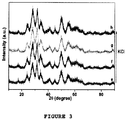
- zirconia crystals having a monoclinic crystalline phase refers to zirconia crystals, the X-Ray diffractogram of which exhibits, at room temperature, peaks characteristic of the monoclinic phase according to Noh et al., Materials Letters 57 (2003) 2425 and does not exhibit any peak positioned at 30° (in 2 ⁇ °) characteristic of the cubic and/or tetragonal phases according to R. Srinivasan et al., J. Mater. Res. (1991) Vol. 6, No. 6, 1287 .
- the rod-like morphology of the particles is also a feature characteristic of the monoclinic zirconia crystalline phase according to Noh et al., Materials Letters 57 (2003) 2425 .
- the suspension obtained according to this invention may also be characterized by its zeta potential, which absolute value is generally of at least 30 mV and/or by the refractive index of the zirconia particles, which is usually of at least 1.8, preferably of at least 1.9, with a solid content of at least 15 wt.%, preferably of at least 20 wt.% and up to 35 wt.%.
- Its pH may be between 2 and 11.
- its viscosity is preferably below 10 cPs, as measured at 25°C with a Brookfield Viscosimeter DV-C with UL adapter.
- This zirconia colloid may then be used in the manufacture of an optical coating, such as an abrasion- or scratch-resistant coating or an anti-reflective coating.
- an optical coating such as an abrasion- or scratch-resistant coating or an anti-reflective coating.
- it may be introduced into a coating composition which includes an epoxysilane (such as GLYMO) and optionally also other colloidal particles than zirconia and/or a curing catalyst (such as an aluminium chelate) and/or at least one alkoxysilane which does not contain any reactive functional group but optionally contains at least one non-hydrolyzable organic group.
- this composition may be hydrolyzed, and it may then be cured, according to well-known sol/gel processes.
- the zirconia colloid of this invention may be introduced into an adhesion or impact-resistant primer composition, comprising a thermoplastic matrix including polyurethane or a homo- or copolymer of (meth)acrylic acid ester.
- the above coating composition may be applied, for instance by dip coating or spin coating, onto a transparent polymer substrate, which may be a thermoplastic resin such as thermoplastic polycarbonate derived from bisphenol A, polyurethane and homo- and copolymers of (meth)acrylate, or a thermoset or photocured resin, which may be obtained by polymerization of allyl carbonates of linear or branched aliphatic or aromatic polyols such as diethylene glycol bis(allyl carbonate) (CR 39®).
- a transparent polymer substrate which may be a thermoplastic resin such as thermoplastic polycarbonate derived from bisphenol A, polyurethane and homo- and copolymers of (meth)acrylate, or a thermoset or photocured resin, which may be obtained by polymerization of allyl carbonates of linear or branched aliphatic or aromatic polyols such as diethylene glycol bis(allyl carbonate) (CR 39®).
- an optical article such as an ophtalmic lens, comprising a transparent polymer substrate and at least one coating prepared from a composition comprising a colloidal suspension as described above.
- Example 1 One part of the suspension obtained in Example 1 was solvent exchanged by diafiltration. To achieve this, the colloidal suspension was concentrated by using an ultrafiltration apparatus while absolute methanol was continuously added to the suspension. The process was stopped when the water content in the suspension was lower than 0.1% by weight and the suspension was then concentrated until reaching a dry content of 21.5% by weight. The yield of conversion of the zirconium precursor into zirconia particles was close to 90%. A colloidal zirconia suspension in methanol was thus obtained.
- Example 1 A series of experiments were performed on the colloidal suspension obtained in Example 1.
- TEM observation JEM-200CX® electron microscope from JEOL
- the colloidal zirconia had a high crystallinity and it was present as single rod-like monoclinic nanocrystallites with short axis range from 2 to 5 nm and long axis range from 3 to 14 nm.
- TEM observations confirmed also that the particles were well dispersed and not aggregated, as was also indicated by the transparency of the colloidal suspension.
- the zeta potential as measured with a Zetasizer Nano ZS90® (MALVERN INSTRUMENTS Ltd.), was 34.5 mV, indicating the high stability of the suspension. Moreover, the particle size distribution obtained by Zetasizer was narrow, indicating a uniform size distribution.
- ICP-AES inductively-coupled plasma-atomic emission spectroscopy
- Optima 7300DV Optima 7300DV
- Zirconia colloids were prepared according to a process similar to that described in Example 1, except that various mineralizers were used instead of KCl, as well as no mineralizer at all.
- alkali metal halides the diffraction patterns obtained by use of alkali metal fluoride exhibit sharper and more intense peaks than the others (see Figure 4 ). This shows that alkali metal fluorides lead to larger crystal size than when other alkali metal halides are used as mineralizers. This fact was confirmed also by particle size measurements from TEM images.
- the crystallites obtained from KCl had average dimensions of 3.5 nm width for 8 mm length, whereas those prepared from KF had 8 mm width for 13 mm length.
- Two zirconia colloids were prepared according to a process similar to that disclosed in Example 1, in which the reaction temperature was lowered to 120 and 150°C, respectively.
- reaction temperature has an obvious effect on the crystallinity and dispersion of the zirconia colloid, and that temperatures above 150°C give better results in this respect.
- a zirconia colloid was prepared according to a process similar to that described in Example 1, in which zirconium nitrate was substituted for zirconium oxychloride as the zirconium source.
- the sample prepared using Zr(NO 3 ) 4 possess a higher crystallinity but lower dispersion and transparency, which are however crucial from the standpoint of the stability of the zirconia colloid formed and of the maximum solid content which may be achieved.
- zirconium source affects the dispersion of the zirconia colloid obtained and that ZrOCl 2 is a better zirconium source, in this regard, than Zr(NO 3 ) 4 .
Landscapes
- Chemical & Material Sciences (AREA)
- Organic Chemistry (AREA)
- Dispersion Chemistry (AREA)
- Chemical Kinetics & Catalysis (AREA)
- Inorganic Chemistry (AREA)
- Inorganic Compounds Of Heavy Metals (AREA)
Claims (12)
- Verfahren zur Herstellung einer kolloidalen Suspension von Zirconiumdioxidteilchen, das die folgenden aufeinanderfolgenden Schritte umfasst:a) hydrothermale Behandlung einer Mischung von Zirconiumoxidchlorid und einem Alkalimetallhalogenid AX in einem wässrigen Lösungsmittel bei einer Temperatur oberhalb von 150 °C, wodurch eine Suspension in Form einer zweiphasigen Mischung, die eine Aufschlämmung und einen Überstand umfasst, erhalten wird, undb) Entsalzen der Suspension ohne vorheriges Peptisieren, wodurch eine kolloidale Suspension von Zirconiumdioxidteilchen erhalten wird.
- Verfahren nach Anspruch 1, dadurch gekennzeichnet, dass die in Schritt (a) erhaltene Suspension vor der Durchführung von Schritt (b) mit Wasser verdünnt wird.
- Aufschlämmung nach einem der Ansprüche 1 und 2, dadurch gekennzeichnet, dass es sich bei dem Alkalimetallhalogenid um Kaliumchlorid handelt.
- Verfahren nach einem der Ansprüche 1 bis 3, dadurch gekennzeichnet, dass das Zirconiumoxidchlorid und das Alkalimetallhalogenid in einem Molverhältnis AX/ZrOCl2 von 1/10 bis 1/1 und vorzugsweise von 1/4 bis 1/2 gemischt werden.
- Verfahren nach einem der Ansprüche 1 bis 4, dadurch gekennzeichnet, dass die Zirconiumoxidchlorid-Konzentration in der Mischung im Bereich von 0,5 bis 4 mol/l und vorzugsweise von 1 bis 2 mol/l liegt.
- Verfahren nach einem der Ansprüche 1 bis 5, dadurch gekennzeichnet, dass die hydrothermale Behandlung über einen Zeitraum von mindestens einem Tag bei einer Temperatur von 150 bis 220 °C, vorzugsweise von 160 bis 200 °C und weiter bevorzugt von 170 bis 190 °C durchgeführt wird.
- Verfahren nach einem der Ansprüche 1 und 3 bis 6, dadurch gekennzeichnet, dass die in Schritt (a) erhaltene Suspension in Schritt (b) durch die Durchführung einer Dialyse in Wasser entsalzt wird.
- Verfahren nach Anspruch 2, dadurch gekennzeichnet, dass die verdünnte Suspension in Schritt (b) durch die Durchführung einer Ultrafiltration entsalzt wird.
- Verfahren nach einem der Ansprüche 1 bis 8, dadurch gekennzeichnet, dass es ferner einen Schritt des Lösungsmittelaustausches einschließt, wodurch das in der Suspension enthaltene wässrige Lösungsmittel zum Teil oder gänzlich durch mindestens ein alkoholisches Lösungsmittel ersetzt wird.
- Verfahren nach Anspruch 9, dadurch gekennzeichnet, dass der Lösungsmittelaustausch durch Dialyse oder Diafiltration durchgeführt wird.
- Verfahren nach einem der Ansprüche 1 bis 10, dadurch gekennzeichnet, dass es einen Zwischenschritt oder einen nachfolgenden Schritt des Verbesserns der Zirconiumdioxiddispersion, entweder durch Zugabe eines Dispergiermittels oder durch Oberflächenmodifikation des Zirconiumdioxids, einschließt.
- Verfahren nach einem der Ansprüche 1 bis 11, dadurch gekennzeichnet, dass es einen Zwischenschritt oder einen nachfolgenden Schritt der Modifikation des pH-Werts durch Zugabe einer organischen oder anorganischen Base einschließt.
Applications Claiming Priority (1)
| Application Number | Priority Date | Filing Date | Title |
|---|---|---|---|
| PCT/CN2012/087464 WO2014100984A1 (en) | 2012-12-26 | 2012-12-26 | Method for producing zirconia colloids |
Publications (3)
| Publication Number | Publication Date |
|---|---|
| EP2958858A1 EP2958858A1 (de) | 2015-12-30 |
| EP2958858A4 EP2958858A4 (de) | 2016-12-28 |
| EP2958858B1 true EP2958858B1 (de) | 2020-11-25 |
Family
ID=51019661
Family Applications (1)
| Application Number | Title | Priority Date | Filing Date |
|---|---|---|---|
| EP12891094.0A Active EP2958858B1 (de) | 2012-12-26 | 2012-12-26 | Verfahren zur herstellung von zirkoniumkolloiden |
Country Status (5)
| Country | Link |
|---|---|
| US (1) | US9802174B2 (de) |
| EP (1) | EP2958858B1 (de) |
| JP (1) | JP6173481B2 (de) |
| CN (1) | CN105102376B (de) |
| WO (1) | WO2014100984A1 (de) |
Cited By (1)
| Publication number | Priority date | Publication date | Assignee | Title |
|---|---|---|---|---|
| EP4368679A4 (de) * | 2021-07-06 | 2025-12-24 | Sakai Chemical Industry Co | Beschichtungszusammensetzung |
Families Citing this family (10)
| Publication number | Priority date | Publication date | Assignee | Title |
|---|---|---|---|---|
| WO2014100984A1 (en) * | 2012-12-26 | 2014-07-03 | Essilor International (Compagnie Generale D'optique) | Method for producing zirconia colloids |
| EP3013306B1 (de) | 2013-06-27 | 2020-07-22 | Ivoclar Vivadent, Inc. | Nanokristallines zirkonoxid und verfahren zur verarbeitung davon |
| CN106006729B (zh) * | 2016-05-17 | 2018-09-28 | 宁夏宝塔石化科技实业发展有限公司 | 一种二氧化锆纳米粉体的制备方法 |
| US9822039B1 (en) * | 2016-08-18 | 2017-11-21 | Ivoclar Vivadent Ag | Metal oxide ceramic nanomaterials and methods of making and using same |
| JP6543433B2 (ja) * | 2016-12-31 | 2019-07-10 | 大研化学工業株式会社 | ジルコニア系ナノ粒子の製造方法 |
| JP6876492B2 (ja) * | 2017-04-04 | 2021-05-26 | 新日本電工株式会社 | 高屈折率材用ジルコニア粉末及びその製造方法 |
| CN111757853A (zh) * | 2017-06-16 | 2020-10-09 | 依视路国际公司 | 高折射率纳米颗粒 |
| KR20210091205A (ko) * | 2018-12-06 | 2021-07-21 | 바스프 에스이 | 제올라이트 물질 및 지르코늄 킬레이트 착물을 포함하는 수성 현탁액 |
| CN114933883B (zh) * | 2022-05-09 | 2023-06-30 | 北京化工大学 | 一种水性聚氨酯粘接剂及其制备方法 |
| CN116445030B (zh) * | 2023-03-14 | 2024-11-15 | 北京化工大学 | 一种透明纳米氧化物水相分散体、纳米复合聚氨酯涂布胶及其制备方法和应用 |
Family Cites Families (17)
| Publication number | Priority date | Publication date | Assignee | Title |
|---|---|---|---|---|
| US4152281A (en) * | 1978-04-17 | 1979-05-01 | General Electric Company | Molten salt synthesis of lead zirconate titanate solid solution powder |
| US4501818A (en) * | 1983-07-05 | 1985-02-26 | Norton Company | Process for the preparation of ceramic powders |
| JPH0729771B2 (ja) * | 1986-01-14 | 1995-04-05 | 悦朗 加藤 | 単斜ジルコニア超微結晶の高分散ゾルまたはゲルおよび製造方法 |
| JPH04198022A (ja) * | 1990-11-28 | 1992-07-17 | Tosoh Corp | 水和ジルコニアゾルの製造法 |
| US6376590B2 (en) * | 1999-10-28 | 2002-04-23 | 3M Innovative Properties Company | Zirconia sol, process of making and composite material |
| JP2005179111A (ja) * | 2003-12-18 | 2005-07-07 | Catalysts & Chem Ind Co Ltd | ジルコニアゾルの製造方法 |
| CN100335417C (zh) | 2005-05-25 | 2007-09-05 | 宜兴新兴锆业有限公司 | 氧氯化锆制备高纯超细氧化锆的生产工艺 |
| CN101208268B (zh) * | 2005-06-29 | 2010-12-29 | 日产化学工业株式会社 | 碱性氧化锆溶胶的制造方法 |
| CN100347092C (zh) | 2006-04-04 | 2007-11-07 | 欧洲海赛有限公司 | 一种氧化锆复合物纳米晶体材料的制备方法 |
| JP4922040B2 (ja) * | 2007-03-29 | 2012-04-25 | 富士フイルム株式会社 | 金属酸化物微粒子水分散物及びその製造方法 |
| ATE510800T1 (de) * | 2007-04-04 | 2011-06-15 | Essilor Int | Verfahren zur herstellung einer kolloidalen zirkoniumlösung |
| JP5253095B2 (ja) * | 2007-12-20 | 2013-07-31 | 日揮触媒化成株式会社 | ジルコニアゾルの製造方法 |
| KR101517369B1 (ko) | 2007-12-20 | 2015-05-15 | 니끼 쇼꾸바이 카세이 가부시키가이샤 | 지르코니아 졸의 제조방법 |
| JP5397829B2 (ja) | 2008-12-04 | 2014-01-22 | 堺化学工業株式会社 | 酸化ジルコニウム分散液の製造方法 |
| CN101613123A (zh) * | 2009-08-05 | 2009-12-30 | 邢长生 | Ivb族金属氧化物的水热合成方法 |
| JP5922231B2 (ja) * | 2011-07-12 | 2016-05-24 | エシロール アンテルナシオナル (コンパニー ジェネラル ドプティック) | ジルコニアコロイドを生成するための方法 |
| WO2014100984A1 (en) * | 2012-12-26 | 2014-07-03 | Essilor International (Compagnie Generale D'optique) | Method for producing zirconia colloids |
-
2012
- 2012-12-26 WO PCT/CN2012/087464 patent/WO2014100984A1/en not_active Ceased
- 2012-12-26 US US14/655,667 patent/US9802174B2/en active Active
- 2012-12-26 CN CN201280078000.2A patent/CN105102376B/zh active Active
- 2012-12-26 JP JP2015549914A patent/JP6173481B2/ja active Active
- 2012-12-26 EP EP12891094.0A patent/EP2958858B1/de active Active
Non-Patent Citations (1)
| Title |
|---|
| None * |
Cited By (1)
| Publication number | Priority date | Publication date | Assignee | Title |
|---|---|---|---|---|
| EP4368679A4 (de) * | 2021-07-06 | 2025-12-24 | Sakai Chemical Industry Co | Beschichtungszusammensetzung |
Also Published As
| Publication number | Publication date |
|---|---|
| CN105102376B (zh) | 2016-12-14 |
| JP2016501825A (ja) | 2016-01-21 |
| CN105102376A (zh) | 2015-11-25 |
| EP2958858A4 (de) | 2016-12-28 |
| US20150328613A1 (en) | 2015-11-19 |
| US9802174B2 (en) | 2017-10-31 |
| JP6173481B2 (ja) | 2017-08-02 |
| WO2014100984A1 (en) | 2014-07-03 |
| EP2958858A1 (de) | 2015-12-30 |
Similar Documents
| Publication | Publication Date | Title |
|---|---|---|
| US9802174B2 (en) | Method for producing zirconia colloids | |
| EP2731914B1 (de) | Verfahren zur herstellung von zirkoniakolloiden, sowie das dabei erhaltene produkt | |
| CA2858283C (en) | Coating composition for an optical article, comprising a colloidal suspension of zirconia particles | |
| EP1870439B1 (de) | Leitfähiges Zinnoxidsol und Herstellungsverfahren dafür | |
| JP6214412B2 (ja) | コアシェル型酸化物微粒子の分散液、その製造方法、およびその用途 | |
| CN107001066A (zh) | 氧化锆粒子的有机溶剂分散体及其制备方法 | |
| CN113165900B (zh) | 一种在氨基酸存在下制备二氧化锆纳米颗粒的方法 | |
| WO2018227629A1 (en) | High refractive index nanoparticles | |
| JP5258447B2 (ja) | 酸化チタン系複合粒子の分散液および該分散液の製造方法 | |
| KR101797751B1 (ko) | 지르코니아의 제조방법 및 그에 의해 제조된 지르코니아 졸 | |
| WO2005088352A1 (ja) | プラスチックレンズの製造方法 | |
| KR20250142374A (ko) | 티탄산바륨스트론튬 미립자 분말 및 그 제조방법, 분산체, 수지 조성물 |
Legal Events
| Date | Code | Title | Description |
|---|---|---|---|
| PUAI | Public reference made under article 153(3) epc to a published international application that has entered the european phase |
Free format text: ORIGINAL CODE: 0009012 |
|
| 17P | Request for examination filed |
Effective date: 20150716 |
|
| AK | Designated contracting states |
Kind code of ref document: A1 Designated state(s): AL AT BE BG CH CY CZ DE DK EE ES FI FR GB GR HR HU IE IS IT LI LT LU LV MC MK MT NL NO PL PT RO RS SE SI SK SM TR |
|
| AX | Request for extension of the european patent |
Extension state: BA ME |
|
| DAX | Request for extension of the european patent (deleted) | ||
| RIC1 | Information provided on ipc code assigned before grant |
Ipc: B01J 13/00 20060101ALI20161117BHEP Ipc: C09C 1/00 20060101ALI20161117BHEP Ipc: C01G 25/02 20060101AFI20161117BHEP |
|
| A4 | Supplementary search report drawn up and despatched |
Effective date: 20161124 |
|
| RAP1 | Party data changed (applicant data changed or rights of an application transferred) |
Owner name: SHANGHAI UNIVERSITY Owner name: ESSILOR INTERNATIONAL |
|
| STAA | Information on the status of an ep patent application or granted ep patent |
Free format text: STATUS: EXAMINATION IS IN PROGRESS |
|
| 17Q | First examination report despatched |
Effective date: 20190220 |
|
| GRAP | Despatch of communication of intention to grant a patent |
Free format text: ORIGINAL CODE: EPIDOSNIGR1 |
|
| STAA | Information on the status of an ep patent application or granted ep patent |
Free format text: STATUS: GRANT OF PATENT IS INTENDED |
|
| GRAS | Grant fee paid |
Free format text: ORIGINAL CODE: EPIDOSNIGR3 |
|
| INTG | Intention to grant announced |
Effective date: 20200921 |
|
| RIN1 | Information on inventor provided before grant (corrected) |
Inventor name: ZHAO, YIN Inventor name: SHI, LIYI Inventor name: YUAN, SHUAI Inventor name: WANG, ZHUYI Inventor name: ZHAO, JIAN Inventor name: PANCHOUT, XAVIER Inventor name: LECLAIRE, YVES Inventor name: PEGA, STEPHANIE |
|
| GRAA | (expected) grant |
Free format text: ORIGINAL CODE: 0009210 |
|
| STAA | Information on the status of an ep patent application or granted ep patent |
Free format text: STATUS: THE PATENT HAS BEEN GRANTED |
|
| AK | Designated contracting states |
Kind code of ref document: B1 Designated state(s): AL AT BE BG CH CY CZ DE DK EE ES FI FR GB GR HR HU IE IS IT LI LT LU LV MC MK MT NL NO PL PT RO RS SE SI SK SM TR |
|
| REG | Reference to a national code |
Ref country code: GB Ref legal event code: FG4D |
|
| REG | Reference to a national code |
Ref country code: CH Ref legal event code: EP |
|
| REG | Reference to a national code |
Ref country code: AT Ref legal event code: REF Ref document number: 1338081 Country of ref document: AT Kind code of ref document: T Effective date: 20201215 |
|
| REG | Reference to a national code |
Ref country code: DE Ref legal event code: R096 Ref document number: 602012073444 Country of ref document: DE |
|
| REG | Reference to a national code |
Ref country code: IE Ref legal event code: FG4D |
|
| REG | Reference to a national code |
Ref country code: AT Ref legal event code: MK05 Ref document number: 1338081 Country of ref document: AT Kind code of ref document: T Effective date: 20201125 |
|
| REG | Reference to a national code |
Ref country code: NL Ref legal event code: MP Effective date: 20201125 |
|
| PG25 | Lapsed in a contracting state [announced via postgrant information from national office to epo] |
Ref country code: NO Free format text: LAPSE BECAUSE OF FAILURE TO SUBMIT A TRANSLATION OF THE DESCRIPTION OR TO PAY THE FEE WITHIN THE PRESCRIBED TIME-LIMIT Effective date: 20210225 Ref country code: PT Free format text: LAPSE BECAUSE OF FAILURE TO SUBMIT A TRANSLATION OF THE DESCRIPTION OR TO PAY THE FEE WITHIN THE PRESCRIBED TIME-LIMIT Effective date: 20210325 Ref country code: FI Free format text: LAPSE BECAUSE OF FAILURE TO SUBMIT A TRANSLATION OF THE DESCRIPTION OR TO PAY THE FEE WITHIN THE PRESCRIBED TIME-LIMIT Effective date: 20201125 Ref country code: RS Free format text: LAPSE BECAUSE OF FAILURE TO SUBMIT A TRANSLATION OF THE DESCRIPTION OR TO PAY THE FEE WITHIN THE PRESCRIBED TIME-LIMIT Effective date: 20201125 Ref country code: GR Free format text: LAPSE BECAUSE OF FAILURE TO SUBMIT A TRANSLATION OF THE DESCRIPTION OR TO PAY THE FEE WITHIN THE PRESCRIBED TIME-LIMIT Effective date: 20210226 |
|
| PG25 | Lapsed in a contracting state [announced via postgrant information from national office to epo] |
Ref country code: AT Free format text: LAPSE BECAUSE OF FAILURE TO SUBMIT A TRANSLATION OF THE DESCRIPTION OR TO PAY THE FEE WITHIN THE PRESCRIBED TIME-LIMIT Effective date: 20201125 Ref country code: BG Free format text: LAPSE BECAUSE OF FAILURE TO SUBMIT A TRANSLATION OF THE DESCRIPTION OR TO PAY THE FEE WITHIN THE PRESCRIBED TIME-LIMIT Effective date: 20210225 Ref country code: IS Free format text: LAPSE BECAUSE OF FAILURE TO SUBMIT A TRANSLATION OF THE DESCRIPTION OR TO PAY THE FEE WITHIN THE PRESCRIBED TIME-LIMIT Effective date: 20210325 Ref country code: LV Free format text: LAPSE BECAUSE OF FAILURE TO SUBMIT A TRANSLATION OF THE DESCRIPTION OR TO PAY THE FEE WITHIN THE PRESCRIBED TIME-LIMIT Effective date: 20201125 Ref country code: PL Free format text: LAPSE BECAUSE OF FAILURE TO SUBMIT A TRANSLATION OF THE DESCRIPTION OR TO PAY THE FEE WITHIN THE PRESCRIBED TIME-LIMIT Effective date: 20201125 Ref country code: SE Free format text: LAPSE BECAUSE OF FAILURE TO SUBMIT A TRANSLATION OF THE DESCRIPTION OR TO PAY THE FEE WITHIN THE PRESCRIBED TIME-LIMIT Effective date: 20201125 |
|
| REG | Reference to a national code |
Ref country code: LT Ref legal event code: MG9D |
|
| PG25 | Lapsed in a contracting state [announced via postgrant information from national office to epo] |
Ref country code: HR Free format text: LAPSE BECAUSE OF FAILURE TO SUBMIT A TRANSLATION OF THE DESCRIPTION OR TO PAY THE FEE WITHIN THE PRESCRIBED TIME-LIMIT Effective date: 20201125 |
|
| PG25 | Lapsed in a contracting state [announced via postgrant information from national office to epo] |
Ref country code: LT Free format text: LAPSE BECAUSE OF FAILURE TO SUBMIT A TRANSLATION OF THE DESCRIPTION OR TO PAY THE FEE WITHIN THE PRESCRIBED TIME-LIMIT Effective date: 20201125 Ref country code: SK Free format text: LAPSE BECAUSE OF FAILURE TO SUBMIT A TRANSLATION OF THE DESCRIPTION OR TO PAY THE FEE WITHIN THE PRESCRIBED TIME-LIMIT Effective date: 20201125 Ref country code: RO Free format text: LAPSE BECAUSE OF FAILURE TO SUBMIT A TRANSLATION OF THE DESCRIPTION OR TO PAY THE FEE WITHIN THE PRESCRIBED TIME-LIMIT Effective date: 20201125 Ref country code: SM Free format text: LAPSE BECAUSE OF FAILURE TO SUBMIT A TRANSLATION OF THE DESCRIPTION OR TO PAY THE FEE WITHIN THE PRESCRIBED TIME-LIMIT Effective date: 20201125 Ref country code: CZ Free format text: LAPSE BECAUSE OF FAILURE TO SUBMIT A TRANSLATION OF THE DESCRIPTION OR TO PAY THE FEE WITHIN THE PRESCRIBED TIME-LIMIT Effective date: 20201125 Ref country code: EE Free format text: LAPSE BECAUSE OF FAILURE TO SUBMIT A TRANSLATION OF THE DESCRIPTION OR TO PAY THE FEE WITHIN THE PRESCRIBED TIME-LIMIT Effective date: 20201125 |
|
| REG | Reference to a national code |
Ref country code: CH Ref legal event code: PL |
|
| REG | Reference to a national code |
Ref country code: DE Ref legal event code: R097 Ref document number: 602012073444 Country of ref document: DE |
|
| PG25 | Lapsed in a contracting state [announced via postgrant information from national office to epo] |
Ref country code: DK Free format text: LAPSE BECAUSE OF FAILURE TO SUBMIT A TRANSLATION OF THE DESCRIPTION OR TO PAY THE FEE WITHIN THE PRESCRIBED TIME-LIMIT Effective date: 20201125 Ref country code: MC Free format text: LAPSE BECAUSE OF FAILURE TO SUBMIT A TRANSLATION OF THE DESCRIPTION OR TO PAY THE FEE WITHIN THE PRESCRIBED TIME-LIMIT Effective date: 20201125 |
|
| REG | Reference to a national code |
Ref country code: BE Ref legal event code: MM Effective date: 20201231 |
|
| PLBE | No opposition filed within time limit |
Free format text: ORIGINAL CODE: 0009261 |
|
| STAA | Information on the status of an ep patent application or granted ep patent |
Free format text: STATUS: NO OPPOSITION FILED WITHIN TIME LIMIT |
|
| PG25 | Lapsed in a contracting state [announced via postgrant information from national office to epo] |
Ref country code: NL Free format text: LAPSE BECAUSE OF FAILURE TO SUBMIT A TRANSLATION OF THE DESCRIPTION OR TO PAY THE FEE WITHIN THE PRESCRIBED TIME-LIMIT Effective date: 20201125 Ref country code: LU Free format text: LAPSE BECAUSE OF NON-PAYMENT OF DUE FEES Effective date: 20201226 Ref country code: AL Free format text: LAPSE BECAUSE OF FAILURE TO SUBMIT A TRANSLATION OF THE DESCRIPTION OR TO PAY THE FEE WITHIN THE PRESCRIBED TIME-LIMIT Effective date: 20201125 Ref country code: IT Free format text: LAPSE BECAUSE OF FAILURE TO SUBMIT A TRANSLATION OF THE DESCRIPTION OR TO PAY THE FEE WITHIN THE PRESCRIBED TIME-LIMIT Effective date: 20201125 Ref country code: IE Free format text: LAPSE BECAUSE OF NON-PAYMENT OF DUE FEES Effective date: 20201226 |
|
| 26N | No opposition filed |
Effective date: 20210826 |
|
| PG25 | Lapsed in a contracting state [announced via postgrant information from national office to epo] |
Ref country code: CH Free format text: LAPSE BECAUSE OF NON-PAYMENT OF DUE FEES Effective date: 20201231 Ref country code: ES Free format text: LAPSE BECAUSE OF FAILURE TO SUBMIT A TRANSLATION OF THE DESCRIPTION OR TO PAY THE FEE WITHIN THE PRESCRIBED TIME-LIMIT Effective date: 20201125 Ref country code: SI Free format text: LAPSE BECAUSE OF FAILURE TO SUBMIT A TRANSLATION OF THE DESCRIPTION OR TO PAY THE FEE WITHIN THE PRESCRIBED TIME-LIMIT Effective date: 20201125 Ref country code: LI Free format text: LAPSE BECAUSE OF NON-PAYMENT OF DUE FEES Effective date: 20201231 |
|
| PG25 | Lapsed in a contracting state [announced via postgrant information from national office to epo] |
Ref country code: IS Free format text: LAPSE BECAUSE OF FAILURE TO SUBMIT A TRANSLATION OF THE DESCRIPTION OR TO PAY THE FEE WITHIN THE PRESCRIBED TIME-LIMIT Effective date: 20210325 Ref country code: TR Free format text: LAPSE BECAUSE OF FAILURE TO SUBMIT A TRANSLATION OF THE DESCRIPTION OR TO PAY THE FEE WITHIN THE PRESCRIBED TIME-LIMIT Effective date: 20201125 Ref country code: MT Free format text: LAPSE BECAUSE OF FAILURE TO SUBMIT A TRANSLATION OF THE DESCRIPTION OR TO PAY THE FEE WITHIN THE PRESCRIBED TIME-LIMIT Effective date: 20201125 Ref country code: CY Free format text: LAPSE BECAUSE OF FAILURE TO SUBMIT A TRANSLATION OF THE DESCRIPTION OR TO PAY THE FEE WITHIN THE PRESCRIBED TIME-LIMIT Effective date: 20201125 |
|
| PG25 | Lapsed in a contracting state [announced via postgrant information from national office to epo] |
Ref country code: MK Free format text: LAPSE BECAUSE OF FAILURE TO SUBMIT A TRANSLATION OF THE DESCRIPTION OR TO PAY THE FEE WITHIN THE PRESCRIBED TIME-LIMIT Effective date: 20201125 |
|
| PG25 | Lapsed in a contracting state [announced via postgrant information from national office to epo] |
Ref country code: BE Free format text: LAPSE BECAUSE OF NON-PAYMENT OF DUE FEES Effective date: 20201231 |
|
| PGFP | Annual fee paid to national office [announced via postgrant information from national office to epo] |
Ref country code: GB Payment date: 20251229 Year of fee payment: 14 |
|
| PGFP | Annual fee paid to national office [announced via postgrant information from national office to epo] |
Ref country code: FR Payment date: 20251226 Year of fee payment: 14 |
|
| PGFP | Annual fee paid to national office [announced via postgrant information from national office to epo] |
Ref country code: DE Payment date: 20251229 Year of fee payment: 14 |