EP2958124B1 - Form für ein lichtbogenlöschendes isoliermaterial und gasunterbrecherschalter damit - Google Patents
Form für ein lichtbogenlöschendes isoliermaterial und gasunterbrecherschalter damit Download PDFInfo
- Publication number
- EP2958124B1 EP2958124B1 EP13874807.4A EP13874807A EP2958124B1 EP 2958124 B1 EP2958124 B1 EP 2958124B1 EP 13874807 A EP13874807 A EP 13874807A EP 2958124 B1 EP2958124 B1 EP 2958124B1
- Authority
- EP
- European Patent Office
- Prior art keywords
- arc
- molded product
- circuit breaker
- insulation material
- extinguishing
- Prior art date
- Legal status (The legal status is an assumption and is not a legal conclusion. Google has not performed a legal analysis and makes no representation as to the accuracy of the status listed.)
- Active
Links
- 0 CC(C)(C)C(*)(C(OC(C)(C)C)(OC(*)(F)F)F)F Chemical compound CC(C)(C)C(*)(C(OC(C)(C)C)(OC(*)(F)F)F)F 0.000 description 1
Images

Classifications
-
- C—CHEMISTRY; METALLURGY
- C08—ORGANIC MACROMOLECULAR COMPOUNDS; THEIR PREPARATION OR CHEMICAL WORKING-UP; COMPOSITIONS BASED THEREON
- C08G—MACROMOLECULAR COMPOUNDS OBTAINED OTHERWISE THAN BY REACTIONS ONLY INVOLVING UNSATURATED CARBON-TO-CARBON BONDS
- C08G65/00—Macromolecular compounds obtained by reactions forming an ether link in the main chain of the macromolecule
- C08G65/02—Macromolecular compounds obtained by reactions forming an ether link in the main chain of the macromolecule from cyclic ethers by opening of the heterocyclic ring
- C08G65/32—Polymers modified by chemical after-treatment
- C08G65/321—Polymers modified by chemical after-treatment with inorganic compounds
- C08G65/323—Polymers modified by chemical after-treatment with inorganic compounds containing halogens
-
- C—CHEMISTRY; METALLURGY
- C08—ORGANIC MACROMOLECULAR COMPOUNDS; THEIR PREPARATION OR CHEMICAL WORKING-UP; COMPOSITIONS BASED THEREON
- C08G—MACROMOLECULAR COMPOUNDS OBTAINED OTHERWISE THAN BY REACTIONS ONLY INVOLVING UNSATURATED CARBON-TO-CARBON BONDS
- C08G65/00—Macromolecular compounds obtained by reactions forming an ether link in the main chain of the macromolecule
- C08G65/002—Macromolecular compounds obtained by reactions forming an ether link in the main chain of the macromolecule from unsaturated compounds
- C08G65/005—Macromolecular compounds obtained by reactions forming an ether link in the main chain of the macromolecule from unsaturated compounds containing halogens
- C08G65/007—Macromolecular compounds obtained by reactions forming an ether link in the main chain of the macromolecule from unsaturated compounds containing halogens containing fluorine
-
- C—CHEMISTRY; METALLURGY
- C08—ORGANIC MACROMOLECULAR COMPOUNDS; THEIR PREPARATION OR CHEMICAL WORKING-UP; COMPOSITIONS BASED THEREON
- C08G—MACROMOLECULAR COMPOUNDS OBTAINED OTHERWISE THAN BY REACTIONS ONLY INVOLVING UNSATURATED CARBON-TO-CARBON BONDS
- C08G65/00—Macromolecular compounds obtained by reactions forming an ether link in the main chain of the macromolecule
- C08G65/02—Macromolecular compounds obtained by reactions forming an ether link in the main chain of the macromolecule from cyclic ethers by opening of the heterocyclic ring
- C08G65/32—Polymers modified by chemical after-treatment
- C08G65/329—Polymers modified by chemical after-treatment with organic compounds
- C08G65/336—Polymers modified by chemical after-treatment with organic compounds containing silicon
-
- C—CHEMISTRY; METALLURGY
- C08—ORGANIC MACROMOLECULAR COMPOUNDS; THEIR PREPARATION OR CHEMICAL WORKING-UP; COMPOSITIONS BASED THEREON
- C08G—MACROMOLECULAR COMPOUNDS OBTAINED OTHERWISE THAN BY REACTIONS ONLY INVOLVING UNSATURATED CARBON-TO-CARBON BONDS
- C08G77/00—Macromolecular compounds obtained by reactions forming a linkage containing silicon with or without sulfur, nitrogen, oxygen or carbon in the main chain of the macromolecule
- C08G77/42—Block-or graft-polymers containing polysiloxane sequences
- C08G77/46—Block-or graft-polymers containing polysiloxane sequences containing polyether sequences
-
- H—ELECTRICITY
- H01—ELECTRIC ELEMENTS
- H01H—ELECTRIC SWITCHES; RELAYS; SELECTORS; EMERGENCY PROTECTIVE DEVICES
- H01H33/00—High-tension or heavy-current switches with arc-extinguishing or arc-preventing means
- H01H33/02—Details
- H01H33/04—Means for extinguishing or preventing arc between current-carrying parts
- H01H33/06—Insulating body insertable between contacts
-
- H—ELECTRICITY
- H01—ELECTRIC ELEMENTS
- H01H—ELECTRIC SWITCHES; RELAYS; SELECTORS; EMERGENCY PROTECTIVE DEVICES
- H01H33/00—High-tension or heavy-current switches with arc-extinguishing or arc-preventing means
- H01H33/02—Details
- H01H33/04—Means for extinguishing or preventing arc between current-carrying parts
- H01H33/22—Selection of fluids for arc-extinguishing
-
- H—ELECTRICITY
- H01—ELECTRIC ELEMENTS
- H01H—ELECTRIC SWITCHES; RELAYS; SELECTORS; EMERGENCY PROTECTIVE DEVICES
- H01H33/00—High-tension or heavy-current switches with arc-extinguishing or arc-preventing means
- H01H33/70—Switches with separate means for directing, obtaining, or increasing flow of arc-extinguishing fluid
- H01H33/7015—Switches with separate means for directing, obtaining, or increasing flow of arc-extinguishing fluid characterised by flow directing elements associated with contacts
- H01H33/7023—Switches with separate means for directing, obtaining, or increasing flow of arc-extinguishing fluid characterised by flow directing elements associated with contacts characterised by an insulating tubular gas flow enhancing nozzle
-
- H—ELECTRICITY
- H01—ELECTRIC ELEMENTS
- H01H—ELECTRIC SWITCHES; RELAYS; SELECTORS; EMERGENCY PROTECTIVE DEVICES
- H01H33/00—High-tension or heavy-current switches with arc-extinguishing or arc-preventing means
- H01H33/70—Switches with separate means for directing, obtaining, or increasing flow of arc-extinguishing fluid
- H01H33/88—Switches with separate means for directing, obtaining, or increasing flow of arc-extinguishing fluid the flow of arc-extinguishing fluid being produced or increased by movement of pistons or other pressure-producing parts
- H01H33/90—Switches with separate means for directing, obtaining, or increasing flow of arc-extinguishing fluid the flow of arc-extinguishing fluid being produced or increased by movement of pistons or other pressure-producing parts this movement being effected by or in conjunction with the contact-operating mechanism
- H01H33/905—Switches with separate means for directing, obtaining, or increasing flow of arc-extinguishing fluid the flow of arc-extinguishing fluid being produced or increased by movement of pistons or other pressure-producing parts this movement being effected by or in conjunction with the contact-operating mechanism the compression volume being formed by a movable cylinder and a semi-mobile piston
-
- H—ELECTRICITY
- H01—ELECTRIC ELEMENTS
- H01H—ELECTRIC SWITCHES; RELAYS; SELECTORS; EMERGENCY PROTECTIVE DEVICES
- H01H33/00—High-tension or heavy-current switches with arc-extinguishing or arc-preventing means
- H01H33/70—Switches with separate means for directing, obtaining, or increasing flow of arc-extinguishing fluid
- H01H33/7015—Switches with separate means for directing, obtaining, or increasing flow of arc-extinguishing fluid characterised by flow directing elements associated with contacts
- H01H33/7076—Switches with separate means for directing, obtaining, or increasing flow of arc-extinguishing fluid characterised by flow directing elements associated with contacts characterised by the use of special materials
-
- H—ELECTRICITY
- H01—ELECTRIC ELEMENTS
- H01H—ELECTRIC SWITCHES; RELAYS; SELECTORS; EMERGENCY PROTECTIVE DEVICES
- H01H33/00—High-tension or heavy-current switches with arc-extinguishing or arc-preventing means
- H01H33/70—Switches with separate means for directing, obtaining, or increasing flow of arc-extinguishing fluid
- H01H33/76—Switches with separate means for directing, obtaining, or increasing flow of arc-extinguishing fluid wherein arc-extinguishing gas is evolved from stationary parts; Selection of material therefor
- H01H33/78—Switches with separate means for directing, obtaining, or increasing flow of arc-extinguishing fluid wherein arc-extinguishing gas is evolved from stationary parts; Selection of material therefor wherein the break is in gas
-
- H—ELECTRICITY
- H01—ELECTRIC ELEMENTS
- H01H—ELECTRIC SWITCHES; RELAYS; SELECTORS; EMERGENCY PROTECTIVE DEVICES
- H01H33/00—High-tension or heavy-current switches with arc-extinguishing or arc-preventing means
- H01H33/70—Switches with separate means for directing, obtaining, or increasing flow of arc-extinguishing fluid
- H01H33/88—Switches with separate means for directing, obtaining, or increasing flow of arc-extinguishing fluid the flow of arc-extinguishing fluid being produced or increased by movement of pistons or other pressure-producing parts
- H01H33/90—Switches with separate means for directing, obtaining, or increasing flow of arc-extinguishing fluid the flow of arc-extinguishing fluid being produced or increased by movement of pistons or other pressure-producing parts this movement being effected by or in conjunction with the contact-operating mechanism
- H01H33/91—Switches with separate means for directing, obtaining, or increasing flow of arc-extinguishing fluid the flow of arc-extinguishing fluid being produced or increased by movement of pistons or other pressure-producing parts this movement being effected by or in conjunction with the contact-operating mechanism the arc-extinguishing fluid being air or gas
Definitions
- the present invention relates to an arc-extinguishing insulation material molded product which when being exposed to an electric arc discharged in current interruption, generates an insulation gas to extinguish the electric arc, and relates to a gas circuit breaker including the same.
- a gas insulated switchgear is a device used to disconnect and/or reconnect high-voltage power lines in power transforming stations, power generation plants, power receiving equipments and the like.
- Such gas insulated switchgear includes such as a circuit breaker, a circuit disconnector, bus lines, a lightning protector, an instrumental transformer and/or a grounding device housed in a single grounded container filled with a high-insulation gas.
- a gas insulated switchgear can be made significantly smaller.
- due to the escalating of land prices, it is difficult to assure a greater installation space, and thereby, such a gas insulated switchgear which can be made smaller has been employed and installed in many electrical switchgear stations.
- the gas circuit breaker is a device that can interrupt an electric line when the line is subjected to a short circuit, an over current or an earth fault.
- the gas circuit breaker is configured to blow gas to an electric arc discharged between electrode contacts of a circuit breaker when interrupting the current so as to extinct (extinguish) the arc discharge.
- the insulation gas to be used in the gas insulated switchgear (GIS) and the gas circuit breaker is generally sulfur hexafluoride (SF 6 ).
- Sulfur hexafluoride has a high insulation property, and the insulation strength thereof is up to three times as that of air.
- sulfur hexafluoride is inert and high in thermal conductivity, which makes it possible to rapidly cool down the electrodes overheated by the discharged electric arc.
- a main interrupting approach in the gas circuit breaker is puffer-type circuit interruption in which a piston is driven to operate in conjunction with the disconnection operation of electrodes so as to blow insulation gas such as sulfur hexafluoride to the electrodes.
- a heating chamber thermal puffer
- machine puffer is provided for the purpose of decreasing the volume of the insulation gas through mechanical forces so as to increase the pressure of the insulation gas.
- an arc-extinguishing insulation material molded product contributing to arc-extinguishing is disposed in the periphery of contacts of electrodes to be disconnected or connected.
- the constituent material of the molded product itself decomposes to generate gas, and the generated gas promotes the extinguishing of the electric arc through blowing so as to cool down the electric arc, through increasing the pressure of insulation gas so as to weaken the electric arc, or through increasing insulation resistance.
- a member made of a polymer is disposed inside a heating chamber, and when the member is heated by an electric arc in the arc space, it generates evaporation gas containing no oxygen in the chemical composition thereof to enhance the pressure increase in the heating chamber.
- PTD 4 Japanese Patent Laid-Open JP 11-029 191 A
- resins composed of carbon atoms and hydrogen atoms such as polystyrene, polyethylene, polypropylene and polymethyl pentene as examples of materials which generate evaporation gas when being heated by an electric arc. Since each of these resins can generate hydrogen gas or hydrocarbon gas having excellent thermal diffusion effect, it is possible for it to efficiently cool down the electric arc and thereby exhibit excellent arc-extinguishing performance.
- PTD 4 further illustrates resins such as polyoxymethylene, polyethylene, polypropylene, polytetrafluoroethylene and melamine as examples of materials for generating evaporation gas.
- resins such as polyoxymethylene, polyethylene, polypropylene, polytetrafluoroethylene and melamine as examples of materials for generating evaporation gas.
- the insulation performance and the blocking performance may not be achieved sufficiently after the current interruption. Furthermore, the water moisture dissolves fluoride compound generated as a decomposition product in the current interruption and turn into hydrofluoric acid, which may corrode the metal components.
- polytetrafluoroethylene resin that does not cause the insulation deterioration of the insulation member is often used as a material for generating the decomposition gas.
- EP 1 544 881 A1 discloses another gas circuit breaker including an arc-extinguishing insulation material molded product provided in the vicinity of an electrode.
- the present invention has been accomplished in view of the aforementioned problems, and it is therefore an object of the present invention to provide an arc-extinguishing insulation material molded product capable of generating a greater amount of gas at exposure to an electric arc so as to achieve stable and high interruption performance and capable of extinguishing the deterioration (insulation deterioration) of an insulation member made of an insulation material in a gas circuit breaker, and a gas circuit breaker including the same.
- the present invention relates to a gas circuit breaker including an arc-extinguishing insulation material molded product provided in the vicinity of an electrode, and wherein the arc-extinguishing insulation material molded product comprising: a polymer which contains a carbon-oxygen bond in the main chain, and in which a part of or all of terminal atoms are at least one kind of atoms selected from fluorine atoms, chlorine atoms, bromine atoms, iodine atoms and astatine atoms. It is preferable that the polymer is the main component. It is preferable that the content of hydrogen atoms in the constituent elements in the polymer is not more than 2 mass%. It is preferable that the non-hydrogen atoms are fluorine atoms.
- the polymer is preferably a polyether-based polymer, and more preferably a fluorinated polyether-based polymer. Further, it is preferable that the polymer contains silicon atoms in the main chain.
- the polymer is a silicone cross-linked product of fluorinated polyether. It is preferable that the polymer contains silicon dioxide.
- the arc-extinguishing insulation material molded product mentioned above contains at least one selected from a group consisting of boron nitride, aluminum oxide and titanium oxide as a wear-resistant filler.
- an insulation gas used for circuit interruption is SF6 gas.
- the carbon-oxygen bond (C-O bond) contained in the main chain is prone to cleavage, which makes the polymer easy to decompose, and thereby in the case where the arc-extinguishing insulation material molded product of the present invention is used in a gas circuit breaker, the more amount of gas will be generated at the exposure to an arc, and thus, it is possible to increase the pressure in the arc-extinguishing chamber sufficiently high, which makes it possible to achieve a stable and high interruption performance.
- a liquid or paste-like material made of a high-molecular compound having a fluorinated polyether backbone and a terminal silicone cross-linking reaction group can be used in molding, which improves formability. Furthermore, the cured product of the high-molecular compound is superior in both chemical durability and heat resistance.
- the arc-extinguishing insulation material molded product contains at least one selected from a group consisting of boron nitride, aluminum oxide and titanium oxide as a wear-resistant filler
- each of the abovementioned wear-resistant fillers can absorb light in the deep ultraviolet region and have great reflectance to light in the regions of near ultraviolet light, visible light and infrared light, it can prevent the arc light from entering into the insulation material molded product, and thus, it is possible to prevent the arc-extinguishing insulation molded product from being decomposed excessively.
- the arc-extinguishing insulation material molded product of the present invention to a gas circuit breaker, it is possible to make the gas circuit breaker excellent in interruption performance, superior in inhibiting the deterioration of insulation performance after interruption and thereby superior in reliability.
- the arc-extinguishing insulation material molded product of the present embodiment is configured to extinguish an electric arc discharged between electrodes (between a movable contactor and a fixed contactor, for example) involved in current interruption in a gas circuit breaker by blowing an insulation gas to the electric arc, and is provided in the vicinity of a contact point between contactors near a space where the electric arc is discharged.
- the polymer constituting the arc-extinguishing insulation material molded product of the present invention has a carbon-oxygen bond in the main chain, and a part of or all of terminal atoms are non-hydrogen atoms.
- the content of hydrogen atoms (hydrogen content) in the constituent elements in the polymer is not more than 2 mass%. It is more preferable that the hydrogen content in the polymer is not more than 1 mass%, and it is further preferable that the polymer is substantially free of hydrogen atoms.
- the non-hydrogen atoms are not particularly limited as long as they can serve as a substituent.
- at least one kind of atoms selected from fluorine atoms, chlorine atoms, bromine atoms, iodine atoms and astatine atoms may be given as examples of the non-hydrogen atoms, and it is preferable that the non-hydrogen atoms include at least fluorine atoms.
- fluorine atom has the highest electronegativity and can bond firmly with various atoms including carbon atoms without being chemically separated with ease, and thereby, if a part of or all of terminal atoms are fluorine atoms, the polymer will become superior in heat resistance and chemical resistance.
- a high-molecular compound represented by the following chemical formula (Formula 1-1) may be given.
- each of R 1 , R 2 , R 3 , R 4 and R 5 is an independent functional group containing carbon, nitrogen, oxygen, silicon, hydrogen, fluorine and the like. It is preferable that at least one of the functional groups of R 1 , R 2 , R 3 , R 4 and R 5 contains a fluorine atom.
- n is a natural number, and is preferably 2 to 5000 (the same applies to the chemical formulae hereinafter).
- the polymer is preferably a polyether-based material, and more preferably a fluorinated polyether-based material.
- the polyether-based material contains no benzene ring in the repeating unit of the polyether. Since benzene ring is difficult to decompose, and if the benzene ring is contained at a large content, when the material is exposed to an electric arc, carbide will be generated at a large amount, the insulation performance may be reduced thereby.
- m is a natural number, and is preferably 2 to 5000 (the same applies to the chemical formulae hereinafter).
- each polymer mentioned above is such a material (ablation material) that when being exposed to an electric arc, it will be caused to decompose and generate gas by the light and heat from the electric arc.
- the material has a bond easy to be cleaved.
- the main chain (the longest bond in the high-molecular compound) of the high-molecular compound constituting the polymer contains a carbon-oxygen bond, which makes it possible to generate more gas so as to increase the gas pressure when being exposed to an electric arc.
- the polymer i.e., a polymer which has a carbon-oxygen bond in the main chain and in which a part of or all of terminal atoms are non-hydrogen atoms
- the polymer may be in liquid form, and in this case, the arc-extinguishing insulation material molded product may be formed by any method such as by impregnating a base material of the arc-extinguishing insulation material molded product with the liquid-form polymer, by encapsulating the liquid-form polymer in a capsule, or by soaking the liquid-form polymer into a porous filler.
- the ratio of the polymer contained in the arc-extinguishing insulation material molded product is greater than 10 mass%. More preferably, the ratio of the polymer to the total amount of organic material components contained in the arc-extinguishing insulation material molded product is at least 50 mass%.
- the arc-extinguishing insulation material molded product contains the polymer as the main component.
- the main component means that a material accounts for at least 50 mass% relative to the total amount of the organic material components contained in the arc-extinguishing insulation material molded product.
- the inventors of the present invention have found that the use of such a material that contains a large amount of hydrogen atoms, for example, polyoxymethylene resin, melamine resin or the like, will cause the insulation performance of a member made of the insulation material to deteriorate. It is believed that the reason may be that in the case where a compound contains hydrogen atoms, when the compound is exposed to the electric arc, hydrogen atoms will react with substances (for example, SF 6 , SF 4 , H 2 O, etc.) in SF 6 gas to generate corrosive gases (in the case of SF 6 gas, HF is generated), and these corrosive gases deteriorate the insulation performance of the member made of insulation material.
- substances for example, SF 6 , SF 4 , H 2 O, etc.
- the polymer constituting the arc-extinguishing insulation material molded product of the present embodiment is also a fluorinated polyether-based polymer, it is different from that of the first embodiment in that it contains silicon atoms in the main chain.
- the compounds represented by the following chemical formulae (Formula 2-1) to (Formula 2-4) may be given.
- each of R 1 , R 2 , R 3 , R 4 and R 5 is an independent substituent containing atoms selected from a group consisting of carbon atoms, fluorine atoms, oxygen atoms, nitrogen atoms and sulfur atoms.
- Each of R 4 , R 5 , R 14 and R 19 is an independent and intermediate substituent containing at least one kind of atoms selected from a group consisting of oxygen atoms, nitrogen atoms and sulfur atoms, or an independent and intermediate substituent containing an amide bond or a sulfonamide bond.
- Each of R 6 to R 13 and R 18 to R 21 is an independent substituent containing atoms selected from a group consisting of carbon atoms, fluorine atoms, hydrogen atoms, oxygen atoms, nitrogen atoms, silicon atoms and sulfur atoms.
- R 22 represents a fluorinated polyether group.
- any of six substituent groups listed in the following (Formula 2-5) may be given.
- a polymer of the abovementioned compounds having a terminal cross-linking reaction group it is also possible to use a polymer of the abovementioned compounds having a terminal cross-linking reaction group.
- a terminal cross-linking reaction group an Si-OH group, an Si-X group (X is an acetoxy group or an isopropenoxy group, etc.), an Si-OCH 3 group, an unsaturated ethylene group and the like may be given.
- a polymer formed through condensation reaction of a compound with a terminal Si-OH group to a compound with a terminal Si-X group (X is an acetoxy group or an isopropenoxy group, etc.), or a polymer formed through hydrolysis condensation reaction of a compound with a terminal Si-OCH 3 group, or a polymer formed through addition reaction of a compound having unsaturated ethylene groups at both ends to an organic silicon compound having two or more Si-H groups in one molecule may be given.
- the terminal cross-linking reaction group in a compound is a silicone cross-linking reaction group
- a filler such as silica particles
- silicon dioxide silicon dioxide
- q and r are each an integer from 2 to 1000.
- the fluorinated polyether-based polymer for the purpose of increasing strength or bulking, it is possible to formulate the fluorinated polyether-based polymer of 100 parts by weight with a filler of 500 parts by weight or less, and preferably with a filler of 10 to 100 parts.
- a filler for the purpose of increasing strength or bulking, it is possible to formulate the fluorinated polyether-based polymer of 100 parts by weight with a filler of 500 parts by weight or less, and preferably with a filler of 10 to 100 parts.
- reinforcing agents such as aerosol silica, precipitated silica, carbon powder, titanium dioxide, aluminum oxide, quartz powder, talc, sericite and bentonite, and fibrous fillers such as glass fibers and organic fibers may be given.
- a condensation curing catalyst such as an organic tin compound or an organic titanium compound, an oil resistance improving agent such as potassium methacrylate, a coloring agent, a heat resistance improving agent such as iron oxide red or cerium oxide, a cold resistance improving agent, a thixotropic agent such as polyether, a dehydrating agent, or an adhesion enhancing agents such as ⁇ -aminopropyl triethoxy silane may be added.
- an organic tin compound or an organic titanium compound an oil resistance improving agent such as potassium methacrylate, a coloring agent, a heat resistance improving agent such as iron oxide red or cerium oxide, a cold resistance improving agent, a thixotropic agent such as polyether, a dehydrating agent, or an adhesion enhancing agents such as ⁇ -aminopropyl triethoxy silane may be added.
- these chemical agents may be added respectively at an amount sufficient to obtain a cured product superior in solvent resistance, chemical resistance, heat resistance and cold resistance for different purposes.
- the carbon-oxygen bond (C-O bond) contained in the main chain is easy to be cleaved, which makes the polymer easy to decompose and generate a large amount of gas, and thus, it is possible to increase the pressure in the arc-extinguishing chamber sufficiently high, which makes it possible to achieve a stable and high interruption performance.
- the content of hydrogen atoms in the constituent material is reduced, HF or H 2 O generated from decomposition at the exposure to an electric arc is inhibited, which makes it possible to inhibit the corrosion to the insulation materials or the insulation deterioration of insulation materials used in the gas circuit breaker.
- the addition of Si atoms to the main chain of the polymer makes it possible to use a liquid or paste-like material having a fluorinated polyether backbone and a terminal silicone cross-linking reaction groups in molding, superior in formability. Furthermore, the cured product is superior in both chemical durability and heat resistance.
- the arc-extinguishing insulation material molded product of the present embodiment is obtained by further adding at least one (wear-resistant filler) selected from a group consisting of boron nitride, aluminum oxide and titanium oxide to the arc-extinguishing insulation material molded product described in the first embodiment and the second embodiment.
- at least one (wear-resistant filler) selected from a group consisting of boron nitride, aluminum oxide and titanium oxide
- a plasma arc of a high temperature of 10000 K to 20000 K is generated between a movable contactor and a fixed contactor.
- an insulation gas such as air, SF 6 gas or the like is blown from an insulation nozzle onto the plasma arc.
- the arc light generated in high pressure air or high pressure gas from the high-temperature plasma arc is known to have a strong energy intensity at 200 nm to the near infrared region.
- the arc light generated by the plasma arc will not only reach the superficial layer of the nozzle but also enter into the inside of the nozzle, causing voids to occur or carbons to explode inside the nozzle (internal explosion), and thereby significantly reducing the insulation performance.
- the arc light includes the light of a wide wavelength from ultraviolet to infrared region, and is particularly strong in deep ultraviolet region. It is believed that the resin constituting the arc-extinguishing insulation material molded product absorbs the arc light in the entire wavelength region and thereby decomposes. Since the wear-resistant filler has a high reflectance to light from the near ultraviolet to infrared region, it is believed that it can suppress the wear amount of the arc-extinguishing insulation material.
- an inorganic filler having a strong absorption in the deep ultraviolet region as a wear-resistant filler, it is possible to absorb energy intensively at the superficial layer, which makes it possible to suppress the wear amount of the arc-extinguishing insulation material more reliably.
- the wear-resistant filler due to the high reflectance of the wear-resistant filler to the light from the near ultraviolet to infrared region, the light can be prevented from entering into the inner side of the arc-extinguishing insulation material molded product in the depth direction, and further, due to the absorption of the arc light in the deep ultraviolet region by the wear-resistant filler, the energy can be absorbed at the superficial layer, and thereby, in combination with the prevention of the entering of light, it is possible to suppress the internal explosion in the arc-extinguishing insulation material molded product, and furthermore, due to the absorption of energy in a relatively superficial layer, even though the wear amount is reduced, the gas decomposed from the arc-extinguishing insulation material molded product is of a lower molecule, which thereby increases the molar amount of the generated gas, and as a result, not only the wear amount is suppressed but also the pressure of the generated gas is prevented from decreasing.
- these inorganic fillers such as boron nitride, aluminum oxide and titanium oxide each have a high reflectance to light from the near ultraviolet to infrared region and a strong absorption in the deep ultraviolet region, they are suitable as a filler (wear-resistant filler) for extinguishing the wear amount of the arc-extinguishing insulation material molded product.
- boron nitride is more preferable since boron nitride has a higher reflectance to light from the near ultraviolet to infrared region and a stronger absorption in the deep ultraviolet region.
- the average particle size of the wear-resistant filler is preferably from 0.5 ⁇ m to 20 ⁇ m, and more preferably from 1 ⁇ m to 10 ⁇ m.
- the average particle size is a value measured by particle size distribution measurement according to the laser diffraction scattering method. The smaller the particle size is, the greater the surface area will be, and the higher the reflectance to light from the near-ultraviolet to infrared region will be, which makes it possible for the arc-extinguishing insulation material molded product to have stronger absorption in the deep ultraviolet region so as to exhibit effectively the wear-extinguishing effect.
- the average particle size is preferably not more than 20 ⁇ m, and more preferably not more than 10 ⁇ m.
- the maximum particle size is not more than 50 ⁇ m.
- the maximum particle size refers to such a particle size that a cumulative frequency in the measurement of the particle size distribution is 99%.
- the average particle size of the wear-resistant filler is too small, when it is formulated with a polymer or the like mentioned in the above, the viscosity of the mixture becomes greater, degrading the formability, and thus, the average particle size of the wear-resistant filler is preferably not less than 0.5 ⁇ m.
- the formulation amount of the wear-resistant filler is preferably 0.1 vol% to 20 vol%, and more preferably 0.5 vol% to 10 vol%. If the formulation amount is less than 0.5 vol%, and particularly not more than 0.1 %, it is insufficient for the filler to exhibit the wear resistance. On the other hand, if the formulation amount is too much, the viscosity of the polymer or the like formulated with the wear-resistant filler will become greater, and thus, the formability will be deteriorated and the amount of gas to be generated will be reduced as well. Accordingly, the formulation amount is preferably not more than 20 vol%, and more preferably not more than 10 vol%.
- the particle size and the formulation amount of the wear-resistant filler should be appropriately set in such a way that the average particle size is in a range of 0.5 ⁇ m to 20 ⁇ m and preferably 1 ⁇ m to 10 ⁇ m, and the maximum particle size is not more than 40 ⁇ m, and the formulation amount is 0.1 vol% to 20 vol% and particularly is 0.5 vol% to 10 vol%.
- any kind of fillers such as a flat-shaped filler and an irregularly shaped filler (pulverized filler) may be used as the wear-resistant filler.
- the wear-resistant filler contains other materials even at a minute amount, it will absorb light in the ultraviolet region, which is a main factor of lowering the reflectance of the molded product, and thereby, it is desirable that the purity of the wear-resistant filler is not less than 99%.
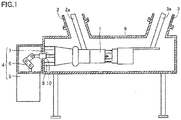
- FIG. 1 is a schematic sectional view illustrating an example of a gas circuit breaker according to the fourth embodiment of the present invention.
- an arc-extinguishing device 1 is electrically connected between a first conductor 2a extending from a first bushing 2 and a second conductor 3a extending from a second bushing 3.
- a drive mechanism 4 for driving a movable conductive conductor 11 is configured to include an operating member 5 which operates through for example a spring mechanism or a hydraulic mechanism, a link 6, and an insulation rod 7.
- Movable conductive conductor 11 is coupled to link 6 through the intermediary of rod 7, and is moved by operating device 5 to perform disconnection operation or connection operation.
- a slidable unit 10 having an O-ring for example is provided to the part.
- arc-extinguishing device 1 is supported by an insulation supporter 8 and kept isolated from housing 9.
- FIG. 2 is an example of a schematic cross-sectional view illustrating a main part of the arc-extinguishing device for the gas circuit breaker according to the fourth embodiment.
- FIG. 2(a) illustrates the state of a first half of the interruption process of the gas circuit breaker
- FIG. 2(b) illustrates the state of a second half of the interruption process of the gas circuit breaker.
- the gas circuit breaker illustrated in FIG. 2 houses, in housing 9 (see FIG. 1 ) which is filled with an arc-extinguishing gas, a movable conductive contactor 11 and a movable arc contactor 13, which are disposed opposite to a fixed conductive contactor 12 and a fixed arc contactor 14, respectively.
- An insulation nozzle 15 is provided around the outer periphery of movable arc contactor 13 and around the outer periphery of fixed arc contact 14, and is secured to a puffer cylinder 16 provided at the movable side.
- a part of or all of the insulation nozzle is formed from the arc-extinguishing insulation material molded product according to the first to third embodiments.
- the arc-extinguishing insulation material molded product is disposed at a position without significantly deforming a flow path formed by insulation nozzle 15 and movable arc contactor 13. Additionally, although not shown in the figure, it is acceptable to dispose a flow guide between movable arc contactor 13 and insulation nozzle 15, and thereafter the arc-extinguishing insulation material molded product may be formed in the flow guide.
- An insulation gas for example, sulfur hexafluoride (SF 6 ), carbon dioxide (CO 2 ), trifluoroiodomethane (CF 3 I), nitrogen (N 2 ), oxygen (O 2 ), tetrafluoromethane (CF 4 ), argon (Ar), helium (He), or a gas mixture containing at least two of these gases may be used as the arc-extinguishing gas.
- sulfur hexafluoride (SF 6 ) alone or a mixture thereof with carbon dioxide (CO 2 ) and nitrogen (N 2 ) is preferred.
- Puffer cylinder 16 is connected to drive mechanism 4 through the intermediary of an operating rod 17 (a portion of rod 7 in FIG. 1 ). Also, a piston 18 is fixedly installed in the housing of the gas circuit breaker in a manner not shown. Puffer cylinder 16 and operating rod 17 and a bulkhead 24 fixed to puffer cylinder 16 enclose a space called as a thermal puffer chamber 19a. Meanwhile, puffer cylinder 16 and bulkhead 24 and operating rod 17 and piston 18 together enclose a space called as a machine puffer chamber 19b.
- Machine puffer chamber 19b is located between piston 18 and bulkhead 24 which is fixed to cylinder 16, when operating rod 17 is driven rightward in the figure, it narrows the space of machine puffer chamber 19b, and thereby, the arc-extinguishing gas in machine puffer chamber 19b is compressed, and the pressure is increased in machine puffer chamber 19b.
- the pressure in machine puffer chamber 19b becomes greater than the pressure in thermal puffer chamber 19a, the arc-extinguishing insulation gas is blown out through a check valve 23 toward the insulation nozzle opening.
- a movable unit 11a is moved toward the side of drive mechanism 4 (rightward in FIG. 2 ).
- an electric arc 20 is generated between fixed arc contactor 14 and movable arc contactor 13.
- thermal puffer chamber 19a Due to the generated high-temperature gas, the gas pressure in thermal puffer chamber 19a is increased high enough to blow the insulation gas toward the opening of the insulation nozzle along with the disconnection operation.
- movable conductive conductor (movable electrode) 11 and fixed conductive contactor (fixed electrode) 12 are pulled apart to a distance sufficient to withstand a restriking voltage present between the electrodes, and thereby, the insulation between the electrodes is recovered and the interruption operation is completed.
- the high-temperature gas discharged from arc-extinguishing device 1 to the outside contains less hydrogen, such hydrogen-containing compound as hydrogen fluoride gas that can escalate corrosion or water that can deteriorate insulation will not be generated, and thereby, it is possible to suppress the insulation deterioration even though the insulation member used as insulation supporter 8 or the like is exposed to the gas.
- the gas circuit breaker of the fourth embodiment by using the arc-extinguishing insulation material molded product of the present invention to form a part of or the entire part of insulation nozzle in the vicinity of a contact point between contactors, hydrogen atoms or hydrogen ions contained in the high-temperature gas discharged from arc-extinguishing device 1 is decreased, and consequently, it is possible to suppress the formation of such hydrogen-containing compound as hydrogen fluoride that can deteriorate the insulation material or water than can degrade the insulation, which makes it possible to suppress the insulation deterioration while achieving sufficient puffer pressure.
- the gas circuit breaker according to the present embodiment provides remarkable effects such as capable of extinguishing the insulation deterioration and capable of being made smaller due to the contribution of the simple-structured drive mechanism.
- Example 1 A variety of polymers listed in Table 1 were prepared.
- fluorinated polyether-based polymer in Example 1, a commercially available perfluoropolyether rubber (ShoreA hardness of 50) was used, and in Example 2, a commercially available silicone cross-linked product (a cured product of two-liquid type material, ShoreA hardness of 70, containing silicon dioxide) A of fluorinated polyether was used, and in Example 3, a commercially available silicone cross-linked product B (a cured product of two-liquid type material, containing no silicon dioxide) of fluorinated polyether was used. After molding and machining these polymers, predetermined arc-extinguishing insulation material molded products (Examples 1-3 and Comparative Examples 1-3) were obtained.
- the measurement of the hydrogen content (the content of hydrogen atoms in the constituent elements in the polymer) was performed according to the CHN elemental analysis method. Specifically, the molded product was heated in a helium/oxygen gas stream to a high temperature of combustion so as to oxidize each of the constituent elements in the molded product, and thereby, the carbon element was oxidized to CO 2 , the hydrogen element was oxidized to H 2 O, and the nitrogen element was oxidized to NO x , and these oxides were further introduced into a reduction furnace including a reduced copper so as to reduce NO x to N 2 . Then, the hydrogen content in each molded product was calculated through quantification of the generated H 2 O.
- each molded product was dried under reduced pressure (at 50 °C) for 2 hours.
- SF 6 gas was introduced into a sealed chamber housing the gas circuit breaker containing the molded product, the interruption test was performed by disconnecting the contactors at conditions of a rated voltage at 84 kV, an electric current at 20 kA (effective value) and an interruption time for 10 to 15 ms to generate the electric arc for 10 times.
- the ratio of the maximum pressure of the generated gas among the 10 interruption tests to the maximum pressure of the generated gas among the 10 interruption tests for Comparative Example 1 was calculated as the pressure ratio of the generated gas.
- the corrosiveness to the insulation member was evaluated in the interruption test by disposing another epoxy resin molded product attached with an electrode at a position in the chamber without being exposed to the electric arc and observing the change of surface resistance before and after the interruption.
- the corrosiveness was evaluated as YES if the surface resistivity of the epoxy resin molded product after the test was reduced by more than 2 orders from the initial value (for example, if the initial value is 10 13 ⁇ /sq., and the surface resistivity after test is less than 10 11 ⁇ /sq.).
- the arc-extinguishing insulation material molded product in each of Examples 1-3 can produce higher pressure of the generated gas, has excellent interruption performance, and can suppress the corrosiveness to the insulator caused by the generated gas. Since the arc-extinguishing insulation material molded product of Comparative Examples 2 and 3 has a hydrogen content greater than 2 mass% and the gas generated thereby is corrosive to the insulator, neither can be applied to a gas circuit breaker containing SF 6 .
- Table 2 lists the types of polymers used in the production of the arc-extinguishing insulation material molded products, and the types, the average particle size, the maximum particle size and the formulation amount of wear-resistant fillers for Examples 4-10 and Comparative Example 4. Each polymer was formulated with a respective wear-resistant filler at a predetermined ratio to form a composition, and the composition was molded and then machined to provide a predetermined arc-extinguishing insulation material molded product (for Example 4 to 10 and Comparative Example 4).
- the interruption test similar to the above one was performed to evaluate the pressure ratio of gas generated by the molded product, the wear ratio (weight ratio) of the composition constituting the arc-extinguishing insulation material molded product and the presence of internal wear.
- the pressure ratio of generated gas was calculated relative to the maximum pressure of Example 2.
- the wear ratio was calculated relative to Example 2 by using the weight difference (wear amount) of the arc-extinguishing insulation material molded product before and after the interruption test.
- the internal wear was performed through the observation of the cross section of the arc-extinguishing insulation material molded product after the interruption test, and was determined as YES when there is a blast part present inside the molded product different from that on the surface. The results are listed in Table 2.
- Example 2 As shown by the results in Table 2, compared to Example 2 where no wear-resistant filler (boron nitride, aluminum oxide, titanium oxide) is added, the wear amount of the arc-extinguishing insulation material molded product in each of Examples 4-10 is suppressed. Moreover, the arc-extinguishing insulator molded material of each Example of 4 to 10 can produce a higher gas pressure than Comparative Example 4 in which 5 vol% of boron nitride was added to tetrafluoroethylene resin. Furthermore, no internal wear was observed in Examples 4 to 10, but the internal wear was observed in Comparative Example 4.
- the arc-extinguishing insulation material molded product in Examples 4 to 10 is effective in extinguishing the wear amount of the arc-extinguishing insulation material molded product after the interruption test, can generate higher gas pressure, and is superior in interruption performance.
Landscapes
- Chemical & Material Sciences (AREA)
- Health & Medical Sciences (AREA)
- Chemical Kinetics & Catalysis (AREA)
- Medicinal Chemistry (AREA)
- Polymers & Plastics (AREA)
- Organic Chemistry (AREA)
- General Chemical & Material Sciences (AREA)
- Inorganic Chemistry (AREA)
- Circuit Breakers (AREA)
- Arc-Extinguishing Devices That Are Switches (AREA)
- Organic Insulating Materials (AREA)
- Polyethers (AREA)
Claims (12)
- Gas-Leistungsschalter, der ein Formerzeugnis mit lichtbogenlöschendem Isoliermaterial aufweist, das in der Nähe einer Elektrode angeordnet ist, dadurch gekennzeichnet,
dass das Formerzeugnis mit lichtbogenlöschendem Isoliermaterial Folgendes aufweist:- ein Polymer, das eine Kohlenstoff-Sauerstoff-Bindung in der Hauptkette aufweist und bei dem ein Anteil von oder sämtliche von den endständigen Atomen zumindest von einer der folgenden Atomarten sind: Fluoratome, Chloratome, Bromatome, Iodatome und Astatatome. - Gas-Leistungsschalter, der das Formerzeugnis mit lichtbogenlöschendem Isoliermaterial gemäß Anspruch 1 aufweist,
wobei das Polymer die Hauptkomponente ist. - Gas-Leistungsschalter, der das Formerzeugnis mit lichtbogenlöschendem Isoliermaterial gemäß Anspruch 1 oder 2 aufweist,
wobei der Gehalt an Wasserstoffatomen in den Bestandteilen des Polymers nicht mehr als 2 Ma% ausmacht. - Gas-Leistungsschalter, der das Formerzeugnis mit lichtbogenlöschendem Isoliermaterial gemäß einem der Ansprüche 1 bis 3,
wobei ein Anteil von oder sämtliche von den endständigen Atomen Fluoratome sind. - Gas-Leistungsschalter, der das Formerzeugnis lichtbogenlöschendem Isoliermaterial gemäß einem der Ansprüche 1 bis 4 aufweist,
wobei das Polymer ein Polymer auf Polyether-Basis ist. - Gas-Leistungsschalter, der das Formerzeugnis mit lichtbogenlöschendem Isoliermaterial gemäß Anspruch 5 aufweist,
wobei das Polymer auf Polyether-Basis ein Polymer auf Fluor-Polyether-Basis ist. - Gas-Leistungsschalter, der das Formerzeugnis mit lichtbogenlöschendem Isoliermaterial gemäß einem der Ansprüche 5 bis 6 aufweist,
wobei das Polymer auf Polyether-Basis keinen Benzolring in der sich wiederholenden Gruppe des Polyethers aufweist. - Gas-Leistungsschalter, der das Formerzeugnis mit lichtbogenlöschendem Isoliermaterial gemäß einem der Ansprüche 1 bis 7 aufweist,
wobei das Polymer ein Siliciumatom in der Hauptkette aufweist. - Gas-Leistungsschalter, der das Formerzeugnis mit lichtbogenlöschendem Isoliermaterial gemäß einem der Ansprüche 1 bis 8 aufweist,
wobei das Polymer ein Silikon-vernetztes Produkt eines fluorierten Polyethers ist. - Gas-Leistungsschalter, der das Formerzeugnis mit lichtbogenlöschendem Isoliermaterial gemäß Anspruch 9 aufweist,
der ferner ein Siliciumdioxid aufweist. - Gas-Leistungsschalter, der das Formerzeugnis mit lichtbogenlöschendem Isoliermaterial gemäß einem der Ansprüche 1 bis 10 aufweist,
das ferner mindestens einen Füllstoff aufweist, der aus der Gruppe ausgewählt wird, die aus folgenden Komponenten besteht: Bornitrid, Aluminiumoxid und Titanoxid. - Gas-Leistungsschalter, der das Formerzeugnis mit lichtbogenlöschendem Isoliermaterial gemäß Anspruch 1 aufweist,
wobei das Isoliergas, das für die Leitungsunterbrechung verwendet wird, SF6-Gas ist.
Applications Claiming Priority (2)
| Application Number | Priority Date | Filing Date | Title |
|---|---|---|---|
| JP2013022217 | 2013-02-07 | ||
| PCT/JP2013/074489 WO2014122814A1 (ja) | 2013-02-07 | 2013-09-11 | 消弧用絶縁材料成形体、それを用いたガス遮断器 |
Publications (3)
| Publication Number | Publication Date |
|---|---|
| EP2958124A1 EP2958124A1 (de) | 2015-12-23 |
| EP2958124A4 EP2958124A4 (de) | 2016-10-12 |
| EP2958124B1 true EP2958124B1 (de) | 2017-11-01 |
Family
ID=51299423
Family Applications (1)
| Application Number | Title | Priority Date | Filing Date |
|---|---|---|---|
| EP13874807.4A Active EP2958124B1 (de) | 2013-02-07 | 2013-09-11 | Form für ein lichtbogenlöschendes isoliermaterial und gasunterbrecherschalter damit |
Country Status (6)
| Country | Link |
|---|---|
| US (1) | US9475906B2 (de) |
| EP (1) | EP2958124B1 (de) |
| JP (1) | JP5940180B2 (de) |
| CN (1) | CN104969323B (de) |
| CA (1) | CA2900227C (de) |
| WO (1) | WO2014122814A1 (de) |
Families Citing this family (13)
| Publication number | Priority date | Publication date | Assignee | Title |
|---|---|---|---|---|
| US10128071B2 (en) * | 2014-12-03 | 2018-11-13 | Hitachi, Ltd. | Abrasion resistant material, puffer cylinder, and puffer type gas circuit breaker |
| CN107787516B (zh) * | 2015-04-13 | 2020-06-19 | Abb瑞士股份有限公司 | 仅中断非短路电流的装置、尤其是隔离开关或接地开关 |
| JP6075423B1 (ja) * | 2015-09-03 | 2017-02-08 | 株式会社明電舎 | 真空遮断器 |
| DE102015218003A1 (de) * | 2015-09-18 | 2017-03-23 | Siemens Aktiengesellschaft | Mittel- oder Hochspannungsschaltanlage mit einem gasdichten Isolierraum |
| JP6189008B1 (ja) * | 2016-03-14 | 2017-08-30 | 三菱電機株式会社 | 消弧用絶縁材料成形体およびこれを備えるガス遮断器 |
| WO2017159433A1 (ja) * | 2016-03-14 | 2017-09-21 | 三菱電機株式会社 | 消弧用絶縁材料成形体およびこれを備えるガス遮断器 |
| EP3764382A1 (de) | 2016-06-03 | 2021-01-13 | ABB Schweiz AG | Gasisolierter nieder- oder mittelspannungstrennschalter |
| CN111433874B (zh) * | 2017-12-11 | 2022-04-12 | 三菱电机株式会社 | 消弧用绝缘材料成型体及断路器 |
| WO2019176159A1 (ja) * | 2018-03-12 | 2019-09-19 | 三菱電機株式会社 | 絶縁成形体、及びガス遮断器 |
| JP6996525B2 (ja) * | 2019-03-13 | 2022-01-17 | 三菱電機株式会社 | ガス絶縁開閉機器 |
| KR102540141B1 (ko) * | 2021-06-08 | 2023-06-07 | 한국전력공사 | 가스절연 개폐장치용 아크화염 소화장치 |
| CN114429879B (zh) * | 2021-12-16 | 2024-03-22 | 河南平高电气股份有限公司 | 一种隔离静触头及三工位隔离接地开关 |
| KR20250179453A (ko) | 2024-06-21 | 2025-12-30 | 효성중공업 주식회사 | 차단기용 노즐 |
Family Cites Families (23)
| Publication number | Priority date | Publication date | Assignee | Title |
|---|---|---|---|---|
| US3351619A (en) | 1966-08-01 | 1967-11-07 | Du Pont | Crosslinkable polymers formed from iodine-containing perfluoroalkyl vinyl ethers |
| US4444671A (en) * | 1976-03-29 | 1984-04-24 | S&C Electric Company | Arc extinguishing material |
| JPS57202003A (en) * | 1981-06-03 | 1982-12-10 | Hitachi Ltd | Sf6 gas insulating electric device and method of producing same |
| JPS63150350A (ja) * | 1986-12-12 | 1988-06-23 | Shin Etsu Chem Co Ltd | シリコ−ンゴム組成物 |
| JP2612979B2 (ja) * | 1991-07-25 | 1997-05-21 | 信越化学工業株式会社 | ハードディスク装置用カバー・パッキング組立体 |
| TW293130B (de) * | 1994-03-10 | 1996-12-11 | Mitsubishi Electric Corp | |
| JPH07312155A (ja) | 1994-05-17 | 1995-11-28 | Nissin Electric Co Ltd | 熱パッファ形ガス遮断器 |
| DE19517540A1 (de) * | 1995-05-12 | 1996-11-14 | Abb Research Ltd | Löschgasabgebender Werkstoff und Druckgasschalter mit einem solchen Werkstoff |
| DE19645524A1 (de) * | 1996-11-05 | 1998-05-07 | Abb Research Ltd | Leistungsschalter |
| JPH1129191A (ja) | 1997-07-09 | 1999-02-02 | Mitsubishi Chem Corp | 開封防止機構付蓋体の締付方法 |
| DE19816505A1 (de) | 1998-04-14 | 1999-10-21 | Asea Brown Boveri | Leistungsschalter |
| JP3336958B2 (ja) * | 1998-06-11 | 2002-10-21 | 日本メクトロン株式会社 | 含フッ素ブロック共重合体の製造法 |
| JP2001155595A (ja) | 1999-11-25 | 2001-06-08 | Mitsubishi Electric Corp | パッファ型ガス遮断器 |
| WO2001080268A1 (en) * | 2000-04-14 | 2001-10-25 | Mitsubishi Denki Kabushiki Kaisha | Circuit breaker |
| JP2002373561A (ja) * | 2001-06-15 | 2002-12-26 | Toshiba Corp | ガス遮断器用ノズルおよびその製造方法 |
| JP4618955B2 (ja) | 2001-09-21 | 2011-01-26 | 株式会社小松製作所 | エレクタ制御装置及びその制御方法 |
| JP2003297200A (ja) * | 2002-04-01 | 2003-10-17 | Toshiba Corp | ガス遮断器 |
| JP2003292761A (ja) * | 2002-04-01 | 2003-10-15 | Shin Etsu Chem Co Ltd | 硬化性フルオロポリエーテル系ゴム組成物及びゴム製品 |
| JP2003323837A (ja) * | 2002-04-26 | 2003-11-14 | Toshiba Corp | ガス遮断器 |
| EP1544881B1 (de) * | 2003-12-19 | 2007-01-24 | ABB Technology AG | Gasisolierte Schaltovrrichtung mit einer Düse |
| JP4753289B2 (ja) * | 2004-07-12 | 2011-08-24 | 信越化学工業株式会社 | フッ素系エラストマー又はフッ素系ゲル用プライマー組成物 |
| US9147543B2 (en) * | 2010-12-07 | 2015-09-29 | Mitsubishi Electric Corporation | Gas circuit breaker |
| CN104054151B (zh) * | 2012-02-06 | 2017-04-19 | 三菱电机株式会社 | 气体断路器 |
-
2013
- 2013-09-11 EP EP13874807.4A patent/EP2958124B1/de active Active
- 2013-09-11 JP JP2014560633A patent/JP5940180B2/ja active Active
- 2013-09-11 CN CN201380072504.8A patent/CN104969323B/zh active Active
- 2013-09-11 US US14/761,558 patent/US9475906B2/en active Active
- 2013-09-11 CA CA2900227A patent/CA2900227C/en active Active
- 2013-09-11 WO PCT/JP2013/074489 patent/WO2014122814A1/ja not_active Ceased
Non-Patent Citations (1)
| Title |
|---|
| None * |
Also Published As
| Publication number | Publication date |
|---|---|
| US9475906B2 (en) | 2016-10-25 |
| EP2958124A4 (de) | 2016-10-12 |
| CN104969323B (zh) | 2017-10-20 |
| CN104969323A (zh) | 2015-10-07 |
| EP2958124A1 (de) | 2015-12-23 |
| JP5940180B2 (ja) | 2016-06-29 |
| CA2900227C (en) | 2018-04-17 |
| US20150357137A1 (en) | 2015-12-10 |
| JPWO2014122814A1 (ja) | 2017-01-26 |
| WO2014122814A1 (ja) | 2014-08-14 |
| CA2900227A1 (en) | 2014-08-14 |
Similar Documents
| Publication | Publication Date | Title |
|---|---|---|
| US9475906B2 (en) | Arc-extinguishing insulation material molded product and gas circuit breaker including the same | |
| KR101996233B1 (ko) | 유전성 절연 매질 | |
| US7816618B2 (en) | Gas insulated switchgear | |
| EP2441075B1 (de) | Dielektrisches isoliermedium | |
| CN107210088B (zh) | 用于产生、分配和/或使用电能的装置和用于这样的装置的组件 | |
| KR20130128433A (ko) | 유전성 절연 매질 | |
| US20090109604A1 (en) | Gas Insulated Switchgear and Gas Circuit Breaker | |
| CN1950917B (zh) | 中压或高压电开关装置 | |
| CN105610083A (zh) | 具有改进的电绝缘和电弧的熄灭的电气设备以及相关的方法 | |
| CN114072881B (zh) | 介电绝缘或消弧流体 | |
| CN87105280A (zh) | 断路器用绝缘喷嘴 | |
| CN106786117A (zh) | 一种卤代烃绝缘气体及其应用 | |
| CN107683277A (zh) | 用于使电作用零件介电绝缘的化合物 | |
| JP7545574B2 (ja) | 中電圧または高電圧の電気装置を再構築するための方法 | |
| CN206498131U (zh) | 充有卤代烃绝缘气体的环网柜 | |
| JP6189008B1 (ja) | 消弧用絶縁材料成形体およびこれを備えるガス遮断器 | |
| JP7273700B2 (ja) | 耐アーク性樹脂成形物、ガス遮断器用のノズル、ガス遮断器及び耐アーク性樹脂成形物の製造方法 | |
| KR20250179453A (ko) | 차단기용 노즐 | |
| WO2017159433A1 (ja) | 消弧用絶縁材料成形体およびこれを備えるガス遮断器 | |
| WO2020044552A1 (ja) | 耐アーク性絶縁成形体、ガス遮断器用のノズル及びガス遮断器 | |
| JPH03245427A (ja) | パッファ形ガス遮断器 |
Legal Events
| Date | Code | Title | Description |
|---|---|---|---|
| PUAI | Public reference made under article 153(3) epc to a published international application that has entered the european phase |
Free format text: ORIGINAL CODE: 0009012 |
|
| 17P | Request for examination filed |
Effective date: 20150805 |
|
| AK | Designated contracting states |
Kind code of ref document: A1 Designated state(s): AL AT BE BG CH CY CZ DE DK EE ES FI FR GB GR HR HU IE IS IT LI LT LU LV MC MK MT NL NO PL PT RO RS SE SI SK SM TR |
|
| AX | Request for extension of the european patent |
Extension state: BA ME |
|
| DAX | Request for extension of the european patent (deleted) | ||
| A4 | Supplementary search report drawn up and despatched |
Effective date: 20160913 |
|
| RIC1 | Information provided on ipc code assigned before grant |
Ipc: C08G 65/323 20060101ALI20160907BHEP Ipc: H01H 33/70 20060101ALI20160907BHEP Ipc: H01H 33/915 20060101ALI20160907BHEP Ipc: H01H 33/04 20060101ALI20160907BHEP Ipc: H01H 33/78 20060101AFI20160907BHEP |
|
| GRAP | Despatch of communication of intention to grant a patent |
Free format text: ORIGINAL CODE: EPIDOSNIGR1 |
|
| RIC1 | Information provided on ipc code assigned before grant |
Ipc: C08G 65/336 20060101ALI20170419BHEP Ipc: H01H 33/91 20060101ALI20170419BHEP Ipc: H01H 33/78 20060101AFI20170419BHEP Ipc: H01H 33/70 20060101ALI20170419BHEP Ipc: C08G 65/00 20060101ALI20170419BHEP |
|
| INTG | Intention to grant announced |
Effective date: 20170516 |
|
| GRAS | Grant fee paid |
Free format text: ORIGINAL CODE: EPIDOSNIGR3 |
|
| GRAA | (expected) grant |
Free format text: ORIGINAL CODE: 0009210 |
|
| AK | Designated contracting states |
Kind code of ref document: B1 Designated state(s): AL AT BE BG CH CY CZ DE DK EE ES FI FR GB GR HR HU IE IS IT LI LT LU LV MC MK MT NL NO PL PT RO RS SE SI SK SM TR |
|
| REG | Reference to a national code |
Ref country code: GB Ref legal event code: FG4D |
|
| REG | Reference to a national code |
Ref country code: CH Ref legal event code: EP Ref country code: AT Ref legal event code: REF Ref document number: 942805 Country of ref document: AT Kind code of ref document: T Effective date: 20171115 |
|
| REG | Reference to a national code |
Ref country code: IE Ref legal event code: FG4D |
|
| REG | Reference to a national code |
Ref country code: DE Ref legal event code: R096 Ref document number: 602013028958 Country of ref document: DE |
|
| REG | Reference to a national code |
Ref country code: NL Ref legal event code: MP Effective date: 20171101 |
|
| REG | Reference to a national code |
Ref country code: LT Ref legal event code: MG4D |
|
| REG | Reference to a national code |
Ref country code: AT Ref legal event code: MK05 Ref document number: 942805 Country of ref document: AT Kind code of ref document: T Effective date: 20171101 |
|
| PG25 | Lapsed in a contracting state [announced via postgrant information from national office to epo] |
Ref country code: SE Free format text: LAPSE BECAUSE OF FAILURE TO SUBMIT A TRANSLATION OF THE DESCRIPTION OR TO PAY THE FEE WITHIN THE PRESCRIBED TIME-LIMIT Effective date: 20171101 Ref country code: FI Free format text: LAPSE BECAUSE OF FAILURE TO SUBMIT A TRANSLATION OF THE DESCRIPTION OR TO PAY THE FEE WITHIN THE PRESCRIBED TIME-LIMIT Effective date: 20171101 Ref country code: NO Free format text: LAPSE BECAUSE OF FAILURE TO SUBMIT A TRANSLATION OF THE DESCRIPTION OR TO PAY THE FEE WITHIN THE PRESCRIBED TIME-LIMIT Effective date: 20180201 Ref country code: LT Free format text: LAPSE BECAUSE OF FAILURE TO SUBMIT A TRANSLATION OF THE DESCRIPTION OR TO PAY THE FEE WITHIN THE PRESCRIBED TIME-LIMIT Effective date: 20171101 Ref country code: ES Free format text: LAPSE BECAUSE OF FAILURE TO SUBMIT A TRANSLATION OF THE DESCRIPTION OR TO PAY THE FEE WITHIN THE PRESCRIBED TIME-LIMIT Effective date: 20171101 Ref country code: NL Free format text: LAPSE BECAUSE OF FAILURE TO SUBMIT A TRANSLATION OF THE DESCRIPTION OR TO PAY THE FEE WITHIN THE PRESCRIBED TIME-LIMIT Effective date: 20171101 |
|
| PG25 | Lapsed in a contracting state [announced via postgrant information from national office to epo] |
Ref country code: GR Free format text: LAPSE BECAUSE OF FAILURE TO SUBMIT A TRANSLATION OF THE DESCRIPTION OR TO PAY THE FEE WITHIN THE PRESCRIBED TIME-LIMIT Effective date: 20180202 Ref country code: LV Free format text: LAPSE BECAUSE OF FAILURE TO SUBMIT A TRANSLATION OF THE DESCRIPTION OR TO PAY THE FEE WITHIN THE PRESCRIBED TIME-LIMIT Effective date: 20171101 Ref country code: BG Free format text: LAPSE BECAUSE OF FAILURE TO SUBMIT A TRANSLATION OF THE DESCRIPTION OR TO PAY THE FEE WITHIN THE PRESCRIBED TIME-LIMIT Effective date: 20180201 Ref country code: IS Free format text: LAPSE BECAUSE OF FAILURE TO SUBMIT A TRANSLATION OF THE DESCRIPTION OR TO PAY THE FEE WITHIN THE PRESCRIBED TIME-LIMIT Effective date: 20180301 Ref country code: RS Free format text: LAPSE BECAUSE OF FAILURE TO SUBMIT A TRANSLATION OF THE DESCRIPTION OR TO PAY THE FEE WITHIN THE PRESCRIBED TIME-LIMIT Effective date: 20171101 Ref country code: AT Free format text: LAPSE BECAUSE OF FAILURE TO SUBMIT A TRANSLATION OF THE DESCRIPTION OR TO PAY THE FEE WITHIN THE PRESCRIBED TIME-LIMIT Effective date: 20171101 Ref country code: HR Free format text: LAPSE BECAUSE OF FAILURE TO SUBMIT A TRANSLATION OF THE DESCRIPTION OR TO PAY THE FEE WITHIN THE PRESCRIBED TIME-LIMIT Effective date: 20171101 |
|
| PG25 | Lapsed in a contracting state [announced via postgrant information from national office to epo] |
Ref country code: DK Free format text: LAPSE BECAUSE OF FAILURE TO SUBMIT A TRANSLATION OF THE DESCRIPTION OR TO PAY THE FEE WITHIN THE PRESCRIBED TIME-LIMIT Effective date: 20171101 Ref country code: CZ Free format text: LAPSE BECAUSE OF FAILURE TO SUBMIT A TRANSLATION OF THE DESCRIPTION OR TO PAY THE FEE WITHIN THE PRESCRIBED TIME-LIMIT Effective date: 20171101 Ref country code: EE Free format text: LAPSE BECAUSE OF FAILURE TO SUBMIT A TRANSLATION OF THE DESCRIPTION OR TO PAY THE FEE WITHIN THE PRESCRIBED TIME-LIMIT Effective date: 20171101 Ref country code: CY Free format text: LAPSE BECAUSE OF FAILURE TO SUBMIT A TRANSLATION OF THE DESCRIPTION OR TO PAY THE FEE WITHIN THE PRESCRIBED TIME-LIMIT Effective date: 20171101 Ref country code: SK Free format text: LAPSE BECAUSE OF FAILURE TO SUBMIT A TRANSLATION OF THE DESCRIPTION OR TO PAY THE FEE WITHIN THE PRESCRIBED TIME-LIMIT Effective date: 20171101 |
|
| REG | Reference to a national code |
Ref country code: DE Ref legal event code: R097 Ref document number: 602013028958 Country of ref document: DE |
|
| REG | Reference to a national code |
Ref country code: FR Ref legal event code: PLFP Year of fee payment: 6 |
|
| PG25 | Lapsed in a contracting state [announced via postgrant information from national office to epo] |
Ref country code: IT Free format text: LAPSE BECAUSE OF FAILURE TO SUBMIT A TRANSLATION OF THE DESCRIPTION OR TO PAY THE FEE WITHIN THE PRESCRIBED TIME-LIMIT Effective date: 20171101 Ref country code: RO Free format text: LAPSE BECAUSE OF FAILURE TO SUBMIT A TRANSLATION OF THE DESCRIPTION OR TO PAY THE FEE WITHIN THE PRESCRIBED TIME-LIMIT Effective date: 20171101 Ref country code: SM Free format text: LAPSE BECAUSE OF FAILURE TO SUBMIT A TRANSLATION OF THE DESCRIPTION OR TO PAY THE FEE WITHIN THE PRESCRIBED TIME-LIMIT Effective date: 20171101 Ref country code: PL Free format text: LAPSE BECAUSE OF FAILURE TO SUBMIT A TRANSLATION OF THE DESCRIPTION OR TO PAY THE FEE WITHIN THE PRESCRIBED TIME-LIMIT Effective date: 20171101 |
|
| PLBE | No opposition filed within time limit |
Free format text: ORIGINAL CODE: 0009261 |
|
| STAA | Information on the status of an ep patent application or granted ep patent |
Free format text: STATUS: NO OPPOSITION FILED WITHIN TIME LIMIT |
|
| 26N | No opposition filed |
Effective date: 20180802 |
|
| PG25 | Lapsed in a contracting state [announced via postgrant information from national office to epo] |
Ref country code: SI Free format text: LAPSE BECAUSE OF FAILURE TO SUBMIT A TRANSLATION OF THE DESCRIPTION OR TO PAY THE FEE WITHIN THE PRESCRIBED TIME-LIMIT Effective date: 20171101 |
|
| PG25 | Lapsed in a contracting state [announced via postgrant information from national office to epo] |
Ref country code: MC Free format text: LAPSE BECAUSE OF FAILURE TO SUBMIT A TRANSLATION OF THE DESCRIPTION OR TO PAY THE FEE WITHIN THE PRESCRIBED TIME-LIMIT Effective date: 20171101 |
|
| GBPC | Gb: european patent ceased through non-payment of renewal fee |
Effective date: 20180911 |
|
| REG | Reference to a national code |
Ref country code: BE Ref legal event code: MM Effective date: 20180930 |
|
| REG | Reference to a national code |
Ref country code: IE Ref legal event code: MM4A |
|
| PG25 | Lapsed in a contracting state [announced via postgrant information from national office to epo] |
Ref country code: LU Free format text: LAPSE BECAUSE OF NON-PAYMENT OF DUE FEES Effective date: 20180911 |
|
| PG25 | Lapsed in a contracting state [announced via postgrant information from national office to epo] |
Ref country code: IE Free format text: LAPSE BECAUSE OF NON-PAYMENT OF DUE FEES Effective date: 20180911 |
|
| PG25 | Lapsed in a contracting state [announced via postgrant information from national office to epo] |
Ref country code: BE Free format text: LAPSE BECAUSE OF NON-PAYMENT OF DUE FEES Effective date: 20180930 |
|
| PG25 | Lapsed in a contracting state [announced via postgrant information from national office to epo] |
Ref country code: GB Free format text: LAPSE BECAUSE OF NON-PAYMENT OF DUE FEES Effective date: 20180911 |
|
| PG25 | Lapsed in a contracting state [announced via postgrant information from national office to epo] |
Ref country code: MT Free format text: LAPSE BECAUSE OF NON-PAYMENT OF DUE FEES Effective date: 20180911 |
|
| PG25 | Lapsed in a contracting state [announced via postgrant information from national office to epo] |
Ref country code: TR Free format text: LAPSE BECAUSE OF FAILURE TO SUBMIT A TRANSLATION OF THE DESCRIPTION OR TO PAY THE FEE WITHIN THE PRESCRIBED TIME-LIMIT Effective date: 20171101 |
|
| PG25 | Lapsed in a contracting state [announced via postgrant information from national office to epo] |
Ref country code: PT Free format text: LAPSE BECAUSE OF FAILURE TO SUBMIT A TRANSLATION OF THE DESCRIPTION OR TO PAY THE FEE WITHIN THE PRESCRIBED TIME-LIMIT Effective date: 20171101 |
|
| PG25 | Lapsed in a contracting state [announced via postgrant information from national office to epo] |
Ref country code: HU Free format text: LAPSE BECAUSE OF FAILURE TO SUBMIT A TRANSLATION OF THE DESCRIPTION OR TO PAY THE FEE WITHIN THE PRESCRIBED TIME-LIMIT; INVALID AB INITIO Effective date: 20130911 Ref country code: MK Free format text: LAPSE BECAUSE OF NON-PAYMENT OF DUE FEES Effective date: 20171101 |
|
| PG25 | Lapsed in a contracting state [announced via postgrant information from national office to epo] |
Ref country code: AL Free format text: LAPSE BECAUSE OF FAILURE TO SUBMIT A TRANSLATION OF THE DESCRIPTION OR TO PAY THE FEE WITHIN THE PRESCRIBED TIME-LIMIT Effective date: 20171101 |
|
| REG | Reference to a national code |
Ref country code: DE Ref legal event code: R084 Ref document number: 602013028958 Country of ref document: DE |
|
| P01 | Opt-out of the competence of the unified patent court (upc) registered |
Effective date: 20230512 |
|
| REG | Reference to a national code |
Ref country code: CH Ref legal event code: U11 Free format text: ST27 STATUS EVENT CODE: U-0-0-U10-U11 (AS PROVIDED BY THE NATIONAL OFFICE) Effective date: 20251001 |
|
| PGFP | Annual fee paid to national office [announced via postgrant information from national office to epo] |
Ref country code: DE Payment date: 20250730 Year of fee payment: 13 |
|
| PGFP | Annual fee paid to national office [announced via postgrant information from national office to epo] |
Ref country code: FR Payment date: 20250808 Year of fee payment: 13 |
|
| PGFP | Annual fee paid to national office [announced via postgrant information from national office to epo] |
Ref country code: CH Payment date: 20251001 Year of fee payment: 13 |