EP2956768B1 - Method for assessing performance of an instrument with liquid chromatography and mass spectrometry functionalities - Google Patents
Method for assessing performance of an instrument with liquid chromatography and mass spectrometry functionalities Download PDFInfo
- Publication number
- EP2956768B1 EP2956768B1 EP14751839.3A EP14751839A EP2956768B1 EP 2956768 B1 EP2956768 B1 EP 2956768B1 EP 14751839 A EP14751839 A EP 14751839A EP 2956768 B1 EP2956768 B1 EP 2956768B1
- Authority
- EP
- European Patent Office
- Prior art keywords
- distinct
- mass
- peptides
- sequence
- peptide
- Prior art date
- Legal status (The legal status is an assumption and is not a legal conclusion. Google has not performed a legal analysis and makes no representation as to the accuracy of the status listed.)
- Active
Links
Images








Classifications
-
- G—PHYSICS
- G01—MEASURING; TESTING
- G01N—INVESTIGATING OR ANALYSING MATERIALS BY DETERMINING THEIR CHEMICAL OR PHYSICAL PROPERTIES
- G01N30/00—Investigating or analysing materials by separation into components using adsorption, absorption or similar phenomena or using ion-exchange, e.g. chromatography or field flow fractionation
- G01N30/02—Column chromatography
- G01N30/86—Signal analysis
- G01N30/8665—Signal analysis for calibrating the measuring apparatus
-
- G—PHYSICS
- G01—MEASURING; TESTING
- G01N—INVESTIGATING OR ANALYSING MATERIALS BY DETERMINING THEIR CHEMICAL OR PHYSICAL PROPERTIES
- G01N30/00—Investigating or analysing materials by separation into components using adsorption, absorption or similar phenomena or using ion-exchange, e.g. chromatography or field flow fractionation
- G01N30/02—Column chromatography
- G01N2030/022—Column chromatography characterised by the kind of separation mechanism
- G01N2030/027—Liquid chromatography
-
- G—PHYSICS
- G01—MEASURING; TESTING
- G01N—INVESTIGATING OR ANALYSING MATERIALS BY DETERMINING THEIR CHEMICAL OR PHYSICAL PROPERTIES
- G01N30/00—Investigating or analysing materials by separation into components using adsorption, absorption or similar phenomena or using ion-exchange, e.g. chromatography or field flow fractionation
- G01N30/02—Column chromatography
- G01N30/04—Preparation or injection of sample to be analysed
- G01N2030/042—Standards
- G01N2030/047—Standards external
-
- G—PHYSICS
- G01—MEASURING; TESTING
- G01N—INVESTIGATING OR ANALYSING MATERIALS BY DETERMINING THEIR CHEMICAL OR PHYSICAL PROPERTIES
- G01N30/00—Investigating or analysing materials by separation into components using adsorption, absorption or similar phenomena or using ion-exchange, e.g. chromatography or field flow fractionation
- G01N30/02—Column chromatography
- G01N30/88—Integrated analysis systems specially adapted therefor, not covered by a single one of the groups G01N30/04 - G01N30/86
- G01N2030/8809—Integrated analysis systems specially adapted therefor, not covered by a single one of the groups G01N30/04 - G01N30/86 analysis specially adapted for the sample
- G01N2030/8813—Integrated analysis systems specially adapted therefor, not covered by a single one of the groups G01N30/04 - G01N30/86 analysis specially adapted for the sample biological materials
- G01N2030/8831—Integrated analysis systems specially adapted therefor, not covered by a single one of the groups G01N30/04 - G01N30/86 analysis specially adapted for the sample biological materials involving peptides or proteins
-
- H—ELECTRICITY
- H01—ELECTRIC ELEMENTS
- H01J—ELECTRIC DISCHARGE TUBES OR DISCHARGE LAMPS
- H01J49/00—Particle spectrometers or separator tubes
- H01J49/0009—Calibration of the apparatus
Definitions
- the present invention provides reagents for instrumentation quality control and methods of use thereof.
- sets of peptides or other molecules are provided for evaluating the performance of instruments with mass spectrometry (MS) and/or liquid chromatography (LC) functionalities.
- Mass spectrometry provides a rapid and sensitive technique for the determination of the molecular mass of a molecule or mixture of molecules.
- mass spectrometry can provide detailed information regarding, for example, the molecular mass (also referred to as "molecular weight” or "MW") of the original molecule, the molecular masses of peptides generated by proteolytic digestion of the original molecule, the molecular masses of fragments generated during the ionization of the original molecule, and even peptide sequence information for the original molecule and fragments thereof.
- Mass spectrometers are extremely precise; their performance and calibration must be carefully monitored as systematic errors may cause erroneous m/z values or changes in sensitivity.
- MS Qual/Quant QC Mix Catalog Number MSQC1, Storage Temperature -20 °C", 2011 (URL:http://legacy.proteored.org/ PME8/msqcldat.pdf ) and in “ Mass Spectrometry Use of Proteomic Standards to Optimize Conditions for an MRM LC-MS Platform MS for Proteins & Peptides Metabolomics Analysis and the METLIN Metabolite Database” by George Yeh, Biofiles Volume, 2012 .
- the present invention provides reagents comprising two or more distinct-mass versions of each of two or more distinct-structure (e.g., sequence) molecules (e.g., peptide, nucleic acid, peptide nucleic acid, polymer, etc.).
- sequence e.g., sequence
- many embodiments of the present invention are described as comprising or for use with peptide reagents, these embodiments should be viewed more broadly as applying to quality control and performance evaluation reagents comprising other molecules and/or polymers.
- the present invention is not limited to peptide reagents.
- the present invention provides peptide mixtures comprising two or more distinct-mass versions of each of two or more distinct-sequence peptides. In some embodiments, the present invention provides peptide mixtures consisting of, or consisting essentially of, two or more distinct-mass versions of each of two or more distinct-sequence peptides. In some embodiments, each of the distinct-sequence peptides is of distinct hydrophobicity. In some embodiments, all of the distinct-mass versions of any of the distinct-sequence peptides are present at distinct concentrations.
- the distinct-mass versions of any of the distinct-sequence peptides are present at concentrations ranging from at least as low as 0.1 nM to at least as high at 100 ⁇ M. In some embodiments, the distinct-mass versions of any of the distinct-sequence peptides are present at concentrations ranging from 1 nM to 10 ⁇ M. In some embodiments, the distinct-mass versions of any of the distinct-sequence peptides are present in a reagent at zeptomoles to picomoles of total peptide.
- the distinct-sequence peptides are separable by liquid chromatography based on their different hydrophobicities or other chemical properties (e.g., charge, size, or hydrophilicity).
- a peptide mixture comprises 3-20 distinct-sequence peptides.
- a peptide mixture comprises 5-10 distinct-sequence peptides.
- the distinct-mass versions of any of the distinct-sequence peptides are differentiable by mass spectrometry.
- the distinct-mass versions of any of the distinct-sequence peptides are the result of different combinations of stable isotope-labeled amino acids.
- the distinct-mass versions of any of the distinct-sequence peptides are the result of different combinations of stable isotope of constituent atoms.
- each of the distinct-mass versions of any of the distinct-sequence peptides comprises a different number of uniformly stable isotope-labeled amino acids.
- a peptide mixture comprises 3-20 distinct-mass versions of each of the distinct-sequence peptides.
- a peptide mixture comprises 5-10 distinct-mass versions of each of the distinct-sequence peptides.
- the present invention provides methods for assessing performance of an instrument with both liquid chromatography (LC) and mass spectrometry (MS) functionalities comprising: (a) introducing a peptide mixture to the instrument, wherein said peptide mixture comprises two or more distinct-mass versions of each of two or more distinct-sequence peptides; (b) analyzing the peptide mixture by LC (consisting of various mobile phases, including but not limited to C 18 , SCX, HILIC etc.); (c) analyzing the peptide mixture by MS (consisting of but not limited to ESI or MALDI methods of ionization); and (d) assessing the performance of the LC and MS functionalities of the instrument based on results of steps (b) and (c).
- LC liquid chromatography
- MS mass spectrometry
- the peptide mixture purified peptides.
- the purified peptides of the peptide mixture are the only peptides introduced to the instrument in step (a).
- the peptide mixture comprises peptides in the presence of one or more impurities.
- the peptide mixture is introduced to the instrument in the presence of one or more other peptides (e.g., background, contaminants, etc.).
- the peptide mixture is a peptide mixture that comprises two or more distinct-mass versions of each of two or more distinct-sequence peptides.
- assessing the performance of the LC and MS functionalities of the instrument comprises reporting one or more LC-parameters for each peptide sequence selected from: retention times, peak height, peak width, peak resolution, and peak symmetry or one or more MS-parameters selected from mass accuracy, mass resolution, sensitivity, dynamic range, linear response, MS/MS spectral quality and sampling and/or isolation efficiency.
- assessing the performance of the LC and MS functionalities of the instrument comprises reporting one or more MS-parameters for each distinctly-massed version of one or more of the peptide sequences selected from: resolution, mass accuracy, and sensitivity as a "neat" mixture, sensitivity within a complex mixture, instrumental sampling, and dynamic range.
- the assessment of LC and/or MS performance is provided by a software program.
- the software reports LC and/or MS parameters from a single analysis, the performance history of the instrument or a comparison between multiple LC and/or MS instruments or instrument platforms.
- the software provides a performance score of the LC and/or MS instrument.
- sensitivity and/or performance are evaluated for a neat sample (e.g., reagent without substantial background causing agents).
- sensitivity and/or performance are evaluated for a complex sample (e.g., reagent and background causing agents/peptides).
- the present invention provides methods for assessing performance of an instrument with both liquid chromatography (LC) and mass spectrometry (MS) functionalities comprising: (a) introducing a peptide mixture to the instrument, wherein said peptide mixture comprises two or more distinct-mass versions of each of two or more distinct-sequence peptides, wherein said peptide mixture comprises two or more distinct-mass versions of each of two or more distinct-sequence peptides; (b) analyzing the peptide mixture by LC; (c) analyzing the peptide mixture by MS; and (d) assessing the performance of the LC and MS functionalities of the instrument based on results of steps (b) and (c).
- LC liquid chromatography
- MS mass spectrometry
- distinct-sequence peptides are of distinct hydrophobicities and separable by LC.
- the present invention provides distinct-mass versions that comprise different combinations of heavy isotope labeled amino acids and are resolved by MS.
- the assessment of LC and MS performance is provided by a software program.
- the software reports LC and MS parameters from a single analysis, the performance history of the instrument or a comparison between multiple LC and MS instruments.
- the software provides a performance score of the LC and/or MS instrument.
- the present invention provides reagents and/or methods for quality control and/or evaluating the performance of instruments with mass spectrometry (MS) and/or liquid chromatography (LC) functionalities.
- MS mass spectrometry
- LC liquid chromatography
- both MS and LC functionalities are assessed.
- only one of MS and LC functionalities are assessed.
- an instrument has both MS and LC functionalities, but only one is assessed.
- an instrument has only one of MS and LC functionalities.
- MS and LC functionalities are provided by a single unit.
- MS and LC functionalities are provided by separate units.
- the assessment of the performance of LC and/or MS functionality is performed by software.
- the software generates a performance score.
- a performance score is unique to the tested instrument (or type of instrument tested).
- a performance score can be used for assessment of the tested instrument (or type of instrument tested) at a given time and/or over time.
- a performance score is comparable to performance scores of other similar and/or different instruments (e.g., those with LC and/or MS functionality).
- a performance score can be used for comparison of a tested instrument (or type of instrument tested) to other similar and/or different instruments at a given time and/or over time.
- software is used to track an instruments historical performance.
- a report of instrument performance parameters (e.g., score) is generated .
- the present invention provides methods for assessing performance of an instrument with both liquid chromatography (LC) and mass spectrometry (MS) functionalities comprising: (a) introducing (e.g., injecting) a peptide mixture to the instrument, wherein the peptide mixture comprises two or more distinct-mass versions of each of two or more distinct-sequence peptides; (b) separating or analyzing the peptide mixture by LC; (c) analyzing the peptide mixture by MS; and (d) assessing the performance of the LC and MS functionalities of the instrument based on results of steps (b) and (c) using software.
- LC liquid chromatography
- MS mass spectrometry
- the peptide mixture is a peptide mixture that comprises two or more distinct-mass versions of each of two or more distinct-sequence peptides. In some embodiments, each distinct-mass version of a distinct-sequence peptide is present at a different concentration. In some embodiments, assessing the performance of the LC and MS functionalities of the instrument comprises reporting one or more LC-parameters for each peptide sequence selected from: retention times, peak height, peak width, peak resolution, and peak symmetry.
- assessing the performance of the LC and MS functionalities of the instrument comprises reporting one or more MS-parameters for each distinctly-massed versions of one or more of the peptide sequences selected from: resolution, mass accuracy, sensitivity of "neat” samples, sensitivity within complex samples, dynamic range, mass resolution, isolation efficiency, MS/MS spectral quality and linear response in a single analytical experiment.
- performance is assessed by software which generates a performance score.
- peptide refers to a polymer compound of two or more amino acids joined through the main chain by peptide amide bonds (--C(O)NH--).
- polypeptide typically refers to short amino acid polymers (e.g., chains having fewer than 25 amino acids), whereas the term “polypeptide” refers to longer amino acid polymers (e.g., chains having more than 25 amino acids).
- distinct-sequence peptides refers to a group of peptides (e.g., two or more) that can be differentiated from one another by the identity and/or order of their amino acids.
- ⁇ three distinct-sequence peptides' are three amino acid chains that, although possibly sharing other characteristics, each comprise at least one amino acid difference, and possibly many amino acid differences, from each other (e.g., LLSLGALEFK, LSSLGALEFK, and AAPGEDSRKY).
- distinct-mass peptides refers to a group of peptides (e.g., two or more) that can be differentiated from one another by mass, even if they cannot be differentiated by sequence.
- “Distinct-mass versions of a peptide” refers to a group of peptides that can be differentiated from one another by mass, even though they cannot be differentiated by amino acid sequence (e.g., peptides have the same amino acid sequence).
- ⁇ three distinct-mass versions of a peptide' are three amino acid chains that, although having the same amino acid sequence, are tagged or labeled (e.g., stable heavy isotope labeled) to have different masses (e.g., LLSLGALEFK, L*LSLGALEFK, and L*L*SLGALEFK; wherein * indicates uniform isotopic labeling of the preceding amino acid).
- isomeric peptides refers to a group of peptides (e.g., two or more) that have the same amino acid sequence.
- the peptides do not differ in terms of tags or chemical modifications, but typically contain varying degrees of stable, heavy isotope labeling (e.g., 13 C, 15 N, 18 O, 2 H, etc.).
- a pair of isomeric peptides may differ in the number of uniformly 13 C/ 15 N-labeled amino acids they contain.
- L*LSLGALEFK and L*L*SLGA*LEFK are isomeric peptide (they are also ⁇ distinct-mass peptides' and ⁇ distinct-mass versions of a peptide with the sequence LLSLGALEFK).
- the term “heavy,” refers to an isotope of an element that has a higher molecular mass than the isotope that is most prevalent at natural abundance (e.g., 13 C instead of 12 C, 2 H instead of 1 H, 15 N instead of 14 N, 18 O instead of 16 O, etc.), or any chemical entities (e.g., peptides, molecules, etc.) comprising one or more of such isotopes.
- uniformly heavy labeled refers to a molecular entity (e.g., peptide, amino acid, etc.) in which substantially all of one or more elements within the molecular entity are present as a heavy isotope instead of the isotope that is most prevalent at natural abundance.
- uniformly 13 C/ 15 N-labelled amino acid is one in which substantially all the carbons and nitrogens (e.g., >95%, >98%, >99%, >99.9%) are present as 13 C instead of 12 C and 15 N instead of 14 N.
- a "heavy labeled peptide" may comprise one or more uniformly heavy labeled amino acids.
- the present invention provides reagents for instrumentation quality control and methods of use thereof.
- sets of peptides or other molecules are provided for evaluating the performance of instruments with mass spectrometry (MS) and/or liquid chromatography (LC) functionalities.
- a QC reagent comprises a set of peptides that can be predictably separated and/or analyzed by LC, MS, or both.
- peptides of reagents provided herein exhibit a broad range of hydrophobicities or other chemical characteristics such that they can be used to probe the entire separation range of an LC instrument.
- peptide reagents provided herein exhibit a broad range of masses such that they can be used to probe the mass/charge (m/z) ratio range of an MS instrument.
- the performance of the analyzing instrument is evaluated. By comparing present and past performance evaluations (e.g., relative to the same peptide reagent), changes in instrument performance can be identified, monitored, and/or recorded over periods of time ranging from days to months.
- the present invention provides reagents comprising two or more distinct-sequence peptides (e.g., 2 sequences, 3 sequences, 4 sequences, 5 sequences, 6 sequences, 7 sequences, 8 sequences, 8 sequences, 10 sequences...15 sequences...20 sequences... 25 sequences... 30 sequences... 50 sequences, or more).
- two or more distinct-sequence peptides e.g., 2 sequences, 3 sequences, 4 sequences, 5 sequences, 6 sequences, 7 sequences, 8 sequences, 8 sequences, 10 sequences...15 sequences...20 sequences... 25 sequences... 30 sequences... 50 sequences, or more.
- reagents comprise three or more distinct-sequence peptides, four or more distinct-sequence peptides, five or more distinct-sequence peptides, six or more distinct-sequence peptides, seven or more distinct-sequence peptides, eight or more distinct-sequence peptides, nine or more distinct-sequence peptides, ten or more distinct-sequence peptides, twelve or more distinct-sequence peptides, fifteen or more distinct-sequence peptides, twenty or more distinct-sequence peptides, etc.
- each peptide sequence of a group of distinct-sequence peptides is of a detectably different hydrophobicity.
- each peptide sequence of a group of distinct-sequence peptides has a unique hydrophobicity (e.g., each peptide is separable from all of the others by LC).
- one or more peptide sequence of a group of distinct-sequence peptides has a unique hydrophobicity (e.g., one or more, but not all, peptides are separable from all of the others by LC).
- the differences in hydrophobicity can be detected by liquid chromatography (e.g., high performance liquid chromatography (HPLC)).
- HPLC high performance liquid chromatography
- each distinct-sequence peptide results in a chromatography peak that is distinguishable from the peaks of the other distinct-sequence peptide.
- the distinct-sequence peptides span a hydrophobicity range such that they can all be distinguished (e.g., separated) on a single run through a LC column.
- distinct-mass versions of a peptide are provided.
- two or more distinct-mass, same-sequence peptides are provided.
- distinct-mass versions of the same peptide sequence comprise different isotopic labeling.
- distinct-mass versions of the same peptide sequence may comprise different degrees of heavy isotope labeling.
- all, or a portion of, the amino acids in a peptide comprise amounts above natural abundance levels of heavy isotopes (e.g., 2 H, 13 C, 15 N, 18 O, etc.).
- same sequence peptides have different masses based on the degree of heavy isotope labeling of all or a portion of their amino acids (e.g., all amino acids in a peptide at natural abundance, all amino acids in a peptide 25% 13 C/ 15 N-labelled, all amino acids in a peptide 50% 13 C/ 15 N-labelled, all amino acids in a peptide 75% 13 C/ 15 N-labelled, all amino acids in a peptide >99% 13 C/ 15 N-labelled, etc.).
- same-sequence peptides have different masses based on the number of fully (e.g., uniformly 13 C/ 15 N labeled) heavy isotope labeled amino acids in the respective peptides (e.g., 0 amino acids uniformly labeled, 1 amino acid uniformly labeled, 2 amino acids uniformly labeled, 3 amino acids uniformly labeled, 4 amino acids uniformly labeled, 5 amino acids uniformly labeled, 6 amino acids uniformly labeled, or more).
- differences in mass of the same sequence peptides result from a combination of the number of isotopically-labeled amino acids and the degree to which they are labeled (3 amino acids are 50% 13 C/ 15 N-labelled, all amino acids have 99% nonexchangeable 2 H labeled, 6 amino acids 75% 18 O labeled, etc.).
- Mass-tags and other labels or modifications may also be employed to alter the mass of peptides without changing the amino acid sequence.
- two or more distinct-mass versions of a single peptide sequence are provided.
- two or more (e.g., 2, 3, 4, 5, 6, 7, 8, 9, 10, or more) distinct-mass versions of each of a plurality (e.g., 2, 3, 4, 5, 6, 7, 8, 9, 10, or more) of distinct-sequence peptides are provided.
- the distinct-mass versions of a peptide are not distinguishable by liquid chromatography (e.g., all distinct-mass versions of a peptide elute from a chromatography column (e.g., HPLC column) in a single peak).
- all distinct-mass versions of a peptide sequence exhibit substantially identical hydrophobicity.
- isomeric peptides have identical or substantially identical hydrophobicities and elute from a chromatography column (e.g., HPLC column) in a single peak.
- a set (e.g., 2, 3, 4, 5, 6, 7, 8, 9, 10, or more) of distinct-mass isomeric peptides are provided.
- each isomer has the same or substantially the same hydrophobicity and co-elutes from liquid chromatography (e.g., HPLC).
- each isomer contains a distinct pattern (e.g., different number) of stable isotope labeling (e.g., different combination of uniform 13 C/ 15 N labeled amino acids), and can therefore be distinguished by mass spectrometry.
- a distinct-mass isomer in a set is provided at any suitable concentration (e.g., 10 pM... 100 pM... 1 nM...
- Distinct-mass isomers may be of unique concentrations or may be at the same concentration as one or more other distinct-mass peptides of the same set.
- each distinct-mass isomer in a set is provided at the same concentration (e.g., 10 pM... 100 pM... 1 nM... 10 nM... 100 nM... 1 ⁇ M... 10 ⁇ M... 100 ⁇ M).
- each distinct-mass isomer in a set is provided at a different concentration (e.g., a set of five distinctly-massed isomers provided at 1 nM, 10 nM, 100 nM, 1 ⁇ M, and 10 ⁇ M, respectively).
- the present invention provides two or more (e.g., 2, 3, 4, 5, 6, 7, 8, 9, 10, or more) distinct-sequence sets of two or more (e.g., 2, 3, 4, 5, 6, 7, 8, 9, 10, or more) distinct-mass isomeric peptides.
- Table 1 depicts generic peptides comprising six distinct-sequence sets (sequences A-F) of four distinct-mass versions each (0, 1, 2, or 3 labeled amino acids).
- Table 1 Generic distinct-sequence sets of distinct-mass isomeric peptides.
- the distinct-sequence peptides of a reagent may each be present as the same number of distinct-mass versions (as depicted in Table 1). In other embodiments, two or more distinct-sequence peptides of a reagent comprise different numbers of distinct-mass versions.
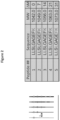
- Table 2 depicts an embodiment of the invention which comprises six distinct sequence sets (VTSGSTSSR (SEQ ID NO: 1), LASVSVSR (SEQ ID NO: 2), YVYVADVAAK (SEQ ID NO: 3), VVGGLVALR (SEQ ID NO: 4), LLSLGAGEFK (SEQ ID NO: 5), LGFTDLFSK (SEQ ID NO: 6)) of six distinct mass isomeric peptides each.
- Table 2 Exemplary distinct-sequence sets of distinct-mass isomeric peptides.
- the distinct-sequence sets exhibit varying degrees of hydrophobicity, and therefore each set elutes independently when analyzed by liquid chromatography (e.g., HPLC).
- Each distinct-mass isomer of a distinct-sequence set has the same hydrophobicity, and therefore co-elute when analyzed by liquid chromatography (e.g., HPLC).
- Any other suitable combinations of distinct-sequence sets of distinct-mass isomers are within the scope of the present invention.
- the invention is not limited by the length, sequence, number, or labeling of the peptides.
- peptides within a set of distinct sequence peptides are selected based on criteria including, but not limited to: peak intensity, peak width, peak compactness (narrowness), LC retention time (e.g., not overlapping with another peptide in the reagent), absence of excluded amino acids (e.g., P, M, W, C, N, Q, and/or N-terminal E) which are deemed to contribute to product instability, feasibility of incorporating sufficient number (e.g., 2, 3, 4, 5, 6, 7, 8, 9, 10, or more) of stable, isotope labeled amino acids (e.g., commercially available stable isotope labeled amino acids), stability, ease of achieving high degree (e.g., >90%, >91%, >92%, >93%, >94%, >95%, >96%, >97%, >98%, >99%) of purity, etc.
- criteria including, but not limited to: peak intensity, peak width, peak compactness (narrowness), LC retention time (e.g
- peptides comprise one or more uniformly isotopically 13 C/ 15 N labeled amino acids, for example, those selected from Table 3. Table 3. Exemplary universally 13 C/15N labeled amino acids Three Letter Code Single Letter Code Molecular formula of 13C/15N universally-labeled free amino acid Molecular formula of 13C/15N universally-labeled amino acid residues Mass shift relative to unlabeled Ala A ⁇ (13C)3H7(15N)O2 (13C)3H5(15N)O (+4) Arg R ⁇ (13C)6H14(15N)4O2 (13C)6H12(15N)4O (+10) Asn N ⁇ (13C)4H8(15N)2O3 (13C)4H6(15N)2O2 (+6) Asp D ⁇ (13C)4H7(15N)O4 (13C)4H5(15N)O3 (+5) Cys C ⁇ (13C)3H7(15N)O2S (13C)3
- a reagent e.g., peptide mixture
- methods of use thereof for the validation, calibration, performance assessment, and/or performance monitoring of analytic instruments (e.g., liquid chromatographs with UV and/or MS detection).
- a reagent provides a performance meter that is used to monitor instrument performance. Reagents and methods provide: assessment of initial instrument performance, monitoring of instrument history, comparison of parameters between instruments, validation of instrument performance (e.g., before or after use), etc.
- a reagent comprises a plurality (e.g., 5) of distinct-sequence sets of several (e.g., 5) distinct-mass isomeric peptides each.
- the reagent is analyzed by liquid chromatography, which separates each of the distinct-sequence sets from each other by their different hydrophobicities.
- the reagent is subsequently analyzed by mass spectrometry, which characterizes the distinct-mass isomers within each set by their mass-to-charge ratios.
- the mass differences e.g., 3-5 Daltons
- the different isomers within a set are provided at a range of different concentrations.
- concentration differences among the isomers within each set are apparent based on the MS analysis and/or amino acid analysis.
- analysis of a single reagent by both the LC and MS components of an instrument provides simultaneous performance analysis.
- a reagent is first analyzed by LC and then analyzed by MS.
- a reagent is analyzed by LC and MS simultaneously (e.g., two portions of the same reagent are each subjected to analysis by one technique).
- each distinct-mass version of a peptide sequence is the same concentration. In some embodiments, each distinct-mass version of a peptide sequence is a different concentration. In some embodiments, the distinct-mass versions of a peptide sequence are provided at a range of concentrations. In particular embodiments, the distinct-mass versions of each peptide sequence in a reagent are provided at the same range of concentrations. In some embodiments, each distinct-sequence peptide (e.g. the sum of the distinct-mass version of the same peptide sequence) is provided at the same concentration.
- each distinct-sequence peptide (e.g. the sum of the distinct-mass version of the same peptide sequence) is provided at a unique concentration.
- the distinct-sequence peptides (e.g. the sum of the distinct-mass version of the same peptide sequence) are provided at range of concentrations (e.g., linear or non-linear distribution over a range).
- a reagent comprises buffers, solvents, salts, and/or other additives (e.g., marker (e.g., radiolabel, fluorescent dye, chromophore, mass tag, etc.), etc.) suitable for use in LC and/or MS.
- Reagents may comprise any suitable buffer (e.g., suitable for use in both LC and MS), such as Ammonium Bicarbonate, Triethyl ammonium bicarbonate (TEAB), TAPS, Tris, HEPES, TAE, TES, MOPS, MES, phosphate buffer, citric acid, CHES, acetic acid, borate, etc.
- a reagent comprises additives to promote solubility (e.g., urea, guanidine HCL, detergents, sugars etc.), stability, etc. of the peptides within the reagent.
- a reagent comprises one of more solvents, such at acetonitrile, methanol, ethanol, hexane, chloroform, etc.
- the methods and reagents find use in quality control of any suitable analytic instruments (e.g., LC, HPLC, MS (e.g., Atmospheric Pressure Ion sources (API), Electrospray or nebulization assisted Electrospray (ES), Atmospheric Pressure Chemical Ionization (APCI), Matrix Assisted Laser Desorption Ionization (MALDI), etc.), LC-MS, LC-MS/MS etc.).
- a reagent is selected, prepared, and/or configured for use with a specific type of instrument (e.g., LC, MS, LC-MS, or LC-MS/MS).
- a reagent is specifically selected, prepared, and/or configured to be used with a variety of instruments.
- a reagent is selected, prepared, and/or configured for performing specific quality control assessments (e.g., calibration, performance evaluation, system suitability, etc.).
- the data generated by analysis (e.g., LC, MS, etc.) of a reagent is analyzed manually by a user or a trained specialist.
- software and/or a package of software is provided to perform automated characterization of the reagent analysis.
- software analyzes and reports on LC parameters (e.g., peak separation, peak efficiency, peak height, peak width, peak shape, retention time, etc.) and/or MS parameters (e.g., mass accuracy, mass resolution, sensitivity, dynamic range and sampling and/or isolation efficiency).
- software correlates peaks in an LC and/or MS analysis to peptides and/or peptide isomers in the reagent.
- software draws conclusions about instrument performance based on instrumental analysis.
- software compares reagent analyses performed at different time points (e.g., separated by minutes, hours, days, weeks, years, etc.) to monitor changes in instrument performance.
- software calibrates instrument data display/output to offset changes in instrument performance over time.
- the software utilizes identifiers for the individual peptides, peptide mix, and/or reagent being analyzed in data analysis.
- the software correlates the data with the known physical characteristics of the individual peptides, peptide mix, and/or reagent.
- software analysis automatically makes determinations regarding instrument sensitivity and/or dynamic range.
- the software will report on instrument performance history.
- the software report on a comparison of performance between multiple instruments.
- the software generates a performance score.
- kits are provided that comprise a peptide reagent and one or more of additional reagents, software, container(s), instructions, additional peptide reagent, etc.
- suitable aliquots of a peptide reagent are provided in a tube or other suitable container.
- a kit provides multiple quality control reagents, useful for performing multiple quality control procedures.
- Peptides were derived from a collection of tryptic peptides originating from a human plasma sample that had been depleted of albumin and IgG. Analysis of the data facilitated the identification of approximately 8300 unique peptides. Peptides containing W, M, C, P, N, Q, and N-terminal E/D were removed from consideration due to stability concerns. Peptides containing histidine were not considered since they added additional charge to the peptides. Furthermore, only fully tryptic peptides were considered (those with internal lysines and arginines were removed from consideration). Further, only peptides that had the ability to incorporate up to at least 7 stable isotopically-labeled residues and could allow for a mass difference of at least 4 Daltons per variant were selected for further consideration.
- Peptides were grouped into 6 bins based on retention times. A set of approximately 20 peptides per bin were then selected based on signal intensity. These peptides were synthesized in crude form, combined into 10 mixtures and analyzed independently on an LTQ-Orbitrap Velos Mass Spectrometer. Properties such as retention time, peak shape, signal intensity, most abundant charge state and the ability to produce high quality MS 2 data were then used in the selection of the last round of peptides. The last set of peptides consisted of 28 peptides (spread across the 6 bins) which were then used to arrive at the final set of peptides.
- final set of peptides (whose concentration was predetermined using amino-acid analysis (AAA))
- AAA amino-acid analysis
- final set of peptides was required to be detectable down to 0.1 fmol (starting from 1 pmole; 5 orders of magnitude).
- final peptide candidates were required to be detectable over a very large dynamic range, sensitive limit of detection and good chromatographic peak shape.
- each of the final peptide candidates was required to contain at least 7 amino acids that could facilitate the isotopic incorporation of stable, heavy isotopically-labeled amino acids that would provide variants with mass differences of at least 4 Daltons between each other such that all 5 peptide isomers within the sample could be clearly resolved so that an accurate measurement of the peak area of all isotopes within the peptide envelope could be measured and integrated.
- Both formats contained the same set of 6 peptides with each peptide having a set of 5 isomeric variants (30 peptides total).
- the isomers were identical in sequence, but contained different heavy labeled amino acids so that they would be distinguished by differing masses. These masses were used to generate standard curves so as to determine instrument sensitivity and dynamic range. The specific details of the variants and mixtures are given in Table 5 below.
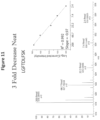
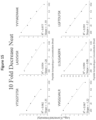
- Format number 1 consisted of peptides in which each set of identical sequence (but variable with regard to isomer and mass) would differ by a 10-fold difference (either increasing or decreasing amount) of peptide amount.
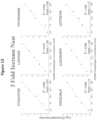
- Format 2 was similar to format 1 with the exception that the decrease from one mass to the next is a 3-fold decrease.
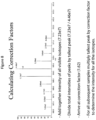
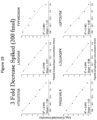
- Figure 16 provides an example of what the 6 standard curves would look like after correction for peak intensities. Additionally, all peptides contained at least one labeled amino acid to prevent isobaric interference when analyzing samples from human plasma, etc.
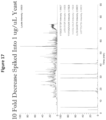
- the peptides (30 total) were mixed into a solution and 200 fmol of this solution was loaded onto a C 18 capillary LC Column (75 ⁇ m x 15 cm).
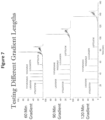
- the LC gradient typically 1 hour, was ramped from 2.5% buffer B (Buffer A - 0.1% formic acid in water and Buffer B - acetonitrile/0.1% FA) until 40 % B.
- Mass spectra were collected, in real time, immediately after following LC. All mass spectra were collected on either a Thermo LTQ-Orbitrap Velos or Q Exactive mass spectrometer operating at MS resolutions of 60,000 with calibrated mass accuracies below 3 ppm. Samples were acquired with a mass range of 350-1200 m/z such that multiply charged (+2/+3) peptides would trigger MS/MS scans.
- the peptides of Table 4 were analyzed by LC and MS, both in the formats described in Table 5 and in other combinations (e.g., isotopologue mixes (e.g., the lightest version of each peptide sequence, second lightest of each peptide sequence... heaviest version of each peptide sequence)), to assess, for example peptide characteristics and analysis procedures.
- isotopologue mixes e.g., the lightest version of each peptide sequence, second lightest of each peptide sequence... heaviest version of each peptide sequence
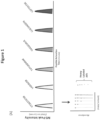
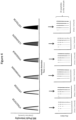
- Figure 6 depicts an LC analysis of sotopologue mixes (e.g., the lightest version of each peptide sequence, second lightest of each peptide sequence... heaviest version of each peptide sequence) of the peptides of Table 4.
- Mix #1 consisted of the "lightest” peptide only from each set, and each mix was prepared with a progressively heavier variant.
- mix #5 contained the "heaviest” form of each peptide.
- the data indicate that although the peptides contain different types of stable, heavy labeled amino acids, they are chemically identical (See Figure 6 ).
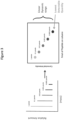
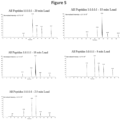
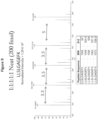
- Mass spectra were taken of the various peptide sequences (See, e.g., Figure 9 ).
- each different mass version of the peptide sequence was supplied at equal concentration.
- approximately equal intensities were observed, with mass separations of at least7 Daltons (note that we are observing the doubly charged peptides and thus have m/z spacings of 3.5 Daltons, respectively).
- All 30 of the peptides of Table 4 were analyzed by MS in an equimolar mixture.
- the molar amounts of each of the peptides (200 fmole) are plotted versus the log of the corrected signal intensity ( Figure 10 ).
Landscapes
- Physics & Mathematics (AREA)
- Health & Medical Sciences (AREA)
- Life Sciences & Earth Sciences (AREA)
- Chemical & Material Sciences (AREA)
- Analytical Chemistry (AREA)
- Biochemistry (AREA)
- General Health & Medical Sciences (AREA)
- General Physics & Mathematics (AREA)
- Immunology (AREA)
- Pathology (AREA)
- Other Investigation Or Analysis Of Materials By Electrical Means (AREA)
- Peptides Or Proteins (AREA)
Priority Applications (1)
| Application Number | Priority Date | Filing Date | Title |
|---|---|---|---|
| EP23194018.0A EP4290231B1 (en) | 2013-02-13 | 2014-02-13 | Peptide mixtures for assessing performance of an instrument with liquid chromatography and mass spectrometry functionalities |
Applications Claiming Priority (2)
| Application Number | Priority Date | Filing Date | Title |
|---|---|---|---|
| US201361764312P | 2013-02-13 | 2013-02-13 | |
| PCT/US2014/016289 WO2014127144A2 (en) | 2013-02-13 | 2014-02-13 | Quality control reagents and methods |
Related Child Applications (2)
| Application Number | Title | Priority Date | Filing Date |
|---|---|---|---|
| EP23194018.0A Division EP4290231B1 (en) | 2013-02-13 | 2014-02-13 | Peptide mixtures for assessing performance of an instrument with liquid chromatography and mass spectrometry functionalities |
| EP23194018.0A Division-Into EP4290231B1 (en) | 2013-02-13 | 2014-02-13 | Peptide mixtures for assessing performance of an instrument with liquid chromatography and mass spectrometry functionalities |
Publications (3)
| Publication Number | Publication Date |
|---|---|
| EP2956768A2 EP2956768A2 (en) | 2015-12-23 |
| EP2956768A4 EP2956768A4 (en) | 2017-03-15 |
| EP2956768B1 true EP2956768B1 (en) | 2023-10-18 |
Family
ID=51350143
Family Applications (2)
| Application Number | Title | Priority Date | Filing Date |
|---|---|---|---|
| EP14751839.3A Active EP2956768B1 (en) | 2013-02-13 | 2014-02-13 | Method for assessing performance of an instrument with liquid chromatography and mass spectrometry functionalities |
| EP23194018.0A Active EP4290231B1 (en) | 2013-02-13 | 2014-02-13 | Peptide mixtures for assessing performance of an instrument with liquid chromatography and mass spectrometry functionalities |
Family Applications After (1)
| Application Number | Title | Priority Date | Filing Date |
|---|---|---|---|
| EP23194018.0A Active EP4290231B1 (en) | 2013-02-13 | 2014-02-13 | Peptide mixtures for assessing performance of an instrument with liquid chromatography and mass spectrometry functionalities |
Country Status (4)
| Country | Link |
|---|---|
| US (4) | US10247711B2 (enExample) |
| EP (2) | EP2956768B1 (enExample) |
| JP (2) | JP6396337B2 (enExample) |
| WO (1) | WO2014127144A2 (enExample) |
Families Citing this family (7)
| Publication number | Priority date | Publication date | Assignee | Title |
|---|---|---|---|---|
| WO2006096704A2 (en) | 2005-03-07 | 2006-09-14 | Invitrogen Corporation | Isotopically-labeled proteome standards |
| DE112011102286B4 (de) * | 2010-07-07 | 2018-11-15 | Thermo Fisher Scientific Gmbh | Massenspektrometrische Quantifizierung von Analyten unter Verwendung eines Universalreporters |
| JP6396337B2 (ja) | 2013-02-13 | 2018-09-26 | プロメガ コーポレイションPromega Corporation | 品質管理試薬及び方法 |
| CN105143872B (zh) | 2013-06-07 | 2019-03-01 | 皮尔斯生物科技有限公司 | 通过质谱分析用复用内标物对蛋白质和蛋白质修饰的绝对定量 |
| WO2019202872A1 (ja) * | 2018-04-16 | 2019-10-24 | 株式会社島津製作所 | 質量分析用キット、微生物識別用キット、試料の調製方法、分析方法および微生物の識別方法 |
| CN109696500B (zh) * | 2019-01-29 | 2021-07-09 | 中国药科大学 | 采用高效液相色谱法测定目标杂质校正因子的方法及应用 |
| KR20260029454A (ko) * | 2023-07-03 | 2026-03-04 | 애질런트 테크놀로지스, 인크. | 질량 분석법을 위한 음성 조정 표준물질 |
Family Cites Families (23)
| Publication number | Priority date | Publication date | Assignee | Title |
|---|---|---|---|---|
| US4847493A (en) | 1987-10-09 | 1989-07-11 | Masstron, Inc. | Calibration of a mass spectrometer |
| US20060141632A1 (en) * | 2000-07-25 | 2006-06-29 | The Procter & Gamble Co. | New methods and kits for sequencing polypeptides |
| EP1309855A2 (en) | 2000-08-14 | 2003-05-14 | Isis Innovation Limited | Mass spectrometry |
| GB0021901D0 (en) | 2000-09-06 | 2000-10-25 | Kratos Analytical Ltd | Calibration method |
| CA2419492C (en) * | 2001-03-22 | 2005-07-05 | Vlaams Interuniversitair Instituut Voor Biotechnologie Vzw | Methods and apparatus for gel-free qualitative and quantitative proteome analysis, and uses therefore |
| WO2003007331A1 (en) | 2001-07-12 | 2003-01-23 | Ciphergen Biosystems, Inc. | Method for calibrating a mass spectrometer |
| AU2003259029A1 (en) * | 2002-06-04 | 2003-12-19 | The Institute For Systems Biology | Methods for high throughput and quantitative proteome analysis |
| US7632686B2 (en) * | 2002-10-03 | 2009-12-15 | Anderson Forschung Group | High sensitivity quantitation of peptides by mass spectrometry |
| US6983213B2 (en) * | 2003-10-20 | 2006-01-03 | Cerno Bioscience Llc | Methods for operating mass spectrometry (MS) instrument systems |
| US20060154318A1 (en) * | 2004-06-09 | 2006-07-13 | Anderson Norman L | Stable isotope labeled polypeptide standards for protein quantitation |
| KR101035213B1 (ko) * | 2005-11-08 | 2011-05-18 | 도호쿠 다이가쿠 | 질량 분석계를 사용한 막 단백질의 정량 방법 |
| JP5003274B2 (ja) * | 2007-05-16 | 2012-08-15 | 株式会社日立製作所 | 質量分析システムおよび質量分析方法 |
| JP5317336B2 (ja) * | 2009-02-23 | 2013-10-16 | 国立大学法人東北大学 | 質量分析装置を用いたタンパク質定量のための評価用ペプチド、人工標準タンパク質、及びタンパク質の定量方法 |
| US20130090862A1 (en) * | 2010-05-20 | 2013-04-11 | University Of Manitoba | Methods and systems for analysis of peptide sample streams using tandem mass spectroscopy |
| DE112011102286B4 (de) * | 2010-07-07 | 2018-11-15 | Thermo Fisher Scientific Gmbh | Massenspektrometrische Quantifizierung von Analyten unter Verwendung eines Universalreporters |
| EP2508537A1 (en) * | 2011-04-04 | 2012-10-10 | Max-Planck-Gesellschaft zur Förderung der Wissenschaften e.V. | Quantitative standard for mass spectrometry of proteins |
| US9163276B2 (en) * | 2011-07-22 | 2015-10-20 | Tohoku University | Method for fabricating stable-isotope-labeled target peptide fragment in mass spectrometry |
| US9388132B2 (en) * | 2011-09-15 | 2016-07-12 | Wisconsin Alumni Research Foundation | Isobaric tandem mass tags for quantitative proteomics and peptidomics |
| US9366678B2 (en) * | 2012-10-25 | 2016-06-14 | Wisconsin Alumni Research Foundation | Neutron encoded mass tags for analyte quantification |
| JP6396337B2 (ja) | 2013-02-13 | 2018-09-26 | プロメガ コーポレイションPromega Corporation | 品質管理試薬及び方法 |
| CN105143872B (zh) * | 2013-06-07 | 2019-03-01 | 皮尔斯生物科技有限公司 | 通过质谱分析用复用内标物对蛋白质和蛋白质修饰的绝对定量 |
| WO2019152745A1 (en) * | 2018-01-31 | 2019-08-08 | Nx Prenatal Inc. | Use of circulating microparticles to stratify risk of spontaneous preterm birth |
| WO2020097593A1 (en) * | 2018-11-09 | 2020-05-14 | Nx Prenatal Inc. | Tandem-paired column chemistry for high-throughput proteomic exosome analysis |
-
2014
- 2014-02-13 JP JP2015558133A patent/JP6396337B2/ja active Active
- 2014-02-13 EP EP14751839.3A patent/EP2956768B1/en active Active
- 2014-02-13 US US14/180,125 patent/US10247711B2/en active Active
- 2014-02-13 EP EP23194018.0A patent/EP4290231B1/en active Active
- 2014-02-13 WO PCT/US2014/016289 patent/WO2014127144A2/en not_active Ceased
-
2018
- 2018-08-29 JP JP2018159973A patent/JP6563574B2/ja active Active
-
2019
- 2019-02-14 US US16/275,417 patent/US10900939B2/en active Active
- 2019-08-23 US US16/549,769 patent/US10908135B2/en active Active
-
2021
- 2021-01-27 US US17/159,923 patent/US11692983B2/en active Active
Also Published As
| Publication number | Publication date |
|---|---|
| US20140230517A1 (en) | 2014-08-21 |
| EP2956768A2 (en) | 2015-12-23 |
| US10900939B2 (en) | 2021-01-26 |
| US20210156832A1 (en) | 2021-05-27 |
| US10908135B2 (en) | 2021-02-02 |
| EP4290231B1 (en) | 2026-04-22 |
| WO2014127144A3 (en) | 2015-11-26 |
| WO2014127144A2 (en) | 2014-08-21 |
| US10247711B2 (en) | 2019-04-02 |
| JP2016512602A (ja) | 2016-04-28 |
| US11692983B2 (en) | 2023-07-04 |
| EP4290231A2 (en) | 2023-12-13 |
| US20190242860A1 (en) | 2019-08-08 |
| US20190376939A1 (en) | 2019-12-12 |
| EP4290231A3 (en) | 2024-03-13 |
| JP2019015734A (ja) | 2019-01-31 |
| JP6396337B2 (ja) | 2018-09-26 |
| EP2956768A4 (en) | 2017-03-15 |
| JP6563574B2 (ja) | 2019-08-21 |
Similar Documents
| Publication | Publication Date | Title |
|---|---|---|
| US11692983B2 (en) | Quality control reagents and methods | |
| Percy et al. | Comparison of standard-and nano-flow liquid chromatography platforms for MRM-based quantitation of putative plasma biomarker proteins | |
| Abbatiello et al. | Design, implementation and multisite evaluation of a system suitability protocol for the quantitative assessment of instrument performance in liquid chromatography-multiple reaction monitoring-MS (LC-MRM-MS) | |
| Gallien et al. | Targeted proteomic quantification on quadrupole-orbitrap mass spectrometer | |
| Brönstrup | Absolute quantification strategies in proteomics based on mass spectrometry | |
| Scherl | Clinical protein mass spectrometry | |
| Rauh | LC–MS/MS for protein and peptide quantification in clinical chemistry | |
| Telving et al. | Targeted toxicological screening for acidic, neutral and basic substances in postmortem and antemortem whole blood using simple protein precipitation and UPLC-HR-TOF-MS | |
| Božović et al. | Quantitative mass spectrometry-based assay development and validation: From small molecules to proteins | |
| JP5103089B2 (ja) | 質量分析装置を用いた定量分析方法 | |
| Kristoffersen et al. | Determination of 12 commonly found compounds in DUID cases in whole blood using fully automated supported liquid extraction and UHPLC-MS/MS | |
| Percy et al. | Inter-laboratory evaluation of instrument platforms and experimental workflows for quantitative accuracy and reproducibility assessment | |
| CN104508487B (zh) | 用于通过质谱法高度多路复用地定量肽类的方法以及用于其的标记试剂 | |
| US11933770B2 (en) | Methods and apparatus for targeted mass spectral proteomic analyses | |
| US20220308066A1 (en) | Multiplexed external calibrator and control for screening and diagnostic assays | |
| JP3707010B2 (ja) | クロマトグラフ/質量分析装置における汎用多成分一斉同定・定量方法 | |
| Barkovits et al. | Targeted protein quantification using parallel reaction monitoring (PRM) | |
| Mohammed et al. | Absolute quantitative targeted proteomics assays for plasma proteins | |
| EP2499655A1 (en) | Detection and/or quantification of a compound in a sample | |
| JP4857000B2 (ja) | 質量分析システム | |
| AU2008283836A1 (en) | Method for generation and use of stable isotope patterns in mass spectral data | |
| Kuhn et al. | Multiplexed immunoaffinity enrichment of peptides with anti-peptide antibodies and quantification by stable isotope dilution multiple reaction monitoring mass spectrometry | |
| KR20070029126A (ko) | 단백질 해석 방법 | |
| Gale et al. | Quantifying proteins by mass spectrometry | |
| Verri Hernandes et al. | Bridging targeted (Zeno MRM-HR) and untargeted (SWATH) LC-MS in a single run for sensitive high-resolution exposomics. |
Legal Events
| Date | Code | Title | Description |
|---|---|---|---|
| PUAI | Public reference made under article 153(3) epc to a published international application that has entered the european phase |
Free format text: ORIGINAL CODE: 0009012 |
|
| 17P | Request for examination filed |
Effective date: 20150909 |
|
| AK | Designated contracting states |
Kind code of ref document: A2 Designated state(s): AL AT BE BG CH CY CZ DE DK EE ES FI FR GB GR HR HU IE IS IT LI LT LU LV MC MK MT NL NO PL PT RO RS SE SI SK SM TR |
|
| AX | Request for extension of the european patent |
Extension state: BA ME |
|
| R17D | Deferred search report published (corrected) |
Effective date: 20151126 |
|
| RIC1 | Information provided on ipc code assigned before grant |
Ipc: C12M 1/00 20060101AFI20151210BHEP |
|
| DAX | Request for extension of the european patent (deleted) | ||
| A4 | Supplementary search report drawn up and despatched |
Effective date: 20170213 |
|
| RIC1 | Information provided on ipc code assigned before grant |
Ipc: C12M 1/00 20060101AFI20170207BHEP Ipc: G01N 30/86 20060101ALI20170207BHEP Ipc: G01N 30/04 20060101ALI20170207BHEP |
|
| STAA | Information on the status of an ep patent application or granted ep patent |
Free format text: STATUS: EXAMINATION IS IN PROGRESS |
|
| 17Q | First examination report despatched |
Effective date: 20210708 |
|
| REG | Reference to a national code |
Ref country code: DE Ref legal event code: R079 Free format text: PREVIOUS MAIN CLASS: G01N0030720000 Ipc: G01N0030860000 Ref country code: DE Ref legal event code: R079 Ref document number: 602014088614 Country of ref document: DE Free format text: PREVIOUS MAIN CLASS: G01N0030720000 Ipc: G01N0030860000 |
|
| RIC1 | Information provided on ipc code assigned before grant |
Ipc: G01N 30/88 20060101ALN20230324BHEP Ipc: G01N 30/04 20060101ALN20230324BHEP Ipc: H01J 49/00 20060101ALN20230324BHEP Ipc: G01N 30/86 20060101AFI20230324BHEP |
|
| GRAP | Despatch of communication of intention to grant a patent |
Free format text: ORIGINAL CODE: EPIDOSNIGR1 |
|
| STAA | Information on the status of an ep patent application or granted ep patent |
Free format text: STATUS: GRANT OF PATENT IS INTENDED |
|
| RIC1 | Information provided on ipc code assigned before grant |
Ipc: G01N 30/88 20060101ALN20230417BHEP Ipc: G01N 30/04 20060101ALN20230417BHEP Ipc: H01J 49/00 20060101ALN20230417BHEP Ipc: G01N 30/86 20060101AFI20230417BHEP |
|
| INTG | Intention to grant announced |
Effective date: 20230510 |
|
| RIC1 | Information provided on ipc code assigned before grant |
Ipc: G01N 30/88 20060101ALN20230428BHEP Ipc: G01N 30/04 20060101ALN20230428BHEP Ipc: H01J 49/00 20060101ALN20230428BHEP Ipc: G01N 30/86 20060101AFI20230428BHEP |
|
| GRAS | Grant fee paid |
Free format text: ORIGINAL CODE: EPIDOSNIGR3 |
|
| GRAA | (expected) grant |
Free format text: ORIGINAL CODE: 0009210 |
|
| STAA | Information on the status of an ep patent application or granted ep patent |
Free format text: STATUS: THE PATENT HAS BEEN GRANTED |
|
| P01 | Opt-out of the competence of the unified patent court (upc) registered |
Effective date: 20230822 |
|
| AK | Designated contracting states |
Kind code of ref document: B1 Designated state(s): AL AT BE BG CH CY CZ DE DK EE ES FI FR GB GR HR HU IE IS IT LI LT LU LV MC MK MT NL NO PL PT RO RS SE SI SK SM TR |
|
| REG | Reference to a national code |
Ref country code: GB Ref legal event code: FG4D |
|
| REG | Reference to a national code |
Ref country code: CH Ref legal event code: EP |
|
| REG | Reference to a national code |
Ref country code: IE Ref legal event code: FG4D |
|
| REG | Reference to a national code |
Ref country code: DE Ref legal event code: R096 Ref document number: 602014088614 Country of ref document: DE |
|
| REG | Reference to a national code |
Ref country code: LT Ref legal event code: MG9D |
|
| REG | Reference to a national code |
Ref country code: NL Ref legal event code: MP Effective date: 20231018 |
|
| REG | Reference to a national code |
Ref country code: AT Ref legal event code: MK05 Ref document number: 1622880 Country of ref document: AT Kind code of ref document: T Effective date: 20231018 |
|
| PG25 | Lapsed in a contracting state [announced via postgrant information from national office to epo] |
Ref country code: NL Free format text: LAPSE BECAUSE OF FAILURE TO SUBMIT A TRANSLATION OF THE DESCRIPTION OR TO PAY THE FEE WITHIN THE PRESCRIBED TIME-LIMIT Effective date: 20231018 |
|
| PG25 | Lapsed in a contracting state [announced via postgrant information from national office to epo] |
Ref country code: GR Free format text: LAPSE BECAUSE OF FAILURE TO SUBMIT A TRANSLATION OF THE DESCRIPTION OR TO PAY THE FEE WITHIN THE PRESCRIBED TIME-LIMIT Effective date: 20240119 |
|
| PG25 | Lapsed in a contracting state [announced via postgrant information from national office to epo] |
Ref country code: IS Free format text: LAPSE BECAUSE OF FAILURE TO SUBMIT A TRANSLATION OF THE DESCRIPTION OR TO PAY THE FEE WITHIN THE PRESCRIBED TIME-LIMIT Effective date: 20240218 |
|
| PG25 | Lapsed in a contracting state [announced via postgrant information from national office to epo] |
Ref country code: LT Free format text: LAPSE BECAUSE OF FAILURE TO SUBMIT A TRANSLATION OF THE DESCRIPTION OR TO PAY THE FEE WITHIN THE PRESCRIBED TIME-LIMIT Effective date: 20231018 |
|
| PG25 | Lapsed in a contracting state [announced via postgrant information from national office to epo] |
Ref country code: AT Free format text: LAPSE BECAUSE OF FAILURE TO SUBMIT A TRANSLATION OF THE DESCRIPTION OR TO PAY THE FEE WITHIN THE PRESCRIBED TIME-LIMIT Effective date: 20231018 |
|
| PG25 | Lapsed in a contracting state [announced via postgrant information from national office to epo] |
Ref country code: ES Free format text: LAPSE BECAUSE OF FAILURE TO SUBMIT A TRANSLATION OF THE DESCRIPTION OR TO PAY THE FEE WITHIN THE PRESCRIBED TIME-LIMIT Effective date: 20231018 |
|
| PG25 | Lapsed in a contracting state [announced via postgrant information from national office to epo] |
Ref country code: LT Free format text: LAPSE BECAUSE OF FAILURE TO SUBMIT A TRANSLATION OF THE DESCRIPTION OR TO PAY THE FEE WITHIN THE PRESCRIBED TIME-LIMIT Effective date: 20231018 Ref country code: IS Free format text: LAPSE BECAUSE OF FAILURE TO SUBMIT A TRANSLATION OF THE DESCRIPTION OR TO PAY THE FEE WITHIN THE PRESCRIBED TIME-LIMIT Effective date: 20240218 Ref country code: GR Free format text: LAPSE BECAUSE OF FAILURE TO SUBMIT A TRANSLATION OF THE DESCRIPTION OR TO PAY THE FEE WITHIN THE PRESCRIBED TIME-LIMIT Effective date: 20240119 Ref country code: ES Free format text: LAPSE BECAUSE OF FAILURE TO SUBMIT A TRANSLATION OF THE DESCRIPTION OR TO PAY THE FEE WITHIN THE PRESCRIBED TIME-LIMIT Effective date: 20231018 Ref country code: BG Free format text: LAPSE BECAUSE OF FAILURE TO SUBMIT A TRANSLATION OF THE DESCRIPTION OR TO PAY THE FEE WITHIN THE PRESCRIBED TIME-LIMIT Effective date: 20240118 Ref country code: AT Free format text: LAPSE BECAUSE OF FAILURE TO SUBMIT A TRANSLATION OF THE DESCRIPTION OR TO PAY THE FEE WITHIN THE PRESCRIBED TIME-LIMIT Effective date: 20231018 Ref country code: PT Free format text: LAPSE BECAUSE OF FAILURE TO SUBMIT A TRANSLATION OF THE DESCRIPTION OR TO PAY THE FEE WITHIN THE PRESCRIBED TIME-LIMIT Effective date: 20240219 |
|
| PG25 | Lapsed in a contracting state [announced via postgrant information from national office to epo] |
Ref country code: SE Free format text: LAPSE BECAUSE OF FAILURE TO SUBMIT A TRANSLATION OF THE DESCRIPTION OR TO PAY THE FEE WITHIN THE PRESCRIBED TIME-LIMIT Effective date: 20231018 Ref country code: RS Free format text: LAPSE BECAUSE OF FAILURE TO SUBMIT A TRANSLATION OF THE DESCRIPTION OR TO PAY THE FEE WITHIN THE PRESCRIBED TIME-LIMIT Effective date: 20231018 Ref country code: PL Free format text: LAPSE BECAUSE OF FAILURE TO SUBMIT A TRANSLATION OF THE DESCRIPTION OR TO PAY THE FEE WITHIN THE PRESCRIBED TIME-LIMIT Effective date: 20231018 Ref country code: NO Free format text: LAPSE BECAUSE OF FAILURE TO SUBMIT A TRANSLATION OF THE DESCRIPTION OR TO PAY THE FEE WITHIN THE PRESCRIBED TIME-LIMIT Effective date: 20240118 Ref country code: LV Free format text: LAPSE BECAUSE OF FAILURE TO SUBMIT A TRANSLATION OF THE DESCRIPTION OR TO PAY THE FEE WITHIN THE PRESCRIBED TIME-LIMIT Effective date: 20231018 Ref country code: HR Free format text: LAPSE BECAUSE OF FAILURE TO SUBMIT A TRANSLATION OF THE DESCRIPTION OR TO PAY THE FEE WITHIN THE PRESCRIBED TIME-LIMIT Effective date: 20231018 |
|
| PG25 | Lapsed in a contracting state [announced via postgrant information from national office to epo] |
Ref country code: DK Free format text: LAPSE BECAUSE OF FAILURE TO SUBMIT A TRANSLATION OF THE DESCRIPTION OR TO PAY THE FEE WITHIN THE PRESCRIBED TIME-LIMIT Effective date: 20231018 |
|
| REG | Reference to a national code |
Ref country code: DE Ref legal event code: R097 Ref document number: 602014088614 Country of ref document: DE |
|
| PG25 | Lapsed in a contracting state [announced via postgrant information from national office to epo] |
Ref country code: CZ Free format text: LAPSE BECAUSE OF FAILURE TO SUBMIT A TRANSLATION OF THE DESCRIPTION OR TO PAY THE FEE WITHIN THE PRESCRIBED TIME-LIMIT Effective date: 20231018 |
|
| PG25 | Lapsed in a contracting state [announced via postgrant information from national office to epo] |
Ref country code: SK Free format text: LAPSE BECAUSE OF FAILURE TO SUBMIT A TRANSLATION OF THE DESCRIPTION OR TO PAY THE FEE WITHIN THE PRESCRIBED TIME-LIMIT Effective date: 20231018 |
|
| PG25 | Lapsed in a contracting state [announced via postgrant information from national office to epo] |
Ref country code: SM Free format text: LAPSE BECAUSE OF FAILURE TO SUBMIT A TRANSLATION OF THE DESCRIPTION OR TO PAY THE FEE WITHIN THE PRESCRIBED TIME-LIMIT Effective date: 20231018 Ref country code: SK Free format text: LAPSE BECAUSE OF FAILURE TO SUBMIT A TRANSLATION OF THE DESCRIPTION OR TO PAY THE FEE WITHIN THE PRESCRIBED TIME-LIMIT Effective date: 20231018 Ref country code: RO Free format text: LAPSE BECAUSE OF FAILURE TO SUBMIT A TRANSLATION OF THE DESCRIPTION OR TO PAY THE FEE WITHIN THE PRESCRIBED TIME-LIMIT Effective date: 20231018 Ref country code: IT Free format text: LAPSE BECAUSE OF FAILURE TO SUBMIT A TRANSLATION OF THE DESCRIPTION OR TO PAY THE FEE WITHIN THE PRESCRIBED TIME-LIMIT Effective date: 20231018 Ref country code: EE Free format text: LAPSE BECAUSE OF FAILURE TO SUBMIT A TRANSLATION OF THE DESCRIPTION OR TO PAY THE FEE WITHIN THE PRESCRIBED TIME-LIMIT Effective date: 20231018 Ref country code: DK Free format text: LAPSE BECAUSE OF FAILURE TO SUBMIT A TRANSLATION OF THE DESCRIPTION OR TO PAY THE FEE WITHIN THE PRESCRIBED TIME-LIMIT Effective date: 20231018 Ref country code: CZ Free format text: LAPSE BECAUSE OF FAILURE TO SUBMIT A TRANSLATION OF THE DESCRIPTION OR TO PAY THE FEE WITHIN THE PRESCRIBED TIME-LIMIT Effective date: 20231018 |
|
| PLBE | No opposition filed within time limit |
Free format text: ORIGINAL CODE: 0009261 |
|
| STAA | Information on the status of an ep patent application or granted ep patent |
Free format text: STATUS: NO OPPOSITION FILED WITHIN TIME LIMIT |
|
| 26N | No opposition filed |
Effective date: 20240719 |
|
| PG25 | Lapsed in a contracting state [announced via postgrant information from national office to epo] |
Ref country code: MC Free format text: LAPSE BECAUSE OF FAILURE TO SUBMIT A TRANSLATION OF THE DESCRIPTION OR TO PAY THE FEE WITHIN THE PRESCRIBED TIME-LIMIT Effective date: 20231018 |
|
| REG | Reference to a national code |
Ref country code: CH Ref legal event code: PL |
|
| PG25 | Lapsed in a contracting state [announced via postgrant information from national office to epo] |
Ref country code: LU Free format text: LAPSE BECAUSE OF NON-PAYMENT OF DUE FEES Effective date: 20240213 |
|
| PG25 | Lapsed in a contracting state [announced via postgrant information from national office to epo] |
Ref country code: CH Free format text: LAPSE BECAUSE OF NON-PAYMENT OF DUE FEES Effective date: 20240229 |
|
| PG25 | Lapsed in a contracting state [announced via postgrant information from national office to epo] |
Ref country code: SI Free format text: LAPSE BECAUSE OF FAILURE TO SUBMIT A TRANSLATION OF THE DESCRIPTION OR TO PAY THE FEE WITHIN THE PRESCRIBED TIME-LIMIT Effective date: 20231018 |
|
| PG25 | Lapsed in a contracting state [announced via postgrant information from national office to epo] |
Ref country code: SI Free format text: LAPSE BECAUSE OF FAILURE TO SUBMIT A TRANSLATION OF THE DESCRIPTION OR TO PAY THE FEE WITHIN THE PRESCRIBED TIME-LIMIT Effective date: 20231018 Ref country code: LU Free format text: LAPSE BECAUSE OF NON-PAYMENT OF DUE FEES Effective date: 20240213 Ref country code: CH Free format text: LAPSE BECAUSE OF NON-PAYMENT OF DUE FEES Effective date: 20240229 |
|
| REG | Reference to a national code |
Ref country code: BE Ref legal event code: MM Effective date: 20240229 |
|
| PG25 | Lapsed in a contracting state [announced via postgrant information from national office to epo] |
Ref country code: BE Free format text: LAPSE BECAUSE OF NON-PAYMENT OF DUE FEES Effective date: 20240229 |
|
| PG25 | Lapsed in a contracting state [announced via postgrant information from national office to epo] |
Ref country code: IE Free format text: LAPSE BECAUSE OF NON-PAYMENT OF DUE FEES Effective date: 20240213 |
|
| PG25 | Lapsed in a contracting state [announced via postgrant information from national office to epo] |
Ref country code: IE Free format text: LAPSE BECAUSE OF NON-PAYMENT OF DUE FEES Effective date: 20240213 Ref country code: BE Free format text: LAPSE BECAUSE OF NON-PAYMENT OF DUE FEES Effective date: 20240229 |
|
| PG25 | Lapsed in a contracting state [announced via postgrant information from national office to epo] |
Ref country code: CY Free format text: LAPSE BECAUSE OF FAILURE TO SUBMIT A TRANSLATION OF THE DESCRIPTION OR TO PAY THE FEE WITHIN THE PRESCRIBED TIME-LIMIT; INVALID AB INITIO Effective date: 20140213 |
|
| PG25 | Lapsed in a contracting state [announced via postgrant information from national office to epo] |
Ref country code: HU Free format text: LAPSE BECAUSE OF FAILURE TO SUBMIT A TRANSLATION OF THE DESCRIPTION OR TO PAY THE FEE WITHIN THE PRESCRIBED TIME-LIMIT; INVALID AB INITIO Effective date: 20140213 |
|
| PG25 | Lapsed in a contracting state [announced via postgrant information from national office to epo] |
Ref country code: FI Free format text: LAPSE BECAUSE OF FAILURE TO SUBMIT A TRANSLATION OF THE DESCRIPTION OR TO PAY THE FEE WITHIN THE PRESCRIBED TIME-LIMIT Effective date: 20231019 |
|
| PG25 | Lapsed in a contracting state [announced via postgrant information from national office to epo] |
Ref country code: TR Free format text: LAPSE BECAUSE OF FAILURE TO SUBMIT A TRANSLATION OF THE DESCRIPTION OR TO PAY THE FEE WITHIN THE PRESCRIBED TIME-LIMIT Effective date: 20231018 |
|
| PGFP | Annual fee paid to national office [announced via postgrant information from national office to epo] |
Ref country code: GB Payment date: 20260227 Year of fee payment: 13 |
|
| PGFP | Annual fee paid to national office [announced via postgrant information from national office to epo] |
Ref country code: DE Payment date: 20260227 Year of fee payment: 13 |
|
| PGFP | Annual fee paid to national office [announced via postgrant information from national office to epo] |
Ref country code: FR Payment date: 20260225 Year of fee payment: 13 |