EP2955207B1 - Silikonverbindung und verwendung davon - Google Patents
Silikonverbindung und verwendung davon Download PDFInfo
- Publication number
- EP2955207B1 EP2955207B1 EP15171249.4A EP15171249A EP2955207B1 EP 2955207 B1 EP2955207 B1 EP 2955207B1 EP 15171249 A EP15171249 A EP 15171249A EP 2955207 B1 EP2955207 B1 EP 2955207B1
- Authority
- EP
- European Patent Office
- Prior art keywords
- compound
- group
- silicone
- carbon atoms
- mass
- Prior art date
- Legal status (The legal status is an assumption and is not a legal conclusion. Google has not performed a legal analysis and makes no representation as to the accuracy of the status listed.)
- Active
Links
- 0 CN(*)*1=CC1 Chemical compound CN(*)*1=CC1 0.000 description 2
- PWQRYHNFCCOLRI-UHFFFAOYSA-N CC(C(OCCC[N-](O[N-](C)(C)C)(O[N-](C)(C)C)O[N-](C)(C)C)=O)=C Chemical compound CC(C(OCCC[N-](O[N-](C)(C)C)(O[N-](C)(C)C)O[N-](C)(C)C)=O)=C PWQRYHNFCCOLRI-UHFFFAOYSA-N 0.000 description 1
Images

Classifications
-
- C—CHEMISTRY; METALLURGY
- C07—ORGANIC CHEMISTRY
- C07F—ACYCLIC, CARBOCYCLIC OR HETEROCYCLIC COMPOUNDS CONTAINING ELEMENTS OTHER THAN CARBON, HYDROGEN, HALOGEN, OXYGEN, NITROGEN, SULFUR, SELENIUM OR TELLURIUM
- C07F7/00—Compounds containing elements of Groups 4 or 14 of the Periodic Table
- C07F7/02—Silicon compounds
- C07F7/08—Compounds having one or more C—Si linkages
- C07F7/0834—Compounds having one or more O-Si linkage
- C07F7/0838—Compounds with one or more Si-O-Si sequences
-
- C—CHEMISTRY; METALLURGY
- C08—ORGANIC MACROMOLECULAR COMPOUNDS; THEIR PREPARATION OR CHEMICAL WORKING-UP; COMPOSITIONS BASED THEREON
- C08L—COMPOSITIONS OF MACROMOLECULAR COMPOUNDS
- C08L83/00—Compositions of macromolecular compounds obtained by reactions forming in the main chain of the macromolecule a linkage containing silicon with or without sulfur, nitrogen, oxygen or carbon only; Compositions of derivatives of such polymers
- C08L83/10—Block- or graft-copolymers containing polysiloxane sequences
- C08L83/12—Block- or graft-copolymers containing polysiloxane sequences containing polyether sequences
-
- C—CHEMISTRY; METALLURGY
- C08—ORGANIC MACROMOLECULAR COMPOUNDS; THEIR PREPARATION OR CHEMICAL WORKING-UP; COMPOSITIONS BASED THEREON
- C08F—MACROMOLECULAR COMPOUNDS OBTAINED BY REACTIONS ONLY INVOLVING CARBON-TO-CARBON UNSATURATED BONDS
- C08F230/00—Copolymers of compounds having one or more unsaturated aliphatic radicals, each having only one carbon-to-carbon double bond, and containing phosphorus, selenium, tellurium or a metal
- C08F230/04—Copolymers of compounds having one or more unsaturated aliphatic radicals, each having only one carbon-to-carbon double bond, and containing phosphorus, selenium, tellurium or a metal containing a metal
- C08F230/08—Copolymers of compounds having one or more unsaturated aliphatic radicals, each having only one carbon-to-carbon double bond, and containing phosphorus, selenium, tellurium or a metal containing a metal containing silicon
-
- G—PHYSICS
- G02—OPTICS
- G02B—OPTICAL ELEMENTS, SYSTEMS OR APPARATUS
- G02B1/00—Optical elements characterised by the material of which they are made; Optical coatings for optical elements
- G02B1/04—Optical elements characterised by the material of which they are made; Optical coatings for optical elements made of organic materials, e.g. plastics
- G02B1/041—Lenses
- G02B1/043—Contact lenses
-
- A—HUMAN NECESSITIES
- A61—MEDICAL OR VETERINARY SCIENCE; HYGIENE
- A61F—FILTERS IMPLANTABLE INTO BLOOD VESSELS; PROSTHESES; DEVICES PROVIDING PATENCY TO, OR PREVENTING COLLAPSING OF, TUBULAR STRUCTURES OF THE BODY, e.g. STENTS; ORTHOPAEDIC, NURSING OR CONTRACEPTIVE DEVICES; FOMENTATION; TREATMENT OR PROTECTION OF EYES OR EARS; BANDAGES, DRESSINGS OR ABSORBENT PADS; FIRST-AID KITS
- A61F2/00—Filters implantable into blood vessels; Prostheses, i.e. artificial substitutes or replacements for parts of the body; Appliances for connecting them with the body; Devices providing patency to, or preventing collapsing of, tubular structures of the body, e.g. stents
- A61F2/02—Prostheses implantable into the body
- A61F2/14—Eye parts, e.g. lenses or corneal implants; Artificial eyes
-
- A—HUMAN NECESSITIES
- A61—MEDICAL OR VETERINARY SCIENCE; HYGIENE
- A61F—FILTERS IMPLANTABLE INTO BLOOD VESSELS; PROSTHESES; DEVICES PROVIDING PATENCY TO, OR PREVENTING COLLAPSING OF, TUBULAR STRUCTURES OF THE BODY, e.g. STENTS; ORTHOPAEDIC, NURSING OR CONTRACEPTIVE DEVICES; FOMENTATION; TREATMENT OR PROTECTION OF EYES OR EARS; BANDAGES, DRESSINGS OR ABSORBENT PADS; FIRST-AID KITS
- A61F2/00—Filters implantable into blood vessels; Prostheses, i.e. artificial substitutes or replacements for parts of the body; Appliances for connecting them with the body; Devices providing patency to, or preventing collapsing of, tubular structures of the body, e.g. stents
- A61F2/02—Prostheses implantable into the body
- A61F2/14—Eye parts, e.g. lenses or corneal implants; Artificial eyes
- A61F2/16—Intraocular lenses
-
- C—CHEMISTRY; METALLURGY
- C08—ORGANIC MACROMOLECULAR COMPOUNDS; THEIR PREPARATION OR CHEMICAL WORKING-UP; COMPOSITIONS BASED THEREON
- C08G—MACROMOLECULAR COMPOUNDS OBTAINED OTHERWISE THAN BY REACTIONS ONLY INVOLVING UNSATURATED CARBON-TO-CARBON BONDS
- C08G77/00—Macromolecular compounds obtained by reactions forming a linkage containing silicon with or without sulfur, nitrogen, oxygen or carbon in the main chain of the macromolecule
- C08G77/04—Polysiloxanes
- C08G77/20—Polysiloxanes containing silicon bound to unsaturated aliphatic groups
-
- C—CHEMISTRY; METALLURGY
- C08—ORGANIC MACROMOLECULAR COMPOUNDS; THEIR PREPARATION OR CHEMICAL WORKING-UP; COMPOSITIONS BASED THEREON
- C08G—MACROMOLECULAR COMPOUNDS OBTAINED OTHERWISE THAN BY REACTIONS ONLY INVOLVING UNSATURATED CARBON-TO-CARBON BONDS
- C08G77/00—Macromolecular compounds obtained by reactions forming a linkage containing silicon with or without sulfur, nitrogen, oxygen or carbon in the main chain of the macromolecule
- C08G77/04—Polysiloxanes
- C08G77/22—Polysiloxanes containing silicon bound to organic groups containing atoms other than carbon, hydrogen and oxygen
- C08G77/24—Polysiloxanes containing silicon bound to organic groups containing atoms other than carbon, hydrogen and oxygen halogen-containing groups
-
- C—CHEMISTRY; METALLURGY
- C08—ORGANIC MACROMOLECULAR COMPOUNDS; THEIR PREPARATION OR CHEMICAL WORKING-UP; COMPOSITIONS BASED THEREON
- C08G—MACROMOLECULAR COMPOUNDS OBTAINED OTHERWISE THAN BY REACTIONS ONLY INVOLVING UNSATURATED CARBON-TO-CARBON BONDS
- C08G77/00—Macromolecular compounds obtained by reactions forming a linkage containing silicon with or without sulfur, nitrogen, oxygen or carbon in the main chain of the macromolecule
- C08G77/42—Block-or graft-polymers containing polysiloxane sequences
- C08G77/46—Block-or graft-polymers containing polysiloxane sequences containing polyether sequences
Definitions
- the present invention relates to a compound which is useful as starting materials for preparing ophthalmic devices such as contact lenses, intraocular lenses and artificial corneas, hereinafter also referred to as ophthalmic monomer, and a method for the preparation thereof.
- the present invention relates to a compound which is copolymerizable with another polymerizable monomer such as a (meth) acryl monomer to provide a polymer having high transparency and oxygen permeability, excellent hydrophilicity, anti-staining property and durability of mechanical strength and being suitable for ophthalmic uses, and a method for preparing the silicone compound.
- the present invention relates to a compound which functions as a crosslinking component for a polymerizable silicone monomer.
- silicone compounds are known as an ophthalmic monomer.
- TRIS 3-[tris(trimethylsiloxy)silyl] propyl methacrylate
- hydrophilic monomers such as 2-hydroxyethyl methacrylate (HEMA)
- HEMA 2-hydroxyethyl methacrylate
- SiGMA described above has good compatibility with hydrophilic monomers such as HEMA.
- the copolymers obtained from SiGMA have relatively high oxygen permeability and high hydrophilicity. Recently, higher oxygen permeability is required for an ophthalmic polymer so as to be used continuously on eyes for a longer term. Polymers obtained from SiGMA do not have sufficient oxygen permeability.
- Patent Literature 1 describes a compound represented by the following formula (a).
- SiGMA the weight ratio of the Si-containing moiety, i.e. bis(trimethylsiloxy)methylsilyl, to the whole molecule is 52 %.
- the weight ratio of the Si-containing moiety, i.e. tris (trimethylsiloxy) silyl, to the whole molecule is 60 %.
- the compound represented by the formula (a) thus has the higher weight ratio of the Si-containing moiety and, therefore, gives higher oxygen permeability to ophthalmic devices.
- Patent Literature 2 describes that the compound represented by the aforesaid formula (a) is prepared by the reaction of a corresponding epoxy precursor and methacrylic acid. There is such a problem such that many side reactions occur and the physical properties of the resulting copolymers vary.
- Patent Literature 3 describes a compound represented by the following formula (e) and an ophthalmic lens prepared from a polymer having repeating units derived from the compound.
- the polymer obtained by polymerization using the aforesaind compound as a monomer component has poor mechanical strength, and the reactivity of the polymerization of the compound is poor. Further, the anti-staining property of the polymer obtained is insufficient.
- Patent Literature 3 claim 3, also describes a monomer having a urethane bond.
- this monomer has such a siloxane structure as tris(trimethylsiloxy)silyl, bis(trimethylsiloxy)methylsilyl and pentamethyldisiloxane, and does not have a chain siloxane structure.
- a polymer obtained from a monomer of this structure may have lower oxygen permeability or a poor shape recovery property.
- a silicone having a tetrameric or higher structure is thought to be preferable in terms of oxygen permeability and, in particular, a silicone having a tetrameric or pentameric structure is thought to be more preferable in order to balance between oxygen permeability and strength of the copolymer. Therefore, development of a method for preparing a silicone monomer having a tetrameric or higher structure with a high purity is desired.
- Patent Literature 4 describes a method for the preparation of a silicone compound represented by the following formula (b), comprising steps of anion-polymerizing a cyclic siloxane in the presence of a lithium trialkylsilanolate as an initiator and, then, reacting the reaction product with a chlorosilane having a (meth)acryl group, such as 3-(2-methacryloyloxy ethoxy) propyl dimethyl chlorosilane.
- a hydrophilic monomer such as 2-hydroxyethyl methacrylate
- the ratio of terminals of the silicone chain blocked with the chlorosilane is not high.
- Patent Literature 5 describes a method for preparing a silicone compound represented by the following formula (c) by esterifying (meth)acrylic acid or transesterifying (meth)acrylate with an organopolysiloxane having a hydroxyl group at the one terminal, wherein r is an integer of 3 or larger.
- r is an integer of 3 or larger.
- the esterification ratio is insufficient, the blocked terminal ratio is low, and the compound has broad distribution of the polymerization degree of the silicone moiety.
- Patent Literature 6 describes a method for preparing a silicone monomer represented by the following formula (d) by esterifying an organopolysiloxane having a hydroxyl group at the one terminal and a (meth) acrylic acid halide: wherein m is one value of the integers of from 3 to 10, n is one value of 1 and 2, R 1 is only one of alkyl groups having 1 to 4 carbon atoms, and R 2 is only one of a hydrogen atom and a methyl group, and more than 95 weight % of the compound is one kind of compound having the specific one structure, i.e., each one value of m, n, R 1 and R 2 .
- a monomeric compound having a fluorinated hydrocarbon group was developed in order to increase oxygen permeability of its polymer or add anti-staining property to its polymer.
- Japanese National Phase Publication No. 2003-516562 describes a method for copolymerizing a hydrophilic monomer, a monomer having tris(siloxysilyl) group and a monomer having a fluorinated hydrocarbon group.
- Japanese Patent Application Laid-Open No. 2008-274278 and Japanese National Phase Publication No. 2013-507652 describe a fluorine-containing silicone monomer having a siloxane chain to which a fluorinated hydrocarbon group bonds as a side chain and a polymerizable group, represented by the following formula.
- R 1 is, independently of each other, an alkyl group having 1 to 6 carbon atoms or -R 4 -CF 3
- R 4 is, independently of each other, an alkenyl group having 1 to 6 carbon atoms
- R 2 is, independently of each other, an alkenyl group having 1 to 6 carbon atoms or a fluorine-containing alkenyl group having 1 to 6 carbon atoms
- R 3 is a group selected from the group consisting of a monovalent linear or branched alkyl group, a siloxane chain having 1 to 30 Si-O units, a phenyl group, a benzyl group, a linear or branched hetero atom-containing group, or a combination of these
- m is 1 to 6
- n is 0 to 14
- p is 1 to 14
- the total of n and p is 15 or less
- Y is a divalent connecting group
- a is 0 or 1
- q 1 to 3
- Patent Literature 10 describes a (meth) acryl group containing organopolysiloxane represented by the following formula (I). wherein R is an unsubstituted or substituted monovalent hydrocarbon or alkoxy group which has 1 to 20 carbon atoms and no (meth)acryl group. Q is, independently of each other, represented by the following "A” or "X", provided that at least one Q is "A”.
- X is selected from the groups defined for R and a monovalent organic group which has an active hydrogen atom and no (meth)acryl group.
- "a” is an integer of from 0 to 1,000 and "b" is and integer of from 0 to 100.
- the silicone compound is prepared by reacting an organopolysiloxane modified with a monovalent organic group having an active hydrogen atom and an isocyanate compound having a hydrocarbon group with two (meth)acryl groups.
- Document WO 2011/045299 relates to compositions for making contact lenses which comprise compounds which have one acrylic group and one fluorinated polysiloxane group.
- compositions for contact lenses which comprise a specific macromer of formula (I).
- This compound prepared for instance in example A1, is an acrylic terminated polysiloxane-perfluoropolyether-polysiloxane three-block polymer, in which the acrylic-polysiloxane and polysiloxane-polyether junctions are carried out with diisocyanate compounds.
- Document EP 1 818 692 has a similar disclosure of compositions for contact lenses. Its compounds have several acrylic groups and a polysiloxane backbone, but no polyether block and no fluoroalkyl substituents on the silicon atoms.
- An additional polymerizable monomer is often used as a crosslinking agent to increase the crosslinking degree of a polymer having repeating units derived from an ophthalmic silicone monomer so as to increase durability of mechanical strength.
- polyfunctional (meth) acrylates such as ethylene glycol dimethacrylate are used as the crosslinking agent.
- the polyfunctional (meth) acrylate does not have a silicone chain and, therefore, oxygen permeability of a polymer obtained is lower sometimes or the crosslinking degree of a polymer is sometimes too high, so that shrinkage may occur in curing and dimension stability may be poor.
- a polymer is needed where its mechanical strength does not deteriorate in a phosphate buffer solution so as to be well used as an ophthalmic device. Further, increased oxide permeability and anti-staining property are required for the polymer at the same time. Therefore, a silicone compound is desired which works well as a crosslinking agent for a polymerizable silicone monomer and provides a polymer having higher oxide permeability, excellent durability of mechanical strength in a phosphate buffer solution, anti-staining property and dimension stability.
- Patent Literature 1 to 6 have only one (meth) acryl group and do not work as a crosslinking agent. Further, a polymer obtained from the compounds has poor durability of mechanical strength, so that the mechanical strength may deteriorate in a phosphate buffer solution.
- Patent Literature 7 to 9 describes a monomer compound having a fluorinated hydrocarbon group. However, these silicone compounds also have only one (meth) acryl group and do not work as a crosslinking agent. Further, these silicone compounds are less compatible with the other polymerizable monomers.
- the silicone compound described in Patent Literature 10 has plural (meth) acryl groups in the molecula, so that it has high cross-linking efficiency.
- the silicone compound has poor compatibility with other polymerizable monomers.
- the silicone compound has many siloxane units.
- the organopolysiloxane has many siloxane units and large molecular weight distribution and, therefore, the purity of the organopolysiloxane is low and a polymer obtained is a mixture of polymers. Further, a polymer obtained from the monomer has poorer transparency.
- the monomer having a silicone chain which has a higher polymerization degree has sometimes poor compatibility with other polymerizable monomers to cause turbidity.
- one of the purposes of the present invention is to provide a silicone compound which functions well as a crosslinking agent for a polymerizable monomer.
- the purpose is to provide a silicone compound which is well compatible with polymerizable silicone monomers and other polymerizable monomers to provide a polymer having high oxygen permeability, excellent hydrophilicity, anti-staining property and dimension stability, and enough durability of mechanical strength so as to not deteriorate in a phosphate buffer solution.
- the other purpose is to provide a silicone compound having a high blocked terminal ratio and a high ratio of one specific structure, and a method for preparing the silicone compound.
- the present inventors have conducted research to solve the afore-mentioned problems and found that a compound represented by the following formula (1) is well compatible with other polymerizable monomers, in particular, polymerizable silicone monomers, functions well as a crosslinking component, and provides a colorless and transparent polymer which has excellent hydrophilicity, anti-staining property and durability of mechanical strength.
- the present invention provides a compound represented by the following formula (1): wherein m is an integer of from 2 to 10, n is an integer of from 1 to 3, R 1 is, independently of each other, an alkyl group having 1 to 6 carbon atoms, R 2 is, independently of each other, an alkylene group having 1 to 6 carbon atoms or a fluoroalkylene group having 1 to 6 carbon atoms, R 3 is an alkyl group having 1 to 4 carbon atoms, R 6 is a substituted or unsubstituted alkyl group which has no (meth) acryl group and has 1 to 20 carbon atoms, or an alkoxy group having 1 to 10 carbon atoms, and R 4 , R 5 , R 7 and R 8 are, independently of each other, a hydrogen atom or a methyl group.
- R 1 is, independently of each other, an alkyl group having 1 to 6 carbon atoms
- R 2 is, independently of each other, an alkylene group having 1 to 6 carbon atoms or a
- the present invention provides a method for preparing the compound, use of the compound as an ophthalmic monomer, a polymer having repeating units derived from the aforesaid compound and an ophthalmic device composed of the polymer.
- the present silicone compound is well compatible with other (meth)acryl monomers and functions well as a crosslinking component. Further, the present compound has a specific amount of fluorine atoms to thereby provide a polymer having excellent anti-staining property. The present compound has a specific amount of silicon atoms to thereby have a higher oxygen permeability. The present compound provides a polymer having excellent hydrophilicity and durability of mechanical strength. The mechanical strength of the polymer does not deteriorate in a phosphate buffer solution. The present silicone compound has one kind of specific structure at a high ratio, to thereby provide a colorless and transparent polymer by copolymerization with the polymerizable monomer.
- the present method comprises the reaction of a silicone compound having a hydroxyl group and a (meth)acryl group-containing isocyanate compound.
- the present method provides a compound having one kind of specific structure at a high ratio. Accordingly, the present compound and the present method are useful for preparing ophthalmic devices.
- Figure 1 is a chart of 1 H-NMR spectra of the silicone compound prepared in Example 1.
- the present silicone compound is represented by the aforesaid formula (1), and has a silicone chain structure having a fluorinated hydrocarbon side group, a urethane structure in a spacer structure bonding the silicone structure and the (meth)acryl structure, and an alkyleneoxide structure between the urethane structure and the silicone structure.
- the present compound is well compatible with other polymerizable monomers and provides a colorless and transparent polymer having a higher oxygen permeability and increased hydrophilicity, anti-staining property and durability of mechanical strength.
- the present silicone compound has two (meth) acryl groups at the one terminal. Therefore, the compound functions well as a crosslinking component to provide a polymer having excellent durability of mechanical strength and dimension stability.
- m is an integer of from 2 to 10, preferably 3 to 7, more preferably 3. If m is smaller than the lower limit, the oxygen permeability of the polymer is worse. If m is larger than the upper limit, the hydrophilicity of the polymer is worse. When m is within the aforesaid limits, the compound has a linear siloxane structure having the desired amount of silicon atoms, so that a polymer obtained has good oxygen permeability and shape recovery property.
- R 5 is, independently of each other, a hydrogen atom or a methyl group.
- n is an integer of from 1 to 3.
- the present compound has an alkyleneoxide structure in the part bonding the urethane bond and the siloxane structure to thereby have the good hydrophilicity. If n is zero, the hydrophilicity is worse. If n is larger than 3, the compound does not have one kind of a specific structure at a high ratio and a polymer thereof has poor durability and mechanical strength.
- n is 1 or 2 and the silicone compound preferably has an ethylene oxide structure, an ethylene oxide-ethylene oxide structure, an ethylene oxide-propylene oxide structure or a propylene oxide-ethylene oxide structure.
- the compound has good balance of hydrophilicity.
- R 1 is, independently of each other, an alkyl group having 1 to 6 carbon atoms, such as a methyl group, an ethyl group, a propyl group, a butyl group, a pentyl group and a hexyl group. Among these, a methyl group is preferable.
- R 2 is, independently of each other, an alkylene group having 1 to 6 carbon atoms or a fluoroalkylene group having 1 to 6 carbon atoms.
- alkylene group include a methylene group, an ethylene group, a propylene group, a butylene group, a pentylene group and a hexylene group.
- fluoroalkylene group include 2,2-difluoroethylene, 3,3-difluoropropylene, 3,3,4,4-tetrafluorobutylene, 3,3,4,4,5,5-hexafluoropentylene and 3,3,4,4,5,5,6,6-octafluorohexylene.
- an ethylene group is preferable.
- R 3 is an alkyl group having 1 to 4 carbon atoms, preferably a butyl group, and R 4 , R 5 , R 7 and R 8 are, independently of each other, a hydrogen atom or a methyl group.
- R 6 is a substituted or unsubstituted monovalent hydrocarbon group which has no (meth)acryl group and has 1 to 20, preferably 1 to 10 carbon atoms, or an alkoxy group having 1 to 10, preferably 1 to 6 carbon atoms.
- Examples of the monovalent hydrocarbon group include alkyl groups such as a methyl group, an ethyl group, a propyl group, a butyl group, a pentyl group, a hexyl group, a heptyl group, an octyl group, a nonyl group and a decyl group; cycloalkyl groups such as a cyclopentyl group and a cyclohexyl group; aryl groups such as a phenyl group and a tolyl group; alkenyl groups such as a vinyl group and an allyl group; and those hydrocarbon groups wherein a part or all of the hydrogen atoms bonded to the carbon atoms of these groups are substituted with a halogen atom such as a chlorine atom and a fluorine atom.
- a methyl group, an ethyl group, a propyl group and a butyl group are preferable and a
- the present method of the invention provides one kind of compound which is represented by the formula (1) and has one specific structure having each specific one value of m and n at a high ratio, as will described below.
- a high ratio means that the amount of the aforesaid one kind of compound having each specific one value of m and n, based on the total amounts of the compound represented by the formula (1), is more than 95 mass %, preferably 97 mass % or more, even more preferably 99 mass % or more.
- One kind of compound having one specific structure is particularly a compound having each specific one value of m, n, R 1 , R 2 , R 3 , R 4 , R 6 , R 7 and R 8 and a specific one kind of alkyleneoxide structure.
- the ratio is determined in gas chromatography, hereinafter referred to as "GC".
- GC gas chromatography
- the compound is mixed with a non-silicone monomer such as 2-hydroxyethyl methacrylate, turbidity does not occur and a transparent polymer is obtained, because the starting compound has a high ratio of one specific structure. If the ratio is less than 95 mass %, for instance, other compounds having different values of m are contained in an amount of more than 5 mass %, a mixture of the present silicone compound and a non-silicone monomer is turbid and does not provide a colorless and transparent polymer.
- the molecular weight is 1081 and the content of siloxanes is approximately 43 mass %, based on the total mass of the compound other than the fluoromethyl group and the content of fluorine atoms is approximately 21 mass %, based on the total mass of the compound. That is, the compound comprises a large amount of Si atoms, whereby a polymer obtained therefrom has high oxygen permeability. Further, the compound has a desired amount of fluorine atom and, therefore, anti-staining property of a polymer is improved.
- the present invention further provides methods for preparing the afore-mentioned compound represented by the formula (1).
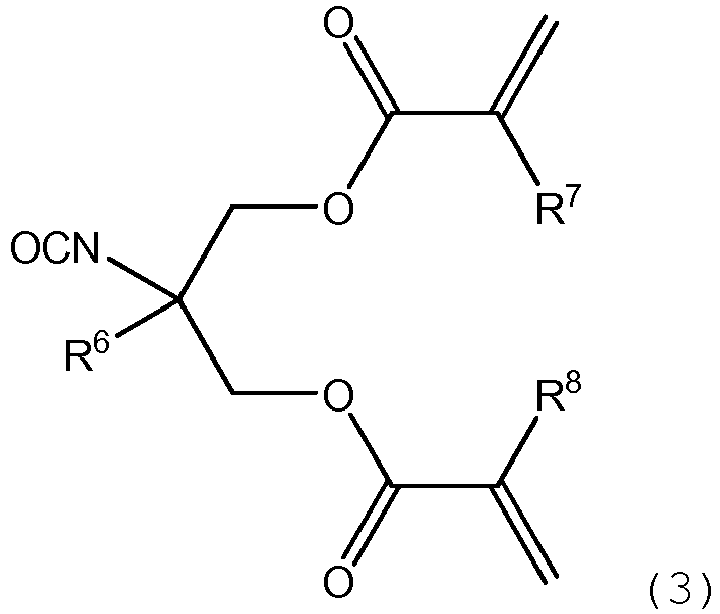
- One of the present methods comprises a step of reacting a silicone compound represented by the following formula (2): wherein m, n, R 1 , R 2 , R 3 , R 4 and R 5 are as defined above; with a (meth)acryl group-containing isocyanate compound represented by the following formula (3): wherein R 6 , R 7 and R 8 are as defined above.
- the reaction is preferably carried out in such a manner that the (meth)acryl group-containing isocyanate compound represented by the formula (3) is slowly added to a solution of the polyorganosiloxane represented by the formula (2) in toluene or hexane to be allowed to react at a temperature of from 0 to 50 degrees C under cooling, for instance, in a water bath.
- the amount of the (meth)acryl group-containing isocyanate compound (3) is 1 to 3 moles, preferably 1.05 to 2 moles, per mole of the polyorganosiloxane represented by the formula (2) . If the amount is smaller than the lower limit, the polyorganosiloxane (2) would remain unreacted in the reaction product and a high ratio of one specific structure of the formula (1) is not attained. If the amount is larger than the upper limit, this is economically disadvantageous.
- the afore-mentioned reactions may be carried out in the presence of a catalyst.
- Any catalyst generally used for isocyanate reactions may be used.
- Preferred are tin compound catalysts and amine catalysts.
- As the tin compound catalysts a tin (II) salt of carboxylic acid and dioctyltin oxide are preferred for its catalyst activity.
- As the amine catalysts tertiary amines such as triethylamine, tributylamine and N-ethyldiisopropylamine are preferred.
- the amount of the catalyst may be 0.001 to 0.1 part by mass, preferably 0.005 to 0.05 part by mass, per 100 parts by mass of the component (2) . If the amount is larger than the upper limit, the catalyst effect may saturate and this is not economical. If the amount is smaller than the lower limit, asufficient catalyst effect is not attained, so that the reacting rate is slow and productivity is worse.
- a polymerization inhibitor may be added, if needed.
- Any conventional polymerization inhibitor for a (meth) acryl compound may be used, such as, for instance, a phenol type polymerization inhibitor such as hydroquinone, hydroquinone monomethyl ether, 2-tert-butyl hydroquinone, 4-methoxy phenol and 2,6-di-tert-butyl-4-methylphenol(BHT). These may be used singly or two or more of them may be used in combination.
- the amount is preferably 5 to 500 ppm, more preferably 10 to 100 ppm, based on the amount of compound to be obtained, but is not limited to these.
- the unreacted silicone compound (2) is monitored in GC. After disappearance of its peak is confirmed, an alcohol, such as methanol or ethanol, is poured into the reaction mixture to inactivate the isocyanate group of the unreacted (meth)acryl group-containing isocyanate compound. Subsequently, an organic solvent and water are added to the mixture and stirred and, then, left standing to allow separation into an organic phase and an aqueous phase. The organic phase is washed several times with water and, then, a silicone compound (1) which has one specific structure is obtained at a high ratio by stripping off the solvent present in the organic phase because almost no side reaction occurs.
- an alcohol such as methanol or ethanol
- the silicone compound represented by the aforesaid formula (2) is prepared by an addition reaction of a polyorganohydrogen siloxane represented by the following formula (4): wherein m, R 1 , R 2 and R 3 are as defined above; with a compound represented by the following formula (5), hereinafter referred to as "allyl ether compound”: wherein n, R 4 and R 5 are as defined above.
- This addition reaction may be carried out in any conventional manner.
- the reaction is carried out in the presence of a hydrosilylation catalyst such as platinum group metal compounds.
- a solvent may be used.
- the solvent include aliphatic or aromatic solvents such as hexane, methylcyclohexane, ethylcyclohexane and toluene; and alcoholic solvents such as ethanol and IPA.
- the ratio of the aforesaid compounds to be used may be according to conventional procedures.
- the amount of the allyl ether compound may be 1.2 moles or more, preferably 1.5 moles or more, per mole of the polyorganohydrogen siloxane.
- the upper limit of the amount may be usually 5 moles or less, particularly 3 moles or less, but is not limited to them.
- the allyl ether compound represented by the aforesaid formula (5) is preferably represented by the following formulas.
- the ally ether compound is optionally diluted with a solvent to which, then, a hydrosilylation catalyst of platinum family is added. Any conventional hydrosilylation catalysts of platinum family may be used and not limited to any particular one.
- the polyorganohydrogen siloxane is added dropwise to the mixture to react at room temperature or a higher temperature. After the completion of the addition, the reaction mixture is held under heating, until disappearance of the peak of the raw material, polyorganohydrogen siloxane, is confirmed, for instance, in GC. After the end point of the reaction is confirmed in GC, the unreacted polyorganohydrogen siloxane does not remain in the product, so that the silicone compound obtained has one specific structure at a higher ratio.
- the aforesaid addition reaction may be conducted in one step.
- the excessive allyl ether compound is removed from the reaction liquid.
- the reaction liquid is subjected to stripping under a reduced pressure, or washed with ion exchanged water or an aqueous sodium sulfate solution to extract the allyl ether compound into an aqueous phase.
- a proper amount of solvent such as toluene and hexane, may preferably be used to attain clear phase separation.
- the solvent is stripped off from the organic phase under a reduced pressure, whereby the silicone compound represented by the aforesaid formula (2) and having a high ratio of one specific structure such as more than 95 mass %, even approximately 97 mass % or more, or even approximately 99 mass % or more, is obtained.
- the silicone compound may be distilled twice or more to further increase the ratio.
- a high ratio means that the amount of the aforesaid one kind of compound having each specific one value of m and n, based on the total amounts of the compound represented by the formula (2), is more than 95 mass %, preferably 97 mass % or more, even more preferably 99 mass % or more.
- the one specific structure means one kind of compound having each one value of m and n, particularly, one kind of compound having each one value of m, n, R 1 , R 2 , R 3 and R 4 and one kind of alkylene oxide structure.
- the polyorganohydrogen siloxane represented by the aforesaid formula (4) may be prepared in known manners.
- the compound (4) wherein m is 3, R 1 is a methyl group, R 2 is an ethylene group and R 3 is a butyl group may be prepared in the following manner.
- BuMe(CF 3 CH 2 CH 2 )SiOLi is synthesized using BuLi.
- 1,3,5-Tris(3,3,3-trifluoropropyl)-1,3,5-trimethylcyclo trisiloxane is subjected to a ring-opening reaction using the BuMe (CF 3 CH 2 CH 2 )SiOLi as an initiator and, then, the reaction is terminated with dimethylchlorosilane.
- a mixture of compounds having m of 2 to 5 is obtained.
- the mixture is distillated to collect a fraction at 146 degrees C and 84 Pa to obtain a compound whose m is 3, at a ratio of 98 mass % or higher in the fraction obtained.
- the distillation may be carried out after the mixture is addition reacted with the allyl ether compound represented by the formula (5) .
- the product of the addition reaction has a higher boiling point. Therefore, the former manner is preferred.
- a silicone compound (2) having one specific structure is obtained at a higher ratio.
- the silicone compound (2) may be prepared also by the steps of subjecting the allyl ether to a silylation to provide a silyl ester with a silylating agent such as hexamethyldisilazane, addition reacting the compound obtained in the aforesaid manner and, then, hydrolyzing the silyl ester.
- a silylating agent such as hexamethyldisilazane
- the silicone compound of the present invention is well compatible with other compounds having a group polymerizable with the silicone compounds, such as compounds having a (meth)acryl group, hereinafter referred to as "polymerizable monomer". Therefore, the silicone compound copolymerizes with the polymerizable monomer to provide a colorless and transparent polymer.
- the silicone compound is well compatible with a fluorinated substituent group-containing (meth)acryl monomer, so that hydrophilicity and anti-staining property of the polymer obtained are increased.
- polymerizable monomer examples include acryl monomers such as (meth)acrylic acid, methyl (meth)acrylate, ethyl (meth)acrylate, (poly)ethylene glycol dimethacrylate, polyalkylene glycol mono(meth)acrylate, polyalkylene glycol monoalkyl ether (meth)acrylate, trifluoroethyl (meth)acrylate, 2-hydroxyethyl (meth)acrylate, and 2,3-dihydroxypropyl (meth) acrylate; acrylic acid derivatives such as N, N-dimethyl acrylamide, N, N-diethyl acrylamide, N-acryloyl morpholine, and N-methyl (meth)acrylamide; other ethylenically unsaturated aliphatic or aromatic compound such as crotonic acid, cinnamic acid, and vinyl benzoic acid; and silicone compounds having polymerizable groups such as a (meth)acryl group. These may be used singly
- the present silicone compound has two (meth) acryl groups, so that it functions well as a crosslinking component. Therefore, the silicone compound is useful as a crosslinking agent for a polymerizable monomer and provides a colorless and transparent polymer having good durability of mechanical strength.
- the present compound is well compatible with a silicone monomer having a polymerizable group such as a (meth)acryl group. Any conventional polymerizable monomers known as ophthalmic monomers may be used.
- silicone monomers having a (meth)acryl group at one terminal and a siloxane structure at the other terminal For instance, silicone monomers described in Patent Literature 1 to 6 may be used.
- the amount of the silicone compound may preferably be 0.1 to 50 parts by mass, more preferably 0.5 to 20 parts by mass, relative to 100 parts by mass of the total amount of the other polymerizable monomers, in particular, the other polymerizable silicone monomer. Because the present silicone compound has one specific structure at a high ratio itself, a polymer obtained has high transparency.
- one or more other compounds which function as a crosslinking component may be polymerized with the present silicone compound and the aforesaid polymerizable monomer.
- the compound may be bifunctional or polyfunctional (meth) acrylates.
- the bifunctional acrylates include 1,4-butanediol diacrylate, 1,6-hexanediol diacrylate, neopentylglycol diacrylate, polyethylene glycol diacrylate, neopentylglycol hydroxypivalate diacrylate, dicyclopentanyl diacrylate, caprolactone-modified dicyclopentenyl diacrylate, ethylene oxide-modified phosphate diacrylate, allylated cyclohexyl diacrylate, and isocyanurate diacrylate.
- polyfunctional acrylates examples include trimethylol propane triacrylate, dipentaerythritol triacrylate, propionic acid-modified dipentaerythritol triacrylate, pentaerythritol triacrylate, propylene oxide-modified trimethylolpropane triacrylate, tris(2-acryloxyethyl) isocyanulate, dipentaerythritol pentaacrylate, propionic acid-modified dipentaerythritol pentaacrylate, dipentaerythritol hexaacrylate, and caprolactone-modified dipentaerythritol hexaacrylate.
- bifunctional methacrylates examples include ethylene glycol dimethacrylate, triethylene glycol dimethacrylate, 1,4-butanediol dimethacrylate, neopentylglycol dimethacrylate, 1,6-hexanediol dimethacrylate, 1,9-nonanediol dimethacrylate, 1,10-decanediol dimethacrylate, glycerin dimethacrylate, and dimethyloltricyclodecane dimethacrylate.
- the polyfunctional methacrylates include trimethylol propane trimethacrylate and ethoxylated trimethylol propane trimethacrylate.
- the amount of the compound may be preferably 0.1 to 50 parts by mass, further preferably 0.5 to 20 parts by mass, relative to 100 parts by mass of the total amount of the other polymerizable monomers.
- the copolymerization of the present compound and the other polymerizable monomer mentioned just above may be carried out in conventional known manners.
- known polymerization initiator such as thermal polymerization initiators or photo polymerization initiators may be used.
- the polymerization initiator include 2-hydroxy-2-methyl-1-phenyl-propane-1-one, azobis isobutyronitrile, azobis dimethylvaleronitrile, benzoyl peroxide, tert-butyl hydroperoxide, and cumene hydroperoxide.
- the polymerization initiator may be used singly or two or more of them may be used in combination.
- the amount of the polymerization initiator is 0.001 to 2 parts by mass, preferably 0.01 to 1 part by mass, relative to 100 parts by mass of a total amount of the polymerizable components.
- a polymer having a unit derived from the compound in the present invention has high oxygen permeability and excellent hydrophilicity, anti-staining property and durability of mechanical strength in a phosphate buffer solution. Therefore, the present compounds are suitable as materials for preparing ophthalmic devices such as contact lenses, intraocular lenses and artificial corneas.
- the method for preparation of the ophthalmic device with the present polymer may be any conventional ones. For instance, a machining method and a molding method may be used for forming lenses such as contact lenses and intraocular lenses.
- the viscosity was determined by a Cannon-Fenske viscosimeter and the specific gravity was as determined by a hydrometer.
- the refraction index was as determined by a digital refractometer RX-5000, ex Atago Co., Ltd.
- 1 H-NMR analysis was conducted by JNM-ECP500, ex JEOL Ltd. with deuterochloroform as the measuring solvent.
- the ratio of a compound was determined by gas chromatography, i.e. GC. Conditions in GC were as follows.
- the reaction mixture was held at 15 degrees C for one hour, to which a mixture of 337.4 g (0.72 mol) of 1,3,5-tris(3,3,3-trifluoropropyl)-1,3,5-trimethylcyclo trisiloxane and 270 g of tetrahydrofuran was then added dropwise over two hours at the internal temperature of 0 to 5 degrees C.
- the reaction mixture was aged at the internal temperature of 0 to 5 degrees C for two hours and, then further at the internal temperature of 20 to 25 degrees C for one hour.
- the mixture was distillated to collect a fraction at 146 degrees C and 84 Pa to obtain 255 g of a product with a yield of 47.8 % (0.34 mol) .
- 1 H-NMR analysis showed that the product was a compound represented by the following formula (6).
- the ratio of the compound represented by the following formula (6) in the obtained product was 98.4 mass %, as determined in GC, the viscosity was 11 mm 2 /s at 25 degrees C, the specific gravity was 1.144 at 25 degrees C and the refraction index was 1.3810.
- the reaction mixture was held at 100 degrees C for one hour and, then, analyzed in GC.
- the peak of the compound represented by the aforesaid formula (6) disappeared, which means that the reaction completed.
- 100 Grams of ion exchanged water were added to the reaction mixture with stirring to wash it and, then, left standing to cause phase separation.
- the aqueous phase containing the excessive ethylene glycol monoallyl ether was removed.
- the organic phase was similarly washed twice with each 100 g of ion exchanged water and, then, the toluene in the organic phase was stripped off under a reduced pressure to obtain 193.7 g (0.23 mol) of a colorless and transparent liquid, silicone compound represented by the following formula (8).
- the yield was 92 %.
- the ratio of the silicone compound represented by the following formula (8) in the obtained product was 98.1 mass %, as determined in GC.
- the mixture was held at 40 degrees C, while monitoring the peak of the silicone compound represented by the formula (8) in GC. Four hours later, the intensity of the peak of the silicone compound fell down below the detection limit by GC and, then, 4.0 g (0.125 mol) of methanol was added to the reaction mixture. Further, 180 g of hexane and 180 g of ion exchanged water were added to the reaction mixture to wash it. The reaction mixture was left standing to cause phase separation. The aqueous phase was removed and, subsequently, the organic phase was washed twice with ion exchanged water.
- silicone compound 1 a silicone compound represented by the following formula (10), hereinafter referred to as silicone compound 1.
- the yield was 79 % and the aforesaid amount (213.5 g) was 0.2 mol.
- the ratio of the silicone compound represented by the following formula (10) in the product was 97.3 mass %, as determined in GC, the viscosity was 258.8 mm 2 /s at 25 degrees C, the specific gravity was 1.171 at 25 degrees C and the refraction index was 1.4199.
- Example 9 The procedures of Example 9 described in Japanese Patent Application Laid-Open No. 2008-274278 , Patent Literature 8, were repeated to synthesize a polysiloxane represented by the following formula (11).
- the obtained product was a mixture of a compound wherein m was 0, a compound wherein m was 3, a compound wherein m was 6, and a compound wherein m was 9, hereinafter referred to as silicone compound 2.
- Example 1 The procedures of Example 1 described in Japanese Patent No. 4646152 , Patent Literature 6, were repeated to synthesize a compound represented by the following formula (12), hereinafter referred to as silicone compound 3.
- the obtained compound was a colorless and transparent liquid.
- the ratio of the silicone compound represented by the aforesaid formula (12) in the obtained product was 98.3 mass %, as determined in GC.
- silicone compound 4 a compound represented by the following formula (13), hereinafter referred to as silicone compound 4.
- the silicone compound obtained was a mixture of compounds having various values of n with an average of 60 in the following formula.
- the viscosity was 87 mm 2 /s at 25 degrees C and the refraction index was 1.4082.
- Example 2 The procedures of Example 1 were repeated, except that 117.5 g (0.25 mol) of the silicone compound represented by the formula (14) was used in place of 128.5 g (0.25 mol) of the silicone compound represented by the formula (8). 145.3 grams of a colorless and transparent liquid product was obtained. 1 H-NMR (300MHz) analysis showed that the obtained compound in the product was a silicone compound represented by the following formula (15), hereinafter referred to as silicone compound 5. The yield was 82 % and the aforesaid amount (145.3 g) was 0.2 mol.
- the ratio of the silicone compound represented by the following formula (15) in the product was 97.8 mass %, as determined in GC, the viscosity was 75.6 mm 2 /s at 25 degrees C, the specific gravity was 1.023 at 25 degrees C and the refraction index was 1.4451.
- Example 2 The procedures of Example 1 were repeated, except that 150.5 g (0.25 mol) of the silicone compound represented by the formula (16) was used in place of 128.5 g (0.25 mol) of the silicone compound represented by the formula (8). 168.2 grams of a colorless and transparent liquid product was obtained. 1 H-NMR (300MHz) analysis showed that the obtained compound in the product was a silicone compound represented by the following formula (17), hereinafter referred to as silicone compound 6. The yield was 80 % and the aforesaid amount (168.2 g) was 0.2 mol.
- the ratio of the silicone compound represented by the following formula (17) in the product was 97.8 mass %, as determined in GC, the viscosity was 96.2 mm 2 /s at 25 degrees C, the specific gravity was 1.010 at 25 degrees C and the refraction index was 1.437.
- Monomer mixtures 1 to 9 were prepared in the following manner, using the silicone compounds 1 prepared in Example 1 and silicone compounds 2 to 6 prepared in Comparative Synthesis Examples 2 to 6.
- Example 3 trifluoroethyl methacrylate was not used.
- Comparative Example 6 triethylene glycol dimethacrylate was used in place of the silicone compounds as a crosslinking agent.
- Comparative Example 7 no crosslinking agent was used.
- Monomer mixtures 1 to 9 obtained were evaluated in the following manners. The results are as shown in Table 1.
- Two films for each mixture were prepared in the same manner as in (2) above.
- One of the two films was soaked in a phosphate buffer solution, PBS (-), at 37 degrees C for 24 hours.
- the film after soaking and the other film (without being soaked) were stored in a well-known artificial lipid solution at 37 plus - minus 2 degrees C for 8 hours.
- the films were washed with PBS(-) and, subsequently, soaked in a 0.1 % solution of sudan black sesame oil.
- the films were evaluated as "good”.
- the color of the film after soaking was different from the film without soaking, that is, the film was stained with the sudan black sesame oil, the film was evaluated as "bad".
- Two films for each mixture were prepared in the same manner as in (2) above. Any water on the surface of the films was wiped off. Then, one of the two films was soaked in a phosphate buffer solution, PBS(-), at 37 degrees C for 24 hours. The film after soaking and the other film (without being soaked) were cut into test samples having a dumbbell shape of a width of 2.0 mm. The top and the bottom of the test sample was held by a jig and pulled at a constant speed. Tensile strength and elongation at break were determined with a tensile tester AGS-50NJ, ex Shimadzu Corporation.
- the compounds used in Comparative Examples 1-3 and 5-7 were less compatible with the other (meth) acryl monomers and did not provide a colorless and transparent polymer. Further, the polymers obtained from the monomer mixtures had poor water wettability (hydrophilicity) and anti-staining property and the mechanical strength deteriorated in the phosphate buffer solution.
- the compound used in Comparative Example 4 was less compatible with the other (meth)acryl monomers and did not provide a colorless and transparent polymer. Further, the polymers obtained from the monomer mixtures had poor water wettability (hydrophilicity) and anti-staining property. Triethylene glycol dimethacrylate does not have any silicone chain and has poor compatibility with a silicone monomer. Therefore, as shown in Table 1, Comparative Example 6, a transparent polymer was not provided.
- the silicone compound of the present invention is well compatible with the other (meth)acryl monomer and provides a colorless and transparent polymer. Further, the silicone compound is well compatible with a fluorinated (meth)acryl monomer, too. Therefore, the silicone compound provides a polymer having excellent water wettability and anti-staining property and mechanical strength. The mechanical strength does not deteriorate in a phosphate buffer solution. Further, as shown in Example 3 of Table 1, the present silicone compound provides, on account of its fluorinated hydrocarbon group, a polymer having an excellent anti-staining property without other fluorinated monomer.
- the polymerizable silicone monomer, TRIS was less compatible with the other (meth)acryl monomer compounds and did not provide a transparent mixture or polymer.
- Examples 2 and 3 when the present silicone compound was mixed with the mixture of the polymerizable silicone monomer, TRIS, and the other (meth) acryl compounds, a transparent mixture and polymer were provided. That is, the present silicone compound functioned well as a compatibilizing agent in addition to a crosslinking agent.
- the compound of the present invention is well compatible with other polymerizable monomers, in particular (meth)acryl silicone monomers and fluorinated substituent group-containing (meth)acryl silicone monomers.
- a polymer having a unit derived from the present compound has good oxygen permeability, has colorlessness and transparency, and good mechanical strength, and, further has good hydrophilicity and anti-staining property. Further the mechanical strength of the polymer obtained does not deteriorate in a phosphate buffer solution and the durability of mechanical strength is excellent.
- the present method provides a compound having one specific structure at a high ratio. Accordingly, the present compound and the present method are useful for preparing ophthalmic devices such as contact lenses, intraocular lenses and artificial corneas.
Landscapes
- Chemical & Material Sciences (AREA)
- Organic Chemistry (AREA)
- Health & Medical Sciences (AREA)
- Chemical Kinetics & Catalysis (AREA)
- Medicinal Chemistry (AREA)
- Polymers & Plastics (AREA)
- Physics & Mathematics (AREA)
- General Physics & Mathematics (AREA)
- Optics & Photonics (AREA)
- Eyeglasses (AREA)
- Addition Polymer Or Copolymer, Post-Treatments, Or Chemical Modifications (AREA)
- Ophthalmology & Optometry (AREA)
- Cardiology (AREA)
- Oral & Maxillofacial Surgery (AREA)
- Transplantation (AREA)
- Engineering & Computer Science (AREA)
- Biomedical Technology (AREA)
- Heart & Thoracic Surgery (AREA)
- Vascular Medicine (AREA)
- Life Sciences & Earth Sciences (AREA)
- Animal Behavior & Ethology (AREA)
- General Health & Medical Sciences (AREA)
- Public Health (AREA)
- Veterinary Medicine (AREA)
Claims (10)
- Verbindung, dargestellt durch die folgende Formel (1):

- Verbindung nach Anspruch 1, wobei die Menge von einer Art von Verbindung mit jeweils einem Wert von m und n in der Formel (1) mehr als 95 Gew.-% von der Gesamtmasse der Verbindung ist.
- Verbindung nach Anspruch 1 oder 2, wobei m in der Formel (1) 3 ist.
- Polymer mit sich wiederholenden Einheiten, abgeleitet von der Verbindung nach einem der Ansprüche 1 bis 3, und sich wiederholenden Einheiten, abgeleitet von mindestens einer anderen Verbindung mit einer Gruppe, die mit der Verbindung polymerisierbar ist.
- Polymer nach Anspruch 4, wobei die andere Verbindung ein Silikonmonomer einschließt.
- Polymer nach Anspruch 5, wobei eine Menge von der Verbindung nach einem der Ansprüche 1 bis 3 0, 1 bis 50 Gewichtsteile bezogen auf 100 Gewichtsteile des Silikonmonomers beträgt.
- Ophthalmische Vorrichtung, zusammengesetzt aus dem Polymer nach einem der Ansprüche 4 bis 6.
- Verfahren zur Herstellung einer Verbindung, dargestellt durch die folgende Formel (1):


- Verfahren nach Anspruch 8, wobei die Menge von einer Art von Verbindung mit jeweils einem Wert von m und n in der Formel (1) mehr als 95 Gew.-% von einer Gesamtmasse der Verbindung ist.
- Verfahren nach Anspruch 8 oder 9, wobei m in der Formel (1) 3 ist.
Applications Claiming Priority (2)
| Application Number | Priority Date | Filing Date | Title |
|---|---|---|---|
| JP2014121257 | 2014-06-12 | ||
| JP2015112952A JP6356635B2 (ja) | 2014-06-12 | 2015-06-03 | 眼科デバイス製造用モノマー |
Publications (2)
| Publication Number | Publication Date |
|---|---|
| EP2955207A1 EP2955207A1 (de) | 2015-12-16 |
| EP2955207B1 true EP2955207B1 (de) | 2018-02-14 |
Family
ID=53397845
Family Applications (1)
| Application Number | Title | Priority Date | Filing Date |
|---|---|---|---|
| EP15171249.4A Active EP2955207B1 (de) | 2014-06-12 | 2015-06-09 | Silikonverbindung und verwendung davon |
Country Status (3)
| Country | Link |
|---|---|
| US (1) | US9284339B2 (de) |
| EP (1) | EP2955207B1 (de) |
| JP (1) | JP6356635B2 (de) |
Cited By (1)
| Publication number | Priority date | Publication date | Assignee | Title |
|---|---|---|---|---|
| EP3627212B1 (de) * | 2017-05-19 | 2023-07-26 | Toray Industries, Inc. | Kontaktlinsenzusammensetzung und kontaktlinse sowie herstellungsverfahren dafür |
Families Citing this family (3)
| Publication number | Priority date | Publication date | Assignee | Title |
|---|---|---|---|---|
| EP4265657A4 (de) * | 2020-12-21 | 2024-11-27 | Dow Toray Co., Ltd. | Radikalische copolymerzusammensetzung, herstellungsverfahren dafür und kosmetische oder kosmetische zutat mit der radikalischen copolymerzusammensetzung |
| EP4660219A1 (de) * | 2023-01-30 | 2025-12-10 | Shin-Etsu Chemical Co., Ltd. | Seitenkettenurethanmodifiziertes silikonmakromer und copolymer davon |
| TW202511327A (zh) * | 2023-08-31 | 2025-03-16 | 日商捷恩智股份有限公司 | 隱形眼鏡用組成物、隱形眼鏡及隱形眼鏡的製造方法 |
Family Cites Families (30)
| Publication number | Priority date | Publication date | Assignee | Title |
|---|---|---|---|---|
| JPS5978236A (ja) | 1982-10-28 | 1984-05-07 | Toagosei Chem Ind Co Ltd | ビニル重合反応性直鎖シリコ−ン高分子量モノマ−の製造法 |
| US4543398A (en) * | 1983-04-28 | 1985-09-24 | Minnesota Mining And Manufacturing Company | Ophthalmic devices fabricated from urethane acrylates of polysiloxane alcohols |
| US4709066A (en) * | 1985-07-15 | 1987-11-24 | Fused Kontacts Of Chicago | Acrylic silicate compositions and methods and highly oxygen-permeable polyacrylates made therefrom |
| JP3014408B2 (ja) * | 1990-05-18 | 2000-02-28 | ノバルティス アクチエンゲゼルシャフト | 酸素透過性高分子材料の製造方法 |
| JP2954691B2 (ja) * | 1990-10-31 | 1999-09-27 | ノバルティス アクチエンゲゼルシャフト | 酸素透過性重合体の製造法 |
| JPH06230320A (ja) * | 1993-02-08 | 1994-08-19 | Asahi Chem Ind Co Ltd | 装用性に優れたソフトコンタクトレンズ |
| US5321108A (en) * | 1993-02-12 | 1994-06-14 | Bausch & Lomb Incorporated | Fluorosilicone hydrogels |
| DE29624309U1 (de) * | 1995-04-04 | 2002-01-03 | Commonwealth Scientific And Industrial Research Organisation, Campbell | Dauertraglinsen |
| TW393498B (en) * | 1995-04-04 | 2000-06-11 | Novartis Ag | The preparation and use of Polysiloxane-comprising perfluoroalkyl ethers |
| ES2191779T3 (es) * | 1995-12-07 | 2003-09-16 | Bausch & Lomb | Composiciones de silicona polimeras con bajo contenido en agua y modulo reducido. |
| KR100468803B1 (ko) * | 1995-12-07 | 2005-04-19 | 바슈 앤드 롬 인코포레이티드 | 실리콘히드로겔의모듈러스를감소시키는데유용한단량체단위 |
| US6310169B1 (en) * | 1999-03-08 | 2001-10-30 | Chisso Corporation | Polymerizable terminal group-containing polyorganosiloxane and production process for the same |
| CA2372930A1 (en) * | 1999-05-12 | 2000-11-23 | Eri Ito | Ocular lens materials and process for producing the same |
| JP2001055446A (ja) | 1999-08-18 | 2001-02-27 | Chisso Corp | ポリオルガノシロキサンおよびその製造方法 |
| US6649722B2 (en) | 1999-12-10 | 2003-11-18 | Novartis Ag | Contact lens |
| KR100522339B1 (ko) * | 1999-12-16 | 2005-10-20 | 아사히 가세이 아이미 가부시끼가이샤 | 장기간 착용이 가능한 소프트 콘택트 렌즈 |
| JP4524838B2 (ja) * | 2000-02-07 | 2010-08-18 | 東レ株式会社 | 眼用レンズ |
| JP4273612B2 (ja) * | 2000-03-03 | 2009-06-03 | 東レ株式会社 | 眼用レンズ |
| JP4882136B2 (ja) | 2000-05-12 | 2012-02-22 | 東レ株式会社 | モノマー、ポリマーおよびそれを用いた眼用レンズ |
| WO2003042222A1 (en) * | 2001-10-02 | 2003-05-22 | Johnson & Johnson Vision Care, Inc. | Monomer, polymer, and ocular lens comprising the same |
| JP4802569B2 (ja) | 2005-06-23 | 2011-10-26 | 東レ株式会社 | シリコーンモノマーの製造方法 |
| EP1818692A3 (de) * | 2006-02-08 | 2010-05-19 | Johson & Johnson Vision Care Inc. | Ablösungshilfen zur Ablösung ophthalmischer Silikon-Wasserstoff-Linsen |
| JP2008019402A (ja) * | 2006-07-14 | 2008-01-31 | Jsr Corp | 硬化性樹脂組成物及び反射防止膜 |
| JP2007186709A (ja) | 2007-03-05 | 2007-07-26 | Toray Ind Inc | 眼用レンズ用モノマー、眼用レンズ用ポリマーおよびコンタクトレンズ |
| US7799888B2 (en) * | 2007-04-27 | 2010-09-21 | Gelest, Inc. | Low molecular weight siloxanes with one functional group |
| JP4646152B2 (ja) * | 2008-05-27 | 2011-03-09 | 信越化学工業株式会社 | 眼科デバイス製造用モノマー |
| GB0917806D0 (en) * | 2009-10-12 | 2009-11-25 | Sauflon Cl Ltd | Fluorinated silicone hydrogels |
| KR101759373B1 (ko) * | 2011-02-28 | 2017-07-18 | 쿠퍼비젼 인터내셔날 홀딩 캄파니, 엘피 | 실리콘 히드로겔 콘택트 렌즈 |
| JP5929131B2 (ja) * | 2011-11-30 | 2016-06-01 | 信越化学工業株式会社 | (メタ)アクリル基含オルガノポリシロキサン及びその製造方法、並びに重合物 |
| US9266985B2 (en) * | 2013-11-14 | 2016-02-23 | Shin-Etsu Chemical Co., Ltd. | Silicone compound and a use thereof |
-
2015
- 2015-06-03 JP JP2015112952A patent/JP6356635B2/ja active Active
- 2015-06-04 US US14/730,904 patent/US9284339B2/en active Active
- 2015-06-09 EP EP15171249.4A patent/EP2955207B1/de active Active
Non-Patent Citations (1)
| Title |
|---|
| None * |
Cited By (1)
| Publication number | Priority date | Publication date | Assignee | Title |
|---|---|---|---|---|
| EP3627212B1 (de) * | 2017-05-19 | 2023-07-26 | Toray Industries, Inc. | Kontaktlinsenzusammensetzung und kontaktlinse sowie herstellungsverfahren dafür |
Also Published As
| Publication number | Publication date |
|---|---|
| EP2955207A1 (de) | 2015-12-16 |
| US20150361114A1 (en) | 2015-12-17 |
| US9284339B2 (en) | 2016-03-15 |
| JP2016014013A (ja) | 2016-01-28 |
| JP6356635B2 (ja) | 2018-07-11 |
Similar Documents
| Publication | Publication Date | Title |
|---|---|---|
| CN110494457B (zh) | 聚硅氧烷单体及其制备方法 | |
| JP2010095589A (ja) | 眼科デバイス製造用シリコーン | |
| EP3085727B1 (de) | Silikon und verwendung davon | |
| JP6037454B2 (ja) | 眼科デバイス製造用モノマー | |
| EP2952515B1 (de) | Silikonverbindung und eine verwendung davon | |
| EP2955207B1 (de) | Silikonverbindung und verwendung davon | |
| JP6045515B2 (ja) | 眼科デバイス製造用モノマー | |
| EP2955208B1 (de) | Silikonverbindung und verwendung davon | |
| WO2020246313A1 (ja) | シロキサン及びその製造方法 | |
| EP2921497B1 (de) | Silikonverbindung und verwendung davon | |
| JP6356628B2 (ja) | 眼科デバイス製造用モノマー、その重合体、及び眼科デバイス | |
| JP6305323B2 (ja) | 共重合体および眼科デバイス | |
| JP6195418B2 (ja) | 眼科デバイス製造用モノマー | |
| JP6073207B2 (ja) | 眼科デバイス製造用モノマー | |
| JP6037453B2 (ja) | 眼科デバイス製造用モノマー | |
| JP7145123B2 (ja) | シロキサンの製造方法 | |
| JP6335836B2 (ja) | 眼科デバイス製造用モノマー、その重合体、及び眼科デバイス |
Legal Events
| Date | Code | Title | Description |
|---|---|---|---|
| PUAI | Public reference made under article 153(3) epc to a published international application that has entered the european phase |
Free format text: ORIGINAL CODE: 0009012 |
|
| AK | Designated contracting states |
Kind code of ref document: A1 Designated state(s): AL AT BE BG CH CY CZ DE DK EE ES FI FR GB GR HR HU IE IS IT LI LT LU LV MC MK MT NL NO PL PT RO RS SE SI SK SM TR |
|
| AX | Request for extension of the european patent |
Extension state: BA ME |
|
| 17P | Request for examination filed |
Effective date: 20160217 |
|
| RBV | Designated contracting states (corrected) |
Designated state(s): AL AT BE BG CH CY CZ DE DK EE ES FI FR GB GR HR HU IE IS IT LI LT LU LV MC MK MT NL NO PL PT RO RS SE SI SK SM TR |
|
| GRAP | Despatch of communication of intention to grant a patent |
Free format text: ORIGINAL CODE: EPIDOSNIGR1 |
|
| INTG | Intention to grant announced |
Effective date: 20171103 |
|
| GRAS | Grant fee paid |
Free format text: ORIGINAL CODE: EPIDOSNIGR3 |
|
| GRAA | (expected) grant |
Free format text: ORIGINAL CODE: 0009210 |
|
| AK | Designated contracting states |
Kind code of ref document: B1 Designated state(s): AL AT BE BG CH CY CZ DE DK EE ES FI FR GB GR HR HU IE IS IT LI LT LU LV MC MK MT NL NO PL PT RO RS SE SI SK SM TR |
|
| REG | Reference to a national code |
Ref country code: GB Ref legal event code: FG4D |
|
| REG | Reference to a national code |
Ref country code: CH Ref legal event code: EP |
|
| REG | Reference to a national code |
Ref country code: IE Ref legal event code: FG4D |
|
| REG | Reference to a national code |
Ref country code: DE Ref legal event code: R096 Ref document number: 602015007972 Country of ref document: DE Ref country code: AT Ref legal event code: REF Ref document number: 969799 Country of ref document: AT Kind code of ref document: T Effective date: 20180315 |
|
| REG | Reference to a national code |
Ref country code: FR Ref legal event code: PLFP Year of fee payment: 4 |
|
| REG | Reference to a national code |
Ref country code: NL Ref legal event code: MP Effective date: 20180214 |
|
| REG | Reference to a national code |
Ref country code: AT Ref legal event code: MK05 Ref document number: 969799 Country of ref document: AT Kind code of ref document: T Effective date: 20180214 |
|
| PG25 | Lapsed in a contracting state [announced via postgrant information from national office to epo] |
Ref country code: HR Free format text: LAPSE BECAUSE OF FAILURE TO SUBMIT A TRANSLATION OF THE DESCRIPTION OR TO PAY THE FEE WITHIN THE PRESCRIBED TIME-LIMIT Effective date: 20180214 Ref country code: NL Free format text: LAPSE BECAUSE OF FAILURE TO SUBMIT A TRANSLATION OF THE DESCRIPTION OR TO PAY THE FEE WITHIN THE PRESCRIBED TIME-LIMIT Effective date: 20180214 Ref country code: LT Free format text: LAPSE BECAUSE OF FAILURE TO SUBMIT A TRANSLATION OF THE DESCRIPTION OR TO PAY THE FEE WITHIN THE PRESCRIBED TIME-LIMIT Effective date: 20180214 Ref country code: ES Free format text: LAPSE BECAUSE OF FAILURE TO SUBMIT A TRANSLATION OF THE DESCRIPTION OR TO PAY THE FEE WITHIN THE PRESCRIBED TIME-LIMIT Effective date: 20180214 Ref country code: NO Free format text: LAPSE BECAUSE OF FAILURE TO SUBMIT A TRANSLATION OF THE DESCRIPTION OR TO PAY THE FEE WITHIN THE PRESCRIBED TIME-LIMIT Effective date: 20180514 Ref country code: FI Free format text: LAPSE BECAUSE OF FAILURE TO SUBMIT A TRANSLATION OF THE DESCRIPTION OR TO PAY THE FEE WITHIN THE PRESCRIBED TIME-LIMIT Effective date: 20180214 Ref country code: CY Free format text: LAPSE BECAUSE OF FAILURE TO SUBMIT A TRANSLATION OF THE DESCRIPTION OR TO PAY THE FEE WITHIN THE PRESCRIBED TIME-LIMIT Effective date: 20180214 |
|
| PG25 | Lapsed in a contracting state [announced via postgrant information from national office to epo] |
Ref country code: LV Free format text: LAPSE BECAUSE OF FAILURE TO SUBMIT A TRANSLATION OF THE DESCRIPTION OR TO PAY THE FEE WITHIN THE PRESCRIBED TIME-LIMIT Effective date: 20180214 Ref country code: SE Free format text: LAPSE BECAUSE OF FAILURE TO SUBMIT A TRANSLATION OF THE DESCRIPTION OR TO PAY THE FEE WITHIN THE PRESCRIBED TIME-LIMIT Effective date: 20180214 Ref country code: AT Free format text: LAPSE BECAUSE OF FAILURE TO SUBMIT A TRANSLATION OF THE DESCRIPTION OR TO PAY THE FEE WITHIN THE PRESCRIBED TIME-LIMIT Effective date: 20180214 Ref country code: RS Free format text: LAPSE BECAUSE OF FAILURE TO SUBMIT A TRANSLATION OF THE DESCRIPTION OR TO PAY THE FEE WITHIN THE PRESCRIBED TIME-LIMIT Effective date: 20180214 Ref country code: GR Free format text: LAPSE BECAUSE OF FAILURE TO SUBMIT A TRANSLATION OF THE DESCRIPTION OR TO PAY THE FEE WITHIN THE PRESCRIBED TIME-LIMIT Effective date: 20180515 Ref country code: BG Free format text: LAPSE BECAUSE OF FAILURE TO SUBMIT A TRANSLATION OF THE DESCRIPTION OR TO PAY THE FEE WITHIN THE PRESCRIBED TIME-LIMIT Effective date: 20180514 |
|
| PG25 | Lapsed in a contracting state [announced via postgrant information from national office to epo] |
Ref country code: AL Free format text: LAPSE BECAUSE OF FAILURE TO SUBMIT A TRANSLATION OF THE DESCRIPTION OR TO PAY THE FEE WITHIN THE PRESCRIBED TIME-LIMIT Effective date: 20180214 Ref country code: IT Free format text: LAPSE BECAUSE OF FAILURE TO SUBMIT A TRANSLATION OF THE DESCRIPTION OR TO PAY THE FEE WITHIN THE PRESCRIBED TIME-LIMIT Effective date: 20180214 Ref country code: EE Free format text: LAPSE BECAUSE OF FAILURE TO SUBMIT A TRANSLATION OF THE DESCRIPTION OR TO PAY THE FEE WITHIN THE PRESCRIBED TIME-LIMIT Effective date: 20180214 Ref country code: PL Free format text: LAPSE BECAUSE OF FAILURE TO SUBMIT A TRANSLATION OF THE DESCRIPTION OR TO PAY THE FEE WITHIN THE PRESCRIBED TIME-LIMIT Effective date: 20180214 Ref country code: RO Free format text: LAPSE BECAUSE OF FAILURE TO SUBMIT A TRANSLATION OF THE DESCRIPTION OR TO PAY THE FEE WITHIN THE PRESCRIBED TIME-LIMIT Effective date: 20180214 |
|
| REG | Reference to a national code |
Ref country code: DE Ref legal event code: R097 Ref document number: 602015007972 Country of ref document: DE |
|
| PG25 | Lapsed in a contracting state [announced via postgrant information from national office to epo] |
Ref country code: SK Free format text: LAPSE BECAUSE OF FAILURE TO SUBMIT A TRANSLATION OF THE DESCRIPTION OR TO PAY THE FEE WITHIN THE PRESCRIBED TIME-LIMIT Effective date: 20180214 Ref country code: CZ Free format text: LAPSE BECAUSE OF FAILURE TO SUBMIT A TRANSLATION OF THE DESCRIPTION OR TO PAY THE FEE WITHIN THE PRESCRIBED TIME-LIMIT Effective date: 20180214 Ref country code: DK Free format text: LAPSE BECAUSE OF FAILURE TO SUBMIT A TRANSLATION OF THE DESCRIPTION OR TO PAY THE FEE WITHIN THE PRESCRIBED TIME-LIMIT Effective date: 20180214 Ref country code: SM Free format text: LAPSE BECAUSE OF FAILURE TO SUBMIT A TRANSLATION OF THE DESCRIPTION OR TO PAY THE FEE WITHIN THE PRESCRIBED TIME-LIMIT Effective date: 20180214 |
|
| PLBE | No opposition filed within time limit |
Free format text: ORIGINAL CODE: 0009261 |
|
| STAA | Information on the status of an ep patent application or granted ep patent |
Free format text: STATUS: NO OPPOSITION FILED WITHIN TIME LIMIT |
|
| 26N | No opposition filed |
Effective date: 20181115 |
|
| REG | Reference to a national code |
Ref country code: CH Ref legal event code: PL |
|
| PG25 | Lapsed in a contracting state [announced via postgrant information from national office to epo] |
Ref country code: SI Free format text: LAPSE BECAUSE OF FAILURE TO SUBMIT A TRANSLATION OF THE DESCRIPTION OR TO PAY THE FEE WITHIN THE PRESCRIBED TIME-LIMIT Effective date: 20180214 |
|
| REG | Reference to a national code |
Ref country code: BE Ref legal event code: MM Effective date: 20180630 |
|
| REG | Reference to a national code |
Ref country code: IE Ref legal event code: MM4A |
|
| PG25 | Lapsed in a contracting state [announced via postgrant information from national office to epo] |
Ref country code: MC Free format text: LAPSE BECAUSE OF FAILURE TO SUBMIT A TRANSLATION OF THE DESCRIPTION OR TO PAY THE FEE WITHIN THE PRESCRIBED TIME-LIMIT Effective date: 20180214 Ref country code: LU Free format text: LAPSE BECAUSE OF NON-PAYMENT OF DUE FEES Effective date: 20180609 |
|
| PG25 | Lapsed in a contracting state [announced via postgrant information from national office to epo] |
Ref country code: CH Free format text: LAPSE BECAUSE OF NON-PAYMENT OF DUE FEES Effective date: 20180630 Ref country code: LI Free format text: LAPSE BECAUSE OF NON-PAYMENT OF DUE FEES Effective date: 20180630 Ref country code: IE Free format text: LAPSE BECAUSE OF NON-PAYMENT OF DUE FEES Effective date: 20180609 |
|
| PG25 | Lapsed in a contracting state [announced via postgrant information from national office to epo] |
Ref country code: BE Free format text: LAPSE BECAUSE OF NON-PAYMENT OF DUE FEES Effective date: 20180630 |
|
| PG25 | Lapsed in a contracting state [announced via postgrant information from national office to epo] |
Ref country code: MT Free format text: LAPSE BECAUSE OF NON-PAYMENT OF DUE FEES Effective date: 20180609 |
|
| PG25 | Lapsed in a contracting state [announced via postgrant information from national office to epo] |
Ref country code: TR Free format text: LAPSE BECAUSE OF FAILURE TO SUBMIT A TRANSLATION OF THE DESCRIPTION OR TO PAY THE FEE WITHIN THE PRESCRIBED TIME-LIMIT Effective date: 20180214 |
|
| PG25 | Lapsed in a contracting state [announced via postgrant information from national office to epo] |
Ref country code: PT Free format text: LAPSE BECAUSE OF FAILURE TO SUBMIT A TRANSLATION OF THE DESCRIPTION OR TO PAY THE FEE WITHIN THE PRESCRIBED TIME-LIMIT Effective date: 20180214 |
|
| PG25 | Lapsed in a contracting state [announced via postgrant information from national office to epo] |
Ref country code: MK Free format text: LAPSE BECAUSE OF NON-PAYMENT OF DUE FEES Effective date: 20180214 Ref country code: HU Free format text: LAPSE BECAUSE OF FAILURE TO SUBMIT A TRANSLATION OF THE DESCRIPTION OR TO PAY THE FEE WITHIN THE PRESCRIBED TIME-LIMIT; INVALID AB INITIO Effective date: 20150609 |
|
| PG25 | Lapsed in a contracting state [announced via postgrant information from national office to epo] |
Ref country code: IS Free format text: LAPSE BECAUSE OF FAILURE TO SUBMIT A TRANSLATION OF THE DESCRIPTION OR TO PAY THE FEE WITHIN THE PRESCRIBED TIME-LIMIT Effective date: 20180614 |
|
| PGFP | Annual fee paid to national office [announced via postgrant information from national office to epo] |
Ref country code: DE Payment date: 20250429 Year of fee payment: 11 |
|
| PGFP | Annual fee paid to national office [announced via postgrant information from national office to epo] |
Ref country code: GB Payment date: 20250501 Year of fee payment: 11 |
|
| PGFP | Annual fee paid to national office [announced via postgrant information from national office to epo] |
Ref country code: FR Payment date: 20250508 Year of fee payment: 11 |