EP2942425A1 - Garniture de carde faite de bandes métalliques - Google Patents
Garniture de carde faite de bandes métalliques Download PDFInfo
- Publication number
- EP2942425A1 EP2942425A1 EP14167767.4A EP14167767A EP2942425A1 EP 2942425 A1 EP2942425 A1 EP 2942425A1 EP 14167767 A EP14167767 A EP 14167767A EP 2942425 A1 EP2942425 A1 EP 2942425A1
- Authority
- EP
- European Patent Office
- Prior art keywords
- wire
- temperature
- tooth
- frequency
- inductor
- Prior art date
- Legal status (The legal status is an assumption and is not a legal conclusion. Google has not performed a legal analysis and makes no representation as to the accuracy of the status listed.)
- Granted
Links
Images
Classifications
-
- D—TEXTILES; PAPER
- D01—NATURAL OR MAN-MADE THREADS OR FIBRES; SPINNING
- D01G—PRELIMINARY TREATMENT OF FIBRES, e.g. FOR SPINNING
- D01G15/00—Carding machines or accessories; Card clothing; Burr-crushing or removing arrangements associated with carding or other preliminary-treatment machines
- D01G15/84—Card clothing; Manufacture thereof not otherwise provided for
- D01G15/88—Card clothing; Manufacture thereof not otherwise provided for formed from metal sheets or strips
-
- C—CHEMISTRY; METALLURGY
- C21—METALLURGY OF IRON
- C21D—MODIFYING THE PHYSICAL STRUCTURE OF FERROUS METALS; GENERAL DEVICES FOR HEAT TREATMENT OF FERROUS OR NON-FERROUS METALS OR ALLOYS; MAKING METAL MALLEABLE, e.g. BY DECARBURISATION OR TEMPERING
- C21D1/00—General methods or devices for heat treatment, e.g. annealing, hardening, quenching or tempering
- C21D1/06—Surface hardening
- C21D1/09—Surface hardening by direct application of electrical or wave energy; by particle radiation
- C21D1/10—Surface hardening by direct application of electrical or wave energy; by particle radiation by electric induction
-
- C—CHEMISTRY; METALLURGY
- C21—METALLURGY OF IRON
- C21D—MODIFYING THE PHYSICAL STRUCTURE OF FERROUS METALS; GENERAL DEVICES FOR HEAT TREATMENT OF FERROUS OR NON-FERROUS METALS OR ALLOYS; MAKING METAL MALLEABLE, e.g. BY DECARBURISATION OR TEMPERING
- C21D1/00—General methods or devices for heat treatment, e.g. annealing, hardening, quenching or tempering
- C21D1/34—Methods of heating
- C21D1/42—Induction heating
-
- C—CHEMISTRY; METALLURGY
- C21—METALLURGY OF IRON
- C21D—MODIFYING THE PHYSICAL STRUCTURE OF FERROUS METALS; GENERAL DEVICES FOR HEAT TREATMENT OF FERROUS OR NON-FERROUS METALS OR ALLOYS; MAKING METAL MALLEABLE, e.g. BY DECARBURISATION OR TEMPERING
- C21D9/00—Heat treatment, e.g. annealing, hardening, quenching or tempering, adapted for particular articles; Furnaces therefor
- C21D9/26—Heat treatment, e.g. annealing, hardening, quenching or tempering, adapted for particular articles; Furnaces therefor for needles; for teeth for card-clothing
-
- C—CHEMISTRY; METALLURGY
- C21—METALLURGY OF IRON
- C21D—MODIFYING THE PHYSICAL STRUCTURE OF FERROUS METALS; GENERAL DEVICES FOR HEAT TREATMENT OF FERROUS OR NON-FERROUS METALS OR ALLOYS; MAKING METAL MALLEABLE, e.g. BY DECARBURISATION OR TEMPERING
- C21D9/00—Heat treatment, e.g. annealing, hardening, quenching or tempering, adapted for particular articles; Furnaces therefor
- C21D9/24—Heat treatment, e.g. annealing, hardening, quenching or tempering, adapted for particular articles; Furnaces therefor for saw blades
-
- Y—GENERAL TAGGING OF NEW TECHNOLOGICAL DEVELOPMENTS; GENERAL TAGGING OF CROSS-SECTIONAL TECHNOLOGIES SPANNING OVER SEVERAL SECTIONS OF THE IPC; TECHNICAL SUBJECTS COVERED BY FORMER USPC CROSS-REFERENCE ART COLLECTIONS [XRACs] AND DIGESTS
- Y02—TECHNOLOGIES OR APPLICATIONS FOR MITIGATION OR ADAPTATION AGAINST CLIMATE CHANGE
- Y02P—CLIMATE CHANGE MITIGATION TECHNOLOGIES IN THE PRODUCTION OR PROCESSING OF GOODS
- Y02P10/00—Technologies related to metal processing
- Y02P10/25—Process efficiency
Definitions
- the invention relates to a method for producing a clothing wire for an all-steel clothing and a clothing wire with inductively hardened teeth.
- a Garniturdraht sawtooth wire
- Such a clothing wire has a foot portion of greater thickness and a toothed wall portion extending away from the foot portion.
- the teeth formed there are hardened, especially near their tooth tip.
- the clothing wire has four zones of different hardness. In a first, extending from the tooth tip, reaching up to about half the tooth height section of the clothing wire has a hardness of at least 60 HRC. In the subsequent zone, the hardness is set to a value of 60 HRC to 55 HRC.
- a hardness of 50 HRC to 55 HRC is provided in such a way that in the area of the tooth root there is still a hardness of about 40 HRC. The remainder of the zone occupied by the foot of the wire is not hardened.
- hardenable steel is first brought to a high temperature and then quenched.
- the CH 670455 A5 provides for a short time to heat the teeth of a Garniturdrahts using a CO 2 gas laser by single pulses or pulse packets to a temperature lying in the austenitizing temperature range. Due to the low heat capacity of a tooth, it then cools down very quickly in the air, causing quench hardening. It can be achieved a hardness of 950 HV in the toothed area, the hardness here at the tooth base is only 200 HV. The boundary between hardened and uncured material runs as a curved or straight line.
- the DE 101 06 673 A1 is based on the knowledge that it is difficult to always limit the heat treatment during hardening only to defined areas. It proposes to harden the clothing wire inductively and to heat it with the highest possible frequency, so that the curing effect is essentially limited to the tooth tips and the surface of the teeth of the clothing wire. For this purpose, a frequency of 1 to 2 MHz is provided. The heating can take place under protective gas. The curing process is carried out by quenching in water, air or oil. Subsequently, the clothing wire is treated at a very low tempering temperature of, for example, only 130 ° C in order to eliminate undesirable stresses without the clothing wire losing its hardness.
- teeth are to be obtained with geometrically precise tooth tips without rework.
- the wire provided for the production of the clothing is first subjected to a heating process in a first station, in which the wire is heated in the passage both in its foot section and in its wall section.
- the heating can be done, for example, by any method in which heat energy is transferred to or generated in the wire, in particular its foot portion.
- the wire may be passed through a heating furnace in which heat is transferred by radiation and / or natural and / or assisted convection to the wire. It is also possible to heat the wire by utilizing current through its ohmic resistance.
- the wire between two opposing supplied with DC or low-frequency alternating current (eg 50 Hz) electrodes, eg carbon electrodes are passed, which touch the wire on side surfaces.
- the wire is flowed through in particular and preferably predominantly electrically at its foot portion in the transverse direction and thus heated.
- two electrodes or two pairs of electrodes or more electrode groups in Wire longitudinally spaced from each other to arrange so that current is introduced and discharged at wire spaced in the wire running positions in the wire.
- the longitudinal flow of the wire distributes the heating effect of the current in the moving wire on a longer section and thus allows uniform heating, in particular of the foot section. In both methods, especially the foot section is flowed through and heated.
- the heating station may include one or more heat sources.
- the wire and in particular its foot section in the first heating station is heated inductively.
- the first frequency is preferably chosen so that the eddy currents produced in the wire predominantly pass through the foot section, but less so through the teeth.
- the inductor and the magnetic field generated by it are aligned so that the eddy current flows around the wire longitudinal axis, i. the axis of the magnetic field at least approximately coincides with the longitudinal axis of the wire.
- the teeth remain so free of eddy currents mainly. But it is also possible to orient the axis of the magnetic field transverse to the wire.
- the first heating station may comprise one or more inductors operating at the same or different frequency.
- the wire is preheated to the first temperature throughout, or at least at its foot portion. Thereafter, the wire passes through a second preheated state (at least at the foot portion) Induction heating station, wherein the inductor of the second station operates at a second frequency higher than the first frequency.
- the field of the inductor is preferably aligned so that it only detects the wall portion, ie the teeth formed there.
- the second frequency is so higher than the first frequency that a uniform heating of the teeth is achieved up to the tooth tips.
- the second temperature is higher than the first temperature. It is especially in the austenitizing temperature range.
- the second station may comprise one or more inductors operating at the same or different frequency. It is true that the frequencies of the second inductors are greater than the frequencies of the first inductors.
- the cooling medium may be gas, an inert gas, air, an aerosol, oil, water, an emulsion or other inert, inert or reactive medium.
- Preheating the wire in the first station to a first temperature and feeding that heated wire to the second inductor while largely avoiding intercooling prevents the teeth, after passing through the second inductor, through the heat output to the root section, to be at a maximum distance from the tooth tip form. Rather, it is achieved that starting from the tooth tip a uniform high hardness is achieved, which extends to a transition zone.
- this transition zone strip-like straight be formed and have a strip width of, for example, at most 0.5 mm.
- a width of the transition zone is sought, which is at most 20% of the tooth height, measured from the tooth root to the tooth tip.
- the zone width is measured in the same direction as the tooth height perpendicular to the wire longitudinal direction. This applies both to measurements before the tooth face and to measurements behind the back of the teeth.
- small-scale temperature grading during curing has a limitation of the width of the hardness transition zone to an almost line-like strip result. This results in a significantly improved performance compared to flame-hardened clothing wires. Teeth deform elastically or break. Plastic deformations of the teeth, ie lateral bending of the same, which significantly disturb the carding process, are avoided.
- the recesses provided in the wall section for the formation of the teeth can be produced in a punching process.
- the wire can be moved stepwise through a punching station.
- the punching station can be moved along with the wire during the punching process and be returned to its original position after opening the punching tool.
- the latter enables a particularly uniform wire feed movement, in particular in the inductors and the quenching station. It is also possible to form a wire loop between the punching station and the inductors, which adjusts the jerky wire movement in the punching station to the uniform wire movement in the inductors.
- the temperature t1 generated by the first inductor is below an austenitizing temperature range tA, while the temperature t2 generated by the second inductor is within the austenitizing temperature range tA.
- the first temperature t1 is above 500 ° C and below 900 ° C (eg 700-750 ° C), while the second temperature t2 may be around 950 ° C.
- the first temperature t1 is an annealing temperature and is preferably set so high that the heat loss of the teeth after passing through the second inductor is so low that the teeth still have a temperature within the austenitizing temperature range on entering the quenching station.
- the residence time in the second heating station and until quenching is also so low that the foot section in the second heating station undergoes no significant edging or heat conduction from the teeth to a significant, with regard to curing temperature increase. Rather, it is ensured that the foot area has an annealing temperature of, for example, at most 680 ° when entering the quenching station. In this way a random hardening is avoided and a good process control is achieved.
- the first inductor (or the other first heating station) and / or the second inductor can be operated under protective gas.
- inert or inert gases such as, for example, nitrogen, argon or the like, are suitable as protective gas.
- the term "protective gas” here also includes reactive, in particular reducing gases that can contribute to the surface cleaning.
- the second frequency f2 is at least 5 times the first frequency f1.
- the first frequency may be set to at most 5 MHz, preferably at most 3 MHz. In the preferred embodiment, it may be between 1 and 5 MHz.
- the second frequency f2 is preferably at least 10 MHz, more preferably at least 15 MHz. In a preferred embodiment, it is 20 MHz to 30 MHz, preferably 27 MHz. With this definition, a consistent quality and a good process control can be achieved.
- the wire may be passed through a third inductor operated at a third frequency f3 less than the second frequency f2.
- the wire can be heated to a third temperature t3, which is at least less than the second temperature t2 and preferably also lower than the first temperature t1.
- an inductive tempering can be effected.
- induction heating takes place in both inductors under inert gas, for example nitrogen.
- inert gas for example nitrogen.
- the result is a shiny all-steel set without scaling, without Spitzenanschmelzitch the teeth and with controlled hardness.
- it is possible to carry out the shaping processing completely in the uncured state.
- Mechanical shape-changing post-processing such as grinding of the tips of teeth and / or chemical processing or the like, is not required in the cured state.
- the wire is brushed on at least one side surface.
- the punching burr generated in the punching station can be eliminated. Due to the hardness of the material, the burr can easily break off and thus be brushed off.
- a clothing wire made by said method has at least one and preferably only one brushed side surface. Due to induction hardening under inert gas, the uncured side surface, the tooth surface and the back of each tooth have the same chemical composition. Foreign atoms that originate from the brush can only be found on one side flank of the clothing wire.
- the inventive clothing wire defined in claim 10 comprises a foot portion having a thickness which is greater than the thickness of the wall portion and the thickness of the teeth.
- the teeth are hardened.
- the boundary between the hardened portion of the teeth and the uncured material preferably has the shape of a straight strip whose width is at most 0.5 mm.
- the width is preferably at most 20% of the tooth height.
- the tooth preferably consists only wholly or, in the small transition zone, partially cured material. It preferably has no uncured and thus ductile material.
- the hardness outside this zone is uniformly high at the tooth and uniformly low at the foot portion. Local hardness maxima and in particular hardness increases from the tooth tip away to the tooth root are not recorded.
- the strip transition zone is preferably for larger teeth from the tooth tip, e.g. at least 3 mm away.
- the transition zone ends slightly above the tooth base. However, it is also possible to set the transition zone so that it touches the tooth base. In this way, a maximum resistant tooth face is obtained without restricting the flexibility of the wire too much. Such a precise definition of the Härteumble can be achieved process reliable with the inventive method.
- the wall sections and / or the teeth may be trapezoidal or triangular in cross-section and tapered away from the foot section. Even with considerable reduction in the thickness of the teeth from the tooth root to the tooth tip, tooth heating, in particular in the second inductor, can be so controlled that tooth tip fusion, as is to be feared when heated with a gas flame, does not occur here.
- the tooth thickness may decrease by more than a third, for example from 0.6 to 0.37 mm, from the root of the tooth to the tip of the tooth.
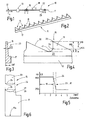
- FIG. 1 an apparatus 10 for making a wire 11 is illustrated as needed to construct an all-steel garniture of a clothing roller.
- the device 10 is used to produce this wire 11 from a profile wire 12 which is moved in its longitudinal direction L through the stations of the device 10.
- the device 10 comprises inter alia a punching station 13, which serves to attach recesses 14 to the profile wire 12 (FIG. FIG. 2 ) and thus teeth 15 to form.
- a punching station 13 which serves to attach recesses 14 to the profile wire 12 (FIG. FIG. 2 ) and thus teeth 15 to form.
- a grinding station or the like can be arranged after the punching station. Further arranged before or after the punching station 13 stations, eg for straightening the profiled wire 12 or the wire 11 may be provided as needed, but are not shown.
- the punching station 13 is a heating station, for example in the form of a first inductor 16 downstream, which is used for inductive heating of the wire 11 with.
- the first inductor 16 generates a field which also encompasses at least the foot section 17 of the wire 11, but optionally also its teeth 15.
- the first inductor 16 operates at the first frequency f1 between 100 kHz and 5 MHz, preferably between 500 kHz and 2 MHz, in the present exemplary embodiment with 1 MHz.
- the wire 11 is heated, in particular in the region of its foot portion 17, to a first temperature t1 of preferably more than 300 ° C.
- the temperature t1 is 700 ° C to 750 ° C. she is preferably set so that no hardening of the foot area 17 occurs during later quenching.
- a second inductor 18 which operates at a much higher frequency f2. This is at least 5, preferably at least 10 and most preferably at least 20 times as high as the first frequency f1.
- the second frequency f2 is 20 MHz to 30 MHz, preferably 27 MHz.
- the second inductor 18 is preferably formed so that it detects only the teeth 15 or a portion of each tooth 15. Between the inductors 16 and 18 no active cooling of the wire 11 is provided. Rather, the wire 11 passes through the gap in less than 2, preferably less than 1 s.
- FIG. 4 illustrates a tooth 15 having a tooth height H15 that extends perpendicular to the longitudinal direction from the tooth base 21 to the tooth tip 20.
- a portion 19 of the tooth 15 is fixed, which extends from the tooth tip 20 to about its center or slightly further in the direction of the tooth base 21.
- the section 19 has a height H19 which is preferably greater than 70%, better still greater than 80% of the tooth height H15.
- the second inductor 18 detects at least the portion 19 of each tooth 15 or even a slightly larger area. Preferably, however, the second inductor 18 does not detect the tooth base 21.
- the second inductor 18 and, if desired, also the first inductor 16 may operate in an inert gas atmosphere, eg of nitrogen. This can be brought up to a quenching station 22.
- the wire 11 After passing through the inductors 16 and 18, the wire 11 reaches the quenching station 22 in the hot state.
- the foot portion 17 has a temperature t1 below the austenitizing temperature range tA, while the portion 19 of each tooth 15 has a temperature t2 lying in the austenitizing temperature range tA.
- the temperature gradient from the portion 19 to the foot portion 17 causes the wire 11 hardens evenly when entering the quenching station 22, in particular at the portion 19, the wire 11, however, remains uncured otherwise.
- the foot portion 17 has a transverse to the longitudinal direction and perpendicular to the side surface to be measured thickness D17, which is greater than the thickness D15 to be measured at each tooth 15.
- the heat storage capacity of the foot D17 is greater than the heat storage capacity of each tooth 15.
- excessive heat flow from the tooth 15 to the foot portion 17 before reaching the quenching station 22 is avoided by raising the temperature of the foot portion 17 to the first temperature t1.
- the wall portion 23 extends away, which may have a triangular or, as shown, trapezoidal cross-section.
- a temperature transition zone 24 is formed on the wire 11 in which the temperature drops from the far high temperature t2 (for example 950 ° C) to the first low temperature t1 (eg 550 ° C). which is to be measured below the temperature transition zone 24 at the remaining portion of the wall 23 and the foot portion 17. Accordingly results in quenching after passing through the quenching station 22 in the wire 11 of in FIG. 5 illustrated hardness profile.
- a uniform high hardness of over 800 HV 0.5 is achieved.
- transition zone 24 of the hardness transition, in which the hardness of over 800 HV 0.5 drops to about 200 HV 0.5 or below.
- This zone has a vertical extent H24, measured away from the foot portion 17, of preferably only 20% of the tooth height H15.
- the temperature transition zone 24 forms a straight line extending in the longitudinal direction L with a width corresponding to the height H24.
- This strip may be arranged at a distance A from the tooth base 24. However, it is also possible and advantageous to reduce the distance A to zero, so that the zone 24 touches the tooth base 21 with its redesignabbaldness boundary. Furthermore, it is possible to lay the transition zone 24 even lower, so that the tooth base 21 is in the region of the hardness transition of the transition zone 24.
- FIG. 6 illustrates the transition zone 24 in cross section.
- the boundaries of the transition zone 24 can, as lines 25, 26 indicate, extend straight across the wall section 23 and the respective tooth 15.
- the transition zone 24 it is also possible (preferably) for the transition zone 24 to be delimited from the hardened or uncured area along curved lines 27, 28.
- the lines 25 and / or 26 may be oriented parallel to the base 17 a of the foot portion 17.
- Corresponding The lines 27 and / or 28 on both sides of the tooth 15 each end at the same height.
- the lines 27, 28 follow arcs that are curved toward the base 17a.
- the center of curvature preferably lies on the side of each line 27, 28 away from the foot section 17, again preferably within the cross section of the tooth 15.
- the boundaries of the transition zone 24 are visible in the cross-section of the all-steel set.
- the thermal load (source or drain) of the foot portion 17 can be adjusted be that the lines 25 and / or 26 extend obliquely to the base 17 a.
- the lines 27 and / or 28 then applies that they end at the two sides of the tooth 15 at different heights.
- a wire 11 provided with teeth 15 successively passes through a first inductor 16 and a second inductor 18.
- the inductors 16, 18 operate at different frequencies f1, f2 and generate different temperatures t1, t2.
- the first inductor 16 heats the non-hardening leg portions 17 to a high temperature t1 below the austenitizing temperature range tA.
- the second inductor 18 heats the teeth 15 to an even higher second temperature t2 lying in the austenitizing temperature range tA. Quenching results in well-hardened teeth of consistently high quality.
- the wire can pass through a third inductor 29.
- the frequency f3 may coincide with the first frequency f1.
- the temperature t3 generated by the third inductor 29 is an annealing temperature of e.g. a few hundred degrees Celsius.
- the wire 11 may be passed through a deburring station before or after starting.
- stamping burrs which may have occurred during the punching of the recesses 14, e.g. be removed by brushes, e.g. act on only one flat side of the teeth 15.
- a wire 11 provided with teeth 15 successively passes through a first inductor 16 and a second inductor 18.
- the inductors 16, 18 operate at different frequencies and produce different temperatures.
- the first inductor 16 heats the non-hardening root portion 17 to a high temperature below the austenitizing temperature range.
- the second inductor 18 heats the teeth 15 to an even higher second temperature within the austenitizing temperature range. Quenching results in well-hardened teeth of consistently high quality.
Landscapes
- Chemical & Material Sciences (AREA)
- Engineering & Computer Science (AREA)
- Mechanical Engineering (AREA)
- Thermal Sciences (AREA)
- Physics & Mathematics (AREA)
- Crystallography & Structural Chemistry (AREA)
- Materials Engineering (AREA)
- Metallurgy (AREA)
- Organic Chemistry (AREA)
- Textile Engineering (AREA)
- Heat Treatment Of Articles (AREA)
- General Induction Heating (AREA)
- Preliminary Treatment Of Fibers (AREA)
Priority Applications (12)
| Application Number | Priority Date | Filing Date | Title |
|---|---|---|---|
| EP19195680.4A EP3597802B1 (fr) | 2014-05-09 | 2014-05-09 | Garniture de carde faite de bandes métalliques et son procédé de fabrication |
| EP14167767.4A EP2942425B1 (fr) | 2014-05-09 | 2014-05-09 | Garniture de carde faite de bandes métalliques |
| KR1020167031055A KR102455649B1 (ko) | 2014-05-09 | 2015-05-05 | 전강 피팅 |
| CN202111013753.2A CN113699329A (zh) | 2014-05-09 | 2015-05-05 | 全钢配件 |
| BR112016025607-7A BR112016025607B1 (pt) | 2014-05-09 | 2015-05-05 | Método para a produção de uma guarnição totalmente em aço para máquinas de cardar e guarnição totalmente em aço para máquinas de cardar |
| CN202011267008.6A CN112553421A (zh) | 2014-05-09 | 2015-05-05 | 全钢配件 |
| JP2016567226A JP6794263B2 (ja) | 2014-05-09 | 2015-05-05 | 全鋼製フィッティング |
| US15/309,745 US11414792B2 (en) | 2014-05-09 | 2015-05-05 | All-steel fitting |
| CN201580024128.4A CN106661646B (zh) | 2014-05-09 | 2015-05-05 | 全钢配件 |
| PCT/EP2015/059839 WO2015169797A1 (fr) | 2014-05-09 | 2015-05-05 | Garniture tout-acier |
| RU2016141256A RU2682530C2 (ru) | 2014-05-09 | 2015-05-05 | Цельнометаллическая пильчатая гарнитура |
| JP2020188156A JP7537069B2 (ja) | 2014-05-09 | 2020-11-11 | 全鋼製針布の製造方法 |
Applications Claiming Priority (1)
| Application Number | Priority Date | Filing Date | Title |
|---|---|---|---|
| EP14167767.4A EP2942425B1 (fr) | 2014-05-09 | 2014-05-09 | Garniture de carde faite de bandes métalliques |
Related Child Applications (2)
| Application Number | Title | Priority Date | Filing Date |
|---|---|---|---|
| EP19195680.4A Division-Into EP3597802B1 (fr) | 2014-05-09 | 2014-05-09 | Garniture de carde faite de bandes métalliques et son procédé de fabrication |
| EP19195680.4A Division EP3597802B1 (fr) | 2014-05-09 | 2014-05-09 | Garniture de carde faite de bandes métalliques et son procédé de fabrication |
Publications (2)
| Publication Number | Publication Date |
|---|---|
| EP2942425A1 true EP2942425A1 (fr) | 2015-11-11 |
| EP2942425B1 EP2942425B1 (fr) | 2019-11-20 |
Family
ID=50685790
Family Applications (2)
| Application Number | Title | Priority Date | Filing Date |
|---|---|---|---|
| EP19195680.4A Active EP3597802B1 (fr) | 2014-05-09 | 2014-05-09 | Garniture de carde faite de bandes métalliques et son procédé de fabrication |
| EP14167767.4A Active EP2942425B1 (fr) | 2014-05-09 | 2014-05-09 | Garniture de carde faite de bandes métalliques |
Family Applications Before (1)
| Application Number | Title | Priority Date | Filing Date |
|---|---|---|---|
| EP19195680.4A Active EP3597802B1 (fr) | 2014-05-09 | 2014-05-09 | Garniture de carde faite de bandes métalliques et son procédé de fabrication |
Country Status (8)
| Country | Link |
|---|---|
| US (1) | US11414792B2 (fr) |
| EP (2) | EP3597802B1 (fr) |
| JP (2) | JP6794263B2 (fr) |
| KR (1) | KR102455649B1 (fr) |
| CN (3) | CN106661646B (fr) |
| BR (1) | BR112016025607B1 (fr) |
| RU (1) | RU2682530C2 (fr) |
| WO (1) | WO2015169797A1 (fr) |
Cited By (1)
| Publication number | Priority date | Publication date | Assignee | Title |
|---|---|---|---|---|
| DE102021102373A1 (de) | 2021-02-02 | 2022-08-04 | Groz-Beckert Kommanditgesellschaft | Verfahren zum Laserhärten eines Garniturdrahtes |
Families Citing this family (2)
| Publication number | Priority date | Publication date | Assignee | Title |
|---|---|---|---|---|
| EP3597802B1 (fr) | 2014-05-09 | 2023-12-20 | Groz-Beckert KG | Garniture de carde faite de bandes métalliques et son procédé de fabrication |
| CN120505495B (zh) * | 2025-07-22 | 2025-09-12 | 烟台瑞玛纺织机械有限公司 | 一种循环冷却式圆机针热处理设备 |
Citations (6)
| Publication number | Priority date | Publication date | Assignee | Title |
|---|---|---|---|---|
| DE2904841A1 (de) | 1979-02-09 | 1980-08-21 | Fritz Stahlecker | Saegezahndraht fuer aufloesewalzen von offenend-spinnaggregaten |
| CH670455A5 (fr) | 1985-01-07 | 1989-06-15 | Kanai Juyo Kogyo Kk | |
| WO1991015605A1 (fr) * | 1990-04-04 | 1991-10-17 | Hollingsworth John D | Procede et appareil de fabrication de tissu pour garnitures de cardes |
| JP2909774B2 (ja) * | 1990-12-28 | 1999-06-23 | 金井 宏之 | 紡機用メタリックワイヤの熱処理方法 |
| DE10106673A1 (de) | 2001-02-14 | 2002-08-29 | Rieter Ingolstadt Spinnerei | Verfahren zur Herstellung einer Auflösewalze einer Offenend-Spinnvorrichtung sowie eine mit Hilfe eines solchen Verfahrens hergestellte Auflösewalze |
| EP1728878A2 (fr) * | 2005-06-03 | 2006-12-06 | Graf + Cie Ag | Procédé et dispositif de durcissement de garnitures de cardage en dent de scie et tout-acier, ainsi que de fil à dent de scie |
Family Cites Families (25)
| Publication number | Priority date | Publication date | Assignee | Title |
|---|---|---|---|---|
| DE10542C (de) | J. ENGEL in Berlin, Hochstrafse 421 | Abnehmbarer Bratofen-Aufsatz für Kochherde | ||
| US2326674A (en) * | 1940-07-26 | 1943-08-10 | Simonds Saw And Steel Co | Induction hardening of saw teeth |
| DE2332685A1 (de) | 1973-06-27 | 1975-01-23 | Stromeyer Albrecht Dr | Verfahren und vorrichtung zur spangebenden verformung von draehten oder dergleichen werkstuecken |
| US4109127A (en) * | 1973-07-25 | 1978-08-22 | Frank Frungel | Apparatus and method for case hardening steel tools by application of heating pulses |
| JPS5641320A (en) | 1979-09-11 | 1981-04-18 | Kanai Hiroyuki | Continuous annealing method for metallic card cloth |
| US5096506A (en) | 1988-11-18 | 1992-03-17 | Hollingsworth John D | Method for making card clothing |
| JPH07118935A (ja) | 1993-10-29 | 1995-05-09 | Kanai Hiroyuki | 紡機用メタリックワイヤ |
| DE19940845C1 (de) | 1999-08-27 | 2000-12-21 | Graf & Co Ag | Verfahren und Vorrichtung zum Herstellen von Feindraht |
| DE10007567C2 (de) | 2000-02-18 | 2003-08-07 | Graf & Co Ag | Verfahren und Vorrichtung zum Herstellen eines Drahtes |
| DE10238065A1 (de) * | 2001-10-02 | 2003-04-17 | Holding Fuer Industriebeteilig | Auflösewalze für eine Spinnstation einer Rotorspinnmaschine |
| JP2004244748A (ja) | 2003-02-13 | 2004-09-02 | Kanai Hiroaki | 梳綿機用メタリックワイヤ |
| CN1245525C (zh) * | 2003-09-12 | 2006-03-15 | 中国科学院力学研究所 | 一种采用yag激光器淬火处理金属针布的系统和方法 |
| EP1738612A4 (fr) * | 2004-04-21 | 2011-03-02 | Inductoheat Inc | Traitement thermique multifrequence d'une piece par chauffage par induction |
| DE102006030418B4 (de) | 2006-06-29 | 2021-06-10 | Trützschler GmbH & Co Kommanditgesellschaft | Sägezahndraht zur Herstellung einer Sägezahnganzstahlgarnitur für eine Walze oder ein Kardierelement einer Spinnereimaschine |
| US7735201B1 (en) * | 2008-08-06 | 2010-06-15 | Nv Bekaert Sa | Multiple wire card wiring, carding cylinder, and method of making such |
| EP2567010B1 (fr) | 2010-05-04 | 2014-09-24 | NV Bekaert SA | Profil de garniture de carde |
| US8789244B2 (en) * | 2010-08-09 | 2014-07-29 | Nv Bekaert Sa | Wire profile for card clothing |
| CN103890252B (zh) * | 2011-09-15 | 2016-08-24 | 格罗茨-贝克特两合公司 | 具有改进齿形的针布 |
| ES2822152T3 (es) * | 2011-11-15 | 2021-04-29 | Groz Beckert Kg | Alambre metálico para carda |
| EP2918710A1 (fr) * | 2014-03-12 | 2015-09-16 | Groz-Beckert KG | Garniture de carde et procédé de fabrication d'un non-tissé de fibres discontinues |
| EP3597802B1 (fr) * | 2014-05-09 | 2023-12-20 | Groz-Beckert KG | Garniture de carde faite de bandes métalliques et son procédé de fabrication |
| EP2944712B1 (fr) * | 2014-05-16 | 2018-09-05 | Groz-Beckert KG | Câble métallique pour garniture de carde |
| CN106687609B (zh) * | 2014-09-12 | 2020-01-07 | 阿莱利斯铝业迪弗尔私人有限公司 | 对铝合金片材材料进行退火的方法 |
| CH711166A1 (de) * | 2015-06-05 | 2016-12-15 | Graf + Cie Ag | Ganzstahlgarnitur. |
| CH713140A1 (de) * | 2016-11-16 | 2018-05-31 | Graf Cie Ag | Garniturdraht. |
-
2014
- 2014-05-09 EP EP19195680.4A patent/EP3597802B1/fr active Active
- 2014-05-09 EP EP14167767.4A patent/EP2942425B1/fr active Active
-
2015
- 2015-05-05 CN CN201580024128.4A patent/CN106661646B/zh active Active
- 2015-05-05 RU RU2016141256A patent/RU2682530C2/ru active
- 2015-05-05 CN CN202011267008.6A patent/CN112553421A/zh active Pending
- 2015-05-05 CN CN202111013753.2A patent/CN113699329A/zh active Pending
- 2015-05-05 US US15/309,745 patent/US11414792B2/en active Active
- 2015-05-05 KR KR1020167031055A patent/KR102455649B1/ko active Active
- 2015-05-05 JP JP2016567226A patent/JP6794263B2/ja active Active
- 2015-05-05 BR BR112016025607-7A patent/BR112016025607B1/pt active IP Right Grant
- 2015-05-05 WO PCT/EP2015/059839 patent/WO2015169797A1/fr not_active Ceased
-
2020
- 2020-11-11 JP JP2020188156A patent/JP7537069B2/ja active Active
Patent Citations (6)
| Publication number | Priority date | Publication date | Assignee | Title |
|---|---|---|---|---|
| DE2904841A1 (de) | 1979-02-09 | 1980-08-21 | Fritz Stahlecker | Saegezahndraht fuer aufloesewalzen von offenend-spinnaggregaten |
| CH670455A5 (fr) | 1985-01-07 | 1989-06-15 | Kanai Juyo Kogyo Kk | |
| WO1991015605A1 (fr) * | 1990-04-04 | 1991-10-17 | Hollingsworth John D | Procede et appareil de fabrication de tissu pour garnitures de cardes |
| JP2909774B2 (ja) * | 1990-12-28 | 1999-06-23 | 金井 宏之 | 紡機用メタリックワイヤの熱処理方法 |
| DE10106673A1 (de) | 2001-02-14 | 2002-08-29 | Rieter Ingolstadt Spinnerei | Verfahren zur Herstellung einer Auflösewalze einer Offenend-Spinnvorrichtung sowie eine mit Hilfe eines solchen Verfahrens hergestellte Auflösewalze |
| EP1728878A2 (fr) * | 2005-06-03 | 2006-12-06 | Graf + Cie Ag | Procédé et dispositif de durcissement de garnitures de cardage en dent de scie et tout-acier, ainsi que de fil à dent de scie |
Cited By (1)
| Publication number | Priority date | Publication date | Assignee | Title |
|---|---|---|---|---|
| DE102021102373A1 (de) | 2021-02-02 | 2022-08-04 | Groz-Beckert Kommanditgesellschaft | Verfahren zum Laserhärten eines Garniturdrahtes |
Also Published As
| Publication number | Publication date |
|---|---|
| US11414792B2 (en) | 2022-08-16 |
| JP6794263B2 (ja) | 2020-12-02 |
| EP2942425B1 (fr) | 2019-11-20 |
| JP2017519104A (ja) | 2017-07-13 |
| EP3597802C0 (fr) | 2023-12-20 |
| JP2021038462A (ja) | 2021-03-11 |
| BR112016025607A2 (fr) | 2017-08-15 |
| CN113699329A (zh) | 2021-11-26 |
| JP7537069B2 (ja) | 2024-08-21 |
| CN106661646B (zh) | 2021-08-17 |
| BR112016025607B1 (pt) | 2022-03-15 |
| KR20160149212A (ko) | 2016-12-27 |
| US20170145600A1 (en) | 2017-05-25 |
| CN106661646A (zh) | 2017-05-10 |
| WO2015169797A1 (fr) | 2015-11-12 |
| RU2016141256A (ru) | 2018-06-09 |
| RU2682530C2 (ru) | 2019-03-19 |
| CN112553421A (zh) | 2021-03-26 |
| EP3597802A1 (fr) | 2020-01-22 |
| KR102455649B1 (ko) | 2022-10-19 |
| RU2016141256A3 (fr) | 2018-08-31 |
| EP3597802B1 (fr) | 2023-12-20 |
Similar Documents
| Publication | Publication Date | Title |
|---|---|---|
| DE102007039279B3 (de) | Wärmebehandlung von flexibel gewalztem Band | |
| DE112009000750B4 (de) | Stahlgegenstand, Verfahren zur Herstellung des Stahlgegenstands und Vorrichtung zur Herstellung eines Stahlgegenstands | |
| EP2014777B1 (fr) | Procédé et dispositif pour le traitement thermique d'une tôle métallique | |
| EP2883967B1 (fr) | Procédé et dispositif de post-traitement d'un élément de formage métallique durci au moyen du chauffage par résistance électrique | |
| DE3427639A1 (de) | Verfahren und vorrichtung zum biegen laenglicher werkstuecke, insbesondere rohre | |
| DE102014106574B4 (de) | Ganzstahlgarnitur | |
| DE102014000129B3 (de) | Verfahren und Vorrichtung zum Schränken von Bandsägeblättern | |
| EP2942425B1 (fr) | Garniture de carde faite de bandes métalliques | |
| EP3353330A1 (fr) | Procédé de fabrication d'une matière brute pour la fabrication de composants métalliques présentant des zones de différentes résistances | |
| EP2371983A1 (fr) | Procédé d'amélioration d'un composant en fonte ainsi que composant en fonte fabriqué selon le procédé | |
| EP0442864B1 (fr) | Méthode et arrangement pour le laminage de barres et fils | |
| AT513628B1 (de) | Verfahren und Vorrichtung zum Wärmebehandeln von Langprodukten | |
| CH711031B1 (de) | Verfahren zur Herstellung von Führungsschienen für ein Linearwälzlager. | |
| DE102006015669B3 (de) | Verfahren und Vorrichtung zum Umwandeln metallischen Gefüges | |
| EP0340747A2 (fr) | Procédé et dispositif pour améliorer la qualité de l'enduction du matériau métallique en forme de barres | |
| EP4261295A1 (fr) | Procédé de fabrication d'une lame | |
| DE102023105277A1 (de) | Fertigungsanlage zur Wärmebehandlung von warm- und kaltgeformten Federelementen, sowie ein Verfahren zur Wärmebehandlung von kaltgeformten Federelementen | |
| DE3234299C2 (de) | Verfahren zum Oberflächenhärten von Werkstücken und Vorrichtung zum Durchführen des Verfahrens | |
| DE202023101010U1 (de) | Fertigungsanlage zur Wärmebehandlung von warm- und kaltgeformten Federelementen | |
| AT514367B1 (de) | Hohle Zahnstange und Verfahren zu deren Herstellung | |
| WO2013030017A1 (fr) | Dispositif permettant de durcir une surface pourvue d'éléments de type nervure ou dent | |
| DE1433711C (de) | Vorrichtung und Verfahren zum Durchlauf patentieren von langgestrecktem Metallgut | |
| DE975988C (de) | Verfahren zur elektrischen Randzonenerwaermung und Haertung von in einer Achse langgestreckten Metallkoerpern, insbesondere Eisenbahnschienen | |
| DE909241C (de) | Induktor fuer das elektro-induktive Erhitzen von Werkstuecken | |
| EP3985133A2 (fr) | Procédé de fabrication d'une platine d'acier, ainsi que station de thermorégulation |
Legal Events
| Date | Code | Title | Description |
|---|---|---|---|
| PUAI | Public reference made under article 153(3) epc to a published international application that has entered the european phase |
Free format text: ORIGINAL CODE: 0009012 |
|
| 17P | Request for examination filed |
Effective date: 20140523 |
|
| AK | Designated contracting states |
Kind code of ref document: A1 Designated state(s): AL AT BE BG CH CY CZ DE DK EE ES FI FR GB GR HR HU IE IS IT LI LT LU LV MC MK MT NL NO PL PT RO RS SE SI SK SM TR |
|
| AX | Request for extension of the european patent |
Extension state: BA ME |
|
| STAA | Information on the status of an ep patent application or granted ep patent |
Free format text: STATUS: EXAMINATION IS IN PROGRESS |
|
| 17Q | First examination report despatched |
Effective date: 20180515 |
|
| GRAP | Despatch of communication of intention to grant a patent |
Free format text: ORIGINAL CODE: EPIDOSNIGR1 |
|
| STAA | Information on the status of an ep patent application or granted ep patent |
Free format text: STATUS: GRANT OF PATENT IS INTENDED |
|
| INTG | Intention to grant announced |
Effective date: 20190527 |
|
| GRAJ | Information related to disapproval of communication of intention to grant by the applicant or resumption of examination proceedings by the epo deleted |
Free format text: ORIGINAL CODE: EPIDOSDIGR1 |
|
| STAA | Information on the status of an ep patent application or granted ep patent |
Free format text: STATUS: EXAMINATION IS IN PROGRESS |
|
| INTC | Intention to grant announced (deleted) | ||
| GRAS | Grant fee paid |
Free format text: ORIGINAL CODE: EPIDOSNIGR3 |
|
| STAA | Information on the status of an ep patent application or granted ep patent |
Free format text: STATUS: GRANT OF PATENT IS INTENDED |
|
| GRAP | Despatch of communication of intention to grant a patent |
Free format text: ORIGINAL CODE: EPIDOSNIGR1 |
|
| GRAA | (expected) grant |
Free format text: ORIGINAL CODE: 0009210 |
|
| STAA | Information on the status of an ep patent application or granted ep patent |
Free format text: STATUS: THE PATENT HAS BEEN GRANTED |
|
| RIC1 | Information provided on ipc code assigned before grant |
Ipc: C21D 9/26 20060101ALI20190918BHEP Ipc: C21D 1/10 20060101ALI20190918BHEP Ipc: D01G 15/88 20060101AFI20190918BHEP Ipc: C21D 9/24 20060101ALN20190918BHEP Ipc: C21D 1/42 20060101ALI20190918BHEP |
|
| RIC1 | Information provided on ipc code assigned before grant |
Ipc: C21D 9/26 20060101ALI20190920BHEP Ipc: C21D 9/24 20060101ALN20190920BHEP Ipc: C21D 1/10 20060101ALI20190920BHEP Ipc: C21D 1/42 20060101ALI20190920BHEP Ipc: D01G 15/88 20060101AFI20190920BHEP |
|
| INTG | Intention to grant announced |
Effective date: 20191008 |
|
| AK | Designated contracting states |
Kind code of ref document: B1 Designated state(s): AL AT BE BG CH CY CZ DE DK EE ES FI FR GB GR HR HU IE IS IT LI LT LU LV MC MK MT NL NO PL PT RO RS SE SI SK SM TR |
|
| REG | Reference to a national code |
Ref country code: GB Ref legal event code: FG4D Free format text: NOT ENGLISH |
|
| REG | Reference to a national code |
Ref country code: CH Ref legal event code: EP |
|
| REG | Reference to a national code |
Ref country code: IE Ref legal event code: FG4D Free format text: LANGUAGE OF EP DOCUMENT: GERMAN |
|
| REG | Reference to a national code |
Ref country code: DE Ref legal event code: R096 Ref document number: 502014013078 Country of ref document: DE |
|
| REG | Reference to a national code |
Ref country code: AT Ref legal event code: REF Ref document number: 1204293 Country of ref document: AT Kind code of ref document: T Effective date: 20191215 |
|
| REG | Reference to a national code |
Ref country code: NL Ref legal event code: FP |
|
| REG | Reference to a national code |
Ref country code: CH Ref legal event code: NV Representative=s name: VALIPAT S.A. C/O BOVARD SA NEUCHATEL, CH |
|
| REG | Reference to a national code |
Ref country code: LT Ref legal event code: MG4D |
|
| PG25 | Lapsed in a contracting state [announced via postgrant information from national office to epo] |
Ref country code: LT Free format text: LAPSE BECAUSE OF FAILURE TO SUBMIT A TRANSLATION OF THE DESCRIPTION OR TO PAY THE FEE WITHIN THE PRESCRIBED TIME-LIMIT Effective date: 20191120 Ref country code: SE Free format text: LAPSE BECAUSE OF FAILURE TO SUBMIT A TRANSLATION OF THE DESCRIPTION OR TO PAY THE FEE WITHIN THE PRESCRIBED TIME-LIMIT Effective date: 20191120 Ref country code: LV Free format text: LAPSE BECAUSE OF FAILURE TO SUBMIT A TRANSLATION OF THE DESCRIPTION OR TO PAY THE FEE WITHIN THE PRESCRIBED TIME-LIMIT Effective date: 20191120 Ref country code: FI Free format text: LAPSE BECAUSE OF FAILURE TO SUBMIT A TRANSLATION OF THE DESCRIPTION OR TO PAY THE FEE WITHIN THE PRESCRIBED TIME-LIMIT Effective date: 20191120 Ref country code: BG Free format text: LAPSE BECAUSE OF FAILURE TO SUBMIT A TRANSLATION OF THE DESCRIPTION OR TO PAY THE FEE WITHIN THE PRESCRIBED TIME-LIMIT Effective date: 20200220 Ref country code: NO Free format text: LAPSE BECAUSE OF FAILURE TO SUBMIT A TRANSLATION OF THE DESCRIPTION OR TO PAY THE FEE WITHIN THE PRESCRIBED TIME-LIMIT Effective date: 20200220 Ref country code: GR Free format text: LAPSE BECAUSE OF FAILURE TO SUBMIT A TRANSLATION OF THE DESCRIPTION OR TO PAY THE FEE WITHIN THE PRESCRIBED TIME-LIMIT Effective date: 20200221 |
|
| PG25 | Lapsed in a contracting state [announced via postgrant information from national office to epo] |
Ref country code: RS Free format text: LAPSE BECAUSE OF FAILURE TO SUBMIT A TRANSLATION OF THE DESCRIPTION OR TO PAY THE FEE WITHIN THE PRESCRIBED TIME-LIMIT Effective date: 20191120 Ref country code: HR Free format text: LAPSE BECAUSE OF FAILURE TO SUBMIT A TRANSLATION OF THE DESCRIPTION OR TO PAY THE FEE WITHIN THE PRESCRIBED TIME-LIMIT Effective date: 20191120 Ref country code: IS Free format text: LAPSE BECAUSE OF FAILURE TO SUBMIT A TRANSLATION OF THE DESCRIPTION OR TO PAY THE FEE WITHIN THE PRESCRIBED TIME-LIMIT Effective date: 20200320 |
|
| PG25 | Lapsed in a contracting state [announced via postgrant information from national office to epo] |
Ref country code: AL Free format text: LAPSE BECAUSE OF FAILURE TO SUBMIT A TRANSLATION OF THE DESCRIPTION OR TO PAY THE FEE WITHIN THE PRESCRIBED TIME-LIMIT Effective date: 20191120 |
|
| PG25 | Lapsed in a contracting state [announced via postgrant information from national office to epo] |
Ref country code: RO Free format text: LAPSE BECAUSE OF FAILURE TO SUBMIT A TRANSLATION OF THE DESCRIPTION OR TO PAY THE FEE WITHIN THE PRESCRIBED TIME-LIMIT Effective date: 20191120 Ref country code: CZ Free format text: LAPSE BECAUSE OF FAILURE TO SUBMIT A TRANSLATION OF THE DESCRIPTION OR TO PAY THE FEE WITHIN THE PRESCRIBED TIME-LIMIT Effective date: 20191120 Ref country code: ES Free format text: LAPSE BECAUSE OF FAILURE TO SUBMIT A TRANSLATION OF THE DESCRIPTION OR TO PAY THE FEE WITHIN THE PRESCRIBED TIME-LIMIT Effective date: 20191120 Ref country code: PT Free format text: LAPSE BECAUSE OF FAILURE TO SUBMIT A TRANSLATION OF THE DESCRIPTION OR TO PAY THE FEE WITHIN THE PRESCRIBED TIME-LIMIT Effective date: 20200412 Ref country code: EE Free format text: LAPSE BECAUSE OF FAILURE TO SUBMIT A TRANSLATION OF THE DESCRIPTION OR TO PAY THE FEE WITHIN THE PRESCRIBED TIME-LIMIT Effective date: 20191120 Ref country code: DK Free format text: LAPSE BECAUSE OF FAILURE TO SUBMIT A TRANSLATION OF THE DESCRIPTION OR TO PAY THE FEE WITHIN THE PRESCRIBED TIME-LIMIT Effective date: 20191120 |
|
| REG | Reference to a national code |
Ref country code: DE Ref legal event code: R026 Ref document number: 502014013078 Country of ref document: DE |
|
| PLBI | Opposition filed |
Free format text: ORIGINAL CODE: 0009260 |
|
| PG25 | Lapsed in a contracting state [announced via postgrant information from national office to epo] |
Ref country code: SK Free format text: LAPSE BECAUSE OF FAILURE TO SUBMIT A TRANSLATION OF THE DESCRIPTION OR TO PAY THE FEE WITHIN THE PRESCRIBED TIME-LIMIT Effective date: 20191120 Ref country code: SM Free format text: LAPSE BECAUSE OF FAILURE TO SUBMIT A TRANSLATION OF THE DESCRIPTION OR TO PAY THE FEE WITHIN THE PRESCRIBED TIME-LIMIT Effective date: 20191120 |
|
| PLAX | Notice of opposition and request to file observation + time limit sent |
Free format text: ORIGINAL CODE: EPIDOSNOBS2 |
|
| 26 | Opposition filed |
Opponent name: TRUETZSCHLER GMBH & CO. KG Effective date: 20200817 |
|
| PG25 | Lapsed in a contracting state [announced via postgrant information from national office to epo] |
Ref country code: SI Free format text: LAPSE BECAUSE OF FAILURE TO SUBMIT A TRANSLATION OF THE DESCRIPTION OR TO PAY THE FEE WITHIN THE PRESCRIBED TIME-LIMIT Effective date: 20191120 Ref country code: PL Free format text: LAPSE BECAUSE OF FAILURE TO SUBMIT A TRANSLATION OF THE DESCRIPTION OR TO PAY THE FEE WITHIN THE PRESCRIBED TIME-LIMIT Effective date: 20191120 |
|
| PLBB | Reply of patent proprietor to notice(s) of opposition received |
Free format text: ORIGINAL CODE: EPIDOSNOBS3 |
|
| PG25 | Lapsed in a contracting state [announced via postgrant information from national office to epo] |
Ref country code: MC Free format text: LAPSE BECAUSE OF FAILURE TO SUBMIT A TRANSLATION OF THE DESCRIPTION OR TO PAY THE FEE WITHIN THE PRESCRIBED TIME-LIMIT Effective date: 20191120 |
|
| PG25 | Lapsed in a contracting state [announced via postgrant information from national office to epo] |
Ref country code: LU Free format text: LAPSE BECAUSE OF NON-PAYMENT OF DUE FEES Effective date: 20200509 |
|
| PG25 | Lapsed in a contracting state [announced via postgrant information from national office to epo] |
Ref country code: IE Free format text: LAPSE BECAUSE OF NON-PAYMENT OF DUE FEES Effective date: 20200509 |
|
| REG | Reference to a national code |
Ref country code: AT Ref legal event code: MM01 Ref document number: 1204293 Country of ref document: AT Kind code of ref document: T Effective date: 20200509 |
|
| PG25 | Lapsed in a contracting state [announced via postgrant information from national office to epo] |
Ref country code: AT Free format text: LAPSE BECAUSE OF NON-PAYMENT OF DUE FEES Effective date: 20200509 |
|
| PG25 | Lapsed in a contracting state [announced via postgrant information from national office to epo] |
Ref country code: MT Free format text: LAPSE BECAUSE OF FAILURE TO SUBMIT A TRANSLATION OF THE DESCRIPTION OR TO PAY THE FEE WITHIN THE PRESCRIBED TIME-LIMIT Effective date: 20191120 Ref country code: CY Free format text: LAPSE BECAUSE OF FAILURE TO SUBMIT A TRANSLATION OF THE DESCRIPTION OR TO PAY THE FEE WITHIN THE PRESCRIBED TIME-LIMIT Effective date: 20191120 |
|
| PG25 | Lapsed in a contracting state [announced via postgrant information from national office to epo] |
Ref country code: MK Free format text: LAPSE BECAUSE OF FAILURE TO SUBMIT A TRANSLATION OF THE DESCRIPTION OR TO PAY THE FEE WITHIN THE PRESCRIBED TIME-LIMIT Effective date: 20191120 |
|
| P01 | Opt-out of the competence of the unified patent court (upc) registered |
Effective date: 20230530 |
|
| PGFP | Annual fee paid to national office [announced via postgrant information from national office to epo] |
Ref country code: DE Payment date: 20240531 Year of fee payment: 11 |
|
| PGFP | Annual fee paid to national office [announced via postgrant information from national office to epo] |
Ref country code: TR Payment date: 20240422 Year of fee payment: 11 |
|
| PLAB | Opposition data, opponent's data or that of the opponent's representative modified |
Free format text: ORIGINAL CODE: 0009299OPPO |
|
| PLBD | Termination of opposition procedure: decision despatched |
Free format text: ORIGINAL CODE: EPIDOSNOPC1 |
|
| PLBP | Opposition withdrawn |
Free format text: ORIGINAL CODE: 0009264 |
|
| REG | Reference to a national code |
Ref country code: DE Ref legal event code: R100 Ref document number: 502014013078 Country of ref document: DE |
|
| PGFP | Annual fee paid to national office [announced via postgrant information from national office to epo] |
Ref country code: NL Payment date: 20250314 Year of fee payment: 12 |
|
| PGFP | Annual fee paid to national office [announced via postgrant information from national office to epo] |
Ref country code: FR Payment date: 20250310 Year of fee payment: 12 |
|
| PGFP | Annual fee paid to national office [announced via postgrant information from national office to epo] |
Ref country code: GB Payment date: 20250320 Year of fee payment: 12 |
|
| PLBM | Termination of opposition procedure: date of legal effect published |
Free format text: ORIGINAL CODE: 0009276 |
|
| 27C | Opposition proceedings terminated |
Effective date: 20250306 |
|
| PGFP | Annual fee paid to national office [announced via postgrant information from national office to epo] |
Ref country code: BE Payment date: 20250410 Year of fee payment: 12 Ref country code: IT Payment date: 20250422 Year of fee payment: 12 |
|
| PGFP | Annual fee paid to national office [announced via postgrant information from national office to epo] |
Ref country code: CH Payment date: 20250601 Year of fee payment: 12 |