EP2938640B1 - Verfahren zur verbesserung der zufuhr eines carbonsäurecomonomers in einen hochdruckreaktor - Google Patents
Verfahren zur verbesserung der zufuhr eines carbonsäurecomonomers in einen hochdruckreaktor Download PDFInfo
- Publication number
- EP2938640B1 EP2938640B1 EP13827061.6A EP13827061A EP2938640B1 EP 2938640 B1 EP2938640 B1 EP 2938640B1 EP 13827061 A EP13827061 A EP 13827061A EP 2938640 B1 EP2938640 B1 EP 2938640B1
- Authority
- EP
- European Patent Office
- Prior art keywords
- compound
- comonomer
- mixture
- pressure
- carboxylic acid
- Prior art date
- Legal status (The legal status is an assumption and is not a legal conclusion. Google has not performed a legal analysis and makes no representation as to the accuracy of the status listed.)
- Active
Links
Images


Classifications
-
- C—CHEMISTRY; METALLURGY
- C08—ORGANIC MACROMOLECULAR COMPOUNDS; THEIR PREPARATION OR CHEMICAL WORKING-UP; COMPOSITIONS BASED THEREON
- C08F—MACROMOLECULAR COMPOUNDS OBTAINED BY REACTIONS ONLY INVOLVING CARBON-TO-CARBON UNSATURATED BONDS
- C08F220/00—Copolymers of compounds having one or more unsaturated aliphatic radicals, each having only one carbon-to-carbon double bond, and only one being terminated by only one carboxyl radical or a salt, anhydride ester, amide, imide or nitrile thereof
- C08F220/02—Monocarboxylic acids having less than ten carbon atoms; Derivatives thereof
- C08F220/04—Acids; Metal salts or ammonium salts thereof
- C08F220/06—Acrylic acid; Methacrylic acid; Metal salts or ammonium salts thereof
-
- C—CHEMISTRY; METALLURGY
- C08—ORGANIC MACROMOLECULAR COMPOUNDS; THEIR PREPARATION OR CHEMICAL WORKING-UP; COMPOSITIONS BASED THEREON
- C08F—MACROMOLECULAR COMPOUNDS OBTAINED BY REACTIONS ONLY INVOLVING CARBON-TO-CARBON UNSATURATED BONDS
- C08F2/00—Processes of polymerisation
-
- C—CHEMISTRY; METALLURGY
- C08—ORGANIC MACROMOLECULAR COMPOUNDS; THEIR PREPARATION OR CHEMICAL WORKING-UP; COMPOSITIONS BASED THEREON
- C08F—MACROMOLECULAR COMPOUNDS OBTAINED BY REACTIONS ONLY INVOLVING CARBON-TO-CARBON UNSATURATED BONDS
- C08F210/00—Copolymers of unsaturated aliphatic hydrocarbons having only one carbon-to-carbon double bond
- C08F210/02—Ethene
-
- C—CHEMISTRY; METALLURGY
- C08—ORGANIC MACROMOLECULAR COMPOUNDS; THEIR PREPARATION OR CHEMICAL WORKING-UP; COMPOSITIONS BASED THEREON
- C08F—MACROMOLECULAR COMPOUNDS OBTAINED BY REACTIONS ONLY INVOLVING CARBON-TO-CARBON UNSATURATED BONDS
- C08F218/00—Copolymers of compounds having one or more unsaturated aliphatic radicals, each having only one carbon-to-carbon double bond, and at least one being terminated by an acyloxy radical of a saturated carboxylic acid, of carbonic acid or of a haloformic acid
- C08F218/02—Esters of monocarboxylic acids
- C08F218/04—Vinyl esters
- C08F218/08—Vinyl acetate
-
- C—CHEMISTRY; METALLURGY
- C08—ORGANIC MACROMOLECULAR COMPOUNDS; THEIR PREPARATION OR CHEMICAL WORKING-UP; COMPOSITIONS BASED THEREON
- C08F—MACROMOLECULAR COMPOUNDS OBTAINED BY REACTIONS ONLY INVOLVING CARBON-TO-CARBON UNSATURATED BONDS
- C08F220/00—Copolymers of compounds having one or more unsaturated aliphatic radicals, each having only one carbon-to-carbon double bond, and only one being terminated by only one carboxyl radical or a salt, anhydride ester, amide, imide or nitrile thereof
- C08F220/02—Monocarboxylic acids having less than ten carbon atoms; Derivatives thereof
- C08F220/10—Esters
- C08F220/12—Esters of monohydric alcohols or phenols
- C08F220/14—Methyl esters, e.g. methyl (meth)acrylate
-
- C—CHEMISTRY; METALLURGY
- C08—ORGANIC MACROMOLECULAR COMPOUNDS; THEIR PREPARATION OR CHEMICAL WORKING-UP; COMPOSITIONS BASED THEREON
- C08F—MACROMOLECULAR COMPOUNDS OBTAINED BY REACTIONS ONLY INVOLVING CARBON-TO-CARBON UNSATURATED BONDS
- C08F220/00—Copolymers of compounds having one or more unsaturated aliphatic radicals, each having only one carbon-to-carbon double bond, and only one being terminated by only one carboxyl radical or a salt, anhydride ester, amide, imide or nitrile thereof
- C08F220/02—Monocarboxylic acids having less than ten carbon atoms; Derivatives thereof
- C08F220/10—Esters
- C08F220/12—Esters of monohydric alcohols or phenols
- C08F220/16—Esters of monohydric alcohols or phenols of phenols or of alcohols containing two or more carbon atoms
- C08F220/18—Esters of monohydric alcohols or phenols of phenols or of alcohols containing two or more carbon atoms with acrylic or methacrylic acids
- C08F220/1802—C2-(meth)acrylate, e.g. ethyl (meth)acrylate
Definitions
- This invention relates to a feeding mode of carboxylic comonomer using new polymerization processes to make ethylene-based interpolymers, and to such interpolymers.
- the polymerization process involves one or more compounds, such as polar chain transfer agents and/or secondary polar comonomers.
- carboxylic acid comonomers There are several inherent problems associated to the use of carboxylic acid comonomers including the following: a) the acidity of the acid comonomer can cause corrosion problems, b) the high reactivity and self-polymerizability of the acid comonomers require them to be stored at low temperature conditions and preferably in the liquid state, c) carboxylic acids require stabilization with either nitroxyl containing inhibitors, like phenolthiazine, or mono-methyl-ether of hydroquinone (MEHQ) activated with oxygen, and the nitroxyl containing inhibitors can inhibit or retard polymerization, while the oxygen present in the MEHQ can act as an initiator when applied at elevated temperatures.
- nitroxyl containing inhibitors like phenolthiazine, or mono-methyl-ether of hydroquinone (MEHQ) activated with oxygen
- MEHQ mono-methyl-ether of hydroquinone
- carboxylic acid monomers in high pressure free radical polymerization, which is carried at pressures preferably above 1000 bar, more preferably above 1500 bar and most preferably above 2000 bar. At these elevated pressures, the melting point of carboxylic acid monomer is significantly increased.
- the carboxylic acid has to be fed to the process in the liquid state, and is moved through the compression, the polymerization, and the separation sections, preferably in the gaseous phase (dissolved and diluted in gaseous or super critical ethylene), in order to avoid self polymerization of liquid or solid carboxylic acid monomer to carboxylic acid homopolymer.
- the high pressure polymerization process makes use of reciprocating plunger compressors to pressurize the ethylene/carboxylic acid monomer feed and recycle streams. It is known that application of carboxylic acid monomer negatively affects the reliability of rotating and reciprocating equipment, due to its corrosion and self polymerization potential. The formation of carboxylic acid homopolymer in the sealing ring or bearing areas of the rotating and moving equipment items in compressors, plunger pumps, agitators etc, could hinder, or stop, lubrication, and could cause friction and extra heat formation, which could lead to equipment failure. Compressor reliability could be improved by decreasing the carboxylic acid monomer level in the ethylene stream(s) to be compressed through feeding all, or a part of, the make-up carboxylic acid monomer directly at high pressure to the reactor.
- Feeding carboxylic acid monomer to a high pressure reactor requires a high pressure diaphragm or reciprocating plunger pump. These pumps have to be operated at higher temperatures in order to avoid solidification of the carboxylic acid monomer. High pressure pump operation with carboxylic acid monomer is challenging, unreliable, if not impossible, by the higher temperature operation required to avoid solidification of the carboxylic acid monomer, the compression energy (further heat up) and the self-polymerization potential. Thus there remains a need to pump carboxylic acid monomer reliably at lower temperatures to pressures above 1000 bar.
- WO-A-2012/044503 describes ethylene based interpolymers and processes to make the same, wherein the process comprises the steps of injecting a first feed comprising a chain transfer agent (CTA) system and ethylene into a first autoclave reactor zone to produce a first reaction product, the CTA system of the first reactor zone having a transfer activity Z1; and transferring at least part of the first zone reaction product to a second reactor zone selected from a second autoclave reactor zone or a tubular reactor zone, and at least one of transferring or freshly injecting a feed comprising a CTA system into the second reactor zone to produce a second reaction zone product, the CTA system of the second reactor zone having a transfer activity of Z2, and with the proviso that the ratio of Z1:Z2 is greater than 1.
- CTA chain transfer agent
- the invention provides a method of injecting a compressed "comonomer/compound mixture,” comprising a "comonomer comprising a carboxylic acid,” and at least one compound, into at least one reactor; said method comprising, adding the at least one compound to the comonomer to form the "comonomer/compound mixture,” prior to compressing and injecting the mixture into the reactor; and wherein the crystallization temperature, at pressure P, of the "comonomer/compound mixture” is at least 5°C lower than the crystallization temperature, at pressure P, of the comonomer, without the presence of the at least one compound; and wherein the pressure P is greater than 500 bar; and wherein the molar ratio of the at least one compound to the comonomer in the mixture is from 1/10 to 1/1; and wherein the comonomer/compound mixture comprises greater than, or equal to, 30 weight percent of the comonomer, based on the weight of the comonomer/compound mixture; wherein the melting
- the invention also provides a method of forming an ethylene-based polymer, said method comprising polymerizing a comonomer, comprising a carboxylic acid, in the presence of ethylene and at least one free radical initiator; and wherein at least one compound is added to the comonomer to form a "comonomer/compound mixture;” and then the mixture is compressed, and injected into at least one reactor; and wherein the crystallization temperature, at pressure P, of the "comonomer/compound mixture” is at least 5°C lower than the crystallization temperature, at pressure P, of the comonomer, without the presence of the at least one compound; and wherein the pressure P is greater than 500 bar; and wherein the molar ratio of the at least one compound to the comonomer in the mixture is from 1/10 to 1/1; and wherein the comonomer/compound mixture comprises greater than, or equal to, 30 weight percent of the comonomer, based on the weight of the comonomer/
- the invention provides, in a first aspect, a method of injecting a compressed "comonomer/compound mixture,” comprising a "comonomer comprising a carboxylic acid,” and at least one compound, into at least one reactor; said method comprising, adding the at least one compound to the comonomer to form the "comonomer/compound mixture,” prior to compressing and injecting the mixture into the reactor; and wherein the crystallization temperature, at pressure P, of the "comonomer/compound mixture” is at least 5°C lower than the crystallization temperature, at pressure P, of the comonomer, without the presence of the at least one compound; and wherein the pressure P is greater than 500 bar; and wherein the molar ratio of the at least one compound to the comonomer in the mixture is from 1/10 to 1/1; and wherein the comonomer/compound mixture comprises greater than, or equal to, 30 weight percent of the comonomer, based on the weight of the comono
- the invention also provides, in a second aspect, a method of forming an ethylene-based polymer, said method comprising polymerizing a comonomer, comprising a carboxylic acid, in the presence of ethylene and at least one free radical initiator; and wherein at least one compound is added to the comonomer to form a "comonomer/compound mixture;” and then the mixture is compressed, and injected into at least one reactor; and wherein the crystallization temperature, at pressure P, of the "comonomer/compound mixture” is at least 5°C lower than the crystallization temperature, at pressure P, of the comonomer, without the presence of the at least one compound; and wherein the pressure P is greater than 500 bar; and wherein the molar ratio of the at least one compound to the comonomer in the mixture is from 1/10 to 1/1; and wherein the comonomer/compound mixture comprises greater than, or equal to, 30 weight percent of the comonomer, based on the weight of
- An inventive method may comprise a combination of two or more embodiments as described herein.
- the pressure P is greater than, 800 bar, further greater than 1000 bar.
- the pressure P is greater than, or equal to, 1200 bar, further greater than, or equal to, 1500 bar, further greater than, or equal to, 1800 bar.
- the pressure P is greater than, or equal to, 2000 bar, further greater than, or equal to, 2500 bar, further greater than, or equal to, 3000 bar, further greater than, or equal to, 3500 bar.
- the pressure P is from “greater than 500 bar” to 5000 bar, further from “greater than 800 bar” to 4000 bar, further from greater than 1000 to 3500 bar.
- the crystallization temperature of the comonomer/compound mixture is reduced by at least 10°C, further by at least 15°C, and further by at least 20°C, relative to the crystallization temperature of the comonomer, without the presence of the at least one compound, and at the same pressure.
- the crystallization temperature of the comonomer is reduced by at least 10°C, further by at least 15°C, and further by at least 20°C, relative to the crystallization temperature of the comonomer, without the presence of the at least one compound, and at the same pressure.
- the crystallization of the comonomer takes place at a pressure P greater than, or equal to, 1500 bar, further greater than, or equal to, 2500 bar, further greater than, or equal to, 3000 bar.
- the molar ratio of the at least one compound to the comonomer is from 1/8 to 1/1, further from 1/6 to 1/1, and further from 1 ⁇ 4 to 1/1.
- the mixture comprises greater than, or equal to, 40 weight percent, further greater than, or equal to, 50 weight percent, further greater than, or equal to, 60 weight percent, further greater than, or equal to, 70 weight percent, of the comonomer, based on the weight of the mixture.
- the at least one compound has a boiling temperature, at atmospheric pressure, greater than, or equal to, 70°C.
- the at least one compound has a boiling temperature, at atmospheric pressure, from 70°C to 160°C, further from 70°C to 140°C, further from 70C to 110°C.
- the at least one compound has a boiling temperature, at atmospheric pressure, less than, or equal to, 160°C, further less than, or equal to, 140°C. In a further embodiment, the at least one compound is an alkylacrylate.
- the at least one compound has a boiling temperature, at atmospheric pressure, greater than, or equal to, 125°C.
- the at least one compound has a boiling temperature, at atmospheric pressure, less than, or equal to, 110°C, further less than, or equal to, 100°C, further less than, or equal to, 90°C.
- the at least one compound is an alkylacrylate.
- the at least one compound has a boiling temperature, at atmospheric pressure, from 70°C to 160°C.
- the at least one compound has a boiling temperature, at atmospheric pressure, from 70°C to 110°C, further from 72°C to 100°C, further from 74°C to 90°C.
- the at least one compound has a melting temperature, at atmospheric pressure, less than, or equal to, 10°C, further less than, or equal to, 0°C, further less than, or equal to, -10°C.
- the mixture comprises less than 2 weight percent ethylene, further less 1 weight percent ethylene, and further less than 0.5 weight percent, ethylene, based on the weight of the mixture.
- the at least one compound comprises at least one heteroatom (for example, O, N, P or S, and preferably O).
- the at least one compound has a "dielectric constant" greater than 3.0 (see references 11 and 12 below).
- the at least one reactor is present in a reactor configuration comprising at least one autoclave reactor.
- the reactor configuration comprises at least one autoclave and at least one tubular reactor.
- the pressure in the at least one reactor is greater than, or equal to, 1000 bar, further greater than, or equal to, 1200 bar, further greater than, or equal to, 1500 bar.
- the method further comprises polymerizing the comonomer in the presence of ethylene and at least one free radical initiator, and further at a pressure greater than 1000 bar.
- the polymerization takes places in a reactor configuration comprising at least one autoclave reactor.
- the polymerization takes place in an autoclave-tube combination.
- the at least one reactor is present in a reactor configuration, in which non converted ethylene is recycled back to a reactor.
- the at least one reactor is present in a reactor configuration that comprises a split ethylene feed configuration, and further, a part of the ethylene is fed to the top zone of a reactor.
- the ethylene fed to the top zone is used to cool an internal agitator motor. Further, this ethylene is acid monomer free or contains a low amount of commoner (acid comonomer).
- the at least one reactor is present in a reactor configuration, in which the comonomer (for example, acrylic acid (AA)) is injected into an ethylene feed, which is fed directly or indirectly to the top zone of a reactor.
- a CTA is fed primarily the top zone (for example, to narrow MWD of high acid products).
- a polar cosolvent is used during the start up phase for direct comonomer injection.
- the at least one reactor is present in a reactor configuration, in which at least some unreacted ethylene and/or some unreacted comonomer is/are recycled to a reactor inlet.
- the pressure in the at least one reactor is greater than 1000 bar.
- the at least one reactor is present in a reactor configuration, in which a majority of unreacted ethylene and/or a majority of unreacted comonomer is/are recycled to a reactor inlet.
- the pressure in the at least one reactor is greater than 1000 bar.
- the level of the at least one compound in a reactor feed is maintained from 1.0 to 10.0 molar percent, further from 1.5 to 8.0 molar percent, further from 2.0 to 6.0 molar percent, based on the total moles of components in the feed.
- the at least one reactor is present in a reactor configuration, in which at least some of the at least one compound is condensed and recycled to one or more comonomer feed stream(s).
- the level of the at least one compound is maintained in a reactor feed from 0.5 to 10.0 molar percent, further from 1.0 to 8.0 molar percent, further from 1.5 to 6.0 molar percent based on the total moles of components in the feed.
- the comonomer contains from 3 to 8 carbon atoms, further from 3 to 6 carbon atoms, further from 3 to 4 carbon atoms.
- the at least one compound is a CTA (chain transfer agent). In a further embodiment, the at least one compound has a chain transfer activity coefficient (Cs at 130 °C and 1360 atm) from 0.0025 to 0.5.
- the at least one compound comprises at least one heteroatom.
- the level of the at least one compound in a reactor feed is maintained from 1 to 10 molar percent, based on the total moles of components in the feed.
- the at least one compound has a chain transfer activity coefficient (Cs at 130°C and 1360 atm) from 0.0025 to 0.5.
- the at least one compound is a second comonomer.
- the at least one compound comprises an ester group.
- the at least one compound is an alkyl acrylates, an alkylmethacrylates, or a vinyl acetate.
- the at least one compound is an alkylacrylate.
- Suitable acrylates include methyl, ethyl, propyl, butyl and higher acrylates.
- the at least one compound is an alkylmethacrylate.
- Suitable methacrylates include methyl, ethyl, propyl, butyl and higher methacrylates.
- At least two compounds are added to the comonomer, and wherein one compound has a higher Cs value than the other compound.
- the ratio of the "Cs value of the compound with the higher Cs value" to the "Cs value of the other compound" is greater than, or equal to, 2, further greater than, or equal to, 3, and further greater than, or equal to, 4.
- the at least one compound contains at least one chemical group selected from the following: an alcohol, a ketone, an aldehyde, an ester, a carboxylic acid, vinyl group, or a combination thereof.
- the at least one compound contains at least one chemical group selected from the following: a ketone, an ester, or a combination thereof. In a further embodiment, the at least one compound is an ester.
- the pressure in the at least one reactor is greater than 500 bar, further greater than, or equal to, 1000 bar, further greater than, or equal to, 1500 bar, further greater than, or equal to, 1700 bar.
- the temperature in the at least one reactor is greater than, or equal to, 170°C, further greater than, or equal to, 200°C, further greater than, or equal to, 220°C.
- An inventive method may comprise a combination of two or more embodiments as described herein.
- the invention also provides an ethylene-based polymer formed from an inventive method of one or more embodiments described herein.
- the ethylene-based polymer comprises, in the polymerized form, from 1 to 30 weight percent comonomer, further from 3 to 28 weight percent comonomer, and further from 5 to 25 weight percent comonomer, based on the weight of the polymer.
- the ethylene-based polymer has a melt index (12) from 0.2 to 5000 g/10 min, further from 0.5 to 4000 g/10 min, and further 1 to 3000 g/10 min.
- the ethylene-based polymer may comprise a combination of two or more embodiments as described herein.
- the invention also provides a composition comprising an ethylene-based polymer formed from an inventive method of one or more embodiments described herein.
- the composition further comprises a second ethylene-based polymer.
- the second ethylene-based polymer is selected from an ethylene/alpha-olefin copolymer, a low density polyethylene (LDPE), a high density polyethylene (HDPE), or a combination thereof.
- LDPE low density polyethylene
- HDPE high density polyethylene
- the second ethylene-based polymer is a LDPE homopolymer.
- the second ethylene-based polymer is a linear low density polyethylene (LLDPE).
- Linear low density polyethylenes include copolymers of ethylene with one or more alpha-olefins, such as, but not limited to, propylene, butene-1, pentene-1, 4-methylpentene-1, pentene-1, hexene-1 and octene-1.
- the composition has a melt index (12) from 0.2 to 5000 g/10 min, further from 0.5 to 4000 g/10 min, and further 1 to 3000 g/10 min.
- composition may comprise a combination of two or more embodiments as described herein.
- the invention also provides an article comprising at least one component formed from an inventive composition.
- the article is selected from a coating, a film, a foam, a laminate, a fiber, or a tape.
- the article is an aqueous dispersion (for example, a dispersion coating for paper, (fertilizer) granules, etc.).
- a aqueous dispersion for example, a dispersion coating for paper, (fertilizer) granules, etc.
- the article is an extrusion coating. In another embodiment, the article is a film.
- An inventive article may comprise a combination of two or more embodiments as described herein.
- high pressure polymerization process refers to a free radical polymerization process in which homo- and or copolymerization is carried out at an elevated pressure typically of at least 1000 bar (for example, 1000 to 5000 bar) and elevated temperature (for example, 100 to 400°C) conditions.
- elevated pressure typically of at least 1000 bar (for example, 1000 to 5000 bar) and elevated temperature (for example, 100 to 400°C) conditions.
- High molecular weight, normally solid copolymers of ethylene and unsaturated carboxylic acids, such as acrylic acid and methacrylic acid are well known (see for example, U.S. Patent 3,132,120 ).
- the level of total polar solvent in polymerization plant can be controlled, and set at a level that will significantly improve phase equilibrium conditions in the reactor, the compressor, and other sections.
- the process of the present invention is a free radical polymerization process.
- the type of free radical initiator to be used in the present process is not critical.
- Free radical initiators that are generally used include organic peroxides, such as peresters, perketals, peroxy ketones, percarbonates and cyclic multifunctional peroxides. These organic peroxide initiators are used in conventional amounts, typically from 0.005 to 0.2 weight percent based on the weight of polymerizable monomers.
- Other suitable initiators include azodicarboxylic esters, azodicarboxylic dinitriles and 1,1,2,2-tetramethylethane derivatives, and other components capable of forming free radicals in the desired operating temperature range.
- Peroxides are typically injected as diluted solutions in a suitable solvent, for example, in a hydrocarbon solvent.
- CTA Chain Transfer Agents
- Chain transfer agents or telogens are used to control the melt index in a polymerization process. Chain transfer involves the termination of growing polymer chains, thus limiting the ultimate molecular weight of the polymer material. Chain transfer agents are typically hydrogen atom donors that will react with a growing polymer chain, and stop the polymerization reaction of the chain, and initiate the growth of a new polymer molecule. These agents can be of many different types, from saturated hydrocarbons, or unsaturated hydrocarbons, to aldehydes, ketones or alcohols. By controlling the concentration of the selected chain transfer agent, one can control the length of polymer chains, and, hence the molecular weight, for example, the number average molecular weight, Mn. The melt flow index (MFI or I 2 ) of a polymer, which is related to Mn, is controlled in the same way.
- MFI melt flow index
- Suitable chain transfer agents include, but are not limited to, aliphatic and olefinic hydrocarbons, such as pentane, hexane, cyclohexane, propene, pentene or hexane; ketones such as acetone, diethyl ketone, methyl ethyl ketone (MEK) or diamyl ketone ; aldehydes such as formaldehyde or acetaldehyde, propionaldehyde; and saturated aliphatic aldehyde alcohols such as methanol, ethanol, propanol or butanol.
- the chain transfer agent may also be a monomeric chain transfer agent. For example, see WO 2012/057975 , US 61/579067 and US 61/664956 .
- a further way to influence the melt-index includes the build up and control, in the ethylene recycle streams, of the compound. Furthermore the melt-index can be influenced by the build up and control of incoming ethylene impurities, like methane and ethane, peroxide dissociation products, like tert-butanol, acetone, etc., and or solvent components used to dilute the initiators. These ethylene impurities, peroxide dissociation products and/or dilution solvent components can act as chain transfer agents.
- an ethylene-based polymer of this invention has a density from 0.910 to 0.950, more typically from 0.915 to 0.945, and even more typically from 0.920 to 0.940, grams per cubic centimeter (g/cc or g/cm 3 ).
- an ethylene-based polymer of the invention has a melt index (I 2 ) from 0.2 to 5000 grams per 10 minutes (g/10 min) at 190°C/2.16 kg, further from 0.5 to 2000 grams per 10 minutes (g/10 min) at 190°C/2.16 kg and further from 1 to 1500 grams per 10 minutes (g/10 min) at 190°C/2.16 kg.
- the ethylene-based polymer is selected from ethylene acrylic acid (EAA), ethylene methacrylic acid (EMAA), vinyl acetate, ethyl acrylate, or butyl acrylate.
- optional secondary comonomers include carbon monoxide, silane-containing comonomers, and others. Terpolymers, such as ethylene-AA-MAA terpolymers may also be formed.
- Other suitable secondary or higher comonomers to be used in the ethylene polymers of the present invention include, but are not limited to, ethylenically unsaturated monomers and especially C 3-20 alpha-olefins, carbon monoxide, vinyl acetate, and C 2-6 alkyl acrylates.
- additives may be added to a composition comprising an inventive polymer.
- Suitable additives include stabilizers; fillers, such as organic or inorganic particles, including clays, talc, titanium dioxide, zeolites, powdered metals, organic or inorganic fibers, including carbon fibers, silicon nitride fibers, steel wire or mesh, and nylon or polyester cording, nano-sized particles, clays, and so forth; tackifiers, oil extenders, including paraffinic or napthelenic oils.
- An inventive composition may be employed in a variety of conventional thermoplastic fabrication processes to produce useful articles, including extrusion coatings; dispersion coating; films; and molded articles, such as blow molded, injection molded, or rotomolded articles; foams; wire and cable, fibers, and woven or non-woven fabrics.
- carboxylic acid-containing comonomer or “comonomer comprising a carboxylic acid,” as used herein, refer to an unsaturated organic compound comprising at least one -COOH group.
- acid comonomer refers to a carboxylic acid-containing comonomer.
- Melting temperature, at pressure (P), of the carboxylic acid-containing comonomer, as used herein, is the temperature, at pressure (P), when the last crystal of the comonomer disappears upon depressurization.
- the crystallization temperature at pressure (P), of the carboxylic acid-containing comonomer, as used herein, is equal to the melting temperature, at pressure (P), as discussed above.
- the “melting temperature at atmospheric pressure” refers to the melting temperature at 1.0 atm pressure.
- boiling temperature at atmospheric pressure refers to the boiling temperature at 1.0 atm pressure.
- chain transfer coefficient refers to the ratio between the “rate of chain transfer” to the “rate of ethylene propagation.”
- Cs at 130°C and 1360 atm refers to the chain transfer coefficient measured at a temperature of 130°C and at a pressure of 1360 atm. See references 1-6 below.
- CTA activity is the product of the chain transfer coefficient (Cs value) with the molar concentration.
- CTA system includes a single CTA or a mixture of CTAs added to the polymerization process, typically to control the melt index.
- a CTA system or a CTA includes a component able to transfer a hydrogen atom to a growing polymer molecule containing a radical, by which the radical is formed on the CTA molecule, which can then initiate the start of a new polymer chain.
- CTA is also known as telogen or telomer.
- recycled ethylene refers to the ethylene-rich feed streams that are removed from the polymer, for example, in the high pressure and low pressure separators, and the recycled ethylene comprises ethylene, other components and reactants not converted in the reactor.
- reaction zone refers to a reactor zone where polymerization reaction is initiated or reinitiated by, for example, addition of radicals or components which dissociate into radicals.
- component activity refers to the reactivity ratios r1 and r2, which discloses information of the reaction rate of the comonomer versus the "rate of ethylene propagation.” See Ehrlich/ Mortimer reference 1 for definitions and typical values for r1 and r2.
- solvent system refers to a compound or a mixture of compounds for diluting carboxylic acid.
- Solvent or cosolvent system may be a vinyl containing monomer(s), maybe an organic peroxide diluent, or may be a chain transfer agent.
- a compound refers to an organic molecule.
- a compound may be a vinyl containing monomer, may be an organic peroxide diluent, and/or may be a chain transfer agent.
- composition refers to a mixture of materials which comprises the composition, as well as reaction products and decomposition products formed from the materials of the composition.
- polymer refers to a compound prepared by polymerizing monomers, whether of the same or a different type.
- the generic term polymer thus embraces the term homopolymer (which refers to polymers prepared from only one type of monomer, with the understanding that trace amounts of impurities can be incorporated into the polymer structure), and the term "interpolymer” as defined infra. Trace amounts of impurities may be incorporated into and/or within the polymer structure
- interpolymer refers to polymers prepared by the polymerization of at least two different types of monomers.
- the generic term interpolymer includes copolymers (which refers to polymers prepared from two different monomers), and polymers prepared from more than two different types of monomers.
- ethylene-based polymer or "ethylene polymer” refers to a polymer that comprises a majority amount of polymerized ethylene based on the weight of the polymer, and, optionally, may comprise at least one comonomer.
- ethylene-based interpolymer or "ethylene interpolymer” refers to an interpolymer that comprises a majority amount of polymerized ethylene, based on the weight of the interpolymer, and at least one comonomer.
- ethylene-based copolymer or "ethylene copolymer” refers to an interpolymer that comprises a majority amount of polymerized ethylene, based on the weight of the copolymer, and only one comonomer (thus, only two monomer types).
- ethylene-based terpolymer refers to an interpolymer that comprises a majority amount of polymerized ethylene, based on the weight of the copolymer, and only two comonomers (thus, only three monomer types).
- autoclave-based products or “autoclaved-based polymers,” as used herein, refer to polymers prepared in a reactor system comprising at least one autoclave reactor.
- high pressure, free-radical polymerization process refers to a free radical initiated polymerization carried out at an elevated pressure of at least 1000 bar (100 MPa).
- compressed comonomer/compound mixture refers to a comonomer/compound mixture at a pressure of greater than 500 bar, more preferably greater than, or equal to, 1000 bar, more preferably greater than, or equal to, 1500 bar.
- compositions claimed through use of the term “comprising” may include any additional additive, adjuvant, or compound, whether polymeric or otherwise, unless stated to the contrary.
- the term, “consisting essentially of' excludes from the scope of any succeeding recitation any other component, step or procedure, excepting those that are not essential to operability.
- Density Samples for density measurement are prepared according to ASTM D 1928. Polymer samples are pressed at 190°C and 30,000 psi (207 MPa) for three minutes, and then at 21°C and 207 MPa for one minute. Measurements are made within one hour of sample pressing using ASTM D792, Method B.
- Melt Index Melt index, or I 2 , (grams/10 minutes or dg/min) is measured in accordance with ASTM D 1238, Condition 190°C/2.16 kg. I 10 is measured with ASTM D 1238, Condition 190°C/10 kg.
- Table 1 lists the reagents used in the studies below, the supplier, and their purity of the tested carboxylic acids, cosolvents and secondary comonomers.
- Table 1 Reagents Product Company Purity Acrylic acid Aldrich Anhydrous, contains 180-200 ppm MEHQ as inhibitor, Purity 99% Methacrylic acid Aldrich Contains 250 ppm MEHQ as inhibitor, Purity 99% Butanone-2 Fluka Purity ⁇ 99.0% (GC) 1-Propanol Gruessing Purity 99% Tert-Butyl acetate Aldrich Purity ⁇ 99.0% Eyhyleneglycol Fluka Purity ⁇ 99.5% Ethyl acetate Sigma-Aldrich Purity ⁇ 99.5% Methanol Fisher Scientific Purity ⁇ 99.99% Tert-Butanol Sigma-Aldrich Anhydrous, Purity ⁇ 99.5% Ethyl acrylate Fluka Purity ⁇ 99.0% Vinyl acetate Aldrich Contains 3-20 ppm hydroquinon
- Figure 1 shows the following equipment parts: flange, moveable piston; cell body; steel cap; sheathed thermocouple; plug; bolt; sapphire window; cooling jacket; TEFLON O-ring; connecting plug to the pressurizing system; pressurizing fluid (heptane); internal volume with stirrer bar.
- Peroxide/solvent mixtures were contained in a high-pressure cell of Figure 1 , with a variable internal volume.
- the cylindrical cell body (170 mm length with inner and outer diameter of 22 and 80 mm, respectively) was sealed conically, with a steel plug on each side of the cylindrical cell body. The plugs were pressed against the cell body with six bolts on each side of the cylindrical cell body. Tightly fitted into the internal boring was a moveable piston sealed with a TEFLON O-ring, which separated the mixture under investigation from heptanes, which acted as the pressurizing fluid.
- a sheathed thermocouple was introduced into the peroxide solution.
- the flat surface of the moveable piston which faced the sapphire window (of 18 mm diameter and 10 mm thickness) was polished to facilitate observation of phase behavior, in particular of the appearance and disappearance of crystals.
- the internal volume was monitored by an endoscope camera, and the pictures were permanently displayed on a screen.
- the pictures also included the actual pressure and temperature readings, to enable a more detailed analysis of the phase behavior.
- the pressure was recorded by a transducer (DMS 3 kbar, HBM-Messtechnik) in the ambient-temperature part of the heptane system.
- a cryostat operated with methanol, was used for thermostatting the autoclave.
- the cooling fluid was passed through a brass mantle, which was closely fitted to the outer wall of the high-pressure cell.
- the temperature was measured within ⁇ 0.3°C, via the thermocouple sitting inside the mixture under investigation.
- the liquid mixture was stirred by a TEFLON-coated magnet, driven through the non-magnetic wall of the stainless-steel cell body (RGT 601, German Werkstoff-No. 2.4969, Arbed Saarstahl) by a large rotating magnet positioned under the autoclave.
- the experimental procedure was as follows.
- the sapphire window was fixed on the right-hand side plug (see Figure 1 ) and this plug sealed against the cell body.
- the peroxide solution was filled into the internal volume, followed by introducing the moveable piston into the cylindrical boring.
- the second plug was sealed against the cell body, heptane was filled into the pressurizing unit, and a pressure of about 100 bar was applied.
- the thermostating mantle was connected with the pre-cooled thermostat, and the autoclave brought to the lowest temperature selected for a particular experimental series. After reaching constant temperature, the pressure was raised, until solidification occurred.
- the pressure associated with the solid/liquid equilibrium was determined at the point when the last crystal disappears upon depressurization (the pressure at this point was recorded as the pressure at the set melting temperature; or Tm at recorded pressure).
- Tm the pressure at the set melting temperature
- the pressure was lowered in steps of about 50 bar, each step being followed by temperature equilibration.
- Melting temperature at pressure (P), as used herein, is the temperature at pressure (P) when the last crystal of the "carboxylic acid-containing comonomer" disappears upon depressurization.
- the crystallization temperature at pressure (P), as used herein, is equal to the melting temperature at pressure (P), as discussed above.
- Table 2 shows the main physical and/or chemical properties of the tested carboxylic acids, cosolvents and secondary comonomer.
- Figure 2 shows the experimental data, fitting melting temperature of AA and AA/compound mixtures as function of pressure.
- Figure 2 shows the measured melting points of acrylic acid (AA) and AA:MEK system at molar ratio 2:1.
- the observed melting temperatures and pressure levels associated with the pure AA and the "AA:MEK system at molar ratio of 2:1" are listed in Table 3.
- the pressure examined in this "melting point reduction" study correlate with typically pressures used in an high pressure reactor, and the "Tm versus pressure" equations (for example, see Table 4) can be used to predict melting temperature reductions at pressures above 2500 bar.
- Table 4 shows the equation factors derived, when applying a second order polynomial to the measured melting point (of mixture or of comonomer, as noted in Table 4), as function of pressure level.
- a second order polynomial for each carboxylic acid/cosolvent mixture, and for each molar ratio, a separate equation was derived, as function of pressure.
- a separate equation was also derived for each pure comonomer as a function of pressure.
- Table 5 lists the temperature and melting temperature reduction of "AA/compound” systems at varying pressures.
- the data in Table 5 show that the largest melting reductions of AA (acrylic acid) are provided by acetates and ketonic solvents. The lowest melting reduction was measured for isododecane. Since isododecane is a non-polar solvent, it cannot interfere with hydrogen bonding, leading to anhydride formation between two carboxylic acid molecules (dimer formation, see reference 9 below). It was surprisingly discovered that alcohols reduced the melting temperature to a lower degree, compared to the acetates and ketonic solvents, although an alcohol potentially could interfere more effectively the hydrogen bonding between the carboxylic acid groups on two or more comonomer molecules.
- ⁇ Tm Tm mixture - Tm comonome
- the solvent isododecane
- ethylene glycol bifunctional alcohol
- ⁇ Tm Tm mixture - Tm comonome
- AA/ethylene glycol system measured at 4:1 molar ratio
- the tested acetates and ketones provide the largest reduction in melting temperature.
- Figure 5 shows the melting point temperature of acrylic acid/compound mixtures, at the noted compositions, at 2500 bar.
- Table 6 shows the cosolvent (compound) needed to maintain the molar ratio, AA:solvent, at 2:1, at varying AA levels.
- the varying AA levels reflect the feed conditions for interpolymers made at varying acid levels.
- the molecular weight of the cosolvent (compound) has a further influence on the weight percent of cosolvent needed.
- the type of chain transfer agent has a strong impact on the chain transfer activity and the melt-index capability of the final polymerization system.
- polar cosolvents By applying two or more polar cosolvents with varying chain transfer activities, a significant level of polar cosolvent can be maintained, regardless of the level of acid monomer, or the melt index of the product to be produced.
- the significant level of polar cosolvent will ensure a positive impact on the "AA/cosolvent" melting temperature, the reactor cloud point pressure, and the phase homogeneity in the high pressure compression systems.
- Table 7 Control of level polar cosolvent by selection of mixed cosolvent system Chain transfer activity required to control melt-index (refer to Table 2 for Cs values) Single MEK CTA system, vol%, based on total volume of components in the reactor feed 0.5 1 2 3 Mixed MEK/ethyl acetate CTA system MEK, vol% 0.14 0.68 1.76 2.86 Ethyl acetate (EA), vol% 4.87 4.33 3.24 2.14
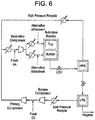
- Figure 6 depicts a flow diagram for a copolymer (ethylene-based polymer) polymerization containing a two zone autoclave reactor.
- fresh ethylene is compressed together with the outlet of the booster compressor, by the primary compressor, to the suction pressure of the secondary compressor.
- the feed of the secondary compressor consists of ethylene rich feed streams, coming from the high pressure recycle and the primary compressor outlet. Additional monomers, including carboxylic acid-containing monomer(s), can be fed at the inlet side of the secondary compressor, or further downstream of the secondary compressor.
- the discharge stream of the secondary compressor is split into two feedstreams.
- feedstreams pass coolers, and could receive, according to the present invention, a high pressure feed of carboxylic acid, mixed with a cosolvent and/or secondary comonomers (or compounds).
- feed streams are fed to the autoclave top reactor zone and autoclave bottom reactor zone, respectively.
- LDV Let Down Valve
- the reactor outlet stream is received, and separated, in the high pressure separator (HPS).
- HPS high pressure separator
- the gaseous overhead is cooled, and cleaned from entrained polymer and/or dissolved waxes in the high pressure recycle.
- the liquid bottom stream from the HPS is further depressurized in the low pressure separator (LPS).
- the polymer, with residual monomers, CTA and/or solvents, is transferred to the product finishing section.
- the gaseous overhead of the LPS is cooled in the LPR (Low Pressure Recycle), and compressed and cooled in the booster compressor.
- LPR Low Pressure Recycle
- various components like CTA(s), cosolvent(s), comonomer(s) and other compounds, may condense and separate, and be removed in the various compression and cooling stages.
- the remaining gaseous flow from the booster compressor is fed to the primary compressor.
- the polymerization flow diagram shown in Figure 6 can be used to polymerize ethylene with one or more carboxylic acid-containing comonomers, and optionally, other comonomers, without the undesirable crystallization of the carboxylic acid-containing comonomer(s) in the feeds, compression equipment and/or pump equipment contained in the polymerization process. Furthermore, this polymerization flow scheme allows for the condensation and reuse of cosolvents.
- the melting point data for the pure compounds are: AA (13 °C) and MAA (16 °C)
Landscapes
- Chemical & Material Sciences (AREA)
- Health & Medical Sciences (AREA)
- Chemical Kinetics & Catalysis (AREA)
- Medicinal Chemistry (AREA)
- Polymers & Plastics (AREA)
- Organic Chemistry (AREA)
- Addition Polymer Or Copolymer, Post-Treatments, Or Chemical Modifications (AREA)
- Polymerisation Methods In General (AREA)
- Organic Low-Molecular-Weight Compounds And Preparation Thereof (AREA)
Claims (14)
- Ein Verfahren zum Einspritzen einer komprimierten "Comonomer-Verbindungs-Mischung", die ein "eine Carbonsäure beinhaltendes Comonomer" und mindestens eine Verbindung beinhaltet, in mindestens einen Reaktor;
wobei das Verfahren das Hinzufügen der mindestens einen Verbindung zu dem Comonomer beinhaltet, um vor dem Komprimieren und Einspritzen der Mischung in den Reaktor die "Comonomer-Verbindungs-Mischung" zu bilden; und
wobei die Kristallisationstemperatur, bei Druck P, der "Comonomer-Verbindungs-/Mischung" mindestens 5 °C niedriger ist als die Kristallisationstemperatur, bei Druck P, des Comonomers, ohne die Anwesenheit der mindestens einen Verbindung; und wobei der Druck P größer als 500 Bar ist; und
wobei das Molverhältnis der mindestens einen Verbindung zu dem Comonomer in der Mischung von 1/10 bis 1/1 ist; und
wobei die Comonomer-Verbindungs-Mischung, bezogen auf das Gewicht der Comonomer-Verbindungs-Mischung, zu mehr als oder gleich 30 Gewichtsprozent das Comonomer beinhaltet;
wobei die Schmelztemperatur bei Atmosphärendruck der mindestens einen Verbindung geringer als die Schmelztemperatur bei Atmosphärendruck des Comonomers ist; wobei das "eine Carbonsäure beinhaltende Comonomer" eine ungesättigte organische Verbindung, die mindestens eine -COOH-Gruppe enthält, ist; und
wobei die mindestens eine Verbindung ein Vinyl enthaltendes Monomer, ein Verdünnungsmittel aus organischem Peroxid und/oder ein Kettenüberträger ist. - Verfahren gemäß Anspruch 1, wobei die mindestens eine Verbindung eine Siedetemperatur, bei Atmosphärendruck, von mehr als oder gleich 70 °C aufweist.
- Verfahren gemäß Anspruch 1 oder Anspruch 2, wobei die Comonomer-Verbindungs-Mischung, bezogen auf das Gewicht der Mischung, weniger als 2 Gewichtsprozent Ethylen beinhaltet.
- Verfahren gemäß einem der vorhergehenden Ansprüche, wobei die mindestens eine Verbindung ein Kettenüberträger ist.
- Verfahren gemäß einem der vorhergehenden Ansprüche, wobei die mindestens eine Verbindung einen Kettenübertragungsaktivitätskoeffizienten (Cs bei 130 °C und 1360 atm) von 0,0025 bis 0,5 aufweist.
- Verfahren gemäß einem der vorhergehenden Ansprüche, wobei mindestens zwei Verbindungen zu dem Comonomer hinzugegeben werden, und wobei eine Verbindung einen höheren Cs-Wert als die andere Verbindung aufweist.
- Verfahren gemäß Anspruch 6, wobei das Verhältnis des "Cs-Werts der Verbindung mit dem höheren Cs-Wert" zu dem "Cs-Wert der anderen Verbindung" größer als oder gleich 2 ist.
- Verfahren gemäß einem der vorhergehenden Ansprüche, wobei die mindestens eine Verbindung mindestens eine chemische Gruppe beinhaltet, die aus den folgenden ausgewählt ist: einem Alkohol, einem Keton, einem Aldehyd, einem Ester, einer Carbonsäure, einer Vinylgruppe oder einer Kombination davon.
- Ein Verfahren zum Bilden eines Polymers auf Ethylenbasis, wobei das Verfahren Folgendes beinhaltet:Polymerisieren eines Comonomers, das eine Carbonsäure beinhaltet, in der Anwesenheit von Ethylen und mindestens einem Radikalinitiator; undwobei mindestens eine Verbindung zu dem Comonomer hinzugefügt wird, um eine "Comonomer-Verbindungs-Mischung" zu bilden; und die Mischung dann komprimiert und in mindestens einen Reaktor eingespritzt wird; undwobei die Kristallisationstemperatur, bei Druck P, der "Comonomer-Verbindungs-Mischung" mindestens 5 °C niedriger ist als die Kristallisationstemperatur, bei Druck P, des Comonomers, ohne die Anwesenheit der mindestens einen Verbindung; undwobei der Druck P größer als 500 Bar ist; undwobei das Molverhältnis der mindestens einen Verbindung zu dem Comonomer in der Mischung von 1/10 bis 1/1 ist; undwobei die Comonomer-Verbindungs-Mischung, bezogen auf das Gewicht der Comonomer-Verbindungs-Mischung, zu mehr als oder gleich 30 Gewichtsprozent das Comonomer beinhaltet;wobei die Schmelztemperatur bei Atmosphärendruck der mindestens einen Verbindung geringer als die Schmelztemperatur bei Atmosphärendruck des Comonomers ist;wobei das "eine Carbonsäure beinhaltende Comonomer" eine ungesättigte organische Verbindung, die mindestens eine -COOH-Gruppe enthält, ist; undwobei die mindestens eine Verbindung ein Vinyl enthaltendes Monomer, ein Verdünnungsmittel aus organischem Peroxid und/oder ein Kettenüberträger ist.
- Verfahren gemäß Anspruch 9, wobei mindestens ein Teil des unreagierten Ethylens und/oder ein Teil des unreagierten Comonomers zu einem Reaktoreinlass zurückgeführt wird.
- Verfahren gemäß Anspruch 9 oder Anspruch 10, wobei mindestens ein Teil der Verbindung kondensiert und zu einem Comonomerzufuhrstrom oder mehreren Comonomerzufuhrströmen zurückgeführt wird.
- Verfahren gemäß einem der Ansprüche 9-11, wobei der Pegel der mindestens einen Verbindung in einer Reaktorzufuhr, bezogen auf die Gesamtzahl an Molen der Komponenten in der Zufuhr, bei 1 bis 10 Molprozent gehalten wird.
- Verfahren gemäß einem der Ansprüche 9-12, wobei die mindestens eine Verbindung ein Kettenüberträger ist.
- Verfahren gemäß einem der Ansprüche 9-13, wobei die mindestens eine Verbindung mindestens eine chemische Gruppe beinhaltet, die aus den folgenden ausgewählt ist: einem Alkohol, einem Keton, einem Aldehyd, einem Ester, einer Carbonsäure, einer Vinylgruppe oder einer Kombination davon.
Priority Applications (1)
| Application Number | Priority Date | Filing Date | Title |
|---|---|---|---|
| EP18170183.0A EP3372619B1 (de) | 2012-12-28 | 2013-12-27 | Verfahren zur verbesserung der zufuhr eines carbonsäurecomonomers in einen hochdruckreaktor |
Applications Claiming Priority (3)
| Application Number | Priority Date | Filing Date | Title |
|---|---|---|---|
| US201261747003P | 2012-12-28 | 2012-12-28 | |
| PCT/US2013/032501 WO2014105110A2 (en) | 2012-12-28 | 2013-03-15 | Method to reduce the crystallization temperature of carboxylic acid comonomer at elevated pressures, and to improve the copolymerization of the same |
| PCT/US2013/078020 WO2014106067A1 (en) | 2012-12-28 | 2013-12-27 | Method to improve the feeding of a carboxylic acid comonomer into a high pressure reactor |
Related Child Applications (1)
| Application Number | Title | Priority Date | Filing Date |
|---|---|---|---|
| EP18170183.0A Division EP3372619B1 (de) | 2012-12-28 | 2013-12-27 | Verfahren zur verbesserung der zufuhr eines carbonsäurecomonomers in einen hochdruckreaktor |
Publications (2)
| Publication Number | Publication Date |
|---|---|
| EP2938640A1 EP2938640A1 (de) | 2015-11-04 |
| EP2938640B1 true EP2938640B1 (de) | 2018-05-02 |
Family
ID=48087707
Family Applications (2)
| Application Number | Title | Priority Date | Filing Date |
|---|---|---|---|
| EP13827061.6A Active EP2938640B1 (de) | 2012-12-28 | 2013-12-27 | Verfahren zur verbesserung der zufuhr eines carbonsäurecomonomers in einen hochdruckreaktor |
| EP18170183.0A Active EP3372619B1 (de) | 2012-12-28 | 2013-12-27 | Verfahren zur verbesserung der zufuhr eines carbonsäurecomonomers in einen hochdruckreaktor |
Family Applications After (1)
| Application Number | Title | Priority Date | Filing Date |
|---|---|---|---|
| EP18170183.0A Active EP3372619B1 (de) | 2012-12-28 | 2013-12-27 | Verfahren zur verbesserung der zufuhr eines carbonsäurecomonomers in einen hochdruckreaktor |
Country Status (8)
| Country | Link |
|---|---|
| US (1) | US9416209B2 (de) |
| EP (2) | EP2938640B1 (de) |
| JP (1) | JP6563340B2 (de) |
| KR (1) | KR102182955B1 (de) |
| CN (1) | CN104870481B (de) |
| BR (1) | BR112015010925B1 (de) |
| ES (2) | ES2828738T3 (de) |
| WO (1) | WO2014105110A2 (de) |
Cited By (1)
| Publication number | Priority date | Publication date | Assignee | Title |
|---|---|---|---|---|
| WO2023147465A1 (en) * | 2022-01-31 | 2023-08-03 | Dow Global Technologies Llc | Carboxylic acid cosolvents in the production of ethylene acid copolymer |
Families Citing this family (8)
| Publication number | Priority date | Publication date | Assignee | Title |
|---|---|---|---|---|
| CN107873035B (zh) * | 2015-06-30 | 2021-04-09 | 陶氏环球技术有限责任公司 | 高压自由基聚合 |
| US12391776B2 (en) | 2019-02-01 | 2025-08-19 | Sk Innovation Co., Ltd. | Method for producing ethylene-carboxylic acid copolymer |
| KR102859381B1 (ko) * | 2019-02-01 | 2025-09-12 | 에스케이이노베이션 주식회사 | 에틸렌-카르복실산 공중합체의 제조 방법 |
| KR102865445B1 (ko) * | 2020-02-20 | 2025-09-25 | 에스케이이노베이션 주식회사 | 에틸렌-카르복실산 공중합체의 제조 방법 |
| WO2021250054A1 (en) * | 2020-06-10 | 2021-12-16 | International Technical Excellence Centers, Llc | Process for producing ethylene homo- and copolymers |
| KR102898955B1 (ko) | 2020-09-25 | 2025-12-10 | 에스케이이노베이션 주식회사 | 에틸렌-아크릴산 공중합체 제조 공정의 용매 세척방법 |
| CN115237180B (zh) * | 2022-09-23 | 2022-12-06 | 济南明鑫制药股份有限公司 | 一种用于甲酯生产中粗品制备的智能控制方法 |
| CN118788239B (zh) * | 2023-04-12 | 2025-09-26 | 中国石油化工股份有限公司 | 高压自由基聚合反应的出料物状态监测方法 |
Family Cites Families (13)
| Publication number | Priority date | Publication date | Assignee | Title |
|---|---|---|---|---|
| US365874A (en) | 1887-07-05 | And william kent | ||
| US3132120A (en) | 1961-02-03 | 1964-05-05 | Du Pont | Method for the preparation of ethylene copolymers |
| US4351931A (en) | 1961-06-26 | 1982-09-28 | E. I. Du Pont De Nemours And Company | Polyethylene copolymers |
| US3658741A (en) | 1966-09-19 | 1972-04-25 | Allied Chem | Homogeneous copolymers from ethylene |
| NL6614676A (de) | 1966-10-18 | 1968-04-19 | ||
| US4252924A (en) * | 1979-04-05 | 1981-02-24 | E. I. Du Pont De Nemours And Company | Continuous process for the preparation of nonrandom ethylene/acid copolymer |
| DE3044519A1 (de) | 1980-11-26 | 1982-06-24 | Basf Ag, 6700 Ludwigshafen | Emulgierbare hartwachse aus copolymerisaten des aethylens mit ungesaettigten carbonsaeuren |
| US4599392A (en) | 1983-06-13 | 1986-07-08 | The Dow Chemical Company | Interpolymers of ethylene and unsaturated carboxylic acids |
| US5028674A (en) | 1990-06-06 | 1991-07-02 | E. I. Du Pont De Nemours And Company | Methanol copolymerization of ethylene |
| US5057593A (en) | 1990-06-11 | 1991-10-15 | E. I. Du Pont De Nemours And Company | Free radical copolymerization of ethylene and CO with acetone |
| WO2011075465A1 (en) * | 2009-12-18 | 2011-06-23 | Dow Global Technology Llc | Polymerization process to make low density polyethylene |
| WO2012044503A1 (en) * | 2010-09-30 | 2012-04-05 | Dow Global Technologies Llc | Ethylene-based interpolymers and processes to make the same |
| EP2632961B1 (de) | 2010-10-29 | 2014-12-24 | Dow Global Technologies LLC | Polymere auf ethylenbasis und verfahren dafür |
-
2013
- 2013-03-15 WO PCT/US2013/032501 patent/WO2014105110A2/en not_active Ceased
- 2013-12-27 EP EP13827061.6A patent/EP2938640B1/de active Active
- 2013-12-27 ES ES18170183T patent/ES2828738T3/es active Active
- 2013-12-27 CN CN201380068054.5A patent/CN104870481B/zh active Active
- 2013-12-27 US US14/438,930 patent/US9416209B2/en active Active
- 2013-12-27 BR BR112015010925-0A patent/BR112015010925B1/pt active IP Right Grant
- 2013-12-27 EP EP18170183.0A patent/EP3372619B1/de active Active
- 2013-12-27 JP JP2015550805A patent/JP6563340B2/ja active Active
- 2013-12-27 KR KR1020157016827A patent/KR102182955B1/ko active Active
- 2013-12-27 ES ES13827061.6T patent/ES2674082T3/es active Active
Non-Patent Citations (1)
| Title |
|---|
| None * |
Cited By (1)
| Publication number | Priority date | Publication date | Assignee | Title |
|---|---|---|---|---|
| WO2023147465A1 (en) * | 2022-01-31 | 2023-08-03 | Dow Global Technologies Llc | Carboxylic acid cosolvents in the production of ethylene acid copolymer |
Also Published As
| Publication number | Publication date |
|---|---|
| US20150299357A1 (en) | 2015-10-22 |
| EP3372619B1 (de) | 2020-08-19 |
| EP2938640A1 (de) | 2015-11-04 |
| WO2014105110A2 (en) | 2014-07-03 |
| KR20150099761A (ko) | 2015-09-01 |
| BR112015010925B1 (pt) | 2021-09-08 |
| CN104870481A (zh) | 2015-08-26 |
| CN104870481B (zh) | 2017-06-27 |
| JP6563340B2 (ja) | 2019-08-21 |
| EP3372619A1 (de) | 2018-09-12 |
| KR102182955B1 (ko) | 2020-11-26 |
| BR112015010925A2 (pt) | 2017-07-11 |
| ES2674082T3 (es) | 2018-06-27 |
| JP2016507615A (ja) | 2016-03-10 |
| ES2828738T3 (es) | 2021-05-27 |
| US9416209B2 (en) | 2016-08-16 |
Similar Documents
| Publication | Publication Date | Title |
|---|---|---|
| EP2938640B1 (de) | Verfahren zur verbesserung der zufuhr eines carbonsäurecomonomers in einen hochdruckreaktor | |
| JP6141288B2 (ja) | 低密度エチレン系ポリマー調製のための新しいエチレンの分配を有する重合プロセス | |
| US10457757B2 (en) | High pressure free-radical polymerizations | |
| EP3356422B1 (de) | Verfahren zur herstellung von polymeren auf ethylenbasis mit reduzierten gelzahlen und geringer reaktorverschmutzung | |
| KR102502365B1 (ko) | 개선된 고압 자유 라디칼 중합을 위한 윤활제 조성물 | |
| CN105829363B (zh) | 改进使用不对称多烯制备乙烯类聚合物的反应器稳定性的方法 | |
| WO2014106067A1 (en) | Method to improve the feeding of a carboxylic acid comonomer into a high pressure reactor | |
| CN110770259B (zh) | 用于生产基于乙烯的聚合物的高压自由基聚合 |
Legal Events
| Date | Code | Title | Description |
|---|---|---|---|
| PUAI | Public reference made under article 153(3) epc to a published international application that has entered the european phase |
Free format text: ORIGINAL CODE: 0009012 |
|
| 17P | Request for examination filed |
Effective date: 20150526 |
|
| AK | Designated contracting states |
Kind code of ref document: A1 Designated state(s): AL AT BE BG CH CY CZ DE DK EE ES FI FR GB GR HR HU IE IS IT LI LT LU LV MC MK MT NL NO PL PT RO RS SE SI SK SM TR |
|
| AX | Request for extension of the european patent |
Extension state: BA ME |
|
| DAX | Request for extension of the european patent (deleted) | ||
| 17Q | First examination report despatched |
Effective date: 20160708 |
|
| GRAP | Despatch of communication of intention to grant a patent |
Free format text: ORIGINAL CODE: EPIDOSNIGR1 |
|
| INTG | Intention to grant announced |
Effective date: 20171128 |
|
| GRAS | Grant fee paid |
Free format text: ORIGINAL CODE: EPIDOSNIGR3 |
|
| GRAA | (expected) grant |
Free format text: ORIGINAL CODE: 0009210 |
|
| AK | Designated contracting states |
Kind code of ref document: B1 Designated state(s): AL AT BE BG CH CY CZ DE DK EE ES FI FR GB GR HR HU IE IS IT LI LT LU LV MC MK MT NL NO PL PT RO RS SE SI SK SM TR |
|
| REG | Reference to a national code |
Ref country code: GB Ref legal event code: FG4D |
|
| REG | Reference to a national code |
Ref country code: CH Ref legal event code: EP Ref country code: AT Ref legal event code: REF Ref document number: 995151 Country of ref document: AT Kind code of ref document: T Effective date: 20180515 |
|
| REG | Reference to a national code |
Ref country code: DE Ref legal event code: R096 Ref document number: 602013037012 Country of ref document: DE Ref country code: IE Ref legal event code: FG4D |
|
| REG | Reference to a national code |
Ref country code: DE Ref legal event code: R096 Ref document number: 602013037012 Country of ref document: DE |
|
| REG | Reference to a national code |
Ref country code: ES Ref legal event code: FG2A Ref document number: 2674082 Country of ref document: ES Kind code of ref document: T3 Effective date: 20180627 |
|
| REG | Reference to a national code |
Ref country code: NL Ref legal event code: FP |
|
| REG | Reference to a national code |
Ref country code: LT Ref legal event code: MG4D |
|
| PG25 | Lapsed in a contracting state [announced via postgrant information from national office to epo] |
Ref country code: SE Free format text: LAPSE BECAUSE OF FAILURE TO SUBMIT A TRANSLATION OF THE DESCRIPTION OR TO PAY THE FEE WITHIN THE PRESCRIBED TIME-LIMIT Effective date: 20180502 Ref country code: BG Free format text: LAPSE BECAUSE OF FAILURE TO SUBMIT A TRANSLATION OF THE DESCRIPTION OR TO PAY THE FEE WITHIN THE PRESCRIBED TIME-LIMIT Effective date: 20180802 Ref country code: NO Free format text: LAPSE BECAUSE OF FAILURE TO SUBMIT A TRANSLATION OF THE DESCRIPTION OR TO PAY THE FEE WITHIN THE PRESCRIBED TIME-LIMIT Effective date: 20180802 Ref country code: LT Free format text: LAPSE BECAUSE OF FAILURE TO SUBMIT A TRANSLATION OF THE DESCRIPTION OR TO PAY THE FEE WITHIN THE PRESCRIBED TIME-LIMIT Effective date: 20180502 Ref country code: FI Free format text: LAPSE BECAUSE OF FAILURE TO SUBMIT A TRANSLATION OF THE DESCRIPTION OR TO PAY THE FEE WITHIN THE PRESCRIBED TIME-LIMIT Effective date: 20180502 |
|
| PG25 | Lapsed in a contracting state [announced via postgrant information from national office to epo] |
Ref country code: LV Free format text: LAPSE BECAUSE OF FAILURE TO SUBMIT A TRANSLATION OF THE DESCRIPTION OR TO PAY THE FEE WITHIN THE PRESCRIBED TIME-LIMIT Effective date: 20180502 Ref country code: RS Free format text: LAPSE BECAUSE OF FAILURE TO SUBMIT A TRANSLATION OF THE DESCRIPTION OR TO PAY THE FEE WITHIN THE PRESCRIBED TIME-LIMIT Effective date: 20180502 Ref country code: HR Free format text: LAPSE BECAUSE OF FAILURE TO SUBMIT A TRANSLATION OF THE DESCRIPTION OR TO PAY THE FEE WITHIN THE PRESCRIBED TIME-LIMIT Effective date: 20180502 Ref country code: GR Free format text: LAPSE BECAUSE OF FAILURE TO SUBMIT A TRANSLATION OF THE DESCRIPTION OR TO PAY THE FEE WITHIN THE PRESCRIBED TIME-LIMIT Effective date: 20180803 |
|
| REG | Reference to a national code |
Ref country code: AT Ref legal event code: MK05 Ref document number: 995151 Country of ref document: AT Kind code of ref document: T Effective date: 20180502 |
|
| PG25 | Lapsed in a contracting state [announced via postgrant information from national office to epo] |
Ref country code: CZ Free format text: LAPSE BECAUSE OF FAILURE TO SUBMIT A TRANSLATION OF THE DESCRIPTION OR TO PAY THE FEE WITHIN THE PRESCRIBED TIME-LIMIT Effective date: 20180502 Ref country code: RO Free format text: LAPSE BECAUSE OF FAILURE TO SUBMIT A TRANSLATION OF THE DESCRIPTION OR TO PAY THE FEE WITHIN THE PRESCRIBED TIME-LIMIT Effective date: 20180502 Ref country code: SK Free format text: LAPSE BECAUSE OF FAILURE TO SUBMIT A TRANSLATION OF THE DESCRIPTION OR TO PAY THE FEE WITHIN THE PRESCRIBED TIME-LIMIT Effective date: 20180502 Ref country code: DK Free format text: LAPSE BECAUSE OF FAILURE TO SUBMIT A TRANSLATION OF THE DESCRIPTION OR TO PAY THE FEE WITHIN THE PRESCRIBED TIME-LIMIT Effective date: 20180502 Ref country code: PL Free format text: LAPSE BECAUSE OF FAILURE TO SUBMIT A TRANSLATION OF THE DESCRIPTION OR TO PAY THE FEE WITHIN THE PRESCRIBED TIME-LIMIT Effective date: 20180502 Ref country code: EE Free format text: LAPSE BECAUSE OF FAILURE TO SUBMIT A TRANSLATION OF THE DESCRIPTION OR TO PAY THE FEE WITHIN THE PRESCRIBED TIME-LIMIT Effective date: 20180502 Ref country code: AT Free format text: LAPSE BECAUSE OF FAILURE TO SUBMIT A TRANSLATION OF THE DESCRIPTION OR TO PAY THE FEE WITHIN THE PRESCRIBED TIME-LIMIT Effective date: 20180502 |
|
| REG | Reference to a national code |
Ref country code: DE Ref legal event code: R097 Ref document number: 602013037012 Country of ref document: DE |
|
| PG25 | Lapsed in a contracting state [announced via postgrant information from national office to epo] |
Ref country code: IT Free format text: LAPSE BECAUSE OF FAILURE TO SUBMIT A TRANSLATION OF THE DESCRIPTION OR TO PAY THE FEE WITHIN THE PRESCRIBED TIME-LIMIT Effective date: 20180502 Ref country code: SM Free format text: LAPSE BECAUSE OF FAILURE TO SUBMIT A TRANSLATION OF THE DESCRIPTION OR TO PAY THE FEE WITHIN THE PRESCRIBED TIME-LIMIT Effective date: 20180502 |
|
| PLBE | No opposition filed within time limit |
Free format text: ORIGINAL CODE: 0009261 |
|
| STAA | Information on the status of an ep patent application or granted ep patent |
Free format text: STATUS: NO OPPOSITION FILED WITHIN TIME LIMIT |
|
| 26N | No opposition filed |
Effective date: 20190205 |
|
| PG25 | Lapsed in a contracting state [announced via postgrant information from national office to epo] |
Ref country code: SI Free format text: LAPSE BECAUSE OF FAILURE TO SUBMIT A TRANSLATION OF THE DESCRIPTION OR TO PAY THE FEE WITHIN THE PRESCRIBED TIME-LIMIT Effective date: 20180502 |
|
| REG | Reference to a national code |
Ref country code: CH Ref legal event code: PL |
|
| GBPC | Gb: european patent ceased through non-payment of renewal fee |
Effective date: 20181227 |
|
| PG25 | Lapsed in a contracting state [announced via postgrant information from national office to epo] |
Ref country code: LU Free format text: LAPSE BECAUSE OF NON-PAYMENT OF DUE FEES Effective date: 20181227 Ref country code: MC Free format text: LAPSE BECAUSE OF FAILURE TO SUBMIT A TRANSLATION OF THE DESCRIPTION OR TO PAY THE FEE WITHIN THE PRESCRIBED TIME-LIMIT Effective date: 20180502 |
|
| REG | Reference to a national code |
Ref country code: IE Ref legal event code: MM4A |
|
| REG | Reference to a national code |
Ref country code: BE Ref legal event code: MM Effective date: 20181231 |
|
| PG25 | Lapsed in a contracting state [announced via postgrant information from national office to epo] |
Ref country code: IE Free format text: LAPSE BECAUSE OF NON-PAYMENT OF DUE FEES Effective date: 20181227 |
|
| PG25 | Lapsed in a contracting state [announced via postgrant information from national office to epo] |
Ref country code: AL Free format text: LAPSE BECAUSE OF FAILURE TO SUBMIT A TRANSLATION OF THE DESCRIPTION OR TO PAY THE FEE WITHIN THE PRESCRIBED TIME-LIMIT Effective date: 20180502 Ref country code: BE Free format text: LAPSE BECAUSE OF NON-PAYMENT OF DUE FEES Effective date: 20181231 |
|
| PG25 | Lapsed in a contracting state [announced via postgrant information from national office to epo] |
Ref country code: GB Free format text: LAPSE BECAUSE OF NON-PAYMENT OF DUE FEES Effective date: 20181227 Ref country code: LI Free format text: LAPSE BECAUSE OF NON-PAYMENT OF DUE FEES Effective date: 20181231 Ref country code: CH Free format text: LAPSE BECAUSE OF NON-PAYMENT OF DUE FEES Effective date: 20181231 |
|
| PG25 | Lapsed in a contracting state [announced via postgrant information from national office to epo] |
Ref country code: MT Free format text: LAPSE BECAUSE OF NON-PAYMENT OF DUE FEES Effective date: 20181227 |
|
| PG25 | Lapsed in a contracting state [announced via postgrant information from national office to epo] |
Ref country code: TR Free format text: LAPSE BECAUSE OF FAILURE TO SUBMIT A TRANSLATION OF THE DESCRIPTION OR TO PAY THE FEE WITHIN THE PRESCRIBED TIME-LIMIT Effective date: 20180502 |
|
| PG25 | Lapsed in a contracting state [announced via postgrant information from national office to epo] |
Ref country code: PT Free format text: LAPSE BECAUSE OF FAILURE TO SUBMIT A TRANSLATION OF THE DESCRIPTION OR TO PAY THE FEE WITHIN THE PRESCRIBED TIME-LIMIT Effective date: 20180502 |
|
| PG25 | Lapsed in a contracting state [announced via postgrant information from national office to epo] |
Ref country code: MK Free format text: LAPSE BECAUSE OF NON-PAYMENT OF DUE FEES Effective date: 20180502 Ref country code: CY Free format text: LAPSE BECAUSE OF FAILURE TO SUBMIT A TRANSLATION OF THE DESCRIPTION OR TO PAY THE FEE WITHIN THE PRESCRIBED TIME-LIMIT Effective date: 20180502 Ref country code: HU Free format text: LAPSE BECAUSE OF FAILURE TO SUBMIT A TRANSLATION OF THE DESCRIPTION OR TO PAY THE FEE WITHIN THE PRESCRIBED TIME-LIMIT; INVALID AB INITIO Effective date: 20131227 |
|
| PG25 | Lapsed in a contracting state [announced via postgrant information from national office to epo] |
Ref country code: IS Free format text: LAPSE BECAUSE OF FAILURE TO SUBMIT A TRANSLATION OF THE DESCRIPTION OR TO PAY THE FEE WITHIN THE PRESCRIBED TIME-LIMIT Effective date: 20180902 |
|
| P01 | Opt-out of the competence of the unified patent court (upc) registered |
Effective date: 20230526 |
|
| PGFP | Annual fee paid to national office [announced via postgrant information from national office to epo] |
Ref country code: NL Payment date: 20251003 Year of fee payment: 13 |
|
| PGFP | Annual fee paid to national office [announced via postgrant information from national office to epo] |
Ref country code: DE Payment date: 20250930 Year of fee payment: 13 |
|
| PGFP | Annual fee paid to national office [announced via postgrant information from national office to epo] |
Ref country code: FR Payment date: 20251117 Year of fee payment: 13 |
|
| PGFP | Annual fee paid to national office [announced via postgrant information from national office to epo] |
Ref country code: ES Payment date: 20260115 Year of fee payment: 13 |