EP2937811B1 - Vehicle peripheral obstacle notification system - Google Patents
Vehicle peripheral obstacle notification system Download PDFInfo
- Publication number
- EP2937811B1 EP2937811B1 EP15161667.9A EP15161667A EP2937811B1 EP 2937811 B1 EP2937811 B1 EP 2937811B1 EP 15161667 A EP15161667 A EP 15161667A EP 2937811 B1 EP2937811 B1 EP 2937811B1
- Authority
- EP
- European Patent Office
- Prior art keywords
- image
- obstacle
- moving obstacle
- composite
- image formation
- Prior art date
- Legal status (The legal status is an assumption and is not a legal conclusion. Google has not performed a legal analysis and makes no representation as to the accuracy of the status listed.)
- Not-in-force
Links
Images







Classifications
-
- G—PHYSICS
- G06—COMPUTING OR CALCULATING; COUNTING
- G06V—IMAGE OR VIDEO RECOGNITION OR UNDERSTANDING
- G06V20/00—Scenes; Scene-specific elements
- G06V20/50—Context or environment of the image
- G06V20/56—Context or environment of the image exterior to a vehicle by using sensors mounted on the vehicle
-
- B—PERFORMING OPERATIONS; TRANSPORTING
- B60—VEHICLES IN GENERAL
- B60Q—ARRANGEMENT OF SIGNALLING OR LIGHTING DEVICES, THE MOUNTING OR SUPPORTING THEREOF OR CIRCUITS THEREFOR, FOR VEHICLES IN GENERAL
- B60Q9/00—Arrangement or adaptation of signal devices not provided for in one of main groups B60Q1/00 - B60Q7/00, e.g. haptic signalling
- B60Q9/008—Arrangement or adaptation of signal devices not provided for in one of main groups B60Q1/00 - B60Q7/00, e.g. haptic signalling for anti-collision purposes
-
- B—PERFORMING OPERATIONS; TRANSPORTING
- B60—VEHICLES IN GENERAL
- B60R—VEHICLES, VEHICLE FITTINGS, OR VEHICLE PARTS, NOT OTHERWISE PROVIDED FOR
- B60R1/00—Optical viewing arrangements; Real-time viewing arrangements for drivers or passengers using optical image capturing systems, e.g. cameras or video systems specially adapted for use in or on vehicles
- B60R1/20—Real-time viewing arrangements for drivers or passengers using optical image capturing systems, e.g. cameras or video systems specially adapted for use in or on vehicles
- B60R1/22—Real-time viewing arrangements for drivers or passengers using optical image capturing systems, e.g. cameras or video systems specially adapted for use in or on vehicles for viewing an area outside the vehicle, e.g. the exterior of the vehicle
- B60R1/23—Real-time viewing arrangements for drivers or passengers using optical image capturing systems, e.g. cameras or video systems specially adapted for use in or on vehicles for viewing an area outside the vehicle, e.g. the exterior of the vehicle with a predetermined field of view
- B60R1/27—Real-time viewing arrangements for drivers or passengers using optical image capturing systems, e.g. cameras or video systems specially adapted for use in or on vehicles for viewing an area outside the vehicle, e.g. the exterior of the vehicle with a predetermined field of view providing all-round vision, e.g. using omnidirectional cameras
-
- G—PHYSICS
- G06—COMPUTING OR CALCULATING; COUNTING
- G06T—IMAGE DATA PROCESSING OR GENERATION, IN GENERAL
- G06T11/00—Two-dimensional [2D] image generation
- G06T11/60—Creating or editing images; Combining images with text
-
- G—PHYSICS
- G06—COMPUTING OR CALCULATING; COUNTING
- G06T—IMAGE DATA PROCESSING OR GENERATION, IN GENERAL
- G06T7/00—Image analysis
- G06T7/20—Analysis of motion
- G06T7/246—Analysis of motion using feature-based methods, e.g. the tracking of corners or segments
-
- G—PHYSICS
- G06—COMPUTING OR CALCULATING; COUNTING
- G06V—IMAGE OR VIDEO RECOGNITION OR UNDERSTANDING
- G06V20/00—Scenes; Scene-specific elements
- G06V20/50—Context or environment of the image
- G06V20/56—Context or environment of the image exterior to a vehicle by using sensors mounted on the vehicle
- G06V20/58—Recognition of moving objects or obstacles, e.g. vehicles or pedestrians; Recognition of traffic objects, e.g. traffic signs, traffic lights or roads
-
- B—PERFORMING OPERATIONS; TRANSPORTING
- B60—VEHICLES IN GENERAL
- B60R—VEHICLES, VEHICLE FITTINGS, OR VEHICLE PARTS, NOT OTHERWISE PROVIDED FOR
- B60R2300/00—Details of viewing arrangements using cameras and displays, specially adapted for use in a vehicle
- B60R2300/80—Details of viewing arrangements using cameras and displays, specially adapted for use in a vehicle characterised by the intended use of the viewing arrangement
- B60R2300/8093—Details of viewing arrangements using cameras and displays, specially adapted for use in a vehicle characterised by the intended use of the viewing arrangement for obstacle warning
-
- E—FIXED CONSTRUCTIONS
- E02—HYDRAULIC ENGINEERING; FOUNDATIONS; SOIL SHIFTING
- E02F—DREDGING; SOIL-SHIFTING
- E02F9/00—Component parts of dredgers or soil-shifting machines, not restricted to one of the kinds covered by groups E02F3/00 - E02F7/00
- E02F9/26—Indicating devices
- E02F9/261—Surveying the work-site to be treated
-
- G—PHYSICS
- G06—COMPUTING OR CALCULATING; COUNTING
- G06T—IMAGE DATA PROCESSING OR GENERATION, IN GENERAL
- G06T2207/00—Indexing scheme for image analysis or image enhancement
- G06T2207/10—Image acquisition modality
- G06T2207/10016—Video; Image sequence
-
- G—PHYSICS
- G06—COMPUTING OR CALCULATING; COUNTING
- G06T—IMAGE DATA PROCESSING OR GENERATION, IN GENERAL
- G06T2207/00—Indexing scheme for image analysis or image enhancement
- G06T2207/20—Special algorithmic details
- G06T2207/20212—Image combination
- G06T2207/20221—Image fusion; Image merging
-
- G—PHYSICS
- G06—COMPUTING OR CALCULATING; COUNTING
- G06T—IMAGE DATA PROCESSING OR GENERATION, IN GENERAL
- G06T2207/00—Indexing scheme for image analysis or image enhancement
- G06T2207/30—Subject of image; Context of image processing
- G06T2207/30248—Vehicle exterior or interior
- G06T2207/30252—Vehicle exterior; Vicinity of vehicle
- G06T2207/30261—Obstacle
Definitions
- the present invention relates to a vehicle peripheral obstacle notification system. More particularly, the invention relates to a vehicle peripheral obstacle notification system which, used on a construction machine such as a large-sized dump truck working at a mine, performs detection and notification of obstacles near the vehicle body so as to efficiently evade the contact with such nearby obstruction.
- a vehicle peripheral obstacle notification system as described in the preamble portion of the patent claim 1 is known from EP 2 570 556 A1 .
- an under-vehicle image display control device that generates a bird's-eye image covering the surroundings of the vehicle, and displays an under-vehicle image together with an image of the vehicle itself in a transparent manner.
- onboard cameras such as a rearview camera for imaging the vehicle surroundings
- an onboard under-vehicle camera positioned at the bottom of the vehicle rear to acquire an image immediately under the bottom of the host vehicle, thereby to improve the capability of real-time acquisition of an under-vehicle image along with its accuracy.
- the onboard under-vehicle camera detects whether there is an obstacle in the expected traveling area of the host vehicle.
- the control device When detecting a moving object in the acquired image, the control device generates and displays a transparent bird's-eye image including a transparent image immediately under the vehicle based on the currently acquired under-vehicle image (e.g., JP-2006-279752-A ).
- a transparent bird's-eye image including a transparent image immediately under the vehicle based on the currently acquired under-vehicle image (e.g., JP-2006-279752-A ).
- EP 2631374 A1 describes a monitoring device for a machine periphery. It generates a bird's eye image including obstacles and further information on said obstacles.
- EP 2 570 556 A1 describes a vehicle peripheral obstacle notification system comprising: a surrounding image input part that comprises plural cameras that acquire plural images of the surroundings of a vehicle and outputs the acquired surrounding images; a composite image formation part adapted to extract parts of the acquired surrounding images as composite image formation areas and compose a composite bird's-eye image as an output resulting from the extracted composite image formation areas; an output part adapted to presents a user with the resulting bird's eye image outputted by the composite image formation part, an object detection part adapted to perform the process of detecting a moving obstacle in surrounding images and for determining its position coordinates; and an area determination part adapted to determine whether the determined position coordinates of a detected moving obstacle are inside or outside the composite image formation areas.
- EP 2570556 A1 teaches the display of bird's eye images of variable scale and displaying in said images obstacles and further information on them as far as they are present there. Likewise, ranges are displayed.
- construction machines perform diverse kinds of work such as traveling and excavation on an unpaved rough terrain or on a ground surface where there are gravel, rocks, mud, and/or oil leaked from the machines.
- troubles may well be expected such as the inability to acquire images with poor visibility due to mud, oil, or dirt sticking to the lens of the onboard under-vehicle camera, or the destruction of the camera proper caused by scattering gravel or rock.
- the onboard under-vehicle camera suffers from such poor visibility or is destroyed outright, it is impossible to detect or identify obstacles in the space under the vehicle body, with nothing appearing in the image being displayed. This can be a significant impediment to securing safety during work.
- An object of the invention is to provide a vehicle peripheral obstacle notification system with an improved notification strategy for detected obstacles.
- the present invention without recourse to an onboard under-vehicle camera, it is possible to detect and image a moving obstacle at a position not appearing in a composite bird's-eye view merged with a view immediately under the vehicle body and covering the surroundings of the host vehicle, the position and image of the moving obstacle being superimposed onto a display screen prompting the user to know quickly what kind of obstacle is detected at what location. This allows the user easily to determine how to deal with the detected moving obstacle. As a result, the efficiency of the entire work being done is improved.
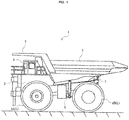
- FIG. 1 is a side view showing a dump truck having a vehicle peripheral obstacle notification system as the first embodiment of the present invention.
- a dump truck 1 (host vehicle) 1 shown in Fig. 1 is furnished primarily with a vehicle body 2 made of a sturdy frame structure, a vessel (bed) 3 mounted tiltably on the vehicle body 2, and a left front wheel 4A(L) and a left rear wheel 4B(L) attached to the vehicle body 2.
- An engine (not shown) for driving the rear wheels 4B is mounted on the vehicle body 2.
- the engine has an engine control unit (ECU), and the revolutions of the engine are controlled by command signals from the ECU regulating the flow rate of the fuel being supplied to the engine.
- ECU engine control unit
- the vessel 3 is provided to carry cargoes such as rubble and coupled tiltably to the vehicle body 2 via a pin coupling part 5, among others.
- cargoes such as rubble and coupled tiltably to the vehicle body 2 via a pin coupling part 5, among others.
- Under the vessel 3 are two tilting cylinders 6 arranged in the direction of the vehicle width with a predetermined distance therebetween. Feeding and evacuating pressure to and from the tilting cylinders 6 causes the cylinders 6 to extend and contract, thereby tilting the vessel 3.
- a canopy 7 is provided above the vessel 3 toward the front.
- the canopy 7 has the function of protecting a cabin 8 below (i.e., in front of the vehicle body 2) from scattering objects such as stones and rocks and also protecting the cabin 8 if the vehicle is overturned.
- a control device 100 constituting the vehicle peripheral obstacle notification system, a steering wheel (not shown), an accelerator pedal (not shown), and a brake pedal (not shown).
- Fig. 2 is a conceptual view explaining the arrangement of cameras making up a surrounding image input part of the vehicle peripheral obstacle notification system as the first embodiment.
- Fig. 3 is a set of conceptual views showing images acquired by the cameras making up part of the vehicle peripheral obstacle notification system as the first embodiment.
- the front side and the rear side of the vehicle body 2 of the dump truck 1 have a front side camera 301 and a rear side camera 303 for acquiring wide-angle images of the front and the rear of the dump truck 1, respectively.
- the left side and the right side of the vehicle body 2 are furnished with a left side camera 302 and a right side camera 304 for acquiring wide-angle images of the left and the right of the dump truck 1, respectively.
- These cameras 301 through 304 are mounted on the respective sides of the vehicle body 2 at a dipping angle so as to acquire mainly images of the respective ground surfaces.
- a right front wheel 4A(R) and a left rear wheel 4B(R) are attached to the vehicle body 2 of the dump truck 1.
- Fig. 3 shows typical surrounding images acquired by the cameras 301 through 304.
- Reference numeral 401 stands for a typical front side image acquired by the front side camera 301; 402 denotes a typical left side image acquired by the left side camera 302; 403 represents a typical rear side image acquired by the rear side camera 303; and 404 indicates a typical right side image acquired by the right side camera 304.
- the surrounding images 401 through 404 are acquired as wide-angle images so that the landscape in the distance (i.e., horizon) looks curved in each image. Also, some of the nearby objects, such as part of the vehicle body 2, part of the right and left front wheels 4A(R) and 4A(L), and part of the right and left rear wheels 4B(R) and 4B(L) appear in the lower portion of each image.
- the front side image 401, left side image 402, rear side image 403, and right side image 404 are combined to make up the surrounding images for this embodiment.
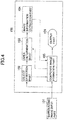
- Fig. 4 is a block diagram showing a structure of the vehicle peripheral obstacle notification system implemented as the first embodiment.
- the vehicle peripheral obstacle notification system as the first embodiment includes a vehicle peripheral obstacle notification device 100 and a surrounding image input part 101.
- the surrounding image input part 101 includes the multiple cameras 301 through 304 for acquiring images of the surroundings of the dump truck 1.
- the surrounding image input part 101 transmits the multiple surrounding images 401 through 404 acquired by the cameras to the vehicle peripheral obstacle notification device 100.
- the vehicle peripheral obstacle notification device 100 includes an object detection part 102, an area determination part 103, an image information extraction part 104, a composite image formation part 105, and an output part 106.
- the object detection part 102 performs a detection process on the multiple surrounding images 401 through 404 sent from the surrounding image input part 101 so as to determine whether there is a moving obstacle in the images.
- the object detection part 102 outputs the result of the detection to the area determination part 103 and composite image formation part 105.
- the area determination part 103 determines whether the moving obstacle is positioned inside or outside the image areas on the basis of position information such as the coordinates at which the moving obstacle is detected in a composite image from the composite image formation part 105. If the moving object is determined to be outside the image areas, the area determination part 103 outputs the coordinates of the detected position to the image information extraction part 104 along with the surrounding images.
- the image information extraction part 104 extracts the image corresponding to the detected position from the surrounding images.
- the image information extraction part 104 outputs the extracted image as a detection result extracted image to the composite image formation part 105 together with the coordinates of the detected position.
- the composite image formation part 105 admits the multiple surrounding images 401 through 404 sent from the surrounding image input part 101, the signal from the object detection part 102 indicating the detection of the moving obstacle, and a detected position coordinate signal from the image information extraction part 104 indicating the position of the moving obstacle as well as the detection result extracted image.
- the composite image formation part 105 first converts the coordinate information about the detected moving obstacle into coordinates in a composite image, and outputs a signal representing the converted coordinates to the area determination part 103.
- the composite image formation part 105 then extracts necessary portions from the input surrounding images for generating a composite bird's-eye image, superimposes the extracted portions on the images following the coordinate conversion, composes an extracted image of the detected position of the obstacle based on the input coordinates of the detected position, and outputs the composite image thus obtained to the output part 106.
- the output part 106 has a display unit that presents a user with the composite image input from the composite image formation part 105.
- FIG. 5 is a flowchart showing processing steps performed by the vehicle peripheral obstacle notification system as the first embodiment.
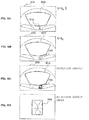
- Figs. 6A, 6B, 6C, and 6D are conceptual views showing an example in which a moving obstacle is detected by the vehicle peripheral obstacle notification system as the first embodiment.
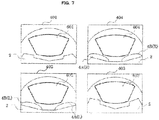
- Fig. 7 is a set of conceptual views showing typical areas extracted from the surrounding images acquired by the vehicle peripheral obstacle notification system as the first embodiment.
- Fig. 8 is a conceptual view showing how a composite image is typically displayed by the vehicle peripheral obstacle notification system as the first embodiment.
- Fig. 5 is a flowchart showing processing steps performed by the vehicle peripheral obstacle notification system as the first embodiment.
- Figs. 6A, 6B, 6C, and 6D are conceptual views showing an example in which a moving obstacle is detected by the vehicle peripheral obstacle notification system as the first embodiment.
- Fig. 7 is a set of conceptual views showing typical areas extracted from the surrounding images acquired by the vehicle peripheral obstacle notification system as the first embodiment.
- Fig. 8 is a conceptual view showing how
- FIG. 9 is a conceptual view explaining how an obstacle outside the image areas is typically detected by the vehicle peripheral obstacle notification system as the first embodiment.
- the same reference numerals denote the same or corresponding components in Figs. 1 through 4 , so that their detailed explanations will be omitted hereunder.
- the vehicle peripheral obstacle notification device 100 inputs surrounding images in step S201. Specifically, the vehicle peripheral obstacle notification device 100 inputs the surrounding images 401 through 404 acquired by the surrounding image input part 101.
- the vehicle peripheral obstacle notification device 100 performs the process of detecting an obstacle in step S202.
- the object detection part 102 shown in Fig. 4 performs the process of detecting a moving obstacle.
- the images targeted for detection are the front side image 401, left side image 402, rear side image 403, and right side image 404 input from the surrounding image input part 101.
- Figs. 6A through 6D depict a typical detection process in which an obstacle is detected from the left side image 402.
- Fig. 6A is an image acquired at time t0-1 earlier than a specific time t0;
- Fig. 6B is an image acquired at the specific time t0;
- Fig. 6C is an image indicative of the result of obstacle detection; and
- Fig. 6D is a detection result image.
- Fig. 6A shows an obstacle 501 being imaged in the left side image 402 at time t0-1
- Fig. 6B indicates an obstacle 502 being imaged in the left side image 402 at the specific time t0.
- the obstacles 501 and 502 are in fact the same person.
- the left side camera 302 has acquired an image of the obstacle moving over time.
- Figs. 6A through 6C show that the person as the obstacle is standing between the front wheel 4A(L) and the rear wheel 4B(L).
- the image acquired in this situation shows the person with his head oriented downward in the image and his legs oriented upward.
- the head is shown proportionally larger than the legs because the head is positioned closer to the camera.
- the object detection part 102 in Fig. 4 compares these images input from the surrounding image input part 101 to calculate the portion where changes have occurred in the images over time.
- a detection result 503 obtained through the calculation and indicated in Fig. 6C as positioned outside the extracted areas (to be discussed later) retains the coordinate information relevant to the left side image 402. If no changes have occurred in the images, the above detection result is not acquired.
- the vehicle peripheral obstacle notification device 100 determines in step S203 whether a moving object is detected in the detection process of step S202. If the moving object is determined to be detected, step S204 is reached; otherwise step S207 is reached.
- the vehicle peripheral obstacle notification device 100 calculates the coordinates of the detected position in step S204.
- the object detection part 102 shown in Fig. 4 converts the position of the moving obstacle acquired in the front side image 401, left side image 402, rear side image 403, and right side image 404 into coordinate information, and outputs a signal representative of the coordinate information to the composite image formation part 105.
- the composite image formation part 105 converts the input signal so as to calculate the coordinate information for a composite image. This conversion is the same as the process of forming the composite image in step S207, to be discussed later.
- portions of the front side image 401, left side image 402, rear side image 403, and right side image 404 are extracted and arranged in such a manner that their boundaries are contiguous with one another allowing the surroundings of the dump truck (host vehicle) 1 to be displayed.
- a front side extracted area 601, a left side extracted area 602, a rear side extracted area 603, and a right side extracted area 604 are established, respectively, in the surrounding images 401 through 404 shown in Fig. 7 .
- These extracted areas are delineated on the basis of wide-angle camera characteristics and in such a manner that portions over a predetermined distance starting from immediately under the dump truck 1 are included in the images and that the extracted area in the image input from a given camera and the extracted area in the image input from the adjacent camera are contiguous with each other without overlaps.
- the extracted areas 601 through 604 are then subjected to coordinate conversion and image composition so as to form a composite image 605 shown in Fig. 8 .
- the front side extracted area 601 is converted to a front side converted image 606.
- the left side extracted area 602 is converted to a left side converted image 607
- the rear side extracted area 603 is converted to a rear side converted image 608, and the right side extracted area 604 to a right side converted image 609.
- the converted images 606 through 609 are arranged successively to be contiguous with each other.
- the composite image 605 is a bird's-eye view of the surroundings of the dump truck 1.
- a host vehicle icon 610 is composed in order to give the user a clear indication of the area in which the dump truck (host vehicle) 1 is located.
- the vehicle peripheral obstacle notification device 100 determines in step S205 whether the coordinates of the detected position in step S204 are outside the areas of the converted images. Specifically, the area determination part 103 determines whether the position of the moving obstacle is inside or outside the image areas on the basis of the position information including the detected position coordinates of the moving obstacle in the composite image from the composite image formation part 105. If the moving obstacle is determined to be outside the areas of the converted images, step S206 is reached; otherwise step S207 is reached.
- the image 503 indicative of the detection result outside the extracted areas is positioned inside the left side image 402 but outside the left side extracted area 602.
- the converted coordinate information points to the outside of the left side converted image 607 shown in Fig. 8 .
- the vehicle peripheral obstacle notification device 100 extracts the image of the detected position in step S206. Specifically, from among the images yet to be converted, the image information extraction part 104 extracts the image covering the portion corresponding to the detected position. With this embodiment, the image information extraction part 104 extracts a detection result image 504 outside the extracted area and corresponding to the detection result 503 that is inside the left side image 402 and outside its extracted area in Fig. 6D . The detection result image 504 thus extracted is retained by the composite image formation part 105.
- step S207 is the process of forming the composite image as in the above-mentioned step S204. Portions of the front side image 401, left side image 402, rear side image 403, and right side image 404 are extracted, subjected to coordinate conversion, and arranged by the composite information formation part 105 in such a manner that their boundaries are contiguous with one another, thereby allowing the surroundings of the dump truck (host vehicle) 1 to be displayed.
- step S206 the processing by the composite image formation part 105 following the execution of step S206 is different from the processing in other cases. If it is determined in step S203 that the moving obstacle is detected, this system retains the coordinate information from the detection result. Also, if it is determined in step S205 that the coordinates of the detection result are outside the image areas, this system retains the detection result image 504 shown in Fig. 6D . To present such information to the user, the composite image formation part 105 sets highlight display to the composite image 605 shown in Fig. 9 .
- the composite image formation part 105 converts the detection result 503 outside the extracted area in Fig. 6C , and sets the detection result image 504 outside the extracted area at the converted coordinates. This allows the composite image 605 shown in Fig. 9 to be superimposed with an image 701 in which the detection result outside the extracted area is arranged. If it is determined in step S205 that the coordinates of the detection result are inside the image area, another type of highlight display such as the rendering of a rectangle is made in that position, and the detection result image 504 outside the extracted area is not used. This makes it possible to notify the user of the presence, by highlight display, of the moving obstacle not appearing in the composite image 605.
- the vehicle peripheral obstacle notification device 100 outputs the composite image in step S208. Specifically, the composite image formation part 105 outputs the composite image 605 to the output part 106. If the moving obstacle has been detected in the above-described process, what is output to the output part 106 is a highlighted composite image 605 such as the detection result 701 following the coordinate conversion.
- step S209 the vehicle peripheral obstacle notification device 100 determines whether the detection and the output of the moving obstacle are completed. If it is determined that these processes are completed, the vehicle peripheral obstacle notification device 100 terminates its processing; otherwise the vehicle peripheral obstacle notification device 100 returns to step S201.
- this embodiment performs the detection and notification of the moving obstacle in the manner described above, the user can be notified of what kind of obstacle is detected at what location.
- the details of the notification prompt the user to determine quickly what to do next in carrying out the work involved.
- the vehicle peripheral obstacle notification system as the first embodiment of the present invention, it is possible to detect, without recourse to an onboard under-vehicle camera, a moving obstacle at a location not appearing in a composite bird's-eye view covering the surroundings of the host vehicle 1 including a view immediately under the vehicle body of the host vehicle 1, the position and an image of the moving obstacle being superimposed onto a display screen prompting the user to know quickly what kind of obstacle is detected at what location.
- This allows the user easily to determine how to deal with the detected moving obstacle. As a result, the efficiency of the entire work being done is improved.
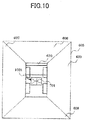
- FIG. 10 is a conceptual view explaining how an obstacle outside the image areas is typically detected by the vehicle peripheral obstacle notification system as the second embodiment.
- the same reference numerals denote the same or corresponding components in Figs. 1 through 9 , so that their detailed explanations will be omitted hereunder.
- the structure and the manner of operation of the vehicle peripheral obstacle notification system as the second embodiment are substantially the same as those of the first embodiment.
- the second embodiment differs from the first embodiment as follows: if a moving object is detected which is under the host vehicle 1 and which does not appear in the composite image 605, the detected position is highlighted, and the image of the detection result (i.e., image of the obstacle) is indicated to the user as an image displayed at the center of the host vehicle icon 610.
- step S801 the composite image 605 such as one shown in Fig. 10 is output to the output part 106.
- the composite image formation part 105 converts the detection result 503 outside the extracted area, and sets highlight display at the converted coordinates for clearly indicating the detected position.
- an arrow 1001 pointing to the detected position is displayed from around the center of the host vehicle icon 610 toward the converted coordinates.
- the composite image formation part 105 sets the rendering of the image 701 in which the detection result outside the extracted area is arranged. If multiple moving obstacles are detected, this process is applied to the most recently detected moving obstacle. As a result of this, if the position at which the moving obstacle is detected is outside the areas of the converted images, simply looking at the host vehicle icon 610 enables the user always to find the image 701 in which the detection result outside the extracted areas is arranged. The user is thus allowed to minimize the movement of the point of view and thereby understand the situation quickly.
- the position of the moving obstacle is displayed where it is detected, but the image of the detected obstacle is displayed at a position different from the detected position.
- the above-described vehicle peripheral obstacle notification system as the second embodiment enables the user to minimize the movement of the point of view when finding the image of the moving obstacle. As a result, the user can understand the situation quickly and ensure safety better than before.
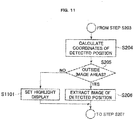
- FIG. 11 is a flowchart showing the processing steps for highlight display performed by the vehicle peripheral obstacle notification system as the third embodiment.
- Fig. 13 is a set of conceptual views explaining how an obstacle inside the image areas is typically detected by the vehicle peripheral obstacle notification system as the third embodiment.
- the same reference numerals denote the same or corresponding components in Figs. 1 through 10 , so that their detailed explanations will be omitted hereunder.
- the structure and the manner of operation of the vehicle peripheral obstacle notification system as the third embodiment are substantially the same as those of the first embodiment.
- the third embodiment differs from the first embodiment as follows: if a moving obstacle is detected in an area appearing in the composite image 605, an image of the detection result (i.e., image of the obstacle) yet to be subjected to coordinate conversion is displayed for notification to the user.
- the flow of the processing by the third embodiment is similar to what is shown in Fig. 5 but differs where another step is added after step S206. This difference is explained below with reference to Fig. 11 .
- step S1101 is carried out to set highlight display so that the user is presented with the detection result image in effect before application of the coordinate conversion and retained by this system.
- the composite image 605 indicated on the right in Fig. 12 is formed.
- the moving obstacle is inside the left side extracted area 602 and is shown as a detection result 1201 inside the extracted area.
- the detection result is subjected to coordinate conversion in step S207 in which the composite image is formed, and the result of the conversion is displayed on the output part 106.
- coordinate conversion is not applied; the detection result is set within the composite image 605 as a detection result image 1202 inside the extracted area.
- the above-described vehicle peripheral obstacle notification system as the third embodiment enables the user to recognize the image closely reflecting the state actually observed from where the camera is located. As a result, the user can understand the situation on site quickly and ensure safety better than before.
- FIG. 13 is a conceptual view showing typical display of a composite bird's-eye image and a detected moving obstacle given by the vehicle peripheral obstacle notification system as the fourth embodiment.
- the same reference numerals denote the same or corresponding components in Figs. 1 through 12 , so that their detailed explanations will be omitted hereunder.
- the structure and the manner of operation of the vehicle peripheral obstacle notification system as the fourth embodiment are substantially the same as those of the first embodiment.
- the fourth embodiment differs from the first embodiment as follows: if a moving object is detected which is under the host vehicle 1 and which does not appear in the composite image 605, a partial area under the host vehicle 1 is shown superimposed on the host vehicle icon 610, along with the image of the detection result (i.e., image of the obstacle) for notification to the user.
- the composite image 605 such as one shown in Fig. 13 is output to the output part 106.
- the composite image formation part 105 converts the detection result 503 outside the extracted area, and sets highlight display for clearly indicating the detected position at the converted coordinates.
- the image 701 in which the detection result outside the extracted areas is arranged is displayed supplemented with a detection result surrounding image 1301 (shown shaded) indicating the surroundings of the detected position.
- the detection result surrounding image 1301 may be an image under the host vehicle 1 included in the image containing the detected moving obstacle, for example.
- the detection result surrounding image 1301 corresponds to the portions other than the left side extracted area 602 within the left side image 402 shown in Fig. 7 .
- the underside of the host vehicle 1 is located apparently at the bottom of the left side extracted area 602. An image of this portion can thus be utilized in Fig. 13 .
- the detection result surrounding image 1301 either the image yet to be subjected to coordinate conversion or the image having undergone coordinate conversion may be set. Because the detection result and the situation of the surroundings can be displayed side by side, the user can easily estimate the cause and the future behavior of the detection result.
- the above-described vehicle peripheral obstacle notification system as the fourth embodiment enables the user easily to estimate the cause and the future behavior of the detected moving obstacle. As a result, the user can understand the situation quickly and ensure safety better than before.
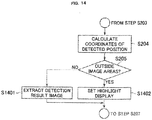
- FIG. 14 is a flowchart showing the processing steps for highlight display performed by the vehicle peripheral obstacle notification system as the fifth embodiment.
- Fig. 15 is a set of conceptual views explaining how an obstacle inside the image areas is typically detected by the vehicle peripheral obstacle notification system as the fifth embodiment.
- the same reference numerals denote the same or corresponding components in Figs. 1 through 13 , so that their detailed explanations will be omitted hereunder.
- the structure and the manner of operation of the vehicle peripheral obstacle notification system as the fifth embodiment are substantially the same as those of the first embodiment.
- the fifth embodiment differs from the first embodiment as follows: if the moving object detected in the surroundings of the host vehicle 1 has moved under the host vehicle 1, an image acquired in the vehicle surroundings (i.e., image of the obstacle) is displayed at the under-vehicle location where there is the moving obstacle, for notification to the user.
- the flow of the processing by the sixth embodiment is similar to what is shown in Fig. 5 but differs where another step is added after step S205. This difference is explained below with reference to Fig. 14 .
- step S1401 is carried out as a process to extract and retain a detection result image. If the coordinates of the detection result are determined to be outside the image areas in step S205, step S206 is replaced with step S1402 in which highlight display is set to present the user with the detection result image inside the image areas retained by this system.
- step S1401 is carried out as a process to extract the detection result image. Specifically, the detection result 1201 inside the extracted area shown on the left in Fig. 15 is acquired, and is retained by the image information extraction part 104. Thereafter, when the moving object has moved under the host vehicle 1, the moving obstacle moves from inside the image area to the outside. At this time, the result of the determination of step S205 in Fig. 14 is changed, and step S1402 is carried out as a process to set highlight display.
- the image 701 is displayed in which the detection result outside the extracted area is displayed superimposed on the host vehicle icon 610.
- the image used here was acquired in step S1401 and has been retained by the image information extraction part 104.
- the image thus acquired is expected to be higher in brightness than if the detection result image is acquired from under the host vehicle 1 where incident light is less than in the surroundings, so that the images acquired from the underside are expected to be relatively dark.
- the display therefore allows the user easily to grasp the behavior of the moving obstacle even if the obstacle has moved under the host vehicle 1.
- the above-described vehicle peripheral obstacle notification system as the fifth embodiment can display an image closely reflecting the state of the moving obstacle visibly recognizable by the user's naked eye, allowing the user easily to grasp the situation on site. As a result, the user can understand the situation quickly and ensure safety better than before.
- the present invention is not limited to the aforementioned embodiments, but covers various modifications. While, for illustrative purposes, those embodiments have been described specifically, the present invention is not necessarily limited to the specific forms disclosed. Note also that some or all of the aforementioned components, functions, processors, and the like can be implemented by hardware such as an integrated circuit or the like. Alternatively, those components, functions, and the like can be implemented by software as well.
Landscapes
- Engineering & Computer Science (AREA)
- Multimedia (AREA)
- Theoretical Computer Science (AREA)
- Physics & Mathematics (AREA)
- General Physics & Mathematics (AREA)
- Mechanical Engineering (AREA)
- Computer Vision & Pattern Recognition (AREA)
- Human Computer Interaction (AREA)
- Closed-Circuit Television Systems (AREA)
- Traffic Control Systems (AREA)
- Image Processing (AREA)
- Fittings On The Vehicle Exterior For Carrying Loads, And Devices For Holding Or Mounting Articles (AREA)
- Image Analysis (AREA)
Applications Claiming Priority (1)
| Application Number | Priority Date | Filing Date | Title |
|---|---|---|---|
| JP2014091571A JP6262068B2 (ja) | 2014-04-25 | 2014-04-25 | 車体近傍障害物報知システム |
Publications (2)
| Publication Number | Publication Date |
|---|---|
| EP2937811A1 EP2937811A1 (en) | 2015-10-28 |
| EP2937811B1 true EP2937811B1 (en) | 2018-10-17 |
Family
ID=52807653
Family Applications (1)
| Application Number | Title | Priority Date | Filing Date |
|---|---|---|---|
| EP15161667.9A Not-in-force EP2937811B1 (en) | 2014-04-25 | 2015-03-30 | Vehicle peripheral obstacle notification system |
Country Status (4)
| Country | Link |
|---|---|
| US (1) | US9463741B2 (enExample) |
| EP (1) | EP2937811B1 (enExample) |
| JP (1) | JP6262068B2 (enExample) |
| CN (1) | CN105007449B (enExample) |
Cited By (1)
| Publication number | Priority date | Publication date | Assignee | Title |
|---|---|---|---|---|
| US11673571B2 (en) * | 2020-07-08 | 2023-06-13 | Toyota Jidosha Kabushiki Kaisha | Vehicle surrounding monitoring apparatus |
Families Citing this family (41)
| Publication number | Priority date | Publication date | Assignee | Title |
|---|---|---|---|---|
| JP5938292B2 (ja) * | 2012-08-03 | 2016-06-22 | 日立建機株式会社 | 運搬車両の監視装置 |
| DE102014107235A1 (de) * | 2014-05-22 | 2015-11-26 | Dr. Ing. H.C. F. Porsche Aktiengesellschaft | Verfahren zur Darstellung einer Fahrzeugumgebung auf einer Anzeigevorrichtung; eine Anzeigevorrichtung; ein System aus einer Mehrzahl an Bilderfassungseinheiten und einer Anzeigevorrichtung; ein Computerprogramm |
| EP3267680A4 (en) * | 2015-03-03 | 2018-10-03 | Hitachi Construction Machinery Co., Ltd. | Device for monitoring surroundings of vehicle |
| EP3432022B1 (en) * | 2016-03-14 | 2025-05-07 | Hitachi Construction Machinery Co., Ltd. | Mine working machine |
| JP6595401B2 (ja) * | 2016-04-26 | 2019-10-23 | 株式会社Soken | 表示制御装置 |
| EP3267419B1 (en) * | 2016-07-08 | 2021-11-10 | Volvo Car Corporation | Method and system for maintaining a database comprising reported traffic-affecting events |
| JP6730615B2 (ja) * | 2016-07-12 | 2020-07-29 | 株式会社Jvcケンウッド | 車両用表示制御装置、車両用表示システム、車両用表示制御方法およびプログラム |
| CN106503653B (zh) * | 2016-10-21 | 2020-10-13 | 深圳地平线机器人科技有限公司 | 区域标注方法、装置和电子设备 |
| US10268907B2 (en) * | 2017-01-11 | 2019-04-23 | GM Global Technology Operations LLC | Methods and systems for providing notifications on camera displays for vehicles |
| US20180201132A1 (en) * | 2017-01-13 | 2018-07-19 | Deere & Company | Mobile machine-user protocol system and method |
| US10936884B2 (en) * | 2017-01-23 | 2021-03-02 | Magna Electronics Inc. | Vehicle vision system with object detection failsafe |
| GB2559759B (en) * | 2017-02-16 | 2020-07-29 | Jaguar Land Rover Ltd | Apparatus and method for displaying information |
| JP6730613B2 (ja) * | 2017-02-28 | 2020-07-29 | 株式会社Jvcケンウッド | 俯瞰映像生成装置、俯瞰映像生成システム、俯瞰映像生成方法およびプログラム |
| JP6796518B2 (ja) * | 2017-03-06 | 2020-12-09 | 日立建機株式会社 | 移動物体検知システム |
| WO2019111859A1 (ja) * | 2017-12-04 | 2019-06-13 | 住友重機械工業株式会社 | 周辺監視装置、情報処理端末、情報処理装置、情報処理プログラム |
| JP6900897B2 (ja) | 2017-12-25 | 2021-07-07 | コベルコ建機株式会社 | 建設機械の障害物検出装置 |
| JP6802196B2 (ja) * | 2018-01-09 | 2020-12-16 | 日立建機株式会社 | 運搬車両 |
| JP7304922B2 (ja) * | 2018-02-01 | 2023-07-07 | アルパイン株式会社 | 周辺監視システム |
| EP3827424B1 (en) * | 2018-07-23 | 2024-04-24 | Newtrax Holdings Inc. | Method and system for acknowledging presence in a context-aware environment |
| JP7374602B2 (ja) * | 2019-03-29 | 2023-11-07 | 日立建機株式会社 | 作業車両 |
| EP3960543A4 (en) * | 2019-04-26 | 2022-07-06 | Sumitomo Construction Machinery Co., Ltd. | DISPLAY DEVICE, SHOVEL, INFORMATION PROCESSING DEVICE |
| US10949685B2 (en) | 2019-07-22 | 2021-03-16 | Caterpillar Inc. | Excluding a component of a work machine from a video frame based on motion information |
| US11755028B2 (en) | 2019-09-11 | 2023-09-12 | Deere & Company | Mobile work machine with object detection using vision recognition |
| US11814816B2 (en) | 2019-09-11 | 2023-11-14 | Deere & Company | Mobile work machine with object detection and machine path visualization |
| GB2588186A (en) * | 2019-10-11 | 2021-04-21 | Caterpillar Inc | System for monitoring surrounding area of cold planer |
| US11320830B2 (en) | 2019-10-28 | 2022-05-03 | Deere & Company | Probabilistic decision support for obstacle detection and classification in a working area |
| US10981507B1 (en) | 2019-11-07 | 2021-04-20 | Focused Technology Solutions, Inc. | Interactive safety system for vehicles |
| JP7290119B2 (ja) * | 2020-01-24 | 2023-06-13 | トヨタ自動車株式会社 | 車両報知装置 |
| JP7319593B2 (ja) * | 2020-02-13 | 2023-08-02 | トヨタ自動車株式会社 | 車両周辺監視装置 |
| JP7329134B2 (ja) * | 2020-03-27 | 2023-08-17 | 日立建機株式会社 | 作業機械 |
| JP7347307B2 (ja) * | 2020-04-02 | 2023-09-20 | 株式会社デンソー | 駐車支援装置、駐車支援システム、及び駐車支援方法 |
| US11472416B2 (en) | 2020-04-30 | 2022-10-18 | Deere & Company | Multi-dimensional mobile machine path visualization and control system |
| CN111912418B (zh) * | 2020-07-16 | 2024-11-26 | 知行汽车科技(苏州)股份有限公司 | 删除移动载体不可行驶区域内障碍物的方法、装置及介质 |
| JP7399836B2 (ja) * | 2020-10-12 | 2023-12-18 | ヤンマーホールディングス株式会社 | 作業車両 |
| US11661722B2 (en) | 2020-11-19 | 2023-05-30 | Deere & Company | System and method for customized visualization of the surroundings of self-propelled work vehicles |
| CN113807163B (zh) * | 2021-07-28 | 2023-12-19 | 中科云谷科技有限公司 | 泵车的支腿放置方法、泵车的支腿放置装置及存储介质 |
| KR20230055722A (ko) * | 2021-10-19 | 2023-04-26 | 현대모비스 주식회사 | 차량의 타겟 감지 시스템 및 방법 |
| JP2023176830A (ja) * | 2022-06-01 | 2023-12-13 | ヤンマーホールディングス株式会社 | 作業機械の制御方法、作業機械用制御プログラム、作業機械用制御システム及び作業機械 |
| US12675753B2 (en) | 2022-11-08 | 2026-07-07 | International Business Machines Corporation | Orchestrating vehicles and remote operating clients |
| US12461523B2 (en) * | 2022-11-08 | 2025-11-04 | International Business Machines Corporation | Orchestrating vehicles and remote operating clients |
| US12651463B2 (en) * | 2024-02-29 | 2026-06-09 | Toyota Connected North America, Inc. | Systems and methods for identifying lifeforms around a stationary vehicle |
Citations (1)
| Publication number | Priority date | Publication date | Assignee | Title |
|---|---|---|---|---|
| US20140354813A1 (en) * | 2011-09-16 | 2014-12-04 | Hitachi Construction Machinery Co., Ltd. | Surroundings Monitoring Device for Work Machine |
Family Cites Families (16)
| Publication number | Priority date | Publication date | Assignee | Title |
|---|---|---|---|---|
| JP4556742B2 (ja) | 2005-03-30 | 2010-10-06 | 株式会社デンソー | 車両直下画像表示制御装置および車両直下画像表示制御プログラム |
| JP4846426B2 (ja) * | 2006-04-20 | 2011-12-28 | パナソニック株式会社 | 車両周囲監視装置 |
| JP4404103B2 (ja) * | 2007-03-22 | 2010-01-27 | 株式会社デンソー | 車両外部撮影表示システムおよび画像表示制御装置 |
| JP4847913B2 (ja) | 2007-03-30 | 2011-12-28 | 日立建機株式会社 | 作業機械周辺監視装置 |
| JP2009253673A (ja) * | 2008-04-07 | 2009-10-29 | Clarion Co Ltd | 車両用周囲状況表示装置 |
| JP5068779B2 (ja) * | 2009-02-27 | 2012-11-07 | 現代自動車株式会社 | 車両周囲俯瞰画像表示装置及び方法 |
| JP4951639B2 (ja) | 2009-03-02 | 2012-06-13 | 日立建機株式会社 | 周囲監視装置を備えた作業機械 |
| JP5165631B2 (ja) * | 2009-04-14 | 2013-03-21 | 現代自動車株式会社 | 車両周囲画像表示システム |
| US20110001819A1 (en) * | 2009-07-02 | 2011-01-06 | Sanyo Electric Co., Ltd. | Image Processing Apparatus |
| US8655019B2 (en) * | 2009-09-24 | 2014-02-18 | Panasonic Corporation | Driving support display device |
| KR101797261B1 (ko) * | 2010-06-18 | 2017-11-13 | 히다찌 겐끼 가부시키가이샤 | 작업 기계의 주위 감시 장치 |
| US9113047B2 (en) * | 2010-10-22 | 2015-08-18 | Hitachi Construction Machinery Co., Ltd. | Peripheral monitoring device for working machine |
| JP5483120B2 (ja) * | 2011-07-26 | 2014-05-07 | アイシン精機株式会社 | 車両周辺監視システム |
| US9598836B2 (en) | 2012-03-29 | 2017-03-21 | Harnischfeger Technologies, Inc. | Overhead view system for a shovel |
| JP5629740B2 (ja) * | 2012-09-21 | 2014-11-26 | 株式会社小松製作所 | 作業車両用周辺監視システム及び作業車両 |
| JP5324690B1 (ja) * | 2012-09-21 | 2013-10-23 | 株式会社小松製作所 | 作業車両用周辺監視システム及び作業車両 |
-
2014
- 2014-04-25 JP JP2014091571A patent/JP6262068B2/ja not_active Expired - Fee Related
-
2015
- 2015-03-13 CN CN201510112033.XA patent/CN105007449B/zh not_active Expired - Fee Related
- 2015-03-19 US US14/662,746 patent/US9463741B2/en not_active Expired - Fee Related
- 2015-03-30 EP EP15161667.9A patent/EP2937811B1/en not_active Not-in-force
Patent Citations (1)
| Publication number | Priority date | Publication date | Assignee | Title |
|---|---|---|---|---|
| US20140354813A1 (en) * | 2011-09-16 | 2014-12-04 | Hitachi Construction Machinery Co., Ltd. | Surroundings Monitoring Device for Work Machine |
Cited By (1)
| Publication number | Priority date | Publication date | Assignee | Title |
|---|---|---|---|---|
| US11673571B2 (en) * | 2020-07-08 | 2023-06-13 | Toyota Jidosha Kabushiki Kaisha | Vehicle surrounding monitoring apparatus |
Also Published As
| Publication number | Publication date |
|---|---|
| CN105007449B (zh) | 2019-01-15 |
| CN105007449A (zh) | 2015-10-28 |
| US20150307024A1 (en) | 2015-10-29 |
| JP2015210649A (ja) | 2015-11-24 |
| US9463741B2 (en) | 2016-10-11 |
| EP2937811A1 (en) | 2015-10-28 |
| JP6262068B2 (ja) | 2018-01-17 |
Similar Documents
| Publication | Publication Date | Title |
|---|---|---|
| US9463741B2 (en) | Vehicle peripheral obstacle notification system | |
| CN106797450B (zh) | 车身外部移动物体探测装置 | |
| JP5529943B2 (ja) | 作業車両用周辺監視システム及び作業車両 | |
| US8933797B2 (en) | Video-based warning system for a vehicle | |
| JP6385745B2 (ja) | 鉱山用作業車両 | |
| US10866416B2 (en) | Display control device and display control method | |
| AU2014213529B2 (en) | Image display system | |
| EP2753996B1 (en) | Terrain visualization for a vehicle and vehicle driver | |
| CN109204136B (zh) | 周边图像显示控制装置 | |
| US20140347483A1 (en) | Work vehicle periphery monitoring system and work vehicle | |
| US20120314072A1 (en) | Image generation apparatus | |
| WO2016002163A1 (ja) | 画像表示装置、画像表示方法 | |
| JP5902990B2 (ja) | 自走式産業機械の画像処理装置 | |
| JP6339337B2 (ja) | 車両周囲移動物体検知システム | |
| JP6878221B2 (ja) | 作業機械の障害物検知システム | |
| JP6401141B2 (ja) | 車両周囲障害物検出装置 | |
| JP5926315B2 (ja) | 作業車両用周辺監視システム及び作業車両 | |
| US20140293047A1 (en) | System for generating overhead view of machine | |
| CN106797452A (zh) | 车辆的周围监视装置 | |
| JP2016119559A (ja) | 作業機械の周囲監視装置 | |
| JP2010073036A (ja) | 車両周辺監視装置 | |
| JP6741364B2 (ja) | 車両周辺画像表示装置および車両周辺画像表示方法 | |
| JP6796518B2 (ja) | 移動物体検知システム | |
| JP6868996B2 (ja) | 障害物検知システム及び建設機械 | |
| JP2019121250A (ja) | 運搬車両 |
Legal Events
| Date | Code | Title | Description |
|---|---|---|---|
| PUAI | Public reference made under article 153(3) epc to a published international application that has entered the european phase |
Free format text: ORIGINAL CODE: 0009012 |
|
| AK | Designated contracting states |
Kind code of ref document: A1 Designated state(s): AL AT BE BG CH CY CZ DE DK EE ES FI FR GB GR HR HU IE IS IT LI LT LU LV MC MK MT NL NO PL PT RO RS SE SI SK SM TR |
|
| AX | Request for extension of the european patent |
Extension state: BA ME |
|
| 17P | Request for examination filed |
Effective date: 20151006 |
|
| RBV | Designated contracting states (corrected) |
Designated state(s): AL AT BE BG CH CY CZ DE DK EE ES FI FR GB GR HR HU IE IS IT LI LT LU LV MC MK MT NL NO PL PT RO RS SE SI SK SM TR |
|
| STAA | Information on the status of an ep patent application or granted ep patent |
Free format text: STATUS: EXAMINATION IS IN PROGRESS |
|
| 17Q | First examination report despatched |
Effective date: 20170224 |
|
| GRAP | Despatch of communication of intention to grant a patent |
Free format text: ORIGINAL CODE: EPIDOSNIGR1 |
|
| STAA | Information on the status of an ep patent application or granted ep patent |
Free format text: STATUS: GRANT OF PATENT IS INTENDED |
|
| INTG | Intention to grant announced |
Effective date: 20180629 |
|
| GRAS | Grant fee paid |
Free format text: ORIGINAL CODE: EPIDOSNIGR3 |
|
| GRAA | (expected) grant |
Free format text: ORIGINAL CODE: 0009210 |
|
| STAA | Information on the status of an ep patent application or granted ep patent |
Free format text: STATUS: THE PATENT HAS BEEN GRANTED |
|
| AK | Designated contracting states |
Kind code of ref document: B1 Designated state(s): AL AT BE BG CH CY CZ DE DK EE ES FI FR GB GR HR HU IE IS IT LI LT LU LV MC MK MT NL NO PL PT RO RS SE SI SK SM TR |
|
| RAP1 | Party data changed (applicant data changed or rights of an application transferred) |
Owner name: HITACHI CONSTRUCTION MACHINERY CO., LTD. |
|
| REG | Reference to a national code |
Ref country code: GB Ref legal event code: FG4D |
|
| REG | Reference to a national code |
Ref country code: CH Ref legal event code: EP |
|
| REG | Reference to a national code |
Ref country code: IE Ref legal event code: FG4D |
|
| REG | Reference to a national code |
Ref country code: DE Ref legal event code: R096 Ref document number: 602015018149 Country of ref document: DE Ref country code: AT Ref legal event code: REF Ref document number: 1054850 Country of ref document: AT Kind code of ref document: T Effective date: 20181115 |
|
| REG | Reference to a national code |
Ref country code: NL Ref legal event code: MP Effective date: 20181017 |
|
| REG | Reference to a national code |
Ref country code: DE Ref legal event code: R082 Ref document number: 602015018149 Country of ref document: DE Representative=s name: MANITZ FINSTERWALD PATENT- UND RECHTSANWALTSPA, DE |
|
| REG | Reference to a national code |
Ref country code: LT Ref legal event code: MG4D |
|
| REG | Reference to a national code |
Ref country code: AT Ref legal event code: MK05 Ref document number: 1054850 Country of ref document: AT Kind code of ref document: T Effective date: 20181017 |
|
| PG25 | Lapsed in a contracting state [announced via postgrant information from national office to epo] |
Ref country code: NL Free format text: LAPSE BECAUSE OF FAILURE TO SUBMIT A TRANSLATION OF THE DESCRIPTION OR TO PAY THE FEE WITHIN THE PRESCRIBED TIME-LIMIT Effective date: 20181017 |
|
| PG25 | Lapsed in a contracting state [announced via postgrant information from national office to epo] |
Ref country code: FI Free format text: LAPSE BECAUSE OF FAILURE TO SUBMIT A TRANSLATION OF THE DESCRIPTION OR TO PAY THE FEE WITHIN THE PRESCRIBED TIME-LIMIT Effective date: 20181017 Ref country code: IS Free format text: LAPSE BECAUSE OF FAILURE TO SUBMIT A TRANSLATION OF THE DESCRIPTION OR TO PAY THE FEE WITHIN THE PRESCRIBED TIME-LIMIT Effective date: 20190217 Ref country code: NO Free format text: LAPSE BECAUSE OF FAILURE TO SUBMIT A TRANSLATION OF THE DESCRIPTION OR TO PAY THE FEE WITHIN THE PRESCRIBED TIME-LIMIT Effective date: 20190117 Ref country code: AT Free format text: LAPSE BECAUSE OF FAILURE TO SUBMIT A TRANSLATION OF THE DESCRIPTION OR TO PAY THE FEE WITHIN THE PRESCRIBED TIME-LIMIT Effective date: 20181017 Ref country code: ES Free format text: LAPSE BECAUSE OF FAILURE TO SUBMIT A TRANSLATION OF THE DESCRIPTION OR TO PAY THE FEE WITHIN THE PRESCRIBED TIME-LIMIT Effective date: 20181017 Ref country code: LV Free format text: LAPSE BECAUSE OF FAILURE TO SUBMIT A TRANSLATION OF THE DESCRIPTION OR TO PAY THE FEE WITHIN THE PRESCRIBED TIME-LIMIT Effective date: 20181017 Ref country code: HR Free format text: LAPSE BECAUSE OF FAILURE TO SUBMIT A TRANSLATION OF THE DESCRIPTION OR TO PAY THE FEE WITHIN THE PRESCRIBED TIME-LIMIT Effective date: 20181017 Ref country code: PL Free format text: LAPSE BECAUSE OF FAILURE TO SUBMIT A TRANSLATION OF THE DESCRIPTION OR TO PAY THE FEE WITHIN THE PRESCRIBED TIME-LIMIT Effective date: 20181017 Ref country code: BG Free format text: LAPSE BECAUSE OF FAILURE TO SUBMIT A TRANSLATION OF THE DESCRIPTION OR TO PAY THE FEE WITHIN THE PRESCRIBED TIME-LIMIT Effective date: 20190117 Ref country code: LT Free format text: LAPSE BECAUSE OF FAILURE TO SUBMIT A TRANSLATION OF THE DESCRIPTION OR TO PAY THE FEE WITHIN THE PRESCRIBED TIME-LIMIT Effective date: 20181017 |
|
| PG25 | Lapsed in a contracting state [announced via postgrant information from national office to epo] |
Ref country code: PT Free format text: LAPSE BECAUSE OF FAILURE TO SUBMIT A TRANSLATION OF THE DESCRIPTION OR TO PAY THE FEE WITHIN THE PRESCRIBED TIME-LIMIT Effective date: 20190217 Ref country code: SE Free format text: LAPSE BECAUSE OF FAILURE TO SUBMIT A TRANSLATION OF THE DESCRIPTION OR TO PAY THE FEE WITHIN THE PRESCRIBED TIME-LIMIT Effective date: 20181017 Ref country code: GR Free format text: LAPSE BECAUSE OF FAILURE TO SUBMIT A TRANSLATION OF THE DESCRIPTION OR TO PAY THE FEE WITHIN THE PRESCRIBED TIME-LIMIT Effective date: 20190118 Ref country code: AL Free format text: LAPSE BECAUSE OF FAILURE TO SUBMIT A TRANSLATION OF THE DESCRIPTION OR TO PAY THE FEE WITHIN THE PRESCRIBED TIME-LIMIT Effective date: 20181017 Ref country code: RS Free format text: LAPSE BECAUSE OF FAILURE TO SUBMIT A TRANSLATION OF THE DESCRIPTION OR TO PAY THE FEE WITHIN THE PRESCRIBED TIME-LIMIT Effective date: 20181017 |
|
| REG | Reference to a national code |
Ref country code: DE Ref legal event code: R097 Ref document number: 602015018149 Country of ref document: DE |
|
| PG25 | Lapsed in a contracting state [announced via postgrant information from national office to epo] |
Ref country code: IT Free format text: LAPSE BECAUSE OF FAILURE TO SUBMIT A TRANSLATION OF THE DESCRIPTION OR TO PAY THE FEE WITHIN THE PRESCRIBED TIME-LIMIT Effective date: 20181017 Ref country code: CZ Free format text: LAPSE BECAUSE OF FAILURE TO SUBMIT A TRANSLATION OF THE DESCRIPTION OR TO PAY THE FEE WITHIN THE PRESCRIBED TIME-LIMIT Effective date: 20181017 Ref country code: DK Free format text: LAPSE BECAUSE OF FAILURE TO SUBMIT A TRANSLATION OF THE DESCRIPTION OR TO PAY THE FEE WITHIN THE PRESCRIBED TIME-LIMIT Effective date: 20181017 |
|
| PLBE | No opposition filed within time limit |
Free format text: ORIGINAL CODE: 0009261 |
|
| STAA | Information on the status of an ep patent application or granted ep patent |
Free format text: STATUS: NO OPPOSITION FILED WITHIN TIME LIMIT |
|
| PG25 | Lapsed in a contracting state [announced via postgrant information from national office to epo] |
Ref country code: SM Free format text: LAPSE BECAUSE OF FAILURE TO SUBMIT A TRANSLATION OF THE DESCRIPTION OR TO PAY THE FEE WITHIN THE PRESCRIBED TIME-LIMIT Effective date: 20181017 Ref country code: EE Free format text: LAPSE BECAUSE OF FAILURE TO SUBMIT A TRANSLATION OF THE DESCRIPTION OR TO PAY THE FEE WITHIN THE PRESCRIBED TIME-LIMIT Effective date: 20181017 Ref country code: RO Free format text: LAPSE BECAUSE OF FAILURE TO SUBMIT A TRANSLATION OF THE DESCRIPTION OR TO PAY THE FEE WITHIN THE PRESCRIBED TIME-LIMIT Effective date: 20181017 Ref country code: SK Free format text: LAPSE BECAUSE OF FAILURE TO SUBMIT A TRANSLATION OF THE DESCRIPTION OR TO PAY THE FEE WITHIN THE PRESCRIBED TIME-LIMIT Effective date: 20181017 |
|
| 26N | No opposition filed |
Effective date: 20190718 |
|
| PG25 | Lapsed in a contracting state [announced via postgrant information from national office to epo] |
Ref country code: MC Free format text: LAPSE BECAUSE OF FAILURE TO SUBMIT A TRANSLATION OF THE DESCRIPTION OR TO PAY THE FEE WITHIN THE PRESCRIBED TIME-LIMIT Effective date: 20181017 Ref country code: SI Free format text: LAPSE BECAUSE OF FAILURE TO SUBMIT A TRANSLATION OF THE DESCRIPTION OR TO PAY THE FEE WITHIN THE PRESCRIBED TIME-LIMIT Effective date: 20181017 |
|
| REG | Reference to a national code |
Ref country code: CH Ref legal event code: PL |
|
| GBPC | Gb: european patent ceased through non-payment of renewal fee |
Effective date: 20190330 |
|
| PG25 | Lapsed in a contracting state [announced via postgrant information from national office to epo] |
Ref country code: LU Free format text: LAPSE BECAUSE OF NON-PAYMENT OF DUE FEES Effective date: 20190330 |
|
| REG | Reference to a national code |
Ref country code: BE Ref legal event code: MM Effective date: 20190331 |
|
| PG25 | Lapsed in a contracting state [announced via postgrant information from national office to epo] |
Ref country code: GB Free format text: LAPSE BECAUSE OF NON-PAYMENT OF DUE FEES Effective date: 20190330 Ref country code: LI Free format text: LAPSE BECAUSE OF NON-PAYMENT OF DUE FEES Effective date: 20190331 Ref country code: CH Free format text: LAPSE BECAUSE OF NON-PAYMENT OF DUE FEES Effective date: 20190331 Ref country code: IE Free format text: LAPSE BECAUSE OF NON-PAYMENT OF DUE FEES Effective date: 20190330 |
|
| PG25 | Lapsed in a contracting state [announced via postgrant information from national office to epo] |
Ref country code: BE Free format text: LAPSE BECAUSE OF NON-PAYMENT OF DUE FEES Effective date: 20190331 Ref country code: FR Free format text: LAPSE BECAUSE OF NON-PAYMENT OF DUE FEES Effective date: 20190331 |
|
| PG25 | Lapsed in a contracting state [announced via postgrant information from national office to epo] |
Ref country code: TR Free format text: LAPSE BECAUSE OF FAILURE TO SUBMIT A TRANSLATION OF THE DESCRIPTION OR TO PAY THE FEE WITHIN THE PRESCRIBED TIME-LIMIT Effective date: 20181017 |
|
| PG25 | Lapsed in a contracting state [announced via postgrant information from national office to epo] |
Ref country code: MT Free format text: LAPSE BECAUSE OF NON-PAYMENT OF DUE FEES Effective date: 20190330 |
|
| PG25 | Lapsed in a contracting state [announced via postgrant information from national office to epo] |
Ref country code: CY Free format text: LAPSE BECAUSE OF FAILURE TO SUBMIT A TRANSLATION OF THE DESCRIPTION OR TO PAY THE FEE WITHIN THE PRESCRIBED TIME-LIMIT Effective date: 20181017 |
|
| PG25 | Lapsed in a contracting state [announced via postgrant information from national office to epo] |
Ref country code: HU Free format text: LAPSE BECAUSE OF FAILURE TO SUBMIT A TRANSLATION OF THE DESCRIPTION OR TO PAY THE FEE WITHIN THE PRESCRIBED TIME-LIMIT; INVALID AB INITIO Effective date: 20150330 |
|
| REG | Reference to a national code |
Ref country code: DE Ref legal event code: R079 Ref document number: 602015018149 Country of ref document: DE Free format text: PREVIOUS MAIN CLASS: G06K0009000000 Ipc: G06V0010000000 |
|
| PGFP | Annual fee paid to national office [announced via postgrant information from national office to epo] |
Ref country code: DE Payment date: 20220203 Year of fee payment: 8 |
|
| PG25 | Lapsed in a contracting state [announced via postgrant information from national office to epo] |
Ref country code: MK Free format text: LAPSE BECAUSE OF FAILURE TO SUBMIT A TRANSLATION OF THE DESCRIPTION OR TO PAY THE FEE WITHIN THE PRESCRIBED TIME-LIMIT Effective date: 20181017 |
|
| REG | Reference to a national code |
Ref country code: DE Ref legal event code: R119 Ref document number: 602015018149 Country of ref document: DE |
|
| PG25 | Lapsed in a contracting state [announced via postgrant information from national office to epo] |
Ref country code: DE Free format text: LAPSE BECAUSE OF NON-PAYMENT OF DUE FEES Effective date: 20231003 |