EP2925914B1 - Method of growth of lead zirconate titanate single crystals - Google Patents
Method of growth of lead zirconate titanate single crystals Download PDFInfo
- Publication number
- EP2925914B1 EP2925914B1 EP13875668.9A EP13875668A EP2925914B1 EP 2925914 B1 EP2925914 B1 EP 2925914B1 EP 13875668 A EP13875668 A EP 13875668A EP 2925914 B1 EP2925914 B1 EP 2925914B1
- Authority
- EP
- European Patent Office
- Prior art keywords
- pzt
- growth
- substrate
- composition
- crystal
- Prior art date
- Legal status (The legal status is an assumption and is not a legal conclusion. Google has not performed a legal analysis and makes no representation as to the accuracy of the status listed.)
- Active
Links
Images




Classifications
-
- C—CHEMISTRY; METALLURGY
- C30—CRYSTAL GROWTH
- C30B—SINGLE-CRYSTAL GROWTH; UNIDIRECTIONAL SOLIDIFICATION OF EUTECTIC MATERIAL OR UNIDIRECTIONAL DEMIXING OF EUTECTOID MATERIAL; REFINING BY ZONE-MELTING OF MATERIAL; PRODUCTION OF A HOMOGENEOUS POLYCRYSTALLINE MATERIAL WITH DEFINED STRUCTURE; SINGLE CRYSTALS OR HOMOGENEOUS POLYCRYSTALLINE MATERIAL WITH DEFINED STRUCTURE; AFTER-TREATMENT OF SINGLE CRYSTALS OR A HOMOGENEOUS POLYCRYSTALLINE MATERIAL WITH DEFINED STRUCTURE; APPARATUS THEREFOR
- C30B19/00—Liquid-phase epitaxial-layer growth
- C30B19/12—Liquid-phase epitaxial-layer growth characterised by the substrate
-
- C—CHEMISTRY; METALLURGY
- C30—CRYSTAL GROWTH
- C30B—SINGLE-CRYSTAL GROWTH; UNIDIRECTIONAL SOLIDIFICATION OF EUTECTIC MATERIAL OR UNIDIRECTIONAL DEMIXING OF EUTECTOID MATERIAL; REFINING BY ZONE-MELTING OF MATERIAL; PRODUCTION OF A HOMOGENEOUS POLYCRYSTALLINE MATERIAL WITH DEFINED STRUCTURE; SINGLE CRYSTALS OR HOMOGENEOUS POLYCRYSTALLINE MATERIAL WITH DEFINED STRUCTURE; AFTER-TREATMENT OF SINGLE CRYSTALS OR A HOMOGENEOUS POLYCRYSTALLINE MATERIAL WITH DEFINED STRUCTURE; APPARATUS THEREFOR
- C30B19/00—Liquid-phase epitaxial-layer growth
- C30B19/02—Liquid-phase epitaxial-layer growth using molten solvents, e.g. flux
- C30B19/04—Liquid-phase epitaxial-layer growth using molten solvents, e.g. flux the solvent being a component of the crystal composition
-
- C—CHEMISTRY; METALLURGY
- C30—CRYSTAL GROWTH
- C30B—SINGLE-CRYSTAL GROWTH; UNIDIRECTIONAL SOLIDIFICATION OF EUTECTIC MATERIAL OR UNIDIRECTIONAL DEMIXING OF EUTECTOID MATERIAL; REFINING BY ZONE-MELTING OF MATERIAL; PRODUCTION OF A HOMOGENEOUS POLYCRYSTALLINE MATERIAL WITH DEFINED STRUCTURE; SINGLE CRYSTALS OR HOMOGENEOUS POLYCRYSTALLINE MATERIAL WITH DEFINED STRUCTURE; AFTER-TREATMENT OF SINGLE CRYSTALS OR A HOMOGENEOUS POLYCRYSTALLINE MATERIAL WITH DEFINED STRUCTURE; APPARATUS THEREFOR
- C30B29/00—Single crystals or homogeneous polycrystalline material with defined structure characterised by the material or by their shape
- C30B29/10—Inorganic compounds or compositions
- C30B29/16—Oxides
- C30B29/22—Complex oxides
- C30B29/32—Titanates; Germanates; Molybdates; Tungstates
-
- H—ELECTRICITY
- H10—SEMICONDUCTOR DEVICES; ELECTRIC SOLID-STATE DEVICES NOT OTHERWISE PROVIDED FOR
- H10N—ELECTRIC SOLID-STATE DEVICES NOT OTHERWISE PROVIDED FOR
- H10N30/00—Piezoelectric or electrostrictive devices
- H10N30/01—Manufacture or treatment
- H10N30/07—Forming of piezoelectric or electrostrictive parts or bodies on an electrical element or another base
- H10N30/074—Forming of piezoelectric or electrostrictive parts or bodies on an electrical element or another base by depositing piezoelectric or electrostrictive layers, e.g. aerosol or screen printing
- H10N30/077—Forming of piezoelectric or electrostrictive parts or bodies on an electrical element or another base by depositing piezoelectric or electrostrictive layers, e.g. aerosol or screen printing by liquid phase deposition
-
- H—ELECTRICITY
- H10—SEMICONDUCTOR DEVICES; ELECTRIC SOLID-STATE DEVICES NOT OTHERWISE PROVIDED FOR
- H10N—ELECTRIC SOLID-STATE DEVICES NOT OTHERWISE PROVIDED FOR
- H10N30/00—Piezoelectric or electrostrictive devices
- H10N30/01—Manufacture or treatment
- H10N30/09—Forming piezoelectric or electrostrictive materials
- H10N30/093—Forming inorganic materials
- H10N30/095—Forming inorganic materials by melting
Definitions
- Perovskites are a class of compounds that have a similar crystal structure to the mineral perovskite (calcium titanate-CaTiO 3 ). Like garnets and some other minerals, perovskites are network compounds-that is to say they are defined by a network of anions (negative ions, most commonly oxygen O 2- ) with specific holes for cations (positive ions, most commonly metallic elements). Half the metals in the periodic table can be inserted into the cation sites and still have a perovskite structure as long as constraints of valence and ionic size are met. The most common perovskite formula is ABO 3 , though other anions are possible and off-stoichiometry compounds with vacancies occur.
- the A site is a large 12-coordinated cubo-octahedral hole typically occupied by a cation with an ionic radius greater than or equal to that of O 2- as this site is equivalent in size and coordination to an oxygen vacancy.
- the B site is a smaller 6-coordinated octahedral hole.
- Ordered and disordered compounds with two cations on the A ((A z A' (1-z) )BO 3 ) or, more commonly, B (A(B x B' (1-x) )O 3 ) sites are possible with formula units and unit cells represented by multiples of the simple perovskite.
- Ordered and disordered A 2 BB'O 6 (often written as A(B 1/2 B' 1/2 )O 3 ) tends toward cubic/tetragonal/orthorhombic/monoclinic unit cells, while ordered A 3 BB' 2 O 9 (often written as A(B 1/3 B' 2/3 )O 3 ) tends toward hexagonal/rhombohedral unit cells.
- the ABO 3 stoichiometry constrains the sum of the average cation valences on the A and B sites of a stoichiometric oxide perovskite to be 6+, but that can be accomplished with various combinations. If the A site is populated completely by a divalent ion such as Pb 2+ , the average B site valence must be 4+.
- solid solutions are not line compounds with a fixed composition, these have complex melting and crystallization behaviors as is well known to those familiar with the art. For even a simple binary solid solution phase diagram, the compound that crystallizes at any composition will tend to be biased toward the higher melting compound.
- Perovskites comprise a number of technologically important materials because of their range of interesting properties. These materials can be ferroelectric, ferromagnetic, multiferroic, piezoelectric, pyroelectric, magnetic, magnetoresistive, electrooptic, magnetooptic, etc.
- Lead zirconate titanate (PZT-Pb(Zr x Ti 1-x )O 3 ) is a perovskite that is a solid solution between lead titanate (PT-PbTiO 3 ) and lead zirconate (PZ-PbZrO 3 ). It is piezoelectric, which is to say there is a linear electromechanical interaction between the mechanical and the electrical states of the material.
- the composition of most technological interest is nearly equimolar, Pb(Zr 0.52 Ti 0.48 )O 3 at the morphotropic phase boundary (MPB) where the proximity of the rhombohedral-tetrahedral (R-T) phase transformation results in an increase in the dielectric permittivity and the piezoelectric coefficients.
- Additives are commonly used to tailor the piezoelectric, dielectric and particulate properties of piezoelectric PZT ceramics.
- PZT is the most commonly used of the piezoelectric perovskites because of its excellent combination of piezoelectric and dielectric properties, high Curie temperature, high R-T transition temperature and ability to make both hard (high coercivity) and soft (low coercivity) materials. It is commercially available in ceramic form, though there are also experimental thin films formed by vapor phase methods. This is because, unlike some other piezoelectric perovskites, it has not successfully been grown as single crystals of any significant size. Both the PZ end member and all the PZT solid solutions are non-congruent, which is to say that this crystal composition cannot be grown from a melt of the same composition. Even the Bridgman method used successfully to grow non-congruent relaxor ferroelectric-PT solid solutions, as will be discussed below, cannot practically overcome the thermodynamic issues with this material. Therefore an invention is required to permit growth of single crystals of significant size.
- the Pb(Zr x Ti 1-x )O 3 room temperature lattice parameters near the MPB are given in Table I.
- the average of the a and b lattice parameters in the (001) plane is ⁇ 0.4055 nm at the MPB showing there is little dependence on the Zr concentration x. At high temperatures at which crystals might be grown, this compound becomes cubic in structure.
- Table I Pb(Zr x Ti 1-x )O 3 lattice parameters in nm.
- Relaxor ferroelectric-normal ferroelectric materials are disordered perovskite solid solutions on the B site between high dielectric constant relaxor ferroelectric materials and high Curie temperature normal ferroelectrics such as lead titanate (PT). These have achieved technological importance in single crystal form in piezoelectric transducers, actuators and sensors through increases in piezoelectric coefficients, d 33 , electromechanical coupling, k 33 , dielectric constants ⁇ 33 T / ⁇ 0 and saturation strains > 1% while having lower losses and a lower modulus.
- Relaxor perovskite materials have the formula Pb(B x B' (1-x) )O 3 where B is a low valence cation and B' is a high valence cation.
- Two typical formula units are (1) Pb(B 2+ 1/3 B' 5+ 2/3 )O 3 , exemplified by Pb(Mg 1/3 Nb 2/3 )O 3 (PMN) and Pb(Zn 1/3 Nb 2/3 )O 3 (PZN) and (2) Pb(B 3+ 1/2 B' 5+ 1/2 )O 3 exemplified by Pb(In 3+ 1/2 Nb 5+ 1/2 )O 3 (PIN) and Pb(Yb 3+ 1/2 Nb 5+ 1/2 )O 3 (PYN).
- First generation single crystals of binary PMN-PT solid solutions have been grown by the Bridgman method and offer high performance with ultra-high electromechanical coupling factors k 33 > 0.9 and piezoelectric coefficients d 33 > 1500 pC/N.
- ferroelectric crystals used in electromechanical devices are subjected to high electric fields, which necessitate that the crystals possess low dielectric/mechanical losses and relatively high coercive fields.
- the mechanical quality factors (Q) (inverse of the mechanical losses of the crystals) of PMN-PT and PZN-PT crystals are found to be less than 100, similar to "soft" PZT ceramics.
- the low mechanical Q limits single crystal PMN-PT to low frequency actuators or resonant power transducers that operate at low duty cycles.
- the coercive field (E C ) of crystals being only 2-3kV/cm, restricts their use to low AC voltage applications or devices requiring a "biased" drive level.
- Second generation ternary solid solutions among PIN, PMN and PT (PIMNT) and PYN, PMN and PT (PYMNT) have improved properties, but still much lower Curie and R-T transition temperatures than PZT as well as much lower mechanical Q's and coercivities.
- PIN, PMN and PT PYN and PT
- PYMNT PYMNT
- single crystal systems with high Curie and R-T transition temperatures are desired for enhanced temperature usage range, thermal stability and acoustic power.
- Relaxor-PT ferroelectric single crystals are, by definition, solid solutions.
- the crystal composition that crystallizes first from any given melt composition will tend to be biased toward the higher melting compound. The farther apart the two melting points, the more the liquidus (temperature where the last solid phase melts on heating or the first solid phase appears on cooling) deviates from the solidus (temperature where the last liquid phase solidifies on cooling or the first liquid phase appears on heating) and therefore more segregation occurs.
- PMN-PT and PIMNT have been successfully grown up to 3" in diameter by the Bridgman method.
- non-unity segregation coefficient K PT ⁇ 0.85 results in a gradient in the composition resulting from selective depletion of the more refractory PMN phase. Attempts have been made to alleviate this with zone leveling, but there is still a significant technological issue of non-uniformity of product.
- PMN-PT polyclinic polymorphonitride
- the two ends are of different crystal structures with the PMN-rich bottom (first crystallized) being stable rhombohedral at room temperature, the middle being MPB with monoclinic structure coexisting with rhombohedral or tetragonal and the PT-rich top (last crystallized) being stable tetragonal at room temperature.
- a nominal 31% PT starting charge will vary in PT concentration from 26% at the seed to 40% at the end.
- Composition PT (%) Structure Rhombohedral Monoclinic Tetragonal Ref. a (nm) ⁇ (°) a (nm) b (nm) c (nm) ⁇ (°) a (nm) c (nm) PMN 0 R 0.40464 nr [1] PMN-PT 10 R 0.40386 nr [1] PMN-PT 20 R 0.40302 nr [2] PMN-PT 25 R 0.4024 89.915 [3] PMN-PT 30 R 0.4017 89.89 [4] PMN-PT 31 R30% 0.4017 89.89 0.4018 0.4007 0.4026 90.15 [4] M70% PMN-PT 33 M75% 0.4019 0.4006 0.4032 90.19 0.4005 0.4046 [4] T25% PMN-PT 35 T65% 0.4018 0.4000 0.4035 90.12 0.4000 0.4044 [4] M/O35% PMN-PT 37 T80% 0.39
- High temperature solution (HTS) growth is useful for growth of "difficult" materials that for various reasons are not amenable to growth by conventional bulk techniques wherein the crystal is grown directly from the melted target compound.
- the list below covers a number of cases that are relevant to PZT.
- HTS growth gives the ability to vary growth conditions including temperature, chemical environment and atmosphere so that unstable crystal materials can be stabilized.
- the crystal growth system consisting of the solvent, solute, crucible, atmosphere and furnace should be stable in every way possible.
- HTS growth of lead zirconate titanate (PZT-PbZr x Ti 1-x O 3 ) crystals has been studied previously.
- the primary solvents have been so called “self-fluxes” with an excess of PbO 7,8,9 and fluoride solvents 10,11,12,13 KF, NaF and PbF 2 alone or in mixtures comprising one or more halide compounds and PbO, Pb 3 (PO 4 ) 2 and/or B 2 O 3 .
- These studies include specific techniques of slow cooling, isothermal, localized cooling, solvent evaporation and top-seeded solution growth all of which require high solubility of PZT for success.
- Table III Growth parameters of HTS PZT crystal growth.
- KF-PbF 2 Slow cool 1150°C 950°C 0.10 Various 0-0.4 and 0.85 [11] (PbO) 0.4 (PbMoO 4 ) 0.6 Slow cool Various Various 0.5 0.28 [12] (KF) 0.4 (PbF 2 ) 0.6 Slow cool Various Various 0.5 0.26 [12] (NaF) 1/3 (PbF 2 ) 2/3 Slow cool Various Various Various 0.5 0.4 [12] (KF) 0.30 (PbF 2 ) 0.66 (Pb 3 (PO 4 ) 2 ) 0.04 Slow cool 1115°C 800°C 0.15 0.5 0.45 [13] [7] S. Fushimi and T.
- PbO-KF-PbCl 2 fluxes used for this application have very high vapor pressures at the growth temperature and as much as 2/3 of the flux may evaporate during the growth run.
- an inventive method is required that can sustain a uniform MPB composition and produce a planar crystal growth front to grow large crystals.
- Cryoscopy is the study of the properties of a multi-component solution by the depression of the freezing point of one or more components. Typically it is used to measure the molecular weight or degree of dissociation of a small quantity of one component dissolved in a bulk liquid of another component.
- the Van 't Hoff factor n is nominally the number of particles into which D dissolves in an ideal solution of C that are distinct from the particles into which C melts in solution.
- n may take on a wider range of values depending on whether the atoms or complexes of D are attracted (smaller n ) or repelled (greater n ) by one another.
- n of D can be different for different C components depending on the nature of the liquid.
- Epitaxy is when a crystal of one material is grown on top of and in registry with another material.
- Liquid phase epitaxy (LPE) is depicted atomistically in FIGURE 6 and pictorially in FIGURE 7 .
- Other HTS techniques such as slow cooling, localized cooling, solvent evaporation and top-seeded solution growth require high solute concentrations and typically involve cooling over a wide temperature range such that the thermodynamic conditions vary significantly with the common result that the crystal composition also varies.
- LPE is unique in that it is a near equilibrium high temperature solution growth technique undertaken at near constant growth conditions from a relatively dilute melt. Accordingly, high crystal quality at constant target stoichiometry can be achieved with the proper match between film and substrate.
- the film and substrate must have an acceptable match in structure, lattice parameter and coefficient of thermal expansion.
- Congruently melting substrate crystals growable by some bulk method can be matched up with non-congruent films that must be grown by HTS techniques to produce film/substrate combinations with effective composite properties.
- the substrate must be of good crystal quality as any defects will propagate into the film.
- LPE has a high volumetric growth rate because the crystal only needs to expand in one dimension with a planar growth front.
- LPE is best conducted from a more dilute melt so homogeneous nucleation of crystallites is avoided and crystal growth can be controlled at a variety of undercoolings. LPE is also best done at the lowest possible temperature to achieve the desired phase as close as possible to equilibrium. In particular, anti-site defects are avoided at lower growth temperatures. The solvent must wet the substrate for good growth.
- LPE has reached its zenith to date in the HTS growth of magnetic garnets on Czochralski-grown non-magnetic garnet substrates for thin-film magnetic bubble and thick-film magnetooptic applications.
- LPE has been shown to be a practical high throughput technique for the growth of thick film garnet Faraday rotator materials ( ⁇ 500 ⁇ m films) with only ⁇ 1 mol% of the limiting rare earth oxide.
- the garnet system is similar to perovskites in that the materials are adaptable because the crystal structure is defined by a network of oxygen atoms.
- JP 3963404 discloses an optical waveguide device using a perovskite type ferroelectric single crystal film as an optical material.
- the lattice parameters and the growing temperature used in the disclosure of JP 3936404 are different from the present invention.
- US 2002 / 179000 A1 a solid-state re-crystallisation of a polycrystal in contact with a seed crystal is described, not a liquid phase epitaxy method as used in the present invention.
- the application also discloses a piezoelectric device comprising a PZT single crystal obtainable according to the disclosed methods.
- Such piezoelectric devices include a transducer, a receiver, a sensor, and an actuator.
- PZT lead zirconate titanate
- other perovskites are accomplished by liquid phase epitaxy onto a substrate of suitable structural and lattice parameter match. A solvent and specific growth conditions for stable growth are required.
- the method proceeds according to traditional LPE techniques known to those of skill in the art. Unique to the claimed method is the selection of substrate, solvent, and solute in combination with the recited method steps.
- the “solution” is defined as the combined solute and solvent.
- the solute is the compound that is dissolved in the solvent and crystallizes as the resultant crystal.
- the solute may be dissolved as the desired crystal compound or as individual constituents of the desired crystal compound.
- the "solvent" is the substance that dissolves the solute and is not incorporated significantly in the resultant crystal.
- the solvent may consist of a single substance or a mixture of substances and may include one or more constituents of the crystal, e.g., PbO.
- addition of the solute depresses the melting temperature of the solvent.
- addition of the solvent depresses the melting temperature of the solute. If there are no intermediate compounds, the two curves meet at the minimum eutectic temperature and thereby define the liquidus. Crystallization of the solute as the first phase to solidify from the liquid occurs on the solute liquidus branch of the melting curve.
- the solvent comprises one or more of PbF 2 , LiF, NaF, KF, Na 3 AlF 6 , PbO, Pb 3 (PO 4 ) 2 , PbCl 2 , B 2 O 3 , WO 3 , MoO 3 , V 2 O 5 , P 2 O 5 , PbWO 4 , PbMoO 4 , Li 2 B 4 O 7 , Na 2 B 4 O 7 , K 2 B 4 O 7 and Pb 2 V 2 O 7 .
- the material should meet a plurality of the following constraints. In one embodiment, the substrate meets all of these constraints.
- the substrate constraints of growability and lattice match to the film are overriding for successful LPE.
- the substrate has at least one substrate room temperature lattice parameter in the range 0.405 ⁇ 0.004nm or a multiple of 0.405 ⁇ 0.004nm by 2 or ⁇ 2.
- the substrate is selected from the group consisting of NdScO 3 , PrScO 3 , Sr(Na 1 ⁇ 4 Ta 3 ⁇ 4 )O 3 , Sr(Na 1 ⁇ 4 Nb 3 ⁇ 4 )O 3 , Ba(Fe y Nb 1-y )O 3 , Ba(Fe y Ta 1-y )O 3 , Ba(Mn y Nb 1-y )O 3 , Ba(Mn y Ta 1-y )O 3 , Ba(Ni y Nb 1-y )O 3 , Ba(Ni y Ta 1-y )O 3 .
- Strontium titanate has been most commonly used for vapor phase epitaxy (VPE) of piezoelectric perovskite thin films, often with one or more buffer/lattice matching layers. However, it has a high lattice mismatch (3-6.5%) to PZT and PMN-PT that is tolerated by VPE thin films, but not by LPE thick films. PZT has been grown epitaxially from a vapor, but never from a liquid.
- FIGURE 8 shows the lattice parameters of the available perovskite substrates (bottom of FIGURE 8 ) and epitaxial thin film compounds of interest that might be grown on them (top of FIGURE 8).
- FIGURE 8 shows a clear gap in available substrate materials between PrScO 3 ( ⁇ 0.4027 nm) and LaLuO 3 ( ⁇ 0.417 nm) that is right where substrates would be needed to match the b and c lattice parameters of PZT.
- the substrate has a perovskite crystal structure and one or more periodic repeat distances in the plane of growth that are integer multiples of the PZT periodic repeat distances of the same crystal orientation to within 2%.
- the substrate comprises a composition selected from the group consisting of a relaxor ferroelectric composition and a normal ferroelectric composition. It is understood that this may include a crystal substrate of a pure relaxor ferroelectric with zero admixture of a normal ferroelectric.
- the substrate is grown by the Bridgman method.
- the normal ferroelectric composition comprises lead titanate with an approximate composition of PbTiO 3 (PT).
- Materials comprising all three of the embodiments above are technologically important for other applications and therefore already have a well-developed method of production of high quality crystals. They also have a close structural and lattice match to the desired morphotropic phase boundary (MPB) composition of PZT at room temperature. At the high temperature used for crystal growth, they will have a cubic crystal structure and therefore by definition be untwinned. Because of common constituents with the film they are expected to have a similar coefficient of thermal expansion to PZT, will be chemically compatible with the film and will contaminate the melt much less if broken and dissolved in the melt. They therefore have most of the ideal substrate characteristics.
- the target composition of this process is the MPB composition where the crystal structure readily transforms among multiple structures and occurs in the center of the grown crystal boule.
- the relaxor ferroelectric composition comprises lead magnesium niobate with an approximate composition of PbMg 1/3 Nb 2/3 O 3 (PMN).
- PMN-PT is the most highly commercialized of the relaxor ferroelectric-normal ferroelectric single crystals. Because it is not a solid solution, pure PMN can be grown as a uniform crystal by the Bridgman method and has an excellent lattice match to the MPB composition of PZT. The solid solutions PMN-PT have slightly inferior, but still good lattice matches to PZT.
- the relaxor composition comprises lead indium niobate with an approximate composition of PbIn 1/2 Nb 1/2 O 3 (PIN).
- the relaxor composition comprises lead ytterbium niobate with an approximate composition of PbYb 1/2 Nb 1/2 O 3 (PYN).
- the relaxor composition comprises a mixture of lead magnesium niobate and lead indium niobate.
- the commercial products using PIN are ternary solid solution crystals of PIN-PMN-PT (PIMNT). These ternary solid solutions have an even better lattice match to the MPB composition of PZT than PMN-PT.
- the relaxor composition comprises a mixture of lead magnesium niobate and lead ytterbium niobate.
- Experimentally quantities of PYN-PMN-PT (PYMNT) and other ternary relaxor ferroelectric-normal ferroelectric compositions have been grown.
- the rare earth scandates REScO 3 are shown as substrate materials in FIGURE 8 . These have been used for vapor phase deposition of perovskite layered films of various functional oxides. Rare-earth scandate data is reported in Table IV. Neodymium scandate is commercially available, but a still better lattice match to PZT is preferred. Praseodymium scandate can be produced and is available in experimental quantities. LaScO 3 is not considered growable by the Czochralski method because of too high a melting temperature >2200°C that poses risk for melting of iridium crucibles. Scandium is classed as a rare earth and is very expensive.
- LaLuO 3 (also only available in experimental quantities) is very expensive as well. It is not known how the lattice structure of these materials evolves on heating, but they do not go through a destructive phase transition.
- Table IV Lattice parameters a, b and c of some rare earth scandium perovskites. The lattice match of these structures to PZT requires viewing them on the diagonal (a+b)/2 ⁇ 2. The a/b ratio defines the degree of in-plane distortion and the tolerance factor T defines how easily this perovskite forms; values of T and a/b closer to 1 tend to be of higher symmetry closer to cubic.
- the method of the present invention comprises growing the PZT single crystal from the solution onto the substrate using liquid phase epitaxy, wherein the temperature of the solution is 700°C or higher and is held to within 25°C of a constant growth temperature.
- phase diagram among PbO, ZrO 2 , TiO 2 , at least two intermediate phases PbZrO 3 and PbTiO 3 and additional solvent ingredients is complex.
- C the solute and D is the solvent.
- ZrO 2 and TiO 2 are more refractory with much higher melting temperatures than the solvents of interest, which are, by the nature and advantages of HTS, of low melting temperature.
- the binary phase diagram will be dominated by the melting curves of the more refractory component with the eutectic or minimum temperature close to the solvent side of the phase diagram. Once again this is desirable and necessary for HTS and even more so for LPE. Growth of the desired phase must occur on the solute branch of the melting curve, not on the solvent side where the solvent will be the first phase to solidify.
- the melting behavior of the solute can be approximated by Equation (1) and the solvent acting as the diluting species, even though that is the opposite of how growth is conventionally interpreted (solute dissolved in solvent). Extrapolation of Equation (1) to the extremely concentrated regime where X C ⁇ X D exceeds the normal bounds of theory, but is a useful way to understand the data.
- K Zr x X Zr X Zr + X Ti which in this case of FIGURE 9 or FIGURE 1-FIGURE 2 is greater than 1.
- K Zr ⁇ 1 may even be preferred.
- thermodynamic data that would allow a choice of growth conditions to optimize growth of the desired composition.
- the choice of essentially a random point on the phase diagram in terms of X Zr and X Ti concentrations and growth temperature (if isothermal) or temperature range (if slow cooling) has predictably resulted in a random crystal composition or compositions.
- the strong separation of the two solubility curves makes the desired approximately equimolar PZT crystal near the MPB almost impossible to grow to any significant size before the growth conditions leave the region where x ⁇ 0.5. Constantly varying growth conditions through cooling, depletion and evaporation have exacerbated this.
- the present disclosure in part comprises a cryoscopic study to determine if there are circumstances where the cryoscopic constants n of a given solvent or class of solvents in ZrO 2 and TiO 2 differ such that coincidence of the liquidus curves can be achieved.
- the data are grouped by the expected n , but the scatter shows that the actual n varies considerably. The following shows that this is systematic and can be used inventively.
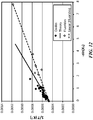
- FIGURE 12 fits eutectic data for TiO 2 -D melts 1/ T versus ln( X C )/ n to Equation (2) where n is taken to be the expected number of unique particles for the given solvent D.
- n is taken to be the expected number of unique particles for the given solvent D.
- the bulk of the data for D oxides are reasonably close to the theoretical curve for an ideal solution.
- the data for D fluorides systematically fits to a lower melting curve than for the oxides with n fluoride / n oxide ⁇ 0.63.
- FIGURE 13 fits similar data for ZrO 2 -D melts. There are fewer points available for zirconia. Most of the oxide data fits the theory. However in this case for both the fluoride data and the data for strong Lewis acids such as V 2 O 5 and WO 3 , the n deviates in the opposite direction with n fluoride-Lewis acid / n oxide ⁇ 1.45. This corresponds to increased association of the solvent and a higher solubility of ZrO 2 , probably because these solutes associate in the melt to create complexes such as the low melting point ZrF 4 . A Lewis acid deviation was not seen in either direction for TiO 2 . With such a small amount of data of uncertain accuracy, these numbers are not quantitative, but show qualitative trends.
- ZrO 2 has been grown from PbF 2 , Na 2 B 4 O 7 and a Na 2 B 4 O 7 -NaF mixture with a relatively low rate of solvent evaporation through sealing the crucible.
- Lewis acids such as V 2 O 5 are conventionally known to increase solubility.
- FIGURES 14 and 15 The uncertain quality of the data used to derive FIGURES 14 and 15 and the fact that they are for ZrO 2 -TiO 2 rather than for PZ-PT means that these figures are not sufficient to predict the best growth conditions, but they give a formalism to determine such conditions for any given solvent.
- a less preferred, but also possible solvent will comprise a strong Lewis acid such as MoO 3 , WO 3 , V 2 O 5 or P 2 O 5 .
- Equimolar salt compounds such as Li 2 MoO 3 are not Lewis acids, but rather mild Lewis bases. However, higher order Lewis acid salts such as Li 2 Mo 2 O 7 can be acidic when they dissociate in solution.
- lead compounds such as PbMoO 3 and Pb 3 (PO 4 ) 2 are Lewis acids since they dissolve into the Lewis neutral PbO and the Lewis acids MoO 3 and P 2 O 5 .
- All these compounds have significant vapor pressures at high temperatures.
- the strong Lewis base oxides MoO 3 , WO 3 , V 2 O 5 or P 2 O 5 have a much higher vapor pressure by themselves than in compound form, but they are much more effective as solvents in their individual oxide form as, for example, Li 2 MoO 4 has a poor solubility for zirconia. Rearrangement of ions in the melt may result in formation of compounds with higher or lower vapor pressures.
- PbO as a melt constituent also has a significant vapor pressure at high temperature. It has been shown that PZ cannot precipitate from a pure PbF 2 -ZrO 2 melt, but that PbO must be present. It is therefore clear that evaporation of PbO so that its concentration is below that of the combined concentrations of ZrO 2 and TiO 2 will be detrimental to the crystallization of PZT. An excess of PbO must therefore be added to the solvent to assure this does not occur. It has been found that PZ grew better if PbO was added; a PbO64%-PbF 2 36% solvent was used to grow PZ. Growth improves if 6% B 2 O 3 is used as a melt additive to reduce solvent evaporation.
- Successful liquid phase epitaxy requires selection of a substrate with a good structural, chemical, lattice parameter and thermal expansion match to the desired PZT composition.
- This is preferably a cubic, rhombohedral or tetragonal perovskite within 2% or 0.008nm of the lattice parameter of PZT to prevent the formation of misfit dislocations.
- a c-oriented PZT film is therefore expected to require a substrate lattice parameter near the average of a and b in this range, which is 0.4055nm or 0.811nm if ordering occurs such that the unit cell lattice parameters are doubled.
- PZT and possibly the substrate may have cubic crystal structures at the growth temperature and a non-destructive phase transition between the growth temperature and room temperature. The phase transition resulting in non-degeneracy of the crystal directions and non-destructive domain twinning will proceed on cooling according to the cooling program, the anisotropic stress field of a disc and the stress between the film and the substrate. The latter will evolve to minimize the stress energy and give the best possible match. Following growth, poling in an electric field may be used to improve or impose a specific match.
- the facet directions of the perovskites are the (001), (010) and (100) directions of the primitive perovskite unit cell. These are the slowest growing directions and growth typically occurs by growth at steps and dislocations, which creates an as-grown surface with bunched macro-steps, growth hillocks and possible impurity segregation at the steps and dislocations. This is undesirable for LPE where a fast-growing direction perpendicular to the substrate and a smooth uniform growth surface is desired. This best occurs for an atomically rough non-facet growth direction where almost all surface sites are growth sites.
- Non-facet surfaces can be achieved by growing on substrates cut at an intentional misorientation from a crystallographically oriented facet, typically 0.5-2.0° off the facet, for example the (001) direction. This can be desirable if the crystallographic properties of the facet direction are desired in the final crystal. Alternatively growth can be performed on a crystallographic orientation that is not a facet, for example (111) as is used in LPE of garnets. This makes characterization of the resultant films by x-ray diffraction more practical than mis-oriented substrates.
- substrates must be growable to a large size.
- Potential substrates include existing substrate materials, innovative use of an existing material and compounds that have not been made in crystal form previously.
- Strontium titanate has been most commonly used for vapor phase epitaxy (VPE) of piezoelectric perovskite thin films, often with one or more buffer/lattice matching layers. However it has a high lattice mismatch (3-6.5%) to PZT and PMN-PT that is tolerated by VPE thin films, but not by LPE thick films. This material is also hard to grow and is not considered desirable as a substrate material for LPE of PZT.
- Neodymium scandate (average lattice parameter 0.4014nm, average a-b mismatch 1%) is commercially available and praseodymium scandate (average lattice parameter 0.4027nm, average a-b mismatch 0.7%) can be produced and is available in experimental quantities. These lattice matches may be viable, but these materials are expensive, hard to grow and of limited availability. This material has low to moderate promise as a substrate material based on its good lattice match and existing supply.
- PMN-PT Lead Magnesium Niobate-Lead Titanate
- PIN-PMN-PT Lead Indium Niobate-Lead Magnesium Niobate-Lead Titanate
- PMN-PT is currently classified in the prior art as an epitaxial material based on desirable epitaxial growth of films of the MPB composition. It has not been known as a substrate material. Bulk PMN-PT and ternary solid solutions containing lead indium niobate (e.g., PIN-PMN-PT) have been successfully grown up to 3" in diameter by the Bridgman method. However the non-unity segregation coefficient K PT ⁇ 0.85 results in a gradient in the composition resulting from selective depletion of the more refractory phase.
- PIN-PMN-PT ternary solid solutions containing lead indium niobate
- PMN-PT is initiated from a melt of composition that will produce the desired phase in the main body of the crystal, but in fact the two ends are of different crystal structures with the PMN-rich bottom (first crystallized) being rhombohedral, the middle being MPB with monoclinic structure coexisting with rhombohedral or tetragonal and the PT-rich top (last crystallized) being tetragonal. Only the central MPB region is used in device applications and the rhombohedral bottoms and tetragonal tops are cut off as scrap.
- PMN Lead Magnesium Niobate
- PIN Lead Indium Niobate
- Bulk relaxor ferroelectrics PMN and PIN are not solid solutions but instead stoichiometric compounds with a rhombohedral structure at room temperature. As such they have been grown by the Bridgman and top seeded solution growth methods. It will be understood that these compounds are a special case end member of the solid solutions with the PT concentration equal zero. Because these compounds lack the strong piezoelectric properties of the solid solutions, they have not been commercialized. These materials are not known as substrate materials.
- Sr(Na 1 ⁇ 4 Ta 3 ⁇ 4 )O 3 and Sr(Na 1 ⁇ 4 Ta 3 ⁇ 4 )O 3 are reported here with the correct orthorhombic structure for the first time with unit cells rotated by 45° in the a-b plane as is common in the perovskites, so the a-b lattice parameters are a factor of ⁇ 2 different and c is doubled, but these have an attractive b-c plane average lattice parameter equivalent to ⁇ 0.8075nm that are approximate doubles of the PZT a-b average with a mismatch of only ⁇ 0.04%.
- the transition metals Mn, Fe, Co, Ni and Cu are capable of multiple valence states depending on the oxygen partial pressure and temperature, which complicates the phase diagram. Fe (and Mn) notably occur in both the 2+ and 3+ valence states.
- Fe 3 O 4 In the spinel structure Fe 3 O 4 there is a combination of the two, but that compound actually has two different symmetry sites so it is really Fe 3+ 2 Fe 2+ O 3 . This is not the case for the perovskites, but preliminary experiments show it is possible for there to be a continuous solid solution between the 2+ and 3+ perovskites for both Fe and Mn as the transition metal, e.g., Ba(Fe 2+ x Fe 3+ (1-3x)/2 Nb (1+x)/2 )O 3 .
- the Nb compounds will have lower melting temperatures than the Ta compounds. They have a cubic crystal structure and are therefore not subject to a phase change.
- the lattice parameter of Ba(Fe 1 ⁇ 2 Ta 1 ⁇ 2 )O 3 is identical to the average a-b lattice parameter of PZT for an excellent lattice match.
- Preferred melt composition embodiments include the following with the compositions in molar percent.
- the solution comprises ZrO 2 or PbZrO 3 and wherein the solubility of ZrO 2 or PZ is higher than predicted by ideal solution theory. In one embodiment, the solution comprises TiO 2 or PbTiO 3 and wherein the solubility of TiO 2 or PT is lower than predicted by ideal solution theory. In one embodiment, the solubilities of PT and PZ in the melt are approximately equal. In one embodiment, the solubilities of titanium oxide and zirconium oxide in the melt are approximately equal.
- Ionic dopants on the A and B sites that are donors or acceptors with respect to the bulk composition are commonly added to improve the piezoelectric properties of piezoelectric materials, most specifically the coercivity and mechanical quality factor Q.
- These can comprise, but are not limited to La 3+ , Bi 3+ , Na + , W 6+ and Mn(mixed valence).
- the PZT comprises less than 10 molar percent ionic dopants.
- the method further includes a step of removing the PZT single crystal from the substrate.
- removing the PZT single crystal from the substrate comprises lapping and polishing. Removed from the substrate, the PZT crystal can be incorporated into devices, etc. for any use known to those of skill in the art.
- melts of a molar composition according the formula: [(ZrO 2 ) ⁇ (TiO 2 ) 1- ⁇ ] y (PbO) 1-y with ⁇ values of approximately 0.1, 0.15, 0.2, 0.3, 0.4, 0.5, 0.54, 0.6 and 0.85.
- 50 g charges of these compositions, where the oxides were all at least 99.99% pure were placed in platinum crucibles, which were sealed with crimped platinum lids. These were placed in alumina crucibles and put in a muffle furnace. The samples were heated to 1170° and crystal growth was done by the slow-cooling method at a rate of 3°C per hour until the melt reached 950°C.
- the crucible was inverted using an alumina rod inserted and attached to the alumina crucible to remove most of the remaining melt from the crystals that grew on the sides of the platinum crucible.
- the crystals were further cleaned with a mixture of 50% nitric acid and 50% water. This mixture well dissolves lead oxide, but also etched some of the lead oxide from the surface of the PZT crystals. The resultant crystals were only of 1 mm in size in their longest dimension.
- PZT powder of composition Pb(Zr 0.525 Ti 0.475 )O 3 was prepared by calcining constituents of > 99% purity at 900°C.
- a solvent of PbO-KF-PbCl 2 in molar ratios of 2:1:2 was added in the amounts of 40% and 60%.
- the charge was placed in a 50 cubic centimeter volume platinum crucible, which was placed inside a vertical electric furnace.
- the samples were heated to 1150-1200°C and held for 5-10 hours to dissolve the PZT.
- the crystals were grown by the slow-cooling method at a rate of 10° per hour to 950°C and then cooled to room temperature.
- the crystals were separated from the flux by dissolving the flux in a warm mixture of 35% nitric acid and 65% water. Flux loss during growth was 22-32%.
- a charge consisting of 205.43 grams of strontium carbonate SrCO 3 , 12.85 grams of lithium carbonate Li 2 CO 3 and 230.61 grams of tantalum oxide Ta 2 O 5 was mixed in a ball mill and pressed into a solid body in an isostatic press. The charge was placed in an iridium crucible of dimensions 50 mm diameter by 50 mm high and put into an RF heated furnace. The melting point of this composition was 1915°C. A crystal of SrLi 0.25 Ta 0.75 O 3 was grown from this melt by the Czochralski method with a pulling rate of 1 mm/hour using a (100) oriented seed of the same material that had been produced in a previous growth run on an iridium wire seed. The crystal had a measured lattice parameter of 0.401 nm. The resultant boule was oriented to the (100) direction, ground to a cylinder and cut crosswise into slices that were then polished to an epitaxial finish.
- this material has a destructive phase transition between room temperature and 900°C that prevented it from being used successfully as a substrate material.
- a crystal of BaLi 0.25 Ta 0.75 O 3 can be grown from this melt by the Czochralski method with a pulling rate of 1 mm/hour using a (100) oriented seed of the same material produced in a previous growth run on an iridium wire seed. Orient the resultant boule to the (100) direction using x-ray diffraction methods, grind to a cylinder and cut crosswise into slices that are polished to an epitaxial finish. These substrates can be used for liquid phase epitaxial growth of perovskites (e.g., PZT) of lattice parameter match within ⁇ 1.
- perovskites e.g., PZT
- the present description also discloses a piezoelectric device, comprising a PZT single crystal formed according to the disclosed methods.
- Such piezoelectric devices include a transducer, a receiver, a sensor, and an actuator.
- a specific system for characterizing pipelines through in-line inspection comprising a PZT piezoelectric device that is a transducer and/or a receiver.
- the pipeline is configured to transport a substance selected from the group consisting of a liquid and a gas.
- Ultrasonic based in-line inspection (ILI) tools sometimes called “smart pigs” are commercially available for use in liquid pipelines for both wall thickness measurement and crack detection. These tools can operate in tethered or free-flowing mode. They characterize the pipe wall by interrogating it with an ultrasonic signal that is coupled through the pipeline liquid and receiving the reflected signals from the inner and outer pipe walls.
- ILI in-line inspection
- PZT lead zirconate titanate
- First generation piezoelectric single crystals have been made from binary solid solution relaxor-PT ferroelectric compositions such as (1-x)Pb(Mg 1/3 Nb 2/3 )O 3 -xPbTiO 3 (PMN-PT or PMNT). These offer high performance with ultra-high electromechanical coupling factors k 33 > 0.9 and improved bandwidths. However these materials are limited in temperature and acoustic power by a much lower operating temperature range compared to PZT.
- Crystals used in electromechanical devices are subjected to high electric fields, which necessitate that the crystals possess low dielectric/mechanical losses and relatively high coercive fields.
- the dielectric losses of PMN-PT crystals are reported to be on the order of ⁇ 0.4%, similar to the values observed in "hard” PZT based piezoelectrics, however, their mechanical quality factors Q are found to be less than 100, similar to "soft” PZT ceramics.
- the low mechanical Q's hence limit single crystals to low frequency actuators or resonant power transducers that operate at low duty cycles.
- Single crystal PZT systems with high operating temperatures, high piezoelectric coefficients, high electromechanical coupling factors, high Q's and improved coercivities are therefore a major step forward for transducer applications.
- Single crystal PZT has been realized to date only in limited and non-commercial sizes, quality and composition. PZT crystals would be uniquely well suited to small dimensional arrays promoting increased miniaturization. It has been demonstrated that miniaturizing array based transducers reduces artifacts, known as side-lobes, due to inherent aberrations in the acoustic field. This is proposed as an enabling technology for higher power array transducers and higher sensitivity receivers to increase the return signal from the back wall of the pipeline.
- the envisaged transducers will require lower drive voltages for equivalent signal levels in transduction and be more sensitive as receivers. Lower drive voltages also mean smaller and lower power electrical components can be used. Improved miniaturization of transducers will be enabled for high density in-line inspection (ILI) tools. Likewise increased miniaturization of electronics will allow both smaller tools for the same number of transducers and higher density tools with the same tool size.
- IIL in-line inspection
Landscapes
- Chemical & Material Sciences (AREA)
- Engineering & Computer Science (AREA)
- Crystallography & Structural Chemistry (AREA)
- Materials Engineering (AREA)
- Metallurgy (AREA)
- Organic Chemistry (AREA)
- Inorganic Chemistry (AREA)
- Manufacturing & Machinery (AREA)
- Crystals, And After-Treatments Of Crystals (AREA)
- Inorganic Compounds Of Heavy Metals (AREA)
Applications Claiming Priority (3)
| Application Number | Priority Date | Filing Date | Title |
|---|---|---|---|
| US201261732062P | 2012-11-30 | 2012-11-30 | |
| US201361774139P | 2013-03-07 | 2013-03-07 | |
| PCT/US2013/072673 WO2014130119A2 (en) | 2012-11-30 | 2013-12-02 | Method of growth of lead zirconate titanate single crystals |
Publications (3)
| Publication Number | Publication Date |
|---|---|
| EP2925914A2 EP2925914A2 (en) | 2015-10-07 |
| EP2925914A4 EP2925914A4 (en) | 2015-12-30 |
| EP2925914B1 true EP2925914B1 (en) | 2021-05-19 |
Family
ID=51391951
Family Applications (1)
| Application Number | Title | Priority Date | Filing Date |
|---|---|---|---|
| EP13875668.9A Active EP2925914B1 (en) | 2012-11-30 | 2013-12-02 | Method of growth of lead zirconate titanate single crystals |
Country Status (5)
| Country | Link |
|---|---|
| US (2) | US9738990B2 (enExample) |
| EP (1) | EP2925914B1 (enExample) |
| JP (2) | JP6457396B2 (enExample) |
| CN (1) | CN104919093B (enExample) |
| WO (1) | WO2014130119A2 (enExample) |
Families Citing this family (8)
| Publication number | Priority date | Publication date | Assignee | Title |
|---|---|---|---|---|
| CN107623070A (zh) * | 2016-07-15 | 2018-01-23 | 中国科学院金属研究所 | 一种铁电阻变存储器及其开关比的调控方法 |
| JP2020500138A (ja) | 2016-10-31 | 2020-01-09 | クエスト インテグレーテッド, エルエルシー | 単結晶のエピタキシャル成長のための、均衡点を有する単結晶ペロブスカイト固溶体 |
| US20180151301A1 (en) * | 2016-11-25 | 2018-05-31 | The Boeing Company | Epitaxial perovskite materials for optoelectronics |
| US11591712B2 (en) | 2019-05-29 | 2023-02-28 | Forschungsverbund Berlin E.V. | Method and setup for growing bulk single crystals |
| US20210242394A1 (en) * | 2020-02-04 | 2021-08-05 | Massachusetts Institute Of Technology | Magnetoelectric heterostructures and related articles, systems, and methods |
| CN115094509A (zh) * | 2022-07-22 | 2022-09-23 | 上海微逾新材料科技有限公司 | 锆钛酸铅单晶及其制备方法和应用 |
| KR102733394B1 (ko) * | 2022-09-06 | 2024-11-25 | 한국과학기술연구원 | 상경계 조성영역에서 압전성이 우수한 pyn-pmn-pt 다결정 압전체를 제조하는 방법 |
| CN116200826A (zh) | 2023-03-02 | 2023-06-02 | 中材人工晶体研究院有限公司 | 一种导模法镁铝尖晶石单晶的生长方法 |
Citations (1)
| Publication number | Priority date | Publication date | Assignee | Title |
|---|---|---|---|---|
| US20020179000A1 (en) * | 2000-02-23 | 2002-12-05 | Ho-Yang Lee | Method for single crystal growth of perovskite oxides |
Family Cites Families (14)
| Publication number | Priority date | Publication date | Assignee | Title |
|---|---|---|---|---|
| FR2683834B1 (fr) * | 1991-11-14 | 1994-03-04 | France Telecom | Procede d'obtention d'un cristal par croissance cristalline en phase liquide sur germe. |
| US5460046A (en) * | 1994-05-25 | 1995-10-24 | Tdw Delaware, Inc. | Method and apparatus for ultrasonic pipeline inspection |
| JP3963404B2 (ja) * | 1996-05-27 | 2007-08-22 | Tdk株式会社 | 積層体及びその成膜方法 |
| JP4327942B2 (ja) * | 1999-05-20 | 2009-09-09 | Tdk株式会社 | 薄膜圧電素子 |
| TW512463B (en) * | 2001-09-28 | 2002-12-01 | Macronix Int Co Ltd | Method for epitaxial growth of lead zirconate titanate film |
| CN1238575C (zh) * | 2001-10-26 | 2006-01-25 | 旺宏电子股份有限公司 | 磊晶成长锆钛酸铅薄膜的方法 |
| JP2003272324A (ja) * | 2002-03-15 | 2003-09-26 | Matsushita Electric Ind Co Ltd | 薄膜圧電体素子およびその製造方法並びにアクチュエータ |
| WO2005073788A1 (ja) * | 2004-01-30 | 2005-08-11 | Gifu University | リラクサー強誘電体固溶体単結晶、デバイス及びデバイスの使用方法 |
| US7449738B2 (en) * | 2004-10-29 | 2008-11-11 | Wisconsin Alumni Research Foundation | Strain-engineered ferroelectric thin films |
| SG124303A1 (en) * | 2005-01-18 | 2006-08-30 | Agency Science Tech & Res | Thin films of ferroelectric materials and a methodfor preparing same |
| JP2009054934A (ja) * | 2007-08-29 | 2009-03-12 | Panasonic Corp | 圧電体素子 |
| JP2009196845A (ja) * | 2008-02-20 | 2009-09-03 | Furuya Kinzoku:Kk | 単結晶製造装置、それに用いる貴金属枠及び貴金属基板ホルダー |
| JP2010013325A (ja) * | 2008-07-04 | 2010-01-21 | Fujifilm Corp | ペロブスカイト型酸化物単結晶及びその製造方法、複合圧電材料、圧電振動子、超音波探触子、並びに、超音波診断装置 |
| JP2012169400A (ja) * | 2011-02-14 | 2012-09-06 | Panasonic Corp | 強誘電体膜の製造方法とそれを用いた強誘電体素子 |
-
2013
- 2013-12-02 JP JP2015545503A patent/JP6457396B2/ja not_active Expired - Fee Related
- 2013-12-02 US US14/420,896 patent/US9738990B2/en active Active
- 2013-12-02 EP EP13875668.9A patent/EP2925914B1/en active Active
- 2013-12-02 WO PCT/US2013/072673 patent/WO2014130119A2/en not_active Ceased
- 2013-12-02 CN CN201380067374.9A patent/CN104919093B/zh active Active
-
2017
- 2017-07-10 US US15/645,768 patent/US20170314156A1/en not_active Abandoned
-
2018
- 2018-12-20 JP JP2018238785A patent/JP2019069897A/ja active Pending
Patent Citations (1)
| Publication number | Priority date | Publication date | Assignee | Title |
|---|---|---|---|---|
| US20020179000A1 (en) * | 2000-02-23 | 2002-12-05 | Ho-Yang Lee | Method for single crystal growth of perovskite oxides |
Also Published As
| Publication number | Publication date |
|---|---|
| WO2014130119A3 (en) | 2014-11-27 |
| US9738990B2 (en) | 2017-08-22 |
| JP2019069897A (ja) | 2019-05-09 |
| US20150233015A1 (en) | 2015-08-20 |
| EP2925914A2 (en) | 2015-10-07 |
| JP6457396B2 (ja) | 2019-01-23 |
| EP2925914A4 (en) | 2015-12-30 |
| US20170314156A1 (en) | 2017-11-02 |
| CN104919093A (zh) | 2015-09-16 |
| WO2014130119A2 (en) | 2014-08-28 |
| JP2016501819A (ja) | 2016-01-21 |
| CN104919093B (zh) | 2018-06-22 |
Similar Documents
| Publication | Publication Date | Title |
|---|---|---|
| US9738990B2 (en) | Method of liquid-phase epitaxial growth of lead zirconate titanate single crystals | |
| US10844516B2 (en) | Single-crystal perovskite solid solutions with indifferent points for epitaxial growth of single crystals | |
| Milisavljevic et al. | Current status of solid-state single crystal growth | |
| US7972527B2 (en) | Method of making ternary piezoelectric crystals | |
| Koruza et al. | (K, Na) NbO3-based piezoelectric single crystals: Growth methods, properties, and applications | |
| EP2414303B1 (en) | Ceramic, piezoelectric device, and production method thereof | |
| Chu et al. | Properties of (Na, K) NbO 3 and (Li, Na, K) NbO 3 ceramic mixed systems | |
| JP4613032B2 (ja) | 圧電単結晶素子およびその製造方法 | |
| Liu et al. | Temperature-dependent evolution of crystallographic and domain structures in (K, Na, Li)(Ta, Nb) O 3 piezoelectric single crystals | |
| Fang et al. | Growth mechanism and electrical properties of Pb [(Zn1/3Nb2/3) 0.91 Ti0. 09] O3 single crystals by a modified Bridgman method | |
| US8597535B2 (en) | Method of making ternary piezoelectric crystals | |
| US8119024B1 (en) | Piezoelectric single crystal ingot, producing method therefor and piezoelectric single crystal device | |
| Han et al. | Bridgman growth and properties of PMN-PT-based single crystals | |
| JP4878607B2 (ja) | 全率固溶型圧電単結晶インゴットの製造方法及び全率固溶型圧電単結晶インゴット、並びに、圧電単結晶素子 | |
| Duran | Processing and ferroelectric behavior of textured KSr2Nb5O15 ceramics | |
| Benčan et al. | Growth and characterization of single crystals of potassium sodium niobate by solid state crystal growth | |
| Zhao et al. | Fabrication of lead-free piezoelectric ceramics by (reactive) templated grain growth | |
| US20260305177A1 (en) | Lead zirconate titanate (pzt) solution phase diagram and crystal growth near thermodynamic equilibrium | |
| Wu et al. | Bridgman growth of Pb [(Zn1/3Nb2/3) 0.91 Ti0. 09] O3 single crystals using different seeds | |
| Xu et al. | 5B-2 Growth and Properties of Some Relaxor-Based Ferroelectric Single Crystals with High Curie Temperature by the Solution Bridgman and Modified Bridgman Techniques | |
| CN122610210A (zh) | 一种铁酸铋-钛酸铅-钛酸钡铁电压电单晶及其制备方法和应用 | |
| Xu | Growth of lead-based functional crystals by the vertical bridgman method | |
| Kwon et al. | Solid state grain growth of piezoelectric single crystals | |
| Yamashita | Piezoelectric materials in the 21/sup st/century | |
| SHROUT et al. | University Park, PA 16802 |
Legal Events
| Date | Code | Title | Description |
|---|---|---|---|
| PUAI | Public reference made under article 153(3) epc to a published international application that has entered the european phase |
Free format text: ORIGINAL CODE: 0009012 |
|
| 17P | Request for examination filed |
Effective date: 20150611 |
|
| AK | Designated contracting states |
Kind code of ref document: A2 Designated state(s): AL AT BE BG CH CY CZ DE DK EE ES FI FR GB GR HR HU IE IS IT LI LT LU LV MC MK MT NL NO PL PT RO RS SE SI SK SM TR |
|
| AX | Request for extension of the european patent |
Extension state: BA ME |
|
| A4 | Supplementary search report drawn up and despatched |
Effective date: 20151201 |
|
| RIC1 | Information provided on ipc code assigned before grant |
Ipc: C30B 19/00 20060101ALI20151123BHEP Ipc: C30B 29/32 20060101ALI20151123BHEP Ipc: H01L 41/41 20130101ALI20151123BHEP Ipc: H01L 41/317 20130101AFI20151123BHEP |
|
| DAX | Request for extension of the european patent (deleted) | ||
| STAA | Information on the status of an ep patent application or granted ep patent |
Free format text: STATUS: EXAMINATION IS IN PROGRESS |
|
| 17Q | First examination report despatched |
Effective date: 20170612 |
|
| RAP1 | Party data changed (applicant data changed or rights of an application transferred) |
Owner name: QUEST COMPANIES, LLC |
|
| RAP1 | Party data changed (applicant data changed or rights of an application transferred) |
Owner name: QUEST INTEGRATED, LLC |
|
| GRAP | Despatch of communication of intention to grant a patent |
Free format text: ORIGINAL CODE: EPIDOSNIGR1 |
|
| STAA | Information on the status of an ep patent application or granted ep patent |
Free format text: STATUS: GRANT OF PATENT IS INTENDED |
|
| INTG | Intention to grant announced |
Effective date: 20201221 |
|
| GRAS | Grant fee paid |
Free format text: ORIGINAL CODE: EPIDOSNIGR3 |
|
| GRAA | (expected) grant |
Free format text: ORIGINAL CODE: 0009210 |
|
| STAA | Information on the status of an ep patent application or granted ep patent |
Free format text: STATUS: THE PATENT HAS BEEN GRANTED |
|
| AK | Designated contracting states |
Kind code of ref document: B1 Designated state(s): AL AT BE BG CH CY CZ DE DK EE ES FI FR GB GR HR HU IE IS IT LI LT LU LV MC MK MT NL NO PL PT RO RS SE SI SK SM TR |
|
| REG | Reference to a national code |
Ref country code: GB Ref legal event code: FG4D |
|
| REG | Reference to a national code |
Ref country code: CH Ref legal event code: EP |
|
| REG | Reference to a national code |
Ref country code: DE Ref legal event code: R096 Ref document number: 602013077595 Country of ref document: DE |
|
| REG | Reference to a national code |
Ref country code: AT Ref legal event code: REF Ref document number: 1394849 Country of ref document: AT Kind code of ref document: T Effective date: 20210615 |
|
| REG | Reference to a national code |
Ref country code: IE Ref legal event code: FG4D |
|
| REG | Reference to a national code |
Ref country code: LT Ref legal event code: MG9D |
|
| REG | Reference to a national code |
Ref country code: AT Ref legal event code: MK05 Ref document number: 1394849 Country of ref document: AT Kind code of ref document: T Effective date: 20210519 |
|
| REG | Reference to a national code |
Ref country code: NL Ref legal event code: MP Effective date: 20210519 |
|
| PG25 | Lapsed in a contracting state [announced via postgrant information from national office to epo] |
Ref country code: HR Free format text: LAPSE BECAUSE OF FAILURE TO SUBMIT A TRANSLATION OF THE DESCRIPTION OR TO PAY THE FEE WITHIN THE PRESCRIBED TIME-LIMIT Effective date: 20210519 Ref country code: AT Free format text: LAPSE BECAUSE OF FAILURE TO SUBMIT A TRANSLATION OF THE DESCRIPTION OR TO PAY THE FEE WITHIN THE PRESCRIBED TIME-LIMIT Effective date: 20210519 Ref country code: BG Free format text: LAPSE BECAUSE OF FAILURE TO SUBMIT A TRANSLATION OF THE DESCRIPTION OR TO PAY THE FEE WITHIN THE PRESCRIBED TIME-LIMIT Effective date: 20210819 Ref country code: FI Free format text: LAPSE BECAUSE OF FAILURE TO SUBMIT A TRANSLATION OF THE DESCRIPTION OR TO PAY THE FEE WITHIN THE PRESCRIBED TIME-LIMIT Effective date: 20210519 Ref country code: LT Free format text: LAPSE BECAUSE OF FAILURE TO SUBMIT A TRANSLATION OF THE DESCRIPTION OR TO PAY THE FEE WITHIN THE PRESCRIBED TIME-LIMIT Effective date: 20210519 |
|
| PG25 | Lapsed in a contracting state [announced via postgrant information from national office to epo] |
Ref country code: PL Free format text: LAPSE BECAUSE OF FAILURE TO SUBMIT A TRANSLATION OF THE DESCRIPTION OR TO PAY THE FEE WITHIN THE PRESCRIBED TIME-LIMIT Effective date: 20210519 Ref country code: NO Free format text: LAPSE BECAUSE OF FAILURE TO SUBMIT A TRANSLATION OF THE DESCRIPTION OR TO PAY THE FEE WITHIN THE PRESCRIBED TIME-LIMIT Effective date: 20210819 Ref country code: PT Free format text: LAPSE BECAUSE OF FAILURE TO SUBMIT A TRANSLATION OF THE DESCRIPTION OR TO PAY THE FEE WITHIN THE PRESCRIBED TIME-LIMIT Effective date: 20210920 Ref country code: ES Free format text: LAPSE BECAUSE OF FAILURE TO SUBMIT A TRANSLATION OF THE DESCRIPTION OR TO PAY THE FEE WITHIN THE PRESCRIBED TIME-LIMIT Effective date: 20210519 Ref country code: RS Free format text: LAPSE BECAUSE OF FAILURE TO SUBMIT A TRANSLATION OF THE DESCRIPTION OR TO PAY THE FEE WITHIN THE PRESCRIBED TIME-LIMIT Effective date: 20210519 Ref country code: SE Free format text: LAPSE BECAUSE OF FAILURE TO SUBMIT A TRANSLATION OF THE DESCRIPTION OR TO PAY THE FEE WITHIN THE PRESCRIBED TIME-LIMIT Effective date: 20210519 Ref country code: LV Free format text: LAPSE BECAUSE OF FAILURE TO SUBMIT A TRANSLATION OF THE DESCRIPTION OR TO PAY THE FEE WITHIN THE PRESCRIBED TIME-LIMIT Effective date: 20210519 Ref country code: GR Free format text: LAPSE BECAUSE OF FAILURE TO SUBMIT A TRANSLATION OF THE DESCRIPTION OR TO PAY THE FEE WITHIN THE PRESCRIBED TIME-LIMIT Effective date: 20210820 Ref country code: IS Free format text: LAPSE BECAUSE OF FAILURE TO SUBMIT A TRANSLATION OF THE DESCRIPTION OR TO PAY THE FEE WITHIN THE PRESCRIBED TIME-LIMIT Effective date: 20210919 |
|
| PG25 | Lapsed in a contracting state [announced via postgrant information from national office to epo] |
Ref country code: NL Free format text: LAPSE BECAUSE OF FAILURE TO SUBMIT A TRANSLATION OF THE DESCRIPTION OR TO PAY THE FEE WITHIN THE PRESCRIBED TIME-LIMIT Effective date: 20210519 |
|
| PG25 | Lapsed in a contracting state [announced via postgrant information from national office to epo] |
Ref country code: EE Free format text: LAPSE BECAUSE OF FAILURE TO SUBMIT A TRANSLATION OF THE DESCRIPTION OR TO PAY THE FEE WITHIN THE PRESCRIBED TIME-LIMIT Effective date: 20210519 Ref country code: CZ Free format text: LAPSE BECAUSE OF FAILURE TO SUBMIT A TRANSLATION OF THE DESCRIPTION OR TO PAY THE FEE WITHIN THE PRESCRIBED TIME-LIMIT Effective date: 20210519 Ref country code: DK Free format text: LAPSE BECAUSE OF FAILURE TO SUBMIT A TRANSLATION OF THE DESCRIPTION OR TO PAY THE FEE WITHIN THE PRESCRIBED TIME-LIMIT Effective date: 20210519 Ref country code: SM Free format text: LAPSE BECAUSE OF FAILURE TO SUBMIT A TRANSLATION OF THE DESCRIPTION OR TO PAY THE FEE WITHIN THE PRESCRIBED TIME-LIMIT Effective date: 20210519 Ref country code: SK Free format text: LAPSE BECAUSE OF FAILURE TO SUBMIT A TRANSLATION OF THE DESCRIPTION OR TO PAY THE FEE WITHIN THE PRESCRIBED TIME-LIMIT Effective date: 20210519 Ref country code: RO Free format text: LAPSE BECAUSE OF FAILURE TO SUBMIT A TRANSLATION OF THE DESCRIPTION OR TO PAY THE FEE WITHIN THE PRESCRIBED TIME-LIMIT Effective date: 20210519 |
|
| REG | Reference to a national code |
Ref country code: DE Ref legal event code: R097 Ref document number: 602013077595 Country of ref document: DE |
|
| PLBE | No opposition filed within time limit |
Free format text: ORIGINAL CODE: 0009261 |
|
| STAA | Information on the status of an ep patent application or granted ep patent |
Free format text: STATUS: NO OPPOSITION FILED WITHIN TIME LIMIT |
|
| 26N | No opposition filed |
Effective date: 20220222 |
|
| PG25 | Lapsed in a contracting state [announced via postgrant information from national office to epo] |
Ref country code: IS Free format text: LAPSE BECAUSE OF FAILURE TO SUBMIT A TRANSLATION OF THE DESCRIPTION OR TO PAY THE FEE WITHIN THE PRESCRIBED TIME-LIMIT Effective date: 20210919 Ref country code: AL Free format text: LAPSE BECAUSE OF FAILURE TO SUBMIT A TRANSLATION OF THE DESCRIPTION OR TO PAY THE FEE WITHIN THE PRESCRIBED TIME-LIMIT Effective date: 20210519 |
|
| PG25 | Lapsed in a contracting state [announced via postgrant information from national office to epo] |
Ref country code: MC Free format text: LAPSE BECAUSE OF FAILURE TO SUBMIT A TRANSLATION OF THE DESCRIPTION OR TO PAY THE FEE WITHIN THE PRESCRIBED TIME-LIMIT Effective date: 20210519 Ref country code: IT Free format text: LAPSE BECAUSE OF FAILURE TO SUBMIT A TRANSLATION OF THE DESCRIPTION OR TO PAY THE FEE WITHIN THE PRESCRIBED TIME-LIMIT Effective date: 20210519 |
|
| REG | Reference to a national code |
Ref country code: CH Ref legal event code: PL |
|
| REG | Reference to a national code |
Ref country code: BE Ref legal event code: MM Effective date: 20211231 |
|
| PG25 | Lapsed in a contracting state [announced via postgrant information from national office to epo] |
Ref country code: LU Free format text: LAPSE BECAUSE OF NON-PAYMENT OF DUE FEES Effective date: 20211202 Ref country code: IE Free format text: LAPSE BECAUSE OF NON-PAYMENT OF DUE FEES Effective date: 20211202 |
|
| REG | Reference to a national code |
Ref country code: DE Ref legal event code: R079 Ref document number: 602013077595 Country of ref document: DE Free format text: PREVIOUS MAIN CLASS: H01L0041317000 Ipc: H10N0030077000 |
|
| PG25 | Lapsed in a contracting state [announced via postgrant information from national office to epo] |
Ref country code: BE Free format text: LAPSE BECAUSE OF NON-PAYMENT OF DUE FEES Effective date: 20211231 |
|
| PG25 | Lapsed in a contracting state [announced via postgrant information from national office to epo] |
Ref country code: LI Free format text: LAPSE BECAUSE OF NON-PAYMENT OF DUE FEES Effective date: 20211231 Ref country code: CH Free format text: LAPSE BECAUSE OF NON-PAYMENT OF DUE FEES Effective date: 20211231 |
|
| PG25 | Lapsed in a contracting state [announced via postgrant information from national office to epo] |
Ref country code: HU Free format text: LAPSE BECAUSE OF FAILURE TO SUBMIT A TRANSLATION OF THE DESCRIPTION OR TO PAY THE FEE WITHIN THE PRESCRIBED TIME-LIMIT; INVALID AB INITIO Effective date: 20131202 |
|
| PG25 | Lapsed in a contracting state [announced via postgrant information from national office to epo] |
Ref country code: CY Free format text: LAPSE BECAUSE OF FAILURE TO SUBMIT A TRANSLATION OF THE DESCRIPTION OR TO PAY THE FEE WITHIN THE PRESCRIBED TIME-LIMIT Effective date: 20210519 |
|
| PG25 | Lapsed in a contracting state [announced via postgrant information from national office to epo] |
Ref country code: MK Free format text: LAPSE BECAUSE OF FAILURE TO SUBMIT A TRANSLATION OF THE DESCRIPTION OR TO PAY THE FEE WITHIN THE PRESCRIBED TIME-LIMIT Effective date: 20210519 |
|
| PG25 | Lapsed in a contracting state [announced via postgrant information from national office to epo] |
Ref country code: MT Free format text: LAPSE BECAUSE OF FAILURE TO SUBMIT A TRANSLATION OF THE DESCRIPTION OR TO PAY THE FEE WITHIN THE PRESCRIBED TIME-LIMIT Effective date: 20210519 |
|
| PGFP | Annual fee paid to national office [announced via postgrant information from national office to epo] |
Ref country code: DE Payment date: 20241112 Year of fee payment: 12 |
|
| PGFP | Annual fee paid to national office [announced via postgrant information from national office to epo] |
Ref country code: GB Payment date: 20241107 Year of fee payment: 12 |
|
| PGFP | Annual fee paid to national office [announced via postgrant information from national office to epo] |
Ref country code: FR Payment date: 20241111 Year of fee payment: 12 |
|
| PG25 | Lapsed in a contracting state [announced via postgrant information from national office to epo] |
Ref country code: TR Free format text: LAPSE BECAUSE OF FAILURE TO SUBMIT A TRANSLATION OF THE DESCRIPTION OR TO PAY THE FEE WITHIN THE PRESCRIBED TIME-LIMIT Effective date: 20210519 |
|
| REG | Reference to a national code |
Ref country code: DE Ref legal event code: R119 Ref document number: 602013077595 Country of ref document: DE |
|
| GBPC | Gb: european patent ceased through non-payment of renewal fee |
Effective date: 20251202 |